

Submitted:
27 December 2023
Posted:
28 December 2023
You are already at the latest version
Abstract
High-grade gliomas are extremely fatal tumors, marked by severe hypoxia and therapeutic resistance. Autophagy is a cellular degradative process that can be activated by hypoxia, ultimately resulting in tumor advancement and chemo-resistance. Our study aimed to examine the link between autophagy markers expression in low (LGG) and high-grade gliomas (HGG). In 39 glioma cases, we assessed protein expression of autophagy markers LC3B, p62, and DRAM by immunohistochemistry (IHC) and mRNA expression of autophagy genes; PI3K, AKT, m-TOR, PTEN, ULK1, ULK2, UVRAG, Beclin 1 and VPS34 using RT-qPCR. Livak’s method was used to analyze the relative changes in gene expression and multi-variate Anova test and Spearman's correlation tests were performed for statistical significance. LC3B, p62, and DRAM expression were positive in 64.1%, 51.3%, and 28.2% of glioma cases respectively. The expression of LC3B and p62 was notably higher in HGG compared to LGG. VPS34 exhibited a significant differential expression and increased fold change and demonstrated strong positive correlations with Beclin1 (rs=0.768), UVRAG (rs=0.802), and ULK2 (rs=0.786) in HGG compared to LGG, thus highlighting the potential link between autophagy and glioma progression. We Provide preliminary data for functional analysis of autophagy using cell culture model and to identify potential targets for therapeutic interventions
Keywords:
Autophagy
; Autophagy related genes (ARG)
; High grade gliomas (HGG)
; Low grade gliomas (LGG)
; LC3B
; p62 & DRAM
1. Introduction
Central nervous system (CNS) cancers are rare and heterogeneous tumors with diverse biology and genetics and account for about 3% of all cancers in the world and are more common in men [1]. Gliomas constitute the most common type of brain tumors, comprising around 24.7% of all primary tumors in the brain and other CNS tumors and 74.6% of malignant cases [2]. The most prevalent malignant histology is glioblastoma making up 14.2% of all tumors and constituting 50.1% of all malignant CNS tumors [3]. New 2021 WHO CNS 5 classification has divided diffuse gliomas into adult type and pediatric type. The basic molecules for the integrated diagnosis of adult-diffuse gliomas are IDH (Isocitrate dehydrogenase), p53, ATRX (alpha-thalassemia/mental retardation, X-linked) & 1p/19q co-deletion. Adult diffuse gliomas (IDH-mutant astrocytomas, IDH-mutant, 1p/19q codeleted oligodendroglioma and IDH-wildtype Glioblastoma) are diffusely infiltrating brain tumors [4]. High grade Gliomas predominantly wild type glioblastomas are extremely lethal neoplasms with a poor prognosis. Despite maximum neurosurgical resection and adjuvant therapy; temozolamide (TMZ), median survival barely extends to approximately 12 months [5]. Unfortunately, as with other solid tumors, chemo- resistance is one of the major challenges in this regard. Various mechanisms have been described for chemo resistance. Evasion of apoptosis is one of the mechanisms for tumor progression and chemo resistance in gliomas [6] probably through either deficiency in BAX or BAK or gain of Bcl2 or BclX [7]. Some studies have also revealed that the resistance of cancer cells to chemotherapeutic drugs may be due to the up regulation of autophagy, thereby avoiding apoptosis [8,9].
Autophagy is a cellular degradation pathway for the breakdown and removal of impaired long lived proteins, as well as the elimination of organelles and pathogens[10]. Moreover, it has an important homeostatic role in maintaining the cell viability in stressed or nutritionally deprived states by recycling the cytoplasmic constituent [11]. Thus, it controls the quality and quantity of proteins and organelles. Dysfunctional autophagy contributes in various diseases, with cancer being one of them. Nevertheless, in cancer, role of autophagy is somewhat complicated and controversial. Autophagy is a double edge sword, has dual effects on cancer. On one hand, it promotes tumor cell survival, by breaking down macromolecules into smaller components like amino acids, fatty acids, and metabolic substances. Studies have suggested that autophagy is activated in glioblastoma (GBM) as a reaction to pathophysiological challenges like necrosis and an acidic milieu. Hypoxia, a characteristic feature of high-grade gliomas, is responsible for inducing autophagy in these tumors. As the tumor progresses and reacts to therapeutic interventions, cells must adjust their metabolism to endure in hypoxic and nutrient-deficient surroundings, which is commonly linked to chemotherapy and radiotherapy resistance. This process facilitates tumor growth and viability, contributing to the maintenance of intracellular metabolism. Under unfavorable hypoxic conditions, molecules such as hypoxia-induced factors (HIF2a and HIF2b), BECN1 (Beclin-1), and BNIP3 (BCL2/adenovirus E1B 19KDa interacting protein 2) serve as survival mechanisms, promoting the progression of GBM and resistance to anticancer treatment in vivo [12-15]. Hypoxia causes BECN1 phosphorylation via the HIF-1a/BECN1 signaling pathway[16,17]. Beclin-1 is a key regulatory protein in autophagosome formation, which binds to the class III PI–3 kinase Vps34, thus facilitating the progression of autophagic process [18,19]. Remarkably, in the presence of hypoxia, the initiation of autophagy through BNIP3/BNIP3L serves as a survival mechanism, fostering the progression of GBM and enhancing resistance to anticancer treatments in vivo [20]. A recent study showed that in U87 cells exposed to hypoxic conditions, the knockdown of HIF1A significantly reduced BNIP3 expression[21]. This implies that tissues with low oxygen levels are prone to show heightened autophagy, indicating that an increased autophagy flux may serve an adaptive function [15,22]. On the other hand, autophagy can also suppress tumor progression in development, as impaired autophagy causes oxidative stress, triggers DNA damage responses and results in genomic instability, a known cause for tumor initiation. Such dual effects on tumor behavior are most likely context dependent [23-26]. Moreover research indicated that prolonged hypoxic stress in vitro, up regulates a pro-apoptotic Bcl-2 protein (BNIP3), leading to hypoxia-dependent autophagic cell death (ACD) in GBM cells [27]. In terms of the mechanism, the elevated expression of BNIP3 leads to the release of BECN1 from complexes with Bcl-2 or Bcl-xL, thereby enabling BECN1 to activate autophagy[28]. Hence, autophagy has been found to show conflicting functions in tumor onset and advancement. Thus, manipulation of autophagy pathways as means of cell death in cancer has led to the exploration of both inhibitors and inducers. Keeping in mind the contradictory results of autophagy in cancer, we investigated expression of autophagy markers and autophagy related genes (ATG) in our cohort of low and high grade gliomas.
2. Results
2.1. Clinicopathologic characteristics ofAdult Diffuse Glioma Patients
Demographic data of the studied cases showed that average age of the patients was 43.14 ± 13.25. Of the 39 adult diffuse glioma patients that were enrolled in this study, 23 (59%) were males and16 (41%) were females. Histological examination showed that IDH- mutated astrocytic tumors were identified as most frequently diagnosed subtype of adult diffuse gliomas (48.7%), followed by oligodendroglial tumors (30.8%) and Glioblastoma IDH-wild type (20.5%). When cases were stratified on the basis of histological grades, 15 (38.5%) cases were of grade 4, 13 (33.3%) were grade 3 and 11 (28.2%) were grade 2. Moreover, of the 39 cases, 25 (64.1%) showed IDHR132 mutation, 16 (41%) showed p53 mutation and 21 (53.8%) showed ATRX loss (mutation), as shown in Table 1.
2.2. Evaluation of autophagy status using immunohistochemical analysis of Molecular markers (LC3B, SQSTM1/p62 and DRAM)
Autophagy-related protein expression of LC3B, SQSTM1/p62 and DRAM was performed in 39 LGG and HGG cases to assess the autophagy status in the current study. Diffuse cytoplasmic and nuclear expression of LC3B was found in all cases. Nonetheless, strong punctate cytoplasmic expression of LC3B and SQSTM1/p62 was categorized as a positive result, and the presence of positive cytoplasmic staining for DRAM was also considered as a positive outcome. Our result showed a strong punctate cytoplasmic expression of LC3B and SQSTM1/p62 and in HGG when compared with LGG and peritumoral non-glioma tissue. Additionally DRAM also exhibited positive and negative cytoplasmic staining (Figure 1).
2.3. Correlation of clinicopathological features and autophagy markers
Among the 39 glioma cases analyzed, 23 (59%) cases of HGG showed a positive expression of LC3B, whereas SQSTM1/p62 demonstrated positive expression in all 20 (100%) HGG cases. DRAM overexpression was detected in the cytoplasm of 11 (28.2%) cases, encompassing both LGG and HGG (Table 2).
Consequently, elevated levels of LC3B and SQSTM1/p62 were frequently observed in HGG, with corresponding p-values of 0.001 and <0.001, respectively. However there was no significant correlation between DRAM overexpression and histologic grades (Table 3). Furthermore, autophagy status was considered to be positive in 19 (48.7%) cases, in this study population. A statistically significant correlation was detected when comparing the age groups with the autophagy markers. Significant correlations were found between age groups and the autophagy markers LC3B (p = 0.022) and SQSTM1/p62 (p = 0.017). Moreover, when examining the correlation between autophagy markers and clinicopathologic factors such as gender, histological type, and molecular markers of glioma including IDH, ATRX, and p53, no statistically significant differences were observed (Table 4).
2.4. Analysis of Autophagy related genes (ATG) expression in High grade and Low grade gliomas
Following the immunohistochemical analysis of well-established autophagy markers, we selected nine autophagy related genes including the master regulators and core autophagy genes such as PTEN, PI3K, AKT, mTOR, ULK1, ULK2, UVRAG, Beclin 1 and VPS34. The difference in relative mRNA expression of autophagy related genes was compared in different grades of gliomas in 39 cases. We found a highly significant statistical difference in VPS34 mRNA relative expressions among grade 2 and 3 (p=0.01) and grade 2 and grade 4 (p=0.01). Nevertheless, there was no notable difference in expression of other genes associated with the essential autophagy machinery between low and high grade gliomas. Comparisons of PI3k (p=0.495), AKT (p=0.85), PTEN (p=0.78), Beclin1 (p=0.217), ULK1 (p=0.785), ULK2 (p=0.524), and UVRAG (p=0.387) between grade 2 and grade 4 showed statistically insignificant differences. Similarly, the negative autophagy regulator mTOR was not significantly differentially expressed between the two glioma grades (p = 0.07), but higher expression was noticed in higher grade.
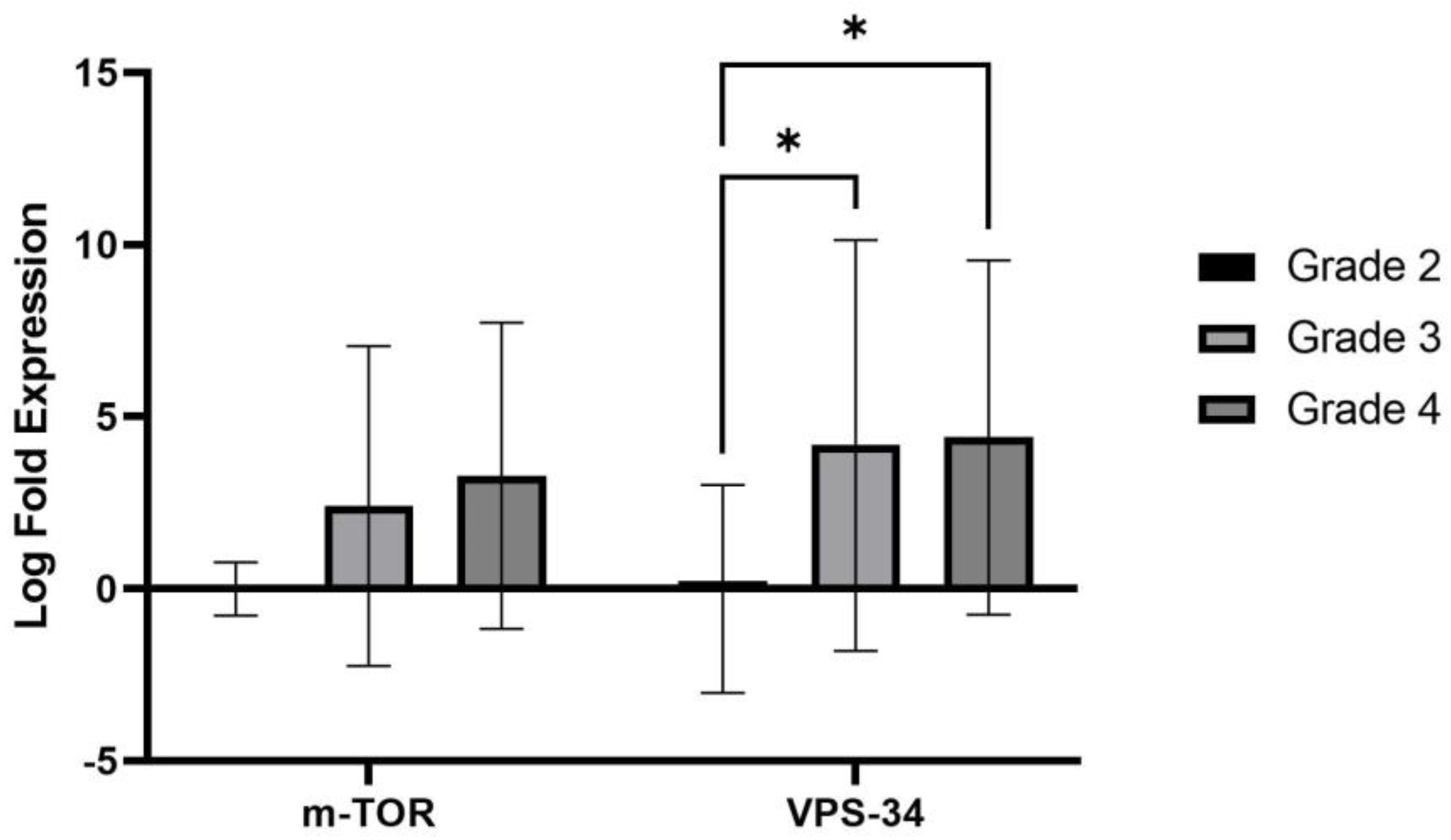
Next, log2 fold change (FC) was executed using grade 2 gliomas as reference group. Two genes were selected for log2 fold change (FC) ≥ 2. We found expression of VPS34 to be significantly increased in higher grade gliomas (p=0.01). Expression of mTOR, which is a negative regulator of autophagy, is increased in grade 3 and grade 4. However it didn’t reach statistical significance (p=0.07).
Figure 3.
The graph depicts the fold change in the expression of VPS34 and mTOR in 2, 3 & 4 WHO grades of gliomas. The Y-axis represents the logarithmic fold expression. The lines marked with asterisks indicate a notable difference (**p < 0.01) in VPS34 expression between low and high-grade cases.
Figure 3.
The graph depicts the fold change in the expression of VPS34 and mTOR in 2, 3 & 4 WHO grades of gliomas. The Y-axis represents the logarithmic fold expression. The lines marked with asterisks indicate a notable difference (**p < 0.01) in VPS34 expression between low and high-grade cases.
Furthermore, we applied Spearman correlation test to examine the correlation between ATG genes in the WHO grade 2, 3 and 4 gliomas. In WHO grade 2, Significant strong positive correlation was observed between PI3K and PTEN, ULK2; mTOR and PTEN, ULK1; PTEN and PI3K, m-TOR, ULK1, ULK 2, UVRAG; ULK1 and mTOR; ULK 2 and PI3K, PTEN, ULK 1; UVRAG and PTEN. Significant moderate positive correlation was observed between BECLIN 1 and mTOR, PTEN and BECLIN 1, ULK2 and UVRAG, VPS34; UVRAG and ULK2; VPS34 and ULK 2 (Table 5).
In grade 3 gliomas, significant strong positive correlation was observed between PI3K and mTOR, ULK2, UVRAG; mTOR and PTEN, ULK1; PTEN and PI3K, m-TOR, ULK1, ULK 2, UVRAG; mTOR and PI3K, PTEN and mTOR, ULK2, UVRAG; ULK1 and ULK2, UVRAG; ULK 2 and PI3K, PTEN, ULK 1, UVRAG, VPS34; UVRAG and PI3K, PTEN, ULK1, ULK2,VPS34. Significant moderate positive correlation was observed between PI3K and ULK1; BECLIN 1 and mTOR; mTOR and VPS34; PTEN and ULK1; ULK1 and PI3K, VPS34 (Table 6).
In WHO grade 4 diffuse gliomas, significant strong positive correlation was observed between PI3K and BECLIN 1, ULK2; BECLIN 1 and ULK1, ULK2, VPS34; ULK2 and ULK1; UVRAG and ULK2; VPS34 and ULK2. Significant moderate positive correlation was observed between PI3K and PTEN and VPS34; ULK 1 and VPS34 (Table 7).
3. Discussion
Autophagy is primarily a stress response process, and most of body tissues need autophagy to eliminate accumulated damaged organelles and unfolded proteins to maintain normal homeostatic milieu. In cancer, autophagy plays both tumor suppressing and tumor promoting effects depending on the specific context, thus could influence on the prognosis, either favorably or adversely. We investigated whether autophagy plays anti-tumoral or pro-tumoral functions in various grades of gliomas.
In this current research, we assessed the immunohistochemical expression of autophagy markers as well as mRNA levels of ATG in different grades of adult-type diffuse gliomas, while also assessing their correlation with clinicopathological parameters. Our investigation revealed a significant connection between the immunohistochemical expression of LC3B, SQSTM1/p62, DRAM, and the overall autophagy status, particularly in relation to tumor grades. Notably, among the 25 positive cases of LC3B, only two were observed in the LGG. Similarly, out of the 20 strongly positive cases of SQSTM1/p62, none was found in the LGG category, and this difference achieved statistical significance (as indicated in Table 3). These results were in accordance with other studies which reported that LC3B and SQSTM1/p62 was highly expressed in high grade gliomas [29,30,31]. Remarkably there is statistically significant association between the autophagy markers LC3B and SQSTM1/p62 (p=0.000), highlighting the interaction among each other. These results may be attributed to the active participation of LC3B and SQSTM1/p62 in the process of autophagy, given their roles as essential structural components of the autophagosome[32] and recent literature also revealed that that SQSTM1/p62 overexpression is capable of promoting mitochondrial and classical macroautophagy [33], which promote tumor progression and chemo-resistances. Furthermore increased expression of LC3B and SQSTM1/p62 in HGG compared with LGG may be in response to confer stress tolerance which is definitely more in HGG, serves to maintain tumor cell survival [34]. Hypoxia, which is major hallmark of Glioblastoma, is known to induce autophagy in these tumors, which eventually produce survival mechanism facilitating the breakdown of various cellular components to generate ATP and metabolic precursors as a means to cope up with stress. This highlights the crucial role of autophagy in protecting cells against stressful conditions[35]. In a study conducted by Deng et al; it was reported that both mRNA and protein levels of SQSTM1/p62 were elevated in human glioma tissues, and the suppression of SQSTM1/p62 had an anti-tumor effect on glioma cells [34]. These findings may support that high levels of LC3B and SQSTM1/p62 expression or prompted autophagy correlated with advanced tumor grade and aggressiveness with the potential role of autophagy as tumor enhancer, thus supporting our results.
We also looked another important autophagy modulator DRAM1 in our study and found its overexpression in 28.2% of the cases, although it was not significantly associated with tumor grades but higher expression of DRAM1 was present in high grade gliomas, when compared with LGG. DRAM 1 primarily resides in lysosomes and is frequently down regulated in various human cancers[36]. DRAM1 enhances lysosomal acidification and facilitates the fusion of lysosomes with autophagosomes, thus triggers the autophagy. Moreover DRAM1 plays pivotal role in governing the association of SQSTM1/p62 with autophagosomes and its subsequent degradation through autophagy. Therefore, reduced DRAM1 expression might be associated with decreased SQSTM1/p62 localization within autophagosome, highlighting the role of DRAM1 in SQSTM1/p62 -mediated autophagy. Our findings align with the study by Geng et al; which also reported reduced DRAM1 expression in non-small cell lung carcinoma, correlating with an unfavorable prognosis [37]. However, another study has shown high expression of both DRAM1 and SQSTM1/p62 in Glioblastoma, where they regulate cell migration and invasion, and are associated with shorter or poor overall survival [38]. These conflicting results could arise from variations in demographics and sample sizes. Thus utilizing the expression levels of LC3B, SQSTM1/p62 and DRAM1 to assess autophagy status in glioma patients could be potential predictive markers.
While investigating the autophagy gene expression patterns in both low (grade 2) and high (grade 3 and 4) grades of tumors, we noticed a remarkable and statistically significant up-regulation in autophagy critical kinase, vacuolar protein sorting 34 (Vps34) gene expression thus indicating a tumor promoter role of VPS34 gene in autophagy. Previous research has shown that VPS34 is involved in initiating autophagy through its interaction with Vps15/Atg14/UVRAG/Beclin1[39]. Consequently, this has gathered considerable attention as a potential target for inhibiting autophagy [40,41] .
We also evaluated the autophagy upstream pathway, PI3K/AKT/mTOR and recorded higher expression of mTOR transcripts in HGG as compared to LGG, which is a negative regulator of autophagy but it didn’t reach significant value(p = 0.07). PI3K/Akt/mTOR signaling pathway is a frequently disrupted pathway across different cancer types [42,43] and abnormal activation of this pathway has been associated with tumor development, progression, invasion and metastasis [44] and is indeed activated in glioma cells [45]. Nonetheless the PTEN, PI3K, AKT, mTOR, Beclin-1, UVRAG, ULK1 and ULK2 genes were remained unchanged when compared in both grades. The significant increase in transcriptional expression of VPS34 implies an increased initiation of autophagy, as VPS34 plays a crucial role in the nucleation of autophagosomes. Conversely, the absence of substantial transcriptional alterations in other genes suggests that these components may not be profoundly influenced at the transcriptional level in high-grade gliomas. Nevertheless, it is important to consider the potential involvement of post-transcriptional, post-translational, or alternative regulatory mechanisms. The specific modulation of autophagy in high-grade gliomas appears to be contingent on the unique context of these tumors. Gliomas exhibit heterogeneity, and the signaling pathways governing autophagy may be subject to the diverse genetic and epigenetic profiles inherent to individual tumors.
The spearman’s correlation between autophagy genes was examined in grades 2, 3 and 4 glioma cases and we found significant positive correlation among different genes. It’s essential to highlight that these observed correlations were statistically significant, but whether they have a biological basis or not remains uncertain. For instance in grade 2 gliomas PTEN showed a strong positive correlation with autophagy genes in line with a study by Errafiy Rajaa [46]. However the absence of PTEN correlation in grade 4 in current study highlights loss of PTEN which is a hallmark of GBM, could be due to mutation or promoter methylation of PTEN gene [47,48].
Similarly in HGG the significant positive correlation between VPS34 and ULK1, ULK2, UVRAG, Beclin1, PI3K genes can also be justified biologically, as literature prevailed that VPS34 kinase forms a stable complex with Beclin1 and p150 which serves as binding partner for ATG14L, UVRAG and AMBRA [49] which are responsible for promotion of autophagy. Thus significant positive correlation indicates that expression of autophagy genes tends to change consistently together, providing insights into the regulatory connections within the autophagic pathways. This understanding may have implications for comprehending the underlying mechanisms influencing tumor progression.
Nevertheless, a limitation of our study is the absence of autophagy flux assessment in formalin fixed paraffin embedded tissue blocks (FFPE) samples. Elevated expression levels of LC3B and SQSTM1/p62 do not consistently correlate with an overall augmentation in autophagy and may be attributed to a potential hindrance in autophagy at the later stages of autophagosome processing. Thus need for a more comprehensive assessment of autophagy, particularly considering the dynamic nature of the process. Moreover, ATG5, ATG12, ATG 7 and ATG 4 genes are crucial for two conjugation systems (Atg8-Atg4 and Atg12-Atg5) involved in autophagy and would provide valuable information, as these processes contribute to the formation and elongation of autophagosomes, facilitating the degradation and recycling of cellular components. Unfortunately, due to financial constraints, we were unable to conduct this analysis. However, future comprehensive studies utilizing diverse techniques will be invaluable in addressing these limitations.
4. Materials and Methods
4.1. Patients Selection
Patients of adult –diffuse gliomas were enrolled from Histopathology department of Dow Diagnostic Reference and Research Lab (DDRRL), Dow University of Health Sciences (DUHS). The research protocol received approval from the Institutional Review board at Dow university of health sciences [Ref: IRB-1150/DUHS/Approval/2018]. Clinical information was recorded. The inclusion criteria required the inclusion of patients diagnosed with adult diffuse gliomas of all grades. Nevertheless, patients diagnosed with pediatric-type diffuse gliomas and astrocytomas with circumscribed morphology were excluded from the study. Initially, there were 50 prospective cases of adult diffuse gliomas that were included in the study. Nonetheless, due to the use of multiple immunohistochemical stains and the extraction of nucleic acids from tissue samples, some cases ran out of available tissue. Consequently, 39 patients were finally included in the study. The mRNA and protein expression of autophagy-related genes (ATG) were determined using Quantitative real-time PCR (qPCR) and IHC.
4.2. Tissue processing for histopathological analysis
Biopsy specimens of brain tumors were received in histopathology department from different hospitals and centers of city through its collection point service. For histopathological examination, every specimen was placed in an automated tissue processor (Thermo scientific, model EXCELSIOR AS) for 12 hours, where they were exposed to graded series of alcohol as 70%, 95% 100% followed by xylene, and then paraffin. The paraffin blocks obtained were sliced into sections measuring 4-5μm thickness for subsequent hematoxylin and eosin staining (H&E). Before staining slides were deparaffinized and sections were treated with xylene, followed by hydration through decreasing concentration of ethanol, as 100%, 70% and 50%. Slides were then cleaned with water before being submerged in H & E for staining. To eliminate excess water from the slide after staining, the sections were submerged in 60%, 80%, and 100% ethanol. Next, slides were mounted by coverslip with Enthelan® after being submerged in xylene (Merck, Darmstadt, Germany). Histopathological examination of the H &E-stained slides at a microscopic level was conducted utilizing the Nikon Eclipse E200 optical microscope (Nikon Instruments Inc. in Tokyo, Japan) and the tumor characterized as adult diffuse gliomas were enrolled in the study. The cases of diffuse gliomas were categorized according to CNS5 classification into distinct subtypes and malignancy grades using histopathological features such as cellularity, atypia, necrosis, micro-vascular proliferation and mitosis.
4.3. Tissue processing for immunohistochemical examination
IHC was carried out using Autostainer Link 48 (Dako North America Inc., USA, S no AS3006D1307), on formalin-fixed paraffin embedded (FFPE) tissue blocks for LC3B, p62 and DRAM antibodies. Sections were sliced into 3-4μm and affixed on charged slides (EnVision FLEX visualization systems) and dried for 60 minutes at 60-70-ºC. Following deparaffinization with xylene rinsed in decreasing concentration of ethanol and then rehydrated in distilled H2O. To facilitate antigen unmasking, retrieval solution (EnVision Flex Target Retrieval solution, pH 9.0, TRIS HCL) was used for 20 minutes in a preheated water bath. To quench endogenous peroxidase activity, slides were immersed in peroxidase blocking solution (EnVision Flex Peroxidase blocking reagent, RTU) for 10 minutes. TBST (Tris Buffer saline with Tween 20, EnVision Flex wash Buffer) was used for washing then sections were incubated for 30-60 minutes at room temperature with primary antibodies LC3B ((ABCAM, ab51520: 1: 800), p62 ((Invitrogen, clone: SOSTM1: 1: 25) and DRAM (Invitrogen, 1; 25). Subsequently, the sections were subjected to a 30-minute treatment at room temperature with a secondary antibody (EnVision Flex/HRP, RTU), after washing with PBS buffer. DAB solution 3, 3-diaminobenzidine tetrahydrochloride solution (EnVision Flex DAB+ chromogen) was applied for 10 minutes to the sections on the slides to reveal the color of antibody staining and counterstained with hematoxylin. Slides were washed for 10 minutes in running water. Sections were then dehydrated (in graded alcohol as 80%, 90%, and 100%), cleaned and cover-slipped using DPX mounting solution.
4.4. Immunohistochemical evaluation of autophagy markers
LC3B and SQSTM1/p62 punctate/dotted cytoplasmic staining was considered as positive [50,51]. The immunopositivity was scored on the basis of strong intensity and percentage positive glioma cells. Immunopositivity of >50% of tumor cells was considered as positive for LC3B, whereas for SQSTM1/p62 it was considered positive when it exceeded >30%[52]. The intensity and percentage scores were multiplied to find the DRAM overexpression. The intensity of DRAM1 staining was scored as follows: 0 (no staining), 1 (weak staining), 2 (moderate staining), and 3 (strong staining). Percentage scores were assigned as follows: 1 (0–25%), 2 (26–50%), 3 (51–75%), and 4 (71–100%). Every sample was assigned a score, which was multiplied to get a total value that ranged from 0 to 12. Score of ≥4 was defined as DRAM1 overexpression, and score of < 4 was categorized as weak or negative expression [53]. The immunohistochemical staining was independently scored by two pathologists at 40x objective magnification and then discrepancies were discussed on a multi head microscope and final scores were determined. Autophagy status was considered as positive when two out of the three autophagy-associated proteins were detected in each sample[54].
4.5. RNA extraction and cDNA synthesis
For the RT-qPCR analysis, total RNA was isolated from FFPE blocks via Pure Link FFPE, total isolation (Invitrogen; Thermo Fisher Scientific, Inc) according to the manufacturer’s protocols [55]. Subsequently DNase treatment was carried out for any DNA contamination. This involved combining 1μg of RNA template with 1μl of reaction buffer containing MgCl2, 1μl of DNase-I, RNase-free (Thermo Fisher Scientific, Cat. No. EN0521), and nuclease-free water in a 0.2 ml tube. The resultant mixture was incubated in the Master cycler X50a (Eppendorf, Germany) for 30 min at 37 °C. To prevent RNA degradation, following the DNase-I treatment, we introduced 1μl of 50 mM EDTA and the samples were incubated at 65 °C for 10 minutes. The RNA integrity was evaluated with a nanodrop, and subsequently, cDNA was generated according to the manufacturer's instructions using the Revert-Aid First Strand cDNA Synthesis Kit (Thermo Fisher Scientific, Cat. No. K1612). The resulting cDNA was stored at -20°C for future applications.
4.6. Gene expression analysis via quantitative real time (qPCR)
qPCR was conducted to assess the genes expression levels of ULK1, ULK2, Beclin 1, UVRAG, VPS34, PTEN, PI3K, AKT, and mTOR, using PCR kit (PowerUp™ SYBR™ Green Master Mix (Thermo Fisher Scientific, Cat. No A25742), and primers (Eurofins, USA). β-actin, a housekeeping gene was used for result normalization in a qPCR assay, utilizing the corresponding primer sets. To perform qPCR analysis, cDNA samples were used and 10uL reaction mixture was prepared. Mixture comprised of 2 microliter cDNA, 1μl primers of both forward and reverse primers, and 5μl of PowerUp™ SYBR™ Green Master Mix and 1-2 microliter of nuclease free water. The thermal cycling conditions for the reaction were as follows: an initial 2 min hold at 50°C, another 2-minute hold at 95°C, and then 40 cycles of denaturation for 15 sec at 95°C followed by annealing at 60°C for 1 minute. 2-ΔΔCt (Livak’s method) was used to analyze the relative changes in gene expression and multivariate Anova test was performed for statistical significance. Following the differential expression of ATG genes, the log2 fold change was calculated. Grade 2 gliomas, which are considered low grade, were chosen as the baseline group for computing the log2 fold change (FC). Table 8 shows the list of primers that were utilized.
4.7. Statistical Analysis
Descriptive statistics were used to express as means with standard deviation. Pearson’s Chi-square test was executed for the association of demographics, clinical pathologic parameters, and molecular markers with tumor type and grade. Multivariate Anova test was performed test to identify any notable difference in the relative gene expression among all the examined ATG genes in 2, 3 & 4 WHO grades of diffuse gliomas and p < 0.05 was considered as significant. Spearman's correlation test was executed to determine the correlation between autophagy genes in grade 2, 3 and 4. We performed all the analyses using IBM SPSS version 24, and used a significance threshold of p < 0.05 to determine statistical associations.
5. Conclusions
In summary, the significantly high expression of autophagic proteins LC3B and SQSTM1/p62, coupled with increased mRNA expression levels of VPS34 in high-grade glioma, underscores the connection between autophagy and the advancement of gliomas. Moreover, the assessment of autophagy status through LC3B and SQSTM1/p62 expression could serve as a promising prognostic tool for glioma patients. We provide preliminary data for functional analysis of autophagy using cell culture model and to identify potential targets for therapeutic interventions.
Author Contributions
Conceptualization, Nouman Mughal; Data curation, Farheen Danish, Muhammad Asif Qureshi and Nouman Mughal; Formal analysis, Farheen Danish, Wajiha Amin and Sufiyan Sufiyan; Methodology, Farheen Danish, Muhammad Asif Qureshi, Sana Naeem and Fatima Arshad; Project administration, Muhammad Asif Qureshi and Nouman Mughal; Software, Wajiha Amin, Sufiyan Sufiyan and Sana Naeem; Supervision, Muhammad Asif Qureshi, Talat Mirza and Nouman Mughal; Visualization, Sufiyan Sufiyan; Writing – original draft, Farheen Danish; Writing – review & editing, Muhammad Asif Qureshi, Talat Mirza and Nouman Mughal.
Funding
This research received no external funding.
Institutional Review Board Statement
The study was approved by the Institutional Review Board of the Dow University of Health Sciences (DUHS), Ref#IRB-1150/DUHS/Approval/2018, dated: 22-Aug-2018.
Informed Consent Statement
Written informed consent was obtained from all patients involved in this study.
Data Availability Statement
Not applicable.
Conflicts of Interest
The authors declare no conflict of interest.
References
- Ferlay, J.; Soerjomataram, I.; Ervik, M.; Dikshit, R.; Eser, S.; Mathers, C.; Rebelo, M.; Parkin, D.M.; Forman, D.; Bray, F. GLOBOCAN 2012 v1. 0, cancer incidence and mortality worldwide. Iarc Cancerbase 2013, 11. [Google Scholar]
- Ostrom, Q.T.; Gittleman, H.; Xu, J.; Kromer, C.; Wolinsky, Y.; Kruchko, C.; Barnholtz-Sloan, J.S. CBTRUS statistical report: primary brain and other central nervous system tumors diagnosed in the United States in 2009–2013. Neuro-oncology 2016, 18 (Suppl. 5), v1–v75. [Google Scholar] [CrossRef] [PubMed]
- Ostrom, Q.T.; Price, M.; Neff, C.; Cioffi, G.; Waite, K.A.; Kruchko, C.; Barnholtz-Sloan, J.S. CBTRUS statistical report: Primary brain and other central nervous system tumors diagnosed in the United States in 2015–2019. Neuro-oncology 2022, 24 (Suppl. 5), v1–v95. [Google Scholar] [CrossRef]
- Louis, D.N.; Perry, A.; Wesseling, P.; Brat, D.J.; Cree, I.A.; Figarella-Branger, D.; Hawkins, C.; Ng, H.; Pfister, S.M.; Reifenberger, G. The 2021 WHO classification of tumors of the central nervous system: a summary. Neuro-oncology 2021, 23, 1231–1251. [Google Scholar] [CrossRef] [PubMed]
- Fisher, J.; Schwartzbaum, J.; Wrensch, M.; Wiemels, J.L. Epidemiology of brain tumors. Neurol. Clin. 2007, 25, 867–890. [Google Scholar] [CrossRef]
- Krakstad, C.; Chekenya, M. Survival signalling and apoptosis resistance in glioblastomas: opportunities for targeted therapeutics. Molecular cancer 2010, 9, 1–14. [Google Scholar] [CrossRef]
- Miyashita, T.; Krajewski, S.; Krajewska, M.; Wang, H.G.; Lin, H.; Liebermann, D.A.; Hoffman, B.; Reed, J.C. Tumor suppressor p53 is a regulator of bcl-2 and bax gene expression in vitro and in vivo. Oncogene 1994, 9, 1799–1805. [Google Scholar] [PubMed]
- Liu, F.; Liu, D.; Yang, Y.; Zhao, S. Effect of autophagy inhibition on chemotherapy-induced apoptosis in A549 lung cancer cells. Oncology letters 2013, 5, 1261–1265. [Google Scholar] [CrossRef]
- Condello, M.; Mancini, G.; Meschini, S. The exploitation of liposomes in the inhibition of autophagy to defeat drug resistance. Frontiers in Pharmacology 2020, 11, 787. [Google Scholar] [CrossRef]
- Levine, B.; Klionsky, D.J. Development by self-digestion: molecular mechanisms and biological functions of autophagy. Developmental cell 2004, 6, 463–477. [Google Scholar] [CrossRef]
- Murrow, L.; Debnath, J. Autophagy as a stress-response and quality-control mechanism: implications for cell injury and human disease. Annual Review of Pathology: Mechanisms of Disease 2013, 8, 105–137. [Google Scholar] [CrossRef] [PubMed]
- Li, Z.; Bao, S.; Wu, Q.; Wang, H.; Eyler, C.; Sathornsumetee, S.; Shi, Q.; Cao, Y.; Lathia, J.; McLendon, R.E. Hypoxia-inducible factors regulate tumorigenic capacity of glioma stem cells. Cancer cell 2009, 15, 501–513. [Google Scholar] [CrossRef] [PubMed]
- Sun, Y.; Xing, X.; Liu, Q.; Wang, Z.; Xin, Y.; Zhang, P.; Hu, C.; Liu, Y. Hypoxia-induced autophagy reduces radiosensitivity by the HIF-1α/miR-210/Bcl-2 pathway in colon cancer cells. International journal of oncology 2015, 46, 750–756. [Google Scholar] [CrossRef]
- Wu, H.-M.; Jiang, Z.-F.; Ding, P.-S.; Shao, L.-J.; Liu, R.-Y. Hypoxia-induced autophagy mediates cisplatin resistance in lung cancer cells. Scientific reports 2015, 5, 12291. [Google Scholar] [CrossRef] [PubMed]
- Denton, D.; Nicolson, S.; Kumar, S. Cell death by autophagy: facts and apparent artefacts. Cell Death & Differentiation 2012, 19, 87–95. [Google Scholar] [CrossRef]
- Lu, N.; Li, X.; Tan, R.; An, J.; Cai, Z.; Hu, X.; Wang, F.; Wang, H.; Lu, C.; Lu, H. HIF-1α/Beclin1-mediated autophagy is involved in neuroprotection induced by hypoxic preconditioning. Journal of Molecular Neuroscience 2018, 66, 238–250. [Google Scholar] [CrossRef] [PubMed]
- Menon, M.B.; Dhamija, S. Beclin 1 phosphorylation–at the center of autophagy regulation. Frontiers in cell and developmental biology 2018, 6, 137. [Google Scholar] [CrossRef] [PubMed]
- Pirtoli, L.; Cevenini, G.; Tini, P.; Vannini, M.; Oliveri, G.; Marsili, S.; Mourmouras, V.; Rubino, G.; Miracco, C. The prognostic role of Beclin 1 protein expression in high-grade gliomas. Autophagy 2009, 5, 930–936. [Google Scholar] [CrossRef] [PubMed]
- Apel, A.; Herr, I.; Schwarz, H.; Rodemann, H.P.; Mayer, A. Blocked autophagy sensitizes resistant carcinoma cells to radiation therapy. Cancer research 2008, 68, 1485–1494. [Google Scholar] [CrossRef] [PubMed]
- Wu, J.; Lei, Z.; Yu, J. Hypoxia induces autophagy in human vascular endothelial cells in a hypoxia-inducible factor 1-dependent manner. Molecular Medicine Reports 2015, 11, 2677–2682. [Google Scholar] [CrossRef] [PubMed]
- Wei, J.; Zhu, K.; Yang, Z.; Zhou, Y.; Xia, Z.; Ren, J.; Zhao, Y.; Wu, G.; Liu, C. Hypoxia-induced autophagy is involved in radioresistance via HIF1A-associated beclin-1 in glioblastoma multiforme. Heliyon 2023, 9. [Google Scholar] [CrossRef] [PubMed]
- Park, S.Y.; Sun, E.G.; Lee, Y.; Kim, M.S.; Kim, J.H.; Kim, W.J.; Jung, J.Y. Autophagy induction plays a protective role against hypoxic stress in human dental pulp cells. Journal of Cellular Biochemistry 2018, 119, 1992–2002. [Google Scholar] [CrossRef] [PubMed]
- White, E. Deconvoluting the context-dependent role for autophagy in cancer. Nature reviews cancer 2012, 12, 401–410. [Google Scholar] [CrossRef] [PubMed]
- Mathew, R.; Karp, C.M.; Beaudoin, B.; Vuong, N.; Chen, G.; Chen, H.-Y.; Bray, K.; Reddy, A.; Bhanot, G.; Gelinas, C. Autophagy suppresses tumorigenesis through elimination of p62. Cell 2009, 137, 1062–1075. [Google Scholar] [CrossRef] [PubMed]
- Karantza-Wadsworth, V.; Patel, S.; Kravchuk, O.; Chen, G.; Mathew, R.; Jin, S.; White, E. Autophagy mitigates metabolic stress and genome damage in mammary tumorigenesis. Genes & development 2007, 21, 1621. [Google Scholar] [CrossRef]
- Mathew, R.; Kongara, S.; Beaudoin, B.; Karp, C.M.; Bray, K.; Degenhardt, K.; Chen, G.; Jin, S.; White, E. Autophagy suppresses tumor progression by limiting chromosomal instability. Genes & development 2007, 21, 1367–1381. [Google Scholar] [CrossRef]
- Azad, M.B.; Chen, Y.; Henson, E.S.; Cizeau, J.; McMillan-Ward, E.; Israels, S.J.; Gibson, S.B. Hypoxia induces autophagic cell death in apoptosis-competent cells through a mechanism involving BNIP3. Autophagy 2008, 4, 195–204. [Google Scholar] [CrossRef]
- Bellot, G.; Garcia-Medina, R.; Gounon, P.; Chiche, J.; Roux, D.; Pouysségur, J.; Mazure, N.M. Hypoxia-induced autophagy is mediated through hypoxia-inducible factor induction of BNIP3 and BNIP3L via their BH3 domains. Molecular and cellular biology 2009, 29, 2570–2581. [Google Scholar] [CrossRef] [PubMed]
- Mohammed, S.M.; Elesawy, Y.F.; Abd El Aziz, A.M.; Khairy, R.A. The Pathological Evaluation of Autophagy-Related Protein (LC3B) and Its Association with the Infiltration of Immune Cells in Glioma. Asian Pacific Journal of Cancer Prevention: APJCP 2022, 23, 1777. [Google Scholar] [CrossRef] [PubMed]
- Tamrakar, S.; Yashiro, M.; Kawashima, T.; Uda, T.; Terakawa, Y.; Kuwae, Y.; Ohsawa, M.; Ohata, K. Clinicopathological significance of autophagy-related proteins and its association with genetic alterations in gliomas. Anticancer Research 2019, 39, 1233–1242. [Google Scholar] [CrossRef]
- Mathew, R.; Karantza-Wadsworth, V.; White, E. Role of autophagy in cancer. Nature Reviews Cancer 2007, 7, 961–967. [Google Scholar] [CrossRef]
- Das, C.K.; Mandal, M.; Kögel, D. Pro-survival autophagy and cancer cell resistance to therapy. Cancer and Metastasis Reviews 2018, 37, 749–766. [Google Scholar] [CrossRef]
- Ivankovic, D.; Chau, K.Y.; Schapira, A.H.; Gegg, M.E. Mitochondrial and lysosomal biogenesis are activated following PINK 1/parkin-mediated mitophagy. Journal of neurochemistry 2016, 136, 388–402. [Google Scholar] [CrossRef]
- Deng, D.; Luo, K.; Liu, H.; Nie, X.; Xue, L.; Wang, R.; Xu, Y.; Cui, J.; Shao, N.; Zhi, F. p62 acts as an oncogene and is targeted by miR-124-3p in glioma. Cancer Cell International 2019, 19, 1–13. [Google Scholar] [CrossRef]
- Rzymski, T.; Milani, M.; Pike, L.; Buffa, F.; Mellor, H.; Winchester, L.; Pires, I.; Hammond, E.; Ragoussis, I.; Harris, A. Regulation of autophagy by ATF4 in response to severe hypoxia. Oncogene 2010, 29, 4424–4435. [Google Scholar] [CrossRef]
- Crighton, D.; Wilkinson, S.; O'Prey, J.; Syed, N.; Smith, P.; Harrison, P.R.; Gasco, M.; Garrone, O.; Crook, T.; Ryan, K.M. DRAM, a p53-induced modulator of autophagy, is critical for apoptosis. Cell 2006, 126, 121–134. [Google Scholar] [CrossRef]
- Geng, J.; Zhang, R.; Yuan, X.; Xu, H.; Zhu, Z.; Wang, X.; Wang, Y.; Xu, G.; Guo, W.; Wu, J. DRAM1 plays a tumor suppressor role in NSCLC cells by promoting lysosomal degradation of EGFR. Cell Death & Disease 2020, 11, 768. [Google Scholar] [CrossRef]
- Galavotti, S.; Bartesaghi, S.; Faccenda, D.; Shaked-Rabi, M.; Sanzone, S.; McEvoy, A.; Dinsdale, D.; Condorelli, F.; Brandner, S.; Campanella, M. The autophagy-associated factors DRAM1 and p62 regulate cell migration and invasion in glioblastoma stem cells. Oncogene 2013, 32, 699–712. [Google Scholar] [CrossRef]
- Ronan, B.; Flamand, O.; Vescovi, L.; Dureuil, C.; Durand, L.; Fassy, F.; Bachelot, M.-F.; Lamberton, A.; Mathieu, M.; Bertrand, T. A highly potent and selective Vps34 inhibitor alters vesicle trafficking and autophagy. Nature chemical biology 2014, 10, 1013–1019. [Google Scholar] [CrossRef]
- Dyczynski, M.; Yu, Y.; Otrocka, M.; Parpal, S.; Braga, T.; Henley, A.B.; Zazzi, H.; Lerner, M.; Wennerberg, K.; Viklund, J. Targeting autophagy by small molecule inhibitors of vacuolar protein sorting 34 (Vps34) improves the sensitivity of breast cancer cells to Sunitinib. Cancer letters 2018, 435, 32–43. [Google Scholar] [CrossRef]
- Marsh, T.; Debnath, J. Ironing out VPS34 inhibition. Nature cell biology 2015, 17, 1–3. [Google Scholar] [CrossRef]
- Hennessy, B.T.; Smith, D.L.; Ram, P.T.; Lu, Y.; Mills, G.B. Exploiting the PI3K/AKT pathway for cancer drug discovery. Nature reviews Drug discovery 2005, 4, 988–1004. [Google Scholar] [CrossRef]
- Hu, M.; Zhu, S.; Xiong, S.; Xue, X.; Zhou, X. MicroRNAs and the PTEN/PI3K/Akt pathway in gastric cancer. Oncology reports 2019, 41, 1439–1454. [Google Scholar] [CrossRef]
- Jiang, N.; Dai, Q.; Su, X.; Fu, J.; Feng, X.; Peng, J. Role of PI3K/AKT pathway in cancer: the framework of malignant behavior. Molecular biology reports 2020, 47, 4587–4629. [Google Scholar] [CrossRef]
- Brennan, C.W.; Verhaak, R.G.; McKenna, A.; Campos, B.; Noushmehr, H.; Salama, S.R.; Zheng, S.; Chakravarty, D.; Sanborn, J.Z.; Berman, S.H. The somatic genomic landscape of glioblastoma. Cell 2013, 155, 462–477. [Google Scholar] [CrossRef]
- Errafiy, R.; Aguado, C.; Ghislat, G.; Esteve, J.M.; Gil, A.; Loutfi, M.; Knecht, E. PTEN increases autophagy and inhibits the ubiquitin-proteasome pathway in glioma cells independently of its lipid phosphatase activity. PloS one 2013, 8, e83318. [Google Scholar] [CrossRef]
- Giotta Lucifero, A.; Luzzi, S. Immune landscape in PTEN-related glioma microenvironment: A bioinformatic analysis. Brain Sciences 2022, 12, 501. [Google Scholar] [CrossRef]
- Simpson, L.; Parsons, R. PTEN: life as a tumor suppressor. Experimental cell research 2001, 264, 29–41. [Google Scholar] [CrossRef]
- Morris, D.H.; Yip, C.K.; Shi, Y.; Chait, B.T.; Wang, Q.J. Beclin 1-Vps34 complex architecture: Understanding the nuts and bolts of therapeutic targets. Frontiers in biology 2015, 10, 398–426. [Google Scholar] [CrossRef]
- Schläfli, A.; Berezowska, S.; Adams, O.; Langer, R.; Tschan, M. Reliable LC3 and p62 autophagy marker detection in formalin fixed paraffin embedded human tissue by immunohistochemistry. European journal of histochemistry: EJH 2015, 59. [Google Scholar] [CrossRef]
- Ladoire, S.; Chaba, K.; Martins, I.; Sukkurwala, A.Q.; Adjemian, S.; Michaud, M.; Poirier-Colame, V.; Andreiuolo, F.; Galluzzi, L.; White, E. Immunohistochemical detection of cytoplasmic LC3 puncta in human cancer specimens. Autophagy 2012, 8, 1175–1184. [Google Scholar] [CrossRef] [PubMed]
- Jiang, T.; Wu, Z. Immunohistochemical assessment of autophagic protein LC3B and p62 levels in glioma patients. International Journal of Clinical and Experimental Pathology 2018, 11, 862. [Google Scholar]
- Wudu, M.; Ren, H.; Hui, L.; Jiang, J.; Zhang, S.; Xu, Y.; Wang, Q.; Su, H.; Jiang, X.; Dao, R. DRAM2 acts as an oncogene in non-small cell lung cancer and suppresses the expression of p53. Journal of Experimental & Clinical Cancer Research 2019, 38, 1–13. [Google Scholar] [CrossRef]
- Masuda, G.; Yashiro, M.; Kitayama, K.; Miki, Y.; Kasashima, H.; Kinoshita, H.; Morisaki, T.; Fukuoka, T.; Hasegawa, T.; Sakurai, K. Clinicopathological correlations of autophagy-related proteins LC3, Beclin 1 and p62 in gastric cancer. Anticancer research 2016, 36, 129–136. [Google Scholar] [PubMed]
- Ahmed, K.; Sheikh, A.; Fatima, S.; Haider, G.; Ghias, K.; Abbas, F.; Mughal, N.; Abidi, S.H. Detection and characterization of latency stage of EBV and histopathological analysis of prostatic adenocarcinoma tissues. Scientific Reports 2022, 12, 10399. [Google Scholar] [CrossRef] [PubMed]
Figure 1.
Representative images of autophagy markers, LC3B, SQSTM1/p62 & DRAM immunohistochemical stains in peritumoral non-glioma tissue, low grade glioma (LGG) and high grade gliomas (HGG) at x400. Peritumoral non-glioma tissues and LGG showing negative staining for autophagy markers while HGG displaying strong dotted or punctate cytoplasmic staining for LC3B and SQSTM1/p62 and diffuse cytoplasmic staining for DRAM.
Figure 1.
Representative images of autophagy markers, LC3B, SQSTM1/p62 & DRAM immunohistochemical stains in peritumoral non-glioma tissue, low grade glioma (LGG) and high grade gliomas (HGG) at x400. Peritumoral non-glioma tissues and LGG showing negative staining for autophagy markers while HGG displaying strong dotted or punctate cytoplasmic staining for LC3B and SQSTM1/p62 and diffuse cytoplasmic staining for DRAM.
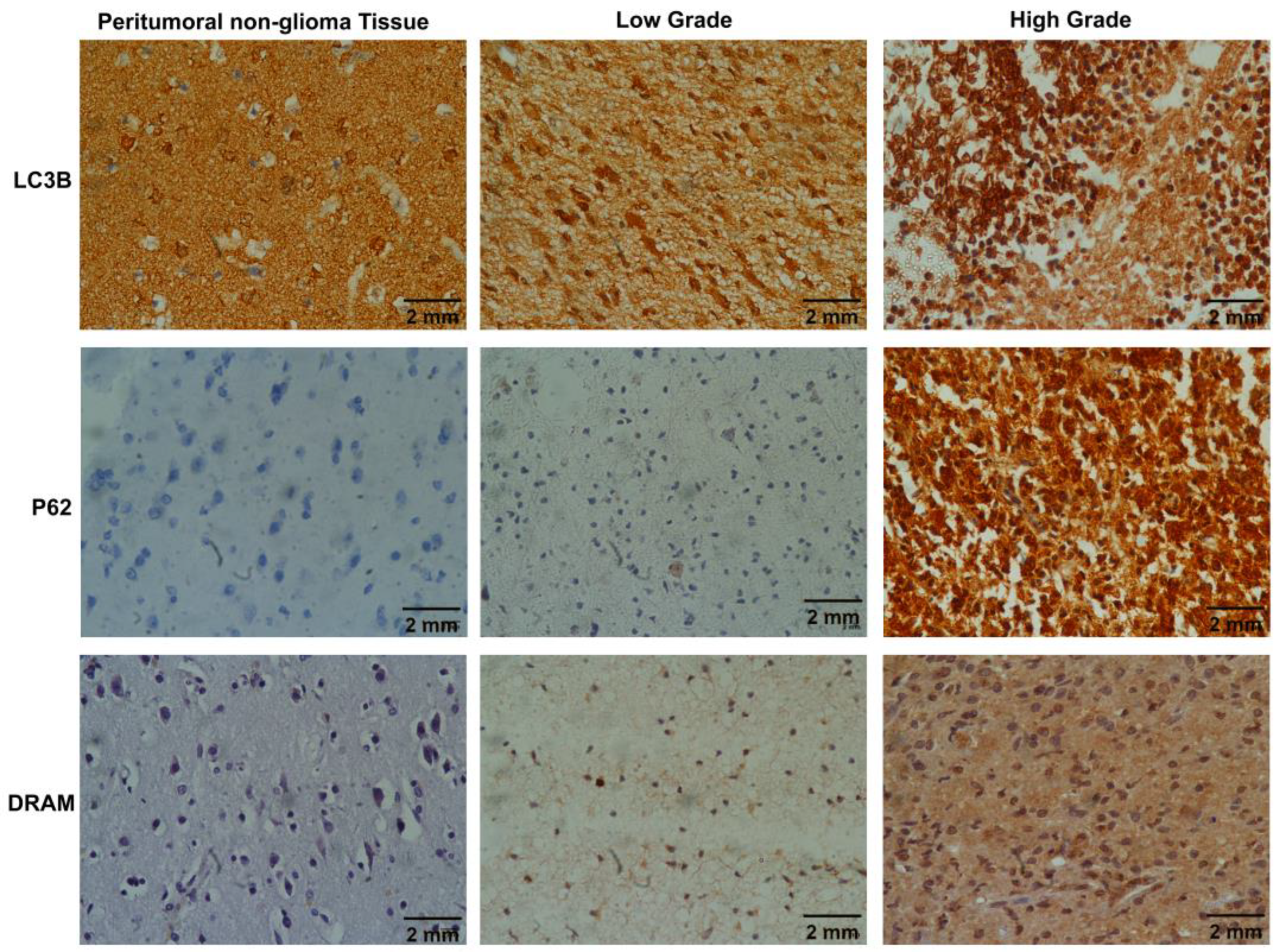
Figure 2.
Expression of autophagy-related genes (ATG) in 2, 3 & 4 WHO grades of diffuse gliomas in 39 patients using housekeeping gene Beta-actin. The Y-axis shows the relative expression of each ATG gene tested. The line with the asterisk sign shows a significant difference (*p < 0.01) in the expression of VPS34 between the various grades of gliomas.
Figure 2.
Expression of autophagy-related genes (ATG) in 2, 3 & 4 WHO grades of diffuse gliomas in 39 patients using housekeeping gene Beta-actin. The Y-axis shows the relative expression of each ATG gene tested. The line with the asterisk sign shows a significant difference (*p < 0.01) in the expression of VPS34 between the various grades of gliomas.
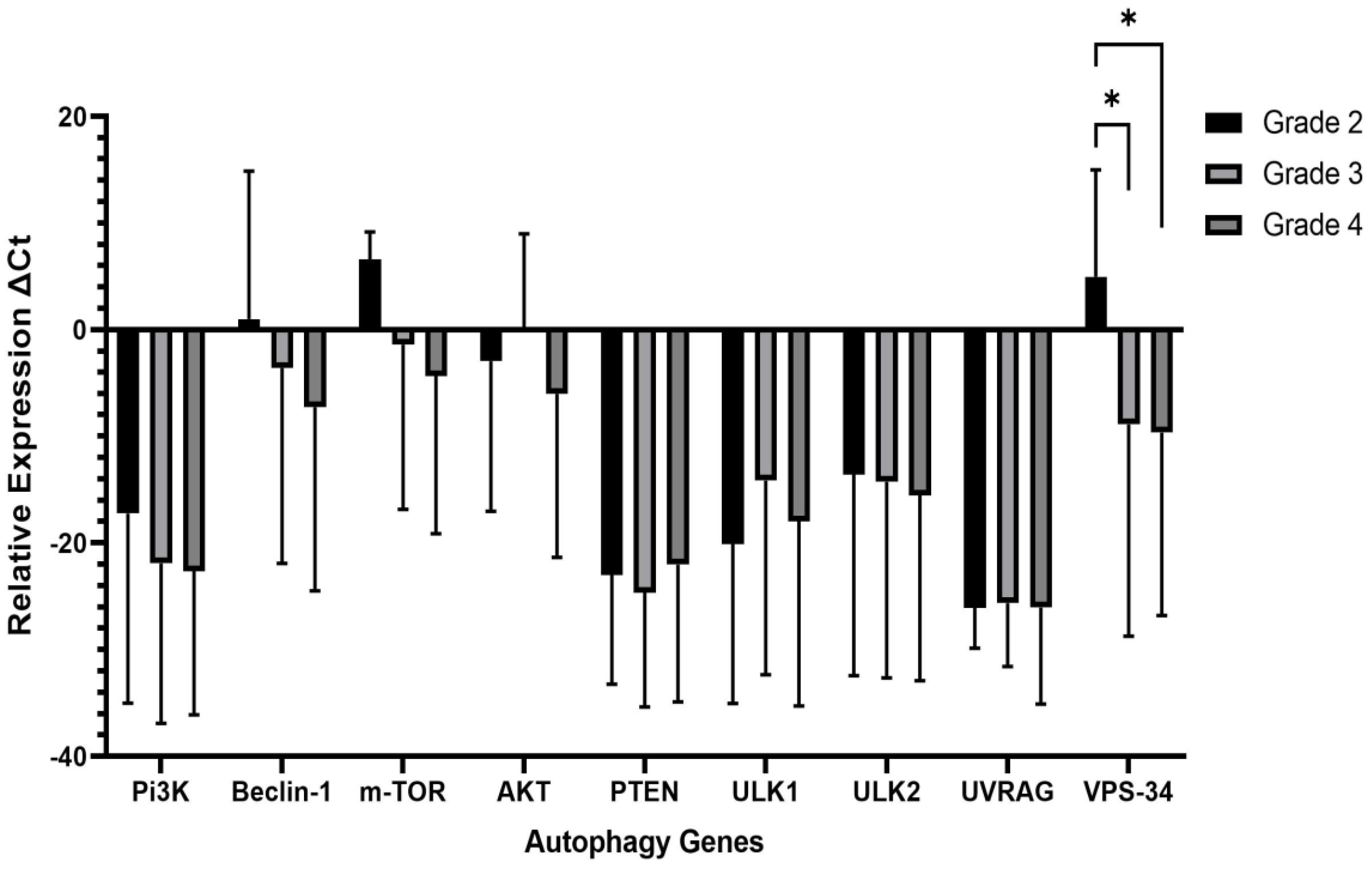

Table 1.
Clinicopathologic characteristics of Adult diffuse glioma patients.
| Variables | Values |
|---|---|
|
Gender Male Female |
23 (59%) 16 (41%) |
| Age in years Median (Range) | 43 (47) |
|
Histopathological Type Astrocytoma (Grade 2-4) Oligodendroglioma (2 and 3) Glioblastoma (Grade 4) |
19 (48.7%) 12 (30.8%) 08 (20.5%) |
|
Histopathological grade 2 3 4 |
11 (28.2%) 13 (33.3%) 15 (38.5%) |
|
Glioma Grade Group Low Grade High Grade |
11 (28.20%) 28 (71.8%) |
|
IDH 1Mutant, N (%) |
25 (64.1%) |
| TP53, N (%) Mutant | 16 (41%) |
| ATRX, N (%) Mutant | 21 (53.8%) |
Table 2.
Frequency of LC3B, SQSTM1/p62 and DRAM in 2, 3 & 4 WHO grades of Adult diffuse Gliomas.
| LC3B | P62 | DRAM | |||||
| Cases | Total | Punctate | Diffuse | High | Low | Positive | Negative |
| 39 | 25 (64.1%) | 14 (35.9%) | 20 (51.3%) | 19 (48.7%) | 11 (28.2%) | 28 (71.8%) | |
| Grades | G-2 (11) | 02 (8%) | 09 (64.2%) | 00 (0%) | 11 (58%) | 04 (36.3%) | 07 (25%) |
| G-3 (13) | 12 (48%) | 01 (7.1%) | 10 (50%) | 03 (15.7%) | 03 (27.2%) | 10 (35.7%) | |
| G-4 (15) | 11 (44%) | 04 (28.5%) | 10 (50%) | 05 (26.3%) | 04 (36.3%) | 11 (39.2%) | |
Table 3.
Association of autophagy markers with histological grades.
| Grade | LC3B | p-value | P62 | p-value | DRAM | p-value | |||
| Punctate | Diffuse | High | Low | Positive | Negative | ||||
| 2 | 2(18%) | 09(82%) | 0.001* | 0(0%) | 11(100%) | 0.001* | 4(36%) | 07(64%) | 0.760 |
| 3 | 12(92%) | 1(7%) | 10(77%) | 3(23) | 3(23%) | 10(77%) | |||
| 4 | 11(73%) | 4(27%) | 10(67%) | 5(33%) | 4(27%) | 11(73%) | |||
Table 4.
Correlation of autophagy markers with clinicopathologic parameters.
| Clinicopathologic Parameters | LC3B | p-value | P62 | p-value | DRAM | p-value | |||
| Punctate | Diffuse |
0.022 |
High | Low |
0.017 |
Present | Absent |
0.380 |
|
|
Age <45 >45 |
10(40%) 15(60%) |
11(79%) 03(21%) |
07(35%) 13(65%) |
14(74%) 05(26%) |
05(45%) 06(55%) |
16(57%) 12(43%) |
|||
|
Gender Male Female |
17(68%) 08(32%) |
06(43%) 08(57%) |
0.117 |
14(70%) 06(30%) |
09(47%) 10(53%) |
0.133 |
09(82%) 02(18%) |
14(50%) 14(50%) |
0.70 |
|
Histological type Oligodendroglioma Astrocytoma Glioblastoma |
09(75%) 12(63%) 04(50%) |
3(25%) 07(37%) 04(50%) |
0.517 |
09(75%) 08(42%) 03(38%) |
03(25%) 11(58%) 05(62%) |
0.139 |
04(33%) 05(26%) 02(25%) |
08(67%) 14(74%) 06(75%) |
0.891 |
|
Histological grade 2 3 4 |
02(18%) 12(92%) 11(73%) |
09(82%) 01(8%) 04(27%) |
0.001 |
0(0%) 10(77%) 10(67%) |
11(100%) 03(23%) 05(33%) |
<0.001 |
04(36%) 03(23%) 04(27%) |
07()64%) 10(77%) 11(73%) |
0.760 |
|
IDH1-R132 mut Present Absent |
18(72%) 07(50%%) |
07(28%) 07(50%) |
0.153 |
14(56%) 06(43%) |
11(44%) 08(57%) |
0.325 |
08(32%) 03(21%) |
17(68%) 11(79%) |
0.376 |
|
ATRX mut/Loss Present Absent |
12(57%) 13(72%) |
09(43%) 05(28%) |
0.261 |
07(33%) 13(72%) |
14(67%) 05(28%) |
0.17 |
05(24%) 06(33%) |
16(76%) 12(67%) |
0.380 |
|
Tp53 mut Present Absent |
09(56%) 16(70%) |
07(44%) 07(30%) |
0.303 |
06(38%) 14(61%) |
10(62%0 09(39%) |
0.133 |
06(38%) 05(22%) |
10(62%) 18(78%) |
0.237 |
Table 5.
Correlation between autophagy related genes in grade 2 Gliomas.
| PI3K | BECLIN1 | mTOR | AKT | PTEN | ULKI | ULK2 | UVRAG | VPS34 | |
| PI3K | - | 0.495 | 0.863 | 0.505 | 0.824 | 0.995 | 0.731 | 0.978 | 0.560 |
| BECLIN1 | 0.495 | - | 0.615 | 0.110 | 0.670 | 0.505 | 0.462 | 0.495 | 0.275 |
| m-TOR | 0.863 | 0.615 | - | 0.357 | 0.835 | 0.846 | 0.604 | 0.896 | 0.473 |
| AKT | 0.505 | 0.110 | 0.357 | - | 0.434 | 0.500 | 0.247 | 0.489 | 0.055 |
| PTEN | 0.824 | 0.670 | 0.835 | 0.434 | - | 0.802 | 0.714 | 0.846 | 0.577 |
| ULK1 | 0.995 | 0.505 | 0.846 | 0.500 | 0.802 | - | 0.753 | 0.956 | 0.516 |
| ULK2 | 0.731 | 0.462 | 0.604 | 0.247 | 0.714 | 0.753 | - | 0.670 | 0.626 |
| UVRAG | 0.978 | 0.495 | 0.896 | 0.489 | 0.846 | 0.956 | 0.670 | - | 0.599 |
| VPS34 | 0.560 | 0.275 | 0.473 | 0.055 | 0.577 | 0.516 | 0.626 | 0.599 | - |
The table displays the correlation coefficient (r) value for each pair of genes, with underlined values indicating statistically significant (p<0.05) correlations between gene pairs.
Table 6.
Correlation between autophagy related genes in grade 3 Gliomas.
| PI3K | BECLIN1 | mTOR | AKT | PTEN | ULKI | ULK2 | UVRAG | VPS34 | |
| PI3K | - | 0.866 | 0.748 | -.094 | 0.988 | 0.674 | 0.781 | 0.747 | 0.192 |
| BECLIN1 | 0.886 | -- | 0.659 | 0.143 | 0.852 | 0.566 | 0.549 | 0.567 | 0.875 |
| mTOR | 0.748 | 0.659 | - | -.088 | 0.714 | 0.544 | 0.527 | 0.396 | 0.627 |
| AKT | -.o94 | 0.143 | -.088 | - | -.104 | -.346 | -.538 | -.380 | -.204 |
| PTEN | 0.988 | 0.852 | 0.714 | -.104 | - | 0.621 | 0.753 | 0.735 | 0.889 |
| ULK1 | 0.674 | 0.566 | 0.544 | -.346 | 0.621 | - | 0.742 | 0.784 | 0.652 |
| ULK2 | 0.781 | 0.549 | 0.527 | -.538 | 0.753 | 0.742 | - | 0.814 | 0.715 |
| UVRAG | 0.747 | 0.567 | 0.396 | -.380 | 0.735 | 0.784 | 0.814 | - | 0.802 |
| VPS34 | 0.912 | 0.875 | 0.627 | -.204 | 0.899 | 0.652 | 0.715 | 0.802 | - |
The table displays the correlation coefficient (r) value for each pair of genes, with underlined values indicating statistically significant (p<0.05) correlations between gene pairs.
Table 7.
Correlation between autophagy related genes in grade 4 Gliomas.
| PI3K | BECLIN1 | mTOR | AKT | PTEN | ULKI | ULK2 | UVRAG | VPS34 | |
| PI3K | - | 0.721 | 0.461 | 0.479 | 0.646 | 0.943 | 0.782 | 0.893 | 0.600 |
| BECLIN1 | 0.721 | - | 0.575 | 0.514 | 0.382 | 0.707 | 0.714 | 0.579 | 0.768 |
| mTOR | 0.461 | 0.575 | - | 0.504 | 0.557 | 0.496 | 0.386 | 0.432 | 0.411 |
| AKT | 0.479 | 0.514 | 0.504 | - | 0.443 | 0.571 | 0.486 | 0.361 | 0.464 |
| PTEN | 0.646 | 0.382 | 0.577 | 0.443 | - | 0.568 | 0.375 | 0.504 | 0.257 |
| ULK1 | 0.943 | 0.707 | 0.496 | 0.571 | 0.568 | - | 0.811 | 0.886 | 0.643 |
| ULK2 | 0.782 | 0.714 | 0.386 | 0.486 | 0.375 | 0.811 | - | 0.729 | 0.786 |
| UVRAG | 0.893 | 0.579 | 0.432 | 0.386 | 0.574 | 0.886 | 0.729 | - | 0.514 |
| VPS34 | 0.600 | 0.768 | 0.411 | 0.464 | 0.257 | 0.643 | 0.786 | 0.514 | - |
The table displays the correlation coefficient (r) value for each pair of genes, with underlined values indicating statistically significant (p<0.05) correlations between gene pairs.
Table 8.
Names of target genes of and their corresponding primer employed for mRNA quantification.
| Genes | Forward primer | Reverse primer |
| Beclin-1 | 5’ -AATGACTTTTTTCCTTAGGGGG-3’ | 5’ -GTGGCTTTTGTGGATTTTTTCT-3’ |
| m-TOR | 5’ -TGGGACAGCATGGAAGAATA-3’ | 5’- TGTTGTGCCAAGGAGAAGAG-3’ |
| UVRAG | 5′- CTGTTGCCCTTGGTTATACTGC -3′ | 5′- GATGATTTCTTCTGCTTGCTCC -3′ |
| VPS34 | 5′-GCT GTC CTG GAA GAC CCA AT-3′ | 5′-TTC TCA CTG GCA AGG CCA AA-3′ |
| PTEN | 5’-CCAAGCTTATGACAGCCATCATC-3’ | 5’-CGCGGATCCTCAGACTTTTGTAA-3’ |
| ULK1 | 5’-GGACACCATCAGGCTCTTCC-3’ | 5’-GAAGCCGAAGTCAGCGATCT-3’ |
| ULK2 | 5’-TTCCTGCTCTAAGGGTTTGCTT-3’ | 5’-CCAGCGAGGGAGAACAACTG-3’ |
| PI3K | 5’ - ATGCAAATTCAGTGCAAAGG-3’ | 5’ - CGTGTAAACAGGTCAATGGC-3’ |
| AKT | 5’ -GCAGCACGTGTACGAGAAGA-3’ | 5’ -GGTGTCAGTCTCCGACGTG-3’ |
Disclaimer/Publisher’s Note: The statements, opinions and data contained in all publications are solely those of the individual author(s) and contributor(s) and not of MDPI and/or the editor(s). MDPI and/or the editor(s) disclaim responsibility for any injury to people or property resulting from any ideas, methods, instructions or products referred to in the content. |
© 2023 by the authors. Licensee MDPI, Basel, Switzerland. This article is an open access article distributed under the terms and conditions of the Creative Commons Attribution (CC BY) license (http://creativecommons.org/licenses/by/4.0/).
Copyright: This open access article is published under a Creative Commons CC BY 4.0 license, which permit the free download, distribution, and reuse, provided that the author and preprint are cited in any reuse.


