

Submitted:
21 December 2023
Posted:
22 December 2023
You are already at the latest version
Abstract
Internet of Things (IoT) is what we have as a great breakthrough in 5G network. Although 5G network can support several Internet of Everything (IoE) services, 6G is the network to fully support that. This paper is a survey research presenting the 5G and IoT technology and the challenges coming, with the 6G network being the new alternative network coming to solve these issues and limitations we are facing with 5G. A reference to the Control Plane and User Plane Separation (CUPS) is made with IPv4 and IPv6 addressing which is the foundation of the Network Slicing for the 5G core network. Comparing to other related papers, we provide in depth information on how the Internet of Things (IoT) is going to affect our lifes and how this technology is handled as Internet of Everything (IoE) in 6G network. Finally, a full reference is made to the 6G network with its challenges comparing to the 5G network.
Keywords:
IoT (Internet of Things)
; 5G networks
; MTC (Machine-Type Communication)
; D2D (Device to Device)
; wireless communication
1. Introduction
5G is using technologies that are not used in 3G, 4G and LTE. Such technologies are LPWA (Low Power Wide Area) and long distance communication. IoT is the technology which allows devices to use 5G network and then interconnect series of applications. The study in reference [1] provides detailed analysis and discussion regarding the use of LPWA in the wireless network concerning coverage, power efficiency and QoS (Quality of Service).
Reviewing the study of evolution from 1G to 6G and their network speeds reference [2] presents a comprehensive study, where we can easily identify all their characteristics. 5G and 6G are the technologies used for the IoT connectivity of devices including challenges such as indoor and outdoor penetration. The NR (New Radio) is quite an important part in the IoT implementation which includes the use of MIMO (Multiple input, Multiple output) antennas as part of the signal transmission as well as the use of IPv6 for backhaul connectivity addressing and D2D communication.
With the term of 5G meaning 5th generation technology and IoT the Internet of Things, both technologies are used to connect people and devices with the use of applications and sensors. Smartphones and IoT devices have changed the way people interact between each other. 5G and 6G networks give the possibility to use extremely high volumes of data and also the possibility multiple devices to be connected at the same time. Applications such as Social Media, online gaming and HD (High Definition) videos can use 5G and 6G networks leading to new economic and business standards. Cloud services will allow information sharing and will enable collaboration between the industries.
The Machine-to-Machine (M2M) communication is analyzed in reference [3] which is also a part of this type of communication. This includes communication and control of vehicles which require an immediate response, remote surgery or automatic braking in cars as well as meteorological meters reporting in real time. Machine-to-Machine (M2M) communication plays an important role on the 5G network. 5G networks will enrich cellular M2M communication reducing end-to-end (E2E) delay, increased battery operational time and huge number of connected devices per cell.
In 5G network, Open RAN (O-RAN) is a solution to deploy RAN in low cost since the deployment of 5G network requires high cost. With O-RAN the mobile operators have more flexibility compared to traditional RAN deployment applying virtualization and intelligence. With the use of O-RAN which is based on open interfaces, mobile operators will bring the cloud and interoperability concept to RAN ensuring intelligence and optimization to the infrastructure.
The study of Control Place and User Plane Separation (CUPS) [4] which is a foundation of the “Network Slicing” in 5G core network gives the possibility of independent scalability. Key advantages of independent geographical location and unlimited scalability of the control plane as well as the user plane is the main characteristic of CUPS. There can be many User Planes (UPs) deployed where there can be only few PCRFs (Policy and Charging Rules Functions) and OCS (Online Charging System) associations needed. Software Defined Networks (SDNs) and Virtual Network Functions (VNFs) are the ones that enable deep data analysis providing all the needed monitoring and measurement reports of the networks and the applications.
The radio network of 5G and 6G functions, are in higher frequencies having as a result less penetration capabilities but with higher spectrum utilization which can be used to increase the capacity on the cells without increasing the number of sites. The energy consumption is independent of the network load, which means that even at low loads, the energy consumption is relatively high. 6G will be able to provide terahertz communication and improvement in coverage and data rate. 6G is going to provide a new communication experience with enhanced conventional mobile communication, accurate indoor positioning, high-quality communication services and even holographic communications. 6G is expected to provide a video in-person meetings supporting a realistic projection of real time 3D dimensional images along with voice as mentioned in reference [5], an extremely large bandwidth requirement. Human-bond communication is another concept that is going to be supported within the use of 6G network. Within the human bond communication, we will be able to share and access the five basic human senses [2]. As a result to the above, it will be able to collect biological information such as diseases and emotional detection.
Some introductory related work that can be found today is in reference [1] and reference [2] which are holistic survey papers on the opportunities and role of 6G within the IoT technology and its applications. In reference [3] is a detailed presentation of IoT data network fundamentals exploring applications such as smart transport, smart health smart city and smart industry. Reference [4] is a comparative discussion highlighting the key challenges of future standardization in IoT and reference [5] is an experiment based in the adoption of three dimensional holographic displays in applications such as smart glasses, car head up displays elc.
This paper is organized as follows: In Section II, the technology of IoT and M2M communication are explored discussing factors that we need to take into consideration such as Coverage, Scalability, Diversity, Battery Life and Devices Cost as well as the needed encrypted protocols used for the data transmission. In Section III, we discuss the 5G mobile network technology with all its advantages such as high data communication rates, low latency, reliability and availability. CUPS functionality is introduced which is part of network slicing, giving us the possibility to provide independent scalability of the control and the user plane based on the network needs and requirements. Geographical redundancy is also part of the above. In terms of security IPsec is there to ensuring secure communication. In section IV, we see that 6G is going to be the network to interconnect all things. 6G is actually going to be the connection of intelligence with great capacity and latency improvement comparing to what we currently have in 5G, with services such as surreal virtual reality, medical imaging, car self-driving, smart home, holographic and precision communications and much more. Finally, in Section V we conclude the article.
Figure 1.
Survey Structure.
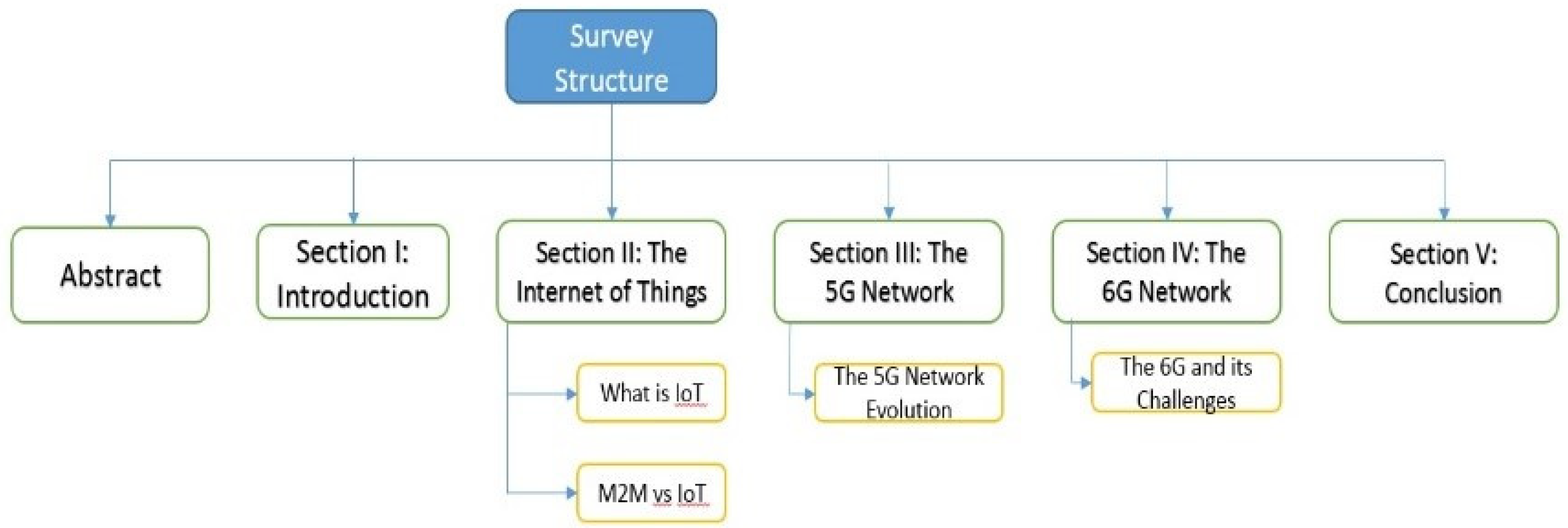

Table 1.
Key Acronym.
| Acronym | Definition |
|---|---|
|
IoT |
Internet of Things |
| IoE | Internet of Everything |
| CUPS | Control Plane and User Plane Separation |
| LPWA | Low Power Wide Area |
| QoS | Quality of Service |
| NR | New Radio |
| MIMO | Multiple input, Multiple output |
| HD | High Definition |
| M2M | Machine to Machine |
| UP | User Plane |
| PCRF | Policy and Charging Rules Function |
| OCS | Online Charging System |
| SDN | Software Defined Network |
| VNF | Virtual Network Function |
| OSI | Open Systems Interconnection |
| PSM | Power Saving Mode |
| eDRX | Extended Discontinuous Reception |
| PDN | Packet Data Network |
| UE | User Equipment |
| MME | Mobility Management Entity |
| HLC | High Latency Communication |
| MT | Mobile Terminated |
| AES | Advanced Encryption Standard |
| ECC | Eliptic Curve Cryptography |
| LoRA | Long Range |
| MTC | Machine-Type Communication |
| PGW | PDN Gateway |
| IPv4 | Internet Protocol 4 |
| IPv6 | Internet Protocol 6 |
| RAN | Radio Access Network |
| SeGW | Security Gateways |
| O&M | Operation and Maintenance |
| SLAM | Simultaneous Localization and Mapping |
| ML WUR AI |
Machine Learning Wakeup Radio Artificial Intelligence |
2. The Internet of Things
2.1. What is IOT
The Internet of Things (IoT) is actually going to change our lives on businesses and services. Based on our study, when we refer to “Things”, this represents the physical layer on the OSI (Open Systems Interconnection) model. All the physical devices can communicate with the network infrastructure (Figure 2). A physical thing can be mapped to a virtual thing within the information world although a virtual thing can exist by itself in the information world.
Our survey on IoT, has discovered that the IoT devices are equipped with communication capabilities, data capture capabilities, sensors, data storage and data processing capabilities. The IoT devices collect and provide information to the information and communication network for further processing. So when we refer to devices, those devices can communicate with each other in different ways, directly, locally through a gateway and over the communication network.
The communication network is transferring all the captured data from the IoT devices to the applications and other devices as instructions from applications to devices. There are IoT devices that need a two way communication (uplink – downlink) in order to monitor and control the IoT devices. This is quite a hot topic in the IoT technology since we need to take into consideration factors such as Coverage, Scalability, Diversity, Battery Life and ofcourse the Cost of Devices (Figure 3).
The use of O-RAN in IoT, will provide flexibility in terms of connectivity for series of application such as e-health, security, medical care overcoming any restriction that might be in terms of IoT connectivity. O-RAN can support massive IoT device connectivity requiring low battery consumption providing large coverage with low throughput. The O-RAN architecture, is the one that adds additional interfaces and controllers in order to meet all the IoT services requirements. The greatest feature of O-RAN are its RAN intelligent controllers (RICs) that gives the possibility to provide better performance than the legacy RAN networks using AI/ML based algorithms optimizing the network in terms of load balancing and slicing control, enabling multiple tenants and handover management. As mentioned above, all the components of O-RAN can be virtualized using Kubernetes platforms giving the possibility to dynamically adjust all the resources based on the network needs having as a result the reduction of the power consumption providing the one that is really needed for the network requirements.
The battery life is one of the most important factors in the IoT technology. The latest research has proven that a key requirement for an IoT device battery lifetime is about 10 years’ time at most. Most of the IoT devices have limited energy resources so it is needed to have low power consumption for both data transmission and self-protection. More than 10 years of lifetime can be achieved by introducing the Power Saving Mode (PSM) as studied in reference [6], reference [7] and in the extended discontinuous reception functionality (eDRX). These features allow the IoT devices to contact the network on a peer need basis meaning that it can stay in sleep mode for minutes, hours or even days.
Today’s existing IoT work is presented in the following papers: Reference [6] is a paper presenting the IEEE 802.11 Wireless Local Area Network (LAN) architecture for IoT systems. In reference [7] the Extended Discontinuous Reception (eDRX) protocol for energy saving on smart grid is presented. The security implications of such systems are examined in reference [8] which focuses on the Advanced Encryption Standar (AES), used for communication security within the wireless sensor networks. In addition, reference [9] presents a comparison of encryption and decryption times of the Advanced Encryption Standard (AES) common nodes, and reference [10] focuses on the lightweight algorithms of the IoT solutions.
The study and analysis on the encryption algorithm chosen which is presented in references [8] and [9] is one of the most important factors to take into consideration for the calculation of the power lifetime of an IoT device. The more secure algorithm used, the more energy consuming it is. Such protocols are the AES (Advanced Encryption Standard) using 128 bit size blocks, the ECC (Eliptic Curve Cryptography) which requires a smaller key size having as a result fast processing speed and less memory requirement. Piccolo is another protocol studied in reference [10] used in the IoT devices which seems to be the most energy efficient than the others providing the maximum lifetime with the lowest consumption.
Many IoT applications are possible to be on a fit and forget base. The less frequently the UE listens for paging, the higher the latency is and also the longer the lifetime of the battery is. The Power Saving Mode (PSM) is similar to Power off but with the UE remaining registered to the network and with no need to re-attach or re-establish a PDN (Packet Data Network) connectivity. A UE using the PSM functionality, is available for mobile terminating services during its connected mode which is caused by a mobile originated event like signaling and data transfer, and for the period of an Active Time witch is after the connected mode. The PSM is intended to be used by UEs that are expecting only infrequent mobile originating and terminating services and can accept latency in the mobile terminating communication.
The Extended Discontinuous Reception (eDRX) on the other hand, has been studied in reference [7] which improves the power efficiency of the mobile devices while they remain reachable through paging, an ideal feature for applications with stricter reachability requirements than PSM. Extended Discontinuous Reception (eDRX) can be used together with the PSM without any issues. For devices that have eDRX feature enabled, the SGSN-MME supports delaying paging requests until the device is in the paging window. During the Attach Request procedure, the UE includes the eDRX parameters. If MME (Mobility Management Entity) accepts the request, the MME includes the eDRX parameters in the Attach Accept message request response. The Extended Discontinuous Reception (eDRX) what does, it extends the sleep cycles in inactive mode with configurable values varying from seconds to minutes. This reduces quite a lot the need for a battery power from the IoT device and also reduces any maintenance cost such as replacement of the battery comparing by just using the Power Saving Mode. Extended Discontinuous Reception (eDRX) ensures a certain reachability period of the IoT device providing significantly improved downlink reachability.
Functions for High Latency Communication (HLC) as studied in reference [7], may be also used to handle the mobile terminated (MT) communication with the UEs being unreachable while using the power saving functions. High latency refers to the initial response time before the normal exchange of the packets establishment which refers to the time it takes before a UE has woken up from its power saving state and responded to the initial downlink packet. The HLC is used in order to achieve full synchronization between the Application Server and the UEs using PSM or eDRX optimizing the signaling between the MME and the SGW when the payloads are buffered.
The The basic areas that can affect the IoT devices’ lifetime are:
- The technical characteristics of the IoT devices such as CPU, memory capacity, signal level, operating system, battery capacity and power consumption of the processor.
- The network topology of the IoT devices system determining the amount of the information passing through.
- The functional characteristics of the IoT devices such as data transfer protocols, security and encryption methods used.
- The frequency and transmission of the collected data.
Based on all these factors, we can estimate-calculate the lifetime of an IoT devices. How often the IoT device takes the measurements from its sensor is a basic parameter.
For the calculation of the energy consumption during data transmission, we need to take into consideration the following parameters:
- CPU frequency
- Transmitted packet size
- Channel bitrate
- Total number of processed algorithm commands
- Sleep mode timeframe
- The channel bit rate
2.2. M2M vs IoT
Existing work on M2M and IoT communication contains several papers that presented as follows: Reference [11] is a paper providing case studies of IoT business based transformation. Reference [12] is a detailed review of IoT data network infrastructure exploring applications such as smart healthcare, smart transportation, smart industry and smart cities. Reference [13] is a book that explores the Machine-to-Machine (M2M) communication, the smart services applications, the challenges of the world of Internet of Things (IoT) and the risks of such a connectivity. Reference [14] covers Machine-to-Machine systems architecture, performance managements techniques, services and standardization. Reference [15] is a detailed survey of Machine-to-Machine (M2M) communications focusing on the Long-Term Evolution-Advanced (LTE-A) networks and an overview of the expected 5G M2M services. Reference [16] is a survey paper of IoT technology highlighting the key challenges of its future standardization. Reference [17] which is a survey work on Machine-to-Machine (M2M) communication with its challenges and congestion control in 3GPP LTE/LTE-A networks. Reference [18] is an article describing the architecture of Machine Type Communication (MTC) within 3GPP systems including overload protection mechanism and functionality of new network elements. Reference [19] which is a paper related to Machine-to-machine (M2M) communications linking the Internet cyber world and physical systems. Reference [20] which is a comprehensive review of the M2M communication investigating distinctive futures, challenges and solutions and reference [21] which is a paper dividing the Machine-to-Machine (M2M) communications into capillary M2M and cellular M2M technology studying the challenges and opportunities.
Thus, when aggregating the research on Internet of Things (IoT) as studied in references [11,12,13] and Machine-to-Machine communication (M2M) as also studied in references [14,15,16,17,18,19,20,21], we can compare those two technologies to see what is more suitable and for what it is needed (Figure 4).
The main difference between the M2M communication and the IoT is that M2M is using a point-to-point communication. IoT device communication is based on a cloud wireless network connectivity allowing large scale of integration. Scalability is a key difference. The IoT communication is highly scalable comparing to M2M since the devices can be added to an existing network with minimum hassle.
Whenever we refer to IoT we always refer to wireless device communication comparing to M2M that can include both wired and wireless communication. Using wireless communication of course has its advantages and disadvantages, including less technology maintenance such as Ethernet connectivity but also less reliability.
So the use a M2M communication, is best for applications that require point-to-point communication, scalability is not a concern, the application should be operational regardless the existence of a WiFi connectivity and needs to be executed quickly and reliably. On the other hand for the IoT communication, scalability is a concern, fast WiFi connectivity is needed, real time synchronization is also needed and multiple standards compatibility is a must as studied in reference [4].
The Materials and Methods should be described with sufficient details to allow others to replicate and build on the published results. Please note that the publication of your manuscript implicates that you must make all materials, data, computer code, and protocols associated with the publication available to readers. Please disclose at the submission stage any restrictions on the availability of materials or information. New methods and protocols should be described in detail while well-established methods can be briefly described and appropriately cited.
Research manuscripts reporting large datasets that are deposited in a publicly available database should specify where the data have been deposited and provide the relevant accession numbers. If the accession numbers have not yet been obtained at the time of submission, please state that they will be provided during review. They must be provided prior to publication.
Interventionary studies involving animals or humans, and other studies that require ethical approval, must list the authority that provided approval and the corresponding ethical approval code.
3. The 5G Network
3.1. The 5G Network Evolution
Based in our thorough research on references [22,23,24,25,26], 5G mobile network technology, is going to deliver a massive system capacity, extremely high data rates, very low latency and ultra-high reliability and availability. New applications like remotely controlled robots, self-driven cars will impact industries and consumers. New radio technologies have been developed and designed like LoRA and SigFox used for Machine-Type Communication (MTC) as mentioned in references [14,15,16,17,18,19,20,21] with very limited demands on throughput, reliability and QoS. LoRa as reviewed in references [27,28,29,30] provides long range and low power of secure data transmission operating within the frequency bandwidth range of 915 to 928 MHz. SigFox based on the research in references [31,32,33,34,35] is a low power network operating within the frequency range of 915 MHz to 928 MHz providing high capacity with low power requirements as mentioned in references [36,37,38].
The architecture of 5G network will be based on the demands on human-to-human and M2M types of communication tuned based on user’s requirements. 5G is the network prepared to bring challenges providing connectivity to an enormous number of connected devices most of them being supported by virtualized networks having as a result to minize the cost of the equipments used to support these networks and of course reducing any implementation complexity. Virtualization as a technology, can boost the backhaul and reduce the processing load of the end devices fulfilling requirements such as energy constrain and size reduction of the IoT devices. In 5G, the main challenge we face is the strong backhaul which is provided by the virtualization. 5G network, is a unified network appearing to the end user as one system. QoS is the one who guaranties the reliability with packet loss rate of 99.99% for this network in terms of connectivity for a variety of M2M services. To be more specific, 5G network using Cloud technology and virtualization, is meant to be the one that will meet all the reliability and latency requirements in terms of M2M communication allowing maximum end to end connectivity latency including retransmissions less than 5ms.
O-RAN empowers the 5G network providing flexibility and freedom to network operators without slowing down any operations but apart of that, the main weakness is the incapability of its control application to address latency less than 10ms of time frame. O-RAN in 5G reduces network OPEX and CAPEX and this is achieved by using open interfaces allowing the increase of market competition. Cloud native O-RAN enables also open source software to be applied having as a result fast innovation improving network efficiency and performance. O-RAN will allow QoE optimization, massive MIMO optimization and Traffic Steering.
Existing work on 5G is reference [22] which is a comprehensive review of the M2M communication investigating distinctive futures, challenges and solutions. Reference [23] a comprehensive study focusing on the M2M technologies, futures, challenges and opportunities, investigating the multiplicity of the M2M communication. An overview paper is reference [24] of the current standardization practices listing solutions about the 5G spectrum requirements. Reference [25] is an overview of the challenges and key features of the 5G mobile networks. Reference [26] is a comprehensive overview of the long-term future of the 5G mobile communications. Reference [27] gives to us a basic understanding of the LoRa and LoRaWAN radio communication technology. Reference [28] is a WIKIPEDIA article related to LoRa and LoRaWAN radio communication technology. Reference [29] is a .pdf file providing basic information related to LoRa as modulation. Reference [30] is a webpage related to Spreading Factor as a performance key characteristic of LoRaWAN. Valuable information concerning the right balance between long range communication and battery performance. Reference [31] is a review of applications, technologies and challenges met in 5G network, discussing the 5G network architecture, adaptive service architecture, data privacy, synchronization and reliability. Reference [32] is an in depth analysis of fog computing architecture and technology as a propose solution for latency, bandwidth and power issues. Reference [33] which is a complete overview to the design, deployment and performance of the LTE, LTE-A, IMS, VoLTE, IoT and 5G networks. As studied in reference [34] which a book that reviews AI-based applications, aspects and models. Reference [35] which is a book that focuses on the energy efficiency, security, performance and interference on different applications such as smart cities, healthcare and transportation systems. Reference [36] which is a survey paper that provides information on challenges and issues related to M2M communication over the Third-Generation Partnership Project (3GPP) Long-Term Evolution (LTE) and Long-Term Evolution-Advanced (LTE-A). Reference [37] is paper focusing on the coexistence of waveforms within the 5G network with each service and which one is best for use. Reference [38] is a study related to the technology elements for efficient small sized drones detection with the use of 5G Millimeter-Wave Cellular network. Reference [39] is a guide on the aspect of network slicing of the 5G network infrastructure. As we see in reference [40], is a study of solving issues related to network slicing and developing efficient framework for 5G wireless and core networks. Reference [41] is a book which provides a comprehensive reference for all the 5G network layers, focusing on fundamental issues and challenges of major areas such as capacity and spectral efficiency on both radio and core sites. Reference [42] is a review of the functionality of Release 16 but also contains a lot of information of the coming Release 17 of the 5G network. Reference [43] is a technical coverage of 5G applications and services as well as information related to network reliability and security. Reference [44] is a 3GPP standardization informational site related to the Control and User Plane Separation. Reference [45] is a detailed information of transportation, services and network architecture on RAN and reference [46] is a well written book discussing the challenges of massive IoT technology within the 5G network, intelligent transportation systems, green communication and multi energy systems in smart cities. Reference [47] is a description of the local and metropolitan area networks including WiFi, 4G comparing to LTE and 5G and its expectations.
The 5G mobile network has full support of IPv6 connectivity. More specifically, when the UE requests an IPv4 address in order to access an IPv4 service, the PGW (PDN Gateway) which is a part of the core will allocate an IPv6 address. This IPv6 address will be used towards all the external interfaces so the session in the PGW will be handled as an IPv6 session. Then the UE will receive a dummy IPv4 address and the Uplink payload headers will be translated from an IPv4 to an IPv6 and the Downlink payload IP headers will be translated from IPv6 to an IPV4. As a benefit of all the above is that we maintain the legacy IPv4 business with the UEs working in an IPv6 network achieving IPv4 address shortage mitigation reducing complexity of IPv4 to IPv6 migration.
5G has full support of network slicing as studied on references [39,40,41,42] which means that there can be deployment of multiple logical networks (what we call slices) on a common physical infrastructure. These slices are isolated from each other on the control plane part and the user plane part (CUPS functionality) as well the management plane. This allows the slices to be optimized individually. This optimization of the slices can be in terms of Performance, Functionality and Geographical deployment.
Studying the separation of the control plane and the user plane (CUPS) for the network functions on references [43,44], this gives us the possibility to investigate the independent scalability of the control and the user plane and also the additional deployment flexibility. A user plane function supporting a low delay application can be deployed closer to the access while the control plane can be placed at a more centralized location.
Discussing RAN architecture in 5G in references [41,42,43,44,45,46] (Figure 5), we should take into consideration security.
The transport network must be able to handle the advanced security algorithms without introducing delay in the transmission. Also, compliance with more stringent regulatory and industrial standards with respect especially to security is required, as well as compliance with an operator or service providers security policies. To protect the new and of course the existing RAN interface, IPsec is recommended. IPsec is used to secure the traffic from the baseband to the core network but there will be more IPsec directly between eNodeB and gNodeB. IPsec ensures secure communication over untrusted transport networks with Confidentiality in order to keep data secure and hidden, Integrity is to make sure no one has modified the data, Authentication is to authenticate the originating and receiving devices as trusted sources and Anti-replay protection is to avoid replay from previous recording.
There will also be more decentralization of the Security Gateways (SeGW) as mentioned in reference [47] positioned closer to the radio sites in order to reduce latency.
Also, network firewalls will be required to cope with the increasing data volumes, which means that there will be need on hardware optimization. The eNodeB and the gNodeB rely on asymmetric cryptography and digital signatures in order to authenticate the communicating peers and also validate signed files. Certificates and trust relationships are required in order to ensure the correctness and validity of the used keys. These node specific and trusted certificates are Vendor credentials to authenticate network access, Node credentials used for O&M communication, Chain certificates for node credentials and trusted certificates used to validate peer certificates.
4. The 6G Network
4.1. The 6G and its challenges
Our survey in the new era of the 6G technologies and architecture has proven to us that we are currently moving from the concept of “connection of things” to “the connection of intelligence” as reviewed in references [48,49,50,51,52,53,54,55]. With the rapid development of wireless communication, 5G will not be enough to meet its growing demand. It is quite hard to predict how exactly 6G network is going to be although it is expected to be in use around the year of 2030 with the initial deployment being available only to business and high-performance applications.
Related existing work on 6G is the reference [48] which is a review of the 6G network with its key technologies including virtual, augmented and mixed reality. Reference [49] does explores challenges and ways of improving future applications security within the NextGen networks and protection of user data from illegal access. Reference [50] is a survey paper related to the recent activities and trends for the 6G networks performing 5G and 6G use cases analysis and future connectivity solutions. Reference [51] is a book analyzing the development of 6G antenna technology as well as 6G
network layer covering also challenges and solutions of massive 6G IoT networks. Reference [52] is a book focusing on the wireless and optical domains of the 6G networking discussing the interoperability and benefits of such technologies. In reference [53], we see an overview of the network evolution from our current 5G to the 6G outlining the research directions and exploring the expected application and requirements. Reference [54] is a book focusing on Machine Learning, Software Defined Networks (SDN), 5G and 6G networking, Cloud Computing and Deep Learning solutions. Reference [55] is exploring the past, the present, and the future wireless networks as well as future 6G network applications potentials, requirements, challenges and opportunities. Reference [56] is a paper reviewing previous and current Cyber-Physical Systems (CPS) architecture proposing Service-Oriented Architecture (SOA) as a general flexible CPS architecture. Reference [57] is a joint Press Release for announcing the use of silica glass antenna in order to transmit and receive 28 GHz 5G radio on vehicles and trains. Reference [58] is a Press Release on a prototype using transparent dynamic metasurface to manipulate 28 GHz 5G radio waves. In reference [59] we see a survey paper of Simultaneous Localization And Mapping (SLAM) for autonomous driving giving an overview of the experiments carried out until now discussing challenges and future orientations. Reference [60] is an article reviewing from 1G up to 5G services and then highlighting what 6G services will look like based on what users really want. Reference [61] is a paper presenting an efficient and with low complexity deep learning based detector for Free Space Optical (FSO) communication systems. Reference [62] is an article performing simulation results confirming that Momentum Federated Learning (MFL) has significant convergence improvement over Federated learning (FL). In reference [63] we see a paper presenting the way of wireless charging technique of mobile applications over the ether with the use of Distributed Laser Charging (DLC) and in reference [64] we do review a paper presenting the Low-power Wakeup Radio (WUR) for applications improving significantly the performance of wireless sensors.
6G will be there to support all this rapid growth and being able to process large amount of data (Figure 6).
Talking on differences between 5G and 6G, the 6G is going to be a network that will have the needed capacity and transmission rates. Internet of Everything (IoE) comes fully into the picture which is the acceleration of Internet of Things (IoT) but with more intelligence. Based in reference [56], IoE can actually connect the real world to the virtual in order to create a better human world who knows our desires and preferences as human beings and being able to perform tasks based on that automatically.
6G network will be the network to use higher frequencies comparing to 5G, providing higher capacity and much lower latency supporting up to one millisecond latency communication. The above will solve any communication issues that currently exists on 5G networks that are between humans and Things. Such communication will be the wearable and micro-devices which are mounted into the huma’s body, five sense communications, 8K holograms and there are also expectations to support extreme massive connectivity and transmission of data supporting 10 million devices per square km. All the above, will dramatically eliminate any cultural and social differences between urban and rural areas.
From architectural point of view, the main difference between 5G and 6G networks, is that 5G network relies on using small base stations equipped with mmwave cells comparing to 6G that is going to use cell free smart surfaces using high frequencies.
In terms for use the O-RAN on 6G network, O-RAN will enables Artificial Intelligence (AI) service control for the RAN Intelligent Controllers (RICs) supporting AI service chaining per device. In simple words, 6G is going to transform the communication of IoT into connection of intelligence using Machine Learning (ML) and Deep Learning (DL) supporting massive interconnectivity, flexibility and energy efficiency. It is also a challenge to fully adopt O-RAN in 6G network since this requires merging of 3GPP and O-RAN standardization specs into one.
Security is for sure an issue which is taken into consideration in 6G since the amount of data and traffic is going to be huge. Privacy, confidentiality and trust based on our survey, are topics in 6G that going to be to a real challenge.
6G is going to be the network to interconnect all things. It will integrate the ground communication with the satellite communications and marine communications. If we take into consideration that more than 70% of earth is covered by water, and the increase of marine applications, that require full network coverage over and under the water as well. 3D communication will give the possibility to integrate ground and airborne networks. Although full coverage across the whole planet with enough capacity is quite far from reality and very costly.
There are also many research papers regarding the network topology of 6G with some of those suggesting to use glass antennas and reflectors as studied in references [57] and [58]. Extensive solutions will also be needed since there will be need to support connectivity for flying drones, space stations, and ships since 5G network is not able to support that.
To meet all the coming challenges, the 6G mobile network is going to provide all the technical standards and techniques required. 6G is actually what follows the 5G network and tries to make it more complete. One of these challenges is the possibility to use terabit wireless network to transfer data. In order to achieve this speed, we will need to transmit signals above 1 terahertz. For that, we need new chip design, computing architecture and energy sources. This will have a huge impact on IoT applications such as medical imaging, automated driving, smart home etc.
Car self-driving will be able to sense the environment and based on the information received will be able to update all the information in real time, such as map info allowing cars to keep and update location info in extreme network speeds. This technology is called SLAM (Simultaneous Localization and Mapping) and allows to build a map of vehicle’s surroundings environment info using cameras and sensors based on reference [59].
6G is expected to provide great capacity compared to 5G, ultra high speed data connectivity and ultra-low latency supporting new applications such as surreal virtual reality, disaster prediction etc. To be more specific here, we are talking about data rates of up to 1000 times faster than what we can achieve with 5G. Talking about capacity, the 6G compared to 5G will give us the possibility to connect up to a trillion objects compared to a billion that we currently have in 5G as reviewed on reference [60]. In terms of latency, 6G is going to provide improvement compared to 5G which is 1ms to smaller than that (about <1ms).
The 6G network is going to support the connectivity demand of robotics and autonomous drone systems application that can be handled with the 5G network although 6G is the most optimal because its low latency specs.
6G will be a network with human intelligence and will provide ways to communicate with smart terminals. Is going to support mobile internet, IoT and holographic and precision communications that requires low latency and high throughput of data.
Machine Learning (ML) is a key topic which deals with smart applications in 6G network. ML main weakness is the issue with privacy and high overload of centralized servers and also the high power consumption in order for large datasets to be processed as mentioned in reference [61]. Distributed Machine Learning comes as a solution to the above issue by enabling parallel computation. This model is based on division of data between number of nodes with all of them having the same machine learning model.
According to reference [62], in 6G network deployment we have to take into consideration the data transmission issues for long distances such as high path loss since THz waves are the ones that can provide high data rates. There is a need for a new transceiver architecture design in order to be able to operate in such high frequency. The transceiver needs to be able to operate and communicate in high frequencies and make sure that very wide bandwidth is fully utilized.
Device energy is a huge challenge in 6G network, even more than in 5G. According to reference [63], there has been a lot of investigations ongoing on that topic and there is a possibility of achieving the charging of the mobile devices to be performed using the radio waves or laser beams together with energy harvesting, solar panels or even energy achieved from walking activity to support power requirements for the IoT devices. With energy harvesting the circuits of the devices can be self-powered solving issues such as long lasting energy support which is one of the most critical issues we are facing in the IoT devices. Another investigation ongoing on energy saving is the Wakeup Radio (WUR) as seen on reference [64] which is mentioned that the devices are put in a sleep-mode until the radio sends a signal to the device to wake up. During this sleep-mode time the device will be consuming no energy or a very small amount.
It’s good here to mention any affects that THz waves could have on human’s health and safety. There are a lot studies on going in order to investigate any issues we might face on that level.
5. Conclusions
Within this survey paper we have explored a series of capabilities we actually have within the 5G network and series of challenges we are going to face with the use of the 6G network. Motivated by the lack of information on 6G, the 6G network is going to be the one that will actually unlock full functionality of smart cities by enabling the Internet of Everything (IoE). 6G is going to be a major step forward.
6G will actually enable services that we cannot think of right now. Artificial Intelligence (AI) and Machine Learning (ML) will support new capabilities and improve performance issues that we currently have in 5G network. Terahertz communication will be used as a communication band within the 6G network.
Ultra long battery lifetime, energy harvesting and wireless charging are going to be provided. Extensive use of machine learning will also be applied.
References
- Knyazev, N.S.; Chechetkin, V.A.; Letavin, D.A. Comparative analysis of standards for Low-power Wide-area Network. 2017 Systems of Signal Synchronization, Generating and Processing in Telecommunications, 2017 (SINKHROINFO), Kazan, 2017.
- Dinh, C. Nguyen, Ming Ding, Pubudu N. Pathirana, Aruna Seneviratne, Jun Li, Dusit Niyato, Fellow, IEEE, Octavia Dobre, Fellow, IEEE, and H. Vincent Poor, Fellow, IEEE, 2022. “6G Internet of Things: A Comprehensive Survey”.
- Veena, S. Chakravarthi, 2011. “Internet of Things and M2M Communication Technologies”, Architecture and Practical Design Approach to IoT in Industry 4.0, ISBN 978-3-030-79272-5, Pages 15-18.
- Stefan Rommer, Peter Hedman, Magnus Olsson, Lars Frid, Shabnam Sultana, Catherine Mulligan, 2019. “5G Core Networks” Powering Digitalization, ISBN 978-0-08-103009-7, Pages 89-102.
- Wakunami, K.; et al. Projection-type see-through holographic three-dimensional display. Nat. Commun. 2016, 7, 12954. [Google Scholar] [CrossRef] [PubMed]
- Daji Qiao, & Shin, K. G. (n.d.), 2005. “Smart power-saving mode for IEEE 802.11 wireless LANs”. Proceedings IEEE 24th Annual Joint Conference of the IEEE Computer and Communications Societies.
- Fan, X.-N. , Hu, Q.-S., & Cao, G.-J, (2019). “Grouping-Based Extended Discontinuous Reception with Adjustable eDRX Cycles for Smart Grid”. 2019 IEEE International Conference on Communications, Control, and Computing Technologies for Smart Grids (SmartGridComm).
- Sultan, I.; Mir, B.J.; Banday, M.T. Analysis and Optimization of Advanced Encryption Standard for the Internet of Things. 2020 seventh International Conference on Signal Processing and Integrated Networks (SPIN), Noida, India, 2020.
- Almuhammadi, S.; Al-Hejri, I. A comparative analysis of AES common modes of operation. In 2017 IEEE 30th Canadian conference on electrical and computer engineering (CCECE), 2017.
- Ievgeniia Kuzminykh, Maryna Yevdokymenko, Vladimir Sokolov, 2022. “Encryption Algorithms in IoT: Security vs Lifetime, How long the device will live?”.
- Samuel, A. , & Sipes, C, (2019). “Making Internet of Things Real”. IEEE Internet of Things Magazine.
- Praveen Kumar Reddy Maddikunta, Quoc-Viet Pham, Dinh C. Nguyen, Thien Huynh-The, Ons Aouedi, Gokul Yenduri, Sweta Bhattacharya, Thippa Reddy Gadekallu, 2022. “Incentive techniques for the Internet of Things: A survey”.
- Samuel Greengard, MIT Press, 2015, “The Internet of Things”, ISBN 0262527731, 9780262527736.
- Carles Anton-Haro and Mischa Dohler, 2015 “Machine-to-machine (M2M) Communications, Architecture, Performance and Applications”, ISBN 978-1-78242-110-8.
- Mehmood, Y.; Görg, C.; Muehleisen, M.; Timm-Giel, A. Mobile m2m communication architectures, upcoming challenges, applications, and future directions. EURASIP J. Wirel. Commun. Netw. 2015, 250. [Google Scholar] [CrossRef]
- Gazis, V. A survey of standards for machine-to-machine and the internet of things. IEEE Commun. Surv. Tut. 2017, 19, 482–511. [Google Scholar] [CrossRef]
- Ghavimi, F.; Chen, H.H. M2m communications in 3GPP LTE/LTE-a networks: Architectures, service requirements, challenges, and applications. IEEE Commun. Surv. Tut. 2015, 17, 525–549. [Google Scholar] [CrossRef]
- Jain, P.; Hedman, P.; Zisimopoulos, H. Machine type communications in 3GPP systems. IEEE Commun. Mag. 2012, 50, 28–35. [Google Scholar] [CrossRef]
- Chen, K.C.; Lien, S.Y. Machine-to-machine communications: Technologies and challenges. Ad Hoc Netw. 2014, 18, 3–23. [Google Scholar] [CrossRef]
- Verma, P.K.; Verma, R.; Prakash, A.; Agrawal, A.; Naik, K.; Tripathi, R.; Alsabaan, M.; Khalifa, T.; Abdelkader, T.; Abogharaf, A. Machine-to-machine (m2m) communications: A survey. J. Netw. Comput. Appl. 2016, 66, 83–105. [Google Scholar] [CrossRef]
- Zhao, M.; Kumar, A.; Ristaniemi, T.; Chong, P.H.J. Machine-to-machine communication and research challenges: A survey. Wirel. Pers. Commun. 2017, 97, 3569–3585. [Google Scholar] [CrossRef]
- Sherine Mohamed Abd El-Kader, Hanan Hussein, 2019. “Fundamental and Supportive Technologies for 5G Mobile Networks” ISBN 9781799811541.
- Afif Osseiran, Jose F. Monserrat, Patrick Marsch, 2016. “5G Mobile and Wireless Communications Technology”, ISBN 978-1-107-13009-8.
- Saad, Z. Asif, 2018. “5G Mobile Communications, Concepts and Technologies”, ISBN 9780429466342.
- Jonathan Rodriguez, 2015. “Fundamentals of 5G Mobile Networks”, ISBN 9781118867525.
- Wei Xiang, Kan Zheng, Xuemin (Sherman) Shen, 2017. “5G Mobile Communications”, ISBN 978-3-319-34208-5.
- Brandon Satrom, “Demystifying LoRa and LoraWAN Wireless Network Protocols”, 2022. https://www.allaboutcircuits.com/technical-articles/demystifying-lora-network-and-lorawan-network-wireless-network-protocols/.
- Wikipedia, “LoRa”. https://en.wikipedia.org/wiki/LoRa.
- Semtech, “AN1200.22 LoRa Modulation Basics”. https://www.semtech.com/uploads/documents/an1200.22.pdf.
- Qoitech, “How Spreading Factor affects LoRaWAN device battery life”. https://www.thethingsnetwork.org/article/how-spreading-factor-affects-lorawan-device-battery-life.
- Yang Yang, Xu Chen, Rui Tan, Yong Xiao, 2021. “Intelligent IoT for the digital world”, ISBN 9781119593553.
- Yang Yang, Xiliang Luo, Xiaoli Chu, Ming Tuo Zhou, 2019. “Fog-Enabled Intelligent IoT Systems”, ISBN 978-3-030-23185-9.
- Ayman ElNashar, Mohamed A. El-saidny, 2018. “Practical Guide to LTE-A, VoLTE and IoT: Paving the way towards 5G”, ISBN 9781119063308.
- Soumya Ranjan Nayak, Biswa Mohan Sahoo, Muthukumaran Malarvel, Jibitesh Mishra, 2021. “Smart Sensor Networks Using AI for Industry 4.0: Applications and New Opportunities”, ISBN 978-1-003-14502-8.
- Bharat, S. Chaudhari, Marco Zennaro, 2020. “LPWAN Technologies for IoT and M2M Applications”, ISBN 978-0-12-818880-4.
- Ghavimi, F.; Chen, H.H. M2M communications in 3GPP LTE/LTEA networks: Architectures, service requirements, challenges and applications. IEEE Commun. Surv. Tuts. 2015, 17, 525–549. [Google Scholar] [CrossRef]
- Sexton, C.; Bodinier, Q.; Farhang, A.; Marchetti, N.; Bader, F.; DaSilva, L.A. Enabling Asynchronous Machine-Type D2D Communication Using Multiple Waveforms in 5G. IEEE Internet of Things Journal 2018, 2327–4662. [Google Scholar] [CrossRef]
- Dmitrii Solomitckii, Margarita Gapeyenko, Vasilii Semkin, Sergey Andreev, and Yevgeni Koucheryavy, 2018. “Technologies for Efficient Amateur Drone Detection in 5G, Millimeter-Wave Cellular Infrastructure”, IEEE Communication magazine.
- S. M. Ahsan Kazmi, Latif U. Khan, Nguyen H. Tran, Choong Seon Hong, 2019. “Network Slicing for 5G and Beyond Networks”, ISBN 978-3-030-16170-5.
- Qiang Ye, Weihua Zhuang, 2021. “Inteligent Resource Management for Network Slicing in 5G and Beyond”, ISBN 978-3-030-88666-0.
- Anwer Al-Dulaimi, Xianbin Wang, Chih-Lin I, 2018. “5G Networks: Fundamental Requirements, Enabling Technologies, and Operations Management”, ISBN 9781119332732.
- Jyrki T., J. Penttinen, 2021. “5G Second Phase Explained: The 3GPP Release 16 Enhancements”, ISBN 9781119645566.
- Jyrki T., J. Penttinen, 2019. “5G Explained: Security and Deployment of Advanced Mobile Communications”, ISBN 978119275701.
- 3GPP, “Control and User Plane Separation of EPC nodes (CUPS)”. https://www.3gpp.org/cups.
- Sassan Ahmadi, 2018. “5G NR, Architecture, Technology, Implementation, and Operation of 3GPP New Radio Standards”, ISBN 978-0-08-102267-2.
- Zoran, S. Bojkovic, Dragorad A. Milovanovic, Tulsi Pawan Fowdur, 2020. “5G Multimedia Communication, Technology, Multiservices and Deployment”, ISBN 978-1-003-09645-0.
- Khaldoun Al Agha, Guy Pujolle, Tara Ali Yahiya, 2001. “Mobile and Wireless Networks”, ISBN 978-1-84821-714-0.
- Martin Maier, Amin Ebrahimzadeh, 2020. “Toward 6G: A New Era of Convergence”, ISBN 9781119658030.
- Bharathy, A.M. Viswa, Alhadidi, Basim, 2022. “Challenges and Risks Involved in Deploying 6G and NextGen Networks”, ISBN 9781668438060.
- Zakria Qadir, Khoa N. Le, Nasir Saeed, Hafiz Suliman Munawar, 2022. “Towards 6G Internet of Things: Recent advantages, use cases, and open challenges”. [CrossRef]
- Xianzhong Xie, Bo Rong, Michel Kadoch, 2021. “6G Wireless Communications and Mobile Networking”, ISBN 978-1-68108-796-2.
- Jonathan Rodriguez, Christos Verikoukis, John S. Vardakas, Nikos Passas, 2021. “Enabling 6G Mobile Networks”, ISBN 978-3-030-74648-3.
- Yulei Wu, Sukhdeep Singh, Tarik Taleb, Abhishek Roy, Harpreet S. Dhillon, Madhan Raj Kanagarathinam, Aloknath De, 2021. “6G Mobile Wireless Networks”, ISBN 798-3-030-72777-2.
- Mangesh, M. Ghonge, Ramchandra Sharad Mangrulkar, Pradip M. Jawandhiya, Nitin Goje, 2021. “Future Trends in 5G and 6G: Challenges, Architecture, and Applications”, ISBN 978-1-003-17515-5.
- Mladen Božanić, Saurabh Sinha, 2021. “Mobile Communication Networks: 5G and a Vision of 6G”, ISBN 978-3-030-69273-5.
- Hu L, Xie N, Kuang Z; et al. 2012. “Review of Cyber-Physical System Architecture”, international symposium on object component service oriented real time distributed computing, pp.25-30.
- DOCOMO Press Release, 2019. “DOCOMO, AGC and Ericsson achieve world’s first 5G communication using glass antenna for 28 GHz”.
- DOCOMO Press Release, 2020. “DOCOMO conducts world’s first successful trial of transparent dynamic metasurface”.
- Bresson, G.; Alsayed, Z.; Yu, L.; Glaser, S. Simultaneous localization and mapping: A survey of current trends in autonomous driving. IEEE Trans Intell Veh 2017, 2, 194–220. [Google Scholar] [CrossRef]
- David, K.; Berndt, H. 6G Vision and Requirement. IEEE Vehic. Teh. Mag. 2018, 13, 72–80. [Google Scholar] [CrossRef]
- Ali Amirabadi Mohammad, Kahaei Mohammad Hossein and Alireza Nezamalhosseini S. Deep learning based detection technique for FSO communication systems. S. Phys. Commun. 2020, 43, 101229. [Google Scholar] [CrossRef]
- Liu, W.; Chen, L.; Chen, Y.; Zhang, W. Accelerating federated learning via momentum gradient descent. IEEE Trans. Parallel Distrib. Syst. 2020, 31, 1754–1766. [Google Scholar] [CrossRef]
- Liu, Q.; Wu, J.; Xia, P.; Zhao, S.; Chen, W.; Yang, Y.; Hanzo, L. Charg-ing unplugged: Will distributed laser charging for mobile wireless power transfer work? IEEE Veh. Technol. Mag. 2016, 11, 36–45. [Google Scholar] [CrossRef]
- Boaventura, A.; Carvalho, N. A low-power wakeup radio for application in WSN-based indoor location systems. Int. J. Wireless Inf. Netw. 2013, 67–73. [Google Scholar] [CrossRef]
Figure 2.
The IoT devices.
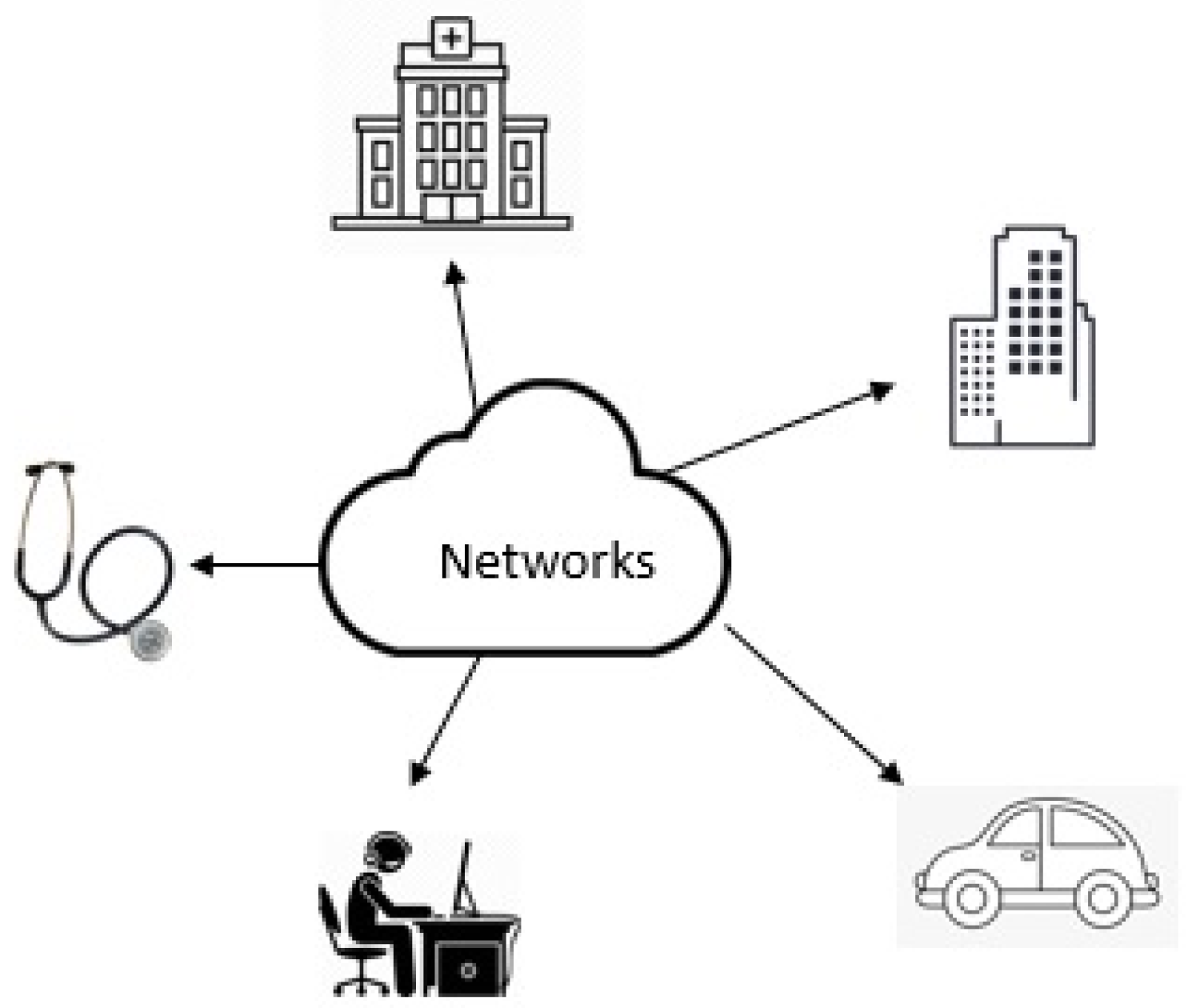
Figure 3.
The IoT challenges.

Figure 4.
The M2M communication compared to the IoT communication.
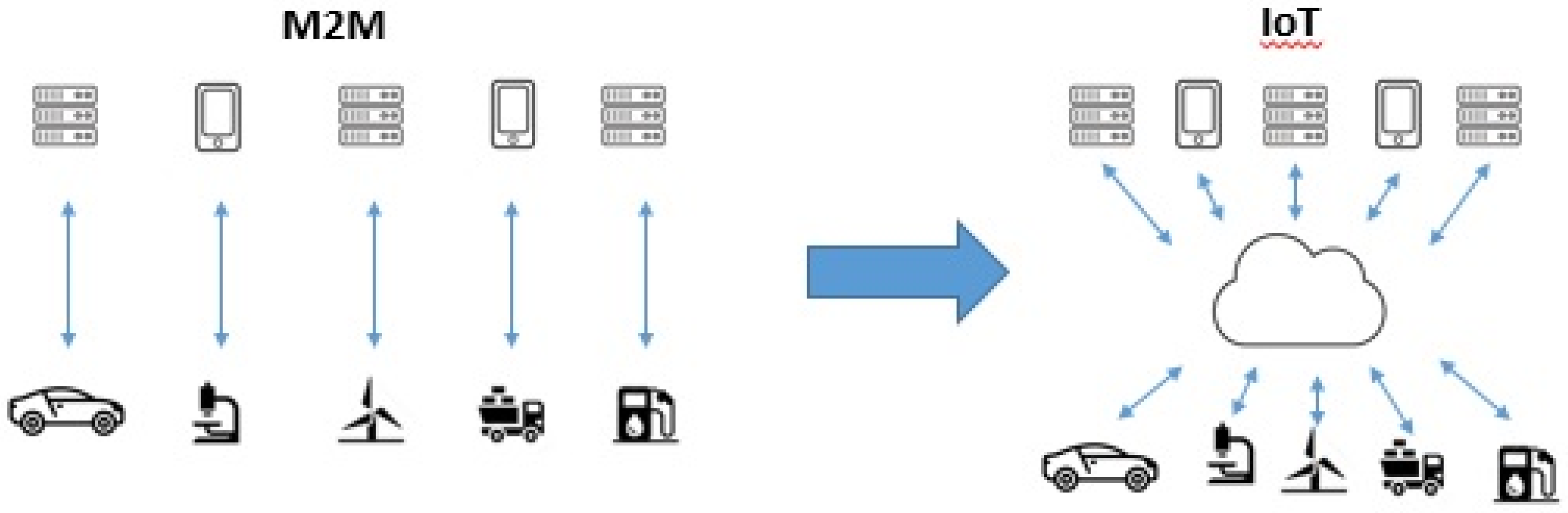
Figure 5.
5G end-to-end communication.
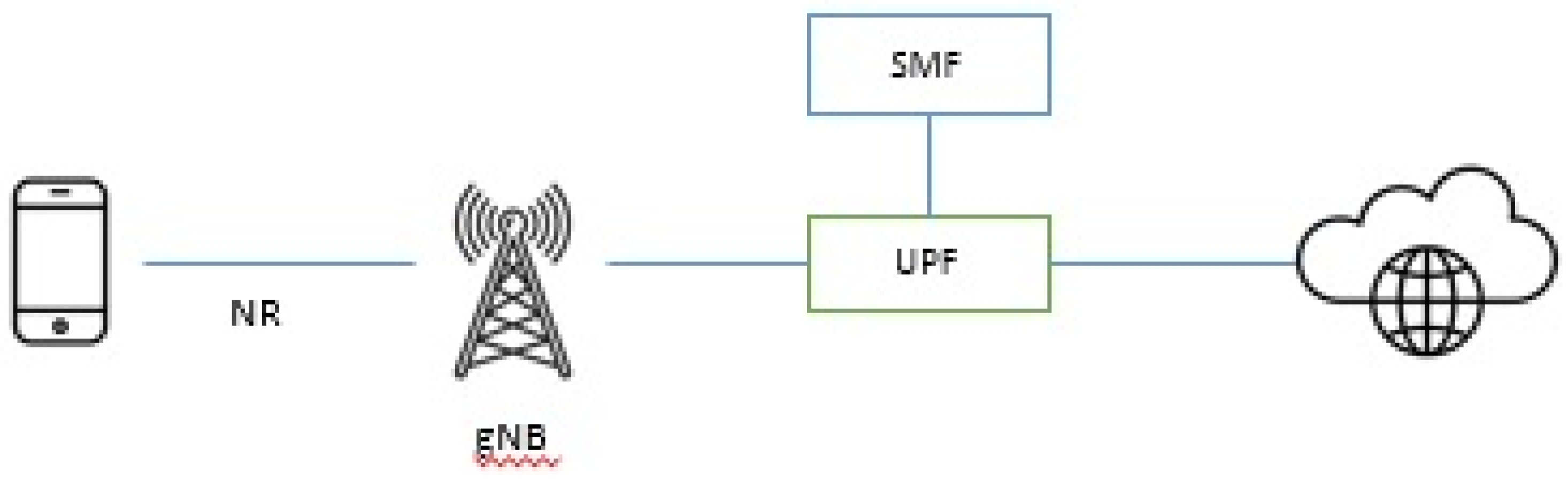
Figure 6.
The mobile network evolution.

Disclaimer/Publisher’s Note: The statements, opinions and data contained in all publications are solely those of the individual author(s) and contributor(s) and not of MDPI and/or the editor(s). MDPI and/or the editor(s) disclaim responsibility for any injury to people or property resulting from any ideas, methods, instructions or products referred to in the content. |
© 2023 by the authors. Licensee MDPI, Basel, Switzerland. This article is an open access article distributed under the terms and conditions of the Creative Commons Attribution (CC BY) license (http://creativecommons.org/licenses/by/4.0/).
Copyright: This open access article is published under a Creative Commons CC BY 4.0 license, which permit the free download, distribution, and reuse, provided that the author and preprint are cited in any reuse.


