
Submitted:
20 December 2023
Posted:
21 December 2023
You are already at the latest version
Abstract
NSD3 is a member of the NSD histone methyltransferase family of proteins. In recent years, it has been identified as a potential oncogene in certain types of cancer. NSD3 gene encodes three isoforms, the full length, a short (NSD3S) and WHISTLE isoforms. Importantly, NSD3S isoform corresponds to the N-terminal of the full-length protein, lacking the methyltransferase domain. The chromosomal location of NSD3 is frequently amplified across cancer types, such as breast, lung, colon, among others. Recently, this amplification has been correlated to a chromothripsis event, that could explain the different NSD3 alterations found in cancer. Fusion proteins containing NSD3 have also been reported, such as leukemia NSD3-NUP98, and in NUT midline carcinoma (NMC), NSD3-NUT fusion. Its role as an oncogene has been described by modulating different cancer pathways through its methyltransferase activity, or the short isoform of the protein, through protein interactions. Specifically, in this review we will focus on stating the functions that have been characterized as methyltransferase dependent, and those that have been correlated with the expression of the NSD3S isoform. Altogether, there is evidence that both isoforms of NSD3 are relevant for cancer progression, establishing NSD3 as a therapeutic target. However, further functional studies are needed to differentiate NSD3 oncogenic activity as dependent or independent of the catalytic domain of the protein, as well as the contribution of each isoform and its clinical significance in cancer progression.
Keywords:
Cancer
; Molecular Oncology
; Oncogenes
; NSD3
; NSD3S
1. Introduction
Chromatin organization is highly regulated by many factors, one of them being histone post-translational modification (HPTMs) [1]. These modifications have a direct implication in the state of compaction of the chromatin and the degree of transcription. Condensed chromatin or heterochromatin is associated with transcriptional repression, and loose chromatin or euchromatin associated with an active transcription of genes [2]. HPTMs can be recognized by proteins that are referred as “readers” and modified by adding or eliminating PTMs, by proteins called “writers” or “erasers”, respectively. Histone methyltransferases (HMT) are “readers” and “writers” of the chromatin, responsible for catalyzing the addition of methyl groups in arginine (PRMT) or lysine residues (HKMT) on the N-terminal histone tails. Most histone lysine methylation is carried out by a family of SET-domain containing proteins, which catalyze the addition of one to three methyl groups [3]. The nuclear receptor-binding SET domain (NSD) family of histone lysine methyltransferase is composed of three members: NSD1, NSD2 (MMSET/WHSC1, Wolf-Hirschhorn syndrome candidate 1), and NSD3 (WHSC1L1, WHSC1 like 1). The NSD proteins play a crucial role in regulating chromatin integrity and gene expression by mono- or di- methylating histone H3 lysine 36, generating H3K36me1 and H3K36me2 [4,5]. Alterations of any of the NSD proteins have been correlated with human diseases. NSD1 haploinsufficiency and point mutations are implicated on Sotos syndrome [6], a childhood developmental disease, and cancer such as, prostate, melanoma, and acute myeloid leukemia (AML) [7]. Haploinsufficiency of NSD2 is related to Wolf-Hirschhorn syndrome, multiple myeloma, neuroblastoma, endometrial and hepatocellular cancer, among others [4,8]. Finally, aberrant expression of NSD3 has been implicated in the development of multiple cancer types, such as lung, breast, pancreatic cancer [9,10,11]. Given the importance that NSD3 has gained in the past few years in relation to cancer development and progression, this article focuses on a detailed review of NSD3 alterations and involvement of the long and short isoform in important cancer pathways.
2. NSD3 protein structure
NSD3 was first described in 2000, by studying the PWWP (proline-tryptophan-tryptophan-proline) domain of NSD2 and performing a database search for proteins having the PWWP domain in their structure. NSD3 protein is found on chromosome 8p11.2 [12], encoding three isoforms by alternative splicing. A protein of 1437 amino acids, termed NSD3L or long isoform [13]. Alternative splicing of exon 10 encodes a protein of 645 amino acids, named NSD3 short (NSD3S), which is identical to NSD3L on the first 619 amino acids [12]. Finally, isoform WHISTLE (WHSC1-like 1 isoform 9 with methyltransferase activity to lysine), a short alternative splice version of the C- terminal of NSD3L that encodes a protein of 506 amino acids. In relation to the protein domains found in NSD3L, it has 5 PHD (plant-homeodomain)-type zinc fingers motifs, 2 PWWP domain, and the methyltransferase SET domain. Right next to the SET domain, there is a SAC (SET-associated Cys-rich) domain rich in cysteines, and finally, near the end of the C-terminal of the protein there is a Cys-His-rich domain termed C5HCH motif [13,14]. The PWWP domain is a histone methyl-lysine (H3K36) reader, acting as an epigenetic regulator of gene expression [15,16,17], and postulated as a site for protein-protein interactions, due to the amino acid composition [18]. The PHD domain is relevant for binding chromatin at histone H3 lysine 4 unmodified or methylated [19]. The SET domain is a region conserved between the SET family of methyltransferases, with specificity for mono or di-methylation of H3 lysine 36. The SET domain is separated into 3 smaller segments, the pre-SET, SET and post-SET domain, all of them needed for the catalytic activity [20], importantly the post-SET region is essential for binding to nucleosomes [21]. Finally, the PHD5-C5HCH region of NSD3 recognizes the H3 N-terminal peptide containing unmodified K4 and trimethylated K9, this recognition may vary from the one for NSD1 and NSD2 and may localize this H3K36 methyltransferases to different genome sites [14]. As NSD3S encodes only the N-terminal of the full-length protein, it only has the first PWWP domain, and lacks the methyltransferase activity [12,13] (Figure 1). In relation to the amino acid sequence, it reveals a similarity of 68% with NSD1 and 55% with NSD2, in regions with conserved domains (between residues 703 and 1409), including the SET domain [13].
3. NSD3 alterations in cancer
NSD3 protein is ubiquitously expressed on human tissues, with NSD3S isoform being more prominent than NSD3L [22,23,24], and WHISTLE isoform primarily found in testis [25]. Compared to NSD1 and NSD2, NSD3 exhibits higher genetic variation and amplification in cancer. The oncogenic role of NSD3 is manifested by changes ranging from alterations in expression, such as overexpression, point mutations as well as fusion with other proteins, which results in differences in cellular activity (Figure 2).
3.1. Study of the amplicon 8p11-12: Chromothripsis
The progress in next-generation sequencing technologies and their use in cancer genome research has eased the identification of a novel type of genomic instability known as chromothripsis. Chromothripsis is a pathological phenomenon by which a series of cluster chromosomal rearrangement occurrence and are localized in limited regions of the genome in one or several chromosomes. This focal chromosomal scrambling contributes to the initiation of cancer by mediating overexpression of oncogenes (amplification, translocation, or generation of oncogenic fusions), inactivation of tumor suppressor genes (by loss or disruption), and/or expression of genes that can contribute to cancer therapy resistance [27,28,29]. Stephens and collaborators found that at least 2-3% of all subtypes of cancer present Chromothripsis [27]. Recently, a study from the Pan-Cancer Analysis of Whole Genomes (PCAWG), the Consortium of the International Cancer Genome Consortium (ICGC) and The Cancer Genome Atlas (TCGA), analyzed patterns of Chromothripsis across 38 cancer types using whole-genome sequencing data and estimated a frequency of 40-60% [30]
The 8p11-12 genomic region spans over 10 Megabases (Mb) and encompasses over 50 known genes, including NSD3. Amplification of the 8p11-12 chromosomal region is a common genetic event in many epithelial cancers, thus structural variations as chromothripsis of the 8p11-12 genomic region has clinical and biological implications in multiple malignancies. A study of structural variations on esophageal squamous cell carcinoma (ESCC) found that chromothripsis leads to high-level amplification of FGFR1, LETM2 and NSD3 in chromosome 8. Further functional studies showed that NSD3 knock-down prevented cell proliferation but had no statistical suppression of cell migration and invasion in KYSE150 or TE-1 ESCC cell lines [31]. Together with genetic observations, they postulate these genes as amplification targets in ESCC.
In breast cancer, a study showed earlier undescribed chromothripsis-like patterns spanning the 8p11-12 genomic region and allele-specific DNA amplification events. One of the most common 8p11-12 amplification peak is in NSD3 loci, identified using DNA copy number analysis. Dual-color interphase FISH demonstrated extensive intra- and intertumoral heterogeneity in 32/47 amplified cases, ranging from neutral DNA copy number (two copies per FISH probe) to high level amplification (up to 50 copies per FISH probe), translocation events with DNA sequences from chromosome 8p on other chromosomes, and/or aneuploidy of chromosome 8 [32].
Several studies have been done over the years to establish the role of NSD3 protein in cancer. Due to the possibility that previously reported amplification, mutations or fusion protein regarding NSD3 in cancer could be generated by this chromothripsis event. More extensive analysis using whole genome sequencing will contribute to unraveling this phenomenon.
3.1.1. Amplification
In relation to the 8p11-12 amplicon found in different epithelial cancers [33], NSD3 has been proposed, among other proteins, as an important oncogene for cancer progression. Using different approaches, such as overexpression of NSD3, small interfering RNA (siRNA) and short hairpin RNA (shRNA)-mediated knockdown against NSD3 in 8p11-12 amplified breast cancer cells, it was found that the loss of NSD3 resulted in profound loss of growth and survival of these cells, denoting the function of this protein in regulating survival and transformation [22,34]. In a breast cancer mouse model expressing NSD3 oncogene in the mammary epithelium, revealed NSD3 as a transforming breast cancer oncogene, by exhibiting mammary hyperplasia, dysplasia and invasiveness [35]. NSD3 has also been proposed as an oncogenic driver in non-small cell lung cancer (NSCLC) [11], lung squamous cell carcinoma (LUSC) [36] and pancreatic ductal adenocarcinoma (PDAC) where the 8p11-12 amplicon has also been found. The studies validated the consistent amplification of NSD3, and utilizing siRNA technology against NSD3 decreases the viability and the colony formation capacity of lung and pancreatic cancer cell lines harboring the 8p amplicon [10,37]. Also, in lung and colon cancer cell lines with NSD3 amplification, loss of the protein leads to cell apoptosis [38]. Stable NSD3 knockdown cell lines were implanted on nude mice and developed fewer tumors of pancreatic and lung-derived cells xenografts [10]. Differential protein expression analysis in LUSC suggested that NSD3 could be a critical driver gene in the recurrent 8p11.23 amplicon that encompasses also FGFR1 oncogene, due to the unsuccessful response to targeted therapies against FGFR1 [36]. Later, Yuan et al demonstrated that NSD3 and not FGFR1 is the principal oncogenic driver in LUSC with the 8p11-12 amplification, establishing NSD3 as an important regulator in LUSC tumorigenesis [39]. Altogether, these reports postulate NSD3 amplification as one of the main oncogenic drivers of the 8p11-12 amplicon across cancer types.
3.1.2. Fusion proteins
Rearrangements involving the short arm of chromosome 8 have been reported and associated with different types of cancer.
The first fusion protein of NSD3 was found with NUP98 in a patient with AML. The t(8;11) (p11.2;p15) fuses NUP98 to the 3´end of NSD3 containing both of the PWWP, the SET, PHD and CH5CH rich domains [40]. The fusion transcript includes the FG repeats of NUP98, which are known to bind transcription factors, such as CREB-binding protein [40], suggesting an importance on transcriptional regulation of leukemic cells and transforms the NUP98-NSD3 fusion into a vital leukemogenesis-related oncogene. The presence of NUP98-NSD3 observed in leukemia cell lines has also been found to be present in B-lymphocyte cell lines derived from healthy volunteers who had undergone transformation by Epstein-Barr virus [41].
In pediatric sarcoma, investigators found a novel alteration, the NSD3/NCOA2 fusion. These two proteins have been found to be involved in fusion processes, NSD3 in acute myeloid leukemia and NCOA2 in infantile spindle cell rhabdomyosarcoma, which strengthens the findings and leaves pending the characterization of its function as well as the presence in other human samples [42].
Nuclear protein of the testis (NUT) midline carcinoma (NMC) is an epithelial cancer, that is defined by chromosomal translocations of the NUT gene. In about 65% of the cases is fused to BRD4, 25% fused to BRD3 and the rest 10% unknown, with recent reports showing to be fused to NSD3 [43,44,45,46]. The first NMC patient with NSD3-NUT fusion t(8;15)(p12;q15) was identified in 2014, described as a protein containing exons 1-7 of NSD3 to exons 2-7 of NUT protein, encoding 1694 amino acids, containing amino acids 1-569 of NSD3 and 8-1132 of NUT [43]. Unlike NUP98-NSD3 fusion, NSD3-NUT fusion has only the N-terminal region of NSD3 protein, the complete NSD3S isoform, without the methyltransferase activity. NSD3-NUT oncofusion is necessary and sufficient for the blockage of differentiation and for the proliferation of NMC cells [43]. NSD3-NUT oncofusion has also been described in patients with NMC of the lung including the same exons of NSD3 described previously [44].
3.1.3. Mutations
Xiong et al describes that exist a variety of NDS3 missense mutations and T419Pfs*8/Nfs*28/N mutations were detected in four cases of Stomach adenocarcinoma (STAD), two cases of colon adenocarcinoma (COAD) and single cases of breast invasive carcinoma (BRCA) and pancreatic adenocarcinoma (PAAD). Likewise, nonsense mutations of NSD3, such as, E1181K and T2342A, enhance the growth of cancer cells and xenograft tumors by disrupting an autoinhibitory loop of the NSD3 protein product, thereby increasing its enzymatic function [47,48]. More studies in relation to the mutations found in NSD3 are necessary to identify the significance of those mutations on cancer progression.
4. NSD3 involvement on cancer
It is well known that NSD3 catalyzes the methylation of histone H3 at lysine 36 (Li, Y. et al, 2009), this occurs because NSD3 binds to LSD2 and G9a/EHMT2, forming a complex in vivo [49]. G9a and LSD2 mediate H3K9 methylation and H3K4 demethylation of actively transcribed genes, helping NSD3 to recognize and methylate H3K36 [14]. Morishita et al, used the C-terminal portion of NSD3, including pre-SET, SET, post-SET and PHD5 domain and identified that in vitro, NSD3 can methylate H3K9, H3K27, H3K36, H3K79 and H4K20 [4]. Discrepancies about the specificity for the substrate of the catalytic domain of NSD3 and other members of the NSD family, may be due to the cellular context, the assay employed, nature of the substrate, or the portion of the protein used, if it is only the SET domain or the full-length protein. In relation to the isoforms of NSD3, NSD3L has been associated with neural crest formation and migration, playing a role in gene expression during neural crest development [50,51]. NSD3S conserves the N-terminal PWWP domain, this domain allows the protein to bind histone H3 at methylated lysine 36 [52]. The WHISTLE isoform has been found to act as a transcriptional repressor through HDAC1 recruitment, having H3K4me2 and H3K27me2/3 methyltransferase activity [25,53], this isoform is considered less relevant to cancer. To better understand how the two main isoforms of NSD3 carry out their oncogenic role, we classified the different functions of NSD3 as methyltransferase-dependent (NSD3L) or as an adaptor protein function (NSD3S).
4.1. Methyltransferase-dependent function of NSD3 in cancer
4.1.1. NOTCH pathway
NSD3L interacts with EZH2 and RNA polymerase II to influence H3K36me2/3-dependent transactivation of genes, including those related to NOTCH signaling in breast cancer with the 8p11-12 amplicon, such as NOTCH receptors, ligands, and ADAM12 [54], these findings indicate that NSD3-induced methylation of H3K36 activates NOTCH signaling to drive breast tumor initiation and metastatic progression.
4.1.2. MTOR pathway
Deregulation of mTOR pathway occurs in various diseases, including cancer. The mTOR pathway responds to environmental signals, regulating basic cell functions like cell growth and proliferation [55], survival, apoptosis, angiogenesis, and metabolism [56]. Yuan et al showed that in lung cancer with amplification of chromosomal region 8p11-12, methylation of H3K36 catalyzed by NSD3 resulted in transcription activation of key oncogenic genes, including those involved in mTOR signaling activation [39]. In their studies, in mice tumors driven by the mNSD3T1242A mutation, RNAseq analysis showed upregulation of MYC, BRD4 and p4EBP1, the last one being involved in activation of mTOR signaling. In pancreatic cancer, NSD3 silencing resulted in inhibition of S6K1 phosphorylation, indicating that in absence of the NSD3 oncoprotein mTOR was not activated [48].
4.1.3. EGFR pathway
It has been shown that HMTs methylate not only histones, but also proteins. NSD family of proteins have been also described to perform that function, both NSD1 [57] and NSD2 [58] methylate NF-kB, regulating its function.
NSD3-mediated mono-methylation of EGFR on the kinase domain (Lys721) affects the cytoplasmic and nuclear function of the protein. In the cytoplasm it increases the kinase activity and downstream ERK signaling pathway without the presence of the ligand EGF. In the nucleus, it stimulates cell cycle progression by increasing the binding to PCNA on squamous cell carcinoma of head and neck (SCCHN) cancer cells [59]. A study in colorectal cancer (CRC) cells showed that overexpression of NSD3 increased phosphorylation of ERK leading to an enhancement of proliferation and migration of CRC cells [60]. Xiong et al, on pancreatic cancer cells, also found a correlation on a decrease of EGFR/ERK pathway activation with NSD3 knockdown [47].
4.1.4. IFN pathway
Activated Interferon regulatory factor 3 (IRF3) is a transcriptional regulator that promotes IFN-α and IFN-β transcription. IFN-β elicits both anti-inflammatory and pro-inflammatory responses, playing a key role in innate immunity and in the response to viral infections [61,62]. Importantly, NSD3-deficient mice are more susceptible to viral infection. Primary peritoneal macrophages derived from NSD3-deficient mice have lower IFN-β levels, lower cytokines IL-6, IL-8, and TNF levels upon VSV infection [63]. NSD3 was found to interact with IRF3 using its PWWP domain, and methylate IRF3 at K366 in VSV-infected HEK293T. NSD3-mediated methylation increases IRF3 transcriptional activity by interfering with the binding between IRF3 and PP1cc phosphatase, maintaining IRF3 phosphorylation. Therefore, NSD3 acts as a critical promoter for the induction of type I IFNs and antiviral innate response [63].
It is accepted that innate and adaptive immunity plays important roles in tumor immune surveillance. Amplification of NSD3 in patients with LUSC exhibits a decrease in type II IFN response, leading to an immune–desert pro-tumorigenic phenotype [64]. In breast cancer, increased expression of NSD3 correlated with a decrease CD8+ T cells and increased PD-L1 gene [65], in agreement with Xu et al in lung cancer. In contrast, in PAAD, through bioinformatic studies, upregulation of NSD3 correlated with increased immune infiltration, specifically macrophages, B cells, neutrophils, CD8+ T cells and dendritic cells [47]. Taken together, there is evidence linking the role of NSD3 in IFN response and immune modulation, however, further studies are needed to accurately state the function.
4.1.5. Cyclin dependent kinase (CDK) pathway
Transcription of CDC6 and CDK2 is regulated by H3K36 di-methylation, these genes promote G1 to S phase transition. In SCCHN cells it was demonstrated that NSD3 regulates transcription of CDC6 and CDK2, indeed NSD3 knockdown resulted in G0/G1 arrest [66]. Knockdown of NSD3 by siRNA in bladder and lung cancer cell lines reduced cell proliferation by inducing cell cycle arrest at G2/M phase through the regulation of expression of CCNG1 and NEK7, via expression profile analysis [67]. CCNG1 and NEK7 are important regulators of G2/M transition in cancer cells [68,69]. In human osteosarcoma cell line NSD3 silencing resulted in an inhibition of cell proliferation, induction of apoptosis, and in a greater number of cells in G2/M phase, suggesting an implication of NSD3 in G2/M cell cycle arrest [70]. NSD3L depletion by siRNA resulted in an increased number of cells with separated sister chromatids during prometaphase, caused by the spindle assembly checkpoint dependent arrest. Also, depletion of NSD3L resulted in defective sister chromatid cohesion in G2 cells, implying that specifically the NSD3L isoform acts in a checkpoint before mitosis, decreasing cohesin and MAU2 recruitment onto chromatin [71].
4.2. NSD3S isoform function as an adaptor protein
4.2.1. NSD3-NUT fusion
The NSD3-NUT fusion oncoprotein is present in several NMC cases. After knockdown of endogenous expression of NSD3-NUT in 1221 NMC cells, there was an increase on keratin levels, and a decreased on cellular proliferation, indicating a crucial role of NSD3-NUT oncofusion on blocking cell differentiation and stimulating proliferation in this cell line. It was found that NSD3 not only interacts with NUT, but is associated with the BRD4-NUT fusion, this interaction being important in blockade of differentiation [43]. It is known that BRD4-NUT binds and activates the histone acetyltransferase, p300, leading to inactivation of p53 [72]. Recently, was described the predominance of the NSD3-NUTM1 oncofusion in thyroid NUT carcinoma [73,74].
4.2.2. NSD3S-BRD4-CHD8 interactions
NSD3 imparts a pTEFb-independent transcriptional activation function on BRD4, on genes such as CCND1 and PIM2. The BRD4/NSD3 complex regulates methylation of H3K36 at BRD4 target genes [75]. BRD4 regulates transcription of some genes, like CD274 that encodes PD-L1 [76]. NSD3S was described as an adaptor protein by Shen et al, that characterized the binding of BRD4 to a small 11 amino acid region on the N-terminal of NSD3 (amino acid 152-163). Also, they showed that the short isoform, NSD3S, was required and sufficient for driving leukemia progression, indicating a methyltransferase independent function of the protein. NSD3S also binds to the chromatin remodeler, CHD8, through the C-terminal region, linking BRD4 to CHD8 on the chromatin, through the ET domain of BRD4 [23]. The three proteins colocalize in regions of the genome and they are release from MYC super-enhancers using BET inhibitor, JQ-1 [23].
4.2.3. NSD3S-MYC interaction
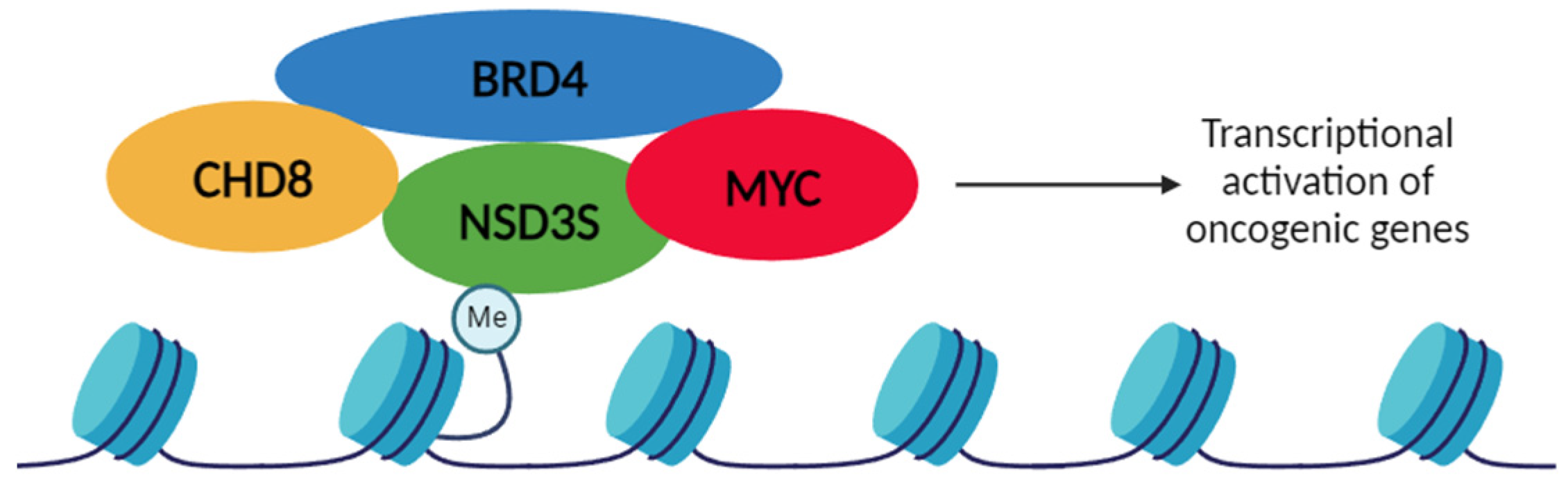
Sun et al reported that in NSD3 knockout pancreatic cells and in shRNA-xenografts, there was a decrease in gene expression on Myc, Adam12 and Notch3, demonstrating that silencing of NSD3 resulted in downregulation of oncogenic genes [48]. We described that NSD3S interacts with MYC stabilizing MYC protein and increasing its transcriptional activity, acting as an oncogenic interaction [77]. NSD3S-MYC interaction is mediated by a 15 amino acid site on NSD3S, between amino acids 389 and 404. Interestingly, deletion of the 15 amino acid peptide showed decreased stabilization of MYC, through the suppression of the FBXW7 mediated degradation of MYC [78]. It is well established that BRD4 regulates transcription of MYC in cancer [79]. Moreover, MYC interacts with BRD4 through the internal region of the protein, it catalyzes the phosphorylation of Thr58, resulting in MYC ubiquitination and degradation [76,80]. The connection between NSD3-MYC-BRD4 and potentially other oncogenic signaling proteins still must be deciphered, but it can be postulated that NSD3S may act as a scaffolding protein recruiting MYC, BRD4 and CHD8 to chromatin by binding to H3K36 through the PWWP domain (Figure 3).
5. Discussion
NSD3 is present as three isoforms, but only two of them have been linked to cancer, the NSD3L and -S isoform. Importantly, NSD3L has catalytic activity, whereas, NSD3S only has the first PWWP domain, that has the function of binding to H3K36 marks on the chromatin. During the last few years, NSD3 has been extensively studied in relation to cancer, however, knowledge about isoform specific role is diffuse and currently the available information focuses on NSD3 function depending on the tumor being studied.
Chromothripsis events have been reported since 2012, causing multiple alterations resulting in gene amplification, deletion, mutation, or fusion. Moreover, in cancer the correlation between chromothripsis and NSD3-amplification (8p11-12 amplicon) was established in 2018. NSD3 has been postulated as one of the main oncogenic drivers of the amplicon 8p11-12 across cancer types. Interestingly, it has been reported that about 50% of invasive breast tumors that have the 8p11-p12 amplicon also harbor MYC amplification [43,81]. This suggests that patients with 8p11-12 and 8q24.21 co-amplification, may present a more aggressive phenotype. More research is needed to see the prevalence between these two types of alteration across cancer types that could help the prognosis of patients.
As previously mentioned, NSD3 has been well established as an oncogene, however, there are still not enough studies that differentiate isoform-specific contributions in cancer progression. NSD3L isoform contains the catalytic domain, mediating the methylation of H3K36, activating gene transcription. In relation to cancer, NSD3L can also methylate proteins, specifically, it has been reported the methylation and activation of EGFR and IRF3, promoting an oncogenic function of the proteins. There are reports of other NSD members methylating and activating oncogenic proteins, such as p65 of the NF-kB pathway [57] and STAT3 [82], suggesting the possibility that NSD3L could methylate and regulate other proteins. We believe that the methylation of non-histone proteins mediated by the NSD family should be further studied in the context of cancer.
Over the past years, NSD3S has been established as an adaptor protein of important drivers of cancer, such as MYC, BRD4 and CHD8. NSD3S through the PWWP domain binds to chromatin and could recruit MYC, along with other chromatin regulators, increasing transcription of MYC target genes, possibly inducing an oncogenic phenotype. Moreover, NSD3S has been shown to be sufficient for leukemia progression, also it stabilizes and increases MYC transcriptional activity, and it is present on the oncogenic NUT fusion. There are some preliminary reports on NSD3S involvement on the Wnt pathway [22,83], however, further studies should be taken into consideration. According to the current findings we conclude that histone or non-histone protein methylation may be one of the oncogenic mechanisms of NSD3, although not the only one. Certainly, there are functions of NSD3 independent of the SET domain.
Due to the oncogenic activity of NSD3 isoforms, driven through the methyltransferase or via the short isoform acting as an adaptor protein, NSD3 has been proposed as a prospective therapeutic target in cancer. Inhibitors against NSD3 have been developed since 2019, specifically targeting the PWWP1 domain of NSD3 (BI-9321), inhibiting both isoforms of the protein. Interestingly, the chemical probe BI-9321 decreases the expression of the Myc gene, reducing cell proliferation [84]. Later, two studies reported the discovery and characterization of NSD3 PROTAC, being more efficient in blocking NSD3 function and decreasing Myc oncogenic node. Both PROTAC were synthesized incorporating an NSD3-PWWP antagonist link to an E3 ligase, showing the degradation of both NSD3 isoforms in cell lines of AML, multiple myeloma and lung cancer [64,85]. These studies correlate with our findings that NSD3S/MYC interaction stabilizes and activates MYC transcriptional activity. Finally, Kim et al, reported the identification of a new NSD3 inhibitor which targets the SET domain of the protein, therefore only the NSD3L isoform [86]. However, based on the understanding we have regarding the function of NSD3, particularly NSD3S, we believe that inhibitors targeting both isoforms would be more effective in blocking oncogenic programs, in a therapeutic context.
Given the importance and the prevalence of NSD3 amplification across several types of cancer, a combination of Whole Genome Sequencing, isoform specific pharmacological targeting and study of the interactome of NSD3 will help to understand the altered expression and contribution of both isoforms of NSD3 in cancer.
Author Contributions
Conceptualization, Y.N and V.GP; Writing original draft, Y.N and S.V; writing – review and editing, Y.N, S.V, V.B and V.GP; Visualization, V.B and V.GP; Supervision and funding acquisition, V.GP. All authors have read and agreed to the published version of the manuscript.
Funding
This research was funded by “Fondo de Subvención de Instalación en la Academia” from the “Agencia Nacional de Investigación y Desarrollo”, ANID, grant number PAI77200098 (V.GP).
Institutional Review Board Statement
Not applicable.
Data Availability Statement
Not applicable.
Acknowledgments
Figures were created using BioRender (https://www.biorender.com/).
Conflicts of Interest
The authors declare no conflict of interest.
References
- Kornberg, R.D.; Lorch, Y. Twenty-Five Years of the Nucleosome, Fundamental Particle of the Eukaryote Chromosome. Cell 1999, 98, 285–294. [Google Scholar] [CrossRef] [PubMed]
- Barski, A.; Cuddapah, S.; Cui, K.; Roh, T.-Y.; Schones, D.E.; Wang, Z.; Wei, G.; Chepelev, I.; Zhao, K. High-Resolution Profiling of Histone Methylations in the Human Genome. Cell 2007, 129, 823–837. [Google Scholar] [CrossRef] [PubMed]
- Kouzarides, T. Histone Methylation in Transcriptional Control. Current Opinion in Genetics & Development 2002, 12, 198–209. [Google Scholar] [CrossRef]
- Morishita, M.; Di Luccio, E. Structural Insights into the Regulation and the Recognition of Histone Marks by the SET Domain of NSD1. Biochemical and Biophysical Research Communications 2011, 412, 214–219. [Google Scholar] [CrossRef] [PubMed]
- Li, W.; Tian, W.; Yuan, G.; Deng, P.; Sengupta, D.; Cheng, Z.; Cao, Y.; Ren, J.; Qin, Y.; Zhou, Y.; et al. Molecular Basis of Nucleosomal H3K36 Methylation by NSD Methyltransferases. Nature 2021, 590, 498–503. [Google Scholar] [CrossRef] [PubMed]
- Douglas, J.; Coleman, K.; Tatton-Brown, K.; Hughes, H.E.; Temple, I.K.; Cole, T.R.P.; Rahman, N. Evaluation of NSD2 and NSD3 in Overgrowth Syndromes. Eur J Hum Genet 2005, 13, 150–153. [Google Scholar] [CrossRef] [PubMed]
- Tauchmann, S.; Schwaller, J. NSD1: A Lysine Methyltransferase between Developmental Disorders and Cancer. Life 2021, 11, 877. [Google Scholar] [CrossRef] [PubMed]
- Toyokawa, G.; Cho, H.-S.; Masuda, K.; Yamane, Y.; Yoshimatsu, M.; Hayami, S.; Takawa, M.; Iwai, Y.; Daigo, Y.; Tsuchiya, E.; et al. Histone Lysine Methyltransferase Wolf-Hirschhorn Syndrome Candidate 1 Is Involved in Human Carcinogenesis through Regulation of the Wnt Pathway. Neoplasia 2011, 13, 887-IN11. [Google Scholar] [CrossRef] [PubMed]
- Liu, L.; Kimball, S.; Liu, H.; Holowatyj, A.; Yang, Z.-Q. Genetic Alterations of Histone Lysine Methyltransferases and Their Significance in Breast Cancer. Oncotarget 2015, 6, 2466–2482. [Google Scholar] [CrossRef] [PubMed]
- Mahmood, S.F.; Gruel, N.; Nicolle, R.; Chapeaublanc, E.; Delattre, O.; Radvanyi, F.; Bernard-Pierrot, I. PPAPDC1B and WHSC1L1 Are Common Drivers of the 8p11-12 Amplicon, Not Only in Breast Tumors But Also in Pancreatic Adenocarcinomas and Lung Tumors. The American Journal of Pathology 2013, 183, 1634–1644. [Google Scholar] [CrossRef]
- Rooney, C.; Geh, C.; Williams, V.; Heuckmann, J.M.; Menon, R.; Schneider, P.; Al-Kadhimi, K.; Dymond, M.; Smith, N.R.; Baker, D.; et al. Characterization of FGFR1 Locus in sqNSCLC Reveals a Broad and Heterogeneous Amplicon. PLoS ONE 2016, 11, e0149628. [Google Scholar] [CrossRef] [PubMed]
- Stec, I.; Van Ommen, G.-J.B.; Den Dunnen, J.T. WHSC1L1, on Human Chromosome 8p11.2, Closely Resembles WHSC1 and Maps to a Duplicated Region Shared with 4p16.3. Genomics 2001, 76, 5–8. [Google Scholar] [CrossRef] [PubMed]
- Angrand, P.-O.; Apiou, F.; Stewart, A.F.; Dutrillaux, B.; Losson, R.; Chambon, P. NSD3, a New SET Domain-Containing Gene, Maps to 8p12 and Is Amplified in Human Breast Cancer Cell Lines. Genomics 2001, 74, 79–88. [Google Scholar] [CrossRef] [PubMed]
- He, C.; Li, F.; Zhang, J.; Wu, J.; Shi, Y. The Methyltransferase NSD3 Has Chromatin-Binding Motifs, PHD5-C5HCH, That Are Distinct from Other NSD (Nuclear Receptor SET Domain) Family Members in Their Histone H3 Recognition. Journal of Biological Chemistry 2013, 288, 4692–4703. [Google Scholar] [CrossRef] [PubMed]
- Wu, H.; Zeng, H.; Lam, R.; Tempel, W.; Amaya, M.F.; Xu, C.; Dombrovski, L.; Qiu, W.; Wang, Y.; Min, J. Structural and Histone Binding Ability Characterizations of Human PWWP Domains. PLoS ONE 2011, 6, e18919. [Google Scholar] [CrossRef] [PubMed]
- Rona, G.B.; Almeida, D.S.G.; Pinheiro, A.S.; Eleutherio, E.C.A. The PWWP Domain of the Human Oncogene WHSC1L1/NSD3 Induces a Metabolic Shift toward Fermentation. Oncotarget 2017, 8, 54068–54081. [Google Scholar] [CrossRef] [PubMed]
- Vermeulen, M.; Eberl, H.C.; Matarese, F.; Marks, H.; Denissov, S.; Butter, F.; Lee, K.K.; Olsen, J.V.; Hyman, A.A.; Stunnenberg, H.G.; et al. Quantitative Interaction Proteomics and Genome-Wide Profiling of Epigenetic Histone Marks and Their Readers. Cell 2010, 142, 967–980. [Google Scholar] [CrossRef] [PubMed]
- Stec, I.; Nagl, S.B.; van Ommen, G.-J.B. The PWWP Domain: A Potential Protein-Protein Interaction Domain in Nuclear Proteins Influencing Differentiation? FEBS Letters 2000. [CrossRef] [PubMed]
- Jain, K.; Fraser, C.S.; Marunde, M.R.; Parker, M.M.; Sagum, C.; Burg, J.M.; Hall, N.; Popova, I.K.; Rodriguez, K.L.; Vaidya, A.; et al. Characterization of the Plant Homeodomain (PHD) Reader Family for Their Histone Tail Interactions. Epigenetics & Chromatin 2020, 13, 3. [Google Scholar] [CrossRef]
- Morishita, M.; Mevius, D.; Di Luccio, E. In Vitro Histone Lysine Methylation by NSD1, NSD2/MMSET/WHSC1 and NSD3/WHSC1L. 2014. [Google Scholar] [CrossRef]
- Allali-Hassani, A.; Kuznetsova, E.; Hajian, T.; Wu, H.; Dombrovski, L.; Li, Y.; Gräslund, S.; Arrowsmith, C.H.; Schapira, M.; Vedadi, M. A Basic Post-SET Extension of NSDs Is Essential for Nucleosome Binding In Vitro. SLAS Discovery 2014, 19, 928–935. [Google Scholar] [CrossRef] [PubMed]
- Yang, Z.-Q.; Liu, G.; Bollig-Fischer, A.; Giroux, C.N.; Ethier, S.P. Transforming Properties of 8p11-12 Amplified Genes in Human Breast Cancer. Cancer Research 2010, 70, 8487–8497. [Google Scholar] [CrossRef] [PubMed]
- Shen, C.; Ipsaro, J.J.; Shi, J.; Milazzo, J.P.; Wang, E.; Roe, J.-S.; Suzuki, Y.; Pappin, D.J.; Joshua-Tor, L.; Vakoc, C.R. NSD3-Short Is an Adaptor Protein That Couples BRD4 to the CHD8 Chromatin Remodeler. Molecular Cell 2015, 60, 847–859. [Google Scholar] [CrossRef]
- Irish, J.C.; Mills, J.N.; Turner-Ivey, B.; Wilson, R.C.; Guest, S.T.; Rutkovsky, A.; Dombkowski, A.; Kappler, C.S.; Hardiman, G.; Ethier, S.P. Amplification of WHSC1L1 Regulates Expression and Estrogen-independent Activation of ERα in SUM-44 Breast Cancer Cells and Is Associated with ERα Over-expression in Breast Cancer. Molecular Oncology 2016, 10, 850–865. [Google Scholar] [CrossRef]
- Kim, S.M.; Kee, H.J.; Eom, G.H.; Choe, N.W.; Kim, J.Y.; Kim, Y.S.; Kim, S.K.; Kook, H.; Kook, H.; Seo, S.B. Characterization of a Novel WHSC1-Associated SET Domain Protein with H3K4 and H3K27 Methyltransferase Activity. Biochemical and Biophysical Research Communications 2006, 345, 318–323. [Google Scholar] [CrossRef]
- The ICGC/TCGA Pan-Cancer Analysis of Whole Genomes Consortium; Aaltonen, L.A.; Abascal, F.; Abeshouse, A.; Aburatani, H.; Adams, D.J.; Agrawal, N.; Ahn, K.S.; Ahn, S.-M.; Aikata, H.; et al. Pan-Cancer Analysis of Whole Genomes. Nature 2020, 578, 82–93. [Google Scholar] [CrossRef]
- Stephens, P.J.; Greenman, C.D.; Fu, B.; Yang, F.; Bignell, G.R.; Mudie, L.J.; Pleasance, E.D.; Lau, K.W.; Beare, D.; Stebbings, L.A.; et al. Massive Genomic Rearrangement Acquired in a Single Catastrophic Event during Cancer Development. Cell 2011, 144, 27–40. [Google Scholar] [CrossRef]
- Forment, J.V.; Kaidi, A.; Jackson, S.P. Chromothripsis and Cancer: Causes and Consequences of Chromosome Shattering. Nat Rev Cancer 2012, 12, 663–670. [Google Scholar] [CrossRef]
- Krupina, K.; Goginashvili, A.; Cleveland, D.W. Scrambling the Genome in Cancer: Causes and Consequences of Complex Chromosome Rearrangements. Nat Rev Genet 2023. [CrossRef]
- Cortés-Ciriano, I.; Lee, J.J.-K.; Xi, R.; Jain, D.; Jung, Y.L.; Yang, L.; Gordenin, D.; Klimczak, L.J.; Zhang, C.-Z.; Pellman, D.S.; et al. Comprehensive Analysis of Chromothripsis in 2,658 Human Cancers Using Whole-Genome Sequencing. Nat Genet 2020, 52, 331–341. [Google Scholar] [CrossRef]
- Cheng, C.; Zhou, Y.; Li, H.; Xiong, T.; Li, S.; Bi, Y.; Kong, P.; Wang, F.; Cui, H.; Li, Y.; et al. Whole-Genome Sequencing Reveals Diverse Models of Structural Variations in Esophageal Squamous Cell Carcinoma. The American Journal of Human Genetics 2016, 98, 256–274. [Google Scholar] [CrossRef] [PubMed]
- Parris, T.Z.; Rönnerman, E.W.; Engqvist, H.; Biermann, J.; Truvé, K.; Nemes, S.; Forssell-Aronsson, E.; Solinas, G.; Kovács, A.; Karlsson, P.; et al. Genome-Wide Multi-Omics Profiling of the 8p11-P12 Amplicon in Breast Carcinoma. Oncotarget 2018, 9, 24140–24154. [Google Scholar] [CrossRef] [PubMed]
- Voutsadakis, I.A. 8p11.23 Amplification in Breast Cancer: Molecular Characteristics, Prognosis and Targeted Therapy. JCM 2020, 9, 3079. [Google Scholar] [CrossRef] [PubMed]
- Bernard-Pierrot, I.; Gruel, N.; Stransky, N.; Vincent-Salomon, A.; Reyal, F.; Raynal, V.; Vallot, C.; Pierron, G.; Radvanyi, F.; Delattre, O. Characterization of the Recurrent 8p11-12 Amplicon Identifies PPAPDC1B, a Phosphatase Protein, as a New Therapeutic Target in Breast Cancer. Cancer Research 2008, 68, 7165–7175. [Google Scholar] [CrossRef]
- Turner-Ivey, B.; Smith, E.L.; Rutkovsky, A.C.; Spruill, L.S.; Mills, J.N.; Ethier, S.P. Development of Mammary Hyperplasia, Dysplasia, and Invasive Ductal Carcinoma in Transgenic Mice Expressing the 8p11 Amplicon Oncogene NSD3. Breast Cancer Res Treat 2017, 164, 349–358. [Google Scholar] [CrossRef] [PubMed]
- Satpathy, S.; Krug, K.; Jean Beltran, P.M.; Savage, S.R.; Petralia, F.; Kumar-Sinha, C.; Dou, Y.; Reva, B.; Kane, M.H.; Avanessian, S.C.; et al. A Proteogenomic Portrait of Lung Squamous Cell Carcinoma. Cell 2021, 184, 4348–4371.e40. [Google Scholar] [CrossRef] [PubMed]
- Tonon, G.; Wong, K.-K.; Maulik, G.; Brennan, C.; Feng, B.; Zhang, Y.; Khatry, D.B.; Protopopov, A.; You, M.J.; Aguirre, A.J.; et al. High-Resolution Genomic Profiles of Human Lung Cancer. Proc. Natl. Acad. Sci. U.S.A. 2005, 102, 9625–9630. [Google Scholar] [CrossRef] [PubMed]
- Chen, Y.; McGee, J.; Chen, X.; Doman, T.N.; Gong, X.; Zhang, Y.; Hamm, N.; Ma, X.; Higgs, R.E.; Bhagwat, S.V.; et al. Identification of Druggable Cancer Driver Genes Amplified across TCGA Datasets. PLoS ONE 2014, 9, e98293. [Google Scholar] [CrossRef] [PubMed]
- Yuan, G.; Flores, N.M.; Hausmann, S.; Lofgren, S.M.; Kharchenko, V.; Angulo-Ibanez, M.; Sengupta, D.; Lu, X.; Czaban, I.; Azhibek, D.; et al. Elevated NSD3 Histone Methylation Activity Drives Squamous Cell Lung Cancer. Nature 2021, 590, 504–508. [Google Scholar] [CrossRef]
- Rosati, R.; La Starza, R.; Veronese, A.; Aventin, A.; Schwienbacher, C.; Vallespi, T.; Negrini, M.; Martelli, M.F.; Mecucci, C. NUP98 Is Fused to the NSD3 Gene in Acute Myeloid Leukemia Associated with t(8;11)(P11.2;P15). Blood 2002, 99, 3857–3860. [Google Scholar] [CrossRef]
- Taketani, T.; Taki, T.; Nakamura, H.; Taniwaki, M.; Masuda, J.; Hayashi, Y. NUP98–NSD3 Fusion Gene in Radiation-Associated Myelodysplastic Syndrome with t(8;11)(P11;P15) and Expression Pattern of NSD Family Genes. Cancer Genetics and Cytogenetics 2009, 190, 108–112. [Google Scholar] [CrossRef] [PubMed]
- Avenarius, M.R.; Miller, C.R.; Arnold, M.A.; Koo, S.; Roberts, R.; Hobby, M.; Grossman, T.; Moyer, Y.; Wilson, R.K.; Mardis, E.R.; et al. Genetic Characterization of Pediatric Sarcomas by Targeted RNA Sequencing. The Journal of Molecular Diagnostics 2020, 22, 1238–1245. [Google Scholar] [CrossRef]
- French, C.A.; Rahman, S.; Walsh, E.M.; Kühnle, S.; Grayson, A.R.; Lemieux, M.E.; Grunfeld, N.; Rubin, B.P.; Antonescu, C.R.; Zhang, S.; et al. NSD3–NUT Fusion Oncoprotein in NUT Midline Carcinoma: Implications for a Novel Oncogenic Mechanism. Cancer Discovery 2014, 4, 928–941. [Google Scholar] [CrossRef] [PubMed]
- Suzuki, S.; Kurabe, N.; Ohnishi, I.; Yasuda, K.; Aoshima, Y.; Naito, M.; Tanioka, F.; Sugimura, H. NSD3-NUT-Expressing Midline Carcinoma of the Lung: First Characterization of Primary Cancer Tissue. Pathology - Research and Practice 2015, 211, 404–408. [Google Scholar] [CrossRef]
- Agaimy, A.; Tögel, L.; Stoehr, R.; Meidenbauer, N.; Semrau, S.; Hartmann, A.; Mantsopoulos, K. NSD3-NUTM1-Rearranged Carcinoma of the Median Neck/Thyroid Bed Developing after Recent Thyroidectomy for Sclerosing Mucoepidermoid Carcinoma with Eosinophilia: Report of an Extraordinary Case. Virchows Arch 2021, 479, 1095–1099. [Google Scholar] [CrossRef] [PubMed]
- Chen, M.; Yang, J.; Lv, L.; Li, Y.; Tang, Y.; Liu, W.; Wang, W.; Jiang, L. Comprehensive Genetic Profiling of Six Pulmonary Nuclear Protein in Testis Carcinomas with a Novel Micropapillary Histological Subtype in Two Cases. Human Pathology 2021, 115, 56–66. [Google Scholar] [CrossRef] [PubMed]
- Xiong, Q.; Zhou, Y.; Zhang, S.; Zhang, Y.; Xu, Y.; Yang, Y.; Zhou, C.; Zeng, Z.; Han, J.; Zhu, Q. NSD3, a Member of Nuclear Receptor-Binding SET Domain Family, Is a Potential Prognostic Biomarker for Pancreatic Cancer. Cancer Medicine 2023, 12, 10961–10978. [Google Scholar] [CrossRef] [PubMed]
- Sun, Y.; Xie, J.; Cai, S.; Wang, Q.; Feng, Z.; Li, Y.; Lu, J.; Chen, W.; Ye, Z. Elevated Expression of Nuclear Receptor-Binding SET Domain 3 Promotes Pancreatic Cancer Cell Growth. Cell Death Dis 2021, 12, 913. [Google Scholar] [CrossRef] [PubMed]
- Fang, R.; Barbera, A.J.; Xu, Y.; Rutenberg, M.; Leonor, T.; Bi, Q.; Lan, F.; Mei, P.; Yuan, G.-C.; Lian, C.; et al. Human LSD2/KDM1b/AOF1 Regulates Gene Transcription by Modulating Intragenic H3K4me2 Methylation. Molecular Cell 2010, 39, 222–233. [Google Scholar] [CrossRef]
- Jacques-Fricke, B.T.; Roffers-Agarwal, J.; Hussein, A.O.; Yoder, K.J.; Gearhart, M.D.; Gammill, L.S. Profiling NSD3-Dependent Neural Crest Gene Expression Reveals Known and Novel Candidate Regulatory Factors. Developmental Biology 2021, 475, 118–130. [Google Scholar] [CrossRef]
- Jacques-Fricke, B.T.; Gammill, L.S. Neural Crest Specification and Migration Independently Require NSD3-Related Lysine Methyltransferase Activity. MBoC 2014, 25, 4174–4186. [Google Scholar] [CrossRef] [PubMed]
- Qin, S.; Min, J. Structure and Function of the Nucleosome-Binding PWWP Domain. Trends in Biochemical Sciences 2014, 39, 536–547. [Google Scholar] [CrossRef] [PubMed]
- Kim, S.-M.; Kee, H.-J.; Choe, N.; Kim, J.-Y.; Kook, H.; Kook, H.; Seo, S.-B. The Histone Methyltransferase Activity of WHISTLE Is Important for the Induction of Apoptosis and HDAC1-Mediated Transcriptional Repression. Experimental Cell Research 2007, 313, 975–983. [Google Scholar] [CrossRef]
- Jeong, G.-Y.; Park, M.K.; Choi, H.-J.; An, H.W.; Park, Y.-U.; Choi, H.-J.; Park, J.; Kim, H.-Y.; Son, T.; Lee, H.; et al. NSD3-Induced Methylation of H3K36 Activates NOTCH Signaling to Drive Breast Tumor Initiation and Metastatic Progression. Cancer Research 2021, 81, 77–90. [Google Scholar] [CrossRef]
- Jacinto, E.; Loewith, R.; Schmidt, A.; Lin, S.; Rüegg, M.A.; Hall, A.; Hall, M.N. Mammalian TOR Complex 2 Controls the Actin Cytoskeleton and Is Rapamycin Insensitive. Nat Cell Biol 2004, 6, 1122–1128. [Google Scholar] [CrossRef] [PubMed]
- Thedieck, K.; Polak, P.; Kim, M.L.; Molle, K.D.; Cohen, A.; Jenö, P.; Arrieumerlou, C.; Hall, M.N. PRAS40 and PRR5-Like Protein Are New mTOR Interactors That Regulate Apoptosis. PLoS ONE 2007, 2, e1217. [Google Scholar] [CrossRef]
- Lu, T.; Jackson, M.W.; Wang, B.; Yang, M.; Chance, M.R.; Miyagi, M.; Gudkov, A.V.; Stark, G.R. Regulation of NF-κB by NSD1/FBXL11-Dependent Reversible Lysine Methylation of P65. Proc. Natl. Acad. Sci. U.S.A. 2010, 107, 46–51. [Google Scholar] [CrossRef]
- Yang, P.; Guo, L.; Duan, Z.J.; Tepper, C.G.; Xue, L.; Chen, X.; Kung, H.-J.; Gao, A.C.; Zou, J.X.; Chen, H.-W. Histone Methyltransferase NSD2/MMSET Mediates Constitutive NF-κB Signaling for Cancer Cell Proliferation, Survival, and Tumor Growth via a Feed-Forward Loop. Molecular and Cellular Biology 2012, 32, 3121–3131. [Google Scholar] [CrossRef]
- Saloura, V.; Vougiouklakis, T.; Zewde, M.; Deng, X.; Kiyotani, K.; Park, J.-H.; Matsuo, Y.; Lingen, M.; Suzuki, T.; Dohmae, N.; et al. WHSC1L1-Mediated EGFR Mono-Methylation Enhances the Cytoplasmic and Nuclear Oncogenic Activity of EGFR in Head and Neck Cancer. Sci Rep 2017, 7, 40664. [Google Scholar] [CrossRef]
- Yi, L.; Yi, L.; Liu, Q.; Li, C. Downregulation of NSD3 (WHSC1L1) Inhibits Cell Proliferation and Migration via ERK1/2 Deactivation and Decreasing CAPG Expression in Colorectal Cancer Cells. OTT 2019, Volume 12, 3933–3943. [Google Scholar] [CrossRef]
- Lin, R.; Heylbroeck, C.; Pitha, P.M.; Hiscott, J. Virus-Dependent Phosphorylation of the IRF-3 Transcription Factor Regulates Nuclear Translocation, Transactivation Potential, and Proteasome-Mediated Degradation. Molecular and Cellular Biology 1998, 18, 2986–2996. [Google Scholar] [CrossRef] [PubMed]
- Sato, M.; Hata, N.; Asagiri, M.; Nakaya, T.; Taniguchi, T.; Tanaka, N. Positive Feedback Regulation of Type I IFN Genes by the IFN-inducible Transcription Factor IRF-7. FEBS Letters 1998, 441, 106–110. [Google Scholar] [CrossRef] [PubMed]
- Wang, C.; Wang, Q.; Xu, X.; Xie, B.; Zhao, Y.; Li, N.; Cao, X. The Methyltransferase NSD3 Promotes Antiviral Innate Immunity via Direct Lysine Methylation of IRF3. Journal of Experimental Medicine 2017, 214, 3597–3610. [Google Scholar] [CrossRef] [PubMed]
- Xu, D.; Liu, S.; Wu, X.; Marti, T.M.; Dorn, P.; Schmid, R.A.; Peng, R.-W.; Shu, Y. Dissecting the Immunological Profiles in NSD3-Amplified LUSC through Integrative Multi-Scale Analyses. Cancers 2022, 14, 4997. [Google Scholar] [CrossRef] [PubMed]
- Kim, H.-S.; Min, K.-W.; Kim, D.-H.; Son, B.-K.; Kwon, M.-J.; Hong, S.-M. High WHSC1L1 Expression Reduces Survival Rates in Operated Breast Cancer Patients with Decreased CD8+ T Cells: Machine Learning Approach. JPM 2021, 11, 636. [Google Scholar] [CrossRef] [PubMed]
- Saloura, V.; Vougiouklakis, T.; Zewde, M.; Kiyotani, K.; Park, J.-H.; Gao, G.; Karrison, T.; Lingen, M.; Nakamura, Y.; Hamamoto, R. WHSC1L1 Drives Cell Cycle Progression through Transcriptional Regulation of CDC6 and CDK2 in Squamous Cell Carcinoma of the Head and Neck. Oncotarget 2016, 7, 42527–42538. [Google Scholar] [CrossRef]
- Kang, D.; Cho, H.; Toyokawa, G.; Kogure, M.; Yamane, Y.; Iwai, Y.; Hayami, S.; Tsunoda, T.; Field, H.I.; Matsuda, K.; et al. The Histone Methyltransferase Wolf–Hirschhorn Syndrome Candidate 1-like 1 (WHSC1L1) Is Involved in Human Carcinogenesis. Genes Chromosomes & Cancer 2013, 52, 126–139. [Google Scholar] [CrossRef]
- Seo, H.R.; Lee, D.H.; Lee, H.J.; Baek, M.; Bae, S.; Soh, J.W.; Lee, S.J.; Kim, J.; Lee, Y.S. Cyclin G1 Overcomes Radiation-Induced G2 Arrest and Increases Cell Death through Transcriptional Activation of Cyclin B1. Cell Death Differ 2006, 13, 1475–1484. [Google Scholar] [CrossRef] [PubMed]
- Salem, H.; Rachmin, I.; Yissachar, N.; Cohen, S.; Amiel, A.; Haffner, R.; Lavi, L.; Motro, B. Nek7 Kinase Targeting Leads to Early Mortality, Cytokinesis Disturbance and Polyploidy. Oncogene 2010, 29, 4046–4057. [Google Scholar] [CrossRef]
- Liu, Z.; Piao, L.; Zhuang, M.; Qiu, X.; Xu, X.; Zhang, D.; Liu, M.; Ren, D. Silencing of Histone Methyltransferase NSD3 Reduces Cell Viability in Osteosarcoma with Induction of Apoptosis. Oncology Reports 2017, 38, 2796–2802. [Google Scholar] [CrossRef]
- Eot-Houllier, G.; Magnaghi-Jaulin, L.; Bourgine, G.; Smagulova, F.; Giet, R.; Watrin, E.; Jaulin, C. The Histone Methyltransferase NSD3 Contributes to Sister Chromatid Cohesion and to Cohesin Loading at Mitotic Exit. Journal of Cell Science 2023, 136, jcs261014. [Google Scholar] [CrossRef] [PubMed]
- Reynoird, N.; Schwartz, B.E.; Delvecchio, M.; Sadoul, K.; Meyers, D.; Mukherjee, C.; Caron, C.; Kimura, H.; Rousseaux, S.; Cole, P.A.; et al. Oncogenesis by Sequestration of CBP/P300 in Transcriptionally Inactive Hyperacetylated Chromatin Domains. EMBO J 2010, 29, 2943–2952. [Google Scholar] [CrossRef]
- Allison, D.B.; Rueckert, J.; Cornea, V.; Lee, C.Y.; Dueber, J.; Bocklage, T. Thyroid Carcinoma with NSD3::NUTM1 Fusion: A Case with Thyrocyte Differentiation and Colloid Production. Endocr Pathol 2022, 33, 315–326. [Google Scholar] [CrossRef] [PubMed]
- Barletta, J.A.; Gilday, S.D.; Afkhami, M.; Bell, D.; Bocklage, T.; Boisselier, P.; Chau, N.G.; Cipriani, N.A.; Costes-Martineau, V.; Ghossein, R.A.; et al. NUTM1-Rearranged Carcinoma of the Thyroid: A Distinct Subset of NUT Carcinoma Characterized by Frequent NSD3-NUTM1 Fusions. American Journal of Surgical Pathology 2022, 46, 1706–1715. [Google Scholar] [CrossRef] [PubMed]
- Rahman, S.; Sowa, M.E.; Ottinger, M.; Smith, J.A.; Shi, Y.; Harper, J.W.; Howley, P.M. The Brd4 Extraterminal Domain Confers Transcription Activation Independent of pTEFb by Recruiting Multiple Proteins, Including NSD3. Molecular and Cellular Biology 2011, 31, 2641–2652. [Google Scholar] [CrossRef] [PubMed]
- Zhu, H.; Bengsch, F.; Svoronos, N.; Rutkowski, M.R.; Bitler, B.G.; Allegrezza, M.J.; Yokoyama, Y.; Kossenkov, A.V.; Bradner, J.E.; Conejo-Garcia, J.R.; et al. BET Bromodomain Inhibition Promotes Anti-Tumor Immunity by Suppressing PD-L1 Expression. Cell Reports 2016, 16, 2829–2837. [Google Scholar] [CrossRef] [PubMed]
- Li, Z.; Ivanov, A.A.; Su, R.; Gonzalez-Pecchi, V.; Qi, Q.; Liu, S.; Webber, P.; McMillan, E.; Rusnak, L.; Pham, C.; et al. The OncoPPi Network of Cancer-Focused Protein–Protein Interactions to Inform Biological Insights and Therapeutic Strategies. Nat Commun 2017, 8, 14356. [Google Scholar] [CrossRef]
- Gonzalez-Pecchi, V.; Kwan, A.K.; Doyle, S.; Ivanov, A.A.; Du, Y.; Fu, H. NSD3S Stabilizes MYC through Hindering Its Interaction with FBXW7. Journal of Molecular Cell Biology 2020, 12, 438–447. [Google Scholar] [CrossRef]
- Wu, S.-Y.; Lee, A.-Y.; Lai, H.-T.; Zhang, H.; Chiang, C.-M. Phospho Switch Triggers Brd4 Chromatin Binding and Activator Recruitment for Gene-Specific Targeting. Molecular Cell 2013, 49, 843–857. [Google Scholar] [CrossRef]
- Devaiah, B.N.; Mu, J.; Akman, B.; Uppal, S.; Weissman, J.D.; Cheng, D.; Baranello, L.; Nie, Z.; Levens, D.; Singer, D.S. MYC Protein Stability Is Negatively Regulated by BRD4. Proc. Natl. Acad. Sci. U.S.A. 2020, 117, 13457–13467. [Google Scholar] [CrossRef]
- Parris, T.Z.; Kovács, A.; Hajizadeh, S.; Nemes, S.; Semaan, M.; Levin, M.; Karlsson, P.; Helou, K. Frequent MYC Coamplification and DNA Hypomethylation of Multiple Genes on 8q in 8p11-P12-Amplified Breast Carcinomas. Oncogenesis 2014, 3, e95–e95. [Google Scholar] [CrossRef] [PubMed]
- Song, D.; Lan, J.; Chen, Y.; Liu, A.; Wu, Q.; Zhao, C.; Feng, Y.; Wang, J.; Luo, X.; Cao, Z.; et al. NSD2 Promotes Tumor Angiogenesis through Methylating and Activating STAT3 Protein. Oncogene 2021, 40, 2952–2967. [Google Scholar] [CrossRef] [PubMed]
- Ferrell, C.M.; Dorsam, S.T.; Ohta, H.; Humphries, R.K.; Derynck, M.K.; Haqq, C.; Largman, C.; Lawrence, H.J. Activation of Stem-Cell Specific Genes by HOXA9 and HOXA10 Homeodomain Proteins in CD34 + Human Cord Blood Cells. STEM CELLS 2005, 23, 644–655. [Google Scholar] [CrossRef] [PubMed]
- Böttcher, J.; Dilworth, D.; Reiser, U.; Neumüller, R.A.; Schleicher, M.; Petronczki, M.; Zeeb, M.; Mischerikow, N.; Allali-Hassani, A.; Szewczyk, M.M.; et al. Fragment-Based Discovery of a Chemical Probe for the PWWP1 Domain of NSD3. Nat Chem Biol 2019, 15, 822–829. [Google Scholar] [CrossRef]
- Sun, Y.; Zhang, Y.; Chen, X.; Yu, A.; Du, W.; Huang, Y.; Wu, F.; Yu, L.; Li, J.; Wen, C.; et al. Discovery of a Potent and Selective Proteolysis Targeting Chimera (PROTAC) Degrader of NSD3 Histone Methyltransferase. European Journal of Medicinal Chemistry 2022, 239, 114528. [Google Scholar] [CrossRef]
- Kim, S.; Hwang, I.; Kim, S.H.; Chung, H.W.; Ji, M.; Moon, S.; Park, H.; Kong, G.; Hur, W. Identification of Novel Class Inhibitors of NSD3 Methyltransferase Showing a Unique, Bivalent Binding Mode in the SET Domain. Chem Biol Drug Des 2023, 102, 500–513. [Google Scholar] [CrossRef]
Figure 1.
Representation of the functional domains in NSD3 isoforms. NSD3 isoforms, including NSD3L (NSD3-long), NSD3S (NSD3-short) and NSD3 Whistle. Amino acid numbers delimitate each functional domain. Different colored rectangles represent the major domains including: PWWP (Pro-Trp-Trp-Pro) in green, PHD (plant homeo domain) in red, AWS (associated with SET), SET and post-SET in blue, finally C5HCH (Cys-His-rich domain) in orange. In parenthesis the protein length (amino acid, aa) is mentioned.
Figure 1.
Representation of the functional domains in NSD3 isoforms. NSD3 isoforms, including NSD3L (NSD3-long), NSD3S (NSD3-short) and NSD3 Whistle. Amino acid numbers delimitate each functional domain. Different colored rectangles represent the major domains including: PWWP (Pro-Trp-Trp-Pro) in green, PHD (plant homeo domain) in red, AWS (associated with SET), SET and post-SET in blue, finally C5HCH (Cys-His-rich domain) in orange. In parenthesis the protein length (amino acid, aa) is mentioned.
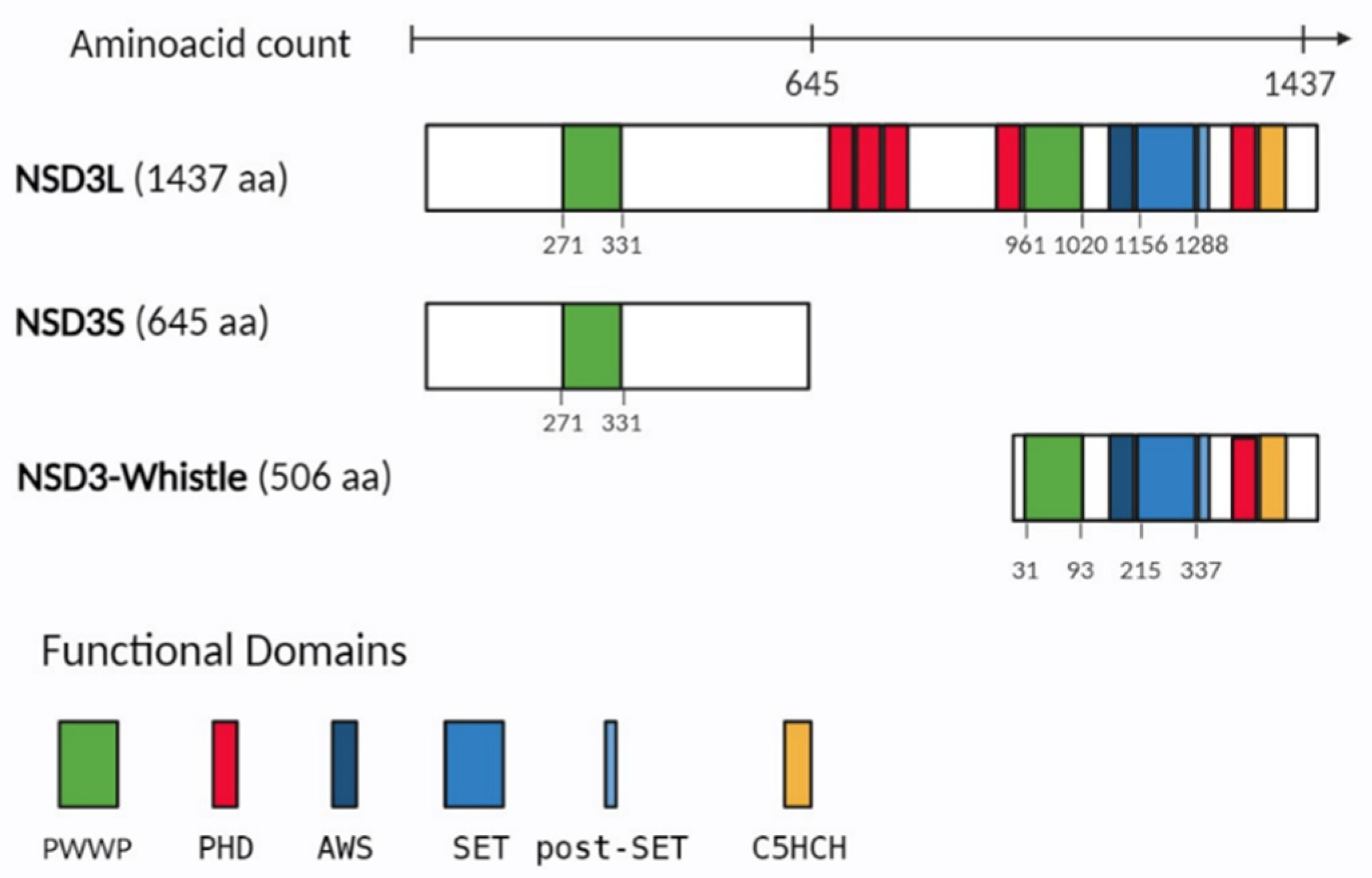
Figure 2.
NSD3 genetic alterations across cancer types. Diagram of genetic alterations in Pan-cancer analysis of whole genomes (ICGC/TCGA) [26]. Percentages shown under each cancer type indicate the total NSD3 alterations, including amplification, mutation, and deep deletion cases. Each cancer has a pie chart associated which shows the fraction for each NSD3 alteration, amplifications in red, mutations in green and deep deletions in blue, no alterations in yellow. NSCLC: Non Small-Cell Lung Cancer.
Figure 2.
NSD3 genetic alterations across cancer types. Diagram of genetic alterations in Pan-cancer analysis of whole genomes (ICGC/TCGA) [26]. Percentages shown under each cancer type indicate the total NSD3 alterations, including amplification, mutation, and deep deletion cases. Each cancer has a pie chart associated which shows the fraction for each NSD3 alteration, amplifications in red, mutations in green and deep deletions in blue, no alterations in yellow. NSCLC: Non Small-Cell Lung Cancer.
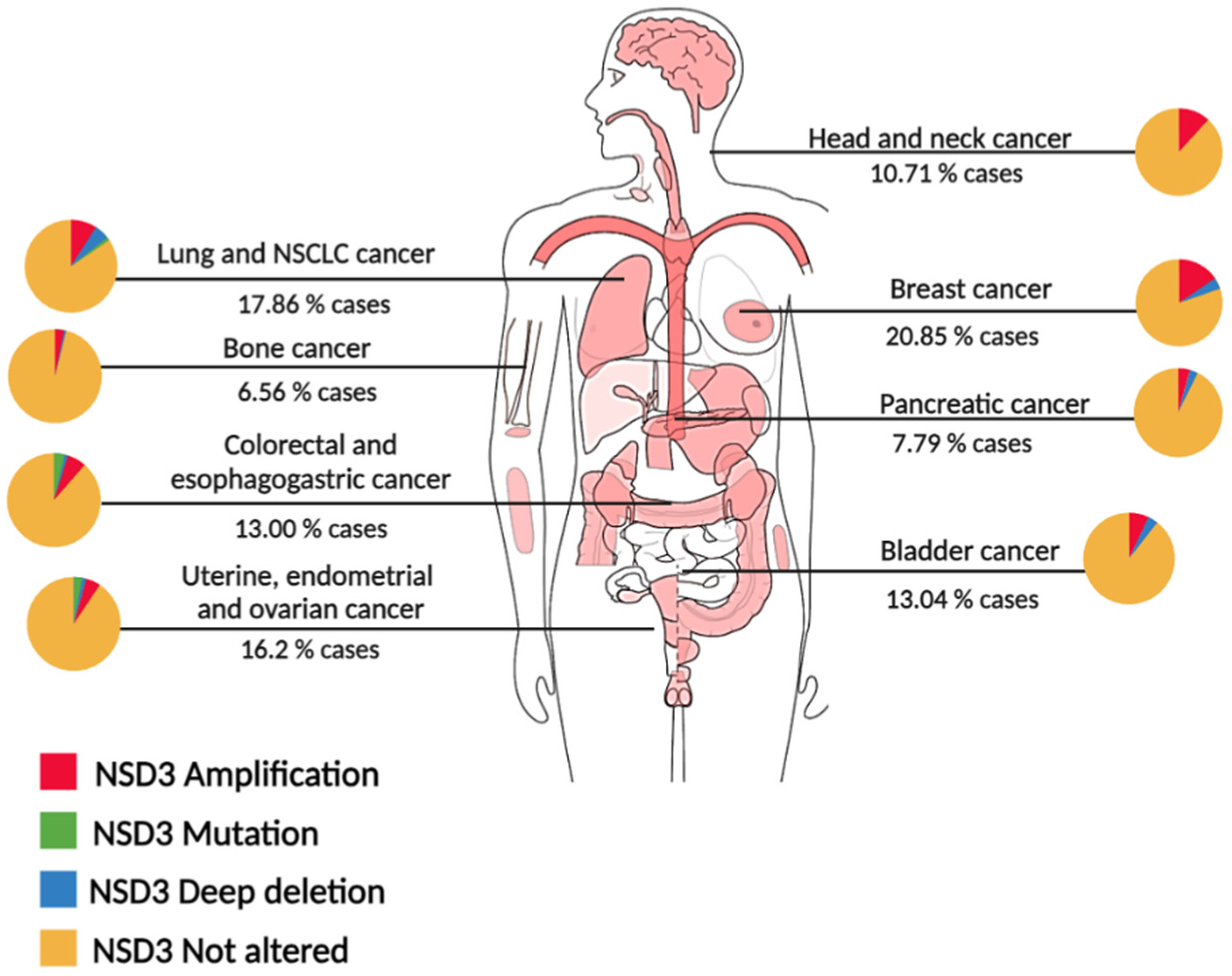
Figure 3.
Proposed model for the oncogenic role of NSD3S as an adaptor protein. NSD3S through the PWWP domain binds to methylated histones (H3K36) and could recruit oncogenic proteins, such as CHD8, BRD4 and MYC, activating an oncogenic transcriptional program. NSD3S adaptor function is shown as interacting with MYC, BRD4 and CHD8.
Figure 3.
Proposed model for the oncogenic role of NSD3S as an adaptor protein. NSD3S through the PWWP domain binds to methylated histones (H3K36) and could recruit oncogenic proteins, such as CHD8, BRD4 and MYC, activating an oncogenic transcriptional program. NSD3S adaptor function is shown as interacting with MYC, BRD4 and CHD8.
Disclaimer/Publisher’s Note: The statements, opinions and data contained in all publications are solely those of the individual author(s) and contributor(s) and not of MDPI and/or the editor(s). MDPI and/or the editor(s) disclaim responsibility for any injury to people or property resulting from any ideas, methods, instructions or products referred to in the content. |
© 2023 by the authors. Licensee MDPI, Basel, Switzerland. This article is an open access article distributed under the terms and conditions of the Creative Commons Attribution (CC BY) license (http://creativecommons.org/licenses/by/4.0/).
Copyright: This open access article is published under a Creative Commons CC BY 4.0 license, which permit the free download, distribution, and reuse, provided that the author and preprint are cited in any reuse.


