
Submitted:
02 March 2024
Posted:
04 March 2024
You are already at the latest version
Abstract
Abraham’s sending forth of Hagar and Ishmael in Gen 21:14 has generally been viewed as an expulsion. It is held that the primary, if not sole, purpose behind this act was to prevent Ishmael from interfering with Isaac’s inheritance. Using an intertextual approach, with an emphasis on key words, Sarah’s גרש (gāreš) demand and Abraham’s שלח (šellach) of Hagar is compared with the narratives of the children of Israel, Jesus, and Adam to uncover objectives as the bestowal of freedom and a mission. An examination of how the LXX translates, and Josephus explains, Sarah and Abraham’s “send-off” of Hagar suggests a mission objective behind their intentions. Abraham’s motivations are analyzed to ascertain whether Hagar’s “send-off” was part of a plan to expand the reach of Abraham and Sarah’s faith-based operations. Finally, linguistic analysis is undertaken to discover possible motives for why Sarah chose Hagar to have a son. These approaches to the biblical story bring into focus a portrait that is radically different from the standard interpretation where there are multiple objectives of Hagar and Ishmael’s being sent into the wilderness primary among them being expanding Abraham and Sarah’s faith-based mission.
Keywords:
Hagar
; Sarah
; Abraham
; drive
; expulsion
; Israel
; Jesus
; Adam
Introduction
Witnessing a certain behavior exhibited by Ishmael, e.g., מצחק (metsachēq, Gen 21:9), Sarah tells her husband to גרש (gāreš) Hagar and her son. Though Abraham finds the request quite grievous, prompted by God, he complies and שלח-s (šellach) Hagar along with Ishmael (Gen 21:11-4). The story has commonly been interpreted as Ishmael’s rejection. For example, both the NIV and NLT translate Sarah’s gāreš demand as “Get rid of (gāreš) that slave woman and her son…” (Gen 21:10).1 Other translations of the word fair no better, e.g., “cast out” (RSV, NRSV, ESV, KJV, NKJV), “drive out” (HCSB, CSB), and “banish” (NET).2 Generally, Sarah’s demand and Abraham’s compliance has been understood along these lines. What could be the cause(s) of this? Chung (2017, p. 574) provides several reasons, primary among them being theological in nature.
A majority of scholars, including Gerhard von Rad, E. A. Speiser, Dixon Sutherland, simply assume that the narrative roles of Hagar and Ishmael within the Abraham narrative are not significant [emphasis added]. Dixon Sutherland’s view is typical. He regards the role of Ishmael in the Abraham narrative simply as an obstacle [emphasis added] to God’s promise of offspring. Christopher Heard comments, ‘Many Christian interpreters leave the impression that they wish Ishmael had never been born [emphasis added].’
Viewing Ishmael as a “mistake” that must be rectified, justifies translating gāreš as “Get rid of” or “Cast out.” However, these “understandings” create other problems—they taint the characters of Sarah and Abraham. For example, Frymer-Kensky (2002, p. 226) observes that “readers today tend to be angry at Sarai, to castigate her for being insensitive to the plight of someone for whom she should have felt both compassion and solidarity.” It’s not just laypeople who are affected. Rabbi Paula Reimers of the Congregation of Beth Israel is a case in point. She discloses in her Parshat Ha-Shuvua weekly Torah reading (Reimers, 2005), the emotional discomfort caused by what she identifies as Sarah’s “cruelty.”
…fearing for Isaac’s inheritance, Sara demanded that Abraham expel Hagar and Ishmael… I don’t know what to say for Sara. I try to imagine her conflicting emotions, her pain and anxiety, but I cannot come to terms with her cruelty to a sister, a fellow woman.
Reimers goes on to say that the Rabbis share her torment. “I am not alone in my distress. Rabbinic tradition hints at its own pain” (Reimers, 2005). The same could be said of Abraham’s execution of Sarah’s “cruel” demand. For example, the candid observation of none other than Elie Wiesel (1986, p. 235), the Holocaust survivor and Nobel Laureate is emblematic.
Abraham is synonymous with loyalty and absolute fidelity; his life a symbol of religious perfection. And yet a shadow hovers over one aspect of his life. In his exalted biography, we encounter a painful episode which puzzles us. … We refer, of course, to his behavior toward his concubine Hagar and their son Ishmael.
Using the inclusive pronouns “we” and “us,” Wiesel discloses, not only his, but also the reader’s conflict with this episode in Abraham’s life. One way to deal with this cognitive dissonance is to say that “The Hebrew Bible presents its heroes in all their humanity, even the part that isn’t pretty. In a sense, that relieves a lot of anxiety” (Reimers, 2005). This coping strategy, however, should not in any way deter one from revisiting the episode, looking for cues whereby Sarah and Abraham’s actions may be interpreted afresh.3
As shown above Sarah’s gāreš demand has been understood quite negatively by Bible translators. Brown et al. (1979) and Koehler et al. (2001) give for the piel form of the verb גרש “drive out, away” and cite among other biblical citations, Gen 21:10, i.e., Sarah’s demand, and Exod. 23:29, 31, where the Hivites, Canaanites, and Hittites are expelled from the land permanently.4 When Sarah’s demand is understood in view of the conquest narratives of the Hivites, et al. it is almost impossible to conceive of a positive meaning to her demand. Whatever גרש (gāreš) may mean (Gen. 21:10), Noble (2021, p. 151), providing an extensive analysis of the Priestly source, says that the Priestly writer did not see it as an expulsion.
“For P, there can be no expulsion [emphasis added] of Hagar or Ishmael into the wilderness because this would mean that Abraham and Sarah are exposing their servants to the deadly wilderness.”
Rather than falling outside of God’s covenant, Noble (2021, p. 151) believes that because Ishmael is a son of Abraham, he “fits therefore into the covenantal schema that begins with Noah and funnels down through Ishmael’s father, Abraham and eventually to Jacob.” He observes that, “Hagar, is privileged with a form of birth annunciation (Gen. 16:10-12) that puts her in the company of Sarah (Genesis 18), Rebekah (Gen. 25:22-23), Manoah’s wife (Judg. 13:9-11), and Hannah (1 Samuel 1), whose sons all constitute some of the leading figures of the biblical stories” (Noble, 2021, p. 13).
For Dozeman, Sarah’s demand is a liberation. He explicitly states in his footnote that “The meaning of ‘to drive out’ in Exodus must be distinguished [emphasis added] from the use of this term in conquest traditions (e.g., Exod. 23:28, 29, 30, 31; 32:2; 34:11; Josh 24:12, 18; Judg. 2:1-7)” (1998, p. 30), that is, Hagar and Ishmael’s garesh should not be equated with the garesh of the Hivites, Canaanites or Hittites. Referring to both Sarah’s gāreš demand (Gen 21:10) and the gāreš of Israel in Exod. 11:1, he says, “in both instances expulsion is an act of liberation for the one being driven out, signifying release from slavery” (Dozeman, 1998, p. 30). Besides Dozeman and Noble’s observations, Zucker and Reiss’ (2015, p. 85) proposal that “It is likely that Sarah consults and conspires with Hagar in an attempt to proactively protect their children” opens Gen. 21:9-14 to a whole new dynamic, in which Sarah’s demand can be seen positively. Interestingly, the authors feel that searching beneath the surface of the text, an argument can be made for “An Alliance between Sarah and Hagar” (2015, p. 84). They write, “Many possibilities exist, possibilities that are in themselves both intriguing and full of intrigue. Biblical characters have in themselves multiple reasons behind their actions, just as is true of people today” (Zucker and Reiss, 2015, p. 84). Further incentives to visit Hagar’s story are recent findings in two areas: first (1), the discovery of striking5 linguistic parallels between Hagar and other biblical types such as the people of Israel,6 Elijah,7 Joseph (see Nikaido, 2001, pp. 229-32), Hannah (see Nikaido, 2001, 232-40), and most importantly Abraham,8 and second (2), the biblical writer’s bestowal on Hagar qualities given to no one else in the Bible. For example, drawing on Trible’s observations Thompson (1997, p. 214) writes:
Hagar is the first person to be visited by an angel (Gen. 16:7), as well as the first person to receive an annunciation (16:11-12). … Hagar is also the only women in all of Scripture to ever receive a promise of innumerable descendants (16:10). And perhaps most striking of all, Hagar, is depicted in 16:13 as boldly bestowing a name on God—“a power attributed to no one else in all the Bible [emphasis added].”
A final incentive to revisit Sarah and Hagar’s story lies in what Frymer-Kensky (2002, p. 236), suggests–our own bias toward Hagar:
The story of Sarai and Hagar is not a story of conflict between “us” and “other,” but between “us” and “another us.” Hagar is the type of Israel, she is the redeemed slave, she is “us.”
So, seeing Hagar as an outsider may be coloring our understanding of Sarah and Abraham’s “send-off” of her. Rather than seeing Hagar as “the other” seeing her as “another us” may free us to see Sarah and Hagar’s story afresh.
In this paper I endeavor to show that there were most likely multiple reasons behind Sarah’s “sending forth” of Hagar, primary among them being, the establishment of a settlement as an extension of Abraham and Sarah’s hegemony. I begin with a brief analysis of key assumptions which prevent a positive appraisal of Sarah’s demand (Gen. 21:10). To uncover what the biblical scribes intended by Sarah’s gāreš and Abraham’s šellach of Hagar, the nation of Israel and Adam’s “expulsions” are analyzed intertextually with Hagar and Ishmael’s “expulsion.” An intertextual comparison of the narratives of Jesus and Hagar will be made. This will show that early Christians framed Jesus’ inauguration after Hagar’s “send-off.” The LXX and Josephus’ view of Sarah’s gāreš demand will be looked at to discover if they thought of Hagar’s “send-off” as a mission. To gauge the likelihood of an apostolic motivation behind Hagar’s “send-off,” an attempt will be made to ascertain whether Abraham is presented in Genesis as the head of a large faith-based organization, and Sarah, as his helper. Before ending the paper with a targum-like translation and commentary of Gen. 21:5-14, I will explore whether the Bible provides answers to why Sarah chose Hagar to have a son.
This paper will employ both intertextual as well as linguistic analysis. The utilization of the Hebrew words גרש and שלח, and their Greek equivalents, ἔκβαλε and απέστειλεν, in various biblical passages will be explored. This is akin to Goitien’s (1956, p. 2) approach to uncover the origin and meaning of the word YHWH who argues that “the meaning of that root is brought out not so much with the dictionaries as its actual use in Arabic literature.” Thus, to discover the meaning of Sarah’s demand and Abraham’s execution of it, besides lexicons, intertextual analysis with an emphasis on certain key words, will be used.
Addressing Key Assumptions Supporting the “Expulsion” Narrative
The following are some of the key assumptions that contribute to the creation and persistence of the standard interpretation of Gen 21:9-14.
Assumptions that Contribute to the Standard Interpretation
1. Sarah’s use of Hagar to have a son was a folly and an act of faithlessness
2. Ishmael is the son of only Hagar, and not Sarah,
3. Ishmael “mocked” or “persecuted” his younger brother Isaac,
4. Ishmael was “a wild-ass man,”
5. Sarah and Hagar were only rivals, and not friends,
6. The sole purpose behind Sarah’s driving away of Ishmael and Hagar was so that Ishmael would not threaten Isaac.
If the terms or verses that support these assumptions are shown to be open to different interpretations, they may be used to explore alternative views.
Sarah’s Use of Hagar to Have a Child Is Not a Folly or an Act of Faithlessness
In Gen 16:1-3 due to her barrenness Sarah marries Hagar to Abraham with the intent to have a son through her.
Now Sarai, Abram’s wife, had borne him no children. But she had an Egyptian slave named Hagar; so she said to Abram, “The LORD has kept me from having children. Go, sleep with my slave; perhaps I can build a family through her.” Abram agreed to what Sarai said. So after Abram had been living in Canaan ten years, Sarai his wife took her Egyptian slave Hagar and gave her to her husband to be his wife.
Harlan (2022, 58) summarizes the common negative attitudes of Christians toward Sarah and Abraham’s using Hagar to have a son. “The prevailing perception of Christian readers is that this decision was a mistake and demonstrated Sarai and Abram’s impatience or unbelief…” Unfortunately, we will see shortly that the scholarly position is not much better. Harlan (2022, p. 59) counters this perception with biblical evidence concluding “Ishmael should not be disparaged as a mistake or the fruit of unfaithfulness.” Before proceeding, it is important to mention Josephus, a person of the first century, who saw Sarah’s act of giving Hagar to Abraham as being due to God’s command. “Accordingly Sarai, at God’s command, brought to his (Abraham’s) bed one of her hand-maidens, a woman of Egyptian descent, in order to obtain children by her” (Ant. 1.18 7).9 It appears for Josephus Sarah was a prophetess. Feldman concurs. He writes, in his commentary on the Antiquities, “Josephus, by remarking that Sarah acted on G–d’s command in giving Hagar to Abraham (Ant. 1.187), is in effect, presenting her as a prophetess (so also in rabbinic literature [Megillah 14a])” (Feldman, 1998, p. 225). Thus, for Josephus, Sarah’s attempt to be built up through Hagar was inspired by God, and therefore, not a mistake or an expression of unbelief. It should be noted that is the earliest Jewish tradition.
However, the contemporary scholarly position on Sarah’s act seems quite negative. For example, Waltke (2001, 252) calls Sarah’s trying to have a son through Hagar “…the foolishness of Sarah’s scheme” and a “faithless suggestion.” Waltke sees Eve’s “taking” and “giving” (Gen 3:6) as the defining features of Sarah’s act. He notes “Sarai … took [lqḥ]… gave [ntn] … to her husband. This is the same progression of verbs at the Fall in 3:6” (Waltke, 2001, p. 252). Although, Wenham (1994, p. 7) observes that “given the social mores of the ancient Near East, Sarai’s suggestion was perfectly proper and respectable course of action,” and notes Westermann’s view “that the author of Genesis approved of her action” (Wenham, 1994, p. 7), he agrees with von Rad and Zimmerli “that the narrator regards their action as a great mistake” (1994, p. 7). To make his case Wenham (1994, pp. 7-8), like Waltke, draws the reader’s attention to the parallelism with Eve’s taking and giving of the forbidden food to Adam. “Note the identical sequence of key nouns and verbs in 3:6: “The woman[wife]… took… gave it to her husband.” He quotes Berg who feels that both narratives, e.g., Eve and Sarah’s, tell a story of a fall. “By employing quite similar formulations and an identical sequence of events in Gen 3:6b and 16:3-4a, the author makes it clear that for him both narratives describe comparable events, that they are both accounts of a fall” (Wenham, 1994, p. 8). However, parallelism in-itself is not enough to interpret Sarah’s action as a folly, for there is no prohibitory injunction in her narrative as there is in the Edenic, e.g., “but you must not eat...” (Gen 2:17). Furthermore, Sarah is not reproached for her action as is Eve in Gen 3:16. Besides, the same parallelism occurs in Gen 30:9 where Leah took (lqḥ) her slave girl Zilpah and gave (ntn) her to Jacob to have children through her. There’s no indication in the Bible of impropriety on the part of Leah. Rather than conveying a negative connotation, the words “taking,” “giving” and even “eating” (which is part of the Fall) by themselves, should be viewed positively, as expressing charity. For example, the same progression of expressions is part of the Eucharist.
Jesus took bread… and gave it to his disciples, saying “Take and eat…” (Matt. 26:26)
Thus, Sarah’s action of taking and giving Hagar to Abraham should not be viewed negatively due to certain parallelism with Eve’s action.
There is another dimension to Sarah’s act that is brought up, e.g., the lack of trust in God’s power to ‘cure” her bareness. For example, Waltke (2001, p. 251) says Sarah was “guilty of synergism.” This subtle idea seems to be due to the controversial dichotomy of faith and works, e.g., Rom. 4:2–3 and James 2:14–26. In any case, Sarah’s action can be viewed as an expression of hope and a form of prayer, rather than synergy. For example, a person in the desert, dying of thirst, prays to God to sustain their life. Coming upon a well they put forth their hand, draw water from the well, and drink it. The actions of drawing water from the well, and drinking it, could be seen, if intended by the doer, as praying to God with actions,
“תפילה עם פעולה,” i.e., the person asks God with actions to quench their thirst and hydrate their body. On the contrary, coming upon a well, and willfully refraining from drawing the water and drinking it, but just praying with one’s heart for God to hydrate one’s body because God has power to do so, would be an act in opposition to God’s will which he has placed in the natural order.
Isaac’s announcement story is also illustrative. The messengers inform Abraham and Sarah that they will have a son next year at this time (Gen 17:16). Having been informed of this, would any intimate contact, between Abraham and Sarah, with the intent of actualizing God’s promise, be construed as being due to a form of synergistic belief? No. Nor would it necessitate any lack of faith or trust in God’s power to make Sarah pregnant. For an act to be synergistic one must believe that God’s power is inefficacious without some form of human action, or God’s power is more efficacious when coupled with human action. There is nothing in the Genesis passage that warrants these interpretations. Any intimate act between the patriarch and matriarch after the announcement of Isaac’s birth should be interpreted as a sign of hope and prayer to have a son.
Praying with appropriate actions appears to be connected to wisdom tradition. In Q Jesus says, “So I say to you: Ask and it will be given to you; seek and you will find; knock and the door will be opened to you.” (Luke 11:9; Matt 7:7). “Seek” and “knock” are expository terms to the word “Ask.” In other words, asking involves actions, not just wanting or asking with one’s lips or heart. To leave no doubt in this matter Jesus provides a parable in which the people ask, seek and knock, to be let in, but the door is not opened to them due to their lack of right actions.
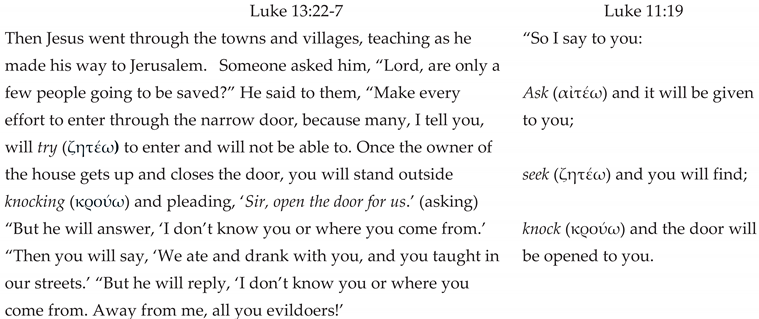
Clearly, in the Lukan passage Jesus says to his disciples that an effort, i.e., action, is required to pass through the narrow gate (13:24). Thus, asking involves actions. That the primary referent of asking, seeking, and knocking in Jesus’ saying is about wisdom seems evident in the saying of James: “If any of you lacks wisdom, you should ask God… and it will be given to you” (Jas. 1:5). Since, “seeking” and “knocking” are actions, Jesus stresses to his audience that asking from God entails a dimension of action, i.e., asking with appropriate actions. This idea of asking with action is clearly reflected in Jesus’ sending his disciples on their apostolic mission of preaching and healing in Matt 9:37-10:8 and Luke 10:1-12. In the story we’re informed that Jesus sent out his disciples to preach instructing them to “Ask the Lord of the harvest, therefore, to send out (ἐκβάλλω) workers into his harvest field” (Luke 10:2).
After this the Lord appointed seventy-two others and sent (ἀποστέλλω) them two by two ahead of him to every town and place where he was about to go. He told them, “The harvest is plentiful, but the workers are few. Ask the Lord of the harvest, therefore, to send out (ἐκβάλλω) workers into his harvest field. Go! I am sending you out (ἀποστέλλω) like lambs among wolves. (Luke 10:1-3) [More on these sayings later in the article.]
What does it mean to ask the Lord to send out workers into his harvest field when Jesus is sending you out as workers into God’s harvest field? Ask here would mean to ask with both words and deeds to be accepted by God as his workers. Thus, to be God’s workers, one must not only pray with one’s heart to be accepted by God, but also pray with actions, that is, act (carry out Jesus’ instructions) as well. Just being sent out by Jesus may not qualify a person as being sent by God either, even if they carry out the instructions. Judas is an example of that (Luke 9:1-2). Although sent out by Jesus, he would not be a worker sent out by the Lord because his heart, and therefore, his intentions weren’t right. Thus, not just wanting, but both wanting and the exercise of one’s will seems to be required. The importance of exercising one’s will in action is expressed in our common language as well, for example, “Actions speak louder than words.” Hence, Sarah’s taking Hagar and giving her to Abraham can be seen as her asking with actions for God to give her a son, rather than a type of synergism.
Ishmael Should Be Viewed as Hagar and Sarah’s Son
During patriarchal times a woman could obtain a child through her slave girl. This is practiced by not only Sarah (Gen 16:1-14), but also Leah and Rachel (Gen 30:1-22). Just as Leah is considered the mother of Gad and Asher, and Rachel, the mother of Dan and Naphtali, Sarah should be considered the mother of Ishmael. Commenting on Gen 16:2 Wenham (1994, p. 7) says, “So Sarai here expresses the hope that she may ‘have sons through her (Hagar).’” Teubal (1990, p. 121) concurs: “Genesis 16 makes it clear that Hagar’s child is Sarah’s heir.” Being his mother, one would expect Sarah to love Ishmael as her son. Not surprisingly this is what Josephus records: “As for Sarah, she at first loved Ismael, who was born of her own handmaid Hagar, with an affection not inferior to that of a son of her own…” (Ant. 1.12.3.).
It may be argued that even though Ishmael was Sarah’s son, she later disowned him by calling him “Hagar’s son,” (Gen 21:10), rather than “my son.” Teubal (1990, 121) disagrees: “Nothing in the subsequent story gives any indication that Sarah rejected that relationship of Hagar’s son…” Rather than a rejection of Ishmael, she claims Sarah’s demand in “(Gen. 21:10) indicates the equality of the status of the sons, at least in Sarah’s eyes” (Teubal, 1990, p. 121). The expression “her son” need not be taken as a sign of maternal rejection. It may have informed Abraham that Hagar will henceforth be solely responsible for the care and upbringing of Ishmael. Hamilton’s (1995, p. 82) observation regarding Abraham’s “placing” (nāṯan) Ishmael on Hagar’s shoulder supports this: “When we learn that nāṯan means not only “put, place” but also to “commit, entrust,” then the meaning is plain. Both “bread/water” and “child” serve as direct objects of nāṯan. Abraham places the physical provisions on her back and entrusts their son and his welfare to Hagar’s care.” A similar expression to that of Sarah’s occurs in John where Jesus says his own mother is now his disciple’s mother.
When Jesus saw his mother there, and the disciple whom he loved standing nearby, he said to her, “Woman, here is your son and to the disciple, “Here is your mother.” From that time on, this disciple took her into his home. (John 19:26-7)
Obviously, Jesus is not stating some unknown biological relation about his disciple such as Mary was his real mother, and that he was separated from his real mother after Mary gave birth to him, and adopted by his known mother who raised him, etc. Saying “Here is your mother” or “Here is your son” as performative utterances establish social expectations between Jesus’ mother and the beloved disciple.10 Jesus’ statement informs the disciple that he is now entrusted with the responsibility of caring for Jesus’ mother as he is responsible for the care of his own mother. Furthermore, Jesus’ telling the beloved disciple that Mary is his mother is in no way a disowning of the disciple’s real mother. The same could be said of Sarah calling Ishmael Hagar’s son. As a performative utterance the saying, rather than disowning him, allocates total care and responsibility of Ishmael to Hagar.
מצחק (metsachēq) May Refer to “Rejoicing” and “Imitating” rather than “Mocking”
The reader is told that Sarah was prompted to make her demand due to a particular behavior exhibited by Ishmael, i.e., metsachēq (Gen 21:9). The term metsachēq is in the piel participle form, and of the same root of tzahaq, Isaac’s name. The Septuagint saw metsachēq quite positively, e.g., “playing with Isaac, her son” (LES 2019, p. 21). This is the earliest view on Ishmael’s action. Sarna (1989, 146) agrees saying that Ishmael “was either amusing himself or playing with Isaac.” Many of the Midrashic interpreters, on the other hand, are quite negative. Wenham (1994, p. 82) summarizes the ancient opinions. “The midrash suggested it might involve idolatry (cf. Exod. 32:6) sexual immorality (cf. Gen 39:14, 17), or even murder (cf. 2 Sam 2:14[שׂחק]).” Given these opinions one is hard pressed not to interpret metsachēq as drawing the ire of Sarah. However, Wenham (1994, p. 82) says that a negative interpretation "…seems unlikely, for Ishmael appears in a quite positive light.” Speiser (1979, p. 155) writes Ishmael’s “playing with Isaac need mean no more than that the older boy was trying to amuse his little brother. There is nothing in the text to suggest that he was abusing him…” Wenham also provides the opinion of Coats (see Coats, 1983, p. 153), who holds that Ishmael was playing the role of Isaac. “It suggests on the contrary, that Sarah saw Ishmael mesaheq playing the role of Isaac” (Wenham, 1994, 82). Alter (1997, p. 98) construes metsachēq “as ‘Isaac-ing-it’—that is, Sarah sees Ishmael presuming to play the role of Isaac.” The positive appraisals of Speiser, Wenham, Coats, and Alter facilitate a constructive interpretation of Sarah’s demand. For example, Rabbi Waskow (2006, p. 37) feels that what Sarah saw was Ishmael’s imitation interfering with the psycho-cognitive development of both boys. Thus, she took measures to thwart this.
So perhaps the constant presence of each son in the other’s face was distorting both of them, making it hard for them to grow up together and yet grow into their own distinct identities. So to be themselves, they must live separately, free of each other’s control and imitation.
The rabbi’s observation augments Sarah’s maternal concerns for both sons. Ishmael’s imitation of Isaac could be detrimental to the development of both siblings. One may dismiss the seriousness of such rivalry between siblings, but the examples of Esau and Jacob (Gen 27:1-43), and Joseph and his brothers (Gen 37) are cause for pause. When Sarah’s demand is read with both sons in mind the partiality that is attributed to her voice is dampened if not excised, and her words now convey, besides wisdom, a deep maternal concern for both sons.
Contrary to Expectations the Expression פּרא אדם (pereʾ ʾādām) Is Quite Positive
Accompanying Ishmael’s birth announcement, the angel of Yahweh tells Hagar that her son will be a pereʾ ʾādām (Gen 16:12). This phrase is usually translated as “wild donkey of a man” or “wild ass of a man” (see NIV, ESV, RSV, NASB (1995, 1977), HCSB). Harlan (2022, p. 61) explains the tendencies to interpret the passage negatively. “The natural inclination of Americans is to view this negatively as most standard translations do (e.g., ASV, RSV, NASB, NIV, NET, ESV, NLT), given the negative characteristics of associating someone with a donkey (especially, an “ass”) in American culture, for it indicates one who is stubborn, stupid, or despicable.” One should note at the outset that in Hebrew the word for a domesticated donkey is חֲמוֹר, (hamor) and not פּרא (pereʾ). This distinction is lost in translation. For example, Wenham (1994, p. 11) comments that the animal פּרא (pereʾ) symbolizes attributes such as an “individualistic lifestyle untrammeled by social convention,” and Sarna (1989, p. 121) says, “a people free and undisciplined.” However, both of them translate פּרא אדם “a wild ass of a man” (Wenham, 1994, 7; Sarna, 1989, 121). Once pereʾ is translated into English as “donkey,” it doesn’t help much to say the word means “individualistic lifestyle untrammeled by social convention” or “a people free and undisciplined.” The word “donkey” continues to unconsciously colors one’s perception even after positive explanations are provided. Because of this psychological dilemma Krayer (2022, 79) suggests pere’ should be understood as a “wild mustang,” and Pigott (2018, 513), as a “wild stallion.” Waskow (2006, p. 8) choses to translate the expression as “a free-running human.” What Speiser (1979, p. 118) notes about pere’ – that it can refer to a “wild horse,” makes apologetic explanations unnecessary. He writes, “The qualifying Heb. noun pere’ could stand for either wild ass or wild horse [emphasis added].” So, all the negative connotations can be avoided by just translating פּרא אדם as “a wild horse.”
Another element that contributes to the negative appraisal of the expression pereʾ ʾādām is the preposition בְּ (be) in the verse that follows. The preposition can have a variety of meanings depending on the context: “in, at, with, by, against” (Pratico and Van Pelt, 2019, p. 53). However, almost all standard translations chose to render the prepositions as “against,” e.g., “his hand will be against everyone” (NIV, NASB, HCSB, RSV, ASV, ESV). To illustrate that not only the preposition בְּ, but the whole verse Gen 16: 12 can very well be translated and understood positively Waskow, Pigott, and Krayer’s renderings are provided below. Compare with NIV.
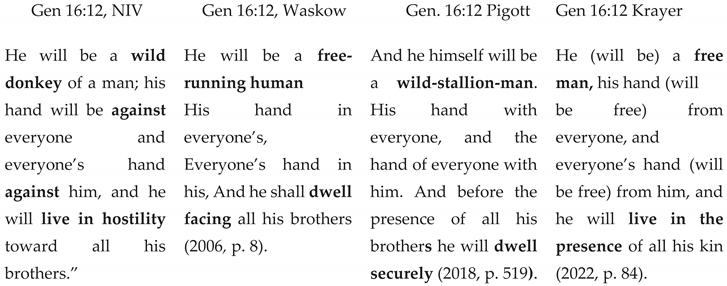
Contrary to popular translations, Waskow, Pigott, and Krayer’s renderings of the passage are quite positive.
Sarah and Hagar’s Relationship Not Based on Rivalry
Popular belief is that polygamous relationships breed only jealousy and rivalry between co-wives. Meriam Peskowitz disagrees. Julia Klein (2008) summarizes the view of Peskowitz
(Peskowitz) disputes the traditional picture of Sarah and Hagar as rivals. "I think the story’s at odds with the way people would have lived," she says, with cooperation among women being essential to survival in the desert.
Furthermore, the Bible says that Sarah wed Hagar to her husband (Gen 16:3). According to Zucker and Reiss (2009, p. 3) this gave rights of a second wife to Hagar.
The biblical text terms Hagar a (second) “wife” (Gen 16:3) using the term ‘isha, (not a pilegesh – a concubine). Hagar presumably was given some undefined rights of a wife, albeit a secondary wife.
If their relationship was defined by rivalry, why would the biblical writer present Sarah interested in increasing Hagar’s social status by giving her rights and privileges of a second wife? To have a son through Hagar Sarah could have offered her to Abraham as a concubine as Leah and Rachel do their respective slave-girls Zilpah and Bilhah (see Gen 30:1-12). Sarah’s action suggests they were friends.
Furthermore, Teubal feels the Bible reveals an intimate relationship between Sarah and Hagar (see Teubal, 1990, p. 84). She refers to the expression “bearing on one’s knee’s” (Gen. 30:3) used by Rachel to have a child through her shifhah (1990, p. 84). Teubal (1990, p. 84) says that this implies “a prescribed practice” (1990, p. 84).11 During delivery the surrogate “would sit between the legs of the woman who would become her child’s social parent while the midwife assisted in the delivery” (Teubal, 1990, p. 84). Teubal feels that since the terminology of both Sarah and Rachel’s narrative are quite similar, this procedure would have been most likely performed in Hagar’s birthing of Ishmael. She (1990, p. 84) says that “if this specific procedure was followed when Hagar gave birth to Sarah’s presumptive heir, it presents a dramatic image of the intimate [emphasis added] relationship necessary between the two women.” So, rather than being based on rivalry, their relationship seems to have been intimate.
The rabbinic tradition of how Hagar came to be a slave of Sarah supports this conclusion. Genesis Rabbah (45:1) notes that when Pharaoh saw how God punished him and his household due to Sarah, he took his daughter, Hagar, and gave her to Sarah12 saying that it is better for his daughter to be a slave in Abraham’s household than a princess in the palace. Lockyer (1967, p. 61) refers to a Jewish tradition that suggests the Pharaoh’s decision to give his daughter to Sarah was after Hagar had persuaded him: “the Egyptian princess became so attached to Sarah that she told her royal father that she would accompany her when she returned to Abraham.”13 According to this oral history Hagar’s decision to leave her royal status, home, and country, strongly suggests that she had been converted by Sarah in the harem and that she was emulating Sarah’s self-sacrifice, i.e., Sarah had left her home, status, and country for the love of God. Given this background the reason Hagar chose to attach herself to Sarah as a slave would be due to (1) that they had become intimate friends in the harem and that Hagar wished not to separate from Sarah, and (2) free women could not travel without a male guardian accompanying them. Solution: become Sarah’s slave.
Being friends does not mean that at times there were no tensions or heated quarrels. There must have been like in any relationship. However, this does not mean that they were not friends. For example, the portrayal in Jewish sources Hagar’s reluctance to accept Sarah’s suggestion to marry Abraham is also evidence of their friendship.
She was at first reluctant [emphasis added] when Sarah desired her to marry Abraham, and although Sarah had full authority over her as her handmaid, she persuaded her, saying, ‘Consider thyself happy to be united with this saint.’14 (JewishEncyclopedia.com. (n.d.). Hagar)
Hagar’s reluctance to marry Abraham suggests she likely anticipated conflict to arise between her and Sarah due to the newly proposed marital arrangement. One also notices Sarah’s concern with Hagar’s reluctance to marry Abraham, for she shows an effort to put Hagar’s heart and mind at ease. These behaviors are expected from intimate friends, not rivals.
Some may insist that these rabbinic traditions should be dismissed on grounds they were penned at a much later date. However, if the Bible clearly presents Sarah and Hagar as rivals, why would the rabbis be interested, in not only elevating Hagar’s status, but presenting the women as friends? The “criterion of embarrassment” warrants a serious reconsideration of the reason(s) behind the Rabbis’ inventing such “tales.”
The particle כִּי (kî) (Gen 21:10) Introduces the Causal Basis for Hagar and Ishmael’s Being Sent Away
Harris, noting the particle כִּי (kî) can be used in four ways, points out that in Gen 21:10 it is used to introduce “a causal clause” (Harris, 1980, 438). Although, almost all Bibles translate the particle כִּי (Gen 21:10) as “for,” it is understood as “so that” (intended consequence), i.e., Hagar and Ishmael were driven away so that Ishmael does not threaten Isaac’s inheritance. Although, not explicitly stated, commentaries on Sarah’s garesh demand, de facto, labor under this assumption. For example, summarizing Van Seters’ understanding of Sarah’s demand (Gen. 21:10), Latvus (2010, p. 256) writes that Hagar and Ishmael were sent away “so that” Ishmael does not inherit with Isaac:
In the context of 21:18, Van Seters underlined the expulsion motive. Sarah’s order to “expel” (גרשׁ) Hagar and Ishmael so that [emphasis added] Ishmael would not “inherit” (ירשׁ) with Isaac (v. 12) is a reflection on how to treat non-Israelites.
Understanding the particle כִּי (kî) in Gen. 21:10 as “so that” confines Sarah’s intent to saving only Isaac from coming under the overbearing presence of Ishmael. However, כִּי (kî) introduces a causal clause which provides the explanation for Sarah’s demand, not the intended consequence (Waltke, 2001, 640). Thus, it should not be understood as so that, but as because, e.g., because this slave girl’s son is not to share in the inheritance, drive her away. The passage from Exodus 20:4-6 may illustrate better the function of כִּי (kî) in Genesis 21:10. In the text below, “so that” and “for” will be used for the particle. Compare.
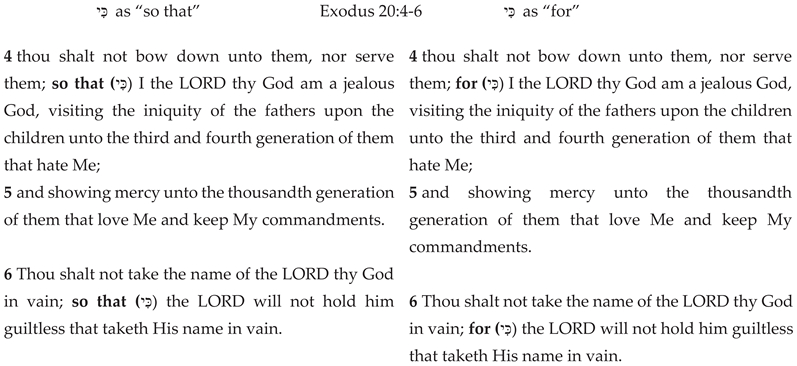
In the Exodus passage above the particle כִּי cannot be “read” or understood as “so that” because it does not make any logical sense. The motivations behind the prohibitions of not bowing down to idols or taking the name of the Lord in vain are implicit. These can be rendered explicit. For example, compare Ex. 20:4 where the motivation of the command is made explicit.
Ex. 20:4
| thou shalt not bow down unto them, nor serve them; so that (כִּי) I the LORD thy God am a jealous God, visiting the iniquity of the fathers upon the children unto the third and fourth generation of them that hate Me; |
thou shalt not bow down unto them, nor serve them; (“so that” I the LORD thy God do not become jealous and punish thee…) because (כִּי) I the Lord thy God am a jealous God, visiting the iniquity of the fathers upon the children unto the third and fourth generation of them that hate Me; |
Clearly, it is not so that God is(be) a jealous God that the nation of Israel must not bow down to idols, but because God is a jealous God that they must not. When כִּי (kî) is understood as introducing the reason why Ishmael is sent away, rather than just the intended result, Sarah’s motivation is open to embrace the interests of not only Isaac, but also Ishmael. Compare the two renderings of Sarah’s demand with כִּי read as “so that” and “because.”
| Gen. 21:10, כִּי so that | Gen. 21:10, כִּי because |
| ’Drive away that slave-girl and her son,’ so that (כִּי) this servant-girl’s son does not share the inheritance with my son Isaac.’ |
’Drive away that slave-girl and her son,’ (so that both Isaac and Ishmael do not come under the overbearing presence of each other, as both of them, in their unique ways actualize God’s promise), because (כִּי) this servant-girl’s son is not to share the inheritance with my son Isaac.’ |
One can even argue that Sarah was more concerned with protecting Ishmael from coming under Isaac’s authority than protecting Isaac from coming under Ishmael’s authority, for Isaac is mentioned as the inheritor of Abraham’s wealth and future estate. Thus, Ishmael would benefit more from being removed from the dominion of Isaac, rather than vice versa. Borgman’s (2001, p. 55) observation, that the separation helped Ishmael supports this: “This thrusting out of mother and child [in Gen. 21:14-21] — becomes … the opportunity for Ishmael’s line to distinguish itself and thrive.” In any case, it appears that Sarah, as a loving and caring mother, had the interests of both of her sons when she separated them temporarily.15 Thus, the particle כִּי (kî) in Sarah’s statement introduces the reason why Ishmael was sent away, not the intended result. As such Sarah’s demand is open to embrace both sons. A final word: not inheriting with Isaac does not mean Ishmael does not play a role in the actualization of the covenant cut with Abraham (Gen. 15:18).
This preliminary analysis may be summarized as such:
1. Sarah’s use of Hagar may be seen as an act of prayer
2. Ishmael should be viewed as Hagar and Sarah’s son
3. מצחק (metsachēq) seems to refer to Ishmael “rejoicing,” and “imitating” Isaac
4. The term פּרא (pere’) symbolizes being free and independent
5. Sarah and Hagar’s relationship was not based on rivalry, but cooperation,
6. כִּי should be read, as it relates to Ishmael, that both Isaac and Ishmael do not come under
the overbearing presence of each other, as both of them, in their unique ways actualize
God’s promise.
We may now turn our attention to Sarah’s גרש demand and Abraham’s שלח act.
Hagar, Archetype of Israel
Dozeman (1998, p. 23) had observed the conquest narratives, e.g., Exod. 23:27-33, should not be used to frame Sarah’s גרש of Hagar. The reasons for this are the following: first, the expulsion of the Canaanites’ is not a liberation. Second, an extra prohibitory injunction is given to the Israelites regarding the Hivites, et al.: “do not let them live in your land” (Exod. 23:33). We do know Ishmael and Isaac’s separation was not permanent for they later came together to bury their father (Gen 25:9). Noble (2021, p. 117) writes that this shows “Ishmael is not separated or otherwise cut off, but cooperates with Isaac in the task.” And third, contrary to the prohibition of living with those driven out for fear of worshiping their gods, after the death of Sarah, Abraham and Isaac appear to go and live with Ishmael. Leviant (1999, p. 47) observes: “There is a double irony here. Ishmael, who nearly died of thirst in the wilderness, settles in the wilderness of Paran. Abraham, who was responsible for exiling [?] Hagar and their son Ishmael to the wilderness of Beersheba, where they nearly die, himself settles (presumably with Isaac) in that town.” There is also the rabbinical tradition that Isaac, after the death of his mother, returned his aunt Hagar back to his father. The concern here is not so much with the historicity of the tradition, but with the meaning of the word גרש. The rabbis did not consider גרש to imply, at least in the case of Ishmael, a rejection or a permanent separation.
If the conquest narratives (Exod. 23:27-33) are not the proper frames to understand the meaning of Sarah’s גרש demand as Dozeman observes, then what is? Dozeman contends it is Moses and Israel’s expulsions from Egypt. He (1998, p. 30) says, that “in both instances expulsion is an act of liberation for the one being driven out, signifying release from slavery.” He goes on to say, “The Salvific character of expulsion for Hagar is made explicit when she received a divine oracle of salvation in Gen 21:17…” (1998, p. 30). No divine oracles are mentioned in connection with Hivites, Canaanites or Hittites. Dozeman claims that God indirectly orchestrated and sanctioned both Hagar and Israel’s expulsions.16 For example, in Ex. 6:1 God informs the reader that He was the cause of Pharaoh’s גרש of Israel out of Egypt.
…with a strong hand he will גרש them out of his land. (Exod. 6:1)
Dozeman is not alone in his appraisal of Hagar being like Israel. Trible, Frymer-Kensky, and Kamionkowski also see a prefigurement of Israel in the life and person of Hagar. Trible (1984, p. 21) observes, “Having once fled from affliction (Gen 16:6b), Hagar continues to prefigure Israel’s story even as Sarah foreshadows Egypt’s role.” And Frymer-Kensky and Kamionkowski (2001) note that “Hagar, the slave from Egypt, foreshadows Israel, the future slaves in Egypt.” The parallel language between Hagar and Israel, invites one to consider that the Priestly writer was framing Sarah’s גרש demand of Hagar in view of Israel’s being גרש out into the desert.
ענה (‘ānāh) to Be Tested, the Reason for Israel’s גרש
Deut. 8:2 says that Israel was led out of Egypt into the desert to be ענה (‘ānāh) as part of God’s divine plan. “Remember how the LORD your God led you all the way in the wilderness these forty years, to humble (‘ānāh) and test you in order to know what was in your heart, whether or not you would keep his commands” (Duet. 8:2). In this verse ‘ānāh is in the piel form. Brown et al. (1979, ענה) give the meaning of “humble, mishandle, afflict” for the piel form of the verb. The piel form is also used in Lev 16:31. Some like NASB (1977, 1995), ISV, NAB, YLT have translated it as “humble”: “It is to be a Sabbath of solemn rest for you, so that you may humble (ענה) yourselves; it is a permanent statute” (Lev. 16:31, NASB 1995). Others have chosen to translate it as “afflict” e.g., ESV, NKJV, ASV, DRB, ERV. Whatever the case, God’s severe and harsh treatment (ענה) of his servants is not a sign of rejection or punishment, it is a test, an act of grace. It is through such severe trials that Israel learned humility and wisdom (Deut. 8:2-3). Although, in the Hithpael form, in Psalms 119, the Psalmist praised being subjected to ענה claiming they learned God’s decrees and submission to it. “It was good for me to be ענה so that I might learn your decrees” (Ps 119:71) and “Before I was ענה, I went astray; but now I keep Your word” (Ps 119:67). Thus, the meaning of the word ענה, like גרש, when associated with Israel has at times a positive meaning.
ענה (‘ānāh) in the Narrative of Hagar
The word ‘ānāh (humbled) used of Israel in Deut. 8:2 and in Lev. 16:31, is also used of Hagar in Gen. 16:6. All of these words happen to be in the piel form. Hagar’s subjection to ענה ‘ānāh (Gen 16:6,9) occurs after Sarah lost stature תֵקַל (têqal) in Hagar’s eyes (Gen. 16:4). The verb קָלַל in Gen 16:4 is in the Qal. form. Almost all Bible versions translate it as “despise,” e.g., NIV, NASB, BSB, NKJV, DRB, or “contempt,” e.g., ESV, HCSB, NRSV, RSV, ISV, conveying the idea that Hagar despised her mistress or looked with contempt at her mistress. Hamilton (1990, p. 442) disagrees: He renders the word in Gen. 16:4 as “lost stature,” and notes the following on the word קָלַל. “V. 4b can hardly be translated ‘she looked with contempt on her mistress’ (so RSV). Such an active display of contempt would require the Piel form of this verb, with its factitive effect. It is loss of face which Sarah felt hat impelled her to complain to Abraham in v. 5 as she does.” Thus, one can say, becoming pregnant Hagar was putting on airs. Sarah was deeply hurt by her attitude. Interestingly, Sarah faults, not Hagar, but Abraham for her demeanor. It appears Abraham’s preferential treatment of Hagar is responsible for the self-image created in her mind. This episode underscores Hagar’s receptivity. The scribe is saying just as Abraham’s intimate relation with Hagar resulted in her involuntarily conceiving and having a son, Abraham’s preferential relation with Hagar resulted in her involuntarily conceiving and giving birth to her new self-image of being the instrument of the divine promise. We’re not told how Hagar behaved towards Sarah. It appears to be irrelevant. The biblical narrative continues.
Then Sarai mistreated (ענה) Hagar; so she fled from her. … Then the angel of the LORD told her, “Go back to your mistress and submit (ענה) to her.” (Gen 16:6-9)
In Gen. 16:6 ענה ‘ānāh is in the piel form, while in v. 9 it is in the Hithpael form. And although, Sarah could have treated Hagar severely, e.g., the piel suggests this as in Deut. 8:2, the form God used to instruct Hagar to ānāh herself to Sarah is in the Hithpael and less severe. For example, in Ezra 8:21 and Dan 10:12 the Hithpael form is used and is usually translated as “humble yourself.” The NIV, HCSB, and NAB translate ענה in Gen 16:6 as “mistreated,” and YLT, DRB, BST and LSV translate it as “afflicted.” However, between co-wives ענה may not be so severe. It may refer to the emotional pain experienced by a wife who does not receive from her husband love comparable to that shown to the other. An example of this usage is by Leah who says God gave her a son for her ענה (misery) (Gen. 29:32): “Leah became pregnant and gave birth to a son. She named him Reuben, for she said, “It is because the LORD has seen my misery ענה)). Surely my husband will love me now.”
If Sarah’s ‘ānāh of Hagar was intended by God as was Pharaoh’s ‘ānāh of Israel in Deut. 8:2-3, or the self-inflicted ‘ānāh of the sabbath observance in Lev 16:31 (both are in the piel form), then, Sarah’s ‘ānāh should be read as a humbling of Hagar, rather than a mistreatment or affliction. Hackett (1989, p. 14) points out that although ānāh could entail oppression, Sarah’s action could have been “simply to humble…” Ellicott’s Commentary (1971, p. 43) agrees: “…its more exact meaning is, Sarai humbled her, that is, reduced her to her original condition.” Rather than submitting to her status of being Sarah’s handmaid, it appears Hagar had submitted to the status which Abraham (unwittingly) had conferred on her. Thus, the writer appears to be saying that God humbled Hagar through Sarah as he humbled Israel (Deut. 8:2-3).
| Gen 16:6-9 Sarai humbled (‘ānāh) her (from Ellicott’s commentary) so much that Hagar ran away from her. … And the messenger of Jehovah saith to her, ’Turn back unto thy mistress, and humble (‘ānāh) thyself under her hands;’ (YLT) |
Deut. 8:2-3 Remember how the Lord your God led you all the way in the wilderness these forty years, to humble (‘ānāh) and test you. … He humbled (‘ānāh) you, causing you to hunger… |
Therefore, it appears that the purpose behind both Israel and Hagar’s gāreš was to subject them to ‘ānāh. One may argue that the word ‘ānāh is not mentioned after Sarah’s gāreš demand in Gen. 21:10, but earlier. That may be because the ‘ānāh (testing) theme in Gen. 16 is continuing. For example, comparing the words behind the “expulsion” narrative of Ishmael with the words of the “binding” narrative of Isaac, Adelman (2016) concludes that Hagar and Ishmael were both tested by God. In her article, “The Expulsion of Ishmael: Who Is Being Tried?” she writes,
It is clear … that both Ishmael and Hagar, like Isaac and Abraham, undergo a trial of near sacrifice and salvation emblematic of God’s elect.
Reading Gen. 21:8–21 and Gen. 22:1–19 as a dialogue Chung (2017, p. 581) also observes that both “Hagar and Abraham are narratively bound together as parents who have to see the life-threatening trial of their sons.” It appears that through ānāh Israel learned “that man does not live on bread alone but on every word that comes from the mouth of the Lord” (Deut. 8:3). And the same could be said of Hagar, that is, through ‘ānāh she learned not to live on inferences drawn from the preferential treatment of Abraham, but on every word that comes forth from the mouth of the Lord.
Thus, the words gāreš and ānāh link the narratives of Hagar and Israel, suggesting that Hagar, like Isarel was (1) freed from slavery, and (2) was driven out into the wilderness to undergo trials and tribulations to find wisdom. Although, one may not be able to deduce a mission objective from Sarah’s gāreš demand of Hagar, since there is no mission intension in Pharaoh’s gāreš of Israel, one cannot rule it out either, for God intended a mission. However, we will see that the Markan community did see a mission objective intended in Sarah’s voice.
Hagar like Jesus
In this section we will see that early Christians portrayed Jesus’ inauguration in a way that is very similar to the language of Hagar’s so-called “expulsion” narrative demonstrating thereby that Hagar’s story was viewed as an initiation of a mission in the first century.
In the synoptic Gospels Jesus’ mission commences with the baptism of John. Mark says that coming out of the water the Spirit εκβαλλω Jesus into the desert (Mark 1:12). Surprisingly the LXX uses the very same Greek word to translate Sarah’s גרש of Genesis 21:10.
| Gen 21:10, LES then she said to Abraham, “Banish (εκβαλε) this maid and her son…” |
Mark 1:12, ESV The Spirit immediately drove (εκβαλλει) him into the wilderness. |
Liddell et al. (1996, ἐκβάλλω) give “throw or cast out” for the general meaning and provide “casting out of evil spirits” of Mark 1:34 and 3:22. For example, “The scribes who had come down from Jerusalem said, “He has Beelzebul in Him!” and, “He drives (εκβαλλει) out demons by the ruler of the demons!” (Mark 3:22, HCSB). In Mark 9:47 the imperative form of the verb is used. “And if your eye causes your downfall, gouge it out (εκβαλε)” (Mark 9:47, HCSB). Obviously, one should not associate the Spirit’s ἐκβάλλω of Jesus with the casting out of evil spirits or the gouging out of an evil eye.
Is there a less forceful or mission-oriented usage of ἐκβάλλω? Liddell et al. and Bauer et al. both provide examples. A biblical example provided by Liddell et al. (1996) is Mark 1:43 which usage is described as “a weakened sense, cause to depart.” In the passage Jesus heals a leper and sends (ἐκβάλλω) him with certain instructions to not inform anyone that Jesus healed him. Jesus also gives him certain instructions which will enable him to be reintroduced back into society (see Lev. 14). The purity laws of Lev. 13-14 may explain the harshness of Jesus’ ἐκβάλλω (sending out) of the leper. For example, a person ostracized from social interaction for some time may find it quite difficult to become resocialized back into society. We see examples of this today among released prisoners: being imprisoned for many years they become institutionalized, i.e., they are unable to function autonomously in society.17 Similarly, when one’s sickness becomes their master status, it may be quite difficult to leave the community of outcasts and resocialize back into society. Thus, the use of a word ἐκβάλλω which signifies being forced into society by being expelled from the status of outcasts. But there’s more to the word in the passage–the idea of some assignment. This refers to the instructions given to the leper when he was sent away. Jesus instructs him not to tell anyone that he healed him. Thus, there appears to be two functions of Jesus’ ἐκβάλλω of the healed leper: (1) to cast him out of the social status of outcasts, and (2) to send him away with certain instructions. One may see Sarah’s ἐκβάλλω in a similar vein, that is, (1) to cast Hagar out from the status of a slave, i.e., liberate her, (2) to remove Ishmael from the social status of inheriting Abraham’s promised land and rule, and (3) to send away Hagar with certain instructions.
The examples given by Bauer et al. (2000) for ἐκβάλλω that of, Matt 9:38 and Luke 10:2, show conclusively that the word ἐκβάλλω does indicate a mission objective. “The harvest is plentiful but the workers are few. Ask the Lord of the harvest, therefore, to send out (ἐκβάλλω) workers into his harvest field” (Matt 9:37-8; Luke 10:2). In this context ἐκβάλλω is used of Jesus’s sending the disciples on their apostolic mission (Matt 10 and Luke 10). The use of the strong term ἐκβάλλω suggests Jesus saw society in some sense to be like a prison which an inmate wishes not to leave. The rich man (Luke 18:18-23) who couldn’t leave his social status is a case in point. In any case, the pairing of ἀποστέλλω with ἐκβάλλω in Luke 10:1-2 leaves no doubt that ἐκβάλλω has been used to express the idea of a mission. However, strangely enough Bauer et al. (2000) fail to mention this. They describe the usage of ἐκβάλλω in Matt. 9:38 and Luke 10:2 as “to cause to go or remove from a position (without force).” There is no indication of the meaning or connotation of a mission objective connected with the word. Observe how the pairing of the words ἐκβάλλω and ἀποστέλλω clearly express the idea of being sent on a mission.
Luke 10:1-1218
| After this the Lord appointed seventy-two others and sent (ἀποστέλλω) them two by two ahead of him to every town and place where he was about to go. He told them, “The harvest is plentiful, but the workers are few. Ask the Lord of the harvest, therefore, to send out (ἐκβάλλω) workers into his harvest field. Go! I am sending (ἀποστέλλω) you out like lambs among wolves. Do not take a purse or bag or sandals; and do not greet anyone on the road. |
A reason for the use of ἐκβάλλω, i.e., a term signifying forcefulness, in the disciples’ being sent out appears to be due to the social world’s being fraught with danger. For example, Jesus warns the disciples to beware of wolves: Matt 10:16 and Luke 10:3. In any case, this context shows conclusively that ἐκβάλλω does function at times as the word ἀποστέλλω “to dispatch someone for the achievement of some objective” (Bauer et. al, 2000). For whatever reason, both Liddell et al. (1996) and Bauer et al. (2000) fail to mention this meaning of ἐκβάλλω. A possible reason for this may be to avoid any association between the Lord of the harvest sending out workers (Matt. 9:38, Luke 10:2) and the story of Adam’s so-called “expulsion” (Gen 3:23) from the garden. When the two sayings are compared it appears the Lord of the harvest has sent out Adam as a worker on a mission to harvest the field. Compare.
| “[T]herefore the LORD God sent him out (gāreš) from the garden of Eden to work the ground from which he was taken” (Gen. 3:23, ESV). | Ask the Lord of the harvest, therefore, to send out (ἐκβάλλω) workers into his harvest field. (Luke 10:2) |
The affinity between these two sayings may be problematic theologically. It is usually held that Adam’s removal from the garden was only a “fall.” However, Hamilton (1990, p. 211) notes “Not all commentators agree that Gen. 3 describes a ‘fall,’” and that “According to Westermann, to see in the text any doctrine of the transmission of sin, or fall from original righteousness, is to read into the test something that it does not claim.” In the Gospel saying of Luke 10:1-3 Jesus appears to be countering contemporary views of Adam’s fall, that is, Adam’s being sent out into the world entails being sent out on a mission “to work the ground from which he was taken” (Gen. 3:23, ESV). [More on Adam’s so-called “expulsion” in the section “Hagar like Adam.”]
Although Mark was not uncomfortable using the word εκβαλλω to express the Spirit’s driving Jesus into the desert, Matthew and Luke appear to be for different words have been used in their accounts of the story. Compare.
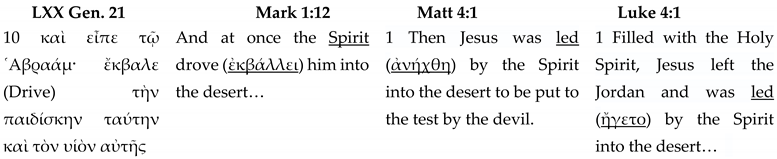
This appears to have been precipitated by three factors: (1) the uncomfortable association ἐκβάλλω created between Jesus and the evil spirits, i.e., the Spirit could not have “driven out” Jesus into the desert like the demons were “driven out” of people, (2) Jesus being identified as a worker sent out by the Lord as were the disciples, and (3) Jesus’s being compared with Hagar. Thus, just as it is wrong to use the exorcism narratives or the “gouge out one’s eye” saying to frame the Spirit’s εκβαλλω of Jesus into the desert, it is wrong to use the conquest narratives of Ex. 23:27-33 to frame Sarah’s גרש or ἐκβάλλω (Gen. 21:10, LXX) demand.
When the narratives of both Hagar and the Jesus’ being driven into the desert (Mark 1) are compared one is confronted with the following uncanny similarities.
| Jesus (Mark 1) | Hagar |
|
|
These commonalities suggest some early Christians conceived Jesus’ εκβαλλω to parallel that of Hagar’s. In comparison to the will and activity of the Spirit on Jesus’ being driven into the desert, Sarah’s demand to drive Hagar and Ishmael away alludes to the will of the Holy Spirit, and Abraham’s act of driving them into the desert alludes to the work of the Holy Spirit.
Since the Spirit’s εκβαλλω of Jesus signals the inauguration of Jesus’ ministry the Markan community appears to have seen a similar dynamic at work with Sarah’s εκβαλλω (Gen 21:10, LXX) demand of Hagar. But why would early Christians couch the inauguration of Jesus’ mission in words paralleling Hagar’s if they believed it was only an “expulsion” as it is commonly read today? They wouldn’t. It appears they saw Hagar’s εκβαλλω as (1) a release from Sarah’s authority, (2) a subjection to trials, and (3) the commencement of a mission. These elements parallel Jesus’ εκβαλλω into the desert, i.e., (1) as a release from the Baptizer’s authority, (2) subjection to sever trials, and (3) the commencement of his divine mission. But why use Hagar’s narrative rather than Moses’ to frame Jesus’ inauguration?19 The answer may lie in what Dozeman (1998, p. 42) says, that Ishmael was seen as an extension of Israel’s mission of salvation to the Gentiles.
There are many dimensions to the relationship between Ishmael and Israel as it is fashioned by Priestly writers. When read from the perspective of Israel, Ishmael represents an expansion of election beyond the boundaries of Israel, and as such Ishmael models the proselyte who undergoes circumcision.
Paul’s decision to journey into Arabia (Gal. 1:17) after his encounter with the risen Christ (Gal. 1:15-6) may reflect the role of Ishmael as he represents extending God’s grace outside Israel. Harlan (2023, p. 88) writes that Paul’s “targeting Nabataean Arabs as the first Gentiles accords with Isaiah’s view of Ishmael’s descendants as ‘first-responders’ to the dawn of eschatological glory (60:1–7).” Thus, it appears highly likely that the reason the Markan community used Hagar’s narrative to frame Jesus’ εκβαλλω into the desert, may be due to not only the prominent role of Hagar and Ishmael in salvation history, but also how they viewed their own relationship to Israel: being Gentiles they saw Jesus’ mission, as far as it relates to them, to be sent to the Gentiles like Hagar and Ishmael were.
Hagar like Adam
Because of the pairing of the words שלח and גרש in both Adam and Hagar’s stories, any analysis of Hagar’s story that does not take into account Adam’s will be incomplete. The general view happens to be that Adam experienced some form of “alienation” from God for his disobedience, rather than “sent out” on some mission. A popular scholarly translation, the NIV, is a case in point. They translate God’s šellach of Adam from the Garden as “banished.”
[T]he lord God banished (šellach – piel form) him from the Garden of Eden to work the ground from which he had been taken. (Gen 3:22)
Dozeman (1998, p. 30) had observed that for both Hagar and Israel “expulsion is an act of liberation for the one that is being driven out.” However, translating the šellach of Adam (Gen 3:23) as “banish” as the NIV does, confines the scope of God’s action to some form of punishment and rejection. Thus, the NIV’s translation of Adam’s šellach does not convey a divine mission. What confounds the problem is that, at times, šellach in the Torah refers to divorce (Deut. 22:19).20 Read from the perspective of a divorce, Adam’s šellach (Gen 3:23) reflects some form of estrangement from God. Hence, the justification of the word “banished” (NIV).21 When this understanding of Adam’s narrative is used to frame Hagar’s story she appears to be estranged from Abraham’s family and God’s salvific promise. However, I will endeavor to show that, contrary to expectations, the piel form of שלח šellach in both Adam and Hagar’s stories express two ideas: (1) being set free, and (2) being sent on some kind of mission.
שלח Being Set Free, Extending One’s Reach, and Being Sent Out on a Mission
For the piel form of שלח Koehler et al. (2001) give the release of slaves of Deut. 1512 and Jr 349-16. So, Abraham’s šellach of Hagar can be read as giving freedom to her. The piel form has also been used to express the idea of a tree spreading its roots and a vine producing shoots: “c) a tree, spreading שָׁרָשָׁיו its roots Jr 178 17, of a vine producing פֹּארוֹת shoots Ezk 176 tendrils (דָּלִיּוֹתֶהָ textual emendation) Ezk 177, branches (קְצִירֶיהָ) Ps 8012” (Koehler et al. 2001, שלח). This meaning enables interpreting Abraham’s šellach (sending forth) of Hagar as extending the reach of his organization like a tree spreading its roots, or a vine producing shoots and tendrils.22 This correlates with Pinker’s (2009, 16) observation that שלח “implies extension of reach and therefore continuation of links.” It appears Abraham was using Hagar to extend his reach to other peoples.
In Gen. 19:13 the piel from of šellach is used of angels sent on a mission. The angels inform Lot that they have been sent to destroy the city. “The outcry to the LORD against its people is so great that he has sent us to destroy it” (Gen. 19:13). There is also the piel form of šellach used in Psa. 104:30 to signify the sending of the Spirit to renew the earth. “[T]he רוּחַ, which was sent out from Yahweh, and whose generative power (יִבָּרֵאֽוּן) was present at the creation, and is the power which renews the soil on the arable land Ps 10430” (Koehler et al., 2001, שׁלח). The wording of this verse appears quite similar to Adam’s being šellach-ed out of Eden (Gen 8:6-12), suggesting Adam’s being sent into the world, was like the Spirit being sent into the world, that is, both are connected with the soil.
Furthermore, in Gen 8:11 the piel form of šellach are used to express Noah’s sending forth a raven and dove to find dry ground. Clearly, this can be thought of as a mission. The birds are released with the intent that they bring back information on the flood. The raven does not return, but the dove does. The dove’s returning with “a plucked olive leaf” (Gen 8:11, HCSB) in its beak conveys critical information to Noah about the condition of the flood. One should also note that in these “send outs” there is no notion of a banishment as is understood in Adam’s narrative (Gen 3:23).
Adam Sent Out to Find That Which He Lost
In the šellachs (piel form) or send outs of the angels (Gen. 19:13), the Spirit (Psa. 104:30), and raven and dove (Gen 8:11), there is a mission objective. But it is generally held that the send out (šellach) of Adam was an expulsion. For example, for the “expel” meaning of שׁלח Koehler et al. (2001) give Gen 3:23, e.g., the expulsion of Adam. However, the Bible says that Adam was sent out for the purpose of working the ground: “So the LORD God sent him away from the garden of Eden to work (לַֽעֲבֹד) the ground from which he was taken.” (Gen 3:23, HCSB). The word for “ground” hā’ăḏāmāh is a play on the name Adam (hā’ăḏām). Just as hā’ăḏām represents “humankind,” hā’ăḏāmāh represents “the nature of human beings” which is intrinsically tied to the ground. So, toiling on the ground represents toiling on human nature, either of one’s own, or that of another–it entails bringing to fruition the character and intellectual faculties of a human being. This metaphor shapes our own language and thinking on learning and developing ourselves. For example, the Concise Oxford English Dictionary says that the word “culture” stems from the 17th century French word culture and means “denoting a cultivated piece of land” (Stevenson & Waite, 2011, culture). Thus, Adam’s being driven from the Garden to work hā’ăḏāmāh suggests he was sent on a mission to cultivate himself and others to attain that which was lost. Rather than attempting to establish this observation from inferences drawn from the Torah—an exercise that should be tackled in another paper, the beliefs of early Christians on Adam’s removal from the garden will be explored, for the Christians of the first Century are not as removed as we are from the Jewish milieu of when the Torah was written. This may not establish the meaning of “to work the ground” (Gen 3:23) but it will show that the view argued in this paper is not novel and existed in the Jewish society of the first century.
Sent Out to Work hā’ăḏāmāh: Parable of the Sower
The parable of the Sower (Mark 4:2-9; Matt 13:3-9; Luke 8:11-5) illustrates the idea that human nature must be worked for the reception and fruition of God’s word.
Then he told them many things in parables, saying: “A farmer went out to sow his seed. As he was scattering the seed, some fell along the path, and the birds came and ate it up. Some fell on rocky places, where it did not have much soil. It sprang up quickly, because the soil was shallow. But when the sun came up, the plants were scorched, and they withered because they had no root. Other seed fell among thorns, which grew up and choked the plants. Still other seed fell on good soil, where it produced a crop—a hundred, sixty or thirty times what was sown. Whoever has ears, let them hear.” (Matt 4:2-9)
The parable points out that the ground that is not worked does not bear fruit. This parable reminds one of, first, Adam’s “send out” to work the earth (Gen 3:23), and second, Jesus’ saying about the workers “sent out” to harvest the fields (Matt 9:38; Luke 10:2).
| So the Lord God sent (ἐξαπέστειλεν) him away from the luxurious garden to work the earth from which he was taken. So he threw (ἐξέβαλε) Adam out… (Gen. 3:23, LES) | He told them, “The harvest is plentiful, but the workers are few. Ask the Lord of the harvest, therefore, to send out (ἐκβάλλω) workers into his harvest field. (Luke 10:2) |
It appears that Jesus or the early Christian community saw Adam as being sent out on a mission. The Parable of the Sower illustrates Adam’s, and therefore, humankind’s, mission of cultivating themselves and helping others cultivate themselves. Just as the ground that is not worked is incapable of bringing to fruition the planted seed, so, the human who has not worked their intellect, is incapable of bringing forth the fruit of the word of God. The preconditions of working the intellect to procure wisdom involves (1) a world of adversity, (2) skilled hard labor, and (3) the exercise of free will. The Sower parable stresses the importance of a receptive mind to the word of God. An aspect of this is the cleansing of the mind from false ideas. This extends to helping others achieve this goal as well. For example, “The laborers of the field” (Matt 9:38; Luke 10:2) illustrates this very idea. The same is the case in John 4:38 where Jesus talks about previous messengers who labored and toiled on the people. “I sent you to reap that for which you did not labor; others have labored, and you have entered into their labor.” These laborers are most likely prophets who, throughout Jewish history, were sent out to work the האדמה (hā’ăḏāmāh) of the people. It is due to their labor that the people have mental categories of a personal loving God, God revealing his will through scripture, a day of reckoning, forgiveness, salvation, etc. In the cases of Adam and Hagar, a particular dimension of their toiling of hā’ăḏāmāh appears to involve the depreciation of their ego, i.e., both were humbled. Adam had tried to be like elohim (Gen 3:5, most likely referring to an archangel23) and Hagar, appears to have esteemed24 herself above Sarah (Gen 16:4-5). To prevent his disciples from falling into a similar predicament of ego inflation, i.e., feeling solely or primarily responsible for the conversion of the people, Jesus tells them, in John 4:38, that previous prophets and messengers tilled and planted the people before them.
Thus, the Sower parable suggests that Adam was sent into the world to find wisdom through cultivating himself and others. For early Christians, however, “finding wisdom” is not confined to the vocation of farming. Humans can find wisdom in any occupation. This is part of the freedom entailed by the piel form of Adam’s שלח šellach from Eden.
Pastoral Occupation: Lost Sheep
The theme of searching for wisdom because it gives life, is at the heart of wisdom literature. Nowhere is this more clearly expressed than in the book of Proverbs.
I love those who love me,
and those who seek me diligently find me.25
…
For he who finds me finds life26
and obtains favor from the Lord; (Prov 8:17, 35)
Kloppenborg (1996, 321) says that there is a broad consensus on the structure of Q, that “it is … more like Proverbs 1-9…” He presents Schulz’s position on Jesus which in the earliest strata of Q was viewed as a messenger of Sophia (wisdom).
…in the younger stratum of Q, to which Schulz assigns most of Q, the words and deeds of the earthly Jesus came to be interpreted kerygmatically. Thus Jesus was seen as an emissary of the heavenly Sophia… (Kloppenborg, 1996, p. 320)
Comparing Adam’s šellach into the world with the Spirit’s šellach into the world (Psalm 104:30) suggests that all humans were meant to be emissaries of the heavenly Sophia.
| Gen 3:23, ESV [T]herefore the LORD God sent (šellach) him out from the garden of Eden to work the ground (hā’ăḏāmāh) from which he was taken. |
Psa. 104:30 When you send (šellach) your Spirit, they are created, and you renew the face of the ground (’ăḏāmāh). |
The “lost sheep” parable (Matt 18:12-13) of early Christians exemplifies this universal mission of human beings, i.e., they must seek wisdom that was lost. Commonly the lost sheep is interpreted as a sinner. This can be a secondary meaning, that is, one who loses wisdom is lost (see the prodigal son, Luke 15:32). However, the initial reference of the lost sheep is to wisdom as in Wisdom Literature.27 Like a shepherd seeking his lost sheep, humans have been sent out into the world to seek and find the wisdom which they lost in the garden. We’re told that even Jesus—although conceived to be the embodiment of wisdom by Paul, e.g., “Christ the power of God and the wisdom of God. (1 Cor 1:24), “grew in wisdom and stature, and in favor with God and man” (Luke 2:52).
If the Lost Sheep parable is about seeking and finding wisdom, then the sheep that is sought should signify wisdom. This is what we find in Q.
| Matt 10:16 Behold, I send you out as sheep (προβατα) in the midst of wolves. |
Luke 10:3 Go your way; behold, I send you out aslambs (αρνας) in the midst of wolves. |
The usage of sheep and lambs in this saying shows that Jesus had taught his disciples wisdom. “I will give you a mouth and wisdom, which none of your adversaries will be able to withstand or contradict.” (Luke 21:15). Jesus had said that “…every one when he is fully taught will be like his teacher.” (Luke 6:40). Thus, the disciples being called sheep and lambs, would be in reference to being like Jesus, possessing wisdom. Paul had observed that Jesus was “the wisdom of God” (1 Cor 1:24). This idea that Jesus embodies wisdom is also expressed by the Baptizer or the early Christians. For example, in John Jesus is referred to as the Lamb of God.
Look, the Lamb of God, who takes away the sin of the world! (John 1:29)
Although the saying does not come from the synoptic tradition or Q source, it appears to be connected to the semantic field of the Lost Sheep or Lamb parable. Placed in the milieu of the time this saying would have been understood as such:
Behold, the Wisdom of God (which Adam lost in the garden), who takes away missing the mark28 of the people. (John 1:29)
Thus, for at least some Christians, Jesus, as “the Lamb of God,” that is, as “the wisdom of God,” was imparting wisdom to people enabling them to make morally wise decisions. Some early Christians appear to have believed that all humans were sent into the world to find wisdom, i.e., that which was lost. The following saying attributed to Jesus expresses this very idea.
For the Son of man came to seek and to save the lost. (Luke 19:10, ESV)
A brief analysis of the term “the son of man” may be required to understand the saying. Crossan’s (1992, p. 255) argument is quite cogent: “My proposal is that those early traditions also held texts in which Jesus spoke of ‘son of man’ in the generic or indefinite sense…” Thus, early Christians used “son of man” inclusively of all humans. Crossan observes that Paul never uses the title “son of man” for Jesus even when one would expect it. For example, referring to the prophecy of Daniel of “one like a son of man” (Dan 7:13), Paul uses the title “the Lord”29 (1 Thess. 4:17) for Jesus, rather than the “Son of Man. Crossan (1992, p. 244) stresses: “Notice, first and above all, that Paul’s title for the returning Jesus is ‘the Lord,’ a title repeated four times within that section. Neither here, nor anywhere else, does he ever mention the ‘Son of Man.’” When Crossan’s observations are taken into consideration Jesus’ saying would read,
For humans have come into the world to seek and save, i.e., find, that which was lost (by Adam in the Garden, e.g., wisdom). (Luke 19:10, personal rendering)
Thus, for early Christians Adam’s שלח and גרש in Genesis seems to entail being sent out to find wisdom through trials and tribulations, rather than just being punished or banished.
Was Abraham’s שלח (šellach) of Hagar a Divorce?
Both Koehler et al. (2001) and Brown et al. (1979) give the meaning of “divorce” to the words גרש (gāreš) and שלח (šellach). Pinker (2009, p. 16) notes that Hapner is of the opinion that Abraham’s šellach of Hagar was a divorce, but doubts the words גרש and שלח “are used in this episode with that sense.” There may be a way to reconcile the two seemingly contradictory positions. Just as there were different forms of marriages at the time, there may have been different forms of divorces. The kind of “divorce” entailed by Abraham’s šellach act may have involved giving Hagar the freedom to complete the divorce or separation if she decided to do so. Being sent far away from home, and being alone, a woman may need, or wish, to remarry to survive and complete her mission. Thus, the piel form of שלח šellach may indicate that Hagar was released from the marital authority of Abraham.
A similar social norm may be at work with Abraham referring to Sarah as “my sister” (Gen 12:19; 20:2). Rather than a constative speech act, that is, stating some fact of relation between Abraham and Sarah, Abraham’s speech should be understood as a performative utterance, establishing a certain social relation. The expression “She’s my sister” could mean “Sarah is now as a sister to me,” i.e., sexual relations are now prohibited. We saw a similar example of a performative utterance in the Gospel of John:
When Jesus saw his mother there, and the disciple whom he loved standing nearby, he said to her, ‘Woman, here is your son,’ and to the disciple, ‘Here is your mother.’ From that time on, this disciple took her into his home. (John 19:26-7)
When Jesus told the beloved disciple that Mary is his mother, Jesus was not stating a biological fact unbeknownst to the beloved disciple and to his audience such as Mary actually gave birth to the beloved disciple, and that he was adopted by the woman he knows to be his mother. Jesus’ speech act establishes a social relation and expectancy between the disciple and Mary the mother of Jesus, that is, “take care of her like your mother.” Thus, telling the Pharaoh or Abimelech that “Sarah is his sister” appears to have functioned the same way. As a performative utterance, the saying could have given Sarah the freedom or legal right to finalize “the divorce,” if she wished to do so. Why would a woman be interested in such a divorce? A woman in Sarah’s situation may be interested in the life of opulence and royalty offered by marrying a king. Thus, in that situation Sarah could have legally and morally “divorced” Abraham and married the Pharoah or King Abimelech. But that would be petty. Sarah willfully refrained from the temptation offered by the marital release of Abraham’s “my sister” statement, demonstrating her love and commitment to remain part of God’s special plan with Abraham. God’s saving her on both occasions (Gen 12:20; 20:14) shows the reader the degree of Sarah’s self-sacrifice and her continuing disinterest in the status and lifestyle of a queen. After each of the abductions she is returned to her husband and bears children.30 These episodes in the life of Sarah appear to be more a test of her than of Abraham. It looks as if the rabbis saw Hagar’s separation or “divorce” from Abraham in a similar light for in some rabbinic traditions she is returned to Abraham with fruitful consequences.31
The Sending Forth of Hagar in the Septuagint
As noted above, scholars feel that being in the intensive form (Piel) the words גרש and שלח convey harshness in the narratives of both Adam and Hagar. Therefore, it is instructive to see how the LXX translator(s) rendered these words into Greek.
| So the Lord God sent (ἐξαπέστειλεν) him away from the luxurious garden to work the earth from which he was taken. So he threw (ἐξέβαλε) Adam out… (Gen. 3:23-4, LES) | And she said to Abraham, “Banish (ἔκβαλε) this maid and her son, for the son of the maid will not inherit with my son Isaac.” … Abraham rose early and took bread loaves and a skin of water… and sent (απέστειλεν) her away. (Gen. 21:10,14, LES) |
Comparing both narratives, we see that, although there isn’t a difference between how גרש has been translated, there is a difference in how the word שלח in Gen. 3:23 and Gen. 21:14 is translated into Greek. The translators have chosen to render שלח in Adam’s narrative (Gen 3:23) as εξαπεστειλεν, but απέστειλεν for Hagar in Gen 21:14. For αποστέλλω the Analytical Lexicon to the Septuagint gives “to send off, to send away.”32 The use of this word strongly suggests that the translators believed she was sent on a mission, for αποστέλλω is often used in the LXX for the sending of angels, messengers, and prophets, e.g., Gen. 19:13; 24:7; 45:7; Num 13:17; 20:14; Deut. 34:10-1, 1 Kings 19:20.33 To get a feel for a mission objective of the Greek word αποστέλλω in the LXX references to some biblical passages are helpful. Notice that in these passages šalach is in the Qal form.
| God sent (šalach, Qal form) me before you to preserve you as a remnant on the earth and to save your lives by a great deliverance. | For God sent (ἀπέστειλε) me ahead of you, to leave you a remnant on the earth and to nourish your great remnant on the earth. (Gen. 45:7, LES) |
| When Moses sent (šalach, Qal form) them to explore Canaan…. | These are the names of the men whom Moes sent (ἀπέστειλε) to seek out the land. (Num. 13:17, LES) |
| Moses sent (šalach, Qal form) messengers from Kadesh to the king of Edom, saying: “This is what your brother Israel says: You know about all the hardships that have come on us. | And Moses sent (ἀπέστειλε) messengers from Kadesh to the king of Edom” (Num. 20:14, LES) |
| Since then, no prophet has risen in Israel like Moses, whom the LORD knew face to face, who did all those signs and wonders the LORD sent (šalach, Qal form) him to do in Egypt—to Pharaoh and to all his officials and to his whole land. | And no prophet has arisen again in Israel like Moses, whom the Lord knew face to face, with all the signs and wonders that the Lord sent (ἀπέστειλεν) him to do in the land of Egypt to Pharao and his attendants and to all his land, the great wonders and the mighty hand that Moses did before all Israel. (Deut. 34:10-1, LES) |
By choosing to translate שׁלח, the Piel form in Gen 21:14 and the Qal forms in Gen. 45:7, Num. 13:17, Num. 20:14 and Deut. 34:10-1 into Greek as ἀπέστειλεν, suggests the translators made no distinction between the Piel form of שׁלח in Gen 21:14 and the Qal form used in these passages. Furthermore, we saw earlier that the Piel form of שׁלח in Gen. 19:12 clearly expresses the idea of a mission. The same Greek word ἀπέστειλεν has been used there as well.
| The outcry to the LORD against its people is so great that he has sent (šellach, piel form) us to destroy it.” (Gen. 19:13) | “…because their outcry has risen before the Lord, and the Lord sent (ἀπέστειλεν) us to wipe it out” (Gen. 19:13, LES) |
Thus, the LXX’s use of απέστειλεν for Abraham’s sending of Hagar in Gen. 21:14 is a strong indicator that the translator(s) believed she was sent on a mission.
The Sending Forth of Hagar in Josephus’ Antiquities of The Jews
What Josephus reports, in regards, to the objective of Sarah’s demand demonstrates conclusively that the idea of Hagar and her son Ishmael were sent away on a mission is not due to modern liberal sensibilities. Josephus literally says that Sarah persuaded Abraham to send out Ishmael and his mother to establish a colony34 (εἰς ἀποικίαν).
ἔπειθεν (she persuaded) οὖν τὸν Ἅβραμον εἰς ἀποικίαν (to found a colony) ἐκπέμπειν (send out) αὐτὸν μετὰ τῆς μητρός (him with his mother). (Ant. 1.12.216)
For the meaning of “ἀποικία ἐκπέμπειν” Liddell et al. (1996, ἀποικία.) provide Thucydides 1.12: “send, lead to form a settlement.” That Josephus believed that Ishmael was sent out to establish a colony is noted by one of the leading authorities on the writings of Josephus, Louis Feldman (1998, p. 244): “…when she (Sarah) decides that Ishmael must be sent away, she seeks merely to have him found a colony…” It is evident that Josephus understood Sarah’s gāreš demand as a directive to establish a colony. Thus, the thesis put forth in this paper is not a novel idea due to modern liberal sensibilities.
However, there is a popular assumption that Josephus has Hellenized the Biblical stories, especially the main personalities, to make them attractive to his aristocratic Roman audience. For example, van der Lans (2010, p. 185) notes, “Josephus deliberately “Hellenized” Jewish scriptures to appeal to his (Jewish, Roman, Greek) audience.” Feldman (1998, p. 249) says that Josephus “[aggrandizes] Abraham the philosopher and scientist, the general, the perfect host and guest, and the man of virtue generally…” To some degree there is truth to this view. However, the impression is that this is generally accepted among scholars on Josephus. Which is not true. Avioz (2019, p. 95) writes “Josephus’ central aim is not apologetic but interpretative and that his Antiquities of the Jews are classified as ‘rewritten Scripture’, focusing mainly on the interpretive aspects of the biblical text.” Thus, one should not accept by default, that Josephus was recasting Abraham and other biblical heroes in Hellenized garb to placate his audience, and that he didn’t believe these interpretations could be justified from the Bible, that is, he didn’t really believe in what he wrote. Spilsbury (1998, 34) agrees. “Hellenization in the Antiquities are [not] always to be taken as propaganda . . . but that they are just as likely to be genuine expressions of Josephus’ own understanding of the biblical narrative.” Feldman (1998, p. 25) allows that even the Masoretic text used by Josephus could have been different. “The fact, however, that the Letter of Aristeas (30) seems to refer to corrupt Hebrew manuscripts of the Pentateuch, and that the Dead Sea fragments of the Pentateuch sometimes disagree with the so-called Masoretic Text, may indicate that the Hebrew text available to Josephus was different from ours.” Although, the Masoretic text of Josephus could have been different, it need not have been. According to Avoiz Josephus’ interpretations are justifiable from the Masoretic text. To this end he provides several examples of Josephus’ exegetical skills (see Avioz, 2019, pp. 96-101) and observes: “The existence of apologetic in Josephus’ retelling cannot be denied, but what I have tried to show is that his exegetical motivations is more inherent than some scholars assume” (2019, p. 108). Thus, Josephus’ stating that Sarah persuaded Abraham to send Ishmael and his mother to establish a “colony” as an extension of their rule could very well be the result of legitimate rabbinic exegesis.35
What Josephus says about Ishmael being sent to establish a colony, he says about Abraham’s other sons (from Keturah) as well, that is, that they too were sent to establish colonies (Gen. 25:6): “Now, for all these sons and grandsons, Abraham contrived to settle them in colonies” (A.J. 1.239). It’s clear that Josephus is interpreting Abraham’s שלח (šellach) (Gen. 25:6) of his sons from Keturah.
But while he (Abraham) was still living, he gave gifts to the sons of his concubines and sent (šellach, piel form) them away from his son Isaac to the land of the east. (Gen. 25:6)
As in Gen. 3:23 and Gen. 21:14, the Piel form of the word שלח is used here. And although, the intensive form of the word שלח is generally seen as negative (covered earlier in the paper), in case of Abraham’s actions, Josephus doesn’t read it as such. He understands it as a mission objective. As noted earlier, this understanding correlates with Pinker’s (2009, p. 16) observation of the Piel form of שלח in Gen. 21:14, that it “implies extension of reach and therefore continuation of links.”
The Rule of Abraham
For some the sending of Hagar to establish a settlement seems implausible, since Abraham is often conceived as the head of a nuclear family aimlessly roaming in the desert looking forward to the promise of God being actualized in the future. As mentioned earlier, Josephus, who portrays Abraham as an active leader of a political organization of quite considerable size, e.g., “ἡγεμονίας” (see Ant. 1.12.215), is dismissed and suspected of aggrandizing (see Feldman, 1998, p. 249) Abraham. However, the Bible has Abraham involved in a military campaign of more than three hundred trained men (Gen 14:14-16). It presents him making alliances with chieftains (Gen 14: 17-19). We are told that Abraham was extremely wealthy in “livestock and in silver and gold” (Gen 13:2). Providing these and other examples, Gordon (1958, p. 30) writes, “The patriarchal narratives, far from reflecting Bedouin life, are highly international in their milieu, in a setting where a world order enabled men to travel far and wide for business enterprise.” Gordon (1958, p. 31) argues that the Bible presents Abraham as “a merchant prince, a tamkârum.” He says, “Abraham comes from beyond the Euphrates, plies his trade in Canaan, visits Egypt, deals with Hittites, makes treaties with Philistines, forms military alliances with Amorites, fights kinglets from as far off as Elam, marries the Egyptian Hagar, etc.” (Gordon, 1958, p. 30). Thus, these features point to a significantly large organization involved in economic and political activities.
Sarah, Abraham’s wife, seems to have had an executive role in Abraham’s organization. One can infer this from her name. For example, Sarai would mean “my ruler,” “my steward,” or “my chief captain” (Harris et al., 1980, שָׂרָה). The words of Teubal (1984, p. 136) summarizes the status of Sarah.
We know, for instance, that she was of sufficient stature to be respected [emphasis added] by kings in communities outside her own. (The Kings reprimand Abraham, not Sarah.) In other words, Sarah’s position was internationally recognized [emphasis added] and was not limited to her own community.
One should realize that this international respect of Sarah found expression in the Pharaoh of Egypt and King Abimelech desiring to marry her. Kings would not be interested in marrying a desert Bedouin. It appears that Sarah did not just possess a prominent social status, but also wielded substantial decision-making authority. Again, Teubal’s (1984, p. 136) observations are insightful.
The Matriarch was also held in high esteem by her husband. Abram is solicitous of her favors before their meeting with kings: he dutifully heeds her request to provide her with a child and accepts Sarah’s decision to treat Hagar harshly when the handmaid is insolent to her. Also, Abraham’s attitude is differential and subservient to the three mysterious visitors at Mamre, in contrast to Sarah who argues with one of them.
To be “held in high esteem” and “dutifully heeded” by Abraham shows Sarah’s role in Abraham’s rule, that is, she was not someone who was passive in Abraham’s household but actively involved in making executive decisions. One should note that Sarah’s use of Hagar as a surrogate (Gen 16:1) to realize the promise of God (Gen 12:2-3) is not confined to expectations of a distant future, but intends realizing immediate organizational goals, such as possibly bequeathing the organization to a legitimate heir. Sarah’s confronting Abraham and framing his role in her loss of stature in Hagar’s sight (Gen 16:5) suggests some degree of a formal hierarchical structure to the organization. Thus, as mentioned earlier, it is not surprising that Josephus calls Abraham’s rule an ἡγεμονίας “government.”36
“ἴδιον υἱον εὐνοίας, ετρεφετο γὰρ επὶ τῇ τῆς ἡγεμονίας διαδοχῇ” (Ant. 1.12.215)
“for he (Ishmael) was brought up in order to succeed in the government.”
Sarah’s request that Abraham marry Hagar appears to be part of the professional concerns and counsels of an executive officer in a diarchy. Since Hagar did not have to marry Abraham for Sarah to have children, that is, she could have been given to him as Zilpah and Bilhah were given to Jacob as a pilegesh (see Gen. 30), marrying Hagar to Abraham implies Sarah was promoting her position in the ἡγεμονίας (government or chieftaincy). If the rabbinic tradition of Hagar’s being a princess of Egypt is true, Sarah’s marrying Hagar to Abraham could reveal political motivations behind her action, e.g., establishing political alliances with Egypt.37
As Teubal mentioned above, the Bible’s presenting Abraham and Sarah in the company of Pharaoh (Gen. 12:10-20) and Abimelech’s (Gen. 20:1-18) officials, suggests they had a large influential organization. This intimates that they were of the upper class and of the movers and shakers of society. That is why Pharaoh and Abimelech desired to marry Sarah (Gen 12:19). Sarah was exceptionally attractive, yes, but her leading role in a large dynamic socioeconomic movement would have been the primary reason for her marital appeal to the monarchs. Accordingly, Sarah should be conceived more like the wise Queen of Sheba, rather than a tent dwelling desert Bedouin.
What about the nature of Abraham and Sarah’s “organization”? The Bible’s saying that all humans will be blessed through Abraham (Gen 12:3) and calling him a prophet (Gen 20:7) indicates religious characteristics. The angelic visitors (Gen 18:1-33) may reveal what the writer believed of the extent of Abraham’s missionary activity. For example, the angels inform Abraham of what is about to transpire at Sodom and Gomorrah. Why would they do that? A reasonable answer is for Abraham and Sarah to retract their servants from the area. Elie Wiesel couldn’t reconcile Abraham’s “expulsion” of his wife and son into the desert with so little rations (see Wiesel, 1986, p. 235). However, a missionary organization of some size can resolve this “problem,” i.e., he expected his servants would assist them in their journey. Just as Jesus sent out his disciples two by two with almost no provisions—he expected others to take care of them on their missionary journey (Mark 6:7-9), Abraham may have had a similar organizational model which provided food and shelter for Hagar and Ishmael until they reached their destination. A rabbi of the sixteenth century, Sforno, claims something similar. Zucker and Reiss (2015, p. 114) note: “Sforno, on his comment on Genesis 21:14, suggests that Abraham sent Hagar away with asses, camels, and laborers [emphasis added].” Sending Hagar with a large retinue suggests the rabbi believed she was sent to establish a settlement, because according Rabbinic tradition Abraham and Sarah were heads of a faith-based organization of considerable size involved in converting people.
Regarding Sarah’s good attributes, it is said that Abraham and Sarah converted the Gentiles. Abraham would convert the men, and Sarah, the women. (Kadari, 1999)
Could Sarah have vested Hagar with the power to establish a settlement in Arabia when she sent her forth? Abraham’s receiving the name אַבְרָהָם (Ab-raham) which means “father of multitudes of people” suggests a growing organization taking under its faith-based umbrella people coming from different ethnic groups.
No longer will you be called Abram; your name will be אַבְרָהָם (Ab-raham), for I have made you a father of many nations. (Gen. 17:5)
Being given the name “Ab-raham” suggests that the initial peoples Abraham directed (or should direct) his efforts to, were people of Arabia. This can be inferred from the fact that “raham” is an Arabic word, not Hebrew. For example, the Bible explains the name אַבְרָהָם (Abraham) to mean “father of many nations” (אַב-הֲמוֹן גּוֹיִם, aḇ-hămōwn gōyim) (Gen. 17:5). However, JewishEncyclopedia.com under “Abraham” notes that “The form ‘Abraham’ yields no sense in Hebrew…” This is quite strange. Why would God give the Israelite Patriarch a name that has no meaning in Hebrew? Even more surprising is that “Ab-raham” happens to be Arabic. Harris et al. (1980, p. 6) observe the following:
Some propose that the root rāham is no more than a variant of rûm “to be lofty” (E. A. Speiser, in AB, Genesis, pp. 124, 127). But in light of the known Arabic noun ruhāmun, “multitude” (KB, p. 8) the changes in meaning which the verse itself teaches should be upheld…
What Harris et al. are saying is that, rather than being a variant of “ab-ram,” the Bible’s explanation of the word “ab-raham” in the Arabic tongue “father of multitudes of people” should be upheld. Ellicott (1971, p. 44) agrees: “Abraham = ‘Father of a multitude,’ raham being an Arabic word, perhaps current in Hebrew in ancient times.” But this begs the question: “Why would God give an Arabic name to a person who is supposedly just passively waiting in the distant future for God’s promise to be realized? What the Arabic name may have suggested to Abraham was that he should turn his attention and “evangelical” activity to Arabia. Is there information in the Bible about Abraham’s activity in Arabia? Chung refers to the Islamic tradition to explain how Ishmael would have known of the death of his father and be involved with Isaac in his burial. He (2017, p. 580) writes:
If Hagar and Ishmael had been completely driven out from the house of Abraham, how could Ishmael meet Isaac to bury Abraham? In the Islamic tradition, Abraham is described to keep coming to visit his son Ishmael. Therefore, Gen. 25:9 strongly indicates that Abraham and Isaac have remained in contact with Hagar and Ishmael even long after Sarah’s request to drive them out.
Chung’s question above is quite insightful: How was Ishmael aware of Abraham’s death if he were “gotten rid of” (see NIV)? One could ask further, “Why weren’t the other sons of Abraham from Keturah (Gen. 25:1-2) involved with Abraham’s burial?” Chung’s comment, that Abraham must have kept in contact with Ishmael is quite likely. Chung’s inference is supported by both Pinker and Noble. Noble (2021, p. 117) had observed that “Ishmael is not separated or otherwise cut off, but cooperates with Isaac…,” and Pinker (2009, p. 16) had written that Abraham’s šellach of Hagar and Ishmael rather than a rejection “implies extension of reach and therefore continuation of links.” The Islamic tradition referred to by Chung is a non-canonical source of information from Arabia—surprisingly the land Hagar is associated with (see Gal. 4:25). The Koran, coming from the heart of Arabia reveals a tradition that Abraham was quite active “evangelizing in Arabia.” For example, there is a tradition that he raised the foundations of an ancient house38 of worship. Different peoples from distant corners of the then known world were invited to go on pilgrimage to perform certain sacred rites.
Behold! We gave the site to Abraham of the (Sacred) House (saying): "Associate not any thing (in worship) with Me; and sanctify My House for those who compass it round or stand up or bow or prostrate themselves (therein in prayer). "And proclaim the Pilgrimage among men: they will come to thee on foot and (mounted) on every kind of camel lean on account of journeys through deep and distant mountain highways.” (Koran 22:26-7, Abdullah Yusuf Ali)
If this tradition is true, it appears Abram took his new Arabic name “Ab-raham” as a sign to expand his universal faith-based project (Gen. 12:13; 17:5) into Arabia.
Many find the biblical evidence and rabbinic traditions about Abraham leading a large religious organization in the wilderness highly implausible, arguing that such a structure requires a society based on an extensive agricultural economy. However, our concern is not so much with historical accuracy, as with the intended meaning of the biblical writer(s). Besides, the biblical record of nomadic pastoral-herdsmen being involved in an extensive religious organization is not at all anachronistic. For example, the discovery of Göbekli Tepe, “[a temple] built some 11,600 years ago,” (see Mann, 2011, pp. 34–59) has forced a reassessment of the view on non-agricultural societies being able to create and sustain some form of a very sophisticated religious organization. Charles Mann (2011, pp. 34–59) reports the words of Klaus Schmidt, a researcher at the German Archaeological Institute, who discovered Göbekli Tepe, and is presently involved in excavating the monument for many years now.
These people were foragers," Schmidt says, people who gathered plants and hunted wild animals. "Our picture of foragers was always just small, mobile groups, a few dozen people. They cannot make big permanent structures, we thought, because they must move around to follow the resources. They can’t maintain a separate class of priests and craft workers, because they can’t carry around all the extra supplies to feed them. Then here is Göbekli Tepe, and they obviously did that.
If foragers, motivated by faith, could create and maintain a large structure like Göbekli Tepe, then it is not implausible to imagine, a merchant-prince and prophet of God, having an extensive “evangelical” organization as the Bible and rabbinical traditions record in which Sarah and Hagar played an important role.
Other biblical evidence that alludes to an apostolic objective of Abraham and Sarah’s sending away of Hagar is with the angel of Yhwh finding (māṣā’) Hagar in the desert (Gen 16:7). Hamilton notes that māṣā’ carries the meaning of divine election. In his commentary on Genesis 16:7, he quotes McEvenue. “When God is the subject of māṣā’, and the following object is personal, māṣā’ ‘carries a technical meaning going well beyond connotations of the English verb: it includes elements of encounter and of divine election’” (Hamilton, 1990, p. 211). Thus, it is not a surprise that Hagar “is the first person in scripture whom such a messenger visits” (Trible, 1984, p. 14).39 Given that Hagar is the first person in scripture to whom the angel of YHWH visits, one expects Hagar to be in some major way instrumental in Abraham and Sarah’s future missionary plans. One must keep in mind that the elements in this episode (Gen. 16:1-15) frame the background of Sarah’s gāreš and Abraham’s šellach of Hagar (Gen. 21:10, 14).
After her “send-off” in Gen. 21:14 the angel’s call from heaven in Gen 21:17 confirms to the reader not only the apostolic nature of Abraham and Sarah’s sending of Hagar, but the role of God in their decision, that is, Hagar’s mission is due to a divine calling, and not just the personal decisions of Sarah and Abraham. The prophecy given to her concerning Ishmael, i.e., “I will make him into a great nation” (Gen 21:8), also affirms apostolic motivations behind her send out. For example, besides putting her heart at ease about her son’s survival, it discloses to the reader her future apostolic success, that is, she will become a great nation. Teubal (1990, p. 168) concurs: “Hagar is the only woman in the Bible who, protected by her personal god, receives the promise that she (via her son) will become a great nation.” Thus, Hagar will play a significant role in bringing the raham–Arabic, “multitudes of people”–into attaching themselves to Abraham. As Dozeman (1998, p. 42) had observed, Hagar’s becoming a great nation ensures her role in actualizing God’s plan of making Abraham a “father of many nations” (ab-raham) beyond the boundaries of Israel.
The Bible May Reveal the Reasons behind Sarah’s Choice of Hagar to Have a Son
On the surface the Priestly writer does not seem to reveal any reason behind Sarah’s choice of Hagar other than identifying some facts like she was a slave and an Egyptian (Gen. 16:1-3). However, these terms may reveal why Hagar was chosen. Four possible reasons can be discerned from the first line of Gen. 16:1: first (1), Hagar’s being called a שפחה (slave-girl), second (2), her being identified as “הָגָר הַמִּצְרִית (Hagar, the Egyptian),” third (3), the letter ה in the name הager, and finally (4), her connection to Arabia. I will discuss each of these elements separately.
שפחה One Reason Why Hagar Was Chosen
We’re told that Sarah chose Hagar to have a son because she was Sarah’s slave-girl, and as a slave one serves their mistress. “Now Sarai, Abram’s wife, had borne him no children. But she had an Egyptian slave (שפחה) named Hagar” (Gen. 16:1). However, there may be more to this identification–something that is perceived in Hebrew, but escapes notice when translated. Earlier God had said to Abraham that “…in you all the families (משפחה, mishpāḥâ) of the earth shall bless themselves” (Gen. 12:2-3, RSV). According to Harris et al. (1980, שׁפח) the root of שפחה (šhipḥâ) and משפחה (mishpāḥâ) are one: שׁפח (shph). So, when a person reads in Hebrew Hagar being referred to as a שפחה šhipḥâ one cannot help but connect this to the משפחה (mishpāḥâ) that will embrace Abraham and be blessed through him. Concerning the Hebrew word שפחה Teubal (1990, p. 58.) provides the following critical information: “shifhah could mean ‘someone who joins or is attached to’ a person or clan.” According to rabbinical tradition this “attachment” involved conversion to Sarah’s faith. The name Ha-ger supports this tradition, for in ancient times gēr referred to proselytes. Harris et al. (1980, גּוּר) tell us that “The gēr in Israel was largely regarded as a proselyte.” This shows that the name Ha-ger also suggests that she attached herself to Sarah’s faith. Hagar’s attachment to Sarah would have social, legal, as well as spiritual dimensions. Thus, when one reads Genesis, one feels, Sarah choses to use Ha-gēr, because she saw her as a proselyte שפחה, to be an archetype of the משפחה (families) who will in the future attach themselves to Abraham through conversion.
The Expression “הגר המצרית, Hagar the Egyptian” May Indicate She Has Renounced the World
The expression הגר המצרית (ha-ger ha’mitzrit) may refer to someone that has renounced the world, and therefore, virtuous. Metonymically or archetypically the word “Mitzrayyim” could stand for “civilization.” If so, then the expression ha-ger ha’mitzria (Ha-gar, the Egyptian) would mean “the stranger of civilization” that is, someone who has renounced living by the social constructs or conventions of civilization. Harris et al. (1980, גּוּר) inform us that in Heb. 11:9,13 the gēr, referring to Abraham, Isaac and Jacob, are presented as pilgrims who kept themselves estranged from the social world. “Hebrews 11:9, 13 describes them as pilgrims and strangers, evidence that they did not regard themselves as members of the sinful world [emphasis added].” This idea is applied to Israel’s stay in Egypt as well. Waskow (2006, p. 38), noting the relationship between ger and Mitzrayyim in regard to Hagar and Israel, writes:
When the Torah says that the Israelites were gerim b’eretz Mitzrayyim, ‘strangers in the Land of Egypt,’ that gerim is the same word as Hagar’s name. And the connection is made even clearer because Hagar is called Hagar ha’mitzria, ‘Hagar the Egyptian’—The Egyptian Stranger.
If the parallelism with Israel is kept in mind Ha-ger ha’mitzria should be read as “the stranger (in the land) of Egypt.” Besides suggesting Hagar was a pilgrim in the world, the expression ha-ger ha’mitzrit could also suggest that she like Israel was not a native of Egypt, that is, just as Israel was a stranger, a non-native in Egypt, so was Sarah’s shifhah a gēr (stranger) in Egypt. One must keep in mind that being called an “Egyptian” does not mean necessarily a native of Egypt. It can also mean “from Egypt” especially given that Hagar’s name means “the stranger.” For example, Moses is referred to as a Mitzri in Ex. 2:19. However, we know he is not a native Egyptian, but an Israelite. Obviously, the word Mitzri used of Moses means “from Egypt.” Another example is from the book of Acts 21:38 where the authorities refer to a messianic aspirant as “The Egyptian.” However, the man was a Jew from Egypt, not a native Egyptian. Furthermore, evidence that shows almost conclusively that Hagar was not an Egyptian is that her name Ha-ger is not Egyptian. Harris et al. (1980, הָגָר) write that “Hagar” “is Semitic not Egyptian.” The word “Hagar” appears to have a double entendre, e.g., meaning the stranger in Hebrew, and fugitive in Arabic. Sarna (1989, p. 119) tells us that “the very name Hagar suggests a word play on Hebrew ger ‘stranger,’ but also “suggest a connection with Arabic hajara. ‘to flee,’ and may mean ‘fugitive.’” Wenham (1994, p. 6) also notes the same: “הגר seems to be Semitic rather than Egyptian (cf. Arabic hegira).” Given the connection with Arabic, could Hagar have been an Arabian? Pinker (2009, p. 15) mentions an opinion of Winckler “that Mizraim (Egypt) and the North Arabian tribe of the Muzrim, to whom Gerar belonged, have been confused. In this process, Hagar, who was a Muzrim woman, became a woman of Mizraim.” In any case, rather than referring to Hagar’s being a native of Egypt, the expression “the stranger, Egyptian” could have meant that Sarah’s shifhah had renounced society and its social conventions.
The tradition recorded in Genesis Rabbah 45:3 supports the idea that Hagar was not interested in participating in the social order. Explaining the tradition under “Hagar” JewishEncyclopedia.com writes,
She was at first reluctant [emphasis added] when Sarah desired her to marry Abraham, and although Sarah had full authority over her as her handmaid, she persuaded her, saying, ‘Consider thyself happy to be united with this saint.’
Why would a woman be reluctant to marry Abraham, who, according to Gordon was a wealthy merchant prince? Marrying Abraham would have raised her social status, giving her certain rights and privileges of “a secondary wife” (see Zucker and Reiss, 2009), Her reluctance to marry Abraham suggests she had renounced participating in the social conventions of society.
The interpretation Ha-ger ha’mitzria, i.e., someone who has renounced the world and its social conventions, dovetails with the rabbinic tradition of how Sarah acquired Hagar. Lockyer had mentioned that, converted by Sarah, Hagar, the daughter of Pharaoh, renounced her royal status, and attached herself to Sarah as a slave to continue her friendship with Sarah. (see Lockyer, 1967, p. 61). As a side note, the idea of Hagar losing her royal status parallels the life of Moses, who was a non-native prince of Egypt who lost his royal status. Given these parallels it’s not surprising Dozeman (1998, p. 29) tells us that in the Bible Hagar resembles Moses even more than she resembles Israel: “Inclusion of the wilderness setting in a comparison of Hagar and the exodus suggests a more heroic quality to Hagar as a character who models the life of Moses more than she prefigures the slavery of Israel.” One striking similarity as noted by Dozeman (1998, p. 23) is that “each is a founder of a nation.” Thus, the sacred writer could be conveying the idea that besides her virtue of renouncing the world, Hagar was chosen by Sarah for her leadership qualities like Moses in establishing a nation.
The ה in the Name הagar
The ה in “הagar” may represent the divine name, or the creative power, of Yhwh. If so, then the biblical writer may be saying that one reason why Sarah chose הagar to have a son was because she recognized the creative power of Yhwh in her. In regards to the letter ה in הagar’s name, one’s attention is drawn to the name changes of Abraהam and Saraה (Gen. 17:5;15) in which the letter ה is added. Waskow (2006, p. 9) discusses the name changes of the patriarch and matriarch in Gen. 17, saying that,
…both names changed by addition of the Hebrew letter hei, a breathing sound (and the letter that appears twice in God’s name).
Ellicott (1971, p. 44) also draws the reader’s attention to commentators who see in the name change of Abram and Sarai the insertion of the divine name.
By some commentators the stress is thrown upon the insertion of the letter “h,” as being the representative of the name Yahveh or Hehveh, (Compare the change of Oshea into Jehoshua, Num. 13:16).
Rashi’s interpretation of Sarah’s name, that she became “princess of the world” strengthens the connection of the ה with the divine breath active in the world.
Initially she was a princess only to her nation: My princess [Sarai], but ultimately she became Sarah, a general term indicating that she was princess for the entire world.40
Rashi’s interpretation of Sarah’s new name may stem from the insertion of the divine name into her name. Rabbi Waskow (2006, pp. 5-6) observes how the Divine name refers to life giving activity in the world.
The name “YHWH” is usually translated as “Lord,” but this is a later superimposition. There are several theories as to what the word originally meant. One is that the four letters are a conflation of those that make up the past, present, and future of the verb to be, and thus the name may mean “The Eternal.” Another is that they are a causative form of the verb to be and thus mean “the One Who Brings Being into Being,” sometimes translated as “Holy One of Being.” Still another theory focuses on how the letters sound if spoken with no vowels–Yyyyyhhhhwwwwhhhh– and heard simply as a breathing sound, thus “breath of Life,” or “Breathing Spirit of the World.”
All these meanings reach toward the sense of a universal God, not limited to Israel or Abrahamic cultures–and the third, the one that focuses on a breathing sound, does not even depend on Hebrew for its meaning. In all languages and cultures, people breathe. And not only human beings; all life forms breathe. Indeed, their breaths are interwoven: I breathe in what the trees breathe out; the trees breathe in what I breathe out. We breathe each other into life.
So, it may be that Rashi derived the meaning “princess of the world” from his exegesis of the divine letter in Saraה’s new name. It appears he took the letter as representative of the creative power of YHWH that gives life in the universe. Nothing can exist without the activity of this creative power. In every breath we take, we praise, glorify, and worship God, whether we recognize it or not. For Rashi the ה inserted into Sarah’s name seems to signify that the divine breath will communicate Sarah’s selfless efforts, that is, the spirit of her faith and service to God and humanity, to the whole world. She will continue to be a guide and role model for everyone throughout the world irrespective of ethnicity even after her death.
If the ה represents God’s divine name Yhwh or His activity as some commentators think, then either the Priestly writer or redactor, may be informing the reader that the primary reason why Sarah chose Hagar to have a son (בנה) was because she recognized the creative power of Yhwh in Hagar’s name. The writer may be further suggesting that the insertions of the ה into Abram and Sarai aligned Abraham and Sarah with Hagar, suggesting the roles of abraהam, saraה, and הagar, in realizing God’s plan of making Abraham a father to many nations (Gen 17:5), are existentially bound up together. If the letter ה in הagar’s name represents God’s divine name, one should see an intimate relationship between Hagar and YHWH. Noble (2021, p. 36), drawing on the correspondence of language of Hagar’s story (Gen. 16) with that of Elijah’s in 1 Kgs. 19:1-18, makes that very assertion. He says, “…the affinities do point out a certain intimacy with YHWH that Hagar seems to have in common with prophet Elijah.” Furthermore, Yhwh’s being called “a ger (stranger) in the land” in Jer. 14:8 strengthens the affinity between Hager and Yahweh, that is, both הagar and Yהwה are strangers in the land (world). Thus, the sacred writer may be suggesting that Sarai chose הager because she recognized the power of the Divine Name in her name.
Hagar’s Connection to Arabia
The Priestly writer could be conveying the idea that Sarah intended to use Hagar to “evangelize” in Arabia, and not to necessarily raise a particular heir to Abraham’s rule. Earlier we saw biblical commentators state that the name “Hagar” is not Egyptian, but, has meanings in both Hebrew and Arabic. For the Arabic meaning of the word both Sarna and Wenham gave “fugitive” (hegira). Pinker (2009, p. 15) had conveyed Winckler’s position that Mizraim (Egypt) and Muzrim (a North Arabian tribe) had been confounded. If Hagar was a Muzrim she would be an Arabian.
There is other evidence that connects Hagar to Arabia, for example, the statements of Paul and Josephus. In Gal. 4:25 Paul writes:
Now Hagar stands for Mount Sinai in Arabia… (Gal. 4:25)
This is a little strange. Instead of connecting Hagar to Egypt, as one would expect, Paul connects her to Arabia. It could be that Hagar was never associated with Egypt, that is, she was a stranger of Egypt. It could be that she came to be associated with Arabia because she was sent there. It could also be that she was sent there because she was originally from Arabia. van der Lans (2010, p. 194) had noted that for Josephus there’s a significant connection between Ishmael and Abraham’s other sons, and where they were sent to colonize: “That there is a significant and deliberate connection between the relocation of all of Abraham’s children is confirmed in the second book of the Antiquitates judaicae, A.J. 2.213, where we are told that Abraham had ‘bequeathed (καταλιπείν) to Ishmael and to his posterity the land of the Arabians…’” Josephus’ claim that Hagar was sent into Arabia to establish a colony, supports the idea that he most likely believed Hagar was an Arabian, for Hagar would more likely succeed in establishing a settlement if she were sent to her own people.
Another factor that may connect Hagar to Arabia may be the ה in her name. Archeological evidence is showing that the origin of the name of Yhwh originated in Arabia. Summarizing his analysis on the origin of “Yhwh” Fleming (2021, p. 274) writes, “In the end, the best analogies for thinking about Yahweh before Israel come from South Arabia, where new inscriptional evidence allows detailed knowledge of political structures and ritual practices integrated with them.” If the origin of Yhwh is Southern Arabia, then it is in Arabic or proto-Arabic, not Hebrew. Arguing for an Arabic origin of Yhwh Goitein (1956, pp. 2-3) writes,
For reasons which will be discussed at the end of the article, the root hwy has almost disappeared from Biblical Hebrew and is used in it only in a pejorative sense, as indicated in the examples adduced. In Arabic, however, the root had an extremely rich life and in many respects resembled the Hebrew root qn’. In the examples of Biblical הַוָּה quoted above, the word appears in connection with nefeš, soul, and the same is the case in Arabic, where nafs, the soul, is the seat of hawä, passion.
Fleming (2021, pp. 198-210). refers to the existence of an ‘am Yhwh (people of Yahweh), separate and distinct from the nation of Israel. Could Hagar’s father, and therefore, Hagar, have been related to this group? If so, it is plausible her father travelled into Egypt from Arabia and conquered a part of it. And when he had a daughter, he gave her the name ה-ger which may have been expressive of his (and his god’s) condition in Egypt, in both ancient Hebrew and Arabic, that is, “the stranger and fugitive” of Egypt. We witness, a similar custom with Moses in the land of Midian where, when he has a son, he calls him “a stranger” based on his own condition in the land of Midian. “Zipporah gave birth to a son, and Moses named him Ger-shom, saying, “I have become a foreigner (ger) in a foreign land” (Ex. 2:22). Obviously, these are circumstantial. But given all these connections between Hagar and Arabia, could the sacred writer be saying that Sarah’s choice to use Hagar to have a son was due to her prophetic intuitions to expand her and her husband’s faith-based activity into Arabia? This is a question that should be considered.
Gen 21:9-14 Meaning-Based Translation and Commentary
The Bible suggests to the reader that Ishmael was conceived with the intent of realizing the promise of God to Abraham. With the birth of Isaac, however, there appears to have been some serious rethinking of each son’s role in the future of the organization. Incorporating the results of the above analysis, a meaning-based41 targumic translation and commentary of Gen 21:5-14 is provided below.
| Gen. 21:5-14, personal rendering Abraham was a hundred years old when his son Isaac was born to him. And Sarah said, “God has made rejoicing for me; everyone who hears will rejoice with me.” And she said, “Who would have said to Abraham that Sarah would nurse children? Yet I have borne him a son in his old age.” And the child grew and was weaned. And Abraham made a great feast on the day that Isaac was weaned. But Sarah saw the son whom the stranger of Egypt, had borne to Abraham – rejoicing [with Sarah] and playing with, and imitating, Isaac, [innocent of the social implications]. So [foreseeing the conflict between the siblings], she [grievously] said to Abraham, “Send forth the female servant and her son [to establish a settlement as an extension of our hegemony, so he can fulfill a role in accordance with the purpose he was conceived, while avoiding coming under Isaac’s authority], for the son of the female servant will not inherit [the hegemony] with my son Isaac!” And the matter was grievous in Abraham’s sight on account of his son. God said to him, “Let it not be so grievous in your sight on account of the boy and your female servant. Listen to whatever Sarah tells you, because it is through Isaac that offspring will be called to you. But I will also make the son of the servant wife into a great nation, because he is your offspring as well.” Early in the morning Abraham took some food and a skin of water and gave them to Hagar. He put them on her shoulders, gave her the child, and sent her [to establish a settlement as an extension of their “evangelical” hegemony]. |
Commentary The narrative begins by informing the reader that everyone who hears Sarah’s story will rejoice (laugh) with her. A great feast is given but no one is mentioned rejoicing (laughing)42 except Ishmael. Pigott notices this. “Ironically, the only person who explicitly laughs about Isaac is Ishmael” (Pigott, 2018, 521) There must have been others rejoicing as well but the writer wants to focus the reader’s attention on the reason(s) for Sarah’s demand. Hamilton notes that Ishmael’s action can be understood as the author of Jubilees: “Sarah saw Ishmael playing and dancing, and Abraham rejoicing with great joy, and she became jealous of Ishmael” (Hamilton, 1995, 79). Sarah could have felt jealousy, and love for Ishmael, a la Josephus. It appears that she’s experiencing ambivalent emotions—she’s quite conflicted. One must not forget that Sarah was the cause of Ishmael’s conception. And following Josephus, she had loved him like her own son, raising him to inherit his father’s rule. Sarah must have told Ishmael on numerous occasions that he will inherit the rule. However, Sarah sees in Ishmael’s imitation of Isaac the constraints on their personalities and the perils pregnant in the siblings living in close proximity with each other. One may say she’s more concerned with Ishmael than Isaac because Isaac will inherit his father’s dominion. She wants to live up to the purpose for which Ishmael was conceived, i.e., of her being built up43 through him. Her solution is to modify Ishmael’s role in the organization. Rather than inherit Abraham’s rule and future estate, Ishmael will model (inherit?) Abraham’s role and life, of leaving his home, and father’s inheritance, to proselytize. Ishmael will be sent forth, i.e., separated temporarily from the family, to take over the settlement or colony established by Hagar as an extension of Abraham and Sarah’s rule. |
The Priestly writer appears to convey the following ideas behind Sarah’s גרש demand and Abraham’s שלח of Hagar:
(1) the temporary separation of the brothers to prevent sibling rivalry,
(2) removal of Ishmael from the candidacy of inheriting Abraham’s rule,(3) bestowal of freedom on Hagar, i.e., (1) freedom from slave status, (2) freedom to continue with the marital relationship with Abraham, and (3) freedom to choose the mission objective of Sarah and Abraham,
(4) subjecting Hagar to ענה as was Israel in the wilderness, e.g., for demonstrating faith and gaining wisdom through trials and tribulations,
(5) the conferral of a new role to Hagar in Abraham’s rule, i.e., establish a settlement as an extension of the ministry of Sarah and Abraham’s “evangelical” mission. (This is in accordance with Sarah’s motive of conceiving Ishmael, for she had said that she intended “to be built up,” through him.)
Did Abraham Carry Out Sarah’s gāreš Demand as God commanded Him?
Sarah’s demand was that Abraham gāreš Hagar and Ishmael (Gen 21:10). Finding the request quite grievous Abraham refrains. However, commanded by God to carry out Sarah’s demand, he capitulates, but rather than gāreš Hagar and Ishmael, Abraham šellach-ed them. Some are troubled by the difference in words. Pinker (2009, p. 9) notes, “Targum Jonathan seems to be bothered by the fact that Abraham did not execute Sarah’s demand and did not ויגרשה but rather וישלחה.” Did Abraham fully obey God’s command? The analysis offered in this paper provides a framework in which an answer can be provided. Some of the key elements of this framework are:
(1) Sarah’s giving of Hagar to Abraham was due to God’s command (Ant. 1.187).
(2) Sarah had Ishmael conceived “to be built up” (Gen 16:2),
(2) Sarah loved Ishmael no less than she loved Isaac (Ant. 1.12.3.),
(3) Ishmael was brought up to succeed Abraham’s chieftaincy (Ant. 1.12.215),
(4) Sarah witnessed signs of future sibling rivalry, detrimental to both sons (Gen. 21:9),
(5) Sarah was torn between her love for Ishmael and Isaac (she wanted to be a good mother to both sons—a reasonable inference from the above premises),
(6) Conclusion: remaining faithful to the purpose for which she had Ishmael conceived, i.e., to be built up by him, (not necessarily inherit the chieftaincy) she assigned a new role for Ishmael in Abraham’s rule, that of overseeing the settlement Hagar will establish as an extension of Sarah and Abraham’s rule (Ant. 1.12.216).
When Sarah used Hagar to have a son, she had not foreseen her future pregnancy to Isaac. Although, she may not have had explicitly conceived Ishmael for the purpose of inheriting Abraham’s ἡγεμονίας, following Josephus it appears she had raised him as such. However, after the birth and weaning of Isaac, she found herself between a rock and a hard place when it came to her sons. Her solution is twofold: (1) separate the siblings temporarily to prevent sibling rivalry, and (2) give the role to Ishmael of expanding the boundaries of Sarah and Abraham’s missionary organization. The harshness of Sarah’s gāreš demand was due to her being conflicted owing to the following reasons:
first, she felt she was being compelled to separate from her son Ishmael whom she loved dearly, second, she felt she was acting contrary to the expectations she had given Abraham, Hagar, and most importantly Ishmael, that he will inherit Abraham’s chieftaincy, and third, this mission necessitated hardships for both Hagar and Ishmael.
Abraham’s response to Sarah’s gāreš was וַיֵּ֧רַע מְאֹ֖ד (wayyêra‘ mə’ōḏ) (Gen 21:11). Sarna (1989, p. 147) renders the words “greatly distressed,” and Wenham (1994, p. 77), “very displeased.” In this verse רעע happens to be an imperfect qal stem. The word is generally understood as “evil” (see Wenham, 1994, p. 77). Abraham’s רעע response is due not only to the thought of separating from his wife and son Ishmael, but to the heavy burdens imposed on them (and on him as well) to establish a colony of believers. We have a similar usage of רעע (Hiphil stem) by Moses addressing God. “’Why hast Thou done evil (רעע) to Thy servant? and why have I not found grace in Thine eyes -- to put the burden of all this people upon me?” (Number 11:11, YLT). It appears Abraham felt the same way about Sarah’s demand, that is, it is evil (רעע) to subject such a difficult burden like establishing a “colony” on a woman and her son far from home. For the culture of the time, it would be normal to think and feel this way. But God intended to subject Hagar to trials. What about Sarah? Was she conflicted as Abraham? The word gāreš suggests that she was. Sarah most likely felt the same way about the situation she was in and the choice she was forced to make, i.e., separating from her son Ishmael and placing a heavy burden on the shoulders of Hagar and Ishmael to establish a colony distressed her. It may be that Mark felt the same about the Spirit’s sending of Jesus (Mark 1:12) into the desert to be severely tested in inauguration of his mission. Thus, he used the word εκβαλλει to express the forcefulness of the Spirit’s action. The Markan writer may have intended to convey the idea that the Spirit, just like Sarah, was conflicted. Paul’s reference to a grieving Holy Spirit in Ephesians may shed some light on this phenomenon. “And do not grieve the Holy Spirit of God, with whom you were sealed for the day of redemption” (4:30). This grief is due to God’s love and compassion as explained in Jer. 31:20.44 Committing sins, humans inadvertently subject themselves to punishment which grieves God. It appears God’s grief is due to not only punishing his servants when they sin but includes the distress, they experience due to being subjected to severe trials and tribulations.
Once God consoled Abraham about the hardships or dangers of sending Hagar and Ishmael to establish a colony, i.e., God will take care of both of them (Gen 21:12-3), the subjective aspects of his distress was eliminated or greatly diminished. So, instead of gāreš-ing his wife and son as Sarah had explicitly demanded, Abraham šellach-ed Hagar with his son. He did not gāreš them because he was no longer conflicted like Sarah due to God’s consolation. The objective and subjective features of Sarah’s gāreš demand can be presented as such.
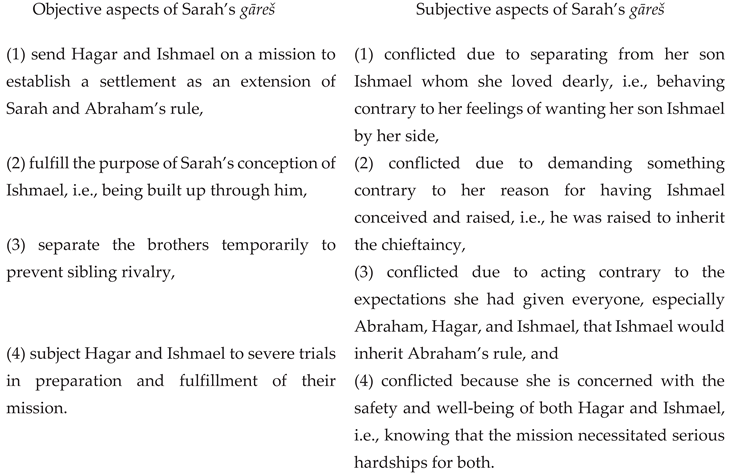
In this analysis Sarah’s gāreš does not carry the meaning of a rejection or banishment of Hagar or Ishmael. Rather than being rejected or “cut off from Abraham”, Ishmael actually builds up Sarah, which is ultimately in accord with, and fulfillment of, the reason for his conception (Gen 16:1-3).
A Final Word
Before concluding this paper mentioning Janzen’s observations on the role of Ishmael in salvation history is quite important. Noting the parallel language between the Adamic story in Genesis and the stories of Isaac and Ishmael Janzen says that although the wording of the universal vocation given to Adam in Gen. 1:28 is echoed in the blessings given to both Isaac and Ishmael, it is only in Ishmael—with the use of the word “exceedingly,” that the parallelism is complete.
[T]he wording of [Gen. 17] v. 20 gives Ishmael’s story an even more remarkable status. The universal vocation that was given to humankind in [Genesis] 1:28 began, “God blessed them, and God said to them, ‘Be fruitful and multiply,’” The promise to Abraham and to Sarah had echoed various elements of [Genesis] 1:28: “I will multiply you exceedingly” (17:2); “I will make you exceedingly fruitful” (v. 6); and “I will bless her…I will bless her” (v. 16). Only in Ishmael [emphasis added], however, do these three elements converge, accompanied by the third use of “exceedingly”: “I will bless him and make him fruitful and multiply him exceedingly” (v. 20). (Janzen, 1993, p. 52)
The convergence of the language between Adam and Ishmael’s narratives strongly suggests that the priestly writer believed Ishmael to play an important role in the realization of the Adamic blessings of Gen. 1:28. Janzen (1993, p. 52) continues:
In narrative terms, the thematic energy drawn from Gen. 1:28, and trickling through [Gen.] 17:2, 6, 16, flows into this verse as one of climax of this chapter. The covenant is with Isaac; but Ishmael too, fully enjoys the human mandate of creation. Moreover, it is only in Ishmael that this chapter [chapter 17 of Genesis] precisely echoes Gen. 12:2: “I will make him [Abraham] a great nation.”
Janzen’s observations strongly suggest that Ishmael plays an important role in realizing God’s promise of making Abraham a great nation.
Conclusion
I began this paper with the lamentations of Paula Reimers and Elie Wiesel on Hagar and Ishmael’s being “driven out.” However, finding parallels between Hagar and the people of Israel, Jesus, and Adam, enabled a positive appraisal of Sarah and Abraham’s “driving out” of Hagar and Ishmael. Although, the intertextual link with Israel does suggest Sarah’s driving out of Hagar, bestowed freedom and the opportunity of acquiring wisdom on Hagar, it may not imply a mission objective. However, the similarities with the narratives of Adam and Jesus do suggest Hagar was sent out on some kind of mission. The linguistic similarities between Adam and Hagar’s “send outs,” that is, use of both גרש and שלח suggests an Adamic quality to Hagar. Janzen’s observations on the convergence of key expressions between Adam and Ishmael support this conclusion. Furthermore, the fact an early Christian community modeled Jesus’ inauguration after Hagar reveals how her “send out” was viewed in the first century: as a mission objective. The LXX’s translation of שלח, and Josephus’ claim concerning Hagar and Ishmael, that they were sent to establish a colony, show that they believed Hagar was sent out on a mission. The heroic qualities of Hagar noted by Dozeman, Noble, Pigott, Thompson, and Chung suggest that, for the Priestly writer, she probably played a significant role in God’s covenant. Zucker and Reiss (2015, p. 84) had noted that “Biblical characters have in themselves multiple reasons behind their actions.” Given this, and Dozeman’s observation that Hagar models Moses more than Israel (see Dozeman, 1998, p. 23), it appears the Priestly writer tried to convey multiple reasons behind Sarah and Abraham’s sending forth of Hagar, primary among them being, the initiation of an apostolic mission.
References
- Adelman, Rachel. (2016). The Expulsion of Ishmael: Who Is Being Tried?. TheTorah.com. https://thetorah.com/article/the-expulsion-of-ishmael-who-is-being-tried.
- Alter, Robert. (1997). Genesis: Translation and Commentary. Norton & Co.
- Avioz, Michael. (2019). Abraham in Josephus’ Writings. In Sean E Adams & Zanne Domoney-Lyttle Abraham (Eds), Jewish and Early Christian Literature, 93-108. London: T&T Clark.
- Bauer, Water, Frederick William Danker, W. F. Arndt, & F. W. Gingrich, eds. (2000). A Greek-English Lexicon of the New Testament and Other Early Christian Literature. 3rd ed. Chicago: University of Chicago Press.
- Borgman, Paul. (2001). Genesis: The Story We Haven’t Heard. Downers Grove: InterVarsity.
- Brown, F., Driver, S. R., Briggs, C. A., Robinson, E., Gesenius, W., & Robinson, M. A. (1979). The new Brown, Driver, Briggs, Gesenius Hebrew and English lexicon: With an appendix containing the Biblical Aramaic. Hendrickson Publishers.
- Chung, II-Seung. (2017). Hagar and Ishmael in light of Abraham and Isaac: Reading Gen. 21:8–21 and Gen. 22:1–19 as a Dialogue. The Expository Times, 128, no. 12, 573-82. [CrossRef]
- Coats, George W. (1983). Genesis: With an Introduction to Narrative Literature. The Forms of the Old Testament Literature1. Grand Rapids: Eerdmans.
- Comprehensive Aramaic Lexicon. (2005). Targum Neofiti to the Pentateuch (Ge 3:5). Hebrew Union College.
- Crossan, J. D. (1992). The Historical Jesus: The Life of a Mediterranean Jewish Peasant. San Francisco: HarperOne.
- Danker, F. W., Arndt, W. F. 1., & Bauer, W. (2000). A Greek-English lexicon of the New Testament and other early Christian literature. 3rd ed. Chicago, University of Chicago Press.
- Dozeman, T. B. (1998). The Wilderness and Salvation History in the Hagar Story. Journal of Biblical Literature 117(1), 23–43. [CrossRef]
- Ellicott, Charles J. (1971). Ellicott’s Bible Commentary. Grand Rapids, MI: Zondervan.
- Etheridge, J. W., Trans. (1862). Targum Jonathan on Genesis. Genesis 3:5. https://www.sefaria.org/Targum_Jonathan_on_Genesis.3.5?lang=bi.
- Feldman, Louis H. (1998). Josephus’s Interpretation of the Bible. Berkeley: University of California Press.
- Fleming, D. F. (2021). Yahweh before Israel: Glimpses of History in a Divine Name. Cambridge University Press.
- Frymer-Kensky, Tikva. (2002). Reading the Women of the Bible. Schoken: New York.
- Frymer-Kensky, T. & Kamionkowski, T. (2021). Hagar: Bible. Shalvi/Hyman Encyclopedia of Jewish Women. Jewish Women’s Archive. https://jwa.org/encyclopedia/article/hagar-bible.
- Gen. Rab. 45:1; translated by H. Freedman (1939). Midrash Rabbah [5 vol.; London: Soncino Fine Arts Society], 1:380.
- Goitein, S. D. (1956). YHWH the Passionate: The Monotheistic Meaning and Origin of the Name YHWH. Vetus Testamentum 6, No. 1, (pp. 1–9). [CrossRef]
- Gordon, Cyrus H. (1958). Abraham and the Merchants of Ura. Journal of Near Eastern Studies 17(1), 28–31. http://www.jstor.org/stable/542500.
- Hackett, Jo Ann. (1989). Rehabilitating Hagar: Fragments of an Epic Pattern. in Gender and Difference in Ancient Israel, ed. Peggy L. Day, Minneapolis: Fortress.
- Hamilton, V. P. (1990). The Book of Genesis: Chapters 1-17. The New International Commentary on the Old Testament. Grand Rapids: Eerdmans.
- ———. (1995). The Book of Genesis: Chapters 18-50. The New International Commentary on the Old Testament. Grand Rapids: Eerdmans.
- Harlan, M. (2022). The Role of Ishmael in the Divine Drama: Act 1. Journal of Language, Culture, and Religion 3(2), 55–70.
- ———. 2023. The Role of Ishmael in the Divine Drama: Act 2. Journal of Language, Culture, and Religion Volume 4(1), 77-95.
- Harris, R. Laird, Archer, Gleason L., & Waltke, Bruce K. eds. (1980). Theological Wordbook of the Old Testament. Edited by R. Laird Harris, Gleason L. Archer Jr., and Bruce K. Waltke. Chicago: Moody.
- Janzen, J. Gerald. (1993). Abraham and All the Families of the Earth. MI: Wm. B. Eerdmans Publishing Company.
- JewishEncyclopedia.com. (n.d.). Abraham. In JewishEncyclopedia.com. Retrieved March 21, 2022, from https://www.jewishencyclopedia.com/articles/360-abraham#.
- ———. (n.d.). Hagar. In JewishEncyclopedia.com. Retrieved March 21, 2022, from https://www.jewishencyclopedia.com/articles/7021-hagar.
- Josephus, Antiquitates Judaicae B. Niese, ed. Flavius Josephus, Antiquitates Judaicae, Whiston chapter 12. (n.d.). Retrieved February 13, 2023, from https://www.perseus.tufts.edu/hopper/text?doc=Perseus%3Atext%3A1999.01.0145%3Abook%3D1%3Awhiston+chapter%3D12.
- Josephus. The Genuine Works of Flavius Josephus the Jewish Historian: Translated from the Original Greek, According to Havercamp’s Accurate Edition, Containing Twenty Books of the Jewish Antiquities, with the Appendix or Life of Josephus, Written by Himself, Seven Books of the Jewish War, and Two Books Against Apion. 1737. Translated by William Whiston. http://penelope.uchicago.edu/josephus/index.html.
- Kadari, Tamar. (1999). Hagar: Midrash and Aggadah. Shalvi/Hyman Encyclopedia of Jewish Women. Jewish Women’s Archive. https://jwa.org/encyclopedia/article/hagar-midrash-and-aggadah.
- Klein, Julia M. (2008). “Why Scholars Just Can’t Stop Talking About Sarah and Hagar.” U.S. News & World Report. https://www.usnews.com/news/religion/articles/2008/01/25/why-scholars-just-cant-stop-talking-about-sarah-and-hagar/.
- Kloppenborg, J. S. (1996). The Sayings Gospel Q and the Quest of the Historical Jesus. The Harvard Theological Review, 89(4), 307–344. http://www.jstor.org/stable/1509919. [CrossRef]
- Koehler, Ludwig, Walter Baumgartner, & Johann J. Stamm. (2001). The Hebrew and Aramaic Lexicon of the Old Testament. Translated and edited under the supervision of Mervyn E. J. Richardson. 2 vols. Leiden: Brill.
- Krayer, P. (2022). God’s promise to Hagar in Genesis 16: Rethinking a problematic text. The Bible Translator, 73(1), 73–88. [CrossRef]
- Latvus, K. (2010). Reading Hagar in Contexts: From Exegesis to Inter-contextual Analysis. In A. Brenner, A. Lee, & G. Yee (Eds.), Genesis (pp. 247-274). Fortress Press.
- Leviant, Curt. (1999). Parallel Lives: The Trials and Traumas of Isaac and Ishmael. Bible Review 15, (pp. 20–25, 47).
- Liddell, H. G., Scott, R. & Jones, H. S. (1996). A Greek-English Lexicon. 9th ed. with revised supplement. Oxford: Clarendon.
- Lockyer, Herbert. (1967). All the Women of the Bible. Formally published under title “Women of the Bible,” Internet Archive (Grand Rapids: Zondervan Pub). https://archive.org/details/allwomenofbiblel0000lock/page/n5/mode/2up.
- Maalouf, T. (2003). Arabs in the Shadow of Israel: The Unfolding of God’s Prophetic Plan for Ishmael’s Line. M.I.: Kregel.
- Nikaido, S. (2001). Hagar and Ishmael as Literary Figures: An intertextual study. Vetus Testamentum 51, 219-42. [CrossRef]
- Noble, J. T. (2021). A Place for Hagar’s Son: Ishmael as a Case Study in the Priestly Tradition. Minneapolis: Fortress Press.
- Onkelos Genesis. (2009). Metsudah Chumash. Metsudah Publications. https://www.sefaria.org/Onkelos_Genesis.3.5?lang=bi&with=About&lang2=en.
- Penner, K. M., Brannan, R., & Loken, I. (2020). The Lexham English Septuagint. Lexham Press.
- Pigott, S. M. (2018). Hagar: The M/Other Patriarch. Review & Expositor, 115(4), 513–528. [CrossRef]
- Pinker, Aron. (2009). The Expulsion of Hagar and Ishmael (Gen 21:9-21). Women in Judaism: A Multidisciplinary E-Journal 6 (1). https://wjudaism.library.utoronto.ca/index.php/wjudaism/article/view/15798.
- Pratico, Gary D., & Miles V. Van Pelt. (2019). Basics of Biblical Hebrew Grammar.
- 3rd edition. Grand Rapids, MI: Zondervan.
- Reimers, Paula. (2005). Parshat Ha-Shavua Torah Reading of the Week. Baylor University Center for American and Jewish Studies.
- https://web.archive.org/web/20050414144822/http://www3.baylor.edu/American_Jewish/rabbi/torah.htm.
- Sarna, Nahum M. (1989). Genesis: The Traditional Hebrew Text with the New JPS Translation. The JPS Torah Commentary. Philadelphia: Jewish Publication Society.
- Stevenson, Angus & Waite, Maurice. (2011). Culture. In the Concise Oxford English Dictionary. NY: Oxford University Press.
- Speiser, E. A. (1979). The Anchor Bible: Genesis. 3rd ed. New York: Doubleday & Company. Inc.
- Spilsbury, P. (1998). The Image of the Jew in Flavius Josephus’ Paraphrase of the Bible.TSAJ 69: Tübingen.
- Teubal, S. J. (1984). Sarah the Priestess: The First Matriarch of Genesis. Ohio, Swallow Press.
- ———. (1990). Hagar the Egyptian: The Lost Tradition of the Matriarchs. Harper & Row Publishers, Inc.
- Thompson, John L. (1997). Hagar, Victim or Villain? Three Sixteenth-Century Views. The Catholic Biblical Quarterly 59(2), 213–33. http://www.jstor.org/stable/43722938.
- Trible, Phyllis. (1984). Texts of Terror: Literary-Feminist Readings of Biblical Narratives, Philadelphia: Fortress Press.
- van der Lans, Birgit. (2010). Hagar, Ishmael, And Abraham’s Household in Josephus’ Antiquitates Judaicae, In M. Goodman, G. H. van Kooten, and J.T.A.G.M. van Ruiten (eds), Abraham, the Nations, and the Hagarites: Jewish, Christian, and Islamic Perspectives on Kinship with Abraham: Themes in Biblical Narrative, Volume: 13 (pp. 185-199). Brill.
- Waltke, Bruce K., & Michael O’Connor. (1990). An Introduction to Biblical Hebrew Syntax. Winona Lake, IN: Eisenbrauns.
- Waltke, Bruce K. with Cathi J. Fredricks. (2001). Genesis: A Commentary. Grand Rapids, MI: Zondervan.
- Waskow, Athur O. (2006). Jewish Interpretations of Abraham’s Journey. In Chittister, J., Chishti, M. S. S., & Waskow, A., The Tent of Abraham: Stories of Hope and Peace for Jews, Christians, and Muslims (pp. 3-17). MA: Beacon Press.
- ———. (2006). Abraham’s Journey in the Bible and Jewish Midrash. In Chittister, J., Chishti, M. S. S., & Waskow, A., The Tent of Abraham: Stories of Hope and Peace for Jews, Christians, and Muslims (pp. 29-78). MA: Beacon Press.
- Wenham, Gordon. (1994). Genesis 16–50. Word Biblical Commentary. TX: Word Books.
- Wiesel, Elie. (1986). Ishmael and Hagar. In J.A. Edelheit (ed.), The life of covenant: The challenge of contemporary Judaism: Essays in honor of Herman E. Schaalman, pp. 235-249, Spertus College of Judaica Press, Chicago, IL.
- Zucker, David J & Moshe Reiss. (2009). Abraham, Sarah, and Hagar as a Blended Family: Problems, Partings, and Possibilities. Women in Judaism: A Multidisciplinary Journal, 6(2), 1-18. https://wjudaism.library.utoronto.ca/index.php/wjudaism/article/view/12643/9527/.
- ———. (2015). The Matriarchs of Genesis: Seven Women, Five Views. Wipf & Stock.
| 1. | All Bible quotations are from the NIV (2011), unless specified otherwise. |
| 2. | Cf. HCSB “drive out,” and NJB “drive away.” |
| 3. | One must keep in mind that this is more easily said than done. As Teubal (1990, p. 49) observes, “conventional assumptions are deeply embedded in our consciousness and therefore difficult to alter.” |
| 4. | In Pro. 22:10 the piel imperative form of גרש gāreš is clearly used in a negative sense: “Drive out (גרש) the mocker, and out goes strife; quarrels and insults are ended.” |
| 5. | This should not be considered sensationalist language. For example, Noble (2021, p. 35) highlighting the intertextual similarities of Hagar’s theophanic story (Gen. 16:7-14) and that of Jacob’s (Gen. 32:23-33) writes, “There are even more striking [emphasis added] similarities between Hagar’s encounter and Elijah’s theophany sequence in 1 Kg. 19:1-18.” |
| 6. | “Recent research on Hagar has emphasized points of contact between her story and the exodus. David Daube, in his investigation The Exodus Pattern in the Bible, noted the similarity between Sarah’s oppression (ענה) of Hagar (Gen 16:6) and Pharaoh’s of Israel at the outset of Exodus (Exod. 1:11, 12), as well as the similar actions of Sarah and Pharaoh in driving out (גרש) Hagar (Gen 21:10) and Israel (Exod. 12:39). The inner-biblical connections have not gone unnoticed by others. M. Tzevat, too, notes the points of contact between Hagar and the exodus with regard to the themes of slavery and abuse, and Trible adds to the comparisons by including the flight (ברח) of the Egyptian Hagar from Sarah (Gen 16:6) and that of Israel from Egypt (Exod. 14:5)” (Dozeman, 1998, p. 28). |
| 7. | Comparing the theophanies of Hagar and Elijah, Noble (1998, pp. 35-6) observes, “If the two theophanies demonstrate nothing else, they show that YHWH, at least, does in fact “attend to” or “hear” Hagar in a way that is similar not only to the way he relates to the patriarch, Jacob, but also to a great prophet.” |
| 8. | Before listing the similarities between Hagar and Abraham, Noble says, “It may be that Abraham provides the most fruitful of all analogies with Hagar” (Noble, 2021, p. 37). Pigott (2018, pp. 513–528) sees a wealth of intertextual parallels between Abraham and Hagar concluding that Hagar is presented on the same level as Abraham, like a patriarch. |
| 9. | I am aware of the assumption that Josephus has Hellenized the Bible, making the biblical personages more appealing to the Roman aristocracy. However, this position is not without its critics. I address this issue briefly under the section “The ‘sending forth’ of Hagar in Josephus’ Antiquities of the Jews.” |
| 10. | I believe that Abraham’s statements about Sarah being his sister also functions as a performative utterance. For more on this see the section “Was Abraham’s שלח (šellach) of Hagar a Divorce? |
| 11. | Teubal provides a photo (1990, p. 83) of a sculpture which depicts a surrogate giving birth between the legs of her mistress. The midwife is assisting. |
| 12. | Given the Bible says Hagar was Sarah’s slave-girl (Gen. 16:6), it appears the reference to “Abraham” in Genesis Rabbah 45:1, functions like a synecdoche, that is, Hagar was given to a member in Abraham’s household, e.g., Sarah, and not to Abraham personally. |
| 13. | I could not find a source for this tradition. |
| 14. | See also Zucker and Reiss, 2015, p. 106. |
| 15. | Isaac and Ishmael appear to be in contact with each other, for when Abraham dies, they both bury him (Gen. 25:9). |
| 16. | “Sarah demands the expulsion of Hagar and Ishmael from the camp (Gen 21:10), while pharaoh drives out Moses from his house (Exod. 10:11) and the Egyptians drive out Israel from their land (Exod. 12:39) In each case, however, God indirectly orchestrates and sanctions the expulsion” (Dozeman, 1998, p. 30). |
| 17. | The same could be said of slaves, i.e., not exercising their will for a long period of time, a person may lose the ability to function autonomously. Such a person will most likely fear being released. Thus, they may have to be forcefully liberated. This appears to be at least one of the reasons why the word gāreš (casting out) is used for the release of slaves (see Deut. 15:12; Jer. 34:9-16). However, gāreš also appears to address a slaveowner’s desire not to free his slave, due to loss of revenue. Thus, the forceful language of casting out (gāreš) also addresses the intention of the slaveowner who is emotionally conflicted, i.e., they must oppose their own desires to keep their slaves enslaved. |
| 18. | Cf. Matt 9:37-10:8. |
| 19. | Dozeman (1998, p. 23) contends that Hagar models Moses more than Israel. |
| 20. | At times gāreš also refers to divorce (see Lev 21:7,14; 22:13; Num 30:9). |
| 21. | Although most Bible’s translate šellach as “sent him forth” or “sent him out” people still have a tendency to “understand” this as being “banished.” |
| 22. | There is a similar usage of גרשׁ for Joseph in the Bible, that of a field producing and yielding fruits. For an example of this usage Brown et al. (1979, גרשׁ) give Deut. 33:14 “thing thrust or put forth, yield.” “About Joseph he said: “May the Lord bless his land with the precious dew from heaven above and with the deep waters that lie below; with the best the sun brings forth and the finest the moon can yield (גרשׁ);” (Deut. 33:13-4). Could גרשׁ have been used of Joseph because he, like Ishmael, was “cast out” temporarily from his family? Surprisingly some hold that Joseph is also described as a פּרא “wild donkey.” “Joseph is a wild colt, a wild colt by a spring, a wild ass on a hillside” (Deut. 49:22, NAB). To see parallels between Joseph and Ishmael see Noble, 2021, 43. |
| 23. | The targums take the word אֱלֹהִ֔ים elohim in Gen. 3:5 to mean an angel. For example, Jonathan reads elohim in Gen. 3:5 as מַלְאָכִין רַבְרְבִין great angels (Etheridge, 1862), Onkelos reads elohim as בְרְבִין great ones (Onkelos, 2009), and Neofiti reads כמלאכין מן קדם ייי angels before Yhwh (Comprehensive Aramaic Lexicon, 2005). It’s clear that the targums understood elohim in Gen. 3:5 to refer to a class of angels who know the good and evil as mentioned in 2 Samuel 14:17, 20: “And now your servant says, ‘May the word of my lord the king secure my inheritance, for my lord the king (David) is like an angel of God in discerning good and evil” (2 Samuel 14:17). If the word elohim in Gen. 3:5 refers to an angel, rather than God, then Adam’s intention in eating of the forbidden fruit lies with seeking to be wise like an angel of God, and not trying to be God. |
| 24. | Hamilton (1990, p. 211) had written that this could not be seen as Hagar looking with content on her mistress. Both YLT and LSV translate Gen. 16:4 as “her mistress is lightly esteemed in her eyes.” |
| 25. | Gospel theme: “seek and you shall find” (Matt 7:7). Obviously, it is wisdom that ought to be sought. |
| 26. | Also see Pro. 3:17-8 and Eccles. 7:12. |
| 27. | Matt 18:14 and Luke 15:7 appear to be later additions to the parable. |
| 28. | The word “sin” in Greek is hamartia. It means missing the mark, (see Bauer et al. (2000, ἁμαρτάνω). There are many dimensions to Wisdom. A major aspect though of Wisdom involves enabling one to “hit the mark” in matters of the Halakha (see Matt 23) which encompasses every aspect of one’s life. In the language of Wisdom Literature this is termed finding wisdom which gives life (see Prov 8:17, 35). For example, a person who hears the story of the Prodigal Son (Luke 15:11-31) [recounted to them by a worker of the field (Luke 10:2)] is reminded (becomes conscious) of God’s unconditional all-embracing love and feels the desire to return to God. In that state of mind, they are more likely to find wisdom, i.e., make the wise choice of returning to God. At the end of the parable the father describes the repented son, as being alive and being found (Luke 15:31). He is alive and found because he found wisdom in his decision to return to God, that is, he hit the mark of God’s intent when he made the choice to return to his father. Also see Pro. 15:24 and Eccles. 7:12. |
| 29. | The reason we don’t find Paul using the title “son of Man” for Jesus may be because early Christians did not. That means early Christians did not connect the “son of man spoken of in Daniel 7:13 to Jesus. |
| 30. | Sarah has Ishmael after her test with Pharaoh, and Isaac, after her test with Abimelech. |
| 31. | Kadari (1999, p. 255) says that “After Sarah’s death Abraham brought his divorcée back and she bore him additional children. Despite her divorce, Hagar’s purity was not suspect, and she remained chaste until Abraham brought her back.” |
| 32. | ALS, s.v. “αποστέλλω.” |
| 33. | The presence of the prefix εξ as in Adam’s being “send out” does not exclude the idea of a mission, for in Malachi 3:1 (šalach, Qal form) the messenger is “sent out” ἐξαποστέλλω on a mission to prepare the way of the Lord. Also, when שלח is used for divorce (Deut. 22:19, 29; 24:1,3,4), LXX translates it as ἐξαποστέλλω (sending out), not αποστέλλω as in Gen. 21:14. |
| 34. | The word “colony” used by Josephus should not be taken in a narrow sense, that is, having the characteristics of Roman colonies. Reading Josephus like this is reading it anachronistically. Josephus is far more sophisticated than that. He appears to have used the word “colony” with a double entendre, that is, Roman aristocrats of his day would understand the word within their cultural constructs, but a Rabbi, would understand it in a broader sense, as referring to a settlement that had certain ties with Abraham. |
| 35. | Feldman (1998, p. 14) notes Josephus’ own testimony concerning his intellectual prowess among his peers: “If, indeed, Josephus is to be taken at his word, his compatriots admitted that in Jewish learning (παρ’ ἡμῖν παιδείαν), he far excelled them (Ant. 20.263).” |
| 36. | Feldman (1998, 243) renders the word “chieftaincy.” |
| 37. | One could argue that Josephus’ claim that Hagar and Ishmael were sent (Ant. 1.12.216) to establish a colony, supports strongly that he believed in the rabbinical tradition of Hagar being a princess of Egypt, for it is highly improbable that he would think that Abraham and Sarah would choose a Bedouin concubine to establish a colony for Ishmael to later inherit and oversee. Not a female Bedouin slave, but a princess of Egypt—especially one who has spent many years in the service of Sarah and Abraham’s ηγεμονιας, would have the qualifications of establishing a colony. |
| 38. | See Koran 2:33. |
| 39. | See also Sarna, 1989, p. 121. |
| 40. |
Berakhot 13a:7; translated by William Davidson, (Sefaria [The William Davidson Talmud, 2022]). https://www.sefaria.org/Berakhot.13a.7?lang=bi&with=all&lang2=en13a:7
|
| 41. | As Krayer (2022, p. 86) observes: “A principle of meaning-based translation is, if the form distorts the meaning, change the form and keep the meaning.” |
| 42. | Concerning the verb ṣḥq Speiser (1979, p. 125) says it “covers a wide range of meanings, including ‘to play, be amused,’ and notably also ‘to rejoice over, smile on a (newborn child).’” |
| 43. | As mentioned earlier, both Sarna and Wenham had noticed the word play in the Hebrew. Sarna (1989, p. 119) comments on אִבָּנֶ֖ה (’ibbaneh) in Gen 16:2: “Hebrew ’ibbaneh contains a double entendre, suggesting both the stem b-n-h, ‘to build,’ and ben, ‘a son,’” and Wenham (1994, p. 7) quotes Speiser: “The verb as it stands (אבנה) can only mean ‘I shall be built up… At the same time however, it is an obvious word play on בן ‘son.’” |
| 44. | For other passages where God grieves see Gen. 6:6; Judg. 2:18; and Isa. 63:9-10. |
Disclaimer/Publisher’s Note: The statements, opinions and data contained in all publications are solely those of the individual author(s) and contributor(s) and not of MDPI and/or the editor(s). MDPI and/or the editor(s) disclaim responsibility for any injury to people or property resulting from any ideas, methods, instructions or products referred to in the content. |
© 2024 by the authors. Licensee MDPI, Basel, Switzerland. This article is an open access article distributed under the terms and conditions of the Creative Commons Attribution (CC BY) license (http://creativecommons.org/licenses/by/4.0/).
Copyright: This open access article is published under a Creative Commons CC BY 4.0 license, which permit the free download, distribution, and reuse, provided that the author and preprint are cited in any reuse.


