

Submitted:
16 December 2023
Posted:
18 December 2023
You are already at the latest version
Abstract
Non-alcoholic beer (NAB) or low alcoholic beer (LAB) are taking over the market with a growing sale. Sus-tainable recycling and valorization of exhausted brewer’s spent grains (BSG) coming from craft beer is a relevant issue in brewing process. In this work, recycled BSG and BSG+GJ (supplemented with 10% grape juice) were used as wort-substrate to inoculate already selected non-conventional yeasts to produce NABLAB craft beer. Results showed that wort composed by only recycled BSG produced appreciate NAB beers (ethanol from 0.12% to 0.54 % v/v) while the addition of 10% of grape juice made LAB beers (ethanol from 0.82 to 1.66 % v/v). As expected, volatile compounds production was highest with the addition of grape juice. Lachancea thermotolerans confirmed the lactic acid production and, as Saccharomyces cerevisiae, is characterized by (in both worts) ethyl butyrate and isoamyl acetate, while Torulaspora delbrueckii produced relevant amounts of exanol, phenylethyl acetate and β-phenyl ethanol (wort added with grape juice). Wickeramhomyces anomalus and Pichia kluyvery showed consistent volatile production but only in wort with grape juice addition where a fermentation activity was exhibited. The overall results indicated that reused BSGs, non-conventional yeasts and grape juice is a suitable strategy for specialty NABLAB beer.
Keywords:
non-alcoholic beer
; low alcoholic beer
; Italian Grape Ale
; non-Saccharomyces
; brewer’s spent grains
1. Introduction
Popularity of craft and specialty beers, together with a healthier society, have defined new trends in the brewing industry [1]. New flavors and styles, but also functional and non-alcoholic beers are the main drivers of product diversification. Therefore, fermentation management using new starter yeasts represents an opportunity where the brewer can easily diversify the product to satisfy consumer desires [2,3,4,5]. In this context, brewers interested to meet the consumers’ expectation toward more healthy products and to expand the assortment of beer must increase the production of non-alcoholic beer (NAB) or low alcoholic beer (LAB) that are taking over the market. It was reported that average sales in Europe have increased by 50% over the last 15 years [6]. Depending on the countries’ laws and the producers’ equipment, NAB can contain 0–0.5% of ethanol [7]. In the EU, no alcoholic beverages containing more than 1.2% ABV are allowed to bear health claims while nutrition claims should refer only to low alcohol levels or to the reduction of alcohol content or energy content [8]. In the production of these specialty beers, the reduction of ethanol content is performed during fermentation by biological methods (modifying yeast fermentation or strains) or physical methods applied after fermentation (thermal or membrane processes) [2]. The use of biological methods, based on the conscious use of selected non-conventional yeasts, different from Saccharomyces traditionally inoculated as starter cultures for brewing, could be a useful approach to produce NAB LAB as non-Saccharomyces yeasts have a limited ability to ferment wort sugars [3,9,10,11,12,13,14,15]. Several non-Saccharomyces yeasts have been investigated to produce non-alcoholic beer with promising results: Saccharomycodes ludwigii, Zygosaccharomyces rouxii, [12] Cyberlindnera spp. [3,16,17] Hanseniaspora spp. [13], Torulaspora delbrueckii, [13,15,18,19,20,21,22] and Pichia kluyveri, Kluyveromyces lactis [21,23].
Furthermore, these yeasts possess metabolic activities that differ from Saccharomyces and may confer peculiar aromatic traits to natural production of NAB LAB. However, one very crucial aspect for the use of microorganisms in food applications is the regulatory concern regarding the safety of microbial cultures while Saccharomyces cerevisiae, possesses an extensive and well-documented history of safe use [24].
Brewers Spent grain (BSG) is the main by-product in a brewery, corresponding to almost 85% of the total residues generated from raw materials usually from malted barley, wheat, rye, oats, or other grains used in the brewing process [25,26]. BSG has a broad spectrum of possible uses. Traditionally, spent grain was used for animal feed and constitutes a valuable source of compounds that can be used as a functional bioactive ingredient in human nutrition with numerous benefits for human health [27] or as compost and energy production that can contribute to a more sustainable circular industry. On the other hand, exhausted BSG coming from craft beer production possesses quite relevant sugars and other valuable compounds that could be further used. Recently Canonico and co-workers [28] investigated different non-conventional yeast strains to produce NAB LAB beers using recycled exhausted BSG. Wort from the recycled BSG inoculated with selected non-conventional yeasts were a favorable combination to produce NAB LAB beers.
In this study a wort obtained from exhausted BSG coming from the mashing of a Pils wort was evaluated the addition of 10% vol of Verdicchio grape juice as a fermentation substrate evaluating the use of selected non-conventional yeasts species. The aim is to valorize and reuse a by-product of craft beer, to produce NAB LAB Italian grape ale style beer.
2. Materials and Methods
2.1. Yeasts strains
The non-conventional yeast strains, coming from the Department of Life and Environmental Sciences (DiSVA) Collection and S. cerevisiae US-05 (Fermentis, Lesaffre, France), starter strain used as control, are reported in Table 1.
The yeasts were selected taking in account the results of a previously work [28].The yeast strains used in the trials were cultivated and maintained on YPD agar medium (10 g/L of yeast extract, 20 g/L of peptone, 20 g/L of glucose and 18 g/L agar) at 4 °C for short-term storage, while for long-term storage, YPD broth supplemented with 40% (w/v) glycerol at -80 °C was used.
2.2. Brewer’s spent grains (BSG) and substrate of fermentation / Recycled BSG to produce worts with low sugar content: BSG and BSG+GJ (10% of grape juice added)
A PILS wort (170 Kg of malt Pils in water at 35 °C) was used to obtain BSG used for the preparation of wort with low sugar content.
The PILS wort was used to prepare 1000 L of Pils craft beer at the Birra dell' Eremo craft brewery (Assisi, Italy) after the addition of Cascade hops during the boiling phase. The main wort (1000 L) had the following composition: pH 5.5, density 12.3 °P and 20 IBU. After the filtration step at 78 °C the wort, after boiling, whirlpool, and refrigeration phases, was inoculated for the industrial fermentation process. After this, the exhausted BSG was further filtered using water at 78 °C and four hundred liters were collected. The enzymatic method (Megazyme, Wicklow, Ireland) was used to determine glucose, sucrose and maltose. The wort obtained was then hopped with the same Cascade hop and same modalities used for the industrial wort. The wort from exhausted BSG had the following composition: pH 5.5, density 1.2 °P; glucose (0.80 g/L); sucrose (0.11 g/L); maltose (3.90 g/L); Yeast Assimilable Nitrogen (YAN) (4.47 mgN/L); polyphenols (28.33 mg/L). 1 L of combined wort from BSG was added with 18 g of Cascade hops and boiled for 1 hour. The portion of hopped wort obtained was then added to the rest of the water. The hopped substrate was divided equally into two batches: in the first it was kept as is (BSG-wort), while in the second it was added with 10% of pasteurized Verdicchio grape juice, vintage 2017 (BSG+GJ-wort). The main analytical parameters of the Verdicchio grape juice used were initial sugar (glucose and fructose) (212 g/L); pH (3.22); total acidity (4.58 g/L); malic acid (2.5 g/L); Total SO2 (27 mg/l); YAN 60 mgN/L). The BSG+GJ-wort showed the following initial composition: glucose (16.7 g/L); fructose (15.1 g/L); sucrose (0.46 g/L); maltose (3.91 g/L); YAN (53.91 mgN/L); polyphenols (75.83 mg/L). The two-worts obtained were used separately as substrates for setting up micro-fermentations.
2.3. Micro-fermentations
The fermentations trials were carried out at 20 °C ± 2°C in 500 ml flasks with hydraulic valve, containing 450 ml of both worts BSG and BSG+GJ. The pre-cultures were grown up for 48-hours in 10% malt extract at 20 °C ± 2 °C. After incubation, the cells were collected by centrifugation (4000 rpm for 5 minutes), resuspended in sterile water and inoculated at 1×10⁶ cells/mL (estimated by Thoma-Zeiss chamber) in the flasks containing both worts BSG and BSG+GJ and incubated at 20 °C ± 2 °C. To evaluate the fermentation evolution, the weight loss, due to the CO2 evolved, was monitored, and recorded daily until a constant value. After fermentation and a week at 4 °C, the beers, evaluated the residual viable yeasts, were added with 1.5 g/L of sucrose, and bottled. The bottles were maintained at 18-20 °C for about 7-10 days for a refermentation phase and then stored at 4 °C. The fermentation trials were carried out in triplicate.
2.4. Microbiological and chemical analysis
The evaluation of viable cell counts were conducted at the start of fermentation process. DA-300 specific gravity meter (Kyoto Electronics Manufacturing, Japan) was used to measure specific gravity. All these measurements were converted to densities and then to degrees Plato, following the indications of Brown and Hammond [29]. The free amino nitrogen was evaluated using the procedures described by Dukes and Butzke [30]. The volatile acidity and pH were performed according to the Official European Union Methods EC 2000. Ethanol was evaluated by gas–liquid chromatographic analysis [31]. Higher alcohols acetaldehyde and ethyl acetate were quantified by direct injection of FID -GC (GC-2014; Shimadzu, Kjoto, Japan) following the instructions of Canonico et al. [31]. Brifly, 1 µL of sample, spiked with 1-pentanol as the internal standard (162 mg/L), was injected into a Zebron ZB-WAX Plus polyethylene glycol column (30 m × 0.32 mm ID × 0.25 µm film thickness; Phenomenex, Torrance, CA, USA). The temperature of injector and detector was 220 °C; column temperature: 5 min at 40 °C then the temperature raised by 5 °C/min, up to 200 °C.
The concentration of the volatile compounds was detected using solid-phase microextraction (HS-SPME) method. Five ml of beer was placed in a vial containing 1 g NaCl closed with a septum-type cap. The extraction was carried out with magnetic stirring for 10 min at 25 °C. After that, the sample was heated to 40 °C after the addition of the internal standard (3-octanol) at a concentration of 1.6 mg/L. Divinylbenzene/carboxen/polydimethylsiloxane (DVB/CAR/PDMS) fibre (Sigma-Aldrich) was inserted into the vial headspace for 30 min. The fibre was desorbed by inserting into GC-2014 (Shimadzu, Kjoto, Japan) injector for 5 min. Supelcowax 10 (length, 60 m; internal diameter, 0.32 mm) glass capillary column was used. The fibre was inserted in the split–splitless mode as reported by Canonico et al. [31]. The compounds were identified and quantified by comparisons with calibration curves for each compound. Specific enzymatic kits (Megazyme, Wicklow, Ireland) were used to determine the concentrations of glucose sucrose, maltose, lactic acid (kit k-masug, Megazyme, Wicklow, Ireland) according to the manufacturer instructions. The analyses were conducted after the primary fermentation.
2.5. Statistical analyses
The statistical analyses of the main analytical characters and volatile compounds of the beers have been evaluated by analysis of variance (ANOVA). Duncan ‘s test, was used to determine the significant differences. To evaluate the significance, the results were considered significant if associated with a value <0.05. Volatile compounds were also evaluate using the Principal component analysis (PCA) to discriminate between the means the variability due to the inoculated strains and different worts ( BSG and BSG+GJ). The statistical software package JMP 11 ® was used for statistical analysis.
3. Results
3.1. Fermentation kinetics
The data of the fermentation evolution are reported in Figure 1. The CO2 evolution in the trials using wort from BSG (Figure 1a) showed relevant differences among the strains tested. T. delbrueckii DiSVA 254 exhibited a similar trend to that S. cerevisiae starter strain US05 with a total CO2 evolved of 1.33 g/450 mL, while L. thermotolerans showed an intermediate fermentation kinetics to the strains tested. W. anomalus and P. Kluyveri exhibited the lowest fermentation performance in comparison with the other strains.
In the trials carried out in BSG+GJ-wort (Figure 1b), as expected, an increase of CO2 evolved was shown. The trend of different strains tested is in closed to that reported in Figure 1a, with the only exception of S. cerevisiae commercial strain US05 that exhibited a rapid first part of fermentation and then slowing down with a final CO2 evolved (4.78 g) little bit lower than T. delbrueckii., L. thermotolerans and W. anomalus. P. kluyveri showed the slowest fermentation trend and final CO2 evolved in comparison with the other fermentation trials.
3.2. The main analytical characters of final products
The results regarding the main analytical character of beers coming from BSG and BsG+GJ worts were reported in Table 2.
All strains completely consumed sucrose and glucose, with the exception of P. kluyveri (0.11 g /L of glucose). The ability to metabolize maltose, however, was variable among the species, with a significant higher residue of this sugar in the fermentations carried out by W. anomalus, and P. kluyveri. This result could be related to their low fermentation ability shown in Figure 1a. Regarding the values of YAN, the data showed a limited reduction in all fermentations tested indicating a low general yeast consumption (initial concentration = 41.47 mg/L). The evaluation of lactic acid produced during fermentations confirmed the ability of L. thermotolerans to produce lactic acid during sugar fermentation while other species tested showed lower values, comparable to the initial amount present in the wort. The results of the ethanol content are consistent with the fermentation activity. S. cerevisiae showed the highest ethanol production (0.54 % v/v) while the lowest concentration was found in the P. kluyveri trials (0.12 % v/v). All fermentation trials could be considered NAB beers since showed an ethanol concentration equal to or less than 0.5%. Analyzing the data relating to the polyphenolic content, a significantly higher content was found in the fermentation trials carried out by W. anomalus and S. cerevisiae strains.
The results of the main analytical characters of beer samples with the addition of 10% of grape juice were reported in Table 3.
Also in this case, all the species analyzed were able to metabolize the glucose (fructose) and sucrose present in the wort, except for P. kluyveri that showed glucose and sucrose residues. The data relating to maltose consumption showed greater variability: significantly higher residue was showed by S. cerevisiae and W. anomalus. Even in this case, a decrease in YAN content was observed. In the fermentation carried out with P. kluyveri, a significant quantity of YAN was found indicating a reduced metabolic activity while a significant higher consumption of YAN was exhibited by T. delbrueckii trials. The quantity of polyphenols found was lower than that of the initial substrate. The greatest reduction was found in T. delbrueckii trials where the polyphenolic components were almost completely removed while the lowest reduction of the polyphenolic compounds was found in P. kluyveri.
The fermentations conducted using this substrate confirmed the ability of L. thermotolerans to produce lactic acid that showed significant amount of this compound. Finally, the ethanol production, in line with the fermentation trend, varied from 1.66 (%v/v) T. delbrueckii to 0.82 (%v/v) P. kluyveri that could be considered LAB beers.
3.3. Volatile compounds
The main volatile compounds formed in beers coming from exhausted BSG wort were reported in Table 4.
The trials conducted with L. thermotolerans and S. cerevisiae produced the highest and relevant amounts of ethyl butyrate (pineapple flavor) and isoamyl acetate (banana aroma). Moreover, S. cerevisiae led to a significant amount in diethyl succinate and geraniol while T. delbrueckii showed a significant increase in hexanol (under the OAV value). Linalool, phenyl ethyl acetate and nerol did not show significant differences among the strains tested.
The results of the volatile compounds detected in the wort with the addition of 10% of Verdicchio grape juice are reported in Table 5.
As expected, in BSG-wort a general increase in volatile compounds was showed L. thermotolerans and S. cerevisiae confirmed the highest production of isoamyl acetate (banana flavor) exhibited in BSG trials. The highest quantity of ethyl butyrate (pineapple flavor) was obtained in the trial carried out with L. thermotolerans followed by S. cerevisiae US05 (0.54 mg/L) and T. delbrueckii (0.46 mg/L). Ethyl hexanoate was produced in significant quantities by S. cerevisiae (0.34 mg/L), followed by T. delbrueckii (0.22 mg/L) and L. thermotolerans (0.15 mg/L) (OAV= 0.17-0.20). Hexanol was found, only in the trials fermented by T. delbrueckii and L. thermotolerans.
The monoterpenes linalool and geraniol were recorded in all the tests, also in this case in negligible quantities while the concentrations of linalool (lavender and hop aroma) varied between 0.01 mg/L and 0.04 mg/L all above the OAV, while geraniol (floral aroma) presents concentrations ranging from 0.01 mg/L to 0.10 mg/L. As regards phenylethyl acetate (fruity and honey aroma), the highest quantity was detected in T. delbrueckii trials. Finally, the content of β-phenyl ethanol (rose aroma) was found to be higher in the tests conducted with T. delbrueckii and W. anomalus.
The main volatile compounds coming from fermentations with two different substrates were elaborated using the Principal Component Analysis (PCA) (Figure 2). The total variance explained was 59%. (PC1 37.7% and PC2 21.3%). As expected, a relevant difference was determined by the addition of 10% grape juice. The trials carried out with the same strain but in different substrates (with and without the addition of Verdicchio grape juice) were placed separately in in two distinct quadrants (up and lower left quadrant respectively). However, L. thermotolerans and S. cerevisiae, grouped in the same in lower right quadrant indicating their influence on volatile compounds production in both substrates.
4. Discussion
In the recent years, in the craft beer sector there is a growing interest in healthy products with a fast development of NABLAB as well as in the valorization of by-products coming from beer production specially BSG [4,6,32,33]. In this work, the reuse of BSG as a fermentation substrate for both environmental and economic sustainability of the beer production process since little is known about the use of by-products and waste generated by craft breweries [33]. In craft beer process BSG still contains significant amounts of sugars and other compounds that could be further used, so different modalities to enhance the sustainability need to be further investigated [34] developing new processes [35].
As reported by Canonico et al. [28] exhausted BSG may be a suitable substrate for brewing new NABLAB using non-conventional yeasts. On the other hand, the possibility of obtaining a beer with the addition of natural ingredients with a distinctive aromatic note but with low alcohol content could be investigated and could be a valuable approach to obtain a peculiar beer style.
In this regard, the wort from BSG, was added with 10% of Verdicchio grape juice using selected non-conventional yeasts. The Verdicchio grape juice addition could be a strategy to obtain a pleasant product but with low alcohol content. In craft beer sector, the addition of natural ingredients is a suitable way to differentiate the wort producing different beer styles. The communion between beer and wine, called Italian Grape Ale (IGA), is defined by BJCP (Beer Judge Certification Program, 2015). This new style of beer is characterized using raw materials linked to wine [31,32,33,34]. Generally, these beers were distinguished by high ethanol content, low bitterness, and low pH [36] Here it was proposed the possibility to obtain an IGA with low alcohol content with reuse of BSG by craft beer production. Indeed, different studies analyzed IGA related to different grape must use, the fermentation process, and sensorial aspects [32,33], but there are no studies regarding the production of low alcohol grape ale with non-conventional yeasts valorizing BSG used as substrate. All strains tested led IGA with low alcohol content but with peculiar fruity and flower notes. This result allows the brewer to choose, based on the type of product the strain that best lends itself to the final beer. Furthermore, this fermentation behavior can be proposed in function of different type of grape for IGA.
Here, the fermentation without the use of grape juice led NAB beer confirming the results obtained in previous work [28] All the strains here tested showed low ethanol production (from 0.12% to 0.54 % v/v), thus exploitable for NAB beer, while the addition of 10% of grape juice they exhibited an ethanol content more suitable for LAB beers (from 0.82 to 1.66 %v/v). As expected, the overall amounts of volatile compounds were in the highest amounts with the addition of grape juice. Ethyl butyrate (pineapple flavor), isoamyl acetate (banana aroma) were the most relevant volatile compounds as previously found [11,23]. L. thermotolerans confirmed the lactic acid production and together with S. cerevisiae, produced (in both Worts) by ethyl butyrate and isoamyl acetate while T. delbrueckii produced relevant amounts of ethyl exanoate, phenylethyl acetate and β-phenyl ethanol (in wort added with grape juice). W. anomalus and P. kluyvery species showed consistent volatile production but only in wort with grape juice, where a fermentation activity was exhibited. Significant results were related to the OAVs since the mentioned volatile compounds were very closed or above the OAVs. The overall results showed that exhausted BSGs from craft beer production process could be a valuable substrate if coupled at selected non-conventional yeasts, to produce distinctive NABLAB aromatic beer. Indeed, this brewing process may be a valuable double tool: i) recycle a by-product; II) valorize it to setup different beer styles combining low ethanol production and valuable volatile profile. For the application of this brewing process further investigations should be directed to set up the fermentation. An important aspect regards the functional and probiotic features of yeast strains since the resulted beverage may be regarded a functional drink with the appropriate features. On the other hand, the safe aspects of microorganisms in food applications regulated by EFSA committee is a relevant feature. Indeed, apart from W. anomalus, non-conventional yeasts tested are not on the Qualified Presumption of Safety (QPS) list or are not recommended for QPS status in European countries [37]. For these reasons, further investigations on the safety aspects of these yeasts needed.
Author Contributions
L.C., A.A., F.C. and M.C. contributed equally to the manuscript. All the authors participated in the design and discussion of the research. L.C. and M.C. carried out the experimental part of the work and carried out the analysis of the data. All authors have read and agreed to the published version of the manuscript.
Funding
This research received no external funding.
Data Availability Statement
The data used to support the findings of this study can be made available on request from the corresponding author. Data is contained within the article.
Acknowledgments
The authors wish to thank the Birra dell’Eremo Microbrewery (Assisi, Italy) for making the microbrewery available and reused BSG production.
Conflicts of Interest
The authors declare no conflict of interest.
References
- Baiano, A. Craft Beer: An Overview. Comprehensive Reviews in Food Science and Food Safety 2021, 20, 1829–1856. [Google Scholar] [CrossRef] [PubMed]
- Iorizzo, M.; Letizia, F.; Albanese, G.; Coppola, F.; Gambuti, A.; Testa, B.; Aversano, R.; Forino, M.; Coppola, R. Potential for Lager Beer Production from Saccharomyces Cerevisiae Strains Isolated from the Vineyard Environment. Processes 2021, 9, 1628. [Google Scholar] [CrossRef]
- Bellut, K.; Michel, M.; Zarnkow, M.; Hutzler, M.; Jacob, F.; Atzler, J.J.; Hoehnel, A.; Lynch, K.M.; Arendt, E.K. Screening and Application of Cyberlindnera Yeasts to Produce a Fruity, Non-Alcoholic Beer. Fermentation 2019, 5, 103. [Google Scholar] [CrossRef]
- Brányik, T.; Silva, D.P.; Baszczyňski, M.; Lehnert, R.; Almeida e Silva, J.B. A Review of Methods of Low Alcohol and Alcohol-Free Beer Production. Journal of Food Engineering 2012, 108, 493–506. [Google Scholar] [CrossRef]
- Güzel, N.; Güzel, M.; Savaş Bahçeci, K. Chapter 6 - Nonalcoholic Beer. In Trends in Non-alcoholic Beverages; Galanakis, C.M., Ed.; Academic Press, 2020; pp. 167–200 ISBN 978-0-12-816938-4.
- Salanță, L.C.; Coldea, T.E.; Ignat, M.V.; Pop, C.R.; Tofană, M.; Mudura, E.; Borșa, A.; Pasqualone, A.; Zhao, H. Non-Alcoholic and Craft Beer Production and Challenges. Processes 2020, 8, 1382. [Google Scholar] [CrossRef]
- Okaru, A.O.; Lachenmeier, D.W. Defining No and Low (NoLo) Alcohol Products. Nutrients 2022, 14, 3873. [Google Scholar] [CrossRef] [PubMed]
- The European Parliament and the Council of the European Union EC (2006a) Regulation (EC) No 1924/2006 of the European Parliament and of the Council on Nutrition and Health Claims Made on Foods L 404/9-24. Off. J. Eur. Union 2006, 18, 244–259.
- Canonico, L.; Zannini, E.; Ciani, M.; Comitini, F. Assessment of Non-Conventional Yeasts with Potential Probiotic for Protein-Fortified Craft Beer Production. LWT 2021, 145, 111361. [Google Scholar] [CrossRef]
- Canonico, L.; Agarbati, A.; Comitini, F.; Ciani, M. Torulaspora Delbrueckii in the Brewing Process: A New Approach to Enhance Bioflavour and to Reduce Ethanol Content. Food Microbiology 2016, 56, 45–51. [Google Scholar] [CrossRef]
- Canonico, L.; Galli, E.; Ciani, E.; Comitini, F.; Ciani, M. Exploitation of Three Non-Conventional Yeast Species in the Brewing Process. Microorganisms 2019, 7, 11. [Google Scholar] [CrossRef]
- De Francesco, G.; Turchetti, B.; Sileoni, V.; Marconi, O.; Perretti, G. Screening of New Strains of Saccharomycodes Ludwigii and Zygosaccharomyces Rouxii to Produce Low-Alcohol Beer: Screening of New Strains of S. Ludwigii and Z. Rouxii. J. Inst. Brew. 2015, 121, 113–121. [Google Scholar] [CrossRef]
- Bellut, K.; Michel, M.; Zarnkow, M.; Hutzler, M.; Jacob, F.; De Schutter, D.P.; Daenen, L.; Lynch, K.M.; Zannini, E.; Arendt, E.K. Application of Non-Saccharomyces Yeasts Isolated from Kombucha in the Production of Alcohol-Free Beer. Fermentation 2018, 4, 66. [Google Scholar] [CrossRef]
- Simões, J.; Coelho, E.; Magalhães, P.; Brandão, T.; Rodrigues, P.; Teixeira, J.A.; Domingues, L. Exploiting Non-Conventional Yeasts for Low-Alcohol Beer Production. Microorganisms 2023, 11, 316. [Google Scholar] [CrossRef] [PubMed]
- Yabaci Karaoglan, S.; Jung, R.; Gauthier, M.; Kinčl, T.; Dostálek, P. Maltose-Negative Yeast in Non-Alcoholic and Low-Alcoholic Beer Production. Fermentation 2022, 8, 273. [Google Scholar] [CrossRef]
- Liu, S.-Q.; Quek, A.Y.H. Evaluation of Beer Fermentation with a Novel Yeast Williopsis Saturnus. Food technology and biotechnology 2016, 54, 403. [Google Scholar] [CrossRef] [PubMed]
- Methner, Y.; Hutzler, M.; Zarnkow, M.; Prowald, A.; Endres, F.; Jacob, F. Investigation of Non- Saccharomyces Yeast Strains for Their Suitability for the Production of Non-Alcoholic Beers with Novel Flavor Profiles. Journal of the American Society of Brewing Chemists 2022, 80, 341–355. [Google Scholar] [CrossRef]
- Simões, J.; Coelho, E.; Magalhães, P.; Brandão, T.; Rodrigues, P.; Teixeira, J.A.; Domingues, L. Exploiting Non-Conventional Yeasts for Low-Alcohol Beer Production. Microorganisms 2023, 11, 316. [Google Scholar] [CrossRef] [PubMed]
- Nikulin, J.; Aisala, H.; Gibson, B. Production of Non-Alcoholic Beer via Cold Contact Fermentation with Torulaspora Delbrueckii. Journal of the Institute of Brewing 2022, 128, 28–35. [Google Scholar] [CrossRef]
- Capece, A.; De Fusco, D.; Pietrafesa, R.; Siesto, G.; Romano, P. Performance of Wild Non-Conventional Yeasts in Fermentation of Wort Based on Different Malt Extracts to Select Novel Starters for Low-Alcohol Beers. Applied Sciences 2021, 11, 801. [Google Scholar] [CrossRef]
- Holt, S.; Mukherjee, V.; Lievens, B.; Verstrepen, K.J.; Thevelein, J.M. Bioflavoring by Non-Conventional Yeasts in Sequential Beer Fermentations. Food Microbiology 2018, 72, 55–66. [Google Scholar] [CrossRef]
- Canonico, L.; Comitini, F.; Ciani, M. Torulaspora Delbrueckii Contribution in Mixed Brewing Fermentations with Different Saccharomyces Cerevisiae Strains. International Journal of Food Microbiology 2017, 259, 7–13. [Google Scholar] [CrossRef]
- Saerens, S.; Swiegers, J.H. Production of Low-Alcohol or Alcohol-Free Beer with Pichia Kluyveri Yeast Strains 2014.
- Miguel, G.A.; Carlsen, S.; Arneborg, N.; Saerens, S.M.G.; Laulund, S.; Knudsen, G.M. Non-Saccharomyces Yeasts for Beer Production: Insights into Safety Aspects and Considerations. International Journal of Food Microbiology 2022, 383, 109951. [Google Scholar] [CrossRef]
- Montusiewicz, A.; Pasieczna-Patkowska, S.; Lebiocka, M.; Szaja, A.; Szymańska-Chargot, M. Hydrodynamic Cavitation of Brewery Spent Grain Diluted by Wastewater. Chemical Engineering Journal 2017, 313, 946–956. [Google Scholar] [CrossRef]
- Villacreces, S.; Blanco, C.A.; Caballero, I. Developments and Characteristics of Craft Beer Production Processes. Food Bioscience 2022, 45, 101495. [Google Scholar] [CrossRef]
- Lynch, K.M.; Steffen, E.J.; Arendt, E.K. Brewers’ Spent Grain: A Review with an Emphasis on Food and Health. Journal of the Institute of Brewing 2016, 122, 553–568. [Google Scholar] [CrossRef]
- Canonico, L.; Agarbati, A.; Comitini, F.; Ciani, M. Unravelling the Potential of Non-Conventional Yeasts and Recycled Brewers Spent Grains (BSG) for Non-Alcoholic and Low Alcohol Beer (NABLAB). LWT 2023, 190, 115528. [Google Scholar] [CrossRef]
- Brown, A.K.; Hammond, J.R.M. Flavour Control in Small-Scale Beer Fermentations. Food and Bioproducts Processing 2003, 81, 40–49. [Google Scholar] [CrossRef]
- Dukes, B.C.; Butzke, C.E. Rapid Determination of Primary Amino Acids in Grape Juice Using an O-Phthaldialdehyde/N-Acetyl-L-Cysteine Spectrophotometric Assay. Am J Enol Vitic. 1998, 49, 125–134. [Google Scholar] [CrossRef]
- Canonico, L.; Comitini, F.; Ciani, M. Influence of Vintage and Selected Starter on Torulaspora Delbrueckii/Saccharomyces Cerevisiae Sequential Fermentation. Eur Food Res Technol 2015, 241, 827–833. [Google Scholar] [CrossRef]
- Myncke E, Huys J., LaureysD,, Schlich, J., Van Opstaele, F., Vanderputten, D., De Clippeleer, J. The search for high-quality low-and non-alcohol beers: a chemical-analytical and sensorial characterisation of commercial NABLAB. 2023,In 15th Trends in Brewing.
- Jackowski, M.; Niedźwiecki, Ł.; Jagiełło, K.; Uchańska, O.; Trusek, A. Brewer’s Spent Grains—Valuable Beer Industry By-Product. Biomolecules 2020, 10, 1669. [Google Scholar] [CrossRef]
- Puligundla, P.; Mok, C. Recent Advances in Biotechnological Valorization of Brewers’ Spent Grain. Food Sci Biotechnol 2021, 30, 341–353. [Google Scholar] [CrossRef] [PubMed]
- Bachmann, S.A.L.; Calvete, T.; Féris, L.A. Potential Applications of Brewery Spent Grain: Critical an Overview. Journal of Environmental Chemical Engineering 2022, 10, 106951. [Google Scholar] [CrossRef]
- De Francesco, G.; Marconi, O.; Sileoni, V.; Perretti, G. Barley Malt Wort and Grape Must Blending to Produce a New Kind of Fermented Beverage: A Physicochemical Composition and Sensory Survey of Commercial Products. Journal of Food Composition and Analysis 2021, 103, 104112. [Google Scholar] [CrossRef]
- Update of the List of QPS-recommended Biological Agents Intentionally Added to Food or Feed as Notified to EFSA 4: Suitability of Taxonomic Units Notified to EFSA until March 2016 - - 2016 - EFSA Journal - Wiley Online Library. Available online: https://efsa.onlinelibrary.wiley.com/doi/full/10.2903/j.efsa.2016.4522 (accessed on 13 December 2023).
Figure 1.
Fermentation kinetics of W. anomalus DiSVA 2 ( ); P. kluyvery Disva 1076 (
 ); T. delbrueckii DiSVA 254 (
 ); L. thermotolerans DiSVA 322 (
 ) and S. cerevisiae (
 ). (a) wort from BSG; (b) wort from BSG+GJ.
); P. kluyvery Disva 1076 (); T. delbrueckii DiSVA 254 (); L. thermotolerans DiSVA 322 () and S. cerevisiae (). (a) wort from BSG; (b) wort from BSG+GJ.
Figure 1.
Fermentation kinetics of W. anomalus DiSVA 2 (); P. kluyvery Disva 1076 (); T. delbrueckii DiSVA 254 (); L. thermotolerans DiSVA 322 () and S. cerevisiae (). (a) wort from BSG; (b) wort from BSG+GJ.
); P. kluyvery Disva 1076 (); T. delbrueckii DiSVA 254 (); L. thermotolerans DiSVA 322 () and S. cerevisiae (). (a) wort from BSG; (b) wort from BSG+GJ.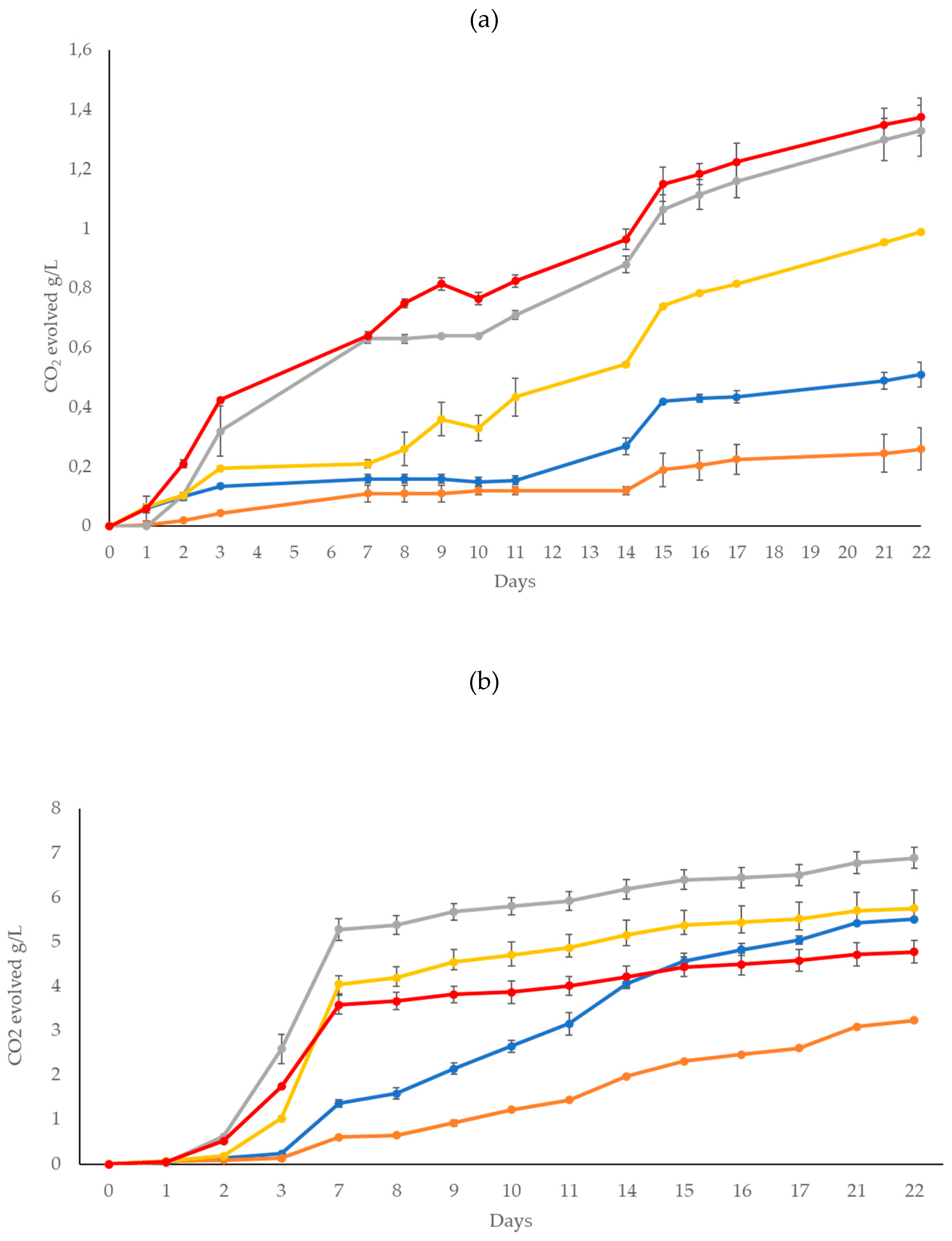
Figure 2.
Principal component analysis (PCA) applied on the main volatile compounds in beer coming from different yeast strains and worts (BSG and BSG+GJ) fermentation. The variance explained by PCA is PC 1 37.7% X-axis and PC 2 21.3% Y-axis.
Figure 2.
Principal component analysis (PCA) applied on the main volatile compounds in beer coming from different yeast strains and worts (BSG and BSG+GJ) fermentation. The variance explained by PCA is PC 1 37.7% X-axis and PC 2 21.3% Y-axis.
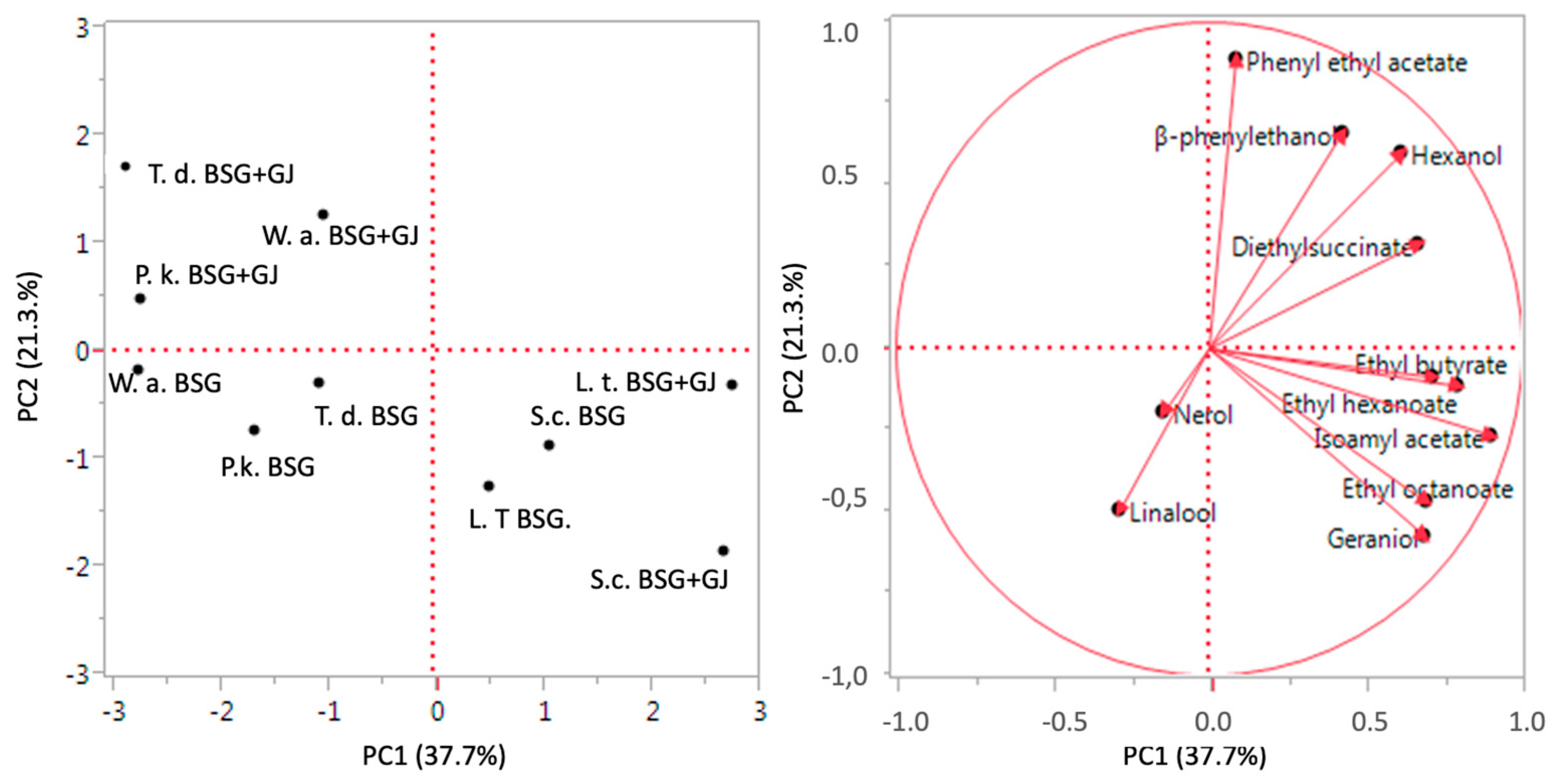

Table 1.
Taxonomic classification, origin and source of the yeast strains tested and S. cerevisiae commercial strain US-05 (Fermentis, Lesaffre, France).
Table 1.
Taxonomic classification, origin and source of the yeast strains tested and S. cerevisiae commercial strain US-05 (Fermentis, Lesaffre, France).
| Yeast strain | Code (DiSVA collection) | Source of isolation |
|---|---|---|
| Lachancea thermotolerans | 322 | Grapes |
| Pichia kluyveri | 1076 | Grapes |
| Wickerhamomyces anomalus | 2 | Backery |
| Torulaspora delbrueckii | 254 | Papaya leaves |
| Saccharomyces cerevisiae | US05 | Commercial starter |
Table 2.
The main analytical characters of the final products from BSG-wort. Data are the means ± SD. Data with different superscript letters (a, b, c) within each column (Duncan tests; p < 0.05). The initial BSG wort: Glucose (0.80 g/L); Sucrose (0.11 g/L); Maltose (3.90 g/L). YAN (41,47 mg/L); Polyphenols (28.33 mg/L).
Table 2.
The main analytical characters of the final products from BSG-wort. Data are the means ± SD. Data with different superscript letters (a, b, c) within each column (Duncan tests; p < 0.05). The initial BSG wort: Glucose (0.80 g/L); Sucrose (0.11 g/L); Maltose (3.90 g/L). YAN (41,47 mg/L); Polyphenols (28.33 mg/L).
| Fermentations trials |
Glucose (g/L) | Sucrose (g/L) | Maltose (g/L) | YAN (mg/L) | Polyphenols (mg/L) | Lactic acid (g/L) | Ethanol (% v/v) |
|---|---|---|---|---|---|---|---|
| W. anomalus Disva 2 | ND* | ND | 3.53±0.02a | 31.03±0.45a | 23.33±1.18a | 0.17±0.00c | 0.27±0.00c |
| P. kluyveri Disva 1076 | 0.11±0.04a | ND | 3.54±0.04a | 38.01±3.81a | 11.67±5.89b | 0.15±0.01d | 0.12±0.00d |
| T. delbrueckii Disva 254 | ND | ND | 0.22±0.02c | 32.95±3.54a | 13.33±1.18b | 0.20±0.01b | 0.49±0.00b |
| L. thermotolerans Disva 322 | ND | ND | 1.19±0.00b | 27.76±0.36b | 13.33±3.54b | 0.32±0.03a | 0.47±0.02b |
| S. cerevisiae US-05 | ND | ND | 0.08±0.03d | 25.71±0.18b | 28.33±5.89a | 0.20±0.00b | 0.54±0.01a |
*ND = Non detectable.
Table 3.
The main analytical characters of products from BSG+GJ wort. Data are the means ± SD. Data with different superscript letters (a, b, c) within each column (Duncan tests; p < 0.05). The initial BSG+GJ wort: Glucose (16.73 g/L); Sucrose (0.46 g/L); maltose (3.91 g/L); YAN (53.91 mg/L); polyphenols (75.83 mg/L).
Table 3.
The main analytical characters of products from BSG+GJ wort. Data are the means ± SD. Data with different superscript letters (a, b, c) within each column (Duncan tests; p < 0.05). The initial BSG+GJ wort: Glucose (16.73 g/L); Sucrose (0.46 g/L); maltose (3.91 g/L); YAN (53.91 mg/L); polyphenols (75.83 mg/L).
| Fermentations trials |
Glucose (g/L) | Sucrose (g/L) | Maltose (g/L) | YAN (mg/L) | Polyphenols (mg/L) | Lactic acid (g/L) | Ethanol (% v/v) |
|---|---|---|---|---|---|---|---|
| W. anomalus Disva 2 | ND* | ND | 2.21±0.04a | 28.14±0.18b | 19.17±7.07b |
0.17±0.00b |
1.32±0.01c |
| P. kluyveri Disva 1076 | 1.91±0.02a | 0.20±0.00a | 0.90±0.03bc | 40.51±0.82a | 50.83±2.36a | 0.18±0.01b | 0.82±0.01e |
|
T. delbrueckii Disva 254 |
0.01±0.00b | ND | 0.84±0.00c | 15.90±0.63e | 1.67±1.18d | 0.18±0.00b | 1.66±0.06a |
| L. thermotolerans Disva 322 | 0.01±0.00b | ND | 0.95±0.00b | 25.19±0.36c | 6.67±1.18c | 0.85±0.04a | 1.40±0.00b |
| S. cerevisiae US-05 | ND | ND | 2.28±0.02a | 22.76±1.27d | 23.33±1.18b | 0.19±0.00b | 1.10±0.00d |
*ND = Non detectable.
Table 4.
The main volatile compounds (mg/L) in beers coming from BSG-wort. Data are means ± SD of three independent experiments. Data with different superscript letters (a, b, c) within each row (Duncan tests; p < 0.05). In bracket the odor active values (OAVs) of the compounds*.
Table 4.
The main volatile compounds (mg/L) in beers coming from BSG-wort. Data are means ± SD of three independent experiments. Data with different superscript letters (a, b, c) within each row (Duncan tests; p < 0.05). In bracket the odor active values (OAVs) of the compounds*.
| By-products mg/L |
W. anomalus Disva 2 |
P. kluyveri Disva 1076 |
T. delbrueckii Disva 254 |
L. thermotolerans Disva 322 |
S. cerevisiae US05 |
|---|---|---|---|---|---|
| Ethyl butyrate (0.14–0.37) * |
0.14±0.01c | 0.18±0.07c | 0.43±0.06b | 0.74±0.10a | 0.73±0.07a |
| Isoamyl acetate (0.30–0.72) * |
0.63±0.01 b | 0.30±0.03 c | 0.67±0.05 b | 0.81±0.09a | 0.92±0.03a |
| Ethyl hexanoate (0.17–0.20) * |
0.03±0.03a | 0.04±0.03a | 0.05±0.01a | 0.03±0.03a | 0.03±0.01a |
| Hexanol | ND** | ND | 0.06±0.01a | 0.02±0.00b | ND |
| Ethyl octanoate (0.2–0.9) * |
0.01±0.00b | ND | 0.01±0.00b | 0.02±0.00a | 0.02±0.00a |
| Linalool (0.0006–0.001) * |
0.06±0.04a | 0.02±0.01a | 0.02±0.00a | 0.03±0.03a | 0.01±0.00a |
| Diethylsuccinate (1.2) * |
0.01±0.00b | 0.01±0.00b | 0.01±0.00b | 0.01±0.00b | 0.02±0.01a |
| Phenyl ethyl acetate (3–5) * |
0.39±0.22a | 0.77±0.16a | 0.44±0.19a | 0.41±0.28a | 0.54±0.15a |
| Nerol (0.01) * |
0.01±0.00a | 0.01±0.00a | 0.01±0.00a | 0.01±0.00a | 0.01±0.00a |
| Geraniol (1.1) * |
0.01±0.00b | 0.02±0.01b | 0.02±0.00b | 0.01±0.01b | 0.05±0.00a |
| β-phenyl ethanol (1.0–1.88) * |
0.48±0.06b | 0.18±0.06c | 0.39±0.05bc | 0.76±0.23a | 0.52±0.04b |
**ND = Non detectable.
Table 5.
The main volatile compounds (mg/L) in fermentation trials using BSG+GJwort. Data are means ± SD from three independent experiments. Data with different superscript letters (a, b, c) within each row (Duncan tests; p < 0.05). In bracket the odor active values (OAVs) of the compounds*.
Table 5.
The main volatile compounds (mg/L) in fermentation trials using BSG+GJwort. Data are means ± SD from three independent experiments. Data with different superscript letters (a, b, c) within each row (Duncan tests; p < 0.05). In bracket the odor active values (OAVs) of the compounds*.
| By-products mg/L |
W. anomalus Disva 2 |
P. kluyveri Disva 1076 |
T. delbrueckii Disva 254 | L. thermotolerans Disva 322 |
S. cerevisiae US05 |
|---|---|---|---|---|---|
| Ethyl butyrate (0.14–0.37) * |
0.35±0.00cd | 0.23±0.07d | 0.46±0.04bc | 0.79±0.06a | 0.54±0.12b |
| Isoamyl acetate (0.30–0.72) * |
0.79±0.07c | 0.85±0.03bc | 0.93±0.10bc | 1.04±0.07ab | 1.21±0.16a |
| Ethyl hexanoate (0.17–0.20) * |
0.05±0.00d | 0.06±0.01d | 0.22±0.02b | 0.15±0.01c | 0.34±0.02a |
| Hexanol | ND** | ND | 0.24±0.03a | 0.22±0.01a | 0.01±0.00b |
| Ethyl octanoate (0.2–0.9) * |
ND | 0.01±0.00b | 0.01±0.00b | 0.02±0.00a | 0.02±0.00a |
| Linalool (0.0006–0.001) * |
0.03±0.03a | 0.02±0.02a | 0.01±0.00a | 0.02±0.00a | 0.04±0.01a |
| Diethylsuccinate (1.2) * |
0.01±0.00b | 0.02±0.01b | 0.06±0.00a | 0.01±0.00b | 0.04±0.00b |
| Phenyl ethyl acetate (3–5) * |
0.47±0.05b | 0.02±0.01c | 1.33±0.50a | 0.37±0.05b | 0.06±0.05c |
| Nerol (0.01) * |
ND | 0.01±0.00a | 0.01±0.00a | ND | 0.01±0.00a |
| Geraniol (1.1) * |
0.01±0.00a | 0.02±0.00a | 0.02±0.00a | 0.05±0.00a | 0.10±0.09a |
| β-phenyl ethanol (1.0–1.88) * |
1.02±0.28a | 0.40±0.10b | 1.14±0.23a | 0.68±0.20ab | 0.42±0.10b |
**ND = Non detectable.
Disclaimer/Publisher’s Note: The statements, opinions and data contained in all publications are solely those of the individual author(s) and contributor(s) and not of MDPI and/or the editor(s). MDPI and/or the editor(s) disclaim responsibility for any injury to people or property resulting from any ideas, methods, instructions or products referred to in the content. |
© 2023 by the authors. Licensee MDPI, Basel, Switzerland. This article is an open access article distributed under the terms and conditions of the Creative Commons Attribution (CC BY) license (http://creativecommons.org/licenses/by/4.0/).
Copyright: This open access article is published under a Creative Commons CC BY 4.0 license, which permit the free download, distribution, and reuse, provided that the author and preprint are cited in any reuse.