

Submitted:
15 December 2023
Posted:
15 December 2023
You are already at the latest version
Abstract
Biocides used in antifouling (AF) paints, such as 4,5-dichlorine-2-n-octyl-4-isothiazole-3-one (DCOIT), can gradually leach into the environment. Some AF compounds can persist in the marine environment and cause harmful effects on non-target organisms. Nanoengineered materials, such as mesoporous silica nanocapsules (SiNC) containing AF compounds, have been developed to control their release rate and reduce their toxicity to aquatic organisms. This study aimed to evaluate the acute toxicity of new nanoengineered materials, SiNC-DCOIT and a silver-coated form (SiNC-DCOIT-Ag), as well as the free form of DCOIT and empty nanocapsules (SiNC), on the sun coral Tubastraea coccinea. T. coccinea is an invasive species and can be an alternative test organism for evaluating the risks to native species, as most native corals are currently threatened. The colonies were collected from the Alcatrazes Archipelago, SP, Brazil, and acclimatized to laboratory conditions. They were exposed for 96h to different concentrations of the tested substances: 3.33, 10, 33, and 100 µg L-1 of free DCOIT; 500, 1000, 2000, and 4000 µg L-1 of SiNC; and 74.1, 222.2, 666.7, and 2000 µg L-1 of SiNC-DCOIT and SiNC-DCOIT-Ag. The test chambers consisted of 500 mL flasks containing the test solutions, and the tests were maintained under constant aeration, constant temperature of 23 ± 2°C, and photoperiod of 12h:12h (light/dark). At the end of the experiments, no lethal effect was observed; however, some sublethal effects were noticeable, such as the exposure of the skeleton in most of the concentrations and replicates, except for the controls, and embrittlement at higher concentrations. Adults of T. coccinea were considered little sensitive to the tested substances. This resistance may indicate a greater capacity for proliferation of the species, which is favored in substrates containing antifouling paints, to the detriment of the native species.
Keywords:
Tubastraea coccinea
; Antifouling
; DCOIT
; Nanomaterials
; Ecotoxicology
1. Introduction
Natural and human-built immersed structures are vulnerable to biofouling, which is the accumulation of various forms of aquatic organisms on such structural surfaces [1,2]. The increased friction caused by the hull of the colonized ship, associated with the weight gain due to biofouling, reduces the operational efficiency, increases costs, and threatens ship safety [2,3,4]. Biofouling may also favor bioinvasion, as has been reported for sun coral Tubastraea spp. across the Brazilian coast [5]. Bioinvasion results from the transport of allochthonous organisms and their establishment in regions where they would not occur based on natural dispersion, and often causes negative impacts, at economic, social, and ecological orders.
Some strategies have been used to mitigate and manage biofouling, including the use of antifouling paints (AF) containing a range of chemical biocides in their composition. These paints have been used to cover ships, oil platforms, pipelines, and other submerged structures [3,6]. However, AF biocides are gradually leached from painted surfaces, causing environmental contamination. Some biocides may persist in the environment and induce adverse effects on non-target organisms [3,4,7].
The use of AF biocides has changed over time. First-generation AF compounds included copper and zinc oxides but had low durability and efficacy [7,8]. These compounds were replaced by organotin (OT)-based AFs, especially tributyltin (TBT), which was durable and effective against most fouling species [7,9,10]. However, because OTs were highly toxic to non-target organisms, bioaccumulative, and persistent, their use in AF coatings was banned globally by the International Maritime Organization after the International Convention on the Control of Harmful Anti-Fouling Systems on Ships [11]. The third generation of AF biocides was introduced in the market especially from the mid 1990’s, and it included organic compounds such as Diuron, Irgarol 1051, and 4,5-dichlorine-2-n-octyl-4-isothiazole-3-one, or DCOIT [1,12]. Such new generation of AF biocides should have three main characteristics: i) be rapidly degradable; ii) be toxic only to target organisms, and iii) induce minimal bioconcentration [13].
DCOIT, also known as SeaNine, was proposed as an environmentally safe alternative for AF biocides [14,15], and authorized for use by the European Chemicals Agency (ECHA) and the United States Environmental Protection Agency (USEPA), based on its low level of global impact [1,3]. Some initial studies have suggested that DCOIT causes low environmental impacts, especially because of its rapid degradation (<24h in natural seawater and <1h in sediments) [6,15]. Thus, DCOIT has been reported to be one of the main biocides used in antifouling paints applied to maritime structures in the recent years [1,3,10]. However, despite its short half-life, DCOIT has been found in port areas worldwide [10,12] in concentrations potentially toxic to aquatic organisms. To manage this problem, new technologies to reduce the release of biocides to the water column and consequently reduce their impacts on non-target marine biota have been proposed [16], including the encapsulation of biocides in nanomaterials [4,17].
Biocide encapsulation prevents its direct interaction with the coating compounds and controls the leaching rates, increasing the coating durability and reducing surface colonization by various organisms [17]. Recently, two forms of nanocapsule containing DCOIT were developed, the first consisting of a silica nanocapsule (SiNC-DCOIT) and a second version in which SiNC was impregnated with silver (SiNC-DCOIT-Ag) [4]. Experiments comparing the antifouling efficacy and toxicity of free and nanoengineered forms of DCOIT in temperate organisms showed that SiNC-DCOIT and SiNC-DCOIT-Ag were less toxic than the free form [17,18]. Moreover, 11 marine species from temperate climates showed various levels of sensitivity to these new AF biocides, while SiNC-DCOIT-Ag reduced the toxicity and environmental danger to the species, without reducing the effectiveness of AF [17,18]. Similar results were observed in tropical mysids [4]. These studies suggested that nanoengineered materials containing DCOIT could be a suitable alternative to attenuate the effects of AF coatings. However, studies on polar and tropical species are necessary, before recommending the adoption of AF coatings that contain such substances.
Shallow water corals are the main ecosystems engineers in the tropics and are highly sensitive to pollution [19]. Here we use the invasive sun-coral Tubastraea coccinea as a model to investigate toxicity to new nanoengineered antifouling, SiNC-DCOIT and SiNC-DCOIT-Ag, as well as the free form of DCOIT and empty nanocapsules (SiNC). A previous study showed that T. coccinea exhibited adverse effects when exposed to high concentrations of some types of oils [20]. T. coccinea is an azooxanthellate species [21], from the Indo-Pacific introduced in the Brazilian coast by opportunistic colonization of oil platforms and currently recorded along more than 3500 km along the coast competing with native species [5,22,23,24]. T. coccinea is an interesting organism to be used in toxicity assessments of antifouling compounds for tropical Brazilian environments, as its collection and use does not cause impacts on native ecosystems. This study aimed to evaluate the toxicity of antifouling DCOIT and its nanoengineered forms on the sun-coral T. coccinea and observe lethal and sublethal effects on animals.
2. Materials and Methods
2.1. Test Organism
Tubastraea coccinea Lesson, 1829, which was initially reported in Brazil in the 1980’s, adhered to oil platforms [25,26]. Considered a cosmopolitan species, T. coccinea is commonly found along the Brazilian coast recovering both natural and artificial hard structures [5,22,27]. The rapid spread of T. coccinea across tropical seas is attributed to its high reproductive rates [28], occurrence of multiple events of introduction [22,29], early reproductive maturity [30], rapid growth and high recruitment rates [31], rare survival strategies [32], and notable regenerative capacity [5,33]. In Brazil, T. coccinea may serve as an alternative to assess the impacts of pollutants on shallow water corals because most native species are threatened [34] and cannot be collected in the field for toxicity testing. In contrast, the removal of sun-coral from the environment is stimulated by Brazilian environmental agencies. Nevertheless, we highlight that the toxicity to antifouling compound might be species-specific and we expect that the tolerance of native zooxanthellate species is likely lower.
2.2. Organisms Sampling
Approximately 250 colonies of T. coccinea were collected by scuba diving in the Alcatrazes Archipelago Wildlife Refuge in Southwestern Brazil (see Figure S1 in the supplementary material), a federal marine protected area (MPA). Colonies were manually removed from the rocky reefs during removal operations organized by the authorities responsible for the MPA (ICMBio). The collections were authorized according to License SISBIO #79823-1.
In the laboratory, the colonies were kept for five days in tanks with clean filtered sea water, under constant aeration, temperature of 23 ± 2°C, and natural photoperiod (12h:12h light/dark) for acclimation (Figure 1). Water was partially renewed daily using reconstituted seawater (RedSea®).
2.3. Toxicity Bioassay
Four substances were analyzed: (1) the biocide DCOIT; (2) the empty silica nanocapsules (SiNC, acquired from Sigma-Aldrich); (3) the nanomaterial containing the biocide SiNC-DCOIT; and (4) the nanomaterial containing the biocide SiNC-DCOIT-Ag. All substances were provided by Smallmatek Ltd. (Aveiro, Portugal). Stock solutions and dispersions were prepared for each substance from the dilution of salts in deionized water and dispersed in an ultrasonic bath (40 kHz) for 30 min. Then, the working solutions and dispersions were prepared by diluting the stock solutions in reconstituted seawater (salinity 34-35) followed by sonication for 15 min; these were immediately added to the replicates (500 mL glass flasks). The following concentrations were prepared for the test substances: 3.33, 10, 33, and 100 µg L-1 for free DCOIT; 500, 1000, 2000, and 4000 µg L-1 for SiNC; and 74.1, 222.2, 666.7, and 2000 µg L-1 for SiNC-DCOIT and SiNC-DCOIT-Ag (Table S1). The negative control consisted of reconstituted seawater (Red Sea®). These concentration ranges were chosen based on previous studies conducted on temperate marine species [17,18].
The tested nanomaterials were fully characterized by Figueiredo et al. [17] and Perina et al. [35]; concentrations were also confirmed by Perina et al. [35]. Briefly, SiNC has a core-shell and porous structure with a diameter of 129 nm, whereas SiNC-DCOIT has a diameter of 152 nm and a biocidal content of 18.3% [17,35]. Charged nanomaterials exhibit spherical and regular shapes. The hydrodynamic diameter obtained through DLS indicated that the size of the ENM varied between 202.67 and 231.11 nm. In turn, the determined PdI was within the range of 0.44-0.58, indicating average dispersity. The zeta potential (ζ) values in natural seawater were positive, and the dispersions tended to be unstable (30 mV > ζ > -30 mV), with the exception of SiNC at 0.001 mg L-1.
The bioassays consisted of exposing the colonies of T. coccinea for 96h to the test substances under constant conditions (23°C ± 2ºC, natural photoperiod (12h:12h light/dark), and constant gentle aeration), as described in [20]. Colonies were tried and randomly introduced into 500 mL glass flasks containing the test solutions. Three replicates were prepared for each treatment. Physicochemical parameters of the test dilutions, such as dissolved oxygen (DO), pH, salinity, and temperature (T°C), were measured at the start and end of the experiments. At 96 h exposure, the colonies were inspected for visible alterations (such as tissue necrosis or endo-skeleton exposure) and counting of the number of dead polyps. Results were first checked for normal distribution and homoscedasticity using the Shapiro-Wilk and Bartlett tests, respectively, and then analyzed by means of analysis of variance (ANOVA) followed by Dunnett’s test for multiple comparisons with the negative control (p < 0.05). Statistical analyses were performed using GraphPad Prism Inc.
3. Results
The results showed no significant lethal effects, since all colonies survived at both control and treatments. Partial death was observed exclusively in colonies exposed to higher concentrations, affecting one and five polyps on the SiNC- 4000 µg/L and the SiNC-DCOIT-Ag - 2000 µg/L treatments, respectively (Figure 2B; Table 1). Sub-lethal effects, such as tissue necrosis and initial signs of tissue loss leading to the exposure of the calcareous skeleton were observed in all treatments and replicates (Figure 2A, Table 1). Two replicates of the control showed initial signs of tissue necrosis, possibly due to manipulation stress (Figure 3). Skeleton fragility was observed exclusively in the organisms exposed to higher concentrations; in these conditions, polyps exhibited broken margins and dead polyps (Figure 2). However, there was no significant difference on the sub-lethal effects between control and treatments. With regard to sub-lethal effects, when the results are compared qualitatively, some trends can be detected. Fragile or dead polyps occurred only at the highest concentrations (i.e., 100 µg/L of DCOIT, 4000 µg/L of SiNC, 666.7 µg/L of SiNC-DCOIT, and 2000 µg/L of SiNC-DCOIT- Ag (Table 1). Raw data are presented in Tables S2 and S3 (Supplementary Material).
4. Discussion
In this study, both free DCOIT and its nanostructured forms did not significant affect T. coccinea polyps. This lack of severe effects might be explained by the rapid degradation of DCOIT under normal conditions [3,6,14,15], becoming low or non-toxic. However, DCOIT can be toxic to marine organisms before degradation occurs [4,35,36,37]. In addition, the nanostructured forms (i.e., SiNC-DCOIT and SiNC-DCOIT-Ag) were expected to be less toxic than the free DCOIT, as previously shown for other marine organisms from temperate regions [17,18]. Together, these results suggest a slow release of the nanostructured biocide into the water column and support the statement of Figueiredo et al. [17,18] that SiNC-DCOIT-Ag is promising candidate for reducing the environmental impact of the third generation of booster biocides currently used because of their lower toxicity and high efficiency as an AF biocide. Furthermore, Santos et al. [1] demonstrated that the SiNC-DCOIT was less toxic than the free DCOIT to larval stages of the brown mussel Perna perna, whereas Jesus et al. [4] found similar results to the mysid Mysidopsis juniae. Similarly, Campos et al. [38] observed that free DCOIT was more toxic to juveniles of the oyster Crassostrea gigas than to its nanostructured counterparts.
In our experiments, signs of sub-lethal effects were detected mainly at the highest concentrations of the tested substances, such as SiNC (4000 µg L-1), SiNC-DCOIT (666.7 µg L-1), and SiNC-DCOIT-Ag (2000 µg L-1), particularly under a qualitative analysis (i.e., presence/absence). However, some of these effects also occurred at lower concentrations, such as those observed for free DCOIT (100 µg L-1). Ferreira et al. [39] assessed the effects of free and nanostructured DCOIT on the symbiotic octocoral Sarcophyton cf. glaucum after 7-day exposure and observed sublethal effects, such as coral polyp retraction, reduced photosynthetic efficiency, and increased levels of oxidative stress in organisms exposed to free DCOIT. Because our experiments evaluated the effects after short-term exposure, the occurrence of these sub-lethal effects may indicate the possibility of long-term effects; thus, further studies are required to assess the tolerance of T. coccinea during long-term exposure.
Antifouling biocides are often present in immersed anthropic structures, such as boats and pipelines, to provide protection against biofouling and avoid the establishment of biological communities on anthropic structures. As antifouling biocides, the tested substances were expected to inhibit and strongly intoxicate fouling organisms, as reported to marine temperate species [17,18] and juveniles of P. perna [1], but they seemed to not be so effective against adults of T. coccinea. Recently, Roepke et al. [40] studied the toxicity of DCOIT (free and encapsulated forms in cerium oxide nanoparticles) and observed that the antifouling inhibited algal fouling but did not affect coral larval settlement. Still, the lack of effects even at the highest concentrations (i.e., at magnitudes of milligrams per liter) shows that T. coccinea is highly tolerant to AF biocides tested, another advantage to its spread along the Brazilian coast, including at seaports [41] and recreational marinas [42], where the concentration of antifouling biocides might be high. In this sense, the application of AF biocides would favor T. coccinea to the detriment of other species, and this may enhance the problem in areas where the sun coral is an invasive species, such as the Brazilian coast. Brockinton et al. [43] stated that anthropic factors could stimulate bioinvasion by sun corals; however, they did not mention the presence of immersed structures painted with antifouling coatings; thus, this factor should also be considered, including on decommissioning of oil pipelines and platforms. Braga et al. [27] stated that the abandonment of oil platforms on the coast of the state of Ceará (Northeast Brazil) was the main factor that allowed the bioinvasion of the Brazilian North coast by Tubastraea spp. Despite the high tolerance of adult colonies, further studies using larval stages of T. coccinea are required, as these are the main targets of antifouling biocides.
5. Conclusions
A recent review showed that marine organisms may be vulnerable to AF biocides and recommended their substitution with environmentally friendly alternatives, such as nanoengineered forms [10]. Our study shows that DCOIT, in its free and nanostructured forms, did not cause lethal effects on T. coccinea adults, even at higher concentrations. No significant sub-lethal effects occurred, but at the highest concentrations, some colonies displayed incipient qualitative effects after 96h of exposure. Thus, T. coccinea is tolerant to the tested biocides, at least in the short term, which may provide this species with a stronger ability to disperse and colonize submerged structures, including those painted with antifouling coatings.
Supplementary Materials
The following supporting information can be downloaded at the website of this paper posted on Preprints.org. Figure S1: Map showing the sampling site of colonies of Tubastraea coccínea (sun-coral) in the Alcatrazes Archipelago, SP, Brazil. Source: Google Earth (2022); Table S1: Concentration of the test-substances during the experiments with antifouling biocides and the sun-coral Tubastraea coccinea; Table S2. Physicochemical parameters of test-solutions measured in the start and the end of the experiments with Tubastraea coccinea and new antifouling biocides; Table S3. Raw data regarding the effects of new antifouling biocides on colonies of Tubastraea coccinea, for each experimental replicate.
Author Contributions
I.M.: Investigation, Methodology, Formal Analysis, Writing – Original Draft. D.M.S.A.: Conceptualization, Funding Acquisition, Supervision, Validation, Writing – Original Draft. K.C.C.C.: Methodology (sampling), Supervision, Writing – Review & Editing.
Funding
This research was funded by São Paulo State Research Foundation - FAPESP (Grants #2020/03004-0 and # 2020/15945-4), and the National Council for Scientific and Technological Development - CNPq (Grant PIBIC-CNPq 2021, Process 4297, and Grant #308533/2018-6).
Institutional Review Board Statement
Ethical review and approval were waived for this study because it involved invertebrates, for which further authorizations are not required in Brazil.
Data Availability Statement
All the results of this investigation are available in the manuscript or in the respective supplementary material.
Acknowledgments
The authors thank São Paulo State Research Foundation - FAPESP by the financial support (Grants #2020/03004-0 and # 2020/15945-4), Dr. Roberto Martins (University of Aveiro) and Smallmatek Ltd. for logistic support and provision of the nanomaterials, our colleagues from NEPEA for the support during the experiments, and the ICMBio and CEBIMAR-USP staff for the support during field collections. IM thanks CNPq for the scholarship (Grant PIBIC-CNPq 2021, Process 4297), and DMSA thanks CNPq (Grant #308533/2018-6) for the PQ fellowship.
Conflicts of Interest
The authors declare no conflict of interest.
References
- Santos, J.V.N.; Martins, R.; Fontes, M.K.; Campos, B.G.; Silva, M.B.M.P.; Maia, F.; Abessa, D.M.S.; Perina, F.C. Can encapsulation of the biocide DCOIT affect the anti-fouling efficacy and toxicity on tropical bivalves? Appl. Sci. 2020, 10(23), 8579. [Google Scholar] [CrossRef]
- Gabe, H.B.; Guerreiro, A.D.S.; Sandrini, J.Z. Molecular and biochemical effects of the antifouling DCOIT in the mussel Perna perna. Comp. Biochem. Physiol. C Toxicol. Pharmacol. 2021, 239, 108870. [Google Scholar] [CrossRef] [PubMed]
- Abreu, F.E.L.; Silva, J.N.L.; Castro, Í.B.; Fillmann, G. Are antifouling residues a matter of concern in the largest South American port? J. Hazard. Mater. 2020, 398, 122937. [Google Scholar] [CrossRef] [PubMed]
- Jesus, É.P.S.; Figueirêdo, L.P.; Maia, F.; Martins, R.; Nilin, J. Acute and chronic effects of innovative antifouling nanostructured biocides on a tropical marine microcrustacean. Mar. Pollut. Bull. 2021, 164, 111970. [Google Scholar] [CrossRef] [PubMed]
- Creed, J.C.; Fenner, D.; Sammarco, P.; Cairns, S.; Capel., K.; Junqueira, A.O.R.; Cruz, I.; Miranda, R.J.; Carlos-Junior, L.; Mantelatto, M.C.; Oigman-Pszczol, S. The invasion of the azooxanthellate coral Tubastraea (Scleractinia: Dendrophylliidae) throughout the world: history, pathways and vectors. Biol. Invasions 2017, 19, 283–305. [Google Scholar] [CrossRef]
- Fonseca, V.B.; Guerreiro, A.S.; Vargas, M.A.; Sandrini, J.Z. Effects of DCOIT (4,5-dichloro-2-octyl-4-isothiazolin-3-one) to the haemocytes of mussels Perna perna. Comp. Biochem. Physiol. C Toxicol. Pharmacol. 2020, 232, 108737. [Google Scholar] [CrossRef] [PubMed]
- Castro, Í.B.; Westfal, E.; Fillmann, G. Third generation antifouling paints: new biocides in the aquatic environment. Quím. Nova 2011, 34(6), 1021-1031. [CrossRef]
- Fernandez, M.A.; Pinheiro, F.M. New approaches for monitoring the marine environment: the case of antifouling paints. Int. J. Environ. Res. Public Health. 2007, 1(3), 427–448. [Google Scholar] [CrossRef]
- Omae, I. General aspects of natural products antifoulants in the environment. In: Antifouling Paint Biocides, Konstantinou, I.K. (ed). Springer, Berlin, Germany, 2005. Volume 50, pp. 227- 262. [CrossRef]
- Campos, B.G.; Figueiredo, J.; Perina, F.C.; Abessa, D.M.S.; Loureiro, S.; Martins, R. Occurrence, effects and environmental risk of antifouling biocides (EU PT21): Are marine ecosystems threatened? Crit. Rev. Environ. Sci. Technol. 2022a, 51. [Google Scholar] [CrossRef]
- Great Britain, Parliament. International Convention on the control of harmful anti-fouling system on ships. Great Britain Parliament. The Stationery Office: London, U.K., 2012. (Treaty Series, v. 13). https://assets.publishing.service.gov.uk/media/5a7cabd5e5274a2f304ef5f5/8284.pdf.
- Chen, L.; Lam, J.C.W. SeaNine 211 as antifouling biocide: A coastal pollutant of emerging concern. J. Environ. Sci. (China) 2017, 61, 68–79. [Google Scholar] [CrossRef]
- Cima, F.; Ferrari, G.; Ferreira, N.G.; Rocha, R.J.; Serôdio, J.; Loureiro, S.; Calado, R. Preliminary evaluation of the toxic effects of the antifouling biocide Sea-Nine211TM in the soft coral Sarcophyton cf. glaucum (Octocorallia, Alcyonacea) based on PAM fluorometry and biomarkers. Mar. Environ. Res. 2013; 83, 16–22. [Google Scholar] [CrossRef]
- Jacobson, A.H.; Willingham, G.L. Sea-nine antifoulant: an environmentally acceptable alternative to organotin antifoulants. Sci. Total Environ. 2020, 258, 103–110. [Google Scholar] [CrossRef] [PubMed]
- Shade, W.D.; Hurt, S.S.; Jacobson, A.H.; Reinert, K.H. Shade, W.D.; Hurt, S.S.; Jacobson, A.H.; Reinert, K.H. Ecological risk assessment of a novel marine antifoulant. Am. Soc. Test. Mater. 1993, 2, 381-408. https://www.astm.org/stp13169s.html. Am. Soc. Test. Mater. 1993, 2, 381–408. [Google Scholar]
- Sinha, S.; Kumar, R.; Anand, J.; Gupta, R.; Gupta, A.; Pant, K.; Dohare, S.; Tiwari, P.; Kesari, K.K.; Krishnan, S.; Gupta, P.K. Nanotechnology-based solutions for antibiofouling applications: an overview. ACS Appl. Nano Mater. 2023, 6(14), 12828–12848. [Google Scholar] [CrossRef]
- Figueiredo, J.; Oliveira, T.; Ferreira, V.; Sushkova, A.; Silva, S.; Carneiro, D.; Cardoso, D.N.; Gonçalves, S.F.; Maia, F.; Rocha, C.; Tedim, J.; Loureiro, S.; Martins, R. Toxicity of innovative anti-fouling nano-based solutions to marine species. Environ. Sci. Nano 2019, 6(5), 1418–1429. [Google Scholar] [CrossRef]
- Figueiredo, J.; Loureiro, S.; Martins, R. Hazard of novel anti-fouling nanomaterials and biocides DCOIT and silver to marine organisms. Environ. Sci. Nano 2020, 7(6), 1670–1680. [Google Scholar] [CrossRef]
- Duprey, N.N.; Yasuhara, M.; Baker, D.M. Reefs of tomorrow: eutrophication reduces coral biodiversity in an urbanized seascape. Glob. Change Biol. 2016, 22(11), 3550–3565. [Google Scholar] [CrossRef] [PubMed]
- Fukushima, L.M.; Capel, K.C.C.; Abessa, D.M.S. Sun Corals - a resistant invader: assessment of the acute toxicity of contaminants associated with petroleum and petrochemical activities in the species Tubastraea coccinea. Proceedings of the 24th AMOP Technical Seminar on Environmental Contamination and Response, Environment and Climate Change Canada, Ottawa, ON, Canada, pp. 626-638. 2022. Available at: http://hdl.handle.net/11449/241533.
- Carpes, R.M.; Alves, M.A.; Creed, J.C.; Da Silva, C.A.; Hamerski, L.; Garden, S.J.; Fleury, B.G.; Felzenszwalb, I. Mutagenic, genotoxic and cytotoxic studies of invasive corals Tubastraea coccinea and Tubastraea tagusensis. J. Appl. Toxicol. 2020, 40(3), 373–387. [Google Scholar] [CrossRef] [PubMed]
- Capel, K.C.C.; Creed, J.; Kitahara, M.V.; Chen, C.A.; Zilberberg, C. Multiple introductions and secondary dispersion of Tubastraea spp. in the Southwestern Atlantic. Sci. Rep. 2019, 9, 13978 (2019). [CrossRef]
- Santos, L.A.H.; Ribeiro, F.V.; Creed, J.C. Antagonism between invasive pest corals Tubastraea spp. and the native reef-builder Mussismilia hispida in the southwest Atlantic. J. Exp. Mar. Biol. Ecol. 2013; 449, 69–76. [Google Scholar] [CrossRef]
- Precht, W.F.; Hickerson, E.L.; Schmahl, G.P.; Aronson, R.B. The Invasive coral Tubastraea coccinea (lesson, 1829): Implications for natural habitats in the Gulf of Mexico and the Florida Keys. Gulf Mex. Sci. 2014, 32(1–2), 55–59, https://aquila.usm.edu/goms/vol32/iss1/5. [Google Scholar] [CrossRef]
- Castro, C.B.; Pires, D.O. Castro, C.B.; Pires, D.O. Brazilian Coral Reefs: What we already know and what is still missing. Bull. Mar. Sci. 2001, 69, 357-371. https://www.ingentaconnect.com/contentone/umrsmas/bullmar/2001/00000069/00000002/art00013. Bull. Mar. Sci. 2001, 69, 357–371. [Google Scholar]
- De Paula, A.F.; Creed, J.C. De Paula, A.F.; Creed, J.C. Two species of the coral Tubastraea (Cnidaria, Scleractinia) in Brazil: a case of accidental introduction. Bull. Mar. Sci. 2004, 74(1). 175-183. https://www.ingentaconnect.com/content/umrsmas/bullmar/2004/00000074/00000001/art00014#. Bull. Mar. Sci. 2004, 74(1), 175–183. [Google Scholar]
- Braga, M.D.A.; Paiva, S.V.; Gurjão, L.M.; Teixeira, C.E.P.; Gurgel, A.L.A.R.; Pereira, P.H.C.; Soares, M.O. Retirement risks: Invasive coral on old oil platform on the Brazilian equatorial continental shelf. Mar. Pollut. Bull. 2021, 165, 112156. [Google Scholar] [CrossRef]
- De Paula, A.F.; Pires, D.O.; Creed, J.C. Reproductive strategies of two invasive sun corals (Tubastraea spp.) in the southwestern Atlantic. J. Mar. Biolog. Assoc. U.K. 2014, 94(3), 481–492. [Google Scholar] [CrossRef]
- Capel, K.C.C.; Toonen, R.J.; Rachid, C.T.C.C.; Creed, J.C.; Kitahara, M.V.; Forsman, Z.; Zilberberg, C. Clone wars: Asexual reproduction dominates in the invasive range of Tubastraea spp. (Anthozoa: Scleractinia) in the South-Atlantic Ocean. PeerJ 2017, 5, e3873. [Google Scholar] [CrossRef] [PubMed]
- Glynn, P.W.; Colley, S.B.; Maté, J.L.; Cortés, J.; Guzman, H.M.; Bailey, R.L.; Feinglod, J.S.; Enochs, I.C. Reproductive ecology of the azooxanthellate coral Tubastraea coccinea in the Equatorial Eastern Pacific: Part V. Dendrophylliidae. Mar. Biol. 2008, 153(4), 529–544. [Google Scholar] [CrossRef]
- Costa, T.J.; Pinheiro, H.T.; Teixeira, J.B.; Mazzei, E.F.; Bueno, L.; Hora, M.S.; Joyeux, J.C.; Carvalho-Filho, A.; Amado-Filho, G.; Sampaio, C.L.; Rocha, L.A. Expansion of an invasive coral species over Abrolhos Bank, Southwestern Atlantic. Mar. Pollut. Bull. 2014, 85(1), 252–253. [Google Scholar] [CrossRef] [PubMed]
- Capel, K.C.C.; Migotto, A.E.; Zilberberg, C.; Kitahara, M.V. Another tool towards invasion? Polyp “bail-out” in Tubastraea coccinea. Coral Reefs 2014, 33, 1165. [Google Scholar] [CrossRef]
- Luz, B.L.P.; Capel, K.C.C.; Zilberberg, C. ; Flores. A.A.V.; Migotto, A.E.; Kitahara, M.V. A polyp from nothing: the extreme regeneration capacity of the Atlantic invasive sun-corals Tubastraea coccinea and T. tagusensis (Anthozoa, Scleractinia). J. Exp. Mar. Biol. Ecol. 2018, 503, 60–65. [Google Scholar] [CrossRef]
- ICMBIO. Pan Corais. Sumário Executivo do Plano de Ação Nacional para a Conservação dos Ambientes Coralíneos. Instituto Chico Mendes de Conservação da Biodiversidade. ICMBio/MMA. Brasília, DF, Brazil. 2016. Available at: https://www.icmbio.gov.br/portal/faunabrasileira/plano-de-acao-nacional-lista/3620-plano-de%02acao-nacional-paraconservacao-dos-recifes-de-corais. Accessed: 5 May 2022.
- Perina, F.; Ottoni, C.; Santos, J.; Santos, V.; Silva, M.; Campos, B.; Fontes, M.; Santana, D.; Maia, F.; Abessa, D.; Martins, R. Marine hazard assessment of soluble and nanostructured forms of the booster biocide DCOIT in tropical waters. Water 2023, 15, 1185. [Google Scholar] [CrossRef]
- Roepke, L.K.; Brefeld, D.; Soltmann, U.; Randall, C.J.; Negri, A.P.; Kunzmann, A. Antifouling coatings can reduce algal growth while preserving coral settlement. Sci. Rep. 2022a, 12, 15935. [Google Scholar] [CrossRef]
- Wendt, I.; Backhaus, T.; Blanck, H.; Arrhenius, Å. The toxicity of the three antifouling biocides DCOIT, TPBP and medetomidine to the marine pelagic copepod Acartia tonsa. Ecotoxicology 2016, 25, 871–879. [Google Scholar] [CrossRef]
- Campos, B.G.; Silva, M.B.M.P.; Avelelas, F.; Maia, F.; Loureiro, S.; Perina, F.; Abessa, D.M.S.; Martins, R. Toxicity of innovative antifouling additives on an early life stage of the oyster Crassostrea gigas: short and long-term exposure effects. Environ. Sci. Pollut. Res. 2022b, 29, 27534–27547. [Google Scholar] [CrossRef] [PubMed]
- Ferreira, V.; Pavlaki, M.D.; Martins, R.; Monteiro, M.S.; Maia, F.; Tedim, J.; Soares, A.M.V.M.; Calado, R.; Loureiro, S. Effects of nanostructure antifouling biocides towards a coral species in the context of global changes. Sci. Total Environ. 2021, 799, 149324. [Google Scholar] [CrossRef] [PubMed]
- Roepke, L.K.; Brefeld, D.; Soltmann, U.; Randall, C.J.; Negri, A.P.; Kunzmann, A. Applying behavioral studies to the ecotoxicology of corals: A case study on Acropora millepora. Front. Mar. Sci. 2022b, 9. [CrossRef]
- Natálio, L.F.; Chernieski, D.; Tomida, L.; Capel, K.C.C. (2022) Alien corals in a Brazilian seaport and perspectives for improving marine bioinvasion detection and management in commercial ports. Ocean Coast. Manag. 2022, 218, 106021. [Google Scholar] [CrossRef]
- Tanasovici, R.M.; Kitahara, M.V.; Dias, G.M. Invasive coral Tubastraea spp. population growth in artificial habitats and its consequences to the diversity of benthic organisms. Mar. Biol. 2020, 167, 119. [Google Scholar] [CrossRef]
- Brockinton, E.E.; Peterson, M.R.; Wang, H.-H.; Grant, W.E. Importance of Anthropogenic Determinants of Tubastraea coccinea Invasion in the Northern Gulf of Mexico. Water 2022, 14, 1365. [Google Scholar] [CrossRef]
Figure 1.
Colonies of Tubastraea coccinea during the acclimatization period in laboratory. Source: the authors.
Figure 1.
Colonies of Tubastraea coccinea during the acclimatization period in laboratory. Source: the authors.
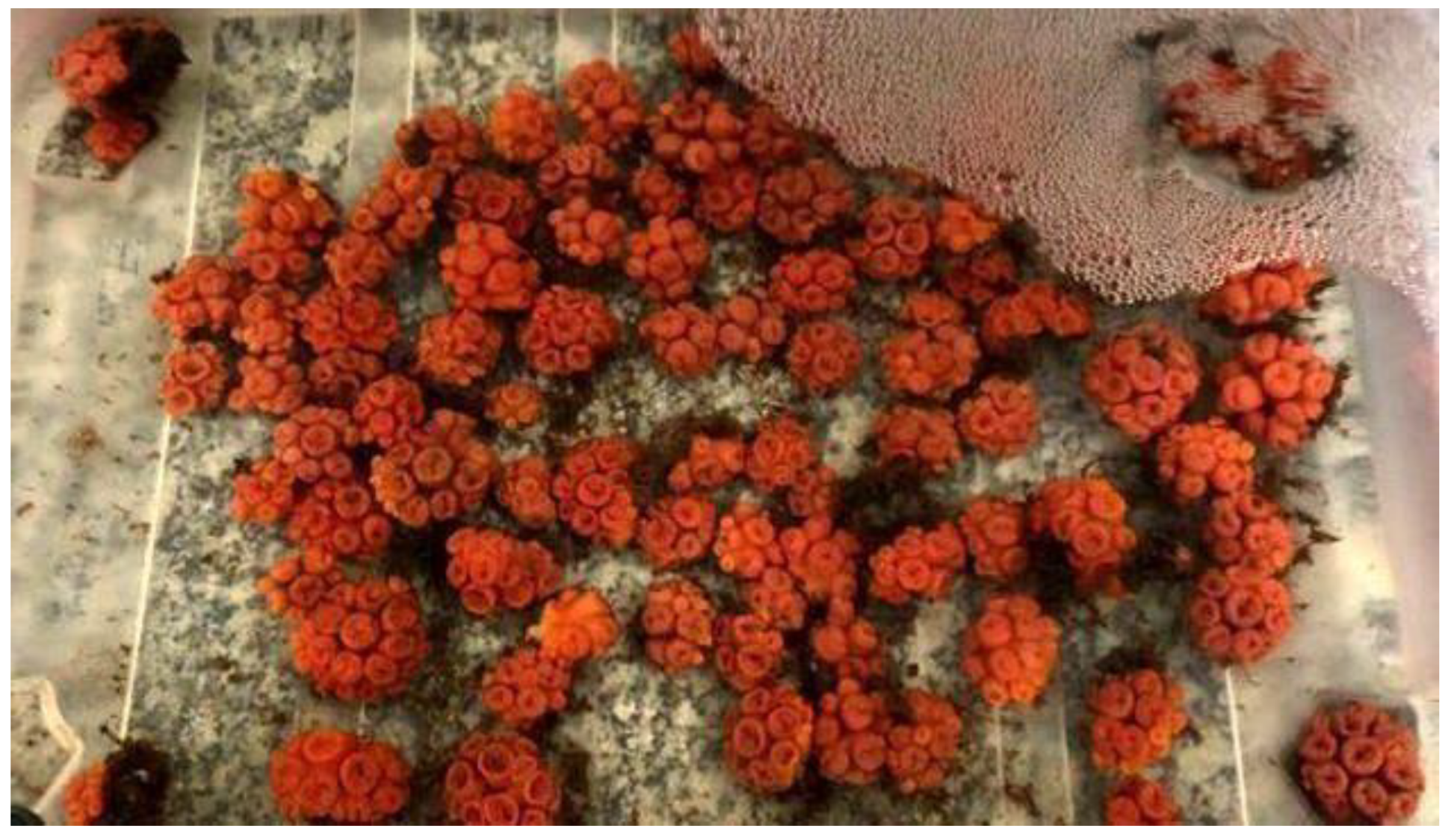
Figure 2.
Sub lethal effects observed in Tubastraea coccinea colonies exposed to antifouling biocides. A: increased fragility of polyps and incipient tissue necrosis at 100 µg/L of DCOIT; B: tissue necrosis and exposed polyps after tissue loss at 2000µg/L of SiNC-DCOIT-Ag.
Figure 2.
Sub lethal effects observed in Tubastraea coccinea colonies exposed to antifouling biocides. A: increased fragility of polyps and incipient tissue necrosis at 100 µg/L of DCOIT; B: tissue necrosis and exposed polyps after tissue loss at 2000µg/L of SiNC-DCOIT-Ag.
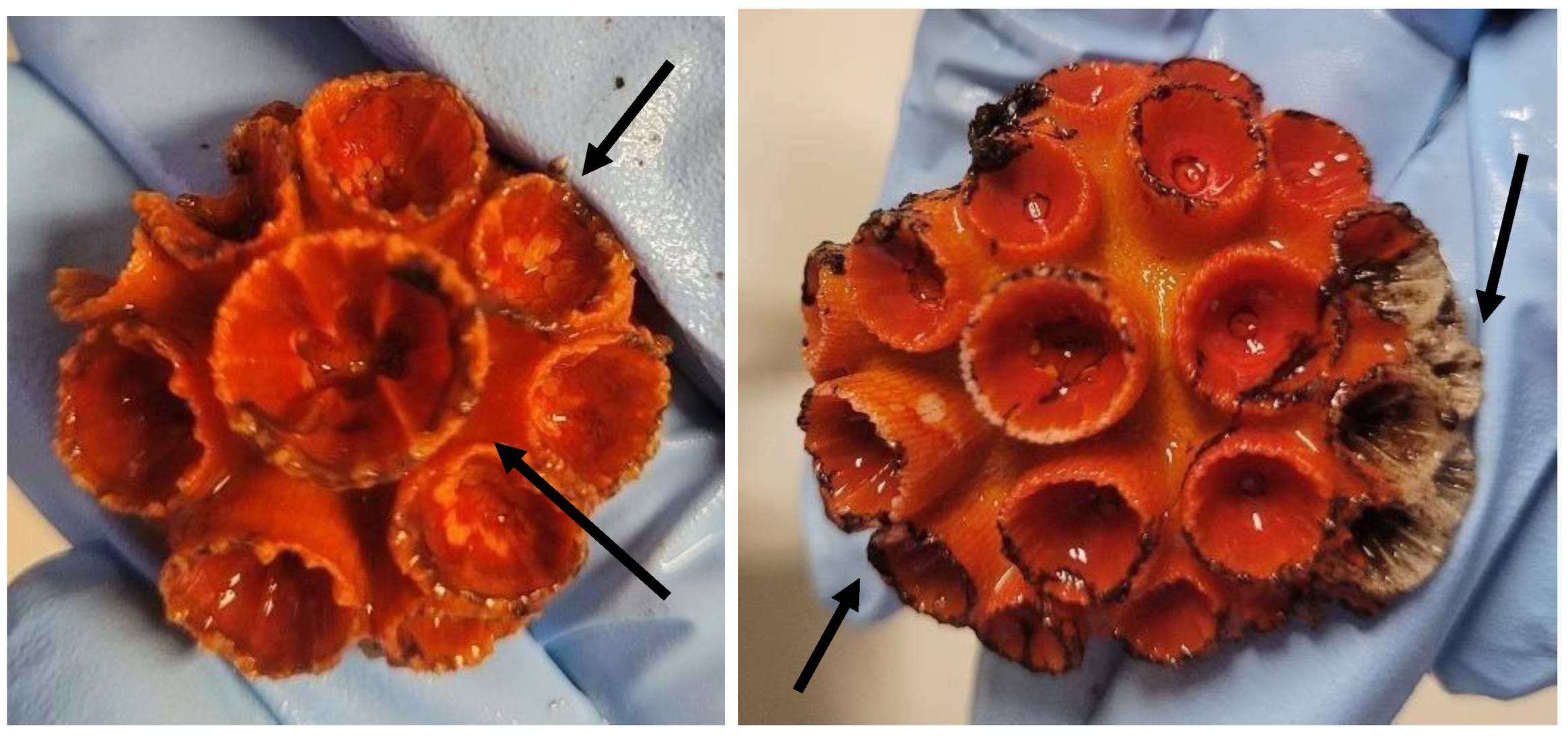
Figure 3.
Appearance of the control colonies of Tubastraea coccinea at the end of the experiment. A: Control 1; B: Control 2; and C: Control 3.
Figure 3.
Appearance of the control colonies of Tubastraea coccinea at the end of the experiment. A: Control 1; B: Control 2; and C: Control 3.
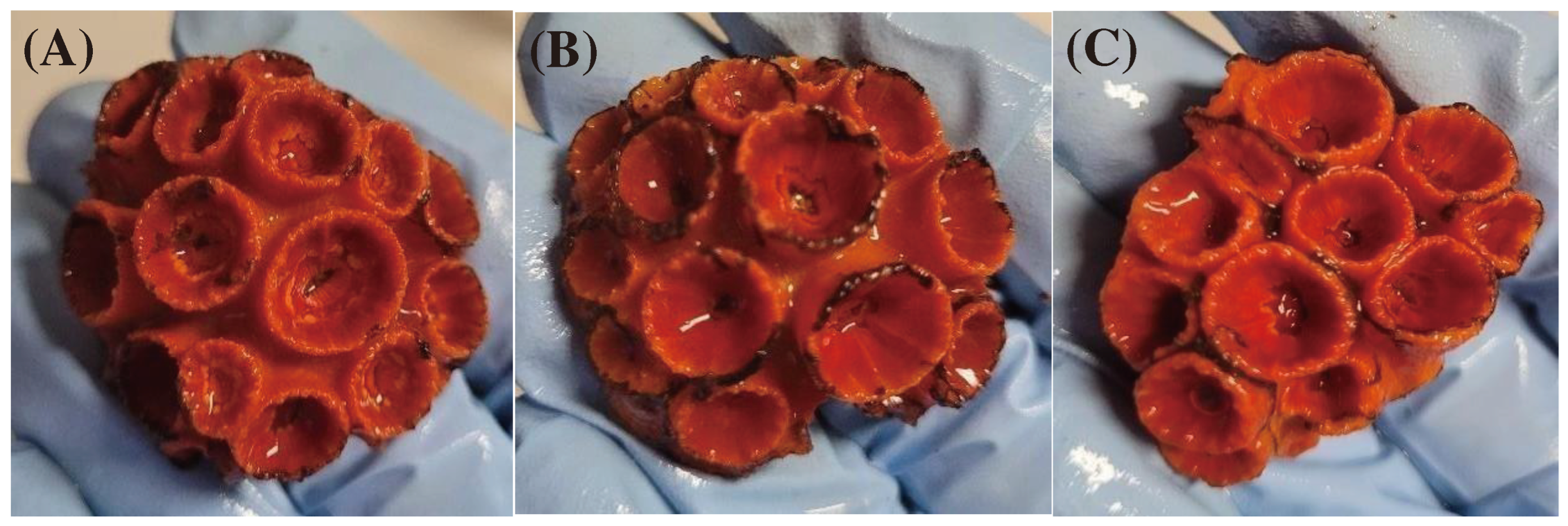

Table 1.
Lethal and sub lethal effects observed in Tubastraea coccinea exposed to new antifouling substances, at each concentration.
Table 1.
Lethal and sub lethal effects observed in Tubastraea coccinea exposed to new antifouling substances, at each concentration.
| Treatment | Concentration (µg L-1) | Tissue Necrosis (% of Total Colonies/Replicate) | Fragile Polyps (n.) | Dead Polyps (n.) |
|---|---|---|---|---|
| Control 1 | 0 | * | 0 | 0 |
| Control 2 | 0 | * | 0 | 0 |
| Control 3 | 0 | * | 0 | 0 |
| DCOIT | 3.33 | 100 | 0 | 0 |
| 10 | 66 | 0 | 0 | |
| 33 | 100 | 0 | 0 | |
| 100 | 66 | 2 | 0 | |
| SiNC | 500 | 66 | 0 | 0 |
| 1000 | 33 | 1 | 0 | |
| 2000 | 33 | 0 | 0 | |
| 4000 | 33 | 2 | 1 | |
| SiNC-DCOIT | 74.1 | 100 | 0 | 0 |
| 222.2 | 100 | 0 | 0 | |
| 666.7 | 33 | 3 | 0 | |
| 2000 | 33 | 0 | 0 | |
| SiNC-DCOIT-Ag | 74.1 | 100 | 0 | 0 |
| 222.2 | 66 | 1 | 0 | |
| 666.7 | 66 | 0 | 0 | |
| 2000 | 100 | 2 | 5 |
* In the Controls 1 and 2, the images suggest an incipient tissue loss in some polyps, but not significant for the colony. In the Control 3, all the polyps looked healthy.
Disclaimer/Publisher’s Note: The statements, opinions and data contained in all publications are solely those of the individual author(s) and contributor(s) and not of MDPI and/or the editor(s). MDPI and/or the editor(s) disclaim responsibility for any injury to people or property resulting from any ideas, methods, instructions or products referred to in the content. |
© 2023 by the authors. Licensee MDPI, Basel, Switzerland. This article is an open access article distributed under the terms and conditions of the Creative Commons Attribution (CC BY) license (http://creativecommons.org/licenses/by/4.0/).
Copyright: This open access article is published under a Creative Commons CC BY 4.0 license, which permit the free download, distribution, and reuse, provided that the author and preprint are cited in any reuse.


