
Submitted:
08 December 2023
Posted:
08 December 2023
You are already at the latest version
Abstract
Background –The brinjal is of much importance in the warm areas of Far East, being grown extensively in India, Bangladesh, Pakistan, China and the Philippines. It is also popular in Egypt, France, Italy and United States. Preserving soil fertility throughout time by preserving organic matter and soil biological diversity, mechanical intervention, as well as exercise is highly needed in upcoming future. Effect of six different fertilizer, five organic and one synthetic fertilizers listing vermicompost, poultry manure, mustard cake, neem cake, bonemeal and N:P:K study were main concern of this investigation to find out the most suitable fertilizer for the brinjal.Result - the final growth and development through N:P:K @ 1.5%(19:19:19) outperformed all the organic fertilizers but when considering only organic fertilizer performance vermicompost@5 ton/ha was outperforming all the other organic fertilizers. Coming close to it, mustard cake@1.5ton/ha has shown its inheritance in providing nutrients. Use of other organic fertilizers are also effective use of poultry manure can provide nitrogen in higher amount in short time. Higher temperature above 25 degree Celsius cause slow growth, temperature range between 21 to 14 degrees Celsius was found better in terms of growth of flower and fruit formation.Conclusion – our experiment demonstrate specific organic fertilizer use over other fertilizers in terms of brinjal different developemental parameters and there is even comparision between synthetic fertilizer with organic fertilizer readily available in market. Vermicompost showed promising result followed by mustard cake for this specific brinjal genotype in northern plain of Indian subcontinent.
Keywords:
organic fertilizers
; vermicompost
; poultry manure
; mustard cake
; bonemeal
; neemcake
Introduction
Organic farming is a farming practise that employs organic fertilisers and pest control obtained from animal or plant waste. Organic farming began as a response to the environmental harm caused by the use of chemical pesticides and synthetic fertilisers. Organic farming, in other terms, is a new farming or agricultural system that repairs, maintains, and enhances the ecological balance. Biodiversity, biological cycles, and soil biological activity are all promoted and enhanced by organic farming, an ecological production management method.(1) There are several diverse organic farming techniques, including mulching, crop rotation, composting, and green manuring. Various tests are carried out utilizing organic fertilizer. While chemically manufactured inorganic fertilizers were only extensively established during the industrial revolution, organic fertilizers have been utilized for many millennia. Nearly half of the world's population is today fed as a consequence of the usage of artificial nitrogen fertilizer, which has considerably aided global growth. (2). Inorganic fertilizers are still used extensively in commercial and agricultural settings for crop growth, frequently because they are simple to apply and promptly taken up by plants. (3) Crop productivity may be impacted by changes in environmental variables as temperature, solar radiation, and precipitation. As the primary chemical connection between the environment and the biosphere, plants have been immediately impacted by increased atmospheric CO2 concentration..(4) Predicting the effects of rising temperatures is increasingly challenging. High temperatures may cause many crops to lose quality attributes including size, soluble solids, and softness. Effect of changing temperature can cause significant effect on the physiological characters of the plants. Using organic fertilisers is increasing among farmers as the demand of organic food is increasing by the consumers. The present experiment entitled “Comparative study of organic fertilizers on growth, development and economics of brinjal (Solanum melongena var. Azad B-3) with reference to temperature”. The purpose of this investigation was to investigate the effects of organic fertilisers on brinjal plant growth, development, flower and fruit formation during the kharif season of 2022-2023 along with one synthetic N:P:K fertiliser. Not many field experiment was performed on organic fertilisers taking temperature as a common field of reference point on different morphological growth parameters. Parameters like Plant Height, Number of mature leaves per plant, Number of mature flowers per plant, Number of primary branches, Number of secondary branches, Days to form fruits, Number of fruits per plot, Number of plants left at the end of the experiment were examined.
Material and method
Site and growing conditions
Vegetable plant brinjal cultivar Azad-B3 was grown on vegetable research farm, Kalyanpur, Department of Vegetable Science of Chandra Shekhar Azad University of Agriculture And Technology, Kanpur, India. Research farm is located between 25.26 and 26.50 degrees north latitude and 79.31 and 80.34 degrees longitude, is 125.9 meters above mean sea level. Typically, the climate is sub-humid and sub-tropical, with harsh winters and summers. The soil's texture was sandy loam, and its pH was 7.8, which indicated a somewhat alkaline response. At the start of the trial, the soil had low levels of organic carbon (0.40%), low levels of available nitrogen (162.0 kg/ha), medium levels of available phosphorus (15.2 kg/ha), and low levels of accessible potassium (192 kg/ha).
Experimental design
The experimental design was randomized complete block with seven treatments and three replications. Five organic treatments, one synthetic fertilizer and one control to test out the whole experiment on different parameters. The experiment started with the broadcasting of seeds @450gm/ha on the raised seed bed and covered with mixture of organic fertilizer on 15th July, 2022. Transplantation of saplings on 16th September, 2022 with each plot size of 5.4 m2 area, Spacing of 0.6 m × 0.6 m, Number of plants in a plot was 15, Total number of plots were 21, Total area occupied was 113.4 m2 area. Distance between replications was more than one meter. Application of treatment (1) vermicompost@5t/ha, Treatment (2) Mustard cake @1.5 t/ha, Treatment (3) Poultry manure@2t/ha, Treatment (4) Bonemeal@1t/ha, Treatment (5) Neemcake@0.05t/ha, Treatment (6) N:P:K (19:19:19)@1.5% and treatment (7) control. Irrigation was done by flood method once every two week and pest, diseases and weeds were controlled manually and by organically available eco-friendly methods. But also no significant incidences of pest and diseases occurred in any plot.
Morphological characters under analysis
Examination of Plant Height, Number of mature leaves per plant, Number of mature flowers per plant, Number of primary branches, Number of secondary branches, Days to form fruits, Number of fruits per plot, Number of plants left at the end of the experiment were examined.
Record of ten plants out of fifteen plants per plot were noted from all the treatments and their replications. Data recorded twice a month 16th and 30th of every month from 16th of September, 2022 on the day of transplantation to 30th January of 2023, last day of the experiment. Plant height from the base of the plant to the apex point was recorded with the help of meter tape. Record of mature leaves that were completely extended, dark green, and free of epiphylls were taken, Number of mature flowers which were fully grown and had ability to form into fruit was recorded per plant, total number of primary and secondary branches were recorded on the last of the experiment so that final count can be done. Days taken by flowers to form into fruit by experimental treatments were different from each other. Number of fruits per plot was taken by taking average from all three replication and their chosen ten plants. At the end of the experiment not all the plants transplanted were alive. Number of living plants at the end of the experiment was taken.
Reference of temperature on all parameters under analysis
Temperature was recorded on the same day when the data were recorded for all the parameters except those parameters whose values recorded on the last of the experiment because it was not that relevant in term of justifying the purpose of this field experiment. For number of primary and secondary branches reference of temperature was not taken into consideration. Use of temperature data logger for recording field atmosphere heat on the experimental site with highest and lowest values. Charts were plot on taking the average value of these two values and coinciding with the same date as for the different parameter for treatments Significant variation between treatments were observed on all the parameters on different temperature on the same dates.
Figure.
15th of July seed sowing and organic fertilization cover over seed.
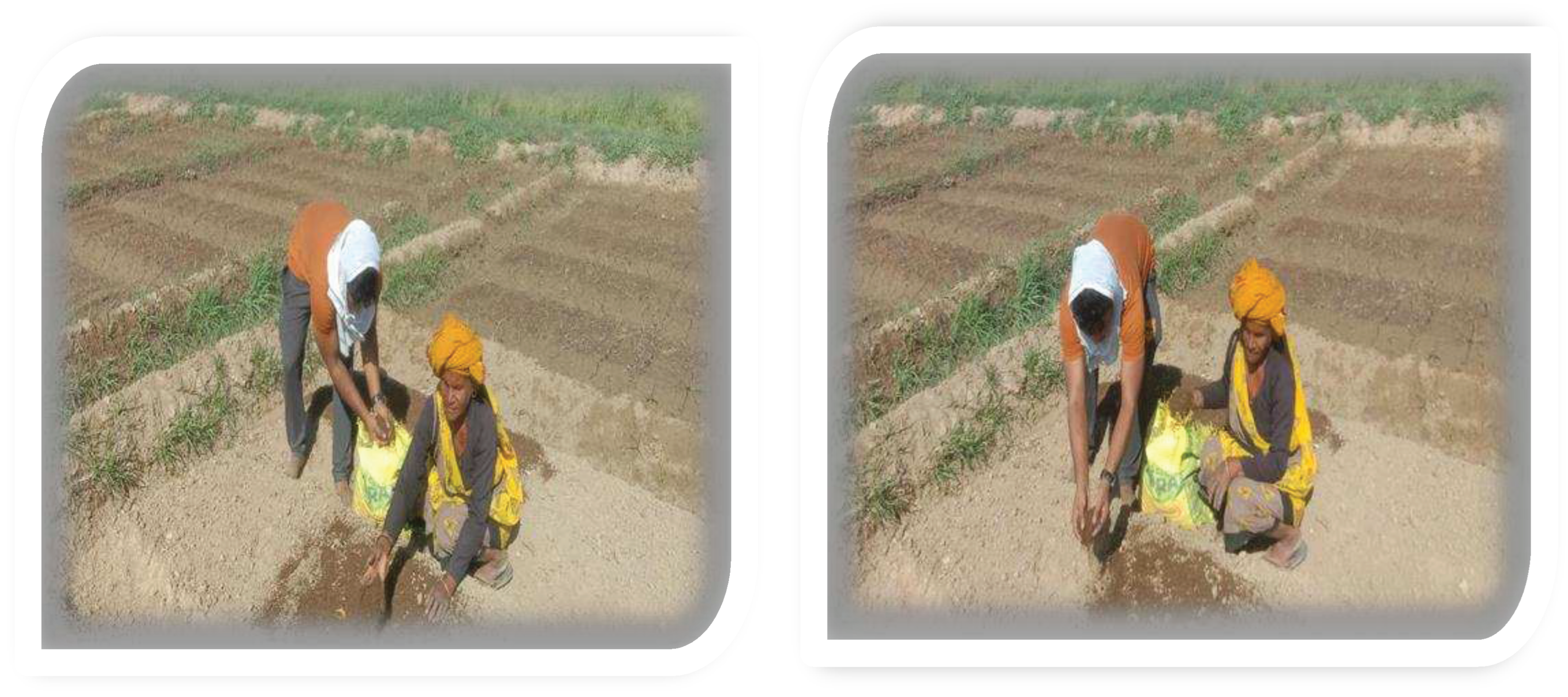
Figure.
25 days after sowing.
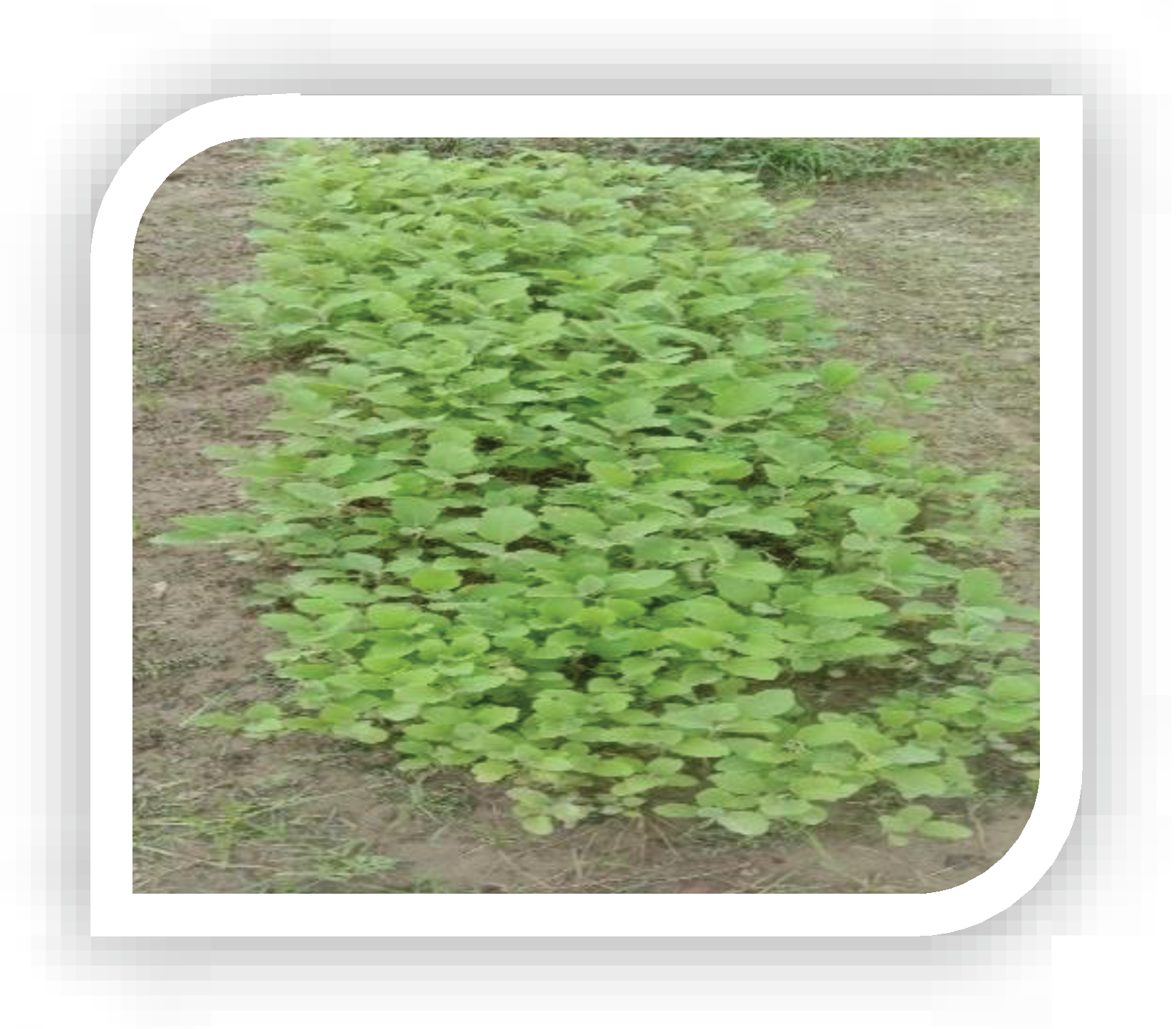
Figure.
Manual weeding and sanitization.
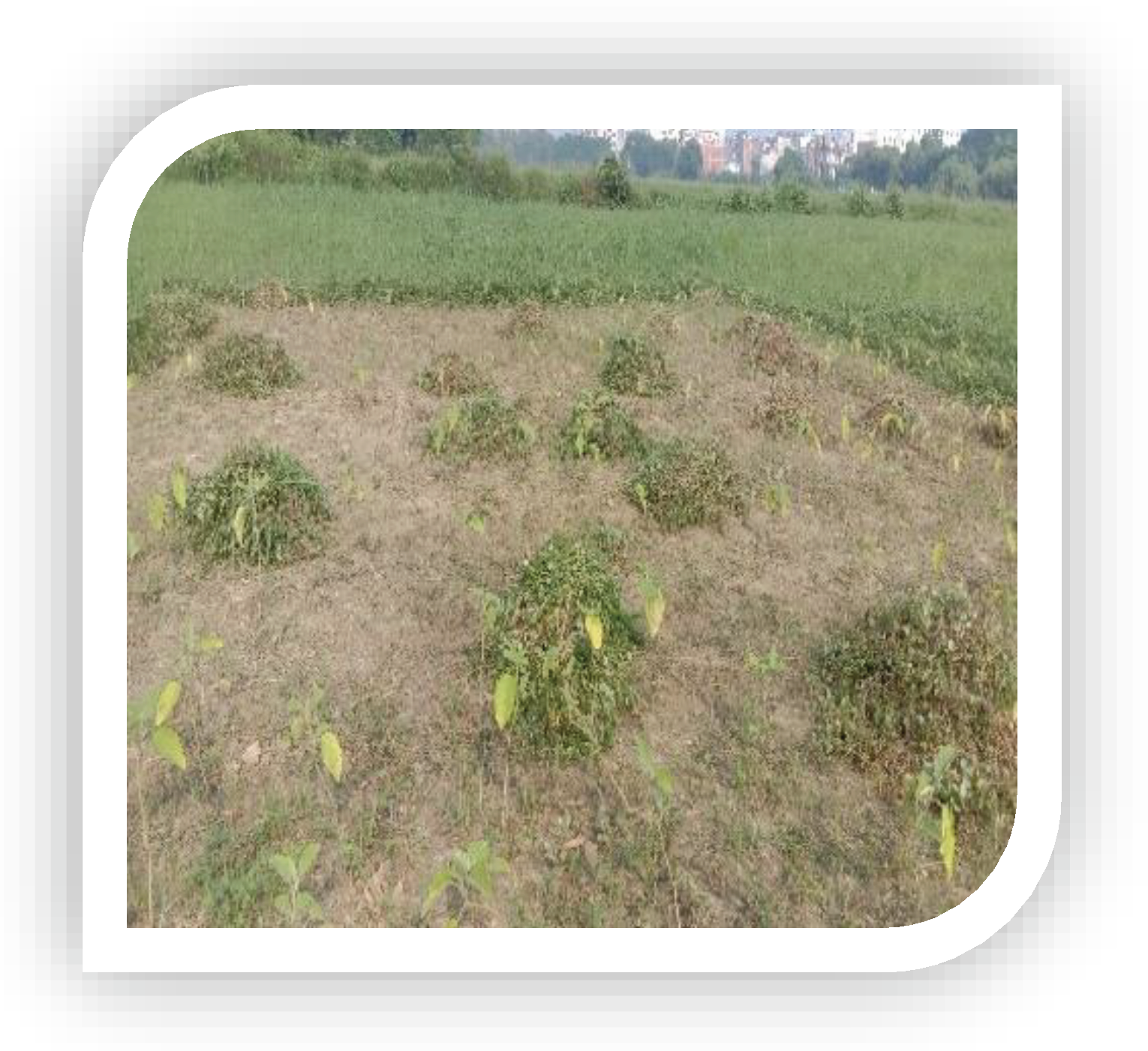
Figure.
Manual weeding, sanitization and flood irrigation.
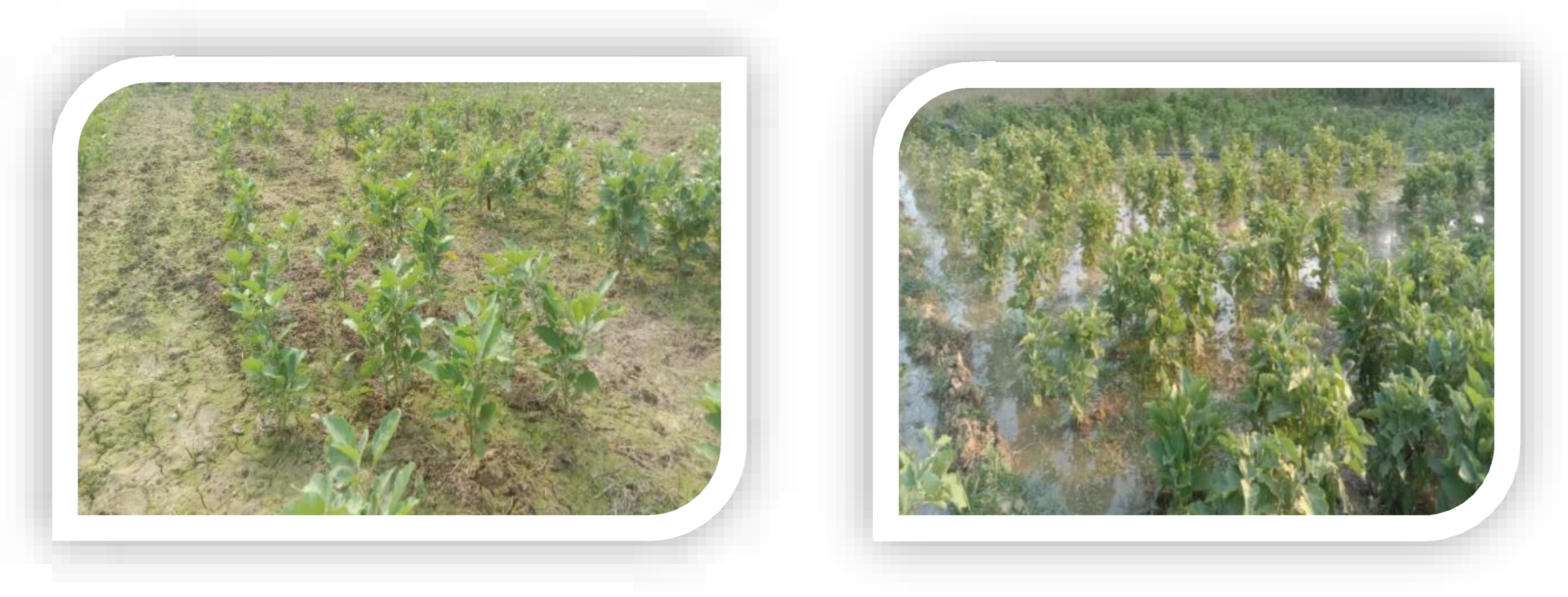
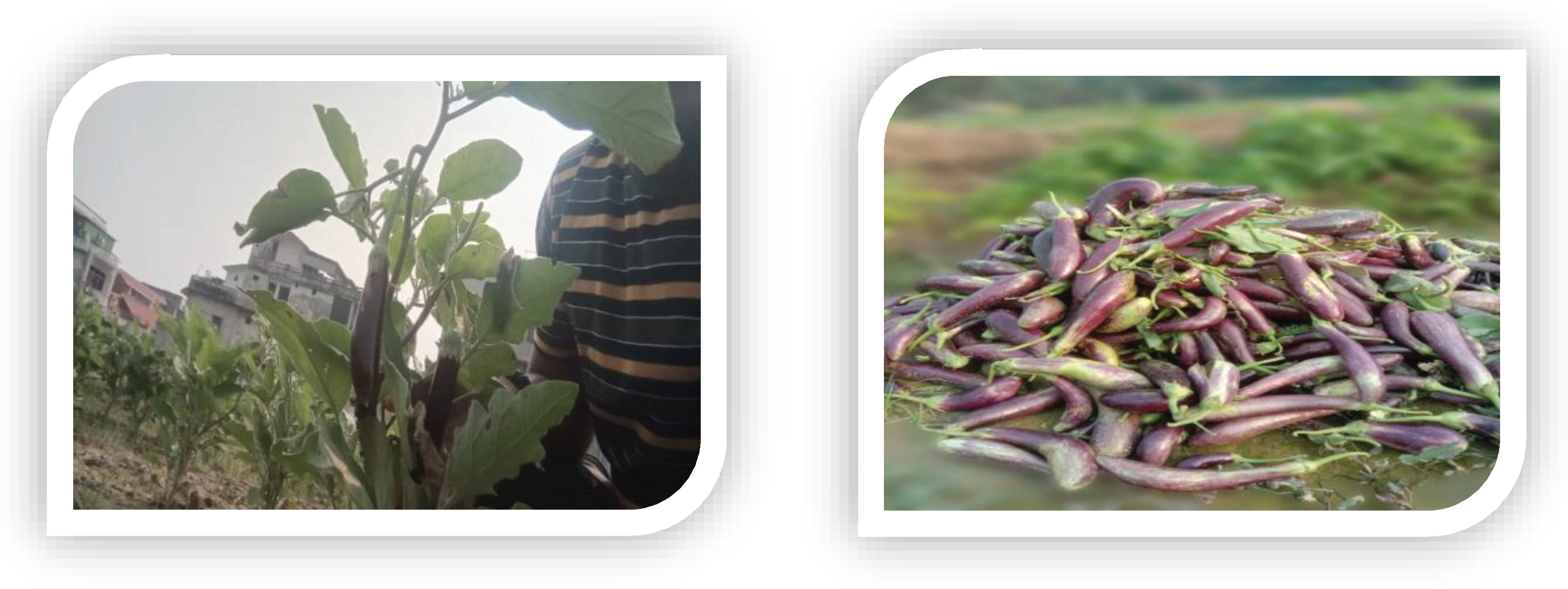
Figure.
First picking and final harvesting.
Biometric observations
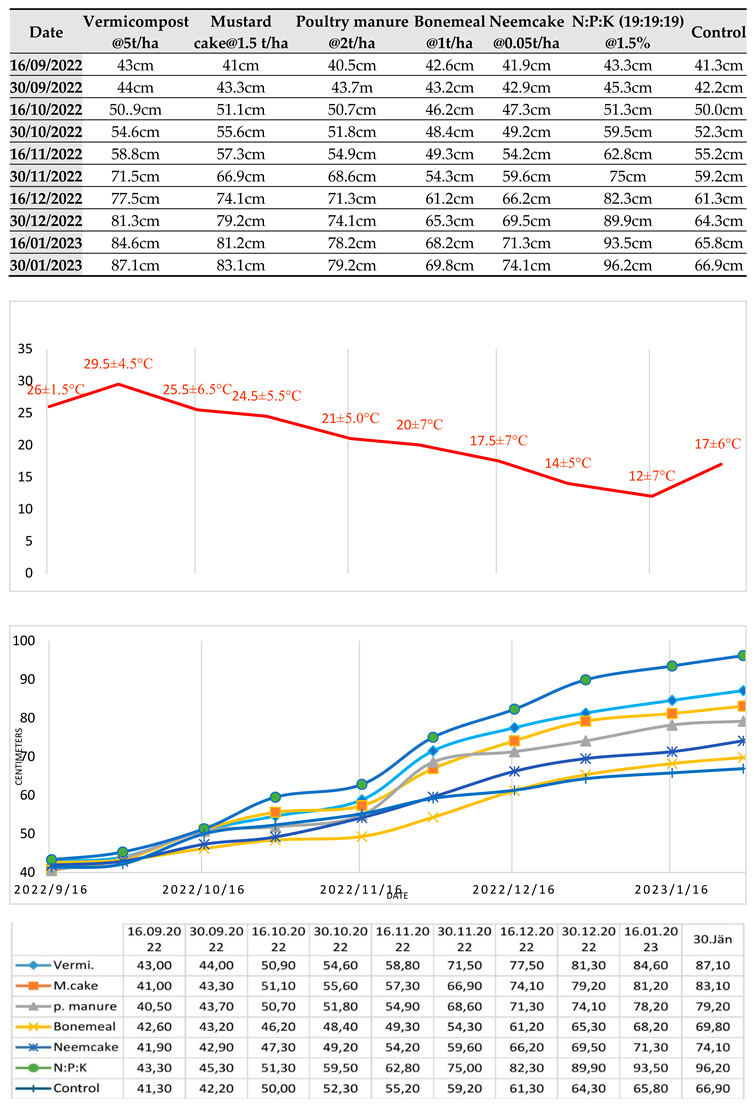
Plant height with reference to temperature
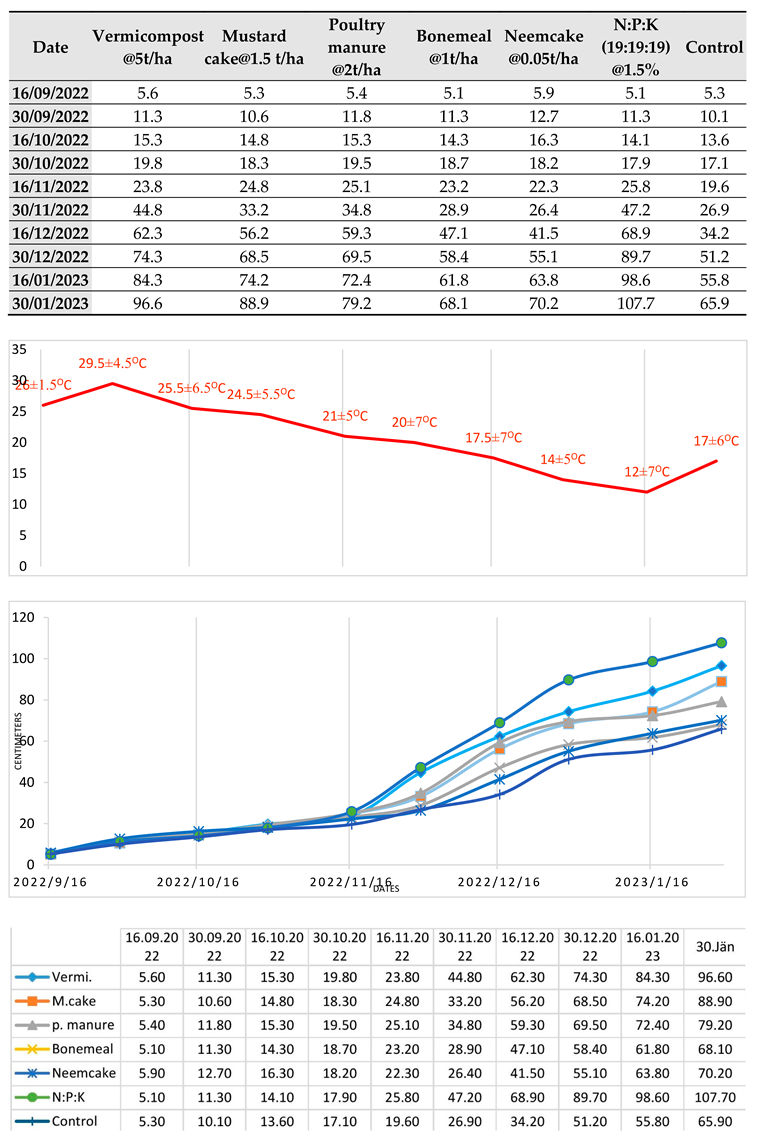
Number of matures leaves with reference to temperature
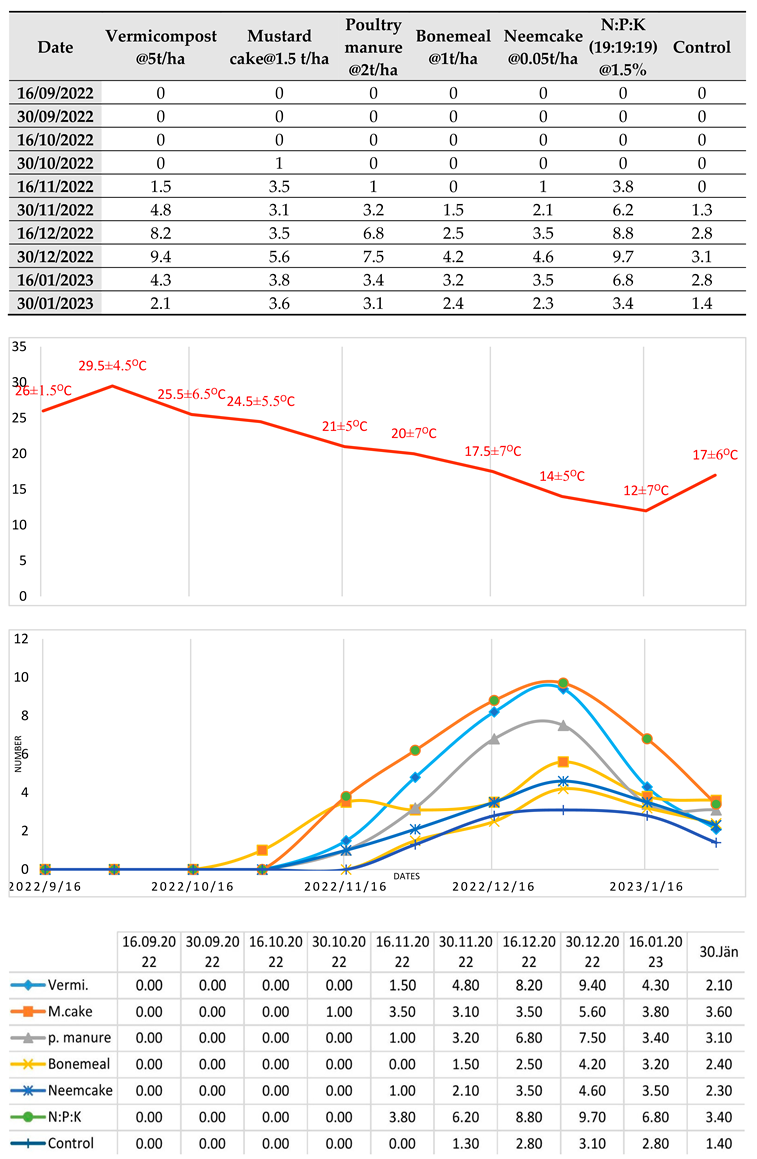
Number of mature flowers with reference to temperature
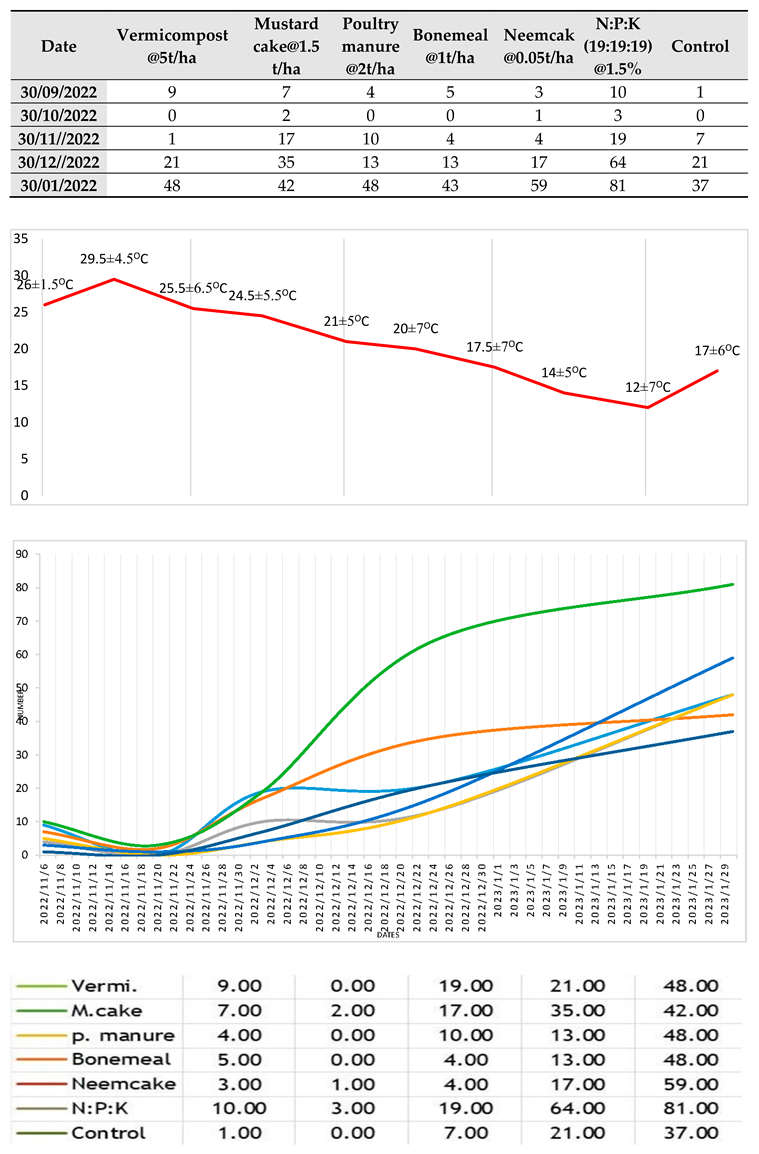
Number of fruits in whole plot with reference to temperature
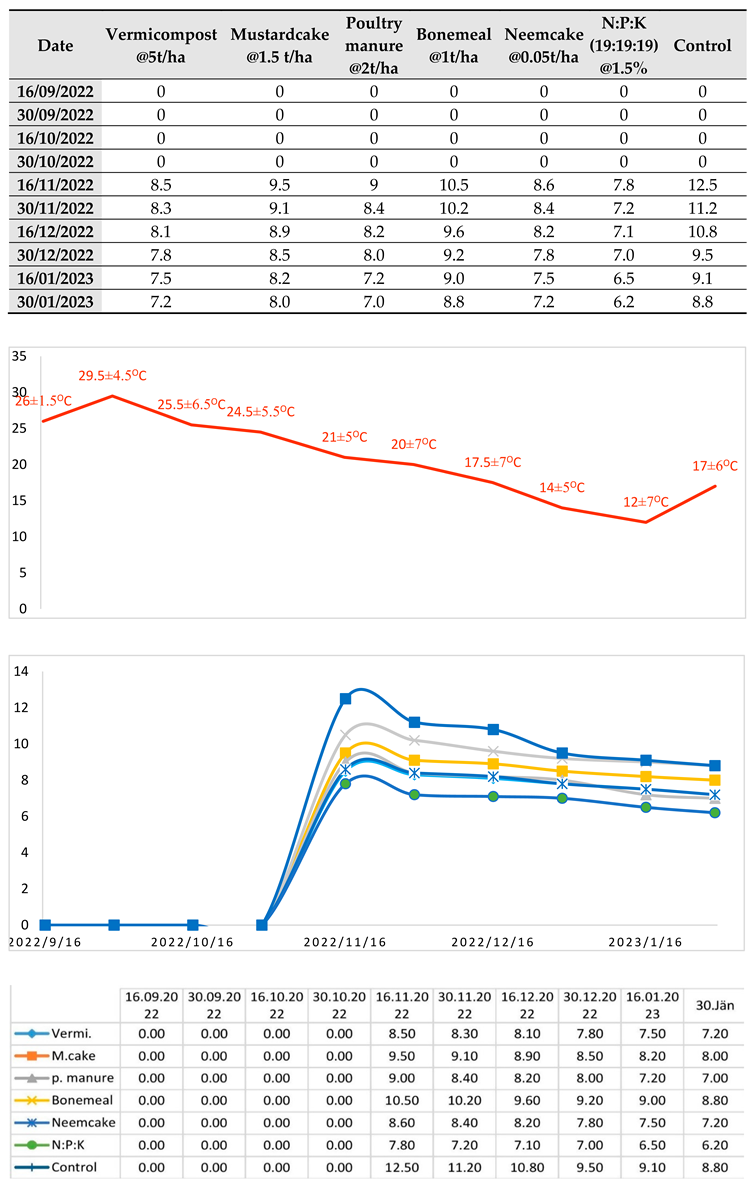
Days to form fruit with reference to temperature.
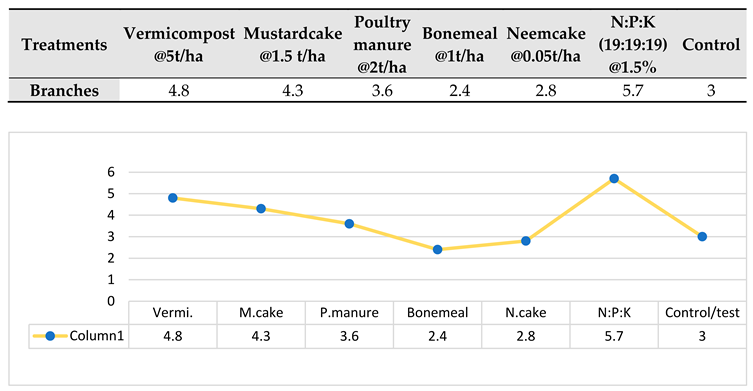
Number of Primary branches per plant
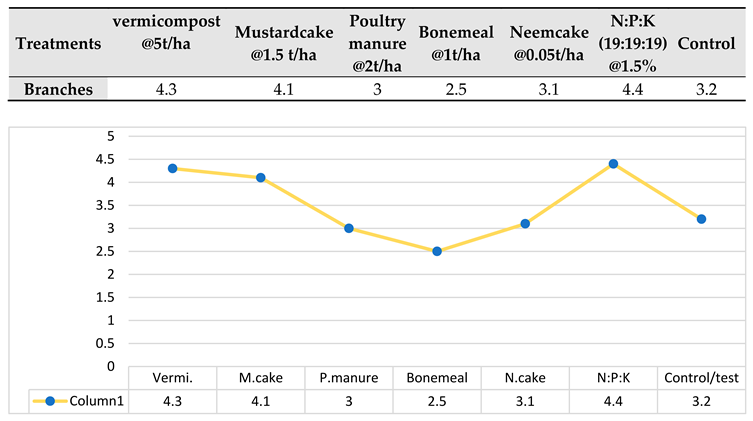
Number of Secondary branches per plant
Number of plants left at the end of experiment
Economics of whole experiment

Table.
Unit charges used in cost of cultivation.
| S.No. | Particulars | Cost(Rs.) |
|---|---|---|
| 1. | Ploughing by tractor | 500.00 hrs-1 |
| 2. | Labour | 300.00 day-1 |
| 3. | Seed | 5000.00 kg-1 |
| 4. | Vermicompost | 20.00Kg-1 |
| 5. | Mustardcake | 35.00 Kg-1 |
| 6. | Poultry manure | 3.00 Kg-1 |
| 7. | Neemcake | 20.00 Kg-1 |
| 8. | Bonemeal | 15.00 Kg-1 |
| 9. | N:P:K | 140.00 Kg-1 |
| 10. | Sale price of brinjal | 65.00 Kg-1 |
Table.
Summary of treatment wise variable cost of cultivation (Rs.Ha-1).
| Treatment no. | Treatments | Variable cost(Rs. Ha-1) | Total cost of cultivation (Rs.ha-1) |
|---|---|---|---|
| 1. | Vermicompost@5t/ha | 100000 | 130650.00 |
| 2. | Mustard cake@1.5t/ha | 52500 | 83150.00 |
| 3. | Poultry manure@2t/ha | 6000 | 36650.00 |
| 4. | Bonemeal@1t/ha | 15000 | 45650.00 |
| 5. | Neem cake@0.05t/ha | 1000 | 31650.00 |
| 6. | N:P:K(19:19:19)@1.5% | 420 | 31070.00 |
Table.
Common cost of cultivation (Rs. Ha-1).
| S.no. | Operation | Unit | Cost(Rs.ha-1) |
|---|---|---|---|
| 1. Field preparation | |||
| A. | Preirrigation | 600 irrigation-1 2Labour |
1200.00 |
| B. | Ploughing by tractor drawn disc plough |
3hrs@500hr-1 | 1500.00 |
| C. | Cross ploughing by cultivator with planking | 2.5hrs@500hr-1 | 1250.00 |
| TOTAL | 3950.00 | ||
| 2. Nursery raising and transplanting | |||
| A. | Cost of seed | 450g@ Rs. 5000/kg |
2000.00 |
| B. | Cost of nursery raising |
2000.00 | |
| C. | Cost of transplanting |
10 labour | 3000.00 |
| D. | Layout and ridge making |
4 labour | 1200.00 |
| TOTAL | 8200.00 | ||
| 3. | Irrigation(4) | 600irrigation-1 | 5000.00 |
| TOTAL | 5000.00 | ||
| 4.Inter cultural operation | |||
| A. | Weeding four times |
4labours | 4800.00 |
| TOTAL | 4800.00 | ||
| 5.Harvesting and picking | |||
| A. | Picking five times |
5 labours | 7000.00 |
| B. | Transporting x 5 | 2 labours | 1000.00 |
| TOTAL | 8000.00 | ||
| 6. | Miscellaneous | 700.00 | |
| FINAL TOTAL | 30650.00 | ||
Table.
Details of economics of different treatments of brinjal crop.
| Treatments no. | Treatments | Cost of cultivation(Rs.) | Gross monetory return(Rs.) | Net monetory return(Rs.) | B:C ratio |
|---|---|---|---|---|---|
| T1 | Vermicompost@5t/ha | 130650.00 | 395850.00 | 265200.00 | 3.029 |
| T2 | Mustard cake@1.5t/ha | 83150.00 | 361400.00 | 278250.00 | 4.346 |
| T3 | Poultry manure@2t/ha | 36650.00 | 287625.00 | 250975.00 | 7.847 |
| T4 | Bonemeal@1t/ha | 45650.00 | 190645.00 | 144995.00 | 4.176 |
| T5 | Neem cake@0.05t/ha | 31650.00 | 277810.00 | 246160.00 | 8.777 |
| T6 | N:P:K(19:19:19)@1.5% | 31070.00 | 773955.00 | 742885.00 | 24.910 |
Result and discussion
The benefit cost ratio per hectare for the cultivation of brinjal Azad- B3 varity for all the organic fertilizer treatments signifies the which organic fertilizer is better than the other in terms of benefit and cost of cultivation. Treatment(T6) N:P:K(19:19:19)@1.5% showed B:C ratio of 24.9 which is most cost effective, it showed better result than organic fertilizer as chemical fertilizer is more concentrate in nutrients. Treatments (T5) Neem cake@0.05t/ha showed B:C ratio of 8.77 which is most cost effective in all the organic fertilizers used in the experiment. The neem cake fertilizer's natural pesticidal, antifungal, and antibacterial qualities come from the tiny levels of neem oil that are still present. Even better, the cakes naturally lower soil pH by generating organic acids during decomposition. Neem cake is extremely friendly with microbes since it is natural, which stimulates good bacteria and other beneficial creatures, assures a stronger texture, increases soil fertility and aeration, boosts crop yield, lowers alkalinity, and increases water-holding capacity. Following this Treatment (T3) Poultry manure@2t/ha showed next best cost benefit ratio with 7.8 showed good result. A more concentrated supply of agricultural nutrients, particularly NPK and calcium, is poultry manure. It doesn't require composting because it is organic by nature and may be used right away from the farm on the fields. Next Treatment (T2) Mustard cake@1.5t/ha showed good result and efficiency with cost benefit ratio of 4.34, protein requirements are met by mustard cake, which also prevents premature buds from falling off. Better fruit and vegetable production is the outcome of this. Following treatment (T4) Bonemeal@1t/ha with ratio of 4.17 cost benefit ratio showed next recommended fertilizer to the farmers in terms of cost benefit ratio. The element is released into the soil for up to four months and is crucial for the growth of robust root systems. You are able to develop a lot of large, blooming flowers, fruits, and vegetables thanks to the slow, continuous delivery of nutrients. Next organic fertilizer of treatment (T1) Vermicompost@5t/ha with lowest cost benefit ratio of 3.029. The main reason for its lowest rank in oragic fertilizer because of its higher recommended dose and its higher price in market in comparison with other organic fertilizers. Farmer can use organic fertilizer according to their interest and need but on the basis of cost benefit ratio neem cake showed good result than others.
Significance of temperature difference and its effect in the brinjal
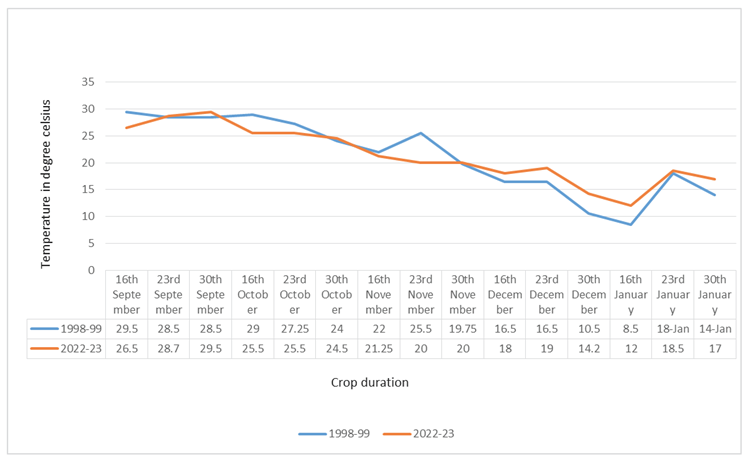
Difference in temperature between 1998-99 and 2022-23 during the crop cycle from 16 September to 30 January of 1998 and 2022 reveals a considerable variation in the temperature as we are concentrating on the impact of climate change in temperature more precisely. The temperature on September 16, 1998, was roughly 29.5°C, while the temperature on September 16, 2022, was 26.5°C. These two years are 25 years apart. On October 16, 1998, the temperature was 29°C, whereas it was 25.5°C in 2022. As the year progresses, the temperature gradually drops in 1998 but rises in 2022. On November 16th, 1998, the temperature was 22°C, on December 16th, 16.5°C, on January 16th, 2023, the temperature was 8.5° C, and on January 30th, 2023, the temperature was 14°C. However in 2022-23, the temperatures were 18°C, 22°C, and 17°C, which was 2.5°C higher than in 1998-99.The growth and development of plants can be significantly impacted even by ±1°C change.
Source:www.weatherspark.com
Plant height
Taking average temperature of highest and lowest recorded values, we get the temperature on which charts were plot. On 16th September at the time of transplantation, recorded 26°C± 1.5°C temperature, Plant height was in order N:P:K (19:19:19)@1.5% followed by Vermicompost@5t/ha, Bonemeal@1t/ha, Neemcake@0.05t/ha ,Mustard cake@1.5 t/ha , Control, Poultry manure@2t/ha with values recorded 43.3cm, 43cm, 42.6cm,41.9cm,41cm,41.3cm and 40.5cm respectively. On 30th September with 29.5°C± 4.5°C temperature, Plant height is in order N:P:K(19:19:19)@1.5% followed by Vermicompost@5t/ha, Poultry manure@2t/ha, Mustard cake@1.5 t/ha, Bonemeal@1t/ha, Neemcake@0.05t/ha, Control, with values recorded 45.3cm ,44cm, 43.7cm,43.3cm,43.2cm,42.9cm and 42.2cm respectively. On 16th October with 25.5°C± 6.5°C temperature, Plant height was in order N:P:K(19:19:19)@1.5% followed by Mustard cake@1.5 t/ha, Vermicompost@5t/ha, , Poultry manure@2t/ha, Control, Neemcake@0.05t/ha and Bonemeal@1t/ha with values recorded 51.3cm ,51.1cm, 50.9cm,50.7, 50.0cm,47.3cm and 46.2cm respectively. On 30th October with 24.5°C ± 5.5°C, Height was following the order N:P:K(19:19:19)@1.5% followed by Mustard cake @1.5 t/ha, Vermicompost@5t/ha, Control, Poultry manure @2t/ha, Neemcake@0.05t/ha , Bonemeal@1t/ha with values recorded 59.5cm, 55.6cm, 54.6cm, 52.3cm, 51.8cm, 49.2cm and 48.4cm respectively. On16th November with 21°C ± 5°C, Height recorded N:P:K(19:19:19)@1.5% followed by Vermicompost@5t/ha, Mustard cake@1.5t/ha, Control, Poultry manure@2t/ha, Neemcake@0.05t/ha and Bonemeal@1t/ha with values recorded 62.8cm,58.5cm, 57.3cm,55.2cm, 54.9cm,54.2cm and 54.2cm respectively. On 30th November at 20°C ± 7°C, Height is in the following order N:P:K(19:19:19)@1.5% followed by Vermicompost@5t/ha, Poultry manure@2t/ha, Mustard cake@1.5t/ha, Neemcake@0.05t/ha, Control, Bonemeal@1t/ha with values recorded 75cm,71.5cm,68.6cm,66.9cm,59.6cm,59.2cm and 54.2cm respectively. On 16th December at 17°C ± 7.5°C, Height was in the following order N:P:K(19:19:19)@1.5% followed by Vermicompost@5t/ha, Mustard cake@1.5t/ha, Poultry manure@2t/ha, , Neemcake@0.05t/ha, Control, Bonemeal@1t/ha with values recorded 82.3cm,77.5cm,74.1cm,71.3cm,66.2cm,61.3cm and 61.2cm respectively On 30th December with 14°C ± 5°C, Height was in the following order N:P:K(19:19:19)@1.5% followed by Vermicompost@5t/ha, Mustard cake@1.5 t/ha, Poultry manure@2t/ha, Neemcake@0.05t/ha, Bonemeal@1t/ha then Control with values recorded 89.9cm,81.3cm,79.2cm,74.1cm ,69.5cm 65.3cm and 64.3cm respectively. On 16th January of 2023 with 12°C ± 7°C, Height was in the following order N:P:K(19:19:19)@1.5% followed by Vermicompost@5t/ha, Mustard cake@1.5 t/ha, Poultry manure@2t/ha, Neemcake@0.05t/ha, Bonemeal@1t/ha then Control with values recorded 93.5cm,84.6cm,81.2cm,78.2cm,71.3cm, 68.2cm and 65.8cm respectively. And on the last day of the experiment on 30th January at 17°C ± 6°C, Height was in the following order N:P:K(19:19:19)@1.5% followed by Vermicompost@5t/ha, Mustard cake@1.5 t/ha, Poultry manure@2t/ha, Neemcake@0.05t/ha, Bonemeal@1t/ha then Control with values recorded 96.2 cm,87.1cm,83.1cm,79.2cm,74.1cm, 9.8cm and 66.9 cm respectively fruit varieties differ from one another in terms of their nutritional content. Wild relatives of the brinjal have been demonstrated to be a significant source for passing on additional agronomically significant features and resistance to biotic and abiotic stressors to farmed brinjal cultivars.(5), Comparable outcomes were accounted for plant height (6)
Number of matures leaves
On 16th September at the time of transplantation, recorded 26°C± 1.5°C temperature, Number of leaves was recorded Neemcake@0.05t/ha followed by Vermicompost@5t/ha, Poultry manure@2t/ha, Mustard cake@1.5t/ha, Control, N:P:K(19:19:19)@1.5% and Bonemeal@1t/ha, with 5.9, 5.6, 5.4,5.3,5.1 and 5.1 respectively. On 30th September with 29.5°C± 4.5°C, Number of matures leaves was in order Neemcake@0.05t/ha followed by Poultry manure@2t/ha, Vermicompost@5t/ha, Bonemeal@1t/ha, N:P:K(19:19:19)@1.5% , Mustard cake@1.5 t/ha and Control with values recorded 12.7,11.8,11.3,11.3 ,11.3 ,10.6 and10.1 respectively. On 16th October at the time of transplantation, recorded 25.5°C± 6.5°C temperature, Number of leaves was recorded Neemcake@0.05t/ha followed by Vermicompost@5t/ha, Poultry manure@2t/ha, Mustard cake@1.5t/ha, Control, Bonemeal@1t/ha N:P:K(19:19:19)@1.5%, with 16.3, 15.3, 15.3,14.8,14.3 and 13.6 respectively. On 30th October with 24.5°C ± 5.5°C, Number of matures leaves is in order Vermicompost@5t/ha followed by Poultry manure@2t/ha Bonemeal@1t/ha, Mustard cake@1.5 t/ha, Neemcake@0.05t/ha, N:P:K (19:19:19)@1.5% and Control with values recorded 19.8,19.5,18.7,18.3,18.2,17.9,17.1 respectively. On16th November with 21°C ± 5°C, number of leaves was N:P:K(19:19:19)@1.5% followed by Poultry manure@2t/ha, Mustard cake@1.5t/ha, Vermicompost@5t/ha , Bonemeal@1t/ha, Neemcake@0.05t/ha and Control, and with values recorded 25.8,25.1,24.8,23.8,23.2cm,22.3cm and 19.6cm respectively. On 30th November with 20°C ± 7°C, Number of matures leaves is in order N:P:K(19:19:19)@1.5%, Vermicompost@5t/ha, Poultry manure@2t/ha, Mustard cake@1.5 t/ha, Bonemeal@1t/ha, Control and Neemcake@0.05t/ha with values recorded 47.2, 44.8, 34.8, 33.2, 28.9, 26.9 and 26.4 respectively. On 16th December at 17°C ± 7.5°C, Number of leaves in order N:P:K(19:19:19)@1.5% followed by Vermicompost@5t/ha, Poultry manure@2t/ha, Mustard cake@1.5t/ha, Bonemeal@1t/ha, Neemcake@0.05t/ha and Control, with values recorded 68.9,62.3,59.3,56.2,47.1,41.5 and 34.2 respectively. On 30th December with 14°C ± 5°C, Number of matures leaves is in order N:P:K(19:19:19)@1.5% followed by Vermicompost@5t/ha poultry manure@2t/ha, Mustardcake@1.5t/ha, Bonemeal@1t/ha, Neemcake@0.05t/ha and Control/Test with values recorded 89.7, 74.3, 69.5, 68.5, 58.4, 55.1 and 51.2 respectively. On 16th January of 2023 with 12°C ± 7°C, Number of leaves was in the following order N:P:K(19:19:19)@1.5% followed by Vermicompost@5t/ha, Mustard cake@1.5 t/ha, Poultry manure@2t/ha, Neemcake@0.05t/ha, Bonemeal@1t/ha then Control with values recorded 98.6, 84.3, 74.2, 72.4, 63.8, 61.8 and 55.8cm respectively. On 30th January 2023 with 17°C ± 6°C, Number of matures leaves is in order N:P:K (19:19:19)@1.5%,Vermicompost@5t/ha, Mustard cake@1.5t/ha, Poultry manure@2t/ha, Neemcake@0.05t/ha, Bonemeal@1t/ha and Control with last final values recorded 107.7 , 96.6, 88.9, 79.2, 70.2, 68.1 and 65 respectively.
Number of matures flower
On16th November with 21°C ± 5°C, number of leaves was N:P:K(19:19:19)@1.5% followed by Poultry manure@2t/ha, Mustard cake@1.5t/ha, Vermicompost@5t/ha , Bonemeal@1t/ha, Neemcake@0.05t/ha and Control, and with values recorded 25.8,25.1,24.8,23.8,23.2cm,22.3cm and 19.6cm respectively. On 30th November with 20°C ± 7°C, Number of mature flowers with reference to temperature is in order N:P:K(19:19:19)@1.5%, Vermicompost@5t/ha, Poultry manure@2t/ha Mustardcake@1.5t/ha, Neemcake@0.05t/ha, Bonemeal@1t/ha, Control with number of mature flowers recorded 6.2,4.8,3.2,3.1,2.1,1.5 and 1.3 respectively. On 16th December at 17°C ± 7.5°C, Number of leaves in order N:P:K(19:19:19)@1.5% followed by Vermicompost@5t/ha, Poultry manure@2t/ha, Mustard cake@1.5t/ha, Bonemeal@1t/ha, Neemcake@0.05t/ha and Control, with values recorded 68.9,62.3,59.3,56.2,47.1,41.5 and 34.2 respectively, On 30th December with 14°C ± 5°C, Number of mature flowers with reference to temperature is in order N:P:K (19:19:19)@1.5%, Vermicompost@5t/ha, Poultry manure@2t/ha, Mustard cake @1.5t/ha Neemcake@0.05t/ha , Bonemeal@1t/ha and Control with number of mature flowers recorded 9.7 ,9.4 ,7.5 ,5.6 ,4.6 ,4.2 and 3.1 respectively. On 16th January of 2023 with 12°C ± 7°C, Number of leaves was in the following order N:P:K(19:19:19)@1.5% followed by Vermicompost@5t/ha, Mustard cake@1.5 t/ha, Poultry manure@2t/ha, Neemcake@0.05t/ha, Bonemeal@1t/ha then Control with values recorded 98.6, 84.3, 74.2, 72.4, 63.8, 61.8 and 55.8cm respectively. On 30th January 2023 gradual decrease in number of flowers at 17°C ± 6°C, Number of mature flowers with reference to temperature is in order Mustard cake@1.5t/ha followed by N:P:K(19:19:19)@1.5%, Poultry manure @2t/ha Bonemeal@1t/ha, Neemcake@0.05t/ha,Vermicompost@5t/ha and Control.
Number of fruits in whole plots
On 30th September with 29.5°C ± 4.5°C, Number of fruits in whole subplots with reference to temperature is in order N:P:K (19:19:19)@1.5% followed by Vermicompost@5t/ha, Mustard cake@1.5t/ha, Bonemeal@1t/ha, Poultry manure@2t/ha, Neemcake@0.05t/ha and Control with number of fruits in whole subplots recorded as 10,9,7,5,4,3 and 1. On 30th October with 24 ± 5.5°C, Number of fruits in whole subplots with reference to temperature is in order N:P:K(19:19:19)@1.5% followed by Mustard cake@1.5t/ha, Neemcake@0.05t/ha Poultry manure@2t/ha, Control, Bonemeal@1t/ha , and Vermicompost@5t/ha with number of fruits in whole subplots recorded as 3,2,1,0,0,0 and 0 respectively. On 30th November with 20 ± 7°C, Number of fruits in whole subplots with reference to temperature is in order N:P:K(19:19:19)@1.5% followed by Mustard cake@1.5t/ha, Poultry manure@2t/ha, Control, Bonemeal@1t/ha , Neemcake@0.05t/ha and Vermicompost@5t/ha with number of fruits in whole subplots recorded as 19,17,10,7,4,4 and 1 respectively. On 30th December with 14 ± 5°C, Number of fruits in whole subplots with reference to temperature is in order N:P:K(19:19:19)@1.5% followed by Mustard cake@1.5t/ha, Vermicompost@5t/ha, Control , Neemcake@0.05t/ha Poultry manure@2t/ha and Bonemeal@1t/ha with number of fruits in whole subplots recorded as 64,53,21,21,17,13 and 13 respectively. On 30th January 2023 gradual decrease in number of flowers at 17°C ± 6°C, Number of mature flowers with reference to temperature is in order N:P:K(19:19:19)@1.5% followed by Neemcake@0.05t/ha , Vermicompost@5t/ha, Poultry manure@2t/ha, Bonemeal@1t/ha, Mustard cake@1.5t/ha and Control with 81, 59, 48,48,43,42,37 number of fruits respectively. The productivity of crops like wheat and rice is the subject of numerous studies. According to Sinha and Swaminathan (1991), an increase in temperature of 2OC could reduce rice yield by about 0.75 tons/ha in high yield areas, and an increase in winter temperature of 0.5OC could reduce wheat yield by 0.45 tons/ha. Additionally, to a 2°C rise in mean air temperature might reduce rice output by 0.06 t/ha in low yield coastal regions and by 0.75 t/ha in high yield locations(7) . Without taking into account the impacts of carbon dioxide fertilization, Rao and Shina (1994) said that wheat output might decline by 28–68%, everyone saw a degree increase (8). Treatment combination of (20% cowdung + 20% Mustard oil cake + 20% poultry manure + 40% chemical fertilizer) produced the highest yield for cultivating the Pusa Purple Long variety in the Kanpur region of India(10)
Days to form fruit
Data on fruit formation started from On 16th November at 21°C ± 5°C, Days taken by flowers to form into fruits is in order Control followed by Bonemeal@1t/ha, Mustard cake@1.5 t/ha, Poultry manure @2t/ha Neemcake@0.05t/ha, Vermicompost@5t/ha and N:P:K(19:19:19)@1.5%,with values 12.5, 10.5, 9.5, 9, 8.6, 8.5 and 7.8 days. On 30th November with 20°C ± 7°C, Maximum days taken by flowers to form into fruits is in order Control followed by Bonemeal@1t/ha, Mustardcake@1.5 t/ha, Poultry manure@2t/ha, Neemcake@0.05t/ha, Vermicompost@5t/ha, N:P:K(19:19:19)@1.5%, with recorded values 11.2, 10.2, 9.1, 8.4, 8.4, 8.3, 7.2 days respectively. On 16th December with 17.5°C ± 7°C, Days taken by flowers to form into fruits is in order Control followed by Bonemeal@1t/ha, Mustard cake@1.5 t/ha, Poultry manure @2t/ha, Neemcake@0.05t/ha, Vermicompost@5t/ha, N:P:K(19:19:19)@1.5%,with values 10.8, 9.6, 8.9, 8.2, 8.2, 8.1, 7.1 days respectively. On 30th December with 14°C ± 5°C, Days taken by flowers to form into fruits is in order Control followed by Bonemeal@1t/ha, Mustard cake@1.5 t/ha, Poultry manure @2t/ha, Vermicompost@5t/ha, Neemcake@0.05t/ha N:P:K(19:19:19)@1.5%,with values 9.5, 9.2, 8.5, 8.0, 7.8, 7.8 , 7.2 days respectively. On 16th January 2023 with 21°C ± 7°C,on the last days of experiment, days taken by flowers to form into fruits is in order Control followed by Bonemeal@1t/ha, Mustard cake@1.5 t/ha, Vermicompost@5t/ha, Neemcake@0.05t/ha , Poultry manure@2t/ha and N:P:K19:19:19)@1.5% with recorded days 9.1,9.0,8.2,7.5,7.5,7.2 and 6.5 days respectively. On 30th January 2023 with 17°C ± 6°C,on the last days of experiment, days taken by flowers to form into fruits is in order Bonemeal@1t/ha followed by Control, Mustard cake@1.5 t/ha, Vermicompost@5t/ha, Neemcake@0.05t/ha , Poultry manure@2t/ha and N:P:K19:19:19)@1.5% with recorded days 8.8,8.8,8.0,7.2,7.2,7.0 and 6.2 days respectively. Yield response of tomato, cabbage and brinjal on peat to poultry manure(PM)All the fertilized plots gave significantly higher yields than the unfertilized plots for the three vegetables. The inorganic fertilizer plots yielded 14.2 kg (23.7 t/ha), 16.7 kg (27.8)(3).
Number of plants left at the end of experiment
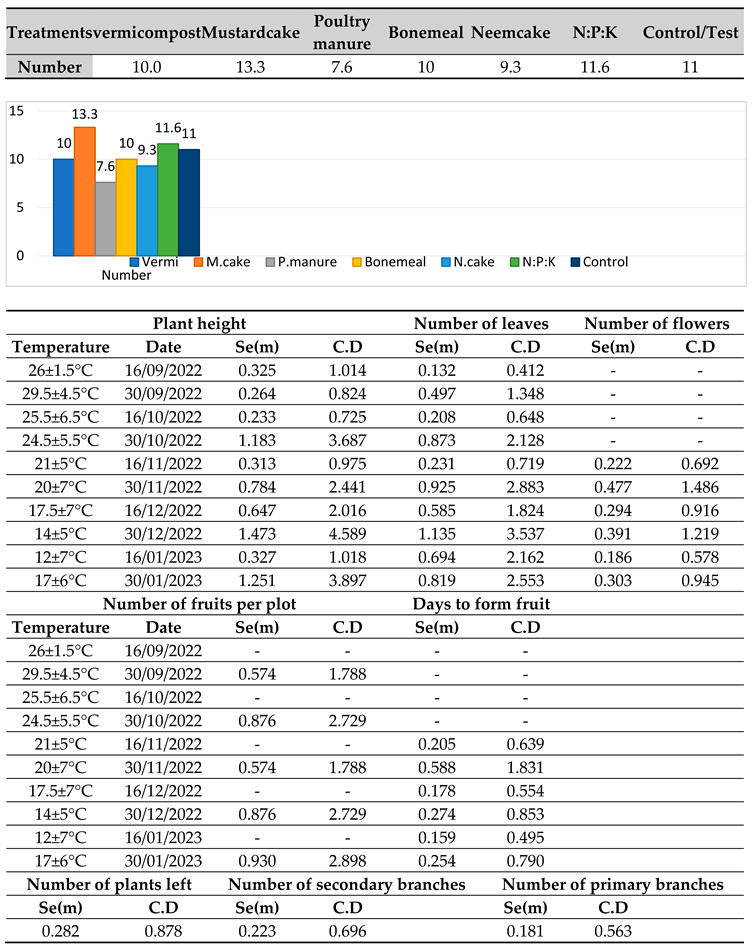
At the end of the experiment on 30th January total number of plants in whole subplots on average was counted in all the treatments. The following order of plants was recorded Mustard cake @1.5 t/ha followed by N:P:K(19:19:19)@1.5%,Control/test, Vermicompost@5t/ha, Bonemeal@1t/ha, Neemcake@0.05t/ha, Poultry manure@2t/ha with number of plants 13.3 ,11.6, 11, 10, 10, 9.3 and 7.6 respectively.(1)
Number of Primary branches
Number of primary branches at the end of the experiment is in the following order N:P:K (19:19:19)@1.5%, followed by Vermicompost@5t/ha, Mustard cake@1.5 t/ha, Poultry manure@2t/ha, Control, Neemcake@0.05t/ha and Bonemeal@1t/ha with total branches counting 5.7, 4.8,4.3,3.6, 3, 2.8 and 2.4 respectively.
Number of Secondary branches
Number of Secondary branches at the end of the experiment is in the following order N:P:K (19:19:19)@1.5% followed by Vermicompost@5t/ha, Mustardcake@1.5 t/ha, Control, Neemcake@0.05t/ha, Poultry manure@2t/ha and Bonemeal@1t/ha with total branches counting 4.4, 4.3, 4.1, 3.2, 3.1, 3 and 2.5 respectively.
Conclusion
The final production evaluation N:P:K@1.5%(19:19:19)outperformed all the organic fertilizers but when it comes to conclude which organic fertilizer performed well Treatments (T5) Neem cake@0.05t/ha was outperforming all the other organic fertilizers. Coming close to it in performance, Treatment (T3) Poultry manure@2t/ha has shown its inheritance in providing nutrients. Neemcake cost twenty rupees per kilogram while poultry manure cost about three rupees per kilogram in the nearby town area but the cost can decrease further in village area or buying directly from manufacturer. During the experiment days it was observed that the effect of mustard cake last longer than the other fertilizers. Use of other organic fertilizers are also effective use of vermicompost can provide nitrogen in higher amount in short time .Use of neemcake is good for the longer duration in providing nitrogen. Availability is really important while choosing the fertilizers along with the amount needed and its cost. During the experiment, effect of temperature and precipitation can cause significant changes in growth and development. Higher temperature above 25 degree Celsius cause slow growth, temperature range between 21 to 14 degrees Celsius was found better in terms of growth of flower and fruit formation.
References
- Instructors C, Development R, Development R. Organic Farming Practice for Sustainable Agriculture. 2018.
- Abouhussein S. Climate Change and Its Impact on the Productivity and Quality of Vegetable Crops. 2019;(January 2012). 20 January.
- Vimala P, Salbiah H, Zahrah T, Ruwaida M. Yield responses of vegetables to organic fertilizers. 2001;29(1):17–27.
- Erisman JW, Sutton MA, Galloway J, Klimont Z, Winiwarter W. How a century of ammonia synthesis changed the world. Nature Geoscience. 2008; 1(10): 636-639. [CrossRef]
- Rotino, G. L., Sala, L., Toppino. (2013). Eggplant. Alien Gene Transfer in Crop Plants, Volume 2, 381-409.
- Naidu AK, Kushwah SS, Diwivedi YC. Performance of organic manures, bio and chemical fertilizers and their combination on microbial population of soil and growth of okra. Jawaharlal Nehru Krishi Vishwa Vidhyalaya Research Journal. 1999; 33(1-2):34-38.
- Kalra, N., P.K. Aggarwal, S. Chander, H. Pathak, R. Choudhary, A. Chaudhary, S. Mukesh, H.K. Rai, U.A. Soni, S. Anil, M. Jolly, U.K. Singh, A. Owrs, M.Z. Hussain, 2003. Impacts of climate change on agriculture. In: Shukla PR, Subodh KS, Ravindranath NH, Garg A, Bhattacharya S (eds) Climate change and India: vulnerability assessment and adapta-tion. University Press, India, pp: 191-226.
- Saseendran, R.M., I.M. Smith, and P.A. Matson, 2000. Ecological and evolutionary responses to climate change. Science, 284: 1943-1947.
- Vimala P, Salbiah H, Zahrah T, Ruwaida M. Yield responses of vegetables to organic fertilizers. 2001;29(1):17–27.
- Khadka H, Kumar J, Silas VJ, Yadav A. Effects of organic manures and chemical fertilizers on the yield and quality parameters of Brinjal ( Pusa purple long ) under the agro - climatic conditions of Kanpur. 2022;11(7):1214–20.
- Swaminathan, M. S.: 1987, ‘Building National and Global Nutrition Security System’, in M. S. Swaminathan and S. K. Sinha (eds.), Global Aspects of Food Production, Tycooly International, Oxford, Riverton (N.J.), Dehra Dun, pp. 417–449.
- Rao, A. and Sinha, A.K. 1994. Climate changes and agriculture. Nature 437: 102- 109.
- Zarin, A.S. 2007. Global climate changes and its effect on agriculture. Nature 408: 184-188.
- Ziska, E., Fraser, D., Falcon, P. 1997. Assessing risks of climate variability and climate change for rice. Science 240: 996-1002.
Disclaimer/Publisher’s Note: The statements, opinions and data contained in all publications are solely those of the individual author(s) and contributor(s) and not of MDPI and/or the editor(s). MDPI and/or the editor(s) disclaim responsibility for any injury to people or property resulting from any ideas, methods, instructions or products referred to in the content. |
© 2023 by the authors. Licensee MDPI, Basel, Switzerland. This article is an open access article distributed under the terms and conditions of the Creative Commons Attribution (CC BY) license (http://creativecommons.org/licenses/by/4.0/).
Copyright: This open access article is published under a Creative Commons CC BY 4.0 license, which permit the free download, distribution, and reuse, provided that the author and preprint are cited in any reuse.