

Submitted:
07 December 2023
Posted:
11 December 2023
You are already at the latest version
Abstract
This study focuses on the nuanced phenomenon of gendered parenting by exploring “how” and “when” maternal son preference associates with depressive symptoms among Chinese early adolescents. Focusing on 1,093 junior high school students from a relatively affluent city in western China, the research examined the mediating roles of mother-child attachment and father-child attachment, as well as the moderating role of school connectedness in the relationship between maternal son preference and depressive symptoms. The results revealed a noteworthy positive correlation between maternal son preference and depressive symptoms among female adolescents, with no significant association observed in males. In addition, mother-child attachment and father-child attachment mediated the relationship between maternal son preference and depressive symptoms, which supported the “spillover effect” and “crossover effect”. Moreover, moderation effect analysis indicated that higher level of school connectedness can buffer the effect of maternal son preference on girls’ depressive symptoms, while lower level of school connectedness can enhance the effect of maternal son preference on girls’ depressive symptoms. These insights help to enhance people's understanding of gendered parenting, emphasizing the enduring necessity of addressing son preference within the broader context of promoting gender equality.
Keywords:
maternal son preference
; gendered parenting
; parent-child attachment
; school connectedness
; depressive symptoms
Abstract This study focuses on the nuanced phenomenon of gendered parenting by exploring “how” and “when” maternal son preference associates with depressive symptoms among Chinese early adolescents. Focusing on 1,093 junior high school students from a relatively affluent city in western China, the research examined the mediating roles of mother-child attachment and father-child attachment, as well as the moderating role of school connectedness in the relationship between maternal son preference and depressive symptoms. The results revealed a noteworthy positive correlation between maternal son preference and depressive symptoms among female adolescents, with no significant association observed in males. In addition, mother-child attachment and father-child attachment mediated the relationship between maternal son preference and depressive symptoms, which supported the “spillover effect” and “crossover effect”. Moreover, moderation effect analysis indicated that higher level of school connectedness can buffer the effect of maternal son preference on girls’ depressive symptoms, while lower level of school connectedness can enhance the effect of maternal son preference on girls’ depressive symptoms. These insights help to enhance people's understanding of gendered parenting, emphasizing the enduring necessity of addressing son preference within the broader context of promoting gender equality.
1. Introduction
Son preference is a prevalent phenomenon across various cultures, with demographers observing a general preference for sons, regardless of whether in developed or developing countries. This inclination is especially pronounced in Asian countries such as South Korea and China (Chew et al., 2018). Son preference reflects deeply ingrained cultural beliefs, notably within the context of Chinese clan culture. At the heart of Chinese clan culture lies the belief that male dominance is crucial to familial sacrifices and that men are the carriers of the family bloodline. This conviction reinforces the entrenched preference for sons over daughters, which leads to the imbalance of the boy/girl sex ratio at birth (Zhang & Ma, 2017). While the boy/girl sex ratio at birth in China had shown a downward trend in recent decades, it still maintains at a high level, underscoring the enduring prevalence of son preference (Jiang & Zhang, 2021; Hou et al., 2018).
Son preference can result in higher mortality rates among women (Pennington et al., 2023), prompt mothers to shorten the birth intervals after having two daughters, and increase sex-selective abortion (Aydede & Robitaille, 2022). Despite these significant consequences, existing studies on son preference mostly focus on the phenomenon itself, causes and broader influence on population and reproductive behavior. In this context, relatively scant attention were given to its influence on individual mental health, especially that of adolescents, which highlights a critical gap in the current research landscape. Consequently, a thorough exploration of son preference within the Chinese cultural context and its association with adolescents’ mental health emerges as an imperative undertaking with far-reaching implications.
1.1. Maternal son preference and Adolescent Depressive Symptoms
Son preference reflects people's understanding of the significance or value of having children of different genders, as well as motivational beliefs and value judgments for raising children of different genders (Aycicegi-Dinn & Kagitcibasi, 2010). It stems from the corrupt customs that the family must have a male offspring, or prefers male offspring when there are both male and female offsprings, and give sons more rights and care (Yang & Liu, 2022). This preference reflects parents’ value towards children and may influence parents’ attitudes and investment towards children of different genders. Previous studies indicate that sons tend to receive more family resources (e.g., food or care) during infancy and childhood to improve their chances of survival (Marco-Gracia & Tapia, 2021), get more educational opportunities, and more attention from parents (Lin et al., 2021).
Since the family is the most important microenvironment for adolescents, parents’ beliefs and attitudes toward their children directly affect their growth and development. A few studies have been concerned about the negative consequences of son preference and indicate that son preference may lower adolescent girls’ health (Liao & Zhang, 2020) and even increase the likelihood of poor health, chronic disease, and depressive symptoms in their later life (Liu & Guo, 2022; Wang et al., 2019). This might be because son preference reduces family investment in girls' health (Liao & Zhang, 2020). Especially in families with limited resources, parental son preference often leads to adverse childhood experiences for daughters, which in turn are linked to poor health in later life, depressive symptoms, and anxiety (Wang et al., 2019).
However, previous studies did not consider the unique effect of maternal son preference on the development of adolescents across different genders (Wang et al., 2019; Liao & Zhang, 2020). As the main caregiver in the family, the mother spends more time with children and has more direct influence on adolescents’ well-being. In addition, the mother herself may be the victim of son preference in her native family, and the gender-based differential treatment that women may encounter at all stages of their life and the resulting sense of inequality between men and women will promote them to form the concept of son preference (Yang, 2017). Therefore, it is necessary to explore the association between maternal son preference and adolescent depressive symptoms of different genders.
1.2. The Mediating Role of Parent-Child Attachment
Parental son preference may be a risk factor for adolescent girls’ parent-child attachment. According to attachment theory, parent-child attachment is formed in the process of interaction between children and parents, and is a deep and continuous emotional connection (Bowlby, 1979). Positive parent-child interaction (eg., parents caring for their children and encouraging children to be autonomous) is conducive to the formation of parent-child relationship, and then forms a secure attachment (Shuang et al., 2022). Earlier longitudinal studies of twins consistently showed that when the pattern of interaction between the mother and her favored child was more sensitive, the twins would develop a secure attachment with mother. However, unfavored children were more likely to develop insecure attachment, anxiety, and low self-esteem (Minde et al., 1990; Sheehan & Noller, 2002). A recent cross-sectional study also showed that parents’ differential treatment may interfere with children’s ability to develop secure attachment relationships (Peng & Chen, 2023).
What’s more, it is important to distinguish the effects of maternal son preference on girls’ attachment with the father and mother. Based on family system theory, the family is composed of multiple subsystems, including the marital subsystem, parent-child subsystem and sibling subsystem, and the overall function of the family system is the result of the interaction between multiple subsystems. Therefore, maternal son preference will not only directly influence the mother-son relationship, but also influence the mother-daughter relationship characterized by “spillover effect” and the father-daughter relationship characterized by “crossover effect” (Martin et al., 2017). According to the spillover effect, the mother’s cognition, emotion or behavior in the mother-son subsystem will affect these aspects in mother-daughter subsystem (Zemp et al., 2018). According to the crossover effect, the cognition, emotion or behavior of mother in the mother-son subsystem can affect the cognition, emotion or behavior of father in the father-child subsystems (Newland et al., 2015). That is to say, the mother’s cognition, emotion and behavior in mother-son subsystem will not only affect the mother-child subsystem, but also affect the father -child subsystem.
Parent-child attachment is closely related to the development of depressive symptoms in adolescents. Studies have consistently indicated that parent-child attachment is still an important predictor of adolescent depressive symptoms, and good quality of parent-child attachment is a protective factor for reducing adolescent depressive symptoms (Spruit et al., 2020). Good parent-child attachment can largely alleviate the internalizing problems, such as depression and anxiety, in children and adolescents; while poor parent-child attachment may cause children to perceive the world as indifferent and foster a cold, unfriendly attitude in interpersonal communication, leading to symptoms related to depression (Tan et al., 2022). A multilevel meta-analysis suggested that insecure attachment to a primary caregiver was associated with the development of depressive symptoms and that insecure attachment had a greater impact on internalizing problems in girls than boys (Spruit et al., 2020). A longitudinal study also showed that poor parent-child attachment predicted the development of depressive symptoms among children and adolescents, even after accounting for all time-invariant factors (Cortes-Garcia et al., 2019).
Although previous studies have confirmed that the quality of parent-child attachment is significantly related to children's depressive symptoms, there may be differences in the relationship between father-child attachment and mother-child attachment and adolescent depressive symptoms. On the one hand, fathers can help children develop social capability and autonomy, and high levels of social capability and autonomy can prevent adolescents from developing depressive symptoms (Pan et al., 2016). For example, a cross-sectional study found that father-child attachment was more strongly associated with depressive symptoms in children and adolescents than mother-child attachment (Pan et al., 2016). On the other hand, children rely more on their mothers as a “safe haven” in times of distress than on their fathers (Kerns et al., 2015). A longitudinal study showed that the individual's attachment to the mother was more important, and the mother-child attachment was more strongly associated with children's social development (Cortes-Garcia et al., 2019). A recent cross-sectional study also found that only the correlation between mother-child attachment and depressive symptoms was significant (Zhao et al., 2022). Thus, there may be differences in the effects of mother-child attachment and father-child attachment on depressive symptoms in adolescents.
Maternal son preference may lead to poor mother-daughter attachment, which in turn is associated with depressive symptoms in female adolescents. When the maternal son preference is high, she may be more likely to interact with sons and ignore daughters in the family, which will make daughters experience lower maternal emotional warmth, more emotional neglect and develop insecure attachment relationships. This insecure attachment relationship makes them less likely to seek support and comfort from others (Svendsen et al., 2020) and learn less about other people's solutions to difficulties when they encounter difficulties. Thus, it is difficult to adapt to negative events and easily fall into a sense of helplessness and powerlessness, which ultimately leads to depressive symptoms (Lakdawalla et al., 2007; Chen et al., 2023). Therefore, mother-child attachment and father-child attachment may mediate the association between maternal son preference and adolescent depressive symptoms.
1.3. The Moderating Role of School Connectedness
During the transitional phase of middle school, adolescents experience a gradual detachment from their family environments. In this context, schools emerge as pivotal settings that affect their cognitive and socio-emotional development (Qin & Li, 2022). School connectedness refers to the level of support students receive from their peers and teachers, and the degree to which they feel they belong to the school (Zhang et al., 2022). It plays a crucial role as a protective factor for adolescents’ externalizing behaviors (e.g., addiction, aggression) and internalizing problems (e.g., depression, anxiety) (Oldfield et al., 2016). Empirical studies have demonstrated a correlation between school connectedness and mental health (Liu et al., 2021), and lower school connectedness in early adolescence predicts depressive symptoms in adolescents six months later (Klinck et al., 2020).
Although studies have shown that maternal son preference and poor parent-child attachment affect the occurrence and development of depressive symptoms in adolescents, not all adolescents who experience these problems will develop depressive symptoms, which may be moderated by school connectedness. According to ecological system theory, the family and the school environments are two important interconnected subsystems in the micro system that affect the development of adolescents (Rudasill et al., 2018). Adolescents who are more connected to school can receive more social support from teachers and peers and experience a heightened sense of emotional belonging (Joo & Lee, 2020). Therefore, the adverse effects of inadequate parental care in the family on adolescents can be alleviated to some extent by a positive school environment. For instance, cross-sectional evidence indicates that high school connectedness can buffer the association between parental neglect and problematic behavior such as dependence on mobile short videos among left-behind adolescents (Liu et al., 2022). Besides, high school connectedness can buffer the association between insecure attachment and adolescents’ depressive symptoms and suicidality, enhancing the protective role of secure attachment in adolescents’ depressive symptoms, and suicidal tendencies (Hayre et al., 2023). Longitudinal evidence also supports the idea that school connectedness moderates the negative impact of parent-child conflict on adolescent depression one year later(Zhang et al., 2022).
1.4. The Current Study
Based on the above argument, there still exists limitations and gaps in previous literature. First, previous studies mostly concern the general family son preference and seldom focus on maternal son preference, not mention the association between maternal son preference and adolescents’ psychological well-being. Second, most of the previous studies, situated within the domains of demography and sociology, mostly adopt qualitative methodologies, which may not reveal the full picture of the phenomenon of son preference. Thus, it is encouraged to used quantitative methods on the basis of a relatively large sample to draw a more precise conclusion. Third, a gap exists in that the existing studies have not considered the interaction within the family subsystems, nor do they concern the interaction of family system and school system in adolescents’ development to reveal the underlying mechanism of maternal son preference on adolescent depressive symptoms. Therefore, based on the family system theory, the internal work model of attachment, and ecological system theory, this study will examine the relationship between maternal son preference and depressive symptoms among adolescents, as well as the roles of parent-child attachment and school connectedness in their association, and three hypotheses are proposed as follows.
H1: Maternal son preference would significantly associate with adolescent depressive symptoms. Specifically, among female group, maternal son preference would be positively and significantly associated with depressive symptoms (H1a); among male group, maternal son preference would not significantly associate with depressive symptoms (H1b).
H2: Mother-child attachment and father-child attachment would mediate the relationship between maternal son preference and adolescent girls’ depressive symptoms.
H3: School connectedness would moderate the mediating model between maternal son preference, parent-child attachment and depressive symptoms (H3).
2. Method
2.1. Participants
This study was conducted with a convenient sample of junior high school students in Xi’an city, a relatively rich city in the midwest area of China. A total of 1,111 questionnaires were collected in 21 classes. After excluding the questionnaires with a high data missing rate (>15%), the number of final valid questionnaires was 1,093, and the recovery rate was 98.38%. Adolescents ranged in age from 12 to 14 (M = 12.96, SD = 0.42) and 42.26% were girls. In addition, 89.66% of the participants lived in urban areas, 7.22% of the participants lived in rural areas, and 3.12% were missing data. In the annual household income, 7.6% reported less than 30,000 yuan, 8.05% between 30,000 and 60,000 yuan, 18.3% between 600,000 and 100,000 yuan, 61.3% above 100,000 yuan, and 4.76% were missing data. The overall subjective socioeconomic level of the family is above average (M = 6.81, SD = 1.62).
2.2. Measures
2.2.1. Maternal son preference
This study used three items about boys' preferences in the Value of Child Scale (VOC; Aycicegi-Dinn & Kagitcibasi, 2010; Liu et al., 2022), such as "If your mother did not have any sons, how much did she regret this?". According to the scoring standard, the items were scored from 0 to 3, and higher scores indicated a mother's greater preference for boys. In this study, the internal consistency coefficient for maternal son preference was 0.718.
2.2.2. Parent-Child Attachment
This study used two subscales of Father-Child Attachment and Mother-Child Attachment in the Inventory of Parent and Peer Attachment (IPPA; Raja et al., 1992). Each subscale contains 10 items, which is divided into three dimensions: communication, trust and alienation (Zhao et al., 2020; Zhao et al., 2022). The scale is scored from 1 to 5 (completely inconsistent to completely consistent). The higher the score, the higher the level of attachment security. In this study, the internal consistency coefficients of father-child attachment and mother-child attachment were 0.795 and 0.771, respectively.
2.2.3. School Connectedness
The School Connectedness scale includes 10 items, which are divided into three dimensions: peer support, teacher support and school belongingness (Yu et al., 2011; Yang et al., 2022). Participants answer on a scale from 1 to 5 (completely disagree to completely agree), items 2 and 5 are reverse scoring items. Besides, the higher the total score, the higher the individual's level of school connectedness. In this study, the internal consistency coefficients of school connectedness was 0.871.
2.2.4. Depressive symptoms
This study used the Simplified Chinese Version of the Depression- Anxiety- Stress Scale (DASS-21, Lovibond & Lovibond, 1995; Gong et al., 2010). The scale has 21 items and is divided into three dimensions: depressive symptoms, anxiety and stress. We only measured the depressive symptoms dimension. The scale is scored from 0 to 3 (completely inconsistent to completely consistent), with higher scores indicating more intense depressive emotional experience. According to the classification standard, the score of the depressive symptoms subscale is multiplied by 2 to make a grade classification. The scores of 10, 14 and 21 are the critical values of mild, moderate and severe depressive symptoms, respectively. The internal consistency coefficient of depressive symptoms dimension was 0.876.
2.3. Procedure
In this study, professionally trained postgraduate students in psychology served as the main examiners. After receiving the informed consent of school, students and parents, we invited the students to participate in the investigation voluntarily in the class as a unit. Before filling out the questionnaire, the examiner gave a brief explanation of the instructions and emphasizes the key points to note. Students filled out the questionnaires in their classroom and took them back on the spot after completing them. Finally, each participant received a small gift to motivate them to participate.
2.4. Statistical Analyses
Because the maternal son preference may have different correlation with adolescent boys’ and girls’ psychological indicators, this study took gender as the benchmark and divided the participants into male and female groups for correlation analysis, mediation effect analysis and moderation effect. First, descriptive statistics and zero-level correlation analyses were performed for all study variables (established from the mean of items) using SPSS 26.0 software. Next, Process procedure (model 4) was used to analyze the mediation effect, with bootstrap sampling of 5,000 times. When the confidence interval of 95% did not contain 0, it indicated that there was significant mediation effect or moderation effect. Finally, PROCESS procedure (model 59) was used to analyze the moderation effect of school connectedness.
A multicollinearity diagnosis was performed on the selected variables before the analysis (Ma, 2008). The results showed that the tolerance value ranged from 0.49 to 0.99 (all greater than the critical value 0.2), and the variance inflation factor (VIF) ranged from 1.01 to 2.04 (all less than the critical value 5), so there was no multicollinearity problem. Since all the variable data came from the participants' self-reported, it may lead to common method bias. Harman single factor test was used to test the common method bias of the date (Podsakoff et al., 2003). An exploratory analysis of the items in the questionnaire showed that the variation rate of the first factor was 29.81%, which was lower than the critical value (40%). Therefore, this study was not affected by severe common method bias.
3. Results
3.1. Descriptive Statistics and Correlation Analysis of Main Variables
In this study, 48.21% of adolescents reported maternal son preference score greater than 0, including 36.96% male adolescents and 11.25% female adolescents. This showed that male adolescents reported more maternal son preference than female adolescents. In addition, the detection rate of depressive symptoms was 16.38%, of which mild depressive symptoms, moderate depressive symptoms and severe depressive symptoms accounted for 6.13%, 6.13% and 4.12%.
The correlation analysis results are shown in Table 1 and Table 2. In the female group, maternal son preference was positively correlated with depressive symptoms (p < 0.01) and negatively correlated with mother-child attachment, father-child attachment and school connectedness (ps < 0.01). In the male group, maternal son preference was not significantly correlated with depressive symptoms, mother-child attachment and father-child attachment (ps>0.05), and it was only negatively correlated with school connectedness (p < 0.05). In addition, in both groups, depressive symptoms was negatively correlated with mother-child attachment, father-child attachment, and school connectedness (ps < 0.01); mother-child attachment was positively correlated with father-child attachment; and both mother-child attachment and father-child attachment were positively correlated with school connectedness (ps < 0.01).
The results showed that among male group, maternal son preference was not significantly correlated with depressive symptoms. Therefore, the mediation effect and moderation effect will not be further explored among male group.
3.2. The Mediation Effect of Parent-Child Attachment between Maternal Son Preference and Depressive Symptoms
For female adolescents, maternal son preference was positively correlated with depressive symptoms, so we further consider the mediating role of father-child attachment and mother-child attachment. This study used model 4 of PROCESS to test the mediation effect.
After adding mediation variables, maternal son preference still positively correlated with depressive symptoms (β=0.090, t=2.291, p < 0.05). This showed that the direct effect of maternal son preference on depressive symptoms was significant after controlling parent-child attachment. In addition, maternal son preference negatively correlated with mother-child attachment (β=-0.156, t=-3.392, p < 0.01) and father-child attachment (β=-0.237, t=-5.226, p < 0.001); both mother-child attachment (β=-0.371, t=-6.862, p < 0.001) and father-child attachment (β=-0.222, t=-4.027, p < 0.001) negatively correlated with depressive symptoms. This showed that the indirect effects of mother-child attachment and father-child attachment were significant. In conclusion, the results showed that mother-child attachment and father-child attachment played a partial mediating role between maternal son preference and depressive symptoms (Figure 1). Among them, the direct effect accounted for 44.8%, and the indirect effect accounted for 28.9% and 26.3%, respectively (Table 3).
3.3. The Moderation Effect of School Connectedness
Since the association between maternal son preference and depressive symptoms was significant in the female group (p < 0.01) and not significant in the male group, we further tested the interaction of maternal son preference and school connectedness on adolescents’ depressive symptoms among female group. The results showed (Table 4) that only the interaction of maternal son preference and school connectedness could significantly negatively correlated with depressive symptoms (β = -0.164, t =-4.829, p < 0.001). Simple slope analysis by pick a point approach showed that maternal son preference positively correlated with depressive symptoms at low level of school connectedness (β=0.194, t=4.456, p < 0.001), and negatively correlated with depressive symptoms at high school connectedness (β=-0.134, t=-2.394, p < 0.05). The results suggested that school connectedness played a moderating role in the relationship between maternal son preference and depressive symptoms.
In order to understand the boundary value of the moderation effect of school connectedness and the value range of school connectedness when the simple slope was significantly less than 0. We used Johnson-Neyman technique to test the simple slope (Hayes & Matthes, 2009). The results (Figure 2) showed that when the school connectedness was less than or equal to -0.25 standard deviation, maternal son preference was positively correlated with depressive symptoms. In addition, the association of maternal son preference and depressive symptoms was weakened with the increase of school connectedness. When the school connectedness was greater than or equal to 0.79 standard deviation, maternal son preference was negatively correlated with depressive symptoms and the influence of maternal son preference on depressive symptoms was increased with the increase of school connectedness.
4. Discussion
This study aims to explore the relationship between maternal son preference and depressive symptoms among Chinese early adolescents, while considering the roles of father-child attachment, mother-child attachment and school connectedness. The results showed that maternal son preference was positively correlated with depressive symptoms only among female adolescents; father-child attachment and mother-child attachment played mediating roles between maternal son preference and depressive symptoms among female adolescents; school connectedness moderated the relationship between maternal son preference and depressive symptoms among female adolescents.
4.1. The Relationship between Maternal Son Preference and Adolescent Depressive Symptoms
This study found that maternal son preference was positively correlated with depressive symptoms only among female adolescents, which supported hypothesis 1. This may be explained from two aspects. First, maternal son preference reduces the equal resource allocation among siblings and adolescents may have depressive symptoms when they perceive an unjust allocation of resources. Resource dilution theory holds that family resources are limited. When the maternal son preference is high, the resources in the family are more inclined to boys, which reduce the family resources that girls get (Chu et al., 2007), such as time resources and educational resources (Xie et al., 2018). For girls, the perceived deprivation of deserved resources can evoke negative emotions such as sadness, anger and shame, leading to depressive symptoms over time. In contrast, boys, receiving the resources they deserve, so the level of maternal son preference is not related to their depressive symptoms (Luo et al., 2020). Second, maternal son preference leads to girls’ low self-evaluation, which is a core element of depressive symptoms. Social comparison theory holds that individuals gain self-evaluation in comparison with others (Festinger, 1954). Adolescents frequently engage in comparisons between their mothers' treatment of siblings and themselves. In families with higher levels of maternal son preference, girls may think that they get less warmth and support from their mothers, which leads to negative self-evaluation, low self-esteem and high depressive symptoms (Rolan & Marceau, 2018; Shanahan et al., 2008).
4.2. The Mediating Role of Parent-Child Attachment
This study found that among female adolescents, mother-child attachment and father-child attachment played mediating roles in the relationship between maternal son preference and depressive symptoms, which supported hypothesis 2. In situations where maternal son preference is pronounced, adolescent girls tend to report low attachment with both their mother and father, which is associated with more severe depressive symptoms. According to attachment theory, parent-child attachment forms an individual's internal working model of self and others. If the attachment between girls and their parents is poor, it can foster a perception that their parents are unsupportive and rejected. leading to a negative internal working pattern of self (I am worthless) and others (no one cares about me, others are not available to me), which may increase the risk of depressive symptoms (Dozois & Beck, 2008; Yang et al., 2022).
First, mother-child attachment mediated the association between maternal son preference and girls’ depressive symptoms, which supported the “spillover effect model”. On the one hand, when a mother has a higher preference for sons, her desire to bear sons is usually higher. When the actual birth is a daughter, the difference between this expectation and reality may evoke negative emotions or behaviors, consequently diminishing communication with daughters and leading to a weakened mother-child attachment (Liu et al., 2022). This makes daughters rarely seek help from their mothers when facing problems or difficulties, which increases their risk of depressive symptoms (Ioffe et al., 2020). On the other hand, mothers' differential parenting styles may affect children's perception of maternal emotional warmth, and adolescents who perceive lower emotional warmth may develop depressive symptoms. When the maternal son preference is higher, girls may experience disappointed and angry with their mothers due to their mother's blind preference for sons. This can lead to a diminished sense of emotional warmth and alienated mother-child relationship, fostering insecure mother-child attachment (Peng & Chen, 2023). Insecure mother-child attachment, in turn, heightens the likelihood of girls experiencing more negative emotions, such as depressive symptoms (Wang et al., 2017).
Second, father-child attachment mediated the association between maternal son preference and adolescent girls’ depressive symptoms, which supported the “crossover effect model”. This could be attributed to the fact that maternal son preference is not just the mother's personal preference, but also reflects the belief and value in the whole family culture. In Chinese traditional culture, mothers often hold the belief that having a son is crucial for gaining acceptance within the family and proving their worth, so maternal son preference reflects the values of gender inequality within the family (Ye et al., 2021). Therefore, when mothers prefer sons, family resources (eg., health and education) are more inclined to sons, which reduces the parents' love to girls, thus affecting the attachment relationship between girls and her parents (Marco-Gracia & Tapia, 2021). In such a family, girls tend to experience negative emotions such as loneliness, sadness, grievance, anger, and shame and gradually form the belief that they are not good enough and unworthy of being loved, which increases the risk of depressive symptoms.
4.3. The Moderation Effect of School Connectedness
In this study, there was a positive correlation between maternal son preference and depressive symptoms in low level of school connectedness, and a negative correlation between maternal son preference and depressive symptoms in high level of school connectedness. Furthermore, using Johnson-Neyman technique, it was found that when school connectedness was less than or equal to -0.25 standard deviation, maternal son preference was positively correlated with depressive symptoms. When school connectedness was greater than or equal to 0.79 standard deviation, maternal son preference was negatively correlated with depressive symptoms.
When the school connectedness was below -0.25 standard deviations, the depressive symptoms of female adolescents increased significantly with the increase of maternal son preference. This can be explained from the “reinforcement model” in that one relationship can enhance the effect of another relationship on problem behavior. When both relationships are good, they can mutually reinforce each other, amplifying their positive influence in reducing problem behavior; when both relationships are poor, they can enhance each other's negative influence on increasing problem behavior (Tian & Tian, 2014; Hayre et al., 2023). Therefore, the combination of high maternal son preference and low school connectedness makes female adolescents experience more depressive symptoms.
When the school connectedness was higher than 0.79 standard deviation, the depressive symptoms of female adolescents decreased significantly with the increase of maternal son preference. This can be explained from the “buffering model”, when one relationship is poor, another good relationship can buffer the negative effects of the poor relationship (Tian & Tian, 2014). In a positive school environment, female adolescents can seek support from peers and teachers to fulfill the emotional needs that may be lacking in the family. This support can act as a compensatory mechanism, alleviating the negative impact of an unfavorable family environment on their development and ultimately reducing the likelihood of depressive symptoms (Zhang et al., 2021). As an important protective factor, school connectedness can buffer the negative impact of maternal son preference on female adolescents. Therefore, regarding how to reduce the negative impact of lack of maternal care on female adolescents, we can compensate by providing more school connectedness for them.
4.4. Limitations and Future Directions
First, this study used a convenient sample which may make the sample less representative, and future research can expand the selection of participants. Second, this study used a cross-sectional study to explore the relationship between variables, which could not well reflect the causal relationship between variables. Therefore, longitudinal study should be used in the future to explore the dynamic relationship between maternal son preference, parent-child attachment, school connectedness and adolescent depressive symptoms. Finally, this study only focused on the influence mechanism of maternal son preference on adolescent depressive symptoms. Although it is generally believed that maternal son preference reflects a family's preference for gender, there may also be differences between maternal son preference and paternal son preference. Future research should also focus on paternal son preference, and explore the influence of both maternal son preference and paternal son preference on adolescent depressive symptoms.
5. Conclusions
This study uses a relatively large sample to address the question “how and when maternal son preference associates with adolescents’ depressive symptoms?”, which adds new empirical evidence for the causes of adolescent depressive symptoms. Specifically, maternal son preference indirectly associates with adolescent girls’ depressive symptoms via impairing mother-girl attachment and father-girl attachment. In addition, low school connectedness enhances the risk of girls’ depressive symptoms when they experience maternal son preference, while high school connectedness buffers the risk of girls’ depressive symptoms when they experience maternal son preference. The results indicate that more attention should be paid to the phenomenon of son preference and gender inequality in family systems to guarantee adolescent girls’ psychological well-being and healthy development.
References
- Aycicegi-Dinn, A., & Kagitcibasi, C. (2010). The Value of Children for parents in the minds of emerging adults. Cross-Cultural Research, 44(2), 174–205. [CrossRef]
- Aydede, Y.; Robitaille, M.C. Speeding up for a son among immigrants in Canada. Population Research and Policy Review 2022, 41, 2233–2265. [Google Scholar] [CrossRef]
- Bowlby, J. (1979). The Bowlby-Ainsworth attachment theory. Behavioral and Brain Sciences, 2(4), 637–638. [CrossRef]
- Chen, L.C.; Gong, Y.S.; Yan, Y.J.; Wu, X.H.; Zhu, D.M.; Wei, J.S.; Jiang, X.J.; Han, J. Relationship among childhood trauma, parent-child attachment, resilience and depressive symptoms of college students in Wuhan. Acta Medicinae Universitatis Scientiae et Technologiae Huazhong, 2023; 52, 54–59. [Google Scholar]
- Chew, S. H., Yi, J. J., Zhang, J. S., & Zhong, S. F. (2018). Risk aversion and son preference: Experimental evidence from Chinese twin parents. Management Science, 64(8), 3896–3910. [CrossRef]
- Chu, C. Y. C., Xie, Y., & Yu, R. R. (2007). Effects of sibship structure revisited: Evidence from intrafamily resource transfer in Taiwan. Sociology of Education, 80(2), 91–113. [CrossRef]
- Cortes-Garcia, L., Wichstrom, L., Viddal, K. R., & Senra, C. (2019). Prospective bidirectional associations between attachment and depressive symptoms from middle childhood to adolescence. Journal of Youth and Adolescence, 48(11), 2099–2113. [CrossRef]
- Dozois, D. J. A., & Beck, A. T. (2008). Chapter 6 – Cognitive schemas, beliefs and assumptions. Risk Factors in Depression, 119,121–143. [CrossRef]
- Festinger, L. (1954). A theory of social comparison processes. Bobbs-Merrill.
- Gong, X., Xie, X. Y., Xu, R., & Luo, Y. J. (2010). Psychometric properties of the Chinese versions of DASS-21 in Chinese college students. Chinese Journal of Clinical Psychology, 18(04), 443–446. [CrossRef]
- Hayre, R. S., Hernandez, C. S., Goulter, N., & Moretti, M. M. (2023). Attachment and school connectedness: Associations with substance use, depression, & suicidality among at-risk adolescents. Child & Youth Care Forum. [CrossRef]
- Hou, J.W.; Hou, J.W.; Gu, B.C.; Zhang, Y.F. The dynamic relationship between gender preferences for children and the sex ratio at birth, 1979-2017. Social Sciences in China 2018, 274, 86–101+206. [Google Scholar]
- Ioffe, M., Pittman, L. D., Kochanova, K., & Pabis, J. M. (2020). Parent-adolescent communication influences on anxious and depressive symptoms in early adolescence. Journal of Youth and Adolescence, 49(8), 1716–1730. [CrossRef]
- Jiang, Q. B., & Zhang, C. L. (2021). Recent sex ratio at birth in China. BMJ Global Health, 6(5), e005438. [CrossRef]
- Joo, Y.S.; Lee, W.K. Does living in a chaotic home predict adolescent delinquency? A moderated mediation model of impulsivity and school connectedness. Children and Youth Services Review 2020, 119, 105617. [Google Scholar] [CrossRef]
- Kerns, K. A., Mathews, B. L., Koehn, A. J., Williams, C. T., & Siener-Ciesla, S. (2015). Assessing both safe haven and secure base support in parent-child relationships. Attachment & Human Development, 17(4), 337–353. [CrossRef]
- Klinck, M., Vannucci, A., & Ohannessian, C. M. (2020). Bidirectional relationships between school connectedness and internalizing symptoms during early adolescence. Journal of Early Adolescence, 40(9), 1336–1368. [CrossRef]
- Lakdawalla, Z., Hankin, B. L., & Mermelstein, R. (2007). Cognitive theories of depression in children and adolescents: A coceptual and quantitative review. Clinical Child and Family Psychology Review, 10(1), 1–24. [CrossRef]
- Liao, L. P., & Zhang, C. L. (2020). Does the son preference harm girls’ health? Evidence from China family panel studies. Economic Review (02), 139–154. [CrossRef]
- Lin, C., Sun, Y., & Xing, C. B. (2021). Son preference and human capital investment among China's rural-urban migrant households. Journal of Development Studies, 57(12), 2077–2094. [CrossRef]
- Liu, C. H., Liu, S. J., Guo, X. L., & Luo, L. (2022). Relationship between mother’ s son preference and parent-child communication: The moderating role of children’ s gender. Psychological Development and Education, 38(01), 64–71. [CrossRef]
- Liu, Q. L., Xu, Y., Li, Y. C., Raat, H., & Jiang, M. (2021). Bidirectional associations between school connectedness and mental health problems in early adolescence: A cross-lagged model. School Mental Health, 13(4), 730–742. [CrossRef]
- Liu, Q. Q., Tu, W., Shang, Y. F., & Xu, X. P. (2022). Unique and interactive effects of parental neglect, school connectedness, and trait self-control on mobile short-form video dependence among Chinese left-behind adolescents. Child Abuse & Neglect, 134, 105939. [CrossRef]
- Lovibond, S. H., & Lovibond, P. F. (1995). Manual for the depression anxiety stress scales. Sydney: Psychology Foundation, 112–118.
- Luo, R., Chen, F. M., Yuan, C. Y., Ma, X. Y., & Zhang, C. (2020). Parent-child discrepancies in perceived parental favoritism: Associations with children's internalizing and externalizing problems in Chinese families. Journal of Youth and Adolescence, 49(1), 60–73. [CrossRef]
- Ma, X.W. Diagnosis and empirical analysis on multicollinearity in linear regression model. Journal of Huazhong Agricultural University (Social Sciences Edition) 2008, 74, 78–81+85. [Google Scholar]
- Marco-Gracia, F. J., & Tapia, F. B. J. (2021). Son preference, gender discrimination, and missing girls in rural spain, 1750-1950. Population and Development Review, 47(3), 665–689. [CrossRef]
- Martin, M. J., Sturge-Apple, M. L., Davies, P. T., Romero, C. V., & Buckholz, A. (2017). A process model of the implications of spillover from coparenting conflicts into the parent-child attachment relationship in adolescence. Development and Psychopathology, 29(2), 417–431. [CrossRef]
- Minde, K., Corter, C., Goldberg, S., & Jeffers, D. (1990). Maternal preference between premature twins up to age 4. Journal of the American Academy of Child and Adolescent Psychiatry, 29(3), 367–374. [CrossRef]
- Newland, R. P., Ciciolla, L., & Crnic, K. A. (2015). Crossover effects among parental hostility and parent-child relationships during the preschool period. Journal of Child and Family Studies, 24(7), 2107–2119. [CrossRef]
- Oldfield, J., Humphrey, N., & Hebron, J. (2016). The role of parental and peer attachment relationships and school connectedness in predicting adolescent mental health outcomes. Child and Adolescent Mental Health, 21(1), 21–29. [CrossRef]
- Pan, Y. G., Zhang, D. J., Liu, Y. L., Ran, G. M., & Teng, Z. J. (2016). Different effects of paternal and maternal attachment on psychological health among Chinese secondary school students. Journal of Child and Family Studies, 25(10), 2998–3008. [CrossRef]
- Peng, L. F., & Chen, Y. W. (2023). Perceived parental disfavoritism and children's aggressive behavior: A chain mediating effect analysis. Chinese Journal of Clinical Psychology, 31(01), 179–183+188. [CrossRef]
- Pennington, A., Maudsley, G., & Whitehead, M. (2023). The impacts of profound gender discrimination on the survival of girls and women in son-preference countries – A systematic review. Health & Place, 79, 1029–1042. [CrossRef]
- Podsakoff, P. M., MacKenzie, S. B., Lee, J. Y., & Podsakoff, N. P. (2003). Common method biases in behavioral research: A critical review of the literature and recommended remedies. Journal of Applied Psychology, 88(5), 879–903. [CrossRef]
- Qin, X.Q.; Li, X. Cyberbullying and adolescent depression: Roles of loneliness and school connection. Journal of Bio-Education 2022, 10, 473–478. [Google Scholar]
- Raja, S. N., McGee, R., & Stanton, W. R. (1992). Perceived attachments to parents and peers and psychological well-being in adolescence. Journal of Youth and Adolescence, 21(4), 471–485. [CrossRef]
- Rolan, E., & Marceau, K. (2018). Individual and sibling characteristics: Parental differential treatment and adolescent externalizing behaviors. Journal of Youth and Adolescence, 47(12), 2535–2553. [CrossRef]
- Rudasill, K. M., Snyder, K. E., Levinson, H., & Adelson, J. L. (2018). Systems view of school climate: A theoretical framework for research. Educational Psychology Review, 30(1), 35–60. [CrossRef]
- Shanahan, L., McHale, S. M., Crouter, A. C., & Osgood, D. W. (2008). Linkages between parents' differential treatment, youth depressive symptoms, and sibling relationships. Journal of Marriage and Family, 70(2), 480–494. [CrossRef]
- Sheehan, G., & Noller, P. (2002). Adolescents' perceptions of differential parenting: Links with attachment style and adolescent adjustment. Personal Relationships, 9(2), 173–190. [CrossRef]
- Shuang, M., Yiqing, W., Ling, J., Guanzhen, O., Jing, G., Zhiyong, Q., & Xiaohua, W. (2022) Relationship between parent-child attachment and depression among migrant children and left-behind children in China. Public Health, 204(12), 1–8. [CrossRef]
- Spruit, A., Goos, L., Weenink, N., Rodenburg, R., Niemeyer, H., Stams, G. J., & Colonnesi, C. (2020). The relation between attachment and depression in children and adolescents: A multilevel meta-analysis. Clinical Child and Family Psychology Review, 23(1), 54–69. [CrossRef]
- Svendsen, S., Griffin, J., & Forkey, H. (2020). Using the attachment relationship and positive parenting principles to build childhood resilience. Advances in Pediatrics, 67, 15–28. [CrossRef]
- Tan, D.Q.; Xie, R.B.; Ding, W.; Wu, W.; Song, S.C.; Li, W.J. The influence of parent-child attachment and teacher-student relationship on left-behind children's internalizing problems: The mediating role of peer attachment. Studies of Psychology and Behavior 2022, 20, 339–345. [Google Scholar]
- Tian, F.F.; Tian, L.M. Three models of effects of parent-child relationship and friendship on problematic behaviors. Advances in Psychological Science 2014, 22, 968–976. [Google Scholar] [CrossRef]
- Wang, Q., Rizzo, J. A., & Fang, H. (2019). Parents' son preference, childhood adverse experience and mental health in old age: Evidence from China. Child Abuse & Neglect, 93, 249–262. [CrossRef]
- Wang, Y. L., Wang, Y., Tang, Z., & Zhang, M. Q. (2017). Family functioning and emotional health in adolescents: mediating effect of mother-child attachment and its gender difference. Chinese Journal of Clinical Psychology, 25(06), 1160–1163. [CrossRef]
- Xie, Y. F., Cheng, J. B., & Zheng, S. Z. (2018). Research on family educational investment of migrant children from the perspective of resource dilution theory. The Journal of Yunnan Administration College, 20(06), 159-163. [CrossRef]
- Yang, F. (The influence of women's life course on their son preference. Population Research 2017, 41, 17–29. [Google Scholar]
- Yang, Y. C., Hu, D. F., Dong, M. C., & Dong, Y. (2022). Parental differential treatment and children's aggression: The mediating role of children's perceived differential treatment and sibling relationship. Chinese Journal of Clinical Psychology, 30(05), 1080–1085. [CrossRef]
- Yang, Y. M., Ma, X. Q., Kelifa, M. O., Li, X. Y., Chen, Z. S., & Wang, P. G. (2022). The relationship between childhood abuse and depression among adolescents: The mediating role of school connectedness and resilience. Child Abuse & Neglect, 131, 105760. [CrossRef]
- Yang, Y., & Liu, T. Y. (2022). Boy preference, intra generational exploitation and intergenerational responsibility transfer in family reproduction—Sociological analysis of the phenomenon of “the devil of helping brother”. Lanzhou Academic Journal, 349(10), 70–83. https://kns.cnki.net/kcms/detail/62.1015.C.20220721.1734.002.html.
- Ye, Y. L., Li, Q., & Feng, Q. D. (2021). Preference for a son and the health of an older sister. China Public Administration Review, 3(04), 5–33. https://kns.cnki.net/kcms/detail/10.1653.D0.20211129.1157.002.html.
- Yu, C. F., Zhang, W., Zeng, Y. Y., Ye, T., Li, Y. M., & Wang, S. J. (2011). Relationship between adolescents' gratitude and problem behavior: The mediating role of school connectedness. Psychological Development and Education, 27(04), 425–433. [CrossRef]
- Zemp, M., Johnson, M. D., & Bodenmann, G. (2018). Within-family processes: Interparental and coparenting conflict and child adjustment. Journal of Family Psychology, 32(3), 299–309. [CrossRef]
- Zhang, C., & Ma, G. (2017). Clan culture, son preference and the development of women in China. The Journal of World Economy, 40(03), 122–143. [CrossRef]
- Zhang, R. P., Qiu, Z. G., Li, Y. J., Liu, L. H., & Zhi, S. H. (2021). Teacher support, peer support, and externalizing problems among left-behind children in rural China: Sequential mediation by self-esteem and self-control. Children and Youth Services Review, 121, 105824. [CrossRef]
- Zhang, Z. H., Wang, Y. L., & Zhao, J. F. (2022). Longitudinal relationships between interparental conflict and adolescent depression: Moderating effects of school connectedness. Child Psychiatry & Human Development, 54(5), 1489–1498. [CrossRef]
- Zhao, F. Q., Cheng, B. B., Li, Y. X., Liu, Z. B., Liu, B., & Zhang, B. S. (2022). Father coparenting and adolescent depression in nuclear families: The mediating roles of father-child attachment and mother-child attachment. Psychological Development and Education, 38(01), 109–117. [CrossRef]
- Zhao, F. Q., Liu, M. X., & Li, S. (2020). Paternal coparenting behavior and adolescent prosocial behaviors: Roles of parent-child attachment, peer attachment, and gender. Children and Youth Services Review, 119, 105629. [CrossRef]
Figure 1.
The mediation effect of parent-child attachment in maternal son preference and depressive symptoms among adolescent girls.
Figure 1.
The mediation effect of parent-child attachment in maternal son preference and depressive symptoms among adolescent girls.
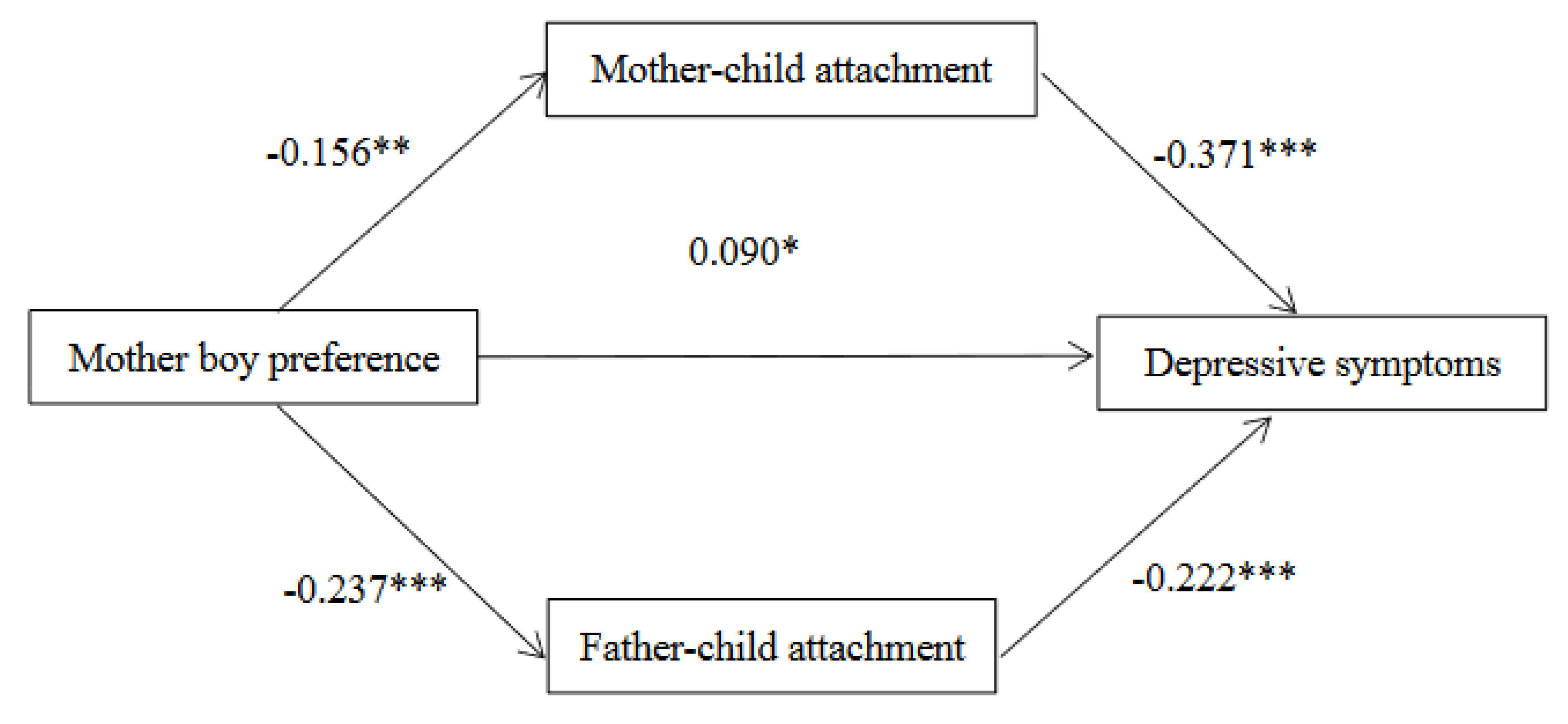
Figure 2.
The moderation effect of school connectedness in maternal son preference and depressive symptoms among adolescent girls.
Figure 2.
The moderation effect of school connectedness in maternal son preference and depressive symptoms among adolescent girls.
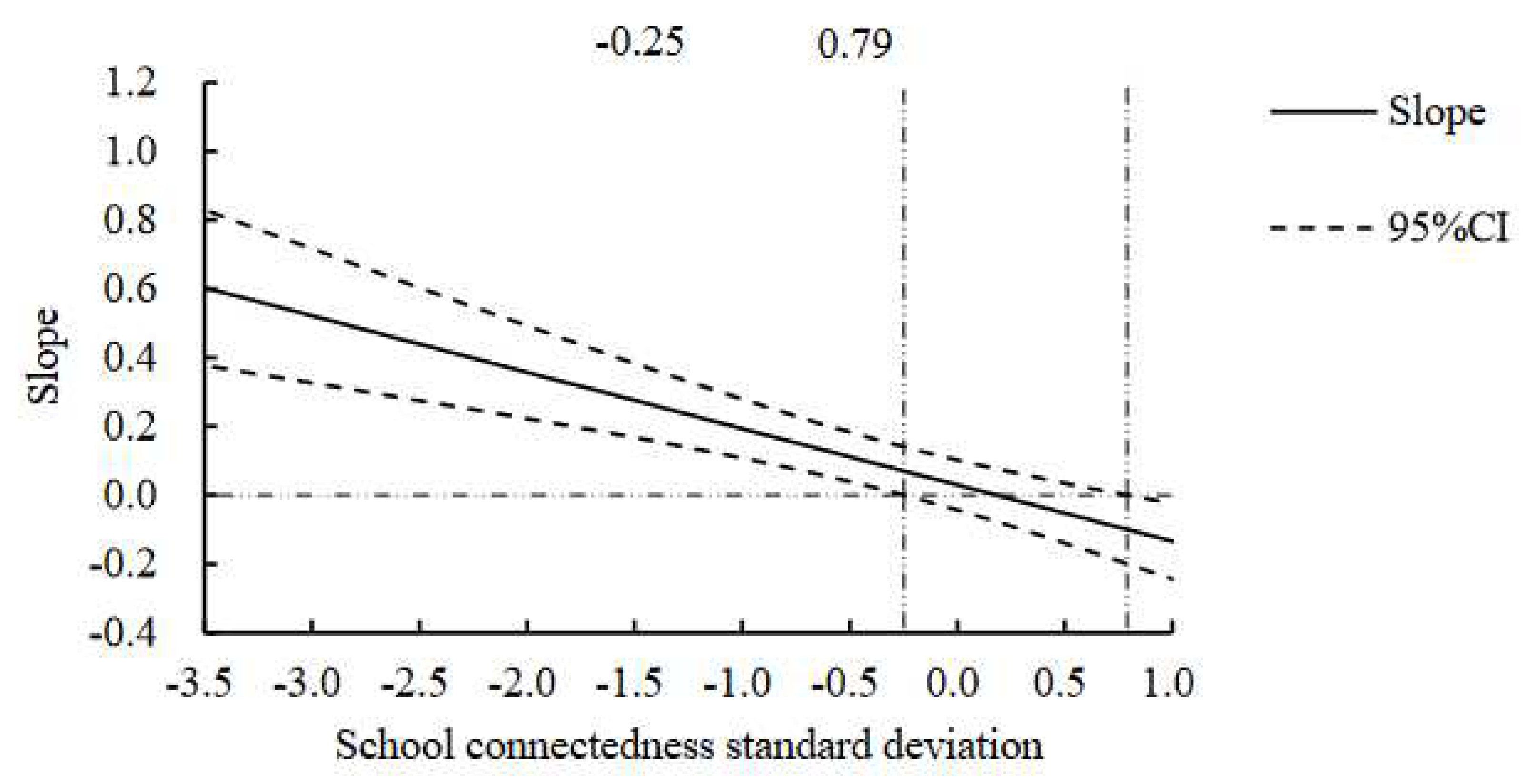

Table 1.
Descriptive statistics and correlation analysis among adolescent boys (N=631).
| M±SD | 1 | 2 | 3 | 4 | 5 | |
|---|---|---|---|---|---|---|
| 1. Maternal son preference | 0.86±0.88 | 1 | ||||
| 2. Mother-child attachment | 3.90±0.64 | -0.06 | 1 | |||
| 3. Father-child attachment | 3.84±0.72 | -0.02 | 0.68*** | 1 | ||
| 4. School connectedness | 4.39±0.65 | -0.09* | 0.50*** | 0.47*** | 1 | |
| 5. Depressive symptoms | 0.62±1.06 | 0.02 | -0.45*** | -0.41*** | -0.47*** | 1 |
Note. *p < 0.05, **p < 0.01, ***p < 0.001
Table 2.
Descriptive statistics and correlation analysis among adolescent girls (N=462).
| M±SD | 1 | 2 | 3 | 4 | 5 | |
|---|---|---|---|---|---|---|
| 1. Maternal son preference | 0.19±0.44 | 1 | ||||
| 2. Mother-child attachment | 3.90±0.61 | -0.16*** | 1 | |||
| 3. Father-child attachment | 3.79±0.68 | -0.24*** | 0.71*** | 1 | ||
| 4. School connectedness | 4.43±0.57 | -0.13** | 0.47*** | 0.50*** | 1 | |
| 5. Depression symptoms | 0.61±0.96 | 0.20*** | -0.54*** | -0.51*** | -0.54*** | 1 |
Table 3.
The mediation effect of parent-child attachment.
| Effect Type | Effect Size | Boot SE | Bootstrap 95%CI | Relative Effect Ratio (%) | |
|---|---|---|---|---|---|
| LLCI | ULCI | ||||
| Total effect | 0.201 | 0.046 | 0.111 | 0.290 | 100 |
| Direct effect | 0.090 | 0.039 | 0.013 | 0.167 | 44.8 |
| Indirect effect 1 | 0.058 | 0.027 | 0.013 | 0.118 | 28.9 |
| Indirect effect 2 | 0.053 | 0.023 | 0.014 | 0.103 | 26.3 |
Note. Indirect effect 1: Maternal son preference→Mother-child attachment→Depressive symptoms; Indirect effect 2: Maternal son preference→Father-child attachment→Depressive symptoms.
Table 4.
The moderation effect of school connectedness on maternal son preference and depressive symptoms.
Table 4.
The moderation effect of school connectedness on maternal son preference and depressive symptoms.
| Dependent variable | Independent variable | β | SE | t | R² | F |
|---|---|---|---|---|---|---|
| MCA | MBP | -0.087 | 0.043 | -2.026 | 0.233 | 46.297*** |
| SC | 0.454 | 0.041 | 10.947 | |||
| MBP×SC | 0.036 | 0.038 | 0.962 | |||
| FCA | MBP | -0.158 | 0.042 | -3.804 | 0.283 | 60.377*** |
| SC | 0.470 | 0.040 | 11.714 | |||
| MBP×SC | 0.058 | 0.036 | 1.605 | |||
| Depressive symptoms | MBP | 0.030 | 0.037 | 0.805 | 0.458 | 54.736*** |
| MCA | -0.303 | 0.051 | -5.897*** | |||
| FCA | -0.076 | 0.053 | -1.437 | |||
| SC | -0.303 | 0.043 | -6.972*** | |||
| MBP×SC | -0.164 | 0.034 | -4.829*** | |||
| MCA×SC | -0.027 | 0.043 | -0.614 | |||
| FCA×SC | 0.076 | 0.046 | 1.658 |
Note. MBP=maternal son preference, MCA=mother-child attachment, FCA=father-child attachment, SC=school connectedness.
Disclaimer/Publisher’s Note: The statements, opinions and data contained in all publications are solely those of the individual author(s) and contributor(s) and not of MDPI and/or the editor(s). MDPI and/or the editor(s) disclaim responsibility for any injury to people or property resulting from any ideas, methods, instructions or products referred to in the content. |
© 2023 by the authors. Licensee MDPI, Basel, Switzerland. This article is an open access article distributed under the terms and conditions of the Creative Commons Attribution (CC BY) license (http://creativecommons.org/licenses/by/4.0/).
Copyright: This open access article is published under a Creative Commons CC BY 4.0 license, which permit the free download, distribution, and reuse, provided that the author and preprint are cited in any reuse.


