

Submitted:
29 November 2023
Posted:
29 November 2023
You are already at the latest version
Abstract
Tuberculosis (TB) caused by Mycobacterium tuberculosis remains a predominant cause of mortality, especially in low- and middle-income nations. Recently antimicrobial peptides were discovered that at low concentrations could stimulate the growth of M. tuberculosis (hormetic response). In this study, such a peptide was used to investigate the effects on the time to positivity (TTP). A systematic substitution analysis of peptide 14D was synthesized using Spot synthesis technology, resulting in 171 novel peptides. Our findings revealed a spectrum of interactions, with some peptides accelerating M. tuberculosis growth, potentially aiding in faster diagnostics, while others exhibited inhibitory effects. Notably, peptide NH2-wkivfiwrr-CONH2 significantly reduced the TTP by 25 hours compared to the wild-type peptide 14D, highlighting its potential in improving TB diagnostics by culture. Several peptides demonstrated potent antimycobacterial activity, with a minimum inhibitory concentration (MIC) of 20 µg/mL against H37Rv and a multidrug-resistant M. tuberculosis strain. Additionally, a reduction in the formation of cord-like structures was observed, which is indicative of reduced virulence and transmission potential. This study underscores the multifaceted roles of antimicrobial peptides in TB management, from enhancing diagnostic efficiency to offering therapeutic avenues against M. tuberculosis.
Keywords:
antimicrobial peptide
; Mycobacterium tuberculosis
; Diagnosis
; Spot synthesis
; Substitution Analysis
; TB
; anti TB compound
1. Introduction
Tuberculosis (TB) is a severe infectious disease that primarily affects the lungs but can also impact other parts of the body, caused by the bacterium Mycobacterium tuberculosis (MTB). TB is one of the top 15 causes of death worldwide, with a mortality of 1.6 million people in 2021 [1]. The disease has a significant presence in low- and middle-income countries, over 80% of cases and deaths occur there, due to socio-economic factors such as poverty, malnutrition, and inadequate healthcare systems.
Culture diagnostics of TB have long been considered the gold standard for TB diagnosis due to their high sensitivity and specificity [2]. They allow for the direct isolation and identification of the Mycobacterium tuberculosis complex from clinical specimens, providing a definitive diagnosis. Moreover, culture diagnostics enable drug susceptibility testing, which is crucial for identifying drug-resistant strains and tailoring treatment regimens [3]. Molecular and immunological diagnostics serve as complementary tools, offering rapid preliminary results, while culture diagnostics provide confirmatory testing and drug susceptibility profiles [2].
Antimicrobial peptides (AMPs) are a class of small, naturally occurring peptides known for their broad-spectrum antimicrobial activity. They are ubiquitous in nature, found in almost all living organisms, and in higher organisms play a crucial role in innate immunity. AMPs show a very strong sequence diversity, with more than 20,000 unique peptides known [4] There is also a structural diversity of AMPs, including α-helical, β-sheet, extended structures and structure combinations [5]. Most Antimicrobial Peptides (AMPs) exhibit a strong affinity for binding with the lipopolysaccharides (LPSs) present in Gram-negative bacteria, and the lipoteichoic acids found in Gram-positive bacteria. Following this binding, they interact with, and often cause depolarization and/or increased permeability in the cytoplasmic membranes [6]. In numerous instances, the peptide moves into the microbial cell to target internal structures. Hence, AMPs have the potential to impact a variety of processes as they typically don't have a single target, but multiple. It's documented that certain AMPs have an affinity for lipid II, DNA and RNA, chaperones and ribosomes, proteases, adenosine triphosphate (ATP), and ABC transporters [7,8,9,10,11,12,13,14,15,16]. At concentrations below lethal levels, some AMPs and antibiotics can promote growth, mobility, mutation frequency, and plasmid conjugative transfer [17]. For instance, GL13K peptides have demonstrated the ability to stimulate growth and boost metabolic activity in Pseudomonas aeruginosa [18]. This phenomenon is referred to as a hormetic response. Recently we have identified peptides that show a hormetic response on slow-growing mycobacteria including MTB [19]. One particular peptide, peptide 14D (NH2-wkivfwwrr-CONH2) showed a reduction in the time to positivity (TTP) on MTB in a commercial test. The stereoisomer 14L has been previously reported to inhibit MTB [20]
Here, we report the further investigation of peptide 14D in regards to the ability to reduce the TTP in a commercial test. We synthesized a substitution analysis of the peptides creating 171 new peptides. Those substitutions provided information about the interaction, what makes the peptides more active or alternatively, drives it towards inhibition instead of stimulation. For all variants TTPs were determined and selected variants were resynthesized on resin and purified to verify the screening data.
2. Methods
2.1. Peptides
The peptide library was fabricated utilizing automated solid-phase peptide synthesis (SPPS) on a Whatman 50 cellulose membrane (10 cm x 15 cm) with the assistance of a MultiPep RSI peptide synthesizer (Intavis, Tuebingen, Germany), adapting the manual synthesis protocol delineated in [21]. Initially, the membrane underwent functionalization through an overnight incubation in a solution comprising 0.2 M Fmoc-Gly-OH (Aldrich), 0.24 M N, N'-diisopropyl carbodiimide (DIC, Fluka), and 0.4 M N-methylimidazole (NMI, Aldrich) in dimethylformamide (DMF, VWR, Leicestershire, UK), setting the stage for automated synthesis.
Following this, deprotection of the glycine was carried out in a 20% piperidine solution (v/v, Thermofisher Acros Organics, Geel, Belgium) in DMF, executed in two phases of 20 and 10 minutes. The synthesis at distinct spots utilized the Fmoc/tBu strategy, employing pre-activated Fmoc amino acids (Bachem, Bubendorf, Switzerland) mixed with equal molar quantities of 1-hydroxybenzotriazole hydrate (HOBt, Aldrich) and DIC, all housed in N-methyl-2-pyrrolidone (NMP, VWR, Leicestershire, UK). This approach ensured heightened coupling efficiency at each position of the amino acid sequence through a double coupling procedure lasting 2x10 minutes.
Post each amino acid coupling cycle, a 5-minute treatment with acetic anhydride (5% v/v in DMF, Fluka) was administered to cap unreacted residues. Subsequently, the Fmoc protective group was removed using a 20% piperidine solution in DMF for two intervals of 5 minutes each. The final stage of the synthesis involved the cleavage of the amino acid side-chain protecting groups, executed through a two-step process involving solutions with varying concentrations of trifluoroacetic acid (TFA) (Acros Organics, Geel, Belgium), tri-isopropylsilane (TIPS, Acros Organics, Geel, Belgium), and water in dichloromethane (DCM, Acros Organics, Geel, Belgium).
The peptides were then severed from the solid support following an overnight incubation in a saturated atmosphere of ammonia gas. The yield and quality of the SPOT synthesis were ascertained using a control peptide and a subset of peptides from the synthesis (n=18). These peptides were isolated using a one-hole-puncher (Ø=6 mm), placed in a sterile 96-well round-bottomed polypropylene non-treated microtiter plate, and left to dissolve overnight in 200 µl of sterile water at room temperature. The peptide concentration was quantified through absorbance measurements at 280 nm using a spectrophotometer. Further analysis was conducted using analytical RP HPLC on a Shim-pack VP-ODS column (120 Å, 150x4.6 mm, Shimadzu, Milton Keynes, UK) facilitated by an LC2010AHT system (Shimadzu, Milton Keynes, UK), employing a solvent system with specific gradients and flow rates.
Peptides on resin were synthesized through automated solid-phase peptide synthesis (SPPS) utilizing a MultiPep RSI peptide synthesizer (Intavis, Tuebingen, Germany) and adhering to the 9-fluorenyl-methoxycarbonyl-tert-butyl (Fmoc/tBu) strategy. The reactive side chains were safeguarded using protective groups such as tBu for Tyr and Asp, trityl (Trt) for Asn, Cys, Gln, and His, 2,2,4,6,7 pentamethyldihydrobenzofuran-5-sulfonyl (Pbf) for Arg, and tert-butoxycarbonyl (Boc) for Lys and Trp.
During the automated SPPS, four equivalents of Fmoc amino acids (Bachem, Bubendorf, Switzerland) were coupled onto TentaGel® HL RAM resin (25 μmol scale, loading 0.3–0.4 mmol/g, Rapp Polymere, Tuebingen, Germany). This was facilitated by in situ activation involving four equivalents of N,N,N′,N′-Tetramethyl-O-(1H-benzotriazol-1-yl)uronium hexafluorophosphate (HBTU; Carbosynth, Berkshire, UK) and eight equivalents of N-Methylmorpholine (NMM, Sigma, Dorset, UK). A double-coupling procedure was executed for 2 × 30 minutes, followed by the removal of the Fmoc group using a 20% (v/v) piperidine solution (Thermofisher Acros Organics, Geel, Belgium) in dimethylformamide (DMF, Jencons-VWR, Leicestershire, UK).
The peptide amides were then cleaved from the resin using a 95% (v/v) aqueous trifluoroacetic acid (TFA, Fisher Scientific, Loughborough, UK) solution, which contained a 5% (v/v) triisopropylsilane (TIPS, Thermofisher Acros Organics, Geel, Belgium)/water (1:1) scavenger mixture, a process lasting 3 hours. Following this, the cleaved peptides were precipitated using ice-cold methyl tert-butyl ether (MTBE; Thermofisher Acros Organics, Geel, Belgium), and post centrifugation, they were dissolved in a solution containing 20% (v/v) acetonitrile (ACN, Jencons-VWR, Leicestershire, UK) and 80% (v/v) water with 1% (v/v) TFA, achieving a concentration of 15 mg/mL.
Analytical reversed-phase (RP) HPLC on a Shim-pack VP-ODS column (120 Å, 150 × 4.6 mm, Shimadzu, Milton Keynes, UK) facilitated by a Shimadzu LC2010AHT system (Shimadzu, Milton Keynes, UK) was employed for analysis. The solvent system used contained 0.1% (v/v) TFA in H2O (solvent A) and 0.1% (v/v) TFA in acetonitrile (solvent B). Verification of the identity was conducted through liquid chromatography–electrospray ionisation mass spectrometry (LC-ESI-MS) using a Shimadzu LC2020 system (Shimadzu, Milton Keynes, UK) equipped with a Jupiter 4 μ Proteo C18 column (90 Å, 250 × 4.6 mm, Phenomenex, Cheshire, UK). The solvent system here comprised 0.01% (v/v) TFA in H2O (solvent A) and 0.01% (v/v) TFA in acetonitrile (solvent B).
Crude peptides were purified to the homogeneity of >92% by preparative RP HPLC on a Shimadzu LC2020 system equipped with a Jupiter 10 μ Proteo C18 column (90 Å, 250 × 21.2 mm, Phenomenex, (Phenomenex, Cheshire, UK)) using a linear gradient system containing 0.01% (v/v) TFA in H2O (solvent A) and 0.01% (v/v) TFA in acetonitrile (solvent B). Pure products were finally characterized by analytical RP-HPLC and LCMS.
2.2. Mycobacterial Culture
The Mycobacterium tuberculosis laboratory strain H37Rv was cultivated in Middlebrook 7H9 media (BD, Wokingham, UK) supplemented with 0.2% glycerol, 0.1% casitone, and 10% OADC at 37 °C. The screening was automated using the BACTEC MGIT 320 system with MGIT mycobacterial culture tubes, supplemented according to manufacturer recommendations.
2.3. Peptide Screening
Peptide screening and verification assays were conducted using the BACTEC MGIT 320 system, with MGIT mycobacterial culture tubes supplemented as per manufacturer guidelines. The tubes were inoculated with exponential starter cultures and peptides at different final concentrations, and TTPs were taken from the automated reader, measuring the relative fluorescence of an oxygen depletion indicator. Once a preset threshold is crossed the TTP is given.
2.4. Minimal Inhibitory Concentration
The determination of the Minimal Inhibitory Concentration (MIC) was carried out in 96-well plates utilising a microdilution assay, as delineated by Wiegand et al. [22]. This assay was conducted twice, with each experiment comprising three technical replicates. Given that all six trials yielded consistent results, a third iteration was deemed unnecessary, thereby conserving both time and resources in the biosafety category 3 laboratory.
3. Results
3.1. Determining the Time to Positivity (TTP) for All 171 Single Substitutions of Peptide 14D
Spot synthesis is a time and cost-efficient method for the synthesis of large numbers of peptides in a parallel and addressable fashion and was developed by Ronald Frank [21,23]. This technique was used to synthesise a systematic substitution library of the peptide 14D (NH2-wkivfwwrr-CONH2) comprising of 171 new peptides. This peptide was discovered recently to have a growth-stimulating effect at low concentrations, a hormetic response, on slow-growing mycobacteria in particular M. tuberculosis [19]. It was shown that the peptide 14D could reduce the Time To Positivity (TTP) in a commercial MTB test. The peptide is made up completely of D-amino acids and, therefore is more stable against proteases than the peptide made up of L-amino acids. We were interested in learning more about the effect by systematically substituting each amino acid with the d-isomer of the naturally occurring amino acids. We also used Glycin despite the fact it has no stereochemistry but is an important proteinogenic amino acid providing the most flexibility in a peptide chain. The peptides were synthesized via the SPOT synthesis and cleaved by ammonia gas so that all C-Termini are amidated. The peptides were then solubilized in water and the absorbance at 280nm was measured to adjust the concentration. The experiment was performed at 3 µg/mL. Each individual peptide was transferred to an individual 7 mL MGIT (Becton Dickinson, UK) mycobacterial culture tube and inoculated with an exponential starter culture. The tube was transferred into a BACTEC MGIT 320 automated mycobacterial detection system and the TTP was monitored. The TTP values of the peptide 14D controls were set to 100% and all other TTP were set relative to this beanchmark. In consequence, values larger than 100% use more time for positivity whereas smaller than 100% use less time for positivity. This data was collated in Figure 1 and color-coded for better visual understanding.
Of the 171 peptides analysed, 11 exhibited a reduction in Time to Positivity (TTP) exceeding 15%, while 13 peptides demonstrated a TTP reduction ranging between 10 and 15%. From the most active set, five peptides were selected for subsequent verification.
Seven peptides displayed pronounced growth inhibition, surpassing 180%. From this subset, five peptides were chosen for further validation. A total of 36 peptides showed a growth inhibition between 120 and 180%, with one peptide from this category being selected for additional validation. Notably, a majority of peptides (104) exhibited activity analogous to the wild-type peptide, falling within the 90 to 120% range.
The data presents several noteworthy observations. Firstly, substitutions with alanine, glycine, proline, and to a lesser extent, asparagine, generally result in diminished growth-stimulating activity across most positions of the wild-type peptide. This trend appears to correlate with the peptide's structural prerequisites for growth stimulation. The introduction of proline, which imparts significant rigidity and creates a hinge, tends to reduce activity. Similarly, the peptide's growth-stimulating activity is compromised when its structure becomes overly flexible due to the incorporation of glycine or alanine.
Certain amino acids, when substituted, enhance the growth-stimulating activity across three or more positions. These include glutamic acid, isoleucine, lysine, and leucine. These amino acids are notably diverse: isoleucine and leucine are small and polar; glutamic acid is small and acidic; and lysine is larger and basic. Substitutional analyses of analogous peptides tested for antimicrobial activity against Pseudomonas aeruginosa revealed that amino acids such as aspartic acid and glutamic acid tend to diminish antimicrobial activity (unpublished results). In this context of M. tuberculosis, glutamic acid appears to enhance growth, potentially indicating a decrease in antimicrobial activity. Conversely, aspartic acid substitutions can either stimulate or significantly inhibit growth, suggesting a potential decrease and increase in antimicrobial activity is possible, depending on the position within the peptide.
The presence of valine at position 4 appears pivotal for growth stimulation, as nine substitutions led to diminished activity, with no substitution enhancing the effect. Similarly, position 7 did not exhibit any activity augmentation, but unlike position 4, there was no marked decrease either. Substitutions at positions 1-3 and 7-9 did not result in any pronounced activity reduction, suggesting that the core sequence from positions 4-6 is paramount for interaction since only here substitutions were detected that flipped the growth stimulation effect into a strong inhibitory effect. However, position 5 appears suboptimal for the desired effect, as six substitutions led to heightened activity, the most significant increase observed across all peptide positions of the wild type.
3.2. Verification of the Screen with Purified Peptides
As described above, 11 peptides were selected for verification of the results. These peptides were synthesized on resin and purified by HPLC-MS. The results are given in Table 1.
In the initial screening, a concentration of 3 µg/mL of the peptide was utilised. For subsequent verification, concentrations of 0.3, 3, 10, and 30 µg/mL were selected to elucidate dose-dependent effects. Concentrating on the 3 µg/mL dosage for verification, all purified peptides, which demonstrated medium or robust growth inhibition during the screening, exhibited similar levels of inhibition. This observation corroborates the screening data. The peptides NH2-wkivfdwrr-CONH2 and NH2-wkivfGwrr-CONH2 manifested the most pronounced inhibition. Of the five peptides chosen due to their propensity for accelerated growth, three exhibited faster growth at a concentration of 3µg/mL. The most efficacious peptide, NH2-wkivfiwrr-CONH2, was able to reduce the Time to Positivity (TTP) by 25 hours in comparison to the wild-type peptide and by 56 hours relative to the untreated control. Consequently, the majority of the peptides, when purified, exhibited effects consistent with the screening results, thereby validating the outcomes of the initial screen
3.3. Determining the Minimal Inhibitory Concentration (MIC) of Selected Peptides with A Strong Inhibitory Effect
To determine the minimal inhibitory concentration (MIC) of antimicrobial compounds against M. tuberculosis several methods are used, for example, liquid culture systems, including BACTEC MB/BacT, MGIT and microdilution broth assay in 96 well plates. In addition, culture-based techniques on solid media are used [24,25,26]. Here we applied the microdilution broth assay for five peptides. The results of the MICs are shown in Table 2.
In the observed increase in TTP values (see Table 1) associated with these peptides, each exhibited a reduced MIC in comparison to the wild-type peptide 14D. At a concentration of 30 µg/mL, every peptide extended the TTP by approximately 40 days relative to M. tuberculosis alone. Notably, the minor variations observed in TTP reduction did not correspond to distinct MICs; all were consistently measured at 20 µg/mL. As is commonly observed with numerous antimicrobial peptides, the MIC against multi-drug resistant (MDR) strains remains consistent with that of the sensitive strains. This pattern is evident in the current data as well.
3.4. Observing Changes in Cord Formation in the Presence of Peptides at 10 µg/mL
The cord factor Trehalose 6, 6′-dimycolate (TDM), is the most abundant glycolipid in the mycobacterial cell wall. Similar to a biofilm formation of other bacteria, cord provides a dense arrangement of bacteria that leads to a shield against antibiotic-mediated killing. It displays well-characterized conformation-dependent immunostimulatory effects, that enable the bacteria to suppress host inflammatory response when needed. The cords play a role in bacterial dissemination by exerting forces on cellular organelles and tissues. This might aid in the spread of the infection within the host, making it more challenging to contain and treat [27,28].
4. Discussion
Tuberculosis (TB) remains a formidable global health challenge, with its persistent prevalence and the problem of drug-resistant strains. The current study delves into an innovative approach to TB management, focusing on the potential of antimicrobial peptides (AMPs) not just as antimicrobial agents, but more importantly, as growth stimulators for Mycobacterium tuberculosis. This unique approach aimed to reduce the Time to Positivity (TTP) in diagnostic tests, potentially leading to faster diagnosis and timely intervention.
The systematic substitution analysis of peptide 14D, which yielded 171 novel peptides, has illuminated a spectrum of interactions with M. tuberculosis. This provided a comprehensive insight into the sequence-activity relationship of these molecules. The extensive exploration has illuminated the nuanced interactions between these peptides and the bacterium. While some peptides further accelerated growth, others, intriguingly, inhibited it. This dual behaviour underscores the multifaceted nature of AMPs and their potential roles in both therapeutic and diagnostic applications. The peptide NH2-wkivfiwrr-CONH2, in particular, stands out for its ability to significantly reduce the Time to Positivity (TTP) by 25 hours compared to the wild-type peptide. Such a reduction in TTP by just one amino acid substitution shows the potential to further improve peptides that can consequently improve TB diagnostics by culture. Faster detection and determining the antibiogram translate to earlier interventions, which can be pivotal in improving patient outcomes and reducing transmission rates.
One of the most notable findings from the systematic substitution analysis of peptide 14D was the role of negatively charged amino acids in modulating M. tuberculosis growth. Historically, in substitution analyses performed on other AMPs targeting different pathogens, measuring antimicrobial activity, the introduction of negatively charged amino acids often resulted in a marked reduction in antimicrobial activity, see Figure 3. This is typically attributed to the disruption of electrostatic interactions between the positively charged AMPs and the negatively charged microbial cell membranes. However, in the context of measuring growth stimulation of M. tuberculosis, the opposite was observed. The incorporation of negatively charged amino acids, in many instances, enhanced the growth-stimulating activity of the peptides. This counterintuitive observation suggests that the interaction dynamics between these peptides and M. tuberculosis are distinct from those of conventional AMPs with their target pathogens. In addition, as seen in Figure 3, lysine and arginine both usually show improvements at many positions to increase antimicrobial activity. However, for the growth stimulation, except in one position, only lysine improves growth stimulation and contrary to expectations neither improves inhibition. These intriguing observations suggest a unique interaction mechanism between the peptide and the bacterium, which warrants further investigation.
Furthermore, the study identified peptides with strong inhibitory effects against M. tuberculosis, with a remarkable MIC of 20 µg/mL. This is particularly significant given the rise of multi-drug resistant strains of M. tuberculosis. The ability of these peptides to inhibit both the standard H37Rv strain and a multi-drug resistant strain at the same MIC underscores their potential as therapeutic agents. The consistent MIC against both strains suggests a mechanism of action that is not easily bypassed by the common resistance mechanisms present in the MDR strains. This could pave the way for the development of new therapeutic agents that can effectively combat resistant strains of M. tuberculosis. We believe that 20 µg/mL against a multi-drug resistant M. tuberculosis strain is a good starting point for further optimizations.
The observation of reduced cord formation in the presence of two peptides is another unexpected but significant finding. Cord formation is a well-documented virulence factor in M. tuberculosis, aiding in bacterial dissemination and potentially contributing to the spread of infection within the host. The ability of peptides to disrupt this process could have therapeutic implications, potentially limiting the spread of the bacterium within the host and making it more susceptible to immune clearance and antimicrobial therapy. It seems like the peptide 14D has an inherent ability to reduce cord formation and that other substitutions destroy this ability except for NH2-wkivfdwrr-CONH2. Further, more detailed investigations are necessary to understand this effect and its potential as a treatment option.
In conclusion, this study has provided valuable insights into the potential of peptide 14D and its variants in both the diagnostic and therapeutic realms of TB management. The findings underscore the versatility of AMPs and their potential to be harnessed in innovative ways to combat infectious diseases. Further studies are warranted to elucidate the exact mechanisms of interaction between these peptides and M. tuberculosis, which could pave the way for the development of novel diagnostic tools and therapeutic agents against this persistent global health threat.
Author Contributions
K.H.: Intellectual design, data analysis, funding support, supervision, writing the first version and editing the manuscript. T.M.: Data collection and data analysis, editing the manuscript, P.M.L.-P.: Peptide synthesis and characterisation, editing the manuscript, J.S.-G.: Data collection and analysis, T.J.B.: Intellectual design, data collection, data analysis, supervision, funding support, editing the manuscript. All authors have agreed to the published version of the manuscript.
Funding
This study was funded by a grant from SBRI, UK, Phase I & II Healthcare: Better Health Outcomes Award and Innovate UK, development grant TS/M009068/1.
Data Availability Statement
The vast majority of data is presented in the manuscript. Further data presented in this study are available on request from the corresponding author.
Acknowledgments
Chat-GPT-4 AI software was used to improve the clarity of some text in the manuscript. We thank Sven Hofmann for his technical support of the peptide synthesis. K.H. thanks life for the opportunity to get a chance, despite the odds, to be able to continue researching and contributing to the research described in this manuscript.
Conflicts of Interest
Several peptides described in this manuscript are patented. Tim Bull and Kai Hilpert are the founders and directors of TiKa Diagnostics Ltd. P.M.L.-P. and J.S.-G. were employed by TiKa Diagnostics Ltd. TiKa Diagnostics Ltd. supported peptide synthesis and TTP measurements.
References
- WHO Tuberculosis - Key Facts Available online: https://www.who.int/news-room/fact-sheets/detail/tuberculosis (accessed on 1 November 2018).
- Gill, C.M.; Dolan, L.; Piggott, L.M.; McLaughlin, A.M. New Developments in Tuberculosis Diagnosis and Treatment. Breathe 2022, 18. [CrossRef]
- Sibandze, D.B.; Kay, A.; Dreyer, V.; Sikhondze, W.; Dlamini, Q.; DiNardo, A.; Mtetwa, G.; Lukhele, B.; Vambe, D.; Lange, C.; et al. Rapid Molecular Diagnostics of Tuberculosis Resistance by Targeted Stool Sequencing. Genome Med. 2022, 14, 1–11. [CrossRef]
- Kang, X.; Dong, F.; Shi, C.; Liu, S.; Sun, J.; Chen, J.; Li, H.; Xu, H.; Lao, X.; Zheng, H. DRAMP 2.0, an Updated Data Repository of Antimicrobial Peptides. Scientific Data 2019, 6, 1–10. [CrossRef]
- Dini, I.; De Biasi, M.G.; Mancusi, A. An Overview of the Potentialities of Antimicrobial Peptides Derived from Natural Sources. Antibiotics 2022, 11. [CrossRef]
- Hancock, R.E.; Chapple, D.S. Peptide Antibiotics. Antimicrob. Agents Chemother. 1999, 43, 1317–1323.
- Le, C.-F.; Fang, C.-M.; Sekaran, S.D. Intracellular Targeting Mechanisms by Antimicrobial Peptides. Antimicrob. Agents Chemother. 2017, 61. [CrossRef]
- Hilpert, K.; McLeod, B.; Yu, J.; Elliott, M.R.; Rautenbach, M.; Ruden, S.; Bürck, J.; Muhle-Goll, C.; Ulrich, A.S.; Keller, S.; et al. Short Cationic Antimicrobial Peptides Interact with ATP. Antimicrob. Agents Chemother. 2010, 54. [CrossRef]
- Brogden, K.A. Antimicrobial Peptides: Pore Formers or Metabolic Inhibitors in Bacteria? Nat. Rev. Microbiol. 2005, 3, 238–250. [CrossRef]
- Cho, J.H.; Sung, B.H.; Kim, S.C. Buforins: Histone H2A-Derived Antimicrobial Peptides from Toad Stomach. Biochimica et Biophysica Acta (BBA) - Biomembranes 2009, 1788, 1564–1569. [CrossRef]
- Kobayashi, S.; Takeshima, K.; Park, C.B.; Kim, S.C.; Matsuzaki, K. Interactions of the Novel Anfimicrobial Peptide Buforin 2 with Lipid Bilayers: Proline as a Translocation Promoting Factor. Biochemistry 2000, 39, 8648–8654. [CrossRef]
- Marchand, C.; Krajewski, K.; Lee, H.-F.; Antony, S.; Johnson, A.A.; Amin, R.; Roller, P.; Kvaratskhelia, M.; Pommier, Y. Covalent Binding of the Natural Antimicrobial Peptide Indolicidin to DNA Abasic Sites. Nucleic Acids Res. 2006, 34, 5157–5165. [CrossRef]
- Carlsson, A.; Engström, P.; Palva, E.T.; Bennich, H. Attacin, an Antibacterial Protein from Hyalophora Cecropia, Inhibits Synthesis of Outer Membrane Proteins in Escherichia Coli by Interfering with Omp Gene Transcription. Infect. Immun. 1991, 59, 3040–3045.
- Mardirossian, M.; Sola, R.; Beckert, B.; Valencic, E.; Collis, D.W.P.; Borišek, J.; Armas, F.; Di Stasi, A.; Buchmann, J.; Syroegin, E.A.; et al. Peptide Inhibitors of Bacterial Protein Synthesis with Broad Spectrum and SbmA-Independent Bactericidal Activity against Clinical Pathogens. J. Med. Chem. 2020, 63, 9590–9602. [CrossRef]
- Mardirossian, M.; Sola, R.; Beckert, B.; Collis, D.W.P.; Di Stasi, A.; Armas, F.; Hilpert, K.; Wilson, D.N.; Scocchi, M. Proline-Rich Peptides with Improved Antimicrobial Activity against E. Coli, K. Pneumoniae and A. Baumannii. ChemMedChem 2019. [CrossRef]
- Mardirossian, M.; Pérébaskine, N.; Benincasa, M.; Gambato, S.; Hofmann, S.; Huter, P.; Müller, C.; Hilpert, K.; Innis, C.A.; Tossi, A.; et al. The Dolphin Proline-Rich Antimicrobial Peptide Tur1A Inhibits Protein Synthesis by Targeting the Bacterial Ribosome. Cell Chem. Biol. 2018. [CrossRef]
- Iavicoli, I.; Fontana, L.; Agathokleous, E.; Santocono, C.; Russo, F.; Vetrani, I.; Fedele, M.; Calabrese, E.J. Hormetic Dose Responses Induced by Antibiotics in Bacteria: A Phantom Menace to Be Thoroughly Evaluated to Address the Environmental Risk and Tackle the Antibiotic Resistance Phenomenon. Science of The Total Environment 2021, 798, 149255. [CrossRef]
- Gorr, S.U.; Brigman, H. V.; Anderson, J.C.; Hirsch, E.B. The Antimicrobial Peptide DGL13K Is Active against Drug-Resistant Gram-Negative Bacteria and Sub-Inhibitory Concentrations Stimulate Bacterial Growth without Causing Resistance. PLoS ONE 2022, 17, e0273504. [CrossRef]
- Hilpert, K.; Munshi, T.; López-Pérez, P.M.; Sequeira-Garcia, J.; Hofmann, S.; Bull, T.J. Discovery of Antimicrobial Peptides That Can Accelerate Culture Diagnostics of Slow-Growing Mycobacteria Including Mycobacterium Tuberculosis. Microorganisms 2023, Vol. 11, Page 2225 2023, 11, 2225. [CrossRef]
- Ramón-García, S.; Mikut, R.; Ng, C.; Ruden, S.; Volkmer, R.; Reischl, M.; Hilpert, K.; Thompson, C.J. Targeting Mycobacterium Tuberculosis and Other Microbial Pathogens Using Improved Synthetic Antibacterial Peptides. Antimicrob. Agents Chemother. 2013, 57. [CrossRef]
- Hilpert, K.; Winkler, D.F.H.D.F.H.; Hancock, R.E.W.R.E.W. Peptide Arrays on Cellulose Support: SPOT Synthesis, a Time and Cost Efficient Method for Synthesis of Large Numbers of Peptides in a Parallel and Addressable Fashion. Nat. Protoc. 2007, 2. [CrossRef]
- Wiegand, I.; Hilpert, K.; Hancock, R.E.W. Agar and Broth Dilution Methods to Determine the Minimal Inhibitory Concentration (MIC) of Antimicrobial Substances. Nat. Protoc. 2008, 3. [CrossRef]
- Frank, R. Spot-Synthesis: An Easy Technique for the Positionally Addressable, Parallel Chemical Synthesis on a Membrane Support. Tetrahedron 1992. [CrossRef]
- Schön, T.; Werngren, J.; Machado, D.; Borroni, E.; Wijkander, M.; Lina, G.; Mouton, J.; Matuschek, E.; Kahlmeter, G.; Giske, C.; et al. Antimicrobial Susceptibility Testing of Mycobacterium Tuberculosis Complex Isolates - the EUCAST Broth Microdilution Reference Method for MIC Determination. Clin. Microbiol. Infect. 2020, 26, 1488–1492. [CrossRef]
- Banfi, E.; Scialino, G.; Monti-Bragadin, C. Development of a Microdilution Method to Evaluate Mycobacterium Tuberculosis Drug Susceptibility. Journal of Antimicrobial Chemotherapy 2003, 52, 796–800. [CrossRef]
- Huang, T.S.; Lee, S.S.J.; Tu, H.Z.; Huang, W.K.; Chen, Y.S.; Huang, C.K.; Wann, S.R.; Lin, H.H.; Liu, Y.C. Use of MGIT 960 for Rapid Quantitative Measurement of the Susceptibility of Mycobacterium Tuberculosis Complex to Ciprofloxacin and Ethionamide. J. Antimicrob. Chemother. 2004, 53, 600–603. [CrossRef]
- Mishra, R.; Hannebelle, M.; Patil, V.P.; Dhar, N.; Mckinney, J.D.; Thacker Correspondence, V. V; Lle Dubois, A.; Garcia-Mouton, C.; Kirsch, G.M.; Jan, M.; et al. Mechanopathology of Biofilm-like Mycobacterium Tuberculosis Cords. Cell 2023, 1–16. [CrossRef]
- Noll, H.; Bloch, H.; Asselineau, J.; Lederer, E. The Chemical Structure of the Cord Factor of Mycobacterium Tuberculosis. Biochim. Biophys. Acta 1956, 20, 299–309. [CrossRef]
- López-Pérez, P.M.P.M.; Grimsey, E.; Bourne, L.; Mikut, R.; Hilpert, K. Screening and Optimizing Antimicrobial Peptides by Using SPOT-Synthesis. Front. Chem. 2017, 5. [CrossRef]
Figure 1.
Substitutional analysis of peptide 14D (NH₂-wkivfwwrr-CONH₂) regarding the Time to Positivity (TTP) of Mycobacterium tuberculosis. All 14D controls (18) were set to 100%, and all other values are relative to this benchmark. The activity levels are colour-coded: dark blue represents values less than 85%; light blue, values between 85% and 90%; light orange, values between 90% and 120%; orange, values between 120% and 180%; and red, values greater than 180%. Green circles mark the substitutions selected for verification.
Figure 1.
Substitutional analysis of peptide 14D (NH₂-wkivfwwrr-CONH₂) regarding the Time to Positivity (TTP) of Mycobacterium tuberculosis. All 14D controls (18) were set to 100%, and all other values are relative to this benchmark. The activity levels are colour-coded: dark blue represents values less than 85%; light blue, values between 85% and 90%; light orange, values between 90% and 120%; orange, values between 120% and 180%; and red, values greater than 180%. Green circles mark the substitutions selected for verification.
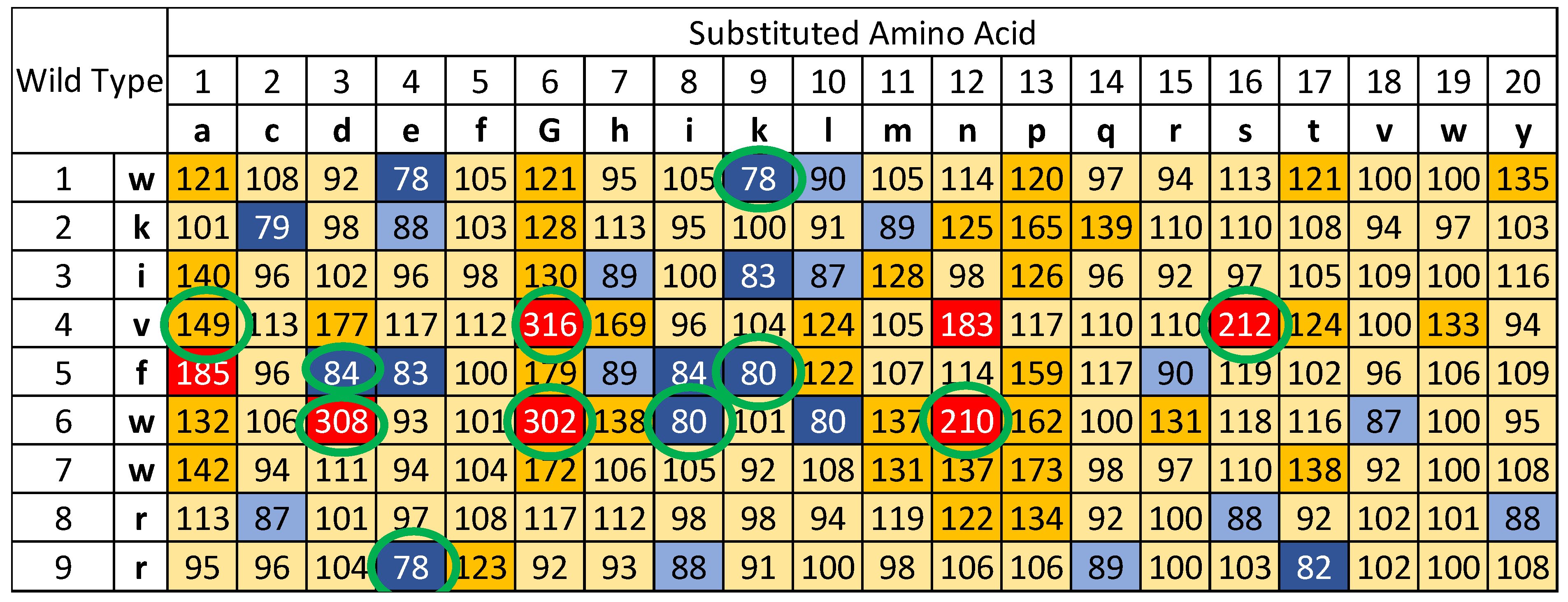
Figure 2.
Picture taken under a microscope showing M. tuberculosis H37Rv, (A) without peptide, (B) with peptide 14D at 0.5 µg/mL and (C) with peptide 14D at 10 µg/ml.
Figure 2.
Picture taken under a microscope showing M. tuberculosis H37Rv, (A) without peptide, (B) with peptide 14D at 0.5 µg/mL and (C) with peptide 14D at 10 µg/ml.
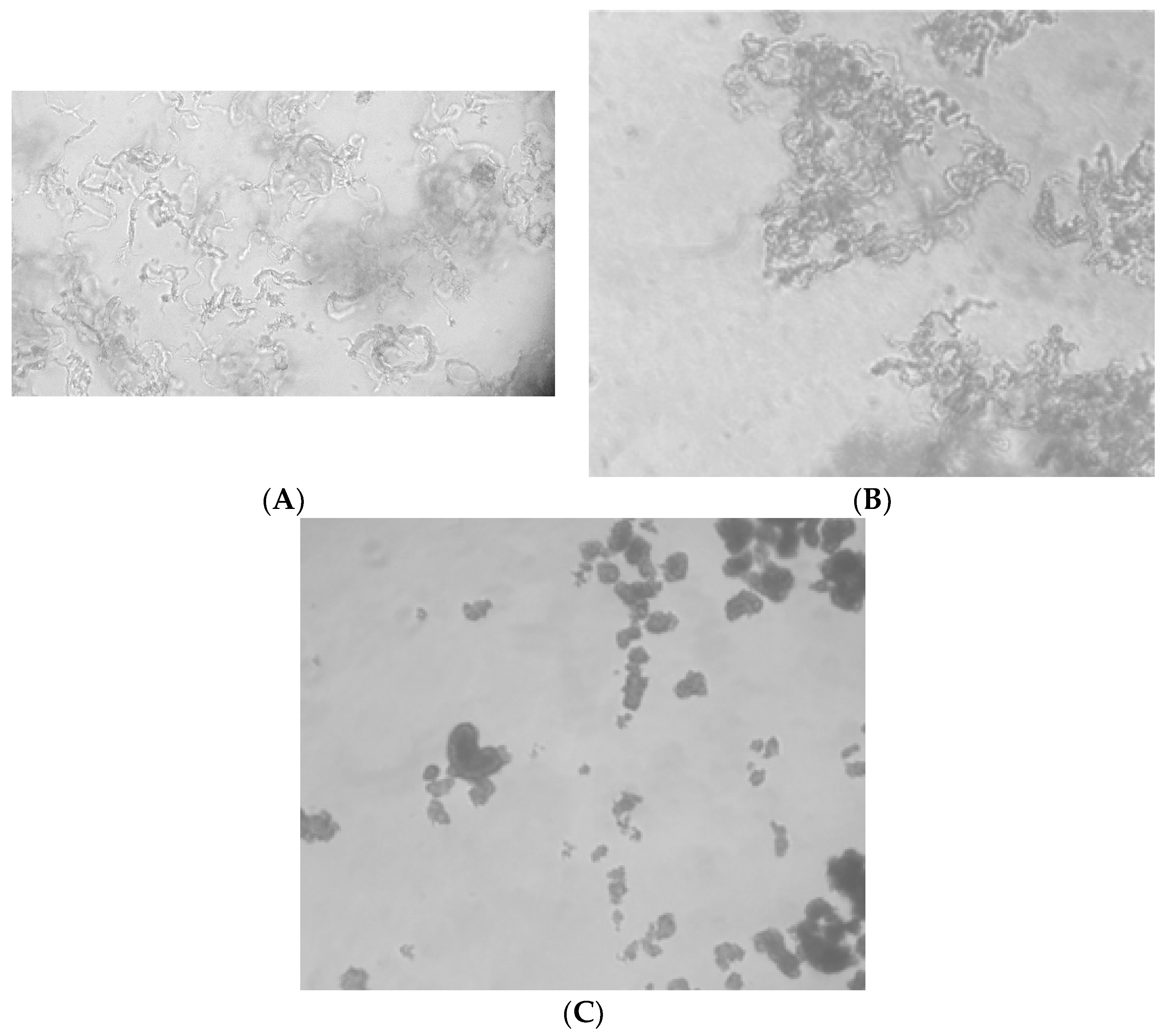
Figure 3.
Analysis of amino acid substitutions in the antimicrobial peptide Apidaecin (GNNRPVYIPQPRPPHPRL). The wild-type sequence and its respective positions are displayed in the first two columns. Subsequent rows (A-Y) show the changes in amino acids at each spot. The numbers inside each cell indicate the RelIC75 value, which is a measure of antimicrobial activity against Pseudomonas aeruginosa strain H1001 after four hours. The colour scheme of the cells ranges from blue to red: blue signifies enhanced activity compared to the original peptide, green denotes comparable activity, and red suggests no activity. Cells left blank represent the original sequence. This was taken from [29].
Figure 3.
Analysis of amino acid substitutions in the antimicrobial peptide Apidaecin (GNNRPVYIPQPRPPHPRL). The wild-type sequence and its respective positions are displayed in the first two columns. Subsequent rows (A-Y) show the changes in amino acids at each spot. The numbers inside each cell indicate the RelIC75 value, which is a measure of antimicrobial activity against Pseudomonas aeruginosa strain H1001 after four hours. The colour scheme of the cells ranges from blue to red: blue signifies enhanced activity compared to the original peptide, green denotes comparable activity, and red suggests no activity. Cells left blank represent the original sequence. This was taken from [29].
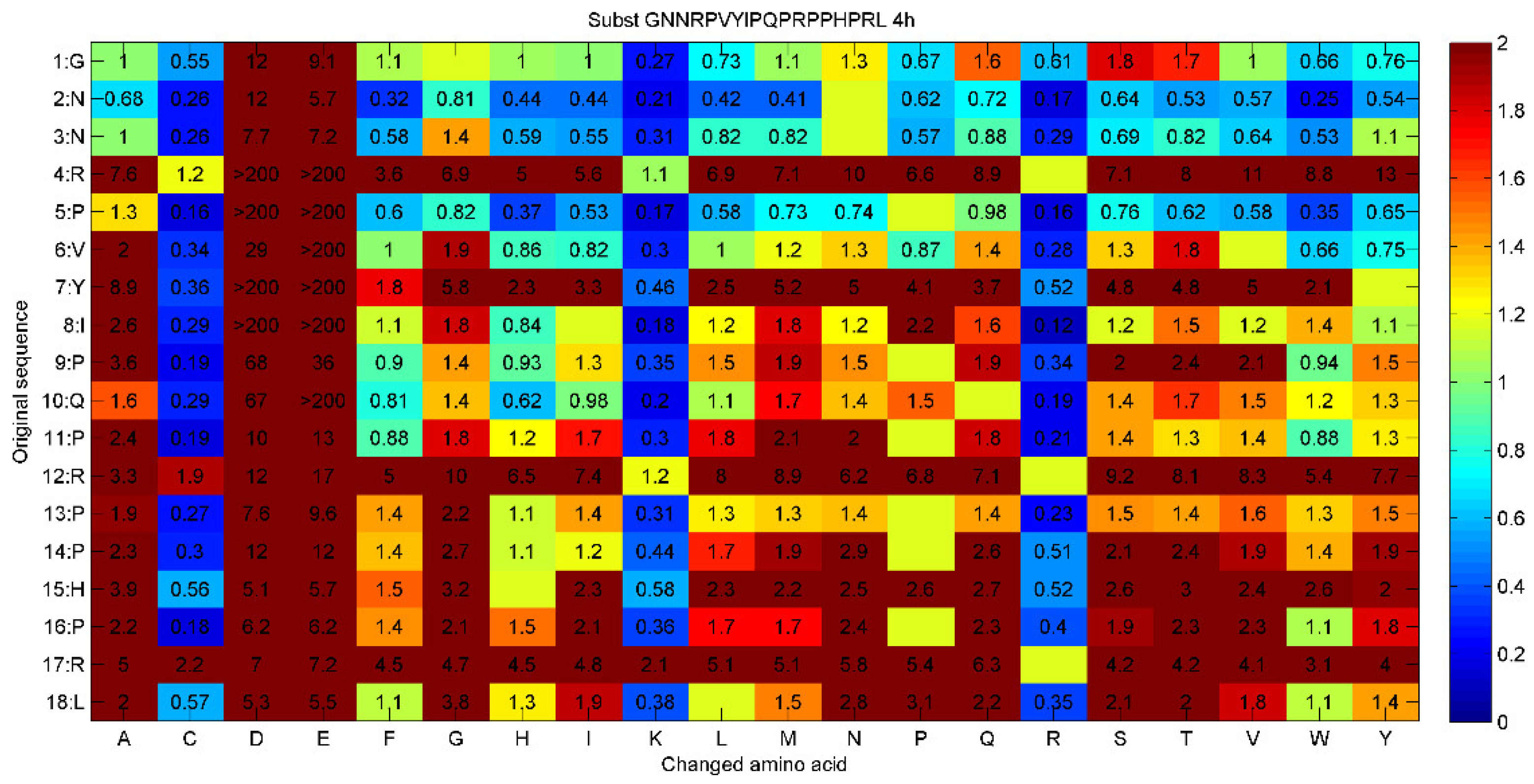

Table 1.
Effect of Peptide 14D and substituted variants at different concentrations on the time to positivity (TTP) of M. tuberculosis measured in MGIT in a BD BACTEC MGIT 320 system. All peptides are C-terminal amidated.
Table 1.
Effect of Peptide 14D and substituted variants at different concentrations on the time to positivity (TTP) of M. tuberculosis measured in MGIT in a BD BACTEC MGIT 320 system. All peptides are C-terminal amidated.
| Sequence | TTP values at different peptide concentrations | |||
| 0.3 µg/mL | 3 µg/mL | 10 µg/mL | 30 µg/mL | |
| TB alone | ||||
| 12d 4h | ||||
| Wild Type | ||||
| wkivfwwrr | 10d 17h | 10d 21h | 11d 21h | 12d 04h |
| Substitutions with potential stronger growth stimulation | ||||
| kkivfwwrr | 11d 09h | 12d 00h | 14d 00h | 46d 04h |
| wkivdwwrr | 12d 13h | 14d 12h | 16d 13h | 19d 06h |
| wkivkwwrr | 10d 08h | 10d 17h | 17d 14h | 25d 19h |
| wkivfiwrr | 10d 16h | 9d 20h | 10d 07h | 12d 21h |
| wkivfwwre | 10d 20h | 10d 00h | 11d 00h | 13d 02h |
| Substitutions with potential medium growth inhibition | ||||
| wkiafwwrr | 11d 01h | 12d 19h | 20d 16h | 47d 06h |
| Substitutions with potential strong growth inhibition | ||||
| wkiGfwwrr | 11d 19h | 15d 20h | 25d 08h | 54d 04h |
| wkisfwwrr | 10d 00h | 14d 08h | 22d 11h | 53d 20h |
| wkivfdwrr | 16d 20h | 33d 01h | 44d 02h | neg (55d) |
| wkivfGwrr | 12d 17h | 22d 08h | 46d 06h | neg (55d) |
| wkivfnwrr | 12d 21h | 15d 13h | 28d 07h | 52d 16h |
Table 2.
Minimum inhibitory concentration (MIC) of peptides against M. tuberculosis H37Rv and a multi-drug resistant (MDR) strain determined by microdilution broth assay. For all peptides, the formation of cord was observed with a microscope in the presence of 10 µg/mL peptides. All peptides are C-terminal amidated.
Table 2.
Minimum inhibitory concentration (MIC) of peptides against M. tuberculosis H37Rv and a multi-drug resistant (MDR) strain determined by microdilution broth assay. For all peptides, the formation of cord was observed with a microscope in the presence of 10 µg/mL peptides. All peptides are C-terminal amidated.
| Sequence | MIC in µg/mL | Cord formation at 10 µg/ml | ||
|---|---|---|---|---|
| H37Rv | MDR-TB | H37Rv | MDR-TB | |
| wkivfwwrr | >50 | >50 | reduced | reduced |
| wkisfwwrr | 20 | 20 | normal | normal |
| wkivfdwrr | 20 | 20 | reduced | reduced |
| wkivfGwrr | 20 | 20 | normal | normal |
| wkivfnwrr | 20 | 20 | normal | normal |
Disclaimer/Publisher’s Note: The statements, opinions and data contained in all publications are solely those of the individual author(s) and contributor(s) and not of MDPI and/or the editor(s). MDPI and/or the editor(s) disclaim responsibility for any injury to people or property resulting from any ideas, methods, instructions or products referred to in the content. |
© 2023 by the authors. Licensee MDPI, Basel, Switzerland. This article is an open access article distributed under the terms and conditions of the Creative Commons Attribution (CC BY) license (http://creativecommons.org/licenses/by/4.0/).
Copyright: This open access article is published under a Creative Commons CC BY 4.0 license, which permit the free download, distribution, and reuse, provided that the author and preprint are cited in any reuse.


