

Submitted:
09 January 2025
Posted:
10 January 2025
You are already at the latest version
Abstract
Gas turbine engines are widely used in aviation, power generation, and marine propulsion due to their efficiency and reliability. The combustion chamber, crucial to engine performance, involves various components such as fuel injection, ignition, and cooling systems. This study presents the design and optimization of a cost-effective combustion chamber model aimed at improving efficiency and power-to-fuel ratio. Numerical simulations were conducted to analyze the swirler design, enhancing combustion efficiency, air-fuel mixing, and emission reduction. The research compares different combustion chamber types based on cost, availability, and fabrication time. The fabrication process and materials used, along with safety and environmental measures, are discussed. Future work will focus on experimental validation and further development of low-emission designs to address challenges in fuel consumption and emissions.
Keywords:
Introduction
The Principles of Combustor
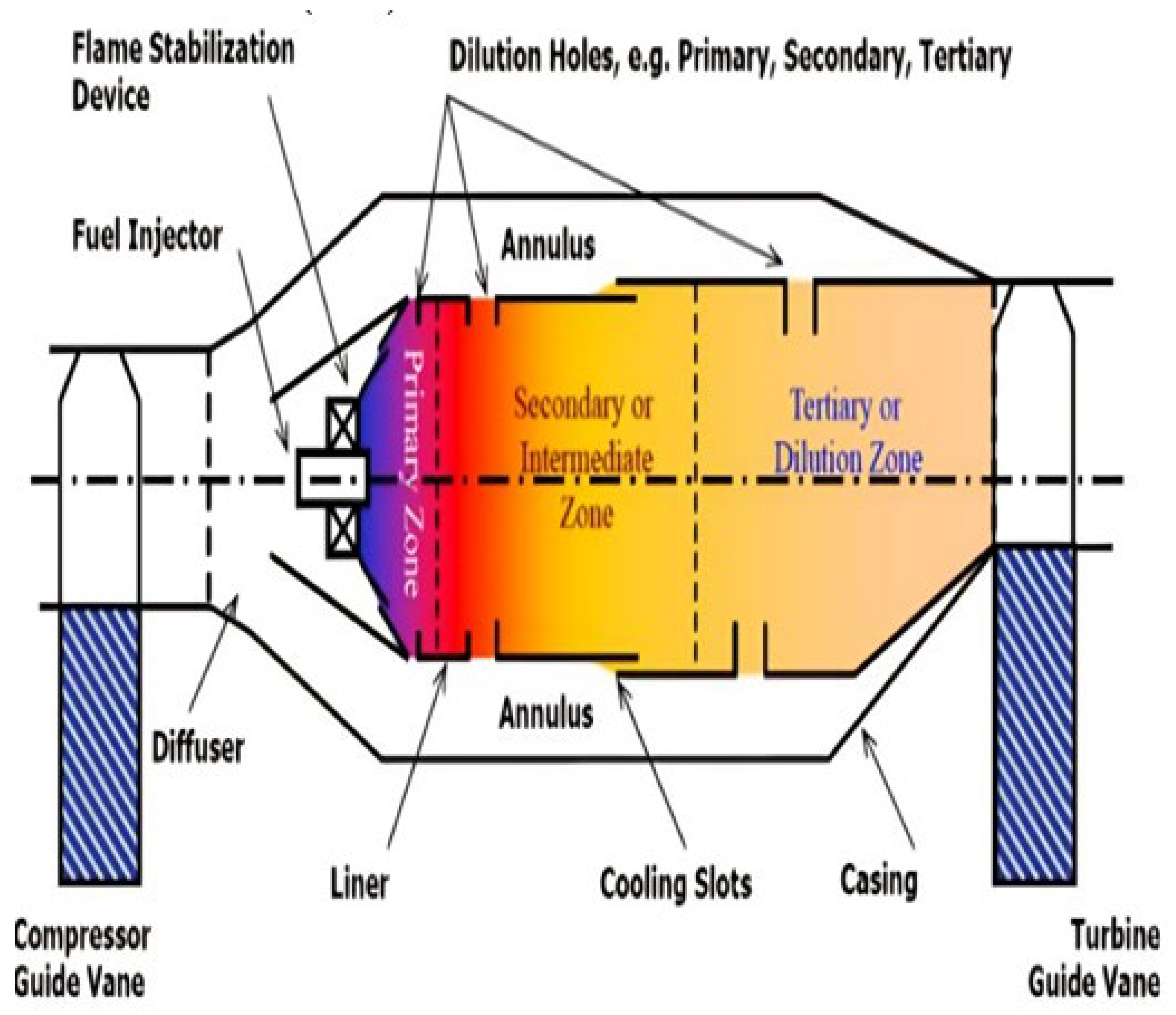
- The flame (combustion) must be contained (kept) inside the combustor. If combustion occurs further back in the engine, the turbine stages are more likely to be overheated and damaged.
- Furthermore, as turbine blades become more advanced and can endure greater temperatures, combustors are being constructed to burn at higher temperatures, and the parts of the combustor must be designed to resist those higher temperatures.
- It should be able to relight at high altitude if the engine flames out.
- Exit temperature profile that is consistent. If the exit flow contains hot patches, the turbine may be susceptible to thermal stress or other sorts of damage. Similarly, the temper- ature profile within the combustor should prevent hot patches, which can cause internal combustor damage or destruction.
- Physical size and weight are both small. Because space and weight are at a premium in aero plane applications, a well-designed combustor attempts to be small. Non-aviation applications, such as power generation gas turbines, are not as hindered by this aspect.
- Broad range of operation. Most combustors must be able to function with a wide range of inlet pressures, temperatures, and mass flows. These variables vary depending on engine settings and climatic conditions (for example, full throttle at low altitude can be considerably different from idle throttle at high altitude).
Process of Combustion in the Combustion Chamber
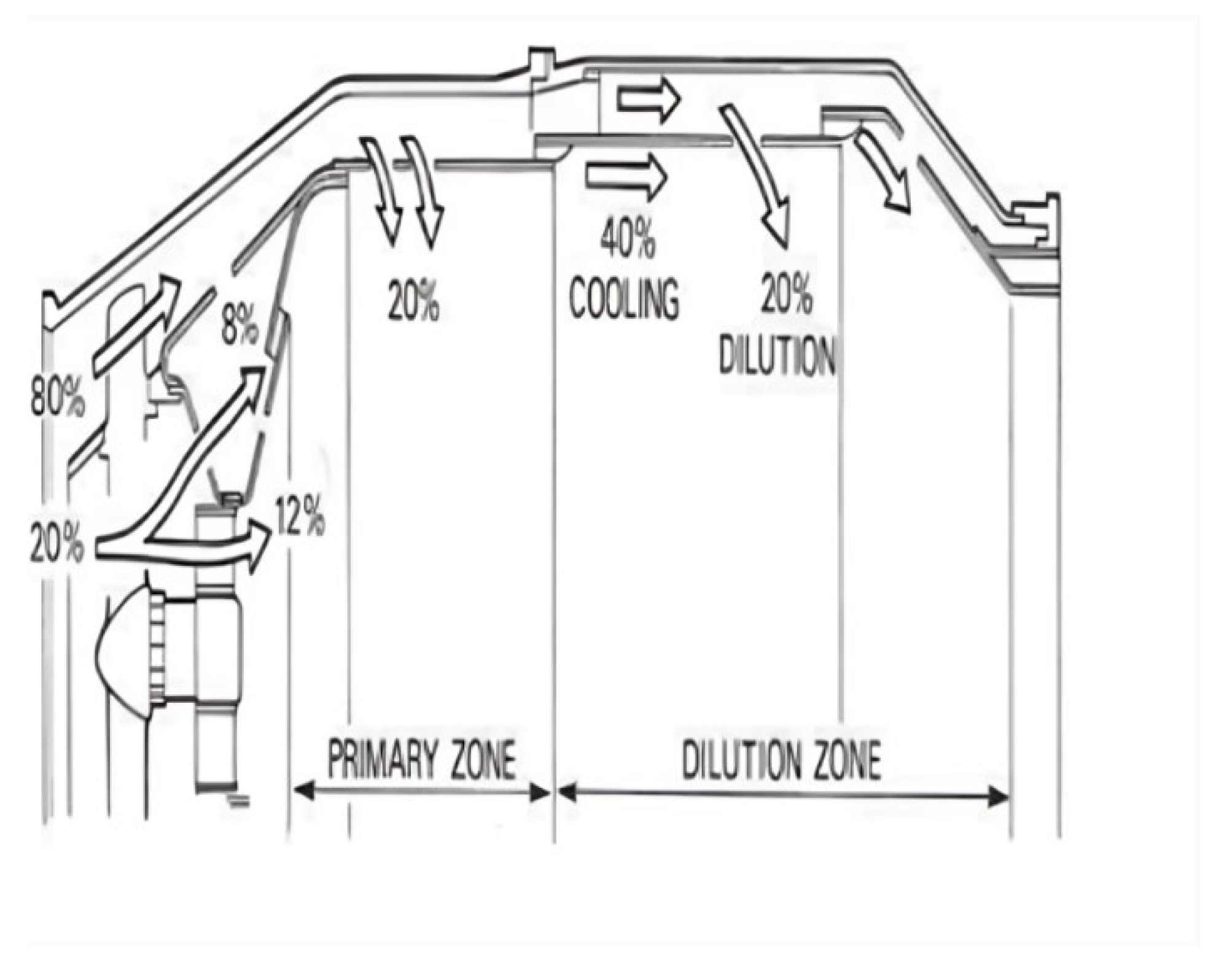
Path of Air Flow Distribution The Primary Air
The Air in the Middle
Relevant Contemporary Issue and Identification of Problem
Background
I. Design Flow/Process
A. Equations
I. Simulations Setup
I. Results
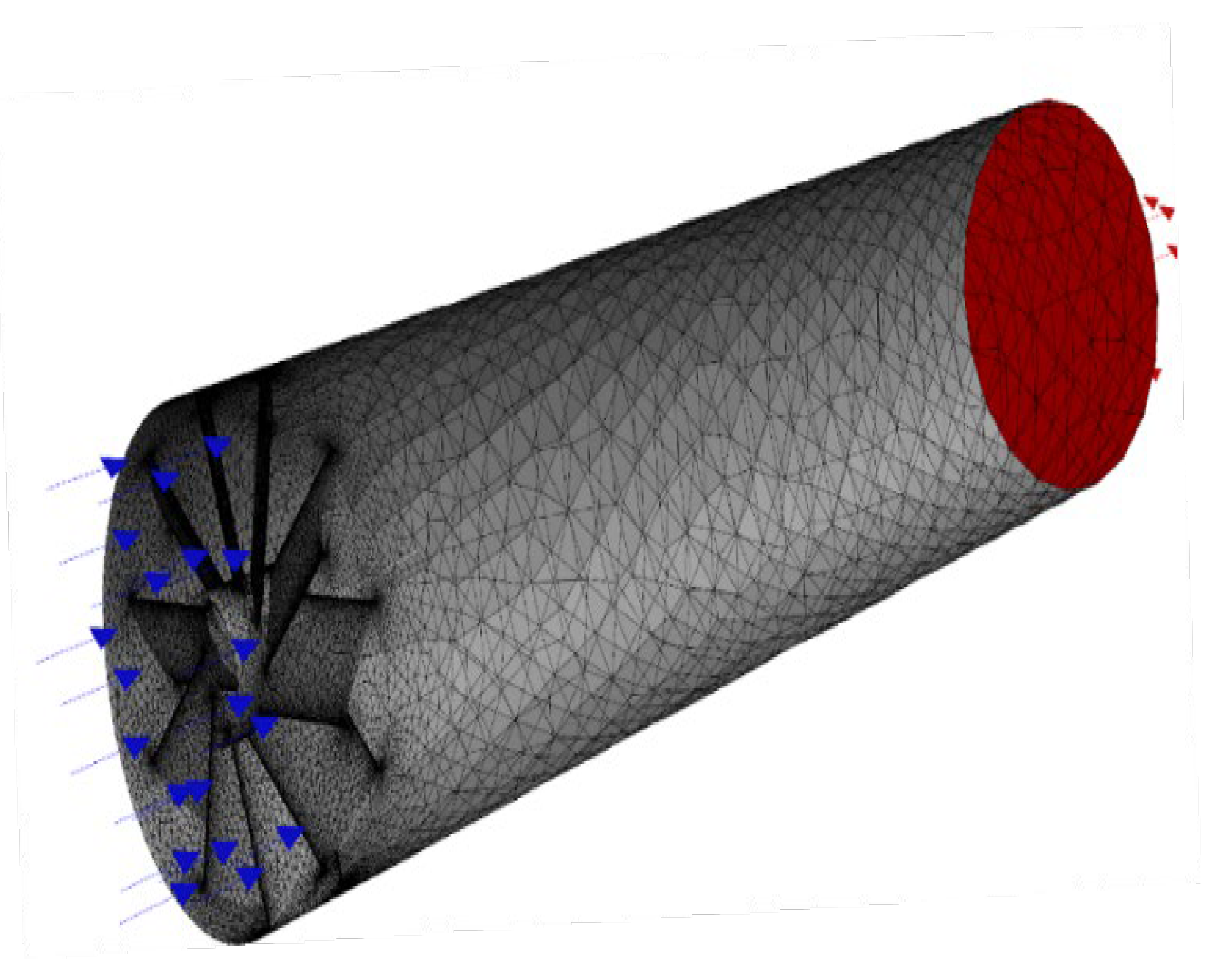
A. Meshing of Swirlers
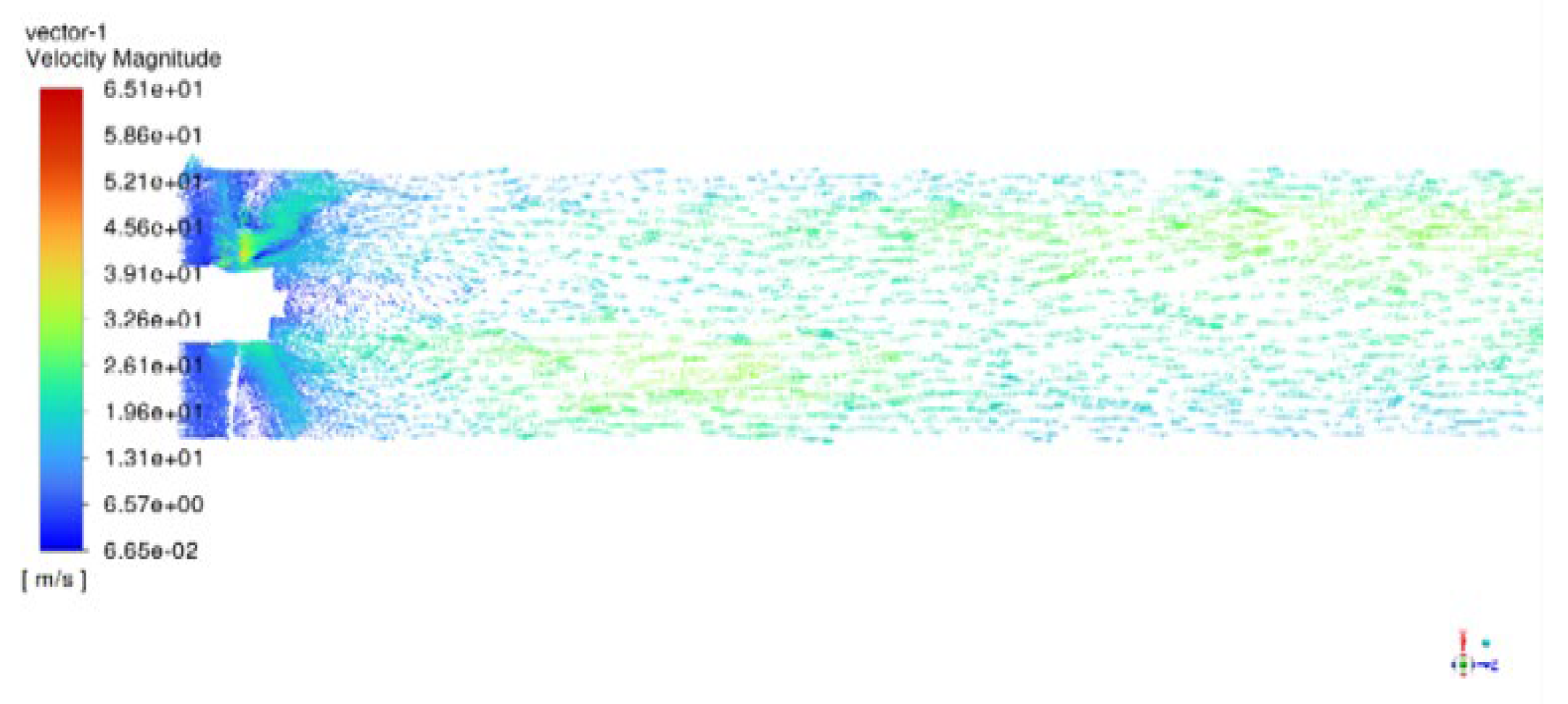
A. Velocity Magnitude
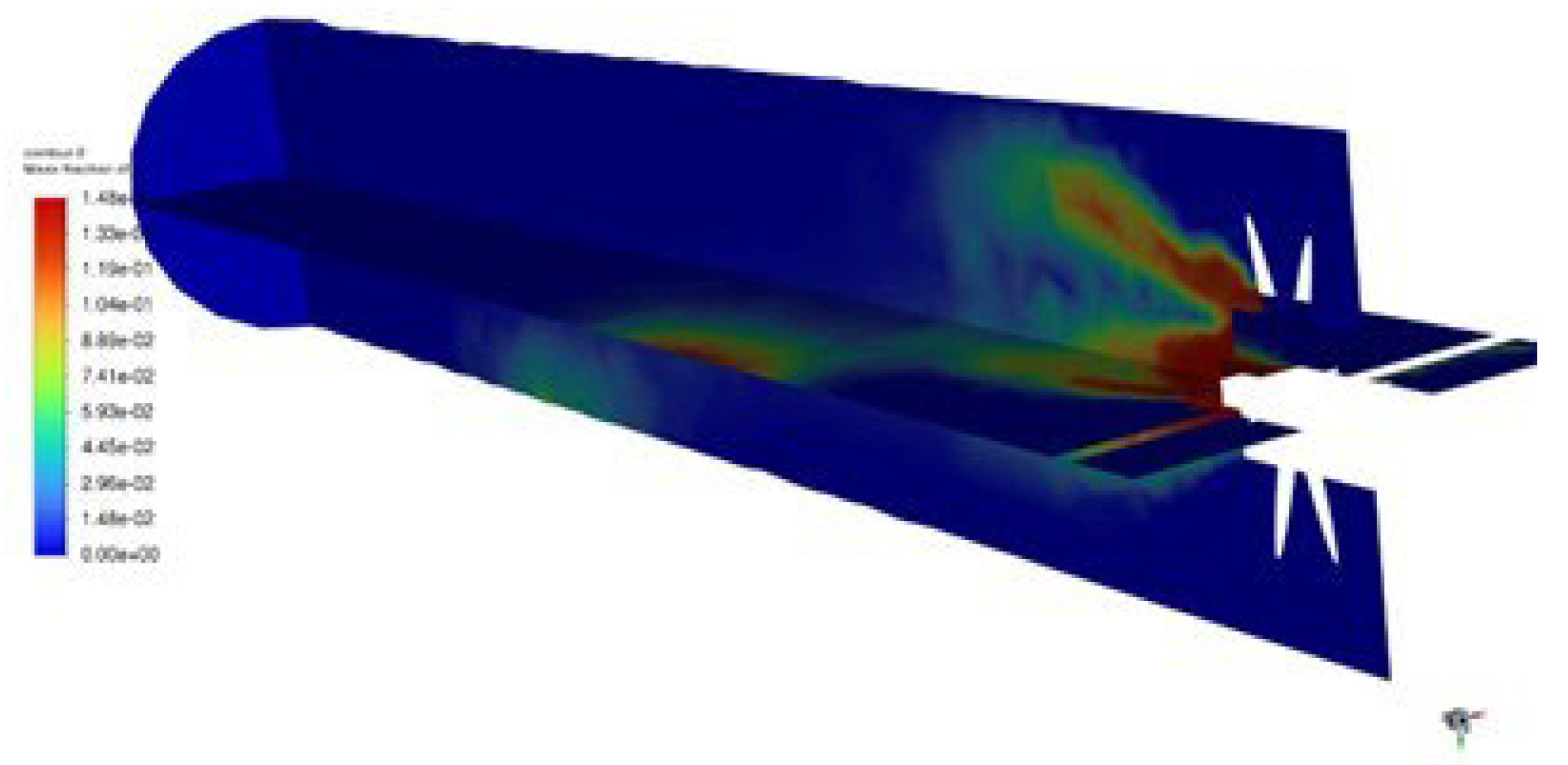
A. Emission of CO
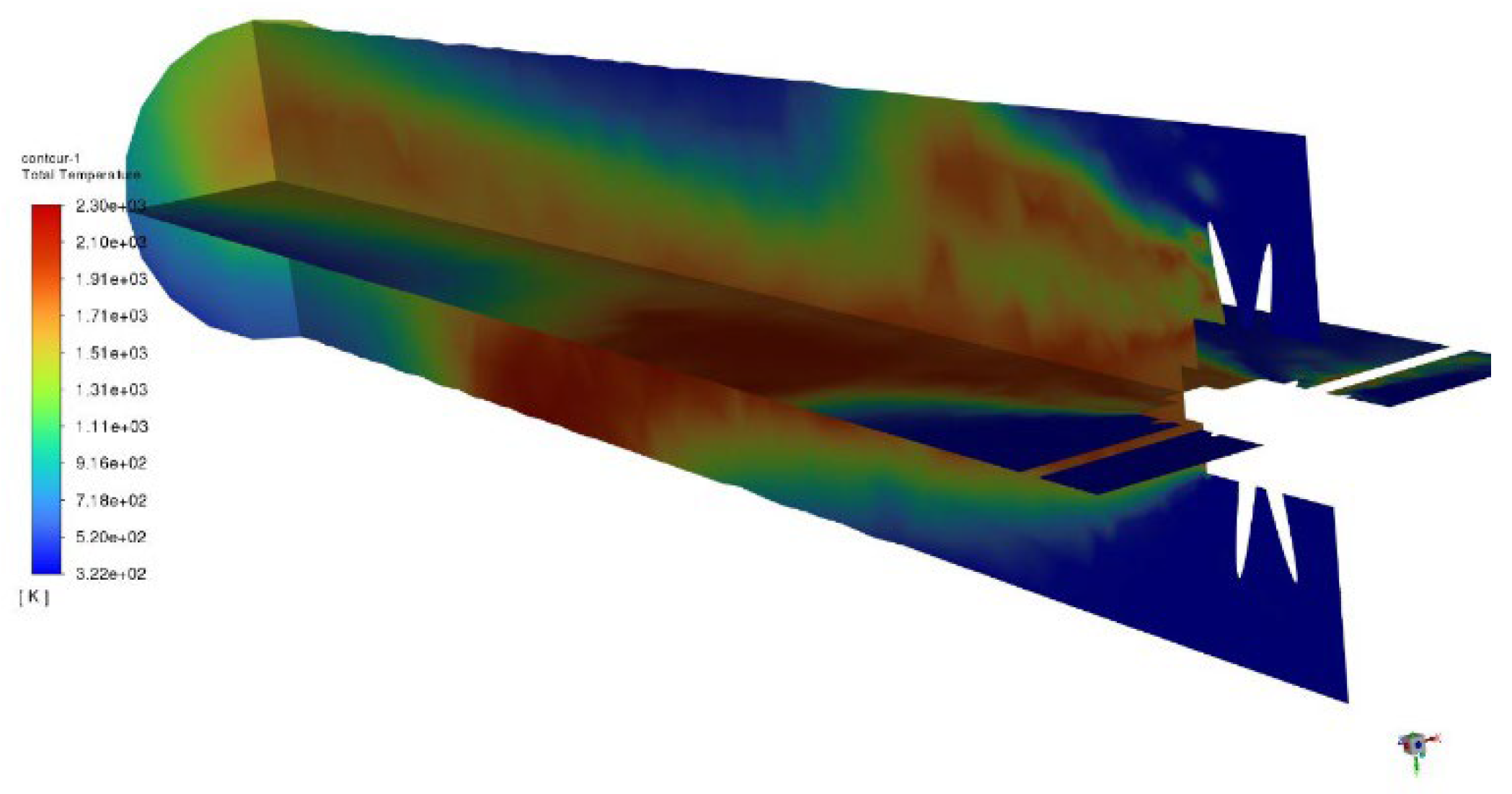
A. Temperature Distribution
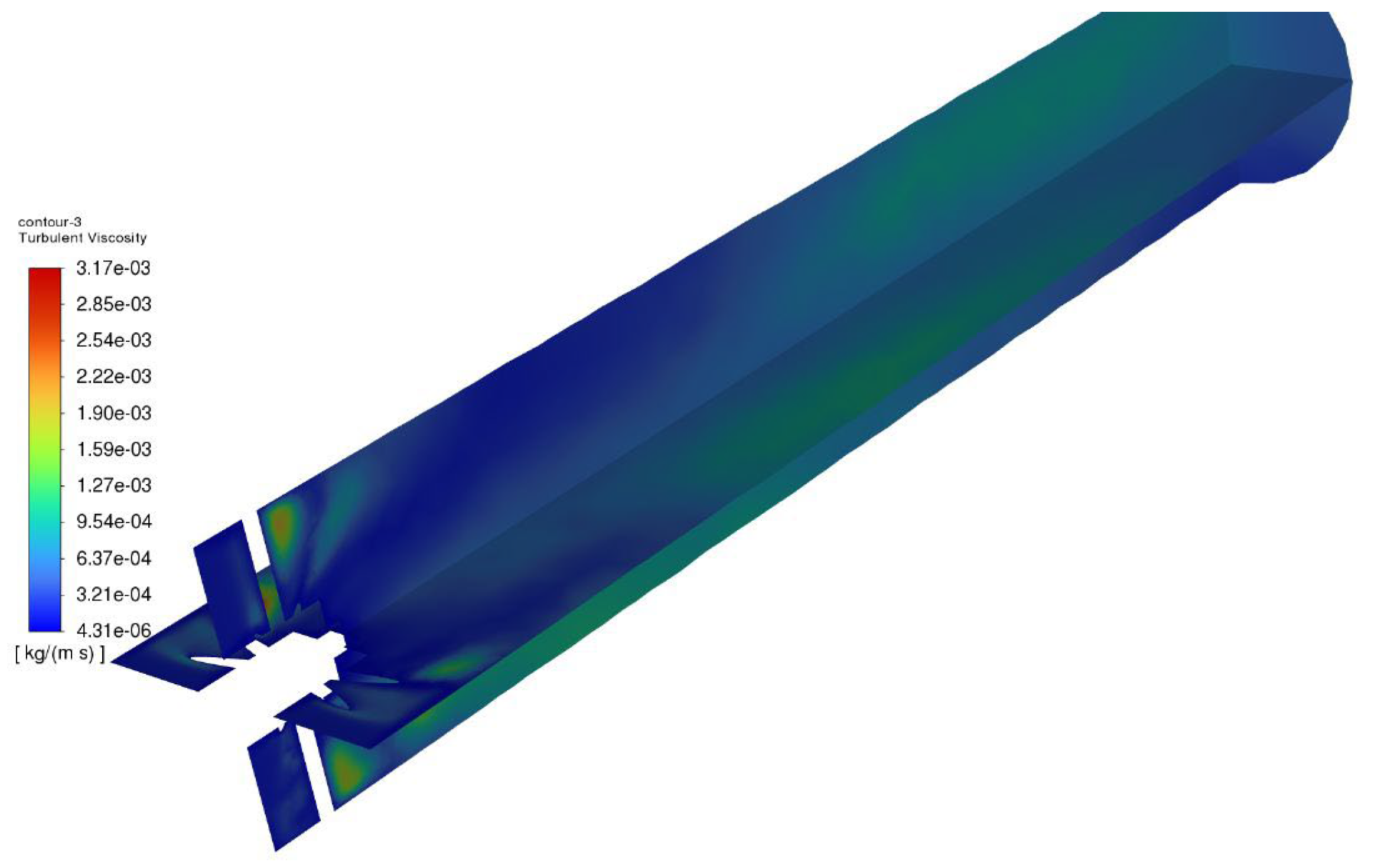
A. Turbulent Viscosity
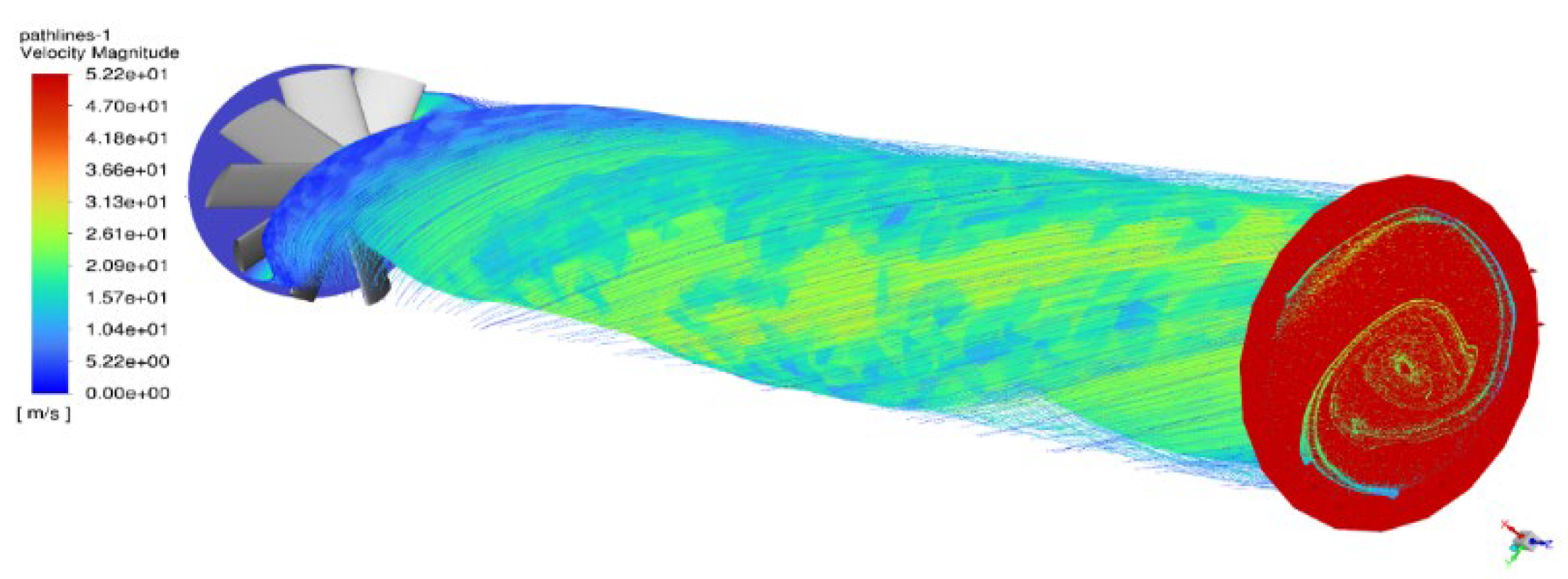
A. Velocity Magnitude of Path Lines
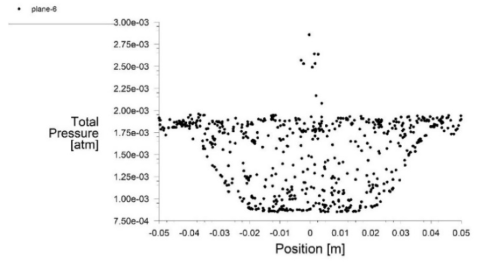
A. Total Pressure Vs Position
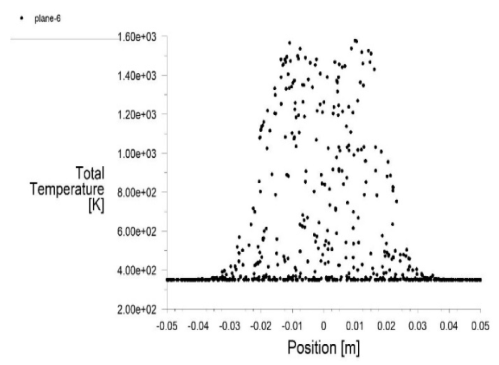
A. Total Temperature Vs Position
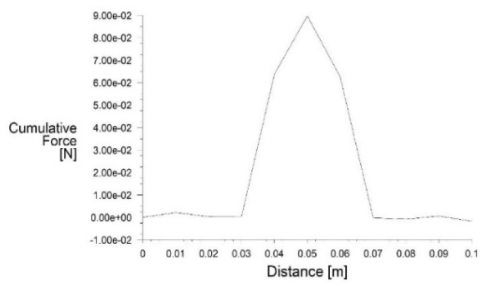
A. Cumulative Force Vs Distance
Boundary Conditions

| Reference Frame | Absolute |
| Mass Flow Specification Method | Mass Flow Rate |
| Mass Flow Rate[kg/s] | 0.05 |
| Supersonic/Initial Gauge Pressure[atm] | 0 |
| Direction Specification Method | Normal to Boundary |
| Specification Method | K and Elipson |
| Turbulent Kinetic Energy[m2/s2] | 1 |
| Turbulent Dissipation Rate[m3/s2] | 1 |
Equations
Conclusions and Future Work
Acknowledgments
References
- A Review on the Use of Computational Fluid Dynamics in Gas Turbine Combustor Analysis and its Scope, H. A. Bhimgade and S. K. Bhele., International Journal of Science and Research (IJSR), India Online ISSN: 2319-7064.
- Dr. A.N. Pawar and Sachin Bhalerao. Thermal mapping of a can types gas turbine combustion chamber using CFD, International Journal of Emerging trends in Engineering and Development. Vol.1 ISSN 2249-6149 Issue2.
- Man Young Kim and Selvakuma Kumaresh, "Combustion and Emission Properties in a Can-type Combustion Chamber.", Vol:8 No:7/2014, International Journal of Mechanical, Aerospace, Industrial, and Mechatronics Engineering.
- Design and Analysis of Gas Turbine Combustion Chamber, P. Sravan Kumar and P. Punna Rao, Vol. 03, Issue 12/2013, International Journal of Computational Engineering Research.
- Dr.G.Kalivarathan, P.S.Jeyalaxmi, CFD analysis of flow characteristics in a petrol turbine- A realistic approach to predicting turbulence, ISSN 0976, Volume 4, Issue 2, March - April 2013. International Journal of Mechanical Engineering and Technology (IJMET).
- CFD Modeling of Swirling Effect in S-Shaped Diffusing Duct by Swirl Angle of 10 Ramazan, Jawaz Pasha, Abdul Mujeeb M S., ISSN: 2320-334X, IOSR Journal of Mechanical and Civil Engineering, Volume 6, Issue 2, March - April 2013.
- Expendable turbojet tubular combustion chamber Nikola S. Davidović, Nenad M. Kolarević, and Marko V. Miloš 2022.
- Interaction of Vortex Shedding and Transverse High-Frequency Pressure Oscillations in a Tubular Combustion Chamber Schwing, J., Sattelmayer, T., & Noiray, N. (2011).
- Numerical simulation of combustion processes in a gas turbine. Bicsák, G., Hornyák, A., & Veress, A. (2012).
- Reference Area Investigation in a Gas Turbine Combustion chamber using CFD Fagner Luis Goular Dias, Marco Antonio Rosa do Nascimento, Lucilene de Oliveira Rodrigues (2014).
- Design of Tubularr Gas Turbine Combustion Chamber for Optimum Mixing Performance Lefebvre, A. H., & Norster, E. R. (1968).
- Thermoacoustic Properties of Can Annular Combustors, 8th AIAA/CEAS Aeroacoustics Conference, 4 Nov 2012.
- Thermoacoustics of Can-Annular Combustors, ASME, September 14, 2018.
- Influence of rotational asymmetry on thermoacoustic instabilities in a can-annular lean-premixed combustor, Elsevier Inc. 19 October 2020.
- Cohen, H. , Rogers, G. F. C., & Saravanamuttoo, H. I. H. (2007). Gas Turbine Theory (6th ed.). Pearson Education Limited. Chapter 7: Combustion Chambers.
- Oyekunle, L. O., & Ismail, I. M. (2018). A Review of Annular Combustion Chamber for Small Gas Turbine Engine. International Journal of Engineering Trends and Technology, 62(5), 272-277.
| S. N | Properties | Description |
|---|---|---|
| 1. | Melting point | 2650 degrees Celsius |
| 2. | Density | 8.89 g/cm3 |
| 3. | Tensile strength | 690 to 783 MPa |
| 4. | Yield strength | 480 to 550 MPa |
| 5. | Hardness | 220 to 270 BHN |
| 6. | Corrosion resistance | Excellent resistance to a wide variety of chemicals. |
| 7. | Oxidation | Good oxidation resistance up to 1100 degrees Celsius. |
| 8. | Weldability | Good weldability with conventional fusion welding techniques. |
| 9. | Machinability | Good machinability with conventional machining tools. |
| 10. | Cost | Relatively low cost compared to other high-temperature materials. |
Disclaimer/Publisher’s Note: The statements, opinions and data contained in all publications are solely those of the individual author(s) and contributor(s) and not of MDPI and/or the editor(s). MDPI and/or the editor(s) disclaim responsibility for any injury to people or property resulting from any ideas, methods, instructions or products referred to in the content. |
© 2025 by the authors. Licensee MDPI, Basel, Switzerland. This article is an open access article distributed under the terms and conditions of the Creative Commons Attribution (CC BY) license (http://creativecommons.org/licenses/by/4.0/).


