

Submitted:
28 November 2023
Posted:
28 November 2023
You are already at the latest version
Abstract
Fish processing by-products such as frames, trimmings, and viscera of commercial fish species are rich in proteins. Thus, they have the potential to be an economical source of proteins that may be used to obtain bioactive peptides and functional protein hydrolysates for the food and nutraceutical industries. The structure, composition, and biological activities of peptides and hydrolysates depend on the freshness and the actual composition of the material. Peptides isolated from fisheries by-products showed antioxidant activity. Changes of hydrolysis parameters changed the sequence and properties of the peptides, and determined their physiological functions. Optimization of the value of such peptides and the production costs must be considered for each particular source of marine by-products and for their specific food applications. This review will discuss the functional properties of fisheries by-products prepared using hydrolysis and their potential food applications. It also reviews the structure-activity relationships of the antioxidant activity of peptides as well as challenges to the use of fisheries by-products for protein hydrolysates production.
Keywords:
marine protein hydrolysates
; hydrolysis variables
; structure-function relations
; antioxidant activity
1. Introduction
In response to the recognition of the limits of marine sources and the crisis of food security, production of aquatic food products is increasing and reached 179 million tonnes in 2018, of which 22 million tonnes (or 12%) were not used for human consumption [1]. Maximum use of by-products from fish processing industries (e.g., heads, frames, skin, trimmings, and viscera from fish, cephalothorax and shells from shrimp, heads and tentacles from squids, and shells and byssus threads from oysters and mussels), that account for 40-60% of the weight, are necessary to retain them in the food chain in line with a sustainable circular economy through production of high-value biomolecules [2,3,4,5]. Among the different fractions of by-products that are produced after filleting, canning, packaging, etc., heads, frames and trimmings constitute >75% of the by-products’ weight and contain significant amounts of muscle residue that can be used for direct human consumption or can be converted to functional food ingredients. Despite the necessity, using by-products within the seafood sector is happening relatively slowly because the seafood industry is more focused on its primary raw materials and products that require minimal processing [6].
One focus has been peptides from marine sources (fish, shellfish, and invertebrates) with antioxidant activity [7,8,9,10]. Antioxidant peptides have an important role in inhibiting oxidation and scavenging free radicals. In the body they may help fight aging and reduce food oxidation. These peptides have been prepared using enzymatic or autolytic hydrolysis, or microbial fermentation [2]. Most peptides studied have been 2-10 amino acids (AA), although some were up to 20 AA and had molecular weight (MW) of 0.2 to 2 kDa [11,12,13,14]. Several proteases with different specificity for peptide bond cleavage and different hydrolysis conditions (temperature, time, pH, enzyme to substrate ratio, water/by-products ratio, and stirring rate) have been used to produce these marine by-products peptides [15,16,17,18]. Changes of hydrolysis conditions did change their antioxidant activities [19,20,21]. Antioxidant activity of peptides in foods has been associated with scavenging of the free radicals formed during lipid peroxidation, and metal chelation [22], which are dependent on the AA composition and sequence, size, hydrophobicity, and N- or C-terminal residues [23,24,25].
Marine protein hydrolysates derived using enzymatic hydrolysis showed antioxidant activity against free radicals and pro-oxidative metal ions. Thus, they may potentially be used as alternative antioxidants in foods and the human body to fight against free radicals-mediated aging [26,27]. The structure of antioxidant peptides and protein hydrolysates from marine sources are highly variable depending on the types of by-products used as the initial protein source as well as the various operating parameters that affect the hydrolysis and the functional outcome. These by-products might be stabilized to preserve their freshness with no oxidized products to ensure lower deteriorative reactions during enzymatic hydrolysis which is needed to obtain protein hydrolysates with acceptable organoleptic properties and storage stability. Marine protein hydrolysates and peptides have been shown to reduce oxidation of both lipids and proteins of seafood during storage, thus indicating antioxidant and anti-freezing effects [21,28,29,30].
Despite the suggested applications for protein hydrolysates from by-products in the food industry, there are several challenges that have caused such products to be unable to be manufactured on a commercial scale. This review will try to discuss the production and characteristics of protein hydrolysates from fisheries by-products derived using hydrolysis, factors involved, and their potential applications to control/reduce oxidative deteriorations of seafood during storage. It also reviews the structure-activity relationships of the antioxidant activity of peptides as well as challenges of industrial processing of by-products and commercialization of protein hydrolysates production.
2. Fish Protein Hydrolysates: Production and Processing Factors
The fish protein hydrolysates markets are anticipated to reach USD 558 million by 2025 with compound annual growth rate (CAGR) of over 5% due to increasing demand for protein-based supplements, food formulations, infant nutrition, fertilizers, and aquafeeds due to their higher absorption or digestion [2]. These hydrolysates contain peptides with 2-10 amino acids or up to 20 amino acids and molecular weight of <3 kDa, especially between 0.2 to 2 kDa [2,14]. By-products of several commercial species such as tuna [17,20,31], tilapia [12,32,33,34,35], marine bony species [19,36,37], small pelagics [38,39,40], salmonids [15,16,41,42], shrimp [18,43,44], marine invertebrates such as mollusks [45,46,47], squid and cuttlefish [48,49,50,51,52,53], and underutilized fish [54,55] have been used as the source for producing protein hydrolysates. By-products from those species showed differences in their composition (i.e., different amounts of lipids, blood, proteins, undigested feed in their stomach or intestines, etc.), emphasizing the need to adjust the hydrolysis conditions for each source according to the inherent characteristics of those by-products (such as sorting by-products to obtain different fractions). Depending on the farm conditions or ocean water quality, there are some safety issues with by-products from different category of aquatic species that should be considered as undesirable metabolites and contaminants that may enter the liquid phase in which peptides are formed, affecting the safety of the protein hydrolysates. Table 1 shows the yield, composition, safety concerns, and preventive measures for by-products from the main groups of aquatic species (fish, crustaceans, and invertebrates).
Enzymatic and autolytic hydrolysis and microbial fermentation have been used for converting the proteins of by-products into peptides with varying sizes and bioactivities [2,7,8,78]. The process of hydrolysis with commercial proteases can be controlled by selecting appropriate enzymes and adjusting the hydrolysis conditions (time, temperature, enzyme concentrations, water ratio, etc.), and the final hydrolysates should be stable in terms of structure (such as peptide profile) and functions. Autolytic hydrolysis mediated by endogenous enzymes such as acid/aspartyl proteases (such as pepsin), serine proteases (trypsin and chymotrypsin), thiol/cysteine protease (cathepsin B, L, and S), and muscle proteases (lysosomal cathepsin, alkaline and neutral protease) have been used to hydrolyze marine proteins [79,80]. However, acidic proteases have a lesser role in autolysis because most studies have shown that hydrolysis by endogenous proteases usually occur at around neutral pH [2] unless this group of proteases is first isolated and then their effects are investigated in acidic pH [81,82,83], although, the cost associated with purification of viscera proteases, their stability, and activity may be a challenge compared to highly stable commercial enzymes. With autolysis, several variables such as the freshness of by-products may affect optimal proteolytic activity and the possible denaturation of endogenous enzymes due to improper handling and storage of by-products will affect the autolysis efficiency and thus, the end products’ properties. But because autolysis is not part of the goals of this review, more detailed information on autolytic hydrolysis technology can be found in previous studies [2]. In general, to obtain protein hydrolysates with stable peptide profiles, smell, nutritional value, functional properties, biological activities, and bioavailability, the process of enzymatic hydrolysis must be controlled at each step of the production process. Figure 1 shows the factors involved and main issues to be considered during enzymatic hydrolysis of fisheries by-products. Properties and structure of the end products are governed by three main factors (the by-products, enzymes, and operating parameters) (Subsections 3.1-3.3).
2.1. By-products Composition, Quality, Storage and Handling
The type of by-products (viscera, heads, frames, trimmings, or their mixtures) and their composition (different amounts of lipids, blood and hemoglobin and metal ions as pro-oxidants) influence the composition, nutritional, and antioxidant properties of the protein hydrolysates [15,84]. Frames, trimmings and heads are clean by-products with potential uses for direct human consumption or as functional hydrolysates. A recent study has shown that 37.2, 56.7, and 81.0% of the weight of heads, frames, and trimmings of Atlantic salmon, respectively, are edible as direct human food while for the viscera, the edible yield is normally thought of as 0% [10], due to the presence of lipids, bile acids, blood, non-digested feed in the intestine, etc., associated with a high rate of oxidation and formation of undesirable metabolites during hydrolysis [3]. According to a survey of methods to utilized Scottish salmon by-products, 15% of the final utilization (frames, trimmings, heads) is for food, 75% (frames, heads, viscera, mixed by-products, skins) is for feed purposes, and 10% (blood) is for fuel and fertilizer [6]. Therefore, cleaner by-products (frames, heads, trimmings) with acceptable freshness are ideal for food pouposes, including production of protein hydrolysates while viscera (alone) is used for producing hydrolyzed protein concentrate and oil, or fish meal and oil (rendering) in the form of mixed by-products. Some of the oxidation products can add carbonyl derivative to the peptides, decreasing their antioxidant activity and possibly their safety. In this regard, Aspevic et al. [85] reported the differences in essential AA, biogenic amines, and sensory properties of protein hydrolysates from backbones, heads, and viscera of salmon and mackerel. Viscera hydrolysates from salmon (SV) and mackerel (MV) had more intense taste and bitterness compared to hydrolysates from heads and backbones. They also showed more small peptides with MW <200 Da (64.7 and 74.5% for SV and MV, respectively) due to the activity of endogamous enzymes during enzymatic hydrolysis with FoodPro PNL (10 U/g protein, 50 min at 55 °C). The presence of bile may add to the bitter taste sensation. SV and MV had higher TMA, cadaverine and putrescine compared to hydrolysates from heads and backbones. MV showed more taste intense and had higher scores for umami, salty, and fish taste compared to salmon hydrolysates, partly due to a higher content of ash (38.3%) in mackerel heads hydrolysates, indicating the need for salt removal before human use. Heads and backbones hydrolysates showed much lower free AA than viscera hydrolysates in both species (~40 g/100 g visceral protein), indicating autolytic hydrolysis that causes higher free AA when using viscera as the raw material for protein hydrolysates. Despite these results, viscera hydrolysates are unlikely to be suitable for use in foods due to safety issues. On the other hand, its potential as functional feed ingredients in the form of acid silage or liquid hydrolysates can be used to enhance the growth, nutrition and health at the larval stage of aquatic species [86]. However, in most studies, the purpose of hydrolyzing viscera and identifying its antioxidant peptides is not clearly stated, although it is generally suggesting the direct use of viscera hydrolysates (which raises safety issues) in foods, or the use of synthetized peptides, which need to consider the economic viability.
The freshness of by-products is one factor affecting the formation of oxidative compounds during hydrolysis, and eventually the structures, functions and shelf life of protein hydrolysates [2,3]. Endogenous muscle proteases including matrix metalloprotease (MMP), and serine and cysteine proteases degrade myofibrillar proteins and microfibrillar networks, resultuing in a significant decrease of quality [87–89]. These proteases are active in trimmings, frames, and heads, which with inappropriate storage temperatures, degrade myofibrillar proteins, lowering the initial quality of proteins for further hydrolysis. A recent survey of fisheries by-products handling practices in Europe indicated that the sorting of by-product fractions was done in >60% of the seafood processing plants, while the remainder did not handle their by-products properly and only 25% of the surveyed plants managed by-products as food grade. According to that survey, the majority of the processing companies used their by-products for non-food purposes, mainly as feed [58]. A study on salmon by-products (frames, heads, and viscera) showed that storage at 4 or 10 ºC greatly influenced the quality. Several metabolites including tyramine, histamine, trimethylamine (TMA) have been formed, and the decline in the quality of viscera increased histamine level that exceeded the limits after 2 days of storage at 10 ºC while, those by-products could be stored for up to 7 days at 4 ºC [57]. Therefore, by-products processing should be done near the fish processing centers so the hydrolysis of by-products can be done in the shortest possible time. When the quantity of by-products exceeds the capacity of the plant, they should be stored frozen. Therefore, the impact of frozen storage for varying times needs further study on the structure of peptides (AA composition, sequence, and size) and their biological functions.
Pretreatments of by-products may lower the concentration of pro-oxidants while resulting in purer protein substrates for enzymatic hydrolysis. Rinsing or incubation of herring by-products (heads, backbone with caudal fin, skin, intestines, and eggs) with antioxidant solutions including Duralox-MANC, isoascorbic acid, isoascorbic acid + ethylenediaminetetraacetic acid (EDTA)) decreased the rate of lipid oxidation and hemoglobin levels during storage at 4ºC for up to 12 days while, extending the shelf-life of by-products from <1 to >12 days with a rinsing strategy or to >7 days with direct addtion into the by-products after mincing [62]. However, due to the high rate of lipid oxidation in such a highly sensitive system, upgrading to food grade with proper safety is a big challenge. Washing or defatting of underutilized Sind sardine muscle mince significantly decreased total pigments (600 and 140 μg/g dry sample) and heme iron (5.3 and 1.2 mg/100 g dry sample) content in washed and defatted mince substrates, respectively, compared with non-pretreated mince (2570 μg/g dry sample and 23 mg/100 g dry sample for total pigments and heme iron, respectively), resulting in lower formation of TBARS but increased DPPH radical scavenging and ferrous chelating activities of protein hydrolysates, espcially with defatted mince [54]. Pretreatment of cape hake by-products with 8 mM CaCl2 + 5 mM citric acid followed by alkaline solubilization of proteins (pH 11) resulted in significantly lower phospholipids (1 AU/g) and lipids (0.39%) but higher solublity in hydrolysates compared to samples directly produced from by-products (4.2 AU/g and 0.87%, respectively). However, these hydrolysates were characterized by higher yellowness and redness that was attributed to the alkaline solubilization of heme proteins during protein isolation [90]. Despite the relative improvement in by-products quality, the economic issue of carrying out such pretreatments at the tonnage scale (i.e., industrially) is a challenge that has not been studied. To tackle technological problems associated with heme proteins and to lower oxidation, the use of antioxidative extracts from agricultural wastes including lingonberry press-cake, apple-, oat-, barley- and shrimp by-products and seaweed (ulva) extracts as helpers all at 30% of the dry weight of the by-product, decreased formation of MDA and the oxidation product 4-hydroxy-(E)-2-hexenal (HHE) in herring and salmon heads and backbone protein isolates, resulting in more stable substrates. Among all helpers, lingonberry press-cake followed by apple peel and ulva were the most effective in reduction of lipid oxidation during alkaline solubilization/acid precipitation and 9 days of ice storage. The new color (dark purple) in the resulting protein isolates with lingonberry press-cake might be advantageous for increasing acceptance of the color by consumers [91]. Further work is needed on the interactions between the phenolic compounds of plant extracts as antioxidants and the by-products proteins, and how it will affect the structure and biological activity of the protein hydrolysates.
2.2. Proteolytic Enzymes
Composition and sequence of peptides in whole hydrolysates from the same source of protein may differ depending on the type of enzyme used. Endopeptidases (e.g., trypsin, chymotrypsin, pepsin, pancreatin, papain, and Alcalase) act away from the N- or C-terminus, while exopeptidases (e.g., carboxypeptidase Y, aminopeptidase M, and Flavourzyme) break peptide bonds at the terminus of polypeptide chains [92]. Since different enzymes have specific cleavage sites (papain: Arg-, Lys- and Phe-; Alcalase: Ala-, Leu-, Val-, Tyr-, Phe- and Try-; trypsin: Arg- and Lys-; pepsin: Phe- and Leu-), different cleavage sites will affect the AA composition, and sequence of peptides [93]. Salmon skin gelatin hydrolyzed with Alcalase showed a higher content of hydrophobic AA, degree of hydrolysis (DH), surface hydrophobicity and peptides with MW <1 kDa than hydrolysates produced using Neutrase, Protamex, and Flavourzyme. This was associated with significantly higher OH• and O2•- scavenging and Fe2+ chelating activity [42]. From tilapia skin gelatin, different peptides, including Gly-Pro-Ala [12], Glu-Gly-Leu (317 Da) and Tyr-Gly-Asp-Glu-Tyr (645 Da) [32], Asp-Pro-Ala-Leu-Ala-Thr-Glu-Pro-Asp-Pro-Met-Pro-Phe (1383 Da) [33], Leu-Ser-Gly-Tyr-Gly-Pro (592 Da) [34] and Tyr-Gly-Thr-Gly-Leu (509 Da) and Leu-Val-Phe-Leu (490 Da) [35] were obtained depending on the enzyme used despite starting with the same protein (tilapia skin gelatin (although the method of production of the gelatin may have differed)). In abalone viscera, different enzymes resulted in different peptide sequences; Alcalase: Gln-Ser-Cys-Ala-Arg-Phe (711 Da), Ala-Ala-Pro-Ala-Val-Ser-Gly-Arg (728 Da), Asn-Arg-Phe- Gly-Val-Ser-Arg (834 Da), and Pro-Val-Pro-Pro-Tyr-Lys-Ala (770 Da), Neutrase: Ala-Ala-Gln-Tyr-Ser-Arg-Asn (808 Da), Val-His-Ala-Glu-Pro-Thr-Lys (780 Da), Gly-Cys-Tyr-Val-Pro-Lys-Cys (769 Da), and Asn-Ser-His-Val-Val-Arg (711 Da); papain: Ala-Ala-Asn-Asn-Ser-Thr-Arg (732 Da), Thr-Ile-Asp-Cys-Asp-Arg (722 Da), Cys-Ile-Gly-Tyr-Asp-Arg (725 Da), Asp-Asp-Ile-Thr-Arg-Asp (734 Da), and Asp-Val-Ala-Phe-Met-Arg (738.3 Da); and trypsin: Met-Glu-Thr-Tyr (543.3 Da), Tyr-His-Gly-Phe (523 Da), Gln-Cys-Val-Arg (505 Da) [45]. Tyr-Pro-Pro-Ala-Lys (574 Da) [46] and Pro-Ile-Ile-Ser-Val-Tyr-Trp-Lys (1005 Da) [47] have been purified from blue mussels using Neutrase and pepsin, respectively. Despite the influence of the structure of peptides on the selectivity of the enzymes used, the high cost of commercial proteases suggests the minimal use of enzymes for hydrolysis. As with Atlantic cod, hydrolysis of heads with a combination of papain and bromelain at minimal concentration of 0.1% by weight of the minced heads for 1 h resulted in reasonable peptides profile in which 56% of peptides were <2 kDa, while most peptides (~33%) had MW between 1 and 2 kDa [94].
2.3. Operating Parameters
The temperature and pH are generally adjusted according to the selected proteases to ensure high hydrolytic activity. Thus, the other factors such as the water to by-products ratio, type of propeller, stirring rate, enzyme deactivation step, use of nitrogen gas, antioxidant addition, time, etc. should be optimized to ensure a stable end-product.
Abalone food muscle hydrolyzed with papain (HPP), Protamex® (HP) or an animal protease (HA) for 0.5 or 4 h showed differences in physicochemical and structural properties governed by the time of hydrolysis and enzyme type. The fluorescence emission spectra of all hydrolysates showed a red shift of 10-12 nm compared with that of control while, fluorescence intensity was higher in hydrolysates than non-hydrolyzed proteins (AFP). Hydrolysis for 4 h resulted in higher intensities in HPP, HP, and HA compared to lower hydrolysis time. Among all samples, HA-4, HPP-0.5, and HPP-4 had higher absolute ζ-potential values than AFP, indicating a higher number of ionizable groups on the protein surface that inhibited the formation of protein aggregates, consistant with solubility, S-S bonds and free –SH groups [95].
de la Fuente et al. [96] reported the differences in peptides identified from salmon viscera obtained using two different stirring methods including conventional stirring (30 min in distilled water at room temperature) and pressurized liquid extraction (PLE; 1500 psi, distilled water as solvent, pH 7.0, 50 ºC, 15 min) despite using the same protein source. For viscera subjected to PLE, 137 peptides were identified and contained several small antioxidant peptides with sequences of Gly-Pro-Pro and Gly-Ala-Ala. On the other hand, only 67 peptides were identified in the control extract. In both extracts, the MW was in the range of 0.6 to 2.6 kDa. However, the PLE extracts contained greater amounts of small peptides. Total antioxidant capacity, measured using ORAC and TEAC showed that PLE viscera extract had higher values (3790 and 7770 μM Trolox Eq for TEAC and ORAC, respectively) compared to the control extracts (788 and 2450 μM Trolox Eq for TEAC and ORAC, respectively).
During hydrolysis, especially at the industrial scale, the high water addition increases the production costs due to the heating and drying needed to obtain a powder or a concentrated liquid [3]. Using less water during hydrolysis can be beneficial as long as it does not affect other processes and efficiency. For cod head hydrolysates with different water to heads ratios (1:1, 1:0.75, and 1:0.5 kg/kg), the ratio was found to have little effect on hydrolysis yield, protein content, and MW distribution of peptides and thus, high water addition might possibly be unnecessary. In addition, the hydrolysis reaction time of 1 h was suitable to obtain hydrolysates with desirable properties [94].
Lipid oxidation is one of the main challenges during enzymatic/autolytic hydrolysis of by-products, resulting in unpleasant odors and flavors, dark colorations and formation of oxidative products in the FPH [2,3]. Due to the low lipid content of heads (1-4%), a separated oil faction was not formed in the cod head hydrolysates (0.65% lipids in the FPH) [94]. When working with a mixture of cod viscera and trimmings, a separate oil faction was formed after enzymatic hydrolysis and a minimum of 6 g of lipids/100 g wet weight by-products was required to form an oil fraction [97]. The intensity of lipid oxidation during hydrolysis will be different among by-products with different compositions, which may affect the structure and safety of the resulting peptides and their antioxidant activity. Reduction of oxygen and replacing it with an inert gas such as nitrogen were shown to decrease lipid oxidation in Sind sardine [54] and tuna [98] protein hydrolysates.
Enzyme deactivation is the last step of the hydrolysis process. The high temperature (80-100 ºC, 10-15 min) is often used to deactivate enzymes [11,12,13,14,15,16]. This temperature may lead to structural changes of the protein hydrolysates and peptides, decreasing antioxidant or other bioactivities. Xie et al. [99] used slow (+4 ºC) and rapid (-18 ºC) cold deactivation temperatures, a 100 ºC water bath, and no deactivation and found that the deactivation method significantly affected the DH, surface hydrophobicity, average particle size, intrinsic fluorescence, secondary structure content (α-helix, β-sheet, β-turns, and random coils) and antioxidant activity.
Storage of protein hydrolysates as a powder following spray-drying may affect their function and properties during storage due to hygroscopicity. If stored at temperatures above the glass transition temperature (Tg), protein hydrolysates will be sticky (10 – 20 °C above Tg), cake (20 – 30 °C above Tg) and collapse (40 – 50 °C above Tg). Thus, to avoid loss of quality and function, powders must be stored at temperatures below their Tg [40].
2.4. Process Scale-Up
One roadblock towards the industrial production of protein hydrolysates from by-products is that most studies with by-products were done at the laboratory scale, which limits their industrial adaptation [114]. Some studies attempted pilot trials to confirm the technical feasibility of the laboratory scale at an industrial scale. In this sense, the process of producing peptides from hake by-catches was scaled up from a 0.5 to a 150 L reactor using the optimized hydrolysis conditions (2% enzyme, 2 h, 50% solids, pH 9, 70 ºC) that were obtained in the laboratory [101]. The authors found similar results at the pilot plant scale in term of protein extraction yield (60.0% pilot and 61.4% lab), antioxidant capacity (172 mg TEAC/g protein in pilot and 224 mg TEAC/g protein in lab), and antioxidant capacity yield (103 mg TEAC/g protein in pilot and 132 mg TEAC/g protein in lab). Furthermore, liquid, solid, and bone yield did not show any significant differences from the results of the laboratory trials. Monkfish by-products (heads and viscera) hydrolysis was scaled up from 100 mL to a 5 L glass reactor at optimized laboratory conditions: 57 ºC, pH 8.3, solid to liquid (S/L) ratio of 1:1 (w/w), 0.05% Alcalase and 200 rpm stirring rate for 3 h. Following hydrolysis, the hydrolysates were filtered (100 μm) to remove non-hydrolyzed materials. Results validated the properties of the FPH obtained by the optimization trial at the laboratory scale. However, the 5 L reactor may still be considered a bench-scale trial and it needs work with larger reactors [110]. An industrial-scale production of hydrolysates from Atlantic salmon by-products (heads, frames, and viscera) using the laboratory (4 L glass vessel) hydrolysis parameters such as enzyme type and concentrations, time and temperature, except for a shorter time from slaughter to hydrolysis (2 h), avoidance of preheating of water inside the reactor, separation using a decanter, and no drying of the hydrolysis solution (acidified with formic acid to reach pH <4) was tested in an industrial plant. The authors attributed the main differences to lower hydrolysis efficiency, separation, and storage conditions [15]. Overall, the cost of enzymes, high water usage, drying or condensation of the hydrolysis solution, as well as the use of separators (one or more steps) to remove oil and other undigested materials are the main cause of the greater process costs at an industrial scale, although the complexity of the hydrolysis line depends on the type and composition of the by-products.
3. Antioxidant Activity of Fisheries By-Products Protein Hydrolysates and Peptides
The antioxidant peptides had 2-10 amino acids, although some were up to 20 amino acids and had a MW of 0.2 to 2 kDa. Antioxidant activity of peptides is mostly related to the presence and position of specific amino acid residues in the peptide chain. Primary structure, amino acid composition, hydrophobicity, spatial conformation, etc. are characteristics that are affected by enzymatic hydrolysis and determine its antioxidant activity [115]. Peptides show antioxidant activity due to the presence of one or more hydrophobic (Pro, Ala, Gly, Leu, Ile, Met, Trp, Phe, Val) and aromatic (Tyr, Trp, Phe) amino acids that can quench free radicals by various mechanisms including hydrogen atom transfer (HAT), single electron transfer followed by proton transfer (SET-PT), and sequential proton loss by electron transfer (SPLET) mechanisms [116]. Scavenging free radicals and oxidants using HAT, SET-PT, and SPLET generally leads to the same end results, although the kinetics and potential for side reactions vary. SPLET, SET-PT, and HAT may occur in parallel; however, the dominant mechanism depends on the antioxidant’s conformational and geometrical features, solubility, partition coefficient, and the type of solvents [117]. Antioxidant activity of hydrophobic amino acids has been attributed to their ability to interact with lipid molecules by increasing the solubility of peptides in lipids and scavenging lipid-derived radicals through electron donating substituents such as OH and NH2 on amino acid side chains in peptides. The presence of hydrophobic amino acids can improve the antioxidant activity of peptides by providing a potential pool of free electrons. Additionally, it is believed that aromatic amino acid residues might possess antioxidant properties due to the chelating ability of the imidazole ring and the trapping ability of lipids [116,117].
Peptides containing proline-rich sequences have been identified to possess antioxidant properties. Proline has an electron-rich nitrogen-containing pyrrolidone ring that stabilizes the radical peptide formed after electron donation [118,119]. Peptides with Pro at the C-terminus (e.g., Pox: Tyr-Tyr-His-Pro) were the most potent antioxidant (0.8 TE at 2.5 μM). Modification of the structure by moving Pro into positions X1 (Pro-Tyr-Tyr-His), X2 (Tyr-Pro-Tyr-His), and X3 (Tyr-Tyr-Pro-His), but leaving the other residues in the same order as in Pox, resulted in a significant difference in ORAC which was 0.2, 0.1, and 0.55 TE at 2.5 μM for X1, X2, and X3, respectively [120]. Strong antioxidant activity has been reported for small peptides containing amino acid residues such as Tyr, His, and Pro [121,122]. The dipeptide Tyr-Tyr at the N-terminal position of Tyr-Tyr-His-Pro and Tyr-Tyr-Pro-His was the portion responsible for stronger antioxidant activity. However, Tyr-Pro-Tyr-His showed the weakest ORAC, inhibited ROS production by 36% at 0.07 μM in human keratinocyte cells (HaCat) after treatment with H2O2 when compared to Tyr-Tyr-His-Pro (with the highest ORAC) which showed almost similar inhibition of ROS production at 2.5 μM (40%) [120]. It is believed that besides amino acid composition and sequence, the changes of secondary structure have a significant impact on the capture and dissipation of free radicals. The nanopeptide Val-Leu-Leu-Tyr-Lys-Asp-His-Cys-His (1127 Da) produced using self-assembly of pine nut Val-Leu-Leu-Tyr (506 Da) and sea cucumber Lys-Asp-His-Cys-His (638 Da) had significanly higher antioxidant activity compared to individual peptides due to changes in the secondary structure as seen in the lower electron paramagnetic resonance (EPR) signal, higher random crimp degree, and increased supply of hydrogen protons (i.e., the higher exposure to active hydrogen) from Raman spectroscopy and 1H NMR spectrum analysis in the nanopeptide than the tetrapeptide and the pentapeptide. The DPPH radical scavenging activity at 3 mmol/mL were 6.1, 9.4, and 80.7% of the 4, 5 and 10 amino acid peptides, respectively [123].
The presence of Tyr at the N-terminal position of peptide Tyr-Ala-Glu-Glu-Arg-Tyr-Pro-Ile-Leu has been reported as the residue that most contributed to antioxidant activity (3.8 μM TE/mg protein). However, Tyr-Pro-Ile and Tyr-Gln-Ile-Gly-Leu with Tyr at the same position showed lower ORAC (1.6 and 1.7 μM TE/mg protein, respectively), indicating the role of adjacent amino acids and chain length on antioxidant activity [124]. Tyr-containing peptides from abalone viscera showed strong ABTS radical scavenging activity in the order of Cys-Ile-Gly-Tyr-Asp-Arg (0.144 mg/mL) > Tyr-His-Gly-Phe (0.268 mg/mL) > and Gly-Cys-Tyr-Val-Pro-Lys-Cys (0.389 mg/mL). The first and last peptides, which contained both Tyr and Cys showed similar trends for scavenging DPPH radicals (IC50 of 0.207 and 0.405 mg/mL, respectively). Despite the observed high ABTS radical scavenging activity, peptides Met-Glu-Thr-Tyr and Tyr-His-Gly-Phe which had Tyr at the C- or N-terminal position, respectively, had weak scavenging activity against DPPH radicals (<20%) which was attributed to the lack of Cys in their sequence. Despite having different size or amino acids residues, peptides Gln-Cys-Val-Arg and Gln-Ser-Cys-Ala-Arg-Phe showed similar DPPH radical scavenging activity (IC50 of 0.392 and 0.416 mg/mL, respectively), indicating the complexity of the relation between the peptides’ structures, and function. Regarding the number of amino acid residues within peptide sequence, The peptide Gly-Cys-Tyr-Val-Pro-Lys-Cys, containing two Cys residues showed lower free radical scavenging activity (IC50 of 0.389 and 0.405 mg/mL for scavenging ABTS and DHHP radicals, respectively) than Cys-Ile-Gly-Tyr-Asp-Arg, which contained only one Cys (IC50 of 0.144 and 0.207 mg/mL for scavenging ABTS and DPPH radicals, respectively [125]. Thus, a simple relationship between the number of Cys and antioxidant effects of peptides is not clear and is more related to its position in the peptide chain and the type of amino acids adjacent to it. Generally, the thiol group of Cys have an antioxidant activity that works by donating hydrogen from the SH group or the loss of an electron from its sulfur atom, thus neutralizing free radicals [24].
It was shown that the presence of a Tyr, Trp, Cys, or Met residue with electron/hydrogen donating ability was the driving force for dipeptides to scavenge radicals. The presence of Tyr, Trp, and Cys in the sequence was required for dipeptides to scavenge ABTS•+, while the presence of Tyr, Trp, Cys, and Met was needed for dipeptides to scavenge ROO• when using the ORAC assay. Structure-activity relationships showed that Tyr and Trp-containing dipeptides with Tyr/Trp residue at the N-terminus (Tyr/Trp-X; Tyr-Gly, Tyr-Ser, Tyr-Gln, Tyr-Glu) had stronger ORAC and ABTS•+ scavenging activity than that at the C-terminus (X-Tyr/Trp; Gly-Tyr and Glu-Tyr) and the steric effects, hydrophobicity and hydrogen bonding also affected the neighboring AA. Tyr-containing dipeptides showed higher ABTS•+ scavenging activity. In contrast, Trp dipeptides (Trp-Gly, Trp-Ser, Trp-Gln, Trp-Glu, Gly-Trp, Glu-Trp) had higher ORAC, and only Cys-containing dipeptides showed moderate reducing power activities [126]. Calculation of BDE, IP, PA, and ETE of Tyr/Trp-X and X-Tyr/Trp (where X was Gly, Leu, Pro, Phe, Ser, Thr, Asn, Gln, Asp, Glu, Lys and Arg) showed that there were little differences among dipeptides, indicating that the neighboring AA did not affect the intrinsic hydrogen or electron-donating ability of the dipeptides studied. Thus, the differences in their radical scavenging activity can be attributed to other factors (such as steric effects, and inter/intra-molecular hydrogen bonds). Furthermore, BDE and PA of Tyr-containing dipeptides were much lower. At the same time, its IP was higher than Trp-X or X-Trp, indicating that HAT and SPLET mechanisms were more favorable for Tyr-containing dipeptides, while SET-PT was the primary mechanism of antioxidant activity of Trp containing dipeptides [126].
Aromatic and acidic amino acids are effective proton and electron donors to neutralize free radicals [127]. The high DPPH• and OH• scavenging activity of Glu-Ala-Pro-Val-Glu-Gly-Gly-Leu-Phe-Asp-Tyr-Val-Lys from scallop has been attributed to the presence of the acidic amino acids (Glu and Asp) and two aromatic amino acids (Phe and Tyr) in the sequence. At the same time, Arg at the C-terminal contributed to high ORAC (6.18 μM TE/μmol) of Lys-Leu-Ala-Asp-Met-Leu-Asn-Pro-Glu-Arg [128]. Tyr and Phe in Gly-Glu-Tyr-Gly-Phe-Glu and Phe in Gly-Ile-Glu-Leu-Phe-Pro-Gly-Leu-Pro sturgeon cartilage contributed to higher DPPH• and OH• scavenging activity [129].
Antioxidant activity of His-containing peptides has been reported and attributed to the chelating and lipid radical-trapping ability of the imidazole ring [130]. Removal of His from the C-terminal position of Val-Asn-Ala-Val-Leu-His (MW: 651 Da) significantly decreased DPPH (~20%) and ABTS (~16%) radical scavenging activity of the modified peptide Val-Asn-Ala-Val-Leu (MW: 514 Da) compared to ~33% and 21% for the original sequence. From circular dichroism (CD) spectroscopy, the secondary structure of Val-Asn-Ala-Val-Leu had no α-helix with a low band intensity at 195 nm, probably due to shortening of the peptide size after removing the C-terminal His. Treatment of the original and modified peptides with 40 kV/cm pulsed electric field (PEF), transferred β-sheet to the random coil. This led to higher antioxidant activity, and Val-Asn-Ala-Val-Leu-His was much more sensitive to PEF than Val-Asn-Ala-Val-Leu, which exposed the leading active site of the C-terminal His by altering the secondary structure of the peptide [122].
Metal-chelating peptides (MCP) can complex transition metal ions, such as Fe2+ and Cu2+, involved in ROS production using the Fenton and Haber Weiss reactions. Therefore, peptides with metal chelating ability can act as indirect antioxidants, reducing or inhibiting food oxidation, and increasing food shelf life, while reducing the oxidation products associated with age-related diseases [131]. These peptides can also be used as supplements to provide dietary minerals such as Ca, Zn and Fe with high absorption rates [132,133,134]. His, Lys, Arg, Pro, and Gly were abundant in peptides with metal chelating ability [135]. Glu, Asp, and Gly residues were the major AA in the 26 identified peptides from anchovy stick water hydrolysates. Peptides containing these AA formed complexes with Ca ions more effectively [133]. From tilapia skin gelatin, Gly-Pro-Ala-Gly-Pro-Ala-Gly-Glu-Lys (782 Da), Asp-Gly-Pro-Ser-Gly-Pro-Lys-Gly-Asp-Arg (984 Da), Gly-Leu-Pro-Gly-Pro-Ser-Gly-Glu-Glu-Gly-Lys-Arg (1198 Da) and Asp-Gly-Pro-Ser-Gly-Pro-Lys-Gly-Asp-Arg-Gly-Glu-Thr-Gly-Leu (1441 Da) have been purified from trypsin hydrolysates and showed high Fe2+ chelating capacity. Each peptide contained one or more acidic amino acids, i.e., Glu and Asp, or basic amino acids such as Lys and Arg. In addition, three of the four Fe2+-chelating peptides contained Ser [132]. Asp, Glu, Gly, and Pro were the primary amino acids in sea cucumber metal-chelating peptides [134].
4. Application of Fish By-Products Protein Hydrolysates to Control Oxidative Deteriorations of Seafood
Oxidation of lipids is often the major cause of quality loss of foods during storage, as seen in the changes in color, texture, flavor, and aroma, which impairs sensory and nutritional properties and the shelf-life of foods [28]. Decomposition of the hydroperoxides formed by pro-oxidative metal ions is a driving factor for lipid oxidation, producing highly reactive alkoxyl lipid radicals and hydroxyl ions. Alkoxyl radicals degrade rapidly to form volatile decomposition products often with off-odors [29]. Furthermore, protein carbonyls can be introduced into proteins using a covalent linkage of lipid carbonyls (e.g., protein-bound malondialdehyde). Protein oxidation leads to functional property changes such as decreased solubility, digestibility, and water-holding capacity [30]. On the other hand, the loss of nutrients and myofibrillar water, and the changes in texture are inevitable during frozen storage [135,136]. The formation of ice crystals, associated with cell membrane rupture and muscle fibers, often lead to protein denaturation and undesirable reactions such as aggregation and decrease of solubility, solute concentration (macromolecular crowding), lipid oxidation, and instability of proteins at the ice-water interphase [137,138]. Protein hydrolysates and peptides may be potential antioxidants to reduce oxidation during food storage, thus extending the shelf life [28]. The antioxidant activity of protein hydrolysates was related to amino acid composition, sequence, size, and the amino acid residues at the C- or N-terminal positions [115]. Enzymatic hydrolysis disrupts the tertiary structure of food proteins, leading to the increase of solvent accessibility of peptides to scavenge free radicals and chelate pro-oxidative metal ions. Protein hydrolysates and peptides have been reported to control food oxidation through various mechanisms including inactivating ROS, scavenging of free radicals, chelation of pro-oxidative metal ions, reducing lipid hydroperoxides, and changes of the physical state of foods. At the same time, peptides control the formation of ice crystals and decrease protein oxidation and denaturation during storage, thus showing bi-functional effects in foods, i.e., antioxidant and cryoprotective activities [25,139]. Table 3 shows the effects of peptides and protein hydrolysates from marine by-product sources on the inhibition/reduction of oxidation of seafood lipids and proteins during processing or storage.
5. Conclusions and Future Challenges Facing By-products Upgrading
Marine by-products have been studied as a source of antioxidant peptides for food, feed and nutraceutical applications. Those studies generally recommended them as potential functional ingredients to enhance health and nutrition. However, the differences in composition of by-products, the type of proteases used and different hydrolysis parameters resulted in various end-products from the same protein. To ensure consistency, the process of upgrading at three levels, i.e., by-products, enzymes, and operating parameters must be optimized for each source of by-products.
Different peptides were produced by different enzymes. However, it has not been determined which peptide is a more potent antioxidant in controlling oxidation in which food system? Different foods, due to inherent composition differences (i.e., different amounts of pro-oxidants, oxidation prone substances and internal antioxidant enzymes) will probably have different reactions with antioxidant peptides with a specific structure during storage. Therefore, the effect of peptides with specific structure or protein hydrolysates produced using a specific condition in different food matrices need be investigated.
Although the structure of peptides was influenced by the specificity of the proteases used, most studies used fresh by-products with acceptable initial quality. It is less know if the same peptides structure and function can be obtained using previously stored by-products and how the quality of proteins in refrigerated or frozen by-products as well as associated chemical reactions during storage will affect the hydrolysis and products structure, function, and stability. This area need to be further investigated, especially in by-products with high lipid and blood contents such as herring and salmonid by-products and to understand which fractions are more oxidized and contribute greater to undesirable biochemical reactions during hydrolysis. Several researchers tried to stabilize by-products before up-grading using antioxidants. There is a price to adding synthetic antioxidants or to maintain the initial quality and safety of agricultural wastes as sources of antioxidative extracts. The practical ability to do this for large quantities of by-products, the space required with energy consumption to create low storage temperature are among the issues that make the valorization more complicated.
Few studies have investigated the relationship between the initial microbial and chemical quality of by-products and the safety of the resulting protein hydrolysates for food applications. Residual antibiotics in protein hydrolysates from intensive fish/shrimp farming, the amount of biogenic amines such as histamine as well as the presence of contaminants (such as cadmium, arsenic, mercury and lead) caused by pollution of the sea or culture water are safety issues that should be considered when selecting by-products.
By-products processing should be done near the fish production and processing centers so the hydrolysis of by-products can be done in the shortest possible time. When the quantity of by-products exceeds the capacity of the plant, they should be stored frozen. Therefore, the impact of frozen storage for varying times needs further study on the structure of peptides (amino acid composition, sequence, and size) and the occurrence of undesirable oxidative deteriorations and biochemical changes that may affect its biological functions. There is limited information about the effect of initial protein quality due to processing and storage on the functional and biological activities of hydrolysates and peptides for food applications. Maintaining the consistency of the raw material properties (in terms of composition, freshness and storage) is likely to be necessary to have a consistent end product from each production batch.
Many studies are underway regarding the use of fish protein hydrolysates in food. Nevertheless, the supply of fresh raw materials with acceptable safety, competitive prices with other commercial ingredients from plant and other sources, and the lack of efficient and standardized techniques to transform fish by-products into marketable forms limits their utilization.
Although the role of protein hydrolysates in maintaining the quality of seafood products has been shown, a standard method for its production from a specific source of marine by-products on a pilot or an industrial scale and its industrial application has not yet been undertaken. Yet, industry prefers to use synthetic preservatives with lower price to maintain the seafood products quality during storage. As an example, in case of shrimp processing, the suggested use of hydrolysates to soak shrimp (as whole or peeled) for 1 h (compared to only a few min in case of sulphate additives) to ensure water holding capacity and protein quality is not practical at an industrial scale for shrimp processors. They cannot wait for such a long time for processing of several tonnes of shrimp that come to a plant each day and should be processed with minimum time.
Protein hydrolysates may also affect the sensory characteristics of food. So how to mask or remove the fish smell using encapsulating methods and the cost of such pretreatments on protein hydrolysates and the market demand for it needs to be addressed.
Author Contributions
Conceptualization, M.N. and J.M.R.; methodology, M.N. and J.M.R.; investigation, M.N., M.Y.; data curation, M.N. and M.Y.; writing—original draft preparation, M.N.; writing—review and editing, M.N., M.Y., and J.M.R. All authors have read and agreed to the published version of the manuscript.
Funding
This research received no external funding.
Data Availability Statement
Not Applicable.
Acknowledgments
We sincerely thank the Office of the Vice Chancellor for Research at Urmia University for the kind support.
Conflicts of Interest
The authors declare no conflict of interest.
References
- FAO. (2020). The state of world fisheries and aquaculture 2020. Sustainability in action. FAO. [CrossRef]
- Nikoo, M.; Benjakul, S.; Ahmadi Gavlighi, H. Protein hydrolysates derived from aquaculture and marine byproducts through autolytic hydrolysis. Compr. Rev. Food Sci. Food Saf. 2022, 21(6), 4872–4899. [Google Scholar] [CrossRef]
- Nikoo, M.; Regenstein, J.M.; Haghi Vayghan, A.; Walayat, N. Formation of oxidative compounds during enzymatic hydrolysis of byproducts of the seafood industry. Process 2023, 11, 543. [Google Scholar] [CrossRef]
- Wassef, E.; Saleh, N.; Abde-Meguid, N.; Abdel-Mohsen, H. Utilization of fish waste biomass as a fishmeal alternative in European seabass (Dicentrarchus labrax) diets: effects on immuno-competence and liver and intestinal histomorphology. Int. Aquat. Res. 2023, 15(2), 145–161. [Google Scholar]
- Mohd Noor, M. I.; Azra, M. N.; Lim, V. C.; Zaini, A. A.; Dali, F.; Hashim, I. M.; … Abdullah, M. F. Aquaculture research in Southeast Asia-A scientometric analysis (1990-2019). Int. Aquat. Res. 2021, 13(4), 271-288. [CrossRef]
- Stevens, J. R.; Newton, R. W.; Tlusty, M.; Little, D. C. The rise of aquaculture by-products: Increasing food production, value, and sustainability through strategic utilisation. Mar. Policy. 2018, 90, 115–124. [Google Scholar] [CrossRef]
- Mutalipassi, M.; Esposito, R.; Ruocco, N.; Viel, T.; Costantini, M.; Zupo, V. Bioactive compounds of nutraceutical value from fishery and aquaculture discards. Foods. 2021, 10, 1495. [Google Scholar] [CrossRef] [PubMed]
- Siddiqui, S. A.; Schulte, H.; Pleissner, D.; Schönfelder, S.; Kvangarsnes, K.; Dauksas, E.; Smetana, S. Transformation of seafood side-streams and residuals into valuable products. Foods 2023, 12, 422. [Google Scholar] [CrossRef]
- Henriques, A.; Vázquez, J. A.; Valcarcel, J.; Mendes, R.; Bandarra, N. M.; Pires, C. Characterization of protein hydrolysates from fish discards and by-products from the North-West Spain fishing fleet as potential sources of bioactive peptides. Mar. Drugs. 2021, 19(6), 338. [Google Scholar] [CrossRef]
- Malcorps, W.; Newton, R. W.; Sprague, M.; Glencross, B. D.; Little, D. C. Nutritional characterisation of European aquaculture processing by-products to facilitate strategic utilisation. Front. Sustain. Food Syst. 2021, 378. [Google Scholar] [CrossRef]
- Nikoo, M.; Benjakul, S.; Ehsani, A., Li, J., Wu, F., Yang, N.,… & Xu, X. Antioxidant and cryoprotective effects of a tetrapeptide isolated from Amur sturgeon skin gelatin. J. Funct. Foods 2014, 7, 609-620. [CrossRef]
- Zheng, L.; Yu, H.; Wei, H.; Xing, Q.; Zou, Y.; Zhou, Y.; Peng, J. Antioxidative peptides of hydrolysate prepared from fish skin gelatin using ginger protease activate antioxidant response element-mediated gene transcription in IPEC-J2 cells. J. Funct. Foods 2018, 51, 104–112. [Google Scholar] [CrossRef]
- Nong, N. T. P.; Hsu, J. L. Bioactive peptides: An understanding from current screening methodology. Process 2022, 10, 1114. [Google Scholar] [CrossRef]
- Cunha, S. A.; Pintado, M. E. Bioactive peptides derived from marine sources: Biological and functional properties. Trends Food Sci. Technol. 2022, 119, 348–370. [Google Scholar] [CrossRef]
- Opheim, M.; Šližytė, R.; Sterten, H.; Provan, F.; Larssen, E.; Kjos, N. P. Hydrolysis of Atlantic salmon (Salmo salar) rest raw materials—Effect of raw material and processing on composition, nutritional value, and potential bioactive peptides in the hydrolysates. Process Biochem. 2015, 50, 1247–1257. [Google Scholar] [CrossRef]
- Vázquez, J. A.; Sotelo, C. G.; Sanz, N.; Pérez-Martín, R. I.; Rodríguez-Amado, I.; Valcarcel, J. Valorization of aquaculture by-products of salmonids to produce enzymatic hydrolysates: Process optimization, chemical characterization and evaluation of bioactives. Mar. Drugs. 2019, 17, 676. [Google Scholar] [CrossRef] [PubMed]
- Vázquez, J. A.; Pedreira, A.; Durán, S.; Cabanelas, D.; Souto-Montero, P.; Martínez, P.; … Valcarcel, J. Biorefinery for tuna head wastes: Production of protein hydrolysates, high-quality oils, minerals and bacterial peptones. J. Clean Prod. 2022, 357, 131909. [CrossRef]
- Nikoo, M.; Xu, X.; Regenstein, J. M.; Noori, F. Autolysis of Pacific white shrimp (Litopenaeus vannamei) processing by-products: Enzymatic activities, lipid and protein oxidation, and antioxidant activity of hydrolysates. Food Biosci. 2021, 39, 100844. [Google Scholar] [CrossRef]
- Valcarcel, J.; Sanz, N.; Vázquez, J. A. Optimization of the enzymatic protein hydrolysis of by-products from seabream (Sparus aurata) and seabass (Dicentrarchus labrax), chemical and functional characterization. Foods. 2020, 9, 1503. [Google Scholar] [CrossRef] [PubMed]
- Zhang, S. Y.; Zhao, Y. Q.; Wang, Y. M.; Yang, X. R.; Chi, C. F.; Wang, B. Gelatins and antioxidant peptides from Skipjack tuna (Katsuwonus pelamis) skins: Purification, characterization, and cytoprotection on ultraviolet-A injured human skin fibroblasts. Food Biosci. 2022, 50, 102138. [Google Scholar] [CrossRef]
- Ngo, D. H.; Kim, S. K. Marine bioactive peptides as potential antioxidants. Curr. Protein Pept. Sci. 2013, 14, 189–198. [Google Scholar] [CrossRef] [PubMed]
- Wang, T.; Zhao, Q.; Wang, Q. Production and antioxidant properties of marine-derived bioactive peptides. Marine proteins and peptides: Biological activities and applications, 2013; 385–406. [Google Scholar] [CrossRef]
- Rodríguez-Forero, A.; Medina-Lambraño, K.; Acosta-Ortíz, E. Variations in the proximate composition of the sea cucumber, Isostichopus sp. aff badionotus. Int. Aquat. Res. 2021, 13, 241–252. [Google Scholar]
- Aluko, R. E. (2015). Amino acids, peptides, and proteins as antioxidants for food preservation. In Handbook of Antioxidants for Food Preservation (pp. 105-140). Woodhead Publishing.
- Nikoo, M.; Benjakul, S. Potential application of seafood-derived peptides as bifunctional ingredients, antioxidant–cryoprotectant: A review. J. Funct. Foods 2015, 19, 753–764. [Google Scholar] [CrossRef]
- Saiwong, S.; Autsavapromporn, N.; Siriwoharn, T.; Techapun, C.; Wangtueai, S. Enzymatic hydrolysis optimization for preparation of sea cucumber (Holothuria scabra) hydrolysate with an antiproliferative effect on the HepG2 liver cancer cell line and antioxidant properties. Int. J. Mol. Sci. 2023, 24(11), 9491. [Google Scholar] [CrossRef] [PubMed]
- Liu, H.; Liang, J.; Xiao, G.; Vargas-De-La-Cruz, C.; Simal-Gandara, J.; Xiao, J.; Wang, Q. Active sites of peptides Asp-Asp-Asp-Tyr and Asp-Tyr-Asp-Asp protect against cellular oxidative stress. Food Chem. 2022, 366, 130626. [Google Scholar] [CrossRef] [PubMed]
- Tang, T.; Wu, N.; Tang, S.; Xiao, N.; Jiang, Y.; Tu, Y.; Xu, M. Industrial application of protein hydrolysates in food. J. Agric. Food Chem. 2023, 71(4), 1788–1801. [Google Scholar] [CrossRef] [PubMed]
- Jacobsen, C.; Horn, A. F.; Sørensen, A. D. M.; Farvin, K. S.; Nielsen, N. S. Antioxidative strategies to minimize oxidation in formulated food systems containing fish oils and omega-3 fatty acids. Antioxidants and Functional Components in Aquatic Foods 2014, 127–150. [Google Scholar]
- Estévez, M.; Xiong, Y. Protein oxidation in foods: mechanisms, consequences, and antioxidant solutions. Foods 2021, 10, 2346. [Google Scholar] [CrossRef] [PubMed]
- Zhang, J. B.; Zhao, Y. Q.; Wang, Y. M.; Chi, C. F.; Wang, B. Eight collagen peptides from hydrolysate fraction of Spanish mackerel skins: Isolation, identification, and in vitro antioxidant activity evaluation. Mar. Drugs. 2019, 17, 224. [Google Scholar] [CrossRef] [PubMed]
- Zhang, Y.; Duan, X.; Zhuang, Y. Purification and characterization of novel antioxidant peptides from enzymatic hydrolysates of tilapia (Oreochromis niloticus) skin gelatin. Peptides 2012, 38, 13–21. [Google Scholar] [CrossRef] [PubMed]
- Ngo, D. H.; Qian, Z. J.; Ryu, B.; Park, J. W.; Kim, S. K. In vitro antioxidant activity of a peptide isolated from Nile tilapia (Oreochromis niloticus) scale gelatin in free radical-mediated oxidative systems. J Funct. Foods 2010, 2(2), 107–117. [Google Scholar] [CrossRef]
- Sun, L.; Zhang, Y.; Zhuang, Y. Antiphotoaging effect and purification of an antioxidant peptide from tilapia (Oreochromis niloticus) gelatin peptides. J. Funct. Foods 2013, 5(1), 154–162. [Google Scholar] [CrossRef]
- Bingtong, L.; Yongliang, Z.; Liping, S. Identification and characterization of the peptides with calcium-binding capacity from tilapia (Oreochromis niloticus) skin gelatin enzymatic hydrolysates. J. Food Sci. 2020, 85(1), 114–122. [Google Scholar] [CrossRef]
- Chi, C. F.; Wang, B.; Wang, Y. M.; Zhang, B.; Deng, S. G. Isolation and characterization of three antioxidant peptides from protein hydrolysate of bluefin leatherjacket (Navodon septentrionalis) heads. Journal Funct. Foods 2015, 12, 1–10. [Google Scholar] [CrossRef]
- Zhao, W. H.; Luo, Q. B.; Pan, X.; Chi, C. F.; Sun, K. L.; Wang, B. Preparation, identification, and activity evaluation of ten antioxidant peptides from protein hydrolysate of swim bladders of miiuy croaker (Miichthys miiuy). J. Funct. Foods 2018, 47, 503–511. [Google Scholar] [CrossRef]
- Ovissipour, M.; Rasco, B.; Shiroodi, S. G.; Modanlow, M.; Gholami, S.; Nemati, M. Antioxidant activity of protein hydrolysates from whole anchovy sprat (Clupeonella engrauliformis) prepared using endogenous enzymes and commercial proteases. J. Sci. Food Agric. 2013, 93(7), 1718–1726. [Google Scholar] [CrossRef]
- Rivero-Pino, F.; Espejo-Carpio, F. J.; Guadix, E. M. Production and identification of dipeptidyl peptidase IV (DPP-IV) inhibitory peptides from discarded Sardine pilchardus protein. Food Chem. 2020, 328, 127096. [Google Scholar] [CrossRef]
- Chiodza, K.; Goosen, N. J. Evaluation of handling and storage stability of spray dried protein hydrolysates from sardine (Sardina pilchardus) processing by-products: Effect of enzymatic hydrolysis time, spray drying temperature and maltodextrin concentration. Food Bioprod. Process. 2023, 141, 1–22. [Google Scholar] [CrossRef]
- Nikoo, M.; Benjakul, S.; Yasemi, M.; Gavlighi, H. A.; Xu, X. Hydrolysates from rainbow trout (Oncorhynchus mykiss) processing by-product with different pretreatments: Antioxidant activity and their effect on lipid and protein oxidation of raw fish emulsion. Lwt. 2019, 108, 120–128. [Google Scholar] [CrossRef]
- Zhang, X.; Dai, Z.; Zhang, Y.; Dong, Y.; Hu, X. Structural characteristics and stability of salmon skin protein hydrolysates obtained with different proteases. LWT – Food Sci. Technol. 2022, 153, 112460. [Google Scholar] [CrossRef]
- Tkaczewska, J.; Kulawik, P.; Jamróz, E.; Čagalj, M.; Matas, R. F.; Šimat, V. Valorization of prawn/shrimp shell waste through the production of biologically active components for functional food purposes. J. Sci. Food Agric. 2023. [CrossRef]
- Leiva-Portilla, D.; Martínez, R.; Bernal, C. Valorization of shrimp (Heterocarpus reedi) processing waste via enzymatic hydrolysis: Protein extractions, hydrolysates and antioxidant peptide fractions. Biocatal. Agric. Biotechnol. 2023, 48, 102625. [Google Scholar] [CrossRef]
- Hu, Y.; Yang, J.; He, C.; Wei, H.; Wu, G.; Xiong, H.; Ma, Y. Fractionation and purification of antioxidant peptides from abalone viscera by a combination of Sephadex G-15 and Toyopearl HW-40F chromatography. Int. J. Food Sci. Technol. 2022, 57(2), 1218–1225. [Google Scholar] [CrossRef]
- Wang, B.; Li, L.; Chi, C. F.; Ma, J. H.; Luo, H. Y.; Xu, Y. F. Purification and characterisation of a novel antioxidant peptide derived from blue mussel (Mytilus edulis) protein hydrolysate. Food Chem. 2013, 138(2-3), 1713–1719. [Google Scholar] [CrossRef]
- Park, S. Y.; Kim, Y. S.; Ahn, C. B.; Je, J. Y. Partial purification and identification of three antioxidant peptides with hepatoprotective effects from blue mussel (Mytilus edulis) hydrolysate by peptic hydrolysis. J Funct. Foods. 2016, 20, 88–95. [Google Scholar] [CrossRef]
- Mendis, E.; Rajapakse, N.; Byun, H. G.; Kim, S. K. Investigation of jumbo squid (Dosidicus gigas) skin gelatin peptides for their in vitro antioxidant effects. Life Sci. 2005, 77(17), 2166–2178. [Google Scholar] [CrossRef]
- Sukkhown, P.; Jangchud, K.; Lorjaroenphon, Y.; Pirak, T. Flavored-functional protein hydrolysates from enzymatic hydrolysis of dried squid by-products: Effect of drying method. Food Hydrocoll. 2018, 76, 103–112. [Google Scholar] [CrossRef]
- Shavandi, A.; Hu, Z.; Teh, S.; Zhao, J.; Carne, A.; Bekhit, A.; Bekhit, A. E. D. A. Antioxidant and functional properties of protein hydrolysates obtained from squid pen chitosan extraction effluent. Food Chem. 2017, 227, 194–201. [Google Scholar] [CrossRef] [PubMed]
- Soufi-Kechaou, E.; Derouiniot-Chaplin, M.; Amar, R. B.; Jaouen, P.; Berge, J. P. Recovery of valuable marine compounds from cuttlefish by-product hydrolysates: Combination of enzyme bioreactor and membrane technologies: Fractionation of cuttlefish protein hydrolysates by ultrafiltration: Impact on peptidic populations. C. R. Chim. 2017, (9-10), 975–985. [Google Scholar]
- Cudennec, B.; Balti, R.; Ravallec, R.; Caron, J.; Bougatef, A.; Dhulster, P.; Nedjar, N. In vitro evidence for gut hormone stimulation release and dipeptidyl-peptidase IV inhibitory activity of protein hydrolysate obtained from cuttlefish (Sepia officinalis) viscera. Food Res. Int. 2015, 78, 238–245. [Google Scholar] [CrossRef]
- Kchaou, H.; Jridi, M.; Benbettaieb, N.; Debeaufort, F.; Nasri, M. Bioactive films based on cuttlefish (Sepia officinalis) skin gelatin incorporated with cuttlefish protein hydrolysates: Physicochemical characterization and antioxidant properties. Food Packag. Shelf Life. 2020, 24, 100477. [Google Scholar] [CrossRef]
- Sarteshnizi, R. A.; Sahari, M. A.; Gavlighi, H. A.; Regenstein, J. M.; Nikoo, M. Antioxidant activity of Sind sardine hydrolysates with pistachio green hull (PGH) extracts. Food Biosci. 2019, 27, 37–45. [Google Scholar] [CrossRef]
- Tadesse, S. A.; Emire, S. A.; Barea, P.; Illera, A. E.; Melgosa, R.; Beltrán, S.; Sanz, M. T. Valorisation of low-valued ray-finned fish (Labeobarbus nedgia) by enzymatic hydrolysis to obtain fish-discarded protein hydrolysates as functional foods. Food Bioprod. Process. 2023, 141, 167–184. [Google Scholar] [CrossRef]
- Ramírez, A. (2007). Salmon by-product proteins. FAO.FAO Fisheries Circular No. 1027. Rome: FAO.
- Shumilina, E.; Slizyte, R.; Mozuraityte, R.; Dykyy, A.; Stein, T. A.; Dikiy, A. Quality changes of salmon by-products during storage: Assessment and quantification by NMR. Food Chem. 2016, 211, 803–811. [Google Scholar] [CrossRef]
- Abdollahi, M., Hyldig, G., Sørensen, A. D. M., Sørensen, R., Iñarra, B., Chastagnol, C. B., … & Cadena, E. (2020). Hurdles and bottlenecks in maintaining and value adding of seafood side-streams.
- Nikoo, M.; Regenstein, J. M.; Noori, F.; Gheshlaghi, S. P. Autolysis of rainbow trout (Oncorhynchus mykiss) by-products: Enzymatic activities, lipid and protein oxidation, and antioxidant activity of protein hydrolysates. LWT 2021, 140, 110702. [Google Scholar] [CrossRef]
- Jeffree, R. A.; Warnau, M.; Teyssié, J. L.; Markich, S. J. Comparison of the bioaccumulation from seawater and depuration of heavy metals and radionuclides in the spotted dogfish Scyliorhinus canicula (Chondrichthys) and the turbot Psetta maxima (Actinopterygii: Teleostei). Sci. Total Environ. 2006, 368(2-3), 839–852. [Google Scholar] [CrossRef] [PubMed]
- Bat, L.; Yardım, Ö.; Öztekin, A.; Arıcı, E. Assessment of heavy metal concentrations in Scophthalmus maximus (Linnaeus, 1758) from the Black Sea coast: implications for food safety and human health. J. Hazard. Mater. Adv. 2023, 100384. [Google Scholar] [CrossRef]
- Wu, H.; Ghirmai, S.; Undeland, I. Stabilization of herring (Clupea harengus) by-products against lipid oxidation by rinsing and incubation with antioxidant solutions. Food Chem. 2022, 316, 126337. [Google Scholar] [CrossRef] [PubMed]
- Wu, H.; Forghani, B.; Abdollahi, M.; Undeland, I. Five cuts from herring (Clupea harengus): Comparison of nutritional and chemical composition between co-product fractions and fillets. Food Chem.: X 2022, 16, 100488. [Google Scholar] [CrossRef] [PubMed]
- Liu, Z.; Liu, Q.; Zhang, D.; Wei, S.; Sun, Q.; Xia, Q.; … Liu, S. Comparison of the proximate composition and nutritional profile of byproducts and edible parts of five species of shrimp. Foods 2021, 10(11), 2603. [CrossRef] [PubMed]
- Davis, R. P.; Davis, D. A.; Boyd, C. E. A preliminary survey of antibiotic residues in frozen shrimp from retail stores in the United States. Curr. Res. Food Sci. 2021, 4, 679–683. [Google Scholar] [CrossRef]
- Farag, M. A.; Mansour, S. T.; Nouh, R. A.; Khattab, A. R. Crustaceans (shrimp, crab, and lobster): A comprehensive review of their potential health hazards and detection methods to assure their biosafety. J. Food Saf. 2023, 43(1), e13026. [Google Scholar] [CrossRef]
- Bao, C.; Cai, Q.; Ying, X.; Zhu, Y.; Ding, Y.; Murk, T. A. Health risk assessment of arsenic and some heavy metals in the edible crab (Portunus trituberculatus) collected from Hangzhou Bay, China. Mar. Poll. Bull. 2021, 173, 113007. [Google Scholar] [CrossRef]
- Nguyen, T. T. (2017). Biorefinery process development for recovery of functional and bioactive compounds from lobster processing by-products for food and nutraceutical applications. Medical biotechnology, vol. Doctor, Flinders.
- USDA. Squid and Squid Byproducts-Agricultural Marketing Service. Teaching Evaluation Report, 2016, pp. 1-31. Compiled by USDA, Agricultural Marketing Service, Agricultural Analytics Division for the USDA National Organic Program. Available online: (https://www. ams.usda.gov/sites/default/files/media/Squid-TR-011216.pdf (Accessed on 1 November 2023).
- Sierra Lopera, L. M.; Sepúlveda Rincón, C. T.; Vásquez Mazo, P.; Figueroa Moreno, O. A.; Zapata Montoya, J. E. Byproducts of aquaculture processes: development and prospective uses. Review. Vitae. 2018, 25, 128–140. [Google Scholar] [CrossRef]
- Cudennec, B.; Balti, R.; Ravallec, R.; Caron, J.; Bougatef, A.; Dhulster, P.; Nedjar, N. In vitro evidence for gut hormone stimulation release and dipeptidyl-peptidase IV inhibitory activity of protein hydrolysate obtained from cuttlefish (Sepia officinalis) viscera. Food Res. Int. 2015, 78, 238–245. [Google Scholar] [CrossRef] [PubMed]
- Souissi, N.; Ellouz-Triki, Y.; Bougatef, A.; Blibech, M.; Nasri, M. Preparation and use of media for protease-producing bacterial strains based on by-products from cuttlefish (Sepia officinalis) and wastewaters from marine-products processing factories. Microbiol. Res. 2008, 163, 473–480. [Google Scholar] [CrossRef] [PubMed]
- Le Bihan, E.; Perrin, A.; Koueta, N. Effect of different treatments on the quality of cuttlefish (Sepia officinalis L.) viscera. Food Chem. 2007, 104(1), 345–352. [Google Scholar] [CrossRef]
- Park, J. H.; Lee, H.; Lee, G. Y.; Kim, H. R.; Kim, Y. W.; Lee, Y. B. Development of refined cuttlefish (Todarodes pacificus) oil and its use as functional ingredients. Food Sci. Biotechnol. 2011, 20, 389–394. [Google Scholar] [CrossRef]
- Galaviz-Villa, I.; Lango-Reynoso, F.; Espejo, I. A. A. Risks and critical points of the oyster product system. Glob. J. Biol. Agric. Health Sci. 2015, 4(2), 25–32. [Google Scholar]
- Sasaki, C.; Tamura, S.; Tohse, R.; Fujita, S.; Kikuchi, M.; Asada, C.; Nakamura, Y. Isolation and identification of an angiotensin I-converting enzyme inhibitory peptide from pearl oyster (Pinctada fucata) shell protein hydrolysate. Process Biochem. 2019, 77, 137–142. [Google Scholar] [CrossRef]
- Ulagesan, S.; Krishnan, S.; Nam, T. J.; Choi, Y. H. A review of bioactive compounds in oyster shell and tissues. Front. Bioeng. Biotechnol. 2022, 10, 913839. [Google Scholar] [CrossRef]
- Nasri, R.; Abdelhedi, O.; Nasri, M.; Jridi, M. Fermented protein hydrolysates: biological activities and applications. Curr. Opin. Food Sci. 2022, 43, 120–127. [Google Scholar] [CrossRef]
- Simpson, B. K., Nollet, L. M., Toldrá, F., Benjakul, S., Paliyath, G., & Hui, Y. H. (Eds.). (2012). Food biochemistry and food processing. John Wiley & Sons.
- Klomklao, S.; Benjakul, S.; Simpson, B.K. Seafood enzymes: Biochemical properties and their impact on quality. In: Food Biochemistry and Food Processing, Edited by Benjamin K. Simpson,Leo M.L. Nollet, Fidel Toldra, Soottawat Benjakul, Gopinadhan Paliyath – Y.H. Hui. 2012, (pp. 263–274). John Wiley & Sons, Inc.
- Kuepethkaew, S.; Zhang, Y.; Kishimura, H.; Kumagai, Y.; Simpson, B. K.; Benjakul, S.; … Klomklao, S. Enzymological characteristics of pepsinogens and pepsins purified from lizardfish (Saurida micropectoralis) stomach. Food Chem. 2022, 366, 130532. [CrossRef]
- Nalinanon, S.; Benjakul, S.; Kishimura, H.; Osako, K. Type I collagen from the skin of ornate threadfin bream (Nemipterus hexodon): Characteristics and effect of pepsin hydrolysis. Food Chem. 2011, 125(2), 500–507. [Google Scholar] [CrossRef]
- Ashaolu, T. J.; Lee, C. C.; Ashaolu, J. O.; Tarhan, O.; Pourjafar, H.; Jafari, S. M. Pepsin: An excellent proteolytic enzyme for the production of bioactive peptides. Food. Rev. Int. 2023, 1–38. [Google Scholar] [CrossRef]
- Vázquez, J. A.; Valcarcel, J.; Sapatinha, M.; Bandarra, N. M.; Mendes, R.; Pires, C. Effect of the season on the production and chemical properties of fish protein hydrolysates and high-quality oils obtained from gurnard (Trigla spp.) by-products. LWT 2023, 177, 114576. [Google Scholar] [CrossRef]
- Aspevik, T.; Thoresen, L.; Steinsholm, S.; Carlehög, M.; Kousoulaki, K. Sensory and chemical properties of protein hydrolysates based on mackerel (Scomber scombrus) and salmon (Salmo salar) side stream materials. J. Aquat. Food Prod. Technol. 2021, 30(2), 176–187. [Google Scholar] [CrossRef]
- Siddik, M. A.; Howieson, J.; Fotedar, R.; Partridge, G. J. Enzymatic fish protein hydrolysates in finfish aquaculture: a review. Rev. Aquac. 2021, 13, 406–430. [Google Scholar] [CrossRef]
- Huang, X.; Wang, H.; Tu, Z. A comprehensive review of the control and utilization of animal aquatic products by autolysis-based processes: mechanism, process, factors, and application. Food Res. Int. 2022, 112325. [Google Scholar] [CrossRef]
- Liu, B.; Liu, Z. Q.; Li, D. Y.; Yu, M. M.; Liu, Y. X.; Qin, L.; … Zhu, B. W. Action of endogenous proteases on texture deterioration of the bay scallop (Argopecten irradians) adductor muscle during cold storage and its mechanism. Food Chem. 2020, 323, 126790. [CrossRef]
- Liu, Z. Q., Zhou, D. Y., Liu, Y. X., Yu, M. M., Liu, B., Song, L., … & Shahidi, F. Inhibitory effect of natural metal ion chelators on the autolysis of sea cucumber (Stichopus japonicus) and its mechanism. Food Res. Int. 2020, 133, 109205. [CrossRef]
- Pires, C.; Teixeira, B.; Cardoso, C.; Mendes, R.; Nunes, M. L.; Batista, I. Cape hake protein hydrolysates prepared from alkaline solubilised proteins pre-treated with citric acid and calcium ions: Functional properties and ACE inhibitory activity. Process Biochem. 2015, 50(6), 1006–1015. [Google Scholar] [CrossRef]
- Zhang, J.; Abdollahi, M.; Alminger, M.; Undeland, I. Cross-processing herring and salmon co-products with agricultural and marine side-streams or seaweeds produces protein isolates more stable towards lipid oxidation. Food Chem. 2022, 382, 132314. [Google Scholar] [CrossRef] [PubMed]
- Irankunda, R.; Camaño Echavarría, J. A.; Paris, C.; Stefan, L.; Desobry, S.; Selmeczi, K.; … Canabady-Rochelle, L. Metal-chelating peptides separation using immobilized metal ion affinity chromatography: Experimental methodology and simulation. Sep. 2022, 9(11), 370.
- Sun, K. L.; Gao, M.; Wang, Y. Z.; Li, X. R.; Wang, P. Wang, B. Antioxidant peptides from protein hydrolysate of marine red algae Eucheuma cottonii: Preparation, identification, and cytoprotective mechanisms on H2O2 oxidative damaged HUVECs. Front. Microbiol. 2022, 13. [Google Scholar]
- Remme, J.; Tveit, G. M.; Toldnes, B.; Slizyte, R.; Carvajal, A. K. Production of protein hydrolysates from cod (Gadus morhua) heads: Lab and pilot scale studies. J. Aquat. Food Prod. Technol 2022, 31(2), 114–127. [Google Scholar] [CrossRef]
- Li, G.; Zuo, X.; Luo, X.; Chen, Z.; Cao, W.; Lin, H.; … Zheng, H. Functional, physicochemical, and structural properties of the hydrolysates derived from the abalone (Haliotis discus subsp hannai Ino) foot muscle proteins. Food Chem.: X 2023, 19, 100841. [PubMed]
- de la Fuente, B.; Pallarés, N.; Berrada, H.; Barba, F. J. Salmon (Salmo salar) side streams as a bioresource to obtain potential antioxidant peptides after applying pressurized liquid extraction (PLE). Mar. Drugs. 2021, 19, 323. [Google Scholar] [CrossRef] [PubMed]
- Šližytė, R.; Rustad, T.; Storrø, I. Enzymatic hydrolysis of cod (Gadus morhua) by-products: Optimization of yield and properties of lipid and protein fractions. Process Biochem. 2005, 40(12), 3680–3692. [Google Scholar] [CrossRef]
- Liu, C.; Morioka, K.; Itoh, Y.; Obatake, A. Contribution of lipid oxidation to bitterness and loss of free amino acids in the autolytic extract from fish wastes: Effective utilization of fish wastes. Fish. Sci. 2000, 66, 343–348. [Google Scholar] [CrossRef]
- Xie, H.; Huang, J.; Woo, M. W.; Hu, J.; Xiong, H.; Zhao, Q. Effect of cold and hot enzyme deactivation on the structural and functional properties of rice dreg protein hydrolysates. Food Chem. 2021, 345, 128784. [Google Scholar] [CrossRef] [PubMed]
- Tan, Y.; Chang, S. K.; Meng, S. Comparing the kinetics of the hydrolysis of by-product from channel catfish (Ictalurus punctatus) fillet processing by eight proteases. Lwt. 2019, 111, 809–820. [Google Scholar] [CrossRef]
- Iñarra, B.; Bald, C.; Gutierrez, M.; San Martin, D.; Zufía, J.; Ibarruri, J. Production of bioactive peptides from hake by-catches: Optimization and scale-up of enzymatic hydrolysis process. Mar. Drugs. 2023, 21, 552. [Google Scholar] [CrossRef]
- Abdelhedi, O.; Mora, L.; Jridi, M.; Toldrá, F.; Nasri, M. Proteolysis coupled with membrane separation for the isolation of bioactive peptides from defatted smooth hound byproduct proteins. Waste. Biomass. Valori. 2023, 1–16. [Google Scholar] [CrossRef]
- Fan, J.; He, J.; Zhuang, Y.; Sun, L. Purification and identification of antioxidant peptides from enzymatic hydrolysates of tilapia (Oreochromis niloticus) frame protein. Mol. 2012, 17(11), 12836–12850. [Google Scholar] [CrossRef]
- Mangano, V.; Gervasi, T.; Rotondo, A.; De Pasquale, P.; Dugo, G.; Macrì, F.; Salvo, A. Protein hydrolysates from anchovy waste: Purification and chemical characterization. Nat. Prod. Res. 2021, 35, 399–406. [Google Scholar] [CrossRef]
- Giannetto, A.; Esposito, E.; Lanza, M.; Oliva, S.; Riolo, K.; Di Pietro, S., … Macrì, F. Protein hydrolysates from anchovy (Engraulis encrasicolus) waste: In vitro and in vivo biological activities. Mar. Drugs. 2020, 18(2), 86.
- Abd El-Rady, T. K.; Tahoun, A. A. M.; Abdin, M.; Amin, H. F. Effect of different hydrolysis methods on composition and functional properties of fish protein hydrolysate obtained from bigeye tuna waste. Int. J. Food. Sci. Technol. 2023. [Google Scholar] [CrossRef]
- Sepúlveda, C. T.; Zapata, J. E. Effects of enzymatic hydrolysis conditions on the antioxidant activity of red Tilapia (Oreochromis spp.) viscera hydrolysates. Curr. Pharm. Biotechnol. 2020, 21(12), 1249–1258. [Google Scholar] [CrossRef] [PubMed]
- Sepúlveda, C. T.; Zapata, J. E.; Martínez-Álvarez, O.; Alemán, A.; Montero, M. P.; Gómez-Guillén, M. C. The preferential use of a soy-rapeseed lecithin blend for the liposomal encapsulation of a tilapia viscera hydrolysate. LWT. 2021, 139, 110530. [Google Scholar] [CrossRef]
- Gómez, L. J.; Gómez, N. A.; Zapata, J. E.; López-García, G.; Cilla, A.; Alegría, A. Optimization of the red tilapia (Oreochromis spp.) viscera hydrolysis for obtaining iron-binding peptides and evaluation of in vitro iron bioavailability. Foods. 2020, 9, 883. [Google Scholar] [CrossRef] [PubMed]
- Vázquez, J. A; Menduíña, A.; Nogueira, M.; Durán, A. I.; Sanz, N.; Valcarcel, J. Optimal production of protein hydrolysates from monkfish by-products: Chemical features and associated biological activities. Mol. 2020, 25(18), 4068. [Google Scholar] [CrossRef] [PubMed]
- Harnedy-Rothwell, P. A.; Khatib, N.; Sharkey, S.; Lafferty, R. A.; Gite, S., Whooley, J.; … FitzGerald, R. J. Physicochemical, nutritional and in vitro antidiabetic characterisation of blue whiting (Micromesistius poutassou) protein hydrolysates. Mar. Drugs. 2021, 19(7), 383. [CrossRef] [PubMed]
- Shekoohi, N.; Naik, A. S.; Amigo-Benavent, M.; Harnedy-Rothwell, P. A.; Carson, B. P.; FitzGerald, R. J. Physicochemical, technofunctional, in vitro antioxidant, and in situ muscle protein synthesis properties of a sprat (Sprattus sprattus) protein hydrolysate. Front. Nutr. 2023, 10. [Google Scholar] [CrossRef] [PubMed]
- Dayakar, B.; Xavier, K. M.; Ngasotter, S.; Layana, P.; Balange, A. K.; Priyadarshini, B.; Nayak, B. B. Characterization of spray-dried carotenoprotein powder from Pacific white shrimp (Litopenaeus vannamei) shells and head waste extracted using papain: Antioxidant, spectroscopic, and microstructural properties. LWT. 2022, 159, 113188. [Google Scholar] [CrossRef]
- Sasidharan, A.; Rustad, T.; Cusimano, G. M. Tuna sidestream valorization: a circular blue bioeconomy approach. Environ. Sci. Pollut. Res. 2023, 1–19. [Google Scholar] [CrossRef]
- Elias, R. J.; Kellerby, S. S.; Decker, E. A. Antioxidant activity of proteins and peptides. Crit. Rew. Food. Sci. Nutr. 2008, 48, 430–441. [Google Scholar] [CrossRef]
- Lončar, A.; Negrojević, L.; Dimitrić-Marković, J.; Dimić, D. The reactivity of neurotransmitters and their metabolites towards various nitrogen-centered radicals: Experimental, theoretical, and biotoxicity evaluation. Comput. Biol. Chem. 2021, 95, 107573. [Google Scholar] [CrossRef]
- Shahidi, F.; Zhong, Y. Measurement of antioxidant activity. J. Funct. Foods. 2015, 18, 757–781. [Google Scholar] [CrossRef]
- Bamdad, F.; Shin, S. H.; Suh, J. W.; Nimalaratne, C.; Sunwoo, H. Anti-inflammatory and antioxidant properties of casein hydrolysate produced using high hydrostatic pressure combined with proteolytic enzymes. Molecules. 2017, 22, 609. [Google Scholar] [CrossRef]
- Basilicata, M. G.; Pepe, G.; Adesso, S.; Ostacolo, C.; Sala, M.; Sommella, E.; … Campiglia, P. Antioxidant properties of buffalo-milk dairy products: A β-Lg peptide released after gastrointestinal digestion of buffalo ricotta cheese reduces oxidative stress in intestinal epithelial cells. Int. J. Mol. Sci. 2018, 19(7), 1955. [CrossRef]
- Sandomenico, A.; Severino, V.; Apone, F.; De Lucia, A.; Caporale, A.; Doti, N.; … Chambery, A. Trifluoroacetylated tyrosine-rich D-tetrapeptides have potent antioxidant activity. Peptides. 2017, 89, 50-59. [CrossRef]
- Mirzapour-Kouhdasht, A.; Moosavi-Nasab, M.; Lee, C. W.; Yun, H.; Eun, J. B. Structure–function engineering of novel fish gelatin-derived multifunctional peptides using high-resolution peptidomics and bioinformatics. Sci. Rep. 2021, 11, 7401. [Google Scholar] [CrossRef]
- Zhang, S.; Dong, L.; Bao, Z.; Lin, S. C-terminal modification on the immunomodulatory activity, antioxidant activity, and structure–activity relationship of pulsed electric field (PEF)-treated pine nut peptide. Foods. 2022, 11, 2649. [Google Scholar] [CrossRef]
- Ma, C.; Ju, H.; Zhao, Y.; Zhang, S.; Lin, S. Effect of self-assembling peptides on its antioxidant activity and the mechanism exploration. LWT – Food Sci. Technol. 2020, 125, 109258. [Google Scholar] [CrossRef]
- Davalos, A.; Miguel, M.; Bartolome, B.; Lopez-Fandino, R. Antioxidant activity of peptides derived from egg white proteins by enzymatic hydrolysis. J. Food Prot. 2004, 67, 1939–1944. [Google Scholar] [CrossRef]
- Liu, J.; Wu, G.; Yang, J.; He, C.; Xiong, H.; Ma, Y. Abalone visceral peptides containing Cys and Tyr exhibit strong in vitro antioxidant activity and cytoprotective effects against oxidative damage. Food Chem. X 2023, 100582. [Google Scholar] [CrossRef]
- Zheng, L.; Zhao, Y.; Dong, H.; Su, G.; Zhao, M. Structure–activity relationship of antioxidant dipeptides: Dominant role of Tyr, Trp, Cys and Met residues. J Funct. Foods. 2016, 485–496. [Google Scholar] [CrossRef]
- Chen, M. L.; Ning, P.; Jiao, Y.; Xu, Z.; Cheng, Y. H. Extraction of antioxidant peptides from rice dreg protein hydrolysate via an angling method. Food Chem. 2022, 337, 128069. [Google Scholar] [CrossRef]
- Zhi, T.; Li, X.; Sadiq, F. A.; Mao, K.; Gao, J.; Mi, S.; … Sang, Y. Novel antioxidant peptides from protein hydrolysates of scallop (Argopecten irradians) mantle using enzymatic and microbial methods: Preparation, purification, identification and characterization. LWT – Food Sci. Technol. 2022, 164, 113636. [CrossRef]
- Sheng, Y.; Qiu, Y. T.; Wang, Y. M.; Chi, C. F.; Wang, B. Novel antioxidant collagen peptides of Siberian sturgeon (Acipenser baerii) cartilages: The preparation, characterization, and cytoprotection of H2O2-damaged human umbilical vein endothelial cells (HUVECs). Mar. Drugs. 2022, 20, 325. [Google Scholar] [CrossRef]
- Zou, T. B.; He, T. P.; Li, H. B.; Tang, H. W.; Xia, E. Q. The structure-activity relationship of the antioxidant peptides from natural proteins. Mol. 2016, 21(1), 72. [Google Scholar] [CrossRef]
- Irankunda, R.; Camaño Echavarría, J. A.; Paris, C.; Stefan, L.; Desobry, S.; Selmeczi, K.; … Canabady-Rochelle, L. Metal-chelating peptides separation using immobilized metal ion affinity chromatography: Experimental methodology and simulation. Sep. 2022, 9(11), 370. [CrossRef]
- Lin, S.; Hu, X.; Li, L.; Yang, X.; Chen, S.; Wu, Y.; Yang, S. Preparation, purification and identification of iron-chelating peptides derived from tilapia (Oreochromis niloticus) skin collagen and characterization of the peptide-iron complexes. LWT 2021, 149, 111796. [Google Scholar] [CrossRef]
- Ke, H.; Ma, R.; Liu, X.; Xie, Y.; Chen, J. Highly effective peptide-calcium chelate prepared from aquatic products processing wastes: Stickwater and oyster shells. LWT. 2022, 168, 113947. [Google Scholar] [CrossRef]
- Fan, C.; Ge, X.; Hao, J.; Wu, T.; Liu, R.; Sui, W.; … Zhang, M. Identification of high iron–chelating peptides with unusual antioxidant effect from sea cucumbers and the possible binding mode. Food Chem. 2023, 399, 133912. [CrossRef]
- Ma, X.; Mei, J.; Xie, J. Effects of multi-frequency ultrasound on the freezing rates, quality properties and structural characteristics of cultured large yellow croaker (Larimichthys crocea). Ultrason. Sonochem. 2021, 76, 105657. [Google Scholar] [CrossRef]
- Liu, Y.; Tan, Y.; Luo, Y.; Li, X.; Hong, H. Evidence of myofibrillar protein oxidation and degradation induced by exudates during the thawing process of bighead carp fillets. Food Chem. 2024, 434, 137396. [Google Scholar] [CrossRef]
- Saki, N.; Ghaffari, M.; Nikoo, M. Effect of active ice nucleation bacteria on freezing and the properties of surimi during frozen storage. LWT 2023, 176, 114548. [Google Scholar] [CrossRef]
- Jia, H.; Roy, K.; Pan, J.; Mraz, J. Icy affairs: Understanding recent advancements in the freezing and frozen storage of fish. Compr. Rev. Food Sci. Food Saf. 2022, 21(2), 1383–1408. [Google Scholar] [CrossRef] [PubMed]
- Nikoo, M.; Benjakul, S.; Rahmanifarah, K. Hydrolysates from marine sources as cryoprotective substances in seafoods and seafood products. Trends Food Sci. Technol. 2016, 57, 40–51. [Google Scholar] [CrossRef]
- Cao, L.; Majura, J. J.; Liu, L.; Cao, W.; Chen, Z.; Zhu, G.; … Lin, H. The cryoprotective activity of tilapia skin collagen hydrolysate and the structure elucidation of its antifreeze peptide. LWT – Food Sci. Technol. 2023, 179, 114670. [CrossRef]
- Cao, S.; Cai, J.; Wang, X.; Zhou, K.; Liu, L.; He, L.; … Yang, H. Cryoprotective effect of collagen hydrolysates from squid skin on frozen shrimp and characterizations of its antifreeze peptides. LWT – Food Sci. Technol. 2023, 174, 114443.
- Kuepethkaew, S.; Klomklao, S.; Benjakul, S.; Betti, M.; Simpson, B. K. Assessment of gelatin hydrolysates from threadfin bream (Nemipterus hexodon) skin as a cryoprotectant for denaturation prevention of threadfin bream natural actomyosin subjected to different freeze-thaw cycles. Int. J. Refrig. 2022, 143, 19–27. [Google Scholar] [CrossRef]
- Shen, X.; Li, T.; Li, X.; Wang, F.; Liu, Y.; Wu, J. Dual cryoprotective and antioxidant effects of silver carp (Hypophthalmichthys molitrix) protein hydrolysates on unwashed surimi stored at conventional and ultra-low frozen temperatures. LWT – Food Sci. Technol. 2022, 153, 112563. [Google Scholar] [CrossRef]
- Zhou, W. J.; Wang, F. X.; Yu, J.; Li, X. H.; Liu, Y. L. Cryoprotective effects of protein hydrolysates prepared from by-products of silver carp (Hypophthalmichthys molitrix) on freeze-thawed surimi. Appl. Sci. 2019, 9(3), 563. [Google Scholar] [CrossRef]
- Xu, Z.; Cao, S.; Zhu, Z.; Hu, B.; Chen, H.; Tu, M.; … Li, T. Characterization and the mechanism underlying the cryoprotective activity of a peptide from large yellow croaker (Pseudosciaena crocea). Food Chem. 2024, 435, 137512. [CrossRef] [PubMed]
- Da Rocha, M.; Alemán, A.; Romani, V. P.; López-Caballero, M. E.; Gómez-Guillén, M. C.; Montero, P.; Prentice, C. Effects of agar films incorporated with fish protein hydrolysate or clove essential oil on flounder (Paralichthys orbignyanus) fillets shelf-life. Food Hydrocoll. 2018, 81, 351–363. [Google Scholar] [CrossRef]
- Jamróz, E.; Kulawik, P.; Tkaczewska, J.; Guzik, P.; Zając, M.; Juszczak, L.; … Turek, K. The effects of active double-layered furcellaran/gelatin hydrolysate film system with Ala-Tyr peptide on fresh Atlantic mackerel stored at− 18 C. Food Chem. 2021, 338, 127867.
- Tkaczewska, J.; Bukowski, M.; Mak, P. Identification of antioxidant peptides in enzymatic hydrolysates of carp (Cyprinus carpio) skin gelatin. Molecules 2018, 24, 97. [Google Scholar] [CrossRef]
- Padial-Domínguez, M.; Espejo-Carpio, F. J.; García-Moreno, P. J.; Jacobsen, C.; Guadix, E. M. Protein derived emulsifiers with antioxidant activity for stabilization of omega-3 emulsions. Food Chem. 2020, 329, 127148. [Google Scholar] [CrossRef]
- Zhang, L.; Li, Q.; Hong, H.; Luo, Y. Prevention of protein oxidation and enhancement of gel properties of silver carp (Hypophthalmichthys molitrix) surimi by addition of protein hydrolysates derived from surimi processing by-products. Food Chem. 2020, 316, 126343. [Google Scholar] [CrossRef]
- Zhang, L.; Shan, Y.; Hong, H.; Luo, Y.; Hong, X.; Ye, W. Prevention of protein and lipid oxidation in freeze-thawed bighead carp (Hypophthalmichthys nobilis) fillets using silver carp (Hypophthalmichthys molitrix) fin hydrolysates. LWT – Food Sci. Technol. 2020, 123, 109050. [Google Scholar] [CrossRef]
- Zhang, X.; Zhang, Y.; Dong, Y.; Ding, H.; Chen, K.; Lu, T.; Dai, Z. Study on the mechanism of protein hydrolysate delaying quality deterioration of frozen surimi. LWT – Food Sci. Technol. 2022, 167, 113767. [Google Scholar] [CrossRef]
- Luo, W.; Yuan, C.; Wu, J.; Liu, Y.; Wang, F.; Li, X.; Wang, S. Inhibition mechanism of membrane-separated silver carp hydrolysates on ice crystal growth obtained through experiments and molecular dynamics simulation. Food Chem. 2023, 414, 135695. [Google Scholar] [CrossRef]
- Lin, J.; Hong, H.; Zhang, L.; Zhang, C.; Luo, Y. Antioxidant and cryoprotective effects of hydrolysate from gill protein of bighead carp (Hypophthalmichthys nobilis) in preventing denaturation of frozen surimi. Food Chem. 2019, 298, 124868. [Google Scholar] [CrossRef]
- Tkaczewska, J.; Kulawik, P.; Jamróz, E.; Guzik, P.; Zając, M.; Szymkowiak, A.; Turek, K. One-and double-layered furcellaran/carp skin gelatin hydrolysate film system with antioxidant peptide as an innovative packaging for perishable foods products. Food Chem. 2021, 351, 129347. [Google Scholar] [CrossRef]
- Jenkelunas, P. J.; Li-Chan, E. C. Production and assessment of Pacific hake (Merluccius productus) hydrolysates as cryoprotectants for frozen fish mince. Food Chem. 2018, 239, 535–543. [Google Scholar] [CrossRef]
Figure 1.
Main factors contributing to enzymatic hydrolysis of fisheries by-products and properties of the end products.
Figure 1.
Main factors contributing to enzymatic hydrolysis of fisheries by-products and properties of the end products.
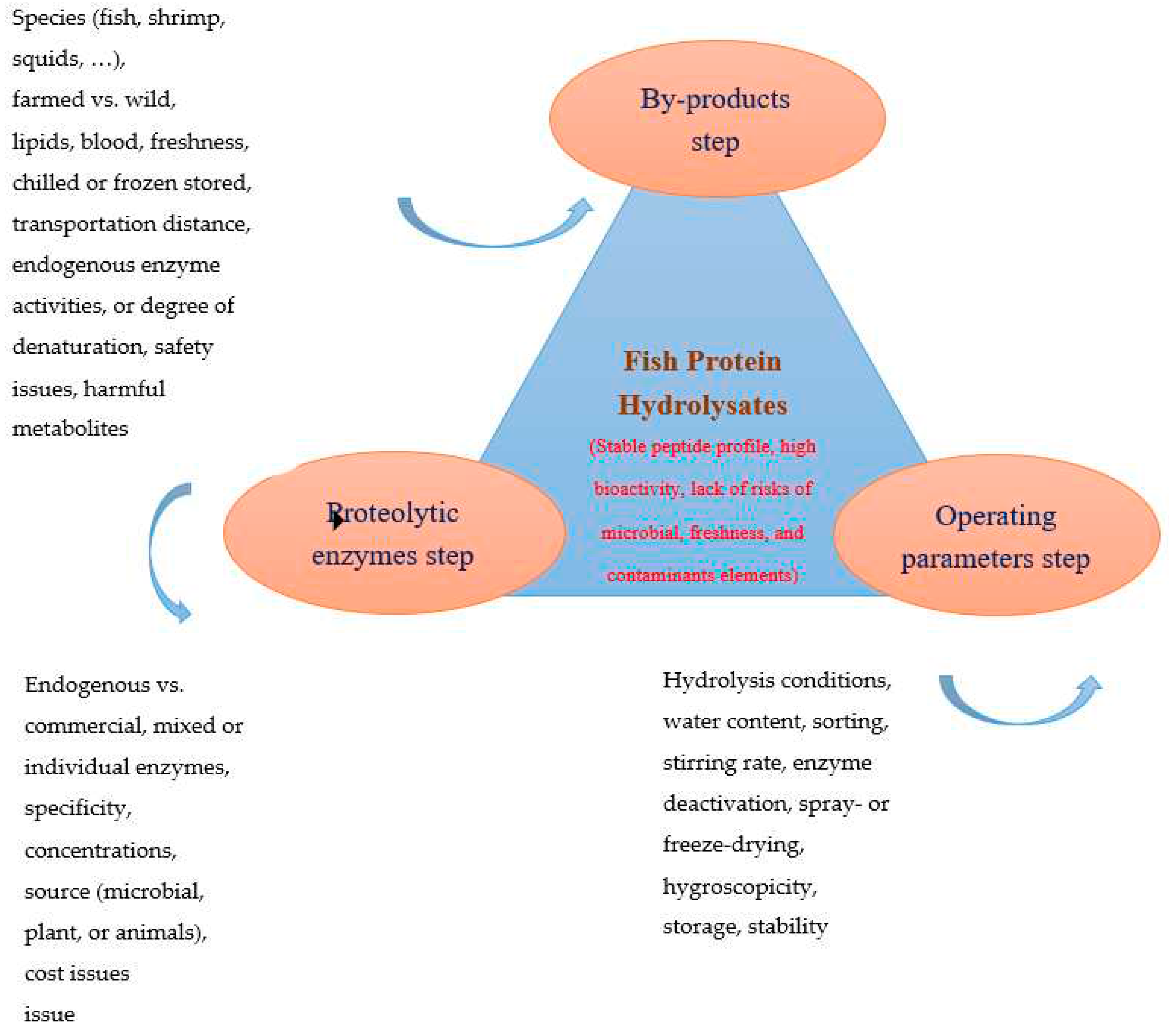

Table 1.
Composition and main safety issues in by-products from different categories of aquatic species.
Table 1.
Composition and main safety issues in by-products from different categories of aquatic species.
| Species | Yield (%) of by-products in relation to whole weight | By-products fractions and yiled (%) | Chemical composition (%) | Main safety issues | Preventive measures | References |
|---|---|---|---|---|---|---|
| Fish | ||||||
| Atlantic salmon (Salmo salar) | 43.8 | Heads (9.9), viscera (10.6), frames (10.4), trimmings (8.2), skin + scale (4.2) | Heads: moisture (53.2), ash (5.01), protein (17.2), lipid (21.5) Frames: moisture (52.9), ash (6.5), protein (19.3), lipid (17.16) Trimmings: moisture (46.4), ash (2.2), protein (18.1), lipid (26.4) Viscera: moisture (46.5), ash (0.97), protein (12.4), lipid (37) |
Fast decomposition by endogenous proteolysis, gills and viscera blood, gall bladder, off-odor of viscera, formation of harmful compounds such as biogenic amines and trimethylamine (TMA), loss of freshness | Lowering storage time and temperature, sorting of heads, frames from viscera, removal of gills where possible | [10,15,56,57] |
| Rainbow trout (Oncorhynchus mykiss) | 20-30 | Heads (11.2), viscera (7.8), frames (7.6), skin (3.4) | Heads: moisture (69.6) organic matetr (27.7), ash (2.7) Trimmings + Frames: moisture (66.5) organic matetr (30.6), ash (3) |
Fast decomposition by endogenous proteolysis (autolysis), high abdominal fats, blood (gills), non-digested feed in the stomach, digesta and fecal matter in the intestines | Cold or frozen storage of by-products, sorting heads and viscera, maintaining freshness, where possible removal of gills with large amounts of blood and hemoglobin (e.g., in large fish >2 kg), pretreatment with antioxidants | [16,58,59] |
| Yellowfin Tuna (Thunnus albacares) | 50-55 | Heads (13), fins (1), skin (10), bone (6), viscera (8), dark meat | Upper half: moisture (68.2), organic matter (26.1), ash (5.4) Lower half: moisture (60.6), organic matter (25.1), ash (14) |
Long time post catch to processing plant, degradation and off-odor of viscera, spoilage of gills, tongue, head flesh, huge blood release from large gills, activation of muscle proteases of heads (autolysis of proteins), contamination by heavy metals (e.g., cadmium) |
Using fresh by-products (catched by longline), removal of gills (blood), cold or frozen storage of by-product before hydrolysis, sorting of viscera from heads, reject batch with high heavy metals | [17] |
| Turbot (Scophthalmus maximus) | 69.6 | Heads (19.6), frames (16.4) trimmings (13.5), viscera (14.3) skin + scale (5.8) |
Heads: moisture (71.3), ash (6.4), protein (20.2), lipid (1.7) Frames: moisture (58.7), ash (7.9), protein (19.1), lipid (12.1) Trimmings: moisture (70.1), ash (4.3), protein (20), lipid (4.8) Viscera: moisture (70.9), ash (1.6), protein (13.4), lipid (10.9) |
Bioaccumulation of heavy metals in muscle and by-products, autolysis of by-products, long time from catch to delivery at the dock, low freshness, bacterial spoilage | Inhibiting quality deterioration by low storage time and temperature, sorting by-products fractions, reject batch with high heavy metals | [10,60,61] |
| European seabass (Dicentrarchus labrax) | 55 | Heads (21.2), frames (11.9) trimmings (7.1), viscera (7.7) skin + scale (7) |
Heads: moisture (59.4), ash (10.1), protein (17.8), lipid (11.2) Frames: moisture (52.6), ash (12.4), protein (18.6), lipid (13.9) Trimmings: moisture (57.5), ash (6.9), protein (21.2), lipid (11.1) Viscera: moisture (31.9), ash (1.5), protein (14.34), lipid (39.3) |
Significant amount of oil and thus high lipid oxidation during hydrolysis, addition of lipid-derived carbonyls on the forming peptides, viscera spoilage, freshness | Sorting frames and trimmings from viscera, antioxidants addition, using N2 to control possible oxidation with viscera | [10,19] |
| Gilthead seabream (Sparus aurata) | 59.9 | Heads (27.6), frames (12.4) trimmings (6), viscera (6.9) skin + scale (7) |
Heads: moisture (51.9), ash (8), protein (15.3), lipid (20.3) Frames: moisture (55.6), ash (9.4), protein (19.4), lipid (13.7) Trimmings: moisture (56.5), ash (4.4), protein (22.4), lipid (13.2) Viscera: moisture (60.5), ash (2), protein (17.2), lipid (12.8) |
Significant amount of oil and thus high lipid oxidation during hydrolysis, addition of lipid-derived carbonyls on the forming peptides, viscera spoilage, freshness | Sorting frames and trimmings from viscera, antioxidants addition, using N2 to control possible oxidation with viscera | [10,19] |
| Herring (Clupea harengus) | ~60 | Heads (13.7-17), backbone (12.1-24.6), belly flap (4.5-10.7), tail (1.6-4), others (including viscera, blood, roe, milt, etc. depending on catch season, 2.4-17.6) | Protein (12.8-19.2), lipids (5.8-17.6), ash (1.3-7.2), moisture (65.7-78.7) |
Fast oxidative deterioration, rancidity soon after filleting, blood contamination (Hb-mediated lipid oxidation), autolysis, rapid microbial spoilage, loss of freshness (biogenic amines formation) | Low storage temperature, stabilization by antioxidants, sorting of heads (due to presence of gills and blood) with other moer stable fractions | [62,63] |
| Crustaceans | ||||||
| Shrimp (Litopenaeus sp., Macrobrachium sp., Fenneropenaeus sp., Penaeus spp.) | 44-62.5 | Heads (34-54), shell (7.4-7.6), tail (1.7-2.8) | Head: moisture (68-75), protein (6.6-10), lipids (2.2-7), ash (4-6) Shell and tail: moisture (58-68), protein (8-11.3), lipids (0.4-0.8), ash (8.5-13.5) |
Endogenous proteases activity, polyphenoloxidase activities, appearance of melanin (black spot), soft shell, antibiotic residue, heavy metals contaminants (cadmium, arsenic, mercury, lead) | Cold chain, frozen storage, use of by-products from extensive shrimp farming (no antibiotic use), raw material safety through suppliers agreement | [3,64,65] |
| Crab (Portunus sp., Polybius sp., Cancer sp., Eriocheir sp., Eriphia sp.) | >50 | Shells, liver (hepatopancrease), physiological liquid (hemolymph), legs | Moisture (50-58), protein (15-30), minerals (30-50), chitin (15-30), fat (1-10) | Heavy metals (arsenic, cadmium, lead, chromium, mercury), loss of freshness (histamine, cadaverine, …), autolysis mediated by endogenous proteases | Stoarge at low temperature, maintaining freshness, reject batch with high heavy metals | [66,67] |
| Lobster (Panulirus spp., Jasus sp.) | 45-80 | Head (20), shell, liver, eggs, hemolymph | Protein: heads (43.5), livers (41.1), shells (29} Lipids: liver (24.3), shells 0.6) Minerals: shells (36), heads (31.6) |
Heavy metals (arsenic, cadmium, lead, chromium, mercury) due to marine pollution, loss of freshness (histamine, cadaverine, …), autolysis mediated by endogenous proteases, TMA formation | Stoarge at low temperature, maintaining freshness, reject batches with high heavy metals | [66,67,68] |
| Cephalopods | ||||||
| Squid (Loligo sp., Illux sp.) | 52 | Heads and tentacles (25), fins (15), viscera (8), skins (3), pen (1) | Moisture (80) protein (18), lipids (1), ash (1) |
Rapid post-mortem auto-proteolytic degradation of proteins, microbial spoilage, contamination by persistent organic pollutants (POP), high concentrations of copper, zinc and cadmium in digestive glands | Keeping freshness, reducing the rate of chemical and microbial spoilage, cold storage, removing dark ink, reject batch contaminated with high concentrations of heavy metals | [69] |
|
Cuttlefish (Sepia officinalis) |
58 | Head and tentacles (23.3), viscera (18.7), fins (8.5), skin (4.2), ink (4.6) | Moisture (64-75), protein (14.9-17.5), lipids (4.8-6.2), ash (1.7-2.0) |
Inappropriate storage temperature, degradation by acid and alkaline proteolytic activity, microbial spoilage, high quantity of heavy metals such as in viscera |
Maintaining freshness of by-products, minimizing enzymatic degradation and microbial spoilage especially in viscera, preservation and cold storage of by-products |
[70,71,72,73,74] |
| Bivalve mollusk | ||||||
| Oyster (Pinctada fucata), mussle (Mytilus edulis), cockle (Cerastoderma edule) | ~60 | Shell (60), byssus threads, extracellular fluid (containing hemolymph and extrapallial fluid (EP)) | Shell: protein (2.5% on a dry weight basis) |
Contamination by heavy metals, gasoline, hydrocarbons, pesticides, and microorganisms (coliforms, vibrio, salmonella, shigella, biotoxins) | Monitoring concentrations in the laboratory each season, reject batches, use of disinfected water and refrigeration, implementation of good hygiene and manufacturing practices, fishermen’s health certificates | [75,76,77] |
Table 2.
Enzymatic hydrolysis and characteristics of protein hydrolysates from fisheries by-products.
Table 2.
Enzymatic hydrolysis and characteristics of protein hydrolysates from fisheries by-products.
| Species | By-products | Enzymes | Hydrolysis conditions | Characteristics | Suggested applications | References |
|---|---|---|---|---|---|---|
| Channel catfish (Ictalurus punctatus) | Heads + frames (3:2 w/w) | Papain, ficin, bromelain, neutrase, alcalase, protamex, novo-proD and thermolysin | Enzymes concentrations: 10-80 AzU/g of protein in substrate Hydrolysis time: 10-120 min Temperature: 40-70 ºC (for thermolysin) and 30-60 ºC for all other proteases pH: 7.2 |
Highest DH (71%) was obtained with ficin (80 AzU/g, 120 min, 30 ºC), hydrolysates from novo-proD (5 and 25 AzU/g, 10 and 20 min) and thermolysin (25 AzU/g, 20 min) at 30 and 60 ºC showed comparable emulsion activity index (EAI) and emulsion stability index (ESI) as soy protein isolate (SPI) | Alternative to soy or other proteins | [100] |
| Hake (Merluccius merluccius) | Undersize (discards) | A: endopeptidase of the serine type, P: broad-spectrum endopeptidase, T: trypsin-specific protease, C: chymotrypsin-specific protease, G: glutamic acid-specific protease, P + G |
A: 1%, 50-70 ºC, pH 6-9 P: 1%, 50 ºC, pH 6 T: 1%, 45 ºC, pH 6 C: 1%, 70 ºC, pH 6 G: 1%, 50 ºC, pH 6 P + G: 1% of each enzyme, 50 ºC, pH 6 |
Protein extarction yield: 68%, average MW: 2.5 kDa, antioxidant activity: 88.5 mg TE/g protein obtained with endopeptidase of the serine type (A) | Food ingredient | [101] |
| Smooth hound (Mustelus mustelus) | Viscera | Neutrase®, Esperase®, Purafect®, endogenous enzymes |
Purafect: pH 10.0, 50 °C, Esperase: pH 9.0, 50 °C, Neutrase: pH 7.0, 50 °C, autolysis: pH 8.0, 50 °C |
DH value of 30, 27.1, 14.2, and 6.8 was obtained using Purafect, Esperase, Endogenous enzymes, and Neutrase, respectively. Ultrafiltration (UF) fraction with MW<5 kDa from Purafect hydrolysates showed the highest antioxidant and antihypertensive activities |
Functional foods | [102] |
| Tilapia (Oreochromis niloticus) | Frames | Properase E, pepsin, trypsin, flavourzyme, neutrase, gc106, papain | Properase E: pH 9, 50 °C, 4 h, E/S: 1:50 Pepsin: pH 2, 37 °C, 6 h, E/S: 1:50 Trypsin: pH 7.5, 45°C, 3 h, E/S: 1:100 Flavourzyme: pH 7, 45 °C, 4 h, E/S: 1:100 Neutrase: pH 7, 45 °C, 4 h, E/S: 1:50 Gc106: pH 4.5, 45 °C, 6 h, E/S: 1:33 Papain: pH 6, 37 °C, 3 h, E/S: 1:100 |
DH: 3.8-15.1 DPPH RSA: 26-70% •OH RSA: 23.7-89% •O2 RSA: 1.5-58.5% H2O2 RSA: 29-72% |
Functional foods | [103] |
| Anchovy (Engraulis encrasicolus) | Viscera | Combined Alcalase, Flavourzyme, and Protamex at 1.1:1.0:0:9 ratio | Temperature: 50 ºC pH: 7.5 Stirring: 150 rpm Time: 3 h E:S ration: 3% (w/w) |
Glutamic cid, glycine, alanine, and lysine consisted 11.8, 10.9, 12 and 10.9 g/100 g of hydrolysates Heavy metals (mg/kg): Cd: 0.04 Pb: 0.25 Hg: 0.02 |
Nutraceuticls | [104,105] |
| Bigeye tuna (Thunnus obesus) | Mixture of heads, fins and backbone | Pepsin | Enzyme concentration: 0.1 g/ 100 g waste mince Hydrolysis time: 5 h Temperature: 37 ºC pH: 2.0 |
Protein: 76.4% Lipid: 10.8% Ash: 12.2% Moisture: 2% Yield: 11% DH: 39% EAA: 25% NEAA: 10.3% |
Aquafeed | [106] |
| Rainbow trout (Oncorhynchus mykiss) | Mixture of heads, frames, and viscera | Endogenous enzymes (autolysis) | Time: 1-3 h Temperature: 40-60 ºC pH: 7.1 (original pH of the by-products, no pH adjustment) |
Peptide <1 kDa: 93.2% at 40 ºC for 1 h of autolysis DPPH: 2.7-4.1 μM TE/g hydrolysate HRSA: 81-98.2% Metal chelating: 6.2-28.5 μM EDTA/g hydrolysate |
Food/feed ingredients | [59] |
| Red tilapia (Oreochromis spp.) | Viscera | Alcalase | E:S ratio: 1:10 (w/w) Temperature: 59 ºC Protein concentration: 10 g/L Stirring speed: 51rpm, Time: 3 h |
Protein: 42.2%, Lipid: 3.6% Ash: 22.9% EAA: 349 residue/1000 residues HAA: 387 residue/1000 residue Peptides with MW of 336 Da were the main fraction ABTS RSA: 536 μM TE/g, FRAP: 115 μM TE/g, Chelation of Fe2+: 377 μM EDTA/g |
Food applications | [107,108] |
| Red tilapia (Oreochromis spp.) | Viscera | Alcalase | Optimal conditions: E:S ratio: 0.306 U/g, Substarte concentration: 8 g protein/L, Time: 3 h, Temperature: 60 ºC, pH: 10 |
DH: 42.5% Iron-binding capacity of hydrolysate (RTVH-B): 67.1% Iron-binding capacity of <1 kDa UF fraction (FRTVH-V): 95.8% |
Dietary supplements to improve iron absorption | [109] |
| Monkfish (Lophius piscatorius) | Heads, viscera | Alcalase | Optimal conditions: E:S ratio: 0.05% (v/w) Time: 3 h Temperature: 57 ºC pH: 8.3 Stirring rate: 200 rpm |
Head hydrolysate: Protein: 69.8% Lipid: 2.4% Ash: 18.5% Moisture: 9.3% Peptides <1 kDa: 54.6% DPPH RSA: 45% ABTS RSA: 13.5 μg BHT/mL Viscera hydrolysate: Protein: 67.4% Lipid: 4.8% Ash: 19.7% Moisture: 5.2% Peptides <1 kDa: 73.7% DPPH RSA: 49.7% ABTS RSA: 14.5 μg BHT/mL |
Protein-rich ingredient for food or feed applications | [110] |
| Atlantic salmon (Salmo salar) | Heads, trimmings, frames | Alcalase | Optimal conditions: E:S ratio: 0.2% (v/w) Time: 3 h Temperature: 64 ºC pH: 9.0 Stirring rate: 200 rpm Solid:liquid: 1:1 |
Head hydrolysate: Protein: 64.2% Peptides <1 kDa: 33% Digestability: 93% DPPH RSA: 45.3% ABTS RSA: 13.1 μg BHT/mL Frames + trimmings hydrolysate (S-TF): Protein: 71.1% Peptides <1 kDa: 48.4% Digestability: 94.1% DPPH RSA: 56.8% ABTS RSA: 16.8 μg BHT/mL |
Aquafeed | [16] |
| Gurnard (Trigla spp.) | Heads, skin + bone | Alcalase | Concentration: 2.5 mL/kg by-products Time: 3 h Temperature: 61 ºC pH: 8.6 Stirring rate: 200 rpm |
Heads hydrolysate: DH: 24–27% Average MW: 1379-1626 Da Total soluble protein: 88-94.8 g/L Skin + bone hydrolysate: DH: 19–24% Average MW: 1203-1562 Da Total soluble protein: 81.9-89.2 g/L |
Food and nutraceutical ingredient | [84] |
| Blue Whiting (Micromesistius poutassou) | Undersized fish | Food-grade protease of microbial origin | Fish:water ratio: 1.7-2:1 Time: 45-120 min Temperature: 50 ºC |
DH: 27-45% Protein: 70–74% Lipid <0.5% Peptides <1 kDa: 55-78% |
Anti-diabetic related functional ingredients | [111] |
| Sprat (Sprattus sprattus) | Undersized fish | Commercial SPH from BioMarine Ingredients Ireland Ltd. | Simulated gastrointestinal digestion (SGID): Pepsin E:S ratio: 2.5% (w/w), pH 2 for 90 min at 37 ºC Pancreatin E:S ratio: 1% (w/w), pH 7 for 150 min at 37 ºC |
DH: 39.7% Peptide<1 kDa: 88.7% EAA: 335.9 NEAA: 498.3 TAA: 834.2 Solubility >90% over pH range of 2-12 ORAC: 588 μM TE/g sample, FRAP: 10.9 μM TE/g sample |
Promote muscle enhancement | [112] |
| Pacific white shrimp (Litopenaeus vannamei) | Shells and heads | Papain | Box Behnken Design (BBD) optimization: Temperature: 45-55 ºC pH: 6.5-7.5 Time: 30-90 min E/S (%): 1-2 |
CPSH: DH: 46-57% Protein: 86.2% DPPH: 89.6% FRAP: 2230 μmol TE/mL CPSS: DH: 47-54% Protein: 83.3% DPPH: 79% FRAP: 1380 μmol TE/mL |
As a nutraceutical in the food industry | [113] |
Table 3.
Effects of marine protein hydrolysates to control oxidative deteriorations in seafood during processing or storage.
Table 3.
Effects of marine protein hydrolysates to control oxidative deteriorations in seafood during processing or storage.
| Marine species | By-product | Hydrolysis conditions | Structural properties of FPH/peptides | Food products | Storage conditions | Oxidation inhibition/quality preservation | References |
|---|---|---|---|---|---|---|---|
| Amur sturgeon (Acipenser schrenckii) | Skin | Gelatin was hydrolyzed with Alcalase (5% w/w, pH 8.0, 50 ºC) for 3 h | Pro-Ala-Gly-Tyr (405 Da) | Japanese seabass mince | Six freezing (-18 °C) and thawing (+4 °C) cycles | Peptide maintained intra-myofibrillar water (T21) pool and reduced free water (T22) population, preserved thermal properties of myosin and actin, and lowered TBARS formation | [11] |
| Tilapia (Oreochromis niloticus) | Skin | Collagen was hydrolyzed with Alcalase at 4000 U/g and 60 °C for 3 h to obtain tilapia skin collagen peptide (TSCP) | Peptides with MW <2.5 kDa accounted for 57.1% of TSCP, Gly accounted for 20.2% of amino acids, and the hydrophilic amino acids content was 38.3%. The active peptide was Asn-His-Gly-Lys (454 Da) |
Scallop adductor muscles | -18 °C for 2 wk | Frozen scallop muscles treated with 3 g/100 g TSCP showed higher salt soluble protein concentration, total sulfhydryl content, Ca2+-ATPase activity, and water-holding capacity during the 8 wk storage period |
[140] |
| Squid (Loligo opalescens) | Skin | Squid skin collagen was hydrolyzed with acid protease at 6000 U/g at 40 °C for 3 h to obtain collagen hydrolysates from squid skin (CH-SS) | 82.3% peptides had MW <5000 Da, among them 22.69% had MW between 1-2 kDa; Asp-Val-Arg-Gly-Ala-Glu-Gly-Ser-Ala-Gly-Leu rich in Gly tripeptide repeat sequence was identified as the active peptide | Shrimp muscle | 14 freezing (-25 °C) and thawing (+4 °C) cycles | CH-SS reduced the mechanical injury caused by ice crystals to shrimp muscle as well as carbonyl formation, maitained the integrity of fiber structure, threby redcing drip loss, higher content of α-helix and lower random coil compared to untreated muscle was found when CH-SS was used | [141] |
| Threadfin bream (Nemipterus hexodon) | Skin | Skin gelatin was hydrolyzed with lizardfish pepsin (pH 2.0 and 40 ◦C) and papain (pH 7.0 and 40 ◦C) for 60 min |
Gelatin hydrolysates had DH of 10, 20, 30 and 40% | Natural actomyosin (NAM) | NAM with 8% gelatin hydrolysates was subjected to six freeze-thaw cycles (20 h freezing at - 18 °C and 4 h thawing at 4 °C for each cycle) |
NAM with 20% DH gelatin hydrolysates showed the highest Ca2+-ATPase activity, total sulfhydryl groups and solubility along with lower disulfide bond content and TBARS | [142] |
| Silver carp (Hypophthalmichthys molitrix) | Muscle | Muscle homogenate was hydrolyzed with protamex (1.5 AU/g) for 30 min at 50 °C | DH of the hydrolysates was 13.6 | Unwashed surimi | Storage at conventional (- 18 °C) or ultra-low (- 60 °C) temperatures and subject to three and six freeze-thaw (per cycle - 18/- 60 °C, 12 h; 4 °C, 12 h) |
Hydrolysates reduce the formation of carbonyls, TBARS, and volatiles hexanal, nonanal and 1-octen-3-ol while maintained total sulfhydryl groups, samples stored at - 18 °C showed lower lipid and protein oxidation than those of samples stored at - 60 °C, indicating structural deterioration of surimi underultra-low frozen temperature storage |
[143] |
| Silver carp | Meat leftovers on bones and heads | Defatted ground mince (5-folds isopropanol at 25 ºC for 1 h) was hydrolyzes with alcalase (AH; 3000 U/g; pH 8, 60 ºC) or Protamex (PH; 2400 U/g, pH 7, 50 ºC) for 30 min | DH for alcalase and protamex hydrolysates was 12.9 and 13.2% respectively, peptides with MW of <138, 286-780, and ~1420 Da accounted for 3.5, 39.1, and 50.6% in alcalase hydrolysates and 4.7, 16.8, and 37.4% in protamex hydrolysates, | Surimi | Surimi with 2, 4, and 6% hydrolysates subjected to six freeze-thaw cycles (-25 ± 1 ºC for 12 h and 4 ± 1 ºC for 12 h per cycle) | Surimi with addition of 2 g of protamex hydrolysate displayed the highest actomyosin extractability, Ca2+-ATPase activity and correspondingly, lowest surface hydrophobicity of actomyosin, while maintaining total sulfhydryl groups and texture of heat-set gel |
[144] |
| Large yellow croaker (Pseudosciaena crocea) | Muscle | Lyophilized protein (0.02 mg/mL) was hydrolyzed with pepsin (pH 2, 40 ºC), trypsin (pH 8, 45 ºC, and neutral protease (pH 7, 50 ºC) at 5000 U/g for 5 h | Peptides with MW<500 Da constituted 77.8, 78.5, and 74.3% of pepsin, trypsin and neutral protease hydrolysates, respectively, trypsin hydrolysates showed the highest content of hydrophilic amino acids (51.87%) compared to pepsin (47.26%) and neutral protease (39.14%) hydrolysates | Turbot fillets | Fillets were soaked in 2 mg/mL hydrolysates alone or in combination with 4% sucrose) for 4 h, then subjected to 3 freeze-thaw cycles (-20 ºC for 24 h, 4 ºC for 12 h for each cycle) | Trypsin hydrolysates reduced the loss of Ca2+-ATP enzyme activity and the structural integrity damage of myofibrillar protein better than other hydrolysates |
[145] |
| Argentine croaker (Umbrina canosai) | Muscle | Alkali-solubilised protein was hydrolyzed with Alcalase (pH 8, 50 ºC) or protamex (pH 7, 50 ºC) at 30 U/g until DH of 20% | MW of Alcalase and Protamex hydrolysates were 1083 and 1350 Da, respectively | Flounder fillets | Fillets coated with agar film containing Alcalase hydrolysates were stored at 5 ºC for 15 days | Agar-hydrolysate film showed higher transparency and mechanical properties than clove essential oil film. It improved biochemical and microbiological qualities of fillets without the sensory limitation of the essential oil volatile compounds | [146] |
| Common carp (Cyprinus carpio) | Skin | Gelatin was hydrolyzed by 2% (proten basis) Protamex® at pH 7 and 50 ºC for 3 h | DPPH RSA, metal chelating ability and FRAP of gelatin hydrolysates were 23.8%, 64%, and 2.65 μM TE/mg sample, respectively, dipeptide Ala-Tyr (MW: 252 Da) was isolated as active antioxidant peptide with FRAP of 89.3 μM TE/mg sample | Atlantic mackerel fillets | -18 °C/ 4 month |
Ala-Tyr peptide layer on the furcellaran/gelatin hydrolysate (FUR/HGEL) films increased antioxidant activity, mechanical and rheological properties, while reducing the water solubility of the films, reduction of fillet oxidation was not significant, TVB-N formation was inhibited by the film | [147,148] |
| Blue whiting (Micromesistius poutassou) | Discards | Hydrolsysi by trypsin (0.1% E:S) at pH 8 and 50 ºC until reaching DH of 4% | EC50 values of DPPH RSA, reducing and chelating power were 1.46,11, and 0.95 mg/mL, respectively. BPH contained 60% of peptides between 0.5 and 3 kDa. Protein, lipid, ash and moisture were 76.8, 9.4, 7.3 and 3.35%, respectively. | Omega-3 emulsion from refined commercial fish oil (18% EPA and 12% DHA) | 20 °C/ 10 days | BPH increased its droplet size during storage while suffering a significant lipid oxidation. However, it was not able to prevent omega-3 oxidation in spite of in vitro radical scavenging or chelating effect comapred to whey (WPH) or soy (SPH) protein hydrolysates | [149] |
| Silver carp | Surimi processing by-products (SPB; head, skin, fin, scale, bone, white muscle leftover on bones, and dark muscle) |
SPB was heated at 121 ºC for 2 h and lyophilized powder hydrolyzed with Alcalase (55 ºC, pH 8) and trypsin (37 ºC, pH 8) for 4 h | Peptide with MW <0.5 kDa accounted for 40.4 and 47.9% in trypsin (DH 13.4%) and Alcalase (DH 18.0%) hydrolysates after 4 h, respectively | Surimi | -18 °C/3 month |
Partial replacement of sucrose with 2% trypsin and Alcalase hydrolysates effectively delayed the oxidation of Cys, carbonylation of amino acids, loss of Ca2+-ATPase activity, and the destruction of structural integrity of myofibrillar protein |
[150] |
| Silver carp | Fins | Fins were dried, dispersed in distilled water (1:5, w/v), and heated at 121 °C for 3 h and the obtained gelatin was hydrolyzed using 4 enzymes (Alcalase: pH 8.0 and 50 °C, trypsin: pH 8.0 and 37 °C, neutrase: pH 7.0 and 45 °C, and papain: pH 7.0 and 55 °C) at 2% for 4 h |
A total of 102 and 61 peptides below 2 kDa were identified in trypsin and Alcalase hydrolysates, respectively, some of the indentified peptides shared similar repeated structures of Gly-Pro-X, such as Gly-Asp-Thr-Gly-Hyp-Ser-Gly-Hyp-Leu, Hyp-Gly- Hyp-Ile-Gly- Hyp-Hyp-Gly- Hyp-Arg, Gly-Gly-Arg-Gly- Hyp-Hyp -Gly-Glu-Arg |
Bighead carp fillets | Fillets were immersed in 2% of alcalase or trypsin hydrolysates with higher antioxidant activity and frozen at -18 °C for 1 wk and thawed at 4 °C (once a wk, as one freeze-tahw cycle) and a total of 6 cycles | Protein oxidation (carbonyls and disulfide bonds) and degradation (the loss of Ca2+-ATPase activity), and lipid oxidation (PV, TBARS, FFA, and fluorescent compounds) were significantly inhibited by fin hydrolysates |
[151] |
| Silver carp | Surimi processing by-products | By-products powders were hydrolyzed with Alcalase at 1:60 w/w at pH 8.5 and 55 ºC | -- | Surimi | Surimi mixed with 0.6 or 1.2% protein hydrolysates stored at -20 ºC for 60 days | Surimi with protein hydrolysates showed lower TBARS, carbonyl content and surface hydrophobicity, higher Ca2+-ATPase activity, total sulfhydryl groups and salt-soluble proteins, reduced degradation of MP, thus induce cross-linking more effectively, leading to formation of denser gel network | [152] |
| Silver carp | Muscle mince | Mince was hydrolyzed with Protamex (2400 U/g, pH 6.5 and 50 ºC) for 30 min and then fractionated into <3, 3-10, and >10 kDa fractions | DH was 13.6% and >50% peptides had MW of 1000-2500 Da | Interactions between peptides and ice planes | Computational simulations | Gly-Val-Asp-Asn-Pro-Gly-His-Pro-Phe-Ile-Met, Gly-Val-Asp-Asn-Pro-Gly-His-Pro-Phe-Ile-Met-Thr, and Ile-Ile-Thr-Asn-trp-Asp-Asp-Met-Glu-Lys in the fractions with MW <3 kDa interacted firmly with water molecules and inhibited growth of ice crystals | [153] |
| Bighead carp (Aristichthys nobilis) | Gills | Gills autoclaved (121 ºC for 4 h to solubilize collagen) were hydrolyzed with Flavourzyme (pH 7.0), Alcalase (pH 8.0), neutral protease (pH 7.0), and papain (pH 7.0) at 5000 U/g for 4 h |
Peptides with MW of <0.5, 0.-1, and 1-2 kDa were the dominant peptides especially with increasing hydrolysis time | Surimi | Surimi (81% moisture) mixed with 1 or 2% neutral protease hydrolysates stored at -18 ºC for 4 months | Surimi with hydrolysates had higher sulfhydryl and salt-soluble proteins and Ca2+-ATPase activity, lower disulfide bonds, carbonyls and hydrophobicity |
[154] |
| Common carp | Skin | Single-layer biopolymer films: furcellaran + carp skin gelatin hydrolysate; two-layer films: furcellaran + carp skin gelatin hydrolysate + Ala-Tyr |
Synthetic Ala-Tyr peptide | Atlantic mackerel carcasses |
Storage 4 °C, 15 days | Single- and double-layer coatings decreased lipid oxidation, but addition of peptide layer to the hydrolysate-furcellaran film did not improve its antioxidant effect | [155] |
| Pacific hake (Merluccius productus) | Fillets | Protamex (1%) was used to hydrolyze fillets for 1 h and with no pH adjustment (optimal condition) | Peptide were in the range of 95 to ~900 Da | Fish balls | Six freeze-thaw cycles (18 h at -25 ºC and 6 h at 4 ºC) | Protein hydrolysates decreased expressible moisture and cook loss while maintaining salt extractable proteins and thermal properties of myosin | [156] |
Disclaimer/Publisher’s Note: The statements, opinions and data contained in all publications are solely those of the individual author(s) and contributor(s) and not of MDPI and/or the editor(s). MDPI and/or the editor(s) disclaim responsibility for any injury to people or property resulting from any ideas, methods, instructions or products referred to in the content. |
© 2023 by the authors. Licensee MDPI, Basel, Switzerland. This article is an open access article distributed under the terms and conditions of the Creative Commons Attribution (CC BY) license (https://creativecommons.org/licenses/by/4.0/).
Copyright: This open access article is published under a Creative Commons CC BY 4.0 license, which permit the free download, distribution, and reuse, provided that the author and preprint are cited in any reuse.


