

Submitted:
23 November 2023
Posted:
27 November 2023
You are already at the latest version
Abstract
This study explores the dynamics of liquid holdup in a lab-scale co-current two-phase upflow moving packed bed reactor, specifically examining how superficial gas velocity influences the line average external liquid holdup at a fixed superficial liquid velocity. Utilizing Gamma-ray Densitometry (GRD) for precise measurements, this research extends to determining line average internal porosity within catalyst particles and the overall external bed porosity. Conducted with an air-water system within a bed packed with 3 mm extrudate porous particles, the study presents a novel methodology to calculate liquid holdup, grounded in Beer–Lambert's law. Findings reveal a decrease in liquid holdup corresponding with increased superficial gas velocity across axial and radial locations, with a notable transition from bubbly to pulse flow regime at a critical velocity of 3.8 cm/sec. Additionally, the lower sections of the packed bed exhibited higher external liquid holdup compared to the middle sections at varied gas velocities. The liquid holdup distribution appeared uniform at lower flow rates, whereas higher flow rates favored the middle sections.
Keywords:
upflow moving packed bed reactor
; line average liquid holdup
; gamma ray densitometry
; porous catalyst
1. Introduction
Improving the quality of light products and the increasing demand for heavy oil in compliance with strict environmental concerns have become a challenge for petrochemical refineries. Catalytic hydroprocessing is considered one of the most promising technologies for the conversion of heavy oils into high-value products, which is a well-known technology to remove undesirable components (sulfur, nitrogen, organometallic, etc.) from hydrocarbon feed streams and has been extensively practically utilized nowadays in refineries worldwide [1]. In hydrotreatment processes, the main issues are the catalyst life and performance limitation because the impurities can deposit on the catalysts resulting in rapid loss of its activity [2]. Under high temperatures and pressure, coking, poisoning, and sintering could cause serious agglomeration and maldistribution leading to unexpected unit shutdowns. Various designs of residue hydrotreating reactors have been described in the literature for treating heavy feedstocks [3]. There are some commercial designs such as Moving Bed of Catalyst (MBR), (U.S. Pat. No. 5,076,908), Fixed Bed Reactor (FBR) (U.S. Pat. No. 3879642 A), Ebullating Catalyst Bed (EBR), (U.S. Pat. Nos. 4,571,326 and 4,744,887) have been reported in the last few decades. The fixed bed systems deal with middle distillate feed, but they cannot deal with every residuum feed that is available. Heavy feeds with highly metallic contaminations (> 250 ppm) make the fixed bed catalytic hydrotreating system inefficient because the deposition of metals on the catalyst will result in a rapid loss of hydrogenation activity [4]. However, high-metal feeds are always the most economically attractive because of their relatively lower price. To deal with drastic change in heavy petroleum feed properties, moving bed technology has been developed [5]. In general, the upflow Moving Bed Reactor has a conical bottom part that allows replacement of the deactivated catalysts with fresh new catalysts. The removed catalysts can be reprocessed and reinjected later on mixed with fresh catalyst from the top of the reactor. In this case, the upward flow fluid with a slight bed expansion could avoid coking and plugging and reduce the pressure drop of the system to some extent [5,6]. The advantages of the upflow moving packed bed reactors are the increased utilization of catalysts characterized by a slight back mixing for both the catalyst and the feedstock; providing a better quality of products and higher efficiency of the process than that of an ebullated bed reactor [7,8]; periodic replacement of spent catalyst without shutdown. The moving bed configuration offers a relatively large catalyst migration time in comparison with the liquid mean residence time, so it can be considered as a pseudo two-phase (gas-liquid) upflow with a fixed bed [9]. Therefore, for the sake of the hydrodynamics study, the moving bed reactor can be investigated as a two-phase upflow packed bed reactor. The liquid holdup in upflow moving packed bed reactor is one of the important design and operating hydrodynamic parameters. Its measurement is essential to get a better understanding of the prediction of pressure drop, mass, and heat transfer mechanisms since the liquid serves as a transport of mass and heat to and from the catalyst particles. Moreover, the upflow packed bed reactor offers advantages for liquid-limited reaction [10]. For exothermic reactions, higher liquid holdup and well distribution ensure complete wetting efficiency and better temperature control thus contributing to the prevention of hot spot formation and thermal instabilities. A two-phase upflow packed bed reactor could be a satisfactory alternative to the classical trickle bed reactor for liquid-limited reactions because of increased gas and liquid interactions, thus increasing the effectiveness of contact, leading to better heat transfer and higher overall mass transfer coefficient [11]. For porous catalytic packed bed reactors, the total liquid holdup () means the overall volume of the liquid phase divided by the reactor volume. The total amount of liquid consists of two parts, which are dynamic liquid () and static liquid (). The static liquid includes the liquid inside the porous catalyst (internal static liquid, ) and the stagnant liquid attached between the catalyst particles (external static liquid, ). The dynamic liquid refers to the freely flowing liquid under operating conditions. Experimental data on the overall liquid holdup or saturation can be obtained by various techniques, such as for example drainage [12], weighing [13], tracer methods [14], and electric capacitance tomography (ECT) [15]. The liquid holdup measurement techniques can be divided into integral, semi-integral, and local measurement methods [16]. Integral methods provide liquid holdup information over the entire volume of the packed bed; these methods include the draining, weighting, and tracer methods. Semi-integral measurement methods provide liquid holdup information over a section or a line-integral of the packed bed, which includes radiation methods (e.g., Gamma-Ray and X-Ray) that can be applied at many axial and radial positions to get line-averaged information. The local measurement methods provide local liquid information by inserting a sensor (e.g., electromagnetic radiation) or a probe (e.g., optical fiber). Probes can be used inside the packed bed at different positions or using time-averaged tomography (Gamma-ray Computed Tomography) or instantaneous tomography (X-Ray or Electrical Capacitance Resistive Tomography). However, liquid draining and tracer methods can only provide the average holdup for the whole packed column. They cannot offer any information on how the liquid is distributed in the packing bed [5]. In fact, the liquid holdup can vary significantly with spatial position, and this information is critical for a better understanding of flow hydrodynamics and mass transport in packed columns. In gas–liquid–solid systems where the catalytic bed is dense and opaque, it’s hard to implement instrumentation inside three-phase systems. While the noninvasive methods such as advanced radioactive measurement techniques eliminate the alteration during the measurements [17], these techniques can determine the flow distribution over the whole reactor section with good spatial resolution and are not too intrusive [18]. The radiation method is based on the attenuation of the radiation beam as it passes through an absorption medium, which can be obtained by Beer-Lambert’s equation. Non-invasive techniques have become the tools of choice for detailed flow structures within porous media, unlike the more traditional interfering probes inserted within flows [15]. Since the catalytic packed bed is opaque, some noninvasive visualization techniques such as Digital Particle Image Velocimetry (DPIV) and Laser Doppler Anemometry (LDA) cannot measure the liquid/gas holdup distribution over its cross-section. Compared with other radiation techniques, the gamma-ray technique is well developed and more versatile because gamma rays have strong energy to penetrate wide ranges of material and can be chosen depending on the test section used [19]. Therefore, gamma-ray approaches have played a major role and have become the tools of choice in the measurement technology for gas–liquid two-phase systems and gas–liquid–solid three-phase systems [20]. A summary of literature review on the hydrodynamics studies of upflow packed bed is given elsewhere[21,22]. However, to the best of our knowledge, there are no studies reported in the literature that have studied liquid holdup in two-phase upflow moving beds with a conical bottom. Attenuation of the gamma radiation is mostly due to the presence of the liquid and solid compared to gas in the flow. Thus, information on the two-phase (liquid – gas) distribution can be obtained for flow over a fixed bed of catalyst, as the attenuation due to the catalyst will be fixed and the variation of attenuation is due to the flowing liquid. Hence, the measurement technique using gamma-ray densitometry leads to the measurement of the line averaged liquid holdup [20,23]. Accordingly, in this work, a comprehensive method has been developed using gamma-ray densitometry to measure and investigate the diameter profile of the line average solid, total external liquid holdup (dynamic liquid plus external static liquid), and internal static liquid holdup inside porous catalyst. For the cold flow laboratory packed bed used in this study, the column was packed randomly with commercial spherical catalyst. The flow conditions were scaled down from the industrial operation conditions as typical lab-scale hydroprocessing units. Owing to the distinct advantages of GRD, we employed it for the first time to measure the line average liquid holdup in a co-current gas-liquid upflow moving packed bed reactor operated under flow rates matching the operating conditions.
2. Materials and Methods
2.1. Experimental Setup
The experimental setup used in this study is a scaled-down version of an industrial upflow moving packed bed reactor, meticulously designed in accordance with the principles of similarity for hydrodynamics and geometry to mirror the essential hydrodynamic characteristics of its full-scale counterpart. The setup consists of a Plexiglas-packed bed column, gas-supplying rotameter, liquid cycling tank, and a pump. Its dimensions are notably 57 inches in height and 11 inches in internal diameter, Figure 1 presents the schematic of the experimental setup and actual photos of the moving packed bed. At the base of the setup, the structure is divided into two primary sections: a gas-liquid distributor plenum and a perforated cone. The plenum features a deflector designed to evenly disperse the incoming mixture of gas and liquid phases. This deflector is strategically placed at the plenum’s base to ensure thorough distribution. To mitigate any initial maldistribution in the plenum and maintain consistent phase distribution into the column, a specially designed gas-liquid distributor equipped with a chimney is positioned between the plenum and cone sections. This distributor includes 19 holes, each with a diameter of 0.1 inch and a height of 1.2 inches, allowing liquid to pass through. Additionally, each chimney possesses a side hole (pitch) at the top, measuring 0.03 inches in diameter, facilitating gas passage. The cone section, situated between the packed bed and plenum sections, contains glass marbles within the space between the column wall and the perforated cone wall, forming a conical frustum distributor. This arrangement, along with the conical frustum in the cone section, is designed to provide a uniform upflow of phases into the catalyst bed and ensure stable bed operation. The design of the and photos of the internals are not given for confidentiality reasons. The packed bed section, serving as the test area, is located above the cone section. It is randomly packed with a 3 mm diameter porous spherical catalyst, commonly used in the industry, extending up to 24 inches in height. The conical frustum supports the catalyst bed. In this setup, both gas and liquid flow concurrently and upward through the bed particles. For the experiments, tap water and oil-free compressed air were used as the liquid and gas feedstocks, respectively, sourced directly from the laboratory’s supply lines. The experimental conditions were carefully controlled, with the experiments being conducted at room temperature and pressure. A wide range of superficial gas velocities were tested, while the liquid superficial velocity was fixed based on the scaled-down velocity of an industrial hydrotreating unit. Additionally, the properties of the bed material and the range of operating conditions are systematically outlined in an accompanying table. To obtain detailed measurements, Gamma-ray densitometry (GRD) was employed at different axial heights of the bed. These included the bottom (Z/D = 0.3) and the middle (Z/D = 1) sections. The horizontal measurement step was set at 1 inch, including r/R = 0, 0.3, 0.5, 0.7, and 0.9, to cover the diameter profile along the bed under normal conditions, as shown in Figure. For quantitative analysis, each data point was measured thrice, and the average gamma-ray intensity value was recorded. The GRD system was moved horizontally for scanning once stable operation was achieved, performing scans along several chord lines parallel to the column’s diameter under various operating conditions, as illustrated in another figure. Eleven specified positions were evenly distributed along the column’s diameter, each separated by a 1-inch interval. Furthermore, the liquid holdup in the packed bed was evaluated using GRD at the same axial levels as the flow scans[21,22]. However, due to the dynamic movement of the three phases at the top section of the bed, where the catalyst becomes fluidized, dual sources were required for accurate measurement, highlighting the complexity of the experimental setup. The results for the liquid holdup, particularly at the bottom and middle sections of the bed, are detailed and discussed in the results and discussion section.
2.2. The Measurement Technique
Gamma-Ray Densitometry (GRD) was used in this work to obtain the line averaged phase holdups, enabling maldistribution identification and discerning various flow regimes. A comprehensive methodology for the GRD technique has been implemented to the measurement of the dynamic liquid holdup and static holdup integrated with static holdup model. The GRD technique comprises of an encapsulated 250-mCi Cs-137 Gamma-ray source with energy of 660 keV, collimated NaI scintillation detector, and online data acquisition system. The gamma-ray source and the detector facing each other, and their positions can be adjusted both vertically and horizontally to span the column through a computerized system, as shown in Figure 2. Collimation of the Gamma-ray source is achieved through the use of a small aperture, creating a focused beam that penetrates the column section and is detected by the collimated detector, which utilizes a 1 mm aperture in a 1-inch-thick lead piece. The radiation that is transmitted and subsequently captured by the detector is integral to the measurements taken. For data acquisition, an Osprey USB interface is used, integrated with a higher-voltage power supply (HVPS), a preamplifier, and a digital multi-channel analyzer (MCA). Due to its favorable efficiency and energy resolution, a thallium-activated sodium iodide (NaI (Tl)) detector is widely employed for the detection of Gamma-rays and other ionizing radiations. Photons that impinge on the scintillation detector induce impulse signals via a sensitive photomultiplier tube. These signals, once collected, are amplified and shaped by the amplifier and are discriminated against by the MCA, which sets a specific threshold to translate radiation intensity into a measurable analog signal for further analysis. The ProSpect® Gamma Spectroscopy Software is then used to analyze the detector’s count data. The principle of attenuation of Gamma rays in matter is harnessed by GRD, where the degree of residual radiation that reaches the detector is indicative of the material’s density through which the Gamma-ray has passed. The principle suggests that a low-density absorber will attenuate less radiation compared to a high-density absorber due to a higher probability of interaction with the radiation. The variation in the amount of residual radiation that is detected is indicative of different flow regimes within the column, reflecting their unique properties. By analyzing the time series of photon counts obtained using the non-invasive GRD technique, valuable data such as phase distribution and holdups are derived, providing insights into the complex behaviors of multiphase flow within the reactor.
2.3. The Principle of the Holdups’ Measurements and the New Methodology for Measuring External and Internal Liquid Holdups and Catalyst Porosity
As mentioned earlier, the principle of the Gamma-ray Densitometry technique measurement for the holdups and bed structure is based on the absorptions of gamma radiation along the beam path as it passes through the tested material [23]. The attenuation of gamma-ray beam depends on the radiation energy of the source and the density and thickness of the absorbing material (Al-Dahhan 2009) [19,24]. The reduction in the radiation intensity from I₀ (at the source) to I can be expressed by the Beer – Lambert’s law according to the following equation [25].
This equation states that the intensity of the detected radiation is directly proportional to the intensity of the incident radiation and varies exponentially with the thickness of the absorbing medium and its density and the mass absorption coefficient . The attenuation ratio () called (), and can be calculated by the natural logarithm sum of the measured attenuation and along the gamma ray beam bath [24] as:
Eq. (2) is the general form of the GRD beam attenuation by different material. Hence, the attenuation ratio will be different by introducing two phases inside the column. Where () is the incident radiation intensity and () is the detected radiation intensity, which is different for each scan and depends on the constituting materials of the attenuating medium. Once the attenuation ratio () obtained for each case, the line averaged holdup of the phases can be estimated as discussed below. As mentioned earlier, The study utilizes a three-phase system with a stationary solid catalyst, and both gas and liquid phases flowing co-currently upward. Hence, the attenuation ratio () will be the summation of the line attenuation of the individual phases. For three phases in operation of gas – liquid – solid system the attenuation ratio () will be:
Where:
, ,and: Mass attenuation coefficient of solid, liquid, and gas in ().
, and : Density of solid, liquid, and gas respectively in ().
= length occupied by solid (catalyst) among the total length ().
= length occupied by liquid (water) among the total length ().
= length occupied by gas (air) among the total length ().
= Total length that is occupied by the gas, liquid and solid along the GRD beam path including the length of air outside the column () and the thickness of the column wall.
Since the path of air outside the column and the column wall are the same in each scan that we performed and these will be cancelled in the steps of manipulating the equations, the attenuation due to these medium and lengths are not included in the following equations. Therefore, in the following equation and their manipulation only the materials inside the column of solid, gas, and liquid are included.
Where: , , , and ,
,, and = the holdup for solid, liquid, and gas respectively.
The attenuation ratio () for the two phases will be:
- Gas – solid system: ()
- Liquid – solid system: ()
- Gas – liquid system: ()
The attenuation ratio () for single phase will be:
- Gas phase: ()
- Solid phase: ()
- Liquid phase: ()
In this study, a new methodology is developed to measure the line average external void space and catalyst bed external liquid holdup in void space, and the line average internal porosity of catalyst. All GRD measurements are carried out at the same axial and radial locations as mentioned in experimental setup section, with different material inside the column as described below. All GRD scans contain the attenuation value of the column wall which is constant. We removed the wall attenuation by subtracting the wall attenuation ratio () from each attenuation ratio (). The catalyst bed is fixed during our experiment except for the top of the bed where the catalysts are fluidized. Therefore, the liquid holdup, void holdup of the bed, and internal liquid holdup and porosity of the catalyst, were measured by performing the following GRD scans:
- Without column.
- The empty column for the wall attenuation.
- The column is filled only with water for the liquid attenuation.
- The column is filled with packed bed for a dry catalyst representing attenuation of the gas and solid phases.
- The packed column is filled with water first, then it is drained where the scan was for a wet catalyst attenuation.
- The packed bed is filled with water representing both liquid and solid attenuation.
- Scanning the gas-liquid-solid flow under the desired operation at the same position where the holdups for all the three phases can be obtained.
GRD scanning procedures for different constituting materials and flowrate conditions were followed as reported by [5,25,26]. New methodology to measure line average liquid holdup in void space, liquid holdup inside the catalyst pores and the catalyst position for porous catalyst, has been developed and performed as follows:
- Scanning without column (absorbing medium) (i.e., air only). In this scanning case, GRD beam passes through the atmosphere from the source to the detector without any absorbing medium in between them. The obtained attenuation is due to air only () which represents the incident radiation () [27]. The gamma ray source is placed on one side and the scintillation detector is on the other side.
-
Scanning the empty column, for wall attenuation of plexiglass (air inside only, base line). In this scanning case, the GRD beam passes through the empty column, the attenuation is due to the wall of the column and the gas (air) inside it. The obtained attenuation is due to wall column and air. The mass attenuation coefficient of the air () is negligible compared to the Plexiglas (), less interaction of air in comparison with Plexiglas. Hence:Where:: represents the attenuation coefficient due to column wall.
- Scanning the column full of water, for liquid attenuation (i.e., water inside only, liquid phase). In this scanning case, the same packed column filled with water only in which the GRD beam passes through the column wall and the water. The obtained attenuation is due to the wall of the column and the liquid inside it:Subtracting (eq.10) from (eq.11), yields the net attenuation of liquid ():Where the attenuation of the gas phase in this case represents the air outside the packed column is neglected as illustrated in step number II of the previous page.
- Scanning the column packed with dry solid catalyst, as a (i.e., dry catalyst inside only, dry solid phase). In this scanning case, the same packed column was packed with dry solid particles only in which the GRD beam passes through the column wall, the dry catalyst and the gas in voids. The obtained attenuation is due to the wall of the column, the dry solid catalyst and the gas in voids between solid catalysts, where the latter is negligible:By subtracting (eq.10) from (eq.13), the net attenuation of dry solid catalyst () is obtained:: represents the attenuation coefficient due to dry solid catalyst, and , so ≅ 0
-
Scanning the column packed with wet solid catalyst, i.e.,. wet catalyst inside only – wet solid phase). The same packed bed, that has the dry solid catalyst particles, was filled with water for a sufficient time then the column was left to drain for a number of hours to ensure that the static liquid becomes negligible. The static holdup in the step is negligible as proper draining ensures that is no liquid outside of the catalyst pores in the measured line averaged location. Hence the only left liquid is detained inside the catalyst porous due to the capillary force [16]. In this scanning case, the GRD beam passes through the column wall, the wet catalyst, and the void space of gas. The obtained attenuation is due to the wall of the column, the solid catalyst, liquid inside the catalyst (porous), and the gas in voids between solid catalysts, where the latter is negligible:The obtained attenuated of the air also neglected in this case as illustrated in step II.The net attenuation of wet solid catalyst () is obtained by subtracting (eq.10) from (eq.15),, Where:
- Scanning the column packed with solid and liquid, (water – catalyst inside, liquid – solid phase).The same packed bed, contains wet solid catalyst inside, was filled with water so the voids between the particles currently filled with water. In this scanning case, the GRD beam passes through the column wall, the solid catalyst and water. The obtained attenuation is due to the wall of the column, the solid catalyst, liquid inside the catalyst (porous) and the liquid outside the catalyst in voids between solid catalysts:By subtracting (eq.10) from (eq.17), the net attenuation of liquid-solid () is obtained in eq. (18), Since: . Hence,Where () is the line average void holdup which is completely occupied by the liquid, which is equal to the bed void.
- Scanning the column with the desired operation of gas and liquid phases, (air – water – catalyst, gas – liquid – solid). In this scanning case, the GRD beam passes through the column wall, catalyst, liquid, and gas as a three-phase liquid – solid – gas attenuation. The obtained attenuation is due to the wall of the column, the solid catalyst, liquid inside the pore, total liquid in external void (dynamic + static), and the gas phase:
Subtracting (eq.10) from (eq.20), yields the net attenuation of liquid – solid – gas ():
Where: , , and the gas is neglected.
To measure the Bed void distribution, by subtraction (eq.16) from (eq.18):
This represents the void between the bed catalyst particles that are randomly packed. To measure the total liquid holdup in external void space (dynamic and static liquid holdup). Therefore, subtracting (eq.16) from (eq.21) yields:
Here due to capillary force and in the absence of surface reactions, the catalyst pores are always intact with the liquid. To measure the catalyst porosity fraction with respect to the total bed volume, which is equivalent to the internal liquid holdup inside the catalyst particle, subtraction of (eq.14) from (eq.16), gives:
: Is equivalent to the catalyst porosity fraction with respect to the bed volume.
The line average gas holdup can be measured by . Therefore,
The attenuation will be different between the phases as the densities are different, which depends on the interaction of the gamma ray with the absorbing material. By subtracting the attenuation of the liquid-solid phase from the attenuation of the three phases, we can get the gas holdup:
The solid holdup then can be obtained from:
3. Results
In this section, the line average diameter distribution of the parameters like solids holdup and the internal liquid holdup inside the catalyst are presented. All these parameters are fixed for a packed bed unit irrespective of the operating conditions. The methods used to obtain these parameters have been discussed in the previous section of the principle of measurements.
3.1. Diameter Profile of the Void Fraction with Wet Catalyst
Figure 3 presents the line-averaged radial profiles of the void fraction in a wet catalyst bed at two distinct axial locations, Z/D=0.3 and Z/D=1, following the water drainage in the pre-wetting stage. The bed’s random packing results in varying void fractions across the column’s diameter, indicating non-uniformity in the distribution of void spaces.
At the midpoint of the column (Z/D=1), the void fraction profile diverges more noticeably from the bottom (Z/D=0.3), suggesting a non-uniform distribution of the catalyst. The percentage deviation in the void fraction was calculated using the following formula:
The analysis yielded a deviation of approximately 15% at the middle axial location and 13% at the bottom, highlighting the presence of radial non-uniformities that can significantly affect flow distribution and catalyst efficiency. These variations are significant as they suggest the presence of flow maldistribution along the radial direction for both axial positions, which could potentially impact the flow distribution and, consequently, the catalyst’s efficiency. A higher voltage structure within the bed can lead to a path of less resistance, promoting a more streamlined flow. This, in turn, could mitigate the issues of channeling and bypassing, which are often precursors to flow maldistribution, as indicated in reference [29]. It is crucial to address these variations to enhance the reactor’s performance and ensure the even distribution of reactants across the catalyst bed.
3.2. Diameter Profile of Line Average Internal Liquid Holdup
Figure 4 presents the line average internal liquid holdup. The data reveals an uneven distribution of the internal static liquid holdup across the radial direction of the column. The percentage deviation shows a variation of about 18 percent at the middle axial location and approximately 8 percent at the bottom. These discrepancies are attributed to the random nature of the packed bed’s distribution [22]. It is critical to note that this parameter is not dependent on the flow rate for a fixed bed reactor; rather, it is influenced by the catalyst’s characteristics and the arrangement of the bed material [28].
3.3. Radial Distribution of Solid holdup (
)
Figure 5 illustrates the line average radial profile of solid holdup, which exhibits a random distribution attributable to the bed’s random packing. The average solid holdup is approximately 0.348. Calculated percentage deviations show about 8 percent at the middle and around 17 percent at the bottom. A comparative study measuring line average solid holdup in a packed bed with GRD on a similar random bed structure (30 cm ID column) using a 3.2 mm alumina particle, indicated an average solid holdup of around 0.66 [29]. However, this referenced catalyst was non-porous. In contrast, our study combines the solid holdup (≈0.348) with line average internal porosity (≈ 0.27) to yield a total of approximately 0.61. This aggregate value ensures a geometric similarity between non-porous and porous catalysts and also confirms the validity of our solid holdup determination method [22]
3.4. The Line Average Total External Liquid Holdup
In this methodology, the total external liquid holdup is defined as the sum of the static and dynamic liquid holdups. The static liquid holdup represents the volume of liquid trapped within the interstices of the catalyst particles, while the dynamic liquid holdup pertains to the liquid flowing through the external void spaces of the catalyst bed. Considering the upflow reactor configuration, it is acknowledged that the static liquid holdup does not remain constant since the gas phase is dispersed, thus affecting the liquid distribution. The decision to report the total external liquid holdup, rather than separately detailing the static and dynamic components, stems from the scaled-down flow rates used in this study, which are reflective of industrial conditions [21]. The baseline operating condition was chosen to emulate industrial flow rates, with the gas flow rate adjusted to observe its impact on the total external liquid holdup, while the baseline liquid flow rate remained constant. The methodology employed to acquire this parameter is outlined in Section 4, where the principle of measurements is discussed. The line average total external liquid holdup, as observed, indicates that the reactor’s flow dynamics are sensitive to gas flow rates, which can be pivotal in optimizing reactor performance. Figure 5, Figure 6, Figure 7, Figure 8, Figure 9 and Figure 10 show that the external line average liquid holdup (ε) at r/R = (0, +0.5, -0.5, +0.9, -0.9) and bottom and middle axial locations (Z/D = 0.3 and 1). It is observed that the liquid holdup is gradually decreasing, and the decreasing trend is sharp after 3.8 cm/sec for all the position except at wall (r/R = +0.9), it is usually seen in this reactor the transition occurs from bubble to pulse flow occurs at this flow rate [30]. Increasing gas flow rate results in a transition in the flow regime from bubbly to pulse flow for gas phase. At Bubbly flow regime the reduction of liquid holdup is not sharp as this regime is characterized by a low interaction between bubbles themselves, bubbles and packing, and also a little effect of bed porosity and geometry on these quantities [31]. As gas velocity is increased, the fluid turbulence and the bubble number will increase, and the interference between bubbles and the coalescence/re-split will occur, which reduces bubble size and increases the gas holdup in the reactor and then reduces the liquid holdup sharply with increasing gas flow rate. All the location irrespective of the axial and radial location showed decreasing trend of the liquid holdup with increasing gas flow rate, and the same trend is observed by [29,30,31]. The decreasing trend calculated with respect to maximum holdup ((max-min)/max) for all location is varying between 15 percent and 33 percent. At wall (r/R = +0.9) the transition of the regime is not clear due to the significant wall effect. The trend at both sides of column wall, as seen in Figure 9 and Figure 10, quite different behavior and this can be directly linked to the effect conical bottom and the plenums. In all the cases the liquid holdup is higher for the bottom part and this is due to external bed voidage external porosity of the bed structure, where the void space is higher for the bottom location compared to the middle section.
3.5. Effect of Superficial Velocity on the External Liquid Holdup
The radial distribution of external liquid holdup at the bottom region (Z/D = 0.3) of the packed bed was analyzed across various superficial gas velocities (Ug = 0.6, 1.2, 3.8, and 7.7 cm/s) while maintaining a constant liquid velocity (Ul = 0.017 cm/s). The radial average liquid holdup was calculated for each gas velocity, showing a decreasing trend with increasing gas velocity, with averages of εr = 0.3, 0.29, 0.27, and 0.24, respectively, displaying a decreasing trend with increasing gas velocity, as showcased in Figure 11. This decline aligns with expectations, where higher gas velocities contribute to more pronounced deviations in liquid holdup. Specifically, the percentage deviations for increasing gas flow rates were approximately 11%, 12%, 13%, and 20%. Higher flow rates induce more chaotic behavior of the phases resulting in more random flow distribution. At lower superficial gas velocities, the external liquid holdup distribution tends to be relatively uniform. However, as the gas velocity increases, the distribution becomes skewed, often shifting towards one side of the column. This behavior may result from the combined influence of the column’s base and distributor designs, which can create preferential pathways for the flow, a phenomenon that is crucial to consider for reactor optimization[18,23].
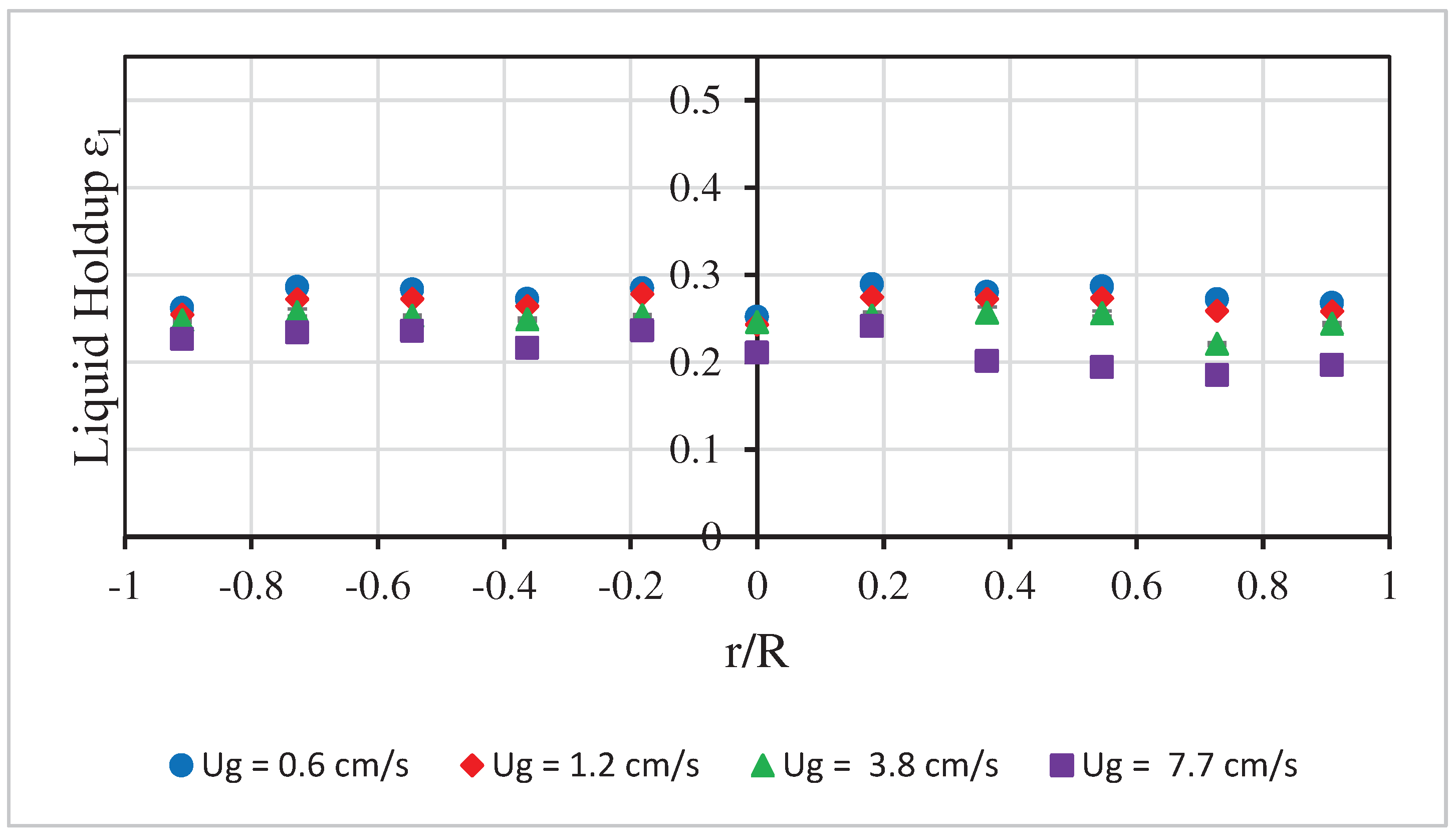
The radial profile of the liquid holdup for the middle part (Z/D = 1) of the packed bed at superficial gas velocities (Ug = 0.6, 1.2, 3.8 and 7.7 cm/s) and at constant liquid velocity (Ul = 0.017 cm/s) are shown in Figure 12. It appears in Figure, a slight decrease in the average liquid holdup values obtained for superficial gas velocities (Ug = 0.6, 1.2, 3.8 and 7.7 cm/s), are (εr = 0.27, 0.26, 0.24 and 0.21). On comparison of the average external liquid holdup values at Z/D = 0.3 and Z/D = 1 for respective liquid velocity it is found to be quite similar but a little higher value for the bottom part. The percent deviation calculated for increasing flow rates is approximate as follows (10%,11%,11%,25%) and is seen to be increasing due to more random behavior due to complex interaction of phases. At lower flow rate the radial distribution is quite uniform as also observed for the bottom part. At higher flow rate the flow distribution is better with respect to bottom part, this is due to the flow rearrangement along the axial height of bed structure.
4. Conclusion
The current study investigated the effect of varying superficial gas velocity at a constant superficial liquid velocity on the line average external liquid holdup in a co-current two phase upflow moving packed bed reactor using Gamma ray densitometry (GRD). The line average internal porosity of the catalyst particles, and line average external bed porosity have been measured also. The experiments were conducted in upflow moving packed bed operated with an air-water system. The moving packed bed was packed randomly with 3 mm extrudate porous particles. The liquid holdup was calculated based on the new methodology developed using Beer – lambert’s equation. It has been found that the liquid holdup decreased as the superficial gas velocity increased at all axial and radial locations. The rate of decrease in liquid holdup at all location except at walls is higher after 3.8 cm/sec and it is due to transition from bubbly to pulse flow regime at this superficial gas velocity. The same trend was observed for reported studies on upflow packed bed reactors. The external liquid holdup is higher for the bottom part than middle section of the packed bed for the same range of superficial gas velocities. At lower flow rate the liquid holdup distribution is quite uniform at both axial locations, but at higher flow rate the middle sections shows better liquid flow distributions. The result shows that gamma ray densitometry can indicate and measure the online liquid holdup, and it’s a reliable method for measuring the holdup inside packed beds with a thick wall. The comparison with available correlation on upflow packed bed showed similar trend but large absolute deviation. This necessitates further studies to develop predictable correlations for this kind of system.
Conflicts of Interest
The authors declare no conflict of interest.” Authors must identify and declare any personal circumstances or interest that may be perceived as inappropriately influencing the representation or interpretation of reported research results. Any role of the funders in the design of the study; in the collection, analyses or interpretation of data; in the writing of the manuscript; or in the decision to publish the results must be declared in this section. If there is no role, please state “The funders had no role in the design of the study; in the collection, analyses, or interpretation of data; in the writing of the manuscript; or in the decision to publish the results.
References
- Liu, Y. Recent advances in heavy oil hydroprocessing technologies. Recent Patents on Chemical Engineering 2009, 2, 22–36. [Google Scholar] [CrossRef]
- Bartholomew, C. Catalyst Deactivation in Hydrotreating of Residua: A Review. Marcel Dekker: New York, NY, USA, 1994. [Google Scholar]
- Ancheyta, J.; Alvarez-Majmutov, A.; Leyva, C. Hydrotreating of oil fractions. Multiphase Catalytic Reactors: Theory, Design, Manufacturing, and Applications, 2016: p. 295-329.
- Scheuerman, G.L.; Johnson, D.R.; Reynolds, B.E.; Bachtel, R.W.; Threlkel, R.S. Advances in Chevron RDS technology for heavy oil upgrading flexibility. Fuel Process. Technol. 1993, 35, 39–54. [Google Scholar] [CrossRef]
- Yin, F.; Afacan, A.; Nandakumar, K.; Chuang, K.T. Liquid holdup distribution in packed columns: gamma ray tomography and CFD simulation. Chem. Eng. Process. - Process. Intensif. 2002, 41, 473–483. [Google Scholar] [CrossRef]
- Reynolds, B.E., et al., Upflow reactor system with layered catalyst bed for hydrotreating heavy feedstocks. 2003, Google Patents.
- Delmon, B. New technical challenges and recent advances in hydrotreatment catalysis. A critical updating review. Catal. Lett. 1993, 22, 1–32. [Google Scholar] [CrossRef]
- Jasim, A.A.; Sultan, A.J.; Al-Dahhan, M.H. Influence of heat-exchanging tubes diameter on the gas holdup and bubble dynamics in a bubble column. Fuel 2018, 236, 1191–1203. [Google Scholar] [CrossRef]
- Iliuta, I.; Larachi, F. Catalytic Wet Oxidation in Three-Phase Moving-Bed Reactors: Modeling Framework and Simulations for On-Stream Replacement of a Deactivating Catalyst. Ind. Eng. Chem. Res. 2012. [Google Scholar] [CrossRef]
- Chander, A.; Kundu, A.; Bej, S.; Dalai, A.; Vohra, D. Hydrodynamic characteristics of cocurrent upflow and downflow of gas and liquid in a fixed bed reactor. Fuel 2001, 80, 1043–1053. [Google Scholar] [CrossRef]
- Al-Dahhan, M.H.; Duduković, M.P. Catalyst bed dilution for improving catalyst wetting in laboratory trickle-bed reactors. AIChE J. 1996, 42, 2594–2606. [Google Scholar] [CrossRef]
- Urrutia, G.; Bonelli, P.; Cassanello, M.; Cukierman, A. On dynamic liquid holdup determination by the drainage method. Chem. Eng. Sci. 1996, 51, 3721–3726. [Google Scholar] [CrossRef]
- Kumar, R.K., et al. Liquid Holdup in Concurrent Gas Liquid Upflow Through Packed Column with Random and Corrugated Structured Packing. in Proceedings of the World Congress on Engineering and Computer Science. 2012.
- Guo, J.; Al-Dahhan, M. Liquid holdup and pressure drop in the gas–liquid cocurrent downflow packed-bed reactor under elevated pressures. Chem. Eng. Sci. 2004, 59, 5387–5393. [Google Scholar] [CrossRef]
- Hamidipour, M.; Larachi, F. Characterizing the liquid dynamics in cocurrent gas–liquid flows in porous media using twin-plane electrical capacitance tomography. Chem. Eng. J. 2010, 165, 310–323. [Google Scholar] [CrossRef]
- Al-Dahhan, M.; Highfill, W. Liquid holdup measurement techniques in laboratory high pressure trickle Bed Reactors. Can. J. Chem. Eng. 1999, 77, 759–765. [Google Scholar] [CrossRef]
- Hubers, J.L.; Striegel, A.C.; Heindel, T.J.; Gray, J.N.; Jensen, T.C. X-ray computed tomography in large bubble columns. Chem. Eng. Sci. 2005, 60, 6124–6133. [Google Scholar] [CrossRef]
- Boyer, C.; Duquenne, A.-M.; Wild, G. Measuring techniques in gas–liquid and gas–liquid–solid reactors. Chemical Engineering Science 2002, 57, 3185–3215. [Google Scholar] [CrossRef]
- Park, H.-S.; Chung, C.-H. Design and application of a single-beam gamma densitometer for void fraction measurement in a small diameter stainless steel pipe in a critical flow condition. Nucl. Eng. Technol. 2007, 39, 349–358. [Google Scholar] [CrossRef]
- Shollenberger, K.; Torczynski, J.; Adkins, D.; O‘Hern, T.; Jackson, N. Gamma-densitometry tomography of gas holdup spatial distribution in industrial-scale bubble columns. Chem. Eng. Sci. 1997, 52, 2037–2048. [Google Scholar] [CrossRef]
- Alexander, V.; Albazzaz, H.; Al-Dahhan, M. Gas phase dispersion/mixing investigation in a representative geometry of gas-liquid upflow Moving Bed Hydrotreater Reactor (MBR) using developed gas tracer technique and method based on convolution/regression. Chem. Eng. Sci. 2018, 195, 671–682. [Google Scholar] [CrossRef]
- Toukan, A.; Alexander, V.; AlBazzaz, H.; Al-Dahhan, M.H. Identification of flow regime in a cocurrent gas – Liquid upflow moving packed bed reactor using gamma ray densitometry. Chem. Eng. Sci. 2017, 168, 380–390. [Google Scholar] [CrossRef]
- Wild, G.; Larachi, F.; Laurent, A. The Hydrodynamic Characteristics of Cocurrent Downflow and Cocurrent Upflow Gas-Liquid-Solid Catalytic Fixed Bed Reactors: the Effect of Pressure. Oil Gas Sci. Technol. 1991, 46, 467–490. [Google Scholar] [CrossRef]
- Al-Dahhan, M.H.; Kemoun, A.; Cartolano, A.R. Phase distribution in an upflow monolith reactor using computed tomography. AIChE J. 2005, 52, 745–753. [Google Scholar] [CrossRef]
- Rados, N.; Shaikh, A.; Al-Dahhan, M. Phase Distribution in a High Pressure Slurry Bubble Column via a Single Source Computed Tomography. Can. J. Chem. Eng. 2008, 83, 104–112. [Google Scholar] [CrossRef]
- Efhaima, A.; Al-Dahhan, M.H. Local time-averaged gas holdup in fluidized bed reactor using gamma ray computed tomography technique (CT). Int. J. Ind. Chem. 2015, 6, 143–152. [Google Scholar] [CrossRef]
- Schlieper, G. Principles of gamma ray densitometry. Met. Powder Rep. 2000, 55, 20–23. [Google Scholar] [CrossRef]
- Kumar, R.K., et al. Liquid holdup in concurrent gas liquid upflow through packed column with random and corrugated structured packing. in Proceedings Proceedings of the World Congress on Engineering and Computer Science2012. 2012.
- Bouteldja, H.; Hamidipour, M.; Larachi, F. Hydrodynamics of an inclined gas–liquid cocurrent upflow packed bed. Chem. Eng. Sci. 2013, 102, 397–404. [Google Scholar] [CrossRef]
- Jasim, A.A.; Sultan, A.J.; Al-Dahhan, M.H. Impact of heat exchanging internals configurations on the gas holdup and bubble properties in a bubble column. Int. J. Multiph. Flow 2018, 112, 63–82. [Google Scholar] [CrossRef]
- Saroha, A.K.; Khera, R. Hydrodynamic study of fixed beds with cocurrent upflow and downflow. Chem. Eng. Process. - Process. Intensif. 2006, 45, 455–460. [Google Scholar] [CrossRef]
Figure 1.
Experimental Setup: (a) Schematic Representation and (b) Photo of the Setup.
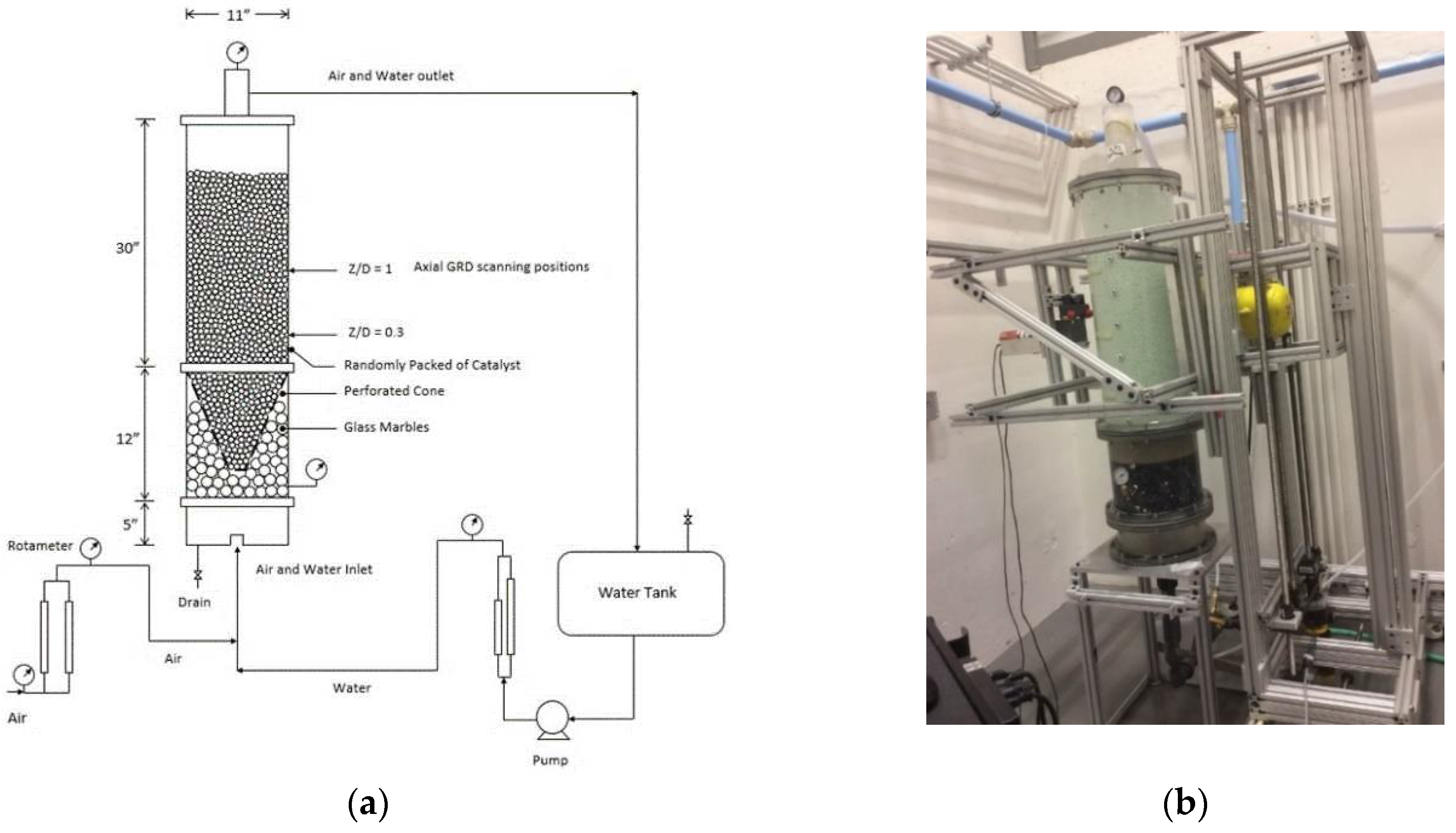
Figure 2.
(a) Schematic diagram of GRD showing arrangement of source, the packed bed, collimators, and the detector, and (b) Radial scanning points.
Figure 2.
(a) Schematic diagram of GRD showing arrangement of source, the packed bed, collimators, and the detector, and (b) Radial scanning points.
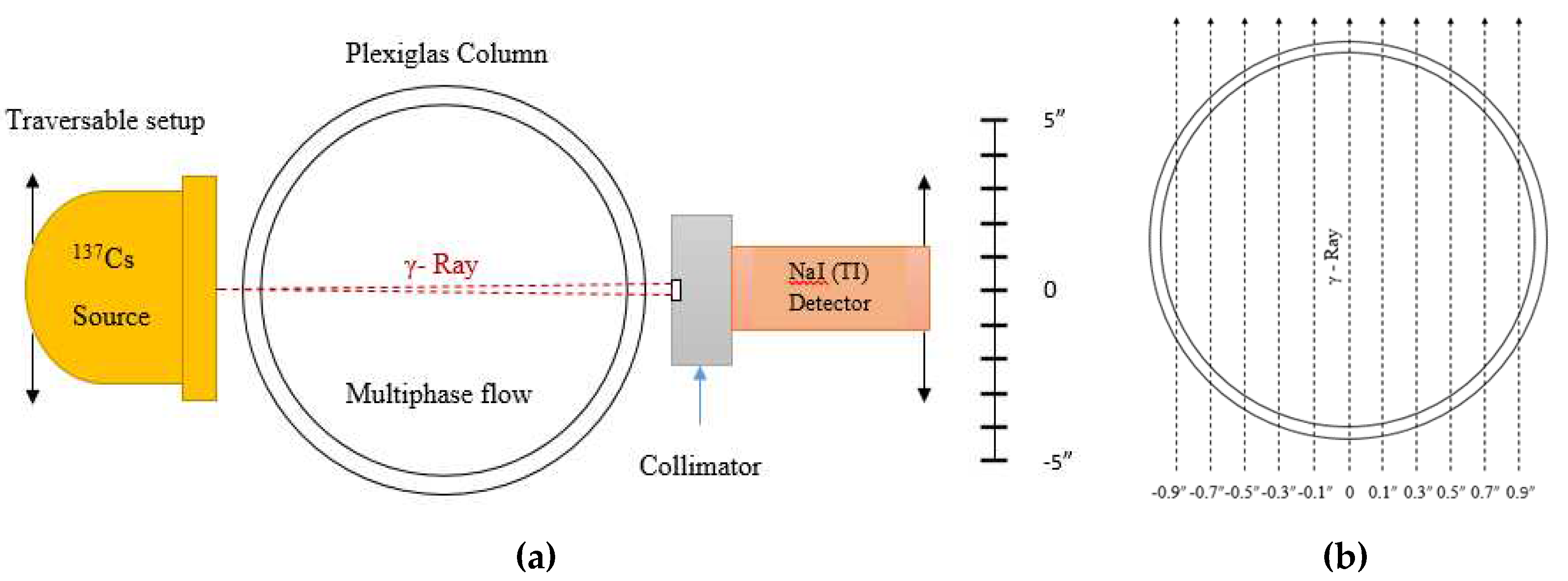
Figure 3.
Diameter profile of external catalyst bed void space (εβ).
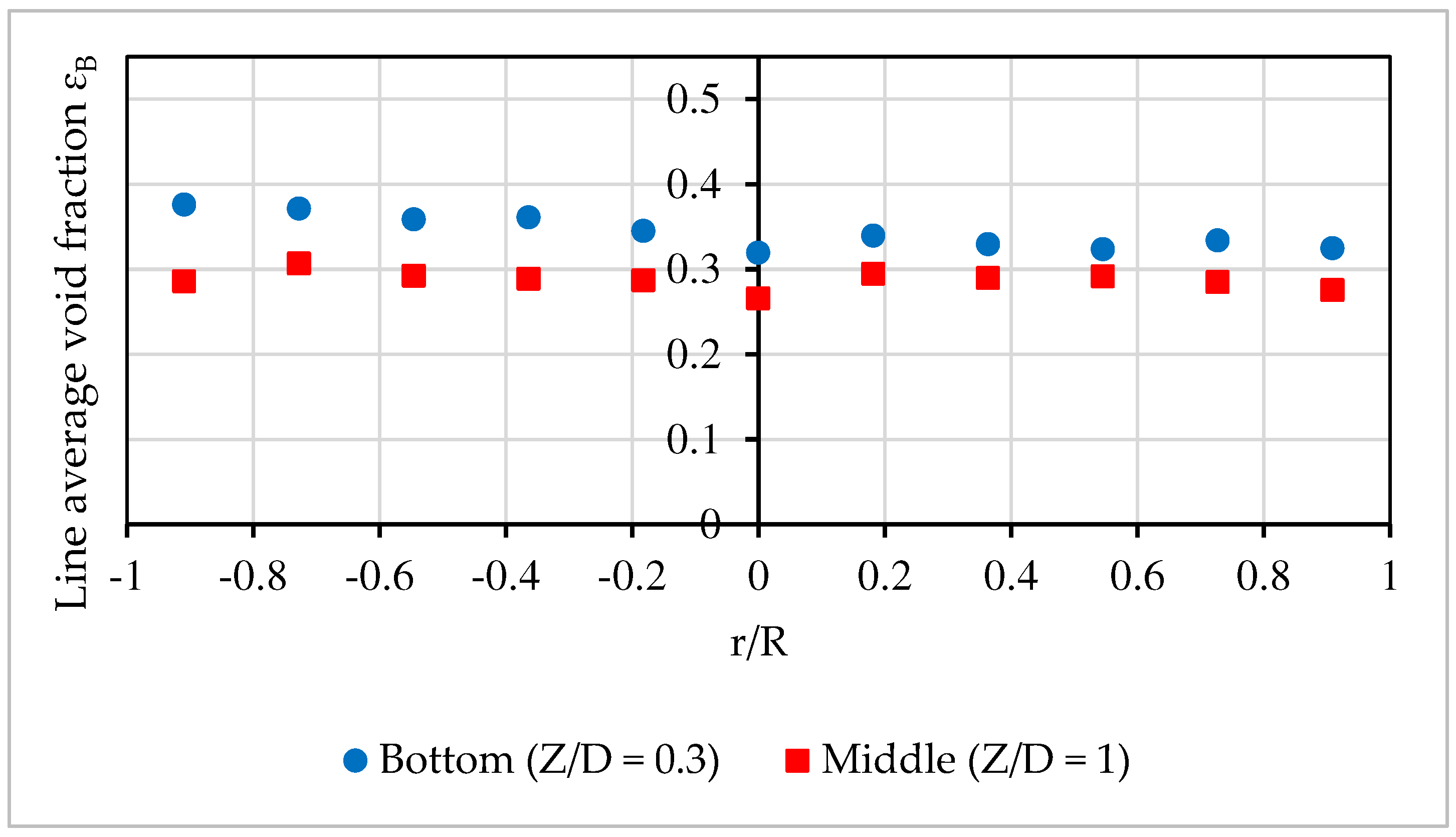
Figure 4.
Radial distribution of line average porosity of the catalyst.
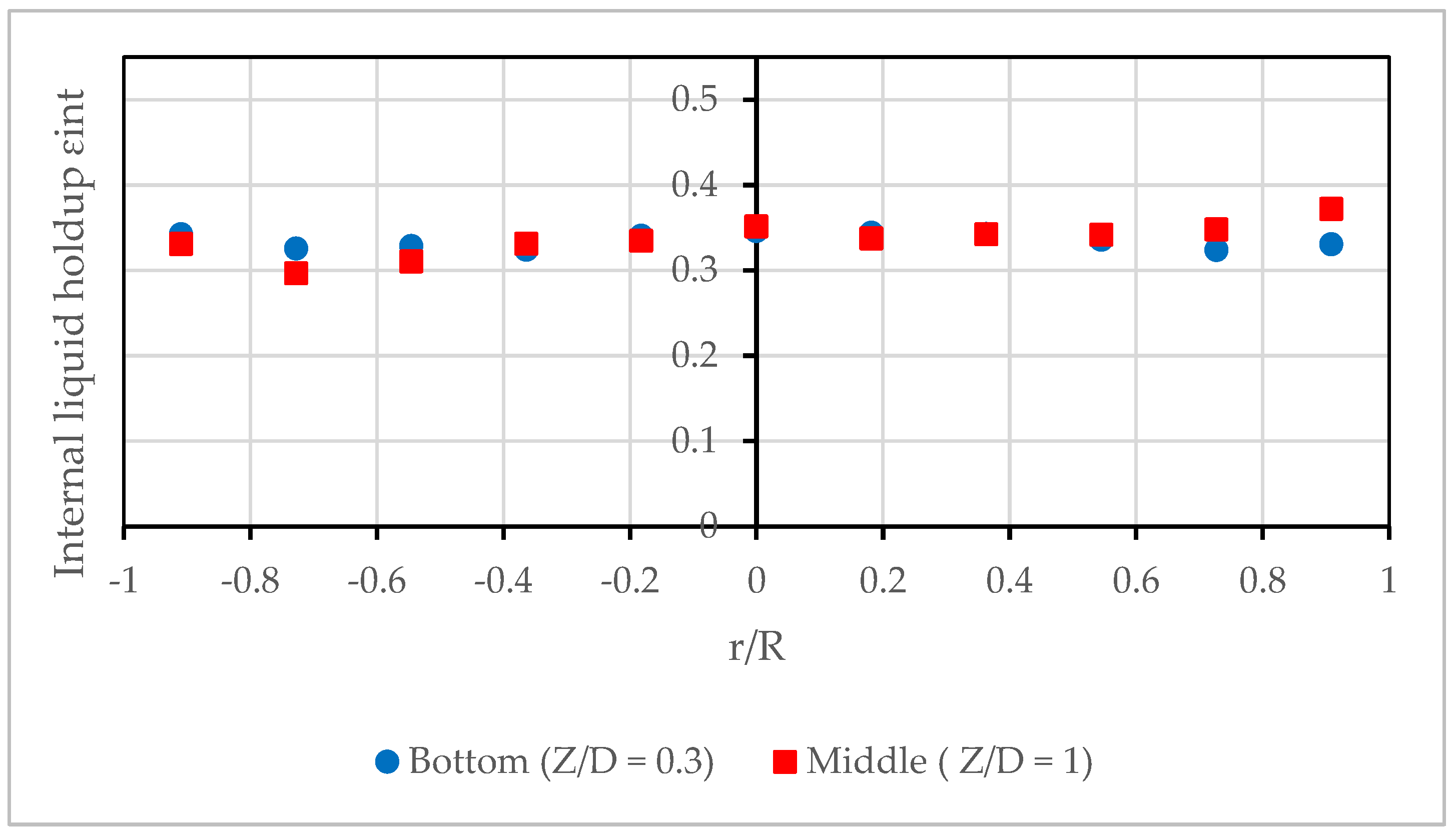
Figure 5.
Radial distribution of Solid holdup (εs).
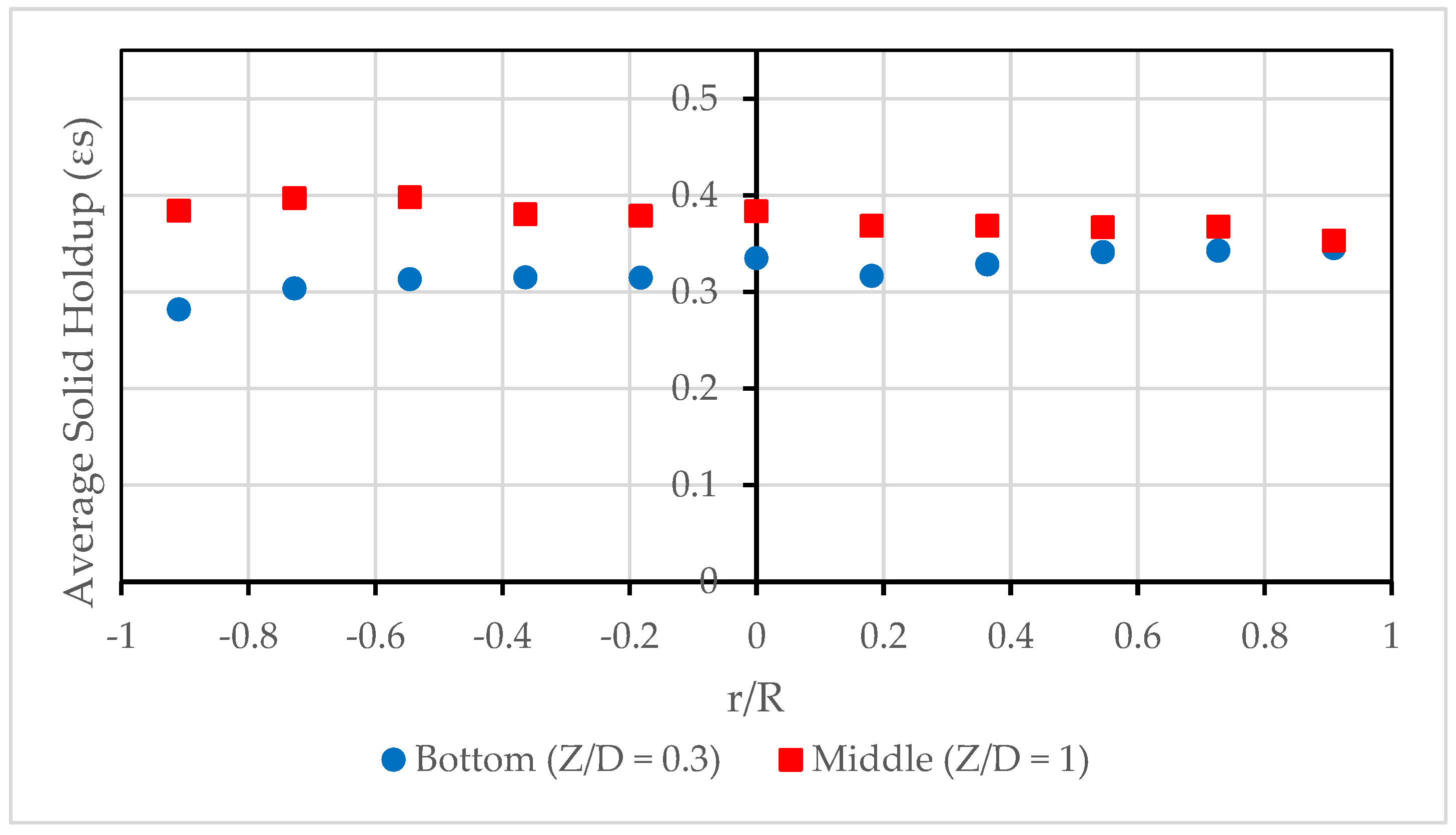
Figure 6.
Liquid Holdup () at the Center (r/R = 0) for the packed bed.
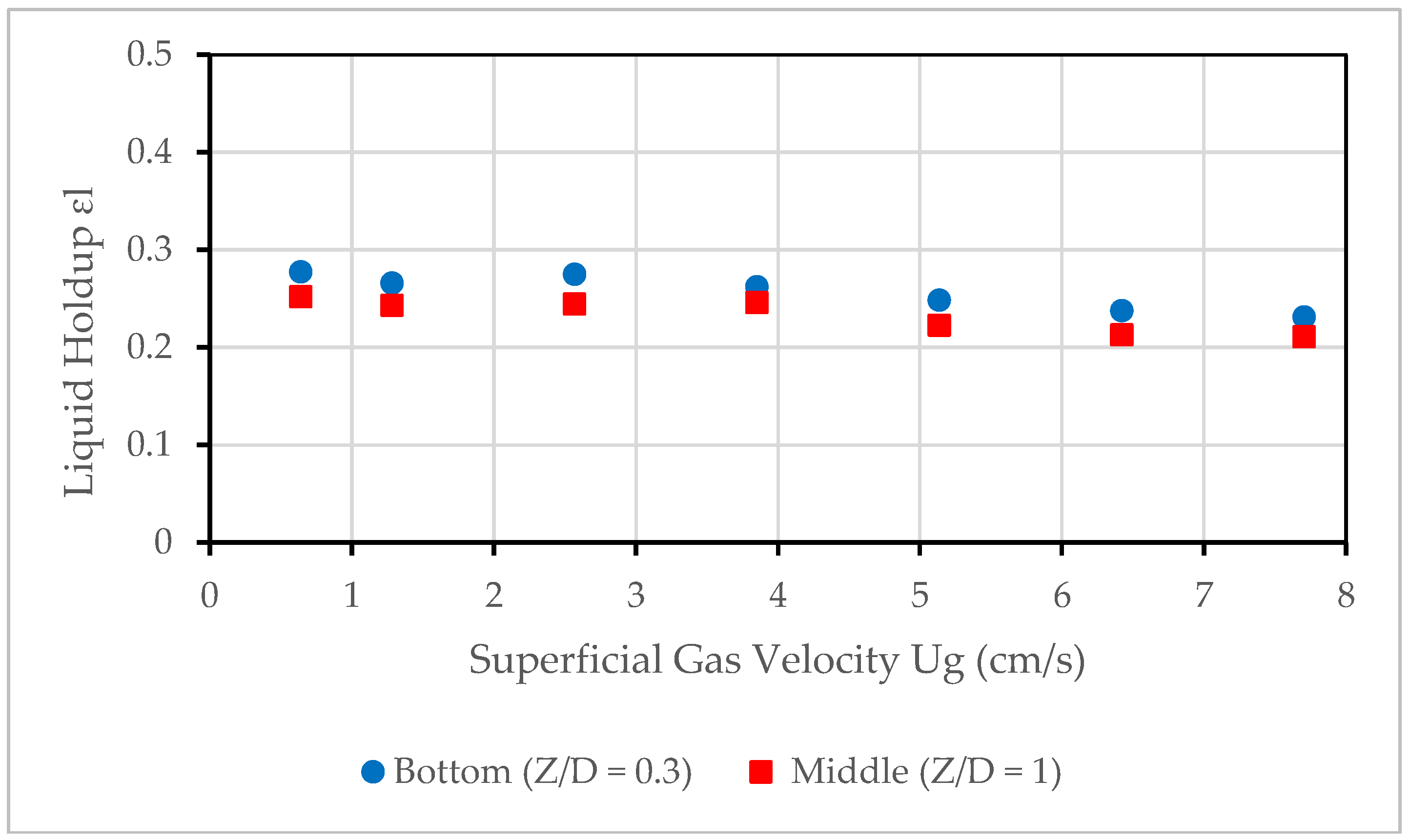
Figure 7.
Liquid Holdup () at (r/R = 0.5) right side of the packed bed.
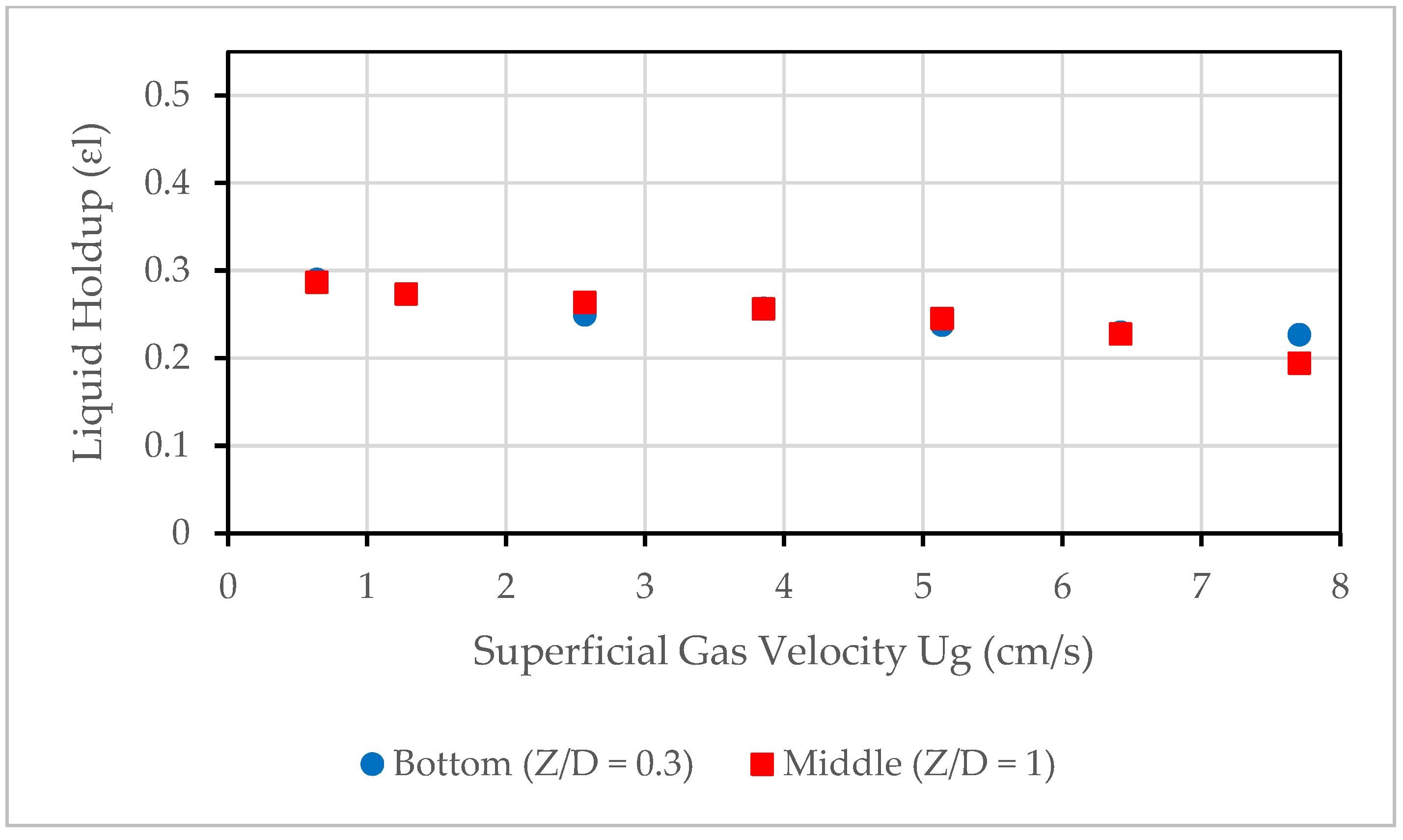
Figure 8.
Liquid Holdup () at (r/R = - 0.5) Left side of the packed bed.
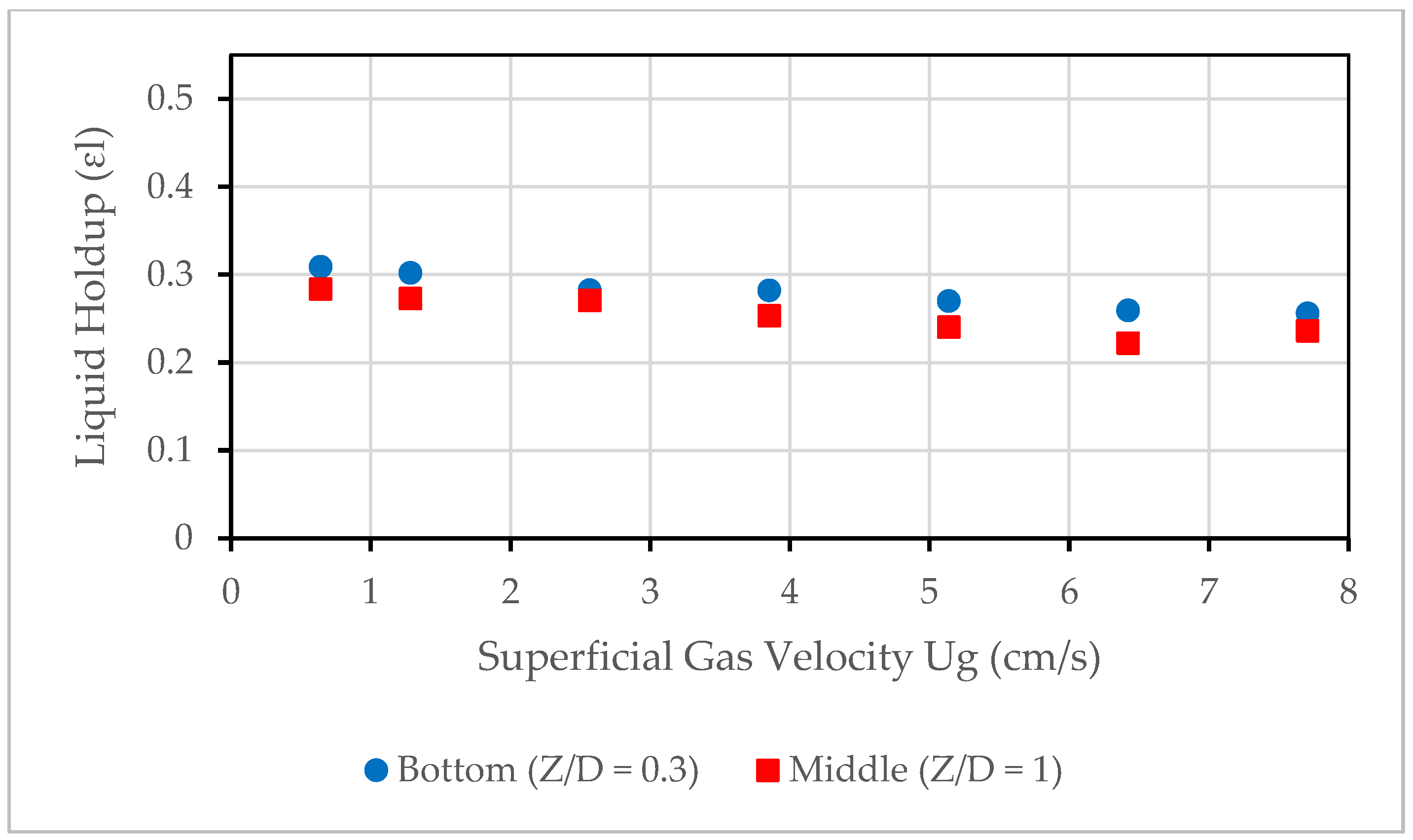
Figure 9.
Liquid Holdup () at (r/R = 0.9) right side of the packed bed.
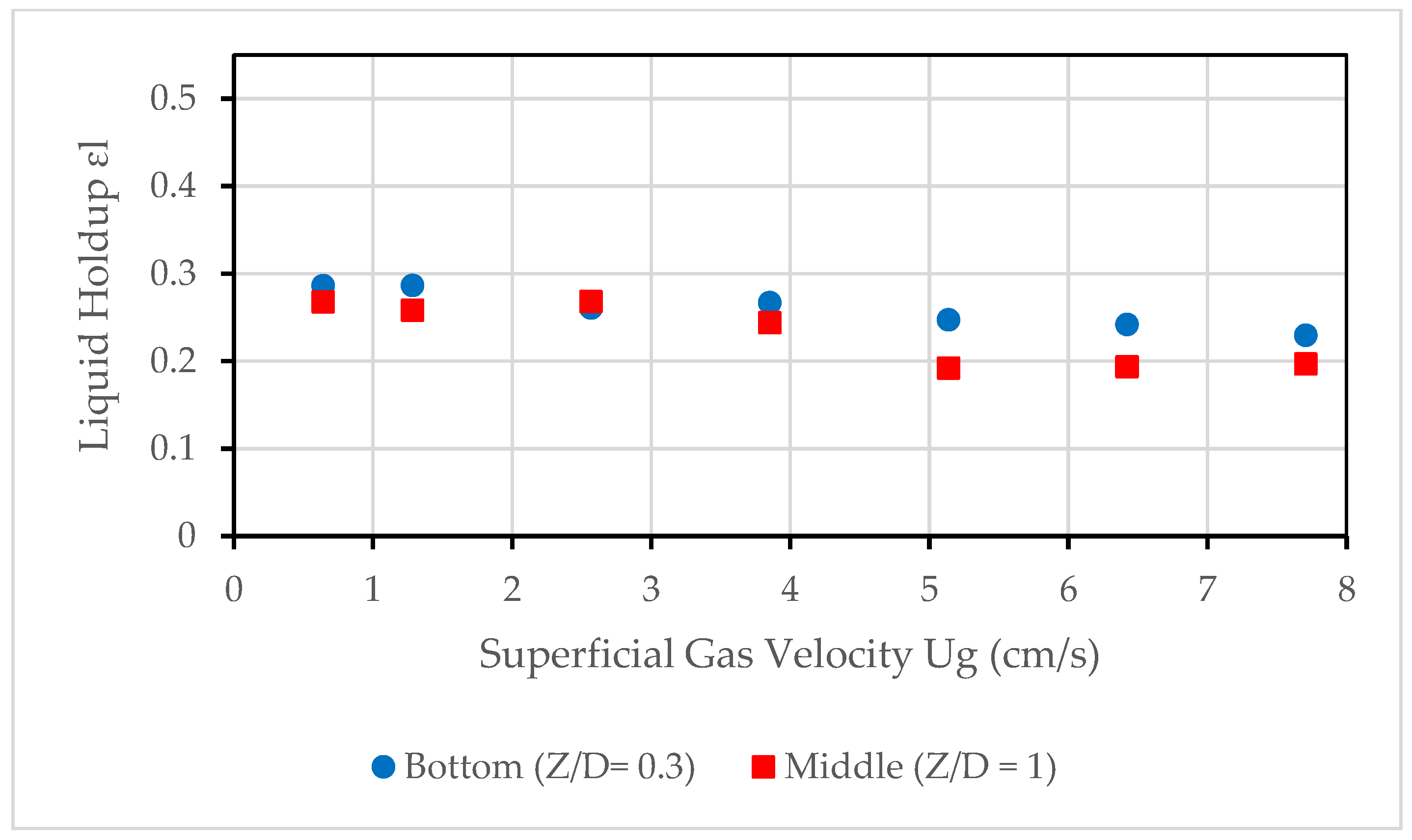
Figure 10.
Liquid Holdup () at (r/R = - 0.9) Left side of the packed bed.
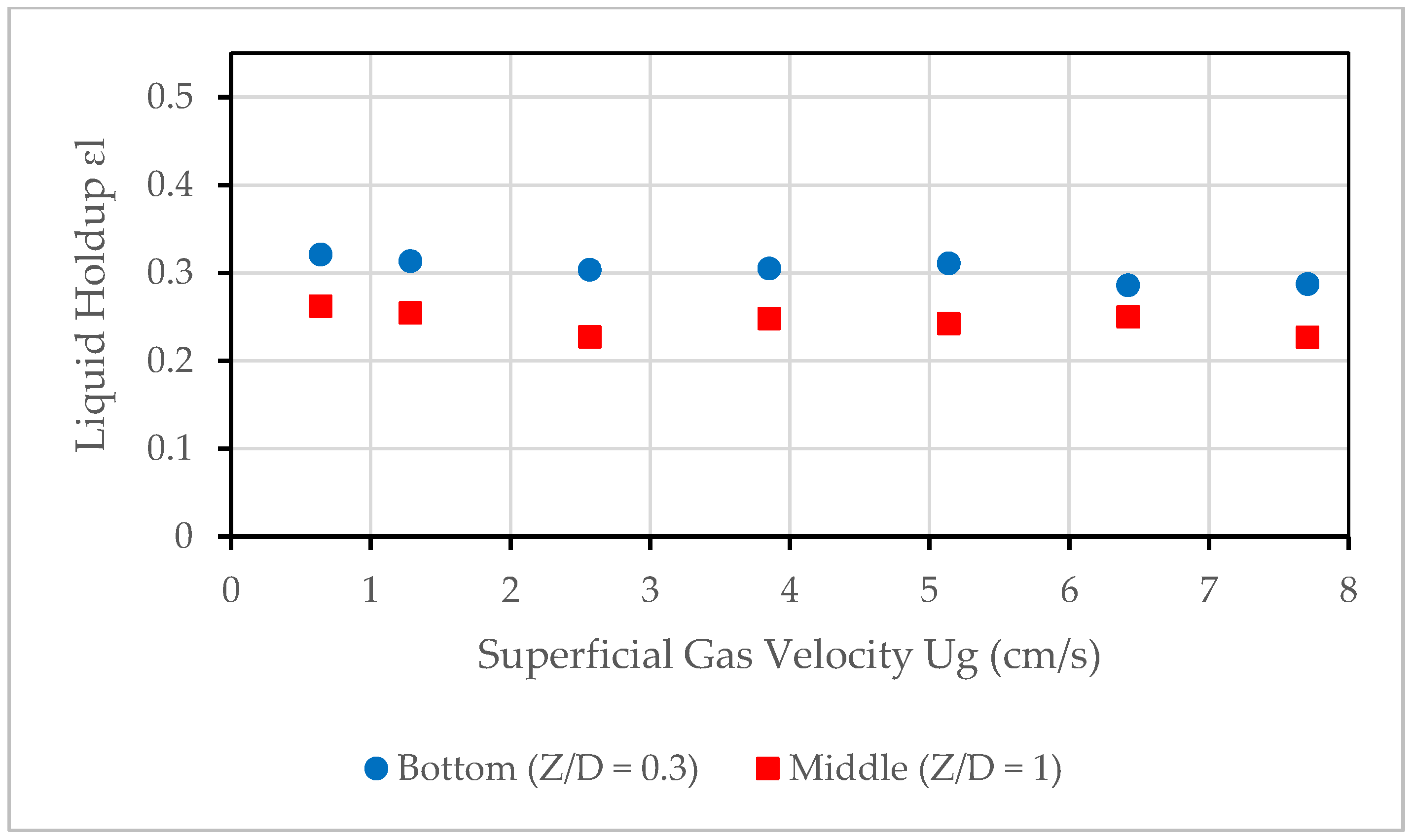
Figure 11.
Effect of superficial gas velocity (Ug) on the liquid holdup.
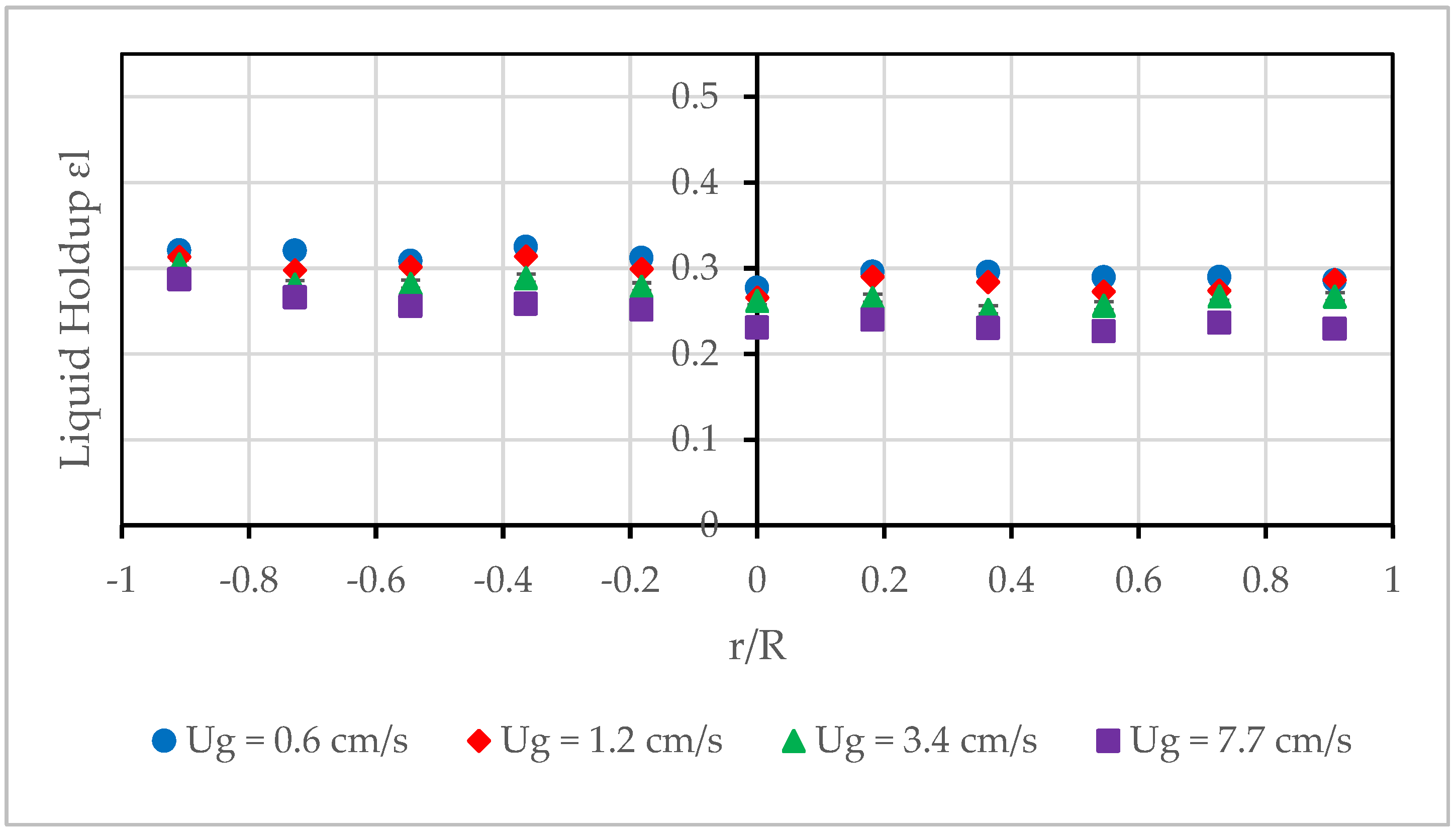
Figure 12.
Effect of superficial gas velocity (Ug) on the liquid holdup at Middle (Z/D = 1) of the packed bed at Ul = 0.017 cm/s.
Figure 12.
Effect of superficial gas velocity (Ug) on the liquid holdup at Middle (Z/D = 1) of the packed bed at Ul = 0.017 cm/s.
Disclaimer/Publisher’s Note: The statements, opinions and data contained in all publications are solely those of the individual author(s) and contributor(s) and not of MDPI and/or the editor(s). MDPI and/or the editor(s) disclaim responsibility for any injury to people or property resulting from any ideas, methods, instructions or products referred to in the content. |
© 2023 by the authors. Licensee MDPI, Basel, Switzerland. This article is an open access article distributed under the terms and conditions of the Creative Commons Attribution (CC BY) license (http://creativecommons.org/licenses/by/4.0/).
Copyright: This open access article is published under a Creative Commons CC BY 4.0 license, which permit the free download, distribution, and reuse, provided that the author and preprint are cited in any reuse.


