

Submitted:
21 November 2023
Posted:
23 November 2023
You are already at the latest version
Abstract
The study explored the correlation between serum biomarkers and hepatocellular carcinoma detection in various fishing groups, utilizing a descriptive and experimental approach in Bangladesh. The study identified fishers often consume tobacco, polluted drinking water, and lack sufficient sunlight, all of which are extremely detrimental to their health. Fishermen who mostly fish at night and spend little time on the water during the daytime hours do not get enough sunlight, nor do they get enough vitamin D. An increased risk of liver cancer was found to be directly and strongly correlated with insufficient serum levels of vitamin D. In addition, a negligent lifestyle, a lack of awareness about hepatitis, and inadequate nutritional assistance have significantly increased their risk. Our results contribute to the information on HCC assessment and evaluation by clarifying the relevance of serum vitamin D, alpha-fetoprotein (AFP), creatinine (Cr), and hemoglobin A1C (HbA1c) in distinguishing between categories and sexes. According to the study, the combination of AFP, Vitamin-D, and Cr (AFP+Vit-D+Cr) has a high predictive value, which improves diagnosis and offers a reliable instrument for identifying liver cancer.
Keywords:
serum biomarkers
; hepatocellular carcinoma
; fishers
; Bangladesh
Introduction
Hepatocellular carcinoma (HCC), with a 5-year survival rate of just 7.0%, is the 3rd most significant cause of cancer mortality globally and the 5th most prevalent malignancy (Henriques et al., 1993). Along with Bangladesh, HCC is the third-leading cause of cancer incidence and death worldwide (Li et al., 2015). Hepatocellular carcinoma (HCC) has a very close relationship with lifestyle. Fishermen are one of the most unconscious communities regarding lifestyle (Sunny et al., 2021a; Sazzad et al., 2023). Fishers, who rely on fishing for survival, often face disputes with the underprivileged population (Islam et al., 2018, Kuddus et al., 2021). They gather in market areas to sell catch and smoke cigarettes to ease tensions (Kuddus et al., 2020; Sunny et al., 2021b). Issues include disputes over fishing grounds and complicated loans between fishermen and dealers (Hasan et al., 2023). High interest rates from local money lenders encourage smoking among fishermen, contributing to hepatocellular cancer (Islam et al., 2023; Sunny et al., 2020). This unhealthy practice, despite regular smoking, continues after fishing and continues into post-fishing life. Their reckless lifestyle, ignorance of hepatitis, and inadequate dietary assistance have significantly increased their danger (Chakma et al., 2022). Conversely, inadequate sanitation and a lack of clean drinking water lead to a steady rise in hepatitis and other waterborne illnesses as well.
There are numerous technologies available to find HCC. Imaging techniques like computed tomography, magnetic resonance imaging, and some markers (Adelani et al., 1993; Bari et al., 2023). Among all the technologies, marker investigation is already proven as a trusted, early diagnosis and cost-effective approach (Edoo et al., 2019). Many markers like embryonic antigens (e.g., i. α-fetoprotein (AFP)); proteantigen enzymes (e.g., i. heat shock protein (HSP), ii. glypicans-3 (GPC3), iii. squamous cell carcinoma antigen (SCCA), iv. golgi protein 73 (GP73), v. tumor-associated glycoprotein 72 (TAG-72), vi. zinc-α2-glycoprotein (ZAG)); and isozymes (e.g., i. des-γ-carboxyprothrombin (DCP), ii. γ-glutamyl transferase (GGT), iii. α-l-fucosidase (AFU)); cytokines (e.g., i. transforming growth factors-β1 (TGF-β1)); VEGF genetic biomarker (e.g., i. AFP mRNA and ii. micro mRNAs) are used for the detection of HCC (Lai et al., 2018). In addition to these, patients with HCC are also significantly affected by vitamin D, hemoglobin A1C (HbA1c), and creatinine. The most often utilized biomarker for HCC screening, diagnosis, treatment assessment and prognosis is serum alpha-fetoprotein (Lee et al., 2019). However, the relationship between vitamin D and predisposing diseases for liver cancer (Markotic et al., 2022). There is strong evidence of increased cancer risk in patients with CKD, in patients with ESRD being treated with chronic dialysis (Lee et al., 2013). In most of the recent studies, DM is shown to increase risk of HCC by 2-to 4-fold, even after adjusting for other predisposing factors (Amarapurkar et al., 2008). In this study we investigate the correlation between various biomarkers like AFP, vitamin D, HbA1c, and creatinine for the diagnosis of HCC. As the interrelationship between HCC and fisher communities has not yet been identified and the correlation between the above-mentioned markers has not been investigated yet, this study will help us to understand both the relationship, which will also help us to reduce the investigation cost for the patients.
Materials and Methods
Experimental setting and participants
This study was divided into two stages: a descriptive study with a non-random sample of participants, and an experimental phase where laboratory-based cross-sectional study was conducted in Ibn Sina Diagnostic and Imaging center, Bangladesh from January 2021 to December 2022. A famous diagnostic center in Dhaka, Bangladesh, hosted the lab-based cross-sectional study. Patients’ information was collected and kept according to guiding of Immunology and histopathology Department, of Ibn Sina Diagnostic and Imaging center in Dhaka, Bangladesh. We included 1238 respondents (1183 patients with hepatocellular carcinoma (HCC) and 55 in the control group) using purposive sampling technique. We included patients ranging in age from 15 to 90 years. Patients with an HCC diagnosis confirmed by a histological examination and those who had not yet started HCC treatment were included in the study.
Experimental design and data collection
A household survey was done to gather empirical data. Some qualitative approaches were also used, including interviews, focus group discussions (FGD), and key informant interviews. A total of 260 interviews were conducted using a semi-structured questionnaire (Supplementary Material). Each interview took approximately 60 minutes. In addition to the 260 individual interview, ninety five FGDs were done, with 10 participants in each group. In order to gather and verify pertinent information, fifteen cross-check interviews (KII) with local health complex and NGO (Non-Governmental Organization) staff working on this area were undertaken.
According to AFP result, HCC patients divided into two groups when AFP value ≤400 ng/ml they considered as moderately elevated (Group A), and AFP value >400 ng/ml considered as markedly elevated HCC (Group B). According to histological HCC patients divided into three groups, when AFP value >20 to 200 ng/ml they considered as well differentiated, when AFP value >200 to 400 ng/ml they considered as moderately differentiated, and AFP value >400 ng/ml considered as poorly differentiated. The patients who joined in this study had no other underline diseases. Additionally, we disqualified patients with a history of additional cancers as well as those who had concomitant conditions that prevented them from obtaining therapy for HCC.
Biomarkers used in this study
In our study we include four markers like AFP, vitamin D, HbA1c, and creatinine to investigate. The reference values of 4 different parameters are as follows: AFP <20 ng/mL was considered as negative and AFP >20 ng/mL was considered as positive (Lim et al., 2016). In the case of vitamin D <10 ng/mL we considered as severe deficiency, vitamin D 10-24 ng/mL we considered as mild to moderate deficiency, vitamin D= 25-80 ng/mL considered as sufficient and >80 ng/mL considered as possible toxic (Kennel et al., 2010). In case of HbA1c<5.7% considered as normal, HbA1c 5.7% to 6.4% considered as prediabetes and HbA1c≥6.5% considered as diabetic (Diabetes overview, 2023), and Creatinine men 0.7 to 1.3 mg/dL considered as negative, creatinine women 0.5 to 1.1 mg/dL considered as negative (Creatinin Blood, 2023) Histological samples were collected by graduate histopathology specialist, and all the samples were collected in a tube and separated by centrifuge diagnosis of AFP, Vitamin D and creatinine and stored at -20°C for further investigation (Alpha Fetoprotein, 2023). Whole blood samples were collected for HbA1c (Rohlfing et al., 2012). We used widely established Chemiluminescent Immunoassay (CLIA) techniques with Advia XPT, USA, for measuring -fetoprotein (AFP) and vitamin D. We used HPLC techniques for HbA1c, utilizing D-10 from BioRad in the USA. And we employed enzymatic techniques with Vitros 5600, USA, for serum creatinine. For the experiment, we used a fresh sample.
Questionnaire Construction and Pre-test
A thorough literature assessment of pertinent studies served as the foundation for the creation of a questionnaire. In order to compile pertinent data on socioeconomic, anthropometric knowledge, and practice related water, sanitation, nutrition, and hygiene, this questionnaire included both open-ended and closed-ended items. The questionnaire was pre-tested with a minimum of two homes in each village. Subsequently, the questionnaire was changed for coherence, clarity, and simplicity of language based on an initial analysis of the data obtained. The best defense against the likelihood of mistakes with the chosen questionnaire is to pre-test it. Piloting or pre-testing the questionnaire was essential for this study for a number of basic reasons. Bangladesh's national language, Bengali, was used to translate the original English questionnaire. It was also essential to make sure that the research assistants and participants could easily understand and comprehend the questionnaire. By doing this, the researcher can select language that is appropriate for the research assistants and participants by pre-testing the questionnaire. Furthermore, the pre-testing assisted in refining and improving to guarantee the interview's time, question order, and content covering. Those households that were taken into consideration for the pre-testing were then disqualified from participating in the final surveys.
Statistical analysis
Statistically, the data were analyzed using Microsoft Excel and IBM SPSS software version 26.0. The results were presented as frequency and percentage, mean±SD. Students t-test to see the mean differences between the continuous data and to see the relationship between two continuous variables we used Pearson Correlation was done for the comparison of data between groups. A p<0.05 considered as level of significance. The sensitivity and specificity, positive predictive value (PPV), and negative predictive value (NPV) were also analyzed for the dissimilar groups.
Results and Discussion
Demographic profile of the fishing community
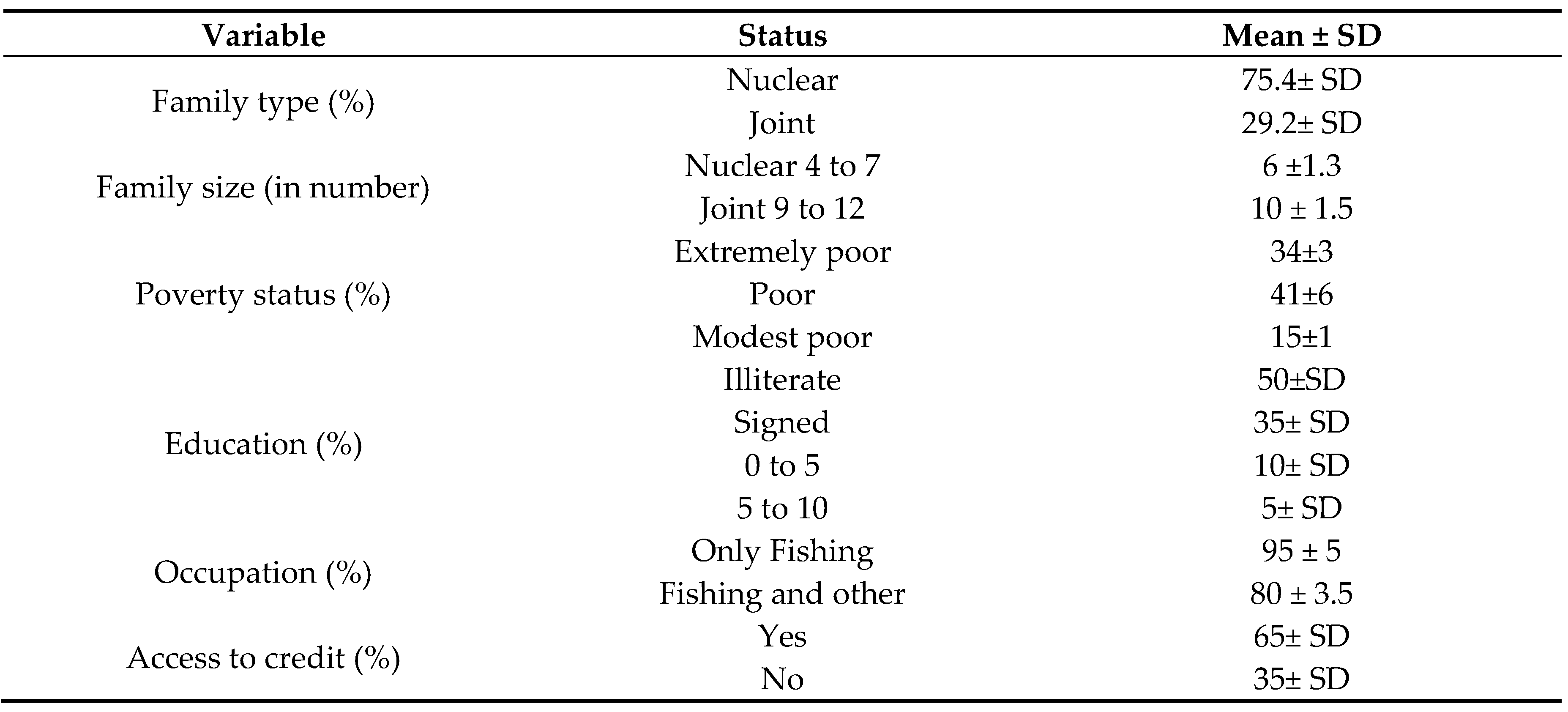
Fishers' community lives in remote areas of Bangladesh and their profession was more diverse than that of any other occupation (Sunny et al., 2020). In the study area there were over 1238 individuals living in on average 160 households (HH). In the households, 75.8% were nuclear families and 24.2% were joint families with family sizes ranging from 4 to 7 in nuclear families and 9 to 12 in joint families. A substantial proportion of 160 HH: 95 ± 5 (mean standard deviation) were largely involved in fishing, and 80 ± 3.5 were simultaneously involved in fishing small company. The fishers also identified as vulnerable community and lived below the poverty line extremely poor (land size 0 decimal), poor (land size <5 decimal) and modest poor (land size >5 decimal) was 34%±3%, 41%±6% and 13%±1%, respectively. Basically fishers’ generation after generation are deprived of education and their literacy levels were low, with 50% illiterate, 35% signed, 10% primary, and 5% have secondary education. Women in fishing communities were mostly dependent on men and had few opportunities to make decisions on a variety of topics (Sazzad et al., 2023). A considerable number of people (65%) have access to low-interest borrowing through local NGOs. Natural disasters endanger people in that community, in addition to low earnings and limited employment opportunities, which have a significant impact on nutritional security and livelihood sustainability (Mohammad & Wahab, 2013; Islam et al., 2017).

Table 1.
Demographic Profile of the community.
 |
Nexus of HCC and Fishing community
Fishers identified the marginalized prone group of people of our society whom maintaining their life by hand to mouth. Generally, their houses located in a shabby area adjacent to riverside and fully depended on fishing. In the evening the fisher folk gather into market areas to sell their fishes and waiting for the customers. After that, they going to tea stall and started consuming cigarette with a huge quantity to reduce the pressure of conflict among stakeholders. The study identified there are various types conflicts such as; due to fishing areas among fisher to fisher, loan complexity among fishers to fish traders etc. Fishers mentioned that huge interest pressure of local money lender also induce them to smoking. Even though it’s their regular habit to smoking whilst go out for fishing and it continuing till the fishing end. A large number of tobacco consumption is also responsible for the hepatocellular carcinoma. In the study areas it was common practices that the fishers taking huge number of tobacco and tobacco related materials which is greatly harmful for their health. It was found that hilsa fishers usually go for fishing during night and move limitedly during day time. This habit prohibited them to enjoy sunlight like usual human being that arised complexity due to lack of vitamin-D. HCC had a close connection to vitamin-D deficiency (Lange et al., 2013). Various based on population’s investigations revealed an inverse relationship between a high probability of liver cancer and serum Vitamin-D values (Yi et al., 2010; Bari et al., 2023). Insufficient serum levels of vitamin D were found to be directly and significantly related to a higher probability of liver cancer (Zhang et al., 2010; Faruk et al., 2023). According to the European Prospective Investigation into Cancer and Nutrition (EPIC) study, vitamin D insufficiency caused HCC in the Japanese population (Louka et al., 2017). Increasing deficiency of vitamin D also being associated with the death of people with liver disease, both with and without hepatocellular carcinoma,
Besides, lack of hepatitis knowledge and careless lifestyle and poor nutritional support has greatly affected them into risk. On the other hand, lack of pure drinking water and poor sanitation (Kuddus et al., 2022; Tufael et al., 2023) gradually increase waterborne diseases and hepatitis. Fishers generally took river water during their fishing trip but took tube well water in the residence. The study identified that 58% tube well is arsenic affected. There was a very close relation of kidney disease with arsenic drinking water (Banal et al., 2017). A correlation with higher mortality rates was found between chronic kidney disease (CKD) and hepatocellular carcinoma (Weng et al., 2011). Cirrhosis is recognized as the root of CKD and is related to a more prevalent rate of survival in the CKD community (Lin et al., 2010). Hepatocellular carcinoma (HCC) poses a considerable risk factor for the development of severe renal failure [28]. Hepatocellular carcinoma (HCC) is more likely to occur in people with chronic kidney disease (CKD) than in people in general and especially dialysis patients have a higher probability to develop liver cancer (Fabrizi et al., 2021). A significant risk factor for the development of kidney disease is liver cirrhosis. This is a result of the complex interaction between the activities of the liver and kidneys, whereby the poor liver function caused by cirrhosis can result in changes in kidney function that may increase the risk of kidney disease (Huo et al., 2004). Patients with cirrhosis increase the risk of finding their kidney disease over diagnosed since many of them are elderly (Kumar et al., 2021).
Serum biomarkers for detecting hepatocellular carcinoma (HCC)
There have been 55 respondents inside the control group, 582 in group A, and 601 in group B, respectively. Men (n, 665; 53.7%) comprise the majority of the total (1238) respondents. The current work has provided significant information into the diagnostic ability of serum biomarkers for detecting hepatocellular carcinoma (HCC). Our results contribute to the information on HCC assessment and evaluation by clarifying the relevance of serum vitamin D, alpha-fetoprotein (AFP), creatinine (Cr), and hemoglobin A1c (HbA1c) in distinguishing between categories and sexes. Serum vitamin D is of clinical importance in Group A (p= 0.045) showing its potential to act as a diagnostic tool for HCC in this subgroup. Furthermore, the highly significant (p p=0.001) in AFP, vitamin-D, Cr, and HbA1c between Groups A and B (as shown in Table 1) show the potent identifying capacity of these biomarkers in classifying respondent with various HCC groups and difference demonstrates their usefulness in early diagnosis and prognosis monitoring.
Table 1.
HCC related biomarkers of the study respondent by their sexes.
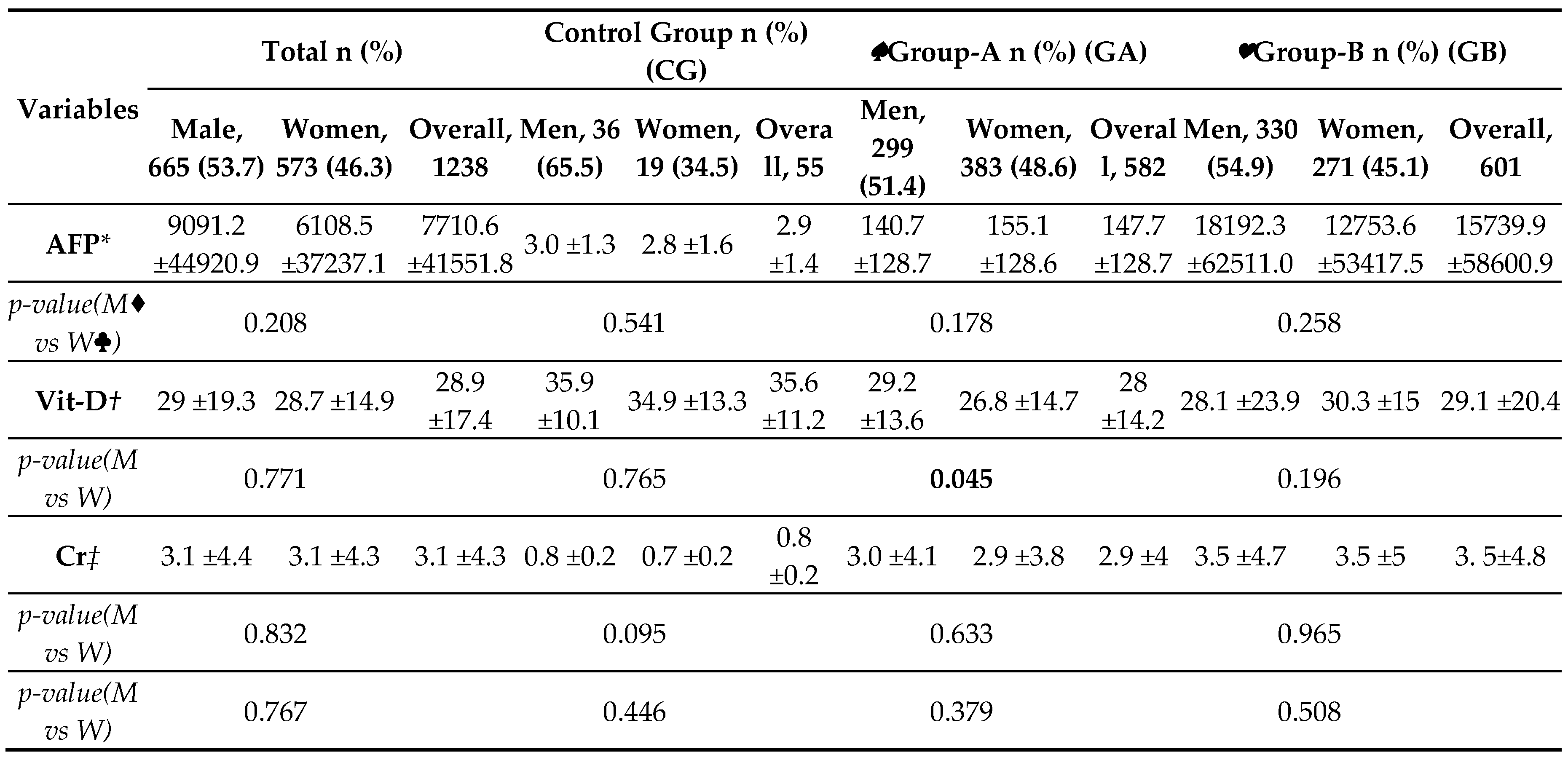 |
*AFP= Alpha-fetoprotein, † Vit-D= Vitamin D, ‡ Cr=Creatinine, § HbA1c= Haemoglobin A1c, ¶ n= Number, # Mean±SD, ♠ Group-A= moderately elevated (AFP >20 to 400), ♥ Group-B= markedly elevated (AFP >400). Independent sample t-test has been used as test statistics. p<0.05 has considered as a level of significance, ,♦ M, ♣ W.
Furthermore, the gender-specific analysis found significance of vitamin-D levels between men and women Group-B respondents (p=0.045) and the significance of AFP, vitamin D, Cr, and HbA1c between Group-A and Group-B (as shown in Table 2) for both sexes demonstrate the biomarkers' constant predictive potential, regardless of sex. The high sensitivity (97%), specificity (89%), positive predictive value (PPV) of 98%, and negative predictive value (NPV) of 71% of AFP as a tool for diagnostic purposes show its accuracy.
Table 2.
Gender-based Comparison of positive and negative rates among study respondent in different groups.
Table 2.
Gender-based Comparison of positive and negative rates among study respondent in different groups.
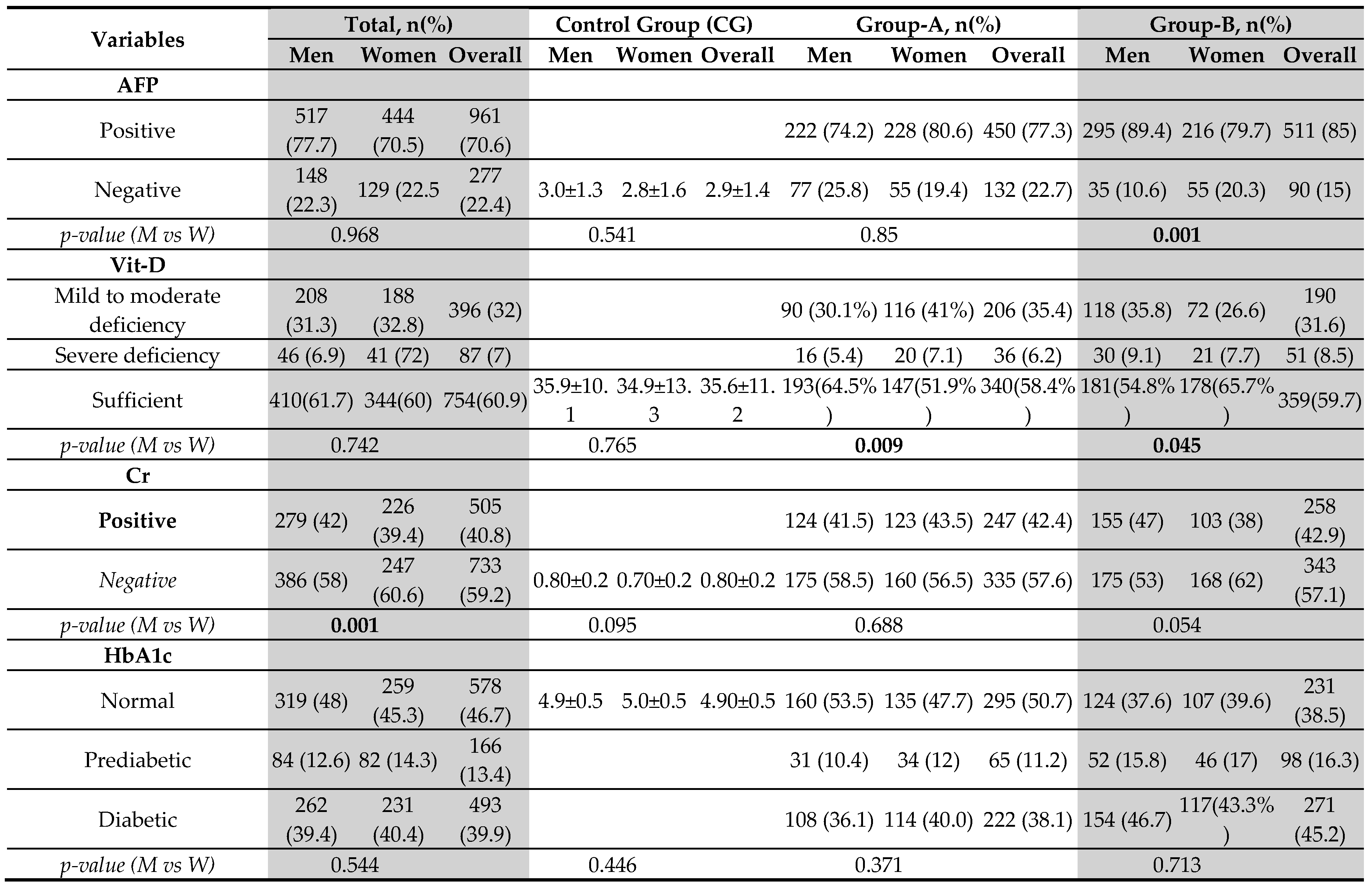 |
The results presented indicate its potential to be an effective HCC diagnostic biomarker and are in connection with its current clinical use. Similarly, the joint AFP, Vitamin-D, and Cr alone, AFP+Vit-D+Cr has a remarkable predictive value with high sensitivity (97%), specificity (95%), PPV (93%), and NPV (89%). This combination of biomarkers increases diagnosis and provides an accurate tool for HCC recognition. The absence of statistically significant associations among the HCC-related investigated biomarkers. The lack of potentially significant combinations of different biomarkers associated with different pathological categories.
Conclusion
Late diagnosis of HCC is one of the main factors for high mortality of patients although surveillance strategies, adherence to surveillance programs has been implemented. In the realm of HCC, peripheral biomarkers that are readily detected in serum or plasma are vital. The immunological imbalance caused by the enigma of liver illnesses, such as viral hepatitis, which underlie the development of liver cirrhosis and, consequently, HCC, further obstructs the identification of immune markers or peripherally produced proteins that may aid in early diagnosis. This study reported clearly the significance of serum biomarkers in HCC detection and based on sex compared to various groups. AFP, vitamin-D, Cr, and HbA1c biomarkers were found to be reliable diagnostic tools for HCC detection. Furthermore, study is needed to maximize the implementation of these biomarkers into clinical practice, with a final goal of improving HCC diagnosis.
Acknowledgments
The authors are thankful to the Department of Biochemistry and Histopathology, Ibn Sina Diagnostic and Imaging Center, Dhaka for their permission in patients’ data collection related to HCC.
Statement of Ethics
The Scientific and Research Ethics Committee of the Ibn Sina Diagnostic and Imaging Center in Dhaka, Bangladesh, gave its approval for this study. However, because the study followed with institutional and municipal regulations, ethical review and approval were not necessary for the human subjects' participation. The patients gave their written, informed consent to take part in the trial.
References
- Adelani, I.B.; Rotimi, O.A.; Maduagwu, E.N. and Rotimi, S.O. (2021). Vitamin D: possible therapeutic roles in hepatocellular carcinoma. Frontiers in Oncology, 11, 642653.
- Alpha Fetoprotein. (2023). National Library of Medicine. Retrieved from: https://www.ncbi.nlm.nih.gov/books/NBK430750/ (Accessed on: August 6, 2023).
- Amarapurkar, D.N.; Patel, N.D. and Kamani, P.M. (2008). Impact of diabetes mellitus on outcome of HCC. Annals of hepatology, 7(2), 148-151.
- Banal, K.A.; Paz-Pacheco, E. and de Villa, V. (2017). Diabetes mellitus and prediabetes in patients with hepatocellular carcinoma in a tertiary Philippine hospital. Journal of the ASEAN Federation of Endocrine Societies, 32(1), 32. [PubMed]
- Bari, K.F.; Salam, M.T.; Hasan, S.E. and Sunny, A.R. (2023). Serum zinc and calcium level in patients with psoriasis. Journal of Knowledge Learning and Science Technology ISSN: 2959-6386 (online), 2(3), 7-14.
- Chakma, S.; Paul, A.K.; Rahman, M.A.; Hasan, M.M.; Sazzad, S.A. and Sunny, A.R. (2022). Climate Change Impacts and Ongoing Adaptation Measures in the Bangladesh Sundarbans. Egyptian Journal of Aquatic Biology and Fisheries. 1;26(2):329-48.
- Creatinin Blood. (2023). University of Rochester. Retrived from: https://www.urmc.rochester.edu/encyclopedia/content.aspx?ContentTypeID=167&ContentID=creatinine_serum (Accessed on: August 6, 2023).
- Diabetes overview. (2023). American Diabetes Association. Retrieved from: https://www.diabetes.org/a1c/diagnosis (Accessed on: August 6, 2023).
- Edoo, M.I.A.; Chutturghoon, V.K.; Wusu-Ansah, G.K.; Zhu, H.; Zhen, T.Y.; Xie, H.Y. and Zheng, S. S. (2019). Serum Biomarkers AFP, CEA and CA19-9 Combined Detection for Early Diagnosis of Hepatocellular Carcinoma. Iranian journal of public health, 48(2), 314–322.
- Fabrizi, F.; Cerutti, R.; Alfieri, C.M. and Ridruejo, E. (2021). An Update on Hepatocellular Carcinoma in Chronic Kidney Disease. Cancers, 13(14), 3617. [PubMed]
- Faruk, O.; Hasan, S. E.; Jubayer, A.; Akter, K.; Al Shiam, S.A.; Rahman, K. and Ali, M.Y. (2023). Microbial Isolates from Urinary Tract Infection and their Antibiotic Resistance Pattern in Dhaka city of Bangladesh. Journal of Knowledge Learning and Science Technology ISSN: 2959-6386 (online), 2(3), 76-87.
- Hasan, M.R.; Hossain, M.M.; Islam, M.S.; Sunny, A.R.; Ferdous, J.; Chowdhury, M.Z.A.; Maria, A.M.; Sarder, A.A.H... and Sultana, A. (2023). Seasonal Variation of Quality and the Total Viable Count of Lean and Fatty Fish. Egyptian Journal of Aquatic Biology & Fisheries, 27(5). [CrossRef]
- Henriques, C.U.; Damm, P.; Tabor, A.; Pedersen, J.F. and Mølsted-Pedersen, L.A.R.S. (1993). Decreased alpha-fetoprotein in amniotic fluid and maternal serum in diabetic pregnancy. Obstetrics & Gynecology, 82(6), 960-964.
- Huo, T.I; Wu, J.C.; Lee, P.C.; Chang, F.Y. Lee, S.D. (2004). Incidence and risk factors for acute renal failure in patients with hepatocellular carcinoma undergoing transarterial chemoembolization: a prospective study. Liver Int 24:210–215.
- Islam, M.M.; Cansse, T.; Islam, M.S. and Sunny, A.R. (2018). Climate change and its impacts: The case of coastal fishing communities of the Meghna River in south central Bangladesh. International Journal of Marine and Environmental Sciences.
- Islam, R.; Sunny, A.R.; Sazzad, S.A.; Amith, D.; Nazmul, H.; Koushikur, R.; Faruque, M.M.; Ashrafuzzaman, M. and Prodhan, S.H. (2023). Environmental Jeopardy and Coping Strategies of the Small-scale Fishers in the Bangladesh Sundarbans: The Precedent of the World’s Largest Mangrove. Egyptian Journal of Aquatic Biology & Fisheries, 27(6).
- Kennel, K.A.; Drake, M.T. and Hurley, D.L. (2010). Vitamin D deficiency in adults: when to test and how to treat. Mayo Clinic proceedings, 85(8), 752–758. [CrossRef]
- Kuddus, M.A.; Alam, M.J.; Datta, G.C.; Miah, M.A.; Sarker, A.K. and Sunny, M.A.R. (2021). Climate resilience technology for year round vegetable production in northeastern Bangladesh. Int. J. Agril. Res. Innov. Tech., 11(1): 29-36. [CrossRef]
- Kuddus, M.A.; Datta, G.C.; Miah, M.A.; Sarker, A.K.; Hamid, S.M.A. and Sunny, A.R. (2020). Performance study of selected orange fleshed sweet potato varieties in North Eastern Bangladesh. International Journal of Environment, Agriculture and Biotechnology, 5(3): 673-682.
- Kuddus, M.A.; Sunny, A.R.; Sazzad, S.A.; Hossain, M.; Rahman, M.; Mithun, M.H.; Ifat, S.E.H.; Ahmed, K.J.; Zandonadi, R.P.; Han, H., Montes, A.A.; Vega, A.A. and Raposo, A. (2022). Sense and Manner of WASH and Their Coalition with Disease and Nutritional Status of Under-five Children in Rural Bangladesh: A Cross-Sectional Study. Frontiers in Public Health, 10.
- Kumar, R.; Priyadarshi, R.N. and Anand, U. (2021). Chronic renal dysfunction in cirrhosis: A new frontier in hepatology. World journal of gastroenterology, 27(11), 990–1005. [CrossRef]
- Lai, G.Y.; Wang, J.B.; Weinstein, S.J.; Parisi, D.; Horst, R.L.; McGlynn, K.A. ... and Freedman, N.D. (2018). Association of 25-hydroxyvitamin D with liver cancer incidence and chronic liver disease mortality in Finnish male smokers of the ATBC study. Cancer Epidemiology, Biomarkers & Prevention, 27(9), 1075-1082.
- Lange, C.M.; Miki, D.; Ochi, H.; Nischalke, H.D.; Bojunga, J.; Bibert, S. ... and Swiss Hepatitis C Cohort Study Group. (2013). Genetic analyses reveal a role for vitamin D insufficiency in HCV-associated hepatocellular carcinoma development. PLoS One, 8(5), e64053.
- Lee, C.H.; Hsieh, S.Y.; Lin, J.L.; Liu, M.S. and Yen, T.H. (2013). Hepatocellular carcinoma in patients with chronic kidney disease. World journal of gastroenterology, 19(16), 2466–2472. [CrossRef]
- Lee, C.W.; Tsai, H.I.; Lee, W.C.; Huang, S.W.; Lin, C.Y.; Hsieh, Y.C.; Kuo, T.; Chen, C.W. and Yu, M.C. (2019). Normal Alpha-Fetoprotein Hepatocellular Carcinoma: Are They Really Normal?. Journal of clinical medicine, 8(10), 1736. [CrossRef]
- Li, C.I.; Chen, H.J.; Lai, H.C.; Liu, C.S.; Lin, W.Y.; Li, T.C. and Lin, C.C. (2015). Hyperglycemia and chronic liver diseases on risk of hepatocellular carcinoma in Chinese patients with type 2 diabetes––National cohort of Taiwan Diabetes Study. International journal of cancer, 136(11), 2668-2679.
- Lim, T.S.; Kim, D.Y.; Han, K.H.; Kim, H.S.; Shin, S.H.; Jung, K.S. ... and Ahn, S.H. (2016). Combined use of AFP, PIVKA-II, and AFP-L3 as tumor markers enhances diagnostic accuracy for hepatocellular carcinoma in cirrhotic patients. Scandinavian journal of gastroenterology, 51(3), 344-353.
- Lin, W.C.; Chang, C.W.; Chang, C.W.; Wang, T.E.; Chen, M.J. and Wang, H.Y. (2019). Challenges of transarterial therapy for hepatocellular carcinoma in patients with chronic kidney disease. Medicine, 98(35), e17007. [CrossRef]
- Louka, M.L.; Fawzy, A.M.; Naiem, A.M.; Elseknedy, M.F.; Abdelhalim, A.E. and Abdelghany, M.A. (2017). Vitamin D and K signaling pathways in hepatocellular carcinoma. Gene, 629, 108-116.
- Markotić, A.; Kelava, T.; Markotić, H.; Silovski, H. and Mrzljak, A. (2022). Vitamin D in liver cancer: novel insights and future perspectives. Croatian medical journal, 63(2), 187–196. [CrossRef]
- Rohlfing, C. L.; Hanson, S.; Tennill, A.L. and Little, R.R. (2012). Effects of whole blood storage on hemoglobin a1c measurements with five current assay methods. Diabetes technology & therapeutics, 14(3), 271–275. [CrossRef]
- Sazzad, S.A.; Billah, M.; Sunny, A.R.; Anowar, S.; Pavel, J.H.; Rakhi, M.S.; ... and Al-Mamun, M.A. (2023). Sketching Livelihoods and Coping Strategies of Climate Vulnerable Fishers. Egyptian Journal of Aquatic Biology & Fisheries, 27(4).
- Sunny, A.R.; Prodhan, S.H.; Ashrafuzzaman, M.; Mithun, M.H.; Hussain, M.; Alam, M.T.; Rashid, A. and Hossain, M.M. (2021a). Fisheries in the context of attaining sustainable development goals (sdgs) in Bangladesh: COVID-19 impacts and future prospects. Preprints, 2021040549.
- Sunny, A.R.; Reza, J.; Anas, M.; Hassan, M.N.; Baten, M.A.; Hasan, R.; Monwar, M.M.; Solaimoan, H. and Hossain, M.M. (2020). Biodiversity assemblages and conservation necessities of ecologically sensitive natural wetlands of north eastern Bangladesh. Indian Journal of Geo-Marine Sciences, 49(1): 135-148.
- Sunny, A.R.; Sazzad, S.A.; Datta, G.C.; Sarker, A.K.; Ashrafuzzaman, M. and Prodhan, S.H. (2021b). Assessing impacts of COVID-19 on aquatic food system and small-scale fisheries in Bangladesh. Marine Policy, 126: 104422. [CrossRef]
- Tufael; Hasan, S.E.; Jubayer, A.; Akter, K.; Akter, A.; Akter, F.; Shiam, S.A.A. and Sunny, A.R. (2023). Effects of Nigella Sativa and Syzygium Cumini Seed Extracts on Blood Glucose Levels in Swiss Albino Mice. Journal of Knowledge Learning and Science Technology ISSN: 2959-6386 (online), 2(3), 53-62. [CrossRef]
- Weng, P.H.; Hung, K.Y.; Huang, H.L.; Chen, J.H.; Sung, P.K. and Huang, K.C. (2011). Cancer-specific mortality in chronic kidney disease: longitudinal follow-up of a large cohort. Clinical journal of the American Society of Nephrology: CJASN, 6(5), 1121.
- Yi, Z.; Wang, L. and Tu, X. (2021). Effect of Vitamin D Deficiency on Liver Cancer Risk: A Systematic Review and Meta-Analysis. Asian Pacific journal of cancer prevention : APJCP, 22(4), 991–997. [CrossRef]
- Zhang, Y.; Jiang, X.; Li, X.; Găman, M.A.; Kord-Varkaneh, H.; Rahmani, J. ... and Xu, Y. (2021). Serum vitamin D levels and risk of liver cancer: a systematic review and dose-response meta-analysis of cohort studies. Nutrition and cancer, 73(8), 1-9.
Disclaimer/Publisher’s Note: The statements, opinions and data contained in all publications are solely those of the individual author(s) and contributor(s) and not of MDPI and/or the editor(s). MDPI and/or the editor(s) disclaim responsibility for any injury to people or property resulting from any ideas, methods, instructions or products referred to in the content. |
© 2023 by the authors. Licensee MDPI, Basel, Switzerland. This article is an open access article distributed under the terms and conditions of the Creative Commons Attribution (CC BY) license (http://creativecommons.org/licenses/by/4.0/).
Copyright: This open access article is published under a Creative Commons CC BY 4.0 license, which permit the free download, distribution, and reuse, provided that the author and preprint are cited in any reuse.


