

Submitted:
22 November 2023
Posted:
23 November 2023
You are already at the latest version
Abstract
Smart, reliable, and connected multi-modal mobility has been a long-standing goal of transit services. This paper focuses on the smart, seamless, and multi-modal mobility service in the context of “Mobility as a Service” (MaaS). Intelligent mobility is the smarter, greener, and more efficient movement of passengers around the world. Increasingly, mobility is approached as a service. This study first conducts an extensive literature review on mobility behavior and demand pattern of MaaS end-users. It then extends the mechanism of supply chain, MaaS, synergy (i.e., vertical cooperation synergy, horizontal competition synergy), and coopetition to develop the multi-tier closed-loop intelligent mobility service supply chain network. This paper explains the intelligent mobility service supply chain network from following perspectives: (i) mobility service taxonomy of MaaS; (ii) aims of intelligent mobility service supply chain network; (iii) urban rail transit (URT)-centered alternatives for integrated multimodal journey planning, i.e. access + URT + egress, and both access and egress can be served by Mobility-On-Demand (MOD) transport; (iv) node member imperatives. From a synthesis of insights from the ‘during’ journey, this study puts forward the synergetic design of intelligent mobility service supply chain network, including: (i) multi-tier closed-loop structure; (ii) key nodes identification for the physical multimodal transport network in the supply chain; (iii) hybrid synergy mechanisms among the partners, i.e., synergy principle, temporal splitting approach for coopetition synergy; (iv) index systems and evaluation methods for synergy measurement. This study also contributes to the integrated multimodal journey planning. In concluding, the paper highlights the important implications of the proposed intelligent mobility service supply chain network for MaaS bundle design and adverse effects reduction, resulting from 1 + 1 > 2 synergy effects.
Keywords:
Mobility as a Service (MaaS)
; intelligent mobility service supply chain network
; hybrid synergy mechanism
; urban rail transit (URT)
; Mobility-On-Demand (MOD) transport service
; integrated multimodal journey planning
1. Introduction
Smart, reliable and connected mobility has been a long-standing goal of transit services. According to the definition provided by [1], Mobility-as-a-Service is a user-centric, intelligent mobility management and distribution system. Considering social inclusion and the sustainable development, mobility is an important issue of smart cities, which are networked places deploying Infocommunication technologies and Internet of Things (IoT) into each activity [2,3]. Intelligent mobility [4] has the potential “to increase mobility, improve safety, and enhance user benefits whilst simultaneously reducing pollution, consumption, and congestion”. Historically, mobility has been viewed largely as a product in the form of displacement. Increasingly, mobility is approached as a service. Resulting in a step change in mobility, intelligent mobility requires the integration of different technologies, services, and products. It is the convergence of digital industries, transport infrastructure, different modes of vehicles, traffic management and end-users, to provide innovative services. And integration is one of its themes [4]. For completing the smart traveling, privately owned cars and traditional public transport are no longer the only mobility options available to travelers. Their chances to access to different types of mobility, i.e., intelligent mobility, are being broadened by new mobility services and innovations within existing mobility options. “Mobility as a Service” (MaaS) is one of the novel mobility concepts that could assist in achieving integrated, door-to-door, and seamless mobility, building on the shared mobility services provided by the various shared modes e.g., car-sharing, bike-sharing, especially in combination with traditional public transport, and developments in Infocommunication technologies [5].
In form, in the new digital age MaaS is an online, web, and smartphone apps-based mobility on demand (MOD) and customised service, e.g., ridesharing, which connects the trips of passengers and instruct the passengers to combine their trips via a single interface, resulting in that a single vehicle can accommodate more than one passenger at a time [6]. This means that the customer focused MaaS model can provided point-to-point and combined transport service through a unified gateway via smart technology. In nature, MaaS is an evolutionary continuation of transport integration, instead of new or revolutionary transport technology [7]. The key concept behind MaaS is to offer travellers mobility solutions in line with their travel requests. In operation, the MaaS platforms can provide an intermodal journey planner (i.e., providing combined services of different transport modes: rail, bus, car--sharing, car rental, metro, bike-sharing, taxi), a booking system, easy-payment methods, mobility packages and real time information [8]. Aiming for smart, green and integrated transport, the European Commission located Maas within the area of Intelligent Transportation Systems (ITS) in its H2020 Work Programme. Thus, ITS lays the foundation for MaaS, while MaaS is the driver for smart and seamless travelling. The prospect of MaaS is bound to the need for end-user centric integration and leads to a favorable response from mobility system users with a broad range of individual priorities towards smart and seamless traveling [7].
Increasingly, with the information and infocommunication technology support, seamless on-demand and end-to-end mobility at the touch of a button is becoming a reality. Meanwhile, supply management innovation towards smart traveling should be encouraged accordingly. As one might expect, these developments, e.g., MaaS, will result in significant changes in the mobility supply/value chain, and established transport players will have to think carefully about their desired position in these new ecosystems, with new players entering the transport industry [4]. [5] highlights that it is important to study not only MaaS as a whole, but also its component elements, intermodal journey planners included. In the study of [9], it is assumed that MaaS encompass only public and shared mobility services, ignoring the private transport. In this study, we focus on the infrastructure and shared/public vehicle integrations and concern the intermodal journey planning for the MaaS platform, facing the challenge of matching multiple links of different traveler paths to multiple transport operators, which can be pre-purchased by the customers through the mobility package tool for a long period of time as one product. In the MaaS market, as one of the core service providers, the transport operators need sufficient incentives to involve the service supply chain network towards the links on the trip chains of the travelers. According to [10], without a foundation of effective supply chain organizational relationships, any effort to manage the flow across the supply chain is unlikely to be successful.
According to the level of MaaS integration [7], in this study, we assume that both the operational integration, i.e., interchange penalties are low and door-to-door journey experience is seamless, and the informational integration, i.e., journey planning and execution information for alternative modes is offered through one interface, are available. In other words, in the form of an APP, MaaS can enable the multi-modal planning with the ability of digital connectivity. And service providers have access to timetables, real-time traffic and transport data, as well as the traffic control. As Maas is acknowledged as a socio-technical phenomenon [11], a hybrid modal model which can align with MaaS as a mix of point-to-point and ‘point-via-point(s) to point’, i.e., the service supply chain network tailored to maximizing the seamless delivery requirement towards smart travelling, is worth investigating in details, and this study is related to technology integration and human travel behavior. The intelligent mobility service supply chain network motivated by MaaS for seamless travelling is a multimodal transport network, in which a variety of companies and transport modes operate, to better adapt to the geographical - temporal variations of demand density. In this network, it is possible there are multiple links, i.e., served by more than one company or mode, between two stops-nodes. Meanwhile, a user can seamlessly experience the services provided by different suppliers in consecutive links for fulfilling the whole travel. Finding equilibria in the transport markets that lack a central authority of control is a challenging task.
In order to be able to capture the complex interactions among decision-makers, it is essential to model and analyze the supply chain network with a holistic, system-wide approach. A MaaS provider acts as an intermediary between the user and the transport providers. Modal integration in the context of MaaS can help ensure that the transport system is network-wide efficient, instead of just efficient within each mode or operator individually [12]. On the other hand, it exists a risk that MaaS may induce an adverse effect, i.e., leading end-users to give up public transport, instead of their cars, in favour of ride-sharing trips [13]. However, in terms of sustainability gains, any shift from public transport to car-centric solutions is not in line with what MaaS is set to achieve [14]. These also testify the necessities of the synergetic design of mobility service supply chain network to provide more flexible transport service for seamless travelling, through spatial and temporal integration among fixed and demand-responsive transportation. However, there is little systematic methodology to guide this kind of design and integration of future-generation transit systems [15], combing fixed-schedule and demand-responsive services. With this preliminary study, we aim to fill this gap. MaaS is not a ‘one size fits all’ solution for all regions [16], so we explore its urban-wide implementation in this study. Furthermore, to be more realistic, the value of MaaS is not in competing with and beating the convenience of the private car, but in creating a multimodal smart/seamless travel option, even a more livable, socially inclusive and sustainable futures towards smart city.
We contribute to this study in several ways. Section 2 conducts an extensive literature review on mobility behavior and demand pattern of Maas end-users. These are crucial to better integrate different transport modes, manage demand and supply, and provide better access. In Section 3, the intelligent mobility service supply chain network in the context of MaaS is interpreted from four perspectives, i.e., mobility service taxonomy of MaaS, aims of intelligent mobility service supply chain network, urban rail transit (URT)-centered alternatives for integrated multimodal journey, and node member imperatives. Section 4 proposes the synergetic design of intelligent mobility service supply chain network, including: (i) multi-tier closed-loop structure of the intelligent mobility service supply chain network, (ii) key nodes identification for the physical multimodal transport network in the supply chain, (iii) synergy principle, (iv) temporal splitting approach for coopetition, (v)synergy measurement. Maas is especially instructive in efficiently obtaining not only operational but also demand data, which can promote integrating models that consider all transportation modes, involving all parties and stakeholders (users, planning agencies, operators and policies). In nature, the proposed intelligent mobility service supply chain network is a mixture of planning and responsive transport system. In Section 5 we make the conclusion remarks.
2. Analysis on mobility behavior and demand pattern of MaaS end-users
Understanding traveler behavior is crucial to better integrate different transport modes, manage demand and supply, and provide better access. The theoretical model of complex travel behavior can be classified into the following two categories [17]: (i) trip-based travel demand models, (ii) activity-based approach. OD flows are an aggregated representation of individuals activity-travel chains [18]. To improve computational efficiency, generally the locations of the individual activity are aggregated into zones. The opinion that the demand and supply of future mobility options will both have to be considered for intelligent mobility [4] should be always held in the related research. Under the background of emerging ‘Sharing Economy’ concept, ([4] Transport System Catapult, 2015) identified a number of travellers key needs, pain-points, and attitudes, and clustered them into a ‘Hierarchy of Traveler Needs’ consisting of three areas from the highest level to the fundamental level: enabling lifestyles, enhancing end-to-end journey, and removing pain-points. For the highest level of enabling lifestyles, it aims at improving mobility fit, i.e., focuses on the problem how intelligent mobility might increase access to better mobility options. For the middle level of enhancing end-to-end journeys, it aims at improving motility choice, i.e., focuses on the problem how intelligent mobility might engage travelers to consider better mobility options. For the fundamental level of removing pain-points, it aims at improving mobility experiences, i.e., focuses on the problem how intelligent mobility might improve mobility options and remove pain-points.
As decision-makers need to understand how the travelers respond to a particular supply that is represented by the MaaS services, [19] identified the behavioral patterns of populations of travelers in the context of MaaS, by creating a methodology able to generate the artificial societies. [9] collected and analyzed the novel data on user preferences for MaaS plans in London and Manchester by combining quantitative and qualitative methods, so as to get insights on what type of MaaS plans individuals would favour. Regardless of the heterogeneous end-user preferences, their choices of routes and vehicles/modes are mostly based on travel time, travel cost, comfort, less transfer, and security, etc. So far, some human mobility patterns have been discovered, e.g., the power law and the exponential law. With Maximum Likelihood Estimation (MLE) and Bayesian Information Criterion (BIC), [20] leveraged three metrics to analyze the human mobility patterns in two real subway and taxi datasets i.e., trip displacement, trip duration, and trip interval.
[21] showed that the mobility service application (MSA) was mostly used for regional and local public transport trips, and the users stated that the MSA made it easier to travel by public transport. [22] showed that psychological needs play a crucial role in the acceptance of MaaS. Besides perceived extrinsic benefits, hedonic motives and habit-based heuristics, usage related self-perceptions (feelings of autonomy, competence and relatedness to an associated peer user group) should be considered as higher order motivational goals that might affect MaaS adoption intention.
By collecting data through user-preference surveys and semi-structured interviews, [23] clustered five attributes of integrated public transport system, i.e., network integration (a fundamental attribute perceived by policy makers and users), fare and ticketing integration (valued by policy makers and frequent users), information integration, physical integration of stations, and coordinated schedules. In nature, the mobility service in the MaaS still belongs to the kind of public transport, so the abovementioned five attributes are adaptable to the synergetic design of intelligent mobility service supply chain network, towards seamless travelling and integrated multimodal journey planning. And it can help make public transport a preferred mode, instead of a choice. Particularly, MaaS promises to better fulfill real traveler needs than conventional public transport [24], e.g., flexible and integrated transport on-demand, and human centered service design.
In order to travel from one point to another using MaaS, the subscription activities of the end-user in the MaaS platform involve to generate and submit traveler profile, generate and submit travel requirements, receive and select generated trip, receive and select mobility package, receive the paybill and pay subscription. [25] identified five core themes as critical determinants underpinning MaaS acceptance and success: car dependence (i.e., modal shift, convenience, enjoyment, morality), trust (i.e., trialling, efficiency, capacity, technology, cyber security, digital readiness), human element externalities (i.e., discourtesy, negligence, danger anticipation, abuse and disobedience), value (i.e., accounts and feedback, application and integration, breaking habits, analytics, leisure and tourism, level of service provision), and cost (benchmarking versus status quo, time, incentives reliefs and motives).
It is recognized that tailoring of the traffic offerings to satisfy the MaaS end-user’s need is the key success factor in changing the travelers’ behavior, i.e., end-user attitudes and behaviors matter much to attract them to shift from the traditional or private travel modes. The MaaS end-user perspective emphasized by the European Mobility-as-a-Service Alliance is to offer the users tailor made mobility solutions based on their individual needs, e.g., in accordance with their travel goals and trip purposes, with easy access to the most appropriate transport modes or services. As analyzed by [11], the typical travel goal for the citizens is to bridge the distance between two geographical points, or just for the experience of traveling; while the trip purposes, i.e., why the distance needs bridging, can be sorted into private and professional purposes. The private trips are usually motivated by concrete goals, e.g. shopping, dropping or picking up kids, or pure leisure, e.g. visiting an interesting place. Professional trips are usually job or study related, which can be divided into frequent work commute and infrequent business trip. On the other hand, the combinations of private and professional trips are also common, e.g. shopping after work.
According to the definition of [26], the end-users of MaaS are the kind of typical planning passengers, who have a pre-trip choice of departure time and stop via subscription. Moreover, the planning passengers can be categorized as two types: (i) those with the desired arrival time at destination and (ii) those with desired departure time from origin [27]. In the context of MaaS, the subscription behavior in just one user interface plays an important role from a user-centric view on MaaS [11], which adds the possibility to the end-users to select a route (from door-to-door based planning to journey), book (the actual agreement on a mobility service) the service and pay (paying the fare price to the mobility provider, trip based or time based) it, and particularly makes the passenger flow more predictable and controllable, e.g., to implement the incentive-based Active Demand Management (ADM) strategy. Meanwhile, for mobility behavioral analysis/modelling in the context of Maas bundle design [28], it is necessary to incorporate sensitivity to information presentation, dynamic information modification during a deliberation process, the framing (e.g., loss, gain) effect of historical preference, the impact of precedent decisions, and time pressure levels [29].
3. Interpretation of intelligent mobility service supply chain network in the context of MaaS
3.1. Mobility service taxonomy of MaaS and aims of intelligent mobility service supply chain network
3.1.1. Mobility service taxonomy of MaaS
There can be three distinct development scenarios for MaaS [30]: (i) Market-driven development. In general, the public sector acts as an enabler in this scenario, while private actors are expected to push the development as a driving force. (ii) Public-controlled development. As such, the public sector drives the emergence of MaaS, either by orchestrating and funding development, implementation as well as operation, or by procuring development, integrator or operator services from private actors. (iii) Public-private development. This scenario implies that both sectors take active, front seat roles, e.g., the public sector enlarges its scope in the personal transport service value chain by absorbing the MaaS integrator role. For any one of the three scenarios, it highlights the importance of appropriate innovation study on new organizational models, processes and competences supporting inter-organizational collaboration. In this study, we incline to adopt the third development scenario, for which the public sector could not only make use of the innovativeness of the private sector, but also keep some level of control over the direction of the development. Regarding to the membership status in the mobility service supply chain network, we support the viewpoint that the mission of mainstream public transport should be to provide the high-capacity backbone as the trunk system with more flexible transport planning, while other transport modes might serve less populated areas and more complex routes or citizen needs as the feeder system.
Generating trips, and choosing destinations, departure times, and modes are the core of the models for the tour and activity schedulers, which have been extensively discussed in the MaaS related literatures [31,32]. Nonetheless, mainly due to lack of spatiotemporal constraints among activity locations, modal interactions are not explicitly considered in most traditional activity planning models [33]. As analyzed by [34], the MaaS ecosystem is built on the interaction of different groups of actors. The mobility service providers are the main group of the key partners, at the core of which is the public transport operators (bus, tram, train and metro operators). Meanwhile, shared mobility operators (bike sharing, car sharing, carpooling, ride hailing), taxi providers and car rental companies, extend the conventional public transport network and provide individualized travel solutions adding the Maas values with increased accessibility, e.g., flexible, convenient, and sustainable. As well as known, computational complexity is high for combinatorial optimization problems like scheduling in supply chain management environments [35]. To reduce this complexity, and considering the advanced characteristics of conventional public transit in large capacity, energy-saving and environment-friendliness, particularly, here we designate the mobility service taxonomy of MaaS as follows: a mix of fixed route public transit (i.e. urban rail transit or bus, as the backbone in the mobility service supply chain network), and Mobility-On-Demand (MOD) transport services (e.g., dynamic bus, taxis, carpooling, carsharing, peer-to-peer ridesharing, shared autonomous vehicles, microtransit, and bikesharing, all of which are as feeders to fixed route transit lines).
3.1.2. Aims of intelligent mobility service supply chain network
MaaS can potentially enable operational integration among mode providers. The lack of scale, poor or no integration among modes, institutional barriers, and poor marketing would lead to the failures of the MaaS implementation, which have been testified in the cases in US, Europe and Australia [16]. As key stakeholders of MaaS, the interaction role of the transport operators depends on the dependencies “Provide Mobility Packages” and “Provide timetables and capacity” with MaaS Operator/Integrator, and “Update stops and stations” with Authority [36]. Analogous to the shared-use autonomous vehicle mobility service [37] to some extent, the MaaS’ characteristics are as follows:
- (i)
- Travelers’ rides demand includes pickup and drop-off locations, which is requested via a mobile application.
- (ii)
- Travelers want to be served, i.e. pick up, as soon as possible or within a time window.
- (iii)
- There are always complete service solutions for the travelers’ requests, i.e., travelers will always be served as long as they are willing to select one solution from the alternatives.
- (iv)
- There may be more than one mode or company, i.e., hybrid multi-modal stakeholders, involved in the service solutions or service supply chains provided for the traveler’s journey.
Based on what are analyzed above, the objectives of the intelligent mobility service supply chain network are as follows: Aiming at the provision of smart and seamless traveling, the intelligent mobility service supply chain network seeks to minimize the maximum dissatisfaction in the system, e.g., minimize fleet miles, traveler waiting times and total journey times, etc.
3.2. Journey alternatives and node member imperatives in intelligent mobility service supply chain network
3.2.1. Urban rail transit (URT)-centered alternatives for integrated multimodal journey
According to TransLink, a journey can be defined as the set of trip stages taken under one fare basis, while a trip is a ride on a single transit vehicle [38]. Generally, a complete journey fulfilled by public transport consists of three stages, i.e., access, main part, and egress. A multimodal public transport trip can be defined as a trip where more than one mode is used [39], especially for the main part of the trip, it is served by one or more public transport modes, e.g. bus, tram and metro. While for the other two stages, the Mobility-On-Demand (MOD)services can be available, e.g. bike sharing, car sharing, car rental, carpooling, taxi, automated vehicles, etc. In this way, the number of possible combinations of journey alternatives for any trip request could be very high. And the two-sided nature of the MOD market has been well recognized [40], in which the operators’ strategy is subject to dynamic demand, and the demand is influenced by the operators’ strategies. More importantly, it has been noticed that while providing significant mobility benefits to a broad range of travelers, MOD services (e.g., provided by the emergence and rapid growth of transportation network companies Uber, Lyft, and Didi) have also increased congestion in large cities [41].
As well as known, rail belongs to the economical, environment friendly type mode for journey. For simplicity and sustainable development consideration, in this study, we designate that the trains are used in the main trip stage for each individual journey in the urban-wide service supply chain network, i.e., we discuss mainly “access + Urban Rail Transit (URT) + egress” as the multimodal trip service alternatives, and walking is not incorporated as access/egress mode to get insight into the trade-offs between mode alternatives as well as sensitivity to MaaS attributes. In other words, the URT mode with dynamic schedule is regarded as the core member or backbone in the intelligent mobility service supply chain network. The challenges for improving and enabling multi-modal journeys lie in reducing complexity, enhancing connectivity, and enhancing speed and reliability. Its advantages are that it will be helpful in dealing with the first/last mile mobility problem. For solving the fragmentation of multi-modal services, there is a need to integrate system across transport modes, e.g., timetabling/scheduling, but also to develop the business models underpinning integrated multi-modal journey.
3.2.2. Node member imperatives
As analyzed by [19], the mobility package generated by the MaaS Operator integrates a range of transport services into bundles, with the goal to minimize the calculation time and satisfying the traveler actor needs. For the goal of the traveler, it aims to reach a destination for the best monetary value in the minimal amount of time, by subscribing a mobility package service through the MaaS platform. As a node on the mobility service supply chain network, the main goal of the transport operator is to provide the mobility service with the end-users to their destinations as soon as possible. As stakeholders of the intelligent mobility service supply chain network, the imperatives of transport operators include as follows:
- (i)
- Focus on multi-modal transport and collaboration with new digital integrators, understand and seek desired position in emerging intelligent mobility ecosystems.
- (ii)
- Collaborate across the industry, by opening data and creating seamless end-to-end journeys (focus on ticketing, pricing, integrated information, commercial models).
- (iii)
- Actively participate and collaborate with digital start-ups, not least by opening up commercially non-sensitive data and start generating real-time data where missing (and consider how to monetise valuable data).
- (iv)
- Reduce complexity of planning by increasing availability of information (in particular expected arrival time, expected level of personal space) and include every element of the journey (car parking, etc.)
As a core node number of the intelligent mobility service supply chain network, leveraging the techniques of fully automated operation and virtual coupling, the imperatives of rail industry include as follows.
- (i)
- Focus on traveller experience on multi-modal journeys, in particular integration of ‘new’ on-demand modes (bike share, car share, taxi apps, autonomous mobility) and speed & reliability of interchange.
- (ii)
- Focus on enabling productive time: connectivity, seamless interchange.
- (iii)
- Focus on dynamic train capacity supply: flexible coupling and decoupling with virtual coupling technique, dynamic timetabling.
- (iv)
- Focus on accessibility of rail: ‘easy to get to’ / first & last mile, 24-hour daily service with fully automated operation (FAO) technique.
- (v)
- Enable digital lifestyles (e.g. journey experience personalisation) and engage travellers with transport choices.
Besides logistics activities, planning & control of materials, and information flows internally within a company or externally between companies, the term ‘supply chain management’ has also been used to describe strategic, inter-organisation issues, and to identity the relationship a company develops with its suppliers [10]. Thus, the MaaS platform can be regarded as a virtual transportation network companies (TNCs) by means of synergy among the real transport operators. In this way, the intelligent mobility service supply chain network can be centralized, decentralized, or a mixture of them.
4. Methods on synergetic design of intelligent mobility service supply chain network
4.1. Multi-tier closed-loop structure of the intelligent mobility service supply chain network
As the MaaS operator can provide one integrated mobile solution by connecting a wide variety of mobility services together in a smart way, it is necessary for the various mobility service providers to cooperate mutually through certain structure and mechanism, of course, in nature, which is a kind of coopetition [42,43]. Thus, we propose the multi-tier closed-loop structure of the intelligent mobility service supply chain network, which underpins the reliable trip chains by co-utility and co-service for smart and seamless traveling via MaaS. The members on the supply chain nodes are composed of the multi-modal transport operators, e.g., urban rail transit (URT, focal mode), bus/dynamic bus, taxis, carpooling, carsharing, shared autonomous vehicles [44], demand-responsive services, peer-to-peer ridesharing, microtransit, bikesharing. Of course, the end-users are also included. Focusing on rule-based processes, in the means of hierarchies, dynamic virtual alliance network, Ad-hoc teamwork by contract, task allocation, resource scheduling, and information & data sharing, this multi-tier closed-loop structure can be modelled as consensus seeking and coopetition illustrated as Figure 1. Obviously, it is structured as a multi-tier closed-loop supply chain network, which originates from the end-user trip requests and ends in the end-user trip satisfaction. Except bus/dynamic bus and URT, the other flexible transport modes in the tier1 suppliers and tier2 suppliers can be ascribed to the sort of mobility-on-demand (MOD) service. There is such a special situation that the end-users’ trip requests can be satisfied directly by the focal mode, i.e. the urban rail transit, which implies that the stop station of the focal mode is within the acceptable walking distance. MaaS platform acts as the synergy hub.
Regarding the MaaS platform as a virtual company for the real transport operators, in this intelligent mobility service supply chain network, as a mass, speedy, punctual, and effective public transit mode, the urban rail transit, i.e., the focal mode is taken as the backbone, operating on a fixed route and dynamic schedule basis, can provide the timetable, price, and the station location. Moreover, we assume that the rail industry adopts the advanced intelligent technique of variable-capacity virtual coupling [45,46] and fully automated operation. Besides the conventional bus, which can also provide the timetable, price, and the station location, the dynamic bus refers to the multiple forms of responsive public transit services, e.g., the day shift, the night shift, the community feeder line, express line during peak hour, business dedicated line, holiday dedicated line, tourist sightseeing line, etc. While the other members of the supply chains, operating on-demand, can provide the available car/bike information, the price, the intelligent parking information (e.g. parking location, parking space, parking capacity, available berth, etc.), the booking information, etc. The transport operators in the same tier (e.g. all suppliers in tier 1) compete in a non-cooperative manner. While the transport operators in different tiers (e.g. suppliers in tier1 and trains in the focal mode tier0) need to cooperate in order to complete the mobility service and establish/maintain relationship. This phenomenon is the so-called coopetition, a situation where competitors simultaneously cooperate and compete with each other.
A better supply chain relationship can improve trust and commitment between supply chain partners in the win-win mode, and perform as the kind of agile supply chain oriented by the mobility service demand. In the environment of integrated supply chain management, the supply chain with strategic partnership embodies the idea of integration and optimal usage of the internal and external resources. Thus, the relationship among the members of the mobility service supply chain network adopts the strategic coopetitive partnership, including four-level integration modes, i.e., macro-level integration, meso-level integration, micro-level integration, and synergy evaluation level. The synergy-oriented business model of the mobility service supply chain network can be illustrated as Figure 2. While for the competition among the members in the same tier can provide a kind of decentralized shared mobility service. Furthermore, within this network structure, the end-users need to transfer twice at most for completing his/her entire journey, which can evidently ensure the level of service towards the seamless travelling. According to the mobility service supply chain network in Figure 1, the complete trip chain for the end-users can be illustrated as Figure 3.
4.2. Key nodes identification for the physical multimodal transport network
Usually the conventional supply chain network can be designed from two angels, i.e., either from the perspective of the logistics channel, or from the perspective of the supply chain location. In this study, we design the mobility service supply chain network from the perspective of the trip chain, by combining the ideas of the above two ways. As analyzed above, the mobility service supply chain network motivated by MaaS for smart travelling consists of a multimodal transport network, in which a variety of companies and transport modes operate in a coopetitive manner, and especially, the rail mode plays the backbone role in this study. In this network, it is possible there are multiple links, i.e., served by more than one company or mode, between two stops-nodes. Meanwhile, the end-user can seamlessly experience the services provided by different mobility service suppliers in consecutive links for fulfilling the whole journey. By collecting data through user-preference surveys and semi-structured interviews, [23] clustered five attributes of integrated public transport system, i.e., network integration (a fundamental attribute perceived by policy makers and users), fare and ticketing integration (valued by policy makers and frequent users), information integration, physical integration of stations, and coordinated schedules.
An efficient transport interchange (geographic integration) could underpin operational integration between multi-operators or multi-modals, and ideally, sufficient service flexibility to minimise inter-segment waiting times and the convenience of the interchange perceived by end-users [16,38]. Thus, it is necessary to identify the key nodes for the geographic integration, including stops, stations, transit hubs, zone centroids, central business district (CBD), transfer points, pick-up and drop-off locations, meeting points, etc. Especially, the meeting point is located within a certain distance from the riders’ origin or destination. With meeting points, riders can be picked up and dropped off not only at their origin and destination but also at a meeting point. The simulation results achieved by [47] demonstrated that meeting points can significantly increase the number of matched participants as well as the system-wide driving distance savings in a ride-sharing system. Activity location is a dominant factor in determining the mode of transport, so POI (Point of Interest) of the city should also be regarded as the key nodes.
Meanwhile, for synergy, coordination, and trip pairing [6], along with the key nodes mentioned above, certain intermediary points with more passenger volume and less traffic impact in the trip chain, and critical place of trip generation (e.g. school, office building), all are taken as the travel time control points with priorities, at which the vehicle arrival and departure time need to be controlled, e.g. implementing headway-based vehicle holding control strategies, so as to guarantee the service level and service coverage of the multimodal transport in the supply chain network, e.g., punctuality, reliability, and seamless transfer. In the multi-key-nodes transit network, the traffic community consisting of the partners in the mobility service supply chain network try to provide opportunities for travel between any two given points. On the basis of the understanding of the end-user travel behavior and perceiving the OD distribution with advanced infocommunication technology, the seamless trip chains can be built as soon as possible in the incremental proceeding multiphase, i.e., mobility service nodes—— mobility service chains——mobility service network, which also serve as the integrated multimodal journey planning alternatives.
4.3. Hybrid synergy mechanisms among the partners of the intelligent mobility service supply chain network
4.3.1. Synergy principle
Value creation involves synergies by integrating complementary and supplementary resources among stakeholders. Targeting at the human-centric service design, the members in the same tiers seek synergy with each other in the supply chain network, while the members in different tiers seek equilibrium conditions mutually. Especially, for the focal mode in tier0 suppliers, i.e., urban rail transit, flexible schedule in line with end-user requests can be achieved by dynamic timetabling with virtual coupling [45] and fully automated operating trains, or using the technique of Timed Transfer System (TTS) at the key nodes. All in all, the entire supply chain network aims to reach a pareto status. The pareto status or stability condition has to ensure that no player in the network has incentive to generate a higher payoff by forming another coalition. The members in tier1 suppliers and in tier2 suppliers comply fully with the focal mode in tier0 suppliers, i.e. urban rail transit, and do not reject service qualifying requests from the end-users, while the urban rail transit tunes flexibly its operational schedule with the trip requests from the end-users by using the advanced intelligent technique of virtual coupling and fully automated operation. For fleet rebalancing, when the mobility-on-demand vehicle is idle, e.g., taxis, carpooling, carsharing, shared autonomous vehicle, bikesharing, it is sent to a parking area. The requests for mobility service from each tier suppliers for ridesharing are processed and respond to in real-time.
The key point for supply chain management lies in adopting the idea of system integration methodology, the core of which is the operation route, i.e., customized requirement——integrated planning——service-oriented architecture. It is a challenge to build the synergy mechanisms for balancing the supply chain network. [48] proposed multi-modal synchronization methods based on the so-called "feeder model" that prioritizes the transport modes and forces the bus schedules to adjust to the less flexible rail schedules. MaaS system makes synergetic decisions about the integrated journey plan in each phase of the trip chain, which aims at providing the end-user centered, demand oriented, seamless, and convenience intelligent mobility service towards smart travelling at the minimum cost. Particularly, the mobility service intention of transport operator is to create user-friendly, resilient, and robust schedules for involved multi-modal vehicles through synchronization. Seamless travel is achieved by means of a ‘simultaneous arrival’ of multi-modal vehicles at the key nodes such that the time gap between these arrivals do not exceed the end-user waiting time associate with the key nodes or transfer stop, i.e., at each node, an upper bound and a lower bound are set for the arrivals of connecting vehicles and these vehicles are run within this allowable time window.
The idea that the parallel existence of competition and cooperation, i.e. coopetition, is actually desirable to the demand–supply relationship has been embraced by the supply chain scholars [49,50]. From such a structural network perspective, cooperation is understood as the direct link between two transport companies, whereas the absence of a link between two transport companies suggests competition [51]. MaaS platform plays an important role as the information service and relay system for multimodal smart traveling. Transport operators on the mobility service supply chain exchange information via the MaaS operator. While the coordination behavior takes place between the vertical adjacent partners on the supply chain nodes.
4.3.2. Temporal splitting approach for coopetition synergy
Generally, the synergy mechanism of supply chain includes centralized synergy, decentralized synergy, and hybrid synergy (i.e., a combination of centralization and decentralization). With the hybrid synergy mechanism, the coopetition relationship among the partners approximates the satellite pattern of supply chain in operation, centering on the focal mode of the urban rail transit. The process-based hybrid synergy includes vertical synergy (upstream and downstream of supply chain members form a tactic vertical alliance) and horizontal synergy (supply chain members in the same level need horizontal synergy), which links the competitive dynamics perspective to cooperation. For suppliers, the synergy aims at task and resource allocation; for end-users, the synergy aims at co-utility and co-service. We adopt the temporal splitting approach for coopetition synergy as follows.
For vertical synergy, the partners in upstream and downstream of the supply chain network, i.e., the mobility-on-demand transport operators in tier1suppliers, URT operators in tier0 suppliers, and the mobility-on-demand transport operators in tier2 suppliers, form the cooperation subnetwork. In the cooperation subnetwork, the operation objective is set to minimize the vehicle’s headway time for transfer comfortably, e.g., seamless. Firms jointly satisfy a common customer’s demand and cooperate by sharing resources. For horizontal synergy, the transport operators who provide the same or similar mobility service, e.g., the mobility on-demand transport operators in tier1 suppliers, form the competition subnetwork. In the competition subnetwork, the operation objective is set to maximize the vehicle’s headway time, so as to share the passengers and avoid vicious competition. Firms may compete on price, development of superior capabilities, and being lead firm for any given customer. Both vertical synergy and horizontal synergy consider the operation cost and passenger demand.
The task and resource allocation to synchronization of the multi-modal mobility services are demand–supply matching problems in nature, which needs to capture the real-time individual end-user decision and deliberation time to accept or reject a transport operator’s trip offer (i.e. wait time, travel time, and price/cost). In the interactive and dynamic way, we develop the synergy mechanisms to describe end-user’s sequential decisions, sub-decisions, and response times, in the context of multi-modal transport operators’ coopetitive trip offer via MaaS platform, under real-time and dynamic information about the boarding/alighting key nodes, travel time, waiting time, price, and service vehicle status. The synergy mechanisms for the upstream and downstream of the intelligent mobility service supply chain network are demonstrated as Figure 4 and Figure 5, respectively. The response time (RT) is defined as the deliberation time from the end-user starting to compare alternatives to the decision being made. Usually, the RT distributions for different options vary, even for the same end-user. As can be seen, the design logic of the synergy mechanism gives the public transport mode, i.e., urban rail transit (URT), and bus, the higher priority.
5. Discussion on synergy measurement with multiple criteria
Seamless journey perceived by end-users via applications of the mobility service supply chain can be experienced before (e.g. journey planning, booking), during (i.e., seamless transfers both in time and space) and after (e.g. payment, feedback) [52]. The second phase is the main focus of attention in this study. Analogous to [52], the groups and hierarchy of criteria are introduced considering both sides, i.e., service provision from the operators and service perception from the end-users. The criteria structure for synergy measurement of the mobility service supply chain is established and presented in Table 1. Analogous to [53], the methods that lead to the results for synergy measurement are illustrated as Figure 6.
6. Conclusions
In conclusion, we provided important insights about the MaaS-motivated synergetic design of intelligent mobility service supply chain network towards urban- wide smart & seamless traveling and integrated multi-modal journey planning. This is the first endeavour that explores the mechanism of supply chain network to smooth the multi-modal mobiltiy service via MaaS. In this context, MaaS plays the roles as the mobiltiy intermediary and mobility service manager, e.g., intermodal journey planners. To enhance the mobility service level, i.e., seamless and smart travelling, this paper considers both the transport operators from the supply side (i.e., mobiltiy service type of MaaS, journey alternatives and node member imperatives) and end-users (i.e., mobiltiy behavior & demand pattern) from the demand side jointly in a multi-tier closed-loop supply chain network. If the principle of MaaS can be interpreted as: Blockchain + Transport = MaaS, then the intelligent mobility service supply chain network proposed in this study can be interpreted as: Internet of Service + MaaS = Internet of Transport Service. The intelligent mobility service supply chain network can be cooperation-dominant coopetition or competition-dominant coopetition, when it can ensure that no player in a coalition has incentive to generate a higher payoff by forming another coalition, it achieves the synergetic stability conditions. At this status, it also can perform the typical synergy effects with higher synergy degree, i.e. 1 + 1 > 2.
By far there exists at least four main providers of commercially MaaS bundles with different levels of integration from price bundling to product bundling [28], e.g., Whim (an international provider rolling out in Finland, Netherland, UK, Austria, Japan and Singapore), UbiGo (Sweden), Stadtwerke Augsburg (Germand) and zengo (Switzerland). Most of the bundle designs from prior peer-reviewed academic stated choice studies and commercial trials can be mapped and compared along the dimensions of modes, metrics, geography, market segment, subscription cycle, discounts, caps to the subsidized use of modes, non-transportation add-ons, customizability, and roll-over options for unused budget, but few of them has focused on the intelligent mobility service design from the perspective of trip chains using the synergetic mechanisms of supply chain network, which is one of the key business for any Maas bundles. We developed the hybrid synergy mechanism for the intelligent mobility supply chain network, i.e., multi-tier closed-loop structure, key nodes for the physical multimodal transport network, synergy principle, synergy form, synergy content, and synergy measurement. Particularly, this intelligent mobility service supply chain network structure can bridge the gap between weak-demand periods and public transport [54]. By taking URT as the backbone or focal members, the proposed intelligent mobility service supply chain network can reduce the risk that MaaS may induce the adverse effects [25], e.g. traffic congestion, air pollution. Moreover, the MaaS-motivated synergetic design of intelligent mobility service supply chain network towards the seamless travelling and multimodal journey planning can be more instructive for the promising during and post-pandemic transport mode.
Author Contributions
J. Z. contributed to conceptualization, methodology, formal analysis, investigation, resources, writing—original draft preparation, writing—review and editing.
Funding
This research received no external funding.
Data Availability Statement
All data have been included in the paper.
Conflicts of Interest
The authors declare that they have no conflict of interest.
References
- Kamargianni, M., Matyas, M., Li, W., Muscat, K., and Yfantis, L. 2018. The MaaS Dictionary. London: MaaSLab, Energy Institute, University College London.
- Barreto, L., Amaral, A., & Baltazar, S., 2018. Urban mobility digitalization: towards mobility as a service (MaaS). In 2018 International Conference on Intelligent Systems (IS), 850-855. [CrossRef]
- Kummitha, R. K. R. and Crutzen, N., 2017. How do we understand smart cities? An evolutionary perspective. Cities, 67, 43–52. [CrossRef]
- 4. Transport System Catapult, 2015. Intelligent mobility: Travellers Needs and UK Capability Study—Supporting the realization of Intelligent Mobility in the UK. London, UK. Report.
- Kamargianni, M., Li, W., Matyas, M., & Schäfer, A., 2016. A critical review of new mobility services for urban transport. Transportation Research Procedia, 14, 3294-3303. [CrossRef]
- Zhang, H., & Zhao, J., 2018. Mobility sharing as a preference matching problem. IEEE Transactions on Intelligent Transportation Systems, 20(7), 2584-2592.
- Lyons, G., Hammond, P., & Mackay, K., 2019. The importance of user perspective in the evolution of MaaS. Transportation Research Part A: Policy and Practice, 121, 22-36. [CrossRef]
- Kamargianni, M., Matyas, M., Li, W., and Schafer, A., 2015. Feasibility Study for “Mobility as a Service” concept in London. Report – UCL Energy Institute and Department for Transport.
- Matyas, M. B., 2020. Investigating individual preferences for new mobility services: the case of “mobility as a service” products. Doctoral dissertation, UCL (University College London).
- Croom, S., Romano, P., Giannakis, M., 2000. Supply chain management: An analytical framework for critical literature review. European Journal of Purchasing and Supply Management, 6 (1), 67–83. [CrossRef]
- Giesecke, R., Surakka, T., & Hakonen, M., 2016. Conceptualising mobility as a service. In 2016 Eleventh International Conference on Ecological Vehicles and Renewable Energies (EVER), 1-11.
- Wong, Y. Z., Hensher, D. A., & Mulley, C., 2020. Mobility as a service (MaaS): Charting a future context. Transportation Research Part A: Policy and Practice, 131, 5-19). [CrossRef]
- Fioreze, T., de Gruijter, M., & Geurs, K., 2019. On the likelihood of using Mobility-as-a-Service: A case study on innovative mobility services among residents in the Netherlands. Case Studies on Transport Policy, 7(4), 790–801. [CrossRef]
- Nikitas, A., Michalakopoulou, K., Njoya, E. T., & Karampatzakis, D., 2020. Artificial intelligence, transport and the smart city: Definitions and dimensions of a New Mobility Era. Sustainability, 12(7), 2789. [CrossRef]
- Calabrò, G., Araldo, A., Oh, S., Seshadri, R., Inturri, G., & Ben-Akiva, M., 2021. Integrating fixed and demand-responsive transportation for flexible transit network design. In TRB 2021: 100th Annual Meeting of the Transportation Research Board.
- Pickford, A., & Chung, E., 2019. The shape of MaaS: the potential for MaaS Lite. IATSS research, 43(4), 219-225. [CrossRef]
- Recker, W. W., McNally, M. G., & Root, G. S., 1986. A model of complex travel behavior: Part I—Theoretical development. Transportation Research Part A: General, 20(4), 307-318. [CrossRef]
- Cantelmo, G., Qurashi, M., Prakash, A. A., Antoniou, C., & Viti, F., 2019. Incorporating trip chaining within online demand estimation. Transportation Research Procedia, 38, 462-481. [CrossRef]
- Gomes, M. A. G., 2019. Growing Artificial Societies to Support Demand Modelling in Mobility-as-a-Service Solutions, Master thesis, U. Porto.
- Xia, F., Wang, J., Kong, X., Wang, Z., Li, J., & Liu, C., 2018. Exploring human mobility patterns in urban scenarios: A trajectory data perspective. IEEE Communications Magazine, 56(3), 142-149. [CrossRef]
- Andersson, A., Winslott Hiselius, L., Berg, J., Forward, S., & Arnfalk, P., 2020. Evaluating a mobility service application for business travel: lessons learnt from a demonstration project. Sustainability, 12(3), 783. [CrossRef]
- Schikofsky, J., Dannewald, T., & Kowald, M., 2020. Exploring motivational mechanisms behind the intention to adopt mobility as a service (MaaS): Insights from Germany. Transportation Research Part A: Policy and Practice, 131, 296-312. [CrossRef]
- Chowdhury, S., Hadas, Y., Gonzalez, V. A. and Schot, B., 2018. Public transport users’ and policy makers’ perceptions of integrated public transport systems, Transport Policy, 61,75–83. [CrossRef]
- Hensher, D.A., 2017. Future bus transport contracts under a mobility as a service (MaaS) regime in the digital age: Are they likely to change? Transp. Res. Part A: Policy Pract. 98, 86–96.
- Alyavina, E., Nikitas, A., & Njoya, E. T., 2020. Mobility as a service and sustainable travel behaviour: A thematic analysis study. Transportation research part F: traffic psychology and behaviour, 73, 362-381. [CrossRef]
- Nuzzolo, A., Crisalli, U., & Rosati, L., 2012. A schedule-based assignment model with explicit capacity constraints for congested transit networks. Transportation Research Part C: Emerging Technologies, 20(1), 16–33. [CrossRef]
- Ansari Esfeh, M., Wirasinghe, S. C., Saidi, S., & Kattan, L., 2020. Waiting time and headway modelling for urban transit systems–a critical review and proposed approach. Transport Reviews, 1-23. [CrossRef]
- Reck, D. J., Hensher, D. A., & Ho, C. Q., 2020. MaaS bundle design. Transportation Research Part A: Policy and Practice, 141, 485-501.
- Yu, J., & Hyland, M. F., 2020. A generalized diffusion model for preference and response time: Application to ordering mobility-on-demand services. Transportation Research Part C: Emerging Technologies, 121, 102854. [CrossRef]
- Smith, G., Sochor, J., & Karlsson, I. M., 2018. Mobility as a Service: Development scenarios and implications for public transport. Research in Transportation Economics, 69, 592-599. [CrossRef]
- Najmi, A., Duell, M., Ghasri, M., Rashidi, T.H., Waller, S.T., 2018. How Should Travel Demand and Supply Models Be Jointly Calibrated? Transp. Res. Rec. J. Transp. Res. Board.
- Najmi, A., Rashidi, T.H., Miller, E.J., 2019. A novel approach for systematically calibrating transport planning model systems. Transportation (Amst). 46, 1915–1950. [CrossRef]
- Najmi, A., Rashidi, T. H., & Liu, W., 2020. Ridesharing in the era of Mobility as a Service (MaaS): An Activity-based Approach with Multimodality and Intermodality. arXiv preprint arXiv:2002.11712.
- Polydoropoulou, A., Pagoni, I., Tsirimpa, A., Roumboutsos, A., Kamargianni, M., & Tsouros, I., 2020. Prototype business models for Mobility-as-a-Service. Transportation Research Part A: Policy and Practice, 131, 149-162. [CrossRef]
- Stockheim, T., Schwind, M., & Koenig, W., 2003. A reinforcement learning approach for supply chain management. In 1st European Workshop on Multi-Agent Systems, Oxford, UK.
- König, D., Eckhardt, J., Aapaoja, A., Sochor, J., and Karlsson, M., 2016. Deliverable 3: Business and operator models for MaaS. MAASiFiE project funded by CEDR. Conference of European Directors of Roads., (3):1–71.
- Hyland, M., & Mahmassani, H. S., 2018. Dynamic autonomous vehicle fleet operations: Optimization-based strategies to assign AVs to immediate traveler demand requests. Transportation Research Part C: Emerging Technologies, 92, 278-297. [CrossRef]
- Chia, J., Lee, J. B., & Han, H., 2020. How Does the Location of Transfer Affect Travellers and Their Choice of Travel Mode?—A Smart Spatial Analysis Approach. Sensors, 20(16), 4418. [CrossRef]
- Yap, M. D., Correia, G., & Van Arem, B., 2016. Preferences of travellers for using automated vehicles as last mile public transport of multimodal train trips. Transportation research part a: policy and practice, 94, 1-16.
- Chow, J. Y., 2018. Informed Urban Transport Systems: Classic and Emerging Mobility Methods toward Smart Cities. Elsevier.
- Erhardt, G. D., Roy, S., Cooper, D., Sana, B., Chen, M., & Castiglione, J., 2019. Do transportation network companies decrease or increase congestion?. Science advances, 5(5), eaau2670. [CrossRef]
- Walley, K., 2007. Coopetition: an introduction to the subject and an agenda for research. International Studies of Management & Organization, 37(2), 11-31. [CrossRef]
- Marcelli, M., & Pellegrini, P., 2018. Literature review toward decentralized railway traffic management. Institut Français des Sciences et Technologies des Transports, l’Aménagement et des Réseaux (IFSTTAR).
- Zubin, I., van Oort, N., van Binsbergen, A., & van Arem, B., 2020. Adoption of Shared Automated Vehicles as Access and Egress Mode of Public Transport: A Research Agenda. In 2020 IEEE 23rd International Conference on Intelligent Transportation Systems (ITSC), 1-6.
- Quaglietta, E., Wang, M., & Goverde, R. M., 2020. A multi-state train-following model for the analysis of virtual coupling railway operations. Journal of Rail Transport Planning & Management, 15, 100195. [CrossRef]
- Shi, X., Chen, Z., Pei, M., & Li, X., 2020. Variable-Capacity Operations with Modular Transits for Shared-Use Corridors. Transportation Research Record, 2674(9), 230-244. [CrossRef]
- Stiglic, M., Agatz, N., Savelsbergh, M., & Gradisar, M., 2015. The benefits of meeting points in ride-sharing systems. Transportation Research Part B: Methodological, 82, 36-53. [CrossRef]
- Verma, A. and S. Dhingra, 2006. Developing integrated schedules for urban rail and feeder bus operation. Journal of urban planning and development, 132(3), 138–146. [CrossRef]
- Wilhelm, M., Sydow, J., 2018. Managing coopetition in supplier networks–a paradox perspective. Journal of Supply Chain Management, 54(3), 22-41. [CrossRef]
- Choi, T. Y., Wu, Z., 2009. Triads in supply networks: Theorizing buyer-supplier-supplier relationships. Journal of Supply Chain Management, 45(1), 8–25. [CrossRef]
- Pathak, S., Wu, Z., & Johnston, D., 2014. Towards a theory of co-opetition of supply networks. Journal of Operations Management, 32(5), 254–267.
- He, Y., Csiszár, C., 2020. Quality Assessment Method for Mobility as a Service. Promet-Traffic & Transportation, 32(5), 611-624. [CrossRef]
- Zhang, J., & Zhang, J., 2021. Comprehensive Evaluation of Operating Speeds for High-Speed Railway: A Case Study of China High-Speed Railway. Mathematical Problems in Engineering, 2021, Article ID 8826193.
- Calabrò, G., Inturri, G., Le Pira, M., Pluchino, A., and Ignaccolo, M., 2020. Bridging the gap between weak-demand areas and public transport using an ant-colony simulation-based optimization. Transportation Research Procedia, Vol. 45C, 234–241. [CrossRef]
Figure 1.
closed-loop multi-tier structure of intelligent mobility service supply chain network.
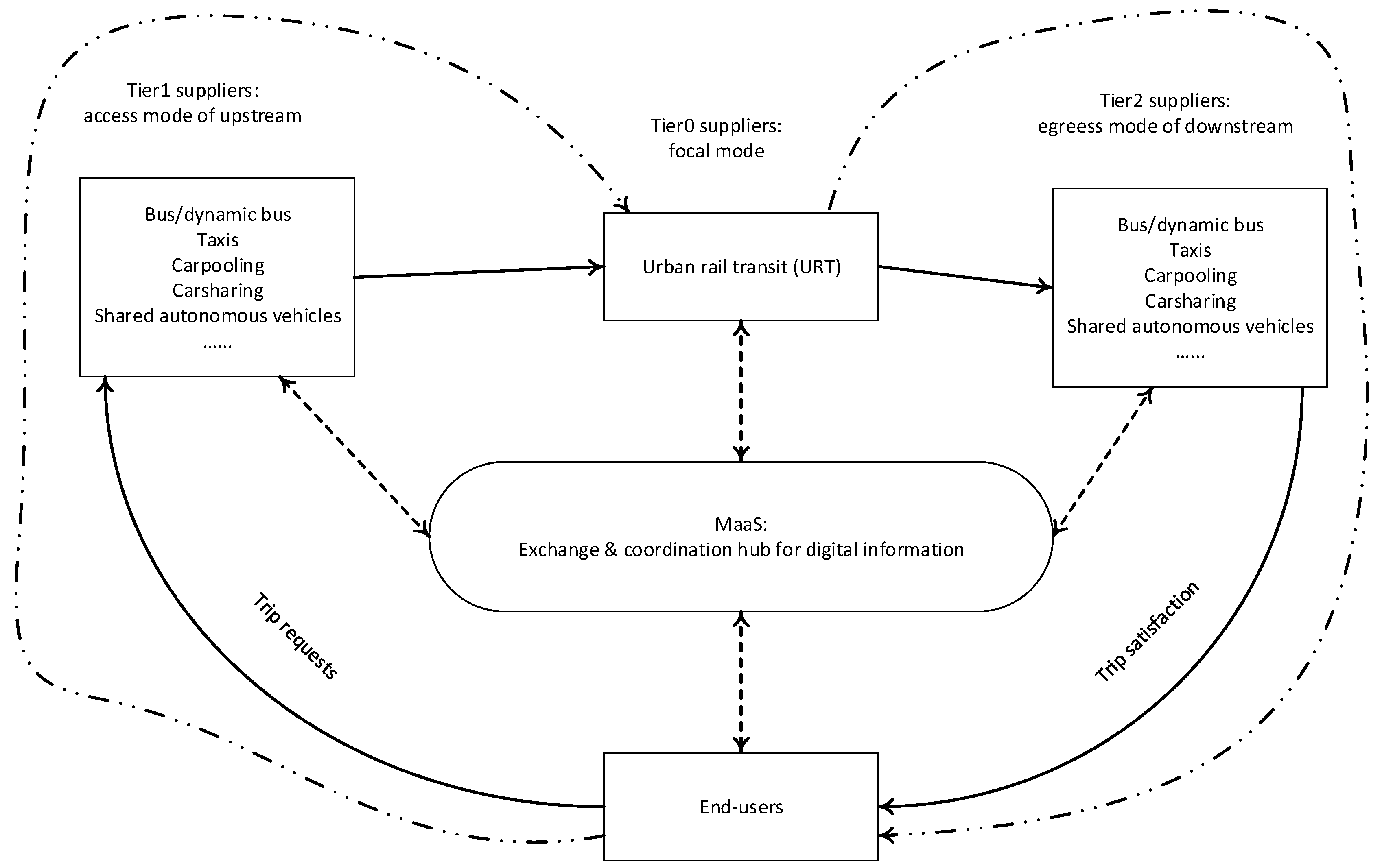
Figure 2.
synergy-oriented business model of intelligent mobility service supply chain network.
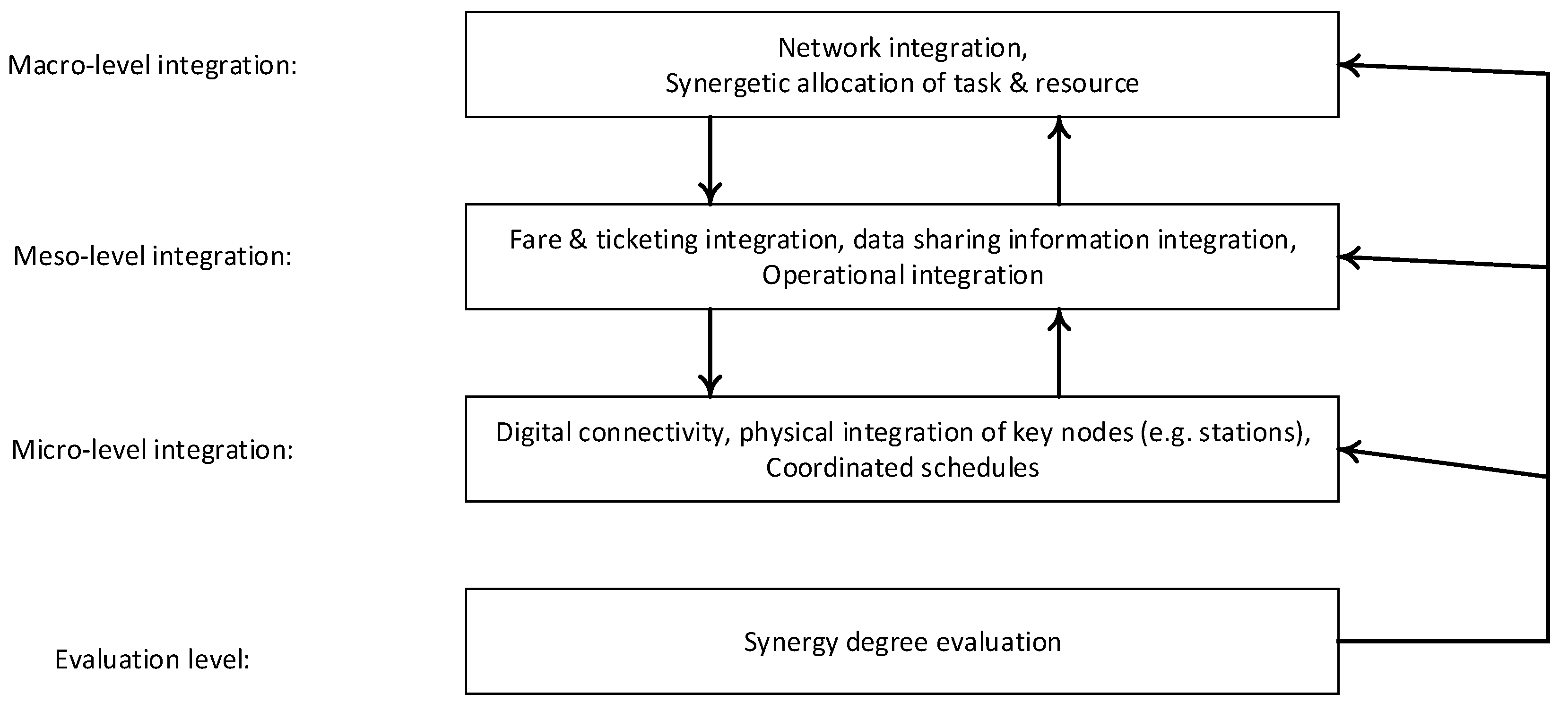
Figure 3.
trip chain of end-users in intelligent mobility service supply chain network.

Figure 4.
upstream synergy mechanism (NETSch-up) of intelligent mobility service supply chain network.
Figure 4.
upstream synergy mechanism (NETSch-up) of intelligent mobility service supply chain network.
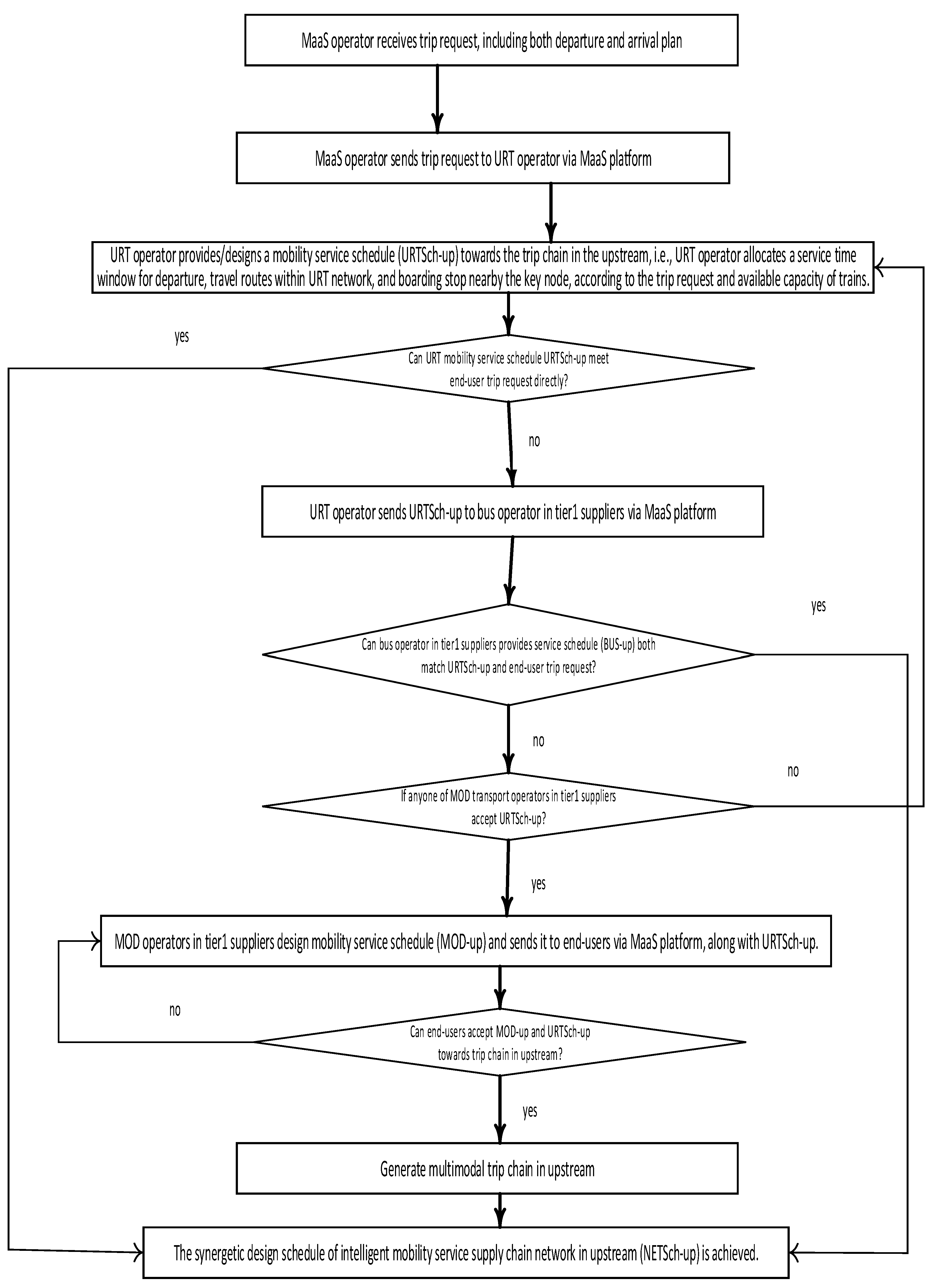
Figure 5.
downstream synergy mechanism (NETSch-down) of intelligent mobility service supply chain network.
Figure 5.
downstream synergy mechanism (NETSch-down) of intelligent mobility service supply chain network.
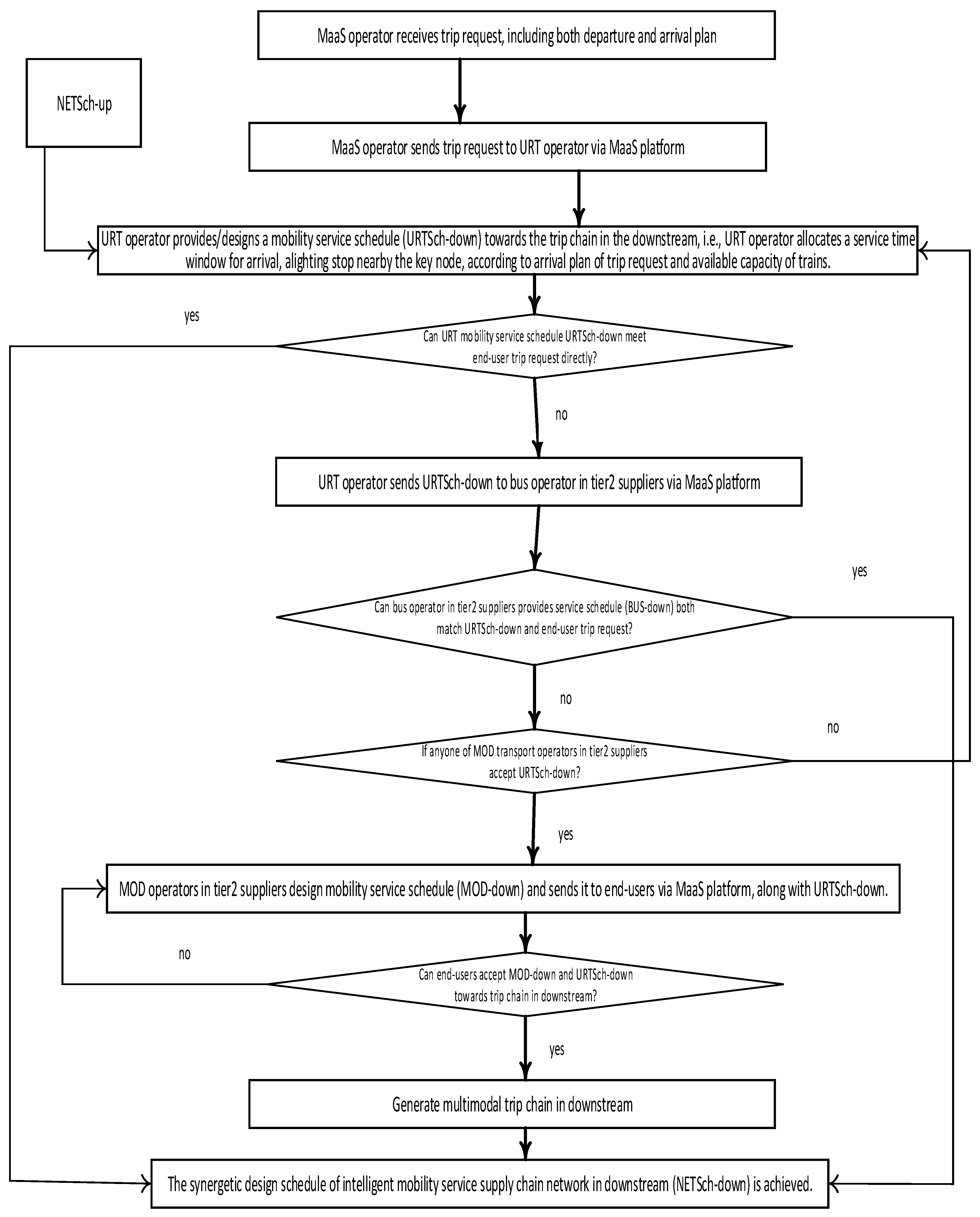
Figure 6.
Integrated desirability framework for synergy measurement (source: [53]).
Figure 6.
Integrated desirability framework for synergy measurement (source: [53]).
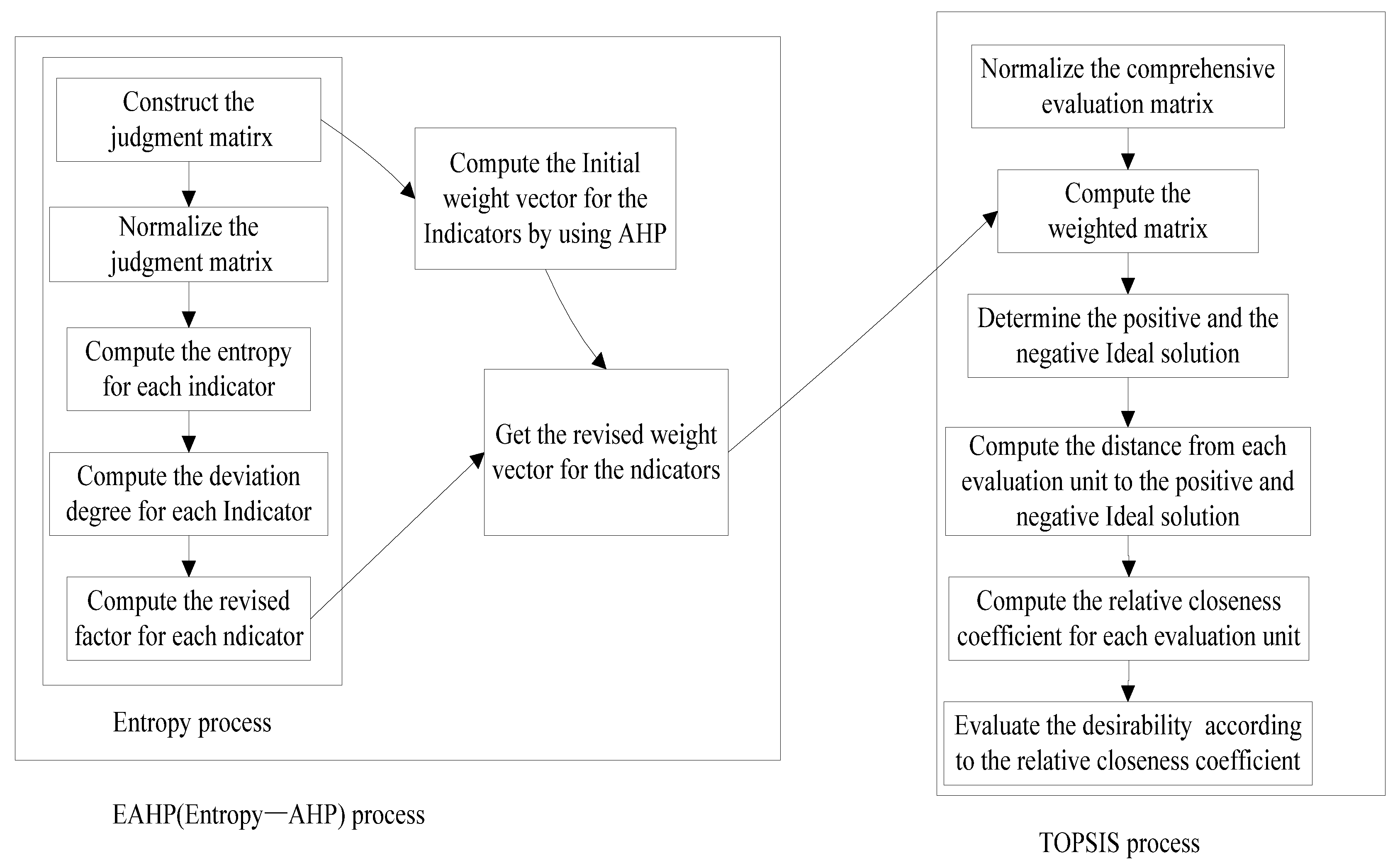

Table 1.
criteria structure for synergy measurement.
| Criteria class | Criteria name | Implications of criteria |
| time consumption for passenger travel | total travel time | The time elapsed for completing an end-user’s journey |
| transfer time | The time elapsed for transfer among the multimodal transport during a journey | |
| walking time | The time elapsed for walking within/among the key nodes or transfer station in the service network | |
| passenger waiting time | The time elapsed for waiting vehicles at stations | |
| passenger delay time | The time span between the committed service time and realized service time | |
| time consumption for vehicle usage | vehicle waiting time | The time elapsed for vehicle waiting at the key nodes or transfer stations in the service network |
| vehicle running time | The time elapsed for completing a vehicle service | |
| vehicle delay time | The time span between the expected service time and realized service time | |
| service performance of the system | response time | Time span between end-user’s booking moment and receiving mobility service moment |
| service time span | Mobility service duration provided by the transport operators, i.e., hours per day or days per week. | |
| unserved passengers | Including two parts: (1) refused travel request due to capacity shortage; (2) missed journey, i.e., the vehicle did not show up for its corresponding journey that has been booked successfully. |
Disclaimer/Publisher’s Note: The statements, opinions and data contained in all publications are solely those of the individual author(s) and contributor(s) and not of MDPI and/or the editor(s). MDPI and/or the editor(s) disclaim responsibility for any injury to people or property resulting from any ideas, methods, instructions or products referred to in the content. |
© 2023 by the authors. Licensee MDPI, Basel, Switzerland. This article is an open access article distributed under the terms and conditions of the Creative Commons Attribution (CC BY) license (http://creativecommons.org/licenses/by/4.0/).
Copyright: This open access article is published under a Creative Commons CC BY 4.0 license, which permit the free download, distribution, and reuse, provided that the author and preprint are cited in any reuse.


