

Submitted:
19 November 2023
Posted:
22 November 2023
You are already at the latest version
Abstract
The genetic potentials of rice cultivars will need to be expressed to their fullest if global rice production is to be expanded enough by 2050 to meet the increased demand of expanding population while the availability of land and water per capita dwindles. New and ‘improved’ rice varieties have contributed greatly to increased production over the past 50 years, but the rate of rice yield increase based on genetic changes has declined in recent decades compared with the early years of the Green Revolution. In fact, many rice consumers continue to prefer to consume ‘traditional’ rice varieties (referred to also as local, native, unimproved, or indigenous) because of their taste, aroma, texture, and other qualities. Further, many farmers prefer to cultivate these varieties because of their better adaptation to local climatic and soil conditions and their evolved resistance to endemic stresses. The practices that comprise the System of Rice Intensification (SRI), including transplanting rice seedlings at a young age, wide spacing between plants, keeping the soil well-aerated rather than inundated, and enhancing soil organic matter, provide traditional rice varieties with micro-environments that are more favorable for the expression of their genetic and agronomic potentials. Interactions among rice plants, soil characteristics, water, energy, and other inputs improve the phenotypic and physiological performance of rice plants. This paper considers how the cultivation of traditional rice varieties with SRI methods can raise yields, reduce farmers’ costs of production, and generate higher incomes, while contributing to the conservation of rice biodiversity.
Keywords:
System of Rice Intensification
; Traditional Rice Varieties
; Conserving Rice Biodiversity
1. Introduction
By 2050, global rice production will need to increase greatly to keep up with world-wide population growth, rising incomes and demand, and to deal with persistent food deficits for millions of households. This must be done while environmental resources are becoming relatively less abundant. The System of Rice Intensification (SRI) by modifying methods of rice crop management has shown potential to increase rice production greatly by capitalizing upon the genetic potentials of most if not all rice varieties, both improved and unimproved, rather than by modifying existing genetic potentials [1,2,3].
SRI changes the usual current methods of rice cultivation in several counter-intuitive ways, especially for irrigated cropping but with appropriate adaptations it can also improve upland rice production:
- Young rice seedlings, only 7-15 days old instead of 20-30 days, are transplanted singly and carefully, rather than in clumps of 3-4 plants or more. This minimizes trauma to the plant roots and protects their capability to support root systems and tiller growth.
- Plant density is greatly reduced, by as much as 80-90% m-2, through wider spacing between these single plants. This minimizes inter-plant competition and gives all plants more access to sunlight, air, water, and nutrients.
- The soil is kept moist and, and not mostly aerobic. Ceasing the continuous flooding of rice paddies ensures a good supply of oxygen to the roots.
These modifications of currently prevailing practices enable each plant to express its genetic potential to the fullest, to grow larger and better root systems and more tillers that in turn produce more and heavier grains [7].
SRI practices have been found to be advantageous for cultivating practically all rice varieties: old or new, traditional or modern, unimproved or improved, local or hybrid, although as should be expected, some varieties respond more fully and favorably to SRI management than do others. Thus far, the highest absolute yields obtained with SRI have been with ‘improved’ varieties or hybrids [8,9], although the greatest relative increases (in %) have come from traditional varieties, which start from a lower base [10].
As seen below, traditional rice varieties have shown themselves to be responsive to SRI management, expressing their genetic potential more fully than with either (a) traditional practices: transplanting older seedlings, even cutting the roots back if these are many weeks old; crowding plants together; and flooding paddy fields; or (b) modern practices that also continue flooding and rely heavily on chemical fertilizers. The latter induce greater vegetative growth that makes plants more vulnerable to lodging and more susceptible to losses from pests and diseases [11].
Traditional rice varieties are mostly photoperiod-sensitive, it should be noted, which influences their time of flowering [12]. An assessment of 324 traditional rice varieties showed a wide range of flowering time, from 65 to 124 days. The flowering stage is crucial in the rice development because of the transition from vegetative to reproductive that determines grain yield. While the management of local varieties is less standardized than with improved varieties, their consumer demand, profitability, and resilience make them worthy of consideration.
Traditional rice varieties are genotypes that are native to a certain area, having evolved there over hundreds, even thousands of generations, so that they have become highly adapted to the local environment and to its characteristic biotic and abiotic stresses. ‘Unimproved’ varieties also often have particular grain characteristics that are valued in the local culture and communities, with particular roles in food and nutrition, for medicinal uses, for rituals, and as household items. The author knows this from personal experience in Indonesia [13].
Because many traditional rice varieties command a higher price in local markets due to consumer preferences and demand, their yield is not the only consideration that shapes farmers’ planting decisions. The better price received for many local varieties plus their lower cost of production when agrochemical inputs are forgone makes their cultivation more profitable for farmers [14].
Also, these varieties are more resistant to abiotic and biotic environmental stresses associated with climate change, such as drought, flooding, extreme temperatures, and also pest and disease attacks [15,16]. An example of this resilience is seen in Figure 1, a photograph from East Java, Indonesia, showing two adjacent rice fields after their locality had been hit first by an insect pest attack and then by a tropical storm.
The field seen on the left was planted with an improved variety and given ‘modern’ chemical fertilizers and agroinputs, while the field on the right growing a traditional variety was managed with SRI methods and organic inputs only. Despite large expenditure on inputs, the field on the left gave little yield, not covering the farmer’s costs. The SRI-managed field on the right, on the other hand, with an ‘unimproved variety’ produced a yield more than 50% above the national average.
SRI practices have also been found to reduce crop water requirements by about 25% because of the larger root systems, as well as greenhouse gas emissions because of a cessation of flooding [17,18]. Under SRI management, soil organisms ranging from beneficial microbes to earthworms have more favorable conditions for growth, thereby enhancing soil fertility [19,20]. Combining SRI practices with traditional varieties can bring out better phenotypes from the inherent genetic potential as discussed next.
2. Morphological Development, Physiological Characteristics, Grain Yield, and Grain Quality of Traditional Rice Varieties under SRI Management
Managing plants, water, nutrients, and soil according to SRI recommendations enables rice plants to express their genetic potentials more fully, as noted above. Traditional varieties do not respond very well to current methods of ‘modern’ management. Crowding and flooding rice plants constrains the growth of their roots and tillers, and application of inorganic fertilizers and agrochemicals makes traditional cultivars more susceptible to lodging and more vulnerable to pest and disease attacks.
The innovation in crop breeding that launched the Green Revolution was the development of short-stalked cultivars of both rice and wheat. IRRI’s IR8 rice variety and CIMMYT’s semi-dwarf wheat did not easily fall over. Most traditional varieties, because they normally grow fairly tall, are vulnerable to lodging when given large amounts of N fertilizer. So, the strategy of the rice and wheat breeders who created the Green Revolution was to produce new cultivars that would not lodge when loaded up with nitrogen.
SRI practices have been found to induce significant improvements in a number of morphological and physiological characteristics. One summarization of experimental trial results has reported that these practices produce larger root systems (63% more depth, 40% more volume); 55% more root exudation; 52% greater leaf area; 30% more chlorophyll in the leaves; 40% more spikelets; and 125% greater water use efficiency.
These morphological and physiological enhancements contributed to 48% higher yield on average from SRI vs. control plots. In the SRI plots, the number of tillers m-2 was 2% greater than in the control plots even though the number of plants m-2 in the control plots was 6x greater than in the SRI trials [7]. Under SRI management, the plants were consistently more productive.
During the flowering and maturing stages of the rice plants, again in controlled trials, SRI leaves were found to exhibit a higher photosynthetic rate (Fv/Fm and ΦPSII), which is crucial for increasing grain yield. Even with a much lower plant population, light interception was 15% higher in SRI plots [21]. The SRI rice plants showed a high photosynthetic efficiency, similar to that of C4 plants. The leaves of these plants were thicker and displayed av greener color that indicated higher chlorophyll content with a more favorable Chl a/b ratio than found under conventional rice management.
This better leaf structure is attributable to a greater supply of nutrients from the roots to the shoots enabling leaves to accomplish more photosynthesis. Assimilates resulting from the photosynthetic activity are delivered to the roots for their development and activity as well as to the rest of the plant. SRI practices thus support the plants’ interdependent relationship between their roots and shoots in a positive-feedback loop [21].
Because of their larger and stronger root systems, SRI rice plants have shown better performance in unstable climate conditions, such as resistance to soil erosion [15]. One of the most interesting effects of SRI practices is to accelerate the crop’s maturation. Table 1 shows how the improved morphological characteristics and physiological activity of SRI rice plants lead to shorter rice crop cycles, more rice produced in a shorter period of time. The rice varieties are the ones most widely used in Morang district of Nepal, not traditional varieties as these have been mostly displaced by ‘modern’ varieties. However, farmers in Morang report the same effect with their traditional varieties.
Despite their shortened growing season and lesser number m-2, the SRI-grown rice plants produced by these farmers (N=413) yielded 48% more grain than those that they raised in nearby fields with conventional methods, i.e., continuous flooding with older seedlings transplanted in closer proximity. That SRI panicles had more spikelets and more filled grains per panicle, plus often heavier grain weight, led to a higher harvest index. Optimizing G x E interactions under SRI management thus significantly increases rice crop production.
3. Traditional Rice Varieties under SRI Management
The diversity of traditional rice varieties is immense, with around 200,000 varieties recorded and about 40,000 currently cultivated. They manifest a wide diversity in morphological and physiological traits, growing in locations from sea level to above 2,000 m elevation, in ecosystems ranging from equatorial (Indonesia) to mostly cold (Northern China), with time to maturity (crop cycle) ranging from 60 to more than 200 days. Most demonstrate some resistance to diseases and pests as well as greater tolerance to environmental stresses, such as drought, salinity, flood, heat, and low temperature.
The grain characteristics of traditional varieties show great diversity, with grain colors ranging from black to white, with purple, red, and various shades of yellow and amber in between. This variability is shown in Figure 2. Grain length varies from 3.5 to 14 mm, with grains classified as round, bold, and slender, seen in Figure 3. Grain breadth ranges from 1.9 – 3 mm. Some varieties are aromatic, and others are non-aromatic; some are glutinous (sticky), and others not. (This is not to be confused with containing gluten, a protein found in the grains of wheat and some other cereals; all rice varieties are gluten-free.)
In recent decades, many improved and hybrid rice varieties have been developed and released by government researchers and companies to be adopted by farmers. These varieties have been bred mostly for their higher yield rather than for other traits, so they are not recognized for their particular qualities such as taste, texture, aroma or color. This has prompted a number of organizations to start programs to promote the conservation of traditional rice varieties, which have been found to respond well to SRI management.
The state of Odisha in India, formerly known as Orissa, is reputed to be one of the centers of rice domestication from as many as 5,000 years ago [23]. With the advent of ‘modern’ varieties, probably over 10,000 ‘native’ varieties have already been lost. For almost two decades, Dr. Debal Deb of Virhi, based in Rayagada district, has been conserving traditional rice varieties, now over 800 [24]. Some of his accessions are reviewed in Appendix A.
Also in Odisha state, the NGO Sambhav has made collecting and conserving indigenous varieties as one of its missions, also evaluating their performance under SRI management. Sambhav has over 700 native varieties of rice in its seed bank, and it has developed a novel participatory strategy for conserving these varieties by getting individual farm families to ‘adopt’ an old variety in perpetuity, so that it is planted and grown anew each year, rather than being simply stored in a vault [25]. The results of growing 99 of these conserved varieties with SRI methods, reported in Appendix B, can be summarized as follows.
All of the varieties tested yielded more than 5 tonnes ha-1 under SRI management, which is well above the all-India yield of 4.1 tonnes ha-1, an average that considers all varieties and yields together. Three of the traditional varieties gave very high yields under SRI management, producing 9 to 11 tonnes ha-1, which is considerably more than twice the national average, while another 11 varieties yielded in the range of 8+ tonnes ha-1, and 15 varieties had yields in the range of 7+ tonnes ha-1. Four of the latter varieties were aromatic, which as a rule are lower-yielding but command a higher market price kg-1. Thirty-six varieties, 5 of them aromatic, gave yields of 6+ tonnes ha-1 with SRI crop management, and another 34 varieties (4 aromatic) produced 5+ tonnes ha-1.
In India, PRADAN, a national NGO based in New Delhi, has been promoting SRI management to farmers in more than eight states to increase their rice productivity. Under SRI methods, many local rice varieties have been found to perform remarkably well [14].
One local variety Kumlichudi, for example, which has reddish-yellow grains, produced a yield of 9.2 tonnes ha-1, with 40-50 tillers per plant, long panicle length (28 cm), and the number of filled grains panicle-1 reaching 275.
- A red-rice variety Adanbargi achieved 8.8 tonnes ha-1 in just 95 days, with up to 35 tillers plant-1, long panicles (27 cm), and more grains panicle-1 (225).
- Mansuri, a popular rice variety with bold grains, showed a yield of 8.4 tonnes ha-1 in 120 days, with 50-60 tillers plant-1, panicle length of 25 cm, and more grains panicle-1, up to 285.
- A black rice variety Kajri with a crop cycle of 135 days gave a yield of 8 tonnes ha-1 under SRI, with 45 tillers plant-1, long panicles (25 cm), and more grains panicle-1 (290).
These are all very impressive performance parameters.
In the Philippines, SRI management of a popular aromatic traditional rice variety Azucena has been quite successful in upland areas, giving 40% higher yield than with usual farmer methods. An NGO in Negros Province, BIND, conducted trials in the mountain areas of Sitio Sutay municipality, evaluating SRI practices adapted for unirrigated (rainfed) rice production. Azusena seedlings were planted at several different distances to ascertain what would be the best spacing (plant density) for the local growing conditions. It turned out that 20 x 40 cm spacing, 10 plants m-2, gave the best results, with an average yield of 7.7 tonnes ha-1, tiller number 9.85 hill-1, panicle length 29.8 cm, and 338 grains panicle-1 [27]. Such results would be good for any cultivar, let alone an unirrigated traditional variety.
In Sarawak, Malaysia, under a WWF conservation initiative, a dozen farmers started growing their local rice variety Adan with SRI methods in 2017; within five years, this number had grown to 53 farmers [28,29]. Adan rice has a long history for the Lun Bawang people in this location as it is the main ingredient in their culinary culture. Due to their location near to forested areas in Sarawak, adopting SRI methodology creates advantages for both the farmers and for local ecosystems by reducing pressure to convert forest area to rice fields. Further, SRI reduces the negative impact on the environment of agrochemical use (synthetic fertilizer and pesticides). By cultivating Adan rice under SRI management, the farmers get higher yield and income, which gives them incentive to cooperate in environmental protection.
A number of traditional rice varieties that tolerate salinity and submergence in water are also being grown with SRI practices. With SRI management, Bahurupi, which is saline-tolerant up to 6 mS cm-1 salinity, can give a yield 5.6 tonnes ha-1, several times more than what is now produced from these soils with farmers’ usual methods. Chamormoni, which is grown in the Sundarbans of West Bengal in India, can tolerate salinity as well as submergence in 1.5-1.8 m of standing water for about a month. Jalkamini, which originated in the 24 Parganas area of West Bengal, and Champaisiari, a local variety of the Mahanadi basin in Odisha state, both grow to about 5 m height to float on the floodwater surface where their leaves can carry out photosynthesis. With SRI practices and planting young seedlings before the flooding begins, these varieties grow more erect and are resistant to lodging in windy and stormy conditions because of their stronger culms and roots and wider spacing under SRI management [30].
In southern Iraq, adopting SRI practices is found to increase the grain yield of a popular local Jasmine rice variety by up to 50%, while also reducing the crop’s water requirements and lowering production cost. This provides benefits to farmers by enhancing their income and to the country by improving environmental quality [31].
Jasmine rice is an aromatic and long-grain variety native to Thailand with a soft texture. Its floral aroma results from the evaporation of the aromatic compound 2-acety-1-pyrroline. Because of these grain quality traits, Jasmine rice has high demand from consumers and commands a good market price. With SRI management, the yield of Jasmine rice in Iraq can be raised to 7 tonnes ha-1, with panicle length up to 22 cm, and with more filled grains panicle-1 (average of 142).
Pandan Wangi is one of the most popular aromatic traditional rice varieties in Indonesia. When grown under SRI management, the grain yield can be increased up to 78% [32]. The fragrant aroma of Pandan Wangi is similar to that of pandan leaves, which makes its eating more pleasurable. The appearance of Pandan Wangi grains as short, round, and transparent attracts consumers, and its excellent taste together with tender texture and moistness give it a combination of stickiness and fluffiness that fetches a higher price in the market. With SRI management, not only is the yield increased, but there are water savings of 50% and a decrease in greenhouse gas emissions.
Several other traditional rice varieties such as Mentik Susu, Mentik Wangi, Rojolele Gepyok, and Rojolele Genjah are also beginning to be cultivated with SRI practices [33]. Productivity of these varieties is increased by up to 50%, supported by longer roots, stronger stems, productive tillers, thicker and greener leaves, longer panicles, heavier grains, and more biomass.
In Crawak village in East Java, Indonesia, as seen in Figure 1, a traditional aromatic variety Sinantur cultivated with organic SRI methods in the summer of 2011 showed impressive resistance to a brown planthopper attack and then resistance to lodging during a tropical storm, giving a yield of 8 tonnes ha-1. A ‘modern’ variety rice crop (Ciherang) in the adjacent field succumbed to both hazards. In West Africa, several indigenous rice varieties of Oryza glaberrima, a rice species closely related to Oryza sativa which has Asian origins, have been found to produce almost twice as much yield by practicing SRI rather than with current rice crop management [34].
SRI has also been applied in the cultivation of black rice, an heirloom variety that has high levels of antioxidants due to anthocyanin pigment in the grain. Compared to other rice varieties, it also contains elevated concentrations of vitamins A and B, iron, fiber, protein, and vital amino acids. Because of its high concentration of antioxidants that can protect the human body from damage by free radicals, black rice offers health advantages such as reduction of atherosclerosis, diabetes, cancer, and other chronic diseases. This makes it popular with health-conscious consumers.
There are many varieties of black rice, including black japonica rice, black glutinous rice, Italian black rice, and Thai black jasmine rice. Due to high demand from consumers, there is considerable scope in many countries for increasing black rice production and sales by practicing SRI for economic and environmental as well as for health gains [35].
In Nepal, the mountainous region of Bajhang district has an elevation over 7,000 m, a short growing period, and poor soil fertility. Two traditional rice varieties being grown there with SRI methods were evaluated, including Hansraj basmati, an aromatic rice with premium export qualities, and Thapachini, a popular local rice variety [36]. With SRI methods, Hansraj yield is increased up to 62% compared to conventional methods. In the market, it has the brand name of Jorayal Basmati, which has high consumer demand. The Thapachini yield increase with SRI practices was 91%. These traditional varieties under SRI management had a higher number of tillers plant-1, longer panicle length, more filled grains panicle-1 with fewer unfilled grains.
Productivity and profitability of traditional rice varieties are also influenced by the age of seedlings at transplanting, contributing to more tillers plant-1 and grain yield. In South India, eight traditional rice varieties were evaluated for the effect of seedling age on rice productivity under SRI management [37]. With SRI practices, transplanting 15-day-old seedlings of all these varieties resulted in more favorable components of yield like number of productive tillers, total spikelets, filled grains panicle-1, and 1000-grain weight. Some specific findings include:
- Njavara, a medicinal rice variety that is susceptible to lodging, has been found to be less susceptible to this when grown with SRI methods.
- Kavuni, used for medicinal purposes due to the antioxidant activity of its natural anthocyanin pigment ranging from red to black coloration, responded very positively to these methods.
- Several of the varieties evaluated -- Nootripathu, Norungan, Kuruvaikalanjiyam, Kuliyadichan, and Chandikar -- are known to be drought-tolerant. This will become ever more important as water limitations for growing rice become more severe.
Basmati rice is one of the leading agricultural export commodities for India. Increasing its yield, quality, and profitability will benefit farmers as well as exporters and the national economy. The large rice-exporting company Tilda began promoting SRI practices in Haryana state because of grain quality as well as yield considerations. It has reported that SRI-grown basmati rice not only has greater resistance to lodging and rice blast disease, but it also has fewer immature and broken grains when being milled [38].
Two basmati rice varieties, Geetanjali and Pusa Basmati-1 were cultivated with SRI methods in the coastal area of eastern and southeastern Odisha state. Both varieties responded well to the effects of SRI management -- wider spacing, organic nutrient management, and young age of seedlings – with higher tiller number, greater panicle length, and more filled grains panicle-1 [39].
In 2023, seven Indian traditional rice varieties were cultivated under SRI practices in Tamil Nadu state [40]. Thanga samba showed the best performance under SRI with a grain yield of 6.5 tonnes ha-1, which would be respectable for most improved varieties. It exhibited greater panicle weight and straw yield, as well as highest net economic return. In comparison to cultivation with conventional methods, SRI-grown traditional varieties showed a high benefit-cost ratio, 2.2:1, with one variety having a calculated ratio of 2.6:1. As would be expected, there was some variance in how well the different varieties responded to SRI management, but the components of yield measured and compared were quite consistently positive.
4. Conclusions
This review has considered what evidence can be found in the published agricultural literature on the effects of practicing SRI with traditional rice varieties from several countries. Possibly there have been some negative effects of SRI management with these varieties that have not been reported. But the published record is very encouraging, indicating that combining SRI management with traditional/native/local/indigenous rice varieties can be both productive and profitable.
SRI practices for managing seeds, plants, soil, water, and energy enable rice plants of most varieties to express their genetic potential more fully. This effect appears to most important for traditional rice varieties that are inhibited by practices of high plant density, continuous flooding, and reliance on chemical fertilizers, herbicides and insecticides. These varieties are in danger of being lost under the pressures from new varieties and ‘modern’ practices, some of which are promoted directly or indirectly by governments (through subsidies for fertilizer, free water, low or no charges for electricity to operate tubewells). Under eco-friendly management, traditional varieties can accomplish high productivity and more robust phenotypes from the given genotype and thus become economically competitive with ‘improved’ varieties.
Understanding SRI practices and their effects, not just on rice plants but on the soil and soil biota, is important for improving current rice breeding programs that aim to feed increased human populations. Plants need to be seen not just as vegetative organisms but as holobionts, i.e., composites of plant and microbial life forms [41]. Under SRI management, traditional rice varieties that enjoy higher consumer preference and better prices can be grown profitably by farmers, and this is good also for the natural environment. Such management can achieve maximal phenotypic expression of traditional varieties’ genetic potentials and can also help to conserve the complex gene pool that rice species have built up and differentiated over many thousands of years.6. Patents
This section is not mandatory but may be added if there are patents resulting from the work reported in this manuscript.
Acknowledgments
The author would like to thank to Dr. Norman Uphoff, guest-editor of this special issue, for his editorial assistance in polishing this paper as English is not my first language and he has extensive knowledge on this subject.
Appendix A
Characteristics of Indian traditional rice varieties that have yielded > 6 t ha-1 under SRI management, reported according to ascending yield ha-1.

Table A1.
Characteristics of Indian traditional rice varieties that have yielded > 6 t ha-1 under SRI management, reported according to ascending yield ha-1.
Table A1.
Characteristics of Indian traditional rice varieties that have yielded > 6 t ha-1 under SRI management, reported according to ascending yield ha-1.
| Variety name | Habitat | Dura-tion (days) |
Tillers plant-1 | Panicle length (cm) | % Fertile panicles | Grains panicle-1 |
Grain yield (t ha-1) |
Stress tolerance |
Grain grade |
Special features; Farmer assessments |
| Lohondi | Lowland | 150 | 17 | 25 | 90 | 200 | 6.0 | 1 | 2 | 1, F2; No need to parboil |
| Rongochuri | Lowland | 120 | 40 | 18 | 38 | 120 | 6.2 | 1,3,4 | 2 | 1, F1; Good for making biryani; grains elongate during cooking |
| Kalinga | Medium upland | 90 | 25 | 20 | 90 | 200 | 6.2 | 1 | 2 | 1; Summer season paddy; price Rs 10 kg-1 |
| Jhumpuri | Lowland | 160 | 32 | 30 | 93 | 290 | 6.2 | 1 | 2 | 1; Straw is strong; this variety is alternated with Champaisiari for avoiding weeds |
| Asamchudi | Lowland | 135 | 25 | 27 | 100 | 385 | 6.2 | 1,3,4 | 2 | 1; High satiety; good for rice porridge and rice beer (landah) |
| Ramipareva | Medium upland | 130 | 15 | 25 | 100 | 346 | 6.2 | 3,4 | 2 | 1, 2, 3 |
| Puiri Lochai | Medium upland | 125 | 43 | 24 | 100 | 275 | 6.2 | 1,3,4 | 2 | 1; Low price in market, Rs 12.5 kg-1 |
| Jeeraphul | Lowland | 150 | 50 | 25 | 90 | 200 | 6.4 | 1 | 2 | 1, F2; No need to parboil |
| Tulsibas | Medium upland | 135 | 21 | 29 | 13 | 355 | 6.5 | 2 | F2; Good price in market, Rs. 50 kg-1; ratooning possible | |
| Bandiluchai | Lowland | 135 | 23 | NA | 100 | 390 | 6.7 | 1,3,4 | 2 | 1, 3, 4; Good for rice porridge; grains that elongate during cooking |
| Sopori | Lowland | 150 | 45 | 25 | 40 | 140 | 6.9 | 3,4 | 3 | F1; Good for Pitha making; tastes sweet |
| Champaisiari | Lowland | 160 | 35 | 32 | 95 | 320 | 7.0 | 2 (30 d) | 2 | 1; Tasty; preferred by the poor |
| Jauphul | Medium upland | 145 | 70 | 19 | 100 | 280 | 7.0 | 1,3,4 | 2 | 1, F2; Good price in market, Rs. 50 kg-1 |
| Sarogotora | Medium upland | 135 | 26 | 29 | 23 | 350 | 7.0 | 3 | 1; Fine non-scented rice; its short straw length makes it suitable as fodder | |
| Mourikhas | Lowland | 140 | 22 | 30 | 18 | 345 | 7.0 | 2 | F2; Good price in market, Rs 50-55 kg-1 | |
| Khajurcheri | Medium upland | 128 | 25 | 25 | NA | 245 | 7.0 | 3 | 1; Fine non-scented rice; good both raw and parboiled; cross-pollinating variety | |
| Dhaniaphul | Lowland | 140 | 45 | 25 | 90 | 330 | 7.2 | 1 | 1 | |
| Bhataphul | Medium upland | 95 | 25 | 28 | 100 | 300 | 7.2 | 1,3,4 | 1 | 1, F2 |
| Birholi | Medium upland | 95 | 25 | 28 | 100 | 300 | 7.2 | 1,3,4 | 1 | 1, F2 |
| Kumdhen | Lowland | 110 | 25 | 25 | 100 | 250 | 7.4 | 1 | 2 | 1, F1 |
| Lal Lochai | Medium upland | 125 | 33 | 23 | 100 | 250 | 7.4 | 1,3,4 | 2 | 1; Rice price in market is only Rs 12.5 kg-1 |
| Kalajeera | Lowland | 145 | 20 | 25 | 100 | NA | 7.4 | 1 | 1, F2 | |
| Lalmokro | Lowland | 135 | 15 | 27 | 100 | 271 | 7.5 | 1,3,4 | 2 | 1, 2, 3 |
| Latamohu | Lowland | 160 | 43 | 30 | 97 | 250 | 7.6 | 1,3,4 | 2 | 1, F1; Tasty |
| Kalachampa | Medium upland | 150 | 37 | 34 | 85 | 327 | 7.6 | 1 | 2 | 1 |
| Kajri | Lowland | 135 | 45 | 25 | 90 | 285 | 8.0 | 2 | 1 | |
| Kurlubuti | Lowland | 135 | 19 | 26 | 100 | 271 | 8.0 | 1,3,4 | 2 | 1; Good for rice porridge; less breaking of grains during milling |
| Radhatilak | Medium upland | 135 | 21 | 29 | 17 | 345 | 8.0 | 2 | 1, F2; Good price in market, Rs 50 kg-1 | |
| Mahsuri | Lowland | 125 | 55 | 25 | 90 | 285 | 8.4 | 2 | 1; Tasty, Rs 10 kg-1 | |
| Adanbargi | Lowland | 100 | 35 | 28 | 90 | 225 | 8.8 | 1,3,4 | 2 | 1 |
| Agnilal | Medium upland | 130 | 16 | 26 | 11 | 220 | 9.0 | 4* | 2 | 1, 5; Good for pregnant women |
| Red 1009 | Medium upland | 135 | 27 | 25 | 22 | 232 | 9.0 | 2 | 1, 2, 3; Strong straw, can be used for thatching and growing mush-rooms | |
| Laluchura | Medium upland | 130 | 25 | 29 | 18 | 245 | 9.0 | 2 | 1, 2, 4; Bold variety; preferred by economically-weaker sections; straw is good for thatching | |
| Kanchan Safri | Medium upland | 110 | 80 | 28 | 90 | 275 | 9.2 | 1,3,4 | 3 | 1 |
| Kumlichudi | Lowland | 120 | 45 | 28 | 90 | 275 | 9.2 | 1,3,4 | 2 | 1 |
| Sungibaram | Lowland | 130 | 21 | 29 | 18 | 285 | 10.0 | 4* | 2 | 1 |
| Bashabhog | Medium upland | 120 | 43 | 32 | 90 | 350 | 10.4 | 1 | 2 | 1, F2 |
| Talomuli | Medium upland | 130 | 31 | 30 | 18 | 280 | 11.0 | 1, 3 | 2 | 1, 4 |
Stress tolerance:1=Drought; 2=Flood; 3=Pests; 4=Diseases; Grain type: 1=Round; 2=Bold; 3=Slender; F1=Light-scented; F2=Strong-scented/aromatic; Special features: 1=Good for daily cooking, 2=Puffed rice, 3=Rice flakes, 4=Popped rice, 5=Medicinal uses. *Against rice blast. These data sourced from Banerjee and Sundharpahari (2013) [22].
Appendix B
Traditional rice varieties (N=99) cultivated under SRI by the NGO Sambhav in Odisha state of India, reported by yield ha-1.
Table A2.
Traditional rice varieties (N=99) cultivated under SRI by the NGO Sambhav in Odisha state of India, reported by yield ha-1.
Table A2.
Traditional rice varieties (N=99) cultivated under SRI by the NGO Sambhav in Odisha state of India, reported by yield ha-1.
| Yield (in tonnes ha-1) | Number of varieties | Traditional varieties evaluated with SRI management |
| ≥11 | 1 | Talamuli |
| ≥10 | 1 | Surangibaran |
| ≥9 | 1 | Agnilal |
| ≥8 | 11 | Laghu Pathara, Runja Manika, Dilip Mota, Sita Sal, Radha Tilak, Birai, Gopal Bhog, Sunapan,* Sana Bhata Dhan, Morikhas, Ketaki Champa |
| ≥7 | 15 (4 aromatic) |
Nandika, Khajur Cheri, Bhainspat, Banamal, Mayurkantha, Narayan Kamini, Lathisal, Karpurakeli, Govind Bhoga, Banspatri, Samalai Bhog, Saragtara, Debrani, Ajirbana, Ketakijoha |
| ≥6 | 36 (5 aromatic) |
Barhagali, Andharchaki, Dandabalunga, Nadiaphula, Mugudi, Hari Shankar, Kolajan, Barapanka, Kalabarni, Kajal Kanhei, Kukudamunda, Ghios, Bhaluki (no. 2), Badagandamala, Jagatsinghpur Basmati, Saru Chinamali, Sunasari, Meghamala, Kalakanhu, Katrangi, Gangabali, Baramasi, Tulsi Mukul, Chamormoni, Batakalama, Kanakchur, Kuja, Kuji Patali, Jalendri, Rahaspanjar, Matabhog, Panicheri, Kalajeera, Basbhog, Doddaberunelu, Banglapatnai |
| ≥5 | 34 (4 aromatic) |
Banapuri, Kankhri, Bhalu Dubraj, Ramsal, Kerandi, Ramigali, Laghu Bhutia, Lim Dhan, Gedi Kanhei, Alsikiba, Raghusal, Nadiajodi, Badanali, Kalonunia, Dhusura Bhutia, Silkote, Balabhadrabhog, Baikani, Nalipakhia, Mugajai, Dudh Kalama, Jawaphul, Kalakadam, Geleigeti, Chudi, Kadalia Champa, Bhelian, Ganagabali (no. 2), Tulsa, Raniakhanda, Kajalamali, Jhingesal, Dhaniaphual, Tulsibasa, Khaw Dam |
* A deep-water traditional rice variety. Italicized names are aromatic rice varieties. Data sourced from Ms. Sabarmatee Tiki, executive director, Sambhav, Rohibank, Odisha, India, provided to SRI-Rice, Cornell University, and shared with the author with permission.
References
- Stoop, W.A.; Uphoff, N.; Kassam, A. A review of agriculture research issues raised by the system of rice intensification (SRI) from Madagascar: Opportunities for improving farming systems for resources-poor farmers. Agric. Syst. 2002, 71, 249–274. [Google Scholar] [CrossRef]
- Vijayakumar, M.; Ramesh, S.; Chandrasekaran, B.; Thiyagarajan, T.M. Effects of system of rice intensification (SRI) practices on yield attributes, yield, and water productivity of rice (Oryza sativa L.). Res. J. Agric. Biolog. Sci. 2006, 2, 236–242. [Google Scholar]
- Tsujimoto, Y.; Horie, T.; Randriamihary, H.; Shiraiwa, T.; Homma, K. 2009. Soil management: The key factors for higher productivity in the fields utilizing the system of rice intensification (SRI) in the central highland of Madagascar. Agric. Syst. 2009, 100, 61–71. [Google Scholar] [CrossRef]
- Manjunatha, B.N.; Basavarajappa, R.; Siddaram, Policepatil, A.S.; Yogeeshappa, H.; Kalyanamurthy, K.N. Effect of age of seedlings under different system of rice intensification (SRI). Int. J. Agric. Sci. 2010, 6, 2, 377–379.
- Laulanié, H. Intensive rice farming in Madagascar. Tropicultura 2011, 29, 183–187. (English translation of the original article published in French in Tropicultura, 1993).
- Uphoff, N.; Fasoula, V.; Iswandi, A.; Kassam, A.; Thakur, A.K. Improving the phenotypic expression of rice genotypes: Rethinking ‘intensification’ for production systems and the selection practices for rice breeding. Crop J. 2015, 46, 77–98. [CrossRef]
- Thakur, A.; Mandal, K.; Verma, O.; Mohanty, R. Do System of Rice Intensification practices produce rice plants phenotypically and physiologically superior to conventional practice? Agronomy 2023, 13, 1098. [CrossRef]
- Yuan, L-P. A scientist’s perspective on experience with SRI in China for raising the yields of super hybrid rice. In Assessments of the System of Rice Intensification, Proc. Int. Conf., Sanya, China, April 1-4, 2002, 23-25, Cornell Int. Inst. Food Agric. Dev., Ithaca, NY, 2002. http://sri.cals.cornell.edu/proc1/sri_06.pdf.
- Diwakar, M.C.; Kumar, A.; Verma, A.; Uphoff, N. Report on the world record yields in kharif season 2011 in Nalanda district, Bihar state, India. Agric. Today (New Delhi) 2012, 79, 261–281. Available online: https://independentsciencenews.org/wp-content/uploads/2012/11/India-Bihar-Paddy-Record-Yield-SRI.pdf (accessed 16 October 2023).
- Uphoff, N. The System of Rice Intensification: Responses to Frequently Asked Questions. SRI Int. Network and Resources Center, Cornell University, Ithaca, NY, 2016. http://sri.cals.cornell.edu/aboutsri/SRI_FAQs_Uphoff_2016.pdf (accessed 15 October 2023).
- Chaboussou, F. Healthy Crops: A New Agricultural Revolution, Jon Carpenter Publishing, Charlbury, UK, 2005.
- Nandini, B.; Gangappa, E.; Mahesha, B. et al. Assessment of flowering response in traditional rice varieties of Karnataka to photo period. Int. J. Curr. Microbiol. App. Sci. 2020, 9, 2, 1224–1229. [CrossRef]
- Dwiningsih, Y.; Al-Kahtani, J. Rojolele: A premium aromatic rice variety in Indonesia. Int. J. Agr. Sci. Tech. 2022, 2, 42–53. https://www.svedbergopen.com/files/1678426833_(5)_IJAGST 202229111427TX45R_(p_42-53).pdf. [CrossRef]
- Banerjee, S. Indigenous paddy varieties under SRI and conventional practices: A performance study. NewsReach, PRADAN, New Delhi 2013, 13. https://www.pradan.net/sampark/wp-content/uploads/2019/07/Indigenous-Paddy-Varieties-under-SRI-and-Conventional-Practices.pdf.
- Thakur, A.K.; Uphoff, N. How the System of Rice Intensification can contribute to climate-smart agriculture, Agron. J. 2017, 109, 1163–1182. [CrossRef]
- Chintalapati, P. et al. Insect pest incidence with the System of Rice Intensification: A multi-location study with meta-analysis, Agronomy 2023, 13. [CrossRef]
- Jagannath, P.; Pullabhotla, H.; Uphoff, N. Meta-analysis evaluating water use, water saving, and water productivity in irrigated production of rice with SRI vs. standard management methods. Taiwan Water Conserv. 2013, 61, 14–49.
- Dahlgren, J.; Parr, A. The impact on greenhouse gas emissions of rice crop management under the System of Rice Intensification: A review. Agronomy 2023, 13. [CrossRef]
- Anas, I.; Rupela, O.P; Thiyagarajan, T.M.; Uphoff, N. A review of studies on SRI effects on beneficial organisms in rice soil rhizospheres, Paddy Water Envir. 2011, 9, 53–69. [CrossRef]
- Doni, F.; Khadka, R.B.; Uphoff, N. Soil biological contributions to the productivity of the System of Rice Intensification. In: Biological Approaches to Regenerative Soil Systems, eds. Uphoff, N.; Thies, J.E., 291-307, CRC Press, Boca Raton, FL, 2023.
- Thakur, A.K.; Chaudhari, S.K.; Singh, R.; Kumar, A. Performance of rice varieties at different spacing grown by the system of rice intensification in eastern India. Indian J. Agric. Sci. 2009, 79, 443–447.
- Banerjee, S.; Sundarpahari. Study of Performance of Indigenous Paddy Varieties under SRI and Conventional practices. Report for the National Consortium of SRI, New Delhi, India, 2013.
- Das, S. Rice in Odisha, IRRI Tech. Bull. No. 16, Int. Rice Res. Inst., Los Baños, Philippines, 2012.
- Deb, D. The struggle to save heirloom rice varieties. Scient. Amer. 2019, 321, 54–61. https://www.scientificamerican.com/article/the-struggle-to-save-heirloom-rice-in-india/.
- Patnaik, A.; Jongerden, J.; Ruivenkamp, G. Repossession through sharing of and access to seeds: Different cases and practices. Int. Rev. Sociol. 2016, 27, 179–201. https://www.tandfonline.com/doi/full/10.1080/03906701.2016.1235213. [CrossRef]
- Roopa, N. The magic of a fistful of seeds. Earth Island J., Aug. 12, 2022. https://www.earth island.org/journal/index.php/articles/entry/the-magic-of-a-fistful-seeds/.
- BIND. Growth and Yield Responses of Traditional Upland Rice on Different Distance of Planting Using Azucena Variety. Report for Broader Initiatives for Negros Development, Bacalod, Philippines, 2005. http://sri.cals.cornell.edu/countries/philippines/philsBIND_ UplandResults2002.pdf (accessed 7 June 2023).
- WWF. Conservation through Ba’kelalan Adan rice: Heirloom rice of the Lun Bawang. World Wide Fund for Nature, Gland, Switzerland, 2023. https://www.youtube.com/watch?v=bhEc4XD0Y4U.
- Toyat, J. WWF-Malaysia, Antares Venture ink MOA to promote, market Ba Kelalan’s highland rice. Borneo Post, Nov. 17, 2023.
- Plabita, R.; Raj, R.K. Extent of adoption of practices under system of rice intensification in Odisha. Oryza 2014, 51, 81–85.
- Hameed, K.A.; Jaber, F.A.; Hadi, A.Y.; Elewi, J.; Uphoff, N. Application of System of Rice Intensification (SRI) methods on productivity of jasmine rice variety in Southern Iraq. Jordan J. Agric. Sci. 2011, 7, 3.
- Dwipa, I.; Rozen, N.; Kasim, M. Emergence of phyllochron of three rice varieties in different time of land flooding in System of Rice Intensification (SRI). Int. J. Envir. Agric. Biotechnol. 2018, 3, 6. [CrossRef]
- Isnawan, B.H.; Samanhudi; Supriyono; Supriyadi. Growth and yield of various local rice varieties with system of rice intensification irrigation system. 2nd Int. Conf. on Sustainable Agriculture, IOP Conf. Series: Earth and Environ. Sci. 2020, 458, 012021. [CrossRef]
- Styger, E. System of Rice Intensification (SRI): Community-Based Evaluation in Goundam and Dire Circles, Timbuktu, Mali, 2008/09. Report for Africare, Bamako, Mali, 2009. http://sri.cals.cornell.edu/countries/mali/MaliAfricare%2008and09.pdf.
- Panda, D.K.; Jyotirmayee, B.; Mahalik, G. Black rice: A review from its history to chemical makeup, health advantages, nutritional properties, and dietary uses. Plant Sci. Today 2022, 9, 1–15. https://horizonepublishing.com/journals/index.php/PST/article/view/1817. [CrossRef]
- Khadka, R.; Acharya, H.; Uphoff, N. Performance of landrace and improved rice varieties under the System of Rice Intensification management in Bajhang District of Nepal. J. Agric. Environ. 2014, 15. [CrossRef]
- Ashraf, A.; Lokanadan, S. Effect of seedling age on productivity and profitability in traditional rice landraces. Oryza 2022, 59, 113–125. [CrossRef]
- Tilda Ricelands. Promotion of SRI with Basmati Rice. Presentation to 3rd National SRI Symposium, Coimbatore, India, 2008. https://www.slideshare.net/SRI.CORNELL/0854-welcome-to-the-world-of-tilda-promotion-of-sri-with-basmati-rice-in-haryana (accessed 20 April 2023).
- Panigrahi, T.; Garnayak, L.M.; Ghosh, M.; Bastia, D.K.; Ghosh, D.C. Productivity and profitability of basmati rice varieties under SRI. Int. J. Bio-resource Stress Manage. 2014, 5, 333–339. [CrossRef]
- Flora, G.; Rajendran, K.; Kumar, K.; Sharmili, K.; Pramitha, J. Effect of System of Rice Intensification practices in increasing the yield of traditional varieties of rice. Int. J. Envir. Clim. Change 2023, 13, 1175–1180. [CrossRef]
- Economist. The idea of “holobionts” represents a paradigm shift in biology, The Economist, June 14, 2023.
Figure 1.
Two adjacent paddy fields in Ngawi district, East Java, Indonesia, in 2011 after both had been exposed to a brown planthopper pest attack, followed by a tropical storm toward the end of the growing season. The field on the left planted with an improved variety (Ciherang) was managed with ‘modern’ inputs. The field on the right growing an aromatic traditional variety (Sinantur) with organic SRI methods resisted both the biotic and abiotic stresses. It gave a yield of 8 tonnes ha-1, while the field on left produced little harvestable yield (picture provided to SRI-Rice by Ms. Miyatty Jannah, the farmer who managed the field on the right).
Figure 1.
Two adjacent paddy fields in Ngawi district, East Java, Indonesia, in 2011 after both had been exposed to a brown planthopper pest attack, followed by a tropical storm toward the end of the growing season. The field on the left planted with an improved variety (Ciherang) was managed with ‘modern’ inputs. The field on the right growing an aromatic traditional variety (Sinantur) with organic SRI methods resisted both the biotic and abiotic stresses. It gave a yield of 8 tonnes ha-1, while the field on left produced little harvestable yield (picture provided to SRI-Rice by Ms. Miyatty Jannah, the farmer who managed the field on the right).
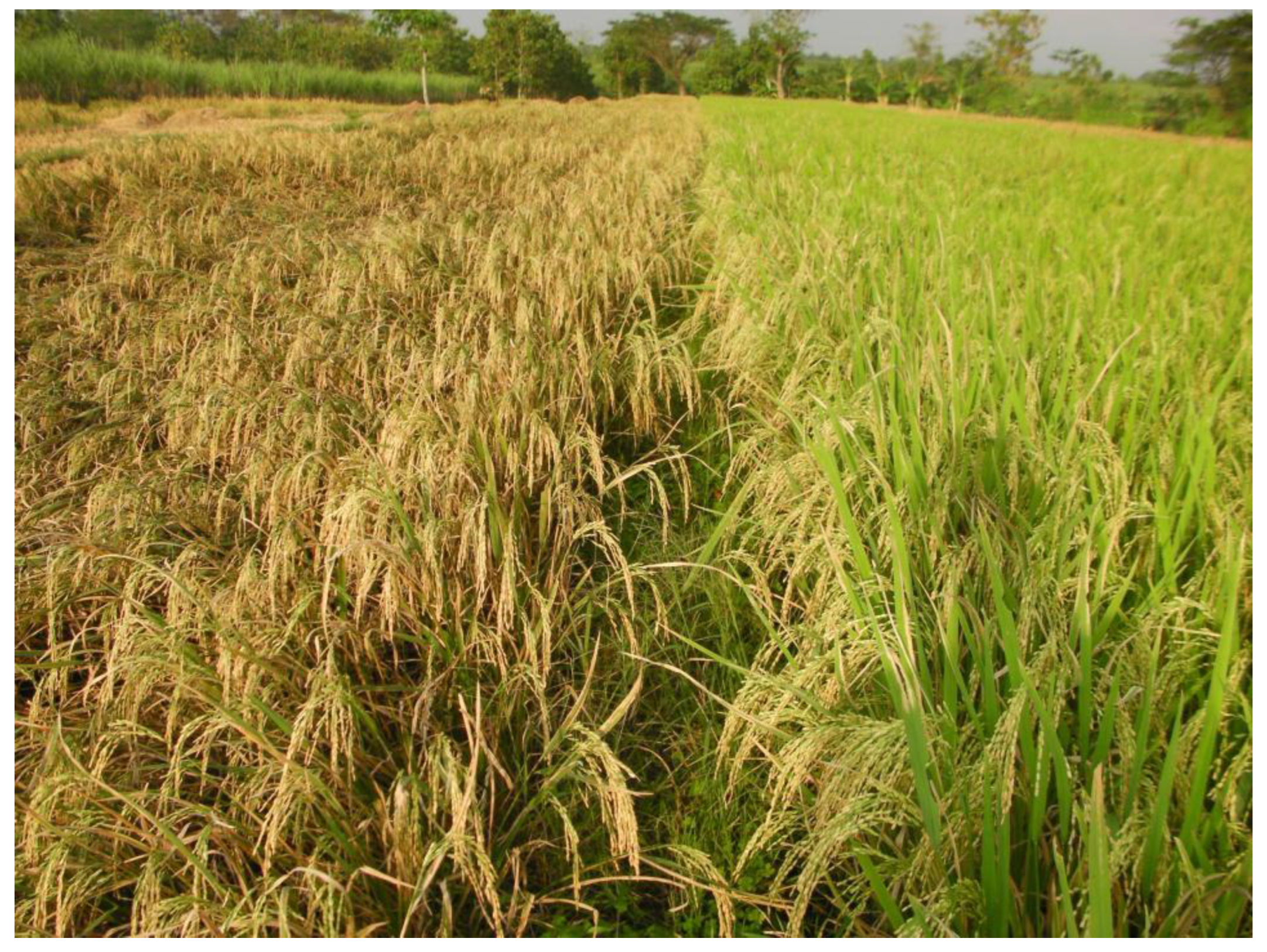
Figure 2.
Different hull colors of traditional rice varieties: A) Kalajeera, B) Gangabaru, C) Sadamota, D) Laldhan [22].
Figure 2.
Different hull colors of traditional rice varieties: A) Kalajeera, B) Gangabaru, C) Sadamota, D) Laldhan [22].
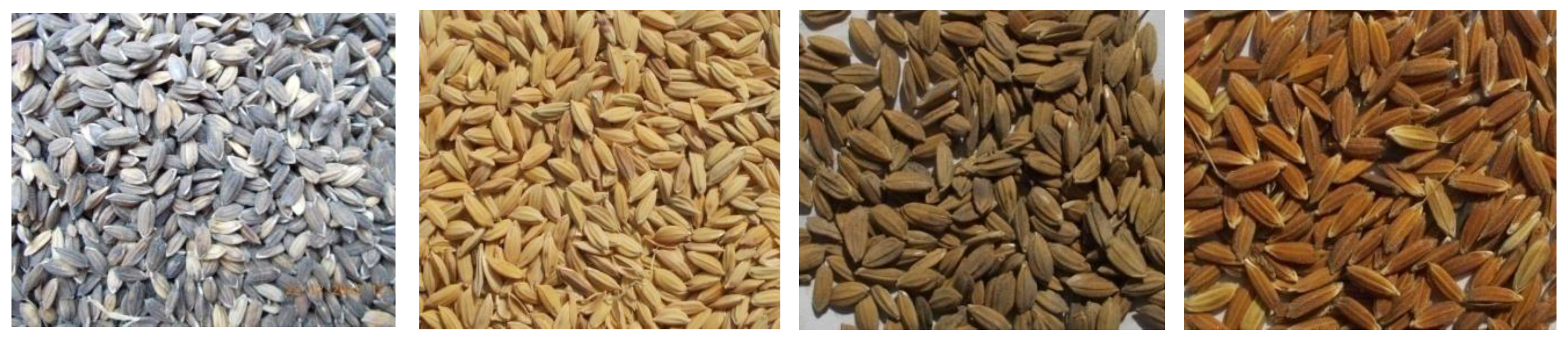
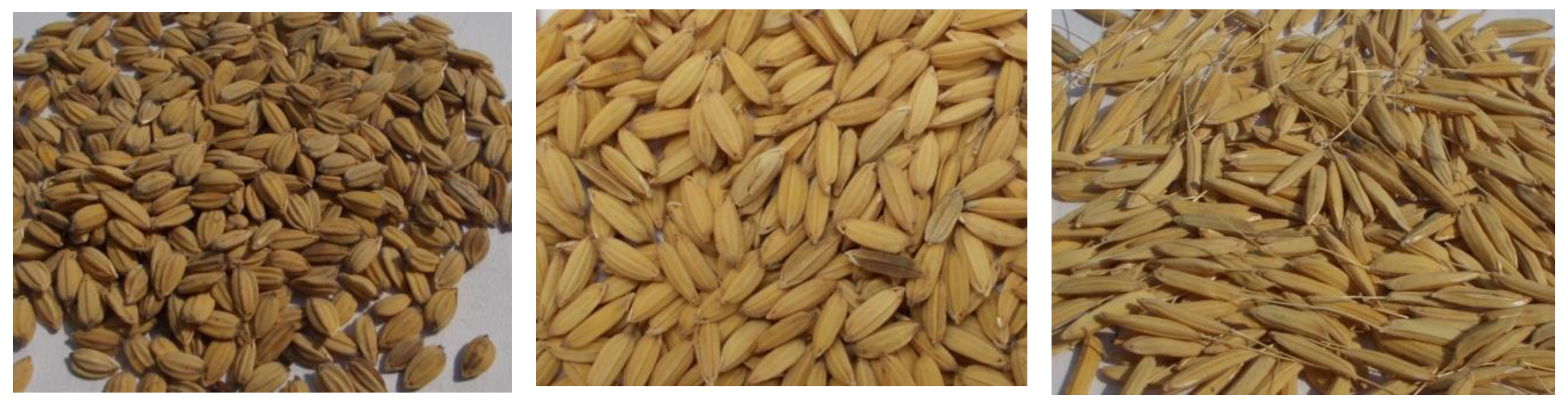
Table 1.
Life cycles of rice plants in Morang district, Nepal, 2007, comparing SRI with conventional farmer management.
Table 1.
Life cycles of rice plants in Morang district, Nepal, 2007, comparing SRI with conventional farmer management.
| Rice varieties | (N) | Life cycle with conventional methods (days) |
Life cycle under SRI management (days) |
Difference (in days) |
| Sughanda (basmati) | 12 | 120 | 106 | 14 |
| Hardinath 1 (improved) | 39 | 120 | 107 | 13 |
| Barse 2014/2017 | 14 | 135 | 126 | 9 |
| Bansdhar/Kanchhi | 248 | 145 | 127 | 18 |
| Radha 12 | 12 | 155 | 138 | 17 |
| Swarna | 40 | 155 | 139 | 16 |
| Mansuli | 48 | 155 | 136 | 19 |
| Total/average | 413 | 140 | 125 | 15 |
Source: Records of the Morang District Agricultural Development Office, Biratnagar (provided by Dr. Rajendra Uprety, DADO, who collected these data).
Disclaimer/Publisher’s Note: The statements, opinions and data contained in all publications are solely those of the individual author(s) and contributor(s) and not of MDPI and/or the editor(s). MDPI and/or the editor(s) disclaim responsibility for any injury to people or property resulting from any ideas, methods, instructions or products referred to in the content. |
© 2023 by the authors. Licensee MDPI, Basel, Switzerland. This article is an open access article distributed under the terms and conditions of the Creative Commons Attribution (CC BY) license (http://creativecommons.org/licenses/by/4.0/).
Copyright: This open access article is published under a Creative Commons CC BY 4.0 license, which permit the free download, distribution, and reuse, provided that the author and preprint are cited in any reuse.


