

Submitted:
19 November 2023
Posted:
21 November 2023
You are already at the latest version
Abstract
Background: Consciousness is usually interpreted as a state of being aware of one’s environment as well as self. According to the trilogy paradigm of consciousness (or simply “trilogy”), it is primarily guided by two new mental functions—awareness-based choice selection (ABCS) and discretionary selection of information for awareness (DSIA) or intentional attention—which may play a role in the choice selection during decision making. Method: To test whether ABCS and DSIA could improve the choice selection efficiency, 204 subjects were recruited using social media platforms to complete an anonymous online survey. The survey was designed to examine the role of subtle hints and cues in guiding participants’ attention toward a particular subject of awareness and this in return would increase the likelihood of selecting a correct choice among the proposed options, thereby enhancing the decision-making efficacy. Results: The participants’ attention could be successfully swayed to a particular subject matter (DSIA) in 59−73% of occasions. In addition, using ABCS increased the efficiency of selecting a correct choice among presented options. The analyses further revealed a gap between the selecting a choice during decision-making process and its execution, which is indicative of an appropriation process. Conclusion: The present study shows that sheer knowledge of facts may not be sufficient for selecting a correct choice among presented options effectively. However, as ABCS improves the choice selection efficiency, it plays an instrumental role in determining the subject of awareness, indirectly supporting the notion of DSIA.
Keywords:
Consciousness
; awareness
; decision making
; attention
Introduction
Despite the prevailing view that rational decisions are made upon an agent’s evaluation of choices guided by personal beliefs, values, and goals (Slovic et al., 1977), Simon (1956) challenged this perspective, arguing that, in order to preserve decision-making efficiency, our decisions may not undergo this elaborate process. Rather, we make decisions based on different degrees of rationality depending on the level of our understanding of the problem. Extant research guided by the expected utility theory also shows that the decision-making process is subject to bias arising from personal characteristics, such as preferences, as well as attitude toward risk (Briggs, 2019; Frisch & Baron, 1988; Steele & Stefansson, 2020). These findings have prompted the present study, the aim of which was to examine whether a new mental function within the trilogy paradigm of consciousness (or “trilogy”)—awareness-based choice selection (ABCS)—proposed by Farhadi (2021) can improve the efficiency and accuracy of the decision-making process by increasing the likelihood of making a correct selection among the proposed choices. Based on the trilogy postulates, ABCS is instrumental in the decision-making process. Defined by Farhadi (2021) as neither a deus ex machina owing to a metaphysical property of the mind nor a special property of an agent, ABCS is simply steering a decision by an agent due to the awareness afforded by a piece of information. Moreover, by applying the power of decision making, to the process of awareness another mental function called discretionary selection of information for awareness (DSIA) or intentional attention emerges. Accordingly, the ABCS stands in contrast to the selection of choice based on algorithm (SCBA), while DSIA is an alternative to the selection of information based on algorithm (SIBA). While mental function of a natural intelligence (NI) can use either ABCS or SCBA for making a decision, as well as DSIA or SIBA for selecting the subject of awareness, artificial intelligence (AI) can rely solely on SCBA and SIBA. In fact, a sequential utilization of ABCS and DSIA shown in Figure 1 comprises the main paradigm of decision making in trilogy and thus sets NI apart from AI (Farhadi, 2022).
Materials and Methods
Subjects and Recruitment
Prior to commencing the study, approval was obtained from the Memorial Care Foundation Institutional Review Board (MHS#393-23). Information required to achieve its aims was acquired by administering an online survey to 204 individuals, 67% of whom completed it. The questionnaire was designed to ensure participant anonymity and only adults (i.e., those aged 18 years and above) were eligible for participation.
Questionnaire
As shown in Table 1, the questionnaire consisted of 15 questions, eliciting demographic information (such as age, gender, and level of education), as well as probing into the respondents’ attention span and decision-making process. Prior to commencing the data collection, the face validity of all questions was established by performing several pilot tests with volunteers that did not take part in the main study. In addition, internal consistency was assessed by deliberately including questions with overlapping themes.
Special Consideration in the Questionnaire Design
The survey focused on five obscure islands in southeast Asia for which hypothetical information was provided to the respondents to reduce any possibility of prior knowledge about these places influencing their responses. The survey commenced with the questions pertaining to the participants’ demographic information followed by a unique control question (CQ) about the importance of building height of the islands’ structures without providing any cues to the relevance of this data for the subsequent questions. This question served as a control and the elicited responses were used to compensate for type 1 error during analysis. The CQ was followed by a page (Description 1) which provided a large amount of hypothetical information about each island, which was presented in a bullet format, with the same sequence of facts for each island. To reduce the likelihood of simple memorization influencing the survey responses, a large amount of information was presented on each page. The information presented in Description 1 was later repeated within Description 2 and Description 3. However, each subsequent description page contained one new line of information per each island. To see if newly added information would grab the participants’ attention, it was added at the end of the previously generated bullet list. The pages denoted as Description 1 and Description 3 were followed by an attention question, to which the participants responded by indicating which pieces of information presented in these pages grabbed their attention (AQ1 and AQ2). Several recall questions (RQ1, 2, 3 and 4) were also included to test the participants’ recollection of the information provided in each page. To ensure the validity of their responses, the participants did not have the option of revisiting the prior descriptions to read the relevant information again. In addition, to focus the participants’ attention to the selected topic, only facts in focus of RQs and numerical data were presented in bold font. Moreover, a verification question was placed in the middle of the questionnaire to ensure that participants did not respond to the questions without paying attention.
Statistical Methods and Missing Data Management
While every attempt was made to minimize instances of missing data by properly planning the study and limiting the length of the questionnaire (which took on average 5 minutes and 40 seconds to complete), 9% of the 204 individuals that started the survey chose to only answer the demographic questions and 33% did not complete the final question. After excluding these instances as well as those in which the verification question lacked a proper response, 136 (67% of the initial sample) subjects were used for analysis. All gathered data was analyzed using the SPSS V.23 commercial software (IBM New York, USA). To compare the proportion of individuals that answered a question correctly or those who selected the topic of their attention, we created a adopted a 2 × 2 table using the control (CQ) and analyzed the data using chi-squared test of independence, with p ≤ .05 indicating statistical significance.
Transparency and Openness
Materials for this study can be found at the Appendix, on trusted repository OSF and can be accessed at under the project name: The Power of Attention and Recall Survey 204 cases, at: https://osf.io/8txpj.
Results
Analyses of the demographic data revealed that 69% of the participants were female and 30% identified as male, while the remaining 1% did not respond to this question. In terms of the age distribution, those in the 55−64 group predominated (29%), followed by 45−54 (20%), while other age categories contributed by less than 17% (Figure 2). According to their educational attainment, the sample mostly comprised of college graduates (45%) and those with higher education (25%), as shown in Figure 3.
The demographic questions were followed by the CQ which probed into the importance of building height without providing any information indicating its relevance. While CQ was used as a control to correct for type I error during analysis, it also served as the first subtle cue about the types of information that were of interest in the survey. Thus, the goal was to see whether the participants would pay more attention to this subject when presented with a large amount of information in the following description page. Surprisingly, this question was answered correctly by 34% of participants, considerably exceeding the 20% that would be expected if a correct response to a multiple choice question (MCQ) with five choices was chosen at random. Since all information related to the five islands in focus of the survey was hypothetical such higher-than-expected type 1 error for CQ could not be attributed to the prior knowledge. We thus considered 34% (rather than 20%) as the type I error for selecting a correct answer among choices by pure chance throughout the study.
After responding to the CQ, participants were presented with the first description page (Description 1) followed by a question probing into the topic of awareness (AQ1). When responding to this question, participants were required to indicate the piece of information that attracted their attention among a large amount of facts provided in Description 1. Based on their answers, it was established that 62% of participants paid attention to building height, which was the topic of CQ. As the proportion of subjects who selected building height as their choice was significantly higher than the correct response rate for the control question (χ2 = 25.22, p < .00001), it was evident that providing information in the CQ successfully attracted the attention of participants toward an undisclosed target in majority of the cases.
The participants whose attention was drawn to “building height” were asked another follow-up question (RQ1) to test their ability to recall the information about building height. Those who selected other choices were each guided to a recall question about the specific topic they selected. Further analyses revealed that, even though each recall question focused on the topic that the participants declared as their primary focus of attention, only 15−26% of participants managed to select the corresponding correct answer, which was a much lower percentage than achieved when responding to the control question (χ2 = 0.62, p = 0.43).
After RQ1, the participants were presented with another description page (Description 2) which contained the same information as Description 1 in addition to a newly added statement for each island about the resilience of the structures in a storm.
Upon reviewing this information, the participants were asked another recall question (RQ2) which focused on the structure resilience in a storm. Interestingly, the proportion of participants who selected a correct answer improved to 43% but still did not reach the level of statistical significance when it was compared to the control question (χ2 = 1.96, p = 0.16).
Next, the subjects were asked the verification question (VQ), which elicited a correct response in 95% of the cases, confirming that the participants were paying attention and were following the instructions, rather than selecting choices at random.
After VQ, the participants were presented with another description page (Description 3) containing the same information as Description 2 in addition to the new statement about the distance of each island to a volcano.
The participants were then asked the second awareness question (AQ2) to discern which piece of information attracted their attention. As expected, 73% of participants focused their attention to the distance of the island from a volcano, which was significantly higher than the percentage of correct responses to the control question (χ2 = 43.31, p < .00001). These findings offered further evidence showing that attention can be successfully swayed toward a particular subject matter without providing a direct instruction.
When the participants were asked what was the reason for paying attention to the particular subject, 56% selected “bold text”, while 36% selected “new information”, 28% selected “numerical format”, and 5% “primary risk”, while the remaining 11% could not identify the reason for paying attention to a specific topic.
The third recall question (RQ3) that focused on the risk of volcano eruption for the island was presented next. The proportion of subjects who selected the correct answer (49%) was higher than for RQ2 (43%) and RQ1 (15−26%) and was significantly higher than that related to the control question (χ2 = 6.42, p = 0.01).
Finally, the participants were presented with the last recall question (RQ4) that focused on the country with which each island was associated. While we did not provide any hint of this association throughout the survey, the participants had six opportunities to read this particular piece of information across the three description pages and within the recall questions. This question thus served as a second control, allowing the effect of repeating information on the efficacy of selecting a correct answer to be assessed. Only 44% of subjects selected the correct answer which was not statistically significant improvement relative to the control (χ2 = 2.65, p = 0.10).
Discussion
Mind could be considered a machine for processing information, given that decisions are nothing more than choice evaluations followed by the selection of one option based on its evaluation score. Therefore, the role of information in the decision making is incontrovertible. However, the utilization of information may differ across the various stages of this process. For example, in the preselection stage, available information is used for forming the choices followed by their rationalization (Slovic et al., 1977). On the other hand, the information that is received from the environment (in the form of awareness) or the information already stored in the mind (in the form of algorithm) could influence the selection of the proper choice in the selection stage. Given these theoretical postulates, before discussing the results obtained in the present study, a general overview of the decision-making and awareness processes—with an emphasis on the trilogy theory of mind—is presented to situate these findings in the right context. However, as the physiological, neurological, or philosophical underpinnings of these phenomena are beyond the scope of this investigation, these aspects are not discussed in detail.
Decision-making Process
Based on trilogy, the decision-making process can be subdivided into three stages in NI, denoted as preselection, selection, and post-selection stage, respectively and 2 stages of preselection and selection in AI (Figure 4).
Preselection Stage
As shown in Figure 4, the decision-making process starts with the preselection stage, during which the available information is segregated into informational and emotional components. The informational intelligence subset comprises information acquired through senses and motor functions, as well as individual’s memories, knowledge, beliefs, morals, values, expectations, and the thought processes. On the other hand, the emotional intelligence subset includes cues derived from one’s physiological status (pain, tiredness, hunger, physiological urges), emotions, moods, and self-esteem. Still, it is worth noting that the decision-making process is also governed by other factors such as structural or biochemical peculiarities of the brain, as well as genetics, upbringing, and prior life experiences, all of which can influence or modify the types of information an individual relies upon when making a decision.
In the preselection stage, these sources of intelligence are processed by the unconscious mind, and are synthesized and analyzed, giving rise to the concept of “reasoning.” As the reasoning process unfolds, counter-reasoning arguments also emerge, priming the mind for the selection stage. After the detail of the matrix of information used for the reasoning and counter-reasoning is finalized into the choices, the decision-making enters the selection stage. Not all selected choices have gone through the rationalization process of reasoning and counter-reasoning as it will be elaborated in the case of SCBA. As shown in Figure 5, many SCBA decisions (such as reflexes) could be made without any prior reasoning process if urgent action is needed.
As evident from these descriptions, the preselection stage of the decision-making process in trilogy is akin to the steps comprising the naturalistic decision models proposed by Drummond (1991). According to this perspective, once the problem has been identified, the goals are specified and given an order of precedence, allowing options to be identified and rated based on their alignment with these goals. However, trilogy extends upon Drummond’s model by positing that counter-reasoning is a necessary aspect of the preselection stage.
Dijksterhuis (2004), on the other hand, proposes another view that, owing to its vast capacity, an unconscious mind is instrumental in the processing of decisions as it offers the best rational option. Although this argument counters the claims made by Simon (1956) regarding bounded rationality, Dijksterhuis (2004) attributed these problems to the limitations in the conscious mind that do not apply to the unconscious mind.
Selection Stage
After completion of the reasoning and counter-reasoning and when the choices are finalized, the next stage of decision making is ensued. As mentioned above, not all selected choices have gone through the rationalization process of reasoning and counter-reasoning but nonetheless enter the selection stage. In this stage of the decision making, how a choice is selected in one’s mind has long been the point of physiological, neurological, and philosophical contention. According to the naturalistic decision models, all options are assessed based on the expected outcome. However, this model fails to account for situations where one lacks the knowledge required to make the most rational choice, as well as cases in which a suboptimal choice is made that is not the most rational one nor aligns the best with one’s knowledge. This shortcoming was recognized by Klein (2008) and Fox et al. (2013), who equated option selection to commitment in the canonical theory of dynamic decision making, which occurs when an agent selects the most preferred option.
Based on trilogy, the selection stage of the decision-making process is governed by two mental functions—ABCS and SCBA. An explanation of a decision based on SCBA could be traced back to stoics who believed that a selection among predetermined choices is derived by a random process steered by a swirl of atoms. In the 17th century, the same notion was presented in the form of “choice and chance” by William James (Doyle, 2010). This method of selection is the simplest form of SCBA where the algorithm dictates a random selection among current choices.
However, many SCBA—which could also be called autopilot responses—do not feature such simple random selection scehema and are rather based on sophisticated algorithms. Indeed, some AI called BDI agents were capable of replicating basic mental states such as beliefs, desires, and intention more than 30 years ago to closely mimic human behavior (Bratman, 1987; Rao & Georgeff, 1995). Specifically, algorithms based on machine learning (ML) are capable of improving their performance based on the knowledge gained through exposure to specific problems, which is akin to the decision-making steps undertaken by a NI. In fact, with recent advances in this domain, many argue that we should be ready to throw in the towel in many fields to AI for their superiority in decision making (Doreswamy et al. 2022, Shin et al., 2023) Nonetheless, all artificial agents follow an algorithm, equating this process to SCBA which based on trilogy is performed in the unconscious mind (Figure 6).
ABCS is the other method of arriving at a choice in the selection stage. In this context, awareness is depicted as a momentary process that serves as a “cause” for the selection. Accordingly, it could influence the selection by tipping the balance toward a particular option over others. ABCS improves the decision-making efficacy by presenting all available information in a matrix used for reasoning and counter-reasoning. However, since not all matrix elements reach our awareness at the same time due to the limiting factor of attention, ABCS does not guarantee the most rational choice, as outlined by Simon (1956) who first introduced the bounded rationality problem.
Consensus is also lacking on the issue of intention, as some believe that it is only an illusion, since all our decisions are made by the unconscious mind. This notion was first introduced by Libet et al. (1983) following an experiment which revealed that the intention to move a limb lagged behind the brain’s electrical activity, suggesting that an unconscious process governed this chain of events. In addition, Budson et al. (2022), argue that there are no issues with slowness of consciousness since it always plays a memory backward in time, due to which any conscious decision is in fact a memory of an unconscious decision. This stance is challenged by many scientists, including Shariff et al. (2008) who in close enough purports that the mind is usually not consciously focused on the present, but on the future, to maintain its effectiveness in causality within the confines of real time.
ABCS is noteworthy in this context, as it signifies the intention to decide, and thus offers a new interpretation of the sequence of events in Libet’s experiment (Figure 8). In fact, the intention to decide simply corresponds to ABCS. However, as awareness of intention is different from the intention itself, the process of becoming aware of the ABCS could lag behind the actual ABCS.
Figure 7.
The efferent and afferent pathways of the decision-making process and our awareness of the various steps of the decision-making process provides us with awareness of various stages of a decision-making process.
Figure 7.
The efferent and afferent pathways of the decision-making process and our awareness of the various steps of the decision-making process provides us with awareness of various stages of a decision-making process.
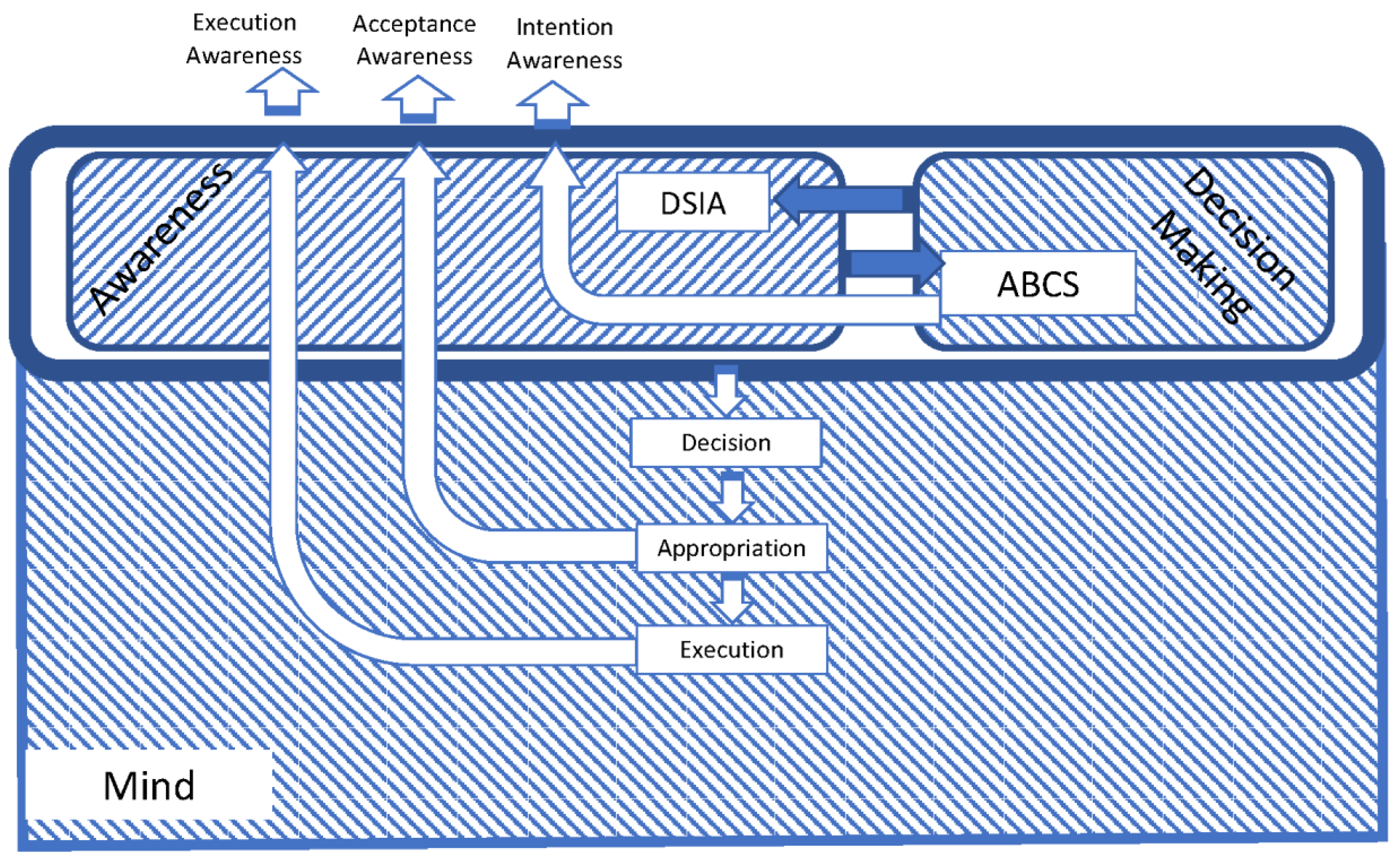
From the philosophical point of view, ABCS does not align with either determinism or compatibilism, since momentary awareness of a particular information can sway the selection of choice in an indetermined manner. Therefore, ABCS purports existence of free will through a new class of libertarianism—physical libertarianism—where the willpower does not arise from either metaphysical properties of the mind (non-causal), or as a result of an event (event-causal) or a special property of an agent (agent-causal). In fact, in physical libertarianism, the willpower is bestowed to the mind because of being aware of select information [Farhadi, 2022].
At this juncture, it needs to be emphasized that, since only NI exhibits awareness, ABCS is also its exclusive property. On the other hand, even though NI can benefit from SCBA in an autopilot fashion, through its hierarchical order, autopilot decision can be overridden by ABCS at any time.
Postselection Stage
The postselection stage is where the selected decision is implemented. Some earlier studies proposed that there should a synchrony between the decision making and its execution with the aim of maximizing the reward, giving rise to the shared optimization hypothesis (Ditterich, 2006; Thura et al., 2014). This sequence is expected at least in AI (Figure 5).
However, the implementation process in NI is typically more complicated, as the choice execution may require an additional step prior to execution termed the appropriation process (Figure 4 and 8) (Farhadi, 2022). The appropriation process is fairly similar to the rationalization process in the preselection stage, in that it involves assessment of the feasibility and practicality of the choice implementation. If during the appropriation process, which is exclusive to NI, paradoxical or practical impediments to the execution of the selected choice emerge, this prompts the agent to reconsider the previously made decision. Even though the appropriation process was first introduced in the trilogy theory of mind, authors of several prior studies have pointed toward the existence of this process without labeling it as such. For example, according to Marti-Marca et al. (2020) and Reynaud et al. (2020), there is a gap separating choice selection and execution, suggesting that the principles governing these processes are distinct and independent of one another. Similar arguments were made by Cos et al. (2011) and Morel et al. (2017), who purported that not all decisions result in action. Subsequent human studies that delved deeper into the cause of this gap attributed it to the constant evaluation of costs and benefits of an action, before executing a decision which may result in inaction (Hagura et al., 2017) or post-initiation deliberation (Burk et al., 2014) which literally translates into “changing one’s mind.”
The appropriation process posited by trilogy may also be likened to the elements underpinning the dynamic decision theory initially presented by Edwards (1962) and later advanced by Fox et al. (2013), as well as the rule-based models developed by Newell and Simon (1956) and subsequently incorporated into the Soar project (Laird et al., 1987). The similarity arises due to the recognition that decisions could be influenced by other decisions and their outcomes, given that execution of a decision may alter the state of the problem that would prompt the need for a new decision. On the other hand, the appropriation is unique in this context, as it precedes the actual choice execution and is not a feedback of the other actions or decisions proposed in dynamic decision theory.
The Process of Awareness
Awareness is deemed to be a distinctly human attribute, allowing objective information to be experienced subjectively. As this process unfolds, sensation transforms into perception (qualia), knowledge becomes knowing, memory turns into remembering, and emotion manifests as feeling. The influx of select information in AI could result in alertness. Alertness in AI shares some stages of awareness in NI. However, the main focus of trilogy is limited to the process of awareness in NI and only a reference is made to alertness process in AI for comparison. According to trilogy, awareness in NI occur through four consecutive stages (Figure 9).
Preselection Stage
As shown in Figure 9, in this initial stage, mind organizes informational and emotional intelligence, facilitating awareness, which closely aligns with the processes described by the late selection theory of attention (Deutsch & Deutsch, 1963; Norman, 1968), spotlight theory of attention (Fernandez-Duque & Johnson, 2002), and unison theory of attention (Desimone & Duncan, 1995; Reynolds & Desimone, 2000).
Selection Stage
During the selection stage, attention needs to be applied to a particular piece of information in order for it to reach awareness. If it is not for the selection stage, awareness would otherwise be overwhelmed by the constant stream of information. In NI, this process is performed by two main mental function of DSIA or intentional attention which stands in sharp contrast to prearranged attention featuring in SIBA, which is the mainstay of most theories of attention that are elaborated below. An example of SIBA is a startling reaction, when one becomes aware of a loud sound, a bright flash of light, or a sudden change in any sensory or motor input based on preset algorithms in the mind. SIBA remains as the sole mechanism for attending to a subject and its end result of alertness in AI while NI is privileged to utilize both DSIA and SIBA.
The Process of Attention
Given the importance of attention for awareness, the main theories of attention are briefly outlined below in order to draw parallels between DSIA and SIBA. Before delving deeper into this topic, it is worth noting that John Locke described attention as “mode of thought” (Mole, 2009), while other definitions equate it to the state of mind that is primed for sensory reception (Mole, 2021).
In contrast, in the early selection theory of attention put forward by Broadbent (1971), attention is conceived as a bottleneck for information processing. Therefore, owing to the limited processing capacity, some information may never be considered or may be discarded without due evaluation (Deutsch & Deutsch, 1963; Norman, 1968; Prinz, 2012). While most authors recognize that information processing undergoes some form of filtering, but they posit the location of this limitation after receiving of the information and early processing and thus, argue that the theory should be properly renamed into “late selection theory of attention” (Allport, 1993; Johnston & McCann, 2006; O’Connor et al., 2002). Irrespective of the label, DSIA may seem congruent with these selection theories of attention. However, none of these theories explains how and why a filter is applied to a particular set of information and how a selection occurs. Consequently, by purporting the presence of a discretionary step in this process of information selection, DSIA could be considered completely distinct from both early and late selection theories of attention.
Feature integration theory also describes attention as a mental mechanism for grouping information to facilitate processing (Treisman, 1999). While this theory has found some support in the research community, its critics argue that such mechanism is counterproductive, as it may give rise to a pseudo-problem (Bennett & Hacker, 2003; O’Regan & Noe, 2001). On the other hand, in the coherence theory of attention, attention is viewed as an obstacle in the interaction between body and mind (Hirst et al., 1980) imposed by the limited capabilities of the body. Attention compensates for this disparity, rendering it a simple selection process (Neumann, 1987) aimed at maintaining the sense of agency in our actions (Watzl, 2017; Wu, 2011). Likewise, attention is conceived as a cognition and prediction optimization factor in the precision optimization theories, (Clark, 2013; Hohwy, 2013). As the primary aim of this process is improved efficiency, it underpins most AI models. All the aforementioned theories purport SIBA as the mainstay of the attention process but fail to refer to any control of agent on the subject matter selection during attention process—DSIA.
The first theory of attention that address this shortcoming and consider the role of agent in the selection of the information is the competition and unison theories of attention. According to these theories, attention is governed by a top-down biased selection that requires agency (Desimone & Duncan, 1995; Reynolds & Desimone, 2000). Mole (2011) also questioned the conceptualization of attention as a distinct cognitive function and proposed cognitive unison theory in which attention is conceived as a harmonious unison of multiple cognitive functions. As this theory defines attention as a metaphysical property, it does not explain why attention turns into unison in relation to one subject but not the others.
Due to its simple common-sense view of attention, spotlight theory of attention which is more of a metaphor rather than a true theory, has gained popularity and at the same time garnered considerable criticism due to its excessive reliance on agency while overlooking some other important aspects of attention (Fernandez-Duque & Johnson, 2002; Henry, 2017). Spotlight theory of attention resonates well with the DSIA described in the trilogy, where a discretion is applied to the selection process. Moreover, rather than taking a top-down view whereby an agency is responsible for selecting the topic of awareness, a down-up perspective is adopted, indicating that the process of selection of a topic of awareness provides a sense of agency or self.
Transformation Stage
Regardless of the method by which information is selected in NI, i.e., irrespective of whether DSIA or SIBA is activated, the resulting intelligence (objective information) is subjected to the transformation leading to subjective experience in NI. Chalmers (2010) referred to this process as “hard problem of consciousness” to highlight the absence of scientific explanation for this posited chain of events.
Postselection Stage
Following the transformation stage, further mental processing may ensue, whereby information is bundled into associative categories (Treisman, 1999) or decoupled further to reveal specific aspects or finer details. Which of these processes will be activated depends on the given context as well as the prior knowledge and experience of an individual, as the aim is to compare any patterns or features with those stored in one’s short- or long-term memory to aid reasoning. According to Dehaene et al. (1998), during these processes, a neuronal version of global workspace is activated.
Interpretation of Data
The findings yielded by the analysis of the survey data gathered as a part of this study indicate that our mind is not able to use all the presented information for processing. Accordingly, to facilitate a decision when faced with a choice, only a select subset of that information reaches the awareness and is used in the decision-making process. This observation aligns with the theory proposed by Simon (1956) purporting that human mind suffers from inherent limitations which restrict the amount of information involved in decision making to render the process more efficient. Thus, the question that needs to be addressed is in which form information should be presented to enhance the correct choice selection efficiency.
This question was the primary consideration when designing this study, due to which the survey was structured to allow the participants to use both ABCS and SCBA in their decision making. They were also deliberately guided in their selection of the subject matter for awareness or intentional attention (DSIA). Accordingly, the analyses allowed a series of decisions to be uncovered, whereby decisions that were made to select a choice among questions were labeled D1-n and those that resulted in a particular subject of awareness were denoted as A1-n. As expected, not every decision was the result of ABCS and not every awareness subject emerged from DSIA. Similarly, not every piece of information that reached to awareness necessarily resulted in a new decision, and neither did each decision lead to selecting the subject of awareness. Still, as can be seen in Figure 10, each series of decision−awareness connections formed a spiral.
The first decision (D1) was prompted by the CQ, which was designed to entice the participants to use the SCBA method in order to make a random selection among the offered choices. As there were five options, the chance of selecting a correct answer would mathematically be equal to 20%. Yet, in practice, this prediction did not materialize, as 34% of the participants selected the correct answer simply due to sheer luck. Consequently, to offset the high type I error, we used the responses to CQ as a control when conducting subsequent analyses.
As noted previously, CQ also served as the first cue for guiding the participants’ awareness to a specific subject (building height) which would be relevant when responding to subsequent questions. Their awareness of the importance of building height as a subject of awareness (A1) improved the efficiency of their second decision (D2) through the ABCS function. Here, D2 denotes the decision to select the topic of attention through DSIA, and indeed 62% of the participants (p < .00001) had selectively paid attention to the building height when reading through vast amounts of information provided on the first description page (Description 1). This result clearly showed that, when participants’ attention is attracted to a particular piece of information, even when this is done indirectly, it can significantly affect their decision (ABCS) and that in turn affects the subject matter of awareness (DSIA).
Although some participants directed their attention to other facts featured in Description 1 (as determined by their responses to AQ1), when asked a follow-up recall question RQ1 about their topic of interest, their correct response rate exceeded the 20% that would be expected if the choice was made at random. Still, the performance on those questions was lower than the correct response rate for the CQ (p > .05). Therefore, despite having a clearly defined topic of attention, the efficiency in the selection of correct answer to RQ1 did not improve. These findings point to a discrepancy between the declared and actual topic of attention due to the appropriation process recognized in trilogy. As this theory postulates, appropriation of a decision may influence the execution of this decision, leading to a different outcome, as shown in Figure 8.
The subtle cues given to the participants to guide their attention to a particular subject matter continued in the second description page (Description 2) where certain text segments were highlighted in bold, data was presented in numerical form, newly added information was placed at the bottom of each bullet list, and information about catastrophic events was introduced.
When participants were asked the next recall question (RQ2) about wind resilience of the buildings on each of the five islands featuring in the survey, the correct answer was chosen in 43% of the cases, which still failed to show statistical significance compared with CQ (p = 0.16). This example demonstrated that, even though the chosen indirect hints swayed the participants when choosing their topic of attention and improved the accuracy of their responses, this effect still failed to reach statistical significance.
The participants were then presented with a new set of indirect hints and cues in the next description page (Description 3) which followed the same pattern as used in the prior description page. In this instance, 73% of participants were successfully directed to a particular subject matter (p < .00001). When asked what guided their decision to focus their attention to a particular subject, participants primarily selected the use of bold font (56%), followed by new information (36%) and numerical cues (28%), and referencing catastrophic outcomes (10%).
Attending to this subject also increased the percentage of correct answers (49%) to the third recall question (RQ3) (p = 0.01) giving credence to ABCS.
To alleviate the risk that efficiency improvements were merely due to learning as a result of repetition, we posed a further recall question (RQ4) pertaining to the association between each of the five islands with a specific country. A further purpose of RQ4 was to assess the importance of repeating certain information as a strategy for attracting attention and thus improving the subsequent decision-making accuracy. However, despite repeatedly exposing participants to the information (6 times) linking each island to a country, those indirect hints failed to improve their correct response rate to RQ4 which remained below the control (p > .05). This result challenges the notions put forward by the naturalistic decision models suggesting that one’s knowledge plays a key role in the choice selection. On the other hand, it is explained by trilogy, which posits that awareness of the knowledge on a particular subject matter, rather than knowledge itself, can improve the efficiency of the following decision.
What the work presented here aimed to show is that how SCBA and ABCS underpins the decision-making process and is influenced by awareness, which in turn depends on DSIA and SIBA. As shown in Figure 10, this study shows a unique sequence of interactions that form a spiral structure that underpins awareness and decision making process in NI that serves as a cause-and-effect cycle which is neither reflexive nor symmetric and does not form an infinite regress.
Limitations of the Study
The main limitation of the present study stems from its focus on the specific aspects of the trilogy theory only. Accordingly, the obtained findings support the notion of the importance of ABCS and DSIA in the process of decision-making ad awareness, other aspects of trilogy (including the importance of SCBA and SIBA, the association of ABCS and free will, the appropriation process, the separation of I and mind, and the role of ABCS and DSIA in generation of sense of self and self-awareness) require further exploration, providing fruitful avenues for future research in this domain. This may imply that trilogy, rather than being a Popperian or Falsifiable Theory, is a comprehensive framework and a large model covering various aspects of mental function. In fact, trilogy should be used as a framework for generating hypotheses or theories which could be tested through various means, including surveys (as was done in the present study).
The aim of this study was not to elucidate the neural mechanisms of proposed mental functions of ABCS, SCBA, SIBA or DSIA. Neither the subject of this study, nor trilogy theory address the processes involved in the transformation stage of awareness and did not provide any insight into how and where our objective information turns into subjective experience (i.e., the hard problem of consciousness), these questions will also require further research.
Conclusion
The present study demonstrated that using awareness-based choice selection increases the efficacy of a decision compared to selecting a choice based on an algorithm. The decision to select a topic of attention and thus sway the awareness to a particular subject matter is particularly important in making the decisions that follow the initial one, forming a spiral. In addition, awareness of the selected piece of information, rather than the actual knowledge of the contents of that information, is the key to selecting an accurate choice among the available options. The importance of awareness in decision making (ABCS) and decision making in selecting the information for awareness (DSIA) can be depicted as a two-way relationship, as proposed in the trilogy theory of mind. The existence of the post-selection appropriation process posited by this theory is also supported by the finding that selection of a choice does not necessarily translate into execution of that decision. Still, further studies are needed to better understand the intricacies of the decision-making and awareness processes.
References
- Allport, A. (1993). Attention and control: Have we been asking the wrong questions? A critical review of twenty five years. In D. E. Meyer & S. Kornblum (Eds.), Attention and Performance XIV: Synergies in experimental psychology, artificial intelligence, and cognitive neuroscience (pp. 183–218). MIT Press.
- Bennett, M. R., & Hacker, P. M. S. (2003). Philosophical Foundations of Neuroscience. Blackwell.
- Bratman, M. E. (1987). Intentions, Plans and Practical Reason. Harvard University Press.
- Briggs, R. A. (2019). Normative Theories of Rational Choice: Expected Utility. The Stanford Encyclopedia of Philosophy Fall 2019 Edition. https://plato.stanford.edu/archives/fall2019/entries/rationality-normative-utility/.
- Broadbent, D. E. (1971). Decision and Stress. Academic Press.
- Budson A. E., Richman K. A., & Kensinger, E. A. (2022). Consciousness as a memory system. Cognitive and Behavioral Neurology, VOL(ISSUE), PAGES. [CrossRef]
- Burk, D., Ingram, J. N., Franklin, D. W., Shadlen, M. N., & Wolpert, D. M. (2014). Motor effort alters changes of mind in sensorimotor decision making. PloS one, 9(3), e92681. [CrossRef]
- Chalmers, D. (2010). Facing up to the problem of consciousness. In EDITORS (Eds.), The character of consciousness (pp. XX−YY). Oxford University Press. https://oxford.universitypressscholarship.com/view/10.1093/acprof:oso/9780195311105.001.0001/acprof-9780195311105-chapter-1.
- Clark, A. (2013). Whatever next? Predictive brains, situated agents, and the future of cognitive science. Behavioral and Brain Sciences, 36(3), 181–204. [CrossRef]
- Cos, I., Bélanger, N., & Cisek, P. (2011). The influence of predicted arm biomechanics on decision making. Journal of Neurophysiology, 105(6), 3022–3033. [CrossRef]
- Dehaene, S., Kerszberg, M., & Changeux, J.-P. (1998). A neuronal model of a global workspace in effortful cognitive tasks. Proceedings of the National Academy of Sciences of the United States of America, 95(24), 14529–14534. [CrossRef]
- Desimone, R., & Duncan, J. (1995). Neural mechanisms of selective visual attention. Annual Review of Neuroscience, 18, 193–222. [CrossRef]
- Deutsch, J. A., & Deutsch, D. (1963) Attention: Some theoretical considerations. Psychological Review, 70, 80–90. [CrossRef]
- Dijksterhuis, A. (2004). Think different: The merits of unconscious thought in preference development and decision making. Journal of Personality and Social Psychology, 87, 586–598. [CrossRef]
- Ditterich, J. (2006). Evidence for time-variant decision making. The European Journal of Neuroscience, 24(12), 3628–3641. [CrossRef]
- Doreswamy, N., & Horstmanshof, L. (2022). Human Decision-making in an Artificial Intelligence-Driven Future in Health: Protocol for Comparative Analysis and Simulation. JMIR research protocols, 11(12), e42353. [CrossRef]
- Doyle, B. (2010). Janesian free will, the two-stage model of William James. William James Studies, 5, 1−28. https://www.jstor.org/stable/26203733.
- Drummond, H. (1991). Effective Decision Making: A Practical Guide for Management. Kogan Page.
- Edwards, W. (1962). Dynamic decision theory and probabilistic information processing. Human Factor Ergonomic Society, 4, 59–73. [CrossRef]
- Farhadi, A. (2021). There is no “I” in “AI”. AI & Society, 36, 1035–1046. [CrossRef]
- Farhadi, A. (2022). Trilogy: A new paradigm of consciousness. Preprints 2022, 2022060073. [CrossRef]
- Farhadi, A. (2022). Physical libertarianism: Redeeming the illusion of free will back into reality. Preprints , 2022060136. [CrossRef]
- Fernandez-Duque, D., & Johnson, M. L. (2002). Cause and effect theories of attention: The role of conceptual metaphors. Review of General Psychology, 6(2), 153–165. [CrossRef]
- Frisch, D., & Baron, J. (1988). Ambiguity and rationality. Journal of Behavioral Decision Making, 1(3), 149–157. [CrossRef]
- Fox, J., Cooper, R. P., & Glasspool, D. W. (2013). A canonical theory of dynamic decision-making. Frontiers in Psychology, 4, 150−END PAGE. [CrossRef]
- Hagura, N., Haggard, P., & Diedrichsen, J. (2017). Perceptual decisions are biased by the cost to act. eLife, 6, e18422. [CrossRef]
- Henry, A. (2017). Agentialism and the Objection from Attention Capture. Paper presented to Canadian Philosophical Association, Ryerson University, Toronto, 29 May 2017.
- Hirst, W., Spelke, E. S., Reaves, C. C., Caharack, G., & Neisser, U. (1980). Dividing attention without alternation or automaticity. Journal of Experimental Psychology: General, 109, 98–117. [CrossRef]
- Hohwy, J. (2013). The Predictive Mind. Oxford University Press.
- Johnston, J. C., & McCann, R. S. (2006). On the locus of dual-task interference: Is there a bottleneck at the stimulus classification stage? The Quarterly Journal of Experimental Psychology, 59, 694–719. [CrossRef]
- Klein, G. (2008). Naturalistic decision making. Journal of the Human Factors in Ergonomics Society, 50, 456–460.
- Laird, J. E., Newell, A., & Rosenbloom, P. S. (1987). SOAR: An architecture for general intelligence. Artificial Intelligence, 33(1), 1−64. [CrossRef]
- Libet, B., Gleason, C. A., Wright, E. W., & Pearl, D. K. (1983). Time of conscious intention to act in relation to onset of cerebral activity (readiness-potential): The unconscious initiation of a freely voluntary act. Brain: A Journal of Neurology, 106(3), 623–642. [CrossRef]
- Marti-Marca, A., Deco, G., & Cos, I. (2020). Visual-reward driven changes of movement during action execution. Scientific Reports, 10(1), 15527–END PAGE. [CrossRef]
- Mole, C. (2009). Attention in later modern thought. The Routledge Encyclopedia of Philosophy. Taylor and Francis. https://www.rep.routledge.com/articles/thematic/attention/v-1/sections/attention-in-later-modern-thought.
- Mole, C. (2011). Attention is Cognitive Unison: An Essay in Philosophical Psychology. Oxford University Press.
- Mole, C. (2021). Attention. The Stanford Encyclopedia of Philosophy Winter 2021 Edition. https://plato.stanford.edu/archives/win2021/entries/attention/.
- Morel, P., Ulbrich, P., & Gail, A. (2017). What makes a reach movement effortful? Physical effort discounting supports common minimization principles in decision making and motor control. PLoS biology, 15(6), e2001323. [CrossRef]
- Neisser, U. (1976). Cognition and Reality. Freeman.
- Neumann, O. (1987). Beyond capacity: A functional view of attention. In A. Sanders & H. Heuer (Eds.), Perspectives on perception and action (pp. 361–394). Lawrence Erlbaum Associates.
- Newell, A., Simon, H. (1956). The logic theory machine--A complex information processing system. in IRE Transactions on Information Theory, vol. 2, no. 3, pp. 61-79, September 1956. [CrossRef]
- Norman, D. A. (1968). Toward a theory of memory and attention. Psychological Review, 75(6), 522–536. [CrossRef]
- O’Connor, D. H., Fukui, M. M., Pinsk, M. A., & Kastner, S. (2002). Attention modulates responses in the human lateral geniculate nucleus. Nature Neuroscience, 5, 1203–1209. [CrossRef]
- O’Regan, K., & Noe, A. (2001). A sensorimotor account of vision and visual consciousness. Behavioral and Brain Sciences, 24, 939–1031.
- Prinz, J. (2012). The Conscious Brain: How Attention Engenders Experience. Oxford University Press.
- Rao, S., & Georgeff, M. P. (1995). BDI-agents: From theory to practice. In V. Lesser (Ed.), Proceedings of the First International Conference on Multiagent Systems (ICMAS’95) (pp. 312–319). The MIT Press.
- Reynaud, A. J., Saleri Lunazzi, C., & Thura, D. (2020). Humans sacrifice decision-making for action execution when a demanding control of movement is required. Journal of Neurophysiology, 124(2), 497–509. [CrossRef]
- Reynolds, J., & Desimone, R. (2000). Competitive mechanisms subserve selective visual attention. In A. Marantz, Y. Miyashita, & W. O’Neil (Eds.), Image, Language, Brain: Papers from the First Mind Articulation Project Symposium (pp. 233–247). The MIT Press.
- Shariff, A. F., Schooler J., & Vohs, K. D. (2008). The hazards of claiming to have solved the hard problem of free will. In J. Baer, J. C. Kaufman, & R. F. Baumeister (Eds.), Are we free? Psychology and free will (pp. 183, 190–193). Oxford University Press.
- Shin, M., Kim, J., van Opheusden, B., & Griffiths, T. L. (2023). Superhuman artificial intelligence can improve human decision-making by increasing novelty. Proceedings of the National Academy of Sciences of the United States of America, 120(12), e2214840120. [CrossRef]
- Simon, H. A. (1956). Rational choice and the structure of the environment. Psychological Review, 63, 129–138. [CrossRef]
- Slovic, P., Fischhoff, B., & Lichtenstein, S. (1977). Behavioral decision theory. Annual Review of Psychology, 28(1), 1–39. [CrossRef]
- Steele, K., & Stefansson, H. O. (2020). Decision Theory. The Stanford Encyclopedia of Philosophy Winter 2020 Edition. https://plato.stanford.edu/archives/win2020/entries/decision-theory/.
- Thura, D., Cos, I., Trung, J., & Cisek, P. (2014). Context-dependent urgency influences speed-accuracy trade-offs in decision-making and movement execution. The Journal of neuroscience : the official journal of the Society for Neuroscience, 34(49), 16442–16454. [CrossRef]
- Treisman, A. (1999). Feature binding, attention and object perception. In G. W. Humphries, J. Duncan, & A. Treisman (Eds.), Attention, Space and Action (pp. 91–111). Oxford University Press.
- Watzl, W. (2017). Structuring Mind: The Nature of Attention and How it Shapes Consciousness. Oxford University Press.
- Wu, W. (2011). Attention as selection for action. In C. Mole, D. Smithies, & W. Wu (Eds.), Attention: Philosophical and Psychological Essays (pp. 97–116). Oxford University Press.
Figure 1.
Reciprocal interaction of two mental functions, Discretionary selection of information for awareness (DSIA) or intentional attention and awareness-based choice selection (ABCS) based on trilogy.
Figure 1.
Reciprocal interaction of two mental functions, Discretionary selection of information for awareness (DSIA) or intentional attention and awareness-based choice selection (ABCS) based on trilogy.

Figure 2.
The age and gender distribution of our subjects.
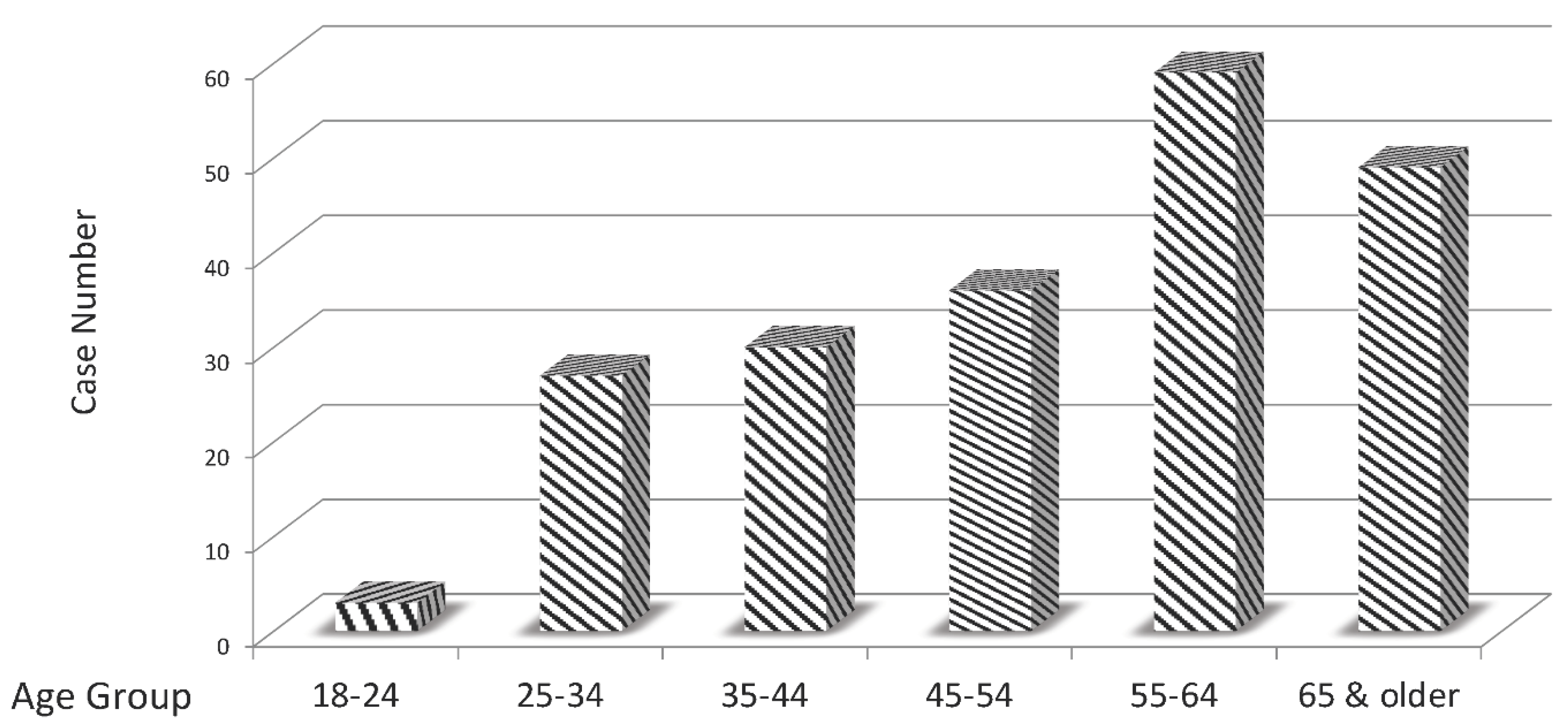
Figure 3.
The education level distribution of the subjects.
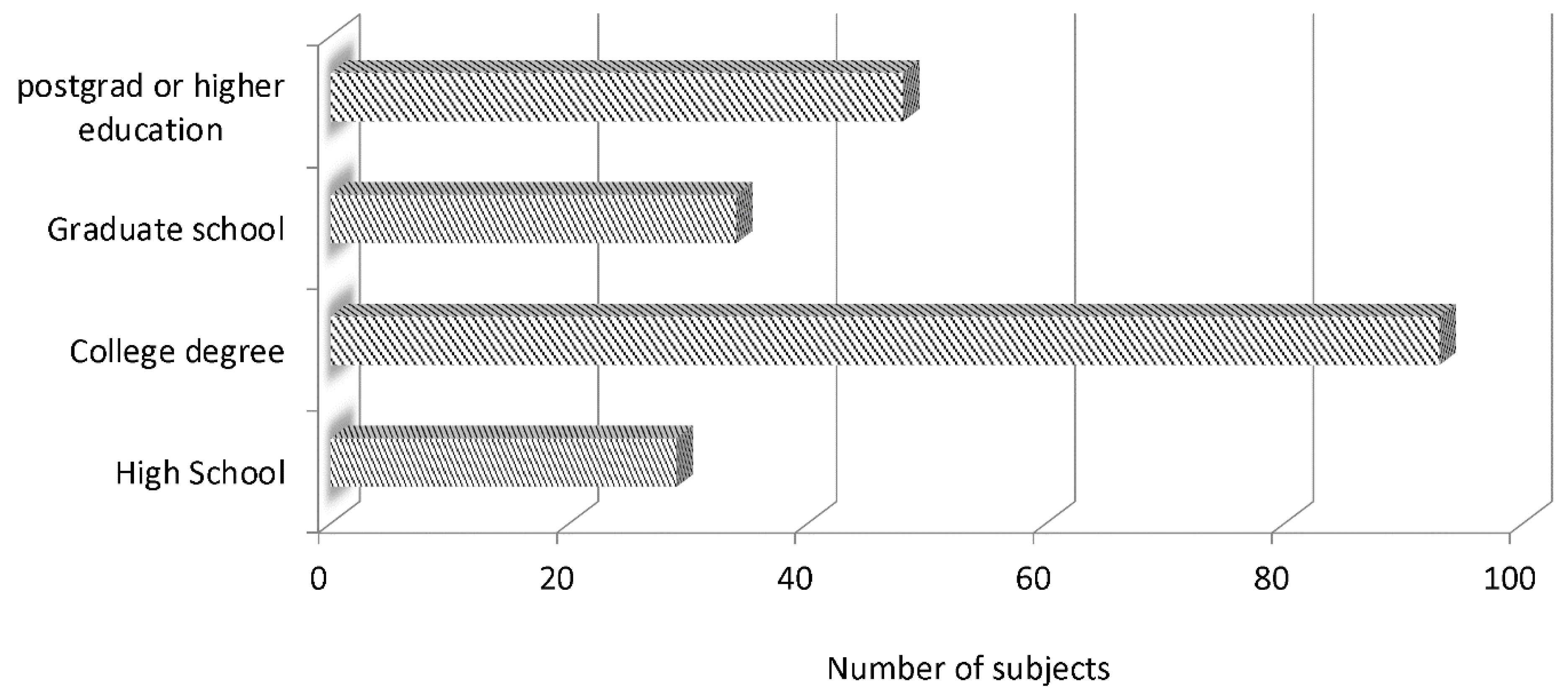
Figure 4.
The different stages of the decision-making process in Artificial and natural Intelligence.
Figure 4.
The different stages of the decision-making process in Artificial and natural Intelligence.
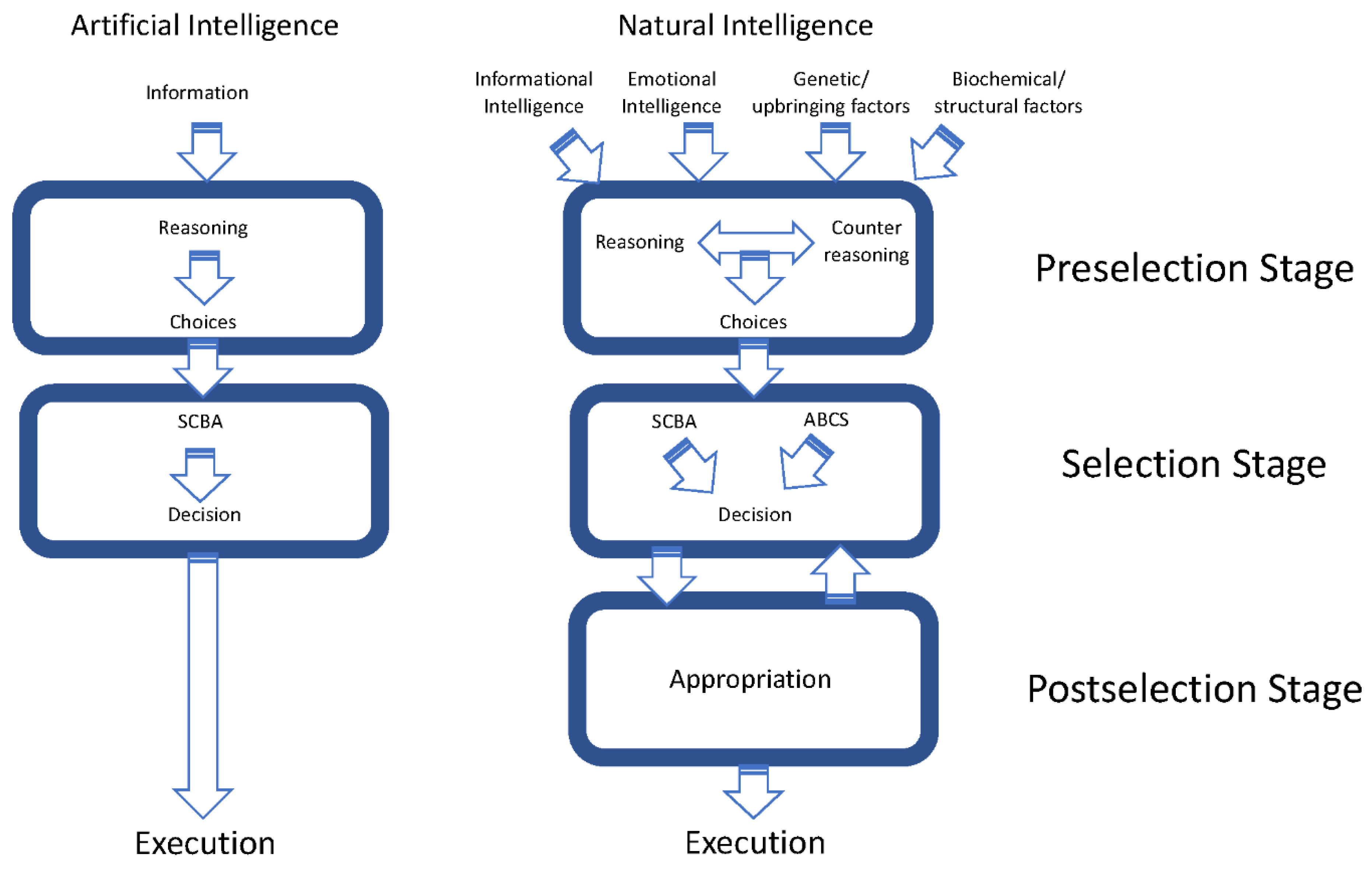
Figure 5.
The autopilot decisions or selection of choice based on an algorithm (SCBA) are either posited after a reasoning process in the mind or would skip the reasoning process due to the need for an urgent action such as reflexes.
Figure 5.
The autopilot decisions or selection of choice based on an algorithm (SCBA) are either posited after a reasoning process in the mind or would skip the reasoning process due to the need for an urgent action such as reflexes.
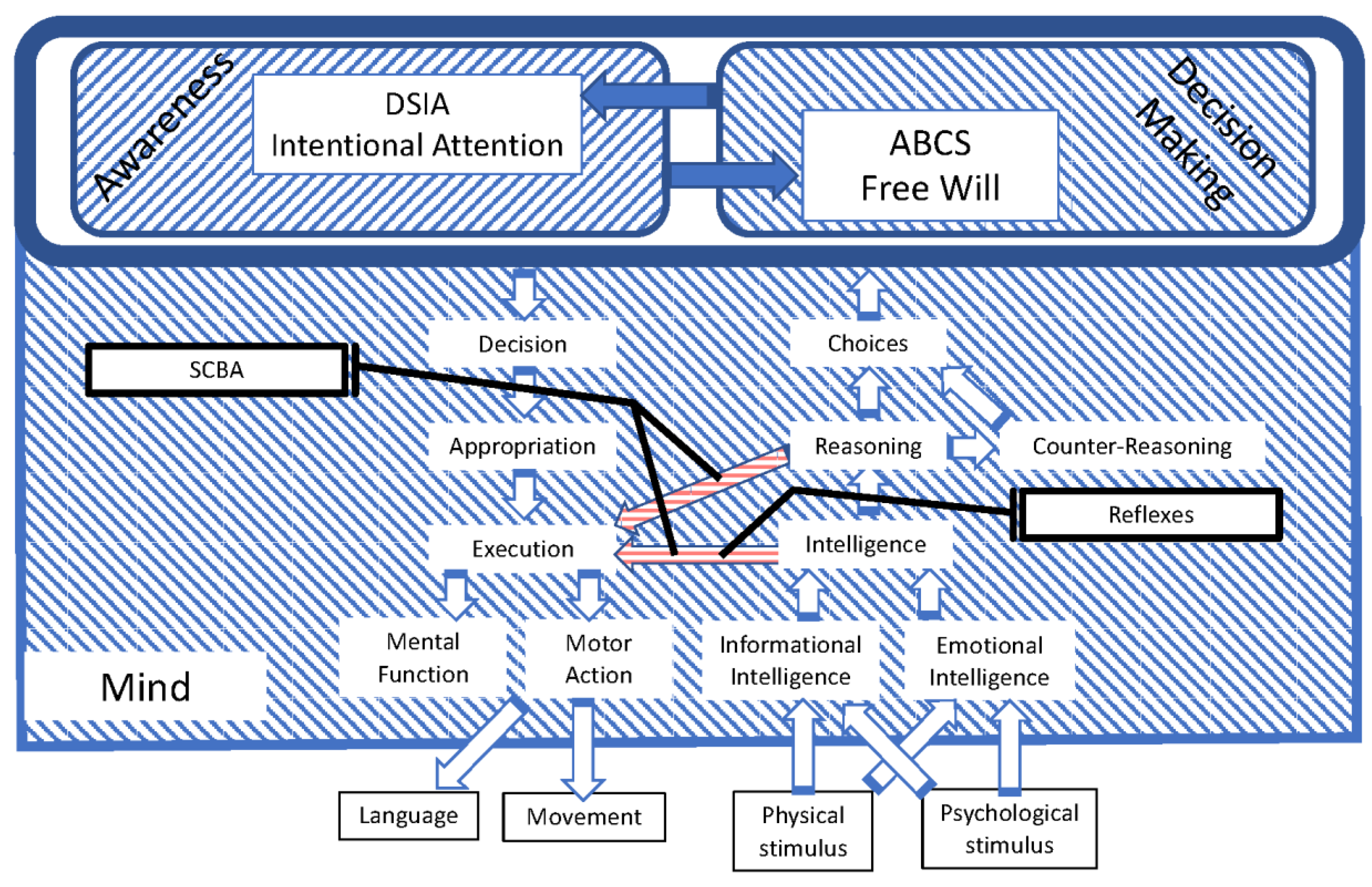
Figure 6.
The intelligence in mind is constantly processed through SCBA and SIBA but remains unconscious unless is being processed by “I,” which is a gateway to consciousness through two mental functions of ABCS (free will) and DSIA (intentional attention).
Figure 6.
The intelligence in mind is constantly processed through SCBA and SIBA but remains unconscious unless is being processed by “I,” which is a gateway to consciousness through two mental functions of ABCS (free will) and DSIA (intentional attention).
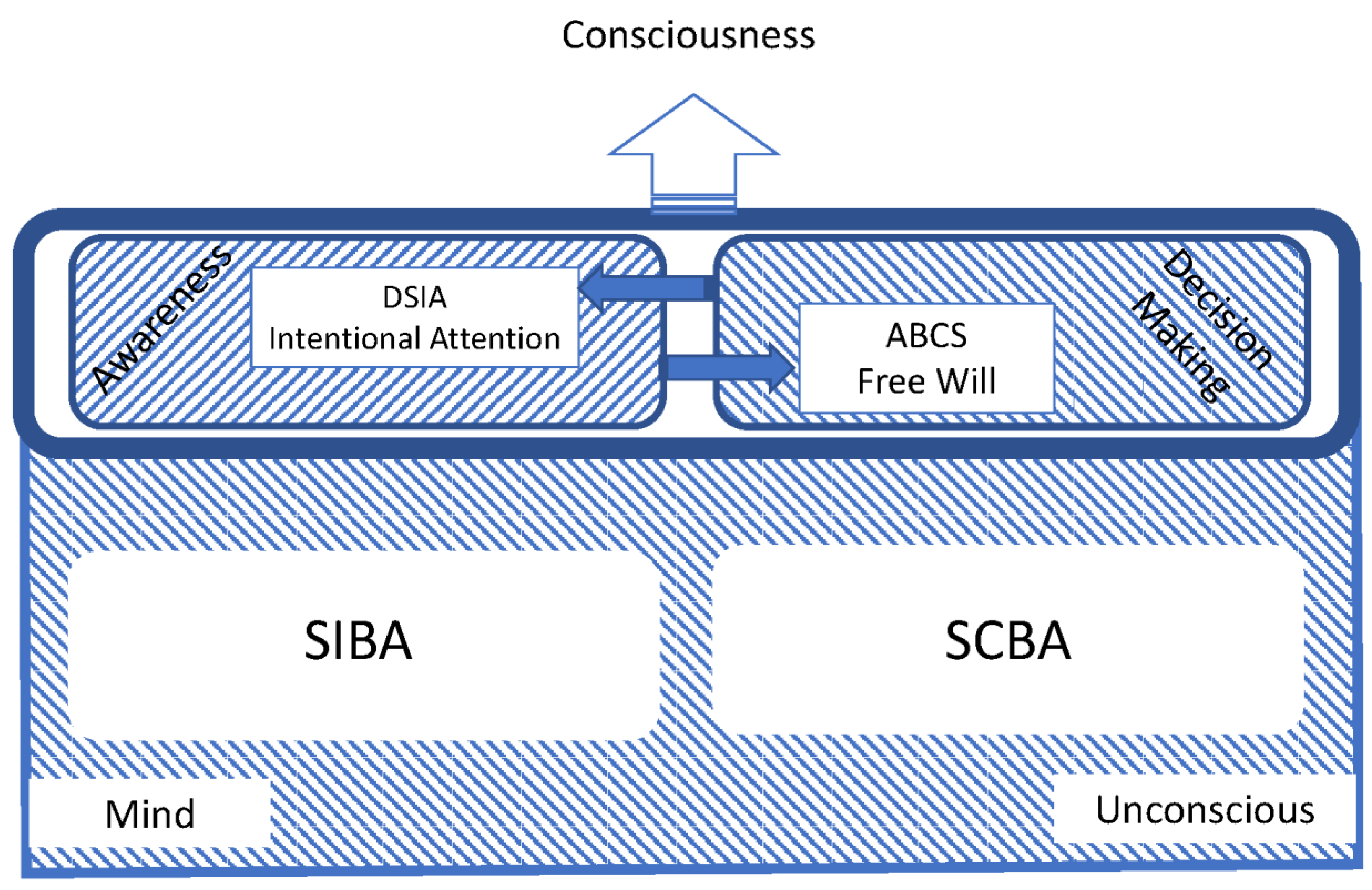
Figure 8.
The relationship role of appropriation in the postselection process.
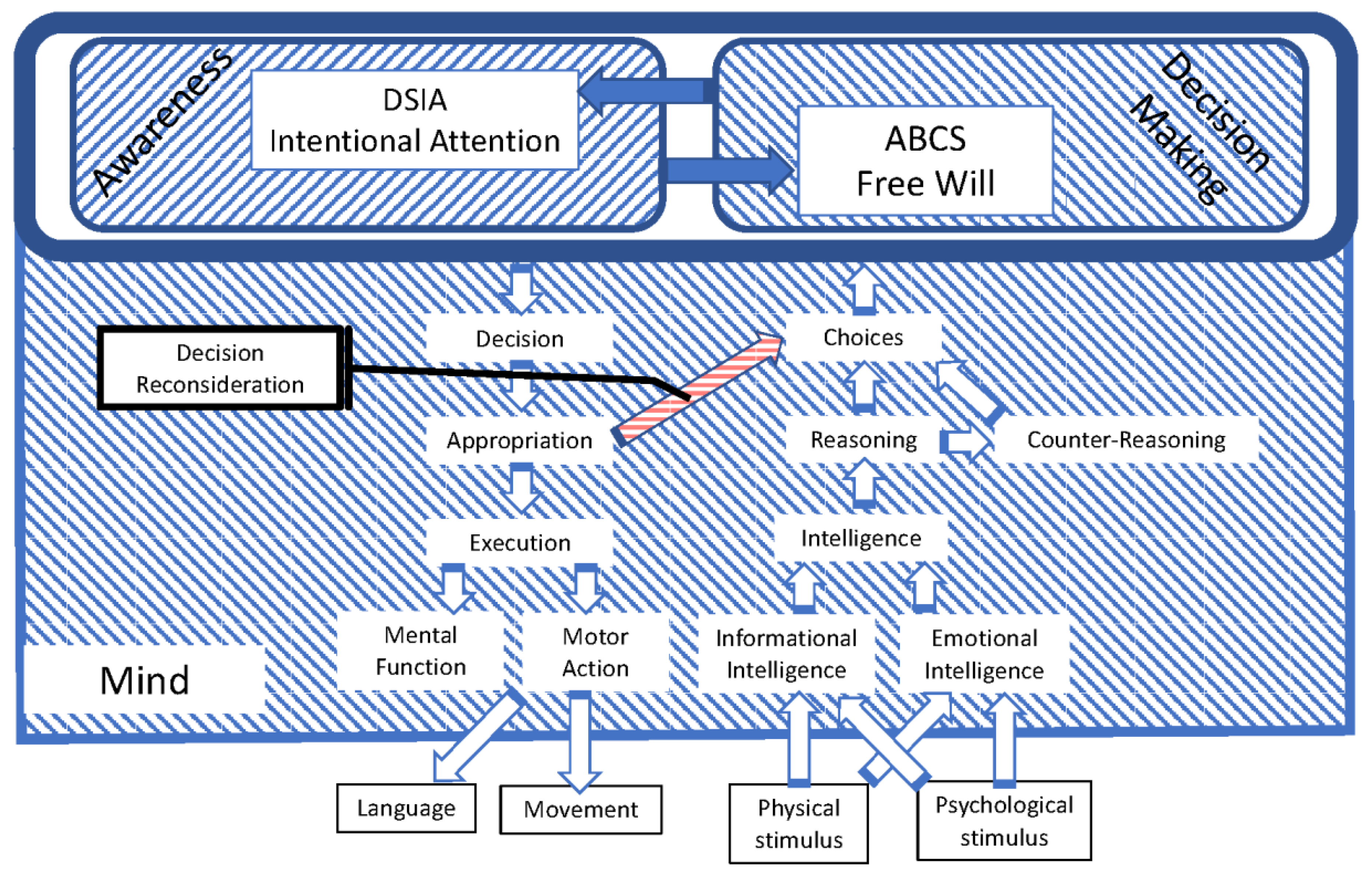
Figure 9.
Different stages of the awareness and alertness process in natural intelligence and artificial intelligence, respectively.
Figure 9.
Different stages of the awareness and alertness process in natural intelligence and artificial intelligence, respectively.
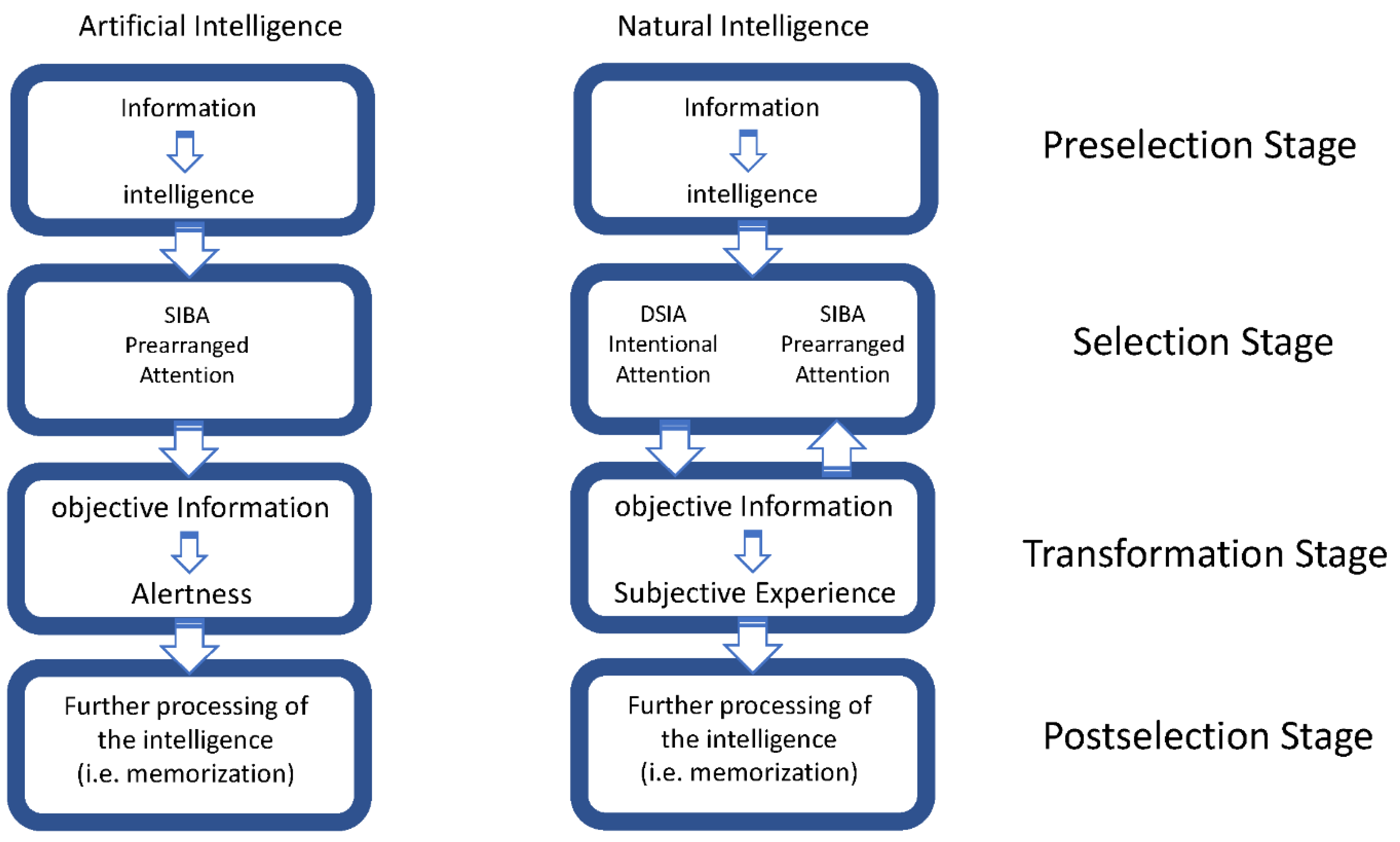
Figure 10.
Not every decision is the result of ABCS and not every awareness is the result of DSIA. Similarly, not every awareness results in a new decision nor every decision results in an awareness. But for those series of interconnected decisions and awareness, there would be series of ABCS and DSIA in a spiral arrangement.
Figure 10.
Not every decision is the result of ABCS and not every awareness is the result of DSIA. Similarly, not every awareness results in a new decision nor every decision results in an awareness. But for those series of interconnected decisions and awareness, there would be series of ABCS and DSIA in a spiral arrangement.
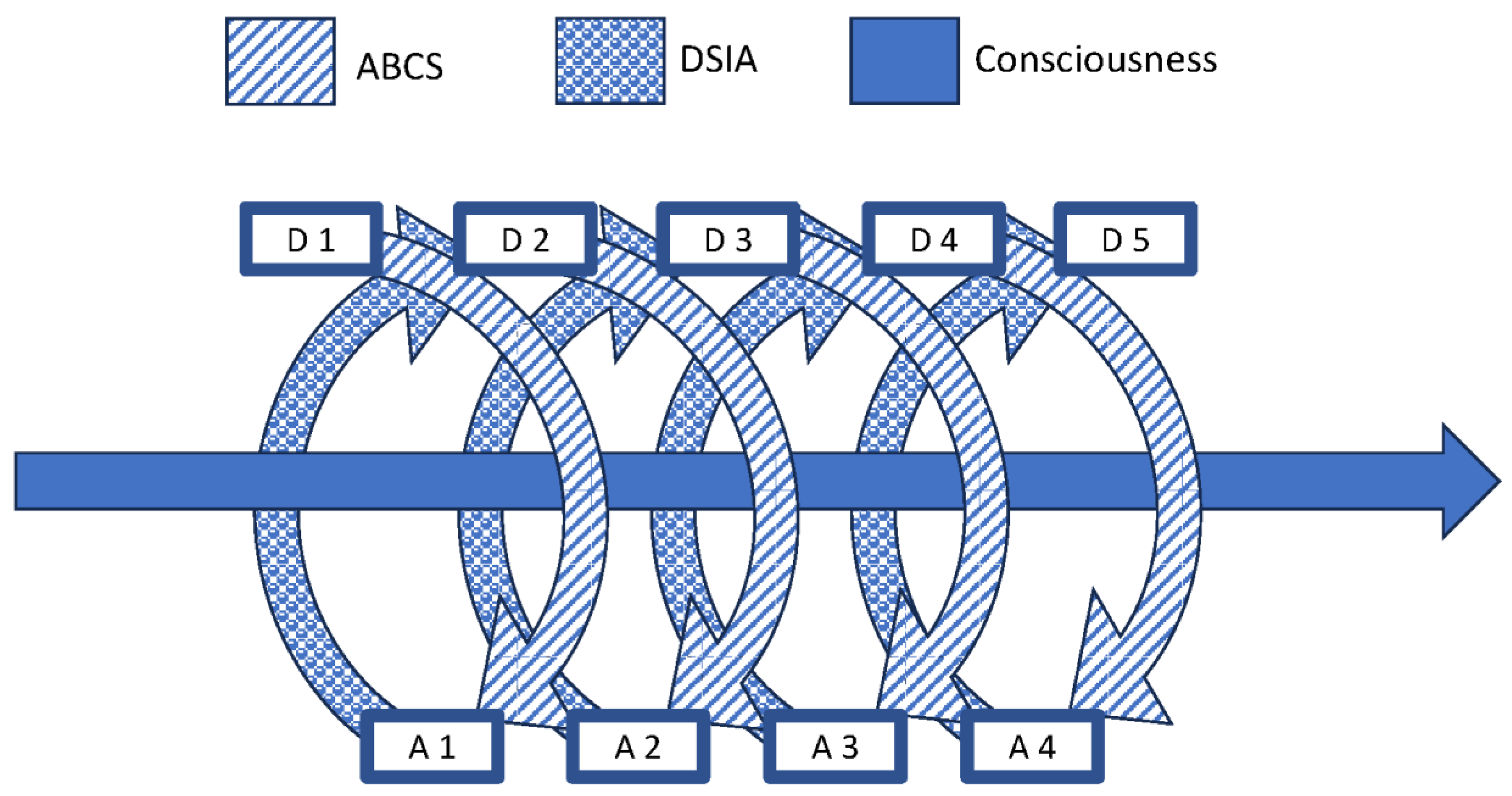

Table 1.
The questions posed in the survey with the percentage of correct answers and the statistical significance in comparison with control.
Table 1.
The questions posed in the survey with the percentage of correct answers and the statistical significance in comparison with control.
| Question | Correct Option | Incorrect Option | Total | Chi Squared* | P value |
|---|---|---|---|---|---|
| Control Question | 68 (35%) | 126 (65%) | 194 | — | — |
| Awareness Question 1 | 106 (62%) | 74 (38%) | 180 | χ2 = 25.22 | < .00001 |
| Recall Question 1A | 10 (32%) | 21 (68%) | 31 | χ2 = 0.62 | .43 |
| Recall Question 1B | 1 (50%) | 1 (50%) | 2 | — | — |
| Recall Question 1C | 1 (100%) | 0 (0%) | 1 | — | — |
| Recall Question 1D | 56 (43%) | 75 (57%) | 131 | χ2 = 1.96 | .16 |
| Recall Question 1E | 5 (23%) | 17 (77%) | 22 | χ2 = 1.18 | .27 |
| Recall Question 2 | 26 (16%) | 132 (84%) | 158 | — | — |
| Verification Question | 145 (93%) | 12 (7%) | 156 | χ2 = 8.28 | .0004 |
| Awareness Question 2 | 102 (72%) | 42 (28%) | 144 | χ2 = 43.31 | < .00001 |
| Recall Question 3 | 66 (49%) | 75 (51%) | 141 | χ2 = 4.70 | .03 |
| Recall Question 4 | 60 (43%) | 79 (57%) | 139 | χ2 = 2.25 | .13 |
*Statistical test was only performed if at least 20% of answers were correct.
Disclaimer/Publisher’s Note: The statements, opinions and data contained in all publications are solely those of the individual author(s) and contributor(s) and not of MDPI and/or the editor(s). MDPI and/or the editor(s) disclaim responsibility for any injury to people or property resulting from any ideas, methods, instructions or products referred to in the content. |
© 2023 by the authors. Licensee MDPI, Basel, Switzerland. This article is an open access article distributed under the terms and conditions of the Creative Commons Attribution (CC BY) license (http://creativecommons.org/licenses/by/4.0/).
Copyright: This open access article is published under a Creative Commons CC BY 4.0 license, which permit the free download, distribution, and reuse, provided that the author and preprint are cited in any reuse.


