

Submitted:
16 November 2023
Posted:
17 November 2023
You are already at the latest version
Abstract
Climate change impacts threaten sustainable development efforts. The magnitude of the impacts, however, varies with socio-ecological characteristics of locations. This is the reason there is con-sensus on the necessity for climate change adaptive capacity building that is country driven, based on and responsive to local needs. However, information on context specific capacity building needs in developing countries is not readily available. The objective of this study was to establish location specific awareness, training, educational, research and technology capacity building needs for climate change adaptation among small-holder farmers in Uganda. Structured interviews were undertaken with 465 households from five agro-ecological zones selected based on the level of vulnerability of agricultural systems to the main climate variation and change hazards. Results reveal substantial capacity building needs in all the zones. Majority of the farmers needed capacity building for interventions on soil water conservation practices for adapting to drought and un-predictable rainfall. For all zones, education, research, and technology were perceived as key needs. However, the needs varied among zones. These results demonstrate the importance of context specificity in adaptation efforts. The study provides agro-ecological and social system specific in-formation for climate change adaptation planning and policy interventions for effective capacity building
Keywords:
Agriculture
; Agro-ecological zone
; Adaptive capacity
; Least Developed Countries
; Paris Agreement
Highlights
- There are substantial capacity building needs to adapt to climate change in all agro-ecological zones
- There are differences in nature of needs across the zones, which mirror the contrasting climate risks and impacts in each zone.
- Findings underscore the need for location-specific planning and tailored interventions that address the unique combinations of climate risks and adaptive capacity needs at micro-levels.
Introduction
Climate change, manifested as increases in number, duration, frequency and severity of extreme weather events, is undermining efforts of nations geared towards the attainment of the sustainable development targets (Cramer et al. 2018; Zhang et al. 2018; Bedeke 2023). The effects of a changing climate cut across sectors, communities and nations (Nerini et al., 2019; Nah et al., 2020). In the agriculture sector, a range of impacts are being experienced. The impacts are mainly associated with either too little or too much rainfall (Nerini et al., 2019; Ibeje et al., 2018). The associated trends and events continue to lower agricultural land productivity, causing malnutrition, loss of livelihoods and hampering prosperity (Ruwoldt, 2013; Singh et al., 2014). The effects are most pronounced and experienced in developing countries where rain-fed agriculture constitutes a major source of livelihood (Nkuba et al. 2020a; Omotoso et al. 2023; Batungwanayo et al. 2023). These impacts are also considered to be key drivers of human displacement and mass migrations (Orhan 2018), increased vulnerability of women and girls to violence (Nerini et al., 2019) and increased gender inequalities such as the withdrawal of girls from school (Ampaire et al. 2020).
Developing countries are generally considered to be disproportionately vulnerable to and impacted by climate change (Parker et al. 2019) mainly because of poverty and heavy livelihood dependency on the increasingly threatened ecosystems (Balasubramanian 2018). In most of these countries, climate change adds another layer of complexity to already existing development challenges such as rapid population growth, underdeveloped financial markets and weak governance systems (Jones, Ludi, and Levine 2010). They are also particularly vulnerable due to very limited geographical and knowledge-based resources (Pachauri et al. 2014). These attributes plus the low adaptive capacity to climate change are worsening vulnerable communities’ lives and livelihoods (Baas, Trujillo, and Lombardi 2015; Balasubramanian 2018; Lobell, Schlenker, and Costa-Roberts 2011). There is, therefore, an urgent need for capacity building among communities to respond appropriately to the impacts of climate change. This however requires a tacit understanding of the context-specific capacity needs.
Most assessments of adaptive capacity are largely rooted in Sen’s capabilities theory and sustainable livelihoods framework (Lemos et al. 2013; Sen 1981). The theory and framework present adaptive capacity as a function of entitlements to material assets and social opportunities. More entitlements are related to more capacity to adapt and lower vulnerability to climate change and vice versa (Engle 2011; Jones, Ludi, and Levine 2010). The assets mainly considered in assessing adaptive capacity include natural, physical, financial, social and human capitals (Mortreux and Barnett 2017). Human capital covers educational considerations (Warrick et al. 2017), which fall under the learning domain of adaptive capacity (Cinner et al. 2018). Learning is about the ability to generate, absorb, and process new information about climate change, adaptation options, and ways to live with, and manage uncertainty. It captures adaptive capacity aspects including experiential and experimental process that enable people to frame or reframe problems, access to information as well as building awareness (Cinner and Barnes 2019).
Assessments show that adaptive capacity in developing countries is constrained by limited access to timely and reliable climate information to enable adaptation responses to climate change impacts (Parker et al. 2019; Saeed et al. 2023). There is also limited access to resources/services for boosting their adaptive capacity (Ng, Monios, and Zhang 2019), including barriers to climate financing and skills services (Banga 2019; Rana, Thwaites, and Luck 2017). Other barriers such as the lasting social exclusion of the poor and marginalised communities have been documented (Mikulewicz 2018; Shrestha 2013). Some communities are excluded from decision making processes, use of technologies that might have been valuable in promoting social, physical, and human capital, hence adaptive capacity.
The need for building climate change adaptive capacity in the developing world, especially for the least developed countries, has increasingly become an essential consideration in the climate regime (Khan, Mfitumukiza, and Huq 2021; Pachauri et al. 2014). Accordingly, the Paris Agreement (PA) sets out to enhance the capacity and ability of such countries to take effective climate change response actions. This involves facilitating technology development, dissemination and deployment, access to climate finance, relevant aspects of education, training and public awareness, and the transparent, timely and accurate communication of information (Article 11.1).
Under the PA, the Nationally Determined Contributions (NDCs) provide a means to communicate and track the various ambitions and commitments by Parties to the agreement. Through the NDCs, developing countries are expected to communicate their capacity building needs for effective climate change response actions (Richards et al. 2015). The first round of NDCs highlight broad priority areas for capacity building in developing countries. Most of the needs are on adaptation, largely in the agriculture sector (Khan, Mfitumukiza, and Huq 2021), with indication of capacity building in most of these areas as a condition for implementing other commitments (Pauw et al. 2020).
However, most of the submitted capacity building needs in the NDCs lack specificity in terms of target sectors and capacity building elements of interest. They also lack clear alignment to implementation support arrangements, such as alignment to mechanisms like the financial systems under the Paris Agreement (Khan, Mfitumukiza, and Huq 2021). That vagueness poses a challenge for efforts to track and measure the extent to which such needs have been addressed (Craft and Fisher 2018). This points to the need for knowledge and scientific evidence to support the processes underlying the development of such policies and plans. Knowledge capability support systems for policy formulation and planning need to be country-driven, based on and responsive to national needs, and foster country ownership, including at the national, subnational and local levels (Bolger 2000; Lafontaine 2000).
Lack of explicit information by countries on the kind of capacity building required, limits the extent to which related policy and partnerships on practice can be guided and realised in respective countries (Dodwell et al. 2015). There is need for context specific information that can support local level relevant capacity building policies and other interventions. In that way, learning from capacity building interventions in a manner that can contribute to meaningful aggregation of national and global climate change adaptation response targets can be realised (Craft and Fisher 2018; Werland and Rudolph 2023). Accordingly, lessons from subnational, national, and global processes can inform efforts aimed at updating and enhancing development and adaptation policies, programmes, and plans by incorporating new as well as location appropriate information and best practices (Northrop et al. 2018).
This study seeks to contribute to the understanding of location specific climate change adaptation needs in the agriculture sector particularly smallholder farmers. This information is useful in enhancing adaptation planning processes and practice. In a majority of developing countries, the agricultural sector is dominated by smallholder farmers. This study focuses on the agriculture sector due to the global significance it commands in the first and second round of NDCs (Khan, Mfitumukiza, and Huq 2021), and importance of the sector to the livelihoods and the economy of Uganda (UBOS 2016). Moreover, agriculture is one of the sectors that is most sensitive to changes in climate with evident risks that threaten the associated livelihoods of many rural populations (Adger et al. 2003). The importance of Agriculture is similarly highlighted in some of the targets (e.g., 2.1, 2.1.2, 2.5.1, 2.a.1, 13.2.1) of the Sustainable Development Goals (SDGs). Implementation and realisation of the intended climate change responses that promote resilience and adaptation in agricultural production will require understanding and dealing with location specific capacity building needs. Such understanding should be based on realities from local communities and context. Specifically, the objective of this study was to generate information to support planning, decision-making processes and actions aimed at the realisation of locally relevant capacity building for effective adaptation. The study addresses two questions: i) What are the climate change adaptive capacity building needs for the agriculture sector in Uganda? ii) Are there differences in climate change adaptive capacity building needs across different agro-ecological zones?
Materials and methods
Description of the study area
The study was conducted in five agro-ecological zones (AGEZs) of Uganda. The agro-ecological zones covered are South-Western Grass Farmlands (SWGF); Western Medium-High Farmlands (WMHF); Western Mid-altitude Farmlands and the Semlilki Flats (WMFSF); Lake Victoria Crescent and Mbale Farmlands (LVCMF); and North-Western Farmland Wooded Savanna (NWFWS). The description of these zones is presented in Table 1. The study area covered five districts of Rubirizi, Mubende, Kikuube, Nebbi and Mbale (Figure 1).
Methods
In each agro-ecological zone, one district (Table 1) was selected based on the level of vulnerability of agricultural systems to the main climate variation and change hazards in Uganda. These districts are particularly vulnerable to unpredictable shifts in rainfall patterns as well as uncertainty in the length and intensity of dry seasons, which in the recent past have been characterised by recurrent drought (Bamutaze et al. 2019; Mbogga 2012; Hisali, Birungi, and Buyinza 2011; Mfitumukiza et al. 2020; Namusoke and Atuhaire 2019; Okaka 2020; Okonya, Syndikus, and Kroschel 2013; Oriangi et al. 2019). A multistage purposive sampling method was used to select the districts and sub counties of study. The choice of parish and village administrative units of study was guided by district and sub-county local government leaders based on their knowledge and experiences on context diversity of socio-ecological vulnerability in their respective areas of jurisdiction. Four hundred sixty-five (465) farmers were randomly selected in the identified parishes. The respondents were distributed in thirty-four villages, ten parishes and five sub counties of the five districts. The number of respondents per parish was determined based on population proportions that were calculated based on the Uganda National Census data of 2014 (UBOS 2016). The sample population was calculated according to Yamane (1973) formula:
Where n is the sample size, N is the total population, and e is the level of precision.
Accordingly, we obtained 101 farmers from SWGF, 90 farmers from WMHF, 100 farmers from WMFSF, 90 farmers from LVCMF and 84 farmers from NWFWS. Field data collection was conducted by a team of five well trained research assistants, with one assistant in each district of study. These were helped by the local government and community leaders who acted as field guides because they were well known to the local people and understood the geography of the study areas. Data were collected using a questionnaire that sought information on; climate change hazards and impacts being experienced by the farmers, and capacity building needs for adaptation in their farming activities. The criteria for categorising the specific needs were based on capacity building elements derived from the Paris Agreement (mainly, but not limited to Articles 11, 12 and 13) and the UNFCCC (Articles 5 and 6). These elements are: education, training and public awareness, research and technology.
Data analysis
The data collected from the field were coded and entered into Statistical Package for the Social Sciences (SPSS) software version 25. Using the same software, descriptive statistics for the capacity building needs in each AGEZ were generated. A one-way Analysis of variance (ANOVA) and post-hoc Turkey’s Honestly Significant Difference (HSD) tests were carried out to ascertain the statistical differences among capacity building needs in the AGEZs. For each respondent, the number of specific needs selected under a broad capacity building category (awareness, education, research, and technology as well as training) were tallied and assigned a numeric score. The scores were aggregated to come up with scores of corresponding capacity building need at the broad category level. Relatively lower scores were interpreted as having relatively a low need for a given capacity building category while high scores implied a high need for a given category as shown in Table 2.
The mean score of capacity building needs for each AGEZ was computed in SPSS. One-way ANOVA was used to compare the mean score of the different AGEZs to ascertain if there were statistically significant differences between the means. The aim of this test was to find out if there were differences in needs across the AGEZs. A post-hoc Turkey HSD test was also run to determine the significant pairwise differences of capacity building needs between AGEZs. The mean score of capacity building need corresponding to the reference AGEZ was labelled “i” and the mean score of the capacity building need corresponding to the AGEZ to be compared was labelled “j”. The post-hoc Turkey’s test was run based on the expression “i-j”.
Results
Adaptive capacity building needs
Overall, a large proportion of respondents involved in this study expressed having experienced unexpected changes in weather events within the last 12 months. The events most experienced are unpredictable rainfall and drought. However, farmers in SWGF and WMFSF experienced this more frequently than farmers in WMFSF, LVCMF and NWFWS AGEZs. As for adaptive capacity needs, the majority of farmers (over 60%) revealed a need for capacity building to respond to drought and unpredictable rainfall hazards. Table 3 shows the capacity building needs reported by farmers in the five AGEZs. Need for education, research and technology registered the highest number of respondents across all AGEZs for both drought and unpredictable rainfall. The SWGF and WMHF zones reported the highest needs for capacity building.
Table 4 shows the specific adaptive capacity building needs for adaptation to drought. Majority of the farmers in all AGEZs needed capacity building for interventions on soil water conservation practices such as planting cover crops, agroforestry, and mulching; practices for planning for cropping activities such as changes in crop varieties and planting dates; irrigation technologies which can be used on farm including use of wastewater. Farmers also sought capacity for water harvesting and storage technologies such as construction of percolation tanks and valley dams; post-harvest management techniques for seed drying and storage to avoid seed spoilage and reduce losses, and technologies for increased livestock stocking capacity on farm.
For unpredictable rainfall, the majority of the farmers needed capacity building for interventions on soil conservation practices, such as construction of terraces, planting crops on ridges, planting cover crops and techniques for draining excess water from farm like digging channels in the garden; cropping strategies such as delays in planting, planting new crop varieties that can survive in excess water, and crops that are early maturing. Farmers also needed technologies for water harvesting and storage including the use of percolation tanks; animal care techniques such as keeping animals indoors and post-harvest management technologies to avoid seed spoilage and losses (Table 5).
Variation in climate change adaptive capacity building needs across agro-ecological zones
Whereas all agro-ecological zones showed high need for capacity building, the level of needs varied. Results of one-way ANOVA (Table 6) show that the capacity building needs were significantly different (p<0.05) across the agro-ecological zones.
Mean differences in capacity building needs for drought between any two agro-ecological zones
The results of the Turkey HSD test for drought showed that on average, SWGF and WMHF zones had significantly higher public awareness needs relative to other AGEZs (p<0.05). LVCMF had significantly lower capacity building needs for education, research and technology, and training (p<0.05). This study also revealed that WMFSF and NWFWS had significantly high needs for training but low public awareness needs for drought response (p<0.05), Table 7.
Mean differences in the capacity building needs for unpredictable rainfall between any two agro-ecological zones
The results of the Turkey HSD test revealed significant differences in public awareness needs, with SWGF and WMHF having higher need for public awareness compared to NWFWS (p<0.05). The study also revealed significantly higher training needs in NWFWS, while LVCMF revealed an overall low need for adaptive capacity building (p<0.05), Table 8.
Discussion
Understanding the specific climate change adaptive capacity needs at local level is critical in designing location sensitive policies, programs, and other interventions for adaptation (Howarth et al. 2018; Tanner et al. 2019). This is because vulnerability characteristics vary across regions and scales (Thomas et al. 2019). In this study, we assessed climate change adaptation needs across five agro-ecological zones in Uganda, a relatively small country. Results of this study showed that there were substantial capacity building needs to adapt to climate change in all AEZs. However, the specific needs varied across the zones and depended on the type of weather and climate events and trends most encountered in a locality. This is interesting for a small country like Uganda where homogeneity would be the expected outcome. This discussion explores the policy, and practice implications of these results for the predominately rural natural resource-dependent communities in developing countries.
The high need for climate change adaptive capacity building irrespective of AEZ
The findings of this study reveal a considerable need for capacity building, regardless of AEZ. The agro-ecological zones considered in this study exhibit varying climatic, social and ecological characteristics. For instance, while the LVCMF is a relatively wet area, with bimodal rainfall distribution, and mean annual rainfall above 1200 mm, the NWFWS experiences unimodal rainfall ranging from 1000 to 1200 mm (Kabanyoro et al. 2013; Wortmann and Eledu 1999). In terms of socio-economic context, the LVCMF is known to have greater access to assets and resources, compared to other AEZs considered in this study (Abuka et al. 2007; Epule et al. 2017). It was anticipated that areas with better socio-economic characteristics would have a better adaptive capacity, hence lower capacity building needs and vice versa. However, results of this study are incongruent with this expectation, as a considerable need for capacity building was evident across all AEZs.
The considerable need for adaptive capacity building shown by the results of this study can be explained in terms of Uganda’s low level of development. According to UNDP (2014), Uganda is among the poorest nations, ranked 164th out of 187 countries based on human development index (HDI). Thirty eight percent of its population live below income poverty line, while 33% live in absolute poverty (Echeverría, Terton, and Crawford 2016; USAID 2014). Over 70% of the population depend on the climate sensitive agriculture, and contribute nearly 25% of the GDP (FAO 2022). These characteristics render the country, as a whole, very vulnerable to the impacts of environmental perturbations. Since the dominant livelihood activities in all AEZ included in this study are mainly agro based, the substantial need for adaptive capacity building irrespective of zone is conceivable. This low level of adaptive capacity undermines the realization of the country’s plans, policies, and development goals including the sustainable development goals. Particularly, it limits the attainment of SDG 2, which targets to end hunger, achieve food security, improved nutrition and promote sustainable agricultural systems. The situation also complicates the country’s aspiration of modernising the agricultural sector that, in the face of climate change, will require significant investment in planning and implementation of adaptation response efforts such as irrigation, new seed varieties suited to new conditions and improved post-harvest management systems among others, as per the capacity building specific needs of communities.
The mismatch in the level of assets and resources and capacity building needs in the different AEZs depicted by results of this study is consistent with the literature, which suggests that the levels of adaptive capacity cannot be solely explained by capitals of a socio-ecological system (Mortreux and Barnett 2017). It is, therefore, essential to recognise that adaptive capacity is a multifaceted and dynamic concept (Coulthard 2008; Below et al. 2010). This observation implies a need for action to facilitate the translation of assets and resources into effective adaptation action, leading to reduction of vulnerability. Recent studies have demonstrated that translation of assets and resources in a socio-ecological system into adaptive capacity requires consideration of many domains including psychosocial factors. These factors include risk attitudes, personal experiences, trust and expectations in authorities, competing concerns, household composition dynamics (Mortreux and Barnett 2017; Eakin, Lemos, and Nelson 2014).
The Variation in Specific needs across AEZ
Although we observed a generally high need for capacity building irrespective of AEZ, there were differences in nature of needs across the zones. These differences mirror the contrasting climate risks and impacts encountered in each agro-ecological zone. For instance, zones such as WMHF and WMFS, prone to severe drought events, exhibited substantial needs for drought-related adaptive capacity, whereas LVCMF, characterized by high rainfall, exhibited lower capacity needs for drought adaptation. These findings underscore the need for location-specific planning and tailored interventions that address the unique combinations of climate risks and adaptive capacity needs at micro-levels. In line with global climate change policy regime, Uganda has progressively developed policies intended to provide an enabling environment for local level adaptive capacity building. However, the high and varied needs revealed by this study presents a substantial gap between the current policy framework and realities on ground. For example, Uganda’s climate policies and plans including the Climate Change Policy (2015), Climate Change Act (2021), Climate Action Plan (2022), and the third National Development Plan (NDPIII), emphasise a devolved, inclusive, and people-centred implementation of adaptation action to create autonomous and resilient societies. However, this study reveals that the policies and plans have not necessarily translated into adaptive capacity building reality at local level. Similar studies have reported considerable gaps in policy design and implementation including the lack of proactive engagement of communities, limitations to access of timely and reliable climate information, inadequate structures, services, and resources, including financial resources, to boost local response actions. This results in a persistent lack of tailored adaptation actions, which leads to failure to address local needs (Parker et al. 2019; Ampaire et al. 2017; Nyasimi et al. 2016; Nkuba et al. 2020b; Gaisie and Cobbinah 2023).
This study and other studies including Ampaire et al. (2017); Antwi-Agyei et al. (2015); Eriksen et al. (2019); and Renner (2020) reflect two perennial policy criticisms in the policy formulation process in developing countries. First, policies are developed out of sync of local realities leading to the lack of congruence with local needs of communities, and therefore very difficult to mainstream such policies into local communities’ context. Second, there is a continued use of top-down approaches to policy formulation and implementation, which promotes elite monopoly of custodianship of information and the associated marginalization and vulnerability of communities (Kahsay and Bulte 2021). Such approaches have been criticized for perpetuating historical power imbalances brought about by centralised and exclusive decision-making (McDougall and Ojha 2021). It also hinders ownership and implementation of policy at local level because of disconnect with the needs and priorities at local community level (Preston, Westaway, and Yuen 2011; Lebel et al. 2012). The manifestations of the limited in-country capacities and capabilities to implement locally driven adaptation responses, especially in a nature-based agricultural sector, include food insecurity, water shortages, and a constrained economic growth, which in turn have aggravated health impacts, hunger, poverty, migration and conflict over diminishing natural resources and agricultural productivity (MWE, 2015; NAPA, 2007). These undermine Uganda’s efforts towards attaining the desired higher income status and the UN’s Sustainable Development Goals.
As climate change continues to threaten the livelihoods and lives of people, especially, among the most vulnerable communities in Least Developed Countries, it is imperative that different actors including policymakers, researchers and practitioners focus on addressing location specific adaptation needs. This is most important for local communities that are heavily dependent on agriculture, which is currently highly vulnerable to the impacts of climate change (Kotir 2011; Bedeke 2023). Such efforts should intentionally aim at promoting meaningful local-community level leadership and participation in strategies and actions for achieving vulnerability reduction and strengthening resilience. Failure to bridge the gap between global and national climate change response efforts and local level needs of communities, could exacerbate the already-existing challenges, including increased environmental degradation, decreased crop yields, food insecurity, increased vulnerability to extreme weather events, and poverty, hence compromising the well-being and livelihoods of those who rely on agriculture. Moreover, without effective adaptation measures, LDCs will continue to struggle to keep pace with global developments and find themselves increasingly impacted and marginalised by climate change. Therefore, it is crucial that LDCs prioritize climate adaptation policies and practices that are tailored to their specific local needs and circumstances.
Conclusion
Results of this study have demonstrated a high need for adaptive capacity building in Uganda’s agriculture sector irrespective of geographic location characteristics. Differences in access to material assets and social opportunities depicted by different agro-ecological zones do not translate into differences in climate change adaptive capacity. Resources endowment is therefore not an accurate adaptive capacity predictor in countries like Uganda. Additionally, the study has shown that the nature of adaptive capacity needs are location and context specific and varies considerably across locations even within the same country. Efforts to enhance adaptive capacity must, therefore, be context specific, to avoid the likely failures associated with generalisations including ineffective uses of resources.
Data Availability Statement
The authors are open to sharing the data used in this study with parties upon request to support further research in this field
Acknowledgments
The Authors acknowledge all participants that contributed to this research including the farmers in the study districts and research assistants who collected the data including Adule Kenan, Kekirunga Patience, Mutesasira George William, Nakumiza Bridget and Ndabikunze David. Special thanks to the reviewers for their constructive comments.
Conflicts of Interest
The authors declare that there is no conflict of interest arising from this research or the publication of its findings.
References
- Abuka, Charles Augustine, Michael Atingi-Ego, Jacob Opolot, and Patrick Okello. 2007. “Determinants of Poverty Vulnerability in Uganda.”.
- Adger, W Neil, Saleemul Huq, Katrina Brown, Declan Conway, and Mike Hulme. 2003. “Adaptation to Climate Change in the Developing World.” Progress in Development Studies 3 (3): 179–95. [CrossRef]
- Ampaire, Edidah L, Mariola Acosta, Sofia Huyer, Ritah Kigonya, Perez Muchunguzi, Rebecca Muna, and Laurence Jassogne. 2020. “Gender in Climate Change, Agriculture, and Natural Resource Policies: Insights from East Africa.” Climatic Change 158 (1): 43–60. [CrossRef]
- Ampaire, Edidah L, Laurence Jassogne, Happy Providence, Mariola Acosta, Jennifer Twyman, Leigh Winowiecki, and Piet Van Asten. 2017. “Institutional Challenges to Climate Change Adaptation: A Case Study on Policy Action Gaps in Uganda.” Environmental Science & Policy 75: 81–90. [CrossRef]
- Antwi-Agyei, Philip, Andrew J Dougill, and Lindsay C Stringer. 2015. “Barriers to Climate Change Adaptation: Evidence from Northeast Ghana in the Context of a Systematic Literature Review.” Climate and Development 7 (4): 297–309. [CrossRef]
- Baas, Stephan, Monica Trujillo, and Niccolo Lombardi. 2015. Impact of Disasters on Agriculture and Food Security. FAO.
- Balasubramanian, Muniyandi. 2018. “Climate Change, Famine, and Low-Income Communities Challenge Sustainable Development Goals.” The Lancet Planetary Health 2 (10): e421–22. [CrossRef]
- Bamutaze, Yazidhi, Samuel Kyamanywa, Bal Ram Singh, Gorettie Nabanoga, and Rattan Lal. 2019. Agriculture and Ecosystem Resilience in Sub Saharan Africa: Livelihood Pathways under Changing Climate. Springer.
- Banga, Josué. 2019. “The Green Bond Market: A Potential Source of Climate Finance for Developing Countries.” Journal of Sustainable Finance & Investment 9 (1): 17–32. [CrossRef]
- Batungwanayo, Pacifique, Viateur Habarugira, Marnik Vanclooster, Jean Ndimubandi, Alan F. Koropitan, and Jean de Dieu Nkurunziza. 2023. “Confronting Climate Change and Livelihood: Smallholder Farmers’ Perceptions and Adaptation Strategies in Northeastern Burundi.” Regional Environmental Change 23 (1): 47. [CrossRef]
- Bedeke, Sisay Belay. 2023. “Climate Change Vulnerability and Adaptation of Crop Producers in Sub-Saharan Africa: A Review on Concepts, Approaches and Methods.” Environment, Development and Sustainability 25 (2): 1017–51. [CrossRef]
- Below, Till, Astrid Artner, Rosemarie Siebert, and Stefan Sieber. 2010. “Micro-Level Practices to Adapt to Climate Change for African Small-Scale Farmers.” A Review of Selected Literature 953: 1–20.
- Bolger, Joe. 2000. “Capacity Development: Why, What and How.” Capacity Development Occasional Series 1 (1): 1–8.
- Cinner, Joshua E, W Neil Adger, Edward H Allison, Michele L Barnes, Katrina Brown, Philippa J Cohen, Stefan Gelcich, Christina C Hicks, Terry P Hughes, and Jacqueline Lau. 2018. “Building Adaptive Capacity to Climate Change in Tropical Coastal Communities.” Nature Climate Change 8 (2): 117–23. [CrossRef]
- Cinner, Joshua E, and Michele L Barnes. 2019. “Social Dimensions of Resilience in Social-Ecological Systems.” One Earth 1 (1): 51–56. [CrossRef]
- Coulthard, Sarah. 2008. “Adapting to Environmental Change in Artisanal Fisheries—Insights from a South Indian Lagoon.” Global Environmental Change 18 (3): 479–89. [CrossRef]
- Craft, Brianna, and Susannah Fisher. 2018. “Measuring the Adaptation Goal in the Global Stocktake of the Paris Agreement.” Climate Policy 18 (9): 1203–9. [CrossRef]
- Cramer, Wolfgang, Joël Guiot, Marianela Fader, Joaquim Garrabou, Jean-Pierre Gattuso, Ana Iglesias, Manfred A Lange, Piero Lionello, Maria Carmen Llasat, and Shlomit Paz. 2018. “Climate Change and Interconnected Risks to Sustainable Development in the Mediterranean.” Nature Climate Change 8 (11): 972–80. [CrossRef]
- Dodwell, Chris, Emelia Holdaway, Kiran Sura, and Helen Picot. 2015. “Supporting Ambitious Intended Nationally Determined Contributions: Lessons Learned from Developing Countries.”.
- Eakin, Hallie C, Maria C Lemos, and Donald R Nelson. 2014. “Differentiating Capacities as a Means to Sustainable Climate Change Adaptation.” Global Environmental Change 27: 1–8. [CrossRef]
- Echeverría, Daniella, Anika Terton, and Alec Crawford. 2016. “Review of Current and Planned Adaptation Action in Uganda.”.
- Engle, Nathan L. 2011. “Adaptive Capacity and Its Assessment.” Global Environmental Change 21 (2): 647–56. [CrossRef]
- Epule, Terence Epule, James D Ford, Shuaib Lwasa, and Laurent Lepage. 2017. “Vulnerability of Maize Yields to Droughts in Uganda.” Water 9 (3): 181. [CrossRef]
- Eriksen, Siri Hallstrom, Laura Katherine Cramer, Ingvild Vetrhus, and Philip Thornton. 2019. “Can Climate Interventions Open up Space for Transformation? Examining the Case of Climate-Smart Agriculture (CSA) in Uganda.” Frontiers in Sustainable Food Systems 3: 111. [CrossRef]
- FAO. 2022. “National Gender Profile of Agriculture and Rural Livelihoods – Uganda. Country Gender Assessment Series. Second Revision.” Kampala, Uganda.
- Fuso Nerini, Francesco, Benjamin Sovacool, Nick Hughes, Laura Cozzi, Ellie Cosgrave, Mark Howells, Massimo Tavoni, Julia Tomei, Hisham Zerriffi, and Ben Milligan. 2019. “Connecting Climate Action with Other Sustainable Development Goals.” Nature Sustainability 2 (8): 674–80. [CrossRef]
- Gaisie, Eric, and Patrick Brandful Cobbinah. 2023. “Planning for Context-Based Climate Adaptation: Flood Management Inquiry in Accra.” Environmental Science & Policy 141: 97–108. [CrossRef]
- Haikerwal, Amrita, and Shailendra K Saxena. 2020. “Impact of Climate Change on Water-Associated Infectious Diseases.” Water-Associated Infectious Diseases, 53–62.
- Hisali, Eria, Patrick Birungi, and Faisal Buyinza. 2011. “Adaptation to Climate Change in Uganda: Evidence from Micro Level Data.” Global Environmental Change 21 (4): 1245–61. [CrossRef]
- Howarth, Candice, Sian Morse-Jones, Katya Brooks, and A P Kythreotis. 2018. “Co-Producing UK Climate Change Adaptation Policy: An Analysis of the 2012 and 2017 UK Climate Change Risk Assessments.” Environmental Science & Policy 89: 412–20. [CrossRef]
- Ibeje, A O, J C Osuagwu, and O R Onosakponome. 2018. “A Markov Model for Prediction of Annual Rainfall.” International Journal of Scientific Engineering and Applied Science (IJSEAS) 3 (11): 1–5.
- Jones, Lindsey, Eva Ludi, and Simon Levine. 2010. “Towards a Characterisation of Adaptive Capacity: A Framework for Analysing Adaptive Capacity at the Local Level.” Overseas Development Institute, December.
- Kabanyoro, Ruth, Stella Kabiri, Immaculate Mugisa, Winfred Nakyagaba, Losira Nasirumbi, George Kituuka, Barbara Kyampeire, Maria Nampera, Namirimu Teopista, and Bernard Fungo. 2013. “Willingness of Farmers to Adopt Rice Intercrops in the Lake Victoria Crescent Agro-Ecological Zone of Uganda.” Order 3 (6).
- Kahsay, Goytom Abraha, and Erwin Bulte. 2021. “Internal versus Top-down Monitoring in Community Resource Management: Experimental Evidence from Ethiopia.” Journal of Economic Behavior & Organization 189: 111–31. [CrossRef]
- Khan, Mizan, David Mfitumukiza, and Saleemul Huq. 2021. “Capacity Building for Implementation of Nationally Determined Contributions under the Paris Agreement.” In Making Climate Action More Effective, 95–106. Routledge.
- Kotir, Julius H. 2011. “Climate Change and Variability in Sub-Saharan Africa: A Review of Current and Future Trends and Impacts on Agriculture and Food Security.” Environment, Development and Sustainability 13: 587–605. [CrossRef]
- Lafontaine, Alain. 2000. “Assessment of Capacity Development Efforts of Other Development Cooperation Agencies.” New York: GEF-UNDP.
- Lebel, Louis, Lailai Li, Chayanis Krittasudthacheewa, Muanpong Juntopas, Tatirose Vijitpan, Tomoharu Uchiyama, and Dusita Krawanchid. 2012. “Mainstreaming Climate Change Adaptation into Development Planning.” Bangkok: Adaptation Knowledge Platform and Stockholm Environment Institute 8.
- Lemos, Maria Carmen, Arun Agrawal, Hallie Eakin, Don R Nelson, Nathan L Engle, and Owen Johns. 2013. “Building Adaptive Capacity to Climate Change in Less Developed Countries.” Climate Science for Serving Society: Research, Modeling and Prediction Priorities, 437–57.
- Lobell, David B, Wolfram Schlenker, and Justin Costa-Roberts. 2011. “Climate Trends and Global Crop Production since 1980.” Science 333 (6042): 616–20. [CrossRef]
- Mbogga, M S. 2012. “Climate Profiles and Climate Change Vulnerability Assessment for the Mbale Region of Uganda.” UNDP Consultancy Report. Kampala, Uganda.
- McDougall, Cynthia, and Hemant Ojha. 2021. “How Does Adaptive Collaborative Management Leverage Changes in Power.” Krister Andersson, Professor of Political Science and Director, The Center for the Governance of Natural Resources, University of Colorado at Boulder, USA, 186.
- Mfitumukiza, David, Bernard Barasa, Nicholas Kiggundu, Amos Nyarwaya, and John Paul Muzei. 2020. “Smallholder Farmers’ Perceived Evaluation of Agricultural Drought Adaptation Technologies Used in Uganda: Constraints and Opportunities.” Journal of Arid Environments 177: 104137. [CrossRef]
- Mikulewicz, Michael. 2018. “Politicizing Vulnerability and Adaptation: On the Need to Democratize Local Responses to Climate Impacts in Developing Countries.” Climate and Development 10 (1): 18–34. [CrossRef]
- Ministry of Water and Environment. 2015. “Economic Assessment of the Impacts of Climate Change in Uganda Final Study Report.” Climate Change Department, no. November. www.cdkn.org.
- Misselhorn, Alison A. 2005. “What Drives Food Insecurity in Southern Africa? A Meta-Analysis of Household Economy Studies.” Global Environmental Change 15 (1): 33–43. [CrossRef]
- Mortreux, Colette, and Jon Barnett. 2017. “Adaptive Capacity: Exploring the Research Frontier.” Wiley Interdisciplinary Reviews: Climate Change 8 (4): e467. [CrossRef]
- Nah, Kyeongah, Ákos Bede-Fazekas, Attila János Trájer, and Jianhong Wu. 2020. “The Potential Impact of Climate Change on the Transmission Risk of Tick-Borne Encephalitis in Hungary.” BMC Infectious Diseases 20 (1): 1–10. [CrossRef]
- Namusoke, M, and S Atuhaire. 2019. “Factors Contributing To Malnutrition among Under-Fives: A Survey of Mubende Regional Referral Hospital.” Uganda. J Health Sci Stud 1 (2): 201.
- Ng, Adolf K Y, Jason Monios, and Huiying Zhang. 2019. “Climate Adaptation Management and Institutional Erosion: Insights from a Major Canadian Port.” Journal of Environmental Planning and Management 62 (4): 586–610. [CrossRef]
- Nkuba, Michael Robert, Raban Chanda, Gagoitseope Mmopelwa, Edward Kato, Margaret N Mangheni, and David Lesolle. 2020a. “Influence of Indigenous Knowledge and Scientific Climate Forecasts on Arable Farmers’ Climate Adaptation Methods in the Rwenzori Region, Western Uganda.” Environmental Management 65: 500–516. [CrossRef]
- ———. 2020b. “Influence of Indigenous Knowledge and Scientific Climate Forecasts on Arable Farmers’ Climate Adaptation Methods in the Rwenzori Region, Western Uganda.” Environmental Management 65: 500–516. [CrossRef]
- Northrop, Eliza, Yamide Dagnet, Niklas Höhne, Joe Thwaites, and Kathleen Mogelgaard. 2018. “Achieving the Ambition of Paris: Designing the Global Stocktake.” World Resources Institute (WRI), Washington, DC. Online: Https://Wriorg.S3.Amazonaws.Com/S3fs-Public/Achievingambition-Paris-Designing-Global-Stockade.Pdf [28 Sept. 2018].
- Nyasimi, Mary, Maren A O Radeny, Catherine Mungai, and Corneliaus Kamini. 2016. “Uganda’s National Adaptation Programme of Action: Implementation, Challenges and Emerging Lessons.”.
- Okaka, Wilson Truman. 2020. “Climate Change-Induced Flood Disaster Policy Communication Issues for Local Community Adaptation Resilience Management in Uganda: Climate Information Services for Effective National Flood Risk Assessment Decision Communication.” In Decision Support Methods for Assessing Flood Risk and Vulnerability, 230–49. IGI Global.
- Okonya, Joshua S, Katja Syndikus, and Jürgen Kroschel. 2013. “Farmers’ Perception of and Coping Strategies to Climate Change: Evidence from Six Agro-Ecological Zones of Uganda.” Journal of Agricultural Science 5 (8): 252. [CrossRef]
- Omotoso, Abeeb Babatunde, Simon Letsoalo, Kehinde Oluseyi Olagunju, Christopher Seleke Tshwene, and Abiodun Olusola Omotayo. 2023. “Climate Change and Variability in Sub-Saharan Africa: A Systematic Review of Trends and Impacts on Agriculture.” Journal of Cleaner Production, 137487. [CrossRef]
- Orhan, Akinalp. 2018. How to Save a Disappearing Nation? Discourses on How to Address the Consequences of Climate Change Induced Migration and Examples from Kiribati. Malmö universitet/Kultur och samhälle.
- Oriangi, George, Yazidhi Bamutaze, Paul Isolo Mukwaya, Paul Musali, Giuliano Di Baldassarre, and Petter Pilesjö. 2019. “Testing the Proposed Municipality Resilience Index to Climate Change Shocks and Stresses in Mbale Municipality in Eastern Uganda.” American Journal of Climate Change 8 (4): 520–43. [CrossRef]
- Pachauri, Rajendra K, Myles R Allen, Vicente R Barros, John Broome, Wolfgang Cramer, Renate Christ, John A Church, Leon Clarke, Qin Dahe, and Purnamita Dasgupta. 2014. Climate Change 2014: Synthesis Report. Contribution of Working Groups I, II and III to the Fifth Assessment Report of the Intergovernmental Panel on Climate Change. Ipcc.
- Parker, Louis, Clement Bourgoin, Armando Martinez-Valle, and Peter Läderach. 2019. “Vulnerability of the Agricultural Sector to Climate Change: The Development of a Pan-Tropical Climate Risk Vulnerability Assessment to Inform Sub-National Decision Making.” PloS One 14 (3): e0213641. [CrossRef]
- Pauw, W Pieter, Paula Castro, Jonathan Pickering, and Shikha Bhasin. 2020. “Conditional Nationally Determined Contributions in the Paris Agreement: Foothold for Equity or Achilles Heel?” Climate Policy 20 (4): 468–84. [CrossRef]
- Preston, Benjamin L, Richard M Westaway, and Emma J Yuen. 2011. “Climate Adaptation Planning in Practice: An Evaluation of Adaptation Plans from Three Developed Nations.” Mitigation and Adaptation Strategies for Global Change 16: 407–38. [CrossRef]
- Rana, Eak, Rik Thwaites, and Gary Luck. 2017. “Trade-Offs and Synergies between Carbon, Forest Diversity and Forest Products in Nepal Community Forests.” Environmental Conservation 44 (1): 5–13. [CrossRef]
- Renner, Julia. 2020. “New Power Structures and Shifted Governance Agendas Disrupting Climate Change Adaptation Developments in Kenya and Uganda.” Sustainability 12 (7): 2799. [CrossRef]
- Richards, Meryl B, Thilde B Bruun, Bruce M Campbell, Lucy E Gregersen, Sophia Huyer, Victoria Kuntze, Simone T N Madsen, Mads B Oldvig, and Ioannis Vasileiou. 2015. “How Countries Plan to Address Agricultural Adaptation and Mitigation.” CCAFS Info Note.
- Ruwoldt, Gina. 2013. “Food Insecurity and Climate Change.” American Journal of Public Health 103 (1): E1. [CrossRef]
- Saeed, Sahrish, Muhammad Sohail Amjad Makhdum, Sofia Anwar, and Muhammad Rizwan Yaseen. 2023. “Climate Change Vulnerability, Adaptation, and Feedback Hypothesis: A Comparison of Lower-Middle, Upper-Middle, and High-Income Countries.” Sustainability 15 (5): 4145. [CrossRef]
- Sen, Amartya. 1981. “Ingredients of Famine Analysis: Availability and Entitlements.” The Quarterly Journal of Economics 96 (3): 433–64. [CrossRef]
- Shrestha, Manoj K. 2013. “Internal versus External Social Capital and the Success of Community Initiatives: A Case of Self-organizing Collaborative Governance in Nepal.” Public Administration Review 73 (1): 154–64. [CrossRef]
- Singh, Naveen P, Cynthia Bantilan, and K Byjesh. 2014. “Vulnerability and Policy Relevance to Drought in the Semi-Arid Tropics of Asia–A Retrospective Analysis.” Weather and Climate Extremes 3: 54–61. [CrossRef]
- Tanner, Thomas, Rizwan Uz Zaman, Sunil Acharya, Elizabeth Gogoi, and Aditya Bahadur. 2019. “Influencing Resilience: The Role of Policy Entrepreneurs in Mainstreaming Climate Adaptation.” Disasters 43: S388–411. [CrossRef]
- Thomas, Kimberley, R Dean Hardy, Heather Lazrus, Michael Mendez, Ben Orlove, Isabel Rivera-Collazo, J Timmons Roberts, Marcy Rockman, Benjamin P Warner, and Robert Winthrop. 2019. “Explaining Differential Vulnerability to Climate Change: A Social Science Review.” Wiley Interdisciplinary Reviews: Climate Change 10 (2): e565. [CrossRef]
- UBOS, Uganda Bureau of Statistics. 2016. “The National Population and Housing Census 2014 – Main Report.” Kampala, Uganda. https://www.ubos.org/wp-content/uploads/publications/03_20182014_National_Census_Main_Report.pdf.
- Uganda, NAPA. 2007. “National Adaptation Programme of Action National Adaptation Programme of Action under the United Nations Framework Convention on Climate Change (UNFCCC).” The Republic of Uganda, Ministry of Environment.
- USAID. 2014. “An Overview of Climate Change and Biodiversity in Uganda.” www.climatelinks.org/sites/default/files/asset/document/Uganda%2520CC%2520and%2520Biodiversity%2520Overview_CLEARED_0.pdf.
- Warrick, Olivia, William Aalbersberg, Patrina Dumaru, Rebecca McNaught, and Kate Teperman. 2017. “The ‘Pacific Adaptive Capacity Analysis Framework’: Guiding the Assessment of Adaptive Capacity in Pacific Island Communities.” Regional Environmental Change 17: 1039–51. [CrossRef]
- Werland, Stefan, and Frederic Rudolph. 2023. “The Relationship of Capacity Building to SUMPS 2.0: Reflections on Learning Programmes.” In Capacity Building in Local Authorities for Sustainable Transport Planning, 21–32. Springer.
- Wortmann, Charles S, and Charles S Eledu. 1999. “An Agroecological Zonation for Uganda: Methodology and Spatial Information.” Occasional Publication.
- Yamane, Taro. 1973. “Statistics: An Introductory Analysis-3.”.
- Zhang, Xiao, Hong-Yi Li, Zhiqun Daniel Deng, Claudia Ringler, Yang Gao, Mohamad I Hejazi, and L Ruby Leung. 2018. “Impacts of Climate Change, Policy and Water-Energy-Food Nexus on Hydropower Development.” Renewable Energy 116: 827–34. [CrossRef]
Figure 1.
Location of study area.
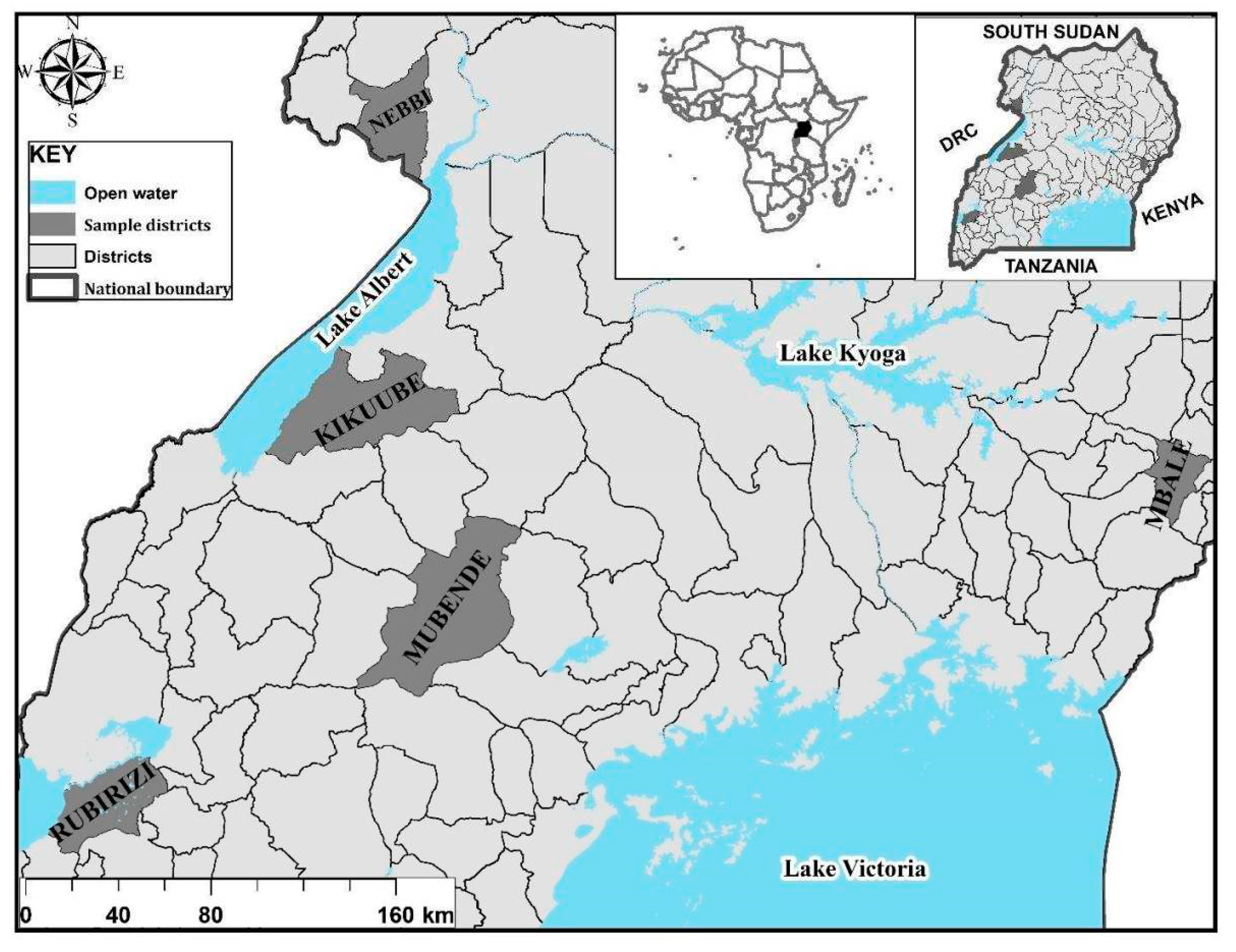

Table 1.
Description of agro-ecological zones of the study areas.
| Agro-ecological zone (District) | Description of agro-ecological zone | Cropping systems |
|---|---|---|
| SWGF (Mubende district) |
Bimodal rainfall ranging from 1000 to1200 mm per year, mean altitude is 1235 metres above sea level, generally flat with short hills, rounded tops and lowland areas. The soils are generally deep with moderate levels of organic matter. | Diverse; majorly bananas, beans, sweet potatoes and maize. |
| WMHF (Rubirizi district) |
Bimodal rainfall ranging from 1000 to1200 mm per year, mean altitude of 1198 metres above sea level), generally rugged terrain with undulating slopes and shallow soils. | Major crops include bananas, maize, beans and sweet potatoes. Cattle rearing, in some few cases, is practiced on large scale. |
| WMFSF (Kikuube district) |
Bimodal rainfall above 1200 mm per year, mean altitude is 1099 metres above sea level, generally undulating with steep slopes and lowlands. The soils are generally deep in low lands and shallow on the upper slopes. | The major crops grown include bananas, maize, sweet potatoes and beans. Coffee and tobacco are the main cash crops. |
| LVCMF (Mbale district) |
Bimodal rainfall above 1200 mm per year, mean altitude is 1213 metres above sea level, varying with steep slopes near Mount Elgon and gentle slopes in western Mbale. The soils are generally red-brown loam and clay with high organic matter content. | Major crops include bananas, sweet potatoes, beans and maize. Coffee is the major cash crop. |
| NWFWS (Nebbi district) |
Unimodal rainfall ranging 1000 to 1200 mm per year, mean altitude is 732 metres above sea level, generally flat with narrow valleys. The soils are generally sandy with low organic matter content. | The major crops grown include Sorghum, maize, sweet potatoes, millet, and cassava. Moderate livestock rearing is practiced |
Source: Adapted from Wortmann and Eledu, (1999).
Table 2.
Computation of the score of a capacity building needs for each respondent.
| Capacity building needs | Specific needs selected by each respondent | Capacity building need | Score of the capacity building need | Interpretation |
|---|---|---|---|---|
| Respondent 1 | R1, R2, R3…Rn | ∑(R1, R2, R3…Rn) | 1 →N | Low → High |
| R1, R2, R3…Rn | ∑(R1, R2, R3…Rn) | |||
| R1, R2, R3…Rn | ∑(R1, R2, R3…Rn) | |||
| Respondent n | R1, R2, R3…Rn | ∑(R1, R2, R3…Rn) |
Table 3.
Percentage of respondents on different capacity building needs for climate change adaptation among small scale farmers in five AGEZs.
Table 3.
Percentage of respondents on different capacity building needs for climate change adaptation among small scale farmers in five AGEZs.
| Hazard | Capacity building need | Agro-ecological zone (percentage of respondents) | ||||
| SWGF | WMHF | WMFSF | LVCMF | NWFWS | ||
| Drought | Awareness | 94.1 | 96.1 | 64.5 | 86.7 | 65.3 |
| Education | 94.7 | 96.7 | 97.7 | 77.2 | 87.3 | |
| Research and technology | 98.0 | 96.7 | 100.0 | 93.3 | 92.9 | |
| Training | 89.0 | 84.7 | 77.8 | 71.1 | 96.4 | |
| Unpredictable rainfall |
Public awareness | 87.3 | 99.8 | 80.6 | 88.2 | 67.6 |
| Education | 98 | 95.6 | 96 | 93.3 | 88.1 | |
| Research and technology | 96.0 | 88.9 | 96.0 | 83.1 | 78.6 | |
| Training | 73.8 | 89.4 | 91.0 | 64.0 | 93.5 | |
Table 4.
Percentage of respondents on specific capacity building needs for drought.
| Need | Specific areas of need | Agro-ecological zone (percentage of respondents) | ||||
| SWGF | WMHF | WMFSF | LVCMF | NWFWS | ||
| Public awareness |
Planning of cropping activities | 96.0 | 99.9 | 46.0 | 97.8 | 70.3 |
| Water harvesting technologies | 99.0 | 100.0 | 97.0 | 96.7 | 84.6 | |
| Irrigation technologies | 97.4 | 100.0 | 96.9 | 66.7 | 55.7 | |
| Proper animal stocking | 92.1 | 100.0 | 53.0 | 83.3 | 66.7 | |
| Soil water conservation practices | 98.0 | 100.0 | 98.0 | 96.6 | 70.3 | |
| Post-harvest management techniques | 87.1 | 92.2 | 90.0 | 81.1 | 79.7 | |
| Onset and cessation of rains | 92.0 | 84.4 | 3.0 | 64.5 | 20.3 | |
| Education | Soil water conservation practices | 92.6 | 95.0 | 96.5 | 69.1 | 86.3 |
| Harnessing water stored in ecosystems | 44.6 | 84.4 | 70.0 | 87.6 | 83.3 | |
| Research and technology | Water harvesting technologies | 87.0 | 95.5 | 100.0 | 60.7 | 87.0 |
| Irrigation technologies | 70.1 | 91.0 | 98.0 | 75.0 | 90.9 | |
| Training | Water harvesting technologies | 99.0 | 98.8 | 100.0 | 91.0 | 100.0 |
| Irrigation technologies | 85.7 | 90.0 | 66.3 | 75.0 | 86.4 | |
| Planning of cropping activities | 49.5 | 49.4 | 50.0 | 45.5 | 50.0 | |
| Soil water conservation techniques | 76.0 | 95.6 | 100.0 | 78.7 | 95.2 | |
Table 5.
Percentage of respondents on specific needs for capacity building to respond to unpredictable rainfall.
Table 5.
Percentage of respondents on specific needs for capacity building to respond to unpredictable rainfall.
| Specific need | Agro-ecological zone (percentage of respondents) | |||||
| SWGF | WMHF | WMFSF | LVCMF | NWFWS | ||
| Public awareness | Planning for cropping activities | 99.1 | 100.0 | 100.0 | 98.9 | 69.1 |
| Soil conservation practices | 100.0 | 100.0 | 98.0 | 91.1 | 65.5 | |
| Water harvesting and storage | 58.4 | 100.0 | 24.0 | 74.4 | 86.9 | |
| Animal care techniques | 84.2 | 100.0 | 81.0 | 78.9 | 42.9 | |
| Post-harvest management techniques | 95.1 | 98.9 | 100.0 | 97.8 | 73.8 | |
| Education | Soil conservation practices | 97.0 | 93.3 | 96.0 | 62.9 | 84.5 |
| Ecosystem management | 100.0 | 31.4 | 94.3 | 16.7 | 80.0 | |
| Research and technology | Water harvesting and storage | 98.7 | 88.9 | 97.9 | 93.7 | 92.8 |
| Training | Off-farm employment | 84.0 | 75.6 | 81.6 | 31.0 | 97.5 |
| Water harvesting and storage | 90.9 | 94.4 | 72.2 | 86.9 | 88.5 | |
| Soil conservation techniques | 14.3 | 82.2 | 82.5 | 45.2 | 87.2 | |
Table 6.
Results of One-Way ANOVA of the adaptive capacity building needs in the different agro-ecological zones.
Table 6.
Results of One-Way ANOVA of the adaptive capacity building needs in the different agro-ecological zones.
| Hazard | Need | Agro-ecological zones | p- value | ||||
| SWGF | WMHF | WMFSF | LVCMF | NWFWS | |||
| Drought | Public awareness | 17.48 ± 4.35 | 17.73 ± 2.93 | 8.47 ± 2.82 | 14.63 ± 4.18 | 9.15 ± 5.15 | 0.000* |
| Education | 3.63 ± 1.32 | 4.07 ± 0.97 | 4.36 ± 0.94 | 2.49 ± 1.08 | 4.18 ± 1.73 | 0.000* | |
| Research and technology | 1.56 ± 0.54 | 1.84 ± 0.45 | 1.98 ± 0.14 | 1.28 ± 0.58 | 1.67 ± 0.61 | 0.000* | |
| Training | 8.52 ± 3.10 | 11.08 ± 2.40 | 13.30 ± 0.90 | 6.72 ± 2.88 | 14.61 ± 3.03 | 0.000* |
|
| Unpredictable rainfall | Public awareness | 10.98 ± 2.56 | 13.23 ± 1.14 | 8.83 ± 2.15 | 9.04 ± 2.94 | 5.82 ± 3.34 | 0.000* |
| Education | 2.51 ± 0.74 | 3.39 ± 0.99 | 2.57 ± 1.08 | 2.04 ± 0.88 | 3.29 ± 1.40 | 0.000* | |
| Research and technology | 0.96 ± 0.20 | 0.89 ± 0.32 | 0.96 ± 0.20 | 0.83 ± 0.38 | 0.79 ± 0.41 | 0.000* | |
| Training | 4.33 ± 1.74 | 7.01 ± 1.19 | 7.43 ± 1.01 | 2.65 ± 1.39 | 7.36 ± 1.53 | 0.000* | |
Table 7.
Results of Turkey’s HSD test showing the mean differences in capacity building needs for drought.
Table 7.
Results of Turkey’s HSD test showing the mean differences in capacity building needs for drought.
| Agro-ecological zone | Public awareness | Education |
Research and Technology |
Training |
|
| i | J | i-j | i-j | i-j | i-j |
| SWGF | WMHF | -0.26 | -0.43 | -0.28* | -2.56* |
| WMFSF | 9.01* | -0.72* | -0.42* | -4.78* | |
| LVCMF | 2.84* | 1.14* | 0.30* | 1.80* | |
| NWFWS | 8.32* | -0.54* | -0.11 | -6.09* | |
| WMHF | SWGF | 0.26 | 0.43 | 0.28* | 2.56* |
| WMFSF | 9.26* | -0.29 | -0.14 | -2.22* | |
| LVCMF | 3.10* | 1.57* | 0.56* | 4.36* | |
| NWFWS | 8.58* | -0.11 | 0.18 | -3.53* | |
| WMFSF | SWGF | -9.01* | 0.73* | 0.42* | 4.78* |
| WMHF | -9.26* | 0.29 | 0.14 | 2.22* | |
| LVCMF | -6.16* | 1.87* | 0.70* | 6.58* | |
| NWFWS | -0.68 | 0.18 | 0.31* | -1.31* | |
| LVCMF | SWGF | -2.84* | -1.14* | -0.28* | -1.80* |
| WMHF | -3.10* | -1.57* | -0.56* | -4.36* | |
| WMFSF | 6.16* | -1.87* | -0.70* | -6.58* | |
| NWFWS | 5.48* | -1.68* | -0.39* | -7.89* | |
| NWFWS | SWGF | -8.32* | 0.55* | 0.11 | 6.09* |
| WMHF | -8.58* | 0.11 | -0.18 | 3.53* | |
| WMFSF | 0.68 | -0.18 | -.31* | 1.31* | |
| LVCMF | -5.48* | 1.68* | 0.39* | 7.89* | |
*. The mean difference is significant at 0.05 level.
Table 8.
Results of Turkey’s test showing the mean differences in capacity building needs for unpredictable rainfall.
Table 8.
Results of Turkey’s test showing the mean differences in capacity building needs for unpredictable rainfall.
| Agro-ecological zone | Public awareness | Education | Research and technology | Training | |
| i | J | i-j | i-j | i-j | i-j |
| SWGF | WMHF | -2.25* | -0.87* | 0.07 | -2.68* |
| WMFSF | 2.15* | -0.06 | 0.00 | -3.10* | |
| LVCMF | 1.94* | 0.47* | 0.13* | 1.68* | |
| NWFWS | 5.16* | -0.77* | 0.17* | -3.03* | |
| WMHF | SWGF | 2.25* | 0.87* | -0.07 | 2.68* |
| WMFSF | 4.40* | 0.82* | -0.07 | -0.42 | |
| LVCMF | 4.19* | 1.34* | 0.06 | 4.36* | |
| NWFWS | 7.41* | 0.10 | 0.10 | -0.346 | |
| WMFSF | SWGF | -2.15* | 0.06 | 0.00 | 3.10* |
| WMHF | -4.40* | -0.82* | 0.07 | 0.42 | |
| LVCMF | -0.21 | 0.53* | 0.13* | 4.78* | |
| NWFWS | 3.01* | -0.72* | 0.17* | 0.07 | |
| LVCMF | SWGF | -1.94* | -0.47* | -0.13* | -1.68* |
| WMHF | -4.19* | -1.34* | -0.06 | -4.36* | |
| WMFSF | 0.21 | -0.53* | -0.13* | -4.78* | |
| NWFWS | 3.22* | -1.24* | 0.05 | -4.71* | |
| NWFWS | SWGF | -5.16* | 0.77* | -0.17* | 3.03* |
| WMHF | -7.41* | -0.10 | -0.10 | 0.35 | |
| WMFSF | -3.01* | 0.72* | -0.17* | -0.07 | |
| LVCMF | -3.22* | 1.24* | -0.05 | 4.71* | |
*. The mean difference is significant at 0.05 level.
Disclaimer/Publisher’s Note: The statements, opinions and data contained in all publications are solely those of the individual author(s) and contributor(s) and not of MDPI and/or the editor(s). MDPI and/or the editor(s) disclaim responsibility for any injury to people or property resulting from any ideas, methods, instructions or products referred to in the content. |
© 2023 by the authors. Licensee MDPI, Basel, Switzerland. This article is an open access article distributed under the terms and conditions of the Creative Commons Attribution (CC BY) license (http://creativecommons.org/licenses/by/4.0/).
Copyright: This open access article is published under a Creative Commons CC BY 4.0 license, which permit the free download, distribution, and reuse, provided that the author and preprint are cited in any reuse.


