
Submitted:
14 November 2023
Posted:
16 November 2023
You are already at the latest version
Abstract
Traditional Corporate Social Responsibility (CSR)-programs rarely include participatory components that connect CSR-activities of private companies with their local communities. However, there is an increasing demand to include citizens as well as the resources and expertise of the private sector in the design and implementation of local community planning processes. To assess the potential, opportunities, and challenges of including private companies into participatory community planning at a local level, we analyzed the experiences that we collected during the piloting phase and the commercial roll-out of the ‘Bürgercockpit’-application for citizen participation, as well as the results of a digital CSR-questionnaire that we shared with different companies in Austria. Our research indicates that most of the participating companies are interested in including local communities into their CSR-projects using a digital tool, if this tool is easy-to-use, easy-to-access, and provides a flexible structure to address specific project requirements as well as properly designed features for stakeholder communication and user feedback. The findings of both, the ‘Bürgercockpit’-pilot study and the CSR-questionnaire provided us valuable input for designing a prototype solution of a digital CSR-tool for participatory community planning at a local level as well as recommendations for future research in this topic of growing interest.
Keywords:
Corporate Social Responsibility (CSR)
; digital participation
; community planning
; citizen participation
1. Introduction
Over the last years, Corporate Social Responsibility (CSR) has become a topic of growing interest that came alongside with societal, political and economic trends influencing the social expectations with regards to corporate behavior [1,2], such as the United Nations’ Millennium Development Goals (MDGs) and Sustainable Development Goals (SDGs) [3,4,5,6], or policies introduced to mitigate the effects of climate change such as the Green Deal of the European Union [7]. With CSR defined as “the continuing commitment by business to behave ethically and contribute to economic development while improving the quality of life of the workforce and their families as well as of the local community and society at large” according to the World Business Council for Sustainable Development [8], CSR-projects and initiatives are common practice within business operations of companies in order to assume their responsibility towards society and the stakeholders of their activities. In addition, CSR-programs help companies to gain reputation, customer loyalty, and customer satisfaction [9,10,11,12,13].
In parallel, citizen participation has become an important asset in local governance, community planning and community development [14,15,16,17,18,19,20]. In this planning context, participation is defined as ”a social process whereby specific groups with shared needs living in a defined geographic area actively pursue identification of their needs, take decisions and establish mechanisms to meet these needs”[21] (p 326), or the “involvement of the local population actively in the decision-making concerning development projects or in their implementation”[22] (p 3). Since 1969, Arnstein’s ladder of citizen participation [23] provides a topology for public engagement and participation with each rung corresponding to the extent of integrating citizens into a decision making process. Scholars and practitioners in participatory community planning frequently resort to this typology when defining the level of citizen empowerment in a planning process [24,25,26,27,28,29].
However, the topic of participation within CSR-programs is typically discussed from the perspective of how employees participate in the selection and implementation of specific CSR-projects within their company; and not from the perspective of citizens or local communities being stakeholders of CSR-projects and CSR-initiatives that are carried out in the neighborhood, municipality, or region where a company is located [30,31,32]. In other words, participation often addresses a company’s workforce rather than the communities at the company location. Hence, traditional CSR-programs of private enterprises rarely include participatory components that connect their social programs with their local communities. Although CSR-projects are occasionally coordinated with local and public authorities [33,34,35], citizens seldomly become active in shaping or informing CSR-initiatives, themselves.
Community planning processes can be enhanced through participatory approaches to connect local companies, citizens, and public authorities as main stakeholders of such processes [13]. CSR-strategies can be developed in co-creation, co-funding, and co-implementation with various stakeholders [36]. This significantly increases the visibility and transparency of CSR initiatives, which, in turn, contributes to the positive perception of the company among the local population [37]. Furthermore, adding the spatial dimension to CSR-initiatives provides an additional asset to participatory community planning by including and addressing relevant spatial information on a local level [38]. Therefore, in accordance with research on participatory approaches in CSR [39,40], this paper seeks to assess the potential of participatory CSR initiatives in a local context, as well as the opportunities and challenges of involving private enterprises in participatory community planning. It proposes a prototype solution of a digital CSR-tool that aims at including the private sector into participatory planning processes on a local level. The paper’s research objectives focus on assessing the needs of companies towards a digital tool to engage in participatory community planning. In line with this research objective, we pose the following research questions: (1) What is are the potential, opportunities, and challenges of including the private sector into participatory community planning at a local level? (2) What are the needs of private enterprises regarding the set-up and the functionalities of a digital CSR-tool for participatory community planning?
To meet the research objectives, we first analyzed the experiences that we collected during the piloting phase and the commercial roll-out of the ‘Bürgercockpit’-application (buergercockpit.org). ‘Bürgercockpit’ is a digital tool for citizen participation and community planning, which has been used since 2017 in several Austrian municipalities, such as Wels, Kremsmünster, Vöcklabruck, Ansfelden, Steyregg, and Michaelnbach, amongst others. Based on these experiences and the CorporateCitizen-survey of Labigne et al. [41], we set up a digital questionnaire that we shared with a total of 80 Austria-based companies of which we received 29 responses. We used the findings of both the piloting phase and the commercial-roll out of the ‘Bürgercockpit’-application as well as the results of the digital questionnaire to design a protype solution of a digital CSR-tool for participatory community planning at a local level.
We first provide a review of related work on CSR-approaches and initiatives and review literature regarding their participatory and spatial components. In the second section of this article, we describe our research methodology. In Section 3, we present our findings of the piloting phase and commercial roll-out of the ‘Bürgercockpit’-application, the results of the questionnaire as well as the set-up and the functionalities of the proposed CSR-prototype solution. In Section 4, we analyze the results of our research and draw conclusions for further research. To conclude, in Section 5 we sum-up our findings regarding the potential, challenges and opportunities of including the private sector into participatory community planning at a local level.
With their CSR-programs, companies aim to follow ethical principles that are not directly required or relevant for their economic activity. Therefore, companies voluntarily commit to environmental and social concerns, and address them within their business activities [42]. CSR initiatives are nowadays mainstream and the number of businesses that include these initiatives (such as donations and charity, green-living and sustainability, support of cultural events, revitalization efforts of cities and regions, alternative use of land, etc.) is steadily growing [43,44,45]. Hence, companies are increasingly taking on social responsibility for their immediate environment as they are discovering their relevance for the development of neighboring cities and regions. Here, companies play an active role in shaping attractive and livable communities and environments [38,46,47] and improve their well-being through business initiatives and resources [37]. Consequently, CSR incorporates social and environmental aspects into business activities [48] where initiatives range between donations and charities. As such, CSR is sometimes criticized for being instrumentalized for businesses' profits and brand reputation [37]. In that regard, CSR practices have also been criticized for being externally enforced (leading to optimizing its results) instead of internally formed in a social, process-oriented way [49].
CSR research dates back to at least the 1950s and has seen a rise in interest since the 1990s [1,50,51]. While the basic and underlying question of CSR is how business can contribute to society, there is still no commonly agreed definition [11,50,52]. Carroll and Brown [53] for example, evaluate the meaning of CSR by dissecting each term. They state that the first term “Corporate” refers to any form and size of business and continue by referencing the second term “Social” “to human society or the life or welfare of a community” (pp 42-43). This also includes any stakeholder that is affected by the business and involves any living being as well as its environment. The term “Responsibility” relates to businesses being held responsible for their “power, control, or management” (p 43) regarding the society and environment they are embedded in.
Even though no common definition exists for CSR, most definitions are similar in that they describe CSR with the help of components such as corporate responsibility, corporate citizenship, sustainability, corporate social performance, conscious capitalism, business ethics or stakeholder management [53,54]. Carroll [55] further describes two different aspects of CSR: protecting and improving society. While companies can mitigate their negative effects on society (i.e., protect the environment by reducing pollution), they can also actively improve society by e.g., philanthropic initiatives. In practice, businesses can leverage the potential of a variety of digital tools to manage and transparently visualize their CSR initiatives (among them, for example, tools such as csr-manager.org, crkompass.de, and tofuture.fi).
As CSR strategies address societal and environmental issues, CSR initiatives inherently possess a spatial dimension, which is addressed by the term Corporate Spatial Responsibility (CSpR) [38,44,56]. CSpR describes spatially-routed business commitments and can be seen as an extension of CSR, which primarily focuses on social and ecological campaigns. Hence, CSpR includes all spatial corporate engagements that can take place on different scales (local, regional, urban, rural) [57]. While, to our best knowledge, not many spatially-enabled digital CSR tools exist, ESRI advertises the possibility to manage CSR practices through their products [58] and TechCSR aims to combine geospatial features with CSR management [59].
The increasing importance of incorporating CSR practices into business agendas is a result of societal pressure on companies for being responsible over stakeholders, communities, and the environment [37,49] by applying “social and ethical standards to their businesses”[60] (p 1). Therefore, especially large companies publish their CSR-initiatives and CSR-campaigns to reflect on this growing interest and attention by the society [50,61]. Since January 2023, the Corporate Sustainability Reporting Directive (CSRD) of the European Union requires companies to publish regular reports on their environmental and social impact activities helping investors, civil society organizations, consumers and other stakeholders to evaluate the sustainability performance of the companies’ business activities [62]. Within this legal framework, the concept of Environmental, Social and Corporate Governance (ESG) [63] should help to measure the sustainability and social impact of business activities as well as to evaluate the CSR-initiatives of companies [64,65,66].
Hence, according to Maclagan [13], integrating internal and social process-oriented methods into CSR campaigns should be participative. With a participatory approach, involving different stakeholders as “moral agents” (p 45), the focus of CSR-practices would center on collaborative decision-making processes. Different examples of participatory approaches in CSR strategies exist. For example, Appe and Barragán [36] describe how Participatory Action Committees (including community stakeholders and representatives) can be formed to co-design and co-implement CSR practices; Puranik [40] delineates methodological solutions to integrating the participation approach in a CSR plan; Anser et al. [39] review how the participatory approach with hotel and tourism managers enhances CSR-practices in terms of their social and environmental impact; and Sattayapanich et al. [9] discuss the factors that affect community participation in environmental CSR-projects.
2. Materials and Methods
The methodology of the presented research is organized as follows: (1) analysis of our experiences made during the piloting phase and the commercial roll-out of the ‘Bürgercockpit’-application between 2017 and 2022; (2) assessment of the potential, opportunities and challenges of participatory CSR-initiatives on local level through a digital questionnaire that we shared amongst different companies; and (3) design of a prototype solution of a P-CSR (‘Participatory-CSR')-tool for participatory community planning, based on the results of steps 1 and 2.
2.1 The ‘Bürgercockpit’-Application Piloting Phase and Commercial Roll-Out
The ‘Bürgercockpit’-application is the German-language derivate of the GeoCitizen-framework and application for community planning (geocitizen.org) that combines participatory components with geospatial features. The framework and application enable geo-referenced discussion and collaboration processes for various application domains, facilitating transparent and sustainable planning and design processes and uses geospatial features as a communication medium [67,68,69,70,71].
According to the design principals of Digital Development [72], we developed both, the conceptual framework as well as the ‘Bürgercockpit’-application in a collaborative, incremental and iterative process from diverse disciplines and constant reference to user needs, starting in 2012 [70,73,74,75]. We applied a cross-platform approach to ensure uniform access across a variety of devices (e.g., web, mobile, and desktop platforms), which helps minimizing development and maintenance costs since only one single code base exists. We used Progressive Web Apps (PWA), which also support offline use along with mobile-like features such as push notifications, local storage, and automatic updates. We further implemented a backend REST API that ensures scalability for future growth (e.g., a growing user base and content) and at the same time enables platform-independent access and granularity for user- and data-model-based authorization control policies. Additionally, we used Bearer Token-based OAuth2 for authentication and authorization, which provides ubiquitous and secure standards, and offers the possibility to integrate third-party client applications.
Within the United Nations action plan for sustainable development processes “Agenda 21”, the ‘Bürgercockpit’-application has been applied in Austria since 2017 in a series of pilot studies through facilitators such as the Public Agency for Regional Development of the Province of Upper Austria (rmooe.at) and the Upper Austrian Future Academy (ooe-zukunftsakademie.at/about-us.htm). Following the guidelines of Community Based Participatory-Action Research (CBPAR/AR) [76,77], we tested and improved the ‘Bürgercockpit’-application in these pilot studies in an iterative process of constant feedback loops provided by typical stakeholders of community planning processes, such as community leaders, process managers, and representatives from municipalities or other planning authorities. In order to gather further feedback for our research and the development of the tool, we presented and discussed the “GeoCitizen/Bürgercockpit”-framework and application on scientific conferences and stakeholder community symposia (see Table S1). This participatory research approach aligns with the claim of transformative science that ‘promotes societal transformation processes through […] technical and social innovations’ [78] (p 374). After completing the piloting phase of two years, the ‘Bürgercockpit’-application was then launched as a commercial product by a spin-off of the University of Salzburg that aims at commercializing the results of the university’s research projects (SpatialServices GmbH, Salzburg, Austria, spatial-services.com/en/geocitizen). Chapter 3.1 presents the insights gathered during the piloting phase and commercial roll-out of the ‘Bürgercockpit’-application.
2.2 CSR-Questionnaire
For setting-up the digital (CSR-)questionnaire, we referred to the CorporateCitizen-survey of Labigne et al. [41] in addition to the insights gained during the piloting phase and the commercial roll-out of the ‘Bürgercockpit’-application, described in the previous chapter. We contacted a total of 80 companies and asked them to complete the questionnaire. These companies either have been previously shown interest in the research topic during the piloting phase or the commercial roll-out of the ‘Bürgercockpit’-application or are well-established enterprises in the Austrian Provinces of Salzburg and Upper Austria that partly already run their own CSR-initiatives. In total, authorized representatives (company owners, CEOs, sustainability managers, asset managers, head of communications, etc.) of 29 companies provided feedback to the questionnaire (see Appendix A). According to the definition of the European Commission [79], we classified the company size in Small and Mid-sized Enterprises (SMEs) with 250 or less employees and large enterprises with more than 250 persons employed. In addition, we classified the company location in rural areas with municipalities with less than 20000 inhabitants, and mid-sized and big cities with 20000 or more inhabitants, according to the definition provided in the Austrian Spatial Planning Report 2018-2020 [80]. Table 1 depicts the number of participating companies in terms of company size and location.
We set up the CSR-questionnaire in SurveyMonkey in three different sections with a total of 27 questions. The first section of the questionnaire aimed at gaining a better understanding of the experiences that the participating companies already gathered in the field of CSR, as well as at assessing the potential of participatory CSR-initiatives in a local context. The second section of the questionnaire sought to assess opportunities and challenges of involving companies in community planning processes at a local level. It also collected the companies’ ideas how this involvement specifically should be designed, using a digital tool. The third and last section of the questionnaire gathered further information on the participating companies, allowing the aggregated analysis of answers regarding company size and company location. The questions were integrated in a smart question tree structure, where selected questions pointed to alternate subsequent questions depending on the response. All questions were optional, allowing the participants to skip the question where they did not want to give an answer. Table S2 provides the full set of questions and their answer types, together with the total number of answers for each question as well as the participants’ responses. Chapter 3.2 presents the results of the CSR-questionnaire.
2.3. P-CSR Prototype Set-Up
We used the input of both, the insights collected during the piloting phase and commercial roll-out of the ‘Bürgercockpit’-application, as well as the analysis of the participants’ answers to the CSR-questionnaire to set-up a prototype solution of a participatory CSR-tool as a modular extension of the existing ‘Bürgercockpit’-application. We describe design and functionalities of the protype in Chapter 3.3.
3. Results
3.1 Piloting Phase and Commercial Roll-Out of the ‘Bürgercockpit’-Application
The piloting phase and the commercial roll-out of the ‘Bürgercockpit’-application showed that there is considerable interest by municipalities and other stakeholders of community planning processes, such as Local Action Groups (LAGs) supported through the EU LEADER-program for Community-Led Local Planning (CLLD) [81], to better integrate the private sector into participatory community planning processes, in particular local enterprises. Specifically, the representatives of municipalities (e.g. mayors, chief officers or the municipal executive board) as well as external professional facilitators who are in charge of coordinating and supervising community planning projects within the Agenda 21-initiative in Austria, expressed their need to (better) address private enterprises and their CSR-programs for the collaborative and transparent planning, implementation and funding of tangible community projects (e.g. the renovation of historic buildings, the reshaping of public spaces, the organization of community events or the set-up of community centers for young or elderly people).
3.2 CSR-Questionnaire
The following section analyses the answers of the 29 participants that completed the CSR-questionnaire. It is structured according to the two main thematic sections of the questionnaire. We present (a) an overall analysis of the participants’ answers, and (b) for selected questions, an analysis of the answers aggregated according to the size and the location of the companies represented by the participants.
3.2.1. Questionnaire Part 1: Experiences and Potential of Local CSR-Initiatives
In the first part of the questionnaire, we collected feedback on experiences of the participating companies in the field of CSR and assessed the potential of participatory CSR-initiatives in a local context.
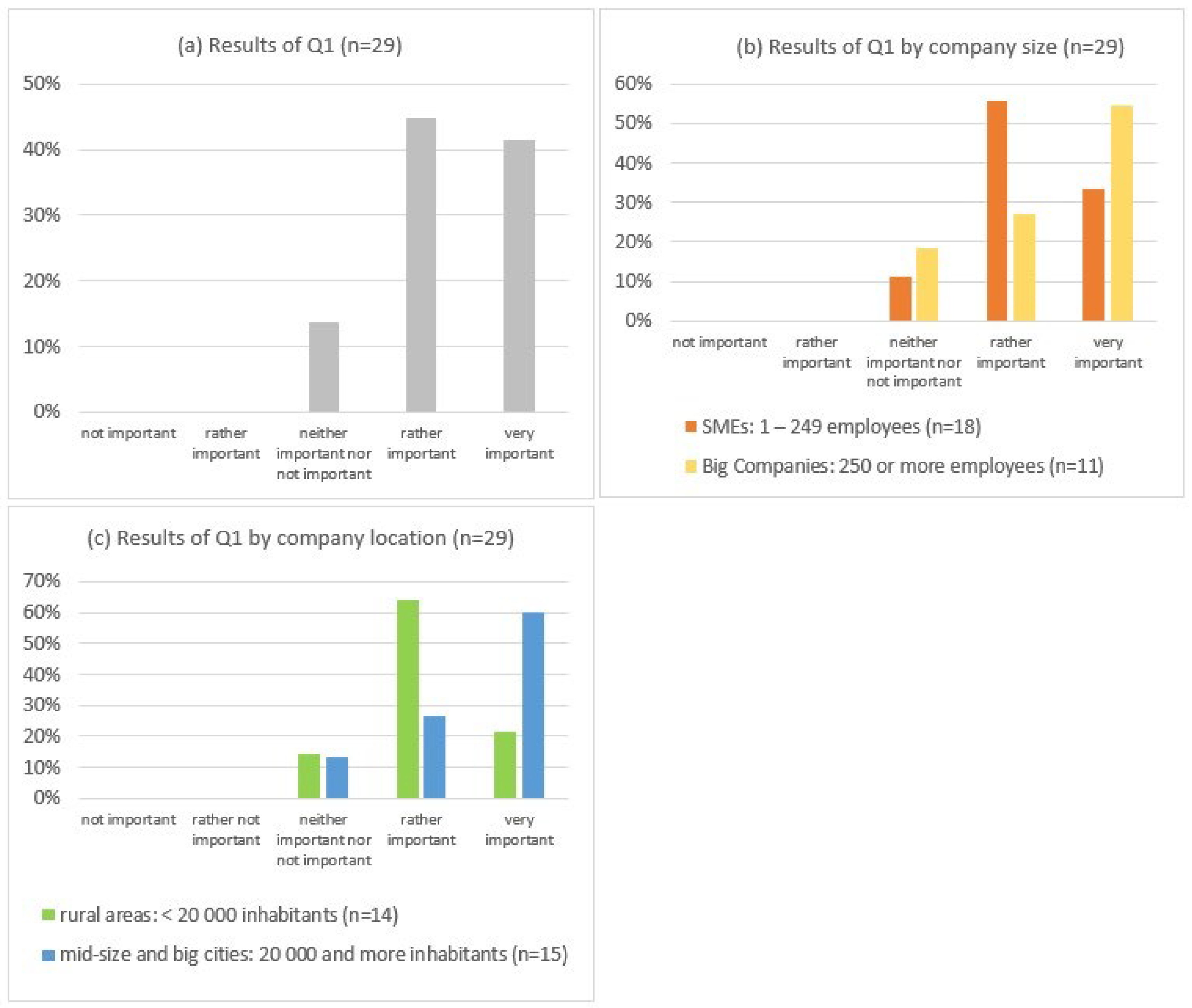
Figure 1a–c depicts the results of Question 1 (Q1). For the vast majority of the 29 participants, the engagement of their company in social relevant issues is an important subject: for 12 participants (41%) it is very important, for 13 participants (45%) it is rather important, whereas for 4 participants (14%) it is neither important nor not important. None of the participating companies mentioned that the subject was not important (see answers rather not important and not important). On a rating scale from 1 (not important) to 5 (very important), the answers’ weighted average was 4.28. Participants representing big and mid-sized companies as well as companies located in mid-sized and big cities tend to slightly consider this topic more important than participants representing SMEs and companies located in rural areas.
Figure 1.
Responses to Question 1: How important is it for your company to show engagement in socially relevant issues? (a) all answers; (b) aggregated results according to company size; (c) aggregated results according to company location.
Figure 1.
Responses to Question 1: How important is it for your company to show engagement in socially relevant issues? (a) all answers; (b) aggregated results according to company size; (c) aggregated results according to company location.
27 out of 29 participants (93%) are familiar with the concept of CSR (Question 2; Q2), and 22 out of 29 participants (76%) have already carried out CSR-projects with their company (Question 3; Q3). All participating big companies (11 participants) and 61% of the participating SMEs (11 participants) have already carried out CSR-projects, as well as 79% of companies located in mid-sized and big cities (11 participants) and 73% of companies located in rural areas (11 participants). All 13 participants who have not yet carried out CSR-projects with their companies, are either considering (7 participants; 53%) or possibly considering (6 participants; 47%) doing so in the future (Question 11; Q11).
16 out of the 22 participating companies who have already carried out CSR-projects (73%), have also done so at their company location (Question 4; Q4). This is a total of 55% of the overall 29 participants. The aggregated results (according to company size and company location) are similar to those of the previous question (Q3): Of those participating companies who have already carried out CSR-projects (n=16), all of the big companies (11 participants) and 73% of the SMEs (8 participants), have also supported specific community planning projects at their company location. Whereas 73% (8 participants) of both, companies located in mid-sized and big cities as well as companies located in rural areas who have already carried out CSR-projects, supported projects at their company location.
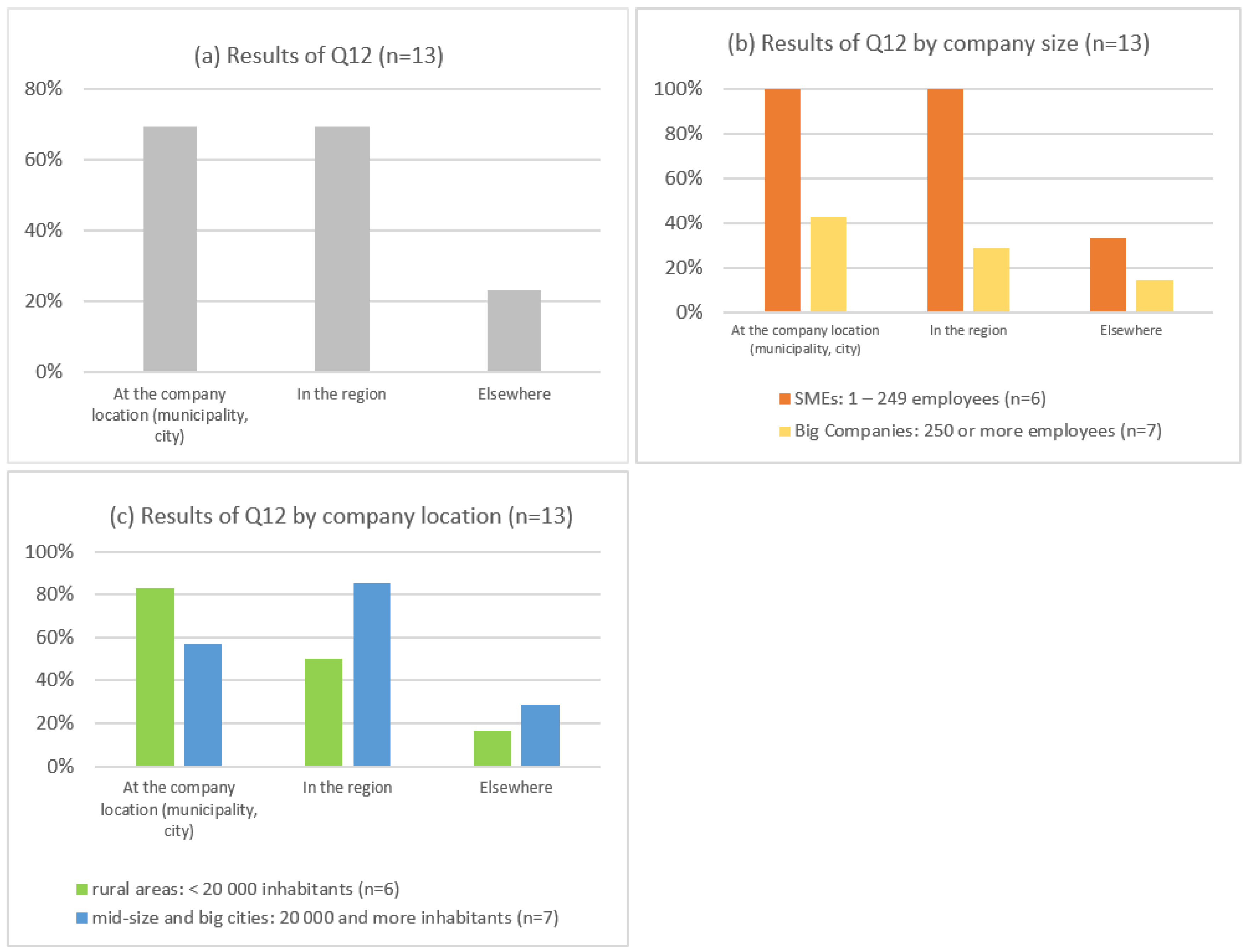
Figure 2a–c depicts the results of Question 12 (Q12) (multiple choices were possible). Here, of those 13 participating companies that have not yet carried out CSR-projects with their companies, 9 participants (69%) can imagine carrying out community planning projects at the company location (municipality or city), as well as in their region (Q12). 3 participants (23%) can imagine doing so in another geographic setting. All participating SMEs who have not yet carried out CSR-projects, plan to do so either at the company location or in the region. This does not apply to the participating big companies: only 3 participants (43%) plan to carry out a CSR-project at the company location, and 2 participants (29%) in the region. These results considerably differ from the results of Q3.
Figure 2.
Responses to Question 12: At which geographical scale can you imagine carrying out community planning projects? (a) all answers; (b) aggregated results according to company size; (c) aggregated results according to company location
Figure 2.
Responses to Question 12: At which geographical scale can you imagine carrying out community planning projects? (a) all answers; (b) aggregated results according to company size; (c) aggregated results according to company location
With a weighted average of 3.33, the level of experience of those 16 participating companies that have already supported community planning projects at their company location, is slightly above average on a rating scale from 1 (not experienced) to 5 (very experienced) (Question 5; Q5). The assessment of all provided answers to this question, as well as the aggregated results (according to company size and company location) is presented in Figure 3a–c. The results of the question are similar to the results of Q4: companies located in mid-sized and big cities as well as big companies are more experienced in supporting community planning projects than companies in rural areas and SMEs.
Figure 3.
Responses to Question 5: How experienced is your company in supporting specific community planning projects? (a) all answers; (b) aggregated results according to company size; (c) aggregated results according to company location
Figure 3.
Responses to Question 5: How experienced is your company in supporting specific community planning projects? (a) all answers; (b) aggregated results according to company size; (c) aggregated results according to company location
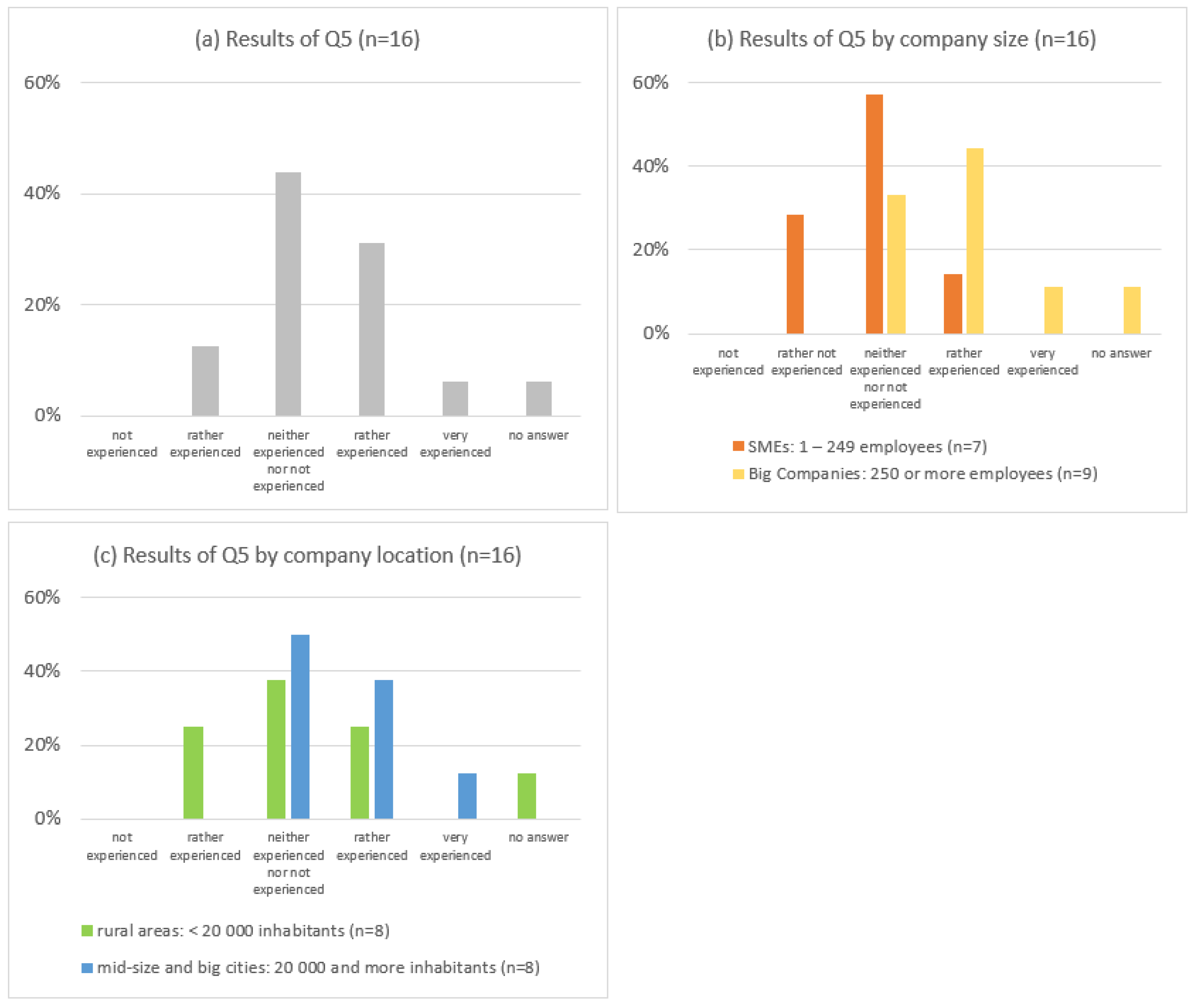
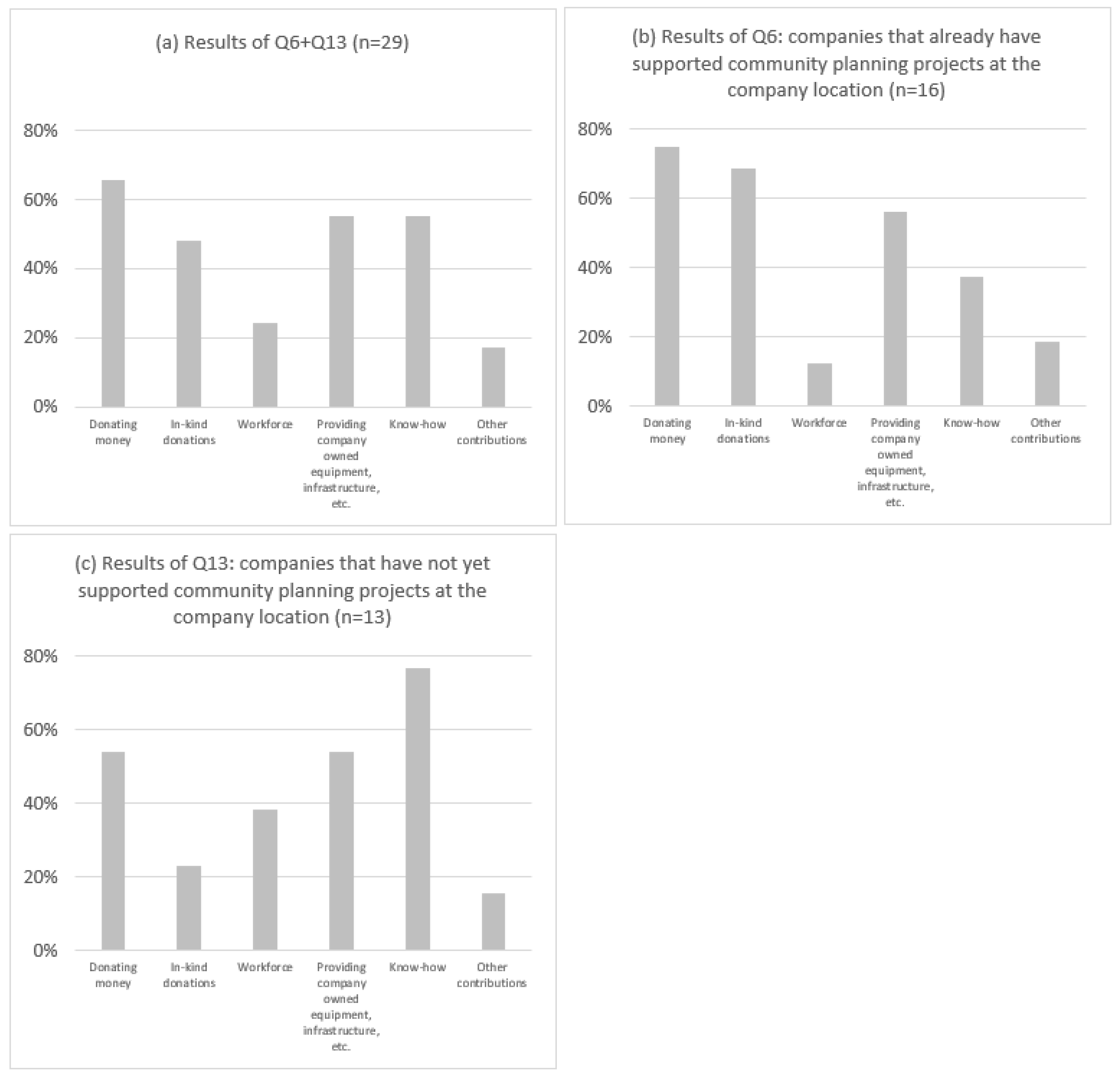
Figure 4a–c depicts the results of Question 6 (Q6) and Question 13 (Q13) that aim at assessing the type of support that has already been provided to specific community planning projects by the participating companies, or the type of support that could be possibly provided by the companies in the future. The aggregated analysis of the answers to Q6 and Q13 of all participants (n=29) shows following results: the participating companies have either already supported specific community planning projects at their company location (Q6), or can imagine doing so (Q13) through the donation of money (19 participants; 66%), company owned equipment, infrastructure, etc. (16 participants; 55%), know-how (16 participants; 55%), in-kind donations (14 participants; 48%), workforce (7 participants; 24%) or in another way (5 participants; 17%). Whereas those companies that already have supported community planning projects mostly donated money (12 participants; 75%) and provided in-kind donations (11 participants; 69%), those companies who have not yet done so would focus on sharing know-how with their communities (12 participants; 80%).
Figure 4.
Responses to Questions 6 and 13: How did your company contribute to specific community planning projects (at your company location)? (a) all answers to Q6 and Q13; (b) all answers to Q6; (c) all answers to Q13
Figure 4.
Responses to Questions 6 and 13: How did your company contribute to specific community planning projects (at your company location)? (a) all answers to Q6 and Q13; (b) all answers to Q6; (c) all answers to Q13
Question 7 (Q7) and Question 14 (Q14) address the type of projects that the participating companies have already supported (Q7) or would probably support in the future (Q14). Here, the provided answers were related to following topics (answers aggregated to thematic categories): housing and mobility, energy and local food supply, environment and education, the support of young, elderly, and disabled community members, as well as the funding of community events and donations to local associations (such as the fire patrol, sports clubs and cultural associations). The list of all answers to Q7 and Q14 is presented in Table S3.
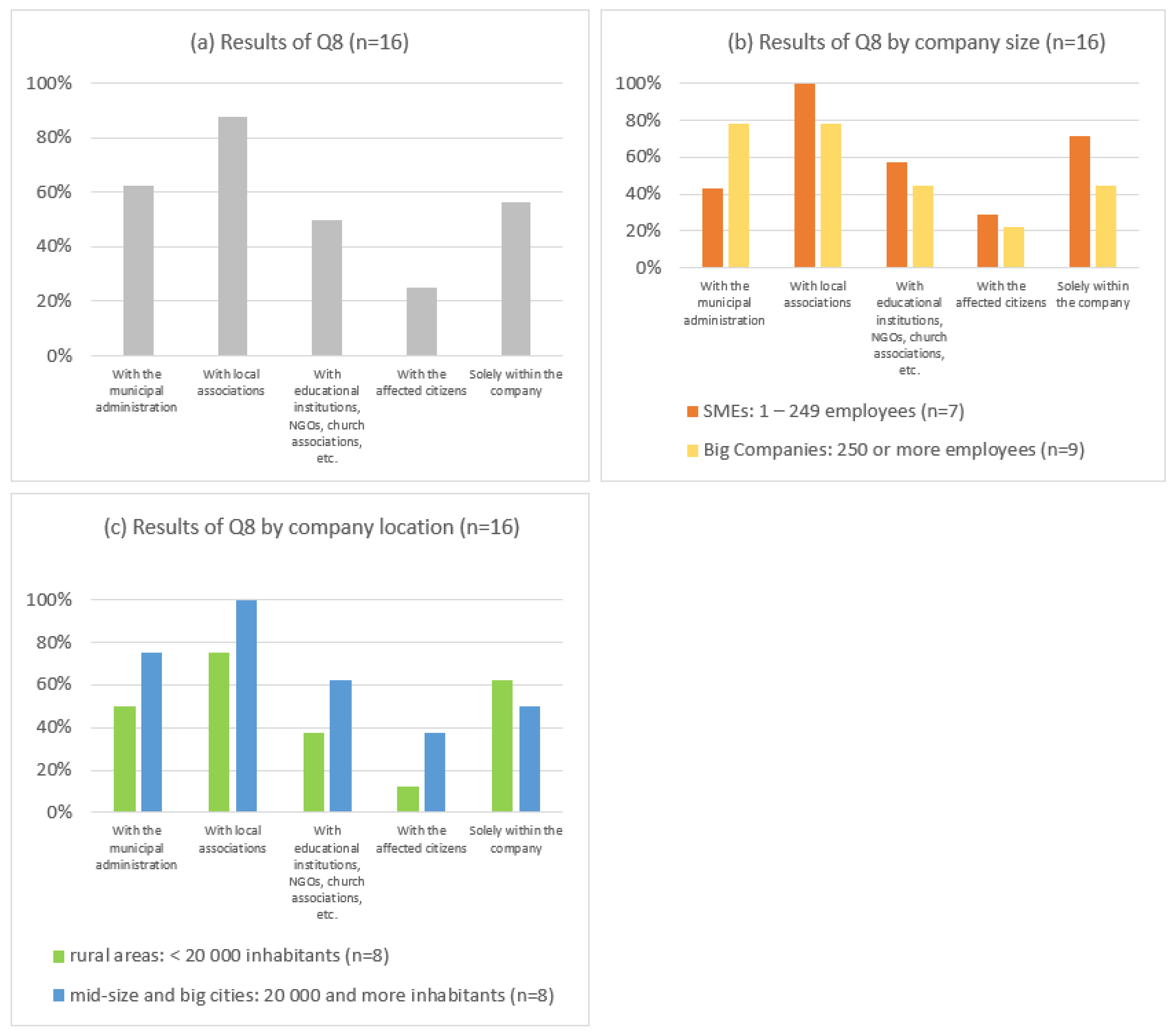
Figure 5a–c depicts the results of Question 8 (Q8) (multiple choices were possible). Here, most of the 16 participating companies that have already supported specific community planning projects at their company location, discussed these projects with local associations (14 participants; 88%). 10 participants (63%) did so with the municipal administration, and 8 participants (50%) with educational institutions, NGOs, church associations, etc. 9 participants (56%) discussed these projects solely within their company, and only 4 participants (25%) had discussions with local citizens. No one of the participants discussed these projects with other people, interest groups or institutions. Only 3 of the participating SMEs (43%) discussed specific community planning projects with the municipal administration, whereas the majority of the participating big companies (7 participants; 78%) did so. A similar pattern can also be observed in terms of the company location: whereas 4 of the participating companies in rural areas (50%) discussed these projects with the municipal administration, 6 of the participating companies in mid-sized and big cities did so (75%).
Figure 5.
Response to Question 8: With whom did your company discuss/decide which projects were supported? (a) all answers; (b) aggregated results according to company size; (c) aggregated results according to company location
Figure 5.
Response to Question 8: With whom did your company discuss/decide which projects were supported? (a) all answers; (b) aggregated results according to company size; (c) aggregated results according to company location
Only 2 of the 16 participating companies (13%) that have already supported specific community planning projects at their company location are currently using a digital tool (mobile application, website, etc.) or have used one in the past to support their companies’ CSR-initiatives (Question 9; Q9 and Question 10; Q10). Regarding the total of 29 participating companies, this is a share of 7%.
3.2.2. Questionnaire Part 2: Opportunities and Challenges
In the second part of the questionnaire, we assessed opportunities and challenges of involving companies into community planning processes at a local level. We also collected the participating companies’ ideas how this involvement should be designed, specifically by using a digital tool (mobile application, websites, etc.).
Question 15 (Q15) and Question 16 (Q16) assess the opportunities and challenges for the participating companies that come along with supporting a community planning project at the company location. The most frequent answers to Q15 (opportunities) refer to following topics (answers aggregated to thematic categories): (a) creating a positive company image at the company location (municipality or region) (16 participants; 55%); (b) fostering the motivation and loyalty of current employees as well as facilitating the recruitment of new employees (16 participants; 55%); (c) promoting marketing activities and customer loyalty (6 participants; 21%); and (d) assuming (ethical) responsibility for communities at the company location (6 participants; 21%). The most frequent answers to Q16 (challenges) refer to following topics (answers aggregated to thematic categories): (a) unrealistic expectations of communities regarding the number of projects that can be supported and/or the intensity of support that can be provided (8 participants; 28%); (b) proper selection and coordination of projects that meet ethical values of communities and project stakeholders (sustainability, transparency, efficiency, etc.) (7 participants; 24%); (c) (human) resources that are committed to the supported projects (4 participants; 14%); and (d) monetary costs of supported projects (3 participants; 10%). 5 participants (17%) do not see any or hardly see any challenges or risks. The list of all answers to Q15 and Q16 is presented in Table S3.
Figure 6a–c presents the answers to Question 17 (Q17). On a rating scale from 1 (not important) to 5 (very important), the vast majority of all participants (n=29) consider the inclusion of citizens in the selection and implementation of a project that is supported by the participants’ companies as either rather important (18 participants; 62%) or very important (5 participants; 17%). For only two participants (7%) this is neither important nor not important or rather unimportant. For one participant (3%) it is not important, and another participant did not provide an answer to this question. The weighted average of all provided answers is 3.86. According to the answers to this question, the participating companies in mid-sized and big cities tend to consider the topic as more important (rather important: 9 participants, 60%; very important: 5 participants, 33%) than the participating companies in rural areas (rather important: 6 participants, 43%; very important: 0 participants).
Figure 6.
Responses to Question 17: How important do you consider the participation of the citizens in the selection and implementation of the process/project that is supported by your company? (a) all answers; (b) aggregated results according to company size; (c) aggregated results according to company location
Figure 6.
Responses to Question 17: How important do you consider the participation of the citizens in the selection and implementation of the process/project that is supported by your company? (a) all answers; (b) aggregated results according to company size; (c) aggregated results according to company location
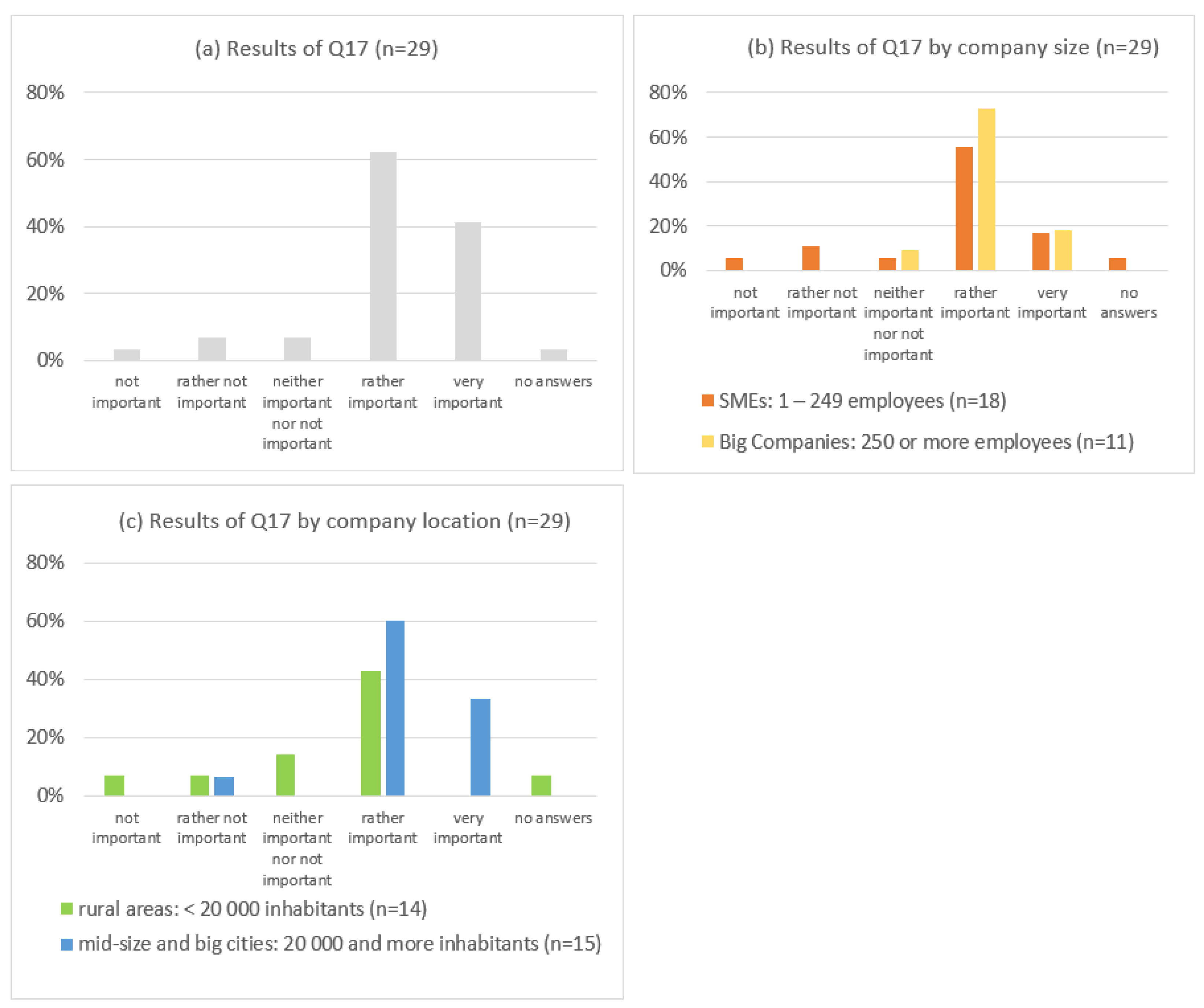
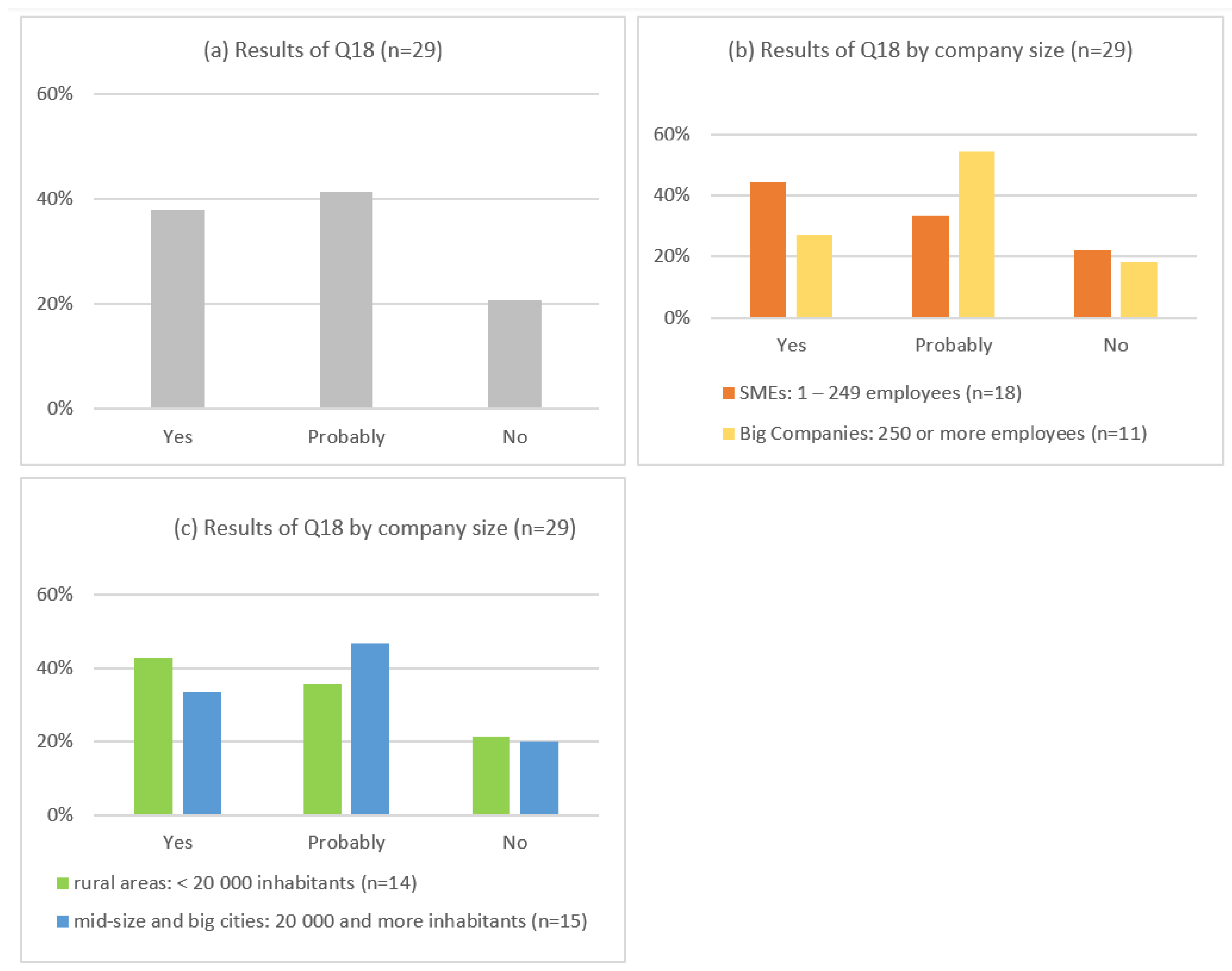
Figure 7a–c presents the answers to Question 18 (Q18), where we asked the participating companies whether or not they would use a digital tool (mobile application, website, etc.) for collaborating with the affected citizens and the (local) administration when designing a community project and monitoring its implementation. Here, 11 participating companies (38%) would use such a tool, 12 participating companies (41%) would probably use such a tool, and 6 participating companies (21%) would not do so. Participating SMEs (Yes: 8 participants, 44%; Probably: 6 participants, 33%) and participating companies in rural areas (Yes: 6 participants, 43%; Probably: 5 participants, 36%) are slightly more positive towards the use of a digital tool, than the participating big companies (Yes: 3 participants, 27%; Probably: 6 participants, 55%) and the participating companies in mid-sized and big cities (Yes: 5 participants, 33%; Probably: 7 participants, 47%).
Figure 7.
Responses to Question 18: Would you use a digital tool (mobile application, website, etc.) for collaborating with the affected citizens and the (local) administration when designing the project and monitoring its implementation? (a) all answers; (b) aggregated results according to company size; (c) aggregated results according to company location
Figure 7.
Responses to Question 18: Would you use a digital tool (mobile application, website, etc.) for collaborating with the affected citizens and the (local) administration when designing the project and monitoring its implementation? (a) all answers; (b) aggregated results according to company size; (c) aggregated results according to company location
Question 19 (Q19) assesses the participating companies’ ideas and preferences regarding the set-up and the functionalities of a digital CSR-tool for participatory community planning at a local level. 23 of the 29 participating companies answered this question and provided following feedback on important parameters for the set-up of such a tool (answers aggregated to thematic categories): (a) simple and intuitive design (i.e., good usability) as well as easy accessibility (10 participants; 43%), (b) clear and project-specific structure as well as flexible user management (6 participants; 26%), (c) transparent presentation of stakeholder responsibilities as well as the maximum level of citizen participation in decision making processes of a specific a project (2 participants; 7%), security and privacy protection standards (2 participants; 7%), and the free of charge licensing and use of the tool. Following functionalities were considered as important: (a) features for stakeholder communication and user feedback (5 participants; 22%), features for spatial data integration and visualization (2 participants; 7%), online-polling (1 participant; 4%), and the transparent branding of supporting companies (1 participant; 4%). The list of all answers to Q19 is presented in Table S3.
3.3. P-CSR Prototype Solution
Based on the analysis of (a) the experiences made during the piloting phase and the commercial roll-out of the ‘Bürgercockpit’-application, as well as (b) the results of the CSR-questionnaire, we amended the architecture and functionalities of the ‘Bürgercockpit’-application with various CSR-specific components for designing the P-CSR prototype solution. Then, we integrated these components as an additional CSR-module into the existing application. As a result, the P-CSR prototype solution provides the following main functionalities:
- Local and thematic channels: CSR-initiatives in participatory community planning can be based on local, temporal and thematic components. To reflect these components also within the P-CSR prototype solution, we divided the information of CSR-practices into spatial and thematic entities (channels).
- User roles: For each of these channels, it is possible to assign different roles and authorizations to different channel users. The moderation of a channel, for example, is essential in participatory and collaborative platforms and in line with legislative requirements such as the EU GDPR (General Data Protection Regulation) and the German Network Enforcement Act. The moderator status can be assigned to a single user or a group of users who obtain extended permissions within each channel to structure discussions, communicate with external stakeholders and moderate the content (e.g., whenever the content does not comply with internet netiquette or general terms and conditions). A specific user role can be assigned to representatives of companies that want to engage in a participatory community planning process in advisory capacity (e.g., designing a community survey or moderating a discussion thread) or as sponsors.
- Participatory and spatial functionalities: A range of tools such as interactive geo-referenced surveys, polls, geospatial features and maps, as well as community-driven data collection can be integrated in channel posts and constitute key components in the discussion process on CSR-practices. These functionalities are complemented by elements such as liking, flagging, and labeling posts as well as replying to and commenting on posts. A discussion forum allows the set-up of structured processes for a collaborative development of ideas, proposals, as well as the implementation and monitoring of specific community initiatives. A set of labels enables the moderator(s) to guide the process of accepting, discussing, or rejecting ideas or initiatives (see Figure 8).
- Sponsorships: Companies can support a participatory community planning process by (a) sponsoring the design and implementation of a specific idea or initiative, or (b) assuming the license fees of a specific community channel. To prevent fraud or fraudulent behavior, companies are verified prior to becoming a supporter of a channel. In any case, these sponsoring activities are transparently listed and described in the corresponding channel(s).
Figure 8.
P-CSR Prototype interface
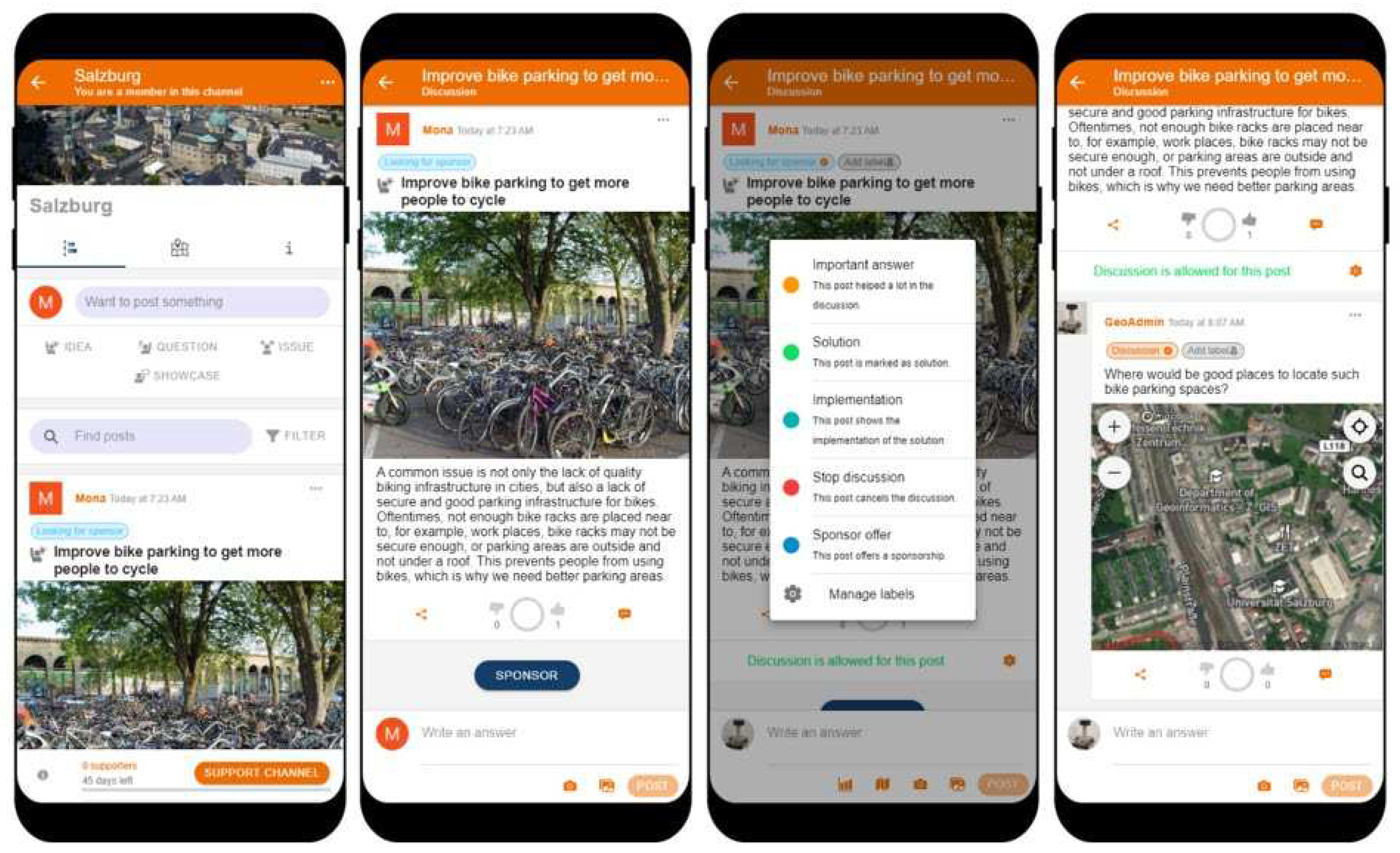
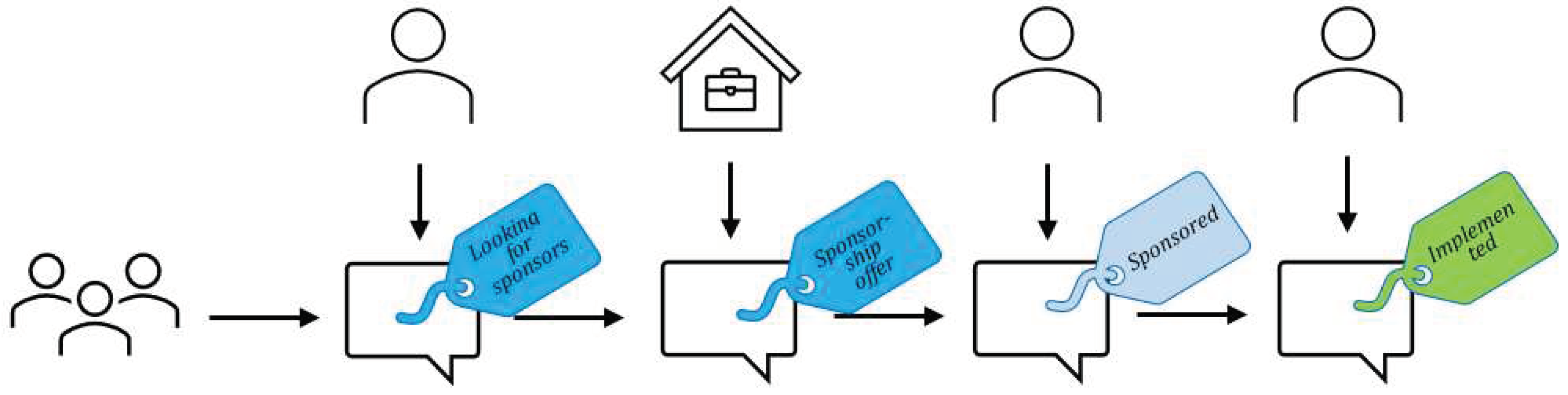
Figure 9 describes a typical workflow of how companies can support the design and the implementation of a community initiative, using the P-CSR prototype. As part of the participatory process, the users propose, discuss and develop their ideas on the platform. Channel moderators can mark selected user posts or entire discussion threads that propose an interesting idea or initiative with the label ‘looking for sponsors’. A company that is interested in sponsoring this idea or initiative, then can express its interest and specify how this support could look like (e.g., through funding, know-how, manpower, material resources, etc.) with the label ‘sponsorship offer’. In a next step, the moderator accepts the sponsorship offer and labels the selected idea or the discussion thread as ‘sponsored’. After the successful implementation of the sponsored idea or community initiative or idea, the moderator labels the post or discussion thread as ‘implemented’.
Figure 9.
Workflow of sponsoring a P-CSR proposal
If a company decides to not only sponsor a specific idea but several initiatives of a community (e.g., as part of a local Agenda 21-process), it can assume the license fees of a community channel through an integrated online payment tool (PayPal); if desired also as supporter of a crowd-funding initiative of different donors. And finally, companies can also set-up and moderate their own community channel for managing their own, local CSR-initiatives.
4. Discussion
The piloting phase and the commercial roll-out of the ‘Bürgercockpit’-application showed that municipalities and other stakeholders such as professional facilitators and Local Action Groups (LAGs) have considerable interest in the integration of the private sector and their CSR-initiatives into the participatory design and implementation of community planning processes. However, they do not yet count on a transparent and structured framework or an easy-to-use (digital) tool to transparently manage the desired inclusion of local companies into such processes at a local level and in a participatory manner.
The results of the CSR-questionnaire support the findings of the previous piloting phase and the commercial roll-out of the ‘Bürgercockpit’-application. The vast majority of the participating companies are familiar with the concept of CSR (Q2) and consider their engagement in social relevant issues as an important subject (Q1). Most of them have already carried out CSR-projects in general (Q3) and at their company location in specific (Q4). This applies particularly to big companies (250 and more employees) in mid-sized to big cities (20000 or more inhabitants) that according to our findings are more experienced in supporting community planning processes than Small and Mid-sized Enterprises (SMEs) with 250 or less employees and companies in rural areas (municipalities with less than 20000 inhabitants) (Q5). However, all participants who have not yet carried out a community planning process are either considering or possibly considering doing so in the future (Q11). Of these companies, especially SMEs have a high motivation to carry out such a process at a local level whereas big companies have less focus on their company location when carrying out CSR-projects (Q12).
The participating companies already supported (Q6) or consider the support of (Q13) community planning processes especially through the donation of money (in specific to local associations such as fire patrols, sports clubs and cultural associations) or workforce (in-kind donations), the provision of company owned equipment, infrastructure, etc., and know-how. This mostly in following thematic areas (Q7 and Q14): housing and mobility, energy and local food supply, environment and education, community events as well as projects that support young, elderly and disabled community members. Most of the participants discuss and decide upon the projects to be supported with local associations, but also with the municipal administration (this applies especially to big companies and companies in mid-sized and big cities) as well as with educational institutions, NGOs and church associations. Just over half of the participating communities discuss these projects solely within their company, and only a quarter of the participants do so with local citizens (Q8). Only 2 out of 29 participants use a digital tool for supporting their companies’ CSR-initiatives (Q9). These findings support our working hypothesis that CSR-projects are currently lacking the inclusion of local citizens as well as the use of (digital) tools that are specifically designed for this purpose.
In terms of opportunities, according to the participating companies, the support of community planning processes at the company location (Q15) in particular promotes the creation of a positive company image at the company location (municipality, region), increases the motivation and loyalty of current employees and facilitates the recruitment of new employees. Interestingly, these parameters do not refer to the issue of participation at a first sight, but rather to topics that are intrinsic elements of the companies’ business operations. In addition, only 6 out of 29 participants support such processes because of assuming (ethical) responsibility for communities at the company location. In terms of challenges that companies face when supporting a community planning process at the company location (Q16), the participants do not consider the funding of such projects as main obstacle (5 out of 29 participants), as expected. As major challenges, they stated unrealistic expectations of communities regarding the number of projects that can be supported and/or the intensity of support that can be provided (what might result in disillusioned communities and project stakeholders), the proper selection and coordination of projects, as well as the provision of workforce that has to be committed to support projects (and is therefore absent in daily business operation). However, 5 out of 29 participants do not see hardly any or any associated challenges, at all.
In contradiction to the fact that the participating companies currently tend to not include local citizens in the planning and implementation of CSR-projects (Q8), for nearly all of the participating companies, the inclusion of citizens in the selection, design and implementation of local CSR-projects is an important issue (Q17). In addition, a considerable share of 79% of the participants would use or would probably use a digital tool (e.g., a mobile application or website) to facilitate participatory community planning processes (Q18). According to the participants, such a tool must provide simple and intuitive usability, easy platform-access, clear and project-specific design and structure, as well as flexible user management. Properly designed features for stakeholder communication and user feedback were considered as the most important participatory functionalities of the tool (Q19). Specific features for spatial data integration and visualization were only requested by two participants.
When designing our research methodology, we put considerable effort in a proper selection of companies that we asked for feedback on the P-CSR questionnaire. We managed to get feedback from 29 companies that had shown interest in the research topic during the piloting phase or the commercial roll-out of the ‘Bürgercockpit’-application, or that are well-established enterprises in the project region. However, in order to verify the results of this research, we suggest collecting additional feedback from other private enterprises resulting in a larger sample size than of the present study. We also recommend further research on the theoretical foundations of integrating the private sector and its increasingly common CSR-agenda into local community planning, in particular focusing on the domains of participation and empowerment, as available literature and empiric evidence on this topic is scarce. The implications of applying digital tools in participatory community planning such as the P-CSR prototype solution proposed in this paper, need to be further investigated to gather more information on the end users’ requirements regarding the structure and design of such a tool, its functionalities, and possible challenges to be faced. We therefore suggest applying the P-CSR prototype in flagship projects within well-established community planning processes supported by Local Action Groups (LAGs) such as communities participating in the Agenda-21 initiative, and beyond.
5. Conclusions
In this study, we evaluate the potential, opportunities and challenges of including the private sector into participatory community planning at a local level as well as the needs of private enterprises regarding the set-up and the functionalities of a digital CSR-tool for carrying out participatory projects in their communities. In addition, we present the prototype of a digital CSR-tool (P-CSR prototype solution), that can be used by companies, municipalities, citizens and other stakeholder for the design and implementation of participatory community planning processes.
To meet the research objectives, we first analyzed the experiences that we collected during the piloting phase and the commercial roll-out of the ‘Bürgercockpit’-application for citizen participation and community planning. Based on these experiences, we set up a digital questionnaire (CSR-questionnaire) that we shared with a total of 80 companies with entrepreneurial activities in the Austrian Provinces of Salzburg and Upper Austria, of which we received 29 responses. In a last step, we used the findings of the piloting phase and the commercial-roll out of the ‘Bürgercockpit’-application as well as the results of the digital questionnaire to design the proposed P-CSR protype solution and a typical workflow of how companies can support the design and the implementation of a community initiative, using the P-CSR prototype.
Both, the findings of the piloting phase and the commercial roll-out of the ‘Bürgercockpit’-application as well as the results of the CSR-questionnaire showed that there is considerable potential for integrating the private sector into participatory community planning at a local level using a digital CSR-tool. On the one hand, we noticed obvious interest of municipalities and other administrative bodies to address private enterprises and their CSR-programs to support community planning processes in the need of acquiring additional funding from the private sector. On the other hand, the companies who participated in the CSR-questionnaire are well-familiar with the concept of CSR and are aware of its added value for entrepreneurial activities as well as for community planning processes. Most of them have already supported community projects at their company location. However, although for most of the participating companies, the inclusion of citizens in the selection, design and implementation of local CSR-projects is considered as an important issue, this is still not common within their CSR-agendas.
According to the results of our research, most of the participating companies would be interested in (further) including local communities into their CSR-projects. They would also use a digital tool (e.g., a mobile application or website) for supporting participatory community planning projects within their CSR-initiatives, if this tool is easy-to-use, easy-to-access, and provides a flexible structure to address specific project requirements as well as properly designed features for stakeholder communication and user feedback. This – in general – very positive attitude of the participating companies towards using a properly designed and easy-to-use digital tool for supporting participatory community planning processes as part of their local CSR-agenda, affirms the primary motivation of our research: the need to make Corporate Social Responsibility participatory and locally visible with the help of digital tools such as the P-CSR prototype solution that we present in this paper.
Supplementary Materials
The following supporting information can be downloaded at the website of this paper posted on Preprints.org, Table S1: Publications and presentations of the ‘Bürgercockpit’-application piloting phase and commercial roll-out; Table S2: CSR-questionnaire (Questions and Responses); Table S3: Set of responses provided to Questions Q6, Q7, Q10, Q12, Q13, Q14, Q15, Q16 and Q19.
Author Contributions
Conceptualization, Karl Atzmanstorfer, Mona Bartling and Anton Eitzinger; methodology, Karl Atzmanstorfer, Mona Bartling and Judith Grubinger-Preiner; software, Christian Feil; validation, Karl Atzmanstorfer, Mona Bartling, Leonardo Zurita and Anton Eitzinger; formal analysis, Karl Atzmanstorfer, Leonardo Zurita and Christian Feil; investigation, Karl Atzmanstorfer, Mona Bartling and Judith Grubinger-Preiner; resources, Mona Bartling; data curation, Christian Feil; writing-original draft preparation, Karl Atzmanstorfer, Mona Bartling and Anton Eitzinger; writing-review & editing, Karl Atzmanstorfer, Mona Bartling, Leonardo Zurita and Judith Grubinger-Preiner; visualization, Karl Atzmanstorfer and Mona Bartling; supervision, Anton Eitzinger; project administration, Karl Atzmanstorfer; funding acquisition, Karl Atzmanstorfer and Anton Eitzinger. All authors have read and agreed to the published version of the manuscript.
Funding
This work was supported by the Austrian Science Fund (FWF) and the Doctoral College–GIScience, University of Salzburg, Austria under Grant W1237, as well as the Public Agency for Regional Development of the Province of Upper Austria (Regionalmanagement Oberösterreich-RMOÖ), the Upper Austrian Future Academy (Oberösterreichische Zukunftsakademie–ZAK) and the Business Innovation Service of the Province of Salzburg–Innovation Salzburg (Wissenschafts- und Innovationsstrategie Salzburg 2025–WISS 2025).
Data Availability Statement
The data presented in this study are available on request from the corresponding author. The data are not publicly available due to privacy concerns stated by the participating companies.
Acknowledgments
The authors like to thank all companies that responded to the P-CSR questionnaire and all members of the community planning stakeholder-community in Austria and beyond, that provided valuable feedback to this research as well as for the development of the GeoCitizen/Bürgercockpit-application and the P-CSR prototype solution.
Conflicts of Interest
The authors declare no conflict of interest.
Appendix A
List of companies that provided feedback to the CSR-questionnaire (in alphabetical order): Adresys Regelungssysteme GmbH, Avoris Immobilienentwicklung GmbH, Bad Goiserer Versicherung, BWT Austria, Conepto Kommunikationsagentur, Cropster Gmbh, dm Österreich GmbH, Doppelmayr Seilbahnen GmbH, Ever Neuropharma GmbH, Gourmetfein GF Fleischproduktion GmbH & Co KG, Growth Ninjas Unternehmensberatung, iC consulenten ZT GmbH, Kaindl Flooring GmbH, Kieninger Bau GesmbH, M-Preis Österreich Warenvertriebs GmbH, Palfinger GmbH, Raiffeisenverband Salzburg, S2A Consulting, Salzburg AG, Schunk Hoffmann Carbon Technology AG, Showa Denko Carbon Austria GmbH, Skidata Austria GmbH, Spar Österreich, Spatial Services Gmbh, Sportunion Salzburg, SYNEX TECH GmbH, Volksbank Salzburg/Bad Goisern, WAT-Bauträger GmbH, Züricher Kantonalbank Österreich ZKB.
References
- Latapí Agudelo, M.A.; Jóhannsdóttir, L.; Davídsdóttir, B. A literature review of the history and evolution of corporate social responsibility. Int. J. Corp. Soc. Responsib. 2019, 4. [Google Scholar] [CrossRef]
- Berger-Walliser, G.; Scott, I. Redefining Corporate Social Responsibility in an Era of Globalization and Regulatory Hardening. Am. Bus. Law J. 2018, 55, 167–218. [Google Scholar] [CrossRef]
- ElAlfy, A.; Palaschuk, N.; El-Bassiouny, D.; Wilson, J.; Weber, O. Scoping the Evolution of Corporate Social Responsibility (CSR) Research in the Sustainable Development Goals (SDGs) Era. Sustainability 2020, 12, 5544. [Google Scholar] [CrossRef]
- López-Concepción, A.; Gil-Lacruz, A.I.; Saz-Gil, I. Stakeholder engagement, CSR development and SDGs compliance: A systematic review from 2015 to 2021. Corp. Soc. Responsib. Environ. Manag. 2022, 29, 19–31. [Google Scholar] [CrossRef]
- Fallah Shayan, N.; Mohabbati-Kalejahi, N.; Alavi, S.; Zahed, M.A. Sustainable Development Goals (SDGs) as a Framework for Corporate Social Responsibility (CSR). Sustainability 2022, 14, 1222. [Google Scholar] [CrossRef]
- Agenda 21. United Nations Conference on Environment & Development 1992; United Nations Division for Sustainable Development: Rio de Janerio, Brazil, 1992.
- Schäfer, H. Green Economy, Green Deal und Sustainable Finance – Die zentrale Rolle von Nachhaltigkeitsratings. In Social Credit Rating; Springer Gabler: Wiesbaden, Germany, 2020. [Google Scholar]
- World Business Council for Sustainable Development. Definition Corporate Social Responsibility (CSR). Available online: https://www.wbcsd.org/ (accessed on 7 April 2023).
- Sattayapanich, T.; Janmaimool, P.; Chontanawat, J. Factors Affecting Community Participation in Environmental Corporate Social Responsibility Projects: Evidence from Mangrove Forest Management Project. J. Open Innov. Technol. Mark. Complex. 2022, 8, 209. [Google Scholar] [CrossRef]
- Islam, T.; Islam, R.; Pitafi, A.H.; Xiaobei, L.; Rehmani, M.; Irfan, M.; Mubarak, M.S. The impact of corporate social responsibility on customer loyalty: The mediating role of corporate reputation, customer satisfaction, and trust. Sustain. Prod. Consum. 2021, 25, 123–135. [Google Scholar] [CrossRef]
- Hopkins, M. What is corporate social responsibility all about? J. Public Aff. 2006, 6, 298–306. [Google Scholar] [CrossRef]
- Kim, H.-R.; Lee, M.; Lee, H.-T.; Kim, N.-M. Corporate Social Responsibility and Employee–Company Identification. J. Bus Ethics 2010, 95, 557–569. [Google Scholar] [CrossRef]
- Maclagan, P. Corporate social responsibility as a participative process. Bus. Ethics A Eur. Rev. 1999, 8, 43–49. [Google Scholar] [CrossRef]
- Reed, M.S.; Vella, S.; Challies, E.; Vente, J. de; Frewer, L.; Hohenwallner-Ries, D.; Huber, T.; Neumann, R.K.; Oughton, E.A.; Del Sidoli Ceno, J.; et al. A theory of participation: What makes stakeholder and public engagement in environmental management work? Restor. Ecol. 2018, 26, S7–S17. [Google Scholar] [CrossRef]
- Ghose, R. The complexities of citizen participation through collaborative governance. Space Polity 2005, 9, 61–75. [Google Scholar] [CrossRef]
- Arkorful, V.E.; Lugu, B.K.; Hammond, A.; Basiru, I. Decentralization and Citizens’ Participation in Local Governance: Does Trust and Transparency Matter? – An Empirical Study. Forum Dev. Stud. 2021, 48, 199–223. [Google Scholar] [CrossRef]
- Day, D. Citizen Participation in the Planning Process: An Essentially Contested Concept? J. Plan. Lit. 1997, 11, 421–434. [Google Scholar] [CrossRef]
- Frankish, C.J.; Kwan, B.; Ratner, P.A.; Higgins, J.W.; Larsen, C. Challenges of citizen participation in regional health authorities. Soc. Sci. Med. 2002, 54, 1471–1480. [Google Scholar] [CrossRef] [PubMed]
- Willems, J.; van den Bergh, J.; Viaene, S. Smart City Projects and Citizen Participation: The Case of London. In Public Sector Management in a Globalized World; Springer Gabler: Wiesbaden, Germany, 2017. [Google Scholar]
- Fagence, M. Citizen Participation in Planning; Elsevier Science: Burlington, MA, USA, 2014; ISBN 9781483294544. [Google Scholar]
- Ndekha, A.; Hansen, E.H.; Mølgaard, P.; Woelk, G.; Furu, P. Community participation as an interactive learning process: Experiences from a schistosomiasis control project in Zimbabwe. Acta Trop. 2003, 85, 325–338. [Google Scholar] [CrossRef]
- Project for the Development of a Community Participation Component in the Tanzanian Rural Water Supply Programme; IRC: The Hague, The Netherlands, 1981.
- Arnstein, S.R. A Ladder Of Citizen Participation. J. Am. Inst. Plan. 1969, 35, 216–224. [Google Scholar] [CrossRef]
- Smart Cities and Smart Spaces: Concepts, Methodologies, Tools, and Applications; IGI Global: Hershey, PA, USA, 2018.
- Building the Foundation for Arnstein's Ladder: Community Empowerment through a Participatory Neighborhood Narrative; Routledge Taylor & Francis Group: London, UK, 2020.
- Huxley, M. Historicizing Planning, Problematizing Participation. Int. J. Urban Reg. Res. 2013, 37, 1527–1541. [Google Scholar] [CrossRef]
- Lauria, M.; Slotterback, C.S. Learning from Arnstein's ladder: From citizen participation to public engagement; Routledge Taylor & Francis Group: New York, NY, USA, Ed.; Routledge Taylor & Francis Group: London, UK, 2021; ISBN 9781000192339. [Google Scholar]
- Karner, A.; Brower Brown, K.; Marcantonio, R.; Alcorn, L.G. The View From the Top of Arnstein’s Ladder. J. Am. Plan. Assoc. 2019, 85, 236–254. [Google Scholar] [CrossRef]
- Gaber, J. Building “A Ladder of Citizen Participation”. J. Am. Plan. Assoc. 2019, 85, 188–201. [Google Scholar] [CrossRef]
- Slack, R.E.; Corlett, S.; Morris, R. Exploring Employee Engagement with (Corporate) Social Responsibility: A Social Exchange Perspective on Organisational Participation. J. Bus. Ethics 2015, 127, 537–548. [Google Scholar] [CrossRef]
- Lewin, L.D.; Warren, D.E.; AlSuwaidi, M. Does CSR make better citizens? The influence of employee CSR programs on employee societal citizenship behavior outside of work. Bus. Soc. Rev. 2020, 125, 271–288. [Google Scholar] [CrossRef]
- Koch, C.; Bekmeier-Feuerhahn, S.; Bögel, P.M.; Adam, U. Employees’ perceived benefits from participating in CSR activities and implications for increasing employee’s engagement in CSR. Corp. Commun. Int. J. 2019, 24, 303–317. [Google Scholar] [CrossRef]
- Steurer, R. The role of governments in corporate social responsibility: Characterising public policies on CSR in Europe. Policy Sci. 2010, 43, 49–72. [Google Scholar] [CrossRef]
- Sahut, J.-M.; Peris-Ortiz, M.; Teulon, F. Corporate social responsibility and governance. J. Manag. Gov. 2019, 23, 901–912. [Google Scholar] [CrossRef]
- Zaman, R.; Jain, T.; Samara, G.; Jamali, D. Corporate Governance Meets Corporate Social Responsibility: Mapping the Interface. Bus. Soc. 2022, 61, 690–752. [Google Scholar] [CrossRef]
- Appe, S.; Barragán, D. Participatory Corporate Social Responsibility with Public Policy Impact: The Case Study of the Holcim Foundation in Ecuador. 2017. [Google Scholar]
- Agudo Valiente, J.M.; Garcés Ayerbe, C.; Salvador Figueras, M. Social responsibility practices and evaluation of corporate social performance. J. Clean. Prod. 2012, 35, 25–38. [Google Scholar] [CrossRef]
- Suwala, L.; Albers, H.-H. Corporate Spatial Responsibility and Sustainable Development Goals. In Decent Work and Economic Growth; Leal Filho, W., Azul, A.M., Brandli, L., Özuyar, P.G., Wall, T., Eds.; Springer: Cham, Switzerland, 2019; ISBN 9783319710587. [Google Scholar]
- Anser, M.K.; Yousaf, Z.; Majid, A.; Yasir, M. Does corporate social responsibility commitment and participation predict environmental and social performance? Corp Soc Responsib Env. Manag 2020, 27, 2578–2587. [Google Scholar] [CrossRef]
- Puranik, R. Participatory Approach for Corporate Social Responsibility Plan in India. In Energy and environment: Select proceedings of ICWEES-2016; Singh, V.P., Yadav, S., Yadava, R.N., Eds.; Springer: Singapore, 2017; ISBN 978-981-10-5797-7. [Google Scholar]
- Labigne, A.; Gilroy; Patrick; Kononykhina, O.; Hollman, Detlef. Christian Schilcher | Birgit Riess. In Bessere Daten für besseres Unternehmensmanagement: CC-Survey 2018: Unternehmensengagement und Corporate Citizenship in Deutschland; 2018.
- Knieling, J.; Othengrafen, F.; Preising, T. Privatisierung von Stadt- und Regionalentwicklung: Gesellschaftlicher Nutzen oder Verwirklichung von Unternehmenszielen? Corporate Spatial Responsibility” oder Corporate Spatial Strategy“? RuR 2012, 70, 451–464. [Google Scholar] [CrossRef]
- Mattila, A.S.; Hanks, L. Antecedents to participation in corporate social responsibility programs. J. Serv. Manag. 2012, 23, 664–676. [Google Scholar] [CrossRef]
- Carrera, L. Corporate social responsibility. A strategy for social and territorial sustainability. Int. J. Corp. Soc. Responsib. 2022, 7, 1–11. [Google Scholar] [CrossRef]
- Shukla, A.; Geetika; Shukla, N. Corporate Social Responsibility Measures: A Brief Review. Bus. Perspect. Res. 2022, 10, 101–120. [Google Scholar] [CrossRef]
- Sharma, E. A review of corporate social responsibility in developed and developing nations. Corp. Soc. Responsib. Environ. Manag. 2019, 26, 712–720. [Google Scholar] [CrossRef]
- Acuti, D.; Grazzini, L.; Mazzoli, V.; Aiello, G. Stakeholder engagement in green place branding: A focus on user-generated content. Corp. Soc. Responsib. Environ. Manag. 2019, 26, 492–501. [Google Scholar] [CrossRef]
- United Nations Industrial Development Organization. What is CSR? Available online:. Available online: https://www.unido.org/our-focus/advancing-economic-competitiveness/competitive-trade-capacities-and-corporate-responsibility/corporate-social-responsibility-market-integration/what-csr (accessed on 17 April 2023).
- Chen, Y.-R.R.; Hung-Baesecke, C.-J.F. Examining the Internal Aspect of Corporate Social Responsibility (CSR): Leader Behavior and Employee CSR Participation. Commun. Res. Rep. 2014, 31, 210–220. [Google Scholar] [CrossRef]
- Crane, A.; Matten, D.; McWilliams, A.; Moon, J.; Siegel, D.S. The Corporate Social Responsibility Agenda; Oxford University Press: London, UK, 2009. [Google Scholar]
- Ferramosca, S.; Verona, R. Framing the evolution of corporate social responsibility as a discipline (1973–2018): A large-scale scientometric analysis. Corp Soc Responsib. Env 2020, 27, 178–203. [Google Scholar] [CrossRef]
- Sarkar, S.; Searcy, C. Zeitgeist or chameleon? A quantitative analysis of CSR definitions. J. Clean. Prod. 2016, 135, 1423–1435. [Google Scholar] [CrossRef]
- Carroll, A.B.; Brown, J.A. Corporate Social Responsibility: A Review of Current Concepts, Research, and Issues. In Corporate social responsibility; Weber, J., Wasieleski, D.M., Eds.; Emerald Group Publishing Limited: Bingley, UK, 2018; ISBN 978-1-78754-260-0. [Google Scholar]
- Freeman, I.; Hasnaoui, A. The Meaning of Corporate Social Responsibility: The Vision of Four Nations. J Bus Ethics 2011, 100, 419–443. [Google Scholar] [CrossRef]
- Carroll, A.B. Corporate social responsibility. Organ. Dyn. 2015, 44, 87–96. [Google Scholar] [CrossRef]
- Knieling, J.; Othengrafen, F.; Preising, T. Privatisierung von Stadt- und Regionalentwicklung: Gesellschaftlicher Nutzen oder Verwirklichung von Unternehmenszielen? ‚qCorporate Spatial Responsibility” oder ‚Corporate Spatial Strategy? Raumforsch. Und Raumordn. Spat. Res. Plan. 2012, 70, 451–464. [Google Scholar] [CrossRef]
- Albers, H.-H.; Suwala, L. Räumliches Unternehmensengagement (Corporate Spatial Responsibility) und Ortsführung (Place Leadership) in Kleinstädten. Perspektiven für eine neue Ortsführung? Eine Zusammenführung von zwei Diskursen. ISR_FB 2020, 51, 62–83. [Google Scholar] [CrossRef]
- ESRI. Corporate Social Responsibility. Available online: https://www.esri.com/en-us/industries/financial/business-areas/corporate-responsibility (accessed on 21 September 2021).
- CyberSWIFT. Corporate Social Responsibility. Available online: https://www.cyber-swift.com/in/industries/corporate-social-resposibility (accessed on 21 September 2021).
- Lindgreen, A.; Swaen, V. Corporate Social Responsibility. Int. J. Manag. Rev. 2010, 12, 1–7. [Google Scholar] [CrossRef]
- Wang, Z.; Hsieh, T.-S.; Sarkis, J. CSR Performance and the Readability of CSR Reports: Too Good to be True? Corp. Soc. Responsib. Environ. Manag. 2018, 25, 66–79. [Google Scholar] [CrossRef]
- European Commission. Corporate Sustainability Reporting Directive (CSRD). Available online: https://finance.ec.europa.eu/capital-markets-union-and-financial-markets/company-reporting-and-auditing/company-reporting/corporate-sustainability-reporting_en (accessed on 7 April 2023).
- ESG. The Report. What is ESG and Why is it Important? Available online:. Available online: https://www.esgthereport.com/what-is-esg/ (accessed on 7 April 2023).
- Gillan, S.L.; Koch, A.; Starks, L.T. Firms and social responsibility: A review of ESG and CSR research in corporate finance. J. Corp. Financ. 2021, 66, 101889. [Google Scholar] [CrossRef]
- EBA. Environmental Social and Governance Disclosures. Available online: https://www.eba.europa.eu/sites/default/documents/files/document_library/Publications/Consultations/2021/Consultation%20on%20draft%20ITS%20on%20Pillar%20disclosures%20on%20ESG%20risk/963626/Factsheet%20-%20ESG%20disclosures.pdf (accessed on 17 April 2023).
- Li, T.-T.; Wang, K.; Sueyoshi, T.; Wang, D.D. ESG: Research Progress and Future Prospects. Sustainability 2021, 13, 11663. [Google Scholar] [CrossRef]
- Atzmanstorfer, K.; Eitzinger, A.; Marin, B.E.; Parra Arteaga, A.; Gonzalez Quintero, B.; Resl, R. HCI-Evaluation of the GeoCitizen-reporting App for citizen participation in spatial planning and community management among members of marginalized communities in Cali, Colombia. giforum 2016, 4, 117–132. [Google Scholar] [CrossRef]
- Atzmanstorfer, K.; Resl, R.; Eitzinger, A.; Izurieta, X. The GeoCitizen-approach: Community-based spatial planning - an Ecuadorian case study. Cartogr. Geogr. Inf. Sci. 2014, 41, 248–259. [Google Scholar] [CrossRef] [PubMed]
- Bartling, M.; Resch, B.; Eitzinger, A.; Zurita-Arthos, L. A Multi-National Human–Computer Interaction Evaluation of the Public Participatory GIS GeoCitizen. giforum 2019, 1, 19–39. [Google Scholar] [CrossRef]
- Bartling, M.; Resch, B.; Trösterer, S.; Eitzinger, A. Evaluating PPGIS Usability in a Multi-National Field Study Combining Qualitative Surveys and Eye-Tracking. Cartogr. J. 2021, 58, 167–182. [Google Scholar] [CrossRef]
- Atzmanstorfer, K.; Blaschke, T. The Geospatial Web. In Citizen e-participation in urban governance: Crowdsourcing and collaborative creativity; Silva, C.N., Ed.; Information Science Reference an imprint of IGI Global: Hershey, PA, USA, 2013; pp. 144–171. ISBN 9781466641693. [Google Scholar]
- Waugaman, A. From principle to practice: Implementing the principles for digital development. In Proceedings of the Principles for Digital Development Working Group No. 4, Washington, DC, USA; 2016. [Google Scholar]
- Eitzinger, A.; Cock, J.; Atzmanstorfer, K.; Binder, C.R.; Läderach, P.; Bonilla-Findji, O.; Bartling, M.; Mwongera, C.; Zurita, L.; Jarvis, A. GeoFarmer: A monitoring and feedback system for agricultural development projects. Comput. Electron. Agric. 2019, 158, 109–121. [Google Scholar] [CrossRef]
- Eitzinger, A.; Bartling, M.; Bonilla-Findji, O.; Andrieu, N.; Jarvis, A.; Feil, C. GeoFarmer App - A tool to complement extension services and foster active farmers' participation and knowledge exchange . 2020. [Google Scholar]
- Bartling, M.; Robinson, A.C.; Resch, B.; Eitzinger, A.; Atzmanstorfer, K. The role of user context in the design of mobile map applications. Cartogr. Geogr. Inf. Sci. 2021, 48, 432–448. [Google Scholar] [CrossRef] [PubMed]
- Pavlish, C.P.; Pharris, M.D. Community-based collaborative action research: A nursing approach; Jones & Bartlett Learning: Sudbury, MA, USA, 2012; ISBN 9780763771126. [Google Scholar]
- Ledwith, M.; Springett, J. Participatory practice: Community-based action for transformative change, 2nd ed.; Policy Press: Bristol, UK, 2022; ISBN 9781447360070. [Google Scholar]
- Wissenschaftlicher Beirat der Bundesregierung Globale Umweltveränderungen. In World in transition: A social contract for sustainability with 62 figures; WBGU: Berlin, Germany, 2011; ISBN 9783936191370.
- European Commission Recommendation of 6 May 2003 concerning the definition of micro, small and medium-sized enterprises . 6 May 2003.
- ÖROK. 16. Raumordnungsbericht: Analysen und Berichte zur räumlichen Entwicklung Österreichs 2018 - 2020 No. 209. 2020. [Google Scholar]
- European Union. Community-Led Local Development (CLLD). Available online: https://enrd.ec.europa.eu/leader-clld_en (accessed on 27 December 2022).

Table 1.
Size and Location of Participating Companies.
| Company Size | Number of Participants |
| 1 – 5 employees | 2 |
| 6 - 10 employees | 4 |
| 11- 50 employees | 8 |
| 51 - 249 employees | 4 |
| 250 or more employees | 11 |
| Company Locations | Number of Participants |
| Rural municipality (< 5000 inhabitants) | 6 |
| Small town (5000 – 19 999 inhabitants) | 8 |
| Medium town (20000 – 99 999 inhabitants) | 2 |
| Big city (100 000 or more inhabitants) | 13 |
Disclaimer/Publisher’s Note: The statements, opinions and data contained in all publications are solely those of the individual author(s) and contributor(s) and not of MDPI and/or the editor(s). MDPI and/or the editor(s) disclaim responsibility for any injury to people or property resulting from any ideas, methods, instructions or products referred to in the content. |
© 2023 by the authors. Licensee MDPI, Basel, Switzerland. This article is an open access article distributed under the terms and conditions of the Creative Commons Attribution (CC BY) license (http://creativecommons.org/licenses/by/4.0/).
Copyright: This open access article is published under a Creative Commons CC BY 4.0 license, which permit the free download, distribution, and reuse, provided that the author and preprint are cited in any reuse.


