
Submitted:
13 November 2023
Posted:
14 November 2023
You are already at the latest version
Abstract
There is currently no set of instruments or procedures to evaluate the effectiveness of cross-sectoral collaboration in the current CFC program. This study aimed to develop a tool for evaluating the cross-sectoral contributions to the CFC program. A paper-based questionnaire was developed by the research team after a preliminary qualitative procedure, and it was subsequently employed to collect data. This process resulted in 17 indicators (41 items) of cross-sectoral collaboration in the development of the CFC in Makassar. These indicators were categorized into five dimensions: governance, administration, autonomy, mutuality, and norms. There were 32 items remaining after several items that were determined not to correspond with the model were eliminated prior to the CFA analysis. According to the CFA results, the five-domain model corresponded to the data with standardized loading factor (SLF)<0.5, indicating that the convergent validity of SLF was acceptable. In addition, these results suggested that the items employed in the tool were really significant in reflecting these five domains. The developed and validated tool was expected to be beneficial in evaluating cross-sectoral collaboration in the CFC program developed in Makassar City. The findings of this study would serve as a benchmark indicator, enabling the assessment process to gauge the significance with which a city is developing with cross-sectoral restriction measures.
Keywords:
Child-Friendly City
; Cross-sectoral Collaboration
; Confirmatory Factor Analysis
; Validity
; Reliability
1. Introduction
On September 5, 1990, Indonesia ratified the Convention on the Rights of the Child, demonstrating its commitment to guaranteeing a brighter future for every child. Since then, significant progress has been made: more children go to school now than in the past, children have become actively involved in making decisions concerning their lives, and important laws protecting children have been drafted. However, there are still barriers, particularly in some disadvantaged regencies and cities, since the results achieved are not equal (1).
In accordance with human dignity and status, child protection guarantees children’s rights to a healthy life, development, and participation. The goal of this protection is to guarantee that children’s rights are upheld, particularly with regard to their health and education. In this context, it also includes a defense against sexual assault (2). Moreover, there is no disputing that children are legal subjects with a right to protection from their infancy, in terms of age, physical, and life experience. Thus, children require protection because of their conditions, as they are considered fragile.
The Indonesian government implemented a number of public policies in 2011, one of which is the child-friendly city (CFC) policy. The CFC is a regency or city that has integrated the resources and commitments of the public and private sectors to establish a development system based on children’s rights. In order to guarantee children’s protection and rights fulfillment, this system is meticulously and sustainably planned in the form of policies, programs, and activities (3). According to the Indonesian government, the CFC project by UNICEF is essential to the development of the country. This is due to the fact that children represent approximately one-third of Indonesia’s population, which is the fourth-most populous nation in the world (4). The UNICEF plan was subsequently adopted and implemented in Indonesia under the Regulation of the Minister of Women’s Empowerment and Child Protection Number 11/2011 on policies for the development of child-friendly regencies/cities. In addition, the ministerial regulation served as a foundation upon which the regional government based the establishment of child protection.
Recently, there have been 349 regencies and cities in Indonesia that have been designated as CFCs. Moreover, in 2019, 247 regencies/cities and 15 provinces in Indonesia received CFC awards from the Ministry of Women’s Empowerment and Child Protection. In particular, South Sulawesi Province was awarded the 2021 CFC award for 15 regencies/cities in the Pratama category and 2 regencies/cities in the Nindya category. Regencies/cities that were recognized as CFCs were evaluated using 25 sub-tension indicators in addition to six institutional indicators. These indicators fell into five categories that are related to children’s rights: civil rights and freedoms; alternative family environments and caregiving; health and basic welfare; education, leisure activities, and cultural events; and special protection. Additionally, there are five categories in which regional CFC implementation is appreciated: CFC, Main, Nindya, Madya, and Pratama (3).
The CFC program addresses some recent health concerns, including the increasing occurrences of malnutrition, child-friendly, suboptimal medical facilities, and unhygienic or inadequate living conditions for children in particular neighborhoods and areas (1). Furthermore, the WHO reported that the majority of childhood illnesses are strongly linked to the settings where children live (at home), learn (at school), and play (in the community). Moreover, there is also a risk of violence. The number of child rights violations in Makassar increased from 2016 to 2019. This has a negative impact on mental illnesses on the level of physical and psychological factors, which affects children’s growth and development significantly (5).
In addition, research conducted in Makassar by Junaedi (6) revealed that despite having adequate human resources at their disposal to implement the CFC program policy, their performances are nevertheless regarded as being of subpar quality due to their lack of knowledge and comprehension regarding child protection and CFC integration. It was additionally discovered that there remained a lack of perception and comprehension of the legal system and that children’s cities are not widely recognized by the general public as a result of unequal socialization and the elderly’s ignorance of the government’s involvement in this program or the program itself.
The aforementioned difficulties highlight that the issue of cross-sectoral collaboration, which is a method for resolving issues within the CFC program, is inextricably linked to the CFC program. The cross-sectoral collaboration in Makassar is explicitly mentioned in Makassar Mayoral Decree Number 2 of 2017 concerning CFC and Makassar Mayor Regulation Number 967/472.3.05/2019 on the establishment of a CFC task group in Makassar. Additionally, creating an urban environment that promotes children’s growth, development, and well-being is a shared objective of the cross-sectoral collaboration process that focuses on establishing a children’s city, which entails a number of steps and actions involving different stakeholders (7). All stakeholders participating in the cross-sectoral collaboration process to establish a children’s city must have a strong commitment, effective communication, and good coordination. Therefore, cities may improve as environments for children to grow up and develop happily and healthfully if there is good collaboration.
In order to determine the degree to which cross-sectoral collaboration efforts have contributed to the CFC program’s success, it is regarded as essential to comprehend the cross-sectoral strategic role. Moreover, there are currently no instruments or procedures available to evaluate the effectiveness of cross-sectoral collaboration in the current CFC program. Therefore, the significance of this study lies in its summary and analysis of the issues experienced by the development of the CFC, particularly in Makassar. In addition, this study developed indicators for evaluating the cross-sectoral role in CFC program management; thereby, it was expected that the indicators developed would be useful for periodic evaluations of the growth of cities and regencies, particularly in South Sulawesi Province.
This indicator’s primary goal is to assist local governments in measuring and valuing their efforts to fulfill children’s rights by establishing child-friendly regencies and cities. Additionally, it was intended to serve as a guide for the national government, provincial government, and regency/municipal governments to plan, implement, monitor, and assess development policies, programs, and activities that are aimed at achieving the establishment of CFC and fulfilling children’s rights (8).
2. Materials and Methods
2.1. Study Design and Data Collection
This study used a cross-sectional design. Moreover, the research team developed a paper-based questionnaire that was employed to collect data. Afterwards, some enumerators who have been trained in gathering data from students of the Faculty of Public Health at Hasanuddin University conducted the data collection. Additionally, direct data collection was done by contacting respondents at their workplace or respective agencies. To ensure data completeness, after the data were collected, data cleaning was performed first. Furthermore, the respondent was contacted over the phone if there was a missing answer’. In addition, it took about 15–20 minutes to collect data on one respondent.
2.2. Participant and Setting
This study was conducted in Makassar city from September 2023 to October 2023. Makassar is one of the metropolitan cities in Indonesia and the capital city of south Sulawesi province, with approximately 1.4 million living in the city making Makassar as the fifth largest city in the country. The sample consisted of 63 representatives (1-3 persons) of the institutions involved in the development of a child-friendly city in Makassar City in accordance with Mayoral Decree Number 267/472.3.05/2019. These representatives included the Commission II of the DPRD in the field of economic development and finance, the Head of Health Service, the Head of Social Service, the Head of the General Work Service, the Head of the Department of Education and Culture, the Director of the Food Security Service, the Leader of the Environmental Agency, the Head of Statistics of Makassar, the Head the Fisheries and Marine Service, all sub-district (camat) heads in Makassar (15 sub-districts), Bank Sulselbar Makassar Region, the Director of Daya Hospital, and the Head of the Family Empowerment and Welfare Mobilization Team (TP PKK), the Section Head of the Children’s Institution BPPPA and Women’s Organization (Dharma Wanita). In addition, the enumerator conducted interviews with each respondent and requested that they fill out a questionnaire.
2.3. Sampling and Sample Size
The purposive sampling technique was employed in this study. The most knowledgeable and active involvement of the respondents in cross-sectoral collaboration for the development of a child-friendly city (CFC), based on indicators of health and well-being in Makassar City, served as the criteria for choosing the sample. Moreover, the criteria resulted in the selection of 63 individuals who represented each agency to be used as samples for this study.
2.4. Tool Development
The indicator was developed into a tool or instrument after a preliminary qualitative procedure. Moreover, in-depth interviews and paperwork were employed to gather the data in order to obtain indicators of assessment and measurement of cross-sectoral collaboration on the development of the child-friendly city (CFC) in Makassar. The informants included the Head of the Child Institution in Women’s Empowerment and Child Protection, the Head of the Health Service, the Head of Education and Culture Service, Commission II of the DPRD Economic and Development and Finance, and other stakeholders involved in the development of CFC based on indicators of health and well-being, as well as experts who have expertise in their respective fields, i.e., 1 expert in the field of the child-friendly city, 1 specialist in the field of health planning and evaluation, and 1 expert on health policy.
The process of data reduction and categorization involved selecting, simplifying, and transforming raw data from interviews. Afterwards, the data was categorized into thematic categories based on the statements of each informant. Following the interview process, indicators of CFC collaboration were identified, and expert discussions were conducted to improve and refocus the indicators that informants had developed so that the measurement could meet the required standards.
Those processes resulted in 17 indicators of cross-sectoral collaboration in the development of the CFC in Makassar. These indicators were categorized into five dimensions: governance, administration, autonomy, mutuality, and norms. The first dimension of governance has three indicators (7 items), namely membership, institutional rules, and structural change. The second dimension of administration has six indicators (14 items), namely channels of communication, clarity of roles and responsibilities, coordination of policymakers and implementers, interagency coordination in the implementation of programs, the availability of data as a medium of information, and evaluation and monitoring of programs. The third dimension of autonomy has two indicators (9 items), namely programs and budgets. The fourth dimension of mutuality has three indicators (6 items), namely the exchange of resources, reward, and training of human resources. The fifth dimension of the norms has three indicators (5 items), namely trust, commitment, and reward. In addition, these indicators (41 items) were then compiled and developed as a tool that was employed to measure the cross-sectoral role in the development of the CFC program. List of the items and dimensions is shown on Table 1.
2.5. Data Analysis
Confirmatory factor analysis (CFA) was performed using Analysis of Moment Structures (AMOS) version 8.5. Factor analysis is a method of analysis to determine if there are one or more latent variables (not directly observable) that cause a set of variables to correlate with each other. Subsequently, this method of factor analysis as a “statistical model” is known as “confirmatory factor analysis” (CFA) (9). Moreover, it is possible to test the validity of a psychological measurement using CFA due to its “confirmatory” nature. In addition, it can be tested using CFA to the extent to which the whole item of the test actually measures information about only one thing, that is, what is being measured.
2.6. Ethical Consideration
The study was approved by the Health Research Ethics Committee (KEPK) of the Faculty of Public Health at Hasanuddin University (Number: 4912/UN4.14.1/TP.01.02/2023). Additionally, individuals who were willing to participate in this study must sign an informed consent form prior to the interview being conducted, and they were requested to fill out the questionnaire.
3. Results
A total of 63 participants were enrolled in the research study. The participants were mostly female (68.3%), with age range was 40-49 years old (38.1%), only a small percentage of participants over the age of 60. In terms of educational background, the vast majority of participants (58.8%) have an undergraduate/bachelor degree. Information regarding participant characteristics is shown in Table 2.
Before performing or obtaining a fit model for CFA analysis, several items were removed since they were determined not to match the model. As shown in Figure 1, for the governance dimension, there are 5 items remaining (2 items removed); for the administration dimension, there are 10 items remaining (4 items removed); and for the norms dimension, there are 2 items remaining (3 items removed). However, for the autonomy and mutuality dimensions, the number of items remained fixed (no item was removed). Thus, the total number of items that fell into the model is 32.
3.1. CFA Analysis Result
One of the main objectives of the CFA is to test the degree of validity of the latent variable/construction of the proposed measurement model theory. The convergent validity test itself is a test to determine whether the variables of the indicator used are really significant in reflecting structural or latency variables. The following are some measurements of the convergent validity test:
3.1.1. Standardized Loading Factor (SLF)
A good convergent validity property is indicated by a high SLF value. According to Hair, JF. (10), a value of SLF ≥ 0.5 indicates that a good convergent validity property has been achieved. In Table 3 we present all SLF values > 0.5, implying that the convergent validity properties based on a good SLF measurement has been achieved.
3.1.2. Construct Reliability (CR) dan Average Variance Extracted (AVE)
Table 4 shows that the CR and AVE values for the four variables/dimensions—governance, administration, autonomy, and mutuality—are above 0.5 for CR or CR > 0.5 and above 0.7 for AVE or AVE > 0.7. This indicates that the four variables/dimensions have achieved convergent validity properties based on CR and good AVE sizes. However, the CR and AVE values for the norms dimension are below 0.5 for CR and below 0.7 for AVE, implying that the convergent validity properties based on the size of CR and the AVE properties were not achieved by the norms. Additionally, the CR value > 0.7 indicates good reliability.
4. Discussion
This study provides a test instrument that may be employed in evaluating cross-sectoral collaboration in the development of the CFC, as well as used as a benchmark to gauge the effectiveness and impact of the CFC’s cross-sectoral collaboration initiatives in Indonesia. Moreover, five dimensions were identified by this study as being useful for evaluating cross-sectoral collaboration in the development of CFC in Indonesia. These dimensions were then broken down into 17 indicators, resulting in 32 items in total.
4.1. Governance
The results of this study revealed that all items (5 items) in the governance dimension have an SLF value > 0.5, a CR value > 0.7, and an AVE value > 0.5, indicating that a good convergent validity property has been achieved or indicates good reliability. This result also implies that the five items used were really significant in reflecting the governance dimension.
From a conceptual standpoint, collaboration is the fundamental component of governance. The nature of governance suggests that public service delivery in the future will be determined by the collaboration between governmental and non-governmental organizations, with both playing a critical role (11,12).
In order to accomplish shared objectives that cannot be attained independently, a number of public, private, and civil society organizations collaborate as stakeholders under the framework of collaborative governance, which is defined as deliberative consensus and collective decision-making (13,14). Furthermore, collaboration and the formation of institutional and intersectoral governance can be initiated and governed through collaborative leadership arrangements, autonomously structured and networked administratively, or initiated and led externally (15).
4.2. Administration
The results of this study revealed that all items (10 items) in the administration dimension have a SLF value > 0.5, a CR value > 0.7, and an AVE value > 0.5, indicating that a good convergent validity property has been achieved or indicates good reliability. This result also implies that the ten items used were really significant in reflecting the administrative dimension.
In this regard, the administration took into consideration the agency’s communication channels, as evidenced by data derived from the coordination meeting’s outcome, discussions conducted about the development of the CFC, and the attendance of agencies other than the task force team at the meeting. Furthermore, it was discovered the significance of each sector’s tasks and responsibilities in carrying out the CFC program’s development in Makassar City. Additionally, a health program will affect how the institution works if there is effective communication (16).
4.3. Autonomy
The results of this study revealed that all items (9 items) in the autonomy dimension have a SLF value > 0.5, a CR value > 0.7, and an AVE value > 0.5, indicating that a good convergent validity property has been achieved or indicates good reliability. This result also implies that the nine items used were really significant in reflecting the autonomy dimension.
In this study, autonomy refers to the institution’s capacity to take advantage of its own resources in conjunction with those of its members who collaborate to promote the CFC. It was evident from how each institution or organization planned its activities, how it focused program aims, how it coordinated planning, and how institutions are involved in the evaluation program activities. Furthermore, indicators of independence include the provision of budgetary resources for the establishment of the CFC in each institution or agency within the South Sulawesi Province, as well as the alignment of the planning process with the current budget.
Despite the fact that strategic investment in administrative capacity is crucial in public management practice, organizations occasionally disregard the significance of establishing a policy agenda or program and allocating funds to ensure the program’s success (15,17). Then, if funds are available, it is preferable that the agency plan and estimate program-related activities according to the study of the requirements needed for an activity to support the development of CFC.
4.4. Mutuality
The results of this study revealed that all items (6 items) in the mutuality dimension have a SLF value > 0.5, a CR value > 0.7, and an AVE value > 0.5, indicating that a good convergent validity property has been achieved or indicates good reliability. This result also implies that the six items used were really significant in reflecting the mutuality dimension.
In this study, “mutuality” refers to the institutions involved and represents the benefits and mutual support that institutions that collaborate on the CFC program share. Moreover, collaboration between several institutions or organizations is necessary for the development of CFC in order to support one another and facilitate the implementation and accomplishment of goals. A single agency is unable to implement the CFC program by itself. Therefore, interagency collaborations are crucial (18).
An overview of this dimension could be discovered by assessing the indicators of resource exchange, the impact of other institutions’ operations on their counterparts, and interagency appreciation. According to in-depth interviews with informants, only a few institutions involved in the development of CFC in Makassar City were discovered to have carried out other sectors in the particular institution program with external benefits between each institution in one work program. This implies that, in spite of efforts made at mutual support across the institutions, interagency collaboration remains necessary to optimize it.
4.5. Norms
The results of this study revealed that all items (2 items) in the norms dimension have an SLF value > 0.5, indicating that a convergent validity property based on a good SLF has been achieved. However, the results also showed a CR value < 0.7 and an AVE value < 0,5, implying that the convergent validity properties based on good CRs and AVEs have not been reached by the norms dimension.
The norms dimension was evaluated using metrics for trust, dedication, and rewards granted to institutions that have made significant progress in the establishment of CFC in Makassar City. Additionally, the effectiveness of program convergence in a given area was determined by the ability, proactive role, and cooperative pattern developed among actors, individuals, and institutions, which were in line with their roles and authority (19). Furthermore, trust and incentives have an impact on the degree of an organization’s commitment. Moreover, there was a strong correlation between organizational commitment and the active role of the organization. In this instance, a high level of program management commitment from the organization will increase the effectiveness of convergence.
4.6. Study Limitation
One potential bias in this study is related to the screening process. As the child-friendly city collaboration has been going on for almost ten years, some of the respondents who are currently serving as officials have not had enough exposure to cross-sectoral collaboration in the child-friendly city (CFC) program. In addition, a successful collaborative process takes time; however, this study used a cross-sectional design, which took less time.
5. Conclusions
The objective of this study was to measure the effectiveness of CFC programs with cross-sectoral restrictions since there is currently no instrument available for conducting proper assessments. Moreover, the final model of the five-factor scale, which included 17 indicators and 32 items, was successfully developed. Additionally, the CFA results showed that the five-domain model corresponded with the data quite well (SLF >0.5), convergent validity was acceptable). It was expected that the results of this study would serve as a benchmark indicator, enabling the assessment process to gauge the significance with which a regency or city is developing with cross-sectoral restriction measures. It was also suggested to test the tool’s use on a larger population or subject in order to further assess its reliability. In addition, other researchers may create a far more extensive tool that still utilizes the ones developed in this study.
Author Contributions
Individual contribution of the authors are; Conceptualization, B.N., S.R, and D.S.A,; methodology, B.N., S.R, and D.S.M.; Supervision, B.N, S.R, D.S.M, and D.S.A; writing -original draft preparation, B.N., S.R, and D.S.M; formal analysis, D.S.M, A.A., M.A.A; instrument testing S.R.N, and , M.; funding acquisition, B.N., S.R.N, M, and A.A.M; data curation B.N., S.R. A.A, D.P and A.A.M; writing – review, editing, and formatting N.A.H, A, and D.S.A.; investigation, D.P, M.A.A, A.A, N.A.H, A; Project administration, N.A.H, and A. All authors have read and agreed to the published version of the manuscript.
Funding
This study was funded by the Indonesian Ministry of Education, Cultural, and Research under the "Basic Research Higher Education" scheme with contract number : 02381/UN4.22/PT.01.03/2023. The funders had no role in study design, data collection and analysis, decision to publish, or preparation of the manuscript.
Institutional Review Board Statement
The study was conducted in accordance with the Declaration of Helsinki, and was approved by the Health Research Ethics Committee (KEPK) of the Faculty of Public Health at Hasanuddin University (Number: 4912/UN4.14.1/TP.01.02/2023).
Informed Consent Statement
Individuals who were willing to participate in this study signed an informed consent form prior to the interview being conducted. Informed consent was obtained from all subjects involved in the study.
Data Availability Statement
The data are available on request from the corresponding author.
Acknowledgments
In this section, you can acknowledge any support given which is not covered by the author contribution or funding sections. This may include administrative and technical support, or donations in kind (e.g., materials used for experiments).
Conflicts of Interest
The authors declare no conflict of interest.
References
- Kementerian Pemberdayaan Perempuan dan Perlindungan Anak. Kota Sehat Layak Anak. Jakarta: Deputi Bidang Tumbuh Kembang Anak, Kementerian Pemberdayaan Perempuan dan Perlindungan Anak; 2019.
- Tanuwijaya F, Nugroho FM. Child-Friendly Cities and Districts As Human Rights Protection in Indonesia’s Decentralization Context. Indones J Law Soc. 2020, 1, 163. [CrossRef]
- Kementerian Pemberdayaan Perempuan dan Perlindungan Anak. Kabupaten/Kota Layak Anak (KLA): Bahan Advokasi Kebijakan KLA. Jakarta: Deputi Bidang Tumbuh Kembang Anak, Kementerian Pemberdayaan Perempuan dan Perlindungan Anak; 2016.
- Pabia YS, Matsunami J, Subanu L. Collaborative Governance in Child-Friendly City Policy Implementation in Kendari City, Southeast Sulawesi Province, Indonesia. J Perenc Pembang Indones J Dev Plan. 2022, 6, 249–66.
- Nurhayati, Aslinda A, Akib H. Implementasi Kebijakan Kota Layak Anak Di Kota Makassar Pada Dinas Pemberdayaan Perempuan Dan Perlindungan Anak Kota Makassar. Angew Chemie Int Ed 2018, 6, 951–952.
- Junaedi, J. Implemetasi Kebijakan Perlindungan Khusus Pada Program Kota Layak Anak di Kota Makassar. J Gov Civ Soc. 2019, 3, 93. [Google Scholar] [CrossRef]
- Chandra A, Acosta J, Carman K, Dubowitz T, Leviton L, Martin L, et al. Building a National Culture of Health: Background, Action Framework, Measures, and Next Steps. Building a National Culture of Health: Background, Action Framework, Measures, and Next Steps. 2016.
- Kartini E, Hermawan I, Kurniawan F, Satria MA, Permara AD. POLICY IMPLEMENTATION OF CHILD PROTECTION IN BANDUNG CITY, INDONESIA. Res Mil. 2023, 13, 103–14.
- Umar J, Nisa YF. Uji Validitas Konstruk dengan CFA dan Pelaporannya. J Pengukuran Psikol dan Pendidik Indones. 2020, 9, 1–11.
- Hair J. F, Anderson RE, Babin BJ, Black WC. Multivariate data analysis: A global perspective (Vol. 7). Up Saddle River, NJ Pearson. 2010, 21, 1–9.
- Bryson JM, Crosby BC, Stone MM. Designing and Implementing Cross-Sector Collaborations: Needed and Challenging. Public Adm Rev. 2015, 75, 647–63. [CrossRef]
- Wang H, Ran B. Network governance and collaborative governance: a thematic analysis on their similarities, differences, and entanglements. Public Manag Rev. 2023, 25, 1187–211. [CrossRef]
- Ran B, Qi H. Contingencies of Power Sharing in Collaborative Governance. Am Rev Public Adm. 2018, 48, 836–51. [CrossRef]
- Ran B, Qi H. The Entangled Twins: Power and Trust in Collaborative Governance. Adm Soc. 2019, 51, 607–36. [CrossRef]
- Bitterman P, Koliba CJ. Modeling Alternative Collaborative Governance Network Designs: An Agent-Based Model of Water Governance in the Lake Champlain Basin, Vermont. J Public Adm Res Theory. 2020, 30, 636–55. [CrossRef]
- Paramasari SN, Nugroho A. Strategi Komunikasi Kesehatan dalam Upaya Membangun Partisipasi Publik pada Masa Pandemi Covid-19. J LENSA MUTIARA Komun. 2021, 5, 123–32. [CrossRef]
- Herdiana H, Sari JFK, Whittaker M. Intersectoral collaboration for the prevention and control of vector borne diseases to support the implementation of a global strategy: A systematic review. PLoS One. 2019, 13.
- Setiarsih D, Raharjeng SH, Kardina RN, Viantri P, Fildzah PP. The important role of multi-sector partnership in stunting management in east java: a literature review. Bali Med J. 2023, 12.
- Akbari J, Salamzadeh Y, Farzad FS. Collaborative Governance, a Tool for Enhancing Compliance with COVID-19 Prevention Guidelines. A Study in Iranian Context [Internet]. Research Square; 2021. Available from: https://europepmc.org/article/PPR/PPR369026.
Figure 1.
CFA Model with Standardized Estimates Values.
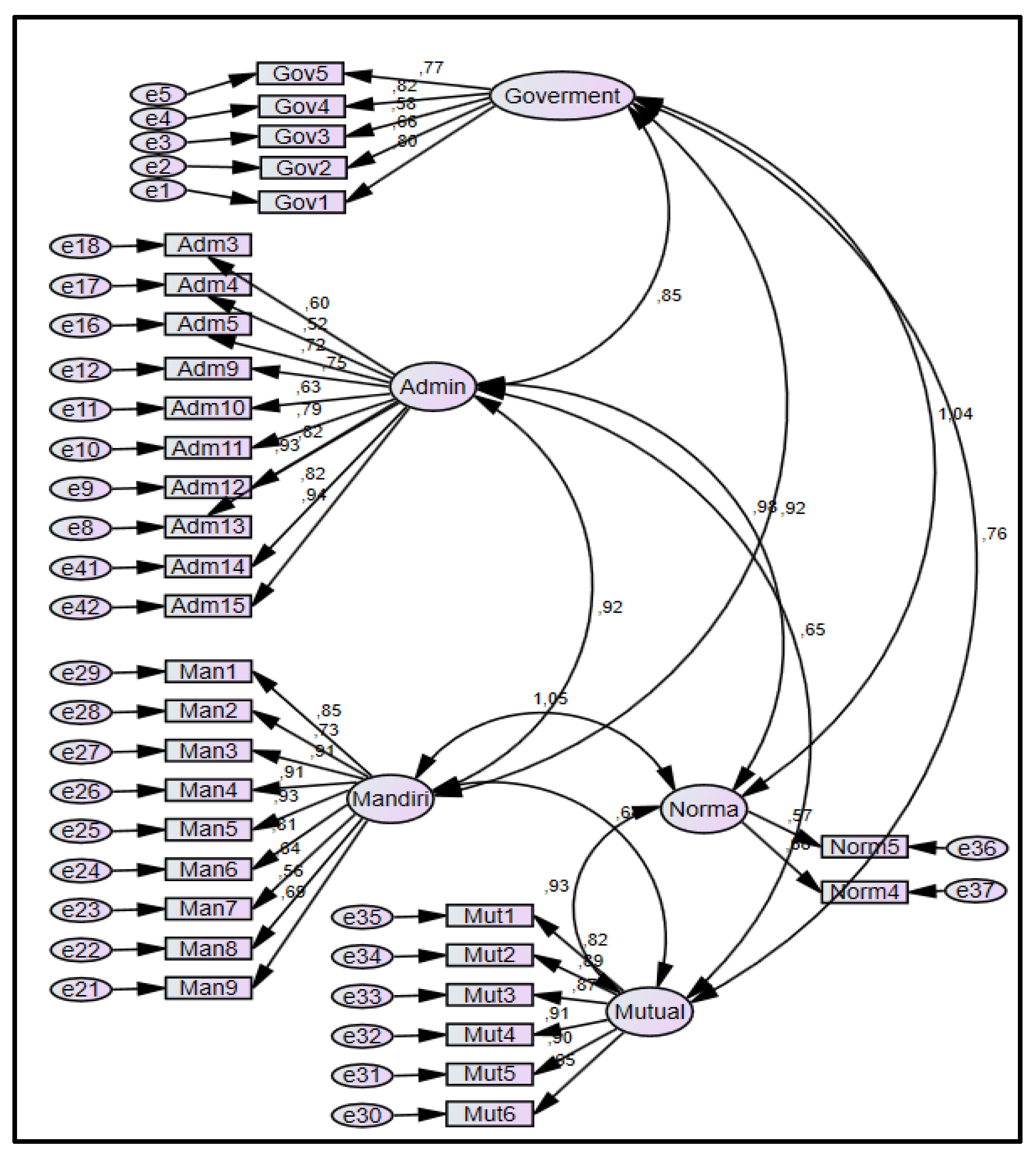

Table 1.
Dimension and Item in the Assessment Tool for Evaluating Cross-sectoral Collaboration in Developing a Child-Friendly City.
Table 1.
Dimension and Item in the Assessment Tool for Evaluating Cross-sectoral Collaboration in Developing a Child-Friendly City.
| No | Dimension (Item) | Include/Exclude |
|---|---|---|
|
Governance: Definition: Rules regarding the governance of the collaboration on Child-Friendly City and the involvement of institutions in program management. | ||
| Gov1 | Are you aware if your institution/agency is included in the City Child-Friendly Task Force (KLA) team? | Include |
| Gov2 | The rules underlying the relationships between institutions in collaboration (such as in terms of tasks, functions, and activities of each institution within your membership in the City Child-Friendly Task Force team) are outlined in: | Include |
| Gov3 | The most supportive policies or regulations related to the coordination system and institutional structure of the City Child-Friendly Task Force Program are found in: | Include |
| Gov4 | Your institution's involvement in the establishment of institutional rules for the City Child-Friendly Task Force/ institutional aspects of cross-sectoral City Child-Friendly Task Force programs. | Include |
| Gov5 | Socialization of institutional rules by the leading sector (Regional Secretary, Regional Development Planning Agency, or Social Welfare Office) for the child-friendly city/ regency program in your District/City | Include |
| Gov6 | Structural changes within your organization, such as leadership turnover, are perceived as hindering the continuity of the program | Exclude |
| Gov7 | Structural changes in the leadership of both Bappeda and DP3A as the leading sectors in the Child-Friendly City institution are perceived as hindering the continuity of programs in your institution | Exclude |
|
Administration Definition: Facilities that support the institutional processes involved in collaboration | ||
| Adm1 | The communication channels used to engage with other institutions to discuss activities and plans for the Child-Friendly City program include | Exclude |
| Adm2 | The benefits of information obtained from coordination meetings among stakeholders | Exclude |
| Adm3 | Meetings between institutions/agencies to discuss activities in the Child-Friendly City/Regency program are discussed through | Include |
| Adm4 | Invitations for meetings among institutions/agencies to discuss activities in the Child-Friendly City/Regency program. | Include |
| Adm5 | Attendance at meetings among institutions/agencies related to the Child-Friendly City/Regency program (Coordination meetings) | Include |
| Adm6 | The urgency of meetings among institutions/agencies related to the Child-Friendly City Program | Exclude |
| Adm7 | Discussion regarding meetings among institutions/agencies related to the Child-Friendly City/Regency program | Exclude |
| Adm8 | The level of importance of meetings among institutions/agencies related to the Child-Friendly City/Regency program. | Exclude |
| Adm9 | The clarity of roles and responsibilities in cross-sectoral collaboration for the Child-Friendly City/Regency is found in: | Include |
| Adm10 | The leaders or representatives of the organization sent to attend cross-sectoral coordination meetings follow up on the meeting outcomes with the implementing team under their purview. | Include |
| Adm11 | The coordination among Regional Apparatus Organizations (OPD) in the implementation of KLA activities. | Include |
| Adm12 | Evaluation of the Child-Friendly City/Regency program by the leading sector of the KLA activities. | Include |
| Adm13 | Involvement in the evaluation of KLA program activities | Include |
| Adm14 | The completeness of data that must be filled in during the KLA evaluation, such as indicators, targets, achievements, and formats provided by the ministry to your institution in supporting the Child-Friendly City Program | Include |
| Adm15 | Follow-up on the Evaluation of the KLA Program. | Include |
|
Autonomy Definition: The potential within the collaborating institutions to support collaboration in a Child-Friendly City. | ||
| Man1 | Having a Program Plan in the form of a Local Action Plan (RAD) for the Child-Friendly City. | Include |
| Man2 | The basis for the preparation of the Local Action Plan (RAD) for the Child-Friendly City | Include |
| Man3 | The involvement of your Regional Apparatus Organization (OPD) in the preparation of the KLA Local Action Plan (RAD). | Include |
| Man4 | Synchronization of activity planning in your institution with the Child-Friendly City Local Action Plan (RAD). | Include |
| Man5 | In the OPD's work plan (Renja), there are activities/programs that have been detailed/integrated from the Local Action Plan (RAD) for the Child-Friendly City | Include |
| Man6 | The planning related to the child-friendly city program, which has been detailed/integrated into the OPD's work plan (Renja), is in accordance with the available budget | Include |
| Man7 | The involvement between clusters in the KLA program (intersection of programs between clusters, such as Cluster Two related to child marriage intersecting with Cluster Three related to health). | Include |
| Man8 | Having an Innovation Program for the Child-Friendly City | Include |
| Man9 | The budget allocation source for the Child-Friendly City Program in each institution/agency. | Include |
|
Mutuality Definition: Mutually beneficial support between collaborating institutions in the Child-Friendly City program. | ||
| Mut 1 | Exchange of human resources (such as speakers and training) among institutions/agencies in implementing the Child-Friendly City Program. | Include |
| Mut 2 | The benefits of human resources exchange assistance (such as speakers and training) obtained from other institutions/agencies | Include |
| Mut 3 | The urgency of assistance (human resources, information, and others) from other institutions | Include |
| Mut 4 | The influence of activities from other institutions on the activities within one's own institution | Include |
| Mut 5 | Feeling appreciated for the performance achieved during cross-sector meetings (feelings such as giving ideas or opinions) | Include |
| Mut 6 | Training for human resources in your institution, especially those involved in the Child-Friendly City program, to understand the Convention on the Rights of the Child (CRC) | Include |
|
Norms Definition: Elements of trust in implementing collaboration strategies in the Child-Friendly City program | ||
| Norms1 | The strategy for handling the Child-Friendly City program is carried out through collaboration across sectors. | Exclude |
| Norms2 | Finding solutions to the challenges faced during meetings among institutions/agencies (cross-sector meetings). | Exclude |
| Norms3 | The necessity of imposing sanctions on institutions that do not fulfill their commitments or functions in the collaborative handling of the Child-Friendly City program | Exclude |
| Norms4 | Participation in the involvement of our institution/agency in Child-Friendly City/Regency activities. | Include |
| Norms5 | Your institution has received rewards or awards in the implementation of the Child-Friendly City program | Include |
Table 2.
Participant characteristics.
| Demography | n | % |
|---|---|---|
| Sex | ||
| Male | 20 | 31.7 |
| Female | 43 | 68.3 |
| Age | ||
| <30 | 10 | 15.9 |
| 30-39 | 16 | 25.4 |
| 40-49 | 24 | 38.1 |
| 50-59 | 12 | 19.0 |
| >60 | 1 | 1.6 |
| Education level | ||
| Senior High School | 5 | 7.9 |
| Undergraduate/Bachelor | 37 | 58.8 |
| Master | 21 | 33.3 |
| Total | 63 | 100 |
Table 3.
Standardized Loading Factor.
| Dimension | Item | Loading Factor (SLF) | |
| Gov1 | → | Governance | 0.799 |
| Gov2 | → | Governance | 0.658 |
| Gov3 | → | Governance | 0.578 |
| Gov4 | → | Governance | 0.824 |
| Gov5 | → | Governance | 0.769 |
| Adm13 | → | Admin | 0.928 |
| Adm12 | → | Admin | 0.820 |
| Adm11 | → | Admin | 0.791 |
| Adm10 | → | Admin | 0.631 |
| Adm9 | → | Admin | 0.750 |
| Adm5 | → | Admin | 0.716 |
| Adm4 | → | Admin | 0.517 |
| Adm3 | → | Admin | 0.603 |
| Man9 | → | Autonomy | 0.686 |
| Man8 | → | Autonomy | 0.564 |
| Man7 | → | Autonomy | 0.641 |
| Man6 | → | Autonomy | 0.810 |
| Man5 | → | Autonomy | 0.927 |
| Man4 | → | Autonomy | 0.907 |
| Man3 | → | Autonomy | 0.909 |
| Man2 | → | Autonomy | 0.729 |
| Man1 | → | Autonomy | 0.847 |
| Mut6 | → | Mutual | 0.649 |
| Mut5 | → | Mutual | 0.904 |
| Mut4 | → | Mutual | 0.910 |
| Mut3 | → | Mutual | 0.870 |
| Mut2 | → | Mutual | 0.889 |
| Mut1 | → | Mutual | 0.822 |
| Norm5 | → | Norm | 0.567 |
| Norm4 | → | Norm | 0.681 |
| Adm14 | → | Admin | 0.824 |
| Adm15 | → | Admin | 0.943 |
Table 4.
Construct Reliability (CR) and Average Variance Extracted (AVE).
| Dimension/Variable | CR | AVE |
|---|---|---|
| Governance | 0,850 | 0,535 |
| Administration | 0,931 | 0,583 |
| Autonomy | 0,936 | 0,624 |
| Mutuality | 0,937 | 0,715 |
| Norms | 0,562 | 0,393 |
Disclaimer/Publisher’s Note: The statements, opinions and data contained in all publications are solely those of the individual author(s) and contributor(s) and not of MDPI and/or the editor(s). MDPI and/or the editor(s) disclaim responsibility for any injury to people or property resulting from any ideas, methods, instructions or products referred to in the content. |
© 2023 by the authors. Licensee MDPI, Basel, Switzerland. This article is an open access article distributed under the terms and conditions of the Creative Commons Attribution (CC BY) license (http://creativecommons.org/licenses/by/4.0/).
Copyright: This open access article is published under a Creative Commons CC BY 4.0 license, which permit the free download, distribution, and reuse, provided that the author and preprint are cited in any reuse.


