
Submitted:
12 September 2024
Posted:
13 September 2024
You are already at the latest version
Abstract
This study focuses on evaluating and improving the effectiveness of village fund management in Merauke Regency, South Papua. Village fund management faces unique challenges due to the region's geographical and socio-economic conditions. Organizational behavior transformation is critical, particularly in addressing weaknesses in organizational structure, communication, work culture, and monitoring systems, to achieve sustainable development outcomes. A qualitative case study approach was employed, with data collected through in-depth interviews, participant observation, and document analysis between May and August 2024. Merauke Regency was selected for its diversity in management practices. Thematic analysis and triangulation techniques were used to ensure the reliability and validity of findings. The findings reveal that transforming the organizational structure from hierarchical to flexible team-based models, improving communication, and fostering a positive work culture significantly enhanced village fund management. These changes led to better coordination, responsiveness, efficiency, and transparency. Increased community participation and strengthened monitoring and evaluation also contributed to more effective development outcomes.This study provides practical recommendations for policymakers to design more sustainable and inclusive village fund management strategies. Data-driven and participatory approaches are crucial for maximizing development impacts and ensuring socio-economic benefits at the village level.
Keywords:
Organizational Behavior
; Village Fund
; Development Effectiveness
; Team Structure
; Community Involvement
1. Introduction
Village fund management is a crucial element in efforts to promote sustainable development at the rural level [1], especially amidst the increasing need for more effective and efficient management. However, in its implementation, various obstacles often arise, including a rigid organizational structure, limited internal communication, and a work culture that does not support innovation and participation [2]. This condition causes low effectiveness of village fund management and has an impact on the achievement of less-than-optimal development results. Along with increasingly complex development dynamics, there is an urgent need to transform organizational behavior in village fund management [3]. This transformation includes fundamental changes in the organizational structure [4], by shifting from a rigid hierarchical model to a more flexible and team-based structure. In addition, internal communication patterns need to be improved to be more open and transparent, supported by information technology [5], in order to accelerate the flow of information and minimize errors in management. The work culture must also change towards a more inclusive and innovative approach, which encourages active participation and involvement of all elements of the organization[6]. Strengthening the monitoring and evaluation system is also an important component in this transformation [7], to ensure that village fund management is not only more effective and efficient, but also accountable and sustainable.
Problems often encountered in managing village funds in the field include a number of significant structural, communicative, and cultural obstacles. First, many villages still use a rigid and hierarchical organizational structure, which hinders coordination and responsiveness to local dynamics [8]. This structure often causes the decision-making process to be slow and centralized, resulting in delays in project implementation and suboptimal fund allocation. Internal communication patterns in many villages tend to be limited and formal, which hinders the effective and rapid flow of information. This limited communication often results in a lack of transparency, miscommunication, and errors in fund management, which in turn reduce the efficiency of project implementation. The lack of effective communication channels also hinders active community participation in the planning and implementation process of development projects. The work culture in many villages does not fully support innovation and participation. A conservative and less inclusive work culture often hinders employee creativity and engagement, and reduces motivation to innovate in managing village funds. In addition, the lack of an adequate monitoring and evaluation system exacerbates these problems by reducing the ability to identify and correct deficiencies in fund management in a timely manner.
While there are a number of studies examining the technical and administrative aspects of village fund management, there is a significant gap in the literature exploring the role of organizational behavior in this context. Most previous studies have focused more on the financial and administrative aspects, such as budget management and fund allocation procedures, without considering how organizational structure, communication patterns, and work culture affect the effectiveness of fund management [9]. This gap creates a lack of understanding of how organizational behavior transformation can improve efficiency and effectiveness in village fund management [10]. In particular, there is little research that has deeply assessed the impact of changing organizational structures from hierarchical to team-based on coordination and responsiveness in village fund management [11]. In addition, the impact of changing internal communication patterns, from formal and limited systems to more open and transparent, has not been thoroughly explored in the context of village fund management. This gap also includes a lack of understanding of how changes in work culture that support innovation and participation can affect employee motivation and community involvement in development programs.
The novelty of this study lies in its approach that integrates organizational behavior analysis with the evaluation of the effectiveness of village fund management, an aspect that has not been widely studied in the context of village development in Indonesia. This study offers a new perspective by exploring how changes in organizational structure, communication patterns, and work culture can affect the success of development programs. In addition, this study also highlights the role of information technology and transparency in strengthening monitoring and accountability mechanisms, which in turn improve the quality and efficiency of village fund management. By prioritizing an organizational behavior approach, this study makes a significant contribution to the understanding of how non-technical interventions can produce substantial impacts on development efforts at the village level.
The urgency of this research lies in the urgent need to optimize the management of village funds in order to improve the effectiveness and sustainability of development programs at the local level. Effective management of village funds is key to ensuring that the allocated funds can be used optimally to achieve the desired development goals, such as improving infrastructure, increasing access to basic services, and community welfare. However, problems often arise due to rigid organizational structures, limited communication patterns, and work cultures that do not support innovation, which can hinder the effectiveness of fund allocation and use. In this context, organizational behavior transformation, including improvements in organizational structure, communication patterns, and work culture, is very important to overcome these challenges. By understanding and implementing changes in organizational behavior, it is expected to improve coordination, responsiveness, and efficiency in village fund management. This will not only improve fund management but also ensure the achievement of better and more sustainable development results. This research is urgent because it can provide practical and strategic guidance for policy makers, program managers, and village communities in designing and implementing more effective fund management strategies, as well as overcoming problems that hinder the success of development programs at the village level. The purpose of this study is to evaluate and improve the effectiveness of village fund management through organizational behavior transformation, with a focus on improving organizational structure, communication patterns, work culture, and strengthening monitoring and evaluation systems in order to achieve more effective and sustainable development results.
2. Materials and Methods
This study uses a qualitative method with a case study approach to explore the transformation of organizational behavior in village fund management and the effectiveness of development programs in Merauke Regency. Qualitative methods are chosen because they provide an in-depth and holistic understanding of complex social phenomena, such as the dynamics of organizational behavior and policy implementation at the village level. The case study approach allows researchers to investigate specific cases intensively and contextually, so as to reveal relevant patterns and provide detailed insights into how organizational behavior affects village fund management and development program outcomes. This research was conducted in Merauke Regency, South Papua, from May to August 2024. Merauke Regency was chosen as the research location because it is an area that faces special challenges in managing village funds and implementing development programs, and has variations in village fund management practices that can provide a comprehensive picture. Several villages in Merauke Regency will be selected as units of analysis to examine in depth how organizational behavior in each village affects the effectiveness of development programs. The villages are Bersehati, Tambat, Senayu and Urumb
Data collection techniques in this study involved in-depth interviews, participant observation, and document analysis. In-depth interviews were conducted with village heads, members of the Village Consultative Body (BPD), program managers, and local communities to obtain their perspectives and experiences related to village fund management and the implementation of development programs. Participatory observation allowed researchers to be directly involved in village activities and observe the processes and interactions in village fund management. In addition, document analysis included a study of village fund management reports, village development plans, and program outcome documentation to provide context and evaluation of program implementation and impact. Data obtained from interviews, observations, and documents were analyzed using thematic analysis techniques. Thematic analysis allows researchers to identify key themes and patterns that emerge in the data, as well as to relate findings to relevant theories and literature. In addition, data triangulation was conducted by combining information from multiple sources to increase the validity and reliability of the research findings. This triangulation process helps ensure that the analysis conducted reflects the complex and diverse realities of village fund management and organizational behavior. The research process begins with planning, which includes the preparation of a research plan, selection of village locations, and determination of key informants. Furthermore, data collection is carried out through in-depth interviews, participant observation, and document collection in the field. The data that has been collected is then analyzed to find relevant themes and patterns. Finally, a research report is prepared to present findings, analysis, and recommendations based on the results of the case study, which aims to provide useful insights in improving village fund management and the effectiveness of development programs.
3. Results
This study examines how organizational behavior transformation in village fund management can improve the effectiveness of development programs, with a focus on changes in organizational structure, communication patterns, and work culture that contribute to achieving more optimal development outcomes. The following are the results of this study

Table 1.
Impact of Organizational Structure Transformation on Fund Management Efficience.
| Musty | Before Transformation | After Transformation | Impact |
|---|---|---|---|
| Organizational structure | Rigid hierarchical structure | Flexible team-based structure | Improved coordination and responsiveness |
| Management Team | Separate project management | A project team was formed specifically for fund management. | Faster and more focused decision making |
| Resource Allocation | Allocation is done centrally | Allocation based on specific village needs | Use of resources that is more appropriate to needs |
| Coordination | Limited, often hampered by bureaucracy | Improved with a responsive team | Improving efficiency in fund management |
| Decision-making | Slow and centralized process | Faster and decentralized processes | Faster and more local decisions |
The organizational structure transformation has led to several positive changes in fund management. Previously, a rigid hierarchical structure hindered flexibility and responsiveness; however, the shift to a more flexible, team-based structure has enhanced coordination and responsiveness. Project management, once handled separately, is now streamlined through specialized project teams, enabling faster and more focused decision-making. Resource allocation has moved from a centralized system to one tailored to specific village needs, ensuring resources are used more effectively. Coordination has improved significantly due to the responsiveness of the new teams, overcoming previous bureaucratic obstacles. Decision-making processes, once slow and centralized, are now quicker and more decentralized, allowing decisions to better align with local conditions.
Table 2.
Impact of changes in internal communication patterns on village fund management.
| Indicator | Before the Change (%) | After the Change (%) | Change (%) |
|---|---|---|---|
| Limited Formal Communication | 70 | 30 | -40 |
| Effectiveness of Fund Management | 60 | 85 | 25 |
| Information Flow | 55 | 80 | 25 |
| Frequency of Management Errors | 40 | 15 | -25 |
| Use of Information Technology | 45 | 75 | 30 |
The data reflects significant improvements in communication and management practices following the implementation of a more open communication system. Before the change, formal and limited communication constituted a high percentage of interactions, which negatively impacted the efficiency of fund management. Post-implementation, there was a noticeable increase in effective fund management, attributed to the enhanced flow of information. The percentage of smooth information flow improved markedly, indicating better dissemination and understanding of critical data. Additionally, the frequency of management errors decreased as a result of the new communication system, highlighting its effectiveness in reducing mistakes. The adoption of information technology also saw an increase, further supporting more efficient fund management. Employee satisfaction with communication systems rose significantly, demonstrating the positive impact of transitioning to a more transparent and interactive communication approach.
Table 3.
Changes in work culture and organizational values and their impact on employee motivation and engagement.
Table 3.
Changes in work culture and organizational values and their impact on employee motivation and engagement.
| Aspect | Changes That Occur | Positive impact |
|---|---|---|
| Work Culture | From a work culture that is less supportive of individual initiative to a culture that is more inclusive and supportive of innovation. | Increase employee motivation. |
| Improve contribution to program success. | ||
| Organizational Values | Emphasis on collaboration, transparency and accountability. | Increasing employee involvement in village development programs. |
| Help employees feel valued. | ||
| Employee Engagement | Employees are actively involved in project planning and implementation. | Employee contributions to the program are more significant. |
| Employee motivation increases | ||
| Employee Motivation | New work culture and values influence employee motivation levels. | Increase work enthusiasm |
| Encourage higher engagement in the program |
The table above illustrates significant changes in aspects of work culture, organizational values, employee engagement, and employee motivation after the transformation of organizational behavior. The work culture that was previously less supportive of initiatives has now changed to be more inclusive, encouraging innovation, and increasing employee motivation and contribution to the success of the program. New organizational values, such as collaboration, transparency, and accountability, have increased employee involvement in village development programs and made them feel more appreciated. The active involvement of employees in project planning and implementation leads to more significant contributions and increased work motivation, while the new culture and values also encourage higher work enthusiasm and participation in the programs implemented.
The Table 4 above illustrates the positive impact of organizational behavior transformation on village fund management. The shift from a hierarchical structure to a leaner structure and project-based teams allows for more targeted allocation of funds, while increased open and transparent internal communication reduces the risk of misallocation and increases the efficiency of fund use. In addition, the implementation of information technology through project management applications and real-time reporting systems has improved coordination and efficiency in fund management, facilitated monitoring, and resulted in more accurate reporting. This transformation shows how changes in structure, communication, and technology can improve the effectiveness of village fund management.
The Table 5 above illustrates the positive impact of changes in work culture on village fund management. Changes in work culture that emphasize accountability and openness have increased compliance with regulations and transparency in the use of funds. In addition, a culture that supports transparency and active participation in internal supervision has proven effective in reducing the risk of irregularities and corruption. Employees who are actively involved in decision-making and have open access to information show a higher level of compliance with regulations, which overall strengthens the integrity and effectiveness of fund management.
The Table 6 above illustrates the positive impact of organizational behavior transformation on achieving development targets, socio-economic impacts, and improving the quality of life of the community. Changes in organizational structure, communication patterns, and work culture have contributed to better achievement of development targets, marked by improved infrastructure and increased access to basic services. In addition, the application of an organizational behavior approach in managing development projects has improved community welfare, quality of life, income, and access to education and health.
Figure 1.
Community Response to Development Project Outcomes.
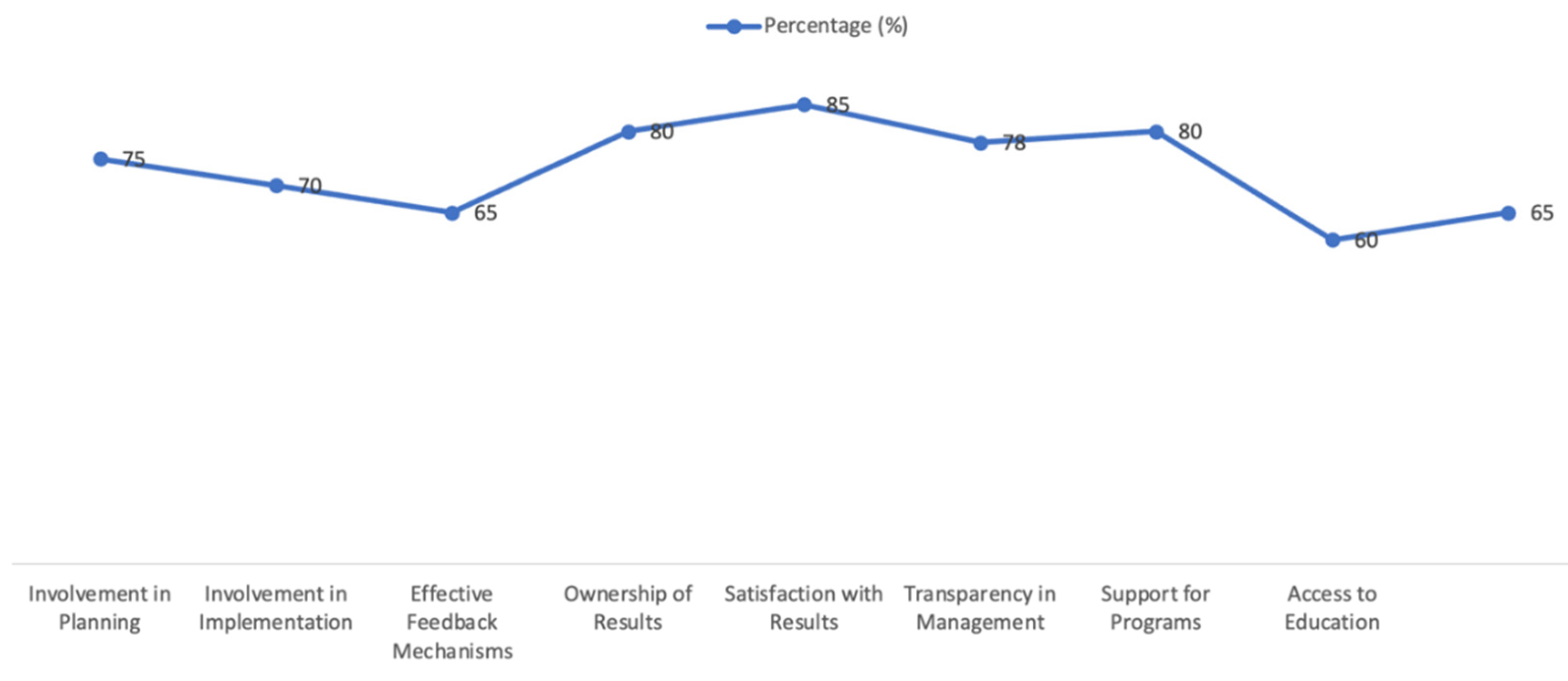
The data indicates a generally positive response from the community regarding various aspects of development projects. The highest percentage is observed in “Satisfaction with Results,” at 85%, reflecting strong approval of the development outcomes. Similarly, “Ownership of Results” is high at 80%, suggesting that most individuals feel a sense of ownership over the project’s achievements. “Involvement in Planning” and “Support for Programs” are also notable, with 75% and 80% respectively, highlighting significant community engagement and backing for development initiatives. In terms of transparency and feedback, 78% of respondents feel that village fund management is transparent, and 65% found feedback mechanisms effective, indicating a positive perception but with room for improvement. Access to education and health, while positively impacted, show slightly lower percentages, with 60% and 65% respectively, suggesting that these areas could benefit from further attention to enhancing accessibility.
4. Discussion
This study identified several significant changes in organizational structure that affected village fund management. First, there was a shift from a rigid hierarchical structure to a more flexible and team-based structure. This change aimed to improve coordination and responsiveness in fund management [12]. Teams formed specifically to manage village development projects enabled faster and more focused decision-making, and facilitated resource allocation as needed [13]. In addition, this study analyzes the impact of changes in internal communication patterns on the efficiency of village fund management. Previously, limited and formal internal communication hampered the rapid and effective exchange of information [14]. However, the implementation of a more open and transparent communication system has improved the flow of information and reduced errors in fund management [15]. The application of information technology such as project management applications and virtual meetings also contributed to increased coordination and teamwork efficiency, allowing for more accurate monitoring and reporting [16].
Assessment of changes in work culture and organizational values showed a positive impact on employee motivation and engagement [17]. The work culture that was previously less supportive of individual initiative has now changed to be more inclusive and supportive of innovation [18]. The introduction of organizational values that emphasize collaboration, transparency, and accountability has increased employee engagement in village development programs [10]. Employees who feel valued and actively involved in the decision-making process show higher motivation and more significant contributions to the success of the program [19]. These changes suggest that an organizational behavior-based approach can significantly influence the effectiveness of village fund management. By improving organizational structures, communication patterns, and work culture, villages can achieve better and more sustainable development outcomes [20]. This study emphasizes the importance of organizational behavior factors in designing effective village fund management strategies, which are often overlooked in previous studies that focus more on technical or administrative aspects.
The transformation of organizational behavior has brought about significant changes in the allocation and use of village funds [21]. Changes in organizational structure, from traditional hierarchies to project-based teams, allow for more responsive and adaptive decision-making to the needs of village communities [22]. This has resulted in more targeted fund allocation, where funds can be channeled directly to priority projects that are in line with village needs and aspirations. In addition, increased open and collaborative internal communication ensures that information related to fund use and project needs is disseminated effectively, reducing the risk of misallocation and increasing the efficiency of fund use [23].
More effective management practices emerged as a result of these changes in organizational behavior. The use of information technology for project management, real-time reporting, and more stringent internal audit systems are some examples of new practices that support better village fund management [24]. More transparent and collaborative communication systems allow employees and stakeholders to be more active in the project planning and implementation process [25], reducing reliance on slow administrative procedures and increasing responsiveness to changing needs in the field [26].
Analysis of the relationship between organizational behavior and regulatory compliance and transparency in the use of funds shows that changes in work culture that emphasize accountability and openness contribute to increased regulatory compliance [27]. A culture that supports transparency and active participation in internal supervision reduces the possibility of irregularities and corruption [28]. Employees who are involved in the decision-making process and have open access to information related to village funds show higher compliance with regulations and transparency standards. Thus, the transformation of organizational behavior not only increases the effectiveness of fund allocation and use but also strengthens monitoring and accountability mechanisms [27], ensuring that village funds are used optimally and in accordance with established development goals.
Measuring the impact of organizational behavior changes on the results of regional development programs shows that transformations in structure, communication patterns[29], and work culture significantly affect the achievement of development targets. Organizational behavior changes involving the adoption of more participatory and data-based managerial methods have increased the efficiency of project implementation, making development targets easier to achieve. Leaner organizational structures and autonomous work teams allow for faster decision-making and are more responsive to the dynamics of local needs [30], leading to better achievement of development targets. Evaluation of the achievement of development targets shows a significant increase in development outcomes. Socio-economic impacts at the village level are also clearly visible, with improvements in infrastructure, increased access to basic services, and increased community welfare. Development projects managed with a new organizational behavior approach have brought positive changes in the quality of life of the community [31], such as increased income, employment opportunities, and improved access to education and health.
Analysis of community involvement and satisfaction with development program outcomes revealed that village communities felt more involved and satisfied with development outcomes. Active community participation in project planning and implementation, as well as the existence of effective feedback mechanisms, have increased their sense of ownership and satisfaction with development outcomes [32]. Higher involvement allows communities to directly convey their needs and aspirations, while transparency in the process of managing village funds and development outcomes builds trust and strong support from the community. Overall, changes in organizational behavior have not only improved performance in achieving development targets but have also had a significant positive impact on social and economic welfare at the village level, as well as increasing community involvement and satisfaction with development program outcomes.
Strategies to improve organizational structure, communication patterns, and work culture in village fund management are key steps to increase the effectiveness of development programs [33]. This study identified that restructuring the organizational structure to reduce bureaucracy and clarify responsibilities can speed up the decision-making process and improve coordination between parties. A more open and transparent internal communication pattern, with the implementation of an integrated information system, allows for a smoother flow of information and better monitoring of the use of funds [34]. In addition, changes in work culture towards a collaborative and participatory culture, where all team members are actively involved in planning and evaluation, have been shown to increase employee motivation and commitment, as well as encourage innovation in project implementation.
Based on the research findings, several practical recommendations for village fund management policies and practices can be proposed. First, it is important to implement policies that support decentralization of decisions and empowerment of village communities in fund management. Second, human resource capacity development through continuous training and education on project management and fund accountability will help improve technical and managerial skills. Third, the establishment of clear operational standards and procedures and a strict audit system can improve transparency and accountability in village fund management. The proposal for a better monitoring and evaluation mechanism to ensure the sustainability and success of development programs includes several strategic steps. First, the implementation of a technology-based monitoring system that allows real-time monitoring of project implementation and fund use. Second, the development of relevant and objectively measurable performance indicators to evaluate program outcomes and impacts periodically. Third, involving the community in the evaluation process through feedback forums and satisfaction surveys to ensure that the program meets community needs and expectations. Fourth, compiling evaluation reports that are transparent and easily accessible to the public to increase accountability and support continuous improvement. With these steps, it is hoped that village fund management can be carried out more effectively and sustainably, providing maximum positive impacts on regional development.
5. Conclusions
This study shows that organizational behavior transformation plays a crucial role in improving the effectiveness of village fund management and achieving development program outcomes. The shift from a rigid hierarchical organizational structure to a more flexible team-based structure has improved coordination and responsiveness in fund management. Changes in internal communication patterns that are more open and transparent, supported by information technology, have accelerated the flow of information, reduced misallocations, and increased teamwork efficiency. In addition, changes in work culture that are more inclusive and supportive of innovation have increased employee motivation and engagement, contributing to the success of development programs. The application of participatory and data-based managerial methods has enabled better achievement of development targets and positive socio-economic impacts at the village level. Community involvement and satisfaction with development outcomes indicate that transparency and active participation strengthen community support and ownership. Therefore, strategies that include improving organizational structures, communication patterns, and work culture, as well as strengthening monitoring and evaluation systems, are key steps to ensure the sustainability and success of development programs. The findings of this study provide valuable guidance for improving village fund management and achieving more effective and sustainable development outcomes.
Author Contributions
Conceptualization, B.T. and Y.O.; methodology, BT.A.P.T.; software, P.R.; validation, B.T., Y.O. and A.P.T.; formal analysis, P.R.; investigation, Y.O.; resources, B.T.; data curation, P.R.; writing—original draft preparation, B.T.; writing—review and editing, P.R.; visualization, P.R.; supervision, A.P.T.; project administration, B.T.; funding acquisition, Y.O. All authors have read and agreed to the published version of the manuscript.
Acknowledgments
I would like to express my deepest gratitude to Universitas Cenderawasih for providing the financial support necessary to conduct this research. Your generosity and commitment to advancing academic inquiry have been instrumental in the successful completion of this project.
Conflicts of Interest
The Authors declare that there is no conflict of interest
References
- Permatasari, P.; Ilman, A.S.; Tilt, C.A.; Lestari, D.; Islam, S.; Tenrini, R.H.; Rahman, A.B.; Samosir, A.P.; Wardhana, I.W. The Village Fund Program in Indonesia: Measuring the Effectiveness and Alignment to Sustainable Development Goals. Sustainability 2021, 13, 12294. [Google Scholar] [CrossRef]
- Iranmanesh, M.; Kumar, K.M.; Foroughi, B.; Mavi, R.K.; Min, N.H. The impacts of organizational structure on operational performance through innovation capability: innovative culture as moderator. Rev. Manag. Sci. 2020, 15, 1885–1911. [Google Scholar] [CrossRef]
- Mathews, M.C. How village leaders in rural Amazonia create bonding, bridging, and linking social capital configurations to achieve development goals, and why they are so difficult to maintain over time. World Dev. 2021, 146. [Google Scholar] [CrossRef]
- Hanelt, A.; Bohnsack, R.; Marz, D.; Marante, C.A. A Systematic Review of the Literature on Digital Transformation: Insights and Implications for Strategy and Organizational Change. J. Manag. Stud. 2020, 58, 1159–1197. [Google Scholar] [CrossRef]
- Li, J.-Y.; Sun, R.; Tao, W.; Lee, Y. Employee coping with organizational change in the face of a pandemic: The role of transparent internal communication. Public Relations Rev. 2020, 47, 101984–101984. [Google Scholar] [CrossRef]
- Kuknor, S.C.; Bhattacharya, S. Inclusive leadership: new age leadership to foster organizational inclusion. Eur. J. Train. Dev. 2020, 46, 771–797. [Google Scholar] [CrossRef]
- Koh, G.A.; Askell-Williams, H. Sustainable school-improvement in complex adaptive systems: A scoping review. Rev. Educ. 2020, 9, 281–314. [Google Scholar] [CrossRef]
- Long, X.; Yang, P.; Su, Q. On the effective organization of rural settlements spatial structure under the transformation and development of mountainous areas in Western China: evaluation measurement based on complex adaptability theory. Environ. Sci. Pollut. Res. 2022, 30, 89945–89963. [Google Scholar] [CrossRef]
- Barauskaite, G.; Streimikiene, D. Corporate social responsibility and financial performance of companies: The puzzle of concepts, definitions and assessment methods. Corp. Soc. Responsib. Environ. Manag. 2021, 28, 278–287. [Google Scholar] [CrossRef]
- Zeho, F.H.; Prabowo, A.; Estiningtyas, R.A.; Mahadiansar, M.; Sentanu, I.G.E.P.S. Stakeholder collaboration to support accountability in village fund management and rural development. J. Socioecon. Dev. 2020, 3, 89–100. [Google Scholar] [CrossRef]
- Ijjasz-Vasquez, E.; Karp, P.; Weber-Fahr, M. Communities of Practice at the World Bank: Breaking Knowledge Silos to Catalyze Culture Change and Organizational Transformation. Taylor & Francis: Hoboken, NJ, USA, 2024.
- Goniewicz, K.; Khorram-Manesh, A.; Hertelendy, A.J.; Goniewicz, M.; Naylor, K.; Burkle, F.M., Jr. Current Response and Management Decisions of the European Union to the COVID-19 Outbreak: A Review. Sustainability 2020, 12, 3838. [Google Scholar] [CrossRef]
- Berkley, J.; Beratan, K.K. Capturing practitioners' "how-to" knowledge in the form of recommendations for more effective planning of collaborative adaptive management projects. Ecol. Soc. 2021, 26. [Google Scholar] [CrossRef]
- Ajibade, P.; Mutula, S.M. Promoting SMEs effectiveness through innovative communication strategies and business-IT alignment. Probl. Perspect. Manag. 2020, 18, 233–244. [Google Scholar] [CrossRef]
- Guo, L.; Chen, J.; Li, S.; Li, Y.; Lu, J. A blockchain and IoT-based lightweight framework for enabling information transparency in supply chain finance. Digit. Commun. Networks 2022, 8, 576–587. [Google Scholar] [CrossRef]
- Swart, K.; Bond-Barnard, T.; Chugh, R. Challenges and critical success factors of digital communication, collaboration and knowledge sharing in project management virtual teams: a review. Int. J. Inf. Syst. Proj. Manag. 2022, 10, 59–75. [Google Scholar] [CrossRef]
- Paais, M.; Pattiruhu, J.R. Effect of Motivation, Leadership, and Organizational Culture on Satisfaction and Employee Performance. J. Asian Finance, Econ. Bus. 2020, 7, 577–588. [Google Scholar] [CrossRef]
- Kör, B.; Wakkee, I.; van der Sijde, P. How to promote managers’ innovative behavior at work: Individual factors and perceptions. Technovation 2020, 99, 102127. [Google Scholar] [CrossRef]
- Ali, B.J.; Anwar, G. An Empirical Study of Employees’ Motivation and its Influence Job Satisfaction. Int. J. Eng. Bus. Manag. 2021, 5, 21–30. [Google Scholar] [CrossRef]
- Zhang, X.; Zhang, Z. How Do Smart Villages Become a Way to Achieve Sustainable Development in Rural Areas? Smart Village Planning and Practices in China. Sustainability 2020, 12, 10510. [Google Scholar] [CrossRef]
- Duan, Y.; Wang, H.; Huang, A.; Xu, Y.; Lu, L.; Ji, Z. Identification and spatial-temporal evolution of rural ‘production-living-ecological’ space from the perspective of villagers’ behavior–A case study of Ertai Town, Zhangjiakou City. Land use policy 2021, 106, 105457. [Google Scholar] [CrossRef]
- Hayat, K.; Hafeez, M.; Bilal, K.; Shabbir, M.S. Interactive Effects of Organizational Structure and Team Work Quality on Project Success in Project Based Non Profit Organizations. iRASD J. Manag. 2022, 4, 84–103. [Google Scholar] [CrossRef]
- Ahinsah-Wobil, I. “The Reform Mechanisms Policy in Ghana’s Public Financial Management,” Available SSRN 3922133, 2021.
- Morawiec, P.; Sołtysik-Piorunkiewicz, A. Cloud Computing, Big Data, and Blockchain Technology Adoption in ERP Implementation Methodology. Sustainability 2022, 14, 3714. [Google Scholar] [CrossRef]
- El Khatib, M.; Kherbash, A.; Al Qassimi, A.; Al Mheiri, K. How Can Collaborative Work and Collaborative Systems Drive Operational Excellence in Project Management? J. Serv. Sci. Manag. 2022, 15, 297–307. [Google Scholar] [CrossRef]
- Kremen, C. Ecological intensification and diversification approaches to maintain biodiversity, ecosystem services and food production in a changing world. Emerg. Top. Life Sci. 2020, 4, 229–240. [Google Scholar]
- Ortega-Rodríguez, C.; Licerán-Gutiérrez, A.; Moreno-Albarracín, A.L. Transparency as a Key Element in Accountability in Non-Profit Organizations: A Systematic Literature Review. Sustainability 2020, 12, 5834. [Google Scholar] [CrossRef]
- Su, H.; Lu, Y.; Lyulyov, O.; Pimonenko, T. Good Governance within Public Participation and National Audit for Reducing Corruption. Sustainability 2023, 15, 7030. [Google Scholar] [CrossRef]
- Sung, W.; Kim, C. A Study on the Effect of Change Management on Organizational Innovation: Focusing on the Mediating Effect of Members’ Innovative Behavior. Sustainability 2021, 13, 2079. [Google Scholar] [CrossRef]
- Antons, O.; Arlinghaus, J.C. Distributing decision-making authority in manufacturing – review and roadmap for the factory of the future. Int. J. Prod. Res. 2022, 60, 4342–4360. [Google Scholar] [CrossRef]
- Ramkissoon, H. Perceived social impacts of tourism and quality-of-life: a new conceptual model. J. Sustain. Tour. 2020, 31, 442–459. [Google Scholar] [CrossRef]
- Sabet, N.S.; Khaksar, S. The performance of local government, social capital and participation of villagers in sustainable rural development. Soc. Sci. J. 2020, 61, 1–29. [Google Scholar] [CrossRef]
- Rasmini, N.K.; Mimba, P.S.H. The influence of apparatus competence, leadership style, tri hita karana culture and society participation on the effectiveness of village fund management. Indones. Account. Rev. 2021, 11, 61–75. [Google Scholar] [CrossRef]
- Taherdoost, H. A review on risk management in information systems: Risk policy, control and fraud detection. Electronics 2021, 10, 3065. [Google Scholar] [CrossRef]
Table 4.
Effectiveness of village fund management based on transformation in organizational behavior.
Table 4.
Effectiveness of village fund management based on transformation in organizational behavior.
| Aspect | Description | Impact |
|---|---|---|
| Organizational structure | The shift from hierarchical structures to leaner structures and project-based teams. | Allows for more targeted allocation of funds. |
| Internal Communication | Improved internal communication to be more open and transparent. | Reduce the risk of misallocation and increase the efficiency of fund use. |
| Management Practices | Use of information technology for project management and real-time reporting. | Improve coordination and efficiency in fund management. |
| Information Technology | Implementation of real-time project management applications and reporting systems. | Facilitates more accurate monitoring and reporting. |
Table 5.
Regulatory Compliance and Transparenc.
| Aspect | Information |
|---|---|
| Changes in Work Culture | A work culture that emphasizes accountability and openness has increased compliance with regulations and transparency in the use of funds. |
| Transparency and Active Participation | A culture that supports transparency and active participation in internal oversight reduces irregularities and corruption. |
| Employee Engagement | Employees who are actively involved in decision-making and have open access to information demonstrate higher compliance with regulations. |
Table 6.
Development Target Achievement and Socio-Economic Impact.
| Aspect | Information |
| Achievement of Development Targets | Changes in structure, communication patterns and work culture contribute to better achievement of development targets. |
| Socio-Economic Impact | There have been improvements in infrastructure, increased access to basic services, and community welfare as a result of development projects managed with a new approach. |
| Improvement of Quality of Life | Development projects managed using an organizational behavior approach show improvements in quality of life, income, and access to education and health. |
Disclaimer/Publisher’s Note: The statements, opinions and data contained in all publications are solely those of the individual author(s) and contributor(s) and not of MDPI and/or the editor(s). MDPI and/or the editor(s) disclaim responsibility for any injury to people or property resulting from any ideas, methods, instructions or products referred to in the content. |
© 2024 by the authors. Licensee MDPI, Basel, Switzerland. This article is an open access article distributed under the terms and conditions of the Creative Commons Attribution (CC BY) license (http://creativecommons.org/licenses/by/4.0/).
Copyright: This open access article is published under a Creative Commons CC BY 4.0 license, which permit the free download, distribution, and reuse, provided that the author and preprint are cited in any reuse.


