
Submitted:
06 November 2023
Posted:
07 November 2023
Read the latest preprint version here
Abstract
In a recent article, the author derived a new generalized Langevin equation (NGLE) and its associated Fokker-Planck equation (FPE) of a Brownian particle in a parabolic potential where the thermal bath, consisting of N harmonic oscillators, interacts bilinearly with the external field. The time needed for the system to reach a steady state is longer than that for the classical version (CGLE). We found a completely different scenario for the entropy than when the interaction of the field with the heat bath is off. The new findings for the entropy and its rate physically improve the thermodynamics description of the system.
Keywords:
Stochastic processes
; Brownian motion
; Fokker-Planck equation.
1. Introduction
There have been numerous applications of the CGLE to describe simple and complex systems. Most of the descriptions are based on Zwanzig’s model where the interaction of the external field affects only the particle dynamics. Thus, the fluctuation-dissipation theorem (FDT) is linear with the static friction coefficient of the bath fluid [1]. Nieuwenhuizen and Allahverdyan [2] worked out the CGLE in the configuration space including an extra term due to the interactions among the bath particles and the Zwanzig’s overdamped limit by Jiménez and Velazco [3]. Paredes, Medina, and Colmenares [4] applied the CGLE in the whole phase space. However, afterward, Daldrop, Kowalik, and Netz [5] applied molecular dynamic simulations to a particle in a thermal bath interacting with a parabolic potential, finding the memory kernel and friction depending on the field frequency. In a previous author’s work [6] the description was modeled by deriving an NGLE to include a specific field interaction with the bath. The FDT is Kubo’s type with the above frequency dependency. Acceptable results were obtained for the kernel and the friction function.
The present work aims to extend the description of the NGLE to the realm of thermodynamics. In this respect, the objective is to determine the entropy and its rate and compare them with the results obtained from the CGLE.
We begin with a resumé of the general equations already derived followed by an analysis of the results. The article ends with a general conclusion.
2. Basic equations
The system is a particle of mass M immersed in a bath of N harmonic oscillators held at temperature T where both subsystems interact with a parabolic potential . The NGLE was derived in [6] and given by:
where the dot over a variable denotes its time derivative. Its solution reads,
where is the susceptibility of the system, parameter is the Drude’s spectral density cutoff frequency of the bath harmonic oscillators, is the mass ratio of the tag particle to a single bath one, is the static friction coefficient, and are the initial position and the effective frequency felt by the particle, respectively. Function where the memory kernel is a composite function involving cosine and sine integral functions of the complex field frequency H. It reads,
The noise is Gaussian and colored with zero mean and a correlation obeying an FDT of Kubo’s type . The friction function is the integral of over the frequency . It is a function too large to display containing Si, Ci, Ei, and the natural log functions of different complex terms of the field frequency. From now on, Boltzmann constant and M are set to 1.
We use the associated reduced position FPE for the probability density function associated with Eq. (2) instead of the bi-variate general one involving velocity and position. It was already obtained in [7] in a different context, reading,
with a solution given by the Gaussian
The steady-state is obtained from Eq. (8). It renders the Gaussian
where .
According to [8,9,10], the mean heat evolves with time as
where . After making the substitutions, we find
The irreversible Gibbs entropy of the Brownian particle, equivalent to Shannon’s, and the entropy rate are
In a system at equilibrium, the response function is the correlation of the fluctuations subjected to disturbances of the external field. For stationary systems, the detailed balance relation is broken if it is out of equilibrium. Therefore, there is a continuous degradation of energy to the thermal reservoir. This behavior occurs along the trajectory, where the correlation of the fluctuations reduces to the conventional FDT if the velocity fluctuations are written in terms of the local mean velocity [11].
In the detailed balance restoration, Van den Broeck and Esposito [12] integrate by part giving two contributions compiling a non-adiabatic part due to the presence of driving, the external field, and an adiabatic one because of a non-equilibrium constrain, the temperature in our case. They, however, introduce the so-called excess representing the dissipation due to the presence of the reservoir. The latter is the systematic entropy generated by the bath degrees of freedom [13]. They propose then an equivalent entropy balance equation for the total entropy production as,
Similar equations hold for the Zwanzig’s CGLE [14,15,16] replacing by and the memory kernel substituted by the well-known exponential decay obeying the original Kubo’s FDT [1].
We will compare the results obtained by the two versions of the generalized Langevin equation NGLE and CGLE.
3. Discussion of numerical results
Because the external potential is time-independent, no work is produced. The interchange of heat between the particles and the bath is needed for the whole system to be kept isothermal and steady.
All calculations [17] were made for the parameter set of Ref. [6], namely, . We choose representing the approximated midpoint between the branches of displayed in Figure 3 of [6]. Black curves identify the set while the red ones are for and an arbitrary . Blue curves designate the NGLE at a frequency as low as and . The procedure to compare NGLE with the CGLE must suit the memory kernel, Equation (6), to the new initial conditions of the system. Noticing from Figure 3 of [6] that at very low the frequency-dependent friction is equal to its static value , we evaluate at such a frequency which can be fitted as . It gives which together with the substitution and defines fully the CGLE. They are displayed as dashed blue plots.
The numerical calculations then require first the determination of the memory kernel given by Eq. (6). Before the calculation, it is smoothed to suppress the spurious data at log times [6] to find next the susceptibility through the inversion of Equation (). Using a method designed by Fox for the CGLE [18], the noise correlation becomes analytical which for our problem renders
Once these quantities are calculated then the standard deviation and follow and all functions are fully specified.
The effect of the external field is to heat up the tagged and reservoir particles in different proportions, so on average, some heat is absorbed by the tagged particles to keep a steady temperature. Figure 1 displays this effect as the mean heat. The dissipation of the average heat in the system increases to keep it isothermal; it is smaller for (black curve). Curves for NGLE at low ( , blue) and the CGLE (dashed blue) have significantly low magnitude and are almost identical, which is not a surprise because both descriptions are for the same static friction coefficient. Oscillations increase with the temperature.
Figure 2 shows the entropy of the whole system, where a smoothed behavior for t ≥ 50 appears, which is also an indication of reaching a steady state. It is positive because the system is isolated. The omission of the physical field-bath interaction (blue) overestimates the total entropy by a little compared to NGLE (black). The difference is irrelevant but will become significant in discussing the entropy production. All curves display a small oscillation at the beginning. Previous works have found that when the interaction field-bath is off, and a classical underdamped Markovian Langevin describes the dynamics, monotonically increases and saturates to a constant value instead [19]. The same behavior occurs with a single oscillation at the beginning when the bath particle interactions are included [2].
The processes responsible for the appearance of the initial oscillations might be due to the heat bath. One approximate way to explain it is by calculating the entropy production as we will show next.
The entropy production rate due to the field is depicted in Figure 3. It is positive as should be [12]. All curves collapse to a single plot to indicate that no matter the parameters defining the system, the field effects seem to generate almost the same rate of entropy production. Any minor difference disappears because of the scale. It goes to zero as the PDF relaxes to the uniform equilibrium distribution. This production rate doesn’t provide information about the oscillations of .
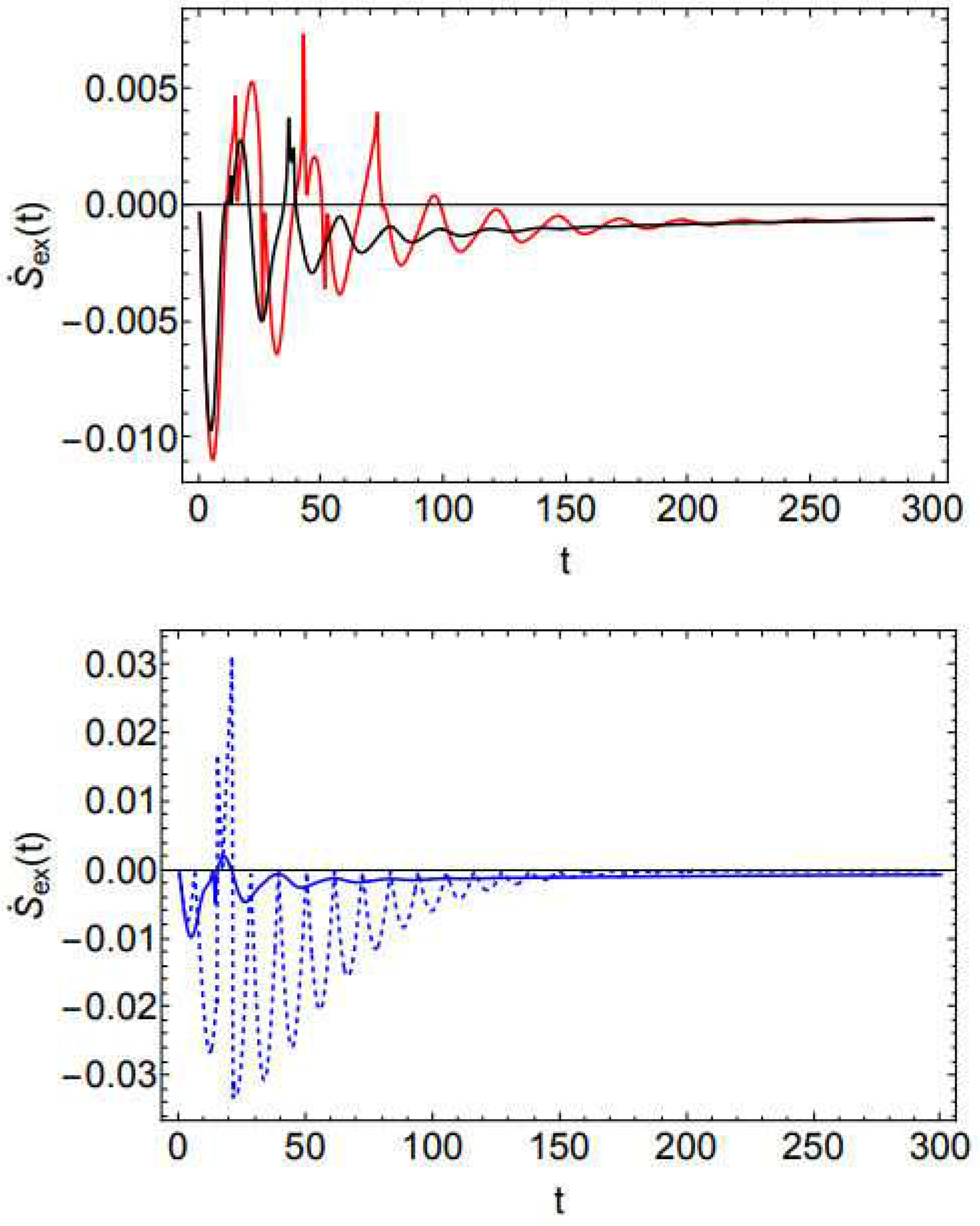
However, the monotonic behavior of changes dramatically by examining , that is, the net effect of the heat transfer by/from the bath. Figure 4 displays this property where the oscillations appear. They are due to the irreversible heat transfer process, which tends to vanish as time evolves. An increasing steady heat flux from the reservoir, different from zero, is kept in the system to ensure the system’s steady state.
Because of the low magnitude of , the major contribution to comes from . The entropy production obtained from Equation (18) (not shown) is just complying with the second law.
Unlike the simple system of a Brownian motion on a circle worked in [12] where the adiabatic and non-adiabatic contributions are positively satisfying Jensen inequality [20], is not a convex function as required by Jensen [21] but a fulctuating one. There is no contradiction with the second law because the definition (20) involves two separate interacting subsystems where the bath is not isolated, delivering heat to the particles to be returned afterward [22]. What is important is that agrees with the second law and mathematically is a convex function obeying Jensen’s inequality.
4. Conclussion
Since the results obtained from the NGLE, Eq. (1), acceptably describe the MD calculations of Daldrop, Kowalitz, and Netz [5] for the same system, should be taken into consideration to observe the effect of the field-bath interaction in the already calculation of other properties as free energies and work with time-dependent external protocols. These should include, to cite a few, the previous works on the classical Langevin equation in the versions with an exponential memory kernel [4] and both Markovians, overdamped [23,24] and inertial [25].
The effect of the field-bath interaction when the kernel is an exponential decay is just NGLE determined at frequencies too small. It allows a direct comparison with the CGLE [4].
For Markovian systems, we make the substitution in Eq. (1) and use the effective parabolic potential to get
where is an external protocol of free choice. The objective of these works, however, is the determination of the optimal one, which optimizes the mechanical work done by/on the particle for the initial conditions set. To derive it, the Euler-Lagrange formalism [26] is applied to the function defining the mechanical work. Therefore, the overdamped system [23,24] and inertial [25] of the ordinary Langevin equation can be compared with the theory of this research.
Unlike the previous versions where the interaction field bath is off, the protocol, work, entropy, and the FPE now depend on the characteristics of the bath through the effective frequency , which in turn is itself a function of the field frequency .
Funding
This research received no external funding.
Acknowledgments
The author thanks Dr. Oscar Paredes-Altuve for helpful discussions.
Conflicts of Interest
The author declares no conflict of interest.
Abbreviations
The following abbreviations are used in this manuscript:
| FPE | Fokker-Planck equation |
| CGLE | Classical generalized Langevin equation |
| NGLE | New generalized Langevin equation |
| FDT | Fluctuation-dissipation theorem |
References
- Kubo, R. The fluctuation-dissipation theorem. Rep. Prog. Phys. 1966, 29, 255. [Google Scholar] [CrossRef]
- Nieuwenhuizen, Th.M.; Allahverdyan, A.E. Statistical Thermodynamics of quantum Brownian motion: Construction of perpetuum mobile of the second kind. Phys. Rev. E 2002, 66, 036102. [Google Scholar] [CrossRef]
- Jiménez-Aquino, J.I.; Velasco, R.M. The Entropy Production Distribution in Non-Markovian Thermal Baths. Entropy 2014, 16, 1917. [Google Scholar] [CrossRef]
- Paredes-Altuve, O.; Medina, E.; Colmenares, P.J. Extracting work from a single reservoir in the non-Markovian underdamped limit. Phys. Rev. E 2016, 94, 062111. [Google Scholar] [CrossRef] [PubMed]
- Daldrop, J.O.; Kowalik, B.G.; Netz, R.R. External potential modifies friction of molecular solutes in water. Phys. Rev. X 2017, 7, 041065. [Google Scholar] [CrossRef]
- Colmenares, P.J. Generalized dynamics and fluctuation-dissipation theorem for a parabolic potential. Phys. Rev. E 2023, 108, 014115. [Google Scholar] [CrossRef] [PubMed]
- Colmenares, P.J. Fokker-Planck equation of the reduced Wigner function associated to an Ohmic quantum Langevin dynamics. Phys. Rev. E 2018, 97, 052126. [Google Scholar] [CrossRef] [PubMed]
- Sekimoto, K. Stochastic Energetics.; Lecture Notes in Physics 799., Springer: Heidelberg. Germany, 2010. [Google Scholar]
- Seifert, U. Entropy production along a stochastic trajectory and an integral fluctuation theorem. Phys. Rev. Letts. 2005, 95, 040602. [Google Scholar] [CrossRef]
- Seifert, U. Stochastic thermodynamics, fluctuation theorems, and molecular machines. Rep. Prog. Phys. 2012, 75, 126001. [Google Scholar] [CrossRef] [PubMed]
- Speck, T.; Seifert, U. Restoring a fluctuation-dissipation theorem in a nonequilibrium steady state. Europhys. Lett. 2006, 74, 391. [Google Scholar] [CrossRef]
- Van den Broeck, C.; Esposito, M. Three faces of the second law. II. Fokker-Planck formulation. Phys. Rev. E 2010, 82, 011144. [Google Scholar] [CrossRef]
- Oono, Y.; Paniconi, M. Steady state thermodynamics. Prog. Theor. Phys. Suppl 1998, 130, 29. [Google Scholar] [CrossRef]
- Zwanzig, R. Nonlinear generalized Langevin Equation. J. Stat. Phys. 1973, 9, 251. [Google Scholar] [CrossRef]
- Hänggi, P. Generalized Langevin Equations: A Useful Tool for the Perplexed Modeller of Nonequilibrium Fluctuations. In Stochastic Dynamics, Lecture Notes in Physics; Schimansky-Geier, L., Pöschel, T., Eds.; Springer-Verlag: Berlin Heidelberg, 1997. [Google Scholar] [CrossRef]
- Zwanzig, R. Nonequilibrium Statistical Mechanics; Oxford University Press: New York. USA, 2001. [Google Scholar]
- Wolfram Research, Inc.. Mathematica v13.1.0.0 computer package was used for the algebraic, numerical and graphics manipulations, 2022.
- Fox, R.F. Gaussian Stochastic Processes in Physics. Phys. Rep. 1978, 48, 179–283. [Google Scholar] [CrossRef]
- Taye, M.A. Entropy production and entropy extraction rates for a Brownian particle that walks in underdamped medium. Phys. Rev. E 2020, 101, 012131. [Google Scholar] [CrossRef] [PubMed]
- Esposito, M.; den Broeck, C.V. Three Detailed Fluctuation Theorems. Phys. Rev. Letts. 2010, 104, 090601. [Google Scholar] [CrossRef]
- Gujrati, P.D. Jensen inequality and the second law. Phys. Lett. A 2020, 384, 126460. [Google Scholar] [CrossRef]
- Prigogine, I. Introduction to Thermodynamics of Irreversible Processes, third ed.; Interscience Publishers: New York. USA, 1967. [Google Scholar]
- Schmiedl, T.; Seifert, U. Optimal finite-time processes in stochastic thermodynamics. Phys. Rev. Letts. 2007, 98, 108301. [Google Scholar] [CrossRef]
- Abreu, D.; Seifert, U. Extracting work from a single heat bath through feedback. Europhys. Lett. 2011, 94, 10001. [Google Scholar] [CrossRef]
- Colmenares, P.J.; Paredes-Altuve, O. Optimal work associated to the off-centered harmonic Brownian motion at any friction damping. Phys. Rev. E 2021, 104, 034115. [Google Scholar] [CrossRef] [PubMed]
- Morse, P.H.; Feshbach, H. Methods of Theoretical Physics; Vol. I, McGraw Hill: New York. USA, 1953. [Google Scholar]
Figure 1.
Mean heat. See text for details.
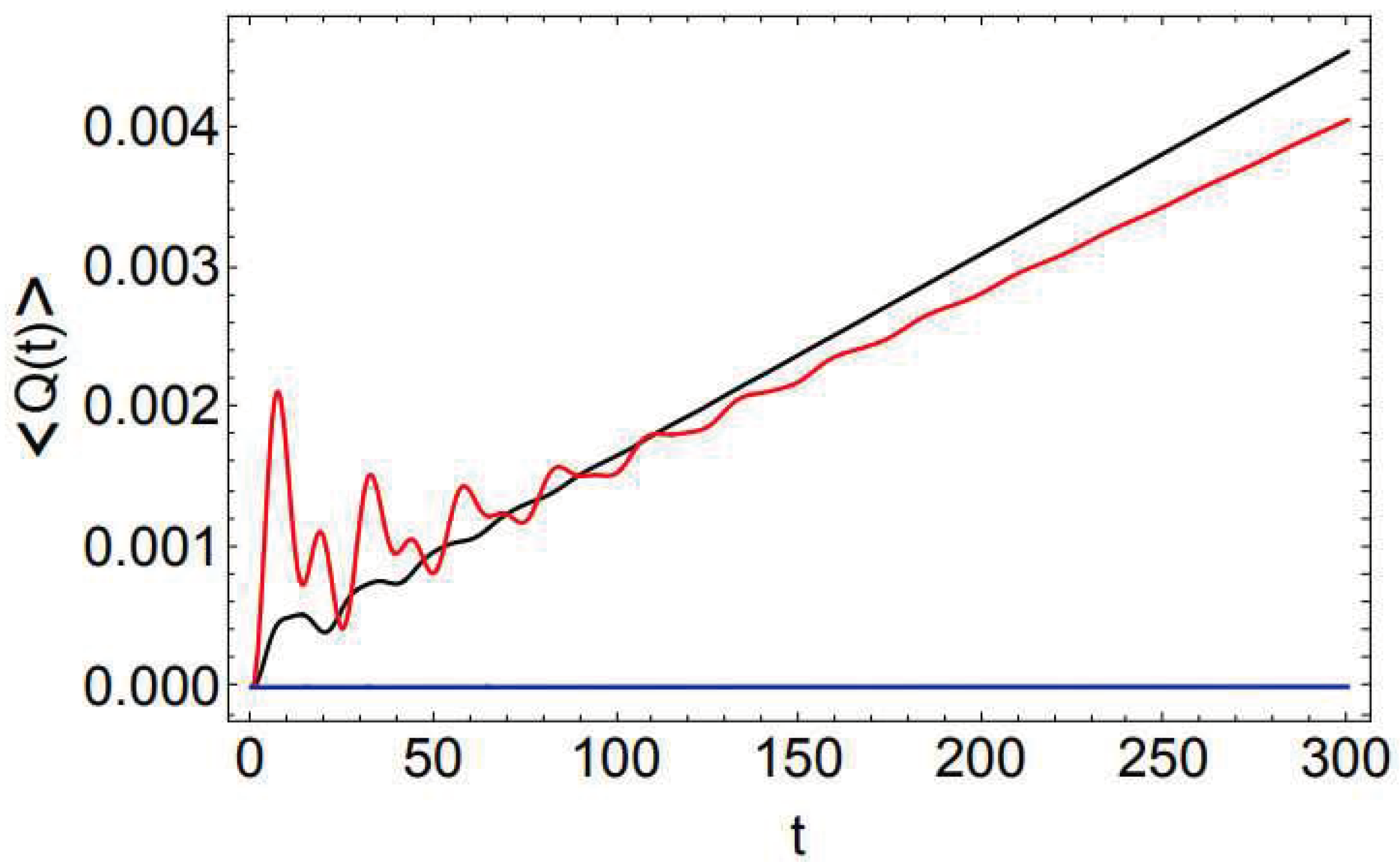
Figure 2.
Entropy of tag particles as a function of t.
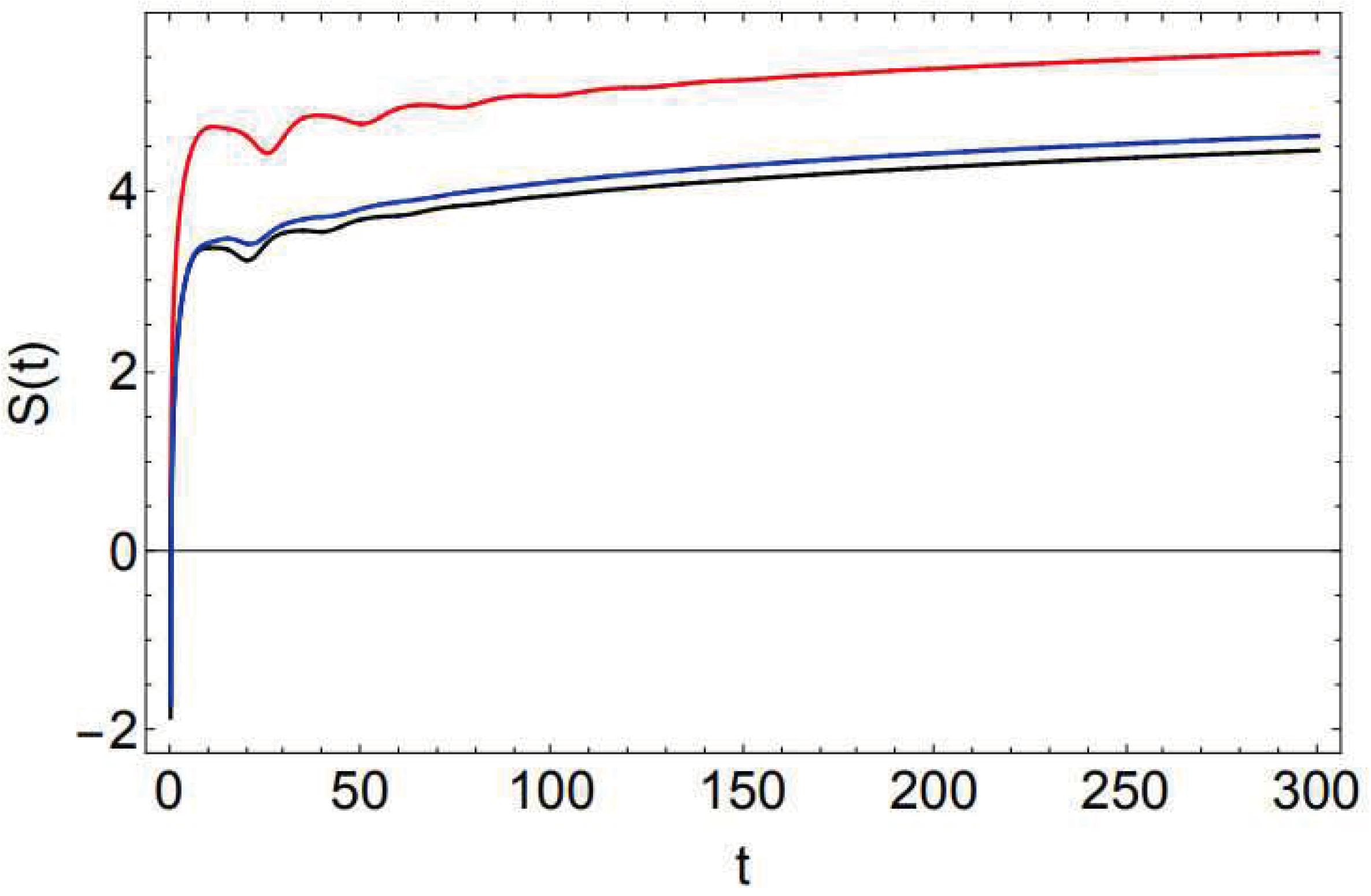
Figure 3.
Non-adiabatic entropy production as a function of t. The curve for superimposes the solid black curve.
Figure 3.
Non-adiabatic entropy production as a function of t. The curve for superimposes the solid black curve.
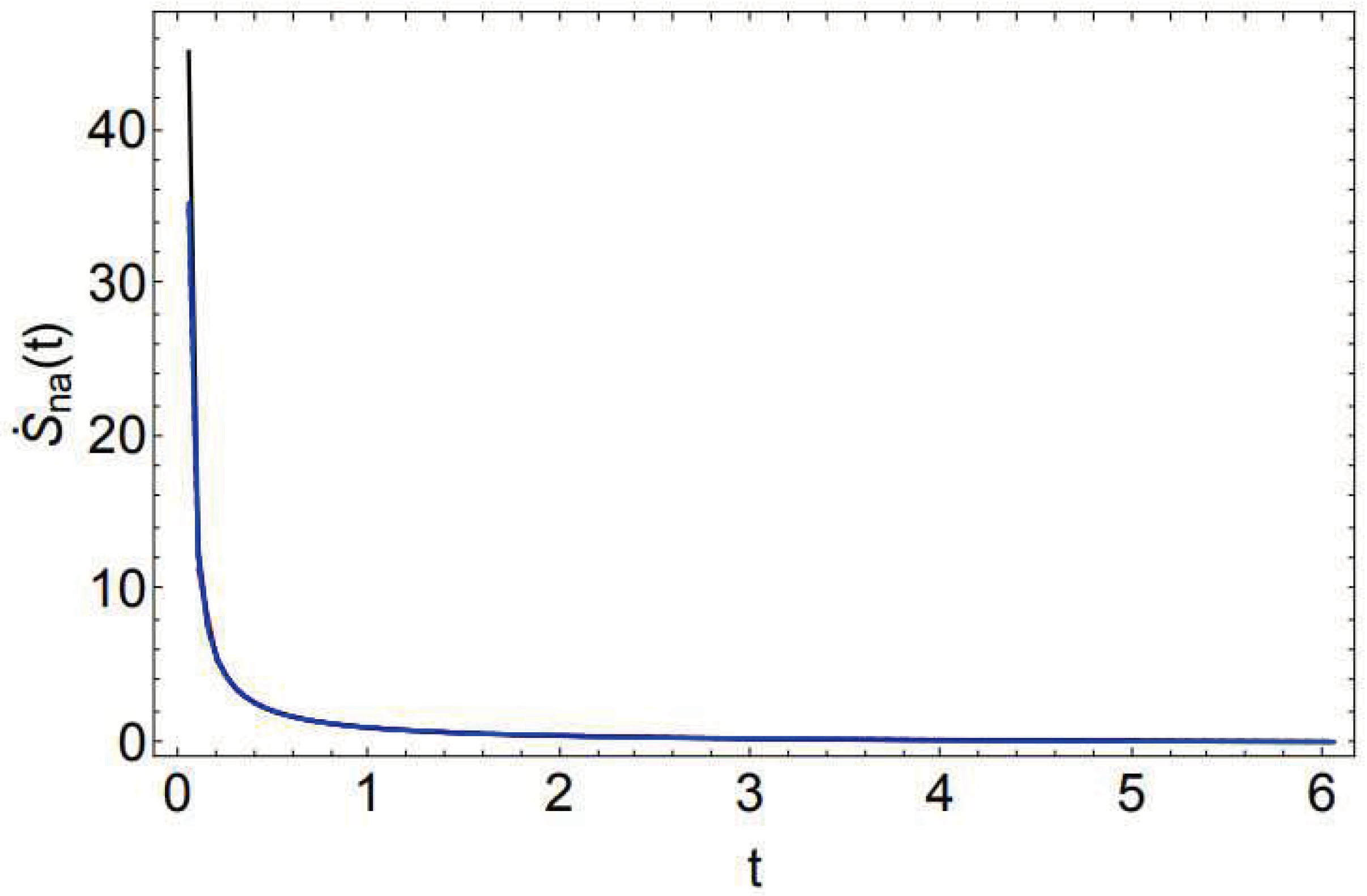
Figure 4.
Systematic entropy rate of the reservoir as a function of t.
Disclaimer/Publisher’s Note: The statements, opinions and data contained in all publications are solely those of the individual author(s) and contributor(s) and not of MDPI and/or the editor(s). MDPI and/or the editor(s) disclaim responsibility for any injury to people or property resulting from any ideas, methods, instructions or products referred to in the content. |
© 2023 by the authors. Licensee MDPI, Basel, Switzerland. This article is an open access article distributed under the terms and conditions of the Creative Commons Attribution (CC BY) license (http://creativecommons.org/licenses/by/4.0/).
Copyright: This open access article is published under a Creative Commons CC BY 4.0 license, which permit the free download, distribution, and reuse, provided that the author and preprint are cited in any reuse.