

Submitted:
06 November 2023
Posted:
07 November 2023
You are already at the latest version
Abstract
Rail, as the cleanest and greenest high-volume transport, has a central role in the decarbonizing, and it is expected to become the backbone of future mobility in the world. It is worthy to highlight that rail generates the lowest CO2 emissions and energy consumption in operation with respect to the other transportation modes but during construction and maintenance phases CO2 emission, energy consumption and other environmental impacts are significant and need to be carefully assessed and properly mitigated. This paper, based on an extensive literature review, provides a comprehensive framework of trends and challenge in railway sustainability. Attention is focused on track and related materials, maintenance strategies, and methods of assessment of the sustainability. Results show that improvement of materials and practices used in construction and appropriate strategies in maintenance, supported by effective monitoring of the state of the track, can reduce the negative effects on the environment and society and contributes to make this transportation mode greener. Proper methods for the assessment of the sustainability, (LCA, Circularity Index) help to quantify the potential of environmental enhancement of different solutions and constitute effective and indispensable tools in the decision-making process.
Keywords:
railway
; track
; sustainability
; materials
; maintenance
; monitoring
; circular economy
; LCA
1. Introduction
As it is well known, sustainability deals with “the development that meets the needs of the present without compromising the ability of future generations to meet their own needs” [1]. With growing concern for the environment, sustainable development has become one of the primary goals of all nations throughout the world.
Sustainable mobility and infrastructures are main global challenges and are important aspects of transport development. Rail transport is part of the solution to the challenge of sustainable transportation.
Railways play a structuring role in the European economy as they facilitate the production and distribution of goods and economic services and form the basis for the provision of basic social services [2]. Indeed, rail transport is becoming increasingly important as part of the transportation system and railway lines are an integral part of the countries’ transport network. In addition to the central role within the mobility system, some figures explain better also the environmental performance of the rail. The whole system of transport contributes for about 21% of the total emission of carbon dioxide CO2 in the world. The main responsible of these emissions is the road transport which contributes for about 74%, followed by aviation and marine which both account for about 11% and rail for 4% [3]. Figures make clear that rail is the main pillar of the transformative climate action in transport and the fastest and most cost-efficient way to decarbonize people’s daily mobility and logistics chains. Two climate goals in long term (2050) and in transition term (until 2050) must be pursued: in long-term, zero direct emissions, in parallel with the decarbonization of the energy sector; in transition term, because GHG emissions persist in the atmosphere and contribute to climate change, minimize the cumulative to keep to the 1.5°C target. Development of the countries need to follow paths toward these goals. As the cleanest and greenest high-volume transport, rail, representing 8% of global passenger and freight transport activity (in passenger per km, tonne per km), it is expected to become the backbone of future sustainable mobility [4].
However, the evident sustainability of the rail does not exempt asset owners, researchers, practitioners from continuing to make efforts to find solutions aimed at more and more improving this mode of transport under the standpoint of the environmental sustainability. To this purpose, it is worthy to highlight that rail generates the lowest CO2 emissions and energy consumption in operation with respect to the other transportation modes but during construction and maintenance phases CO2 emission, energy consumption and other environmental impacts are significant and need to be carefully assessed and properly mitigated [4,5]. This circumstance calls for research efforts voted at the improvement of specific aspects in all stages of the lifespan of the railways [6] and particularly in construction and maintenance where materials, practices, equipment, and strategies can be optimized with the aim of minimizing the negative effects on the environment and society and make this transportation mode greener. In the last years there has been a significant surge in research productivity on the environmental impact and sustainability of rail systems; however, this is very low in comparison to other topics and therefore further studies are requested [7].
In the railway operation, it is fundamental to guarantee the high quality of the service and provide efficiency, safety, and comfort of trip. The quality of the track, ensured by adequate construction methods and materials and frequent maintenance, is essential to this purpose. Further, as demonstrate by several research, it is important to analyze also the effects of climate change on infrastructures vulnerability [8,9,10,11,12,13]. In this context, the development and renewal of infrastructures is a critical challenge [14,15,16]. Build new tracks or maintain the existing ones is a resource intensive activity resulting in environmental damages that require to be reduced.
The objective of this work is that of providing a comprehensive overview of the actions for the sustainability in railways with a special focus on track, highlighting also challenges of the present and the future. The topics investigated include: (i) materials used in the construction and maintenance; (ii) maintenance strategies; (iii) tools for monitoring the state of the track; (iv) methods for sustainability assessment.
Paper is articulated as follows. The next section describes the methodology followed in addressing the rail track sustainability. Section 3 reports the results of the study of the state of the art based on the collected and analyzed publications belonging to the most recent literature. Finally, Section 4 outlines the challenges and the future perspectives of the research.
2. Methods
The methodology used in this study to assess the actual trends on environmental sustainability in rail track sector and the future challenges takes into consideration the lifespan of the track and the related main stages, as shown in Figure 1.
Sustainability must be pursued since the track conception in design phase when the choice of the suitable track system (ballasted, ballast-less) and related materials and components requires the consideration of the environmental concerns as well as technical, functional and economic aspects [17,18].
During construction, the mitigation of the inevitable impacts and the environmental sustainability arise from the choice of the materials, the supply mode, the supply distance of materials and components and the construction schedule. As for the materials, the selection of them focused on circular economy and then on the use of recycled materials produces benefit on environment, but it is important also to consider the supply mode (train, road vehicle) and the distance. Materials transportation is, in fact, one of the significant sources of the impact for air and noise emissions which merit to be careful considered in an environmental sustainability perspective. Impacts during constructions are usually temporary and therefore the duration of the construction phase affects the disturbance produced by the activities and the acceptability of the negative burdens. The project schedule, the timetable that outlines start and end dates and milestones that must be met for the project to be completed on time, and the respect of the scheduled times are crucial aspect in the lowering the generated impacts. Another relevant topic to consider is related to the equipment and machineries: number and type contribute to the respect of the times and the quality of the executed works, but they are usually diesel powered and then emissive [19]; thus the choice of the type of machinery must be regarded as one of the actions voted to reach the sustainability.
The use phase is here discussed with regard to the maintenance needed during the service life. The sustainability issues of the operational phase of the railway are not the subject of this study. Maintenance strategies, materials, practices and equipment are important themes on track sustainability. Ballasted track requires frequent interventions aimed at ensuring geometric and structural quality for efficiency, safety and regularity of the trains service.
Areas of enhancement of track sustainability in end of life are reuse/recycling of the dismantled materials and components and landfill, when recycling/reuse is partially or totally not allowed.
From the analysis carried out, materials and maintenance strategies, supported by track monitoring, appear critical areas of improving of track sustainability. The methods for the environmental assessments are crucial for qualitative and quantitative estimates of the benefits of alternative choices.
Table 1 synthetizes the main references analyzed in this work in theme of sustainable measures considering to the quoted critical areas and related track components.
3. Results
3.1. Sustainable Track Materials for Construction and Maintenance
To ensure efficiency and functionality over time, railway superstructure requires both effective construction techniques and materials and recurrent maintenance activities over service life. The increase of traffic volumes, axle loads and speed results in increased wear and tear and degradation of the track in all its components, such as rails, switches, sleepers, and subgrade, but particularly in the ballast layer which has the following functions [20]:
- Allows the resistance of sleepers against vertical, longitudinal, and lateral displacements, thus providing stable support for travelling trains.
- Transfers train forces to the subgrade according to its bearing capacity thus reducing compressive stresses on the subgrade.
- Keeps track geometry in the vertical and lateral directions.
- Provides elasticity to the railway track for getting proper reading comfort.
- Provides effective drainage to the track and absorption of noise and vibration.
The ballast is the weakest element of the superstructure because it is subject to the great deterioration: in fact, being an unbonded layer, the passage of vehicles, speeds, and vibrations cause geometric decay and degeneration of the quality levels. This implies that the ballast requires more frequent maintenance interventions than other elements. These reasons stimulated researchers to explore alternative materials and technologies for the construction and maintenance of the ballast layer with the objective of increasing its stability and durability [21,22,23,24,25]. Some promising ballast technologies focus attention also on environmental performance [26,27]. They include recycled crushed stone, asphalt materials, steel slag and crushed stone bonding.
Various selection criteria for ballast materials and test methods for quantifying ballast quality are applied [28,29,30]. Material properties affect the durability of the ballast layer and further the durability of the track itself.
The material usually used consists of simple gravel or ore and has the disadvantages of being easily crushed and having poor bearing capacity [20]. As train speed and axle load increase, there are more demanding requirements for particles and ballast layer, such as tighter particle size distribution PSD, higher particle strength and higher particle densities. Note that the use of crushed stones as ballast material increases the difficulty of maintenance. Several studies have summarized the test methods for determining the mechanical, physical, environmental, and geometric properties of ballast materials. The two traditional and commonly used tests are the Los Angeles abrasion test (LAA) and the micro-Deval abrasion test (MDA). The LAA test is performed only on dry ballast particles, while the MDA test can be performed on dry or impregnated particles. Based on the properties of the ballast and the corresponding tests, the quality of the ballast can be classified. It is inferred that the quality is classified according to degradation and weathering.
Considering the global strategy of low-carbon economies, it is important to maximize track life instead of replacing/building new track, in addition principle of circular economy must be even more applied also in the railway sector. To this purpose, traditional materials and solutions, are joined to alternative materials to the double aim of increasing durability and performance and guarantee environmental sustainability. For example, it has been shown that by mixing a certain percentage of the ballast with the new ballast, the performance of the layer can still be maintained. Or it has been shown that waste ballast can be used to pave roads when mixed with asphalt. Still, even waste products from industries can be recycled for use on railways.
Some alternative recycled materials listed below are proved to increase the lifetime and performance of the ballast, in addition to which, being recycled materials, they also make possible to pursue economic and environmental benefits according to the criteria of the circular economy [20]. In fact, the application of recycling waste materials in transport infrastructure developments is an efficient way of minimizing waste accumulation in stockpiles.
- Steel slag as rail ballast exhibits interesting technical properties such as higher modulus of elasticity and lower vertical stress, lower permanent deformation under high train loads. These observations imply that the use of steel slag ballast (SSB) can potentially reduce the track maintenance costs owing to lower settlement and breakage, enhance the lateral resistance due to its higher density, and provide better riding comfort because of higher resilient modulus [22,31].
- Steel slag and crushed rocks: the mixture of crushed rocks with steel slag by 50% (or lower) allow to create a material that meets the standard for special class ballast in terms of abrasion resistance and improves the shear strength of the slag-rock ballast compared to pure steel slag ballast layer [32].
- Crumb Rubber (from end of life of tyre): low percentage of this material (10%) brings significant improvements to the ballast behavior in terms of settlement and deterioration, mechanical properties, capacity to dissipate energy and contributes to extend the service life of the railway track [21,33].
- Asphalt: the use of asphalt in ballast layer improves the ballast layer stiffness, by bonding the discrete ballast into a form of track between slab track and ballasted track. The asphalt can be recycled and decomposed after heating, making it easier to maintain and repair.
- Polyethylene fibres: studies demonstrate that when narrow fibres were used, the fibre-reinforced ballast significantly reduced the settlement because fibres in granular materials reduces the lateral expansion of the mixture (smaller principal strains) and mobilizes a higher stress ratio [34].
- Polyurethane, cement and geopolymer: these binders act like the asphalt; differences deal with costs, working principle and installation. Geopolymer is a promising material for low carbon footprint but suffer of the problem of thermal expansion and contraction. Glued ballast layer is subjected to rapid degradation due to the fouling in the ballast layer [35].
- Bitumen stabilised ballast (BSB): it represents an innovative solution designed to increase ballast service life and reduce overall maintenance burdens. This technology, which can be used for new track-beds as well as to reinforce existing ones, consists of the use of bitumen emulsion (BE) poured or sprayed at ambient temperature onto the ballast. The main advantage resulting from the use of BSB is related to long term analysis (between 40 and 60 years) [36].
- Geogrid: several studies and experiments have shown how the inclusion of geogrid in te ballast increases the service life of the track improving the strength properties and particularly the resilient modulus of the railway ballast. Geogrid also reduces the extent of dynamic amplification factor (DAF) [37,38].
For the application of new materials and technologies aimed at improving track response and durability it is necessary to provide a set of recommendations and guidelines distinguished for designed-based solution and maintenance-based solutions. Design-based solutions include use of elastic elements, development of alternative elastic elements, use of geogrids, use of bituminous layers. Maintenance based solutions include conventional tamping, use of stoneblowing, ballast stabilization, including polyurethane-based stabilization techniques [39].
Regarding the subballast layer, literature shows that sustainable solutions are related to the use of non-conventional bituminous mixture made with recycled materials [5], able to ensure great stability to the layer, geocell reinforced coal mine overburden waste [40], which has proved ensure a decreasing in vertical settlements, and lateral deformations and subgrade stresses. A recent study [41] demonstrates that the use of recycled rubber products such as CWRC mixtures (i.e., mixtures of coal wash (CW) and rubber crumbs (RC)) and SEAL mixtures (i.e., mixtures of steel furnace slag, CW and RC) to replace subballast, tyre cells reinforcements for subballast and under ballast mats increases the energy dissipation effect of the track, hence reducing the ballast degradation efficiently and increasing the track stability.
Another important component of the track is the sleeper. The widely used type is the pre-stressed reinforced concrete sleeper. Research on the sustainable solution for this component led to innovative projects based on the use of recycled materials. One of these is the Greenrail sleeper [42] which has an inner core of pre-stressed concrete and an outer shell made of a mix of rubber from old tyres and recycled plastics. Rubber and plastic materials increase the average lifespan of a railway sleeper by reducing its maintenance needs and costs by two to two and a half times compared to concrete. In fact, it reduces the ballast pulverization and provides greater resistance to rails’ lateral displacement and significant electrical isolation. Further, the outer shell creates less noise and fewer vibrations as the train passes over it, reducing noise pollution for nearby residents. Greenrail sleeper exhibits also greater resistance to fracturing problems caused by freezing and thawing. From the environmental standpoint it is worthy to highlight that Greenrail sleepers needed for 1 km of rail line contribute to the recovery of up to 35 tonnes of ELTs and plastic from urban waste [43].
With regards to the traditional pre-stressed concrete sleeper, a recent study [44] presents an innovative solution, called Laminated CFRPU Reinforced Green concrete railway sleepers (LCRG-type) in which reinforcement is made with laminated carbon-fiber-reinforced polyurethane (L-CFRPU) and concrete are produced with a 30% lower cement and a dosage 50% natural pozzolan. For the new sleeper CO2 emission value is 54% less (on average) than conventional concrete railway sleepers, but compressive strength of the sleeper concrete has almost halved.
Recently, recycled composite sleepers have been produced and applied in weight-restricted Sherrington Viaduct, between Salisbury and Warminster, in the United Kingdom. They have expected to achieve Zero Carbon 2050 target due to at least a 40% reduction in greenhouse gas emissions from sleeper production and embodying recycled plastic within the track infrastructure for at least 50 years. Designed for over 50 years of use, when they are eventually replaced, they can be re-used, re-purposed or recycled to make new sleepers or other composite products.
As for the rails, switches, and fasteners, requirements on steel are more restrictive and not alternative materials can be used. One area of improvement of this component concerns the connection. Continuous Welded Rails (CWR) has increased consistently worldwide thanks to its many advantages, over the conventional jointed rail track in terms of, for example, reduction of maintenance costs or increase of life cycle of track components. Anyway, it is worthy to note that steel is a material that can be 100% endlessly recycled. Due to the high recyclability and relatively high value of scrap steel, this option often seems more attractive as well as sustainable and in line with the principle of circular economy. Reuse of these components poses the following technical challenges: lack of standardization of components, uncertainty of the efficiency of reused components, lack of knowledge of fatigue history and product composition, inappropriate decomposition handling. Criteria for the reuse are established as follows: if the components are “as good as new”, they can be reinstalled in all lines, if they are “almost as good as new” they meet the criteria for less frequent lines and can be repurposed and used in secondary lines, if neither is possible the material is sold as scrap or used as fence posts, supports for railway equipment such as signals, sold to produce designer furniture [45].
3.2. Maintenance Strategies: Environment-Related Effects
Maintenance is constantly required in ballasted track to ensure efficiency, reliability, availability, functionality and safety of the railways. Replacement is needed at the end of service life (Table 2).
The component to which is mainly addressed the periodic maintenance is the ballast which needs periodic interventions to maintain the alignment and restore the geometry to an acceptable condition, [46,47].
Maintenance activities includes renewal and re-construction as well as ballast cleaning, resurfacing, rail-head grinding and re-railing. From the environmental standpoint all these activities require the use of resources and diesel power machineries such as tamping machines (diesel engine) used for packing, lifting and lining the track bed, ballast regulators, used for replenishing ballast and rebuilding shoulder profiles and dynamic stabilizers which passing through the track consolidate the ballast aggregates to a uniform fit ensuring a good interlocking between the crushed aggregates. All these operations have the aim of extending the track life, reducing riding discomfort, improving train-track interaction, and functionality of the infrastructure. CO2 emissions from railway maintenance equipment are significant as demonstrated by [19,48,49]. Krezo et al. [19] found that track geometry restoration is peaked by ballast tamping activity followed by regulating and stabilizing, the productivity improvement can considerably reduce life-cycle CO2 emissions and improving the productivity of tamping work can be done by parallel multiple tamping heads/units.
Few researches deals with the prediction of the effect of climate change on the railway network’s maintenance. Dépoues [50] addressed the need to consider climate change as an external constraint in early in planning and decision-making proactively. Palin et al. [51] studied the effect of increasing temperature during the summertime and extreme weather on track components in Great Britain. They found that the increasing temperature during the summer could result in track buckling, postponement of maintenance operations, and exposure of workers to heat stress during outdoor maintenance.
The environmental aspect of the maintenance cannot be underestimated with respect to the cost-effective issues. The optimization of the maintenance activity under the technical, economic and environmental standpoints requires the awareness that this is a critical activity in managing railway infrastructure assets. Maintenance management cover a wide range of themes [52]:
- Maintenance policy: preventive, corrective, and improvement policy
- Maintenance operation: activities and equipment
- Degree of maintenance: prefect, imperfect, minimal
- Decision making level: strategical, tactical, operational
- Maintenance planning: action intervention and prioritization, intervention timing, inspection interval planning
- Maintenance scheduling: possession time of the track for maintenance, maintenance sequencing, vehicle routing, and crew scheduling.
Another important theme is related to decision making process. In this sense, the track degradation modelling is the basis for estimating the appropriate time for condition-based maintenance interventions in railway track maintenance. Literature on this topic has been gathered and deeply analyzed. Track degradation behavior is affected by uncertainties about heterogeneous influencing factors such as weather conditions, train axle loads, the track-bed settlements, and the construction materials [53].
Researchers classify degradation models into mechanistic or physics-based, empirical or data-driven, and hybrid models considering both physics-based and data-driven models [54,55,56].
In recent years, AI-based models have become popular, as they overcome the deficiencies of current mechanistic models in the prediction of rail track degradation. AI models involve activities and developments relating to human-like intelligence reproduced by computer applications. For this purpose, they exploit computer techniques or reasoning algorithms that attempt to automate intelligent functions [57,58]. AI models can be categorized into different sub-categories, including Artificial Neural Networks (ANNs), Adaptive Neuro-Fuzzy Inference Systems (ANFIS), Decision Support Systems (DSSs) and machine learning models.
The efficiency of the railway network system can be improved through a higher control on the maintenance processes and application timing. It increases the overall quality level of the track-bed, reduces the discomfort experienced by the users, decreases the environmental impacts [59] and promotes a better allocation of the commonly large amount of economic resources needed for maintenance and renewal [53].
3.3. Tools for Monitoring the State of the Track
Monitoring of the state of the track is a core activity to implement the correct maintenance strategies in terms of sites, time, and mode of interventions.
Research carried out on the tools for monitoring showed that there are several devices that enable European railroad companies to perform track diagnostics to support maintenance activities. Various techniques have been developed to allow measurements to be made continuously or at fixed points. These include:
- RSMV, Rolling Stiffness Measuring Vehicle, a technique used in Sweden that is based on measurements of track stiffness. It is used to identify areas where action is needed.
- FWD, Falling Weight Deflectometer, used in the United Kingdom. The data obtained after the test is carried out allow the elastic modulus of the lower zone of the track to be calculated.
- GPR, Ground- Penetrating Radar, a tool that allows fast, non-destructive inspection to estimate the integrity of the railway substructure. It provides continuous measurements of the thicknesses and layers of ballast, sub-ballast and subgrade. The measurements are sensitive to water content and material density. It is also capable of distinguishing dirty ballast from clean ballast.
-
Archimedes train, which is the most important diagnostic tool in Italy. This tool has made it possible to:
- Make measurements that were not possible before its introduction (2003)
- Carry out line monitoring without its interruption
- Increase the frequency of visiting operations
- Carry out different measurements simultaneously
- Increase the maximum diagnostic speed from 160 to 200 KM/h.
- ETR500Y2 train Dia.man.te (an acronym for Diagnostics, Maintenance and Technology). This tool is used to periodically monitor the condition of infrastructure and track, contact lines, signaling equipment, and telecommunications facilities.
Further, different types of sensors are used today [60,61,62,63]. The inclusion of sensors in railway track components permits the automated and real-time monitoring of track behaviour and traffic conditions, necessary for adopting preventive maintenance strategies. Various types of accelerometer, piezoresistive and piezoelectric sensors were evaluated to determine their viability for smart rail pads. The piezoelectrics presented the highest implementation potential for this application, considering its low cost and clearer ability to monitor variations in traffic and/or track state. Some of these sensors are:
- Fiber optic sensors: in the last two decades, a significant number of innovative sensing technologies based on fiber optic sensors (FOS) have been utilized for structural health monitoring (SHM) due to their inherent distinctive advantages, such as small size, light weight, immunity to electromagnetic interference (EMI) and corrosion, and embedding capability. Fiber optic-based monitoring systems use quasi-distributed and continuously distributed sensing techniques for real time measurement and long-term assessment of structural properties. This allows for early-stage damage detection and characterization, leading to timely remediation and prevention of catastrophic failure.
- Force Sensing Resistors (FSR) or piezoelectric sheets, work by measuring the voltage changes due to variations in the stress levels to which they are subjected.
Based on data from monitoring, specific tools help to manage maintenance tasks. In example, Timon, is a computer application that is being used in France to visualize track defects development and provide information on actions (i.e. tamping and grinding) and future analysis to be performed, or Defrail is a digital application for describing rail defects.
3.4. Sustainablity Assessment Methods
The assessment of the real performance of alternative materials and technical solutions and the awareness to mitigate the environmental negative burdens call for the consideration of many classes of impacts and for methods able to perform sound analyses (i.e. LCA), referred to life cycle of the railway track. Different methods can be used to this purpose. Below, the applicability of Life cycle assessment and circularity metrics are discussed.
3.4.1. Life Cycle Assessment
Life Cycle Assessment (LCA) is a methodology defined by ISO 14040, 2006 a, b [64,65] and applied to evaluate the environmental impact of a product/materials over its entire life cycle. Life Cycle Assessment (LCA) aims at analyzing the “environmental profile” of a rail infrastructure project or construction process and it is a useful operational tool for integrating sustainability into project development and for measuring the environmental and energy loads.
The LCA framework encompasses four stages: (i) goal and scope definition; (ii) Life-Cycle inventory analysis (LCI); (iii) Life-Cycle impact assessment (LCIA); and (iv) interpretation, Figure 2 (a).
According to the current ISO 21931-2 [66] framework for methods of assessment of the environmental and sustainability performance of construction works, LCA is able to evaluate the impacts occurring during modules A1 (raw material extraction), A2 (transport of raw materials to construction material manufacturing factory), A3 (construction material manufacturing at factory), A4 (transport of materials to road construction site), and A5 (all processes during construction of road), B1-B5 (road maintenance), B6-B8 (the use stage relating to operation of road), C1-C5 (the end-of-life stage and relandscaping) and module D (net benefits from reuse, recycling, and energy recovery beyond the system boundary), Figure 2(b).
However, it is not always possible or necessary to include all modules (analysis from cradle to grave), often the analyses conducted, as can be seen from literature, are partial and refer only to some phases of the life cycle (i.e. from cradle to gate).
Several studies applied LCA method to roads and their components; only recently, some studies have begun to incorporate the LCA method to assess the environmental impacts of railway [18,67,68,69]. The LCA may need to fulfil different requirements in different decision-contexts. Some key aspects to be addressed in LCA application are [70]:
- Determine the length of the period of analysis.
- Estimate the maintenance frequency.
- Include the effects of climate change on infrastructure performance.
The period of analysis was commonly determined based on infrastructure service life. The maintenance frequency was estimated based on current practice, laboratory tests, modelling, or scenarios. The effects of climate change were considered i.e. by comparing results in a control case and in a changed climate.
3.4.2. Circularity Metrics
Considering the quantity of the materials in the construction and maintenance of the rail track one of the strategies for sustainability deals with reducing, reusing, and recycling materials and extending products useful life through maintenance and repair. This is the concept of the Circular Economy (CE) intended in sensu stricto and focusing on the technological cycle of the resources and therefore as slowing (for the extended period of utilization) and closing (for the circular flow) resource loops [71,72]. There is another definition of CE in sensu latu which refers to a sustainable economic system where economic growth is decoupled from resources use. According ot this broad concept, CE ‘is an economic model wherein planning, resourcing, procurement, production and reprocessing are designed and managed, as both process and output, to maximize ecosystem functioning and human well-being [73,74]. The transition to a circular economy as stated by the European Commission [75] “is a tremendous opportunity to transform our economy and make it more sustainable, contribute to climate goals and the preservation of the world’s resources, create local jobs and generate competitive advantages for Europe in a world that is undergoing profound changes”.
Circularity metrics and tools help to assess the impacts or benefits generated by the circular strategies. Several circularity metrics can be found in literature according to the two quoted definition of CE [72,74,76,77]. Most of the indicators focus on the preservation of materials and reducing of the amounts of virgin material extraction. In this view the contribution of recycled materials to raw materials demand, can be represented by two indicators.
a. End-Of- Life Recycling Input Rate (EOL-RIR) that measures, for a given raw material, how much of its input into the production system comes from recycling of “old scrap”.
b. Circular Material Use rate (CMU rate), defined as the ratio of the circular use of materials (U) to the overall material use (M) [45].
4. Challenges and Future Perspectives of the Research
The literature review carried out provides in-depth perspectives on the research area and helps at identifying gaps in the literature that must be bridging with future research. From the analysis carried out, the themes to be developed and the challenge to face in the future in rail track sustainability must be mainly addressed towards the reduction of the environmental impact of railway industrial activities, by reducing waste and pollution.
- As for materials, different alternative materials, most of them coming from the recycling/reuse in a circular economy perspective, have been proved to be able for the use in the track components. Many questions merit to be tackled in the sustainability assessment of different alternatives: availability and supply distance, circularity index, impacts of the recycling processes, quantitative assessment of environmental benefits.
- Concerning the maintenance strategies and their effects on the environment, regular inspections and preventative repairs are essential to address the challenges of rail track sustainable maintenance. New technologies enable more accurate and frequent monitoring of track conditions. Drones and specialized camera systems can survey large sections of the railroad to spot potential issues proactively. Machine learning is a valid approach to automatically analyze track imagery and data to identify maintenance needs. Future research path is related to the setting-up of track degradation models to formulate appropriate and specific evaluations on the maintenance needs also considering new materials.
- The assessment of environmental performance by means the application of LCA needs to be more extended in railway sector and addressed towards the quantification of the environmental benefits arising from the use of innovative materials and construction and maintenance techniques. In a view of a wide application of the principle of circular economy in design and maintenance of the track, the setting-up of appropriate circularity metrics is a crucial aspect.
Future challenges on climate change requires the adaptation of the new railway and the existing ones. In the first case, climate resilience can be ensured by locating, designing and operating an asset with the current and future climate in mind. The existing infrastructures can be made more climate-resilient by retrofitting and/or ensuring that maintenance regimes incorporate resilience to the impacts of climate change over an asset’s lifetime.
Funding
This research was funded by MOST – Sustainable Mobility National Re-search Center and received funding from the European Union Next-GenerationEU (PIANO NAZIONALE DI RIPRESA E RESILIENZA (PNRR) – MISSIONE 4 COMPONENTE 2, INVESTIMENTO 1.4 – D.D. 1033 17/06/2022, CN00000023).
Acknowledgments
This study was carried out within the MOST – Sustainable Mobility National Re-search Center and received funding from the European Union Next-GenerationEU (PIANO NAZIONALE DI RIPRESA E RESILIENZA (PNRR) – MISSIONE 4 COMPONENTE 2, INVESTIMENTO 1.4 – D.D. 1033 17/06/2022, CN00000023). This manuscript reflects only the authors’ views and opinions, neither the European Union nor the European Commission can be considered responsible for them.
Conflicts of Interest
The authors declare no conflict of interest.
References
- Brundtland, G.; Khalid, M.; Agnelli, S.; Al-Athel, S.; Chidzero, B.; Fadika, L.; Singh, M. 1987. Our Common Future (\’Brundt- land Report\’). Oxford University Press, Oxford.
- European Commission. Adapting Infrastructures to climate change. 2013.
- Ritchie, H. Cars, planes, trains: where do CO2 emissions from transport come from?”. Published online at OurWorldInData.org. Retrieved from: ‘https://ourworldindata.org/co2-emissions-from-transport’ [Online Resource], 2020.
- Lawrence, M.; Bullock, R. The Role of Rail in Decarbonizing Transport in Developing Countries. Mobility and Transport Connectivity Series. © Washington, DC: World Bank. 2022. http://hdl.handle.net/10986/38214 License: CC BY-NC 3.0 IGO.
- Bressi, S.; Santos, J.; Giunta, M.; Pistonesi, L.; Lo Presti, D. A comparative life cycle assessment of asphalt mixtures for railway sub-ballast containing alternative materials. Resources Conservation and Recycling 2018, 137, 76–88. [Google Scholar] [CrossRef]
- Milewicz, J.; Mokrzan, D.; Szymanski, G.M. Environmental Impact Evaluation as a Key Element in Ensuring Sustainable Development of Rail Transport. Sustainability 2023, 15, 13754. [Google Scholar] [CrossRef]
- Da Fonseca-Soares, D.; Galvinicio, J.D.; Eliziário, S.A.; Ramos-Ridao, A.F. A Bibliometric Analysis of the Trends and Characteristics of Railway Research. Sustainability 2022, 14, 13956. [Google Scholar] [CrossRef]
- UIC ARISCC-Adaptation of Railway Infrastructure to Climate Change. Final Report. Nolte, R Berlin, I Z T 2011.
- EEA Adaptation of transport to climate change in Europe: challenges and options across transport modes and stakeholders 2014.
- Baker, C.J.; Chapman, L.; Quinn, A.; Dobney, K. Climate change and the railway industry: a review. Proc IME C J Mech Eng Sci 2010, 224(3), 519–528. [Google Scholar] [CrossRef]
- Nemry, F.; Demirel, F. Impacts of Climate Change on Transport: A Focus on Road and Rail Transport Infrastructures. JRC Working Papers. Directorate growth & innovation and JRC-Seville, Joint Research 2012 Centre. [CrossRef]
- Armstrong J, Preston J, Hood I (2016) Adapting railways to provide resilience and sustainability. Proc Inst Civ Eng Eng Sustain 2016, 169, 1–10. [CrossRef]
- Giunta, M. Sustainability and resilience in the rehabilitation of road infrastructures after an extreme event: an integrated approach. Baltic Journal of Road and Bridge Engineering, 2017, 12(3), 154–160. [CrossRef]
- Climate ADAPT (2019) Operation and construction measures for ensuring climate-resilient railway infrastructure. Available at: https://climate-adapt.eea.europa.eu/ metadata/adaptation-options/operation-and-construction-measures-for-ensuring-climate-resilient-railway-infrastructure.
- Wang, T.; Qu, Z.; Yang, Z.; Nichol, T.; Clarke, G.; Ge, Y-E. Climate change research on transportation systems: Climate risks, adaptation and planning. Transportation Research Part D 2020, 88, 102553. [CrossRef]
- Blackwood, L., Renaud, F.G., Gillespie, S. Nature-based solutions as climate change adaptation measures for rail infrastructure. Nature-Based Solutions 2022, 100013. [CrossRef]
- Praticò, F.G.; Giunta, M. LCC-based appraisal of ballasted and slab tracks: limits and potential. The Baltic Journal of Road and Bridge Engineering 2018, 13(4), 475–499. [Google Scholar] [CrossRef]
- Pons, J.J.; Villalba Sanchis, I.; Insa Franco, R.; Yepes, V. Life cycle assessment of a railway tracks substructures: Comparison of ballast and ballastless rail tracks. Environmental Impact Assessment Review 2020, 85, 106444. [Google Scholar] [CrossRef]
- Krezo, S.; Mirza, O.; Kaewunruen, S.; Sussman, J.M. Evaluation of CO2 emissions from railway resurfacing maintenance activities. Transp Res Part D Transp Environ 2018, 65, 458–465. [Google Scholar] [CrossRef]
- Guo, Y.; Xie, J.; Fan, Z., Markine, V.; Connolly, D.P.; Jing, G. Railway ballast material selection and evaluation: A review. Construction and Building Materials 2022, 344, 128218. [CrossRef]
- Sol-Sanchez M.; Thom, N.H.; Moreno-Navarro, F.; Rubio-Gamez, M.C.; Airey, G.D. A study into the use of crumb rubber in railway ballast, Construction and Building Materials 2015, 75, 19-24. [CrossRef]
- Guimaraes Delgado, B.; Viana da Fonseca, A.; Fortunato, E.; Maia, P. Mechanical behavior of inert steel slag ballast for heavy haul rail track: laboratory evaluation. Transportation Geotechnics 2019, 20, 100243. [Google Scholar] [CrossRef]
- Sahay, J.; Nagpal, O.; Prasad, S. Waste management of steel slag. Steel times international 2000, 24(2), 38. [Google Scholar]
- Jia, W.; Markine, V.L.; Jing, G. Analysis of furnace slag in railway sub-ballast based on experimental tests and DEM simulations, Construction and Building Materials 2021, 288, 123114. [CrossRef]
- Mehran Khoshoei, S.; Mortazavi Bak, H.; Mahdi Abtahi, S.; Mahdi Hejazi, S.; Shahbodagh, B. Experimental Investigation of the Cyclic Behavior of Steel-Slag Ballast Mixed with Tire-Derived Aggregate. Journal of Materials in Civil Engineering 2021 33 (2). [CrossRef]
- Ghanbari, M.; Abbasi, A.M.; Ravanshadnia, M. Production of natural and recycled aggregates: the environmental impacts of energy consumption and CO2 emissions. Journal of Material Cycles and Waste Management 2017, 20 (2) 810-822. [CrossRef]
- Pradhan, S.; Tiwari, B.R.; Kumar, S.; Barai, S.V. Comparative LCA of recycled and natural aggregate concrete using Particle Packing Method and conventional method of design mix. Journal of Cleaner Production 2019, 228, 679–691. [Google Scholar] [CrossRef]
- Nalsund, R. Railway ballast characteristics, selection criterion and performance. PhD Thesis. Norwegian University of Science and Technology, Trondheim, Department of Civil and Transport Engineering, 2014.
- Indraratna, B. 1st Proctor Lecture of ISSMGE: Railroad performance with special reference to ballast and substructure characteristics. Transportation Geotechnics 2016, 7, 74–114. [Google Scholar] [CrossRef]
- Alabbasi, Y.; Hussein, M. Large-scale triaxial and box testing on railroad ballast: a review. SN Applied Sciences 2019, 1(12). [CrossRef]
- Hussain, A.; Hussaini, S.K.K. Use of steel slag as railway ballast: A review. Transportation Geotechnics 2022, 35, 100779. [Google Scholar] [CrossRef]
- Jing, G.; Wang, J.; Wang, H.; Siahkouhi, M. Numerical investigation of the behavior of stone ballast mixed by steel slag in ballasted railway track. Construction and Building Materials, 2020, 262, 120015. [CrossRef]
- Fathali, M.; Nejad, F.M.; Esmaeili, M. Influence of Tire-Derived Aggregates on the Properties of Railway Ballast Material Journal of Materials in Civil Engineering, 2017, 29 (1), 04016177. [CrossRef]
- Ajayi, O.; Le Pen, L.; Zervos, A.; Powrie, V. Feasibility Study of Random Fibre Reinforced Railway Ballast Proceedings of the 23rd European Young Geotechnical Engineers Conference, Barcelona 2014.
- Jing, G.; Qie, L.; Markine, V.L.; Jia, W. Lo Polyurethane reinforced ballasted track: Review, innovation and challenge. Construction and Building Materials 2019, 208(3), 734–74. [Google Scholar] [CrossRef]
- D’Angelo, G.; Bressi, S.; Giunta, M.; Presti, D.; Thom, N. Novel performance-based technique for predicting maintenance strategy of bitumen stabilised ballast. Construction and Building Materials 2018, 161, 1–8. [Google Scholar] [CrossRef]
- Sweta, K.; Khaja, S-; Hussaini, K. Effect of geogrid on deformation response and resilient modulus of railroad ballast under cyclic loading. Construction and Building Materials 2020, 264, 120690. [CrossRef]
- Leonardi, G. Analysis of railway tracks reinforced with geogrids. ARPN Journal of Engineering and Applied Sciences 2021, 16(24), 2722–2728. [Google Scholar]
- Sol-Sanchez, M.; D’Angelo, G. Review of the design and maintenance technologies used to decelerate the deterioration of ballasted railway tracks. Constr Build Mater 2017; 157, 402-415. [CrossRef]
- Banerjee, L.; Chawla, S.; Kumar Dash, S. Application of geocell reinforced coal mine overburden waste as subballast in railway tracks on weak subgrade. Construction and Building Materials 2020, 265, 120774. [Google Scholar] [CrossRef]
- Indraratna, B.; Qi, Y.; Sai Malisetty, R.; Navaratnarajah, S.K.; Fatima Mehmood, F.; Tawk Rail, M. Recycled materials in railroad substructure: an energy perspective. Rail. Eng. Science 2022, 30(3), 304–322. [Google Scholar] [CrossRef]
- https://cordis.europa.eu/project/id/738373 (Accessed on 2023 October 30th).
- Dolci, G.; Rigamonti, L.; Grosso, M. Potential for improving the environmental performance of railway sleepers with an outer shell made of recycled materials. Transportation Research Interdisciplinary Perspectives 2020, 6, 100160. [Google Scholar] [CrossRef]
- Çeçen, F.; Aktas¸, B.; Ozbayrak, A. Decarbonization of the concrete railway sleeper production: bringing the low-dosage pozzolanic cement usage in the sleeper production via novel laminated CFRPU reinforcement technique. Materials Today Sustainability 2023, 23, 100455. [Google Scholar] [CrossRef]
- International Union of Railway. UIC SUSTAINABILITY Circular practices in the railway and ways forward REUSE Project final Report 2021. https://uic.org/IMG/pdf/reuse_project_final_report.pdf.
- Giunta, M.; Praticò, F. G., 2017. Design and maintenance of high-speed rail tracks: A comparison between ballasted and ballast-less solutions based on Life Cycle Cost Analysis. In Proceedings of International Congress on Transport Infrastructure and System, Rome 10-12 April 2017.
- Italferr. LCA Life Cycle Assessment, line guida per la valutazione LCA di infrastrutture ferroviarie, 2019.
- Milford, R.L.; Allwood, J.M. Assessing the CO2 impact of current and future rail track in the UK. Transp Res Part D Transp Environ 2010. [CrossRef]
- Kiani, M.; Parry T, Ceney H. Environmental life-cycle assessment of railway track beds. Proc Inst Civ Eng Eng Sustain 2008. [CrossRef]
- Dépoues, V. Organisational uptake of scientific information about climate change by infrastructure managers: the case of adaptation of the French railway company. Clim Change 2017, 143, 473–486. [Google Scholar] [CrossRef]
- Palin EJ, Thornton HE, Mathison CT, McCarthy RE, Clark RT, Dora J. Future projections of temperature-related climate change impacts on the railway network of Great Britain. Clim Change 2013. [CrossRef]
- Sedghi, M.; Kauppila, O.; Bergquista, B.; Vanhataloa, E.; Kulahcia, M. A taxonomy of railway track maintenance planning and scheduling: A review and research trends. Reliability Engineering and System Safety 2021, 215, 107827. [Google Scholar] [CrossRef]
- ressi, S.; Santos, J; Losa M. Optimization of maintenance strategies for railway track-bed considering probabilistic degradation models and different reliability levels. Reliab Eng Syst Saf 2021, 207, 107359. [CrossRef]
- Soleimanmeigouni, I.; Ahmadi, A.; Kumar, U. Track geometry degradation and maintenance modelling: a review. Proc Inst Mech Eng Part F J Rail Rapid Transit 2018. [Google Scholar] [CrossRef]
- Elkhoury, N.; Hitihamillage, L.; Moridpour, S.; Robert, D. Degradation prediction of rail tracks: a review of the existing literature. Open Transp J 2018, 12(1), 88-104.
- Higgins, A. Scheduling of railway track maintenance activities and crews. J Oper Res Soc 1998. [Google Scholar] [CrossRef]
- Khajehei, H.; Ahmadi, A.; Soleimanmeigouni, I.; Haddadzade, M.; Nissen, A.; Javad Latifi Jebelli, M. Prediction of track geometry degradation using artificial neural network: a case study. International Journal of Rail Transportation 2022, 10:1, 24-43. [CrossRef]
- Jovanovic, S., Guler, H.; Coko, B. 2015. Track degradation analysis in the scope of railway infrastructure maintenance management systems. Gradjevinar 2015, 67 (3), 247-258.
- Bressi, S.; D’Angelo, G.; Santos, J.; Giunta, M. Environmental performance analysis of bitumen stabilized ballast for railway track-bed using life-cycle assessment. Constr Build Mater 2018, 188, 1050–1064. [Google Scholar] [CrossRef]
- Du, C.; Dutta, S.; Kurup, P.; Yu, T.; Wang, X. A review of railway infrastructure monitoring using fiber optic sensors. Sensors and Actuators A 2020, 303, 111728. [Google Scholar] [CrossRef]
- Sol-Sanchez, M.; Castillo-Mingorance, J.M.; Moreno-Navarro, F.; Rubio-Gamez, M.C. Smart rail pads for the continuous monitoring of sensored railway tracks: Sensors analysis. Automation in Construction 2021, 132, 103950 (a). [Google Scholar] [CrossRef]
- Sol-Sanchez, M.; Castillo-Mingorance, J.M.; Moreno-Navarro, F.; Mattinzioli, T.; Rubio-Gamez, M. C. Piezoelectric-sensored sustainable pads for smart railway traffic and track state monitoring: Full-scale laboratory tests., Construction and Building Materials 2021 301, 124324 (b). [CrossRef]
- Antognoli, M.; Marinacci, C.; Ricci, S.; Rizzetto, L. Requirement specifications for track measuring and monitoring systems. Ingegneria Ferroviaria 2020, 11, 841–864. [Google Scholar]
- ISO 14040, 2006a. Environmental Management - Life-Cycle Assessment - Principles and Framework. International Organization for Standardization., Geneva.
- ISO 14044, 2006b. Environmental Management – Life-Cycle Assessment – Requirements and Guidelines. International Organization for Standardization., Geneva.
- ISO 21931-2:2019 Sustainability in buildings and civil engineering works Framework for methods of assessment of the environmental, social and economic performance of construction works as a basis for sustainability assessment. Part 2: Civil engineering works. International Organization for Standardization., Geneva.
- Fathali, M.; Chalabii, J.; Astaraki, F.; Esmaeili, M. A new degradation model for life cycle assessment of railway ballast materials. Construction and Building Materials 2021, 270, 121437. [Google Scholar] [CrossRef]
- Celauro, C.; Cardella, A.; Guerrieri, M. LCA of Different Construction Choices for a Double-Track Railway Line for Sustainability Evaluations. Sustainability 2023, 15, 5066. [Google Scholar] [CrossRef]
- Gulcimen, S.; Aydogan, E.K.; Uzal, N. Life cycle sustainability assessment of a light rail transit system: Integration of environmental, economic, and social impacts. Integr. Environ. Assess. Manag. 2021, 17, 1070–1082. [Google Scholar] [CrossRef] [PubMed]
- Liljenstrom, C.; Bjorklund, A.; Toller, S. Including maintenance in life cycle assessment of road and rail infrastructure-a literature review. The International Journal of Life Cycle Assessment 2022, 27, 316–34. [Google Scholar] [CrossRef]
- Bocken, N.M.P.; de Pauw, I.; Bakker, C.; van der Grinten, B. Product design and business model strategies for a circular economy. J. Ind. Prod. Eng. 2016, 33, 308–320. [Google Scholar] [CrossRef]
- Moraga, G., Huysveld, S.; Mathieux, F.; Blengini, G.A.; Alaerts, L.; Van Acker, K., de Meester, S.; Dewulf, J. Circular economy indicators: what do they measure? Resources Conserv. Recycl. 2019, 146, 452–461. [CrossRef]
- Murray, A.; Skene, K.; Haynes, K. The circular economy: an interdisciplinary exploration of the concept and application in a global context. J. Bus. Ethics 2017, 140, 369–380. [Google Scholar] [CrossRef]
- Corona, B.; Shen, L.; Reike, D.; Rosales Carreón, J.; Worrell, E. Towards sustainable development through the circular economy—A review and critical assessment on current circularity metrics. Resources, Conservation and Recycling 2019, 151, 104498–2019. [Google Scholar] [CrossRef]
- European Commission. A monitoring framework for the circular economy, Communication from the Commission to the European Parliament, the Council, the European Economic and Social Committee and the Committee of the Regions. 2018.
- Saidani, M., Yannou, B., Leroy, Y., Cluzel, F., Kendall, A., 2018. A taxonomy of circular economy indicators. J. Clean. Prod. 2019, 207, 542–559. [CrossRef]
- De Pascale, A.; Arbolino, R.; Szopik-Depczynska, K.; Limosani, M.; Giuseppe Ioppolo, G. A systematic review for measuring circular economy: The 61 indicators. Journal of Cleaner Production 2021, 281, 124942. [Google Scholar] [CrossRef]
Figure 1.
Areas of improving of the track sustainability in life cycle phases.
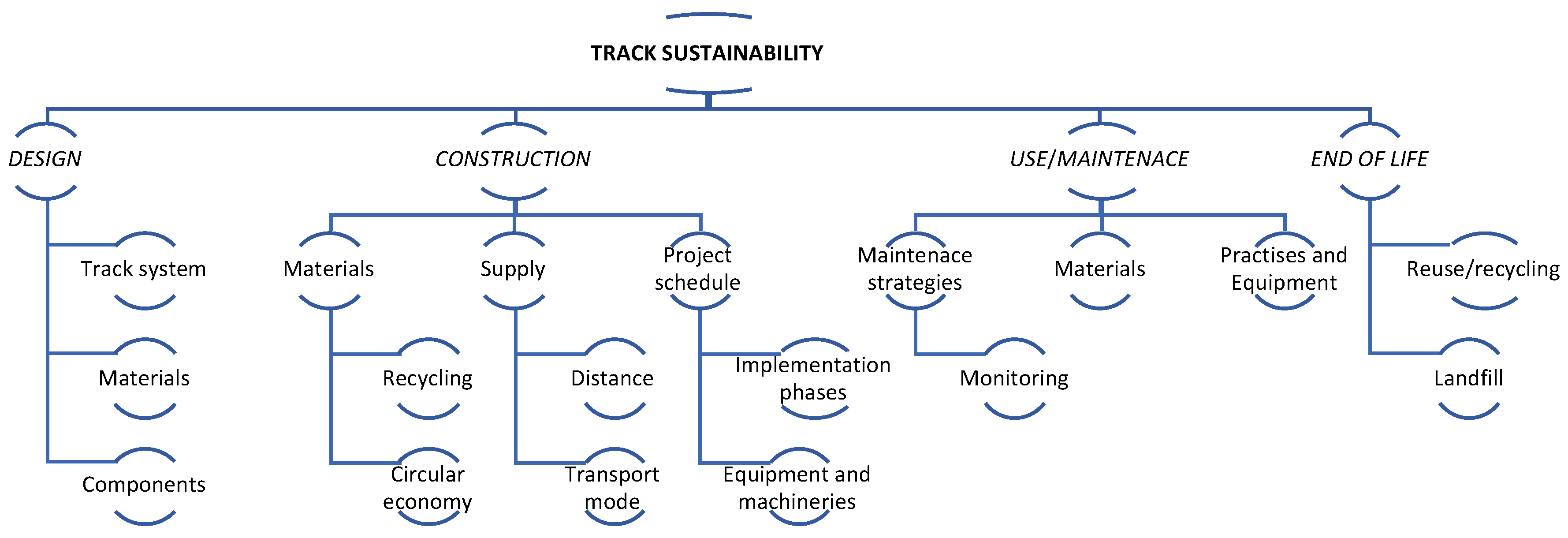
Figure 2.
(a) The phases of the LCA, ISO 14040, 2006a; (b) Schematic illustration of the life-cycle stages of a civil engineering works project and their classification in modules, ISO 21931-2.
Figure 2.
(a) The phases of the LCA, ISO 14040, 2006a; (b) Schematic illustration of the life-cycle stages of a civil engineering works project and their classification in modules, ISO 21931-2.
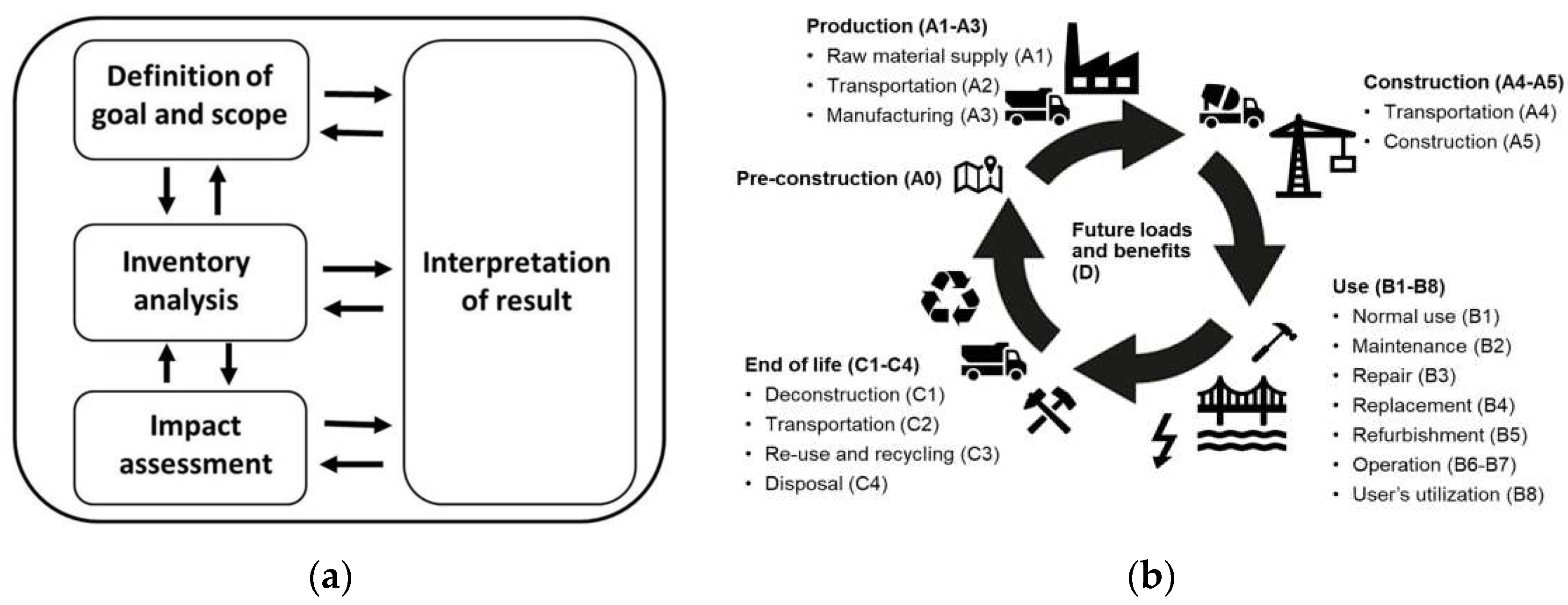

Table 1.
Synthesis of the state of the art on track sustainable measures.
| Topics | Track Component | References |
|---|---|---|
| Materials | Sub-ballast | [5,40,41] |
| Ballast | [20,21,22,23,24,25,26,27,28,29,30,31,32,33,34,35,36,37,38,39] | |
| Sleepers | [42,43,44] | |
| Rail | [45] | |
| Maintenance strategies | All | [46,47,48,49,50,51,52,53,54,55,56,57,58,59] |
| Monitoring | All | [60,61,62,63] |
| Environmental assessment | All | [64,65,66,67,68,69,70,71,72,73,74,75,76,77] |
Table 2.
Service life of ballasted track components.
| Component | Service Life [Years] |
|---|---|
| Rail replacement | 28 |
| Sleepers replacement | 40 |
| Fastenings replacement | 40 |
| Ballast recovery | 30 |
| Tamping/levelling | 1-5 |
Disclaimer/Publisher’s Note: The statements, opinions and data contained in all publications are solely those of the individual author(s) and contributor(s) and not of MDPI and/or the editor(s). MDPI and/or the editor(s) disclaim responsibility for any injury to people or property resulting from any ideas, methods, instructions or products referred to in the content. |
© 2023 by the authors. Licensee MDPI, Basel, Switzerland. This article is an open access article distributed under the terms and conditions of the Creative Commons Attribution (CC BY) license (http://creativecommons.org/licenses/by/4.0/).
Copyright: This open access article is published under a Creative Commons CC BY 4.0 license, which permit the free download, distribution, and reuse, provided that the author and preprint are cited in any reuse.


