
Submitted:
30 October 2023
Posted:
31 October 2023
You are already at the latest version
Abstract
Plants are exposed to a variety of abiotic and biotic stresses leading to increased formation of reactive oxygen species (ROS) in plant cells. ROS are capable of oxidizing proteins, pigments, lipids, nucleic acids, and other cell molecules, disrupting their functional activity. During the process of evolution, numerous antioxidant systems were formed in plants, including antioxidant enzymes and low-molecular-weight non-enzymatic antioxidants. Antioxidant systems perform neutralization of ROS and therefore prevent oxidative damage of cell components. In the present review, we focus on the biosynthesis of non-enzymatic antioxidants in higher plant cells such as ascorbic acid (vitamin C), glutathione, flavonoids, isoprenoids, including carotenoids, tocopherol (vitamin E), ubiquinone and plastoquinone. Their functioning and their reactivity with respect to individual ROS are described. The review is also devoted to the modern genetic engineering methods, which are widely used to change the quantitative and qualitative content of the non-enzymatic antioxidants in cultivated plants. These methods allow to obtain various plant lines with given properties in a rather short time. The most successful approaches for plant transgenesis and plant genome editing for the enhancement of the biosynthesis and the content of these antioxidants are discussed.
Keywords:
higher plants
; reactive oxygen species
; antioxidants
; isoprenoids
; plastoquinone
; carotenoids
; tocopherol
; ubiquinone
; flavonoids
; ascorbic acid
; glutathione
; transgenesis
; CRISPR/Cas9
1. Introduction
In all aerobic organisms, the interaction between molecular oxygen and various cellular components invariably gives rise to the production of reactive oxygen species (ROS). In higher plants, these components primarily include the carriers of the electron-transport chains in both photosynthetic and respiratory apparatuses and of short plasma membrane chain. Even under optimal operating conditions, ROS are formed at a low level [1]. Stress conditions amplify ROS production in different cellular compartments, such as chloroplasts [2,3,4], peroxisomes [5], mitochondria [6], and in the plasma membrane [7]. The physiological functions of ROS largely depend on their chemical properties, their formation site, as well as on the concentration of ROS. This concentration is influenced by the rate of ROS formation and the rate of their neutralization by the antioxidant systems.
The antioxidant systems in higher plants are represented by antioxidant enzymes and non-enzymatic antioxidants. Antioxidant enzymes exist in multiple molecular forms (isoenzymes) across different cell organelles, mainly within their aqueous phases. For example, superoxide dismutases (SODs), which detoxify superoxide anion-radical, can be classified as CuZnSOD, MnSOD, or FeSOD, based on the metal cofactor. These isoenzymes are localized in distinct cell compartments: in chloroplasts (for FeSOD and CuZnSOD), cytosol (for CuZnSOD), and mitochondria (for MnSOD). Catalase, ascorbate peroxidases (APXs), Cys peroxiredoxins, and various other peroxidases are the most abundant antioxidant enzymes that catalyze the reduction of hydrogen peroxide (H2O2) to water. APXs (thylakoid-bound APX and stromal APX) and Cys peroxiredoxins detoxify H2O2 in chloroplasts, cytoplasmic and peroxisomal APX – in cytoplasm and peroxisomes, respectively. Catalase functions in glyoxysomes and peroxisomes.
Representatives of non-enzymatic antioxidants in higher plants are ascorbic acid (vitamin C), glutathione, flavonoids, isoprenoids, including carotenoids, tocopherol (vitamin E), ubiquinone, and plastoquinone. Similar to antioxidant enzymes, non-enzymatic antioxidants function in different cell compartments both in aqueous (ascorbic acid, glutathione, flavonoids) and membrane phases (flavonoids and isoprenoids). Recently, the potential antioxidant activity of compounds that were not previously considered as such (sugars, proline, etc.) has been actively studied. However, they are not the subject of this review, as the mechanism of their antioxidant activity remains unclear and may be associated with their protective and signaling effects.
Over the last few decades scientists not only successfully increased the intensity of biosynthesis of antioxidant enzymes, but also multiplied the level of the antioxidants to improve plants sustainability. However, creating mutant plants with modified biosynthesis of non-enzymatic antioxidants is complicated since multiple pathways and enzymes are involved in their biosynthesis. Yet, it is currently believed that the creation of plants with a high content of antioxidants is a clear and direct way to increase the sustainability of crops.
There are two primary approaches to increase the levels of low-molecular-weight antioxidants: i) enhancing the expression of one or more genes encoding key enzymes involved in the biosynthesis of the target antioxidant; ii) reducing the expression of genes encoding enzymes involved in the utilization or consumption of the specific antioxidant. These approaches can be achieved using both classical transgenesis and genome editing methods, either by directly altering the expression intensity of antioxidant biosynthesis genes or indirectly by regulating the activity of transcription factors for the corresponding genes.
The classical transgenesis involves introducing additional copies of the key enzyme-encoding genes into the plant, either from its own genome or from other species. These genes are inserted under the control of constitutive promoters, such as the cauliflower mosaic virus (CaMV) 35S promoter. The genome editing strategies incorporate the use of zinc finger nucleases (ZFN), transcription activator-like effector nucleases (TALEN), and clustered regularly interspaced short palindromic repeats with CRISPR-associated protein (CRISPR/Cas) systems. CRISPR/Cas9 has become the most popular system due to its simplicity, accuracy, and versatility. This method uses ribonucleoprotein complexes, which are able to recognize targeted sequences in the genome using the synthetic guide RNA and make a double-stranded DNA break. This break is followed by repair with a donor matrix through the homologous directed repair (HDR) or non-homologous repair (NHEJ). The most common results of NHEJ are insertions and deletions (indels) in target sites, leading to the formation of mutations due to a shift in the reading frame in the coding sequence of the gene, and the appearance of a stop codon, which can lead to loss of gene function, and in some cases to enhanced gene expression. The CRISPR/Cas9 genome editing system is widely used in applied research to create crops with new valuable agronomic traits without introducing exogenous sequences and with minimal off-target changes in the genome [8].
The present review describes the biosynthesis pathways of isoprenoid antioxidants: ubiquinone, plastoquinone, tocopherols and carotenoids, as well as flavonoids, ascorbic acid and glutathione. The mechanisms of the antioxidant activity of these compounds in relation to various ROS are also described. The review also emphasizes the success in developing a wide range of plants of different species with increased content of non-enzymatic antioxidants, achieved using either classical transgenesis or genome editing methods. Given the indispensable role of the CRISPR/Cas9 genome editing system in advancing functional genomics, we pay special attention to CRISPR/Cas9-based editing of plants. The review also emphasizes the result of modern actively developing approaches designed on CRISPR/Cas9 basis that provides the delivery of effector molecules or markers to certain DNA regions to change the transcriptional level of gene expression towards activation (CRISPRa) or suppression of gene activity (CRISPRi).
2. Functioning of Non-Enzymatic Antioxidants in Higher Plant Cells and the Ways of Boosting Their Biosynthesis
2.1. Isoprenoids
2.1.1. Biosynthesis of isoprenoids
Isoprenoids (also known as terpenoids) belong to secondary metabolites, which include carotenoids, sterols, polyprenyl alcohols, ubiquinone-10 (UQ), plastoquinone-9 (PQ), tocopherols and others. The first stages of their biosynthetic pathways involve the formation of prenyl side chain precursors and a benzoquinone ring. Isopentenyl diphosphate (IPP) (Figure 1A) is the universal isoprene precursor for prenyl side chain synthesis of all isoprenoids. Benzoquinone ring originates from L-tyrosine (Figure 1B) or phenylalanine, both products of the shikimate pathway, which is a specialized pathway for the biosynthesis of aromatic compounds.
In the second stage, the condensation of the ring and the prenyl side chain with subsequent modifications takes place [9]. The prenyl side chain is synthesized in the cytoplasm IPP, which is converted by isopentenyl diphosphate isomerase (IPPI) to dimethylallyl pyrophosphate (DMAPP) followed by the synthesis of numerous isoprenoids, including PQ and UQ (Figure 2). The information about the genes, which encode the main enzymes of the isoprenoid biosynthesis in Arabidopsis thaliana, is given in Table 1.
The transformation of IPP to DMAPP occurs both in the stroma of chloroplasts and in the matrix of mitochondria with the involvement of polyprenyl diphosphate synthase (PPS), such as geranyl diphosphate synthase (GPPS), farnesyl diphosphate synthase (FPPS), and geranyl geranyl diphosphate synthase (GGPPS) [32,33]. These diphosphate synthases catalyze the formation of polyprenyl diphosphates with various chain lengths, making them the key enzymes in the biosynthesis of many isoprenoid compounds, such as PQ and UQ, vitamin E, carotenoids, and others [34].
2.1.1.1. Ubiquinone synthesis
For the synthesis of UQ, IPP is transported to mitochondria, where further stages of UQ9 synthesis are carried out. In plants, the isoprene subunits for the UQ side chain are generated through the mevalonate (MVA) pathway, which takes place both in cytoplasm and peroxisomes (Figure 2). The produced precursors are further used for the biosynthesis of sesquiterpenes, triterpenes, sterols, and brassinosteroids [35,36]. The next step of UQ synthesis is the formation of polyisoprenoid tail of polyprenyl-pyrophosphate (PPPP) in mitochondria by solanesyl diphosphate synthase (SPS3), which is trans-polyprenyl diphosphate synthase, also called Coq1. This is one of the most important enzymes in UQ synthesis, since Arabidopsis AtSPS3 knockout mutants were embryo-lethal [14]. The most likely substrate for SPS3 in plants is farnesyl diphosphate (FPP), as evidenced by the reduced UQ level in loss-of-function FPP synthase mutants FPS1 and FPS2 [37].
Enzymes (colored): 4CL8, peroxisomal 4-coumarate CoA ligase; βLCY1, β-carotene cyclase; βOHase, β-carotene hydroxylase; εLCY, ε- carotene cyclase; εOHase, ε-carotene hydroxylase; CoQ1 (SPS3), solanesyl diphosphate synthase; Coq3, Coq5, S -adenosyl- l -methionine (SAM)-dependent methyltransferases; Coq2 (PPT1), 4-hydroxybenzoate polyprenyl diphosphate transferase; Coq6, CoqF, flavin-dependent monooxygenases; CRTISO, carotenoid isomerase; FPPS, farnesyl diphosphate synthase; GGPPS, geranylgeranyl diphosphate synthase; GGPPS, geranyl geranyl diphosphate synthase; HPPD, 4-hydroxyphenylpyruvate dioxygenase; HPPR, 4-hydroxyphenylpyruvatereductase; HPT (VTE2), homogentisate phytyl transferase; HST, homogentisate solanesyl diphosphate transferase; IDI, isopentenyl diphosphate isomerase; IPPI, isopentenyl diphosphate isomerase; NXS, neoxanthin synthase; PDS, Phytoene desaturase; PSY, Phytoene synthase; SPS, solanesyl diphosphate synthases; TAT, tyrosine aminotransferase; VDE, violaxanthin deepoxidase; VTE1, tocopherol cyclase; VTE3, MPBQ/MSBQ methyl transferase; VTE4, γ-tocopherol methyltransferase; VTE5, phytol kinase; VTE6, phytyl-phosphate kinase; ZDS, ζ-carotene desaturase; ZE, zeaxanthin epoxidase.
The enzymes of the cytoplasmic stages of isoprenoid synthesis are marked in purple, the stages and enzymes of the chloroplast isoprenoid synthesis are marked in turquoise, the stages of tocopherol synthesis are yellow-brown, the stages of plastoquinone synthesis are green, and the stages of carotenoid synthesis are red. The stages and enzymes of ubiquinone synthesis are marked in brown.
The aromatic ring precursor for UQ biosynthesis is 4-hydroxybezoic acid (4-HB) (Figure 1C), which is derived from either L-phenylalanine or L-tyrosine. Phenylalanine is converted to p-coumaric acid through the phenylpropanoid pathway, which also precedes the synthesis of flavonoids in cytoplasm. Formed in this way, flavonoid kaempferol serves as one of the 4-HB sources [38]. The other pathway involves the conversion of p-coumaric acid into 4-HB by β-oxidative metabolism, in which p-coumaric acid is imported into peroxisomes [39]. In peroxisomes, 4-coumarate CoA ligases (AT4G19010 and 4CL8) catalyze the formation of p-coumaroyl-CoA with subsequent 4-HB formation.
Coq2, 4-hydroxybenzoate polyprenyl diphosphate transferase (PPT1), is another important enzyme in UQ biosynthesis, which provides the catalysis of its rate-limiting stage [9]. PPT1 transfers the polyisoprenoid chain of PPPP to the 4-HB ring, generating the first lipophilic UQ intermediate, polyprenyl-hydroxybenzoate (PPHB) [15]. Further UQ biosynthesis requires subsequent hydroxylation of C1, C5, and C6 positions of the aromatic ring in PPHB structure catalyzed by flavin-dependent monooxygenases (Coq6 and CoqF) and S-adenosyl-l-methionine-dependent methyltransferases (Coq3 and Coq5) [40]. The co-expression of the genes involved in UQ biosynthesis in mitochondria as well as of the genes involved in 4-HB biosynthesis and the MVA pathway was shown in Arabidopsis [14,41]. In the context of plants both the regulation of UQ biosynthesis and the response of the genes encoding UQ biosynthetic enzymes to environmental stimuli are less studied than in yeasts and mammals [40].
2.1.1.2. Plastoquinone synthesis
The synthesis of the benzoquinone ring for all isoprenoids synthesized in chloroplasts, as described above, originates from L-Tyrosine (Figure 2). The resulting is converted by 4-hydroxyphenylpyruvate dioxygenase (HPPD) to homogentisate acid (HGA) via 4-hydroxyphenylpyruvic acid (HPPA). It is HGA that is the benzene quinone ring precursor for PQ and tocopherols in plants. The second key component in PQ synthesis, solanesyl diphosphate, is synthesized from geranylgeranyl diphosphate (GGDP) and IPP by a reaction catalyzed by solanesyl diphosphate synthase (SPS). This is one of the most important regulatory enzymes in PQ9 synthesis, since under exposure of Arabidopsis plants to increased light intensity, an accumulation of PQ9 was observed accompanied by the increase of transcript levels of the genes encoding the enzymes of plastoquinone biosynthesis and, first of all, the gene encoding SPS1 [42]. Condensation of HGA ring and side chain of solanesyl diphosphate is the first direct step in PQ synthesis via a methyl-solanesyl-benzoquinone intermediate. The formation of PQ and its product plastochromanol-8 (PCr) occurs by tocopherol cyclase enzymes (VTE3 and VTE1).
2.1.1.3. Tococherol synthesis
VTE3 and VTE1 are also involved in the biosynthesis of γ- and δ-tocopherols (Figure 2). Phytyl-PP for tocopherols synthesis originates from GGDP by phosphorylation of its free phytol with VTE5 or VTE6. Both of these enzymes are important for vitamin E synthesis: tocopherol levels reduced to 20% in VTE5-knockout Arabidopsis plants, compared to wild-type [26]. Phytol phosphorylation, catalyzed by VTE6 was also shown to be important for phylloquinone biosynthesis, which in turn is required for Photosystem I (PS I) complex functioning and stability [27]. The VTE6 knockout Arabidopsis mutants exhibited an impaired function of PS I due to a higher rate of PS I subunits degradation and increased PS I susceptibility to photodamage, compared to wild-type.
Phytyl-PP molecules are condensed with HGA by homogentisate prenyl transferase (HPT, VTE2) to yield 2-methyl-6-phytylplastoquinol (MPBQ), which is methylated by VTE3 to form 2,3-dimethyl-5-phytyl-1, 4-benzoquinone (DMPBQ). MPBQ and DMPBQ are substrates for VTE1 to yield δ- and γ-tocopherols (Figure 2). Finally, γ-tocopherol methyltransferase (VTE4) converts δ- and γ-tocopherols (and tocotrienols) to β- and α-tocopherols. HPT is the enzyme which catalyzes the limiting step in tocopherols biosynthesis [43].
2.1.1.4. Carotenoid synthesis
Carotenoid synthesis is also a branch of terpenoid plastid biosynthesis from the same precursors as those for tocopherols and PQ (Figure 2). Carotenoid synthesis starts from the condensation by the enzyme phytoene synthase (PSY) of two GGDP molecules to produce phytoene. Two desaturases, phytoene desaturase (PDS) and ζ-carotene desaturase (ZDS), catalyze similar dehydrogenation reactions by introducing four double bonds to form tetra-cis-lycopene.
The knockout of the PDS gene in many crop species resulted in a phenotype with pigmentation loss. Albino regenerants of cells with edited PDS gene have been obtained for Malus domestica plants, for diploid and octoploid strawberries, yams, and onion [44,45,46,47]. The regenerants of carrot cells with mutations in the region of the DcPDS and DcMYB113-like genes were depigmented [48] (Table 2).
Desaturation requires a plastid terminal oxidase and plastoquinone in photosynthetic tissues [49,50,51]. In the next step, the carotenoid isomerase (CRTISO) catalyzes cis-trans isomerization resulting in all-trans-lycopene. This enzyme is important for optimal carotenoid synthesis in etioplasts, chromoplasts, and chloroplasts [52]. Mutant plants deficient in CRTISO activity accumulate various cis-isomer biosynthetic intermediates when grown in the dark, but these intermediates can be photoisomerized in the light and yield viable plants, albeit with reduced lutein levels [18]. The next steps of carotenoid biosynthesis split into two main branches differing by cyclic end-groups. One branch is responsible for the synthesis of α-carotene and its derivatives by lycopene epsilon cyclase (εLCY) and lycopene beta cyclase (βLCY). Their altered expression in mutants resulted in lutein levels ranging from 10% to 180% of those in wild-type [53]. With participation of βLCY lycopene is cyclized to introduce β-ionone which leads to the other, β,β branch of carotene synthesis. The functioning of this branch leads to the synthesis of β-carotene and its derivatives, provitamin A and the components of the xanthophyll cycle, violaxanthin, antheraxanthin, and zeaxanthin.
The Orange genes (Or), which were found in many plant species, are a class of regulatory genes that mediate carotenoid accumulation [54]. It was shown that in sweet potato the product of IbOr can protect PSY and the oxygen-evolving enhancer protein PsbP of photosystem II (PS II) [55,56]. The product of this gene does not directly participate in carotenoid biosynthesis but is involved in chromoplast differentiation, creating a storage site for carotenoids [57]. Two spontaneous natural mutations in the Or were recognized in Brassica oleracea, which were responsible for the orange color of the inflorescences [58]. The overexpression of Or leads to an increase in carotenoid content in transgenic potatoes [59] and maize [60].
During fruit ripening, a signal transduction cascade in response to the plant hormone ethylene involves proteins of the ETHYLENE-INSENSITIVE 3/ETHYLENE-INSENSITIVE 3-LIKEs (EIN3/EILs) family. In tomato, CRISPR/Cas9 knockouts of eil2 were shown to produce yellow or orange fruits, in contrast to the red wild-type tomato fruits. Further analysis of the transcriptome and metabolome data of the ripe fruits of the mutant and wild-type showed that TF EIL2 is involved in the accumulation of β-carotene through direct regulation of the expression of the SlERF.H30 and SlERF.G6 genes, which, in turn, are involved in the regulation of the βLCY gene in tomatoes (SlLCYB2) [61].
Lumen acidification under high light activates violaxanthin de-epoxidase, resulting in zeaxanthin formation from violaxanthin through antheraxanthin [62]. The interconversion reaction, which is the epoxidation of zeaxanthin by zeaxanthin epoxidase localized on the stromal side of the thylakoid membrane, takes place under low light intensities [23]. Conversion of violaxanthin to neoxanthin is catalyzed by neoxanthin synthase (NXS).
Fibrillins are lipid-associated proteins which are known as structural components of carotenoid sequestering in plant chromoplasts [63,64]. Some fibrillins have the ability to bind proteins involved in the synthesis of plastid isoprenoids, thus contributing to their activity. Fibrillin 5 (FBN5) was found to be essential for PQ biosynthesis. FBN5 stimulates enzymatic activity of SPS1 and SPS2 through binding to its solanesyl moiety [65]. The same authors have shown that homozygous Arabidopsis mutants with the FBN5 encoding gene knocked out were seedling-lethal, and the growth rate of transgenic plants with low FBN5-B levels was slower than that of wild-type plants. FBN6 was shown to interact with PSY and increase its enzymatic activity [66].
2.1.2. Antioxidant activity of isoprenoids
Quinones, both plastoquinone, the mobile electron carrier in the photosynthetic electron transfer chain of the chloroplast, and ubiquinone, the mobile electron carrier in the respiratory electron transfer chain of the mitochondria, possess efficient antioxidant activity. The fully reduced PQ, plastohydroquinone (PQH2), and UQ, ubihydroquinone (UQH2), neutralize superoxide anion-radical (O2•−), protecting against lipid peroxidation of the membranes during oxidative stress conditions of both abiotic and biotic nature [67,68,69,70,71]. It is known that O2•−, especially in the protonated state (perhydroxyl radical, HOO•) initiates lipid peroxidation [70,72].
O2•− is the primary singly reduced product of molecular oxygen reduction, i.e., it is the primary product of molecular oxygen reduction. In thylakoids O2•− is generated at the level of PS I outside the membrane by FA/FB terminal clusters and to a high extent inside the thylakoid membranes by phyllosemiquinone (the singly reduced phylloquinone or vitamin K) [4,73] presumably in A1 sites under stress conditions [74]. Moreover, O2•− can be produced in the plastoquinone pool (PQ pool) [75] as well as in some other complexes of the chain under specific conditions (reviewed in [74]. In the PQ pool O2•− is produced in the reaction of singly reduced PQ, plastosemiquinone (PQ•−), with molecular oxygen. Presumably, PQ•− appears in the PQ pool owing to comproportionation of PQ and PQH2 molecules rather than as the result of PQH2 oxidation in the plastohydroquinone-oxidizing site of cytochrome b6/f complex (reviewed in [76]).
In the mitochondria the electron transfer to molecular oxygen with generation of O2•− can proceed in complex I and complex III. In complex I, such a reducing agent is presumably reduced flavinmononucleotide [77], and at the level of complex III, it is believed to be a singly reduced ubiquinone, ubisemiquinone (UQ•−), formed as a result of the oxidation of UQH2 in the quinol-oxidizing site of complex III [78]. Meanwhile, it is possible to predict that in the UQ pool, as in the PQ pool, UQ•− may also be produced owing to comproportionation of UQ and UQH2.
Reactions of the reduced quinones with O2•− were studied in detail; in an aqueous medium the constant rate of second order reaction is estimated to be around 108 M−1 s−1 [79], and around 104 M−1 s−1 in acetonitrile [80]. We propose that the reaction of the reduced PQ, plastohydroquinone (PQH2), with O2•− as well as the reaction of the reduced UQ, ubihydroquinone (UQH2), with O2•− occurs predominantly at the membrane/water phase boundary, where the rate constant of 108 M−1 s−1 is applicable. We have previously estimated that the equilibrium constant of the reaction of PQH2 with O2•− should be equal to or even higher than 109 [76].
The reaction of the reduced quinone with O2•− results in the formation of H2O2 [71,81], which possesses a lower reactivity among ROS. It has now been proven that PQH2 is also able to react with H2O2 [80,82,83] (Vilyanen et al., 2023, unpublished); however, the rate constant of the reaction of hydroquinones with H2O2 is rather low, approximately 103 M−1 s−1 − 104 M−1 s−1 in the phosphate buffer [82].
Another aspect of the antioxidant activity of the reduced quinones is related to their ability to quench singlet oxygen, 1O2, which is known to initiate lipid peroxidation as well. 1O2 is formed as a result of the spin inversion of one of the unpaired electrons in the O2 molecule. This is especially relevant to chloroplasts, where the main way of 1O2 generation is the energy transfer from the chlorophyll in triplet state (3Chl) to O2. That process primarily occurs in PS II of the photosynthetic electron transfer chain in thylakoids [84,85]. The energy of 3Chl is approximately 1.3 eV, allowing the molecular oxygen to be converted into 1O2 (~ 1 eV).
PQH2 neutralizes 1O2 [80,86,87] owing to either chemical or physical mechanisms with a rate constant of approximately 108 M−1s−1 [88,89]. The physical mechanism of quenching is based on the energy transfer from 1O2 to PQH2 resulting in conversion of 1O2 back to O2; while the chemical mechanism of quenching is due to oxidation of PQH2 (presumably of its isoprenoid chain) resulting in generation of the plastoquinone derivatives, hydroxyplastoquinones.
The ability to quench 1O2 is also typical for other prenylquinols including tocochromanols such as tocopherols, tocotrienols and PCr [89]. Tocopherols in organic solvents can neutralize both O2•− with the rate constant of 106 M−1s−1 [90] and 1O2 with the rate constant of 108 M−1 s−1 [88], and even scavenge OH• [91] and decompose H2O2 [92].
Although the reaction of UQH2 with 1O2 is less studied, it can be assumed that this activity is also characteristic of ubihydroquinone and both mechanisms, physical and chemical, can be applied.
Quinones may not only directly quench 1O2 but also quench 3Chl therefore preventing the formation of 1O2 [93]. Carotenoids, the tetraterpenoid organic pigments, exert the antioxidant activity through the same pathway, i.e., due to their ability to quench both 1O2 and 3Chl. Carotenoids are subdivided into two main groups. The first is xanthophylls, which is the oxygenated carotenoids. The representatives of this group in thylakoids are violaxanthin, zeaxanthin, lutein, neoxanthin, fucoxanthin, etc. The second group is carotenes; in thylakoids these are β-carotene and lycopene. Quenching of 3Chl by carotenoids mainly proceeds in the antenna system of PS II [94,95]. Alboresi et al. [96] showed that the lack of lutein and zeaxanthin resulted in a higher generation of 1O2 in thylakoids. Telfer [94] suggested that the main function of β-carotene of the PS II reaction center is the quenching of 1O2 if it is generated there.
Carotenoids, similar to quinones, quench singlet oxygen by physical and chemical mechanisms, and it has been shown that chemical quenching is much weaker than physical quenching [97]. The rate constants of physical quenching of 1O2 by β-carotene and zeaxanthin were estimated to be 7×10⁹ M−1 s−1 and of 7×10⁸ M−1 s−1 for fucoxanthin; while the rate constants of chemical quenching for β-carotene and zeaxanthin were approximately 4×10⁶ M−1 s−1 and 3×10⁵ M−1 s−1 for fucoxanthin [97]. Similar results were presented in [98].
Yet, there is a series of works in which, using biochemical and biophysical methods, researchers have shown that some carotenoids can be involved in the formation of singlet oxygen themselves; for example, Ashikhmin et al. [99] provided the evidence that phytofluene, the uncolored C40 carotenoid with a short chain, effectively generated 1O2 under UVA conditions, while it was able to quench 1O2 in the dark.
2.1.3. Genetic approaches for boosting isoprenoid production in plants
The biosynthetic pathway of isoprenoid synthesis involves numerous enzymes (see Table 1 and Figure 2). For many of these enzymes, the impact of overexpression or knockout on the content of various isoprenoids and the characteristics of the mutant plants has been studied. The regulation of isoprenoid biosynthesis is a complex, multi-level process, including transcriptional, epigenetic and post-translational control. At each of these stages, it is possible to interfere with genetic engineering methods. The content of isoprenoids in plants can be changed using different approaches, such as introducing additional gene cassettes that affect the intensity of enzyme biosynthesis or by introducing targeted mutations into the genes of these enzymes.
One of the approaches for the elevation of the level of various isoprenoids is upregulation of the expression of the genes encoding the enzymes of the initial steps of isoprenoid biosynthetic pathway. However, such an approach may be associated with certain challenges, since the correspondent metabolites are used in various branches of the biosynthesis of antioxidants further downstream. For instance, Arabidopsis plants overexpressing FPPS encoding gene (see Figure 2) exhibited lower levels of endogenous isoprenoids compared to wild-type [100]. Moreover, these plants display necrotic damage accompanied by an increase in H2O2 accumulation, especially under constant illumination. It appears that elevation of FPPS expression leads to metabolic disruptions, possibly due to the rapid depletion of IPP (isopentenyl diphosphate), a precursor for all isoprenoids.
Another enzyme, HPPD, plays a crucial role in the metabolic pathway leading to the synthesis of tocopherols, PQ, and PCr. Studies involving overexpression of the HPPD gene yielded contradictory results. For example, overexpression of HPPD in Arabidopsis led to an approximately 40% increase in tocopherol accumulation in leaves [101]. In tobacco plants with overexpression of barley HPPD gene under the 35S promoter, there was no increase in tocopherol content in the leaves; however, tocopherol levels increased in seeds [102]. Interestingly, these tobacco plants exhibited a significant (up to 50% of wild-type levels) increase in PQ content in leaves [101]. Transgenic sweet potato plants overexpressing HPPD were found to be more resistant to drought (cessation of watering for 14 days), salinity (watering with 200 mM NaCl), and oxidative stress (induced by incubating leaf discs in 5 µM methyl viologen) compared to non-transgenic plants [103]. Similar to the findings in Falk et al. [102], the authors of that study did not observe an increase in tocopherol content in the leaves of transgenic sweet potatoes. Unfortunately, the authors did not analyze the content of plastoquinones and plastochromanol, so the mechanism of resistance of these transgenic plants remains unclear.
Nevertheless, when enzymes are exclusively involved in the biosynthesis of specific types of isoprenoids, successful genetic transformations have been reported. For example, in Arabidopsis, the overexpression of the gene encoding peroxisomal 4CL involved in the oxidation of p-coumaric acid for the subsequent biosynthesis of UQ (Figure 2) led to an approximately 1.5- to 2-fold increase in UQ accumulation [10,11].
Yet the most promising approaches to enhance isoprenoid content involve genetic engineering manipulations with enzymes catalyzing the last steps of biosynthesis of certain antioxidants of interest. Overexpression of VTE1, which catalyzes both the penultimate step in tocopherol biosynthesis and the conversion of PQ to PCr (Figure 2), resulted in a sevenfold increase in tocopherol accumulation in Arabidopsis leaves [104]. Transgenic Arabidopsis plants exhibited elevated tocopherol levels, primarily in γ-tocopherol [42]. Another study involving VTE1-overexpressing Arabidopsis plants demonstrated a significant accumulation of plastochromanol in leaves, approximately 60 times higher than in wild-type plants [105]. Tobacco plants overexpressing the VTE1 gene from Arabidopsis exhibited increased resistance to drought stress, with reduced lipid peroxidation and H2O2 content under stress conditions [106]. Rice plants overexpressing VTE1 (using a construct with two 35S promoters) demonstrated enhanced resistance to salinity stress, along with decreased H2O2 levels under stress conditions [107].
It is known that α-tocopherol exhibits the highest biological activity. That is why many studies focus on the strategy of increasing the content of this form of tocopherol in plants. The enzyme VTE4 is involved in the final stage of α-tocopherol biosynthesis (Table 1, Figure 2). It has been used extensively for genetic engineering modifications of various plant species, including the increase of α-tocopherol content in soybean seeds to enhance their nutritional value. The expression of the gene encoding VTE4 from Perilla frutescens under a seed-specific promoter (vicilin) resulted in a tenfold increase in α-tocopherol content in soybean seeds [108]. Overexpression of AtVTE4 in soybean seeds showed a fourfold increase in α-tocopherol content [109], although the overall tocopherol content changed only slightly.
In the study by Li et al., [110], screening was conducted to assess the impact of overexpressing various tocopherol biosynthesis genes, both separately and in certain combinations (VTE2+VTE4 and VTE3+VTE4), on tocopherol content. The highest accumulation of tocopherols in the form of α-tocopherol occurred in Arabidopsis plants with simultaneous overexpression of VTE2 and VTE4, approximately six times higher than in wild-type plants. Additionally, a high level of tocopherol accumulation was demonstrated in transgenic Arabidopsis plants with increased VTE2 content [110]. Interestingly, transgenic Codonopsis lanceolata plants overexpressing the Arabidopsis gene AtVTE4 exhibited higher antimicrobial activity against Staphylococcus aureus and E. coli compared to wild-type plants [111]. The increased antimicrobial activity may be associated with the elevated accumulation of tocopherols in these transgenic plants, which was approximately six times higher than in the leaves of wild-type plants.
Because UQ is a component of the respiratory chain common to all eukaryotes, gene transfer from other eukaryotic organisms, such as yeast, into plant genomes is feasible. The expression of CoQ2 from yeast led to a six-fold increase in ubiquinone content in tobacco leaves [112]. The resulting transgenic plants showed increased resistance, compared to wild-type plants, against salinity stress (300 mM NaCl) and oxidative stress induced by the addition of 50 µM methyl viologen [112].
Overexpression of the SPS enzymes (Figure 2) in different plant species has led to increased accumulation of UQ or PQ, depending on the specific variant of the SPS gene used. In Salvia miltiorrhiza plants, the overexpression of the SmPP1 gene resulted in approximately a twofold increase in PQ content, while the overexpression of the SmPP2 gene led to a 1.5-fold increase in UQ content [113].
In Arabidopsis plants with the overexpression of SPS1, the content of PQ increased approximately 1.5- to 2-fold, and the content of PCr increased approximately 3-fold compared to that in wild-type [42]. These transgenic plants showed greater resistance to high light conditions (1300 µmol photons/m²s) compared to wild-type plants: they exhibited decreased lipid peroxidation and PS II photoinhibition. Since there was a significant increase in PCr content in these plants, it can be speculated that the increased resistance is determined by the higher PCr content. However, despite the similarly increased PCr content, the plants overexpressing VTE1 did not differ from wild-type plants in their resistance to high light conditions [42]. Furthermore, plants with a VTE1 knockout, which were highly sensitive to increased light conditions, regained their resistance to light stress when SPS1 was overexpressed in these plants [114]. Therefore, increasing plastoquinone content in leaves by genetic engineering approaches could be a promising way to enhance plant sustainability under photoinhibitory conditions.
As detailed above, carotenoids also play an important antioxidant role. Furthermore, β-carotene serves as a precursor to vitamin A, which humans cannot synthesize on their own and must obtain from their diet. Both of these factors explain the numerous attempts to increase the content of carotenoids in the leaves and fruits of plants.
One of the best-known examples of plants with increased β-carotene content is "Golden Rice," created through the simultaneous overexpression of the narcissus gene encoding PSY (Figure 2) and a bacterial carotene desaturase [115]. Subsequently, "Golden Rice II" was developed, using the PSY gene from maize, resulting in a 23-fold increase in carotenoid content compared to the original "Golden Rice" [116] (Table 1). Seeds of Brassica napus, known as "Golden Canola," were generated through the overexpression of a bacterial phytoene synthase gene, leading to carotenoid levels in these seeds approximately 50 times higher than in non-transgenic seeds [117]. Similar approaches were used to produce "Golden Maize" seeds [118]. In transgenic bananas the highest accumulation of carotenoids was detected in lines carrying the banana PSY gene rather than the maize PSY. In these bananas, the carotenoid content reached 55 µg/g, exceeding that in "Golden Rice II" seeds [119].
An alternative approach for obtaining plants with increased β-carotene content involves inhibiting the activity of enzymes that use β-carotene as a substrate. Orange plants with a significant (up to 36 times) increase in β-carotene content were generated through the suppression of β-carotene hydroxylase (βOHase) expression using RNA interference [120] (Figure 2, Table 1). The antioxidant properties of these oranges were tested on a model organism, a small nematode worm Caenorhabditis elegans. The study revealed that the survival rate of worms under oxidative stress conditions (H2O2 supplementation) increased by 20% when they were fed oranges with enhanced β-carotene content [120].
To increase the β-carotene content in sweet potatoes, RNA interference of βOHase was also employed to suppress its expression level [121]. The total carotenoid content in these transgenic plants increased by 10 to 18 times, β-carotene content increased by 16 to 35 times, and the amount of zeaxanthin increased by 5 to 15 times. The resulting plants demonstrated increased resistance to salinity (150 mM NaCl) and reduced accumulation of ROS under stress conditions [121].
On the other hand, overexpression of βOHase in Arabidopsis only led to a slight reduction in the amount of β-carotene due to its conversion into xanthophylls, along with a significant accumulation of xanthophyll carotenoids, reaching up to 40% of the total carotenoid content under moderate light conditions [122]. These transgenic Arabidopsis plants showed increased resistance to higher light intensity and elevated temperatures (1000 μmol photons/m² s, 40°C) [122], which is in line with the role of xanthophylls in protecting plants against photoinhibition. Additionally, the transgenic Arabidopsis plants accumulated significantly lower amount of anthocyanin (see below), which also serves as a stress indicator for Arabidopsis. The levels of lipid peroxidation in the leaves of transgenic plants were also reduced under high light conditions compared to wild-type plants [122].
Mulberry plants overexpressing βOHase under the 35S promoter displayed increased resistance to UV radiation, high light (1000 μmol photons/m² s), and heat stress (40°C), compared to wild-type plants, resulting in reduced accumulation of ROS in the leaves [123]. In Lisianthus plants, overexpression of the Arabidopsis gene encoding βOHase also led to a significant increase in carotenoid content (1.5–3 times) and, notably, enhanced accumulation of zeaxanthin (1.5–2 times) [124]. These transgenic plants were also more resistant to light stress [124]. Another way to increase zeaxanthin content in plants is by gene silencing of zeaxanthin epoxidase (see the carotenoid biosynthesis pathway in Figure 2). For example, using this approach on potato plants resulted in the growth of zeaxanthin content in tubers by up to 130 times, compared to the control plants [125].
LCYs are the key enzymes in the carotenoid biosynthesis pathway in higher plants (Table 1, Figure 2). Therefore, in many experimental studies on various plant species, LCY encoding genes are the targets for genome editing in order to increase the accumulation of bioactive lycopene. The tomato plants with a fivefold increase in lycopene content in fruits compared to unedited plants were transformed using the multiplex editing system CRISPR/Cas9. This method resulted to simultaneous knockout of five genes: Stay-green 1 (SGR1) gene for the stimulation of lycopene synthesis, εLCY and three βLCY genes, preventing cyclization of lycopene (Table 2). Single, double, triple and quadruple mutants of these genes were characterized, with the highest accumulation of lycopene in fruits for SGR1 single mutants [126]. Reducing the activity of εLCY should lead to an increase in β-carotene and zeaxanthin, but it may also result in a decrease in lutein levels, which could have negative consequences for plants. There are mentions in the literature about the specific reduction of εLCY activity in tubers from potato plants obtained using antisense sequences of the εLCY gene fragments introduced under the control of patatin promoter, which is specific for tuber tissues. In the resulting transgenic plants, carotenoid content in the tubers increased 2.5 times, and β-carotene content increased 14-fold [127]. In order to increase the provitamin A content, the fifth exon of the εLCY gene was transformed in an embryogenic cell suspension of commercial banana varieties, specifically the Cavendish, Grand Naine, and Rasthali cultivars, followed by regeneration of transformed plants. The β-carotene content in the flesh of mature fruits of edited banana lines was six times higher compared to unedited fruits, while the amounts of lutein and α-carotene were reduced [128].
Using CRISPR/Cas9 genomic technology, a single His in position 523 was replaced by Leu in the εLCY gene in rice callus culture [129]. For precise targeted mutagenesis, a matrix delivery system based on a geminivirus replicon was used, which made it possible to significantly increase the frequency of homologous recombination and to obtain the transformed rice calli with a bright orange color with a success rate of 1.32%. The total content of carotenoids in the resulting edited callus lines was 6.8–9.6 times higher than in wild-type callus. The authors also showed a decrease in the accumulation of ROS in the edited lines under salt stress conditions. Unlike traditional methods that rely on randomly selecting mutations and monitoring their effects, this work specifically targeted the εLCY gene for precise editing. It was performed as a follow-up to the study by Ishihara et al. [130], who found that a polymorphism of one nucleotide in the εLCY gene (H523L) led to an increase in the accumulation of carotenoids in rice calli. This experiment demonstrates the possibility of the replacement of the genes by “elite alleles” within one generation, which makes an invaluable contribution to the development of new varieties of agricultural plants.
Nicotiana tabacum K326 plants, which are the mutants in the homologous genes, encoding εLCY, Ntε-LCY1 and Ntε-LCY2, were obtained using CRISPR/Cas9 by Song et al. [131] (Table 2). The authors studied the phenotypes of the mutants, the expression pattern of carotenoid biosynthesis pathway genes, and the response to light stress. This made it possible to identify functional differences in the expression of homologues. Mutations in the Ntε-LCY gene regions led to an increase in growth rate of leaves, an accumulation of carotenoids and chlorophyll, and an increase in stress resistance to strong light of tobacco plants. All these effects were most pronounced in Ntε-LCY2 mutant plants [131].
The use of Target-AID technology results in obtaining the alleles of the DNA damage UV binding protein 1 (SlDDB1)/de-etiolated1 (SlDET1) genes, and the genes encoding βLCY (SlCYC-B), which affect the accumulation of carotenoids in tomatoes (Table 2). The content of carotenoids, lycopene and β-carotene, in the edited lines was higher compared to wild-type tomato plants [132,133]. This study showed the possibility of simultaneous replacement of nucleotides in several target genes in one plant within one generation, which has potential advantages in breeding work.
Another promising approach to increase the content of carotenoids in plants is the expansion of storage space for carotenoids together with intensification of their biosynthesis. The previously described Or gene is not only a chaperone capable of binding to PSY, but is also involved in chromoplast formation, a storage site for carotenoids [57]. This gene encodes the cysteine-rich protein DnaJ and regulates the accumulation of carotenoids in chromoplasts [134,135]. The use of the CRISPR/Cas9 system makes it possible to introduce targeted mutations into various parts of the Or gene and to identify the parts of the gene, where the changes would lead to an increase in carotenoid accumulation. A model cell line of orange rice callus was obtained by targeted mutagenesis of the OsOr gene (Table 2). The authors showed that it was the single guide RNA targeting region between the third exon and the third intron, which produced the orange calli phenotype. The transformed cell line accumulated more lutein and β-carotene compared to wild-type callus line and was characterized by an increase in the level of transcripts of the genes encoding the enzymes of the carotenoid metabolic pathway: PSY2, PSY3, PD, ZDS, and βLCY. Orange callus plants also showed increased tolerance to salt stress [136].
An interesting and promising approach involves simultaneously overexpressing genes in the isoprenoid biosynthesis pathway that are located upstream of the target product and reducing the activity of downstream enzymes. For example, the knockdown of the activity of βOHase in wheat endosperm led to an approximately 10-fold increase in β-carotene content [137]. Overexpression of the PSY gene resulted in an approximately 14-fold increase in β-carotene content. As a result, the simultaneous use of both of these strategies led to an approximately 30-fold increase in β-carotene content in wheat endosperm [137].
There are examples of successful editing of genes encoding the proteins of isoprenoid catabolism resulting in an increase in isoprenoid content. One such example is the editing of Carotenoid cleavage dioxygenases (CCDs), which belong to a small family of genes that play an important role in carotenoid degradation. Silencing of the CCD4 gene using CRISPR/Cas9 in banana plants resulted in an increase of β-carotene content by 1.3–1.4 times in leaves and by 2.3–2.7 times in roots compared to wild-type plants [138].
A new step in plant biotechnology involved the production of marker-free rice plants with an increased content of carotenoids in grains by the insertion of a biosynthesis gene cassette into two specially selected regions of the plant genome, called genomic safe harbors (GSHs). The integration of genetic constructs into GSHs avoids negative consequences of accidental random insertions into vital regions of the plant genome. The carotenoid biosynthesis gene expression cassette included the carotenoid desaturase gene from Erwinia uredovora (SSU-crtI) and maize phytoene synthase (ZmPsy) under the control of the endosperm-specific glutelin 30 promoter [139]. The resulting rice plants accumulated significant amount of β-carotene in the endosperm compare to non-transgenic plants without β-carotene in endosperm.
Metabolic engineering, complemented by genome editing techniques, allows researchers to improve desired experimental results. Thus, the transfer of a transgenic construct including an expression cassette of carotenoid biosynthesis genes (maize PSY, Arabidopsis ORHis, barley HGGT), together with CRISPR/Cas9 sequences to knock out the β-carotene hydroxylase 2 (BCH2) gene, increased the carotenoid content in Arabidopsis seeds by 5.3 times and their stability during ripening and storage (Table 2). Due to the knockout of the BCH2 gene, the negative effect of increased carotenoid content on seed storage and germination was reduced, since the pool of hydroxylated β-carotene, which is a precursor in abscisic acid biosynthesis, decreased [140].

Table 2.
Engineering plants through CRISPR/Cas editing of the genes involved in synthesis of antioxidants of non-enzymatic nature.
Table 2.
Engineering plants through CRISPR/Cas editing of the genes involved in synthesis of antioxidants of non-enzymatic nature.
| Proteins | Species | Target genes | Anti-oxidants | Editing type | Result |
|---|---|---|---|---|---|
| Kaempferol 3-O-rhamnosyl transferase and kaempferol 3-O-glucosyltransferase | A. thaliana |
At1g30530, At5g17050 |
Ubiquinone | Knockout as a result of deletion and insertion | Ubiquinone content in the double knockout represented 160% of wild-type level [141] |
| PSY, phytoene synthase |
Oryza sativa | ZmPsy | Carotenoids | Marker-free targeted insertion at pre-determined plant genomic safe harbors (knock-in Erwinia uredovora carotenoid desaturase (SSU-crtI) and maize phytoene synthase (ZmPsy) both driven by the endosperm-specific glutelin promoter) |
High level of β-carotene in the endosperm [139] |
| SlCYC-B, lycopene-β-cyclase; SlDDB1, DNA damage UV binding protein 1; SlDET1, de-etiolated 1 |
Solanum lycoper-sycum |
DNA damage SlCYC-B, SlDDB1, SlDET1, | Carotenoids | Target activation-induced cytidine deaminase base-editing technology, substitution of a cytidine with a thymine | Variations in carotenoid accumulation with an additive effect for each single mutation [132,133] |
|
LCY-E, lycopene ε-cyclase; Blc, beta-lycopene cyclase; LCY-B1, lycopene β-cyclase 1; LCY-B2, lycopene β-cyclase 2; SGR1, Stay-green 1 |
S. lycopersycum |
DQ100158 (SGR1), EU533951 (LCY-E), XM_010313794 (Blc), EF650013 (LCY-B1), AF254793 (LCY-B2) |
Carotenoids | Knockout as a result of deletions, insertion, substitution | Lycopene content in tomato fruit was increased to about 5.1-fold [126] |
|
LCYE, lycopene ε-cyclase |
O. sativa (rice calli) |
LcyE | Gene replacement using HDR, substitution H523L | Orange-colored line, total carotenoid content was 6.8–9.6 times higher than that of wild-type calli, increased tolerance to salt stress [129] | |
| Nicotiana tabacum |
Ntε-LCY1, Ntε-LCY2 |
Knockout as a result of deletions, insertion, substitution | Increase of the total carotenoid and chlorophyll contents, photosynthetic efficiency, and levels of the stress response [131] | ||
| Musa sapientum (banana) | GN-LCYε | Knockout as a result of indels | Accumulation of β-carotene content up to 6-fold; absence or a drastic reduction in the levels of lutein and α-carotene [128] | ||
| EIL2, Ethylene-Insensitive 3/ Ethylene-Insensitive 3-Likes |
S. lycopersycum | EIL2 | Carotenoids, Ascorbate |
Knockout as a result of insertion | Yellow, orange fruits. 1.62-fold increase of ascorbate content via both the L-galactose and myoinositol pathways [61] |
| PDS, phytoene desaturases |
Malus domestica (apple) |
LC10183 (PDS) |
Carotenoids | Knockout as a result of deletions, insertion | Albino phenotypes of regenerated plantlets [44] |
| Fragaria sp. | PDS | Knockout as a result of deletions | Albino regenerants [45] | ||
| Daucus carota (Orange carrot ‘Kurodagosun’, ‘Deep purple’ carrot) | XM_017385289.1 (DcPDS and DcMYB113-like genes) | Knockout as a result of deletions, insertion, substitution | Albino plants and purple color depigmented plants [48] |
||
| Dioscorea rotundata | DrPDS | Knockout as a result of deletions, insertion | Phenotypes of variegated to complete albinism [46] | ||
| Allium cepa L. | AcPDS | Knockout as a result of deletions, indels | Regenerated shoots exhibited three distinct phenotypes: albino, chimeric, and pale green [47] | ||
| CCDs, carotenoid cleavage dioxygenases | Musa sapientum (banana) | CCDs | Carotenoids | Knockout as a result of deletions | Higher fold β-carotene accumulation in non-green tissue (roots) than in green tissue (leaf) [138] |
| βOHase2, β-carotene hydroxylase |
A. thaliana |
At5g52570 (BCH2) |
Xantho-phylls | Knockout as a result of deletions | Prevention of the negative effects of carotenoid overproduction on seed germination [140] |
| DnaJ, cysteine-rich zinc-binding domain |
O. sativa (rice calli) |
Orange gene (OsOr) | Chromoplast formation | Knockout as a result of deletions | Orange-colored line accumulated more lutein, β-carotene, and two β-carotene isomers; increased tolerance to salt stress [136] |
| F3H, flavanone 3-hydroxylases |
D. carota (Carrot calli, purple-colored) |
F3H | Dihydro-flavonols, leucoantho-cyanidins, proantho-cyanidins, antho-cyanidins, anthocyanins | Knockout as a result of deletions | Blockage of the anthocyanin biosynthesis, discoloration of calli [142] |
| F3′H, flavanone 3′-hydroxylase |
Oryza sativa L. (black rice) |
Os10g0320100 (OsF3′H) |
Flavan-3-oles | Knockout as a result of deletions, insertions | Ocher seeds, much lower anthocyanin content [143] |
| Euphorbia pulcherrima | F3'H | Increased ratio of pelargonidin to cyanidin, braigt color changed from vivid red to vivid reddish orange [144] | |||
| DFR, dihydroflavonol 4-reductase | Zea mays | GRMZM2G026930 (a1), MZM2G013726 (a4) | Leucoantho-cyanidins, proantho-cyanidins, antho-cyanidins, anthocyanins | Knockout as a result of deletions, insertions | Blockage of the anthocyanin biosynthesis [145] |
| S. lycopersycum | Solyc02g085020 (DFR) |
Blockage of the anthocyanin biosynthesis, hypocotyls and callus were green [146,147] | |||
|
Oryza sativa L. (black rice) |
Os01g0633500 (OsDFR) |
Much lower anthocyanin content, ocher seeds [143] |
|||
| Ipomoea nil |
AB006793 (InDFR-B) |
Anthocyanin-less white flowers [148] | |||
| S. lycopersycum | DFR | Green hypocotyl due to defective anthocyanin accumulation [147] | |||
| LDOX, leucoanthocyanidin dioxygenase |
Oryza sativa L. (black rice) |
Os01g0372500 (OsLDOX) |
Prontho-cyanidins, antho-cyanidins, anthocyanins | Knockout as a result of deletions and insertions | Brown seeds, much lower total anthocyanin content [143] |
| UGTs, UDP-glucosyltransferases | A. thaliana | UGT79B2 (At4g27560), UGT79B3, (At4g27570) | Anthocyanin | Knockout as a result of deletions and insertions | Reduced levels of flavonoids and increased susceptibility to abiotic stress [149] |
|
Gt5GT, anthocyanin 5-O-glucosyl transferase; Gt3′GT, anthocyanin 3′-O-glucosyl transferase; Gt5/3′AT, anthocyanin 5/3′-aromatic acyl transferase |
Gentian cv. Albireo (Gentiana-triflora × G. scabra) |
Gt5GT, Gt3′GT, Gt5/3′AT |
Anthocyanin | Knockout as a result of deletions and insertions | Transformants produced pale red violet, dull pink and pale mauve flowers [150] |
| PAP1, production of anthocyanin pigment 1 (MYB transcription factor (TF)) |
A. thaliana |
AT1G56650 (PAP1) |
Flavonoids | CRISPR/Cas9 activation system with the p65-HSF activators to increase endogenous transcriptional levels | Purple pigmentation of the leaves under a high light [151] |
|
ANT1, anthocyanin mutant 1 (Myb TFs) |
S. lycopersicum | ANT1 | Flavonoids | Gene targeting upstream of the ANT1 gene | Overexpression and ectopic accumulation of pigments in tomato tissues [152] |
| CRISPR/LbCpf1-based HDR, Gene targeting upstream of the ANT1 gene | Tomato purple phenotype with salinity tolerance [153] | ||||
| SlAN2-like, (R2R3-MYB TFs) |
Solyc10g086290 (SlAN2-like) |
Knockout as a result of deletion | Lower accumulation of anthocyanins, downregulation of multiple anthocyanin-related genes [154] | ||
| SlAN2 (R2R3-MYB TFs) |
SlAN2 | Knockout as a result of deletion and substitution | Flavonoid content and the relative expression levels of several anthocyanin-related genes in vegetative tissues were significantly lower [155] | ||
| DcPDS and DcMYB113-like (R2R3-MYB TFs) |
D. carota ('Deep Purple') |
DcPDS, DcMYB113-like | Knockout as a result of deletions | Regenerated albino shoots [48] |
|
| PtrMYB57 (R2R3-MYB TFs) |
Populus tomentosa Carr | PtrMYB57 | Anthocyanin and proantho-cyanidin | Knockout as a result of deletions | High anthocyanin and proanthocyanidin phenotype [156] |
| FtMYB45 (R2R3-MYB TFs) |
Fagopyrum tataricum | FtMYB45 | Flavonoids | Knockout as a result of deletions and insertion | Content of rutin, catechin, and other flavonoids was increased in hairy root mutants [157] |
| bZIP (basic region/leucine zipper TFs) |
Vitis vinifera | VvbZIP36 | Flavonoids | Knockout as a result of deletions and insertion | Accumulation of metabolites (naringenin chalcone, naringenin, dihydroflavonols and cyanidin-3-O-glucoside). Synthesis of stilbenes (α-viniferin), lignans and some flavonols (including quercetin-3-O-rhamnoside, kaempferol-3-O-rhamnoside and kaempferol-7-O-rhamnoside) was inhibited [158] |
| TTG1, Transparent Testa Glabra1 (MYB-bHLH-WD40 TFs) |
A. thaliana | TTG1 | Flavonoids | Knockout as a result of deletion | Mutants produce pale seeds and lack trichomes [159] |
| O. sativa L. | OsTTG1 | Decreased falvonoid accumulation in various rice organs [160] | |||
| TT, Transparent Testa (bHLH TFs) |
Brassica napus | BnTT8 | Proantho-cyanidin | Knockout as a result of deletion and insertion | The yellow-seeded phenotype, seeds with elevated seed oil and protein content and altered fatty acid composition [161,162] |
| N. tabacum L. |
NtAn1a, NtAn1b |
||||
| uORFGGP1 | Single nucleotide transversion from C to T in the 5′ UTR of the Solyc06g073320 sequence, leading to a change in the predicted amino acid sequence from serine to phenylalanine | Increased ascorbate content (2- to 5-fold higher), male sterility [163] | |||
| GST, Glutathione S-transferase | S. lycopersycum | SlGSTAA | Glutathione | Knockout as a result of deletions | Green hypocotyl owing to anthocyanin deficiency [164,165] |
| Gentian cv. Albireo (G. triflora × G. scabra) |
GST | Knockout as a result of deletions | Decreased anthocyanin accumulation in flower petals [150] | ||
| F. vesca | RAP, Reduced Anthocyanins in Petioles | Knockout as a result of deletions, insertion | Green stem and white-fruited phenotype [166] | ||
| Phosphorylase, GGP | Lactuca sativa | uORFAtVTC2LsGGP1 and LsGGP2 (homologs of AtVTC2) | Ascorbate | Knockout as a result of deletions and indels | Increased ascorbate content by ∼150% and oxidation stress tolerance [167] |
| S. lycopersicum | uORFAtVTC2LsGGP2 (homologs of AtVTC2) | Knockout, deletions, indels | Increased ascorbate content [126] |
2. Flavonoids
2.1. Biosynthesis of flavonoids
Flavonoids are a class of water-soluble polyphenolic secondary metabolites that contain a 15-carbon phenylpropanoid core, which is modified by rearrangement, alkylation, oxidation and glycosylation. In the structure of flavonoids, benzene rings A and B, along with heterocycle C, include not only carbon atoms but also oxygen (Figure 3). Flavonoids represent the most numerous class of natural phenolic compounds. The classification of flavonoids into 12 groups is based on the oxidation state of heterocycle C and the number of hydroxyl or methyl groups on the benzene ring. The four key classes of flavonoids – chalcones, flavanones, dihydroflavonols and leucoanthocyanidins – also act as intermediate metabolites. They contribute to the synthesis of other flavonoid forms such as flavones, isoflavones, flavonols, flobaphenes, proanthocyanidins, anthocyanins, stilbenes, and aurones.
By functioning as signaling molecules, allelopathic compounds, phytoalexins, detoxifying agents, and antimicrobial protective compounds, flavonoids protect plants from various biotic and abiotic stresses as well as nutritional deficiencies [168]. In addition, flavonoids in plants serve as natural UV-filters [169].
Biosynthesis of flavonoids (Figure 4) occurs at the cytosolic side of the endoplasmic reticulum, leading to the accumulation of flavonoids in the central vacuole. As with isoprenoids, flavonoid biosynthesis begins with phenylalanine, one of the products of the shikimate pathway (Figure 2). The first three steps of flavonoid biosynthesis from phenylalanine are referred to as the general phenylpropanoid pathway resulting in the formation of 4-coumaroyl-CoA (4-C-CoA) from p-coumaric acid (Figure 4). The initial step, the deamination of phenylalanine to trans-cinnamic acid, is catalyzed by phenylalanine ammonia lyase (PAL) [170]. The information on the genes, which encode the main enzymes for flavonoid biosynthesis in A. thaliana is given in Table 3. PAL exhibits strong inducibility under stress conditions, enhancing the synthesis of all phenolic compounds, including phytoalexins, thereby serving as a primary adaptive response to a number of biotic and abiotic stressors [171]. Subsequent steps of this pathway are catalyzed by cinnamic acid 4-hydroxylase (C4H) and 4-coumarate CoA ligase (4CL).
Alternative names of Arabidopsis genes are in parentheses.
The key reaction in flavonoid biosynthesis is the condensation of activated coumaric acid (4-coumaroyl-CoA) with three molecules of activated malonic acid (malonyl-CoA). This reaction is catalyzed by chalcone synthase (CHS), which is the key and rate-limiting enzyme in the flavonoid biosynthetic pathway. CHS activity leads to the formation of naringenin-chalcone [189]. Total flavonoid level decreased in tomato plants after RNAi-mediated CHS gene suppression [190]. Malonyl-CoA and p-coumaroyl-CoA are also used in the synthesis of stilbenes catalyzed by stilbene synthase (STS) [191]. The formation of stilbenes is the first branch of the flavonoid biosynthetic pathway that has only been found in a few plants, such as grapes, pine, sorghum, and peanuts [192,193].
Naringenin-chalcone is the origin for other chalcones after hydroxylation of ring B. Its formation is also a key branch point for the synthesis of several major classes of flavonoids: flavanones, flavonols, and anthocyanins (Figure 4). Naringenin-chalcone is then exposed to dehydroxylation by chalcone reductase (CHR), yielding isoliquiritigenin [194]. Chalcone isomerases (CHIs) utilize either naringenin-chalcone or isoliquiritigenin to generate naringenin and liquiritigenin, which are another class of flavonoids: flavanones. These flavanones, as well as pentahydroxyflavanone, and eriodictyol, are common substrates for the synthetic branches leading to flavones, isoflavones, and phlobaphenes [195,196]. Aurones, yellow plant pigments, which are also synthesized from chalcones [197,198], are found in a relatively small number of plant species, such as snapdragon, sunflower, and coreopsis.
Hydroxylation of naringenin by flavanone 3-hydroxylase (F3H) and flavonoid 3’-hydroxylase (F3’H) produces dihydroflavonols, from which dihydroflavonol reductase (DFR) produces leucoanthocyanidins (Figure 4). The role of the carrot F3H gene was tested on model purple calli. Targeted knockout of this F3H gene using the CRISPR/Cas9 system led to color loss of these calli (Table 2) [142].
With the help of the flavonol synthase (FLS) enzyme, dihydroflavonols are converted into flavonols (Flavan-3-ols) [199] with kaempferol synthesized first, followed by the subsequent formation of other flavonols. The transgenic tobacco mutant containing the FLS gene from Camellia sinensis showed the accumulation of kaempferol and a decrease in the anthocyanin content in flowers [200]. The other transgenic tobacco mutant, overexpressing FLS from Allium cepa, possessed the enhanced quercetin levels in roots [201]. Kaempferol is also important for biosynthesis of 4-HBA, one of the main precursors of UQ synthesis [41]. A. thaliana plants with knocked out genes encoding kaempferol 3-O-rhamnosyltransferase and kaempferol 3-O-glucosyltransferase accumulated an increased amount of UQ [141]. This was due to the impaired glycosylation of kaempferol by these enzymes to form kaempferol 3-O-glycosides, which is a concurrent biochemical pathway for 4-HBA synthesis. This increase in UQ levels is attributed to the absence of glycosylation of kaempferol by the knocked-out enzymes, which normally form kaempferol 3-O-glycosides. These glycosides are part of a parallel biochemical pathway that competes with the synthesis of 4-HBA, a precursor for UQ.
Flavonoid 3’-hydroxylase (F3’H) is a cytochrome P450 monooxygenase responsible for the hydroxylation of the 3’-position on the B-ring of flavonoids. This enzyme can catalyze the conversion of dihydroflavonol dihydrokaempferol to dihydroquercetin or kaempferol to quercetin [178]. A site-specific mutation of the OsF3’H gene in rice with black grains led to a significant decrease in flavonoid content and, accordingly, a change in grain color to ocher. The same color with the same decrease in flavonoid content was observed in DFR gene knockout plants (Table 2) [143]. The knockout of the F3’H gene in Euphorbia pulcherrima resulted in a significant decrease in cyanidin levels and a consequent change in bract color from red to yellow-red [144] (Table 2).
Flavanones are also the substrates in the flavone, isoflavone (flavan-4-oles), and phlobaphene biosynthetic pathways (Figure 4). F3H competes with flavone synthase (FNS), isoflavone synthase (IFS), and flavanone 4-reductase (FNR), respectively, for these common substrates [202]. FNS is subdivided into two classes: FNSI and FNSII. FNSII comprises NADPH- and oxygen-dependent cytochrome P450-membrane monooxygenases, widely distributed in higher plants [203,204]. FNSI consists of soluble 2-oxoglutarate- and Fe2+-dependent dioxygenases, which are predominantly found in Apiaceae [205]. Nevertheless, FNSI was also identified and characterized in maize and Arabidopsis [179]. The biosynthesis of flavones is similar in all higher plants, but in Scutellaria baicalensis, which is a traditional medicinal plant in China and is rich in flavones, the additional flavone synthetic pathway was found [206]. In this pathway, cinnamic acid is converted directly by cinnamate-CoA ligase (CLL-7) to cinnamoyl-CoA independently of C4H and 4CL enzyme activity (Figure 4) with subsequent formation of flavones baicalein and norwogonin.
It has been shown that flavanones (naringenin and eriodictyol) are converted to flavan-4-ols upon inhibition of F3H activity due to the catalytic activity of FNR [207]. Flavan-4-ols are the precursors of one more class of flavonoids, phlobaphenes [208]. Phlobaphenes are only synthesized in maize and other cereals [180,209] and this way is controlled by the MYB (myeloblastosis)-type transcription factor (TF) P [210].
Anthocyanidin synthase (ANS), which is also called Leucoanthocyanidin dioxygenase (LDOX), converts leucoanthocyanidins to anthocyanins. It was also shown that this enzyme takes part in the proanthocyanidin biosynthesis pathway, which is important for normal vacuole development in Arabidopsis [211]. Proanthocyanidins (tannins) are synthesized from leucoanthocyanidins and anthocyanidins due to the activity of anthocyanidin reductase (ANR) [181] and leucoanthocyanidin reductase (LAR) [212]. LAR, which is responsible for reduction of leucoanthocyanidin to catechin (trans-flavan-3-ol), has been reported in legume [213], grape [214] and Populus trichocarpa [215], but it was not found in Arabidopsis.
Flavonoid 3-O-glucosyltransferase (FGT) is involved in the glycosylation of unstable anthocyanidins to stable anthocyanins [216]. Seven genes encoding this enzyme have been identified in the Arabidopsis genome [183,184,185,186]. Their further modifications (acylation, glycosylation, and methylation) lead to the formation of various anthocyanins [217].
Flavonoid biosynthesis is under the control of transcriptional regulator complex MBW, composed of the basic helix–loop–helix (bHLH), MYB, and WD40 (tryptophan-aspartic acid (W-D) dipeptide) proteins. The family of bHLH proteins, which is involved in many essential biological processes, is very common in all eukaryotic organisms [218].
The ability of MYB TFs to bind to DNA and interact with other proteins is governed by a conserved MYB domain at their N-terminus [219]. According to the number and position of MYB domain repeats, MYB proteins can be divided into four groups (1R-, R2R3-, 3R-, and 4R-MYB), where the most important TFs are R2R3-MYB (for a review, see [220,221]). In A. thaliana, the R2R3-MYB gene family is formed by the genes MYB11, MYB12, and MYB111 [222]. In Arabidopsis, the knockout of MYB12 (ATMYB12) resulted in reduced amounts of quercetin and kaempferol in the seedlings, and the flavonoid content was increased in ATMYB12-OX plants. However, the plants with either overexpressed or knocked out ATMYB12 gene did not show any significant difference in flavonoid content, and there were no obvious changes in their phenotype compared to wild-type plants. The bHLH TFs have also been shown to be involved in the regulation of multiple physiological and developmental processes [218].
2.2. Antioxidant activity of flavonoids
Flavonoids possess antioxidant, antimicrobial, anti-inflammatory, and many other properties (see above). They are widely used in medicine, in industry as dyes, tanning agents, etc. The antioxidant effect of flavonoids is to suppress the formation of ROS by chelation of microelements involved in the formation of free radicals, removal of ROS, and inhibition of enzymes that enhance the formation of free radicals. Flavonoids in plants also possess the ability to absorb UV-solar waves thus inhibiting the production of ROS, and to quench ROS after their formation [223].
The antioxidant activity of flavonoids depends on the location of functional groups in their structure. The antioxidant activity is mainly based on the presence of hydroxyl groups (OH), presumably in B and C rings (Figure 3), while hydroxyl groups in A ring seem to be less important [224,225,226,227]. Flavonoids, similar to quinones, were shown to efficiently scavenge ROS such as O2•− and 1O2, with the constant rates in the latter case ranging from ~106 M−1 s−1 to 108 M−1 s−1 in ethanol predominantly owing to physical quenching [228,229]. The most abundant and largest subgroup of flavonoids in fruits and vegetables are flavones and flavan-3-oles. The latter, along with leucoanthocyanins, are the most reduced flavonoids and, in addition, these compounds are most often present in a reduced form in plant cells. Their hydroxyl groups are responsible for biological activity, especially antioxidant activity. Studies on A. thaliana mutants, which were genetically modified to overexpress a number of genes related to flavonoid synthesis and its regulatory transcription factors MYB12/PFG1 and MYB75/PAP1, showed increased resistance to drought [230]. Excessive accumulation of anthocyanins with strong antioxidant activity in vitro reduced the accumulation of ROS in vivo under drought conditions.
The detailed analysis of the antioxidant properties of flavonoids has been performed in [227] to understand which ring is the most important for antioxidant activity. In the study, various flavonoids – flavonols, flavanones, flavones, anthocyanidins, hydroxycinnamates, and flavanols, were studied. These compounds have structural similarities but differ in the nature of their B and C rings. The focus was to understand their reactions with 2,2’-azinobis-(3-ethyl benzothiazoline 6-sulfonic acid) diammonium salt radical (ABTS•+). ABTS•+ is known to be a reactive compound, e.g., the rate constant of ABTS•+ with ascorbic acid at neutral pHs is 106 M−1 s−1 [231]. The study shows that the structure of the B ring, namely the position of hydroxyl group(s), is the main factor determining the antioxidant activity of flavonoids.
The distinctive feature of flavonoids is their ability to function as antioxidants both in the aqueous phase and in lipophilic environments. Therefore, flavonoids neutralize O2•− in both water and membrane phases; in both phases, O2•− can be produced at a high rate. 1O2 is mainly generated within PSII (see above) or by any free chlorophyll molecule in chloroplasts to a very small extent. Flavonoids were found to be bound to the chloroplast envelope, so 1O2, if produced by the free chlorophylls in the vicinity to the envelope, should be accessible to these flavonoids [232]. According to thermodynamic characteristics, the low redox potentials of various flavonoids allow them not only to reduce O2•− or quench 1O2, but also to reduce OH•, and peroxyl (ROO•) as well as alkoxyl radicals (RO•) [233].
The phenolic hydroxyl groups in flavonoid structure are responsible not only for direct antioxidant activity of flavonoids but also for chelation of metals preventing their interaction with H2O2 and therefore the generation of highly reactive oxidizer, hydroxyl radical (OH•). Besides their direct antioxidant functions, flavonoids also act indirectly by inhibiting ROS-generating enzymes, such as mitochondrial succinoxidase, NADH oxidase, microsomal monooxygenase and others, as well as by upregulating and protecting antioxidant systems [234].
2.3. Genetic approaches for boosting flavonoid production in plants
Mutagenesis of plants for enhancement of flavonoid production is also a rapidly developing area. There are two main approaches to increase the level of various flavonoids in plants: the regulation of the activity of individual enzymes involved in flavonoid metabolism or the regulation of the activity of TFs, which in vivo are involved in the activation of the entire flavonoid biosynthesis pathway.
2.3.1. Regulation of the expression of individual genes encoding key enzymes in flavonoid biosynthesis
Amplification of the expression level of the genes encoding the enzymes of the initial stages of flavonoid biosynthesis sometimes gives ambiguous results. For instance, overexpression of the CHI gene (Figure 4, Table 3) in tomato fruits led to a remarkable 78-fold increase in flavonol content [235]. Overexpression of the CHI gene from Petunia hybrida in potato plants resulted in a slight but significant increase in flavonoid content [236]. CHS is responsible for catalyzing the formation of chalcones – a distinct class of flavonoids and a precursor to other flavonoid classes. When the CHS gene is overexpressed in potato plants, it frequently results in a decrease of CHS levels in the plants [236]. Apparently, this effect was observed due to suppression of CHS gene expression by its extra copies. However, when the CHS gene from barley was overexpressed in potato plants, this effect was not observed, although no significant increase in anthocyanin accumulation was detected either [236].
Flavan-3-ols formation is directly catalyzed by FLS (Figure 4). The effect of the intensification of FLS gene expression on flavonoid accumulation and the resistance of resulting plants to various stresses was studied using different plant species. For instance, overexpression of the FLS gene from Euphorbia Kansui Liou in Arabidopsis resulted in an approximately 75% increase in flavonoid content compared to wild-type [237]. The transgenic Arabidopsis plants generated in this study demonstrated enhanced resistance to salinity (200 mM NaCl) and drought induced by 20% PEG. These plants accumulated lower levels of ROS compared to control plants. This was attributed to the antioxidant activity of flavonoids and the increased activity of superoxide dismutase and peroxidase in these plants [237]. Transgenic tobacco plants overexpressing FLS from Apocynum venetum also contained a significantly higher amount of flavonoids, approximately 2.8 times more than wild-type [238]. These plants accumulated lower level of ROS and exhibited increased resistance to salinity (150 mM NaCl) [238]. Arabidopsis plants with overexpression of FLS1 from Triticum aestivum were also more resistant to salt stress [239]. However, there are data in the literature that overexpression of FLS does not always lead to an increase in the flavonoid content in plants. For example, in Arabidopsis plants with an overexpressed FLS1 gene, the flavonoid content did not significantly differ from that in wild-type plants [240]. It appears that different FLS genes perform distinct roles in flavonoid biosynthesis, and selecting the right gene variant is essential.
An increase in the content of flavonoids in the transgenic plants of tea and tobacco was found after overexpression of the DFR gene [241], encoding the enzyme, catalyzing the production of leucoanthocyanidins, an alternative class of flavonoids (Figure 4, Table 3). These plants demonstrated elevated antioxidant activity (70–185%) compared to wild-type plants. Furthermore, these tobacco plants exhibited an increased resistance to biotic stress, particularly against Spodoptera litura infestation [241]. The growth of larvae on the transgenic tobacco plants was inhibited by 10–40% compared to wild-type plants, likely due to the reduced ability of the larvae to feed on tobacco with increased flavon-3-ol content. Similar results were obtained in the same study for transgenic tobacco plants overexpressing ANR, an enzyme involved in the synthesis of proanthocyanidins from anthocyanidins, for which leucoanthocyanidins are the precursors (Figure 4). Overexpression of DFR from P. hybrida in potatoes resulted in an increase in anthocyanin content. Pelargonidin content increased 4-fold and petunidin content increased 3-fold [236]. Furthermore, extracts from the tubers of these transgenic potato plants exhibited enhanced antioxidant activity compared to that of wild-type [236].
Since anthocyanidins are also the precursors of anthocyanins (Figure 4), the DFR gene is often used as a target for genome editing. The genome of Ipomoea nil contains three tandemly arranged copies (DFR-A, DFR-B, and DFR-C). All these copies are expressed, but DFR-B is the dominant one responsible for stem and flower pigmentation. Targeted knockout of the InDFR-B gene of I. nil resulted in a change in stem color to green and to the appearance of white flowers without anthocyanins [148] (Table 2). Editing of the OsDFR gene in rice resulted in a lower anthocyanin accumulation and a change of the rice grain color from black to ocher [143] (Table 2). The tomato DFR gene was used for two-stage editing in order to develop the technology of inserting a transgene into a given region of the genome. Initially, the authors used CRISPR-Cas9 to obtain tomato plants with a 1013 bp deletion of the DFR gene. In the second stage, this deletion was corrected by restoring the original gene sequence through the use of donor DNA. Knockout of the DFR gene led to green color of hypocotyls and calli of seedlings homozygous for the deletion, which were able to regenerate in vitro. When the integrity of the gene was restored by knock-in, the purple color of these plants was also restored due to the accumulation of anthocyanins (Table 2) [146].
FNS catalyzes the final step in the formation of one more flavonoid class, flavones (Figure 4, Table 3). Overexpression of FNS from the Antarctic moss Pohlia nutans in Arabidopsis resulted in an increased flavone content in the transgenic plants [242]. These transgenic plants demonstrated greater resistance to drought compared to wild-type plants. For instance, seed germination on MS medium with mannitol (osmotic stress) was approximately 45% higher in the transgenic lines compared to wild-type [242]. Transgenic tobacco plants overexpressing FNS from Morus notabilis also accumulated more flavones and exhibited increased resistance to UV-B radiation [205].
Genome editing of gentian plants, which produce blue flowers due to the accumulation of the polyacylated anthocyanin gentiodelphin, helped to identify the functions of three genes of the FGT family: anthocyanin 5-O-glycosyltransferase (Gt5GT), anthocyanin 3′-O-glycosyltransferase (Gt3′GT), and anthocyanin 5/3′-aromatic acyltransferase (Gt5/3′AT). In mutant gentian lines, the effect of gene knockouts on pigment accumulation was distinct for each gene. When the Gt5GT gene was knocked out, delphinidin 3G became the primary accumulated pigment. For lines with a Gt3'GT knockout, the dominant floral pigment was delphinidin 3G-5CafG. Conversely, plants with a Gt5/3'AT gene knockout accumulated two types of pigments: delphinidin 3G-5G-3'G as the primary pigment and delphinidin 3G-5G as the secondary pigment. Therefore, there are two possibilities for modification of delphinidin 3G-5G in gentian flowers: one involves glycosylation by the 3'GT enzyme, and the other involves acylation by 5/3'AT. The flowers of the knockout plants were pale red-violet, dull pink, and lavender, in contrast to the bright blue flowers of wild-type plants [150].
2.3.2. Regulation of transcription factor activity to enhance flavonoid biosynthesis
The regulation of flavonoid biosynthesis, which involves the participations of transcription factors bHLH and the proteins of MYB family is described above. The genes of the R2R3-MYB subfamily of transcription factors are actively used as targets for genome editing to increase the level of flavonoids in plants [243,244]. Overexpression of AtMYB12 in Arabidopsis simultaneously increases the expression of AtCHS, AtCHI, AtF3H, and AtFLS (Table 3) [243,244]. The resulting transgenic Arabidopsis plants exhibited enhanced resistance to drought and salinity (25% PEG6000 or 200 mM NaCl for 2 weeks) [244]. The levels of H2O2 and malondialdehyde (MDA) in the transgenic plants were 40–60% lower compared to wild-type, while the activities of SOD and peroxidase were 30–40% higher [244].
Transgenic tobacco plants overexpressing AtMYB12 also demonstrated increased resistance to biotic stress caused by insect pests, such as Spodoptera litura and Helicoverpa armigera [245]. The enhanced resistance of transgenic plants is likely associated with the accumulation of the flavonoid rutin, which is toxic to insects.
PAP1 (Production of Anthocyanin Pigment 1) is another transcription factor, a typical representative of the R2R3-MYB transcription factors. Overexpression of AtPAP1 in tobacco led to increased accumulation of flavonoids in all parts of the plant [246]. In these transgenic tobacco plants, the expression of genes PALs, CHS, CHI, F3H, F3'H, ANS, and DFR (Table 3, Figure 4) was significantly higher compared to control tobacco plants. Furthermore, these transgenic plants also demonstrated increased resistance to insect pests, such as S. litura [246].
Arabidopsis double mutant WOX1, which simultaneously overexpresses both MYB12 and PAP1 TFs, contained up to 20 times more anthocyanins in all parts of the plants, although the overall flavonoid content only increased twofold (Nakabayashi et al., 2013). The WOX1 plants accumulated more anthocyanins and total flavonoids than the plants that individually overexpress either MYB12 or PAP1. These double mutants demonstrated greater radical scavenging activity and increased resistance to oxidative stress induced by methyl viologen, approximately threefold compared to wild-type [230]. Additionally, the double mutants showed enhanced drought resistance (no watering for 20 days) compared to wild-type plants.
Simultaneous expression of two maize transcription factors, MYB type C1 and MYC type LC, under the control of the fruit-specific tomato E8 promoter, led to an increase in the content of kaempferol (approximately 60-fold), naringenin (2-fold), and quercetin (3-fold) in tomato fruits [247]. In C1/LC transgenic tomato plants, the expression of CHS, F3H, and DFR increased by over 100-fold, while the expression of FLS and ANS was also higher in transgenic plants, by 5 to 15 times compared to wild-type [247].
The tomato genome contains four homologous R2R3-MYB transcription factors: SlAN2, SlANT1, SlANT1-like and SlAN2-like/Aft. Dark purple tomato plants were obtained by inserting the 35S CaMV promoter into the promoter region of the SlANT1 gene using the TALENs and CRISPR/Cas9 systems, and the bean yellow dwarf virus (BeYDV) vector for producing donor DNA. This strategy increased the expression level of the TFs, which resulted in an increased expression level of genes responsible for flavonoid synthesis [152]. Insertion of the CaMV 35S into the promoter region of the SlANT1 gene using CRISPR/LbCpf1-based HDR resulted in pronounced plant pigmentation and allowed visual selection of edited plants [153]. Tomato SlAN2-like mutants generated by CRISPR/Cas9 accumulated less amounts of flavonoids and were dysregulated in the expression of many flavonoid biosynthesis genes [154]. The SlAN2 mutation introduced using CRISPR/Cas9 into purple tomatoes cv. "Indigo Rose" led to a decrease in the content of flavonoids only in the vegetative parts of plants and was accompanied by a number of morphological changes (reduction in plant height, decrease in fruit size). In the fruits of the edited plants, the flavonoid content was the same as in the unedited plants [155]. In carrots, the knockout of the DcMYB113-like gene in the purple variety resulted in depigmented regenerants [48].
The R2R3-MYB transcription factor PtrMYB57 is a repressor of anthocyanin and proanthocyanidin biosynthesis. In poplar, the CRISPR/Cas9 mutant PtrMYB57 was characterized by high levels of anthocyanin and proanthocyanidin accumulation in leaves compared to wild-type plants [156]. The R2R3-MYB transcription factor FtMYB45 suppresses flavonoid biosynthesis in Tartary buckwheat (Fagopyrum tataricum). Knockout of this TF resulted in increased content of rutin, catechin, and other flavonoids in hairy root mutants [157].
In the basic helix-loop-helix (bHLH) group of TFs, the Transparent Testa gene plays an important role in the accumulation of flavonoids. CRISPR/Cas9-induced BnTT8 mutants in Brassica napus possessed yellow seed color associated with a block in tissue-specific proanthocyanidin deposition in the seed coat, as well as increased protein and lipid content. Transcriptome analysis showed that targeted mutations resulted in suppressed expression of phenylpropanoid/flavonoids biosynthetic genes [161]. Targeted mutagenesis of homologous TT8 genes in tobacco (NtAn1a and NtAn1b) also resulted in seeds with a yellow seed coat phenotype and increased lipid and protein accumulation [162].
In the MYB-bHLH-WD40 (MBW) complex, the repeat protein WD40 is involved in transcriptional regulation of the flavonoid metabolic pathway in many plant species. The Transparent Testa Glabra1 (TTG1) locus related to WD40 was knocked out using CRISPR-Cas9 gene editing technology in A. thaliana plants with different ploidy levels [159] and in rice plants [160]. Mutations in the gene resulted in a decrease in the synthesis of flavonoids in plants, which led to light coloration of seeds and disturbances in the formation of trichomes.
The basic region/leucine zipper (bZIP) TF gene family also plays a key role in the regulation of flavonoid biosynthesis in many plant species. Knockout of the VvbZIP36 gene in grapevine (Vitis vinifera) using CRISPR/Cas9 led to the accumulation of flavonoids and a number of related metabolites (naringenin chalcone, naringenin, dihydroflavonols, and cyanidin-3-O-glucoside), which was accompanied by the appearance of red pigmentation on the leaves. Editing revealed that VvbZIP36 is a negative regulator of flavonoid biosynthesis [158].
Thus, obtaining targeted mutations in various transcription factor genes makes it possible to identify their functions in regulating the expression of flavonoid biosynthesis genes (activation or repression) and clarify their role in other processes related to plant development. Other TFs, such as PAP1, MYB1, MYB2, MYB10, DcMYB6, and Lateral Organ Boundary Domain (LBD) TF family, among others, are known to increase the accumulation of flavonoids. These TFs are potential candidates for genome editing [248,249]. An example is FaMYB10-2, one of three MYB10 homologues responsible for fruit color in strawberries. It is known that the insertion of a transposon into the promoter region of this gene can alter the biosynthesis of flavonoids. Depending on the location, this insertion can either enhance the biosynthesis of flavonoids in fruits or lead to its inhibition and the appearance of white fruits [250]. Using genome editing, it becomes possible to obtain various types of mutations with desired change in the phenotype of cultivar strawberry fruits.
Uridine diphosphate-dependent glucosyltransferases (UGTs) are responsible for the transfer of monosaccharide residues to their acceptor molecules in plants. Two enzymes, encoded by the UGT79B2 and UGT79B3 genes, were identified in Arabidopsis. These enzymes participate in modifications of flavonoids by adding UDP-rhamnose to cyanidin and 3-O-glucoside-cyanidin. The double mutants ugt79b2/b3 generated by the CRISPR-Cas9 system were characterized by reduced levels of flavonoids in plants and increased susceptibility to abiotic stress. Thus, UGT79B2 and UGT79B3 are flavonoid rhamnosyltransferases, and they mediate abiotic stress tolerance by modulating flavonoid accumulation [149].
3. Ascorbate and Glutathione
3.1. Biosynthesis of ascorbate
Ascorbate, also known as Vitamin C or L-ascorbic acid (AscA), is an important biologically active substance. Despite its importance, the pathway of its biosynthesis in plant cells was described only in 2007 for A. thaliana and many aspects concerning the regulation of the AscA biosynthetic pathway still need clarification. The information about the genes encoding the main enzymes for AscA biosynthesis in A. thaliana is in Table 4. Plants synthesize AscA by four alternative routes: D-mannose/L-galactose (Smirnoff–Wheeler) [251], L-Gulose, Myo-inositol, and D-Galacturonic pathways [252,253,254]. The Smirnoff-Wheeler pathway is often referred to as the primary or main pathway of AscA biosynthesis in plants [255]. However, in plant species that produce fruits with high level of Vitamin C the other known pathways for AscA biosynthesis can also be predominant. For example, the L-galactose pathway is the main one in the fruits of peach and kiwi, while the D-galacturonic pathway is dominant in the fruits of grapes and strawberries [256]. Additionally, in a number of plants, such as citrus or tomato, the predominant biosynthetic pathway can shift as the fruits ripen.
Most enzymes of the D-mannose/L-galactose pathway are localized in the cytosol. This pathway starts from the conversion of D-glucose into L-galactose through eight stages, which are necessary only to change the spatial position of the hydrogen and hydroxyl groups at the fourth carbon atom in the structure of these carbohydrates (Figure 5). The first step is the transformation of D-glucose to D-glucose-6-phosphate followed by its transformation into D-fructose-6-phosphate by Phosphoglucose isomerase. Then D-fructose-6-phosphate is converted into D-mannose-6-phosphate by Phosphomannose isomerase (PMI). D-Mannose-6-phosphate is converted into D-Mannose-1-phosphate by Phosphomannose mutase (PMM). D-Mannose-1-phosphate is then transformed to GDP-D-Mannose by GDP-D-mannose pyrophosphorylase (GMP). Studies have indicated a correlation between PMI1 gene expression in Arabidopsis and ascorbate levels [257]. The same authors have shown that the knockdown of PMI1 has led to decreased AscA levels. In transgenic tobacco overexpressing the PMM, GDP, and GMP genes derived from Malpighia glabra (a plant known for its remarkably high vitamin C content), the AscA levels were found to be two-fold higher than in wild-type plants [258,259,260]. The information about the genes encoding the main enzymes for AscA biosynthesis in A. thaliana is in Table 4.
Table 4.
Arabidopsis thaliana genes encoding the key enzymes involved in synthesis of Glutamate and Ascorbate.
Table 4.
Arabidopsis thaliana genes encoding the key enzymes involved in synthesis of Glutamate and Ascorbate.
| Genes | Enzymes | Functions | |
|---|---|---|---|
| At4g23100 | γ-glutamylcysteine synthetase, γ-ECS, ATECS1, ATGSH1, Cinnamyl Alcohol Dehydrogenase Homolog 2, Glutamate-Cysteine Ligase, GSH1, GSHA | Catalysis of the first, and rate-limiting, step of glutathione biosynthesis. | |
| At5g27380 | Glutathione Synthetase 2, ATGSH2, GSH2, GSHB | Binding γ-glutamylcysteine and glycine together to form glutathione | |
| At4g29130 | Hexokinase 1, HXK1, ATHXK1, GIN2 | Hexose phosphorylation activity | |
| At2g19860 | Hexokinase 2, HXK2, ATHXK2 | ||
| At1g47840 | Hexokinase 3, HXK3 | ||
| At4g24620 | Phosphoglucose Isomerase, PGI, Glucose-6-phosphate isomerase | Transformation of d-glucose-6-phosphate into d-fructose-6-phosphate | |
| At3g02570 At1g67070 | Man-6-phosphate Isomerase, Phosphomannose isomerase, PMI | D-mannose-6-P formation from d-fructose-6-phosphate [261] | |
| At2g45790 | Phosphomannomutase, PMM | Transformation of D-mannose 6-phosphate into D-mannose 1-phosphate [262,263] | |
| At2g39770 | GDP-D-mannose pyrophosphorylase, GMP1, Vitamin C Defective 1, VTC1, Cytokinesis Defective 1, CYT1, Embryo Defective 101, EMB101, Sensitive To Ozone 1, SOZ1, | Guanosine monophosphate transfer from GTP to GDP-D-Mannose [251,264,265] | |
| At5g28840 | GDP-D-mannose 3’,5’ Epimerase, GME | The conversion of GDP-D-mannose to GDP-L-galactose (Barber, 1979). GME is also able to catalyze the 3′ epimerization of GDP-mannose, giving GDP-l-gulose, which is the precursor of a possible side-branch biosynthetic pathway (the gulose pathway) for vitamin C synthesis [252,266]. Plays a key role at the intersection of ascorbate and non-cellulosic cell-wall biosynthesis. | |
| At5g55120 | VTC5 | GDP-L-Galactose Phosphorylase, GGP | Encodes a novel protein involved in ascorbate biosynthesis, which was shown to catalyze the transfer of GMP from GDP-galactose to a variety of hexose-1-phosphate acceptors [267] |
| At4g26850 | VTC2 | ||
| At3g02870 | L-Galactose 1-P-phosphatase, GPP, VTC4 |
The conversion of l-Galactose-1-phosphate into l-galactose [268,269,270] | |
| At3g07130 | Purple acid phosphatase with phytase activity, PAP15 | ||
| At4g33670 | L-Galactose Dehydrogenase, GDH | The conversion of l-galactose into l-galactono-1,4-lactone [251] | |
| At3g47930 | L-Galactono 1,4-lactone Dehydrogenase, GLDH | Oxidation of L-galactono-1,4-lactone to AscA [264,271] | |
| At3g05620 At5g04970 At5g47500 At5g61680 | Methyl Esterases | The conversion of Methyl-D-Galacturonate into D-Galacturonate in D-Galacturonate pathway [272] | |
|
At1g14520 At4g26260 |
Myo-Inositol Oxygenase, MIOX1 | Convertion of Myo-inositol into L-Gulono-1,4-lactone Myo-inositol [254] | |
| At1g65770 | Ascorbic Acid Mannose Pathway Regulator 1, AMR1, ATFDA7, F-BOX/DUF295 ANCESTRAL 7 | Regulation of the mannose/L-galactose ascorbic acid biosynthetic pathway in response to developmental and environmental factors [273] | |
| At3g23230 | Ethylene Response Factor 98, ERF98, AtERF98, Transcriptional Regulator of Defense Response 1, TDR1, TTDR1 | Enhancement of the tolerance to salt through the transcriptional activation of ascorbic acid synthesis [274] | |
Alternative names of Arabidopsis genes are in parentheses.
Secondary metabolic reactions that facilitate the transformation of GDP-L-galactose into AscA (Figure 5) are active mainly in mature plants. The rate-limiting step in this metabolic pathway of vitamin C synthesis is the reaction that directly produces AscA, controlled by the enzyme GDP-L-galactose phosphorylase. The enzyme GDP-D-mannose-3',5'-epimerase (GME) controls the mutual transformation of GDP-D-mannose and GDP-L-galactose. In young, actively growing plants, most products from this reaction contribute to primary metabolic reactions, specifically, the biosynthesis of cell wall polysaccharides [275,276]. This suggests that the initial stages of this metabolic pathway are mainly associated with the growth of plant organs. This implies that the first specific step for L-Ascorbic acid biosynthesis in the Smirnoff-Wheeler pathway is the conversion of GDP-L-galactose into L-Galactose-1-phosphate, a reaction catalyzed by GDP-L-galactose-phosphorylase (GGP) [277]. In Arabidopsis, this enzyme is encoded by two genes, VTC2 and VTC5 [278] (Table 4). The plants with knockout of these genes had 20% and 80% of the vitamin C content of wild-type plants, respectively [267]. The double vtc2 and vtc5 mutants were unable to grow beyond the cotyledon expansion. Adding galactose or AscA to the seedlings compensated for the absence of both of these enzymes. These data suggest that, at least in Arabidopsis, the D-mannose/L-galactose pathway is the main source of vitamin C.
VTC4 in Arabidopsis encodes galactose-1-phosphate phosphatase (GPP), which converts L-galactose-1-phosphate to L-galactose [268,279]. Knockouts of the VTC4 gene in Arabidopsis resulted in only a partial decrease in GPP activity and vitamin C content [268,269]. This unexpected retention of activity can be attributed to the fact that, in Arabidopsis, this reaction is also catalyzed by purple acid phosphatase AtPAP15 [270] (Table 4). The conversion of L-galactose to L-galacton-1,4-lactone is catalyzed by L-galactose dehydrogenase (GDH), which is an NAD-dependent enzyme [251]. Overexpression of GDH in Arabidopsis did not change the content of vitamin C, and in antisense plants, the content of vitamin C decreased only under bright light [280], which suggests that it is not a crucial stage of AscA biosynthesis. The last step of the L-galactose pathway is the oxidation of L-galactono-1,4-lactone by L-galactono-1,4-lactone dehydrogenase (GLDH) into AscA (Figure 5). This step takes place in mitochondria, and is coupled with the cytochrome c pathway that is present there [281]. GLDH was identified as one of the proteins in mitochondrial complex I [282]. It acts as an essential plant-specific factor for complex I assembly [283]. Thus, stresses that disrupt electron flow have significant effects on AscA biosynthesis [281].
The second important pathway for AscA biosynthesis in plants is the D-galacturonate pathway, which involves methyl-D-galacturonate from pectin of cell walls (Figure 5). In the first step of this pathway, methyl esterase catalyzes the conversion of methyl-D-galacturonate into D-galacturonate, which is then transformed into L-galacturonate by D-galacturonate reductase. It was shown that D-galacturonate methyl ester supplied exogenously to cell cultures, including those of Arabidopsis, caused an increase in AscA level [284,285]. The GalUR gene, which expression correlates with the increase in AscA during fruit ripening, was cloned, and the recombinant enzyme was shown to have NADPH-dependent D-GalUA reductase activity [254]. Its role in AscA biosynthesis was confirmed by overexpression in Arabidopsis, which resulted in several-fold increase in foliar AscA. However, there is no evidence for this pathway operating under normal conditions; it takes place only under conditions of cell wall breakdown [286].
Exogenous L-gulose addition also increased the AscA content of Arabidopsis cell cultures but much less effectively than the addition of methyl galacturonate [284]. In the L-gulose pathway of AscA biosynthesis, the precursor of L-gulose is GDP-D-mannose, a compound also found in the Smirnoff-Wheeler pathway (Figure 5). The first step of the L-gulose pathway is the conversion of GDP-D-mannose into GDP-L-gulose by GDP-D-mannose-3’,5’-epimerase (GME) followed by the formation of L-gulose-1-phosphate by GDP-L-gulose-1-phosphate phosphatase. In the last step of this pathway, AsA is formed from L-gulono-1,4-lactone by L-gulono-1,4-lactone dehydrogenase in mitochondria.
The myo-inositol pathway includes conversion of myo-inositol into L-gulonic acid, with its subsequent lactonization to L-gulono-1,4-lactone by aldono lactonase (Figure 5). Then L-gulono-1,4-lactone dehydrogenase converts L-gulono-1,4-lactone into AscA, a step also seen in the gulose and the Smirnoff-Wheeler pathways [261,287]. It was also shown that the transformation of lettuce and tobacco by constitutive expression of the rat cDNA encoding L-gulono-1,4-lactone oxidase resulted in a 4- to 7-fold increase in the content of vitamin C in the leaves of these plants [288].
Experimental data demonstrating the significance of the myo-inositol metabolic pathway for AscA synthesis are contradictory. The main enzyme in this pathway is myo-inositol oxygenase (MIOX). Overexpression of this enzyme (At4g26260) in Arabidopsis was reported to increase the content of foliar AscA [253]. Later, Endres and Tenhaken [289] showed a decrease in myo-inositol with no changes in the AscA level in the same transgenic plants. Nevertheless, in a later study, Arabidopsis MIOX overexpressants exhibited an elevated level of foliar AscA, enhanced growth rate, higher biomass accumulation, and increased tolerance to abiotic stresses [290]. MIOX4 overexpressants also had an increased level of auxin, showing an increase in the expression of genes involved in auxin metabolism, as well as an increased PSII efficiency and an increased proton motive force [291].
AscA synthesis in higher plants is modulated on both transcriptional and post-transcriptional levels. However, our understanding of the regulatory mechanisms both within and between the AscA synthesis pathways remains limited. Ascorbic Acid Mannose Pathway Regulator 1 (AMR1) is a negative regulator of the ascorbic acid and mannose pathways. AMR1 negatively affected the expression of the genes encoding GMP, GME, GGP, GPP, GDH, and GLDH [273]. As the light intensity increased, the content of the AMR1 gene transcripts decreased. With aging of plant leaves, the accumulation of AMR1 gene transcripts was observed, which coincided with a decrease in AscA level. AMR1 knockout mutants showed higher accumulation of AscA levels and were more tolerant to oxidative stresses. Ethylene response factor ERF98, which is induced by ethylene, salt, and H2O2, transcriptionally activates AscA synthesis [273]. Arabidopsis mutant plants with AtERF98 gene knockout and knockdown exhibited decreased AscA levels, while mutants with overexpressed AtERF98 showed increased levels.
3.2. Biosynthesis of glutathione
The glutathione molecule is a tripeptide consisting of three amino acids: glutamate, cysteine, and glycine. Glutathione synthesis takes place in chloroplasts and cytosol [292,293]. Once synthesized, glutathione can be found in various cellular compartments, including mitochondria. Glutathione is primarily synthesized in chloroplasts, since both of the enzymes involved in this pathway, γ-glutamylcysteine synthetase (γ-ECS) and glutathione synthetase (GSHS), are located in this compartment. The biosynthesis of glutathione consists of two steps (Figure 6). In the first step, γ-ECS catalyzes the reaction between the γ-carboxyl group of glutamate and α-amino group of cysteine resulting in the formation of γ-glutamylcysteine, which is partially exported to the cytosol. In the second step, GSHS, which is located both in the cytosol and plastids, forms glutathione molecule by amide bond formation between the α-carboxyl group of the cysteine moiety in γ-glutamylcysteine and the α-amino group of glycine [294,295]. After that glutathione is transported into mitochondria or reimported into the plastids [296].
The activities of various enzymes affect the glutathione/glutathione disulfide ratio, which are also significantly affected by various stresses. The rate of glutathione synthesis is controlled by several factors with the most important one being the feedback inhibition of γ-ECS by glutathione due to its binding to the glutamate site of the enzyme [297]. The information about the genes encoding the main enzymes for glutathione biosynthesis in A. thaliana is given in Table 4.
2.3.3. Antioxidant activity of ascorbate and glutathione
AscA and glutathione are the main participants in the Foyer-Halliwell-Asada metabolic pathway or the water-water cycle. This cycle serves to detoxify H2O2 with involvement of AscA, glutathione, and NADPH [298,299,300]. The water-water cycle is initiated when electrons are transferred from photosynthetic electron transport chain to oxygen, forming O2•− [301] (see above). O2•− further undergoes dismutation reaction catalyzed by SOD, to produce H2O2, which in turn is reduced by AscA with involvement of ascorbate peroxidase (APX) generating H2O and monodehydroascorbate radical (MDHA) (Figure 5). If MDHA is not reduced by the components of photosynthetic electron transfer chain, it dismutates to form AscA and dehydroascorbate (DHA). DHA is reduced to AscA by glutathione, and further the oxidized glutathione is reduced by NADPH with involvement of glutathione reductase [298]. Since glutathione, AscA, and NADPH are present in plant cells at high concentrations, it is assumed that this cycle plays a significant role in H2O2 detoxification [255].
Two isoforms of APX are present in chloroplasts, the thylakoid-bound (tAPX) and the soluble stromal (sAPX) [302]. Compared to catalase (which is located in peroxisomes and glyoxysomes in higher plants) with a Km value for H2O2 of 25 mM, APX, having a lower Km value of 80 μM, can maintain a much lower concentration of H2O2 in chloroplasts. This is important given the inhibitory effect of H2O2 on the Calvin-Benson-Bassham cycle enzymes, with a half-inhibitory concentration as low as 10 µM [303,304].
In addition to the antioxidant activity against H2O2, both AscA and glutathione can effectively scavenge O2•−. The rate constant of the reaction with O2•− at neutral pH values is ~105 M−1 s−1 for AscA [305] and ~103 M−1 s−1 for reduced glutathione [306]. Both reactions lead to the formation of H2O2 in the chloroplast stroma, however they are much less efficient than the dismutation reaction of O2•− catalyzed by SOD (~109 M−1 s−1). Furthermore, ferredoxin, which is the electron acceptor from PSI, in its reduced form is also known to reduce O2•− to H2O2 [307]. However, in vivo, the steady-state concentration of the reduced ferredoxin is low. Given that the addition of SOD effectively inhibits this reaction, the rate constant of the reaction of reduced ferredoxin with O2•− is likely not very high [307].
AscA efficiently quenches 1O2 by chemical mechanism producing DHA and H2O2 with the rate constant of this reaction estimated to be 3×10⁸ M−1 s−1 [308], while the physical quenching rate is rather low [98]. Reduced glutathione and other thiols predominantly exhibit a chemical quenching mechanism of 1O2; the rate constant for glutathione is estimated to be 2.4×10⁶ M−1 s−1 [309]. The reaction of glutathione with 1O2 results in four main oxidation products: the dinitrophenyl derivatives, glutathione disulfide (63%), glutathione sulphoxide (14%), glutathione sulphonate (8%), and glutathione sulphinate (2%). An additional 13% of the products were unidentified compounds [309].
AscA and glutathione are involved not only in the water-water cycle operation and direct scavenging of ROS to minimize the consequences of the oxidative stress in plant cells, but also in regeneration and stabilization of several cell components. For example, AscA plays a role in the regeneration of α-tocopherol from its radicals, which are produced during the detoxification of lipid peroxide radicals.
Glutathione is also the substrate for phospholipid hydroperoxide glutathione peroxidase, which is one of the glutathione peroxidase (GPX) isoforms. Under stress conditions, this peroxidase is upregulated to protect against the accumulation of lipid hydroperoxides in various cell compartments [310]. Glutathione regulates multiple metabolic functions. It is involved in redox homeostasis. It interacts with proteins in several ways, affecting their structure and activity through changes in the thiol-disulfide balance and preventing oxidative denaturation under stress conditions by protecting their thiol groups. Glutathione protects membranes by maintaining the reduced state of antioxidants such as α-tocopherol and zeaxanthin. The mechanism of glutathione detoxification of various toxic compounds is based on the conjugation of the xenobiotic molecules with glutathione, leading to the formation of less reactive products. This conjugation reaction can occur spontaneously, but in biological systems, it is often facilitated by enzymes such as GPX and glutathione S-transferase (GST). Detoxified xenobiotics are then transported to vacuoles for their subsequent sequestration.
2.3.4. The approaches for boosting ascorbate and glutathione production
Describing the discovery of enzymes involved in AscA biosynthesis, we have already reported examples of the successful creation of mutants with its increased synthesis. One more approach to obtain an increased production of the metabolites of interest in plants is to regulate the target gene expression at the translational level. For this purpose, the targeted mutations of nucleotide sequences are introduced in the region of upstream open reading frames (uORFs) of the genes of interest. UORFs are cis elements located in the 5' untranslated regions (UTR) of mRNA; they promote ribosome stalling and dissociation during mRNA translation; thus, they act as translation repressors. Introducing mutations into the uORF regions can eliminate this suppressive effect, leading to an increased expression of the gene (Morris et al., 2000). This strategy was successfully tested on the uORF of the LsGGP2 gene, encoding GDP-L-galactose phosphorylase, which is a key enzyme in the biosynthesis of AscA through the Swirnoff-Wheeler pathway. Editing of the uORF led to an increase in AscA content in lettuce (Lactuca sativa L.) leaves by approximately 150% and an increased resistance to oxidative stress [167] (Table 2). A similar study was done with tomato plants. The mutations in the uORF region of the SlGGP1 gene in two independent CRISPR-edited lines led to an increase in the AscA level in fruits [163] (Table 2). In mutant tomatoes edited in the uORF-GGP1 (single nucleotide transversion from C to T) region, the amount of AscA increased by 2–5 times compared to wild-type. However, these mutations led to impaired flower fertility, resulting in the production of homozygous mutants with fruits having a small number of non-viable seeds or being completely seedless [163].
Another approach to increase the ascorbic acid level, which was confirmed experimentally, was the editing of the transcription factors of genes encoding proteins involved in its synthesis. The EIL2 protein controls carotenoid metabolism and ascorbic acid biosynthesis in tomatoes (S. lycopersicum). As previously described, the fruits of the CRISPR/Cas9 eil2 mutants had changes in fruit color and also showed an increase in ascorbic acid content. The authors showed that SlEIL2 repressed the expression of the gene L-GALACTOSE-1-PHOSPHATASE 3 (SlGPP3) and MYO-INOSITOL OXYGENASE 1 (SlMIOX1) at the transcriptional level, resulting in a 1.6-fold increase in ascorbic acid synthesis through the L-galactose and myo-inositol pathways in the mutants [61] (Table 2).
To increase the level of ascorbic acid in plants, genes that regulate its metabolism were proposed as candidates for genome editing. These are the ascorbic acid mannose pathway regulator 1 (AMR1), COP9 Signalosome Subunit 5B (CSN5B) and 8 (CSN8), and NBS-LRR 33 (NL33). This strategy is supported by data from insertional mutagenesis and RNA interference, demonstrating that reduced expression of these genes led to a higher concentration of ascorbic acid and enhanced plant stress resistance [311].
Plants with elevated AscA content were obtained by overexpressing monodehydroascorbate reductase (MDHAR), an enzyme that maintains the reduced AscA pool (Figure 5). Tobacco plants overexpressing the MDHAR gene from acerola accumulated approximately 1.6 to 2 times more AscA and exhibited greater resistance to salt stress [312]. The content of MDA in the transgenic plants subjected to stress was about 2 times lower compared to wild-type [312]. The co-overexpression of MDHAR and DHAR from Brassica rapa in Arabidopsis resulted in an increased glutathione content and an enhanced resistance to freezing (16 hours at -5°C) [313].
Regulating the activity of GR, GST, and GPX, the enzymes directly affecting the levels of oxidized/reduced glutathione, is an effective approach to increase the content of glutathione and the resistance of plants. Overexpression of bacterial GR in chloroplasts of a poplar hybrid (Populus tremula x Populus alba) led to a 100- to 500-fold increase in GR activity compared to wild-type [314]. This resulted in a twofold increase in the total glutathione content in the leaves and an increase in the reduced fraction of glutathione. The engineered plants exhibited greater resistance to photoinhibitory conditions (1000 µmol quanta/m²s, 5 ℃) and oxidative stress induced by leaf incubation in the presence of MV [314].
Overexpression of tomato GR in tobacco plants also led to a 1.9- to 2.3-fold increase in GR activity compared to wild-type [315]. The resulting transgenic plants exhibited higher germination rates and increased root length compared to wild-type under normal conditions. Moreover, these plants demonstrated better growth in salinity conditions (100 mM NaCl), including lower H2O2 accumulation [315]. Arabidopsis plants overexpressing AtGR1 had a higher glutathione level and a higher reduced glutathione/oxidized glutathione ratio. Such transgenic plants exhibited greater resistance to the toxic effects of aluminum: H2O2 production in transgenic plants was 26% lower compared to wild-type [316].
Noteworthy results were reported in the study by Raja et al. In this research, tomato plants were engineered with a cassette of genes encoding enzymes of the ascorbate-glutathione cycle. Genes utilized in this study included MDHAR, DHAR, GR, APX and SOD from Pennisetum glaucum, under the control of stress-inducible promoters [317]. These transgenic tomato plants accumulated approximately 50% more AscA and 90% more DHA compared to wild-type and demonstrated enhanced resistance to salinity (200 mM NaCl) and drought stress [317]. Furthermore, these engineered plants exhibited increased resistance to mercury (Hg) toxicity, accumulating significantly lower levels of H2O2 and maintaining higher photosynthetic activity compared to wild-type [318]. Notably, the transgenic tomato plants accumulated 20% less Hg in their leaves but 40% more in their roots than wild-type [318].
Similar to the case with flavonoids and AscA, a promising approach for glutathione level increase involves the regulation of transcription factor activity. For instance, it has been demonstrated that overexpressing the transcription factor NAC2 from S. lycopersicum L. in Arabidopsis plants leads to increased expression of enzymes involved in glutathione biosynthesis: γ-ESC, GS, and GR under abiotic stress conditions [319]. These engineered plants accumulated fewer ROS, exhibited improved growth, and demonstrated better water retention in tissues during drought and salinity stress compared to wild-type [319].
As mentioned above, glutathione together with GST is involved in binding heavy metals. Thus, transgenic plants with increased glutathione content can be used to remediate soil contaminated with heavy metals. For instance, Indian mustard plants with overexpression of glutathione synthetase from E. coli and elevated glutathione levels accumulated three times more cadmium in their shoots than wild-type [320]. Rice plants overexpressing the GST gene OsGSTU5 contained higher levels of glutathione compared to wild-type. In the presence of cadmium in the soil, these transgenic plants accumulated 1.5 times more cadmium than wild-type plants [321].
Overexpression of GST from Suaeda salsa (halophytic plant adapted to saline-alkali soils) in Arabidopsis under the control of the 35S promoter led to a significant increase in the expression of GST and GPX [322]. The resulting plants also showed enhanced tolerance to salinity stress (100 mM NaCl). Under saline conditions, transgenic plants did not exhibit an increase in accumulation of MDA, whereas wild-type plants experienced a substantial increase in MDA levels under salinity stress compared to control conditions [322].
Overexpression of tobacco GST led to approximately a twofold increase in GST activity and an approximately 1.8-fold increase in the total glutathione content [323]. Constitutive expression of RcGPX from Rhodiola crenulata in Salvia miltiorrhiza under the control of the 35S promoter also led to an increase in the total glutathione content and the increase in activity of the enzymes GR, APX, and GPX [324]. The resulting plants exhibited greater resistance to a two-week drought compared to wild-type [324]. Tobacco plants expressing GPX from Chlamydomonas exhibited increased resistance to oxidative stress induced by MV, photoinhibitory stress (1000 µmol quanta/m²s, 4°C), and salt stress (250 mM NaCl) [325]. In Arabidopsis, there are eight isoforms of glutathione peroxidase-like enzymes. Overexpression of one of them, AtGPXL5, in Arabidopsis led to an increase in glutathione content. The resulting transgenic plants were more resistant to the effects of 100 mM NaCl compared to wild-type [326].
Analysis of the gene encoding GST, carried out using CRISPR/Cas9 mutant gentian lines, showed that the functioning of this enzyme is associated not only with glutathione, but also with the transport of flavonoids and their accumulation in flowers and leaves [327]. In octoploid strawberries, it was confirmed that the Reduced Anthocyanins in Petiole (RAP) gene, which encodes GST, plays a crucial role in binding and transporting flavonoids into fruits and leaves. In the initial generation (T0), when six copies of the RAP gene were simultaneously knocked out in the strawberry genome, it resulted in a green stem and white fruit phenotype [166].
In gene editing, knocking out the genes that encode colored antioxidants is also employed as a morphological selective marker. For example, tomato plants with male sterility were created by simultaneously knocking out the male sterile 1035 (Ms1035) and GST genes. This allowed the creation of a male-sterile tomato line that was selected for the green color of the hypocotyl [164]. Double knockout mutants for both the GST gene and the Ms10 locus, which mediates male sterility and is closely linked to GST, had a green hypocotyl and were easily scanned at the seedling stage [165]. In the other study, the authors used a double knockout mutant for the TM6 (male sterile locus) gene and the gene encoding DFR, one of the enzymes of flavonoid synthesis, see above. These mutations were also inherited in a linked manner, and selected for a green, non-pigmented hypocotyl that indicated the desired mutation variants [147]. To study the functioning of the new dCas9 variant with p65 transactivating subunit of NF-kappa B and a heat shock factor 1 (HSF) activation domain, TF-mediated production of PAP1 was chosen as the target. Editing led to an increase in the expression level of the PAP1 gene by two to three times and stained A. thaliana leaves purple, which confirmed the success of the generated dCas9 construct with modified p65-HSF as a transcription activator [151].
3. Conclusion
The versatility of oxidative stress occurrence in response to environmental conditions like extreme temperatures, drought, soil salinity, pests, and diseases, highlights the importance for developing crops, which are able to withstand various environmental challenges. In the present review we have provided evidence that enhancing the content of various low-molecular-weight antioxidants, isoprenoids, flavonoids, ascorbate, or glutathione, increased the sustainability of higher plants under those environmental factors, which are accompanied by the elevated ROS level.
In addition to the versatility of such plants in terms of increased resistance to oxidative stress conditions, they also exhibit specific characteristics. This is a consequence of the fact that the non-enzymatic antioxidants discussed in the review perform other protective as well as signaling functions in plants in addition to antioxidant functions. We have here described that creating plants with increased flavonoid content appears to be an effective means of combating biotic stresses, especially insect pests, since some of the flavonoids are toxic for herbivorous insects. Increasing glutathione content in plants may be an effective approach for phytoremediation of soils contaminated with heavy metals. Enchasing of the content of ascorbic acid and of isoprenoids including ubiquinone, plastoquinone, carotenoids improves the nutritional value of plants and increases the shelf life of fruits and seeds. Moreover, it is possible that under photoinhibitory conditions, the replacement of oxidized PQ derivatives in thylakoid membrane by PQ molecules from plastoglobules can be facilitated in plants with increased PQ content. An increase in the carotenoid content, particularly of xanthophylls, is also important for plants owing to their participation in the dissipation of excess energy into heat. This suggests that the creation of mutant plants, which enhance the biosynthesis of antioxidants can be an effective strategy to increase the adaptive abilities not only by reducing the level of ROS, but also by using the other defined internal potential reserves of plants.
The major part of the described in the present review knowledge about the role of enzymes in the synthesis of non-enzymatic antioxidants, as well as the characteristics of plant transformants with increased content of these antioxidants was obtained using classical transgenes. However, the currently actively developing technics of creating mutants using various genome editing methods significantly expands the capabilities of researchers. These technics allows both the gene sequences and regulatory elements into a certain given region of the plant genome to be inserted. In addition, it makes possible to introduce mutations into one or several target genes with an accuracy of one nucleotide. The genome editing methods are based on the manipulations of the nucleotide sequences in a strictly specified location and with a minimum number of off-target changes in the genome, and are supposed to be environmentally friendly. Employing these strategies can lead to the development of plants with novel traits, addressing multiple challenges at once: enhancing plant resilience, elevating the nutritional value of crops, and aiding in the remediation of polluted soils.
Author Contributions
Conceptualization, M.M.M.-B., N.N.R.; writing—review and editing, N.N.R., D.V.V., T.V.M., M.M.M.-B. All authors will be informed about each step of manuscript processing including submission, revision, revision reminder, etc., via emails from our system or the assigned Assistant Editor. All authors have read and agreed to the published version of the manuscript.
Funding
The preparation of the manuscript was supported by the Russian Science Foundation (grant number 23-14-00396).
Data Availability Statement
The original research results presented in this paper are not submitted to other journals, and were not previously published.
Acknowledgments
The authors thank Dr. Ilya Naydov for the help with proofreading the manuscript.
Conflicts of Interest
The authors declare no conflict of interest.
References
- Foyer, C.H.; Noctor, G. Redox Regulation in Photosynthetic Organisms: Signaling, Acclimation, and Practical Implications. Antioxid. Redox Signal. 2009, 11, 861–905. [Google Scholar] [CrossRef]
- Mubarakshina, M.M.; Ivanov, B.N.; Naydov, I.A.; Hillier, W.; Badger, M.R.; Krieger-Liszkay, A. Production and Diffusion of Chloroplastic H2O2 and Its Implication to Signalling. Journal of Experimental Botany 2010, 61, 3577–3587. [Google Scholar] [CrossRef] [PubMed]
- Borisova, M.M.M.; Kozuleva, M.A.; Rudenko, N.N.; Naydov, I.A.; Klenina, I.B.; Ivanov, B.N. Photosynthetic Electron Flow to Oxygen and Diffusion of Hydrogen Peroxide through the Chloroplast Envelope via Aquaporins. Biochimica et Biophysica Acta (BBA)-Bioenergetics 2012, 1817, 1314–1321. [Google Scholar] [CrossRef] [PubMed]
- Kozuleva, M.A.; Ivanov, B.N.; Vetoshkina, D.V.; Borisova-Mubarakshina, M.M. Minimizing an Electron Flow to Molecular Oxygen in Photosynthetic Electron Transfer Chain: An Evolutionary View. Frontiers in Plant Science 2020, 11. [Google Scholar] [CrossRef] [PubMed]
- NOCTOR, G.; VELJOVIC-JOVANOVIC, S.; DRISCOLL, S.; NOVITSKAYA, L.; FOYER, C.H. Drought and Oxidative Load in the Leaves of C3 Plants: A Predominant Role for Photorespiration? Annals of Botany 2002, 89, 841–850. [Google Scholar] [CrossRef] [PubMed]
- Noctor, G.; Mhamdi, A.; Foyer, C.H. The Roles of Reactive Oxygen Metabolism in Drought: Not So Cut and Dried. Plant Physiology 2014, 164, 1636–1648. [Google Scholar] [CrossRef] [PubMed]
- Kwak, J.M.; Mori, I.C.; Pei, Z.-M.; Leonhardt, N.; Torres, M.A.; Dangl, J.L.; Bloom, R.E.; Bodde, S.; Jones, J.D.G.; Schroeder, J.I. NADPH Oxidase AtrbohD and AtrbohF Genes Function in ROS-Dependent ABA Signaling in Arabidopsis. The EMBO Journal 2003, 22, 2623–2633. [Google Scholar] [CrossRef]
- Mipeshwaree Devi, A.; Khedashwori Devi, K.; Premi Devi, P.; Lakshmipriyari Devi, M.; Das, S. Metabolic Engineering of Plant Secondary Metabolites: Prospects and Its Technological Challenges. Front Plant Sci 2023, 14, 1171154. [Google Scholar] [CrossRef]
- Liu, M.; Lu, S. Plastoquinone and Ubiquinone in Plants: Biosynthesis, Physiological Function and Metabolic Engineering. Front. Plant Sci. 2016, 7. [Google Scholar] [CrossRef]
- Block, A.; Widhalm, J.R.; Fatihi, A.; Cahoon, R.E.; Wamboldt, Y.; Elowsky, C.; Mackenzie, S.A.; Cahoon, E.B.; Chapple, C.; Dudareva, N.; et al. The Origin and Biosynthesis of the Benzenoid Moiety of Ubiquinone (Coenzyme Q) in Arabidopsis. The Plant Cell 2014, 26, 1938–1948. [Google Scholar] [CrossRef]
- Soubeyrand, E.; Kelly, M.; Keene, S.A.; Bernert, A.C.; Latimer, S.; Johnson, T.S.; Elowsky, C.; Colquhoun, T.A.; Block, A.K.; Basset, G.J. Arabidopsis 4-COUMAROYL-COA LIGASE 8 Contributes to the Biosynthesis of the Benzenoid Ring of Coenzyme Q in Peroxisomes. Biochem J 2019, 476, 3521–3532. [Google Scholar] [CrossRef]
- Okada, K.; Kasahara, H.; Yamaguchi, S.; Kawaide, H.; Kamiya, Y.; Nojiri, H.; Yamane, H. Genetic Evidence for the Role of Isopentenyl Diphosphate Isomerases in the Mevalonate Pathway and Plant Development in Arabidopsis. Plant and Cell Physiology 2008, 49, 604–616. [Google Scholar] [CrossRef]
- Phillips, M.A.; D’Auria, J.C.; Gershenzon, J.; Pichersky, E. The Arabidopsis Thaliana Type I Isopentenyl Diphosphate Isomerases Are Targeted to Multiple Subcellular Compartments and Have Overlapping Functions in Isoprenoid Biosynthesis. The Plant Cell 2008, 20, 677–696. [Google Scholar] [CrossRef]
- Ducluzeau, A.-L.; Wamboldt, Y.; Elowsky, C.G.; Mackenzie, S.A.; Schuurink, R.C.; Basset, G.J.C. Gene Network Reconstruction Identifies the Authentic Trans-Prenyl Diphosphate Synthase That Makes the Solanesyl Moiety of Ubiquinone-9 in Arabidopsis. The Plant Journal 2012, 69, 366–375. [Google Scholar] [CrossRef]
- Okada, K.; Ohara, K.; Yazaki, K.; Nozaki, K.; Uchida, N.; Kawamukai, M.; Nojiri, H.; Yamane, H. The AtPPT1 Gene Encoding 4-Hydroxybenzoate Polyprenyl Diphosphate Transferase in Ubiquinone Biosynthesis Is Required for Embryo Development in Arabidopsis Thaliana. Plant Mol Biol 2004, 55, 567–577. [Google Scholar] [CrossRef] [PubMed]
- Marbois, B.; Gin, P.; Gulmezian, M.; Clarke, C.F. The Yeast Coq4 Polypeptide Organizes a Mitochondrial Protein Complex Essential for Coenzyme Q Biosynthesis. Biochimica et Biophysica Acta (BBA) - Molecular and Cell Biology of Lipids 2009, 1791, 69–75. [Google Scholar] [CrossRef]
- Isaacson, T.; Ohad, I.; Beyer, P.; Hirschberg, J. Analysis in Vitro of the Enzyme CRTISO Establishes a Poly-Cis-Carotenoid Biosynthesis Pathway in Plants. Plant Physiology 2004, 136, 4246–4255. [Google Scholar] [CrossRef]
- Park, H.; Kreunen, S.S.; Cuttriss, A.J.; DellaPenna, D.; Pogson, B.J. Identification of the Carotenoid Isomerase Provides Insight into Carotenoid Biosynthesis, Prolamellar Body Formation, and Photomorphogenesis. The Plant Cell 2002, 14, 321–332. [Google Scholar] [CrossRef] [PubMed]
- Cunningham, F.X.; Gantt, E. GENES AND ENZYMES OF CAROTENOID BIOSYNTHESIS IN PLANTS. Annu Rev Plant Physiol Plant Mol Biol 1998, 49, 557–583. [Google Scholar] [CrossRef] [PubMed]
- Pogson, B.; McDonald, K.A.; Truong, M.; Britton, G.; DellaPenna, D. Arabidopsis Carotenoid Mutants Demonstrate That Lutein Is Not Essential for Photosynthesis in Higher Plants. Plant Cell 1996, 8, 1627–1639. [Google Scholar] [CrossRef] [PubMed]
- Fiore, A.; Dall’Osto, L.; Fraser, P.D.; Bassi, R.; Giuliano, G. Elucidation of the β-Carotene Hydroxylation Pathway in Arabidopsis Thaliana. FEBS Letters 2006, 580, 4718–4722. [Google Scholar] [CrossRef]
- Kim, J.-E.; Cheng, K.M.; Craft, N.E.; Hamberger, B.; Douglas, C.J. Over-Expression of Arabidopsis Thaliana Carotenoid Hydroxylases Individually and in Combination with a Beta-Carotene Ketolase Provides Insight into in Vivo Functions. Phytochemistry 2010, 71, 168–178. [Google Scholar] [CrossRef] [PubMed]
- Bugos, R.C.; Hieber, A.D.; Yamamoto, H.Y. Xanthophyll Cycle Enzymes Are Members of the Lipocalin Family, the First Identified from Plants*. Journal of Biological Chemistry 1998, 273, 15321–15324. [Google Scholar] [CrossRef] [PubMed]
- Yamamoto, H.Y.; Higashi, R.M. Violaxanthin De-Epoxidase: Lipid Composition and Substrate Specificity. Archives of Biochemistry and Biophysics 1978, 190, 514–522. [Google Scholar] [CrossRef] [PubMed]
- Moran, G.R. 4-Hydroxyphenylpyruvate Dioxygenase. Archives of Biochemistry and Biophysics 2005, 433, 117–128. [Google Scholar] [CrossRef]
- Valentin, H.E.; Lincoln, K.; Moshiri, F.; Jensen, P.K.; Qi, Q.; Venkatesh, T.V.; Karunanandaa, B.; Baszis, S.R.; Norris, S.R.; Savidge, B.; et al. The Arabidopsis Vitamin E Pathway Gene5-1 Mutant Reveals a Critical Role for Phytol Kinase in Seed Tocopherol Biosynthesis. The Plant Cell 2006, 18, 212–224. [Google Scholar] [CrossRef]
- Wang, L.; Li, Q.; Zhang, A.; Zhou, W.; Jiang, R.; Yang, Z.; Yang, H.; Qin, X.; Ding, S.; Lu, Q.; et al. The Phytol Phosphorylation Pathway Is Essential for the Biosynthesis of Phylloquinone, Which Is Required for Photosystem I Stability in Arabidopsis. Molecular Plant 2017, 10, 183–196. [Google Scholar] [CrossRef]
- Hirooka, K.; Bamba, T.; Fukusaki, E.; Kobayashi, A. Cloning and Kinetic Characterization of Arabidopsis Thaliana Solanesyl Diphosphate Synthase. Biochem J 2003, 370, 679–686. [Google Scholar] [CrossRef]
- HIROOKA, K.; IZUMI, Y.; AN, C.-I.; NAKAZAWA, Y.; FUKUSAKI, E.; KOBAYASHI, A. Functional Analysis of Two Solanesyl Diphosphate Synthases from Arabidopsis Thaliana. Bioscience, Biotechnology, and Biochemistry 2005, 69, 592–601. [Google Scholar] [CrossRef] [PubMed]
- Jun, L.; Saiki, R.; Tatsumi, K.; Nakagawa, T.; Kawamukai, M. Identification and Subcellular Localization of Two Solanesyl Diphosphate Synthases from Arabidopsis Thaliana. Plant and Cell Physiology 2004, 45, 1882–1888. [Google Scholar] [CrossRef] [PubMed]
- Grusak, M.A.; DellaPenna, D. Improving the Nutrient Composition of Plants to Enhance Human Nutrition and Health. Annual Review of Plant Physiology and Plant Molecular Biology 1999, 50, 133–161. [Google Scholar] [CrossRef]
- Ma, Y.; Yuan, L.; Wu, B.; Li, X.; Chen, S.; Lu, S. Genome-Wide Identification and Characterization of Novel Genes Involved in Terpenoid Biosynthesis in Salvia Miltiorrhiza. Journal of Experimental Botany 2012, 63, 2809–2823. [Google Scholar] [CrossRef]
- Zhang, L.; Lu, S. Overview of Medicinally Important Diterpenoids Derived from Plastids. Mini Reviews in Medicinal Chemistry 2017, 17, 988–1001. [Google Scholar] [CrossRef]
- Kellogg, B.A.; Poulter, C.D. Chain Elongation in the Isoprenoid Biosynthetic Pathway. Current Opinion in Chemical Biology 1997, 1, 570–578. [Google Scholar] [CrossRef]
- Zhou, F.; Pichersky, E. More Is Better: The Diversity of Terpene Metabolism in Plants. Current Opinion in Plant Biology 2020, 55, 1–10. [Google Scholar] [CrossRef]
- Pu, X.; Dong, X.; Li, Q.; Chen, Z.; Liu, L. An Update on the Function and Regulation of Methylerythritol Phosphate and Mevalonate Pathways and Their Evolutionary Dynamics. Journal of Integrative Plant Biology 2021, 63, 1211–1226. [Google Scholar] [CrossRef] [PubMed]
- Closa, M.; Vranová, E.; Bortolotti, C.; Bigler, L.; Arró, M.; Ferrer, A.; Gruissem, W. The Arabidopsis Thaliana FPP Synthase Isozymes Have Overlapping and Specific Functions in Isoprenoid Biosynthesis, and Complete Loss of FPP Synthase Activity Causes Early Developmental Arrest. The Plant Journal 2010, 63, 512–525. [Google Scholar] [CrossRef] [PubMed]
- Berger, A.; Latimer, S.; Stutts, L.R.; Soubeyrand, E.; Block, A.K.; Basset, G.J. Kaempferol as a Precursor for Ubiquinone (Coenzyme Q) Biosynthesis: An Atypical Node between Specialized Metabolism and Primary Metabolism. Current Opinion in Plant Biology 2022, 66, 102165. [Google Scholar] [CrossRef]
- Bussell, J.D.; Reichelt, M.; Wiszniewski, A.A.G.; Gershenzon, J.; Smith, S.M. Peroxisomal ATP-Binding Cassette Transporter COMATOSE and the Multifunctional Protein ABNORMAL INFLORESCENCE MERISTEM Are Required for the Production of Benzoylated Metabolites in Arabidopsis Seeds. Plant Physiology 2014, 164, 48–54. [Google Scholar] [CrossRef]
- Xu, J.-J.; Zhang, X.-F.; Jiang, Y.; Fan, H.; Li, J.-X.; Li, C.-Y.; Zhao, Q.; Yang, L.; Hu, Y.-H.; Martin, C.; et al. A Unique Flavoenzyme Operates in Ubiquinone Biosynthesis in Photosynthesis-Related Eukaryotes. Science Advances 2021, 7, eabl3594. [Google Scholar] [CrossRef] [PubMed]
- Soubeyrand, E.; Johnson, T.S.; Latimer, S.; Block, A.; Kim, J.; Colquhoun, T.A.; Butelli, E.; Martin, C.; Wilson, M.A.; Basset, G.J. The Peroxidative Cleavage of Kaempferol Contributes to the Biosynthesis of the Benzenoid Moiety of Ubiquinone in Plants. The Plant Cell 2018, 30, 2910–2921. [Google Scholar] [CrossRef]
- Ksas, B.; Becuwe, N.; Chevalier, A.; Havaux, M. Plant Tolerance to Excess Light Energy and Photooxidative Damage Relies on Plastoquinone Biosynthesis. Sci Rep 2015, 5, 10919. [Google Scholar] [CrossRef]
- Collakova, E.; DellaPenna, D. The Role of Homogentisate Phytyltransferase and Other Tocopherol Pathway Enzymes in the Regulation of Tocopherol Synthesis during Abiotic Stress. Plant Physiol 2003, 133, 930–940. [Google Scholar] [CrossRef] [PubMed]
- Nishitani, C.; Hirai, N.; Komori, S.; Wada, M.; Okada, K.; Osakabe, K.; Yamamoto, T.; Osakabe, Y. Efficient Genome Editing in Apple Using a CRISPR/Cas9 System. Sci Rep 2016, 6, 31481. [Google Scholar] [CrossRef] [PubMed]
- Wilson, F.M.; Harrison, K.; Armitage, A.D.; Simkin, A.J.; Harrison, R.J. CRISPR/Cas9-Mediated Mutagenesis of Phytoene Desaturase in Diploid and Octoploid Strawberry. Plant Methods 2019, 15, 45. [Google Scholar] [CrossRef] [PubMed]
- Syombua, E.D.; Zhang, Z.; Tripathi, J.N.; Ntui, V.O.; Kang, M.; George, O.O.; Edward, N.K.; Wang, K.; Yang, B.; Tripathi, L. A CRISPR/Cas9-Based Genome-Editing System for Yam (Dioscorea Spp.). Plant Biotechnology Journal 2021, 19, 645–647. [Google Scholar] [CrossRef] [PubMed]
- Mainkar, P.; Manape, T.K.; Satheesh, V.; Anandhan, S. CRISPR/Cas9-Mediated Editing of PHYTOENE DESATURASE Gene in Onion (Allium Cepa L.). Front Plant Sci 2023, 14, 1226911. [Google Scholar] [CrossRef] [PubMed]
- Xu, Z.-S.; Feng, K.; Xiong, A.-S. CRISPR/Cas9-Mediated Multiply Targeted Mutagenesis in Orange and Purple Carrot Plants. Mol Biotechnol 2019, 61, 191–199. [Google Scholar] [CrossRef]
- Beyer, P.; Mayer, M.; Kleinig, H. Molecular Oxygen and the State of Geometric Isomerism of Intermediates Are Essential in the Carotene Desaturation and Cyclization Reactions in Daffodil Chromoplasts. European Journal of Biochemistry 1989, 184, 141–150. [Google Scholar] [CrossRef]
- Norris, S.R.; Barrette, T.R.; DellaPenna, D. Genetic Dissection of Carotenoid Synthesis in Arabidopsis Defines Plastoquinone as an Essential Component of Phytoene Desaturation. The Plant Cell 1995, 7, 2139–2149. [Google Scholar] [CrossRef]
- Carol, P.; Stevenson, D.; Bisanz, C.; Breitenbach, J.; Sandmann, G.; Mache, R.; Coupland, G.; Kuntz, M. Mutations in the Arabidopsis Gene IMMUTANS Cause a Variegated Phenotype by Inactivating a Chloroplast Terminal Oxidase Associated with Phytoene Desaturation. Plant Cell 1999, 11, 57–68. [Google Scholar] [CrossRef]
- DellaPenna, D.; Pogson, B.J. Vitamin Synthesis in Plants: Tocopherols and Carotenoids. Annu Rev Plant Biol 2006, 57, 711–738. [Google Scholar] [CrossRef]
- Pogson, B.J.; Rissler, H.M. Genetic Manipulation of Carotenoid Biosynthesis and Photoprotection. Philos Trans R Soc Lond B Biol Sci 2000, 355, 1395–1403. [Google Scholar] [CrossRef]
- Li, L.; Yuan, H. Chromoplast Biogenesis and Carotenoid Accumulation. Archives of Biochemistry and Biophysics 2013, 539, 102–109. [Google Scholar] [CrossRef]
- Park, S.; Kim, H.S.; Jung, Y.J.; Kim, S.H.; Ji, C.Y.; Wang, Z.; Jeong, J.C.; Lee, H.-S.; Lee, S.Y.; Kwak, S.-S. Orange Protein Has a Role in Phytoene Synthase Stabilization in Sweetpotato. Sci Rep 2016, 6, 33563. [Google Scholar] [CrossRef]
- Kang, L.; Kim, H.S.; Kwon, Y.S.; Ke, Q.; Ji, C.Y.; Park, S.-C.; Lee, H.-S.; Deng, X.; Kwak, S.-S. IbOr Regulates Photosynthesis under Heat Stress by Stabilizing IbPsbP in Sweetpotato. Frontiers in Plant Science 2017, 8. [Google Scholar] [CrossRef]
- Li, L.; Yang, Y.; Xu, Q.; Owsiany, K.; Welsch, R.; Chitchumroonchokchai, C.; Lu, S.; Van Eck, J.; Deng, X.-X.; Failla, M.; et al. The Or Gene Enhances Carotenoid Accumulation and Stability during Post-Harvest Storage of Potato Tubers. Mol Plant 2012, 5, 339–352. [Google Scholar] [CrossRef] [PubMed]
- Crisp, P.; Walkey, D.G.A.; Bellman, E.; Roberts, E. A Mutation Affecting Curd Colour in Cauliflower (Brassica Oleracea L. Var. Botrytis DC). Euphytica 1975, 24, 173–176. [Google Scholar] [CrossRef]
- Lopez, A.B.; Van Eck, J.; Conlin, B.J.; Paolillo, D.J.; O’Neill, J.; Li, L. Effect of the Cauliflower Or Transgene on Carotenoid Accumulation and Chromoplast Formation in Transgenic Potato Tubers. Journal of Experimental Botany 2008, 59, 213–223. [Google Scholar] [CrossRef] [PubMed]
- Tran, T.-L.; Ho, T.-H.; Nguyen, D.-T. Overexpression of the IbOr Gene from Sweet Potato (Ipomea Batatas ’Hoang Long’) in Maize Increases Total Carotenoid and β-Carotene Contents. Turk J Biol 2017, 41, 1003–1010. [Google Scholar] [CrossRef] [PubMed]
- Chen, C.; Zhang, M.; Zhang, M.; Yang, M.; Dai, S.; Meng, Q.; Lv, W.; Zhuang, K. ETHYLENE-INSENSITIVE 3-LIKE 2 Regulates β-Carotene and Ascorbic Acid Accumulation in Tomatoes during Ripening. Plant Physiology 2023, 192, 2067–2080. [Google Scholar] [CrossRef]
- Niyogi, K.K. PHOTOPROTECTION REVISITED: Genetic and Molecular Approaches. Annu Rev Plant Physiol Plant Mol Biol 1999, 50, 333–359. [Google Scholar] [CrossRef] [PubMed]
- Newman, L.A.; Hadjeb, N.; Price, C.A. Synthesis of Two Chromoplast-Specific Proteins During Fruit Development in Capsicum Annuum. Plant Physiol 1989, 91, 455–458. [Google Scholar] [CrossRef] [PubMed]
- Deruère, J.; Römer, S.; d’Harlingue, A.; Backhaus, R.A.; Kuntz, M.; Camara, B. Fibril Assembly and Carotenoid Overaccumulation in Chromoplasts: A Model for Supramolecular Lipoprotein Structures. The Plant Cell 1994, 6, 119–133. [Google Scholar] [CrossRef] [PubMed]
- Kim, E.-H.; Lee, Y.; Kim, H.U. Fibrillin 5 Is Essential for Plastoquinone-9 Biosynthesis by Binding to Solanesyl Diphosphate Synthases in Arabidopsis. The Plant Cell 2015, 27, 2956–2971. [Google Scholar] [CrossRef] [PubMed]
- Iglesias-Sanchez, A.; Morelli, L.; Rodriguez-Concepcion, M. Arabidopsis FIBRILLIN6 Regulates Carotenoid Biosynthesis by Directly Promoting Phytoene Synthase Activity. 2022. 2022.06.30.498318. [Google Scholar] [CrossRef]
- Hundal, T.; Forsmark-Andrée, P.; Ernster, L.; Andersson, B. Antioxidant Activity of Reduced Plastoquinone in Chloroplast Thylakoid Membranes. Arch Biochem Biophys 1995, 324, 117–122. [Google Scholar] [CrossRef] [PubMed]
- Maciejewska, U.; Polkowska-Kowalczyk, L.; Swiezewska, E.; Szkopinska, A. Plastoquinone: Possible Involvement in Plant Disease Resistance. Acta Biochim Pol 2002, 49, 775–780. [Google Scholar] [CrossRef]
- Kruk, J.; Jemioła-Rzemińska, M.; Burda, K.; Schmid, G.H.; Strzałka, K. Scavenging of Superoxide Generated in Photosystem I by Plastoquinol and Other Prenyllipids in Thylakoid Membranes. Biochemistry 2003, 42, 8501–8505. [Google Scholar] [CrossRef]
- Maroz, A.; Anderson, R.F.; Smith, R.A.J.; Murphy, M.P. Reactivity of Ubiquinone and Ubiquinol with Superoxide and the Hydroperoxyl Radical: Implications for in Vivo Antioxidant Activity. Free Radical Biology and Medicine 2009, 46, 105–109. [Google Scholar] [CrossRef]
- Borisova-Mubarakshina, M.M.; Vetoshkina, D.V.; Ivanov, B.N. Antioxidant and Signaling Functions of the Plastoquinone Pool in Higher Plants. Physiol Plant 2019, 166, 181–198. [Google Scholar] [CrossRef]
- Aikens, J.; Dix, T.A. Perhydroxyl Radical (HOO.) Initiated Lipid Peroxidation. The Role of Fatty Acid Hydroperoxides. Journal of Biological Chemistry 1991, 266, 15091–15098. [Google Scholar] [CrossRef] [PubMed]
- Kozuleva, M.A.; Petrova, A.A.; Mamedov, M.D.; Semenov, A.Yu.; Ivanov, B.N. O2 Reduction by Photosystem I Involves Phylloquinone under Steady-State Illumination. FEBS Letters 2014, 588, 4364–4368. [Google Scholar] [CrossRef] [PubMed]
- Kozuleva, M.A.; Ivanov, B.N. Superoxide Anion Radical Generation in Photosynthetic Electron Transport Chain. Biochemistry Moscow 2023, 88, 1045–1060. [Google Scholar] [CrossRef] [PubMed]
- Khorobrykh, S.A.; Ivanov, B.N. Oxygen Reduction in a Plastoquinone Pool of Isolated Pea Thylakoids. Photosynthesis Research 2002, 71, 209–219. [Google Scholar] [CrossRef]
- Mubarakshina, M.M.; Ivanov, B.N. The Production and Scavenging of Reactive Oxygen Species in the Plastoquinone Pool of Chloroplast Thylakoid Membranes. Physiologia Plantarum 2010, 140, 103–110. [Google Scholar] [CrossRef] [PubMed]
- Grivennikova, V.G.; Vinogradov, A.D. Generation of Superoxide by the Mitochondrial Complex I. Biochim Biophys Acta 2006, 1757, 553–561. [Google Scholar] [CrossRef] [PubMed]
- Muller, F.L.; Liu, Y.; Van Remmen, H. Complex III Releases Superoxide to Both Sides of the Inner Mitochondrial Membrane. J Biol Chem 2004, 279, 49064–49073. [Google Scholar] [CrossRef] [PubMed]
- Afanas’ev, I.B. Superoxide Ion: Chemistry and Biological Implications; CRC Press, 1991; ISBN 978-0-8493-5452-6. [Google Scholar]
- Khorobrykh, S.; Tyystjärvi, E. Plastoquinol Generates and Scavenges Reactive Oxygen Species in Organic Solvent: Potential Relevance for Thylakoids. Biochimica et Biophysica Acta (BBA) - Bioenergetics 2018, 1859, 1119–1131. [Google Scholar] [CrossRef]
- Vetoshkina, D.V.; Ivanov, B.N.; Khorobrykh, S.A.; Proskuryakov, I.I.; Borisova-Mubarakshina, M.M. Involvement of the Chloroplast Plastoquinone Pool in the Mehler Reaction. Physiol Plant 2017, 161, 45–55. [Google Scholar] [CrossRef]
- Sanchez-Cruz, P.; Santos, A.; Diaz, S.; Alegría, A.E. Metal-Independent Reduction of Hydrogen Peroxide by Semiquinones. Chem. Res. Toxicol. 2014, 27, 1380–1386. [Google Scholar] [CrossRef] [PubMed]
- Borisova-Mubarakshina, M.M.; Naydov, I.A.; Ivanov, B.N. Oxidation of the Plastoquinone Pool in Chloroplast Thylakoid Membranes by Superoxide Anion Radicals. FEBS Letters 2018, 592, 3221–3228. [Google Scholar] [CrossRef]
- Neverov, K.V.; Krasnovsky Jr, A.A. Phosphorescence Analysis of the Chlorophyll Triplet States in Preparations of Photosystem II. Biophysics 2004, 49, 469–474. [Google Scholar]
- Rutherford, A.W.; Krieger-Liszkay, A. Herbicide-Induced Oxidative Stress in Photosystem II. Trends Biochem Sci 2001, 26, 648–653. [Google Scholar] [CrossRef] [PubMed]
- Kruk, J.; Trebst, A. Plastoquinol as a Singlet Oxygen Scavenger in Photosystem II. Biochimica et Biophysica Acta (BBA) - Bioenergetics 2008, 1777, 154–162. [Google Scholar] [CrossRef]
- Yadav, D.K.; Prasad, A.; Kruk, J.; Pospíšil, P. Evidence for the Involvement of Loosely Bound Plastosemiquinones in Superoxide Anion Radical Production in Photosystem II. PLOS ONE 2014, 9, e115466. [Google Scholar] [CrossRef] [PubMed]
- Gruszka, J.; Pawlak, A.; Kruk, J. Tocochromanols, Plastoquinol, and Other Biological Prenyllipids as Singlet Oxygen Quenchers—Determination of Singlet Oxygen Quenching Rate Constants and Oxidation Products. Free Radical Biology and Medicine 2008, 45, 920–928. [Google Scholar] [CrossRef]
- Ferretti, U.; Ciura, J.; Ksas, B.; Rác, M.; Sedlářová, M.; Kruk, J.; Havaux, M.; Pospíšil, P. Chemical Quenching of Singlet Oxygen by Plastoquinols and Their Oxidation Products in Arabidopsis. The Plant Journal 2018, 95, 848–861. [Google Scholar] [CrossRef]
- Rennenberg, A.P. Heinz Photooxidative Stress in Trees. In Causes of Photooxidative Stress and Amelioration of Defense Systems in Plants; CRC Press, 1993; ISBN 978-1-351-07045-4. [Google Scholar]
- Wang, S.Y.; Jiao, H. Scavenging Capacity of Berry Crops on Superoxide Radicals, Hydrogen Peroxide, Hydroxyl Radicals, and Singlet Oxygen. J. Agric. Food Chem. 2000, 48, 5677–5684. [Google Scholar] [CrossRef]
- Srivastava, S.; Phadke, R.S.; Govil, G.; Rao, C.N.R. Fluidity, Permeability and Antioxidant Behaviour of Model Membranes Incorporated with α-Tocopherol and Vitamin E Acetate. Biochimica et Biophysica Acta (BBA) - Biomembranes 1983, 734, 353–362. [Google Scholar] [CrossRef]
- Rajagopal, S.; Egorova, E.A.; Bukhov, N.G.; Carpentier, R. Quenching of Excited States of Chlorophyll Molecules in Submembrane Fractions of Photosystem I by Exogenous Quinones. Biochimica et Biophysica Acta (BBA) - Bioenergetics 2003, 1606, 147–152. [Google Scholar] [CrossRef]
- Telfer, A. What Is β-Carotene Doing in the Photosystem II Reaction Centre? Philosophical Transactions: Biological Sciences 2002, 357, 1431–1440. [Google Scholar] [CrossRef]
- Mozzo, M.; Passarini, F.; Bassi, R.; van Amerongen, H.; Croce, R. Photoprotection in Higher Plants: The Putative Quenching Site Is Conserved in All Outer Light-Harvesting Complexes of Photosystem II. Biochimica et Biophysica Acta (BBA) - Bioenergetics 2008, 1777, 1263–1267. [Google Scholar] [CrossRef] [PubMed]
- Alboresi, A.; Dall’Osto, L.; Aprile, A.; Carillo, P.; Roncaglia, E.; Cattivelli, L.; Bassi, R. Reactive Oxygen Species and Transcript Analysis upon Excess Light Treatment in Wild-Type Arabidopsis Thaliana vs a Photosensitive Mutant Lacking Zeaxanthin and Lutein. BMC Plant Biol 2011, 11, 62. [Google Scholar] [CrossRef]
- Krasnovsky Jr, A.; Paramonova, L.I. Interaction of Singlet Oxygen with Carotenoids: Rate Constants of Physical and Chemical Quenching. Biofizika 1983, 28, 725–729. [Google Scholar]
- Triantaphylidès, C.; Havaux, M. Singlet Oxygen in Plants: Production, Detoxification and Signaling. Trends in Plant Science 2009, 14, 219–228. [Google Scholar] [CrossRef] [PubMed]
- Ashikhmin, A.A.; Benditkis, A.S.; Moskalenko, A.A.; Krasnovsky, A.A. Phytofluene as a Highly Efficient UVA Photosensitizer of Singlet Oxygen Generation. Biochemistry (Mosc) 2020, 85, 773–780. [Google Scholar] [CrossRef] [PubMed]
- Manzano, D.; Fernández-Busquets, X.; Schaller, H.; González, V.; Boronat, A.; Arró, M.; Ferrer, A. The Metabolic Imbalance Underlying Lesion Formation in Arabidopsis Thaliana Overexpressing Farnesyl Diphosphate Synthase (Isoform 1S) Leads to Oxidative Stress and Is Triggered by the Developmental Decline of Endogenous HMGR Activity. Planta 2004, 219, 982–992. [Google Scholar] [CrossRef] [PubMed]
- Tsegaye, Y.; Shintani, D.K.; DellaPenna, D. Overexpression of the Enzyme P-Hydroxyphenolpyruvate Dioxygenase in Arabidopsis and Its Relation to Tocopherol Biosynthesis. Plant Physiology and Biochemistry 2002, 40, 913–920. [Google Scholar] [CrossRef]
- Falk, J.; Andersen, G.; Kernebeck, B.; Krupinska, K. Constitutive Overexpression of Barley 4-Hydroxyphenylpyruvate Dioxygenase in Tobacco Results in Elevation of the Vitamin E Content in Seeds but Not in Leaves 1. FEBS Letters 2003, 540, 35–40. [Google Scholar] [CrossRef]
- Kim, S.-E.; Bian, X.; Lee, C.-J.; Park, S.-U.; Lim, Y.-H.; Kim, B.H.; Park, W.S.; Ahn, M.-J.; Ji, C.Y.; Yu, Y.; et al. Overexpression of 4-Hydroxyphenylpyruvate Dioxygenase (IbHPPD) Increases Abiotic Stress Tolerance in Transgenic Sweetpotato Plants. Plant Physiology and Biochemistry 2021, 167, 420–429. [Google Scholar] [CrossRef]
- Kanwischer, M.; Porfirova, S.; Bergmüller, E.; Dörmann, P. Alterations in Tocopherol Cyclase Activity in Transgenic and Mutant Plants of Arabidopsis Affect Tocopherol Content, Tocopherol Composition, and Oxidative Stress. Plant Physiology 2005, 137, 713–723. [Google Scholar] [CrossRef]
- Zbierzak, A.M.; Kanwischer, M.; Wille, C.; Vidi, P.-A.; Giavalisco, P.; Lohmann, A.; Briesen, I.; Porfirova, S.; Bréhélin, C.; Kessler, F.; et al. Intersection of the Tocopherol and Plastoquinol Metabolic Pathways at the Plastoglobule. Biochemical Journal 2009, 425, 389–399. [Google Scholar] [CrossRef] [PubMed]
- Liu, X.; Hua, X.; Guo, J.; Qi, D.; Wang, L.; Liu, Z.; Jin, Z.; Chen, S.; Liu, G. Enhanced Tolerance to Drought Stress in Transgenic Tobacco Plants Overexpressing VTE1 for Increased Tocopherol Production from Arabidopsis Thaliana. Biotechnol Lett 2008, 30, 1275–1280. [Google Scholar] [CrossRef] [PubMed]
- Ouyang, S.; He, S.; Liu, P.; Zhang, W.; Zhang, J.; Chen, S. The Role of Tocopherol Cyclase in Salt Stress Tolerance of Rice (Oryza Sativa). Sci. China Life Sci. 2011, 54, 181–188. [Google Scholar] [CrossRef] [PubMed]
- Tavva, V.S.; Kim, Y.-H.; Kagan, I.A.; Dinkins, R.D.; Kim, K.-H.; Collins, G.B. Increased Alpha-Tocopherol Content in Soybean Seed Overexpressing the Perilla Frutescens Gamma-Tocopherol Methyltransferase Gene. Plant Cell Rep 2007, 26, 61–70. [Google Scholar] [CrossRef] [PubMed]
- YoungJin, K.; HongYul, S.; TaeIl, P.; SoHyeon, B.; WoonChul, S.; HyunSoon, K.; JungGon, K.; YongEui, C.; SongJoong, Y. Enhanced Biosynthesis of α-Tocopherol in Transgenic Soybean by Introducing γ-TMT Gene. Journal of Plant Biotechnology 2005, 7, 1–7. [Google Scholar]
- Li, Y.; Zhou, Y.; Wang, Z.; Sun, X.; Tang, K. Engineering Tocopherol Biosynthetic Pathway in Arabidopsis Leaves and Its Effect on Antioxidant Metabolism. Plant Science 2010, 178, 312–320. [Google Scholar] [CrossRef]
- Ghimire, B.K.; Seong, E.S.; Yu, C.Y.; Kim, S.-H.; Chung, I.-M. Evaluation of Phenolic Compounds and Antimicrobial Activities in Transgenic Codonopsis Lanceolata Plants via Overexpression of the γ-Tocopherol Methyltransferase (γ-Tmt) Gene. South African Journal of Botany 2017, 109, 25–33. [Google Scholar] [CrossRef]
- Ohara, K.; Kokado, Y.; Yamamoto, H.; Sato, F.; Yazaki, K. Engineering of Ubiquinone Biosynthesis Using the Yeast Coq2 Gene Confers Oxidative Stress Tolerance in Transgenic Tobacco. Plant J 2004, 40, 734–743. [Google Scholar] [CrossRef]
- Liu, M.; Ma, Y.; Du, Q.; Hou, X.; Wang, M.; Lu, S. Functional Analysis of Polyprenyl Diphosphate Synthase Genes Involved in Plastoquinone and Ubiquinone Biosynthesis in Salvia Miltiorrhiza. Front Plant Sci 2019, 10, 893. [Google Scholar] [CrossRef]
- Ksas, B.; Légeret, B.; Ferretti, U.; Chevalier, A.; Pospíšil, P.; Alric, J.; Havaux, M. The Plastoquinone Pool Outside the Thylakoid Membrane Serves in Plant Photoprotection as a Reservoir of Singlet Oxygen Scavengers. Plant, Cell & Environment 2018, 41, 2277–2287. [Google Scholar] [CrossRef]
- Ye, X.; Al-Babili, S.; Klöti, A.; Zhang, J.; Lucca, P.; Beyer, P.; Potrykus, I. Engineering the Provitamin A (Beta-Carotene) Biosynthetic Pathway into (Carotenoid-Free) Rice Endosperm. Science 2000, 287, 303–305. [Google Scholar] [CrossRef] [PubMed]
- Paine, J.A.; Shipton, C.A.; Chaggar, S.; Howells, R.M.; Kennedy, M.J.; Vernon, G.; Wright, S.Y.; Hinchliffe, E.; Adams, J.L.; Silverstone, A.L.; et al. Improving the Nutritional Value of Golden Rice through Increased Pro-Vitamin A Content. Nat Biotechnol 2005, 23, 482–487. [Google Scholar] [CrossRef] [PubMed]
- Shewmaker, C.K.; Sheehy, J.A.; Daley, M.; Colburn, S.; Ke, D.Y. Seed-Specific Overexpression of Phytoene Synthase: Increase in Carotenoids and Other Metabolic Effects. Plant J 1999, 20, 401–412X. [Google Scholar] [CrossRef]
- Naqvi, S.; Zhu, C.; Farre, G.; Ramessar, K.; Bassie, L.; Breitenbach, J.; Perez Conesa, D.; Ros, G.; Sandmann, G.; Capell, T.; et al. Transgenic Multivitamin Corn through Biofortification of Endosperm with Three Vitamins Representing Three Distinct Metabolic Pathways. Proc Natl Acad Sci U S A 2009, 106, 7762–7767. [Google Scholar] [CrossRef]
- Paul, J.-Y.; Khanna, H.; Kleidon, J.; Hoang, P.; Geijskes, J.; Daniells, J.; Zaplin, E.; Rosenberg, Y.; James, A.; Mlalazi, B.; et al. Golden Bananas in the Field: Elevated Fruit pro-Vitamin A from the Expression of a Single Banana Transgene. Plant Biotechnol J 2017, 15, 520–532. [Google Scholar] [CrossRef]
- Pons, E.; Alquézar, B.; Rodríguez, A.; Martorell, P.; Genovés, S.; Ramón, D.; Rodrigo, M.J.; Zacarías, L.; Peña, L. Metabolic Engineering of β-Carotene in Orange Fruit Increases Its in Vivo Antioxidant Properties. Plant Biotechnol J 2014, 12, 17–27. [Google Scholar] [CrossRef] [PubMed]
- Kim, S.H.; Ahn, Y.O.; Ahn, M.-J.; Lee, H.-S.; Kwak, S.-S. Down-Regulation of β-Carotene Hydroxylase Increases β-Carotene and Total Carotenoids Enhancing Salt Stress Tolerance in Transgenic Cultured Cells of Sweetpotato. Phytochemistry 2012, 74, 69–78. [Google Scholar] [CrossRef]
- Davison, P.A.; Hunter, C.N.; Horton, P. Overexpression of Beta-Carotene Hydroxylase Enhances Stress Tolerance in Arabidopsis. Nature 2002, 418, 203–206. [Google Scholar] [CrossRef]
- Saeed, B.; Das, M.; Khurana, P. Overexpression of β-Carotene Hydroxylase1 (BCH1) in Indian Mulberry, Morus Indica Cv. K2, Confers Tolerance against UV, High Temperature and High Irradiance Stress Induced Oxidative Damage. Plant Cell Tiss Organ Cult 2015, 120, 1003–1014. [Google Scholar] [CrossRef]
- Wu, W.; Ji, J.; Wang, G.; Zhao, Q.; Jin, C.; Guan, C.; Josine, T.L. Overexpression of AtchyB in Eustoma Grandiflorum Shinn Enhances Its Tolerance to High-Light Via Zeaxanthin Accumulation. Plant Mol Biol Rep 2012, 30, 1433–1443. [Google Scholar] [CrossRef]
- Römer, S.; Lübeck, J.; Kauder, F.; Steiger, S.; Adomat, C.; Sandmann, G. Genetic Engineering of a Zeaxanthin-Rich Potato by Antisense Inactivation and Co-Suppression of Carotenoid Epoxidation. Metab Eng 2002, 4, 263–272. [Google Scholar] [CrossRef] [PubMed]
- Li, X.; Wang, Y.; Chen, S.; Tian, H.; Fu, D.; Zhu, B.; Luo, Y.; Zhu, H. Lycopene Is Enriched in Tomato Fruit by CRISPR/Cas9-Mediated Multiplex Genome Editing. Front Plant Sci 2018, 9, 559. [Google Scholar] [CrossRef]
- Diretto, G.; Tavazza, R.; Welsch, R.; Pizzichini, D.; Mourgues, F.; Papacchioli, V.; Beyer, P.; Giuliano, G. Metabolic Engineering of Potato Tuber Carotenoids through Tuber-Specific Silencing of Lycopene Epsilon Cyclase. BMC Plant Biol 2006, 6, 13. [Google Scholar] [CrossRef] [PubMed]
- Kaur, N.; Alok, A.; Shivani, null; Kumar, P.; Kaur, N.; Awasthi, P.; Chaturvedi, S.; Pandey, P.; Pandey, A.; Pandey, A.K.; et al. CRISPR/Cas9 Directed Editing of Lycopene Epsilon-Cyclase Modulates Metabolic Flux for β-Carotene Biosynthesis in Banana Fruit. Metab Eng 2020, 59, 76–86. [Google Scholar] [CrossRef] [PubMed]
- Kim, J.H.; Yu, J.; Kim, H.K.; Kim, J.Y.; Kim, M.-S.; Cho, Y.-G.; Bae, S.; Kang, K.K.; Jung, Y.J. Genome Editing of Golden SNP-Carrying Lycopene Epsilon-Cyclase (LcyE) Gene Using the CRSPR-Cas9/HDR and Geminiviral Replicon System in Rice. Int J Mol Sci 2022, 23, 10383. [Google Scholar] [CrossRef] [PubMed]
- Ishihara, A.; Ohishi, K.; Yamada, T.; Shibata-Hatta, M.; Arai-Kichise, Y.; Watanabe, S.; Yoshikawa, H.; Wakasa, K. Biochemical and Molecular Characterization of Orange- and Tangerine-Colored Rice Calli. Plant Biotechnology 2015, 32, 193–203. [Google Scholar] [CrossRef]
- Song, W.; Wei, F.; Gao, S.; Dong, C.; Hao, J.; Jin, L.; Li, F.; Wei, P.; Guo, J.; Wang, R. Functional Characterization and Comparison of Lycopene Epsilon-Cyclase Genes in Nicotiana Tabacum. BMC Plant Biol 2022, 22, 252. [Google Scholar] [CrossRef]
- Hunziker, J.; Nishida, K.; Kondo, A.; Kishimoto, S.; Ariizumi, T.; Ezura, H. Multiple Gene Substitution by Target-AID Base-Editing Technology in Tomato. Sci Rep 2020, 10, 20471. [Google Scholar] [CrossRef]
- Hunziker, J.; Nishida, K.; Kondo, A.; Ariizumi, T.; Ezura, H. Phenotypic Characterization of High Carotenoid Tomato Mutants Generated by the Target-AID Base-Editing Technology. Front Plant Sci 2022, 13, 848560. [Google Scholar] [CrossRef]
- Wang, Z.; Ke, Q.; Kim, M.D.; Kim, S.H.; Ji, C.Y.; Jeong, J.C.; Lee, H.-S.; Park, W.S.; Ahn, M.-J.; Li, H.; et al. Transgenic Alfalfa Plants Expressing the Sweetpotato Orange Gene Exhibit Enhanced Abiotic Stress Tolerance. PLoS One 2015, 10, e0126050. [Google Scholar] [CrossRef] [PubMed]
- Berman, J.; Zorrilla-López, U.; Medina, V.; Farré, G.; Sandmann, G.; Capell, T.; Christou, P.; Zhu, C. The Arabidopsis ORANGE (AtOR) Gene Promotes Carotenoid Accumulation in Transgenic Corn Hybrids Derived from Parental Lines with Limited Carotenoid Pools. Plant Cell Rep 2017, 36, 933–945. [Google Scholar] [CrossRef] [PubMed]
- Kim, H.K.; Kim, J.Y.; Kim, J.H.; Go, J.Y.; Jung, Y.-S.; Lee, H.J.; Ahn, M.-J.; Yu, J.; Bae, S.; Kim, H.S.; et al. Biochemical Characterization of Orange-Colored Rice Calli Induced by Target Mutagenesis of OsOr Gene. Plants (Basel) 2022, 12, 56. [Google Scholar] [CrossRef]
- Zeng, J.; Wang, X.; Miao, Y.; Wang, C.; Zang, M.; Chen, X.; Li, M.; Li, X.; Wang, Q.; Li, K.; et al. Metabolic Engineering of Wheat Provitamin A by Simultaneously Overexpressing CrtB and Silencing Carotenoid Hydroxylase (TaHYD). J Agric Food Chem 2015, 63, 9083–9092. [Google Scholar] [CrossRef] [PubMed]
- Awasthi, P.; Khan, S.; Lakhani, H.; Chaturvedi, S.; Shivani; Kaur, N.; Singh, J.; Kesarwani, A.K.; Tiwari, S. Transgene-Free Genome Editing Supports the Role of Carotenoid Cleavage Dioxygenase 4 as a Negative Regulator of β-Carotene in Banana. Journal of Experimental Botany 2022, 73, 3401–3416. [Google Scholar] [CrossRef]
- Dong, O.X.; Yu, S.; Jain, R.; Zhang, N.; Duong, P.Q.; Butler, C.; Li, Y.; Lipzen, A.; Martin, J.A.; Barry, K.W.; et al. Marker-Free Carotenoid-Enriched Rice Generated through Targeted Gene Insertion Using CRISPR-Cas9. Nat Commun 2020, 11, 1178. [Google Scholar] [CrossRef] [PubMed]
- Sun, T.; Zhu, Q.; Wei, Z.; Owens, L.A.; Fish, T.; Kim, H.; Thannhauser, T.W.; Cahoon, E.B.; Li, L. Multi-Strategy Engineering Greatly Enhances Provitamin A Carotenoid Accumulation and Stability in Arabidopsis Seeds. aBIOTECH 2021, 2, 191–214. [Google Scholar] [CrossRef] [PubMed]
- Soubeyrand, E.; Latimer, S.; Bernert, A.C.; Keene, S.A.; Johnson, T.S.; Shin, D.; Block, A.K.; Colquhoun, T.A.; Schäffner, A.R.; Kim, J.; et al. 3-O-Glycosylation of Kaempferol Restricts the Supply of the Benzenoid Precursor of Ubiquinone (Coenzyme Q) in Arabidopsis Thaliana. Phytochemistry 2021, 186, 112738. [Google Scholar] [CrossRef]
- Klimek-Chodacka, M.; Oleszkiewicz, T.; Lowder, L.G.; Qi, Y.; Baranski, R. Efficient CRISPR/Cas9-Based Genome Editing in Carrot Cells. Plant Cell Rep 2018, 37, 575–586. [Google Scholar] [CrossRef]
- Jung, Y.J.; Lee, H.J.; Kim, J.H.; Kim, D.H.; Kim, H.K.; Cho, Y.-G.; Bae, S.; Kang, K.K. CRISPR/Cas9-Targeted Mutagenesis of F3′H, DFR and LDOX, Genes Related to Anthocyanin Biosynthesis in Black Rice (Oryza Sativa L.). Plant Biotechnol Rep 2019, 13, 521–531. [Google Scholar] [CrossRef]
- Nitarska, D.; Boehm, R.; Debener, T.; Lucaciu, R.C.; Halbwirth, H. First Genome Edited Poinsettias: Targeted Mutagenesis of Flavonoid 3’-Hydroxylase Using CRISPR/Cas9 Results in a Colour Shift. Plant Cell Tissue Organ Cult 2021, 147, 49–60. [Google Scholar] [CrossRef]
- Char, S.N.; Neelakandan, A.K.; Nahampun, H.; Frame, B.; Main, M.; Spalding, M.H.; Becraft, P.W.; Meyers, B.C.; Walbot, V.; Wang, K.; et al. An Agrobacterium-Delivered CRISPR/Cas9 System for High-Frequency Targeted Mutagenesis in Maize. Plant Biotechnol J 2017, 15, 257–268. [Google Scholar] [CrossRef]
- Danilo, B.; Perrot, L.; Botton, E.; Nogué, F.; Mazier, M. The DFR Locus: A Smart Landing Pad for Targeted Transgene Insertion in Tomato. PLoS One 2018, 13, e0208395. [Google Scholar] [CrossRef] [PubMed]
- Zhou, M.; Deng, L.; Yuan, G.; Zhao, W.; Ma, M.; Sun, C.; Du, M.; Li, C.; Li, C. Rapid Generation of a Tomato Male Sterility System and Its Feasible Application in Hybrid Seed Production. Theor Appl Genet 2023, 136, 197. [Google Scholar] [CrossRef]
- Watanabe, K.; Kobayashi, A.; Endo, M.; Sage-Ono, K.; Toki, S.; Ono, M. CRISPR/Cas9-Mediated Mutagenesis of the Dihydroflavonol-4-Reductase-B (DFR-B) Locus in the Japanese Morning Glory Ipomoea (Pharbitis) Nil. Sci Rep 2017, 7, 10028. [Google Scholar] [CrossRef]
- Li, P.; Li, Y.-J.; Zhang, F.-J.; Zhang, G.-Z.; Jiang, X.-Y.; Yu, H.-M.; Hou, B.-K. The Arabidopsis UDP-Glycosyltransferases UGT79B2 and UGT79B3, Contribute to Cold, Salt and Drought Stress Tolerance via Modulating Anthocyanin Accumulation. Plant J 2017, 89, 85–103. [Google Scholar] [CrossRef] [PubMed]
- Tasaki, K.; Higuchi, A.; Watanabe, A.; Sasaki, N.; Nishihara, M. Effects of Knocking out Three Anthocyanin Modification Genes on the Blue Pigmentation of Gentian Flowers. Sci Rep 2019, 9, 15831. [Google Scholar] [CrossRef]
- Park, J.-J.; Dempewolf, E.; Zhang, W.; Wang, Z.-Y. RNA-Guided Transcriptional Activation via CRISPR/dCas9 Mimics Overexpression Phenotypes in Arabidopsis. PLoS One 2017, 12, e0179410. [Google Scholar] [CrossRef]
- Čermák, T.; Baltes, N.J.; Čegan, R.; Zhang, Y.; Voytas, D.F. High-Frequency, Precise Modification of the Tomato Genome. Genome Biol 2015, 16, 232. [Google Scholar] [CrossRef] [PubMed]
- Vu, T.V.; Sivankalyani, V.; Kim, E.-J.; Doan, D.T.H.; Tran, M.T.; Kim, J.; Sung, Y.W.; Park, M.; Kang, Y.J.; Kim, J.-Y. Highly Efficient Homology-Directed Repair Using CRISPR/Cpf1-Geminiviral Replicon in Tomato. Plant Biotechnol J 2020, 18, 2133–2143. [Google Scholar] [CrossRef]
- Yan, S.; Chen, N.; Huang, Z.; Li, D.; Zhi, J.; Yu, B.; Liu, X.; Cao, B.; Qiu, Z. Anthocyanin Fruit Encodes an R2R3-MYB Transcription Factor, SlAN2-like, Activating the Transcription of SlMYBATV to Fine-Tune Anthocyanin Content in Tomato Fruit. New Phytol 2020, 225, 2048–2063. [Google Scholar] [CrossRef] [PubMed]
- Zhi, J.; Liu, X.; Li, D.; Huang, Y.; Yan, S.; Cao, B.; Qiu, Z. CRISPR/Cas9-Mediated SlAN2 Mutants Reveal Various Regulatory Models of Anthocyanin Biosynthesis in Tomato Plant. Plant Cell Rep 2020, 39, 799–809. [Google Scholar] [CrossRef]
- Wan, S.; Li, C.; Ma, X.; Luo, K. PtrMYB57 Contributes to the Negative Regulation of Anthocyanin and Proanthocyanidin Biosynthesis in Poplar. Plant Cell Rep 2017, 36, 1263–1276. [Google Scholar] [CrossRef] [PubMed]
- Wen, D.; Wu, L.; Wang, M.; Yang, W.; Wang, X.; Ma, W.; Sun, W.; Chen, S.; Xiang, L.; Shi, Y. CRISPR/Cas9-Mediated Targeted Mutagenesis of FtMYB45 Promotes Flavonoid Biosynthesis in Tartary Buckwheat (Fagopyrum Tataricum). Front Plant Sci 2022, 13, 879390. [Google Scholar] [CrossRef] [PubMed]
- Tu, M.; Fang, J.; Zhao, R.; Liu, X.; Yin, W.; Wang, Y.; Wang, X.; Wang, X.; Fang, Y. CRISPR/Cas9-Mediated Mutagenesis of VvbZIP36 Promotes Anthocyanin Accumulation in Grapevine (Vitis Vinifera). Horticulture Research 2022, 9, uhac022. [Google Scholar] [CrossRef]
- Ryder, P.; McHale, M.; Fort, A.; Spillane, C. Generation of Stable Nulliplex Autopolyploid Lines of Arabidopsis Thaliana Using CRISPR/Cas9 Genome Editing. Plant Cell Rep 2017, 36, 1005–1008. [Google Scholar] [CrossRef]
- Yang, X.; Wang, J.; Xia, X.; Zhang, Z.; He, J.; Nong, B.; Luo, T.; Feng, R.; Wu, Y.; Pan, Y.; et al. OsTTG1, a WD40 Repeat Gene, Regulates Anthocyanin Biosynthesis in Rice. Plant J 2021, 107, 198–214. [Google Scholar] [CrossRef]
- Zhai, Y.; Yu, K.; Cai, S.; Hu, L.; Amoo, O.; Xu, L.; Yang, Y.; Ma, B.; Jiao, Y.; Zhang, C.; et al. Targeted Mutagenesis of BnTT8 Homologs Controls Yellow Seed Coat Development for Effective Oil Production in Brassica Napus L. Plant Biotechnol J 2020, 18, 1153–1168. [Google Scholar] [CrossRef]
- Tian, Y.; Liu, X.; Fan, C.; Li, T.; Qin, H.; Li, X.; Chen, K.; Zheng, Y.; Chen, F.; Xu, Y. Enhancement of Tobacco (Nicotiana Tabacum L.) Seed Lipid Content for Biodiesel Production by CRISPR-Cas9-Mediated Knockout of NtAn1. Front Plant Sci 2020, 11, 599474. [Google Scholar] [CrossRef]
- Deslous, P.; Bournonville, C.; Decros, G.; Okabe, Y.; Mauxion, J.-P.; Jorly, J.; Gadin, S.; Brès, C.; Mori, K.; Ferrand, C.; et al. Overproduction of Ascorbic Acid Impairs Pollen Fertility in Tomato. Journal of Experimental Botany 2021, 72, 3091–3107. [Google Scholar] [CrossRef] [PubMed]
- Liu, J.; Wang, S.; Wang, H.; Luo, B.; Cai, Y.; Li, X.; Zhang, Y.; Wang, X. Rapid Generation of Tomato Male-Sterile Lines with a Marker Use for Hybrid Seed Production by CRISPR/Cas9 System. Mol Breed 2021, 41, 25. [Google Scholar] [CrossRef] [PubMed]
- Zhou, M.; Deng, L.; Yuan, G.; Zhao, W.; Ma, M.; Sun, C.; Du, M.; Li, C.; Li, C. A CRISPR-Cas9-Derived Male Sterility System for Tomato Breeding. Agronomy 2023, 13, 1785. [Google Scholar] [CrossRef]
- Gao, Q.; Luo, H.; Li, Y.; Liu, Z.; Kang, C. Genetic Modulation of RAP Alters Fruit Coloration in Both Wild and Cultivated Strawberry. Plant Biotechnol J 2020, 18, 1550–1561. [Google Scholar] [CrossRef]
- Zhang, H.; Si, X.; Ji, X.; Fan, R.; Liu, J.; Chen, K.; Wang, D.; Gao, C. Genome Editing of Upstream Open Reading Frames Enables Translational Control in Plants. Nat Biotechnol 2018, 36, 894–898. [Google Scholar] [CrossRef]
- Samanta, A.; Das, G.; Das, S. Roles of Flavonoids in Plants. International Journal of pharmaceutical science and technology 2011, 6, 12–35. [Google Scholar]
- Takahashi, A.; Ohnishi, T. The Significance of the Study about the Biological Effects of Solar Ultraviolet Radiation Using the Exposed Facility on the International Space Station. Biol Sci Space 2004, 18, 255–260. [Google Scholar] [CrossRef]
- Cheng, G.W.; Breen, P.J. Activity of Phenylalanine Ammonia-Lyase (PAL) and Concentrations of Anthocyanins and Phenolics in Developing Strawberry Fruit. Journal of the American Society for Horticultural Science 1991, 116, 865–869. [Google Scholar] [CrossRef]
- Forkmann, G.; Heller, W. 1.26 - Biosynthesis of Flavonoids. In Comprehensive Natural Products Chemistry; Barton, S.D., Nakanishi, K., Meth-Cohn, O., Eds.; Pergamon: Oxford, 1999; pp. 713–748. ISBN 978-0-08-091283-7. [Google Scholar]
- Ohl, S.; Hedrick, S.A.; Chory, J.; Lamb, C.J. Functional Properties of a Phenylalanine Ammonia-Lyase Promoter from Arabidopsis. The Plant Cell 1990, 2, 837–848. [Google Scholar] [CrossRef] [PubMed]
- Shufflebottom, D.; Edwards, K.; Schuch, W.; Bevan, M. Transcription of Two Members of a Gene Family Encoding Phenylalanine Ammonia-Lyase Leads to Remarkably Different Cell Specificities and Induction Patterns. Plant J 1993, 3, 835–845. [Google Scholar] [CrossRef] [PubMed]
- Werck-Reichhart, D.; Bak, S.; Paquette, S. Cytochromes P450. Arabidopsis Book 2002, 1, e0028. [Google Scholar] [CrossRef] [PubMed]
- Wohl, J.; Petersen, M. Functional Expression and Characterization of Cinnamic Acid 4-Hydroxylase from the Hornwort Anthoceros Agrestis in Physcomitrella Patens. Plant Cell Rep 2020, 39, 597–607. [Google Scholar] [CrossRef]
- Ehlting, J.; Büttner, D.; Wang, Q.; Douglas, C.J.; Somssich, I.E.; Kombrink, E. Three 4-Coumarate:Coenzyme A Ligases in Arabidopsis Thaliana Represent Two Evolutionarily Divergent Classes in Angiosperms. The Plant Journal 1999, 19, 9–20. [Google Scholar] [CrossRef]
- Shirley, B.W.; Kubasek, W.L.; Storz, G.; Bruggemann, E.; Koornneef, M.; Ausubel, F.M.; Goodman, H.M. Analysis of Arabidopsis Mutants Deficient in Flavonoid Biosynthesis. Plant J 1995, 8, 659–671. [Google Scholar] [CrossRef]
- Schoenbohm, C.; Martens, S.; Eder, C.; Forkmann, G.; Weisshaar, B. Identification of the Arabidopsis Thaliana Flavonoid 3’-Hydroxylase Gene and Functional Expression of the Encoded P450 Enzyme. Biol Chem 2000, 381, 749–753. [Google Scholar] [CrossRef]
- Falcone Ferreyra, M.L.; Emiliani, J.; Rodriguez, E.J.; Campos-Bermudez, V.A.; Grotewold, E.; Casati, P. The Identification of Maize and Arabidopsis Type I FLAVONE SYNTHASEs Links Flavones with Hormones and Biotic Interactions. Plant Physiol 2015, 169, 1090–1107. [Google Scholar] [CrossRef] [PubMed]
- Grotewold, E.; Chamberlin, M.; Snook, M.; Siame, B.; Butler, L.; Swenson, J.; Maddock, S.; St Clair, G.; Bowen, B. Engineering Secondary Metabolism in Maize Cells by Ectopic Expression of Transcription Factors. Plant Cell 1998, 10, 721–740. [Google Scholar] [CrossRef] [PubMed]
- Xie, D.-Y.; Sharma, S.B.; Paiva, N.L.; Ferreira, D.; Dixon, R.A. Role of Anthocyanidin Reductase, Encoded by BANYULS in Plant Flavonoid Biosynthesis. Science 2003, 299, 396–399. [Google Scholar] [CrossRef]
- Devic, M.; Guilleminot, J.; Debeaujon, I.; Bechtold, N.; Bensaude, E.; Koornneef, M.; Pelletier, G.; Delseny, M. The BANYULS Gene Encodes a DFR-like Protein and Is a Marker of Early Seed Coat Development. Plant J 1999, 19, 387–398. [Google Scholar] [CrossRef]
- Jones, P.; Messner, B.; Nakajima, J.-I.; Schäffner, A.R.; Saito, K. UGT73C6 and UGT78D1, Glycosyltransferases Involved in Flavonol Glycoside Biosynthesis in Arabidopsis Thaliana. J Biol Chem 2003, 278, 43910–43918. [Google Scholar] [CrossRef]
- Tohge, T.; Nishiyama, Y.; Hirai, M.Y.; Yano, M.; Nakajima, J.; Awazuhara, M.; Inoue, E.; Takahashi, H.; Goodenowe, D.B.; Kitayama, M.; et al. Functional Genomics by Integrated Analysis of Metabolome and Transcriptome of Arabidopsis Plants Over-Expressing an MYB Transcription Factor. Plant J 2005, 42, 218–235. [Google Scholar] [CrossRef]
- Yonekura-Sakakibara, K.; Tohge, T.; Niida, R.; Saito, K. Identification of a Flavonol 7-O-Rhamnosyltransferase Gene Determining Flavonoid Pattern in Arabidopsis by Transcriptome Coexpression Analysis and Reverse Genetics. J Biol Chem 2007, 282, 14932–14941. [Google Scholar] [CrossRef]
- Yonekura-Sakakibara, K.; Fukushima, A.; Nakabayashi, R.; Hanada, K.; Matsuda, F.; Sugawara, S.; Inoue, E.; Kuromori, T.; Ito, T.; Shinozaki, K.; et al. Two Glycosyltransferases Involved in Anthocyanin Modification Delineated by Transcriptome Independent Component Analysis in Arabidopsis Thaliana. Plant J 2012, 69, 154–167. [Google Scholar] [CrossRef]
- Stracke, R.; Jahns, O.; Keck, M.; Tohge, T.; Niehaus, K.; Fernie, A.R.; Weisshaar, B. Analysis of PRODUCTION OF FLAVONOL GLYCOSIDES-Dependent Flavonol Glycoside Accumulation in Arabidopsis Thaliana Plants Reveals MYB11-, MYB12- and MYB111-Independent Flavonol Glycoside Accumulation. New Phytologist 2010, 188, 985–1000. [Google Scholar] [CrossRef]
- Zhao, L.; Gao, L.; Wang, H.; Chen, X.; Wang, Y.; Yang, H.; Wei, C.; Wan, X.; Xia, T. The R2R3-MYB, bHLH, WD40, and Related Transcription Factors in Flavonoid Biosynthesis. Funct Integr Genomics 2013, 13, 75–98. [Google Scholar] [CrossRef]
- Deng, X.; Bashandy, H.; Ainasoja, M.; Kontturi, J.; Pietiäinen, M.; Laitinen, R.A.E.; Albert, V.A.; Valkonen, J.P.T.; Elomaa, P.; Teeri, T.H. Functional Diversification of Duplicated Chalcone Synthase Genes in Anthocyanin Biosynthesis of Gerbera Hybrida. New Phytologist 2014, 201, 1469–1483. [Google Scholar] [CrossRef] [PubMed]
- Schijlen, E.G.W.M.; de Vos, C.H.R.; Martens, S.; Jonker, H.H.; Rosin, F.M.; Molthoff, J.W.; Tikunov, Y.M.; Angenent, G.C.; van Tunen, A.J.; Bovy, A.G. RNA Interference Silencing of Chalcone Synthase, the First Step in the Flavonoid Biosynthesis Pathway, Leads to Parthenocarpic Tomato Fruits. Plant Physiol 2007, 144, 1520–1530. [Google Scholar] [CrossRef]
- Parage, C.; Tavares, R.; Réty, S.; Baltenweck-Guyot, R.; Poutaraud, A.; Renault, L.; Heintz, D.; Lugan, R.; Marais, G.A.B.; Aubourg, S.; et al. Structural, Functional, and Evolutionary Analysis of the Unusually Large Stilbene Synthase Gene Family in Grapevine. Plant Physiology 2012, 160, 1407–1419. [Google Scholar] [CrossRef] [PubMed]
- Chong, J.; Poutaraud, A.; Hugueney, P. Metabolism and Roles of Stilbenes in Plants. Plant Science 2009, 177, 143–155. [Google Scholar] [CrossRef]
- Wang, X.; Hu, H.; Wu, Z.; Fan, H.; Wang, G.; Chai, T.; Wang, H. Tissue-Specific Transcriptome Analyses Reveal Candidate Genes for Stilbene, Flavonoid and Anthraquinone Biosynthesis in the Medicinal Plant Polygonum Cuspidatum. BMC Genomics 2021, 22, 353. [Google Scholar] [CrossRef] [PubMed]
- Bomati, E.K.; Austin, M.B.; Bowman, M.E.; Dixon, R.A.; Noel, J.P. Structural Elucidation of Chalcone Reductase and Implications for Deoxychalcone Biosynthesis. J Biol Chem 2005, 280, 30496–30503. [Google Scholar] [CrossRef] [PubMed]
- Lin, S.; Singh, R.K.; Moehninsi; Navarre, D.A. R2R3-MYB Transcription Factors, StmiR858 and Sucrose Mediate Potato Flavonol Biosynthesis. Horticulture Research 2021, 8, 25. [Google Scholar] [CrossRef]
- Casas, M.I.; Falcone-Ferreyra, M.L.; Jiang, N.; Mejía-Guerra, M.K.; Rodríguez, E.; Wilson, T.; Engelmeier, J.; Casati, P.; Grotewold, E. Identification and Characterization of Maize Salmon Silks Genes Involved in Insecticidal Maysin Biosynthesis. The Plant Cell 2016, 28, 1297–1309. [Google Scholar] [CrossRef] [PubMed]
- Alsayari, A.; Muhsinah, A.B.; Hassan, M.Z.; Ahsan, M.J.; Alshehri, J.A.; Begum, N. Aurone: A Biologically Attractive Scaffold as Anticancer Agent. European Journal of Medicinal Chemistry 2019, 166, 417–431. [Google Scholar] [CrossRef]
- Nakayama, T.; Yonekura-Sakakibara, K.; Sato, T.; Kikuchi, S.; Fukui, Y.; Fukuchi-Mizutani, M.; Ueda, T.; Nakao, M.; Tanaka, Y.; Kusumi, T.; et al. Aureusidin Synthase: A Polyphenol Oxidase Homolog Responsible for Flower Coloration. Science 2000, 290, 1163–1166. [Google Scholar] [CrossRef]
- Stich, K.; Eidenberger, T.; Wurst, F.; Forkmann, G. Flavonol Synthase Activity and the Regulation of Flavonol and Anthocyanin Biosynthesis during Flower Development in Dianthus Caryophyllus L. (Carnation). Zeitschrift für Naturforschung C 1992, 47, 553–560. [Google Scholar] [CrossRef]
- Jiang, X.; Shi, Y.; Fu, Z.; Li, W.-W.; Lai, S.; Wu, Y.; Wang, Y.; Liu, Y.; Gao, L.; Xia, T. Functional Characterization of Three Flavonol Synthase Genes from Camellia Sinensis: Roles in Flavonol Accumulation. Plant Science 2020, 300, 110632. [Google Scholar] [CrossRef] [PubMed]
- Park, S.; Kim, D.-H.; Yang, J.-H.; Lee, J.-Y.; Lim, S.-H. Increased Flavonol Levels in Tobacco Expressing AcFLS Affect Flower Color and Root Growth. International Journal of Molecular Sciences 2020, 21, 1011. [Google Scholar] [CrossRef]
- Cao, Y.; Xing, M.; Xu, C.; Li, X. Biosynthesis of Flavonol and Its Regulation in Plants. Acta Horticulturae Sinica 2018, 45, 177–192. [Google Scholar] [CrossRef]
- Yun, C.-S.; Yamamoto, T.; Nozawa, A.; Tozawa, Y. Expression of Parsley Flavone Synthase I Establishes the Flavone Biosynthetic Pathway in Arabidopsis Thaliana. Biosci Biotechnol Biochem 2008, 72, 968–973. [Google Scholar] [CrossRef]
- Wei, S.; Zhang, W.; Fu, R.; Zhang, Y. Genome-Wide Characterization of 2-Oxoglutarate and Fe(II)-Dependent Dioxygenase Family Genes in Tomato during Growth Cycle and Their Roles in Metabolism. BMC Genomics 2021, 22, 126. [Google Scholar] [CrossRef]
- Li, H.; Li, D.; Yang, Z.; Zeng, Q.; Luo, Y.; He, N. Flavones Produced by Mulberry Flavone Synthase Type I Constitute a Defense Line against the Ultraviolet-B Stress. Plants (Basel) 2020, 9, 215. [Google Scholar] [CrossRef] [PubMed]
- Zhao, Q.; Yang, J.; Cui, M.-Y.; Liu, J.; Fang, Y.; Yan, M.; Qiu, W.; Shang, H.; Xu, Z.; Yidiresi, R.; et al. The Reference Genome Sequence of Scutellaria Baicalensis Provides Insights into the Evolution of Wogonin Biosynthesis. Molecular Plant 2019, 12, 935–950. [Google Scholar] [CrossRef]
- Winefield, C.S.; Lewis, D.H.; Swinny, E.E.; Zhang, H.; Arathoon, H.S.; Fischer, T.C.; Halbwirth, H.; Stich, K.; Gosch, C.; Forkmann, G.; et al. Investigation of the Biosynthesis of 3-Deoxyanthocyanins in Sinningia Cardinalis. Physiologia Plantarum 2005, 124, 419–430. [Google Scholar] [CrossRef]
- Bruce, W.; Folkerts, O.; Garnaat, C.; Crasta, O.; Roth, B.; Bowen, B. Expression Profiling of the Maize Flavonoid Pathway Genes Controlled by Estradiol-Inducible Transcription Factors CRC and P. The Plant Cell 2000, 12, 65–79. [Google Scholar] [CrossRef]
- Styles, E.D.; Ceska, O. Genetic Control of 3-Hydroxy- and 3-Deoxy- Flavonoids in Zea Mays. Phytochemistry 1975, 14, 413–415. [Google Scholar] [CrossRef]
- Schijlen, E.G.W.M.; Ric de Vos, C.H.; van Tunen, A.J.; Bovy, A.G. Modification of Flavonoid Biosynthesis in Crop Plants. Phytochemistry 2004, 65, 2631–2648. [Google Scholar] [CrossRef] [PubMed]
- Abrahams, S.; Lee, E.; Walker, A.R.; Tanner, G.J.; Larkin, P.J.; Ashton, A.R. The Arabidopsis TDS4 Gene Encodes Leucoanthocyanidin Dioxygenase (LDOX) and Is Essential for Proanthocyanidin Synthesis and Vacuole Development. Plant J 2003, 35, 624–636. [Google Scholar] [CrossRef] [PubMed]
- Lepiniec, L.; Debeaujon, I.; Routaboul, J.-M.; Baudry, A.; Pourcel, L.; Nesi, N.; Caboche, M. Genetics and Biochemistry of Seed Flavonoids. Annu Rev Plant Biol 2006, 57, 405–430. [Google Scholar] [CrossRef]
- Tanner, G.J.; Francki, K.T.; Abrahams, S.; Watson, J.M.; Larkin, P.J.; Ashton, A.R. Proanthocyanidin Biosynthesis in Plants. Purification of Legume Leucoanthocyanidin Reductase and Molecular Cloning of Its cDNA. J Biol Chem 2003, 278, 31647–31656. [Google Scholar] [CrossRef]
- Bogs, J.; Downey, M.O.; Harvey, J.S.; Ashton, A.R.; Tanner, G.J.; Robinson, S.P. Proanthocyanidin Synthesis and Expression of Genes Encoding Leucoanthocyanidin Reductase and Anthocyanidin Reductase in Developing Grape Berries and Grapevine Leaves. Plant Physiol 2005, 139, 652–663. [Google Scholar] [CrossRef] [PubMed]
- Yuan, L.; Wang, L.; Han, Z.; Jiang, Y.; Zhao, L.; Liu, H.; Yang, L.; Luo, K. Molecular Cloning and Characterization of PtrLAR3, a Gene Encoding Leucoanthocyanidin Reductase from Populus Trichocarpa, and Its Constitutive Expression Enhances Fungal Resistance in Transgenic Plants. J Exp Bot 2012, 63, 2513–2524. [Google Scholar] [CrossRef]
- Grotewold, E. The Genetics and Biochemistry of Floral Pigments. Annu Rev Plant Biol 2006, 57, 761–780. [Google Scholar] [CrossRef]
- Zhang, T.; Zhang, H.; Wu, R. Recent Advances on Blue Flower Formation. Chinese Bulletin of Botany 2020, 55, 216. [Google Scholar] [CrossRef]
- Yamada, Y.; Sato, F. Chapter Eight - Transcription Factors in Alkaloid Biosynthesis. In International Review of Cell and Molecular Biology; Jeon, K.W., Ed.; Academic Press, 2013; Vol. 305, pp. 339–382. [Google Scholar]
- Dubos, C.; Stracke, R.; Grotewold, E.; Weisshaar, B.; Martin, C.; Lepiniec, L. MYB Transcription Factors in Arabidopsis. Trends Plant Sci 2010, 15, 573–581. [Google Scholar] [CrossRef]
- Meraj, T.A.; Fu, J.; Raza, M.A.; Zhu, C.; Shen, Q.; Xu, D.; Wang, Q. Transcriptional Factors Regulate Plant Stress Responses Through Mediating Secondary Metabolism. Genes 2020, 11, 346. [Google Scholar] [CrossRef]
- Cao, Y.; Jia, H.; Xing, M.; Jin, R.; Grierson, D.; Gao, Z.; Sun, C.; Chen, K.; Xu, C.; Li, X. Genome-Wide Analysis of MYB Gene Family in Chinese Bayberry (Morella Rubra) and Identification of Members Regulating Flavonoid Biosynthesis. Front Plant Sci 2021, 12, 691384. [Google Scholar] [CrossRef] [PubMed]
- Stracke, R.; Ishihara, H.; Huep, G.; Barsch, A.; Mehrtens, F.; Niehaus, K.; Weisshaar, B. Differential Regulation of Closely Related R2R3-MYB Transcription Factors Controls Flavonol Accumulation in Different Parts of the Arabidopsis Thaliana Seedling. The Plant Journal 2007, 50, 660–677. [Google Scholar] [CrossRef]
- Agati, G.; Azzarello, E.; Pollastri, S.; Tattini, M. Flavonoids as Antioxidants in Plants: Location and Functional Significance. Plant Science 2012, 196, 67–76. [Google Scholar] [CrossRef]
- Lien, E.J.; Ren, S.; Bui, H.H.; Wang, R. Quantitative Structure-Activity Relationship Analysis of Phenolic Antioxidants. Free Radic Biol Med 1999, 26, 285–294. [Google Scholar] [CrossRef]
- Bors, W.; Saran, M. Radical Scavenging by Flavonoid Antioxidants. Free Radic Res Commun 1987, 2, 289–294. [Google Scholar] [CrossRef]
- Jovanovic, S.V.; Steenken, S.; Hara, Y.; Simic, M.G. Reduction Potentials of Flavonoid and Model Phenoxyl Radicals. Which Ring in Flavonoids Is Responsible for Antioxidant Activity? J. Chem. Soc., Perkin Trans. 2 1996, 2497–2504. [Google Scholar] [CrossRef]
- Sekher Pannala, A.; Chan, T.S.; O’Brien, P.J.; Rice-Evans, C.A. Flavonoid B-Ring Chemistry and Antioxidant Activity: Fast Reaction Kinetics. Biochemical and Biophysical Research Communications 2001, 282, 1161–1168. [Google Scholar] [CrossRef]
- Rice-Evans, C.A.; Miller, N.J.; Paganga, G. Structure-Antioxidant Activity Relationships of Flavonoids and Phenolic Acids. Free Radic Biol Med 1996, 20, 933–956. [Google Scholar] [CrossRef]
- Nagai, S.; Ohara, K.; Mukai, K. Kinetic Study of the Quenching Reaction of Singlet Oxygen by Flavonoids in Ethanol Solution. J Phys Chem B 2005, 109, 4234–4240. [Google Scholar] [CrossRef]
- Nakabayashi, R.; Yonekura-Sakakibara, K.; Urano, K.; Suzuki, M.; Yamada, Y.; Nishizawa, T.; Matsuda, F.; Kojima, M.; Sakakibara, H.; Shinozaki, K.; et al. Enhancement of Oxidative and Drought Tolerance in Arabidopsis by Overaccumulation of Antioxidant Flavonoids. Plant J 2014, 77, 367–379. [Google Scholar] [CrossRef]
- Wolfenden, B.S.; Willson, R.L. Radical-Cations as Reference Chromogens in Kinetic Studies of Ono-Electron Transfer Reactions: Pulse Radiolysis Studies of 2,2′-Azinobis-(3-Ethylbenzthiazoline-6-Sulphonate). J. Chem. Soc., Perkin Trans. 2 1982, 805–812. [Google Scholar] [CrossRef]
- Agati, G.; Matteini, P.; Goti, A.; Tattini, M. Chloroplast-Located Flavonoids Can Scavenge Singlet Oxygen. New Phytol 2007, 174, 77–89. [Google Scholar] [CrossRef] [PubMed]
- Kumar, S.; Pandey, A.K. Chemistry and Biological Activities of Flavonoids: An Overview. The Scientific World Journal 2013, 2013, e162750. [Google Scholar] [CrossRef] [PubMed]
- Halliwell, B.; Gutteridge, J.M.C. Free Radicals in Biology and Medicine; Oxford University Press, 2015; ISBN 978-0-19-871748-5. [Google Scholar]
- Colliver, S.; Bovy, A.; Collins, G.; Muir, S.; Robinson, S.; de Vos, C.H.R.; Verhoeyen, M.E. Improving the Nutritional Content of Tomatoes through Reprogramming Their Flavonoid Biosynthetic Pathway. Phytochemistry Reviews 2002, 1, 113–123. [Google Scholar] [CrossRef]
- Lukaszewicz, M.; Matysiak-Kata, I.; Skala, J.; Fecka, I.; Cisowski, W.; Szopa, J. Antioxidant Capacity Manipulation in Transgenic Potato Tuber by Changes in Phenolic Compounds Content. J Agric Food Chem 2004, 52, 1526–1533. [Google Scholar] [CrossRef]
- Wang, Y.; Zhou, L.-J.; Wang, Y.; Liu, S.; Geng, Z.; Song, A.; Jiang, J.; Chen, S.; Chen, F. Functional Identification of a Flavone Synthase and a Flavonol Synthase Genes Affecting Flower Color Formation in Chrysanthemum Morifolium. Plant Physiol Biochem 2021, 166, 1109–1120. [Google Scholar] [CrossRef]
- Wang, M.; Ren, T.; Huang, R.; Li, Y.; Zhang, C.; Xu, Z. Overexpression of an Apocynum Venetum Flavonols Synthetase Gene Confers Salinity Stress Tolerance to Transgenic Tobacco Plants. Plant Physiol Biochem 2021, 162, 667–676. [Google Scholar] [CrossRef]
- Wang, M.; Qin, L.; Xie, C.; Li, W.; Yuan, J.; Kong, L.; Yu, W.; Xia, G.; Liu, S. Induced and Constitutive DNA Methylation in a Salinity-Tolerant Wheat Introgression Line. Plant and Cell Physiology 2014, 55, 1354–1365. [Google Scholar] [CrossRef]
- Nguyen, N.H.; Kim, J.H.; Kwon, J.; Jeong, C.Y.; Lee, W.; Lee, D.; Hong, S.-W.; Lee, H. Characterization of Arabidopsis Thaliana FLAVONOL SYNTHASE 1 (FLS1) -Overexpression Plants in Response to Abiotic Stress. Plant Physiology and Biochemistry 2016, 103, 133–142. [Google Scholar] [CrossRef]
- Kumar, V.; Nadda, G.; Kumar, S.; Yadav, S.K. Transgenic Tobacco Overexpressing Tea cDNA Encoding Dihydroflavonol 4-Reductase and Anthocyanidin Reductase Induces Early Flowering and Provides Biotic Stress Tolerance. PLOS ONE 2013, 8, e65535. [Google Scholar] [CrossRef] [PubMed]
- Wang, H.; Liu, S.; Wang, T.; Liu, H.; Xu, X.; Chen, K.; Zhang, P. The Moss Flavone Synthase I Positively Regulates the Tolerance of Plants to Drought Stress and UV-B Radiation. Plant Sci 2020, 298, 110591. [Google Scholar] [CrossRef] [PubMed]
- Mehrtens, F.; Kranz, H.; Bednarek, P.; Weisshaar, B. The Arabidopsis Transcription Factor MYB12 Is a Flavonol-Specific Regulator of Phenylpropanoid Biosynthesis. Plant Physiol 2005, 138, 1083–1096. [Google Scholar] [CrossRef] [PubMed]
- Wang, F.; Kong, W.; Wong, G.; Fu, L.; Peng, R.; Li, Z.; Yao, Q. AtMYB12 Regulates Flavonoids Accumulation and Abiotic Stress Tolerance in Transgenic Arabidopsis Thaliana. Mol Genet Genomics 2016, 291, 1545–1559. [Google Scholar] [CrossRef] [PubMed]
- Misra, P.; Pandey, A.; Tiwari, M.; Chandrashekar, K.; Sidhu, O.P.; Asif, M.H.; Chakrabarty, D.; Singh, P.K.; Trivedi, P.K.; Nath, P.; et al. Modulation of Transcriptome and Metabolome of Tobacco by Arabidopsis Transcription Factor, AtMYB12, Leads to Insect Resistance. Plant Physiol 2010, 152, 2258–2268. [Google Scholar] [CrossRef] [PubMed]
- Mitsunami, T.; Nishihara, M.; Galis, I.; Alamgir, K.M.; Hojo, Y.; Fujita, K.; Sasaki, N.; Nemoto, K.; Sawasaki, T.; Arimura, G. Overexpression of the PAP1 Transcription Factor Reveals a Complex Regulation of Flavonoid and Phenylpropanoid Metabolism in Nicotiana Tabacum Plants Attacked by Spodoptera Litura. PLoS One 2014, 9, e108849. [Google Scholar] [CrossRef]
- Bovy, A.; de Vos, R.; Kemper, M.; Schijlen, E.; Almenar Pertejo, M.; Muir, S.; Collins, G.; Robinson, S.; Verhoeyen, M.; Hughes, S.; et al. High-Flavonol Tomatoes Resulting from the Heterologous Expression of the Maize Transcription Factor Genes LC and C1. Plant Cell 2002, 14, 2509–2526. [Google Scholar] [CrossRef]
- Khusnutdinov, E.; Sukhareva, A.; Panfilova, M.; Mikhaylova, E. Anthocyanin Biosynthesis Genes as Model Genes for Genome Editing in Plants. Int J Mol Sci 2021, 22, 8752. [Google Scholar] [CrossRef]
- Mackon, E.; Jeazet Dongho Epse Mackon, G.C.; Guo, Y.; Ma, Y.; Yao, Y.; Liu, P. Development and Application of CRISPR/Cas9 to Improve Anthocyanin Pigmentation in Plants: Opportunities and Perspectives. Plant Sci 2023, 333, 111746. [Google Scholar] [CrossRef]
- Castillejo, C.; Waurich, V.; Wagner, H.; Ramos, R.; Oiza, N.; Muñoz, P.; Triviño, J.C.; Caruana, J.; Liu, Z.; Cobo, N.; et al. Allelic Variation of MYB10 Is the Major Force Controlling Natural Variation in Skin and Flesh Color in Strawberry (Fragaria Spp.) Fruit. Plant Cell 2020, 32, 3723–3749. [Google Scholar] [CrossRef] [PubMed]
- Wheeler, G.L.; Jones, M.A.; Smirnoff, N. The Biosynthetic Pathway of Vitamin C in Higher Plants. Nature 1998, 393, 365–369. [Google Scholar] [CrossRef] [PubMed]
- Wolucka, B.A.; Van Montagu, M. GDP-Mannose 3’,5’-Epimerase Forms GDP-L-Gulose, a Putative Intermediate for the de Novo Biosynthesis of Vitamin C in Plants. J Biol Chem 2003, 278, 47483–47490. [Google Scholar] [CrossRef] [PubMed]
- Lorence, A.; Chevone, B.I.; Mendes, P.; Nessler, C.L. Myo-Inositol Oxygenase Offers a Possible Entry Point into Plant Ascorbate Biosynthesis. Plant Physiol 2004, 134, 1200–1205. [Google Scholar] [CrossRef] [PubMed]
- Agius, F.; González-Lamothe, R.; Caballero, J.L.; Muñoz-Blanco, J.; Botella, M.A.; Valpuesta, V. Engineering Increased Vitamin C Levels in Plants by Overexpression of a D-Galacturonic Acid Reductase. Nat Biotechnol 2003, 21, 177–181. [Google Scholar] [CrossRef]
- Smirnoff, N. Ascorbic Acid: Metabolism and Functions of a Multi-Facetted Molecule. Curr Opin Plant Biol 2000, 3, 229–235. [Google Scholar] [CrossRef] [PubMed]
- Tyapkina, D.Y.; Kochieva, E.Z.; Slugina, M.A. Vitamin C in Fleshy Fruits: Biosynthesis, Recycling, Genes, and Enzymes. Vavilov Journal of Genetics and Breeding 2019, 23, 270–280. [Google Scholar] [CrossRef]
- Maruta, T.; Yonemitsu, M.; Yabuta, Y.; Tamoi, M.; Ishikawa, T.; Shigeoka, S. Arabidopsis Phosphomannose Isomerase 1, but Not Phosphomannose Isomerase 2, Is Essential for Ascorbic Acid Biosynthesis. J Biol Chem 2008, 283, 28842–28851. [Google Scholar] [CrossRef]
- Badejo, A.A.; Jeong, S.T.; Goto-Yamamoto, N.; Esaka, M. Cloning and Expression of GDP-d-Mannose Pyrophosphorylase Gene and Ascorbic Acid Content of Acerola (Malpighia Glabra L.) Fruit at Ripening Stages. Plant Physiology and Biochemistry 2007, 45, 665–672. [Google Scholar] [CrossRef]
- Badejo, A.A.; Tanaka, N.; Esaka, M. Analysis of GDP-d-Mannose Pyrophosphorylase Gene Promoter from Acerola (Malpighia Glabra) and Increase in Ascorbate Content of Transgenic Tobacco Expressing the Acerola Gene. Plant and Cell Physiology 2008, 49, 126–132. [Google Scholar] [CrossRef] [PubMed]
- Badejo, A.A.; Fujikawa, Y.; Esaka, M. Gene Expression of Ascorbic Acid Biosynthesis Related Enzymes of the Smirnoff-Wheeler Pathway in Acerola (Malpighia Glabra). J Plant Physiol 2009, 166, 652–660. [Google Scholar] [CrossRef] [PubMed]
- Venkatesh, J.; Park, S.W. Role of L-Ascorbate in Alleviating Abiotic Stresses in Crop Plants. Bot Stud 2014, 55, 38. [Google Scholar] [CrossRef] [PubMed]
- Qian, W.; Yu, C.; Qin, H.; Liu, X.; Zhang, A.; Johansen, I.E.; Wang, D. Molecular and Functional Analysis of Phosphomannomutase (PMM) from Higher Plants and Genetic Evidence for the Involvement of PMM in Ascorbic Acid Biosynthesis in Arabidopsis and Nicotiana Benthamiana. Plant J 2007, 49, 399–413. [Google Scholar] [CrossRef] [PubMed]
- Hoeberichts, F.A.; Vaeck, E.; Kiddle, G.; Coppens, E.; van de Cotte, B.; Adamantidis, A.; Ormenese, S.; Foyer, C.H.; Zabeau, M.; Inzé, D.; et al. A Temperature-Sensitive Mutation in the Arabidopsis Thaliana Phosphomannomutase Gene Disrupts Protein Glycosylation and Triggers Cell Death. J Biol Chem 2008, 283, 5708–5718. [Google Scholar] [CrossRef] [PubMed]
- Smirnoff, N.; Conklin, P.L.; Loewus, F.A. BIOSYNTHESIS OF ASCORBIC ACID IN PLANTS: A Renaissance. Annu Rev Plant Physiol Plant Mol Biol 2001, 52, 437–467. [Google Scholar] [CrossRef]
- Fenech, M.; Amaya, I.; Valpuesta, V.; Botella, M.A. Vitamin C Content in Fruits: Biosynthesis and Regulation. Front Plant Sci 2018, 9, 2006. [Google Scholar] [CrossRef]
- Maruta, T.; Ichikawa, Y.; Mieda, T.; Takeda, T.; Tamoi, M.; Yabuta, Y.; Ishikawa, T.; Shigeoka, S. The Contribution of Arabidopsis Homologs of L-Gulono-1,4-Lactone Oxidase to the Biosynthesis of Ascorbic Acid. Biosci Biotechnol Biochem 2010, 74, 1494–1497. [Google Scholar] [CrossRef]
- Dowdle, J.; Ishikawa, T.; Gatzek, S.; Rolinski, S.; Smirnoff, N. Two Genes in Arabidopsis Thaliana Encoding GDP-L-Galactose Phosphorylase Are Required for Ascorbate Biosynthesis and Seedling Viability. Plant J 2007, 52, 673–689. [Google Scholar] [CrossRef] [PubMed]
- Conklin, P.L.; Gatzek, S.; Wheeler, G.L.; Dowdle, J.; Raymond, M.J.; Rolinski, S.; Isupov, M.; Littlechild, J.A.; Smirnoff, N. Arabidopsis Thaliana VTC4 Encodes L-Galactose-1-P Phosphatase, a Plant Ascorbic Acid Biosynthetic Enzyme. J Biol Chem 2006, 281, 15662–15670. [Google Scholar] [CrossRef]
- Torabinejad, J.; Donahue, J.L.; Gunesekera, B.N.; Allen-Daniels, M.J.; Gillaspy, G.E. VTC4 Is a Bifunctional Enzyme That Affects Myoinositol and Ascorbate Biosynthesis in Plants. Plant Physiol 2009, 150, 951–961. [Google Scholar] [CrossRef] [PubMed]
- Zhang, W.; Gruszewski, H.A.; Chevone, B.I.; Nessler, C.L. An Arabidopsis Purple Acid Phosphatase with Phytase Activity Increases Foliar Ascorbate. Plant Physiol 2008, 146, 431–440. [Google Scholar] [CrossRef]
- Leferink, N.G.H.; van den Berg, W.A.M.; van Berkel, W.J.H. L-Galactono-Gamma-Lactone Dehydrogenase from Arabidopsis Thaliana, a Flavoprotein Involved in Vitamin C Biosynthesis. FEBS J 2008, 275, 713–726. [Google Scholar] [CrossRef]
- Louvet, R.; Cavel, E.; Gutierrez, L.; Guénin, S.; Roger, D.; Gillet, F.; Guerineau, F.; Pelloux, J. Comprehensive Expression Profiling of the Pectin Methylesterase Gene Family during Silique Development in Arabidopsis Thaliana. Planta 2006, 224, 782–791. [Google Scholar] [CrossRef]
- Zhang, W.; Lorence, A.; Gruszewski, H.A.; Chevone, B.I.; Nessler, C.L. AMR1, an Arabidopsis Gene That Coordinately and Negatively Regulates the Mannose/l-Galactose Ascorbic Acid Biosynthetic Pathway. Plant Physiology 2009, 150, 942–950. [Google Scholar] [CrossRef]
- Zhang, Z.; Wang, J.; Zhang, R.; Huang, R. The Ethylene Response Factor AtERF98 Enhances Tolerance to Salt through the Transcriptional Activation of Ascorbic Acid Synthesis in Arabidopsis. Plant J 2012, 71, 273–287. [Google Scholar] [CrossRef]
- Roberts, R.M. The Metabolism of D-Mannose- 14 C to Polysaccharide in Corn Roots. Specific Labeling of L-Galactose, D-Mannose, and L-Fucose. Arch Biochem Biophys 1971, 145, 685–692. [Google Scholar] [CrossRef] [PubMed]
- Baydoun, E.A.-H.; Fry, S.C. [2-3H]Mannose Incorporation in Cultured Plant Cells: Investigation of L-Galactose Residues of the Primary Cell Wall. Journal of Plant Physiology 1988, 132, 484–490. [Google Scholar] [CrossRef]
- Bulley, S.; Laing, W. The Regulation of Ascorbate Biosynthesis. Curr Opin Plant Biol 2016, 33, 15–22. [Google Scholar] [CrossRef]
- Hancock, R.D.; Viola, R. Biosynthesis and Catabolism of L-Ascorbic Acid in Plants. Critical Reviews in Plant Sciences 2005, 24, 167–188. [Google Scholar] [CrossRef]
- Laing, W.A.; Bulley, S.; Wright, M.; Cooney, J.; Jensen, D.; Barraclough, D.; MacRae, E. A Highly Specific L-Galactose-1-Phosphate Phosphatase on the Path to Ascorbate Biosynthesis. Proc Natl Acad Sci U S A 2004, 101, 16976–16981. [Google Scholar] [CrossRef]
- Gatzek, S.; Wheeler, G.L.; Smirnoff, N. Antisense Suppression of L-Galactose Dehydrogenase in Arabidopsis Thaliana Provides Evidence for Its Role in Ascorbate Synthesis and Reveals Light Modulated l-Galactose Synthesis. Plant J 2002, 30, 541–553. [Google Scholar] [CrossRef] [PubMed]
- Millar, A.H.; Mittova, V.; Kiddle, G.; Heazlewood, J.L.; Bartoli, C.G.; Theodoulou, F.L.; Foyer, C.H. Control of Ascorbate Synthesis by Respiration and Its Implications for Stress Responses. Plant Physiol 2003, 133, 443–447. [Google Scholar] [CrossRef] [PubMed]
- Schertl, P.; Sunderhaus, S.; Klodmann, J.; Grozeff, G.E.G.; Bartoli, C.G.; Braun, H.-P. L-Galactono-1,4-Lactone Dehydrogenase (GLDH) Forms Part of Three Subcomplexes of Mitochondrial Complex I in Arabidopsis Thaliana. J Biol Chem 2012, 287, 14412–14419. [Google Scholar] [CrossRef]
- Pineau, B.; Layoune, O.; Danon, A.; De Paepe, R. L-Galactono-1,4-Lactone Dehydrogenase Is Required for the Accumulation of Plant Respiratory Complex I. J Biol Chem 2008, 283, 32500–32505. [Google Scholar] [CrossRef]
- Davey, M.W.; Gilot, C.; Persiau, G.; Østergaard, J.; Han, Y.; Bauw, G.C.; Van Montagu, M.C. Ascorbate Biosynthesis in Arabidopsis Cell Suspension Culture. Plant Physiology 1999, 121, 535–544. [Google Scholar] [CrossRef]
- Loewus, F.A.; Kelly, S. The Metabolism of P-Galacturonic Acid and Its Methyl Ester in the Detached Ripening Strawberry. Arch Biochem Biophys 1961, 95, 483–493. [Google Scholar] [CrossRef]
- Smirnoff, N. Chapter 4 - Vitamin C: The Metabolism and Functions of Ascorbic Acid in Plants. In Advances in Botanical Research; Rébeillé, F., Douce, R., Eds.; Biosynthesis of Vitamins in Plants Part B; Academic Press, 2011; Vol. 59, pp. 107–177. [Google Scholar]
- Akram, N.A.; Shafiq, F.; Ashraf, M. Ascorbic Acid-A Potential Oxidant Scavenger and Its Role in Plant Development and Abiotic Stress Tolerance. Front Plant Sci 2017, 8, 613. [Google Scholar] [CrossRef]
- Jain, A.K.; Nessler, C.L. Metabolic Engineering of an Alternative Pathway for Ascorbic Acid Biosynthesis in Plants. Molecular Breeding 2000, 6, 73–78. [Google Scholar] [CrossRef]
- Endres, S.; Tenhaken, R. Myoinositol Oxygenase Controls the Level of Myoinositol in Arabidopsis, but Does Not Increase Ascorbic Acid. Plant Physiol 2009, 149, 1042–1049. [Google Scholar] [CrossRef]
- Tóth, S.Z.; Nagy, V.; Puthur, J.T.; Kovács, L.; Garab, G. The Physiological Role of Ascorbate as Photosystem II Electron Donor: Protection against Photoinactivation in Heat-Stressed Leaves. Plant Physiology 2011, 156, 382–392. [Google Scholar] [CrossRef]
- Nepal, N.; Yactayo-Chang, J.P.; Medina-Jiménez, K.; Acosta-Gamboa, L.M.; González-Romero, M.E.; Arteaga-Vázquez, M.A.; Lorence, A. Mechanisms Underlying the Enhanced Biomass and Abiotic Stress Tolerance Phenotype of an Arabidopsis MIOX Over-Expresser. Plant Direct 2019, 3, e00165. [Google Scholar] [CrossRef]
- Zechmann, B.; Müller, M. Subcellular Compartmentation of Glutathione in Dicotyledonous Plants. Protoplasma 2010, 246, 15–24. [Google Scholar] [CrossRef]
- Zechmann, B. Compartment-Specific Importance of Glutathione during Abiotic and Biotic Stress. Front Plant Sci 2014, 5, 566. [Google Scholar] [CrossRef] [PubMed]
- Hell, R.; Bergmann, L. λ-Glutamylcysteine Synthetase in Higher Plants: Catalytic Properties and Subcellular Localization. Planta 1990, 180, 603–612. [Google Scholar] [CrossRef] [PubMed]
- Xiang, C.; Oliver, D.J. Glutathione Metabolic Genes Coordinately Respond to Heavy Metals and Jasmonic Acid in Arabidopsis. Plant Cell 1998, 10, 1539–1550. [Google Scholar] [CrossRef] [PubMed]
- Mahmood, Q.; Ahmad, R.; Kwak, S.-S.; Rashid, A.; Anjum, N. Ascorbate and Glutathione: Protectors of Plants in Oxidative Stress. In Ascorbate-Glutathione Pathway and Stress Tolerance in Plants; 1970; pp. 209–229. ISBN 978-90-481-9403-2. [Google Scholar]
- Richman, P.G.; Meister, A. Regulation of Gamma-Glutamyl-Cysteine Synthetase by Nonallosteric Feedback Inhibition by Glutathione. J Biol Chem 1975, 250, 1422–1426. [Google Scholar] [CrossRef] [PubMed]
- Noctor, G.; Foyer, C.H. ASCORBATE AND GLUTATHIONE: Keeping Active Oxygen Under Control. Annu Rev Plant Physiol Plant Mol Biol 1998, 49, 249–279. [Google Scholar] [CrossRef] [PubMed]
- Meyer, A.J. The Integration of Glutathione Homeostasis and Redox Signaling. J Plant Physiol 2008, 165, 1390–1403. [Google Scholar] [CrossRef] [PubMed]
- Jimenez, A.; Hernandez, J.A.; Pastori, G.; del Rio LA, null; Sevilla, F. Role of the Ascorbate-Glutathione Cycle of Mitochondria and Peroxisomes in the Senescence of Pea Leaves. Plant Physiol 1998, 118, 1327–1335. [Google Scholar] [CrossRef] [PubMed]
- Asada, K. The Water-Water Cycle as Alternative Photon and Electron Sinks. Philos Trans R Soc Lond B Biol Sci 2000, 355, 1419–1431. [Google Scholar] [CrossRef] [PubMed]
- Miyake, C.; Asada, K. Thylakoid-Bound Ascorbate Peroxidase in Spinach Chloroplasts and Photoreduction of Its Primary Oxidation Product Monodehydroascorbate Radicals in Thylakoids. Plant and Cell Physiology 1992, 33, 541–553. [Google Scholar] [CrossRef]
- Kaiser, W. The Effect of Hydrogen Peroxide on CO2 Fixation of Isolated Intact Chloroplasts. Biochimica et Biophysica Acta (BBA) - Bioenergetics 1976, 440, 476–482. [Google Scholar] [CrossRef]
- Ivanov, B.; Kozuleva, M.; Mubarakshina, M.; Ivanov, B.; Kozuleva, M.; Mubarakshina, M. Oxygen Metabolism in Chloroplast. In Cell Metabolism - Cell Homeostasis and Stress Response; IntechOpen, 2012; ISBN 978-953-307-978-3. [Google Scholar]
- Gotoh, N.; Niki, E. Rates of Interactions of Superoxide with Vitamin E, Vitamin C and Related Compounds as Measured by Chemiluminescence. Biochimica et Biophysica Acta (BBA) - General Subjects 1992, 1115, 201–207. [Google Scholar] [CrossRef]
- Winterbourn, C.C.; Metodiewa, D. The Reaction of Superoxide with Reduced Glutathione. Archives of Biochemistry and Biophysics 1994, 314, 284–290. [Google Scholar] [CrossRef]
- Allen, J.F. A Two-Step Mechanism for the Photosynthetic Reduction of Oxygen by Ferredoxin. Biochemical and Biophysical Research Communications 1975, 66, 36–43. [Google Scholar] [CrossRef]
- Kramarenko, G.G.; Hummel, S.G.; Martin, S.M.; Buettner, G.R. Ascorbate Reacts with Singlet Oxygen to Produce Hydrogen Peroxide. phot 2006, 82, 1634–1637. [Google Scholar] [CrossRef]
- Devasagayam, T.P.A.; Sundquist, A.R.; Di Mascio, P.; Kaiser, S.; Sies, H. Activity of Thiols as Singlet Molecular Oxygen Quenchers. Journal of Photochemistry and Photobiology B: Biology 1991, 9, 105–116. [Google Scholar] [CrossRef]
- Jain, P.; Bhatla, S.C. Signaling Role of Phospholipid Hydroperoxide Glutathione Peroxidase (PHGPX) Accompanying Sensing of NaCl Stress in Etiolated Sunflower Seedling Cotyledons. Plant Signaling & Behavior 2014, 9, e977746. [Google Scholar] [CrossRef]
- Broad, R.C.; Bonneau, J.P.; Hellens, R.P.; Johnson, A.A.T. Manipulation of Ascorbate Biosynthetic, Recycling, and Regulatory Pathways for Improved Abiotic Stress Tolerance in Plants. Int J Mol Sci 2020, 21, 1790. [Google Scholar] [CrossRef]
- Eltelib, H.A.; Fujikawa, Y.; Esaka, M. Overexpression of the Acerola (Malpighia Glabra) Monodehydroascorbate Reductase Gene in Transgenic Tobacco Plants Results in Increased Ascorbate Levels and Enhanced Tolerance to Salt Stress. South African Journal of Botany 2012, 78, 295–301. [Google Scholar] [CrossRef]
- Shin, S.-Y.; Kim, M.-H.; Kim, Y.-H.; Park, H.-M.; Yoon, H.-S. Co-Expression of Monodehydroascorbate Reductase and Dehydroascorbate Reductase from Brassica Rapa Effectively Confers Tolerance to Freezing-Induced Oxidative Stress. Mol Cells 2013, 36, 304–315. [Google Scholar] [CrossRef] [PubMed]
- Foyer, C.H.; Souriau, N.; Perret, S.; Lelandais, M.; Kunert, K.J.; Pruvost, C.; Jouanin, L. Overexpression of Glutathione Reductase but Not Glutathione Synthetase Leads to Increases in Antioxidant Capacity and Resistance to Photoinhibition in Poplar Trees. Plant Physiol 1995, 109, 1047–1057. [Google Scholar] [CrossRef] [PubMed]
- Zhai, J.; Liang, Y.; Zeng, S.; Yan, J.; Li, K.; Xu, H. Overexpression of Tomato Glutathione Reductase (SlGR) in Transgenic Tobacco Enhances Salt Tolerance Involving the S-Nitrosylation of GR. Plant Physiol Biochem 2023, 196, 497–506. [Google Scholar] [CrossRef] [PubMed]
- Yin, L.; Mano, J.; Tanaka, K.; Wang, S.; Zhang, M.; Deng, X.; Zhang, S. High Level of Reduced Glutathione Contributes to Detoxification of Lipid Peroxide-Derived Reactive Carbonyl Species in Transgenic Arabidopsis Overexpressing Glutathione Reductase under Aluminum Stress. Physiol Plant 2017, 161, 211–223. [Google Scholar] [CrossRef] [PubMed]
- Raja, V.; Wani, U.M.; Wani, Z.A.; Jan, N.; Kottakota, C.; Reddy, M.K.; Kaul, T.; John, R. Pyramiding Ascorbate-Glutathione Pathway in Lycopersicum Esculentum Confers Tolerance to Drought and Salinity Stress. Plant Cell Rep 2022, 41, 619–637. [Google Scholar] [CrossRef] [PubMed]
- Bashir, S.; Jan, N.; Wani, U.M.; Raja, V.; John, R. Co-over Expression of Ascorbate Glutathione Pathway Enzymes Improve Mercury Tolerance in Tomato. Plant Physiol Biochem 2022, 186, 170–181. [Google Scholar] [CrossRef] [PubMed]
- Borgohain, P.; Saha, B.; Agrahari, R.; Chowardhara, B.; Sahoo, S.; van der Vyver, C.; Panda, S.K. SlNAC2 Overexpression in Arabidopsis Results in Enhanced Abiotic Stress Tolerance with Alteration in Glutathione Metabolism. Protoplasma 2019, 256, 1065–1077. [Google Scholar] [CrossRef] [PubMed]
- Liang Zhu Y, null; Pilon-Smits, E.A.; Jouanin, L.; Terry, N. Overexpression of Glutathione Synthetase in Indian Mustard Enhances Cadmium Accumulation and Tolerance. Plant Physiol 1999, 119, 73–80. [Google Scholar] [CrossRef]
- Yang, Y.; Li, J.; Li, H.; Ding, Y.; Wu, W.; Qin, R.; Ni, J.; Xu, R.; Wei, P.; Yang, J. OsGSTU5 and OsGSTU37 Encoding Glutathione Reductases Are Required for Cadmium Tolerance in Rice. Int. J. Environ. Sci. Technol. 2023, 20, 10253–10260. [Google Scholar] [CrossRef]
- Qi, Y.C.; Liu, W.Q.; Qiu, L.Y.; Zhang, S.M.; Ma, L.; Zhang, H. Overexpression of Glutathione S-Transferase Gene Increases Salt Tolerance of Arabidopsis. Russ J Plant Physiol 2010, 57, 233–240. [Google Scholar] [CrossRef]
- Roxas, V.P.; Smith, R.K.; Allen, E.R.; Allen, R.D. Overexpression of Glutathione S-Transferase/Glutathione Peroxidase Enhances the Growth of Transgenic Tobacco Seedlings during Stress. Nat Biotechnol 1997, 15, 988–991. [Google Scholar] [CrossRef] [PubMed]
- Zhang, L.; Wu, M.; Teng, Y.; Jia, S.; Yu, D.; Wei, T.; Chen, C.; Song, W. Overexpression of the Glutathione Peroxidase 5 (RcGPX5) Gene From Rhodiola Crenulata Increases Drought Tolerance in Salvia Miltiorrhiza. Frontiers in Plant Science 2019, 9. [Google Scholar] [CrossRef]
- Yoshimura, K.; Miyao, K.; Gaber, A.; Takeda, T.; Kanaboshi, H.; Miyasaka, H.; Shigeoka, S. Enhancement of Stress Tolerance in Transgenic Tobacco Plants Overexpressing Chlamydomonas Glutathione Peroxidase in Chloroplasts or Cytosol. Plant J 2004, 37, 21–33. [Google Scholar] [CrossRef]
- Riyazuddin, R.; Bela, K.; Horváth, E.; Rigó, G.; Gallé, Á.; Szabados, L.; Fehér, A.; Csiszár, J. Overexpression of the Arabidopsis Glutathione Peroxidase-like 5 Gene (AtGPXL5) Resulted in Altered Plant Development and Redox Status. Environmental and Experimental Botany 2019, 167, 103849. [Google Scholar] [CrossRef]
- Tasaki, K.; Yoshida, M.; Nakajima, M.; Higuchi, A.; Watanabe, A.; Nishihara, M. Molecular Characterization of an Anthocyanin-Related Glutathione S-Transferase Gene in Japanese Gentian with the CRISPR/Cas9 System. BMC Plant Biol 2020, 20, 370. [Google Scholar] [CrossRef]
Figure 1.
The chemical structures of the main precursors in isoprenoid synthesis. A - Isopentenyl diphosphate; B - L-tyrosine; C - 4-hydroxybenzoic acid.
Figure 1.
The chemical structures of the main precursors in isoprenoid synthesis. A - Isopentenyl diphosphate; B - L-tyrosine; C - 4-hydroxybenzoic acid.
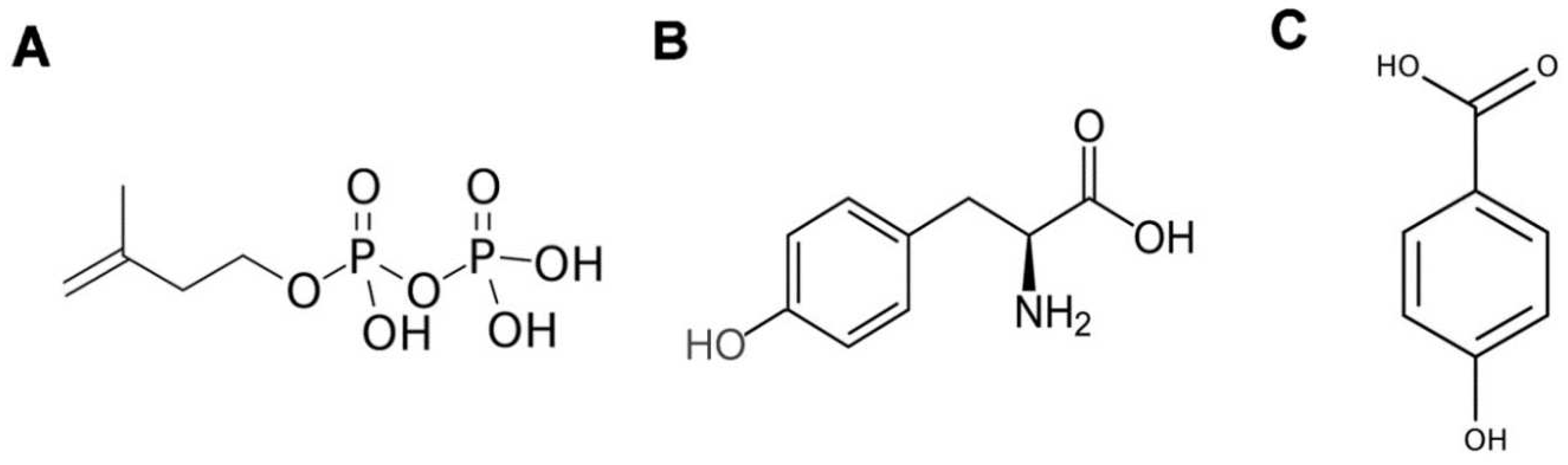
Figure 2.
Schematic overview of biosynthetic pathways of isoprenoid antioxidants. Metabolites: 4-HBA, 4-hydroxybenzoic acid; 4-HPPA, 4-hydroxyphenylpyruvic acid; DAHP, 3-deoxy-D-arabino-heptulosonate 7-phosphate; DMAPP, dimethylallylpyrophosphate; DMPBQ, dimethyl-phytyl-benzoquinone; GGPP, geranylgeranyl diphosphate; HGA, homogentisate acid; IPP, isopentenyl diphosphate; MEP, 2C-methyl-D-erythritol-4-phosphate; MPBQ, methyl-phytyl-benzoquinone; MSBQ, methyl-solanesyl-benzoquinone; MVA, mevalonic acid; Phytyl-DP, phytyl diphosphate; PPDHB, polyprenyl-dihydroxybenzoate; PPHB, polyprenyl-hydroxybenzoate; PPPP, polyprenyl-pyrophosphate; Solanesyl-DP, solanesyl diphosphate.
Figure 2.
Schematic overview of biosynthetic pathways of isoprenoid antioxidants. Metabolites: 4-HBA, 4-hydroxybenzoic acid; 4-HPPA, 4-hydroxyphenylpyruvic acid; DAHP, 3-deoxy-D-arabino-heptulosonate 7-phosphate; DMAPP, dimethylallylpyrophosphate; DMPBQ, dimethyl-phytyl-benzoquinone; GGPP, geranylgeranyl diphosphate; HGA, homogentisate acid; IPP, isopentenyl diphosphate; MEP, 2C-methyl-D-erythritol-4-phosphate; MPBQ, methyl-phytyl-benzoquinone; MSBQ, methyl-solanesyl-benzoquinone; MVA, mevalonic acid; Phytyl-DP, phytyl diphosphate; PPDHB, polyprenyl-dihydroxybenzoate; PPHB, polyprenyl-hydroxybenzoate; PPPP, polyprenyl-pyrophosphate; Solanesyl-DP, solanesyl diphosphate.
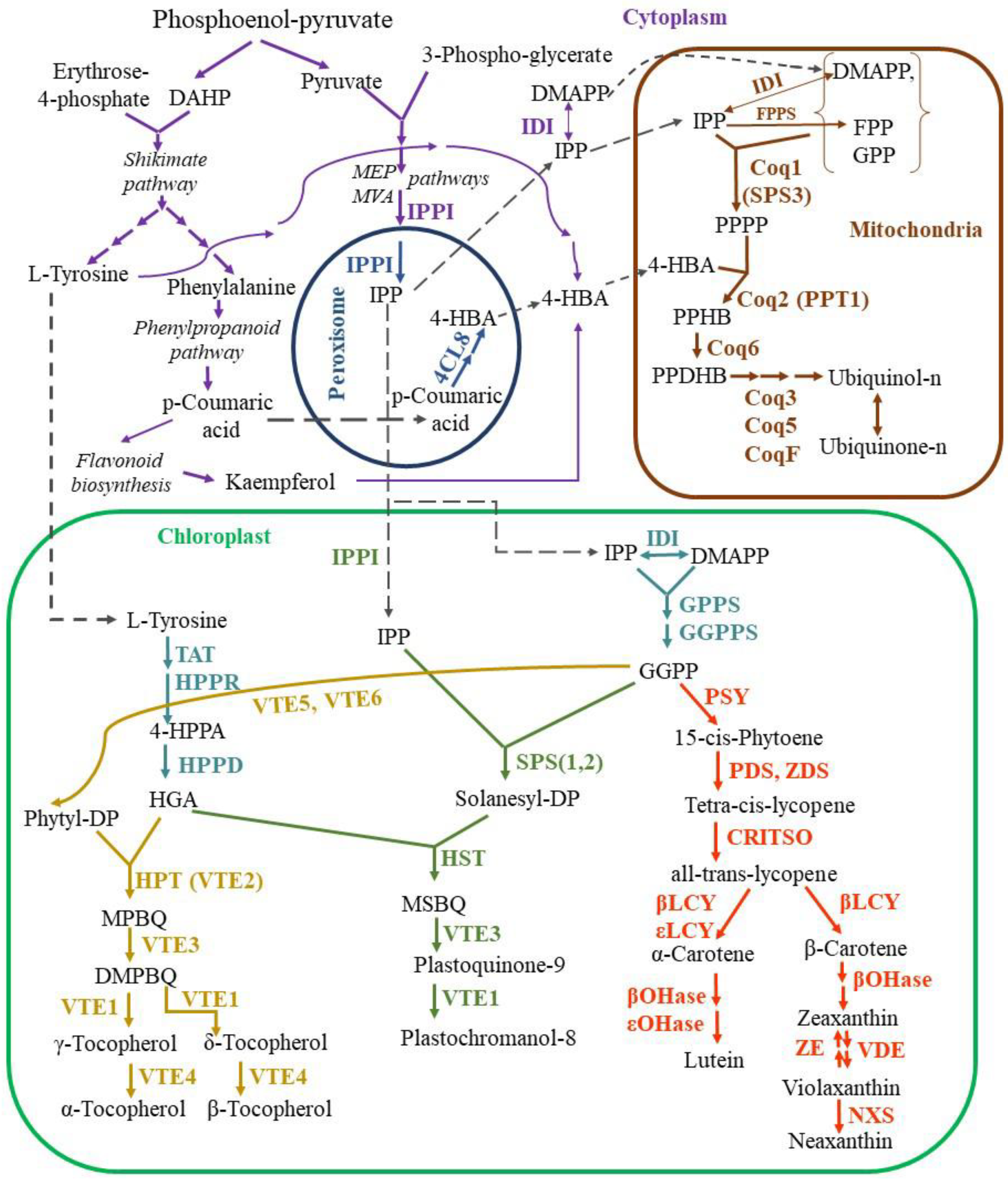
Figure 3.
Basic flavonoid skeleton. Benzene rings A and B and heterocycle C in flavonoids structure are shown.
Figure 3.
Basic flavonoid skeleton. Benzene rings A and B and heterocycle C in flavonoids structure are shown.
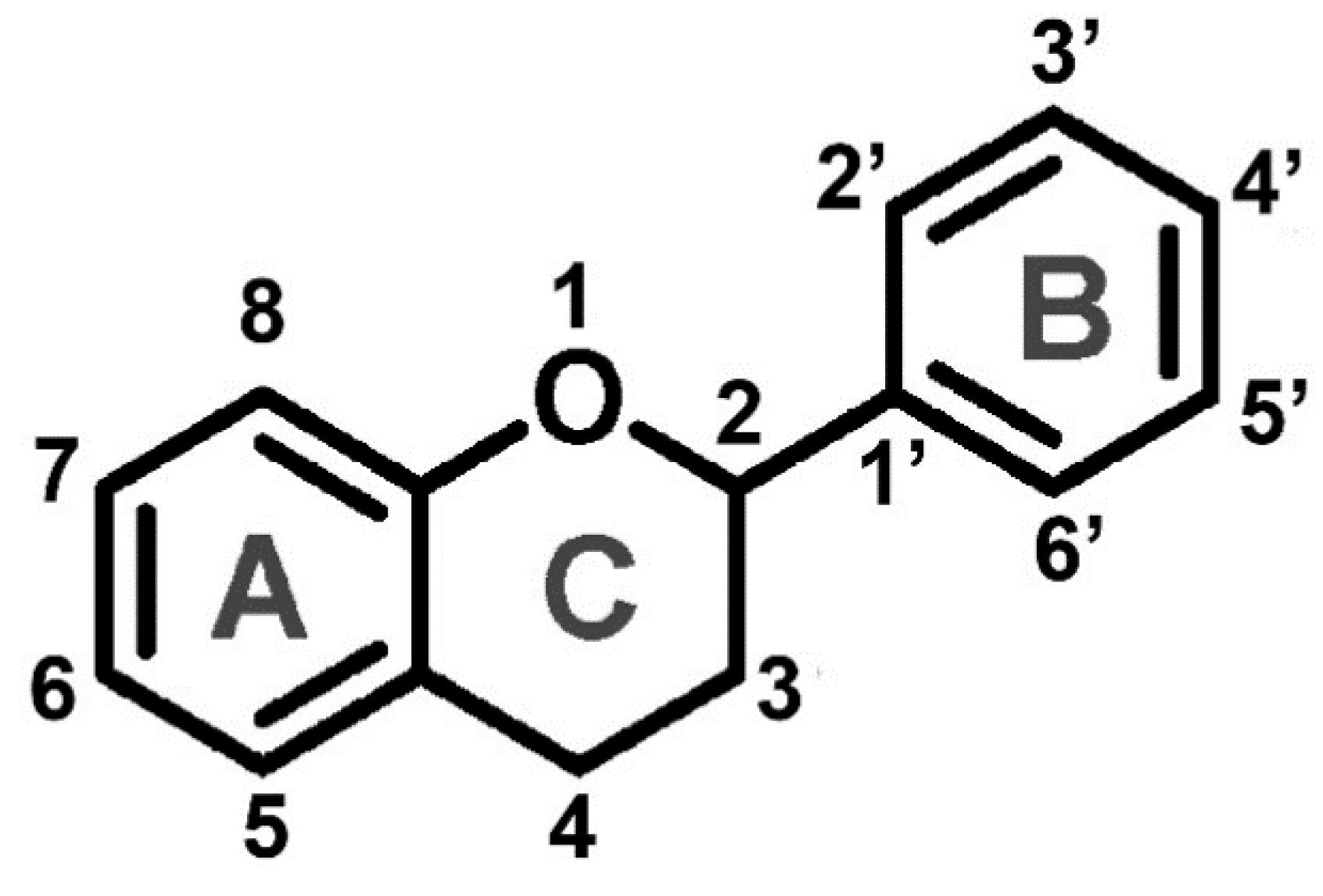
Figure 4.
The pathway of flavonoid biosynthesis in plants. Each colored frame represents a different class of flavonoids. The enzyme names are abbreviated as follows: ACCase, acetyl-CoA carboxylase; ANS, anthocyanidin synthase; ANR, anthocyanidin reductase; C4H, cinnamic acid 4-hydroxylase; CHI, chalcone isomerase; CH4′GT, chalcone 4′-O-glucosyltransferase; 4CL, 4-coumarate CoA ligase; CHS, chalcone synthase; CHR, chalcone reductase; CLL-7, cinnamate–CoA ligase; DFR, dihydroflavonol 4-reductase; FGT (AGT), flavonoid glycosyltransferases; FNS, flavone synthase; FNR, flavanone 4-reductase; F3H, flavanone 3-hydroxylase; F3’H, flavanone 3’-hydroxylase; FLS, flavonol synthase; IFS, isoflavone synthase; LAR, leucoanthocyanidin reductase; PAL, phenylalanine ammonia lyase; STS, stilbene synthase.
Figure 4.
The pathway of flavonoid biosynthesis in plants. Each colored frame represents a different class of flavonoids. The enzyme names are abbreviated as follows: ACCase, acetyl-CoA carboxylase; ANS, anthocyanidin synthase; ANR, anthocyanidin reductase; C4H, cinnamic acid 4-hydroxylase; CHI, chalcone isomerase; CH4′GT, chalcone 4′-O-glucosyltransferase; 4CL, 4-coumarate CoA ligase; CHS, chalcone synthase; CHR, chalcone reductase; CLL-7, cinnamate–CoA ligase; DFR, dihydroflavonol 4-reductase; FGT (AGT), flavonoid glycosyltransferases; FNS, flavone synthase; FNR, flavanone 4-reductase; F3H, flavanone 3-hydroxylase; F3’H, flavanone 3’-hydroxylase; FLS, flavonol synthase; IFS, isoflavone synthase; LAR, leucoanthocyanidin reductase; PAL, phenylalanine ammonia lyase; STS, stilbene synthase.
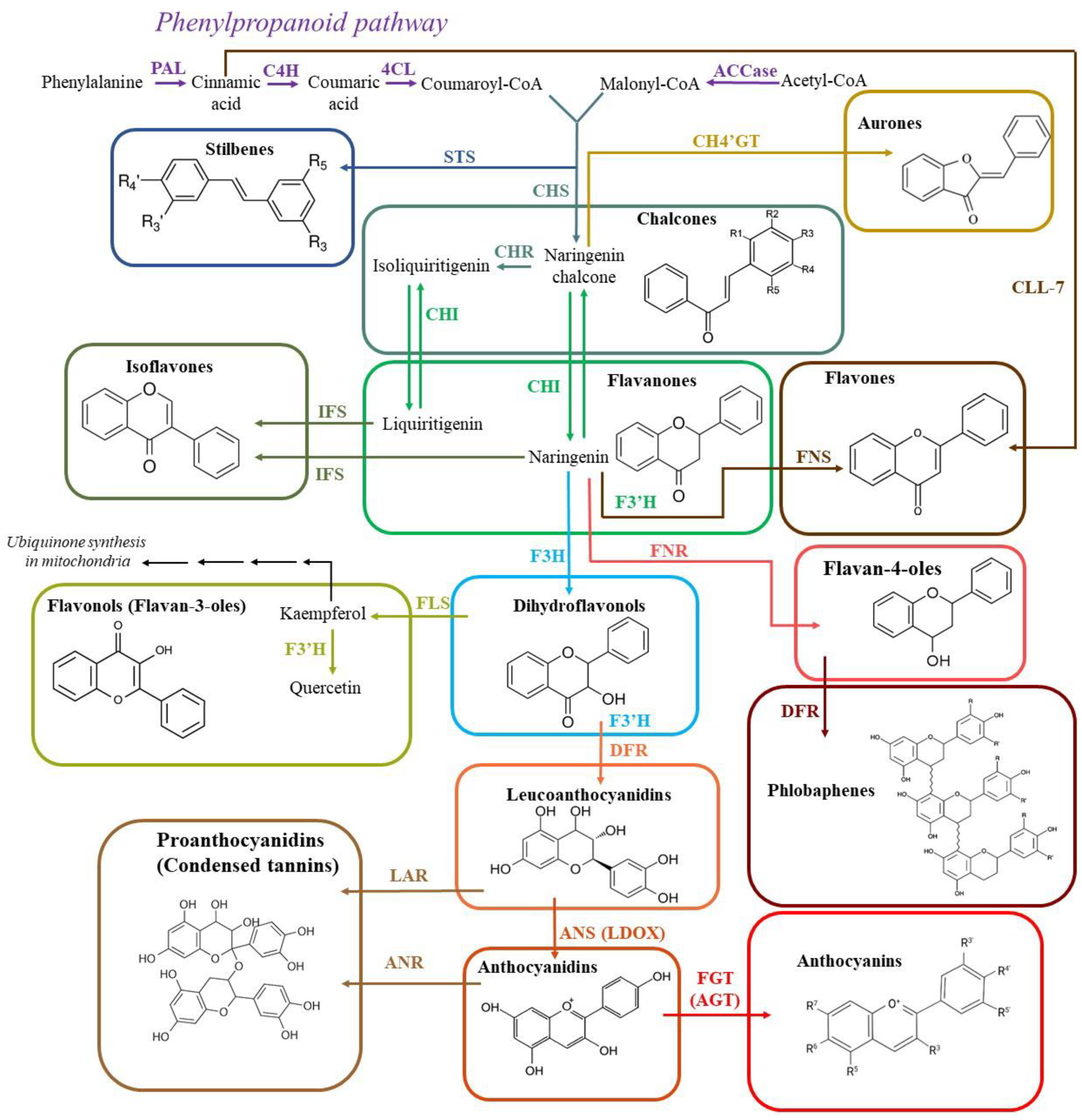
Figure 5.
The pathways of L-ascorbic acid biosynthesis in plants. The enzymes catalyzing the reactions of Smirnoff-Wheeler, L-gulose, D-Galacturonate, and Myo-inositol pathways are red, purple, blue and green, respectively.
Figure 5.
The pathways of L-ascorbic acid biosynthesis in plants. The enzymes catalyzing the reactions of Smirnoff-Wheeler, L-gulose, D-Galacturonate, and Myo-inositol pathways are red, purple, blue and green, respectively.
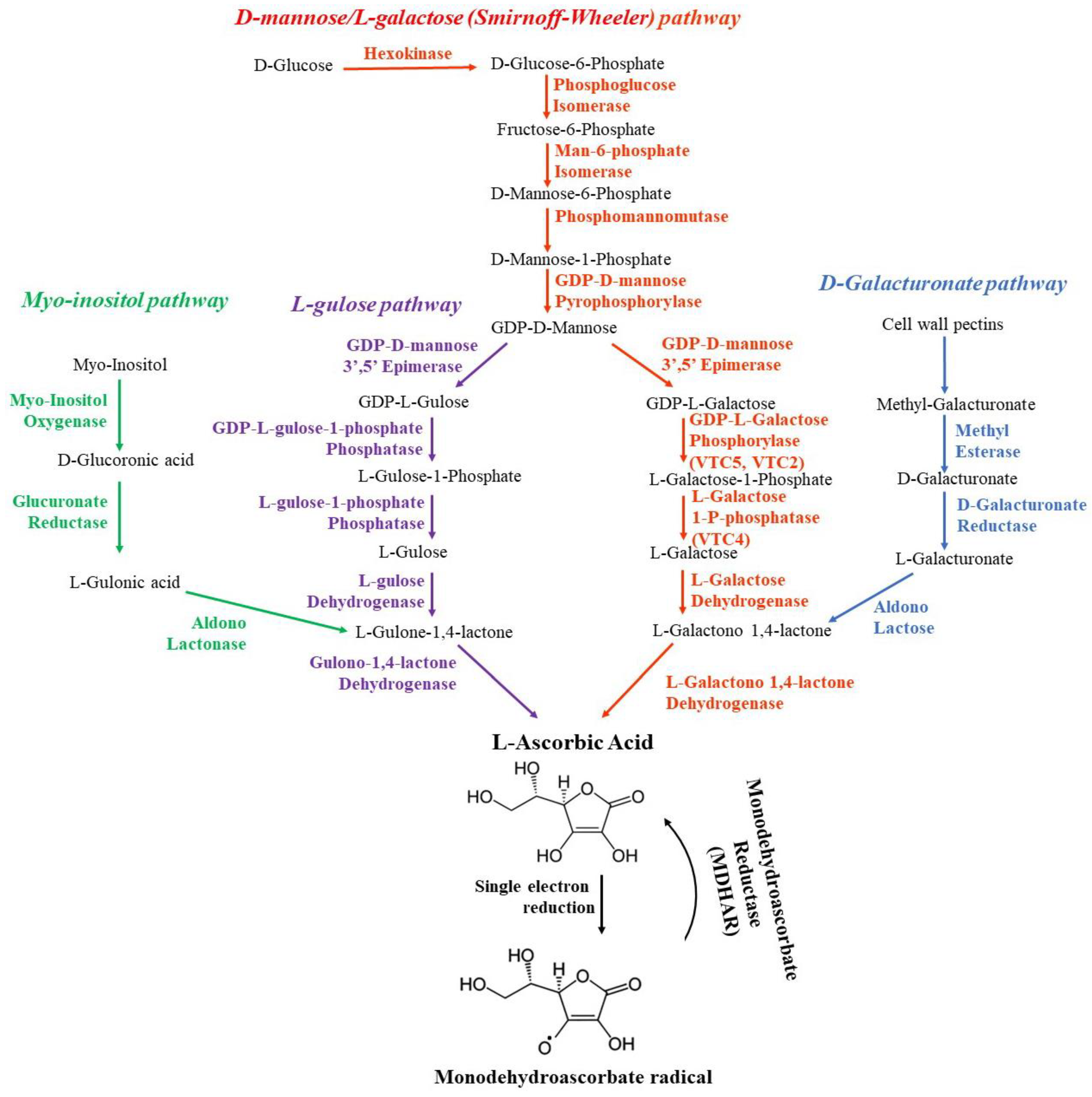
Figure 6.
The pathways of glutathione biosynthesis in plants. The enzyme names are abbreviated as follows: γ-ECS, γ-glutamylcysteine synthetase; GSHS, glutathione synthetase; GR, Glutathione reductase; GPX, Glutathione peroxidase. The cytoplasmic stages are marked in purple; the plastid stages are marked in green; the mitochondrial stages are marked in brown.
Figure 6.
The pathways of glutathione biosynthesis in plants. The enzyme names are abbreviated as follows: γ-ECS, γ-glutamylcysteine synthetase; GSHS, glutathione synthetase; GR, Glutathione reductase; GPX, Glutathione peroxidase. The cytoplasmic stages are marked in purple; the plastid stages are marked in green; the mitochondrial stages are marked in brown.
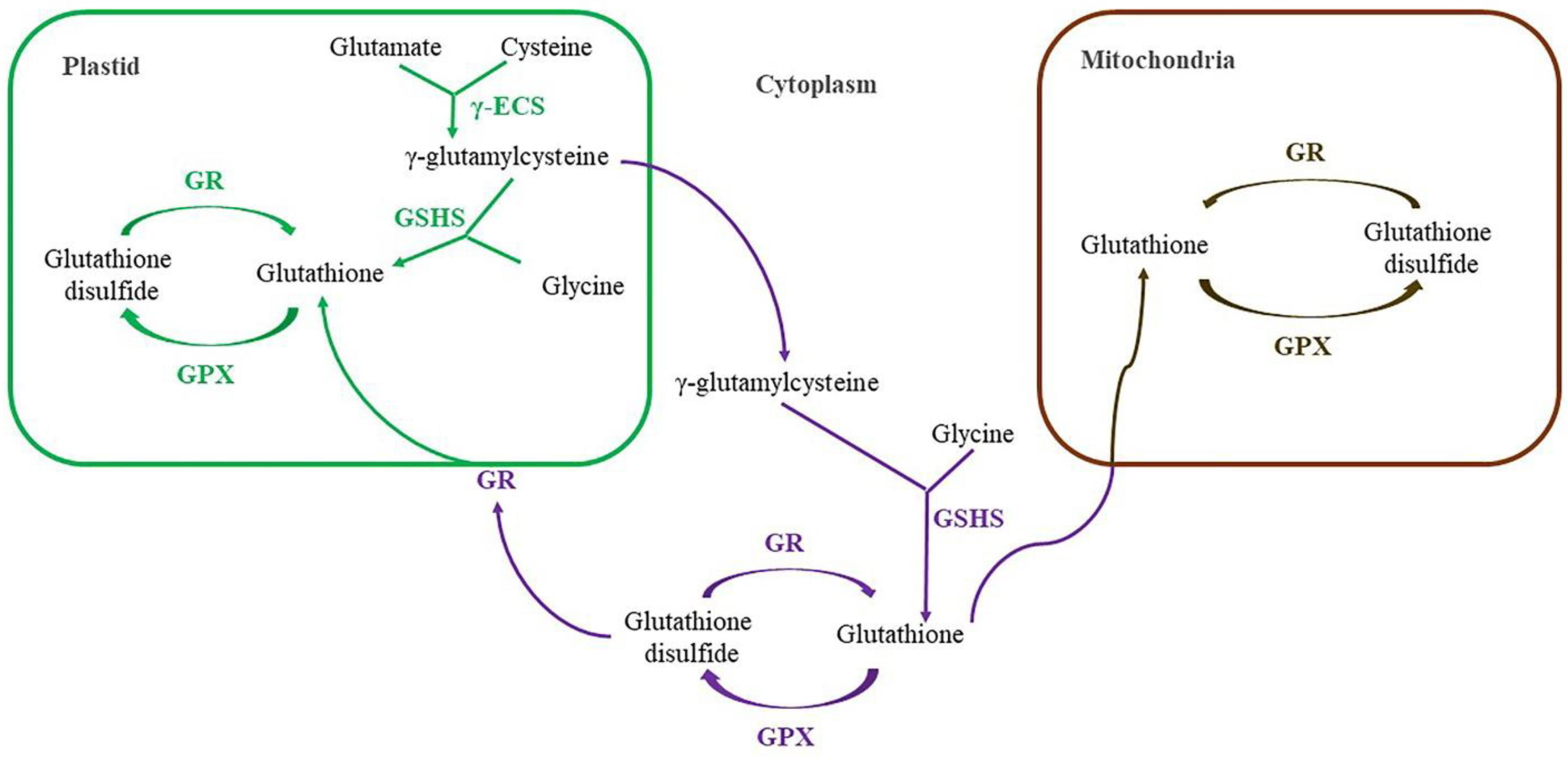
Table 1.
Arabidopsis thaliana genes encoding the key enzymes involved in synthesis of isoprenoid antioxidants.
Table 1.
Arabidopsis thaliana genes encoding the key enzymes involved in synthesis of isoprenoid antioxidants.
| Genes | Enzymes | Functions | |
|---|---|---|---|
| At5g16440 | IPPI, isopentenyl diphosphate isomerases | Enzymes with dimethyl allyl diphosphate isomerase activity. It is involved in the biosynthesis of IPP, isopentenyl diphosphate. IPP is a subject for further condensation reactions to form intermediates in the synthesis of plastidic and mitochondrial isoprenoids (carotenoids, tocopherols, PQ, PCr8, UQ) | |
| At3g02780 | |||
| At4g19010 | AT4G 19010 |
Peroxisomal 4-coumarate CoA ligases | 4-HBA (hydroxybezoic acid) biosynthesis from phenylalanine in peroxisomes for further UQ biosynthesis [10,11] |
| At5g38120 | 4CL8 | ||
| At5g47770 | FPS1 | Farnesyl diphosphate synthases | Isoprenoid farnesyl diphosphate (FPP) biosynthesis for further UQ biosynthesis [12,13] |
| At4g17190 | FPS2 | ||
| At2g34630 | CoQ1, SPS3, solanesyl diphosphate synthase | Isoprene polymerization for further UQ biosynthesis [14] | |
| At4g23660 | Coq2, PPT1, 4-hydroxybenzoate polyprenyl diphosphate transferase | Rate-limiting enzyme in UQ biosynthesis. Catalysis of benzoquinone ring of 4-HB condensation with polyisoprenoid side chain of polyprenyl-pyrophosphate to form 3-polyprenyl-4-hydroxybenzoate [15] |
|
| At3g24200 | Coq6 | Flavin-dependent monooxygenases (Toda et al., 2014; Latimer et al., 2021) | Aromatic hydroxylation of C-H in different positions in UQ biosynthesis |
| At1g24340 | CoqF | ||
| At2g30920 | Coq3 | S -adenosyl- l -methionine (SAM)-dependent methyl transferases | |
| At5g57300 | Coq5 | ||
| At2g03690 | Coq4 | Presumably, a scaffold protein, which is responsible for organization of UQ biosynthetic complex [16] | |
| At5g17230 | PSY, phytoene synthase | Condensation of two molecules of GGDP to produce phytoene for further carotenoid biosynthesis |
|
| At4g14210 | PDS, phytoene desaturase | Desaturation of phytoene to ζ-carotene by introduction of four double bonds into phytoene for further carotenoid biosynthesis | |
| At3g04870 | ZDS, ζ-carotene desaturase | Reduction ζ-carotene to lycopene by introduction of four double bonds for further carotenoid biosynthesis | |
| At1g06820 | CRTISO, carotenoid isomerase | Catalyzes cis-trans isomerization of poly-cis-carotenoids to all-trans-lycopene. Together with PDS and ZDS, CRTiso is required to complete the synthesis of lycopene from phytoene for further carotenoid biosynthesis [17,18] | |
| At3g10230 | βLCY1, β-carotene cyclase, ATLCY, LYC, Lycopene cyclase | Introduction of a ring at both ends of symmetrical lycopene to form the bicyclic β-carotene [19] | |
| At5g57030 | εLCY, ε- carotene cyclase | Required to form lutein [20] | |
| At4g25700 | βOHase1 | β-carotene hydroxylases | Conversion of beta-carotene to zeaxanthin via cryptoxanthin [21] |
| At5g52570 | βOHase2 | ||
| At3g53130 | εOHase, ε-carotene hydroxylase | Involved in epsilon ring hydroxylation to carotene for lutein biosynthesis [22] | |
| At5g67030 | ZE, zeaxanthin epoxidase | Introduction of epoxide groups into both rings of zeaxanthin to form violaxanthin [23] | |
| At1g08550 | VDE, | De-epoxidation of violaxanthin to zeaxanthin [24] | |
| At1g06570 | HPPD, 4-hydroxyphenylpyruvate dioxygenase (α-ketoisocaproate dioxygenase, KIC dioxygenase) |
Homogentisate (HGA) synthesis from hydroxyphenylpyruvate for further biosynthesis of PQ, PCr and tocopherols [25] | |
| At5g04490 | VTE5, phytol kinase | Phosphorylation of free phytol for further biosynthesis of tocopherols [26] | |
| At1g78620 | VTE6, phytyl-phosphate kinase | A key enzyme for phytol phosphorylation for further biosynthesis of tocopherols and phylloquinone [27] | |
| At1g78510 | SPS1 | Solanesyl diphosphate synthases | Solanesyl diphosphate condensation from geranylgeranyl diphosphate (GGDP) and isopentenyl phosphate (IPP) for further biosynthesis of PQ and PCrs [28,29,30] |
| At1g17050 | SPS2 | ||
| At5g09820 | FBN5-B | Fibrillins | Specifically interacted with solanesyl SPS1 and SPS2 |
| At3g11945 | HST, homogentisate solanesyl diphosphate transferase | Condensation of homogentisate (HGA) with solanesyl diphosphate with formation of methyl-solanesyl-benzoquinone (MSBQ) for further biosynthesis of PQ and PCrs | |
| At2g18950 | HPT, homogentisate phytyl transferase (VTE2) | Catalysis of condensation of HGA and Phytyl-DP to form dimethyl-phytyl-benzoquinone (MPBQ) for further biosynthesis of tocopherols | |
| At3g63410 | VTE3 2-methyl-6-phytyl-1,4-benzoquinol methyltransferase |
Methyl-solanesyl-benzoquinone (MSBQ) conversion to PQ9 and methyl-phytyl-benzoquinone (MPBQ) conversion to DMPBQ for further biosynthesis of tocopherols [31] | |
| At4g32770 | VTE1, tocopherol cyclase | Plastochromanol-8 synthesis from reduced plastoquinone-9; α-tocopherol biosynthesis from γ -tocopherol [31] | |
| At1g64970 | VTE4, G-TMT, γ-tocopherol methyltransferase |
Conversion of δ- and γ-tocopherols (and tocotrienols) to β- and α-tocopherols [31] | |
Table 3.
Arabidopsis thaliana genes encoding the key enzymes involved in synthesis of flavonoids.
| Genes | Enzymes | Functions |
|---|---|---|
| At2g37040 | PAL, phenylalanine ammonia lyase | The deamination of phenylalanine to trans-cinnamic acid [172,173] |
| At3g53260 | ||
| At2g30490 | C4H, Cinnamic acid 4-hydroxylase | The hydroxylation of trans-cinnamic acid [174,175] |
| At1g65060 | 4CL, 4-coumarate CoA ligase | Coumaric acid conversion to coumaroyl-CoA, which is the last step of phenylpropanoid pathway [176] |
| At5g13930 | CHS, chalcone synthase (ATCHS, Transparent Testa 4, TT4) | The condensation of activated coumaric acid with three molecules of activated malonic acid in the form of malonyl-CoA to the formation of naringenin-chalcone. A key enzyme involved in the biosynthesis of flavonoids [177] |
| At3g55120 | CHI, chalcone isomerase (A11, ATCHI, Chalcone flavanone isomerase, Transparent Testa 5, TT5) | Catalysis of the conversion of chalcones into flavanones [177]. At3g55120 is co-expressed with CHS encoding gene [54] |
| At3g51240 | F3H, flavanone 3-hydroxylase | Encodes flavanone 3-hydroxylase that is coordinately expressed with CHSs and CHIs and involved in flavonoid biosynthesis [178]. |
| At5g07990 | F3’H, flavanone 3’-hydroxylase (CYP75B1, Cytochrome P450 75B1, D501, Transparent Testa 7, TT7) | Hydroxylation of 3’-position of B-ring of flavonoids with catalysis of dihydroquercetin and quercetin formation from dihydrokaempferol and kaempferol, respectively [178] |
| At5g24530 | FNS, flavone synthase (AtDMR6, Downy Mildew Resistant6) | The conversion of the flavanones into flavones. This class is also shown to comprise soluble Fe2+/2-oxoglutarate-dependent dioxygenases, which are oxygen- and NADPH-dependent cytochrome P450 membrane-bound monooxygenases [179] |
| At5g08640 | FLS, flavonol synthase (ATFLS1) | Encodes a flavonol synthase that catalyzes formation of flavonols from dihydroflavonols. Co-expressed with CHI and CHS (qRT-PCR) |
| At5g63590 | ||
| At5g42800 | DFR, dihydroflavonol 4-reductase | The reduction of the 4-keto group of dihydroflavonol to the corresponding leucoanthocyanidin (Shirley et al., 1998). Synthesis of phlobaphenes from flavan-4-oles in Zea mays [180] |
| At1g61720 | ANR, anthocyanidin reductase | Synthesis of proanthocyanidins (condensed tannins) from leukoanthocyanidins and anthocyanidins [181] |
| At4g22880 | ANS, anthocyanidin synthase (LDOX, Leucoanthocyanidin dioxygenase) | Convertion leucoanthocyanidins to anthocyanins [182] |
| At5g17050 | FGT, flavonoid glycosyltransferases | Glycosylation of anthocyanidins to anthocyanins [183,184,185,186] |
| At1g30530 | ||
| At5g17030 | ||
| At2g36790 | ||
| At1g06000 | ||
| At4g14090 | ||
| At5g54060 | ||
| At2g47460 | MYB domain protein 12, MYB12, ATMYB12, PFG1 | Flavonol synthesis regulators. Strongly activate the promoters of CHS, F3H, FLS and CHI [187] |
| At3g62610 | AtMYB11, PFG2 | |
| At5g49330 | AtMYB111, PFG3 | |
| At2g46510 | bHLH17 (ABA-inducible bHLH-type transcription factor, AIB, ATAIB, JA-associated MYC2-like 1, JAM1 | Positive regulator of flavonoid biosynthesis [188] |
Disclaimer/Publisher’s Note: The statements, opinions and data contained in all publications are solely those of the individual author(s) and contributor(s) and not of MDPI and/or the editor(s). MDPI and/or the editor(s) disclaim responsibility for any injury to people or property resulting from any ideas, methods, instructions or products referred to in the content. |
© 2023 by the authors. Licensee MDPI, Basel, Switzerland. This article is an open access article distributed under the terms and conditions of the Creative Commons Attribution (CC BY) license (https://creativecommons.org/licenses/by/4.0/).
Copyright: This open access article is published under a Creative Commons CC BY 4.0 license, which permit the free download, distribution, and reuse, provided that the author and preprint are cited in any reuse.


