

Submitted:
27 October 2023
Posted:
30 October 2023
You are already at the latest version
Abstract
A rapid synthesis of chiral sulfoxide-functionalized meta-terphenyl derivatives by a 2,5-[C4+C2] ring transformation reaction of pyrylium salts with in-situ generated enantio-merically pure .alpha.-sulfinylacetaldehydes is described. This synthetic method demonstrates for the first time the use of .alpha.-sulfinylacetaldehydes in a reaction sequence initiated by nu-cleophilic attack of pyrylium salts by .alpha.-sulfinylcarbanions to generate chiral aromatic systems. The method presented shows broad applicability starting with various methyl sulfoxides and a number of functionalized pyrylium salts, furnishing meta-terphenyls with complex substitution patterns from readily accessible starting compounds.
Keywords:
⍺-sulfinylacetaldehyde
; sulfoxide
; pyrylium salt
; ring transformation
; meta-terphenyl
1. Introduction
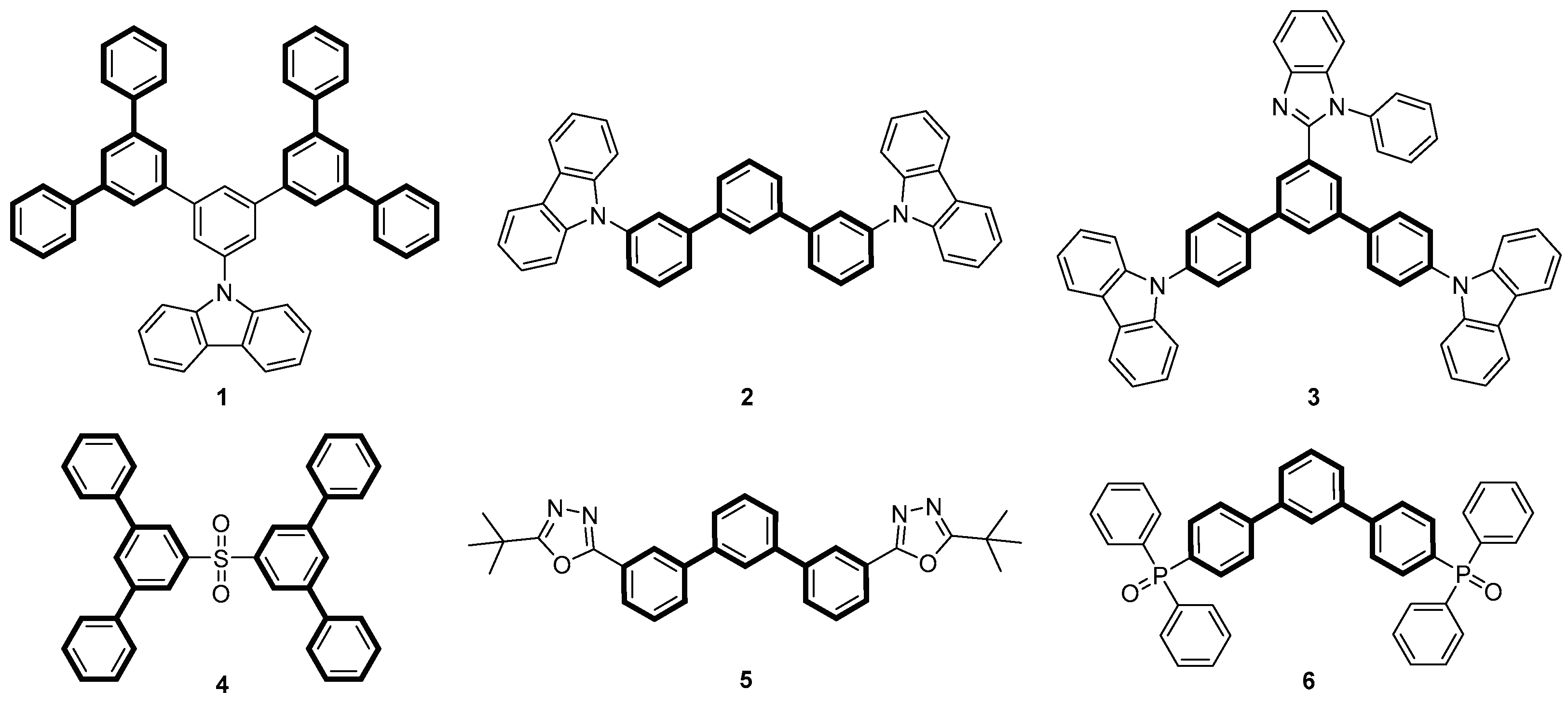
Terphenyls are a class of organic compounds consisting of three interconnected phenyl rings. Depending on the arrangements of the aromatic rings, where substitutions can occur in the ortho-, meta- or para-position, different structural isomers and properties are obtained. The meta-terphenyl skeleton occurs in several natural compounds [1], such as trifucol [2], macranthol [3], and mulberrofuran R [4]. Due to their extensive conjugation, terphenyls exhibit distinct optical [5,6,7,8] and electronic properties [9] that make them valuable for the preparation of various materials, such as organic light-emitting diodes (OLEDs, Figure 1).
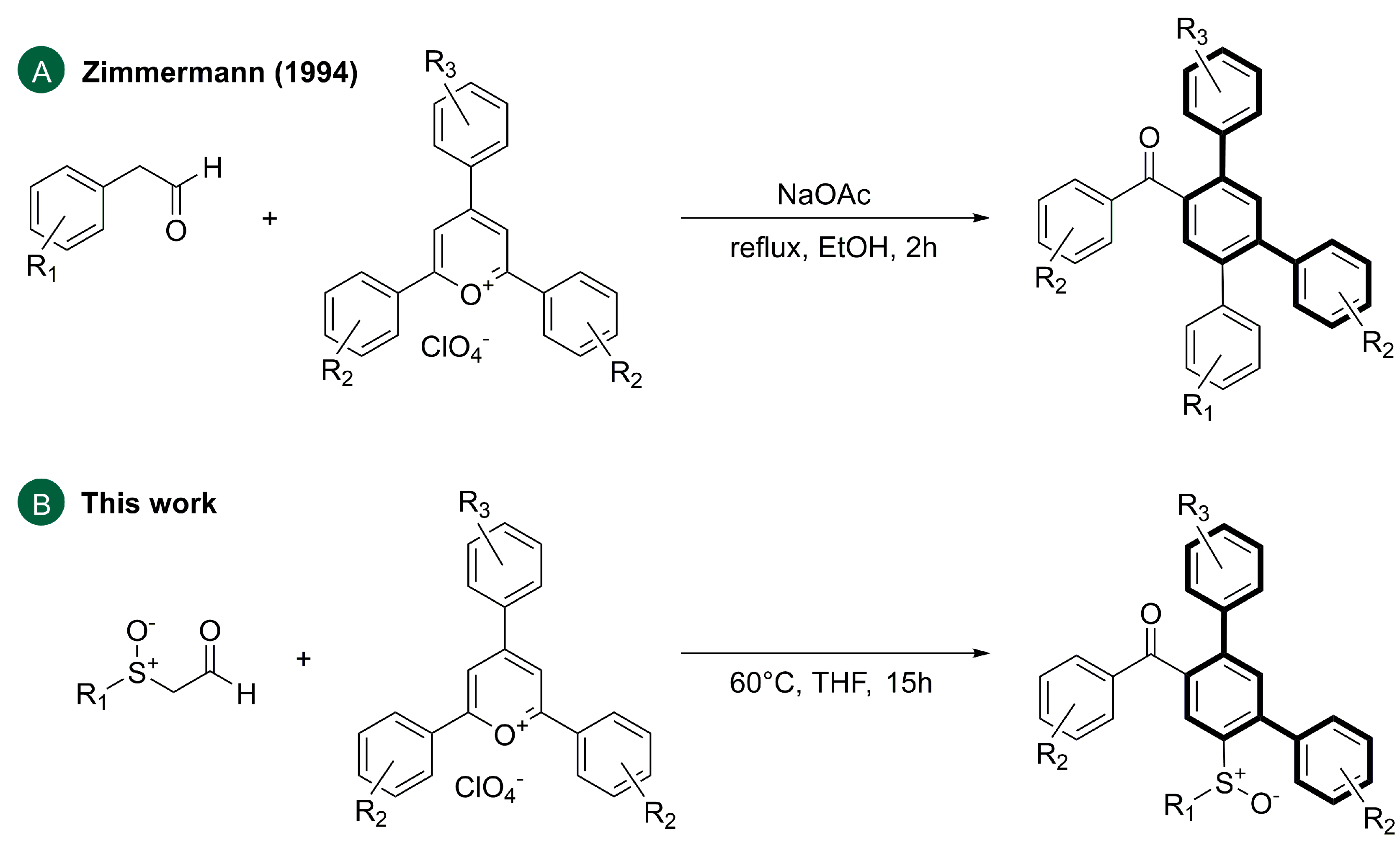
Here, the meta-terphenyl skeleton is mainly used in host materials. Especially carbazole substituted meta-terphenyl derivatives of type 1-3 show promising optoelectronic properties [11,13,14,15]. Besides these, Sasabe et al. [10] synthesized a sulfone-bridged meta-terphenyl derivative 4 as a high performance host material for green and blue OLEDs. In addition, meta-terphenyl derivatives are used in electron transport materials. Examples include m-terphenyloxadiazole 5 synthesized by Wu et al. [5] or m-terphenyldiphenylphosphine oxide 6 prepared by Zhang et al. [12]. In general, two primary approaches to the preparation of terphenyl compounds can be distinguished: (i) coupling of dihalobenzene derivatives with aryl metal nucleophiles [16,17,18,19], or (ii) the use of open-chain precursor molecules to form the aromatic rings by concerted or sequential benzannulation reactions [19,20]. In 1994, Zimmermann [21] reported a ring transformation reaction of triarylpyrylium salts with aryl acetaldehydes to give substituted carbocycles. He converted phenylacetaldehyde or 4-fluorophenylacetaldehyde with functionalized 2,4,6-triarylpyrylium salts in an ethanolic solution in the presence of sodium acetate as a weak base into the corresponding 2,4,5-triarylbenzophenones in high yields (Scheme 1).
Based on these results, we tried to use chiral, enantiomerically pure α-sulfinylacetaldehydes as nucleophiles to perform an analogous ring transformation with a series of 2,4,6-triarylpyrylium salts to obtain optically active sulfinylated meta-terphenyls.
2. Results and Discussion
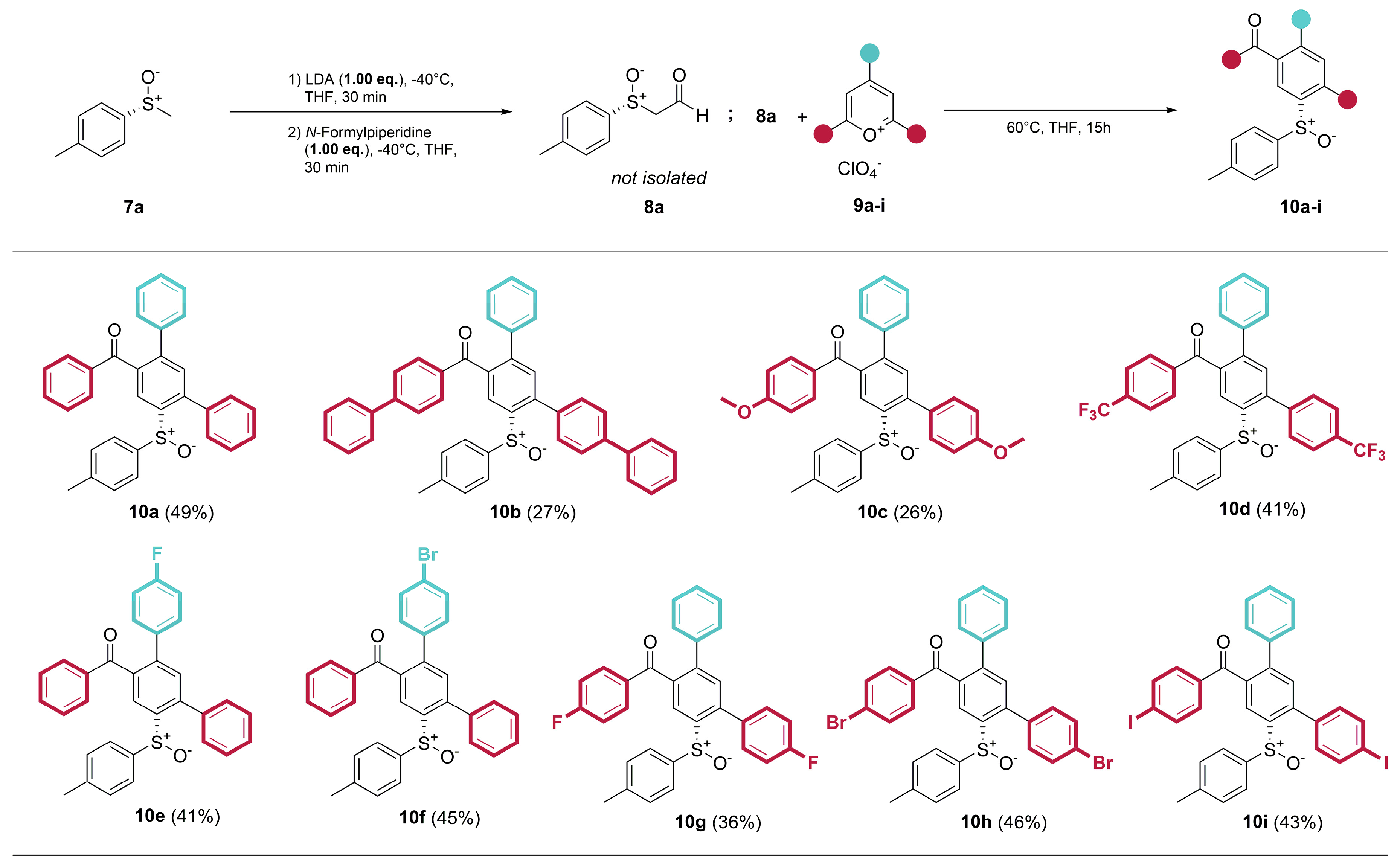
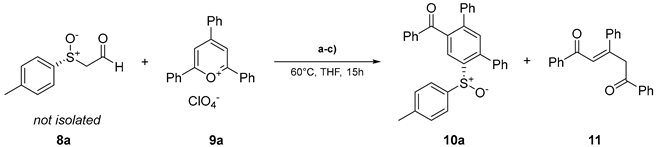
The preparation of enantiomerically pure (R)-p-tolyl methyl sulfoxide ((R)-7a) is carried out by the method developed by Andersen [22] and Solladie [23,24] starting from p-toluene sodium sulfinate. Subsequently, the synthesis of (R)-sulfinylacetaldehyde (8a) is achieved via deprotonation of (R)-7a with lithiumdiisopropylamide (LDA), followed by formyl transfer with N-formylpiperidine according to Pflieger et al. [25]. After isolation of the aldehyde 8a, the ring transformation is performed with 2,4,6-triphenylpyrylium perchlorate (9a) [26] in ethanol in the presence of sodium acetate analogous to Zimmermann [21]. In this first attempt, the desired cyclization product 10a is obtained in 20% yield. In addition to the desired product, the open chain 1,4-diketone 11 (Scheme 5) is isolated in 28% yield as a side product (Scheme 2).
Due to the instability of 8a, [27] we tried to avoid its isolation. After the reaction of the lithiated sulfoxide (R)-7a with the formylating reagent the -40°C cold THF solution is added directly to a room temperature suspension of pyrylium salt 9a in THF and heated to 60°C overnight. This significantly increases the yield of 10a to 32%. Nevertheless, the by-product 11 is isolated in approximately the same yield as before (Table 1, #1). By adding 4 molecular sieves, its yield can be reduced from 26% to 10% (Table 1, #2). Surprisingly, increasing the equivalents of (R)-sulfinylacetaldehyde lowers the yield of the cyclization product dramatically, whereas the yield of the by-product remains unchanged (Table 1, #3). One reason for the low yield seems to be the high concentration of the sulfinylacetaldehyde, which is very unstable at elevated temperatures and may undergo self- condensation. By not isolating 8a, it is no longer necessary to use sodium acetate as a base due to the formation of lithiumpiperidide in the course of the reaction. This leads to approximately the same product yield as entry 2, but the yield of the by-product decreases significantly (Table 1, #4). Carrying out the reaction with a 1:1.8 excess of the pyrylium salt increases the yield of 10a even further to 49% (Table 1, #5).
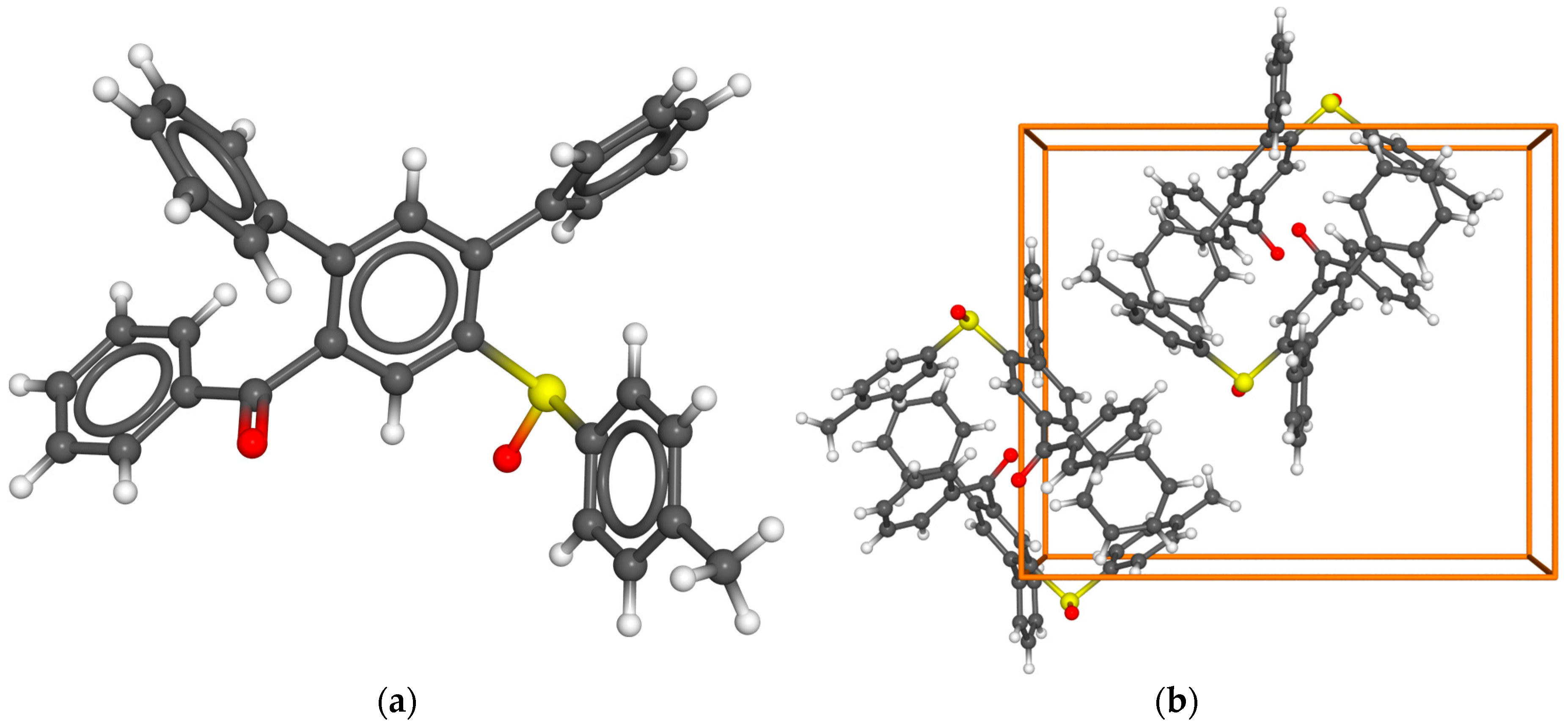
The structure of the standard substrate 10a was confirmed by single crystal X-ray analysis (Figure 2, CCDC deposition number 2302385).
Employing the optimized reaction conditions, substrate variations were first investigated using a variety of functionalized pyrylium salts 9a-i (Scheme 3). With the exception of 10b and 10c all products are obtained in 40 to 50% yield. The pyrylium salts reacting to 10b and 10c with electron donating substituents (9b -Ph, 9c -OMe) are expected to show a decreased reactivity due to the reduced electrophilicity at the 2-position of the pyrylium salt. Indeed, both donor substituted products have been obtained with reduced yields.
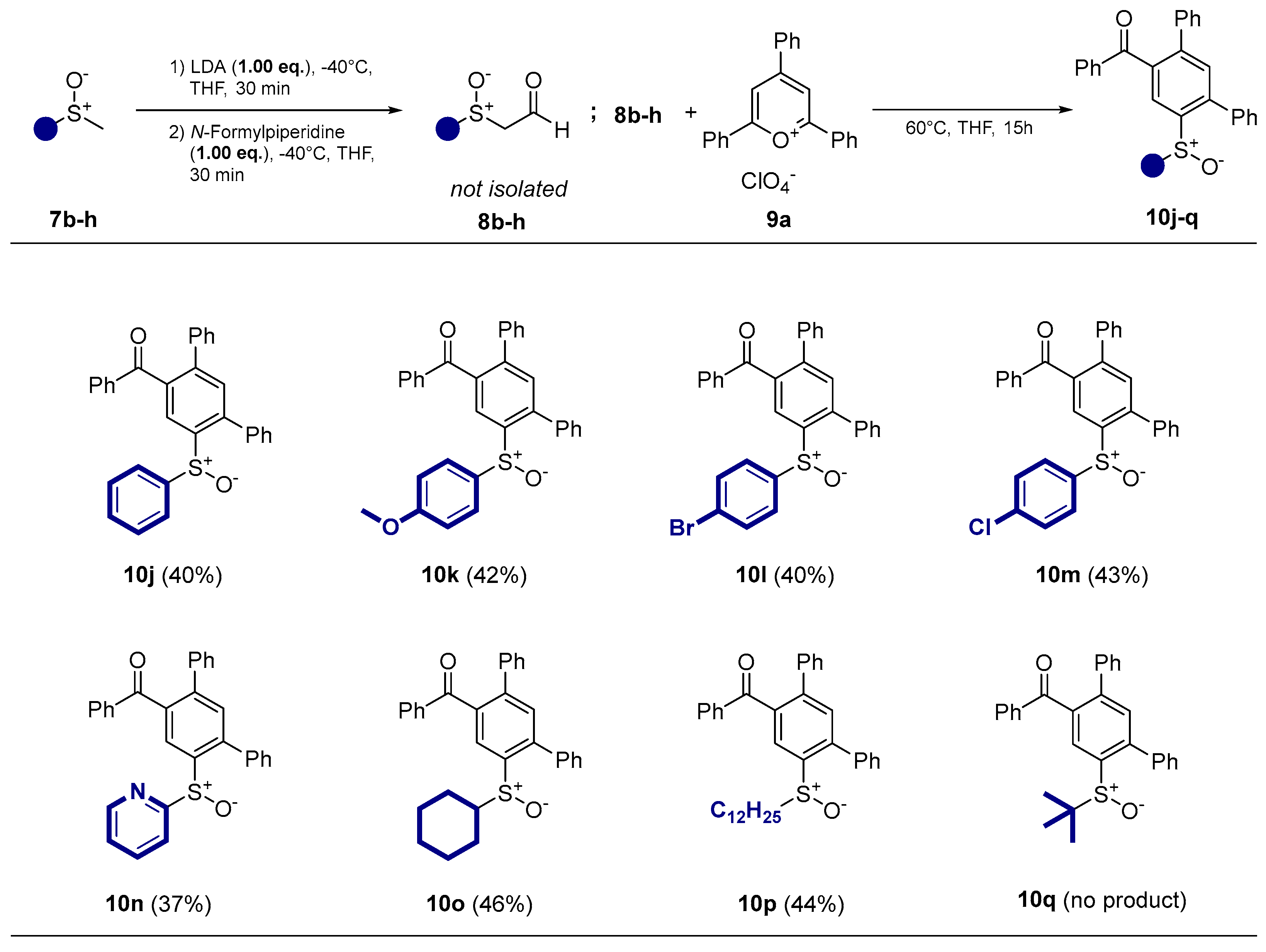
After varying the pyrylium salts, different racemic methyl sulfoxides 7b-h were tested (Scheme 4). Here, almost all sulfoxides show comparable reactivity and the resulting terphenyls are obtained in similar yields as with the standard substrate (R)-7a. The method is well suitable for aromatic sulfoxides with electron donating substituents (10k) as well as with halogens (10l-m). Moreover, heteroaromatic sulfoxides (10n) and aliphatic sulfoxides with additional acidic protons in the α’-position show comparable reactivity to (R)-7a and are obtained with yields of 40% (10o-p). No product can be isolated with sterically demanding tert-butyl methyl sulfoxide (10q).
From the results obtained, we assume that the reaction mechanism described by Zimmermann [21] for phenylacetaldehyde may be transferred to our system (Scheme 5). Here, the carbanion of the α-sulfinylacetaldehydes 8 attacks the preferred 2-position [28] of the pyrylium salts 9. The resulting 2H-pyran 12 then reacts via electrocyclic ring opening to the ketoaldehyde 13 [29]. The intermediate 14 obtained by proton shift reacts with the acidic methylene group in the course of an aldol addition to give intermediate 15. Condensation accompanied by rearomatization yields the ring transformation products 10. In the presence of water, the pyrylium salts hydrolyze to the unstable cyclic hemiacetal 16, which reacts by electrocyclic ring opening to form the open-chain 1,4-diketone 11 [30].
3. Conclusion
In summary, we have developed an efficient synthesis for the preparation of highly substituted meta-terphenyls bearing both a sulfoxide moiety and an acyl group at the central ring starting from readily available methyl sulfoxides 7a-h and triarylpyrylium perchlorates 9a-i. Starting from chiral, enantiomerically pure (R)-p-tolyl methyl sulfoxide ((R)-7a), the optically active derivatives 10a-i have been prepared. The method is broadly applicable to a variety of aromatic and alkyl methyl sulfoxides and differently functionalized pyrylium salts. All new compounds have been fully characterized by spectroscopic methods. A crystal structural analysis of 10a rounds off the structural evidence.
4. Materials and Methods
4.1. General Methods
Melting points were determined on Stuart Smp10 melting point apparatus (Vernon Hills, IL, USA) and are uncorrected. Thin-layer chromatography (TLC) was performed using E. Merck silica gel SilG/UV254 by Macherey Nagel & Co., Düren (thickness of layer 0.2 mm) and visualized by UV fluorescence quenching. 1H NMR spectra were recorded on a Bruker DRX 500 spectrometer operating at 500 MHz at 300K. 13C NMR spectra were recorded on the same instrument at 125 MHz. 19F NMR spectra were recorded at 471 MHz. All chemical shifts (δ) are reported in ppm relative to tetramethylsilane (TMS) as internal standard (δ = 0.00 ppm). The spectra were referenced against the residual solvent signal as reported in the literature [31]. The fine structure of proton signals was specified as s (singlet), d (doublet), t (triplet). Quaternary carbons are designated with subscript q. IR spectra were recorded on a FTIR spectrometer Paragon 1000 (Perkin Elmer LAS GmbH). The specific optical rotations were determined on a Anton Paar MCP300 Polarimeter in 1 dm cuvettes. ESI-MS measurements were recorded on a Bruker Impact II. Elemental analyses were performed on Vario El from Elementar. The pyrylium salts 9a-i were synthesized using established methods [26] by condensation of the corresponding benzaldehydes and acetophenones with phosphorus oxychloride and perchloric acid. The racemic methyl sulfoxides 7b-h were synthesized from the corresponding thiols by methylation followed by oxidation with mCPBA following literature procedures [32]. All other reagents were obtained from commercial sources and used without further purification unless otherwise specified.
4.2. General procedure for the synthesis of the ring transformation products
The corresponding methyl sulfoxide 7a-h (1.00 eq.) is placed in an oven-dried Schlenk tube under argon and dissolved in dry THF (1.00 ml/mmol). The solution is cooled to -40°C and lithium diisopropylamide (1.00 eq.; 2M solution in THF, ethylbenzene, n-heptane) is added and stirred for 30 min. N-formylpiperidine (1.00 eq.) is then added slowly and the mixture is stirred for an additional 40 minutes at -40°C. In a second Schlenk tube, the 2,4,6-triarylpyrylium salt 9a-i is placed under argon and suspended with dry THF (2.00 ml/mmol). To this is quickly added the in situ synthesized α-sulfinylacetaldehyde and the mixture is heated to 60°C. After 15 hours, the mixture is cooled to room temperature and dichloromethane (10 ml/mmol) is added and transferred to a separatory funnel. The mixture is extracted with water and the aqueous phase is subsequently re-extracted twice with dichloromethane. The organic phases are combined and dried over magnesium sulfate. After removal of the solvent, the crude product is purified by column chromatography (for aromatic methyl sulfoxides 5% ethyl acetate to 20% ethyl acetate in n-pentane; for alkyl methyl sulfoxides 25% Et2O in n-pentane).
- (R)-Phenyl(6’-(p-tolylsulfinyl)-[1,1’:3’,1’’-terphenyl]-4’-yl)methanone (10a) Prepared from 600 mg (3.89 mmol) (R)-p-tolyl methyl sulfoxide ((R)-7a). Yield: 49% as an off-white solid. mp 186°C. Rf= 0.22 (20% ethyl acetate in n-pentane). IR (ATR) (cm-1): 1669, 1041, 697. 1H NMR (500 MHz, Chloroform-d): δ 8.30 (s, 1H), 7.77 – 7.71 (m, 2H), 7.52 – 7.40 (m, 4H), 7.39 – 7.26 (m, 7H), 7.25 – 7.16 (m, 3H), 7.07 – 7.02 (m, 2H), 7.00 – 6.94 (m, 2H), 2.30 (s, 3H) ppm. 13C NMR (126 MHz, Chloroform-d): δ 197.2q, 143.6q, 143.0q, 142.2q, 141.7q, 141.4q, 138.9q (2C), 137.4q, 137.0q, 133.4, 132.4, 130.2, 129.7, 129.6, 129.0, 128.7, 128.7, 128.5, 128.5, 128.1, 125.7, 124.6, 21.5 ppm. MS (ESI) (m/z): 473.16 [M+H]+, 495.14 [M+Na]+, 511.11 [M+K]+, 945.31 [2M+H]+, 967.29 [2M+Na]+, 983.26 [2M+K]+. HRMS (ESI) (m/z): Calcd for C32H24O2S [M+H]+ 473.15698; Found 473.15715. Anal. Calc. for C32H24O2S: C 81.33; H 5.12. Found C 81.32; H 5.34. = +28.27° (c 0.53; acetone).
- (R)-[1,1’-biphenyl]-4-yl(4’-(p-tolylsulfinyl)-[1,1’:3’,1’’:4’’,1’’’-quaterphenyl]-6’-yl)methanone (10b) Prepared from 600 mg (3.89 mmol) (R)-p-tolyl methyl sulfoxide ((R)-7a). Yield 27% as an off-white solid. mp 116°C. Rf= 0.24 (20% ethyl acetate in n-pentane). IR (ATR) (cm-1): 1598, 754, 695. 1H NMR (500 MHz, Chloroform-d): δ 8.34 (s, 1H), 7.85 (d, J = 8.5 Hz, 2H), 7.73 – 7.64 (m, 4H), 7.63 – 7.57 (m, 4H), 7.55 – 7.50 (m, 2H), 7.50 – 7.44 (m, 3H), 7.42 (d, J = 8.1 Hz, 4H), 7.34 (d, J = 6.6 Hz, 2H), 7.28 – 7.20 (m, 3H), 7.06 (s, 4H), 2.32 (s, 3H) ppm. 13C NMR (126 MHz, Chloroform-d): δ 196.7q, 146.1q, 143.7q, 143.0q, 141.9q, 141.8q, 141.6q, 141.4q, 140.3q, 139.9q, 139.0q, 138.9q, 136.4q, 135.8q, 132.5, 130.8, 130.1, 129.8, 129.1, 129.0, 129.0, 128.6, 128.4, 128.1, 127.9, 127.4, 127.4, 127.2, 127.2, 125.7, 124.7, 21.5 ppm. MS (ESI) (m/z): 625.21 [M+H]+, 647.20 [M+Na]+, 1249.43 [2M+H]+, 1271.41 [2M+Na]+. HRMS (ESI) (m/z): Calcd for C44H32O2S [M+H]+ 625.21958; Found 625.21987. Anal. Calc. for C44H32O2S: C 84.58; H 5.16. Found C 84.28; H 5.27. = -30.94° (c 0.48; acetone).
- (R)-(4-methoxy-6’-(p-tolylsulfinyl)-[1,1’:3’,1’’-terphenyl]-4’-yl)(4-methoxyphenyl)methanone (10c) Prepared from 600 mg (3.89 mmol) (R)-p-tolyl methyl sulfoxide ((R)-7a). Yield 26% as a yellow solid. mp 188°C. Rf= 0.06 (20% ethyl acetate in n-pentane). IR (ATR) (cm-1): 1594, 1248, 1169, 1026. 1H NMR (500 MHz, Chloroform-d): δ 8.24 (s, 1H), 7.76 (d, J = 9.0 Hz, 2H), 7.37 (s, 1H), 7.32 (m, 2H), 7.30 – 7.21 (m, 5H), 7.09 (d, J = 8.3 Hz, 2H), 7.05 (d, J = 8.3 Hz, 2H), 6.99 (d, J = 8.8 Hz, 2H), 6.87 (d, J = 9.0 Hz, 2H), 3.92 (s, 3H), 3.87 (s, 3H), 2.33 (s, 3H) ppm. 13C NMR (126 MHz, Chloroform-d): δ 195.8q, 163.8q, 160.0q, 143.4q, 142.8q, 141.7q, 141.6q, 141.5q, 139.1q, 139.0q, 132.6, 132.5, 130.9, 130.1q, 129.9q, 129.7, 128.9, 128.5, 128.0, 125.6, 124.5, 114.1, 113.8, 55.6, 55.5, 21.5 ppm. MS (ESI) (m/z): 533.17 [M+H]+, 555.16 [M+Na]+, 1065.35 [2M+H]+, 1087.33 [2M+Na]+. HRMS (ESI) (m/z): Calcd for C34H28O4S [M+H]+ 533.17811; Found 533.17854. Anal. Calc. for C34H28O4S: C 76.67; H 5.30. Found C 76.33; H 5.12. = +15.19° (c 0.25; acetone).
- (R)-(6’-(p-tolylsulfinyl)-4-(trifluoromethyl)-[1,1’:3’,1’’-terphenyl]-4’-yl)(4-(trifluoromethyl)phenyl)methanone (10d) Prepared from 300 mg (1.95 mmol) (R)-p-tolyl methyl sulfoxide ((R)-7a). Yield 41% as an off-white solid. mp 91°C. Rf = 0.47 (20% ethyl acetate in n-pentane). IR (ATR) (cm-1): 1672, 1322, 1064. 1H NMR (500 MHz, Chloroform-d): δ 8.34 (s, 1H), 7.78 (d, J = 8.1 Hz, 2H), 7.69 (d, J = 8.0 Hz, 2H), 7.58 (d, J = 8.1 Hz, 2H), 7.42 (d, J = 8.0 Hz, 2H), 7.38 (s, 1H), 7.23 (m, 5H), 7.07 (d, J = 8.0 Hz, 2H), 6.99 (d, J = 8.0 Hz, 2H), 2.32 (s, 3H) ppm. 13C NMR (126 MHz, Chloroform-d): δ 196.0q, 143.9q, 143.4q, 142.3q, 141.2q, 140.9q, 140.7q, 139.6q, 138.7q, 138.3q, 134.5q (d, 2JCF = 33 Hz), 132.3, 131.0q (d, 2JCF = 33 Hz), 130.2, 130.0 (2C), 129.0, 128.8, 128.5 , 125.9, 125.7 (q, 3JCF = 3.9 Hz), 125.5 (q, 3JCF = 3.9 Hz), 125.3, 124.0q (1JCF = 271 Hz), 123.5q (1JCF = 271 Hz), 21.5 ppm. 19F NMR (471 MHz, Chloroform-d) δ -62.6, -63.2 ppm. MS (ESI) (m/z): 609.13 [M+H]+, 631.11 [M+Na]+, 647.09 [M+K]+, 1217.26 [2M+H]+, 1239.24 [2M+Na]+, 1255.21 [2M+K]+. HRMS (ESI) (m/z): Calcd for C34H22F6O2S [M+H]+ 609.13175; Found 609.13177. Anal. Calc. for C34H22F6O2S: C 67.10; H 3.64. Found C 67.17; H 3.66. = +8.70° (c 0.53; Aceton).
- (R)-(4’’-fluoro-6’-(p-tolylsulfinyl)-[1,1’:3’,1’’-terphenyl]-4’-yl)(phenyl)methanone (10e) Prepared from 600 mg (3.98 mmol) (R)-p-tolyl methyl sulfoxide ((R)-7a). Yield 41% as an off-white solid. mp 164°C. Rf = 0.20 (20% ethyl acetate in n-pentane). IR (ATR) (cm-1): 1667, 1039. 1H NMR (500 MHz, Chloroform-d): δ 8.29 (s, 1H), 7.77 – 7.69 (m, 2H), 7.56 – 7.48 (m, 1H), 7.46 – 7.41 (m, 3H), 7.40 – 7.34 (m, 2H), 7.33 (s, 1H), 7.32 – 7.28 (m, 2H), 7.27 – 7.22 (m, 2H), 7.04 (d, J = 8.0 Hz, 2H), 7.00 – 6.94 (m, 2H), 6.94 – 6.88 (m, 2H), 2.30 (s, 3H) ppm. 13C NMR (126 MHz, Chloroform-d): δ 197.1q, 162.6q (d, 1JCF = 248.0 Hz), 143.1q, 142.5q, 142.3q, 141.8q, 141.3q, 138.8q, 137.3q, 136.9q, 135.0q (d, 4JCF = 3.3 Hz), 133.6, 132.4, 130.7 (3JCF = 8.2 Hz), 130.2, 129.8, 129.6, 128.8, 128.6, 128.5, 126.9, 125.7, 124.6, 115.6 (d, 2JCF = 21.6 Hz), 21.5 ppm. 19F NMR (471 MHz, Chloroform-d) δ -113.8 ppm. MS (ESI) (m/z): 491.15 [M+H]+, 513.13 [M+Na]+, 529.10 [M+K]+, 981.29 [2M+H]+, 1003.28 [2M+Na]+, 1019.24 [2M+K]+. HRMS (ESI) (m/z): Calcd for C32H23FO2S [M+H]+ 491.14756; Found 491.14762. Anal. Calc. for C32H23FO2S: C 78.34; H 4.73. Found C 78.46; H 4.96. = +29.52° (c 0.49; acetone).
- (R)-(4’’-bromo-6’-(p-tolylsulfinyl)-[1,1’:3’,1’’-terphenyl]-4’-yl)(phenyl)methanone (10f) Prepared from 600 mg (3.89 mmol) (R)-p-tolyl methyl sulfoxide ((R)-7a). Yield: 46% as a white solid. mp 167°C. Rf = 0.21 (20% ethyl acetate in n-pentane). IR (ATR) (cm-1): 1660, 1046. 1H NMR (500 MHz, Chloroform-d): δ 8.29 (s, 1H), 7.77 – 7.72 (m, 2H), 7.59 – 7.50 (m, 1H), 7.49 – 7.34 (m, 7H), 7.32 (s, 1H), 7.31 – 7.27 (m, 2H), 7.19 – 7.11 (m, 2H), 7.04 (d, J = 8.0 Hz, 2H), 6.99 – 6.89 (m, 2H), 2.30 (s, 3H) ppm. 13C NMR (126 MHz, Chloroform-d): δ 196.9q, 143.4q, 142.4q, 142.3q, 141.8q, 141.2q, 138.7q, 137.9q, 137.2q, 136.9q, 133.7, 132.3, 131.7, 130.5, 130.2, 129.8, 129.6, 128.8, 128.8, 128.6, 125.6, 124.6, 122.6q, 21.5 ppm. MS (ESI) (m/z): 551.07 [M+H]+, 573.05 [M+Na]+, 1101.13 [2M+H]+, 1123.11 [2M+Na]+. HRMS (ESI) (m/z): Calcd for C32H23BrO2S [M+H]+ 551.06749; Found 551.06752. Anal. Calc. for C32H23BrO2S: C 69.69; H 4.20. Found C 69.21; H 3.99. = +25.77° (c 0.50; acetone).
- (R)-(4-fluoro-6’-(p-tolylsulfinyl)-[1,1’:3’,1’’-terphenyl]-4’-yl)(4-fluorophenyl)methanone (10g) Prepared from 600 mg (3.89 mmol) (R)-p-tolyl methyl sulfoxide ((R)-7a). Yield 36% as an off-white solid. mp 190°C. Rf = 0.26 (20% ethyl acetate in n-pentane). IR (ATR) (cm-1): 1663, 1594, 1226. 1H NMR (500 MHz, Chloroform-d): δ 8.26 (s, 1H), 7.77 – 7.64 (m, 2H), 7.29 – 7.17 (m, 7H), 7.10 (t, J = 8.6 Hz, 2H), 7.06 (d, J = 8.0 Hz, 2H), 6.99 (t, J = 8.6 Hz, 4H), 2.30 (s, 3H) ppm. 13C NMR (126 MHz, Chloroform-d): δ 195.6q, 165.9q (d, 1JCF = 256.1 Hz), 163.12q (d, 1JCF = 248.9 Hz), 143.59q, 143.20q, 142.11q, 141.33q, 141.11q, 138.83q, 138.69q, 133.5q (d, 4JCF = 5.46 Hz), 133.4q (d, 4JCF = 5.95 Hz), 132.7 (d, 3JCF = 9.5 Hz), 132.52, 131.4 (d, 3JCF = 8.1 Hz), 129.92, 128.96, 128.68, 128.33, 125.82, 124.77, 115.8 (d, 2JCF = 22.15 Hz), 115.7 (d, 2JCF = 21.91 Hz), 21.56 ppm. 19F NMR (471 MHz, Chloroform-d) δ -104.2, -112.5 ppm. MS (ESI) (m/z): 509.14 [M+H]+, 531.12 [M+Na]+, 1017.27 [2M+H]+, 1039.25 [2M+Na]+. HRMS (ESI) (m/z): Calcd for C32H22F2O2S [M+H]+ 509.13813; Found 509.13831. Anal. Calc. for C32H22F2O2S: C 75.57; H 4.36. Found C 75.66; H 4.38. = +28.14° (c 0.50; acetone).
- (R)-(4-bromo-6’-(p-tolylsulfinyl)-[1,1’:3’,1’’-terphenyl]-4’-yl)(4-bromophenyl)methanone (10h) Prepared from 600 mg (3.89 mmol) (R)-p-tolyl methyl sulfoxide ((R)-7a). Yield 46% as an off-white solid. mp 235°C. Rf = 0.41 (20% ethyl acetate in n-pentane). IR (ATR) (cm-1): 1667, 1039. 1H NMR (500 MHz, Chloroform-d): δ 8.26 (s, 1H), 7.60 – 7.51 (m, 4H), 7.47 (d, J = 8.5 Hz, 2H), 7.33 (s, 1H), 7.23 (s, 5H), 7.18 (d, J = 8.5 Hz, 2H), 7.10 (d, J = 8.3 Hz, 2H), 7.03 (d, J = 8.3 Hz, 2H), 2.33 (s, 3H) ppm. 13C NMR (126 MHz, Chloroform-d): 196.1q, 143.7q, 143.1q, 142.2q, 141.2q, 141.0q, 138.7q, 138.5q, 136.2q, 135.7q, 132.3, 131.9, 131.8, 131.5, 131.2, 129.9, 128.9, 128.8q, 128.7, 128.4, 125.7, 124.9, 123.2q, 21.5 ppm. MS (ESI) (m/z): 628.98 [M+H]+, 650.96 [M+Na]+, 666.93 [M+K]+, 1256.95 [2M+H]+, 1278.93 [2M+Na]+. HRMS (ESI) (m/z): Calcd for C32H22Br2O2S [M+H]+ 628.97800; Found 628.97792. Anal. Calc. for C32H22Br2O2S: C 60.97; H 3.52. Found C 60.89; H 3.66. = -19.41° (c 0.50; acetone).
- (R)-(4-iodo-6’-(p-tolylsulfinyl)-[1,1’:3’,1’’-terphenyl]-4’-yl)(4-iodophenyl)methanone (10i) Prepared from 300 mg (1.95 mmol) (R)-p-tolyl methyl sulfoxide ((R)-7a). Yield 43% as an off-white solid. mp 234°C. Rf= 0.36 (20% ethyl acetate in n-pentane). IR (ATR) (cm-1): 1659, 1038, 956. 1H NMR (500 MHz, Chloroform-d): δ 8.25 (s, 1H), 7.81 – 7.75 (m, 2H), 7.73 – 7.66 (m, 2H), 7.43 – 7.36 (m, 2H), 7.33 (s, 1H), 7.23 (m, 5H), 7.09 (d, J = 8.0 Hz, 2H), 7.07 – 7.00 (m, 4H), 2.33 (s, 3H) ppm. 13C NMR (126 MHz, Chloroform-d): δ 196.2q, 143.6q, 142.9q, 142.0q, 141.2q, 140.9q, 138.5q, 138.4q, 137.8, 137.7, 136.7, 136.1, 132.1, 131.2, 131.1, 129.8, 128.8, 128.6, 128.3, 125.6, 124.8, 101.7q, 94.7q, 21.4 ppm. MS (ESI) (m/z): 724.95 [M+H]+, 746.93 [M+Na]+. HRMS (ESI) (m/z): Calcd for C32H22I2O2S [M+H]+ 724.95027; Found 724.95074. Anal. Calc. for C32H22I2O2S: C 53.06; H 3.06. Found C 53.04 ; H 2.99. = -32.45° (c 0.26; acetone).
- Phenyl(6’-(phenylsulfinyl)-[1,1’:3’,1’’-terphenyl]-4’-yl)methanone (10j) Prepared from 309 mg (2.20 mmol) methylphenylsulfoxide. Yield 39% as an off-white solid. mp 140°C. Rf= 0.19 (20% ethyl acetate in n-pentane). IR (ATR) (cm-1): 1663, 1046. 1H NMR (500 MHz, Chloroform-d): δ 8.31 (s, 1H), 7.79 – 7.72 (m, 2H), 7.56 – 7.18 (m, 17H), 7.17 – 7.04 (m, 2H) ppm. 13C NMR (126 MHz, Chloroform-d): δ 197.2q, 144.5q, 143.8q, 142.7q, 142.3q, 139.0q, 138.9q, 137.4q, 137.0q, 133.4, 132.5, 131.2, 130.2, 129.6, 129.1, 129.0, 128.8, 128.8, 128.6, 128.5, 128.1, 125.6, 124.7 ppm. MS (ESI) (m/z): 459.14 [M+H]+. HRMS (ESI) (m/z): Calcd for C31H22O2S [M+H]+ 459.1413; Found 459.1414.
- (6’-((4-methoxyphenyl)sulfinyl)-[1,1’:3’,1’’-terphenyl]-4’-yl)(phenyl)methanone (10k) prepared from 355 mg (2.09 mmol) 4-methoxyphenylmethylsulfoxide. Yield 42% as an off-white solid. mp 94°C. Rf= 0.10 (20% ethyl acetate in n-pentane). IR (ATR) (cm-1): 1664, 1250, 1045, 698. 1H NMR (500 MHz, Chloroform-d): δ 8.35 (s, 1H), 7.77 (d, J = 8.3 Hz, 2H), 7.57 – 7.48 (m, 1H), 7.45 – 7.37 (m, 6H), 7.33 – 7.27 (m, 4H), 7.27 – 7.16 (m, 3H), 7.02 (d, J = 8.8 Hz, 2H), 6.75 (d, J = 8.9 Hz, 2H), 3.79 (s, 3H) ppm. 13C NMR (126 MHz, Chloroform-d): δ 197.2q, 161.8q, 143.4q, 142.9q, 142.0q, 138.8q, 138.7q, 137.3q, 136.9q, 135.5q, 133.3, 132.3, 130.1, 129.4, 128.9, 128.6, 128.5, 128.4, 128.4, 127.9, 127.7, 124.3, 114.4, 55.4 ppm. MS (ESI) (m/z): 489.15 [M+H]+, 511.13 [M+Na]+, 527.11 [M+K]+, 977.30 [2M+H]+, 999.28 [2M+Na]+, 1015.25 [2M+K]+. HRMS (ESI) (m/z): Calcd for C32H24O3S [M+H]+ 489.15189; Found 489.15195. Anal. Calc. for C32H24O3S: C 78.66; H 4.95. Found C 78.53; H 5.01.
- (6’-((4-bromophenyl)sulfinyl)-[1,1’:3’,1’’-terphenyl]-4’-yl)(phenyl)methanone (10l) prepared from 438 mg (2.00 mmol) 4-bromophenylmethylsulfoxid. Yield 43% as a white solid. mp 92°C. Rf= 0.34 (20% ethyl acetate in n-pentane). IR (ATR) (cm-1): 1664, 1048, 697. 1H NMR (500 MHz, Chloroform-d): δ 8.27 (s, 1H), 7.76 – 7.68 (m, 2H), 7.53 – 7.43 (m, 4H), 7.39 (s, 1H), 7.38 – 7.26 (m, 6H), 7.25 – 7.18 (m, 5H), 7.03 – 6.95 (m, 2H) ppm. 13C NMR (126 MHz, Chloroform-d): δ 197.1q, 144.0q, 143.0q, 142.4q, 142.1q, 139.1q, 138.7q, 137.5q, 137.2q, 136.9q, 133.5, 132.6, 130.1, 129.6, 129.3, 129.0, 128.9, 128.6, 128.5, 128.2, 126.9, 124.5 ppm. MS (ESI) (m/z): 537.05 [M+H]+, 559.03 [M+Na]+, 575.00 [M+K]+, 1073.09 [2M+H]+, 1095.07 [2M+Na]+. HRMS (ESI) (m/z): Calcd for C31H21BrO2S [M+H]+ 537.05184; Found 537.05130. Anal. Calc. for C31H21BrO2S: C 75.52; H 4.29. Found C 75.48; H 4.32.
- (6’-((4-chlorophenyl)sulfinyl)-[1,1’:3’,1’’-terphenyl]-4’-yl)(phenyl)methanone (10m) prepared from 350 mg (2.00 mmol) 4-chlorophenylmethylsulfoxid. Yield 40 % as a white solid. mp 122°C. Rf= 0.34 (20% ethyl acetate in n-pentane). IR (ATR) (cm-1): 1664, 1049, 697. 1H NMR (500 MHz, Chloroform-d): δ 8.26 (s, 1H), 7.72 (d, J = 8.0 Hz, 2H), 7.53 – 7.43 (m, 4H), 7.41 – 7.30 (m, 7H), 7.28 (m, 2H), 7.25 – 7.19 (m, 3H), 6.92 (d, J = 8.0 Hz, 2H) ppm. 13C NMR (126 MHz, Chloroform-d): δ 197.1q, 144.0q, 143.7q, 142.3q, 142.1q, 139.1q, 138.7q, 137.2q, 136.9q, 133.5, 132.6, 132.3, 130.1, 129.6, 129.0, 128.9, 128.6, 128.5, 128.2, 127.0, 125.8q, 124.5 ppm. MS (ESI) (m/z): 493.10 [M+H]+, 515.08 [M+Na]+, 531.05 [M+K]+, 985.19 [2M+H]+, 1007.17 [2M+Na]+. HRMS (ESI) (m/z): Calcd for C31H21ClO2S [M+H]+ 493.10236; Found 493.10232. Anal. Calc. for C31H21ClO2S: C 69.28; H 3.94. Found C 69.42; H 3.80.
- Phenyl(6’-(pyridin-2-ylsulfinyl)-[1,1’:3’,1’’-terphenyl]-4’-yl)methanone (10n) prepared from 300 mg (2.12 mmol) 2-pyridylmethylsulfoxid. Yield 36% as a white solid. mp 110°C. Rf= 0.04 (20% ethyl acetate in n-pentane). IR (ATR) (cm-1): 1659, 1048, 689. 1H NMR (500 MHz, Chloroform-d): δ 8.44 (m, 1H), 7.80 (s, 1H), 7.78 – 7.69 (m, 2H), 7.65 – 7.58 (m, 2H), 7.56 – 7.52 (m, 2H), 7.42 (s, 1H), 7.41 – 7.32 (m, 4H), 7.24 – 7.14 (m, 5H), 7.14 – 7.06 (m, 3H) ppm. 13C NMR (126 MHz, Chloroform-d): δ 196.9q, 165.5q, 150.0, 144.4q, 144.2q, 142.1q, 138.9q (2C), 138.1, 137.6q, 136.9q, 133.3, 132.5, 130.5, 130.1, 129.0, 128.7, 128.5, 128.4, 128.4, 128.2, 127.3, 124.7, 120.2 ppm. MS (ESI) (m/z): 460.13 [M+H]+. HRMS (ESI) (m/z): Calcd for C30H21NO2S [M+H]+ 460.1366; Found 460.1368. Anal. Calc. for C30H21NO2S: C 78.41 ; H 4.61; N 3.05. Found C 78.35 ; H 4.67; N 3.07.
- (6’-(cyclohexylsulfinyl)-[1,1’:3’,1’’-terphenyl]-4’-yl)(phenyl)methanone (10o) prepared from 304 mg (2.08 mmol) cyclohexylmethylsulfoxid. Yield 46% as a white solid. mp 160°C. Rf= 0.22 (20% ethyl acetate in n-pentane). IR (ATR) (cm-1): 2926, 1664, 1046, 697. 1H NMR (500 MHz, Chloroform-d): δ 8.11 (s, 1H), 7.77 – 7.69 (m, 2H), 7.52 – 7.42 (m, 7H), 7.38 – 7.32 (m, 4H), 7.28 – 7.20 (m, 3H), 2.27 (m, 1H), 1.84 – 1.73 (m, 1H), 1.70 – 1.61 (m, 1H), 1.60 – 1.50 (m, 2H), 1.48 – 1.16 (m, 3H), 1.16 – 0.99 (m, 3H), 0.92 – 0.81 (m, 1H) ppm. 13C NMR (126 MHz, Chloroform-d): δ 197.3q, 143.6q, 142.1q, 139.3q, 138.9q, 138.6q, 137.6q, 137.0q, 133.4, 132.3, 130.1, 129.3, 129.0, 128.9, 128.7, 128.6, 128.4, 128.1, 126.0, 60.7, 27.3, 25.8, 25.3, 25.3, 22.8 ppm. MS (ESI) (m/z): 465.18 [M+H]+, 487.17 [M+Na]+, 503.14 [M+K]+, 951.35 [2M+Na]+. HRMS (ESI) (m/z): Calcd for C31H28O2S 465.18828; Found 465.18810. Anal. Calc. for C31H28O2S: C 80.14; H 6.07. Found C 80.22; H 6.02.
- (6’-(dodecylsulfinyl)-[1,1’:3’,1’’-terphenyl]-4’-yl)(phenyl)methanone (10p) prepared from 465 mg (2.00 mmol) 1-dodecylmethylsulfoxid. Yield 44% as a yellow oil. Rf= 0.40 (20% ethyl acetate in n-pentane). IR (ATR) (cm-1): 2922, 1666, 1047, 697. 1H NMR (500 MHz, Chloroform-d): δ 8.23 (s, 1H), 7.78 (d, J = 8.5 Hz, 2H), 7.58 – 7.45 (m, 6H), 7.45 – 7.33 (m, 4H), 7.28 (dd, J = 14.7, 7.7 Hz, 3H), 2.59 (dd, J = 14.0, 8.0 Hz, 1H), 2.56 – 2.39 (m, 1H), 1.72 – 1.58 (m, 1H), 1.54 – 1.41 (m, 1H), 1.39 – 1.07 (m, 18H), 0.93 (t, J = 7.0 Hz, 3H) ppm. 13C NMR (126 MHz, Chloroform-d): δ 197.3q, 143.6q, 141.3q, 141.3q, 139.0q, 138.9q, 137.3q, 137.0q, 133.4, 132.3, 130.1, 129.1, 129.1, 129.0, 128.9, 128.6, 128.5, 128.4, 128.1, 125.0, 54.9, 32.0, 29.7 (2C), 29.6, 29.4, 29.4, 29.0, 28.3, 22.8, 22.2, 14.2 ppm. MS (ESI) (m/z): 551.30 [M+H]+, 573.28 [M+Na]+, 1001.59 [2M+H]+, 1123.57 [2M+Na]+. HRMS (ESI) (m/z): Calcd for C37H43O2S [M+H]+ 551.29783; Found 551.29773. Anal. Calc. for C37H43O2S: C 80.68; H 7.69. Found C 80.38; H 7.75.
5. Patents
There have been no patent filings associated with this work.
Supplementary Materials
The following supporting information can be downloaded at the website of this paper posted on Preprints.org. NMR spectra and crystallographic data.
Author Contributions
Conceptualization, D.B. and M.R.; synthetic work, D.B.; X-ray crystallography, K.H.; writing—original draft preparation, review, and editing, D.B. and M.R.; All authors have read and agreed to the published version of the manuscript.
Funding
This research received no external funding.
Data Availability Statement
The data presented in this study are available on request from the corresponding author.
Conflicts of Interest
The authors declare no conflict of interest.
Sample Availability
Samples of the compounds 10a-p are available from the authors.
References
- Liu, J.-K. Natural Terphenyls: Developments since 1877. Chem. Rev. 2006, 106, 2209–2223. [Google Scholar] [CrossRef] [PubMed]
- Glombitza, K.-W.; Rauwald, H.-W.; Eckhardt, G. Fucole, polyhydroxyoligophenyle aus Fucus vesiculosus. Phytochemistry 1975, 14, 1403–1405. [Google Scholar] [CrossRef]
- Kouno, I.; Hashimoto, A.; Kawano, N.; Yang, C.-S. New Sesqui-neolignan from the Pericarps of Illicium macranthum. Chem. Pharm. Bull. 1989, 37, 1291–1292. [Google Scholar] [CrossRef]
- Taro, N.; Hideki, K.; Kazuhiro, T.; Toshio, F. Structure of Mulberrofuran R, a Novel 2-Arylbenzofuran Derivative from the Cultivated Mulberry Tree (Morus lhou Koidz.). Heterocycles 1987, 26, 759. [Google Scholar] [CrossRef]
- Wu, C.-A.; Chou, H.-H.; Shih, C.-H.; Wu, F.-I.; Cheng, C.-H.; Huang, H.-L.; Chao, T.-C.; Tseng, M.-R. Synthesis and physical properties of meta-terphenyloxadiazole derivatives and their application as electron transporting materials for blue phosphorescent and fluorescent devices. J. Mater. Chem. 2012, 22, 17792–17799. [Google Scholar] [CrossRef]
- Kamath, L.; Manjunatha, K.B.; Shettigar, S.; Umesh, G.; Narayana, B.; Samshuddin, S.; Sarojini, B.K. Investigation of third-order nonlinear and optical power limiting properties of terphenyl derivatives. Opt. Laser Technol. 2014, 56, 425–429. [Google Scholar] [CrossRef]
- Liu, Z.; Zhao, B.; Gao, Y.; Chen, H.; Dong, B.; Xu, Y.; Li, J.; Wang, H.; Li, W. Triplet collection for highly efficient single-emitting-layer pure fluorescent WOLED based thermally activated delayed fluorescent host of acridine/sulfone derivative. Opt. Mater. 2020, 110, 110510. [Google Scholar] [CrossRef]
- Lee, C.W.; Lee, J.Y. A hole transport material with ortho- linked terphenyl core structure for high power efficiency in blue phosphorescent organic light-emitting diodes. Org. Electron. 2014, 15, 399–404. [Google Scholar] [CrossRef]
- Liao, H.-R.; Lin, Y.-J.; Chou, Y.-M.; Luo, F.-T.; Wang, B.-C. Theoretical study of optical and electronic properties of p-terphenyls containing cyano substituents as promising light-emitting materials. J. Lumin. 2008, 128, 1373–1378. [Google Scholar] [CrossRef]
- Sasabe, H.; Seino, Y.; Kimura, M.; Kido, J. A m-Terphenyl-Modifed Sulfone Derivative as a Host Material for High-Efficiency Blue and Green Phosphorescent OLEDs. Chem. Mater. 2012, 24, 1404–1406. [Google Scholar] [CrossRef]
- Su, S.-J.; Cai, C.; Kido, J. RGB Phosphorescent Organic Light-Emitting Diodes by Using Host Materials with Heterocyclic Cores: Effect of Nitrogen Atom Orientations. Chem. Mater. 2011, 23, 274–284. [Google Scholar] [CrossRef]
- Zhang, Q.; Wang, B.; Tan, J.; Mu, G.; Yi, W.; Lv, X.; Zhuang, S.; Liu, W.; Wang, L. Optimized electron-transport material based on m-terphenyl-diphenylphosphine oxide with the harmonious compatibility of high ET and electron mobility for highly efficient OLEDs. J. Mater. Chem. C. 2017, 5, 8516–8526. [Google Scholar] [CrossRef]
- Jiang, W.; Duan, L.; Qiao, J.; Zhang, D.; Dong, G.; Wang, L.; Qiu, Y. Novel star-shaped host materials for highly efficient solution-processed phosphorescent organic light-emitting diodes. J. Mater. Chem. 2010, 20, 6131–6137. [Google Scholar] [CrossRef]
- Sasabe, H.; Pu, Y.-J.; Nakayama, K.-i.; Kido, J. m-Terphenyl-modified carbazole host material for highly efficient blue and green PHOLEDS. Chem. Commun. 2009, 6655–6657. [Google Scholar] [CrossRef] [PubMed]
- Gong, S.; Zhao, Y.; Yang, C.; Zhong, C.; Qin, J.; Ma, D. Tuning the Photophysical Properties and Energy Levels by Linking Spacer and Topology between the Benzimidazole and Carbazole Units: Bipolar Host for Highly Efficient Phosphorescent OLEDs. J. Phys. Chem. C 2010, 114, 5193–5198. [Google Scholar] [CrossRef]
- Al-Zoubi, R.M.; Al-Jammal, W.K.; El-Khateeb, M.Y.; McDonald, R. Synthesis of Diiodinated Biphenyls and Iodinated meta-Terphenyls by Regioselective Suzuki–Miyaura Cross-Coupling Reactions of 5-Substituted 1,2,3-Triiodobenzenes. Eur. J. Org. Chem. 2015, 2015, 3374–3384. [Google Scholar] [CrossRef]
- Antelo Miguez, J.M.; Adrio, L.A.; Sousa-Pedrares, A.; Vila, J.M.; Hii, K.K. A Practical and General Synthesis of Unsymmetrical Terphenyls. J. Org. Chem. 2007, 72, 7771–7774. [Google Scholar] [CrossRef]
- Camacho, D.H.; Salo, E.V.; Guan, Z. Synthesis and Structure of m-Terphenyl-Based Cyclophanes with Nitrogen Intra-annular Functional Groups. Org. Lett. 2004, 6, 865–868. [Google Scholar] [CrossRef]
- Adrio, L.A.; Míguez, J.M.A.; Hii, K.K. Synthesis of Terphenyls. Org. Prep. Proced. Int. 2009, 41, 331–358. [Google Scholar] [CrossRef]
- Poudel, T.N.; Tamargo, R.J.I.; Cai, H.; Lee, Y.R. Recent Progress in Transition-Metal-Free, Base-Mediated Benzannulation Reactions for the Synthesis of a Diverse Range of Aromatic and Heteroaromatic Compounds. Asian J. Org. Chem. 2018, 7, 985–1005. [Google Scholar] [CrossRef]
- Zimmermann, T. Ringtransformationen heterocyclischer Verbindungen. VII. 2,4,5-Triaryl-benzophenone aus 2,4,6-Triaryl-pyryliumsalzen und Arylacetaldehyden: Erste Pyryliumringtransformationen mit Aldehyden als Kohlenstoffnucleophile. J. Prakt. Chem./Chem.-Ztg. 1994, 336, 303–306. [Google Scholar] [CrossRef]
- Andersen, K.K. Synthesis of (+)-ethyl p-tolyl sulfoxide from (−)-menthyl (−)-p-toluenrsulfinate. Tetrahedron Lett. 1962, 3, 93–95. [Google Scholar] [CrossRef]
- Solladié, G. Asymmetric synthesis using nucleophilic reagents containing a chiral sulfoxide group. Synthesis 1981, 185–196. [Google Scholar] [CrossRef]
- Solladié, G.; Hutt, J.; Girardin, A. Improved Preparation of Optically Active Methyl p-Tolyl Sulfoxide. Synthesis 1987, 173–173. [Google Scholar] [CrossRef]
- Pflieger, P.; Mioskowski, C.; Salaun, J.P.; Weissbart, D.; Durst, F. Synthesis of optically active α-sulfinylacetaldehyde. Tetrahedron Lett. 1988, 29, 6775–6778. [Google Scholar] [CrossRef]
- Vidal, M.; Rezende, M.C.; Pastene, C.; Aliaga, C.; Domínguez, M. Solvatochromism of conjugated 4-N,N-dimethylaminophenyl-pyridinium donor–acceptor pairs. New J. Chem. 2018, 42, 4223–4231. [Google Scholar] [CrossRef]
- Banfi, L.; Colombo, L.; Gennari, C.; Annunziata, R.; Cozzi, F. Stereospecific synthesis of chiral.alpha.-sulfinylhydrazones. Synthesis 1982, 829–831. [Google Scholar] [CrossRef]
- Balaban, A.T.; Nenitzescu, C.D. 699. Reaction of pyrylium salts with alkali cyanides. J. Chem. Soc. 1961, 3566–3572. [Google Scholar] [CrossRef]
- Kuthan, J. Pyrans, Thiopyrans, and Selenopyrans. In Adv. Heterocycl. Chem.; Katritzky, A.R., Ed.; Academic Press, 1983; Volume 34, pp. 145–303. [Google Scholar]
- Williams, A. Hydrolysis of pyrylium salts. Kinetic evidence for hemiacetal intermediates. J. Am. Chem. Soc. 1971, 93, 2733–2737. [Google Scholar] [CrossRef]
- Gottlieb, H.E.; Kotlyar, V.; Nudelman, A. NMR chemical shifts of common laboratory solvents as trace impurities. J. Org. Chem. 1997, 62, 7512–7515. [Google Scholar] [CrossRef]
- Sakai, N.; Shimada, R.; Ogiwara, Y. Indium-Catalyzed Deoxygenation of Sulfoxides with Hydrosilanes. Asian J. Org. Chem. 2021, 10, 845–850. [Google Scholar] [CrossRef]
Figure 1.
Examples of host 1-4 [10,11] and electron transport materials 5-6 [12] containing meta-terphenyl units.
Scheme 1.
A Ring transformations of arylacetaldehydes with triarylpyrylium salts by Zimmermann [21]. B Use of α-sulfinylacetaldehydes to perform an analogous ring transformation reaction for the preparation of sulfinyl functionalized meta-terphenyls.
Scheme 1.
A Ring transformations of arylacetaldehydes with triarylpyrylium salts by Zimmermann [21]. B Use of α-sulfinylacetaldehydes to perform an analogous ring transformation reaction for the preparation of sulfinyl functionalized meta-terphenyls.
Scheme 2.
Initial experiments employing isolated sulfinylacetaldehyde 8a.

Figure 2.
(a) Molecular structure of 10a. (b) Unit cell (Z = 4, space group P 212121) with anisotropic thermal ellipsoids (50% probability level). Hydrogen atoms were placed geometrically.
Figure 2.
(a) Molecular structure of 10a. (b) Unit cell (Z = 4, space group P 212121) with anisotropic thermal ellipsoids (50% probability level). Hydrogen atoms were placed geometrically.
Scheme 3.
Substrate scope and isolated yields of ring transformation products 10a-i with different pyrylium salts 9a-i.
Scheme 3.
Substrate scope and isolated yields of ring transformation products 10a-i with different pyrylium salts 9a-i.
Scheme 4.
Substrate scope and isolated yields of ring transformation products 10j-q (racemic) with different methyl sulfoxides 7b-h.
Scheme 4.
Substrate scope and isolated yields of ring transformation products 10j-q (racemic) with different methyl sulfoxides 7b-h.
Scheme 5.
Assumed reaction mechanism of the ring transformation reaction of α-sulfinylacet- aldehydes with triarylpyrylium salts based on the work of Zimmermann [21].
Scheme 5.
Assumed reaction mechanism of the ring transformation reaction of α-sulfinylacet- aldehydes with triarylpyrylium salts based on the work of Zimmermann [21].
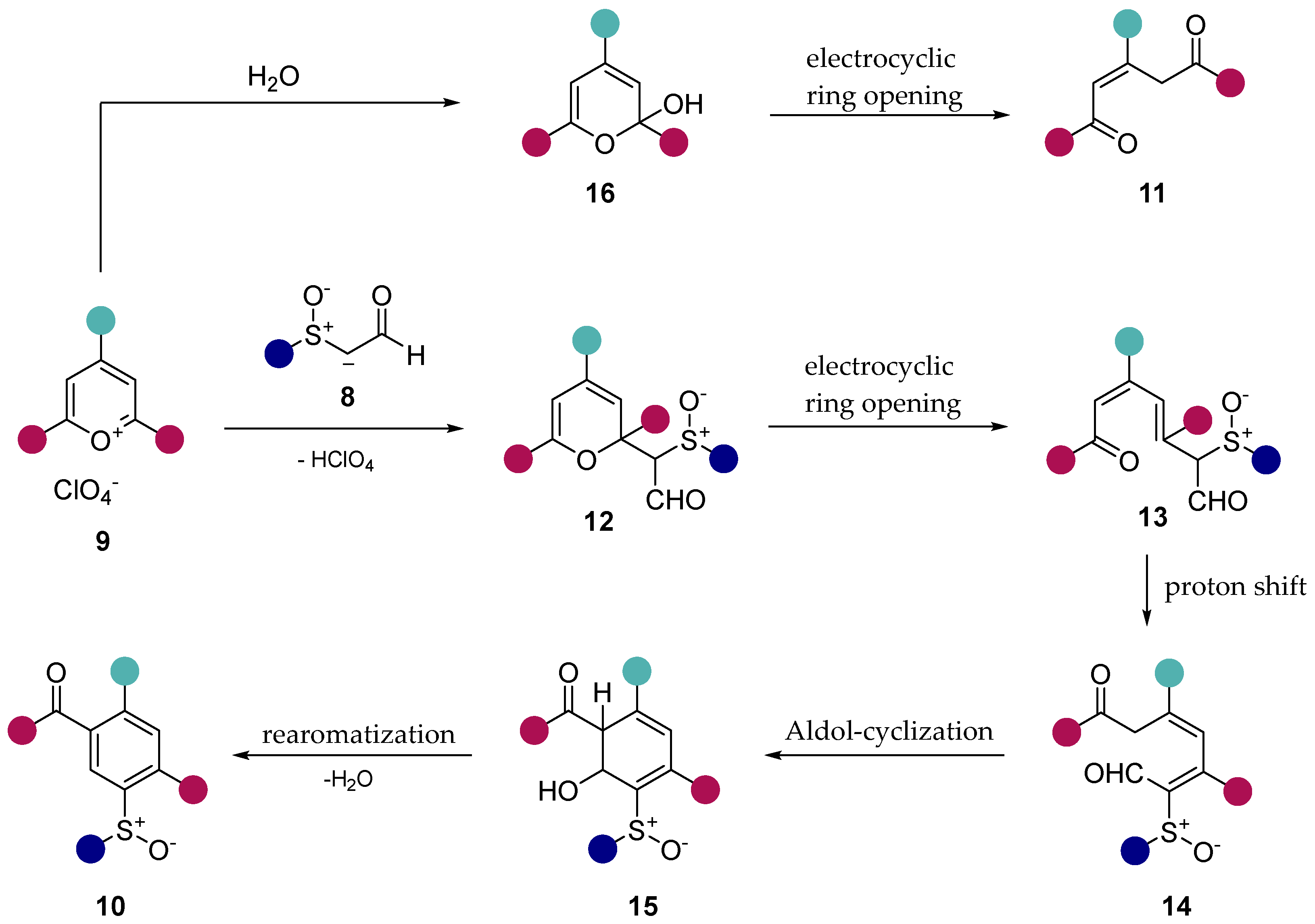

Table 1.
Optimization of reaction conditions.a.
 | |||||
|---|---|---|---|---|---|
| Entry | eq. 8a | eq. 9a | Base | Yield 10a / % | Yield 11 / % |
| 1 | 1.0 | 1.0 | NaOAc | 32 | 26 |
| 2b | 1.0 | 1.0 | NaOAc | 35 | 16 |
| 3 | 2.0 | 1.0 | NaOAc | 9 | 27 |
| 4 | 1.0 | 1.0 | - | 38 | <10 |
| 5 | 1.0 | 1.8 | - | 49 | <10 |
aa) 1.0 eq. LDA, -40°C, 30 min. b) 1.0 eq. N-formylpiperidine, -40°C, 40 min. c) 1.0–1.8 eq. 9a, 0.0–1.0 eq. NaOAc (suspension in THF), 15h, 60°C b 4 molecular sieves added.
Disclaimer/Publisher’s Note: The statements, opinions and data contained in all publications are solely those of the individual author(s) and contributor(s) and not of MDPI and/or the editor(s). MDPI and/or the editor(s) disclaim responsibility for any injury to people or property resulting from any ideas, methods, instructions or products referred to in the content. |
© 2023 by the authors. Licensee MDPI, Basel, Switzerland. This article is an open access article distributed under the terms and conditions of the Creative Commons Attribution (CC BY) license (http://creativecommons.org/licenses/by/4.0/).
Copyright: This open access article is published under a Creative Commons CC BY 4.0 license, which permit the free download, distribution, and reuse, provided that the author and preprint are cited in any reuse.


