
Submitted:
27 April 2025
Posted:
28 April 2025
Read the latest preprint version here
Abstract
The theory states that the first things that existed in the universe until the present moment were moved by influences of the intensity of the specific physical concept. This statement is possible based on the numerous observations that show that the intensity of the specific physical concept can influence specific elements and facts. In this way, it is possible to understand that the study is the possibility of unifying quantum physics with the theory of general relativity. The objective of the study is to help explain the elements and facts of the universe from its origins to the present.
Keywords:
existence of obligatory necessity
; origin of the universe
; Intensity of the specific physical concept
; Theory of everything
1. Introduction
The theory of everything is still a great mystery to humanity, but it is possible to advance in the understanding of the theory of everything, just by observing the universe and its patterns, thus it will be possible to obtain information about the possible theory of everything.
From observations of the universe, it is possible to reach the conclusion that the elements of facts arise from the intensity of the specific physical concept, developing the “theory of obligatory necessity” that explains the existence of elements or facts from the beginning to the present moment.
Currently, the elements and facts still depend on the intensity of the specific physical concept. There are countless necessities in the universe, such as:
- needs to exist
- I need to neutralize the existence
- need for adaptation
- need for interactions or actions
The intensities of specific physical concepts provide conditions or not for the existence of elements and facts. Numerous observations in the universe confirm the theory. It is worth noting that there are countless intensities of the specific physical concept, such as countless intensities of specific height, countless intensities of specific force, countless intensities of specific position, countless intensities of specific temperature, countless intensities of specific movement, countless intensities of specific mass, countless intensities of specific time, countless intensities of specific volume, countless intensities of specific pressure, countless intensities of specific work, countless intensities of specific electric field, countless intensities of frequency, countless intensities of the specific strong nuclear force, among other intensities of the specific physical concept. Some of these intensities of the specific physical concept can influence specific elements or facts.
2. The Existence and Interactions or Actions
The existence of elements or facts in comparison to other existences tends to have different characteristics, reinforcing the idea that there is not just one case provided by the theory. In terms of interactions or actions of elements or facts that give rise to new elements or facts, they tend to have different physical concepts, all influenced by the intensity of the specific physical concept. Examples serve to understand existence and interactions or actions [5,6]:
An example of existence that generally has different characteristics are chemical elements that are defined by the number of protons that form the atoms, that is, this characteristic defines a chemical element, promoting its differences and determining its properties. Thus, it is worth reflecting that there were countless influences of intensity of the specific physical concept to reach the environment of countless chemical elements. In an attempt to organize the countless elements according to their characteristics, the periodic table was developed to meet this need.
Figure 1.
Periodical, Source: Freepik.
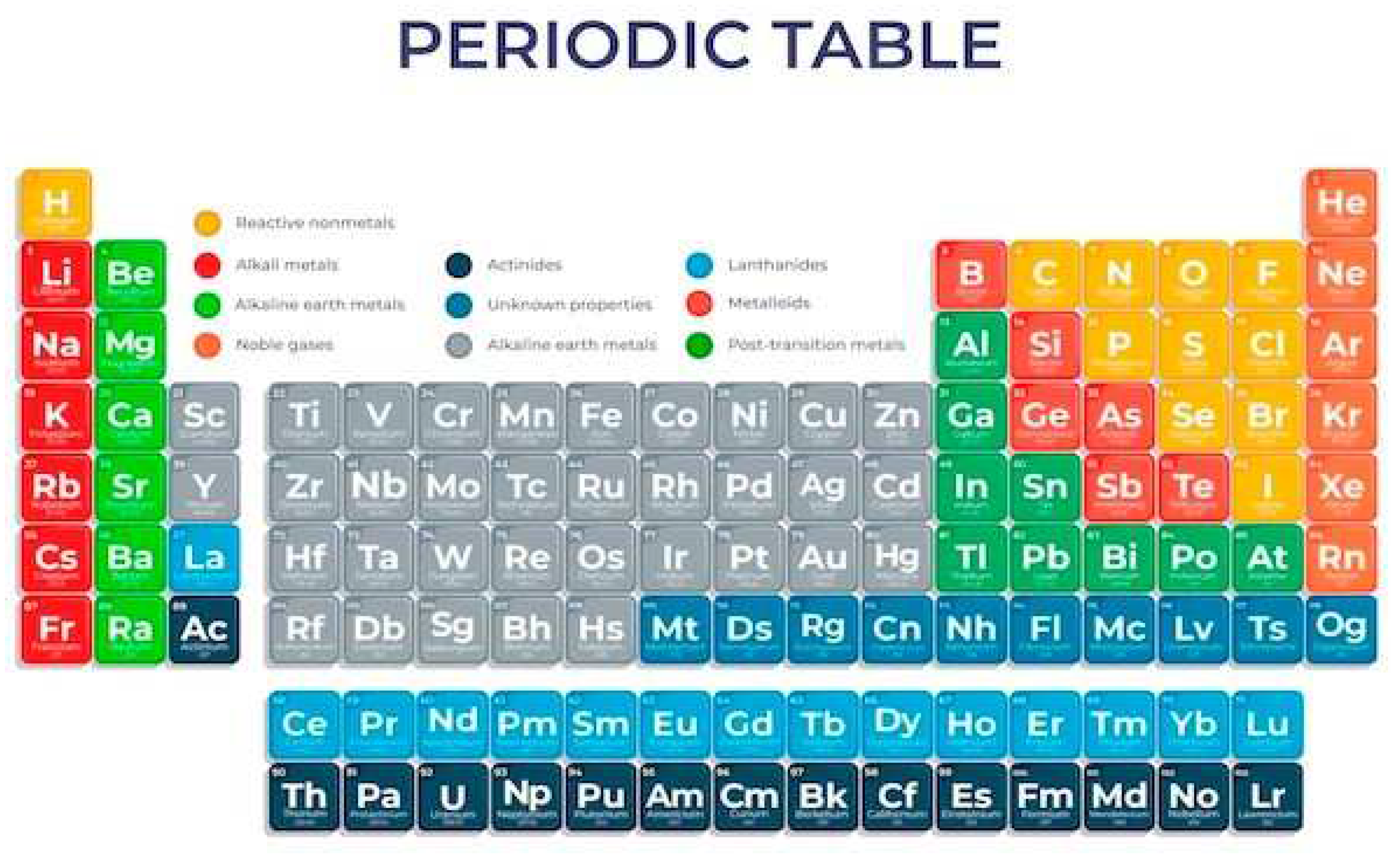
The periodic table is made up of 118 chemical elements, organized by atomic number, in ascending order from left to right. The families or groups of the periodic table are the vertical lines, which are numbered from 1 to 18. Chemical elements from the same family have similar chemical properties, they are the following groups or families:
- •
- Metals: Metals make up most of the elements in the Periodic Table. Some examples are gold, silver, copper, zinc, iron, platinum, aluminum, sodium, potassium, among others. The elements belonging to this group have the following main properties :
- -
- Have shine
- -
- They are solid
- -
- electric current
- -
- Conducts heat
- -
- They are malleable
- -
- They are ductile
- •
- Non-metals: They are composed of 11 elements carbon, nitrogen, phosphorus, oxygen, sulfur, selenium, fluorine, chlorine, bromine, iodine and astatine that have different properties than metals:
- -
- not shine
- -
- Does not conduct electricity
- -
- Does not conduct heat
- -
- Fragmentation occurs
- •
- Semimetals: They are composed of seven elements boron, silicon, germanium, arsenic, antimony, tellurium and polonium that have properties intermediate to metals and non-metals:
- -
- Shine
- -
- electrical conduction
- -
- Fragmentation occurs
- •
- Noble gases: These are elements from family 18 of the periodic table. These are helium, neon, argon, krypton, xenon and donium.
- •
- Hydrogen: Hydrogen is different from any other chemical element, as it does not fit into any of the groups presented.
In the periodic table, the horizontal lines are the periods that have elements in increasing order of atomic number.
Any natural element of any physical state, in comparison with other elements, has distinct characteristics. As per the following examples:
- A)
- Mercury (hg) and bromine (br): both are liquids at room temperature, but they have different characteristics. Mercury has characteristics that allow it to be used in the manufacture of mirrors and thermometers. Bromine has characteristics that allow it to be used in firefighting.
- B)
- Carbon(c), phosphorus(p), sulfur(s): all are solids, but have different characteristics. Carbon has characteristics that allow it to be used in the production of energy and in the manufacture of jewelry. Phosphorus has characteristics that make it used in the manufacture of matchboxes. Sulfur has characteristics that allow it to be used in the production of fertilizers and paper.
- C)
- Oxygen(o),nitrogen(n):both are gases, but with different characteristics. Oxygen is used in the respiration of many living things. Nitrogen has characteristics that make it used in dyes and explosives.
It is worth noting that the intensity of specific physical concepts, such as the strong nuclear force, influences the elements, that is, it is necessary that there is no change in the intensity of the strong nuclear force.
An example of interactions or actions are chemical reactions, which is when the material undergoes a transformation in which its constitution changes; that is, forming new substances provided by the influences of the intensity of specific physical concepts such as temperature and pressure. Chemical reactions are initial substances that are called reactants and end products, and reactions represented by chemical equations. acid rain and rust formation are ideal examples for understanding chemical reactions:
A. Example of acid rain
Figure 2.
Formation of acid drainage. Source: Freepik.
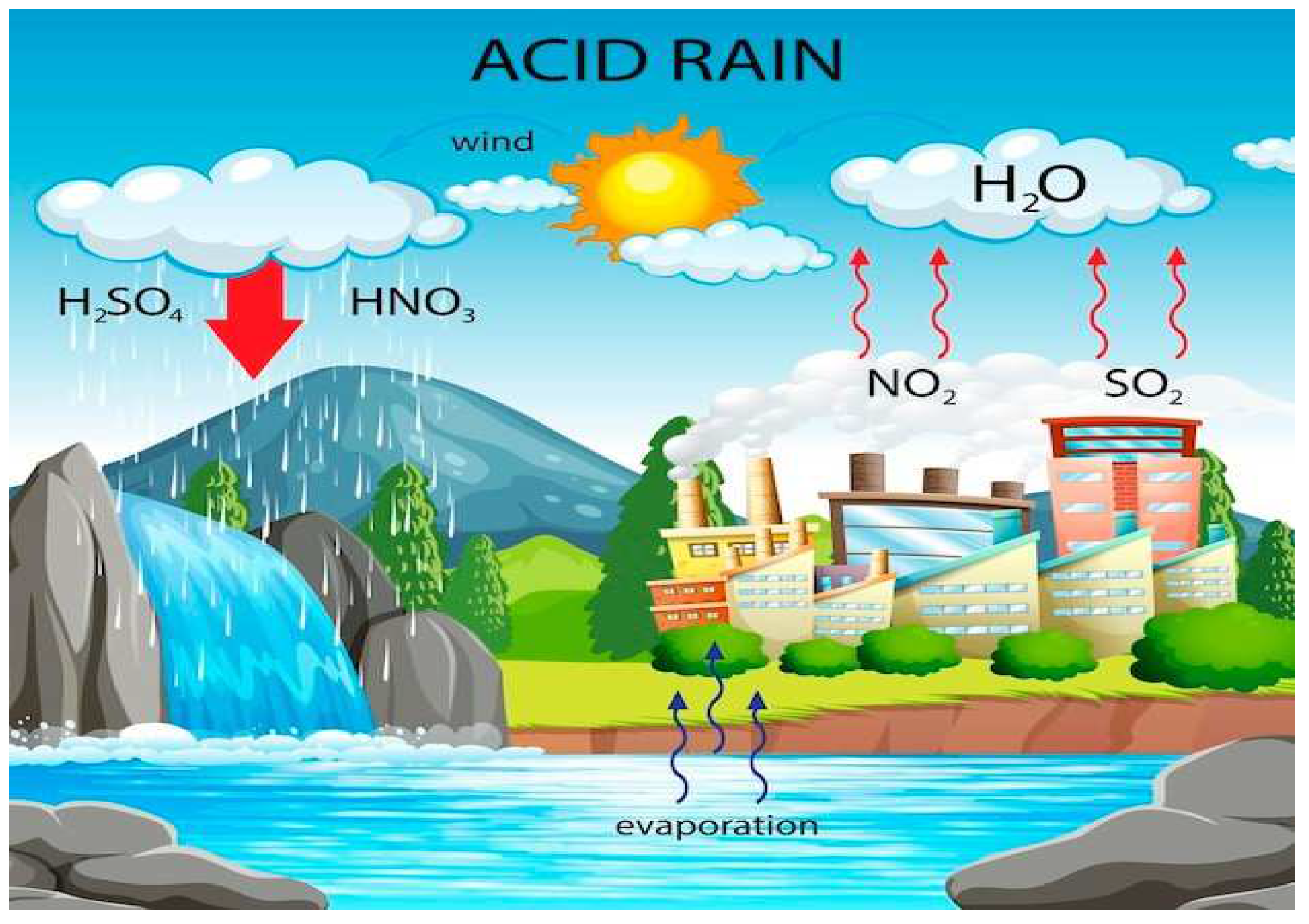
The equation SO 3 + H 2 O → H 2 SO 4 is the reaction of sulfur dioxide with water giving rise to sulfuric acid, known as acid drainage. Water (H 2 O) has some characteristics, such as: regulating body temperature, detoxifying the body and helping in the absorption of nutrients. 3 ) characteristics change; in other words, the new element sulfuric acid (H 2 SO 4 ) has different characteristics than water, promoted by the reaction due to the conditions and influences of the spaces.
B. Example of rust
Figure 3.
Rustformation.Source: Freepik.
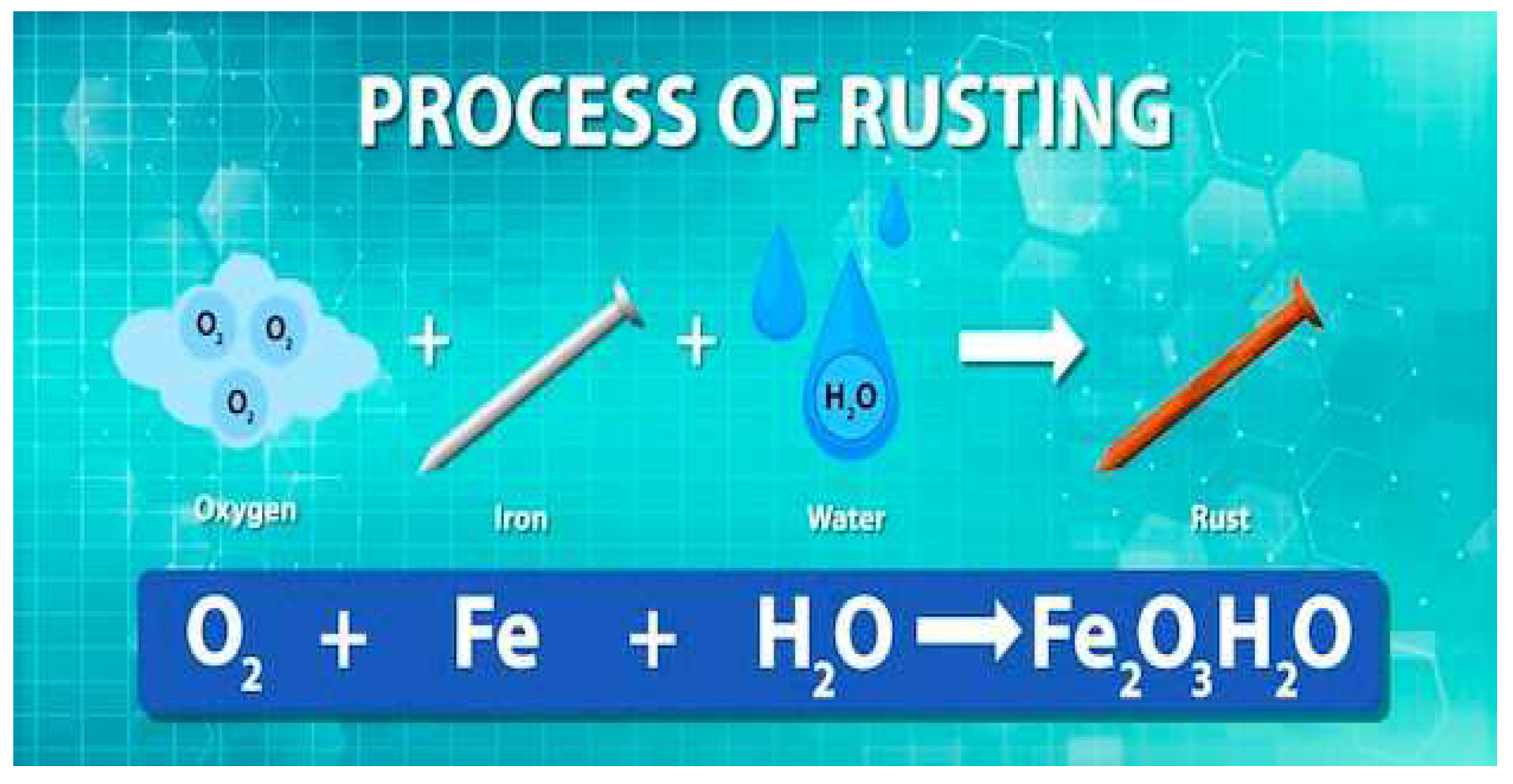
The general equation 2Fe+O 2 +2H 2 O → 2Fe(OH) 2 describes rust, which occurs when iron (Fe) comes into contact with water (H 2 O) or oxygen (O 2 ). In the beginning, iron had characteristics that allowed it to be used in the formation of metal alloys, in the production of automobiles and metal structures for construction. But when iron comes into contact with water or oxygen, it does not maintain its characteristics, because the rust that develops causes damage to the iron; thus, the emergence of new elements occurs due to the intensities of the specific physical concept.
3. Theory of Everything
Numerous scientists are trying to unify the phenomena of quantum physics and the theory of relativity into a single scientific theory. However, quantum physics and the general theory of relativity describe different phenomena. Thus, there is an urgent need for a theory that can explain elements and facts within a unified framework. The theory of obligatory necessity achieves this unification, since the intensity of the specific physical concept, is related to the elemental composition, chemical reaction, absence of the element or facts, and adaptation. [1,2].
4. List of Examples that Reinforce the Theory
- 1)
- Animals have numerous needs, such as growing in size to continue existing and then decreasing in size to oppose existence. Furthermore, animals need to eat to obtain energy to carry out their daily activities. Animal bones are needed to protect internal organs such as the lungs, heart and brain. Body hair helps animals adapt to cold and solar radiation. The absence of body hair causes infections and irritation, which is why body hair is essential. In all animal organs, their existence is essential, as each organ performs functions such as the heart that brings blood to the body, the digestive system that helps obtain food to obtain energy and the brain that assists in the body’s actions. All these biological phenomena are provided by chemical elements.
- 2)
- Numerous chemical elements are essential for its usefulness, such as: oxygen, responsible for the respiration of many living beings, carbon is used in energy plants, nitrogen plays a role in plant growth, sodium regulates blood volume and acts on nerve impulses, the Calcium acts on bones and teeth, potassium helps cells function properly, aluminum is used in planes, automobiles and armored vehicles. Therefore, these elements that generate biological and chemical phenomena are influenced by the intensity of the specific physical concept.
- 3)
- Many objects arose out of necessity, such as: the lamp that illuminates, the telephone to communicate, the television to inform the population, the means of transport to travel. These chemical elements that make up these objects are influenced by intensities of specific physical concepts.
- 4)
- Life adaptation developed by Darwin occurs through the intensities of specific physical concepts such as position and temperature.
- 5)
- In water, certain elements and phenomena that do not exist outside water are favored. The existence of the water element is provided by the chemical reaction that depends on the intensity of specific physical concepts.
- 6)
- The climate of different regions favors different elements and phenomena due to the intensity of the specific physical concept such as position among other factors.
- 7)
- The characteristics of a volcano do not provide conditions for the existence of certain elements and phenomena, since the intensity of the specific physical concept of temperature does not provide it.
- 8)
- Countless planets are varied in elements or fact provided by the intensities of the specific physical concept as position.
- 9)
- A circular glass object on a table at rest maintains its existence, however if the same object is placed at a relevant height with the action of gravity, the circular glass object loses its existence. That is, the physical concept intensity specifies how height and gravity change matter.
- 10)
- It is possible to observe that chemical reactions and interactions at the level of quantum physics going towards the macroscopic level, all of this can be explained by physical properties, from temperature (physical concept), distance (physical concept), position (physical concept). of physical properties can alter the reality of the element or fact.
5. Example of Physical Spaces and Elements to Reinforce the Theory
Figure 4.
Imagination of physical spaces and elements, Source: Author.
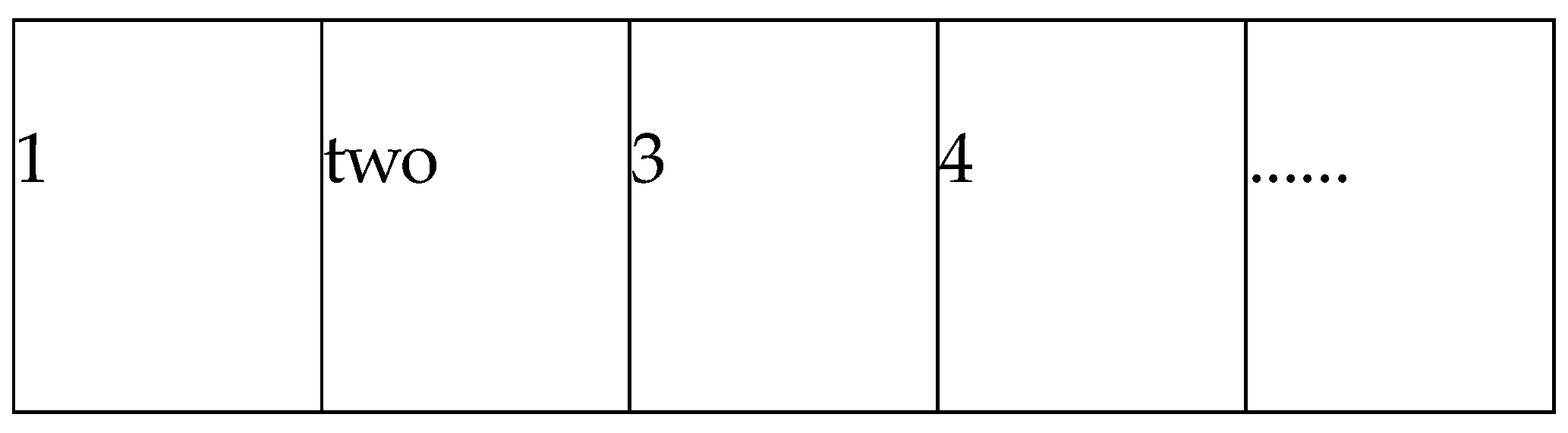
Let’s imagine that the squares 1,2,3,4, etc. They represent some spaces that make up the universe, space 1 is the city of Rio de Janeiro, space 2 is the volcano, space 3 is the city of Belém and space 4 is the sun.
→ the elements that are part of space 1 (Rio de Janeiro), are not part of space 2 and 4 due to their characteristics, I do not allow elements from space 1
6. A Practical Example of the Theory
Placing a few ice cubes in liquid water favors the disappearance of the ice cubes, on the other hand, if a drop of liquid water falls into a huge ice the phenomenon is different due to the intensity of specific physical concepts.
7. No Luck
In a dice game, the result is also influenced by physical factors such as height, position, force, gravity, among others. If the die is positioned at number three, at a negligible height, without any significant force or change, and is immediately released, the die will remain at position three.
8. The Different Universe
If the universe underwent changes in its intensities of specific physical concepts, it is possible that the composition of the elements would also be different or some elements would be absent. The presence or absence of intensity of specific physical concepts can significantly alter the reality of the elements of the universe.
9. Before the Big Bang
To get an idea of what happened before the Big Bang, it is necessary to have information about the initial elements and facts at the exact moment the Big Bang occurred. These initial elements or facts can help explain what happened before the Big Bang, after all, what happened before the Big Bang influenced the existence of these initial elements and facts of the Big Bang.
Example: Assuming that the initial element or fact at the moment the Big Bang occurred is influenced by the intensity of the specific physical concept X, then it is possible to understand the universe through the influences that these elements or facts suffer. It can be inferred that, by observing the causes of the influence on these elements or facts, we can gain insights into what came before the Big Bang.
10. Later Elements
When elements interact, changes occur in their characteristics, leading to the formation of new elements. Therefore, at the origin of the universe, the elements had specific characteristics, but through interactions they gave rise to other elements. However, these changes are always influenced by the intensities of specific physical concepts in which they occur. For example, element X and element Y within space Z indifferent realities may result. It is important to consider that at some point element X or Y was influenced by an intensity of the specific physical concept, either before or after the interaction occurred.
11. Representation and Its Relations
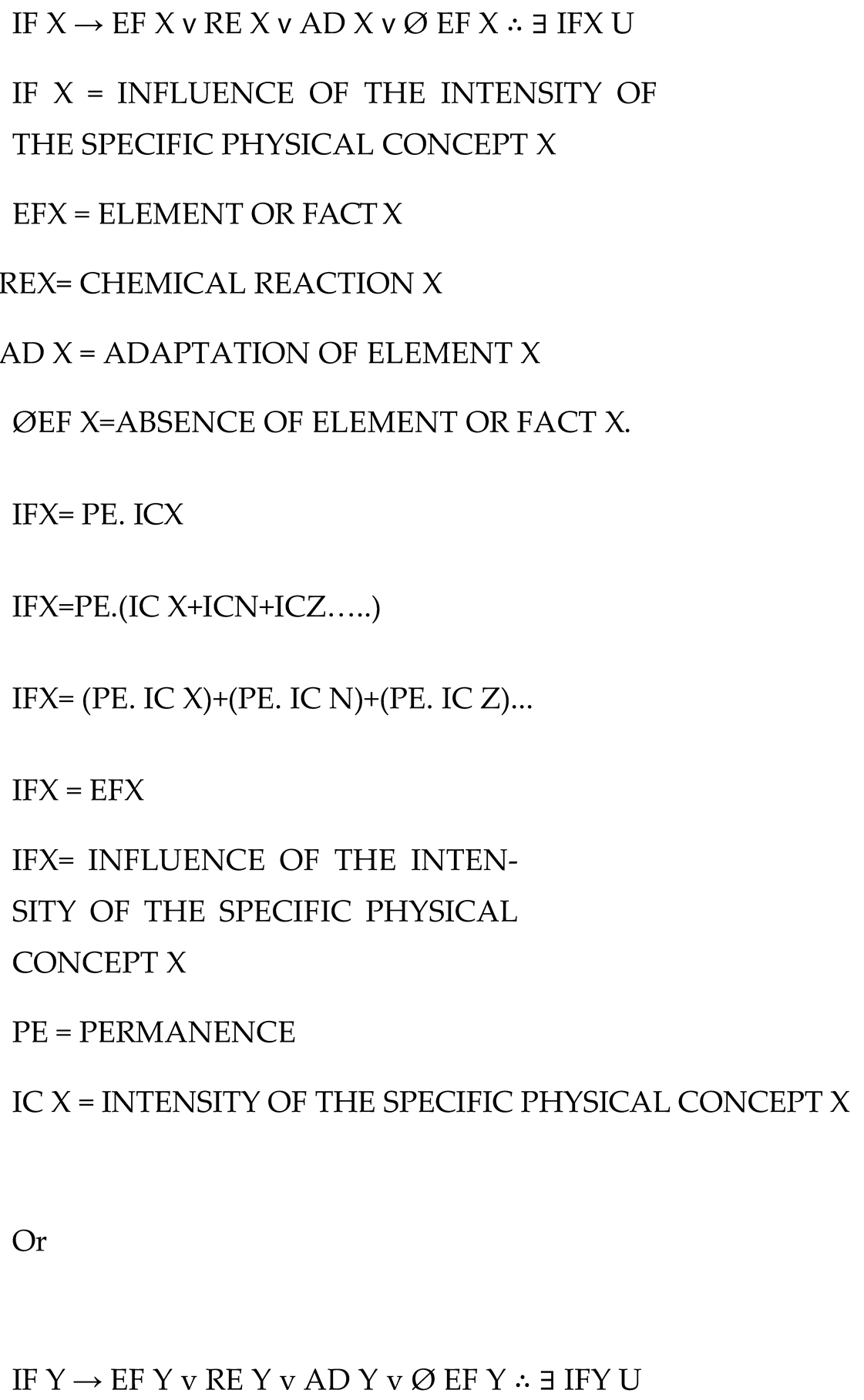
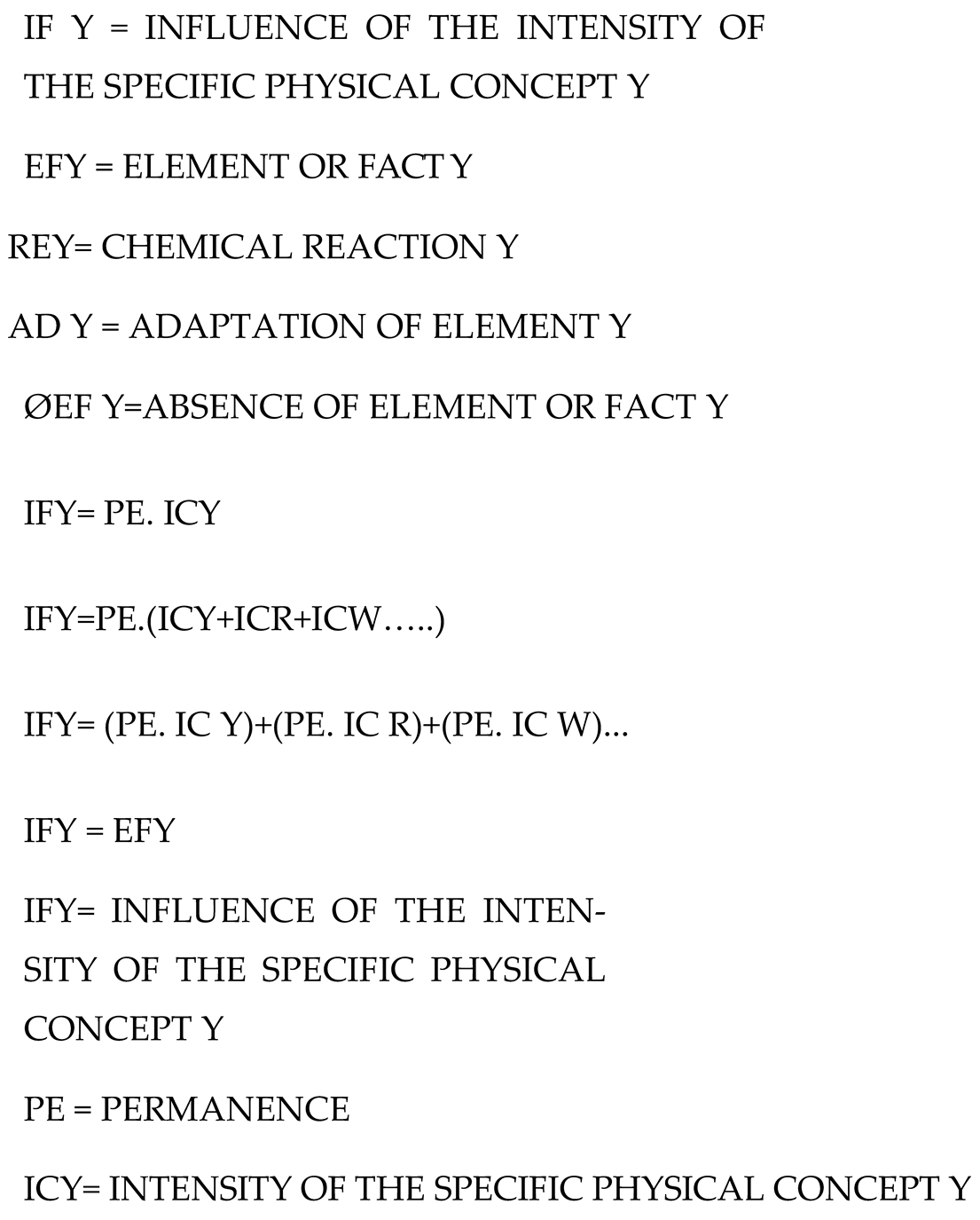
In addition to IFX and IFY, other influences of the intensity of the specific physical concept are possible to arrive at the current result for a variety of elements present in the periodic table and the variety of existing particles.
Faced with several examples of the intensity of the specific physical concept, influencing elements or facts, it is possible to generalize that elements or facts at the microscopic or macroscopic level (quantum physics and theory of general relativity) can be influenced by the intensity of the specific physical concept. To reach scientific proof it is necessary to imagine any element or fact, then change the intensity of the specific physical concepts of the chosen element or fact in question.
It is worth noting that there are countless intensities of the specific physical concept, such as countless intensities of specific height, countless intensities of specific force, countless intensities of specific position, countless intensities of specific temperature, countless intensities of specific movement, countless intensities of specific mass, countless intensities of specific time, countless intensities of specific volume, countless intensities of specific pressure, countless intensities of specific work, countless intensities of specific electric field, countless intensities of frequency, countless intensities of the specific strong nuclear force, among other intensities of the specific physical concept. Some of these intensities of the specific physical concept can influence specific elements or facts.
12. Fun Game of Including New Intensities of Specific Physical Concepts in the Element or Fact
O1: Imagine a scenario with two bottles X and Y of water, each with 2 liters, under the same conditions. The functions promoted by the two bottles are identical, for example, the movement of water. Later, a specific low temperature is placed in bottle X of water (intensity of the specific physical concept), thus, bottle X of water acquires a different movement from bottle Y, which did not receive a specific low temperature (bottle X becomes cold). Then, bottle X is placed at a specific high temperature (intensity of the specific physical concept), which promotes the nonexistence of this bottle of liquid water, transforming it into gas, that is, a new movement. In addition, bottle X is placed at a specific high temperature, causing a loss of 99% of the water from the liquid state, promoting a specific movement. Thus, new intensities of specific physical concepts are possible, by changing the element or fact.
02: In a child’s game, three identical balls X, Y and Z are thrown at the wall. Ball X is thrown with very little force, ball Y is thrown with little force, and ball Z is thrown with a strong force. In this way, balls X and Y end up in different positions at the end of the throw, while balls Z lose their shape due to the strong force that was thrown at the wall. Therefore, specific force intensities promote new realities for balls X, Y, and Z.
In addition to these two imagined scenarios presented, it is possible to randomly choose elements or facts of nature and, later, include new intensities of physical concepts that can change the element or fact.
13. Motivation for the Study Presented
Scientific phenomena such as gravity and the theory of general relativity developed by Isaac Newton and Albert Einstein are observable through differences in the reality of scientific phenomena, which behave differently. It is possible to observe the existence of phenomena such as gravity and the theory of general relativity.
In this way, it is possible to observe that the theory of obligatory necessity is coherent, as varied specific physical concepts (height, position, forces, speed, temperature...) result in the varied element or fact, that is, when these specific physical concepts are changed (height, position, forces, speed, temperature...), elements and facts are also changed.
14. Conclusions
The theory of obligatory necessity aligns with observations of facts, since the intensity of specific physical concepts play a significant role in influencing the existence of elements and phenomena. This influence can be attributed to the need for existence, the need for opposition to existence, the need for adaptation or the need for interactions and actions. These factors highlight the crucial relationship between intensity of specific physical concepts and the manifestation of elements and phenomena.
According to the theory of obligatory necessity, the emergence of the first elements and phenomena in the universe can be attributed to the concept of obligatory necessity. This concept is particularly relevant when considering the Big Bang theory, which describes the early expansion and development of the universe.
Furthermore, the theory states that the universe did not arise by chance, that is, the universe was not an accident, as it arose by determination that is influenced by the intensity of the specific physical concept; that is, it influences the existence of facts and elements.
The study helps to explain the elements and facts of the universe from its origin to the present moment.
References
- Hawking,Stephen.ABreveHistory of Time.Intrinsic,riodejaneiro,256p.January 2015.
- Hawking,Stephen.The Universeinanutshell.Arx, São Paulo,216p.April 2004.
- TAHAN, M. The man who told. RiodeJaneiro, Record, 2010.
- 02-Day-to-day numbers-Mathematics-Ens.Bottom.–Telecurso,novotelecurso,youtube,2013, 11 minutes and 45 seconds. Available at: https://www.youtube.com/watch?v=6HNOg12ExEI&t=224s.
- HARARI, Yuval Noah. Sapiens: A Brief History of Humankind.
- LAZKOZ, Ruth.How long has it been since the Big Bang and how is it measured.Science-BBCNews Brazil.June 20, 2022.
Disclaimer/Publisher’s Note: The statements, opinions and data contained in all publications are solely those of the individual author(s) and contributor(s) and not of MDPI and/or the editor(s). MDPI and/or the editor(s) disclaim responsibility for any injury to people or property resulting from any ideas, methods, instructions or products referred to in the content. |
© 2025 by the authors. Licensee MDPI, Basel, Switzerland. This article is an open access article distributed under the terms and conditions of the Creative Commons Attribution (CC BY) license (http://creativecommons.org/licenses/by/4.0/).
Copyright: This open access article is published under a Creative Commons CC BY 4.0 license, which permit the free download, distribution, and reuse, provided that the author and preprint are cited in any reuse.


