

Submitted:
21 October 2023
Posted:
23 October 2023
You are already at the latest version
Abstract
The $k$-set tree connectivity, as a natural extension of classical connectivity, is a very important index to evaluate the fault-tolerance of interconnection networks. Let $G=(V, E)$ be a connected graph and a subset $S\subseteq V$, an $S$-tree of graph $G$ is a tree $T=(V',E')$ that contains all the vertices of $S$. Two $S$-trees $T$ and $T'$ are internally disjoint if and only if $E(T)\cap E(T')=\varnothing$ and $V(T)\cap V(T')=S$. The cardinality of maximum internally disjoint $S$-trees is defined as $\kappa_{G}(S)$, and the $k$-set tree connectivity is defined by $\kappa_{k}(G)=\min\{\kappa_{G}(S)|S\subseteq V(G)\ \text{and} \ |S|=k\}$.
In this paper, we show that the $k$-set tree connectivity of hierarchical folded hypercube when $k=4$, that is, $\kappa_{4}(HFQ_{n})=n+1$, where $HFQ_{n}$ is hierarchical folded hypercube for $n\geq 7$.
Keywords:
tree connectivity
; hierarchical folded hypercube
; internally disjoint trees
; fault-tolerance
1. Introduction
All graphs in this paper are finite simple and undirected. For more terminology and notation that are used but not described here, refer to reference [1]. A network is commonly molded by a graph , where vertices correspond to processors and edges correspond communication links. For any vertex , let be the neighbour set of x in the graph G, and . Let be the degree of x in G. Besides, we use and to denote the minimum degree and maximum degree of G, respectively. If , then G is called a regular graph. For any , an -path is a simple graph whose vertices begin with a and end with b. Any two -paths A and B are internally disjoint if and only if . For any vertex set , let be the induced subgraph of G that contains all the vertices of S. For convenience sake, let and use “” to express “Without loss of generality”. Let be n-bit binary string and be the i-th bit of x. Denotes by the Hamming distance of two distinct n-bit binary strings of x and y is that the number of positions where they differ.
With the rise and rapid development of high-performance parallel computer science, more and more attention is being paid to interconnection networks with excellent performance. An eminent topological structure can significantly improve the reliability of a network. Therefore, it is essential to consider the fault tolerance of the network while designing the topology of the network. This means that the interconnection network should be able to operate effectively even when certain nodes and edges fail, ensuring that it retains specific network properties. In fact, the topological structure of an interconnection network commonly modeled by an undirected simple graph , where every vertex corresponds to a processor, and each edge corresponds to a communication link. Then many computer scientists and engineers use some parameters of graph theory to design and analyzing topological structures of interconnection networks, for instance the connectivity.
The connectivity of a connected graph G is the minimum cardinality of vertices whose removed to obtain a disconnected graph or only a vertex. A famous theorem that we know of Whitney [2] gives another equivalent definition of connectivity. For any vertex set , let be the maximum cardinality of internally disjoint paths joining x and y in G. Then and . However, the connectivity has an evident drawback that in the practical application of interconnection networks, the probability of all neighbours adjacent to a vertex failing at the same time is extremely small. Therefore, it is not precise enough to measure the fault tolerance of a network by the parameter of connectivity.
In order to better evaluate the fault tolerance level of a network, Chartrand et al. [3] extended the connectivity and came up with the concept of the k-set tree connectivity. For any vertex set , as the induced subgraph of G is actually a tree. An S-tree of a connected graph G is a tree that contains the subset S. Two S-trees T and are internally disjoint if and only if and . Let be the maximum number of internally disjoint S-trees in graph G. The k-set tree connectivity is denoted by and .
The relation between the tree connectivity and the connectivity and the bounds of the tree connectivity have been extensively investigated [4,5,6]. Furthermore, the 3-set tree connectivity of some networks have been studied. Such as, Chartrand ea al. explored the 3-set tree connectivity of complete graphs [7]. Li ea al. derived the 3-set tree connectivity of card product graphs [8]. Li et al. determined product graphs [9]. Li et al. evaluated the 3-set tree connectivity of complete bipartite graph [10]. Zhao et al. investigated the 3-set tree connectivity of star graphs and alternating group graphs [11]. However, there are few results about 4-set tree connectivity. The results known about 4-set tree connectivity of networks so far, are hypercubes [12], exchanged hypercubes [13] and dual cube [14] and hierarchical cubic networks [15]. For more researches and results about the k-set tree connectivity, refer to [16,17,18,19,22,23].
In this paper, we study the 4-set tree connectivity of the hierarchical folded hypercube.
2. Preliminaries
An n-dimensional hierarchical folded hypercube can be divided into clusters, say , , …, and every cluster is isomorphic to the n-dimensional folded hypercube . Any vertex can be denoted by a two-tuple address , where both and are n-bit binary strings. The first binary string identifies the cluster the vertex a belong to and the second binary string identifies the vertex within the cluster. Two vertices and are adjacent in if and only if one of the following two prerequisites holds:
,
if , then otherwise, and .
Where is called cube edge, which in a cluster of and is called cross edge, which connecting two vertices in two distinct clusters of .
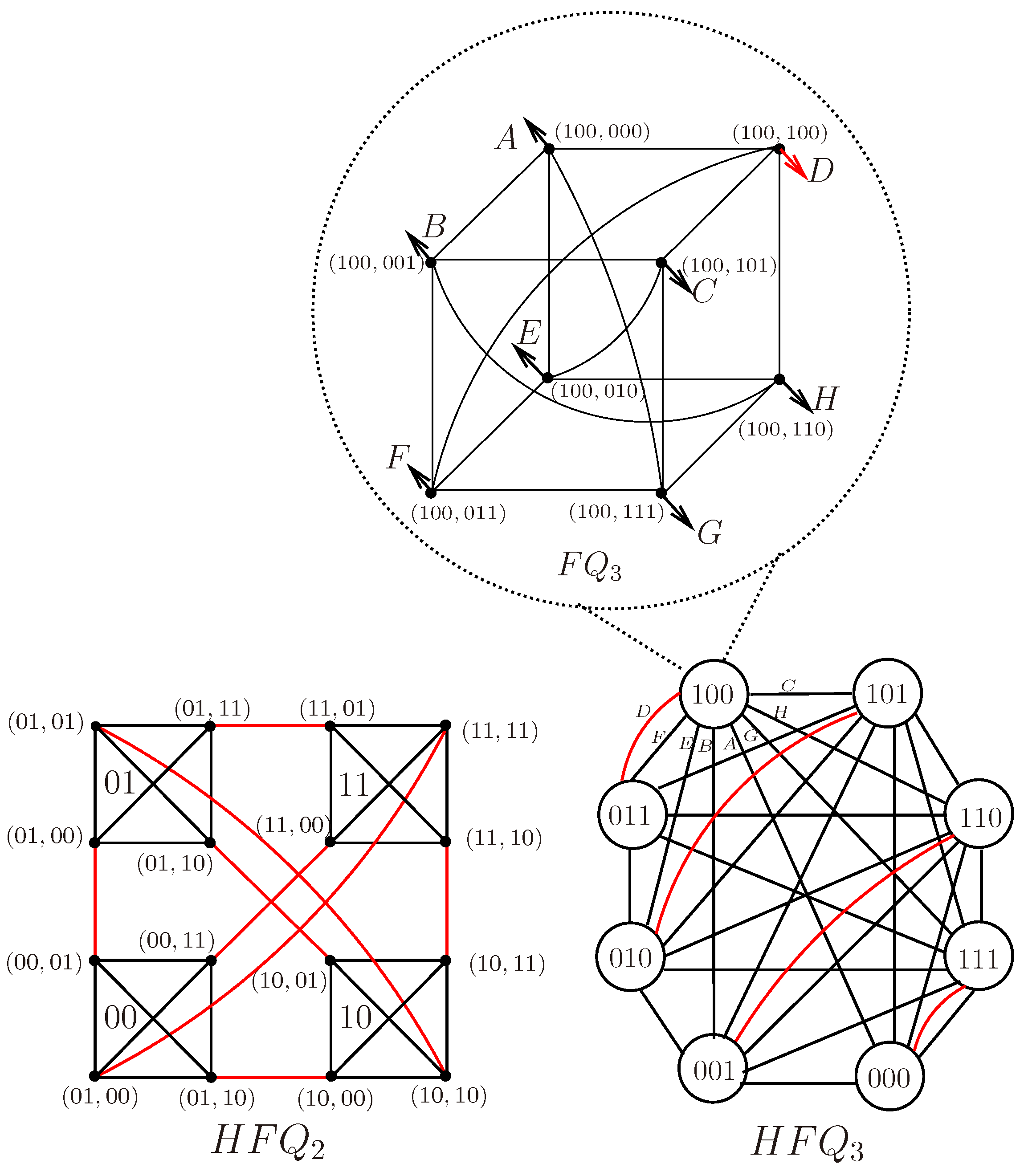
Figure 1.
The -dimension hierarchical folded hypercube.
Lemma 2.1.
Let , , …, be the clusters of for , we have
For , let with . The external neighbors of different vertices in distributes in distinct clusters of . Besides, if with , the external neighbor of a distributes in the same cluster with b.
For and , there exist two cross edges between and for and if and only if ; otherwise there is just one cross edge.
For any two vertices in for , the external neighbor of a and b can not be the same vertex.
Proof.
Let and . By the definition of , , and . Therefore, the external neighbors of and are and , respectively. Since , the external neighbor of and distribute in different clusters of . In view of and , the external neighbor of b is . Let , then and the external neighbor of a is . When , the external neighbors of a and b belong to the same cluster of .
By (1), it is clear that the result holds.
Let for and suppose that a and b have a same external neighbor, denote by x, then a and b are the two external neighbors of x, a contradiction.□
Lemma 2.2.
Let be the clusters of for . Then, arbitrary vertex for , , we have
The external neighbors of the distinct vertices in distribute in different clusters of .
When , there is one and only one vertex in with the external neighbor belongs to the same cluster with the vertex v and . Otherwise, all the vertices in with the external neighbors distribute in different clusters with the vertex b.
Proof.
w.l.o.g., let . Recall that , which is -regular, therefore . As , for any , . By (1) of Lemma 1, the external neighbors of vertices in distribute in different clusters of .
By the definition of , the result can be obtained directly.□
Lemma 2.3.
Let be the clusters of and for , where and , then N is connected.
Proof.
w.l.o.g., let . By (2) of Lemma 1, there exists at least one cross edge between arbitrary two different clusters of . Therefore, N is connected.□
Lemma 2.4.
Lemma 2.5.
3. The 4-set tree connectivity of hierarchical folded hypercube
In this part, we determine the k-set tree connectivity of folded hypercubes , when . That is, where .
The following lemma provides a sharp upper bound for our main result.
Lemma 3.1.
[5] Let G be a connected graph of order with minimum degree . Then for . In addition, if there exist two adjacent vertices of degree , then for .
The following three Lemmas describe several clear and crucial properties on k-connected graphs, which provide great convenience when we construct internally disjoint paths.
Lemma 3.2.
[1] Let G be a k-connected graph and u and v be arbitrary two distinct vertices of G. Then there are k internally disjoint paths joining x and y in G.
Lemma 3.3.
[1] Let be a k-connected graph, arbitrary vertex , let be a vertex subset of V and . Then, there exists a k-fan in G from u to Y.
Lemma 3.4.
[1] Let be a k-connected graph and be two disjoint vertex subsets with and . Then, there exist k disjoint -paths in G.
The following two Theorems on the folded hypercube are very beneficial to our proof of the main result.
Theorem 3.1.
Theorem 3.2.
Lemma 3.5.
Let be the clusters of for and . Let and for different , then there exist internally disjoint S-trees in .
Proof.
w.l.o.g., suppose that and . Let and . See Figure 2. By Theorem 3.1, there are n internally disjoint trees connecting . Recall that , for each . By Lemma 2.4, , there are neighbors of x in . Let for and .
Note that , it is potential that or . To avoid repetition, we only consider the case of and , as the discussion about or is similar. By of Lemma 2.2, there are at most two vertices of X with the external neighbors belonging to , and the two vertices must be x and , for some . To obtain the main result, we need two consider following three cases.
Case 1.
There are two vertices in X with the external neighbors belonging to .
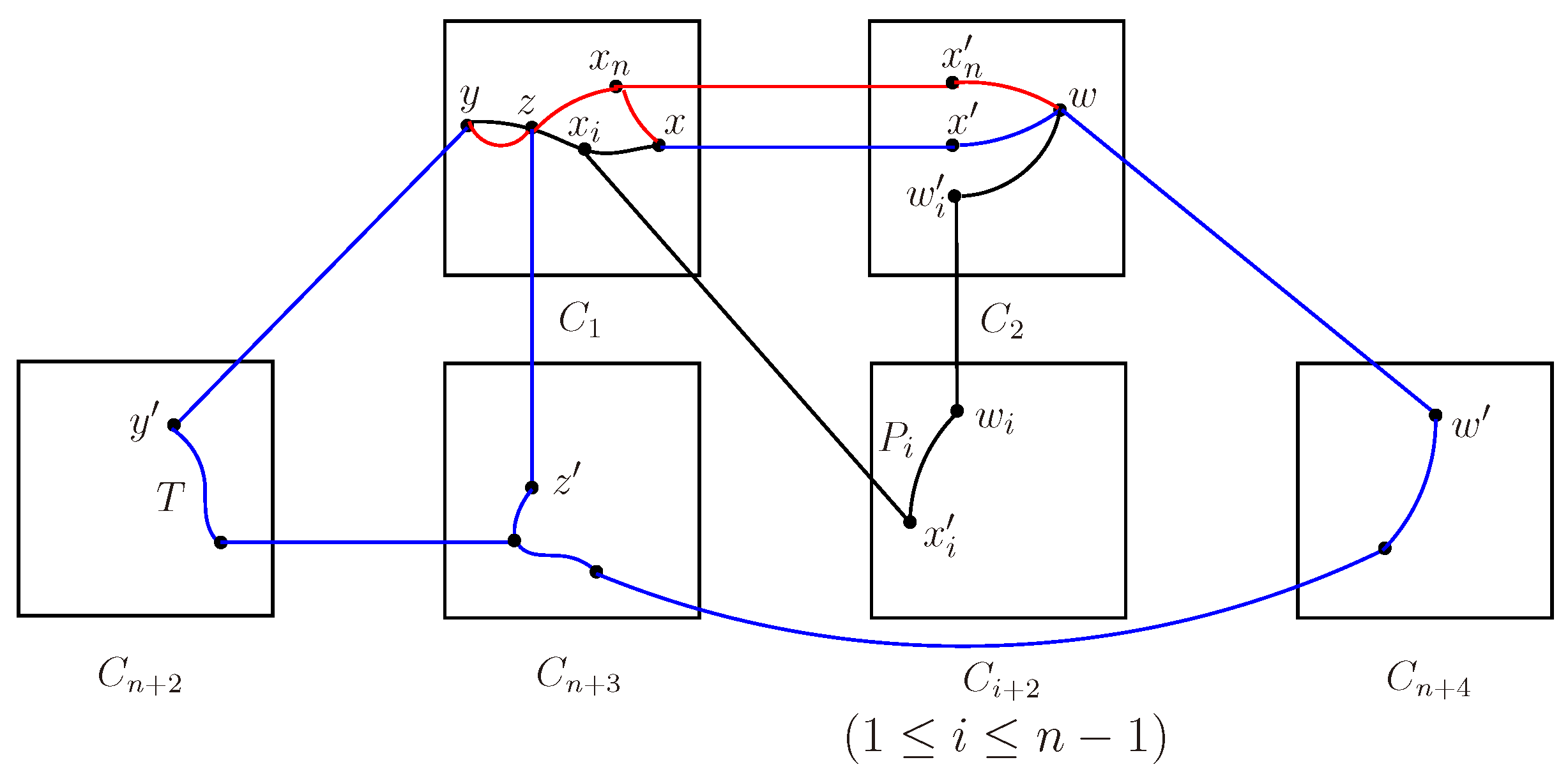
Figure 2.
The explanation of Case 1.
w.l.o.g., assume that the two vertices are x and , that is . Let and there exists a vertex and such that for . Since is connected, there exists a path joining and in , for . Let . By Lemma 3.3, there are disjoint paths from w to W, and such that , , for . w.l.o.g., suppose that , , . By Lemma 2.3, is connected, then there is a tree T connecting and . Let for , and , then are internally disjoint S-trees.
Case 2.
There is only one vertex in X with the external neighbor belonging to .
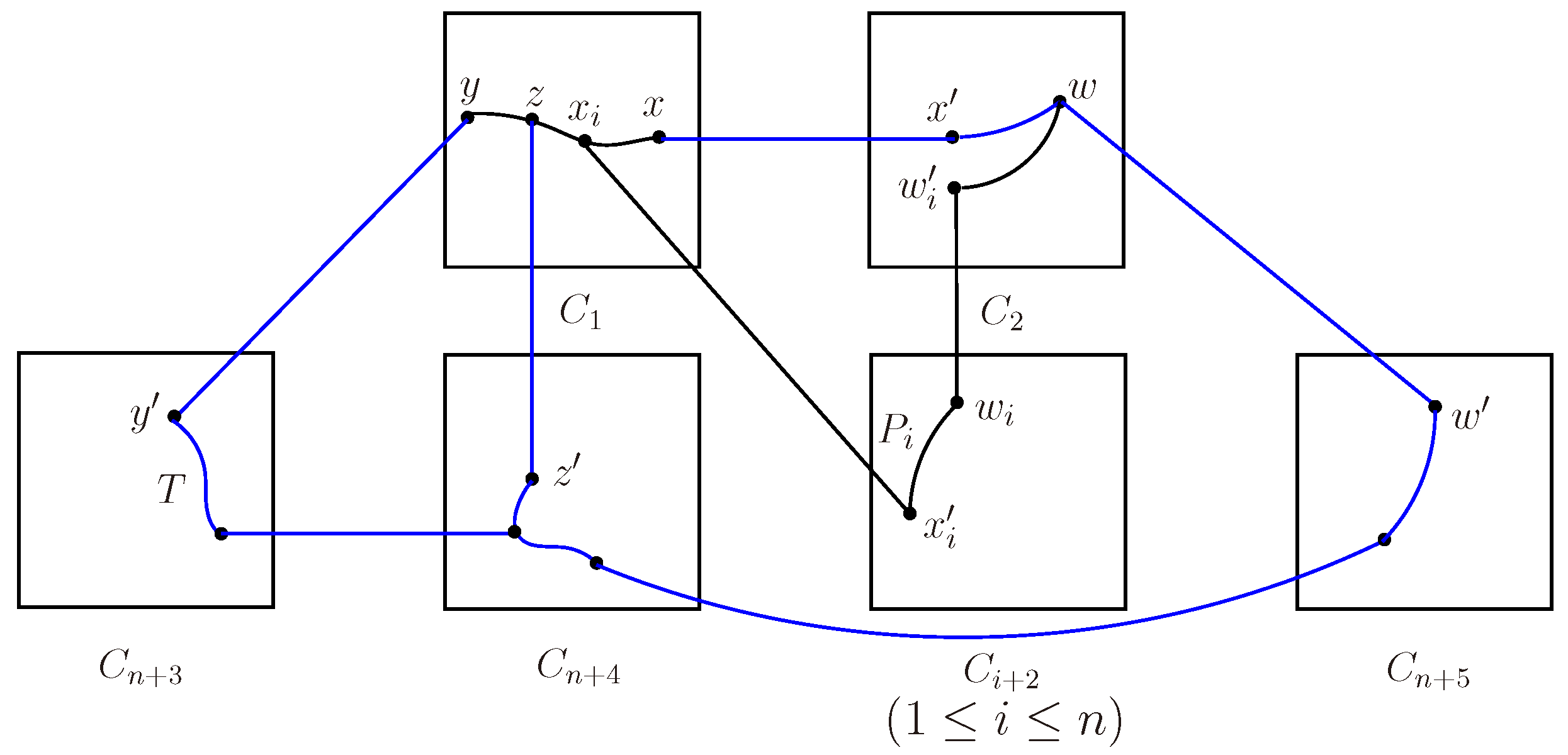
Recall that, we consider that , by of Lemma 2.2, . Let for . Since is connected, there is a path joining and in , and such that for . Let . By Lemma 3.3, there are disjoint paths between w and W, and subject to , for . w.l.o.g., assume that , , . By Lemma 2.3, is connected, then there is a tree T connecting and . Let for and , then are internally disjoint S-trees.
Case 2.2.
for certain .
w.l.o.g., suppose that . By Lemma 2.1, at most one vertex of and belongs to .
Case 2.2.1.
.
Let for . Since is connected, there exists a path joining and in , and such that for . w.l.o.g., assume that . Note that, or may belongs to the same cluster with some for some . We need to discuss the following two situations.
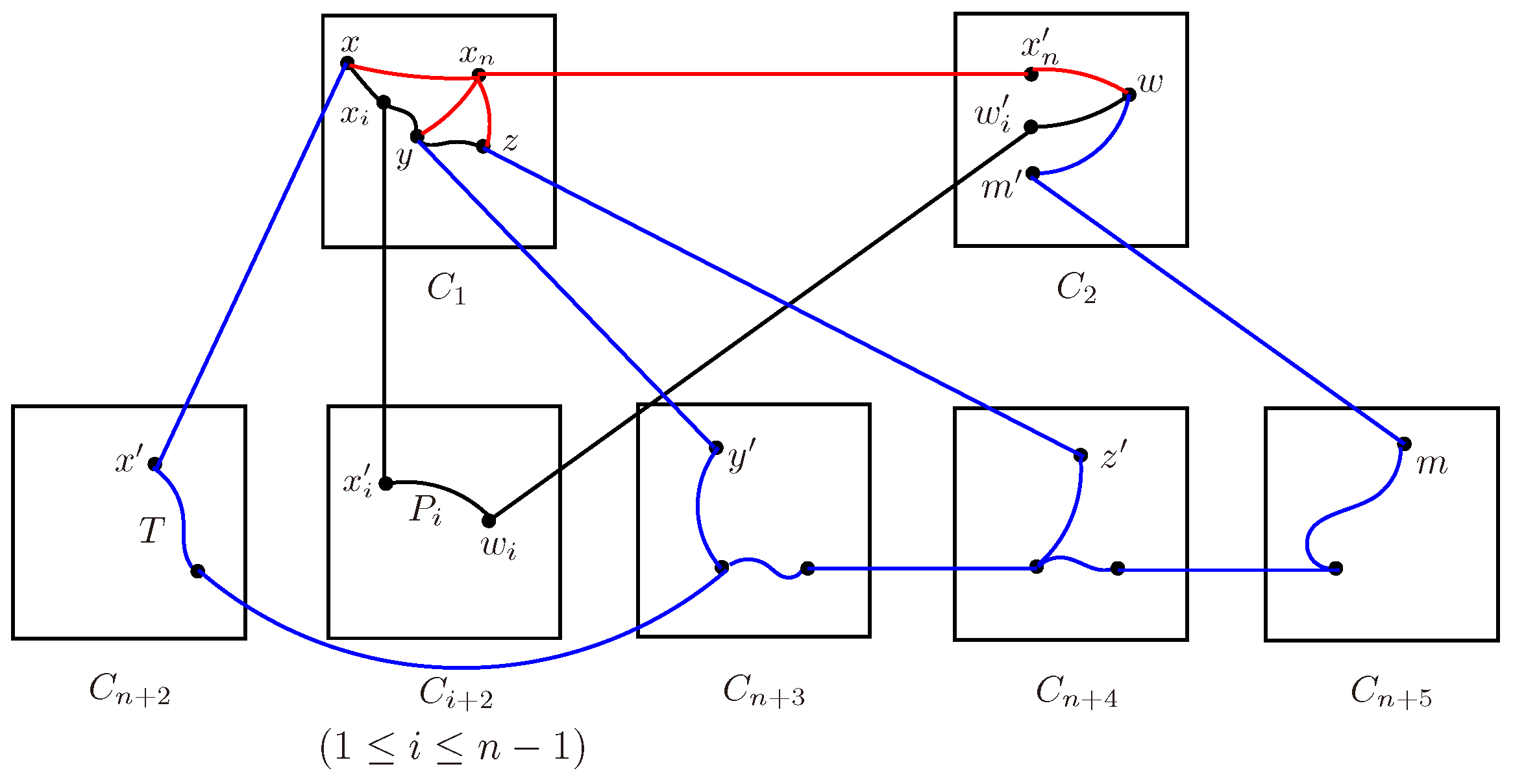
Figure 4.
The explanation about for of Case .
When for . w.l.o.g., suppose that , , and such that . Let . By Lemma 3.3, there exist disjoint paths from w to W, and such that be the path joining w and . By Lemma 2.3, is connected, then there exists a tree T connecting and m. Let for , and , then are internally disjoint S-trees.
When or for certain .
w.l.o.g., suppose that and . That is, . Let and , . Let , and . By Lemma 3.4, there exist two internally disjoint -paths, saying and Q, subject to be the path from to and P be the path from to g. Similar to the case of for , we get n internally disjoint S-trees . Let and . By Lemma 2.3, is connected, then there exists a tree T connecting and m. Let .
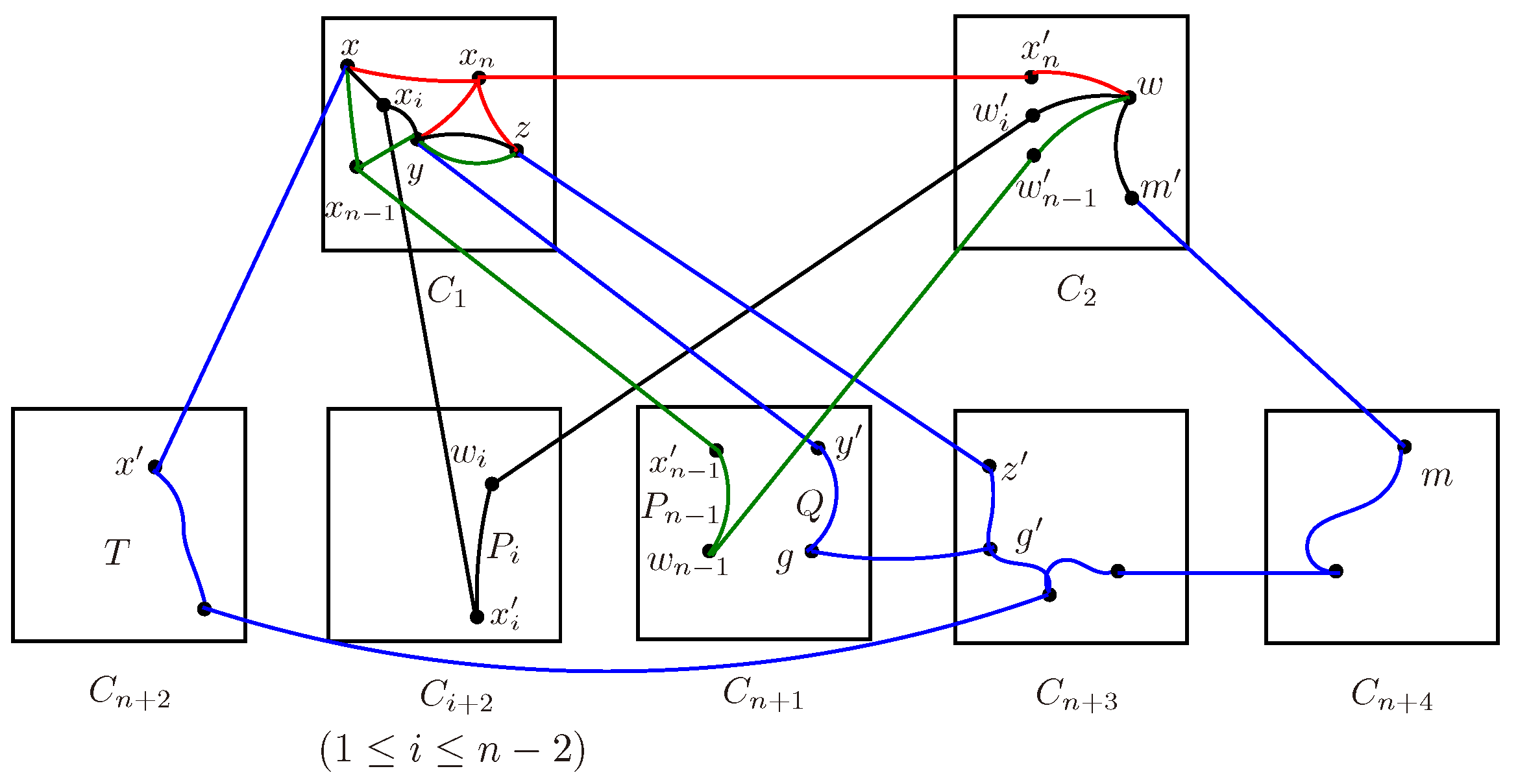
Figure 5.
The explanation about for some of Case .
Case 2.2.2.
or .
w.l.o.g., assume that , by of Lemma 2.2, y must be the neighbor of in . Then The proof is similar to that of Case 1.
Case 3.
None of the vertex in X with their external neighbor belongs to .
By of Lemma 2.1, and may belong to . We consider the following three subcases to obtain the result.
Case 3.1.
.
By of Lemma 2.2, y is adjacent to z in and is adjacent to in . Let for . Since is connected, there is a path joining and in , and subject to for . w.l.o.g., assume that , . By Lemma 2.3, is connected, then there exists a tree T connecting and . Let . By Lemma 3.3, there exist disjoint paths from w to W, and such that is the path joining and w. Let for .
When , for certain . w.l.o.g., suppose that . Let .
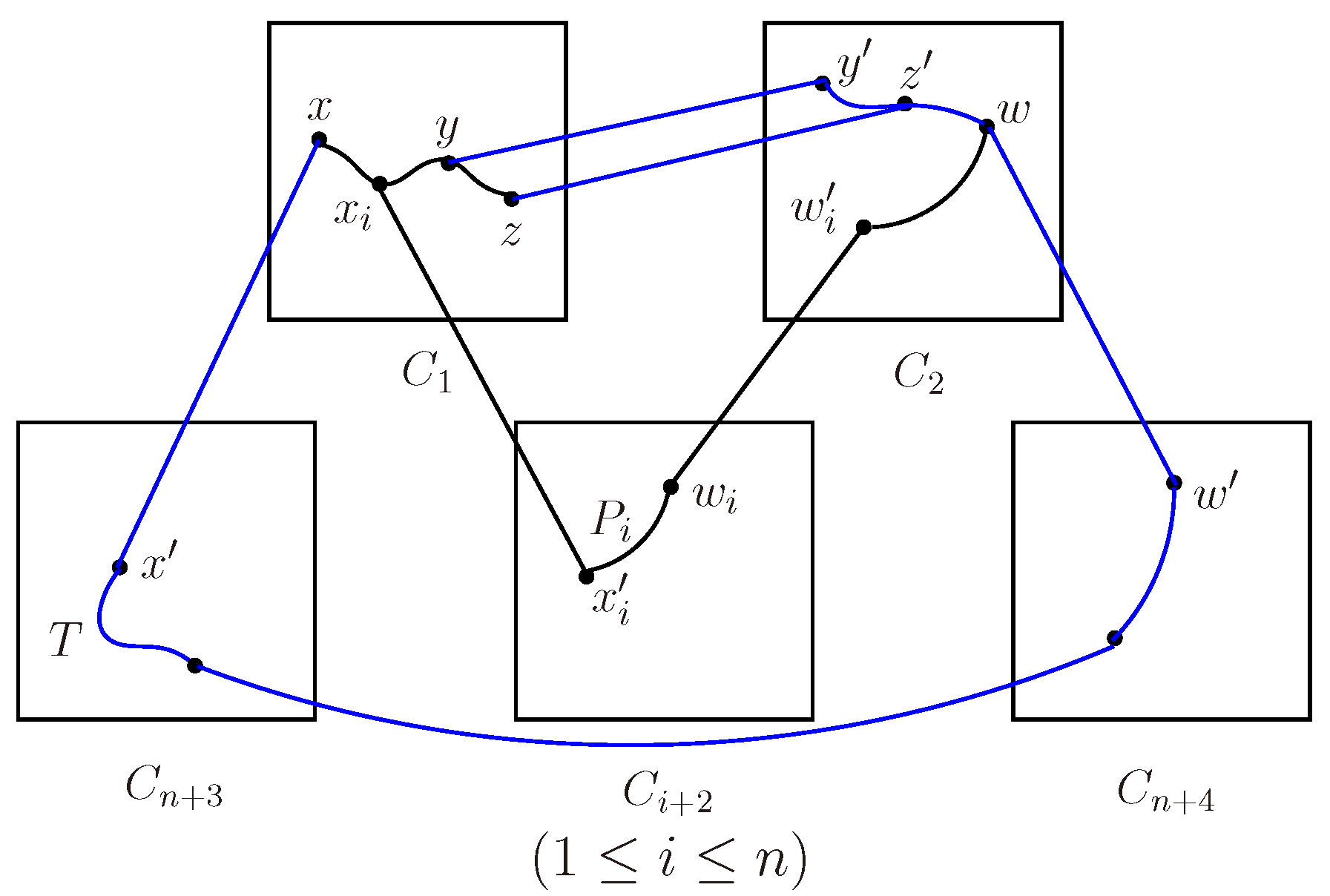
Figure 6.
The explanation about of Case .
When , for . Since is adjacent to , let . Obviously, are disjoint paths. Let .
Case 3.2.
or .
Is clear that, similar to that of Case , we can get internally disjoint S-trees.
Case 3.3.
and .
Note that, or may belongs to the same cluster with for some .
When for . w.l.o.g., assume that and . Similar to that of Case , we get n internally disjoint S-trees. By Lemma 2.3, is connected, then there exists a tree T connecting and m. Let .
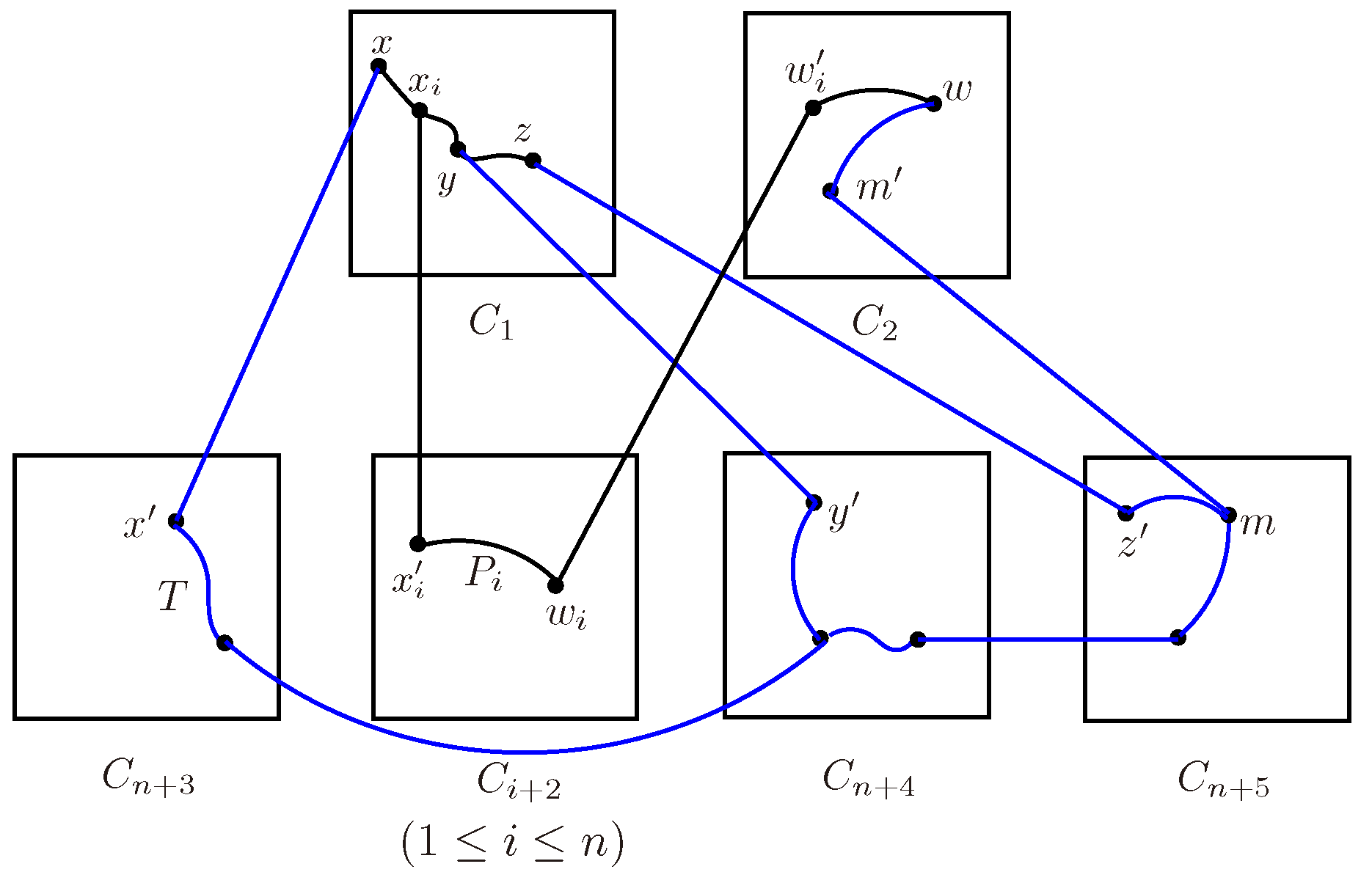
Figure 7.
The explanation of Case .
When or for certain . w.l.o.g., suppose that and . That is, . Let and , . Let , and . By Lemma 3.4, there exist two internally disjoint -paths, saying and R, subject to be the path joining and , subject to R be the path joining and f. Similar to the subcase of for , we get n internally disjoint S-trees. Let and . By Lemma 2.3, is connected, then there exists a tree T connecting and m. Let .□
Lemma 3.6.
Let be the clusters of for and . Let and for different , then there exist internally disjoint S-trees in .
Proof.
w.l.o.g., suppose that , . Let and . By Lemma 2.5, , then there exist internally disjoint paths joining x and y in and internally disjoint paths joining z and w in . Let and for . Let and . Select n vertices from , namely X, subject to the external neighbor of arbitrary vertex in X doesn’t distribute in . As the same way, select n vertices from , namely Z, subject to the external neighbor of arbitrary vertex in Z doesn’t distribute in . By Lemma 2.2, it can be done. w.l.o.g., suppose that and . By of Lemma 2.2, any vertex in with its external neighbor belongs to different clusters. Let vertex subset and vertex subset .
Case 1.
There are two vertices in with the external neighbors distribute in .
By (2) of Lemma 2.2, two vertices . By (1) of Lemma 2.2, any vertex in with its external neighbor belongs to different clusters. To avoid repetition, we just consider the vertices in distribute in distinct clusters, as the discussion of some vertex belongs to the same cluster with is similar. Let and for . By Lemma 2.3, is connected, then there exists a tree connecting and . Let for .
When or distributes in for some . w.l.o.g., assume that . Let .
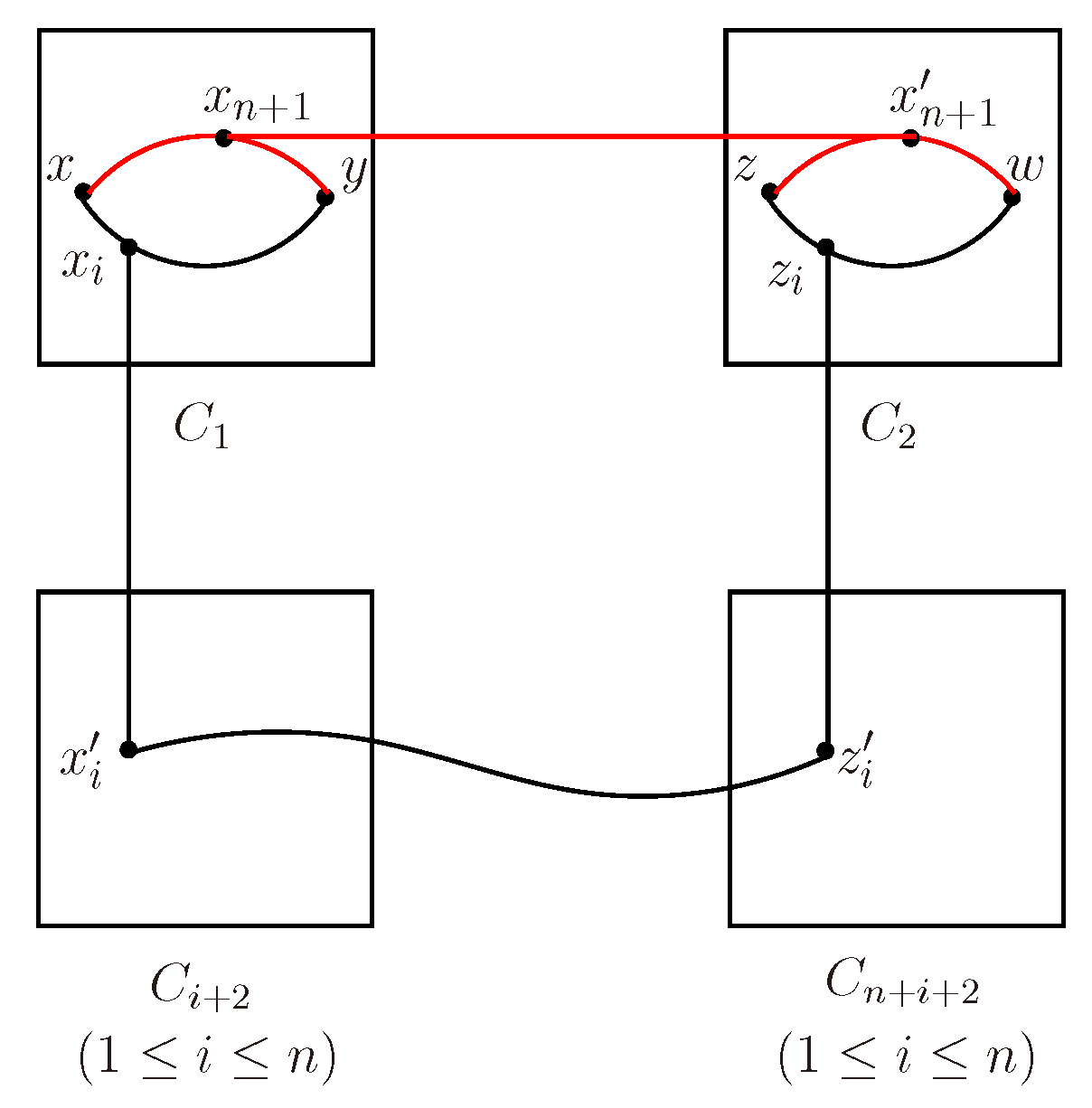
Figure 8.
The explanation about or distributes in of Case 1.
When and don’t belong to for . Since is connected, there is a path R joining and z, that is . w.l.o.g., let . Let .
Case 2.
There is only one vertex in with the external neighbor distributing in .
The proof is similar to that of Case 1.
Case 3.
None of the vertex in with their external neighbor distributes in .
To avoid repetition, we just consider the vertices in distribute in distinct clusters, as the discussion of some vertex belongs to the same cluster with is similar. This can be done for . Let and for . By 2 of Lemma 2.1, is connected to , then there is a tree connecting and . Let for .□
Lemma 3.7.
Let be the clusters of for and . Let , and for different , then there exist internally disjoint S-trees in .
Proof.
w.l.o.g., suppose that , and . Let , and . By Lemma 2.5, , then there are internally disjoint paths joining x and y in . Let for and . Note that, it is possible that . In fact, to avoid repetition, we only consider the case of .
Case 1.
There exist three cross edges between X and .
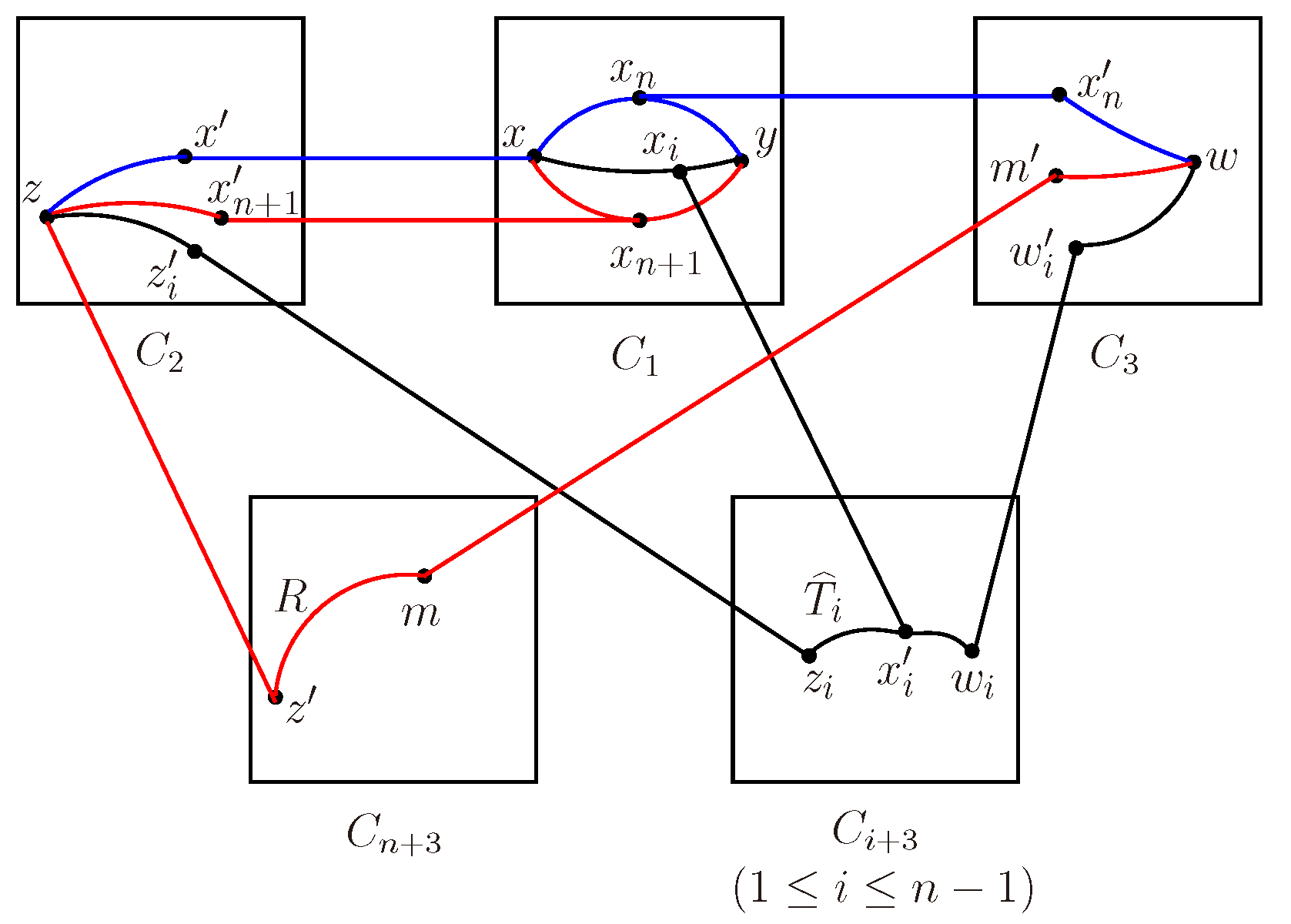
Figure 9.
The explanation of Case 1.
w.l.o.g., assume that there are two cross edges between X and and one cross edge between X and . By Lemma 2.2, suppose that and . Let , where . Since is connected, there is a tree connecting and in and such that , . There are two cross edges between and , then for . w.l.o.g., let . Since is connected, there is a path R joining and m in and such that . Let and . By Lemma 3.3, there exist internally disjoint paths between z and Z, subject to , and for . Similarly, there are internally disjoint paths from w to W, such that , and for . Let for , and .
Case 2.
There exist two cross edges between X and .
Case 2.1.
There are two cross edges between X and .
w.l.o.g., suppose that . Similar to Case 1, we by replacing subset to subset and replacing subset to subset , we get n internally disjoint S-trees. As for the n-th S-tree, we changed into .
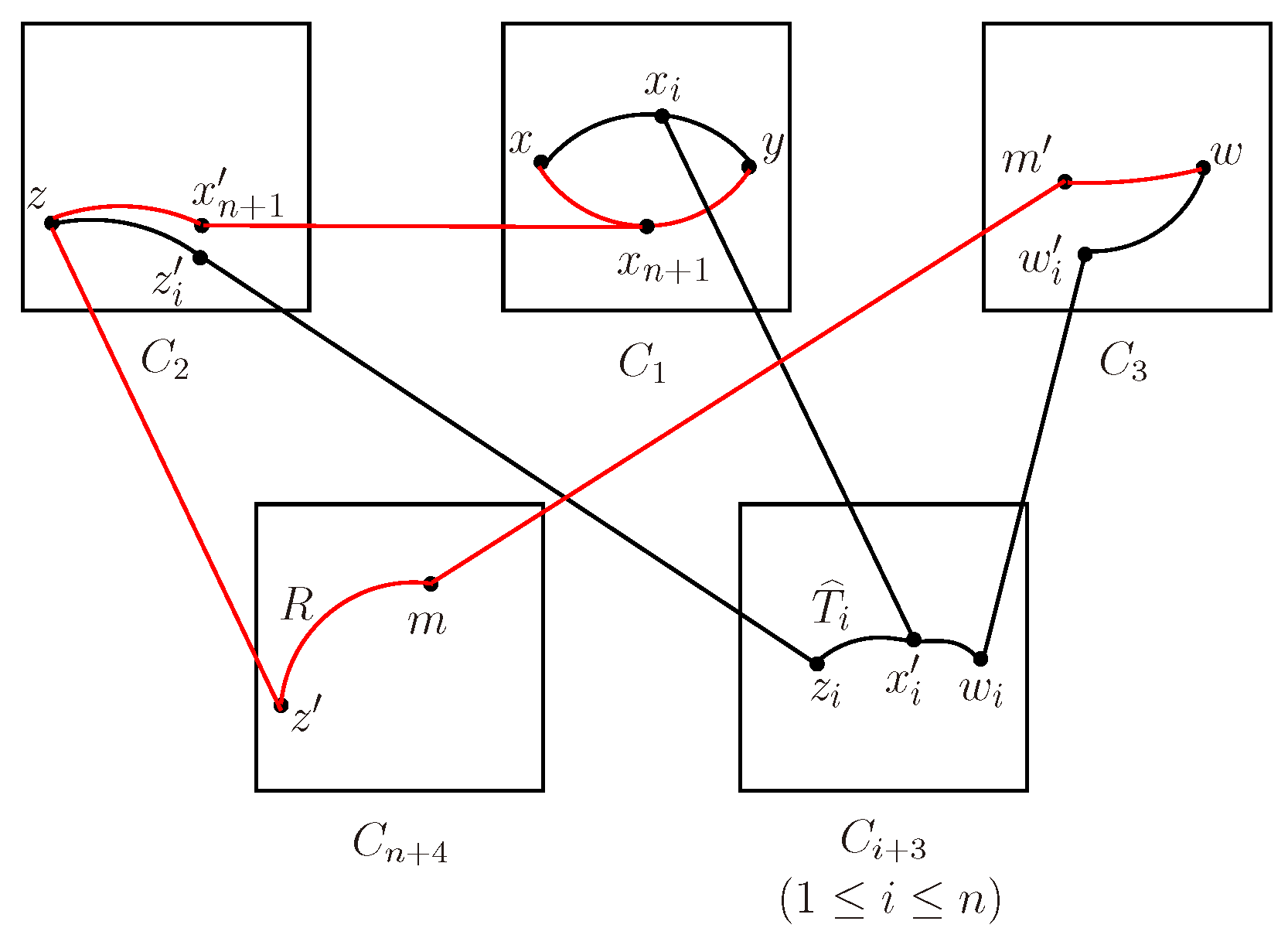
Figure 10.
The explanation of Case .
Case 2.2.
There is one cross edge between X and , the other between X and .
Case 2.2.1.
for certain .
w.l.o.g., assume that , . By Lemma 2.2, the vertices in distribute in different clusters. Let for . Since is connected, there exists a tree connecting and such that , . Let and . By Lemma 3.3, there exist internally disjoint paths from z and Z, internally disjoint paths from w to W and subject to , , , , where . Let , where . Let .
Case 2.2.2.
, for and .
w.l.o.g., suppose that , and , where .
When , by 2 of Lemma 2.1, . w.l.o.g., assume that . As is connected, there is a path Q joining and m, subject to . Let . Note that, it is possible that . To avoid repetition, we just consider the case of , as the discussion of is similar. By of Lemma 2.1, . w.l.o.g., let . As is connected, there is a path R joining and g and subject to . Let . By the Lemma 2.4, . By the Lemma 3.3, there are internally disjoint paths between z and Z and internally disjoint paths between w and W such that , , and , , for . Let , where , and .
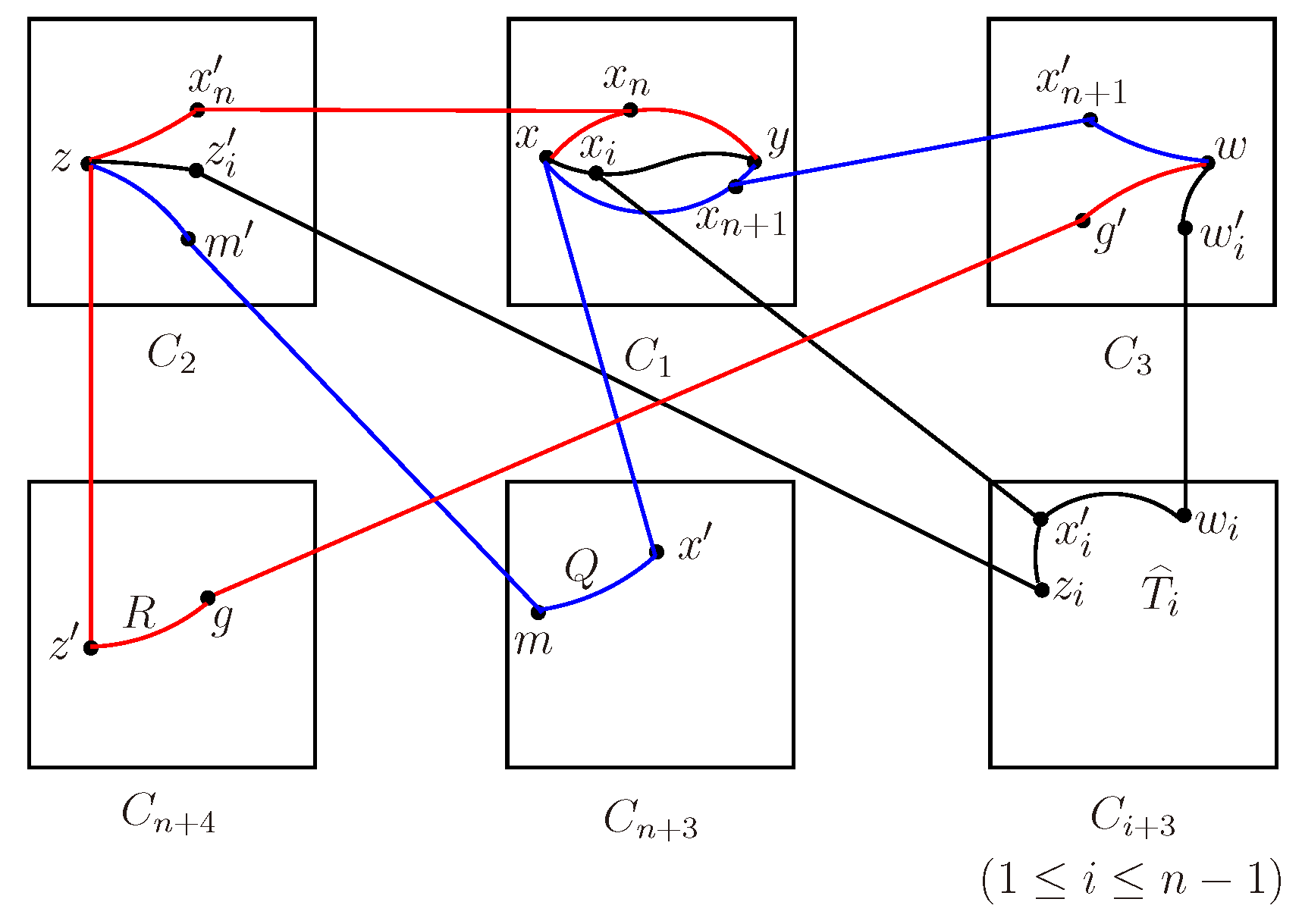
Figure 11.
The explanation of of Case .
When , similar to the situation of , we obtain internally disjoint S-trees.
When , for certain . Similar to the situation of , we obtain internally disjoint S-trees.
When . w.l.o.g., assume that . Since is connected, there is a path M joining and m, subject to . Let and and subject to . By the Lemma 2.4, . By the Lemma 3.3, there are internally disjoint paths between z and Z, internally disjoint paths from w to W such that , , and , , , where . We obtain internally disjoint S-trees, similar to the situation of . Let . For the n-th tree, we consider the following two situations. First, assume that for certain . w.l.o.g., suppose that . Let . Next, suppose that for . As is connected, there is a path Q joining z and . That is, . w.l.o.g., let , that is . Let .
Case 3.
There exist one cross edge between X and .
Suppose that the cross edge is between X and .
Case 3.1.
.
By Lemma 2.2, the vertices in distribute in distinct clusters of . Let , where . Since is connected, there is a tree connecting and subject to , , where . Let subset and subset . By Lemma 2.4, . By Lemma 3.3, there are internally disjoint paths between z and Z, internally disjoint paths between w and W. Let for .
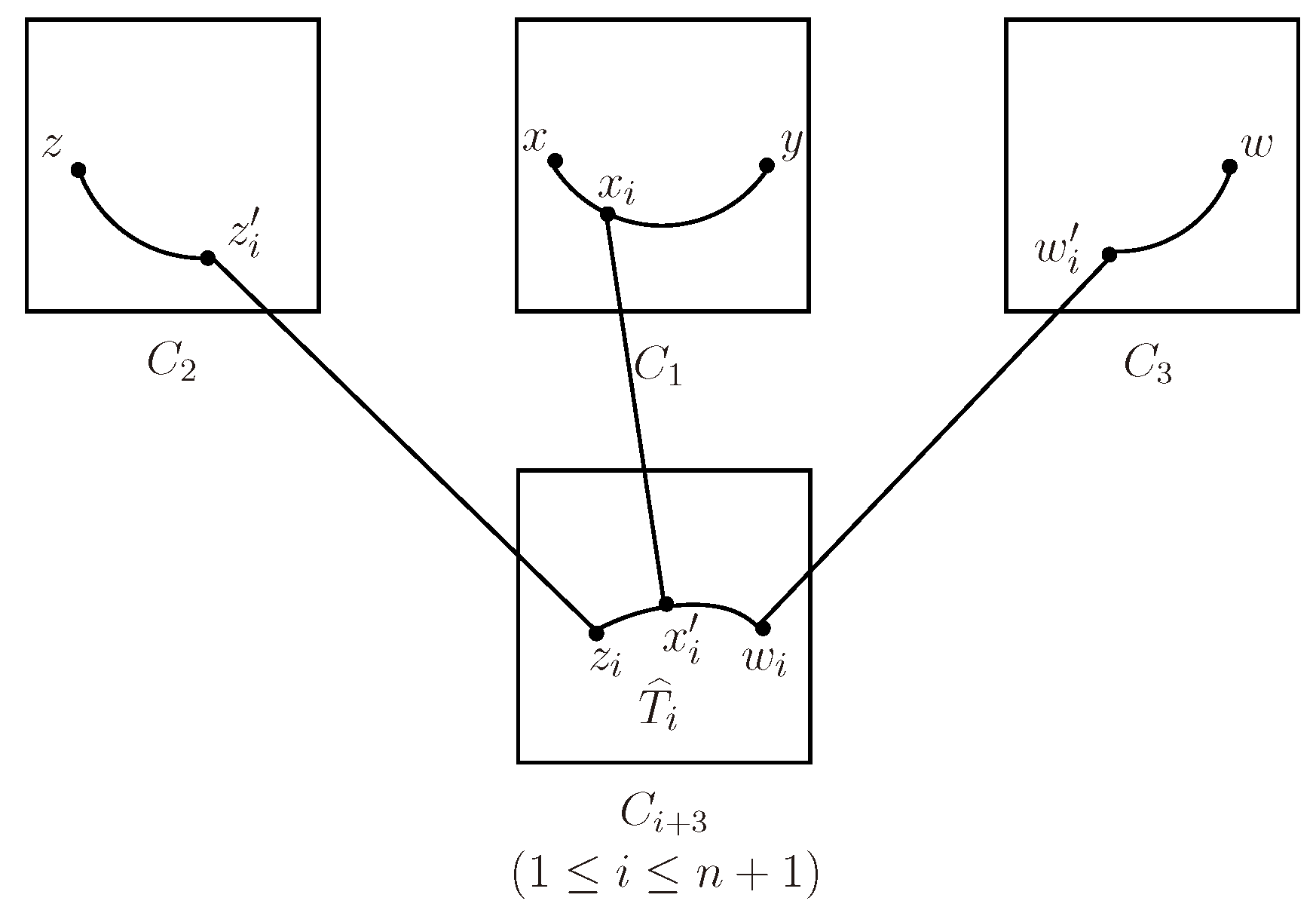
Figure 12.
The explanation of Case .
Case 3.2.
for some .
w.l.o.g., suppose that and for .
When . By Lemma 2.2, the vertices in distribute in different clusters of . Let for . Since is connected, then there is a tree connecting and subject to , , where . Let , and subject to . By Lemma 2.4, . By Lemma 3.3, there are internally disjoint paths between z and Z subject to , , internally disjoint paths from w to W subject to , for . Since is connected, then there exist a path R joining and . Let , where . Let .
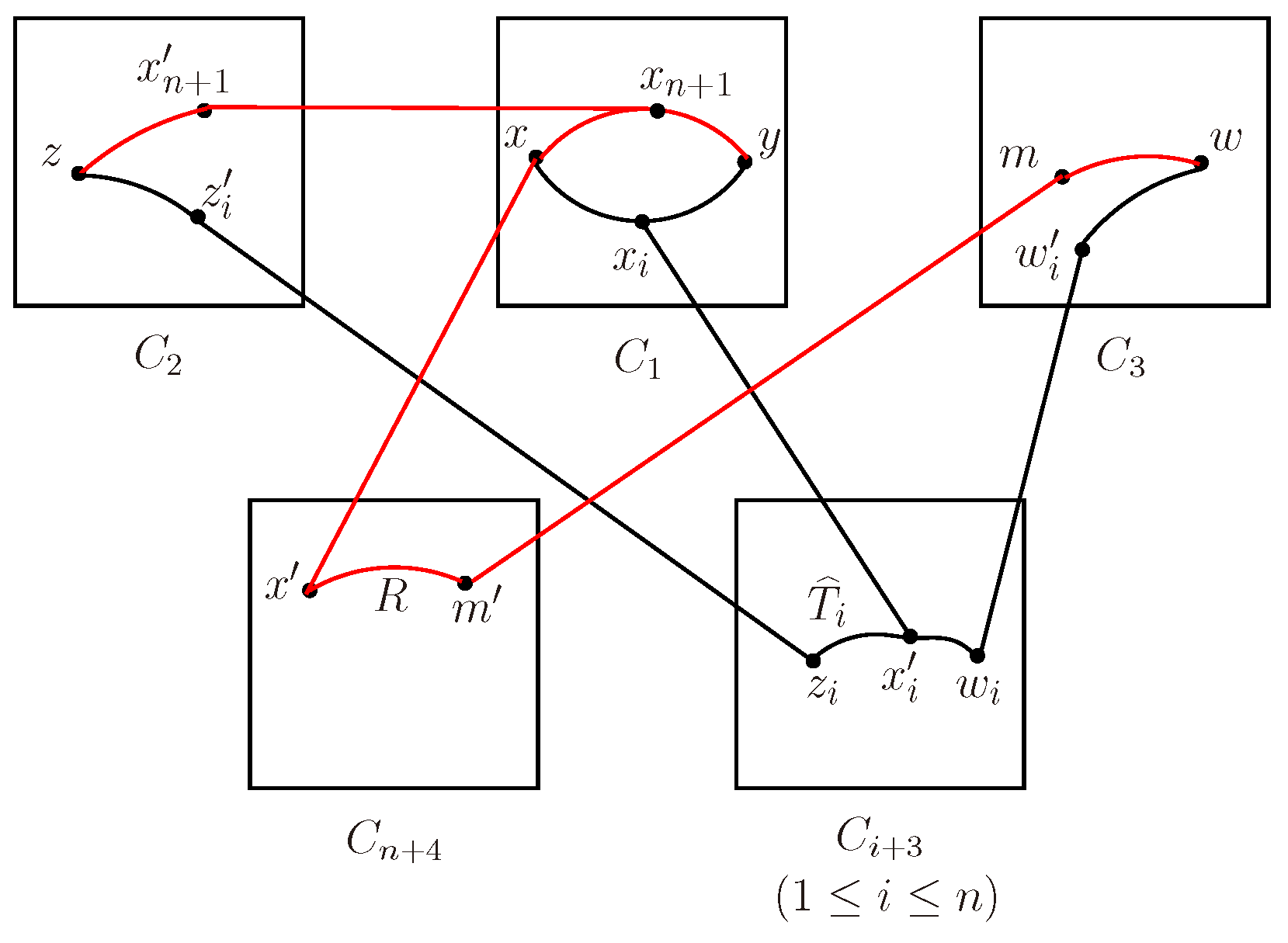
Figure 13.
The explanation of of Case .
When , by Lemma 2.2, or , similar to the case of , we get internally disjoint S-trees.
Case 4.
There is no cross edge between X and .
Similar to that of Case , we get internally disjoint S-trees.□
Lemma 3.8.
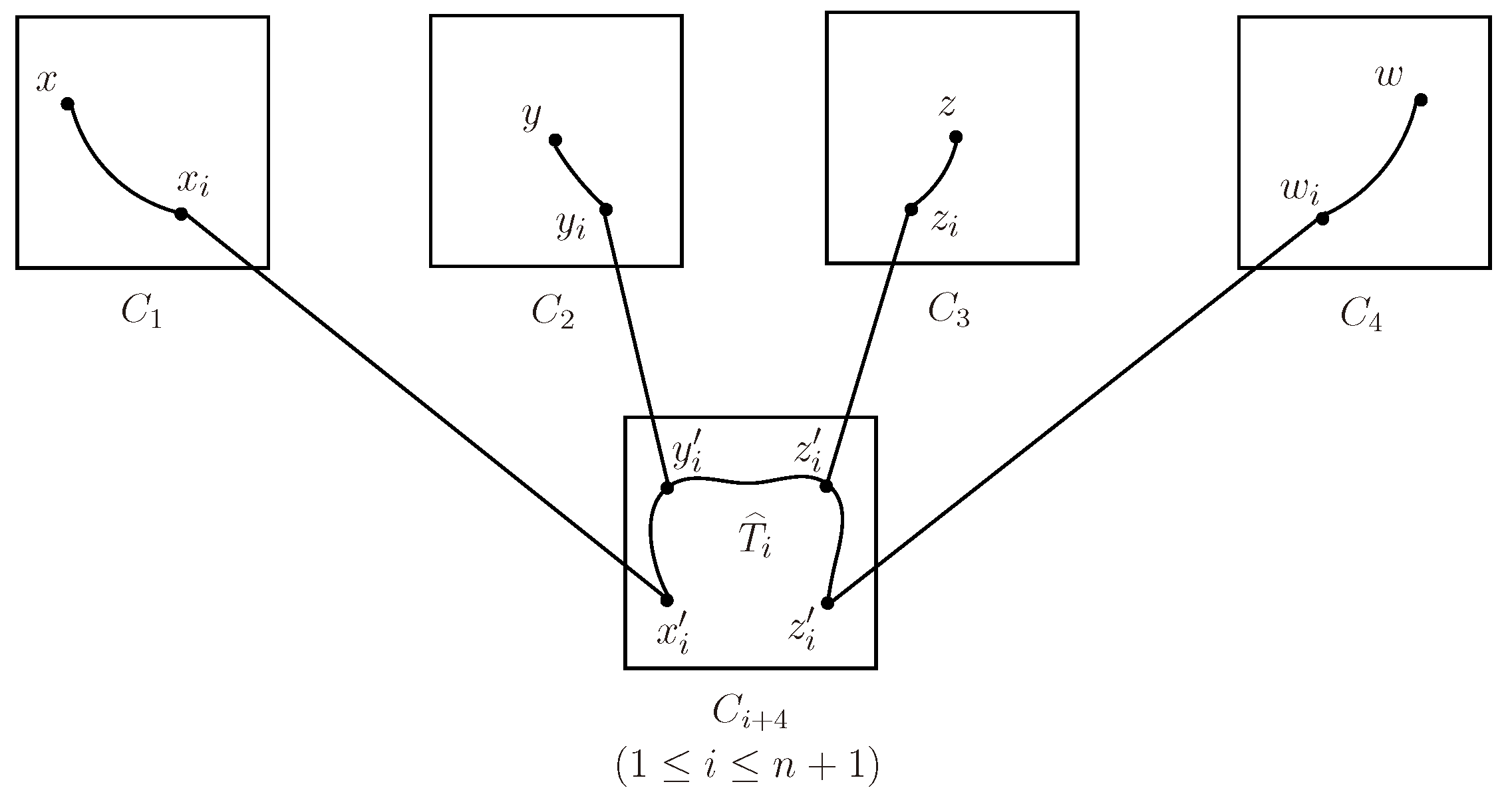
Proof.
w.l.o.g., suppose that , , and . Let , , and . Let , , , . By Lemma 2.5, , then there are internally disjoint paths from x and X in , internally disjoint paths from y and Y in , internally disjoint paths from z and Z in , internally disjoint paths from z and Z in , such that , , , and such that for . Since is connected, there exists a tree connecting in for . Let for .□
Theorem 3.3.
, for .
Proof.
By Lemma 2.5, . By Lemma 3.1, . By Lemma 3.5, Lemma 3.6, Lemma 3.7, Lemma 3.8, we obtain that . Thus, the result holds.□
4. Concluding remarks
The hierarchical folded hypercube is a more popular topology for designing the internetworks due to its regularity, symmetry and many other unique properties. As one of the important variants of the hypercube, hierarchical folded hypercube has received more attention and many research results on hierarchical folded hypercube have emerged. We mainly study the 4-set tree connectivity of hierarchical folded hypercube and obtain that for . Currently, there are few results about k-set tree connectivity of networks when and most of the results are about . Our future work would like to consider the k-set tree connectivity of some network for and it will be a great challenge.
Funding
Supported by Qinghai University Science Foundation of China (No. 2023-QGY-6), the National Science Foundation of China (Nos. 12261074, 12201335 and 11661068)
References
- Bondy, J.A.; Murty, U.S.R. Graph Theory; Springer: New York, 2008. [Google Scholar]
- Whitney, H. Congruent graphs and connectivity of graphs. J. Amer Math Soc. 1932, 54, 150–168. [Google Scholar] [CrossRef]
- Chartrand, G.; Kappor, S.; Lesniak, L. Generalized connectivity in graphs. Bombay Math 1984, 2, 1–6. [Google Scholar]
- Li, H.; Li, X.; Mao, Y.; Sun, Y. Note on the generalized connectivity. Ars Combin 2014, 114, 193–202. [Google Scholar]
- Li, S.; Li, X.; Zhou, W. Sharp bounds for the generalized connectivity. Discrete Math 2010, 310, 2147–2163. [Google Scholar] [CrossRef]
- Li, H.; Wu, B.; Meng, J.; Mao, Y. Steiner tree packing number and tree connectivity. Discrete Math 2018, 341, 1945–1951. [Google Scholar] [CrossRef]
- Chartrand, G.; Okamoto, F.; Zhang, P. Rainbow trees in graphs and generalized connectivity. Networks 2010, 55, 360–367. [Google Scholar] [CrossRef]
- Li, H.; Li, X.; Sun, Y. The generalized 3-connectivity of Cartesian product graphs. Discrete Math Theor Comput Sci 2012, 14, 43–54. [Google Scholar] [CrossRef]
- Li, H.; Ma, Y.; Yang, W.; Wang, Y. The generalized 3-connectivity of graph products. Appl Math Comput 2017, 295, 77–83. [Google Scholar] [CrossRef]
- Li, S.; Li, W.; Li, X. The generalized connectivity of complete bipartite graphs. Ars Combin 2012, 104, 65–79. [Google Scholar] [CrossRef]
- Zhao, S.; Hao, R. The generalized connectivity of alternating group graphs and (n,k)-star graphs. Discrete Appl Math 2018, 251, 310–321. [Google Scholar] [CrossRef]
- Lin, S.; Zhang, Q. The generalized 4-connectivity of hypercubes. Discret Appl Math 2017, 220, 60–67. [Google Scholar] [CrossRef]
- Zhao, S.; Hao, R. The generalized 4-connectivity of exchanged hypercubes. Appl Math Comput 2019, 347, 342–353. [Google Scholar] [CrossRef]
- Zhao, S.; Hao, R.; Cheng, E. Two kinds of generalized connectivity of dual cubes. Discret Appl Math 2019, 257, 306–316. [Google Scholar] [CrossRef]
- Zhao, S.; Hao, R.; Wu, J. The generalized 4-connectivity of hierarchical cubic networks. Discret Appl Math 2021, 289, 194–206. [Google Scholar] [CrossRef]
- Li, X.; Mao, Y. Generalized Connectivity of Graphs; Springer Cham Publishing, 2016. [Google Scholar]
- Sun, Y.; Li, X. On the difference of two generalized connectivities of a graph. J Combin Optim 2017, 33, 283–291. [Google Scholar] [CrossRef]
- Sun, Y.; Li, F.; Jin, Z. On two generalized connectivities of graphs. Disc Math Theo 2018, 38, 245–261. [Google Scholar]
- Li, X.; Mao, Y. A survey on the generalized connectivity of graphs. Comput Sci 2012. [CrossRef]
- EL-Amawy, A.; Latifi, S. Properties and performance of folded hypercubes. IEEE Trans. Parallel Distrib. Syst. 1991, 2, 31–42. [Google Scholar] [CrossRef]
- Sun, X.; Dong, Q.; Zhou, S.; et al. Fault tolerance analysis of hierarchical folded cube. Theor Comput Sci 2019, 790, 117–130. [Google Scholar] [CrossRef]
- Li, S.; Tu, J.; Yu, C. The generalized 3-connectivity of star graphs and bubble-sort graphs. Appl Math Comput 2016, 274, 41–46. [Google Scholar] [CrossRef]
- Li, C.; Lin, S.; Li, S. The 4-set tree connectivity of (n,k)-star networks. Theor Comput Sci 2020, 844, 81–86. [Google Scholar] [CrossRef]
- Wang, J.; Zou, J.; Zhang, S. The generalized 4-connectivity of hierarchical star networks. Open Math 2022, 20, 1261–1275. [Google Scholar] [CrossRef]
- Wang, J.; Zhang, S.; Ge, H. The generalized 3-connectivity of folded hypercubes. Journal of Shandong Univerdity 2022, 27, 42–49. [Google Scholar] [CrossRef]
- Li, H.; Cheng, D. The generalized 4-connectivty of folded hypercube. International Journal of Computer Mathematics: Computer Systems Theory 2022, 7, 235–245. [Google Scholar] [CrossRef]
Disclaimer/Publisher’s Note: The statements, opinions and data contained in all publications are solely those of the individual author(s) and contributor(s) and not of MDPI and/or the editor(s). MDPI and/or the editor(s) disclaim responsibility for any injury to people or property resulting from any ideas, methods, instructions or products referred to in the content. |
© 2023 by the authors. Licensee MDPI, Basel, Switzerland. This article is an open access article distributed under the terms and conditions of the Creative Commons Attribution (CC BY) license (http://creativecommons.org/licenses/by/4.0/).
Copyright: This open access article is published under a Creative Commons CC BY 4.0 license, which permit the free download, distribution, and reuse, provided that the author and preprint are cited in any reuse.


