

Submitted:
19 October 2023
Posted:
20 October 2023
You are already at the latest version
Abstract
This study investigates the impact of financial integration on international dynamics from the perspective of volatility shocks. To achieve this, I employ an IRBC model with time-varying volatilities, recursive preferences, and a global bank. The model demonstrates that volatility shocks trigger precautionary saving incentives, but the specific effects vary based on the type of shock. In the presence of productivity volatilities, countries with a higher level of financial integration exhibit greater divergence in their business cycles, while financial integration tends to result in more synchronized business cycles in the face of financial volatilities. Disregarding volatility shocks would underestimate the impact of financial integration on the comovement of business cycles across countries. Furthermore, welfare analysis also indicates that financial markets play a crucial role in enhancing social welfare, regardless of the type of volatility.
Keywords:
Financial Integration
; Volatility Shocks
; Business Cycle Comovement
1. Introduction
In the face of the worldwide spread of the coronavirus and the economic turmoil triggered by the global financial crisis, increased cross-border risk contagion has raised significant concerns regarding the macroeconomic effects of time-varying volatility shocks. Volatility shocks have the potential to spread across borders, impacting other countries through diverse channels, including global value chains, cross-border capital flows, and population movements [1,2,3,4,5,6]. This results in interconnected shifts in business cycles among nations. Mounting evidence suggests that financial integration plays a crucial role as a channel for transmitting international business cycles [7,8,9,10,11,12,13,14,15,16,17,18]. Although most of the studies focus on the level of shocks (e.g., productivity and financial shocks), little attention has been paid to the volatility of shocks. I argue that neglecting volatility shocks would underestimate the impact of financial integration on the comovement of business cycles across countries. Furthermore, a failure to address volatility shocks would reduce the precision of welfare analysis when evaluating financial integration.
In this paper, I study how financial integration affects the comovement of business cycles in the presence of volatility shocks. To conduct my analysis, I construct an international real business cycle (IRBC) model with a global bank, incorporating time-varying volatilities and recursive preferences. Drawing inspiration from Fernández-Villaverde and Rubio-Ramírez [19] and Fernández-Villaverde et al. [1], I introduce the volatility of risky asset returns into the model to depict financial volatilities. Consequently, I can investigate the cross-country transmission of economic cycles under both productivity and financial market volatility shocks. My findings highlight the significance of precautionary saving motives as a crucial mechanism in the cross-country transmission of uncertainty shocks. The impact of financial integration on business cycle synchronization crucially depends on the type of shock. In the presence of productivity volatility shocks, financial integration weakens the synchronization of economic cycles, whereas in the presence of financial volatility shocks, financial integration enhances the cross-country transmission of economic cycles. Moreover, in response to the ongoing debate about the pros and cons of financial integration, I conduct a welfare analysis. The quantitative results show that financial integration yields social welfare, regardless of the type of volatility shock.
The contagion mechanisms of the two kinds of volatility shocks work as follows: The first scenario characterizes how financial integration affects international dynamics in the presence of a productivity volatility shock. As the risk of domestic productivity fluctuations increases, precautionary savings by domestic residents increase, reducing bank deposit rates and, correspondingly, corporate lending rates. The decrease in lending rates is transmitted abroad through the interest rate channel, which enables firms in the foreign financially integrated sector to hire more labor at a lower cost and expand production. This, in turn, squeezes out loans from the domestic financially integrated sector. Thus, productivity volatility shocks lead to an unequal distribution of international bank loans between firms in the two countries, causing a reverse movement in firm investment and output. Consequently, when a productivity volatility shock occurs, countries with higher levels of financial integration demonstrate greater inequality in loan distribution, leading to more divergent business cycles. In contrast to productivity volatility shocks, financial volatility shocks impact sectors that hold risky assets in banks, especially for financially integrated sectors where both countries are equally exposed to volatility in international financial markets. Therefore, the larger the relative size of the financially integrated sector (i.e., the higher the degree of financial integration), the more synchronized the comovements in the business cycles of the two countries will be.
The existing theoretical literature has not yet conducted a detailed examination of the impact of financial integration on business cycle synchronization under uncertainty shocks. They overwhelmingly focus on the level of exogenous shocks (i.e., magnitude, persistence, or correlation), rather than second-order moments such as volatility. In studies that examine this issue from the perspective of uncertainty shocks, the majority of studies primarily concentrate on the volatility of productivity shocks [3,4,5,20,21,22]. Some other studies explore volatilities stemming from government spending shocks, consumption preference shocks, labor supply shocks, and monetary policy shocks [23,24]. Few studies focus on the uncertainty of financial shocks. However, note that, in reality, there is an external financing premium between loan rates and risk-free interest rates. Moreover, an increase in the volatility of interest rates in the financial market results in increased corporate financing risk, reflecting an elevated level of financial risk [1,19]. There is a scarcity of theoretical articles specifically addressing the volatility associated with financial shocks. In contrast, empirical studies focusing on this issue are abundant [25,26,27,28,29,30]. These studies analyze the volatility of financial shocks by examining stock market returns or the VIX index. They emphasize the crucial role of credit markets in the propagation of uncertainty shocks and highlight the significance of the level of financial development. The findings suggest that compared to developed economies, emerging economies with relatively lower levels of financial development and less robust capital markets typically experience stronger negative impacts from uncertainty shocks. This is primarily due to their limitations in mitigating risks through international financial markets.
The studies most relevant to this paper are Colacito et al. [5], Silva-Yanez [22], and Gete and Melkadze [31]. Gete and Melkadze [31] find that recursive preferences significantly improve the explanatory power of the theoretical model for the pass-through of output volatility and risk sharing across countries. Silva-Yanez [22] investigates the effects of uncertainty shocks on foreign asset accumulation, risk sharing, and social welfare in emerging economies. The model shows that the presence of volatility shocks strengthens the precautionary saving motive and encourages a more significant accumulation of foreign assets in the small open economy. With increased financial integration, representative households can diversify income risk, thereby weakening the incentive for precautionary saving and reducing the willingness to accumulate foreign assets. However, Silva (2020) only examines TFP volatility shocks and overlooks the key role of financial volatilities. Gete and Melkadze [31] document the cross-country patterns of uncertainty and credit variables with an international focus. By simultaneously examining the effects of uncertainty shocks on key economic variables, such as the current account, investment, output, and credit flows, he argues that the traditional IRBC model can explain the impact of uncertainty shocks on current account surplus, but it fails to account for credit contraction and increased risk premiums. To address this issue, Gete and Melkadze [31] extends a two-country incomplete markets IRBC model by incorporating a credit supply channel that considers default and lenders’ exposure to aggregate risk. According to Gete and Melkadze [31], uncertainty shocks increase the household sector’s incentive for precautionary saving, leading to a higher current account surplus. However, these shocks also increase firms’ default risk, which tightens bank credit and raises lending rates. Consequently, firms face difficulties in corporate financing, resulting in a simultaneous decline in their investment activities. Gete and Melkadze [31] compares volatility shocks to the international rate and TFP in a small open economy model and suggests that these two types of shocks are observationally equivalent. In contrast to his research, I investigate a two-country model and discover that financial integration entails distinct transmission channels for the cross-country transmission of TFP volatility shocks and financial volatility shocks.
This paper is also related to the literature on the ongoing debate about the benefits of financial integration. The scholarly perception of the relationship between financial integration and social welfare has gradually evolved over time. Early studies expressed a positive outlook on financial globalization, emphasizing its potential to enhance consumption smoothing [32,33,34,35,36,37,38,39]. These studies highlighted the crucial role of capital markets in facilitating risk sharing. International credit markets provided increased liquidity. Additionally, cross-border asset holdings and diversified portfolios effectively diversified country-specific and nonsystematic risks. Consequently, financial integration was believed to effectively mitigate country-specific risk shocks, thereby promoting overall social welfare. In other studies, however, scholars have found that the impact of financial liberalization on international risk sharing is not significant [40], especially for developing countries with low levels of financial integration [41,42,43,44,45,46,47]. Bai and Zhang [40] argue that in the presence of financial frictions and the risk of sovereign debt default, the removal of capital controls and deregulation of financial markets cannot deliver significant improvement in international risk sharing. Kim et al. [41] discover that the degree of risk sharing among East Asian countries is significantly lower than in developed economies, with nearly 80% of shocks not being effectively shared. Capital markets play an insignificant role, while credit markets are effective but limited. Their research also explores the impact of regional and global risk sharing, leading to the conclusion that East Asian countries exhibit considerably less financial market integration than European financial markets. As a result, consumer risk sharing is more likely to be achieved through global financial markets. Other similar studies, such as Calvi et al. [45], Yu et al. [46] and Park and Lee [47], mostly support the notion that the financial integration process in East Asian countries is relatively sluggish and lags behind the integration process in the real economy.
With the outbreak of the global financial crisis, many scholars began to reflect on the disadvantages of financial integration. The costs of financial integration can be summarized as follows: First, capital flows have aggregation effects and procyclicality. Historical experience shows that cross-border capital inflows are concentrated in only a few middle-income countries in Latin America and Asia, and small countries with low levels of economic development still face financing difficulties even if they open their capital accounts [48,49,50]. Furthermore, capital flows are strongly procyclical. The influx of capital during economic booms causes capital overheating; the withdrawal of capital during economic downturns not only exacerbates the risk of runs [51] but also causes liquidity crises for those firms that are overly dependent on capital. Second, capital mismatch can bring distortion. Overheated capital will lead to stock and housing bubbles, which will crowd out investment in the real economy and lead to numerous high-leverage and rent-seeking behaviors, hampering long-term economic growth [52]. Moreover, financial integration serves as a significant channel that triggers economic volatility, as highlighted by Stiglitz [53], Agénor [52], Pancaro [54], and Cavoli et al. [55]. Pancaro [54] argues that rather than aiding in smoothing consumption, capital liberalization has actually led to a rise in consumption volatility in emerging economies. This is particularly problematic for low-income countries, as excessive credit expansion can escalate credit risk and amplify output volatility.
This paper contributes to the growing literature on the study of financial integration in international dynamics. In comparison to other theoretical works, this paper possesses two advantages. On the one hand, by examining the issue through the lens of volatility shocks, the paper provides valuable insights. I investigate both productivity and financial market volatility shocks, uncovering distinct transmission mechanisms that differ from the findings of Gete and Melkadze [31]. I argue that disregarding volatility shocks would underestimate the impact of financial integration on the comovement of business cycles and result in less accurate alignment of business cycle statistics with real data. On the other hand, the quantitative findings also contribute to the discussion on the benefits of financial integration. I find that financial integration plays a critical role in effectively mitigating the adverse impact of volatility shocks on social welfare. This is primarily because financial integration enables individuals and firms to save and borrow from international financial markets. As a result, precautionary saving motives are reduced, and consumption fluctuations caused by volatility shocks are dampened, leading to an enhancement in social welfare.
The paper is organized as follows: Section 2 lays out the theoretical model. Section 3 analyzes the quantitative results and compares the transmission mechanism under a TFP volatility shock and a financial volatility shock. Section 4 performs a sensitivity analysis. Finally, Section 5 concludes the paper.
2. Model
I construct a two-country, two-sector dynamic stochastic general equilibrium model with time-varying volatilities in an open economy. Each sector comprises households, firms, and commercial banks. Sector I is a financially closed sector, where commercial banks can only engage in borrowing and lending activities among firms and households within the same sector. On the other hand, sector II is a financially integrated sector, where financial transactions occur through global banks. The size of sector I is denoted as (), while sector II is represented by n. The exogenous parameter n reflects the degree of financial integration, with higher values indicating greater integration. The two countries in the model are perfectly symmetric, and their economic behaviors mirror each other. I provide a detailed description of the model setup, taking the home country as an illustrative example, and variables related to foreign counterparts are denoted with an asterisk.
2.1. Households
I introduce the Epstein-Zin recursive utility function, which offers a more accurate representation of the characteristics observed in the real economy. In contrast to the CRRA utility function, the Epstein-Zin recursive utility function enables the separation of the coefficient of relative risk aversion (RRA) and the intertemporal elasticity of substitution (IES) in the preference structure, that is, these two parameters are no longer inversely related. Recursive utility allows consumers to exhibit different attitudes toward current and intertemporal consumption risks, providing a more flexible characterization of consumers’ subjective attributes. Assuming homogeneity among households and a continuous distribution in the interval [0, 1], the objective of representative household is to maximize the expected lifetime utility function, which is expressed as follows:
where , , is the intertemporal discount factor, is the inverse of the labor supply elasticity, is the labor level adjustment parameter, is the risk aversion coefficient of households, represents the IES, and the recursive utility function simplifies to the CRRA utility function when .
The household’s budget constraint is given by
where represents household consumption in sector i in period t, is labor input, is household savings in commercial banks from period to t, is the deposit rate, is the unit labor wage, and is the corporate dividend. The household maximizes the lifetime utility equation (2) under the budget constraint equation (1) to obtain the corresponding first-order conditions:
Since sector II is fully financially integrated, households in both countries can allocate their savings to international commercial banks. Therefore, for sector II, the interest rates on savings in the home and foreign household sectors are equal, i.e., .
2.2. Firms
The representative firm is risk neutral, continuously distributed in the interval [0,1], and invests labor and capital in production activities in each period with a production function in Cobb-Douglas form:
Here, and represent capital inputs and labor inputs, respectively, and the coefficient denotes the share of capital in output. Assume that productivity follows a time-varying AR(1) process, and I introduce and to capture the volatility of productivity, which also follow an AR(1) process. Furthermore, and represent the productivity volatility shocks from the two countries, respectively, and they are assumed to follow an i.i.d. distribution. Finally, and represent the correlation coefficient matrix.
The manufacturer needs to borrow working capital from the bank to pay a portion of the workers’ wages prior to receiving sales revenue [56,57]. The firm’s optimization problem involves choosing various types of factor inputs and making investment decision to maximize its expected profits, taking into account investment adjustment costs:
where is the stochastic discount factor, given by . represents the net profit of the firm after subtracting all operating expenses, including workers’ wages, firm investments, and interest on borrowed working capital. The profit of the representative firm can be expressed as:
Here, the product price is normalized to 1, represents the firm’s investment, denotes the proportion of total wages that the firm needs to borrow as working capital, and denotes the interest rate on the firm’s financing loan. Similarly, in the case of sector II, where both domestic and foreign producers can borrow from global banks and achieve full financial integration, the borrowing interest rate faced by domestic and foreign manufacturers will be exactly the same. That is, .
The dynamic capital accumulation equation is given by:
where is the capital depreciation rate and is the investment adjustment cost function and satisfies , , and [8,58]. The settings of and make the steady state in the presence of investment adjustment costs consistent with the steady state in the absence of adjustment costs, satisfying and . Here, is the capital depreciation rate, and is the investment adjustment cost function, which satisfies , , and [8,58]. The values of and are chosen such that the steady state with investment adjustment costs aligns with the steady state without adjustment costs, satisfying and .
The first-order condition obtained by solving the above optimal solution satisfies:
2.3. Commercial Banks
Commercial banks serve as a crucial intermediary between households and firms, performing the basic function of credit intermediation. Household savings in the non-financially integrated sectors in both countries are and , while the financially integrated sectors can save in international banks, and total household savings in sector two in both countries are . There are two main uses of savings deposits in commercial banks; one is to provide risk-free corporate loans that are used as working capital for manufacturers, and the other is used to invest in risky assets. and denote the return on risky assets in each country, and the mean asset return is the same in both countries in equilibrium. Assume that the expected return on risky assets is high enough that each commercial bank invests the maximum share allowed by its bank regulation. is used to denote this share and satisfies . In sector I, commercial banks’ lending and investment activities are limited to that sector in that country, while in sector II, international banks can lend to manufacturers in both countries and allocate diversified international investments. Finally, referring to the model setting of Kalemli-Ozcan et al. [14], commercial banks need to incur certain operating costs to organize and manage various business activities. Under the assumption of competitive banks, the profit of commercial banks is zero in equilibrium:
Assuming that the returns on risky assets in both countries follow a bivariate AR(1) process, this paper incorporates the depiction of financial shock volatility into the model based on the approach proposed by Fernández-Villaverde and Rubio-Ramírez [19] and Fernández-Villaverde et al. [1].
where represents the average return on risky assets, and denote the exogenous financial shocks in both countries, and represents the fluctuations in the return on risky assets following an AR(1) process. The variables and represent the financial market volatility shocks in the two countries. All the variables, , , , and , are assumed to follow i.i.d distributions. The correlation coefficient matrices and are of size .
2.4. Equilibrium
The equilibrium state of the entire economic system is defined as follows: given exogenous shocks and initial conditions, the price series , and the allocation sequence are determined in a way that satisfies the following conditions. The household sector maximizes expected lifetime utility, the producer maximizes expected profit, the budget constraint of each economic agent is satisfied, competitive commercial bank profits are zero, and each market clears.
The labor market clearing conditions are:
The total profits of firms are distributed among households in proportion to their individual dividends. In other words, the profit distribution is cleared according to the following mechanism:
The capital market is cleared under the condition that the working capital of each sector is equal to the loans provided in that sector. Specifically, in sector I, the bank loans are limited to advances for workers’ wages in each country’s sector I firms. In sector II, the working capital corresponds to the total global bank loans provided to sector II in both countries. This ensures that the capital market is in equilibrium and all capital requirements are met.
2.5. Calibration and Solution Method
I choose the parameter values based on relevant studies by Kollmann [4] and Colacito et al. [5], and set the risk aversion coefficient of consumers, denoted as , to 10, and the IES, denoted as , to 1.5. The parameters of the level shocks refer to the method of Kalemli-Ozcan et al. [14]. To ensure comparability, I use to match the quarterly GDP growth rate in the US of 1.32% in two cases. is calibrated to for productivity shock only and when both productivity and financial shocks hit.
Regarding the parameters related to volatility shocks, the productivity volatility shock parameters are taken from Mumtaz and Theodoridis [24]. The autocorrelation coefficient of productivity volatility, denoted , is set to 0.99, and the variance of productivity volatility, denoted , is calibrated to 0.065. The correlation of productivity volatility between the two countries is assumed to be 0, implying that productivity shocks are uncorrelated across countries [3,24,59]. For the parameters related to financial volatility shocks, references are made to Mencia and Sentana [60] and Skintzi and Refenes [61]. The autocorrelation coefficient of financial volatility, denoted , is set to 0.98, and the standard deviation of the variance, represented as , is calibrated to 0.064. The autocorrelation coefficient is set to 0.98. According to the VIX index1 calculated by Ederington and Guan [62], the standard deviation of the variance is calibrated to 0.064. The correlation of financial volatility between countries is also assumed to be 0.
Following Mendoza [63] and Perri and Quadrini [15], , the fraction of the wage bill that is paid in advance, is set to 0.26, matching the ratio of working capital to GDP in the data. The size of sector II, n, is calibrated to match an average value of 0.15 for the level of financial integration in the U.S. during the sample period. is calculated by BIS data, using the fraction . The share and average return of risky assets is set to 0.4 and 0.06, according to the statistics in the U.S. [14,64]. Other parameter values are selected using the same settings as those in the international macro literature. For example, the discount factor , the capital share , the capital depreciation rate , and the labor supply adjustment are set such that the average yearly return to capital equals 4%, labor’s share of GDP equals 64%, the annual depreciation rate is 10 %, and the labor supply is approximately 1/3 in steady state. The parameter calibration values are summarized in Table 1.
Since an exact solution for the DSGE model is not available, the Taylor approximation method, also known as the perturbation method, is commonly employed to obtain an approximate solution. This method linearizes the model by performing a Taylor expansion around the steady-state value. The first-order approximation solution, based on the principle of certainty equivalence in the first-order moment expansion, assumes a risk premium of 0. The second-order approximation, although influencing the level of the risk premium, fails to capture the volatility of uncertainty shocks, which are shocks characterized by exogenous shock variance. Given that the model does not feature an occasionally binding constraint, the higher-order approximation is expected to provide a more accurate solution closer to the global solution. Moreover, the higher-order approximation facilitates handling models with a greater number of state variables, as is the case in this paper. Therefore, I employ a high-order approximation to solve the model. This approach not only compensates for the zero risk premium in the first-order approximation and the constant risk premium in the second-order approximation, which cannot account for time-varying uncertainty shocks, but it also allows me to quantify the welfare changes resulting from financial integration under various types of external shocks [3,59,66].
3. Quantitative Results
In this section, I analyze the quantitative implications of the model with different shocks. First, I employ impulse response functions (IRFs) to examine how financial integration affects the business cycle comovement of various economic activities and compare the transmission mechanisms under TFP volatility shocks and financial volatility shocks. Second, I utilize model-simulated data to conduct regression analysis. By comparing the results before and after the introduction of uncertainty shocks, I confirm that the role of financial integration is underestimated when volatility shocks are not considered. Next, I report the simulated moments, which demonstrate that the model aligns well with the data. Finally, I conduct a welfare analysis to quantitatively evaluate the effect of financial integration.
3.1. Impulse Response Analysis
3.1.1. Responses to Productivity Volatility Shocks
I begin the analysis by investigating the cross-country transmission path of business cycles under productivity volatility shocks. In Figure 1, I present the impulse response results of key economic variables in both countries when the home country experiences a positive productivity volatility shock of one unit standard deviation. The horizontal axis represents the time period in quarters, while the vertical axis represents the percentage deviation of each variable from its equilibrium value. Additionally, Figure 2 illustrates the impulse response results for each sector in both countries under the same shock.
In the presence of consumer risk aversion, the marginal utility of expected future consumption is higher in the presence of volatility shocks than in the certainty case. Consequently, as the risk of domestic productivity volatility rises, residents of the home country tend to save more and allocate a greater portion of their income toward future consumption, driven by the "precautionary saving" motive. This increase in precautionary saving is clearly observed in Figure 2, where a significant reduction in consumption is evident in both home sector I and sector II. The transmission of volatility shocks to the foreign sector occurs through the interest rate channel. As residents of the home country increase their savings, deposit rates in domestic banks decline, and as a result, corporate lending rates also decrease. Since sector II in both countries is financially integrated and faces the same interest rates for savings and loans, the decline in savings rates affects foreign residents’ savings and leads to an increase in consumption within foreign sector II.
Note that while both sector I and sector II in the home country face the same productivity volatility shock, their output, labor, and investment exhibit opposite trends. This disparity arises due to differences in the level of financial integration. Specifically, firms in sector I can only access loans from domestic commercial banks. As domestic savings increase, more capital is available for borrowing, leading to an increase in firms’ working capital. Consequently, they can hire more labor for productive activities, resulting in higher investment and output. Sector II, on the other hand, is fully financially integrated, and loans from international banks are allocated to sector II firms in both countries. The domestic sector II is directly affected by productivity volatility shocks, which result in increased output uncertainty. In contrast, the foreign sector does not face direct productivity volatility shocks. However, the decrease in lending rates caused by productivity fluctuation shocks in the home country can be transmitted abroad through the interest rate channel. This allows foreign firms in sector II to expand their production and hire more labor at a lower cost. In contrast, global banks have a preference for lending more to the foreign sector that is not subject to productivity volatility shocks. As a result, lending to the domestic sector II is crowded out, leading to a decrease in firms’ working capital. Figure 2 demonstrates that the demand for labor in domestic sector II decreases 2, investment declines, and output falls.
In the presence of productivity volatility shocks, there is an observed divergence in the behavior of output, consumption, and investment between the two countries. This leads to a reduction in business cycle comovements. Furthermore, firms in the financially integrated and financially closed sectors exhibit distinct responses to productivity volatility shocks, highlighting the significant role of financial integration in transmitting international dynamics.
3.1.2. Responses to Financial Volatility Shocks
The global financial crisis not only resulted in a shrinkage of financial assets but also triggered intense volatility in financial markets. To analyze the theoretical mechanism through which financial integration affects the cross-country transmission of business cycles under financial volatility shocks, this paper incorporates the volatility of risky asset returns into the international economic cycle model. The dynamic adjustment process of the key economic variables in both countries following a positive financial volatility shock of one unit standard deviation is illustrated in Figure 3. Additionally, Figure 4 presents the impulse responses of each sector under the same financial shock for both countries.
In the face of financial market volatility shocks, the uncertainty of risky asset returns increases, leading to a higher possibility of bank asset losses and increased risk of being unable to fulfill repayment of residents’ savings. This, in turn, amplifies the financing risk faced by enterprises. To mitigate potential adverse financial shocks in the future, residents have a stronger incentive to save as a precautionary measure and reduce their current consumption. Simultaneously, firms respond to the risk by increasing investment and capital accumulation to safeguard against possible financing difficulties arising from a future credit crunch. As residents’ savings increase, the interest rate on their deposits decreases. Under the equilibrium condition of zero profit for competitive commercial banks, the interest rate on loans provided to firms also decreases. This enables firms to expand their labor force, leading to an increase in labor demand. Despite facing domestic financial uncertainty shocks, financial integration plays a crucial role in transmitting business cycles across countries. In particular, sector II, which holds risky assets in international banks, exhibits precautionary savings behavior among its residents in response to international financial market volatility. This behavior is evident in Figure 4 as a simultaneous decrease in residential consumption and an increase in business investment in sector II in both countries. The impact of volatility shocks is more pronounced in sector I, as firms in this sector are unable to borrow through international financial markets, and residents’ savings are limited to their own banks.
Under the influence of productivity volatility shocks, the transmission of business cycles between the two countries occurs indirectly through the interest rate channel. In contrast, financial volatility shocks directly impact sectors that hold risky assets in banks, particularly the financially integrated sector II. As a result, both countries are exposed to similar fluctuations in the international financial market, leading to more synchronized output, consumption, and investment. Financial integration further amplifies the cross-country transmission of economic cycles. To some extent, this observation helps to explain the phenomenon observed during the 2008 financial crisis, where the subprime mortgage crisis in the US propagated to Europe through financial interconnections. This contagion effect then spread across global financial markets, resulting in a synchronized downturn in the global economy. I argue that this outcome is not solely attributed to conventional financial shocks [14,18] but also to volatility shocks in financial markets that amplify the contagion of the crisis.
3.1.3. Discussion on the Effect of Financial Integration
Under the impact of productivity volatility shocks, output, consumption, and investment in both countries exhibit changes in opposite directions, driven by the different responses of the financially integrated sectors in each country. The domestic productivity volatility shock results in an uneven distribution of international bank loans between sector II in the two countries, leading to countermovement in firm investment. This suggests that the divergence will be more pronounced as the size of sector II increases, that is, a higher degree of financial integration. This conjecture is supported by Figure 5, which compares the changes in the main macroeconomic variables for different levels of financial integration. Increasing the size of sector II (n) to 0.8 and comparing it with the benchmark model () confirms this observation.
In the presence of financial volatility shocks, residents and firms in sector II of both countries are exposed to the same international financial market volatility. Therefore, the larger the size of sector II, the more closely the business cycles of the two countries move, resulting in higher synchronization (see Figure 6) 3.
3.2. Regressions Analysis of Simulated Data
In this section, I conduct regression analysis using the data obtained from the numerical simulation of the model4. The model I employ incorporates productivity shocks and productivity volatility shocks, enabling me to simulate the dynamics of the economy during nonfinancial crises. Additionally, I introduce productivity shocks, financial shocks, and volatility shocks into both sides of the model to simulate the changes in each economic variable during the global financial crisis.
The comparison of regression results before and after the introduction of volatility shocks is presented in Table 2. The findings indicate that the introduction of uncertainty shocks does not alter the original results, but it leads to larger absolute values of the coefficients of financial integration and the interaction term. This suggests that the impact of financial integration on business cycle comovement becomes stronger during both nonfinancial and financial crises. In the presence of productivity volatility shocks, financial integration further diminishes business cycle synchronization. On the other hand, in the presence of financial volatility shocks, financial integration facilitates the cross-country transmission of business cycles, highlighting its underestimated role in the contagion of crises. In contrast to the findings of Gete and Melkadze [31], this study reaches a different conclusion by introducing various types of volatility shocks in a two-country open economy model. It highlights that the role of financial integration in the cross-country transmission of productivity volatility shocks and financial market volatility shocks differs significantly. This disparity in transmission channels is considered one of the theoretical contributions of this research.
3.2.1. Simulated Moments
Next, I present the main predictions of the model and show that they conform well to the data. Table 3 provides a comparison of statistics related to the business cycle before and after the inclusion of volatility shocks. Consistent with the findings of Kollmann [4] and Silva-Yanez [22], the introduction of uncertainty shocks leads to higher volatility in output, consumption, and investment. Comparing the results in Columns (2) and (4) reveals that productivity volatility shocks decrease the correlation coefficients of consumption, output, investment, and labor between countries while increasing the volatility of investment and net exports. Furthermore, comparing Column (3) with Column (5) indicates that the introduction of financial volatility shocks significantly increases the cross-country correlation coefficients for each macro variable. The comparison between Columns (3) and (6) reveals that the inclusion of uncertainty shocks brings the correlation coefficient statistics closer to the actual data level, thereby improving the model’s ability to capture business cycle-related statistics.
4. Sensitivity Analysis
The precautionary saving motive plays a vital role as a channel through which uncertainty shocks influence the economy. In this section, I examine the role of precautionary saving in the transmission of business cycles across countries by exploring different parameters, such as the autocorrelation coefficient of volatility shocks, risk aversion coefficient, and IES5. Moreover, I compare these results with the impulse responses in the benchmark model to validate the mechanism of the cross-country transmission channel of uncertainty shocks.
4.1. Autocorrelation Coefficient of Volatility Shocks
First, I reduce the autocorrelation coefficient of the productivity volatility shock to 0.9 [59]. Figure 7 illustrates the responses of the main macro variables to domestic productivity volatility shocks under this parameter setting (dashed line) and includes the impulse response results obtained from the benchmark model (solid line) for comparison. The findings reveal that the impact of less persistent productivity volatility shocks is smaller. The lower autocorrelated shock allows the economy to return to its equilibrium more quickly, thereby weakening the incentive for precautionary savings in response to uncertainty shocks. Consequently, compared to the benchmark model, the increase in precautionary savings leads to a smaller decrease in the savings rate and a lower increase in foreign residential consumption. With a reduced decline in corporate lending rates, the foreign sector experiences a smaller gain, resulting in less pronounced increases in labor demand and investment. In turn, the domestic financial integration sector is crowded out with less corporate lending and lower declines in domestic investment, labor and output levels. Furthermore, as the persistence of shocks decreases, all economic variables converge more rapidly to their steady state values.
Similarly, I set the persistence parameter of financial volatility shocks to 0.95, compared to 0.98 in the benchmark model. The results shown in Figure 8 indicate that financial volatility shocks with lower persistence moderate the precautionary saving incentives compared to the benchmark results. Consequently, when an economy experiences a negative financial volatility shock, the decline in resident consumption is reduced. Furthermore, the precautionary incentive for firms to increase investment against risk is also diminished as shock persistence decreases. These tests confirm the significant role played by precautionary saving motives in the cross-country transmission of volatility shocks, as evidenced by the reduced magnitude of changes in all major macroeconomic variables, both domestically and internationally.
4.2. Risk Aversion Coefficient
The risk aversion coefficient represents the level of risk compensation required to hedge against uncertainty and reflects consumers’ attitudes toward risk in the current period. Consumers with high risk aversion demand a higher risk premium, and conversely, those with low risk aversion require less compensation for risk. Therefore, lower risk aversion mitigates the dampening effect of volatility shocks on household consumption, thereby weakening the incentive for precautionary saving.
In this section, I set the risk aversion coefficient to 4, following the parameter settings of Neumeyer and Perri [57] and Devereux and Yu [17], to examine the cross-country transmission mechanism of the precautionary saving motive to business cycles under volatility shocks. The impulse response results presented in Figure 9 and Figure 10 demonstrate that, for both productivity and financial volatility shocks, reducing the risk aversion coefficient significantly dampens the impact of the shocks compared to the benchmark model. In particular, for financial shocks, a decrease in risk aversion considerably weakens the effect of financial shocks on the transmission of business cycles. Figure 10 illustrates that when the risk aversion coefficient is set to 4, there is only a modest change in each macro variable. This test further confirms the crucial role played by precautionary saving motives in the cross-country transmission of volatility shocks.
4.3. Intertemporal Elasticity of Substitution
The IES reflects consumers’ intertemporal risk aversion and their willingness to adjust consumption over time. A higher IES indicates that consumers are more willing to intertemporarily adjust their consumption patterns, implying a preference for smooth consumption. Conversely, a lower IES suggests that individuals are less patient in delaying consumption and exhibit less intertemporal substitution behavior. In this subsection, I select an IES of 0.5, following the parameter setting used by Bansal and Yaron [71], Ai [72] and Backus et al. [20]. This adjustment allows us to assess the impact of consumers’ intertemporal substitution behavior on the cross-country transmission of volatility shocks and evaluate the robustness of the theoretical framework proposed in my study.
The results presented in Figure 11 and Figure 12 demonstrate the impact of reducing the IES on consumers’ intertemporal consumption decisions. As the IES decreases, consumers become less willing to postpone their consumption, leading to a smaller decline in domestic residential consumption in response to a volatility shock. Compared to the benchmark model, the reduction in domestic consumption is less pronounced when the IES is lower. As a result, there is a smaller increase in savings and a correspondingly smaller decrease in deposit and loan rates. This effect holds true for both productivity volatility shocks and financial volatility shocks.
In the case of productivity volatility shocks, the decrease in lending rates has a smaller impact on the foreign production sector, leading to a weakened transmission mechanism. This observation is supported by the diminishing effect of productivity volatility shocks as the IES decreases, as depicted in Figure 11. In the case of financial volatility shocks, the responses of the financially integrated sectors of both countries, which hold risky assets in international banks, are perfectly synchronized. With a lower IES, the decline in consumption is less pronounced in both countries, and correspondingly, savings rise less, deposit and loan rates decrease less, and business investment, labor input, and output increase less. Therefore, Figure 12 illustrates the diminishing effect of financial volatility shocks under the setting of lower intertemporal elasticities of substitution.
4.4. Welfare Analysis of Financial Integration
Based on the extensive academic debate on the pros and cons of financial integration, in this section, I attempt to answer the following questions: Is a high degree of financial integration beneficial? Does financial integration amplify the transmission of financial crises, resulting in a decrease in overall social welfare? Alternatively, does it enable countries to diversify their risks, leading to an increase in overall welfare? To address these questions, I undertake a quantitative welfare analysis of financial integration. This study examines how the degree of financial integration affects overall social welfare under various types of volatility shocks. This research serves as a theoretical foundation for exploring the dynamics of financial integration and provides insights into enhancing the macroprudential regulatory system.
The existing literature has extensively examined the welfare implications of financial integration by comparing the social welfare of an economy under complete financial autarky and financial integration [17,33,73,74,75]. This comparison is typically done by calculating the Hicksian equivalent variation (i.e., the percentage change in effective consumption) between the two scenarios. Following this approach, I analyze the welfare of financial integration by examining the deterministic equivalence of effective consumption in the context of autarky and open financial scenarios. Specifically, the welfare of sector i is defined as the conditional expectation of lifetime utility:
Summing the welfare of two sectors in the economy gives the total social welfare. Next, I define the deterministic equivalent of effective consumption, denoted as , using Equation (4.2), and compare its magnitude between the two extreme cases of financial autarky and complete financial integration. This allows us to capture the change in welfare due to financial openness.
The findings in Table 4 show that financial integration leads to a welfare gain of approximately 0.2% in the presence of either a productivity volatility shock or a financial volatility shock. This result is attributed to the precautionary saving motive, which serves as an important channel in the cross-country transmission of uncertainty shocks. Financial integration allows residents and firms to save and borrow through international financial markets, effectively mitigating the precautionary saving motive and helping to diversify consumption risks caused by uncertainty shocks. This, in turn, enhances social welfare. This quantitative finding aligns with the theoretical results presented in Section 3.
5. Conclusion
This paper examines the impact of financial integration on economic cycle comovement under volatility shocks by introducing recursive utility into a dynamic stochastic general equilibrium model. I analyze the cross-country transmission mechanism of business cycles under both productivity volatility shocks and financial volatility shocks. The sensitivity analysis verifies the key role played by precautionary saving motives in the cross-country transmission of business cycles. Finally, the welfare analysis indicates that under volatility shocks, financial integration leads to welfare gains of 0.2%.
Unlike the conclusion reached by Gete and Melkadze [31] of no significant difference between the results of the role of productivity volatility shocks and interest rate volatility shocks obtained in the small-country open economy model, this paper obtains different conclusions within the framework of a two-country model in an open economy. The findings suggest that financial integration plays distinct roles in the cross-country transmission mechanisms of different types of volatility shocks: in the presence of productivity volatility shocks, financial integration reduces the synergies of the business cycle, while in the presence of financial volatility shocks, financial integration promotes business cycle synchronization. By comparing the cross-country transmission mechanism of business cycles under these two types of volatility shocks, I provide a theoretical foundation for preventing and coping with various external shocks and reducing uncertainty risks.
The introduction of volatility shocks brings the statistics of the correlation coefficients of macro variables closer to the level observed in real data. Furthermore, the numerical simulation results of the model demonstrate that ignoring volatility shocks will underestimate the impact of financial integration on the synchronization of economic cycles between countries. This paper also contributes to the discussion of the benefits of financial integration. Financial markets play a crucial role in enhancing social welfare, regardless of the type of volatility.
Funding
This research received no external funding. The APC was funded by School of International Trade and Economics, Central University of Finance and Economics.
Institutional Review Board Statement
Not applicable.
Informed Consent Statement
Not applicable.
Data Availability Statement
No new data were created or analyzed in this study. Data sharing is not applicable to this article.
Conflicts of Interest
The authors declare no conflict of interest.
References
- Fernández-Villaverde, J.; Guerrón-Quintana, P.; Rubio-Ramírez, J.F.; Uribe, M. Risk matters: The real effects of volatility shocks. Am. Econ. Rev. 2011, 101, 2530–2561. [Google Scholar] [CrossRef]
- Christiano, L.J.; Motto, R.; Rostagno, M. Risk shocks. Am. Econ. Rev. 2014, 104, 27–65. [Google Scholar] [CrossRef]
- Fogli, A.; Perri, F. Macroeconomic volatility and external imbalances. J. Monet. Econ. 2015, 69, 1–15. [Google Scholar] [CrossRef]
- Kollmann, R. International business cycles and risk sharing with uncertainty shocks and recursive preferences. J. Econ. Dyn. Control. 2016, 72, 115–124. [Google Scholar] [CrossRef]
- Colacito, R.; Croce, M.M.; Liu, Y.; Shaliastovich, I. Volatility risk pass-through. Technical report, National Bureau of Economic Research, 2018.
- Arellano, C.; Bai, Y.; Kehoe, P.J. Financial frictions and fluctuations in volatility. J. Polit. Econ. 2019, 127, 2049–2103. [Google Scholar] [CrossRef]
- Backus, D.K.; Kehoe, P.J.; Kydland, F.E. International real business cycles. J. Polit. Econ. 1992, 100, 745–775. [Google Scholar] [CrossRef]
- Baxter, M.; Crucini, M. Business cycles and the asset structure of foreign trade. Int. Econ. Rev. 1995, 36, 821–854. [Google Scholar] [CrossRef]
- Heathcote, J.; Perri, F. Financial globalization and real regionalization. J. Econ. Theory. 2004, 119, 207–243. [Google Scholar] [CrossRef]
- Kose, M.A.; Yi, K.M. Can the standard international business cycle model explain the relation between trade and comovement? J. Int. Econ. 2006, 68, 267–295. [Google Scholar] [CrossRef]
- Devereux, M.B.; Yetman, J. Leverage constraints and the international transmission of shocks. J. Money Credit Bank. 2010, 42, 71–105. [Google Scholar] [CrossRef]
- Devereux, M.B.; Sutherland, A. Country portfolios in open economy macro-models. J. Eur. Econ. Assoc. 2011, 9, 337–369. [Google Scholar] [CrossRef]
- Kollmann, R.; Enders, Z.; Müller, G.J. Global banking and international business cycles. Eur. Econ. Rev. 2011, 55, 407–426. [Google Scholar] [CrossRef]
- Kalemli-Ozcan, S.; Papaioannou, E.; Perri, F. Global banks and crisis transmission. J. Int. Econ. 2013, 89, 495–510. [Google Scholar] [CrossRef]
- Perri, F.; Quadrini, V. International recessions. Am. Econ. Rev. 2018, 108, 935–984. [Google Scholar] [CrossRef]
- Yao, W. International business cycles and financial frictions. J. Int. Econ. 2019, 118, 283–291. [Google Scholar] [CrossRef]
- Devereux, M.B.; Yu, C. International financial integration and crisis contagion. Rev. Econ. Stud. 2020, 87, 1174–1212. [Google Scholar] [CrossRef]
- Tang, A.; Yao, W. The effects of financial integration during crises. J. Int. Money Finance. 2022, 124, 102613. [Google Scholar] [CrossRef]
- Fernández-Villaverde, J.; Rubio-Ramírez, J. Macroeconomics and volatility: Data, models, and estimation. Technical report, National Bureau of Economic Research, 2010.
- Backus, D.; Coleman, C.; Ferriere, A.; Lyon, S. Pareto weights as wedges in two-country models. J. Econ. Dyn. Control. 2016, 72, 98–110. [Google Scholar] [CrossRef]
- Hoffmann, M.; Krause, M.U.; Tillmann, P. International capital flows, external assets and output volatility. J. Int. Econ. 2019, 117, 242–255. [Google Scholar] [CrossRef]
- Silva-Yanez, L.E. Essays on Macroeconomic Uncertainty and Capital Flows. City University of New York, 205 East 42nd Street New York, NY 10017, United States, 2020.
- Benigno, G.; Benigno, P.; Nisticò, S. Risk, monetary policy, and the exchange rate. NBER Macroecon. Annu. 2012, 26, 247–309. [Google Scholar] [CrossRef]
- Mumtaz, H.; Theodoridis, K. The international transmission of volatility shocks: An empirical analysis. J. Eur. Econ. Assoc. 2015, 13, 512–533. [Google Scholar] [CrossRef]
- Popescu, A.; Rafael Smets, F. Uncertainty, risk-taking, and the business cycle in Germany. CESifo Econ. Stud. 2010, 56, 596–626. [Google Scholar] [CrossRef]
- Carrière-Swallow, Y.; Céspedes, L.F. The impact of uncertainty shocks in emerging economies. J. Int. Econ. 2013, 90, 316–325. [Google Scholar] [CrossRef]
- Gilchrist, S.; Sim, J.W.; Zakrajšek, E. Uncertainty, financial frictions, and investment dynamics. Technical report, National Bureau of Economic Research, 2014.
- Caldara, D.; Fuentes-Albero, C.; Gilchrist, S.; Zakrajšek, E. The macroeconomic impact of financial and uncertainty shocks. Eur. Econ. Rev. 2016, 88, 185–207. [Google Scholar] [CrossRef]
- Lhuissier, S.; Tripier, F.; et al. Do uncertainty shocks always matter for business cycles. Centre d’Etudes Prospectives et d’Informations Internationales research center. 2016.
- Alessandri, P.; Mumtaz, H. Financial regimes and uncertainty shocks. J. Monet. Econ. 2019, 101, 31–46. [Google Scholar] [CrossRef]
- Gete, P.; Melkadze, G. Aggregate volatility and international dynamics. The role of credit supply. J. Int. Econ. 2018, 111, 143–158. [Google Scholar] [CrossRef]
- Obstfeld, M. International capital mobility in the 1990s. Technical report, National Bureau of Economic Research, 1993.
- Van Wincoop, E. Welfare gains from international risksharing. J. Monet. Econ. 1994, 34, 175–200. [Google Scholar] [CrossRef]
- Asdrubali, P.; Sørensen, B.E.; Yosha, O. Channels of interstate risk sharing: United States 1963–1990. Q. J. Econ. 1996, 111, 1081–1110. [Google Scholar] [CrossRef]
- Van Wincoop, E. How big are potential welfare gains from international risksharing? J. Int. Econ. 1999, 47, 109–135. [Google Scholar] [CrossRef]
- Kalemli-Ozcan, S.; Sørensen, B.E.; Yosha, O. Economic integration, industrial specialization, and the asymmetry of macroeconomic fluctuations. J. Int. Econ. 2001, 55, 107–137. [Google Scholar] [CrossRef]
- Kose, M.A.; Prasad, E.S.; Terrones, M.E. How does globalization affect the synchronization of business cycles? Am. Econ. Rev. 2003, 93, 57–62. [Google Scholar] [CrossRef]
- Asdrubali, P.; Kim, S. Dynamic risksharing in the United States and Europe. J. Monet. Econ. 2004, 51, 809–836. [Google Scholar] [CrossRef]
- Rangvid, J.; Santa-Clara, P.; Schmeling, M. Capital market integration and consumption risk sharing over the long run. J. Int. Econ. 2016, 103, 27–43. [Google Scholar] [CrossRef]
- Bai, Y.; Zhang, J. Financial integration and international risk sharing. J. Int. Econ. 2012, 86, 17–32. [Google Scholar] [CrossRef]
- Kim, S.; Kim, S.H.; Wang, Y. Financial integration and consumption risk sharing in East Asia. Jpn. World Econ. 2006, 18, 143–157. [Google Scholar] [CrossRef]
- Shin, K.; Sohn, C.H. Trade and financial integration in East Asia: effects on co-movements. World Econ. 2006, 29, 1649–1669. [Google Scholar] [CrossRef]
- Sørensen, B.E.; Wu, Y.T.; Yosha, O.; Zhu, Y. Home bias and international risk sharing: Twin puzzles separated at birth. J. Int. Money Finance. 2007, 26, 587–605. [Google Scholar] [CrossRef]
- Kim, S.; Lee, J.W.; Shin, K. Regional and global financial integration in East Asia. China Asia World Econ. 2008, 168–200. [Google Scholar]
- Calvi, R.; et al. Assessing financial integration: A comparison between Europe and East Asia. Technical report, Directorate General Economic and Financial Affairs (DG ECFIN), European, 2010.
- Yu, I.W.; Fung, K.P.; Tam, C.S. Assessing financial market integration in Asia–equity markets. J. Bank. Financ. 2010, 34, 2874–2885. [Google Scholar] [CrossRef]
- Park, C.Y.; Lee, J.W. Financial integration in emerging Asia: Challenges and prospects. Asian Econ. Policy Rev. 2011, 6, 176–198. [Google Scholar] [CrossRef]
- Fernandez-Arias, E.; Montiel, P.J. The surge in capital inflows to developing countries: An analytical overview. World Bank Econ. Rev. 1996, 10, 51–77. [Google Scholar] [CrossRef]
- Bhattacharya, A.; Montiel, P.; Sharma, S. Private capital flows to sub-Saharan Africa: An overview of trends and determinants. External Finance for Low-Income Countries; International Monetary Fund, Washington, DC. 1997; pp. 207–232.
- Basu, A.; Srinivasan, K. Foreign direct investment in Africa-Some case studies, IMF Working Paper, No. 02/61, 2002.
- Chang, R.; Velasco, A. Financial fragility and the exchange rate regime. J. Econ. Theory. 2000, 92, 1–34. [Google Scholar] [CrossRef]
- Agénor, P.R. Benefits and costs of international financial integration: Theory and facts. World Econ. 2003, 26, 1089–1118. [Google Scholar] [CrossRef]
- Stiglitz, J.E. Capital market liberalization, economic growth, and instability. World Dev. 2000, 28, 1075–1086. [Google Scholar] [CrossRef]
- Pancaro, C. Macroeconomic volatility after trade and capital account liberalization. World Bank Policy Research Working Paper, No.5441, 2010.
- Cavoli, T.; Gopalan, S.; Rajan, R.S. Does financial inclusion amplify output volatility in emerging and developing economies? Open Econ. Rev. 2020, 31, 901–930. [Google Scholar] [CrossRef]
- Christiano, L.J.; Eichenbaum, M. Current real-business-cycle theories and aggregate labor-market fluctuations. Am. Econ. Rev. 1992, 430–450. [Google Scholar]
- Neumeyer, P.A.; Perri, F. Business cycles in emerging economies: The role of interest rates. J. Monet. Econ. 2005, 52, 345–380. [Google Scholar] [CrossRef]
- Jermann, U.J. Asset pricing in production economies. J. Monet. Econ. 1998, 41, 257–275. [Google Scholar] [CrossRef]
- Caldara, D.; Fernandez-Villaverde, J.; Rubio-Ramirez, J.F.; Yao, W. Computing DSGE models with recursive preferences and stochastic volatility. Rev. Econ. Dyn. 2012, 15, 188–206. [Google Scholar] [CrossRef]
- Mencia, J.; Sentana, E. Valuation of VIX derivatives. J. Financ. Econ. 2013, 108, 367–391. [Google Scholar] [CrossRef]
- Skintzi, V.D.; Refenes, A.N. Volatility spillovers and dynamic correlation in European bond markets. J. Int. Financial Mark. Inst. Money. 2006, 16, 23–40. [Google Scholar] [CrossRef]
- Ederington, L.H.; Guan, W. How asymmetric is US stock market volatility? J. Financial Mark. 2010, 13, 225–248. [Google Scholar] [CrossRef]
- Mendoza, E.G. Sudden stops, financial crises, and leverage. Am. Econ. Rev. 2010, 100, 1941–1966. [Google Scholar] [CrossRef]
- Bekhtiar, K.; Fessler, P.; Lindner, P. Risky assets in Europe and the US: risk vulnerability, risk aversion and economic environment, ECB Working Paper No. 2270, 2019.
- Greenwood, J.; Hercowitz, Z.; Huffman, G.W. Investment, capacity utilization, and the real business cycle. Am. Econ. Rev. 1988, 402–417. [Google Scholar]
- Andreasen, M.M.; Fernández-Villaverde, J.; Rubio-Ramírez, J.; et al. The pruned state-space system for non-linear dsge models: Theory and empirical applications. Rev. Econ. Stud. 2016, 85, 1–49. [Google Scholar] [CrossRef]
- Oi, W.Y. The desirability of price instability under perfect competition. Econometrica: J. Econom. Soc. 1961, 58–64. [Google Scholar] [CrossRef]
- Hartman, R. The effects of price and cost uncertainty on investment. J. Econ. Theory. 1972, 5, 258–266. [Google Scholar] [CrossRef]
- Abel, A.B. Optimal investment under uncertainty. Am. Econ. Rev. 1983, 73, 228–233. [Google Scholar]
- Heathcote, J.; Perri, F. The international diversification puzzle is not as bad as you think. J. Polit. Econ. 2013, 121, 1108–1159. [Google Scholar] [CrossRef]
- Bansal, R.; Yaron, A. Risks for the long run: A potential resolution of asset pricing puzzles. J. Finance. 2004, 59, 1481–1509. [Google Scholar] [CrossRef]
- Ai, H. Information quality and long-run risk: Asset pricing implications. J. Finance. 2010, 65, 1333–1367. [Google Scholar] [CrossRef]
- Van Wincoop, E. How Big are Potential Welfare Gains from International Sharing? FRB of New York Staff Report, No. 37, 1998.
- Gourinchas, P.O.; Jeanne, O. The elusive gains from international financial integration. Rev. Econ. Stud. 2006, 73, 715–741. [Google Scholar] [CrossRef]
- Coeurdacier, N.; Rey, H.; Winant, P. Financial integration and growth in a risky world. J. Monet. Econ. 2020, 112, 1–21. [Google Scholar] [CrossRef]
Figure 1.
Impulse responses for each country under productivity volatility shock.
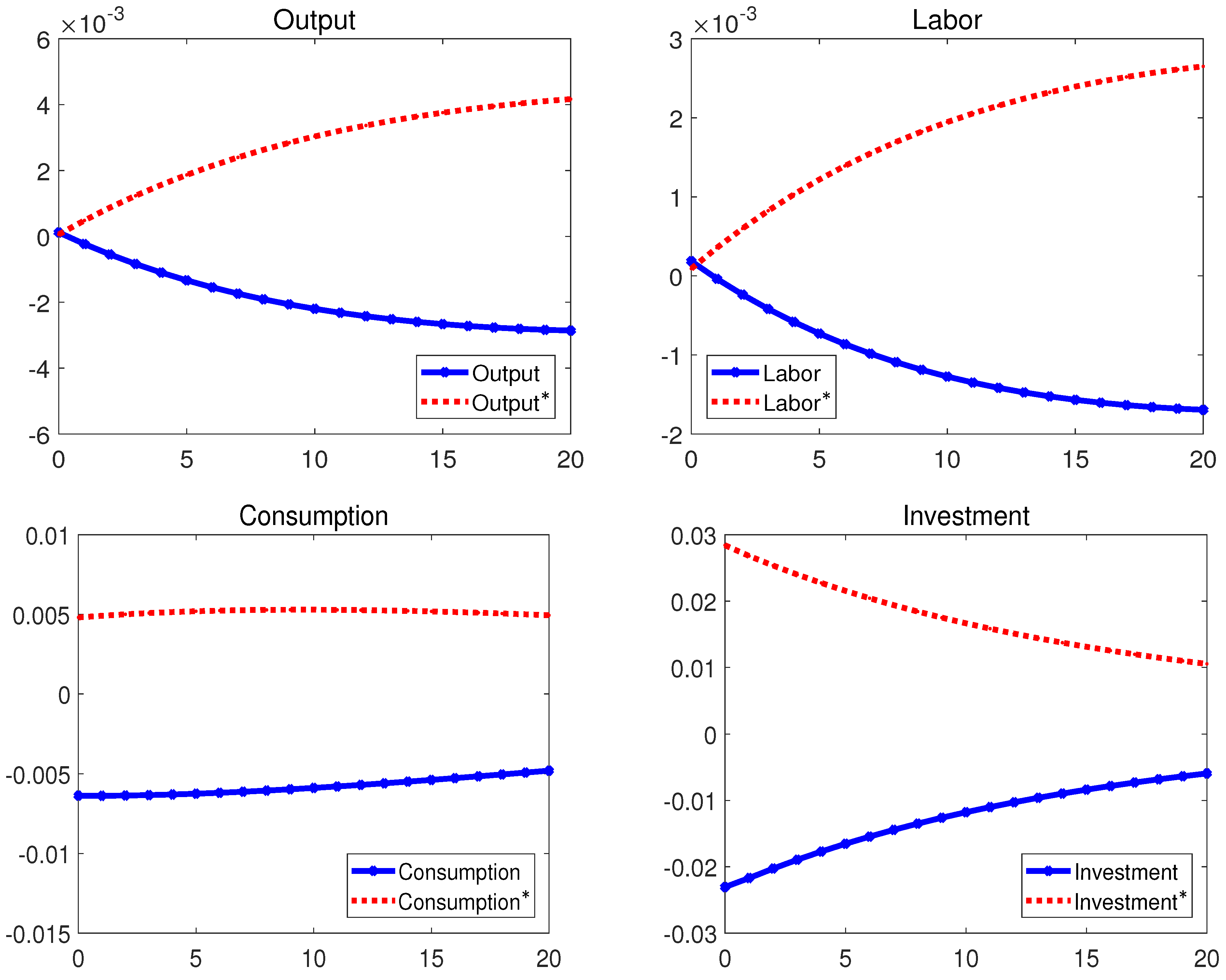
Figure 2.
Impulse responses for each sector under productivity volatility shock.
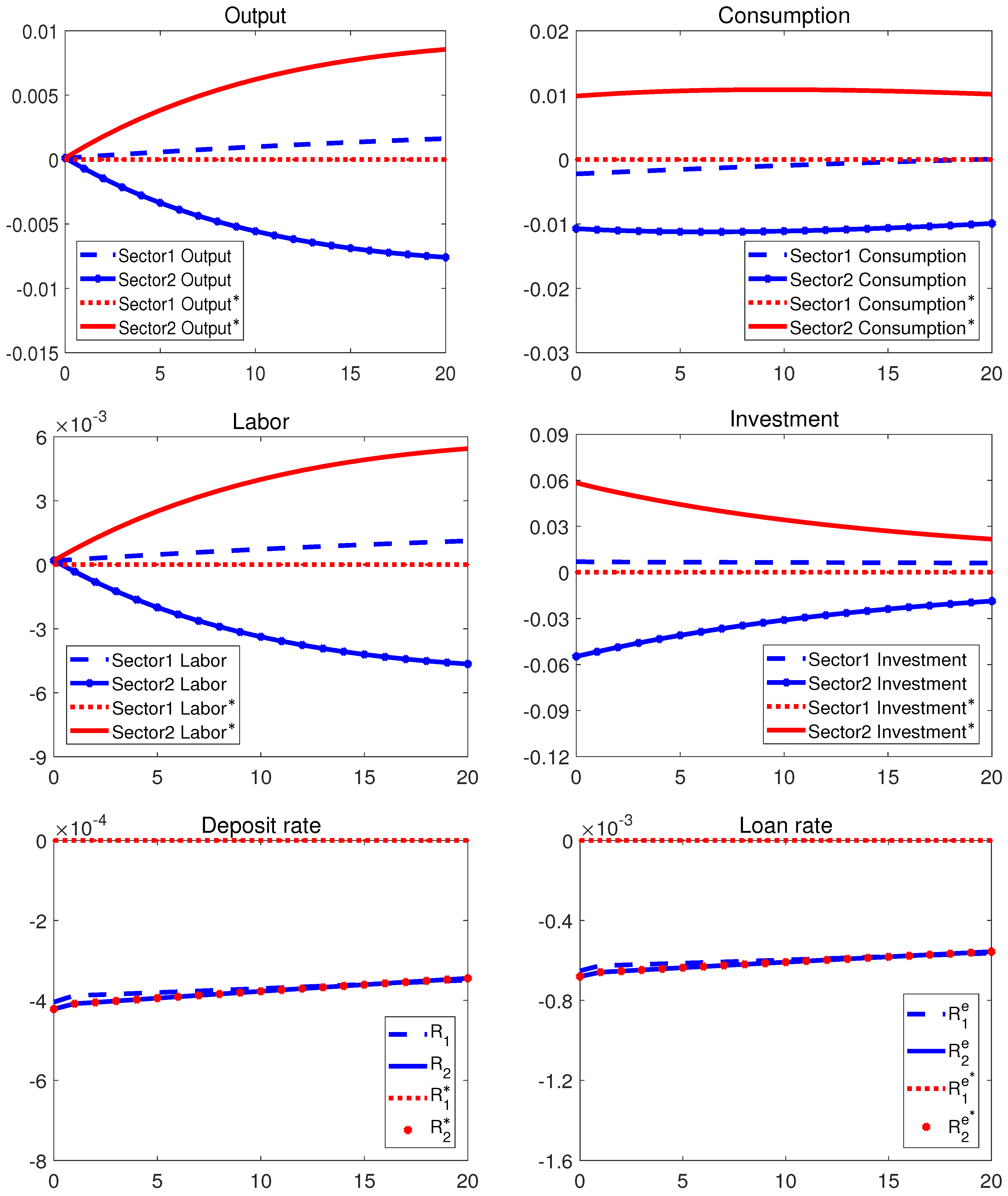
Figure 3.
Impulse responses for each country under financial volatility shocks.
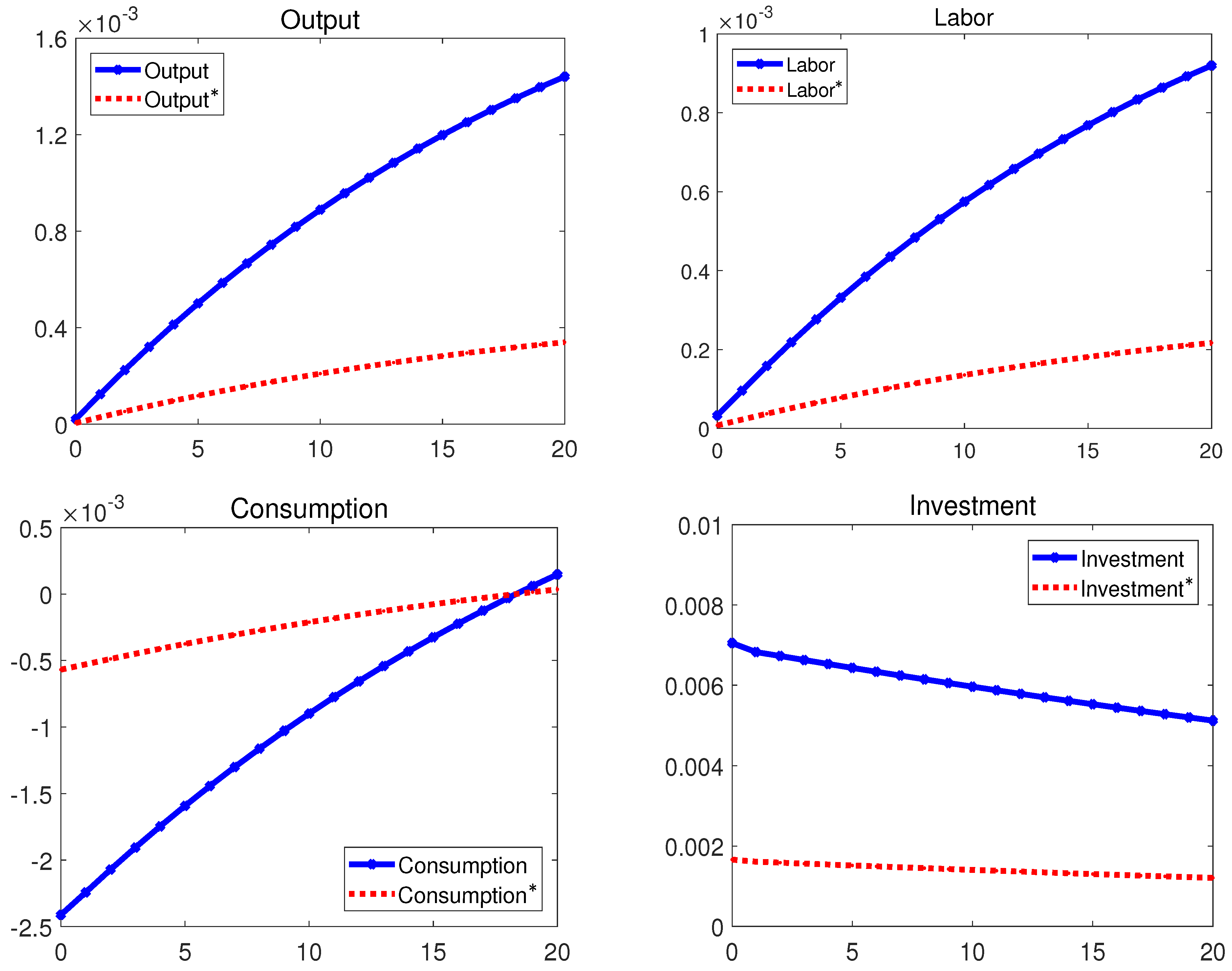
Figure 4.
Impulse responses for each sector under financial volatility shocks.
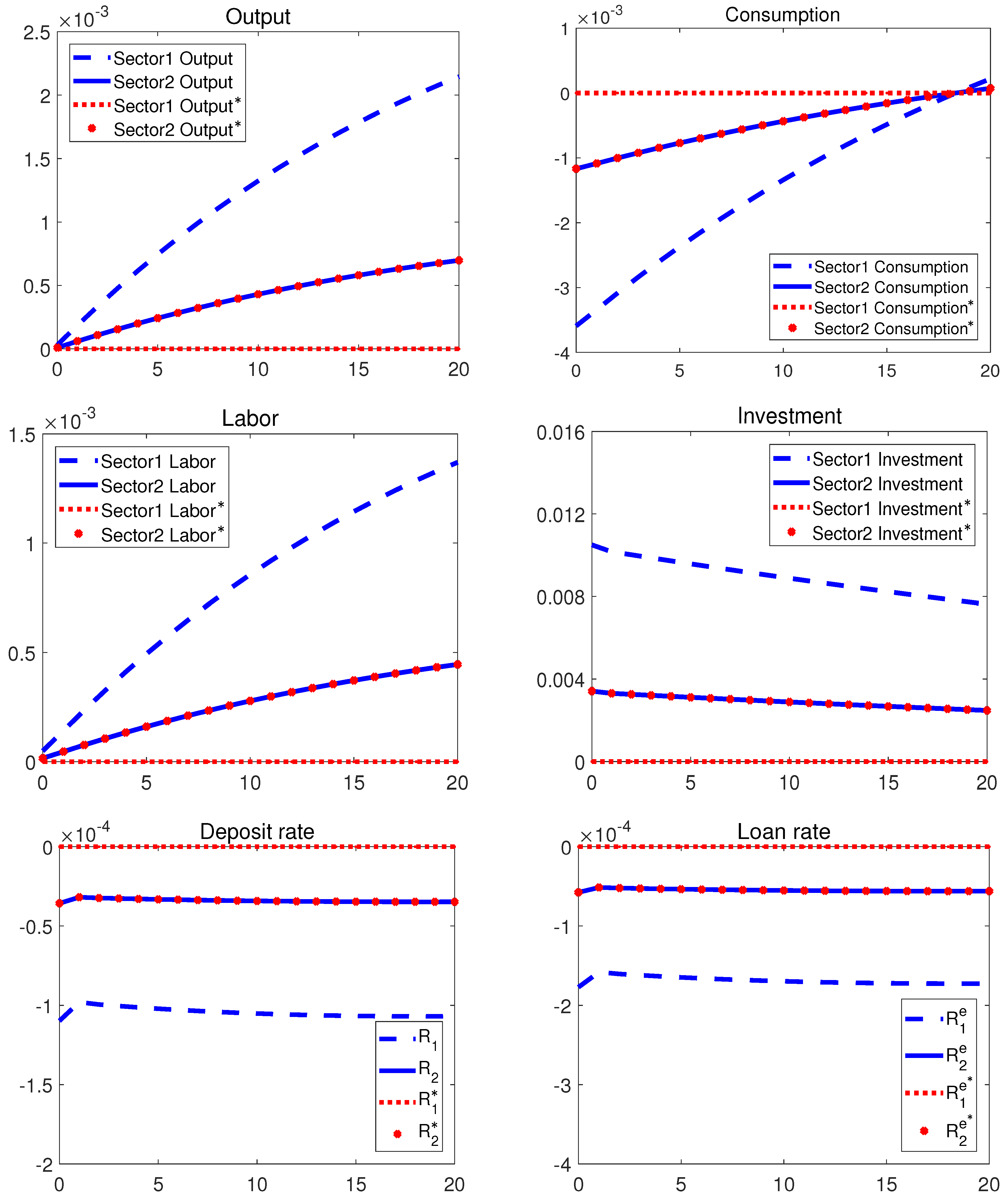
Figure 5.
Degree of financial integration and productivity volatility shocks.
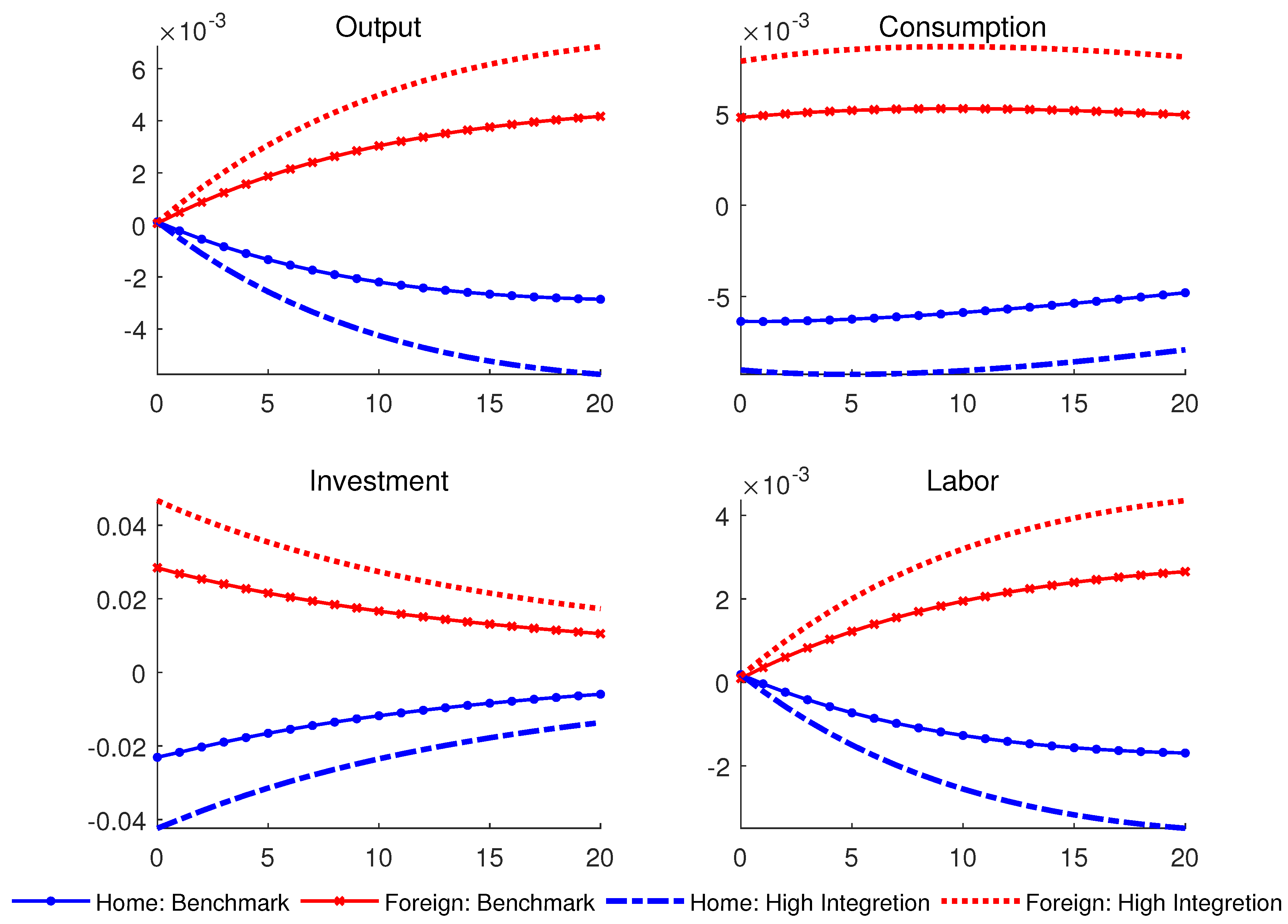
Figure 6.
Degree of financial integration and financial volatility shocks.
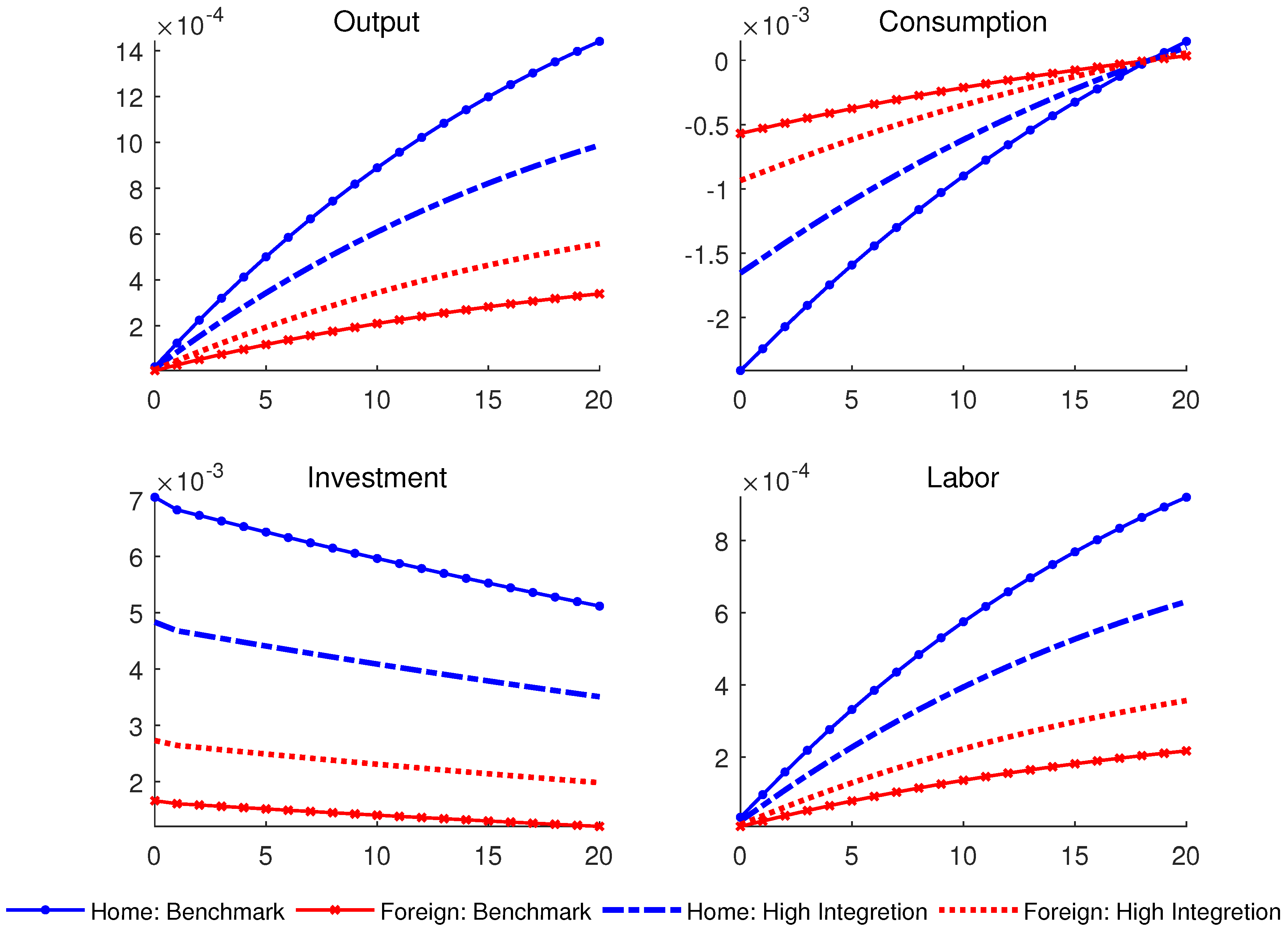
Figure 7.
Lower persistence of productivity volatility shocks.
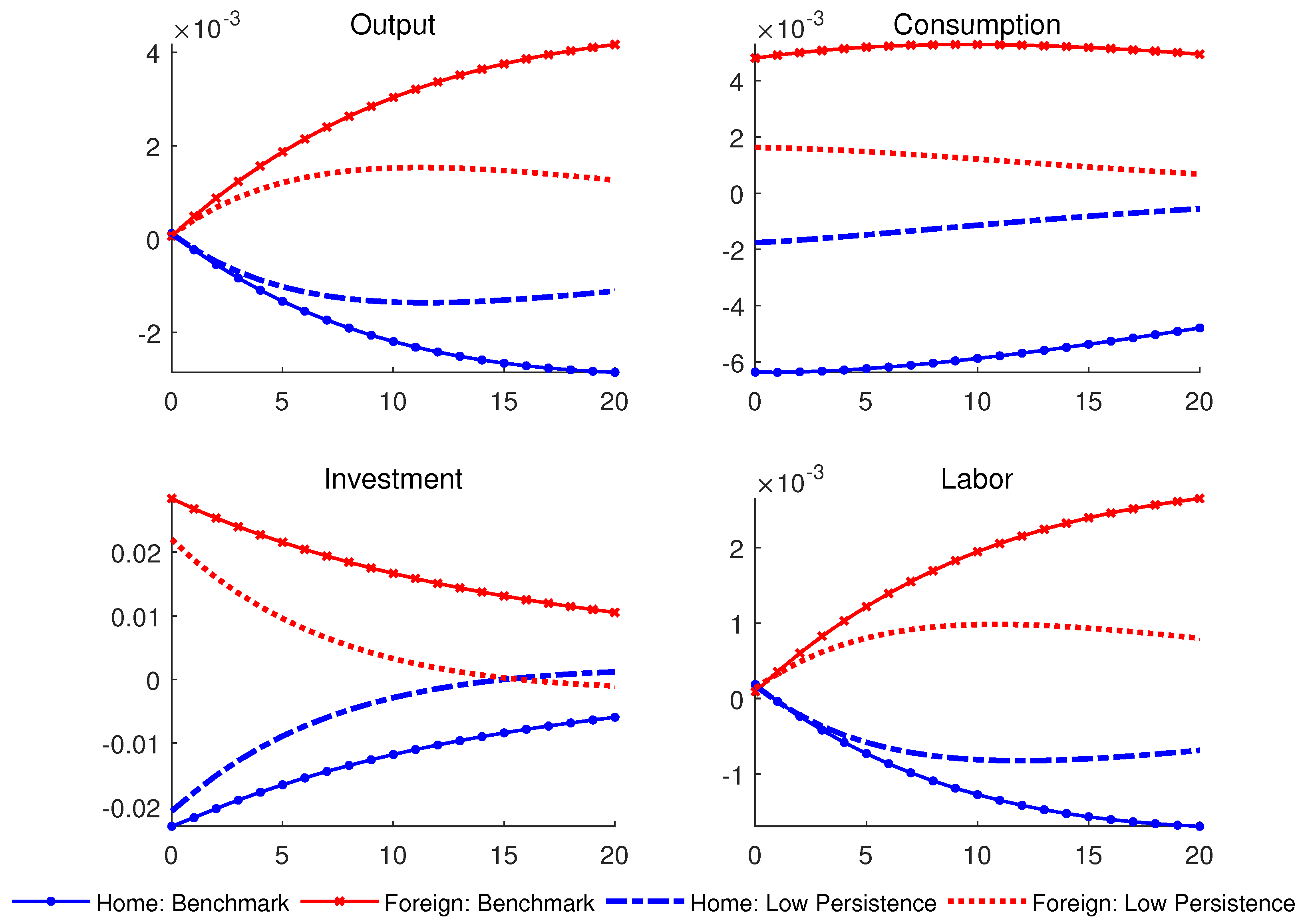
Figure 8.
Lower persistence of financial volatility shocks.
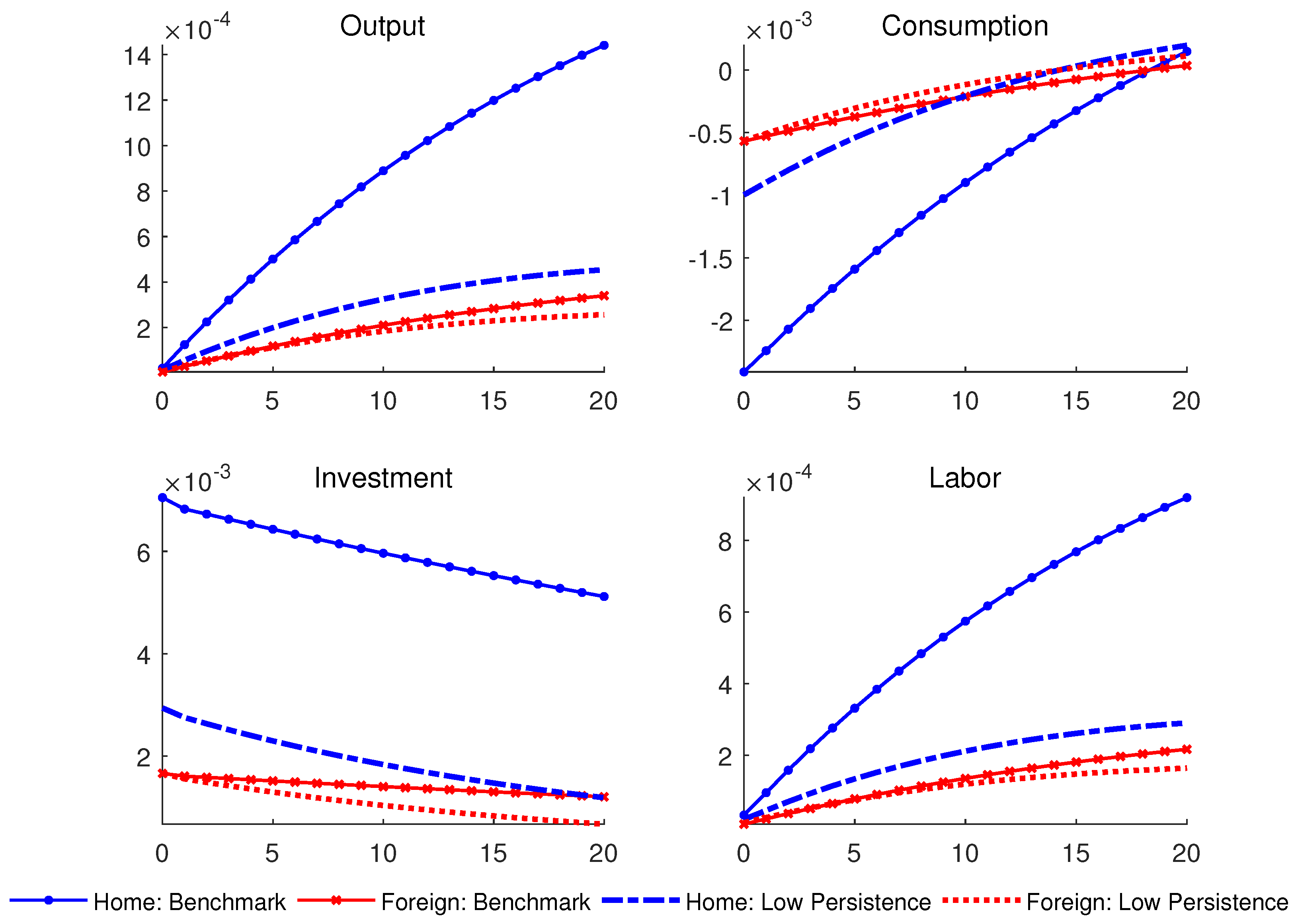
Figure 9.
Risk aversion coefficient and productivity volatility shocks.
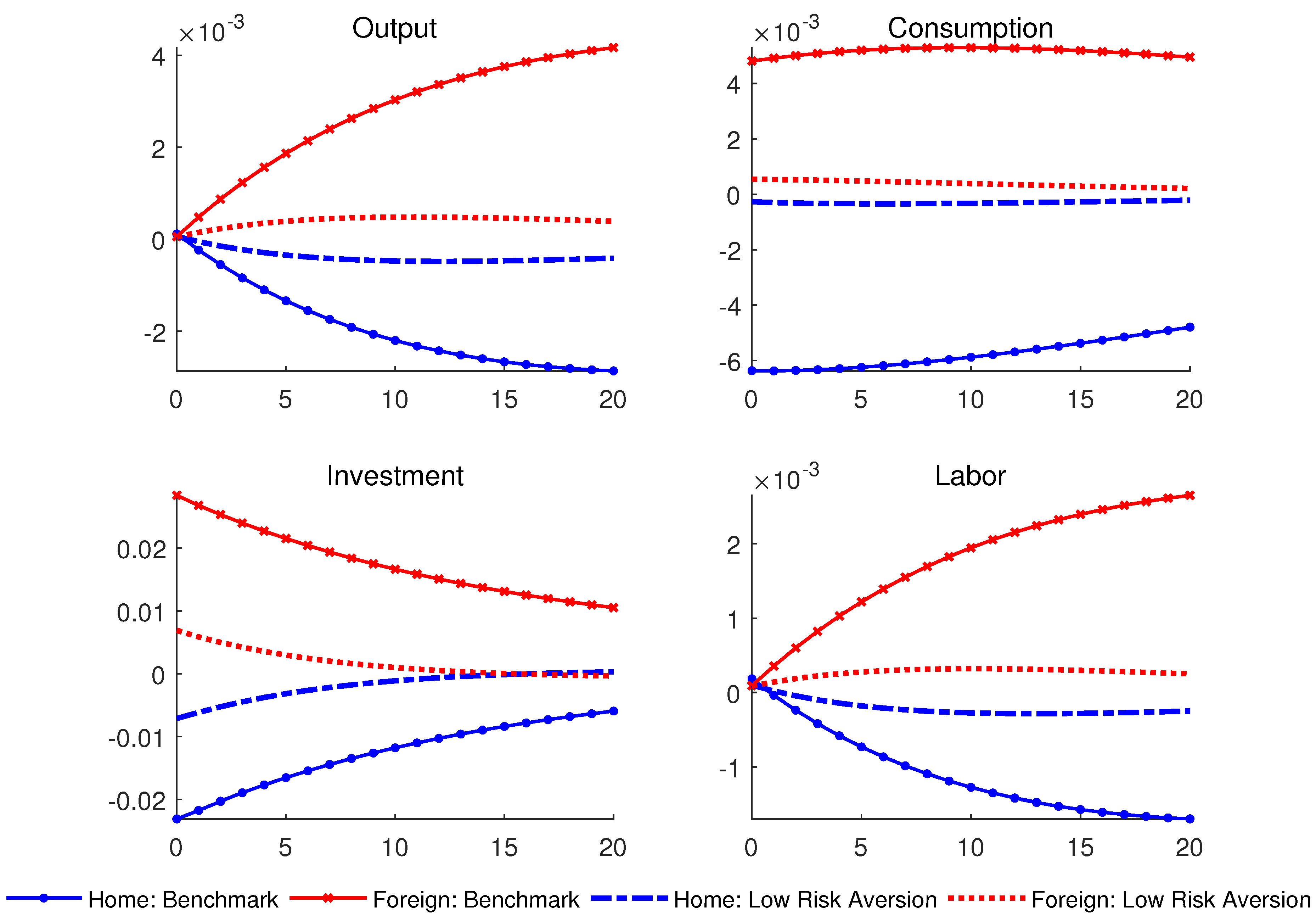
Figure 10.
Risk aversion coefficient and financial volatility shocks.
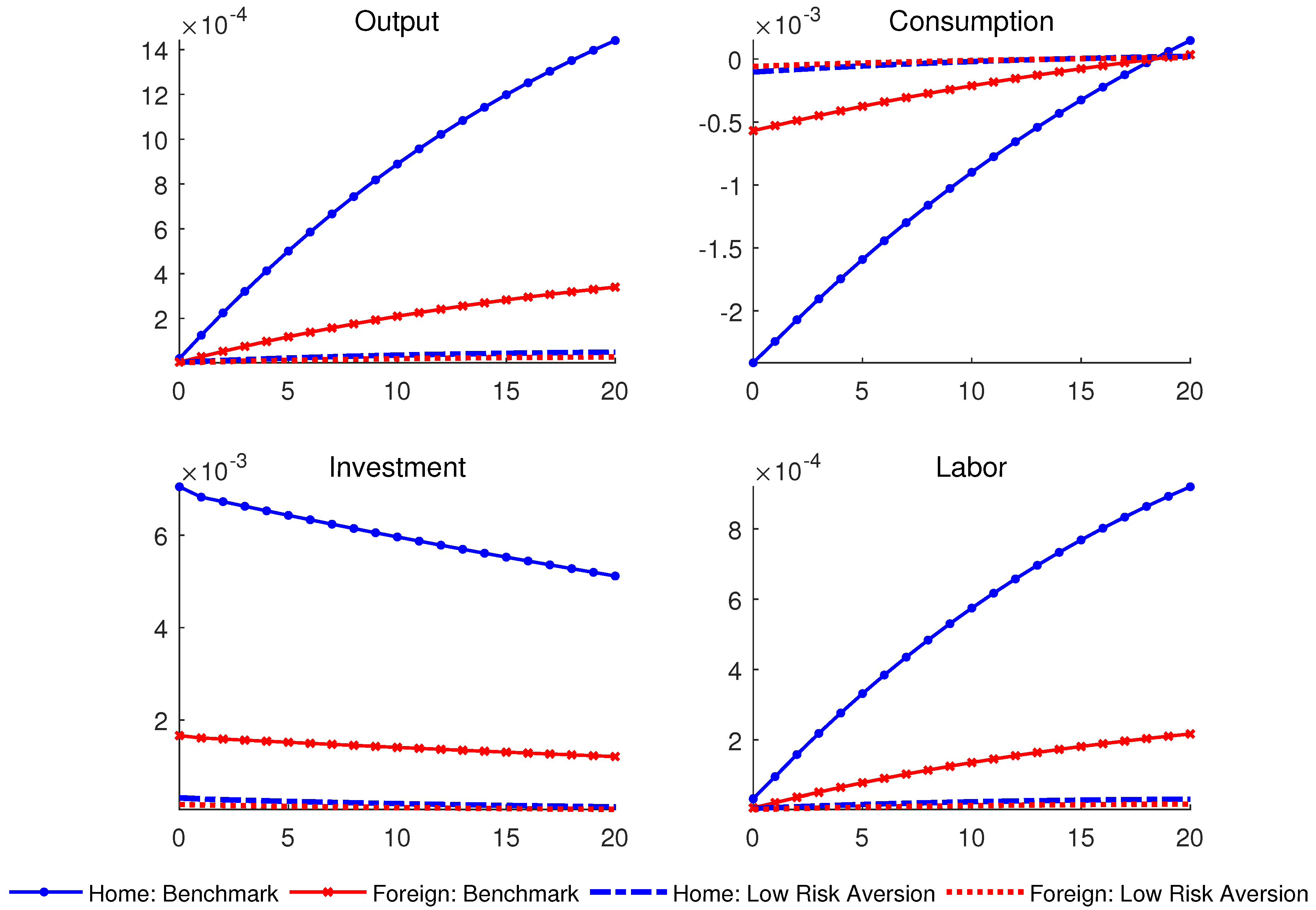
Figure 11.
Intertemporal elasticity of substitution and productivity volatility shocks.
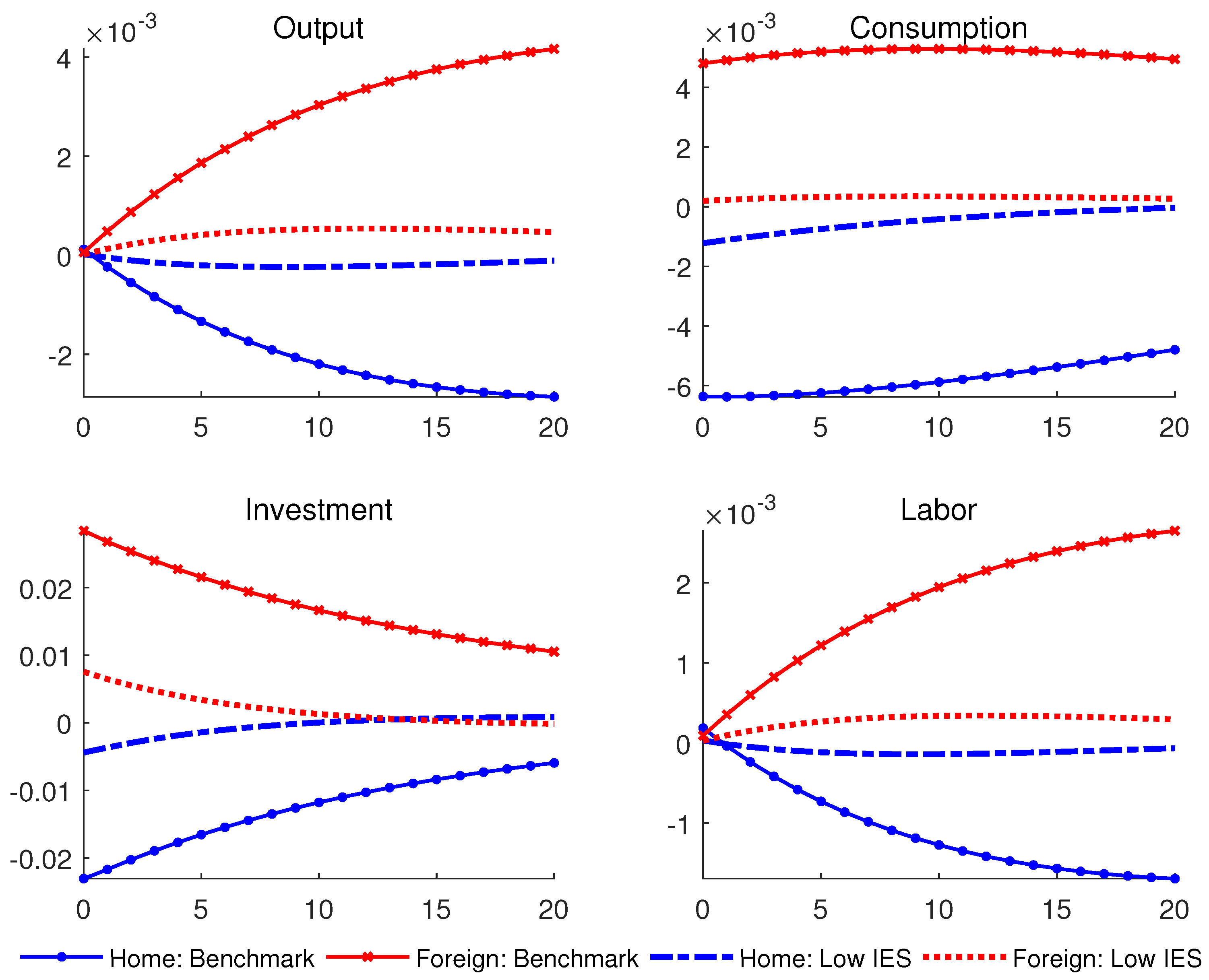
Figure 12.
Intertemporal elasticity of substitution and financial volatility shocks.
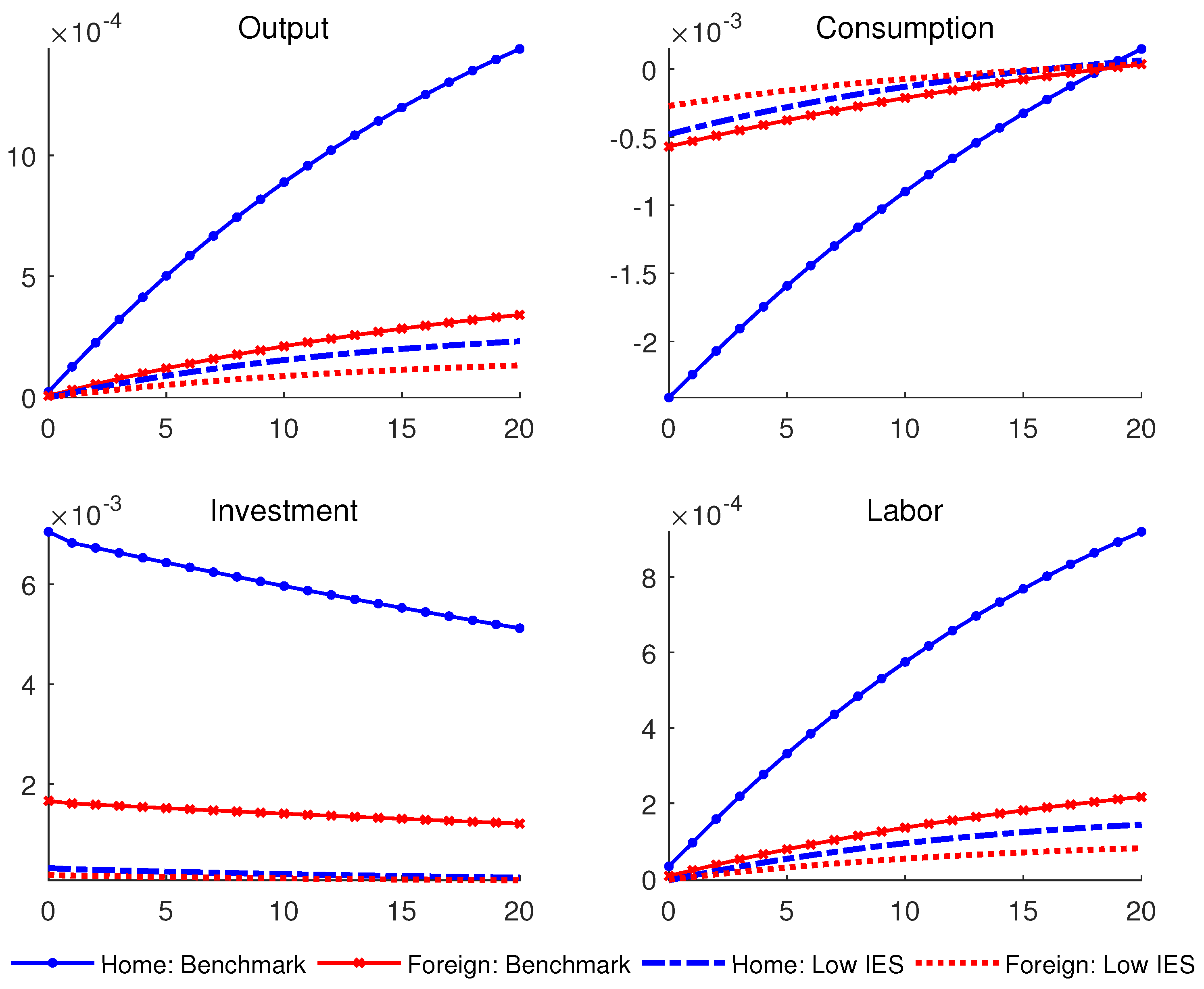

Table 1.
Summary of parameter values.
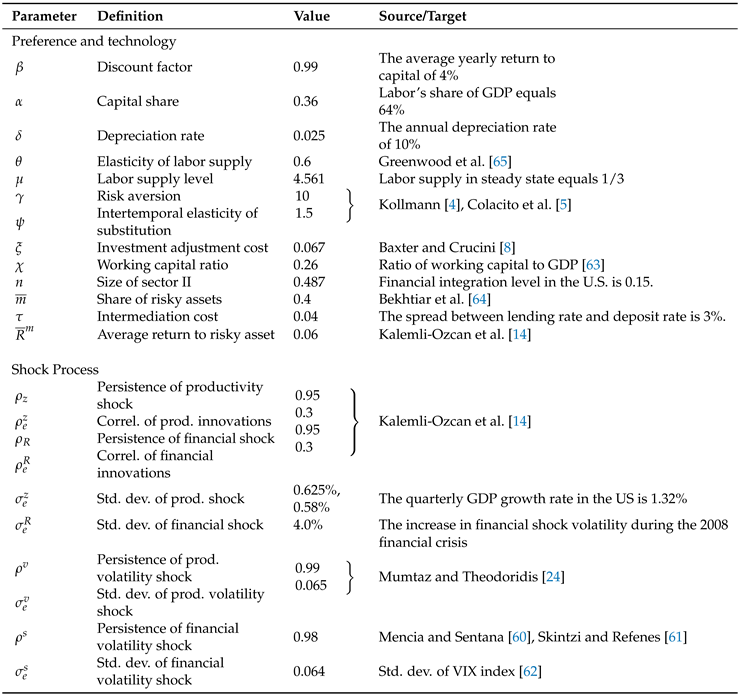 |
Table 2.
Comparison before and after volatility shocks.
| With Volatility Shocks | Without Volatility Shocks | ||||||
|---|---|---|---|---|---|---|---|
| (1) | (2) | (3) | (4) | (5) | (6) | ||
| -0.0075*** | -0.0363*** | -0.6860*** | -0.0071*** | -0.0115*** | -0.6215*** | ||
| (0.0008) | (0.0022) | (0.0423) | (0.0004) | (0.0004) | (0.0173) | ||
| 0.0269*** | 0.0980*** | 0.1596*** | 0.0250*** | 0.0804*** | 0.1246*** | ||
| (0.0046) | (0.0128) | (0.0149) | (0.0040) | (0.0047) | (0.0130) | ||
| Country-Pair FE | Yes | Yes | Yes | Yes | Yes | Yes | |
| Time FE | Yes | Yes | Yes | Yes | Yes | Yes | |
| Country Time Trends | Yes | Yes | Yes | Yes | Yes | Yes | |
| Observation | 39600 | 39600 | 39600 | 39600 | 39600 | 39600 | |
| Adj. | 0.168 | 0.156 | 0.212 | 0.080 | 0.094 | 0.138 | |
Note: This table presents the estimation results obtained from regression analysis using numerical simulation data. The first three columns include the introduction of volatility shocks, while the last three columns do not. The coefficient on the constant term is excluded. All continuous variables are expressed in logarithmic form. I also control for country-pair fixed effects, time fixed effects, and country-specific time trends. Standard errors clustered at the country-pair level are reported in parentheses. Significance levels are denoted by *, **, and *** at the 10%, 5%, and 1% levels, respectively.
Table 3.
Business cycle statistics.
| Data | Prod. Shock | Prod. + Financial |
Prod.+ Prod. Vol. |
Prod.+Financial Financial Vol. |
All | |
|---|---|---|---|---|---|---|
| (1) | (2) | (3) | (4) | (5) | (6) | |
| Percentage Standard Deviation | ||||||
| Output | 1.32 | 1.32 | 1.32 | 1.47 | 1.34 | 1.47 |
| Standard Deviation Relative to Output | ||||||
| Consumption | 0.62 | 0.64 | 0.86 | 0.64 | 0.89 | 0.88 |
| Investment | 2.85 | 2.19 | 2.27 | 2.22 | 2.29 | 2.31 |
| Labor | 0.66 | 0.62 | 0.82 | 0.62 | 0.84 | 0.84 |
| Net Export | 0.40 | 0.29 | 0.41 | 0.32 | 0.41 | 0.44 |
| Cross-Correlation with Output | ||||||
| Consumption | 0.78 | 0.99 | 0.90 | 0.99 | 0.90 | 0.91 |
| Investment | 0.94 | 0.94 | 0.91 | 0.93 | 0.91 | 0.90 |
| Labor | 0.84 | 1.00 | 0.91 | 1.00 | 0.91 | 0.92 |
| Net Export | -0.44 | -0.25 | -0.12 | -0.26 | -0.12 | -0.14 |
| Cross-Country Correlations | ||||||
| Consumption | 0.49 | 0.25 | 0.51 | 0.22 | 0.52 | 0.48 |
| Output | 0.20 | 0.29 | 0.35 | 0.27 | 0.36 | 0.33 |
| Investment | 0.35 | -0.08 | 0.09 | -0.13 | 0.11 | 0.05 |
| Labor | 0.38 | 0.28 | 0.52 | 0.26 | 0.53 | 0.50 |
Notes: The statistics in Column (1) are calculated based on the research by Heathcote and Perri [70]. Columns (2) to (6) present the statistics of the economy under different types of shocks. The model is simulated for 200 periods, with the initial 20 periods discarded. The statistics are computed by repeating the simulations 200 times and taking the average. All variables are Hodrick-Prescott (HP) filtered with a smoothing parameter of 1,600. All statistics, except for net exports, are presented in logarithmic form. The net export statistics represent the ratio (Exports - Imports)/GDP.
Table 4.
Welfare analysis of financial integration under volatility shocks.
| Financial Autarky | Financial Integration | Change of (%) |
|||||
|---|---|---|---|---|---|---|---|
|
Social Welfare |
Deterministic Equivalence of Cons. |
Social Welfare |
Deterministic Equivalence of Cons. |
||||
| (1) | (2) | (3) | (4) | (5) | |||
| Prod. Vol. Shock | 1.6763 | 0.01676 | 1.6796 | 0.01680 | 0.1990 | ||
| Financial Vol. Shock | 1.6784 | 0.01678 | 1.6817 | 0.01682 | 0.1986 | ||
| 1 | VIX index reflects investors’ expectations of market volatility; the higher the index is, the more volatile the market, hence the name “market panic index”. The index is compiled by the Chicago Board Options Exchange (CBOE), and the new version of the compilation method after 2003 incorporates more options with different strike prices, selecting S&P 500 (SPX) options as the underlying. Further information regarding the calculation can be found at https://en.jinzhao.wiki/wiki/VIX
|
| 2 | Labor in the domestic sector II experiences a slight increase in response to productivity volatility shocks, which can be attributed to the Oi-Hartman-Abel effect. The Oi-Hartman-Abel effect, as proposed by Oi [67], Hartman [68], and Abel [69], and others, suggests that labor demand is a convex function with respect to total factor productivity based on the first-order condition of firm profit maximization. According to Jensen’s inequality, an increase in productivity volatility leads to an increase in labor demand. This effect is observed when firms have the ability to endogenously determine their production scale and flexibly adjust factor inputs. However, as lending to the domestic sector II continues to be crowded out by the foreign sector, investment by firms in the domestic sector II declines, resulting in a decrease in labor demand. |
| 3 | Appendix D.2 illustrates the trend of the cross-country correlation coefficient at different levels of financial integration. Figure ?? compares the impact of productivity shocks alone versus the combination of productivity shocks and productivity volatility shocks, revealing that the inclusion of productivity volatility shocks decreases the correlation of output, consumption, investment, and labor in both countries. Figure ?? further incorporates an additional financial volatility shock into the analysis of productivity and financial shocks. The results demonstrate that the effect of the financial volatility shock is not significant at low levels of financial integration. However, as financial integration deepens, the financial volatility shock amplifies the correlation of economic volatility between countries, with a more pronounced effect being observed at higher levels of integration. |
| 4 | The simulation process involves the following steps: first, I select 20 levels of financial integration at equal intervals, representing different degrees of financial integration. For each level of financial integration, I simulate 100 periods while considering the simultaneous effects of productivity shocks and productivity volatility shocks. Additionally, I simulate another 100 periods under the joint impact of all shocks. This simulation is performed for 10 country pairs. |
| 5 | The business cycle statistics and simulation results for each of the above sensitivity analyses are summarized in Appendix D. The findings of this paper remain robust to different parameters of the shock autocorrelation coefficient, the risk aversion coefficient, and the IES. |
Disclaimer/Publisher’s Note: The statements, opinions and data contained in all publications are solely those of the individual author(s) and contributor(s) and not of MDPI and/or the editor(s). MDPI and/or the editor(s) disclaim responsibility for any injury to people or property resulting from any ideas, methods, instructions or products referred to in the content. |
© 2023 by the authors. Licensee MDPI, Basel, Switzerland. This article is an open access article distributed under the terms and conditions of the Creative Commons Attribution (CC BY) license (http://creativecommons.org/licenses/by/4.0/).
Copyright: This open access article is published under a Creative Commons CC BY 4.0 license, which permit the free download, distribution, and reuse, provided that the author and preprint are cited in any reuse.


