

Submitted:
17 October 2023
Posted:
18 October 2023
You are already at the latest version
Abstract
The aim of this study is to determine the importance and effectiveness of different interventions aimed at improving social skills in people with autism spectrum disorder (ASD) through theatrical techniques. It aims to establish a direct relationship between the interventions and the benefits for socioemotional reciprocity, nonverbal communication behaviors used for social interactions and the development, establishment and understanding of interpersonal relationships. For this purpose, a systematic review of the literature published from 2011 to 2021 in the ERIC, Web of Science, EuropePMC, PubPsych, Índices-Csic, Redalyc, Roderic, Scopus, PubMed, Scielo and Dialnet databases was carried out, and a total of 29 articles were reviewed. The results indicate that theater creates a safe environment in which people with ASD can engage with their own emotions and those of others, thereby offering a therapeutic setting in which to promote communication, motor development and social coexistence. The implications and limitations of the study are discussed.
Keywords:
neurodevelopmental disabilities
; intervention
; autism
; theater
; benefits
; social skills
; mental health
; ASD
; emotional control
1. Introduction
According to the Diagnostic and Statistical Manual of Mental Disorders (DSM-5) of the American Psychiatric Association [1], autism spectrum disorder (ASD) is a neurodevelopmental disorder whose most characteristic features are persistent deficits in communication and social interaction across multiple contexts and a repertoire of restricted and stereotyped behaviors, interests or activities.
According to the eleventh edition of the World Health Organization’s International Statistical Classification of Diseases and Related Health Problems (ICD-11) [2], the essential features of autism in the domain of social communication and reciprocal social interaction are limitations in the following areas: understanding, being interested in or responding to the verbal and nonverbal social communications of others; understanding the integration of verbal and nonverbal components such as eye contact, gestures, facial expressions, and body language; understanding the use of language in the appropriate social context and having the ability to sustain reciprocal conversations; recognizing social cues; being able to imagine and respond to the feelings, emotional states, and attitudes of others; sharing interests; and establishing and maintaining relationships with peers.
Social skills play a fundamental role in the development of children’s ability to communicate with other people and involve knowing how to act in a given social situation to improve and maintain meaningful social and emotional relationships throughout life [3]. However, the lack of social skills is one of the difficulties that people with ASD encounter, which is why training in such skills can be considered a necessity [4].
Among the different intervention techniques, in recent years, theater has increasingly been used. López-Vázquez [5] considers theater to be a playful activity that seeks to develop the social skills and competencies of participants by means of dramatic play through interactive situations in which they adopt different roles, alternately placing themselves in various points of view to represent actions, people or objects. In this way, theater enhances social role-playing, creativity, spontaneity and a whole series of communicative, expressive and artistic aspects that are natural to human beings.
The nature of theater is that it engages participants through surprise and novelty. As such, it can be a flexible form of pedagogy that is highly responsive to the environment and context. It can lead to the creation of a teaching situation with little room for failure, as value is placed on the intervention itself, emphasizing the importance of engaging in dramatic play regardless of the outcome; therefore, theater represents a safe environment in which to practice important social skills [6].
Drama therapy is particularly appropriate for people with ASD, as it develops social skills and supports the expression of feelings through structured work that helps reduce anxiety. A dramatherapist can model clear and expressive communication and facilitate the development of relationships with others, which provides participants with numerous opportunities to rehearse and replicate social skills until they learn them and integrate them into their behavior. Dramatherapy sessions offer clearly defined boundaries and structures that help build trust and familiarity. In this therapeutic environment, individuals with ASD can explore ways to communicate their needs, feelings, and interests; pay attention to these needs; and work on them creatively [7].
O’Sullivan [8] states that theatrical interventions attempt to provide creative, enjoyable, and engaging opportunities for individuals with ASD to practice a wide range of social skills in the safety and security of a workshop environment. Theatrical interventions create a fictional context that engages participants’ attention in a playful way and encourages interaction and communication with others.
There are several different approaches to using drama as an intervention for people with ASD, ranging from participation in theatrical performance and the creation of play scripts to improvisation and simulation. Underpinning all forms of theatrical interventions is the intention to actively engage participants in exploring and making sense of the world in which they live and to work creatively with them to understand their place and their relationship to others in that environment. Theatrical interventions are structured, arts-based, educational mediations involving a facilitator, teacher, or therapist who relies on a variety of creative and fun teaching and learning strategies to actively engage the participants in learning with the goal of developing greater social awareness, communication skills, and understanding [8].
According to Conn [9], dramatic play is an educational technique for the development of social skills for children with ASD because it offers a variety of different forms of communication necessary for social life. Dramatic activities provide children with ASD with the opportunity to experience positive social interactions. Acting teaches social awareness, cognition, communication, perception, and expression, so theater can serve as a valuable tool for strengthening social-emotional functioning in individuals with ASD.
De Oliveira and De Oliveira [10] note that art is a means to balance human beings in the most critical moments of their lives, restoring their self-esteem; helping them develop in body, mind and spirit; and strengthening their interaction with others. It is believed that theater allows individuals to identify as human in both a broad and a detailed way as well as to search for new lives and new characters. Theater provides opportunities to activate the imagination, display creativity and experience an essence that is built throughout life, reflecting the social environment in which individuals live.
Villanueva-Bonilla et al. [11] reported positive results of group intervention programs that are based on play activities; that are flexible and adapted to the individual characteristics of each child; and that are focused on emotional, cognitive and social areas, including family members and other people from the children’s social environment participating in intervention activities.
Goldstein et al. [12] show that arts programs are often credited with helping children with autism acquire cognitive and social skills by providing little or no description of classroom experiences, thus creating a naturalistic and accessible context. It is valuable for researchers to move away from theorized processes derived from laboratory findings, as the interests of researchers and the work of teachers are often parallel.
Mpella et al. [13] state that social skills training combined with a creative program such as one involving play is especially effective in improving the development, duration, and frequency of peer social interactions and thus the social skills of children with ASD.
Bermúdez et al. [14] conclude that theater should be used as an end in itself and not only as a means for the development of social skills. In addition to serving as a technique for young people to learn to communicate better, theater becomes an option for a vocation and opportunities both for work and for leisure and personal growth.
Emerging evidence suggests that theater creates a safe environment in which youth with ASD can engage with their own and others’ emotions and perspectives, allowing them to develop a deeper understanding of the self and others [15].
Although the benefits shown by previous studies are significant, previous research addressing the relationship between ASD and theater is not sufficient; hence, the present research makes a valuable contribution to the literature. In addition, it is difficult to generalize the results reported in the analyzed studies because of methodological differences in the age of participants and the number of intervention sessions.
Bellavista-Rof and Mora-Giral [16] conduct a systematic review of theater as a tool for the prevention and treatment of various mental disorders and health promotion. They remark that while there are disease prevention and mental health promotion programs based on health education, there has been little research on the effectiveness of theater or dramatic art as a prevention or treatment tool for mental disorders since it is an innovative technique in this field. Regarding the treatment of ASD, the authors show the potential of using a theatrical approach to facilitate the development of core areas where young people with autism have deficits.
Maas [17] conducts a review of the literature showing how theatrical arts, specifically improvisational theater, improve social perception and attention, emotion management, self-esteem, cognitive flexibility, theory of mind, and social interaction skills in youths with ASD. The review examines the literature related to the use of improvisational theater for people with ASD and how improvisational games or techniques can be worked into occupational therapy practice. Although the literature is limited, the review notes that these studies are promising because of the results regarding the social participation of the subjects involved in the programs.
Therefore, the main objective of this work is to systematically review the scientific literature to determine the effectiveness of interventions aimed at improving social skills in people with ASD through different theatrical techniques. The review is carried out without a focus on a specific type, technique or theatrical genre, which is also a limitation of the reviews mentioned above.
The following specific objectives are defined to address the main objective:
- To define the features of ASD.
- To review and compare experiences in the use of drama in people diagnosed with ASD.
- To justify the proposal to apply all kinds of theatrical techniques to people with ASD based on scientific evidence.
Finally, this study is designed to evaluate the following hypothesis: people diagnosed with ASD will notably improve the development of social skills after participating in theatrical techniques, both through the inclusion of these techniques in the official school curriculum and through the use of workshops and extracurricular programs.
According to Goldstein [18], the use of drama and acting techniques is a novel approach to improving social competence. Acting teaches social awareness, cognition, communication, perception, and expression; therefore, drama can serve as a valuable tool to strengthen basic social-emotional functioning in people with ASD.
Problem Statement
Due to the global concern for achieving sustainable development, in 2015, the United Nations General Assembly adopted the 2030 Agenda. This action plan outlines 17 Sustainable Development Goals (SDGs), which are further divided into 169 specific targets covering various areas. Health promotion, defined as the process of enabling individuals to gain greater control over and enhance their health, is the primary focus of SDG 3, which aims to ensure good health and well-being for all at every stage of life.
On the other hand, the concept of social sustainability aims to strengthen the cohesion and integration of specific social groups. These groups may present difficulties of adaptation and participation in social contexts, as would be the case of people with neurodevelopmental disorders in general, and more specifically with ASD. In this sense, any intervention that facilitates the integration and inclusion of these groups can be related to social sustainability.
The objective of this study is aligned with the global effort to enhance the quality of life and mental well-being of individuals, especially those affected by autism spectrum disorder. This is achieved by increasing their support and ensuring they have the opportunity to realize their full potential.
2. Methods
This work includes a systematic review of the scientific literature related to theater-based social skills interventions aimed at people with ASD. The guidelines proposed in the PRISMA statement [19] have been followed. The different phases of the review process are detailed below (see Figure 1 for the PRISMA flowchart).
Figure 1.
PRISMA flow diagram.
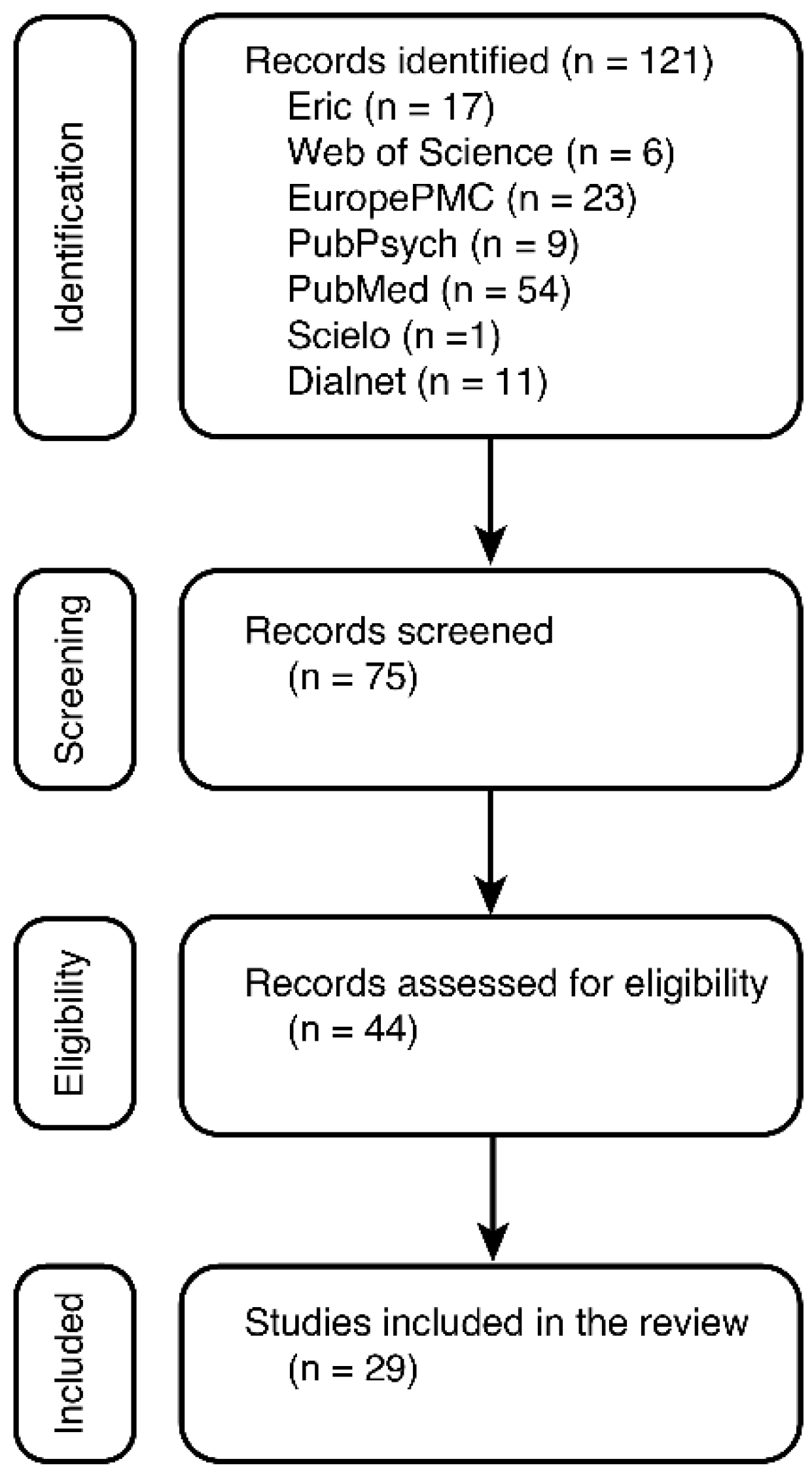
Two searches were carried out: an initial search in July and September 2021 and a second search that ended on February 20, 2022. The databases used were ERIC, Web of Science, EuropePMC, PubPsych, Índices-Csic, Redalyc, Roderic, Scopus, PubMed, Scielo and Dialnet. The combinations of terms used for ERIC, WOS, EuropePMC, PubPsych, and PubMed were as follows:
- -
- theater AND intervention AND autism
- -
- dramatic art AND autism
- -
- theater AND autism spectrum
- -
- theater AND asperger
The combinations of terms used for Scielo, Índices-Csic, Roderic, Redalyc and Dialnet were as follows:
- -
- teatro Y intervención Y autismo
- -
- arte dramático Y autismo
- -
- teatro Y espectro autista
- -
- asperger Y teatro
In addition, in the search engines that provided this option, we included the following:
- -
- without the words (training/assistant/public/teachers)
- -
- exact wording (autism spectrum)
Before starting to read the abstracts, we defined the inclusion and exclusion criteria during the search. The review included scientific articles that reported empirical research on social skills interventions aimed at people diagnosed with ASD; the articles could be from any country, institution or author and published in any language between 2011 and 2021 to analyze the results of the last decade. In terms of the exclusion criteria, other publication types, such as theses, dissertations, conference proceedings and books, were excluded. In addition, articles that did not include empirical research on interventions, those that did not include people diagnosed with ASD in the sample, those that did not address the use of theatrical techniques and those without a full text available were excluded. The selected articles were downloaded as text files, and all abstracts were read. After duplicates were eliminated, an analysis of the articles was carried out. Finally, 29 articles were selected for the systematic review.
The data extraction sheet contained the following information: 1) authors and year of publication, 2) type of intervention, 3) sessions and duration, 4) sample, 5) results and 6) effect size.
3. Results
All studies reported an improvement in social-emotional functioning, self-esteem, emotion management, empathy and listening as well as a decrease in stress and anxiety and an increase in body awareness, communicative intention, adaptive skills, communication and social interaction through different theatrical techniques.
In three of the articles reviewed, sociodramatic interventions aimed at improving the social skills of youths with ASD through drama were conducted during summer programs [20,21,22]. Error-free teaching was used, and an enriching and fun environment with clear social rules was developed; this environment reinforced positive behaviors and prioritized social engagement. The programs included peer theater games, imaginative activities, role-playing, scripted acting, improvisational theater, movement theater with music, and a final play. These games were effective in engaging youth on the autism spectrum, with their conditions being reinterpreted as a source of power and strength, motivating acceptance rather than exclusion and improving social relationships. The results were positive in all three studies, with participants showing reduced stress, improved social relationships, decreased social problems, increased active participation with peers, improved facial identification and memory, and improved social functioning.
In four of the articles reviewed, studies were conducted with ASD learners in regular primary and secondary school drama therapy groups [7,13,23,24]. The overall goals were to help users with ASD reach their full potential, improve their mental well-being, and take full advantage of available educational, cultural, and social opportunities. Dramatherapy was a positive intervention that facilitated emotional development, independence, awareness, cooperation and peer relationships, sense of self-identity and social skills in the participants. There was also an improvement in skills and the successful management of everyday situations such as conflict resolution, sharing, turn taking, identification and expression of emotions, cooperation, attention, obedience and empathy; these improvements were accompanied by a reduction in anxiety and repetitiveness. In addition, teachers and therapists in these studies reflected on their experiences and those of others.
In four of the articles reviewed, the authors conducted drama therapy-based research in special education schools [6,12,25,26]. They used a variety of dramatic techniques, such as improvisation, storytelling, puppets and masks, and choral speech in visual, verbal and kinesthetic learning to test how this practice could promote bodily cognition, focusing on physical interaction as the core of communication. These projects enabled students with ASD to increase their social skills, develop new creative abilities, and gain greater security, confidence, self-esteem, insight and empathy.
Three of the articles analyzed focused on theatrical experiences in early care centers to test whether the consolidation of social skills in children with ASD was more effective through theatrical play than through traditional learning methods [27,28,29]. The three interventions in these studies involved working on social interaction, body perception, peer relationships, courtesy rules, understanding of instructions, rhythm and imitation, recognition of emotions, representation of emotions and association of emotions with circumstances. These global interventions targeted children’s cognitive, motor, language and communication and socioemotional skills. They increased communicative interest and improved the identification, awareness and representation of emotions and the ability to develop conversations, which improved social skills.
In thirteen of the analyzed articles, research was conducted in after-school dramatherapy workshops [8,11,14,30,31,32,33,34,35,36,37,38,39]. Theater games, role-playing activities, instruction in songs and choreography, and improvisation were used. In all of the studies, theater helped the participants develop skills in communication, movement, pretend play, and social interaction. The participants experienced improved social perception, facial memory, verbal cues, emotional expression, self-expression, assertive communication, adaptive skills, theory of mind, self-esteem, confidence and social competence in natural settings. There was also a reduction in anxiety that correlated with increased engagement with peers. The results showed that theater has a therapeutic capacity that enables people with ASD to develop personally and that theater activates social behavioral mechanisms for communication and interaction with the world.
The remaining two articles did not fall into any of the above categories. Mandelberg et al. [40] evaluate the long-term outcome of a family-assisted social skills intervention for children with ASD. The participants showed decreased conflict during play, improved social skills, and decreased loneliness after the intervention. Massa et al. [15] developed a theatrical intervention involving the final production of a play to provide members of a university community with high-quality contact with autistic individuals and an opportunity to learn their stories. This intervention was found to be effective in terms of emotional impact and increased empathy.
A summary of the results of the selected studies is shown in Table 1, Summary of the Reviewed Articles.

Table 1.
Summary of the reviewed articles.
| Authors and year | Type of intervention | Sessions/Duration | Sample | Results | Effect size |
|---|---|---|---|---|---|
| Beadle-Brown et al. [23] | Multisensory capsule improvisation games | 10 45-min sessions, 1 weekly/10 weeks |
22 individuals with ASD (7-12 years old) |
Development of social interaction, communication, and imagination. | 0.8 |
| Blanco et al. [30] | Weekend extracurricular theater workshop | 6 of 1 h and 30 min 1 fortnightly/12 weeks |
7 individuals with Asperger’s (14-18 years old) |
Increased social skills, sense of belonging to a group, improved self-esteem, empathy and listening skills. | NR |
| Calafat-Selma et al. [31] | Extracurricular theater | 27 50-min sessions, 2 weekly/16 weeks |
2 individuals with ASD and 7 with intellectual disability | Improvements in speech, relationship and play. Adaptation level without significant improvement. |
NR |
| Corbett et al. [33] | Theatrical intervention program | 38 2-hour sessions, 4 weekly/12 weeks |
8 individuals with ASD and 8 normotypical individuals (6-17 years old) |
Improved social-emotional functioning. | NR |
| Corbett et al. [20] | Summer camp | 10 4-hour sessions, 5 weekly/2 weeks |
11 individuals with ASD and Asperger’s (8-17 years old) |
Increased active participation with peers. Improved facial identification and memory. |
NR |
| Corbett et al. [32] | Weekend theater workshop | 10 4-hour sessions, 1 weekly/10 weeks |
30 individuals with ASD and 30 normotypical individuals (8-14 years old) |
Decrease in stress and anxiety. | NR |
| Corbett et al. [34] | Weekend theater workshop for young people | 10 4-hour sessions, 1 weekly/10 weeks |
77 individuals with ASD (8-16 years old) |
Improvements in theory of mind, facial memory and cooperative gameplay. | NR |
| Fein [21] | Theater workshop, at summer camp | NR | Individuals with ASD (11-18 years old) |
Improved personal relationships. | NR |
| Fernández-Aguayo and Pino-Juste [27] | Theatrical exercises in an early care center | 16 1-hour and 10-min sessions, 1 weekly/16 weeks |
9 ASD/social communication disorder/cognitive deficiency (3-4 years old) |
Increased communication. Improved identification and representation of emotions. Ability to develop conversations. |
NR |
| Godfrey and Haythorne [7] | Dramatherapy program in various contexts | NR | 42 family members, educators and teachers of students with ASD | Increased confidence, self-esteem, social skills, communication skills, creativity and imagination. | NR |
| Goldstein et al. [12] | Musical theater in a special education center | 40 sessions throughout the school year | 36 individuals with ASD (3-12 years old) |
Improved social relations and behavioral skills. | NR |
| Guli et al. [35] | Creative theater workshop | 12 2-hour session, 1 weekly/12 weeks 16 1.5-hour sessions, 2 weekly/8 weeks |
11 individuals with ASD, 2 with nonverbal learning disability and 5 with attention deficit hyperactivity disorder (8-14 years old) |
Improved interpersonal relationships. Increased empathy and self-control. |
NR |
| Kempe and Tissot [6] | Intervention program in a special education center | 13 1-hour and 40-min sessions over 20 weeks |
10 individuals with learning difficulties and 2 with ASD (18-19 years old) |
Increase in social skills. Development of creative skills. |
NR |
| Lerner et al. [22] | Sociodramatic intervention based on improvisation in a summer program | 29 5-hour sessions, 1 daily/6 weeks |
17 individuals with Asperger’s and high-functioning individuals with ASD (11-17 years old) |
Improved social skills. | NR |
| Lewis and Banerjee [25] | Storytelling in drama therapy at a special education school | 12 60-min sessions, 10 group and 2 individual sessions/12 weeks |
3 individuals with ASD (12-14 years old) |
Increased security, confidence, self-esteem, insight and empathy. | NR |
| Madriz et al. [14] | Theater workshop for young people | 95 1.5-hour sessions, 1 weekly/95 weeks |
8 individuals with ASD (12-22 years old) |
Increased emotional expression and assertive communication. | NR |
| Mandelberg et al. [40] | Social skills program | 12 1-hour sessions, 1 weekly/12 weeks |
24 high-functioning individuals with ASD and normotypical peers (6-11 years old) |
Reduction of conflicts in the game. Improved emotional management. |
NR |
| Martín [28] | Shadow theater in an early care center | 30 50-min sessions, 3 weekly/10 weeks |
1 individual with ASD (6 years old) |
Improved communicative intent and emotional state. Increased body awareness. |
NR |
| Massa et al. [15] | Theatrical production | 2 months | 2 individuals with ASD, 1 with anxiety disorder (18-29 years old) |
Reduction of autism stigma. | NR |
| May [36] | Comedy and clown workshops | NR | 5 individuals with ASD and 4 normotypical individuals (13-16 years old) |
Myth of autistic humorlessness debunked. | NR |
| Mehling et al. [37] | Extracurricular theater workshop | 10 1-hour sessions, 1 weekly/10 weeks |
14 individuals with ASD (10-13 years old) |
Improved social interaction, pragmatic language, and facial emotional recognition. | NR |
| Mpella et al. [13] | Theater program as part of the school’s physical education program | 16 45-min sessions, 2 weekly/8 weeks |
6 individuals with ASD and 132 normotypical peers in their respective classrooms (9-11 years old). |
Improved cooperation, attention and empathy. Reduction of anxiety and repetitiveness. |
NR |
| Dyer [24] | Dramatherapy in elementary school | 8 45-min sessions, 1 weekly/8 weeks |
3 individuals with ASD and 3-5 normotypical individuals (5-11 years old) |
Increased confidence and self-esteem. Improved turn-taking and skills to work effectively alone and with others. |
NR |
| O’Sullivan [8] | Weekend dramatherapy workshop | 10 90-min sessions, 1 weekly/10 weeks |
12 individuals with Asperger’s (9-11 years old) |
High levels of activity and interest. Emotional and physical collapse of a participant. |
NR |
| Pimpas [29] | Social skills training program | 1 45-min session, 1 weekly/1 year |
1 individual with ASD (9 years old) |
Correct display of emotions and affections. Greater expressiveness. |
NR |
| Sandoval and Hernández [38] | Theater and digital fabrication workshop | 16 1.5-hour sessions, 1 weekly/16 weeks |
10 individuals with ASD (12-20 years old) |
Improvements in the expression of emotions and teamwork. | NR |
| Trowsdale and Hayhow [26] | Psychophysical theater during school hours in a special education center | 1 1-hour session, 1 weekly/5 years |
Variety of students with learning difficulties, ASD among others (3-11 years old) |
Improved communication and socialization skills. New collaboration skills. |
NR |
| Villanueva-Bonilla et al. [11] | Social role play | 25 60-min sessions, 2 weekly/13 weeks |
3 individuals with ASD (8-10 years old) |
Positive changes in identification, understanding and emotional expression. | NR |
| Wilmer-Barbrook [39] | Dramatherapy | 36 1.5-hour sessions, 1 weekly/36 weeks |
8 individuals with Asperger’s (16-24 years old) |
Increased confidence, self-esteem, social skills, emotional expression, and communication skills. | NR |
NR: Not reported.
4. Discussion
The results show that in all the articles in which a program to improve social skills through theater was applied, once the specific intervention objectives were defined and carried out, improvements were produced. The programs offered a variety of stimuli to people with ASD that were important for their social lives. Therefore, the hypothesis stated at the beginning of this paper, i.e., that dramatic play interventions could help develop social competence in people with ASD through the development of imagination, symbolism, fantasy and role play, is supported. The results confirm that play and drama foster development in many of the areas in which people with ASD tend to be deficient.
The results were positive in all the studies; however, there were certain limitations, such as difficulty in comparing the effectiveness of the interventions due to methodological differences derived mainly from the number and characteristics, such as age, of subjects in the sample. The diversity in the number of intervention sessions carried out also made it difficult to generalize the results. Another limitation was the lack of specification of the degree of ASD of the participants; in some articles, the characteristics, limitations and strengths of the participants were detailed, but the participants were described as people with ASD in general.
There are also notable differences with respect to the intensity of the treatment. Interventions with a duration of 6 to 20 weeks were applied, except in Madriz et al. [14], who applied a long-term program with a duration of 96 weeks, and Trowsdale and Hayhow [26], whose study lasted 5 years. Regarding the characteristics of the subjects participating in the studies, in 23 studies, the sample consisted of people with ASD and other developmental disorders, and in 6 studies, the sample also included normotypical peers.
Regarding the number of participants, there were also large differences, as there were studies in which a single subject was taken as the referent, studies in which the sample ranged from 3 to 25 subjects, studies in which the sample ranged from 60 to 80 participants, and studies in which the sample exceeded 100 participants. The ages of the participants also differed from one study to another, with ages ranging from 3 to 29 years.
5. Conclusions
The results demonstrate the role of the realization of artistic potential through theater in the development of social skills, motivation, self-confidence, self-awareness, and generation of ideas that facilitate the resolution of conflicts, with an interest in education and in any area of life.
The results of the present review contribute to the evidence regarding how theater or drama can be used as a tool to promote mental health in different aspects of both prevention and treatment.
The nature of drama is that it engages through surprise and novelty, becoming a flexible form of pedagogy that generates benefits in teaching situations with little room for failure and creating a safe environment in which to practice social skills without fear of error.
The limitations of this work should be mentioned since it is necessary to increase the number of complete, systematic studies with experimental designs in order to obtain more scientific knowledge and greater development of this underexplored field. Increased research in this area would also allow for the generalization of results in other contexts. In future research, this could be achieved by using a larger repertoire of keywords that would return a greater number of articles to be analyzed, thereby expanding the field of research and allowing the analysis of all types of interventions in which theater provides benefits rather than only those focused on improving social skills. It would also be beneficial to use more databases, including paid databases, and to be able to analyze the characteristics of each project and intervention in terms of the specific activities used, which would support more in-depth knowledge of the methodological strategies employed and provide help and guidance for future studies.
In the future, schools should promote and encourage the development of creativity among students, both normotypical students and students with any disability or disorder, through theater to generate positive changes in their social skills and therefore in the different capacities that contribute to the establishment of an optimal social relationship. Interventions in which different play strategies are implemented in an inclusive environment and through a holistic and inclusive learning process should be implemented. It should be noted that in the early childhood education stage, there is greater creative development, so being able to enhance creativity at this stage would increase the degree of bodily expression and improve the expressivity level and the ability to solve problems.
Author Contributions
Conceptualization, M.M.-V., N.F.-G., and S.H.-F; methodology, C.M.-S., F.G.-S., and F.T.-T.; software, M.M.-V. and N.F.-G.; validation, N.F.-G. and S.H.-F; formal analysis, M.M.-V., N.F.-G., and S.H.-F; investigation, F.G.-S., C.M.-S. and F.T.-T.; resources, F.T.-T.; data curation, C.M.-S. and F.T.-T; writing—original draft preparation, M.M.-V., N.F.-G., and S.H.-F; writing—review and editing, M.M.-V., N.F.-G., S.H.-F, and F.T.-T.; data visualization, F.G.-S., C.M.-S. and F.T.-T.; supervision, M.M.-V. and F.T.-T.; project administration, M.M.V. and F.T.-T.; and funding acquisition, F.T.-T. All authors have read and agreed to the published version of the manuscript.
Funding
This work is one of the results of the research project HIM/2015/017/SSA.1207, “Effects of mindfulness training on psychological distress and quality of life of the family caregiver”. Main researcher: Filiberto Toledano-Toledano, Ph.D. The present research received federal funds for health research and was approved by the Commissions of Research, Ethics and Biosafety at the Hospital Infantil de México Federico Gómez National Institute of Health. The source of federal funds did not control the study design, data collection, analysis, interpretations, or decisions regarding publication.
Institutional Review Board Statement
Not applicable
Informed Consent Statement
Not applicable
Data Availability Statement
The raw data supporting the conclusions of this article will be made available by the authors without undue reservation.
Acknowledgments
The authors thank Angel Gabriel Uribe Zamorano for his support.
Conflicts of Interest
The authors declare no conflicts of interest.
Appendix A
Checklist PRISMA 2020
| Section and topic | Item | Checklist item | Location where item is reported |
| Title | |||
| Title | 1 | Identify the report as a systematic review. | 1 |
| ABSTRACT | |||
| Abstract | 2 | See the PRISMA 2020 for Abstracts checklist. | 4 |
| INTRODUCTION | |||
| Rationale | 3 | Describe the rationale for the review in the context of existing knowledge. | 5-12 |
| Objectives | 4 | Provide an explicit statement of the objective(s) or question(s) the review addresses. | 11-12 |
| METHODS | |||
| Eligibility criteria | 5 | Specify the inclusion and exclusion criteria for the review and how studies were grouped for the syntheses. | 14 |
| Information sources | 6 | Specify all databases, registers, websites, organizations, reference lists and other sources searched or consulted to identify studies. Specify the date when each source was last searched or consulted. | 13 |
| Search strategy | 7 | Present the full search strategies for all databases, registers and websites, including any filters and limits used. | 13 |
| Selection process | 8 | Specify the methods used to decide whether a study met the inclusion criteria of the review, including how many reviewers screened each record and each report retrieved, whether they worked independently, and, if applicable, details of automation tools used in the process. | 14 |
| Data collection process | 9 | Specify the methods used to collect data from reports, including how many reviewers collected data from each report, whether they worked independently, any processes for obtaining or confirming data from study investigators, and, if applicable, details of automation tools used in the process. | 14 |
| Data items | 10a | List and define all outcomes for which data were sought. Specify whether all results that were compatible with each outcome domain in each study were sought (e.g. for all measures, time points, analyses) and, if not, the methods used to decide which results to collect. | NA |
| 10b | List and define all other variables for which data were sought (e.g., participant and intervention characteristics, funding sources). Describe any assumptions made about any missing or unclear information. | NA | |
| Study risk of bias assessment | 11 | Specify the methods used to assess risk of bias in the included studies, including details of the tool(s) used, how many reviewers assessed each study and whether they worked independently, and, if applicable, details of automation tools used in the process. | NA |
| Effect measures | 12 | Specify for each outcome the effect measure(s) (e.g., risk ratio, mean difference) used in the synthesis or presentation of results. | NA |
| Synthesis methods | 13a | Describe the processes used to decide which studies were eligible for each synthesis (e.g., tabulating the study intervention characteristics and comparing to the planned groups for each synthesis). | NA |
| 13b | Describe any methods required to prepare the data for presentation or synthesis, such as handling of missing summary statistics or data conversions. | NA | |
| 13c | Describe any methods used to tabulate or visually display results of individual studies and syntheses. | NA | |
| 13d | Describe any methods used to synthesize results and provide a rationale for the choice(s). If meta-analysis was performed, describe the model(s), method(s) to identify the presence and extent of statistical heterogeneity, and software package(s) used. | NA | |
| 13e | Describe any methods used to explore possible causes of heterogeneity among study results (e.g., subgroup analysis, metaregression). | NA | |
| 13f | Describe any sensitivity analyses conducted to assess the robustness of the synthesized results. | NA | |
| Assessment of information bias | 14 | Describe any methods used to assess risk of bias due to missing results in a synthesis (arising from reporting biases). | NA |
| Deficiency assessment | 15 | Describe any methods used to assess certainty (or confidence) in the body of evidence for an outcome. | NA |
| RESULTS | |||
| Study selection | 16a | Describe the results of the search and selection process, from the number of records identified in the search to the number of studies included in the review, ideally using a flow diagram. | 34 |
| 16b | Cite studies that might appear to meet the inclusion criteria but were excluded, and explain why they were excluded. | NA | |
| Study characteristics | 17 | Cite each included study and present its characteristics. | 31-33 |
| Study risk of bias assessment | 18 | Present assessments of risk of bias for each included study. | NA |
| Results of individual studies | 19 | For all outcomes, present, for each study, (a) summary statistics for each group (where appropriate) and (b) an effect estimate and its precision (e.g. confidence/credible interval), ideally using structured tables or plots. | NA |
| Results of syntheses | 20a | For each synthesis, briefly summarize the characteristics and risk of bias among contributing studies. | NA |
| 20b | Present results of all statistical syntheses conducted. If meta-analysis was done, present for each the summary estimate and its precision (e.g. confidence/credible interval) and measures of statistical heterogeneity. If comparing groups, describe the direction of the effect. | NA | |
| 20c | Present results of all investigations of possible causes of heterogeneity among study results. | NA | |
| 20d | Present results of all sensitivity analyses conducted to assess the robustness of the synthesized results. | NA | |
| Reporting biases | 21 | Present assessments of risk of bias due to missing results (arising from reporting biases) for each synthesis assessed. | NA |
| Certainty of evidence | 22 | Present assessments of certainty (or confidence) in the body of evidence for each outcome assessed. | NA |
| DISCUSSION | |||
| Discussion | 23a | Provide a general interpretation of the results in the context of other evidence. | 18-22 |
| 23b | Discuss any limitations of the evidence included in the review. | 21 | |
| 23c | Discuss any limitations of the review processes used. | 21 | |
| 23d | Discuss implications of the results for practice, policy, and future research. | 21-22 | |
| OTHER INFORMATION | |||
| Registration and protocol | 24a | Provide registration information for the review, including register name and registration number, or state that the review was not registered. | NA |
| 24b | Indicate where the review protocol can be accessed, or state that a protocol was not prepared. | NA | |
| 24c | Describe and explain any amendments to information provided at registration or in the protocol. | NA | |
| Support | 25 | Describe sources of financial or nonfinancial support for the review and the role of the funders or sponsors in the review. | 22 |
| Competing interests | 26 | Declare any competing interests of review authors. | 22 |
| Availability of data, code, and other materials | 27 | Report which of the following are publicly available and where they can be found: template data collection forms, data extracted from included studies, data used for all analyses, analytic code, any other materials used in the review. | NA |
References
- Asociación Americana De Psiquiatría. Manual de Diagnóstico y Estadística de Trastornos Mentales, 5th ed.; Editorial Médica Panamericana: Arlington, Estados Unidos, 2013. [Google Scholar]
- World Health Organization. International Statistical Classification of Diseases and Related Health Problems, 11th ed.; World Health Organization: Geneva, Switzerland, 2019. [Google Scholar]
- Merrell, K.W.; Gimpel, G.A. Social Skills of Children and Adolescents: Conceptualization, Assessment, Treatmented.; Lawrence Erlbaum Associates Publishers: Mahwah, NJ, US, 1998. [Google Scholar]
- Ares, D.A.; Bermudez, L.M.; Chinchill, R.H. Neurodidáctica y estrategias de aprendizaje para la inclusión. Desarrollo de competencias comunicativas en niños y niñas con riesgo biológico y/o social. Rev. Educ. Inclusiva 2017, 9, 43–53. [Google Scholar]
- López-Vázquez, A.R. Aprender a ver teatro, empezar a hacer teatro. Prim. Not., Rev. Lit. 2008, 233, 75–81. [Google Scholar]
- Kempe, A.; Tissot, C. The use of drama to teach social skills in a special school setting for students with autism. Support Learn. 2012, 27, 97–102. [Google Scholar] [CrossRef]
- Godfrey, E.; Haythorne, D. Benefits of dramatherapy for autism spectrum disorder: A qualitative analysis of feedback from parents and teachers of clients attending roundabout dramatherapy sessions in schools. Dramatherapy 2013, 35, 20–28. [Google Scholar] [CrossRef]
- O’Sullivan, C. Drama and Autism. In Encyclopedia of Autism Spectrum Disorders, Volkmar, F.R., Ed.; Springer: New York, NY, USA, 2015; pp. 1–13. [Google Scholar]
- Conn, C. Play and Friendship in Inclusive Autism Education: Supporting Learning and Developmented; Routledge: Abingdon Oxon, NY, 2016. [Google Scholar]
- de Oliveira, M.A.E.; de Oliveira, R.F.T. A arteterapia no tratamento do transtorno do espectro autista (TEA). Rev. Cient. Univ. 2016, 3, 1–4. [Google Scholar]
- Villanueva-Bonilla, C.; Bonilla-Santos, J.; Ríos-Gallardo, Á.M.; Solovieva, Y. Desarrollando habilidades emocionales, neurocognitivas y sociales en niños con autismo. Evaluación e intervención en juego de roles sociales. Rev. Mex. Neurocienc. 2018, 19, 43–59. [Google Scholar] [CrossRef]
- Goldstein, T.R.; Lerner, M.D.; Paterson, S.; Jaeggi, L.; Toub, T.S.; Hirsh-Pasek, K.; Golinkof, R. Stakeholder perceptions of the effects of a public school-based theatre program for children with ASD. J. Learn. Through Arts 2019, 15, n1. [Google Scholar] [CrossRef]
- Mpella, M.; Evaggelinou, C.; Koidou, E.; Tsigilis, N. The effects of a theatrical play programme on social skills development for young children with autism spectrum disorders. Int. J. Spec. Educ. 2019, 33, 828–845. [Google Scholar]
- Bermúdez, L.M.M.; Poveda, A.S.; Rojas, V.G.; Ares, P.A. Teatro para convivir: Investigación-acción para el desarrollo de habilidades sociales en jóvenes costarricenses con trastorno del espectro autista. Rev. Esp. Discapac. 2019, 7, 165–183. [Google Scholar] [CrossRef]
- Massa, A.; DeNigris, D.; Gillespie-Lynch, K. Theatre as a tool to reduce autism stigma? evaluating ’Beyond Spectrums’. Res. Drama Educ. J. Appl. Theatre Perform. 2020, 25, 613–630. [Google Scholar] [CrossRef]
- Bellavista-Rof, C.; Mora-Giral, M. Prevención y tratamiento de los trastornos mentales a través del teatro: Una revisión. Rev. Psicol. Clín. Con Niños Adolesc. 2019, 6, 76–87. [Google Scholar] [CrossRef]
- Maas, C. Improvisational theatre and occupational therapy for children with autism spectrum disorder. Int. J. Disabil. Dev. Educ. 2021, 68, 10–25. [Google Scholar] [CrossRef]
- Goldstein, T.R. Correlations among social-cognitive skills in adolescents involved in acting or arts classes. Mind Brain Educ. 2011, 5, 97–103. [Google Scholar] [CrossRef]
- Page, M.J.; McKenzie, J.E.; Bossuyt, P.M.; Boutron, I.; Hoffmann, T.C.; Mulrow, C.D.; Shamseer, L.; Tetzlaff, J.M.; Akl, E.A.; Brennan, S.E.; et al. Declaración PRISMA 2020: Una guía actualizada para la publicación de revisiones sistemáticas. Rev. Esp. Cardiol. 2021, 74, 790–799. [Google Scholar] [CrossRef] [PubMed]
- Corbett, B.A.; Swain, D.M.; Coke, C.; Simon, D.; Newsom, C.; Houchins-Juarez, N.; Jenson, A.; Wang, L.; Song, Y. Improvement in social deficits in autism spectrum disorders using a theatre-based, peer-mediated intervention. Autism Res. 2014, 7, 4–16. [Google Scholar] [CrossRef] [PubMed]
- Fein, E. Making meaningful worlds: Role-playing subcultures and the autism spectrum. Cult. Med. Psychiatry 2015, 39, 299–321. [Google Scholar] [CrossRef]
- Lerner, M.D.; Mikami, A.Y.; Levine, K. Socio-dramatic affective-relational intervention for adolescents with asperger syndrome & high functioning autism: Pilot study. Autism 2011, 15, 21–42. [Google Scholar] [CrossRef]
- Beadle-Brown, J.; Wilkinson, D.; Richardson, L.; Shaughnessy, N.; Trimingham, M.; Leigh, J.; Whelton, B.; Himmerich, J. Imagining autism: Feasibility of a drama-based intervention on the social, communicative and imaginative behaviour of children with autism. Autism 2018, 22, 915–927. [Google Scholar] [CrossRef]
- Dyer, N. Behold the tree: An exploration of the social integration of boys on the autistic spectrum in a mainstream primary school through a dramatherapy intervention. Dramatherapy 2017, 38, 80–93. [Google Scholar] [CrossRef]
- Lewis, J.; Banerjee, S. An investigation of the therapeutic potential of stories in dramatherapy with young people with autistic spectrum disorder. Dramatherapy 2013, 35, 29–42. [Google Scholar] [CrossRef]
- Trowsdale, J.; Hayhow, R. Psycho-physical theatre practice as embodied learning for young people with learning disabilities. Int. J. Incl. Educ. 2015, 19, 1022–1036. [Google Scholar] [CrossRef]
- Fernández-Aguayo, S.; Pino-Juste, M. Trastornos del desarrollo y dramatización: Descripción de una experiencia teatral en un centro de Atención Temprana. In Atención Temprana y Educación Familiar, IV Congreso Internacional; Buceta, M.J., Crespo, J.M., Eds.; Servicio de Publicaciones e Intercambio Científico de la Universidade de Santiago de Compostela: Santiago de Compostela, Spain, 2015; pp. 19–29. [Google Scholar]
- Martínez, L.M. Intervención de teatro de sombras en un caso con necesidades educativas especiales por trastorno de espectro autista. Rev. Educ. Univ. Granada 2018, 25, 131–148. [Google Scholar] [CrossRef]
- Pimpas, I. A psychological perspective to dramatic reality: A path for emotional awareness in autism. Dramatherapy 2013, 35, 57–63. [Google Scholar] [CrossRef]
- Martínez, A.B.; Barreiros, J.M.R.; Sanmamed, M.G. El teatro como herramienta socializadora para personas con Asperger. Rev. Esp. Orientac. Psicopedag. 2016, 27, 116–125. [Google Scholar] [CrossRef]
- Calafat-Selma, M.; Sanz-Cervera, P.; Tárraga-Mínguez, R. El teatro como herramienta de intervención en alumnos con trastorno del espectro autista y discapacidad intelectual. Rev. Educ. Inclusiva 2016, 9, 95–108. [Google Scholar]
- Corbett, B.A.; Blain, S.D.; Ioannou, S.; Balser, M. Changes in anxiety following a randomized control trial of a theatre-based intervention for youth with autism spectrum disorder. Autism 2017, 21, 333–343. [Google Scholar] [CrossRef] [PubMed]
- Corbett, B.A.; Gunther, J.R.; Comins, D.; Price, J.; Ryan, N.; Simon, D.; Schupp, C.W.; Rios, T. Brief report: Twiheatre as therapy for children with autism spectrum disorder. J. Autism Dev. Disord. 2011, 41, 505–511. [Google Scholar] [CrossRef] [PubMed]
- Corbett, B.A.; Ioannou, S.; Key, A.P.; Coke, C.; Muscatello, R.; Vandekar, S.; Muse, I. Treatment effects in social cognition and behavior following a theater-based intervention for youth with autism. Dev. Neuropsychol. 2019, 44, 481–494. [Google Scholar] [CrossRef] [PubMed]
- Guli, L.A.; Semrud-Clikeman, M.; Lerner, M.D.; Britton, N. Social competence intervention program (SCIP): A pilot study of a creative drama program for youth with social difficulties. Arts Psychother. 2013, 40, 37–44. [Google Scholar] [CrossRef]
- May, S. Autism and comedy: Using theatre workshops to explore humour with adolescents on the spectrum. Res. Drama Educ. J. Appl. Theatre Perform. 2017, 22, 436–445. [Google Scholar] [CrossRef]
- Mehling, M.H.; Tassé, M.J.; Root, R. Shakespeare and autism: An exploratory evaluation of the Hunter Heartbeat Method. Res. Pract. Intellect. Dev. Disabil. 2017, 4, 107–120. [Google Scholar] [CrossRef]
- Poveda, A.S.; Montoya, D.H. Digital fabrication and theater: Developing social skills in young adults with autism spectrum disorder. Front. Psychol. 2021, 12, 615786. [Google Scholar] [CrossRef] [PubMed]
- Wilmer-Barbrook, C. Adolescence, Asperger’s and acting: Can dramatherapy improve social and communication skills for young people with Asperger’s syndrome? Dramatherapy 2013, 35, 43–56. [Google Scholar] [CrossRef]
- Mandelberg, J.; Frankel, F.; Cunningham, T.; Gorospe, C.; Laugeson, E.A. Long-term outcomes of parent-assisted social skills intervention for high-functioning children with autism spectrum disorders. Autism 2014, 18, 255–263. [Google Scholar] [CrossRef]
Disclaimer/Publisher’s Note: The statements, opinions and data contained in all publications are solely those of the individual author(s) and contributor(s) and not of MDPI and/or the editor(s). MDPI and/or the editor(s) disclaim responsibility for any injury to people or property resulting from any ideas, methods, instructions or products referred to in the content. |
© 2023 by the authors. Licensee MDPI, Basel, Switzerland. This article is an open access article distributed under the terms and conditions of the Creative Commons Attribution (CC BY) license (http://creativecommons.org/licenses/by/4.0/).
Copyright: This open access article is published under a Creative Commons CC BY 4.0 license, which permit the free download, distribution, and reuse, provided that the author and preprint are cited in any reuse.


