

Submitted:
06 November 2023
Posted:
09 November 2023
You are already at the latest version
Abstract
Salmonella infection is one of major challenges to the poultry industry because of its pressing effects on health of poultry, food safety and human well-being that later may devastate economic losses to the poultry sector. The paper reviews public health implications and the use of antibiotics together with the risk of drug resistance. In recent years, the usage of probiotics in poultry industry has been growing to mitigate an increasing pressure to adopt sustainable farming practices. The mechanisms which probiotics may control Salmonella and important criteria for selecting effective probiotics in poultry are reported. Various studies highlighting the additional benefits of probiotics in poultry production in addition to Salmonella controls are also included. While probiotics offer promise in enhancing poultry health, challenges and limitations in their utilization must also be carefully considered.
Keywords:
probiotics in poultry
; Salmonella infections
; antibiotic resistance
; poultry health
Introduction
In recent years, there has been a growing interest in the application of probiotics in poultry production because of the potential benefits of incorporating probiotics into poultry farming practices. As the world’s demand for poultry products continues to rise, so does the need for sustainable and efficient methods of production.
Humans have a responsibility to uphold animal welfare by considering all aspects of animal well-being, such as proper husbandry, nutrition, disease prevention, and treatment. Maintaining a good health of poultry is crucial for poultry itself, humans, and the environment. Healthy poultry has an impact on production quality and quantity, which affects farmers directly and the economics of the industry. Furthermore, it is crucial to recognize the zoonotic potential of various poultry diseases, with transmission pathways primarily linked to food consumption and contact with infected birds.1 The presence of uninfected birds can lower the risk of human infections and diseases outbreak. This directly influences public health system and country’s economic status. Therefore, preventing salmonella infections, one of the most spread zoonosis diseases, can diminish the fatal occurrence.
Currently, antibiotics are utilized to prevent poultry pathogens in the poultry industry worldwide. This leads to many problems including development of antibiotic resistance in normal bacteria2, drug residues in various tissues and organs of the birds, and dysfunctionality of beneficial gut microbiota.3
Probiotics have been recognized and proposed as a promising antibiotic alternatives in farm animal production.4 Thus, the probiotic applications in animal feed could reduce the dependence of antibiotic usage which may cause the emergence of antibiotic resistance bacteria which later make humans and animals infections hard to treat, and reduce aforementioned common problems.5
This study will examine key factors driving the increased interest in utilization of probiotics in poultry, highlighting recent findings for their potential role to promote poultry health, reduce the dependence of antibiotic usage, and decrease the risk of salmonella infection. It will also review possible mechanisms of probiotics that help prevent and control Salmonella based on previous studies published in related journals.
Economic and Public Health Implications from Salmonella
Salmonella, a genus of bacteria, imposes extremely harmful roles in farm animal production industry. Salmonella can cause harmful infections on many animals’ species however it is very common in poultry. Poultry, including meat and eggs, stands as an important source of essential protein in the human consumption. Therefore, understanding these roles is crucial for poultry producers and consumers alike, as Salmonella can impact poultry health, food safety, and human health. Between 1985 and 2002 in the United States, the Center for Disease Control and Prevention (CDC) reported that egg contamination originated 53% of all reported cases of Salmonella in human.6 Eggs contaminated with Salmonella Enteritidis caused salmonellosis outbreak in Europe between 2015 and 2018, resulting 838 confirmed and 371 probable cases in 16 countries.7 Outbreaks of Salmonella infections have been reported in various countries both in developed and developing nations, involving a large number of infected and fatal individuals.8 Although humans infections are commonly associated with food consumption, disease transmission is reported to be associated with direct and indirect contact.1
Salmonella Infections in Poultry
Salmonella is a genus consists of two species: Salmonella bongori and Salmonella enterica with over 2500 serotypes.9 Salmonella enterica, according to the antigenic specificity, can subdivide into 6 species: enterica, salamae, arizonae, diarizonae, houtenae, and indica. Salmonella enterica subsp. enterica is mostly associated and causes infection in warm-blooded animals while Salmonella bongori and other 5 subspecies of Salmonella enterica were found in cold-blood animals and the environment.10 The most important serovars in veterinary include S. enterica subsp. enterica serovar Pullorum, S. enterica subsp. enterica serovar Gallinarum, S. enterica subsp. arizonae, and other salmonella infection-causing serovars.9
First, S. enterica subsp. enterica serovar Pullorum can infect almost all birds, primarily in chicks and poults. The disease is called Pollorum disease. In severe cases, newly hatched chicks die within a short time and may not show any gross lesion.11 Second, S. enterica subsp. enterica serovar Gallinarum has many similarities with Salmonella Pollorum in many ways; including history, clinical signs, epizootiology, pathological findings, as well as control and eradication methods. It affects primarily in chicks and poults as well. Third, Salmonella enterica subsp. arizonae affects most frequently in turkey but can infect other avian species, mammal including human, and reptile species as well.11,12 Salmonella arizonae infections or Arizonosis in turkeys cause nonspecific symptoms.11 Sato and Adler13 noted that clinical sign was rarely seen in adult turkeys and no turkey died. The last two serovars have been reported to be the most common causes of human non-typhoidal salmonellosis. Salmonella enterica subsp. enterica serovar Enteritidis infect mainly in poultry, and it can be transmitted to human through meat and egg. It can cause embryo mortality, exhibiting symptoms similar to other bacteria that cause acute septicemia. This pathogen can lead to morbidity and mortality in chicks and poults but no morbidity and mortality was found in mature poultry.11,14 Depression, anorexia, reduced egg production, diarrhea, and mortality were found in orally inoculated laying hens.15 Lastly, Salmonella enterica subsp. enterica serovar Typhimurium has a broad host range and can be linked to diseases in humans, livestock, rodents, and avian species16,17 Report from OzFoodNet, Salmonella Typhimurium is a major cause of foodborne outbreaks linked to consumption of eggs.18
As Salmonella Enteritidis and Salmonella Typhimurium are responsible for non-typhoidal salmonellosis, one of the most widespread zoonotic diseases19, this paper will mainly discuss Salmonella Typhimurium and Salmonella Enteritidis. Poultry referring to domesticated birds such as chickens, ducks, and turkeys is one of the most consumed meat and the reservoir for Salmonella.20 While infected poultry does not have severe symptoms, it can produce contaminated eggs, and spread the infection to other susceptible hens which have not been exposed before.21,22
Mode of Salmonella Transmission
Salmonella can be introduced into the flocks from many different sources.23 Risk factors for contamination include feed23, inadequate level of hygiene24, farm structure25, wet and cold season25, and litter-beetle infestation.26 In poultry, the Salmonella route of transmission can be both vertical and horizontal. Vertically transmission, Salmonella Enteritidis has a special affinity for the chicken reproductive system. It can migrate from the cloaca to the reproductive organs, infecting ovary and developing eggs.27 A study by Gast and Beard28 showed that freshly laid, contaminated eggs contain a small number of bacteria (5.50 CFU/ml). After storing eggs for 7 days at 25°C, the number of bacteria increases to a detectable level (15.59 CFU/ml). Moreover, when those eggs are incubated, the temperature, typically ranging between 37°C-39°C, is optimum for embryo, as well as bacteria to grow.29 Horizontally transmission, Salmonella can transmit through contaminated manure, feed, water, rodents, insects, wild birds, transportation coops and vehicles, and farm environment.30
The Use of Antibiotics for Prevention and Treatment of Salmonellosis in Poultry
Antibiotics are favorably utilized in livestock mainly to prevent infections, treat infections, promote growth and improve production.31,32 If needed, Salmonella infections in poultry are typically treated with antibiotics such as sulphonamides, neomycin, tetracyclines, amoxycillin, and fluoroquinolones in accordance with the sensitivity.33 The administration of antibiotic doses can vary, but it is essential to follow local guideline and use it carefully. However, the indiscriminate use of antibiotics can accelerate the antibiotic resistance in pathogens which can result in treatment failures, economic losses, and gene pool for transmission to environment and humans through the residue in meat3 and eggs.34
Recent study published in 2023 was done by collecting chicken meat and feces samples in Nakhon Ratchasima, Thailand from January 2021 to March 2022 and compared with samples from Japan. It showed that Salmonella prevalence at slaughterhouses in Thailand and Japan was not significantly different (41.2% and 40.7%, respectively). However, all the Salmonella isolates in Japan were not resistant to the nine antibiotics tested. On the contrary, the majority of Thai Salmonella isolates from chicken cloacal swabs and meat were resistant to doxycycline (78.3%) and colistin (63.5%).35 These may suggest that there has been excessive antibiotic usage in Thailand, resulting in the development of drug resistance within the country.
The excessive use of antibiotics is contributing to a global public health crisis, resulting in as many as 3,500 human deaths daily due to antimicrobial-resistant infections (superbugs).36 Consequently, many countries have banned the use of antibiotics and promote alternative substances.
Probiotics and Their Roles for Poultry Health
Probiotics, with their ability to promote health, improve performance, and reduce the reliance on antibiotics, have emerged as a promising solution to address the challenges faced by the poultry industry. The term ‘probiotic’ is derived from Greek language meaning “for life”.37 Lilly and Stillwell first coined the term “Probiotic” in 1965 and described it as substances secreted by one organism and have ability to stimulate the growth of another organism.38 In 2002, Marteau et al.39 defined it as "microbial preparations or elements derived from microbial cells that exert a positive influence on health and promote well-being". When consumed in sufficient quantities, probiotics positively affect humans or animals health by enhancing the properties of the existing gastrointestinal flora.40
There are many important properties of microorganisms to be considered as probiotics as shown in Table 1.
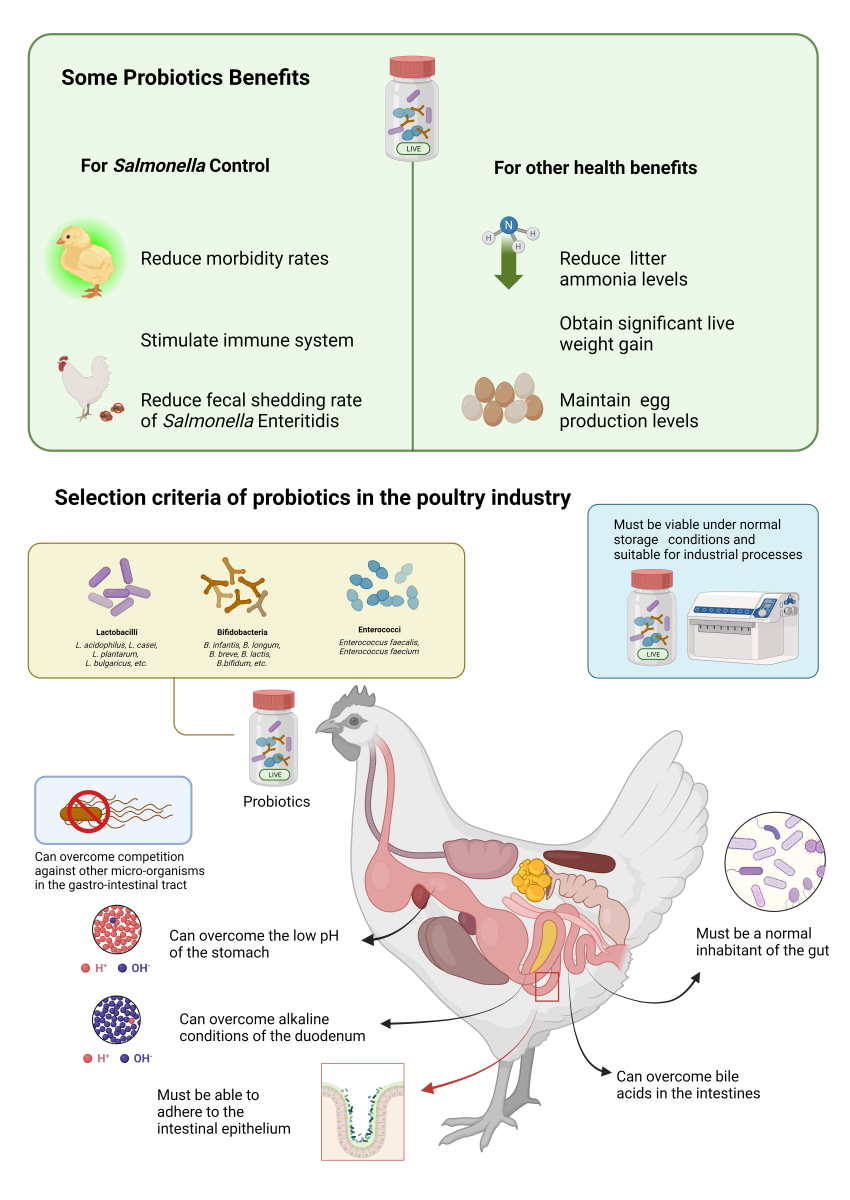
To be more specific for poultry applications, the selection of probiotics for poultry health demands careful consideration of several key factors to ensure their effectiveness in promoting the well-being of birds and enhancing overall production. Firstly, it is crucial that the chosen probiotics should be derived from specific poultry gut environment, as they are more likely to survive and thrive in the intestinal tract. In addition, practical considerations of probiotics include the ability to store and transport under typical storage conditions. The selection of probiotics must also include its suitability for large-scale industrial processes, with probiotics needing to be cost-effective for poultry farmers.42 The criteria for selecting probiotics for poultry can be conveniently summarized in Table 2 and illustrated in Figure 1.
In general, the application of diverse probiotics offers multiple advantages to the poultry industry, beyond focusing on Salmonella infections, which will be explored further in the subsequent discussion. Table 3 compiles various studies explaining benefits of probiotics in poultry industry.
Probiotics Mechanisms to Prevent and Control Salmonellosis
The most important scientific question regarding the use of probiotics in medicine is to identify the mechanisms by which they impact health. Although several mechanisms have been proposed, most of them have not been experimentally proven.51 Most of the main mechanisms of probiotics discussed is for human gastrointestinal but it is speculated that similar mechanisms occurring in poultry health.
The potential mechanisms through which probiotics aid in the prevention and control of Salmonella infections include:
- (1)
- Competition for nutrients: Probiotics could sequester essential nutrients resulting in invading pathogens could not colonizing. Probiotics like E. coli Nissle 1917 can diminish Salmonella Typhimurium’s colonization in intestines by competing for iron, a crucial but limited nutrient necessary for Salmonella Typhimurium’s growth.52
- (2)
- Production of antimicrobial conditions and compounds: Lactic acid bacteria can produce antimicrobial substances, e.g., lactic acid, hydrogen peroxide, and bacteriocins.53 Production of organic acid may lower pH which cause an unfavorable environment for pathogen colonization.51,54,55
- (3)
- Blocking of adhesion sites: When probiotics, for example Lactobacilli, are ingested, they adhere to intestinal mucosa, competing for binding sites. Therefore, less binding sites are available pathogens which make pathogens leave the body soon before they can colonize.56
- (4)
- Immunomodulation: Probiotics can stimulate both adaptive (specific) and innate (nonspecific) immunity. When they colonized in the gut, they activate lymphocytes and mature the humoral immune mechanisms, especially the circulation of IgA and IgM secreting cells.56
As non-typhoid salmonellosis usually causes asymptomatic in poultry, it is crucial to prevent the proliferation to eggs, chicks, other poultry, humans, other animals, and the environment. The commonly used probiotics as a supplementation in poultry industry include several species of Bifidobacterium, Lactobacillus, and Bacillus, Enterococcus and Pediococcus.57 In the following findings as shown in Table 4, some probiotics have been employed for Salmonella infections prevention and control in poultry.
Challenges and Limitations of the Usage of Probiotics in Poultry Production
In Thailand, Chaiyawan et al.62 reported that the utilization of spore-based probiotics in poultry production remains limited due to inconsistent efficiency observed across various farms. It is worth mentioning that the spore probiotics available for use in commercial poultry farming are typically derived from laboratory strains or exogenous strains of Bacillus sp. Consequently, the widespread adoption of spore-based probiotic products in the Thai poultry farming industry has not been readily embraced. Moreover, Yaqoob et al.63 explained in their recent review article about the inconsistency in results on effectiveness of probiotics. They found that both biotic and abiotic factors are crucial on the effectiveness. Thus, further studies are needed to investigate the specific mechanisms of those factor on how probiotic interacts with both biotic and abiotic factors of the host. The other important aspect is the mode of delivery, i.e., how the probiotic is administered, because different delivery methods may affect the efficacy of the probiotic. Krysiak et al.64 explained that probiotic is usually prepared in single species in European market. However, non-European markets use multispecies probiotics of undefined composition. Consequently, the study of the occurrence of synergism between various bacterial strains is needed to be fully understood. Another challenge that is to be concerned is probiotic viability during feed manufacturing which involves high temperatures, high pressure and intensive mechanically sheer.65,66 Further research is still needed to fully understand the potential of probiotics in poultry production and to ensure their safety and effectiveness.
Acknowledgments
I would like to express my sincere gratitude to Associate Prof. Dr. Supapon Cheevadhanarak, Assistant Prof. Tanu Pinyopummintr, D.V.M., Ph.D., Pawiya Pupa, D.V.M., Ph.D. for their reviews and constructive comments.
References
- Steinmuller N, Demma L, Bender JB, Eidson M, Angulo FJ. Outbreaks of enteric disease associated with animal contact: not just a foodborne problem anymore. Clin Infect Dis Off Publ Infect Dis Soc Am. 2006;43(12):1596-1602. [CrossRef]
- Sørum H, Sunde M. Resistance to antibiotics in the normal flora of animals. Vet Res. 2001;32(3-4):227-241. [CrossRef]
- Muaz K, Riaz M, Akhtar S, Park S, Ismail A. Antibiotic Residues in Chicken Meat: Global Prevalence, Threats, and Decontamination Strategies: A Review. J Food Prot. 2018;81(4):619-627. [CrossRef]
- Alloui MN, Szczurek W, Świątkiewicz S. The Usefulness of Prebiotics and Probiotics in Modern Poultry Nutrition: a Review / Przydatność prebiotyków i probiotyków w nowoczesnym żywieniu drobiu – przegląd. Ann Anim Sci. 2013;13(1):17-32. [CrossRef]
- Ashraf R, Shah N. Antibiotic resistance of probiotic organisms and safety of probiotic dairy products. Int Food Res J. 2011;18:837-853.
- Food and Drug Administration, HHS. Prevention of Salmonella enteritidis in shell eggs during production, storage, and transportation. Final rule. Fed Regist. 2009;74(130):33029-33101.
- Pijnacker R, Dallman TJ, Tijsma ASL, et al. An international outbreak of Salmonella enterica serotype Enteritidis linked to eggs from Poland: a microbiological and epidemiological study. Lancet Infect Dis. 2019;19(7):778-786. [CrossRef]
- Popa GL, Papa MI. Salmonella spp. infection - a continuous threat worldwide. Germs. 2021;11(1):88-96. [CrossRef]
- Chaves Hernández AJ. Poultry and Avian Diseases. In: Van Alfen NK, ed. Encyclopedia of Agriculture and Food Systems. Academic Press; 2014:504-520. [CrossRef]
- Löfström C, Hansen T, Maurischat S, Malorny B. Salmonella: Salmonellosis. In: Caballero B, Finglas PM, Toldrá F, eds. Encyclopedia of Food and Health. Academic Press; 2016:701-705. [CrossRef]
- Saif YM. Diseases of Poultry. 12th ed. Blackwell publ; 2008.
- Sanyal D, Douglas T, Roberts R. Salmonella infection acquired from reptilian pets. Arch Dis Child. 1997;77(4):345-346. [CrossRef]
- Sato G, Adler HE. Bacteriological and Serological Observations on Turkeys Naturally Infected with Arizona 7:1,7,8. Avian Dis. 1966;10(3):291-295. [CrossRef]
- Bäumler AJ, Hargis BM, Tsolis RM. Tracing the origins of Salmonella outbreaks. Science. 2000;287(5450):50-52. [CrossRef]
- Shivaprasad HL, Timoney JF, Morales S, Lucio B, Baker RC. Pathogenesis of Salmonella enteritidis Infection in Laying Chickens. I. Studies on Egg Transmission, Clinical Signs, Fecal Shedding, and Serologic Responses. Avian Dis. 1990;34(3):548-557. [CrossRef]
- Transmission of Salmonella between wildlife and meat-production animals in Denmark | Journal of Applied Microbiology | Oxford Academic. Available online: https://academic.oup.com/jambio/article-abstract/105/5/1558/6720211 (accessed on 5 August 2023).
- Rabsch W, Andrews HL, Kingsley RA, et al. Salmonella enterica Serotype Typhimurium and Its Host-Adapted Variants. Infect Immun. 2002;70(5):2249-2255. [CrossRef]
- OzFoodNet Working Group. Monitoring the Incidence and Causes of Diseases Potentially Transmitted by Food in Australia: Annual Report of the OzFoodNet Network, 2008. Commun Dis Intell Q Rep. 2020;33(4):389-413.
- Salmonella in poultry - SVA. Available online: https://www.sva.se/en/what-we-do/feed-safety/general-facts-about-salmonella/salmonella-in-poultry/ (accessed on 29 July 2023).
- Ramtahal MA, Amoako DG, Akebe ALK, Somboro AM, Bester LA, Essack SY. A Public Health Insight into Salmonella in Poultry in Africa: A Review of the Past Decade: 2010–2020. Microb Drug Resist. 2022;28(6):710-733. [CrossRef]
- Calenge F, Kaiser P, Vignal A, Beaumont C. Genetic control of resistance to salmonellosis and to Salmonella carrier-state in fowl: a review. Genet Sel Evol. 2010;42(1):11. [CrossRef]
- Gast RK, Holt PS. Persistence of Salmonella enteritidis from one day of age until maturity in experimentally infected layer chickens. Poult Sci. 1998;77(12):1759-1762. [CrossRef]
- Rose N, Beaudeau F, Drouin P, Toux JY, Rose V, Colin P. Risk factors for Salmonella enterica subsp. enterica contamination in French broiler-chicken flocks at the end of the rearing period. Prev Vet Med. 1999;39(4):265-277. [CrossRef]
- Henken AM, Frankena K, Goelema JO, Graat EAM, Noordhuizen JPTM. Multivariate Epidemiological Approach to Salmonellosis in Broiler Breeder Flocks. Poult Sci. 1992;71(5):838-843. [CrossRef]
- Angen Ø, Skov MN, Chriél M, Agger JF, Bisgaard M. A retrospective study on salmonella infection in Danish broiler flocks. Prev Vet Med. 1996;26(3):223-237. [CrossRef]
- Baggesen DL, Olsen JE, Bisgaard M. Plasmid profiles and phage types of Salmonella typhimurium isolated from successive flocks of chickens on three parent stock farms. Avian Pathol J WVPA. 1992;21(4):569-579. [CrossRef]
- Mares M. Current Topics in Salmonella and Salmonellosis. BoD – Books on Demand; 2017.
- Gast RK, Beard CW. Detection and Enumeration of Salmonella enteritidis in Fresh and Stored Eggs Laid by Experimentally Infected Hens. J Food Prot. 1992;55(3):152-156. [CrossRef]
- Salmonella. UNL Food. Published August 13, 2015. Available online: https://food.unl.edu/salmonella (accessed on 30 July 2023).
- Zamora-Sanabria R, Alvarado AM, Zamora-Sanabria R, Alvarado AM. Preharvest Salmonella Risk Contamination and the Control Strategies. In: Current Topics in Salmonella and Salmonellosis. IntechOpen; 2017. [CrossRef]
- Mathew AG, Liamthong S, Lin J, Hong Y. Evidence of class 1 integron transfer between Escherichia coli and Salmonella spp. on livestock farms. Foodborne Pathog Dis. 2009;6(8):959-964. [CrossRef]
- Castanon JIR. History of the use of antibiotic as growth promoters in European poultry feeds. Poult Sci. 2007;86(11):2466-2471. [CrossRef]
- Salmonellosis, S. Enteritidis and S. Typhimurium infections. Available online: https://www.thepoultrysite.com/disease-guide/salmonellosis-s-enteritidis-and-s-typhimurium-infections (accessed on 2 August 2023).
- Goetting V, Lee KA, ℡l LA. Pharmacokinetics of veterinary drugs in laying hens and residues in eggs: a review of the literature. J Vet Pharmacol Ther. 2011;34(6):521-556. [CrossRef]
- Noenchat P, Direksin K, Sornplang P. The phenotypic and genotypic antimicrobial resistance patterns of Salmonella isolated from chickens and meat at poultry slaughterhouses in Japan and Thailand. Vet World. 2023;16(7):1527-1533. [CrossRef]
- Global burden of bacterial antimicrobial resistance in 2019: a systematic analysis - The Lancet. Available online: https://www.thelancet.com/journals/lancet/article/PIIS0140-6736(21)02724-0/fulltext (accessed on 8 October 2023).
- Schrezenmeir J, de Vrese M. Probiotics, prebiotics, and synbiotics—approaching a definition123. Am J Clin Nutr. 2001;73(2):361s-364s. [CrossRef]
- Lilly DM, Stillwell RH. Probiotics: Growth-Promoting Factors Produced by Microorganisms. Science. 1965;147(3659):747-748. [CrossRef]
- Marteau P, Cuillerier E, Meance S, et al. Bifidobacterium animalis strain DN-173 010 shortens the colonic transit time in healthy women: a double-blind, randomized, controlled study. Aliment Pharmacol Ther. 2002;16(3):587-593. [CrossRef]
- Howarth GS, Wang H. Role of Endogenous Microbiota, Probiotics and Their Biological Products in Human Health. Nutrients. 2013;5(1):58-81. [CrossRef]
- Vimala Y, Kumar PD. Some aspects of probiotics. Indian J Microbiol. 2006;46:1-7.
- Ramlucken U, Ramchuran SO, Moonsamy G, Jansen van Rensburg C, Thantsha MS, Lalloo R. Production and stability of a multi-strain Bacillus based probiotic product for commercial use in poultry. Biotechnol Rep. 2021;29:e00575. [CrossRef]
- Kabir SML. The Role of Probiotics in the Poultry Industry. Int J Mol Sci. 2009;10(8):3531-3546. [CrossRef]
- Nurmi EV, Schneitz JE, Makela PH. Process for the production of a bacterial preparation for the prophylaxis of intestinal disturbances in poultry. Published online August 25, 1987. Available online: https://patents.google.com/patent/US4689226A/en (accessed on 28 July 2023).
- Distribution of pathogen inhibition in the Lactobacillus isolates of a commercial probiotic consortium - Chateau - 1993 - Journal of Applied Bacteriology - Wiley Online Library. Available online: https://ami-journals.onlinelibrary.wiley.com/doi/abs/10.1111/j.1365-2672.1993.tb02993.x (accessed on 28 July 2023).
- Watkins BA, Miller BF, Neil DH. In Vivo Inhibitory Effects of Lactobacillus acidophilus Against Pathogenic Escherichia coli in Gnotobiotic Chicks1. Poult Sci. 1982;61(7):1298-1308. [CrossRef]
- The Dynamics of Probiotics on Growth Performance and Immune Response in Broilers. [CrossRef]
- Peralta-Sánchez JM, Martín-Platero AM, Ariza-Romero JJ, et al. Egg Production in Poultry Farming Is Improved by Probiotic Bacteria. Front Microbiol. 2019;10. Available online: https://www.frontiersin.org/articles/10.3389/fmicb.2019.01042 (accessed on 1 August 2023).
- Chiang SH, Hsieh WM. Effect of direct-fed microorganisms on broiler growth performance and litter ammonia level. Asian-Australas J Anim Sci. 1995;8(2):159-162.
- Zammit VA, Park SO. Impact of the Combination of Probiotics and Digital Poultry System on Behavior, Welfare Parameters, and Growth Performance in Broiler Chicken. Microorganisms. 2023;11(9):2345. [CrossRef]
- Britton RA, Versalovic J. Probiotics and Gastrointestinal Infections. Interdiscip Perspect Infect Dis. 2009;2008:e290769. [CrossRef]
- Deriu E, Liu JZ, Pezeshki M, et al. Probiotic Bacteria Reduce Salmonella Typhimurium Intestinal Colonization by Competing for Iron. Cell Host Microbe. 2013;14(1):26-37. [CrossRef]
- Mishra C, Lambert J. Production of anti-microbial substances by probiotics. Asia Pac J Clin Nutr. 1996;5(1):20-24.
- Sherman PM, Ossa JC, Johnson-Henry K. Unraveling Mechanisms of Action of Probiotics. Nutr Clin Pract. 2009;24(1):10-14. [CrossRef]
- Abd El-Hack ME, Abdelnour SA, Taha AE, et al. Herbs as thermoregulatory agents in poultry: An overview. Sci Total Environ. 2020;703:134399. [CrossRef]
- FUNCTIONAL MECHANISMS OF PROBIOTICS | Journal of microbiology, biotechnology and food sciences. Available online: https://office2.jmbfs.org/index.php/JMBFS/article/view/8188 (accessed on 1 August 2023).
- Ruvalcaba-Gómez JM, Villagrán Z, Valdez-Alarcón JJ, et al. Non-Antibiotics Strategies to Control Salmonella Infection in Poultry. Anim Open Access J MDPI. 2022;12(1):102. [CrossRef]
- Kizerwetter-Swida M, Binek M. Protective effect of potentially probiotic Lactobacillus strain on infection with pathogenic bacteria in chickens. Pol J Vet Sci. 2009;12(1):15-20.
- El-Ghany WAA, El-Shafii SSA, Hatem ME, Dawood RE. A Trial to Prevent Salmonella Enteritidis Infection in Broiler Chickens Using Autogenous Bacterin Compared with Probiotic Preparation. J Agric Sci. 2012;4(5):p91. [CrossRef]
- Effect of a Multi-Species Probiotic on the Colonisation of Salmonella in Broilers | SpringerLink. Available online: https://link.springer.com/article/10.1007/s12602-019-09593-y (accessed on 1 August 2023).
- El-Sharkawy H, Tahoun A, Rizk AM, et al. Evaluation of Bifidobacteria and Lactobacillus Probiotics as Alternative Therapy for Salmonella typhimurium Infection in Broiler Chickens. Animals. 2020;10(6):1023. [CrossRef]
- Chaiyawan N, Taveeteptaikul P, Wannissorn B, et al. Characterization and Probiotic Properties of Bacillus Strains Isolated from Broiler. Thai J Vet Med. 2010;40(2):207-214.
- Yaqoob MU, Wang G, Wang M. An updated review on probiotics as an alternative of antibiotics in poultry — A review. Anim Biosci. 2022;35(8):1109-1120. [CrossRef]
- Krysiak K, Konkol D, Korczyński M. Overview of the Use of Probiotics in Poultry Production. Anim Open Access J MDPI. 2021;11(6):1620. [CrossRef]
- Cutlip SE, Hott JM, Buchanan NP, Rack AL, Latshaw JD, Moritz JS. The Effect of Steam-Conditioning Practices on Pellet Quality and Growing Broiler Nutritional Value. J Appl Poult Res. 2008;17(2):249-261. [CrossRef]
- Rakshit S. Microbial and Processing Criteria for Production of Probiotics: A Review. Food Technol Biotechnol. Published online January 1, 2006. Available online: https://www.academia.edu/72790604/Microbial_and_Processing_Criteria_for_Production_of_Probiotics_A_Review (accessed on 8 October 2023).
Figure 1.
Illustration of selection criteria of probiotics in the poultry industry 43–45 (Created with BioRender.com).
Figure 1.
Illustration of selection criteria of probiotics in the poultry industry 43–45 (Created with BioRender.com).


Table 1.
Properties of microorganisms to be considered as probiotics 41.
| Properties of microorganisms |
|---|
| Generally Recognized as Safe (GRAS) |
| Bile, hydrochloric acid and pancreatic juice resistance |
| Anti-carcinogenic properties |
| Stimulate immune system |
| Intestinal permeability reduction |
| Lactic acid production |
| Resistance to acidic conditions of the stomach |
| Resistance to alkaline conditions of the duodenum |
Table 2.
Selection criteria of probiotics in the poultry industry 43–45.
| Properties of microorganisms |
|---|
| Must be a normal inhabitant of the gut |
| Must be able to adhere to the intestinal epithelium |
| Can overcome the low pH of the stomach |
| Can overcome the presence of bile acids in the intestines |
| Can overcome competition against other micro-organisms in the gastro-intestinal tract |
| Must be viable under normal storage conditions and suitable for industrial processes |
| Must be cost effective to use for farm animals |
Table 3.
Examples of various studies explaining benefits of probiotics in poultry industry.
| Probiotic strains | Categories of chicks | Starting age for administration | Administration | Benefits | Ref. |
|---|---|---|---|---|---|
| Lactobacillus acidophilus | Gnotobiotic chicks | 2 days old | Inoculation 108-109 organism/ml. |
Decreased mortality from 100% to 0% when challenged with pathogenic Escherichia coli. | 46 |
| Protexin® Boost Lactobacillus plantarum, Lactobacillus bulgaricus, Lactobacillus acidophilus, Lactobacillus rhamnosus, Bifidobacterium bifidum, Streptococcus thermophilus, Enterococcus faecium, Aspergillus oryzae, and Candida pintolopessi |
Broiler chicks | 1 day old | Added to drinking water 2gm of Protexin® Boost/10 liters water | Significant live weight gain, high carcass yield, high breast and leg weight and high antibody production |
47 |
| Enterococcus faecalis UGRA10 | Laying hens | 16 weeks old | Fodder diet with the bacterium E. faecalis UGRA10 108 CFU/g of fodder | Maintained egg production levels | 48 |
|
Lactobacillus acidophilus, Bacillus subtilis, Streptococcus faecium |
Broilers | 1 day old | Added to diet varied from 0-1 g probiotic2/kg feed for the first 3 wks and 0-0.5 g probiotic2/kg feed for wk 4 to wk 6 | Reduced litter ammonia levels | 49 |
|
Bacillus subtillus, Streptomyces galilaeus, and Sphingobacteriaceae |
Broilers | 1 day old | 3.5 × 10⁸ CFU/g of each strain | Improved growth performance and behavioral welfare | 50 |
Table 4.
Some probiotics for Salmonella infections prevention and control in poultry.
| Categories of chicks | Age | Probiotics | Administration | Challengedpathogen | Results | Ref. |
|---|---|---|---|---|---|---|
| Broiler | Lactobacillus salivarius strain 3d (isolated from chicken feces) | Orally 108 CFU / 100fl of Phosphate Buffered Saline. one day before with selected pathogenic bacteria |
Salmonella Enteritidis, Clostridium perfringens and Campylobacter jejuni. |
Lower salmonella in caecal content after infection compared to control group and no Salmonella detection after 7 days. | 58 | |
| Broiler chicks | 1 day old |
Lactobacillus acidophilus, Enterococcus faecium, Lactobacillus plantarum and Lactobacillus casei |
Added in drinking water for 5 consecutive days in a dose of 1gm/4 liter of the drinking water |
Salmonella Enteritidis | Significantly lower morbidity rates, fecal shedding rate of Salmonella Enteritidis, and re-isolation rate of Salmonella Enteritidis from different organs | 59 |
| Broiler chickens | newly hatched | Lactobacillus crispatus, Lactobacillus salivarius, Lactobacillus gallinarum, Lactobacillus johnsonii, Enterococcus faecalis and Bacillus amyloliquefaciens. | Added in feed 2.0 × 10¹⁰ to 8.9 × 10¹⁰ CFU per kg feed | Salmonella Enteritidis A9 | Reduced Salmonella Enteritidis A9 in ceca: detected 95% of broilers on day 14 and 55% on day 28. Stimulated immune system |
60 |
| Broiler chicks | 1 day old | Lacticaseibacillus casei, Bifidobacterium breve, Bifidobacterium longum and Bifidobacterium infantis. | Oral inoculation 2 × 10⁹ CFU from each probiotic bacterium |
Salmonella typhimurium | Prevention of the detrimental effects of acquired Salmonella infection by B. breve, L. casei and B. infantis, An ability to bind to intestinal cells in vitro, Reduction of Salmonella typhimurium recovery from the cecal tonsils in vivo. | 61 |
Disclaimer/Publisher’s Note: The statements, opinions and data contained in all publications are solely those of the individual author(s) and contributor(s) and not of MDPI and/or the editor(s). MDPI and/or the editor(s) disclaim responsibility for any injury to people or property resulting from any ideas, methods, instructions or products referred to in the content. |
© 2023 by the author. Licensee MDPI, Basel, Switzerland. This article is an open access article distributed under the terms and conditions of the Creative Commons Attribution (CC BY) license (https://creativecommons.org/licenses/by/4.0/).
Copyright: This open access article is published under a Creative Commons CC BY 4.0 license, which permit the free download, distribution, and reuse, provided that the author and preprint are cited in any reuse.


