

Submitted:
04 October 2023
Posted:
04 October 2023
You are already at the latest version
Abstract
Taiwan’s Chi Mei Medical Center has a vision of becoming a sustainable organization. They found they violated the sustainable development goal (SDG) 13 (“Climate Action”) since its workflows consume excessive tangible resources and waste much operation time. To fulfill the vision, the Chi Mei Medical Center first introduced electronic invoicing. Implementing this electronic invoicing included adopting cloud E-invoice data and creating a software robot for auditing them. This study presents this software robot and its contributions. The software robot replaces an internal auditor to log into Taiwan’s E-invoice platform, download cloud E-invoice data, and detect the inconsistency between these cloud and on-premise data. Internal auditors of the Chi Mei Medical Center only needed to confirm the detection results. They welcome this software robot since it significantly reduces their work burdens. They approved more software robots for assisting other workflows. Besides, the Chi Mei Medical Center earned profits after eliminating paper invoices. This elimination helped release less carbon. This study concludes that chasing a sustainable organization is unnecessarily equivalent to the requirement of more costs. A software robot represents the last puzzle for constructing a paperless workflow since it can resolve the resistance of existing workers to a new workflow.
Keywords:
SDG 13
; electronic invoicing
; software robot
; paperless workflow
; cloud E-invoice data
1. Introduction
Taiwan’s Chi Mei Medical Center is famous in southern Taiwan; nevertheless, it has suffered from insufficient or uneconomic workflows. Implementing these workflows wastes excessive tangible resources and operation time. For example, its internal auditors audited massive paper invoices to detect fraud each month. An example of fraud is undeclared invoices. The Chi Mei Medical Center paid money according to these invoices. Undeclared invoices may imply tax evasion problems.
The Chi Mei Medical Center has a vision of becoming a sustainable organization. Consequently, the Chi Mei Medical Center's executives have tried to revise its inefficient or uneconomic workflows to pursue SDG 13. It implemented electronic invoicing as its first trial. In Taiwan, uploading each E-invoice to Taiwan's E-invoice platform [1] is necessary. Although this upload may be immediate or periodic, we may employ an E-invoice platform to detect fraud. The clues of this fraud may lie in the inconsistency between cloud E-invoice and on-premise data.
However, browsing Taiwan's E-invoice platform to detect inconsistencies between cloud E-invoice and on-premise data costs a lot of time. It is easy to expect that internal auditors of the Chi Mei Medical Center will refuse to browse excessive cloud E-invoice data on Taiwan's E-invoice platform. This brow is uninteresting and repetitive. Besides, any commercial Enterprise Resources Planning (ERP) or Accounting Information Systems (AIS) does not have the function of connecting Taiwan's E-invoice platform since this website is unique.
We may employ recent bot creators such as UiPath to create software robots for automating the browsing of Taiwan’s E-invoice platform. The IEEE Standard Association [2] defines a software robot as “A preconfigured software instance that uses business rules and predefined activity choreography to complete the autonomous execution of a combination of processes, activities, transactions, and tasks in one or more unrelated software systems to deliver a result of service with human exception management.” A software robot may reproduce the work that humans do. It may be called a software robot or a bot.
Unlike other programming languages, employing a bot creator is easy enough to let auditors create a software bot themselves. The resulting software robot can automatically log in to Taiwan’s E-invoice platform, download cloud E-invoice data, and detect inconsistencies between cloud E-invoice and on-premise data. The resulting software robot can operate when auditors get off their work. Auditors will welcome it since their remaining work only confirms the resulting inconsistency. However, existing bots for automating an audit process were few. The Chi Mei Medical Center had no choice but to create its software robots for automating the audit of cloud E-invoice data.
This study contributes to the presentation that a software robot may be the last puzzle for constructing workflows for achieving SDG 13. To chase SDG 13, an organization builds new workflows. It is easy to expect some of its employees will resist these new workflows. Automating new workflows using software robots may resolve the resistance. The Chi Mei Medical Center has provided valuable experience in removing the resistance of its internal auditors to the audit of cloud E-invoice data.
The remainder of this study contains five sections. Section 2 presents literature relevant to this study. Section 3 illustrates how the Chi Mei Medical Center implemented electronic invoicing. Section 4 shows the effects of implementing this electronic invoicing. Based on this section, Section 5 presents some discussions. Section 6 offers the conclusion of this study.
2. Literature Review
The global consumption of paper and paperboard totaled 408 million tons in 2021 [3]. Printing and writing papers were the second most in-demand end-use, with a total global demand of 85 million tons. The Chi Mei Medical Center can consume less printing and writing papers and thus support SDG 13. Greenwood [4] and Chao [5] have concluded the reasons that promote a paperless workflow:
- We used papers on-site and cannot access them from a distance.
- Papers occupy spaces. They go against archiving and storage.
- Delivering paper documents requires external actions.
- Copying a paper document is necessary for multiple readers.
- Due to the definitive displacement of the information on top of the paper, paper documents can’t be quickly revised, reformatted, and merged with other documents.
- Replicating a paper document needs external technology such as photocopiers and scanners.
- Paper documents can only retain static information (wording or images).
- Paper-based systems are less safe since several risks of destruction may destroy them.
A paperless workflow requires emerging information technologies such as servers and robotic process automation. Some other studies have presented the positive impacts of these emerging information technologies on sustainability. For example, Elliot [6] demonstrated that suitable design, production, applications, and deployment of information technologies cause human behaviors to impact sustainability positively. Luthando, et al. [7] inspected a paperless office environment’s positive influence on sustainability. Hafiz and Farid [8] employed a profit model and a cost-benefit analysis to evaluate the benefits of implementing paperless workflows. Oliveira et al. [9] presented the positive impacts on companies. These impacts include profitability, cost reduction, and contribution to environmental sustainability.
Nevertheless, we can expect that deploying a paperless workflow has challenges and barriers. Implementing a paperless workflow relies on digital records; however, cybernetic attacks may occur in employing these digital records (Cumming and Findlay [10]). Meanwhile, we can expect that creating a paperless workflow may be against some existing regulations. Luthando, et al. [7] found that employees may complain about a new paperless workflow's slow responses and errors. Liang et al. [11] concluded that a company should change before implementing a new paperless workflow; nevertheless, this transformation may fail to fit the varied market circumstances when mismanagement appears. Deng et al. [12] concluded internal motivations can affect adopting a paperless workflow. These motivations include top management support, greening the organization's culture, and strategic intent.
The Chi Mei Medical Center created a software robot to automate the audit of cloud E-invoice data. A software robot containing features such as artificial intelligence and management tools can be applicable for accounting, taxation, human resources, and regulatory purposes [13,14,15]. Hsu [16] reported that software robots could help financial departments improve operation efficiency. Tseng [15] conducted a questionnaire survey among financial accounting personnel in different industries and ages, intending to investigate their understanding of software robots and their recognition of the benefits of introducing bots. He documented that financial accounting departments should carry out self-assessments to review their current workflows and whether their human resources and information facilities can support the application of software robots. Furthermore, Tseng (2020) indicated that personnel training and facility arrangements were the key to successfully developing and deploying bots.
3. Electronic invoicing
The Chi Mei Medical Center now has 13 administrative departments, including the Human Resources Department, the Accounting Office, and the Resources Office. The Accounting Office is responsible for accounting and audit systems. The accounting system creates the issuance of notes for incoming and outgoing, processes accounting affairs, and compiles financial statements. The audit system reviews incoming and outgoing accounting of all branches and accounts and collects receivables. To eliminate papers, improve the correctness and speed of operations, and meet SDG 13, executives of the Chi Mei Medical Center established a cross-department digital transition team. The first job of this team was integrating the Director's Office, the Business Administration Department, the Materials Office, the Information Office, the Accounting Department, the Cashier Division, and the Pharmacy Department to introduce electronic invoicing in placing an order. They identified that placing an order has four steps:
- Manufacturers of this order issue payment invoices. These invoices may be hand-written or hard copies of E-invoices. Figure 1 exemplifies a hard copy of an E-invoice.
- The Account Office of the Chi Mei Medical Center stores order information in its ERP or AIS system.
- If manufacturers are authorized traders of Taiwan's E-invoice platform, they should upload E-invoice data to this website. This upload may be immediate or periodical.
- Internal auditors of the Chi Mei Medical Center review the consistency between invoices from manufacturers and its accounting data. This review of invoices may be one-by-one or in batches. In reviewing a hard copy of an E-invoice, an internal auditor can scan its QR code to browse E-invoice on Taiwan's E-invoice platform. If an audited invoice is paper-based, internal auditors have no choice but to use their eyes to audit this paper invoice.
The Chi Mei Medical Center knew that the last step was the bottleneck in invoicing. Even if hard copies of E-invoices were adopted, browsing Taiwan's E-invoice platform to detect the inconsistency between cloud and on-premise data was still time-consuming. They may print cloud and on-premise data to facilitate the detection of inconsistency; accordingly, this printing violated SDG 13. Therefore, the Chi Mei Medical Center adopted UiPath to create a software robot to automate the step of detecting the inconsistency between cloud E-invoice and on-premise data. Figure 2 illustrates the resulting software robot. This bot automatically logs in to Taiwan's E-invoice platform and imports cloud E-invoice data into an Excel file. It can wait for new E-invoice data and import cloud E-invoice data into an Excel file. Detecting the inconsistency between cloud E-invoice and on-premise data is next implemented in this Excel file. A separate module was employed to output the inconsistency. Internal auditors only need to confirm these outputs.
Taiwan’s E-invoice platform and the software robot shown in Figure 2 can eliminate the need for paper invoices or hard copies of E-invoices. Manufacturers only exchange E-invoice data with the Chi Mei Medical Center. It has a genuinely paperless electronic invoicing workflow.
3. Results
The Chi Mei Medical Center had more confidence in a software robot since it was a young information technology. Therefore, they measured the average time in completing its conventional audit of paper invoices or hard copies of E-invoices at its three branches between October 2020 and January 2021. This average time is equal to
Comparing the results of Equation (1) with the average time spent to audit cloud E-invoice data using the proposed bot is next inspected.
Figure 1(a)-1(b) denote the remote cause for introducing electronic invoicing to achieve SDG 13. In these two figures, the Chi Mei Medical Center checks the total number of paper invoices and hard copies of E-invoices between October 2020 and January 2022. Its internal auditors may audit invoices one by one or in batches.
Observing Figure 1(a)-1(b) finds that hard copies of E-invoices increased gradually. Summing data points in these two figures reveals that the Chi Mei Medical Center audited 114214 invoices in batches and 11374 invoices one by one. If these invoices can be paperless, we can save approximately 2.66 tons of carbon [17]. This result indicated that Chi Mei Medical Center has the potential to become a sustainable organization.
Furthermore, the executives of the Chi Mei Medical Center asked its internal auditors to sample some orders and measure the average time spent to audit invoices of these orders one by one. Placing the orders employs paper invoices or hard copies of E-invoices. Figure 4(a)-4(c) show the results. These results serve as a benchmark for preliminarily evaluating the effects of electronic invoicing. Generating Figure 4(a)-4(c) were completed at three branches of Chi Mei Medical Center from May 28, 2021, to Nov 4, 2021.
Even if the Chi Mei Medical Center just changed to replace some paper invoices with hard copies of E-invoices, Figure 4(a)-4(c) demonstrate that auditing invoices one by one has been more efficient. In Figure 4(b), blue points generated with hard copies of E-invoices are below red points. These red points represent the conventional use of paper invoices. To internal auditors, the burden of auditing paper invoices was heavy. The average time spent to audit per paper invoice is about or above 1 minute. If the internal auditors of the Chi Mei Medical Center were few, they may need quite a while to audit over 1000 paper invoices one by one.
Nevertheless, Figure 4(a)-4(c) contain too few data points. For example, observing Figure 4(a) and 4(c) can find two blue points in these figures. Therefore, we still further classify the scientific soundness of introducing electronic invoicing. Besides, employing hard copies of E-invoices does not help achieve SDG 13. The Chi Mei Medical Center still uses excessive paper.
Executives of the Chi Mei Medical Center also thought that Figure 4(a)-4(c) were insufficient to conclude the benefits of electronic invoicing. They desired more evidences. Therefore, the Chi Mei Medical Center experimented to audit invoices in batch at its YongKang branch with paper invoices, hard copies of E-invoices, and cloud E-invoice data. The software robot shown in Figure 2 was employed to audit cloud E-invoice data. The experiment time was between 10/18/2021 and 2/8/2021. For approaching the real working condition as close as possible, internal auditors of this YongKang branch may audit paper invoices, hard copies of E-invoices, and cloud E-invoice data simultaneously. Note that some manufacturers are old, they still use paper invoices. Figure 5(a)-5(b) show the results.
Blue data points in Figure 5(a) represent that replacing some paper invoices or hard copies of E-invoices with cloud E-invoice data improves the average time spent to audit invoices. Figure 5(b) shows the total number of audited invoices increased after introducing electronic invoicing. Suppose all manufacturers linked to the Chi Mei Medical Center can be authorized traders of Taiwan’s E-invoice platform. They can release less carbon to achieve SDG 13 but audit more invoices.
Figure 6(a)-6(c) and Take 1 ensure that cloud E-invoice data and the proposed software robot reach the Chi Mei Medical Center’s objective of paperless electronic invoicing. In Figure 6(a)-6(c), three branches of Chi Mei Medical demonstrated that saving operation time is possible if cloud E-invoice data and the proposed bot are adopted. Table 1 records that the Chi Mei Medical Center eliminated 9148 paper invoices in invoicing. This elimination implies that the Chi Mei Medical Center can consume 0.11 tons of carbon per month; nevertheless, saving this amount brings profits to the Chi Mei Medical Center. This result denotes the starting point of transferring the Chi Mei Medical Center into a sustainable organization.
One may suspect that Table 1 didn’t include computer usage, software fees, telecom charges, and electricity bills in operating the present software robot. Fortunately, the UiPath (the community version) is free. Running this software requires a usual computer. In Taiwan, internet fees are constant per month. Meanwhile, the electricity bills for employing the proposed software robot are negligible compared to the ordinary electricity bills of the Chi Mei Medical Center.
Internal auditors were satisfied with the new paperless electronic invoicing. One of the female internal auditors stated representative opinions of the proposed software robot:
「Oh! The software robot brings unexpected changes to my work. Now, I drink my bubble tea and wait for the outputs produced by the bot. My remaining work is confirming the results of this Excel file. That’s great!」
The above conversation implies that existing internal auditors welcome a software robot. The vice president of the Chi Mei Medical Center was also surprised by the influence brought by software robots. He can’t wait to see the application of other bots.
4. Discussion
We can obtain the following experiences from Section 4:
- It is unnecessary that constructing a sustainable organization doesn’t earn profits. The Chi Mei Medical Center made profits in the trial of introducing electronic invoicing for reaching SDG 13. Some organizations are afraid of chasing SDG 13 since they expect that the chase will result in additional costs. The Chi Mei Medical Center provided a counter-example. Introducing proper information technologies can help obtain profits in chasing SDG 13.
- A software robot may be the last puzzle for building a paperless workflow. We can quickly expect that existing workers of an organization will resist the promotion of a new workflow. Their resistance is always an essential problem in promoting a new workflow. A software robot can substitute for workers to complete repetitive tasks such as data retrieval from a website; thus, it reduces the burden on workers. Due to humanity, workers will welcome a new workflow supported by a software robot.
- A complete information infrastructure is vital to the chase of SDG 13. If Taiwan’s E-invoice platform is unavailable, auditing the inconsistency between cloud and on-premise E-invoice data is impossible. Nevertheless, a medical center can’t construct an E-invoice platform. A government should maintain similar websites. The government should have clear policies and define a complete information infrastructure in pursuing SDG 13.
- We recommend coding software robots to complement the missing features of an ERP or AIS system. The Chi Mei Medical Center has an ERP system; however, it selected to code a software robot to implement electronic invoicing. The Chi Mei Medical Center showed that bot programming is easy and inexpensive.
5. Conclusions
This study presents the full story about how the Chi Mei Medical Center implemented electronic invoicing for the vision of becoming a sustainable organization. In this electronic invoicing, the Chi Mei Medical Center employed a software robot to audit the inconsistency between cloud and on-premise E-invoice data. This software robot helped eliminating excessive paper invoices, earning some profits, and achieving SDG 13. Existing internal auditors of the Chi Mei Medical welcomed the software robot.
From the proposed story, we can conclude:
- Building a sustainable organization can earn profits. Some Taiwan’s organizations are anxious about the promotion of SDG 13 since it implies additional costs. The Chi Mei Medical Center demonstrated that releasing less carbon can gain profits.
- A software robot may be a necessary puzzle of a new workflow. It mitigates the resistance of existing workers to this new workflow.
- If an ETP or AIS system misses some features, complementing these missing features using software robots is a cheap and easy choice. Non-information workers can create a software robot by themselves.
Meanwhile, the current study still has some limitations. The Chi Mei Medical Center is a private organization. It is impossible to abandon all paper-based invoices. Therefore, the effects of adopting cloud E-inv
Author Contributions
Conceptualization, T.-J Zheng, J.-R. Cheng; methodology, J.-R. Cheng; software, J.-R. Cheng; validation, J.-R. Cheng; resources, Y.-L. Weng; data curation, Y.-F. Yang; writing—original draft preparation, Y.-F. Yang; writing—review and editing, G. Y. Sheu; visualization, G. Y. Sheu; supervision, T.-J Zheng; project administration, T.-J Zheng.
Funding
This research received no external funding.
Data Availability Statement
All the data in this article can be obtained from Y.-F. Yang or G. Y. Sheu.
Conflicts of Interest
The authors declare no conflict of interest.
References
- Taiwan’s E-invoice platform. Available online: https://www.einvoice.nat.gov.tw/ (accessed on 1/6/2023).
- IEEE Guide for Terms and Concepts in Intelligent Process Automation. IEEE Std 2755-2017, 2017, pp. 1-16.
- Paper and paperboard demand globally 2021-2032. Available online: https://www.statista.com/statistics/1089078/demand-paper-globally-until-2030/ (accessed on 16/8/2023).
- Greenwood, P. Securing information in a paper-efficient environment. Comput. Fraud. Secur. 2012, 2012, 3, pp. 18-20.
- Chao, C. Implementing a Paperless system for small and medium-sized businesses (SMBs). Available online: https://scholarsbank.uoregon.edu/xmlui/handle/1794/19630 (accessed on 16/8/2023).
- Elliot, S. Transdisciplinary Perspectives on Environmental Sustainability: A Resource Base and Framework for IT-Enabled Business Transformation. MIS Quart. 2011, 35(1), pp. 197-236.
- Luthando, T., Bongani S., Nkosinathi Z., Siphiwo L., Shairn H.-T., and Bruwer, J.-P. The influence of a paperless office environment on the sustainability of the Master of the High Court in Cape Town. Environ. Econ. 2016, 7(3), pp. 33-44.
- Hafiz I., Farid, A. Paperless campus: The real contribution towards a sustainable low carbon society. ISOR J. Environ. Sci., Toxicol. Food Technol. 2015, 9(8), pp. 10-17.
- Oliveira, J. , Azevedo, A. , Ferreira, J. J. , Gomes, S., and Lopes J. M. An insight on B2B firms in the age of digitalization and paperless processes. Sustainability 2021, 13, 11565.
- Cumming, K. and Findlay, C. Digital recordkeeping: Are we at a tipping point? Rec. Manag. J. 2010, 20(3), pp. 265-278.
- Liang, H., Saraf, N., Hu, Q., & Xue, Y. Assimilation of enterprise systems: The effect of institutional pressures and the mediating role of top management. MIS Quart. 2007, 31(1), pp. 59-87.
- Deng, Q., Ji, S., and Wang, Y. Green IT practice disclosure: An examination of corporate sustainability reporting in IT sector. J. Inf. Commun. Ethics Soc. 2017, 15(2), pp. 145-164.
- Fersht, P., Slaby, J. R. Robotic automation emerges as a threat to traditional low-cost outsourcing. Available online: https://www.hfsresearch.com/research/robotic-automation-emerges-threat-traditional-low-cost-outsourcing/ (accessed on 18/8/2023).
- Lacity, M. C. and Willcocks, L What knowledge workers stand to gain from automation. Harv. Bus. Rev. 2015, 20(3), pp. 265-278.
- Tseng, H.-C. RPA (Robotic Process Automation) on the efficiency of business process ─ A case of accounting cycle. Master’s degree, Soochow University, Taiwan, 2020/6/17.
- Hsu, L. S. Financial robot development and practical application. Ang. Account. Mag. 2018, 9(9), pp. 79-85 (in traditional Chinese).
- Ministry of Finance, ROC. Introduce electronic invoices and implement ESG sustainable management. Available online https://www.mof.gov.tw/singlehtml/384fb3077bb349ea973e7fc6f13b6974?cntId=a6bbf217773144f9a3bf88fa025da122 (accessed on 20/9/2023).
Figure 1.
A hard copy of an E-invoice (in traditional Chinese).

Figure 2.
Software robot for automating the audit of cloud E-invoice data. (in traditional Chinese).
Figure 2.
Software robot for automating the audit of cloud E-invoice data. (in traditional Chinese).
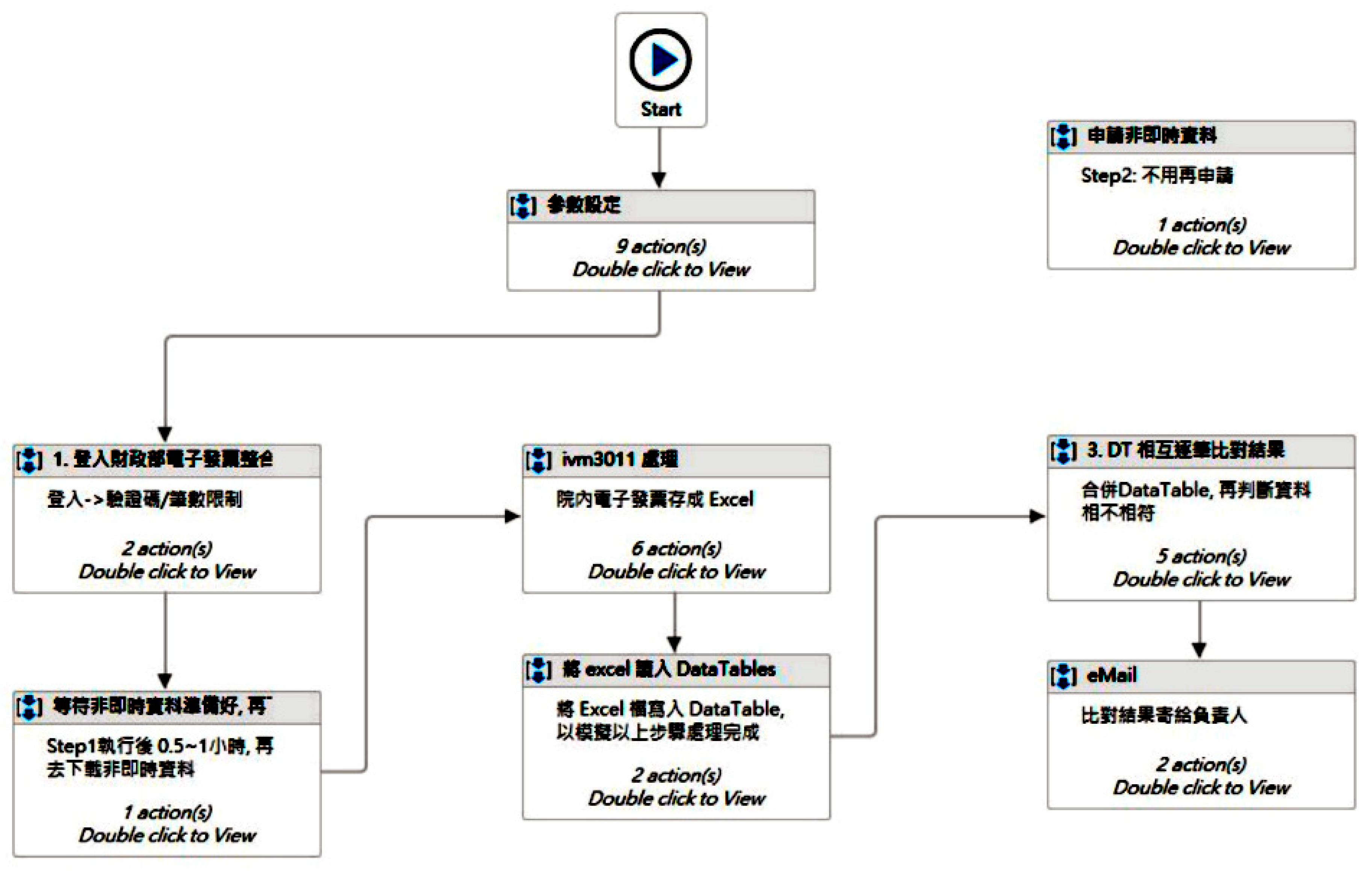
Figure 3.
Variation of invoices audited one-by-one or in batches: (a) one by one; (b) In batches.
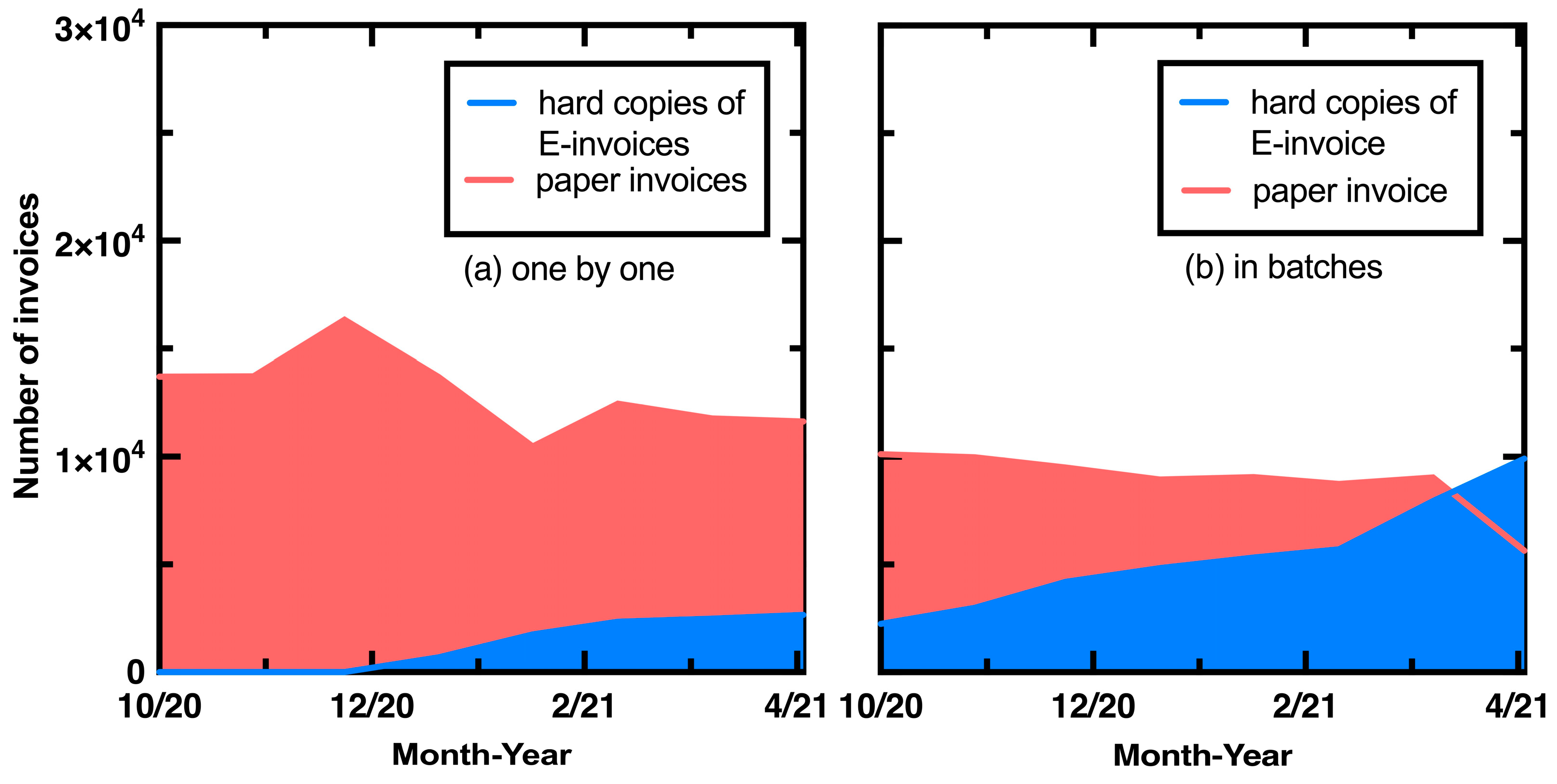
Figure 4.
Measurements of the average time spent to audit invoices one-by-one.
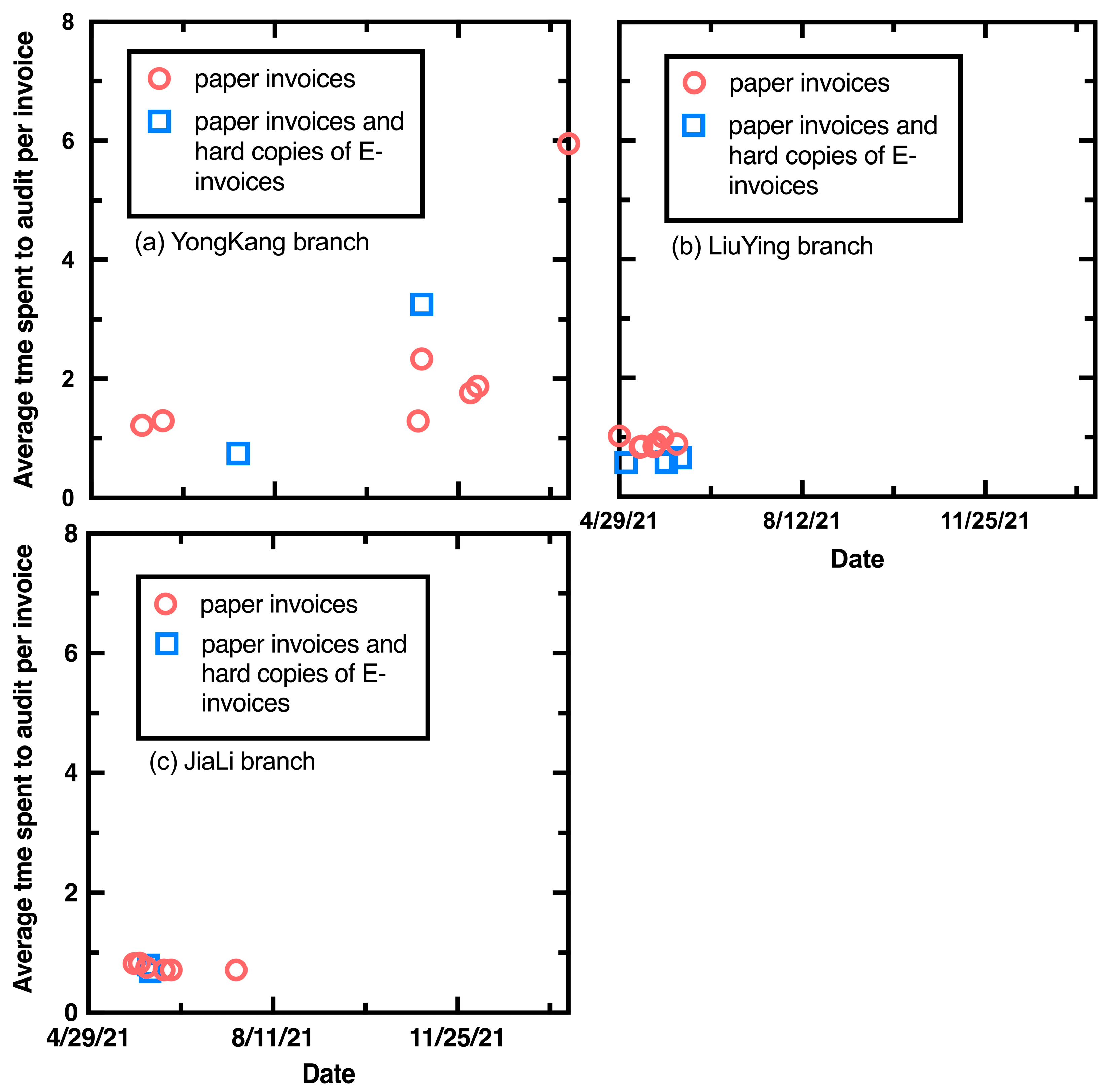
Figure 5.
Experiment of introducing electronic invoicing (audit of cloud E-invoice data in batch).
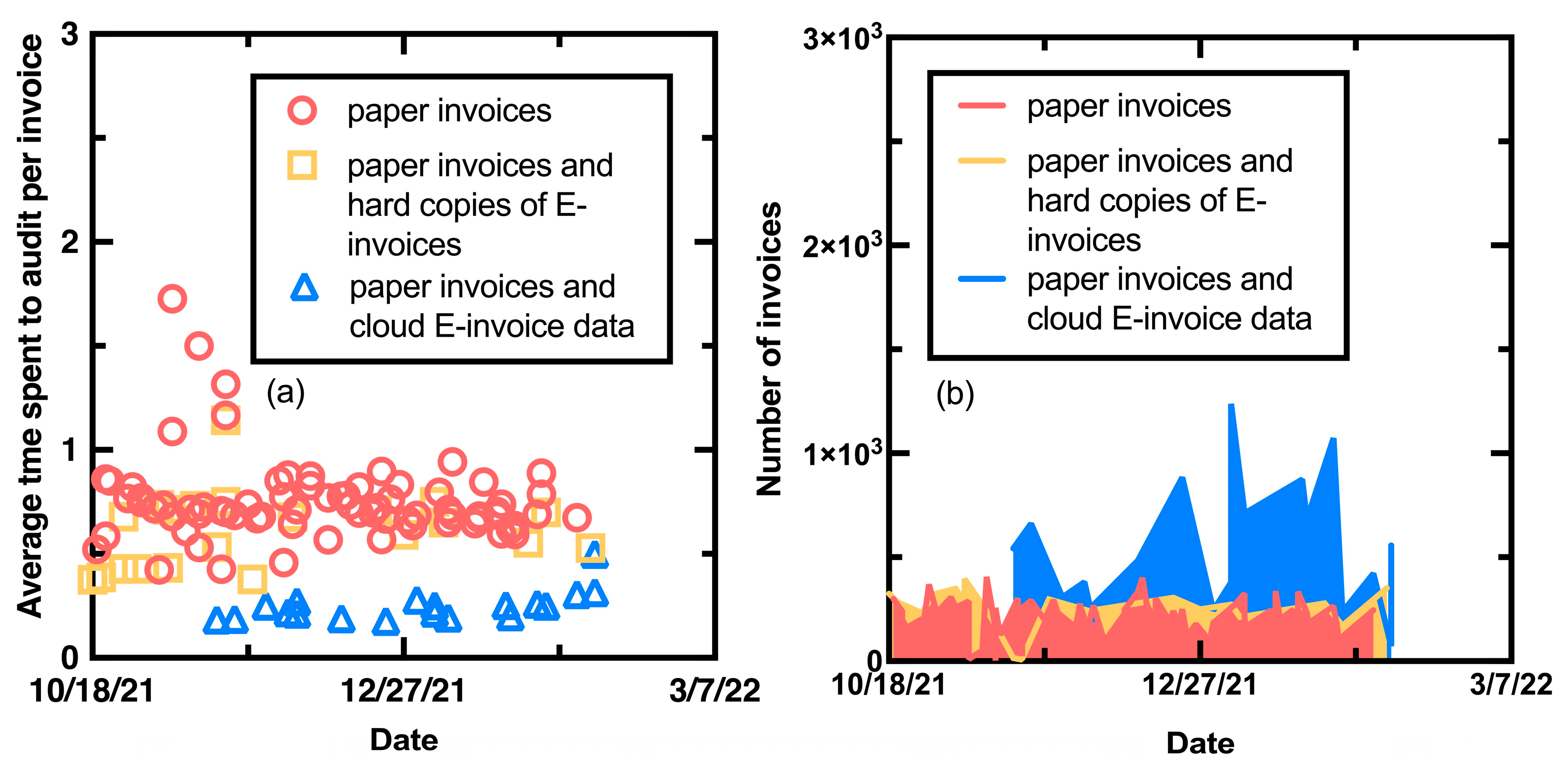
Figure 6.
Effects of promoting electronic invoicing to three branches of the Chi Mei Medical Center.
Figure 6.
Effects of promoting electronic invoicing to three branches of the Chi Mei Medical Center.
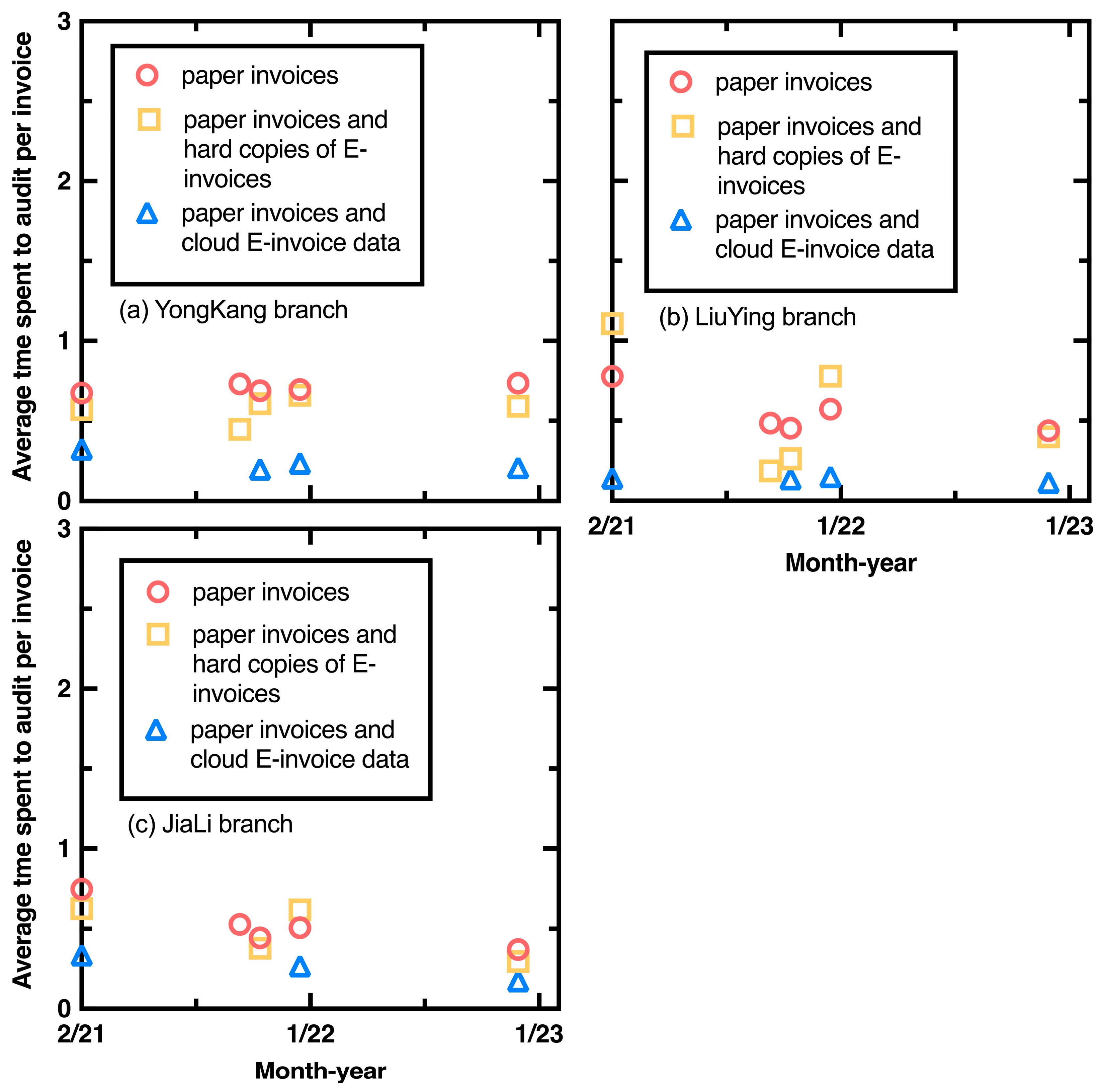

Table 1.
Changes before and after introducing a software bot to audit cloud E-invoice data.
| Observation | After | Before |
| paper invoices | 2,730 | 11878 |
| costs of papers | TWD 2,048 | TWD 10,409 |
| human resource costs | TWD 1,311,876 | TWD 1,457,640 |
Disclaimer/Publisher’s Note: The statements, opinions and data contained in all publications are solely those of the individual author(s) and contributor(s) and not of MDPI and/or the editor(s). MDPI and/or the editor(s) disclaim responsibility for any injury to people or property resulting from any ideas, methods, instructions or products referred to in the content. |
© 2023 by the authors. Licensee MDPI, Basel, Switzerland. This article is an open access article distributed under the terms and conditions of the Creative Commons Attribution (CC BY) license (http://creativecommons.org/licenses/by/4.0/).
Copyright: This open access article is published under a Creative Commons CC BY 4.0 license, which permit the free download, distribution, and reuse, provided that the author and preprint are cited in any reuse.


