

Submitted:
29 September 2023
Posted:
30 September 2023
You are already at the latest version
Abstract
The protection of all environmental compartments (water, soil, air) is of great interest for the normal functioning of life on Earth. Namely, the environment is systematically polluted with different concentrations of physical, biological and chemical pollutants. For the purpose of environmental protection, numerous in situ and ex situ biological, chemical and physical remediation techniques have been developed. Most techniques have limitations such as high costs, processing time and environmental feasibility. In general, biological techniques have proven to be the most environmentally friendly compared to chemical and physical techniques. Furthermore, remediation is an extremely complex procedure due to the complexity of the pollutant composition. Therefore, the implementation of individual physical, biological or chemical remediation techniques is often not sufficient for adequate remediation of the polluted environment. Accordingly, for more economical and efficient environmental remediation, it is recommended to use a combination of techniques that should meet the requirements of efficiency and treatment duration. Ultimately, this short review presents a concise overview of the recent application of physical, biological and chemical remediation techniques to all compartments of the polluted environment (water, air, soil). A critical review of existing knowledge on environmental remediation through a search of relevant literature helped to assess the basic challenges and limitations that arise in the issue of environmental remediation, as well as providing recommendations and guidelines for future research.

Keywords:
water remediation
; soil remediation
; air remediation
; pollution
; environmental pollutants
1. Introduction
The release of pollutants into the environment by numerous human activities and natural disasters causes different levels of pollution in the environment. Numerous chemical, physical and biological pollutants represent a toxicological threat to both the environment and human beings. Therefore, numerous remediation techniques have been developed to reduce the hazardous effects of a polluted environment. These techniques include biological, chemical and physical remediation. Although various remediation techniques are available for remediation of the polluted environment, the choice of the appropriate technique is quite challenging and depends on a number of factors such as the composition and concentration of pollutants in the polluted medium, operating costs, efficiency, feasibility, applicability and final impact on the environment. Hence, the purpose of this short review is to provide an overview of the main types of environmental pollutants, used environmental remediation techniques, and summarize recent relevant research applied in the remediation of all environmental compartments (water, soil, air). The main literature sources were the Web of Science Core Collection and Scopus databases. The literature was searched using keywords related to environmental remediation. Most of the literature does not offer a combined critical report on the remediation of all environmental compartments (air, soil, water) but rather focuses on a single system. Therefore, this review aims to complete recent knowledge about the effectiveness, advantages and limitations of the application of remediation techniques to all environmental compartments (water, soil, air) with recommendations and guidelines for future research.
2. Categories of Environmental Pollutants
The environment represents the natural habitat of organisms, including humans, and consists of three complex compartments, air, water and soil. Rapid economic development and industrialization have led to an increase in living standards, and thus to significant environmental pollution as a consequence of non-compliance with increasingly strict legal regulations for the emission of pollutants into the environment [1]. Pollutants originate from natural (volcanic eruptions) and anthropogenic (industry, waste, wastewater, etc.) sources, and are classified as chemical, physical, and biological as shown in Figure 1.
The group of chemical pollutants includes heavy metals, volatile organic compounds (VOC), polycyclic aromatic hydrocarbons (PAH), polychlorinated biphenyls (PCB), pesticides, pharmaceutical products, etc. Heavy metals are highly toxic, tend to accumulate in biological systems and have carcinogenic, mutagenic and teratogenic effects. The characteristic of organic pollutants is high persistence, toxicity, carcinogenicity and bioaccumulation in the environment. The most common gaseous pollutants are volatile organic compounds and inorganic gases such as COx, NOx, SOx, Cl2 and NH3. Discarded pharmaceutical products belong to the group of "new" pollutants, which are characterized by high persistence and non-biodegradability [2].
The group of physical pollutants includes particulate matter, radiation and noise. Particulate matter is divided into PM10 (diameter 2.5 μm - 10 μm) and PM2.5 (diameter <2.5 μm), and can be of organic or inorganic origin. PM2.5 particles are considered a major health problem as they cause serious lung and cardiovascular diseases, as well as allergies in humans. Radiation can be nuclear, electromagnetic and ultraviolet. Many household devices such as cell phone and Wi-Fi signals and microwave ovens are sources of radiation in close proximity to humans. Any unwanted sound that causes disturbances (damage or loss of hearing, headache, irregular heartbeat) is considered noise pollution, and it is most often a consequence of the operation of machines in industrial facilities [2].
Biological pollutants are toxic animals and microorganisms that pollute the environment directly affecting human health by transmitting various diseases and causing allergic reactions and infections [2].
Therefore, any emission of the mentioned pollutants into the environment, especially above the permissible values prescribed by law, represents a threat to the entire ecosystem. Since achieving a balance between industrialization and environmental protection is a challenge nowadays, great efforts are needed to limit future emissions of pollutants into the environment. Currently, already contaminated areas pose a risk for the spread of contamination. Therefore, in order to prevent the spread of pollution or complete remediation of polluted areas, various methods of environmental remediation have been developed.
3. Environmental Remediation Techniques
Remediation is a term generally used to clean up or restore a polluted environment. It represents taking measures to prevent the spread of pollution and further degradation of the environment to a level that enables future use, revitalization and recultivation. Therefore, the goal of remediation is to reduce the concentration of pollutants in the environment (air, water, soil) to an acceptable level or to remove them completely. Environmental remediation can be carried out in situ, i.e. directly at the site of pollution, or ex situ, i.e. outside the site of pollution, at the intended location for remediation [3,4,5,6]. Due to the economy and simplicity of implementation, in situ remediation is more often applied. Regardless of the environmental remediation implementation process, remediation techniques are divided into biological, chemical and physical as shown in Figure 2, and their brief description will be given below.
3.1. Biological Remediation
Biological remediation reduces, removes or immobilizes pollutants using biological agents, plants or microorganisms. Basically, it is divided into phytoremediation and bioremediation [7].
Phytoremediation is a technique that uses plants to remediate the environment (air, water, soil) polluted by hazardous substances using the ability of plants to bind and accumulate pollutants in shoots and leaves (phytoextraction), roots (phytostabilization) or bind and convert into less toxic forms that they release into atmosphere from above-ground parts (phytovolatilization). Plants that have the ability to tolerate high concentrations of heavy metals (Cd, Cr, Pb, Co, Ag, Se and Hg) with the ability to accumulate them are called hyperaccumulators. Most of them belong to the Brassicaceae, Fabaceae, Lamiaceae, Poaceae and Euphorbiaceae families [4,8,9].
Bioremediation uses microorganisms, mainly bacteria and fungi, to remediate polluted areas. This type of remediation can occur naturally, by adding inoculation of selected microbial strains with the ability to degrade target pollutants (bioaugmentation) or by stimulating biodegradation by modifying environmental conditions such as moisture, pH, nutrients, oxygen concentration, etc. (biostimulation) [10].
3.2. Chemical Remediation
Chemical remediation is applied to contaminated soil, water systems and air using chemical agents and active substances that have the ability to decompose or remove pollutants [11]. The main chemical remediation techniques include soil leaching, electrochemical remediation, stabilization/solidification, permeable reactive barrier and photocatalysis.
Soil leaching implies the extraction of pollutants from the soil, most often ex situ with the use of an appropriate extraction/leaching agent. The most commonly used extraction agents are organic or inorganic acids, alkalis and complexing agents [7,12].
Electrochemical remediation is applied to contaminated soil or water systems. Pollutants are separated by the action of a weak direct current through a network of cathodes and anodes in a polluted medium (soil, water). Under the action of direct current through the polluted medium, the pollutant electromigrates towards the oppositely charged electrodes through the processes of electrophoresis (movement of charged colloidal particles) and electroosmosis (migration of the liquid phase). In this way, electrodeposition and/or migration of pollutants occurs [5,7,12].
Stabilization and solidification (S/S) is a soil remediation technique based on the immobilization of pollutants in the soil. Stabilization is a chemical process that involves adding reagents to contaminated soil to convert the pollutant into a more chemically stable and less toxic form. On the other hand, solidification (physical process) is based on the immobilization (trapping) of pollutants by binding them to binding substances (clay, cement, fly ash, zeolite) into a solid mass, which usually results in a decrease in its permeability and an increase in its strength [5,7,12].
Permeable reactive barrier (PRB) is used for remediation of polluted water systems. The barrier is placed below the soil surface, perpendicular to the direction of the groundwater flow. The PRB is filled with active materials capable of sorption, chemical precipitation or degradation of pollutants [5,7].
Photocatalysis refers to the photogeneration (exposure to light energy) of strong oxidizing and reducing agents on the surface of the catalyst, during which a photocatalytic reaction occurs that produces free radicals that indiscriminately decompose pollutants. Numerous studies on the use of photocatalysts for the remediation of polluted environments have been in wastewater treatment using titanium oxide, TiO2, however, photocatalysts can also be used for air remediation [13].
3.3. Physical Remediation
Physical remediation is most often applied to contaminated soil, and implies the removal of pollutants through physical mechanisms such as soil capping/encapsulation, separation/replacement, mixing and heat treatment [6,14].
Capping/encapsulation is a remediation technique based on covering polluted soil with a single or multi-layer system of clean soil and geosynthetics with the aim of protecting against the spread of pollution. This technique does not imply soil remediation, since no efforts are made to remove pollutants, but further environmental pollution is prevented [8].
Soil replacement is based on diluting the concentration of pollutants in the soil by partial or complete replacement of the contaminated soil. This technique is suitable for heavily polluted soils of a small area [15].
Soil mixing is a technique based on mixing contaminated with uncontaminated soil, whereby the concentration of pollutants is reduced to a value that is not dangerous for the environment by dilution [4,6].
Thermal remediation involves heating the medium, usually soil or sediment, which leads to the pollutants mobilization, evaporation or destruction. It includes thermal desorption which can take place at high (320-560°C) or lower temperature (90-320°C) and vitrification which uses high temperature (≈1500°C) to transform the soil into a glass matrix [14].
4. Overview of Recent Knowledge on Environmental Remediation
4.1. Recent Knowledge on Biological Remediation of Soil, Water and Air
Biological remediation is applicable to all environmental compartments, soil, water and air. The results of investigation on phytoremediation of contaminated soil are shown in Table 1.
According to Landberg and Greger's [16] investigation on a rural area of 2466 m2, in the village of Sunnerset in Sweden, the plant Salix viminalis was used to remediate soil contaminated with heavy metals (Cr, As, Cd, Zn, Cu, Pb, Ni), PAH and PCB compounds. After ten years of phytoremediation, all pollutants in the soil were significantly reduced, for heavy metals in the amount of 21-87% and for PAHs and PCBs from 25 to 73%. Most of the mentioned pollutants were removed in the highest percentage in the first five years. Remediation of oil-contaminated soil with an average concentration of 14400 mg/kg was carried out by Panchenko et al. [17] in a field in the vicinity of an oil refinery in Volga, Russia, with the plants Melilotus officinalis, Agropyron cristatum, Medicago sativa L. and Lolium perenne L. The highest oil removal was achieved already after the first year of phytoremediation, by reducing their concentration to a value of 2500 mg/kg, and after 5 years to a value of 1100 mg/kg, i.e. 92.4%. Cheng et al. [18] collected petroleum-contaminated soil near an oil supply center in Taiwan and treated it with the plants Vetiveria zizanioides and Cymbopogon nardus itle. The initial amount of petroleum in the soil was 3000-8000 mg/kg. After 15 months of phytoremediation with Vetiveria zizanioides, petroleum concentrations were reduced by 89%-90%, depending on the initial petroleum concentration. A similar result was obtained using the Cymbopogon nardus itle plant. A removal of 86% to 91% was achieved depending on the initial petroleum concentration in the soil. Three studies were conducted by Chen et al. [19] (from September 2020 to January 2021, then from April to October 2021 and from July 2021 to July 2022) on three samples of cadmium-contaminated soil with a concentration of 0.7676 mg/kg, 1.3058 mg/kg and 1.0970 mg/kg. Phytoremediation of the soil with the plant Pennisetum hybridum resulted in the percentage of cadmium removal for three samples in the amount of 23.62%, 21.50% and 35.81%. Based on the aforementioned investigations, it is clearly observed that the application of phytoremediation in the remediation of soil contaminated with heavy metals and petroleum is a relatively highly effective, but also a long-term procedure. Therefore, the application of phytoremediation will be desirable in places that do not have a direct negative impact on the human population and where the urgency of the remediation procedure is not required.
Investigations on phytoremediation of steel foundry wastewater contaminated with heavy metals (Al, As, Cd, Cr, Cu, Fe, Mn, Pb, Zn) using aquatic plants, Pistia stratiotes and Eichhornia crassipes was conducted by Aurangzeb et al. [20]. The results of the investigation are shown in Table 2. Depending on the initial heavy metal concentration, heavy metal removal in the range of 16%-71% was achieved after treatment with Pistia stratiotes. On the other hand, using Eichhornia crassipes, the removal efficiency was from 48% to 83%. The results clearly showed the higher effectiveness of Eichhornia crassipes compared to Pistia stratiotes in removing the same initial concentrations of heavy metals.
Phytoremediation tests of sediment contaminated with copper and lead are shown in Table 3.
Song et al. [21] used a combination of plants, Vallisneria natans, Hydrilla verticillata and Myriophyllum spicatum for phytoremediation of copper and lead polluted sediment of Le'an River near Dexing copper mine, located in Wannian, Shangrao City, Jiangxi Province. A copper removal efficiency of 26.1% was achieved when Vallisneria natans and Myriophyllum spicatum were planted together in the polluted sediment. With the simultaneous use of Hydrilla verticillata and Myriophyllum spicatum, a percentage of lead removal of 68.4% was achieved. The test indicated the possibility of reducing the concentrations of both copper and lead by in situ remediation, by planting the mentioned plants in the polluted sediment.
The assessment of the effectiveness of improving indoor air quality in studio apartments by phytoremediation with indoor plants was carried out by Sharma et al. [22]. The results of research are shown in Table 4.
As specified, the assessment of indoor air quality without and with the presence of indoor plants Sansevieria kirkii, Sansevieria trifasciata, Monstera deliciosa, Zamiifolia and Portulacaria afra in the period from December 2021 to January 2022 in four studio apartments with an area of 33 m2 was conducted by Sharma et al. [22]. The characteristics of the rooms were as follows: apartment 1 (with ventilation and plants), apartment 2 (without ventilation, with plants), apartment 3 (with ventilation and without plants) and apartment 4, which served as a control room (no ventilation, no plants). During two weeks, the measured data gave an insight into the indoor air quality. Significant differences were observed in the concentrations of pollutants in the apartments (Table 4). The measured values of PM2.5 and PM10 in the apartments showed higher concentrations than those measured outdoors. The main source of air pollution in apartments is attributed to activities such as baking. The average concentration of PM2.5 in apartment 4 (without plants, without ventilation) was 35.72 μg/m3, and for PM10 58.81 μg/m3. The results showed that apartment 1 with plants and ventilation can significantly reduce the concentration of PM2.5, up to 64.61% and PM10 up to 67.01%. The average concentration of VOCs in the apartment without plants and ventilation (apartment 4) reached a value of 800.41 μg/m3, while in the apartment with ventilation and plants (apartment 1) the highest reduction was observed, to a value of 56.35 μg/m3. The average concentration of formaldehyde in apartment 4, without plants and without ventilation, was 23.99 µg/m3. Apartment 1, with plants and ventilation, had a formaldehyde concentration of 6.02 µg/m3, similar to apartment 2, only with plants, a value of 5.98 µg/m3. The results revealed that average formaldehyde concentrations were significantly higher in apartments without indoor plants. Similar to other pollutants, CO2 concentrations were found to be higher in apartments without indoor plants and without ventilation (2616.36∙103 μg/m3) than in apartments with plants and/or ventilation. Moreover, the lowest average CO2 concentration of 615.50∙103 μg/m3 was recorded in the apartment 1, with plants and ventilation. The results show that the average concentration of all air pollutants was significantly higher without plants and ventilation than with plants and ventilation. Even with ventilation and without plants (apartment 3), the average concentrations are higher than with ventilation and plants (apartment 1), indicating that ventilation cannot fully reduce pollution. The results indicate a simple and sustainable way of improving indoor air quality in apartments by phytoremediation with indoor plants.
Table 5 shows the results of phytoremediation of polluted indoor air.
Active botanical biofilter systems can be effective in removing indoor air pollutants. Ibrahim et al. [23] used a biofilter consisting of the Epipremnum aureum plant and mechanical ventilation with an air flow of 540 m3/h and achieved a removal efficiency of 54.5% for PM2.5, 65.4% for PM10 and 46.0% for VOCs. Phytoremediation of benzene from indoor polluted air using two plants Schefflera arboricola and Spathiphyllum wallisii was investigated by Parsheh et al. [24] in a controlled environment using a plexiglass chamber. The average removal efficiency at different initial benzene concentrations (Table 5) was 91.0%-97.0%. The toxic effect of benzene on the plants used was not determined at the tested concentrations. It can be concluded that this application is environmentally acceptable for the removal of benzene from polluted indoor air. According to a laboratory study conducted by Gong et al. [25], indoor benzene removal using Epipremnum aureum, Chlorophytum comosum, Hedera helix, and Echinopsis tubiflora was 72%. The results of the conducted investigations clearly indicate that phytoremediation of indoor polluted air is effective and can be used as a precautionary measure against possible unexpected pollutant emissions.
The results of bioremediation of organic pollutants and heavy metals are presented in Table 6.
For the biodegradation of pyrene at an initial concentration of 1000 mg/L, Marzuki et al. [26] used two types of bacteria, Bacillus licheniformis and Sphingobacterium. The result of the interaction of the bacterial suspension and pyrene during 30 days was the decomposition of pyrene by Bacillus licheniformis in an amount of 38.29%, i.e. 39.00% by Sphingobacterium. Testing of the bioremediation of anthracene and pyrene with the bacterial species Bacillus pumilus, Pseudomonas stutzeri and Acinetobacter calcoaceticus was carried out by Marzuki et al. [27]. During 25 days of interaction with pollutants, a decrease of 21.89% of anthracene and 7.71% of pyrene was observed. Furthermore, Marzuki et al. [28] investigated the bioremediation of waste contaminated with naphthalene, Cr(VI) and Cd using the bacteria Bacillus pumilus and Pseudomonas stutzeri. The initial concentration of Cr(VI) and Cd was 250 mg/L, and naphthalene 1000 mg/L. Biodegradation efficiency using Bacillus pumilus bacteria for naphthalene was 7.16%, for Cr(VI) 56.30% and for Cd 61.23%. Biodegradation by the bacterium Pseudomonas stutzeri was 11.24% for naphthalene, 52.74% for Cr(VI) and 57.80% for Cd. Gomaa [29] collected samples of calcareous soil in Egypt and used them to isolate bacteria that produce the urease enzyme. Bacteria Micrococcus sp. mixed with heavy metal salts in the concentration range of 0-10 mol/L showed a good ability to biosequestrate Cd and Pb during 2 days in the amount of 60.66% and 97.20%.
Chen et al. [30] conducted a two-year study on soil contaminated with Zn, Cd and PAH compounds by phytoremediation using the plant Sedum alfredii and bioremediation using the bacteria Microbacterium sp. strain KL5 and Candida tropicalis strain C10. The experimental results presented in Table 7 indicate a more efficient removal of PAH compounds in the amount of 96.4% compared to heavy metals, for Cd 36.1% and for Zn 12.7%.
The results presented in Table 6 and Table 7 indicate a mostly successful remediation of organic pollutants in relation to heavy metals. Studies have shown that bioremediation efficiency of up to 100% is achieved by using a consortium of bacteria in relation to a single bacterial species. In addition, the growth of bacterial cells continues even after the decomposition of organic pollutants. This indicates that bacterial cells can still carry out cell division and decomposition of hydrocarbon components for use as an energy source [31]. Furthermore, it is well known that microorganisms and plants reduce and/or remove pollutants from a polluted medium. However, according to recent advances in pollutant reduction, a combined system of microorganisms and plants has been shown to improve pollutant removal to an efficient level. In a pollutant-rich environment, the environment is depleted of nutrients. By introducing the appropriate plant and microorganism into such an environment, the plant interacts with the microorganism to survive under toxic conditions. This interaction leads to higher germination efficiency and enhanced root growth resulting in enhanced pollutant degradation [32].
4.2. Recent Knowledge on Chemical Remediation of Soil, Water and Air
In addition to phytoremediation and bioremediation, chemical remediation is one of the most applied and researched remediation techniques. This is supported by the fact that chemical remediation techniques are more numerous than others and applicable to all compartments of the environment (soil, water, air). The results of the chemical remediation investigations by leaching contaminated soil are shown in Table 8.
Artificially contaminated soil containing 700 mg Cu/kg, 530 mg Pb/kg, and 900 mg Zn/kg was used in a study by Park et al. [33]. A high-pressure soil washing device used tap water as a leaching agent. Under optimal experimental conditions, a removal of 37.7% for Cu, 36.6% for Pb and 45.1% for Zn was achieved. Zhang et al. [34] artificially polluted the soil with cadmium and phenanthrene, which was prepared by mixing sand and kaolinite clay in a ratio of 2:1. The soil remediation carried out by leaching with a 5 g/L rhamnolipid solution (an environmentally acceptable biosurfactant) at pH=9 and 15°C resulted in the removal of cadmium in the amount of 72.4% and phenanthrene in the amount of 84.8%. Furthermore, Song and Nam [35] used a KCl solution to leach cesium-contaminated soil with a concentration of 1.47 mg/kg collected near a nuclear power plant in South Korea. The cesium removal efficiency was found to be 81.3% under the optimal leaching experimental conditions with 1 mol/L KCl solution at L/S= 20, pH=2 for 2 hours. Hu et al. [36] investigated the two-stage remediation of zinc-contaminated soil with a concentration of 557.2 mg/kg by leaching with a 5 g/L citric acid solution and a 4 g/L chitosan (polysaccharide) solution. The efficiency of zinc removal from the soil by leaching was 63.9%. Copper, nickel and zinc contaminated soil from an industrial site in Dongguan, China, Cheng et al. [37] were leached with a solution obtained by mixing 0.05 mol/L EDTA and 0.20 mol/L citric acid, 0.05 mol/L EDTA with 0.20 mol/L oxalic acid and 0.05 mol/L EDTA with 0.20 mol/L tartaric acid. The removal percentage for three types of leaching solutions was for Cu 81.5%, 85.5%, 85.0%, for Ni 85.9%, 82.9%, 78.9% and for Zn 81.1%, 84.6%, 82.5%. The leaching conditions were pH 3.0, S/L = 1:10 and leaching time 6 hours. Remediation of contaminated soil by leaching is most often carried out ex situ and is applicable for smaller amounts of contaminated soil. The results of the investigations indicate a relatively high efficiency of pollutant removal by leaching with a relatively short time of procedure implementation.
The results of the electrochemical soil remediation investigations are presented in Table 9.
A pilot test and a test in environmental conditions were conducted by Chai et al. [38] on a cadmium-contaminated soil sample with an average concentration of 3.68 mg/kg. The sample was taken in Gaolian Village, Shaoguan City, Guangdong Province, China. After fourteen days of remediation, the efficiency of Cd removal from the soil in the pilot test was 87.0%, and in environmental conditions 74.0%. The result was attributed to the voltage gradient, which was five times higher in the pilot test than in environmental conditions. Also, the results showed that the efficiency of Cd removal from the soil was the highest in the upper soil layer of 0-10 cm. The removal of petroleum in the amount of 75.2% from petroleum-contaminated soil, using a graphite electrode at a voltage of 30 V and water as an electrolyte with the biosurfactant rhamnolipid in a period of 10 days, was carried out by Gidudu et al. [39]. Alcántra et al. [40] achieved the removal efficiency of pyrene in the amount of 45.0% and fluoranthene in the amount of 57.0% using graphite electrodes and a 1% solution of the nonionic surfactant Tween 80 (polysorbate 80 produced from polyethoxylated sorbitan and oleic acid) and 0.1 mol/L of Na2SO4 solution, at 30 V and pH=7 for 23 days of the experiment. In the work of Cong et al. [41], artificially contaminated soil with a 1000 mg/L chlorophenol solution was electrochemically remediated in a laboratory device using a graphite electrode. A voltage of 1200 V and a current of 10 mA were applied. After 140 minutes of the experiment, the removal efficiency of phenol was 72.0%, 2-chlorophenol 80.2%, 2,4-dichlorophenol 81.6% and 2,4,6-trichlorophenol 85.2%. The obtained results indicated the feasibility of electrochemical remediation of soil contaminated with polychlorinated phenols. Taking into account the applicability of electrochemical remediation, it is observed that with the increase in the applied voltage, the remediation time is significantly reduced, with an increase in the efficiency of pollutant removal. However, shortening the remediation time significantly increases the costs of the procedure, which calls into question the cost-effectiveness of implementing electrochemical remediation, especially for larger amounts of contaminated soil.
Table 10. shows the results of electrochemical remediation of polluted water systems.
Abdulredha et al. [42] performed electrocoagulation of As(III) polluted water with a concentration of 300 mg/L, using a stainless steel electrode. At optimal operating conditions of electric current density of 6 mA/cm2, at pH=9.0 and during 30 minutes, the efficiency of As(III) removal was achieved in the amount of 81.0%. Furthermore, Babu et al. [43] achieved complete removal of As(III) from water with an initial As(III) concentration of 1 mg/L by applying a voltage of 5 V to Fe electrodes for 60 min of the experiment. Gooren et al. [44] investigated the removal of As(III) from a groundwater sample taken in Kocaeli province, Turkey which was artificially contaminated with As(III). The electrochemical reactor consisted of a titanium cathode and an anode compartment (Al ball anode) which was aerated. Under optimal conditions of pH=7.5, air flow of 6 L/min, current of 0.30 A and a time of 12 minutes, the achieved removal efficiency of As(III) was 99.2% for an initial concentration of 200 μg/L. The remediation of the groundwater of the island of Tenerife (Spain) contaminated with fluorides with an initial concentration of 7.35 mg/L using aluminum electrodes at optimal conditions in a cell of 10 mA/cm2, pH=7.8 and a time of 15 minutes was carried out by Betancor-Abreua et al. [45]. The results showed a fluoride removal efficiency of 85.9%. López-Guzmán et al. [46] investigated the removal of fluoride and arsenic from water containing 5 mg/L fluoride and 80 μg/L arsenic. The optimal experimental conditions were pH=5.0, treatment time 15 minutes and a current of 4.5 mA/cm2. The achieved removal efficiency using the Fe-Al electrode for fluoride was 85.7% and 100.0% for arsenic. Comparing the results of electrochemical remediation of polluted soil and water, a higher efficiency of pollutant removal from water systems is observed, which is probably the reason for the facilitated electromigration of pollutants in the water medium. Moreover, the implementation time of electrochemical remediation is significantly longer for soil compared to water systems. This indicates a better applicability of electrochemical remediation for water systems.
Table 11 shows the results of the stabilization/solidification study of contaminated soil.
Anand-Reddy et al. [47] mixed artificial lead and zinc contaminated soil with limestone-calcined clay cement (LC3) and solidified it over a period of 28 days. Then the toxicity of the material was tested according to the standard toxicity characteristic leaching protocol (TCLP). The results indicated a decrease in the concentration of Zn and Pb by increasing the solidification time. The decrease in eluted concentrations was attributed to increased pH values and the formation of metal hydroxides in the presence of free available Ca(OH)2 and Ca2+ ions in the binding material. Moreover, when limestone is added to calcined clay it reacts to form carbo-aluminates which tend to reduce the mobility of heavy metals by forming insoluble metal hydroxides thereby increasing the effectiveness of immobilization and reducing the leaching of zinc and lead. It was concluded that stabilization with LC3 promotes the immobilization of Zn and Pb from contaminated soil, which further reduces the possibility of their leaching. In addition to the above, there is also an increase in strength in the treated samples, which is a consequence of the hydration reaction. The stabilization/solidification efficiency was 88.0% for Zn and 99.0% for Pb, after 28 days of solidification. Hu et al. [48] used a tailings-based geopolymer to immobilize Ba and Pb. The compressive strength of the prepared tailings-based geopolymer after 7 days of solidification reached a value of 35 MPa. The maximum concentration of Pb and Ba in the leachate did not exceed the value of 0.1 mg Pb/L and 0.4 mg Ba/L. The results of leaching showed that the prepared tailings-based geopolymer was able to effectively immobilize heavy metal cations by >95.0%. Treatment of copper-contaminated sediment samples collected in the Sembrong River, Malaysia by stabilization/solidification using portland composite cement as the main binder with the addition of rice husk ash was carried out by Aliyu et al. [49]. A high percentage of Cu stabilization was observed after 28 days leaching according to the TCLP procedure, in the amount of 97.8%. The results showed that the partial replacement of cement with rice husk ash in the binder system increased the strength and reduced the leaching ability of Cu from the polluted sediment. A soil containing 170.4 mg As/kg was sampled by Li et al. [50] in the Great Bay area of South China and treated by solidification/stabilization using a mixture of cement and blast slag. The results showed that with the 10% binder application, more than 80% of As was effectively stabilized at pH=5.5-6.5 during the 28 days of the experiment. The stabilization/solidification technique is very important for the stabilization or disposal of hazardous waste, especially that obtained after ex situ remediation using different sorbents. Studies have shown that the addition of sorbents saturated with heavy metals to cement increases its strength, which justifies the process of their stabilization/solidification.
Table 12 shows the results of investigations on the remediation of polluted water systems using a permeable reactive barrier.
Lee et al. [51] investigated the possibility of zeolitic rocks as a filler for a permeable reactive barrier (PRB) for the purpose of remediation of zinc-contaminated groundwater. Zinc concentrations in the effluent decreased until the equilibrium was established from 434 to 5 mg/L, whereby the zinc removal efficiency in the amount of 99.0% was achieved. The efficiency of toluene removal, with an initial concentration of 5 mg/L using three reactor columns representing PRB, was investigated by Yaman et al. [52]. The first column consisted of sand and gravel as a reactor medium and a microbial inoculum (the dominant bacterium Alcanivorax) with nutrients (ammonium chloride and potassium dihydrogen phosphate). After 44 days of treatment, the toluene concentration was 0.59 mg/L, which represents a removal efficiency of 88.2%. The second column consisted of sand and gravel as a reactor medium, the specified microbial inoculum, nutrients and 12 layers of nonwoven geotextile fabrics. After 44 days, the concentration of toluene in the eluate of the second column was 0.1 mg/L, which represents a removal efficiency of 98%. The third column consisted only of sand and gravel as a reactor medium (natural attenuation), and after 44 days the toluene concentration decreased to a value of 4.29 mg/L, which represents a removal efficiency of 14.2%. Jun et al. [53] used a laboratory reactor to simulate PRB for the remediation of heavy metal landfill leachate-contaminated groundwater with initial concentrations of 82.8 mg Zn/L, 13.8 mg Mn/L, 555.9 mg Ca/L, 186.4 mg Mg/L, 0, 08 mg Cd/L, 0.2 mg Cr/L, 1.2 mg Sr/L and 16.2 mg Al/L. Zero valent iron (ZVI) and zeolite were used as reactive media. The removal efficiency was for Zn 97.2%, Mn 99.6%, Ca 81.7%, Mg 95.9%, Cd 95.2%, Cr 70.7%, Sr 90.5% and Al 58,7%. Historical storage of ore containing sulphide minerals at an industrial site in British Columbia, Canada has led to soil and groundwater contamination. Significant amounts of heavy metals including Cu, Cd, Co, Ni and Zn have been released into groundwater by oxidation of sulphide minerals. Ludwig et al. [54] placed a pilot-scale PRB in the path of the dissolved heavy-metal plume, and the reactive mixture used in the barrier consisted of 15% leaf compost, 84% pea gravel, 1% limestone by volume and sulfate-reducing bacteria. After 21 months, there was a significant removal of heavy metals. Heavy metal concentrations decreased as follows, for Cu from 3.63 mg/L to 0.0105 mg/L, Cd from 0.0153 mg/L to 0.0002 mg/L, Co from 0.0053 mg/L to 0.011 mg/L, Ni from 0.131 mg/L to 0.033 mg/L and Zn from 2.41 mg/L to 0.136 mg/L, i.e. expressed as removal efficiency for Cu, Cd, Co, Ni and Zn was 99.7%, 98.7%, 79.2%, 74.8% and 94.4%. Guo et al. [55] conducted laboratory testing of nitrate removal from synthetic and real wastewater using PRB filled with modified raw wheat straw and with the addition of denitrifying bacteria in the amount up to 35%. During the 370 days of the experiment, a nitrate removal efficiency of 90.0% was achieved in laboratory conditions and 60.0% in the field for initial nitrate concentrations of 27.80-59.86 mg/L. The results of the investigations show that the application of PRB can be very effective for the removal of pollutants from water systems. Although the duration of the procedure is relatively long, the extremely high removal efficiency compensates for the time of the procedure. The wide range of PRB materials makes this technique applicable to all systems contaminated with different types of pollutants. For example, one of the reactive media used for water remediation using PRB is natural zeolite, due to its high cation exchange capacity. Ultimately, the application of PRB can be significant in preventing the spread of potential contamination by placement in areas of high vulnerability of water systems.
Table 13 shows the results of remediation of polluted air by photocatalysis.
Using multicomponent oxide thin films of ZnO/Zn2TiO4 and TiO2 as photocatalysts on a glass substrate, Hernández-García et al. [56] successfully carried out the degradation of benzene in the gaseous state. The initial benzene concentration was 0.11 ppm. The process took place in a batch type reactor, at room temperature. The results show the degradation of benzene in the amount of 95% for a period of 4 hours using the ZnO/Zn2TiO4 photocatalyst. Furthermore, by applying thin layers of TiO2, a degradation of only 70% was achieved under the same measurement conditions. The synergistic effect of the photocatalyst proved to be better. Yamada et al. [57] evaluated the photocatalytic properties of a TiO2 coating produced by spraying on a steel substrate, by removing NOx. The NOx removal of 87% indicated that the TiO2 coating has good photocatalytic properties. Hernández-García et al. [58] investigated the photodegradation of gaseous benzene with an initial concentration of 110 ppm without and with photocatalysts (CdO, TiO2, CdO/CdTiO3) in a batch reactor at room temperature with UV irradiation. The efficiency of benzene removal without a photocatalyst was 25%, with CdO 40% and with TiO2 70% for a UV irradiation time of 4 h. Mehrizadeh et al. [59] studied the application of ZnFe2O4 nanoparticles for the removal of toluene from the gaseous phase by a photocatalytic process under UV and visible irradiation in a photoreactor. The prepared nanoparticles were able to remove 60% of toluene. Abidia et al. [60] proved that the photocatalytic test carried out in a reactor with visible light and CuxO/TiO2 on polyester cloth affects the removal of polluted air with chloroform. Chloroform concentration decreased up to 71% within 15 hours of irradiation. Optimal removal was achieved at a catalyst deposition current of 80 A and a catalyst deposition time of 20 seconds. Removal of chloroform in the amount of 71% under the action of CuxO/TiO2 on polyester cloth was achieved in 35 hours, which shows a good catalytic ability to remove chloroform. Photocatalysis appears to be a promising technique for the remediation of polluted air as well as wastewater primarily polluted with biologically non-degradable organic compounds, since the application of irradiation to the photocatalytic material produces free radicals that in a short time indiscriminately and highly efficiently degrade pollutants.
4.3. Recent knowledge on Physical Remediation of Contaminated Soil and Sediment
As already mentioned, physical remediation is applicable exclusively for contaminated soil and sediment. Techniques such as separation, capping/encapsulation and soil mixing do not actually represent remediation because their purpose is to prevent the spread of contamination. In contrast to the mentioned techniques, thermal treatment represents remediation, therefore Table 14 shows the results of thermal remediation investigations of contaminated soil and sediment.
Removal of PAH compounds (phenanthrene, pyrene, benzopyrene) from artificially polluted soil by thermal remediation, by heating the soil in a quartz tube, was carried out by Liu et al. [61]. The concentration of PAH compounds in the contaminated soil was 1.2 mg/kg. The results showed that more benzopyrene was retained in the soil due to its higher thermal stability. Furthermore, a slight decrease of PAH compounds was observed at temperatures up to 100°C. When the temperature was set to 200°C, the content of benzopyrene decreased by 23%, while the content of phenanthrene and pyrene decreased by only 1%. Furthermore, when the temperature was set to 400°C, the residual amount of all three PAH compounds in the soil was 0.5-1%, because the boiling point of PAHs is approximately around 400°C, and there was no significant difference even at 800°C. However, PAH compounds were removed in the following order: phenanthrene, pyrene and benzopyrene, depending on the molecular structure, boiling point and number of rings. Heat treatment at 400°C caused significant changes in the composition of organic matter, because pyrolysis occurred, and thus the reduction of organic matter. This was the reason for the change in the physical properties and bioavailability of organic matter in the treated soil by thermal remediation. Sörengård et al. [62] carried out thermal remediation of artificially polluted soil with perfluoroalkyl and polyfluoroalkyl substances (PFAS) with initial concentrations of 4 mg/kg and 0.025 mg/kg. The soil was subjected to thermal remediation at temperatures from 150°C to 550°C for 75 minutes. The concentrations of perfluoroalkyl and polyfluoroalkyl decreased by 43% and 79% at a temperature of 350°C. More than 99% of PFAS were removed at temperatures of 450°C and 550°C. In a laboratory-experimental study Bulmău et al. [63] conducted thermal remediation of sampled soil from a highly polluted site as a result of anthropogenic activities associated with petroleum refining. The initial concentrations of benzoanthracene, benzopyrene, pyrene and total PAHs were 0.257 mg/kg, 0.050 mg/kg, 0.089 mg/kg and 0.989 mg/kg, respectively. After 30 minutes of thermal remediation at 650°C, the decontaminated soil had a concentration of benzoanthracene in the amount of 0.020 mg/kg, benzopyrene 0.002 mg/kg, pyrene 0.014 mg/kg and total PAHs 0.201 mg/kg, i.e. expressed as a percentage: 92.9%, 96%, 84.3% and 79.7%. Maa et al. [64] collected soil samples from agricultural land near a mercury mining area in Tongren, Guizhou Province of China. The heat treatment was carried out in a laboratory rotary furnace with a mercury vapor treatment system. The mercury removal is greatly improved by the addition of citric acid. The concentration of mercury in the soil was reduced from 134 mg/kg to 1.1 mg/kg when the soil was treated at 400°C for 60 minutes. Hydrocarbon-contaminated marine sediment of Augusta Bay, Italy with an initial concentration of 1370 mg/kg was thermally treated by Falciglia et al. [65]. An electric furnace with a gas outlet connected to a VOC capture system made of granular activated carbon was used. The results revealed that temperatures ranging from 200°C to 280°C resulted in an overall hydrocarbon removal efficiency of 75% to 85% within 10 minutes. The maximum removal efficiency was 89% at 200°C for 30 minutes. Thermal remediation is suitable for soil contaminated with substances whose heat treatment does not produce toxic gaseous compounds dangerous to the environment. This type of processing can be performed in situ. However, in case of formation of toxic gaseous products, it is necessary to carry out remediation in ex situ mode with convenient collection of toxic gaseous products, which increases the cost of performing the procedure [66].
5. Overview of the Applicability and Selection of Appropriate Technique for the Remediation of the Polluted Environment
Various techniques for the remediation of the polluted environment were investigated with the aim of mitigating the harmful effects and consequences on the ecosystem. It is well known that remediation is a challenging process due to the complexity of the performance and financial expenses. Therefore, the evaluation of efficiency in terms of energy requirements, flexibility of processing different pollutants and the level of generation of waste as a by-product at the end of the treatment process is very critical in the development and application of any treatment technique.
Most techniques are applicable in situ and ex-situ, such as phytoremediation, bioremediation, electrochemical remediation, solidification/stabilization, use of permeable reactive barriers, and physical soil treatment techniques. However, chemical soil leaching is carried out ex situ, which makes the implementation even more expensive. In general, in situ remediation is more cost competitive and preferable than ex situ performance.
Physical remediation techniques are relatively highly effective. They are applicable for small areas of highly polluted soil and are often destructive and economically very demanding. Namely, these techniques require a large amount of manpower and material resources. For example, soil excavation is considered the most expensive remediation approach. In addition to the above requirements, physical remediation techniques are considered the most effective as they require minimal implementation time compared to other techniques.
Chemical remediation techniques are applicable to all polluted environmental compartments (water, soil, air). They are mostly fast, simple, easy to use and relatively economical, and their effectiveness depends on the type of pollutant. However, they are often not environmentally acceptable due to the application and generation of additional pollutants in the environment. Compared to physical remediation, they are considered more economical due to the relatively small doses of chemical agents used. For example, the stabilization and retention of metals in soil is suitable for application in large areas, with the condition of metal stability.
Physical remediation techniques are generally not applicable on agricultural land due to their destructive nature. On the other hand, certain chemical techniques such as sorption and biological techniques can be applied to large agricultural areas due to their non-destructive nature. Thus, the remediation of agricultural soil requires careful application of thermal desorption, since too high a temperature can cause thermal decomposition of organic substances in the soil and make the soil unsuitable for agricultural purposes.
Nowadays, sorption is one of the most studied techniques due to the simplicity of performance, efficiency and economic profitability using natural sorbents. In addition, waste materials (by-product) of an industrial process are often used for sorption purposes, which realizes the principle of circular economy. Since sorption is sometimes a reversible process, it additionally contributes to the multipurpose use of materials for remediation purposes. Investigations are systematically carried out to find new materials such as nanomaterials, biochar and other natural modified materials that would meet the requirements of high efficiency and optimal cost. Therefore, environmentally friendly sorbents can be used as fillers for PRB and in situ immobilization of pollutants. Techniques using new materials such as sorption on modified sorbents and photocatalysis have shown significant efficiency in wastewater treatment.
Compared to physical and chemical remediation techniques, biological remediation is a relatively more economical but environmentally friendly in situ non-destructive safe "green" remediation technique. It shows advantages in terms of field applicability, cost and environmental performance safety. The main limitation of biological remediation is the long implementation period and its applicability for slightly to moderately contaminated soils.
More recent research is being conducted with the aim of finding indigenous plants that have the ability to remove pollutants. In addition, the development of bioengineering leads to the improvement of the applicability of biological remediation using modified plant species and specific microorganism’s resistant to the toxicity of pollutants. This could contribute to compensating the shortcomings of biological remediation, by shortening the remediation time.
Ultimately, all techniques have advantages and limitations. It is necessary to take into account all the factors that affect the feasibility of the remediation process when choosing the best technique. Finally, the cost analysis is the basis for making a decision on the remediation of the polluted media.
6. Future Directions and Conclusion
This short review compares the effectiveness of different remediation techniques applied to the polluted environment (water, soil, air). Their application is an extremely complex and demanding task. Namely, the impact of environmental pollution with different types of pollutants directly affects the living world as a result of the destruction of natural resources. Therefore, nowadays in most countries, the level of awareness of the human population about environmental protection is increasing as a result of increasing information and the efforts of scientists and associations whose goal is to preserve the environment as a whole. In addition, stricter legal regulations are being introduced for the emission of pollutants in order to reduce their emission into the environment. Remediation of the polluted environment is becoming an increasing challenge due to the complexity of the pollutants composition in the environment. The various applied remediation techniques such as physical, biological and chemical have their advantages and limitations in terms of efficiency, feasibility, flexibility and energy requirements. Sometimes low processing efficiency and high operating costs require finding an alternative technique that will meet the requirements of efficiency and remediation time.
However, the use of individual techniques often does not meet the requirements of high efficiency in a short period of time, and a combination of two or more techniques consecutively or simultaneously is recommended. A solution could be found by using a hybrid system that combines two or more physical, biological or chemical treatment processes. This method of processing should be more efficient, especially for removing the complex composition of different types of pollutants. For example, physical containment of pollutants combined with biological remediation appears to be a good approach to environmental remediation. Furthermore, phytoremediation can be effectively used in combination with bioremediation. Thus, bioremediation can effectively reduce the bioavailability of organic and inorganic pollutants in the polluted medium. Then, phytoremediation can be used to remove lower residual concentrations of pollutants. The application of genetic engineering is promising in the commercialization of phytoremediation and bioremediation. Namely, the use of genetically modified plants and microorganisms in accordance with the requirements of the contaminated medium can be a very effective tool for more thorough remediation.
Therefore, the strategy for the development of future hybrid remediation techniques is to research green, environmentally friendly in situ techniques that should be based on high efficiency and rapid remediation. However, most published investigations have been conducted at the laboratory level. Therefore, there is a need for further systematic research on this issue on real samples and in the field in order to understand the suitability, sustainability and applicability of these techniques for practical purposes. It would also be desirable to examine the synergistic effect of combined remediation techniques.
The proposed hybrid method of remediation could lead to the development of innovative techniques. Therefore, recommendations and future guidelines for improving environmental remediation are proposed: (I) simultaneous or consecutive combination of different remediation techniques, (II) confirmation of the applicability of hybrid remediation techniques on real samples and in the field, (III) synthesizes new "green" materials without affecting the environment and (IV) in addition to environmental requirements, consider the applicability costs of hybrid remediation techniques.
Author Contributions
Conceptualization, investigation, methodology, formal analysis, writing—original draft preparation, writing—review and editing, M.U. and A.J. All authors have read and agreed to the published version of the manuscript.
Acknowledgments
This work has been supported by the bilateral Croatian-Slovenian project “Natural modified sorbents as materials for remediation of mercury contaminated environment” (2020–2023), founded by the Croatian Ministry of Science and Education and Slovenian Research Agency (ARRS).
Conflicts of Interest
The authors declare no conflict of interest.
References
- Jovanović, T.; Petrović, M.; Kostić, M.; Bojić, D.; Bojić, A. Chemical remediation technologies. FU Phys. Chem. Technol. 2021, 19, 1–15. [Google Scholar] [CrossRef]
- Qadeer, S.; Anjum, M.; Khalid, A. Emerging Environmental Pollutants: Issues and Challenges. In Environmental Contamination and Remediation; Anwar, Y., Rehman Hakeem, K., Alharby, H.F., Alghamdi, K.M., Eds.; Cambridge Scholars Publishing: Newcastle upon Tyne, UK, 2018; pp. 1–40. [Google Scholar]
- Khalid, S.; Shahid, M.; Niazi, N.K.; Murtaza, B.; Bibi, I.; Dumat, C. A comparison of technologies for remediation of heavy metal contaminated soils. J. Geochem. Explor. 2017, 182, 247–268. [Google Scholar] [CrossRef]
- Sánchez-Castro, I.; Molina, L.; Prieto-Fernández, M.Á.; Segura, A. Past, present and future trends in the remediation of heavy-metal contaminated soil - Remediation techniques applied in real soil-contamination events. Heliyon 2023, 9, e16692. [Google Scholar] [CrossRef] [PubMed]
- Rajendran, S.; Priya, T.A.K.; Khoo, K.S.; Hoang, T.K.A.; Ng, H.S.; Munawaroh, H.S.H.; Karaman, C.; Orooji, Y.; Show, P.L. A critical review on various remediation approaches for heavy metal contaminants removal from contaminated soils. Chemosphere 2022, 287, 132369. [Google Scholar] [CrossRef]
- Yao, Z.; Li, J.; Xie, H.; Yu, C. Review on remediation technologies of soil contaminated by heavy metals. Procedia Environ. Sci. 2012, 16, 722–729. [Google Scholar] [CrossRef]
- Teng, D.; Mao, K.; Ali, W.; Xu, G.; Huang, G.; Niazi, N.K.; Fenga, X.; Zhang, H. Describing the toxicity and sources and the remediation technologies for mercury-contaminated soil. RSC Adv. 2020, 10, 23221–23232. [Google Scholar] [CrossRef] [PubMed]
- Liu, L.; Li, W.; Song, W.; Guo, M. Remediation techniques for heavy metal-contaminated soils: Principles and applicability. Sci. Total Environ. 2018, 633, 206–219. [Google Scholar] [CrossRef]
- Ifon, B.E.; Togbé, A.; Tometin, L.A.S.; Suanon, F.; Yessoufou, A. Metal-Contaminated Soil Remediation: Phytoremediation, Chemical Leaching and Electrochemical Remediation. In Metals in Soil - Contamination and Remediation; Begum, Z.A., Rahman, I.M.M., Hasegawa, H., Eds.; IntechOpen, 2019. [Google Scholar] [CrossRef]
- Lacalle, R.G.; Becerril, J.M.; Garbisu, C. Biological Methods of Polluted Soil Remediation for an Effective Economically-Optimal Recovery of Soil Health and Ecosystem Services. J. Environ. Sci. Public Health 2020, 4, 112–133. [Google Scholar] [CrossRef]
- Yan, L.; Zhao, W. Application Research on Soil and Water Environmental Pollution Remediation Technology. Earth Environ. Sci. 2019, 384, 012212. [Google Scholar] [CrossRef]
- He, F.; Gao, J.; Pierce, E.; Strong, P.J.; Wang, H.; Liang, L. In situ remediation technologies for mercury-contaminated soil. Environ. Sci. Pollut. Res. 2015, 22, 8124–8147. [Google Scholar] [CrossRef]
- Wood, D.; Shaw, S.; Cawte, T.; Shanen, E.; Heyst, B.V. An overview of photocatalyst immobilization methods for air pollution remediation. Chem. Eng. J. 2019, 391, 123490. [Google Scholar] [CrossRef]
- Raffa, C.M.; Chiampo, F.; Shanthakumar, S. Remediation of Metal/Metalloid-Polluted Soils: A Short Review. Appl. Sci. 2021, 11, 4134. [Google Scholar] [CrossRef]
- Sharma, S.; Tiwari, S.; Hasan, A.; Saxena, V.; Pandey, L.M. Recent advances in conventional and contemporary methods for remediation of heavy metal-contaminated soils. 3 Biotech 2018, 8, 216. [Google Scholar] [CrossRef]
- Landberg, T.; Greger, M. Phytoremediation Using Willow in Industrial Contaminated Soil. Sustainability 2022, 14, 8449. [Google Scholar] [CrossRef]
- Panchenko, L.; Muratova, A.; Dubrovskaya, E.; Golubev, S.; Turkovskaya, O. Natural and Technical Phytoremediation of Oil-Contaminated Soil. Life 2023, 13, 177. [Google Scholar] [CrossRef] [PubMed]
- Cheng, P.C.; Lin, Y.C.; Lin, M.S.; Lin, S.L.; Hsiao, Y.H.; Huang, C.Y.; Tu, P.C.; Cheng, S.F. Phytoremediation Efficiency of Weathered Petroleum-Contaminated Soils by Vetiveria zizanioides and Cymbopogon nardus itle. Eng. Proc. 2023, 38, 63. [Google Scholar] [CrossRef]
- Chen, C.; Wei, Z.; Hu, K.; Wu, Q.T. Phytoextraction and Migration Patterns of Cadmium in Contaminated Soils by Pennisetum hybridum. Plants 2023, 12, 2321. [Google Scholar] [CrossRef] [PubMed]
- Aurangzeb, N.; Nisa, S.; Bibi, Y.; Javed, F.; Hussain, F. Phytoremediation potential of aquatic herbs from steel foundry effluent. Braz. J. Chem. Eng. 2014, 31, 881–886. [Google Scholar] [CrossRef]
- Li, Y.; Song, Y.; Zhang, J.; Wan, Y. Phytoremediation Competence of Composite Heavy-Metal-Contaminated Sediments by Intercropping Myriophyllum spicatum L. with Two Species of Plants. Int. J. Environ. Res. Public Health 2023, 20, 3185. [Google Scholar] [CrossRef]
- Sharma, S.; Bakht, A.; Jahanzaib, M.; Lee, H.; Park, D. Evaluation of the Effectiveness of Common Indoor Plants in Improving the Indoor Air Quality of Studio Apartments. Atmosphere 2022, 13, 1863. [Google Scholar] [CrossRef]
- Ibrahim, I.Z.; Chong, W.T.; Yusoff, S.; Wang, C.T.; Xiang, X.; Muzammil, W.K. Evaluation of common indoor air pollutant reduction by a botanical indoor air biofilter system. Indoor Built Environ. 2021, 30, 7–21. [Google Scholar] [CrossRef]
- Parseha, I.; Teirib, H.; Hajizadehc, Y.; Ebrahimpour, K. Phytoremediation of benzene vapors from indoor air by Schefflera arboricola and Spathiphyllum wallisii plants. Atmos. Pollut. Res. 2018, 9, 1083–1087. [Google Scholar] [CrossRef]
- Gong, Y.; Zhou, T.; Wang, P.; Lin, Y.; Zheng, R.; Zhao, Y.; Xu, B. Fundamentals of Ornamental Plants in Removing Benzene in Indoor Air. Atmosphere 2019, 10, 221. [Google Scholar] [CrossRef]
- Marzuki, I.; Nisaa, K.; Asaf, R.; Athirah, A.; Paena, M.; Susianingsih, E.; Nurhidayah, N.; Kadriah, I.A.K.; Kamaruddin, K.; Sahabuddin, S.; Nurbaya, N.; Septiningsih, E.; Herlinah, H.; Hendrajat, E.A.; Suwardi, S.; Ramlan, A. Comparison of Pyrene Biodegradation Using Two Types of Marine Bacterial Isolates. Sustainability 2022, 14, 9890. [Google Scholar] [CrossRef]
- Marzuki, I.; Asaf, R.; Paena, M.; Athirah, A.; Nisaa, K.; Ahmad, R.; Kamaruddin, M. Anthracene and Pyrene Biodegradation Performance of Marine Sponge Symbiont Bacteria Consortium. Molecules 2021, 26, 6851. [Google Scholar] [CrossRef] [PubMed]
- Marzuki, I.; Daris, L.; Nisaa, K.; Emelda, A. The power of biodegradation and bio-adsorption of bacteria symbiont sponges sea on waste contaminated of polycyclic aromatic hydrocarbons and heavy metals. Earth Environ. Sci. 2020, 584, 012013. [Google Scholar] [CrossRef]
- Gomaa, E.Z. Biosequestration of heavy metals by microbially induced calcite precipitation of ureolytic bacteria. Rom. Biotechnol. Lett. 2019, 24, 147–153. [Google Scholar] [CrossRef]
- Chen, F.; Tan, M.; Ma, J.; Zhang, S.; Li, G.; Qua, J. Efficient remediation of PAH-metal co-contaminated soil using microbial-plant combination: A greenhouse study. J. Hazard. Mater. 2016, 302, 250–261. [Google Scholar] [CrossRef]
- Marzuki, I.; Rosmiati, R.; Mustafa, A.; Sahabuddin, S.; Tarunamulia, T.; Susianingsih, E.; Hendrajat, E.A.; Sahrijanna, A.; Muslimin, M.; Ratnawati, E.; Kamariah, K.; Nisaa, K.; Herlambang, S.; Gunawan, S.; Santi, I.S.; Isnawan, B.H.; Kaseng, E.S.; Septiningsih, E.; Asaf, R.; Athirahm, A.; Basri, B. Potential Utilization of Bacterial Consortium of Symbionts Marine Sponges in Removing Polyaromatic Hydrocarbons and Heavy Metals, Review. Biology 2023, 12, 86. [Google Scholar] [CrossRef]
- Supreeth, M. Enhanced remediation of pollutants by microorganisms–plant combination. IJEST 2022, 19, 4587–4598. [Google Scholar] [CrossRef]
- Park, S.H.; Koutsospyros, A.; Moon, D.H. Optimization of a High-Pressure Soil Washing System for Emergency Recovery of Heavy Metal-Contaminated Soil. Agriculture 2022, 12, 2054. [Google Scholar] [CrossRef]
- Zhang, X.; Zhang, X.; Wang, S.; Zhao, S. Improved remediation of co-contaminated soils by heavy metals and PAHs with biosurfactant-enhanced soil washing. Sci. Rep. 2022, 12, 3801. [Google Scholar] [CrossRef]
- Song, H.; Nam, K. Development of a potassium-based soil washing solution using response surface methodology for efficient removal of cesium contamination in soil. Chemosphere 2023, 332, 138854. [Google Scholar] [CrossRef]
- Hu, W.; Niu, Y.; Zhu, H.; Dong, K.; Wang, D.; Liu, F. Remediation of zinc-contaminated soils by using the two-step washing with citric acid and water-soluble chitosan. Chemosphere 2021, 282, 131092. [Google Scholar] [CrossRef]
- Cheng, S.; Lin, Q.; Wang, Y.; Luo, H.; Huang, Z.; Fu, H.; Chen, H.; Xia, R. The removal of Cu, Ni, and Zn in industrial soil by washing with EDTA-organic acids. Arab. J. Chem. 2020, 13, 5160–5170. [Google Scholar] [CrossRef]
- Cai, Z.; Sun, Y.; Deng, Y.; Zheng, X.; Sun, S.; Romantschuk, M.; Sinkkonen, A. In situ electrokinetic (EK) remediation of the total and plant available cadmium (Cd) in paddy agricultural soil using low voltage gradients at pilot and full scales. Sci. Total Environ. 2021, 785, 147277. [Google Scholar] [CrossRef]
- Gidudu, B.; Nkhalambayausi Chirwa, E. M. The combined application of a high voltage, low electrode spacing, and biosurfactants enhances the bio-electrokinetic remediation of petroleum contaminated soil. J. Clean. Prod. 2020, 276, 122745. [Google Scholar] [CrossRef]
- Alcántara, M.T.; Gómez, J.; Pazos, M.; Sanromán, M.A. Electrokinetic remediation of PAH mixtures from kaolin. J. Hazard. Mater. 2010, 179, 1156–1160. [Google Scholar] [CrossRef] [PubMed]
- Cong, Y.; Ye, Q.; Wu, Z. Electrokinetic behaviour of chlorinated phenols in soil and their electrochemical degradation. Process Saf. Environ. Prot. 2005, 83, 178–183. [Google Scholar] [CrossRef]
- Abdulredha, M.; Ismael, H.I.; Khalaf, Z.D.; Abood, E.S. Adopting electrocoagulation technology for removing arsenic from contaminated water. Earth Environ. Sci. 2022, 1088, 012020. [Google Scholar] [CrossRef]
- Syam Babu, D.; Nidheesh, P.V.; Suresh Kumar, M. Arsenite removal from aqueous solution by aerated iron electrocoagulation process. Sep. Sci. Technol. 2019, 56, 184–193. [Google Scholar] [CrossRef]
- Goren, A.Y.; Kobya, M.; Oncel, M.S. Arsenite removal from groundwater by aerated electrocoagulation reactor with Al ball electrodes: Human health risk assessment. Chemosphere 2020, 251, 126363. [Google Scholar] [CrossRef] [PubMed]
- Betancor-Abreua, A.; Menaa, V.F.; Gonzáleza, S.; Delgadob, S.; Soutoa, R.M.; Santana, J.J. Design and optimization of an electrocoagulation reactor for fluoride remediation in underground water sources for human consumption. J. Water Process. Eng. 2019, 31, 100865. [Google Scholar] [CrossRef]
- López-Guzmán, M.; Alarcón-Herrera, M.T.; Irigoyen-Campuzano, J.R.; Torres-Castañón, L.A.; Reynoso-Cuevas, L. Simultaneous removal of fluoride and arsenic from well water by electrocoagulation. Sci. Total Environ. 2019, 678, 181–187. [Google Scholar] [CrossRef] [PubMed]
- Anand Reddy, V.; Solanki, C.H.; Kumar, S.; Reddy, K.R.; Du, Y.J. Stabilization/Solidification of Zinc- and Lead-Contaminated Soil Using Limestone Calcined Clay Cement (LC3): An Environmentally Friendly Alternative. Sustainability 2020, 12, 3725. [Google Scholar] [CrossRef]
- Hu, S.; Zhong, L.; Yang, X.; Bai, H.; Ren, B.; Zhao, Y.; Zhang, W.; Ju, X.; Wen, H.; Mao, S.; Tao, R.; Li, C. Synthesis of rare earth tailing-based geopolymer for efficiently immobilizing heavy metals. Constr. Build. Mater. 2020, 254, 119273. [Google Scholar] [CrossRef]
- Aliyu, M.K.; Abd Karim, A.T.; Chan, C.M.; Oyekanmi, A.A.; Hossain, K.; Ismail, N. Mobility of copper and its micro-structure characteristics in contaminated river sediment through stabilization by using cement and rice husk ash. Water Environ. J. 2020, 34, 229–238. [Google Scholar] [CrossRef]
- S. Li, J.; Chen, L.; Zhan, B.; Wang, L.; Poon, C.S.; Tsang, D.C.W. Sustainable stabilization/solidification of arsenic-containing soil by blast slag and cement blends. Chemosphere 2021, 271, 129868. [Google Scholar] [CrossRef]
- Lee, S.H.; Jo, H.Y.; Yun, S.T.; Lee, Y.J. Evaluation of factors affecting performance of a zeolitic rock barrier to remove zinc from water. J. Hazard. Mater. 2010, 175, 224–234. [Google Scholar] [CrossRef]
- Yaman, C.; Anil, I.; Alagha, O.; Blaisi, N.I.; Yaman, A.B.; Qureshi, A.; Cevik, E.; Rehman, S.; Gunday, S.T.; Barghouthi, M. Toluene Bioremediation by Using Geotextile-Layered Permeable Reactive Barriers (PRBs). Processes 2021, 9, 906. [Google Scholar] [CrossRef]
- Jun, D.; Yongsheng, Z.; Weihong, Z.; Mei, H. Laboratory study on sequenced permeable reactive barrier remediation for landfill leachate-contaminated groundwater. J. Hazard. Mater. 2009, 161, 224–230. [Google Scholar] [CrossRef] [PubMed]
- Ludwig, R.D.; McGregor, R.G.; Blowes, D.W.; Benner, S.G.; Mountjoy, K. A permeable reactive barrier for tretment of heavy metals. Ground water 2002, 40, 59–66. [Google Scholar] [CrossRef] [PubMed]
- Guo, C.; Qi, L.; Bai, Y.; Yin, L.; Li, L.; Zhang, W. Geochemical stability of zero-valent iron modified raw wheat straw innovatively applicated to in situ permeable reactive barrier: N2 selectivity and long-term denitrification. Ecotoxicol. Environ. Saf. 2021, 224, 112649. [Google Scholar] [CrossRef] [PubMed]
- Hernández-García, F.A.; Torres-Delgado, G.; Castanedo-Pérez, R.; Zelaya-Ángel, O. Gaseous benzene degradation by photocatalysis using ZnO+Zn2TiO4 thin films obtained by sol-gel process. Environ. Sci. Pollut. Res. 2016, 23, 13191–13199. [Google Scholar] [CrossRef] [PubMed]
- Yamada, M.; Kandori, Y.; Sato, K.; Fukumoto, M. Fabrication of Titanium Dioxide Photocatalyst Coatings by Cold Spray. J. Solid Mech. Mater. Eng. 2009, 3, 210–216. [Google Scholar] [CrossRef]
- Hernández-García, F.A.; Torres-Delgado, G.; Castanedo-Pérez, R.; Zelaya-Ángel, O. Photodegradation of gaseous C6H6 using CdO+CdTiO3 and TiO2 thin films obtained by sol–gel technique. J. Photochem. Photobiol. A: Chem. 2015, 310, 52–59. [Google Scholar] [CrossRef]
- Mehrizadeh, H.; Niaei, A.; Tseng, H.H.; Salari, D.; Khataee, A. Synthesis of ZnFe2O4 nanoparticles for photocatalytic removal of toluene from gas phase in the annular reactor. J. Photochem. Photobiol. A: Chem. 2017, 332, 188–195. [Google Scholar] [CrossRef]
- Abidia, M.; Assadia, A.A.; Bouzazaa, A.; Hajjaji, A.; Bessais, B.; Rtimic, S. Photocatalytic indoor/outdoor air treatment and bacterial inactivation on CuxO/TiO2 prepared by HiPIMS on polyester cloth under low intensity visible light. Appl. Catal. B: Environ. 2019, 259, 118074. [Google Scholar] [CrossRef]
- Liu, C.; Shi, H.; Wang, C.; Fei, Y.; Han, Z. Thermal Remediation of Soil Contaminated with Polycyclic Aromatic Hydrocarbons: Pollutant Removal Process and Influence on Soil Functionality. Toxics 2022, 10, 474. [Google Scholar] [CrossRef]
- Sörengård, M.; Lindh, A.S.; Ahrens, L. Thermal desorption as a high removal remediation technique for soils contaminated with per- and polyfluoroalkyl substances (PFASs). PLoS ONE 2020, 15, e0234476. [Google Scholar] [CrossRef]
- Bulmău, C.; Mărculescu, C.; Lu, S.; Qi, Z. Analysis of thermal processing applied to contaminated soil for organic pollutants removal. J. Geochem. Explor. 2014, 147, 298–305. [Google Scholar] [CrossRef]
- Maa, F.; Peng, C.; Houc, D.; Wua, B.; Zhanga, Q.; Li, F.; Gua, Q. Citric acid facilitated thermal treatment: An innovative method for the remediation of mercury contaminated soil. J. Hazard. Mater. 2015, 300, 546–552. [Google Scholar] [CrossRef] [PubMed]
- Falciglia, P.P.; Lumia, L.; Giustra, M.G.; Gagliano, E.; Roccaro, P.; Vagliasindi, F.G.A.; Di Bella, G. Remediation of petrol hydrocarbon-contaminated marine sediments by thermal desorption. Chemosphere 2020, 260, 127576. [Google Scholar] [CrossRef] [PubMed]
- Zhao, C.; Dong, Y.; Feng, Y.; Li, Y.; Dong, Y. Thermal desorption for remediation of contaminated soil: A review. Chemosphere 2019, 221, 841–855. [Google Scholar] [CrossRef] [PubMed]
Figure 1.
Categories of environmental pollutants [2].
Figure 1.
Categories of environmental pollutants [2].
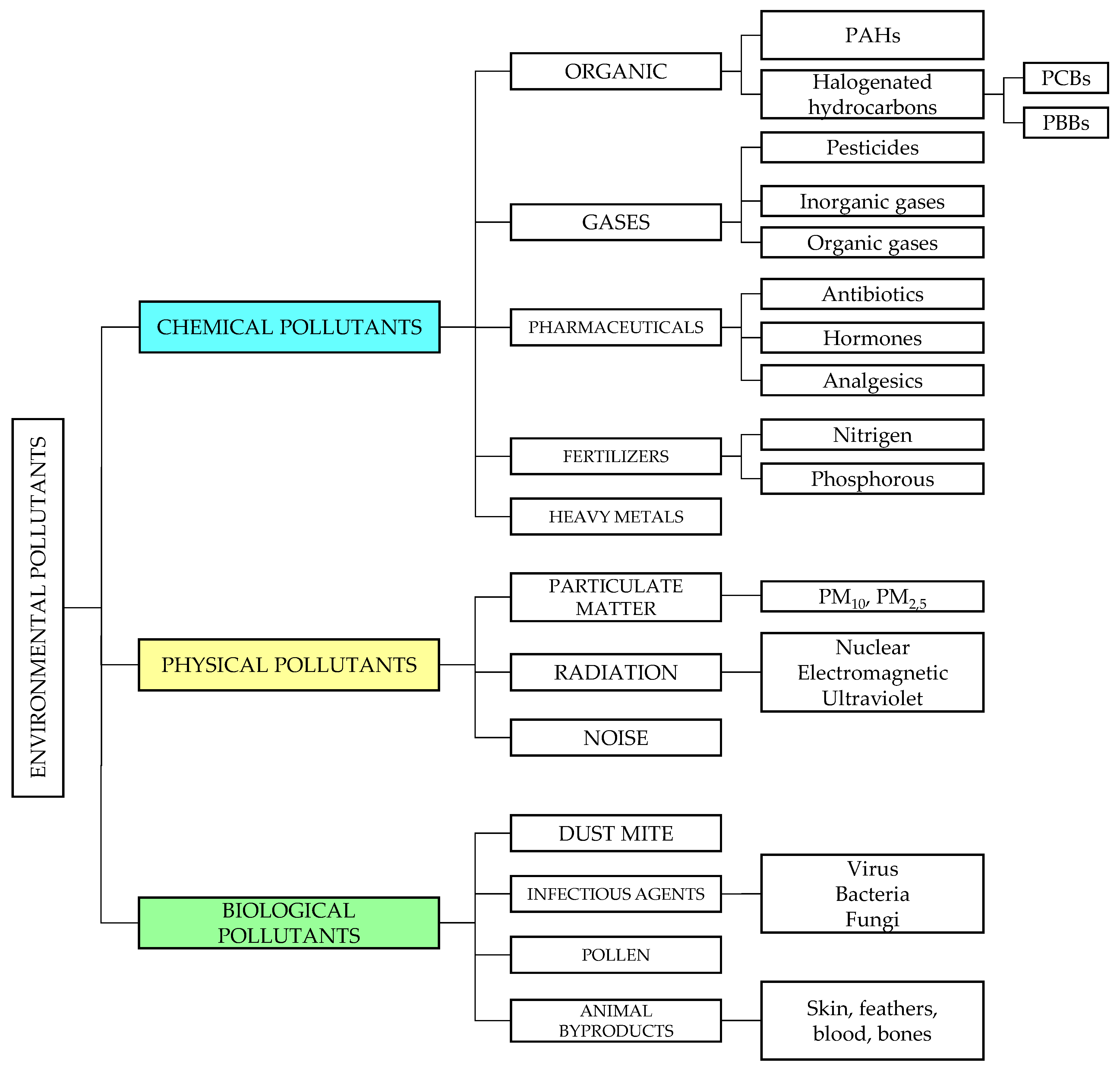
Figure 2.
Environmental remediation techniques.
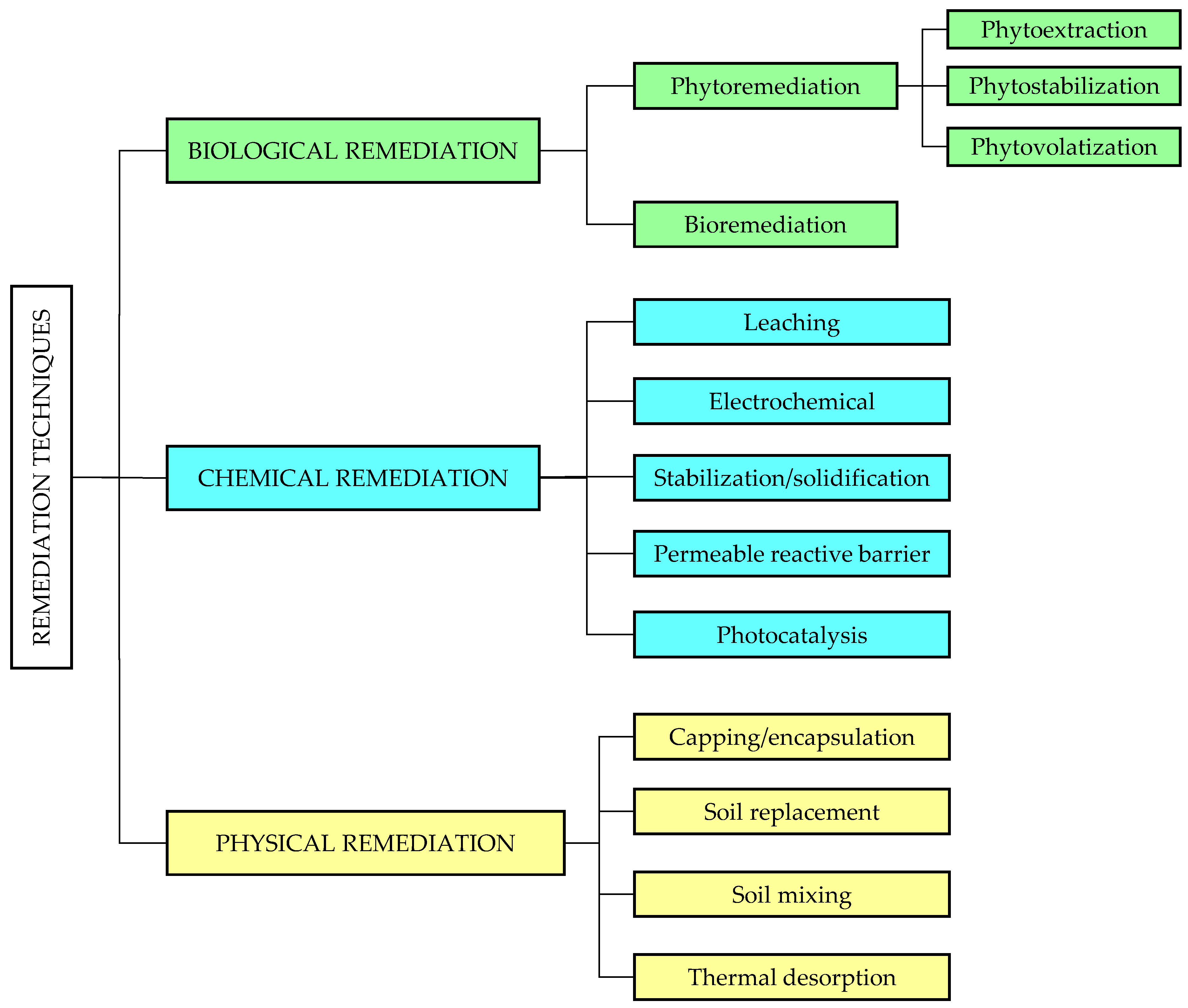

Table 1.
Results of investigation on phytoremediation of contaminated soil.
| Plant | Pollutant | Concentration [mg/kg] |
Duration | % removal | Literature |
|---|---|---|---|---|---|
| Salix viminalis | Cr As Cd Zn Cu Pb Ni |
9 5.3 4.4 64 294 2350 15.3 |
10 years | 21.1 30.2 54.5 60.9 62.2 62.6 86.9 |
[16] |
| Cyrsene Napthalene Phenanthrene Pyrene Sum of PAHs Sum of PCBs |
0.36 0.92 0.37 0.77 2.67 0.03 |
25.0 46.7 73.0 54.3 35.2 53.3 |
|||
|
Melilotus officinalis Agropyron cristatum Medicago sativa L. Lolium perenne L. |
Oil | 14400 | 5 years | 92.4 | [17] |
| Vetiveria zizanioides | Petroleum | 3000-8000 | 15 months | 89-90 | [18] |
| Cymbopogon nardus itle | 86-91 | ||||
| Pennisetum hybridum | Cd | 0.7676 1.3058 1.0970 |
4 months 6 months 12 months |
23.62 21.50 35.81 |
[19] |
Table 2.
Results of phytoremediation investigations of waters contaminated with heavy metals [20].
Table 2.
Results of phytoremediation investigations of waters contaminated with heavy metals [20].
| Pollutant | Al | As | Cd | Cr | Cu | Fe | Mn | Pb | Zn |
| Concentration, [mg/L] | 22.17 | 5.03 | 0.03 | 2.84 | 0.16 | 14.70 | 20.37 | 5.25 | 2.01 |
| % removal -Pistia stratiotes | 30.8 | 16.2 | 49.8 | 41.5 | 33.4 | 31.1 | 22.4 | 70.8 | 35.6 |
| % removal -Eichhornia crassipes | 72.9 | 26.1 | 82.8 | 62.8 | 78.6 | 61.1 | 47.6 | 62.5 | 78.3 |
Table 3.
Results of phytoremediation tests of contaminated sediment [21].
Table 3.
Results of phytoremediation tests of contaminated sediment [21].
| Plant | Pollutant | % removal |
|---|---|---|
|
Vallisneria natans Myriophyllum spicatum |
Cu | 26.1 |
|
Hydrilla verticillata Myriophyllum spicatum |
Pb | 68.4 |
Table 4.
Results of the assessment of the effectiveness of indoor air quality improvement in studio apartments by phytoremediation with indoor plants [22].
Table 4.
Results of the assessment of the effectiveness of indoor air quality improvement in studio apartments by phytoremediation with indoor plants [22].
| Pollutant | Apartments/Conditions |
Concentration [μg/m3] |
% removal |
| PM10 | 1/ventilation, plant | 19.40 | 67.01 |
| 2/plant | 21.82 | 62.89 | |
| 3/ventilation | 29.02 | 50.65 | |
| 4/no ventilation, no plants | 58.81 | Control | |
| PM2.5 | 1/ventilation, plant | 12.64 | 64.61 |
| 2/plant | 17.11 | 52.09 | |
| 3/ventilation | 15.94 | 56.63 | |
| 4/no ventilation, no plants | 35.72 | Control | |
| VOC | 1/ventilation, plant | 56.35 | 92.95 |
| 2/plant | 190.93 | 76.14 | |
| 3/ventilation | 84.42 | 89.41 | |
| 4/no ventilation, no plants | 800.41 | Control | |
| Formaldehyde | 1/ventilation, plant | 6.02 | 74.89 |
| 2/plant | 5.98 | 75.07 | |
| 3/ventilation | 34.67 | 30.00 | |
| 4/no ventilation, no plants | 23.99 | Control | |
| CO2 | 1/ventilation, plant | 615.50∙103 | 76.47 |
| 2/plant | 1154.52∙103 | 55.87 | |
| 3/ventilation | 1278.42∙103 | 51.13 | |
| 4/no ventilation, no plants | 2616.36∙103 | Control |
Table 5.
Results of phytoremediation of polluted indoor air.
| Plant | Pollutant | Concentration | % removal | Literature |
|---|---|---|---|---|
| Epipremnum aureum | PM2.5 PM10 VOC |
18-25 mg/m3 18-25 mg/m3 - |
54.5 65.4 46.0 |
[23] |
|
Schefflera arboricola Spathiphyllum wallisii |
Benzene | 3.5-6.5 μg/m3 10.5-16.3 μg/m3 25.0-30.0 μg/m3 |
97.0 94.0 91.0 |
[24] |
|
Epipremnum aureum Chlorophytum comosum Hedera helix Echinopsis tubiflora |
Benzene | 0.2-50 mg/dm3 | 72.0 | [25] |
Table 6.
Results of bioremediation of organic pollutants and heavy metals.
| Pollutant | Bacteria | Concentration | % removal |
Duration [days] |
Literature |
| Pyrene | Sphingobacterium | 1000 mg/L | 39.00 | 30 | [26] |
| Bacillus licheniformis | 38.29 | ||||
| Anthracene |
Bacillus pumilus Pseudomonas stutzeri Acinetobacter calcoaceticus |
- | 21.89 | 25 | [27] |
| Pyrene | 7.71 | ||||
| Naphthalene | Bacillus pumilus | 1000 mg/L | 7.16 | 30 | [28] |
| Pseudomonas stutzeri | 11.24 | ||||
| Cr(VI) | Bacillus pumilus | 250 mg/L | 56.30 | 15 | |
| Pseudomonas stutzeri | 52.74 | ||||
| Cd | Bacillus pumilus | 250 mg/L | 61.23 | ||
| Pseudomonas stutzeri | 57.80 | ||||
| Cd | Micrococcus sp | 0-10 mmol/L | 60.66 | 2 | [29] |
| Pb | 97.20 |
Table 7.
Results of soil phytoremediation and bioremediation [30].
Table 7.
Results of soil phytoremediation and bioremediation [30].
| Pollutant | Plant | Bacteria | % removal | Duration |
|---|---|---|---|---|
| PAH Cd Zn |
Sedum alfredii |
Microbacterium sp. strain KL5 Candida tropicalis strain C10 |
96.4 36.1 12.7 |
2 years |
Table 8.
Results of contaminated soil leaching.
| Leaching agent | Pollutant |
Concentration [mg/kg] |
Experimental conditions | % removal | Literature |
| Water | Cu | 700 | *S/L=1:1 5 MPa |
37.7 | [33] |
| Pb | 530 | 36.6 | |||
| Zn | 900 | 45.1 | |||
| 5 g/L rhamnolipid | Cd | 40-200 | pH=9, 15°C | 72.4 | [34] |
| phenanthrene | 84.8 | ||||
| 1 mol/L KCl | Cs | 1.5 | L/S=20 pH=2 2 h |
81.3 | [35] |
| 5 g/L citric acid 4 g/L chitosan |
Zn | 557.2 | - | 63.9 | [36] |
| 0.05 mol/L EDTA 0.20 mol/L citric acid |
Cu Ni Zn |
3884.8 624.5 280.3 |
S/L=1:10 pH=3.0 6 h |
81.5 85.9 81.1 |
[37] |
| 0.05 mol/L EDTA 0.20 mol/L oxalic acid |
Cu Ni Zn |
3884.8 624.5 280.3 |
85.5 82.9 84.6 |
||
| 0.05 mol/L EDTA 0.20 mol/L tartaric acid |
Cu Ni Zn |
3884.8 624.5 280.3 |
85.0 78.9 82.5 |
*S/L – solid/liquid ratio.
Table 9.
Results of the electrochemical soil remediation investigations.
| Pollutant | Concentration | Electrolyte |
Voltage [V] |
Duration | % removal | Literature |
| Cd | 3.68 mg/kg | 0.5 mol/L lactic acid | 20 | 14 days | 74.0 87.0 |
[38] |
| Petroleum | 150 mL/kg | water | 30 | 10 days | 75.2 | [39] |
| Pyrene | 500 mg/kg | 0.1 mol/L Na2SO4 | 30 | 23 days | 45.0 | [40] |
| Fluoranthene | 57.0 | |||||
| Phenol 2-chlorophenol 2,4-dichlorophenol 2,4,6-trichlorophenol |
1000 mg/L (soil : solution = 150 mL : 80 mL) |
Distilled water pH=9.8 |
1200 | 140 min | 72.0 80.2 81.6 85.2 |
[41] |
Table 10.
Results of electrochemical remediation of polluted water systems.
| Pollutant | System | Concentration | Current | Duration [min] | pH | % removal | Literature |
| As(III) | Water | 300 mg/L | 6 mA/cm2 | 30 | 9.0 | 81.0 | [42] |
| As(III) | Water | 1 mg/L | - | 60 | - | 100.0 | [43] |
| As(III) | Groundwater | 200 μg/L | 0.30 A | 12 | 7.5 | 99.2 | [44] |
| Fluoride | Groundwater | 7.35 mg/L | 10 mA/cm2 | 15 | 7.8 | 85.9 | [45] |
| fluoride Arsenic |
Water | 5 mg/L 80 µg/L |
4.5 mA/cm2 | 15 | 5.0 | 85.7 100.0 |
[46] |
Table 11.
Results of the stabilization/solidification study of contaminated soil.
| Pollutant |
Concentration [mg/kg] |
Material | Solidification duration | % removal | Literature |
| Pb Zn |
5000-10000 | limestone-calcined clay cement (LC3) | 28 days | 99.0 88.0 |
[47] |
| Pb Ba |
- | tailings-based geopolymer | 7 days | >95.0 | [48] |
| Cu | - | cement and rice husk ash | 28 days | 97.8 | [49] |
| As | 170.4 | cement and blast slag | 28 days | >80.0 | [50] |
Table 12.
Results of investigations on the remediation of polluted water systems using a permeable reactive barrier.
Table 12.
Results of investigations on the remediation of polluted water systems using a permeable reactive barrier.
| Pollutant | Reactive media |
Concentration [mg/L] |
Duration | % removal | Literature |
| Zn | Zeolitic rocks | 434 | - | 99.0 | [51] |
| Toluene | Sand Gravel bacterium Alcanivorax |
5 | 44 days | 88.2 | [52] |
| Sand Gravel bacterium Alcanivorax Geotextile |
98.0 | ||||
| Sand Gravel |
14.2 | ||||
| Zn Mn Ca Mg Cd Cr Sr Al |
*ZVI and zeolite | 82.8 13.8 555.9 186.4 0.08 0.2 1.2 16.2 |
- | 97.2 99.6 81.7 95.9 95.2 70.7 90.5 58.7 |
[53] |
| Cu Cd Co Ni Zn |
leaf compost, pea gravel, limestone, sulfate-reducing bacteria | 3.63 0.0153 0.0053 0.0131 2.41 |
21 month | 99.7 98.7 79.2 74.8 94.4 |
[54] |
| nitrate | ZVI modified raw wheat straw | 27.80-59.86 | 370 days | 90.0 (lab.) 60.0 (field) |
[55] |
*ZVI- zero valent iron.
Table 13.
Results of remediation of polluted air by photocatalysis.
| Pollutant |
Concentration [ppm] |
Catalyst | Substrate | Duration | Light source | % removal | Literature |
| Benzene | 0.11 | ZnO/Zn2TiO4 | glass | 4 h | UV | 95 | [56] |
| TiO2 | 70 | ||||||
| NOx | - | TiO2 | steel | - | UV | 87 | [57] |
| Benzene | 110 | - | - | 4 h | UV | 25 | [58] |
| CdO | 40 | ||||||
| TiO2 | 70 | ||||||
| CdO/CdTiO3 | 75 min | 100 | |||||
| Toluene | 300-3200 | ZnFe2O4 | - | - | UV | 60 | [59] |
| Chloroform | 6 | CuxO/TiO2 | polyester cloth | 15 h | ViS | 71 | [60] |
Table 14.
Results of thermal remediation investigations of contaminated soil and sediment.
| Pollutant |
Concentration [mg/kg] |
Media |
Temperature [°C] |
Duration [min] |
% removal | Literature |
| Phenanthrene Pyrene Benzopyrene |
1.2 | soil | 400 | - | >99.0 >99.0 >99.0 |
[61] |
| Perfluoroalkyl compounds Polyfluoroalkyl compounds | 4 0.025 |
soil | 450 550 |
75 | >99.0 99.0 |
[62] |
| Benzoanthracene Benzopyrene Pyrene Total PAHs |
0.257 0.050 0.089 0.989 |
soil | 650 | 30 | 92.2 96.0 84.3 79.7 |
[63] |
| Hg | 134 | soil | 400 | 60 | 99.2 | [64] |
| Petroleum hydrocarbons | 1370 | sediment | 200 | 30 | 89.0 | [65] |
Disclaimer/Publisher’s Note: The statements, opinions and data contained in all publications are solely those of the individual author(s) and contributor(s) and not of MDPI and/or the editor(s). MDPI and/or the editor(s) disclaim responsibility for any injury to people or property resulting from any ideas, methods, instructions or products referred to in the content. |
© 2023 by the authors. Licensee MDPI, Basel, Switzerland. This article is an open access article distributed under the terms and conditions of the Creative Commons Attribution (CC BY) license (http://creativecommons.org/licenses/by/4.0/).
Copyright: This open access article is published under a Creative Commons CC BY 4.0 license, which permit the free download, distribution, and reuse, provided that the author and preprint are cited in any reuse.


