

Submitted:
27 September 2023
Posted:
29 September 2023
You are already at the latest version
Abstract
With the widespread Application of Virtual Reality (VR) in education, optimizing foreign language learning in VR has become a focal point of research. This paper introduces a comprehensive theoretical framework (VR-CCL) based on constructivism and cognitive load theory to enhance foreign language learning in VR. Through a literature review, we explore the applications of VR in education, foreign language learning theories, and prior works on technology-assisted language learning. We further detail the three main components of the VR-CCL framework and validate its effectiveness through two case studies: Duolingo VR and Rosetta Stone VR. Finally, we discuss the strengths and limitations of the framework and its implications for educators and developers.
Keywords:
Virtual Reality
; Foreign Language Learning
; Constructivism
; Cognitive Load Theory
; VR-CCL Framework
; Technology-Assisted Learning
1. Introduction
1.1. Background of Virtual Reality in education
Within recent epochs, Virtual Reality (VR) has ascended as a paradigm-shifting apparatus within the scholastic sphere [1]. Once tethered to the intricate tapestry of computer visualization and ludic interfaces, the capacities of VR to craft deep, tridimensional realms are now esteemed for amplifying pedagogical voyages. Primordial inceptions of VR in this domain accentuated realms necessitating volumetric comprehension, epitomized by disciplines like architecture and medicine [2]. However, as techno-evolution burgeons and fiscal exigencies wane, VR’s tendrils extend into scholastic sanctuaries ranging from foundational pedagogies to apex academic citadels.
The magnetism of VR in pedagogy is anchored in its prowess for engendering experiential tutelage. Herein, scholars meld with subject matter, not as passive vessels but as vivacious participants. Such immersion transcends mere assimilation, germinating seeds of analytical rumination and solution-oriented sagacity. Moreover, within VR’s embrace, academicians find solace in exploration, unshackled by tangible repercussions, free to err, and enlightened by subsequent revelations.
Contemporary analyses juxtaposing conventional methodologies with VR-infused curricula unveil myriad accolades. Pupils navigating this nexus unearth heightened spatial sagacity, superior mnemonic tenacity, and a zest for erudition [3]. Nonetheless, the sagacious confluence of VR into the pedagogical matrix mandates meticulous orchestration, harmonizing both techno-artifacts and instructional stratagems.
To encapsulate, VR’s narrative within the academic milieu has metamorphosed from esoteric dalliances to ubiquitous commendation, presaging a renaissance in erudition paradigms. As the techno-tapestry weaves ever complex patterns, prognostications discern an augmented sphere for VR, unveiling avantgarde, efficacious pedagogical conduits [4].
1.2. Importance of foreign language learning
Navigating the vast tapestry of our interwoven global tableau, mastering nonnative dialects breaches boundaries beyond mere oratory exchanges. It emerges as a bridge, enlightening one to the tapestry of various civilizations, catalyzing global symbiosis, and amplifying cerebral advancement [5]. The pursuit of linguistic plurality is increasingly heralded as an invaluable asset across an array of arenas, from trade and inter-nation dialogues to scholastic corridors.
Anchoring the global fiscal landscape is the spirit of transnational cooperation. Companies with global footprints actively seek individual’s adept at navigating varied linguistic and cultural terrains, ensuring seamless international interactions and discussions [6]. In this epoch of borderless interactions, as entities stretch their global tendrils, the ability to resonate with affiliates, collaborators, and patrons in their vernacular emerges as an unparalleled edge.
Stepping past the rudiments of lexis and syntax, absorbing a foreign dialect unveils the opulence of assorted cultural tapestries. Such submersion cultivates compassion, whittles down parochial worldviews, and kindles a spirit of universal fellowship. In pedagogic settings, pupils steeped in alien tongues frequently manifest amplified cross-cultural sagacity, equipping them to navigate our kaleidoscopic globe adeptly [7].
Ample scholarly explorations highlight the cerebral windfalls accompanying bior multilingual prowess. Venturing into alien dialects is linked with honed analytical faculties, fortified mnemonic resilience, and amplified juggling capabilities. Additionally, it is conjectured to forestall mental stagnation in the twilight years [8].
In summation, the imperatives of absorbing foreign dialects are multifarious, echoing across fiscal, cultural, and cerebral dimensions. With the crescendo of global entwining, the value placed upon polyglot denizens shall inexorably surge, accentuating the exigency for trailblazing and potent linguistic assimilation modalities.
1.3. Brief Layout of the Paper
This document delves deeply into the confluence of virtual reality (VR) and the domain of learning foreign languages. The ensuing chapters are methodically curated to grant readers an encompassing grasp of the subject’s expansive scope.
After this prologue, Chapter 2 immerses itself in a bibliographic survey, sketching the trajectory of VR in pedagogical landscapes, the foundational pillars of foreign language mastery, and the nexus of tech-augmented pedagogies within this sphere. This chapter also discerns the quintessential attributes demarcating potent VR linguistic experiences, shedding light on extant research voids.
Chapter 3 delineates the philosophical moorings shaping our avantgarde VR-CCL paradigm. It unpacks germane cognitive paradigms in language acquisition, assimilating wisdom from pedagogic psychology, notably those germane to VR.
Within the precincts of Chapter 4, we unfurl the VR-CCL paradigm, a pioneering blueprint crafted to enhance linguistic journeys within VR. This approach is broken down into its fundamental components, each rooted in well-established educational principles, and their practical implications within a virtual reality context are discussed in detail.
Chapter 5 unfurls twin case exemplars—Duolingo VR and Rosetta Stone VR—to elucidate the tangible embodiment of the VR-CCL paradigm. These exemplars proffer palpable perspectives, juxtapositions, and deductions, affirming the paradigm’s practicality.
Chapter 6 embarks on a rigorous discourse, juxtaposing the merits against potential constraints of the VR-CCL paradigm. It further outlines its repercussions for pedagogues and technologists, proffering pragmatic directives.
Conclusively, Chapter 7 encapsulates the manuscript, highlighting its seminal revelations and pointing towards promising trajectories for impending explorations at this exhilarating crossroads of VR and linguistic pedagogy.
By charting this manuscript’s chapters, aficionados will fathom the metamorphic capacities of VR within foreign language tutelage and the groundbreaking methodologies primed to harness this latent prowess.
The evolution of virtual reality in education over the years is depicted in Figure 1.
1.4. Objective and contributions of the paper
This treatise is poised with a cardinal mission: to weave together the disjointed virtual reality (VR) tapestries and the art of foreign language acquisition. Marrying insights from both arenas, our ambition is to unfurl a stalwart theoretical schema, termed the VR-CCL, sculpted to steer pedagogues and tech savants towards harnessing the unparalleled nuances of VR, amplifying linguistic educational yield.
The bequests of this treatise are multilayered:
(1) Theoretical Fusion: We coalesce tenets from constructivist vistas, cognitive burden postulates, and kindred pedagogic paradigms, fashioning the VR-CCL matrix. This fusion furnishes a rejuvenated vantage on tailoring VR to satiate the bespoke exigencies of language tutelage.
(2) Applicable Wisdom: Traversing the intricacies of the VR-CCL matrix, we bestow pragmatic stratagems ripe for deployment within tangible VR linguistic pedagogical realms. Though rooted in Theory, these stratagems have a discernible bias towards tangible deployment.
(3) Exemplar Dissections: We incorporate tangible exemplars, notably Duolingo VR and Rosetta Stone VR, as living testaments of the VR-CCL matrix’s vitality. These probings vindicate the matrix’s pragmatism and spotlight conceivable hurdles and antidotes in its orchestration.
(4) Horizons Uncharted: Pinpointing the strengths, constraints, and latent enhancement corridors for the VR-CCL matrix, we sow seeds for prospective scholarly quests. This visionary stance ensures the treatise retains its pertinence as the VR technological tapestry and linguistic pedagogic methodologies incessantly metamorphose.
At its core, this treatise aspires to be an indelible compass for educators, tech architects, and scholars enraptured by the confluence of VR and language tutelage, offering a harmonious blend of conceptual profundity and pragmatic directives.
2. Literature Review
2.1. Virtual Reality in educational settings
In recent epochs, Virtual Reality (VR) has metamorphosed from an esoteric tech forte essentially tethered to digital gaming to a pivotal catalyst echoing in myriad arenas, notably education [9]. The enveloping quintessence of VR, distinguished by its adeptness to craft tangible or envisioned terrains while endorsing user engagements, heralds a seismic recalibration in educational elucidation and absorption modalities [10].
Historical retrospections unveil monumental strides in pedagogic apparatuses. Commencing from the chalk-dusted epochs, transcending the advent of luminary projectors, and culminating into the digital renaissance festooned with interactive boards and cybernetic learning spheres, each juncture has bequeathed augmented interactivity and captivation [11]. VR emerges as the contemporary and arguably the most poignant stride in this evolutionary mosaic [12]. It bestows a panoramic, multisensory pedagogic odyssey, obliterating the fetters of planar portrayals.
The gamut of VR’s applicability in pedagogic precincts is expansive and multifarious [13]. Take, for instance, the annals of yesteryears; learners can be ethereally ferried to bygone empires, meandering through the cobblestones of Roman piazzas or beholding the monumental ascendancy of Egyptian pyramids [14]. Labyrinthine organic cycles or meticulous surgical choreographies can be envisioned and rehearsed without real-world liabilities in natural philosophy and medicinal arts [15]. Cartographic tutorials might unfurl as phantasmal sojourns to farflung geographies, while aspirant architects can saunter through their nascent edifices [16].
Venturing beyond canonical syllabi, VR unveils prodigious prospects in specialized pedagogy [17]. Bespoke VR sagas can be sculpted for scholars grappling with cognitive hurdles, autism spectrum nuances, or kinesthetic encumbrances, endowing them with an egalitarian scholastic milieu, often elusive in traditional cadences [18].
Nevertheless, weaving VR into scholastic tapestries is full of quandaries [19]. The inaugural expenditure tethered to VR paraphernalia might be exorbitant for specific academies. The quest for crafting superlative scholastic narratives that resonate technologically and pedagogically persists [20]. Pedagogues necessitate adeptness in maneuvering VR arsenals, coupled with simmering discourses on digital engagement and its conceivable reverberations on learners [21].
While VR unfurls an avantgarde horizon for pedagogy, its judicious melding mandates an equilibrium, cognizant of its merits and impediments [22]. With the inexorable march of tech innovation and augmented accessibility, one can prognosticate that VR’s imprint on education shall burgeon, sculpting pedagogic futures [23].
The distribution of virtual reality applications across various educational domains is illustrated in Figure 2.
2.2. Foreign language learning theories
The endeavor to grasp a foreign language has always been an academic challenge and a personal goal [24]. Over time, multiple theories have been proposed to demystify the intricacies of language learning. These perspectives shed light on the intricacies of language acquisition and help educators tailor their teaching techniques more effectively [25].
Behaviorist Theory: Inspired by B.F. Skinner’s research suggests that language learning is about forming habits [26]. It hinges on repetition and positive reinforcement, implying that correct language use becomes second nature with consistent affirmation. The age-old method of rote learning, with repetitive exercises in grammar and vocabulary, is a byproduct of this school of thought.
Innate Theory, as Noam Chomsky advocates, posits that humans possess an inherent inclination to acquire languages from birth [27]. He introduced the concept of the ‘Language Acquisition Device’ (LAD), a prewired facility in our brains that simplifies the language learning process. It contradicts the behaviorist standpoint, focusing instead on the innate human knack to grasp intricate linguistic constructs.
Cognitive Theory: From this vantage, language acquisition is a sophisticated cognitive task wherein learners actively piece together their linguistic understanding [28]. It suggests learners tap into their preexisting knowledge base and cognitive tools to theorize about their target language, refining these theories as they delve deeper.
Sociocultural Theory: Based on Lev Vygotsky’s insights, this Theory emphasizes that social engagements are integral to cognitive growth [29]. It posits that language learning is deeply intertwined with societal interactions, collective endeavors, and cultural nuances.
Input Hypothesis: Stephen Krashen’s Theory underscores the significance of understandable linguistic input [30]. Krashen suggests that language learners are most effective in absorbing a language when they can comprehend the linguistic information they encounter. The crux here is to expose students to content slightly beyond their current mastery level.
Affective Filter Hypothesis: Another of Krashen’s contributions, this hypothesis accentuates the role of emotions like motivation, anxiety, and self-assurance in language learning. A favorable emotional environment can “lower the affective filter,” making it easier for learners to absorb and process language.
Incorporating VR into this landscape offers a fresh dimension to these theories [24]. VR’s enveloping environments can offer a plethora of contextual cues, aligning well with the Input Hypothesis. Its interactive scenarios can stimulate social engagements, echoing the Sociocultural Theory’s tenets. Furthermore, VR’s captivating nature can positively influence learners’ emotions, potentially optimizing conditions for language assimilation.
It is essential for educators and tech developers to grasp these theories, especially when sculpting VR-infused language learning modules. Grounding VR tools in solid educational theories can magnify their potential, paving the way for more impactful language education [25].
2.3. Previous works on technology-assisted language learning
Incorporating technology into language education is by no means a fresh endeavor. Over the years, technological advancements have persistently reshaped language teaching, introducing fresh tools and methods to enrich the educational journey [31].
Computer-Assisted Language Learning (CALL): Introduced in the 1960s, CALL signified the initial notable fusion of technology into language education [32]. The primary versions of CALL were largely text-focused drills. However, as technology developed, these transformed to embrace multimedia features, interactive tasks, and virtual simulations [33]. Numerous studies have established that CALL can tailor learning experiences to individual preferences, enabling students to learn at a rhythm that suits them.
Mobile-Assisted Language Learning (MALL): The proliferation of smartphones and tablets ushered in a new phase of language education [34]. MALL apps like Duolingo and Babbel employ game-like features to capture users’ interest. These platforms offer concise lessons prompt feedback, and are tailored to cater to contemporary learners.
Online Language Portals: Platforms like Coursera, Udemy, and iTalki have democratized access to language resources, featuring courses from global institutions and native speakers [35]. Such websites amalgamate video sessions, interactive tests, peer interactions, and on-the-spot feedback to craft a holistic learning ambiance.
Virtual Worlds and MMORPGs: Virtual realms like Second Life and specific MMORPGs geared towards language learning offer learners’ virtual spaces to apply language skills in lifelike situations [36]. They enable genuine interactions, allowing learners to hone their speaking, listening, and cultural comprehension.
Augmented Reality (AR) and Language Learning: AR supplements the natural environment with computer-generated enhancements [37]. Tools like Google Translate’s real-time camera translation illustrates the potential of AR in language learning. AR integrates language learning into daily routines by converting routine situations into learning moments.
Virtual Reality (VR) in Language Education: The shift towards VR in language learning is the next logical step in this technological evolution [31]. VR’s unparalleled immersive quality allows learners to engage with languages within contextually appropriate virtual scenarios. Preliminary studies into VR-supported language education are encouraging, indicating heightened learner enthusiasm, involvement, and recall [33].
However, while the potential of technology in education is vast, it is crucial to perceive it as an enabler rather than an ultimate solution [31]. The success of any tech-driven language learning system is contingent on its judicious blend into a broader educational strategy. As VR starts to take a more central role in language teaching, comprehending its strengths and challenges, as seen through past technological evolutions, becomes crucial.
2.4. Key features of effective VR language learning
The infusion of Virtual Reality (VR) into language education has ushered in many avenues to enrich and optimize the learning journey [38]. Nevertheless, the efficacy of VR applications can vary widely. Several paramount constituents underscore VR’s efficacy in linguistic pedagogy:
Immersive Experiences: A hallmark of VR is its capability to craft authentic, enveloping settings [39]. This deep immersion transports learners to settings – a lively urban square or a serene coffee shop – where they can exercise their linguistic skills in situations that mirror reality.
Contextual Learning: VR’s prowess in simulating diverse situations bestows learners with context-rich instances to employ language constructs, bolstering both recall and practical Application [40].
Interactive NPCs (Non-Player Characters): These characters emulate human interactions, granting learners opportunities to hone their dialogic skills. Progressive VR platforms harness AI-powered NPCs, which modify their interactions, presenting an evolving dialogue companion.
Instantaneous Feedback: Timely feedback is instrumental for grasping a language. In VR, learners can get on-the-spot guidance on facets like pronunciation, lexicon usage, or syntactic patterns, facilitating swift adaptation and refinement.
Multisensory Engagement: Beyond mere visual and auditory cues, sophisticated VR configurations might integrate touch feedback, deepening the educational immersion [39]. Such a comprehensive sensory engagement caters to diverse learning predilections and amplifies memory anchoring.
Collaborative Endeavors: VR environments accommodating multiple users empower learners to engage with peers or tutors contemporaneously. These shared interactions can kindle group tasks, discussions, or dramatization exercises, enhancing communicative prowess.
Tailored Learning Journeys: A learning trajectory tailored to a student’s linguistic level and learning inclination can amplify the potency of VR experiences [40]. VR platforms that tweak the content, challenge level, or feedback mechanisms in sync with individual learners promise optimal pedagogical outcomes.
Cultural Immersion: Beyond linguistic mechanics, VR can immerse learners in the cultural fabric, letting them virtually partake in global festivities, customs, or mundane routines [38]. Such immersive sessions cultivate cultural cognizance and appreciation, critical facets of holistic language instruction.
While VR promises to revolutionize language pedagogy, its success is seamlessly integrating these vital elements. Collaborative endeavors between educators and tech creators, focusing on these attributes, can ensure that learners not only master linguistic nuances but also gain profound insights into the cultural tapestry intertwined with the language.

Table 1.
Key Features of Effective Virtual Reality (VR) Language Learning.
| Key Features | Description |
|---|---|
| Immersive Environment | Engages learners by simulating real-world scenarios, enhancing retention and comprehension. |
| Interactive Content | Allows learners to actively participate, promoting active learning and better understanding. |
| Adaptive Learning Paths | Adjusts content based on learner’s progress, ensuring personalized learning experiences. |
| Real-time Feedback | Provides immediate feedback on performance, enabling learners to correct mistakes and improve. |
| Multi-modal Learning | Incorporates visual, auditory, and kinesthetic learning styles, catering to diverse learners. |
| Collaborative Learning Spaces | Facilitates peer-to-peer interactions and collaborative tasks in a virtual setting. |
2.5. Gaps in existing VR language learning research
Incorporating Virtual Reality (VR) into the domain of language pedagogy has undoubtedly exhibited promising outcomes. However, discerning and acknowledging the lacunae and constraints inherent in the prevailing research landscape is crucial. A proactive approach towards these gaps can set the stage for more exhaustive research endeavors and refined VR methodologies in the subsequent phases.
Extended Scope of Research: Most studies centered around VR in language education delve into brief interventions. A pressing requirement emerges for longitudinal examinations that scrutinize the persistent influences of VR on linguistic adeptness over prolonged durations.
Standardizing Success Indicators: The benchmarks deployed to gauge the efficacy of VR-centric language learning tools oscillate across diverse studies. Instituting a standardized set of metrics can yield a more lucid understanding of VR’s tangible contributions to linguistic mastery.
Broadening Linguistic Horizons: Although an array of VR tools caters to predominant languages such as English, Spanish, and Mandarin, there must be more platforms for less mainstream languages. Widening this spectrum can render VR-driven language education more encompassing.
Technological Inclusivity: Elite VR configurations carry a hefty price tag, potentially placing them out of reach for a broad learner demographic. Investigating the potential of frugal VR systems in facilitating language acquisition can democratize access to this innovative tech.
Harmonizing Tech and Pedagogy: Certain research endeavors bear an excessive tilt towards VR’s technological facets, inadvertently overshadowing pedagogical dynamics. An equilibrium that marries pedagogical tenets with tech strides is paramount.
Empowering the Learner: Amid VR’s captivating ambiance, there is a conspicuous research void regarding learners’ autonomous journey and self-direction within these realms.
Symbiosis with Conventional Pedagogy: The interplay between VR and traditional classroom-centric language instruction remains relatively uncharted. Probing into hybrid learning models amalgamating VR could shed light on enhancing the holistic language learning paradigm.
Navigating Cognitive Intensity: The encompassing nature of VR might, at times, thrust learners, especially novices, into a cognitive whirlwind. Developing strategies to curtail and navigate this cognitive inundation can refine the learning trajectory.
To encapsulate, the extant research, though insightful, warrants augmentation to harness VR’s potential in language pedagogy. As we tread forward in VR-infused language instruction, it is pivotal for scholars, pedagogues, and tech innovators to engage in collaborative endeavors. This collaboration maximizes the potential of the technological framework, enhancing educational experiences for learners worldwide.
3. Theoretical Foundations
Diving into Virtual Reality (VR) within the domain of linguistic pedagogy unveils more than just cutting-edge technological evolutions. Indeed, its foundations anchor deeply within multifaceted theoretical paradigms that have steadfastly steered the course of language mastery. Grasping the quintessence and subtleties of VR in this scholastic realm mandates an intricate expedition into the bedrock theories bolstering its adoption. Far from mere postulates, these theories bestow a compass for VR’s deployment, illuminating pathways to finesse its orchestration for pinnacle linguistic outcomes. In cognizance of these theoretical bedrocks, scholarly educators and innovative developers stand poised to sculpt discernment decisions. Such prudence ensures that VR apparatuses resonate harmoniously with the zenith of teaching methodologies, all while addressing the cerebral and emotive requisites of the scholars. Subsequent segments shall unfurl the tapestry of cardinal cognitive doctrines pertinent to language enlightenment and delve into pedagogic psychology tenets germane to VR. This intellectual voyage sets the stage for an enriched discourse on the VR-CCL schema.
3.1. Cognitive theories in language learning
Cognitive doctrines have perennially spearheaded our quest to decipher the complex mechanisms underpinning language mastery. These tenets illuminate how individuals assimilate, archive, and recall linguistic data, bequeathing profound insights into the gears of language absorption. As we integrate VR into linguistic pedagogy, comprehending these cognitive machinations becomes quintessential to unlocking VR’s maximal efficacy. By calibrating VR ambiances to resonate with cognitive axioms, we sculpt realms that captivate scholars while fostering profound and enduring linguistic comprehension. In ensuing passages, we shall probe deeper into the nuances of these cognitive tenets, traversing from the evolutionary phases of language mastery to methodologies amplifying linguistic absorption and the pivotal role of cognitive burden in assimilating linguistic intricacies.
Figure 3 provides a flowchart detailing the process of cognitive development in relation to language acquisition.
3.1.1. Cognitive development and language acquisition
The trajectory of cognitive maturation profoundly influences an individual’s capacity to assimilate and articulate language. The illustrious cognitive theorist Jean Piaget propounded that offspring navigate through specific epochs of cognitive maturation, each delineated by distinct intellectual modalities and learning proficiencies [41]. Within the sensorimotor epoch (birth to 2 years), neonates commence forging connections between auditory stimuli and their corresponding significances, establishing the bedrock for linguistic mastery. The preoperational epoch (2 to 7 years) heralds a prolific expansion in the lexicon and the genesis of rudimentary syntactic constructs. As juveniles segue into the concrete operational epoch (7 to 11 years), they cultivate the proficiency to cogitate logically on tangible occurrences, augmenting their linguistic discernment and articulation. Conclusively, during the formal operational epoch (12 years onward), abstract ratiocination paved the way for a sophisticated grasp and deployment of intricate linguistic architectures.
These epochs elucidate the intricate tapestry interweaving cognitive evolution and linguistic assimilation [42]. Discerning a learner’s cognitive epoch empowers pedagogues to finetune VR engagements harmonizing with their developmental prerequisites, championing the zenith of linguistic educational outcomes.
3.1.2. Application of cognitive strategies in language learning
Cognitive tactics represent intentional, purpose-driven cerebral operations that learners harness to bolster language mastery [41]. These tactics include structuring fresh insights into coherent sequences or leveraging memory aids to anchor vocabulary. For instance, the tactic of elaboration, held in high regard, entails weaving ties between novel linguistic information and pre-existing knowledge, thus intensifying understanding and buttressing recollection. Another esteemed tactic, deduction, capacitates learners to extrapolate the significance of unfamiliar lexemes or expressions by harnessing ambient hints, bolstering self-reliant edification.
The encompassing skill of metacognitive cognizance empowers learners to orchestrate their learning trajectory through strategically delineating, surveillance, and evaluating their linguistic mastery tactics [42]. To illustrate, a scholar might, with deliberation, elect to repetitively rehearse a lexicon cluster (an act of repetition) or array them under thematic umbrellas (a taxonomic method), contingent upon their perceived efficacy.
Embedding such cerebral tactics within VR linguistic edification landscapes can magnify their potency. By mimicking tangible life episodes, VR can proffer sumptuous backdrops that galvanize scholars to harness these tactics, nurturing profound linguistic sagacity and enduring memory anchors.
3.1.3. Cognitive load and language processing
Cognitive burden denotes the mental strain necessitated to assimilate data and execute endeavors. Within the realm of linguistic edification, it signifies the cerebral capital utilized by scholars during the assimilation and digestion of nascent linguistic components. Numerous variables, such as the intricacy of the linguistic content, the scholar’s antecedent wisdom, and the pedagogical blueprint, can sway this burden [43].
Three cardinal cognitive burdens are recognized: inherent, superfluous, and pertinent. The inherent burden is indelibly linked to the material under study and is gauged by its convolution juxtaposition with the scholar’s preexisting acumen. As an illustration, grappling with the intricate facets of an esoteric grammatical paradigm in an unfamiliar tongue might inflict a lofty inherent strain upon novices.
The superfluous burden is not quintessential for the edification trajectory but emanates from how data is showcased or chores are delineated. Haphazardly structured content or nebulous directives can gratuitously augment this burden, sidetracking cerebral assets from genuine edification.
Pertinent burden pertains to cerebral undertakings that bolster the edifice of enduring cognition, such as schema formulation. Quintessential pedagogical blueprints strive to curtail superfluous burdens while amplifying pertinent ones, ensuring judicious utilization of scholars’ cerebral capital for substantive edification.
Within VR linguistic edification terrains, supervising cognitive burden is paramount. VR’s engulfing essence can proffer sumptuous, contextually apt episodes but concurrently risks inundating scholars with a surfeit of sensory data. Thus, it becomes cardinal to concoct VR voyages that harmonize the unveiling of nascent linguistic content with interactive facets, safeguarding those scholars remain captivated without succumbing to saturation. This equilibrium underpins proficient linguistic digestion, solidifying emergent wisdom and competencies.
3.2. Educational psychology theories relevant to VR
Pedagogical psychology unfurls a tapestry of discernments into the modalities through which individuals assimilate knowledge, particularly within tech-augmented milieus like Virtual Reality (VR). As VR burgeons into an influential instrument within the educational sphere, grasping the psychological tenets bolstering efficacious edification within this domain ascends in significance. This segment ventures into salient pedagogical psychology postulates inextricably linked to VR environments. These postulates elucidate not merely the cerebral and affective oscillations of scholars within VR but also chart the blueprint of VR odysseys to optimize edificatory outcomes. By amalgamating these theoretical vantages, we can adeptly leverage the distinctive boons of VR, forging engrossing educative sojourns that resonate both in allure and scholarly merit.
A comparative chart highlighting the differences in learner motivation and engagement between traditional and VR learning is presented in Figure 4.
3.2.1. Immersive learning experiences in VR
Virtual Reality (VR) emerges as a beacon in the digital terrain, celebrated for its prowess in fabricating encompassing edificatory escapades [44]. In the VR lexicon, ‘immersion’ delineates the profound sentiment of corporeal inhabitance within an ethereal realm. This profound sentiment springs from a symphony of visual, auditory, and occasionally tactile resonances enveloping the scholar, endowing the virtual milieu with a palpable verisimilitude [45].
The allure of VR’s immersive pedagogy emanates from its dexterity to emulate real-world tableaux that might otherwise be untenable, perilous, or elusive within conventional educational precincts. Picture a fledgling medic honing surgical dexterities within the sanctity of a virtual infirmary or a scholar of antiquity meandering through bygone epochs, imbibing history in its raw, unvarnished splendor. Such tangible veracity fosters experiential edification, wherein scholars distill wisdom and prowess not from dormant content imbibition but vivacious engagements.
VR’s enveloping character can amplify affective resonance. Affective oscillations wield a pivotal clout over the edificatory journey, steering zeal, focus, and mnemonic preservation. Engulfed in emotive fervor, scholars tend to harbor an intensified yearning to traverse, engage, and invest cerebral vigor, paving the path for profound comprehension and enhanced material anchorage.
In this pursuit of immersion, equilibrium remains paramount. Excessive submersion could inundate the cognitive reservoir, especially amidst a deluge of data or an intricate virtual cosmos. Thus, pedagogical architects must judiciously sculpt VR odysseys, ensuring immersive elements amplify and harmonize with the scholarly intent without ensnaring the learner in cognitive quagmires.
3.2.2. Learner motivation and engagement in VR
Motivation and fervor stand as cornerstones in the pedagogical tapestry, and Virtual Reality (VR) unfurls an unparalleled tapestry to amplify these facets [46]. With its engrossing and tactile realms, VR metamorphoses pedestrian scholastic materials into riveting odysseys, kindling a learner’s innate zeal.
VR’s salient virtue is its ability to bestow immediate and consequential feedback. As scholars meander through the virtual terrains, the repercussions of their endeavors manifest instantaneously, be it while piecing together a digital contraption or embarking on a linguistic sojourn in alien tongues. Such real-time affirmations bolster the edificatory voyage and ignite a flame of triumph, intensifying the pull of motivation.
The all-encompassing terrains crafted by VR conjure a profound immersion, making learners feel ensconced within the educational escapade. Such an amplified immersion can spawn heightened empathy and an affective bond with the content. Visualize, for instance, an aspirant of environmental lore forging a profound kinship with issues of deforestation after witnessing the obliteration of a verdant canopy in the virtual cosmos.
The elements of gamification, seamlessly woven into VR pedagogical platforms, further accentuate motivation. The allure of challenges, accolades, and the thrill of competition infuse vivacity into the learning journey, nudging scholars to immerse deeper, thereby honing their grasp over the subject matter.
Amidst VR’s mesmerizing allure, it remains paramount to tether its capabilities to genuine educational aspirations. The charm of VR must not eclipse the cardinal scholastic imperatives. Instead, VR should serve as a conduit, augmenting and synergizing with time-honored educational modalities, crafting a comprehensive and efficacious learning sojourn.
3.2.3. Social interaction and collaborative learning in VR
Virtual Reality (VR) transcends the confines of isolated escapades, emerging as a social engagement and collective edification nexus [47]. VR’s prowess in mirroring the tangible world presents an unmatched avenue for scholars to plunge into collective endeavors, dialogues, and analytical pursuits within a communal virtual expanse.
Group learning within VR manifests in myriad modalities. Picture, for instance, students congregating in a digital lab, orchestrating experiments and disseminating discoveries synchronously. Alternatively, envision them embroiled in a dramatized exercise, donning varied personas, navigating challenges, and striving toward a collective mission. Such ventures hone collaborative acumen and articulation and empower participants to embrace diverse vantage points.
VR’s ambit encompasses a global tableau. Pupils spanning continents can convene within a digital academy, interspersing their distinct cultural imprints and worldviews. This transcontinental communion amplifies the pedagogical journey, fostering cross-cultural sagacity and compassion.
Another noteworthy facet of VR’s collaborative paradigm is the capacity to chronicle and reenact engagements. Pedagogues can scrutinize these captures to proffer insights, while learners can peruse them for introspection and enriched comprehension.
Amidst the expansive potential of VR in cooperative pedagogy, it is paramount to champion accessibility. Ensuring equitable ingress, user-friendly navigation, and judicious content oversight guarantees that VR-facilitated collective education remains inclusive and resonant for every participant.
4. VR-CCL Framework for Optimized Language Learning
Incorporating Virtual Reality (VR) within the pedagogical tapestry, predominantly within the precincts of foreign language pedagogy, demands a meticulous methodology to unlock its latent prowess. Emerging from this exigency, the VR-CCL (Virtual Reality - Constructivism and Cognitive Load) paradigm offers an intricate tapestry, amalgamating the tenets of constructivist pedagogical axioms and the nuances of cognitive load theory cocooned within the VR milieu.
The architecture of this paradigm has been meticulously sculpted to navigate the labyrinthine intricacies and boundless vistas birthed by VR in the language acquisition odyssey. Harnessing the ethereal and symbiotic faculties of VR, the VR-CCL paradigm aspires to sculpt a harmonized learning sanctum, resonating with the cognitive oscillations of learners and fostering profound educational epiphanies.
Subsequent discourses shall pierce the veil of the VR-CCL paradigm’s nucleus, shedding luminescence on how each facet augments language mastery within the VR cosmos. As we embark on an erudite voyage through interactive resonance, cognitive burden orchestration, and tailoring tactics, a lucid compass shall manifest, guiding pedagogues and visionaries toward seizing the zenith of VR’s capabilities in foreign language enlightenment.
The overarching structure and components of the VR-CCL framework are visualized in Figure 5.
4.1. Interactive Engagement (Based on Constructivist Learning Theory)
Interactive resonance forms the bedrock of the VR-CCL paradigm, gleaning insights from the pillars of constructivist educational philosophy. Constructivism advocates for learners’ active chiseling of wisdom through their dynamic interplay with surrounding stimuli. Thus, VR’s inherently interactive milieu emerges as a sublime canvas for hands-on enlightenment. Such dynamisms amplify their essence, furnishing genuine backdrops where aspirants can immerse, practice, and assimilate novel linguistic patterns and lexicons. Succeeding segments shall plumb the depths of diverse dimensions of interactive resonance within VR, accentuating the quintessence of learner-content dialogues, peer-to-peer exchanges, objective-driven endeavors, and the paramountcy of reflexive mechanisms in orchestrating an enriching odyssey of learning.
4.1.1. Learner-content interaction in VR
Virtual Reality (VR) has revolutionized the pedagogical panorama, especially linguistics. With its tomes and spoken discourses, the conventional learning alcove has been eclipsed by VR’s enveloping, tridimensional realms. In these vistas, the nexus between scholar and material is not merely amplified; it undergoes metamorphosis.
Envision an instance where an apprentice, endeavoring to master French, is virtually conveyed to a charming alley in Paris. Meandering through this milieu, every placard, carte du jour, and periodical becomes a conduit to immerse in the dialect. They can virtually handle artifacts, peruse annotations, or even solicit refreshments at a bistro, honing articulation and phraseology in synchrony. Such engagements bestow upon the educational voyage a profound contextuality. Lexemes transform from nebulous concepts to memorized into instrumental conduits for exploration, discourse, and discernment in a virtual cosmos echoing the tangible.
This profundity of engagement is augmented by the pan-sensory resonance that VR dispenses. An aspirant does not merely visualize the term “pomme” at a virtual produce stand; they can ‘grasp’ the apple, ‘eavesdrop’ on its accurate enunciation, and even ‘per-ceive’ its tactile essence via haptic reverberations. These pan-sensory encounters ascertain that the acquisition process extends beyond the intellect into tangible experiences.
The VR milieu is malleable. Should a student grapple with the specific lexicon, the setting can orchestrate additional episodes accentuating those terminologies, fortifying assimilation and prowess. In contrast, the milieu can intensify for seasoned scholars, ushering in intricate lexicon and sophisticated syntactical paradigms.
VR rejuvenates the bond between scholar and content, rendering it vibrant, modifiable, and profoundly immersive, ensuring that linguistic mastery evolves from a scholastic chore into a palpable, evocative expedition.
4.1.2. Learner-learner interaction in VR
The domain of Virtual Reality (VR) not only magnifies the scholar’s communion with content but also recalibrates the intricacies of inter-peer dialogues. Conventional linguistic acquisition frequently encompasses dyadic or collective engagements, wherein students’ discourse, dramatize or amalgamate efforts on assignments. VR elevates these dialogues to an unparalleled plateau of veracity and engrossment.
Within a VR ambit, acolytes can assume personas, facilitating interactions in ambiances reflecting tangible life tableau. For illustration, scholars assimilating Spanish might be transported to a virtual bazaar in Barcelona, haggling with contemporaries, brokering terms, and effectuating acquisitions—such dialogues obligate acolytes to wield the dialect in pragmatic, instantaneous circumstances, bolstering eloquence and assurance.
VR proffers a cosmopolitan dais. An understudy in Tokyo can effortlessly commune with a counterpart in Buenos Aires, surmounting spatial and ethnocultural chasms. This planetary discourse acquaints scholars with many vernaculars, tonalities, and idiomatic expressions, augmenting their linguistic arsenal and ethnocultural discernment.
The alacrity of reciprocation in VR stands as another boon. Articulatory aberrations or syntactical lapses can be promptly rectified by contemporaries, engendering a synergistic learning milieu. Beyond this, the VR interface can assimilate instantaneous trans-literation utilities and articulation manuals, aiding scholars amidst exchanges.
VR metamorphoses scholarly interchanges from mere dialogic drills into profoundly engrossing, genuine, and international exchanges, rendering linguistic assimilation a communal and culturally opulent pursuit.
4.1.3. Task and goal-oriented interaction in VR
Virtual Reality (VR) furnishes a singular conduit for mission-centric and objective-driven engagements, especially within linguistic acquisition. Contrasting conventional techniques, wherein assignments might be circumscribed to textual endeavors or rudimentary exchanges, VR proffers an engulfing milieu wherein scholars can plunge into verisimilar tableaux, necessitating lingual dexterity to fulfill determinate ends.
Visualize, for a moment, an undertaking within VR that mandates steering through a nonnative metropolis employing solely the focal dialect. Disciples could pinpoint a dis-tinct locale, requisitioning sustenance or deciphering a conundrum, all while articulating solely in the vernacular under scrutiny. These tableaux not merely assay their lingual faculties but also their prowess in harnessing them in tangible, quotidien predicaments.
The engulfing essence of VR ascertains those disciples remain wholly enmeshed in the designated assignment. External diversions wane, and the palpable immersion within the virtual realm augments the gravitas of the mission, rendering efficacious discourse paramount. The intensified involvement and authenticity render VR endeavors more resonant and indelible, culminating in superior consolidation and employment of linguistic paradigms.
VR’s inherent malleability sanctions assignments to be modulated in alignment with individual adeptness tiers. Neophytes might be embroiled in more elementary liaisons, such as procuring commodities from a mercantile, while seasoned learners could broker commercial pacts or orate discourses.
In its quintessence, mission-centric and objective-driven liaisons within VR proffer a vivacious, captivating, and adaptable modality for linguistic acquisition, melding theoretical cognizance with pragmatic deployment.
4.1.4. Feedback and assessment mechanisms in interaction
Feedback, an integral pillar of efficacious learning, assumes an augmented stature within the purview of VR linguistic tutelage. Feedback metamorphoses within this enveloping VR expanse, becoming instantaneous, situationally apt, and markedly interactive. Distancing from archaic paradigms, where Feedback could be temporally staggered or unduly broad, VR proffers punctual rectifications and mentorship, ameliorating the trajectory of comprehension.
Envision, for a moment, a disciple engrossed in a virtual tableau. Herein, auditory discernment apparatuses could identify lapses in articulation, furnishing immediate redressals. Optical indicators, perhaps through chromatic delineations, might spotlight syntactic blemishes or lexemic deviations, empowering learners to amend transgressions posthaste. Such brisk interventions buttress apt lingual practices and elevate the learner’s self-assuredness.
VR architectures can seamlessly incorporate mutable evaluation instruments. The matrix can modulate the intricacy of assignments, safeguarding those conundrums consistently strike the optimal balance of profundity. This fluid evaluative approach assures incessant ascension without inundating or marginalizing the aspirant.
In augmentation, post-engagement dissections can furnish granular examinations into a scholar’s virtuosities and facets necessitating refinement. By gauging parameters such as lexemic expansiveness, syntactic intricacy, and engagement fruition coefficients, pedagogues and scholars can discern explicit domains ripe for concerted cultivation.
The evaluative and Feedback apparatuses inherent to VR linguistic pedagogy are avantgarde, bequeathing punctual, mutable, and nuanced perceptions that conventional methodologies scarcely rival.
4.2. Cognitive Load Management (Based on Cognitive Load Theory)
Cognitive Load Theory (CLT) articulates that potent learning transpires when cognitive requisites levied upon a learner are meticulously balanced. Within the sphere of VR linguistic education, supervising this cognitive demand emerges as a linchpin. While VR’s immersive essence proffers opulent pedagogical encounters, it could simultaneously weave intricacies potentially inundating a learner’s cognitive bandwidth. This segment ventures into tactics and tenets drawn from CLT, aspiring to galvanize VR’s capabilities while maintaining a cognitive equilibrium propitious for efficacious language mastery.
4.2.1. Simplifying extraneous elements to reduce extraneous load
Virtual Reality (VR) proffers a sumptuous, engulfing milieu for linguistic education, yet this opulence can occasionally bear ambivalent facets. The multifaceted-ness and profundity of VR journeys can usher in superfluous cognitive impositions upon scholars, termed the extrinsic burden. This imposition, albeit not intrinsically augmenting the educational trajectory, can detract from it by depleting cognitive assets primed for linguistic comprehension and integration.
Discerning and attenuating these extrinsic components is crucial for apex linguistic edification in VR. Contemplate potential diversions: elaborate visual renderings, non-germane animations, or even ambient sonorities misaligned with pedagogical aims. Albeit accentuating VR’s verisimilitude, they might misdirect a scholar’s focus from the principal linguistic corpus. Distilling or extirpating such constituents ensures that a scholar’s cognitive prowess is undeviatingly channeled towards linguistic mastery.
Furthermore, the architectural ethos of VR linguistic platforms ought to venerate lucidity and pertinence. Every facet within the VR ambit should embody a palpable educational intent. Through assiduous content and design curations, pedagogues and VR artisans can craft an educative sphere that accentuates immersion’s merits while eschewing the snares of unwarranted cognitive exertion. Striking this equilibrium is quintessential for leveraging VR’s entirety in linguistic pedagogy, certifying scholars remain engrossed and fixated on their cardinal pursuit: conquering a novel tongue.
4.2.2. Enhancing essential elements to increase germane load
In a VR language learning setting, reducing distractions is paramount. However, it is just as vital to spotlight elements that directly aid in mastering the language, thereby bolstering the relevant cognitive load. The relevant cognitive load pertains to the mental energy expended on assimilating and processing new data, which translates to linguistic material in this scenario.
In a VR framework, this can be realized by underscoring pivotal linguistic components, terms, and cultural subtleties. For instance, lucid visual indicators or recurring motifs can assist learners in recognizing and retaining fresh terms. Likewise, engaging simulations that echo everyday situations can be crafted to emphasize distinct grammatical facets, ensuring learners grasp and utilize them in a realistic context.
Sound-based tools, such as distinct pronunciation aids or diverse dialects, can be merged to facilitate auditory comprehension and accent mastery. By delivering on-the-spot Feedback within these simulations, learners can promptly rectify errors, solidifying the accurate linguistic patterns.
It is also advantageous to weave cultural aspects into the VR landscape. By submerging learners in settings that faithfully represent a culture, they attain a more pro-found grasp of the societal backdrop of the language, rendering their educational voyage more comprehensive and resonant. Fundamentally, a learner’s mental capacity is adeptly channeled by enhancing these crucial components, refining the educational trajectory within the immersive VR domain.
4.2.3. Gradual guidance and task decomposition
In the immersive world of VR language education, there is a real risk of learners becoming daunted by the vastness and intricacy of fresh linguistic content. Addressing this necessitates the implementation of careful scaffolding and task segmentation.
In this context, scaffolding means progressively introducing linguistic elements in a methodical and tiered fashion. Rather than immediately plunging learners into intricate dialogues or sentences, starting with basic vocabulary and fundamental grammatical constructs is beneficial. As they gain confidence and skill, the depth of the content can gradually intensify, ensuring that while they are consistently pushed, they never feel swamped.
Task segmentation, conversely, is about dissecting broader, intricate activities into more digestible, smaller undertakings. For example, instead of thrusting learners into an elaborate VR conversation, they might initially practice isolated phrases and then progress to brief exchanges, culminating in extended dialogues. This progressive method lets learners cement their grasp on individual segments, fostering confidence and solidifying their understanding before venturing into more involved tasks.
By weaving these approaches into VR language education, a more streamlined and organized learning path is carved, diminishing cognitive strain and amplifying the overall efficiency of the educational journey.
4.2.4. Feedback and self-assessment in managing cognitive load
Within the immersive realm of VR language education, Feedback and self-evaluation are crucial, especially in balancing cognitive demands. Well-structured feedback mechanisms can significantly slash unnecessary cognitive strain by offering learners clear insights into their performance, highlighting improvement areas, and solidifying correct practices.
Instant Feedback in VR, powered by up-to-the-minute analytics and AI-guided evaluations, provides learners with an immediate perspective on their linguistic proficiencies and areas needing attention. This promptness ensures that mistakes are nipped in the bud, averting the solidification of wrong practices. For example, suppose a student recurrently mispronounces a particular term or misapplies a grammar rule. In that case, on-the-spot Feedback can steer them correctly, ensuring these missteps do not evolve into persistent habits.
Conversely, self-evaluation gives learners the reins, prompting them to introspect on their accomplishments and bolstering metacognitive capabilities. By intermittently scrutinizing their progress, learners can chart achievable objectives, recalibrate their approaches, and take charge of their educational voyage. In the VR milieu, tools such as interactive tests, immersive simulations, and scenario-driven exercises can be harnessed to boost this self-reflection, offering students a chance to measure their grasp in an engaging, lifelike framework.
By embedding Feedback and self-assessment mechanisms in VR language education platforms, cognitive load can be deftly managed, ensuring students stay focused, enthused, and on a clear path to language proficiency.
4.3. Personalization and Adaptivity (Based on Input Hypothesis Theory)
The Input Hypothesis Theory, articulated by Stephen Krashen, accentuates the quintessence of intelligible linguistic stimuli in language assimilation. This doctrine highlights the paramountcy of bespoke curriculum and fluid adaptiveness within the confines of VR-infused linguistic pedagogy. Considering the kaleidoscope of scholastic antecedents and learning arches individuals’ traverse, it becomes quintessential to proffer meticulously curated content resonating with their linguistic prowess and pedagogic inclinations. Armed with its engrossing and malleable faculties, VR emerges as the consummate dais to execute such individualized and pliable methodologies. This discourse seeks to elucidate the amalgamation of Input Hypothesis Theory tenets into the VR-CCL paradigm, aiming to amplify linguistic pedagogic ramifications.
4.3.1. Dynamic content adaptation in VR
Virtual Reality (VR) emerges as a paradigm-shifting medium for content dissemination, boasting the capability to metamorphose dynamically in alignment with individual learner archetypes. Given the spectrum of learner proficiencies, educational modalities, and inclinations, this malleability becomes profoundly indispensable in linguistic pedagogy. Drawing cues from the Input Hypothesis Theory, it becomes imperative to furnish learners with linguistic stimuli marginally transcending their present proficiency, colloquially delineated as ‘i+1’, to ascertain pinnacle educational outcomes.
This dynamic content transmogrification manifests in multifarious avenues within the VR linguistic and educational sphere. Instantaneous evaluations can discern a learner’s linguistic stature, calibrating the intricacy of subsequent linguistic challenges. Neophytes may grapple with rudimentary lexicon and syntactical frameworks, while their seasoned counterparts delve into labyrinthine grammatical edifices and intricate lexemes.
VR can architect a lifelike tableau wherein learners liaise with ethereal entities. These virtual denizens can recalibrate their linguistic delivery in tempo, lexicon breadth, and intricacy, ensuring perpetually decipherable communication.
Feedback apparatus within VR can illuminate discrepancies, furnishing rectifications, thereby enriching the educational odyssey’s customization. As an exemplar, should a learner recurrently flounder with verbs of yesteryears, the VR mechanism can proliferate tableau accentuating that specific grammatical facet.
The dynamism of content transfiguration in VR, anchored in the tenets of the Input Hypothesis Theory, guarantees that learners perpetually find themselves on the precipice of challenge without tumbling into the abyss of bewilderment, laying the foundation for efficacious linguistic mastery.
4.3.2. Learner modeling and learning path recommendation
Deciphering the enigma of a learner stands paramount in any pedagogical arena, and VR linguistic instruction echoes this sentiment. Learner modeling delves into crafting a nuanced silhouette of a learner, extrapolating from their engagements, prowess, proclivities, and critiques within the VR tableau. This crafted archetype is the cornerstone, facilitating a bespoke educational journey attuned to the individual’s requisites, fortifying enthrallment and assimilation.
VR’s forte lies in its prowess to amass a kaleidoscope of data fragments during a learner’s symbiosis with the system. From the durations lavished on distinct undertakings, the momentary vacillations prior to responses, to the intricate tapestry of missteps woven, this amassed data is meticulously dissected to curate a holistic learner schematic. In its grandeur, this blueprint can prognosticate potential stumbling blocks, the learner’s favored pedagogical modality, and their intrinsic fervor.
The VR infrastructure can usher the learner down a tailored educational boulevard. An individual showcasing prowess in lexicon yet grappling with syntactical weaving might find themselves amidst scenarios accentuating grammatical nuances. In juxtaposition, an auditory aficionado might encounter an augmented array of listening endeavors within the VR milieu.
As the learner’s odyssey unfolds, this model undergoes perpetual refinement, ensuring perpetually apt recommendations. This fluid recalibration stands vital, particularly within linguistic pedagogy, where the path of ascension often eschews linearity, leading learners to grapple with unforeseen quandaries.
Learner modeling fused with bespoke educational pathway suggestions within VR proffers an individualized sojourn. This ensures that each learner’s unique characteristics and preferences are skillfully addressed, enhancing the chances of achieving successful language proficiency.
4.3.3. Personalized design of tasks and activities
At the heart of proficient language acquisition is the substance and the mode of its conveyance. Within the VR domain, the horizon for customization stretches immeasurably, allowing educators to craft endeavors that echo the learner’s ethos. This individualized touch profoundly amplifies the pedagogical voyage, infusing it with vibrancy and pertinence.
Visualize a duo of learners: one harbors a fervent passion for gastronomy, whereas the other is an insatiable wanderlust. Within a bespoke VR linguistic milieu, the gastronome might find themselves ensconced in a Parisian virtual culinary sanctum, acquiring French whilst orchestrating an iconic Gallic delicacy. On the other hand, the globe-trotter might traverse the labyrinthine byways of Tokyo, soliciting directions while imbibing nuances of Japanese.
Such tailored experiences spring from an amalgam of discerning learner profiles and avantgarde computational blueprints. By delving into a learner’s inclinations, avocations, and prior sojourns, VR paradigms can conjure milieus that transcend pedagogical bounds, resonating on a profoundly intimate plane. This stratagem ensures learners metamorphose from mere sponges of knowledge to zealous contributors in their educational odyssey.
The intricacy of these undertakings can seamlessly oscillate on the learner’s linguistic prowess. Neophytes might immerse in rudimentary endeavors like object delineation, while seasoned linguists could grapple with intricate dialogues or cerebral conundrums in the desired vernacular.
In its quintessence, the meticulous curation of endeavors within VR linguistic instruction guarantees that the substance resonates with the learner’s aptitude and their fervors and aspirations, nurturing an indomitable allegiance to the edifying voyage.
4.3.4. Personalized assessment and feedback
Evaluative processes are the linchpin of efficacious learning, granting pedagogues and pupils a lucid window into advancement and domains necessitating refinement. However, conventional evaluative methodologies frequently espouse a homogenized blueprint, potentially sidelining distinct pupils’ multifaceted requisites and prowess. Within the sphere of VR linguistic pedagogy lies a golden prospect to metamorphose this schema via individualized appraisals and responsive feedback channels.
Evaluation can be effortlessly interwoven into the educational tapestry within the VR ambit. Visualize post a simulated tête-à-tête with a vernacular conversationalist, the system promptly dissecting a pupil’s articulation, syntactical choices, and lexicon deployment. This expeditious critique, sculpted around the pupil’s execution, can elucidate commendable facets and spotlight zones beckoning deeper exploration.
VR’s fluidic canvas beckons malleable appraisals. Hinging on a pupil’s prowess in a delineated segment, ensuing examinations can modulate in intricacy, vouching that they perpetually encounter calibrated challenges. This fluidity does not merely sustain pupil immersion but also vouches those evaluations genuinely mirror their acumen.
Another boon tethered to VR-oriented bespoke critiques is its proclivity for immersive rectification. Rather than a mere quantitative grade or inscribed critique, pupils can be ushered into lifelike tableaux where errors can be addressed and amended. Envision a pupil grappling with orchestrating a meal order in Castilian nuances; they could find themselves ensconced in a virtual Iberian bistro, revisiting the dialogue till it is impeccably etched.
Bespoke evaluations and critiques within VR linguistic pedagogy unfurl a more granular, dynamic, and experiential avenue for gauging prowess. By resonating with individual requisites and proffering instantaneous, milieu-rich critiques, VR harbors the potential to elevate the evaluative journey, rendering it profoundly poignant and impactful for the linguistic voyager.
5. Case Study
5.1. Case Study One: Duolingo VR
5.1.1. Detailed Description of Duolingo VR
Duolingo, an illustrious beacon in the linguistic pedagogical software sphere, has now voyaged into the mesmerizing domain of Virtual Reality, unveiling the “Duolingo VR” platform. This avant-garde stratagem endeavors to recast the modus operandi of linguistic acquisition, proffering a palpably interactive and captivating journey.
Eschewing the conventional framework of the Duolingo application, which predominantly leans on textual drills and sonorous prompts, Duolingo VR submerges aficionados into vivid tableau mirroring authentic situations, galvanizing the application of the aspired vernacular. Imagine an aspirant of the French language ensconced in a lively Parisian coffeehouse, placing an order, or meandering through the timeworn cobblestone alleys of Montmartre, weaving dialogues with simulated personas in the language under the spotlight.
The architectural ethos of this platform emanates from the quintessence of immersion. By crafting facsimiles of tangible experiences, Duolingo VR endows its users with richly contextualized arenas, fortifying the application of acquired linguistic prowess. This augments mnemonic anchoring and elevates self-assurance, enabling neophytes to indulge in dialogic exchanges sans the trepidation of erring before genuine interlocutors.
A salient hallmark of Duolingo VR is its astute adaptive pedagogical mechanism. Discerning an individual’s linguistic command, it modulates the virtual mise-en-scènes in alignment. Neophytes might grapple with rudimentary endeavors such as self-introduction, while seasoned linguists might find themselves immersed in commercial parleys or dissecting sophisticated discourses.
With the integration of cutting-edge phonetic recognition systems, Duolingo VR bestows real-time critiques on articulation and syntactical choices, facilitating immediate amelioration and honing of linguistic flair. This symphony of enthralling milieus, malleable instruction, and instantaneous critique solidifies Duolingo VR’s stature as a pioneering implement in the vast expanse of linguistic enlightenment.
5.1.2. Application of the VR-CCL Framework in Duolingo VR
The VR-CCL (Virtual et al.) framework, which underscores the importance of inter-active participation, adept handling of cognitive burden, and tailored learning experiences, is vividly manifested in the design and operations of Duolingo VR.
About interactive engagement, Duolingo VR elevates the user’s connection with the material to an unparalleled echelon. Its rich, immersive environments render the learning trajectory profoundly tangible and hands-on. Envision a student meandering through a simulated Spanish bazaar or partaking in a cultural fiesta in Mexico; such settings naturally beckon learners to forge dialogues with virtual entities, bolstering their articulation prowess.
Diving into the domain of cognitive load management, the adaptive algorithms powering Duolingo VR emerge as game changers. The platform strikes a delicate balance by astutely modulating the intricacy of encounters in alignment with a user’s linguistic mastery — ensuring students are neither swamped with complexity nor left craving more challenges. Such a fluid calibration keeps unnecessary cognitive strain at bay, empowering learners to channel their focus onto the core facets of language assimilation.
The hallmark of customization in the VR-CCL framework is poignantly echoed in Duolingo VR’s adaptive features. Beyond mere difficulty tweaking, this platform offers bespoke Feedback anchored in each learner’s unique interactions. The system delivers on-the-spot critiques, empowering users to rectify and refine promptly. This granular personal touch ensures a learner-centric approach, meticulously addressing individual quirks and hurdles, sculpting a more efficient and individualized learning odyssey.
Duolingo VR’s architectural blueprint and features harmonize seamlessly with the tenets of the VR-CCL paradigm, epitomizing the elegant marriage of avantgarde tech with time-tested educational philosophies to optimize language acquisition endeavors.
The application and outcomes of the VR-CCL framework in Duolingo VR are graphically represented in Figure 6.
5.1.3. Insights and Implications from Duolingo VR
Duolingo VR’s adept integration of the VR-CCL framework sheds light on virtual reality’s vast capabilities in language education.
The sheer immersion offered by Duolingo VR stands as a testament to the potency of hands-on, experiential learning. Learners who immerse themselves in vividly designed, realistic settings shift from passive spectators in the educational process to engaged participants. This immersive plunge nurtures a profound rapport with the language and amplifies memory retention and practical application.
Duolingo VR’s flair for adaptability underscores the paramount importance of customization in contemporary pedagogy. While conventional classroom environments might lean towards generalized teaching methodologies, potentially overlooking individual nuances, Duolingo VR diverges markedly. Its ability to mold scenarios and finetune Feedback, catered to each learner’s distinct profile, champions a bespoke educational approach. This focus on personalization translates to more targeted, efficient, and impactful learning trajectories.
The pivotal role of instantaneous Feedback is another noteworthy takeaway from Duolingo VR’s setup. With learners receiving immediate critiques on aspects like pronunciation and grammatical structures, they can promptly rectify their missteps. This rapid loop of action-feedback correction is instrumental in fostering correct linguistic patterns, thereby mitigating the risk of entrenching erroneous habits.
On the social interaction front, even though the exchanges are orchestrated in a virtual space, they herald a transformative era in language learning. Engaging with these virtual entities replicates the spontaneity and unpredictability of genuine human inter-actions, equipping learners with pragmatic conversational tools while simultaneously bolstering their self-assuredness.
Duolingo VR’s harmonious marriage with the VR-CCL blueprint unveils a tantalizing glimpse into the vanguard of language education. It accentuates pivotal tenets like deep immersion, rigorous personalization, swift feedback mechanisms, and nuanced social interactions as the bedrock for cultivating adept language maestros.
5.1.4. Conclusions
Delving into Duolingo VR through the prism of the VR-CCL framework reveals a meticulously crafted tapestry of design and functionality that fortifies its position as a trailblazer in language education. The melding of deeply immersive experiences with structured learning trajectories stands out at its core. This duality ensures learners are spellbound and methodically advanced, balancing engagement and pedagogical progression.
The platform’s adaptability is emblematic of the transformative potential of AI in ed-tech. Duolingo VR’s ability to sculpt the learning journey around the individual heralds a new era where education is not a monolithic experience but a profoundly personal one. Such precision tailoring amplifies engagement and bolsters retention, offering a tantalizing glimpse into the future of language instruction. Amplifying this is the platform’s commitment to instantaneous Feedback, spotlighting the pivotal role of immediate course correction in the learning continuum — an element often sidestepped in conventional methodologies.
The platform’s foray into virtual social dynamics marks a pivotal shift in the language education paradigm. Duolingo VR does not just offer linguistic knowledge in a vacuum; it thrusts learners into meticulously crafted simulations of real-world dialogues, ensuring the chasm between theoretical knowledge and its tangible application is effectively bridged. This emphasis on practice readies learners for authentic human interactions, refining their language proficiency and conversational confidence.
When dissected through the VR-CCL framework, Duolingo VR stands tall as a beacon of innovation in the digital language education arena. Its harmonious blend of cutting-edge features and alignment with contemporary educational theories corroborates its standing in today’s market. It signals its role as a harbinger for the transformative wave of VR in redefining language pedagogy.
5.2. Case Study Two: Rosetta Stone VR
5.2.1. Introduction to Rosetta Stone VR
Rosetta Stone, a titan in the domain of language learning for many years, has stepped into the cutting-edge virtual reality sphere with its innovative platform, Rosetta Stone VR. This VR iteration aspires to transform the landscape of how individuals grasp new languages by tapping into the immersive potency of virtual spaces.
At its essence, Rosetta Stone VR prioritizes a comprehensive linguistic journey for learners. Diverging from traditional approaches that often compartmentalize aspects of a language, this platform amalgamates vocabulary, grammatical structures, pronunciation nuances, and cultural insights into unified lessons. Every module immerses learners in a context-rich virtual backdrop – navigating a lively French bazaar or experiencing the tranquility of a Japanese shrine. These environments not only heighten the realism of the instruction but also cultivate a profound connection to the culture underlying the language.
Ease of use is a hallmark of the platform’s interface, ensuring users can traverse the system effortlessly, regardless of their tech savvy. A standout feature is the incorporation of voice recognition technology, which facilitates instantaneous Feedback on pronunciation an edge that distinguishes Rosetta Stone VR from several other contenders in the field.
Rosetta Stone VR transcends being a mere tech-savvy iteration of its renowned predecessor. Instead, it embodies a fresh vision for language instruction. By capitalizing on the immersive essence of virtual reality, it pledges to deliver a more captivating, context-driven, and fruitful learning odyssey for its community of users.
5.2.2. Comparison with Duolingo VR
When placing Rosetta Stone VR and Duolingo VR side by side, a tapestry of contrasts and parallels unfurls, offering a panoramic view of the burgeoning realm of VR-driven language instruction platforms.
Both platforms adeptly harness the enveloping nature of virtual reality, but their content delivery strategies must be revised. Duolingo VR, celebrated for its gamification of learning modules, champions a more animated and hands-on approach. Users frequently immerse themselves in scenarios reminiscent of minigames, marrying entertainment with education. Conversely, Rosetta Stone VR gravitates towards authenticity, embedding learners in genuine-feeling environments. It offers users an enriched cultural dive by endeavoring to mirror actual interactions and settings.
Their foundational pedagogies further set them apart. Duolingo VR extends snack-sized, modular lessons, empowering users with the autonomy to gravitate toward topics that pique their curiosity. This modularity aligns with contemporary learners’ inclinations for instantaneous and tailor-made content. Rosetta Stone VR, meanwhile, adheres to a more orchestrated and sequential learning trajectory, drawing inspiration from its longstanding commitment to all-encompassing linguistic instruction.
From a user interface and experience standpoint, both platforms champion straightforwardness and user-friendliness. Nonetheless, Rosetta Stone VR’s incorporation of voice recognition tech, furnishing real-time pronunciation critiques, provides an ad-vantage in interactive instruction.
Amidst these disparities, a unifying aspiration binds them: their zealous endeavor to utilize VR’s transformative potential to amplify the allure and efficacy of language acquisition. Although their techniques and focal points might veer in different directions, both Duolingo VR and Rosetta Stone VR stand as monumental strides in the digital language teaching space, each catering to a spectrum of learner proclivities and requisites.
5.2.3. Application of the VR-CCL Framework in Rosetta Stone VR
Analyzing Rosetta Stone VR through the lens of the VR-CCL framework offers a comprehensive understanding of its intricate design and the pedagogical principles that underpin its functionality.
Interactive engagement sits at the forefront of Rosetta Stone VR’s design philosophy. By plunging learners into lifelike scenarios—be it striking a conversation in a French cafe or finding one’s way in Tokyo’s bustling streets—the platform transforms passive learning into an active, immersive experience. This not only aids in language acquisition but also imbibes learners with a rich cultural context, bridging the often-overlooked gap between mere linguistic knowledge and its practical, real-world application.
From a cognitive load management standpoint, Rosetta Stone VR showcases deliberate and thoughtful design. By progressively introducing linguistic elements, the platform ensures learners digest information at a manageable pace, preventing cognitive overwhelm. The inclusion of real-time voice recognition further bolsters this, as it facilitates instant Feedback, allowing learners to rectify errors swiftly. Such a feature ensures that learners’ mental capacities are channeled effectively, honing in on areas necessitating refinement.
Personalization and adaptivity, two cornerstones of modern educational platforms, are well-represented in Rosetta Stone VR. The platform’s algorithms continuously monitor learners’ progress, adjusting content to align with their evolving proficiency. Such dynamism guarantees that the instructional content remains both challenging and accessible, fine-tuning the trajectory of the learning experience.
Rosetta Stone VR is a testament to the harmonious marriage of immersive VR capabilities with well-established pedagogical strategies. Its alignment with the VR-CCL framework accentuates its current efficacy and underscores its relevance in the ever-evolving landscape of virtual language education.
The application and outcomes of the VR-CCL framework in Rosetta Stone VR are graphically represented in Figure 7.
5.2.4. Conclusions
Rosetta Stone VR is a shining example of how virtual reality is paving the way for transformative experiences in language education. The platform, while deeply rooted in its established pedigree of language instruction, leverages the immersive nature of VR to offer a learning journey beyond mere vocabulary and grammar lessons.
Integrating the VR-CCL framework into Rosetta Stone VR’s design is a testament to the platform’s dedication to pedagogical soundness. The emphasis on fostering interactive engagements between learners and content creates a dynamic learning environment. Moreover, its efforts in ensuring the cognitive load are effectively managed, combined with a robust personalization strategy, ensures that the platform caters to individual learner needs, optimizing retention and application.
While Rosetta Stone VR has made significant inroads, there is always room for refinement. Expanding on cultural scenarios would allow learners to better understand the languages they are studying. Additionally, fostering more meaningful social interactions within the platform can further simulate real-world language usage, and refining feed-back mechanisms can ensure more precise learner corrections and understanding.
Rosetta Stone VR epitomizes the evolution of language learning in the age of digital technology. Its pioneering approach and potential growth areas set the stage for a future where VR plays an integral role in education. It offers insights and lessons for those keen on pushing the boundaries of learning in the digital age.
6. Discussion
6.1. Strengths and limitations of the framework
6.1.1. Major advantages of the VR-CCL framework
The VR-CCL framework serves as a blueprint for optimizing language learning experiences in the realm of virtual reality. This framework marries the principles of constructivism and cognitive load theory, balancing immersive engagement and manageable learning pathways.
One of the standout benefits of the VR-CCL framework is its holistic view of the learning process. Instead of focusing solely on content delivery, it prioritizes meaningful interactions. This emphasis on engagement is crucial, whether between the learner and content, amongst learners or centered on specific tasks. Interactive engagement is often the difference between passive absorption and active understanding, especially in language learning where practical application is critical.
The VR-CCL framework’s attention to cognitive load management is a testament to its forward-thinking approach. With its endless possibilities, VR can easily overwhelm learners with excessive stimuli. However, by considering learners’ cognitive capacities and fine-tuning content to eliminate unnecessary complexities, the framework guarantees a streamlined and focused learning experience. This precision ensures that learners can efficiently process and internalize language constructs without distractions.
One of the most salient aspects of the VR-CCL framework is its commitment to personalization. Recognizing that every learner is unique, with distinct needs, preferences, and pace, the framework adapts. It offers bespoke learning pathways, ensuring that instruction resonates personally enhancing motivation and comprehension.
The VR-CCL framework is a comprehensive guide for shaping VR-based language instruction. Considering engagement, cognitive load, and personalization ensures that virtual learning environments are not just technologically advanced but also pedagogically sound, providing learners with an unparalleled language acquisition experience.
6.1.2. Potential limitations of the VR-CCL framework
In the realm of the VR-CCL construct, while it unfurls a panoramic vista for elevating language immersion within the confines of virtual reality, we cannot remain blinkered to its intrinsic frailties. A salient trepidation revolves around an overarching dependence on tech apparatuses. Alas, not every scholastic enclave or earnest disciple is privy to avantgarde VR machinery, potentially stymieing the ubiquitous embrace of this schema. Even when this digital portal is afoot, technological snafus or the precipitous acclimation gradient tethered to VR gadgets might encumber its flawless amalgamation.
Another quandary looms over the specter of cognitive inundation. Although the framework ardently champions cognitive equilibrium, the engulfing ambiance crafted by VR occasionally veers toward sensory satiation for the neophytes, especially if bereft of adept orchestration. Such an avalanche could spawn distractions or, worse yet, engender a reticence toward harnessing VR for linguistic pursuits.
While the customization aspect is commendable, it requires an extensive profile for each learner to successfully implement it. The quagmire of data sanctity, coupled with the Herculean task of impeccably seizing and deciphering said intel, remains a formidable adversary.
While the VR-CCL edifice, deeply rooted in time-tested axioms, clamors for more palpable corroboration across multifarious terrains to affirm its omnipresent relevance. Recognizing that this construct merely furnishes a compass, its prowess may oscillate, contingent on its deployment and the milieu’s nuances.
Table 2 provides a side-by-side comparison of the strengths and limitations of the VR-CCL framework.
6.2. Implications for educators and developers
6.2.1. Specific recommendations for educators
While the VR-CCL paradigm stands at the zenith of technological innovation, the onus rests on educators to steer its potent deployment. Initially, pedagogues must delve deeply into VR’s realm, grasping its prowess and constraints. Undertaking educational symposiums or hands-on seminars may prove instrumental in this pursuit.
Crafting VR odysseys mandates educators to remain acutely attuned to a student’s cognitive bandwidth. This translates to distilling intricate linguistic endeavors into digestible segments, striking a harmony between profound immersion and cognitive exertion.
Constructive critiques serve as the bedrock of profound edification. Educators must harness instantaneous data streams within the VR milieu, dispensing swift and insightful guidance. Such timely interventions pave the way for prompt course corrections and invigorate the learner’s zeal.
It is paramount for educators to cultivate a receptive disposition. Periodically beckoning scholars’ perspectives can fine-tune the VR journey, ensuring its resonance with pedagogical aspirations while sustaining its allure and efficacy.
6.2.2. Technical recommendations for developers
For artisans of code seeking to wield the prowess of the VR-CCL architecture, an intricate grasp of its digital intricacies and didactic nuances becomes paramount. Crafting VR linguistic immersion tools demands an overarching emphasis on intuitive navigation, ensuring pedagogues and disciples can traverse and exploit its functionalities with dexterity.
Ensuring compatibility across a tapestry of hardware configurations remains cardinal, given the kaleidoscope of VR apparatuses gracing the marketplace. This commitment paves the way for an unwavering educational odyssey, uninfluenced by the technological vessel employed.
The incorporation of analytical machinery emerges as a pivotal directive. Such instruments, adept at chronicling user engagements, milestones achieved, and zones of a quandary, become a treasure trove of insights for academic stalwarts and software maestros. These gleanings can sculpt evolutionary refinements to the digital ensemble.
Guardians of code must enshrine data sanctity and fortification at the helm, assuring that a learner’s personal and academic footprints remain inviolable. Such a gesture not only germinates trust but also acts as a beacon, beckoning a broader embrace of VR-infused linguistic pedagogy.
6.2.3. Trends in future VR language learning applications
The vast expanse of VR in linguistic pedagogy unfurls a panorama rife with burgeoning paradigms set to sculpt its forthcoming tapestry. Delving into immersive sagas, wherein scholars find themselves ensconced within a richly woven narrative tapestry, is gaining momentum. This modus operandi does not merely amplify rapture but also bestows learners with contextually enmeshed linguistic voyages.
A salient shift emerges in the melding of AI-driven bespoke educational trajectories. Through meticulous scrutiny of a pupil’s evolutionary journey, accomplishments, and areas of challenge, the VR conduit deftly customizes its offerings, anchoring the pinnacle of pedagogic success.
The ascendance of communal VR sanctuaries, sanctums wherein scholars can confluence in synchronicity, marks another epochal tide. Such havens germinate a milieu conducive to peer-influenced enlightenment and serve as crucibles for tangible linguistic exercises.
The harmonious melding of augmented reality (AR) with its VR counterpart promises to usher in an amalgamated realm of instruction. This symbiotic fusion promises to encapsulate the zenith of both domains, lavishing pupils with a sumptuously layered linguistic sojourn.
Table 3 lists specific recommendations for educators and developers, along with their potential impacts.
7. Conclusions
7.1. Recap of the Paper’s Contributions
This manuscript delved profoundly into the uncharted terrains of Virtual Reality (VR) and its prowess in honing foreign linguistic proficiencies. Fusing the tenets of Constructivism and Cognitive Load Theory, the inception of the VR-CCL blueprint emerged, proffering a meticulously chiseled paradigm to elevate language mastery within the VR cosmos. Through intricate investigative studies, this blueprint’s tangible incarnations and merits were illuminated, underscoring its malleability and potency. The gleaned enlightenment from this scholarly odyssey augments the pedagogical dialogue surrounding tech-augmented linguistic education and bequeaths pragmatic blueprints for savants and architects endeavoring to tap into VR’s monumental reserves for linguistic pedagogy.
7.2. Suggestions for Future Research Directions
The VR-CCL blueprint, though brimming with potential for VR-centric linguistic pedagogy, still beckons for more profound scholarly scrutiny. Subsequent inquiries might explore the protracted reverberations of such immersive pedagogical encounters on linguistic recall and mastery. Moreover, as the VR technological tapestry continues its relentless metamorphosis, exploring its symbiosis with nascent tech marvels like augmented reality or artificial intelligence could unveil an enriched academic milieu. A sagacious move would be to orchestrate intercultural analyses, discerning the blueprint’s resonance across multifarious linguistic and cultural tapestries, thus ensuring its expansive relevance and versatility.
Author Contributions
Conceptualization, C.S. and S.-Y.S.; methodology, C.S., S.-Y.S., and K.-S.S.; writing original draft preparation C.S., S.-Y.S., and K.-S.S.; supervision, S.-Y.S. and K.-S.S. All authors have read and agreed to the published version of the manuscript.
Funding
This paper received support from Kunsan National University in 2023.
Institutional Review Board Statement
Not applicable.
Informed Consent Statement
Not applicable.
Data Availability Statement
The data used to support the findings of this study are available from the corresponding author upon request.
Conflicts of Interest
The authors declare no conflict of interest.
References
- Johnson, L.; Adams Becker, S.; Estrada, V.; Freeman, A. NMC Horizon Report: 2016 Higher Education Edition. The New Media Consortium, 2016.
- Slater, M.; Wilbur, S. A framework for immersive virtual environments (FIVE): Speculations on the role of presence in virtual environments. Presence: Teleoperators & Virtual Environ 1997, 6, 603–616. [Google Scholar] [CrossRef]
- Merchant, Z.; Goetz, E. T.; Cifuentes, L.; Keeney-Kennicutt, W.; Davis, T. J. Effectiveness of virtual reality-based instruction on students’ learning outcomes in K-12 and higher education: A meta-analysis. Comput 2014, 70, 29–40. [Google Scholar] [CrossRef]
- Dede, C. Immersive interfaces for engagement and learning. Science 2009, 323, 66–69. [Google Scholar] [CrossRef] [PubMed]
- Bialystok, E.; Craik, F. I.; Luk, G. Bilingualism: consequences for mind and brain. Trends Cogn. Sci 2012, 16, 240–250. [Google Scholar] [CrossRef] [PubMed]
- Harzing, A. W.; Pudelko, M. Do we need to distance ourselves from the distance concept? Why home and host country context might matter more than (cultural) distance. Manag. Int. Rev 2016, 56, 1–34. [Google Scholar]
- Byram, M. Teaching and assessing intercultural communicative competence. Multilingual Matters, 1997.
- Costa, A.; Sebastián-Gallés, N. How does the bilingual experience sculpt the brain? Nat. Rev. Neurosci 2014, 15, 336–345. [Google Scholar] [CrossRef]
- Milgram, P.; Kishino, F. A taxonomy of mixed reality visual displays. IEICE Trans. Inf. Syst 1994, 77, 1321–1329. [Google Scholar]
- Huang, H.M.; Rauch, U.; Liaw, S.S. Investigating learners’ attitudes toward virtual reality learning environments: Based on a constructivist approach. Comput. Educ 2010, 55, 1171–1182. [Google Scholar] [CrossRef]
- Dede, C. Immersive interfaces for engagement and learning. Science 2009, 323, 66–69. [Google Scholar] [CrossRef]
- Slater, M.; Wilbur, S. A framework for immersive virtual environments (FIVE): Speculations on the role of presence in virtual environments. Presence: Teleoperators & Virtual Environ 1997, 6, 603–616. [Google Scholar] [CrossRef]
- Merchant, Z.; Goetz, E. T.; Cifuentes, L.; Keeney-Kennicutt, W.; Davis, T. J. Effectiveness of virtual reality-based instruction on students’ learning outcomes in K-12 and higher education: A meta-analysis. Comput. Educ 2014, 70, 29–40. [Google Scholar] [CrossRef]
- Winn, W. The impact of three-dimensional immersive virtual environments on modern pedagogy. In Virtual Reality in Neuro-Psychophysiology; IOS Press: 1997; pp. 46-61.
- Mantovani, F.; Castelnuovo, G. The sense of presence in virtual training: enhancing skills acquisition and transfer of knowledge through learning experience in virtual environments. In Being There: Concepts, Effects and Measurements of User Presence in Synthetic Environments; IOS Press: 2003; pp. 167-182.
- Kavanagh, S.; Luxton-Reilly, A.; Wuensche, B.; Plimmer, B. A systematic review of virtual reality in education. Themes Sci. Technol. Educ 2017, 10, 85–119. [Google Scholar]
- Parsons, S.; Cobb, S. State-of-the-art of virtual reality technologies for children on the autism spectrum. Eur. J. Spec. Needs Educ 2011, 26, 355–366. [Google Scholar] [CrossRef]
- Standen, P. J.; Brown, D. J. Virtual reality in the rehabilitation of people with intellectual disabilities: Review. CyberPsychol. & Behav 2005, 8, 272–282. [Google Scholar] [CrossRef]
- Mikropoulos, T. A.; Natsis, A. Educational virtual environments: A ten-year review of empirical research (1999–2009). Comput. Educ 2011, 56, 769–780. [Google Scholar] [CrossRef]
- Dalgarno, B.; Lee, M. J. What are the learning affordances of 3-D virtual environments? Br. J. Educ. Technol 2010, 41, 10–32. [Google Scholar] [CrossRef]
- Bailenson, J. N.; Yee, N.; Blascovich, J.; Beall, A. C.; Lundblad, N.; Jin, M. The use of immersive virtual reality in the learning sciences: Digital transformations of teachers, students, and social context. J. Learn. Sci 2008, 17, 102–141. [Google Scholar] [CrossRef]
- Freina, L.; Ott, M. A literature review on immersive virtual reality in education: state of the art and perspectives. In The International Scientific Conference eLearning and Software for Education; “Carol I” National Defence University: 2015; Vol. 1, p. 133.
- Radianti, J.; Majchrzak, T. A.; Fromm, J.; Wohlgenannt, I. A systematic review of immersive virtual reality applications for higher education: Design elements, lessons learned, and research agenda. Comput. Educ 2020, 147, 103778. [Google Scholar] [CrossRef]
- Warschauer, M.; Healey, D. Computers and language learning: An overview. Lang. Teach 1998, 31, 57–71. [Google Scholar] [CrossRef]
- Ellis, R. The Study of Second Language Acquisition; Oxford University Press: 1994.
- Skinner, B.F. Verbal Behavior; Appleton-Century-Crofts: 1957.
- Chomsky, N. Aspects of the Theory of Syntax; MIT Press: 1965.
- McLaughlin, B. Theories of Second-Language Learning; Edward Arnold: 1987.
- Vygotsky, L.S. Mind in Society: The Development of Higher Psychological Processes; Harvard University Press: 1978.
- Krashen, S.D. Principles and Practice in Second Language Acquisition; Pergamon: 1982.
- Chapelle, C. A. Computer-assisted language learning. In The Handbook of Technology and Second Language Teaching and Learning; 2017; pp. 8-20. [CrossRef]
- Levy, M. Computer-Assisted Language Learning: Context and Conceptualization; Oxford University Press: 1997.
- Warschauer, M.; Healey, D. Computers and language learning: An overview. Lang. Teach 1998, 31, 57–71. [Google Scholar] [CrossRef]
- Kukulska-Hulme, A.; Shield, L. An overview of mobile assisted language learning: From content delivery to supported collaboration and interaction. ReCALL 2008, 20, 271–289. [Google Scholar] [CrossRef]
- Blake, R. J. Brave New Digital Classroom: Technology and Foreign Language Learning; Georgetown University Press: 2013.
- Peterson, M. Computerized games and simulations in computer-assisted language learning: A meta-analysis of research. Simul. & Gaming 2010, 41, 72–93. [Google Scholar] [CrossRef]
- Godwin-Jones, R. Emerging technologies: Augmented reality and language learning: From annotated vocabulary to place-based mobile games. Lang. Learn. & Technol 2016.
- Burston, J. MALL: The pedagogical challenges. Comput. Assist. Lang. Learn 2015, 28, 202–215. [Google Scholar] [CrossRef]
- Godwin-Jones, R. Emerging technologies: The rise of digital games in language learning and teaching. Lang. Learn. & Technol 2018, 22, 9-19.
- Lantolf, J. P.; Thorne, S. L. Sociocultural Theory and the Genesis of Second Language Development; Oxford University Press: 2006.
- Piaget, J. The Construction of Reality in the Child; Basic Books: 1954.
- O’Malley, J. M.; Chamot, A. U. Learning Strategies in Second Language Acquisition; Cambridge University Press: 1990.
- Sweller, J. Cognitive load during problem solving: Effects on learning. Cogn. Sci 1988, 12, 257–285. [Google Scholar] [CrossRef]
- Slater, M.; Wilbur, S. A framework for immersive virtual environments (FIVE): Speculations on the role of presence in virtual environments. Presence: Teleoperators & Virtual Environ 1997, 6, 603-616.
- Bowman, D. A.; McMahan, R. P. Virtual reality: How much immersion is enough? . Computer 2007, 40, 36–43. [Google Scholar] [CrossRef]
- Dede, C. Immersive interfaces for engagement and learning. Science 2009, 323, 66–69. [Google Scholar] [CrossRef] [PubMed]
- Bailenson, J. N.; Yee, N.; Blascovich, J.; Beall, A. C.; Lundblad, N.; Jin, M. The use of immersive virtual reality in the learning sciences: Digital transformations of teachers, students, and social context. J. Learn. Sci 2008, 17, 102–141. [Google Scholar] [CrossRef]
Figure 1.
Evolution of Virtual Reality in Education.
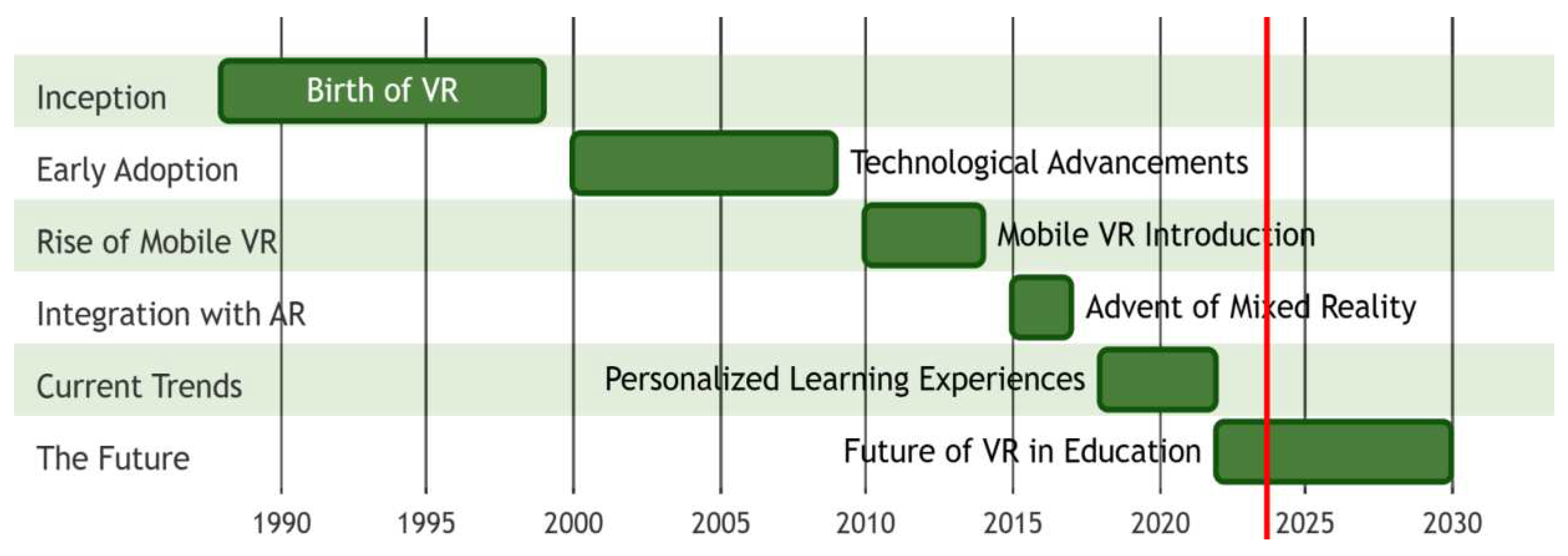
Figure 2.
Evolution of Virtual Reality in Education.

Figure 3.
Cognitive Development in Relation to Language Acquisition.
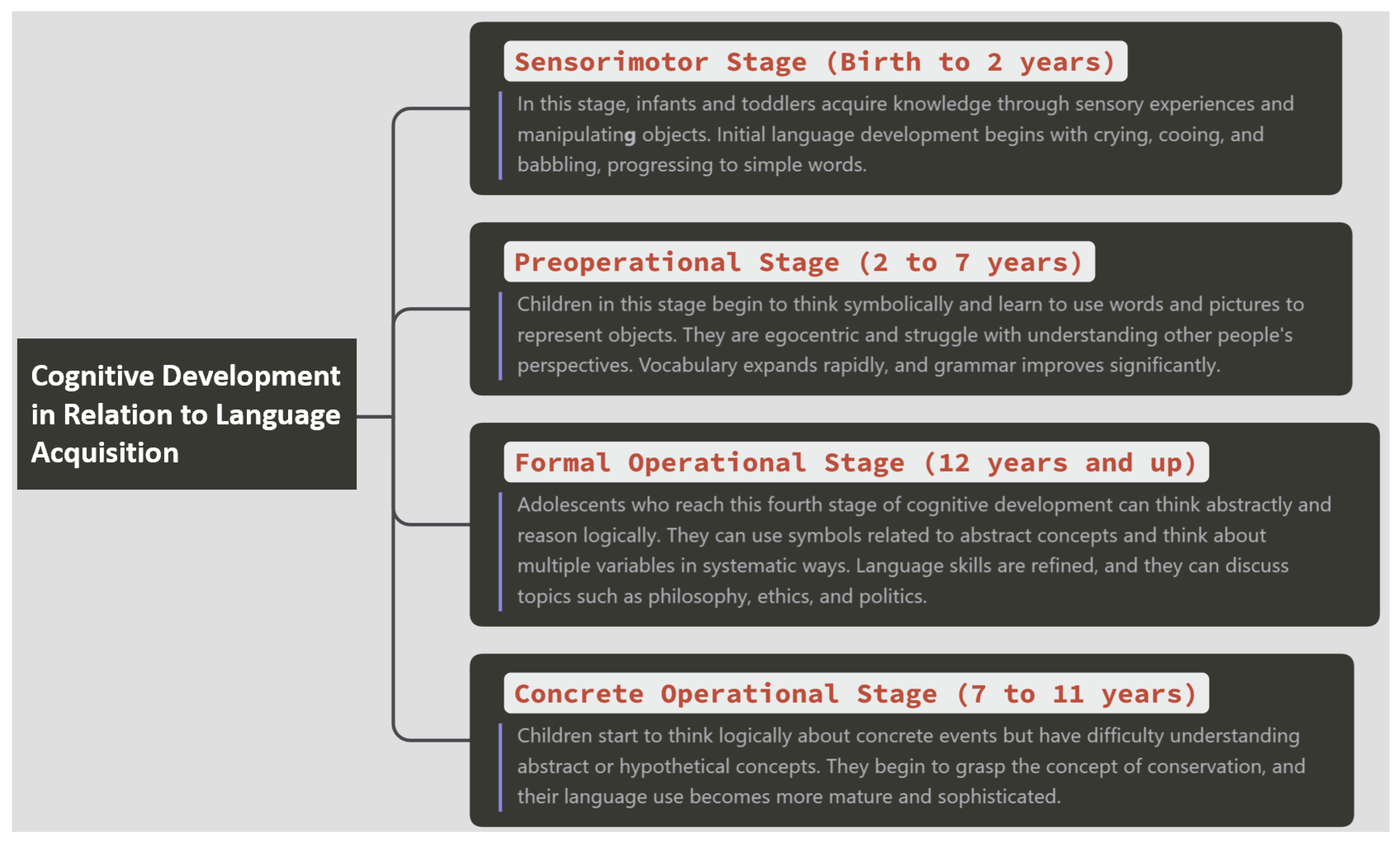
Figure 4.
Comparative Analysis of Learner Engagement and Motivation.
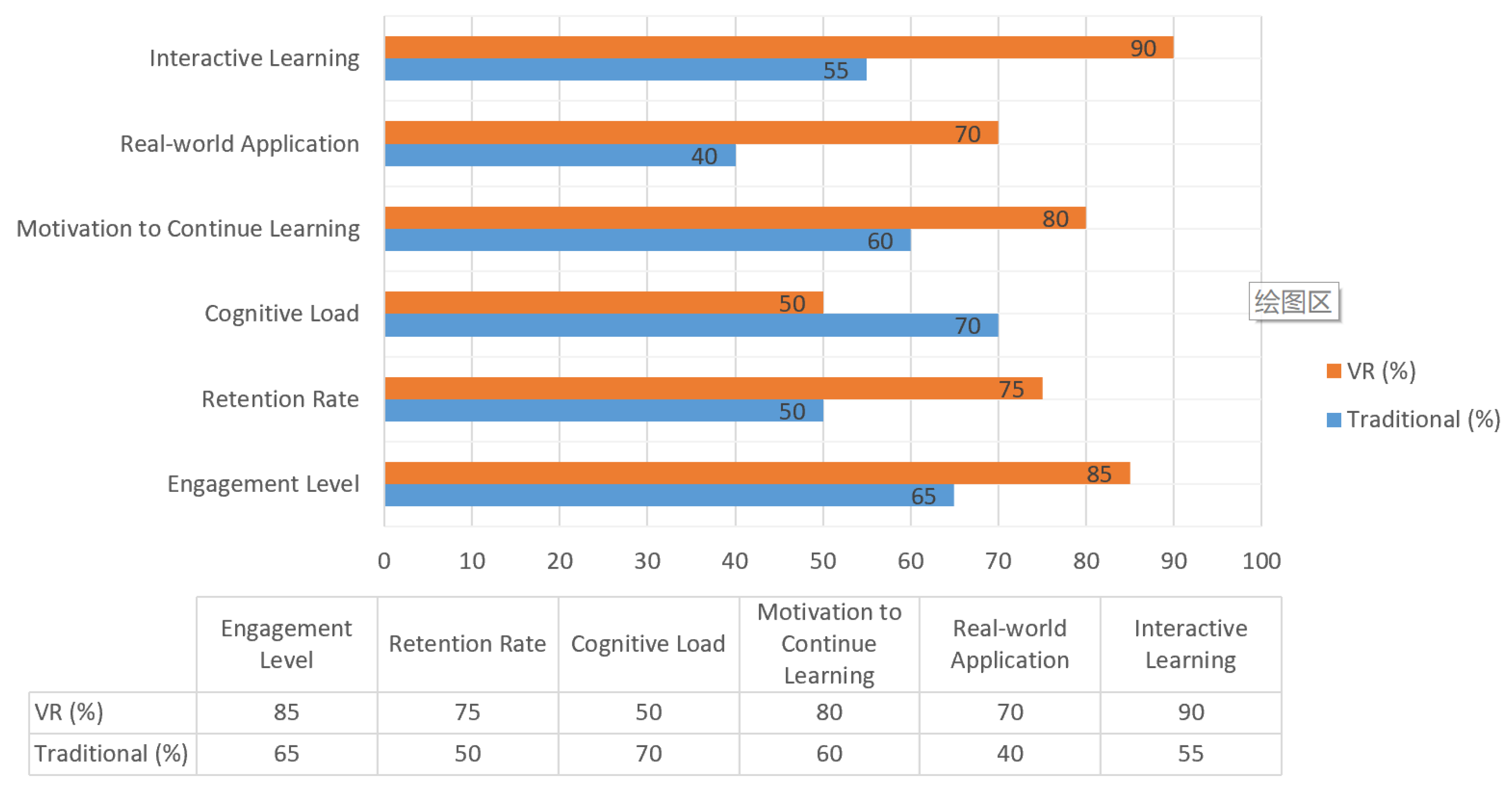
Figure 5.
Visual Representation of the VR-CCL (Virtual Reality-Constructivist Cognitive Learning) Framework.
Figure 5.
Visual Representation of the VR-CCL (Virtual Reality-Constructivist Cognitive Learning) Framework.

Figure 6.
Implementation and Outcomes of the VR-CCL Framework in Duolingo VR.
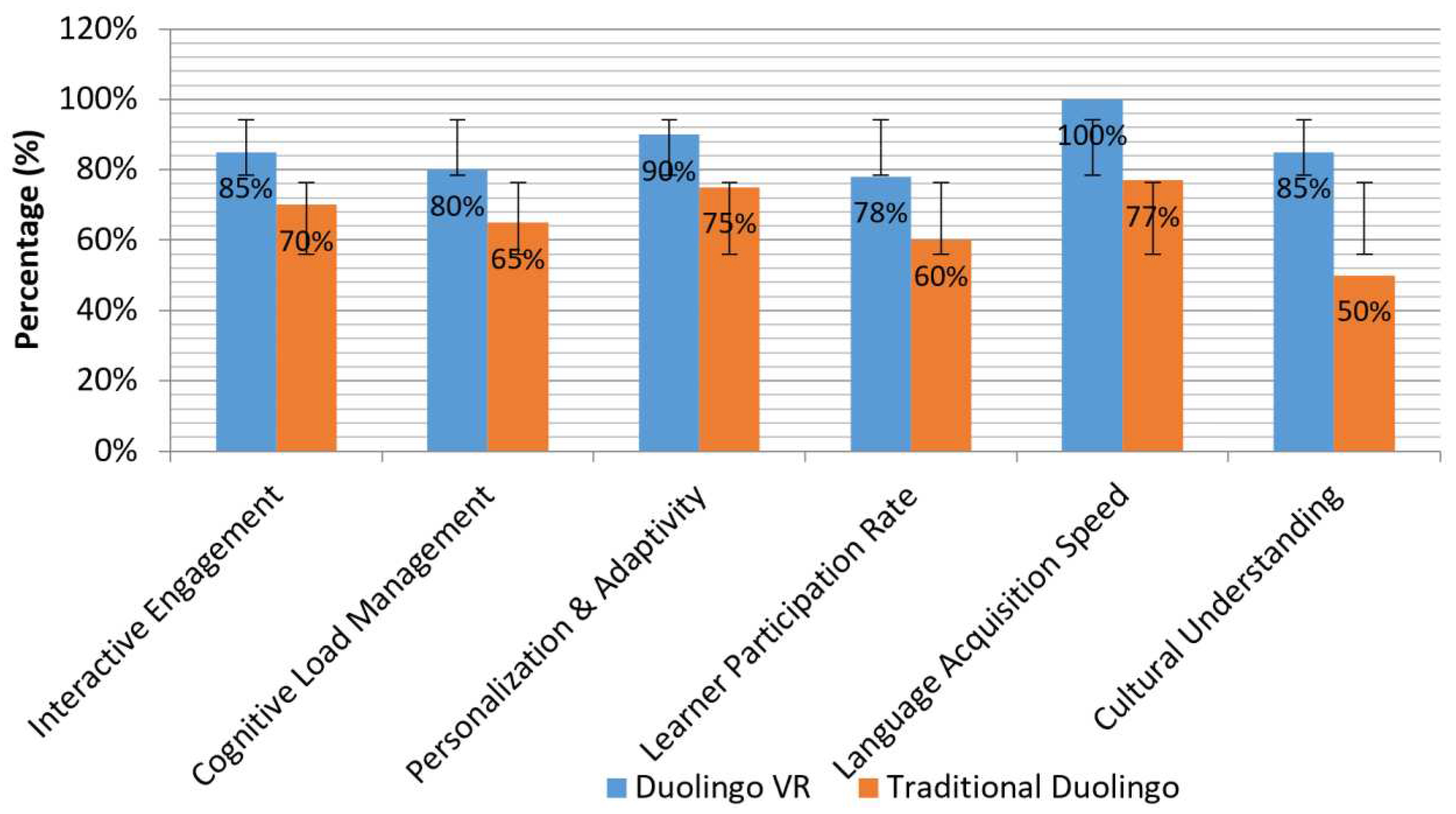
Figure 7.
Rosetta Stone VR: VR-CCL Framework Application and Outcomes.
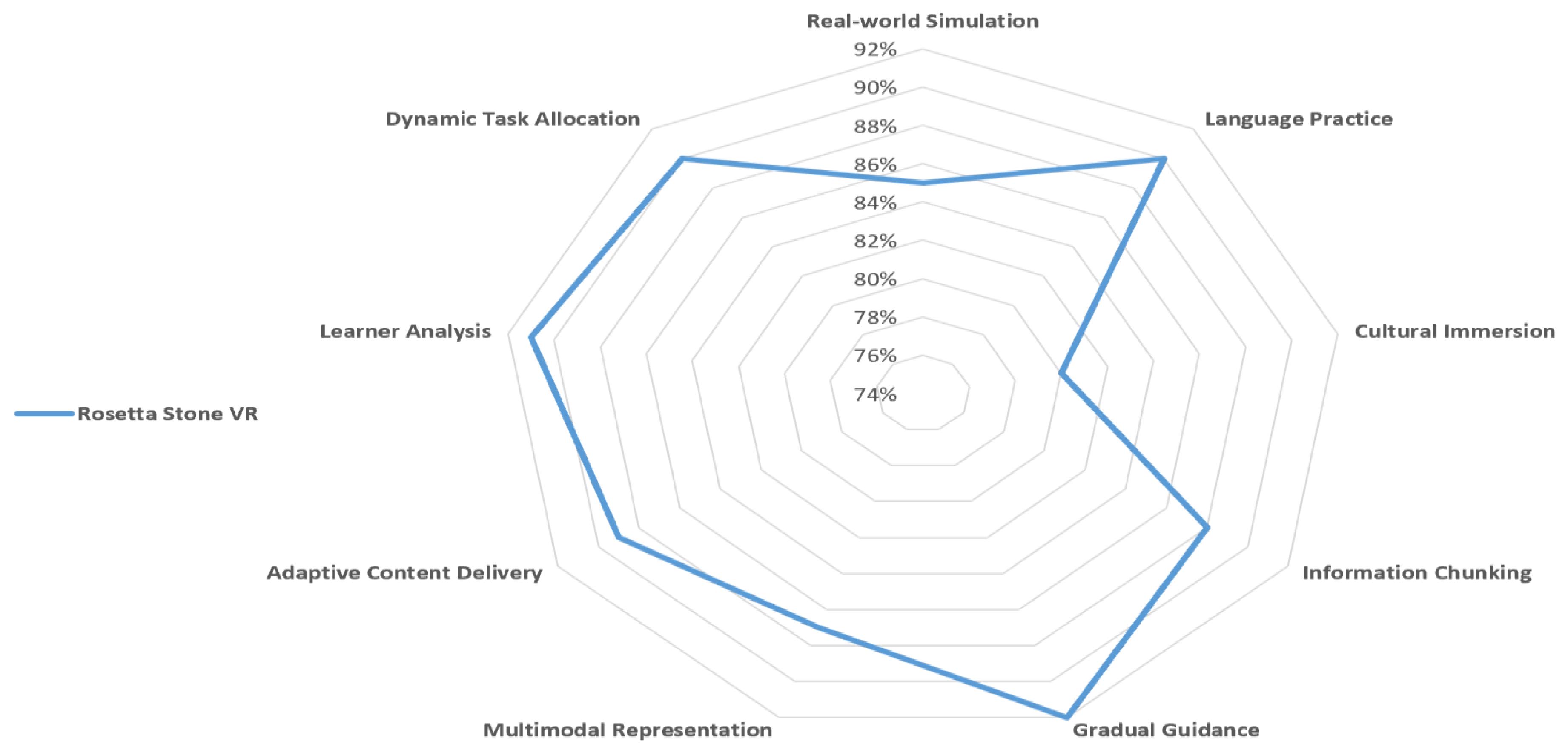
Table 2.
Comparative Analysis of the Strengths and Limitations of the VR-CCL Framework.
| Strengths of VR-CCL Framework | Limitations of VR-CCL Framework |
|---|---|
| Immersive Experience | Technical Requirements |
| Interactive Learning | Technical Issues |
| Personalized Learning Paths | Physical Discomfort |
| Multimodal Learning | Over-reliance on Technology |
| Immediate Feedback | Content Creation |
| Reduced Learning Anxiety | Privacy and Data Security Concerns |
Table 3.
Recommendations and Impacts for the Integration of VR-CCL in Education.
| Recommendations | Potential Impacts |
|---|---|
| Integrate VR-CCL principles into curriculum design | Enhanced learner engagement and retention |
| Provide training for educators on VR-CCL application | Improved teaching efficacy and learner outcomes |
| Collaborate with VR developers for content creation | Tailored VR experiences aligning with educational goals |
| Continuously gather feedback from students | Iterative improvements in VR content and delivery |
| Stay updated with latest VR-CCL research | Incorporation of cutting-edge techniques and strategies |
Disclaimer/Publisher’s Note: The statements, opinions and data contained in all publications are solely those of the individual author(s) and contributor(s) and not of MDPI and/or the editor(s). MDPI and/or the editor(s) disclaim responsibility for any injury to people or property resulting from any ideas, methods, instructions or products referred to in the content. |
© 2023 by the authors. Licensee MDPI, Basel, Switzerland. This article is an open access article distributed under the terms and conditions of the Creative Commons Attribution (CC BY) license (http://creativecommons.org/licenses/by/4.0/).
Copyright: This open access article is published under a Creative Commons CC BY 4.0 license, which permit the free download, distribution, and reuse, provided that the author and preprint are cited in any reuse.


