

Submitted:
27 September 2023
Posted:
28 September 2023
You are already at the latest version
Abstract
The limited availability of water resources worldwide presents obstacles, to the progress of ag-riculture. This situation calls for the implementation of water saving technologies to address these challenges effectively. The quest for technologies that conserve water in agriculture, par-ticularly within the context of cotton production, is related to the study of the impact of drought on the growth, leaf surface area, accumulation of dry matter, boll number, and productivity. The benefits of local drip irrigation have been established. Various models and strategies for opti-mizing and improving the efficiency of how we use water for irrigation purposes. In a market driven economy the effective utilization of water assetsis closely linked to the improvement of managing mineral nutrients. To enhance both the quantity and quality of production, nitrogen is the key factor element that plays a role in the process. The formation of highly efficient cotton crops by adapting the growing technology to the specific soil-climatic conditions of the area, in-cluding controlling nitrogen fertilizing and irrigation, is the primary method to achieve con-sistent harvests. The results of irrigation with water deficit and feeding plants with different fer-tilizer rates are presented. This matter is presently significant, in achieving dependable crop harvests supporting the economic growth of farms and safeguarding the well being of agricul-tural environments.
Keywords:
cotton
; irrigation
; fertilization
; water deficit
; efficiency
; productivity
1. Introduction
Cotton ranks among the most precious crops cultivated by humans. In terms of cultivation area it ranks sixth after wheat, rice, maize, barley and sorghum. These crops are considered essential for nutrition. The areas sown with cotton in the world are nearly 350 million da and occupy about 2.5% of the cultivated areas.
Cotton cultivation in Bulgaria occurs within constraints of limited temperature resources and erratic rainfall, making the economic productivity of cotton closely tied to the conditions experienced during its growth period. In connection with global warming and more frequent droughts, the drought tolerance of varieties is of great importance for sustainable cotton production.
Regions that receive ≥120 mm of seasonal rainfall and have average annual temperatures ranging from 10 to 29°C showed a notable increase, in the production of seed cotton. [1].
Cotton yield, its structural components, and production quality are markedly impacted by the meteorological conditions of the year [2]. When temperature conditions are ideal, humidity plays a predominant role compared to other abiotic factors. The correlation coefficient between yields and moisture supply from May to August stands at r = 0.76 [3]. During years with favorable temperature conditions, the most effective approach is implementing an irrigation regime of 60% evapotranspiration (ET) until the flowering phase, 100% ET during mass flowering, 60% ET from 5 to 15 August with an irrigation rate of 17.5 mm and with a water application rate of 174 mm. In such circumstances, cotton is characterized by limited growth and high early maturity, which guarantees a 46.5% higher yield from the first harvest. The total yield is 77.9% higher, providing the highest effect of 100 m3 of irrigation water and fiber length. Significantly higher cotton seed yield was reported to be obtained in areas with precipitation that occurs during specific seasons ≥ 120 mm and annual temperatures ranging from 10–29 ℃ [1].
It was found that the strongest positive correlation of the yield with the rainfall in July-August. The severe drought and high air temperatures during this period also cause high values of daily evapotranspiration. In non-irrigated conditions, the rainfall during this period largely determines the yield [4]. During years with less temperature stability, optimal results were achieved with an irrigation rate of 74.0 mm. In this scenario, there was a 41% rise in raw cotton yield found [5].
Cotton exhibits high sensitivity to water scarcity at various stages of its growth and development, with its peak daily water consumption occurring during the period from flowering to budding. Moreover, the time frame spanning from seed germination to the onset of flowering is vulnerable to excessive water, which can lead to an overgrowth of vegetative parts. Stopping watering prematurely can help conserve water, but may result in reduced productivity [6]. Extending irrigation time, in turn, tends to negatively impacting both yield and quality and ultimately jeopardize the economic viability of the cotton production system. The team of researchers believes that the optimal time to stop irrigation of cotton depends on the geographical location of the irrigated cotton fields.
Soil drying (35-40 % field capacity) in flowering-fruiting period causes inhibition of growth, intensifies the dropping of knots and reduces the number and mass of boxes, which is manifested in reduced yield. Drought diminishes the levels of chlorophyll a, chlorophyll b, and carotenoids, with carotenoids being the least affected. This phenomenon can be attributed to their biological function, which involves safeguarding chlorophyll against photooxidation during stressful conditions [7].
Broadly speaking, water stress leads to a reduction in leaf surface area, the accumulation of dry matter, the quantity of nodules, boll count, and results in a decrease in fiber length [8,9,10]. Cultivars have also been reported to produce additional boxes at higher nodes as a result of additional irrigation, leading to higher total yield [10].
The global shift toward warmer and drier climate conditions prompts the need to explore more cost-effective methods for managing irrigation water. One arena where innovative technologies and revised policies can make a substantial difference in enhancing the efficient utilization of water resources is crop irrigatio [11,12,13].
A large proportion of nitrous oxide (N2O) emissions worldwide are the result of human activities. The biggest cause is the increasing share of agricultural land and the increase in the amount of synthetic fertilizers in agriculture in recent decades. Industrial farming, and in particular the planting of intensive annual crops, is one factor in this, as farmers tend to overdose on nitrogen fertilizers in their quest to increase their yields. In essence, both synthetic and organic fertilizers increase the amount of nitrogen available to soil microbes, which through their activity convert it into the greenhouse gas N2O. Improving the effectiveness of mineral fertilizer utilization is a vital measure in reducing nitrogen oxide emissions in agriculture.
Employing advanced techniques such as subsurface fertilizer placement, drip irrigation, and fertigation can notably curtail N2O emissions in this agriculturally predominant area [14].
N2O emissions were not agriculturally meaningful initially but experienced a significant up to 16-fold increase when N fertilizer was applied, as compared to situations where zero-N was added [15]. A study of subsurface drip irrigation illustrates its advantages as a system with low N2O emissions in cotton.
The presence of contaminants above certain levels can lead to negative consequences in the entire food chain, all types of ecosystems and other natural resources
2. Discussion
Irrigation and water deficit impact
The pursuit of water-saving innovations in agriculture is of paramount importance to many countries in the European Union and worldwide. Enhancing the efficiency of irrigation entails refining the transportation and absorption of water by crop plants. Drip irrigation has proven its advantages and effectiveness across a variety of crops. This precise method of delivering irrigation water can result in water savings of 30 to 50% and yield improvements of 20 to 40% [16] (Table 1). In Uzbekistan, scientists report a 25.42% (equivalent to 0.91 t·ha−1) higher productivity of irrigation water than conventional irrigation [17].
Deficit irrigation intentionally subjects crops to water stress, which leads to decreased yields [18,19]. Irrigation, whether with a controlled continuous or occasional shortage, serves as a method to enhance water utilization efficiency, aiming for greater yields per unit of irrigation. The objective of deficit irrigation is to improve the effectiveness of water usage in irrigation, achieved either by reducing the volume of water applied during irrigation or by reducing the frequency of irrigation events [20].
Reducing the cotton irrigation rate by 25% and 50% from the standard 120 mm does not result in significant yield changes, with declines of 9.20% (equivalent to 26.1 kg/da) and 12.50% (equivalent to 35.5 kg/da) [20], respectively. However, when the irrigation rate is reduced to 60 mm, irrigation costs decrease by 62%. This leads to the highest net income for every 100 m3 of irrigation water used, and each cubic meter of water has the most pronounced impact.
Drip irrigation is adopted due to its effectiveness in reducing soil surface evaporation, enhancing crop yields, and improving water utilization efficiency in irrigation [22]. That is now widely applied in vegetable production and in irrigation of field crops to cope with water shortage. Apart from deficit irrigation, another promising technique for inducing stress tolerance in certain agricultural crops is partial root zone drying. Effective management expertise is essential for water deficit irrigation. Micro-irrigation technology simplifies the adoption of water conservation measures, and as a portion of the root zone becomes dry, the plant's abscisic acid (ABA, a plant growth regulator) levels rise in response to increasing drought stress. Leaves close stomata as a response to water stress, reduce plant growth and leaf surface evaporation.
After research by scientists from the Tashkent Institute of Irrigation and Melioration, a number of advantages of drip irrigation for cotton have been defined [23]. Savings of 45-50% of water and 40-50% of fuels and lubricants and mineral fertilizers were found. With drip irrigation, the productivity increases by 7.4 t/ha, and for growing 1 t of cotton, 85 cubic meters of water are used per 1 ha.
After conducting a field study with large mobile irrigators LMIM to evaluate the range of irrigation strategies by creating a regulated water deficit in cotton, it was noted that water scarcity has a significant influence on the development of cotton [24]. It was concluded that irrigation with small and frequently realized irrigation rates is only possible when using a drip irrigation system.
A water deficit irrigation approach is applied to produce, based on the susceptibility of agricultural crops during critical stages of development to drought stress. The utilization of continuously pressurized irrigation systems also offers the opportunity to apply minimal amounts of water regularly, presenting an extra method for stress control [25].
A four-year study assessing crop yield and water utilization, comparing conventional and restricted drip irrigation, offers strong support for recommending irrigation during water deficit [26].
For the rational management of water-conserving technologies, it is important to track the moisture content of the soil horizon [27].
Water stress leads to a decrease in the leaf area of plants, and the degree of reduction is influenced by the severity of drought stress and the growth stage of the crop. In the case of cotton, water stress irrigation resulted in a notable reduction in plant height. With drip irrigation, irrigation rates can be adjusted, the area irrigated is limited and evaporation from the soil surface is reduced [28].
A notable decrease in plant height was observed when a reduced amount of irrigation water was applied [29]. Drought has also been documented as leading to a decrease in leaf area and leaf area index.
Studies have shown the biomass of cotton plants and their reproductive organs increase with the volume of irrigation [30]. Irrigation levels, with drip irrigation, affect the number of closed bolls (The quantity of irrigation influenced the count of closed bolls) [31]. The data was obtained at 4 irrigation levels and plots four varieties of cotton for two growing periods.
The leaf area index of the cotton crop exhibited a favorable response to drip irrigation [32]. It was reported that there was a significant positive effect of irrigation on the leaf area index of cotton [33]. The highest values were obtained in the optimal drip irrigation treatment (100%), and the lowest values were observed in the water deficit condition (25%). These conclusions are also supported by the results of studies by other authors [34]. In addition to a reduction in the leaf area index, they report a reduction in fiber length as a reaction to water shortage. When examining the indicators related to fiber strength, fineness, and uniformity, no variations were noticed as a result of changes in irrigation levels.
The impact of water stress on fiber length is contingent on the timing and duration of moisture deficit, especially during the fiber elongation stage. Insufficient water during the initial flowering phase has no influence on fiber length. Nevertheless, a moisture deficit occurring shortly after flowering and during the fiber elongation period can diminish fiber length due to direct mechanical and physiological effects on cell expansion [9,33,35,36,37].
Cotton yield is transformed by biomass [38] and is determined by the recycled biomass allocated to reproductive organs. Studies found that optimal water-N supply increased biomass accumulation of cotton plants by maintaining leaf photosynthetic capacity and improving root growth [39]. Moderate irrigation to a depth of 0.20 cm improves the photoassimilation of the reproductive organs. A high degree of correlation was found between root length at the flowering stage and cotton yield [40]. The regression between irrigation and cotton yields was y = -0.0026x2 + 18.015x-24845 (R2 = 0.959), respectively.
A research study investigating the impact of nitrogen fertilizer application through irrigation water revealed that a decrease in rates by 18.75% did not lead to a decrease in the quantity or quality of yields. Instead, it enhanced the efficiency of water utilization in irrigation [41,42,43].
The diminishing water resources are compelling researchers to concentrate on improving water utilization efficiency. This includes the introduction of new drought-resistant cotton varieties and the implementation of effective irrigation water management strategies.
Cotton fiber yield typically decreases as a result of a reduced number of flowers and the abortion of flower buds during periods of severe water stress, especially during reproductive growth stages [8]. Field studies in the US with eight genotypes grown under both natural and irrigated conditions indicated that irrigation retarded vegetative growth [10]. Cotton fiber yield decreased by 25% in moisture deficit, mainly due to a 19% decrease in boll count.
Conventional furrow irrigation in cotton produced more buds than alternative furrow irrigation [44]. The authors also found that reducing the irrigation rate accelerated box ripening, which increased early maturity. An alternative drip irrigation method yielded more seeds and fiber per cotton plant compared to conventional irrigation when the same amount of irrigation water was used [45]. Cotton yield is notably influenced by the extent of drip irrigation application or water stress [33]. A 25% reduction in the amount of water applied through drip irrigation led to a 17.1% decrease in yield. However, a 50% reduction in irrigation resulted in a much larger 34.1% decrease in yield.
Regulated irrigation under specific topographical and soil conditions conducted in the Southeast Anatolia (GAP) region of Turkey contributed to cotton yields of 4380, 3630 and 3380 kg/ha, respectively. The supply of irrigation water was carried out with a drip system, along furrows and by raining. The efficiency of water use was determined in the three ways of distribution of water for irrigation, respectively 4.87; 3.87 and 2.36 kg/ha/mm for drip, furrow and rain [46]. Depending on the amount of water applied, the irrigation coefficients range from 50.8 to 59.0% (furrow), 52.9 to 64.8% (rain), 50.8 to 56.8% (drip).
The effectiveness of drip irrigation was also established by [47] as a result of a comparative study on irrigation of cotton. The results obtained when supplying the irrigation water along the bed, along the furrow and drip indicate the advantages of the regulated irrigation regime implemented with the drip irrigation system. Drip irrigation water use efficiency is 28–58% higher than furrow irrigation and 45–68% higher than bed irrigation.
Coefficient of efficiency (Kef) of using the irrigation water supplied by means of a drip irrigation system was calculated after the parameters of the additional yield were es-tablished for three varieties of cotton, at 4 levels of fertilization [48]. The values of the coefficient of efficiency range from 0.53 to 1.11 (Figure 1).
Increasing yield and increasing fiber quality are the main emphasis in the search for adapted strategies related to the study of the impact of water deficit on cotton yield. Studies have established fiber quality parameters under different irrigation regimes (IR) (IR -0, IR -25, IR -50, IR -75 and IR -100). Irrigation efficiency was found to increase from 0.62 to 0.71 kg.m−3 with IR -75 irrigation [36].
Deficiency of drip irrigation cotton at 75% treatment level did not reduce fiber yield and seed yield. From an economic point of view, a 25.0% saving in irrigation water (PR-75) results in a 34.0% reduction in net income [33]. However, they considered that in areas without water scarcity, the net income is reasonable with IR -100. The highest average yield was reported when the irrigation regime was optimized. The highest efficiency of water use for irrigation was established at PR-25 (1.46 kg.m-3), and the smallest at 100% irrigation (0.81 kg.m-3). An augmentation in leaf index and dry matter yield was documented as the irrigation rate increased. The highest yield was obtained with IR -100 [49]. At water deficit (IR -25, IR -50 and IR -75) a decrease in evapotranspiration, total seed yield, fiber length was recorded, the leaf area index, but an increase in the number of buttons and the number of open boxes was observed. The highest efficiency of the irrigation water is reported at a reduced irrigation regime by half.
Field experiments are conducted to assess the effects of limited irrigation water availability and its efficient utilization in light of the ongoing global trends of gradual warming and drying conditions [50]. The effect of irrigation was investigated at 100% (100% evapotranspiration ET), 85% (85% ET), 70%, 55% and 45% (45% ET). The economic evaluation of water deficit confirms that yield loss is less than 10% at 70 % ET and 85 % ET, which is acceptable for greater sustainability. The results indicate that appropriate drip irrigation schemes are necessary for sustainable cotton production. Although irrigating at 85% of the crop's evapotranspiration (ET) is a reliable method for achieving high cotton yields, using 70% of ET can serve as a viable option when there is a shortage of irrigation water.
Researchers in Uzbekistan [50] established irrigation water efficiency parameters for both gravity and drip irrigation systems. Optimizing the irrigation regime in drip irrigation, particularly using 70–70–60% of field capacity (FC), results in efficiency gains ranging from 35% to 103% compared to furrow irrigation. Drip irrigation also conserves 18–42% of irrigation water in contrast to furrow irrigation. Additionally, providing water to the root zone leads to a 10-19% increase in cotton yield.
In water-scarce areas, a drip irrigation strategy with surface and groundwater is recommended [52]. An increase in the dry matter in the leaves, a significantly higher yield and a better absorption of nutrients have been found by scientists with different mixing ratio irrigation in cotton. Last but not least is the efficiency of using irrigation water in the conditions of shortage of this resource.
The limited availability of water resources poses significant challenges to the sustainable progress of agriculture and underscores the need for the adoption of water-saving technologies. Water-deficit irrigation has been shown to enhance crop water productivity (WP), but its impact on yield varies considerably [53]. Researchers observed that under water deficit irrigation, WP increased on average by 5.3% compared to optimal irrigation, but it also led to a significant reduction in cotton seed yield, averaging around 20.2%.
The influence of water deficit on the quantitative parameters of yields and quality have been the subject of a study by a number of researchers [47,49,54,55,56]. The application of water-saving technologies is a priority in the agrotechnics of crops. The impact of regulated water deficit is the subject of research by a number of researchers. A reaction coefficient of cotton characterizing the sustainability of production when the irrigation rate is reduced is derived. Polynomial equations are used to determine the relationships between vegetative growth, the development of generative organs, productivity, and irrigation rates [50,51]. Cotton irrigation models have also been developed to study the effectiveness of furrow irrigation [57]. Waterlogging in some areas with high groundwater levels leads to a reduction in yields.
In the context of field irrigation management for cotton (Gossypium hirsutum L.) in Qira Oasis, Xinjiang, China, researchers [57] have created a decision support system model for irrigation planning. This model utilizes the water stress factor and the moisture content in the root zone to monitor their impact on photosynthesis and the growth of cotton plants. Applying the deficit irrigation model, they found that net leaf photosynthetic rate, stomatal conductance, and transpiration rate were reduced by 11.2%, 18.7%, and 10%, respectively, relative to optimal irrigation, but with better efficiency at irrigation water use.
Impact of nitrogen fertilization
In a market economy setting, efficient water use is closely linked to the optimization of mineral nutrition. Precisely applying the necessary quantity of mineral fertilizer, evenly distributed across the field, optimizes resources such as irrigation water, fertilizers, labor, and energy. This balanced approach to nutrient application, along with the optimization of soil moisture, contributes to increased yields. When studying the effects of drip fertigation on cotton efficiency and productivity, researchers confirmed its positive influence on crop potential and soil fertility [59].
A six-year field experiment carried out with two varieties of cotton in Greece under conditions of optimal and disturbed irrigation regime, with different rates of nitrogen fertilization indicate that the optimal conditions for cotton development and high yield are irrigation at 50% of ET and fertilization with nitrogen 150-180 kg/ha [60].
The ability to deliver fertilizers in conjunction with irrigation water enables the maintenance of a suitable nutritional regimen for plants throughout various stages of their growth, ensuring better nutrient distribution. This approach also leads to reduced labor expenses and a decreased need for fertilizers [61].
An increase in nitrogen nutrition efficiency under drip irrigation has been reported [41]. The agronomic nitrogen efficiency increased from 21.65 to 28.59 kg of ginned cotton per kg of applied N when the same amount of water was applied and N by drip irrigation compared to a control basin. The results suggest that a single fertilization at the beginning of the flowering phase reduces labor input without reducing yield and thus may be a practical alternative for fertilization of cotton. Single fertilization was also found to provide a higher rate of biomass accumulation and is a practical alternative for fertilization of cotton, there was a significant correlation between root density and length and cotton yield [62]. A low level of N in the nutrient solution greatly reduced the components of vegetative growth, pod number and seed yield.
Reducing the volume of water applied results in decreased agronomic nitrogen efficiency [41]. Drip irrigation, when compared to gravity irrigation, enhances the agronomic efficiency of nitrogen application. Findings from a field study conducted in the Yangtze River Valley of China suggest that a single fertilization event reduces labor expenses without compromising yield [62].
In another study with three nitrogen rates (60, 110 and 160 kg/ha) and three levels of irrigation, it was found that the reduced water supply caused a change in the distribution of N in plants, with the seeds absorbing nitrogen to the highest degree under water stress conditions [63]. The total absorbed N by the plants at the end of the growing season increases linearly with the increase in the level of irrigation and reaches 192-261 kgN/ha. The authors indicated that N inputs exceeded plant requirements and the nitrogen balance was positive. Differences in the values of nitrate N in the upper soil layer in individual years and the N absorbed by cotton plants are explained by meteorological changes. The maximum average fiber production efficiency index value of 9.6 was obtained under deficit irrigation, while an efficiency index of 8.1 was obtained under 40 cm irrigation when N uptake by the crop was not excessive (192 kg /ha).
Research has examined the significance of utilizing treated wastewater for supplementary cotton irrigation, particularly in scenarios of water scarcity in tropical semi-arid regions [65]. The application of treated wastewater for supplemental irrigation led to a substantial increase in cotton yield across all three scenarios: normal, drought, and severe drought, with improvements of approximately 29%, 255%, and 251% respectively. In cases of extended dry periods within the drought and severe drought scenarios, the volume of supplemental irrigation with municipal treated wastewater increased. This resulted in greater nutrient input into the soil, enhanced photosynthetic responses, improved physical water productivity, reduced fertilizer expenses, and higher incomes for farmers.
The controlled application of treated domestic wastewater for irrigation, even with a deliberate water deficit, can play a crucial role in a strategy aimed at conserving fresh water and reducing fertilizer usage. Moreover, it has the potential to boost profit margins in cotton production within tropical semi-arid regions [66]. The most favorable cotton yield, water use efficiency, and potassium use efficiency were achieved when irrigation was conducted at 75% of the crop's evapotranspiration (ETC) or as full irrigation (100% of ETC), especially when combined with a moderate increase in potassium fertilization.
Different models are being developed for the optimization of irrigation water for agricultural crops. Analyzing the effects of drought on agricultural crops involves the examination of different relationships and models. These analyses help in forecasting crop productivity trends [50,67,68,69].
The SIRMOD simulation model illustrates simple “recipe” strategies that can increase efficiency and reduce deep losses from irrigation water drainage [70]. The simulations were carried out with subsurface irrigated cotton. Effectiveness varies widely from 17 to 100% and averages low at 48%.
Calibration and validation of the AquaCrop model in cotton used data from 4 experiments under several climate and agricultural policy scenarios [71]. The analysis indicates that raising the cost of water beyond its present rate has a constrained influence on the ideal level of irrigation water utilization. Additionally, it highlights that the existing Common Agricultural Policy (CAP) of the European Union does not encourage water conservation in cotton irrigation.
The restriction of soil moisture levels and the presence of low soil nitrogen (N) concentrations are progressively emerging as significant issues, particularly in arid regions [72].
Ensuring a suitable nutritional regime and optimizing the cotton feeding area are prerequisites for increasing yield. Without adequate amounts of nutrients in the soil during the individual phases of development, the full yield potential of cotton cannot be manifested [73,74]. On the other hand, the rising costs of fertilizers and growing concern over greenhouse gas emissions are prompting increased focus on the effective utilization of nitrogen (N) fertilizers [75].
The need to optimize applied fertilizers according to crop requirements is increasingly being defined as a priority. However, the ideal nitrogen (N) rate has not been definitively established, as optimal N levels and utilization efficiency are influenced by various factors, including yield potential, soil fertility, and field management practices [76,77].
The rate of 70 kg N/ha results in significantly high values for unginned cotton yield and fiber yield, increases the number of bolls and the mass of 1 boll, the number of seeds per boll, randemana per fiber, the fat content of the seeds [78]. This moderate nitrogen application increases the rate of photosynthesis, absorption of moisture and nutrients, cell division, expansion and differentiation of cells, protein synthesis. These processes improve the rate of development and ripening of the bolls.
The commonly accepted average nitrogen rate in China is 300 kg/ha [79]. Experimental results show that the optimization of irrigation and nitrogen fertilization (treatment with N240P65K62 and irrigation of 480 mm) can effectively reduce nitrogen losses during drip fertilization and plastic mulching [80].
Investigating the effects of 6 nutrient regimes and 6 irrigation regimes with irrigation water deficit on plant height, stem diameter, biomass, seed yield and soil moisture under an irrigated plastic mulch production system found that deficit irrigation (60-80% of potential evapotranspiration) during flowering and 16-5,6-2,4 (N-P2O5-K2O) fertilization optimized water and nutrient uptake, and this leading to increased irrigation water use efficiency and an increase in overall cotton growth and development [81].
The SIRMOD simulation model illustrates simple “recipe” strategies that can increase efficiency and reduce deep losses from irrigation water drainage [70]. The simulations were carried out with subsurface irrigated cotton. Effectiveness varies widely from 17 to 100% and averages low at 48%.
Calibration and validation of the AquaCrop model in cotton used data from 4 experiments under several climate and agricultural policy scenarios [71]. The analysis suggests that an increase in the price of water above the current level has a limited impact on the optimal level of irrigation water use and that the current Common Agricultural Policy (CAP) of the European Union does not promote water conservation in cotton irrigation.
Limiting soil water levels and low soil nitrogen (N) concentrations are increasingly becoming a serious problem, especially in arid regions [72].
Ensuring a suitable nutritional regime and optimizing the cotton feeding area are prerequisites for increasing yield. Without adequate amounts of nutrients in the soil during the individual phases of development, the full yield potential of cotton cannot be manifested [73,74]. On the other hand, increasing costs of fertilizers and growing attention on greenhouse gas emissions lead to greater attention to the efficient use of N fertilizers [75].
The need to optimize applied fertilizers according to crop requirements is increasingly being defined as a priority. However, the optimal N rate has not been determined because optimal N levels and use efficiency are affected by a number of factors such as yield potential, soil fertility and field management [76,77].
The rate of 70 kg N/ha results in significantly high values for unginned cotton yield and fiber yield, increases the number of bolls and the mass of 1 boll, the number of seeds per boll, randemana per fiber, the fat content of the seeds [78]. This moderate nitrogen application increases the rate of photosynthesis, absorption of moisture and nutrients, cell division, expansion and differentiation of cells, protein synthesis. These processes improve the rate of development and ripening of the bolls.
The commonly accepted average nitrogen rate in China is 300 kg/ha [79]. Experimental results show that the optimization of irrigation and nitrogen fertilization (treatment with N240P65K62 and irrigation of 480 mm) can effectively reduce nitrogen losses during drip fertilization and plastic mulching [80].
Investigating the effects of 6 nutrient regimes and 6 irrigation regimes with irrigation water deficit on plant height, stem diameter, biomass, seed yield and soil moisture under an irrigated plastic mulch production system found that deficit irrigation (60-80% of potential evapotranspiration) during flowering and 16-5,6-2,4 (N-P2O5-K2O) fertilization optimized water and nutrient uptake, and this leading to increased irrigation water use efficiency and an increase in overall cotton growth and development [81].
A number of other studies have also focused on the effects of a balanced optimum N rate on cotton yield and yield components [82,83]. There is an opportunity to significantly reduce nitrogen fertilizer applications in Australian cotton fields without reducing yields [75] And other studies have also indicated that N fertilizers can be used at a moderately lower rate and more efficiently than traditionally used [77].
Augmenting irrigation water quantities results in higher dry matter and seed cotton yield, but it also causes a reduction in the harvest index [84]. Researchers observed that soil nitrogen (-N) content increased as nitrogen levels increased, but irrigation led to a decline in -N content in the surface soil layer (0–30 cm) while elevating it in the deeper layer (40–80 cm).
Precision farming and shifting deficit irrigation are strategies for agricultural management that assist farmers in enhancing crop yield, optimizing fertilizer utilization, and maximizing water resource efficiency. Research results [85] revealed that variable deficit irrigation and N-P-K = 150.90–26.71–50.80 Kg·ha−1 fertilization significantly affected cotton yield, plant height, plant stem, seed weight, above-ground dry matter, nitrogen and fertilizer efficiency, and water-use efficiency. With judicious application of variable deficit irrigation during critical growth stages, significant improvement in yield (up to +28.664%) and water savings (up to 24.941%) was reported, thereby increasing water productivity (+35.715 % to 42.659%), irrigation water use efficiency (from farmers' 0.421–0.496 kg·m−3 to water deficit irrigation of 0.601–0.685 kg·m−3), nitrogen efficiency (+16.888% to +22.859%) ) and productivity of N-P-K fertilizers (from farmers' 16.754–23.769 to VDI from 20.583–27.957).
It was reported that seeding density and nitrogen fertilization from 0 to 180 kg/ha greatly affected cotton yield and its earliness, as in two regions at higher densities the number of bolls in the early first fruiting sites decreased by 33 and 40 %, respectively, and early ripening decreased at high N levels due to later formed and late ripening boxes at the upper fruiting sites [86].
Cotton accumulates around 250-300 kg N/ha to reach its peak yield potential. Interestingly, it utilizes less than half of the applied fertilizer N in the same growing season, sourcing most of its nitrogen from the soil. About 33% of the applied N is recovered by the plant, 25% remains in the soil when the crop reaches maturity, while approximately 42% is lost [44,87].
A deficiency of nitrogen throughout the growing season results in insufficient vegetative growth, fewer fruiting bodies due to impaired plant development, and premature aging of the plant [19]. Additionally, nitrogen deficiency results in lower fiber quality [88,89,90].
High rates of nutrients may lead to luxuriant consumption or delayed maturity, while too low rates lead to plant stress or suboptimal yields [91]. Nitrogen rates below 22.4 kg/ha lead to stress due to severe shortage of N and to a significant yield loss.
With high nitrogen fertilization, plants cannot absorb all the excess N in the soil, these extra N levels are slowly washed out of the soil by water runoff, resulting in nitrate contamination of ground and drinking water [74,83].
In order to reduce excessive fertilization of cotton and environmental pollution, combined fertilization with liquid organic fertilizer (rich in humic acid, amino acids, microbial flora and trace elements - manganese, zinc, boron) and chemical fertilizer (urea (containing N 46.0%), monoammonium phosphate (ammonium dihydrogen phosphate containing N 12.0% and P2O5 61.0%) and potassium sulfate (containing K2O 50.0%) [92]. Against the background of drip irrigation and fertilization with the appropriate combination of organic fertilizer and a 20% reduction in chemical fertilizer, scientists reported an accumulation of higher total plant mass and reproductive organ biomass.
Testing different nitrogen rates found the positive influence of 180 kg N/ha, together with 150 kg K/ha, leading to the highest yield of raw cotton and the highest fiber yield [93]. The nutrient nitrogen has a greater impact on cotton yield than any other nutrient [94].
Leaf N concentration as an indicator of nitrogen status and to assess soil N mineralization potential is useful for optimizing N management in cotton [95,96]. And another researcher also emphasized the management of soil fertility, maintaining optimal pH and how soil reaction affects the availability of nutrients in the soil [97].
Cotton seed yield and irrigation water productivity were significantly affected by fertilization rate [1]. Seed cotton yield increased with the increasing fertilization rate until up to some thresholds. They concluded that the appropriate application rates of nitrogen, phosphorus and potassium are 300–400 kg N ha−1, 79–105 kg P ha−1 and 100–133 kg K ha−1, respectively.
Results of a field experiment carried out in India indicate the parameters of productivity, nitrogen use efficiency and irrigation water [98]. Despite the unlimited water resource, researchers believe that it is necessary to apply effective systems to save irrigation water. Drip irrigation scheduled at 0.8 ETc recorded 2.5 and 23.2% higher seed cotton yield (2509 kg ha-1) than 1.0 ETc and 0.6 ETc, respectively.
As per certain authors, different cotton cultivars exhibit distinct fertilization needs 99-102]. Varietal specificity to assimilation of nutritional elements by cotton was established) when evaluating 100 cotton genotypes according to indicators such as total dry mass of the whole plant, aboveground dry mass, total accumulated nitrogen, N absorption efficiency, etc. [103].
Nitrogen, phosphorus and potassium influence the yield of cotton, with N having a decisive influence in all studied cultivars, while phosphorus has a weaker effect [104]. Phosphorus (P) absorption greatly relies on the distribution of roots within the soil profile [105]. Scientists are determining to what extent the distribution of shallow roots under drip irrigation affects and how this improves P nutrition of cotton plants.
In light gray soil conditions, specifically with the Andijan-37 and Sultan cotton varieties, mineral fertilizers were applied at a rate of NPK-150-125-75 kg/ha. Additionally, 750 kg of bentonite was introduced during the cotton cutting period. The study revealed that for all variants of cotton cultivars, when irrigated at levels corresponding to 60-70-60% of the limited field moisture capacity (LFMC), cotton yield decreased by 1.5-2.0 kg/ha due to insufficient soil moisture compared to variants irrigated at 70-70-60% LFMC. To optimize results, it is recommended to incorporate 750 kg/ha or 6000 kg/ha of bentonite (once every 3 years) into the mineral fertilizers prior to the autumn cultivation and irrigate using a 1-2-1 system at a rate of 70-70-60% of LFMC with a seasonal irrigation rate of m3/ha [106].
Localized irrigation water delivery is a high-tech, computer-controlled irrigation system that fine-tunes the balance of water and nutrient intake and ensures the sustainable use of Earth's ecosystems.
5. Conclusions
Identifying the sensitive phases of cotton development and studying the impact of water and nutrient deficits is a step towards refining and updating cultivation technologies.
Optimizing fertilization and irrigation strategies for specific cotton cultivars is a practical approach to achieve the best economic outcomes. Mineral nutrition, particularly nitrogen nourishment, plays a pivotal role in enhancing both the quantity and quality of production. Addressing this issue is essential for achieving consistently high yields, promoting sustainable economic development in agriculture, and preserving the overall health of agricultural lands.
The formation of highly efficient cotton crops by adapting the growing technology to the specific soil-climatic conditions of the area, including controlling nitrogen application and irrigation, is the primary method to achieve consistent yields.
References
- Cheng, M., Wang, H., Fan, J., Zhang, S., Wang, Y., Li ,Y., Sun, X., Yan,g L., Zhang, F. Water productivity and seed cotton yield in response to deficit irrigation: A global meta-analysis. " Agricultural Water Management 2021, 255 (2021): 107027. [CrossRef]
- Shah, A.N., Wu, Y., Tanveer, M., Hafeez, A., Tung, Sh. A., Ali, S., Khalofah , A., Saham, M.S., Al-Qthanin, R.N., Yang, G., Interactive effect of nitrogen fertilizer and plant density on photosynthetic and agronomical traits of cotton at different growth stages. Saudi Journal of Biological Sciences 2021, (In Press). ISSN 1319-562X. [CrossRef]
- Milkovski J., Bozhinov, M., Dimitrova, L. et al. Cotton in Bulgaria 1983, Ed. "Hr. G. Danov", Plovdiv, 123-130.
- Stoilova, A., Nicolov, G. Dependence of Cotton productivity from Agrometeorological factors. Bulg. J. of Agricultural Science 2002, 8, 387-391.
- Saldzhiev, I., Nikolov, G. Irrigation regime with regulated water deficit of cotton. Plant breeding sciences 2005, 4, 31-39.
- Koudahe, K., Sheshukov, A. Y., Aguilar, J., Djaman, K. Irrigation-Water Management and Productivity of Cotton: A Review. Sustainability 2021, 13(18), 10070. [CrossRef]
- Koleva, M., Vasilev, A. Chlorophyll fluorescence characteristics and seed yield of Bulgarian cotton cultivars grown in rainfed conditions. 11th Meeting of the Inter-Regional Cooperative Research Network on Cotton for the Mediterranean and Middle East Regions. 2012, Antalya, Turkey.
- Gerik T.J., Faver, K.L., Thaxton, P.M., El-Zik, K.M. Late Season Water Stress in Cotton: I. Plant Growth, Water Use, and Yield. Crop Science 1996, Vol. 36(4), 914-921. [CrossRef]
- Pettigrew, W.T. Physiological Consequences of Moisture Deficit Stress in Cotton. Crop Physiology & Metabolism 2004а. Vol. 44(4), 1265-1272. [CrossRef]
- Pettigrew W.T. Moisture Deficit Effects on Cotton Lint Yield, Yield Components, and Boll Distribution. Agronomy Journal 2004b, Vol. 96, Issue 2, 377-383. [CrossRef]
- Ziad, A. M., Jamous S. A. Climate change and agricultural water demand: Impacts and adaptations. African Journal of Environmental Science and Technology 2010, Vol. 4(4), pp. 183-191.
- Moteva, M., Trifonova, T., Georgieva, V., Kazandjiev, V. An update of the irrigation depths according to the current climatic conditions in Bulgaria. Journal of Mountain Agriculture on the Balkans 2016, vol. 19, 6, 2016, 226-242.
- Kireva, R., Petrova-Branicheva V. Irrigation Mode Of Fruit And Vegetables, Breeded In Drop Irritation In The Area Of Sofia Field. Annual Of The University Of Architecture, Civil Engineering And Geodesy 2018, Sofia. Vol. 51, Issue 6, 181-188.
- Scheer, C., Wassmann, R., Kienzler, K., Ibragimov, N., Eschanov, R. Nitrous oxide emissions from fertilized, irrigated cotton (Gossypium hirsutum L.) in the Aral Sea Basin, Uzbekistan: Influence of nitrogen applications and irrigation practices. Soil Biology and Biochemistry 2008, 40(2), 290-301. [CrossRef]
- Bronson, K. F., Hunsaker, D. J., Williams, C. F., Thorp, K. R., Rockholt, S. M., Del Grosso, S. J., Venterea R. T., Barnes, E. M. Nitrogen management affects nitrous oxide emissions under varying cotton irrigation systems in the Desert Southwest, USA. Journal of environmental quality 2018, 47(1), 70-78. [CrossRef]
- Ravinder R. A., G. Majumdar, A.R. Reddy, 2011. Validation of farm pond size for irrigation during drought. Indian Journal of Agronomy 56 (4), 356-364.
- Khamidov, M. K., Juraev, U. A., Buriev, X. B., Juraev, A. K., Saksonov, U. S., Sharifov, F. K., Isabaev, K. T. Efficiency of drip irrigation technology of cotton in saline soils of Bukhara oasis. In IOP Conference Series: Earth and Environmental Science 2023, Vol. 1138, No. 1, p. 012007. IOP Publishing. [CrossRef]
- Igbadun, H.E., Salim, B.A., Tarimo, A.K., Henry, P.R., Mahoo, F. Effects of deficit irrigation scheduling on yields and soil water balance of irrigated maize. Irrig. Sci 2008,27, 11-23. [CrossRef]
- Zhang H., Khan, A., Tan, D.K.Y., Luo ,H. Rational Water and Nitrogen Management Improves Root Growth, Increases Yield and Maintains Water Use Efficiency of Cotton under Mulch Drip Irrigation. Front. Plant Sci. 2017, 30. [CrossRef]
- Wu, P.T., Zhu, D.L., Wang, J. Gravity-fed drip irrigation design procedure for a single-manifold subunit. Irrigation Science 2010, 28, 359–369. [CrossRef]
- Saldzhiev, I., Raykov, S. Productivity and economic effect of cotton under different irrigation rates. Agricultural machinery 2010, 3, 72-74.
- Petkov P., Kireva, R., Karaivanov, K. Use of drip irrigation in Bulgaria - status and prospects. Agricultural machinery 2009, 6, 1-11.
- Fazliеv, J., Khaitova, I., Atamurodov, B., Rustamova, K., Ravshanov, U., Sharipova, M. Efficiency of applying the water-saving irrigation technologies in irrigated farming. Internauka 2019, 21 (part 103 3), 35.
- White, S.C.Partial rootzone drying and deficit irrigation in cotton for use under large mobile irrigation machines. Thesis 2007, (PhD/Research) University of Southern Queensland, Australia.
- Zhu, D.L., Wu, P.T., Merkley, G.P. Drip irrigation lateral design procedure based on emission uniformity and field micro-topography variation. Irrig Drain 2009,59, 1-12. [CrossRef]
- Zuo, W., Wu, B., Wang, Y., Xu, S., Tian, J., Jiu, X., Dong, H., Zhang, W. Optimal planting pattern of cotton is regulated by irrigation amount under mulch drip irrigation. Frontiers in Plant Science 2023, 14, 1158329. [CrossRef]
- Butayarov, A. T., Nazarov, A. A. Scientific substantiation of technology of efficient use of water resources in irrigation of cotton. In E3S Web of Conferences 2023, Vol. 401, p. 05048). EDP Sciences. [CrossRef]
- Wanjura, D. F, Upchurch, D.R., Mahan, J.R., Burke, J. J. Cotton yield and applied water relationships under drip irrigation. Agricultural Water Management 2002, 55(3), 217-237. [CrossRef]
- Du, T., Kang, S., Sun, J., Zhang, X., Zhang, J. An improved water use efficiency of cereals under temporal and spatial deficit irrigation in north China. Agricultural Water Management 2010, 97, 66-74. [CrossRef]
- Li, N., Tung, S. A., Wang, J., Li, J., Shi, X., Hao, X., Shi, F., Tian, Y., Luo, H., Yang, G. Non-film mulching comprehensively improved plant growth and yield of cotton in a deep-drip irrigation system under arid regions. Industrial Crops and Products 2022, 184, 115009. [CrossRef]
- Darawsheh, M. K., Kakabouki, I., Folina, A., Karydogianni, S., Katsenios, N., Zisi, C. Effect of four irrigation doses and four varieties on agronomical characteristics and yield of cotton cultivation in central Greece. Journal of Aridland Agriculture 2020, 6, 31-38. [CrossRef]
- Yazar, A., Sezen, S. M., Seseren, S. LEPA and trickle irrigation o cotton in the Southeast Anatolia Project (GAP) area in Turkey. Agricultural Water Management 2002, 54, 189-203. [CrossRef]
- Dagdelen, N., Basal, H., Yilmaz, E., Gürbüz, T., Akçay, S. Different drip irrigation regimes affect cotton yield, water use efficiency and fiber quality in western Turkey. Agricultural Water Management 2009, 96(1), 111-120. [CrossRef]
- Shareef M., Gui, D., Zeng, F., Waqas, M., Zhang, B., Iqbal, H. Water productivity, growth, and physiological assessment of deficit irrigated cotton on hyperarid desert-oases in northwest China. Agricultural Water Management 2018, Vol. 206, 1-10. [CrossRef]
- Balkcom, K., Reeves, D.W., Shaw, J.N., Burmester, C.H., Curtis, L.M. Cotton Yield and Fiber Quality from Irrigated Tillage Systems in the Tennessee Valley. Agronomy Journal 2006, Vol. 98, Issue 3, 596-602. [CrossRef]
- Basal H., Dagdelen, N., Unay, A. Effects of deficit drip irrigation ratios on cotton (Gossypium hirsutum L.) yield and fibre quality. Journal of Agronomy and Crop Science 2009, Vol. 195, Issue1, 19-29. [CrossRef]
- Bradow, J.M., Davidonis, G.H. Quantitation of Fiber Quality and the Cotton Production-Processing Interface: A Physiologist's Perspective. The Journal of Cotton Science 2000, 4, 34-64.
- Brodrick, R., Bange, M.P., Milroy, S.P., Hammer, G.L. Physiological determinants of high yielding ultra-narrow row cotton: Canopy development and radiation use efficiency. Field Crops Research 2013, Vol. 148, 86-94. [CrossRef]
- Chen, Z., Tao, X., Khan, A., Tan, D. K., Luo, H. Biomass accumulation, photosynthetic traits and root development of cotton as affected by irrigation and nitrogen-fertilization. Frontiers in plant science 2018, 9, 173. [CrossRef]
- Yan, Y., Sheng, Y., Feng, S., Li, Z., Jia, H., Zhao, C.Effects of Soil Moisture on the Distribution of Root Length Density and Yield of Cotton under Drip Irrigation. Journal of Irrigation and Drainage 2008, 5.
- Aujla, M.S., Thind, H.S., Buttar, G.S. Cotton yield and water use efficiency at various levels of water and N through drip irrigation under two methods of planting. Agricultural Water Management 2005, Vol. 71, 2, 167-179. [CrossRef]
- Li F., Dai, J., Tian, L., Zhang, H., Li, W., Dong, H. Review of the technology for high-yielding and efficient cotton cultivation in the northwest inland cotton-growing region of China. Field Crops Research 2017, Vol. 208, 18-26. [CrossRef]
- Zugui, L., Aiwang, D., Haiqing, W., Jiyang, Z., Guangxing, W. Impacts of Water-andFertilizer Allocation on Tomato Yield and Water Use Efficiency in Drip Irrigation Greenhouse. China Rural Water and Hydropower 2003, 01.
- Tang, H.Y., Yang, G.Z., Zhang, X.L., Siddique, K. Improvement of Fertilizer N Recovery by Allocating More N for Later Application in Cotton (Gossypium hirsutum L.). International Journal of Basic & Applied Sciences 2012, 12, 32-37.
- Du, T., Kang, S., Zhang, J., Li, F. Water use and yield responses of cotton to alternate partial root-zone drip irrigation in the arid area of north-west China. Irrig Sci. 2008, 26, 147-159. [CrossRef]
- Cetin, O., Bilgel, L. Efect of different irrigation methods on shedding and yield of cotton. Agricultural Water Management 2002, 54, 1-15. [CrossRef]
- Ramamurthy, V., Patil, N.G., Venugopalan, M.V., Challa, O. Effect of drip irrigation on productivity and water-use efficiency of hybrid cotton (Gossypium hirsutum) in Typic Haplusterts. Indian Journal of Agricultural Sciences 2009, 79 (2), 118–21.
- Stoyanova, A., Georgiev, M, Ivanov, S., Emurlova, F., Vasilev, D. Assessment of yield and water use efficiency of drip-irrigated cotton (Gossypium Hirsutum L.). Scientific Papers. Series A. Agronomy, 2021, Vol. LXIV, No. 1, ISSN 2285-5785; ISSN CD-ROM 2285-5793; ISSN Online 2285-5807; ISSN-L 2285-5785.
- Onder D., Akiscan, Y., Onder, S., Mert, M. Effect of different irrigation water level on cotton yield and yield components. African Journal of Biotechnology 2009, Vol. 8 (8), 1536-1544.
- Yang, C., Luo, Y., Sun, L., Wu, N. Effect of deficit irrigation on the growth, water use characteristics and yield of cotton in arid Northwest China. Pedosphere 2015, 25(6), 910-924. [CrossRef]
- Ibragimov N., Evett, S.R., Esanbekov, Y., Kamilov, B.S., Mirzaev, L. Water use efficiency of irrigated cotton in Uzbekistan under drip and furrow irrigation. Agricultural Water Management 2007, Vol. 90, Issues 1–2, 112-120. [CrossRef]
- Niaz, N., Tang, C. Effect of surface water and underground water drip irrigation on cotton growth and yield under two different irrigation schemes. Plos one 2022, 17(10), e0274574. [CrossRef]
- Isaev S, Mambetnazarov, A., Khalmuratova, B., Goziev, G., Ashirov ,Y. Efficiency of appropriate irrigation system of cotton and winter wheat in water scarce conditions of Uzbekistan. IOP Conf. Ser.: Earth Environ. Sci. 2022 1068 012044. [CrossRef]
- Mahan J., Payton, P. Design and Implementation of a Rainfed Matrix for Cotton. Agriculture 2018, 8, 193. [CrossRef]
- Ravender, S., Kundu, K., Bandyopadhyay, D., Enhancing, K.K. Agricultural Productivity through Enhanced Water Use Efficiency. Journal of Agricultural Physics 2010, 10, 1–15.
- Yanmei, L., Yanxin, S., Shangqiang, L., Guoyuan, Z., Tongke, Z., Yanhua, C., Jungang, Y., Lin, Z. Effects of two slow-release nitrogen fertilizers and irrigation on yield, quality, and water-fertilizer productivity of greenhouse tomato. Agricultural Water Management 2017, 186, 139-146. [CrossRef]
- Vories, E.D., Jones, A.S. Influence of Irrigation Pattern on Effectiveness of Furrow Irrigation of Cotton. Agronomy and Soils 2017, 153-161. [CrossRef]
- Chen, X., Qi, Z., Gui, D., Sima, M. W., Zeng, F., Li, L., L. Li, X. Li, Feng, S. Responses of cotton photosynthesis and growth to a new irrigation control method under deficit irrigation. Field Crops Research 2022, 275, 108373. [CrossRef]
- Jayakumar, M., Surendran, U., Manickasundaram, P. Drip fertigation program on growth, crop productivity, water, and fertilizer-use efficiency of Bt cotton in semi-arid tropical region of India, Communications in Soil Science and Plant Analysis 2015, 46, 3, 293-304. [CrossRef]
- Polychronides M., Galanopoulou-Sendouca, S., Aggelides, S., Danalatos, N.G. The Effect of Irrigation and Fertilization on Cotton Growth and Development under Greek Conditions,1998. Proceedings of the World Cotton Research Conference-2. Athens 1998, Greece, 405-407.
- Petkov P., Varlev, I., Karaivanov, K. Determining the economically optimal sizing and economic effect of drip irrigation of vegetables. Water business 2013. 5-6.13_s4.pdf.
- Yang, G., Tang, H., Tong, J., Nie, Y., Zhang, X. Effect of fertilization frequency on cotton yield and biomass accumulation. Field Crops Research 2012, 125, 161-166. [CrossRef]
- Stamatiadis, S., Tsadilas, C., Samaras, V., Schepers, J.S., Eskridge, K. Nitrogen uptake and N-use efficiency of Mediterranean cotton under varied deficit irrigation and N fertilization. European Journal of Agronomy 2016, 73, 144-151. [CrossRef]
- Janat M. Response of Cotton to Irrigation Methods and Nitrogen Fertilization: Yield Components, Water-Use Efficiency, Nitrogen Uptake, and Recovery, Communications in Soil Science and Plant Analysis 2008, 39, 15-16, 2282-2302. [CrossRef]
- de Araújo, A. F. B., Cavalcante, E. S., Lacerda, C. F., de Albuquerque, F. A., da Silva Sales, J. R., Lopes, F. B., Gheyi, H. R. Fiber quality, yield, and profitability of cotton in response to supplemental irrigation with treated wastewater and NPK fertilization. Agronomy 2022, 12(10), 2527. [CrossRef]
- Lima, B. L. D. C., Silva, Ê. F. D. F. E., Zonta, J. H., Neto, C.T., C. P., Lacerda, C. F. D., Ferreira, J. F. D. S., Cruz, F. J. R. Irrigation with wastewater and K fertilization ensure the yield and quality of coloured cotton in a semiarid climate. Agronomy 2021, 11(12), 2370. [CrossRef]
- Popova, Z., Varlev, I., Ivanova, M., Dimitrov, E. Optimal zoning of irrigation norms under the changing climate in Bulgaria. Soil Science Agrochemistry and Ecology 2016, 50, 3-4.
- Dochin, K., Kuneva, V., Ivanova, A., Iliev, I. Current state of phytoplankton in Batak reservoir (Southwestern Bulgaria), Bulgarian Journal of Agriculture Science 2018, 24 (4), 686-697.
- Kostadinov, K., Filipov, S., Valcheva, D., Kuneva, V. Influence of biological fertilization on vegetative behavior and productivity of greenhouse eggplant. Scientific Papers, Series B. Horticulture 2019, LXIII (1), 297-305.
- Alejo, L.A. Evaluation of the SIRMOD model for optimum furrow irrigation performance. CIGR Journal 2020, Vol 22, 1, 30-39.
- García-Vila, M., Fereres, E., Mateos, L., Orgaz ,F., Steduto, P. Deficit Irrigation Optimization of Cotton with AquaCrop. Agronomy Journal 2009, Vol. 101, Issue 3 p. 477-487. [CrossRef]
- Constable, G.A., Bange, M.P. The yield potential of cotton (G. hirsutum L.). Field Crops Res. 2015, 182, 98–106. [CrossRef]
- Kirchmann, H., Thorvaldsson, G. Challenging targets for future agriculture, European Journal of Agronomy 2000, Vol. 12, Issues 3-4, 145-161. [CrossRef]
- Stavrinos E., Georgiev, V. Water efficiency and nutrients (NPK) rates effects on cotton production under the climate conditions of Central Greece, Agricultural Science (Bulg.) 2006, Vol. 39, 5, 18-25, ISSN: 1313-3534.
- Rochester, I. J. Assessing internal crop nitrogen use efficiency in high-yielding irrigated cotton. Nutrient Cycling in Agroecosystems 2011, 90(1), 147-156. [CrossRef]
- Chen, D., Suter, H., Islam, A., Edis, R., Freney, J., Walker, C. Prospects of improving efficiency of fertiliser nitrogen in Australian agriculture: a review of enhanced efficiency fertilisers. Soil Res. 2008, 46, 289–301. [CrossRef]
- Dong, H., Kong, X., Li, W., Tang, W., Zhang, D. Effects of plant density and nitrogen and potassium fertilization on cotton yield and uptake of major nutrients in two fields with varying fertility. Field Crops Res. 2010, 119 (1), 106-113. [CrossRef]
- Kura, H.N., Abubakar, I.U., Mahmud, M. Effect of irrigation methods and nitrogen levels on yield parameters of cotton varieties (Gossypium hirsitum L.) FUDMA Journal of Agriculture and Agricultural Technology 2020, Vol. 6 No. 1, 78-90. ISSN: 2504-9496.
- Yang, G., Tang, H., Nie, Y., Zhang, X. Responses of cotton growth, yield, and biomass to nitrogen split application ratio. European Journal of Agronomy 2011, 35, 164-170. [CrossRef]
- Ma, H., Yang, T., Niu, X., Hou, Z., Ma, X. Sound water and nitrogen management decreases nitrogen losses from a drip-fertigated cotton field in northwestern china. Sustainability 2021, 13(2), 1002. [CrossRef]
- Li, M., Xiao, J., Bai, Y., Du, Y., Zhang, F., Cheng, H., Wang, H. Response mechanism of cotton growth to water and nutrients under drip irrigation with plastic mulch in Southern Xinjiang. Journal of Sensors 2020, 1-16. [CrossRef]
- Bondada, B., Oosterhuis, D. Canopy photosynthesis, specific leaf weight, and yield components of cotton under varying nitrogen supply. Journal of Plant Nutrition 2001, 24(3), 469-477. [CrossRef]
- Clawson, E., Cothren, J.T., Blouin, D.C., Satterwhite, J.L. Timing of maturity in ultra-narrow and conventional row cotton as affected by nitrogen fertilizer rate. Agronomy Journal 2008, 100(2), 421–431. [CrossRef]
- Hou, X., Xiang, Y., Fan, J., Zhang, F., Hu, W., Yan, F., Hu, W., Yan, F., Guo, J., Xiao, C., Li, Y., Cheng, H., Li, Z. Evaluation of cotton N nutrition status based on critical N dilution curve, N uptake and residual under different drip fertigation regimes in Southern Xinjiang of China. Agricultural Water Management 2021, 256, 107134. [CrossRef]
- Filintas, A., Nteskou, A., Kourgialas, N., Gougoulias, N., Hatzichristou, E. A. Comparison between Variable Deficit Irrigation and Farmers’ Irrigation Practices under Three Fertilization Levels in Cotton Yield (Gossypium hirsutum L.) Using Precision Agriculture, Remote Sensing, Soil Analyses, and Crop Growth Modeling. Water 2022, 14(17), 2654. [CrossRef]
- Raphael, J.P., Echer, F., Rosolem, C. Shading and Nitrogen Effects on Cotton Earliness Assessed by Boll Yield Distribution. Crop Science 2019. [CrossRef]
- Xu, G.H., Fan, X.R., Miller, A.J. Plant Nitrogen Assimilation and Use Efficiency. Annual Review of Plant Biology 2012, 63, 153-182. [CrossRef]
- Hu, M., Tian, C., Lu, Z., Liu, H., Chen, T. Effects of N Rate on Cotton Yield and Nitrate N Concentration in Plant Tissue and Soil. Journal of Northwest Sci-Tech University of Agriculture and Forestry 2006, 34, 63-68 (In Chinese with English Abstract).
- Mohsen, S., Rashidi, M. Effect of Different Application Rates of Nitrogen on Yield and Quality of Cotton (Gossypium hirsutum). American-Eurasian Journal of Agricultural Environmental Sciences 2011, 10, 366-370.
- Zhang, S., Zhang, L. Above-Ground Dry Matter Accumulation of Cotton Genetics at Different Nitrogen Applications. Journal of Cotton Science 2010, 22, 77-82. (In Chinese with English Abstract).
- Szilvay, B.L. Fertility Management and Variety Mixtures of Cotton in North Carolina. A thesis for the degree of Master of Science. Тhe Graduate Faculty of North Carolina State University, Crop Science 2020, Raleigh, North Carolina. рр.118.
- Shi, X. J., Hao, X. Z., Li, N. N., Li, J. H., Shi, F., Han, H. Y., Tian, Y., Chen, Y., Luo, H. H. Organic liquid fertilizer coupled with single application of chemical fertilization improves growth, biomass, and yield components of cotton under mulch drip irrigation. Frontiers in Plant Science 2022, 12, 763525. [CrossRef]
- Gormus, O, Sabagh, A. E., Islam, M.S. Optimizing yield and fiber quality of cotton under mediterranean environment: managing nitrogen and potassium nutrition. Journal of Experimental Biology and Agricultural Sciences 2016, Vol. 4 (V-Suppl.), 572-580. ISSN No. 2320 - 8694. [CrossRef]
- Silvertooth, J.C., Norton, E.R. Management of fertilizer nitrogen in Arizona cotton production. University of Arizona, Bulletin 2011, 1243. https://extension.arizona.edu/sites/extension.arizona.edu/files/pubs/az1243.pdf.
- Boquet D.J., Tubaña, B.S., Mascagni, H. J., Holman, M., Hague, S. Cotton Yield Responses to Fertilizer Nitrogen Rates in a Cotton-Corn Rotation. Agronomy Journal 2009, Vol. 101, No. 2, 400-407. [CrossRef]
- Liaqat A., Akram, M., Din, M., Rehman, U., Zafar, M., Ghafoor, A., Haider, Z.Y. Improving the productivity of cotton (G. hirsutum L.) by integrated use of macro and micronutrients under agro-climatic conditions of Bahawalnagar, Pakistan. Int. J. Adv. Multidiscip. Res. 2018, 5 (11), 37-43.
- Harris, G. Fertilizing for high yield cotton. University of Georgia. Focus on Cotton -Plant Management Network Webcast 2014. www.extension.org.
- Singh, K., Rathore, P., Brar, A. S., Mishra, S. K. Drip fertigation improves seed cotton yield, water productivity and profitability of cotton raised under high density planting system in semi-arid environment. Emirates Journal of Food and Agriculture 2021.
- Clement-Bailey, J., Gwathmey, C. Potassium Effects on Partitioning, Yield and Earliness of Contrasting Cotton Cultivars. Agronomy Journal 2007, 99 (4), 1130-1136. ISSN: 0002-1962. [CrossRef]
- Fritschi, F.B., Roberts, B.A., Travis ,R.L., Rains, DW., Hutmacher, R.B. Response of Irrigated Acala and Pima cotton to nitrogen fertilizer application. Growth, dry matter partitioning and yield. Agronomy Journal 2003, 95(1), 133-146. [CrossRef]
- Karamanidis, G., Nechev, H., Stoilova, A. Effect of fertilization and plant density on Bulgarian and Greece cotton cultivars growth in Orestiada district - Greece. Proc. Conference USB 2004, St. Zagora, 67-70.
- McConnell, J., Meyers, B., Mozaffari, M. Varietal Responses of Cotton to Nitrogen Fertilization. In: Wayne E. Sabbe, Arkansas Soil Fertility Studies 2003, 32-33.
- Zhang, H., Fu, X., Wang, X., Gui, H., Dong, Q., Pang, N., Wang, Z., Zhang, X., Song, M. Identification and screening of nitrogen-efficient cotton genotypes under low and normal nitrogen environments at the seedling stage. J Cotton Res 2018, 1,6. [CrossRef]
- Girma, K., Teal, R., Freeman, K., Boman, R., Raun, W. Cotton lint yield and quality аs affected by applications of N, P, and K fertilizers. The Journal of Cotton Science 2007, 11, 12–19. http://journal.cotton.org.
- Mai, W. X., Xue, X. R., Azeem, A. Growth of cotton crop (gossypium hirsutum l.) Higher under drip irrigation because of better phosphorus uptake. Applied Ecology & Environmental Research 2022, 20(6). [CrossRef]
- Isaev S., Khasanov, S., Ashirov, Y., Karabaeva, T., Gofirov, A. Effect of water and resource saving technologies of cotton growing on cotton yield. E3S Web of Conferences 2021, 244, 02012. [CrossRef]
Figure 1.
Dynamics of the coefficient efficiency (Kef.) in three varieties of cotton, 2018-2020.
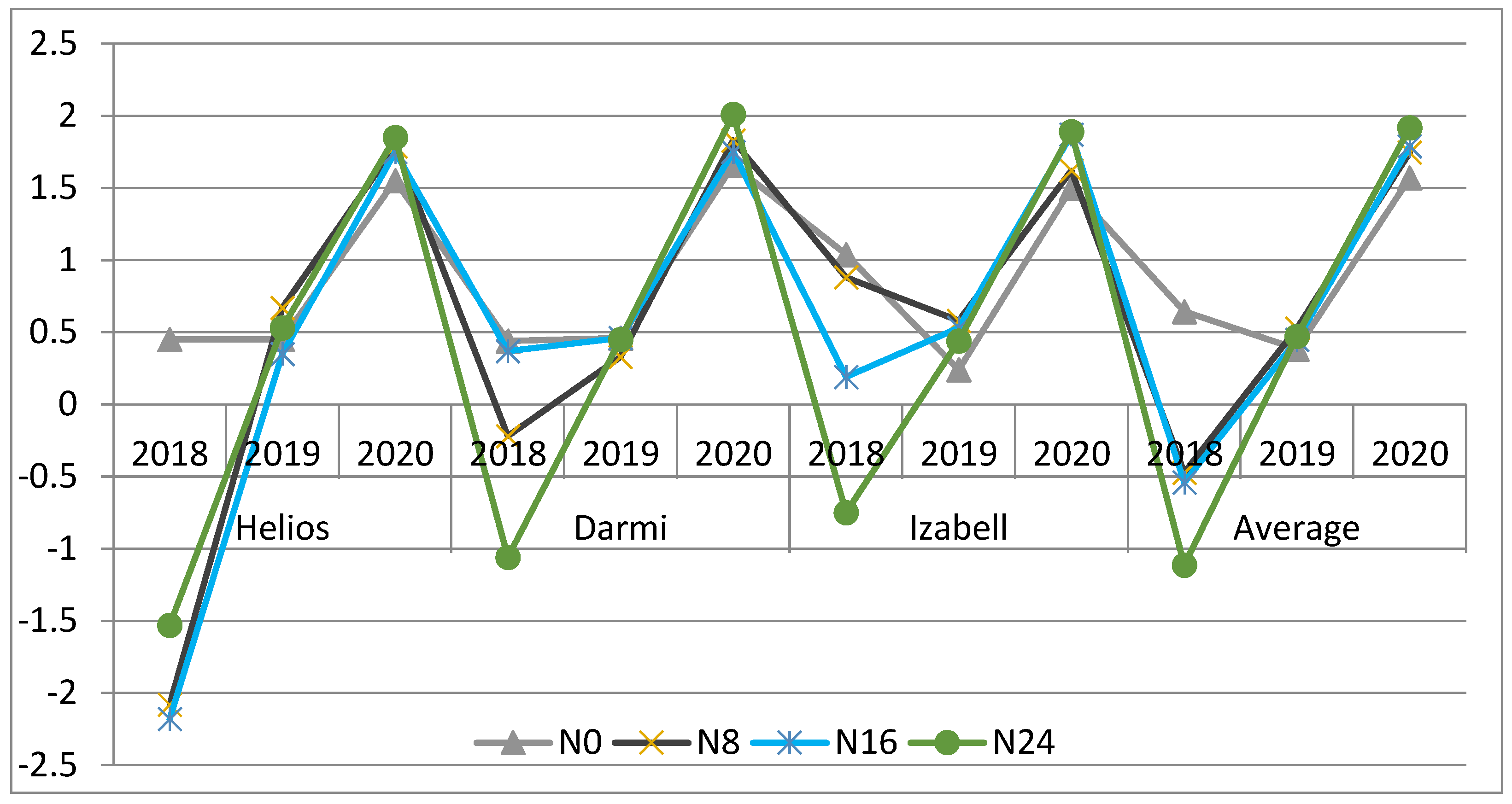

Table 1.
Systematized table for studying the impact of irrigation on cotton.
| Author | Article | What is being researched | Results |
| Ravinder R. A., G. Majumdar, A.R. Reddy Gerik T.J., Faver, K.L., Thaxton, P.M., El-Zik, K.M. P ettigrew W.T. Dagdelen, N., Basal, H., Yilmaz, E., Gürbüz, T., Akçay, S Koudahe, K., Sheshukov, A. Y., Aguilar, J., Djaman, K. Igbadun, H.E., Salim, B.A., Tarimo, A.K., Henry, P.R., Mahoo, F. |
Validation of farm pond size for irrigation during drought. Late Season Water Stress in Cotton: I. Plant Growth, Water Use, and Yield. Moisture deficit effects on cotton lint yield, yield components, and boll distribution. Different drip irrigation regimes affect cotton yield, water use efficiency and fiber quality in western Turkey. Irrigation-Water Management and Productivity of Cotton: A Review. Effects of deficit irrigation scheduling on yields and soil water balance of irrigated maize. |
Yield | Drip irrigation delivering irrigation water can result in water savings of 30 to 50% and yield improvements of 20 to 40% . The yield of fiber is reduced due to less number of flowers. Under water stress during reproductive growth, flower bud abortion is observed. In the case of a moisture deficit, the yield of fiber decreases by 25%, mainly as a result of reducing the number of boxes by 19%. A 25% reduction in the irrigation rate results in a 17.1% reduction in yield, and a reduction of up to 50% results in a 34.1% lower yield. Early termination of irrigation norms reduces the productivity of cotton. Irrigation under water deficit reduces grain yield more than biomass yield. |
| Dagdelen, N., Basal, H., Yilmaz, E., Gürbüz, T., Akçay, S Shareef M., Gui, D., Zeng, F., Waqas, M., Zhang, B., Iqbal, H. Du, T., Kang, S., Sun, J., Zhang, X., Zhang, J. Onder D., Akiscan, Y., Onder, S., Mert, M. |
Different drip irrigation regimes affect cotton yield, water use efficiency and fiber quality in western Turkey. Water productivity, growth, and physiological assessment of deficit irrigated cotton on hyperarid desert-oases in northwest China. An improved water use efficiency of cereals under temporal and spatial deficit irrigation in north China. Effect of different irrigation water level on cotton yield and yield components. |
Index of leaf area | With optimal irrigation (100%) the highest values were recorded, and in conditions of water deficit (25%) the lowest were calculated. The leaf area index has different values under different watering regimes. A decrease in the leaf area index was reported with irrigation deficit. The authors reported that water stress caused a decrease in leaf area and leaf area index. An increase in the leaf index and dry matter yield was registered with an increase in the irrigation rate. The highest values were recorded in the -100 % irrigation regime |
| Khamidov, M. K., Juraev, U. A., Buriev, X. B., Juraev, A. K., Saksonov, U. S., Sharifov, F. K., Isabaev, K. Isaev S, Mambetnazarov, A., Khalmuratova, B., Goziev, G., Ashirov ,Y. |
Efficiency of drip irrigation technology of cotton in saline soils of Bukhara oasis. Efficiency of appropriate irrigation system of cotton and winter wheat in water scarce conditions of Uzbekistan. |
Irrigation water productivity | Scientists report a 25.42% (0.91 t·ha−1) increase in the productivity of irrigation water in drip irrigation compared to conventional irrigation. Water-deficit irrigation increases water productivity but reduces seed cotton yield by an average of 20.2% |
| Yang, C., Luo, Y., Sun, L., Wu, N. |
Effect of deficit irrigation on the growth, water use characteristics and yield of cotton in arid Northwest China. | Evapotranspiration | Yield loss was less than 10% at 70% ET and 85% ET. Irrigation at 85% ET - safe to obtain high yield, at 70% ET is an alternative in limited availability of irrigation water. |
| Wu, P.T., Zhu, D.L., Wang, J. Saldzhiev, I., Raykov, S. Fazliеv, J., Khaitova, I., Atamurodov, B., Rustamova, K., Ravshanov, U., Sharipova, M. Ramamurthy, V., Patil, N.G., Venugopalan, M.V., Challa, O. Chen, X., Qi, Z., Gui, D., Sima, M. W., Zeng, F., Li, L., L. Li, X. Li, Feng, S. |
Gravity-fed drip irrigation design procedure for a single-manifold subunit. Productivity and economic effect of cotton under different irrigation rates. Efficiency of applying the water-saving irrigation technologies in irrigated farming. Effect of drip irrigation on productivity and water-use efficiency of hybrid cotton (Gossypium hirsutum) in Typic Haplusterts. Responses of cotton photosynthesis and growth to a new irrigation control method under deficit irrigation. |
The effectiveness of the use of irrigation water | It can reportedly be achieved by reducing the amount of irrigation water or by reducing the number of irrigation events. By reducing the irrigation rate to 60 mm, the irrigation costs are reduced to 62%, the net income of 100 m3 of irrigation water is the highest, and the effect of 1 m3 of water is the largest. With localized irrigation, productivity increased by 7.4 centner/ha, and for growing 1 centner of cotton, 85 cubic meters of water were used per 1 ha. The water use efficiency is 28-58% higher than furrow irrigation and 45-68% higher with bed irrigation. An irrigation scheduling model was developed investigating water stress and cotton plant development. Decreases in net leaf photosynthetic rate, stomatal conductance and transpiration rate of 11.2%, 18.7% and 10% were reported, respectively, compared to optimal irrigation , but with better efficiency when using the irrigation water |
Disclaimer/Publisher’s Note: The statements, opinions and data contained in all publications are solely those of the individual author(s) and contributor(s) and not of MDPI and/or the editor(s). MDPI and/or the editor(s) disclaim responsibility for any injury to people or property resulting from any ideas, methods, instructions or products referred to in the content. |
© 2023 by the authors. Licensee MDPI, Basel, Switzerland. This article is an open access article distributed under the terms and conditions of the Creative Commons Attribution (CC BY) license (http://creativecommons.org/licenses/by/4.0/).
Copyright: This open access article is published under a Creative Commons CC BY 4.0 license, which permit the free download, distribution, and reuse, provided that the author and preprint are cited in any reuse.


