

Submitted:
27 September 2023
Posted:
28 September 2023
You are already at the latest version
Abstract
The paper proposes an innovative solution for managing and ensuring high energy efficiency of power supply systems at high non-linear loads. This is realized by maintaining optimal value of reliability indicators and high quality of power supply. The validation is carried out using analyzes and tests of quality of electromagnetic compatibility (EMC) for increased number of powered frequency converters. It has been proven that the effective use and reduction of energy consumption can be achieved thanks to the unique technological features of the employed electrical devices. This enables a normal operation of the system with decreased power and adequate control of energy processes. The problem of predicting power losses under changing conditions in a decentralized electrical network has been solved based on the theory of electromagnetic compatibility. The influence of the mains mode parameters and the indices of instantaneous distortion of current and voltage waveforms caused by the operation of converters on the resonance phenomena in power supply systems were investigated. Recommendations were developed for the selection of proper parameters of compensators for 6-10 kV and 0.4-0.66 kV circuits based on the analysis of the optimization problem when minimizing active power losses. Results of our findings may aid parties involved in designing and maintaining power networks in various applications, such as mines, etc.
Keywords:
energy efficiency
; managing power supply systems
; electromagnetic compatibility (EMC)
; reliability
; frequency converters
; higher harmonics
; interharmonics
; resonance phenomena
1. Introduction
The managing the electromagnetic environment at any industrial facility constitutes a result of the mutual interaction of both natural electric and magnetic fields (e.g., due to atmospheric discharges) as well as those introduced by facility operation. It can be dangerous for all electrical machines and equipment, working in different environmental areas (e.g. in the underground mines which are supplied from the high voltage transmission lines) [1]. Therefore, in power plants, substations and/or transmission lines, extremely high values of the intensity of the electric and/or magnetic fields at the mains frequency can be encountered. They can, i.e., reach up to about 25 kV/mm and 103 A/m, respectively. Besides, the interference due to higher frequencies are unavoidable. Operation of various types of electrical equipment, like: control, alarm or data transmission devices, may be also a source of disturbance. Changing the operating mode of electrical equipment, as well as emergency situations (e.g., short-circuits), cause rapid changes in the introduced electromagnetic fields, disturbing the stable electromagnetic environment. It is depicted, inter alia, by a change in the value of various disturbance indicators [2] and may interfere with the operation of industrial facility automatic control systems [3]. The most common sources of disturbances are: overvoltages in networks during switching, short-circuits, operation of lightning strike limiters, or during current disturbances in networks. Interference are also introduced by electrical equipment operating in a discontinuous mode, such as: a welder, lifting equipment, power tools, household appliances, as well as other various factors like: contact transition resistance, switching time verification, drift of component parameters, or thermoelectric effects on the contacts between various materials.
It is obvious that any switching process in the power system is related to changes in the electric energy stored in inductive as well as capacitive elements of electrical devices [4]. It is manifested by variation of current and voltage waveforms and other parameters characterizing physical process in transient. With rare exceptions (electric arc, pulsed processes, etc.) relations between voltage and currents in transients are known from the theory of electric circuits [5,6,7].
Managing power supply energy efficiency involves implementing various strategies and technologies to optimize the consumption and utilization of electricity. Here are some key approaches to consider:
- Choose power supplies, transformers, and other electrical equipment that meet energy efficiency standards. In this case we have to look for devices with high efficiency ratings. The implementation proper testing and monitoring IT systems must be introduced [6].
- Improve power factor to minimize reactive power and reduce losses in electrical systems. Power factor correction techniques include the use of capacitors, active power factor correction circuits, and harmonic filters [6]. Power factor correction provides the optimization of the unpredictable changes in electrical networks during the operational time.
- Implement load monitoring and management systems to ensure that energy consumption is optimized. Identify peak usage periods and take steps to reduce demand during those times, such as through load shifting or demand response programs [7].
- Provide the regular energy audits to identify areas of high energy consumption and potential efficiency improvements. Analyze power usage patterns, identify energy wastage, and implement corrective measures [8].
- Install power monitoring systems to track and analyze energy consumption. Real-time monitoring can help identify energy inefficiencies, voltage fluctuations, and power quality issues, enabling timely corrective actions.
- Utilize software tools that provide energy management capabilities, allowing you to monitor and control power usage across various devices and systems [9]. These tools can enable features such as automatic power management, scheduling, and remote shutdown of idle equipment.
- Promote energy-conscious behavior among employees and users. Encourage turning off lights and equipment when not in use, utilizing power-saving features on computers and other devices, and raising awareness about the importance of energy efficiency [6].
- Maintain and service electrical equipment regularly to ensure optimal performance and energy efficiency. Keep equipment clean, repair any faulty components promptly, and ensure that electrical connections are properly tightened to minimize resistance and losses [8].
By implementing these strategies and technologies, you can effectively manage and improve the energy efficiency of your power supply, reducing costs and environmental impact while ensuring reliable electricity for your operations.
Until recently, electromagnetic processes in electrical networks of industrial enterprises and power systems have been considered as large violations of static and dynamic stability, the occurrence of short-circuit currents, etc. [8,9]. Energy and sustainable development are closely intertwined, and transitioning to sustainable energy systems is crucial for achieving a more equitable, prosperous, and environmentally responsible future [10]. The analysis and calculation of transients in power systems is closely related to general problems of electromagnetic compatibility (EMC). It should be emphasized that the electromagnetic field characterizes the environment in the form of various electromagnetic interferences. Therefore, some types of electrical equipment may be considered as either interference generators (sources of noise) or objects of their influence that determine their electromagnetic compatibility. Long-term influence of electromagnetic interference on the insulation of electrical equipment may cause damage and, consequently, a short circuit. When it comes to automation, communication and relay protection circuits, it often results in mal operation of these systems, i.e., a violation of electromagnetic compatibility. This is due to a malfunction of the protection devices, the initiation of self-excited oscillations in the power grid, static instability, and other negative phenomena. Therefore, the study of electromagnetic transients in the enterprise power supply system should not be limited only to the calculation of short-circuit currents and the stability of operation of power plants connected to the electrical network. It should primarily include the analysis of electromagnetic interference, which is a set of electromagnetic compatibility problems.
The main contribution and novelty of this paper are as follows:
- We perform a detailed analysis of the usefulness of commonly used reliability and power quality factors in order to develop a set of new effective indicators considering the specificity of operation of both industrial enterprises and power system.
- We use measurement data on the scope and nature of the instantaneous current and voltage waveform distortions, under the technological process of industrial enterprises, to improve the quality of calculations of electromagnetic and technological losses. This distinguishes our results on the estimation of energy-saving modes of power systems.
- We show that the mechanism of the optimal solution, to ensure the required level of electromagnetic compatibility of the power supply system components of any industrial enterprise, is twofold in nature.
- Our results of electric resonance modeling in industrial power grids allowed a reliable determination of possible resonance zones during the higher frequencies, both harmonics and interharmonics. The obtained amplitude-frequency characteristics for specified operation conditions, and parameters of the power system as well as the energy demand of a large coal company, determined the range of changes of the value of the input resonance resistance.
- This determines the size of the power system value to ensure optimal reactive power compensation under decentralized electricity distribution. Results of our findings may aid researchers and professionals involved in designing and managing power networks, including those operating in mines.
The manuscript is organized as follows: Section 1 provides an introduction to the discussed topic. Section 2 discussed the matter of electromagnetic interference (EMI) within enterprise power supply systems. Section 3 presents a review of related previously published papers. Section 4 relates to electromagnetic compatibility issues of renewable energy sources (RES). Section 5 talks about interharmonics and their importance in power supply networks. Section 6 presents the results and findings of our studies, including practical feedback for power network operators and related third-parties.
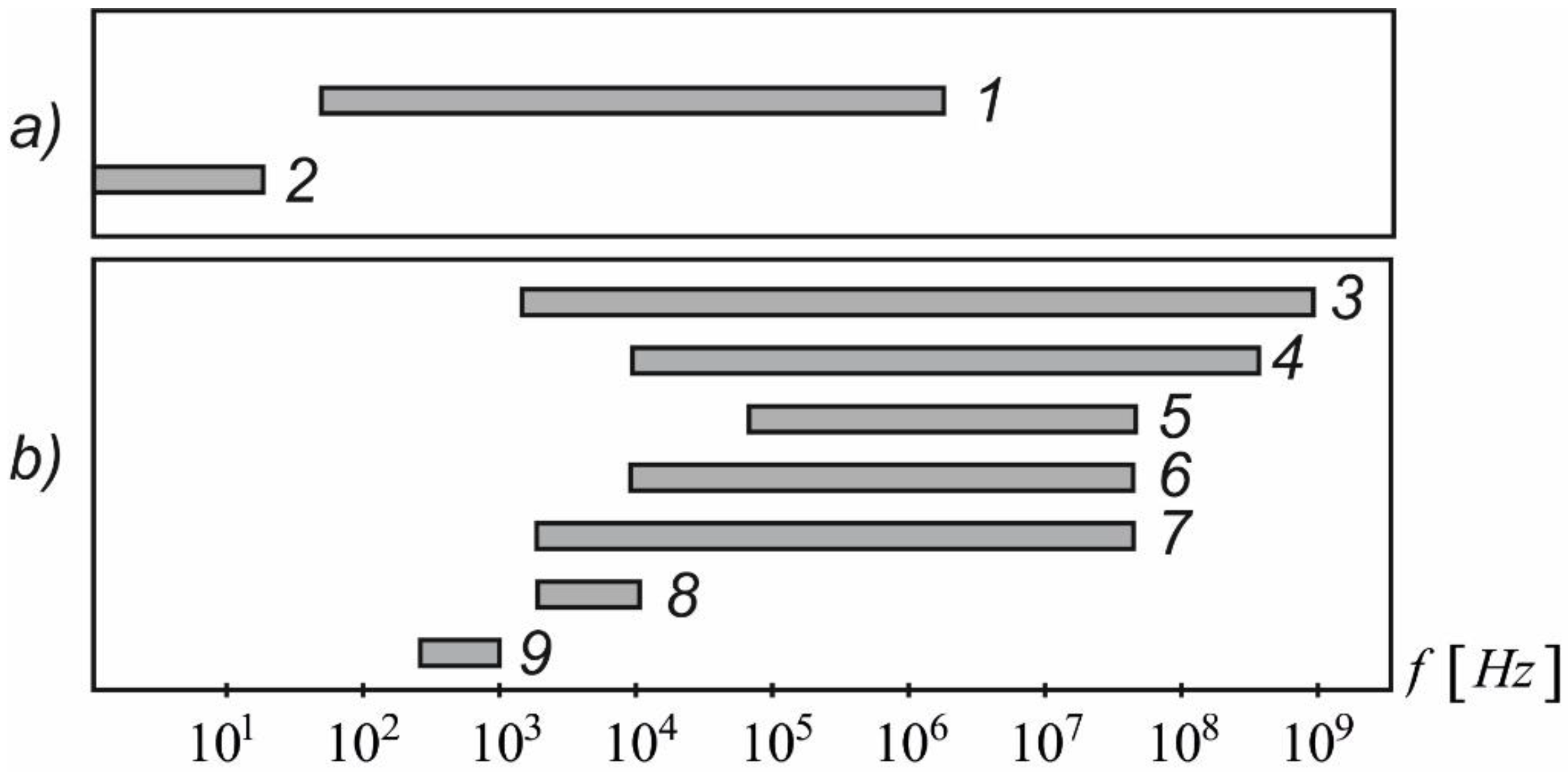
As already mentioned, the power supply system of the enterprise is the source of several electromagnetic disturbances. Among them are power lines, switchgears, bus lines, cables, as well as any automation, control, and security equipment. Emergency (transient) electromagnetic processes are mainly associated with short-circuits in supplying systems and with any switching in power circuits. As a result, they are the source of randomly arising oscillatory as well as aperiodic disturbances, usually of a wide spectrum of frequencies. The stationary electromagnetic processes, accompanied by disturbances of low, medium, and high frequencies (from a few Hz up to 100 GHz) arise in all electrical power installations. Their frequency spectrum is shown in Figure 1.
Figure 1.
Frequency spectra of arising disturbances in electrical systems and facilities due to: a) pulse electromagnetic and b) periodic processes; 1 – switching operations; 2 – load surges; 3 – radio and TV sets; 4– computer systems; 5 – supply-line switches; 6 – electrical installations; 7 – power consumers; 8 – centralized control systems; 9 – power supply lines.
Figure 1.
Frequency spectra of arising disturbances in electrical systems and facilities due to: a) pulse electromagnetic and b) periodic processes; 1 – switching operations; 2 – load surges; 3 – radio and TV sets; 4– computer systems; 5 – supply-line switches; 6 – electrical installations; 7 – power consumers; 8 – centralized control systems; 9 – power supply lines.
Thus, electrical installations are not only a source of electromagnetic disturbances, but also suffer from these perturbations under emergency as well as normal conditions. This mainly takes place during:
- planned switching at the high-voltage side, as well as any maneuvering processes under failure (short circuit, overlapping of power lines insulation, operations with power disconnectors, etc.);
- switching on and off at the low voltage side any electrical equipment containing inductive circuits, and high-current equipment generating strong electric and/or magnetic fields at industrial frequency;
- the use of efficient high-frequency communication devices, data transmission units, as well as presence of the voltage fluctuations with the frequency of higher harmonics, power supply interruptions of the control current circuits, etc.;
- electrostatic discharges related to a direct lightning strike to the power line or to nearby object.
Scheduled switching during tests and the short-circuits (short-circuit, overlapping of power line insulation, switching, etc.), on both high-voltage and low-voltage sides, result in harmful transient electromagnetic disturbances, primarily affecting the automation, control, and protection systems. Simultaneously, damped oscillations with frequencies of hundreds of kilohertz and overvoltages many times greater than the rated voltage may occur in high-voltage power networks. The electromagnetic disturbances during the commutation of inductive circuits are most intensive and dangerous for the technical means of low-voltage discrete automation devices. Under unfavorable conditions, under commutation of inductive loads, a significant level of disturbances, such as overvoltages, are possible to arise in power networks with a value of up to about 10 kV, at the steepness of up to 100 V/ns. The pulse rise time in the data transmission lines is fund to be in the range from 1 ns to 1 ms.
In some cases, when accepted levels are exceeded, electromagnetic disturbances may violate the immunity to disturbances of technical measures in power plants and substations. This applies to the widely used microprocessor-based safety devices. The operational reliability tests of over 100 power substations [8,11] have shown that even 15% of secondary devices can be damaged when they do not meet the electromagnetic compatibility requirements [12].
Selected types and characteristics of electromagnetic interference, affecting the technical measures of stations and power substations, are presented in Table 1.

Table 1.
Exemplary types and characteristic of electromagnetic interference affecting the technical means of electric power stations and substations.
Table 1.
Exemplary types and characteristic of electromagnetic interference affecting the technical means of electric power stations and substations.
| Interference of prolonged nature | Interference of transient nature with high probability of appearance |
Interference of transient nature with low probability of appearance |
| Slow voltage variation in AC power supply systems and DC power supply systems |
Supply voltage dips with duration no longer than 0.02 s in AC power supply systems and in DC power supply systems |
Supply voltage dips with duration longer than 0.02 s in AC power supply systems and in DC power supply systems |
| Harmonics and interharmonics of supply voltage |
Fluctuation of supply voltage | Outage of power in AC supply systems |
| Voltage of industrial frequency | Damped oscillating magnetic field | Microsecond impulse disturbances of high energy |
| Conductive disturbances of 0–150 kHz (excluding disturbances of 50 Hz) |
Electrostatic discharges | Short appearance of voltage of industrial frequency |
Under a typical symmetrical power supply of industrial enterprises, background disturbances also occur. However, their level is within the limits allowed by the standards. As a rule, the content of the negative-sequence voltage component is within ±2%. The asymmetry of the three-phase voltage system for the zero sequence occurs within the same limits. The background level of non-sinusoidalities caused mainly by asymmetry of transformer cores, as a rule, does not exceed 2-3%. In practice, there are found non-periodic voltage dips associated with switching electrical devices, such as: motors, transformers, capacitors, etc. Their depth does not exceed a few percent of the rated voltage, the duration lasts from 100 ms to several seconds. On the other hand, voltage drops resulting from insulation damage due to short-circuits cause voltage reduction to 10%, lasting from 500 ms to a few seconds. There are also periodic voltage drops caused by the operation of controlled electronic converters. Short-term periodic and non-periodic surges, lasting up to several dozen microseconds, are also unavoidable. One of the causes are lightning strikes.
It should be noted that interharmonics (IH), most frequently occurring in electrical devices, indicate the greatest negative impact [13,14,15]. Such processes are also observed in the energy supply of complex thermochemical processes [16,17]. However, the problem of the interharmonics generation in power systems and their impact is still being studied. This is due to the complexity of the problem and its uncertainty.
2. Review of Related Works
Renewable energy sources (RES) are used more and more widely in the world [18]. In some countries, their amount of generated electricity exceeds already the value of traditional fossil-based sources. In 2015, the share of RES in the world’s energy production was equal only 5%. By 2030 it is predicted to reach 18.6%, and in 2050 to come close to 50% [8,19]. This means an increase of more than 8.6 times. As for solar energy, its increase is expected to be over 30 times, with an average annual increase of 10.2%. Whereas the share of wind energy will increase 11 times during this time, with the predicted annual growth of 7.1%. The solar power plants should not normally result in significant fluctuations of the power in the system. However, this does not apply to periods of a maximum feeding power under the highest intensity of solar radiation. Therefore, the impact of this unregulated and unpredictable solar energy generation must be reduced either by the influence of conventional energy sources or by taking special measures to keep the power balance in the system. The analysis of available literature shows that the assessment of a rapid change in the system load is possible to predict, based on the reactive power analysis and the sinusoidal distortion coefficient [20].
However, the greatest problems are related with effective employment of wind farms most often used in European countries [21]. This is due to the unpredictable unstable operation of wind turbines with the wind force. As a result, the generated power is unstable and may significantly affect the stability and reliability of the power system operation [22]. The stochastic nature of the active power generated by a wind turbine results in frequency fluctuations in the system, changing both its value and the rate of change over time [21]. Therefore, quality of power energy provided to consumers decreases with visible effects such as: flickers, changes in time, as well as voltage drops [22]. Moreover, the swinging of the turbine with the wind force leads to low-frequency oscillations of the power, which additionally ruins the stability and operation dynamics of the system. It should be noted that increasing the contribution of RES in the power system reduces its inertia (time constant). Therefore, the system becomes more and more sensitive to small, short-term disturbances. It is manifested, inter alia, by the appearance of low-frequency perturbations in the dynamics of its work [20,23]. It is expected that this problem will gradually increase under the transformation from a centralized to a distributed system, with an increasing share of renewable energy sources. This problem becomes especially important for large industrial enterprises. For example, it is known that the practical range of today’s short-circuit power in 6-35 kV networks is within 150-1500 MVA. Whereas, in networks of 110-220 kV it lays within 5000-10000 MVA. Therefore, due to the decrease in the value of a short-circuit power in particular electrical nodes for the new structure of the distributed network, it becomes necessary to theoretically re-analyze the value and flow of short-circuit currents as well as to perform an appropriate coordination of the operation of the protection system [2].
Today’s global strategy regarding the development and operation of the power system requires a new approach. As for the Ukrainian power system, the main limitations in its development include both technical as well as operational restrictions. The rapid development of renewable energy sources is playing a major role here. It forces the decentralization of the system structure and determines the electromagnetic compatibility under asymmetric operation with a non-linear load [2].
Thus, the Ukrainian government faces the following challenges:
- introduction of market rules with the possibility to predict the energy consumption;
- creating a single model of the Unified Energy System with distributed generation compatible with the models of European Systems,
Nowadays, the Ukrainian industry, above all, suffers from high power transmission losses of up to 20%. This is a lot, compared to developed countries. For example, in Western Europe they are around 4-5%, and in the United States approx. equal to 6% [3]. High power losses in Ukrainian networks result mainly from ineffective reactive power compensation and the method of its regulation. Besides, obsolete fixed assets in electrical facilities, ineffective ways to optimize the operation of the network and voltage regulation, as well as unresolved problems of power quality had a great influence on the current situation [26,27]. Low level of power quality significantly reduces energy efficiency in power grids, which is manifested by a change of various reliable indicators [28]. The problem of power quality is one of the important components of the complex problem of electromagnetic compatibility of a modern power supply system (PSS). Its solution is a basic step forward to improve the efficiency of power system operation. This is emphasized in the works of recognized scientists [29,30]. Therefore, for the effective operation of the Ukrainian power system, it is particularly important to ensure conditions for both effective transmission and efficient consumption of electricity. It is also very important to reduce the energy consumption level of all state-owned industrial facilities [31].
The problem of electromagnetic compatibility and electricity quality is particularly important due to the growing use of various types of power converters in power networks. This has a direct reflection in the economic effects. According to available data, the annual losses in the world’s power system, caused by low quality of energy, reaches approx. 500 billion dollars per year [2,22]. The main negative factors here are both the influence of higher harmonics as well as the asymmetry of the network operation and voltage fluctuations. According to [23,32], the annual losses resulting from this fact in Ukraine reach up to $ 5.1 billion. The same results are observed in the management of other dynamic processes [33].
3. Methods and Methodology.
Managing power supply energy efficiency through higher voltage and interharmonics is a complex task that requires a combination of methods and methodologies. Interharmonics refer to frequencies that are not integer multiples of the fundamental frequency (usually 50 or 60 Hz), and they can be caused by non-linear loads and other disturbances in the power system. It means the usage the following elements of joint methods and methodologies to effectively manage power supply energy efficiency:
- Voltage level optimization. Increasing the voltage level within acceptable limits can reduce losses in power transmission and distribution systems. However, this needs to be carefully regulated to avoid over-voltage issues;
- Load management. The management strategy provides the reducing power demand during peak periods. This can involve shifting loads to off-peak times or implementing demand response programs;
- Power factor correction (power coefficient correction). Using the correcting power factor by adding capacitors or other devices to the system reduces losses and improves energy efficiency;
- Harmonic mitigation. The usage of the harmonic filters gives possibility to reduce the presence of harmonics and interharmonics in the system. This helps prevent distortion of the system and energy losses;
- Monitoring and analysis. The implementation of the continuous monitoring and analysis of the power supply system identifies sources of interharmonics and opportunities for improvement. Implement different software that optimize energy usage in real-time by considering various factors, including voltage levels and harmonic content;
- Predictive maintenance. The usage predictive maintenance techniques by introducing sensors and data analytics allows to identify and address potential issues before they cause efficiency problems;
- Regulatory compliance. Ensure compliance with relevant regulations and standards related to voltage levels, power quality, and harmonic distortion.
So, in our work for the simulation and modeling we used tools to, the main task of which is to predict the behavior of the power supply system under various conditions and assess the impact of voltage changes and interharmonics. For managing power supply energy efficiency with higher voltage and interharmonics was provided a holistic approach that considers various aspects of the power system, including equipment, regulation, and monitoring. It is necessary for getting the striking a balance between energy efficiency, power quality, and system reliability.
3.1. Interharmonics in power grids
- Harmonic: f = hf1, where h > 0 (and h is an integer).
- Interharmonic: f ≠ hf1, where h > 0 (and h is an integer).
- Sub-harmonic: 0 < f < f1
where: f1 is the fundamental frequency of the power grid.
Interharmonics are not a multiple of the fundamental frequency of the system. On the amplitude-frequency spectrum, they are located between the canonical (higher) harmonics (including the fundamental one), and the constant as well as fundamental harmonic. Non-canonical harmonics as well as subharmonics are therefore treated as special cases of the interharmonics. The IH appearing in the network, mostly due to operation of different electrical appliances, result in the most harmful effect [8,11,12].
3.2. Sources of interharmonics
The interharmonics are generated under both short-term work and work in transients of any energy receiver (consumer). It is related to the rapid change of the technological process, as well as the changes of the electromagnetic field during the operation of electrical appliances (i.e., half-duplex operation of a frequency converter (FC), rectifier, etc.). In the first case, the process of changing the current (or voltage), being the source of the IH, is random and non-periodic. However, for the latter case, apart from special spontaneous cases, the IH can be considered periodically variable. Therefore, it is the basis for the approach to perform analyses and calculations of IH produced by different sources [8,11]. The interharmonics are due to modulation of the fundamental and/or higher harmonics by other frequency components. It can be observed, e.g., during the operation of static frequency converters, particularly: cycloconverters, asynchronous drives, converting cascades, arc furnaces, welders, etc. The interharmonics, generally speaking, affect similarly as the higher harmonics, but their influence is stronger. This explains the appearance of extra loss of active power and electric energy. If the nonlinear impedance Z0, which is the source of harmonics (HH) and IH, is supplied by a sinusoidal voltage source e1(t), with impedance ZS(RS, LS), the instantaneous current i(t) can be expressed as [11]:
where: i1(t), ihh(t), iih(t) are contributions due to fundamental, high and interharmonics, respectively.
Or in another form as:
As a result, the instantaneous value of the voltage uAB(t) at the load terminals is expressed as:
Hence, the influence of the current interharmonics on the quality of the supply source can be rated.
Considering the importance of Ukraine’s energy security and defense capabilities, it is vital to emphasize the importance of comprehensive studies of electromagnetic compatibility and power supply reliability of mining enterprises. It is particularly important for the non-stationary technical and legal conditions of power systems operation and the need to transform to the so-called intelligent energy [11]. In view of the above, appropriate analyzes of the specificity of the power supply systems of mining enterprises with high non-linear loads were carried out based on comprehensive tests. When assessing the energy balance of enterprises, the respective technological units have been distinguished, where the consumption of electric energy in the converted form reaches around 100% and shows the dynamics of the so-called “problem load” growth over the last decade [11]. Therefore, the commonly used electromagnetic compatibility indicators that are important for estimation of the rated operation of electrical systems were analyzed.
4. Results and Discussion
As a result, the main reasons and the effects of their inadequacy have been specified. The concept of the so-called “energy efficiency of power supply systems” has been used here as a comprehensive indicator. It considers the reliability and quality of power supply under monitored operation of the power grid and the stationary conditions of mining enterprises installations as well. The operation conditions of the electric power systems with non-linear loads were examined, considering the decentralization concept under designing and constructing of such networks. Therefore, appropriate studies of the working conditions and its changes were carried out for the main electric energy receivers used in mines.
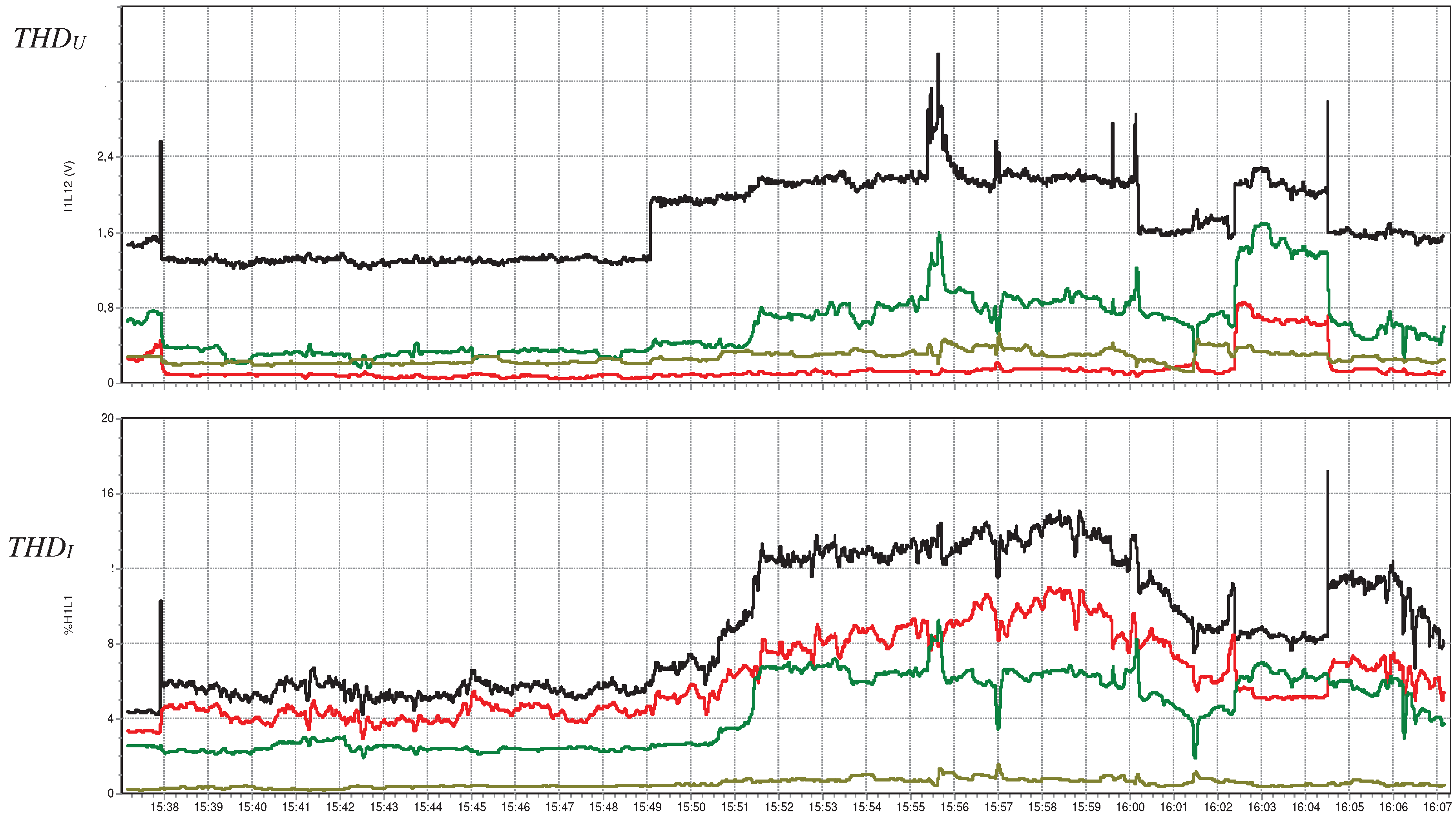
Particular attention was paid to the relationship between the operation mode and higher harmonic content in the range of both HH and IH. As a result, the comprehensive experimental study of changes in the value of the quality indicators for voltage THDU and current, THDI during operation, were performed. For the main ventilation fan (MVF) and the lifting machine (LM), they are shown in Figure 2. The electromagnetic disturbances caused by the operation of this type of machines are found to be of cyclical nature. This allowed for assumptions of both HH and IH frequencies for further analysis of the power system operation [11].
Figure 2.
Distortion of the current and voltage waveforms under start-up of the MVF: a) voltage distortion factor THDU (black), b) current distortion factor THDI; where red – 5th and green – 7th harmonics of voltage and current, respectively.
Figure 2.
Distortion of the current and voltage waveforms under start-up of the MVF: a) voltage distortion factor THDU (black), b) current distortion factor THDI; where red – 5th and green – 7th harmonics of voltage and current, respectively.
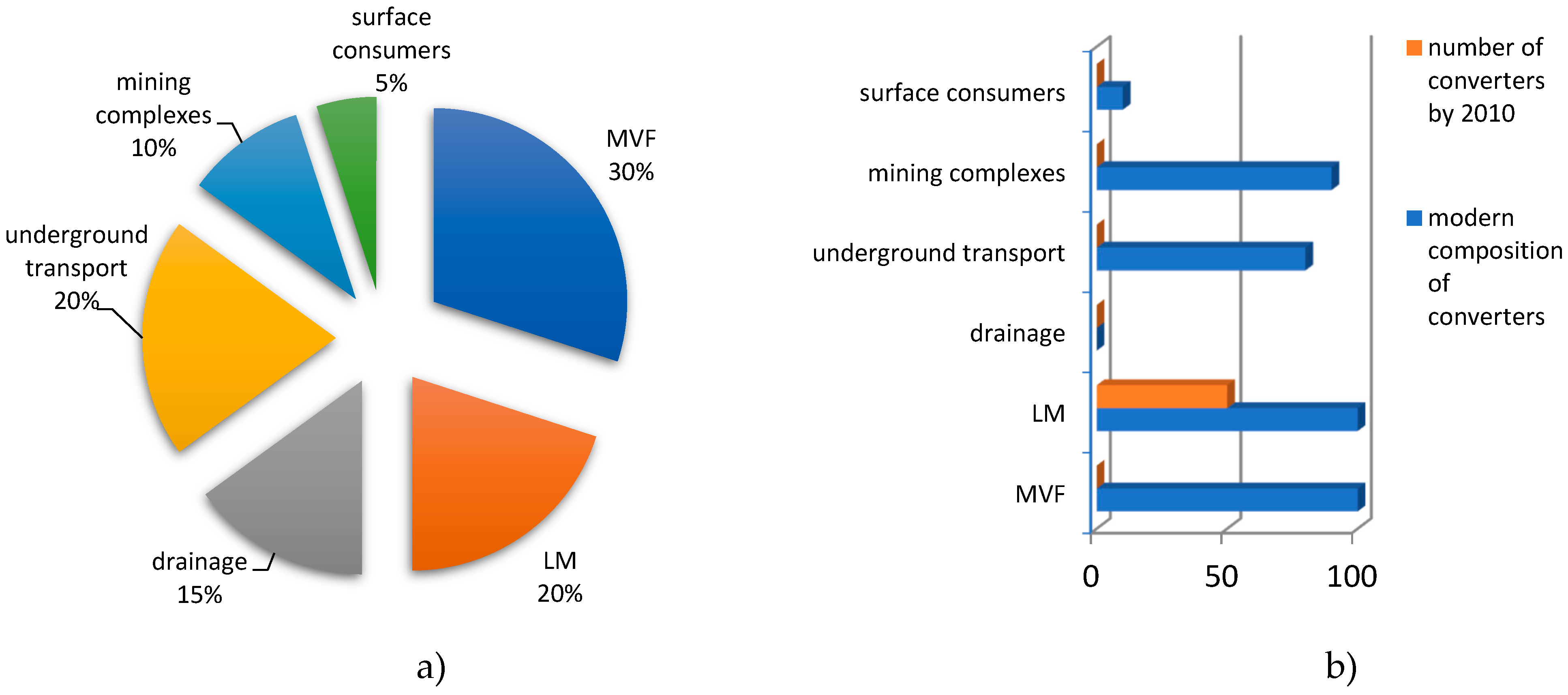
The levels of asymmetry and voltage fluctuations, during the operation of lifting machines, were investigated. It has been shown that under the real power system value, the unbalance K2U (negative sequence) and voltage fluctuations δUt indicators are within the limits allowed by the regulations. Considering the specificity of underground coal mining technology to assess and forecast, the efficiency of the power system operation opens new possibilities for implementing the principles of energy efficiency and limiting final electricity consumption, as shown in Figure 3. This is because the main energy consumers that need to be considered in the energy balance are stationary electrical installations equipped with valve converters.
Figure 3.
Energy balance: a) due to the main technological loads of the mine; b) and the dynamics of the increase in non-linear loads in the energy balance.
Figure 3.
Energy balance: a) due to the main technological loads of the mine; b) and the dynamics of the increase in non-linear loads in the energy balance.
The analysis of the nature of harmonic disturbances during the operation of the hoisting machine (LM), powered by frequency converters, showed a significant dependence of the levels of higher harmonics of both current and voltage, measured at the station rails, on the operating cycle of the lifting machines. This proves the similarity of the velocity diagrams and the experimental graphical relationships of higher harmonics, as shown in Figure 4 and Figure 5.
Figure 4.
Time histories of higher harmonics during coal lifting.
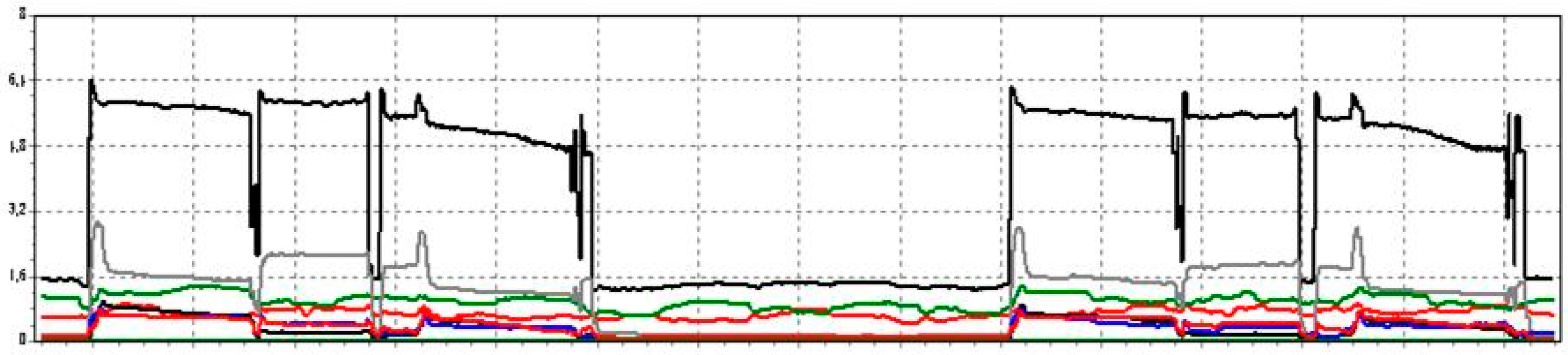
Figure 5.
Speed diagram of the hoisting machine.
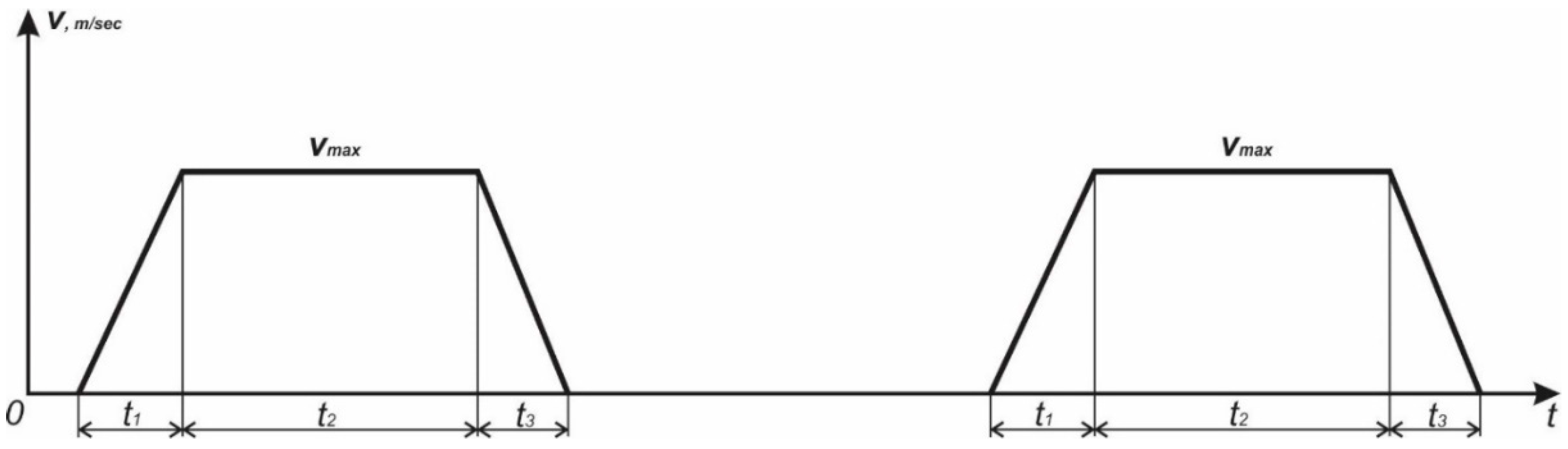
It should be emphasized that the measurements of higher harmonic levels were made at different distance from the mine’s supply point. This allowed the assessment of the effect of electromagnetic interference suppression by the electrical resistance of the network. The evaluation of the obtained graphs of higher harmonics enabled the formulation of important conclusions allowing the introduction of modified distortion coefficients. They constitute the basis for a new method of determining additional electricity losses in a mine’s power supply system at non-sinusoidal voltage.
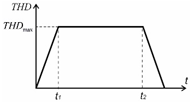
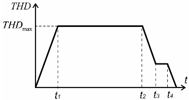
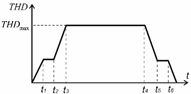
The following relationships were used to develop the mean values of the coefficients:
- Average THDav value per shift/daywhere: THDi is the value of the distortion of voltage waveform coefficient in the i-th cycle of the lifting machine; ti is the duration of the i-th cycle;
- RMS value of THDRMS per shift/day
- Utilization coefficient:where: THDnom is the value of the distortion coefficient of the voltage waveform, based on the rated power of the converter.
- Maximum coefficient:where: THDmax is the maximum value of the curvature of the voltage sinusoidal obtained from real graphs.
- Switching factor:
Experimental monitoring of electrical modes and voltage quality indicators for coal mines confirms the simulation results and proves the reliability of the values of the developed coefficients of the graphs for current harmonics are described in Table 2.
Obtained values of the coefficients consider the power of the converter and the measurement data of the tachogram of the hoisting machine. This allows for the development of a more accurate method of calculating electricity losses in the power supply system of mining enterprises. This method considers the multifactorial models of changing the mining technology, as well as the parameters of the converter systems used. This is a novelty that distinguishes the current scientific achievements and can be used as an effective tool for the creation of a completely new, energy-efficient transmission and distribution systems.
Table 2.
Values of coefficients of graphs of higher current harmonics.
| Harmonic profile | Power converter | |||||
|---|---|---|---|---|---|---|
 |
MVA | 1.0 | 2.0 | 3.0 | 4.0 | 5.0 |
| THDav | 0.026 | 0.056 | 0.09 | 0.117 | 0.146 | |
| THDRMS | 0.003 | 0.011 | 0.025 | 0.044 | 0.069 | |
| KU THD | 0.44 | 0.51 | 0.52 | 0.51 | 0.52 | |
| KY THD | 0.50 | 0.53 | 0.56 | 0.56 | 0.56 | |
| KМ THD | 1.33 | 1.14 | 1.14 | 1.14 | 1.03 | |
 |
MVA | 1.0 | 2.0 | 3.0 | 4.0 | 5.0 |
| THDav | 0.025 | 0.054 | 0.08 | 0.111 | 0.131 | |
| THDRMS | 0.003 | 0.011 | 0.025 | 0.044 | 0.069 | |
| KU THD | 0.42 | 0.49 | 0.49 | 0.48 | 0.47 | |
| KY THD | 0.48 | 0.51 | 0.53 | 0.53 | 0.50 | |
| KМ THD | 1.33 | 1.14 | 1.14 | 1.14 | 1.03 | |
 |
MVA | 1.0 | 2.0 | 3.0 | 4.0 | 5.0 |
| THDav | 0.024 | 0.051 | 0.08 | 0.109 | 0.128 | |
| THDRMS | 0.003 | 0.011 | 0.025 | 0.044 | 0.069 | |
| KU THD | 0.39 | 0.47 | 0.47 | 0.47 | 0.46 | |
| KY THD | 0.45 | 0.49 | 0.51 | 0.52 | 0.49 | |
| KМ THD | 1.33 | 1.14 | 1.14 | 1.14 | 1.03 | |
The problem of resonance phenomena in systems supplying significant non-linear loads has also been considered as a factor. During the modeling, the frequency bands related to the method and operation conditions of the used converters were considered. This was important for solving the characteristic equation for the complex impedance at a given load mode (9), which allowed to obtain analytical relationship determining the parameters of the power supply, that make optimal operation of the compensation devices possible.
The equation for determining the frequency response of the LC circuit of the supply network, which is the basis of the resonance phenomena model, has the form:
where: Z1n represents the resistance of complex loading on frequency of the first harmonic; xcm is the equivalent inductive resistance of the power supply at the frequency of the n-th harmonic; xkn is the resistance of the capacitor bank for the n-th harmonic; rc is the total active resistance of network elements; rk is the rated active resistance of the capacitor bank.
As shown in Figure 6, it has been found that resonance phenomena in the 6-10 kV load nodes of mining plants occur together with the evidence of both harmonic and/or interharmonic frequencies.
Figure 6.
Amplitude-frequency characteristics of the load unit of the mine during the transition to decentralized power supply (Z/Z1 – relative resistance of the load node).
Figure 6.
Amplitude-frequency characteristics of the load unit of the mine during the transition to decentralized power supply (Z/Z1 – relative resistance of the load node).
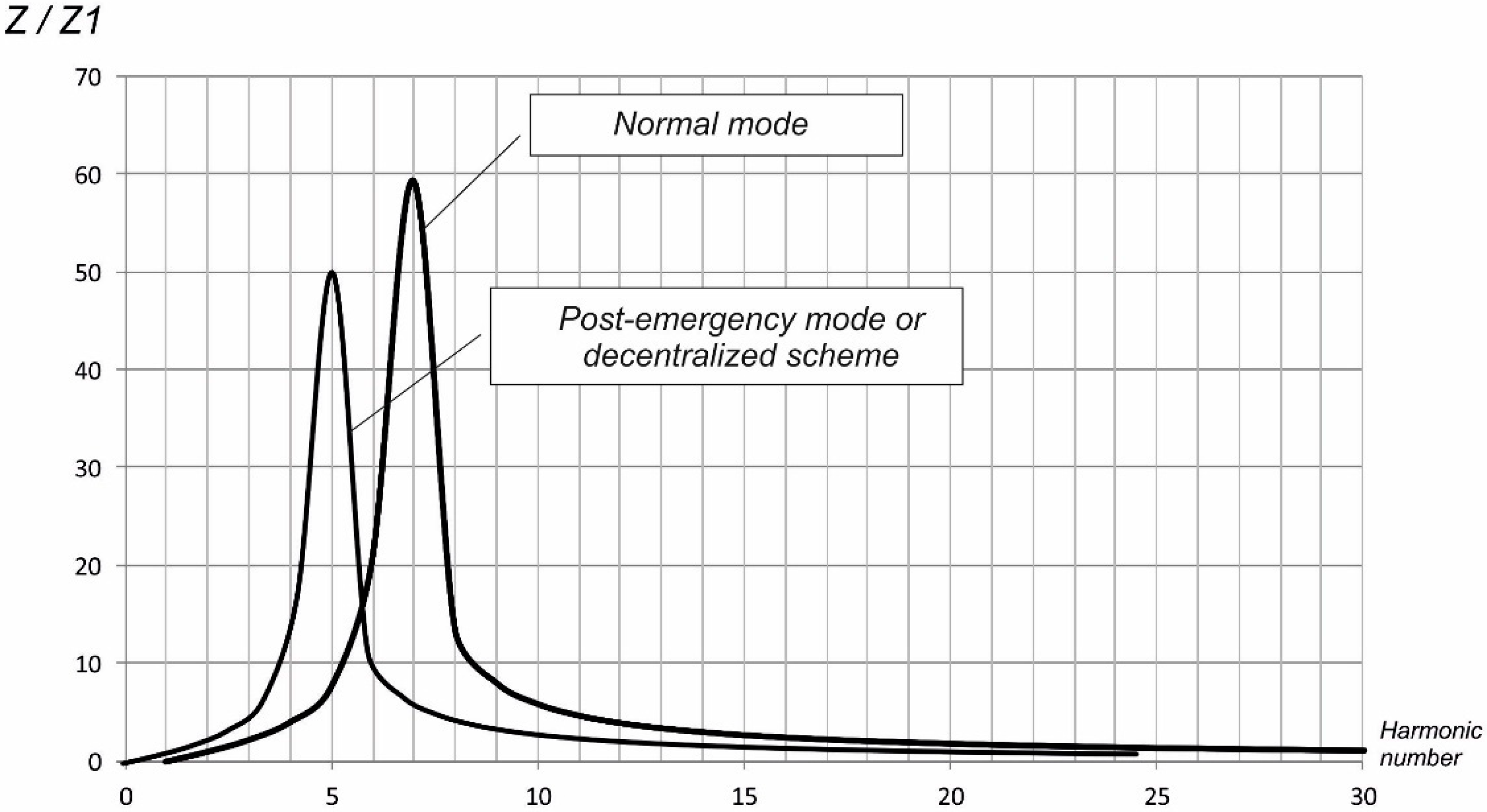
This is especially visible during periods of a small electrical loading, e.g., during survey, repairing and/or when switching to a decentralized power supply.
7. Conclusions
The analysis of the operation modes of typical electric energy loads used in industrial enterprises (especially mines) revealed their specificity, such as: cyclical work and a significant share of breaks in no-load operation. To meet stringent requirements regarding the reliability and safety of operation (e.g., explosion-proof), special requirements on the construction of electrical networks and energy consumption management has been given. A detailed analysis of the usefulness of commonly used reliability and power quality factors encouraged the authors to develop new effective indicators considering both the specificity of work of industrial enterprises as well as power system.
The use of measurement data on the scope and nature of the instantaneous current and voltage waveform distortions, under the technological process of industrial enterprises, allows to improve the quality of calculations of electromagnetic and technological losses. This is a novelty, which distinguishes the obtained scientific results of the estimation of energy-saving modes of power systems.
It has been shown that the mechanism of the optimal solution, to ensure the required level of electromagnetic compatibility of the power supply system components of any industrial enterprise, is twofold in nature. First, it is important to reduce the harmonic background, which plays an important role (80%) in ensuring rational operation. Secondly, the operational reliability of the power system components is deteriorated by around 20-30% during the operation of the controlled valve converters of lifting machines and fans in the mine. All this should be considered when developing effective indicators of energy quality efficiency.
The results of electric resonance modeling in industrial power grids allowed a reliable determination of possible resonance zones during the higher frequencies, both harmonics and interharmonics. The obtained amplitude-frequency characteristics for specified operation conditions, and parameters of the power system as well as the energy demand of a large coal company, determined the range of changes of the value of the input resonance resistance at the level Z/Z1 equal to 80-120. This determines the size of the power system value to ensure optimal reactive power compensation under decentralized electricity distribution. Results of our findings may aid researchers and professionals involved in designing and managing power networks, including those operating in mines.
Author Contributions
Conceptualization, G.P. and B.P.; methodology, G.P. and O.A.; software, O.A., E.C.C., and A.J.; validation, B.M., Y.P.; formal analysis, Y.P., A.J.; investigation, O.A. and B.P.; resources, G.P. E.C.C.; data curation, Y.P., E.C.C.; writing—original draft preparation, B.P.; writing—review and editing, O.A., B.M., A.J., A.P.; visualization, B.M., Y.P., A.P.; supervision B.M., E.C.C., G.P, A.P.; project administration, A.P. and B.P.; funding acquisition, A.J. All authors have read and agreed to the published version of the manuscript.
Funding
AGH University of Krakow
Data Availability Statement
Not applicable.
Conflicts of Interest
The authors declare no conflict of interest.
References
- Figiel, A.; Technical safety of machinery and equipment in the aspect of the activities of the KOMAG Division of Attestation Tests, Certifying Body. Mining Machines 2020, 1, 2–8.
- Pivnyak, G., Rogoza, M., Papaika, Yu., & Lysenko, A. Traction and energy characteristics of no-contact electric mining locomotives with AC current thyristor converters. Power Engineering, Control, and Information Technologies in Geotechnical Systems 2015, 1–6. [CrossRef]
- Takura, T., & Matsuki, H. Relationship Between Drive Frequency and Load Characteristics in Bidirectional Contactless Power Transfer for Electric Vehicles. IEEE Transactions on Magnetics 2018, 54(11), 1–5. [CrossRef]
- ustafin, M.; Almuratova, N.; Darimbayeva, N; Daurenovam, G. Mathematical model of asynchronous frequency controlled electric drive for different types of load. Eng. J. Satbayev Univ. 2021, 143, 199–206. [CrossRef]
- Popescu, F.G.; Pasculescu, D.; Marcu, M.D.; Pasculescu, V.M. Analysis of current and voltage harmonics introduced by the drive systems of a bucket wheel excavator. Min. Miner. Depos. 2020, 14, 40–46. [Google Scholar] [CrossRef]
- Shea, J. J. Electrical transformers and power equipment, 3rd edition. IEEE Electrical Insulation Magazine 2000, 16(3), 34–34. [CrossRef]
- Sinchuk, O.; Strzelecki, R.; Sinchuk, I.; Веridzе, T.; Fedotov, V.; Baranovskyi, V.; Budnikov, K. Mathematical model to assess energy consumption using water inflow-drainage system of iron-ore mines in terms of a stochastic process. Min. Miner. Depos. 2022, 16, 19–28. [Google Scholar] [CrossRef]
- Pivnyak, G.; Zhezhelenko, I.; Papaika, Y. Estimating economic equivalent of reactive power in the systems of enterprise power supply. Nauk. Visnyk Natsionalnoho Hirnychoho Universytetu 2016, 5, 62–66. [Google Scholar]
- Thanh, L.X.; Bun, H.V. Identifying the factors influencing the voltage quality of 6kV grids when using electric excavators in surface mining. Min. Miner. Depos. 2022, 16(2), 73–80. [Google Scholar] [CrossRef]
- Polyanska, A., Savchuk, S., Dudek, M., Sala, D., Pazynich, Y., & Cicho, D. Impact of digital maturity on sustainable development effects in energy sector in the condition of Industry 4.0. Nauk. Visnyk Natsionalnoho Hirnychoho Universytetu 2022, 6, 97–103. [CrossRef]
- Pivnyak, G.; Zhezhelenko, I.; Papaika, Y.; A. Lysenko. Interharmonics in power supply systems. Nauk. Visnyk Natsionalnoho Hirnychoho Universytetu 2017, 6, 109–114. [Google Scholar]
- Golovchenko, A., Pazynich, Y., & Potempa, M. Automated Monitoring of Physical Processes of Formation of Burden Material Surface and Gas Flow in Blast Furnace. Solid State Phenomena 2018, 277, 54–65. [CrossRef]
- Sinchuk, O.; Sinchuk, I.; Beridze, T.; Filipp, Y.; Budnikov, K.; Dozorenko, O.; Strzelecki, R. Assessment of the factors influencing on the formation of energy-oriented modes of electric power consumption by water-drainage installations of the mines. Min. Miner. Depos. 2021, 15, 25–33. [Google Scholar] [CrossRef]
- Malec, M.; Zając, R. Harmonization of technical requirements in the scope of machines for underground mines. Mining Machines. 2021, 39(2), 44–52. [Google Scholar]
- Thanh, L.X.; Bun, H.V. Identifying the efficiency decrease factor of motors working under power harmornic in 660V electric mining grids. Min. Miner. Depos. 2021, 15, 108–113. [Google Scholar] [CrossRef]
- Dychkovskyi, R.O. Determination of the rock subsidence spacing in the well underground coal gasification. Nauk. Visnyk Natsionalnoho Hirnychoho Universytetu 2015, 6, 30–36. [Google Scholar]
- Dychkovskyi, R.O. Forming the bilayer artificially created shell of georeactor in underground coal well gasification. Nauk. Visnyk Natsionalnoho Hirnychoho Universytetu 2015, 5, 37–42. [Google Scholar]
- Markevych, K.; Maistro, S.; Koval, V.; Paliukh, V. Mining sustainability and circular economy in the context of economic security in Ukraine. Min. Miner. Depos. 2022, 16, 101–113. [Google Scholar] [CrossRef]
- Węgrzyn, A.; Spirydowicz, A.; Grebski, Wes. Dilemmas of the energy transformation in Poland 2021/2022. Mining Machines 2022, 1, 32–42.
- Sala, D., & Bieda, B. (2022). Application of uncertainty analysis based on Monte Carlo (MC) simulation for life cycle inventory (LCI). Inżynieria Mineralna, 2(2). [CrossRef]
- Kamiński, P.; Dyczko, A.; Prostański, D. Virtual simulations of a new construction of the artificial shaft bottom (Shaft safety platform) for use in mine shafts. Energies 2021, 14, 2110. [Google Scholar] [CrossRef]
- Papaika, Y.A.; Lysenko, O.; Rodna, K.; Shevtsova, O. Information technologies in modeling operation modes of mining dewatering plant based on economic and mathematical analysis. Nauk. Visnyk Natsionalnoho Hirnychoho Universytetu 2020, 4, 82–87. [Google Scholar] [CrossRef]
- Beshta, O.S. Electric drives adjustment for improvement of energy efficiency of technological processes. Nauk. Visnyk Natsionalnoho Hirnychoho Universytetu 2012, 4, 98–107. [Google Scholar]
- Papaika, Y.; Lysenko, O.; Koshelenko, Y.; Olishevskyi, I. Mathematical modeling of power supply reliability at low voltage quality. Nauk. Visnyk Natsionalnoho Hirnychoho Universytetu 2021, 2, 97–103. [Google Scholar] [CrossRef]
- Kolb, A.; Pazynich, Y.; Mirek, A.; Petinova, O. Influence of voltage reserve on the parameters of parallel power active compensators in mining. E3S Web Conf. 2020, 201, 01024. [Google Scholar] [CrossRef]
- Jing, X., & Lang, Z. The Parametric Characteristics of the GFRFs and the Parametric Characteristics Based Analysis. Frequency Domain Analysis and Design of Nonlinear Systems Based on Volterra Series Expansion 2014, 65–82. [CrossRef]
- Dyczko, A. Real-time forecasting of key coking coal quality parameters using neural networks and artificial intelligence. Rudarsko-Geološko-Naftni Zbornik 2023, 38(3), 105–117. [Google Scholar] [CrossRef]
- Manat, S.M.; Yugay, V.V. Power quality analysis study of single-phase inverter. Eng. J. Satbayev Univ. 2021, 143, 159–164. [Google Scholar] [CrossRef]
- Vladyko, O., Maltsev, D., Sala, D., Cichoń, D., Buketov, V., & Dychkovskyi, R. Simulation of leaching processes of polymetallic ores using the similarity theorem. Rudarsko-Geološko-Naftni Zbornik 2022, 37(5), 169–180.
- Kosobudzki, G.; Florek, A. EMC requirements for power drive systems. Pow. Elec. Drives 2017, 2, 127–135. [Google Scholar]
- Golovchenko, A.; Pazynich, Y.; Potempa, M. Automated monitoring of physical processes of formation of burden material surface and gas flow in blast furnace. Solid State Phenom. 2018, 277, 54–65. [Google Scholar] [CrossRef]
- Falshtynskyi, V., Dychkovskyi, R., Khomenko, O., & Kononenko, M. On the formation of a mine-based energy resource complex. E3S Web of Conferences 2020, 201, 01020. [CrossRef]
- Rusu, D. Dynamic integration of CSR into strategic management processes. Business excellence and management. 2022, 12(1), 73–92. [Google Scholar] [CrossRef]
Disclaimer/Publisher’s Note: The statements, opinions and data contained in all publications are solely those of the individual author(s) and contributor(s) and not of MDPI and/or the editor(s). MDPI and/or the editor(s) disclaim responsibility for any injury to people or property resulting from any ideas, methods, instructions or products referred to in the content. |
© 2023 by the authors. Licensee MDPI, Basel, Switzerland. This article is an open access article distributed under the terms and conditions of the Creative Commons Attribution (CC BY) license (http://creativecommons.org/licenses/by/4.0/).
Copyright: This open access article is published under a Creative Commons CC BY 4.0 license, which permit the free download, distribution, and reuse, provided that the author and preprint are cited in any reuse.


