

Submitted:
26 September 2023
Posted:
27 September 2023
You are already at the latest version
Abstract
A drinking strategy aiming to replace a given percentage of the sweat losses incurred during exercise should result in reproducible fluid intake volume and, hence, fluid balance from one exercise session to the other performed under similar scenarios. Whether this may also be the case with ad libitum drinking during exercise is unclear. We characterized the repeatability of ad libitum fluid intake during repeated 1 h exercise sessions and examine its effect over time on fluid balance and selected physiological functions and perceptual sensations. Twelve (3 women) healthy individuals participated in this study. At weekly intervals, they completed 4, 2 x 30 min walking/jogging exercise bouts (55% VO2max, 40°C, 20-30% relative humidity) interspersed by a 3 min recovery period. During exercise, participants replaced water (20°C) ad libitum. There were no significant differences among the 4 exercise sessions for absolute fluid intake volume (~ 1000 mL · h-1), percent body mass loss (~ 0.4%), sweat rate (~ 1300 mL · h-1) and percent of sweat loss replaced by fluid intake (~ 80%). Heart rate, rectal temperature and perceived thirst and heat stress did not differ significantly between the first and fourth exercise session. Perceived exertion was significantly lower during the fourth vs. the first exercise session, but the difference was trivial, < 1 arbitrary unit. In conclusion, ad libitum fluid intake during 4 successive identical 1 h walking/jogging sessions conducted in the heat will result in similar fluid intake volumes and perturbations in fluid balance, heart rate, rectal temperature and perceived thirst, heat stress and exertion.
Keywords:
dehydration
; drinking pattern
; exercise
; heat stress
; physiological and perceptual functions
1. Introduction
Humans produce sweat during exercise which, if properly evaporated, limits the increase in body core temperature [1]. Hence, the consumption of fluid during exercise is important to maintain body water levels within an acceptable spectrum. Indeed, improper consumption of fluid during exercise may lead to excessive dehydration, which may increase plasma osmolality, glycogen usage and perceived exertion and thirst and reduce mood, plasma volume, thermoregulatory ability, cardiovascular efficiency and endurance performance [2,3,4].
Before exercising, athletes must determine whether fluid replacement is required. If the answer is positive, then decide on how fluid should be replaced during that exercise. There are two main hydration strategies that athletes may privilege during exercise: 1) drink in a planned manner or 2) drink in an ad libitum manner [5]. The decision to choose one strategy over the other should be based on exercise circumstances, fluid availability, gastrointestinal tolerance, fluid carrying capacity and personal preferences [6]. Independent of the chosen option, and despite that ad libitum drinking is usually associated with a lesser volume of fluid consumed during exercise compared with planned drinking, it is expected that both hydration strategies will have a similar effect on endurance performance during 1-2 h running and cycling exercises [7].
When relying on planned drinking, athletes must decide beforehand on an ideal rate of fluid replacement for the upcoming exercise. According to the National Athletic Trainers’ Association (NATA) [5] and the American College of Sports Medicine (ACSM) [8], the amount of fluid replacement should be sufficient to limit the loss of body mass through sweat, urine and breathing to 2%, otherwise endurance performance should be impacted neagatively [2]. Under this circumstance, the estimated amount of fluid to be consumed for a particular exercise session should be scenario-specific and established a priori through a sweat rate test [5,8,9]. Therefore, for exercise sessions performed under similar scenarios of exercise intensity, exercise duration, ambient temperature, absolute humidity, baseline state of hydration, ingested fluid temperature and an athlete state of heat acclimatization, the extent of fluid replacement during exercise, and consequently fluid balance during and following exercise, should be similar between exercise sessions and, hence, also the resulting hydration-driven perturbations in physiological responses to exercise. Understanding or predicting how hydration impacts the physiological responses to exercise may be important for athletes and coaches. Indeed, it may help them 1) improve the planning of training sessions, 2) increase the understanding of the level of stress induced by the training sessions, 3) enhance the management of the recovery periods following exercise and 4) better predict the adaptations to different training stimuli applied over time.
Athletes relying on an ad libitum drinking strategy to replace fluid during exercise may start an exercise with no pre-established drinking plan, having little idea of their sweat rates and associated fluid requirements, and should consume fluids during exercise whenever they want, and in whatever volume they want [10,11]. Therefore, as fluid replacement with this drinking strategy is not systematically controlled, it could potentially be more difficult for athletes and coaches to understand and predict what the physiological responses to exercise-induced hydration perturbations might be from one training session to the other performed under similar scenarios. And ultimately, this may increase the difficulty in predicting and understanding the responses to, and plan optimal recovery strategies from, training.
Despite that the term ad libitum drinking theoretically refers to a non-structured behavior, Claveau et al. [10] demonstrated that requiring athletes to drink either ad libitum or based on their thirst perception leads to identical volumes of fluid consumed during prolonged cycling exercise. Therefore, ad libitum-driven fluid intake during exercise appears to be dependent, at least in part, upon the perception of thirst. To this effect, Maresh et al. [12] have shown that hypohydration preceding exercise in the heat modulates thirst-driven fluid intake during exercise and results in similar fluid regulatory hormonal responses and alterations in plasma volume, compared with euhydration. Moreover, studies in rodents have demonstrated that increases in body core temperature induce significant fluid intake prior to any alterations in extracellular fluid osmolality or volume occur [13]. Hence, hyperthermia can initiate fluid ingestion in anticipation of the sweat losses that would take place in the future to mitigate the increase in body core temperature. Altogether, the above observations suggest that ad libitum-driven fluid intake may be involuntarily regulated by athletes and, hence, could potentially result in predictable fluid intakes during exercise conducted under similar scenarios.
We found less than a handful of relevant studies [14,15,16,17] that examined whether ad libitum fluid intake may result in reproducible fluid intake volumes under identical exercise scenarios. It must be noted that this literature is not readily identifiable, as the characterization of ad libitum fluid consumption during exercise as the main study’s goal is not explicitly appreciable from the available titles. Altogether, results of these studies are mixed and produce more questions than answers. Wilk et al. [16] had 10 to 12-yr old boys perform 6 exercise sessions over a 2-week period. Sports drink (grape-flavored, 6% carbohydrate) was consumed ad libitum during exercise. Fluid intake was reproducible from one session to the other, but it remains unknown whether results translate to men. Another study [14] examined the ad libitum fluid intake of women during three distinct phases of the menstrual cycle. Women performed three intermittent exercise sessions (30 min exercise/30 min rest) in the heat over a period of several weeks. Ad libitum fluid intake (flavor-preferred, non-caloric sport drink (Gatorade ZeroTM)) was only permitted during the breaks. Again, fluid intake was repeatable, but it is unclear what results would have been observed had participants been permitted to drink only during exercise, not only during the breaks. Greenleaf et al. [17] asked men to complete 2 h of exercise (23.8°C, 50% relative humidity) per day for 8 consecutive days while consuming tap water (16°C) in an ad libitum manner. Fluid intake did not vary significantly between exercise bouts. It is unclear if those results would apply to warm/hot conditions where sweat production is greater and thirst more challenged than in a thermoneutral climate. Finally, Sekiguchi et al. [15] showed that ad libitum fluid intake (water) did not result in similar fluid intake volumes in participants performing five consecutive days of heat acclimation training. Whether these results would hold during non-heat acclimation training remains to be determined.
There is a need to further our knowledge and observe and characterize the repeatability of ad libitum fluid intakes of healthy adults over several exercise sessions performed under identical exercise scenarios. Therefore, the first objective of this study was to determine whether the ad libitum-associated variations in the amount of fluid consumed, percentage of sweat loss replaced, and dehydration level differ significantly between identical 1 h exercise sessions repeated on multiple occasions across time. The second objective of the study was to determine whether parameters that can be impacted by fluid intake during exercise such as heart rate, rectal temperature and perceived thirst, heat stress and exertion differed across exercise sessions. We hypothesized that the volumes of fluid consumed through ad libitum drinking would not differ significantly from one exercise session to the other and, therefore, that the evaluated physiological functions and perceptual sensations would also not be significantly altered.
2. Materials and Methods
2.1. Participants
Twelve (3 women) healthy, physically active and non-heat acclimatized individuals participated in this research project. Their physical characteristics are presented in Table 1. Prior to the initiation of any procedures, participants were fully explained the nature, risks and associated benefits of the study. Then, they signed an informed consent form. The research protocol and informed consent form were approved by the CIUSSS Estrie-CHUS Ethics Committee (project #2019-3081).
2.2. Context of the study
This study was an integral part of a larger research project whose goal was to examine the impact of habituation to exercise-induced dehydration on endurance performance and cognition. Results of these studies have already been published [18,19]. As illustrated in Figure 1., these studies required participants to complete 2, 4-week training blocks (walking/jogging on a treadmill) in the heat interspersed by a 5-week washout period. The goal of the washout period was to eliminate the heat stress- and hypohydration-related adaptations that may have taken place during the first training block. The training blocks were administered in a randomized and crossover fashion. Each training block was composed of 3 exercise sessions per week, each spaced by 48-72 h. The first training session of the week always consisted in a 1 h exercise session where participants were required to drink ad libitum. For the remaining 2 exercise sessions, during one they were required to exercise until a 2%, and in the other, until a 4% body mass has been lost (dehydration training block) or all fluid loss was replaced (euhydration training block). Only results of the 1 h exercise sessions completed during the training block where participants were required to remain well hydrated (euhydration training block) during the 2 or 4% body mass loss exercise sessions are presented in this study. Seven participants completed the 1 h exercise sessions during their first training block whereas the remaining 5 during their second training block, after the washout period had been completed. Therefore, our results are representative of individuals who participated in a total of 4, 1 h exercise bouts interspersed by 7 days. However, 1-week prior to starting each training block, participants came to the laboratory for the 1) collection of preliminary measurements and 2) completion of a 1 h exercise session to familiarize themselves with the environmental conditions and determine and confirm the proper exercise intensity to be used in all upcoming exercise sessions. Subjects could drink ad libitum during this specific session, but fluid volume consumed was not measured as exercise intensity was not fixed throughout the exercise period.
2.3. Preliminary measurements
Body mass while post-void was measured with an electronic floor scale (± 20 g, BX-300 +, Atron Systems, West Caldwell, NJ, USA), height using a stadiometer and resting blood pressure and heart rate after a 3 min rest period with a digital sphygmomanometer (Welch Allyn 420 series, Skaneateles Falls, NY, USA). Fat-free mass (FFM) was assessed with the dual-energy X-ray absorptiometry technology (Lunar Prodigy, GE Healthcare, Chicago, IL, USA). Maximal oxygen consumption (O2max) was measured on a motorized treadmill (TMX428 Trackmaster, Newton, KS, USA) using an expired gas analysis system (Cosmed Quark CPET, Cosmed, Chicago, IL, USA) which had been calibrated with gases of known concentration. The test started at a speed of 7 km h-1, with a fixed grade of 1%. Each subsequent min the speed was increased by 1 km h-1 until participants reached exhaustion. The attainment of O2max was confirmed using recognized criteria [20].
2.4. Pre-exercise protocol
Participants completed the 1h exercise sessions at a time of their choice and were required to drink 250 mL of water 60 min prior to bedtime the night before each exercise session as well as 60 min prior to their arrival at the laboratory for the exercise sessions. Participants abstained from food and fluid intake during the last 60 min prior to the exercise sessions and were requested not to exercise for the last 12 h prior to reporting to the laboratory. Otherwise, nutrition, hydration and training were not further standardized between and before exercise sessions. All exercise sessions occurred in Sherbrooke, Canada, during the spring and early summer months.
2.5. 1-hour exercise sessions
Immediately following their arrival at the laboratory participants emptied their bladder, collected a urine sample, were weighted in the nude (± 50 g, MyWeight HD-300, HBI Technologies, Phoenix, AZ, USA), dressed themselves, installed a chest electrode and inserted a rectal telemetric pill. Following these procedures, participants entered the environmental chamber (40°C and 20-30% relative humidity, wind speed: ~5 km ∙ h-1), rested on the treadmill for 2 min and then started walking or jogging at an intensity of 55% O2max. The exercise sessions consisted of 2, 30 min exercise bouts interspersed by a recovery period of 3 min. During exercise participants were allowed to replace water ad libitum, which was provided at 20°C through opaque cycling bottles. Participants were not made aware that their intake of fluid was being monitored during exercise. Following exercise participants voided their bladder, toweled dry and were weighted.
2.6. Measurements
Urine was collected using graduated urinals. Urine was weighted considering 1 g = 1 mL. Urine specific gravity was assessed in duplicate using a digital refractometer (PAL-10S, Atago, Bellevue, WA, USA). Heart rate (USB ANT stick (Garmin, USA) + Golden Cheetah software) was measured continuously using a Garmin Premium chest electrode (Garmin, Olathe, KS, USA). Rectal temperature was measured every 10 min using a calibrated telemetric pill (CorTempTM, HQ Inc, Palmetto, FL, USA) inserted just passed the anal sphincter [21]. Each pill was reused after proper sterilization up to 50 h, as suggested by Pancrate et al. [22]. Perceived exertion (15-point Borg scale);[23]), perceived thirst (11-point scale;[24]) and perceived heat stress (7-point scale;[25]) were measured every 10 min. Percent dehydration was computed as the difference between pre- and post-exercise body mass relative to pre-exercise body mass. Sweat loss was calculated by subtracting the post- from the pre-exercise body mass, correcting for fluid intake and urine losses. Sweat rate (mL ∙ h-1) was considered to represent the amount of sweat produced during the entire hour of exercise. Respiratory water losses and losses of mass associated with the respiratory exchange of O2 and CO2 were not considered and assumed to be similar among trials [24]. The percent of sweat loss replaced by ad libitum fluid intake was taken as the total volume of fluid consumed during exercise relative to sweat loss.
2.7. Statistical analyses
Normality of distribution of residuals (or differences for the dependent t-test) was tested using the Shapiro-Wilk test. One-way repeated measures ANOVAs were used to analyze pre-exercise body mass and percentage of body mass change among exercise sessions 1 vs. 2, vs. 3 and vs. 4, and overall fluid intake volume, sweat rate, percentage of body mass loss, percentage of sweat loss replaced, balance between fluid intake and sweat loss and change in mean heart rate among exercise sessions. A Friedman test was used to analyze changes in pre-exercise perceived thirst among exercise sessions. A dependent t-test was used to compare the change in heart rate from min 0 and 60 of the first exercise session vs. that of the fourth exercise session. Two-way repeated measures ANOVA were conducted to examine the influence of time, exercise session and their interaction on heart rate and perceived heat stress. In replacement of one-way repeated measures ANOVAs, two-way repeated measures ANOVAs and a dependent t-test, linear mixed models were used in case of missing data (pre-exercise urine specific gravity (2 (missing data)/48 (total data)), laboratory temperature (2/48) and relative humidity (2/48), change in rectal temperature over time among exercise sessions (35/336), change in mean rectal temperature among the exercise sessions (4/48) and change in rectal temperature between min 0 and 60 of the first exercise session vs. that of the fourth exercise session (3/24) and, because of its robustness to violations of distribution assumptions [26], when residuals were abnormally distributed (change in perceived exertion and thirst over time among exercise sessions). When needed, post-hoc comparisons were performed using the false discovery rate procedure. Repeated measures correlations were performed to examine relationship between variables [27]. Coefficients of variation (CV) were computed using the root mean squared method [28]. Unless otherwise noted, results are reported as mean ± standard deviation (SD). Statistical significance was accepted as p ≤ 0.05. Statistical analyses were performed with the Microsoft Excel (version 2212, Microsoft, Redmond, WA, USA), IBM SPSS statistics (version 21, New York, NY, USA), MedCalc (version 22.006, Ostend, Belgium) and R studio (version 2021.09.01, Boston, MA, USA) software.
We estimated the sample size required for this study based on results of a previously published study [29] from our laboratory where the repeatability of ad libitum fluid intake volume from a familiarization session to an experimental trial during 1 h of cycling was computed (change in fluid intake volume = 101 mL; effect size = 0.66, r = 0.104). From these numbers, it was determined that 7 participants were required to detect a statistically significant effect (1 – β = 0.8, α = 0.05) in fluid intake volume between exercise sessions using a one-way repeated measures ANOVA with one group of subjects and 4 measurement periods. The G*Power software was used to compute sample size (version 3.1.9.6., Kiel University, Germany).
3. Results
3.1. Pre-exercise hydration and ambient temperature and relative humidity
Table 2 presents values of urine specific gravity, body mass and perceived thirst observed before each exercise session as well as the percentage change in pre-exercise body mass from exercise session 1 to exercise sessions 2, 3 and 4. Altogether, these results suggest that participants were well and similarly hydrated prior to each exercise session. Mean laboratory ambient temperature (39.8 ± 0.5°C, p = 0.28) and relative humidity (24.7 ± 2.4%, p = 0.16) did not differ among exercise sessions.
3.2. Fluid balance
Figure 2 depicts the individual, mean as well as the distribution (95% confidence interval (CI)) of absolute and relative (per body mass and FFM) fluid intake volume, percent body mass loss, sweat rate and percent of sweat loss replaced by fluid intake during each exercise session. There were no statistically significant differences (all p > 0.36) among the four exercise sessions for any of the variables. Over the 4 exercise sessions, mean sweat rates (~ 1300 ± 384 mL · h-1) were slightly higher than the mean absolute fluid intake volumes (~ 1000 ± 520 mL · h-1), which led to mean body mass changes of ~ - 0.4 ± 0.7%. Hence, participants replaced a significant portion (~ 80 ± 41%) of their sweat losses through fluid intake during exercise. The variations in mean absolute fluid intake volume between exercise sessions 1 and 2, 2 and 3 and 3 and 4 were 58 ± 351, 43 ± 342 and 64 ± 293 mL. The most important variation occurred between exercise sessions 2 and 4, with 164 ± 623 mL. Table 3 shows the balance between total accumulated fluid intake volume and total accumulated sweat loss for each of the exercise sessions and over the four exercise sessions. For each of the four exercise sessions mean absolute fluid intake volume was lower than mean sweat loss, with no significant difference between exercise sessions (p = 0.56). Five individuals, at least for one exercise session, consumed more fluid than they lost through sweat. Three individuals completed the 4 exercise sessions with a positive fluid balance.
Within and between exercise session variations in absolute fluid intake volume were important. Indeed, the between subjects’ CVs for absolute fluid intake volume during exercise sessions 1, 2, 3 and 4 were respectively of 80.9, 44.5, 38.2 and 38.6%. On the other hand, the within subjects’ CVs for absolute fluid intake volume between exercise sessions 1 and 2, 2 and 3 and 3 and 4 were respectively of 38.1, 22.4 and 18.4%. Hence, the within subjects’ CVs were approximately twofold lower than the between subjects’ CVs. Correcting for either body mass or FFM did not substantially change these outcomes. Perceived thirst did not explain the variations in fluid intake volume between nor within individuals. Indeed, there were no correlations between absolute fluid intake volumes and mean perceptions of thirst (r = 0.09, p = 0.58) or the changes in absolute fluid intake volume and the changes in perception of thirst (r = - 0.12, p = 0.57) from one exercise session to the other. No significant correlation (r = 0.02, p = 0.90) was also observed between absolute fluid intake volumes and sweat rates over the four exercise sessions. However, a significant (r = - 0.60, p < 0.01) negative relationship was observed between absolute fluid intake volumes measured during exercise session 1, 2 and 3 and the percentage changes in absolute fluid intake volume between exercise sessions 1 and 2, 2 and 3 and 3 and 4. Finally, we observed no significant relationship (r = - 0.01, p = 0.96) between sweat rates and perceived thirsts.
3.3. Rectal temperature and heart rate
Rectal temperature (Figure 3A) as well as heart rate (Figure 3B) increased continuously over time during each of the exercise sessions. A time (p < 0.01), but no exercise session (p = 0.06) or interaction (p = 0.06) effect was detected for heart rate, whereas for rectal temperature an exercise session (p = 0.02) and time (p < 0.01), but no interaction (p = 0.54) effects, were observed. Mean changes in heart rate from exercise sessions 1 vs. 2, 1 vs. 3 and 1 vs. 4 became progressively lower over time, but post hoc analyses revealed no significant differences among exercise sessions. There was no significant change between the change in heart rate (min 60 – min 0) of the first exercise session vs. that of the fourth exercise session (p = 0.30). The same pattern of change as that observed with mean heart rate occurred for mean rectal temperature from exercise sessions 1 vs. 2, 1 vs. 3 and 1 vs. 4, with the exception that post hoc corrections revealed significant differences for exercise sessions 1 vs. 2 and 1 vs. 3, but not for exercise session 1 vs. 4. It must be noted that none of the differences between exercise sessions exceeded 0.15°C. There was no significant change between the change in rectal temperature (min 60 – min 0) of the first exercise vs. that of the fourth exercise session (p = 0.57).
3.4. Perceived thirst, exertion and heat stress
Perceived thirst (Figure 4A) as well as perceived heat stress (Figure 4C) were not associated with significant time, exercise session or interaction effects. However, an exercise session (p = 0.01), time (p < 0.01), but no interaction (p = 0.96) effect was detected for perceived exertion (Figure 4B). Post hoc corrections revealed that the changes in perceived exertion for exercise sessions 1 vs. 2, 1 vs. 3 and 1 vs. 4 were all significant, although they could be considered trivial as they were all less than 1 AU.
4. Discussion
A In this study, we characterized the repeatability of ad libitum fluid intake of healthy adults over 4 identical, 1 h exercise sessions interspersed by 7 days, and determined how this drinking strategy would impact fluid balance, heart rate, rectal temperature, perceived exertion, perceived thirst and perceived heat stress over the 4 exercise sessions. To the best of our knowledge, this was the first study to shed a direct spotlight on the drinking behavior of adults required to consume fluid in an ad libitum manner over multiple exercise sessions completed under uniform exercise conditions (40°C, 20-30% relative humidity, walking/jogging at 55% O2max). This study was part of a larger research project in which participants were required to perform two additional weekly exercise sessions under hot conditions where they replaced fluid losses with equal amounts of water. Yet, no signs of heat acclimation were observed in our participants over the four exercise sessions, as suggested by the lack of significant difference in mean heart rate, rectal temperature and sweat rate between the first and last exercise session [30]. Therefore, within the context of the current study where participants were unacclimated to the heat, our findings show that consuming water ad libitum results, from a statistical or practical standpoint, in similar fluid intake volume, heart rate, rectal temperature and perceptual sensations from one exercise session to the other realized under identical circumstances. In our opinion, results of this study are relevant and important. Indeed, they could help athletes and coaches understand how an ad libitum drinking strategy influences the volume of fluid consumed under similar exercise conditions and, as a result, improve the 1) anticipation of the possible dehydration-driven physiological and perceptual responses to training; 2) planning of exercise sessions and; 3) management of the recovery periods.
Ad libitum drinking resulted in reproducible fluid intake volumes over the four exercise sessions. The greatest difference in mean fluid intake volume observed among any of the exercise sessions was 165 mL, which occurred between the first and fourth exercise session. Put into perspective, this amount is relatively trivial, corresponding to less than 1/4 to 1/3 of a regular 600-750 mL cycling water bottle, or, at most, to about 3 sips of fluid for healthy young adults, at least during cycling exercise [10]. This finding agrees with that found in the study of Wilk et al. [16] who wanted to determine whether the ad libitum consumption of sports drink over 6 identical cycling sessions of 70 min performed in the heat could systematically protect young boys from dehydration. Indeed, they observed a non-significant maximal variation in fluid intake volume of 137 mL among the exercise sessions. Our finding is also in line with that of Freemas et al. [14] who wished to determine the role played by the different menstrual cycle phases (follicular, late follicular and mid-luteal phases) on ad libitum fluid intake volume over three identical intermittent exercise sessions conducted in the heat. They reported a non-significant maximal variation in fluid intake of 304 mL among the exercise sessions. Greenleaf et al. [17] also arrived at similar results. They required 5 men to complete 2 h of exercise per day in a thermoneutral climate for 8 consecutive days while consuming tap water ad libitum. Fluid intake did not vary by more than 103 mL among exercise sessions. Sekiguchi et al. [15] examined the ad libitum fluid intake volume of endurance athletes undergoing five consecutive days of heat acclimation training. Contrary to our results and those of Wilk et al. [16], Freemas et al. [14] and Greenleaf et al. [17], they observed a significant difference among the exercise sessions with a maximal variation in fluid intake of 540 mL observed between training sessions 1 and 5. It is unclear how the results of these studies can be compared to ours, as the first provided sports drink and was not performed in adults but rather in young boys, the second had participants perform their exercise sessions at several weeks of interval and allowed them to consume fluids only during the resting periods, the third was completed in a thermoneutral climate and, for the fourth, the exercise intensity was not fixed and the exercise sessions occurred during a heat acclimation process. But a tentative synthesis of the available literature could be that for young to middle-aged male and female, ad libitum fluid consumption under identical exercise conditions completed in thermoneutral and hot conditions, could lead to reproducible fluid intake volumes, unless consecutive exercise sessions occur in the heat in non-heat acclimatized individuals. This topic needs to be researched further before more solid conclusions can be drawn.
Whether it is being examined in terms of absolute change or corrected for body mass or FFM, our findings demonstrate that there was substantial variation in ad libitum fluid intake volume among participants. Indeed, the CV for absolute fluid intake volume among participants was of the order of 80% for the first exercise session, but this figure reduced drastically to ~ 40% for the remaining 3 exercise sessions. We interpret this finding to suggest that participants likely learned from the experience gained during the first exercise session and adjusted their fluid intake volume towards a more physiologically common and narrower spectrum of fluid intake over the remaining exercise sessions which, according to Figure 1 A, was between 500 and 1500 mL. The within participants’ CVs for fluid intake volume between exercise sessions 1-2, 2-3 and 3-4 support the previous assertion and add the notion that participants continued to adjust their ad libitum fluid intake volume from exercise sessions 2 to 4 at a relatively constant rate of ~ ± 200-400 mL. This point is reinforced by the fact that we observed a significant relationship between absolute fluid intake volumes measured during exercise session 1, 2 and 3 and the percentage changes in absolute fluid intake volume between exercise sessions 1 and 2, 2 and 3 and 3 and 4, respectively. Hence, individual fluid intake volumes from exercise sessions 1, 2 and 3 seem to have influenced the changes in fluid intake volume during each of the following exercise session. Altogether, athletes and coaches should expect that variations in ad libitum fluid intake volume of less than 500 mL should occur from one exercise sessions to the other conducted under similar conditions.
It is unclear what drove the inter- and intra-individual differences in fluid intake. A difference in sweat rate among participants, impacting the rate of water loss and change in plasma osmolality, both modulator of thirst [31], could be a possible answer, but we observed no relationship between sweat rates and fluid intake volumes or perceived thirst and there was no divergence in sweat rates between exercise sessions. Additionally, we observed no association between the ratings of perceived thirst and fluid intake volumes within exercise sessions nor between the changes in the ratings of perceived thirst and fluid intake volumes between exercise sessions. For each of the exercise sessions the ratings of perceived thirst were kept low and varied trivially over time. Therefore, it is not impossible that participants consumed fluid ahead of the development of their thirst or that our timing of perceived thirst assessment during the exercise sessions with respect to that of participants was not optimal, both of which would have led to an impossibility to detect a relationship between thirst and fluid intake volume or sweat rate.
According to the ACSM [8], the goal of drinking during exercise is to prevent a body mass loss > 2%. Results from Figure 2E show that the participants’ rate of sweat loss replacement through fluid intake was sufficient to maintain the change in body mass below this threshold at the end of each exercise sessions. Hence, under the current exercise scenario, it seems that ad libitum drinking offered an acceptable protection against deleterious decreases in body mass during exercise. However, one must recognize that under this particular exercise scenario, only few individuals were susceptible to lose more than 2% body mass, even if fluid consumption had been withheld. More specifically, based on total sweat loss and initial body mass, only 4 different individuals over the 4 exercise sessions could have lost a body mass > 2% with fluid deprivation.
On the other hand, ad libitum drinking did not protect some of the participants from overdrinking during exercise. In fact, inspection of findings from Table 3 as well as from Figure 2E,F indicates that during each of the exercise sessions, 2 to 3 participants consumed more fluid than they lost through sweat. Moreover, 3 individuals completed the 4 exercise sessions with a positive fluid balance, i.e., they had consumed more fluid over the 4 exercise sessions than they had lost through sweat. Individuals are advised not to gain body mass during exercise, as it represents a risk factor for the development of hyponatremia [32]. A series of field studies [33,34,35,36,37] observing the ad libitum fluid intake of a total of 136 soldiers undergoing 15 to 40 km long route-marches has been published. Of that number of soldiers, only three gained body mass during exercise, suggesting that gains in body mass may be a rare occurrence during walking/jogging exercises. However, relative to these studies, the incidence of cases in the current study is substantially more important. In the above studies, the walks were performed outdoors, in groups, and individuals carried loads ranging from 17 to 55 kg. We speculate that the greater distractions generated by the surrounding environments, possibility for discussions between individuals or difficulty of the task may have diverted participants’ attention further away from a more systematic planning of fluid intake than in the current study. Moreover, the longer duration of the 15-40 km marches (compared to this study) may have allowed more time for the adjustment of fluid intake and, hence, correction of overhydration.
Heart rate, rectal temperature and perceived exertion and heat stress were either not statistically different, or from a practical standpoint impacted distinctly, among exercise sessions. This observation fits with the fact that ad libitum fluid intake volume, the percentage of sweat loss replaced by fluid intake and dehydration level were not significantly different among exercise sessions. Wilk et al. [16] also demonstrated that ad libitum drinking led to non-significant changes in heart rate and rectal temperature among six cycling sessions in young boys. Unfortunately, they did not assess perceived exertion nor perceived heat stress. Our observations coupled with those of Wilk et al. [16] are important. In fact, they indicate to athletes and coaches that the dehydration-driven perturbations in heart rate, body core temperature and perceived exertion [38], all of which may be important modulator of exercise performance [4], are likely to be similar among relatively uniform exercise sessions when fluid is being consumed ad libitum. And this may have important implications in the planning of training, as alluded to in the introductory paragraph of this section.
Findings of the current study must be interpreted with the following limitations in mind. Results only apply to low intensity walking/jogging exercises of 1 h. Higher intensity exercises of longer duration, or sports requiring the driving of a machine at high speed, i.e., cycling, could reduce the athletes’ focus and attention for bodily cues driving fluid requirements. In turn, this could result in less reproducible fluid intake volumes among similar exercise sessions. Athletes were not made aware that their fluid consumption was being monitored during exercise nor were they able to visualize the amount consumed at each gulp. However, participants had access to the elapsed time and, as such, it cannot be ruled out that they may have timed each intake of fluid according to a consciously- or subconsciously-determined schedule. Unfortunately, we did not monitor the elapsed time between each intake of fluid. Therefore, the reproducibility of fluid consumption among exercise sessions may have been, at least in part, confounded by this factor. Aside from the 1 h exercise sessions, participants were required to perform two other weekly exercise sessions during which they were asked to fully replace their sweat losses through fluid intake. It cannot be discounted that this drinking pattern may have influenced the drinking behavior of some participants during the 1 h exercise sessions. As shown in Table 2, urine specific gravity was significantly different among exercise sessions at arrival at the laboratory. Moreover, it amounted to 1.021 g · mL-1 prior to the fourth exercise session. Based on this observation, some may argue that individuals did not start each exercise session similarly or adequately hydrated. However, in healthy adults, dehydration or hypohydration is characterized by a urine specific gravity that exceeds 1.03 g · mL-1 [39]; participants were below this threshold prior to each exercise session. Moreover, thirst was low prior to each exercise session, and body mass fluctuations among exercise sessions were < 1%. These latter two indices are suggestive of adequate hydration [39,40].
5. Conclusions
The current findings indicate that ad libitum fluid consumption results in reproducible fluid intake volumes among 1 h walking/jogging exercise sessions completed under identical conditions of temperature, humidity and exercise intensity. Moreover, associated changes in fluid balance status, heart rate, rectal temperature and perceived thirst, heat stress and exertion are expected to be relatively similar among exercises completed under identical scenarios and with ad libitum drinking. Nevertheless, our results highlight the fact that ad libitum drinking may lead to fluid overconsumption in some individuals. Hence, as a precautionary measure, individuals completing novel exercise sessions while drinking ad libitum should be encouraged to check body mass following exercise and adjust fluid intake during subsequent exercise sessions if need be.
Author Contributions
Conceptualization, EDBG; methodology, EDBG; formal data analysis, EDBG; investigation, PC and ILS; data curation, EDBG, PC and TAD; data interpretation, EDBG, PC, ILS, TAD, AJD, FA and MDH; writing—original draft preparation, EDBG; writing—review and editing, EDBG, PC, ILS, TAD, AJD, FA and MDH; supervision, EDBG; project administration, EDBG; funding acquisition, EDBG. All authors have read and agreed to the published version of the manuscript.
Funding
This project was made possible through a research grant (# W7714-196896/001/SV) provided by the Canadian Government (Innovation for Defence Excellence and Security (IDEaS)).
Institutional Review Board Statement
This study was conducted according to the guidelines of the Declaration of Helsinki, and approved by the Ethics Committee of the CIUSSS Estrie-CHUS (protocol code #2019-3081, year of approval: 2019).
Informed Consent Statement
Informed consent was obtained from all subjects involved in the study.
Data Availability Statement
Data will be made available from the corresponding author upon reasonable request.
Acknowledgments
We thank all the participants that dedicated time and efforts to the success of this project.
References
- Cramer, M.N.; Gagnon, D.; Laitano, O.; Crandall, C.G. Human temperature regulation under heat stress in health, disease, and injury. Physiol Rev 2022, 102, 1907–1989. [Google Scholar] [CrossRef] [PubMed]
- Cheuvront, S.N.; Carter Iii, R.; Sawka, M.N. Fluid Balance and Endurance Exercise Performance. Current Sports Medicine Reports (Lippincott Williams & Wilkins) 2003, 2, 202–208. [Google Scholar]
- Cheuvront, S.N.; Kenefick, R.W. Dehydration: physiology, assessment, and performance effects. Compr Physiol 2014, 4, 257–285. [Google Scholar] [PubMed]
- James, L.J.; Funnell, M.P.; James, R.M.; Mears, S.A. Does Hypohydration Really Impair Endurance Performance? Methodological Considerations for Interpreting Hydration Research. Sports Med 2019, 49, 103–114. [Google Scholar] [CrossRef] [PubMed]
- McDermott, B.P.; Anderson, S.A.; Armstrong, L.E.; Casa, D.J.; Cheuvront, S.N.; Cooper, L.; Kenney, W.L.; O’Connor, F.G.; Roberts, W.O. National Athletic Trainers’ Association Position Statement: Fluid Replacement for the Physically Active. J Athl Train 2017, 52, 877–895. [Google Scholar] [CrossRef] [PubMed]
- Garth, A.K.; Burke, L.M. What do athletes drink during competitive sporting activities? Sports Med 2013, 43, 539–564. [Google Scholar] [CrossRef]
- Goulet, E.D.B.; Hoffman, M.D. Impact of Ad Libitum Versus Programmed Drinking on Endurance Performance: A Systematic Review with Meta-Analysis. Sports Med 2019, 49, 221–232. [Google Scholar] [CrossRef]
- Sawka, M.N.; Burke, L.M.; Eichner, E.R.; Maughan, R.J.; Montain, S.J.; Stachenfeld, N.S. American College of Sports Medicine position stand. Exercise and fluid replacement. Med Sci Sports Exerc 2007, 39, 377–390. [Google Scholar]
- Baker, L.B. Sweating rate and sweat sodium concentration in athletes: a review of methodology and intra/interindividual variability. Sports Med 2017, 47, 111–128. [Google Scholar] [CrossRef]
- Claveau, P.; Deshayes, T.A.; Jeker, D.; Pancrate, T.; Goulet, E.D.B. Provision of instructions to drink ad libitum or according to thirst sensation: impact during 120 km of cycling in the heat in men. Appl Physiol Nutr Metab 2021, 1–8. [Google Scholar]
- Kenefick, R.W. Drinking Strategies: Planned Drinking Versus Drinking to Thirst. Sports Med 2018, 48, 31–37. [Google Scholar] [CrossRef] [PubMed]
- Maresh, C.M.; Gabaree-Boulant, C.L.; Armstrong, L.E.; Judelson, D.A.; Hoffman, J.R.; Castellani, J.W.; Kenefick, R.W.; Bergeron, M.F.; Casa, D.J. Effect of hydration status on thirst, drinking, and related hormonal responses during low-intensity exercise in the heat. J Appl Physiol (1985) 2004, 97, 39–44. [Google Scholar] [CrossRef] [PubMed]
- Gizowski, C.; Bourque, C.W. The neural basis of homeostatic and anticipatory thirst. Nat Rev Nephrol 2018, 14, 11–25. [Google Scholar] [CrossRef] [PubMed]
- Freemas, J.A.; Goss, C.S.; Ables, R.; Baker, T.B.; Bruinvels, G.; Mündel, T.; Martin, B.J.; Carter, S.J.; Chapman, R.F.; Schlader, Z.J. Fluid balance during physical work in the heat is not modified by the menstrual cycle when fluids are freely available. J Appl Physiol (1985) 2023, 134, 1376–1389. [Google Scholar] [CrossRef]
- Sekiguchi, Y.; Benjamin, C.L.; Dion, S.O.; Manning, C.N.; Struder, J.F.; Dierickx, E.E.; Morrissey, M.C.; Filep, E.M.; Casa, D.J. Changes in Hydration Factors Over the Course of Heat Acclimation in Endurance Athletes. Int J Sport Nutr Exerc Metab 2021, 31, 406–411. [Google Scholar] [CrossRef]
- Wilk, B.; Kriemler, S.; Keller, H.; Bar-Or, O. Consistency in preventing voluntary dehydration in boys who drink a flavored carbohydrate-NaCl beverage during exercise in the heat. Int J Sport Nutr 1998, 8, 1–9. [Google Scholar] [CrossRef]
- Greenleaf, J.E.; Brock, P.J.; Keil, L.C.; Morse, J.T. Drinking and water balance during exercise and heat acclimation. J Appl Physiol Respir Environ Exerc Physiol 1983, 54, 414–419. [Google Scholar] [CrossRef]
- Deshayes, T.A.; Daigle, N.; Jeker, D.; Lamontagne-Lacasse, M.; Perreault-Briere, M.; Claveau, P.; Simoneau, I.L.; Chamoux, E.; Goulet, E.D.B. Impact of Repeated Acute Exposures to Low and Moderate Exercise-Induced Hypohydration on Physiological and Subjective Responses and Endurance Performance. Nutrients 2021, 13. [Google Scholar] [CrossRef]
- Deshayes, T.A.; Daigle, N.; Jeker, D.; Lamontagne-Lacasse, M.; Perreault-Briere, M.; Claveau, P.; Simoneau, I.L.; Chamoux, E.; Goulet, E.D.B. Cognitive Performance Before and Following Habituation to Exercise-Induced Hypohydration of 2 and 4% Body Mass in Physically Active Individuals. Nutrients 2022, 14. [Google Scholar] [CrossRef]
- American College of Sports, M.; Thompson, W.R. ACSM’s guidelines for exercise testing and prescription, 8th ed.; Lippincott Williams & Wilkins Philadelphia: Philadelphia, 2009. [Google Scholar]
- Gosselin, J.; Beliveau, J.; Hamel, M.; Casa, D.; Hosokawa, Y.; Morais, J.A.; Goulet, E.D.B. Wireless measurement of rectal temperature during exercise: Comparing an ingestible thermometric telemetric pill used as a suppository against a conventional rectal probe. J Therm Biol 2019, 83, 112–118. [Google Scholar] [CrossRef]
- Pancrate, T.; Gosselin, J.; Deshayes, T.A.; Goulet, E.D.B. Validity and Reliability of the CorTemp(TM) Telemetric Pill during 50 h of Reuse in a Circulating Water Bath. J Therm Biol 2020, 93, 102737. [Google Scholar] [CrossRef] [PubMed]
- Borg, G.A. Psychophysical bases of perceived exertion. Med Sci Sports Exerc 1982, 14, 377–381. [Google Scholar] [CrossRef] [PubMed]
- Dion, T.; Savoie, F.A.; Asselin, A.; Gariepy, C.; Goulet, E.D. Half-marathon running performance is not improved by a rate of fluid intake above that dictated by thirst sensation in trained distance runners. Eur J Appl Physiol 2013, 113, 3011–3020. [Google Scholar] [CrossRef] [PubMed]
- Jeker, D.; Claveau, P.; Abed, M.E.F.; Deshayes, T.A.; Lajoie, C.; Gendron, P.; Hoffman, M.D.; Goulet, E.D.B. Programmed vs. Thirst-Driven Drinking during Prolonged Cycling in a Warm Environment. Nutrients 2021, 14. [Google Scholar] [CrossRef] [PubMed]
- Schielzeth, H.; Dingemanse, N.J.; Nakagawa, S.; Westneat, D.F.; Allegue, H.; Teplitsky, C.; Réale, D.; Dochtermann, N.A.; Garamszegi, L.Z.; Araya-Ajoy, Y.G. Robustness of linear mixed-effects models to violations of distributional assumptions. Methods in Ecology and Evolution 2020, 11, 1141–1152. [Google Scholar] [CrossRef]
- Bakdash, J.Z.; Marusich, L.R. Repeated Measures Correlation. Front Psychol 2017, 8, 456. [Google Scholar] [CrossRef]
- Hyslop, N.P.; White, W.H. Estimating precision using duplicate measurements. J Air Waste Manag Assoc 2009, 59, 1032–1039. [Google Scholar] [CrossRef]
- Perreault-Briere, M.; Beliveau, J.; Jeker, D.; Deshayes, T.A.; Duran, A.; Goulet, E.D.B. Effect of Thirst-Driven Fluid Intake on 1 H Cycling Time-Trial Performance in Trained Endurance Athletes. Sports (Basel) 2019, 7. [Google Scholar] [CrossRef]
- Périard, J.D.; Racinais, S.; Sawka, M.N. Adaptations and mechanisms of human heat acclimation: Applications for competitive athletes and sports. Scand J Med Sci Sports 2015, 25 (Suppl. 1), 20–38. [Google Scholar] [CrossRef]
- Engell, D.B.; Maller, O.; Sawka, M.N.; Francesconi, R.N.; Drolet, L.; Young, A.J. Thirst and fluid intake following graded hypohydration levels in humans. Physiol Behav 1987, 40, 229–236. [Google Scholar] [CrossRef]
- Hew-Butler, T.; Rosner, M.H.; Fowkes-Godek, S.; Dugas, J.P.; Hoffman, M.D.; Lewis, D.P.; Maughan, R.J.; Miller, K.C.; Montain, S.J.; et al. Statement of the 3rd International Exercise-Associated Hyponatremia Consensus Development Conference, Carlsbad, California, 2015. Br J Sports Med 2015, 49, 1432–1446. [Google Scholar] [CrossRef] [PubMed]
- Nolte, H.; Noakes, T.D.; Van Vuuren, B. Ad libitum fluid replacement in military personnel during a 4-h route march. Med Sci Sports Exerc 2010, 42, 1675–1680. [Google Scholar] [CrossRef] [PubMed]
- Nolte, H.W.; Noakes, T.D.; Nolte, K. Ad libitum vs. restricted fluid replacement on hydration and performance of military tasks. Aviat Space Environ Med 2013, 84, 97–103. [Google Scholar] [CrossRef] [PubMed]
- Nolte, H.W.; Noakes, T.D.; van Vuuren, B. Protection of total body water content and absence of hyperthermia despite 2% body mass loss (‘voluntary dehydration’) in soldiers drinking ad libitum during prolonged exercise in cool environmental conditions. Br J Sports Med 2011, 45, 1106–1112. [Google Scholar] [CrossRef]
- Nolte, H.W.; Noakes, T.D.; Van Vuuren, B. Trained humans can exercise safely in extreme dry heat when drinking water ad libitum. J Sports Sci 2011, 29, 1233–1241. [Google Scholar] [CrossRef]
- Nolte, H.W.; Nolte, K.; Hew-Butler, T. Ad libitum water consumption prevents exercise-associated hyponatremia and protects against dehydration in soldiers performing a 40-km route-march. Mil Med Res 2019, 6, 1. [Google Scholar] [CrossRef]
- Montain, S.J.; Coyle, E.F. Influence of graded dehydration on hyperthermia and cardiovascular drift during exercise. J Appl Physiol (1985) 1992, 73, 1340–1350. [Google Scholar] [CrossRef]
- Armstrong, L.E. Hydration assessment techniques. Nutr Rev 2005, 63, S40–S54. [Google Scholar] [CrossRef]
- Armstrong, L.E.; Ganio, M.S.; Klau, J.F.; Johnson, E.C.; Casa, D.J.; Maresh, C.M. Novel hydration assessment techniques employing thirst and a water intake challenge in healthy men. Appl Physiol Nutr Metab 2014, 39, 138–144. [Google Scholar] [CrossRef]
Figure 1.
Schematic of the mother research protocol, illustrating the distribution of the 1 h exercise sessions during the training blocks. PM: preliminary measurements; 1 h*: 1 h exercise session where fluid intake was not monitored and individualized exercise intensity determined and confirmed; 1 h: 1 h exercise session where ad libitum fluid intake was monitored; 2%: exercise until a 2% body mass loss has been lost or replaced by fluid intake; 4%: exercise until a 4% body mass loss has been lost or replaced by fluid intake; EUH: euhydration; DEH: dehydration.
Figure 1.
Schematic of the mother research protocol, illustrating the distribution of the 1 h exercise sessions during the training blocks. PM: preliminary measurements; 1 h*: 1 h exercise session where fluid intake was not monitored and individualized exercise intensity determined and confirmed; 1 h: 1 h exercise session where ad libitum fluid intake was monitored; 2%: exercise until a 2% body mass loss has been lost or replaced by fluid intake; 4%: exercise until a 4% body mass loss has been lost or replaced by fluid intake; EUH: euhydration; DEH: dehydration.
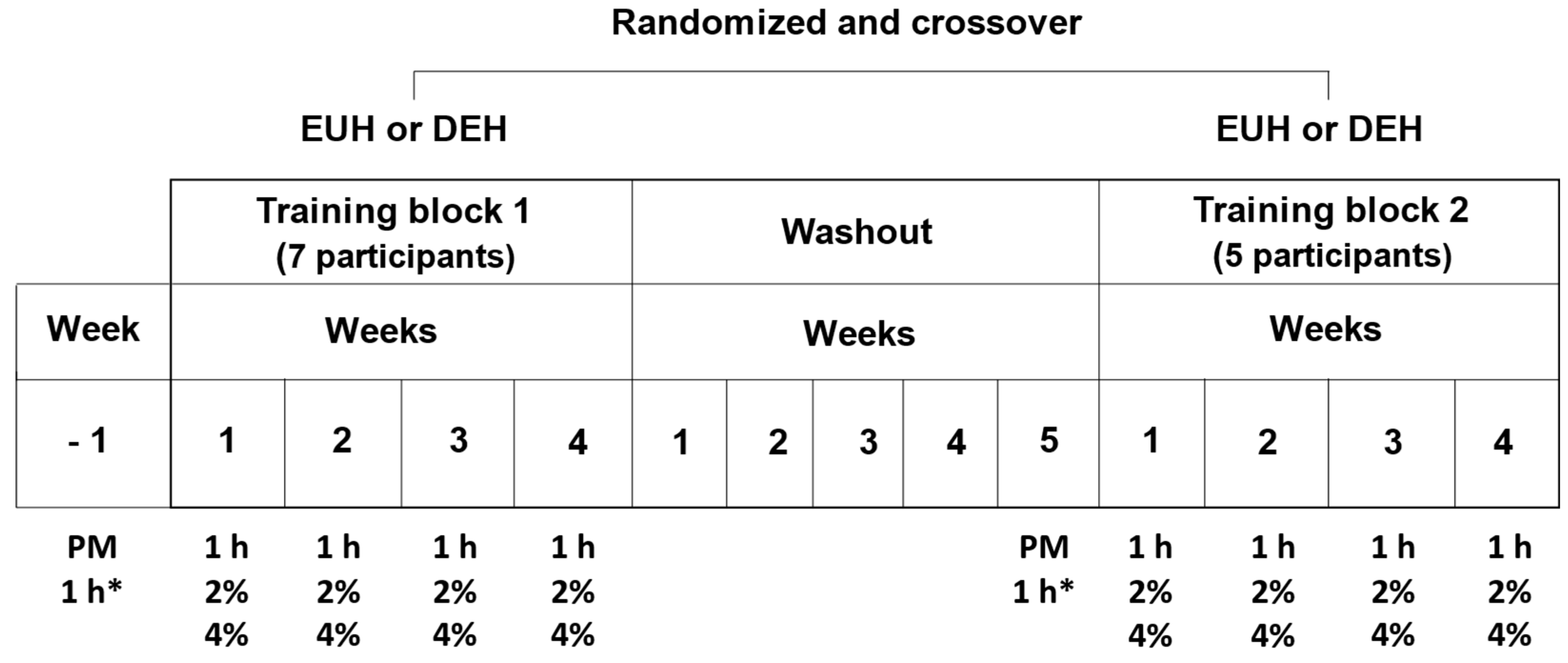
Figure 2.
Distribution of absolute fluid intake volume (A), fluid intake volume corrected for body mass (B), fluid intake volume corrected for fat-free mass (C), sweat rate (D), body mass change (E) and percentage of sweat loss replaced by fluid intake (F) over the four exercise sessions. Unfilled circles: individual responses; filled squares: mean responses; bars: 95% confidence intervals.
Figure 2.
Distribution of absolute fluid intake volume (A), fluid intake volume corrected for body mass (B), fluid intake volume corrected for fat-free mass (C), sweat rate (D), body mass change (E) and percentage of sweat loss replaced by fluid intake (F) over the four exercise sessions. Unfilled circles: individual responses; filled squares: mean responses; bars: 95% confidence intervals.
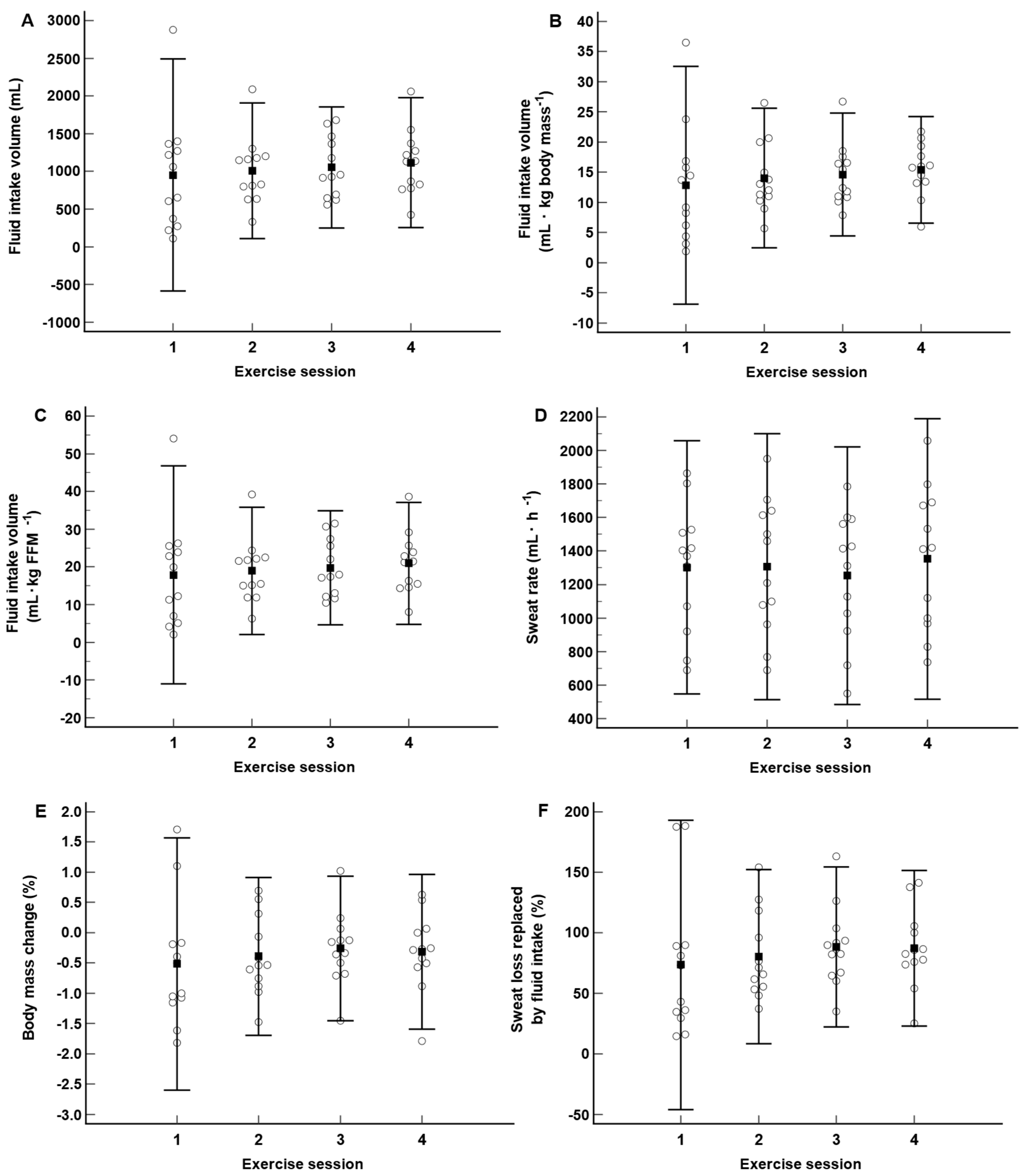
Figure 3.
Change in rectal temperature (A) and heart rate (B) observed during each of the four exercise sessions. * p < 0.05. Data are means ± SD.
Figure 3.
Change in rectal temperature (A) and heart rate (B) observed during each of the four exercise sessions. * p < 0.05. Data are means ± SD.
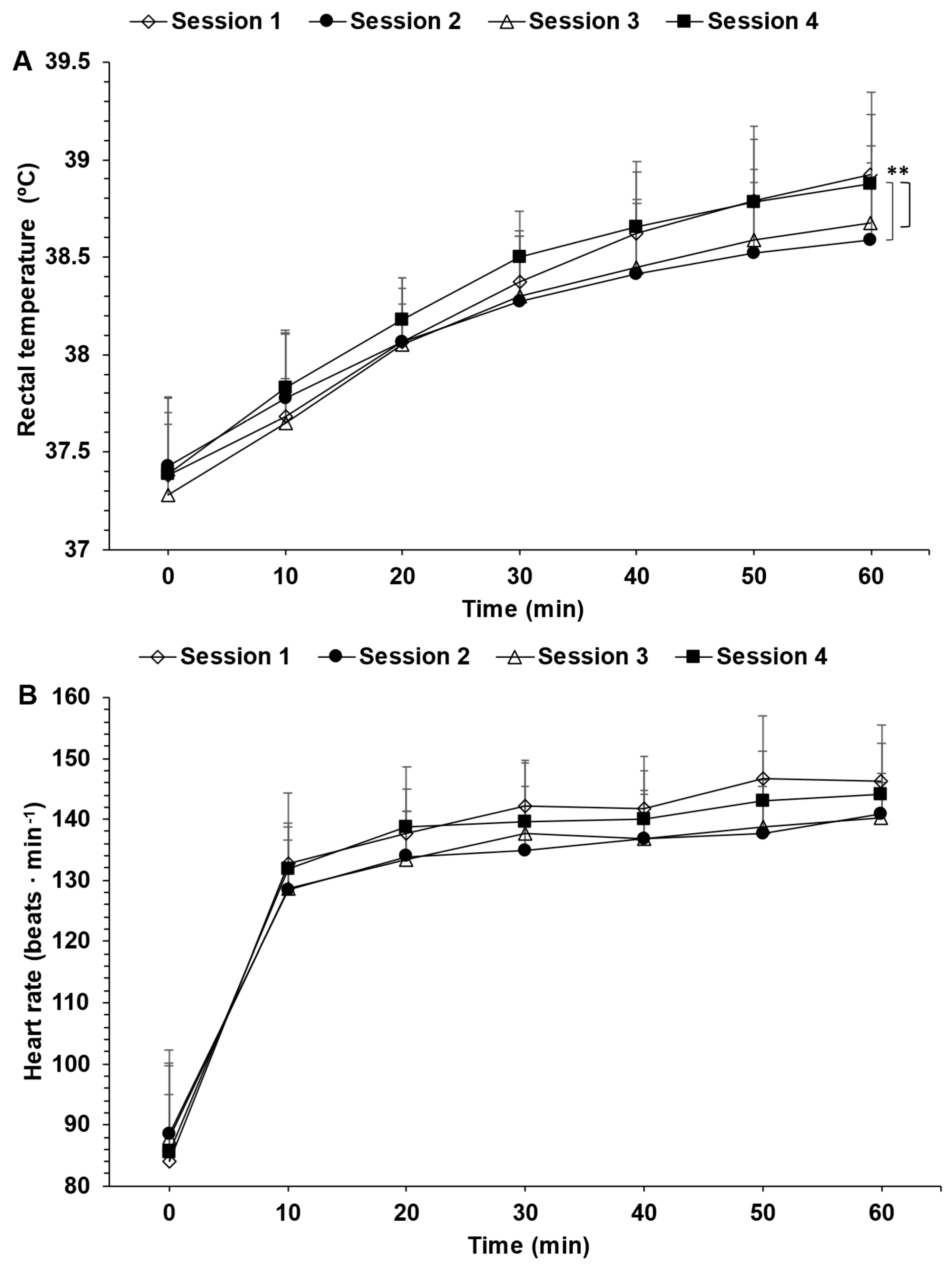
Figure 4.
Change in perceived exertion (A), perceived thirst (B) and perceived heat stress (C) observed during each of the four exercise sessions. AU: arbitrary units. Data are means ± SD.
Figure 4.
Change in perceived exertion (A), perceived thirst (B) and perceived heat stress (C) observed during each of the four exercise sessions. AU: arbitrary units. Data are means ± SD.


Table 1.
Physical characteristics of the participants.
| Physical characteristics | Mean ± SD |
|---|---|
| Age (years) | 23 ± 5 |
| Body mass (kg) | 71.7 ± 12.7 |
| Height (cm) | 173.8 ± 8.5 |
| Body mass index (kg · m2) | 23.7 ± 3.7 |
| Fat-free mass (kg) | 57.9 ± 10.4 |
|
Relative maximal O2 consumption (mL· kg body mass · min-1) |
52.7 ± 7.1 |
| Resting heart rate (beats · min-1) | 70 ± 13 |
| Resting systolic blood pressure (mmHg) | 119 ± 10 |
| Resting diastolic blood pressure (mmHg) | 73 ± 4 |
SD: standard deviation.
Table 2.
Hydration-related variables at arrival at the laboratory before each of the four exercise sessions.
Table 2.
Hydration-related variables at arrival at the laboratory before each of the four exercise sessions.
| Variables |
Exercise session 1 |
Exercise session 2 | Exercise session 3 | Exercise session 4 | pvalue | ||
|
Urine specific gravity (g · mL-1) |
1.011 ± 0.007 | 1.016 ± 0.009 | 1.018 ± 0.008 | 1.021 ± 0.005 | 0.001 | ||
| Body mass (kg) | 72.1 ± 12.6 | 72.3 ± 12.7 | 72.3 ± 12.9 | 71.7 ± 12.8 | 0.18 | ||
| Thirst (AU) | 2.2 ± 0.8 | 2.3 ± 0.8 | 2.3 ± 0.8 | 2.7 ± 0.9 | 0.66 | ||
|
Exercise session 1 to 2 |
Exercise session 1 to 3 |
Exercise session 1 to 4 |
|||||
| Change in body mass (%) | 0.35 ± 1.32 | 0.21 ± 1.55 | - 0.55 ± 1.45 | 0.046 | |||
AU: arbitrary units.
Table 3.
Balance between the total accumulated fluid intake volume and total accumulated sweat loss for each of the exercise sessions and over the four exercise sessions.
Table 3.
Balance between the total accumulated fluid intake volume and total accumulated sweat loss for each of the exercise sessions and over the four exercise sessions.
| Participants | Exercise session 1 (mL) * | Exercise session 2 (mL) * | Exercise session 3 (mL) * | Exercise session 4 (mL) * | Total accumulated fluid intake volume (mL) - total accumulated sweat loss (mL) * |
|---|---|---|---|---|---|
| 1 | - 650 | - 332 | - 303 | - 175 | - 1460 |
| 2 | - 1286 | - 1070 | - 1042 | - 1264 | - 4662 |
| 3 | - 580 | - 357 | - 72 | + 39 | - 970 |
| 4 | - 150 | - 50 | + 50 | - 200 | - 350 |
| 5 | - 500 | - 750 | - 150 | 0 | - 1400 |
| 6 | - 145 | - 466 | - 635 | - 245 | - 1491 |
| 7 | + 654 | + 414 | + 144 | + 312 | + 1524 |
| 8 | - 250 | + 200 | + 650 | + 400 | + 1000 |
| 9 | - 1150 | - 700 | - 250 | - 400 | - 2500 |
| 10 | - 800 | - 650 | - 500 | - 650 | - 2600 |
| 11 | - 700 | - 250 | - 200 | - 250 | - 1400 |
| 12 | + 1350 | + 450 | - 100 | - 400 | + 1300 |
| Mean ± SD | - 350 ± 738 | - 297 ± 435 | - 201 ± 419 | - 236 ± 439 | - 1084 ± 1783 |
* a negative value denotes an accumulated fluid intake volume < than the accumulated sweat loss. A positive value denotes an accumulated fluid intake volume > than the accumulated sweat loss. SD: stand- ard deviation.
Disclaimer/Publisher’s Note: The statements, opinions and data contained in all publications are solely those of the individual author(s) and contributor(s) and not of MDPI and/or the editor(s). MDPI and/or the editor(s) disclaim responsibility for any injury to people or property resulting from any ideas, methods, instructions or products referred to in the content. |
© 2023 by the authors. Licensee MDPI, Basel, Switzerland. This article is an open access article distributed under the terms and conditions of the Creative Commons Attribution (CC BY) license (http://creativecommons.org/licenses/by/4.0/).
Copyright: This open access article is published under a Creative Commons CC BY 4.0 license, which permit the free download, distribution, and reuse, provided that the author and preprint are cited in any reuse.


