

Submitted:
25 September 2023
Posted:
26 September 2023
You are already at the latest version
Abstract
Proposed study aims to investigate the digital transformation of Greek small and medium enterprises (SMEs), with a particular focus on their digital maturity and the strategic and organizational factors contributing to digital transformation. The research issue of digital transformation is attracting considerable interest among academics and business practicians since COVID-19 accelerated the procedure of implementing Industry’s 4.0 principles all over global economies. Quantitative research on 147 Greek SMEs revealed most important issues on how these businesses implement digital transformation, factors accelerating or decelerating the process, barriers and expected outcomes. Research enlights how SMEs face the transition to digital business and reveals the factors that can facilitate the whole process. Results can be valuable for stakeholders enabled to digital transformation process from both business and academic point of view, while there exist aspects that can contribute to policy makers / motivation developers in state’s level as well.
Keywords:
digital transformation
; small and medium enterprises (SMEs)
; digital maturity
; digital transformation strategy
Introduction
Until recently, research literature for Greek SME’s was mainly concentrating on external economic shocks, such as the financial crisis of 2008 (Cucculelli and Peruzzi, 2020). However, only recently become clear that “green and digital agenda” is crucial since natural disasters (earthquakes, fires, etc.) or incidents such as COVID pandemic have a severe impact on business activity. Due to its uniqueness, the current crisis has already been characterized as a black swan event for entrepreneurship (Cowling et al., 2020), resulting in substantial changes in business, lifestyle, culture and social interactions of entrepreneurs (Ratten, 2020) and strongly affecting access to finance and the survival of SMEs (Brown et al., 2020).
SMEs tend to be more vulnerable, than large companies, in exogenous shocks that put markets at risk due to lack of resources, known as the liability of smallness (Eggers, 2020). Under such circumstances, SMEs are for years and years after the shoch reluctant to invest their limited resources in innovative projects with an uncertain outcome (Lee et al., 2015) or in other activities that will increase their financial leverage (Thorgren and Williams, 2020). On the other hand, small firms knowing better customers’ needs, may develop the ability to recognize, evaluate and exploit opportunities in times of crisis (Beliaeva et al., 2020) and/or the flexibility to respond successfully to any crisis using valuable information based on the close relationships between customers and managers/owners (Eggers, 2020).
Such a condition led Industry’s 4.0 framework to reshape from a pure technological orientation (Baur and Wee, 2015) to a more business and human centered orientation (Kargas, Giannakis, et al., 2022) where intangible, business assets are recognized as a significant pillar of development (Gkika et al., 2022). That is why digital transformation passed from manufacturing and mass production, to less traditional economic activities, such as the ones that most SMEs are involved (Kargas and Varoutas, 2020).
Researchers should take into account that manufacturing sector is not advanced in all countries and especially in the smaller ones the technologies of Industry 4.0 cannot apply so as to offer a competitive advantage in the country’ s competitiveness (Laitsou et al., 2020). The SMEs in these countries belong to economic sectors with unique characteristics. Limited resources, financial pressure and the absence of IT departments make it even more difficult to SMEs to come up to requirements (Fenton et al., 2019).
Proposed research aims to contribute on the evaluation of the digital transformation’s progress in Greek SME’s, as a source for sustainable development in the global economic environment and as an opportunity for developing innovation.
A quantitative research methodology was adopted, using a self-administered questionnaire to collect data from a sample of 147 SMEs across various industries in Greece. The results revealed a moderate level of digital maturity among Greek SMEs, with considerable variation across the sample. The most digitally mature businesses were found to have invested significantly in strategic planning and organizational alignment, which underscored the importance of these factors in successful digital transformation. In terms of technology, the study found that Greek SMEs are primarily utilizing cloud services, mobile technologies, and social media for their digital transformation efforts. Yet, emerging technologies such as Artificial Intelligence, Big Data analytics, and the Internet of Things were also identified as increasingly influential.
The study contributes on enlightening new eras of business development for Greek SMEs by exploiting digital transformation’s opportunities arising. Results indicate that while Greek SMEs are making notable strides in their digital transformation journey, there is still space for improvements. Businesses should continue to invest in strategic and organizational factors to boost their digital maturity. Embracing a wider range of digital technologies, including emerging ones, could also provide significant benefits. The findings of this study contribute to a deeper understanding of the digital transformation process in Greek SMEs, offering valuable insights for businesses and policymakers.
Literature Review
Digital Transformation is related with the implementation of digital technologies in order to expand existing business models, to transform organizational structures, to alternate how resources are used and to reevaluate relationships with stakeholders (Brynjolfsson and Hitt, 2000; Frank et al., 2019; Loebbecke and Picot, 2015; Vial, 2019). The concept gained research interest over the years, since various sectors started to enter to Industry’s 4.0 era. These sectors included service industry (Diener and Špaček, 2021), manufacturing (Llopis-Albert et al., 2021), healthcare sector (Ricciardi et al., 2019) and education (Jackson, 2019). Most studies investigated the relationship between digital transformation and organizational success parameters, such as: innovation (Appio et al., 2021), efficiency (Gebayew et al., 2018; Kraus et al., 2021), competitive advantage (Cahyadi, 2020), value creation for the customers (Wolpert and Roth, 2020), quick decisions regarding customers and competitors (Corso et al., 2018), cost reduction (Saini, 2018) etc.
Even though academic research provide strong enough evidence about the positive effects of implementing digital transformation, businesses still face difficulties and uncertainties, since the implementation is complex and costly (Matt et al., 2015). Most significantly, it requires changes since it involves designing new processes, creating new tasks, developing new business models (Reis et al., 2018), integrating new technologies (Chaparro-Peláez et al., 2020; Loske and Klumpp, 2022), cultivating new collaboration and digital culture (Krasonikolakis et al., 2020), leading even to even new performance measures (Allen, 2019; Nadkarni and Prügl, 2021). However, not all enterprises or sectors adopted digital transformation (e.g. SMEs) due to investment difficulties and lack of effective business models (Filotto et al., 2021).
Digital transformation rose as a result of both internal and external business factors (Bulovic and Covic, 2020). As far as internal factors are concerned, it includes among others transforming processes to compete globally and increase competitiveness (Helmy et al., 2017), increasing innovativeness, expanding research and development, increasing business value (Kane et al., 2015) and recruiting / developing talented employees (White, 2012). Moreover, issues such as organizational culture and climate can also contribute to organizational change towards digital era (Isensee et al., 2020), while agility seem to enhance new forms of strategic management (Kargas and Aretos, 2023; Troise et al., 2022). All these seem to be strongly related with the overall strategic orientation a company has and of course with the methodology digital transformation is implemented in internal process and operation as a whole (Pelletier and Cloutier, 2019).
Moreover, a series of external factors are reshaping the concept of digital transformation. Such factors include product / service personalization according to customers’ needs (von Leipzig et al., 2017), work force’s new skills (Kargas, Papakyriakopoulos, et al., 2022), new technologies (e.g. Artificial Intelligence, Augmented and Virtual Reality, Blockchain, Robotics etc.) reshaping operations and business models (Helmy et al., 2017; Kargas and Loumos, 2023) and big data analytics provide new business opportunities and business models (Kostakis and Kargas, 2021; Reinsel et al., 2018). Economic crisis as well tend to affect heavily SMEs (Cucculelli and Peruzzi, 2020), since this kind of businesses are more vulnerable to fund raising (Brown et al., 2020) and other useful resources (Eggers, 2020; Thorgren and Williams, 2020).
COVID-19 was another external factor, a more recent, that affected all kinds of economic and business activities worldwide (Goodell, 2020), including SMEs as well (Greene and Rosiello, 2020). Even though business community was initially shocked by COVID-19 consequences, soon enough faced the whole situation as an opportunity (Beliaeva et al., 2020), accelerating businesses’ digital transformation. By digitally transforming their operations, SMEs achieved organizational efficiency, cost savings, competitive advantages and internationalization, ensuring their viability and growth even under pandemic crisis circumstances (Fauzi and Sheng, 2022). Most significantly, SMEs realized during COVID-19 period that digital transformation is a strategic priority for long-term viability and growth and should not be regarded as a luxury required occasionally under crisis conditions (Donthu and Gustafsson, 2020).
Such a framework increased the research on the relationship between digital transformation and SMEs. Teng et. al. (2022) conducted qualitative research on the impact of digital technology, employee digital skills and digital transformation strategy on SMEs. Moreover, researchers gathered data from Chinese enterprises in order to assess the impact of digital transformation on financial performance. Their results provided evidence that digital transformation is positively related to performance and mediate the effect of digital transformation strategies on performance (Teng et al., 2022).
Another study (Scuotto et al., 2021) conducted research on a total of 2,156,360 European SMEs to investigate the relationship between individuals’ digital capabilities and SMEs' digitalization growth and innovation. Internal digital capabilities have proved to be of highly significance so that businesses can respond quickly to market changes and to tackle complex digital transformation tasks. Results indicate that recruiting employees being digitally literate can be proved a competitive advantage.
In a more specific study, Alraja et. al. (2021) concentrated on how leaders affect digital transformation when it comes to technological, organizational and environmental decisions. With a sample of more than 60 SME’s leaders they concluded that all the above – mentioned factors are of high importance when it comes to the ability of SMEs to digitize their business process (Alraja et al., 2021). In a more quantitative analysis Isensee et. al. (2020) studied digital transformation of SMEs and its relationship with organizational culture and sustainability. By analyzing data from more than 800 research papers on the topic they revealed that SMEs digital transformation is directly affected by SMEs' (a) strategic orientation, (b) internal capabilities, (c) management and (d) attitudes on the subject (Isensee et al., 2020).
A series of other studies (Gaweł et al., 2023; Westerlund, 2020) put emphasis on the relationship between digitalization of SMEs and their internationalization. Their perspective of research varies from understanding how native digital SMEs internationalize their operation up to non – digital SMEs can internationalize through a digital transformation procedure. Results can provide helpful insights on how digitalization can facilitate internationalization but moreover reveal differences between native digital and non – digital SMEs. As far as these differences are concerned it should be mentioned differences in the degree of usage (a) of Information and Communication Technologies (ICT), (b) of internal resources (e.g. digital literacy of employees) and (c) of value chains.
Garzoni et al. (2020) went one step beyond studying hot digital technologies has changed the growth of SMEs when it comes to digitally transform existing businesses. Results indicate that digital awareness, digital search, digital collaboration and digital transformation are the main four levels of involvement (Garzoni et al., 2020). Finally, there exist series of more focused studies that put emphasis on specific subjects of digital transformation such as business models, innovation performance, (Bouwman et al., 2019), decision making process (Kilimis et al., 2019) etc..
Methodology
A quantitative approach was selected in order to gather data regarding Greek SMEs digital transformation. The quantitative approach was preferred since more objective and reliable data could be collected (Kumar, 2011). Research was based on a similar research conducted from the German – Hellenic Champer of Industry and commerce in 2021 (German-Hellenic Chamber, 2022), changed appropriately to serve current research goals. Researchers collected data for a period of 4 months, between September to December 2022.
A sample of 147 Greek SMEs were involved in answering the online questionnaire, consisting of 31 questions. The questionnaire was separated in 3 sections, with the first one involving demographic questions, such as sex, age, educational background, working department (if any), company size (number of employees) and business sector that the company is involved. The rest two sections gather data regarding SMEs’:
- digital maturity with 6 questions and
- strategy and organization with 5 questions.
A 5-point Likert scale was used in order to evaluate the responders’ agreement / disagreement on each question. Research questions under each section are presented in the Table 1 below.
As far as the sample is concerned, a convenience sample of SMEs locating in Athens – Greece was selected, providing random data with each subject of the research having the same probability of selection (Taherdoost, 2016).
Results
Out of the total 147 respondents each one representing a distinct SME, 55% were males and 45% were females, while their ages ranged from:
- between 18-24 years old was 4.1% of respondents,
- between 25-34 years old was 59.2% of respondents,
- between 35-44 years old was 32.7% of respondents and
- between 45-54 years old was 4.1% of respondents.
Τhe highest percentage of participants (44.9%) hold a bachelor’s degree, followed by 30.6% holding a master’s degree, while 20.4% were high school graduates and 4.1% hold a PhD degree. As shown in Figure 1, the highest percentage (34.7%) of the participants work in the service industries, followed by 22.4% working in technology, 6.1% in transportation, 4.1% in distributive transactions, 2% in tourism and a percentage of 2% in agriculture, horticulture and forestry. Finally, 28.6% chose the option “other” and the participants specified their response as working in the industry of telecommunications (9), cleaning products (3), household products and decoration (6), television (6), consulting (6), distributions (6), shipping (3) military (3), health (8) and constructions (3).
As far as digital maturity over 60% of respondents feel that their companies are quite and very mature versus only 14.3% that feel that their companies not very mature or no mature at all. Moreover, there exists another 24.5% that evaluates as somewhat mature their company, indicating a small but not significance progress. The results are supported by findings regarding existing plans of becoming more digital. Almost 20% stated that their companies are digital narratives, while another 49% declared being ahead or on schedule regarding their plans to become more digital. More than 30% stated being behind their schedules (10.2%), not yet started even though having a plan (12.2%) and now planning to develop a digital plan (8.2%).
Even though most SMEs seem to have entered somehow in digital era, only 40.8% have in place a digital business model. The rest have partially implemented some elements (36.7%) and almost 22% is planning or not interested in developing a digital business plan. In some degree this can be associated with the results regarding who is currently leading the digital transformation of the organization. Almost 40.8% of the respondents stated that the Chief Executive Officer is leading the digital transformation, followed by percentages of 18.4% for no one in particular, 16.3% for the Chief Technology Officer, 12.2% for the Chief Marketing Officer, 6.1% for the Chief Operating Officer, 4.1% for the Chief Digital Transformation Officer and, finally, 2% reported the Chief Information Officer.
Most significantly, respondents indicated the fields within which they think the businesses should initiate the implementation of the digital transformation. The results (Figure 2) showed a majority of 51% who stated management and strategy, 18.4% products, 12.2% technology, 10.2% platforms and 8.2% stated the employee engagement and HR. Management and strategy alongside with the appropriate products seem that main driver for digital transformation.
Moreover, respondents expressed their agreement or disagreement about the the main drivers of digital transformation. As shown in Table 2 below, the average value (AV) and standard deviation (SD) was taken into account in order to evaluate how competitors, customers, suppliers, government and other drivers affect SMEs’ digital transformation. Results indicate that the most important driver of digital transformation, in Greek SMEs, is customers (AV=4.14, SD=1.05), followed by competitors (AV=4.00, SD=0.93). Customer needs and competitors’ actions seem to affect the development and implementation of digital plans. Both these drivers are gathering an almost similar interest.
The next most significant driver is suppliers (AV=3.53, SD=1.16), since Greek economy is heavily dependent from foreign suppliers. Their digital transformation makes it inevitable for Greek SMEs to adapt to a new, digital business era. Finally, the participants’ responses for factors such as Government (AV=3.35, SD=0.86) and other factors (AV=3.08, SD=0.86) tended towards neutrality indicating that even though there exists a national progress in digital economy’s indexes. (Laitsou et al., 2020).
Even though the above – mentioned results regarding digital maturity promising, the next section of questions related with “Strategy and Organization” provides a clearer picture about which is the actual situation on SMEs’ digital transformation. Only 34.7% of respondents stated that there exists an operational digital strategy, while the rest of respondents recognize that there some steps have been done (32.7%) under a strategic plan or such plan exists at the moment (32.6%).
Not surprisingly the most significant factor when developing a digital transformation strategy (Table 3) is technology (AV=4.57, SD=0.78), followed by management (AV=4.45, SD=0.76), flexibility (AV=4.43, SD=0.67), investments (AV=4.41, SD=0.78), knowledge sharing (AV=4.33, SD=0.67), culture (AV=4.33, SD=0.77) and finally human resources (AV=3.78, SD=1.17).
When it comes to barriers for effective implementation of to digital transformation (Table 4), results indicates that most important barrier is lack of will to change (AV=4.40, SD=0.88), followed by the lack of knowledge (AV=4.18, SD=0.96), inadequate management (AV=4.10, SD=0.86), low investment (AV=4.06, SD=1.04), lack of infrastructure (AV=4.02, SD=1.12) and regulations (AV=3.45, SD=0.97).
Moreover, respondents believe that digital transformation’s outcomes are mainly related with improved customer satisfaction (AV=4.51, SD=0.76) and increased operational speed and flexibility (AV=4.43, SD=0.81), while at a second stage these outcomes bring increased market share (AV=4.31, SD=0.89), increased revenues (AV=4.31, SD=0.98), reduced time to develop new products and services (AV=4.22, SD=0.96), reduced operating costs (AV=4.18, SD=1.0) and improved number of top talent which is recruited and retained (AV=3.61, SD=1.18). (Table 5)
Finally, the biggest challenges when implementing digital transformation were internal operations (53.1%), followed by lack of appropriate external skills (34.7%), cultural resistance (8.2%) and finally financial reasons (4.1%)
A Reliability Analysis was conducted to assess the reliability and internal consistency of the set of items used in the questionnaire. The most commonly used reliability test in SPSS is Cronbach's alpha, while a commonly accepted threshold for reliability is 0.70 or higher. Proposed results (Table 6) indicate an accepted threshold for reliability with Cronbach's Alpha being 0.776 for the itemset of 32 questions.
Based on such strong reliability, authors put research emphasis on understanding how is cultivated the respondents’ perception about digital maturity of a firm (Question DM1) and digital transformation strategy development (Question SO1). At a first stage, non-parametric correlations were calculated in order to define which relationships are statistically significant. Results are revealed in Table 7, where only statistically significant relationships are presented, while non – significant results are concealed. As far as these statistically significant relationships are concerned, proposed results indicate:
- a strong, positive relationship between digital maturity and existing digital transformation strategy,
- digital maturity and digital transformation strategy, are strongly and positively affected by the existence of a digital business model,
- the person leading the digital transformation process plays a significant role as well for both digital maturity and digital transformation strategy,
- management and technology play crucial role for the development of a digital transformation strategy, while platforms and products have a less significant role,
- cultivating digital maturity and digital transformation strategy is positively related with customers, while competitors and government have no statistically significant and only suppliers affect positively digital transformation strategy,
- agility and technology are the two most significant internal factors when it comes to digital maturity and digital transformation strategy, alongside with management and knowledge sharing that have positive impact only on digital transformation strategy,
- funding and investment issues are the most significant barrier to further digitalization,
- increased customer satisfaction is the only statistically significant outcome that Greek SMEs expect from when developing their digital transformation strategy.
Two distinct one-way ANOVA were run in SPSS for each one of digital maturity (DM1) and digital transformation strategy (SO1). As far as digital maturity is concerned (Table 8), the value of F is 7.698, which reaches significance with a p-value of 0.000 while R Square is 0.675 being marginally accepted.
Digital transformation strategy as well (Table 9) demonstrates an F value 20.181 with a p-value 0.000 and R Square being 0.845 a rather high degree of predictiveness.
Out of these ANOVA analyses useful equations arise regarding how each one of the dependent variables is developed. The following equations are presenting only variables that affect dependent variable in a statistically significant way.
ANOVA results support partially the above-mentioned correlations regarding digital maturity. Digital maturity is affected positively (Equation 1), in a statistically significant way, from the existence of digital business model and the existence of digital strategy. Moreover, there is a positive impact from willingness to change among Greek SMEs and the prospects of increased revenues. In contrary, governmental actions and technology have a negative impact.
As far as digital transformation strategy is concerned (Equation 2) results indicate that (a) digital maturity, (b) digital business model, (c) customer satisfaction, (d) technology and (e) management play a positive and statistically significant role. In contrary with correlations’ results, there exist three variables that have a negative impact, namely: digital transformation culture, low investments / funding and the person that leads the digital transformation process.
Discussion
Results presented in the previous section, provide evidence about several digital transformation’s issues when it comes to SMEs and particularly in the Greek business environment. Not surprisingly, there exists a strong, positive relationship between digital maturity and existing digital transformation strategy Moreover, both digital maturity and digital transformation strategy are affected from the existence of digital business models. Such an evidence support existing results for traditional industries (Remane et al., 2017), manufacture (Luz Martín-Peña et al., 2018) and SMEs (Bouwman et al., 2019) as well.
Moreover, results supported the idea that entering in digital era is not merely about technology, even though technological advances are gaining high attention among Greek SMEs. Results support existing findings that management (Appio et al., 2021; Kraus et al., 2022), agility (AlNuaimi et al., 2022; Burchardt and Maisch, 2019; Mangalaraj et al., 2023) and knowledge sharing (de Bem Machado et al., 2022; Yang et al., 2023) affect positively digital transformation. As far as agility is concerned, agile management styles inspired from software development sector seem to gain interest even from non – ICT sectors such as SMES (Kargas and Aretos, 2023). Products and digital platforms are gaining less attention since the majority of Greek SMEs are service – oriented.
Greek SMEs seem to connect digital transformation with customer satisfaction. Such a customer – oriented approach is not something new (Gil-Gomez et al., 2020; von Leipzig et al., 2017; Miguel et al., 2022) but it seem an overconcentration on this aspect neglecting all other influences or possible outcomes. It should be noted that customer satisfaction is essential for maintaining existing customer base but cannot ensure gaining new customers. Such an aspect reveals that digital transformation for Greek SMEs is a viability strategy rather than a growth and international business pattern. Competitors are not statistically significant players to force or motivate SMEs to digital transformation, but suppliers are. Such an aspect is expected since Greek economy in mainly an importing goods and services. Many suppliers of Greek SMEs are located abroad, forcing national businesses to adopt digital tools and strategies in order to maintain existing cooperation. Government seem to affect negatively Greek SMEs towards their digital transformation process indicating the lack of financial / regulatory / administrative motives from state’s authorities.
Finally, most important barrier to further implementing digital transformation is recognized to be funding and investments. Such a barrier has two distinct but interrelated issues. First of all, Greek SMEs even after almost 15 years since the recession, still face difficulties to have access to loans and funding (Vettas et al., 2017). This can be related to the above-mentioned issue of lacking efficient, digital business models for SMEs so that to self-funding in digital transformation.
References
- Allen, R. (2019), “Transformational and digital change: a UK perspective”, Organisational and Social Dynamics, Vol. 19 No. 2, pp. 143–167. [CrossRef]
- AlNuaimi, B.K., Kumar Singh, S., Ren, S., Budhwar, P. and Vorobyev, D. (2022), “Mastering digital transformation: The nexus between leadership, agility, and digital strategy”, Journal of Business Research, Vol. 145, pp. 636–648.
- Alraja, M.N., Hussein, M.A. and Ahmed, H.M.S. (2021), “What affects digitalization process in developing economies? An evidence from SMEs sector in Oman”, Bulletin of Electrical Engineering and Informatics, Vol. 10 No. 1, pp. 441–448. [CrossRef]
- Appio, F.P., Frattini, F., Petruzzelli, A.M. and Neirotti, P. (2021), “Digital Transformation and Innovation Management: A Synthesis of Existing Research and an Agenda for Future Studies”, Journal of Product Innovation Management, Vol. 38 No. 1, pp. 4–20. [CrossRef]
- Baur, C. and Wee, D. (2015), “Industry 4.0 is more than just a flashy catchphrase. A confluence of trends and technologies promises to reshape the way things are made.”. Available online: https://www.mckinsey.com/business-functions/operations/our-insights/manufacturings-next-act (accessed on 27 August 2021).
- Beliaeva, T., Shirokova, G., Wales, W. and Gafforova, E. (2020), “Benefiting from economic crisis? Strategic orientation effects, trade-offs, and configurations with resource availability on SME performance”, International Entrepreneurship and Management Journal, Vol. 16 No. 1, pp. 165–194.
- de Bem Machado, A., Secinaro, S., Calandra, D. and Lanzalonga, F. (2022), “Knowledge management and digital transformation for Industry 4.0: a structured literature review”, Knowledge Management Research & Practice, Vol. 20 No. 2, pp. 320–338.
- Bouwman, H., Nikou, S. and de Reuver, M. (2019), “Digitalization, business models, and SMEs: How do business model innovation practices improve performance of digitalizing SMEs?”, Telecommunications Policy, Vol. 43 No. 9, p. 101828.
- Brown, R., Rocha, A. and Cowling, M. (2020), “Financing entrepreneurship in times of crisis: Exploring the impact of COVID-19 on the market for entrepreneurial finance in the United Kingdom”, International Small Business Journal: Researching Entrepreneurship, Vol. 38 No. 5, pp. 380–390. [CrossRef]
- Brynjolfsson, E. and Hitt, L.M. (2000), “Beyond Computation: Information Technology, Organizational Transformation and Business Performance”, Journal of Economic Perspectives, Vol. 14 No. 4, pp. 23–48.
- Bulovic, V. and Covic, Z. (2020), “The Impact of Digital Transformation on Sustainability in Fashion Retail”, 2020 IEEE 18th International Symposium on Intelligent Systems and Informatics (SISY), IEEE, pp. 000149–000154.
- Burchardt, C. and Maisch, B. (2019), “Digitalization needs a cultural change – examples of applying Agility and Open Innovation to drive the digital transformation”, Procedia CIRP, Vol. 84, pp. 112–117. [CrossRef]
- Cahyadi, I. (2020), “Developing Digital Application to Improve Business Process Sustainability in An Indonesian Fast Moving Consumer Goods Company”, Journal of Physics: Conference Series, Vol. 1569 No. 3, p. 032023. [CrossRef]
- Chaparro-Peláez, J., Acquila-Natale, E., Hernández-García, Á. and Iglesias-Pradas, S. (2020), “The Digital Transformation of the Retail Electricity Market in Spain”, Energies, Vol. 13 No. 8, p. 2085. [CrossRef]
- Corso, M., Giovannetti, G., Guglielmi, L. and Vaia, G. (2018), “Conceiving and Implementing the Digital Organization”, CIOs and the Digital Transformation, Springer International Publishing, Cham, pp. 181–203.
- Cowling, M., Brown, R. and Rocha, A. (2020), “Did you save some cash for a rainy COVID-19 day? The crisis and SMEs”, International Small Business Journal: Researching Entrepreneurship, Vol. 38 No. 7, pp. 593–604. [CrossRef]
- Cucculelli, M. and Peruzzi, V. (2020), “Post-crisis firm survival, business model changes, and learning: evidence from the Italian manufacturing industry”, Small Business Economics, Vol. 54 No. 2, pp. 459–474.
- Diener, F. and Špaček, M. (2021), “Digital Transformation in Banking: A Managerial Perspective on Barriers to Change”, Sustainability, Vol. 13 No. 4, p. 2032. [CrossRef]
- Donthu, N. and Gustafsson, A. (2020), “Effects of COVID-19 on business and research”, Journal of Business Research, Vol. 117, pp. 284–289. [CrossRef]
- Eggers, F. (2020), “Masters of disasters? Challenges and opportunities for SMEs in times of crisis”, Journal of Business Research, Vol. 116, pp. 199–208. [CrossRef]
- Fauzi, A.A. and Sheng, M.L. (2022), “The digitalization of micro, small, and medium-sized enterprises (MSMEs): An institutional theory perspective”, Journal of Small Business Management, Vol. 60 No. 6, pp. 1288–1313.
- Fenton, A., Fletcher, G. and Griffiths, M. (Eds.). (2019), Strategic Digital Transformation : A Results-Driven Approach, 1st Edition., Routledge.
- Filotto, U., Caratelli, M. and Fornezza, F. (2021), “Shaping the digital transformation of the retail banking industry. Empirical evidence from Italy”, European Management Journal, Vol. 39 No. 3, pp. 366–375.
- Frank, A.G., Dalenogare, L.S. and Ayala, N.F. (2019), “Industry 4.0 technologies: Implementation patterns in manufacturing companies”, International Journal of Production Economics, Vol. 210, pp. 15–26. [CrossRef]
- Garzoni, A., De Turi, I., Secundo, G. and Del Vecchio, P. (2020), “Fostering digital transformation of SMEs: a four levels approach”, Management Decision, Vol. 58 No. 8, pp. 1543–1562.
- Gaweł, A., Mroczek-Dąbrowska, K. and Pietrzykowski, M. (2023), “Digitalization and Its Impact on the Internationalization Models of SMEs”, pp. 19–40.
- Gebayew, C., Hardini, I.R., Panjaitan, G.H.A., Kurniawan, N.B. and Suhardi. (2018), “A Systematic Literature Review on Digital Transformation”, 2018 International Conference on Information Technology Systems and Innovation (ICITSI), IEEE, pp. 260–265.
- German-Hellenic Chamber. (2022), Digital Transformation Survey 2022.
- Gil-Gomez, H., Guerola-Navarro, V., Oltra-Badenes, R. and Lozano-Quilis, J.A. (2020), “Customer relationship management: digital transformation and sustainable business model innovation”, Economic Research-Ekonomska Istraživanja, Vol. 33 No. 1, pp. 2733–2750. [CrossRef]
- Gkika, E., Ntanos, S., Komisopoulos, F. and Drosos, D. (2022), “The impact of Global Competition Dimensions on Economic Development”, ISPIM Connects Athens – The Role of Innovation: Past, Present, Future, LUT Scientific and Expertise Publications, Athens.
- Goodell, J.W. (2020), “COVID-19 and finance: Agendas for future research”, Finance Research Letters, Vol. 35, p. 101512. [CrossRef]
- Greene, F.J. and Rosiello, A. (2020), “A commentary on the impacts of ‘Great Lockdown’ and its aftermath on scaling firms: What are the implications for entrepreneurial research?”, International Small Business Journal: Researching Entrepreneurship, Vol. 38 No. 7, pp. 583–592. [CrossRef]
- Helmy, M., Khater, M. and Zaki, M. (2017), Digital Business Transformation and Strategy: What Do We Know so Far?, Cambridge.
- Isensee, C., Teuteberg, F., Griese, K.-M. and Topi, C. (2020), “The relationship between organizational culture, sustainability, and digitalization in SMEs: A systematic review”, Journal of Cleaner Production, Vol. 275, p. 122944.
- Jackson, N.C. (2019), “Managing for competency with innovation change in higher education: Examining the pitfalls and pivots of digital transformation”, Business Horizons, Vol. 62 No. 6, pp. 761–772. [CrossRef]
- Kane, G.C., Palmer, D., Phillips, A.N., Kiron, D. and Buckley, N. (2015), “Strategy, not Technology, Drives Digital Transformation”, MIT Sloan Management Review, pp. 1–25.
- Kargas, A. and Aretos, A. (2023), “Transforming Strategic Management Using Agile Methodologies”, pp. 349–368.
- Kargas, A., Giannakis, A. and Foukas, I. (2022), “Recognizing Skills and Competencies Required Under Industry 4.0’s Framework for Achieving Business Digital Transformation”, in Mirjana, P.-B. and Çağlar, D. (Eds.), Management Strategies for Sustainability, New Knowledge Innovation, and Personalized Products and Services, pp. 1–34.
- Kargas, A. and Loumos, G. (2023), “Cultural Industry’s Strategic Development: Reaching International Audience by Using Virtual Reality and Augmented Reality Technologies”, Heritage 2023, Vol. 6, Pages 4640-4652, Multidisciplinary Digital Publishing Institute, Vol. 6 No. 6, pp. 4640–4652. [CrossRef]
- Kargas, A., Papakyriakopoulos, D., Komisopoulos, F., Gkika, E.C. and Filios, S. (2022), “Tracing innovation with skill and competences”, ISPIM Connects Athens – The Role of Innovation: Past, Present, Future, Role of Innovation: Past, Present, Future, on 28-30 November 2022. Event Proceedings: LUT Scientific and Expertise Publications, Athens.
- Kargas, A. and Varoutas, D. (2020), “Industry 4.0 in Cultural Industry. A Review on Digital Visualization for VR and AR Applications”, in Bolognesi, C.M. and Cettina, S. (Eds.), Impact of Industry 4.0 on Architecture and Cultural Heritage, IGI Global, Hershey, PA, pp. 1–19.
- Kilimis, P., Zou, W., Lehmann, M. and Berger, U. (2019), “A Survey on Digitalization for SMEs in Brandenburg, Germany”, IFAC-PapersOnLine, Vol. 52 No. 13, pp. 2140–2145.
- Kostakis, P. and Kargas, A. (2021), “Big-Data Management: A Driver for Digital Transformation?”, Information 2021, Vol. 12, Page 411, Multidisciplinary Digital Publishing Institute, Vol. 12 No. 10, p. 411. [CrossRef]
- Krasonikolakis, I., Tsarbopoulos, M. and Eng, T.-Y. (2020), “Are incumbent banks bygones in the face of digital transformation?”, Journal of General Management, Vol. 46 No. 1, pp. 60–69. [CrossRef]
- Kraus, S., Durst, S., Ferreira, J.J., Veiga, P., Kailer, N. and Weinmann, A. (2022), “Digital transformation in business and management research: An overview of the current status quo”, International Journal of Information Management, Vol. 63, p. 102466. [CrossRef]
- Kraus, S., Schiavone, F., Pluzhnikova, A. and Invernizzi, A.C. (2021), “Digital transformation in healthcare: Analyzing the current state-of-research”, Journal of Business Research, Vol. 123, pp. 557–567. [CrossRef]
- Kumar, R. (2011), Research Methodology: A Step-by-Step Guide for Beginners, 3rd ed., SAGE Publications Ltd.
- Laitsou, E., Kargas, A. and Varoutas, D. (2020), “Digital Competitiveness in the European Union Era: The Greek Case”, Economies, Vol. 8 No. 4, p. 85. [CrossRef]
- Lee, N., Sameen, H. and Cowling, M. (2015), “Access to finance for innovative SMEs since the financial crisis”, Research Policy, Vol. 44 No. 2, pp. 370–380. [CrossRef]
- von Leipzig, T., Gamp, M., Manz, D., Schöttle, K., Ohlhausen, P., Oosthuizen, G., Palm, D., et al. (2017), “Initialising Customer-orientated Digital Transformation in Enterprises”, Procedia Manufacturing, Vol. 8, pp. 517–524.
- Llopis-Albert, C., Rubio, F. and Valero, F. (2021), “Impact of digital transformation on the automotive industry”, Technological Forecasting and Social Change, Vol. 162, p. 120343. [CrossRef]
- Loebbecke, C. and Picot, A. (2015), “Reflections on societal and business model transformation arising from digitization and big data analytics: A research agenda”, The Journal of Strategic Information Systems, Vol. 24 No. 3, pp. 149–157. [CrossRef]
- Loske, D. and Klumpp, M. (2022), “Verifying the effects of digitalisation in retail logistics: an efficiency-centred approach”, International Journal of Logistics Research and Applications, Vol. 25 No. 2, pp. 203–227. [CrossRef]
- Luz Martín-Peña, M., Díaz-Garrido, E. and Sánchez-López, J.M. (2018), “The digitalization and servitization of manufacturing: A review on digital business models”, Strategic Change, Vol. 27 No. 2, pp. 91–99.
- Mangalaraj, G., Nerur, S. and Dwivedi, R. (2023), “Digital Transformation for Agility and Resilience: An Exploratory Study”, Journal of Computer Information Systems, Vol. 63 No. 1, pp. 11–23. [CrossRef]
- Matt, C., Hess, T. and Benlian, A. (2015), “Digital Transformation Strategies”, Business & Information Systems Engineering, Vol. 57 No. 5, pp. 339–343.
- Miguel, P.M. de, De-Pablos-Heredero, C., Montes, J.L. and García, A. (2022), “Impact of Dynamic Capabilities on Customer Satisfaction through Digital Transformation in the Automotive Sector”, Sustainability, Vol. 14 No. 8, p. 4772. [CrossRef]
- Nadkarni, S. and Prügl, R. (2021), “Digital transformation: a review, synthesis and opportunities for future research”, Management Review Quarterly, Vol. 71 No. 2, pp. 233–341.
- Pelletier, C. and Cloutier, L.M. (2019), “Conceptualising digital transformation in SMEs: an ecosystemic perspective”, Journal of Small Business and Enterprise Development, Vol. 26 No. 6/7, pp. 855–876. [CrossRef]
- Ratten, V. (2020), “Coronavirus (covid-19) and entrepreneurship: changing life and work landscape”, Journal of Small Business & Entrepreneurship, Vol. 32 No. 5, pp. 503–516. [CrossRef]
- Reinsel, D., Gantz, J. and Rydning, J. (2018), The Digitization of the World from Edge to Core.
- Reis, J., Amorim, M., Melão, N. and Matos, P. (2018), “Digital Transformation: A Literature Review and Guidelines for Future Research”, pp. 411–421.
- Remane, G., Hanelt, A., Nickerson, R.C. and Kolbe, L.M. (2017), “Discovering digital business models in traditional industries”, Journal of Business Strategy, Vol. 38 No. 2, pp. 41–51. [CrossRef]
- Ricciardi, W., Pita Barros, P., Bourek, A., Brouwer, W., Kelsey, T., Lehtonen, L., Anastasy, C., et al. (2019), “How to govern the digital transformation of health services”, European Journal of Public Health, Vol. 29 No. Supplement_3, pp. 7–12. [CrossRef]
- Saini, K. (2018), “A Future’s Dominant Technology Blockchain: Digital Transformation”, 2018 International Conference on Computing, Power and Communication Technologies (GUCON), IEEE, pp. 937–940.
- Scuotto, V., Nicotra, M., Del Giudice, M., Krueger, N. and Gregori, G.L. (2021), “A microfoundational perspective on SMEs’ growth in the digital transformation era”, Journal of Business Research, Vol. 129, pp. 382–392. [CrossRef]
- Taherdoost, H. (2016), “Sampling Methods in Research Methodology; How to Choose a Sampling Technique for Research”, SSRN Electronic Journal. [CrossRef]
- Teng, X., Wu, Z. and Yang, F. (2022), “Research on the Relationship between Digital Transformation and Performance of SMEs”, Sustainability, Vol. 14 No. 10, p. 6012. [CrossRef]
- Thorgren, S. and Williams, T.A. (2020), “Staying alive during an unfolding crisis: How SMEs ward off impending disaster”, Journal of Business Venturing Insights, Vol. 14, p. e00187. [CrossRef]
- Troise, C., Corvello, V., Ghobadian, A. and O’Regan, N. (2022), “How can SMEs successfully navigate VUCA environment: The role of agility in the digital transformation era”, Technological Forecasting and Social Change, Vol. 174, p. 121227. [CrossRef]
- Vettas, N., Stavraki, S. and Vassiliadis, M. (2017), “Characteristics and Possible Solutions to Problems Related to Loans to SMEs in Greece”, Non-Performing Loans and Resolving Private Sector Insolvency, Springer International Publishing, Cham, pp. 307–333.
- Vial, G. (2019), “Understanding digital transformation: A review and a research agenda”, The Journal of Strategic Information Systems, Vol. 28 No. 2, pp. 118–144. [CrossRef]
- Westerlund, M. (2020), “Digitalization, Internationalization and Scaling of Online SMEs”, Technology Innovation Management Review , Vol. 10 No. 4, pp. 48–57.
- White, M. (2012), “Digital workplaces: Vision and reality”, Business Information Review, Vol. 29 No. 4, pp. 205–214.
- Wolpert, S. and Roth, A. (2020), “Development of a classification framework for technology based retail services: a retailers’ perspective”, The International Review of Retail, Distribution and Consumer Research, Vol. 30 No. 5, pp. 498–537. [CrossRef]
- Yang, X., Pan, L., Song, A., Ma, X. and Yang, J. (2023), “Research on the strategy of knowledge sharing among logistics enterprises under the goal of digital transformation”, Heliyon, Vol. 9 No. 4, p. e15191. [CrossRef]
Figure 1.
Sector in which the organization operates.
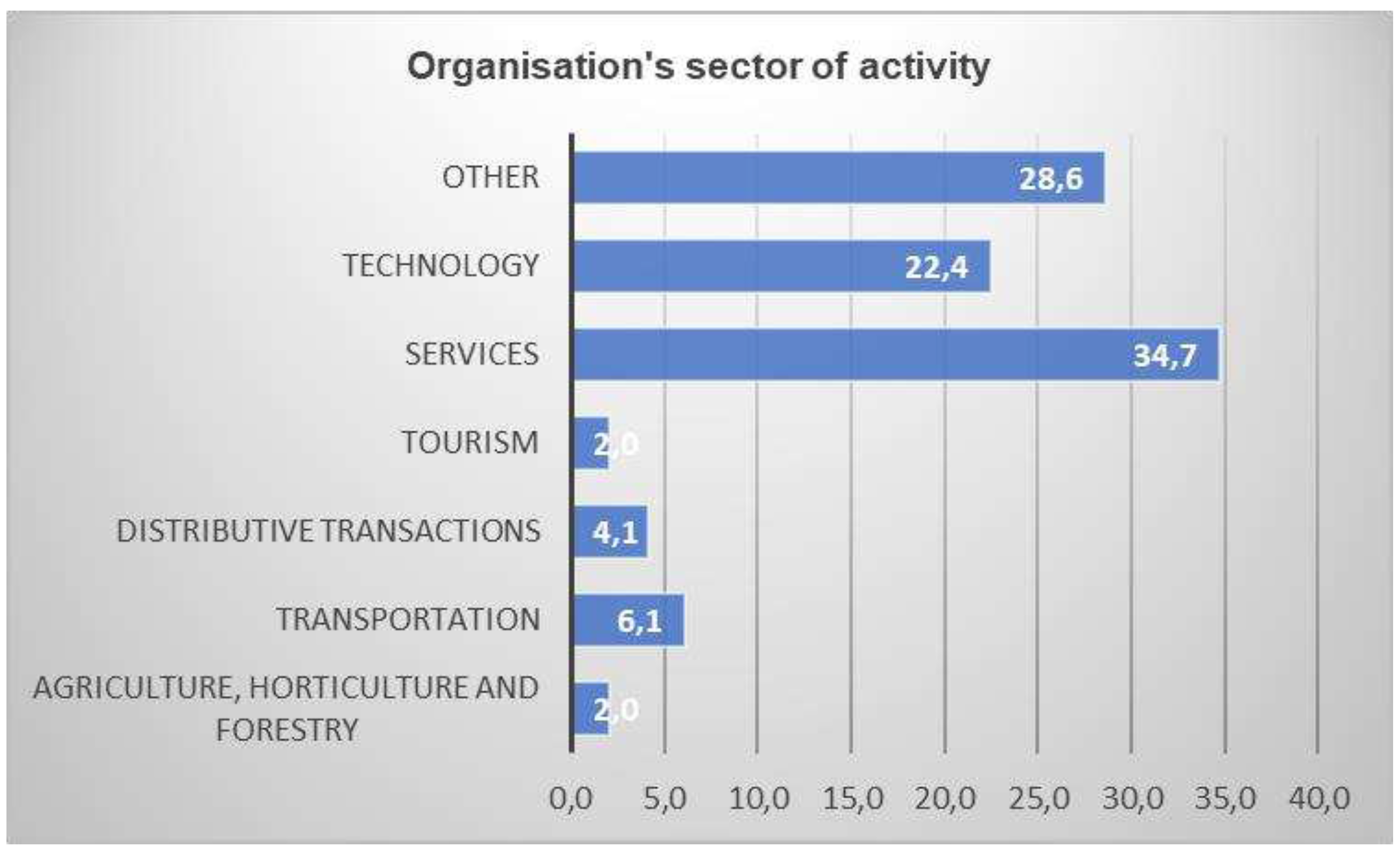
Figure 2.
Initiating digital transformation in SMEs.
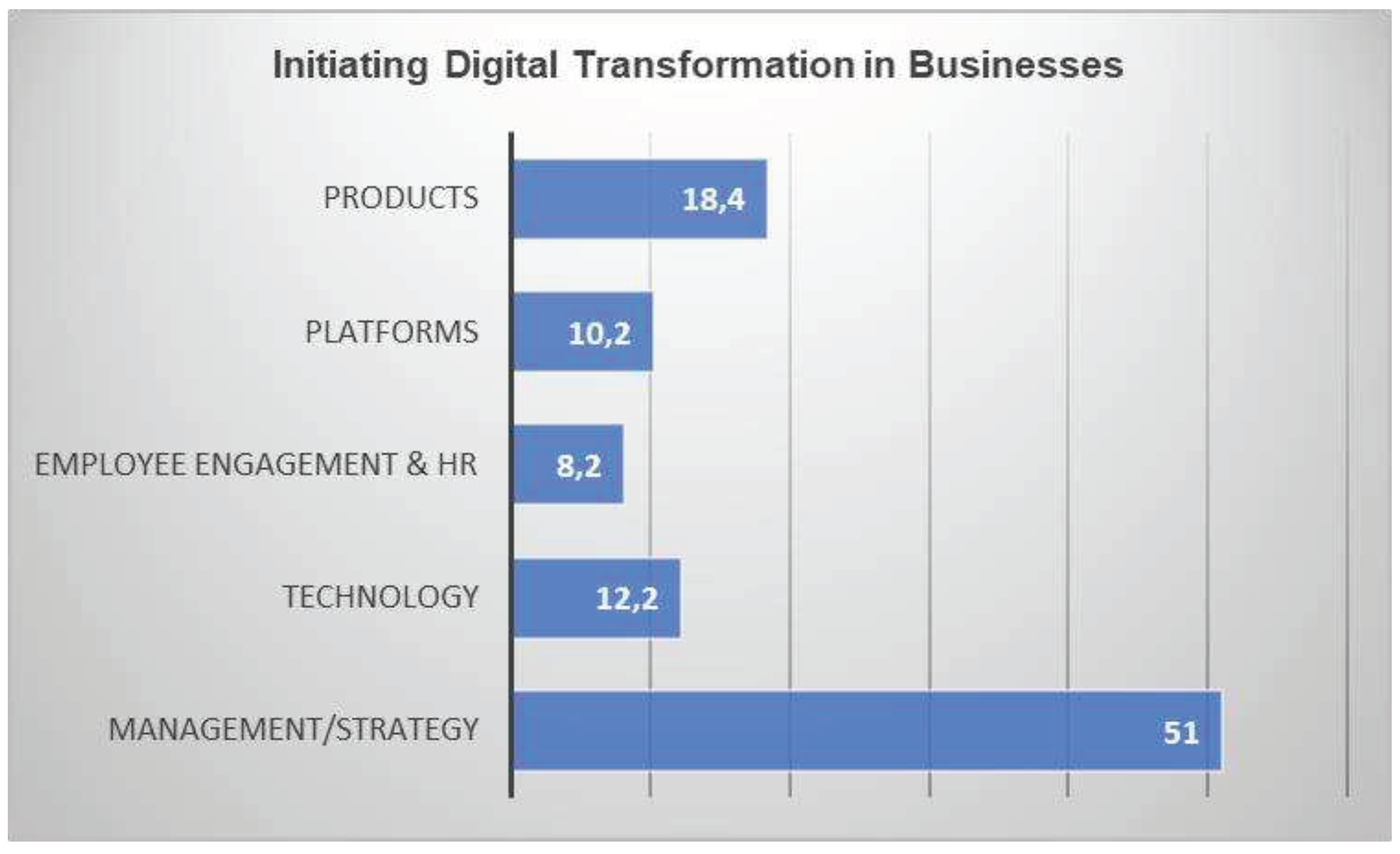

Table 1.
Research questionnaire.
| Section | Questions |
|---|---|
| Digital Maturity | DM1: How digitally mature do you consider your organization to be at the moment? |
|
DM2: Where do you see your own organization currently when it comes to becoming more digital? (1) We are ahead of our schedule when it comes to becoming more digital, (2) We are right on schedule when it comes to becoming more digital, (3) We are behind schedule when it comes to being more digital, (4) We have not started to become more digital yet, but are planning our approach, (5) We have not started to become more digital yet, and have more plans to think, (6) We have always been 100% digital business. | |
| DM3: To what extent does your company have a digital business model? | |
| DM4: Who is currently leading your organization’s digital transformation? | |
|
DM5: Where should businesses start with digital transformation? (1) Management / Strategy, (2) Technology, (3) Employee engagement & HR, (4) Platforms, (5) Products. | |
|
DM6: What do you believe are the main drivers of digital transformation? (1) Competitors, (2) Customers, (3) Suppliers, (4) Government, (5) Others. | |
| Strategy and Organization | SO1: Does your company have a digital transformation strategy? |
|
SO2: How important are the following factors in your company's digital transformation strategy? (1) Digital Transformation Culture, (2) Management, (3) HR, (4) Knowledge Sharing, (5) Agility, (6) Technology, (7) Funding / Investments. | |
|
SO3: What are the main Barriers of digital transformation? (1) Low funds / investments, (2) Lack of knowledge, (3) Lack of infrastructure, (4) Regulations, (5) Inadequate management, (6) Lack of willingness to change. | |
|
SO4: What are the most important outcomes your organization expects to achieve of the following as a result of its digital transformation? (1) Increase revenue, (2) Increase market share, (3) Reduce operating costs, (4) Increase business speed and agility, (5) Improve customer satisfaction, (6) Reduce the development time for new products/services, (7) Improve amount of better talent hired and retained. | |
|
SO5: What are the biggest challenges that your organization has actually experienced in trying to undertake a successful digital transformation? (1) Internal procedures, (2) Cultural resistance, (3) Lack of skills, (4) Financial issues. |
Source: German Hellenic Chamber of Industry and commerce Digital Transformation Committee, 2022.
Table 2.
Main drivers of digital transformation.
| Who do you think are the main drivers of digital transformation? | AV | SD | Strongly disagree | Disagree | Neutral | Agree | Strongly agree |
|---|---|---|---|---|---|---|---|
| Competitors | 4.00 | 0.93 | 2.0 | 6.1 | 12.2 | 49.0 | 30.6 |
| Customers | 4.14 | 1.05 | 4.1 | 4.1 | 12.2 | 32.7 | 46.9 |
| Suppliers | 3.53 | 0.97 | 2.0 | 8.2 | 44.9 | 24.5 | 20.4 |
| Government | 3.35 | 1.16 | 8.2 | 16.3 | 22.4 | 38.8 | 14.3 |
| Other | 3.08 | 0.86 | 4.1 | 16.3 | 51.0 | 24.5 | 4.1 |
Table 3.
Importance of digital transformation strategy factors.
| How important are the following factors in your company’s digital transformation strategy? | AV | SD | Not important at all | Slightly important | Somewhat important | Quite important | Very important |
|---|---|---|---|---|---|---|---|
| Digital transformation culture | 4.33 | 0.77 | 4.1% | 6.1% | 42.9% | 46.9% | |
| Management | 4.45 | 0.76 | 2.0% | 4.1% | 38.8% | 55.1% | |
| HR | 3.78 | 1.17 | 8.2% | 6.1% | 14.3% | 42.9% | 28.6% |
| Knowledge sharing | 4.33 | 0.74 | 2.0% | 10.2% | 40.8% | 46.9% | |
| Flexibility | 4.43 | 0.67 | 2.0% | 4.4% | 42.9% | 51.0% | |
| Technology | 4.57 | 0.67 | 2.0% | 4.1% | 28.6% | 65.3% | |
| Investments | 4.41 | 0.78 | 4.1% | 6.1% | 34.7% | 55.1% |
Table 4.
Main barriers to digital transformation.
| What are the main barriers to digital transformation? | AV | SD | Strongly disagree | Disagree | Neutral | Agree | Strongly agree |
|---|---|---|---|---|---|---|---|
| Low investment | 4.06 | 1.04 | 4.1% | 1.1% | 14.3% | 36.7% | 40.8% |
| Lack of knowledge | 4.18 | 0.96 | 9.2% | 14.3% | 28.6% | 49.0% | |
| Lack of infrastructure | 4.02 | 1.12 | 4.1% | 8.2% | 12.2% | 32.7% | 42.9% |
| Regulations | 3.45 | 0.97 | 4.1% | 8.2% | 40.8% | 32.7% | 14.3% |
| Inadequate management | 4.10 | 0.86 | 8.2% | 8.2% | 49.0% | 34.7% | |
| Lack of will to change | 4.40 | 0.88 | 2.0% | 2.0% | 8.2% | 28.6% | 59.2% |
Table 5.
Expected outcomes of digital transformation.
| What are the most important outcomes your organisation expects to achieve out of the following as a result of its digital transformation? | AV | SD | Not important at all | Slightly important | Somewhat important | Quite important | Very important |
|---|---|---|---|---|---|---|---|
| Increased revenue | 4.31 | 0.98 | 4.1% | 12.2% | 28.6% | 55.1% | |
| Increased market share | 4.31 | 0.89 | 2.0% | 2.0% | 10.2% | 34.7% | 51.0% |
| Reduced operating costs | 4.18 | 1.00 | 4.1% | 2.0% | 12.2% | 34.7% | 46.9% |
| Increased operational speed and flexibility | 4.43 | 0.81 | 2.0% | 2.0% | 2.0% | 38.8% | 55.1% |
| Improved customer satisfaction | 4.51 | 0.76 | 4.1% | 4.1% | 28.6% | 63.3% | |
| Reduced time to develop new products/services | 4.22 | 0.96 | 2.0% | 4.1% | 12.2% | 32.7% | 49.0% |
| Improved number of top talents recruited and retained | 3.61 | 1.18 | 8.2% | 8.2% | 22.4% | 36.7% | 24.5% |
Table 6.
Reliability Statistics.
| Cronbach's Alpha | Cronbach's Alpha Based on Standardized Items | N of Items |
| ,776 | ,870 | 32 |
Table 7.
Kendall's tau Correlations.
| DM1 | SO1 | ||
|---|---|---|---|
| DM1 | Correlation Coefficient | 1,000 | ,607** |
| Sig. (2-tailed) | 0,000 | ||
| DM3 | Correlation Coefficient | ,604** | ,797** |
| Sig. (2-tailed) | 0,000 | 0,000 | |
| DM4 | Correlation Coefficient | -,183** | -,237** |
| Sig. (2-tailed) | 0,007 | 0,001 | |
| DM5 | Correlation Coefficient | -,167* | |
| Sig. (2-tailed) | 0,016 | ||
| DM6 Customers | Correlation Coefficient | ,150* | ,215** |
| Sig. (2-tailed) | 0,034 | 0,002 | |
| DM6 Suppliers | Correlation Coefficient | ,143* | |
| Sig. (2-tailed) | 0,041 | ||
| SO1 | Correlation Coefficient | ,607** | 1,000 |
| Sig. (2-tailed) | 0,000 | ||
| SO2 Management | Correlation Coefficient | ,246** | |
| Sig. (2-tailed) | 0,001 | ||
| SO2 Knowledge Sharing | Correlation Coefficient | ,178* | |
| Sig. (2-tailed) | 0,014 | ||
| SO2 Agility | Correlation Coefficient | ,201** | ,193** |
| Sig. (2-tailed) | 0,006 | 0,009 | |
| SO2 Technology | Correlation Coefficient | ,186* | ,279** |
| Sig. (2-tailed) | 0,012 | 0,000 | |
| SO3 Low Investments | Correlation Coefficient | -,159* | -,214** |
| Sig. (2-tailed) | 0,025 | 0,002 | |
| SO4 Increase Customer Satisfaction | Correlation Coefficient | ,178* | |
| Sig. (2-tailed) | 0,015 | ||
| SO5 | Correlation Coefficient | ,148* | |
| Sig. (2-tailed) | 0,041 |
N=147, **. Correlation is significant at the 0.01 level (2-tailed). *. Correlation is significant at the 0.05 level (2-tailed).
Table 8.
One-way ANOVA for Digital Maturity (DM1).
| Sum of Squares | df | Mean Square | F | Sig. | ||
| Regression | 123,697 | 31 | 3,990 | 7,698 | ,000 | |
| Residual | 59,609 | 115 | ,518 | |||
| Total | 183,306 | 146 | ||||
Table 9.
One-way ANOVA for Digital Transformation Strategy (SO1).
| Sum of Squares | df | Mean Square | F | Sig. | ||
| Regression | 218,972 | 31 | 7,064 | 20,181 | ,000 | |
| Residual | 40,252 | 115 | ,350 | |||
| Total | 259,224 | 146 | ||||
Disclaimer/Publisher’s Note: The statements, opinions and data contained in all publications are solely those of the individual author(s) and contributor(s) and not of MDPI and/or the editor(s). MDPI and/or the editor(s) disclaim responsibility for any injury to people or property resulting from any ideas, methods, instructions or products referred to in the content. |
© 2023 by the authors. Licensee MDPI, Basel, Switzerland. This article is an open access article distributed under the terms and conditions of the Creative Commons Attribution (CC BY) license (http://creativecommons.org/licenses/by/4.0/).
Copyright: This open access article is published under a Creative Commons CC BY 4.0 license, which permit the free download, distribution, and reuse, provided that the author and preprint are cited in any reuse.


