

Submitted:
22 September 2023
Posted:
26 September 2023
You are already at the latest version
Abstract
In the theoretical treatment of crystallization it is commonly assumed that relaxation processes of the liquid proceed fast as compared to crystal nucleation and growth processes. Actually, it is supposed that the liquid is located always in the metastable state corresponding to the current values of pressure and temperature. However, near and below the glass transition temperature, Tg, this condition is commonly not fulfilled. In such cases, in the treatment of crystallization, deviations of the state of the liquid from the respective metastable equilibrium state have to be accounted for in determining the kinetic coefficients governing the crystallization kinetics, the thermodynamic driving force of crystallization, and the surface tension of the aggregates of the newly evolving crystal phase including the surface tension of critical clusters affecting considerably the crystal nucleation rate. These factors may considerably influence the course of the overall crystallization process. A theoretical analysis of the resulting effects is given in the present paper by numerical solutions of the J(ohnson)–M(ehl)–A(vrami)–K(olmogorov)–equation employed as the tool to model the overall crystallization kinetics and by analytical estimates of the crystallization peak temperatures in dependence on cooling and heating rates. The results are shown to be in good agreement with experimental data. Possible extensions of the theory to be explored in future analysis are anticipated.
Keywords:
nucleation
; thermodynamics of nucleation
; general theory of phase transitions
; theory and models of crystal growth
1. Introduction
In materials science, the understanding of the kinetics of phase transformation processes, under varying external and/or internal conditions, is of significant importance. One example in this respect consists in the widely studied process of phase formation in glass-forming liquids at cooling and heating by differential scanning calorimetry and differential thermal analysis methods or fast scanning calorimetry [1,2,3]. In the respective experimental investigations, primarily the latent heat of crystallization, respectively, melting is measured. Different attempts have been developed to interpret the experimental data theoretically and to derive conclusions concerning the dependence of the nucleation and growth rates on temperature. These studies are of fundamental importance for the understanding of the glass–forming ability of a given substance or for the specification of the conditions which have to be fulfilled to create materials with a well–defined fraction, shape, and distribution of the crystalline phases evolving possibly in them.
One of the most appropriate methods in this analysis consists in the application of the J(ohnson)-M(ehl)-A(vrami)-K(olmogorov)-equation (see e.g., [4,5,6]). It is derived modeling the basis features of crystallization, i.e., the kinetics of nucleation and of the further growth of the supercritical clusters. These processes depend (at constant pressure) on temperature, their interplay determines the degree of overall crystallization. They are affected significantly by the rates of cooling and heating. By this reason, a variety of investigations has been devoted to the understanding of crystal nucleation and growth and their dependence on the rates of change of temperature [7,8,9,10,11,12,13,14,15,16]. Since the JMAK-equation is a consequence of modeling the interplay of the basic processes determining crystallization, we consider it as to have severe advantages to other approaches like the also widely employed for these purposes Kissinger equation [17,18,19,20]. By this reason, we perform our present analysis employing the JMAK–equation. The main purpose of our study can be described as follows.
In the application of classical nucleation theory to the theoretical description of crystallization of liquids and glasses it is as a rule assumed that nucleation and subsequent growth of the crystal phase proceed only after the supercooled liquid or the glass have completed structural relaxation processes towards the corresponding metastable equilibrium state. Only employing such an assumption, the thermodynamic driving force of crystallization and the surface tension can be determined in the way as it is commonly performed. However, as shown in detail in the first special issue on "Crystallization Thermodynamics" in Entropy in [21], near and below the glass transition temperature a different situation is observed as a rule. In this temperature range, these processes proceed concomitantly with structural relaxation. As a consequence, nucleation and growth rates depend not only on temperature but also on the current state of the relaxing melt. A similar behavior is expected to occur if the glass transition is governed by variations of pressure or other external control parameters.
To treat the nucleation kinetics theoretically for such cases, adequate expressions for the thermodynamic driving force and the surface tension are required accounting for the contributions caused by the deviation of the supercooled liquid from metastable equilibrium. Utilizing the approach developed by de Donder (see, e.g., [5,6]), these deviations may be expressed via differences of a set of appropriately chosen structural order parameters from their equilibrium values as anticipated for the first time in [22]. Relaxation processes result in changes of the structural order parameters with time. As a consequence, the thermodynamic driving force and the surface tension, and other basic characteristics of crystal nucleation, such as the work of critical cluster formation and the steady-state nucleation rate, as well as the rates of growth, also become time-dependent. The correct description of relaxation of the structural order parameters is consequently a prerequisite of a correct treatment of nucleation and growth in such cases. As shown in cited above paper [21] and in [23] based on the analysis of experimentally observed nucleation rate data, temporarily, the liquid may be even trapped in this relaxation process in local minima of the potential energy landscape resulting in a step-wise change of the work of critical cluster formation and the steady-state nucleation rate (see also [24,25,26,27]). Consequently, the shape of the potential energy landscape and its change with temperature may significantly affect crystal nucleation.
Described above scenario of nucleation and growth – the interplay of structural relaxation and crystallization – is realized if diffusion (or other appropriate kinetic mechanisms controlling nucleation and growth) and viscosity (responsible widely for the –relaxation process in the liquid) decouple. At such conditions, elastic stresses evolving in nucleation and growth may also significantly affect the crystallization kinetics. Consequently, a comprehensive theoretical description of crystal nucleation and growth near and below the glass transition range has to account appropriately for the effects of deviations of the liquid from the metastable states and of their relaxation on crystal nucleation and growth of crystals in glass-forming liquids. In addition, in this temperature range, also the effects caused by simultaneous stress evolution and stress relaxation in crystal nucleation and growth has to be taken into consideration [23,28,29,30,31,32].
These theoretical concepts have been successfully applied to the interpretation of experimental data on nucleation as shown, e.g., in [23,33,34,35] and in another contribution to the present special issue [36]. They allow also a new approach to the understanding of hysteresis effects in crystallization in cooling and heating as discussed already partly in [37]. In latter mentioned paper, we drew the attention to the dependence of the steady-state nucleation rate on the interplay of relaxation and crystal nucleation in cooling and heating. Here this analysis is extended to the description of the effect of deviations of the glass-forming liquid from metastable equilibrium and its relaxation on the kinetics of overall crystallization in cooling and heating considerably going beyond the analysis of the effects of the interplay of relaxation and crystallization on the overall crystallization at isothermal conditions performed in [34,35].
The paper is structured as follows. In Section 2, the basic theoretical relations employed for the analysis are summarized. The JMAK–equation is briefly developed and the expressions for the thermodynamic and kinetic parameters utilized in the numerical computations are summarized. Immediately also possible generalizations of the theoretical treatment are listed to be accounted for in future studies. Some of them are discussed in detail in the Appendix. The results of the numerical solutions of the JMAK–equation are given in Section 3. A theoretical analysis of the obtained results is outlined in Section 4. It includes the derivation of analytical estimates of the crystallization peak temperatures in heating and cooling based on the JMAK–formalism. A summary of the results and their discussion given in Section 5 completes the paper.
2. Basic Equations
2.1. Johnson-Mehl-Avrami-Kolmogorov (JMAK) – Equation
The degree of overall crystallization, , at time, t, is defined as the ratio
where is the volume crystallized at time t, V is the initial volume of the melt at time . The Johnson-Mehl-Avrami-Kolmogorov (JMAK) – equation describes the evolution of with time. The origin of this relation can be described as follows.
In the interval of time the number
of clusters is formed which may grow up to macroscopic dimensions. Here is the nucleation rate per unit volume at time . The clusters are assumed to grow in n independent spatial directions with a linear growth rate which may also depend, in general, on time. The contribution to the volume of the new phase, , originating from one cluster () formed at the moment at later times is then given by
being equal to
for growth with the same rate, u, in n independent perpendicular directions.
In any case, one has to substitute here the volume of the new phase which evolves due to the growth from one supercritical nucleus formed at . This condition specifies the value of the shape factor, , correlating growth rates and volume of the newly evolving phase. For three-dimensional growth in radial direction, we get as a special case
i.e., here is equal to . Here and in most other applications it is assumed commonly that the initial size of the clusters is small as compared with the characteristic sizes at time t, i.e., it is supposed that , where is the current value of the critical cluster radius.
The total amount of the new phase formed by the clusters nucleating in the interval is given, consequently, by
or by
This equation can be rewritten in the form
Since clusters are formed in the time interval (), we have to take – in order to determine the fraction of the crystalline phase at time t – the sum (integral in the range ()) resulting into Eqs. (10) and (11),
In this integration procedure it is assumed that both and are equal to zero at .
These general relations can be further specified considering particular nucleation and growth modes. We analyze here briefly two special cases employed later in the theoretical analysis of overall crystallization in cooling and heating. One of the simplest cases we are encountered with is if nucleation and growth rates are considered as constant, i.e.,
Under such condition the extended volume becomes equal to
leading after integration to the well-known classical result
A derivation of Eq. (14) with respect to time gives the rate of overall crystallization in the form
The parameter is the so-called Avrami kinetic coefficient. Employing this notation, Eq. (14) gets the form
This relation we may utilize to replace time in Eq. (15) via the relations
The rate of change of the degree of overall crystallization, , is equal to zero at both limits and , it has a maximum (for ) at a definite value of given by , it corresponds to the point of inflexion in the -curves.
As a second special case, we consider again nucleation-growth at isothermal conditions, so that the growth rate can be taken as constant. However, nucleation is assumed now to proceed exclusively at a number of heterogeneous nucleation cores. The nucleation rate at time can be expressed then as
Here is a combination of kinetic and thermodynamic parameters describing the considered heterogeneous nucleation process. It is widely independent of time. The solution of this equation is
resulting in
In the limiting case of large values of , we may express the nucleation rate in the form
where is the Dirac Delta-function. A substitution into Eq. (11) yields
and for constant values of the growth rate
This equation can be rewritten in the form of Eq. (16), again, but with the replacements
Note that, accounting for the interplay of relaxation and crystal nucleation and growth, even at isothermal conditions the general relations, Eqs. (10), (11) and (24), have to be employed, as a rule, for the description of overall crystallization since the nucleation and growth rates may vary with time due to relaxation. The simple relations, Eqs. (14) and (25) as described above, are not applicable any more (see also [34,35]).
2.2. Description of the Rates of Nucleation and Growth and the Kinetics of Relaxation
In order to utilize the JMAK-equation, appropriate expressions for the rates of nucleation and growth have to be known. In their specification, we employ the methods discussed in detail in [21,37]. Here we reproduce the main results directly required for the computations referring for details to cited papers.
The kinetics of nucleation, we describe by the steady-state nucleation rate, J, in the conventional form
Here is the work of critical cluster formation, the surface tension of crystallites of critical size, and are the surface area and the radius of the critical cluster modeled to be of spherical shape, is the change of the bulk contributions to the Gibbs free energy per unit volume of the crystal phase when the metastable liquid is transformed into the crystal, is the Boltzmann constant and T the absolute temperature.
Deviations of the state of the liquid from metastable equilibrium are described by a structural order parameter, . Its equilibrium values in the corresponding metastable state are denoted by . Deviations from equilibrium are expressed also by
Utilizing a simple lattice hole model for the description of the configurational contributions to the thermodynamic quantities, the equilibrium value of the structural order parameter is given by
Here is the melting temperature, the parameter we set equal to , again. The dependence of on the reduced temperature, , is shown in Figure 1a, the method of determination of the temperature dependence of (typically of the form as shown in Figure 1b) we will discuss below.
Accounting for deviations from metastable equilibrium, the work of critical cluster formation can be written in this case as
where is a characteristic size parameter determined by the particle number density, c. The dependence of the surface tension and the thermodynamic driving force of the crystallization process is given by
Here and are the melting enthalpy and melting entropy per particle of the crystal at the temperature, , and the pressure, , corresponding to the melting point of the substance, is the difference in specific heats per particle in the liquid and the crystalline phases, respectively, also at (). The pressure we will take as constant equal to the atmospheric pressure.
The change of the work of critical cluster formation caused by deviations of the state of the liquid from metastable equilibrium is described by the factor being a function of the structural order parameter, , and its equilibrium value, (see Figure 1). It is equal to one for .
Finally, reflects the kinetic mechanism of cluster formation and growth, in the present analysis it is chosen as
Here D is the diffusion coefficient governing the aggregation kinetics. We suppose that the kinetics of aggregation is the same for both nucleation and growth and is governed by a diffusion coefficient, D, which can be written, in general, as
The activation energy for diffusion, , depends on temperature, pressure, and composition. For the macroscopic linear growth rate, u, we use the commonly employed relation
setting .
In the numerical computations, the diffusion coefficient we express both for the description of nucleation and crystal growth as
with
Here h is Planck’s constant and is the temperature of decoupling of diffusion and viscosity (relaxation), i.e., the temperature at which the Stokes-Einstein-Eyring equation breaks down. We set it equal to , where is the glass transition temperature according to the definition by Tammann (see, e.g., [5,6,38]) correlating it with a Newtonian viscosity, , equal to Pa s at . In the absence of deviations of the liquid from metastable equilibrium, the dependence of the steady-state nucleation and growth rates on temperature have a form in this model approach as illustrated on Figure 2.
The change of the structural order parameter with time is given by
with
Assuming a certain (constant) rate of change of temperature,
with different signs of the parameter q ( for cooling and for heating processes), Eq. (40) then takes the form
Solving this equation, we can determine for any desired temperature below the melting temperature, , of the substance under consideration.
The typical course of the –curves in cooling and heating is shown in Figure 1b. Note that always holds (cf. Eq. (29) and Figure 1a) and, while is approaching zero in the course of an isothermal relaxation process, the parameter in Eqs. (33) and (34) tends to one. Deviations of the state of the liquid from metastable equilibrium may lead both to on increase (for ) and to a decrease (for ) of the surface tension. In contrast, deviations from metastable equilibrium always result in an increase of the thermodynamic driving force. It follows that may approach in isothermal relaxation the final value from above (for leading to ) or from below (for leading to ).
2.3. Possible Extensions
For a quantitatively more correct analysis, more general relations may have to be used. In particular, (i) in cooling and heating both thermal and athermal nucleation have to be taken into consideration having the following meaning. In classical nucleation theory, the term nucleation rate is usually identified with the rate of formation of critical clusters. For constant external and internal conditions this rate is at the same time equal to the change of the total number of clusters exceeding the critical size, .
However, if the state of the system is changed in the course of the transformation, either due to a variation of the external conditions or internal processes (decrease of supersaturation), then the rate of formation of critical clusters is not equal to the rate of change of the total number of clusters exceeding the critical size. Indeed, if we introduce the notations
where is the number of clusters with sizes at time t in the system, and
for their rate of formation, then
holds.
With the continuity equation connecting flux in cluster size space and number of supercritical clusters (c.f. [5,6]), one gets for time-independent supersaturations (constant)
while for time-dependent situations
is obtained. The first term in Eq. (48) describes the stochastic process of formation of supercritical clusters connected with thermal fluctuations in the system. The second term accounts for the process of athermal nucleation which is a consequence of the change in the critical cluster size caused here by variations of temperature. In cooling, the critical cluster size decreases with decreasing temperature giving an additional positive contribution to the total number of clusters, in heating we have the opposite situation.
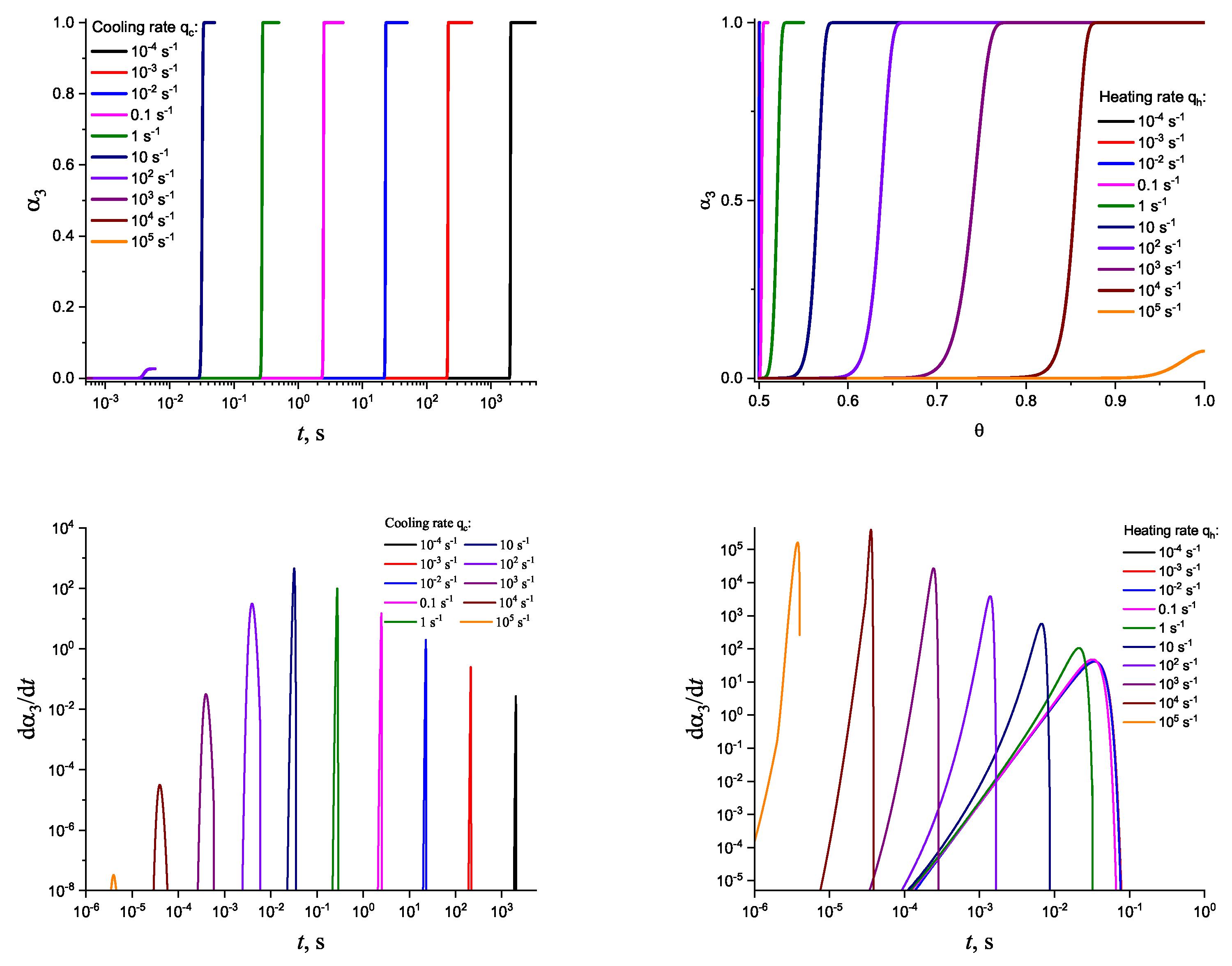
Figure 3.
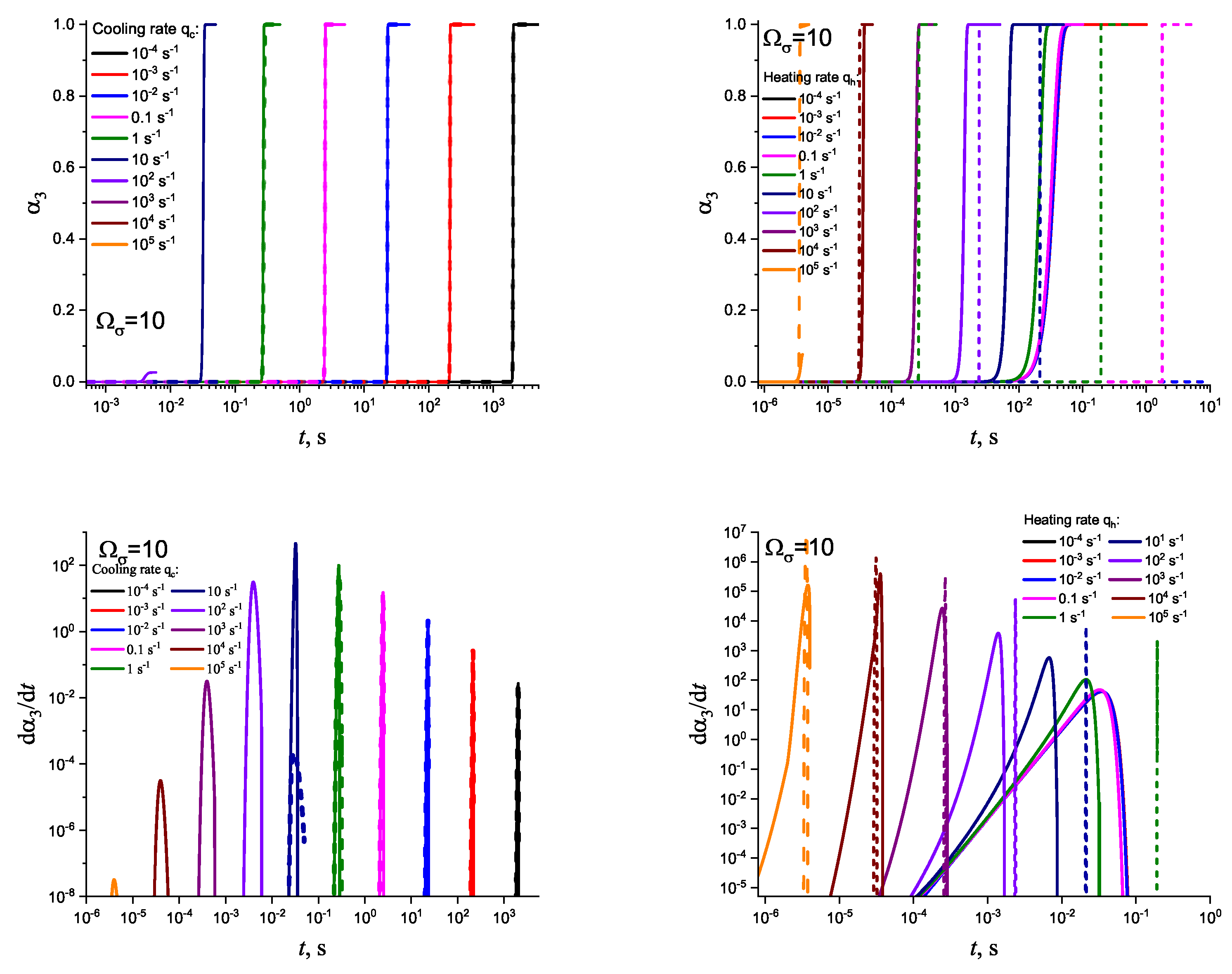
Determination of the degree, , and the rate, , of overall crystallization in dependence on time, t, in cooling (left side) and heating (right side) for sets of cooling () and heating () rates as shown in the figures. In the presentation of the results of the numerical computations, we always express the heating rate in reduced variables as . Cooling is started at a temperature equal to , while heating is supposed to start at a temperature .
Figure 3.
Determination of the degree, , and the rate, , of overall crystallization in dependence on time, t, in cooling (left side) and heating (right side) for sets of cooling () and heating () rates as shown in the figures. In the presentation of the results of the numerical computations, we always express the heating rate in reduced variables as . Cooling is started at a temperature equal to , while heating is supposed to start at a temperature .
In order to employ above equation, we have to specify the values of the critical cluster size, , and the value of the number of critical clusters per unit volume, , at some given time, t. Latter parameter can be determined via classical nucleation theory. In order to have an estimate for we can use the expression for the steady-state cluster size distribution [5,6]
where is the number of monomers per unit volume in the system and the actual value of the work of critical cluster formation. This approach implies that the change of the external parameters is not too fast so that steady-state conditions can be established in the range up to the critical cluster size at each moment of time. Combining above given relations and Eqs. (10) and (11), we obtain
or, with Eq. (27),
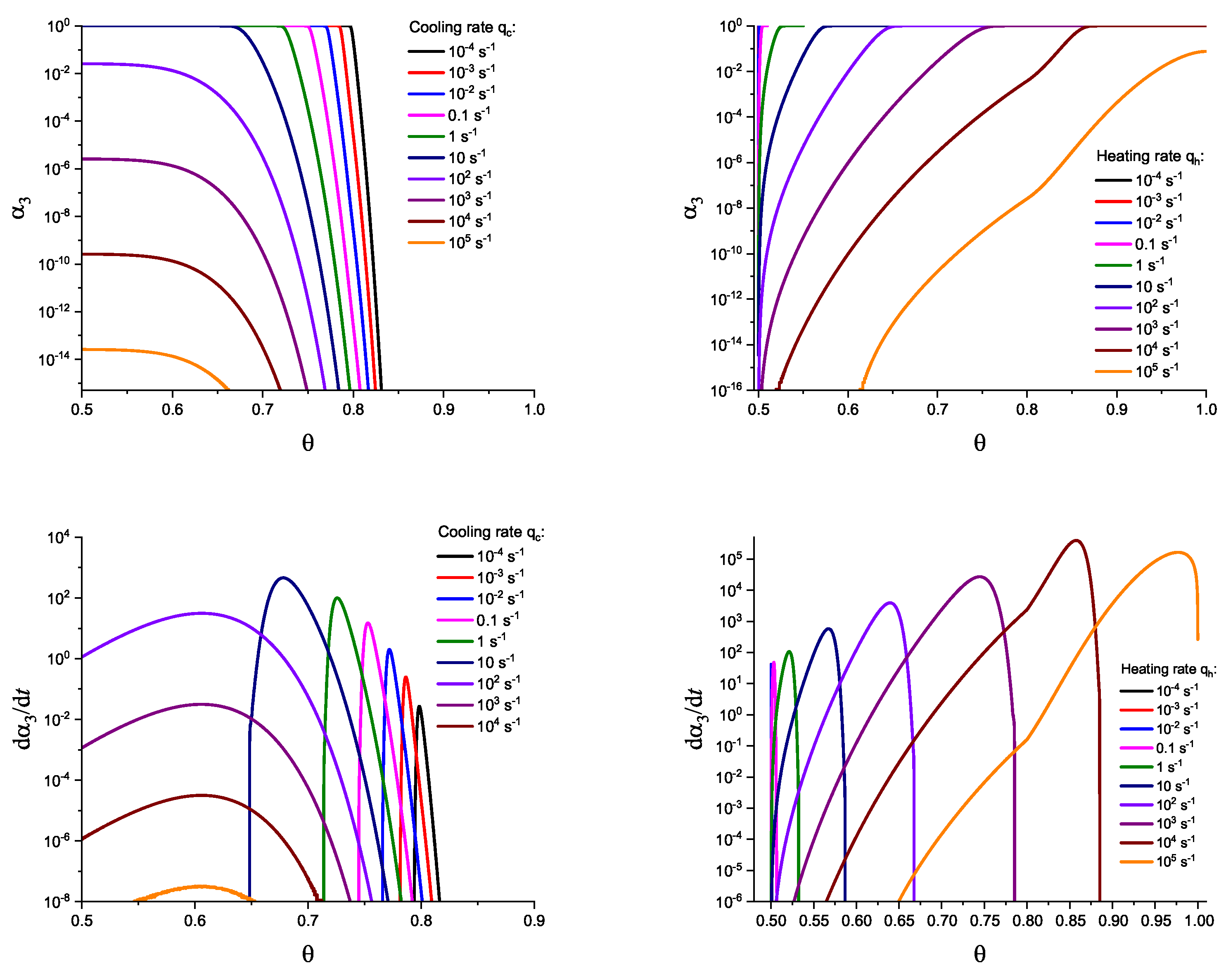
Figure 4.
Determination of the degree, , and the rate, , of overall crystallization in dependence on temperature, , in cooling (left side) and heating (right side) for sets of cooling () and heating () rates as shown in the figures.
Figure 4.
Determination of the degree, , and the rate, , of overall crystallization in dependence on temperature, , in cooling (left side) and heating (right side) for sets of cooling () and heating () rates as shown in the figures.
The account of athermal nucleation leads, consequently, to a change in the pre-factor, , in the expression for the steady-state nucleation rate (cf. Eq. (27)).
As a second possible generalization, (ii) time–lag effects in nucleation have to be accounted for [5,6,34,39,40,41,42]. Its incorporation requires an appropriate description of the approach to steady-state conditions and estimates of the time-lag in nucleation, . The time–lag in nucleation is the time required to reach steady–state cluster size distributions [5,6,43]. Assuming that initially the liquid consists only of monomers (atoms, molecules), the time–lag in nucleation can be estimated as [5,6,21]
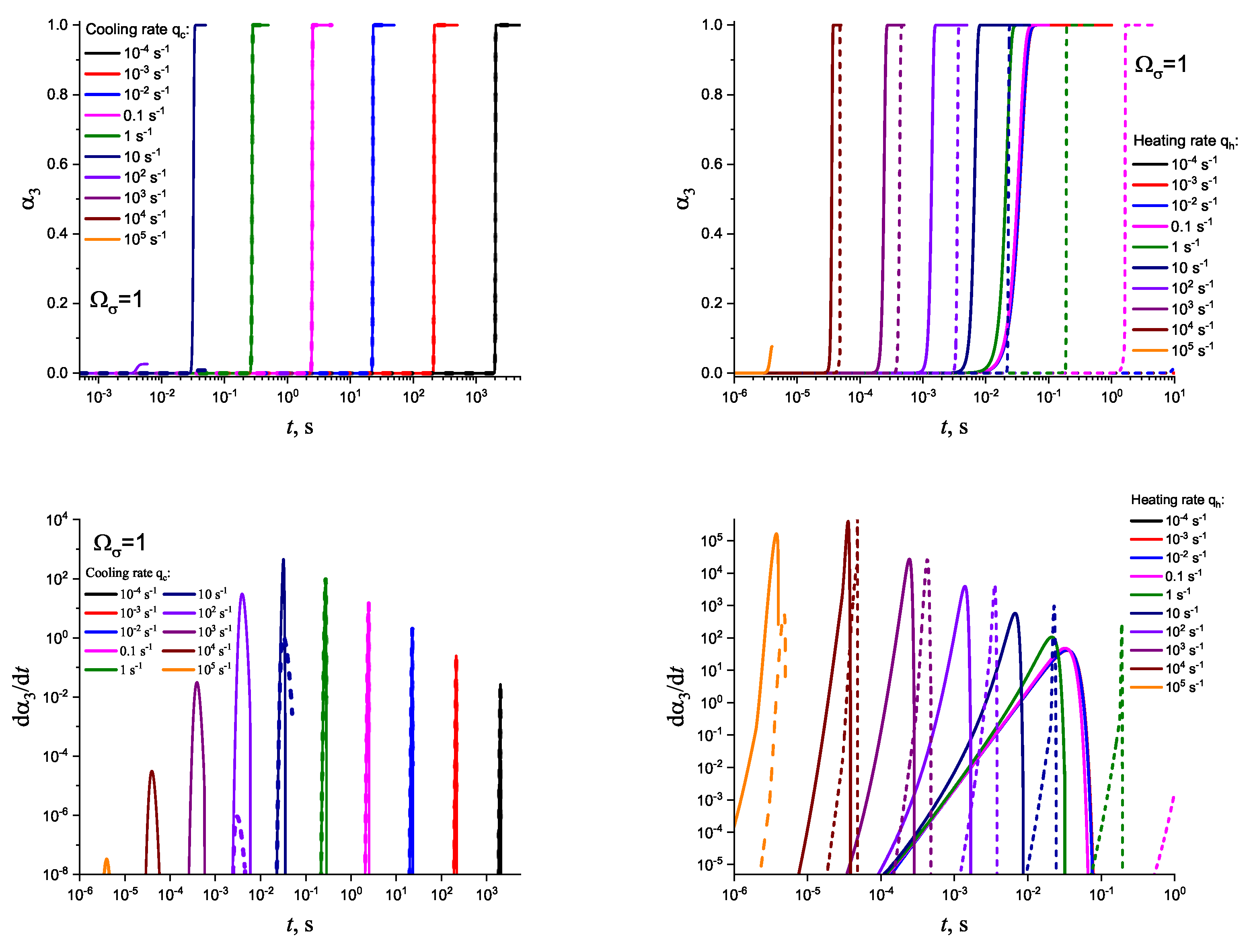
Figure 5.
Determination of the degree, , and the rate, , of overall crystallization in dependence on time, t, in cooling (left side) and heating (right side) for sets of cooling () and heating () rates as shown in the figures. In contrast to Figure 3, here the effect of deviations of the state of the liquid from metastable equilibrium is accounted for. The computations are performed utilizing Eqs. (58) and (59) with and . The results obtained in such way are shown by dashed curves, the curves shown in Figure 3Figure 4 are given for comparison in as full curves, again.
Figure 5.
Determination of the degree, , and the rate, , of overall crystallization in dependence on time, t, in cooling (left side) and heating (right side) for sets of cooling () and heating () rates as shown in the figures. In contrast to Figure 3, here the effect of deviations of the state of the liquid from metastable equilibrium is accounted for. The computations are performed utilizing Eqs. (58) and (59) with and . The results obtained in such way are shown by dashed curves, the curves shown in Figure 3Figure 4 are given for comparison in as full curves, again.
The numerical factor varies in the range depending on the method employed in the derivation of Eq. (53). Above the decoupling temperature, , the product becomes widely independent of temperature since in this range the Stokes-Einstein-Eyring relation may be employed, below not. However, considering cooling and heating, the value of the time-lag depends also on prehistory [40,41], it will be smaller in general as compared to the estimate given by this relation. Time-lag effects can for sure be neglected if the characteristic time of change of temperature, , in cooling and heating is small as compared with the time-lag in nucleation, i.e., if the condition
holds.
In general, the average time of formation of the first supercritical nucleus can be expressed in a good approximation as [39]
Provided steady-state conditions with respect to nucleation are established, the following relation,
holds for the time required to form the first supercritical cluster at such conditions. The condition is fulfilled in the temperature range near to the glass transition temperature and below. In this temperature range, moreover, is a good approximation. Effects of relaxation of the liquid on the overall crystallization can be expected theoretically to occur at . They affect then also the overall crystallization kinetics at higher temperatures.
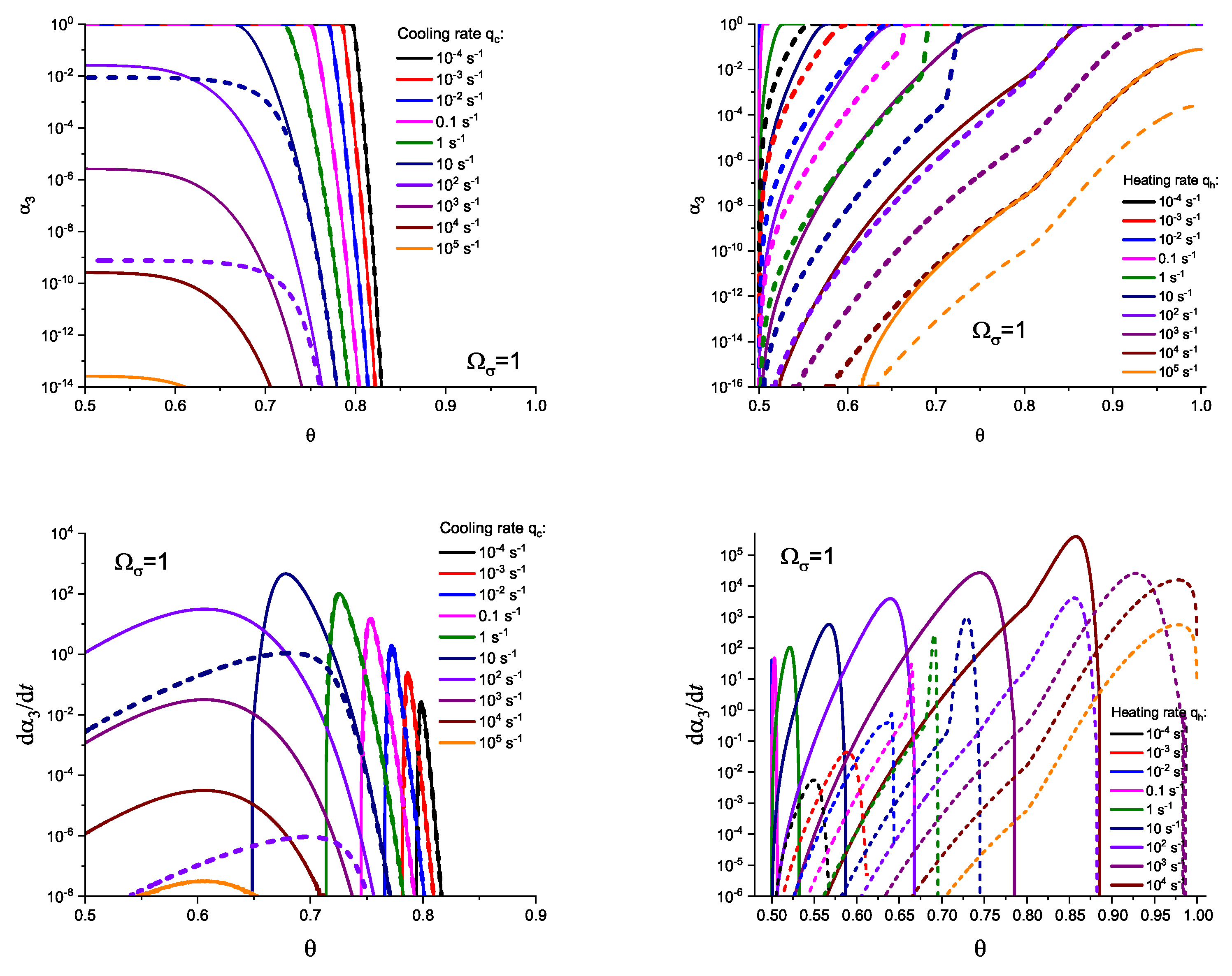
Figure 6.
Determination of the degree, , and the rate, , of overall crystallization in dependence on temperature, , in cooling (left side) and heating (right side) for sets of cooling () and heating () rates as shown in the figures. In contrast to Figure 4, here the effect of deviations of the state of the liquid from metastable equilibrium is accounted for. The computations are performed utilizing Eqs. (58) and (59) with and . The results obtained in such way are shown by dashed curves, the curves shown in Figure 3Figure 4 are given for comparison in as full curves, again.
Figure 6.
Determination of the degree, , and the rate, , of overall crystallization in dependence on temperature, , in cooling (left side) and heating (right side) for sets of cooling () and heating () rates as shown in the figures. In contrast to Figure 4, here the effect of deviations of the state of the liquid from metastable equilibrium is accounted for. The computations are performed utilizing Eqs. (58) and (59) with and . The results obtained in such way are shown by dashed curves, the curves shown in Figure 3Figure 4 are given for comparison in as full curves, again.
In a third direction of advancement of the theoretical approach, (iii) the effect of interplay of elastic stress evolution and stress relaxation on nucleation and growth [5,6,28,29,30,31,32] in the temperature range near and below the glass transition temperature has to be accounted for. For crystal nucleation in viscous liquids, the effective value of the stress parameter , the elastic energy per particle of the crystal phase, is determined by the interplay of stress evolution (caused by the formation of a crystallite) and stress relaxation accompanying this process. Assuming, as done here, that relaxation is described by Maxwell’s relaxation law, the effective value of for a crystallite of critical size is given by
Here is the respective value for crystallization in a Hookean solid. The effect of the interplay of evolution of elastic stresses caused by crystal nucleation and relaxation in the description of nucleation is determined by the ratio . It results also in an increase of the surface tension as described in [21]. The effect of the interplay of stress evolution and relaxation in crystal growth in glass-forming liquids is described in [44,45], it is also determined by this ratio of characteristic time scales, .
Figure 7.
Determination of the degree, , and the rate, , of overall crystallization in dependence on time, t, in cooling (left side) and heating (right side) for sets of cooling () and heating () rates as shown in the figures. In contrast to Figure 3, here the effect of deviations of the state of the liquid from metastable equilibrium is accounted for. The computations are performed utilizing Eqs. (58) and (59) with and . The results obtained in such way are shown by dashed curves, the curves shown in Figure 3Figure 4 are given for comparison in as full curves, again.
Figure 7.
Determination of the degree, , and the rate, , of overall crystallization in dependence on time, t, in cooling (left side) and heating (right side) for sets of cooling () and heating () rates as shown in the figures. In contrast to Figure 3, here the effect of deviations of the state of the liquid from metastable equilibrium is accounted for. The computations are performed utilizing Eqs. (58) and (59) with and . The results obtained in such way are shown by dashed curves, the curves shown in Figure 3Figure 4 are given for comparison in as full curves, again.
Further extensions of the approach described above are eventually required accounting for (iv) the possible dependence of the bulk properties of critical clusters on supersaturation [37,46], (v) self–consistency corrections of the steady-state nucleation rate [47], (vi) the possible dependence of the kinetic coefficients on the structural order parameter [5,6], (vii) a more precise description of the scenario and the kinetics of relaxation (see e.g., [5,6,21,28,34]) and (viii) a more detailed description of the glass-forming melts including the extension of the model to several structural order parameters, (ix) the account of Ostwald’s rule of stages (or Ostwald’s step rule) [48], of secondary nucleation [49], of both bulk and surface crystallization [50,51], of the evolution of rigid amorphous fractions [52] on the overall–crystallization process. Another circle of questions is connected with (x) the problem whether a spinodal or a pseudospinodal may exist in and, consequently, affect melt crystallization [41,53,54,55,56]. Latter question is addressed in detail in Appendix A.
To our point of view, all these (and possible further) factors are expected eventually to affect quantitatively the results but not the general qualitative features of the effect of relaxation of the melt on overall crystallization as described in the next sections.
3. Results of Numerical Computations
In Figure 3Figure 4, we present results of numerical computations modeling the evolution of the degree of overall-crystallization, , for the model considered assuming steady-state nucleation and growth in three () independent directions. In the computations shown in these figures it is assumed that deviations of the state of the liquid from metastable equilibrium can be neglected. The steady-state nucleation rate and the growth rates are described then by a dependence on temperature as shown in Figure 2. In cooling, the process is started at the melting temperature, in heating at sufficiently low temperatures equal to . In the initial states, the liquid is considered as free of crystalline particles. In Figure 3, the process is shown in dependence on temperature, while in Figure 4 the same quantities are given as functions of the reduced temperature. A significant dependence of the shapes of the respective curves on cooling and heating rates is observed. In particular, the crystallization peak temperatures (corresponding to or ) are shifted to lower temperatures with increasing values of the cooling rate, . In contrast, for heating processes, the crystallization peak temperature is shifted to higher values with increasing heating rates, .
As the next step, we, again, present results of numerical computations modeling the evolution of the degree of overall-crystallization, , for the model considered assuming steady-state nucleation and growth in three () independent directions. However, in the computations shown in these figures it is assumed now that deviations of the state of the liquid from metastable equilibrium have to be accounted for. Deviations of the thermodynamic driving force and the surface tension caused by deviations from metastable equilibrium are described in a first approach by Eqs. (32) and (33). A comparison with Figure 3Figure 4 shows that deviations of the curves occur but they are relatively small. For comparison, we anyway present them in Appendix B (in Figure A1-Figure A2 there).
In addition, we employ here also an alternative model–independent approach for the determination of the effect of deviations of thermodynamic driving force and surface tension cause by deviations from metastable equilibrium as described in detail in [37]. In this approach, we determine these quantities via the relations
and
Different models are characterized here by different values of the parameters and . The results of computations shown in Figure 5, Figure 6, Figure 7 and Figure 8 are obtained setting and equal to two different values, (Figure 5Figure 6) and (Figure 7Figure 8), correspondingly. The results obtained in such way are shown by dashed curves, the curves shown in Figure 3Figure 4 are given for comparison as full curves, again. The dependence of the crystallization peak temperatures on cooling and heating rates obtained numerically for the different cases discussed is presented in Figure 9.
The main conclusions can be summarized as follow: (i) Deviations of the liquid from metastable equilibrium may significantly affect the overall course of the crystallization kinetics. (ii) The influence of these deviations is more important for heating as compared to cooling processes. (iii) Both in cooling and heating the overall crystallization process may be not completed for sufficiently high cooling and heating rates in agreement with experiment. This effect determines to a large degree the glass–forming ability of a given substance as discussed in connection with kinetic criteria of glass–formation in terms of the TTT–diagrams [5,6,57] utilizing the JMAK-equations. It is found also in the computations that the critical heating rate is about one order of magnitude higher than the critical cooling rate as it is observed commonly in experiments [58,59,60,61]. (iv) In heating, deviations from metastable equilibrium originally inhibit nucleation (as far as the condition holds). This effect occurs for relatively low temperatures (cf. Figure 1). For higher temperatures (at ), we have the opposite situation. Deviations from equilibrium accelerate nucleation. Mentioned effects increase with an increase of the value of the parameter determining the magnitude of changes of the surface tension caused by deviations from metastable equilibrium. (v) The nucleation peak temperatures depend significantly on the cooling and heating rates. The peak temperatures in cooling are weakly affected by the degree of deviation of the liquid from equilibrium, in heating, the effect is large. These dependencies and the origin of mentioned differences are studied theoretically in detail in the subsequent section (Section 4).
4. Theoretical Analysis
4.1. Some General Considerations
In the preceding section, results of numerical computations have been presented showing the change of the degree of crystallization of a liquid in cooling and heating modeled in terms of the JMAK-equation, Eqs. (10) and (11),
The main attention is devoted hereby to the analysis of the problem, at which conditions and to what extent crystallization is affected by the relaxation of the glass-forming liquid to the respective metastable equilibrium state. As discussed in detail in previous papers [21,23,37,41], it is determined by the ratio of the average time of formation of the first supercritical nucleus, , and the relaxation time, , being equal to the time scale in the approach to thermodynamic equilibrium. Deviations from metastable equilibrium and relaxation processes to it may affect crystal nucleation and growth if the condition is fulfilled. In cooling and heating, the interplay of relaxation and nucleation and growth affects significantly the whole course of overall crystallization, in particular, the dependence of the crystallization peak temperatures on cooling and heating rates. These dependencies are shown in Figure 9 as obtained via the numerical computations. Section 4.2 is devoted to an analytical description of these results.
4.2. Cold Crystallization Peak Temperature in Heating as a Function of the Heating Rate: Homogeneous Nucleation
Solving above given relations numerically, we can determine, as a special case, the temperatures of the crystallization peaks, , widely discussed in the analysis of experimental data in cooling and heating (e.g., [1,2,3,17,19,62]). In the present section, we will derive simple relations for the dependence of the cold-crystallization peak temperature on the heating rate and similarly for the crystallization peak temperature in cooling for the case of heterogeneous nucleation extending the analysis performed in [62]. In this procedure, certain approximations may be employed connected with the locations of the maxima of nucleation and growth rates in dependence on temperature.
Indeed, from a theoretical point of view, it can be shown that intensive homogeneous nucleation occurs in a relatively small range of temperatures (see Figure 10), with a maximum near to the glass transition temperature, , defined in the classical form proposed by Tammann [38] as related to a viscosity of Pa s. This maximum is caused by the interplay of thermodynamic and kinetic factors dominating the crystal nucleation process. The kinetic factor is correlated with the diffusion coefficients significantly decreasing with decreasing temperature. The maximum of the growth rates is located, as a rule, at much higher temperatures.
By this reason, in experiments, Tammann’s development method (see e.g., [5,6,58,59,60,61]) is commonly employed in the analysis of crystal nucleation. The formation of crystal nuclei is stimulated by choosing some well-defined nucleation temperature; then in order to detect these nuclei, the temperature is switched to higher values to allow them to grow to detectable experimental sizes over reasonable experimental time scales. However, for heterogeneous nucleation the maximum of the growth rate may be located at higher temperatures compared to the maximum of the nucleation rate quite near to the melting temperature. These differences in the locations of the maxima of nucleation and growth rates supply us, as will be shown, with the key to the understanding of differences in the overall crystallization behavior in cooling and heating observed experimentally and reflected also in the numerical computations.
Considering first crystallization in heating with a constant rate, , Eqs. (60) may be reformulated as
The number of supercritical crystallites, N, formed via homogeneous nucleation in heating, we can describe approximately then by the relation
Here is the temperature corresponding to the maximum of the steady-state nucleation rate, and the temperature range, where nucleation effectively occurs. It can be determined by
Increasing the heating rate, consequently, results in a decrease of the number of supercritical clusters formed.
Utilizing these relations, Eq. (61) can be reformulated as
Accounting for the mathematical identity
the second term in this relation can be rewritten as
Here obeys the condition . Setting in approximately equal to , we get in this way a simple first estimate for the dependence of the change of the overall crystallization on temperature. In an alternative approximation, one could also expand the growth rate, u, into a Taylor series in the vicinity of including second order terms in the differences allowing to express the degree of overall crystallization as a function of temperature. Here we will, however, concentrate the attention on one particular feature of the –curves, the dependence of the crystallization peak temperature, , on the heating rate, q.
The cold crystallization peak in heating corresponds to the maximum of the derivatives, , of the overall crystallization curves or, equivalently, the inflexion point of the –curves. It is determined by . Utilizing Eq. (64), we obtain as a consequence
This is the most general relation for the determination of the crystallization peak temperature. However, its application leads to quite complex expressions. On the other hand, Eq. (67) implies that
is fulfilled.
Latter condition is realized if
Taking the differential of , we obtain
and, computing the derivatives,
Employing Eq. (65), we may rewrite this relation as
Here obeys the condition . Setting in approximately equal to , we get in this way a simple first estimate for the dependence of the change of the peak temperature in overall crystallization. In any of these relations, the crystallization peak temperature increases with increasing heating rate and is determined widely by the dependence of the growth rate on temperature and, in particular, by the value of the activation energy for diffusion, (cf. Eqs. (36) and (37)).
For , Eq. (69) predicts and from Eqs. (71) and (72) we arrive at the dependence in this limit. Both limiting conditions are fulfilled in the dependence of on heating rate obtained numerically and shown in Figure 9. Accounting for deviations from metastability, then, in particular, the maxima of the nucleation rates become also dependent on heating rate. Qualitatively, it can be stated that the maxima of the nucleation rate are shifted to higher values, by this reason also the crystallization peak temperatures are located at higher temperatures at the same heating rates. Note also that in [62] it was shown experimentally that at a sufficiently high heating rates the crystallization peak temperature may become independent of the heating rate after an initial increase, as shown here in Figure 9, instead a plateau is reached. Such kind of behavior obviously requires the incorporation of additional factors like, eventually, athermal nucleation into the description via the JMAK–equation. This problem will be analyzed in detail in a future study.
4.3. Crystallization Peak Temperature in Cooling as a Function of the Cooling Rate: Heterogeneous Nucleation
Considering homogeneous nucleation in cooling starting at the melting temperature, , the situation is quite different as compared to heating. Perceptible nucleation occurs only at low temperatures and the clusters formed in this range cannot grow already significantly in further cooling. However, for heterogeneous nucleation, the situation is quite different [64,65]. Here we can have in cooling a quite similar scenario as discussed for homogeneous nucleation in heating. Indeed, assuming that all heterogeneous nucleation sites become active immediately at the beginning of the cooling process, Eqs. (23) and (60) result in
With
we obtain
The analysis of these relations can now be performed practically in an identical way as done in the previous section for overall crystallization in heating. Instead of Eq. (69), we can utilize, now, the relation
Here obeys the condition . For , we have and , again. For zero cooling rates, the peak temperature should be located at in the present case. This necessary condition of validity of the approach is, consequently, fulfilled, again.
5. Summary of Results and Discussion
The results of the present analysis can be summarized as follows: (i) Relations of the form of Eq. (14) and their consequences, like Eqs. (15)-(19), are not applicable any more to the description of the overall crystallization kinetics if relaxation processes of the glass-forming liquid to the respective metastable equilibrium state have to be accounted for. The analysis has to be performed based on the general relations given by Eqs. (10) and (11). The same statement is valid for heterogeneous nucleation since the growth rates become dependent on time. In line with latter two relations, the degree of crystallization at some given time is not a function of temperature but a functional of combinations of the nucleation and growth rates. (ii) Both at isothermal conditions and at cooling and heating with some given rate of change of temperature, overall crystallization processes may significantly depend on the degree of deviation of the liquid from equilibrium. This effect is more pronounced for nucleation as compared to growth as far as the commonly observed location of the maxima of nucleation and growth rates is realized for the system under consideration. The maximum of the nucleation rate is for homogeneous nucleation commonly located at lower temperatures as compared to the maximum of the growth rates. By this reason, nucleation proceeds predominantly in temperature ranges where deviations from metastable equilibrium are of significant importance. This effect is less pronounced for growth processes proceeding at higher temperatures. (iii) Both for cooling and heating, the thermodynamic driving force is as a rule larger as compared with the case when the liquid is in the corresponding metastable equilibrium state. However, the surface tension behaves differently, it is larger for cooling processes and may become in heating smaller as compared with the value corresponding to nucleation in a metastable liquid. These differences in the surface tension and the thermodynamic driving force of crystallization as compared with the case that the liquid is in a metastable state are the origin of the hysteresis effects in crystal nucleation discussed here. They may result in nucleation flashes and, more generally, in the "flare-up" of fluctuations at heating as discussed first long ago by Porai-Koshits, Mazurin and coworkers and noted also by Davis [66,67,68,69] (for details see also [70,71]). These effects are of particular significance if driving force and surface tension deviate significantly for cooling and heating, i.e., if deviations of the liquid from metastable equilibrium affect considerably thermodynamic driving force and surface tension. The mechanism of nucleation and growth as outlined here gives in this way a principally new method of treatment of hysteresis effects in overall crystallization in cooling and heating and of the nucleation flashes in heating, in particular. (iv) The analysis of nucleation-growth processes at changing temperatures is a much more complex problem as compared to the theoretical treatment of this process at isothermal process conditions. Extending previously obtained results, in [13] the average time of formation of the first supercritical nucleus in cooling and heating was specified. These results allow one to determine the time and temperature when the nucleation–growth processes become of importance. The crystallization peak is determined, then, as the result of nucleation and subsequent growth of the supercritical clusters proceeding after the first nucleus has been formed. Different approaches have been developed in the past to describe this overall crystallization process analytically [7,8,9,10,11,12,13,14,15,16,17,18,19,20]. In most of these attempts, the degree of crystallization or the location of the crystallization peak temperature is expressed as some function of temperature introducing some activation energy chosen in such a way that the degree of crystallization and the crystallization peaks are specified more or less correctly. From a mathematical point of view, the degree of crystallization is described then as a function of temperature. However, such treatment is, from a principal point of view, not correct and can be only an approximation. Indeed, the degree of overall crystallization is, as evident from Eqs. (10) and (11) or Eq. (61), a functional of nucleation and growth rates. As evident from these relations, several parameters like the work of critical cluster formation, the thermodynamic driving force for cluster growth and the activation energy for diffusion significantly affect the values of the functionals. Employing the differences in the locations of the maxima of nucleation and growth rates in dependence of temperature, in the present approach the degree of crystallization could be expressed as a functional only of the growth rates. This method leads to adequate expressions for the dependence of the crystallization peaks on the rates of change of temperature as shown in the present paper. In line with the approximation, the effective activation energy for diffusion is the dominant parameter determining mentioned dependence. As shown this approach is appropriate for dominant homogeneous nucleation in heating and dominant heterogeneous nucleation in cooling. The possibility to model the crystallization peak temperature in heating via the Kissinger equation can be correlated in this way with the validity of the model employed by us for heating (and similarly for heterogeneous nucleation in cooling). (v) A variety of additional factors may have to be incorporated into the present theory as reviewed briefly in Section 2.3. They may lead to quantitative modifications of the results. However, the general conclusions concerning the necessity to account deviations of the state of the liquid from metastable equilibrium for a correct description of the kinetics of overall crystallization will remain, as we deeply believe, unchanged. The approach to such quantitatively more correct treatment we consider as a task to be solved in future analyses.
Author Contributions
All authors contributed significantly to the present paper. J.W.P.S. wrote the manuscript. T.V.T. performed the numerical computations and prepared the figures. All authors intensively participated in the discussion of the problems outlined and the different variants of the manuscript and have read and agreed to the published version of the manuscript.
Funding
This research received no external funding.
Institutional Review Board Statement
Not applicable.
Data Availability Statement
Not applicable.
Acknowledgments
J.W.P.S. would like to express his deep gratitude to Vladimir M. Fokin (Salvador de Bahia, Brazil & St. Petersburg, Russia) and Alexander S. Abyzov (Kharkov, Ukraine) for prolonged intensive discussions of the interplay of relaxation and crystallization and to Gyan P. Johari (Hamilton, Canada) on a variety of aspect of the theoretical description of glasses and the glass transition giving the basis for the present study.
Conflicts of Interest
The authors declare no conflict of interest.
Appendix A. Characteristic times of relaxation and crystallization: Some general considerations
A variety of specific features of crystal nucleation and growth as compared with other types of first-order phase transformations are caused by the possibility that the liquid may not crystallize with increasing deviations of its state from equilibrium but may be transferred into a glass. One particular problem in this connection consists in the analysis of possible ways of resolution of the Kauzmann paradox [53] i.e., in the discussion of the question whether liquids may reach in cooling metastable equilibrium states with lower volume density of entropy as compared to the crystal or not. The temperature at which the entropy densities of liquid and crystal become identical is denoted today as Kauzmann temperature, . As one of the mechanisms preventing such seemingly paradoxical situation, Kauzmann suggested that slightly above this temperature (at the pseudo-spinodal curve as it was denoted by him) intensive crystallization takes place precluding the realization of such states.
Kauzmann himself denoted the temperature of occurrence of the pseudo-spinodal originally also as and discussed also different possibilities of location of the defined by him temperature as compared to the glass transition temperature, , and its consequences ([53], pages 247-248 (I would like to thank Gyan P. Johari reminding me this point)). In particular, he wrote: "Let us denote by the temperature at which the two kinds of barriers become equal. may be above or below the glass–transformation point, , as defined in terms of the ’conventional’ duration of an experiment. If is above , it will be impossible for the liquid to be studied as a liquid at temperatures between and , other than by experiments of much shorter duration than the ’conventional’ one, since it will crystallize spontaneously during any experiments requiring more time than the average time between simple molecular jumps. According to the concepts presented in the previous part of this paper, adequate measurements under these circumstances would result in glass–like properties for the liquid. On the other hand, if is below , it is still possible to distinguish between a glassy state and a true metastable liquid between and . But below no such distinction is possible; the glass is then the only experimentally attainable form of the liquid …Accordingly, provided the free energy barriers vary with the temperature in the way that we have postulated, it is not permissible to extrapolate the curves in Figure 3 to 6 indefinitely below and to infer thereby the existence of a ’thermodynamic’ glass–like transition."
In this discussion [53], Kauzmann distinguished two sources for metastability in glass-forming systems, metastability connected with the work of critical crystal cluster formation required for liquid-crystal phase transitions and metastability caused by the necessity to form an activated complex in order to realize transport processes like diffusion or viscous flow. Discussing the dependence of both types of activation barriers on temperature, he wrote: "Suppose that when the temperature is lowered a point is eventually reached at which the free energy barrier to crystal nucleation becomes reduced to the same height as the barriers to the simpler motions…At such temperatures the liquid would be expected to crystallize just as rapidly as it changed its typically liquid structure to conform to a temperature or pressure change in its surroundings …There are good theoretical reasons for believing in the existence of such a ’pseudo–critical temperature’" ([53], pages 220 and 247).
Kauzmann distinguishes such pseudo-critical states from critical points or states along the spinodal curve noting: "In the past there has been a considerable amount of speculation concerning the existence of a critical point between crystalline and liquid states analogous to the critical point between liquids and gases. No experimental evidence for or against such a critical point has ever been found [72], though there is reason to believe that none is possible (Bernal [73]; but see Frenkel …[74]). It is apparent, however, that the behavior with which we are here concerned has a certain similarity to the behavior at a critical point in that here, as at a true critical point, the free energy barrier between the crystal and the liquid disappears. On the other hand, there is a fundamental difference in that the two states do not really merge and their free energies are decidedly different …, so that one cannot go reversibly from the one state to the other without a normal phase change" ([53], page 248).
Meanwhile, the absence of a spinodal in one-component melt-crystallization was established by Skripov and Baidakov based on a thorough analysis of experimental data first in [75] and reconfirmed in [76,77]. The absence of the spinodal is connected with the absence of an equilibrium critical point on the coexistence curve liquid–solid as formulated first based on symmetry concepts by Landau [78,79]. Employing the basic concepts of classical nucleation theory (CNT) utilizing the thermodynamic theory of heterogeneous systems as developed by Gibbs [80], the conclusion of the absence of a spinodal in melt crystallization can be extended to multi-component systems as performed in [41]. In brief, according to CNT, the steady-state nucleation rate, J, can be expressed via the work of critical cluster formation, , as
The steady-state nucleation rate, J, is equal to the average number of supercritical crystal clusters formed per unit time in a unit volume of the melt, is a kinetic pre-factor determined by the kinetics of aggregation. In Eq. (A1), is the Boltzmann constant, and T the absolute temperature. Assuming a spherical shape (choosing the surface of tension as the dividing surface), the surface area of the critical cluster is given by , where is the critical cluster radius. It is determined by the ratio of the surface tension, , and the thermodynamic driving force of crystallization, , as . The thermodynamic driving force of nucleation in dependence on temperature is given generally in the form [5,6]
Here is the melting or liquidus temperature and the melting pressure corresponding to it. Approximately, it may be written as
Assuming validity of the Stefan-Skapski-Turnbull relation [5,6], for moderate deviations from equilibrium the surface tension can be approximately expressed by [41]
It may be transformed to
At the Kauzmann temperature, the thermodynamic driving force approaches a maximum [41] and employing the approximation for the surface tension latter quantity tends to zero. Despite the approach of zero of the surface tension (which may be not correct in a more accurate description), crystallization of liquids does not exhibit features indicating the possible identity of liquid and crystal states as it is the case at the critical point and the spinodal in liquid-gas transitions or segregation processes in solutions. The existence of a spinodal curve requires a simultaneous approach of both thermodynamic driving force and surface tension to zero since both phases become here indistinguishable. These conditions are not fulfilled.
A similar point of view has been expressed by Kelton and Greer ([81], page 107) in the discussion of the behavior of the work of critical cluster formation, , for some model computations, where latter quantity also tends to zero. They note: "The decrease of to zero is a failing of this particular model, since there is no point at which the liquid becomes unstable relative to the solid." They then continue: "Nonetheless, it does indicate that a properly constructed density-functional model could describe the transition from a nucleation-and-growth mechanism to a spinodal transformation, which the CNT cannot do". Some eventually possible scenarios in this direction (account of the dependence of the bulk state parameters of the critical clusters on supersaturation, crystallization via preferential segregation of the liquid) are discussed in [37].
The second item, we would like to analyze is, whether a pseudo-spinodal exists, whether its existence results in a intensive increase of the rates of crystallization or whether the pseudo-spinodal may have some other implications. As well-known from CNT, the dependence of the steady-state nucleation rate on temperature is determined according to Eq. (A1) by the interplay of the thermodynamically based term (proportional to the probability of thermal fluctuations required to form a critical cluster, i.e., ) and the kinetic term (, where D is the diffusion coefficient determining the kinetics of aggregation in crystallization). The first term approaches zero at the melting temperature and (for ) in the limit . At typical conditions, it exhibits a maximum in between both limits as discussed, for example, by Tammann [82] and Turnbull (Figure 2 in [83]). The kinetic term decreases monotonically and significantly with decreasing temperature due to the decrease of the diffusion coefficient or the increase of the viscosity with decreasing temperature. As the consequence, the temperature dependence of the steady-state nucleation rate is characterized by a maximum [64] where the kinetic term (decrease of the diffusion coefficient) starts to overestimate the increase of the thermodynamic term. This maximum is found generally to be located near to the glass transition temperature, , according to the definition by Tammann [38] being equal to for a variety of glass-forming melts and equal to for metallic glass-forming alloys [5,6,53]. There are no indications in Eq. (A1) of a renewed dramatic increase of the nucleation rate at temperatures significantly below this maximum, which could be correlated with a pseudo-spinodal as suggested by Kauzmann. A huge amount of experimental data on crystallization proves that such type of the dependence of the steady-state nucleation rate on temperature is not an exception but the rule, experimentally no exceptions are observed.
As noted earlier, Kauzmann introduced his hypothesis of existence of a pseudo-spinodal in melt crystallization based on the assumption of the possible near-equality of the activation energies for diffusion and crystal nucleation at low temperatures, respectively, the approach of characteristic time-scales for relaxation, , and crystallization, correspondingly, i.e., . Following Kauzmann’s original argumentation, the relation of these characteristic time-scales is discussed intensively till now (for an overview, see [41]). As the characteristic time scale for crystallization, commonly the average time, , of formation of the first supercritical nucleus is chosen identified by different authors either with the time-lag, for steady-state nucleation at the given temperature (e.g., [84]) or, alternatively, as the time required to form the first supercritical crystallite at steady-state conditions, (e.g., [54]). Note that the second approach, followed actually also by Kauzmann, does not give a unique definition of the pseudospinodal. The result depends significantly on the volume, V, of the liquid. Moreover, the average time of formation of the first supercritical nucleus, , is determined, in general, as the sum of both these terms. As an approximate analytical estimate (see Eq. (11) in [39]), we can express as
The numerical factor varies in the range depending on the method employed in the derivation of Eq. (A7). Above the decoupling temperature, , the product becomes widely independent of temperature since in this range the Stokes-Einstein-Eyring relation may be employed, below not. Numerical estimates accounting, as necessarily required, for the decoupling of diffusion and relaxation lead to the conclusion that the condition for the pseudospinodal curve, , as formulated by Kauzmann is generally fulfilled near to the glass transition temperature.
This result can be given also an alternative verification. For crystal nucleation in viscous liquids, the effective value of the stress parameter , the elastic energy per particle of the crystal phase, is determined by the interplay of stress evolution (caused by the formation of a crystallite) and stress relaxation accompanying this process. Assuming, as done here, that relaxation is described by Maxwell’s relaxation law, the effective value of for a crystallite of critical size is given by
As shown in [5,6] and cited there papers, the effect of elastic stresses on crystal nucleation in glass-forming liquids is determined by the ratio, . is the respective value for crystallization in a Hookean solid. For temperatures sufficiently above the glass transition temperature, elastic stresses can be expected to be of minor importance, for glasses, they have to be of the order of magnitude as for Hookean solids. Consequently, in decreasing the temperature the ratio has to change from zero near to the melting temperature to very large values below the glass transition temperature to appropriately fulfil mentioned general condition. Consequently, the condition for the occurrence of the pseudo-spinodal as formulated by Kauzmann will be fulfilled as the rule near to the glass transition temperature . The steady-state nucleation rate has a maximum there but its dependence on temperature is well-reflected by the standard equations of CNT. As shown in [21,23,37] and demonstrated also in the present paper, in further cooling the liquid to states below the glass transition temperature, the steady-state nucleation rate is additionally decreased due to the interplay of relaxation and crystal nucleation. Consequently, the knowledge of the ratio is really of significant importance in modeling crystal nucleation but in quite another context as supposed originally by Kauzmann.
Appendix B. Application of the lattice–hole model in the computations and some possible generalization of this model
In the present appendix, we present results of numerical computations modeling the evolution of the degree of overall-crystallization, , for the lattice–hole model considered here assuming steady-state nucleation and growth in three () independent directions. again. The deviations of the state of the liquid from metastable equilibrium are described by Eqs. (32) and (33). The results are presented in Figure A1-Figure A2. A comparison with Figure 3Figure 4 shows that deviations of the curves occur but they are relatively small. By this reason, we would like to anticipate here a possible generalization of this model leading eventually to more pronounced results.
For the specification of the thermodynamic properties of glass–forming melts, we employ here relations derived from a simple lattice-hole model of liquids discussed in detail in [5,6]. The structural order–parameter is connected in the framework of this model with the free volume of the liquid and defined via the number of unoccupied sites (or holes), , per mole of the liquid each of them having a volume, , identical to the volume of a structural unit of the liquid at the same values of pressure and temperature. According to this model, the molar volume of the liquid is determined as
Here is the Avogadro number.
The thermodynamic functions of the system are described in the framework of this model by the sum of contributions resulting from the thermal motion of the molecules of the liquid and, in addition, from the configurational contributions described by the structural order-parameter, . The configurational contribution to the volume is given, consequently, by
The configurational contribution to the enthalpy, , of one mole of the liquid is described in the framework of this lattice-hole model via the molar heat of evaporation, , of the liquid at the melting temperature as
is a parameter which has to be determined appropriately. Experimental data show that the molar heat of evaporation can be expressed for a wide class of liquids in accordance with Trouton’s rule as
Figure A1.
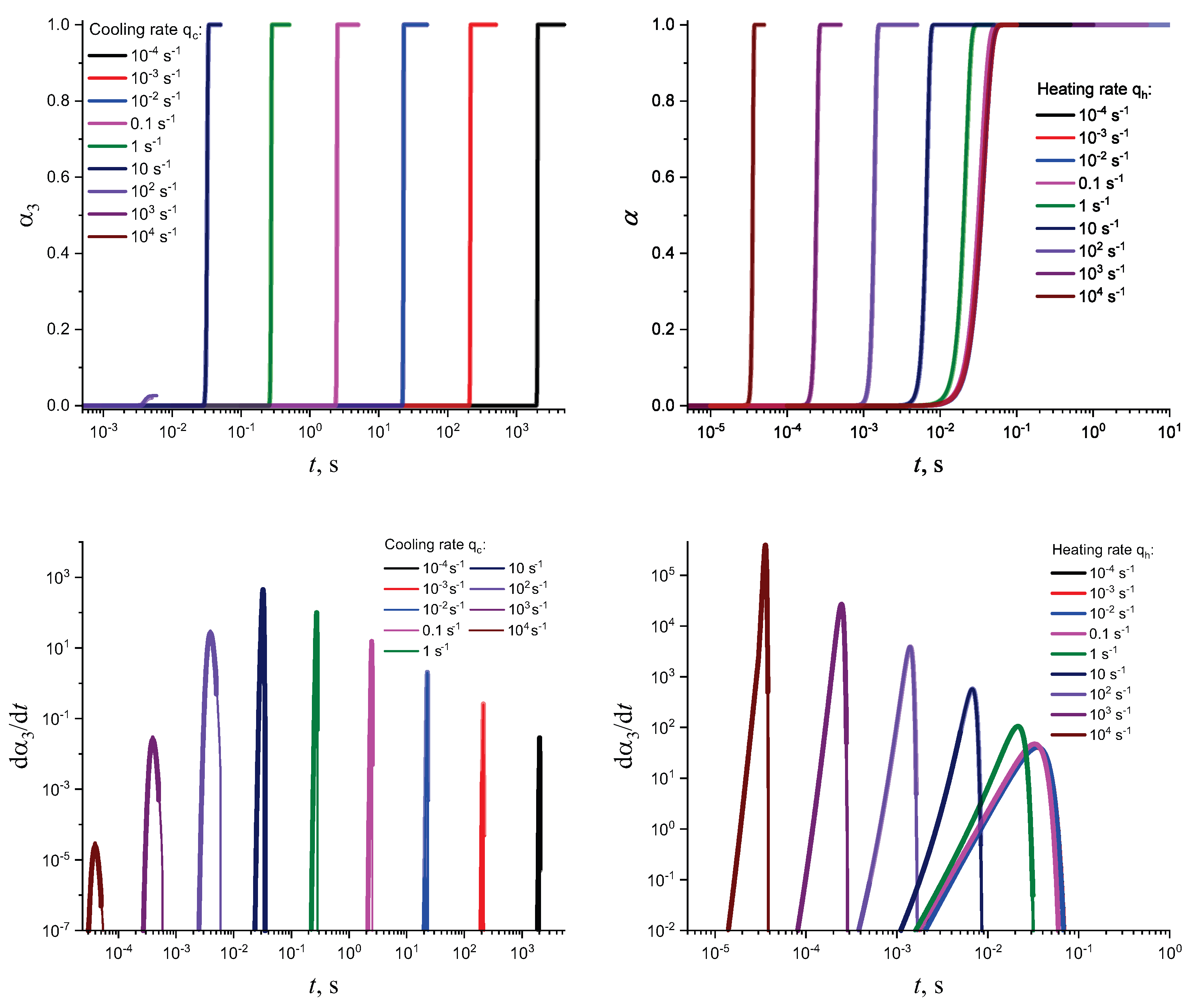
Determination of the degree, , and the rate, , of overall crystallization in dependence on time, t, in cooling (left side) and heating (right side) for sets of cooling () and heating () rates as shown in the figures. In contrast to Figure 3, here the effect of deviations of the state of the liquid from metastable equilibrium is accounted for. The computations are performed utilizing Eqs. (32) and (33).
Figure A1.
Determination of the degree, , and the rate, , of overall crystallization in dependence on time, t, in cooling (left side) and heating (right side) for sets of cooling () and heating () rates as shown in the figures. In contrast to Figure 3, here the effect of deviations of the state of the liquid from metastable equilibrium is accounted for. The computations are performed utilizing Eqs. (32) and (33).
According to Eq. (A11), is taken as a function of the melting temperature, . A much more reasonable and better assumption would be to take it equal to the respective value at the current temperature. In this way, we may formulate a generalization of Eq. (A11) in the form
Further, we can make the substitution
with
Figure A2.
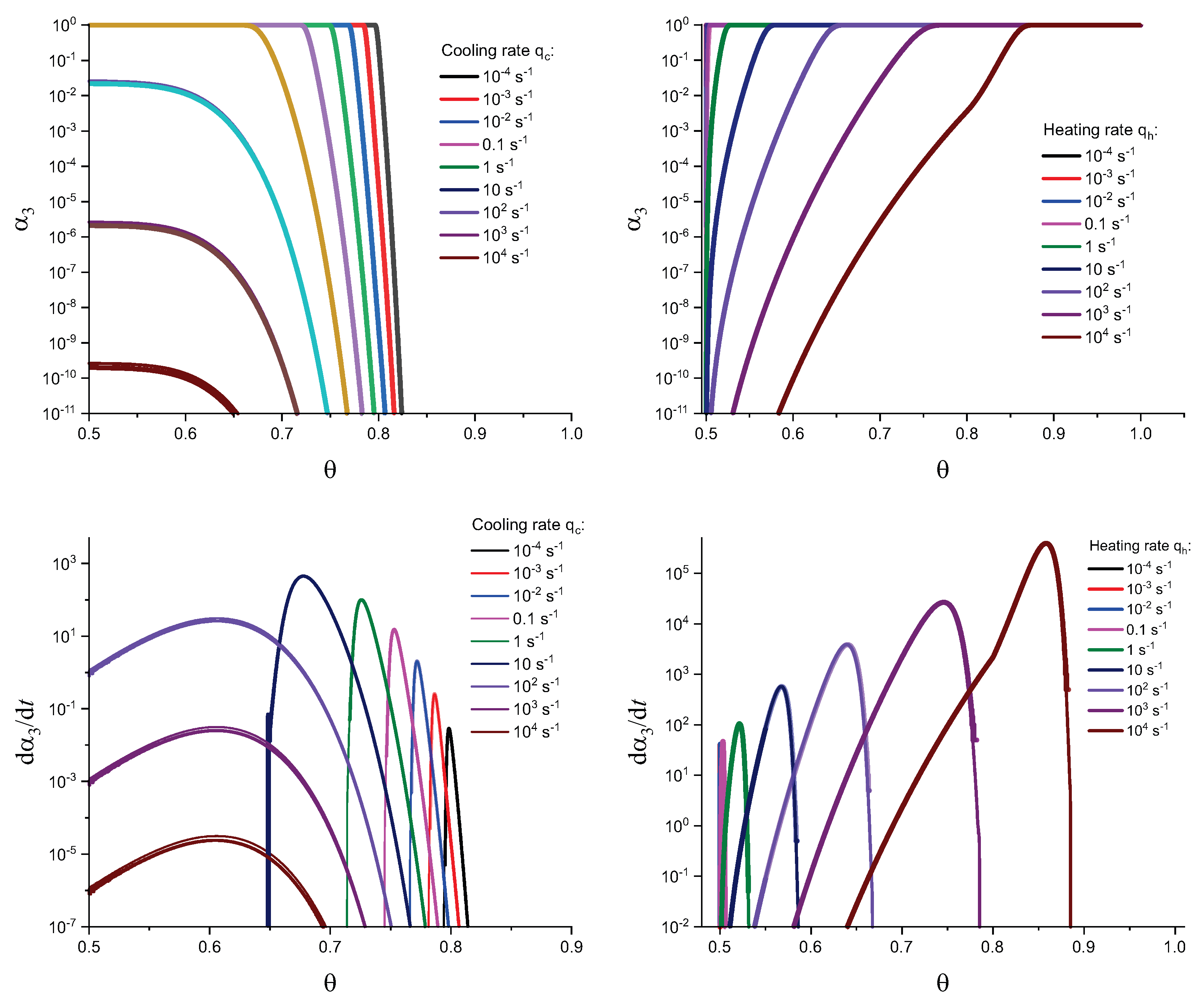
Determination of the degree, , and the rate, , of overall crystallization in dependence on temperature, , in cooling (left side) and heating (right side) for sets of cooling () and heating () rates as shown in the figures. In contrast to Figure 4, here the effect of deviations of the state of the liquid from metastable equilibrium is accounted for. The computations are performed utilizing Eqs. (32) and (33).
Figure A2.
Determination of the degree, , and the rate, , of overall crystallization in dependence on temperature, , in cooling (left side) and heating (right side) for sets of cooling () and heating () rates as shown in the figures. In contrast to Figure 4, here the effect of deviations of the state of the liquid from metastable equilibrium is accounted for. The computations are performed utilizing Eqs. (32) and (33).
The configurational contribution to the entropy per mole is described in this model via the conventional mixing term
With , we obtain for the configurational contribution to the internal energy and the Gibbs free energy
The equilibrium value of the structural order-parameter, , is determined via the relation resulting in
It is different from the result employed in the present analysis (Eq. (23)) and may lead to a more pronounced effect of deviations of the liquid from equilibrium on crystallization. A detailed analysis is considered to be of interest but out of the scope of the present paper.
References
- Yinnon, H.; Uhlmann, D.R. Applications of thermoanalytical techniques to the study of crystallization kinetics in glass-forming liquids, Part 1: Theory. J. Non-Crystalline Solids 1983, 54, 253–275. [Google Scholar] [CrossRef]
- Schick, C.; Mathot, V. (Eds.) Fast Scanning Calorimetry; Springer: Cham, Switzerland, 2016. [Google Scholar]
- Vyazovkin, S.; Sbirrazzuoli, N. Review: Nonisothermal Crystallization Kinetics by DSC: Practical Overview. Processes 2023, 11, 1438. [Google Scholar] [CrossRef]
- Skripov, V.P.; Koverda, V.P. Spontaneous Crystallization of Undercooled Liquids; Nauka: Moscow, Russia, 1984 (in Russian).
- Gutzow, I.S.; Schmelzer, J.W.P. The Vitreous State: Thermodynamics, Structure, Rheology, and Crystallization; Springer: Berlin/Heidelberg, Germany, 1995. [Google Scholar]
- Gutzow, I.S.; Schmelzer, J.W.P. The Vitreous State: Thermodynamics, Structure, Rheology, and Crystallization; 2nd ed.; Springer: Berlin/Heidelberg, Germany, 2013. [Google Scholar]
- Henderson, D.W. Thermal analysis of non-isothermal crystallization kinetics in glass-forming liquids. J. Non-Crystalline Solids 1979, 30, 301–315. [Google Scholar]
- Schmelzer, J.W.P.; Schmelzer, J., Jr. Kinetics of Nucleation at Increasing Supersaturation. J. Colloid Interface Sci. 1999, 215, 345–355. [Google Scholar] [PubMed]
- Kashchiev, D.; Borissova, A.; Hammond, R.B.; Roberts, K.J. Effect of cooling rate on the critical undercooling for crystallization. J. Cryst. Growth 2010, 312, 698–704. [Google Scholar]
- Yang, B.; Abyzov, A.S.; Zhuravlev, E.; Gao, Y.; Schmelzer, J.W.P.; Schick, C. Size and rate dependence of crystal nucleation in single tin drops by fast scanning calorimetry. J. Chem. Phys. 2013, 138, 054501. [Google Scholar]
- Yang, B.; Perepezko, J.H.; Schmelzer, J.W.P.; Gao, Y.; Schick, C. Dependence of crystal nucleation on prior liquid overheating by differential fast scanning calorimeter. J. Chem. Phys. 2014, 140, 104513. [Google Scholar] [PubMed]
- Tanaka, K.K.; Kimura, Y. Theoretical Analysis of Crystallization by Homogeneous Nucleation of Water Droplets. Phys. Chem. Chem. Phys. 2019, 21, 2410–2418. [Google Scholar] [CrossRef]
- Deubener, J.; Schmelzer, J.W.P. Statistical Approach to Crystal Nucleation in Glass-forming Liquids. Entropy 2021, 23, 246/1–28. [Google Scholar] [CrossRef]
- Todorova, S.; Gutzow, I.; Schmelzer, J.W.P. Kinetics of nucleation at increasing or decreasing supersaturation. In Nucleation Theory and Applications; Schmelzer, J.W.P., Röpke, G., Priezzhev, V.B., Eds.; Workshop Proceedings 2000–2002, Joint Institute for Nuclear Research Publishing Department: Dubna, Russia, 2002; pp. 215–233. [Google Scholar]
- Sestak, J.; Berggren, G. Study of the kinetics of the mechanism of solid–state reactions at increasing temperatures. Thermochimica Acta 1971, 3, 1–12. [Google Scholar] [CrossRef]
- Dimitra, K.; Konstantinos, C. Nonisothermal Crystallization Kinetics: Studying the Validity of Different Johnson–Mehl–Avrami–Erofeev–Kolmogorov (JMAEK) Based Equations. Thermochimica Acta 2021, 704, 179030. [Google Scholar] [CrossRef]
- Kissinger, H.E. Reaction kinetics in differential thermal analysis. Analytical Chemistry 1957, 29, 1702–1706. [Google Scholar] [CrossRef]
- Blaine, R.L.; Kissinger, H.E. Homer Kissinger and the Kissinger equation. Thermochimica Acta 2012, 540, 1–6. [Google Scholar] [CrossRef]
- Vyazovkin, S. Is the Kissinger Equation Applicable to the Processes that Occur on Cooling? Macromolecular Rapid Communications 2002, 23, 771–775. [Google Scholar] [CrossRef]
- Vyazovkin, S. Kissinger Method in Kinetics of Materials: Things to Beware and Be Aware of. Molecules 2020, 25, 2813. [Google Scholar] [CrossRef]
- Schmelzer, J.W.P.; Tropin, T.V.; Fokin, V.M.; Abyzov, A.S.; Zanotto, E.D. Effects of Glass Transition and Structural Relaxation on Crystal Nucleation: Theoretical Description and Model Analysis. Entropy 2020, 22, 1098. [Google Scholar] [CrossRef]
- Schmelzer, J.W.P.; Schick, C. Dependence of Crystallization Processes of Glass-forming Melts on Prehistory: A Theoretical Approach to a Quantitative Treatment. Physics and Chemistry of Glasses: European Journal of Glass Science and Technology 2012, B 53, 99–106. [Google Scholar]
- Fokin, V.M.; Abyzov, A.S.; Yuritsyn, N.S.; Schmelzer, J.W.P.; Zanotto, E.D. Effect of structural relaxation on crystal nucleation in glasses. Acta Materialia 2021, 203, 116472/1–13. [Google Scholar] [CrossRef]
- Schmelzer, J.W.P.; Tropin, T.V. Reply to "Comment on ’Glass Transition, Crystallization of Glass-Forming Melts, and Entropy’" by Zanotto and Mauro. Entropy 2018, 20, 704–1. [Google Scholar] [CrossRef]
- Golovchak, R.; Kozdras, A.; Balitska, V.; Shpotyuk, O. J. Step-wise kinetics of natural physical ageing in arsenic selenide glasses. J. Phys.: Condens. Matter 2012, 24, 505106/1–10. [Google Scholar] [CrossRef]
- Lijian Song; Wei Xu; Juntao Huo; Jun-Qiang Wang; Xinmin Wang; Runwei Li Two–step relaxations in metallic glasses during isothermal annealing. Intermetallics 93 2018, 93, 101–105. [CrossRef]
- Morvan, A.; Delpouve, N.; Vella, A.; Saiter–Fourcin, A. Physical aging of selenium glass: Assessing the double mechanism of equilibration and the crystallization process. Journal of Non-Crystalline Solids 2021, 570, 121013. [Google Scholar] [CrossRef]
- Schmelzer, J.W.P.; Müller, R.; Möller, J.; Gutzow, I.S. Elastic Stresses, Stress Relaxation, and Crystallization: Theory. Physics and Chemistry of Glasses 2002, 43 C, 291–300. [Google Scholar]
- Schmelzer, J.W.P.; Müller, R.; Möller, J.; Gutzow, I.S. Theory of Nucleation in Viscoelastic Media: Application to Phase Formation in Glassforming Melts. J. Non-Crystalline Solids 2003, 315, 144–160. [Google Scholar] [CrossRef]
- Schmelzer, J.W.P.; Potapov, O.V.; Fokin, V.M.; Müller, R.; Reinsch, S. The Effect of Elastic Stress Evolution and Relaxation on Crystal Nucleation in Lithium Disilicate Glasses. J. Non-Crystalline Solids 2004, 333, 150–160. [Google Scholar] [CrossRef]
- Abyzov, A. S; Fokin, V.M.; Rodrigues, A.M.; Zanotto, E.D.; Schmelzer, J.W.P. The effect of elastic stresses on the thermodynamic barrier for crystal nucleation. J. Non-Crystalline Solids 2016, 432, 325–333. [Google Scholar] [CrossRef]
- Schmelzer, J.W.P.; Schick, C. General concepts of crystallization: Some recent results and possible future developments. In: Advances in Dielectrics Series; Kremer, F., Series editor: Dielectrics and Crystallization; Ezquerra, T.A.; Nogales, A.; Eds.; Springer, Nature Switzerland AG, 2020, pgs. 1–22.
- Rodrigues, L.R.; Abyzov, A.S.; Fokin, V.M.; Zanotto, E.D. Effect of structural relaxation on crystal nucleation in a sodalime–silica glass. Journal American Ceramic Society 104, 3212–3223 (2021). [CrossRef]
- Rodrigues, L.R.; Abyzov, A.S.; Fokin, V.M.; Schmelzer, J.W.P.; Zanotto, E.D. Relaxation effect on crystal nucleation in a glass unveiled by experimental, numerical, and analytical approaches. Acta Materialia 223, 117458/1–10 (2022). [CrossRef]
- Abyzov, A.S.; Fokin, V.M.; Yuritsyn, N.S.; Nascimento, M.L.F.; Schmelzer, J.W.P.; Zanotto, E.D. Crystal nucleation in a L2S-glass during aging well below Tg. J. Chem. Phys. 2023, 158, 064501/1–10. [Google Scholar] [CrossRef] [PubMed]
- Abyzov, A.S.; Fokin, V.M.; Yuritsyn, N.S.; Nascimento, M.L.F.; Zanotto, E.D. Structure relaxation of a silicate glass revealed by crystal nucleation, present special issue (in preparation).
- Schmelzer, J.W.P.; Tropin, T.V. Theory of Crystal Nucleation of Glass-forming Liquids: Some New Developments. Int. J. Appl. Glass Sci. 2022, 13, 171–198. [Google Scholar] [CrossRef]
- Tammann, G. Der Glaszustand (English: The Vitreous State); Leopold Voss Verlag: Leipzig, Germany, 1933. [Google Scholar]
- Schmelzer, J.W.P.; Abyzov, A.S.; Baidakov, V.G. Time of formation of the first supercritical nucleus, time-lag, and the steady-state nucleation rate. Int. J. Appl. Glass Sci. 2017, 8, 48–60. [Google Scholar] [CrossRef]
- Kashchiev, D. Nucleation at existing cluster size distributions. Surf. Sci. 1969, 18, 389–397. [Google Scholar] [CrossRef]
- Schmelzer, J.W.P.; Abyzov, A.S.; Fokin, V.M.; Schick, C. Kauzmann paradox and the crystallization of glass-forming melts. J. Non-Cryst. Solids 2018, 501, 21–35. [Google Scholar] [CrossRef]
- Gutzow, I.S.; Kashchiev, D. The kinetics of overall crystallization of undercooled melts in terms of the non-steady state theory of nucleation. In: Advances in Nucleation and Crystallization in Glasses; Hench, L.L.; S. Freiman, S.W., Editors: American Ceramic Society, Columbus, Ohio, 1971, pgs. 116–122.
- Slezov, V.V. Kinetics of First–Order Phase Transitions; WILEY–VCH: Berlin–Weinheim, 2009. [Google Scholar]
- Möller, J.; Schmelzer, J.W.P.; Avramov, I. Kinetics of Segregation and Crystallization with Stress Development and Stress Relaxation. physica status solidi 1996, b 196, 49–62. [Google Scholar] [CrossRef]
- Schmelzer, J.W.P.; Zanotto, E.D.; Avramov, I.; Fokin, V.M. Stress Development and Stress Relaxation During Crystal Growth in Glass-Forming Melts. J. Non–Crystalline Solids 2006, 352, 434–443. [Google Scholar] [CrossRef]
- Schmelzer, J.W.P.; Boltachev, G.S.; Baidakov, V.G. Classical and Generalized Gibbs’ Approaches and the Work of Critical Cluster Formation in Nucleation Theory. J. Chem. Phys. 2006, 124, 194503. [Google Scholar] [CrossRef]
- Abyzov, A.S.; Schmelzer, J.W.P.; Fokin, V.M.; Zanotto, E.D. Crystallization of supercooled liquids: Self–consistency correction of the steady-state nucleation rate. Entropy 2020, 22, 558/1-28. [Google Scholar] [CrossRef]
- Ostwald, W. Studien über die Bildung und Umwandlung fester Körper. 1. Abhandlung: Übersättigung und Überkaltung (Engl: Studies on the formation and transformation of solid bodies. 1. Analysis: Supersaturation and undercooling). Zeitschrift für Physikalische Chemie 1897, 22, 289–330. [Google Scholar] [CrossRef]
- Shijie Xu; Zhongbi Hou; Xiaoyu Chuai; Yanfei Wang Overview of Secondary Nucleation: From Fundamentals to Application. Ind. Eng. Chem. Res. 2020, 59, 18335–18356. [CrossRef]
- Bin Yang; Yulai Gao; Changdong Zou; Qijie Zhai; Abyzov, A. S; Zhuravlev, E.; Schmelzer, J.W.P.; Schick, C. Cooling rate dependence of undercooling of pure Sn single drop by fast scanning calorimetry. Appl. Phys. A 2011, 104, 189–196. [Google Scholar] [CrossRef]
- Bin Yang; Abyzov, A. S.; Zhuravlev, E.; Yulai Gao; Schmelzer, J.W.P.; Schick, C. Size Dependent Nucleation of Single Tin Particles by Differential Fast Scanning Calorimetry. J. Chem. Phys. 2013, 138, 054501/1-5. [Google Scholar] [CrossRef]
- Chen, B.; Torkelson, J.M. Development of rigid amorphous fraction in cold–crystallized syndiotactic polystyrene films confined near the nanoscale: Novel analysis via ellipsometry. J. Polym. Sci. 2022, 60, 1631. [Google Scholar] [CrossRef]
- Kauzmann, W. The Nature of the Glassy State and the Behavior of Liquids at Low Temperatures. Chem. Rev. 1948, 43, 219–256. [Google Scholar] [CrossRef]
- Zanotto, E. D; Mauro, J.C. The glassy state of matter: Its definition and ultimate fate. J. Non-Crystalline Solids 2017, 471, 490–495. [Google Scholar] [CrossRef]
- Schmelzer, J.W.P.; Tropin, T.V. Glass transition, crystallization of glass-forming melts, and entropy, Entropy 2018, 20, 103/1–32. [CrossRef]
- Tipeev, A.O.; Schmelzer, J.W.P.; Zanotto, E.D. Comment on: "Spinodal limits of supercooled liquid Al deduced from configuration heredity of crystal clusters". Computational Materials Science 207, 111316 (2022). submitted for publication.
- Uhlmann, D.R. A kinetic treatment of glass formation. Journal of Non–Crystalline Solids 1972, 7, 337–348. [Google Scholar] [CrossRef]
- Zhuravlev, E.; Schmelzer, J.W.P.; Abyzov, A.S.; Fokin, V.M.; Androsch, R.; Schick, C. Experimental test of Tammann’s nuclei development approach in crystallization of macromolecules. Crystal Growth & Design 2015, 15, 786–798. [Google Scholar] [CrossRef]
- Andrianov, R. A; Androsch, R.; Rui Zhang; Mukhametzyanov, T.A.; Abyzov, A.S.; Schmelzer, J.W.P.; Schick, C. Growth and dissolution of crystal nuclei in poly(L-lactic acid) (PLLA) in Tammann’s development method. Polymer 2020, 196, 122453. [Google Scholar] [CrossRef]
- Andrianov, R. A; Schmelzer, J.W.P.; Androsch, R.; Mukhametzyanov, T.A.; Schick, C. Radial growth rate of near–critical crystal nuclei in poly(L–lactic acid) (PLLA) in Tammann’s two–stage development method. J. Chem. Phys. 2023, 158, 054504. [Google Scholar] [CrossRef] [PubMed]
- Rui Zhang; Katalee Jariyavidyanon; Mengxue Du; Zhuravlev, E. ; Schick, C.; Androsch, R. Nucleation and crystallization kinetics of polyamide 12 investigated by fast scanning calorimetry. J. Polymer Science 2022, 60, 842–855. [Google Scholar] [CrossRef]
- Mukhametzyanov, T.; Schmelzer, J.W.P.; Yarko, E.; Abdullin, A.; Ziganshin, M.; Sedov, I.; Schick, C. Crystal Nucleation and Growth in Cross–Linked Poly(ε–caprolactone) (PCL). Polymers 2021, 13, 3617/1–21. [Google Scholar] [CrossRef]
- Schmelzer, J.W.P.; Abyzov, A.S.; Fokin, V.M. Crystallization of glass: What we know, what we need to know. Int. J. Appl. Glass Sci. 2016, 7, 253–261. [Google Scholar] [CrossRef]
- Schmelzer, J.W.P.; Abyzov, A.S.; Fokin, V.M.; Schick, C.; Zanotto, E.D. Crystallization in glass-forming liquids: Maxima of nucleation, growth, and overall crystallization rates. J. Non-Cryst. Solids 2015, 429, 24–32. [Google Scholar] [CrossRef]
- Schmelzer, J.W.P.; Abyzov, A.S. Pressure-induced crystallization of liquids: Maxima of nucleation, growth, and overall crystallization rates. Int. J. Appl. Glass Sci. 2018, 9, 198–207. [Google Scholar] [CrossRef]
- Andreev, N.S.; Mazurin, O.V.; Porai-Koshits, E.A.; Roscova, G.P.; Filipovich, V.N. Liquid Phase Separation in Glasses; Nauka: Moscow, Russia, 1974 (in Russian).
- Mazurin, O.V.; Porai–Koshits, E.A.; Andreev, N.S. Phase separation in glass; North–Holland Publishers: Amsterdam & New York, 1984.
- Davis, M.J. Effect of the Growth Treatment on Two-Stage Nucleation Experiments. J. Amer. Ceramic Society 2001, 84, 492–96. [Google Scholar] [CrossRef]
- Davis, M.J.; Ihinger, P.D. Effects of thermal history on crystal nucleation in silicate melt: Numerical simulations. J. Geophys. Research 2002, 107, 2284/1–20. [Google Scholar] [CrossRef]
- Gutzow, I.S.; Schmelzer, J.W.P.; Todorova, S. Frozen–In Fluctuations, Immiscibility and Crystallization in Oxide Melts and the Structural and Thermodynamic Nature of Glasses. Phys. Chem. Glasses: Eur. J. Glass Science and Technology 2008, 49, 136–148. [Google Scholar]
- Schmelzer, J.W.P.; Gutzow, I.S. Glasses and the Glass Transition; WILEY–VCH: Berlin–Weinheim, Germany, 2011. [Google Scholar]
- Simon, F. On the range of stability of the fluid state. Transactions Faraday Society 1937, 33, 65–73. [Google Scholar] [CrossRef]
- Bernal, J.D. An attempt at a molecular theory of liquid structure. Transactions Faraday Society 1937, 33, 27–40. [Google Scholar] [CrossRef]
- Frenkel, Ya.I. The Kinetic Theory of Liquids; Oxford University Press: Oxford, United Kingdom, 1946. [Google Scholar]
- Skripov, V.P.; Baidakov, V.G. Absence of a spinodal in undercooled liquids. Teplofizika Vysokikh Temperatur 1972, 10, 1226–1230. [Google Scholar]
- Skripov, V.P.; Koverda, V.P. Spontaneous Crystallization of Undercooled Liquids; Nauka: Moscow, Russia, 1984 (in Russian).
- Skripov, V.P.; Faizullin, M.Z. Crystal–Liquid–Gas Phase Transitions and Thermodynamic Similarity; Wiley–VCH: Weinheim, Germany, 2006. [Google Scholar]
- Landau, L.D. On the theory of phase transitions. Zhurn. Eksper. Teor. Fiz. 1937, 7, 19–32. [Google Scholar] [CrossRef]
- Landau, L.D.; Lifshitz, E.M. Statistical Physics; Academy of Sciences Publishing House: Berlin, Germany, 1987. [Google Scholar]
- Gibbs, J.W. The Collected Works, vol. 1, Thermodynamics; Longmans & Green: New York – London – Toronto, 1928. [Google Scholar]
- Kelton, K.F.; Greer, A.L. Nucleation in Condensed Matter: Applications in Materials and Biology; Pergamon–Press: Amsterdam, The Netherlands, 2010. [Google Scholar]
- Tammann, G. Über die Abhängigkeit der Zahl der Kerne, welche sich in verschiedenen unterkühlten Flüssigkeiten bilden, von der Temperatur (Engl: On the dependence of the number of nuclei, forming in different undercooled liquids, on temperature). Z. Phys. Chem. 1898, 25, 441–479. [Google Scholar] [CrossRef]
- Turnbull, D. Under What Conditions can a Glass be Formed? Contemporary Physics 1969, 10, 473–488. [Google Scholar] [CrossRef]
- Angell, C.A.; MacFarlane, D.R.; Oguni, M. The Kauzmann Paradox, Metastable Liquids, and Glasses: A Summary. In: Dynamic Aspects of Structural Change in Liquids and Glasses. Eds.: C. A. Angell and M. Goldstein, Annals New York Academy of Sciences 1986, 484, 241–247. [Google Scholar] [CrossRef]
Figure 1.
Structural order parameter, , and its equilibrium value, , in dependence on reduced temperature, . a) Dependence of the equilibrium value of the structural order parameter for the whole range of temperatures between melting or liquidus temperature, , and absolute zero as obtained in the framework of the lattice model employed here. b) Typical behavior of the structural order parameter, , in dependence on temperature in the vicinity of the glass transition range if the liquid is cooled down and heated with the same constant rate of change of temperature. The dependencies are shown by full curves if the system is cooled down (blue curve) and heated (red curve) with a constant rate (here taken equal to K/s or ), the dashed curve shows the equilibrium value of this parameter in the given range of temperature. The figure is taken from [21] (Creative Commons Attribution License).
Figure 1.
Structural order parameter, , and its equilibrium value, , in dependence on reduced temperature, . a) Dependence of the equilibrium value of the structural order parameter for the whole range of temperatures between melting or liquidus temperature, , and absolute zero as obtained in the framework of the lattice model employed here. b) Typical behavior of the structural order parameter, , in dependence on temperature in the vicinity of the glass transition range if the liquid is cooled down and heated with the same constant rate of change of temperature. The dependencies are shown by full curves if the system is cooled down (blue curve) and heated (red curve) with a constant rate (here taken equal to K/s or ), the dashed curve shows the equilibrium value of this parameter in the given range of temperature. The figure is taken from [21] (Creative Commons Attribution License).
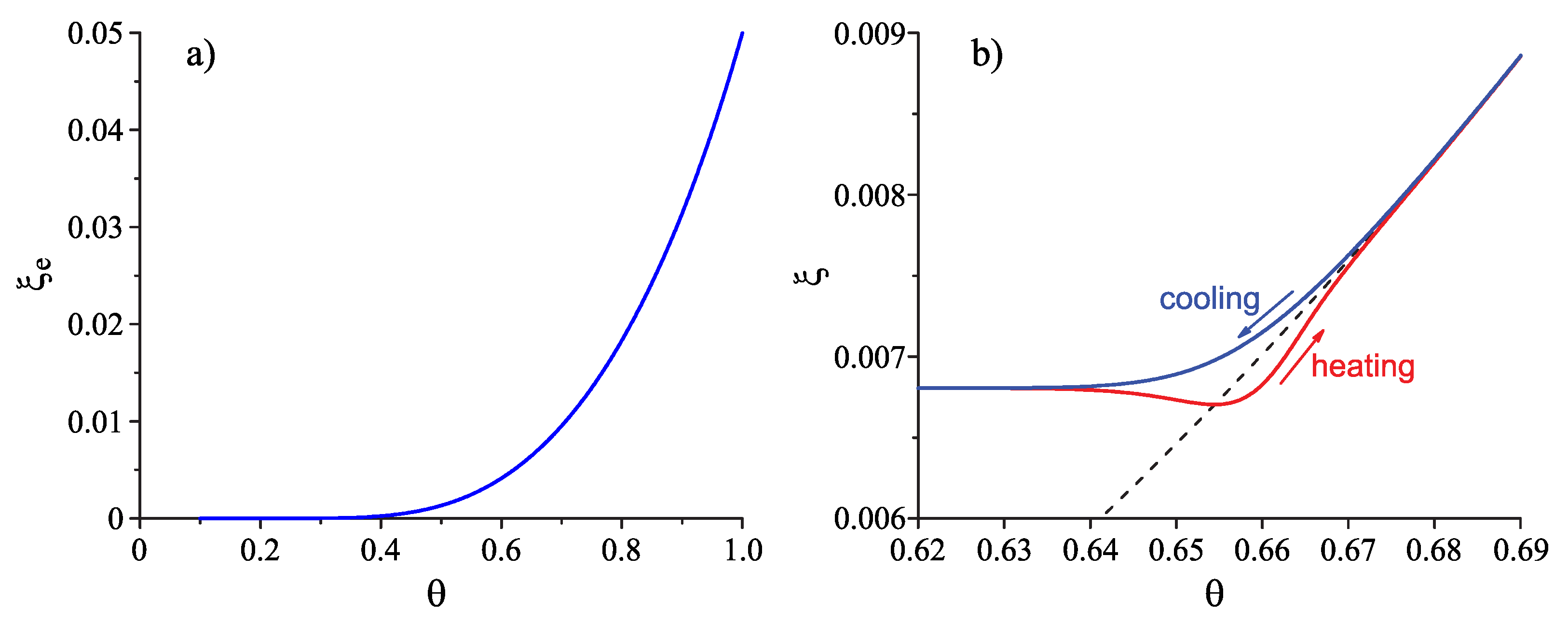
Figure 2.
Dependence of the steady-state nucleation rate, J, and the growth rate, u, on temperature in reduced coordinates, , for the model employed here in the computations in the limiting case that the liquid is always in a metastable state.
Figure 2.
Dependence of the steady-state nucleation rate, J, and the growth rate, u, on temperature in reduced coordinates, , for the model employed here in the computations in the limiting case that the liquid is always in a metastable state.
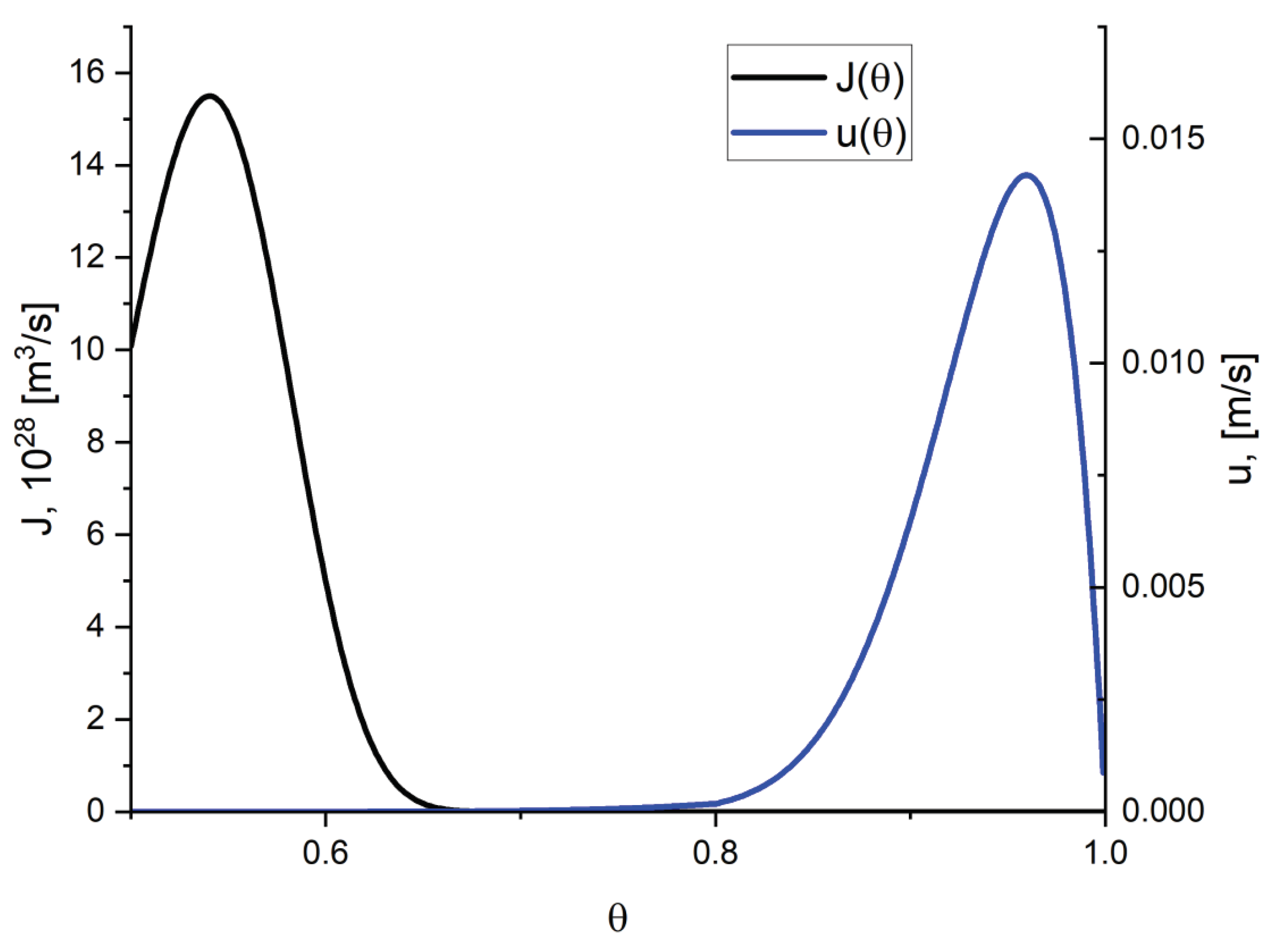
Figure 8.
Determination of the degree, , and the rate, , of overall crystallization in dependence on temperature, , in cooling (left side) and heating (right side) for sets of cooling () and heating () rates as shown in the figures. In contrast to Figure 4, here the effect of deviations of the state of the liquid from metastable equilibrium is accounted for. The computations are performed utilizing Eqs. (58) and (59) with and . The results obtained in such way are shown by dashed curves, the curves shown in Figure 3Figure 4 are given for comparison in as full curves, again.
Figure 8.
Determination of the degree, , and the rate, , of overall crystallization in dependence on temperature, , in cooling (left side) and heating (right side) for sets of cooling () and heating () rates as shown in the figures. In contrast to Figure 4, here the effect of deviations of the state of the liquid from metastable equilibrium is accounted for. The computations are performed utilizing Eqs. (58) and (59) with and . The results obtained in such way are shown by dashed curves, the curves shown in Figure 3Figure 4 are given for comparison in as full curves, again.
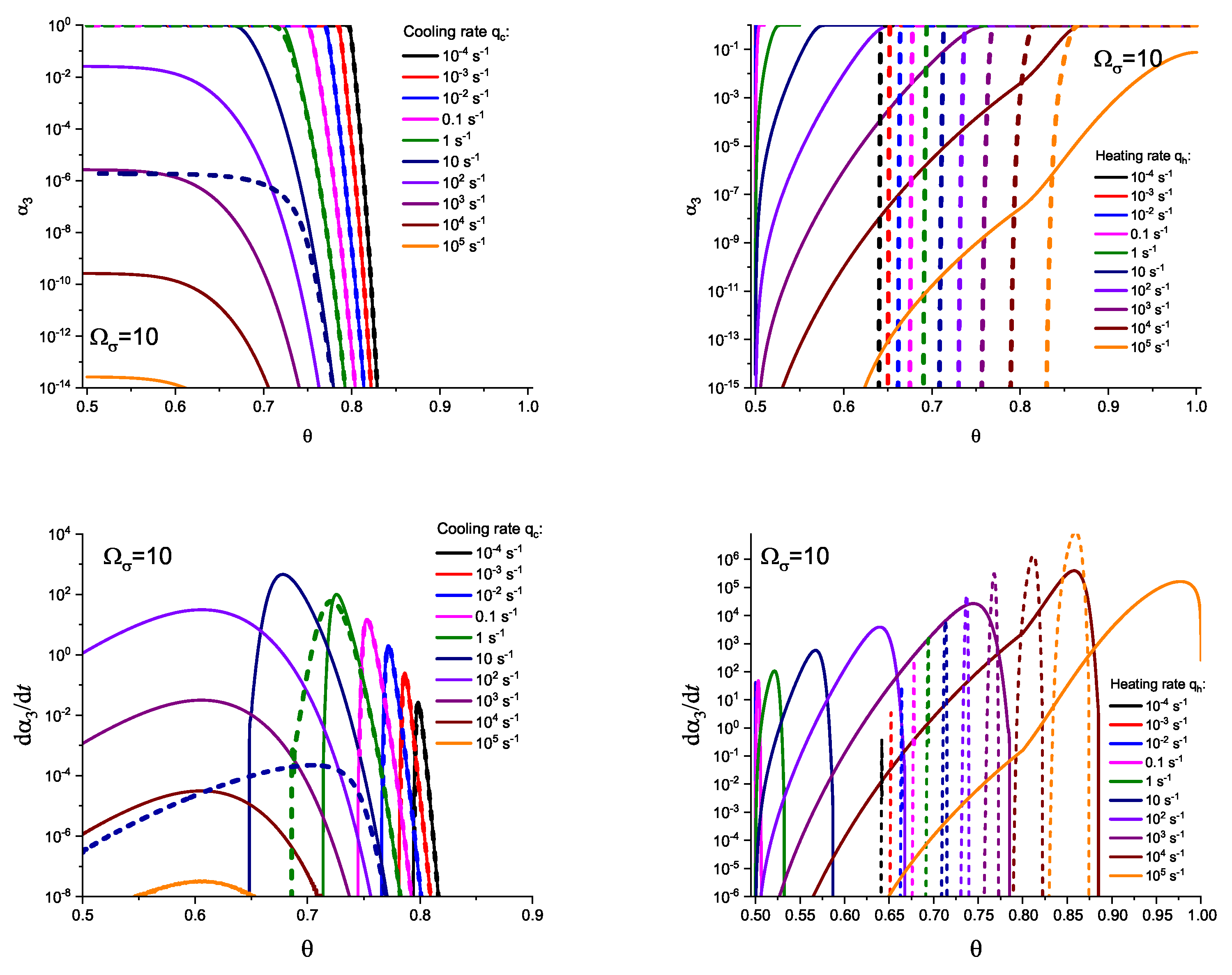
Figure 9.
Crystallization peak temperatures, , in dependence on cooling (blue) and heating (red) rates as obtained from the numerical computations. The results are given for nucleation and growth in metastable liquids (presented in Figure 3Figure 4) and accounting for deviations from metastability in the form as shown in Figure 5Figure 6 (), respectively, Figure 7Figure 8 ().
Figure 9.
Crystallization peak temperatures, , in dependence on cooling (blue) and heating (red) rates as obtained from the numerical computations. The results are given for nucleation and growth in metastable liquids (presented in Figure 3Figure 4) and accounting for deviations from metastability in the form as shown in Figure 5Figure 6 (), respectively, Figure 7Figure 8 ().
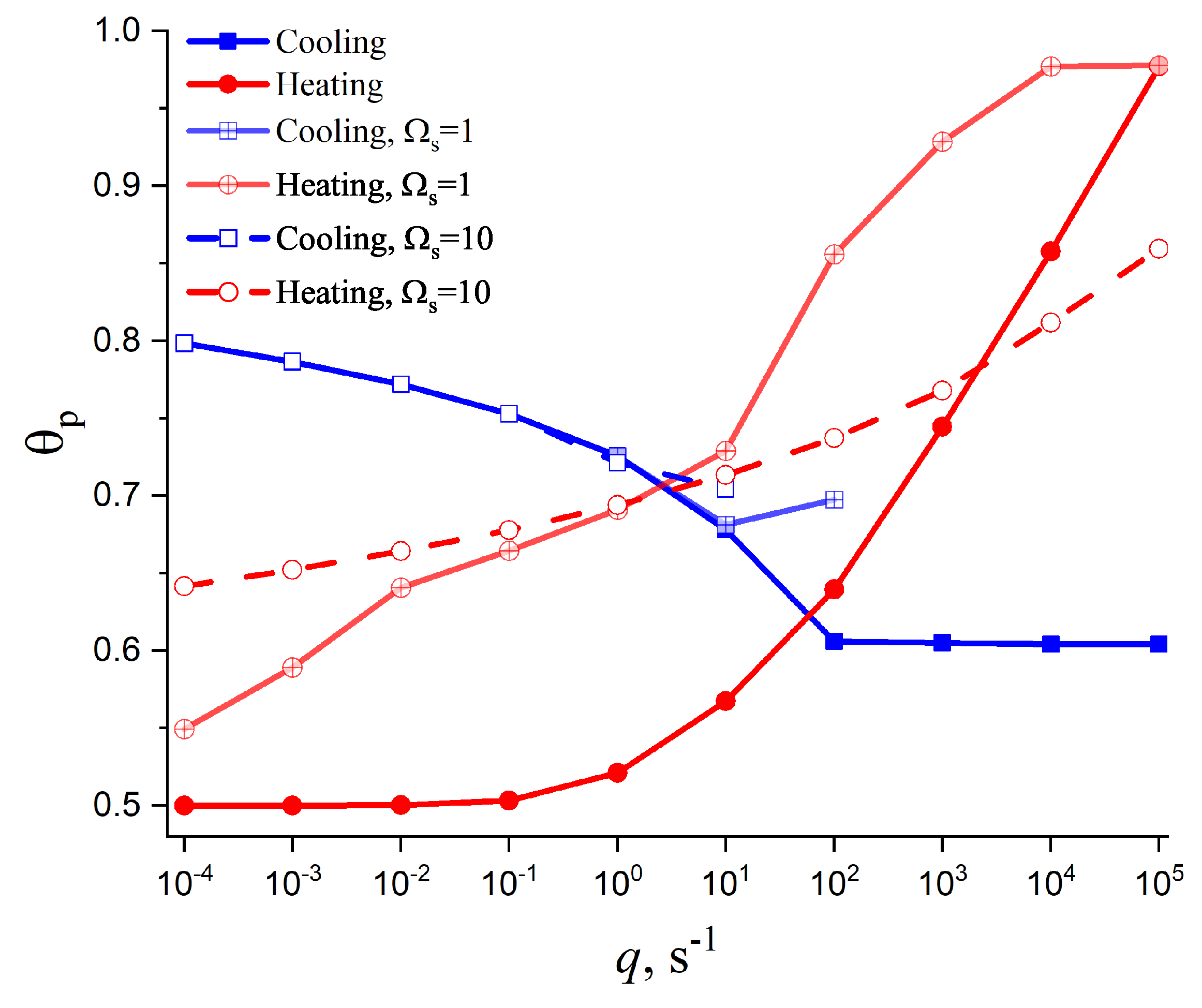
Figure 10.
Normalized steady-state nucleation rate, , and normalized crystal growth rate, , in dependence on reduced temperature, . Here is the maximum nucleation rate and is the maximum growth rate obtained via experiment; is the melting or liquidus temperature. The blue curve (1) shows the theoretical result when the kinetic term in the expression for the nucleation rate is determined via appropriate diffusion coefficients; the green curve (2) is drawn under the assumption of validity of the Stokes–Einstein–Eyring equation, allowing one to replace the diffusion coefficient with viscosity. Its wide coincidence with experimental data is reached by employing appropriate expressions for the curvature dependence of the surface tension (for details, see [41]). The reduced thermodynamic driving force, , is also shown; it has a maximum at the Kauzmann temperature, [63]. It is evident that crystallization occurs only in a relatively small temperature range. Typically the maximum of the growth rate, , is located at temperatures much higher than the maximum of the steady-state nucleation nucleation rate [64,65], as shown here in the figure. The figure is taken from [55] (Creative Commons Attribution License).
Figure 10.
Normalized steady-state nucleation rate, , and normalized crystal growth rate, , in dependence on reduced temperature, . Here is the maximum nucleation rate and is the maximum growth rate obtained via experiment; is the melting or liquidus temperature. The blue curve (1) shows the theoretical result when the kinetic term in the expression for the nucleation rate is determined via appropriate diffusion coefficients; the green curve (2) is drawn under the assumption of validity of the Stokes–Einstein–Eyring equation, allowing one to replace the diffusion coefficient with viscosity. Its wide coincidence with experimental data is reached by employing appropriate expressions for the curvature dependence of the surface tension (for details, see [41]). The reduced thermodynamic driving force, , is also shown; it has a maximum at the Kauzmann temperature, [63]. It is evident that crystallization occurs only in a relatively small temperature range. Typically the maximum of the growth rate, , is located at temperatures much higher than the maximum of the steady-state nucleation nucleation rate [64,65], as shown here in the figure. The figure is taken from [55] (Creative Commons Attribution License).
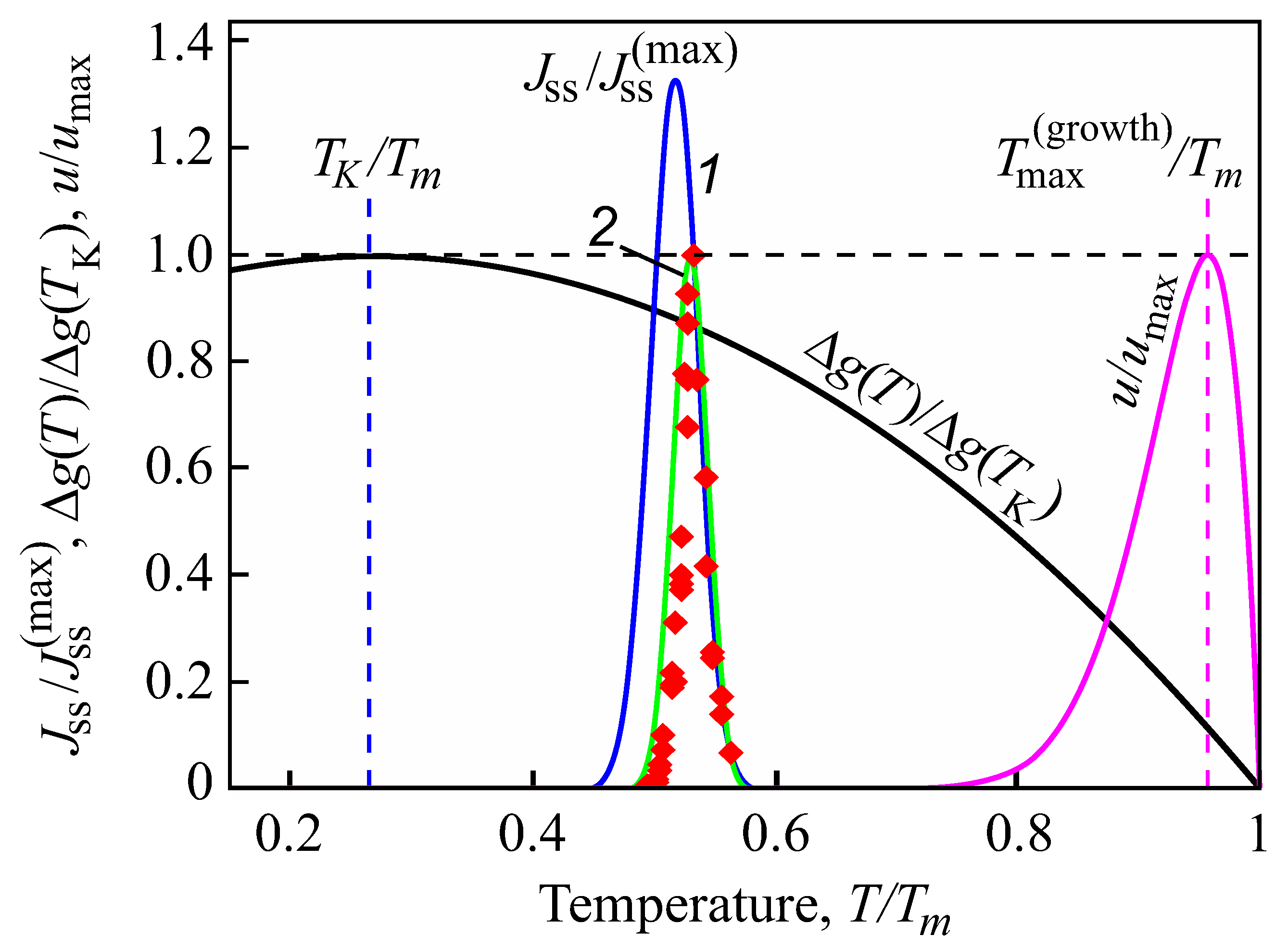
Disclaimer/Publisher’s Note: The statements, opinions and data contained in all publications are solely those of the individual author(s) and contributor(s) and not of MDPI and/or the editor(s). MDPI and/or the editor(s) disclaim responsibility for any injury to people or property resulting from any ideas, methods, instructions or products referred to in the content. |
© 2023 by the authors. Licensee MDPI, Basel, Switzerland. This article is an open access article distributed under the terms and conditions of the Creative Commons Attribution (CC BY) license (https://creativecommons.org/licenses/by/4.0/).
Copyright: This open access article is published under a Creative Commons CC BY 4.0 license, which permit the free download, distribution, and reuse, provided that the author and preprint are cited in any reuse.


