

Submitted:
20 September 2023
Posted:
25 September 2023
You are already at the latest version
Abstract
Climate change is expected to affect the agricultural sector in ways that are often unclear to predict. If in the short- medium-terms farmers may adapt to climate change by adjusting agricultural practices, in the long-term these adjustments may become insufficient, forcing farmers to change their farming systems. The extent and direction in which these farming system transitions will occur is still a subject underexplored in the literature. We propose a new framework to explore the marginal effect of climate change on the choice of the farming system, while controlling the effect of other drivers known to also influence farming system choice. Using a spatial-explicit farming system choice-model developed by a previous study in an extensive agricultural region of southern Portugal, we applied a space-for-time approach to simulate the effect of climate change on the future dynamics of the farming systems in the study area. Results suggest that climate change will force many farmers to change the farming system in a foreseeable future. The extent of the projected changes in farming systems is likely to trigger significant social, economic, or environmental impacts, which should require early attention from policy makers.
Keywords:
climate change
; farming systems
; space-for-time
; marginal effect
; choice modelling
1. Introduction
Climate change is expected to bring substantial impacts on the agricultural sector [1,2]. Plenty research has been published on the subject, mostly focusing on assessing the effects of climate change on crop and livestock productivity [3,4,5], or on the shifting of agroclimatic zones [6,7], or on global food security [4,8,9]. However, literature focused on anticipating farmers’ decisions in their climate change adaptation strategies is surprisingly less abundant.
Farm management decisions are typically made at the whole-farm level, in a comprehensive and internally coherent approach that accounts for the interdependencies between crops, livestock rearing, and other activities, rather than independently for each crop or activity [10]. So, to understand and anticipate farmers decisions in their adaptation strategies to climate change, an integrated farming systems (FS) approach should be adopted, rather than resorting to simple crop modelling analysis focused on understanding how climate change will affect a particular crop or activity [11,12,13]. In this sense, a FS acts as a classification scheme that is useful for identifying groups of farms that carry out roughly the same activities, with similar land use and livestock patterns, employing identical technologies and production methods and which, therefore, can be expected to react in a similar way to external stimuli [10,14]. This is the FS concept adopted in this study.
Farming system choice is a farmer’s decision that involves the joint consideration of several factors acting alone or in interaction, expanding or narrowing the farmer’s set of possible choices, which include both socioeconomic factors (e.g., policy or market context, farm size, water or labour availability, or farmer’s idiosyncrasies) and biophysical factors (e.g., soil, slope, or climate) [10,15,16].
Modelling FS choice at the farm-level is often faced with data constraints. On the one hand, information is needed to establish the typology that will represent the available FS portfolio for farmers, which may require collecting data on crops, land uses, livestock, and production methods for each farm. On the other hand, it requires characterizing farms in terms of the above-mentioned drivers of farming system choice, which can be done by resorting to GIS analysis, if appropriate data are available, or by carrying out expensive and time-consuming surveys. Additional challenges may stem from the fact that some relevant drivers of FS choice are subject to temporal variations, such as prices, or to space-time variations such as climate. In the latter case, the difficulty is further inflated by the fact that in most cases it is not practicable to collect the required data for a period of time that is long enough to capture the effect of climate change on farmers’ choice of FS.
Such difficulties have led researchers interested in modelling the effect of climate change on FS choice to resort to proxy approaches, often relaxing the farming system concept to a farm-type approach, such as the typologies built from official statistical databases (e.g., the EU Farm Accountancy Data Network database – FADN, used to classify farms based on production orientation and economic size) [17,18], or the use of farm types derived from farm surveys [5,15]. Such farm-type approaches are not suitable for representing farmers’ choices, as they typically include components that are exogenous to that choice, such as the physical or economic size of the farm.
Other works on farming resilience to climate change focus on short- to medium-term adaptation strategies, such as crop diversification, the adoption of more drought-resistant varieties, adjustments in planting and harvest dates, or increasing irrigation [19,20], and not in the long-term impacts where, by hypothesis, the magnitude of climate change may become incompatible with adjustments within the same FS, and may force farmers to undertake deeper changes, eventually leading them to switching into a different FS.
To test this hypothesis, we propose to explore the effects of climate change on FS choice using a discrete choice model approach, where the categorical dependent variable represents the range of available FS to farmers, and the independent variables include a diversity of drivers of FS choice, including climatic variables. We depart from a recently developed FS choice model for a region in southern Portugal – the Alentejo region [16], whose dependent variable includes a wide range of categories representing FS types and, taking advantage of the considerable extent of this region and its internal climate variability, we use a space-for-time approach to simulate climate change scenarios. The use of a space-for-time substitution procedure is based on the assumption that when the drivers of spatial variation are the same of variation over time, then time can be replaced by space to model future change patterns [21]. Space-for-time have been used before in studies on the effects of climate change on the agricultural sector, for example to assess how regional crop-suitability will shift with climate change [22]. Still, to our knowledge, this coupling of a FS discrete choice model with a space-for-time substitution approach is a pioneer in empirical studies on the effects of climate change applied to the agricultural sector.
The proposed modelling layout allows exploring the marginal effects of climate change in the choice of FS, while ensuring high control over the remaining drivers that are intended to be kept constant, a premise that is often assumed in the literature, albeit in an implicit way and therefore not usually discussed. Thus, the objective of the present study is not to predict which FS farmers will effectively choose in the future, but to understand how climate change alone will influence this decision-making process.
The specific objectives of the present study are, therefore: 1) simulating the marginal effects of different climate scenarios on FS choice; 2) comparing the results achieved with our farm-level FS choice approach with those from crop-modelling approaches; 3) assessing the limits of a space-for-time approach to explore the marginal effects of climate change on farming system choice. Finally, insights on the usefulness of the proposed approach to assess the impacts of farming system dynamics induced by climate change are discussed.
2. Materials and Methods
2.1. Study area
The Alentejo region (EU NUT II), in the southern part of mainland Portugal, was selected as the study area for this work for 3 main reasons: 1) it is large enough to have significant climate variation, a crucial requirement for the space-for-time modelling approach described below; 2) the land use/cover is largely dominated by agriculture, and; 3) a recently developed farm-level mapping of farming systems is available for the entire region (see section 2.2).
The Alentejo region extends for ca. 31,550 km2, covering about 1/3 of Portugal (Figure 1). Its climate is typically Mediterranean, characterized by warm and dry summers that contrast with cool, rainy winters. Average monthly temperatures range from 9.9◦C in January to 23.4◦C in August (annual average 16.3◦C) and total annual precipitation sums 619 mm, mostly concentrated from October to March. Climate gradients across the region are significant, with annual average temperatures increasing from 13.2◦C to 17.8◦C and precipitation decreasing from 1272 mm to 379 mm, while progressing from northwest to southeast.
Agriculture covers about 70% of the territory, with the remaining area corresponding mostly to forest areas (25%), water bodies (3%) and artificial areas (2%). Agriculture is dominated by permanent pastures, annual crops (mostly cereals and forages) and permanent crops (primarily olive groves), in descending order of their weight in farmland. Approximately 40% of the agricultural land is under the canopy of scattered trees, mainly cork and holm oaks (Quercus suber and Q. rotundifolia, respectively), an agroforestry system locally called “montado”.
2.2. Baseline data
The baseline data for the present research consisted primarily of a FS map for the Alentejo region, a machine learning model predicting these FS from a set of socioeconomic and biophysical variables, including climate variables, and data on future climate scenarios.
2.2.1. Farming systems information
Information on FS was extracted from a recent paper [16] where a typology of 22 FS was derived from a cluster analysis applied on land use and livestock data for virtually all farms in the Alentejo region in 2017 (Table 1). The data was taken from the Integrated Administration and Control System (IACS) and the Land Parcel Identification System (LPIS), provided by the national agency responsible for Common Agricultural Policy (CAP) payments.
All parcels declared by the same CAP beneficiary in the reference year (2017) were aggregated and taken as a single farm. The polygons of these parcels were spatially identified under the LPIS, so farm mapping was made possible (Figure 2). A total of 24,313 farms were thus identified and mapped, roughly covering 2 × 10⁶ ha of utilized agricultural area (about 87% of total utilized agricultural area in Alentejo, according to the most recent 2019 agricultural census in Portugal, and 65% of total Alentejo territorial area).
2.2.2. Farming systems predictive model
The FS predictive model was also taken from [16], consisting of a classificatory random forest model that predicts the FS (categorical variable) characterizing each farm from a broad set of 27 predictors describing farm structure (e.g., farm size, farm spatial fragmentation, irrigation use), socioeconomic context (e.g., population density, use of hired labour, main sources of income) and biophysical variables describing soil quality (pH and texture), topography (slope classes) and climate. These climate variables, which are key for the present study, included the maximum and minimum mean temperatures of the warmest and coldest months, respectively, and annual precipitation, averaged between 1971 and 2000, which were used in model estimation in [16] (at the time, the most recent publicly available 30-year climate averages for mainland Portugal).
All farms were, therefore, characterized under these variables by overlaying the farms map with raster layers representing the spatial distribution of each variable, to extract the average of the pixel-values covered by the polygons of each farm, using a GIS zonal statistics tool.
The random forest model showed a good global predictive accuracy (63.7% error rate, which was evaluated positively considering the high number of 22 classes in the dependent variable, for which the random error rate would be about 95.4%) (Figure 2).
In this study, the same model was replicated to predict FS choice under climate change scenarios, by replacing the values of the climate variables used to estimate the model, by new values referring to those climate scenarios, following a space-for-time substitution procedure [21].
2.2.3. Climate scenarios
Data for climate change scenarios were extracted from the WorldClim database (https://www.worldclim.org), which provides climate projections based on a range of pathways for emission scenarios, known as “Shared Socioeconomic Pathways” (SSPs) [23]. These have been used as inputs for the latest climate models, under the Intergovernmental Panel on Climate Change (IPCC) and the six-assessment report of the Coupled Model Intercomparison Projects (CMIP6) [2,23]. These climate projections consist of monthly values of minimum temperature, maximum temperature, and precipitation, derived from 23 global climate models (GCMs), for four SSPs (1-2.6, 2-4.5, 3-7.0 and 5-8.5) related to increasing levels of anthropogenic greenhouse gas (GHG) emissions, and for four 20-year periods (2021-2040, 2041-2060, 2061-2080, 2081-2100).
In the present study, long term climate scenarios for 2081-2100 were selected to heighten the effect of climate change on FS choice, since we were interested in capturing the effects on FS change, and not just changes in agricultural practices, like moving to more drought resistant crop varieties. Three SSP scenarios were used to simulate a low (SSP 1-2.6), moderate (SSP 3-7.0) and high GHG emission (SSP 5-8.5) scenarios. For each of these, we extracted the median of the projections provided by 9 of the 23 climate models, which were those with complete information on all climate variables and all SSP scenarios, to extract predictions of maximum and minimum temperatures of the warmest and coldest month, respectively, and annual average precipitation, so they can be comparable to the baseline climate variables used in the estimation of the random forest FS predictive model.
2.3. Scenario assessment
The effects of climate change on FS choice were primarily assessed based on the changes in the land shares of the different FS in the study area, in each scenario. Sankey diagrams [24] were used to graphically visualize the predicted FS areal transitions. Transition matrices with the relative values of the areal transfers between FS are also shown in supplementary information.
3. Results
3.1. Climate change predictions
Climate scenarios for the study area in 2081-2100 predict significant changes in the climate variables under study, even in the low emission scenario (SSP 1-2.6) (Table 2). The climate anomaly in the average value of the minimum temperature of the coldest month is expected to range from an increase of 1.0◦C in the low emission scenario, to 3.3◦C in the high emission scenario. The average maximum temperature in the warmest month is expected to raise 2.0◦C in the low emission scenario, and 6.6◦C in the high emission. Average annual precipitation is anticipated to decrease between -19.9 mm in the low emission scenario, to -96.5 mm in the high emission scenario, which corresponds to a decrease of about 16% of the total annual precipitation of the baseline period (1971-2000). In the moderate emissions scenario (SSP 3-7.0), the forecasts point to anomalies values between the limits of the two extreme scenarios.
As expected, these climatic anomalies are not uniform across the study area, showing variations that are particularly evident in the case of the maximum temperature, whose anomalies are about 4◦C higher in the interior, compared to the coastal areas. In the case of precipitation, the effect of relief on climate models is apparent, with more significant decreases expected with increasing altitude. In the lower areas of the interior, where the current precipitation is quite low (400 mm or less), forecasts even predict an increase in the average annual precipitation.
3.2. Effects of climate change on farming system choice
Model predictions show that climate change will substantially impact FS choice in the study area. Altogether, 23%, 37% or 40% of the total agricultural area of the study area is expected to change the FS, respectively in the low, moderate, or high GHG emission scenarios (Figure 3). The impact of climate change, however, is not expected to be the same across all FS: while some will barely be affected, others will undergo significant changes, either gaining or losing area (Table 3).
The Cattle grazing - HO system, which is currently the dominant system covering ca. 30% of the total agricultural area, is expected to be the one experiencing the greatest area increase in any of the 3 climate scenarios, almost doubling the area in the high emission scenario (89% increase). Most of this growth will come from area currently under the Cattle Grazing - CO system (Figure 4), which is one of the top area losers, expected to drop between 22% and 72% of its current area, respectively in the low and high emission scenarios (Table 3). Irrigated olive groves are also expected to increase area, which may expand up to 46% in the high emission scenario, mainly at the expense of Vineyards and Rainfed olive groves. Rainfed cereals are also expected to expand in all three scenarios, at the expense of areas from different systems (see transition matrices in supplementary information).
In addition to the Cattle grazing - CO system, other systems are expected to suffer significant declines in area. Except for the Sheep grazing - HO system, all other sheep specialized systems (Sheep grazing - CO, Sheep grazing - forages, Sheep grazing - pastures, and Sheep grazing - pastures and forages) are predicted to lose area, in particular the Sheep grazing - CO system, which will likely lose more than half its current area (55%) in the low emission scenario, to almost disappear in the high emission scenario (93% drop). Fruit trees, Stone pine, and Vineyards are also expected to lose area, irrespectively of the climate scenario.
Other systems show inconsistent trends across the three scenarios. Cattle grazing - forages and Sheep grazing - HO are predicted to lose area in the low emission scenario, but to expand in the moderate and the high emission scenarios. Conversely, the Rainfed olive groves with sheep system is anticipated to expand in the low emission scenario, but to lose area in the moderate and high emission scenarios.
4. Discussion
The proposed modelling framework proved its suitability to explore the marginal effects of climate change on FS choice. As hypothesised, our findings suggest that the magnitude of the climate changes expected in the long run scenarios will force many farmers to adjust well beyond agricultural practices, pushing them to undertake an effective FS change. Moreover, such effects are expected in both high and low GHG emission scenarios although, unsurprisingly, they are clearly more substantial in high emission scenarios. This supports the claims of previous authors on the need for a farming systems approach when investigating farmers’ adaptation strategies to climate change, to the detriment of the conventional crop-modelling approaches that populate most of the literature. [13].
The FS choice model used in the simulations included a variety of drivers of FS choice that were intentionally kept constant except for the climate variables, making it possible to attribute the observed FS dynamics predominantly to the marginal effect of climate change, as was the objective of the present study. This does not mean conceding that the social, economic, technological, policy, or demographic context, for example, will remain unchanged in the future, but only that we sought to isolate the effect of our variables of interest (climate), to investigate their marginal contribution in the choice of future FS, in a ceteris paribus approach.
4.1. Marginal effects of climate change on farming system choice
The scrutiny of the marginal effects of climate change on FS choice must consider that the simulations were carried out using a predictive model estimated from data observed on the decisions of more than 23 thousand farmers in their FS choice, based on real farms, and mediated by a very high number of independent variables that included 13 socioeconomic drivers and 14 biophysical drivers, conjointly influencing the decision-making process. Therefore, the effect of simulations on the climate variables must be assessed in the context of the joint action of all these drivers, whose influence on the decision will act differently in each farm, since each one is unique in its characteristics. Also, climate change will not affect all farms equally, since the extent of those changes are differentiated in space, showing an increasing gradient of the average temperatures of the coldest and warmest months from the coast towards inland, and a drop in precipitation marked by altitude. Under all these premises, it is not surprising that climate change will not affect all FS in the same way: while some will be severely affected by gaining or losing area, others will persist mostly unaffected.
The primary FS shift expected to be induced by climate change till the end of the century refers to the significant westward expansion of the Cattle grazing - HO system, towards areas currently dominated by the Cattle grazing - CO system. This extensive replacement of cork oak by holm oak agroforestry systems is probably related to the distinct agroecological preferences of both oak species, which currently makes the cork oak dominant to the west and north of Alentejo, where the climate tends to be less hot and dry due to the proximity of the Atlantic Ocean [25], and the holm oak more frequent in the warmer and drier southern interior of the Alentejo region [16,26]. Thereby, the widespread decrease in precipitation and increase in summer heat will likely prompt holm oak to expand to areas currently dominated by cork oak. However, this expansion of the Cattle grazing-HO system towards the more northwestern parts of Alentejo seems to suffer some resistance, only overthrown under the higher GHG emission scenarios, which may be related to the predominance of light-texture soils (sandy soils) in this region, which tends to favour cork oak and not holm oak [16]. The predicted sharp reduction in cork oak area is likely to imply significant social and economic impacts at the national level, given the high importance of the cork cluster in Portugal [27]. It should also be noted that the spatial dispersion of the cork oak and holm oak agroforestry systems observed in 2017 is a consequence of decisions made by farmers decades before, conceivably matching the reference period of the 1971-2000 climate averages used by [16] in the random forest predictive model estimation, which may mitigate possible time-lag issues in the climate data used to describe the baseline situation in 2017.
Most sheep grazing systems are expected to lose significant area, mainly to the Cattle grazing HO system. Although available data does not allow clarification, this may be related to a preference of the cattle systems for larger farms, which are predominant in the Alentejo region [16], fostering its expansion over sheep systems. Still on the effects of climate change on livestock specialized FS, our findings indicate that the Grazing goats FS will possibly be one of the least affected, probably for being a low demanding FS in terms of socioeconomic and biophysical context, only associated with sloping terrain [16] which will not be altered by climate change.
Among the crop specialized FS, most will lose area in response to climate change, especially in the moderate and high emission scenarios. The Vineyards and the Stone pine FS are the ones likely to lose more area, in relative terms, the first especially for the Irrigated olive grove FS and the later for the Cattle grazing - HO. Both the Vineyards and Stone pine FS have a strong regional identity in Alentejo agriculture, being both pillars of important agro-industrial value chains on a regional and national scale, so the prediction of its reduction can lead to important social and economic impacts.
As for FS strongly dependent on irrigation, the Irrigated cereal and horticultural crops FS is expected to lose area, while the Irrigated olive groves FS is projected to expand significantly in response to climate change, the higher the emissions scenario. This later FS, however, is highly dependent on public irrigation systems, whose future sustainability in the study area has been questioned due to the predicted drop in precipitation and its impacts in both quantity and quality of irrigation water [28,29]. The Rice FS is also expected to remain mostly unchanged, since its choice is strongly influenced by the availability of suitable areas next to water courses, a driver of low relevance for most other FS.
The Rainfed cereals FS is also expected to expand in response to climate change, not so much because it is favoured by future climate conditions, but because they are likely to be less affected than most of the competing FS, as they are typically rainfed extensive systems with a strong dependence on autumn-winter crops (cereals).
4.2. Comparing farming system and crop-modelling approaches
The proposed FS approach to explore the effects of climate change relies on a discrete-choice modelling framework, where farmers are set to choose the FS—a categorical variable—among a range of possible choices, based on socioeconomic and biophysical drivers. The crop-modelling approaches, or other species-specific approaches often found in the literature, typically assume that farmers operating a given farming system will adapt to climate change by adjusting farming practices, such as increasing irrigation water or adjusting sowing/harvesting dates, without shifting to other FS. In this section, we discuss our results with reference to those of previous studies focused on key crops or activities in the study area and carried out in comparable agroecological contexts, to explore similarities and divergences between the results of both approaches.
Despite little current knowledge about the dynamics of Mediterranean oak woodlands in response to multiple drivers [26], previous studies have reported the likelihood of a decline in Mediterranean agroforestry systems resulting from climate change. Research on cork and holm oak canopy cover loss carried out in the same region as the present study (Alentejo) found a likely decline trend for cork oak associated with the increase of mean temperature, while the decline in holm oak would be mostly associated with increasing cattle numbers [30]. Rising temperatures in recent decades have also been related with increased crown defoliation and tree mortality in both cork and holm oak [30]. Other studies carried out in Spanish Andalusia, a region that borders the Alentejo to the west, report that a significant part of the cork oak plantations made in this region in the 90s of the last century, largely driven by CAP policies encouraging the afforestation of marginal farmland, are probably doomed to succumb due to the deterioration of weather conditions in the future [31]. Our findings are in line with these previous studies, with the novelty of foreseeing an extensive replacement of the cork oak by holm oak.
As for the apparent substitution of sheep by cattle, pushed by the substantial expansion of the Cattle grazing - HO system, although research references relating these effects to climate change are scarce, there is evidence mentioning that cattle grazing is prone to reduce grassland heterogeneity in Mediterranean regions, which may decrease the ability to adapt to climate change [32]. Further evidence suggest that climate change will negatively influence perennial grasslands and forage yields in Mediterranean ecosystems [33,34], which may raise doubts about the expansion of cattle grazing systems predicted by our simulations.
The patent increase in the Irrigated olive groves FS suggested by our results seems to contrast with findings of previous studies focused on the impacts of climate change on olive groves, which have questioned the future suitability of this crop in the Mediterranean basin, unless appropriate adaptation measures are implemented [35]. One such possible measure is irrigation [36,37], which is in line with our forecasts of an expansion of the Irrigated olive groves FS and a contraction of the Rainfed olive groves FS. Warming and drought trends expected for southern Europe in the coming decades, however, are likely to bring major challenges to irrigation expansion due to excessive heat and water stress [28,29]. Additionally, other works have warned of the possible increase in the risk of pest outbreaks in Mediterranean olive groves, as a result of climate change [38]. Therefore, doubts remain about the sustainability of our prediction of an increase in the Irrigated olive groves FS, which is particularly important since this crop has been the target of large investments in new plantations in recent years in the study area, cultivated in intensive and super-intensive regimes with irrigation, being already one of the main irrigation crops in the Alentejo region [39].
Regarding our prediction of an expansion of the Rainfed cereals FS, it contrasts with results of previous studies that used crop-modelling to assess the impact of climate change on wheat production in southern Portugal, foreseeing significant production losses, depending on the climate scenario used [40]. As adaptation measures to reverse yield reductions, these authors propose the use of early flowering wheat varieties, or the anticipation of the sowing date. Studies that used the CERES-Wheat crop model to simulate yields under climate change in Mediterranean regions also identified a trend towards reduced yields, recommending the development of adaptation strategies and measures such as the use of adapted genotypes to counteract the negative impact of climate change [41].
We conclude that the two approaches can be complementary, assuming that in the short to medium term farmers will be able to make this type of adjustment without changing the FS, while our results suggest that in the long term this may no longer be possible, and many farmers will effectively be forced to change the FS. Whether or not, when the time comes, they will have the means, the knowledge, or the ability to carry out this change remains a critical issue that should concern policymakers, but which is beyond the scope of the present study.
4.3. Strengths and weaknesses of the proposed approach
An important asset of the proposed framework is that it relies on very detailed and spatially explicit farm-level data, describing livestock and land use/cover at the plot-scale, which was made possible by the opportunity to access IACS/LPIS data. Therefore, it is built on observed data from management decisions made by actual farmers, framed by the characteristics of their farms and their biophysical and socioeconomic contexts. This entails a significant advantage when compared to previous studies, mainly based on crop models or on declared data collected in surveys in response to hypothetical scenarios (e.g., [15]). Also, the spatial explicit feature provided by the connection to the LPIS enables exploring areal trade-offs between FS and to explicitly map where the changes are expected to take place, which may be valuable to, e.g., inform land planning assessment.
The random forest approach used in model estimation made it possible to work with a high dimensional categorical dependent variable, representing the 22 FS choice-set available to farmers in adapting to climate change scenarios, which is unprecedented in the literature.
The potential limitation of working with agricultural data for a single year (2017), which at the outset would prevent the exploration of temporal dynamics, was overcome by resorting to an approach of substituting time for space, taking advantage of the considerable extent of the study area. Despite being a longstanding approach (see [42] and references therein), space-for-time substitution remains a widely used approach in several fields, especially in ecology where it emerged (e.g., [21,43]), whenever only stationary data are available.
With minor adjustments, the same basic approach could be used to explore, for example, how public policies could be implemented to encourage farmers to adopt particular FS, aimed at ensuring desired levels of food security or sufficient provision of socially valued public goods, provided that the random forest choice-model include some comparative profitability variable discriminating the FS. Such possibilities stand as proposals for future research.
On the shortcomings of the framework, it should be noted that it deals solely with changes in the averages of climate variables, and not with changes in their variability. Indeed, climate change pressures on farmers decisions will likely be felt earlier—if not already felt—due to the increasing frequency of extreme events, such as droughts, heat waves, or floods, which may significantly anticipate the need for farmers to adapt to climate change. This drawback, however, is hardly avoidable because current climate models do not provide scenarios of climate variability change, but only changes in their average values.
The framework’s implementation is also quite demanding in baseline data, both to derive the FS typology and for estimating the choice model. In fact, the approach is only feasible when data comparable to that in the IACS/LPIS are available, which is often not the case, particularly in developing regions where such research could be of particular interest, e.g., in the context of food security issues.
The fact that the framework deals only with existing FS, observed in the reference year (2017), may also entail some weakness, as it hinders the emergence of new FS potentially better suited to cope with climate change [10]. Nevertheless, the high number of categories in the FS typology must have contributed to minimize this possible problem.
Finally, it must be recognized that some of the results achieved are hard to explain based on the available information, such as the fact that the Cattle grazing - forages FS loses area in the low emission scenario and increases area in the higher emissions scenarios.
5. Conclusions
Not underestimating that the relationship between climate and agriculture goes both ways, since agriculture is also a driver of climate change, the present study focused on investigating the marginal effect of climate change on the choice of the FS. Results indicate that climate change is prone to lead many farmers to change their FS, as an adaptation strategy. Such changes are likely to modify the pattern of ecosystem services currently provided by agriculture, including at the provisioning, regulating, supporting or cultural levels. This calls for further research on the exploration of marginal effects, opening the way for climate change impact assessments and the consideration of policy options. Indeed, previous work has suggested that changes in policy, as well as technology or prices, may have a stronger impact on farmers’ decisions than climate change [13,44], meaning that there will be room for policy do help ease the adaptation effort that farmers will have to endure.
Supplementary Materials
The following supporting information can be downloaded at the website of this paper posted on Preprints.org. Transition matrices for areal changes of farming systems from 2017 to 2081-2100 in three climate change scenarios in the Alentejo region, Portugal.
Author Contributions
Conceptualization, methodology, validation, writing—review and editing, P.F.R. and J.L.S.; formal analysis, data curation, writing—original draft preparation, P.F.R.. All authors have read and agreed to the published version of the manuscript.
Funding
This work was financed by national funds through FCT - Portuguese Foundation for Science and Technology, I.P., under the Project UIDB/00239/2020 of the Forest Research Centre (CEF) and the Associated Laboratory TERRA.
Conflicts of Interest
The authors declare no conflict of interest.
References
- European Environment Agency, Climate change adaptation in the agriculture sector in Europe - Publications Office of the EU, EEA Rep. No 04/2019, Publ. Off. (2019). https://op.europa.eu/en/publication-detail/-/publication/fb9bf9af-0117-11ea-8c1f-01aa75ed71a1/language-en/format-PDF/source-265745439.
- IPCC, Climate Change 2022: Impacts, Adaptation and Vulnerability. Contribution of Working Group II to the Sixth Assessment Report of the Intergovernmental Panel on Climate Change, Cambridge University Press. Cambridge University Press, Cambridge, UK and New York, NY, USA, 2022. [CrossRef]
- P. Asare-Nuamah, E. Botchway, Understanding climate variability and change: analysis of temperature and rainfall across agroecological zones in Ghana, Heliyon. 5 (2019) e02654. [CrossRef]
- Y.T. Ayinu, D.Y. Ayal, T.T. Zeleke, K.T. Beketie, Impact of climate variability on household food security in Godere District, Gambella Region, Ethiopia, Clim. Serv. 27 (2022) 100307. [CrossRef]
- L.T. Habtemariam, G. Abate Kassa, M. Gandorfer, Impact of climate change on farms in smallholder farming systems: Yield impacts, economic implications and distributional effects, Agric. Syst. 152 (2017) 58–66. [CrossRef]
- S. Adnan, K. Ullah, S. Gao, A.H. Khosa, Z. Wang, Shifting of agro-climatic zones, their drought vulnerability, and precipitation and temperature trends in Pakistan, Int. J. Climatol. 37 (2017) 529–543. [CrossRef]
- Ceglar, M. Zampieri, A. Toreti, F. Dentener, Observed Northward Migration of Agro-Climate Zones in Europe Will Further Accelerate Under Climate Change, Earth’s Futur. 7 (2019) 1088–1101. [CrossRef]
- Molotoks, P. Smith, T.P. Dawson, Impacts of land use, population, and climate change on global food security, Food Energy Secur. 10 (2021) 1–20. [CrossRef]
- S.A. Ofori, S.J. Cobbina, S. Obiri, Climate Change, Land, Water, and Food Security: Perspectives From Sub-Saharan Africa, Front. Sustain. Food Syst. 5 (2021) 1–9. [CrossRef]
- J.L. Santos, F. Moreira, P.F. Ribeiro, M.J. Canadas, A. Novais, A. Lomba, A farming systems approach to linking agricultural policies with biodiversity and ecosystem services, Front. Ecol. Environ. in press (2020) fee.2292. [CrossRef]
- P. Hayman, L. Rickards, R. Eckard, D. Lemerle, Climate change through the farming systems lens: Challenges and opportunities for farming in Australia, Crop Pasture Sci. 63 (2012) 203–214. [CrossRef]
- P. Reidsma, F. Ewert, A.O. Lansink, R. Leemans, Adaptation to climate change and climate variability in European agriculture: The importance of farm level responses, Eur. J. Agron. 32 (2010) 91–102. [CrossRef]
- P. Reidsma, J. Wolf, A. Kanellopoulos, B.F. Schaap, M. Mandryk, J. Verhagen, M.K. Van Ittersum, Climate change impact and adaptation research requires integrated assessment and farming systems analysis: A case study in the Netherlands, Environ. Res. Lett. 10 (2015). [CrossRef]
- J. Dixon, Concept and Classifications of Farming Systems, in: Encycl. Food Secur. Sustain., Elsevier, 2019: pp. 71–80. [CrossRef]
- P.M. Etwire, The impact of climate change on farming system selection in Ghana, Agric. Syst. 179 (2020) 102773. [CrossRef]
- P.F. Ribeiro, J.L. Santos, M.J. Canadas, A.M. Novais, F. Moreira, Â. Lomba, Explaining farming systems spatial patterns: A farm-level choice model based on socioeconomic and biophysical drivers, Agric. Syst. 191 (2021). [CrossRef]
- D. Iakovidis, Y. Gadanakis, J. Park, Farm-level sustainability assessment in Mediterranean environments: Enhancing decision-making to improve business sustainability, Environ. Sustain. Indic. 15 (2022) 100187. [CrossRef]
- D. Leclère, P.A. Jayet, N. de Noblet-Ducoudré, Farm-level Autonomous Adaptation of European Agricultural Supply to Climate Change, Ecol. Econ. 87 (2013) 1–14. [CrossRef]
- M.P.M. Meuwissen, P.H. Feindt, A. Spiegel, C.J.A.M. Termeer, E. Mathijs, Y. de Mey, R. Finger, A. Balmann, E. Wauters, J. Urquhart, M. Vigani, K. Zawalińska, H. Herrera, P. Nicholas-Davies, H. Hansson, W. Paas, T. Slijper, I. Coopmans, W. Vroege, A. Ciechomska, F. Accatino, B. Kopainsky, P.M. Poortvliet, J.J.L. Candel, D. Maye, S. Severini, S. Senni, B. Soriano, C.J. Lagerkvist, M. Peneva, C. Gavrilescu, P. Reidsma, A framework to assess the resilience of farming systems, Agric. Syst. 176 (2019) 102656. [CrossRef]
- M. van Zonneveld, M.S. Turmel, J. Hellin, Decision-Making to Diversify Farm Systems for Climate Change Adaptation, Front. Sustain. Food Syst. 4 (2020) 1–20. [CrossRef]
- G.O.U. Wogan, I.J. Wang, The value of space-for-time substitution for studying fine-scale microevolutionary processes, Ecography (Cop.). 41 (2018) 1456–1468. [CrossRef]
- Holzkämper, P. Calanca, J. Fuhrer, Analyzing climate effects on agriculture in time and space, Procedia Environ. Sci. 3 (2011) 58–62. [CrossRef]
- K. Riahi, D.P. van Vuuren, E. Kriegler, J. Edmonds, B.C. O’Neill, S. Fujimori, N. Bauer, K. Calvin, R. Dellink, O. Fricko, W. Lutz, A. Popp, J.C. Cuaresma, S. KC, M. Leimbach, L. Jiang, T. Kram, S. Rao, J. Emmerling, K. Ebi, T. Hasegawa, P. Havlik, F. Humpenöder, L.A. Da Silva, S. Smith, E. Stehfest, V. Bosetti, J. Eom, D. Gernaat, T. Masui, J. Rogelj, J. Strefler, L. Drouet, V. Krey, G. Luderer, M. Harmsen, K. Takahashi, L. Baumstark, J.C. Doelman, M. Kainuma, Z. Klimont, G. Marangoni, H. Lotze-Campen, M. Obersteiner, A. Tabeau, M. Tavoni, The Shared Socioeconomic Pathways and their energy, land use, and greenhouse gas emissions implications: An overview, Glob. Environ. Chang. 42 (2017) 153–168. [CrossRef]
- N. Cuba, Research note: Sankey diagrams for visualizing land cover dynamics, Landsc. Urban Plan. 139 (2015) 163–167. [CrossRef]
- J.C. Pérez-Girón, E.R. Díaz-Varela, P. Álvarez-Álvarez, Climate-driven variations in productivity reveal adaptive strategies in Iberian cork oak agroforestry systems, For. Ecosyst. 9 (2022). [CrossRef]
- V. Acácio, F.S. Dias, F.X. Catry, M. Rocha, F. Moreira, Landscape dynamics in Mediterranean oak forests under global change: understanding the role of anthropogenic and environmental drivers across forest types, Glob. Chang. Biol. 23 (2017) 1199–1217. [CrossRef]
- I.H. Sørensen, M. Torralba, C. Quintas-Soriano, J. Muñoz-Rojas, T. Plieninger, Linking Cork to Cork Oak Landscapes: Mapping the Value Chain of Cork Production in Portugal, Front. Sustain. Food Syst. 5 (2021) 1–15. [CrossRef]
- J. Rocha, C. Carvalho-Santos, P. Diogo, P. Beça, J.J. Keizer, J.P. Nunes, Impacts of climate change on reservoir water availability, quality and irrigation needs in a water scarce Mediterranean region (southern Portugal), Sci. Total Environ. 736 (2020). [CrossRef]
- Tomaz, P. Palma, S. Fialho, A. Lima, P. Alvarenga, M. Potes, R. Salgado, Spatial and temporal dynamics of irrigation water quality under drought conditions in a large reservoir in Southern Portugal, Environ. Monit. Assess. 192 (2020) 1–17. [CrossRef]
- V. Acácio, F.S. Dias, F.X. Catry, M.N. Bugalho, F. Moreira, Canopy Cover Loss of Mediterranean Oak Woodlands: Long-term Effects of Management and Climate, Ecosystems. 24 (2021) 1775–1791. [CrossRef]
- J. Duque-Lazo, R.M. Navarro-Cerrillo, F.J. Ruíz-Gómez, Assessment of the future stability of cork oak (Quercus suber L.) afforestation under climate change scenarios in Southwest Spain, For. Ecol. Manage. 409 (2018) 444–456. [CrossRef]
- N. Faria, Predicting agronomical and ecological effects of shifting from sheep to cattle grazing in highly dynamic Mediterranean dry grasslands, L. Degrad. Dev. 30 (2019). [CrossRef]
- Dumont, D. Andueza, V. Niderkorn, A. Lüscher, C. Porqueddu, C. Picon-Cochard, A meta-analysis of climate change effects on forage quality in grasslands: specificities of mountain and mediterranean areas, Grass Forage Sci. 70 (2015) 239–254. [CrossRef]
- Yang, H. Fraga, W. Van Ieperen, J.A. Santos, Modelling climate change impacts on early and late harvest grassland systems in Portugal, Crop Pasture Sci. 69 (2018) 821–836. [CrossRef]
- H. Fraga, M. Moriondo, L. Leolini, J.A. Santos, Mediterranean olive orchards under climate change: A review of future impacts and adaptation strategies, Agronomy. 11 (2021) 1–15. [CrossRef]
- H. Fraga, J.G. Pinto, J.A. Santos, Olive tree irrigation as a climate change adaptation measure in Alentejo, Portugal, Agric. Water Manag. 237 (2020) 106193. [CrossRef]
- L. Tanasijevic, M. Todorovic, L.S. Pereira, C. Pizzigalli, P. Lionello, Impacts of climate change on olive crop evapotranspiration and irrigation requirements in the Mediterranean region, Agric. Water Manag. 144 (2014) 54–68. [CrossRef]
- Caselli, R. Petacchi, Climate change and major pests of mediterranean olive orchards: Are we ready to face the global heating?, Insects. 12 (2021). [CrossRef]
- S. Branquinho, J. Rolim, J.L. Teixeira, Climate change adaptation measures in the irrigation of a super-intensive olive orchard in the south of portugal, Agronomy. 11 (2021). [CrossRef]
- Yang, H. Fraga, W. van Ieperen, H. Trindade, J.A. Santos, Effects of climate change and adaptation options on winter wheat yield under rainfed Mediterranean conditions in southern Portugal, Clim. Change. 154 (2019) 159–178. [CrossRef]
- M. Dettori, C. Cesaraccio, P. Duce, Simulation of climate change impacts on production and phenology of durum wheat in Mediterranean environments using CERES-Wheat model, F. Crop. Res. 206 (2017) 43–53. [CrossRef]
- S.T.A. Pickett, Space-for-Time Substitution as an Alternative to Long-Term Studies, in: Long-Term Stud. Ecol., Springer New York, New York, NY, 1989: pp. 110–135. [CrossRef]
- R.S.L. Lovell, S. Collins, S.H. Martin, A.L. Pigot, A.B. Phillimore, Space-for-time substitutions in climate change ecology and evolution (Preprint), EcoEvoRxiv. (2022). [CrossRef]
- J. Wolf, A. Kanellopoulos, J. Kros, H. Webber, G. Zhao, W. Britz, G.J. Reinds, F. Ewert, W. De Vries, Combined analysis of climate, technological and price changes on future arable farming systems in Europe, AGSY. 140 (2015) 56–73. [CrossRef]
Figure 1.
Location of the Alentejo study area, Portugal.
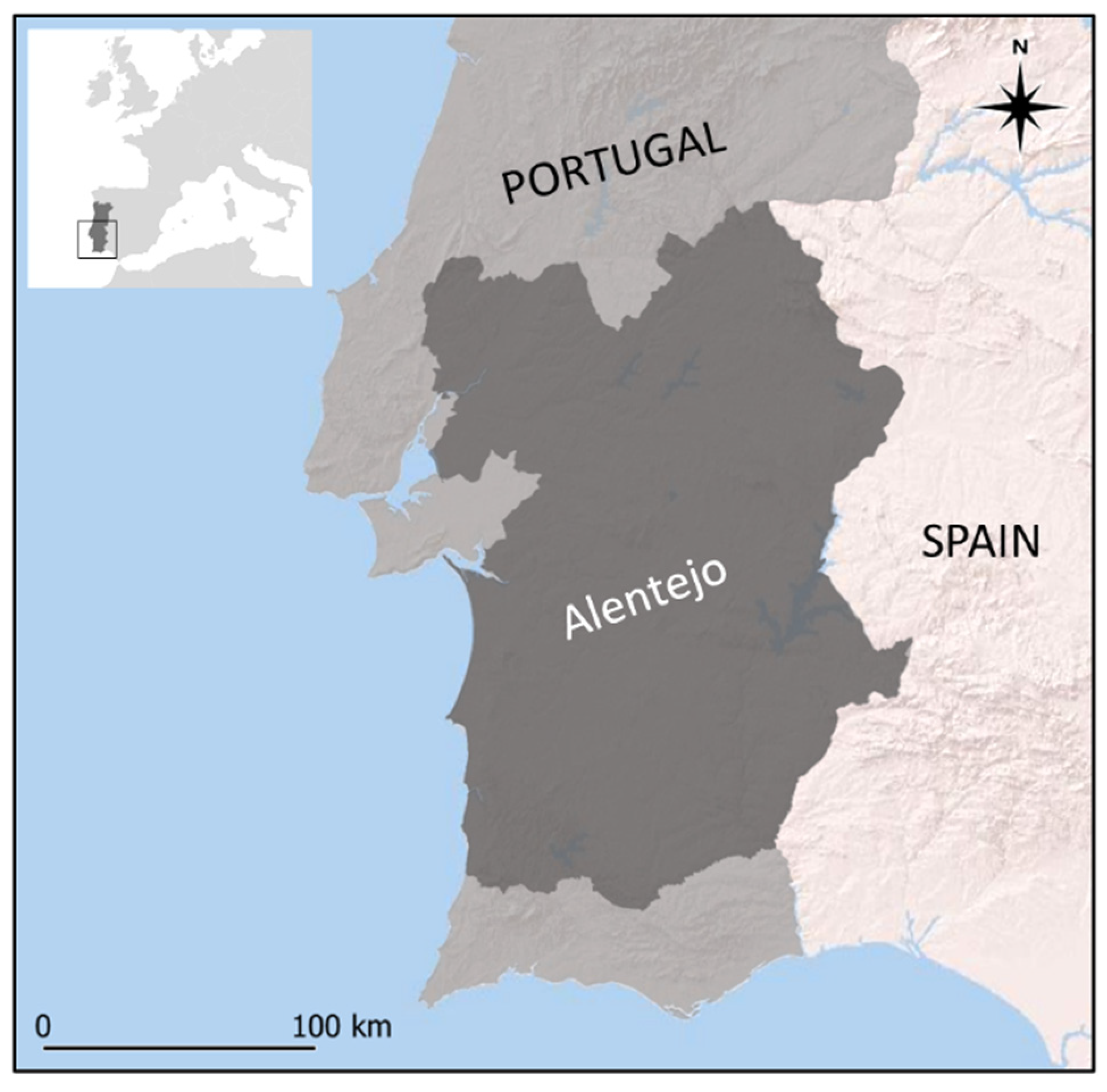
Figure 2.
Observed (A) and predicted (B) spatial distribution of the farming systems of Alentejo, Portugal, in 2017. Colour legend is provided in Table 1. Non-coloured areas (in black) refer to areas that did not apply for CAP payments in 2017, most of which are assumed to be non-agricultural areas, mostly forest (adapted from[16]).
Figure 2.
Observed (A) and predicted (B) spatial distribution of the farming systems of Alentejo, Portugal, in 2017. Colour legend is provided in Table 1. Non-coloured areas (in black) refer to areas that did not apply for CAP payments in 2017, most of which are assumed to be non-agricultural areas, mostly forest (adapted from[16]).
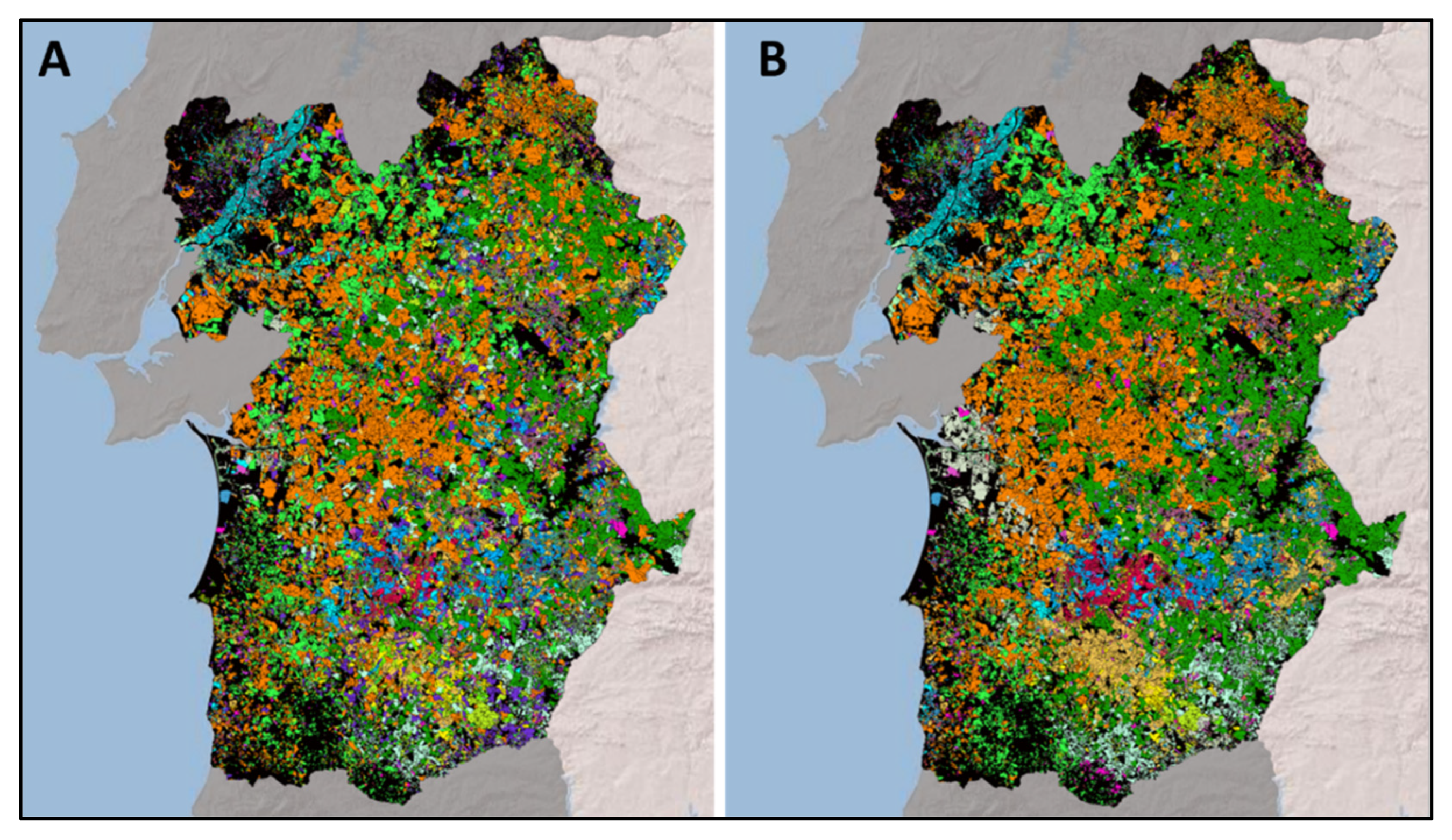
Figure 3.
Predicted farming systems distribution in the study area in 2017 (A—baseline scenario) and for the 2081 2100 low (B—SSP 1-2.6), moderate (C—SSP 3-7.0), and high emission (D—SSP 5-8.5) climate scenarios (see Table 1 for colour legend; see supplementary information in [16] for detailed spatial distribution of each of the 22 farming systems in the baseline scenario).
Figure 3.
Predicted farming systems distribution in the study area in 2017 (A—baseline scenario) and for the 2081 2100 low (B—SSP 1-2.6), moderate (C—SSP 3-7.0), and high emission (D—SSP 5-8.5) climate scenarios (see Table 1 for colour legend; see supplementary information in [16] for detailed spatial distribution of each of the 22 farming systems in the baseline scenario).
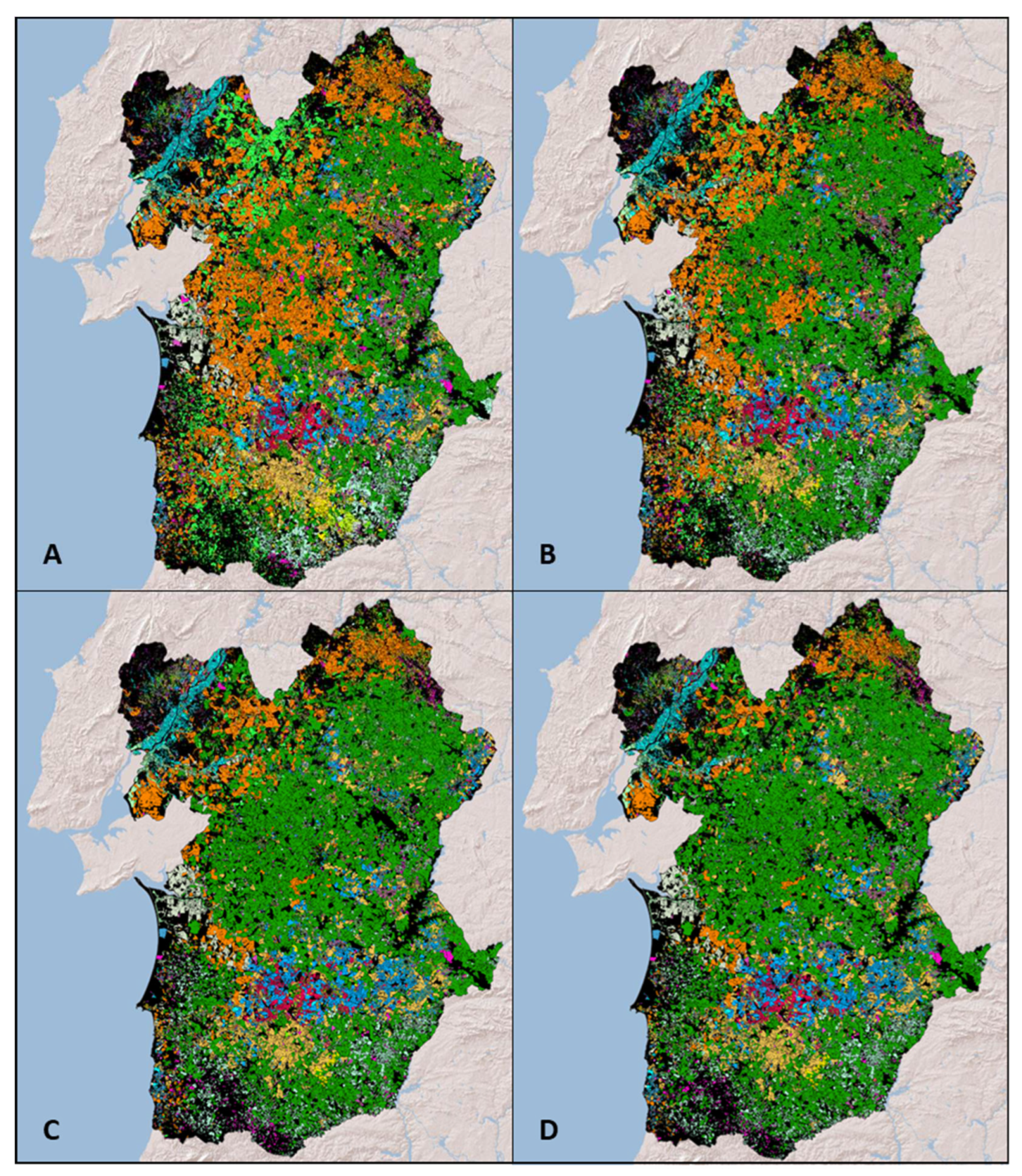
Figure 4.
Areal transitions between farming systems from the baseline period (2017) to 2081-2100 in each of the three climate scenarios (to avoid over-cluttering the figure, transitions below 1000 ha – ca. 0.05% of the study area – are not shown; farming system names are abbreviated from names in Table 1).
Figure 4.
Areal transitions between farming systems from the baseline period (2017) to 2081-2100 in each of the three climate scenarios (to avoid over-cluttering the figure, transitions below 1000 ha – ca. 0.05% of the study area – are not shown; farming system names are abbreviated from names in Table 1).
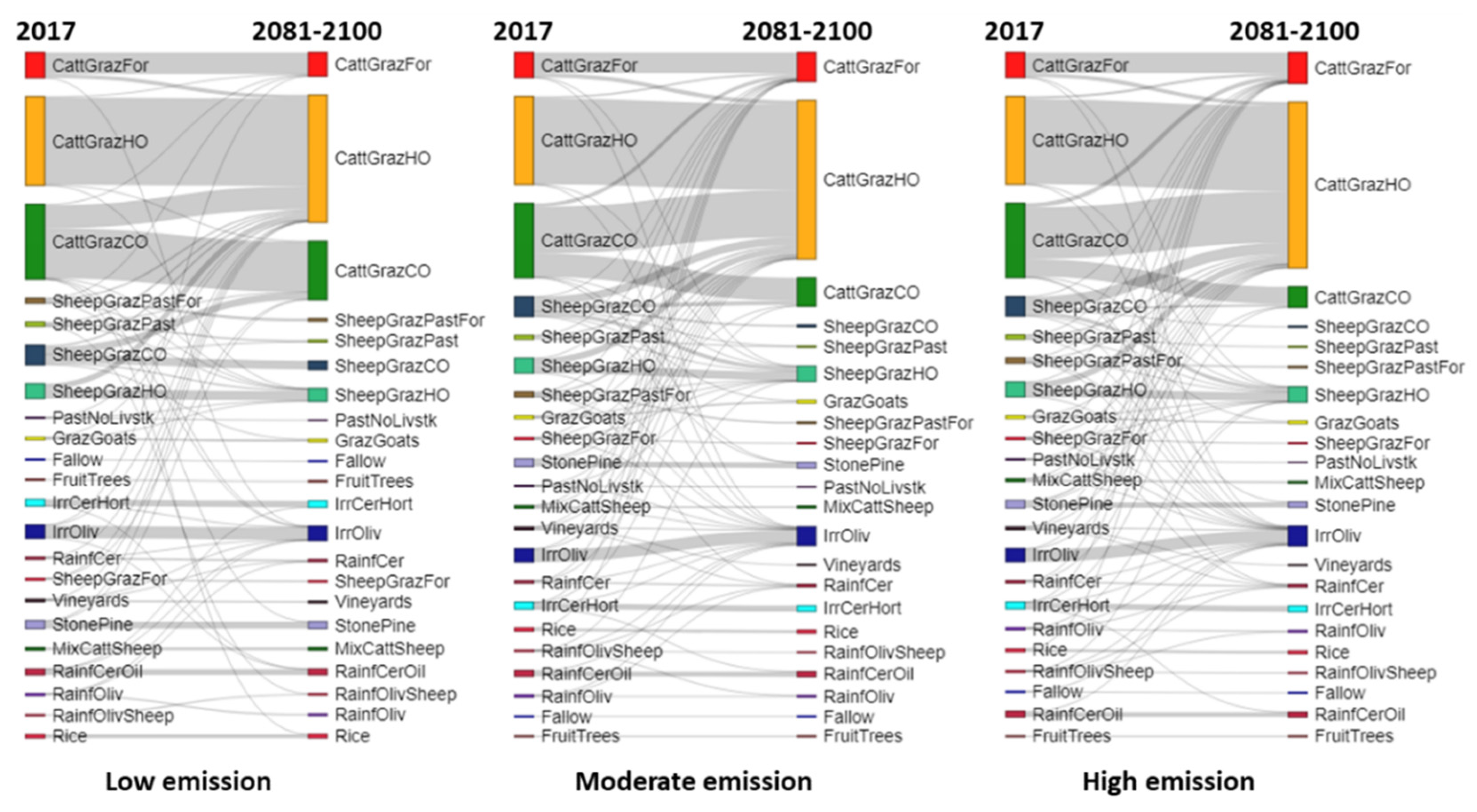

Table 1.
The farming systems of Alentejo, Portugal, in 2017 (adapted from [16]). Figures in brackets describe the livestock density, in livestock units per hectare of total agricultural area. Colours provide a legend for Figure 2. For a detailed description of farming systems, see [16].
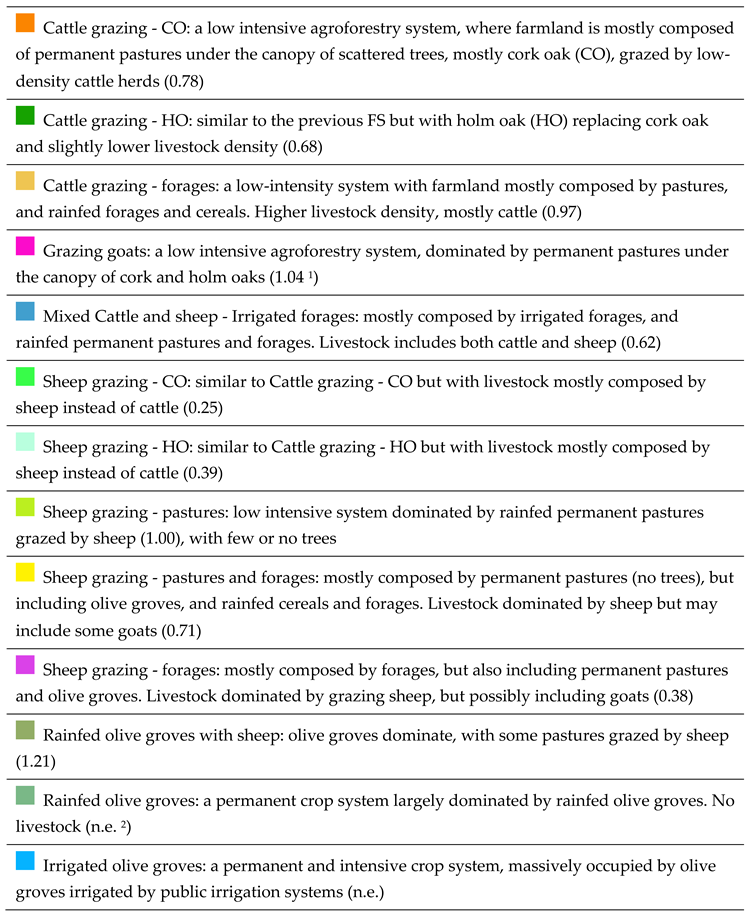
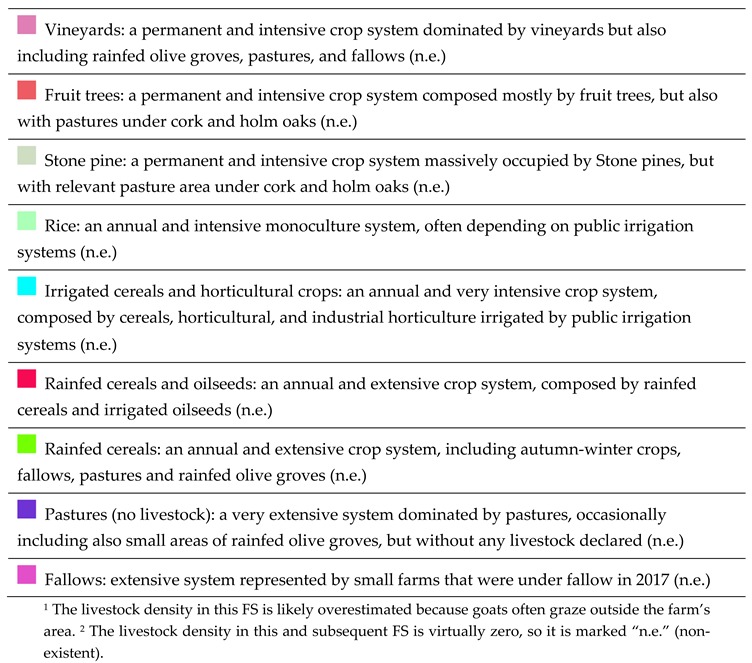
Table 2.
Distribution of the three climate variables used in the models in the baseline situation (average 1971-2000) in the study area and their predicted anomalies for the long-term scenario of 2081-2100. Figures embedded in the graphics depict the corresponding mean values of the anomaly.
Table 2.
Distribution of the three climate variables used in the models in the baseline situation (average 1971-2000) in the study area and their predicted anomalies for the long-term scenario of 2081-2100. Figures embedded in the graphics depict the corresponding mean values of the anomaly.
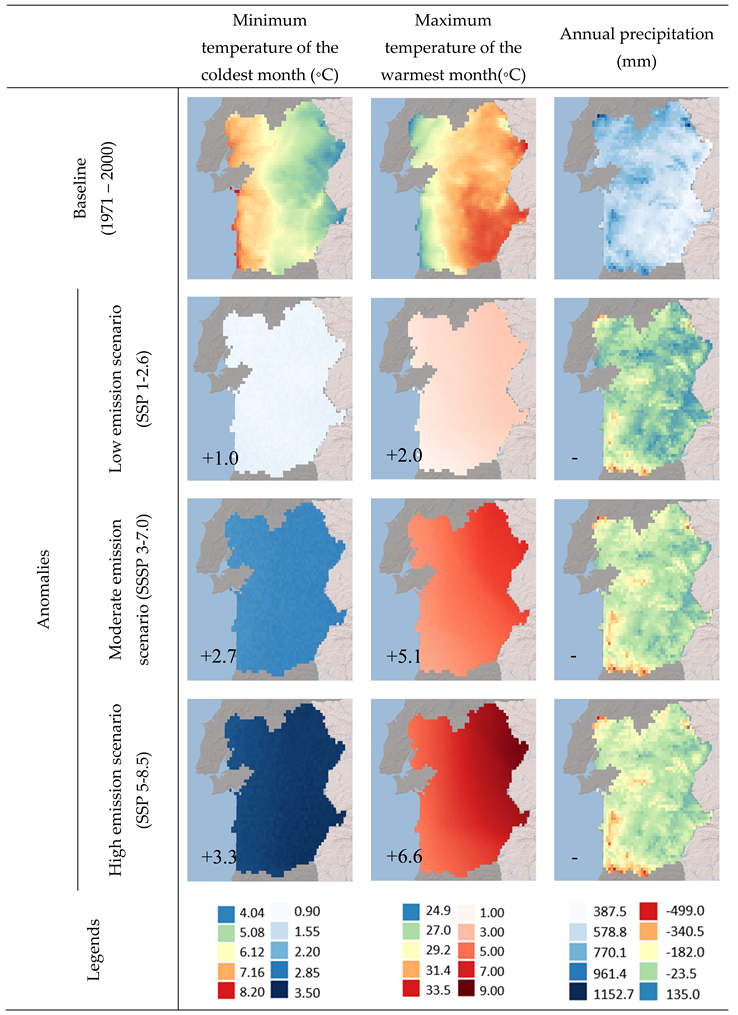
Table 3.
Expected effects of climate change on current area of farming systems in the long term (2081-2100) scenarios.
Table 3.
Expected effects of climate change on current area of farming systems in the long term (2081-2100) scenarios.
| Farming system | Area in 2017 (predicted) | Expected relative changes in area in each 2081-2100 scenario | |||
|---|---|---|---|---|---|
| ha | % | Low (SSP 1-2.6) |
Moderate (SSP 3-7.0) |
High (SSP 5-8.5) |
|
| Cattle grazing - CO | 495,655 | 25.2 | -22% | -62% | -72% |
| Cattle grazing - HO | 580,656 | 29.5 | 44% | 80% | 89% |
| Cattle grazing - forages | 168,219 | 8.5 | -3% | 17% | 23% |
| Grazing goats | 21,075 | 1.1 | -12% | 8% | 6% |
| Mixed Cattle and sheep - Irrigated forages | 20,090 | 1.0 | -1% | -13% | -18% |
| Sheep grazing - CO | 132,621 | 6.7 | -55% | -89% | -93% |
| Sheep grazing - HO | 100,952 | 5.1 | -11% | 4% | 5% |
| Sheep grazing - pastures | 32,734 | 1.7 | -48% | -62% | -66% |
| Sheep grazing - pastures and forages | 36,330 | 1.8 | -45% | -61% | -63% |
| Sheep grazing - forages | 18,602 | 0.9 | -23% | -48% | -59% |
| Rainfed olive groves with sheep | 13,396 | 0.7 | 3% | -22% | -28% |
| Rainfed olive groves | 15,472 | 0.8 | -15% | -12% | -7% |
| Irrigated olive groves | 89,647 | 4.6 | 11% | 42% | 46% |
| Vineyards | 21,947 | 1.1 | -45% | -58% | -64% |
| Fruit trees | 10,256 | 0.5 | -8% | -33% | -37% |
| Stone pine | 54,665 | 2.8 | -11% | -26% | -29% |
| Rice | 22,220 | 1.1 | 7% | -9% | -12% |
| Irrigated cereals and horticultural crops | 50,042 | 2.5 | -9% | -22% | -21% |
| Rainfed cereals and oilseeds | 39,694 | 2.0 | 9% | -9% | -12% |
| Rainfed cereals | 19,182 | 1.0 | 7% | 14% | 22% |
| Pastures without livestock | 12,775 | 0.6 | -75% | -84% | -84% |
| Fallows | 12,700 | 0.6 | -13% | -5% | -1% |
| Total | 1,968,929 | 100.0 | – | – | – |
Disclaimer/Publisher’s Note: The statements, opinions and data contained in all publications are solely those of the individual author(s) and contributor(s) and not of MDPI and/or the editor(s). MDPI and/or the editor(s) disclaim responsibility for any injury to people or property resulting from any ideas, methods, instructions or products referred to in the content. |
© 2023 by the authors. Licensee MDPI, Basel, Switzerland. This article is an open access article distributed under the terms and conditions of the Creative Commons Attribution (CC BY) license (http://creativecommons.org/licenses/by/4.0/).
Copyright: This open access article is published under a Creative Commons CC BY 4.0 license, which permit the free download, distribution, and reuse, provided that the author and preprint are cited in any reuse.


