

Submitted:
19 September 2023
Posted:
21 September 2023
You are already at the latest version
Abstract
The article justifies the need to involve the technogenic deposits (off-balance ore and wastes) into the economic circulation of mining enterprises when there is natural resources depletion. It could be considered as one of the tools of the circular economy. The authors analyze global trends in the copper deposits development, global demand for copper, and design recommendations for possible alternative options for the copper production. The authors use a case of Erdenet Mining Corporation SOE based in Mongolia to develop the approach for economic, social and environmental problem-solving. The millions of mining dumps are proposed to develop as technogenic resources for recycled materials, prolonging profitable activities of the mine. The Hierarchy analysis method is used to obtain optimum order of the mining dumps development to get economic, social and environmental effect.
Keywords:
depletion of natural capital
; mining
; technogenic deposits
; mining dumps
; circular economy
; environmental protection
; Erdenet Mining Corporation SOE
; Mongolia
I Introduction
The natural capital depletion and the waste accumulation are among the main global environmental problems as well as climate change, air, water and soil pollution, loss of biodiversity, etc. [1]. Preservation of natural capital and ensuring green economic growth are becoming the main task in the context of the depletion of the production resource base. It is possible to solve it by optimizing nature management through the inclusion of production waste and resources of technogenic deposits into economic circulation [2]. These changes related to the exhaustion of raw materials and the generation of waste that are limiting factors of sustainable development. Therefore, the theory and practice of modern economic development pays great attention to the principles of resource conservation. A promising model of environmental management is based on the use of waste to preserve natural capital, to reduce production costs, to improve the environment and living conditions of the population.
Nowadays there are global challenges to the environmental security such as the increasing of the natural resources’ consumption with the reduction in their reserves. It leads to a struggle for the limited natural resources and has a negative impact on the economy, population and the environment. Additionally, the resource-based model of economic development has been exhausted and inefficient. Under these conditions, the priority task is the processing of production waste, the improvement of the mineral resource base of mining by involving secondary material resources into the economic circulation, and reducing the burden on the environment. This approach is especially relevant for mining sphere. At present, there is already some experience in using technogenic deposits as a new resource base, for example, mine waste rocks formed during diamond mining to extract gold and molybdenum [3].
Modern science has many publications on the problems of accumulated environmental damage, issues of depletion of natural capital, and therefore the search for alternative sources of production. Technogenic resources, i.e., those obtained as a result of industrial activity represent not only the potential for the production of “indirect” products of industrial production or subsoil use, but also secondary ones, for example, metals of smaller fractions can be extracted from dumps during their processing or resources can be obtained for construction (blocks, mixtures for filling roads). An important area of such research is the issue of environmental safety in the future. K. Lapakko considers industrial waste dumps as a potential source of environmental pollution, since water drainage leads to mixing of groundwater and the threat of chemicals entering it increases significantly. The author offers solutions on how to predict the composition of water in dumps in the future in order to reduce the threat of environmental pollution [4].
Collins, R. J. and R. H. Miller. are exploring the possibility of recycling industrial waste dumps, recognizing that there are significant limitations to their use in the production of various products. For example, according to the authors, the elements contained in dumps may be finely dispersed and oxidize, or the dump itself may be too far away and transporting processed waste may not make economic sense. However, such elements can be used in the construction of railway tracks and concreting platforms, including helicopter platforms in remote areas. Each case must be analyzed taking into account such criteria [5].
Smith L. explores the management of mining waste, dividing it into main types. Depending on the species, the author proposes processing mechanisms, assessing their behavior in the future - the impact on the environment and their economic potential. The main challenge for Smith L. is trying to predict the effects of waste processing and the time period [6]. Some authors [7] associate the problem of waste processing with the costs and inefficiency of available technologies. Nilima Chaturvedi et al. believes that the mining of metals and other ores ensures the social well-being of the population, as it serves for the production of goods. However, the downside of this process is the accumulation of huge amounts of waste. According to experts’ calculations, more than 700 kg of metals were dumped around the world in 1995. Considering that since then, the volume of subsoil use has increased, the accumulation of useful elements in industrial waste has grown exponentially. Therefore, to increase the economic efficiency of waste disposal, investment in innovation, waste management and recycling technologies is necessary. The profitability of the mining enterprise as well as social (maintain or even increase employment and income) and environmental (reduce the source of pollution) issues could be solved. The authors [7] discuss the disturbed lands and their restoring based on the case of iron ore deposits in India where phytoremediation methods are used.
The article [8] notes that rock waste can negatively affect the environment. Techniques for the hydrogeochemical behavior of mine waste rock are reviewed for sustainable management of tailings ponds to optimize management and minimize potential negative environmental impacts.
Swedish research [9] shows the potential for converting mine dumps into gold. The article [10] discusses the issues of the potential environmental risk assessment as a result of the mobility of microelements present in the soil during the development of gold rock dumps. In general, the issues of extracting valuables from mine dumps and tailings during mining are discussed in the study [11].
In [12], using the case of tailings development project, the resource potential of mine waste is analyzed in order to ensure sustainability and ensure cleaner production.
Finally, the paper [13] examines the issues of project management and the project life cycle assessment in the process of useful products extracting from the tailings of a gold mining enterprise.
A significant scientific and practical interest is presented in case of the extracting and development of the tailing dumps in the Republic of Sakha (Yakutia). There is a huge waste dumps of a gold recovery plant at the Kular deposit in the Russian Arctic. The problem of accumulated environmental damage is solved as well. This makes it possible to reduce the risks of environmental emergencies in the Arctic region, to obtain useful products, and also to harmonize the interests of the mining company and the local population [14]. In addition, this approach has been improved and a mechanism for interaction and cooperation of target groups, i.e., business, local government and indigenous peoples during the industrial development of the Arctic, was developed [15].
Currently, in world practice, significant experience has been accumulated in the use of geochemical technologies for processing waste from mining enterprises and obtaining useful products [16].
Modern studies show that the technogenic raw materials involvement into processing can significantly strengthen the economic potential and provide a solution to many urgent problems of subsoil use, including:
- -
- more complete use of non-renewable natural resources;
- -
- the preservation of depleting mineral raw materials in the subsoil
- -
- increasing labor productivity through cost-effective processing of extracted raw materials
- -
- ensure employment making new jobs;
- -
- cheap building materials (sand, crushed stone, gravel, etc.);
- -
- mineral additives to improve soil structure, fertilizers for agriculture;
- -
- reduction or elimination of environmental pollution sources;
- -
- recultivation of lands occupied by waste [17].
One of the factors affecting the functioning of mining enterprises is the possible depletion of mineral reserves, which leads to the closure of the mine and the liquidation of the enterprise. At the same time, the accumulated waste due to mine activities can be considered as a resource base, a kind of technogenic deposits that could be involved to the economic circulation, e.g., for the building materials production. The mine waste rocks formed during the production of marketable ores contain a significant number of useful elements. The authors propose to use the substitute resources of mining, which is understood as a set of technogenic resources (off-balance ore, mine waste rocks, enrichment waste) suitable for reuse as a new raw material base. Such approach allows extending the life of a mining enterprise, reducing the burden on the environment and obtaining demanded products through recycling. For example, 1 ton of non-ferrous metals accounts for up to 100-150 tons of waste and another 50-60 tons for processing.
Mining waste is a unique source of many valuable rare metals. The exploitation of technogenic deposits makes it possible to maintain the required level of metal production even with a significant decrease in the production of metal ores. It should be noted that industrial wastes are often close in composition and properties to natural raw materials, and in some cases, they have advantage [18]. One such example is copper.
The depletion of copper is currently due to the fact that many mining enterprises are working on enrichment technologies designed for high and medium grades of minerals in ores. In the near future, according to forecasts, the copper content in ores will decrease to 0.5% and below. At the same time, the mine waste rocks contain large reserves of substandard, poor and oxidized ores. They are independent technogenic deposits. Calculations made for the Russian Kalmakyr copper site of mine waste rocks leaching showed the economic feasibility of introducing this technology. The need to develop and to implement the projects and programs for waste processing is very up-to-date because in Russia, Mongolia and worldwide the countries face with the problem of resource base depletion. In addition, there is an acute issue of eliminating the accumulated damage and the environment protection.
An analysis of world experience shows that the extraction of minerals and metals has a negative impact on the environment [19]. At the same time, the accumulated waste of mining enterprises can be considered as a kind of technogenic resources that are quite cost-effective to involve in economic circulation. This meets the principles of a green and circular economy.
2. Materials and Methods
The model of mining waste involvement to the economic circulation can be built on the basis of replacing primary natural raw materials by substitute resources, which can be, for example, technogenic deposits formed as a result of the mining activities. Evaluation of their use in dynamics helps to determine the relative savings, the benefit of the finished products’ production from technogenic resources. In practice the reduction of available reserves of natural raw materials, the resource base depletion of mining is a general trend in the world. This circumstance is already reflected in the financial indicators of such enterprises, including growth of costs for the environment recovery. The development of the industry for the extraction and production of non-ferrous metals, including copper, is based on the involvement to the economic circulation and subsoil use the resources, which are also limited and exhaustible. In many countries the main problems in mining enterprises’ supplying with raw materials for copper production are associated with the depletion of mineral reserves, which led to the closure of mines and a reduction in copper production (Table 1).
In some countries, such as Chile, Australia, China, Canada, USA, New Zealand there is an experience on copper manufacturing from production waste [20]. In terms of explored copper deposits, Russia accounts for 5% of world reserves, Mongolia - 3%. For comparison: less than a third of technogenic waste is recycled in Russia, while in the world this figure reaches 85-90%. Therefore, an important issue of environmental economics is the analysis and trends assessment of sustainable development of the copper industry in the context of the of raw materials’ depletion.
Thus, a common trend for Russia and Mongolia in copper production is the reduction of raw materials reserves against the backdrop of an increase in copper demand for national economies’ needs. Another trend is the cessation of mining enterprises due to the closure of mines. Therefore, for mining companies in Russia, Mongolia and other countries, there is a strong search for new resources of the production by secondary raw materials involvement into the economic circulation, as well as problem-solving of the accumulated environmental damage. For example, as a result of the past activities of many mining enterprises in Russia, huge number of the accumulated environmental damage and disturbed territories were formed. They negatively impact on the environmental conditions of life of the population living in such areas.
This is why the case of Erdenet Mining Corporation SOE is interesting for theory and practice, since in Mongolia the mining sector in the medium term will remain a key factor in the country's economic growth. Erdenet Mining Corporation SOE is one of the largest enterprises in Asia for the extraction and dressing of copper and molybdenum. It was founded in 1978 at the copper-molybdenum deposit called “Erdenetiin Ovoo”. The enterprise provides socio-economic development of the cities of Erdenet (90.000 population) and Darkhan (76.000 population). Geological exploration of the Erdenetiin Ovoo deposit began in the late 1950s. In the period from 1964 to 1968, this field was discovered. In 1976, the first explosion was carried out and overburden have started; more than 18 million m3 of rock mass per year is mined at the Erdenetiin Ovoo deposit by open pit method. Currently, this enterprise produces 530.0 thousand tons of copper and more than 4.0 thousand tons of molybdenum concentrate. This enterprise processes 25 million tons of ore per year, produces 530.0 thousand tons of copper and 4.5 thousand tons of molybdenum concentrate.
Mongolia's mining sector makes a significant contribution to the country's GDP, accounting for a quarter of its income.
Currently, the Erdenetiin Ovoo deposit is based on reserves of porphyry copper ores of the North-Western section with a copper content of 0.54-0.57%, molybdenum - 0.0165-0.0179%. At the same time, the waste rock mass contains significant residual amounts of copper, molybdenum, rhenium, silver and other associated metals, as well as flotation reagents used in technological processes. According to experts, at this mining enterprise, the explored reserves of copper and molybdenum remain for approximately 25-30 years using the current mining technology. The negative consequences are linked to useful components decreasing in raw materials’ content, growing costs of products. At the same time, there is a growing demand in the world, and there is a trend toward an increase in copper production.
Stabilization of world prices for raw materials, primarily for copper, to a large extent stimulated the implementation of waste processing projects and the involvement of off-balance ore in the economic turnover, which, given the low price of primary natural resources, was not profitable enough. This makes it possible to cost-effectively involve off-balance ores and resources of technogenic deposits into economic circulation. Among the tools for reducing the environmental and economic costs of production, the processing cost, raw materials could be replaced by others, less expensive, for example, by substitute resources.
The following case on sustainable mining could be considered. The data for the article and math calculations’ carrying out was the materials of Erdenet Mining Corporation SOE. To obtain finished products (copper and molybdenum) at the same level when the content of copper and molybdenum in the ore is reducing to 0.54% and 0.0167%, a further increase in ore production is necessary. At the same time, the cost of processing mined ore and producing finished products increases every year. The completed SWOT analysis showed that the strengths of Erdenet Mining Corporation SOE include the availability of substitute resources for the production and technogenic deposits as a new resource base for production. The weaknesses of the enterprise are raw material depletion, the need to implement compensatory measures due to mine’s closure, the dependence on world prices for raw materials, the lack of facilities for processing copper concentrate, as well as rising environmental costs. Among the threats there are the closure of the enterprise’s mine in the future, instability of prices on the world market, rising costs of employment and for environmental modernization of the production. From the moment the enterprise was created and reached its design capacity, the copper content in ore indicator ranged from 0.685% to 0.833%. Later it steadily declined from 2013 to 0.530%, and currently stands at 0.45%. The experts project its drop to 0.21% by 2040. At the same time, in order to maintain copper concentrate production volumes, the company has started increasingly mining and processing ores with worse mineral content. Thus, when working in the combined North-Western and Central sections with a processing capacity of 35 million tons per year, the life of the mine can be (Figure 1):
- a)
- with a cut-off copper content of 0.25% - 36 years,
- b)
- with a cut-off copper content of 0.15% - 41 years.
It is obvious that in order to maintain production volumes of finished products in conditions of a copper content decrease in the extracted raw materials, the extraction of a significantly larger volume of rock mass and ore will be required. It will be accompanied by an increase in the costs of its processing. At the same time, there is an increase in volumetric indicators associated with the extraction and processing of ore, while simultaneously reducing the ore content. At the beginning of 2018, the price of 1 ton of copper on world commodity exchanges exceeded $7,000 (the selling price of copper concentrate from Erdenet Mining Corporation SOE was $1,730/t). In 2017, rock production at the enterprise increased by 1,810 thousand m3 relative to 2010, but ore processing remained at the same level. The production of finished products (copper) decreased significantly.
S&P Global forecast copper growth will rise to 50 million metric tons per year by 2035, exceeding total global consumption from 1990 to 2021. According to estimates by the Canadian mining corporation Ivanhoe Mines, an era of global copper shortage is coming and, in the face of growing unmet demand for this resource, prices will increase by an order of magnitude. The global trend in demand and prices for refined copper shows continuous growth against the backdrop of significant depletion of deposits and a reduction in balance reserves of copper ores. Mineralized overburden rocks, substandard off-balance ores, difficult-to-process oxidized and mixed ores are deposited in the mining waste rocks [20]. Despite the difficulties of extracting copper from deposit dumps, this process is possible with present technology development and taking into account the constant increase in copper prices is economically feasible.
The exploitation period depends on the size of the deposit and the ore content. At the same time, during the extraction process, the percentage of the ore content decreases. On average, the copper content in ores at developed deposits, for example, in Russia, is reduced to 0.5%. For example, the Gumeshevsky copper mining deposit in Russia has been in operation for 315 years; during this period, copper extraction technologies have changed many times, that keeps mining profitability.
Dumps of copper mining rocks are significant technogenic deposits consisted of substandard, poor and oxidized ores’ reserves [21]. Existing leaching technologies help to use dumps as technogenic deposits and cost-effective copper extraction. The life of the field could be extended, Figure 2.
The most technologically simple and less expensive methods are dump or heap leaching, which are successfully implemented in many countries. An enlarged technical and economic calculation made for the copper dump leaching of the Kalmakyr deposit have showed the economic feasibility of introducing this technology. On Figure 3 shows the dynamics of copper content in the ore of the Erdenet field. It has decreased from 0.83% to 0.35% during the period of subsoil use. The percentage of copper in the ore dumps is 0.38%, and in the oxidized dumps - 0.53%.
In 2012, the percentage of copper in the ore of the deposit and the ore of the dumps was equal. In 2021 the copper content in the ore of the deposit was at the level of copper content in the oxidized dumps. It is estimated that the average period for technogenic deposit development is 25-30 years. The main task of copper ore deposit dumps’ involvement is to rationally determine the procedure for mining based on economic, social and environmental goals.
The problem-solving requires evaluation criteria development for each of the goals. The composition of the criteria may be different and should be determined based on the individual characteristics of the enterprise, including remoteness from populated territories occupied by dumps and tailings areas, their impact on the environment. The following criteria were identified during discussion with Erdenet Mining Corporation SOE, civil activists living in the mining area:
- -
- Economic: profitability and volume of copper concentrate extraction;
- -
- Social: the demand for the territory occupied by mining dumps and its perspectives for local development;
- -
- Environmental: negative impact reducing on the environmental and possible risk of an emergency.
The specific of the Erdenet production requires annual capital expenditures to maintain and development. The profitability of the production is determined as ratio of annual profit to capital costs. The economic goals’ assessment criteria are calculated as profitability in shares, volume of concentrate recovery - in thousand tons during the period of dump development. The social and environmental goals’ criteria are assessed by experts using the T. Saaty scale [22]. A set and number of criteria used for dumps evaluation does not affect the proposed process for problem-solving.
To determine a rational procedure for mining dumps of a copper ore deposit, a calculation procedure has been developed. It is performed by two stages. At the first stage, it is necessary to determine the priority of using dumps, based on all applicable criteria. During such assessment, all criteria must be used simultaneously with their weight. Among well-known ranking methods, the Hierarchy Analysis Method (HAI) satisfies the formulated conditions. To apply this method, you should use the T. Saaty scale, which is already included in the expert assessment of socio-ecological criteria [22, 23].
Therefore, it is necessary to convert the evaluation criteria into this scale [16, 17], to quantify an economic goal using an incremental step based on formula:
where - criterion value for the i-th dump.
Using the found step, an individual scale ranging from the minimum to maximum value for the used criterion can be obtained. It corresponds to the T. Saaty scale. For example, if the maximum value of production profitability among the analyzed dumps is 4.22, and the minimum is 1.36, then the step value is. Based on this step, a gradation of production profitability has been obtained. It is associated with lexical units and scale scores (Table 3).
The algorithm for the priority determining of compared objects based on the hierarchy analysis method is known and widely used in practical calculations [14-35]. It is not advisable to dwell on it. The use of the hierarchy analysis method makes possible to obtain priority for the dumps’ development .
The second stage of problem-solving is to determine the rational sequence of dump mining [22]. It will ensure the first-priority selection of the highest priority dumps based on the annual volume of allocated financial resources in year t to ensure annual capital costs for mining maintenance and development during dumps’ processing . The sequence of dump mining is identified by the required start and end dates for dump mining with a duration of . The heuristic algorithm is developed and used for the rational sequence of dumps’ mining determination:
Step 1. Specifying a set of analyzed dumps for which rational sequence and timing of mining has to be found.
Step 2. Setting the current time and values for the volume of financing of capital investments, Step 3. Selection of the dump with the highest priority within the available financial resources to ensure capital costs for the mining maintenance and development:
Step 4. Check: if such a dump is not selected, then move on to the next year; go to step 3. Otherwise, go to step 5.
Step 5. Calculation of time for dump development:
Step 6. Adjustment of remaining funding amounts after choosing a dump :
Step 7. Elimination from the set of unselected dumps:
Step 8. Check whether all dumps are included in the mining sequence, i.e., ? If yes, then the calculations are complete; otherwise, go to step 3. The proposed algorithm can be easily implemented as a VBA-Excel macro.
3. Results
The Erdenet mine dumps located at a distance of 5 to 8 km from urban areas have been chosen as the objects of the research. The Plan of their processing must consider economic, social and environmental priorities. There are two kinds of dumps:
- -
- with average ore content about 0.38% (dumps of off-balance ores no. 2, 4a, 8, 9;
- -
- with average ore content 0.53% (dumps of oxidized off-balance ores no. 8a, 12, 2b).
The economic indicators of the analyzed dumps are given in Table 4.
Expert assessment of analyzed dumps according to environmental impact criteria must be also considered. The demand for the territory for local development and the risk of an emergency is given in Table 5.
At stage 1, the priorities for the use of mining dumps are assessed by the hierarchy analysis method. Table 6 shows the weights of the criteria (last row of the table) and mountain dumps’ assessments for each of the criteria separately (columns 2-6 of the table). In the last column the priority of mountain dumps’ processing is calculated based on weights of the criteria.
Figure 4 presents the priorities for the mountain dumps’ use. Moreover, dumps number 9, 8 and 2b have the highest priority.
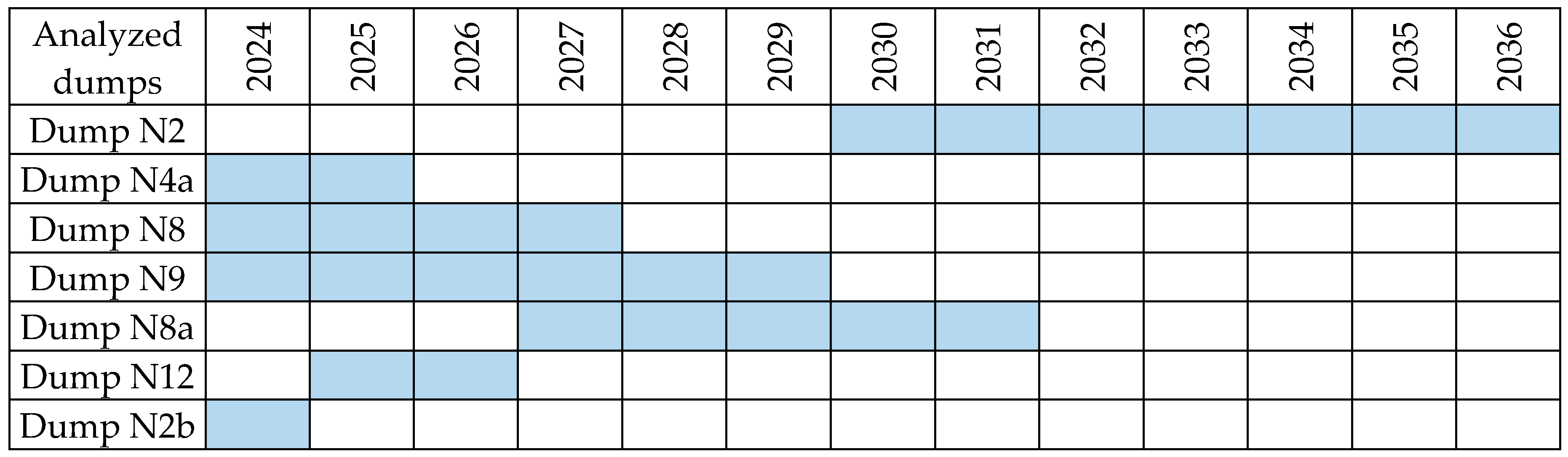
At stage 2, based on the received priorities, capital costs, duration of mining and the amount of funding, the priority of mining these dumps is determined. Erdenet Mining Corporation SOE has a maximum annual financing of capital costs as 62 million $US for the dumps’ development. 2024 was adopted as the year for dumps’ mining start. For 2024, the highest priority options are selected based on developed algorithm for priority of mining dumps’ determination. Dump N9 is selected because it has the highest priority (0.19). Since the mining dump’s development requires 6 years (Table 3). Figure 5 marks the period from 2024 to 2029 with available financing 44 million $US (because for ).
For 2024, the N8 mining dump is selected as the highest priority. The capital investment costs are $US 17 million. Since the remaining funding allows for the N8 dump development in 2024, the process of its mining could be illustrated on a graph. In Figure 5 shows the process of mining the N8 dump for the period of 2024–2027. The funding remains have to be adjusted: for . Next, the mining dump N2b is selected with a priority of 0.18. 11 $US million of the capital investments are required for the dump’s development. The selected dump requires one year of implementation and is included in the 2024 plan.
An attempt to include to 2024 plan the dump N2 with a priority of 0.15 is not possible since the development of this mountain dump requires 36 million dollars. This sum exceeds the funding remains for 2024. The next priority for mining dump N4a use should be chosen. It requires capital costs of $US12 million and two years of development. This mining dump will be added to 2024-2025 plan. Funding balances are being adjusted : $US million; $US million. From 2025 to 2026, it is not possible to include the remaining dumps in the formed plan, because the funding is insufficient. In 2027, the volume of possible financing is $US27 million. Therefore, the mining dump N8a is included in this period (till 2031).
The adjustment to residual funding for this period is as follows: million dollars; million dollars for ; million dollars for . The start of the N2 mining dump development is possible only from 2030 (Table 7).
As a result, a sequence was obtained for the technogenic deposits’ involvement considering all mountain dumps development by 2036. It possible to reduce the period of mining dumps development in four years. There could be recommendation to increase the funding for the dump’s development for the 2026-2029 period. As Figure 5 shows the capital costs and production volume correlate providing that obtained order of technogenic resources involvement into economic circulation has been realizing. This ensures high production profitability.
The following trajectories show the achieved social development and environmental security goals by the mining dumps development according obtained order (Figure 6).
The progressive process of goals achieving could be seen on the graph:
- -
- in 2030 (the middle of the mining dumps development period) the risk of environmental emergencies has been reduced by 81.5%;
- -
- urban development through reclaimed areas is 94.3% satisfied;
- -
- environmental pollution reduced by 90.3%.
The results of the research were used for development strategy for Erdenet Mining Corporation SOE, Erdenet city and its social and environmental sustainability.
Conclusion
The developed approach was designed to define the priority order of dumps mining development to achieve economic, social and environmental effects. The individual sets of criteria can be used for a specific production facility. Its composition should be dictated by geographical features, occupied dump areas, percentage of mined ore, the impact of dumps on the environment and other factors. The research has proved that the technogenic deposits have a significant impact on the economics of mining enterprises and could be used for the environment improvement by using of non-renewable natural resources. The proposed approach offers the mechanism of costs reduction by technogenic raw materials’ use for finished products production. When the resource base is depleted the mining company is interested in prolonging and keeping its activity to ensuring the profit and the employment [36]. The mining dumps development for the production of building materials (sand, crushed stone, gravel, etc.) could be the problem-solving and liquidation of accumulated environmental damage as well.
References
- Davaakhuu, N. , Potravny I. M., Tishkov S.V., Kulakov K.A. Modeling mining company activities under conditions of resource base depletion: Ecological-and-economic aspect, Mining Journal, 2019, 8, 50–54. [Google Scholar] [CrossRef]
- Novoselov, A.L. , Novoselova I. Yu., Potravny I.M. Model for the development of mineral resources in the region based on the principles of “green” economy, Mining Journal, 2017, 7, 55–58. [Google Scholar]
- Novoselov, A. , Potravny I., Novoselova I., Gassiy V. T: Sustainable Development of the Arctic Indigenous Communities: The Approach to Projects Optimization of Mining Company, Sustainability, 2020, 12(19), 7963. [CrossRef]
- Lapakko, K. Metal mine rock and waste characterization tools: An overview, the Acid Drainage Technology Initiative - Metal Mining Sector web page, 02, No. 67 (available at www.mackay.unr. 20 April.
- Collins, R. J. and R. H. Miller. Availability of Mining Wastes and their Potential for Use as Highway Material, Federal Highway Administration, Report No. FHWA-RD-76-106, Washington, DC, May, 1976.
- Smith, Leslie. Hydrogeology and Mineral Resource Development / Leslie Smith – Guelph, Ontario, Canada, 2021. 67 p.
- et al. Iron ore mining, waste generation, environmental problems and their mitigation through phytoremediation technology International Journal of Science and Research Methodology, 2016, 5 (1), 397-420.
- Bas Vriens, Benoit Plante, Nicolas Seigneur and Heather Jamieson. Mine Waste Rock: Insights for Sustainable Hydrogeochemical Management. Minerals. 2020. [CrossRef]
- Nils Johansson, Joakim Krook, Mats Eklund. Transforming dumps into gold mines. Experiences from Swedish case studies. Environmental Innovation and Societal Transitions, Volume 5, 2012, Pp. 33-48. [CrossRef]
- Sihle Mngadi, Masixole Sihlahla, Sakiah Lekoadu, Shandung Moja, Philiswa N. Nomngongo. Evaluation of mobility, fractionation and potential environmental risk of trace metals present in soils from Struibult gold mine dumps. Journal of African Earth Sciences, Volume 172, 2020, 104008. [CrossRef]
- J.H.P. Watson, P.A. J.H.P. Watson, P.A. Beharrell. Extracting values from mine dumps and tailings. Minerals Engineering. Volume 19, Issue 15. 2006. Pp. 1580-1587. [CrossRef]
- Rudolf Suppes, Soraya Heuss-Aßbichler. A: Resource potential of mine wastes, 2021. [CrossRef]
- K.H. Cairncross, M. K.H. Cairncross, M. Tadie Life cycle assessment as a design consideration for process development for value recovery from gold mine tailings. Minerals Engineering, Volume 183, 2022, 107588. [CrossRef]
- Potravny, I.M. , Chavez Ferreyra K.Y., Novikov A.V. Project Approach to Benefit Sharing during industrial Development of the Russian Arctic. Eurasian Mining. 2023. No. 1. pp. 29–32. [CrossRef]
- Eugenia Potravnaya, Hye-Jin Kim. Economic Behavior of the Indigenous Peoples in the Context of the Industrial Development of the Russian Arctic: A Gender-Sensitive Approach, Region: Regional Studies of Russia, Eastern Europe, and Central Asia. 2020. 9(2): pp.
- Bowel, R. et al. Unlocking value in mine waste and mine sites, Geochemistry: Innovation and collaboration, 2021, 61, 13 P. (available at https://cdn-web-content.srk.com/upload/user/image/SRK-News-Issue-61- A4-spreads20211008123758632.
- Yezhov, A.I. Evaluation of technogenic raw materials in Russian Federation (firm mineral resources), Gornye nauki i tehnologii (Mining science and technology), 2016, 4, 62-72. [CrossRef]
- Trubilov, V.S. , Klepikov A.S. Copper-containing dumps as a prospective source of copper obtaining, Tsvenye Metally, 2014, 11 (863), 31-36.
- Apolo Herrera A., E. , Chavez Ferreyra K. Y., Potravny I.M. Gold mining impact assessment on the economy and the environment in Ecuador, Mining Journal, 2020, 2, 62–65. [Google Scholar] [CrossRef]
- Danny Walker. Placer Gold Mining in Mongolia – the New Zealand Way, World Placer Journal, November 2001, 2, 26–29.
- Gorlova, O.E. , Shadrunova I. V., Sinyanskaya O.M. Development of a combined technology for nonacid flotation–hydrometallurgical processing of noneconomic copper ore stock piles, Gornyy informatsionno-analiticheskiy byulleten, 2018, 12, 151–167. [Google Scholar] [CrossRef]
- Saaty T., L. , Vargas L. G. The seven pillars of the analytic hierarchy process, Models. Methods, Concepts & Applications of the Analytic Hierarchy Process: International series in operations research & management science, 2012, 175, 23–40. [Google Scholar]
- Saaty, T.L. Decision making with the analytic hierarchy process. Int. J. Services Sciences, 2008, 1, 1, 83–98. [Google Scholar] [CrossRef]
- Ukraintsev, I.V. , Trubilov V. S., Klepikov A.S. Poor substandard and technogenic raw materials as a promising source of copper, Non-ferrous metals, 2016, 10, 36–42. [Google Scholar]
- Romanchak, V. The Problem of the Adequacy of the Analytic Hierarchy Process and Its Solution, Analytic Hierarchy Process. Models. Methods. Concepts. 2023. [Google Scholar] [CrossRef]
- Yavuz, M. The application of the analytic hierarchy process (AHP) and Yager’s method in underground mining method selection problem, International Journal of Mining. Reclamation and Environment. 2015. [Google Scholar] [CrossRef]
- Goepel K., D. Comparison of Judgment Scales of the Analytical Hierarchy Process - A New Approach, International Journal of Information Technology and Decision Making, 2018, 05-20.
- Korneenko V., P. Korneenko V. P. On the correctness of the method of analyzing hierarchies and comparing its approximate solution with the approximation matrix method, Bulletin of Cybernetics, 2021, 3(43), 12-22. [CrossRef]
- Korneenko V., P. Method of approximation matrix for forming object weights in multicriteria selection problems, Bulletin of Cybernetics, 2021, 1(41), 51-62. [CrossRef]
- Balusa, Bhanu & Gorai, Amit. Sensitivity analysis of fuzzy-analytic hierarchical process (FAHP) decision-making model in selection of underground metal mining method. Journal of Sustainable Mining, 2018, 18. 10.1016/j.jsm.2018.10.003.
- Ataei, M. , Jamshidi M., Sereshki F., Jalali S.E. Mining method selection by AHP approach, Journal of the Southern African Institute of Mining and Metallurgy, 2008, 108(12).
- Bogdanovic, B. , Nikolic D., Ilic I. AHP and PROMETHEE method for mining method evaluation, Anais da Academia Brasileira de Ciências, 2012, 84(1), 219-233.
- Musingwini, C. , Minnitt R.C.A. Ranking the efficiency of selected platinum mining methods using the analytic hierarchy process (AHP). Third International Platinum Conference ‘Platinum in Transformation’. The Southern African Institute of Mining and Metallurgy. 2008, 319-325. https://platinum.org.za/Pt2008/Papers/319-326_Musingwini.
- Wang, C. , Yang S., Jiang C-Y., Wu G-Y., Liu Q-Z. Monte Carlo analytic hierarchy process for selection of the longwall mining method in thin coal seams. 1005. [Google Scholar] [CrossRef]
- Kuckartz B.T., Peroni R., Rodrigues A.L. Multi-stage dumping sequence - a feasible waste management alternative for open pit mining, International Engineering Journal, 2021, 74(2), 253-260. [CrossRef]
- Gassiy, V. , Stoikov, V. Renewable energy and green construction in the Arctic, E3S Web of Conferences, 2020, 207, 02008. [Google Scholar] [CrossRef]
Figure 1.
Changes in production profitability and selling prices of copper concentrate. Source: compiled by the authors.
Figure 1.
Changes in production profitability and selling prices of copper concentrate. Source: compiled by the authors.
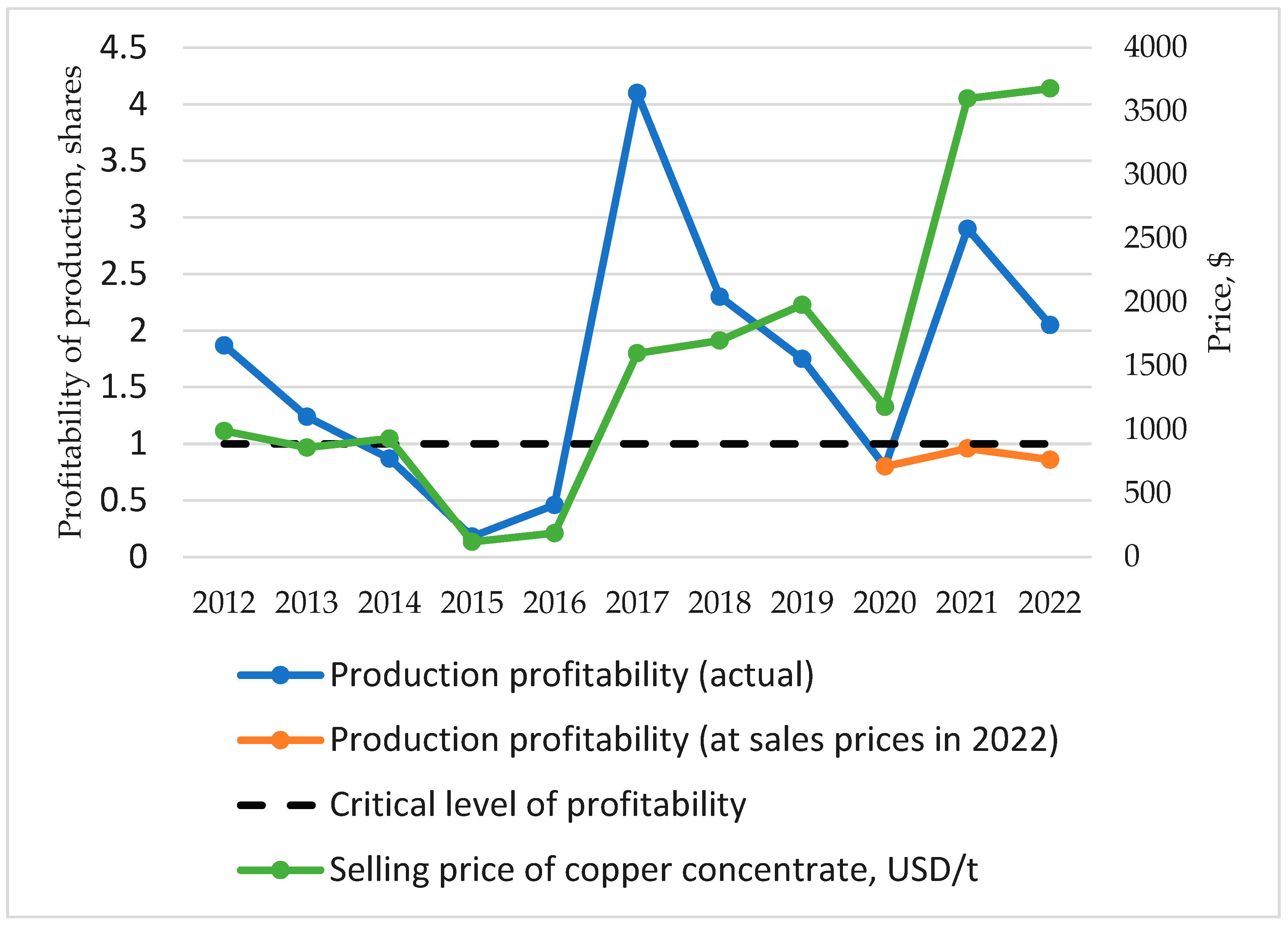
Figure 2.
Schematic diagram of the economic feasibility of deposit dumps involvement in the process of copper ore mining. Source: compiled by the authors
Figure 2.
Schematic diagram of the economic feasibility of deposit dumps involvement in the process of copper ore mining. Source: compiled by the authors
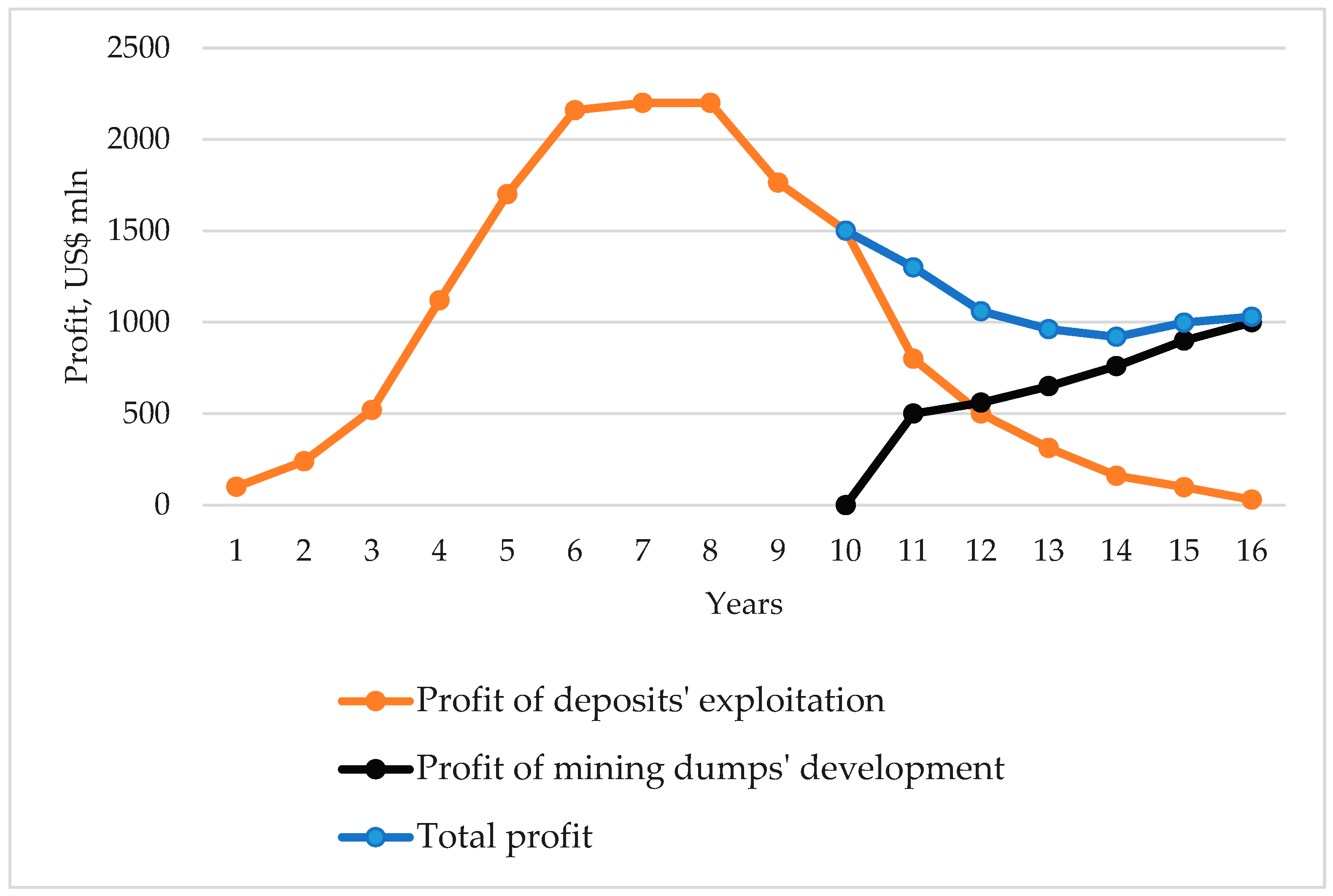
Figure 3.
Dynamics of copper content in ore during the exploitation of the Erdenetiin Ovoo deposit, Mongolia. Source: compiled by the authors.
Figure 3.
Dynamics of copper content in ore during the exploitation of the Erdenetiin Ovoo deposit, Mongolia. Source: compiled by the authors.
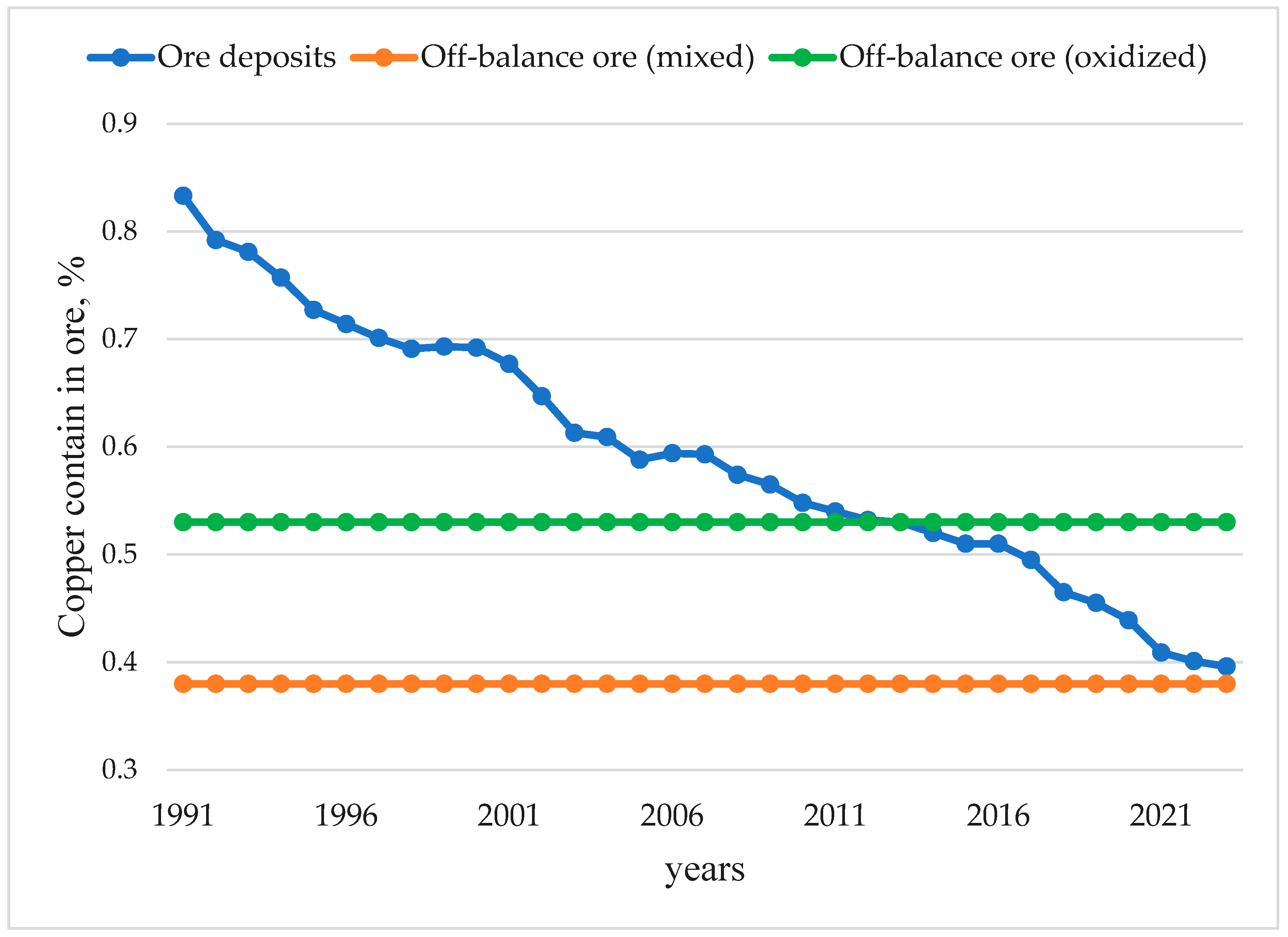
Figure 4.
Priorities for analyzed dumps’ use as technogenic resources. Note: Compiled by the authors.
Figure 4.
Priorities for analyzed dumps’ use as technogenic resources. Note: Compiled by the authors.
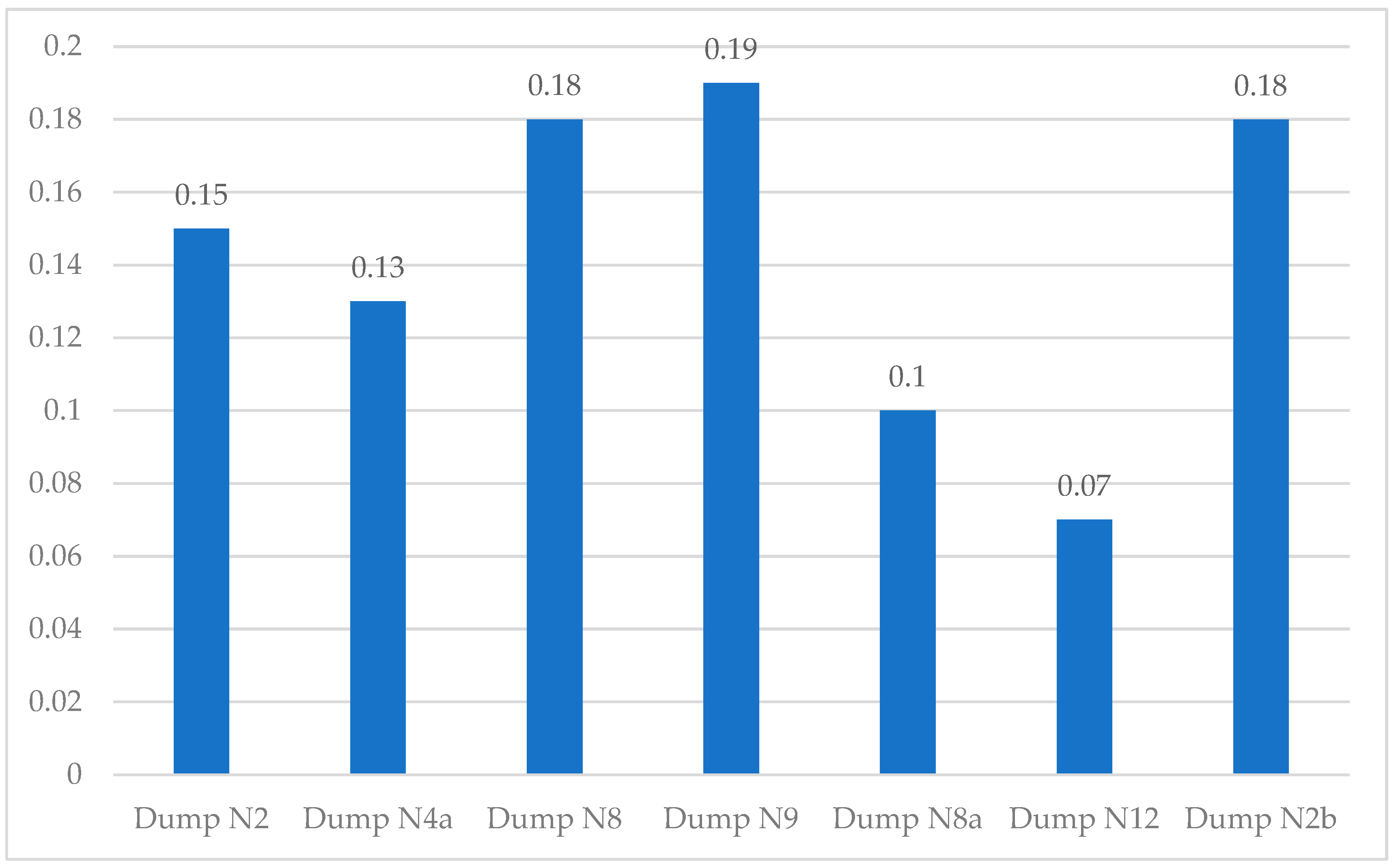
Figure 5.
Dynamics of economic indicators of dumps mining development in accordance with the obtained order. Source: compiled by authors
Figure 5.
Dynamics of economic indicators of dumps mining development in accordance with the obtained order. Source: compiled by authors
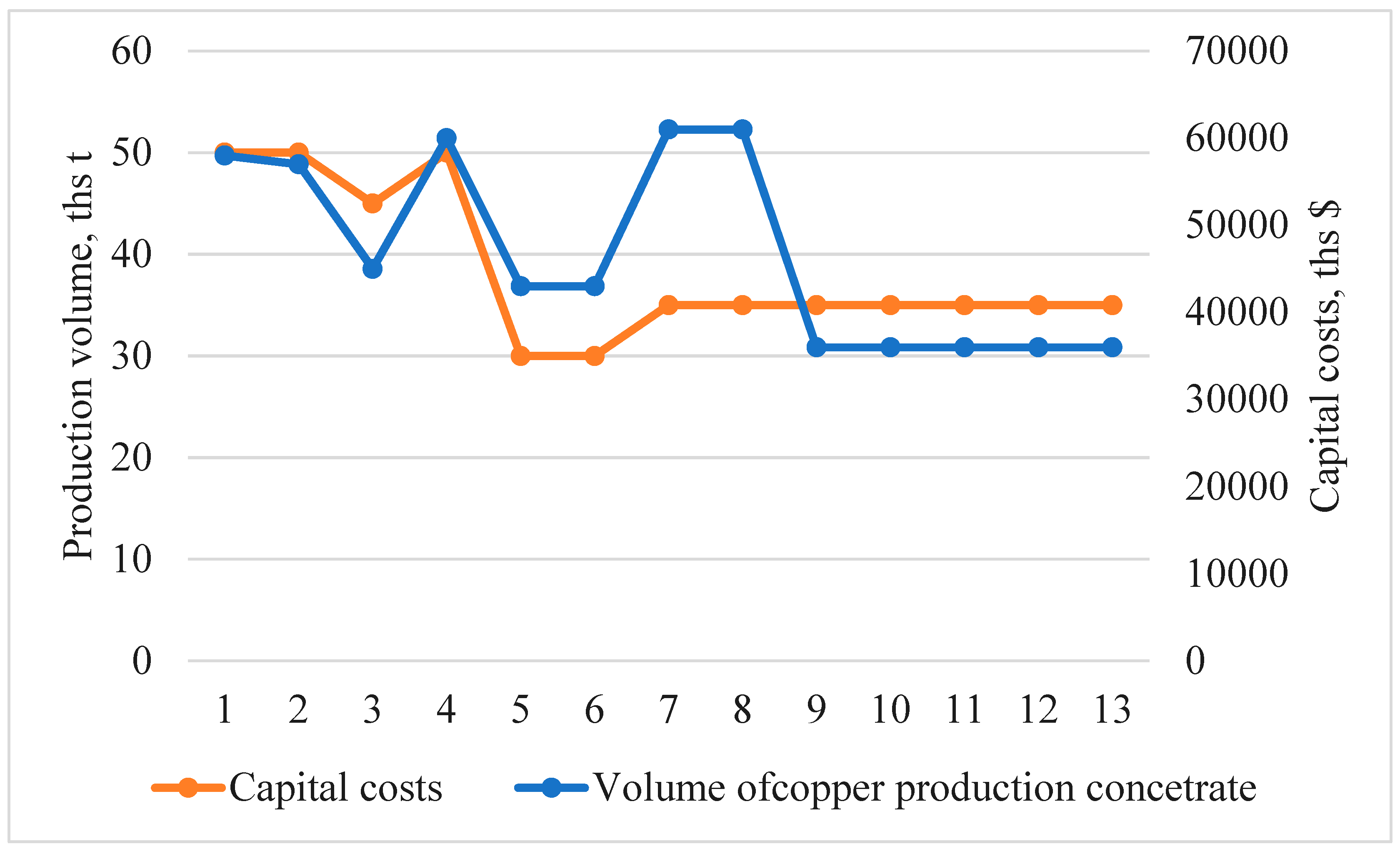
Figure 6.
The achieved social development and environmental security goals by the mining dumps development according obtained order.
Figure 6.
The achieved social development and environmental security goals by the mining dumps development according obtained order.
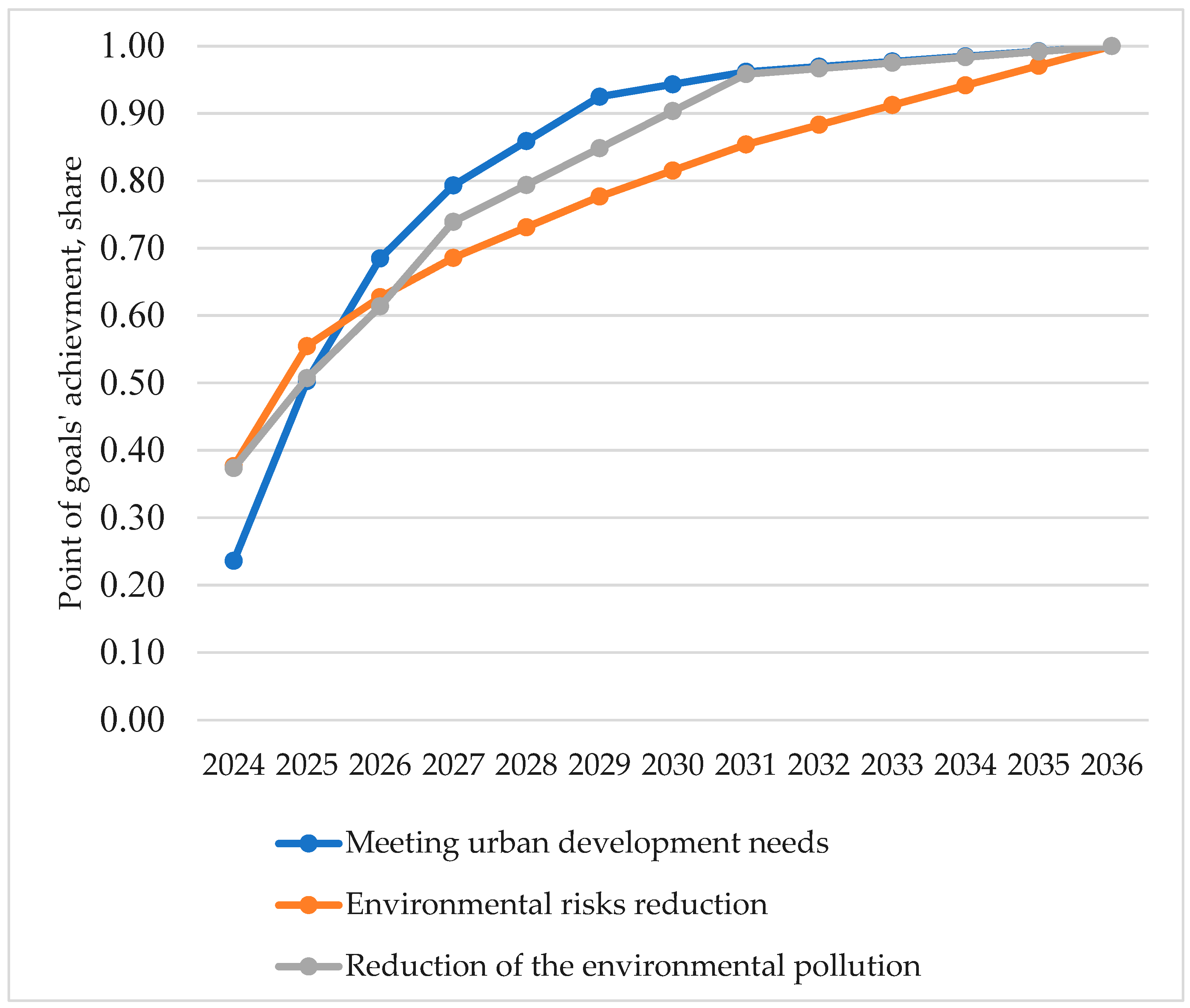

Table 1.
The production reduction and closure of mines for the extraction of copper ore due to the depletion of reserves in the world.
Table 1.
The production reduction and closure of mines for the extraction of copper ore due to the depletion of reserves in the world.
| Country | Mines | Capacity, thousand tons | State of the mine |
| USA | Miami, Freeport | 26 | Closed |
| USA | Tyrone, Freeport | 43 | Reduced up to 50% |
| Chile | El Abra, Freeport | 166 | Reduced up to 50% |
| Chile | Collahuasi, Glen/ Anglo American | 445.25 | Capacity reduction to 30 thousand tons |
| USA | Ray, Asarco | 53.29 | Capacity reduction to 40% |
| Congo | Katanga, Glencore | 160 | Temporary closed |
| Zambia | Morani, Glencore | 110.185 | Temporary closed |
| Botswana | Mowana | 10 | Closed |
Source: London Metal Exchange, CRU group.
Table 2.
Indicators of heavy industry development in Mongolia in 2021.
| Indicator | Share, |
| Mining sector in gross domestic product (GDP) | 24% |
| Industrial sector in national economy | 69% |
| Foreign direct investment | 77% |
| Export | 93% |
Source: Economic efficiency of the sector in 2021, the Ministry of Mining and Heavy Industry, https://mmhi.gov.mn/en/.
Table 3.
An example of converting quantitative values of a criterion into the T. Saaty scale.
| Value of profitability | Lexical assessment | Point assessment |
| 4,22 | very high | 9 |
| 3,87 | intermediate | 8 |
| 3,51 | high | 7 |
| 3,15 | intermediate | 6 |
| 2,79 | average | 5 |
| 2,43 | intermediate | 4 |
| 2,08 | low | 3 |
| 1,72 | intermediate | 2 |
| 1,36 | very low | 1 |
Table 4.
Economic indicators of the analyzed dumps of the Erdenet deposit.
| Analyzed dumps | Potential copper reserves in dumps, thousand tons | Duration of dump development, years | Capital investments for mining maintenance and development, million $US / year | Production profitability, shares |
| Dump N2 | 210 | 7 | 36 | 3.02 |
| Dump N4а | 10 | 2 | 12 | 1.36 |
| Dump N8 | 80 | 4 | 17 | 4.22 |
| Dump N9 | 120 | 6 | 18 | 3.99 |
| Dump N8а | 50 | 5 | 25 | 1.39 |
| Dump N12 | 10 | 2 | 10 | 1.63 |
| Dump N2b | 5 | 1 | 11 | 1.48 |
Note: compiled by the authors.
Table 5.
Social and environmental assessments of the liquidation of the analyzed dump areas.
| Analyzed dumps | Assessment of socio-ecological criteria in the lexical scale | ||
| Impact on the environment | Demand for the territory for city development | Risk of an emergency | |
| Dump N2 | Very low | Average | Average |
| Dump N4а | Very low | High | Average |
| Dump N8 | Low | High | Short |
| Dump N9 | Very low | Very high | Average |
| Dump N8а | Low | Average | Short |
| Dump N12 | Very low | High | Short |
| Dump N2b | Low | Average | Average |
Note: compiled by the authors based on data from Erdenet Mining Corporation SOE.
Table 6.
Resulting assessments of the priority of mountain dumps’ use as technogenic raw materials.
| Analyzed dumps. | Criteria Scores | Dumps’ priorities | ||||
| Profitability of production | Potential reserves of copper | Demand for the territory. occupied by dumps | Risk of an emergency | Environmental pollution | ||
| Dump N2 | 0.15 | 0.45 | 0.05 | 0.20 | 0.06 | 0.15 |
| Dump N4а | 0.04 | 0.03 | 0.17 | 0.21 | 0.05 | 0.13 |
| Dump N8 | 0.36 | 0.19 | 0.17 | 0.05 | 0.28 | 0.18 |
| Dump N9 | 0.34 | 0.19 | 0.33 | 0.22 | 0.05 | 0.19 |
| Dump N8а | 0.04 | 0.07 | 0.05 | 0.05 | 0.23 | 0.10 |
| Dump N12 | 0.04 | 0.04 | 0.17 | 0.05 | 0.06 | 0.07 |
| Dump N2b | 0.04 | 0.03 | 0.05 | 0.22 | 0.27 | 0.18 |
| Criterion weight | 0.10 | 0.06 | 0.15 | 0.39 | 0.30 | 1.00 |
Note: compiled by the authors based on data from Erdenet Mining Corporation SOE.
Table 7.
Order for mining dumps with the maximum volume of capital investments in 62 $US million for the mining maintenance and development.
Table 7.
Order for mining dumps with the maximum volume of capital investments in 62 $US million for the mining maintenance and development.
 |
Disclaimer/Publisher’s Note: The statements, opinions and data contained in all publications are solely those of the individual author(s) and contributor(s) and not of MDPI and/or the editor(s). MDPI and/or the editor(s) disclaim responsibility for any injury to people or property resulting from any ideas, methods, instructions or products referred to in the content. |
© 2023 by the authors. Licensee MDPI, Basel, Switzerland. This article is an open access article distributed under the terms and conditions of the Creative Commons Attribution (CC BY) license (https://creativecommons.org/licenses/by/4.0/).
Copyright: This open access article is published under a Creative Commons CC BY 4.0 license, which permit the free download, distribution, and reuse, provided that the author and preprint are cited in any reuse.


