
Submitted:
19 September 2023
Posted:
21 September 2023
You are already at the latest version
Abstract
The prefabricated houses supply in Chile was analyzed from web platforms, public market, social media, and Internal Revenue Service, using indicators according to regulatory compliance, complexity, and sustainability attributes, which are essential in advancing to industrialization, and climate change adaptability. The 80% is concentrated in construction, and manufacturing companies, 83% of them are legally registered,with the capacity of meeting technical requirements. To delve deeper into this, 54% has low level, 35% medium level, and 11% high level. The sustainability was measured in 5 levels: 2.7% (1), 37,5% (2), 58,6% (3), 1,1% (4) and 0% (5), which is the highest one. This attribute was determined as the weakest one. The proposed evaluation, based on indicators by attribute, is objective and relevant to consideration since there is still a lack of capacity to supply the housing deficit, and there is not attributes associated to security in habitability to address the climate change, and environment threats, with a lack of action by the state to promote this productive sector, therefore focusing more in provide products, than taking responsibility of the site, not advancing to become a real state agency, which could be improved if management, and regulation were incorporated.
Keywords:
wooden houses
; habitability and climate change
; climate change adaptation
; safe housing
; sustainable housing
1. Introduction
Wood is the most used material to meet housing requirements for different socioeconomic levels [1,2], no only meeting the requirements in emergencies, but also in being the “future sustainable solution in high-rise buildings in the world” due to a sustainability technically well-documented [3,4,5,6]. It is also the most accessible solution in rural areas given the wood availability, and the lack of access to state subsidies. Beyond the current legislation, it is mistakenly possible to reduce costs when acquiring houses with no sustainability attributes, such as energetic efficiency, and low carbon footprint.
What has been happening for decades, since in Chile the demand exceeds by far the housing supply, is a housing deficit higher than 650.000 homes, and to stop this deficit from increasing, 100.000 houses need to be fabricated annually [8], for that reason the self-build is becoming more common [2,7,9], or the acquisition of houses in alternatives housing markets with a large supply of building types, qualities, deadlines, from construction kits, to turn-key complete installation services. As providers, there are consolidated architectural offices, and/or construction companies, complying with technical criteria established until the final work reception. It represents an option for those with purchasing power, but not for those without, accessing in this case to substandard habitability, where the indicators of sustainability, and safety hardly ever exist, or are assessed. For a non-wood construction industry, which generates 35% of waste globally, with a 20% of water consumption, and with 40% of greenhouse gas emissions, sustainability is not an option, but a necessity. As a model, to promote this process, the International Living Future Institute launched in 2006 the strictest, and most sustainable green building program in the world: the Living Building Challenge. Through this program, around 20 buildings at global level seek to be certificated, confirming that they generate more than they consume through the certification “Net Zero Energy Building” (NZEB) [11]. The architectural design, water management, ventilation, photovoltaic panels, orientation of the building, and windows are considered in this certification. That is to say, at global level, standards are higher each time, and, while wood has always been available as raw material, today it plays a new leading role. Meanwhile in Chile, strategic national programs have been promoting the wood potential during the past two decades, but this only represents from 10 to 12% of the formal construction. The state drives the energetic certification of buildings, and houses to increase the value of supply, and in terms of public building, it complies with technical regulation, however, there is a lack of technical regulation certification in the private market. Exceptionally, in high level projects, international certifications like Passivhaus, or LEED are included, highly exceeding national regulations. Up to now, wood structural construction does not exist in these buildings, except for some buildings created as a trigger effect, or other very specific corporations. [9,12].
The purpose of reflect on the vulnerability, and lack of sustainability of habitability when territorial conditions are no taken into account, setting homes in areas of risk, seismic exposition, volcanos, forest fires among other threads without understand its importance is what this investigation seeks to highlight, focusing on the supply of prefabricated wooden houses in three central Chilean regions: Valparaíso, Metropolitan, and O’Higgins. The results may be extrapolated to most of the Latin American territory, therefore giving a chance to this sector to manage processes related to sustainability, preparation, and preventive actions towards habitability conditions triggered by climate change.
2. Materials and Methods
In order to evaluate prefab houses that this productive sector is providing, this study was developed through a review of bibliographic sources, and online data, including web platforms, directories of business, publications by INFOR (Forestry Institute), SII (Internal Revenue Service) database, among others.
The study includes Valparaíso, Metropolitan, and O’Higgins regions in central Chile, considered due to their potential demand capacity.
To generate records on the companies selected to be studied, in addition to investigation online, and in social media where offers are being made, a search of information in the public market’s sales, official statistics, and Internal Revenue Service was carried out. Highlighting key words in search engines, using as model the ones used in [10], to build sustainability indicators that this time were: 1.-Materialy (wood, biomaterials, others); 2.-Safety (earthquakes, fires, others); 3.-Bioeconomy (Reduce – Reuse – Recycler (R – R – R); 4.-Energetic efficiency, and thermal comfort. A directory of companies was created, and then the houses offered were evaluated based on an indicator built in Table 2, with guidelines to evaluate considering complexity, regulation compliance, and sustainability, as detailed in Table 1.
3. Results
3.1. Building types
Among the most characteristic types of building in the Chilean supply is the prefabricated houses with frame-platform system (60%), SIP system (35%), and to a lesser extent, log, or roundwood houses (5%). The complexity, regulation compliance, and sustainability are not the same in each building type, so there is variation among levels in terms of the attributes considered in the building types studied.
3.2. Evaluation of prefab houses based on indicators
By using a group of indicators built based on variables, and by following part of the methodology of sustainability indicators developed by [10], attributes, and variables were prioritized in Table 1, the ones included in the Linkert scale from 3 to 5 levels as explained in Table 1, being 1 the lowest, and 3 or 5 the highest. The indicators are the number jointly obtained, considering the observed attributes, grouped and described in Table 2, which is the base of the organization of products in groups according to the region where they are located, and the level of each building type evaluated. Products were classified by quality, and the detailed technical information provided. The indicators included information published in sales media; each variable was observed whether explicit, or not.
On this basis, a prioritized record of products for sale was elaborated.

Table 1.
Qualification by attributes (Complexity, regulation compliance, Sustainability).
| Attribute | Variables | Variable level | Likert |
|---|---|---|---|
| I: Complexity | A: Manufacturer, or construction company’s experience | Does not mention | 1 |
| <5 years | 2 | ||
| 5-15 years | 3 | ||
| 16-25 years | 4 | ||
| >25 years | 5 | ||
| B: Supply diversity: N°, design, and model’s refinement | Does not mention | 1 | |
| <5 | 2 | ||
| 5-10 | 3 | ||
| 11-15 | 4 | ||
| >15 | 5 | ||
| C: Size diversity of houses | Does not mention | 1 | |
| <40m2 | 2 | ||
| 40-72m2 | 3 | ||
| 73-120m2 | 4 | ||
| >120m2 o or custom-made | 5 | ||
| D: Formality, start of business activities, and registration in Internal Revenue Services | Informal | 1 | |
| Formal | 5 | ||
| E: Sales possibility with housing subsidy granted by the state | No | 1 | |
| Yes | 5 | ||
| F: Framework agreement participation, public tenders and/or real estate management integration. | No | 1 | |
| Yes | 5 | ||
| II: Compliance with regulations in force (CNV) | A: Seismic resistance | no | 1 |
| yes | 5 | ||
| B: Fire resistance | no | 1 | |
| yes | 5 | ||
| C: Thermal comfort | no | 1 | |
| yes | 5 | ||
| D: Acoustic comfort | no | 1 | |
| yes | 5 | ||
| E: Minimum dimensions | no | 1 | |
| yes | 5 | ||
| F: Waterproof | no | 1 | |
| yes | 5 | ||
| G: Windproof | no | 1 | |
| yes | 5 | ||
| I: Material protection for its durability | no | 1 | |
| yes | 5 | ||
| III: Sustainability | A: Structural material of the building | Does not mention | 1 |
| Hybrid | 3 | ||
| Wood | 5 | ||
| B: Risk reduction in forest fires, earthquakes, climate change. | Does not mention | 1 | |
| At least one | 3 | ||
| Two or more | 5 | ||
| C: Bio-economy Reduce–Reuse–Recycle (RRR) | Does not mention | 1 | |
| At least one | 3 | ||
| Two or more | 5 | ||
| D: Energetic efficiency, water, self-generation, reutilization | Does not mention | 1 | |
| At least one | 3 | ||
| Two or more | 5 | ||
| E: Others from the voluntary code of sustainable construction (MINVU) | no | 1 | |
| yes | 5 |
Source: Own development.
In Table 2, the indicator’s guideline is presented by grouping variables of each attribute in Table 1 (Complexity, regulatory compliance, sustainability) according to Likert scale from 1 to 5, or 1 to 3.
Table 2.
Indicator’s guideline based on attributes according to number, and quality.
| Number of attributes | Quality of attributes (based on Table 1) | Indicador |
|---|---|---|
| *Does not mention | Does not mention | 1 |
| Only one | Attributes without distinction | 2 |
| Two until four | Clearly recognizable Attributes | 3 |
| Three to five | Attributes with relevant technical explanation | 4 |
| More than five | Greatly highlighted attributes | 5 |
This study describes the products offered by 88 companies in the sector, and it suggests a differentiation process using indicators by attribute for its evaluation.
In Table 3, the indicators built for wooden prefab houses in three regions of central Chile are presented.
As observed, the industry of prefabricated houses is characterized by a medium level of complexity, that is to say, most of companies are capable of producing houses with standards suitable for the requirements, however, this supply is not the one being promoted, since there is no constant obligation to comply with technical requirements, these are ignored in accordance with the client in order to reduce costs. Moreover, the study shows that the selling mode Kit to build, or the prefab house built but without installation is the one the market prefers. Thus, the house manufacturer is mainly dedicated to build houses, and does not take responsibility on how to install them, so the owner will be responsible for the consequences when regulations are violated, or when mistakes happen, since the final work reception is rarely carried out, and when it does, the municipal building directions are based only in the documents presented, but not in onsite inspections [14,15,16,17]. There is an important group of companies that, according to the information provided by their sales channels, obtain a low valuation, which is important to note when the current housing deficit scenario is leading people to search for urgent, and low-cost solutions, finding in this market the proper ways to solve temporally, and precariously their housing necessities. This creates a vicious circle of unsatisfaction, and demand for definitive solutions when temporal houses become something normal, increasing by this the camps, or the overcrowding when installing additional houses in the same place destinated to one house only at first instance.
From the total of products evaluated, only from four companies, products with high level were obtained (4), given their industrialization, and digitalization capacity, use of BIM technology to plan satisfactory large-scale solutions, whether in individual, or residential buildings. It is possible with adjustments that some of the companies providing medium level products (3) may contribute to constructive solutions for social houses, thus decreasing habitability deficit. For that purpose, they should be contacted, trained, and focused on a public/private interest, establishing requirements, inspection of processes, and products, that based on the evaluation carried out, it may be very helpful.
In Figure 1, a graphical overview of product’s evaluation results in the regions considered.
Most of companies are located in the Metropolitan region with 69%, followed by Valparaíso region with 20%, and lastly the O’Higgins region with 11%. Most of the companies are building contractors (80%). In terms of formality 83% of the companies are formal, and 17% informal (This condition was verified in evaluated companies included in SII’s records). On the other hand, the most frequent level of complexity (54%) is low in comparison with the average, which is 35%, while high complexity is 11% of this companies according to products offered.
In Table 4, the indicators by attributes resulting from online quotation are presented, different from Table 2 which represents information observed in definitions available in their media, while indicators in Table 4 represents definitions sent by the company itself after a request for quotation. This quotation was used to check whether the companies are explicitly considering complying with the regulation in force in terms of thermal isolation of houses, which is a binding technical criterion in accordance with the OGUC since 2007 for all new buildings. Results show that, most of companies from the sample, offer other services with additional cost to the basic kit, while the thermal comfort is considered as “demanded” by the client, and it is also quoted independently.
4. Discussion
In overall terms, it is determined that there are significant differences in respect of technologic capacity, and digitalization using BIM technology in the companies analyzed, with just a few over the majority in this feature.
The Technical Division (DITEC) from the Ministry of Housing, and Town Planning have announced the legal framework which will regulate the industrializing companies who are going to work with to decrease housing deficit [17]. From the wood construction sector, four companies have been authorized, with social housing projects, and medium-rise buildings, which have been progressing in regulation compliance, using BIM technology in productive process, with a coordinated industrialization inside the factory, in order to allow the chaining with other providers. In such way, potentially, it is possible to make the wooden housing market in Chile to grow, and be developed even as an exportation product for Latin America.
[19] In this investigation it is noted as a finding of the evaluation on thermal subsidies from the family property protection program, and its effects in overcoming the energetic poverty in Chile , that “there is no focus on the most vulnerable homes, and there is no responsibility taken by the program staff, and its poor management, in addition to the thermal subsidies granted, with dissatisfied goals in respect with the resources granted, indirectly, and sectorized, and without adequate monitoring, and inspection. Moreover, it ensures this is added to problems resulting from public institution’s decentralization, the lack of focalization, and characterization of beneficiaries with territorial, and transversal relevance of energetic poverty.
Although there are norms, and laws, finally the recurring problem is who inspects, and enforces compliance, as an example, when low durability wood is used in Chile, it is required to use wood treated with preservatives authorized, and registered in SAG (Agricultural and Livestock Service) in accordance with the risk level in benefit of the structure [20], it is a binding norm of the OGUC (General Construction and Urbanism Ordinance) [21]. Thus, buildings with wooden framework, and wooden prefabs mentioned in E, and H classes, must comply with the articles 5.6.81. of this ordinance. In the same way, pieces or elements of wood, whether structural or finishings, with structural graded or not containing other construction classes, must comply with 5.6.6. and 5.6.8. of this ordinance [21]. By observing the supply, it shows that this is a complex scenario to address, since preserved wood tends to be higher in price, 15% more than without treatment, home buyers do not analyze or know the consequences of not including this expense, they rather save on costs, but not due to the usage of chemical compounds, or the preference of protection over design, but for not having a real durability understanding. Without reasoning that, while the initial expense is a little higher in materials, the proportion of total cost of a house ready to be inhabited is practically residual, (it does not exceed 1 to 3%, the same case is observed in relation to thermal isolation, and floor humidity isolation), and if they would have been contemplated, it would have led to an important progress in quality, durability, functioning, and performance of the house. Based on the life cycle logic, less forests would need to be cut to build, and/or to heat, there would be less transportation requirements, it would increase service life, decreasing the necessity of recycle, replace, reuse 3 to 4 times more than if wood was not preserved. It is possible that a better understanding by users would promote a better regulation compliance, through an informed acquisition.
Coincidentally, this study indicates that there is a strong fragmentation of companies offering “prefab houses” products, that is to say, they build components, and/or complete houses, but no installation of wet, and dry networks, neither installation service, and foundation ground enablement, and urbanization, and industries are not planned to complete this cycle. Thus, a favorable environment is created to pretend satisfying the needs of those who seek options to solve their housing problems in a market with several offers. From prestigious, old, and established companies have shown their permanence in the market, and they have been prejudiced by the uncontrollable formal, and informal companies with no legal compliance with buyers, for example the thermal comfort norm, therefore this study supports what is informed by [19] in their findings.
By exposing and describing this industry, the existent productive capacity can be explained, making adequations to comply with regulations, strengthen users, and whatever is necessary to make this productive sector a more integrated one, successful, and useful for society. In order to do this, as indicated [22], “the extent, and gravity of energetic poverty are deeply connected to the thermal industry, and the inefficiency of houses built, although not generalized, there is a negative component of the market when assuming mistakenly that costs are being reduced by not including thermal comfort, when in reality is the other way round. The base of the existent investigation, according to [22], it has been limited to the identification of real behavior, building technology, and design factors that influence in thermal comfort, and fuel consumption in homes. It was perceived the necessity of take action from the regulatory sector, as well as in the user’s empowerment to fulfill their rights, and to have access to efficient, and calculated solutions designed by experts.
This investigation allows to reflect on the necessity to achieve progress against the reality that demonstrate that the state’s reaction to promote changes is going at a much lower speed than the settlement of families in the territory, and there is more asynchrony between necessity, and the state’s rhythms [23,24]. According to the national cadaster on camps [24], there are 76.544 families living in precarious settlements, 64% more than in the 2019 cadaster, the self-building or the acquisition of emergency houses exacerbates the problem, not only due to the exposed energetic poverty, but by the consequences of exposition, and physical insecurity. Each economic, and politic crisis, or any important disaster in the country leaves a lost of economic power, and houses, increasing the housing deficit, worsening by the increase of house prices, pandemic, migratory flow, and fragmentation of homes. It is not about decreasing the housing deficit, but to increase law enforcement, or at least more than it is currently available.
The analysis on used housing addressed in [25] for 68.466 houses, all of them located in all regions of the country with data provided by the survey Casen in 2017, indicates that 38.1% are built out of wood. The study show that the wooden house is always in a lower quality position when observing size ranges, which increase in houses with sizes lower than 40 m2, where the majority are structural of wood. Another important factor is that, for each 100 wooden houses in the country, 23 have less 40 m2, while in concrete, and brick it reaches 12 to 13 units, respectively, which is directly related to the poverty level of families, and the size of the house.
Finally, it is concerning that, in overall, the safety subject has not been analyzed as a relevant topic until now, and that is still not enough considering sustainability, exemplified through the life cycle analysis, also to get clarity in respect of the final destination of building materials, which is the subject where wood have advantages, but in a still little sophisticated market of prefab houses, these are not shown as an attribute yet. For that reason, it is suggested to consider these three vital elements in construction with wood: Reduce – Reuse – Recycle (R-R-R).
5. Conclusions
This industry is characterized by providing houses in Kit mode to build, already built, and turnkey to a lesser extent, thus being confined to construction factories, in addition to housing companies, both participate in providing housing solutions, so they should be regulated by the state.
Most of the companies are located in the Metropolitan region with 69%, followed by Valparaíso region with 20%, and finally the O’Higgins region with 11%. The type of company that predominates is constructor-manufacturer with 80%. In terms of formality, 83% of the companies are formal, and 17% informal. This information should be related to the high number of people living in these regions.
A 54% has a low complexity, 35% medium-level, and 11% of high complexity, which makes evident the companies’ level of preparation to face markets with higher compliance requirements, technical criteria, deadlines, and costs.
The global evaluation of the 88 companies indicated that 2.7% obtained level 1, 37.5% obtained level 2, and 58.6% level 3, and only 1.1% was located in a level 4, none of them obtained the level 5.
4. Discussion
Authors should discuss the results and how they can be interpreted from the perspective of previous studies and of the working hypotheses. The findings and their implications should be discussed in the broadest context possible. Future research directions may also be highlighted.
5. Conclusions
This section is not mandatory but can be added to the manuscript if the discussion is unusually long or complex.
Author Contributions
Conceptualization, Garay R. and Benedetti, S.; methodology, Garay R.; investigation Garay, R..; resources, Benedetti, S..; data curation, Garay, R.; writing—review and editing, Garay, R. and Benedetti, S. Please turn to the CRediT taxonomy for the term explanation. Authorship must be limited to those who have contributed substantially to the work reported.
Funding
Please add: “This research received no external funding” or “This research was funded by NAME OF FUNDER, grant number XXX” and “The APC was funded by XXX”. Check carefully that the details given are accurate and use the standard spelling of funding agency names at https://search.crossref.org/funding. Any errors may affect your future funding.
Acknowledgments
In this section, you can acknowledge any support given which is not covered by the author contribution or funding sections. This may include administrative and technical support, or donations in kind (e.g., materials used for experiments).
References
- Harju, C. The perceived quality of wooden building materials—A systematic literature review and future research agenda. International Journal of Consumer Studies 2022, 46, 29–55. [Google Scholar] [CrossRef]
- Hidalgo Dattwyler, R.; Vergara Constela, C.D.; Gutiérrez Aguilera, D.; Capetillo Constela, C.; y Alvarado Peterson, V. Su casa, su deuda. La política de vivienda chilena entre la financiarización, la subsidiariedad y la integración social. Revista INVI 2022, 37, 1–44. [Google Scholar] [CrossRef]
- Bascuñán Reyes, D. (2021). Tecnologías constructivas para la protección frente al fuego en edificios de madera de mediana y gran altura (Master's thesis, Universitat Politècnica de Catalunya).
- Garay Moena, R.; Castillo Soto, M.; Fritz Fuentes, C.; Hernández Ortega, C. Desarrollo de un indicador integrado de sustentabilidad y seguridad estructural para el mercado de viviendas de madera aplicado a Chile central. Revista hábitat sustentable 2022, 12, 8–23. [Google Scholar] [CrossRef]
- Green, M.; Taggart, J. (2020). Tall wood buildings: Design, construction and performance. Birkhäuser. Disponible en: https://www.degruyter.com/document/doi/10.1515/9783035618860/html.
- Pacini, J.C. (2021). Estructuras de madera: Diseño, cálculo y construcción. Nobuko.
- González Méndez, E.A. (2022). Vivienda extendida, radicación y densificación: tipología de vivienda adecuada para núcleos familiares extensos de allegados, en barrios pericentrales vulnerables. URI: https://repositorio.uchile.cl/handle/2250/191687.
- Ministerio de Vivienda y Urbanismo (MINVU). 2023. Avance Plan de Emergencia habitacional. Disponible en: https://www.gob.cl/noticias/plan-de-emergencia-habitacional-casi-la-totalidad-de-las-260-mil-viviendas-comprometidas-ya-cuentan-con-subsidio-asignado/.
- Martínez Gamboa, M. (2022). Evaluación de los subsidios térmicos del programa de protección al patrimonio familiar y sus efectos en la superación de la pobreza energética en Chile. Disponible en https://repositorio.uchile.cl/handle/2250/192414.
- Garay, R.; Pfenniger, F.; Castillo, M.; Fritz, C. Quality and Sustainability Indicators of the Prefabricated Wood Housing Industry—A Chilean Case Study. Sustainability 2021, 13, 8523. [Google Scholar] [CrossRef]
- Madera 21. (2023). La madera se abre paso como alternativa en edificios “net zero”. https://www.madera21.cl/blog/2023/08/01/la-madera-se-abre-paso-como-alternativa-en-edificios-net-zero/. 2023.
- Amigo, C.; Calvo, R.; Cortés, A.; Urquiza, A. Pobreza Energética. El acceso desigual a energía de calidad como barrera para el desarrollo en Chile. Policy Pap 2019, 3, 59. [Google Scholar]
- Castillo, M.; Garay, R.; Tapia, R.; Garfias, R.; y Orell, M. (2020). Metodología de evaluación de infraestructuras críticas en zonas de riesgo de incendios forestales. Repositorio Académico. Universidad de Chile. https://repositorio.uchile.cl/handle/2250/173421.
- Garay, R.; Castillo, M.; Tapia, R. Viviendas ubicadas en áreas de riesgo de incendios forestales de interfaz. Un análisis territorial y normativo desde Chile. ACE: Architecture, City and Environment 2021b, 16, 9523. [Google Scholar] [CrossRef]
- INE 2023 Permisos de Edificación. Disponible en: https://www.ine.gob.cl/estadisticas/economia/edificacion-y-construccion/permisos-de-edificacion.
- Quinzacara, E.C. El permiso de construcción desde la perspectiva del Derecho administrativo general. Análisis de sus principales problemas a nivel jurisprudencial. Revista de Derecho Administrativo Económico 2021, 33, 33–70. [Google Scholar] [CrossRef]
- Biblioteca del Congreso Nacional de Chile. 2023. Resolución 59 EXENTA. Establece condiciones y mecanismos de aprobación de proyectos de viviendas industrializadas tipo y fija el procedimiento para revisión de proyectos que incorporen el uso de viviendas industrializadas tipo, desarrollados en el marco de los programas habitacionales fondo solidario elección de vivienda DS n°49 (V. Y U.) De 2011, y de habitabilidad rural DS n°10 (V. Y U.), de 2015. Disponible en: https://www.bcn.cl/leychile/navegar?i=1188149&f=2023-01-23.
- Tapia Zarricueta, R. Medición de la precariedad en asentamientos urbanos irregulares: estudio comparativo entre Venezuela, Chile y Argentina. Revista INVI 2000, 15. [Google Scholar] [CrossRef]
- Martínez Gamboa, M. (2022). Evaluación de los subsidios térmicos del programa de protección al patrimonio familiar y sus efectos en la superación de la pobreza energética en Chile. Disponible en https://repositorio.uchile.cl/handle/2250/192414.
- Instituto Nacional e Normalización INN. NCh 819 (2019). Madera preservada - Clasificación según riesgo de deterioro en servicio y muestreo. https://ecommerce.inn.cl/nch819201968329.
- Ordenanza General de Urbanismo y Construcción [OGUC] (2017). Resumen de modificaciones y rectificaciones de la ordenanza general de urbanismo y construcciones. Santiago, Chile. https://www.minvu.gob.cl/wp-content/uploads/2019/05/OGUC-Mayo-2020-D.S.-N%C2%B01-D.O.-29-05-2020.pdf. /: https.
- Felmer, Gabriel (2018). Prototipos de Viviendas de Bajo Consumo Energético para Diferentes Regiones de Chile. Tesis doctoral La Universidad Abierta. [CrossRef]
- Pena, G.; Kosut, J.; Favre, F. y otros. Estudio interdisciplinario para la validación de criterios de diseño de eficiencia energética en los programas de vivienda [en línea]. Montevideo: Udelar. FI: Udelar. FADU: Udelar. FCS, 2022.
- Mendia, S. (2022). Análisis territorial de la brecha habitacional y el déficit potencial comunal. Disponible en: https://urbanismosocial.cl/publicaciones/analisis-territorial-de-la-brecha-habitacional-y-el-deficit-potencial-comunal/.
- INFOR, 2021 Madera y Construcción, hacia una simbiosis estratégica. Disponible en: https://wef.infor.cl/index.php/publicaciones/estudios/madera-y-construccion-hacia-una-simbiosis-estrategica.
| 1 | “Personal communication with Andrés Ducaud, Arxada QUIMETAL’s Technical Manager. |
Figure 1.
Evaluation of Products “Prefabs Houses” in three regions.
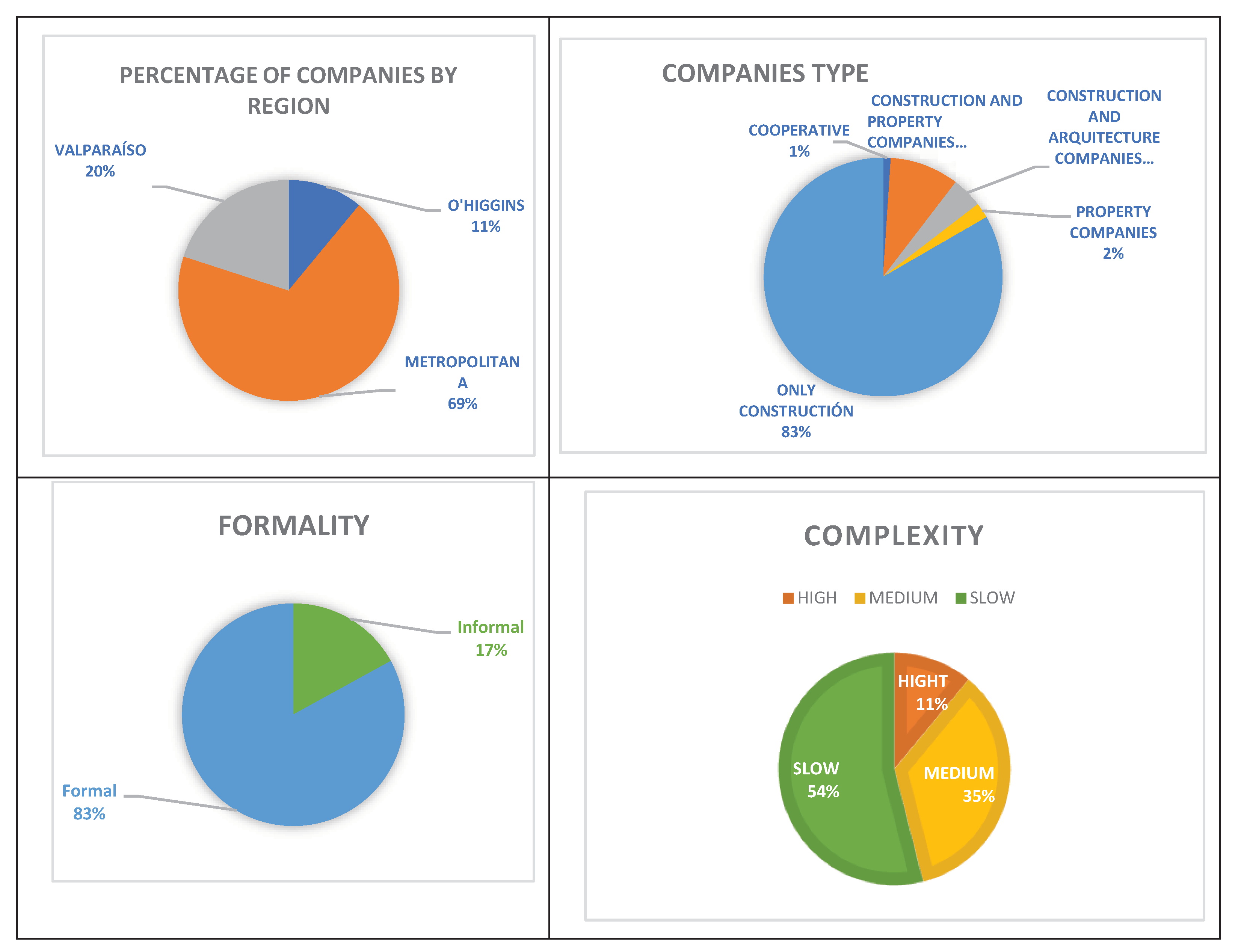
Table 3.
Indicators of prefabricated houses by region.
| Area | Evaluated units | Units by Likert level | Indicator |
|---|---|---|---|
| Valparaíso region | 16 | 1 | 1 |
| 7 | 2 | ||
| 8 | 3 | ||
| Metropolitan region | 61 | 5 | 1 |
| 29 | 2 | ||
| 23 | 3 | ||
| 4 | 4 | ||
| O’Higgins region | 10 | 2 | 1 |
| 4 | 2 | ||
| 4 | 3 |
Table 4.
Evaluation of Prefab Houses supply based on attributes.
| Indicator | Description of assigned qualification |
|---|---|
| 1 | Minimal characterization of the product: materiality, surface, price, and providing only KIT to build. Provides freight with additional cost by covered Km. |
| 2 | Fair characterization of the products, includes plans, Kit’s construction details, there is clarity in what is included or not, provides freight with additional cost to mobilized the Kit, or turnkey houses, but does not indicate thermal isolation |
| 3 | Offers all of the above, moreover it offers installation services with separate charges, or through external sources (masons to recruit) separating them from responsibilities. Offers thermal insulation upon request. |
| 4 | Offers all of the above, it provides experience and clarity in the product installed. It includes thermal isolation. |
| 5 | Offers all of the above, it is the most reliable option, although the price is higher, it is possible to determine that it complies with OGUC criteria, including thermal isolation, and other sustainable construction codes (CCS) |
Disclaimer/Publisher’s Note: The statements, opinions and data contained in all publications are solely those of the individual author(s) and contributor(s) and not of MDPI and/or the editor(s). MDPI and/or the editor(s) disclaim responsibility for any injury to people or property resulting from any ideas, methods, instructions or products referred to in the content. |
© 2023 by the authors. Licensee MDPI, Basel, Switzerland. This article is an open access article distributed under the terms and conditions of the Creative Commons Attribution (CC BY) license (http://creativecommons.org/licenses/by/4.0/).
Copyright: This open access article is published under a Creative Commons CC BY 4.0 license, which permit the free download, distribution, and reuse, provided that the author and preprint are cited in any reuse.


