

Submitted:
18 September 2023
Posted:
20 September 2023
You are already at the latest version
Abstract
Concerning the hippocampal mechanisms that simultaneously function to map environmental position and to generate episodic memories, a developing consensus emerged by the early 21st century. The hippocampus was recognized as embodying the primary location of personal narrative development, with the ability to create stable and coherent narrative largely representing the mental health of individuals. Determining recent advances regarding the relationship among the hippocampus, narrative, and mental health, a limited, six-database review was conducted for peer reviewed articles published since 2019. Of the 127 records located, 14 reports were included for study. The results support the necessity of creating and maintaining a stable and coherent narrative as fundamental to human mental health such that facts will be distorted in personal accounts, sleep will be disrupted, and DNA altered to retain one’s personal narratives. With narrative development fundamental to human mental health, a goal of interventions concerning hippocampal function and positive health outcomes is enhancing personal narratives in providing individuals with the ability to construct and recall those that are robust and effective. One such intervention that has proven successful in this regard, the Health Narratives Research Process, is outlined with its most recent results presented, offering opportunity for further such research.
Keywords:
hippocampus
; narrative
; mental health
; positive health outcomes
1. Introduction
Following decades of research, an October 2009 Nature article noted that there was a growing consensus concerning the mechanisms of the hippocampus that simultaneously function to map environmental position and to generate episodic memories [1]. This consensus, based on studies of mice in virtual environments, [2,3] seemed to indicate then, and continues to show now [4,5], that focus on environmental position provides data for when and where a particular memory is located in time and space [6], while answers regarding who is present, what is undertaken, how the activity takes place, and why it is chosen—creating a meaningful sequence [7]—are the content of conceptually generated episodic memories [8]. In all, for humans, the workings related to the hippocampus represent personal narrative governing their choices [9]. Furthermore, the ability to create stable, coherent narrative largely identifies the mental health of individuals [10]. Nevertheless, although this ability of humans to create narrative through activities directed by the hippocampus has provided selective advantages to them in comparison to rodent research subjects, it has also created a proclivity for the mental health problems humans experience [11].
Regarding this growing consensus, the first aim of this study is to investigate what research has been conducted recenty regarding the hippocampus in connection with narrative and mental health to determine the research directions that have been taken. To accomplish this, six databases (OVID, PubMed, ProQuest, Scopus, Web of Science, and Google Scholar) were searched on 17 August 2023 in a limited review of “hippocampus, narrative, mental health” for peer reviewed articles published from 2019 to the present concerning humans. The review was confined to the last five years to follow best practices for reviews in health-related fields [12]. The result is that research published during this period has continued to identify the hippocampus as the location of memories regarding environmental position while simultaneously generating episodic memories. Nevertheless, the mechanisms underlying the formation and management of the memory traces are still poorly understood [13]. At the same time, it has been recognized that improving the mental health of individuals is effectively (though not easily) accomplished through focusing on enhancing personal narrative development [14,15,16,17]. As such, the second aim is to present a narrative research process founded and offered by the author specifically intended for health researchers experiencing burnout as an example of a method that has been found useful in enhancing personal narrative development in its demonstrated success regarding positive mental health outcomes in well-defined conditions.
This study is valuable because it is the first to identify research on the hippocampus in relation to narrative and mental health to assess the direction of the growing consensus regarding the mechanisms of the hippocampus that simultaneously function to map environmental position and to generate episodic memories in humans, and then to offer a process for improving mental health with respect to narrative development.
2. Materials and Methods
2.1. Study Design
In conducting a limited review, the methods used in gathering the materials utilized the most recent template of the preferred reporting items for the systematic review and meta-analyses (PRISMA) flow of information diagram specific to scoping reviews [18] Although not a true scoping review [19] (because the keywords searched were not extensive enough to make the search comprehensive), along with the Figure 1 flowchart, a 2020 PRISMA Scoping Review Checklist was completed as a supplementary file, Table (S1), detailing the page location where each aspect of the process is reported for this study. The author chose to follow the PRISMA processes as they have been identified as high level procedures [20]. Each of the methods followed is recorded in Figure 1. As per the guidelines for PRISMA scoping reviews, the materials gathered from different search methods for the databases are recorded in combination, rather than separately, regarding both the screening process and those materials included. To support transparency in the materials gathered, the information regarding the search process for each database is provided separately, in detail, in the following sections.
2.2. Searched Records Returned
To gather the materials to be included in this limited search, the following methods were engaged to search the parameter including following keywords: “hippocampus, narrative, mental health”. Searched 17 August 2023, the OVID search included the following databases: Embase, APA Psychinfo, and Medline. This search was narrowed to articles from 2019-2024, APA PsycArticles Journals, English language, humans, human, peer reviewed. For this OVID search, there were 9 returns. Of the returns, 1 was a duplicate, 6 included the keyword “narrative” only in relation to a narrative review (and were therefore inappropriate for inclusion), 1 was lacking the keyword “hippocampus” in the text (it was found only in the references), leaving 1 return that was included for review.
The search of PubMed that followed later that day was able to include a “not” qualifier. As such, the keywords searched were “hippocampus, narrative, mental health, not narrative review”. As a result of including this qualifier, there were no returns retrieved.
For the ProQuest search, immediately undertaken after that of PubMed, the same keywords were used as in the PubMed search. As well, the returns were qualified to those in English, published from 2019-2024, scholarly journals, and articles. There were 5 returns. Of these, 2 did not include mental health, and 3 were included for review. It was with this ProQuest search that the value of the keyword “mental health” in the searched keywords became evident. The two articles that did not include mental health were by the same author [21,22] and were ones that used “hippocampus” in a metaphorical way, vaguely meaning the part of the brain related to narrative development. However, in using the word in this way, no information concerning mental health was provided regarding the role of the hippocampus in developing personal narrative.
For the Scopus search that followed later that day, there were 5 returns following the same search process as used for ProQuest. Narrative was not found in 1 of the returns, and mental health was not present in 3. There was 1 article resulting from this search that was included for review.
Regarding the Web of Science search of “hippocampus, narrative, mental health, and not narrative review” then undertaken, there were no returns.
A search of Google Scholar of the aforementioned keywords conducted the same day, for articles published between 2019-2024, produced 108 returns. There were 4 duplicates, 13 not in English, 41 that were not peer reviewed, 1 not published between 2019-2024, 5 non-human. This left 44 records to be screened of the Google Scholar search and 62 records to be screened including those from the other databases’ searches. There were 0 records excluded because they mentioned narrative only in relation to the publication representing a narrative review, leaving 44 Google Scholar reports sought for retrieval (56 in total, combining all of the searches performed that day). Of these reports, 6 from the Google Scholar search were unable to be retrieved, leaving 39 of these reports and 50 in total. The Google Scholar reports assessed for eligibility excluded reports lacking the following keywords: hippocampus—14; narrative—10; mental health—5. This left 9 studies from the Google Scholar search included in the review, equaling 14 studies in total included.
What must be noted in this Google Scholar search is that although 5 records were excluded for not including mental health, all of the records included used a synonym for “mental health”, and not the exact phrase. Given that the purpose of the search was to include those papers that discussed mental health, not “mental health”, these articles were accepted to be included. However, this lack of including the exact term “mental health” is likely the reason these works were not located in any of the other searches performed. Terms that were used in reports returned of the Google Scholar search considered equivalent to mental health (given the context in which they appeared) are: “mental stimulation”, “mental state”, “mental disorders”, “mental files”, “mental strength”, “mental stress” “mental representation”, and “mentalization functions”.
There were no registers searched.
2.3. Searched Reports Included
Under those reports of included studies, a distinction was then made between in what way the hippocampus was mentioned in the 14 reports included and, similarly, the aspect of mental health that was the focus of the articles. No greater separation was made for narrative (as the other keyword searched) as in each case its mention in an article was to describe the process of creating a personal story—defined as a personally valued creation with a beginning, middle and end [23] (p.26). As seen in Figure 1, although there were only 14 reports included, both the mentions of the hippocampus and those of mental health total to 15. This is as a result of one report in each case indicating more than one way of considering either the hippocampus or mental health.
The categories to which the mentions of the hippocampus were divided, and the number of returns fitting those categories, are related to hippocampal: volume—3; activity—4; construction—2; and function—6. In contrast, these same 14 returns can be classified with respect to what they mention regarding mental health: mental diagnosis—3; integration—3; connection—1; temporal/spatial maps—2; memory—4; and point of view—2. These divisions are recorded in Table 1 and are reported in detail in the Results section to follow.
3. Results
The reports included of the 14 studies comprise these databases searched in order of their return: OVID—Epigenetic Changes Associated with Different Types of Stressors and Suicide (Dee, et al., 2023) [24]; ProQuest—An interpersonal neurobiology perspective on the mind and mental health: personal, public, and planetary well-being (Siegel & Drulis, 2023) [25]; Dimensional personality impairment is associated with disruptions in intrinsic intralimbic functional connectivity (Traynor, et at., 2023) [26]; A trauma-informed approach is needed to reduce police misconduct (Raver & McElheran, 2022) [27]. Scopus—Neurobiological and clinical effect of metacognitive interpersonal therapy vs structured clinical model: study protocol for a randomized controlled trial (Magni et al., 2019) [28]. Google Scholar—Can Neuroscience Change the Way We View Morality? (Kelly & O’Connell, 2020) [29]; Investigation of TGA (1): Neuropsychology, Neurophysiology and Other Investigations (Larner, 2022) [30]; Cross-validation of functional MRI and paranoid-depressive scale: Results from multivariate analysis (Stoyanov, et. al., 2019) [31]; Atomic Event Concepts in Perception, Action, and Belief (Thorpe, 2022) [32]; Food Memory and Food Imagination at Auschwitz (Pine, 2022) [33]; Speed of time-compressed forward replay flexibly changes in human episodic memory (Michelmann, et al., 2022) [34]; Relationship between hospitalization stress and changes in sleep patterns in children aged 3-6 years in the Al-Fajar Room of Haji Hospital (Sriyanah, et. al., 2022) [35]; Contextual prediction errors reorganize naturalistic episodic memories in time (Yazin, et al., 2021) [36]; and Updating beliefs beyond the here-and-now: the counter-factual self in anosognosia for hemiplegia (Kirsch, et al., 2021) [37] (see Table 1).

Table 1.
The 14 reports included of studies (numbered in relation to their citation number) from a 17 August 2023 search of the parameter containing the keywords “hippocampus, narrative, mental health” listed in order of their return in searching the following databases: OVID—1; ProQuest—3; Scopus—1; Google Scholar—9, with each of the following filtered out: (1) duplicates, returns not published in English, not in peer reviewed journals, not published between 2019-2024, reporting on non-humans, (2) narrative is listed only as narrative review, (3) those reports not retrieved, (4) reports do not include any of hippocampus,, narrative, or mental health—examined for both the hippocampal function specified in developing personal narratives and that concerning mental health.
Table 1.
The 14 reports included of studies (numbered in relation to their citation number) from a 17 August 2023 search of the parameter containing the keywords “hippocampus, narrative, mental health” listed in order of their return in searching the following databases: OVID—1; ProQuest—3; Scopus—1; Google Scholar—9, with each of the following filtered out: (1) duplicates, returns not published in English, not in peer reviewed journals, not published between 2019-2024, reporting on non-humans, (2) narrative is listed only as narrative review, (3) those reports not retrieved, (4) reports do not include any of hippocampus,, narrative, or mental health—examined for both the hippocampal function specified in developing personal narratives and that concerning mental health.
| # | Author, Publication Date | Hippocampal Function—Mental Health |
|---|---|---|
| 24 | Dee., et al., 2023 | With volume ↓—DNA altered from early childhood trauma |
| 25 | Siegel & Drulis, 2023 | With ↓ activity—impaired functional & structural integration |
| 26 | Traynor, et at., 2023 | ↓ rs-fMRI activity—connectivity, self-interpersonal impairment |
| 27 | Raver & McElheran, 2022 | ↓ volume & activity—limited processing of mental events |
| 28 | Magni et al., 2019 | ↓ volume— clinical priority regarding BPD |
| 29 | Kelly & O’Connell, 2020 | Storied visualization— connectivity: pivotal role in morality |
| 30 | Larner, 2022 | Semantic retrieval— time/space confusion separate |
| 31 | Stoyanov, et. al., 2019 | Highest peaks fMRI— cross-validation: depression, paranoia |
| 32 | Thorpe, 2022 | “Concept cells”—cognitive spatial & temporal maps |
| 33 | Pine, 2022 | Leptin signaling— health related to memory of food |
| 34 | Michelmann, et al., 2022 | Memory replay—contracted temporal order of things |
| 35 | Sriyanah, et. al., 2022 | High cortisol—memory consolidation chaotic, longer REM |
| 36 | Yazin, et al., 2021 | Contextual binding— dual nature to episodic memory recall |
| 37 | Kirsch, et al., 2021 | Lesions—associated with learned counterfactual beliefs |
These reports can be divided with respect to in what way they mention the hippocampus and, similarly, the way in which they refer to mental health (broadly, in the case of the Google Scholar returns), each regarding their relationship to developing personal narrative. How they have been divided is specified in Figure 1, and has been noted in the Materials and Methods section. Why they have been divided in this manner is in relation to the information provided in Table 1 under “Hippocampal Function—Mental Health”, summarized as follows.
3.1. Types of Mention of the Hippocampus
With respect to the Hippocampus, there are 3 studies that report on hippocampal volume—each regarding a decrease in volume [24,27,28]. Activity in the hippocampus is a concern of 4 of the studies—2 regarding a decrease in hippocampal activity [25,27], and 2 concerning an increase in functional magnetic resonance imaging (fMRI) used to observe activity [26,31]. The actual construction of the hippocampus is the focus of 2 of the articles—1 in healthy individuals [32], and 1 regarding patients with lesions [37]. The remaining 6 papers concentrated on the function the hippocampus was investigated to perform— [29,30,33,34,35,36]. Although some of these studies also investigate the role of the hippocampus in relation to mice or rats, only the information of these studies pertaining to humans is noted, as it is only regarding humans that the relevance of personal narrative here is under consideration.
3.1.1. Volume
Of the 14 reports included for study, 3 focused on the results of a decreased change in the volume of the hippocampus [24,27,28]. One showed that trauma corresponds with a reduction in hippocampal volume [24] while the two others reported that reduced volume in the hippocampus is related to bipolar disorder [27,28]—especially when narrativizing their experiences was not available to those studied.
The first represents a review of current literature on epigenetic changes associated with different types of stressors as well as suicide [24]. Of the over 100 studies reviewed by this paper, most focus on research involving either mice or rats. The few specific to the hippocampus that concern humans are primarily post-mortem studies of suicides. An exception is a study of 33 adults with major depressive disorder matched with 36 healthy adults. The findings were that childhood trauma, being male, and smaller hippocampal volume were independently associated with greater peripheral serotonin transporter methylation, altering the DNA in these cases.
The second article reports on the need for a trauma-informed approach to reduce police misconduct [27]. This paper refers to previous research undertaken in relation to the hippocampus to support its argument. As such, although published in 2023, the report is referencing data regarding the hippocampus from 2011 [38]. The findings referenced are that chronic exposure to potentially psychologically traumatic events, combined with limited opportunities to process events emotionally, physically, and cognitively through narrative, can influence neuroanatomic structural changes in the brain, including reduced volume in the hippocampus.
The third report returned that focuses on change in the volume of the hippocampus is a study protocol for a randomized controlled trial of the neurobiological and clinical effect of metacognitive interpersonal therapy compared with a structured clinical model [28]. As such, the role of the hippocampus represents only a small aspect of the study, with the authors’ referencing that several MRI studies explored the neurobiological correlates of bipolar disorder and these showed volume reduction in the hippocampus, among their other findings. These studies referenced were ones published between 2009-2012 [39,40,41,42]. As such, this 2019 report, although published in the last five years is referencing research that is between 11 and 14 years old.
3.1.2. Activity
Regarding mention of the activity of the hippocampus, there were 4 articles included—2 concerning decreased activity [25,27], and 2 related to an increase in hippocampal activity visible through fMRI used to observe the activity [26,31]. The papers specifying decreased activity will be discussed first, followed by the those mentioning increased fMRI imagining activity.
The 2023 paper regarding an interpersonal neurobiology perspective on the mind and mental health with respect to personal, public, and planetary well-being [25] notes that individuals with a range of conditions, such as those with schizophrenia, bipolar disorder, autism spectrum disorder, and post-traumatic stress disorder, have impaired functional and structural integration, revealed especially in regions such as the hippocampus, where there is decreased activity. It must be noted, however, that this claim is based on three different references that are each older than five years [43,44,45], the most recent being from 2017 and the other 2 from 2014.
Already noted in the previous subsection on Volume, the article on the need for a trauma-informed approach to reduce police misconduct [27] specifies that activity in the hippocampus is also reduced with chronic exposure to potentially psychologically traumatic events. These must be combined with limited narrativizing opportunities to process events emotionally, physically, and cognitively to influence neuroanatomic structural changes to result in the reduced activity in the hippocampus. This finding is part of the one previously referenced as from 2011 regarding a decrease in hippocampal volume, although the paper itself is published in 2023.
In a study of dimensional personality impairment, finding that it is associated with disruptions in intrinsic intralimbic functional connectivity [26], resting state-fMRI is identified as a powerful method to investigate neuroimaging biomarkers of psychiatric illness, such as personality disorder—the focus of these authors’ article. An increase in resting state-fMRI notes specifically that participants with personality disorder displayed right lateralized overconnectivity of the orbitofrontal cortex, and dorsolateral prefrontal cortex, with closely interconnected limbic areas, included the anterior parahippocampal gyrus, and the hippocampus. itself. For this research, there were 45 participants in the personality disorder group and 29 for the control group. Although this work was published in 2023, it is unclear when this research study was conducted. The paper was originally received by the journal in 2020. As such, the research was conducted well before the 2023 publication.
For a study of the cross-validation of fMRI and paranoid-depressive scale, concerning the results from multivariate analysis [31], the stimuli represent items from a paranoid-depressive self-evaluation scale, administered simultaneously with fMRI. The results found that among the highest peaks were those associated with the hippocampus for both schizophrenia and depression. However, as the authors note, the small sample size might have affected the result. Included in the study were 30 adult psychiatric patients with either a diagnosis of schizophrenia (n = 16, mean age 36.4 ± 12.5 y, 10 males), or depressive episode (n = 14, mean age 45.3 ± 12.5 y, five males). The research was published in 2019; however, there is no information provided regarding when either the study took place or the data were analyzed.
3.1.3. Construction
The specific construction of the hippocampus is the focus of two of the reports included—1 in healthy individuals [32], and 1 concerning patients with lesions [37].
A paper published in 2021 about atomic event concepts in perception, action, and belief [32], claims that there is present empirical evidence for the existence of internal cognitive spatial and temporal maps in and that their neural implementation is identified as residing in the hippocampus. Furthermore, the authors note there is evidence that ‘concept cells’ are also located in the hippocampus, playing a critical role in the formation of when-beliefs and where-beliefs. Although the recent research this article cites is from 2019 [46,47], both articles, cited to support claims made regarding humans, are based on chimpanzees as the research subjects rather than humans.
An article updating beliefs beyond the here-and-now, regarding the counter-factual self in anosognosia for hemiplegia (the lack of awareness for one’s paralysis following right hemisphere stroke) [37] looked specifically at patients with lesions. It was found that learned counterfactual beliefs were associated with lesions in the limbic regions for the 26 patients with right hemisphere stroke studied. The hippocampus was among those areas where lesions produced this result. This report was published in 2021; however, the authors do not mention when the study was conducted.
3.1.4. Function
There were 6 papers that concentrated on hippocampal function, [29,30,33,34,35,36], These will be examined in order.
Whether neuroscience can change the way morality is viewed [29] is the topic of a paper that states stories activate a broad array of brain areas that support language, emotion, memory, and imagination, with the hippocampus primary among those areas. The most important role of the hippocampus in this regard is found to be visualization. This 2020 publication is clear regarding the function of the hippocampus. However, the references provided in this paper are limited to 11 and it is not specified which study provided this information in particular to the athors.
In an investigation of Transient Global Amnesia (TGA), a sudden syndrome of anterograde and shrinking retrograde memory loss lasting several hours in otherwise healthy adults [48], the authors of Neuropsychology, Neurophysiology and Other Investigations [30] referred to the 2022 research of Sandikci et al. [49] that found impaired semantic fluency in 16 patients during TGA, compared to their function one day later, suggesting a role for the hippocampus in semantic retrieval. Furthermore, this article also notes that sophisticated tests of hippocampal function have recognized selective and prolonged deficits in hippocampus-dependent spatial navigation in patients following TGA, intimating damage within the hippocampus [50].
Food Memory and Food Imagination at Auschwitz [33] notes that, when active, the hippocampus receives and responses to appetite signals, like the hormone leptin, as the hippocampus has a direct link to the digestive system that goes beyond emotion and smell. As a result, in situations where individuals are deprived of food—such as prisoners of the concentration camp Auschwitz during World War II—they can lose their memory for food. In the case of many of these liberated prisoners, this loss of food memory coincided with an inability of leptin to signal food intact to the hippocampus, leading to their resulting death. These authors reference a 2011 publication to support this claim [51]. Recent research substantiates the findings of this article [52].
An article investigating speed of time-compressed forward replay flexibly changes in human episodic memory [34] notes that it is possible for memory replay in humans to be forward and compressed such that the duration of memory replay or mental navigation is found to be faster than the real navigation, but this varies substantially between participants. Here, hippocampal place cells, corresponding to certain positions in the navigational path, later fire again on a faster timescale than during navigation. The study design and results are discussed in detail with the information concerning the participants following in a later section. The magnetoencephalography portion of the study involved 24 volunteers (13 male; 11 female) tested, between 18 and 34 years old (mean: 23.92 years). Six participants were left handed and 18 were right handed.
Investigating the relationship between hospitalization stress and changes in sleep patterns in children aged 3-6 years in the Al-Fajar Room of Haji Hospital, Makassar [35] found, in a sample size of 45 children using accidental sampling, that 83.3% experienced changes in sleep patterns. They conclude that the higher the hospitalization stress preschool-aged children experience, the more their sleep patterns tended to change, and that the higher the cortisol produced, the higher the disturbances in the hippocampal and neocortical systems.
It is recognized in a paper concerning how contextual prediction errors reorganize naturalistic episodic memories in time [36] that in daily life multiple different events share the same context—the example is given of children exposed to different subjects in online learning where their memory encoding is in the same context. Referring to a 2019 theory [53], it is proposed by the authors that contextual binding is a unified mechanism with the hippocampus playing a central role in item and context binding, where the hippocampus is sensitive to predictive mismatches [54].
3.2. Types of Mention of Mental Health
Regarding mental health, 3 of the papers report on at least one specific mental diagnosis [24,28,31], while 3 are specifically concerned with structural integration [25,27,35], and 1 focuses on connection of brain activity [27]. The development of temporal/spatial mental maps is the concentration of 2 articles [32,34]; memory is highlighted in 4 studies [30,33,35,36]; and the ability to assume a particular point of view is examined in 2 publications [29,37]. The studies reported below are the same as those noted regarding their information concerning the hippocampus. As such, the details of the study will not be mentioned again. For these details, please refer to the articles first cited in the specific subsections of 3.1. Types of Mention of the Hippocampus.
3.2.1. Mental Diagnosis
Mental health is examined in relation to the diagnosis of suicidality in the article concerned with epigenetic changes associated with different types of stressors and suicide [24]. Concerning suicide completers, it is noted that various studies have provided evidence that stress exposure of different types—especially as a result of childhood trauma—and the associated epigenetic changes linked to maladaptive and poor mental health outcomes, are those that can be passed down through generations through changes in the DNA [55,56,57].
In considering the neurobiological and clinical effect of metacognitive interpersonal therapy versus a structured clinical model, this study protocol for a randomized controlled trial focused on Borderline Personality Disorder (BDP) [28]. What was identified regarding mental health is that the population the focus of study for the project represents a clinical priority of the Italian mental health system because of its high suicidal risk, high direct and indirect health costs, long-term impairment and social dysfunction associated with BPD.
The results of a multivariate analysis were in regards to those diagnosed with paranoia and/or depression [31]. The purpose of the study was to cross-validate fMRI results. The study confirmed the possibility to achieve bottom-up classification of mental disorders through this method of cross-validation by use of the brain signatures relevant to clinical evaluation tests.
3.2.2. Integration
The first article to discuss structural integration with respect to mental health is that which offers an interpersonal neurobiology perspective on the mind and mental health, specifically in relation to personal, public, and planetary well-being [25]. The article outlines an interpersonal neurobiology perspective regarding the fundamental components of mental health that promote well-being. The primary contention of these authors is that mental health is generally defined as a lack of mental illness rather than optimal self-organization through integration, promotion of mental health, and the recognized need for resilience. Without this type of optimal self-organization there is impaired functionality and a lack of structural integration.
In a paper investigating a trauma-informed approach to reduce police misconduct [27], it is argued that police misconduct is the result of a high level of mental health problems in police officers stemming from their identified neurobiological dysregulation and subsequent poor decision making under threat. This is seen to result from a limited ability to process mental events resulting from coercion to assimilate into an entrenched police culture reinforced by organizational stressors. These include inconsistent leadership styles, stifling bureaucracy, lack of resources, unfair/inconsistent personnel practices, unsupportive peers, and unfair workload distributions [58,59,60].
The examination of the relationship between hospital stress and changes in sleep patterns in pre-school-aged children for one hospital in Indonesia [35] finds that the disrupted sleep of these children during hospitalization to be the result of fear, worry, and anxiety, causing disintegrating mental stress and chaotic memory consolidation concurrent with longer REM sleep.
3.2.3. Connection
The connection that concerns one article is that which is focused on personality disorder [26]. The conclusion is that disruptions in both core mentalization and affective networks are present in personality disorder, causing impairment in connectivity and self-interpersonal relationships. Furthermore, higher intralimbic functional connectivity may represent what underlies self-interpersonal personality impairment in personality disorder regardless of the specific symptoms. This is seen to provide initial neurobiological evidence to support alternative dimensional conceptualizations of personality disorder.
3.2.4. Temporal/Spatial Maps
For an article concerned with atomic event concepts in perception, action and belief, mental health is related to understanding concepts as mental files [32]—where these files have an extension, are used to store information, and have a reliable but fallible way of recognizing instances of a concept. These mental files play a role in background deliberation and planning as, in the view of this author, without them, there is insufficient time for deliberation and planning. As such, mental files contains simple instructions and links to motor plans, representing cognitive spatial and temporal maps. However, a quick search of Google Scholar of “mental files, hippocampus”, demonstrates this concept of mental files appears to be non-standard, as there were no returns that included mental files in association with the hippocampus.
An article looking at the speed of time-compressed forward replay flexibility changes in human episodic memory [34] considers mental episodes. These are seen to be contracted from that of original perception; yet, longer episodes of the time participants take to mentally simulate a path increases when the path of this episode includes more turns, a research finding supporting a previous 2016 study [61].
3.2.5. Memory
In a paper focusing on transient global amnesia [30], a sudden, temporary interruption of short-term memory causing disorientation in patients resulting in confusion regarding their perceived location in space and time (although otherwise alert, attentive and normal in their thinking abilities) the author indicates that various cognitive screening devises return their scores as normal, providing a reference of an in depth discussion of these tests in this regard [62]. This result confirms that this type of space/time confusion is separate from thinking abilities,
Food memory and food imagination at Auschwitz [33] explains that, once liberated, concentration camp prisoners who had suffered severe malnutrition experienced new physical and mental health disorders caused by an inability to digest food appropriately as their food memory had been negatively affected. Without this food memory, such liberated prisoners were unable to regain the ability to eat productively and, as a result, died of malnutrition.
A problem with memory consolidation is the mental health difficulty displayed by preschool-aged children confined to a hospital [35]. This is the result of disrupted sleep patterns. Under these conditions, memory consolidation was found to become chaotic so that the REM sleep phase was longer.
Recognizing that impaired temporal memory recall is one of the earliest signs of preclinical Alzheimer’s disease and mild cognitive impairment, a paper regarding prediction errors in episodic memories related to time [36], finds a dual nature to episodic memory recall. The temporal order of older, inaccurately predicted sequences of memories in a given context is significantly weaker. Concomitantly, an increase in memory strength for the newer memory sequences was observed. This suggests that prediction errors can selectively disrupt episodic memories in the time domain.
3.2.6. Point of View
In considering whether neuroscience can change how morality is viewed [29] this article claims, when decisions have consequences for future selves, individual differences are visible in the connectivity between the temporal-parietal junction (associated with simulating another perspective) and the caudate (thought to compute decision value) to the extent that people apply the principle that benefit to the neediest should be maximized. Hippocampal activity has been found highly correlated with activity in the temporal-parietal junction [63].
The problem of anosognosia for hemiplegia is considered in relation to the inability of the those affected to consider a point of view other than the one they presuppose [37]. In this case, beliefs are updated with counter-facts to maintain the erroneous point of view. In this regard, patients fail to update their beliefs regarding their motor abilities even when confronted with their severe motor loss during neurological examination, massively compromised daily living abilities, more frequent falls than other stroke patients, as well as ample medical and social feedback. Published in 2021, the most recent research the authors reference in this regard is from 2016 [64].
4. Discussion
The following discussion is divided into three parts. The first concerns the implications with respect to personal narrative of the articles considered in relation to the function of the hippocampus and the type of mental health experienced as a result. The second presents an intervention for promoting personal narrative development that has been particularly effective with health researchers experiencing burnout referred to as the Health Narratives Research Process. The final section presents the limitations of this study, identifying areas in need of future research in this regard.
4.1. Implications of the Articles Reviewed
The implications of the articles reviewed will be considered from the perspective of developing personal narratives. What the research of the reports included concerning hippocampal function identified is that the hippocampus is fundamental to the creation of memory through the development of narrative and changes with respect to its volume, activity, and how that activity can be identified with fMRI tests. The importance of developing a coherent narrative that corresponds with sense input is found to be crucial with respect proper sleep in young children, stroke patients being able to identify the fact and extent of their impairment, the proclivity to remember events in the order they occurred and—with respect to concentration camp survivors—the ability to remember food so that it can be properly digested. In this way, healthy function of the hippocampus has been found in this research to be imperative to maintaining human life. Mental health, in this way, was found to be intermingled with physical health as the hippocampus defines, through personal narrative, when and where the body is in time and space while identifying who is involved, what is happening, how it is being accomplished and why an activity is being undertaken. As such, the narrative created through “concept cells” of the hippocampus represents the mental health of the individual both because it plays the pivotal role in the type of morality demonstrated by a person, and as a result of changes in the hippocampus affecting the DNA of the individual.
Therefore, the role of developing cohesive and robust narrative in individuals is crucial. Although mindfulness [65,66,67], resilience training [68,69,70], and the two used in combination [71] are helpful in improving mental health, neither of these two methods producing positive outcomes is directly concerned with creating a coherent and stable personal narrative. Regarding the role of the hippocampus in promoting mental health, what is needed is a method that is structured to help individuals in constructing meaningful personal narratives that can continue to promote positive health outcomes even in challenging circumstances. The Health Narratives Research Process (HeNReP) is one such intervention specifically created to help create and maintain personally meaningful narratives in researchers that corresponds to the functions and activities of the hippocampus noted in this limited review of the keywords “hippocampus, narrative, mental health”.
4.2. Health Narratives Research Process
The Heath Narratives Research Process (HeNReP) is a free, non-credit, open-discipline, non- hierarchical process that has been offered in association with the Health, Arts and Humanities Program of the Department of Psychiatry in the University of Toronto since 2015—originally as the Health Narratives Research Group (HeNReG) that ran from the first week in October to the last week in April. What differentiates the HeNReP from the previous HeNReG is that it is not tied to the yearly calendar or to a group, as the process is available to individual participants at any time throughout the academic year. The aim of the process is to help health researchers reduce the burnout that often develops in relation to engaging in their research (where burnout has been defined by the World Health Organization in 2019 as an occupation-specific syndrome resulting from unsuccessfully managed chronic workplace stress characterized by feelings of energy depletion or exhaustion; increased mental distance, feelings of negativism or cynicism related to one's job; and reduced professional efficacy [72]). This is accomplished by the researcher and the facilitator participating in multi-session online structured writing exercises that attempt to order their thinking processes regarding their research related to health. The facilitator/founder/originator of the HeNReP is the author of this paper.
4.2.1. Role of the Facilitator
In conducting the HeNReP, the facilitator participates as an equal participant. The process takes place online over a Facebook platform in a private group created by the facilitator especially for the one-on-one process, taking a minimum of 28 prompts to complete. To engage in the process, prompts created by the facilitator are sent to the participant over the private Facebook group. These prompts are created and arranged by the facilitator in a particular order.
4.2.2. The Prompts
The first prompt of the process is “Describe yourself regarding your research related to health.”. This prompt represents the story the participants are asked to construct about themselves that is to be the basis of the answers to each of the prompts that follow. The purpose of the prompts to follow this initial one is to take this story and develop it into a narrative with a particular point of view. In relation to this story developed, the aim of the responses to the prompts is to create a structure to the intent of each participant’s research program.
The prompts are questions arranged from those that are most objective to those that are increasingly subjective, ordered through questions beginning with “when,” “where,” “who,” “what,” “how,” and then “why.” There are twenty-eight individual prompts (including the first prompt requesting a description). After the initial prompt, the first four type of questions (“when,” “where,” “who,” “what”) each have four distinct prompts; “how” questions have five different prompts, and “why” questions are the topic of six different prompts. The value of ordering writing prompts in this manner has been previously noted [16].
The reason for the number of different prompts being greater than one is that, in focusing on reducing burnout in researchers, the success of the process depends on the researchers achieving a different, more objective, and more detailed point of view regarding their story describing themselves regarding their research related to health. Developing this new point of view takes time and practice. Four prompts were decided on in the previous HeNReG (the group process) because they represented a month’s worth of weekly practice. The reason both the “how” prompts and the “why” prompts are organized to have more than four is because these prompts in particular relate to the need to establish greater connectivity and interrelation in thought processes to be answered as they are increasingly subjective in this process. This requires additional time in order for the participant to become comfortable in answering. Furthermore, of the two prompts requiring more than four, the “why” prompts are those associated with developing the moral stance of the participant. This not only requires a focus on additional thinking, it also involves creating a coherent narrative focused on individual obligations [73] (p. 141), thus, six different prompts were considered appropriate in this regard.
The facilitator poses each of the prompts on the private Facebook group set up for the interaction between the participant and facilitator. Why the private Facebook group was chosen over other online platforms has been noted elsewhere in relation to the previous HeNReG [16,74,75,76,77]. These reasons were further reinforced once the group became a one-on-one process. Once the participant responds to the prompt, the participant is expected to ask an additional question of facilitator (and vice versa) in the private Facebook group, making sure their question begins with the same word the focus of the particular prompt. The participant should aim for their responses to take no longer than five minutes of continuous typing. This is to promote the ability of the participants to be clear and concise with their answers.
4.2.3. Research Program
The HeNReP is a form of qualitative research known as narrative research. Narrative research examines varying perspectives of a constructed story to make experience comprehensible [78]. In narrative research, data are treated as stories where narrative data result from a communication exchange and an understanding of how human actions are related to the social context in which they occur [79]. Truth, in this particular form of narrative research developed by the author, is considered to be like a landscape with obstacles. As such, each participant is equal in having a position on the landscape. The type of obstacles each participant has relates to their position and determines their point of view. To try to visualize the landscape in this way is to re-search.
There are two ways to research in this analogy: discipline-based and narrative. In discipline-based research, obstacles in the landscape are barriers to eliminate through climbing higher, where higher views supersede lower ones because research is considered hierarchical. The purpose of research in this regard is to create the most accurate aerial view of the landscape because the view at the top is the desired view. In contrast, for narrative research, obstacles in the landscape are landmarks to construct a route around. Each participants’ point of view is equal because research to find these routes is seen as non-hierarchical. The routes that are created from one point of view to another can be added together. All points of view are necessary to add together in successfully navigating the landscape.
The HeNReP acknowledges the value of discipline-based research but uses narrative research to create as many routes as possible from the participant’s point of view to that of the facilitators, similar to a "street view" in Google maps [80].
4.2.4. Participation
A potential participant emails or Messengers the facilitator stating their interest in joining the HeNReP and indicating their research interest related to health. Participation requires a willingness to participate online using a private Facebook group. A participant can join at any time but, by joining, a participant agrees their responses may be anonymously referenced in presentations given and/or scholarly articles written by the facilitator regarding the results of the HeNReP. The participant gives consent by first reading over the information the facilitator has emailed to the potential participant regarding the operation of the group, and then sending an email to the facilitator agreeing to participate. The participant is free to leave the process at any time.
A separate private Facebook group is set up for each participant of the HeNReP. To create this group, each participant of a HeNReP must agree to become a Facebook friend of the facilitator in order to be invited to the private Facebook group. Once the group is set up, the participant is encouraged to read the posts on the private Facebook group and respond to questions that they receive from the facilitator, as well as provide their own questions to the facilitator. The participant also may post links they think relevant to the private Facebook group.
The reason the HeNReP is conducted online-only is that the HeNReG was an in-person group held at one of the teaching hospital of the University of Toronto before the group was forced to moved online during the COVID-19 lockdowns beginning 12 March 2020 [74]. During the time that the HeNReG was conducted online, the group function of the process suffered, with each of the participants responding only to the facilitator, rather than also to each other [74,76]. As a result, when the 2022-2023 academic year began, the facilitator decided to test the appropriateness of the method as an online, one-on-one process, rather than an in-person group process. This was also necessary as the facilitator no longer lived in commuting distance of the University of Toronto.
4.2.5. Feedback
Feedback for the HeNReP is formally requested after the final “why” prompt by the facilitator. The feedback form represents one common to the Health, Arts and Humanities Program of the Department of Psychiatry at the University of Toronto and takes the form of a Google survey to be completed online constructed for each separate HeNReP by the facilitator. Each participant is asked to complete the Google survey within two weeks of the end of the process. These feedback forms remain the possession of the facilitator and are kept private with the facilitator, although the anonymous results are reported yearly to the Director of the Health, Arts and Humanities Program and published yearly in articles [16,74,75,76,77].. The participants complete the feedback form recognizing that the data of the form may be referenced for academic purposes only by the facilitator, always keeping the identities of the participant anonymous.
Reports of the usefulness of the process according to results from the feedback forms while it was the HeNReG have been noted in the previous publications by this author [16,74,75,76,77]. On the other hand, there has been no report to date on the feedback forms of the HeNReP. That data will be examined for the first time here.
Whereas in previous years of the HeNReG where the number of group participants was approximately 20 an academic year, in becoming a process no longer tied to the academic year, when the one-on-one participant was always the focus of the facilitator’s attention (unlike in the group process), the number of participants joining at any point over the 2022-2023 academic year was 7. Given that responding to the prompts and asking follow-up questions was no longer constrained by a weekly schedule, most participants extended the time between when they responded to prompts, when they answered prompts, when they asked a question of the facilitator, and when they responded to the next prompt. Consequently, by September 2023, only four participants in the one-on-one HeNRePs had completed the process. Of these, one of the participants has yet to send in the completed feedback form, although reminders to do so have been sent. The narrative questions feedback of those who completed the process and the feedback form follows.
In response to the question on the feedback form, “How might the HeNReP be of help to you in the future?”, the three responses are as follows:
- -
- Self-awareness and assessing my goals when I join a new research project in the future.
- -
- It helped me remind myself that I am much more capable than I think, and know that I have written down what I am interested in health research, it will be nice to be able to go back to that response when I am doubting myself.
- -
- This process helped me clarify my ideas and articulate what about the research process is helpful or unhelpful to me as a researcher. I think that teaching others and presenting new knowledge/insights is the best way to crystalize concepts learned, explore working hypotheses, or develop questions for future inquiry.
Regarding the question on the feedback form, “In what ways was the HeNReP valuable to you as a researcher?”, the three responses received are as follows:
- -
- Reflective writing project has taught me self-awareness and the improvement I made in research over the years.
- -
- It was helpful to have to set time aside and really reflect on why I was interested in health research. As someone who is only beginning to enter into the job market, it’s nice to have a better sense of myself and the type of work I like to do.
- -
- I appreciated the opportunity for self-reflection based on the nuances of the prompt. I felt that there was a real dialogue and that I learned something from the exchange of ideas and personal research practices shared and explained.
Although the fourth researcher who participated in the process has yet to return the completed feedback form for data inclusion, in the final posting on the private Facebook group of this particular HeNReP, the participant provided this response:
- -
- I would recommend the health narrative process to other people because it would help to explore one's research in a more wholistic manner, not only in terms of the research process but also in terms of what the research would mean to you and your life personally. I think it's important for a researcher to explore what health research means to them and their life personally because I think that's one thing that keeps people motivated to do what they do. If you don't make the research a part of what you do it will more difficult to pursue it long term.
This feedback provides continuing reason to consider that a health narratives research process similar to the HeNReP is useful for helping those health researchers who self-identify as experiencing burnout to develop coherent and stable personal narratives with respect to their research program. Furthermore, the use of the Facebook platform for conducting the HeNReP provides the opportunity for these researchers to refer back to their private postings and continue to communicate with the facilitator in this regard, even once the process is complete. As a result, these researchers have the opportunity to engage in new HeNRePs with the facilitator if there is a change in the direction of their research related to health. The 2023-2024 academic year will be the first that any researcher participating in the previous HeNReG is now opting to create a one-on-one HeNReP to coincide with developments in their research related to health. Two such researchers have contacted the facilitator in this regard, to start the process in October 2023.
4.3. Limitations
The initial limitation to this work is that, although it follows the PRISMA process for scoping reviews, it is merely a limited review. This is because a number of keywords that might have returned additional reports were not included. Some of these are “hippocampal, stories, mental disorder, mental disease, temporal memory, and episodic memory”. Why a full scoping review was not completed is that the aim of the investigation was to provide evidence of the direction studies on the hippocampus concerning narrative and mental health were developing for the purpose of presenting the type of intervention that has been found helpful in regards to narrative development. The review was undertaken to examine in what way this intervention might be affecting both the hippocampus in particular, and mental health generally. Nevertheless, this limited review points to the need to conduct a scoping review on this topic, which might later lead to a full systematic review, with future research
An important limitation of this work is that there were only 127 returns related to a combination of the keywords “hippocampus, narrative, mental health” and, of these, merely 14 of the reports were included for assessment. In itself representing a small number, these post-2019 reports were further compromised regarding a number of them relying of studies that were much older than 2019 to support their claims [25,27,28,33]. As such, future research is required to either substantiate or refute the claims made in those papers that relied on older information to make their assessments.
An additional limitation is that the evaluation of the articles for their authors’ points of view regarding hippocampal function and mental health was contingent on the reading done by this author. Although this author undertook the present study with the aim of objectivity, it is possible that the author had a cognitive bias that was unrecognized [81]. Although various frameworks have been developed to debias research, there remains little research on the efficacy of these models and, as such, how to recognize and reduce cognitive bias is identified as an area in need of additional research [81].
The final limitation is that, regarding the HeNReP, there have been few returns of the feedback form to provide data on the results for the 2022-2023 academic year. Nevertheless, there is comparative research that has been published on the previous HeNReG [16,74,75,76,77] that used the same process, but in a group format. As such, there is ample evidence to support the value of the group format of the process. Whether the current HeNReP will present a similar accumulation of data will in part depend on the results of the process that will be undertaken beginning October 2023 for the 2023-2024 academic. When these data becomes available, it will inform future research by this author. Other researchers interested in developing narrative based on the results of the limited review undertaken here are encouraged to make use of this narrative process developed by the author for their own research programs.
5. Conclusions
In examining the results of a limited review of the keywords “hippocampus, narrative, mental health” regarding research that has been published since 2019, this investigation undertook to determine (1) whether the emerging consensus that had developed by 2009 regarding the role of the hippocampus in simultaneously functioning to map environmental position and to generate episodic memories had continued, and (2) if so, what directions this consensus had taken. The results demonstrate that this consensus has continued and the integral role of the hippocampus regarding both mental and physical health has become even more apparent. What has also been noted is the foundational role that personal narrative development plays in maintaining health, and that without a cohesive and robust personal narrative quality of life is reduced to the point of death in extreme circumstances. Given this importance of narrative development, there is a need for a recognized and successful form of narrative development that offers participants the opportunity to develop strong and supportive personal narratives. The Health Narratives Research Process (HeNReP) has been presented as one such process that has proven successful with researchers and is offered here for those who see value in further examining its veracity.
Funding
This research received no external funding.
Data Availability Statement
No new data were created or analyzed in this study. Data sharing is not applicable to this article.
Conflicts of Interest
The author declares no conflict of interest.
References
- Nitz, D. Neuroscience The inside story on place cells. Nature 2009, 461, 889–890. [Google Scholar] [CrossRef] [PubMed]
- Harvey, C.D.; Collman, F.; Dombeck, D.A.; Tank, D.W. ntracellular dynamics of hippocampal place cells during virtual navigation. Nature, 2009, 461, 941–946. [Google Scholar] [CrossRef] [PubMed]
- Iglói, K.; Zaoui, M.; Berthoz, A.; Rondi-Reig, L. Sequential egocentric strategy is acquired as early as allocentric strategy: Parallel acquisition of these two navigation strategies. Hippocampus 2009, 19, 1199–1211. [Google Scholar] [CrossRef]
- Doron, A.; Rubin, A.; Benmelech-Chovav, A.; Benaim, N.; Carmi, T.; Refaeli, R.; Novick, N.; Kreisel, T.; Ziv, Y.; Goshen, I. Hippocampal astrocytes encode reward location. Nature 2022, 609, 772–778. [Google Scholar] [CrossRef] [PubMed]
- Chen, S.; Hu, G.; Meng, X.; Guo, J.; Fang, H.; Jiang, H.; Weng, D. Altered functional connectivity of the hippocampus with the sensorimotor cortex induced by long-term experience of virtual hand illusion. Virtual Reality 2023, 27, 2703–2710. [Google Scholar] [CrossRef]
- Sugar, J.; Moser, M.B. Episodic memory: Neuronal codes for what, where, and when. Hippocampus 2019, 29, 1190–1205. [Google Scholar] [CrossRef]
- Kovács, K.A. Episodic memories: how do the hippocampus and the entorhinal ring attractors cooperate to create them? Front. Systems Neurosci. 2020, 14, 559168. [Google Scholar] [CrossRef]
- Mace, J.H.; Clevinger, A.M. The associative nature of episodic memories. In The organization and structure of autobiographical memory; Mace, J., Ed.; Oxford University Press: Oxford, U.K, 2019; pp. 183–200. [Google Scholar] [CrossRef]
- Koban, L.; Gianaros, P.J.; Kober, H.; Wager, T.D. The self in context: brain systems linking mental and physical health. Nature Rev. Neurosci. 2021, 22, 309–322. [Google Scholar] [CrossRef]
- Dimitrova, J.; Simms, L.J. Construct validation of narrative coherence: Exploring links with personality functioning and psychopathology. Personality Disorders: Theory, Res. Treatment 2022, 13, 482–493. [Google Scholar] [CrossRef]
- Pine, D.S.; Wise, S.P.; Murray, E.A. Evolution, emotion, and episodic engagement. Amer. J. Psychia. 2021, 178, 701–714. [Google Scholar] [CrossRef]
- Peters, M.D.; Godfrey, C.; McInerney, P.; Khalil, H.; Larsen, P.; Marnie, C.; Pollock, D.; Tricco, A.C.; Munn, Z. Best practice guidance and reporting items for the development of scoping review protocols. JBI evidence synth. 2022, 20, 953–968. [Google Scholar] [CrossRef] [PubMed]
- Danieli, K.; Guyon, A.; Bethus, I. Episodic Memory formation: A review of complex Hippocampus input pathways. Prog. Neuro-Psychopharm. Bio. Psychia. 2023, 126, 110757. [Google Scholar] [CrossRef] [PubMed]
- Fonagy, P.; Luyten, P.; Allison, E.; Campbell, C. Mentalizing, epistemic trust and the phenomenology of psychotherapy. Psychopathol. 2019, 52, 94–103. [Google Scholar] [CrossRef] [PubMed]
- Maroney, D.I. The Imagine Project[TM]: Using Expressive Writing to Help Children Overcome Stress and Trauma. Pediatric Nursing 2020, 46, 300–311. [Google Scholar]
- Nash, C. Enhancing Hopeful Resilience Regarding Depression and Anxiety with a Narrative Method of Ordering Memory Effective in Researchers Experiencing Burnout. Challenges 2022, 13, 28. [Google Scholar] [CrossRef]
- Sheehan, L.; Oexle, N.; Bushman, M.; Glover, L.; Lewy, S.; Armas, S.A.; Qin, S. To share or not to share? Evaluation of a strategic disclosure program for suicide attempt survivors. Death Studies 2023, 4, 392–399. [Google Scholar] [CrossRef]
- Page, M.J.; Moher, D.; Bossuyt, P.M.; Boutron, I.; Hoffmann, T.C.; Mulrow, C.D.; Shamseer, L.; Tetzlaff, J.M.; Akl, E.A.; Brennan, S.E.; Chou, R.; Glanville, J.; Grimshaw, J.M.; Hróbjartsson, A.; Lalu, M.M.; Li, T.; Loder, E.W.; Mayo-Wilson, E.; McDonald, S.; McGuinness, L.A.; Stewart, L.A.; Thomas, J.; Tricco, A.C.; Welch, V.A.; Whiting, P.; McKenzie, J.E. PRISMA 2020 explanation and elaboration: updated guidance and exemplars for reporting systematic reviews. BMJ 2021, 372, n160. [Google Scholar] [CrossRef]
- Lockwood, C.; Dos Santos, K.B.; Pap, R. Practical guidance for knowledge synthesis: Scoping review methods. Asian Nursing Res. 2019, 13, 287–294. [Google Scholar] [CrossRef]
- Salameh, J.-P.; Bossuyt, P.M.; McGrath, T.A.; Thombs, B.D.; Hyde, C.J.; Macaskill, P.; Deeks, J.J.; Leeflang, M.; Korevaar, D.A.; Whiting, P.; Takwoingi, Y.; Reitsma, J.B.; Cohen, J.F.; Frank, R.A.; Hunt, H.A.; Hooft, L.; Rutjes, A.W.S.; Willis, B.H.; Gatsonis, C.; Levis, B.; Moher, D.; McInnes, M.D.F. Preferred reporting items for systematic review and meta-analysis of diagnostic test accuracy studies (PRISMA-DTA): explanation, elaboration, and checklist. BMJ 2020, 370, m2632–m2632. [Google Scholar] [CrossRef]
- . Fins, J.J. Resuscitating patient rights during the pandemic: COVID-19 and the risk of resurgent paternalism: CQ. Cambridge Quart. Healthcare Ethics 2021, 30, 215–221. [Google Scholar] [CrossRef]
- Fins, J.J. Two patients: Professional formation before “Narrative medicine”: CQ. Cambridge Quart. Healthcare Ethics 2020, 29, 642–650. [Google Scholar] [CrossRef] [PubMed]
- Abbott, H.P. The Cambridge Introduction to Narrative; Cambridge University Press: Cambridge, U.K., 2020. [Google Scholar]
- Dee, G; Ryznar, R. ; Dee, C. Epigenetic Changes Associated with Different Types of Stressors and Suicide. Cells 2023, 12, 1258. [Google Scholar] [CrossRef] [PubMed]
- Siegel, D.J.; Drulis, C. An interpersonal neurobiology perspective on the mind and mental health: personal, public, and planetary well-being. Ann. Gen. Psychia. 2023, 22, 5–5. [Google Scholar] [CrossRef] [PubMed]
- Traynor, J.M.; Wrege, J.S.; Walter, M.; Ruocco, A. C. Dimensional personality impairment is associated with disruptions in intrinsic intralimbic functional connectivity. Psychol..Med. 2023, 53, 1323–1333. [Google Scholar] [CrossRef]
- Raver, J.L.; McElheran, M. A trauma-informed approach is needed to reduce police misconduct. Indust. Organiz. Psychol. 2022, 15, 583–587. [Google Scholar] [CrossRef]
- Magni, L.R.; Carcione, A.; Ferrari, C.; Semerari, A.; Riccardi, I.; Nicolo’, G.; Lanfredi, M.; Pedrini, L.; Cotelli, M.; Bocchio, L.; Pievani, M.; Gasparotti, R.; Rossi, R. Neurobiological and clinical effect of metacognitive interpersonal therapy vs structured clinical model: study protocol for a randomized controlled trial. BMC Psychia. 2019, 19, 195–195. [Google Scholar] [CrossRef]
- Kelly, C.; O’Connell, R. Can Neuroscience Change the Way We View Morality? Neuron 2020, 108, 604–607. [Google Scholar] [CrossRef]
- Larner, A.J. Investigation of TGA (1): Neuropsychology, Neurophysiology and Other Investigations. In Transient Global Amnesia: From Patient Encounter to Clinical Neuroscience; Springer International Publishing: Cham, Switzerland, 2022; pp. 65–80. [Google Scholar] [CrossRef]
- Stoyanov, D.; Kandilarova, S.; Paunova, R.; Barranco Garcia, J.; Latypova, A.; Kherif, F. Cross-validation of functional MRI and paranoid-depressive scale: Results from multivariate analysis. Front. Psychia. 2019, 10, 869. [Google Scholar] [CrossRef]
- Thorpe, L. Atomic Event Concepts in Perception, Action, and Belief. J. Amer. Philoso. Assoc. 2022, 8, 110–127. [Google Scholar] [CrossRef]
- Pine, L. Food Memory and Food Imagination at Auschwitz. In Food in Memory and Imagination: Space, Place And, Taste; Forrest, B., de St. Maurice, G., Eds.; Bloomsbury Academic: London, U.K, 2022; pp. 109–122. [Google Scholar] [CrossRef]
- Michelmann, S.; Staresina, B.P.; Bowman, H.; Hanslmayr, S. Speed of time-compressed forward replay flexibly changes in human episodic memory. Nature Human Behav. 2019, 3, 143–154. [Google Scholar] [CrossRef]
- Sriyanah, N.; Efendi, S.; Syatiani, S.; Nurleli, N.; Nurdin, S. Relationship between hospitalization stress and changes in sleep patterns in children aged 3-6 years in the Al-Fajar Room of Haji Hospital, Makassar. Int. J. Health Sci. 2022, 6, 608–618. [Google Scholar] [CrossRef]
- Yazin, F.; Das, M.; Banerjee, A.; Roy, D. Contextual prediction errors reorganize naturalistic episodic memories in time. Sci. Rep. 2021, 11, 12364. [Google Scholar] [CrossRef] [PubMed]
- Kirsch, L.P.; Mathys, C.; Papadaki, C.; Talelli, P.; Friston, K.; Moro, V.; Fotopoulou, A. Updating beliefs beyond the here-and-now: the counter-factual self in anosognosia for hemiplegia. Brain Commun. 2021, 3, fcab098. [Google Scholar] [CrossRef]
- Sherin, J.E.; Nemeroff, C.B. Post-traumatic stress disorder: The neurobiological impact of psychological trauma. Dialogues Clin, Neurosci. 2011, 13, 263–278. [Google Scholar] [CrossRef] [PubMed]
- Leichsenring, F.; Leibing, E.;Kruse, J.; New, A.S.; Leweke, F. Borderline personality disorder. Lancet 2011, 377, 74–84. [Google Scholar] [CrossRef] [PubMed]
- Nunes, P.M.; Wenzel, A.; Borges, K.T.; Porto, C.R.; Caminha, R.M.; de Oliveira, I.R. Volumes of the hippocampus and amygdala in patients with borderline personality disorder: a meta-analysis. J Personal Disord. 2009, 23, 333–45. [Google Scholar] [CrossRef]
- Goodman, M.; Hazlett, E.A.; Avedon, J.B.; Siever, D.R.; Chu, K.W.; New, A.S. Anterior cingulate volume reduction in adolescents with borderline personality disorder and co-morbid major depression. J Psychiatr Res. 2011, 45, 803–7. [Google Scholar] [CrossRef]
- Rossi, R.; Lanfredi, M.; Pievani, M.; Boccardi, M.; Beneduce, R.; Rillosi, L; Giannakopoulos, P. ; Thompson, P.M.; Ross,i G.; Frisoni, G.B. Volumetric and topographic differences in hippocampal subdivisions in borderline personality and bipolar disorders. Psychiatry Res. 2012, 20, 132–8. [Google Scholar] [CrossRef]
- Korgaonkar, M.S.; Fornito, A.; Williams, L.M.; Grieve, S.M. Abnormal structural networks characterize major depressive disorder: a connectome analysis. Biol Psychiatry. 2014, 76, 567–74. [Google Scholar] [CrossRef]
- Sharp, P.B.; Telzer, E.H. Structural connectomics of anxious arousal in early adolescence: translating clinical and ethological findings. NeuroImage Clin. 2017, 16, 604–9. [Google Scholar] [CrossRef]
- Tymofiyeva, O.; Ziv, E.; Barkovich, A.J.; Hess, C.P.; Xu, D. Brain without anatomy: construction and comparison of fully network-driven structural MRI connectomes. PLoS ONE. 2014, 9, e96196. [Google Scholar] [CrossRef] [PubMed]
- Ban, S.; Normand, E. Spatial Cognitive Abilities in Foraging Chimpanzees. In The Chimpanzees of the Taï Forest: 40 Years of Research; Boesch, C., Wittig, R.M., Eds.; Cambridge University Press: New York, NY, U.S.A, 2019; pp. 440–50. [Google Scholar] [CrossRef]
- Janmaat, K.R.L. Temporal Cognition in Taï Chimpanzees. In The Chimpanzees of the Taï Forest: 40 Years of Research; Boesch, C., Wittig, R.M., Eds.; Cambridge University Press: New York, NY, U.S.A, 2019; pp. 451–66. [Google Scholar] [CrossRef]
- Ropper, A.H. Transient global amnesia. N. Engl. J. Med. 2023, 388, 635–640. [Google Scholar] [CrossRef] [PubMed]
- Sandikci, V.; Ebert, A.; Hoyer, C.; Platten, M.; Szabo, K. Impaired semantic memory during acute transient global amnesia. J. Neuropsychol. 2022, 16, 149–60. [Google Scholar] [CrossRef] [PubMed]
- Schöberl, F.; Irving, S.; Pradhan, C.; Bardins, S.; Trapp, C.; Schneider, E.; Kugler, G.; Bartenstein, P.; Dieterich, M.; Brandt, T.; Zwergal, A. Prolonged allocentric navigation deficits indicate hippocampal damage in TGA. Neurology 2019, 92, e234–e243. [Google Scholar] [CrossRef]
- Kanoski, S.E.; Hayes, M.R.; Greenwald, H.S.; Fortin, S.M.; Gianessi, C.A.; Gilbert, J.R.; Grill, H.J. Hippocampal leptin signaling reduces food intake and modulates food-related memory processing. Neuropsychopharmacol. 2011, 36, 1859–1870. [Google Scholar] [CrossRef]
- Da Ré, C.; Souza, J.M.; Fróes, F.; Taday, J.; Dos Santos, J.P.; Rodrigues, L.; Sesterheim, P.; Gonçalves, C.A.; Leite, M.C. Neuroinflammation induced by lipopolysaccharide leads to memory impairment and alterations in hippocampal leptin signaling. Behav. Brain Res. 2020, 379, 112360. [Google Scholar] [CrossRef]
- Yonelinas, A.P.; Ranganath, C.; Ekstrom, A.D.; Wiltgen, B.J. A contextual binding theory of episodic memory: systems consolidation reconsidered. Nat. Rev. Neurosci. 2019, 20, 364–375. [Google Scholar] [CrossRef]
- Bein, O.; Duncan, K.; Davachi, L. Mnemonic prediction errors bias hippocampal states. Nat. Commun. 2020, 11, 3451. [Google Scholar] [CrossRef]
- Nestler, E.J. Transgenerational Epigenetic Contributions to Stress Responses: Fact or Fiction? PLoS Biol. 2016, 14, e1002426. [Google Scholar] [CrossRef]
- Skinner, M.K. Environmental stress and epigenetic transgenerational inheritance. BMCMed. 2014, 12, 153. [Google Scholar] [CrossRef]
- Švorcová, J. Transgenerational Epigenetic Inheritance of Traumatic Experience in Mammals. Genes 2023, 14, 120. [Google Scholar] [CrossRef] [PubMed]
- Bikos, L.J. “It’s all window dressing:” Canadian police officers’ perceptions of mental health stigma in their workplace. Policing: Int. J. Police Strat. Manage. 2020, 44, 63–76. [Google Scholar] [CrossRef]
- Carleton, R.N.; Afifi, T.O.; Taillieu, T.; Turner, S.; Mason, J.E.; Ricciardelli, R.; McCreary, D.R.; Vaughan, A.D.; Anderson, G.S.; Krakauer, R.L.; Donnelly, E.A.; 2nd, Camp, R.; Groll, D.; Cramm, H.A.; MacPhee, R.S.; Griffiths, C.T. Assessing the relative impact of diverse stressors among public safety personnel. Int. J. Environ. Res. Pub. Health 2020, 17, 1234. [Google Scholar] [CrossRef]
- Ricciardelli, R.; Czarnuch, S.; Carleton, R.N.; Gacek, J.; Shewmake, J. Canadian public safety personnel and occupational stressors: How PSP interpret stressors on duty. . Int. J. Environ. Res. Pub. Health 2020, 17, 4736. [Google Scholar] [CrossRef] [PubMed]
- . Bonasia, K.; Blommesteyn, J.; Moscovitch, M. Memory and navigation: compression of space varies with route length and turns. Hippocampus 2016, 26, 9–12. [Google Scholar] [CrossRef] [PubMed]
- Larner, A.J. (Ed.) Cognitive screening instruments. A practical approach, 2nd ed.; Springer: London, U.K., 2017. [Google Scholar]
- Wible, C.G. Hippocampal temporal-parietal junction interaction in the production of psychotic symptoms: a framework for understanding the schizophrenic syndrome. Front. Human Neurosci. 2012, 6, 180. [Google Scholar] [CrossRef]
- Besharati, S.; Forkel, S.J.; Kopelman, M.; Solms, M.; Jenkinson, P.M.; Fotopoulou, A. Mentalizing the body: Spatial and social cognition in anosognosia for hemiplegia. Brain. 2016, 139, 971–985. [Google Scholar] [CrossRef]
- Shankland, R.; Tessier, D.; Strub, L.; Gauchet, A.; Baeyens, C. Improving mental health and well-being through informal mindfulness practices: an intervention study. Appl. Psychol.: Health Well-Being 2021, 13, 63–83. [Google Scholar] [CrossRef]
- Gál, É.; Ștefan, S.; Cristea, I.A. The efficacy of mindfulness meditation apps in enhancing users’ well-being and mental health related outcomes: a meta-analysis of randomized controlled trials. J. Affect. Disord. 2021, 279, 131–142. [Google Scholar] [CrossRef]
- Zhu, J.L.; Schülke, R.; Vatansever, D.; Xi, D.; Yan, J.; Zhao, H.; Xie, X.; Feng, J.; Chen, M.Y.; Sahakian, B.J.; Wang, S. Mindfulness practice for protecting mental health during the COVID-19 pandemic. Transl. Psychiatry 2021, 11, 329. [Google Scholar] [CrossRef]
- Scheuch, I.; Peters, N.; Lohner, M.S.; Muss, C.; Aprea, C.; Fürstenau, B. Resilience training programs in organizational contexts: A scoping review. Front. Psychol. 2021, 12, 4489. [Google Scholar] [CrossRef] [PubMed]
- Rieckert, A.; Schuit, E.; Bleijenberg, N.; Ten Cate, D.; de Lange, W.; de Man-van Ginkel, J.M.; Mathijssen, E.; Smit, L.C.; Stalpers, D.; Schoonhoven, L.; Veldhuizen, J.D. How can we build and maintain the resilience of our health care professionals during COVID-19? Recommendations based on a scoping review. BMJ Open 2021, 11, e043718. [Google Scholar] [CrossRef] [PubMed]
- Ungar, M.; Theron, L. Resilience and mental health: How multisystemic processes contribute to positive outcomes. Lancet Psychiatry 2020, 7, 441–448. [Google Scholar] [CrossRef] [PubMed]
- Christopher, M.; Bowen, S.; Witkiewitz, K. Mindfulness-based resilience training for aggression, stress and health in law enforcement officers: study protocol for a multisite, randomized, single-blind clinical feasibility trial. Trials 2020, 21, 1–12. [Google Scholar] [CrossRef]
- World Health Organization. Burn-out an "occupational phenomenon": International Classification of Diseases. 2019. Available online: https://www.who.int/news/item/28-05-2019-burn-out-an-occupational-phenomenon-international-classification-of-diseases (accessed on 8 September 2023).
- Igneski, V. Individual Duties in Unstructured Collective Contexts. In Collectivity–Ontology, Ethics, and Social Justice; Hess, K.M., Igneski, V., Isaacs, T., Eds.; Rowman & Littlefield International Ltd.: London, U.K, 2018; pp. 133–152. [Google Scholar]
- Nash, C. Report on Digital Literacy in Academic Meetings during the 2020 COVID-19 Lockdown. Challenges 2020, 11, 20. [Google Scholar] [CrossRef]
- Nash, C. Reconsidering Privilege: How to Structure Writing Prompts to Develop Narrative. Survive Thrive 2020, 5, 3. Available online: https://repository.stcloudstate.edu/survive_thrive/vol5/iss2/3 (accessed on 6 September 2023).
- Nash, C. Online Meeting Challenges in a Research Group Resulting from COVID-19 Limitations. Challenges 2021, 12, 29. [Google Scholar] [CrossRef]
- Nash, C. Team Mindfulness in Online Academic Meetings to Reduce Burnout. Challenges 2023, 14, 15. [Google Scholar] [CrossRef]
- Ntinda, K. 2018. Narrative research. In Handbook of research methods in health social sciences; Liamputtong, P, Ed.; Springer Nature Singapore Pte Ltd.: Singapore, 2019; pp. 411–423. [Google Scholar] [CrossRef]
- Renjith, V.; Yesodharan, R.; Noronha, J.A.; Ladd, E.; George, A. Qualitative methods in health care research. Int. J. Prev. Med. 2021, 12, 20. [Google Scholar] [CrossRef]
- Biljecki, F.; Ito, K. Street view imagery in urban analytics and GIS: A review. Lands Urban Plan 2021, 215. [Google Scholar] [CrossRef]
- Neal, T.; Lienert, P.; Denne, E.; Singh, J.P. A general model of cognitive bias in human judgment and systematic review specific to forensic mental health. Law and human behavior 2022, 46(2), 99. [Google Scholar] [CrossRef] [PubMed]
Figure 1.
The preferred reporting items for systematic review and meta-analyses (PRISMA) flow of information chart (Page et al. 2020 [18]) for a scoping review followed for a limited review of a search of the parameter with the keywords, “hippocampus, narrative, mental health” in the following databases: OVID, PubMed, ProQuest, Scopus, Web of Science, and Google Scholar conducted on 17 August 2023. No registers were searched.
Figure 1.
The preferred reporting items for systematic review and meta-analyses (PRISMA) flow of information chart (Page et al. 2020 [18]) for a scoping review followed for a limited review of a search of the parameter with the keywords, “hippocampus, narrative, mental health” in the following databases: OVID, PubMed, ProQuest, Scopus, Web of Science, and Google Scholar conducted on 17 August 2023. No registers were searched.
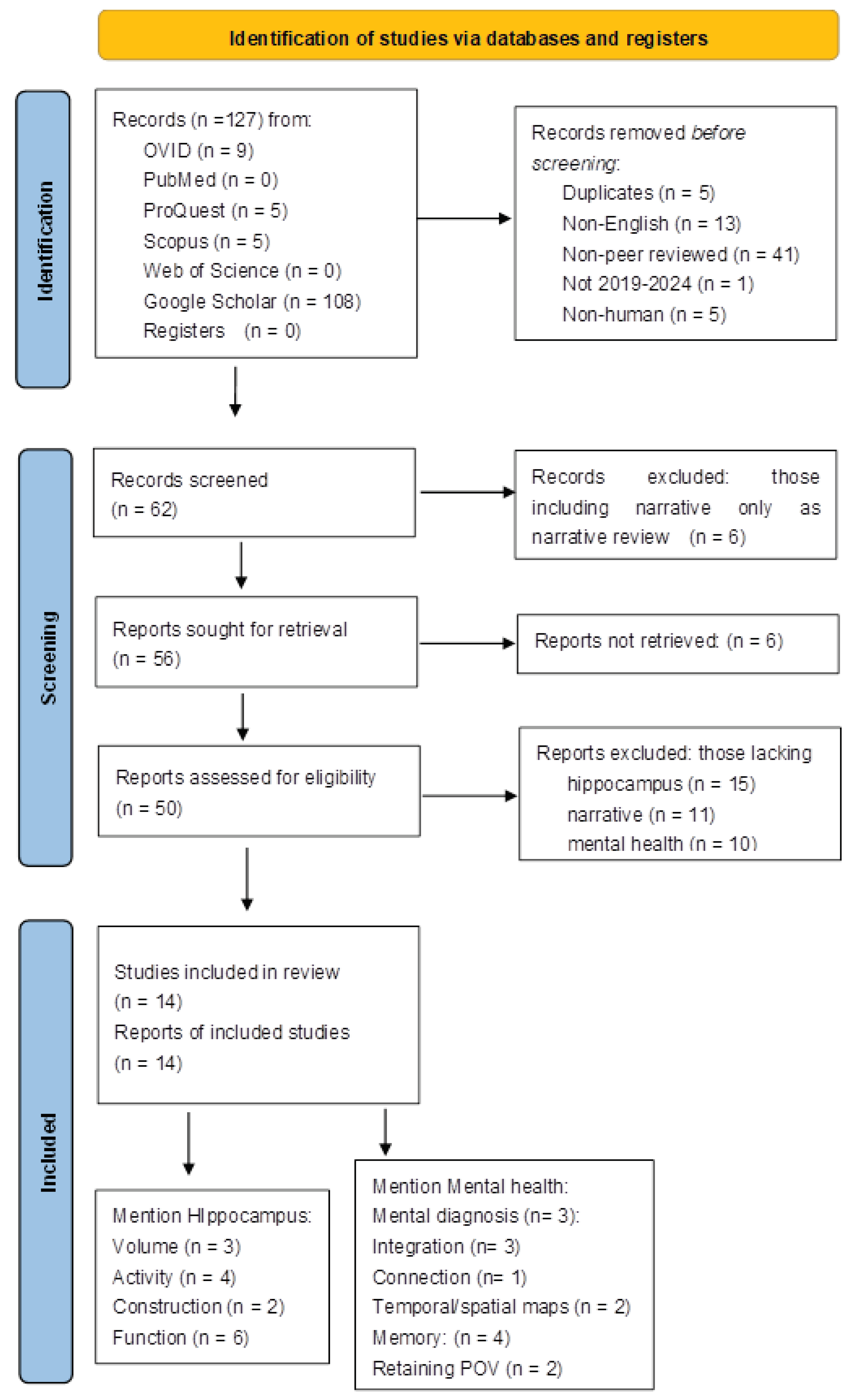
Disclaimer/Publisher’s Note: The statements, opinions and data contained in all publications are solely those of the individual author(s) and contributor(s) and not of MDPI and/or the editor(s). MDPI and/or the editor(s) disclaim responsibility for any injury to people or property resulting from any ideas, methods, instructions or products referred to in the content. |
© 2023 by the authors. Licensee MDPI, Basel, Switzerland. This article is an open access article distributed under the terms and conditions of the Creative Commons Attribution (CC BY) license (http://creativecommons.org/licenses/by/4.0/).
Copyright: This open access article is published under a Creative Commons CC BY 4.0 license, which permit the free download, distribution, and reuse, provided that the author and preprint are cited in any reuse.


