

Submitted:
20 May 2024
Posted:
21 May 2024
Read the latest preprint version here
Abstract
Dark energy and dark matter are described as different manifestations of vacuum energy in a new cyclic universe framework of Extra Dimensional Symmetry (EDS) that doubles large spatial dimensions with microscopic partners. In this testable framework, vacuum energy, constrained by a Planck density constraint, exists in a gravitationally dark state where actual gravitational constant Go = 0G. While a small repulsive component is constrained by an asymptotically evolving asymmetry to the active state where Go = 2G, some components in the inert state are enabled to gravitationally attract by neutrino induced gravitational constant with light and shear activated heavy components. Observational and experimental tests are briefly discussed.
Keywords:
dark energy
; dark matter
; extra dimension
; gravity
; neutrino
; vacuum energy
1. Introduction
Dark energy is a mysterious energy component that has been observed to be driving the accelerated expansion of the universe, and have defied several explanations since its discovery in supernova observations [1]. Its existence has since been confirmed by several independent observations like the Planck measurements of the Cosmic Microwave Background (CMB), indicating that it accounts for about 68.3% of the gravitating energy content of the universe [2]. This is in addition to the older dark matter mystery [3] of a gravitationally attractive but invisible matter component constituting about 26.8% of the gravitating energy content of the universe. Only about 4.6% is in the form of visible baryonic matter.
The cosmological constant (Λ) earlier introduced into Einstein’s Field Equations, while being the simplest solution, results in a serious conflict between measured density of dark energy and the 120 orders of magnitude larger value predicted from quantum field theory [4]. The Λ problem has defied logical solution from supersymmetric cancellation approaches, relaxation of vacuum energy [5] and anthropic approach [6]. It also defies an approach that simply makes the spacetime metric insensitive to Λ [7].
Slowly evolving scalar field models like quintessence [8,9] is one of the many alternative approaches to solve the dark energy mystery without the Λ route. We also have modified gravity models [10] and unification of dark energy and dark matter [11]. See Ref. [12] for detailed review and Refs.[13,14] for recent review.
The amount of theoretical and observational efforts that has been applied to understand dark energy and dark matter indicates that they require new physics beyond the existing standard model of cosmology and particle physics. Attempts to resolve the dark matter mystery can be mainly classified as either a modification of gravity or introduction of new particles beyond the standard model of particle physics. However, both approaches of modified gravity and particle dark matter tends to fail in providing consistent explanations to the dark matter mystery as each approach tends to succeed in explaining some observations and fail at some others.
There is an approach that explains dark matter as gravitational polarization of vacuum energy by baryonic matter without invoking new particle or modifying gravity in the traditional sense [15]. It is based on the idea that matter and antimatter have opposite gravitational charges which requires a violation of the Weak Equivalence Principle. Preliminary findings from measurements of antiproton to proton charge to mass ratio imply that matter and antimatter gravitate the same way [16]. Furthermore, the recent result from the ALPHA collaboration has ruled out the possibility of gravitationally repulsive antimatter [17].
In this paper, the dark energy and dark matter puzzle are approached using the new framework of Extra Dimension Symmetry (EDS) that doubles the number of large extra dimensions with microscopic partners. EDS provides a possible solution to the dark energy puzzle by placing vacuum energy (constrained by a Planck energy density constraint) in a gravitationally inert state where the actual gravitational constant Go = 0G. Due to a speed limit asymmetry between the two states (resulting in a slightly lower energy density in the inert state) given the energy density constraint, a nonzero component of vacuum energy is constrained to the gravitationally active state where Go = 2G, manifesting as dark energy. For dark matter, it relies on the background effect of neutrinos which induces nonzero gravitational constant in the inert state, enabling the gravitation of virtual particles which appears as dark matter and neutrino mass generation mechanism. The neutrino induced gravitational constant has a light term corresponding to hot dark matter and a transient heavy term (cold dark matter) that can be activated by shear stress or sudden disappearance of negative pressure. This neutrino substrate approach for dark matter doesn’t require the polarization of the quantum vacuum or opposite gravitational charges for particles and antiparticles like in [15].
This paper is organized as follows. Section 2 discusses the key dimensional symmetry in which spatial dimensions are grouped as a set of dimension(s) with dimensional partners having opposite dimension numbers that determines either a positive or negative response to the stress energy tensor. It also discusses the selective response of the extra dimensions to the components of the stress energy tensor. It further discusses the speed constraint, the two gravitationally inert and active states, their speed limit asymmetry and density constraint, which is then applied in section 4 to provide a possible solution to the Λ problem of dark energy. Section 3 discusses General Relativity in two set of these extra dimensions which determines the dynamics of expansion and contraction as well as the heavy term of neutrino induced gravitational constant. Section 4 discusses the emergence of an asymptotically evolving Λ dark energy due to the speed limit asymmetry and energy density constraint discussed in section 2. It also briefly discusses dynamics of the resulting dark energy and the cyclic universe scenario that results from the reversal of a dimensionality parameter. Section 5 discusses the neutrino induced gravitation of virtual particles which appears as dark matter, its dynamics as well as observational and experimental probe. Discussion and conclusion follows in Section 6.
2. Extra Dimensional Symmetry Framework
In this framework, the spatial dimensions are grouped, with the number of large spatial dimensions described by the dimension number (analogous to baryon number) with an oscillating dimensionality parameter d that can either be +1 or -1, in a cyclic universe scenario such that,
where and with in the present universe, a dimension with corresponds to which is a 1D time like spatial dimension that is invisible due to a speed constraint consistent with special relativity discussed later in Section 2.2. Dimensions with corresponds to which is the visible 3D set of spatial dimensions. Dimensions with () appears to be ruled out by observation, resulting in a framework describing a universe with 3+1 large spatial dimensions.
Gravitational interaction in is not diluted by a large as they are compartmentalized partly by their opposite dimension number and the entropic nature of . While the positive dimension number of denotes positive response to the components of the stress energy tensor where mass energy is seen as positive and therefore attractive, the negative dimension number of denotes a negative response where mass energy appears negative and therefore repulsive.
The EDS framework further doubles these large set of spatial dimensions ( and ) with microscopic partners with opposite dimension numbers (anti-spatial dimensions) such that the total dimension number of the universe can be zero as illustrated in Table 1. While the dimensional partner of , is a Planck size dimension, the dimensional partner of is denoted and the size of one of the component dimensions is constrained to 137 Planck units which determines the value of the fine structure constant. However, it is possible that the dimension number symmetry in EDS is broken and the number of component dimensions in can be more than 3D.
The opposite dimension numbers of spatial and anti spatial dimensions implies the inversion of the sign of the stress energy tensor in which expansion becomes contraction while contraction becomes expansion. As a result of this, the expansion of the large spatial dimensions and in the early universe is equivalent to the gravitational collapse of their dimensional partners. This is partly enabled by the selective response to the stress energy tensor discussed later in section 2.1.
In this attempt to resolve the mysteries of dark energy and dark matter, the focus is on the large spatial dimensions and , their microscopic partners and illustrated in Figure 1 and how they interact with one another.
2.1. Selective Response of Extra Dimensions to Components of the Stress Energy Tensor
As part of the symmetries in the EDS framework, every gravitational interaction in the visible spatial dimensions is mirrored in either of the extra spatial dimensions with negative dimension numbers such as and , while the dimension is presently inert since its collapse to the Planck scale.
The dimension is unable to respond to shear stress and negative pressure due to its one spatial dimensionality (shear stress requires at least two spatial dimensions) and its entropic nature. The size of associated with every cubic Planck volume of 3D space is a measure of its entropy such that, in Planck unit. It expands in response to energy density and positive pressure when , such as in the present universe, while the dimension only responds to shear stress and negative pressure.
2.2. Speed Constraint and Invisibility of S0 Dimension
Despite its cosmic size, the dimension is invisible due to its time like behavior from the speed constraint in the EDS framework. Consistent with Special Relativity, the speed constraint requires that a particle’s velocity must always equal the maximum speed limit c in the – dimensions.
Massless particles like photons have zero velocity component along , while massive particles and antiparticles travel in opposite directions along as illustrated in Figure 2. This motion along can be quantitatively equivalent to the passage of time such that,
where µ is particle velocity along , and ν is particle velocity along visible spatial dimensions .
When for massive particles, and conversely, when ν , for massless particles, , to satisfy the speed constraint. This suggests that time can be an emergent temporal dimension driven by the velocity of particles along dimension. How fast time appears to pass for a massive particle can be equivalent to the ratio of its component of velocity to the speed limit c as,
where is the equivalent Lorentz factor for the dimension. Since ,
2.3. Speed Limit Asymmetry
The asymmetry in speed limits c and is described by the asymmetry parameter which is the ratio of the Planck size of to the size of dimension, illustrated in Figure 2. such that,
where () is the size of in Planck unit which grows with the gravitational contraction of . This implies a slightly larger value of in deep gravitational potential wells and hence smaller value of .
The asymmetry between the two speed limits and , as shown in Figure 2 can be expressed as,
2.4. Gravitational State Oscillation
In EDS, Standard Model particles oscillates between the two speed states which are also opposite gravitational on and off states. This is such that for a particle of energy E, the state life time for such particle can be expressed as,
where is the reduced Planck constant and is the Planck energy.
The oscillation of real Standard Model particles in this scenario, between the two gravitational states and , makes gravity discrete on microscopic spacetime scale while it appears smooth on macroscopic spacetime scale with an average gravitational constant value of 1G.
2.5. Planck Energy Density Constraint
The Planck energy density constraint essentially constrains the total energy density in a given volume of spacetime to always equal the upper limit of the Planck density . This is only obtainable in the gravitational active state where the speed limit is c while the bare vacuum energy component exists in the inert state with lower speed limit and hence lower Planck density
where is the vacuum energy density, and is the total baryonic matter density. The key significance of this, is in the emergence of non zero Λ dark energy in section 4. However, such energy density constraint implies a Planck density limit to the density of black holes like that suggested in [18], where Planck stars replace black hole singularities.
3. General Relativity in and Dimensions
3.1. General Relativity in S0 Dimension
In 1+1 dimensionality the curvature term in Einstein Field Equations is zero [19]. In dimension where the dimension number is negative, it can be expressed as,
where is the equivalent cosmological constant in S0 dimension, is the metric tensor and is the stress energy tensor. The negative dimension number of the dimension which inverts the sign of the stress energy tensor, confers on it some unique features such as:
- Positive energy density in is equivalent to negative energy density everywhere in .
An energy density associated with a given Planck volume of 3d space appears as an equivalent negative energy density everywhere along the corresponding dimension as illustrated in Figure 3.
- ii.
- Positive pressure in is equivalent to negative pressure in
Any form of positive pressure in appears as negative pressure in for the same reason of negative dimensionality. The result is a positive cosmological constant expansion of that is equivalent to the curvature of () as illustrated in Figure 4, such that,
3.2. General Relativity in Dimensions
In 3D dimensions, the Einstein tensor is not zero unlike in 1D dimension. In addition, only responds to shear stress and negative pressure due to selective response to the stress energy tensor as discussed in section 2.1. The result is that the positive curvature effect () of shear stress on dimensions is equivalent to the negative curvature effect () of shear stress on the dimensions. Therefore,
Furthermore, the positive cosmological constant () expansion of due to negative pressure, is equivalent to the negative cosmological constant () contraction of .
The gravitational inversion of - dimensions as illustrated in Figure 5 results in the negative pressure driven collapse of until all its component dimensions have completely collapsed to their minimum length scale. This complete collapse is the trigger for the reversal of the dimensionality parameter in Equation (1), in this cyclic universe scenario.
4. Emergence of Asymptotically Evolving Cosmological Constant
The asymmetry in speed limit described in Equation (6) between the two gravitational states also reflects in the values of their Planck densities such that
where is the lower Planck density in state and is the Planck density in the state. is the asymmetry parameter that asymptotically approaches zero with the gravity driven growth of .
The existence of the bare vacuum energy component in the lower state implies that , which is less than and the Planck energy density constraint in Equation (8) requires that the total vacuum energy density and baryonic matter density should be equal to .
Since the gravitationally inert lower speed state is unable to contain the total vacuum energy components, a small component is therefore constrained to the gravitationally active state as dark energy as illustrated in Figure 6, such that,
Dynamics of Dark Energy in a Cyclic Universe
This form of dark energy varies spatially according to the suppression of by gravitational potential wells (Equation (5) and Figure 3). The deeper the gravitational well the more the suppression and this can show up in the precision measurement of the Integrated Sachs Wolf effect. In addition, the density of this form of dark energy also tracks the gravity driven growth of on cosmological time scale. A smaller in the early universe can result in with capable of driving an inflationary universe before asymptotically falling close to its current value at the end of inflation. The recent result from the DESI collaboration indicates a possible evolution of dark energy density [20].
Due to the gravitational symmetry in this framework, the positive expansion of the visible spatial dimensions is equivalent to the negative contraction of until all its 3D components completely collapse to their characteristic minimum length scales. At this point, the dimensionality parameter in Equation (1) becomes negative triggering a reverse cycle of the universe. The dimension number signs of the dimensions are reversed as well as their various responses to components of the stress energy tensor. Baryonic matter and dark matter becomes repulsive with black holes becoming white holes until complete evaporation, while dark energy becomes attractive, driving the collapse of the visible universe while expanding the dimensions. Associated with an expanding , is the fall in the value of the fine structure constant since it is coupled to the size of one of its 3 dimensions. The corresponding contraction of increases the density of dark energy in reverse towards the Planck density scale, while dimension remains at the Planck scale, neither expanding nor contracting. This results in an accelerated collapse of the visible universe with the reversal of the dimensionality parameter at the point of complete collapse back to positive causing a bounce in a cyclic scenario.
Since the size of is a measure of entropy, its contraction when the dimensionality parameter is negative implies reduction in entropy of the universe. This further implies possible loss of entropy to the Bulk in a Multiverse scenario.
5. Dark Matter from Neutrino Enabled Gravitation of Virtual Particles
In the EDS framework, the existence of most of the vacuum energy component in the gravitationally dark state with actual gravitational constant ensures that virtual particles in such state are gravitationally inert. However, neutrinos can induce small component of the gravitational constant in this inert state. It enables virtual particles within a spatial volume determined by the size of neutrinos, to gravitate with positive pressure and appear as dark matter. In the absence of neutrino coupling to the Higgs field, the mass generation mechanism for neutrinos in EDS, is this gravitational coupling to vacuum energy through the induced gravitational constant component.
This neutrino induced gravitational constant further consists of a light term associated with ordinary neutrino flavours and a heavy term associated with sterile neutrino that can be activated by shear stress. It can be expressed as,
where is the asymmetry parameter associated with the emergence of dark energy. is the dimensionless flavour parameter associated with ordinary neutrino flavours. It oscillates with neutrino flavour such that . is a dimensionless flavour parameter associated with sterile neutrinos that also oscillates between zero and one (), but constrained to zero by negative pressure driven collapse of . Once shear stress exceeds a threshold value above negative pressure, ordinary neutrinos can transition into a sterile phase with the extra degree of freedom that comes with expansion. oscillation resumes and remains in this sterile phase for a life time . is a dimensionless energy scale parameter such that and it is described by,
where is neutrino energy and is Planck energy.
5.1. Dynamics of Neutrino Dependent Dark Matter
Eq. (15) consists of a heavy term () that is by default inactive with constrained to its zero phase by negative pressure and an oscillating light term (). On one hand, the light term associated with ordinary neutrino flavours produces the effect of light and hot dark matter which can only make up a small fraction of dark matter. On the other hand, the heavy term associated with sterile neutrinos produces the effect of heavy and cold dark matter.
Once neutrinos passes through a region of spacetime that experiences shear stress above a threshold value caused by baryons (or high frequency gravitational oscillation in caused by sudden disappearance of high negative pressure), the heavy term becomes activated over an oscillation distance after which ordinary neutrinos transition into sterile neutrinos. It oscillates with the value of varying from zero to one and back to zero within a life time depending on the number of sterile neutrino flavours.
The distance dependent activation behaviour of the heavy sterile phase after baryonic shear activation, gives it a modified gravity like behaviour. should be proportional to neutrino energy, number of sterile neutrino flavours and mode of activation. For instance, sterile neutrino activation through gravitational disturbance of the dimensions by sudden disappearance of highly negative pressure should result in very short and almost immediate activation of the heavy term close to the source of activation. While the detailed dynamics of is yet to be fully worked out, it can be worked out from future experimental and theoretical insights.
5.2. Experimental Probe of Sterile Neutrino Dependent Dark Matter
The detectability of sterile neutrino dependent heavy dark matter in this framework poses some potentially interesting outcomes. From Equation 15, if an Ultra High Energy neutrino with 1016 eV energy transitions into a sterile neutrino and , it should induce a component gravitational constant in the inert state where vacuum energy density is of the Planck scale. This enables the gravitation of virtual particles within the volume of space described by the size of the sterile neutrinos. Such sterile neutrino enabled gravitation of virtual particles produces the effect of heavy dark matter while active and should be detectable as slight increase in the value of the gravitational constant measurable with gravimeters.
5.2.1. Shear Activation of Sterile Neutrinos Between Artificial Source and Detector
Shear activation of sterile neutrinos should be achievable with the generation of strong seismic disturbance between an artificial neutrino source and detector separated by a distance greater than their required sterile transition distance. This should be achievable with the upcoming DUNE experiment and can then be detected as a reduction in the detection rate of active neutrino flavours or anomalies in precision measurement of the gravitational constant.
5.2.2. Measure of Gravitational Constant During Coincident Lunar Quake and Solar Eclipse
There is the possibility of sterile transition of solar neutrinos after passing through regions of shear stress from strong lunar quakes. The resulting sterile neutrinos from coincident lunar quake and solar eclipse event on reaching Earth, can be observed as anomalies in measurements of the gravitational constant. Moreover there have been various reports of anomalies in measurements of the gravitational constant during some solar eclipse events [21,22]. This is in addition to other reports of anomalies in measurements of the gravitational constant such as in [23] that appears to be correlated with length of day variation.
5.2.3. Precision Measurement of Posible Dent in
The activation of sterile neutrinos in EDS requires the shear driven gravitational expansion of dimensions one of which is coupled to the fine structure constant . This implies that an Ultra Heavy Dark Matter from sterile neutrino flavour parameter of can be detected as a measurable dent in the value of . Indications of spatial variations in was reported in [24]. There is a possiblity that geoneutrinos or even solar neutrinos, on passing through regions of high tectonic stress, transition to sterile neutrinos that may show up above the surface as anomalies in measurents of the gravitational constant or even a dent in . Such dent in can then be measured as slight drop in atomic energy levels and possible glow resulting from energy level transitions in atoms within the dent. Spectral analysis of Earth Quake Lights [25,26] can be of potential interest in this regard.
6. Discussion and Conclusions
EDS as a symmetry framework of spatial dimensions, doubles large spatial dimensions with microscopic partners of opposite dimension number which inverts the sign of gravitational interactions in these extra dimensions. It provides a framework for the possible resolution of the mysteries of dark energy and dark matter. In doing so it provides some potential insights into the dimensional structure of spacetime, gravity and the dynamics of a cyclic universe. It also implies that time could be an emergent property of a large extra spatial dimension with negative dimension number and size that is a measure of entropy.
Specifically, it places the bare vacuum energy component in a state where the gravitational field is switched off while real standard model particles oscillate between this gravitationally inert state and the active state. Due to a Planck energy density constraint and a speed limit asymmetry described by the asymptotically evolving asymmetry parameter , a small component of vacuum energy is constrained to exist in the gravitationally active state and appear as dark energy. This form of dark energy asymptotically evolves towards zero with the gravity driven growth of dimension. However, the oscillation of the dimensionality parameter on cosmological timescale still results in a cyclic universe scenario.
Furthermore, EDS describes dark matter as resulting from neutrino enabled gravitation of virtual particles, in which neutrinos induce small component of the gravitational constant in the gravitationally inert state. The induced gravitational constant serves as a mass generation mechanism for neutrinos through this gravitational coupling to vacuum energy. It has a light term associated with ordinary neutrino flavours and a heavy term associated with sterile neutrinos. While the transition to sterile neutrino phase is suppressed by negative pressure driven collapse of the dimension, it can be activated with the extra degree of freedom from shear stress driven expansion of .
Due to delay in sterile transition on passing through regions of baryon generated shear stress, The resulting heavy and cold dark matter readily form halos, exhibiting hybrid particle and modified gravity behaviour like the gravitational polarization of vacuum energy approach [15] and superfluid dark matter [27].
Expected results from the trio of the JWST, Euclid and upcoming Nancy Grace Roman Telescope and Vera Rubin Observatory, are expected to provide precision measurements of dark energy density as well as the dynamics of dark matter. Such precision measurements should glean out the predicted suppression of dark energy density in the deep gravitational potential wells of baryonic matter.
Experiments relying on shear stress activation of sterile neutrinos can look out for deficit in detection rate of known neutrino flavours or anomalies in measurements of the gravitational constant. In extreme case of ultra heavy sterile transition, this may show up as dents in the measured value of with associated shifts in atomic energy levels and Earth Quake Lights can be of potential interest in this regard.
EDS also provides a potential insight on baryon asymmetry which may arise if the universe has a net spin with respect to the dimension in a Multiverse scenario. Since spin in opposite directions of as illustrated in Figure 2 represents particle and antiparticle states, a net spin may result in baryon asymmetry particularly in the early universe. Such form of baryon asymmetry would have reduced in the present universe by a factor of with the expansion of the dimension.
In conclusion, the EDS framework offers new physics explanations for dark energy and dark matter as different manifestations of vacuum energy. While dark energy is the small repulsive component of vacuum energy in the active state, dark matter is simply virtual particles in the inert state that is enabled to gravitationally attract with neutrino induced gravitational constant and also serves as a mass generation mechanism for neutrinos. The predicted dynamics of dark energy as well as the shear stress activation of sterile neutrinos provides observational and experiment probes with potential insights into a number of other unsolved problems.
Author Contributions
Kabir Adinoyi Umar: Conceptualization, Investigation, Writing-original draft, Writing-review and editing, Resources.
Data availability
No data was used for the research described in the article.
Acknowledgments
The author gratefully acknowledges Benjamin G. Ayatunji for his criticisms, encouragement and mentorship. He is very grateful to S. X. K. Howusu for his inspiring advice and initial motivation for this work. The author is immensely grateful to Aminu M. Musa, and Buhari M. Abubakar.
Declaration of competing interest
The authors declare that they have no known competing financial interests or personal relationships that could have appeared to influence the work reported in this paper.
References
- Riess, A. G. et al., Observational evidence from supernovae for an accelerating universe and a cosmological constant, Astron. J. 116 (1998) 1009-1038, arXiv: astro-ph/9805201. [CrossRef]
- Ade P. A. R. et al., Planck 2013 results. XVI. cosmological parameters, (2013), arXiv:1303.5076[astro-ph.CO].
- Bertone, G. and Hooper, D., History of dark matter, Rev. Mod. Phys. 90 (2018) 045002. [CrossRef]
- Carroll, S. M., The cosmological constant, Living Rev. Rel. 4:1, (2001), arXiv:astro-ph/0004075.
- Kachru, S. et al., de Sitter vacua in string theory, Phys. Rev. D68 (2003) 046005, arXiv:hep-th/0301240.
- Banks, T. et al., On anthropic solutions of the cosmological constant problem, JHEP 0101 (2001) 031, arXiv:hep-th/0007206. [CrossRef]
- Arkani-Hamid, N., A small cosmological constant from a large extra dimension, Phys. Lett. B480 (2000) 193-199, arXiv:hep-th/000197.
- Caroll, S. M., Quintessence and the rest of the world: suppressing long-range interactions, Phys. Rev. Lett. 81 (1998) 3067.
- Ratra, B. and Peebles, J., Cosmological consequences of a rolling homogenous scalar field, Phys. Rev. D 37 (1988) 321.
- Tsujikawa, S., Modified gravity models of dark energy, Lec. Notes Phys. 800 (2010) 99-145.
- Bilic, N., Tuper, G. B., Viollier, R. D., Unification of dark matter and dark energy: The inhomogenouschaplygin gas, Phys. Lett. B 535 (2002) 17-21.
- Copeland, E. J. et al., Dynamics of dark energy, Int. J. Mod. Phys. D15 (2006) 1753-1936, arXiv:hep-th/0603057.
- Oks E., Brief review of recent advances in understanding dark matter and dark energy, New Astron. Rev. 93 (2021) 101632, arXiv:2111.00363[astro-ph.CO]. [CrossRef]
- Arun K. et al., Dark matter, dark energy and alternate models: a review, Advances in Space Research, 60, (2017) 166-186, arXiv: 1704.06155[physics.gen-ph].
- Hajdukovic D. S., Quantum vacuum and dark matter, Astrophysics and Space Science 337 (2012) 9-14.
- Borchert M. J., Devlin J. A., Ulmer S., et al., A 16 parts per trillion measurement of the antiproton to proton charge-mass ratio, Nature 601 (2022) 53-57.
- Anderson E. K. et al., Observation of the effect of gravity on the motion of antimatter, Nature 621, (2023) 716-722. [CrossRef]
- Rovelli, C., Vidoto, F., Planck Stars, Int. J. Mod. Phys. D23 (2014) 1442026, arXiv:1401.6562.
- Boozer A. D., General relativity in (1+1) dimension, Eur. J. Phys. 29 (2008) 319-333. [CrossRef]
- Adame, A. G. et al., DESI 2024 VI: Cosmological constraints from the measurements of Baryon Acoustic Oscillations, arXiv: 2404.03002 [astro-ph.CO].
- Wang, Q., Yang, X. and Tang, K., Gravity anomaly from Mohe total eclipse, Chin. Sci. Bull. 46, (2001) 1833-1836.
- Wang, Q. et al., Precise measurements of gravity variations during a total eclipse, Phys. Rev. D 62 (2010) 041101. [CrossRef]
- Anderson, J. D., Shubert, G., Trimble, V. and Feldman, M. R., Measurements of Newton’s gravitational constant and length of day, EPL 110 (2015) 10002; arXiv: 1505.01774 [gr-qc]. [CrossRef]
- Webb, J. K. et al., Indications of a spatial variation of the fine structure constant, arXiv:1008.3907v2[astro-ph.CO]. [CrossRef]
- Theriault, R., St-Laurent, F., Freund, F. T. and Derr, J. S., Prevalence of Earthquake lights associated with rift environments, Seis. Res. Lett. 85 (1) (2014) 159-178. [CrossRef]
- Derr, J., Earth quake lights: A review of observations and present theories. Bull Seismol. Soc. Am. 63 (1973).
- Hossenfelder S., Mistele T., The Milky Way’s rotation curve with superfluid dark matter, MNRAS 498 (2020) 3484-349, arXiv:2003.07324[astro-ph.GA]. [CrossRef]
Figure 1.
Large spatial dimensions and and their microscopic dimensional partners and . The opposite dimension numbers which inverts the sign of the stress energy tensor implies that and collapsed toward their minimum microscopic sizes during the inflation of and in the early universe.
Figure 1.
Large spatial dimensions and and their microscopic dimensional partners and . The opposite dimension numbers which inverts the sign of the stress energy tensor implies that and collapsed toward their minimum microscopic sizes during the inflation of and in the early universe.
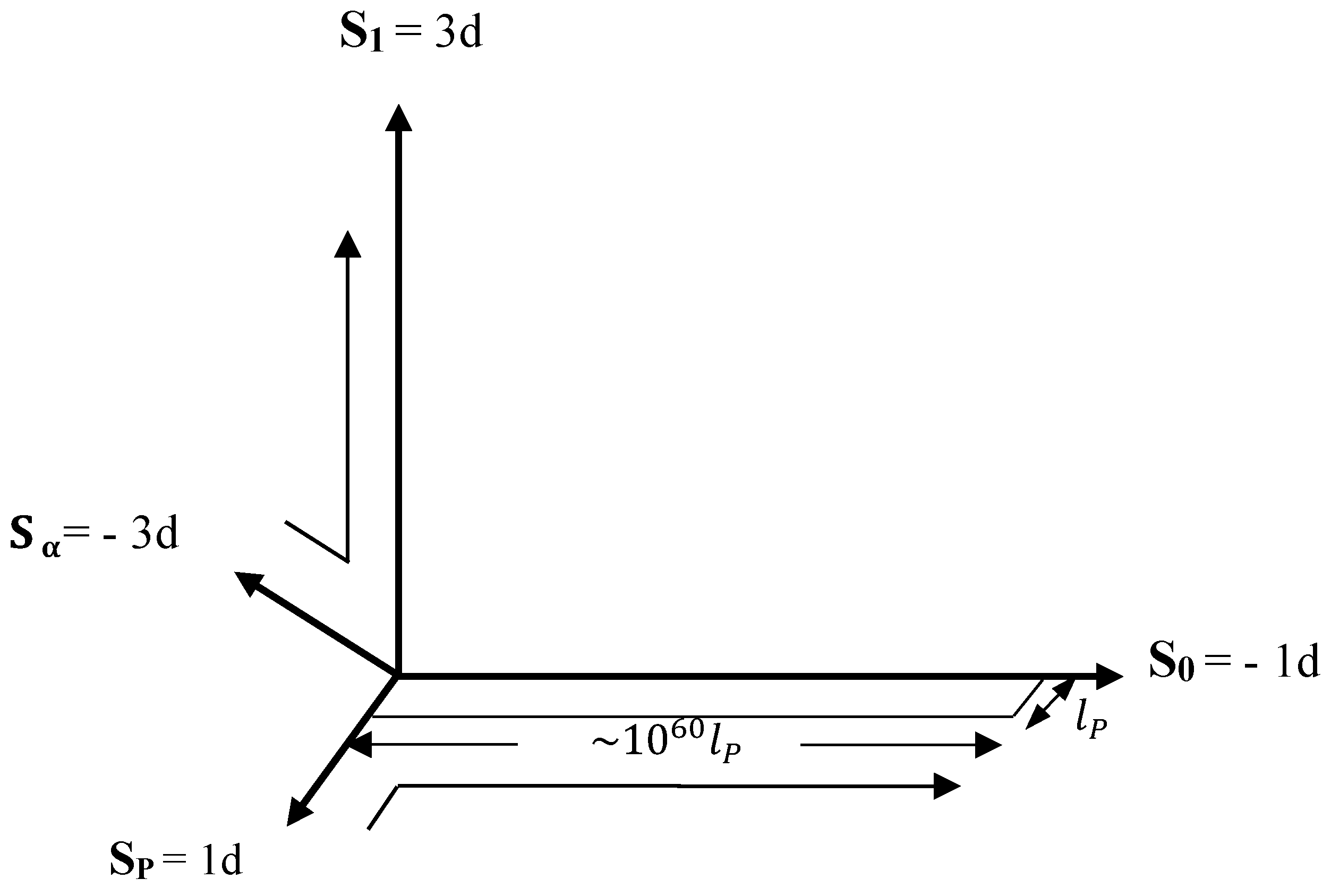
Figure 2.
Ring structure of - dimensions with two slightly unequal speed limit states C and C0, at the two ends of dimension that can be seen as two brane surfaces. Traveling in opposite directions of represents particle and antiparticle states.
Figure 2.
Ring structure of - dimensions with two slightly unequal speed limit states C and C0, at the two ends of dimension that can be seen as two brane surfaces. Traveling in opposite directions of represents particle and antiparticle states.
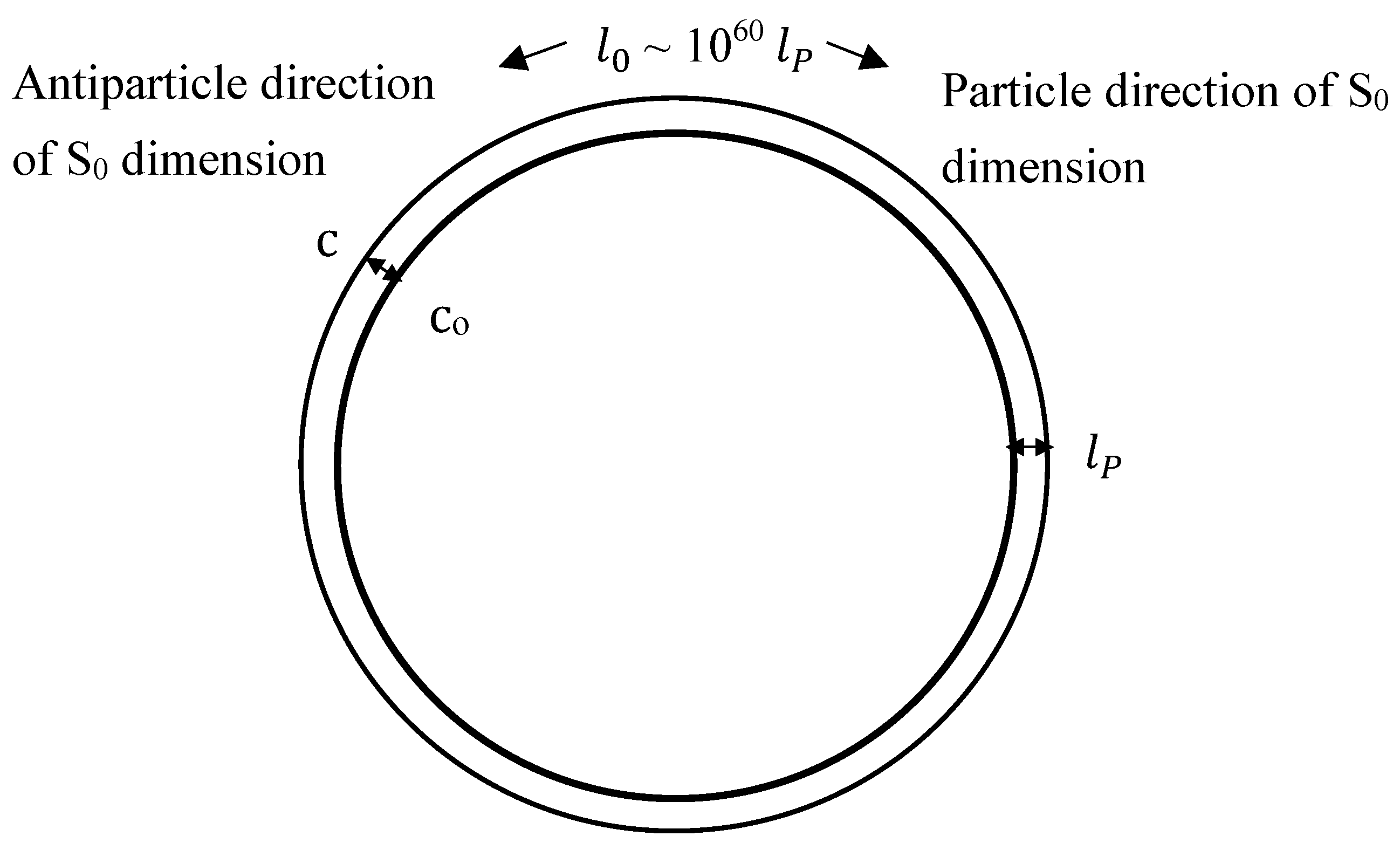
Figure 3.
A gravitational well in is inverted into a gravitational hill with the expansion of by the gravitational interaction of a test particle. The test particle is replicated about 1060 times everywhere along dimension.
Figure 3.
A gravitational well in is inverted into a gravitational hill with the expansion of by the gravitational interaction of a test particle. The test particle is replicated about 1060 times everywhere along dimension.
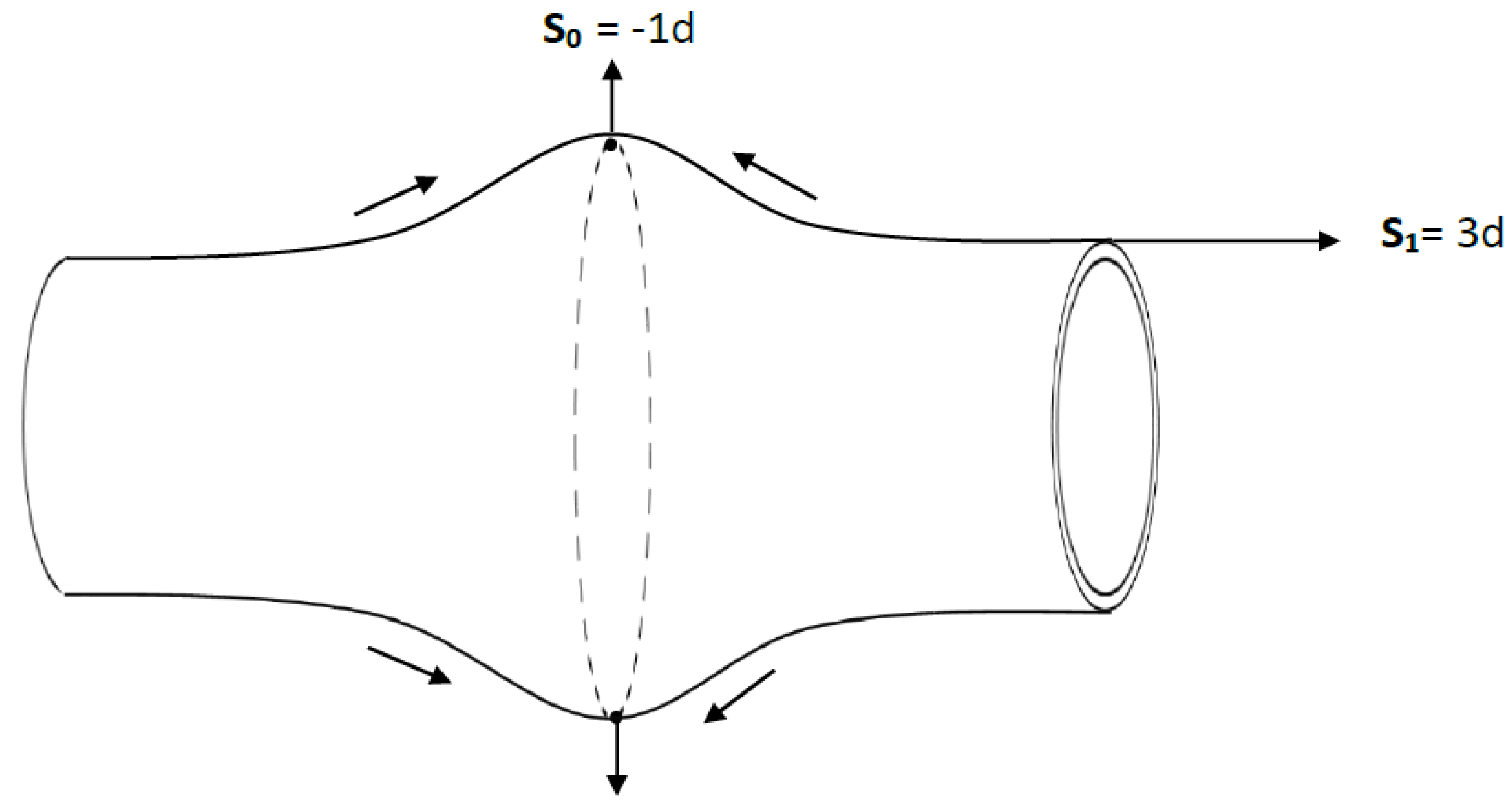
Figure 4.
Gravitational inversion in - dimensions. A positive cosmological constant expansion of is equivalent to the curvature of in the present universe with a positive dimensionality parameter. This is reversed in a cyclic universe when dimensionality parameter becomes negative.
Figure 4.
Gravitational inversion in - dimensions. A positive cosmological constant expansion of is equivalent to the curvature of in the present universe with a positive dimensionality parameter. This is reversed in a cyclic universe when dimensionality parameter becomes negative.
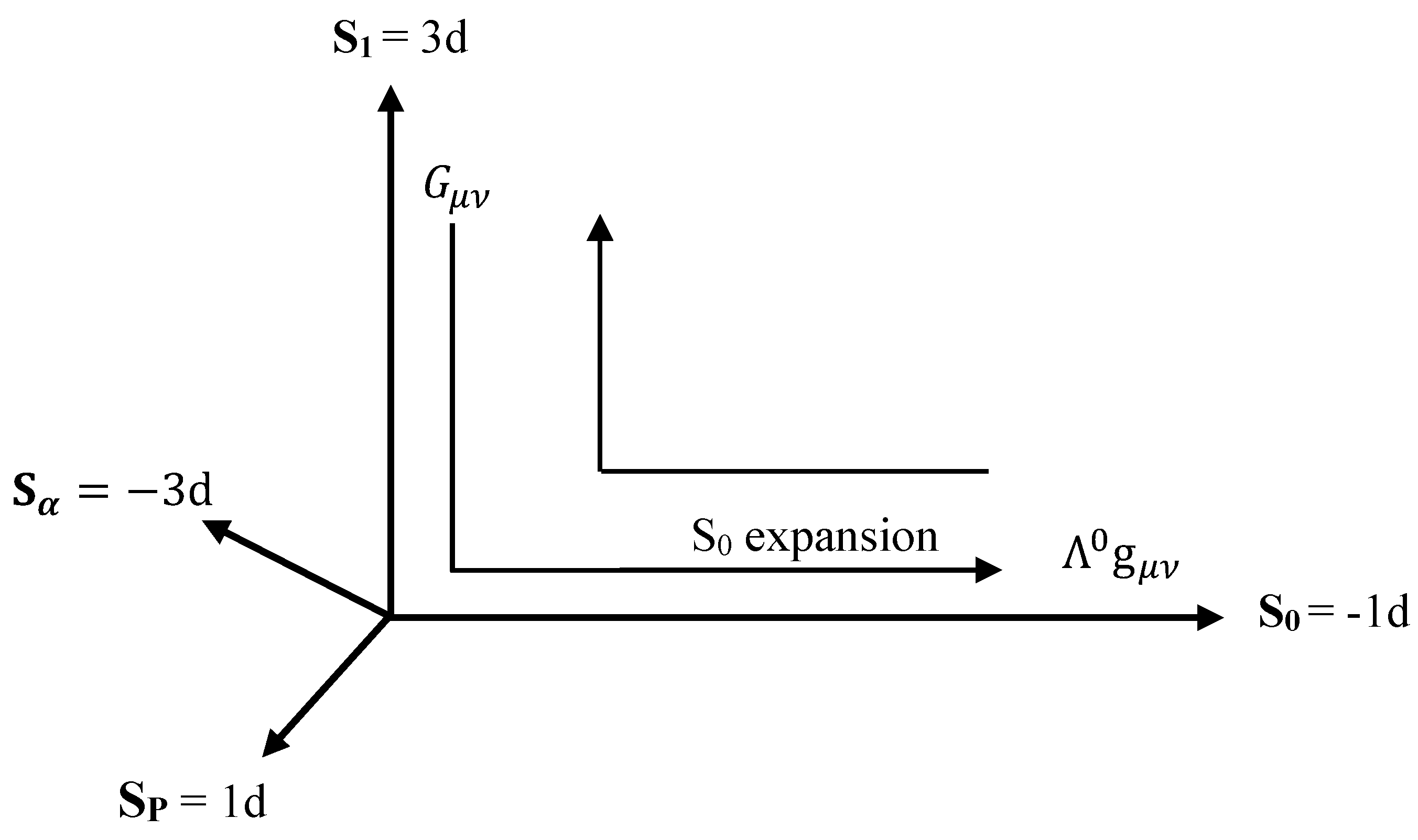
Figure 5.
Gravitational inversion in - dimensions. Positive curvature of resulting from shear stress, is equivalent to the negative curvature of due to the same shear stress component. Also, a positive cosmological constant expansion of is equivalent to a negative cosmological constant contraction of .
Figure 5.
Gravitational inversion in - dimensions. Positive curvature of resulting from shear stress, is equivalent to the negative curvature of due to the same shear stress component. Also, a positive cosmological constant expansion of is equivalent to a negative cosmological constant contraction of .
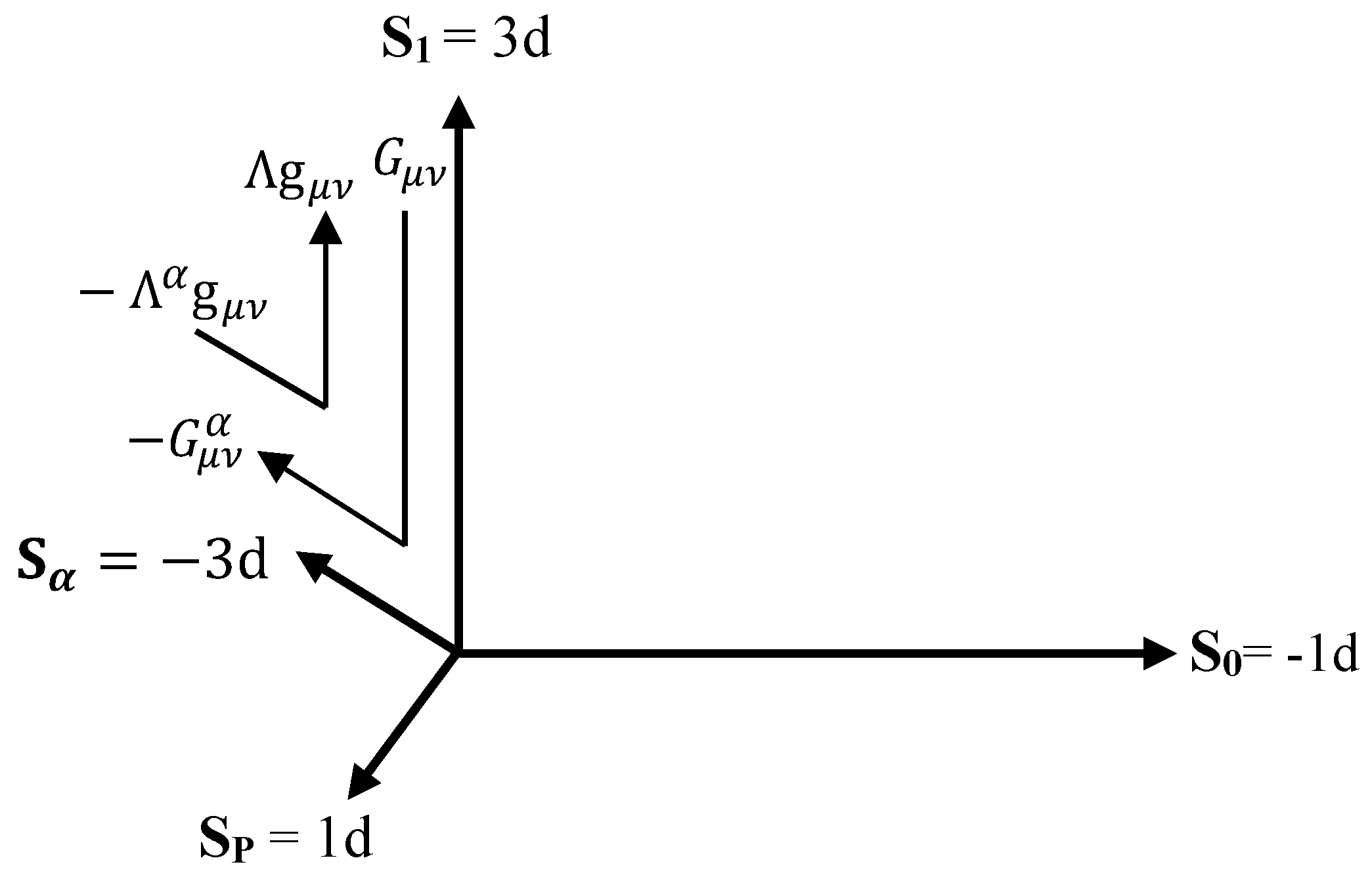
Figure 6.
While the bare vacuum energy component occupies the gravitationally inert state to its limit, there has to be a component in the gravitationally active state to satisfy the energy density constraint. The lower Planck density is associated with speed state .
Figure 6.
While the bare vacuum energy component occupies the gravitationally inert state to its limit, there has to be a component in the gravitationally active state to satisfy the energy density constraint. The lower Planck density is associated with speed state .
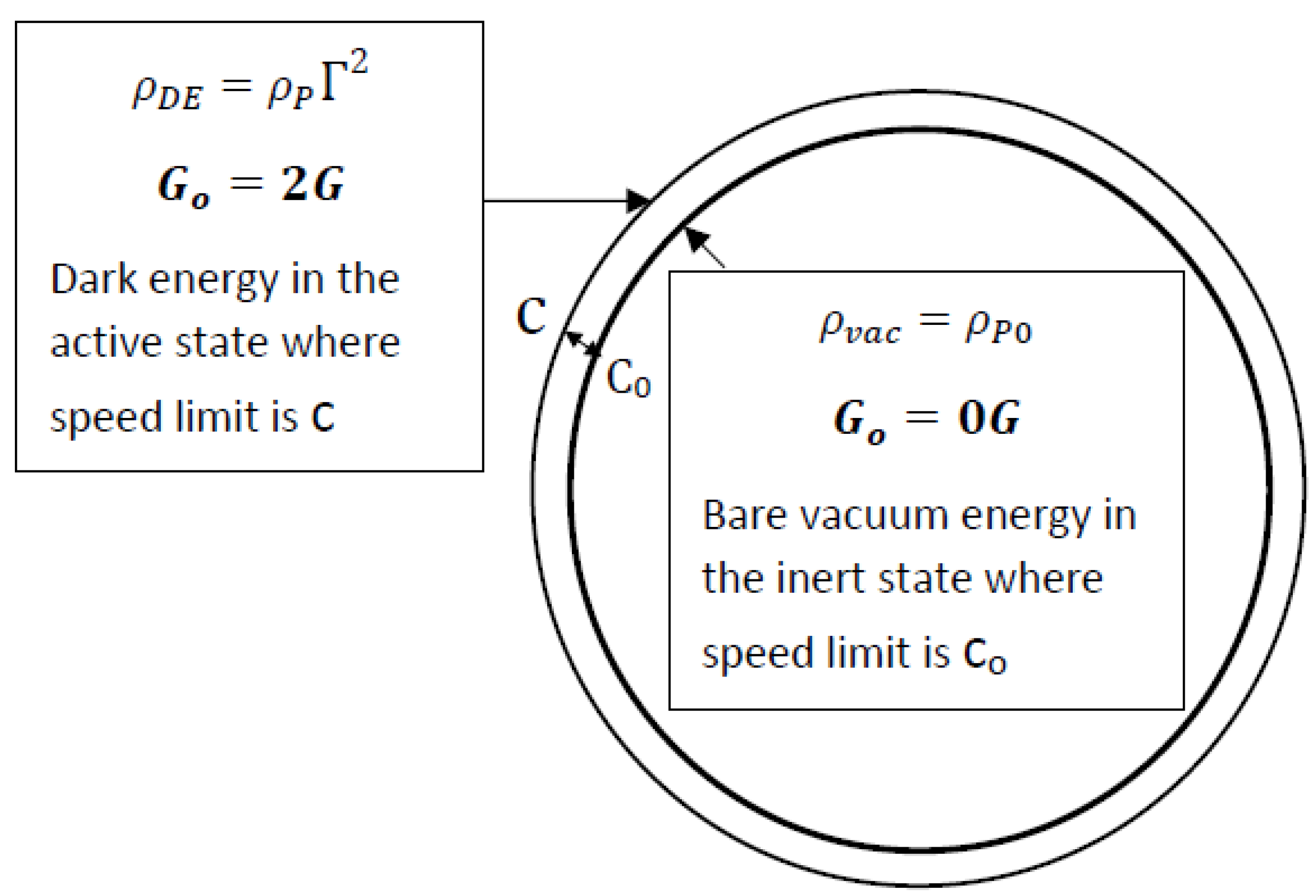

Table 1.
Periodic table of spatial dimensions indicating dimension number symmetry between the sets of spatial and anti-spatial dimensions within the EDS framework. The direction of the arrow from left to right indicates a positive dimensionality parameter d in which the large spatial dimensions expands while their microscopic dimensional partners collapse to their minimum length scale. The number of component dimensions in can be more than 3D in a broken symmetry scenario.
Table 1.
Periodic table of spatial dimensions indicating dimension number symmetry between the sets of spatial and anti-spatial dimensions within the EDS framework. The direction of the arrow from left to right indicates a positive dimensionality parameter d in which the large spatial dimensions expands while their microscopic dimensional partners collapse to their minimum length scale. The number of component dimensions in can be more than 3D in a broken symmetry scenario.
| Microscopic Anti-spatial dimensions |
Large Spatial dimensions |
|
|---|---|---|
| n | ||
| 1 | ||
| 0 |
Disclaimer/Publisher’s Note: The statements, opinions and data contained in all publications are solely those of the individual author(s) and contributor(s) and not of MDPI and/or the editor(s). MDPI and/or the editor(s) disclaim responsibility for any injury to people or property resulting from any ideas, methods, instructions or products referred to in the content. |
© 2024 by the authors. Licensee MDPI, Basel, Switzerland. This article is an open access article distributed under the terms and conditions of the Creative Commons Attribution (CC BY) license (http://creativecommons.org/licenses/by/4.0/).
Copyright: This open access article is published under a Creative Commons CC BY 4.0 license, which permit the free download, distribution, and reuse, provided that the author and preprint are cited in any reuse.