
Submitted:
08 September 2023
Posted:
13 September 2023
You are already at the latest version
Abstract
Building facade design plays an essential role in enhancing energy efficiency and reducing environmental impact in high-performance building design. Balancing the conflicts among various building facade design parameters to satisfy different optimization objectives constitutes a highly complex optimization problem. The rapidly increasing number of studies demonstrates a significant interest in implementing multi-objective optimization methods to tackle building facade optimization problems.
This study conducts a systematic review of optimization methods for building facade optimization (BFO). The optimization objectives and design variables are categorized based on their characteristics. The efficiency and effectiveness of optimization algorithms in addressing BFO problems are compared. Building optimization techniques and tools are showcased, along with their functions and limitations.
Key findings highlight the robust feasibility and effectiveness of optimization algorithms, methods, and techniques in resolving a diverse range of BFO challenges. The limitations, challenges, and future potential of these methods are summarized and proposed.
Keywords:
Systematic review
; Optimization
; Heuristic algorithm
; Multi-objective
; Building façade
1. Introduction
1.1. Background
Building facades are essential aspect of architectural design, especially in the context of multidisciplinary optimization. Façade design parameters have significant impact on building performance, encompassing aesthetics, economics, and environmental sustainability. To address these multifaceted considerations, building facade design must adapt to local climates and respond to environmental changes. Generally, the goal of building facade optimization (BFO) is to achieve the best combination of design parameters to find optimal solutions, taking into account all possibilities and constraints [1,2].
High-performance design strategies are typically integrated into a project during the early design stage, when the conceptual design is nearly complete. Decisions made in the preliminary design phase have the greatest potential for achieving high-performance building design. The traditional trial-and-error approach, often facilitated by building performance simulation (BPS), proves inadequate for achieving optimal solutions due to the time constraints associated with the early design stage.
By executing parametric simulation and sensitivity analysis, the relative importance facade design parameters can be quantified. This process helps identify parameters with minimal impact that can remain fixed, thus contributing to optimal solutions [3]. However, the decision-making process is riddled with uncertainties due to temporal variations and unpredictable conflicts between nonlinear design variables. In real-world BFO scenarios, architects often face conflicting optimization objectives, such as trade-offs between energy consumption, initial investment, thermal comfort, daylighting, and environmental impact. BFO problems with multiple objectives fall under the category of multi-objective optimization (MOO) problems, and their optimization procedures are inherently more complex and time-consuming compared to single-objective optimization problems.
Over the past decade, there has been a rapid increase in the number of studies exploring the development of optimization algorithms rooted in computer science. This trend underscores a strong interest in the development and implementation of MOO optimization methods due to their effectiveness and efficiency. The integration of MOO algorithms has significantly improved our understanding of how facade design parameters interact to affect building performance. These optimized solutions have the potential to provide innovative guidelines for building facade design and even influence local building codes, especially in specific climatic contexts.
Given these complex challenges and potential opportunities, this review aims to shed light on the concepts, methodologies, evaluation criteria, and implementation strategies that underlying multi-objective building facade optimization. Through a comprehensive examination of existing BFO studies, this review attempts to elucidate the feasibility and efficiency of various optimization algorithms, while also highlighting upcoming challenges and directions for future research. As the architectural landscape navigates an era of increased complexity and computational sophistication, the importance of this review becomes even more pronounced.
1.2. Related review studies
This review builds on previous research in the area of building facade optimizing, and is based on a comprehensive analysis and citation of recent academic research. It considers a set of criteria for comparing optimization algorithms, derived from previous review studies. These criteria include three main categories, each of which is further divided into three subcategories: (i) Scope: This category includes various aspects such as building types, climate zones, and geographic locations. (ii) Optimization Algorithms: Within this category, we consider problem types, the specific optimization algorithms employed, and the design parameters and optimization objectives they address. (iii) Accuracy: This category focuses on the evaluation metrics used to assess the effectiveness of the optimization methods.
Existing reviews in related areas such as optimization methods, building facades, and energy efficiency have contributed to the understanding of these domains. Caldas and Nortford conducted a review that focused on Genetic Algorithm (GA) for Building Facade Optimization (BFO), shedding light on multi-objective optimization challenges and applications related to building form, window size, wall insulation, and HVAC control strategies [4]. In a different vein, Sadineni et al. reviewed the parameters influencing building energy performance through building facade design, delving into various energy efficient envelope techniques and discussing the impact of insulation, airtightness, infiltration, and phase change materials [5]. Similarly, Pacheco et al. conducted a review focusing on strategies to improve energy efficiency in residential buildings [6]. A study by Kaynakli specifically addressed the cost-effectiveness of optimal thermal insulation thickness in building facades [7], although these studies focused on energy performance without considering thermal and visual comfort.
The complexity of BFO challenge requires research to improve and implement optimization methods. Some studies provide exhaustive reviews of algorithms and tool integration for building facade design optimization, aiming to elucidate the state of the art while outlining future obstacles [8]. Nguyen et al. compared the performance of optimization algorithm in solving discontinuous multi-objective building optimization problems, and discussed challenges and future implementation prospects [9]. Attia et al. investigated optimization tools for zero-energy building design [10], while Evins compared optimization methods for sustainable building design problems [11,12]. In addition, Huang and Niu reviewed and discussed popular optimization algorithms for building facade design [13], noting the widespread use of evolutionary algorithms, particularly GAs and their adaptations, for finding building optimization solutions. Costa-Carrapiço et al. reviewed the implications of GA-based multi-objective optimization (MOO) in BFOs, highlighting computational efficiency and suggesting further studies on GA-mixed techniques [14]. Their review emphasized the need for standardized systematic approaches, the ease of switching between modeling and optimization environments, and the need for unnecessary programming expertise among designers. Recent reviews have also addressed optimization methods that address multiple design objectives, including building energy performance, thermal and visual comfort, life-cycle costs, and environmental impact [15].
Although several studies have compared methods using different evaluation criteria, these criteria often reflect engineering practices rather than the unique needs of architects in the early design phase [16]. Greater focus is warranted on the selection and improvement of optimization algorithms tailored to specific building optimization challenges.
1.3. This review
The primary objective of this review is to ensure inclusivity, making it accessible to architects with different backgrounds and levels of expertise. This inclusivity is expected to enhance the practicality of using optimization methods to improve the performance of building facade. Ultimately, the goal is to provide architects with valuable support in their decision-making processes when engaging in building facade design.
Furthermore, this review serves the purpose of identifying existing knowledge gaps and untapped opportunities within the field of building facade optimization research. By doing so, it sheds light on emerging trends and potential future perspectives, paving the way for the integration of innovative approaches into everyday architectural practice. It is expected that building optimization methods will be increasingly applied to address increasingly complex architectural challenges, particularly in the area of high-performance building facade design.
The first section of this review introduces the background, provides an overview of existing review studies, and outlines the objectives of the study. The following section discuss the concept definitions, evaluation metrics, and characteristics of design variables and objectives relevant to building facade optimization (BFO). This is followed by a comprehensive presentation of commonly used optimization algorithms in BFOs, with an emphasis on heuristic algorithms. These include Genetic Algorithms (GA), Simulated Annealing (SA), Particle Swarm Optimization (PSO), Ant Colony Optimization (ACO), Harmony Search (HS), and heuristic algorithms integrated with Machine Learning Algorithms (MLAs) or Artificial Neural Networks (ANNs). In addition, direct search algorithms known for their role in solving nonlinear optimization problems are introduced.
The review also examines existing simulation and optimization tools, emphasizing the integration of optimization platforms, simulation engines, and 3D modeling environments. Subsequently, a general overview of the reviewed studies is provided, along with the identification of key achievements, knowledge gaps, and potential future trends.
2. Systematic literature review on multi-objective optimization for high-performance building facade design
2.1. Search strategy and systematic literature review process
The systematic literature review methodology used in this paper follows the well-established sequence of steps commonly used in such review studies [17,18]. The process begins with the formulation of the research question and proceeds to the development of a comprehensive review protocol. This is followed by a thorough literature search and screening procedure to identify relevant publications for further comprehensive review.
A multifaceted search strategy was implemented to ensure comprehensive coverage of the relevant academic literature. The first step was an unbiased database search without considering the impact factor. This approach was complemented by using a citation snowballing method and a citation pearl growing strategy to uncover additional relevant sources. The primary academic literature collections used including the Web of Science (WOS), encompassing the Web of Science Core Collection, and the Scopus databases. The iterative database search was initiated using specific keywords to identify key academic literature. The final search was conducted on July 29, 2023. It included searching for key terms in both topic and title (WOS) and in title, abstract, and keywords (Scopus) with no time limit. Document type filters were applied, focusing on articles (including early access), conference papers, and reviews in Web of Science, and articles, conference papers, and reviews in Scopus. Related keywords and Boolean operators such as ‘AND’ and ‘OR’ were effectively used to refine the search.
The selection of primary studies followed a structured four-step procedure, as shown in Table 1. As a result of these search efforts, a total of 702 records were initially identified for further evaluation and analysis. After the removal of 243 duplicate records, the number was reduced to 459, which formed the basis for further investigation (Table 1).
2.1.1. Term occurrences and co-occurrence links
The identification of general research topics can be achieved by analyzing the frequency of terms used in the description of publications. The text mining software VOSviewer was used for this purpose [19]. This software helps tp generate a network map that highlights occurrences and co-occurrence links of Multi-Objective Optimization (MOO) models in the context of the building design process, with a special focus on their applications in architecture.
Occurrences indicate how often a single term occurs. Essentially, the higher the frequency of use of a term, the higher its occurrence value. Co-occurrences, on the other hand, measure how often two terms appear together, and the strength of a co-occurrence link increases as these two terms align more frequently. To perform this analysis, we extracted terms from the titles and abstracts of each publication. We then visualized these occurrences and co-occurrence links to compare research topics across both design domains. As shown in Figure 1, the size of the circle corresponds to the number of occurrences. In addition, the thickness of the lines connecting the circles indicates the strength of the co-occurrence link.
2.1.2. Title and abstract screening
During this phase, an initial evaluation was performed by screening titles, keywords and abstracts. The following criteria were applied:
- i.
- Only publications containing building façade design strategies or related keywords (such as passive design strategy) were included.
- ii.
- Publications that explicitly used multi-objective optimization strategies were included.
In the first screening step, a total of 193 records were excluded from the study as they did not meet the pre-defined inclusion criteria, particularly in terms of the research scope and optimization topic.
Following the initial screening, a more detailed abstract screening was conducted to further refine the selection process and prioritize the most relevant studies for full-text review. The purpose of this step aimed to ensure that the compilation of publications would clearly contribute to the knowledge of multi-objective optimization for building facade design. The following criteria were used for this refined process:
- i.
- Review papers related to multi-objective building design optimization were excluded in order to focus only on publications focused on building façade design.
- ii.
- Publications that did not provide sufficient information to directly contribute to the understanding of multi-objective building facade design optimization were excluded.
- iii.
- In order to focus on building facade design strategies, publications related to multi-objective optimization for passive design strategies or building retrofitting that potentially include building façade design parameters but also include building geometry, floor plans, roofs, or active systems were excluded.
- iv.
- To maintain a specific focus on the impact of comprehensive façade optimization on building performance, publications on optimization for specific building façade elements or technologies, such as PV panel placement or implementation of specific movable shading techniques, as well as those on fenestration and wall materials were excluded.
2.1.3. Full-text screening
In the full-text screening phase, a thorough review of the full text, including methodology and conclusions, resulted in the exclusion of an additional 54 records. Publications that did not provide sufficient information that directly contributed to the advancement of multi-objective optimization algorithms were excluded. Finally, 56 records that fully met the inclusion criteria were included in the systematic review (Table 3).
Figure 2 shows the distribution of the studies, with particular emphasis on recent research. As shown in Figure 2, the origin of studies on multi-objective building facade optimization dates back to 2003, with a more consistent growth in publications since the 2010s. The stacked column plot further highlights the rapid increase in studies after 2020.
As shown in Table 2, previous multi-objective optimization studies covered eight building typologies, including office, residential, educational, hospital, and tourism buildings. Notably, office and residential buildings account for 88% of the total studies reviewed, underscoring the significant research interest and demand for optimizing the performance of these two building types.
In addition, many studies focused on optimizing the retrofit of residential buildings. The initial investment associated with building retrofits can pose a challenge to the implementation of energy-efficient techniques, particularly in the case of energy refurbishment of existing buildings, public housing projects for low-income groups, and privately-owned dwellings. Several existing reviews [14,20] have presented different methods to support the decision-making process for building retrofits.

Table 3.
Primary studies focusing on MOO in building optimization, listed in chronological order.
| Author (s) | Year | Type * | Method | Objectives | Design parameters | ||||||||||||||
|---|---|---|---|---|---|---|---|---|---|---|---|---|---|---|---|---|---|---|---|
| R | O | E | H | T | Energy | Eco | Env | Daylight | Thermal | Orientation | Window | Shading | Wall | Glazing | Airtightness | ||||
| [21] | Caldas and Norford | 2003 | ✓ | GA | ✓ | ✓ | ✓ | ✓ | ✓ | ||||||||||
| [22] | Zemella et al. | 2011 | ✓ | ENN | ✓ | ✓ | ✓ | ✓ | |||||||||||
| [23] | Gagne and Andersen | 2012 | ✓ | GA | ✓ | ✓ | |||||||||||||
| [24] | Bogar et al. | 2013 | ✓ | NSGA-II | ✓ | ✓ | ✓ | ||||||||||||
| [25] | Gossard et al. | 2013 | ✓ | ANN+GA | ✓ | ✓ | |||||||||||||
| [26] | Wright et al. | 2014 | ✓ | NSGA-II | ✓ | ✓ | ✓ | ||||||||||||
| [27] | Jayedi et al. | 2014 | ✓ | ANN+GA | ✓ | ✓ | |||||||||||||
| [28] | Kasinalis et al. | 2014 | ✓ | NSGA-II | ✓ | ✓ | ✓ | ✓ | ✓ | ✓ | |||||||||
| [29] | Echenagucia et al. | 2015 | ✓ | NSGA-II | ✓ | ✓ | ✓ | ||||||||||||
| [30] | Chatzikonstantinou et al. | 2015 | ✓ | DE | ✓ | ✓ | ✓ | ||||||||||||
| [31] | Wu et al. | 2016 | ✓ | NSGA-II | ✓ | ✓ | ✓ | ✓ | |||||||||||
| [32] | Ascione et al. | 2016 | ✓ | NSGA-II | ✓ | ✓ | ✓ | ✓ | ✓ | ||||||||||
| [33] | Xu et al. | 2016 | ✓ | NSGA-II | ✓ | ✓ | ✓ | ||||||||||||
| [34] | Azari et al. | 2016 | ✓ | ANN+GA | ✓ | ✓ | ✓ | ✓ | ✓ | ||||||||||
| [35] | Karaman et al. | 2017 | ✓ | NSGA-II | ✓ | ✓ | ✓ | ||||||||||||
| [36] | Fan and Xia | 2017 | ✓ | GA | ✓ | ✓ | ✓ | ✓ | |||||||||||
| [37] | Narangerel et al. | 2017 | ✓ | GA | ✓ | ✓ | ✓ | ✓ | ✓ | ||||||||||
| [38] | Bingham et al. | 2017 | ✓ | NSGA-II | ✓ | ✓ | ✓ | ✓ | |||||||||||
| [39] | Kang et al. | 2018 | ✓ | NSGA-II | ✓ | ✓ | ✓ | ✓ | ✓ | ||||||||||
| [40] | Chen et al. | 2018 | ✓ | NSGA-II | ✓ | ✓ | ✓ | ✓ | ✓ | ✓ | |||||||||
| [41] | Cascone et al. | 2018 | ✓ | NSGA-II | ✓ | ✓ | ✓ | ✓ | ✓ | ||||||||||
| [42] | Grygierek et al. | 2018 | ✓ | NSGA-II | ✓ | ✓ | ✓ | ✓ | ✓ | ✓ | ✓ | ||||||||
| [43] | Shen | 2018 | ✓ | SPEA-2 | ✓ | ✓ | ✓ | ✓ | |||||||||||
| [44] | Shahbazi et al. | 2019 | ✓ | SPEA-2 | ✓ | ✓ | ✓ | ||||||||||||
| [45] | Yi | 2019 | ✓ | NSGA-II | ✓ | ✓ | ✓ | ||||||||||||
| [46] | Ascione et al. | 2019 | ✓ | GA | ✓ | ✓ | ✓ | ✓ | ✓ | ||||||||||
| [47] | Torres-Rivas et al. | 2019 | ✓ | NSGA-II | ✓ | ✓ | ✓ | ✓ | |||||||||||
| [48] | Jalali et al. | 2020 | ✓ | SPEA-2 | ✓ | ✓ | ✓ | ||||||||||||
| [49] | Kim and Clayton | 2020 | ✓ | SPEA-2 | ✓ | ✓ | ✓ | ||||||||||||
| [50] | Chang et al. | 2020 | ✓ | GA | ✓ | ✓ | ✓ | ✓ | ✓ | ✓ | ✓ | ||||||||
| [51] | Zhao and Du | 2020 | ✓ | NSGA-II | ✓ | ✓ | ✓ | ✓ | ✓ | ||||||||||
| [52] | Yilmaz et al. | 2020 | ✓ | PS+PSO+HJ | ✓ | ✓ | ✓ | ✓ | ✓ | ✓ | |||||||||
| [53] | Pilechiha et al. | 2020 | ✓ | SPEA-2 | ✓ | ✓ | |||||||||||||
| [54] | Ciardiello et al. | 2020 | ✓ | NSGA-II | ✓ | ✓ | ✓ | ✓ | ✓ | ✓ | ✓ | ||||||||
| [55] | Wang et al. | 2020 | ✓ | NSGA-II | ✓ | ✓ | ✓ | ✓ | ✓ | ✓ | ✓ | ✓ | ✓ | ||||||
| [56] | Acar et al. | 2021 | ✓ | NSGA-II | ✓ | ✓ | ✓ | ✓ | ✓ | ✓ | |||||||||
| [57] | Naji et al. | 2021 | ✓ | NSGA-II | ✓ | ✓ | ✓ | ✓ | ✓ | ✓ | |||||||||
| [58] | Lin et al. | 2021 | ✓ | NSGA-II | ✓ | ✓ | ✓ | ✓ | ✓ | ||||||||||
| [59] | Nasrollahzadeh | 2021 | ✓ | SPEA-2 | ✓ | ✓ | ✓ | ✓ | ✓ | ✓ | ✓ | ||||||||
| [60] | Abdou et al. | 2021 | ✓ | NSGA-II | ✓ | ✓ | ✓ | ✓ | |||||||||||
| [61] | Belhous et al. | 2021 | ✓ | NSGA-II | ✓ | ✓ | |||||||||||||
| [62] | Xu et al. | 2021 | ✓ | NSGA-II/MOPSO | ✓ | ✓ | ✓ | ||||||||||||
| [63] | Lin and Yang | 2021 | ✓ | ANN+GA | ✓ | ✓ | ✓ | ✓ | ✓ | ||||||||||
| [64] | Mashaly et al. | 2021 | ✓ | SPEA-2 | ✓ | ✓ | ✓ | ||||||||||||
| [65] | Albatayneh | 2021 | ✓ | GA | ✓ | ✓ | ✓ | ✓ | ✓ | ✓ | ✓ | ✓ | |||||||
| [66] | Yao et al. | 2022 | ✓ | SPEA-2 | ✓ | ✓ | ✓ | ✓ | ✓ | ||||||||||
| [67] | Seghier et al. | 2022 | ✓ | NSGA-II | ✓ | ✓ | ✓ | ✓ | |||||||||||
| [68] | Wu and Zhang | 2022 | ✓ | SPEA-2 | ✓ | ✓ | ✓ | ✓ | ✓ | ✓ | ✓ | ||||||||
| [69] | Xu et al. | 2022 | ✓ | ANN+GA | ✓ | ✓ | ✓ | ✓ | ✓ | ✓ | ✓ | ||||||||
| [70] | Semahi et al. | 2022 | ✓ | NSGA-II | ✓ | ✓ | ✓ | ✓ | ✓ | ||||||||||
| [71] | Xu et al. | 2022 | ✓ | NSGA-II | ✓ | ✓ | ✓ | ✓ | ✓ | ✓ | ✓ | ||||||||
| [72] | Zong et al. | 2022 | ✓ | NSGA-II | ✓ | ✓ | ✓ | ✓ | |||||||||||
| [73] | Himmetoglu | 2022 | ✓ | ANN+GA | ✓ | ✓ | ✓ | ✓ | ✓ | ||||||||||
| [74] | Nazari et al. | 2023 | ✓ | NSGA-II | ✓ | ✓ | ✓ | ✓ | |||||||||||
| [75] | Wang et al. | 2023 | ✓ | NSGA-II | ✓ | ✓ | ✓ | ✓ | ✓ | ✓ | |||||||||
| [76] | Elsheikh et al. | 2023 | ✓ | NSGA-II | ✓ | ✓ | ✓ | ✓ | ✓ | ✓ | |||||||||
* Type: R, residential; O, office; E, educational; E, education; H, hospital; T, tourism.
3. Features of building façade optimization
3.1. Optimization objectives
In the area of multi-objective optimization (MOO) models for building facade optimization (BFO), the predominant focus has been on improving energy efficiency, minimizing initial investment, life-cycle costs, environmental impact, and improving thermal and visual comfort (Table 4). As shown in Figure 4, two- or three-objective optimization problems are more common, with only a limited number of studies addressing four objectives [77]. Optimization efforts often seek to balance energy and lighting performance, with particular attention paid to energy performance and economic considerations, especially in retrofit projects. As shown in Figure 3, interest in assessing the impact on thermal-visual comfort started in 2012, followed by an increasing number of studies focusing on the correlation between visual comfort and building facades since 2017. In addition, scrutiny of environmental impacts, including life cycle emissions, has increased since 2012 [87,88], in response to the growing emphasis on carbon neutrality in various countries.
Over the past decades, numerous studies have highlighted energy performance as a top priority for both researchers and designers. This includes thermal and lighting energy metrics, with primary energy demand/consumption and energy use intensity (EUI) being commonly used indicators [44,80]. Lighting energy metrics vary and include load, demand, use, and consumption.
The intricate relationship between building energy performance and the building facade design parameters is a cornerstone of these investigations. Facade design variables, such as orientation, window-to-wall ratio (WWR), glazing characteristics, and shading systems, have a significant impact on the building energy use patterns. The facade’s role as a mediator between the exterior environment and the interior spaces makes it a key factor in determining heating, cooling, and lighting demand. Consequently, researchers and designers alike seek to optimize these design variables to achieve the delicate balance between energy efficiency and occupant comfort, resulting in solutions that reduce energy consumption while promoting comfortable indoor environment [51].
In this pursuit, the integration of multiple metrics is paramount. While some studies treat heating, cooling, and lighting energy demands as separate objectives, others combine them into a comprehensive total energy demand metric [81]. However, given the inherent trade-offs between these objectives, it is clear that an all-encompassing metric may inadvertently overlook conflicting impacts on optimization outcomes. Therefore, the use of a diverse set of metrics is essential to holistically evaluate the performance of building facade designs from multiple perspectives.
In addition to energy concerns, economic considerations play a critical role in the optimization of building facades. The evaluation of investment costs and life cycle cost (LCC) analysis are crucial in this regard [41,82]. As energy efficient technologies in new buildings are often subject to strict cost constraints, retrofit projects pose unique challenges due to potentially higher costs [36,83,84,85]. Therefore, investment cost and LCC analysis emerge as key optimization objectives to ensure that proposed facade designs meet budgetary constraints while providing long-term benefits. The integration of economic perspectives into the optimization framework allows for a well-rounded decision-making process, where the feasibility of sustainable solutions is weighed against their financial viability.
The influence of design variables on environmental and economic performance is similarly intertwined. The choice of exterior wall and roof materials has a direct impact on both energy efficiency and life-cycle cost [86]. The delicate balance between thermal transmittance and embodied energy highlights the complex trade-offs that architects and designers must navigate when optimizing building facades.
In addition, the pursuit of environmentally sustainable design has introduced a dimension of environmental impact assessment to facade optimization studies. Metrics that include natural resource depletion, greenhouse gas emissions, acidification, and ozone depletion are often used to quantify the environmental impact of design decisions. While Life Cycle Assessment (LCA) methods have been instrumental in assessing the environmental footprint of building components, their application to the inherently unique and long-lived nature of buildings presents unique challenges [87]. For example, the embodied energy and carbon emissions of insulation materials exemplify the complex interplay between thermal performance and environmental impact [87].
Despite the focus on energy efficiency, human comfort remains a fundamental consideration in the optimization of building facades. Improving indoor environmental quality (IEQ) recognizes that energy-efficient design alone may not be sufficient to address issues such as glare and overheating. Visual comfort and IEQ often resulting from the harmonious interplay of daylighting and glare control, underscore the relationship between design variables and occupant well-being [37,80,88]. The delicate balance required to ensure comfortable lighting levels while mitigating glare requires careful calibration of glazing characteristics, shading systems, and building orientation.
In summary, the evaluation of building facade performance requires a holistic understanding of the intricate interplay between design variables and performance objectives across multiple domains. This multifaceted evaluation process recognizes that building facades are integral components that are influenced by a variety of factors beyond mere aesthetics and energy efficiency. As an amalgamation of technical, environmental, economic, and social considerations, the optimization of building facades involves a delicate balance among these facets to create harmonious and sustainable built environments [89,90,91].
3.2. Design variables
In the field of building facade optimization, the complex interplay between design variables and performance objectives is at the heart of research and decision-making. Building facades are dynamic systems in which various design variables, including building orientation, glazing characteristics, shading systems, and more, collectively influence multiple performance objectives that include technical, environmental, economic, aesthetic, and social aspects.
The integration of design variables and performance objectives is particularly evident when considering the optimization models used in the design of building facades. This optimization process seeks to achieve a delicate balance between competing objectives such as improving energy efficiency, minimizing initial investment, life-cycle costs, and environmental impact, while enhancing thermal and visual comfort. This multidimensional nature of optimization underscores the need for a holistic understanding of how specific design choices impact various performance metrics holistically.
Optimization problems are classified based on various properties, such as continuity, linearity, differentiability, convexity, and computational complexity [92]. These characteristics have a significant impact on the suitability of optimization algorithms. In the context of building facade optimization (BFO), the problems involve complex objectives such as energy efficiency, cost-effectiveness, daylighting, and thermal comfort. These objectives often involve nonlinear, non-convex, and non-differentiable functions. In addition, the design variables for building facades can be continuous, discrete, or a combination of both, contributing to problem discontinuity. As a result, traditional calculus-based and gradient-based methods commonly used in engineering are unsuitable for addressing BFO challenges.
Categorizing design variables into continuous, discrete, or hybrid types plays a key role in selecting appropriate optimization algorithms and improving their effectiveness and efficiency. Discrete variables often lead to non-convex optimization, potentially limiting algorithms to local optima. This requires the exclusion of algorithms that are inappropriate for discrete variables. Design variables related to building geometry, such as window dimensions or overhangs, typically fall into the continuous spectrum. Conversely, variables associated with building material properties, such as thermal transmittance or reflectance, often take on discrete values.
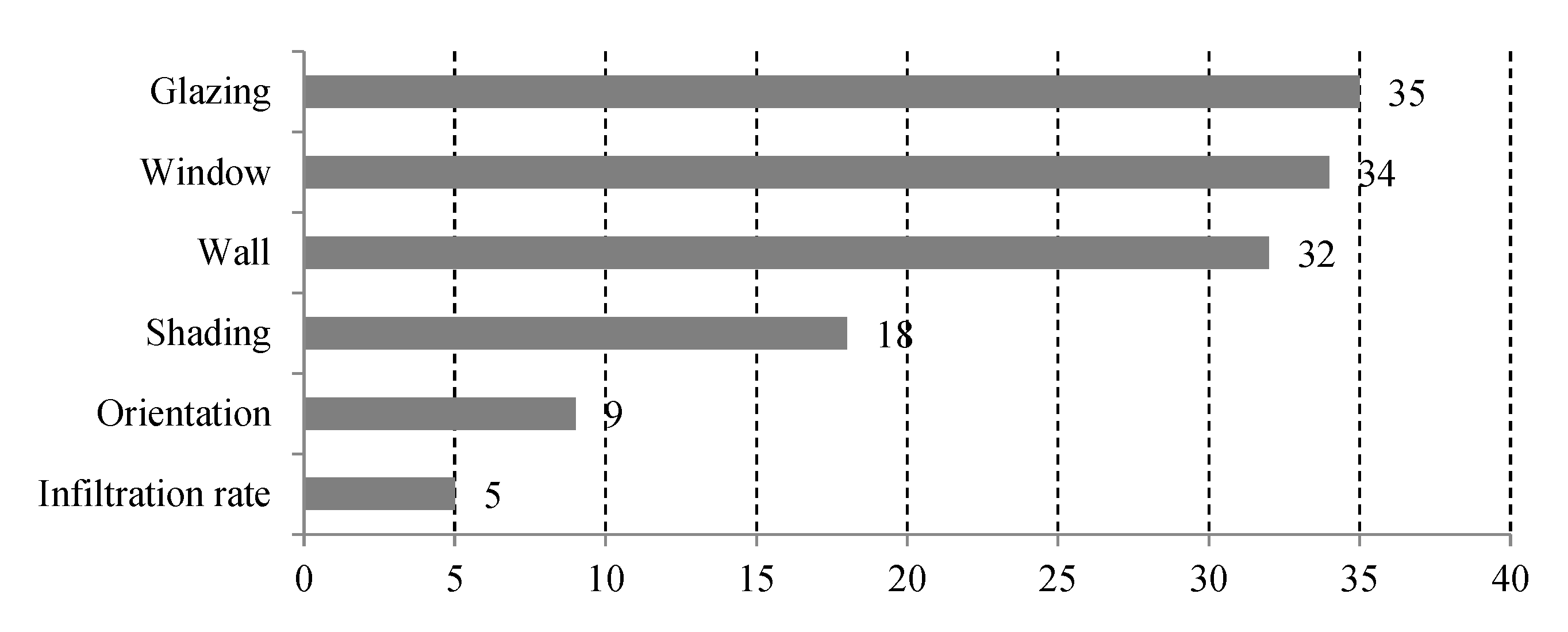
Figure 4 illustrates the frequency of implementation of these design variables in the reviewed studies. Notably, wall insulation, WWR, and glazing material emerge as the most frequently used elements in BFO studies. Building orientation, geometry [6], and infiltration rate [93] have been addressed relatively infrequently in previous research.
Figure 5.
Frequency of implementation of design variables in reviewed studies.
The intricate relationships between design variables and performance objectives come to the forefront when evaluating building orientation. Orientation decisions, intricately interwoven with WWR, shading, and glazing systems, play a central role in determining energy efficiency, daylighting, and indoor comfort [94,95]. Proper orientation choices not only maximize solar gain and daylighting, but also mitigate the risk of overheating in the interior. Optimization results show that well-chosen orientation configurations can achieve optimal energy performance and life-cycle costs, even within the constraints of the maximum allowable WWR [96].
Similarly, the interaction between window area and performance goals is profound. More than half of the studies consider window area, as represented by WWR, as a critical design variable, emphasizing its central influence on energy performance [97,98,99]. Whether optimizing for energy efficiency, daylighting, or visual comfort, window area and its associated variables play a central role in shaping the overall performance of the facade.
Shading systems are essential for mitigating solar heat gain, especially in warmer climates. Tightly integrated with window systems, shading systems help reduce energy demand, improve thermal and visual comfort, and effectively direct daylight. These systems include both continuous and discrete design variables. Continuous variables include shading depth, slat or blind spacing, and tilt angles, while discrete values encompass solar absorptance and reflectance of shading materials. Shading systems, essential for mitigating solar heat gain, epitomize the interrelationship between design choices and performance objectives. These systems, tightly integrated with window design, influence energy demand reduction, thermal comfort improvement, and effective daylighting management [51]. The trade-off between continuous and discrete design variables in shading depth, fin or louver spacing, and tilt angles illustrates how design decisions intersect with the goal of achieving balanced performance outcomes [49].
The choice of exterior wall and roof materials significantly has a significant impact on energy performance and indoor comfort. The design parameters used to describe thermophysical properties, such as thermal conductivity and volumetric specific heat [25], are often considered as discrete values, such as solar absorption and thermal transmittance. Notably, thermal transmittance can also be considered a continuous value when defined as the thickness of the insulation layer.
Glazing systems also have a significant impact on indoor thermal and visual comfort and energy consumption. Studies often compare different glazing materials to identify optimal options. Glazing properties such as U-value, τ-value, and solar heat gain coefficient (SHGC) are typically treated as discrete values. Research often evaluates different glazing types based on cost, thermal impact, and lighting comfort for specific case studies [28,96], and identifies the most appropriate glazing type for local climates.
Infiltration rate emerges as a critical factor influenced by building facade materials and construction techniques, with significant implications for energy efficiency, thermal comfort, initial investment, and building life-cycle carbon emissions. Improved airtightness, as shown by sensitivity analysis, reduces heat loss by convection and significantly reduces heating energy demand in summer, thereby influencing energy, environmental and economic aspects of building performance [93].
Table 4.
Features of building façade optimization design variables.
| Design variables | Continuous | Discrete |
|---|---|---|
| Building orientation | ✓ | |
| Window system | ||
| Window area | ✓ | |
| length | ✓ | |
| width | ✓ | |
| Shading system | ||
| shading depth; | ✓ | |
| distance between fins or shading blinds; | ✓ | |
| tilt angle of fins and blinds; | ✓ | |
| solar absorptance; | ✓ | |
| reflectance of the shading material | ✓ | |
| Building façade (exterior wall and roof) | ||
| thermal transmittance of material | ✓ | |
| solar absorbance of material | ✓ | |
| thickness of layer | ✓ | |
| Glazing system | ||
| glazing properties (U-value, τ-value, SHGC) | ✓ | |
| Infiltration rate | ✓ |
In BFO, the characteristics of the design variables strongly influence the complexity of the building optimization problem, potentially affecting the effectiveness of an algorithm. In particular, when time constraints exist, as is often the case during the preliminary design phase, algorithms with fast search capabilities can reach optimal solutions more quickly. Therefore, a comprehensive understanding of the nature of design variables is critical to selecting appropriate algorithms and avoiding the pitfall of getting trapped in a local optimum. As shown in Table 3, all design variables are discrete values, although some can be treated as continuous values in steps, allowing them to be solved using derivative methods. This distinction is important because the use of derivative methods is typically less complicated and time-consuming than non-derivative methods. However, many studies fail to explore how design variables affect the effectiveness and efficiency of optimization algorithms. Therefore, further analysis and discussion in this area is needed.
4. Optimization algorithms for multi-objective building façade optimization
Evaluating the robustness, reliability, and efficiency of optimization algorithms involves considering factors such as their ability to obtain near-optimal solutions, the nature of the design variables, the convergence rate, and the parameter complexity, tailored to the specific characteristics of building optimization problems [100]. For example, Chegari et al. used computational time, optimality, and diversity of solutions as evaluation criteria to select an appropriate multi-objective optimization algorithm for improving indoor thermal comfort and energy performance in residential buildings [101].
Efficiency and effectiveness are critical metrics for evaluating optimization algorithms, recognizing that no single algorithm can excel at solving all optimization problems. Previous research has compared the performance of optimization algorithms, but often without delving into the reasons for such results, which is essential for this area of study. For example, while one study found that NSGA-II outperformed the PSO algorithm in producing the best Pareto solutions, the reasons for this superiority remain unexplored [101]. The factors that influence the feasibility, reliability, and efficiency of different algorithms in solving BFO problems remain unclear, highlighting gaps in understanding their effectiveness.
In this study, three metrics are used to evaluate the performance of optimization algorithms in addressing BFO challenges. First, the ability of the algorithm to achieve near-optimal satisfactory solutions while avoiding local optima is critical. Rather than achieving true Pareto optimal solutions, early design stage building optimization requires identifying near-optimal satisfactory solutions within a given time frame, influenced by parameter settings such as initial positions and search step sizes. Second, efficiency is critical to ensure that an optimization algorithm can achieve optimal results within a limited time frame. A BFO process entails involves numerous iterations, each potentially lasting hours, days, or weeks, requiring efficient iterations that stop at satisfactory solutions. Finally, maintaining the diversity of building facade design variables and solutions is especially critical in architectural design. Architectural considerations extend beyond energy performance to include aesthetic and social aspects. Methods such as niche-based approaches in genetic algorithms can maintain a range of solutions to accommodate different design possibilities [155,156].
4.1. Hooke-Jeeves
The Hooke-Jeeves (HJ) algorithm, also known as Direct Search, was introduced by Hooke and Jeeves in 1961 [102]. Unlike traditional gradient-based optimization methods, HJ explores points with improved objective function values in the vicinity of the current point. This approach is suitable for solving discontinuous or differentiable functions. HJ finds application in nonlinear engineering problems where derivatives may be unknown, such as the energy-efficient design of buildings [103]. However, HJ’s convergence speed can be slow when dealing with problems with significant discontinuities. Its limitation in handling large numbers of design variables can also lead to local minima. As a result, Direct Search methods are unsuitable for BFO problems with multiple discontinuous design variables.
Peippo et al. were early adopters of the HJ algorithm for multi-objective building optimization [104]. They observed HJ’s straightforward implementation in nonlinear optimizations, but noted potentially slow convergence. For highly complex building optimization models, more sophisticated methods are recommended to reduce overall computational time. Similarly, the Nelder-Mead method struggled to find near-optimal solutions and proved unsuitable for complex optimization functions in building thermal design [105]. In another study, Futrell et al. compared four optimization algorithms: Nelder-Mead, HJ, PSO, and PSO/HJ algorithms. The results showed that while the Nelder-Mead and HJ methods converged faster than the heuristic algorithms, neither consistently produced solutions close to the overall Pareto fronts [106].
4.2. Heuristic algorithms
According to the existing reviews, heuristic algorithms have been used extensively in the optimization of building facades and have performed well. Table 4 shows that GA and its modified versions, including GA/NSGA-II account for most of the reviewed studies, followed by the SPEA-2 algorithm. Other heuristic algorithms (e.g., PSO, SA, ACO, HS), which have been widely used in solving multi-objective building optimization problems have also been mentioned and compared in the reviewed studies. It’s worth mentioning that there is a growing trend of implementing the MLA/ANN integrated based heuristic algorithms.
Heuristic algorithms are more effective in finding optimal solutions near the Pareto front within acceptable time:
- Most optimization problems are complex multi-model problems with discrete design variables. Derivative-free heuristic algorithms have a strong ability to solve such problems.
- The procedure of BFO usually needs to satisfy the time constraint in the early design stage. Heuristic algorithms can run parallel simulations more efficiently, thus greatly reducing the computational cost.
- Building façade design needs to maintain the diversity of different design parameters and techniques. Therefore, the heuristic algorithms, especially the evolutionary algorithms with niche methods, which can collect a variety of different design variables, are more feasible for solving BFO problems.
Genetic Algorithms (GA) were first introduced by John Holland in 1975, inspired by Darwin’s principle of survival of the fittest and the concept of natural evolution [107]. The core process of the basic GA involves generating an initial population, creating new generations through crossover and mutation functions, and iteratively selecting individuals based on the fitness function until termination conditions are met. The use of an elitism strategy ensures that the best individuals, called elites, are carried over to subsequent generations. GA uses niching, which stores multiple solutions in a niche, to enhance its ability to promote subpopulations near local optimal solutions. This counteracts the effects of genetic drift caused by the selection operator in simple GA. GA also employs selection principles that favor non-dominant solutions with higher fitness to survive and reproduce.
BFOs present challenging combinatorial problems with a mixture of continuous and discrete design variables. These characteristics have made GA one of the most popular heuristic algorithms in optimization [108]:
- GA effectively handles multidimensional, non-differentiable, and non-continuous problems.
- GA quickly provides Pareto optimal solutions early in the optimization process through parallel simulations.
- GA’s niching method provides multiple solutions during evolution.
- GA runs reach acceptable optima in reasonable time.
The Non-dominated Sorting Genetic Algorithm-II (NSGA-II), a variant of GA using non-dominated sorting, is widely used in multi-objective BFO studies [56,70,109,110,111]. Goldberg’s non-domination technique ranks solutions and orders them by non-domination levels, thereby preserving diversity in the search space [112]. In terms of finding non-dominated solutions, the hierarchy of algorithms is as follows: NSGA-II excels, followed by MOPSO, and then MOGA. When evaluating the quality of Pareto solutions, NSGA-II ranks first, followed by MOGA, and then MOPSO [113].
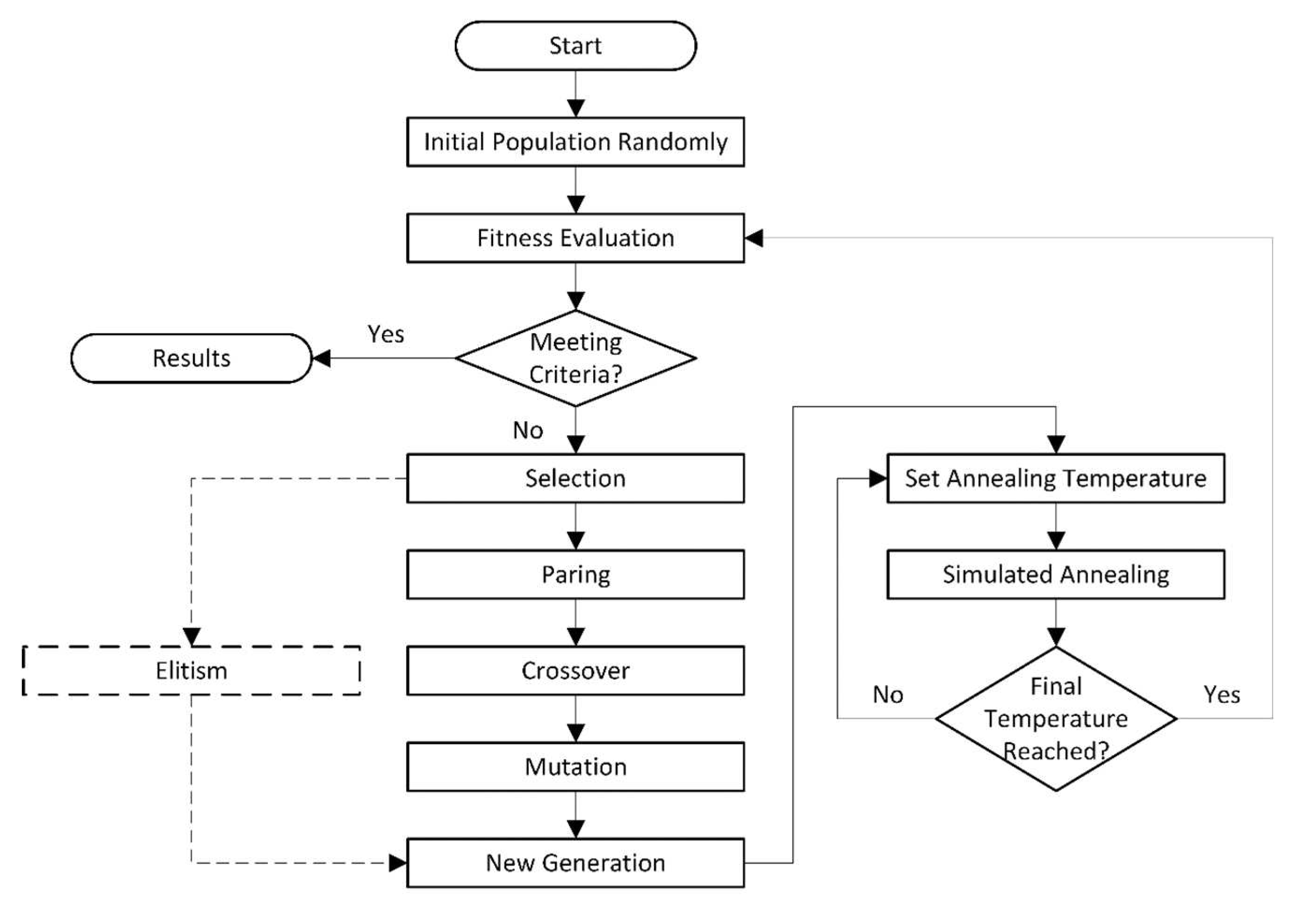
The limitations of GA also persist in existing studies, which necessitates further development. First, to improve solution reliability, GA often requires numerous generations to mitigate the effects of randomly generated initial solutions, prolonging an already time-consuming process. Second, GA is still susceptible to local optima traps. These drawbacks can be mitigated by coupling GA with other algorithms (e.g., SA) that have strong local search capabilities [114]. Future research should prioritize the reduction of optimization time to accelerate GA’s attainment of satisfactory optimal solutions.
Figure 6.
Flowchart of GA-SA.
The Particle Swarm Optimization (PSO) algorithm, introduced by Eberhart and Kennedy in 1995, is inspired by simplified social models such as fish schooling, bird flocking, and swarm theory [115]. PSO attempts to mimic the behavior of animal swarms, where individuals communicate and interact while optimizing collectively. It combines individual intelligence with mechanisms for sharing information among individuals. The algorithm initializes a swarm of particles at random points in the design space. Each particle retains the power value associated with its position and iteratively updates its velocity and direction based on this information. PSO excels at both local and global search because particles store their personal best solution and the best solution achieved by neighboring particles (personal and neighborhood optima). Initially, most particles focus on global search and gradually shift to local search with iterations [116]. Its simplicity has made PSO popular for solving BFO problems.
For example, Yılmaz et al. introduced a multi-objective PSO to optimize the balance between building energy, daylight, visual and thermal performance [117]. The method effectively reduces the computational cost by improving the exploration of the problem space, thereby speeding up the decision making in the early stages. A similar study has been carried out by Xu et al. [118].
An interesting facet is the integration of PSO with the Hooke-Jeeves (HJ) algorithm in building energy efficiency optimization studies. Wetter and Wright showed that the metaheuristic algorithm outperforms HJ in finding the global optimum, since HJ is prone to local minima traps [105]. This led to the proposal of the PSO-HJ hybrid algorithm, which combines PSO and pattern search algorithm (HJ), and demonstrated superiority among nine benchmarked optimization algorithms. Futrell et al. also presented a hybrid PSO-HJ algorithm for Pareto front solutions in balancing daylighting and thermal performance in the design of complex fenestration systems [106]. The algorithm demonstrated efficiency and robustness. Similarly, Vera et al. used the PSO-HJ algorithm to solve the BFO problem for visual comfort and energy use in complex fenestration systems [119]. Notably, the hybrid PSO-HJ algorithm yielded solutions closely approximated exact solutions from exhaustive search, with a 97% reduction in computational time.
Simulated Annealing (SA), a stochastic method introduced independently by Kirkpatrick [120] and Cerny [121] in the 1980s, emulates the gradual cooling process of metals in physical annealing to approximate global optima. As a metaheuristic optimization algorithm, SA has the unique ability to escape local optima and find solutions closer to the global optimum through advanced higher-level search strategies. Similar to GA, although SA was originally developed for discrete problems, it can be effectively applied to continuous problems as well.
As discussed earlier, heuristic algorithms often stop searching for better results and thus get stuck in local minima when current search points do not yield improvements. In contrast, SA’s cooling strategy and the Metropolis-Hastings technique encourage irregular exploration of neighboring points, thus preventing trapping in local optima [122]. This gives SA a robust local search capability and the ability to avoid local optima.
Compared to GA, SA requires less computational time because it operates by traversing from one point to another, eliminating the need to start with a population of starting points. Its simplicity in generating a set of Pareto solutions within a single run and shorter computational time stands as a significant advantage among optimization techniques [123].
An interesting variation, the Pareto Simulated Annealing (PSA) algorithm, combines the properties of SA and GA to tackle multi-objective optimization (MOO) problems [124]. Leveraging the property of SA, a population of starting points can span the entire search space, greatly improving search efficiency. This parallelizable approach contributes to reduced computational time. Although not extensively explored in multi-objective building facade optimization, studies have shown the potential of integrating SA to address the limitations of GA. For example, Junghans and Darde fused GA with SA to optimize a single-objective problem in office building facade design. GA demonstrated capabilities in broad coverage of initial starting points and fast global search, while SA performed refined local search around a near-optimal solution [114]. The results showed that the hybrid GA-SA approach produced solutions closer to the global optimum than GA alone. Although the hybrid GA-SA approach has not yet been applied to multi-objective BFO problems, it holds great promise for significant efficiency improvements in the future.
The Ant Colony Optimization (ACO) algorithm was originally introduced by Dorigo in 1992, inspired by the foraging behavior of natural ants [125]. ACO, the first algorithm based on swarm intelligence, combines local and global search to effectively solve complex optimization problems. A study by Bamdad et al. compared the performance of ACO with Nelder-Mead, PSO, and PSO-HJ algorithms [126]. Their results showed that ACO consistently exhibited a faster convergence rate compared to the three benchmark algorithms and produced results closer to the global optimum. In addition, ACO showed greater consistency of results in terms of spread compared to the other methods. Another case involved the application of ACO to a multi-objective optimization problem related to a panelized building envelope, where the algorithm aimed to find optimal solutions satisfying lighting performance and cost criteria [127]. Despite these results, the reasons for ACO’s superior efficiency over the benchmark algorithms remain unclear in existing research.
The Harmony Search (HS) algorithm, proposed by Geem and Kim [128] is inspired by the improvisational process of musicians and mimics how they adjust pitches using three operations (random selection, memory consideration, and pitch adjustment) to achieve pleasing harmonies.
Fesanghary et al. were among the first to use the HS algorithm to optimize the design of a low-emission low-cost residential building envelope due to its simplicity and ease of implementation [129]. Similarly, Asadi used the HS method to minimize life-cycle-cost (LCC) and CO2 emissions for residential building design, focusing on envelope parameters as design variables [130]. Khoroshiltseva et al. introduced a multi-objective approach based on the HS method to optimize the shape of energy-efficient shading devices to achieve high indoor comfort and low energy consumption for residential buildings [131]. Remarkably, their study produced a set of 1500 optimal solutions in the Pareto front from a potential 1412 solutions in the entire search space, demonstrate the efficiency of HS in early-stage decision making.
While the Simulated Annealing (SA), Ant Colony Optimization (ACO), and Harmony Search (HS) algorithms have not yet seen widespread use in multi-objective building facade optimization problems, their demonstrated success in tacking multi-objective optimization (MOO) in other building-related optimization contexts suggests significant potential for their application in building facade design optimization. Their efficiency, robustness, and reliability in solving various building optimization problems warrant further exploration in the specific domain of building facade design. These algorithms could provide valuable alternatives and complement existing optimization approaches, potentially leading to more effective and diverse solutions in building facade design. Further research and experimentation in this direction could lead to innovative and efficient methods for optimizing building facades with respect to a variety of objectives and constraints.
4.3. MLA/ANN-integrated based heuristic algorithms
Artificial Intelligence (AI) applications have demonstrated remarkable success in several critical areas, transcending the confines of data analysis to encompass creative tasks such as image recognition and speech processing. A significant focus within the building design community is the use of Predictive Models rooted in Machine Learning Algorithms (MLAs), often referred to as black-box models due to their independent nature. These models have received considerable attention for their ability to address complex nonlinear challenges. By learning from relevant data, they construct mathematically fitting models that serve as proxies for resource-intensive simulations. This approach yields invaluable insights from data, enabling fast and accurate predictions for new input data without the need for exhaustive computational simulations or intricate building details. Over the past decade, this paradigm has generated considerable interest in the research community.
Furthermore, it’s important to recognize that the effectiveness of optimization algorithms depends not only on the characteristics of the optimization problem, but also on the parameter settings. For example, the convergence rate of GA is strongly influenced by parameters such as population size and number of iterations. Therefore, the mechanism used to train Artificial Neural Networks (ANN) could potentially be extended to parameter optimization in future studies.
The integration of ANN offers the advantage of reducing the optimization time due to its training mechanism. This is particularly beneficial in scenarios where time-consuming Building Performance Simulation (BPS) programs are involved. The proposed ANN training process enables a comprehensive exploration of the alternative space in a remarkably short time, a feat unattainable by exhaustive searches using computationally expensive BPS engines. This approach has found widespread application, particularly in predicting energy consumption in buildings, often in parallel with numerous review studies.
Several existing studies have synergistically combined heuristic algorithms with ANN, resulting in mixed methods such as ANN-GA and ANN-PSO [34,132]. The choice of ANN is based on its established efficiency in various building studies [133,134]; as well as its prevalence across different programming languages and optimization platforms. A seminal study by Magnier and Haghighat introduced the integration of ANN with a Multi-Objective Genetic Algorithm (MOGA) [135]. The ANN was first trained and validated using a TRNSYS simulation model and then integrated with NSGA-II for optimization. This integration resulted in a significant reduction in optimization time, from over a decade to only three weeks. Similarly, Chegari et al. innovatively combined ANN with common metaheuristic algorithms such as NSGA-II, PSO, and GA to improve indoor thermal comfort and energy performance in residential buildings [132]. Among these hybrid approaches, the ANN-PSO combination was found to be the most effective in achieving the desired performance results.
The integration of Artificial Neural Networks (ANNs) with optimization algorithms such as NSGA-II has significant potential to revolutionize optimization efforts in building facade design. Incorporating ANNs into NSGA-IIadds a new dimension to the optimization process. ANNs excel at recognizing intricate relationships within data, and when fused with NSGA-II, they serve as surrogate models that approximate objective functions and constraints. This surrogate modeling capability significantly reduces the computational burden associated with many building performance simulations.
The workflow involves training the ANN using a representative data set derived from building performance simulations. Once trained, the ANN captures the complex relationships between design variables and performance metrics. During the optimization phase, NSGA-II uses the trained ANN to guide its search, dramatically reducing the need for time-consuming simulations. This integration has remarkable benefits, allowing NSGA-II to explore the design space more efficiently and intelligently. The result is convergence to optimal solutions in a fraction of the time traditionally required. In particular, this approach accommodates both continuous and discrete design variables, providing the flexibility to handle a wide range of parameters.
The combination of ANNs and NSGA-II represents a harmonious synergy between computational efficiency and optimization precision. It enables architects and researchers to navigate the complex landscape of building facade design with greater speed and accuracy. This ultimately promotes informed and innovative design decisions. However, despite these advances, the full potential of machine learning to improve building facade design has yet to be realized. Architects and researchers are just beginning to tap into its capabilities, suggesting a promising direction for future innovation.
Several studies have already explored the hybrid ANN-GA optimization technique to achieve optimal building facade designs with multi-objective considerations such as energy efficiency, thermal comfort, daylighting, cost-effectiveness, and environmental impact [25,27,34,63,69]. Xu et al. introduced a comprehensive three-stage optimization methodology for classroom envelopes [69], which includes building modeling, meta-model training, hyper-parameter optimization, and multi-objective optimization stages. Himmetoğlu et al. developed a hybrid ANN-GA algorithm for building facade design solutions, incorporating ANN models trained on solutions obtained from EnergyPlus simulations [73].
In the future, an interesting avenue could be to create plug-ins for architectural software such as Grasshopper or Dynamo. Such plug-ins could automate critical tasks such as model parameterization, ANN training, feature extraction, validation, and optimization. This integration would allow architects to seamlessly leverage advanced ANN insights, streamlining decision-making, and foster innovative design exploration [136].
Table 5.
Extraction of primary studies methodology and tools, listed in chronological order.
| Author (s) | Year | Method | Simulation Tool | Optimization Tool | |
|---|---|---|---|---|---|
| [21] | Caldas and Norford | 2003 | NSGA | DOE-2 | N/A |
| [22] | Zemella et al. | 2011 | Evolutionary Neural Network Design (ENN-Design) | EnergyPlus | N/A |
| [23] | Gagne and Andersen | 2012 | Micro-GA | Lightsolve Viewer (LSV) | N/A |
| [24] | Bogar et al. | 2013 | NSGA-II | EnergyPlus | ePlusOpt + MATLAB |
| [25] | Gossard et al. | 2013 | ANN+NSGA-II | TRNSYS | GenOpt |
| [26] | Wright et al. | 2014 | NSGA-II | EnergyPlus | N/A |
| [27] | Jayedi et al. | 2014 | ANN+GA | TRNSYS | GenOpt |
| [28] | Kasinalis et al. | 2014 | NSGA-II | TRNSYS; DAYSIM | MATLAB |
| [29] | Echenagucia et al. | 2015 | NSGA-II | EnergyPlus | Python |
| [30] | Chatzikonstantinou et al. | 2015 | Differential Evolution(DE) | DIVA for Rhinoceros | MATLAB |
| [31] | Wu et al. | 2016 | NSGA-II | EnergyPlus | MATLAB |
| [32] | Ascione et al. | 2016 | NSGA-II | EnergyPlus | jEPlus+EA |
| [33] | Xu et al. | 2016 | NSGA-II | EnergyPlus | Jmetal package (Java based) |
| [34] | Azari et al. | 2016 | ANN+NSGA-II | eQuest | N/A |
| [35] | Karaman et al. | 2017 | NSGA-II; jE_DEMO | N/A | N/A |
| [36] | Fan and Xia | 2017 | GA | N/A | N/A |
| [37] | Narangerel et al. | 2017 | GA | N/A | N/A |
| [38] | Bingham et al. | 2017 | NSGA-II | EnergyPlus | jEPlus+EA |
| [39] | Kang et al. | 2018 | NSGA-II | TRNSYS | RcmdrPlugin of DOE |
| [40] | Chen et al. | 2018 | NSGA-II | EnergyPlus | N/A |
| [41] | Cascone et al. | 2018 | NSGA-II | EnergyPlus | Python |
| [42] | Grygierek et al. | 2018 | NSGA-II | EnergyPlus | MATLAB |
| [43] | Shen | 2018 | SPEA-2 | DIVA for Grasshopper | Octopus plugin for Grasshopper |
| [44] | Shahbazi et al. | 2019 | SPEA-2 | DIVA for Grasshopper | Octopus plugin for Grasshopper |
| [45] | Yi | 2019 | NSGA-II | DIVA for Grasshopper | MATLAB |
| [46] | Ascione et al. | 2019 | GA | EnergyPlus | MATLAB |
| [47] | Torres-Rivas et al. | 2019 | NSGA-II | EnergyPlus | MOBO |
| [48] | Jalali et al. | 2020 | SPEA-2 | EnergyPlus (Honeybee for Grasshopper) | Octopus plugin for Grasshopper |
| [49] | Kim and Clayton | 2020 | SPEA-2 | EnergyPlus (Honeybee for Grasshopper) | Octopus plugin for Grasshopper |
| [50] | Chang et al. | 2020 | GA | EnergyPlus (Honeybee for Grasshopper) | MATLAB |
| [51] | Zhao and Du | 2020 | NSGA-II | EnergyPlus | jEPlus+EA |
| [52] | Yilmaz et al. | 2020 | Pattern Search+PSO+HJ | GenOpt | |
| [53] | Pilechiha et al. | 2020 | SPEA-2 | EnergyPlus (Honeybee for Grasshopper) | Octopus plugin for Grasshopper |
| [54] | Ciardiello et al. | 2020 | aNSGA-II | EnergyPlus | Python (eppy library) |
| [55] | Wang et al. | 2020 | NSGA-II | EnergyPlus | Python |
| [56] | Acar et al. | 2021 | NSGA-II | EnergyPlus | MATLAB |
| [57] | Naji et al. | 2021 | NSGA-II | EnergyPlus | jEPlus+EA |
| [58] | Lin et al. | 2021 | NSGA-II | MOBELM | MATLAB |
| [59] | Nasrollahzadeh | 2021 | SPEA-2 | EnergyPlus (Honeybee for Grasshopper) | Octopus plugin for Grasshopper |
| [60] | Abdou et al. | 2021 | NSGA-II | TRNSYS | MOBO |
| [61] | Belhous et al. | 2021 | NSGA-II | TRNSYS | MOBO |
| [62] | Xu et al. | 2021 | ANN+NSGA-II/MOPSO | EnergyPlus | Python |
| [63] | Lin and Yang | 2021 | ANN+GA | DesignBuilder | MATLAB |
| [64] | Mashaly et al. | 2021 | SPEA-2 | EnergyPlus (Honeybee for Grasshopper) | Octopus plugin for Grasshopper |
| [65] | Albatayneh | 2021 | GA | EnergyPlus | DesignBuilder-jEPlus link package |
| [66] | Yao et al. | 2022 | SPEA-2 | EnergyPlus (Honeybee for Grasshopper) | Octopus plugin for Grasshopper |
| [67] | Seghier et al. | 2022 | NSGA-II | N/A | MATLAB |
| [68] | Wu and Zhang | 2022 | SPEA-2 | EnergyPlus (Honeybee for Grasshopper) | Octopus plugin for Grasshopper |
| [69] | Xu et al. | 2022 | ANN+MOGA/NSGA-II/MOPSO | EnergyPlus | N/A |
| [70] | Semahi et al. | 2022 | NSGA-II | EnergyPlus | jEPlus+EA |
| [71] | Xu et al. | 2022 | NSGA-II | EnergyPlus | Python |
| [72] | Zong et al. | 2022 | NSGA-II | N/A | Python |
| [74] | Nazari et al. | 2023 | ANN+GA | EnergyPlus | N/A |
| [75] | Wang et al. | 2023 | NSGA-II | EnergyPlus (Honeybee for Grasshopper) | Wallacei plugin for Grasshopper |
| [76] | Elsheikh et al. | 2023 | NSGA-II | EnergyPlus | DesignBuilder-jEPlus link package |
5. Simulation-based building optimization technique
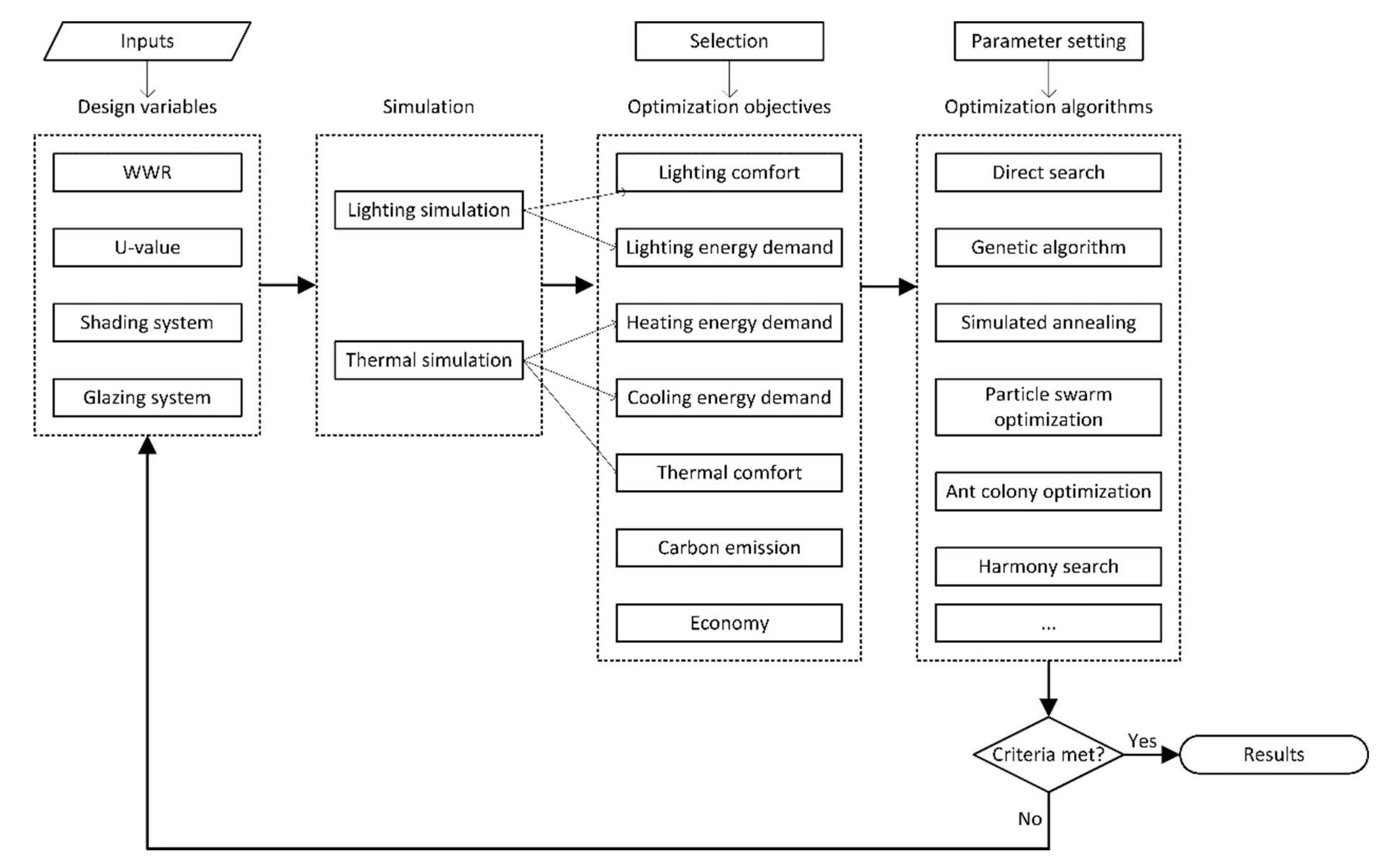
A comprehensive additional table, Table 5, was developed focusing on methodology and tools details alone. The general simulation-based building optimization process is shown in the flowchart in Figure 6 and includes the following key phases:
- Input Design Parameters: Architects provide essential design parameters such as window-to-wall ratio (WWR), U-value, shading system, and glazing types. These serve as design variables for the Building Facade Optimization (BFO) problem.
- Define Design Objectives: Architects desine the design objectives for the BFO problem, outlining what needs to be optimized in terms of building facade performance.
- Optimization Algorithm Selection: Architects select an appropriate optimization algorithm and configure its parameters to meet the requirements of the problem.
- Optimization Algorithm Execution: The selected optimization algorithm begins its actions, initiating computational modeling and simulations.
- Simulation Engine Execution: The lighting/thermal simulation engine performs in dynamic simulations, producing results that meet the specified design objectives.
- Result Selection Mechanism: The optimization algorithm selection mechanism evaluates the simulation results and determines the results that meet the optimization objectives.
- Post-Processing Module: A post-processing module kicks in and extracts the Pareto fronts from the simulation results. These fronts represent the optimal trade-off solutions between conflicting objectives.
This structured process integrates architectural design, computational simulation, and optimization techniques to guide architects toward Pareto-optimal building facade solutions that meet multiple performance objectives.
The core of the Building Facade Optimization (BFO) technique lies in the seamless integration of effective optimization tools and building design simulation tools. This integration can be achieved using either dedicated optimization software or custom programming. Several optimization platforms have been developed to facilitate this integration and enable architects and engineers to create high-performance building designs.
One approach is to integrate building simulation engines into general-purpose optimization platforms. These platforms, which originated in the engineering field, are beginning to find applications in building optimization. Prominent examples include MATLAB [137], GenOpt [138], modeFRONTIER [139], and ModelCenter [140]. MATLAB in particular is widely used in the reviewed studies, followed by GenOpt, a building performance optimization tool developed by the Lawrence Berkeley National Laboratory. These platforms offer a range of optimization methods, accept both continuous and discrete variables, and can be coupled with various building simulation engines such as DOE-2, EnergyPlus, TRNSYS, and DAYSIM. Some even provide the flexibility for users to develop custom algorithms. However, these optimization platforms have certain limitations. While they can automate simulations by importing building simulation data and analyzing result files, the process is not inherently interactive with 3D modeling, which can be inconvenient for architects. Architects often have to switch between the design and simulation-optimization environments, which can hinder efficiency in the early design stages. There is a need to develop of more architect-friendly optimization tools as plugins for 3D architectural modeling platforms.
Figure 7.
General workflow of building optimization process based on simulation technique.
In addition to the optimization platforms discussed earlier, there is a notable tool called Octopus that works as a plugin for Rhinoceros 3D modeling via Grasshopper. Octopus uses sophisticated evolutionary algorithms such as SPEA-II [141] and HypE [142] to provide robust optimization capabilities. One of its distinct advantages is its seamless integration into the Grasshopper environment, allowing architects to work within their familiar 3D modeling tools. Octopus has demonstrated its effectiveness in addressing multi-objective BFO challenges in recent years [43,44,48,49,53], particularly in the context of comprehensive building envelope design [59,64]. This plugin has facilitated the optimization of complex building facade designs by leveraging its integration with the Grasshopper interface and supporting various evolutionary algorithms. As a result, architects and designers have been able to explore a wide range of design possibilities, take into account multiple objectives while benefiting from the interactive and intuitive nature of the 3D modeling environment. This integration not only streamlines the optimization process, but also promotes a more direct connection between design intent and optimization results. By using Octopus within the Grasshopper ecosystem, architects can efficiently navigate the complexities of building facade design, ultimately leading to more informed and innovative design decisions.
The evaluation of building optimization techniques includes considerations such as thermal and visual comfort, as well as energy demand. Various methods are available to analyze optimization objectives, often using detailed building simulation tools or custom-developed tools.
Detailed discussions of building performance simulation tools are available in existing studies, and systematic reviews on BPS tools such as DOE-2 [143], TRNSYS [144], EnergyPlus [145], and ASHRAE toolkit [146] have been published. Another category of optimization tools is designed specifically for building performance simulation engines such as EnergyPlus or TRNSYS. These platforms provide user-friendly environments that allow architects to select optimization algorithms, define variables and objectives, and visualize results. For example, jEPlus is tailored for complex optimizations with EnergyPlus and is tightly integrated with DesignBuilder software, providing benefits to designers without programming expertise. The jEPlus+EA approach has been widely used for building façade optimization and renewable energy integration [147,148].
Table 6.
Comparison of the optimization tools.
| Platform | BPS engine integration | 3D Visualize | Algorithm selection | Custom | 3D model Interact | |
|---|---|---|---|---|---|---|
| Thermal | Lighting | |||||
| Matlab | ✓ | ✓ | ✓ | ✓ | ✓ | × |
| GenOpt | ✓ | × | ✓ | ✓ | ✓ | × |
| ModelCenter | ✓ | × | ✓ | ✓ | ✓ | × |
| modeFRONTIER | ✓ | × | ✓ | ✓ | ✓ | × |
| jEPlus + EA | ✓ | × | ✓ | × | × | × |
| MOBO | ✓ | × | ✓ | × | × | × |
| Octopus | ✓ | ✓ | ✓ | × | ✓ | ✓ |
Table 5 compares the optimization tools in terms of integration with dynamic building simulation engines, interaction with 3D building modeling, visualization of results, variety of different algorithms, and the possibility of custom algorithms. Some of the optimization platforms that are tightly integrated with BPS tools are not compatible with 3D CAD software, which reduces the efficiency when architects run the optimization during the preliminary design phase.
In architectural design practice, user-friendly interfaces or plugins for optimization tools have been developed to facilitate seamless integration with building performance simulation plugins and multi-objective optimization tools [44,49,149,150,151], especially for parametric building facade and complex fenestration system design [64,152,153]. However, more work is needed to increase flexibility. Improving existing algorithms or adding new ones is essential for efficiency. Custom algorithms developed by the architect should be supported, given the increasing ability of programming training. In addition, optimization parameter settings should be architect-friendly.
A key consideration is the graphical user interface (GUI), which is essential for architects to present and communicate with clients. While most optimization platforms offer Pareto front representation, integration between 3D design and simulation-optimization is still lacking, hindering immediate reflection of design variations.
In summary, the integration of design, simulation, and optimization platforms is critical to the efficiency of the building facade optimization (BFO) process. While optimization platforms from the engineering field offer various algorithms and customization capabilities, they may lack responsiveness to 3D CAD software, which hinders optimization efficiency. In addition, such platforms may not be user-friendly for architects, potentially hindering the design process. Building-specific optimization platforms, on the other hand, are often tailored to popular simulation engines, but may lack the flexibility to handle various design variables. To improve BFO efficiency, future developments should prioritize architect-friendly optimization tools as plugins to 3D architectural modeling platforms, enabling seamless integration between design and simulation-optimization. The ability for architects to develop and add custom algorithms is critical, requiring the addition of more algorithms for increased flexibility. User-friendly optimization parameter settings are essential, as are optimization platforms that can instantly reflect design variations, facilitating effective presentation and communication with clients.
6. Discussion and conclusion
6.1. Summary of main findings
This paper reviews the previous studies on multi-objective building façade optimization. A total of 459 papers were screened and 56 of them were finally selected and systematically reviewed. The original study started in the 2000s, but the implementation of multi-objective optimization algorithms in solving BFO problems has become more consistent since 2010, and there is a rapid growth of literature since 2020.
Office and residential buildings accounted for 88% of the total number of studies reviewed, indicating the high level of research interest and need to optimize the performance of these two building types. Many studies focused on optimizing the retrofit of residential buildings. The choice of optimization objectives has evolved in response to changing interests and advances in building research. In the original BFO studies, there is a predominant focus on optimizing the balance between energy efficiency, daylighting, and economic considerations. Since the 2010s, studies have increasingly emphasized achieving a balance between indoor thermal comfort and daylighting in optimizing building design. The shift towards evaluating the influence on both thermal and visual comfort became evident around 2014, signifying an increased emphasis on human comfort considerations. Studies investigating the balance between energy efficiency and thermal comfort coincide with the extensive use of MOO methods in residential renovations, which often include economic and environmental goals. In addition, the growing concern for carbon neutrality has led to a surge in studies focusing on environmental aspects, especially since 2016. While the majority of optimization problems have traditionally been bi-objective, there has been a growing trend toward studying problems with three or even four objectives. This shift has increased the complexity of BFO problems. As a result, the use of appropriate MOO algorithms for BFO problems has becomes imperative. This strategic approach is essential to improve building performance while effectively balancing energy efficiency, economic considerations, environmental impact, and indoor comfort. This importance is particularly pronounced in the early design stage, where decisions made have significant potential to improve overall building performance. By implementing appropriate MOO algorithms in BFO applications, architects and designers can make informed decisions that holistically address multiple objectives and lay a strong foundation for optimal building outcomes.
The frequency distribution of design variables within the reviewed studies follows a ranking: wall insulation, WWR, glazing material, building orientation, geometry, and infiltration rate. Among these, glazing system, WWR, and wall construction are the most commonly used elements as design variables in BFOs. In contrast, building geometry and air exchange rate have received significantly less attention in previous research. One possible explanation for this discrepancy could be the limitations of the modeling environments of simulation engines, which may not be user-friendly enough to modify complicated design parameters such as building geometry or window shapes. Nevertheless, studies have shown that certain design factors, such as airtightness, occupants, and WWR, have a significant influence in certain climates, especially colder ones. As a result, these influential design parameters should be considered early in the design process, particularly during the modeling phase of BFO studies. This strategic inclusion can improve the accuracy and relevance of optimization results by better aligning them with real-world conditions and climatic considerations.
Selecting an appropriate optimization algorithm and improving its efficiency depends critically on understanding the nature of the design variables—whether they are continuous, discrete, or a combination of both. This analysis extends to building facade design variables and their intrinsic properties. In particular, a significant portion of these variables, such as glazing material and wall construction, can only be expressed as discrete values. Meanwhile, certain variables lend themselves to continuous values, providing an opportunity to use derivative methods for solution. The appeal of using derivative methods lies in their relative simplicity and time efficiency compared to non-derivative methods. However, there is a significant gap in the current landscape: the study of how design variables affect the effectiveness and efficiency of optimization algorithms remains largely overlooked. This highlights the need for deeper analysis and discussion. Understanding the interplay between design variables and optimization algorithms has the potential to provide valuable insights, refine approaches, and optimize the match between variables and algorithms.
A comprehensive comparison and discussion of optimization algorithms used to address BFO problems has been conducted. The algorithms reviewed include direct search, genetic programming search (GPS), genetic algorithms (GA), simulated annealing (SA), particle swarm optimization (PSO), ant colony optimization (ACO), and harmony search (HS). Among these algorithms, GA and its various adaptations emerge as the most widely used methods within the reviewed studies. GA’s popularity can be attributed to its efficiency during the initial optimization stages, its ability to preserve a wide variety of design parameters through evolutionary processes, and its reliability in achieving convergence. Together, these attributes contribute to GA’s prominence in addressing BFO problems and confirm its effectiveness in navigating the intricacies of architectural optimization challenges.
The nature of the optimization problem significantly influences the suitability of the chosen optimization algorithm. In particular, BFO problems have special characteristics. These problems are characterized by nonlinearity and discontinuity due to the discrete values of the design variables. In addition, the optimization objectives involve the integration of nonlinear, non-convex, and non-differentiable functions. These inherent characteristics make calculus-based methods or gradient-based techniques, which are commonly used in engineering contexts, unsuitable for addressing BFO problems. The complex interplay of nonlinearity and discontinuity underscores the need for specialized algorithms capable of handling the complexity inherent in BFO problems. As such, the optimization landscape of BFO problems requires tailored methods that are adept at handling their unique characteristics.
The widely used optimization algorithms have been compared in the reviewed studies, considering aspects such as diversity, robustness, convergence speed, and parameter complexity. It’s crucial to investigate how the nature of BFO problems aligns with the feasibility and efficiency of these algorithms. Studying the relationships between BFO characteristics and algorithm performance is essential. This will ensure that the chosen optimization approach matches the intricacies of BFO challenges, leading to better architectural optimization results.
Among the many well-used algorithms, the prominence of genetic algorithms (GAs) and their adaptations was particularly evident, revealing significant potential for future endeavors. This preference is underpinned by a number of factors, including their ability to handle both continuous and discrete parameters, their efficiency in facilitating global searches during the initial stages of optimization, their ability to perform parallel simulations on multi-processor systems, their resistance to getting trapped in local minima, and their ease of setting optimization parameters. Taken together, these attributes position GA and its variants as powerful tools for tackling the nuanced landscape of BFO problems and provide a promising path for future advances in architectural optimization.
Algorithm integration serves as a means to address the limitations of individual algorithms in local or global search. In particular, the reviewed studies show a remarkable interest and future potential in overcoming algorithmic limitations through hybrid approaches. These include PSO-HJ, GA-SA, ANN-GA, and ANN-PSO, which combine different algorithms to improve performance. It’s worth mentioning that given the local search speed drawbacks of GA, complementary algorithms such as SA can be incorporated to enhance the efficiency of the search process. While the GA-SA method remains untapped in multi-objective optimization for building facades, its potential for significant efficiency improvement is evident. This highlights a promising avenue for future research, with strong prospects for increasing optimization effectiveness in architectural applications.
The use of ANN training mechanisms shows great potential in optimizing performance. ANN allows for comprehensive exploration of alternative solutions in a shorter timeframe, a task that would be unattainable through performing exhaustive searches using time-intensive building performance simulations. Past research has successfully employed this mechanism for parameter optimization, which plays a central role in improving optimization algorithm performance. Integrating Artificial Neural Networks (ANNs) with NSGA-II optimization offers a powerful solution for enhancing building facade design. ANNs act as surrogate models, approximating objective functions and constraints, which reduces simulation requirements and improves NSGA-II’s efficiency. Trained ANNs expertly guide NSGA-II’s search, allowing for swift convergence to optimal solutions. This approach allows for the accommodation of various design variables and promotes faster, more accurate design optimization.
In architectural practices, challenges often arise during the preliminary design stage when implementing building optimization. Efforts are invested in integrating optimization platforms and simulation engines to enhance convenience and efficiency in the pursuit of optimal building designs. Previous studies have identified several optimization platforms, including MATLAB, GenOpt, MOBO, modeFRONTIER, and Octopus, which significantly improve the user experience in building optimization. Among these, Grasshopper add-ons (such as Octopus and Wallacei) on the Rhinoceros 3D modeling software platform have gained considerable popularity, followed by MATLAB Optimization ToolboxTM. Grasshopper add-ons provide an advantage as they are integrated within the Rhinoceros 3D environment. This translates to a user-friendly interface for creating shape design, with the added potential to contribute to various other advancements within the Grasshopper community. In contrast, general optimization platforms such as MATLAB and GenOpt lack responsiveness to 3D computer graphics and computer-aided design (CAD) software like Rhinoceros 3D. Consequently, they may not be as architect-friendly and efficient, especially during the initial design phase, which focuses on shaping design concepts.
6.2. Suggestions for further work
In recent decades, there has been a significant increase in interest in building optimization, especially in the area of Multi-Objective Optimization (MOO). This trend emphasizes the growing awareness of the significance of optimizing building design and performance, particularly in addressing the complex challenges associated with building facades. Nevertheless, despite progress, certain difficulties still remain. These factors encompass the effectiveness of optimization algorithms, a thorough comprehension of optimization problem intricacies, and the creation of simple-to-use simulation and optimization tools that flawlessly integrate with architectural workflows. Nevertheless, there is significant hope that multi-objective optimization techniques will become a routine aspect of standard architectural design processes with the fast-paced advancements in technology and computational methods. The potential benefits of improved building performance, energy efficiency, and sustainability are vast and lead to more optimized and innovative architectural solutions. The research landscape is primarily focused on two areas: methodological gaps and future exploration topics.
Methodological Gaps:
- Delving deeper into the analysis and comparison of evaluation criteria tailored to optimization algorithms, specifically addressing the challenges posed by building facade optimization.
- Uncovering the intricate interplay between design variables and the effectiveness of optimization algorithms, offering insights into how design choices impact algorithm performance.
- Crafting research endeavors that align with the practical constraints confronting architectural firms, acknowledging time limitations during the early design stages that frequently dictate decision-making timelines.
- Pioneering the creation of comprehensive platforms that integrate architectural design, simulation, and optimization tools seamlessly, promoting a cohesive design process.
- Addressing compatibility issues through optimization platforms that integrate seamlessly with 3D CAD software improves user-friendliness for architects.
Future Topics of Study:
- Creation of optimization tools designed for integration with popular 3D architectural design platforms, revolutionizing architects’ communication with clients through visualized and optimized design solutions.
- Empowering architects with the ability to develop and incorporate bespoke algorithms within optimization processes, fostering innovation and tailoring algorithms to specific design challenges.
- Further refining and expanding architect-friendly environments is crucial in harmoniously blending in-depth building performance simulation with real-time reflection of 3D design models.
- A concerted focus on optimization algorithms will enhance their selection, adaptation, and enhancement, addressing unique challenges that arise in diverse building optimization scenarios.
- Advancing algorithms and ATC approaches is key to harnessing the strengths of multiple algorithms and achieving improved optimization outcomes.
- Additionally, formulating systematic optimization frameworks that can handle the intricacies of complex multi-objective building facade optimization problems is essential.
- This ensures architects can harness the full potential of optimization beyond simulation surrogates. Advocating for the integration of optimization concepts into architectural education to equip architects with the ability to utilize optimization for data analysis, form exploration, and fine-tuning building design parameters to enhance overall performance.
As the field continues to evolve, these areas of research hold promise for uncovering valuable insights, spurring innovation, and ushering in a new era of architectural design optimization. This emerging era aims to strike a harmonious balance between aesthetics, functionality, and sustainability, driving architectural endeavors to unprecedented levels of excellence and holistic performance.
References
- Gossard, D.; Lartigue, B.; Thellier, F. Multi-objective optimization of a building envelope for thermal performance using genetic algorithms and artificial neural network. Energy Build. 2013, 67, 253–260. [Google Scholar] [CrossRef]
- Tuhus-Dubrow, D.; Krarti, M. Genetic-algorithm based approach to optimize building envelope design for residential buildings. J. Affect. Disord. 2010, 45, 1574–1581. [Google Scholar] [CrossRef]
- Lomas, K.J.; Eppel, H. Sensitivity analysis techniques for building thermal simulation programs. Energy Build. 1992, 19, 21–44. [Google Scholar] [CrossRef]
- Caldas, L.G.; Norford, L.K. Genetic Algorithms for Optimization of Building Envelopes and the Design and Control of HVAC Systems. J. Sol. Energy Eng. 2003, 125, 343–351. [Google Scholar] [CrossRef]
- Sadineni, S.B.; Madala, S.; Boehm, R.F. Passive building energy savings: A review of building envelope components. Renew. Sustain. Energy Rev. 2011, 15, 3617–3631. [Google Scholar] [CrossRef]
- Pacheco, R.; Ordóñez, J.; Martínez, G. Energy efficient design of building: A review. Renew. Sustain. Energy Rev. 2012, 16, 3559–3573. [Google Scholar] [CrossRef]
- Kaynakli, O. A review of the economical and optimum thermal insulation thickness for building applications. Renew. Sustain. Energy Rev. 2012, 16, 415–425. [Google Scholar] [CrossRef]
- Kheiri, F. A review on optimization methods applied in energy-efficient building geometry and envelope design. Renew. Sustain. Energy Rev. 2018, 92, 897–920. [Google Scholar] [CrossRef]
- Nguyen, A.-T.; Reiter, S.; Rigo, P. A review on simulation-based optimization methods applied to building performance analysis. Appl. Energy 2014, 113, 1043–1058. [Google Scholar] [CrossRef]
- Attia, S.; Hamdy, M.; O’brien, W.; Carlucci, S. Assessing gaps and needs for integrating building performance optimization tools in net zero energy buildings design. Energy Build. 2013, 60, 110–124. [Google Scholar] [CrossRef]
- Evins, R. A review of computational optimisation methods applied to sustainable building design. Renew. Sustain. Energy Rev. 2013, 22, 230–245. [Google Scholar] [CrossRef]
- Machairas, V.; Tsangrassoulis, A.; Axarli, K. Algorithms for optimization of building design: A review. Renew. Sustain. Energy Rev. 2014, 31, 101–112. [Google Scholar] [CrossRef]
- Huang, Y.; Niu, J.-L. Optimal building envelope design based on simulated performance: History, current status and new potentials. Energy Build. 2016, 117, 387–398. [Google Scholar] [CrossRef]
- Costa-Carrapiço, I.; Raslan, R.; González, J.N. A systematic review of genetic algorithm-based multi-objective optimisation for building retrofitting strategies towards energy efficiency. Energy Build. 2019, 210, 109690. [Google Scholar] [CrossRef]
- Manni, M.; Nicolini, A. Multi-Objective Optimization Models to Design a Responsive Built Environment: A Synthetic Review. Energies 2022, 15, 486. [Google Scholar] [CrossRef]
- Coello, C.A.C.; Lamont, G.B.; Ray, T.; Farina, M.; Di Barba, P.; Reed, P.; Devireddy, V.; Luna, E.H.; Furukawa, T.; Dissanayake, G.; et al. Applications of Multi-Objective Evolutionary Algorithms. 2004. [CrossRef]
- Kitchenham, B.; Brereton, O.P.; Budgen, D.; Turner, M.; Bailey, J.; Linkman, S. Systematic literature reviews in software engineering – A systematic literature review. Inf. Softw. Technol. 2009, 51, 7–15. [Google Scholar] [CrossRef]
- Xiao, Y.; Watson, M. Guidance on Conducting a Systematic Literature Review. J. Plan. Educ. Res. 2017, 39, 93–112. [Google Scholar] [CrossRef]
- N. J. van Eck and L. Waltman, “Software survey: VOSviewer, a computer program for bibliometric mapping,” Scientometrics, vol. 84, no. 2, pp. 523–538, Dec. 2010. [CrossRef]
- Hashempour, N.; Taherkhani, R.; Mahdikhani, M. Energy performance optimization of existing buildings: A literature review. Sustain. Cities Soc. 2019, 54, 101967. [Google Scholar] [CrossRef]
- Caldas, L.G.; Norford, L.K. Genetic Algorithms for Optimization of Building Envelopes and the Design and Control of HVAC Systems. J. Sol. Energy Eng. 2003, 125, 343–351. [Google Scholar] [CrossRef]
- Zemella, G.; De March, D.; Borrotti, M.; Poli, I. Optimised design of energy efficient building façades via Evolutionary Neural Networks. Energy Build. 2011, 43, 3297–3302. [Google Scholar] [CrossRef]
- Gagne, J.; Andersen, M. A generative facade design method based on daylighting performance goals. J. Build. Perform. Simul. 2012, 5, 141–154. [Google Scholar] [CrossRef]
- D. Bogar, G. D. Bogar, G. Rapone, A. Mahdavi, and O. Saro, “GA-optimisation of a curtain wall façade for different orientations and climates,” in Building Simulation Applications, 2013. [Online]. Available: https://www.scopus.com/inward/record.uri?eid=2-s2. 8504. [Google Scholar]
- Gossard, D.; Lartigue, B.; Thellier, F. Multi-objective optimization of a building envelope for thermal performance using genetic algorithms and artificial neural network. Energy Build. 2013, 67, 253–260. [Google Scholar] [CrossRef]
- Wright, J.A.; Brownlee, A.; Mourshed, M.M.; Wang, M. Multi-objective optimization of cellular fenestration by an evolutionary algorithm. J. Build. Perform. Simul. 2013, 7, 33–51. [Google Scholar] [CrossRef]
- Jayedi, N. Tabassum, J. Hopfenblatt, J. B. Kim, and M. O. Haque, “Optimizing container housing units for informal settlements: A parametric simulation & visualization workflow for architectural resilience,” in Projections - Proceedings of the 26th International Conference of the Association for Computer-Aided Architectural Design Research in Asia, CAADRIA 2021, 2021, pp. 51–60. [CrossRef]
- Kasinalis, C.; Loonen, R.; Cóstola, D.; Hensen, J. Framework for assessing the performance potential of seasonally adaptable facades using multi-objective optimization. Energy Build. 2014, 79, 106–113. [Google Scholar] [CrossRef]
- Echenagucia, T.M.; Capozzoli, A.; Cascone, Y.; Sassone, M. The early design stage of a building envelope: Multi-objective search through heating, cooling and lighting energy performance analysis. Appl. Energy 2015, 154, 577–591. [Google Scholar] [CrossRef]
- Chatzikonstantinou, B. Ekici, I. S. Sariyildiz, and B. K. Koyunbaba, “Multi-objective diagrid facąde optimization using differential evolution,” in 2015 IEEE Congress on Evolutionary Computation, CEC 2015 - Proceedings, 2015. [Online]. Available: https://www.scopus.com/inward/record.uri?eid=2-s2.0-84963612041&doi=10.1109%2FCEC.2015.7257170&partnerID=40&md5=369f0e7cf66aea8b08ce21e68db02d8c.
- M. H. Wu, T. S. Ng, and M. R. Skitmore, “Sustainable building envelope design by considering energy cost and occupant satisfaction,” Energy Sustain. Dev., 2016, [Online]. Available: https://www.scopus.com/inward/record.uri?eid=2-s2.0-84957671952&doi=10.1016%2Fj.esd.2015.12.003&partnerID=40&md5=9cd1f38c375e0711ac6577274920bb16.
- Ascione, F.; De Masi, R.F.; de Rossi, F.; Ruggiero, S.; Vanoli, G.P. Optimization of building envelope design for nZEBs in Mediterranean climate: Performance analysis of residential case study. Appl. Energy 2016, 183, 938–957. [Google Scholar] [CrossRef]
- W. Xu, K. P. W. Xu, K. P. Lam, A. Chong, and O. T. Karaguzel, “Multi-objective optimization of building envelope, lighting and HVAC systems designs,” in ASHRAE and IBPSA-USA Building Simulation Conference, 2016, pp. 110–117.
- Azari, R.; Garshasbi, S.; Amini, P.; Rashed-Ali, H.; Mohammadi, Y. Multi-objective optimization of building envelope design for life cycle environmental performance. Energy Build. 2016, 126, 524–534. [Google Scholar] [CrossRef]
- S. Karaman, B. Ekici, C. Cubukcuoglu, B. K. Koyunbaba, and I. Kahraman, “Design of rectangular façade modules through computational intelligence,” in 2017 IEEE Congress on Evolutionary Computation, CEC 2017 - Proceedings, 2017. [Online]. Available: https://www.scopus.com/inward/record.uri?eid=2-s2.0-85028509112&doi=10.1109%2FCEC.2017.7969420&partnerID=40&md5=7d89d539e179acdd51e9576e64ed7d88.
- Fan, Y.; Xia, X. A multi-objective optimization model for energy-efficiency building envelope retrofitting plan with rooftop PV system installation and maintenance. Appl. Energy 2017, 189, 327–335. [Google Scholar] [CrossRef]
- Narangerel, J.-H. Lee, and R. Stouffs, “Thermal and Daylighting Optimization of Complex 3D Faceted Façade for Office Building,” in Proceedings of the International Conference on Education and Research in Computer Aided Architectural Design in Europe, 2017, pp. 209–218.
- R. Bingham, M. Agelin-Chaab, and M. A. Rosen, “Multi-objective optimization of a residential building envelope in the Bahamas,” in 2017 5th IEEE International Conference on Smart Energy Grid Engineering, SEGE 2017, 2017. [Online]. Available: https://www.scopus.com/inward/record.uri?eid=2-s2.0-85032352094&doi=10.1109%2FSEGE.2017.8052815&partnerID=40&md5=77671c2a5a2310bfda6d5e7563ecda63.
- Kang, S.; Yong, S.-G.; Kim, J.; Jeon, H.; Cho, H.; Koo, J. Automated processes of estimating the heating and cooling load for building envelope design optimization. Build. Simul. 2017, 11, 219–233. [Google Scholar] [CrossRef]
- Chen, K.W.; Janssen, P.; Schlueter, A. Multi-objective optimisation of building form, envelope and cooling system for improved building energy performance. Autom. Constr. 2018, 94, 449–457. [Google Scholar] [CrossRef]
- Cascone, Y.; Capozzoli, A.; Perino, M. Optimisation analysis of PCM-enhanced opaque building envelope components for the energy retrofitting of office buildings in Mediterranean climates. Appl. Energy 2018, 211, 929–953. [Google Scholar] [CrossRef]
- Grygierek, K.; Ferdyn-Grygierek, J. Multi-Objective Optimization of the Envelope of Building with Natural Ventilation. Energies 2018, 11, 1383. [Google Scholar] [CrossRef]
- X. Shen, “Environmental parametric multi-objective optimization for high performance facade design,” in CAADRIA 2018 - 23rd International Conference on Computer-Aided Architectural Design Research in Asia: Learning, Prototyping and Adapting, 2018, pp. 103–112.
- Shahbazi, Y.; Heydari, M.; Haghparast, F. An early-stage design optimization for office buildings’ façade providing high-energy performance and daylight. Indoor Built Environ. 2019, 28, 1350–1367. [Google Scholar] [CrossRef]
- Yi, Y.K. Building facade multi-objective optimization for daylight and aesthetical perception. J. Affect. Disord. 2019, 156, 178–190. [Google Scholar] [CrossRef]
- Ascione, F.; Bianco, N.; Mauro, G.M.; Napolitano, D.F. Building envelope design: Multi-objective optimization to minimize energy consumption, global cost and thermal discomfort. Application to different Italian climatic zones. Energy 2019, 174, 359–374. [Google Scholar] [CrossRef]
- Torres-Rivas, A.; Palumbo, M.; Haddad, A.; Cabeza, L.F.; Jiménez, L.; Boer, D. Multi-objective optimisation of bio-based thermal insulation materials in building envelopes considering condensation risk. Appl. Energy 2018, 224, 602–614. [Google Scholar] [CrossRef]
- Jalali, Z.; Noorzai, E.; Heidari, S. Design and optimization of form and facade of an office building using the genetic algorithm. Sci. Technol. Built Environ. 2019, 26, 128–140. [Google Scholar] [CrossRef]
- Kim, H.; Clayton, M.J. A multi-objective optimization approach for climate-adaptive building envelope design using parametric behavior maps. J. Affect. Disord. 2020, 185, 107292. [Google Scholar] [CrossRef]
- Chang, S.; Castro-Lacouture, D.; Yamagata, Y. Decision support for retrofitting building envelopes using multi-objective optimization under uncertainties. J. Build. Eng. 2020, 32, 101413. [Google Scholar] [CrossRef]
- Zhao, J.; Du, Y. Multi-objective optimization design for windows and shading configuration considering energy consumption and thermal comfort: A case study for office building in different climatic regions of China. Sol. Energy 2020, 206, 997–1017. [Google Scholar] [CrossRef]
- Yılmaz, Y.; Yılmaz, B. . A weighted multi-objective optimisation approach to improve based facade aperture sizes in terms of energy, thermal comfort and daylight usage. J. Build. Phys. 2020, 44, 435–460. [Google Scholar] [CrossRef]
- Pilechiha, P.; Mahdavinejad, M.; Pour Rahimian, F.; Carnemolla, P.; Seyedzadeh, S. Multi-objective optimisation framework for designing office windows: quality of view, daylight and energy efficiency. Appl. Energy 2020, 261, 114356. [Google Scholar] [CrossRef]
- Ciardiello, A.; Rosso, F.; Dell'Olmo, J.; Ciancio, V.; Ferrero, M.; Salata, F. Multi-objective approach to the optimization of shape and envelope in building energy design. Appl. Energy 2020, 280, 115984. [Google Scholar] [CrossRef]
- Wang, R.; Lu, S.; Feng, W. A three-stage optimization methodology for envelope design of passive house considering energy demand, thermal comfort and cost. Energy 2019, 192, 116723. [Google Scholar] [CrossRef]
- Acar, U.; Kaska, O.; Tokgoz, N. Multi-objective optimization of building envelope components at the preliminary design stage for residential buildings in Turkey. J. Build. Eng. 2021, 42, 102499. [Google Scholar] [CrossRef]
- S. Naji, L. Aye, and M. Noguchi, “Multi-objective optimisations of envelope components for a prefabricated house in six climate zones,” Appl. Energy, 2021, [Online]. Available: https://www.scopus.com/inward/record.uri?eid=2-s2.0-85096001686&doi=10.1016%2Fj.apenergy.2020.116012&partnerID=40&md5=01f711dc9b6b47931823df8686e4978e.
- Y.-H. Lin, M.-D. Lin, K.-T. Tsai, M.-J. Deng, and H. Ishii, “Multi-objective optimization design of green building envelopes and air conditioning systems for energy conservation and CO2 emission reduction,” Sustain. Cities Soc., 2021, [Online]. Available: https://www.scopus.com/inward/record.uri?eid=2-s2.0-85094197524&doi=10.1016%2Fj.scs.2020.102555&partnerID=40&md5=b7be83cc7b54a2c744afa0286f6cc834.
- Nasrollahzadeh, N. Comprehensive building envelope optimization: Improving energy, daylight, and thermal comfort performance of the dwelling unit. J. Build. Eng. 2021, 44, 103418. [Google Scholar] [CrossRef]
- N. Abdou, Y. El Mghouchi, S. Hamdaoui, and M. Mhamed, “Optimal Building Envelope Design and Renewable Energy Systems Size for Net-zero Energy Building in Tetouan (Morocco),” in Proceedings of 2021 9th International Renewable and Sustainable Energy Conference, IRSEC 2021, 2021.
- M. Belhous, H. Mastouri, H. Radoine, S. I. Kaitouni, and B. Benhamou, “Multi-objective Optimization of the Thickness of the Thermal Insulation and the Windows Area of a House in Benguerir, Morocco,” in Proceedings of 2021 9th International Renewable and Sustainable Energy Conference, IRSEC 2021, 2021. [Online]. Available: https://www.scopus.com/inward/record.uri?eid=2-s2.0-85128017241&doi=10.1109%2FIRSEC53969.2021.9741150&partnerID=40&md5=4edcf510153e6102ffd9b6177130cc4c.
- Xu, Y.; Zhang, G.; Yan, C.; Wang, G.; Jiang, Y.; Zhao, K. A two-stage multi-objective optimization method for envelope and energy generation systems of primary and secondary school teaching buildings in China. J. Affect. Disord. 2021, 204, 108142. [Google Scholar] [CrossRef]
- Y. Lin and W. Yang, “An ANN-exhaustive-listing method for optimization of multiple building shapes and envelope properties with maximum thermal performance,” Front. Energy, 2021, [Online]. Available: https://www.scopus.com/inward/record.uri?eid=2-s2.0-85060017171&doi=10.1007%2Fs11708-019-0607-1&partnerID=40&md5=1c6ce8b0dbaaeb764f5c1b961c4e37dd.
- Mashaly, I.A.; Garcia-Hansen, V.; Cholette, M.E.; Isoardi, G. A daylight-oriented multi-objective optimisation of complex fenestration systems. J. Affect. Disord. 2021, 197, 107828. [Google Scholar] [CrossRef]
- Albatayneh, A. Optimising the Parameters of a Building Envelope in the East Mediterranean Saharan, Cool Climate Zone. Buildings 2021, 11, 43. [Google Scholar] [CrossRef]
- Yao, S.; Jiang, Z.; Yuan, J.; Wang, Z.; Huang, L. Multi-objective optimization of transparent building envelope of rural residences in cold climate zone, China. Case Stud. Therm. Eng. 2022, 34. [Google Scholar] [CrossRef]
- Seghier, T.E.; Lim, Y.-W.; Harun, M.F.; Ahmad, M.H.; Samah, A.A.; Majid, H.A. BIM-based retrofit method (RBIM) for building envelope thermal performance optimization. Energy Build. 2022, 256. [Google Scholar] [CrossRef]
- H. Wu and T. Zhang, “Multi-objective optimization of energy, visual, and thermal performance for building envelopes in China’s hot summer and cold winter climate zone,” J. Build. Eng., 2022, [Online]. Available: https://www.scopus.com/inward/record.uri?eid=2-s2.0-85136006394&doi=10.1016%2Fj.jobe.2022.105034&partnerID=40&md5=796014f21bfdc366e11c6ba37b13290e.
- Xu, Y.; Yan, C.; Pan, Y.; Zhao, K.; Li, M.; Zhu, F.; Jiang, Y. A three-stage optimization method for the classroom envelope in primary and secondary schools in China. J. Build. Eng. 2022, 52. [Google Scholar] [CrossRef]
- Semahi, S.; Zemmouri, N.; Hamdy, M.; Attia, S. Passive envelope design optimization of residential buildings using NSGA-II in different Algerian climatic zones. 2021, 17, 760–767. [CrossRef]
- Xu, Y.; Yan, C.; Wang, D.; Li, J.; Shi, J.; Lu, Z.; Lu, Q.; Jiang, Y. Coordinated optimal design of school building envelope and energy system. Sol. Energy 2022, 244, 19–30. [Google Scholar] [CrossRef]
- Zong, C.; Margesin, M.; Staudt, J.; Deghim, F.; Lang, W. Decision-making under uncertainty in the early phase of building façade design based on multi-objective stochastic optimization. J. Affect. Disord. 2022, 226. [Google Scholar] [CrossRef]
- Himmetoğlu, S.; Delice, Y.; Aydoğan, E.K.; Uzal, B. Green building envelope designs in different climate and seismic zones: Multi-objective ANN-based genetic algorithm. Sustain. Energy Technol. Assessments 2022, 53. [Google Scholar] [CrossRef]
- Nazari, S.; Sajadi, B.; Sheikhansari, I. Optimisation of commercial buildings envelope to reduce energy consumption and improve indoor environmental quality (IEQ) using NSGA-II algorithm. Int. J. Ambient. Energy 2023, 44, 918–928. [Google Scholar] [CrossRef]
- Wang, M.; Chen, C.; Fan, B.; Yin, Z.; Li, W.; Wang, H.; Chi, F. Multi-Objective Optimization of Envelope Design of Rural Tourism Buildings in Southeastern Coastal Areas of China Based on NSGA-II Algorithm and Entropy-Based TOPSIS Method. Sustainability 2023, 15, 7238. [Google Scholar] [CrossRef]
- Elsheikh, A.; Motawa, I.; Diab, E. Multi-objective genetic algorithm optimization model for energy efficiency of residential building envelope under different climatic conditions in Egypt. Int. J. Constr. Manag. 2021, 23, 1244–1253. [Google Scholar] [CrossRef]
- Chang, S.; Castro-Lacouture, D.; Yamagata, Y. Decision support for retrofitting building envelopes using multi-objective optimization under uncertainties. J. Build. Eng. 2020, 32, 101413. [Google Scholar] [CrossRef]
- Sharif, S.A.; Hammad, A. Simulation-Based Multi-Objective Optimization of institutional building renovation considering energy consumption, Life-Cycle Cost and Life-Cycle Assessment. J. Build. Eng. 2019, 21, 429–445. [Google Scholar] [CrossRef]
- F. Flager, J. F. Flager, J. Basbagill, M. Lepech, and M. Fischer, “Multi-objective building envelope optimization for life-cycle cost and global warming potential,” eWork Ebus. Archit. Eng. Constr. - Proc. Eur. Conf. Prod. Process Model. 2012, ECPPM 2012, no. Cross 2004, pp. 193–200, 2012. [CrossRef]
- Wu, H.; Zhang, T. Multi-objective optimization of energy, visual, and thermal performance for building envelopes in China's hot summer and cold winter climate zone. J. Build. Eng. 2022, 59, 105034. [Google Scholar] [CrossRef]
- G. Zemella, D. De March, M. Borrotti, and I. Poli, “Optimised design of energy efficient building façades via Evolutionary Neural Networks,” Energy Build., 2011, [Online]. Available: https://www.scopus.com/inward/record.uri?eid=2-s2.0-80755163157&doi=10.1016%2Fj.enbuild.2011.10.006&partnerID=40&md5=9cb64b50c0a204ab8a5723d5afbd3afe.
- Acar, U.; Kaska, O.; Tokgoz, N. Multi-objective optimization of building envelope components at the preliminary design stage for residential buildings in Turkey. J. Build. Eng. 2021, 42, 102499. [Google Scholar] [CrossRef]
- Seghier, T.E.; Lim, Y.-W.; Harun, M.F.; Ahmad, M.H.; Samah, A.A.; Majid, H.A. BIM-based retrofit method (RBIM) for building envelope thermal performance optimization. Energy Build. 2022, 256. [Google Scholar] [CrossRef]
- Chang, S.; Castro-Lacouture, D.; Yamagata, Y. Decision support for retrofitting building envelopes using multi-objective optimization under uncertainties. J. Build. Eng. 2020, 32, 101413. [Google Scholar] [CrossRef]
- Yao, S.; Jiang, Z.; Yuan, J.; Wang, Z.; Huang, L. Multi-objective optimization of transparent building envelope of rural residences in cold climate zone, China. Case Stud. Therm. Eng. 2022, 34. [Google Scholar] [CrossRef]
- Naji, S.; Aye, L.; Noguchi, M. Multi-objective optimisations of envelope components for a prefabricated house in six climate zones. Appl. Energy 2020, 282, 116012. [Google Scholar] [CrossRef]
- Jalali, Z.; Noorzai, E.; Heidari, S. Design and optimization of form and facade of an office building using the genetic algorithm. Sci. Technol. Built Environ. 2019, 26, 128–140. [Google Scholar] [CrossRef]
- Yılmaz, Y.; Yılmaz, B. . A weighted multi-objective optimisation approach to improve based facade aperture sizes in terms of energy, thermal comfort and daylight usage. J. Build. Phys. 2020, 44, 435–460. [Google Scholar] [CrossRef]
- de Weck, O.; Agte, J.; Sobieszczanski-Sobieski, J.; Arendsen, P.; Morris, A.; Spieck, M. State-of-the-Art and Future Trends in Multidisciplinary Design Optimization. Collect. Tech. Pap. - AIAA/ASME/ASCE/AHS/ASC Struct. Struct. Dyn. Mater. Conf. [CrossRef]
- N. M. Alexandrov, M. Y. N. M. Alexandrov, M. Y. Hussaini, and others, “Multidisciplinary design optimization: State of the art,” 1997.
- Choudhary, R.; Papalambros, P.Y.; Malkawi, A. A Hierarchical Design Optimization Approach for Meeting Building Performance Targets. Arch. Eng. Des. Manag. 2005, 1, 57–76. [Google Scholar] [CrossRef]
- Burer, S.; Letchford, A.N. Non-convex mixed-integer nonlinear programming: A survey. Surv. Oper. Res. Manag. Sci. 2012, 17, 97–106. [Google Scholar] [CrossRef]
- Jung, Y.; Heo, Y.; Lee, H. Multi-objective optimization of the multi-story residential building with passive design strategy in South Korea. J. Affect. Disord. 2021, 203, 108061. [Google Scholar] [CrossRef]
- Dutta, A.; Samanta, A.; Neogi, S. Influence of orientation and the impact of external window shading on building thermal performance in tropical climate. Energy Build. 2017, 139, 680–689. [Google Scholar] [CrossRef]
- Monteiro, H.; Freire, F.; Soares, N. Life cycle assessment of a south European house addressing building design options for orientation, window sizing and building shape. J. Build. Eng. 2021, 39, 102276. [Google Scholar] [CrossRef]
- F. Flager, J. Basbagill, M. Lepech, and M. Fischer, “Multi-objective building envelope optimization for life-cycle cost and global warming potential,” in eWork and eBusiness in Architecture, Engineering and Construction - Proceedings of the European Conference on Product and Process Modelling 2012, ECPPM 2012, 2012, pp. 193–200. [CrossRef]
- Grygierek, K.; Ferdyn-Grygierek, J. Multi-Objective Optimization of the Envelope of Building with Natural Ventilation. Energies 2018, 11, 1383. [Google Scholar] [CrossRef]
- Evins, R. Configuration of a genetic algorithm for multi-objective optimisation of solar gain to buildings. Proc. 12th Annu. Genet. Evol. Comput. Conf. GECCO ’10 - Companion Publ, 2006. [Google Scholar] [CrossRef]
- Delgarm, N.; Sajadi, B.; Kowsary, F.; Delgarm, S. Multi-objective optimization of the building energy performance: A simulation-based approach by means of particle swarm optimization (PSO). Appl. Energy 2016, 170, 293–303. [Google Scholar] [CrossRef]
- C. Coello, “Evolutionary multiobjective optimisation: a historical view of the field,” IEEE Comput. Intell. Mag., no. 1, pp. 28–36, 2006.
- Chegari, B.; Tabaa, M.; Simeu, E.; Moutaouakkil, F.; Medromi, H. Multi-objective optimization of building energy performance and indoor thermal comfort by combining artificial neural networks and metaheuristic algorithms. Energy Build. 2021, 239. [Google Scholar] [CrossRef]
- R. Hooke and T. A. Jeeves, “‘Direct Search’ Solution of Numerical and Statistical Problems*”.
- Wetter, M.; Polak, E. Building design optimization using a convergent pattern search algorithm with adaptive precision simulations. Energy Build. 2005, 37, 603–612. [Google Scholar] [CrossRef]
- Peippo, K.; Lund, P.; Vartiainen, E. Multivariate optimization of design trade-offs for solar low energy buildings. Energy Build. 1999, 29, 189–205. [Google Scholar] [CrossRef]
- Wetter, M.; Wright, J. A comparison of deterministic and probabilistic optimization algorithms for nonsmooth simulation-based optimization. Build. Environ. 2004, 39, 989–999. [Google Scholar] [CrossRef]
- Futrell, B.J.; Ozelkan, E.C.; Brentrup, D. Bi-objective optimization of building enclosure design for thermal and lighting performance. J. Affect. Disord. 2015, 92, 591–602. [Google Scholar] [CrossRef]
- J. H. Holland, Adaptation in Natural and Artificial Systems: An Introductory Analysis with Applications to Biology. Control & Artificial Intelligence University of Michigan Press, 1975.
- Shan, R.; Junghans, L. “Adaptive radiation” optimization for climate adaptive building facade design strategy. Build. Simul. 2017, 11, 269–279. [Google Scholar] [CrossRef]
- Wang, M.; Chen, C.; Fan, B.; Yin, Z.; Li, W.; Wang, H.; Chi, F. Multi-Objective Optimization of Envelope Design of Rural Tourism Buildings in Southeastern Coastal Areas of China Based on NSGA-II Algorithm and Entropy-Based TOPSIS Method. Sustainability 2023, 15, 7238. [Google Scholar] [CrossRef]
- Echenagucia, T.M.; Capozzoli, A.; Cascone, Y.; Sassone, M. The early design stage of a building envelope: Multi-objective search through heating, cooling and lighting energy performance analysis. Appl. Energy 2015, 154, 577–591. [Google Scholar] [CrossRef]
- Bingham, R.; Agelin-Chaab, M.; Rosen, M.A. Multi-objective optimization of a residential building envelope in the Bahamas. In Proceedings of the 2017 IEEE International Conference on Smart Energy Grid Engineering (SEGE), Oshawa, ON, Canada, 14–17 August 2017; pp. 294–301. [Google Scholar]
- D. E. Goldberg, “Genetic Algorithms in Search, Optimization & Machine Learning (p. 126) Addison-Wesley,” Reading, Mass, 1989.
- Xu, Y.; Yan, C.; Pan, Y.; Zhao, K.; Li, M.; Zhu, F.; Jiang, Y. A three-stage optimization method for the classroom envelope in primary and secondary schools in China. J. Build. Eng. 2022, 52. [Google Scholar] [CrossRef]
- Junghans, L.; Darde, N. Hybrid single objective genetic algorithm coupled with the simulated annealing optimization method for building optimization. Energy Build. 2015, 86, 651–662. [Google Scholar] [CrossRef]
- J. Kennedy, “Particle swarm optimization,” IEEE Int. Conf. Neural Networks, pp. 129–132, 1995.
- Wang, J.; Li, H. Particle Swarm Optimization with Enhanced Global Search and Local Search. J. Intell. Syst. 2016, 26, 421–432. [Google Scholar] [CrossRef]
- 117. Y. Yılmaz and B. Ç. Yılmaz, “A weighted multi-objective optimisation approach to improve based facade aperture sizes in terms of energy, thermal comfort and daylight usage,” https://doi.org/10.1177/1744259120930047, vol. 44, no. 5, pp. 435–460, Jun. 2020. [CrossRef]
- Y. Xu, G. Y. Xu, G. Zhang, C. Yan, G. Wang, Y. Jiang, and K. Zhao, “A two-stage multi-objective optimization method for envelope and energy generation systems of primary and secondary school teaching buildings in China,” Build. Environ., 2021, [Online]. Available: https://www.scopus.com/inward/record.uri?eid=2-s2.0-85111072847&doi=10.1016%2Fj.buildenv.2021.108142&partnerID=40&md5=8606461b7f5641db3f05bf3fa3aad686.
- Vera, S.; Uribe, D.; Bustamante, W.; Molina, G. Optimization of a fixed exterior complex fenestration system considering visual comfort and energy performance criteria. Build. Environ. 2017, 113, 163–174. [Google Scholar] [CrossRef]
- Kirkpatrick, S.; Gelatt, C.D., Jr; Vecchi, M.P. Optimization by Simulated Annealing. Science 1983, 220, 671–680. [Google Scholar] [CrossRef]
- V. Cerny, “Minimization of continuous functions by simulated annealing.” Dec. 10, 1984. Accessed: Jan. 03, 2023. [Online]. Available: https://cds.cern.ch/record/156608.
- Metropolis, N.; Rosenbluth, A.W.; Rosenbluth, M.N.; Teller, A.H.; Teller, E. Equation of State Calculations by Fast Computing Machines. J. Chem. Phys. 1953, 21, 1087–1092. [Google Scholar] [CrossRef]
- Suman, B.; Kumar, P. A survey of simulated annealing as a tool for single and multiobjective optimization. J. Oper. Res. Soc. 2006, 57, 1143–1160. [Google Scholar] [CrossRef]
- Czyzżak, P.; Jaszkiewicz, A. Pareto simulated annealing—a metaheuristic technique for multiple-objective combinatorial optimization. J. Multi-Criteria Decis. Anal. 1998, 7, 34–47. [Google Scholar] [CrossRef]
- M. Dorigo, “Optimization, learning and natural algorithms,” Ph. D. Thesis, Politec. di Milano, 1992.
- Bamdad, K.; Cholette, M.E.; Guan, L.; Bell, J. Ant colony algorithm for building energy optimisation problems and comparison with benchmark algorithms. Energy Build. 2017, 154, 404–414. [Google Scholar] [CrossRef]
- K. Shea, A. K. Shea, A. Sedgwick, and G. Antonuntto, “Multicriteria optimization of paneled building envelopes using ant colony optimization,” Lect. Notes Comput. Sci. (including Subser. Lect. Notes Artif. Intell. Lect. Notes Bioinformatics), vol. 4200 LNAI, pp. 627–636, 2006. [CrossRef]
- Geem, Z.W.; Kim, J.H.; Loganathan, G.V. A new heuristic optimization algorithm: Harmony search. Simulation 2001, 76, 60–68. [Google Scholar] [CrossRef]
- Fesanghary, M.; Asadi, S.; Geem, Z.W. Design of low-emission and energy-efficient residential buildings using a multi-objective optimization algorithm. Build. Environ. 2012, 49, 245–250. [Google Scholar] [CrossRef]
- Asadi, E.; da Silva, M.G.; Antunes, C.H.; Dias, L.; Glicksman, L. Multi-objective optimization for building retrofit: A model using genetic algorithm and artificial neural network and an application. Energy Build. 2014, 81, 444–456. [Google Scholar] [CrossRef]
- Khoroshiltseva, M.; Slanzi, D.; Poli, I. A Pareto-based multi-objective optimization algorithm to design energy-efficient shading devices. Appl. Energy 2016, 184, 1400–1410. [Google Scholar] [CrossRef]
- Chegari, B.; Tabaa, M.; Simeu, E.; Moutaouakkil, F.; Medromi, H. Multi-objective optimization of building energy performance and indoor thermal comfort by combining artificial neural networks and metaheuristic algorithms. Energy Build. 2021, 239. [Google Scholar] [CrossRef]
- Ayata, T.; Arcaklıoğlu, E.; Yıldız, O. Application of ANN to explore the potential use of natural ventilation in buildings in Turkey. Appl. Therm. Eng. 2007, 27, 12–20. [Google Scholar] [CrossRef]
- J. Yang, H. J. Yang, H. Rivard, and R. Zmeureanu, “BUILDING ENERGY PREDICTION WITH ADAPTIVE ARTIFICIAL NEURAL NETWORKS,” 2005.
- Magnier, L.; Haghighat, F. Multiobjective optimization of building design using TRNSYS simulations, genetic algorithm, and Artificial Neural Network. J. Affect. Disord. 2010, 45, 739–746. [Google Scholar] [CrossRef]
- Nourkojouri, H.; Shafavi, N.S.; Tahsildoost, M.; Zomorodian, Z.S. Development of a Machine-Learning Framework for Overall Daylight and Visual Comfort Assessment in Early Design Stages. J. Daylighting 2021, 8, 270–283. [Google Scholar] [CrossRef]
- “MATLAB - MathWorks - MATLAB Simulink.” Accessed: Aug. 14, 2022. [Online]. Available: https://www.mathworks.com/products/matlab.html.
- Bushnell, D. GENOPT—a program that writes user-friendly optimization code. Int. J. Solids Struct. 1990, 26, 1173–1210. [Google Scholar] [CrossRef]
- Giouri, E.D.; Tenpierik, M.; Turrin, M. Zero energy potential of a high-rise office building in a Mediterranean climate: Using multi-objective optimization to understand the impact of design decisions towards zero-energy high-rise buildings. Energy Build. 2019, 209, 109666. [Google Scholar] [CrossRef]
- F. Flager, J. Basbagill, M. Lepech, and M. Fischer, “Multi-objective building envelope optimization for life-cycle cost and global warming potential,” in eWork and eBusiness in Architecture, Engineering and Construction - Proceedings of the European Conference on Product and Process Modelling 2012, ECPPM 2012, 2012. [Online]. Available: https://www.scopus.com/inward/record.uri?eid=2-s2.0-84863524280&doi=10.1201%2Fb12516-32&partnerID=40&md5=4f93403d25f00c06c25753cdbee6458b. 1201. [Google Scholar]
- Wahid, A.; Gao, X.; Andreae, P. Multi-objective clustering ensemble for high-dimensional data based on Strength Pareto Evolutionary Algorithm (SPEA-II). 2015, 1–9. [CrossRef]
- Bader, J.; Zitzler, E. HypE: An Algorithm for Fast Hypervolume-Based Many-Objective Optimization. Evol. Comput. 2011, 19, 45–76. [Google Scholar] [CrossRef] [PubMed]
- Winkelmann, F.; Birdsall, B.; Buhl, W.; Ellington, K.; Erdem, A.; Hirsch, J.; Gates, S. DOE-2 supplement: Version 2. 1E. 1993. [Google Scholar] [CrossRef]
- Beckman, W.A.; Broman, L.; Fiksel, A.; Klein, S.A.; Lindberg, E.; Schuler, M.; Thornton, J. TRNSYS The most complete solar energy system modeling and simulation software. Renew. Energy 1994, 5, 486–488. [Google Scholar] [CrossRef]
- Crawley, D.B.; Lawrie, L.K.; Winkelmann, F.C.; Buhl, W.; Huang, Y.; Pedersen, C.O.; Strand, R.K.; Liesen, R.J.; Fisher, D.E.; Witte, M.J.; et al. EnergyPlus: creating a new-generation building energy simulation program. Energy Build. 2001, 33, 319–331. [Google Scholar] [CrossRef]
- J. K. Kissock, J. S. Haberl, and D. E. Claridge, “Development of a Toolkit for Calculating Linear, Change-Point Linear and Multiple-Linear Inverse Building Energy Analysis Models, ASHRAE Research Project 1050-RP, Final Report.” Energy Systems Laboratory, Texas A&M University, Nov. 2002. [Online]. Available: https://oaktrust.library.tamu.edu/handle/1969.1/2847.
- Bingham, R.D.; Agelin-Chaab, M.; Rosen, M.A. Whole building optimization of a residential home with PV and battery storage in The Bahamas. Renew. Energy 2018, 132, 1088–1103. [Google Scholar] [CrossRef]
- Zhao, J.; Du, Y. Multi-objective optimization design for windows and shading configuration considering energy consumption and thermal comfort: A case study for office building in different climatic regions of China. Sol. Energy 2020, 206, 997–1017. [Google Scholar] [CrossRef]
- Negendahl, K.; Nielsen, T.R. Building energy optimization in the early design stages: A simplified method. Energy Build. 2015, 105, 88–99. [Google Scholar] [CrossRef]
- Zani, A.; Andaloro, M.; Deblasio, L.; Ruttico, P.; Mainini, A.G. Computational Design and Parametric Optimization Approach with Genetic Algorithms of an Innovative Concrete Shading Device System. Procedia Eng. 2017, 180, 1473–1483. [Google Scholar] [CrossRef]
- Zani, A.; Tagliabue, L.C.; Poli, T.; Ciribini, A.L.; De Angelis, E.; Manfren, M. Occupancy Profile Variation Analyzed through Generative Modelling to Control Building Energy Behavior. Procedia Eng. 2017, 180, 1495–1505. [Google Scholar] [CrossRef]
- Agirbas, A. Multi-objective building design optimisation using acoustics and daylighting. Indoor Built Environ. 2021, 31, 853–867. [Google Scholar] [CrossRef]
- Lakhdari, K.; Sriti, L.; Painter, B. Parametric optimization of daylight, thermal and energy performance of middle school classrooms, case of hot and dry regions. J. Affect. Disord. 2021, 204, 108173. [Google Scholar] [CrossRef]
Figure 1.
Density visualization of words in the title, abstract, and authors’ keywords from the journal articles.
Figure 1.
Density visualization of words in the title, abstract, and authors’ keywords from the journal articles.
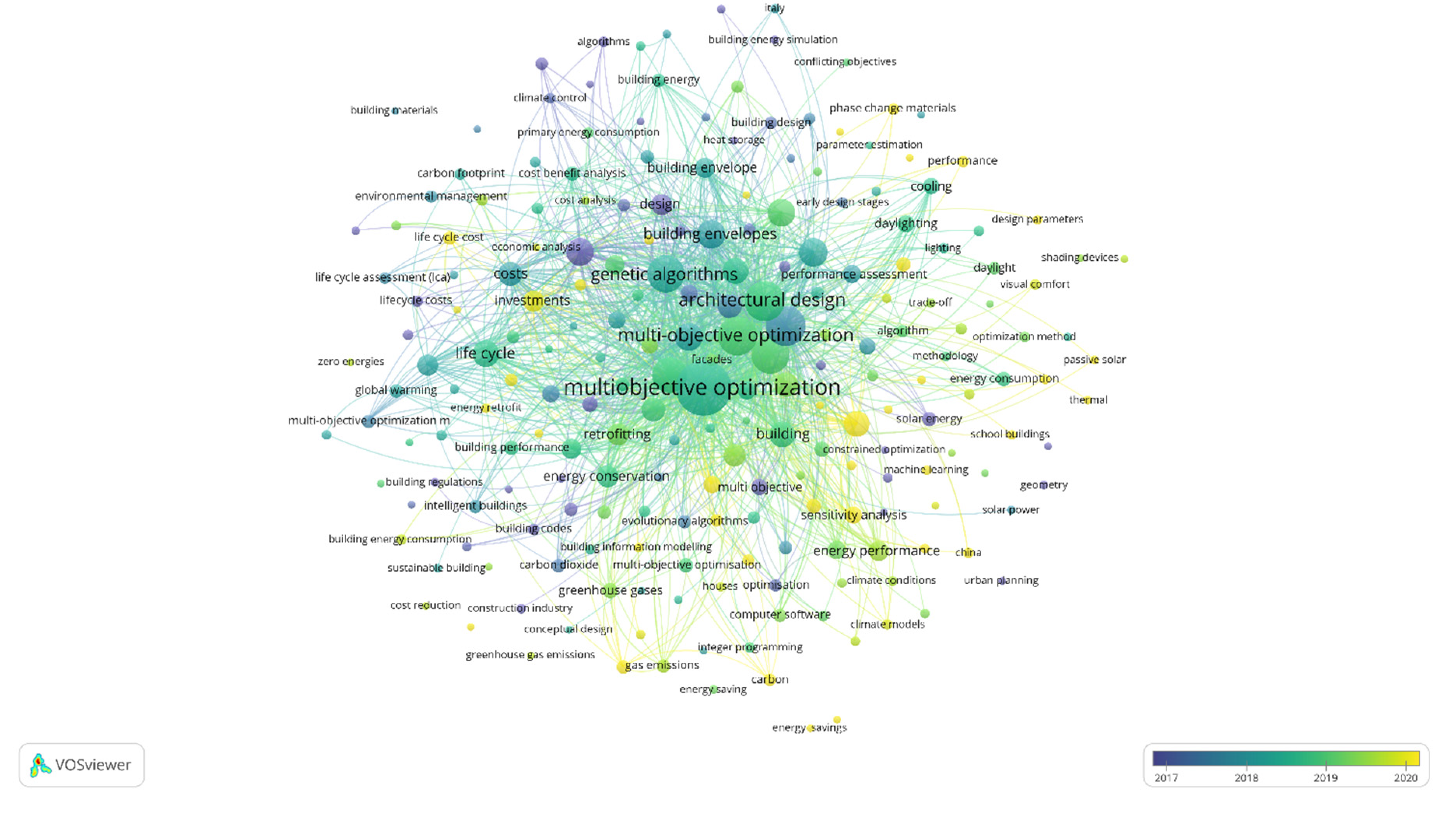
Figure 2.
The number of publications in multi-objective BFO per year.
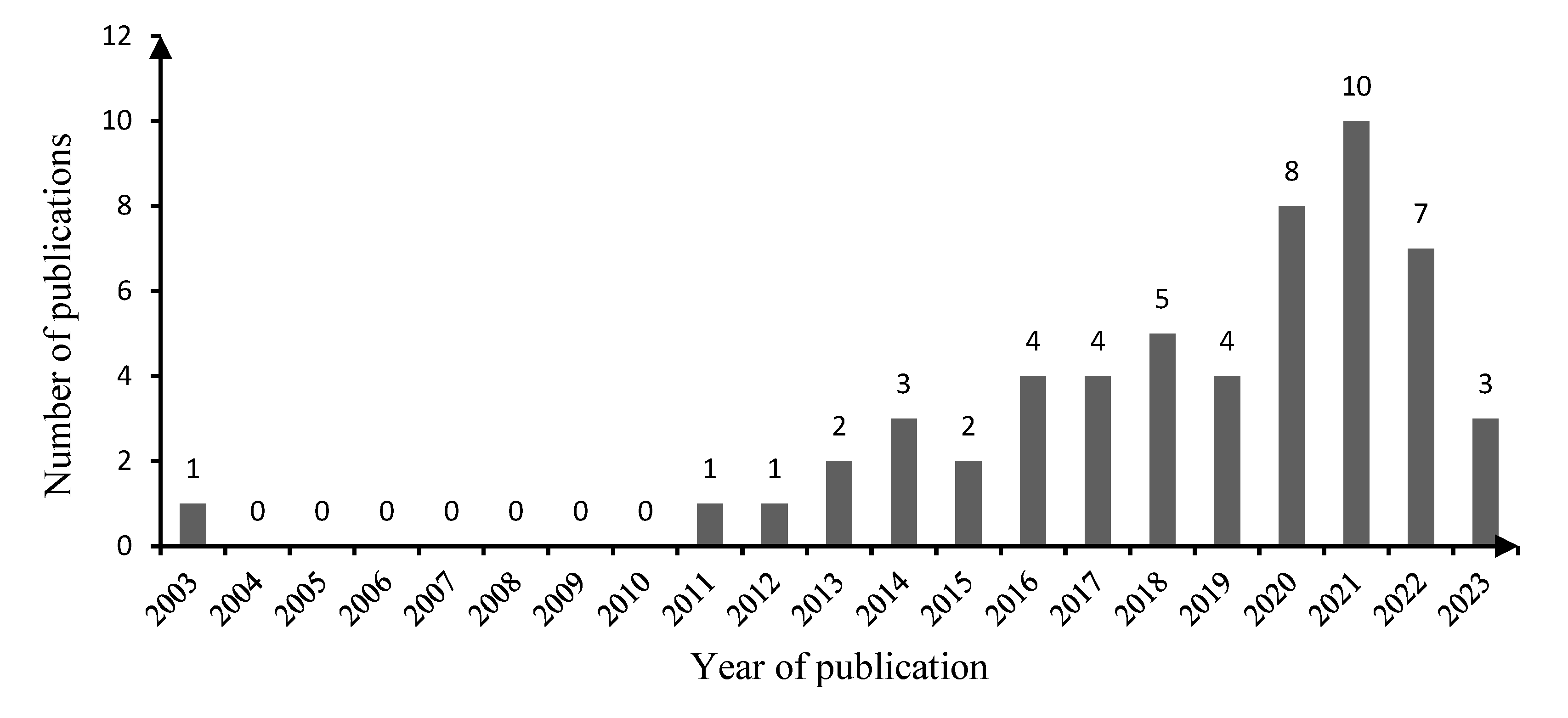
Figure 3.
Overall chronological trends for the objectives of building façade multi-objective optimization publications.
Figure 3.
Overall chronological trends for the objectives of building façade multi-objective optimization publications.
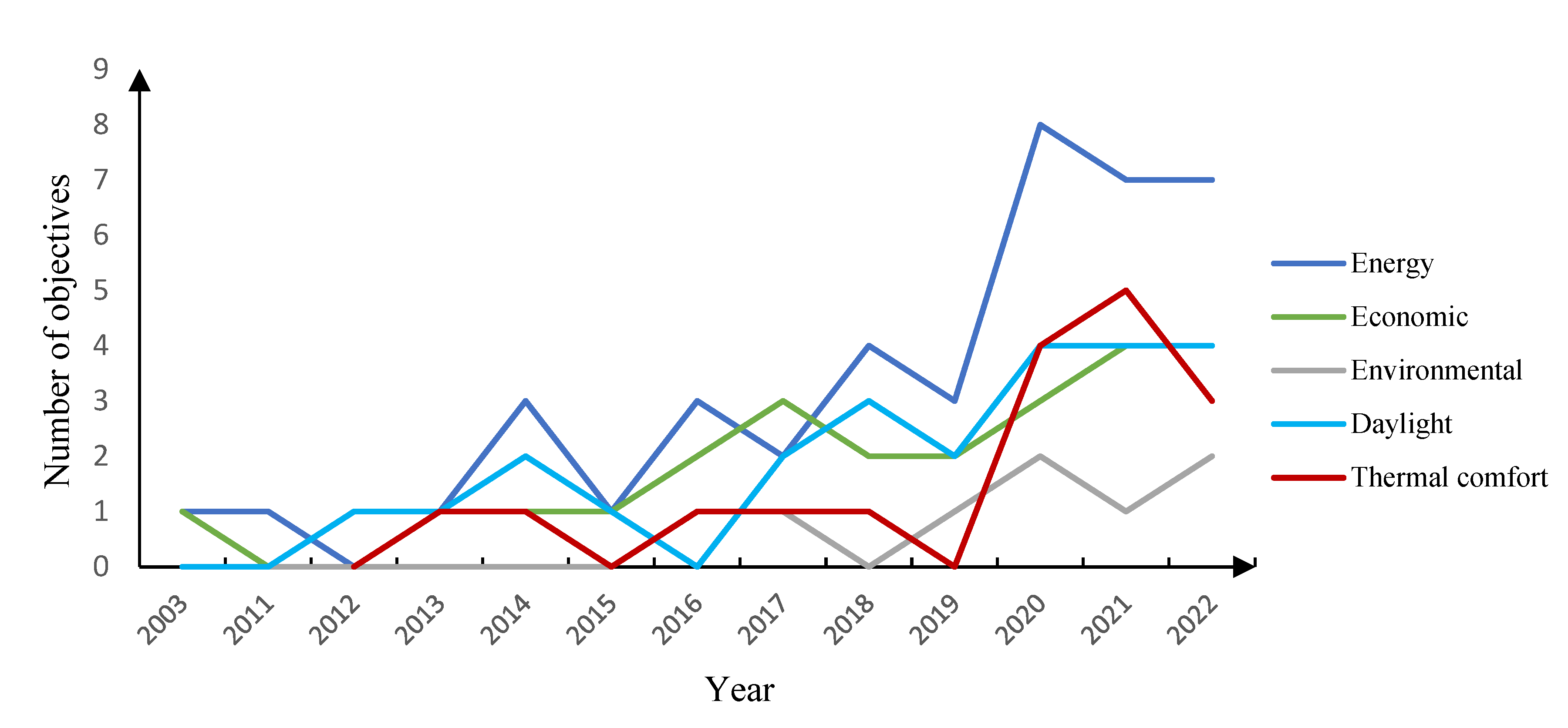
Figure 4.
Number of objectives for multi-objective BFO.

Table 1.
Search strategy keywords and results.
| Database | Keywords | Results |
|---|---|---|
| WOS | (TS=(building facade) OR TS=(building envelope) OR TS=(building skin)) AND (TS=(multi-objective) OR TS=(two-objective) OR TS=(triple-objective)) AND (TS=(optimization) OR TS=(optimize)) | 376 |
| Scopus | TITLE-ABS-KEY (building AND (facade OR envelope OR skin) AND (multi-objective OR two-objective OR triple-objective) AND (optimization OR optimize) ) | 326 |
| Total After Deduplication | 459 | |
| Total After Title Screening | 266 | |
| Total After Abstract Screening | 110 | |
| Total After Full-text Screening | 56 |
Table 2.
Number of the case studies by building type.
| Building type | Number in the reviewed literatures |
|---|---|
| Office | 26 |
| Residential | 19 |
| Education | 3 |
| Hospital | 1 |
| Tourism | 1 |
Disclaimer/Publisher’s Note: The statements, opinions and data contained in all publications are solely those of the individual author(s) and contributor(s) and not of MDPI and/or the editor(s). MDPI and/or the editor(s) disclaim responsibility for any injury to people or property resulting from any ideas, methods, instructions or products referred to in the content. |
© 2023 by the authors. Licensee MDPI, Basel, Switzerland. This article is an open access article distributed under the terms and conditions of the Creative Commons Attribution (CC BY) license (http://creativecommons.org/licenses/by/4.0/).
Copyright: This open access article is published under a Creative Commons CC BY 4.0 license, which permit the free download, distribution, and reuse, provided that the author and preprint are cited in any reuse.


