

Submitted:
08 September 2023
Posted:
11 September 2023
You are already at the latest version
Abstract
Carbon dots are carbon based nanoparticles, which have the characteristics of simple preparation process, photoluminescence, biocompatibility, adjustable surface function, water solubility, and low toxicity. They are widely used in biological applications such as imaging, biosensing, photocatalysis, and molecular transfer. It has also aroused great interest among researchers in agriculture and has made significant progress in improving crop growth and production. This review presents the physiological functions of carbon dots for crop growth and development, photosynthesis, water and nutrient absorption, and abiotic stress resistance and their applications in improving ecological environment and agriculture as biosensors, and the future application prospects and research directions of carbon dots in agriculture were prospected.
Keywords:
photosynthesis
; nutrient and water absorption
; abiotic stress resistance
; yield
; biosensor
1. Introduction
The world population is constantly growing, and in order to meet the global demand for food and industrial raw materials, the input and consumption of agricultural resources continue to increase. It is estimated that the global annual crop yield is over 3 billion tons, requiring 190 million tons of fertilizers, 4 million tons of pesticides, and 2.7 trillion cubic meters of freshwater resources (accounting for 70% of global freshwater resources). In addition, there is a significant use of pesticides and herbicides, which seriously threatens the global ecosystem and is not conducive to the sustainable development of agriculture [1]. Therefore, there is an urgent need for agriculture to develop new green and environmentally friendly technologies to address the challenges of food growth and sustainable agricultural security development. Nanomaterials are considered to play a crucial role in addressing these challenges faced by future agriculture. In the past few decades, a large number of nanomaterials have been developed and applied in agriculture, playing a vital role in promoting crop growth and development, increasing yield, improving fertilizer and pesticide use efficiency, protecting the ecological environment, and alleviating environmental pressure [2-4].
Carbon dots (CDs) are a type of carbon based nanomaterials with fluorescence properties, consisting of carbon nanoparticles with quasi spherical structures with a size of less than 10 nm [5]. CDs, as the generic term for a variety of nanosized fluores-cent carbon materials, concretely include graphene quantum dots, carbon quantum dots, carbon nanodots, and carbonized polymer dots, which are classified according to the specific carbon core structure, surface groups, and properties, as is shown in Figure 1 [6,7]. CDs generally have O/N-containing functional groups, such as amino (–NH2), carboxyl (–COOH), and hydroxyl (–OH) on their surface which make these materials water soluble, probably due to the formation of H-bonding [8]. Because CDs are abundant with surface groups, functional ligands can bind to ions, organic molecules, polymers, DNA, and proteins, with the aim to change the properties of the CDs, by tailoring their surface properties and interactions, functionalized CDs can be optimized to meet specific requirements in different fields. Compared with traditional nanomaterials such as cadmium/lead, rare earths, and metal oxides, CDs have advantages in better photostability, higher quantum yield, lower toxicity, abundant low-cost sources, and excellent biocompatibility, which empowers them to have promising applications in biomedicines, optronics, sensors, and catalysis [9]. Recently, many researchers have explored the potential applications of CDs in different aspects, including agriculture [10-16].
Different types of natural raw materials can be employed for the fabrication of CDs, many synthetic methods have been mentioned for the fabrication of CDs [8]. Mass production of CDs can be achieved through technologies such as electrophoresis, laser etching, and electrochemical oxidation [17,18]. Previous studies have explored the effects of carbon based nanomaterials (such as fullerene, carbon nanotubes, and graphene particles) and metal or metal oxide nanoparticles (such as Au, Ag, Fe3O4, TiO2, and ZnO) on the growth of crops [19,20], demonstrating the broad application prospects of nanotechnology in agriculture. CDs, as a new star in carbon based nanomaterials, the research on their physiological function and their impact on crop growth and development are still in its early stages. Since Qu et al. [21] revealed the biocompatibility of CDs with bean sprouts, the potential impact of CDs on the growth of various crops has attracted widespread attention from agricultural researchers. The application effects and mechanisms of CDs in plants, especially crops, need to be further studied, and it is expected to develop new green, high-yield and high-efficiency cultivation technologies that promote crop growth and increase yield, which is of great significance for ensuring global food security.
2. Applications of Carbon Dots in Crop Production
Increasing agricultural productivity is critical to feed the evergrowing human population. In recent years, the promoting effect of CDs on plant growth has been observed in monocotyledonous plants (wheat, rice, and maize), dicotyledonous plants and other plants (mung beans, tomatoes, lettuce, tobacco, soybeans, eggplants, chili peppers, watermelons, radishes, celery, coriander, and cabbage) [5]. CDs are widely used in agriculture as seed priming agents, photosynthetic enhancers, plant stress ameliorators, and sensors [5]. The positive impact of CDs on different plants indicates their great application potential in the agricultural production, which plays an important role in promoting crop growth and improving the sustainability of agricultural production. In Table 1, we summarized the growth enhancement effect of CDs in main cereal crops, rice, wheat and maize, which accounting for 99% of global food production. CDs exhibit dose-dependent and mode of application dependent effects on plants. CDs are introduced into the plant can use various modes of application, such as seed pretreatment, foliar spray, hydroponic solution treatment, and so on. For the full understanding of the effect of CDs on crop development and the underlying mechanism, the evaluation of various growth parameters is involved over a full growth cycle of the plant.
3. The Physiological Role of Carbon Dots and Their Impact on Crop Growth and Development
The primary physiological functions of CDs are to promote seed germination and root growth, improve plant nutrient absorption, promote plant growth, increase biomass accumulation, enhance photosynthesis, increase plant carbohydrate content, plant abiotic stress and disease resistance, these are crucial processes for the growth of plants and increase crop yield (Figure 2).
3.1. The Pathways of Carbon Dots Uptake by Crops and Their Accumulation and Transport Characteristics within Plants
The main pathways for CDs to enter plants include root absorption from soil/water and leaf absorption. Studies have shown that CDs can penetrate plant cells and then be transported along with water and minerals from roots to stems and leaves,hey are absorbed through cell walls and plasmodesmata through extracellular pathways in intercellular spaces and extracellular spaces, and then pass through the cortex and enter the xylem through the plastid pathway [29]. CDs have stable and unique fluorescence signals, providing a good pathway for their tracking in plants. The process of CDs being absorbed by plants can be demonstrated through methods such as fluorescence imaging, transmission electron microscopy, or Raman spectroscopy measurement [20,25,30-32]. Using CDs aqueous solution to cultivate mung beans, concentration dependent red orange fluorescence enhancement can be clearly observed in mung bean seedlings under 365 nm ultraviolet light. The roots, stems, and leaves of young seedlings were observed using confocal laser scanning microscopy, and it was found that CDs mainly exist in the vascular system. Transmission electron microscopy was used to observe the transverse sections of roots, stems, and leaves, and large aggregation clusters of CDs were observed in the intercellular spaces. Therefore, CDs are absorbed by the root and enter the root vascular bundle, which is then transported to the stem and leaf vascular bundles, and then enter the intercellular space for aggregation [33]. In addition, studies on crops such as rice and corn have shown that carbon dots can be absorbed and used by plants through foliar spraying, thereby increasing grain weight and yield [20,26].
3.2. Carbon Dots Enhance Crop Photosynthesis
The growth and yield of crops depend on effective photosynthesis, which is the fundamental material source for plant growth and biomass accumulation, contributing over 90% of crop biomass. One important physiological function of CDs is to enhance plant photosynthesis. Photosynthesis includes two energy conversion processes from light energy to electric energy and from electric energy to chemical energy, involving light absorption, electron transfer, photophosphorylation, carbon assimilation and other important reaction steps. CDs typically exhibit strong absorption in the ultraviolet region (200-400 nm), but their light absorption can be extended to the visible light range due to the type and content of surface groups, as well as changes in oxygen/nitrogen content in carbon nuclei. In the 500-800 nm range, CDs have long wave absorption, converting UV light that cannot be used by plants into visible light [13,34,35]. CDs are both excellent electron donor and electron acceptor [26,36,37], amine functionalized CDs are strongly conjugated on the surface of chloroplasts and assist in absorbing photons to transfer electrons to the chloroplasts, accelerating the all electron transfer chain pathway in photosynthetic reactions, thereby enhancing photosynthesis [38]. 5 mg L-1 nitrogen doped CDs significantly increased the net photosynthetic rate of maize (21.51%). Further studies have shown that there is an increase in light conversion, electron supply, chlorophyll, ATP synthase (adenosine triphosphate synthase) activity, and NADPH (nicotinamide adenine dinucleotide phosphate) synthesis during photosynthesis, especially a significant increase of 122.80% in electron transfer chain rate [26,28]. In addition, CDs significantly increased the expression of chlorophyll synthase and chlorophyll enzyme genes in rice, which helps to improve chlorophyll synthesis and CO2 assimilation [22,24]. CO2 assimilation is a physiological process responsible for the conversion of electrical energy to chemical energy in photosynthesis, and rubisco enzyme is a key enzyme in this process [39]. Rubisco enzyme activity directly affects photosynthetic rate and carbohydrate accumulation. Wang et al. [31] found that the rubisco enzyme activity of mung bean seedlings treated with CDs was 30.9% higher than that of the control. Similar increased effects of CDs on rubisco enzyme activity were found in plants such as rice and arabidopsis [20,40]. In terms of enhancing photosynthesis, CDs have more advantages in monocotyledonous plants compared to dicotyledonous plants. The structural differences in the vascular system and root structure of monocotyledonous and dicotyledonous plants are the reasons for its high photosynthesis [5]. CDs also have different effects on the photosynthesis of C3 plants (rice) and C4 plants (corn), and their effect on the CO2 assimilation of rice is higher than that of corn, which is attributed to that corn is a C4 plant, it has an internal way to reduce photorespiration and improve the CO2 fixation rate; CDs also significantly improved the stomatal conductance of rice. The greater the stomatal conductance, the higher the CO2 absorption in the stomata, therefore, CDs can enhance the gas exchange capacity of plant leaves [23,41]. In addition, CDs can be degraded in plants to form plant hormone analogues and release CO2, hormone analogues promote plant growth, and CO2 released is further assimilated through the calvin cycle, thus increasing carbohydrate accumulation [20,40,42]. The above research indicates that CDs have great potential to improve crop growth and photosynthesis in agricultural production. In conclusion, CDs provide artificial photosynthesis support for crops, which increases the photosynthesis rate, and consequently increase grain yield, the morphological charcteristics of plant, such as plant height, biomass, leaf area, and physiologial charcteristics, such as stomata conductance, rubisco activity, ATP and NADP formation, PSI and PSII rate, electron transfer chain are all improved by CDs [43], which rises the carbohydrates levels, and finally increased grain yield.
3.3. Improving Crop Quality with Carbon Dots
Research has shown that CDs can be applied as nanofertilizers, improving crop photosynthesis while also increasing crop yield. Spraying 560 mg L-1 of CDs aqueous solution on the leaves can increase the yield of dicotyledonous plants such as soybeans, tomatoes, and eggplants by 20% [40]. Wang et al. [31] found that 0.02 mg mL-1 CDs increased the root length, stem length, root activity, and fresh weight of mung beans, resulting in a 17.5% increase in bean sprout yield compared to the control.
The main source of crop yield is photosynthesis, and the level of yield is determined by the accumulation and distribution of photosynthetic products. Continuous spraying of CDs (50 mg L-1) during the vegetative growth stage of maize can increase carbohydrate accumulation during the reproductive growth stage, resulting in an increase in 1000-grain weight and a final yield increase of 24.50%. Further research has found that the expression of sucrose transporter (SUT) genes in leaves increased by 1.61 times, and the upregulation of SUT expression enhances the transportation capacity of sucrose in the phloem. Therefore, more carbohydrates are transported from leaves to grains, thereby promoting grain filling and increasing yield [26]. Under drought conditions, spraying nitrogen doped CDs on maize leaves promotes the synthesis of carbohydrates by enhancing photosynthesis, resulting in a 30% reduction in maize yield loss; at the same time, starch, soluble sugar, protein, linoleic acid, and α-linolenic acid content of grains significantly increased by 7.0%, 9.8%, 49.7%, 10.5%, and 12.3%, respectively, thus improving grain quality [28]. The appropriate concentration of nitrogen doped CDs can significantly promote the accumulation of lettuce biomass, significantly improving the soluble sugar and other nutritional quality indicators of lettuce [44].
Fertilizer, as the main source of crop nutrients in modern agricultural production, directly participates in or regulates crop nutrient metabolism and cycling, and is closely related to crop yield and quality. Adding CDs as fertilizer enhancers to different types of fertilizers can accelerate chemical reactions, accelerate nutrient decomposition, improve fertilizer release characteristics, increase fertilizer use efficiency, and promote crop growth and development. Adding nano carbon to slow-release fertilizers can promote the formation of rice tillers, increase chlorophyll content during booting, promote dry matter accumulation, and increase the number of effective panicles and grains per panicle, ultimately leading to increased of grain yield and nitrogen fertilizer use efficiency in rice [45]. Therefore, CDs have great potential in improving crop yield and quality.
3.4. Carbon Dots Promote Seed Germination, Increase Water and Nutrient Absorption
Seed germination is the first and crucial step in plant growth, and good seed germination can help plants develop better. It has been found on both rice and wheat that seeds treated with CDs aqueous solution can promote seed germination [20,21]. Water and nutrient absorption and assimilation are important factors affecting seed germination, crop growth and development, and yield formation. One of the reasons that CDs promote seed germination and enhance seed vitality is that they can penetrate the hard seed coat, promote water infiltration, and facilitate seed water absorption and germination [5]. Seed germination, root development, seed moisture content, and seedling length are related to the surface hydrophilic groups (-OH and -COOH) of CDs. The hydrophilic groups on the surface of CDs provide rich binding sites for water molecules, and it can enter the plant with the absorption of CDs, adequate water absorption promotes seed germination and accelerates seedling growth [20,40]. In addition to serving as adsorption sites for water, CDs upregulate the expression of seed aquaporins genes, activate aquaporins, and reduce rhizosphere pH, which promotes water and nutrient absorption, improves the rhizosphere microbial environment, and is conducive to seed germination and growth [46,47].
The absorption of water by crops is accompanied by the absorption of nutrients. Hydroxyl and carboxyl groups also endow CDs with the ability to adsorb various nutrient ions (K+, Ca2+, Mg2+, Cu2+, Zn2+, Mn2+, and Fe3+), which are important nutrient elements for crop growth. They interact with hydrophilic groups on the surface of CDs through hydrogen bonding and electrostatic interactions to adsorb on the surface of CDs, when CDs enter the plant, they also increase the concentration of nutrient ions in the plant, this is also the reason for the sustained and slow release of nutrients in the xylem [48]. The nutrient ion content in arabidopsis treated with CDs is higher than that in the control, indicating that nutrient ions can enter the plant with CDs [40]. Studies on coriander showed that spraying 40 mg L-1 of CDs increased the element content of K, Ca, Mg, P, Mn, and Fe by 64.3%, 21.0%, 26.2%, 12.8%, 56.0%, and 125%, respectively [49]. When 0.02 mg mL-1 was used to treat lettuce, the N, P, and K contents in the plants increased by 4.4%, 10.8%, and 16.5%, respectively [50]. On the other hand, after treating with CDs, the expression of genes related to aquaporins (membrane proteins used for transporting water, nutrients, and gases) is upregulated, thereby increasing water and mineral ion absorption and promoting crop growth [51,52]. Carbon element is widely present in soil, and CDs have better environmental friendliness compared to general nanomaterials. After entering the soil, the solubility of CDs increases the EC value of soil. The increase in EC value is the direct reason for the formation of a large amount of bicarbonate ions, promoting the absorption and utilization of water and nutrients such as nitrogen, phosphorus, and potassium by crop roots [53]. In addition, CDs can improve the activity of nitrogenase and the nitrogen fixation efficiency of nitrogen-fixing bacteria by affecting the secondary structure of nitrogenase and improving electron transfer in the biocatalytic process. This provides an economic and environmentally friendly way to improve the biological nitrogen fixation ability of nitrogen-fixing bacteria and provide a nitrogen source for crop growth when nitrogen is insufficient [1,31].
3.5. Carbon Dots Improve Crop Resistance to Abiotic Stress and Disease Resistance
In actual production, crops are constantly challenged by adverse abiotic environmental conditions. According to the report of the Food and Agriculture Organization of the United Nations (FAO) in 2007, more than 96% of the world's rural land is affected by various abiotic stress, including drought, high temperature, low temperature, nutrient deficiency, and excessive salt or heavy metals in the soil. These abiotic stress have a negative impact on crop productivity, leading to serious yield loss [54,55]. For example, drought stress on rice and wheat after flowering can lead to premature plant senescence, reduced material production, shortened filling period, and reduced grain weight [56-58]. CDs can promote plant growth, and a large number of studies have also proved that they can improve plant resistance to abiotic stress, thereby improving crop yield.
The increase of reactive oxygen species (ROS) is the main factor affecting crop growth under abiotic stress. The accumulation of ROS in cells usually leads to oxidative damage to proteins, lipids, carbohydrates, and DNA [59,60]. The mechanism of CDs improving crop resistance to abiotic stress is that CDs have the effect of scavenging free radicals, and the surface of CDs fused with carboxyl and amino groups can transform DPPH free radicals into stable DPPH-H through hydrogen transfer mechanism [61,62]; on the other hand, CDs can increase the activities of superoxide dismutase (SOD), peroxidase (POD) and catalase (CAT), and reduce the contents of ROS and malondialdehyde (MDA) [63]. CDs combine the free radical scavenging characteristics and the ability to improve the activity of antioxidant enzymes to protect crops from abiotic stress, providing a theoretical basis for their application in crop stress resistant cultivation. Research has shown that under drought stress, the application of CDs in maize reduces the accumulation of ROS within the plant, weakens the oxidative stress caused by drought, promotes the synthesis of proline and abscisic acid in the leaves, and long-distance transportation to the roots, thereby upregulating the expression of aquaporin (AQP) genes by 2.3 to 7.6 times, increasing the proportion of K+/Na+ (by 47.7%), and promoting crop water absorption under drought conditions (by 49.0%); in addition, it increases the transport of carbohydrates to the roots, increases the content of root exudates (organic acids, amino acids, etc.), and increases the abundance of rhizosphere microorganisms (proteobacteria, actinomyces, ascomycetes, etc.), promoting the absorption of nitrogen and phosphorus in maize, thereby improving the drought resistance of crops [28]. CDs also have a positive impact on the growth of soybean under drought conditions, applying 5 mg L-1 carbon dots on the leaves can eliminate the accumulation of reactive oxygen species in soybean leaves under drought stress, enhancing photosynthesis and carbohydrate transport; on the other hand, CDs stimulate the root to secrete amino acids, organic acids, auxin and other organic substances, recruit beneficial microorganisms for the rhizosphere (such as actinomyces, ascomycetes, acidobacteria and mycobacterium), and promote the activation of soil nitrogen; at the same time, the expression of GmNRT, GmAMT, and GmAQP genes in the root was upregulated, promoting nitrogen absorption, utilization, and metabolism, significantly improving the nitrogen content and water absorption capacity of soybeans; in addition, it also increased the content of protein, fatty acids, and amino acids in soybean seeds by 3.4%, 6.9%, and 17.3%, respectively [64,65]. Wang et al. [66] explored the relieving effect of CDs on heat stress in Italian lettuce. The study showed that CDs enhanced antioxidant enzyme activity and osmoregulation (manifested by a decrease in proline content), and reduced damage caused by lipid peroxidation in plant cells (manifested by a decrease in MDA levels), thereby improving heat tolerance. Soil salt stress is also an important factor affecting plant growth. Salt stress leads to crop nutrient deficiency, osmotic stress, and ion toxicity. Li et al. [67] showed that CDs exhibit Ca2+ mobilization characteristics and can alleviate salinity stress by enhancing Ca2+ signaling and ROS scavenging activity. In addition, Gohari et al. [68] found that putrescine functionalized CDs can increase K content, photosynthetic pigments, proline, phenolic substances, and antioxidant enzyme activity in grape leaves, while reducing Na+, MDA, and H2O2 content, thereby alleviating salt stress and increasing leaf fresh and dry weight. The above research provides a theoretical basis for CDs as abiotic stress modifiers to improve crop yield and plant protection.
Crop diseases are important limiting factors that affect crop growth and yield formation. Currently, prevention and control measures mainly rely on the widespread use of pesticides/fungicides, and the inefficient use of pesticides seriously threatens biodiversity and ecosystem functions. Previous study has found that CDs have broad-spectrum antibacterial activity against bacteria and fungi, laying the foundation for their application in crop disease control and improving crop disease resistance [69]. CDs can destroy the secondary structure of DNA/RNA in bacterial walls and bacteria and fungi, thus showing broad-spectrum antibacterial/antifungal activity against gram-positive (staphylococcus aureus and bacillus subtilis) and gram-negative (bacillus subtilis and escherichia coli) bacteria [1,20]. Luo et al. [70] found that foliar spraying of 10 mg L-1 nitrogen doped CDs activated the acquired resistance of jasmonic acid and salicylic acid dependent systems in tomato, resulting in the stagnation of pathogen growth in vivo, effectively reducing the symptoms of tomato green wilt syndrome caused by ralstonia solanacearum by 71.19%. Therefore, CDs can be used as green and efficient antibacterial agents for preventing and controlling of crop disease.
3.6. The Protective Effect of Carbon Dots on Agricultural Ecological Environment
A good ecological environment is the key to food security production. Given the low toxicity, chemical inertness, biodegradability, and low cost of CDs, they are considered as an excellent choice for degrading organic pollutants. Pesticides, industrial chemicals, by-products of industrial processes, and aromatic hydrocarbons entering the environment can induce and accumulate pathogenic bacteria in the food chain, transforming them into organic pollutants. These pollutants have mutagenic, carcinogenic, and endocrine disrupting chemical properties, which harm human health. Existing research has recognized the key role of CDs in the photodegradation of organic pollutants such as residual pesticides and endocrine disruptors, Cruz et al. [71] found that CDs were used in combination with a photosensitizer for photodegradation of organic dyes and toxic gases. Compared with their original photocatalysts, the addition of CDs greatly improved the degradation rate. Carbon dots have the potential to be used as photocatalysts for tetracycline degradation. Tetracycline is a broad-spectrum antibiotic, which can promote the growth of livestock and poultry when added in low doses, and can be used to treat animal diseases when used in high doses. Because its massive use in livestock and poultry and aquaculture causes certain residues in the environment, it is a more prominent environmental risk problem. Recent research shows that, without any additives, nitrogen doped carbon dots can completely degrade tetracycline within 10 minutes, thereby eliminating its adverse effects on the ecological environment [72]. In addition, CDs can also reduce the absorption of heavy metal ions by crops, thereby avoiding the harm of heavy metals to crop growth [73], Because heavy metal ions can be trapped between functional groups on the surface of CDs, reducing the concentration of heavy metal ions in crops [74]. The addition of CDs has a certain activation effect on soil urease, dehydrogenase, and catalase, changing soil pH, increasing soil microbial community abundance and diversity, increasing Cd2+ fixation, reducing Cd2+ mobility, and thus reducing the harm of Cd2+ to the environment [75]. Safe water is the fundamental needs that promote healthy crop production. But the massive and continuously increasing consumption of hazardous chemicals at the domestic and industrial level has led to large amount of wastewater discharge and ecological problems. The green synthesized carbon-dots-based photocatalysts for wastewater treatment have the advantages of inexpensive, non-toxic, require basic ingredients, exhibit quick reactions, involve easy procedures and straightforward post-processing steps [8,76,77] . The understanding of carbon-dots-based photocatalytic degradation of contaminated wastewater will also set the stage for future wastewater treatment research.
3.7. The Role of Carbon Dots as Biosensors in Agriculture
Due to the fluorescence quenching phenomenon, as the concentration of pesticides increases, the fluorescence intensity of CDs significantly decreases. Based on this, Tafreshi et al. [78] developed a fluorescence based method for the detection of three pesticides, including diazinon, glyphosate, and semicarbazide. The sensor has good selectivity even in the presence of other herbicides, and has excellent performance in tomato samples. It can also be used in other agricultural products to achieve ultra sensitive fluorescence detection of pesticides in real samples using green carbon dots. Research has shown that when electrostatic interactions occur between functional groups on the surface of CDs and isothio pesticides, CDs exhibit fluorescence quenching, Ghosh et al. [79] developed a sensor for the detection of isothio pesticides based on the fluorescence quenching phenomenon of CDs. The detection limit is as low as nanomolar concentrations in water, as well as in fruit and rice samples, and it still has high selectivity in the presence of various interfering substances and other pesticides. The fluorescence properties of CDs can be significantly regulated through atomic doping or surface functionalization. Doped CDs can be single element doped or multi element doped, which enhances the fluorescence characteristics of CDs and significantly improves their performance in sensing applications [80,81]. Yahyai et al. [82] synthesized sulfur and nitrogen doped CDs, a paper based chemiluminescence sensor was developed for the determination of oxfamil pesticide in fruit juice and water. It was found that KMnO4 oxidized S, N-CDs and produced their excited state, which significantly enhanced the luminous intensity of CDs. Therefore, the sensitivity and detection capability of the sensor were significantly improved. In addition, the sensor showed a good recovery rate between 97.5 and 105.5 in actual samples, which indicates the high performance of the sensor. Luo et al. [83] developed B, N doped CDs and fluorescence platforms based on cerium oxide (CeO2), CeO2 showed catalytic reaction of p-methyl-p-oxyphosphorus in alkaline medium, converting it into p-nitrophenol and phosphate, reducing the fluorescence activity of B, N-CDs, which can be used to detect the residues of methyl-p-oxyphosphorus pesticides in herbal plants and water. CDs also can be used for wastewater remediation by sensing of heavy-metal ions (e.g., Pb2+, Hg2+, Cr6+, Cd2+, or Cu2+) and various anions in water bodies [7], which offer feasible strategy for the safe crop production and the protection of human health and the environment.
4. Futuristic Outlook
Although considerable developments have been made in research on CDs, further research is needed to broaden the understanding of their potential application in agriculture. Here, future research prospects of CDs in agriculture will be discussed in brief (Figure 3).
Low and middle yield farmland in China accounts for 90% of the total arable land in the country. Improving the crop yield of medium and low yield farmland is an important issue that urgently needs to be solved in food production of China, as well as an important way to implement the strategy of "storing grain in the land" and ensure food security of China [84]. The traditional methods of improving soil by increasing the application of nitrogen, phosphorus, potassium, organic fertilizers, biochar, etc. require fossil energy consumption, high cost and energy consumption, and the soil water and fertilizer retention capacity is generally poor in medium and low yield fields, which is prone to nutrient loss, environmental pollution, and is not conducive to sustainable development of agricultural production, making it difficult to promote on a large scale in production. Given the low-cost, non-toxic, and excellent physiological effects of carbon dots, it is of great significance to regulate them from the perspective of crops themselves. In the future, we will increase research on the impact of carbon dots on the growth, development, and yield formation of different crops under medium and low yield field conditions, and develop new environmentally friendly cultivation and regulation technologies to improve the production capacity of medium and low yield fields and food security in China.
The non-structural carbohydrates stored in the stems and sheaths of cereal crops (such as rice, wheat, and corn) are important sources of grain filling substances, and their transport rate and amount affect the grain filling rate, thereby affecting grain weight and yield [85,86]. Vascular bundle development, hormone levels, carbon metabolism enzyme activity, sucrose transporter and SWEET gene expression and protein levels are important factors affecting photosynthetic transport and grain filling [87-90]. Carbon dots were found to upregulate the expression of sucrose transport protein genes in maize, which may enhance the sucrose transport ability of the phloem, thereby increasing the transport of photosynthetic assimilates to grains, promoting grain filling and yield formation [20,26]. Our recent field experiments have shown that under ruduced nitrogen input conditions, foliar spraying of CDs on rice can simultaneously improve leaf net photosynthetic rate, stem non-structural carbohydrates translocation, seed setting rate, and grain yield (data not published). Therefore, further research on the regulatory role and mechanism of CDs on stem has important guiding significance for green, high yield, efficient, and high-quality cultivation of rice.
Previous studies have confirmed that CDs have antibacterial effects and can enhance plants' ability to resist plant pathogens and pests, but they may also pose a potential threat to beneficial microbial communities. Therefore, it is necessary to evaluate their potential impact on non target organisms to ensure their safe application in agriculture. In addition, the impact of CDs on crops depends on the application dosage and varies from crop to crop. Numerous studies have reported the promotion of CDs on crop growth. However, high doses of CDs can also have adverse effects on plant growth, such as 1000 to 2000 mg L-1 CDs significantly reducing the fresh weight of roots and aboveground parts of seedlings in maize [30]. CDs cause a decrease in the growth rate of microalgae in suspension, resulting in a decrease in available light flux due to their absorption of light (shading effect) [91]. Therefore, dosage optimization is necessary for different crops before applying CDs, in order to improve their application effectiveness in large-scale production. In addition, existing research lacks sufficient understanding of the bioaccumulation of CDs in animals and plants and their subsequent cumulative effects on entering the food chain. Therefore, conducting systematic and in-depth research in this field will elucidate the ecological toxicity of CDs and contribute to their safe application in agriculture.
Sensors based on CDs have great prospects in agricultural monitoring, and research in this field is still in its early stages. The previously reported CDs based sensors are excellent candidates for detecting various pesticide residues in agricultural products, including insecticides and herbicides. In this field, further research is still needed to accelerate the construction of a highly sensitive sensor platform for rapid sensing of food and other products, and expand to the development of an integrated, convenient and wearable sensor to achieve real-time and on-site detection of toxic chemicals and heavy metals, and real-time and on-site monitoring of plant growth, micronutrients, and abiotic and Biotic stress of plants, contribute to the development of efficient agriculture in the future.
In addition, the easy surface functionalization of CDs indicates that they can serve as promising carriers to carry specific molecules into crops, such as insecticides, nutrients, plant growth regulators, etc., thereby achieving precise regulation of crop growth and development.
Author Contributions
Writing—original draft preparation, G.L. and J.X.; writing—review and editing, K.X.; supervision, K.X.; project administration, G.L.; funding acquisition, G.L. All authors have read and agreed to the published version of the manuscript.
Funding
This research was funded by Jiangsu Agricultural Science and Technology Independent Innovation Fund, grant number CX(22)3151, the Key Research and Development Program of Jiangsu Province, grant number BE2021361.
Conflicts of Interest
The authors declare no conflict of interest.
References
- Li, Y.; Xu, X.; Wu, Y.; Zhuang, J.; Zhang, X.; Zhang, H.; Lei, B.; Hu, C.; Liu, Y. A review on the effects of carbon dots in plant systems. Materials Chemistry Frontiers. 2020, 4, 437–448. [Google Scholar] [CrossRef]
- Dasgupta, N.; Ranjan, S.; Ramalingam, C. Applications of nanotechnology in agriculture and water quality management. Environmental Chemistry Letters. 2017, 15, 591–605. [Google Scholar] [CrossRef]
- Xu, Z.P. Material Nanotechnology Is Sustaining Modern Agriculture. ACS Agricultural Science & Technology. 2022, 2, 232–239. [Google Scholar] [CrossRef]
- He, X.; Deng, H.; Hwang, H.M. The current application of nanotechnology in food and agriculture. Journal of Food and Drug Analysis. 2019, 27, 1–21. [Google Scholar] [CrossRef] [PubMed]
- Maholiya, A.; Ranjan, P.; Khan, R.; Murali, S.; Nainwal, R.C.; Chauhan, P.S.; Sathish, N.; Chaurasia, J.P.; Srivastava, A.K. An insight into the role of carbon dots in the agriculture system: a review. Environmental Science: Nano. 2023, 10, 959–995. [Google Scholar] [CrossRef]
- Xia, C.; Zhu, S.; Feng, T.; Yang, M.; Yang, B. Evolution and Synthesis of Carbon Dots: From Carbon Dots to Carbonized Polymer Dots. Advanced Science. 2019, 6, 1901316. [Google Scholar] [CrossRef] [PubMed]
- Singh, P.; Arpita; Kumar, S.; Kumar, P.; Kataria, N.; Bhankar, V.; Kumar, K.; Kumar, R.; Hsieh, C.-T.; Khoo, K.S. Assessment of biomass-derived carbon dots as highly sensitive and selective templates for the sensing of hazardous ions. Nanoscale 2023. [Google Scholar] [CrossRef] [PubMed]
- Singh, P.; Rani, N.; Kumar, S.; Kumar, P.; Mohan, B.; Pallavi; Bhankar, V.; Kataria, N.; Kumar, R.; Kumar, K. Assessing the biomass-based carbon dots and their composites for photocatalytic treatment of wastewater. Journal of Cleaner Production 2023, 413, 137474. [Google Scholar] [CrossRef]
- Shen, J.; Zhu, Y.; Yang, X.; Li, C. Graphene quantum dots: emergent nanolights for bioimaging, sensors, catalysis and photovoltaic devices. Chemical Communications. 2012, 48, 3686. [Google Scholar] [CrossRef] [PubMed]
- Hoang, V.C.; Dave, K.; Gomes, V.G. Carbon quantum dot-based composites for energy storage and electrocatalysis: Mechanism, applications and future prospects. Nano Energy. 2019, 66, 104093. [Google Scholar] [CrossRef]
- Liu, M.L.; Chen, B.B.; Li, C.M.; Huang, C.Z. Carbon dots: synthesis, formation mechanism, fluorescence origin and sensing applications. Green Chemistry. 2019, 21, 449–471. [Google Scholar] [CrossRef]
- Yan, Y.; Gong, J.; Chen, J.; Zeng, Z.; Huang, W.; Pu, K.; Liu, J.; Chen, P. Recent Advances on Graphene Quantum Dots: From Chemistry and Physics to Applications. Advanced Materials. 2019, 31, e1808283. [Google Scholar] [CrossRef] [PubMed]
- Liu, J.; Geng, Y.; Li, D.; Yao, H.; Huo, Z.; Li, Y.; Zhang, K.; Zhu, S.; Wei, H.; Xu, W.; Jiang, J.; Yang, B. Deep Red Emissive Carbonized Polymer Dots with Unprecedented Narrow Full Width at Half Maximum. Adv Mater. 2020, 32, e1906641. [Google Scholar] [CrossRef] [PubMed]
- Yuan, F.; Wang, Y.K.; Sharma, G.; Dong, Y.; Zheng, X.; Li, P.; Johnston, A.; Bappi, G.; Fan, J.Z.; Kung, H.; Chen, B.; Saidaminov, M.L.; Singh, K.; Voznyy, O.; Bakr, O.M.; Lu, Z.H.; Sargent, E.H. Bright high-colour-purity deep-blue carbon dot light-emitting diodes via efficient edge amination. Nature Photonics. 2020, 14, 171–176. [Google Scholar] [CrossRef]
- Zhang, Z.; Yi, G.; Li, P.; Zhang, X.; Fan, H.; Zhang, Y.; Wang, X.; Zhang, C. A minireview on doped carbon dots for photocatalytic and electrocatalytic applications. Nanoscale. 2020, 12, 13899–13906. [Google Scholar] [CrossRef]
- Tuerhong, M.; Xu, Y.; Yin, X.-B. Review on Carbon Dots and Their Applications. Chinese Journal of Analytical Chemistry. 2017, 45, 139–150. [Google Scholar] [CrossRef]
- Xu, X.Y.; Ray, R.; Gu, Y.L.; Ploehn, H.J.; Gearheart, L.; Raker, K.; Scrivens, W.A. Electrophoretic analysis and purification of fluorescent single-walled carbon nanotube fragments. Journal of the American Chemical Society. 2004, 126, 12736–12737. [Google Scholar] [CrossRef]
- Sun, Y.P.; Zhou, B.; Lin, Y.; Wang, W.; Fernando, K.A.; Pathak, P.; Meziani, M.J.; Harruff, B.A.; Wang, X.; Wang, H.F.; Luo, P.; Yang, H.; Kose, M.E.; Chen, B.; Veca, M.; Xie, S.Y. Quantum-sized carbon dots for bright and colorful photoluminescence. Journal of the American Chemical Society. 2006, 128, 7756–7757. [Google Scholar] [CrossRef]
- Zhu, Z.J.; Wang, H.; Yan, B.; Zheng, H.; Jiang, Y.; Miranda, O.R.; Rotello, V.M.; Xing, B.; Vachet, R.W. Effect of surface charge on the uptake and distribution of gold nanoparticles in four plant species. Environmental Science & Technology. 2012, 46, 12391–12398. [Google Scholar] [CrossRef]
- Li, H.; Huang, J.; Lu, F.; Liu, Y.; Song, Y.; Sun, Y.; Zhong, J.; Huang, H.; Wang, Y.; Li, S.; Lifshitz, Y.; Lee, S.T.; Kang, Z. Impacts of Carbon Dots on Rice Plants: Boosting the Growth and Improving the Disease Resistance. ACS Applied Bio Materials. 2018, 1, 663–672. [Google Scholar] [CrossRef] [PubMed]
- Qu, S.; Wang, X.; Lu, Q.; Liu, X.; Wang, L. A biocompatible fluorescent ink based on water-soluble luminescent carbon nanodots. Angew Chem Int Ed Engl. 2012, 51, 12215–12218. [Google Scholar] [CrossRef] [PubMed]
- Li, Y.; Pan, X.; Xu, X.; Wu, Y.; Zhuang, J.; Zhang, X.; Zhang, H.; Lei, B.; Hu, C.; Liu, Y. Carbon dots as light converter for plant photosynthesis: Augmenting light coverage and quantum yield effect. J Hazard Mater. 2021, 410, 124534. [Google Scholar] [CrossRef] [PubMed]
- Tan, T.L.; Zulkifli, N.A.; Zaman, A.S.K.; Jusoh, M.B.; Yaapar, M.N.; Rashid, S.A. Impact of photoluminescent carbon quantum dots on photosynthesis efficiency of rice and corn crops. Plant Physiology and Biochemistry. 2021, 162, 737–751. [Google Scholar] [CrossRef]
- Li, Y.; Xu, X.; Lei, B.; Zhuang, J.; Zhang, X.; Hu, C.; Cui, J.; Liu, Y. Magnesium-nitrogen co-doped carbon dots enhance plant growth through multifunctional regulation in photosynthesis. Chemical Engineering Journal. 2021, 422, 130114. [Google Scholar] [CrossRef]
- Tripathi, S.; Sarkar, S. Influence of water soluble carbon dots on the growth of wheat plant. Applied Nanoscience. 2014, 5, 609–616. [Google Scholar] [CrossRef]
- Wang, C.; Yang, H.; Chen, F.; Yue, L.; Wang, Z.; Xing, B. Nitrogen-doped carbon dots increased light conversion and electron supply to improve the corn photosystem and yield. Environmental Science & Technology. 2021, 55, 12317–12325. [Google Scholar] [CrossRef]
- Milenković, I.; Borišev, M.; Zhou, Y.; Spasić, S.Z.; Leblanc, R.M.; Radotić, K. Photosynthesis Enhancement in Maize via Nontoxic Orange Carbon Dots. Journal of Agricultural and Food Chemistry. 2021, 69, 5446–5451. [Google Scholar] [CrossRef]
- Yang, H. Mechanism of nitrogen-doped carbon dots on photosynthesis and drought tolerance of maize. Master dissertation, Jiangnan University, Wuxi, 2022. [Google Scholar]
- Yan, X.; Wang, J.; Li, D.; Feng, J.; Xu, Q.; Chen, H.; Han, R. Response of primary root to nitrogen-doped carbon dots in Arabidopsis thaliana: alterations in auxin level and cell division activity. Environmental Science: Nano. 2021, 8, 1352–1363. [Google Scholar] [CrossRef]
- Chen, J.; Dou, R.; Yang, Z.; Wang, X.; Miao, C.; Gao, X.; Wang, L. The effect and fate of water-soluble carbon nanodots in Maize (Zea mays L. ). Nanotoxicology. 2016, 10, 818–828. [Google Scholar] [CrossRef] [PubMed]
- Wang, H.; Zhang, M.; Song, Y.; Li, H.; Huang, H.; Shao, M.; Liu, Y.; Kang, Z. Carbon dots promote the growth and photosynthesis of mung bean sprouts. Carbon. 2018, 136, 94–102. [Google Scholar] [CrossRef]
- Zhang, M.; Hu, L.; Wang, H.; Song, Y.; Liu, Y.; Li, H.; Shao, M.; Huang, H.; Kang, Z. One-step hydrothermal synthesis of chiral carbon dots and their effects on mung bean plant growth. Nanoscale. 2018, 10, 12734–12742. [Google Scholar] [CrossRef] [PubMed]
- Li, W.; Zheng, Y.; Zhang, H.; Liu, Z.; Su, W.; Chen, S.; Liu, Y.; Zhuang, J.; Lei, B. Phytotoxicity, Uptake, and Translocation of Fluorescent Carbon Dots in Mung Bean Plants. ACS Applied Materials & Interfaces. 2016, 8, 19939–19945. [Google Scholar] [CrossRef]
- Jiang, F.; Chen, D.; Li, R.; Wang, Y.; Zhang, G.; Li, S.; Zheng, J.; Huang, N.; Gu, Y.; Wang, C.; Shu, C. Eco-friendly synthesis of size-controllable amine-functionalized graphene quantum dots with antimycoplasma properties. Nanoscale. 2013, 5, 1137–1142. [Google Scholar] [CrossRef] [PubMed]
- Zhu, S.; Meng, Q.; Wang, L.; Zhang, J.; Song, Y.; Jin, H.; Zhang, K.; Sun, H.; Wang, H.; Yang, B. Highly photoluminescent carbon dots for multicolor patterning, sensors, and bioimaging. Angew Chem Int Ed Engl. 2013, 52, 3953–3957. [Google Scholar] [CrossRef] [PubMed]
- Cao, L.; Sahu, S.; Anilkumar, P.; Bunker, C.E.; Xu, J.; Fernando, K.A.; Wang, P.; Guliants, E.A.; Tackett K.N., 2nd; Sun, Y.P. Carbon nanoparticles as visible-light photocatalysts for efficient CO2 conversion and beyond. J Am Chem Soc. 2011, 133, 4754–4757. [Google Scholar] [CrossRef] [PubMed]
- Mitra, S.; Chandra, S.; Patra, P.; Pramanik, P.; Goswami, A. Novel fluorescent matrix embedded carbon quantum dots for the production of stable gold and silver hydrosols. Journal of Materials Chemistry. 2011, 21, 17638. [Google Scholar] [CrossRef]
- Chandra, S.; Pradhan, S.; Mitra, S.; Patra, P.; Bhattacharya, A.; Pramanik, P.; Goswami, A. High throughput electron transfer from carbon dots to chloroplast: a rationale of enhanced photosynthesis. Nanoscale. 2014, 6, 3647–3655. [Google Scholar] [CrossRef]
- Paul, M. Photosynthesis. Plastid biology, energy conversion and carbon assimilation. Annals of Botany. 2013, 111, ix. [Google Scholar]
- Li, H.; Huang, J.; Liu, Y.; Lu, F.; Zhong, J.; Wang, Y.; Li, S.; Lifshitz, Y.; Lee, S.-T.; Kang, Z. Enhanced RuBisCO activity and promoted dicotyledons growth with degradable carbon dots. Nano Research. 2019, 12, 1585–1593. [Google Scholar] [CrossRef]
- Liu, Y.; Zhang, S.; Yang, F.; Wang, G.; Jing, X.; Wang, X.; You, C. New strategy of light quality regulation with leaf-spraying fluorescent coatings for enhancing photosynthesis efficiency. RSC Advances. 2021, 11, 26620–26628. [Google Scholar] [CrossRef]
- Huang, C.; Xia, T.; Niu, J.; Yang, Y.; Lin, S.; Wang, X.; Yang, G.; Mao, L.; Xing, B. Transformation of 14C-labeled graphene to 14CO2 in the shoots of a rice plant. Angew Chem Int Ed Engl. 2018, 57, 9759–9763. [Google Scholar] [CrossRef]
- A/P Chowmasundaram, Y.; Tan, T.L.; Nulit, R.; Jusoh, M.; Rashid, S.A. Recent developments, applications and challenges for carbon quantum dots as a photosynthesis enhancer in agriculture. RSC Advances. 2023, 13, 25093–25117. [Google Scholar] [CrossRef]
- Tan, J.; Zhao, S.; Chen, J.; Pan, X.; Li, C.; Liu, Y.; Wu, C.; Li, W.; Zheng, M. Preparation of nitrogen-doped carbon dots and their enhancement on lettuce yield and quality. Journal of Materials Chemistry B. 2023, 11, 3113–3123. [Google Scholar] [CrossRef] [PubMed]
- Wu, M.; Hao, R.; Tian, X.; Wang, X.; Ma, G.; Tang, H. Effects of adding nono-carbon in slow-released fertilizer on grain yield and nitrogen use efficiency of super hybrid rice. Hybrid Rice. 2010, 25, 86–90. [Google Scholar]
- Farshbaf, M.; Davaran, S.; Rahimi, F.; Annabi, N.; Salehi, R.; Akbarzadeh, A. Carbon quantum dots: recent progresses on synthesis, surface modification and applications. Artificial Cells Nanomedicine and Biotechnology. 2018, 46, 1331–1348. [Google Scholar] [CrossRef] [PubMed]
- Liu, Z.; Li, Y.; Yang, H.; Liu, X.; Wang, C. Study on the mechanism of carbon dots promoting crop seed germination and growth. J Anhui Agric. Sci. 2021, 49, 1–5. [Google Scholar]
- Zheng, Y.; Xie, G.; Zhang, X.; Chen, Z.; Cai, Y.; Yu, W.; Liu, H.; Shan, J.; Li, R.; Liu, Y.; Lei, B. Bioimaging Application and Growth-Promoting Behavior of Carbon Dots from Pollen on Hydroponically Cultivated Rome Lettuce. ACS Omega. 2017, 2, 3958–3965. [Google Scholar] [CrossRef]
- Hu, J.; Jia, W.; Yu, X.; Yan, C.; White, J.C.; Liu, J.; Shen, G.; Tao, S.; Wang, X. Carbon dots improve the nutritional quality of coriander (Coriandrum sativum L.) by promoting photosynthesis and nutrient uptake. Environmental Science: Nano. 2022, 9, 1651–1661. [Google Scholar] [CrossRef]
- An, Z.; Zhang, H.; Li, W.; Yang, X.; Kang, Y.; Zheng, M.; Lei, B. Large-Scale Preparation of Peanut-Bran-Derived Carbon Dots and Their Promoting Effect on Italian Lettuce. ACS Agricultural Science & Technology. 2021, 2, 215–221. [Google Scholar] [CrossRef]
- Kou, E.; Yao, Y.; Yang, X.; Song, S.; Li, W.; Kang, Y.; Qu, S.; Dong, R.; Pan, X.; Li, D.; Zhang, H.; Lei, B. Regulation Mechanisms of Carbon Dots in the Development of Lettuce and Tomato. ACS Sustainable Chemistry & Engineering. 2021, 9, 944–953. [Google Scholar] [CrossRef]
- Chen, Q.; Chen, L.; Nie, X.; Man, H.; Guo, Z.; Wang, X.; Tu, J.; Jin, G.; Ci, L. Impacts of surface chemistry of functional carbon nanodots on the plant growth. Ecotoxicol Environ Saf. 2020, 206, 111220. [Google Scholar] [CrossRef] [PubMed]
- Li, Y.; Sun, L. Effects of nanocarbon mixing with nitrogen fertilizer on soil microbial community structure and nutrient content. China Rice. 2019, 25, 70–73. [Google Scholar] [CrossRef]
- Gramer, G.R.; Urano, K.; Delrot, S.; Pezzotti, M.; Shinozaki, K. Effects of abiotic stress on plants: a systems biology perspective. BMC Plant Biology. 2011, 163. [Google Scholar]
- Zhang, H.; Zhu, J.; Gong, Z.; Zhu, J.K. Abiotic stress responses in plants. Nat Rev Genet. 2021, 23. [Google Scholar] [CrossRef] [PubMed]
- Bidinger, F.; Musgrave, R.B.; Fischer, R.A. Contribution of stored pre-anthesis assimilate to grain yield in wheat and barley. Nature. 1977, 270, 431–433. [Google Scholar] [CrossRef]
- Yang, J.; Zhang, J.; Wang, Z.; Zhu, Q.; Liu, L. Water deficit–induced senescence and its relationship to the remobilization of pre-stored carbon in wheat during grain filling. Agronomy Journal. 2001, 93, 196–206. [Google Scholar] [CrossRef]
- Yang, J.; Zhang, J.; Wang, Z.; Zhu, Q.; Wei, W. Remobilization of carbon reserves in response to water deficit during grain filling of rice. Field Crops Research. 2001, 71, 47–55. [Google Scholar] [CrossRef]
- Gill, S.S.; Tuteja, N. Reactive oxygen species and antioxidant machinery in abiotic stress tolerance in crop plants. Plant Physiology and Biochemistry. 2010, 48, 909–930. [Google Scholar] [CrossRef] [PubMed]
- Choudhury, F.K.; Rivero, R.M.; Blumwald, E.; Mittler, R. Reactive oxygen species, abiotic stress and stress combination. Plant Journal. 2017, 90, 856–867. [Google Scholar] [CrossRef] [PubMed]
- Das, B.; Dadhich, P.; Pal, P.; Srivas, P.K.; Bankoti, K.; Dhara, S. Carbon nanodots from date molasses: new nanolights for the in vitro scavenging of reactive oxygen species. Journal of Materials Chemistry B. 2014, 2, 6839–6847. [Google Scholar] [CrossRef]
- Zhao, S.; Lan, M.; Zhu, X.; Xue, H.; Ng, T.W.; Meng, X.; Lee, C.S.; Wang, P.; Zhang, W. Green Synthesis of Bifunctional Fluorescent Carbon Dots from Garlic for Cellular Imaging and Free Radical Scavenging. ACS Applied Materials & Interfaces. 2015, 7, 17054–17060. [Google Scholar] [CrossRef]
- Su, L.X.; Ma, X.L.; Zhao, K.K.; Shen, C.L.; Lou, Q.; Yin, D.M.; Shan, C.X. Carbon Nanodots for Enhancing the Stress Resistance of Peanut Plants. ACS Omega. 2018, 3, 17770–17777. [Google Scholar] [CrossRef]
- Wang, C.; Ji, Y.; Cao, X.; Yue, L.; Chen, F.; Li, J.; Yang, H.; Wang, Z.; Xing, B. Carbon Dots Improve Nitrogen Bioavailability to Promote the Growth and Nutritional Quality of Soybeans under Drought Stress. ACS Nano. 2022, 16, 12415–12424. [Google Scholar] [CrossRef]
- Ji, Y.; Yue, L.; Cao, X.; Chen, F.; Li, J.; Zhang, J.; Wang, C.; Wang, Z.; Xing, B. Carbon dots promoted soybean photosynthesis and amino acid biosynthesis under drought stress: Reactive oxygen species scavenging and nitrogen metabolism. Sci Total Environ. 2023, 856, 159125. [Google Scholar] [CrossRef] [PubMed]
- Wang, H.; Kang, Y.; Li, H.; Huang, S.; Li, W.; Zheng, M.; Huang, R.; Lei, B.; Yang, X. Salvia miltiorrhiza Derived Carbon Dots and Their Heat Stress Tolerance of Italian Lettuce by Promoting Growth and Enhancing Antioxidant Enzyme Activity. ACS Omega. 2021, 6, 32262–32269. [Google Scholar] [CrossRef]
- Li, Y.; Tang, Z.; Pan, Z.; Wang, R.; Wang, X.; Zhao, P.; Liu, M.; Zhu, Y.; Liu, C.; Wang, W.; Liang, Q.; Gao, J.; Yu, Y.; Li, Z.; Lei, B.; Sun, J. Calcium-Mobilizing Properties of Salvia miltiorrhiza-Derived Carbon Dots Confer Enhanced Environmental Adaptability in Plants. ACS Nano. 2022, 16, 4357–4370. [Google Scholar] [CrossRef] [PubMed]
- Gohari, G.; Panahirad, S.; Sadeghi, M.; Akbari, A.; Zareei, E.; Zahedi, S.M.; Bahrami, M.K.; Fotopoulos, V. Putrescine-functionalized carbon quantum dot (put-CQD) nanoparticles effectively prime grapevine (Vitis vinifera cv. 'Sultana') against salt stress. BMC Plant Biol. 2021, 21, 120. [Google Scholar] [CrossRef]
- Li, H.; Huang, J.; Song, Y.; Zhang, M.; Wang, H.; Lu, F.; Huang, H.; Liu, Y.; Dai, X.; Gu, Z.; Yang, Z.; Zhou, R.; Kang, Z. Degradable Carbon Dots with Broad-Spectrum Antibacterial Activity. ACS Applied Materials & Interfaces. 2018, 10, 26936–26946. [Google Scholar] [CrossRef]
- Luo, X.; Cao, X.; Wang, C.; Yue, L.; Chen, X.; Yang, H.; Le, X.; Zhao, X.; Wu, F.; Wang, Z.; Xing, B. Nitrogen-doped carbon dots alleviate the damage from tomato bacterial wilt syndrome: systemic acquired resistance activation and reactive oxygen species scavenging. Environmental Science: Nano. 2021, 8, 3806–3819. [Google Scholar] [CrossRef]
- Cruz, A.; Gallareta-Olivares, G.; Rivas-Sanchez, A.; González-González, R.B.; Ahmed, I.; Parra-Saldívar, R.; Iqbal, H.M.N. Recent Advances in Carbon Dots Based Biocatalysts for Degrading Organic Pollutants. Current Pollution Reports. 2022, 8, 384–394. [Google Scholar] [CrossRef]
- Thara, R.; Korah, B.K.; Mathew, S.; John, B.K.; Mathew, B. Dual mode detection and sunlight-driven photocatalytic degradation of tetracycline with tailor-made N-doped carbon dots. Environ Res. 2023, 216, 114450. [Google Scholar] [CrossRef] [PubMed]
- Xiao, L.; Guo, H.; Wang, S.; Li, J.; Wang, Y.; Xing, B. Carbon dots alleviate the toxicity of cadmium ions (Cd2+) toward wheat seedlings. Environmental Science: Nano. 2019, 6, 1493–1506. [Google Scholar] [CrossRef]
- Dučić, T.; Milenkovic, I.; Mutavdzic, D.; Nikolic, M.; de Yuso, M.V.M.; Vucinic, Z.; Algarra, M.; Radotic, K. Estimation of carbon dots amelioration of copper toxicity in maize studied by synchrotron radiation-FTIR. Colloids and Surfaces B: Biointerfaces. 2021, 204, 111828. [Google Scholar] [CrossRef] [PubMed]
- Chen, Y. Effect of carbon quantum dots on dissimilatory iron reduction and cadmium transformation in soil and its microbial mechanism. Master dissertation, Guangdong University of Technology, Guangzhou, 2022. [Google Scholar]
- Kumar, S.; Yadav, S.; Kataria, N.; Chauhan, A.K.; Joshi, S.; Gupta, R.; Kumar, P.; Chong, J.W.R.; Khoo, K.S.; Show, P.L. Recent Advancement in Nanotechnology for the Treatment of Pharmaceutical Wastewater: Sources, Toxicity, and Remediation Technology. Current Pollution Reports. 2023, 9, 110–142. [Google Scholar] [CrossRef]
- Rani, N.; Singh, P.; Kumar, S.; Kumar, P.; Bhankar, V.; Kumar, K. Plant-mediated synthesis of nanoparticles and their applications: A review. Materials Research Bulletin. 2023, 163, 112233. [Google Scholar] [CrossRef]
- Tafreshi, F.; Fatahi, Z.; Ghasemi, S.F.; Taherian, A.; Esfandiari, N. Ultrasensitive fluorescent detection of pesticides in real sample by using green carbon dots. PLoS One. 2020, 15, e0230646. [Google Scholar] [CrossRef]
- Ghosh, S.; Gul, A.R.; Park, C.Y.; Xu, P.; Baek, S.H.; Bhamore, J.R.; Kim, M.W.; Lee, M.; Kailasa, S.K.; Park, T.J. Green synthesis of carbon dots from Calotropis procera leaves for trace level identification of isoprothiolane. Microchemical Journal. 2021, 167, 106272. [Google Scholar] [CrossRef]
- Ansari, L.; Hallaj, S.; Hallaj, T.; Amjadi, M. Doped-carbon dots: Recent advances in their biosensing, bioimaging and therapy applications. Colloids and Surfaces B: Biointerfaces. 2021, 203, 111743. [Google Scholar] [CrossRef]
- Li, X.; Fu, Y.; Zhao, S.; Xiao, J.; Lan, M.; Wang, B.; Zhang, K.; Song, X.; Zeng, L. Metal ions-doped carbon dots: Synthesis, properties, and applications. Chemical Engineering Journal. 2022, 430, 133101. [Google Scholar] [CrossRef]
- Yahyai, I.; Al-Lawati, H.A.J.; Hassanzadeh, J. A paper-based chemiluminescence detection device based on S, N-doped carbon quantum dots for the selective and highly sensitive recognition of bendiocarb. Analytical Methods. 2021, 13, 3461–3470. [Google Scholar] [CrossRef] [PubMed]
- Luo, M.; Wei, J.; Zhao, Y.; Sun, Y.; Liang, H.; Wang, S.; Li, P. Fluorescent and visual detection of methyl-paraoxon by using boron-and nitrogen-doped carbon dots. Microchemical Journal. 2020, 154, 104547. [Google Scholar] [CrossRef]
- Wang, C.Y.; Sun, X.F.; Wang, M.; Wang, J.B.; Ding, Q.F. Chinese cropland quality and its temporal and spatial changes due to urbanization in 2000 -2015. J. Resour. Ecol. 2019, 10, 174–183. [Google Scholar] [CrossRef]
- Fu, J.; Huang, Z.; Wang, Z.; Yang, J.; Zhang, J. Pre-anthesis non-structural carbohydrate reserve in the stem enhances the sink strength of inferior spikelets during grain filling of rice. Field Crops Research. 2011, 123, 170–182. [Google Scholar] [CrossRef]
- Yang, J. Study on grain filling characteristics and physiological basis of inter-subspecific hybrid rice. Doctoral Dissertation, China Agricultural University, Beijing, 1996. [Google Scholar]
- Yang, J.; Zhang, J.; Wang, W. Hormonal changes in the grains of rice subjected to water stress during grain filling. Plant Physiology. 2001, 127, 315–323. [Google Scholar] [CrossRef] [PubMed]
- Yang, J.; Zhang, J.; Wang, Z.; Zhu, Q. Activities of starch hydrolytic enzymes and sucrose-phosphate synthase in the stems of rice subjected to water stress during grain filling. Journal of Experimental Botany. 2001, 52, 2169–2179. [Google Scholar] [CrossRef]
- Fu, J.; Xu, Y.; Chen, L.; Yuan, L.; Wang, Z.; Yang, J. Changes in enzyme activities involved in starch synthesis and hormone concentrations in superior and inferior spikelets and their association with grain filling of super Rice. Rice Science. 2013, 20, 120–128. [Google Scholar] [CrossRef]
- Braun, D.M.; Wang, L.; Ruan, Y.L. Understanding and manipulating sucrose phloem loading, unloading, metabolism, and signalling to enhance crop yield and food security. Journal of Experimental Botany. 2014, 65, 1713–1735. [Google Scholar] [CrossRef]
- Todorenko, D.A.; Gvozdev, D.A.; Tsoraev, G.V.; Baizhumanov, A.A.; Lukashev, E.P.; Matorin, D.N. The effect of carbon nanodots and graphene quantum dots on the green microalga Scenedesmus quadricauda. Journal of Applied Phycology. 2023. [CrossRef]
Figure 1.
Classification of carbon dots: GQDs, graphene quantum dots, GQDs are small graphene fragments consisting of single or few graphene sheets with obvious graphene lattices and chemical groups on the edgeor within the interlayer defect; CQDs, carbon quantum dots, CQDs are always spherical and possess obvious crystal lattices and chemical groups on the surface; CNDs, carbon nanodots, CNDs possess high carbonization degree with some chemical groups on the surface, but usually show no obvious crystal lattices structure and polymer features; CPDs, carbonized polymer dots, CPDs possess a polymer/carbon hybrid structure comprising of abundant functional groups/polymer chains on the surface and a carbon core [6,7].
Figure 1.
Classification of carbon dots: GQDs, graphene quantum dots, GQDs are small graphene fragments consisting of single or few graphene sheets with obvious graphene lattices and chemical groups on the edgeor within the interlayer defect; CQDs, carbon quantum dots, CQDs are always spherical and possess obvious crystal lattices and chemical groups on the surface; CNDs, carbon nanodots, CNDs possess high carbonization degree with some chemical groups on the surface, but usually show no obvious crystal lattices structure and polymer features; CPDs, carbonized polymer dots, CPDs possess a polymer/carbon hybrid structure comprising of abundant functional groups/polymer chains on the surface and a carbon core [6,7].
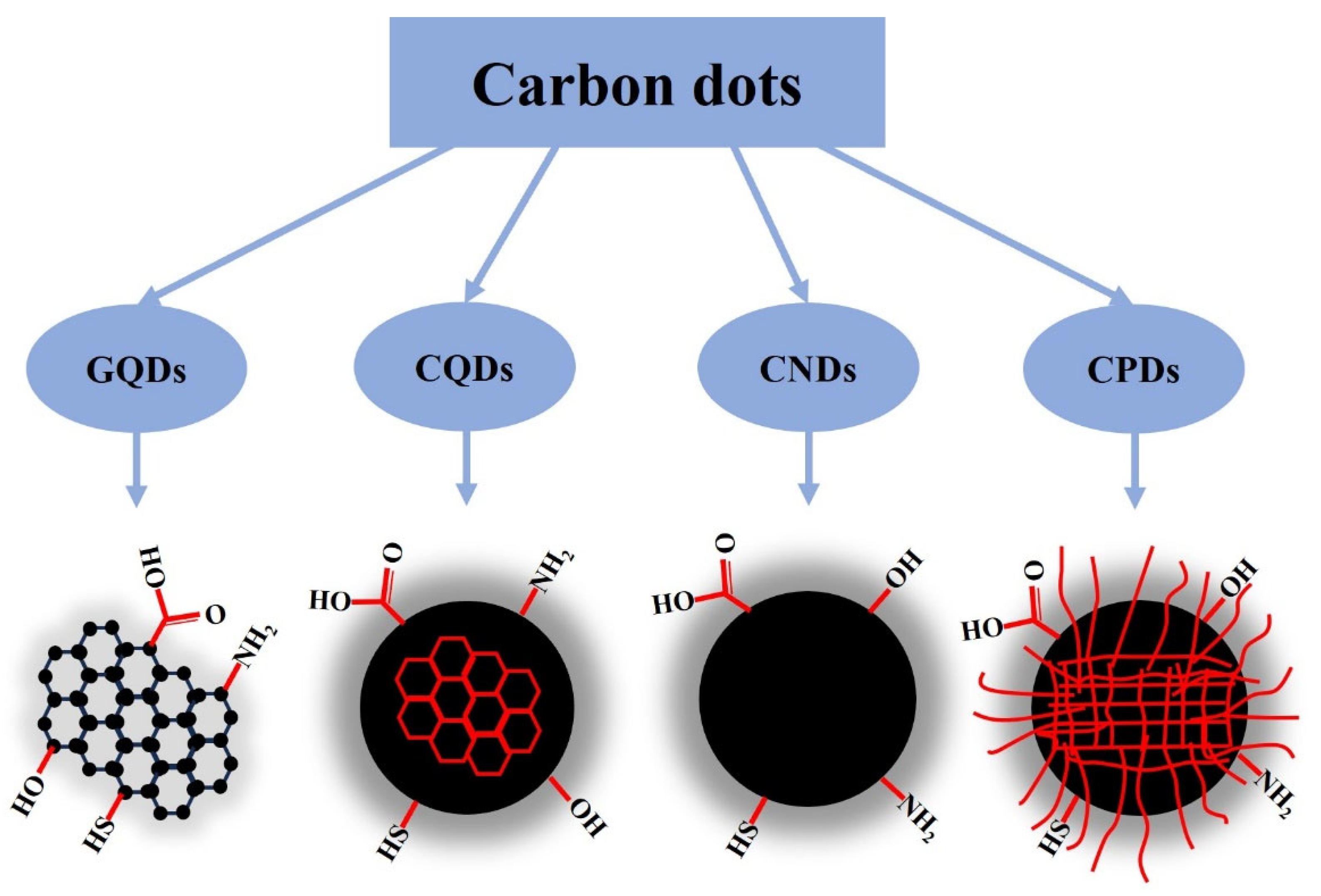
Figure 2.
Physiological functions of carbon dots.
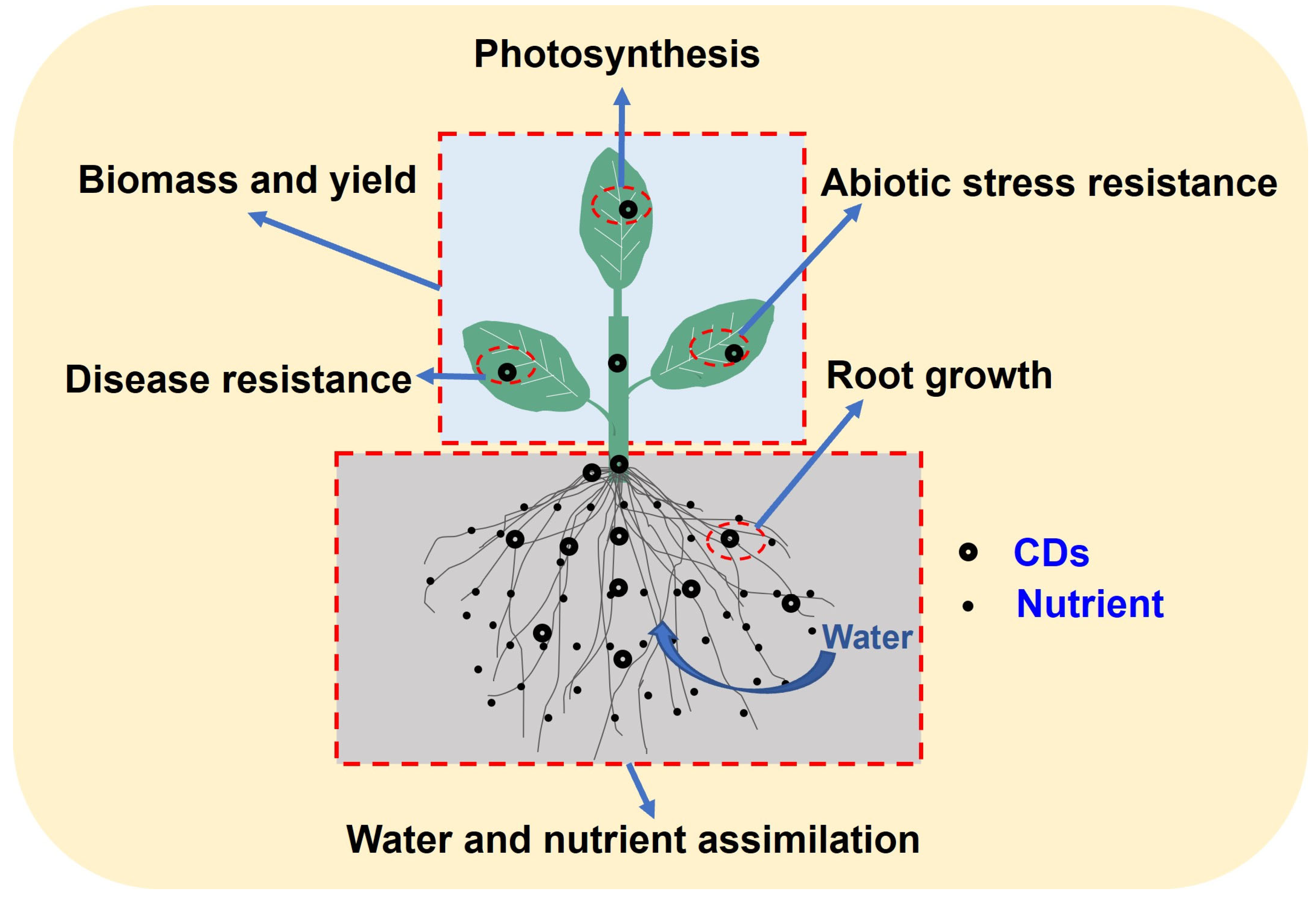
Figure 3.
Future aspects of applications of CDs in modern agriculture.
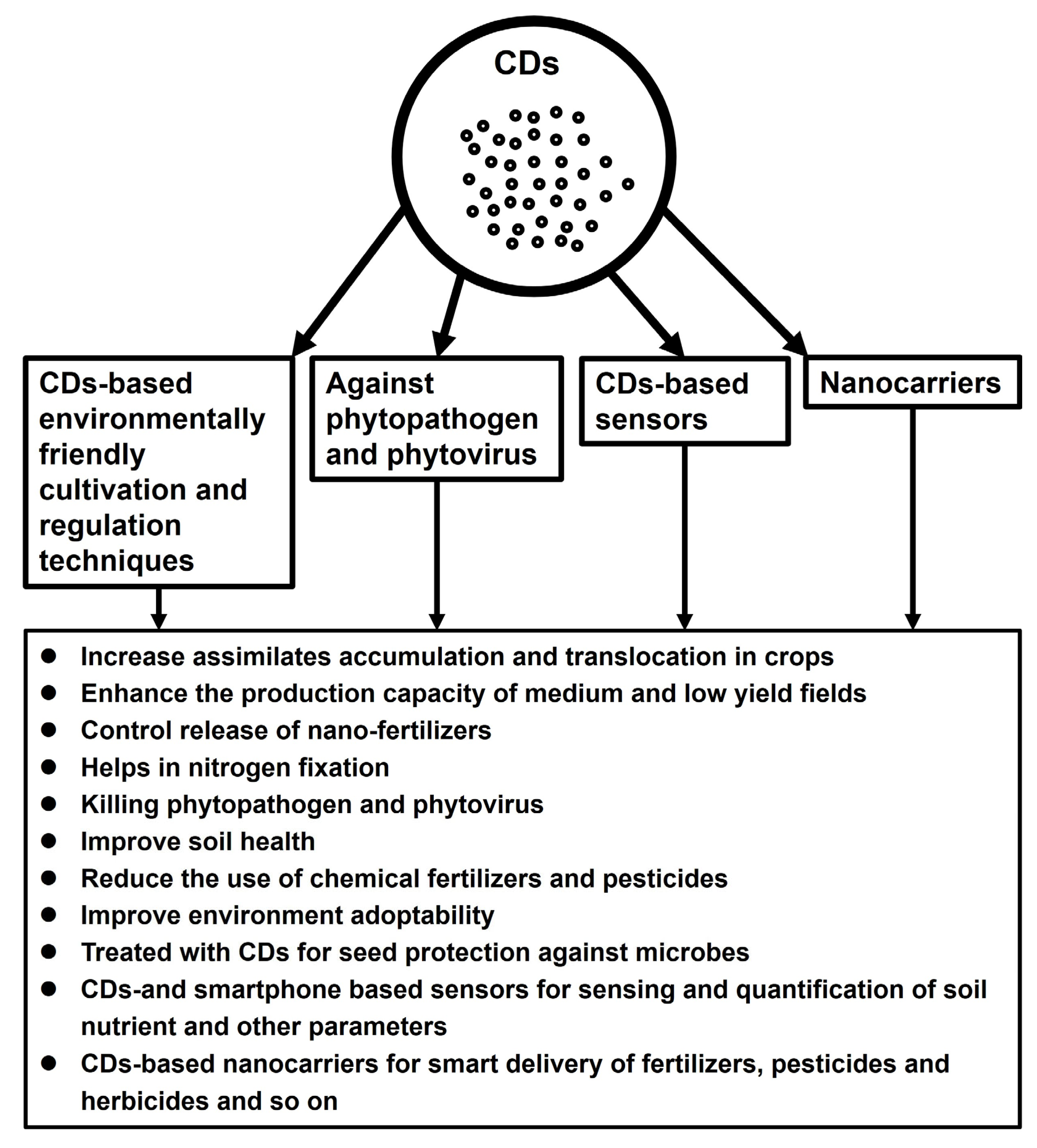

Table 1.
The effect of CDs on plant growth in main cereal crops.
| Crop | Source of CDs | Treated part of plant | Experimental methods | Effecet of CDs on plnat | Mechanism of action | Reference | ||
|---|---|---|---|---|---|---|---|---|
| Rice | Electrochemical etching using graphite rods, CDs are about 5 mm | Seed | Soke in MS medium supplemented with CDs of 0.56 mg/mL, and expose for 10 days | Enhance disease-resistance ability and grain yield | Increase the thionin gene expression; CDs degrade to formplant-hormone analogues and CO2; RuBisCO activity increase by 42% | [20] | ||
| Rice | Microwave pyrolysis using citric acid and ethanolamine, CDs are 3-4 nm | Leave | Spray with 300 μg/mL CDs three times a week with 5 mL/pot | Increase shoot length, dry weights of shoot and root | Increases the electron transport rate and photo-synthetic efficiency of photosystem II by 29.81% and 29.88%; increased the chlorophyll content and RuBisCO carboxylase activity by 64.53% and 23.39% | [22] | ||
| Rice | Microwave pyrolysis using biochar, CDs are 1-4 nm | Leave | Spray with 150 mg/mL CDs twice a month until the end of heading | Increase plant height and grain weight by 4.8% and 5.1% | Increase CO2 assimilate rate by 56% and 56% | [23] | ||
| Rice | Hydrothermal using citric acid, ethanolamine, and magnesium hydrate | Leave | Spray with 50, 100, and 300 μg/mL CDs with a dosage of 5 mL/pot and exposure for 16 days | Increased the height and fresh biomass by 22.34% and 70.60% | Up-regulated the gene expressions of enzymes related to chlorophyll by 15.26–115.02%; increasing chlorophyll a and chlorophyll b contents by 14.39% and 26.54%; increased the RuBisCO activity plants by 46.62% | [24] | ||
| Wheat | Carbon soot of mustard oil lamp, CDs are 20-100 nm | Seed | Soake in CDs aqueous solution for 3-4 days | Increase root and shoot length | Regulate the movement of water and ions | [25] | ||
| Maize | Thermo-polymerization of melamine and ethylenediamine tetraacetic acid, CDs are 2.5 nm | Leave | Spray 5 mL per plant with 1, 5, 10, 50 mg/L CDs and expose for 7 days | Increase yield and 1000-grain weight by 24.5% and 15.0% | Increased light conversion efficiency by 121.00%; increased the chlorophyll content by 15.41%; increase relative gene expression of psbA by 22.30 fold, ATPase activity by 41.44%, and NADPH production by 110.31% | [26] | ||
| Maize | Microwave pyrolysis using biochar, CDs are 1-4 nm | Leave | Spray with 150 mg/mL twice a month until the end of heading | Increase plant height and ear weight by 20.9% and 39.6% | Increase CO2 assimilate rate and stomatal conductance by 16% and 18% | [23] | ||
| Maize | Ultrasonication using citric acid and o-phenylenediamine | Root; leave | Hydroponic medium cultivation and sparying on leaves with 1, 5, and 10 mg/L CDs, and expose for 14 days | Increase photosynthetic parameters | Increase photosynthetic pigments | [27] | ||
| Maize | Hydrothermal using citric acid and ethylenediamine | Leave | spray 5 mL per plant using 5 mg/L CDs solutions, and expose for 33 days | Increase fresh weight of shoots and roots by 62.1% and 50.6%, and dry weight of shoots androots by 29.2% and 37.5% | Increase net photosynthes by 122.9%; increase root exudates of succinic acid (14.5 folds), pyruvic acid (10.0 folds), and betaine (11.8 folds), and relative abundance of microbial community by 122.6%-344.4% | [28] |
Disclaimer/Publisher’s Note: The statements, opinions and data contained in all publications are solely those of the individual author(s) and contributor(s) and not of MDPI and/or the editor(s). MDPI and/or the editor(s) disclaim responsibility for any injury to people or property resulting from any ideas, methods, instructions or products referred to in the content. |
© 2023 by the authors. Licensee MDPI, Basel, Switzerland. This article is an open access article distributed under the terms and conditions of the Creative Commons Attribution (CC BY) license (http://creativecommons.org/licenses/by/4.0/).
Copyright: This open access article is published under a Creative Commons CC BY 4.0 license, which permit the free download, distribution, and reuse, provided that the author and preprint are cited in any reuse.


