
Submitted:
07 September 2023
Posted:
08 September 2023
You are already at the latest version
Abstract
Purpose: The purpose of this study is to further explore how e-loyalty and E-marketing influences E-trust and satisfy the demand by offering fresh perspectives based on research as well as emphasis on the factors influencing the E-trust such as culture as a mediator. This study not only contributed theoretically but also presented practical implementations.
Design/methodology/approach: Online survey was used to obtain data by focusing the Hospitality sector (Hotel Industry) and verifying the conceptual framework. Data was collected in multiple time lags.
Findings: Findings showed that the E-trust influenced by E-loyalty and E-Marketing. E-trust comes from the previous experiences, e-loyalty and e-marketing. Further, some trends such as culture influenced the e-trust.
Research limitation/implications: The present study is quite suitable for those Researchers interested in learning more about the effects of E-loyalty and E-marketing on user E-trust and how to mitigate cultural influences can benefit from the current study. This research also has implications for those who wish to improve market allure and survival in digital world. This study focused on the hospitality sector (Hotel Industry) in China; however, the sector and geography could be altered to suit the needs of the study's participants.
Practical implications: The present study delivers the practical guidelines which are quiet suitable for understanding the formation of E-loyalty, E-marketing, and E-trust through which specific E-marketing strategy can be designed to deal with the consumer’s E-loyalty and their expectations as per their Cultural perspective. At some particular regions/countries, cultural trends are more important than practical market. This research study practically showed that how culture changed the consumer set of mind.
Originality/value: The relationship between E-loyalty, E-marketing, E-trust, specifically with the cultural influence in digital market has been the subject of few research.
Keywords:
E-Loyalty
; E-Marketing
; E-Trust
; culture
; hotel industry
; China
1. Introduction
E-loyalty and e-marketing are two of the most important aspects of any successful online business. In order for customers to remain loyal to a business, they must trust the company and its products. Trust in digital context is known as e-trust, where customer avail goods and services digitally or through internet (Taddeo, M. (2009), it is essential for any business to succeed in the digital age. Previous satisfaction and loyalty surveys were mainly conducted in offline consumer environments. Hence, it is discovered by the researchers that it is necessary for interactive and personalized marketing to offer more and more opportunities (Burke, R. R. 2002). Hence the main focus of this study is on e-loyalty and how automatically it generates the e-trust. Lack of trust is a major obstacle to the adoption of e-commerce (Chang, Cheung, & Tang, 2013). On the other side, trust is found to be a key factor in the global spread of Information and communication technologies (ICTs) (Kirs & Bagchi, 2012). Indeed, e-marketing has globalized, making cross-border purchases by consumers simple and convenient, and opening up markets for online retailers on both sides of the Atlantic.
Culture is the backbone of this study. Previous literature emphasize the need for more study of trust's dimensions and the influence of culture on trust (Gefen, Benbasat, and Pavlou (2008), therefore culture and e-trust are interrelated. Nonetheless, there is a surprising lack of actual study validating their connection, especially in digital context (e-marketing) (Gefen & Heart, 2006), trust, trustworthiness (including ability, integrity, and benevolence), and inclination to trust are so frequently used synonymously and combined in the research, we also focus on the dimensionality of these and related categories in the present study. In short if there would be no trust then the consumers avoid to buy goods and services online, and their focus would be changed from online to physical which affect the whole market. Culture also took part in trust depending on the specific area, for example in some countries people do not prefer to buy online because of the e-trust they prefer to buy physical it happens mostly in Asian countries. According to Luhmann (1979), a person decides whether or not to trust a brand based on three factors: past experiences, expectations, and the level of risk involved. The familiarity of both the trustor and the trustee with the system is crucial. It's the thing that sets the trustor at ease with their decision to trust. So the e-trust build by designing the good strategies as per the digital market requirement. E-trust is also affected by e-loyalty and e-marketing (Wilis & Nurwulandari, 2020). Discussing the E-loyalty and E-marketing phenomenon is the important in this era because all the digital marketing is depending on it. Researchers have also been looking into ways to build up online loyalty among clients in recent years (Chou, Chen, & Lin, 2015). Previous research has shown that e-satisfaction and e-trust are two of the most important aspects in creating e-loyalty (Chou, Chen, & Lin, 2015). There are other factors affecting e-trust (Juwaini, 2022), these factots could be quality, price, marketing tactics etc. But here researcher were not specifically mentioned about culture, which is the focus of the study.
As per the previous literature, there are two problems that has to define: (1) why consumer still face e-trust issue while designing different strategies according to the market? (2) Which factor involved with e-trust so that consumer are still hesitated by trusting an online brand? Apart from all marketing strategies and purchasing again and again by showing e-loyalty, consumer still affected by culture and the trends in the particular society they are living in. (3) This study also explaining the consequences of e-loyalty and e-trust. (4) It also explaining the importance of e-loyalty, e-marketing, e-trust and culture in both national and international perspective.
Further studies are needed for e-loyalty, e-marketing, e-trust (Shafiee, Haghighizade & Rahimzadeh, 2016) and culture is the suitable factor to analyze the digital marketing in a better way. Previous studies defined commitment of e-loyalty and how consumer to consistently revisit the website and repeatedly buy the goods and services from that particular website (Cyr, 2008) but they did not define why this happened, this happened due to the e-trust they built. If consumer is loyal then he/she will purchase goods and services repeatedly, but some other factors also change the mind set of consumer such as culture, which is not discussed in this perspective. Of course e-loyalty and e-marketing generated e-trust but culture has the power to change the consumer mentality against e-trust, which is the focus of the current study. Therefore, it is a pressing need to address the knowledge gap around the connections between e-marketing, e-trust, and e-loyalty with the effect of culture as a mediator. On the basis of literature review and prior studies on e-loyalty, e-marketing, e-trust and culture; the present study is focused on closing above mentioned key gaps and concluded the following research questions:
- What is the relationship of E-loyalty and e-trust? Either this relationship is positive or negative?
- What is the relationship of E-marketing and e-trust? Either this relationship is positive or negative?
- Either Culture mediates the relationship between E-Loyalty and E-trust?
- Culture mediates the relationship between E-Marketing and E-trust?
- Culture affected E-trust in both positive and negative way.
2. Theoretical Background
Previous research has shown that e-trust is significant contributors to e-loyalty among customers (Chou, Chen & Lin 2015). Customers are more likely to make purchases from an online retailer in which they have a high level of perceived e-trust (Connolly, & Bannister, 2007), E-trust creates a safe environment in which consumers feel more comfortable being honest (Cho& Fiorito, 2009) and prefer to buy products again and again on the same website (Liu, et al., 2005), which shows higher loyalty to the particular brand or website. If a consumer has e-trust then uncertainty decreases and rebuying possibility increase (Doong, Wang, & Shih, 2008) which shows e-loyalty to that specific brand. Several researches done in an online setting have indeed revealed a beneficial connection between e-trust and e-loyalty (Harris & Goode, 2004; Kassim & Abdullah, 2008).
The emergence of loyalty notion comes back to early decade of 1940. The market share (behavioral loyalty) and brand preferences (attitude loyalty) are two distinct ideas represented in this framework (Rundle-Thiele, 2001). In this domain, numerous scholars have provided a variety of definitions. Some academics think that loyalty is demonstrated by repeated purchases of consumer (Jacoby, 1978), and examining a customer's purchasing patterns entails examining their level of loyalty (Kuehn, 1962). Others think the behavioral and attitudinal components work well together to evaluate loyalty (Dick & Basu, 1994). Richard Oliver has provided the most thorough definition, and in his opinion, loyalty is defined as a strong commitment to continue purchasing the same goods or services in the future, despite rivals' marketing efforts (Oliver, 1999). E-loyalty is defined as customers' propensity to make repeat purchases based on their positive impressions of a brand over time (Keller, 1993), and repeat purchase showed e-trust and e-loyalty direct and positive relationship. Here it is approved that E-loyalty and E-trust has positive relationship with each other. If a consumer trust any website or brand and prefer to purchase repeatedly it shows the E-loyalty with that particular brand.
H1.
E-Loyalty has positive effect on E-trust; E-trust positively affected by E-Loyalty
In order to effectively communicate with its clients, the lodging sector has embraced the Internet (Diaz and Koutra, 2013; Law et al., 2010). A website is undoubtedly a helpful tool for businesses to advertise their goods and services and attract and keep clients (Akincilar and Dagdeviren, 2014). According to McMullan and Gilmore (2008), returning guests have an impact on the hotel's bottom line and are crucial to the spread of good word of mouth (WOM), which shows the trust and loyalty of the customers. E-loyalty increased comprises on e-marketing effectiveness (which represented the e-trust), sufficient sales and growth in customer attraction (Sharma & Sheth, 2004), which represented the positive relation of E-marketing and E-trust).
Loyal clients are the foundation of a successful business, and the Internet and e-marketing provide a low-cost means of cultivating these ties (Chang, & Chen, 2008) and loyal customers are those who has trust on that particular brand. Previous studies demonstrated the significance of trust in e-business (e-marketing) and showed how trust mitigates client apprehension and encourages site visits and purchases (Wu et al. 2008) represented that e-marketing and e-trust has a positive and significant relationship. Accordingly, it may be argued that content on websites is an effective way of developing customers' e-trust (Rahimnia & Hassanzadeh, 2013), which showed the connection of e-marketing and e- trust. E-commerce has a strong influenced on customers’ buying intentions to trust e-marketing (Corbitt et al. 2003) so that, e-trust is created by e-marketing. E-trust has a significant, positive impact on e-marketing (Corbitt et al. 2003). It has been shown that consumers are more willing to shop online if they have greater e-marketing techniques and a higher level of trust in e-commerce (Rahimnia & Hassanzadeh, 2013). Customers are attracted to and remain loyal to online businesses that they trust. Hence proved that the e-marketing has a positive effect on e-trust and e-trust significantly making the relation stronger with e-marketing.
H2.
E-Marketing has positive effect on E-trust; E-trust positively affected by E-Marketing.
It is evaluated the role of culture in the establishment of e-loyalty intentions (Gracia, Arino, & Blasco, 2015), some culture allows the customers to create the e-loyalty and they making purchasing repeatedly then e-trust automatically generated. E-loyalty development process changes among cultures, even across comparable civilizations (Gracia et al., 2015). Consumers in a collectivist and high uncertainty-avoidant culture were hypothesized to be more likely to form trust through a transference process (i.e. the truster draws on proof sources from which trust is transferred to a target) than those in an individualistic and low uncertainty-avoidant culture (Doney et al. 1998). People in high-collectivist and low-risk-taking cultures are more likely to transmit trust because they compare the recipient to the provider (Jin et al. 2008), so that customers are relying on previous experiences and reputation which is created by e-marketing through e-trust which become the root of e-loyalty. Users' perspectives on the e-commerce, such as their level of loyalty, are influenced by cultural norms (Chau et al. 2002) which explained e-loyalty and e-trust depend on the cultural norm of that particular region. For example in China people has more e-trust and e-loyalty than Pakistan or India because their trust built by the previous experience.
H3.
Culture mediates the relationship between E-Loyalty and E-trust
Therefore, this study combines the findings of previous studies on e-trust with the idea of culture to inquire into the factors that shape customers' perceptions of an e-marketing reliability (Hallikainen & Laukkanen, 2018) which explains the customers’ set of mind are also changing because of the culture and tradition prevailing in that specific region or country. Theoretical investigations imply a connection between national cultures and trust (Doney, Cannon & Mullen, 1998; Hofstede, 1984) Nonetheless, there is surprisingly little actual study verifying their connection, especially in e-marketing (Gefen & Heart, 2006; Huang, Ba, & Lu, 2014; Hwang & Lee, 2012; Jarvenpaa, Tractinsky, & Saarinen, 1999; Yoon, 2009). Some studies inquired into how different cultures affect people's propensity to trust each other (An, & Kim, 2008; Chen, Wu, & Chung, 2008; Park, Gunn, & Han, 2012; Teo, & Liu, 2007), by investigating how various characteristics and dimensions of national culture have an effect on trust (An, & Kim, 2008; Capece et al., 2013; Huang, Ba, & Lu, 2014; Hwang & Lee, 2012; Chen, Wu, & Chung, 2008) culture may effect trust differently in various countries (Gefen & Heart, 2006), it is argued that cultural values effect how consumers from Eastern and Western origins establish trust in e-marketing. In some countries like USA have more trust on e-marketing as compare to Pakistan or Bangladesh. It is studied that trust development among virtual community members in China, Hong Kong and Taiwan, and discover no significant variations in trust development across the nations, but indicate that overall Chinese exhibit a greater trust tendency (Chen, Wu, & Chung, 2008) so It is proved that trust on e-marketing vary from country to country according to their culture. Individuals not only have diverse attitudes and experiences with e-marketing inside and across national cultures, but they also have different degrees of trust in general. Therefore culture mediates the relationship between E-marketing and E-trust.
H4.
Culture mediates the relationship between E-Marketing and E-trust
Gefen, Benbasat, and Pavlou (2008) included the dimensionality of trust and the influence of culture on trust as research issues that need additional exploration in their research agenda for trust in the digital world. Empirical research validating the connection between national culture and trust is surprisingly scarce, especially in the world of the internet (Huang et al., 2014; Gefen & Heart, 2006; Yoon, 2009), but according to Hofstede, (1984) despite theoretical evidence to the contrary. Current study is also focused on the relationship of culture and trust which is still under observation of many researcher (Tong & Mitra, 2009; Denner et. al., 2019; Hoppes & Holley, 2014). Theoretical studies imply a connection between national cultures and trust (Doney, Cannon, & Mullen, 1998) which showed that still have a need to explore the phenomenon of E-trust and Culture. This study also explaining all the relationship of E-trust and culture in an advance way and contributed in literature. Mostly studies focused on trust but not interested to discuss the trust in digital form which is e-trust. People also follow the trends of e trust (Bauman, A., & Bachmann, R. (2017) that trend is called culture, which convinced the consumer to follow that culture either to trust in digital world or not (e-marketing). If one bad case found then more online consumer affected (Koh, Hu & Clemons, 2010), they believe on what they see in their environment (Trudel, 2019). So we hypothesized:
H5.
Culture affected E-trust in both positive and negative way.
Figure 1.
Theoretical Framework.
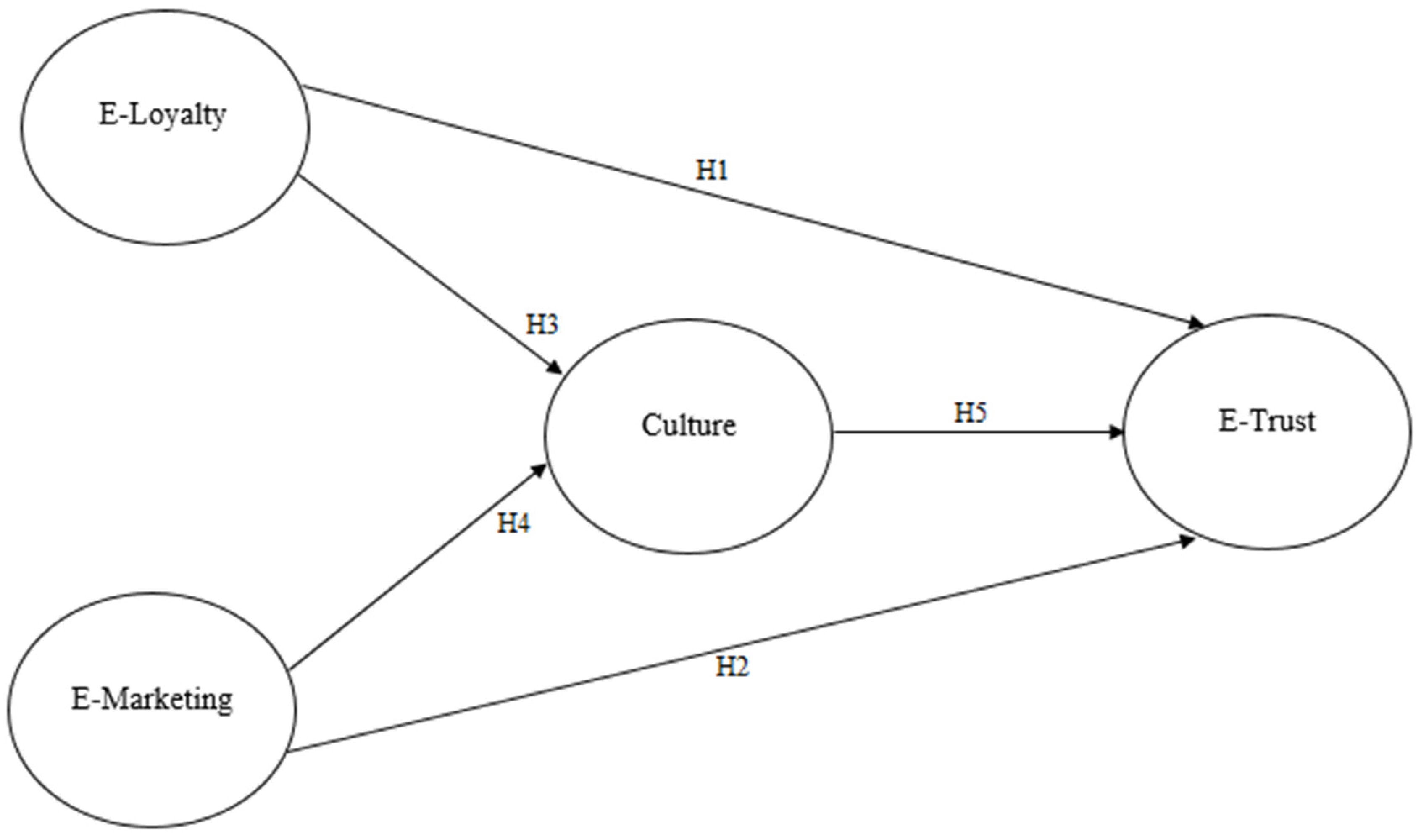
Hypothesis
H1.
E-Loyalty has positive effect on E-trust; E-trust positively affected by E-Loyalty.
H2.
E-Marketing has positive effect on E-trust; E-trust positively affected by E-Marketing.
H3.
Culture mediates the relationship between E-Loyalty and E-trust and created causes and effects the E-trust.
H4.
Culture mediates the relationship between E-Marketing and E-trust and created causes and effects the E-trust.
H5.
Culture affected E-trust in both positive and negative way.
3. Methodology
In order to create effective marketing tactics that cater to the kind and degree of customer E-loyalty and e-marketing with the effect of culture, participants were offered a gift certificate as a reward for taking part. This study offers useful guidelines for hotel industry in hospitality sector that shed light on the e-loyalty formation process of anticipations on the part of potential consumers. This research shows that the methods through which customers establish E-loyalty to hotels in physical and virtual settings are same. The results showed that e-loyalty and e-marketing created e-trust (Shafiee, Haghighizade & Rahimzadeh, 2016) while culture of different regions/areas also affect the e-trust (Miao et. al., 2022). It seems that men, in comparison to women, are more attuned to the ways in which the design and features of a hotel's website affect their stay to increase client happiness with the website's services (Tzavlopoulos et. al., 2019) and the likelihood of repeat visits, which in turn increases customer loyalty. Current study also discuss all these circumstances but at one page which included e-loyalty, e-marketing, e-trust and culture simultaneously. We have translated all the questionnaires English into Chinese language for better understanding and to avoid inconvenience of respondents. Table 1 showing the descriptive statistics of demographic information of the respondents.
419 valid replies generated in total which are in suitable condition to use for this study. 25.5% (107) were female, while 74.5% (312) who were taking part in present study. 28.4% (119) were between the ages of 25-30 years, 43.2% (181) were between the age 31-36 years and 28.4% (119) of the respondents were over the age of 36. Higher-educated respondents dominated the sample, with 73% (306) having earned master degrees from an accredited university, 15% (65) are those who had doctorate degree.
Measurement
Cyr, D., Kindra, G. S., & Dash, S. (2008) provided the basis for the items used to assess the components in the conceptual framework. The offline fulfillment factor was also addressed by adding some more questions. E-loyalty was measured by adapting Oliver (1999); Pedersen and Nysveen (2004) and Hinson et al. (2016). E-trust was measured by using the five-point likert scale adapted from the study of Garbarino and Johnson (1999). E-Marketing was adapted by Davis (1989), El-Gohary (2010) and Phillips, Calantone and Lee (1994). Culture and gender measurement was adapted by House, R. J., Hanges, P. J., Javidan, M., Dorfman, P. W., & Gupta, V (2004). Five point Likert scale was used to measure all the measurement items ranging from 1 to 5 (strongly disagree to strongly agree). Researchers can improve the quality of their findings and the efficacy of their study by using a well-thought-out research design (Wiersma, 2009.
4. Results
The nature and strength of hypothesized correlations may be determined through quantitative research, making it the method of choice (de Vaus, 2001). Quantitative research designs, as stated by Chase, Teel, Thornton- Chase, and Manfredo (2016), provide reliable and valid findings, therefore current study also based on quantitative data. In this study, the measurement models were first evaluated using Smart PLS 4, built-in statistical tools, specifically the composite reliability (CR), average variance extracted (AVE), and Cronbach's alpha (CA) measures. The theoretical model was then tested for variance inflation factor (VIF), R2, and coefficient of determination (R2). The study concluded by using SEM to test the hypothesized connections.
Cronbach's alpha measures internal consistency on a standard scale from 0 to 1 (Table 2). A greater number of elements agree with each other. When the Cronbach's alpha for a series of questions is high, it means that the participants' responses were generally reliable (Brown, 2002). Table 2 showed the Cronbach's alpha of culture is 0.888 which indicated 88% response rate is reliable, E-marketing has 0.894 which indicated 89% and so on.
Table 3 indicated the Mediation Analysis Results. Preacher and Hayes (2004) rule, for the mediation H3 and H4 so that can measure the mediation assessment of culture in the relationship of E-loyalty/E-marketing and E-trust. Through bootstrapping, for E-trust and E-loyalty (β=0.072, P<0.01, t=2.297)) and E-marketing and E-loyalty (β=0.701, t=3.843, p<0.01) positive effect were found. Boot confidence interval (CI; for E-trust, lower limit (LL) =0.069, upper limit (UL) = 0.32; for E-marketing and E-trust LL=0.037, UL=0.67) are advised to avoid include a leading or trailing zero (see Table 3). Both of the proposed mediation hypotheses are supported by the data in this study. This shows a complementary total effect and indirect mediating role of Culture between E-loyalty & E-Trust, as well as E-marketing & E-Trust. Hence H3 and H4 for mediation hypothesis supported. All the other hypothesis H1, H2 and H5 shown in Table 5.
A series of confirmatory factor analyses (CFAs) were performed to check for uni-dimensionality and discriminatory validity of the suggested factors and indicators (Table 4). Each construct's factor loadings and composite reliabilities are provide (Table 4). All factor loadings are significantly higher than 0.5, demonstrating convergent validity as suggested by Hair et al. (2019). The levels of reliability achieved are far higher than those advocated by Nunnally (1978). PLS-SEM efficiently deal with smaller sample or normatively stated constructs (Becker, Ringle & Sarstedt 2018; Hair et al. 2019). According to Bagozzi and Yi 1988; Nunnally 1978) Table 4 showed the threshold of 0.70 for composite reliability standards was met. The AVE (average variance extracted) is >0.5, also analyzed the value of VIF which also met the criteria. In Structural equation results, it showed how E-loyalty and E-marketing created E-trust (Shafiee, Haghighizade & Rahimzadeh, 2016) while culture is also affected the E-trust. It is suggestive that where E-loyalty contain positive attitude (Li, Aham-Anyanwu, Tevrizci, & Luo, 2015), and have a significant impact in promoting E-trust, and developed positive relationship between customer and brand. According to Bagozzi and Yi (1988) and Hair et al. (2011) Composite reliability (CR) values 0.7 is sufficient or higher than 0.7 (Khan et al., 2017). Table 4 presented the composite reliability (CR) values at its range, which support the study findings. Researchers also suggested the proposed validity threshold at least 0.50 which should be acceptable. (Table 4) shows that the AVE in this analysis varied from 0.612 to 0.698, which supported the current study.

Table 4.
Confirmatory factor Analysis (CFA).
| Variables | Items | Loadings | Cronbach's alpha | Composite reliability | Average Variance Extracted (AVE) | Composite reliability (rho_a) | Variance Inflation Factor (VIF) |
|---|---|---|---|---|---|---|---|
| E-Loyalty | 0.89 | 0.891 | 0.645 | 0.891 | |||
| EL 1 | 0.792 | 2.042 | |||||
| EL 2 | 0.746 | 1.93 | |||||
| EL 3 | 0.863 | 2.317 | |||||
| EL 4 | 0.719 | 1.927 | |||||
| EL 5 | 0.792 | 2.204 | |||||
| EL 6 | 0.774 | 2.041 | |||||
| E-Marketing | 0.894 | 0.895 | 0.612 | 0.895 | |||
| EM 1 | 0.839 | 2.166 | |||||
| EM 2 | 0.794 | 1.863 | |||||
| EM 3 | 0.860 | 2.098 | |||||
| EM 4 | 0.837 | 2.02 | |||||
| EM 5 | 0.812 | 2.008 | |||||
| EM 6 | 0.773 | 1.915 | |||||
| EM 7 | 0.701 | 1.747 | |||||
| Culture | 0.888 | 0.888 | 0.64 | 0.888 | |||
| CUL 1 | 0.698 | 1.927 | |||||
| CUL 2 | 0.782 | 2.17 | |||||
| CUL 3 | 0.733 | 1.957 | |||||
| CUL 4 | 0.798 | 2.085 | |||||
| CUL 5 | 0.742 | 1.947 | |||||
| CUL 6 | 0.778 | 2.079 | |||||
| E-Trust | 0.892 | 0.892 | 0.698 | 0.892 | |||
| ET 1 | 0.702 | 2.042 | |||||
| ET 2 | 0.783 | 2.447 | |||||
| ET 3 | 0.711 | 2.143 | |||||
| ET 4 | 0.711 | 2.226 | |||||
| ET 5 | 0.716 | 2.249 |
Table 5.
Hypothesis construct.
| Hypothesis | Relationship | β | t-value | p-value | Decision |
|---|---|---|---|---|---|
| H1 | EL->ET | 0.286 | 2.369 | 0.000 | Supported |
| H2 | EM->ET | 0.722 | 4.697 | 0.000 | Supported |
| H3 | EL->CL->ET | 0.272 | 2.297 | 0.000 | Supported |
| H4 | EM->CL->ET | 0.701 | 3.843 | 0.000 | Supported |
| H5 | CL->ET | 0.193 | 4.603 | 0.000 | Supported |
Note: **p-value <0.1, EL: E-Loyalty; ET: E-trust; EM: E-marketing; CL: Culture;.
For H1 (β=0.286, t=2.369, p<0.01), proved that E-Loyalty has positive effect on E-trust (shown in Table 5) if customer is prefer to purchase again and again same online services which showing his/her e-loyalty (Valvi & Fragkos, 2012; Audrain-Pontevia, N’Goala & Poncin, 2013) which further build e-trust. H2 (β=0.722, t=4.697, p<0.01) e-trust is also built by e-marketing (Yousaf et. al., 2018; Rahimnia & Hassanzadeh, 2013). If any brand market their brands with best marketing strategies the consumer definitely impressed by those marketing tactics. For H5 (β=0.193, t=4.603, p<0.01) shows the Culture affected E-trust, consumer trust level affect as per the trends (Culture) revealing in that particular society (Akour et. al., 2022; Posey et. al., 2010; Bansal & Gefen, 2010). Culture as a mediator also play vital role in relation with E-loyalty and E-trust/E-marketing and E-trust. It suggests that while E-loyalty directly impact culture, they do not activate efficiently in E-trust but at the same time culture change the mind set of customers to trust a brand. As per the additional contribution, this study is conducted in hotel Industry of China through online survey.
5. Discussion
The current study has some real-world consequences because it was conducted in the hospitality sector (Hotel Industry) including different hotels located in different cities of China, which is widely recognized as one of the world's most important economic sectors (Jauhari & Sanjeev, 2012) and has practical implications. The hotel industry is among the world's most dynamic and rapidly expanding markets (De Grosbois, 2012) and becomes largest industry in future (Gu, Ryan & Yu, 2012). Customer are more concern about the goods and services which they have seen online and compare them physically (Smith & Brynjolfsson, 2001; Butler & Peppard, 1998) it also happened in current study when asked from consumer about their experience for hotel industry, they are more concern about services they are showing on their websites or web pages (Zhou, Lu, & Wang, 2009). In this study customers are also concerned about their cultural trends. For example, in some areas digital marketing does not work as good rather than other areas. Customer mind set is dependent on the particular area where he/she is living (Keller, 2013; Gupta & Govindarajan, 2002; Saaksjarvi & Pol, 2007).
They follow the norm and trends of that particular areas/countries so they prefer to make decision on their cultural trends and norms (Forssbaeck & Oxelheim, 2014; Arraras et. al., 2013; Gabriel & Lang, 2006) hence, the current study also target the main concern which is cultural trends. This is proved by the findings as per the Figure 2 and Table 5.
Table 5 stated all the proposed hypothesis results. All the hypothesis supported as per the obtained results. H1 concluded that both E-loyalty and E-trust has positive relationship which is proved by the stated results. E-loyalty and E-trust interrelated with each other (Ghane, Fathian & Gholamian, 2011) this study also showed their interrelation by values (β=0.286, t=2.369, p < .001), which showed the 28% (0.286) positive significant effect is generated by e-loyalty towards e-trust. Figure 2 also presented all numeric values to show the positive and significant values. Hence, proved that if a customer purchased repeatedly the same goods or services then e-trust is created. H2 explained that also has positive relationship between E-Marketing and E-trust which shows higher significant positive relationship which is 0.722. Table 5 showing the values (β=0.722, t=4.697, p < .001) positive significant effect is generated by e-Marketing and e-trust. Figure 2 also justified the presented values to show the significance of the results. Therefore, it is proved that if design e-marketing strategies in an appropriate way then customer attracted more and which directly help to build e-trust. In the Figure 2 and Table 5 showed 72% (β =0.722) impact is created by the e-marketing techniques which was practically significant for any business. H3 supported by the mediation results which shown in Table 3/Table 5 for E-Loyalty to E-trust (H3: β=0.272, t=2.297, p < .001), results showed that 27% mediation will be supported when culture mediated the relationship between e-loyalty to e-trust. Findings also showed that if a customer purchased repeatedly the same goods or services then e-trust is created but at the same time it is also affected by culture and trends prevailing in that region/country. For H4, E-marketing to E-trust relationship mediated by the cultural trends prevailing in that particular area. Values showed (H4: β=0.701, t=3.843, p < .001), culture mediated the relationship between E-marketing and E-trust which showed and proved by the analysis (see Table 3). E-marketing and e-trust has 70% mediation due to culture which support the H4. It also explained how culture affect the e-trust in a high and significant way. H5: Culture and E-trust direct effect which is (β=0.193, t=4.603, p < .001) which supported the hypothesis (see Table 5), culture effect the e-trust by 19%. Findings showed that 19% are those customers who were made decisions on the base of cultural trends revealing in that specific area. So the main focus of the current study is on Hospitality sector especial hotel industry which shows E-loyalty and E-marketing at its best. That's why it's so important for the marketing sector of an economy to foster an immersive setting by taking a marketing-minded view on the value of experiences. This research aimed to develop a theoretical framework for analyzing how cultural factors influence e-loyalty, e-marketing and e-trust. Managers in the field of marketing can, however, strengthen and facilitate e-trust through the implementation of systems of experiential marketing.
6. Conclusion
Therefore we proved that E-Loyalty and E-marketing significantly valuable by promoting the e-trust in customer. E-loyalty and E-marketing are the backbone of any brand, and become the cause to generate E-trust practices. Cultural trends also created hurdles while making trust in hotel industry. It is suggested that E-loyalty and E-marketing can support the businesses/brands to become stronger in getting customers’ e-trust to enhance the brand value and get fruitful outcomes. But there is a need to focus on cultural trends which not only effect the mindset of customer but also make this trend stronger in specific areas, which might affect the digital market in future.
7. Limitations and Future Directions
Although the present research boosting the results but still have notable limitations. First, data was collected virtually with different time lags and multiple sources. But results would be differed if it is conducted by cross sectional or experimental design. Secondly this research is conducted in Hospitality sector and targeted hotel industry of China but if choose any other sector and region then it could be changed. The future directions are recommended in several other categories such as banking, educational, high-tech, manufacturing industries and development sectors etc. as well as in other countries and culture to enhance the model abstraction. Thirdly, current study focused on E-loyalty, E-marketing, culture and E-trust, it is observed that if customer satisfaction and e-satisfaction which also affected by Culture. Lastly, other research design could be used for better recognition.
Funding
This research received no external funding.
Informed Consent Statement
The data will be collected online, so no physical interaction took place, and surety provided to those who participated this research to not used confidentiality.
Data Availability Statement
We will provide research data if required.
Conflicts of Interest
There are no conflicts of interest.
References
- Akincilar, A., & Dagdeviren, M. (2014). A hybrid multi-criteria decision making model to evaluate hotel websites. International Journal of Hospitality Management, 36, 263-271. [CrossRef]
- Akour, I., Alnazzawi, N., Alshurideh, M., Almaiah, M. A., Al Kurdi, B., Alfaisal, R. M., & Salloum, S. (2022). A Conceptual Model for Investigating the Effect of Privacy Concerns on E-Commerce Adoption: A Study on United Arab Emirates Consumers. Electronics, 11(22), 3648. [CrossRef]
- An, D., & Kim, S. (2008). Effects of national culture on the development of consumer trust in online shopping. Seoul Journal of Business, 14(1), 123-151. [CrossRef]
- Arraras, J. I., Greimel, E., Chie, W. C., Sezer, O., Bergenmar, M., Costantini, A., ... & European Organisation for Research and Treatment of Cancer Quality of Life Group. (2013). Cross-cultural differences in information disclosure evaluated through the EORTC questionnaires. Psycho-Oncology, 22(2), 268-275. [CrossRef]
- Audrain-Pontevia, A. F., N’Goala, G., & Poncin, I. (2013). A good deal online: The Impacts of acquisition and transaction value on E-satisfaction and E-loyalty. Journal of Retailing and Consumer Services, 20(5), 445-452. [CrossRef]
- Bagozzi, R. P., & Yi, Y. (1988). On the evaluation of structural equation models. Journal of the academy of marketing science, 16, 74-94. [CrossRef]
- Bansal, G., & Gefen, D. (2010). The impact of personal dispositions on information sensitivity, privacy concern and trust in disclosing health information online. Decision support systems, 49(2), 138-150. [CrossRef]
- Bauman, A., & Bachmann, R. (2017). Online consumer trust: Trends in research. Journal of technology management & innovation, 12(2), 68-79. [CrossRef]
- Becker, J. M., Ringle, C. M., & Sarstedt, M. (2018). Estimating Moterating effects in PLS-SEM andPLSc-SEM: Interaction term gerneration* data treatment. Journal of Applied Structural Equation Modeling, (2), 1-21. [CrossRef]
- Brown, J. D. (2002). The Cronbach alpha reliability estimate. JALT Testing & Evaluation SIG Newsletter, 6(1).
- Burke, R. R. (2002). Technology and the customer interface: What consumers want in the physical and virtual store? Journal of the academy of Marketing Science, 30(4), 411-432. [CrossRef]
- Butler, P., & Peppard, J. (1998). Consumer purchasing on the Internet:: Processes and prospects. European management journal, 16(5), 600-610. [CrossRef]
- Capece, G., Calabrese, A., Di Pillo, F., Costa, R., & Crisciotti, V. (2013). The impact of national culture on e-commerce acceptance: The Italian case. Knowledge and Process Management, 20(2), 102-112. [CrossRef]
- Chang, H. H., & Chen, S. W. (2008). The impact of customer interface quality, satisfaction and switching costs on e-loyalty: Internet experience as a moderator. Computers in Human Behavior, 24(6), 2927-2944. [CrossRef]
- Chang, M. K., Cheung, W., & Tang, M. (2013). Building trust online: Interactions among trust building mechanisms. Information & management, 50(7), 439-445. [CrossRef]
- Chase, L. D., Teel, T. L., Thornton-Chase, M. R., & Manfredo, M. J. (2016). A comparison of quantitative and qualitative methods to measure wildlife value orientations among diverse audiences: A case study of Latinos in the American Southwest. Society & natural resources, 29(5), 572-587. [CrossRef]
- Chau, P. Y., Cole, M., Massey, A. P., Montoya-Weiss, M., & O'Keefe, R. M. (2002). Cultural differences in the online behavior of consumers. Communications of the ACM, 45(10), 138-143. [CrossRef]
- Chen, Y. H., Wu, J. J., & Chung, Y. S. (2008). Cultural impact on trust: A comparison of virtual communities in China, Hong Kong, and Taiwan. Journal of Global Information Technology Management, 11(1), 28-48. [CrossRef]
- Cho, H., & Fiorito, S. S. (2009). Acceptance of online customization for apparel shopping. International Journal of Retail & Distribution Management, 37(5), 389-407. [CrossRef]
- Chou, S., Chen, C. W., & Lin, J. Y. (2015). Female online shoppers: Examining the mediating roles of e-satisfaction and e-trust on e-loyalty development. Internet Research, 25(4), 542-561. [CrossRef]
- Connolly, R., & Bannister, F. (2007). Consumer trust in electronic commerce: Social & technical antecedents. World Academy of Science, Engineering and Technology, 34, 239-248.
- Corbitt, B. J., Thanasankit, T., & Yi, H. (2003). Trust and e-commerce: A study of consumer perceptions. Electronic commerce research and applications, 2(3), 203-215. [CrossRef]
- Cyr, D. (2008). Modeling web site design across cultures: Relationships to trust, satisfaction, and e-loyalty. Journal of management information systems, 24(4), 47-72. [CrossRef]
- Cyr, D., Kindra, G. S., & Dash, S. (2008). Web site design, trust, satisfaction and e-loyalty: The Indian experience. Online Information Review, 32(6), 773-790. [CrossRef]
- Davis, F. D. (1989). Delle vicende dell’agricoltura in Italia; studio e note di C. Bertagnolli. Perceived Usefulness, Perceived Ease of Use, and User Acceptance of Information Technology., 13 (3), 319–340.
- De Grosbois, D. (2012). Corporate social responsibility reporting by the global hotel industry: Commitment, initiatives and performance. International Journal of Hospitality Management, 31(3), 896-905. [CrossRef]
- De Vaus, D. (2001). Research design in social research. Research design in social research, 1-296.
- Denner, J., Bean, S., Campe, S., Martinez, J., & Torres, D. (2019). Negotiating trust, power, and culture in a research–practice partnership. AERA open, 5(2), 2332858419858635. [CrossRef]
- Diaz, E., & Koutra, C. (2013). Evaluation of the persuasive features of hotel chains websites: A latent class segmentation analysis. International Journal of hospitality management, 34, 338-347. [CrossRef]
- Dick, A. S., & Basu, K. (1994). Customer loyalty: Toward an integrated conceptual framework. Journal of the academy of marketing science, 22, 99-113. [CrossRef]
- Doney, P. M., Cannon, J. P., & Mullen, M. R. (1998). Understanding the influence of national culture on the development of trust. Academy of management review, 23(3), 601-620. [CrossRef]
- Doong, H. S., Wang, H. C., & Shih, H. C. (2008). Exploring loyalty intention in the electronic marketplace. Electronic Markets, 18(2), 142-149. [CrossRef]
- El-Gohary, H. (2010). E-Marketing-A literature Review from a Small Businesses perspective. International journal of business and social science, 1(1).
- Forssbaeck, J., & Oxelheim, L. (2014). The multifaceted concept of transparency. The Oxford handbook of economic and institutional transparency, 3-30. [CrossRef]
- Gabriel, Y., & Lang, T. (2006). The unmanageable consumer. Sage.
- Garbarino, E., & Johnson, M. S. (1999). The different roles of satisfaction, trust, and commitment in customer relationships. Journal of marketing, 63(2), 70-87. [CrossRef]
- Gefen, D., & Heart, T. H. (2006). On the need to include national culture as a central issue in e-commerce trust beliefs. Journal of Global Information Management (JGIM), 14(4), 1-30. [CrossRef]
- Gefen, D., Benbasat, I., & Pavlou, P. (2008). A research agenda for trust in online environments. Journal of Management Information Systems, 24(4), 275-286. [CrossRef]
- Ghane, S. O. H. E. I. L. A., Fathian, M., & Gholamian, M. R. (2011). Full relationship among e-satisfaction, e-trust, e-service quality, and e-loyalty: The case of Iran e-banking. Journal of Theoretical and Applied Information Technology, 33(1), 1-6.
- Gracia, D. B., Ariño, L. V. C., & Blasco, M. G. (2015). The effect of culture in forming e-loyalty intentions: A cross-cultural analysis between Argentina and Spain. BRQ Business Research Quarterly, 18(4), 275-292. [CrossRef]
- Gu, H., Ryan, C., & Yu, L. (2012). The changing structure of the Chinese hotel industry: 1980–2012. Tourism Management Perspectives, 4, 56-63. [CrossRef]
- Gupta, A. K., & Govindarajan, V. (2002). Cultivating a global mindset. Academy of Management Perspectives, 16(1), 116-126.
- Hair Jr, J. F., Hult, G. T. M., Ringle, C. M., Sarstedt, M., Danks, N. P., Ray, S., ... & Ray, S. (2021). Mediation analysis. Partial least squares structural equation modeling (PLS-SEM) using R: A workbook, 139-153.
- Hair, J. F., Risher, J. J., Sarstedt, M., & Ringle, C. M. (2019). When to use and how to report the results of PLS-SEM. European business review, 31(1), 2-24. [CrossRef]
- Hallikainen, H., & Laukkanen, T. (2018). National culture and consumer trust in e-commerce. International journal of information management, 38(1), 97-106. [CrossRef]
- Harris, L. C., & Goode, M. M. (2004). The four levels of loyalty and the pivotal role of trust: A study of online service dynamics. Journal of retailing, 80(2), 139-158. [CrossRef]
- Hinson, E., VanZyl, H., Nimako, S. G., Chinje, N., & Asiamah, E. (2016). Extending the four-stage brand loyalty framework in African Telecoms. African Journal of Business and Economic Research, 11(2), 53-82.
- Hofstede, G. (1984). Culture's consequences: International differences in work-related values (Vol. 5). Sage.
- Hoppes, C. R., & Holley, K. A. (2014). Organizational trust in times of challenge: The impact on faculty and administrators. Innovative Higher Education, 39, 201-216. [CrossRef]
- House, R. J., Hanges, P. J., Javidan, M., Dorfman, P. W., & Gupta, V. (Eds.). (2004). Culture, leadership, and organizations: The GLOBE study of 62 societies. Sage publications.
- Hu, F. L., & Chuang, C. C. (2012). A study of the relationship between the value perception and loyalty intention toward an e-retailer website. Journal of Internet Banking and Commerce, 17(1), 1.
- Huang, L., Ba, S., & Lu, X. (2014). Building online trust in a culture of Confucianism: The impact of process flexibility and perceived control. ACM Transactions on Management Information Systems (TMIS), 5(1), 1-23.
- Hwang, Y., & Lee, K. C. (2012). Investigating the moderating role of uncertainty avoidance cultural values on multidimensional online trust. Information & management, 49(3-4), 171-176. [CrossRef]
- Jacoby, J., Chestnut, R. W., & Fisher, W. A. (1978). A behavioral process approach to information acquisition in nondurable purchasing. Journal of marketing research, 15(4), 532-544. [CrossRef]
- Jarvenpaa, S. L., Tractinsky, N., & Saarinen, L. (1999). Consumer trust in an Internet store: A cross-cultural validation. Journal of Computer-Mediated Communication, 5(2), JCMC526. [CrossRef]
- Jauhari, V., & Sanjeev, G. M. (2012). Responding to the emerging strategic and financial issues in the Indian hospitality industry. Worldwide Hospitality and Tourism Themes, 4(5), 478-485. [CrossRef]
- Jin, B., Yong Park, J., & Kim, J. (2008). Cross-cultural examination of the relationships among firm reputation, e-satisfaction, e-trust, and e-loyalty. International Marketing Review, 25(3), 324-337. [CrossRef]
- Juwaini, A., Chidir, G., Novitasari, D., Iskandar, J., Hutagalung, D., Pramono, T., ... & Purwanto, A. (2022). The role of customer e-trust, customer e-service quality and customer e-satisfaction on customer e-loyalty. International journal of data and network science, 6(2), 477-486. [CrossRef]
- Kassim, N. M., & Abdullah, N. A. (2008). Customer loyalty in e-commerce settings: An empirical study. Electronic Markets, 18(3), 275-290. [CrossRef]
- Keller, K. L. (1993). Conceptualizing, measuring, and managing customer-based brand equity. Journal of marketing, 57(1), 1-22. [CrossRef]
- Keller, K. L. (2013). Building strong brands in a modern marketing communications environment. In The evolution of integrated marketing communications (pp. 65-81). Routledge. [CrossRef]
- Kirs, P., & Bagchi, K. (2012). The impact of trust and changes in trust: A national comparison of individual adoptions of information and communication technologies and related phenomenon. International Journal of Information Management, 32(5), 431-441. [CrossRef]
- Koh, N. S., Hu, N., & Clemons, E. K. (2010). Do online reviews reflect a product’s true perceived quality? An investigation of online movie reviews across cultures. Electronic commerce research and applications, 9(5), 374-385. [CrossRef]
- Kuehn, A. A., & Day, R. L. (1962). Strategy of product quality. Harvard Business Review.
- Law, R., Qi, S., & Buhalis, D. (2010). Progress in tourism management: A review of website evaluation in tourism research. Tourism management, 31(3), 297-313. [CrossRef]
- Li, H., Aham-Anyanwu, N., Tevrizci, C., & Luo, X. (2015). The interplay between value and service quality experience: E-loyalty development process through the eTailQ scale and value perception. Electronic Commerce Research, 15, 585-615. [CrossRef]
- Luhmann, N. (1979). Zeit und Handlung–Eine vergessene Theorie/Time and Action–A Forgotten Theory. Zeitschrift für Soziologie, 8(1), 63-81. [CrossRef]
- McMullan, R., & Gilmore, A. (2008). Customer loyalty: An empirical study. European journal of marketing. [CrossRef]
- Miao, M., Jalees, T., Zaman, S. I., Khan, S., Hanif, N. U. A., & Javed, M. K. (2022). The influence of e-customer satisfaction, e-trust and perceived value on consumer's repurchase intention in B2C e-commerce segment. Asia Pacific Journal of Marketing and Logistics, 34(10), 2184-2206. [CrossRef]
- Nunnally, J. C. (1978). Psychometric Theory: 2d Ed. McGraw-Hill.
- Nysveen, H., & Pedersen, P. E. (2004). An exploratory study of customers' perception of company web sites offering various interactive applications: Moderating effects of customers' Internet experience. Decision Support Systems, 37(1), 137-150. [CrossRef]
- Oliver, R. L. (1999). Whence consumer loyalty? Journal of Marketing. 1999.
- Park, J., Gunn, F., & Han, S. L. (2012). Multidimensional trust building in e-retailing: Cross-cultural differences in trust formation and implications for perceived risk. Journal of Retailing and Consumer Services, 19(3), 304-312. [CrossRef]
- Phillips, L. A., Calantone, R., & Lee, M. T. (1994). International Technology Adoption: Behavior Structure, DemandCertainty and Culture. Journal of Business & Industrial Marketing, 9(2), 16-28. [CrossRef]
- Posey, C., Lowry, P. B., Roberts, T. L., & Ellis, T. S. (2010). Proposing the online community self-disclosure model: The case of working professionals in France and the UK who use online communities. European journal of information systems, 19(2), 181-195. [CrossRef]
- Rahimnia, F., & Hassanzadeh, J. F. (2013). The impact of website content dimension and e-trust on e-marketing effectiveness: The case of Iranian commercial saffron corporations. Information & Management, 50(5), 240-247. [CrossRef]
- Rundle-Thiele, S., & Maio Mackay, M. (2001). Assessing the performance of brand loyalty measures. Journal of Services Marketing, 15(7), 529-546. [CrossRef]
- Shafiee, M. M., Haghighizade, R., & Rahimzadeh, S. (2016, April). A comparative investigation of the impact of e-marketing competitive strategies on e-loyalty with focusing on Porter's model. In 2016 10th International Conference on e-Commerce in Developing Countries: With focus on e-Tourism (ECDC) (pp. 1-8). IEEE. [CrossRef]
- Sharma, A., & Sheth, J. N. (2004). Web-based marketing: The coming revolution in marketing thought and strategy. Journal of business research, 57(7), 696-702. [CrossRef]
- Smith, M. D., & Brynjolfsson, E. (2001). Consumer decision-making at an Internet shopbot: Brand still matters. The Journal of Industrial Economics, 49(4), 541-558. [CrossRef]
- Taddeo, M. (2009). Defining trust and e-trust: From old theories to new problems. International journal of technology and human interaction (IJTHI), 5(2), 23-35.
- Teo, T. S., & Liu, J. (2007). Consumer trust in e-commerce in the United States, Singapore and China. Omega, 35(1), 22-38. [CrossRef]
- Tong, J., & Mitra, A. (2009). Chinese cultural influences on knowledge management practice. Journal of knowledge management, 13(2), 49-62. [CrossRef]
- Trudel, R. (2019). Sustainable consumer behavior. Consumer psychology review, 2(1), 85-96. [CrossRef]
- Tzavlopoulos, Ι., Gotzamani, K., Andronikidis, A., & Vassiliadis, C. (2019). Determining the impact of e-commerce quality on customers’ perceived risk, satisfaction, value and loyalty. International Journal of Quality and Service Sciences, 11(4), 576-587. [CrossRef]
- Valvi, A. C., & Fragkos, K. C. (2012). Critical review of the e-loyalty literature: A purchase-centred framework. Electronic commerce research, 12, 331-378. [CrossRef]
- Wiersma, W. (2009). Research methods in education: An introduction. (No Title).
- Wilis, R. A., & Nurwulandari, A. (2020). The effect of E-Service Quality, E-Trust, Price and Brand Image Towards E-Satisfaction and Its Impact on E-Loyalty of Traveloka's Customer. Jurnal Ilmiah Manajemen, Ekonomi, & Akuntansi (MEA), 4(3), 1061-1099. [CrossRef]
- Wu, C. S., Cheng, F. F., & Yen, D. C. (2008). The atmospheric factors of online storefront environment design: An empirical experiment in Taiwan. Information & management, 45(7), 493-498. [CrossRef]
- Yoon, C. (2009). The effects of national culture values on consumer acceptance of e-commerce: Online shoppers in China. Information & Management, 46(5), 294-301. [CrossRef]
- Yousaf, Z., Sahar, N., Majid, A., & Rafiq, A. (2018). The effects of e-marketing orientation on strategic business performance: Mediating role of e-trust. World Journal of Entrepreneurship, Management and Sustainable Development, 14(3), 309-320. [CrossRef]
- Zhou, T., Lu, Y., & Wang, B. (2009). The relative importance of website design quality and service quality in determining consumers’ online repurchase behavior. Information Systems Management, 26(4), 327-337. [CrossRef]
Figure 2.
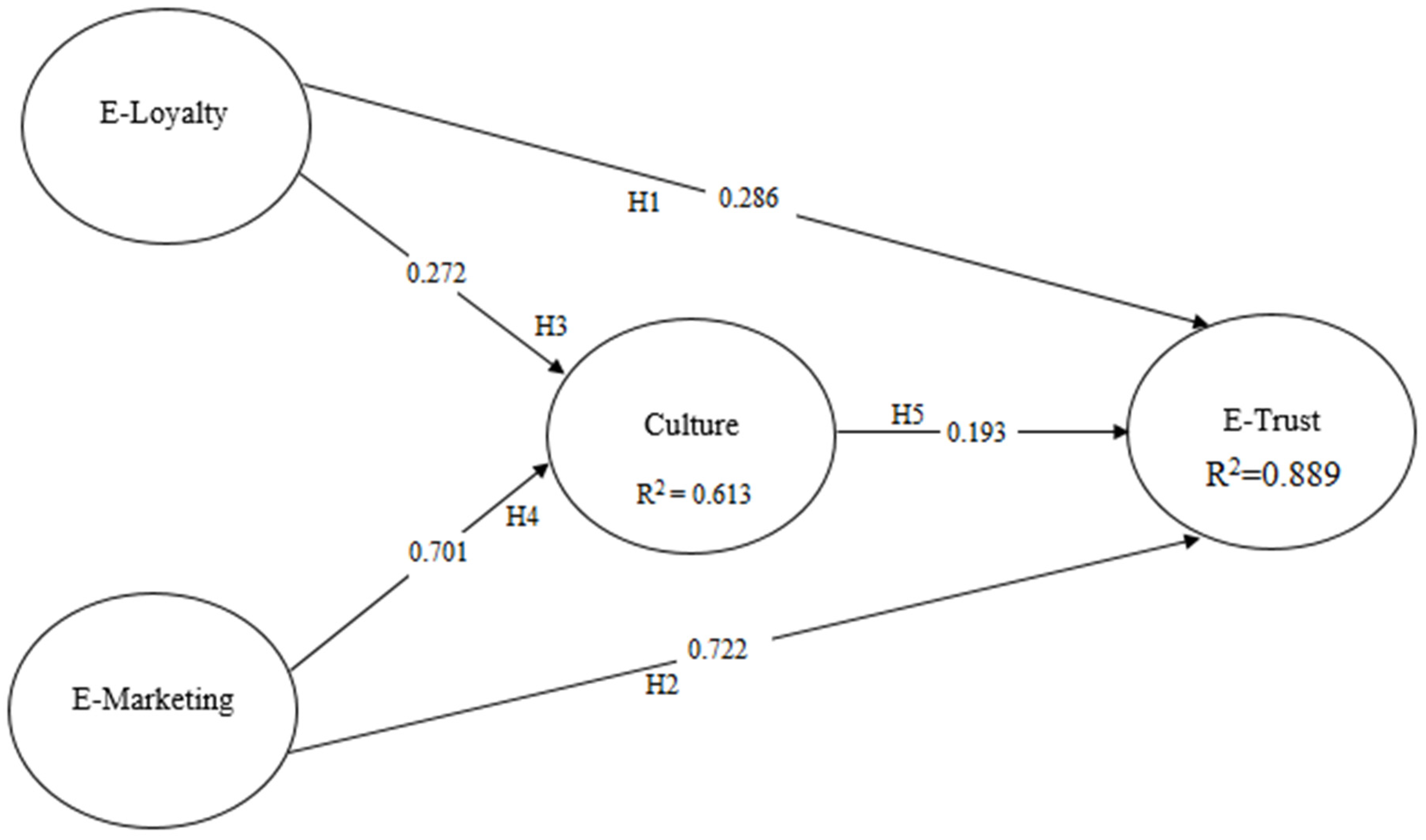
Table 1.
Demographic Information.
| Variables | Category | Frequency | Percentage |
|---|---|---|---|
| Gender | Male | 312 | 74.5 |
| Female | 107 | 25.5 | |
| Age | 25-30 | 119 | 28.4 |
| 31-36 | 181 | 43.2 | |
| 36 and above | 119 | 28.4 | |
| Experience | Less than 3 years | 185 | 44.2 |
| 4-6 years | 138 | 32.9 | |
| 7-9 years | 54 | 12.9 | |
| 10-12 years | 25 | 6.0 | |
| Above 12 years | 17 | 4.0 | |
| Education | Graduation (14 years) | 48 | 11.5 |
| Master | 306 | 73.0 | |
| PhD. | 65 | 15.5 |
Table 2.
Reliability test.
| Reliability test | ||
|---|---|---|
| Items | Cronbach's alpha | |
| Culture | 6 | 0.888 |
| E-Marketing | 7 | 0.894 |
| E-Trust | 5 | 0.892 |
| E-Loyalty | 6 | 0.89 |
Table 3.
Mediation Analysis Results.
| Hypothesis | Relationship | β | t-value | p-value | CI | Decision | |
|---|---|---|---|---|---|---|---|
| 5% | 95% | ||||||
| H3 | E-Loyalty->CL->ET | 0.272 | 2.297 | 0.000 | 0.069 | 0.32 | Supported |
| H4 | E-Marketing->CL->ET | 0.701 | 3.843 | 0.000 | 0.045 | 0.67 | Supported |
Note: Sig at: p < 0.05, EL: E-Loyalty, ET: E-Trust, EM: E-Marketing, CL: Culture, β: beta, CI: Confidence Interval.
Disclaimer/Publisher’s Note: The statements, opinions and data contained in all publications are solely those of the individual author(s) and contributor(s) and not of MDPI and/or the editor(s). MDPI and/or the editor(s) disclaim responsibility for any injury to people or property resulting from any ideas, methods, instructions or products referred to in the content. |
© 2023 by the authors. Licensee MDPI, Basel, Switzerland. This article is an open access article distributed under the terms and conditions of the Creative Commons Attribution (CC BY) license (http://creativecommons.org/licenses/by/4.0/).
Copyright: This open access article is published under a Creative Commons CC BY 4.0 license, which permit the free download, distribution, and reuse, provided that the author and preprint are cited in any reuse.


