
Submitted:
29 August 2023
Posted:
30 August 2023
You are already at the latest version
Abstract
With the realization of the Grand Canal's full water supply and the strong pursuit of green and low-carbon transportation in contemporary society, the value of the Grand Canal's water transport has been further affirmed, and its coordinated development with other transportation modes has become inevitable and important. This paper analyzes and combs through the characteristics, development status and existing problems of Grand Canal water transport and other transport modes in depth, and takes Jiangsu as an example. A collaboration model of Grand Canal water transport and other transport modes was built and their collaboration degree has been calculated. It is believed that the coordinated development of Grand Canal water transport and other transport modes can be greatly promoted via four aspects: optimizing the construction and governance of Grand Canal water transport, building an integrated management platform of transport modes, improving the integrated transport network structure, and promoting the deep integration of integrated shipping and tourism.
Keywords:
Grand Canal water transport
; transportation mode
; collaborative development
1. Introduction
Transportation plays a fundamental supporting role in the national economy, and the report of the 19th National Congress of the Communist Party of China clearly puts forward the requirement of a transportation power. With the development of social economy, modern transportation modes are becoming more and more abundant, and can be predominately divided into five types: railway transportation, highway transportation, waterway transportation, air transportation and pipeline transportation. Each transportation mode has its own characteristics, advantages and disadvantages. Compared with other modes of transportation, waterways have the advantages of saving investments, occupying less land, having a large transportation capacity, a low freight rate, low energy consumption, little pollution, safety and reliability, and improving the comprehensive utilization rate of water resources [1]. Other modes of transportation have shown strong advantages in efficiency and convenience, which has caused China's water transportation status to decline in recent years(Figure 1). However, under the new situation characterized by green, low-carbon and sustainable development, accelerating the development and upgrading the status of water transport have become basic characteristics of China's resource factor endowment and the objective requirements of China's national economic and social sustainable development. At the same time, against the background of the digital economy and the new development pattern, improving the status of inland water transport and its coordinated development with other modes of transportation is an urgent concern.
2. Research Issues and Literature Review
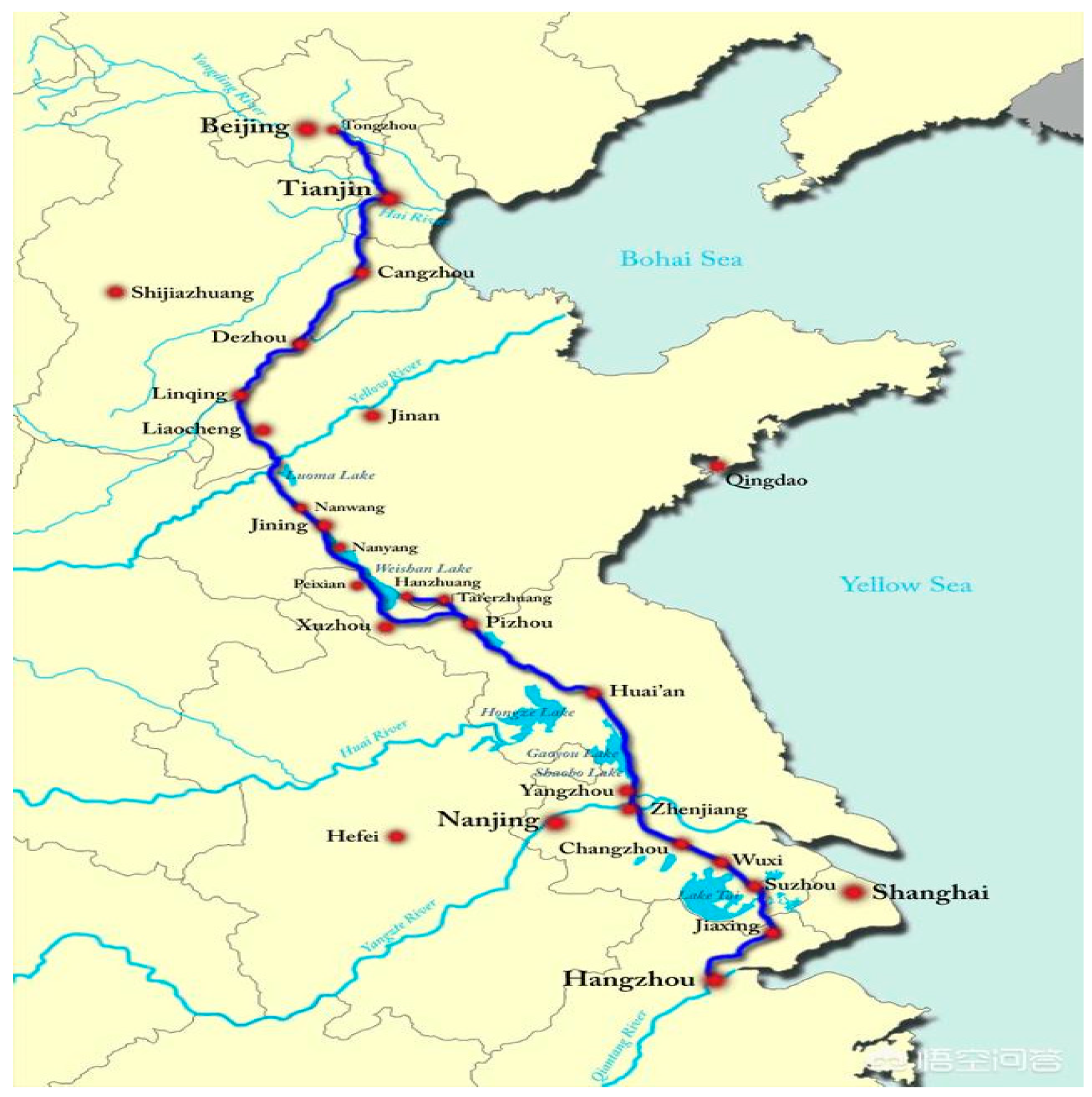
China's Grand Canal, at a total length of about 1,800 kilometers, spans more than 10 latitudes, connects five major water systems, connects six provinces (municipalities directly under the Central Government) to several cities and is an important representative of inland rivers (Figure 2). Therefore, the water transport mode of the Grand Canal occupies an important position in waterway transportation and is an important part of the modern transportation system. Its coordination with other modes of transportation is crucial in the comprehensive and coordinated development of all modern transportation modes, and strategic research on promoting the coordinated development of the Grand Canal and other modes of transportation has important theoretical and practical value. Keywords such as Grand Canal water transport, transportation and mode coordination were searched in CNKI, Wanfang and other databases, and the results sorted, and the related literature mostly focused on three aspects: the development history of Grand Canal water transport, the improvement of canal water transport quality and the study of comprehensive transportation systems.
Research on the development history of water transport in the Grand Canal has shown that the excavation of the Grand Canal promoted the development of the coastal economy, which linked the early Central Plains with the Maritime Silk Road, enabling the Central Plains, which are deep in the hinterland of the mainland, to communicate with foreign countries in many ways. Fei Xiaotong[2] thinks that the east of the canal is only 80 kilometers away from the sea, where the canal and the Yellow River form the main trunk, and the rivers are vertical and horizontal, forming a water network area like Jiangnan today, in which the canal plays the role of the north–south transportation artery. Scholars in Taiwan Province, China, began their research on water transportation in the Grand Canal, including the history of water transportation, the water transportation system, sailors' transportation, etc., as well as commercial and economic issues, and paid attention to drawing arguments from the textual research of classical documents. Japanese scholars have carried out good empirical research on the Canal. For example, Yoshisaka Masayoshi [3] documentary evidence studies the material circulation of the Grand Canal in the Qing Dynasty, centering on Huai 'an Pass in the Qianlong period. Some Japanese scholars have also paid attention to the important role of the Grand Canal as a waterway artery in the development of towns and the commodity economy south of the Yangtze River in the Ming and Qing Dynasties. For example, Chuan Shengshou (2009)[4] thinks that the development of the Grand Canal circulation had an important relationship with the formation of a huge urban chain. In the Qing Dynasty and the Republic of China, with the rise of new modes of transportation such as shipping and railways, the status of the canal in society declined greatly, but it still attracted the attention of many researchers (Liu Xuan, 2016)[5]. Zhang Hongli (2018)[6] commented on "Research on the History of Inland Waterway in Qing Dynasty", and thought that this monograph on the history of water transport in the Qing Dynasty focused on exploring the shipping situation of Chinese sailboats in the Grand Canal and the Yangtze River, the route selection, and its promoting role in regional social economy.
Research on the improvement of canal water transport quality has shown that shipping is the origin and soul of the Grand Canal culture, and the modernization of inland waterway transportation has achieved remarkable results[7-9]. Against the background of the construction of the Grand Canal Cultural Belt, Wang Can[10] and others proposed that the development of Zhejiang inland water transport should be combined with protection and inheritance, ecological green factors, cultural tourism and industrial transformation, and put forward the strategy of the high-quality development of Zhejiang inland water transport, scientifically dividing the protection and utilization space of the Grand Canal Cultural Belt, developing ecological green shipping, promoting the intensive utilization of resources, improving the water passenger transport system, boosting the development of cultural tourism, promoting the Huzhou inland water transport demonstration zone, and promoting the transformation and upgrading of inland water transport (Wang Can,2020). Although Jiangsu has entered a new stage of taking the lead in exploring transportation modernization and promoting the construction of the transportation modernization demonstration zone in the new era, inland river shipping is still a shortcoming of the comprehensive transportation system. Li Wei (2022)[11] and others analyzed the current development status and existing problems of inland river shipping in Jiangsu, deeply studied the requirements of the new era and new situation for the development of inland river shipping, analyzed the connotations of the high-quality development of inland river shipping, and put forward paths and countermeasures for the high-quality development of inland river shipping in Jiangsu in the new era, so as to provide references for accelerating the establishment of a modern inland river shipping system.
Research on comprehensive transportation systems has shown that, at present, the main domestic express logistics transportation mode is via road transportation, but it is gradually tending to combine various transportation modes, such as aviation, waterways and the railway, and is beginning to explore the coordinated operation of transportation modes under the "new multimodal transport"[12-14]. For example, on October 20, 2016, the China Railway Corporation announced that it would trial the high-speed rail express service in 505 cities where all high-speed trains stopped in China. The service produced covered business documents, e-commerce parcels, etc., with the basic goal of realizing an express delivery network with full coverage of municipalities directly under the central government, provincial capital cities, prefecture-level cities in the central and eastern regions and economically developed counties. Zhang Xin[15] and others believe that promoting the low-carbon development of the transportation industry is an important aspect of the structural reform of the supply side of the transportation industry and is a systematic and strategic consideration for solving many problems in China's transportation industry. Therefore, we should adhere to the development concept of "comprehensive transportation, green transportation, smart transportation and safe transportation", and adopt specific measures to realize the low-carbon development of the transportation system from key areas of low-carbon transportation development such as infrastructure, transportation equipment, public transportation services, road freight transportation, intelligent transportation and traffic governance capacity building[16]. A comprehensive transportation system refers to a transportation complex with divisions of labor, cooperation, organic combination, a reasonable layout and connections according to the unified transportation process, combined with its own technical and economic characteristics (Han Feng, 2008)[17].
Generally speaking, combined with the demands and trends in the history of canal water transportation, the high-quality development of canal water transportation and the construction of a comprehensive transportation system, promoting the coordinated development of canal water transportation and other modes of transportation is related to resource allocation among various modes of transportation (transportation structure problems) and resource allocation within various modes of transportation (transportation organization problems), so we should pay attention to the complementary advantages and organic combination of various modes of transportation[18]. Focusing on the allocation and optimization of transportation resources of various modes of transportation, promoting the coordinated development of various modes of transportation and ensuring the improvement of the overall operation efficiency of the transportation system are important considerations to enhance the contemporary water transport value of the Grand Canal and are important topics worthy of in-depth study.
3. Status and Problem Analysis
3.1. The Characteristics, Present Situation and Problems of the Grand Canal Water Transport
Water transportation has unique advantages of large volume capacity, long distance, low energy consumption, low cost and less pollution, and is the most resource-saving and environmentally friendly transportation mode. Waterways and ports are the most important infrastructure features of water transport; the waterway provides the basic transport conditions and the port is the hub or node to realize transportation, and the two are interdependent, complementary and mutually promoting. At present, the layout of inland water transportation in China is built around the Yangtze River, Pearl River, Beijing-Hangzhou Canal, Huaihe River, Heilongjiang River and Songliao River as the main bodies. Among them, the Beijing–Hangzhou Canal has become the water transport artery for "transporting coal from the north to the south" in China, and there are ports such as Tianjin Port, Linqing Port, Jining Port, Tengzhou Port, Xuzhou Port, Huai 'an Port, Yangzhou Port and other large and small terminals on this artery. By 2019, there were 18 national development zones on both sides of the Jiangsu section of the Beijing–Hangzhou Canal. The total GDP of the eight cities along the route has accounted for more than two-thirds of the province for several consecutive years, and the freight volume has reached 480 million tons, accounting for about 80% of the total freight volume of the Beijing–Hangzhou Canal, which is more than twice that of the Rhine River; this has supported the economic and social development of the areas along the canal. According to the statistics of Jiangsu Provincial Department of Transportation[19], from January to May 2021 the container throughput of Huai 'an Port increased by more than 50% year-on-year, and it continued to rank first in Jiangsu's inland rivers and at the forefront of the country. The leading position of the Huaihe Ecological Economic Belt and the hub port of the Beijing–Hangzhou Grand Canal was further consolidated. Huai' an Xingang has also built the first 5G industry application base station in the inland river port in China, taking the lead in realizing 5G independent networking in Jiangsu; 16 multimodal transport routes have been opened successively. As early as the Eleventh Five-Year Plan period, the state put forward the goal of giving full play to the advantages of inland waterway transportation, strengthening the effective connection with other modes of transportation, improving the development of the comprehensive transportation system and improving the efficiency of resource utilization.
Green, modern shipping on the Beijing–Hangzhou Canal is people-oriented, emphasizing humanistic development and integrated development. For people, first, the environment along the river is more open and beautiful. We have selected typical green and modern flight segments and important nodes in various cities to create facilities such as hydrophilic platforms, landscape sketches, eco-tourism and canal cultural signs along the waterway to enhance the shipping environment along the river. Second, the characteristics of shipping culture have become more prominent. Combined with canal culture and brand creation, supporting shipping exhibitions, gate history exhibitions and popular science experience tour facilities will be planned in the lock gate area, anchorage and service areas along the line, and a lock experience tour, a shipping culture museum and a shipping culture tourist area will be created, which will be open to the public.
Green, modern shipping on the Beijing–Hangzhou Canal highlights the development of wisdom and gathers strength to improve the quality of shipping services. In the future, boat people can not only improve the beautiful environment along the route, but also realize the following benefits. First, transportation will be faster. Through the improvement of channel conditions and the improvement in the port energy level, the sailing speed will be improved, the loading and unloading time will be reduced, and the popularization and application of the convenient gate crossing system will enable the crew to complete gate crossing online without going ashore, further improving the efficiency of shipping services. Second, the service will be more intelligent. By improving the inland waterway public information service platform, the crew can be provided with infrastructure information on the waterway, lock and water service area, and at the same time the release of dynamic information such as ship positioning, electronic navigation and freight information can be realized, so as to enable the crew to obtain all kinds of shipping information in time. Third, the benefits will be more significant. Through the standardized development of ships and the use of clean energy, as well as efficient transportation organization and the policy guidance of revolving water, the transportation market of water transportation will become larger and the actual load rate will be higher, which can further reduce the operating costs of ships and enhance the comprehensive transportation benefits.
Although the Grand Canal has been opened to the whole line, there are still some shortcomings in its construction and management. Firstly, the construction of shipping infrastructure needs to be further improved; the channel depth has not yet completely reached 12.5 meters, and the whole line of navigation has not been fully realized. In terms of port construction, at present, the scale of the ports on the Grand Canal is generally small, and the coordination with other land ports is also obviously insufficient. Secondly, the operational structure cannot adapt to the development of a modern shipping system, and the operational scale of transportation enterprises is small, lacking market competitiveness and risk resistance. In 2020, the average tonnage of cargo ships in the Yangtze River trunk line was 1960 tons, and the average tonnage of ships in the entire Beijing–Hangzhou Grand Canal was about 1000 tons. Finally, the level of integration is not yet sufficient. On the one hand, there are people from all walks of life who have low awareness of the Grand Canal shipping, and the potential and efficiency of the Grand Canal have not been fully established. On the other hand, in current comprehensive transportation, the local transportation demand is still dominated by roads, and the important support and driving role of shipping in regional economic and social development has not been effectively estimated.
3.2. Characteristics, Present Situation and Problems of Other Transportation Modes
Highway transportation is a mode of transportation for transporting passengers and goods on the highway, and it is one of the components of the transportation system. It mainly involves short-distance passenger and cargo transportation. Its main features include strong adaptability, direct transportation, fast transportation speed, quick capital turnover, an easy mastery of technology, low safety, poor continuity and a small traffic volume. The modes of transportation mainly include container truck transportation, heavy goods transportation, express goods transportation, taxi transportation, moving goods transportation and dangerous goods transportation. By May 2022, China's road freight volume had exceeded 14.3 billion tons, and the cargo turnover had reached 2.65 trillion tons-kilometers. During the same period, the total number of road passengers reached 1.5 billion, and the passenger turnover exceeded 97.5 billion person-kilometers[19].
Railway freight transportation is one of the main modes of modern transportation, and it is also one of the two basic modes of land freight transportation. It occupies an important position in the whole transportation field and plays an increasingly important role. It is characterized by large transportation capacity, high speed and low cost, and is generally not limited by climatic conditions. It is suitable for the long-distance transportation of bulk and bulky goods, where it is unmatched by road and air transportation modes. The national railway mileage has reached 150,000 kilometers, including 40,000 kilometers for high-speed railway, with 59.5% for double track and 73.3% for electrification; 61,000 kilometers for the western railway; 156.7 kilometers/10,000 square kilometers for the national railway; and 131,000 kilometers for the national railway, with 61.9% for double track and 75.4% for electrification. In terms of passenger transport, the national railway passenger transport volume reached 2.612 billion, an increase of 408 million, or 18.5% over the previous year, of which 2.533 billion was from the national railways, an increase of 16.9% over the previous year, and the national railway passenger turnover reached 956.781 billion person-kilometers, an increase of 130.162 billion person-kilometers, or 15.7% over the previous year, of which 955.53 billion was from the national railways. In terms of cargo transportation, the total volume of railway freight transportation in China was 4.774 billion tons, an increase of 221 million tons or 4.9% over the previous year, of which 3.726 billion tons were from national railways, an increase of 4% over the previous year, and the total turnover of railway freight transport in China was 3,323.8 million tons kilometers, an increase of 272.354 billion tons kilometers or 8.9% over the previous year, of which 2,995.001 billion tons kilometers were from national railways. In terms of energy conservation and emission reduction, comprehensive energy consumption and the emissions of major pollutants have declined[19].
Air transportation is a mode of transportation that uses airplanes, helicopters and other aircraft to transport people, goods and mail. It is fast and mobile, which are important factors in modern passenger transport, especially for long-distance passenger transport, and indispensable for the transport of valuables, fresh goods and precision instruments in international trade. The characteristics of air transport include commodity, service, international, paramilitary, capital, technology, risk intensity and natural monopoly. Due to the international economic downturn in the past two years, the air transportation industry has encountered bottlenecks, but it has still seen increases in cargo and mail transportation. In 2021, the whole industry undertook 7,318,400 tons of cargo and mail transportation, an increase of 8.2% over the previous year. Domestic routes undertook 4,651,400 tons of cargo and mail traffic, an increase of 2.6% over the previous year, of which Hong Kong, Macao and Taiwan routes undertook 189,900 tons, an increase of 8.0% over the previous year; The cargo and mail transportation volume of international routes was 2,667,000 tons, up by 19.6% over the previous year[19].
Pipeline transportation is a long-distance transportation mode of liquid and gas materials using pipelines as transportation tools, and it is a special transportation mode for transporting oil, coal and chemical products from the production place to the market. Among the five modes of transportation, pipeline transportation has unique advantages. In construction, compared with railways, highways and aviation, the investment is much lower. Moreover, for oil transportation with flammable characteristics, pipeline transportation is more safe and airtight, and it can also provide continuous transportation. Generally speaking, pipeline transportation has characteristics of large volume, small land occupation, short construction periods, low cost, high safety, strong continuity, low energy consumption, strong specificity, poor flexibility, large fixed investment and strong franchise.
To sum up, all kinds of transportation modes have their advantages and disadvantages and their scopes of application, but there are still shortcomings in development: firstly, the layout planning of dry ports lacks overall coordination; secondly, the logistics facilities in dry ports are small in scale, simple in function and lower in value-added services; finally, there are some small imbalances between operating parties. In view of the requirements of green transportation and low-carbon transportation in the current high-quality development of transportation, it is necessary to further strengthen the integrated development of transportation modes in order to realize complementary advantages.
4. Selection of Evaluation Methods
This paper intends to use AHP and fuzzy mathematics to evaluate the business model of e-commerce industrial parks based on ecosystems. First of all, using the judgment matrix in AHP can solve the problem of the specific weight of evaluation indicators not being clearly defined. Secondly, it is generally difficult to give a definite score when evaluating the business model of e-commerce industrial parks. Using fuzzy mathematics, the score can be limited to a certain range, which can make the evaluation more reasonable.
5. Jiangsu Grand Canal Water Transport and Other Transportation Modes: Synergy Evaluation
According to synergy, this paper defines the coordination degree of transportation modes as the degree to which the five modes of transportation, namely railway, highway, aviation, Grand Canal water transport and other water transport, cooperate and unify with each other by means of adjusting structure, updating technology and strengthening management.
5.1. Model
It is assumed that the sequence parameter variables of the transportation mode i represent five modes of transportation, , namely railway, highway, aviation, Grand Canal water transport and other water transport, eij∈. In this paper, the order parameter variables of different transportation modes are defined as the evaluation index of their synergy.
5.1.1. Define the Order Degree of the Order Parameter Component of Transportation Mode i::
The bigger the , the greater the contribution to the order of transportation mode i.
5.1.2. Define the Order Degree of Transportation Mode i:
5.1.3. Define the Coordination Degree of Transportation Modes in the Year t:
The greater the , the higher the degree of coordination for the transportation system, and vice versa. Based on the above definition, the evaluation model of the transportation system synergy is constructed, and the steps are as follows:
Arrange the annual index values of the transportation mode i in time series to form a decision matrix :
- 。
- There, is the value of index j in year t, .
- Standardize:
- , is the standardized data and represents the average value of index j; means that the standard deviation of index j.
- Calculate the weight of index j of transportation mode i: :
- 。
- There, represent five modes of transportation, namely railway, highway, aviation, Grand Canal water transport and other water transport, and means the correlation coefficients of evaluation index k and evaluation index j,
- Normalize and obtain :
- .
- is the system order degree of the order parameter component of the transportation mode i.
- Calculate the order degree of the transportation mode i in year t; .
- .
- Calculate the coordination degree of the whole transportation system in year t: .
5.2. Evaluation Indicators of Various Modes of Transportation
5.2.1. Freight Volume
The freight volume of different modes of transportation can be used to reflect part of the collaborative contribution of this mode of transportation. Relevant data can be obtained from the Jiangsu Statistical Yearbook[19].
5.2.2. Matching Degree of Transportation Supply and Demand
The passenger traffic volume of different modes of transportation can also be used to reflect part of the collaborative contribution of this mode of transportation. Relevant data can be obtained from the Jiangsu Statistical Yearbook[19].
5.2.3. Passenger Traffic Volume
The exponential smoothing method is used to obtain the data of freight and passenger demand of various modes of transportation in Jiangsu Province from 2014 to 2018, and then the ratio of actual data to demand forecast data is taken as the matching degree of transportation supply and demand[19].
5.3. Evaluation Results
Due to the outbreak of epidemic in 2019, the data have changed greatly. This paper only calculates the coordination degree of various modes of transportation and the coordination degree of the whole transportation system in Jiangsu Province from 2014 to 2018, using MATLAB software. The calculation results show that the Grand Canal water transport has a place in the transportation system of Jiangsu Province, which has certain synergy value in freight transportation, but there is still much room for improvement, while the coordination degree in passenger transportation is very low; this is related to the construction of the Grand Canal cultural belt, and also has some room for improvement.
6. Integration Development Countermeasures
The collaborative development of multiple modes of transportation can be divided into two aspects: horizontal and vertical. Horizontal collaboration mainly refers to the collaboration of different modes of transportation in different transportation batches, and its main influencing factors include the characteristics of transportation objects, transportation requirements, the matching of transportation modes, the transportation capacity of transportation enterprises and the selection preferences of transportation consignors. Vertical coordination refers to the coordination of different modes of transportation in the same transportation batch, and its influencing factors mainly include the distance from the origin to the destination, the terrain, optional modes of transportation and the docking ability of carriers with different modes of transportation. Based on the research results of the content and influencing factors on the coordinated development of the Grand Canal water transport and other modes of transport, and focusing on the problems existing in the current coordinated development of the Grand Canal water transport and other modes of transport, this paper puts forward relevant countermeasures and suggestions with the five main objectives of improving the comprehensive transport effect, enhancing the comprehensive transport efficiency, improving the comprehensive transport safety level, reducing the comprehensive transport cost and reducing the comprehensive transport loss.
6.1. Optimizing the Construction and Management of the Grand Canal Waterway
Optimizing the construction and management of the Grand Canal waterway basically includes seven links. First, the waterway grade to meet the needs of regional and hinterland economic development should be scientifically and reasonably determined. Second, we small, scattered and weak ports should be further reduced, regional port integration should be promoted, hub ports should be developed, the construction of collection and distribution systems should be strengthened and the level of port capital operation and intelligent development should be improved. Third, to vigorously promote the standardization of ship types and further effectively connect with shipping elements such as waterways and docks. Fourth, to constantly improve the institutional system, strengthen the construction of laws, regulations, standards and norms and enhance the capacity and level of canal water transport development and management. Fifth, to promote the standardized development and intensive management of shipping enterprises and encourage them to become bigger and stronger. Sixth, to further strengthen the construction of the crew, study and promote the professional development of the crew, improve the crew’s education and training system and implement a series of measures to provide reliable and stable crew protection for the development of water transport. Seventh, to promote the development of green water transport, promote the use of shore power by ships berthing at port, develop clean energy and further strengthen the organic combination of waterway construction and ecological environment.
The development of green water transport is particularly important, and it is related to whether the advantages of water transport can be highlighted effectively compared with other modes of transportation. The concept of saving resources and protecting the environment runs through the whole process of planning, design, construction, maintenance and operation of canal water transport. This involves optimizing the design of water transport construction projects, improving process equipment and reducing energy consumption and pollution emissions in construction and production links. It also covers the strict implementation of environmental impact assessments of construction projects, the simultaneous construction of environmental protection facilities and the protection of drinking water sources, aquatic nature reserves and key habitats according to law. We will promote the technical transformation of "replacing oil with electricity" for tire gantry cranes in container terminals, promote the use of energy-efficient port loading and unloading and transmission equipment and carry out special actions to connect ships arriving in Hong Kong to shore power. We will strengthen the control of pollution from ships' mobile sources, install facilities for treating oil pollution (or storing), collect domestic sewage and garbage on new transport ships in the canal, renovate existing passenger ships (including truck ro-ro ships) in key waters and equip them with relevant facilities and build a monitoring system for ship pollution. We will also establish an emergency response mechanism for canal water transport pollution accidents and equip them with pollution treatment equipment. The water service area of the canal will be built, and the service area and port will be equipped with onshore receiving and treatment facilities for ship domestic garbage and oily sewage. It is important to encourage the scrapping or updating of old transport ships and single-hull tankers, and to accelerate the elimination of ships with high energy consumption, high pollution and low performance.
6.2. Building a Platform for Integrated Management of Transportation Modes
Regardless of horizontal or vertical coordination, the integrated development of transportation modes requires the construction of a unified management platform. The unified information management platform will be attended by platform builders, operators and carriers; will involve the selection and combination of transportation modes such as canal water transportation, other inland water transportation, sea transportation, road transportation, railway transportation, air transportation and pipeline transportation, as well as the management of transportation tools, the provisions of rights and obligations of participating entities, etc.; and can be divided into two modules: passenger transportation and freight transportation. At present, the new technology represented by blockchain is showing more and more outstanding performance in aspects of information storage, transmission and sharing, system affairs planning, scheduling and coordination, and intelligence, etc., and should be used emphatically in the integration and development of transportation modes. In addition, we will vigorously develop modern comprehensive shipping services such as shipping transaction, consultations, information services, finance and insurance; cultivate representative enterprises in the industry; guide small- and medium-sized shipping enterprises to develop intensively and on a large scale; actively promote the large-scale and intensive management of dangerous goods transportation; and attract shipping to enter the platform and participate in the coordinated development of transportation modes.
6.3. Optimize the Structure of the Comprehensive Transportation Network
A good traffic network structure can highlight advantages in terms of transportation quality indicators such as capital saving and time saving. First of all, we should promote the corporatization of canal shipping, promote the development of water passenger transport in the direction of tourism, comfort and passenger rolling, and improve the service quality of passenger transportation. Secondly, we should improve the river–sea and trunk–branch transportation service networks, and river–sea transshipment, and form a pattern of complementary and coordinated development of direct and transshipment. Thirdly, we should strengthen effective connections with other modes of transportation and promote the construction of a comprehensive transportation system, and vigorously develop multimodal transport and actively promote the water–rail transport of containers and bulk goods, and then port and shipping enterprises will be encouraged to extend the industrial chain, expand service functions such as warehousing, distribution, logistics, etc., and transform into logistics operators, promoting the effective docking and linkage development of ports and bonded port areas, bonded zones, logistics parks and port-adjacent industrial parks, and effectively reducing logistics costs. Finally, we should focus on strengthening the hub function and role of the comprehensive transportation ports. The "port" here can be an inland water port, a seaport, a dry port or an integrated land and water port. We will promote the reform of regional port integration and inter-provincial port cooperation in an orderly manner, strengthen the integration of port resources, promote the rational layout of terminals such as containers, coal, iron ore, commercial vehicles and tourist passenger transport, and enhance the specialization, scale and service capacity of ports. We should strengthen the construction of railway facilities for port collection and distribution, and promote all major ports to realize railway entry. We will promote the improvement of the port collection and distribution highway system, focus on solving the bottleneck problem of the development of port-based highways in urban sections and promote the effective connection of traffic networks along the river, with major ports as nodes. We should strengthen the linkage between ports along the river and coastal ports, water ports and dry ports, and promote the effective connection between canal shipping and other modes of transportation.
6.4. Promote the Deep Integration of Comprehensive Shipping and Tourism
In recent years, people have paid close attention to the culture of the Grand Canal, and tourism in the Grand Canal and the cities along it is popular and valuable. The necessity and feasibility of the deep integration of comprehensive shipping and tourism are reflected highly by people sightseeing and visiting the scenery of the Grand Canal and the cities along the canal by means of water transportation. To promote the deep integration of comprehensive shipping and tourism, firstly, it is necessary to improve the passenger service functions of ports along major canals, enrich cruise tourism products, formulate service standards and improve service quality, which can further promote the development of cruise tourism. Secondly, it is necessary to deepen the online ticketing of waterway passenger transport along the canal and improve the application of electronic ship tickets, the electronic ticketing of scenic spots along the canal and the docking of land passenger transport flights and waterway passenger ships, and strengthen the docking and sharing of traffic and tourism information. This is not only an important strategy to promote the effective and coordinated development of the Grand Canal water transport and other modes of transport, but also reflects the mutual promotion and integration effect between industries.
7. Conclusions
As early as the Eleventh Five-Year Plan period, the state proposed to give full play to the advantages of inland waterway transportation, to strengthen the effective connection with other modes of transportation, to improve the development of a comprehensive transportation system and to improve the efficiency of resource utilization. The integrated development of the Grand Canal waterway and other modes of transportation can not only effectively use inland waterways, but also promote the further realization of green and low-carbon goals of transportation. It can also give full play to the advantages of other modes of transportation, such as roads, railways, aviation and pipelines, and realize the complementary advantages among the modes of transportation. It is also an important adhesive in the process of integration between transportation and other industries, including tourism.
Author Contributions
For this article, with three authors, individual contributions were as follows: conceptualization, Fang Ling and Yao Guanxin; methodology, Fang Ling and Cheng Xin; software, Cheng Xin; validation, Fang Ling and Yao Guanxin; formal analysis, Fang Ling; investigation, Fang Ling; resources, Fang Ling and Cheng Xin; data curation, Fang Ling; writing—original draft preparation, Fang Ling; writing—review and editing, Fang Ling; visualization, Fang Ling; supervision, Fang Ling; project administration, Fang Ling; funding acquisition, Cheng Xin. All authors have read and agreed to the published version of the manuscript.
Funding
This research was funded by NSFC, grant number 72103178, by the opening project of the China Grand Canal Research Institute in 2022 and by postdoctoral research funding.
Data Availability Statement
Some relevant data can be obtained from the Jiangsu Statistical Yearbook, and some new data were created as follows: firstly, we obtained the data of freight and passenger demand of various modes of transportation in Jiangsu Province from 2014 to 2018, and then the ratio of actual data to demand forecast data was taken as the matching degree of transportation supply and demand.
Conflicts of Interest
The authors declare no conflict of interest.
References
- Yu, D. Evaluation Index System of Comparative Advantage of Waterway Transport. Transport Research, 2018, 4, 1–6. [Google Scholar]
- Fei, X. Selected Works of Fei Xiaotong [M]. Beijing: Capital Normal University Press, 2008.
- Yoshisaka, M. The Material Circulation of the Grand Canal in Qing Dynasty-During the Qianlong Period, the Guan Center in Huai 'an. History and Geography No.15, Essays of Northeastern University.
- Chuan, S. Gongna system in Ming and Qing Dynasties と a huge metropolitan chain: the Yangtze River と the Grand Canal[M]. Tokyo: Jigu Academy, 2009.
- Liu, X. Review of overseas research on the Grand Canal since Ming and Qing Dynasties. Journal of Liaocheng University (Social Science Edition), 2016, 2. [Google Scholar]
- Zhang, H. Sailing boats in inland rivers of China. Journal of Suihua University, 2018, 38, 154–157. [Google Scholar]
- Pan, H.; Wu, X.; Liu, X.; et al. High quality development ideas for domestic water transportation in the new era. Water Transportation Engineering 2021, 14–19. [Google Scholar]
- Li, H. Promoting high-quality development of inland ports in Jiangsu under new circumstances. Water Transport Management, 2019, 41, 7–9. [Google Scholar]
- Xu, G. High quality development of Yangtze River Delta integration and high-level promotion of port and waterway intelligence. Navigation 2019, 3–6. [Google Scholar]
- Wang, C. High-quality development strategy of inland waterway transportation in Zhejiang under the Grand Canal culture. China Waterway, 2020, 6, 15–17. [Google Scholar]
- Li, W. High-quality development path and countermeasures of Jiangsu inland shipping in the new era. China Waterway, 2022, 2, 17–19. [Google Scholar]
- Zhao, R.; Xie, X.; Wei, Z.; et al. Quantitative Analysis and Comparison of Energy Conservation and Emission Reduction in Highway and Waterway Transportation. Transportation Energy Conservation and Environmental Protection, 2017, 13, 46–50. [Google Scholar]
- Zhang, C. Comparison and Development Analysis of Energy Transport Modes in China. Chemical Management, 2014, 208. [Google Scholar]
- Kuang, Y.; Huang, Y. Comparative advantages and competitive pattern analysis of the main transportation modes in the Yangtze River Economic Belt. Logistics Technology, 2015, 34, 67–70. [Google Scholar]
- Zhang, X.; Zhang, Y.; Zheng, X. Research on Low Carbon Transportation System Based on Supply Side Structural Reform. Journal of Beijing United University (Humanities and Social Sciences Edition), 2016, 14, 104–111. [Google Scholar]
- Zheng, Y. Advantages in the development of waterway transportation economy under a low-carbon economy. Economic and Trade Practice 2017, 57. [Google Scholar]
- Han, F. Building China's comprehensive transportation system based on railways. Railway Transport and Economy, 2008, 30, 20–22. [Google Scholar]
- Ge, J.; Yue, Q. Current Situation and Reflection on the Development of Jiangsu Water Transport. Transportation and Port and Shipping, 2018, 5, 78–81. [Google Scholar]
- Jiangsu Statistical Yearbook 2021.
Figure 1.
2013-2021 volume trend of Transport Modes of Jiangsu.
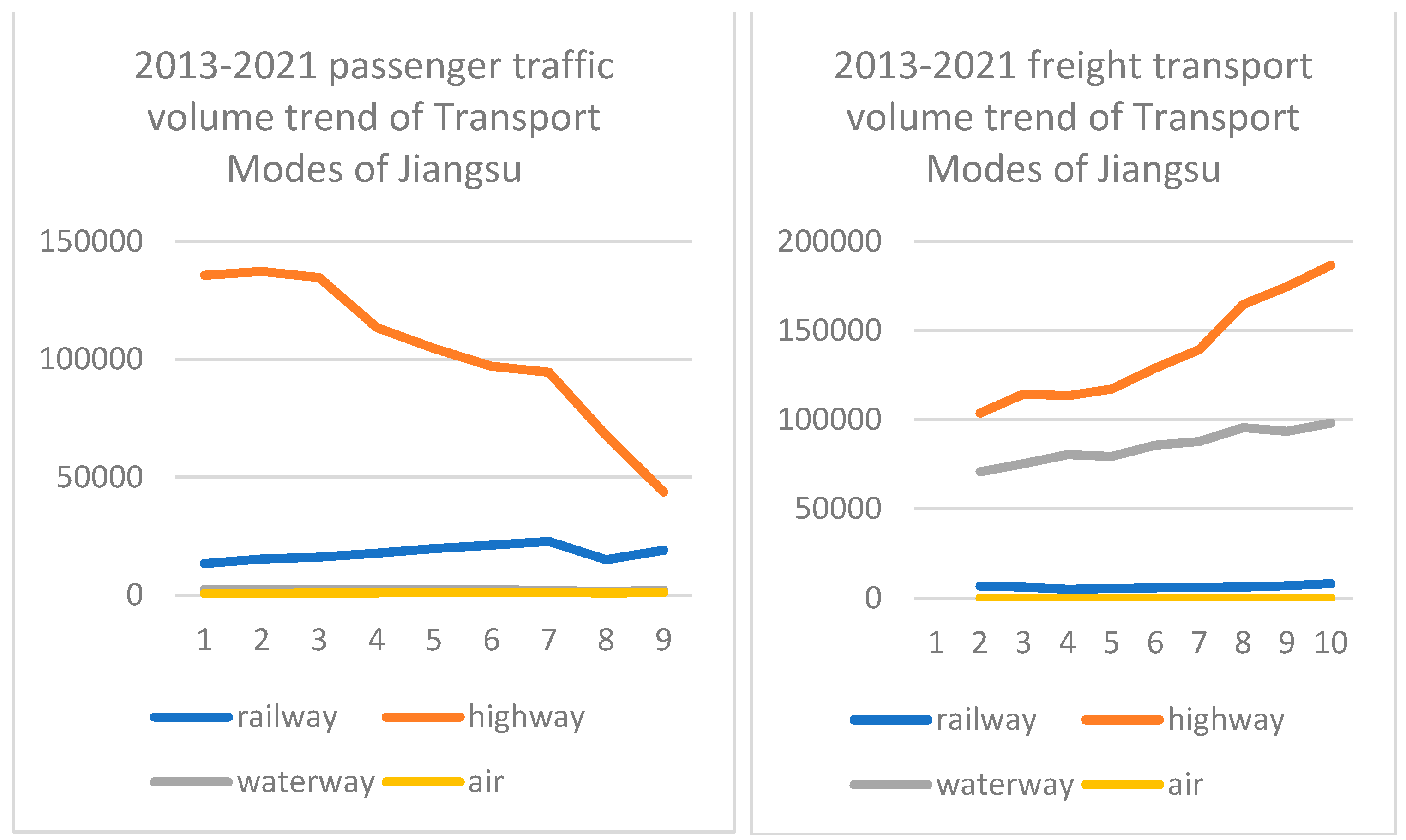
Figure 2.
the map of China's Grand Canal.
Disclaimer/Publisher’s Note: The statements, opinions and data contained in all publications are solely those of the individual author(s) and contributor(s) and not of MDPI and/or the editor(s). MDPI and/or the editor(s) disclaim responsibility for any injury to people or property resulting from any ideas, methods, instructions or products referred to in the content. |
© 2023 by the authors. Licensee MDPI, Basel, Switzerland. This article is an open access article distributed under the terms and conditions of the Creative Commons Attribution (CC BY) license (https://creativecommons.org/licenses/by/4.0/).
Copyright: This open access article is published under a Creative Commons CC BY 4.0 license, which permit the free download, distribution, and reuse, provided that the author and preprint are cited in any reuse.


