

Submitted:
26 August 2023
Posted:
29 August 2023
You are already at the latest version
Abstract
The purpose of this article is to present a multi-criteria model designed to evaluate the potential of Sincelejo's cultural identity for tourism development. A descriptive quantitative methodology was used, which included a survey of 211 participants. A decision support method was applied, using the Weighted Additive Sum approach, following the multi-attribute method. Based on the information gathered, the elements of cultural identity shared by most of the criteria were identi-fied, highlighting the gastronomic, social, and cultural traditions and customs of the region, the results of which made it possible to design a composite indicator to evaluate the tourism potential of cultural identity in the area.
Keywords:
cultural identity
; tourism development
; tourism
; attributes
; potential
; multi-attribute model
1. Introduction
Sincelejo, the capital of the department of Sucre, has historically been recognized for its agricultural and livestock focus, being known as the "Cebuísta Capital of Colombia" due to the quality of its beef cattle. However, despite this economic activity, the municipality faces social inequality and scarce opportunities, which limits its quality of life and favorable conditions. In view of this situation, tourism is presented as an alternative to promote the development and economic diversification of the region.
Considering that governments worldwide have recognized the potential of tourism as an opportunity to promote development and address local needs [1,2], it is essential to have a clear vision of the region's potential and particularities, taking advantage of the natural, cultural, and economic resources of the territory to position an attractive tourism offer.
According to the Municipal Mayor's Office of Sincelejo [3], culture is currently considered to achieve comprehensive, human, and equitable development, becoming a determining factor for community development. This perspective is supported by [4], who emphasize that culture has become the purpose of development, but to achieve it in practice it is necessary to have a clear knowledge of the dynamics, trends, strengths, and weaknesses of the sector and the cultural sphere. In this sense, in Sincelejo, tourism can play a crucial role in taking advantage of and promoting the cultural wealth and resources of the territory, thus contributing to the integral and equitable development of the region.
In this context, cultural identity acquires significant relevance as a prominent topic of discussion in disciplines such as archaeology, history, and anthropology. Since ancient times, experts in these fields have addressed cultural identity, generating debates that have questioned its meaning and key associated concepts [5,6,7,8,9,10,11].
In relation to Sincelejo, the analysis and understanding of cultural identity becomes crucial to enhance tourism and economic development in the region. By understanding and valuing the historical and cultural richness of the local community, tourism strategies can be designed that respect and promote its authenticity. Furthermore, by considering the debates and theoretical questions surrounding it, more solid and sensitive approaches can be generated for its preservation and promotion, ensuring that tourism is a tool for sustainable and equitable development for the community.
Consistent with the above, it is essential to keep in mind that the interpretation of a landscape or cultural object is not unique. Each person who observes them may have different perspectives based on his or her own interests, expectations, and fears. This implies that the image presented of the inhabitants of a region can be reinterpreted by those who observe it, even if they did not participate in its original creation [12]. In the context of tourism promotion and the preservation of cultural identity in Sincelejo, it is necessary to consider this multiplicity of interpretations and perspectives, thus allowing for a greater appreciation and understanding of the cultural richness of the region.
It is here where cultural identity plays an essential role in sustainable tourism development. According to [13], tourism management implies establishing multisectoral relations with key actors responsible for tourism resources, such as the environment, biodiversity, culture, and indigenous and native peoples. This requires the creation of instruments and mechanisms that facilitate joint actions oriented towards a common objective, seeking to generate wealth without damaging natural and cultural resources, promoting their conservation and protection.
Therefore, it is important to identify the factors that make up the cultural identity of Sincelejo as a regional city that includes the municipalities of Sampués, Corozal, and Morroa, which are in its area of influence and have similar characteristics. From this, we aim to design a multi-criteria model that allows their potential to generate sustainable tourism development to be measured.
1.1. Frame of reference
Studies carried out at international, national, and local levels allow us to understand the state of the question asked and the relevance of addressing this issue, as well as the problems that arise in the general context of the cultural identity of places and how this impacts their positioning, being considered attractive for tourism in each of its manifestations.
In the international arena, the authors of [14] analyzed Yogyakarta's cultural paradiplomacy using a descriptive–qualitative method and concluded that strategies such as visiting foreign territories, participating in international events, attending networks, and representation on behalf of the central government should be applied to disseminate its cultural identity. These strategies can be used as inspiration and a starting point to explore how to disseminate and promote Sincelejo's cultural identity in an effective and relevant way. It is important to adapt and adjust these ideas to the local context to ensure their relevance and applicability.
The authors in [15] analyzed the presentation of cultural identity at three Maori tourist attractions in New Zealand. Through in-depth interviews with managers and staff, they found that Maori identity is conveyed to visitors through the physical setting, activities, and intangible dimensions of meaning. Cultural authenticity, achieved through cultural integrity, honesty, and etiquette, was found to be fundamental to the visitor experience. In conclusion, the text shows how Maori tourist attractions can preserve and share their culture with visitors through cultural authenticity and integrity, and how this can lead to sustainable tourism that fosters appreciation of Maori culture.
It is important to note the work conducted by [16], who discuss the Mista'arvim, Jewish undercover agents posing as Arabs to infiltrate Palestinian and Arab societies in the service of the Israeli army. These agents succeeded in their operations by transforming their Arab personalities into a performative imitation of 'Arabs'. The article examines how the tactic of histaʿarvut sheds light on performative acts in the field of popular music, in which an Israeli Jewish identity is asserted through a 'masked' performance of Arabs. The term 'sonic masking' is introduced to delve into specific performative uses of an Arab accent and musical characteristics as an example of cultural histaʿarvut in the work of Israeli musicians Shefita, Daniel Sa'adon, and Tuna.
Research on cultural identity in Sincelejo could consider how performative representations and acts of masking can affect the way in which cultural identity is constructed and promoted in the region. This could include an analysis of local cultural expressions, such as music, art, or traditional manifestations, to understand how performative and masking elements are used to assert a specific cultural identity.
The authors of [17] conducted a study in Colombia to investigate the country's cultural identity, considering its ethnic and cultural diversity, and reviewed the literature on the psychological and social characteristics of different regional groups. This study is relevant for understanding Colombia's cultural identity in the 21st century and its implications for the country and considers the pluriculturality and multiethnicity recognized in the Colombian Political Constitution of 1991. The variables considered are essential for analyzing the cultural identity of a country and its regions from a multicultural perspective.
This is why the Colombian Caribbean Region is covered by multiculturalism, composed of the departments of Atlántico, Bolívar, Cesar, Córdoba, Magdalena, Sucre, and La Guajira, which, although they have similarities, also have many differences in terms of their traditions. The author of [18] points out that in his study on the cultural manifestations of the region to determine the key elements in the configuration of the imagination of its cultural identity, its expressions contribute to the construction of a community.
Therefore, the notion of cultural identity is consistent with the evolution of the concept of culture and cultural heritage in relation to territory, which is why a universal culture is not determined based on the differences and specificities of the peoples of the world [19]. Thus, one of the foundations on which the culture of a territory is based corresponds to the heritage it possesses in terms of monuments, architectural and/or archaeological works, and from the point of view of history in relation to art, science, and places created by nature and or man that have exceptional value and contribute to the aesthetic, anthropological, and ethnological representativeness of a territory [20].
1.2. Cultural identity: a determining factor in tourism development
Tourism and cultural identity are closely related in today's globalized world, allowing contact, communication, and exchange. Cultural tourism is a sustainable alternative to mass tourism and represents the best model for local development in a turbulent global context. This is because it uses authentic destination characteristics and unique elements to differentiate itself from competitors and protect the cultural identity, values, lifestyle, and economy of local communities. Urošević examined tourists, residents, and experts, and it was found that the key elements of destination identity are heritage tourism, creative industries, multiculturalism, and local lifestyle [21].
Likewise, [22] states that cultural identity is a reaction to globalization as it becomes a wall against uniformity; it claims the relationship of cultures to each other based on their own cultural resources that can mutate or transform as they become available to everyone and according to the responsibility of each one. Moreover, local cultures do not disappear, but they are not transformed either [23]; neither are they static, but they are constantly constructed and reconstructed in the context of changing social and political relations [24,25]. This highlights the relationship between the local and the non-local, and how local identity is constructed and contested as a function of geopolitical dynamics and specific colonial legacies. In this sense, globalization can foster cultural diversity by bringing different cultures into contact with each other and encouraging their dialogue and collaboration.
The linkage between cultural identity and tourism reveals a close relationship between the local cultural context and tourism activity, which endows the territory with capacities for sustainable economic development [26]. This interdependence involves the public institution, action policy, environment, local population, and visitors. Integrating a tourism policy into a broader sustainable development strategy is essential to address environmental problems [27]. In this context, the measurement of cultural identity becomes crucial to understand how the interaction between stakeholders affects mental wellbeing and individual and social functioning, ensuring responsible and equitable tourism.
The authors in [28] explain that cultural identity is manifested in the daily expressions of a community, such as language, social institutions, idiosyncrasies, popular culture, family relationships, art, and literature, which depend on independent variables that include historical time, geographic space, social class structure, ethnicity, migration, gender, and generations. This cultural identity, as an intangible resource, can be exploited for tourism promotion as it provides a sense of place and identity and influences the motivation and loyalty of tourists to a particular destination [29].
Gastronomy and hospitality are essential to cultural tourism and can be key to the economy of countries, regions, and localities [30]. According to [31], gastronomy is an important factor in niche travel and niche destinations, while [32] shows that cross-border collaboration in the wine industry can be used for the development and promotion of culture, regional identity, and tourism. Both studies highlight the importance of gastronomy and hospitality for cultural tourism and offer practical implications for project management and implementation in the sector [32].
Culture and identity are closely linked, with the former helping to shape the latter. Music, as a form of cultural expression, can play an important role in shaping the cultural identity of an individual or a group of people. In addition, music can also be a vehicle for promoting cultural diversity and cross-cultural understanding as it often reflects the unique traditions and perspectives of a community or country [33,34,35,36].
Cultural identity is expressed through music. In this regard, [37] describes how young people in Bangalore, India, use Western music to build a subculture outside the traditional structures of society, such as family, school, work, poverty, bureaucracy, and religion. In this sense, Western music becomes a space to explore and express a unique cultural identity and resist the cultural homogenization imposed by dominant society.
Likewise, cultural identity is a complex construction that is formed through multiple factors, including history, geography, language, food, music, religion, and other customs, since they can be fundamental elements in the construction of cultural identity as they reflect the values and beliefs shared by a community and can influence their way of life and relationship with the world [38] [39]. Certain authors, such as those in [35,36,37,38], have pointed out the importance of these aspects in the formation of cultural identity and their impact on the promotion of cultural diversity and intercultural understanding, manifested in all aspects of daily life and fundamental for the understanding and respect of cultural differences.
Cultural distance between destinations becomes relevant as it represents the cultural differences that influence the perception and experience of tourists when visiting a place. According to [40], this distance has a positive impact on foreign tourist arrivals and affects key aspects such as demand, travel group composition, behaviors, expenditures, and satisfaction. It is essential to take care of the presentation and promotion of the destination's cultural identity to avoid its over-commercialization and, instead, promote sustainable tourism development that respects the local culture, which will contribute to preserving and enhancing the cultural authenticity of the place. Furthermore, the relevance of cultural distance as a determining factor in the choice of tourism destinations and its influence on the composition and behavior of tourism markets is highlighted [41].
The cultural identity of a destination is a distinctive and unique element that includes aspects such as history, heritage, traditions, and food. By safeguarding this cultural identity, the destination can attract tourists interested in an authentic experience. However, there is a risk that this culture may be over-commercialized for tourism consumption, which could affect its authenticity, which refers to the perception of a cultural experience, and which may be affected by the commodification of tourism. However, [42] argues that authenticity is a negotiable concept, and that commercialization does not necessarily destroy the meaning of cultural products but can add new meanings. Furthermore, [43] found that cultural identity influences the perception of authenticity, tourist satisfaction, and loyalty to the destination.
1.3. The importance of models for assessing cultural identity
The measurement of cultural identity is crucial because of its influence on people's mental wellbeing and both individual and social functioning and it is closely related to key concepts such as religion, attitudes toward family, leisure, rituals, food, and language. Measuring cultural identity can be complicated, so it is important to have a multifaceted instrument to better understand it [44]. One way to do this is through models, creating indicators that allow for a better understanding of the representations of reality, facilitating understanding, in a clear and simple way, of the different variables and relationships established between them. For [45], it is an external representation, created by researchers, teachers, engineers, etc., that facilitates the understanding or teaching of the systems or states of the affairs of the world.
Therefore, measurement models are very important for decision making in tourist destinations, as well as for the articulation to the people and communities of these places. a specific case that shows this relevance accounts for the process of integrated and participatory municipal tourism management in the Municipality of Zaña which, in 2017, revealed that 56% of the people they surveyed were unaware and did not agree with the tourism planning process, indicating a lack of community participation in decision making [46].
To this end, an integrated and participatory municipal tourism management model has been created that strengthens the cultural tourism offer and contributes to local economic and social development, validated by experts. The implementation of this model seeks to improve community participation and knowledge of tourism issues and promote sustainable tourism in the area [46].
These models should consider the components of the tourism product that promote cultural identity and community participation in tourism-related decision making. These can be fundamental to promoting sustainable and responsible tourism development, while fostering local development and preserving cultural identity in an orderly and sustainable manner.
In this sense, when considering the wide variety of indicators for measuring cultural identity, the quantification of tourist destinations is complex due to its unquestionable multidimensional nature and the absence of consensus on the indicators to be used. In view of this situation, it is essential to understand the characteristics of the tourist destination and of the particularities, motivations, preferences, and needs of the tourist segments.
2. Materials and Methods
This section details both the instrument and the method used to collect information and evaluate the level of cultural identity in the municipalities of the Sincelejo region in Colombia, encompassing Sincelejo, Corozal, Sampués, and Morroa. These municipalities are interconnected by their mutual influence and their shared similarities in terms of vocation, traditions, and customs.
2.1. Method
To carry out this analysis, documentary research and fieldwork techniques were designed, and a quantitative approach was adopted. Data were obtained through surveys conducted in the selected municipalities. Once collected, these data were subjected to an analysis that culminated in the presentation of the results within the proposed model.
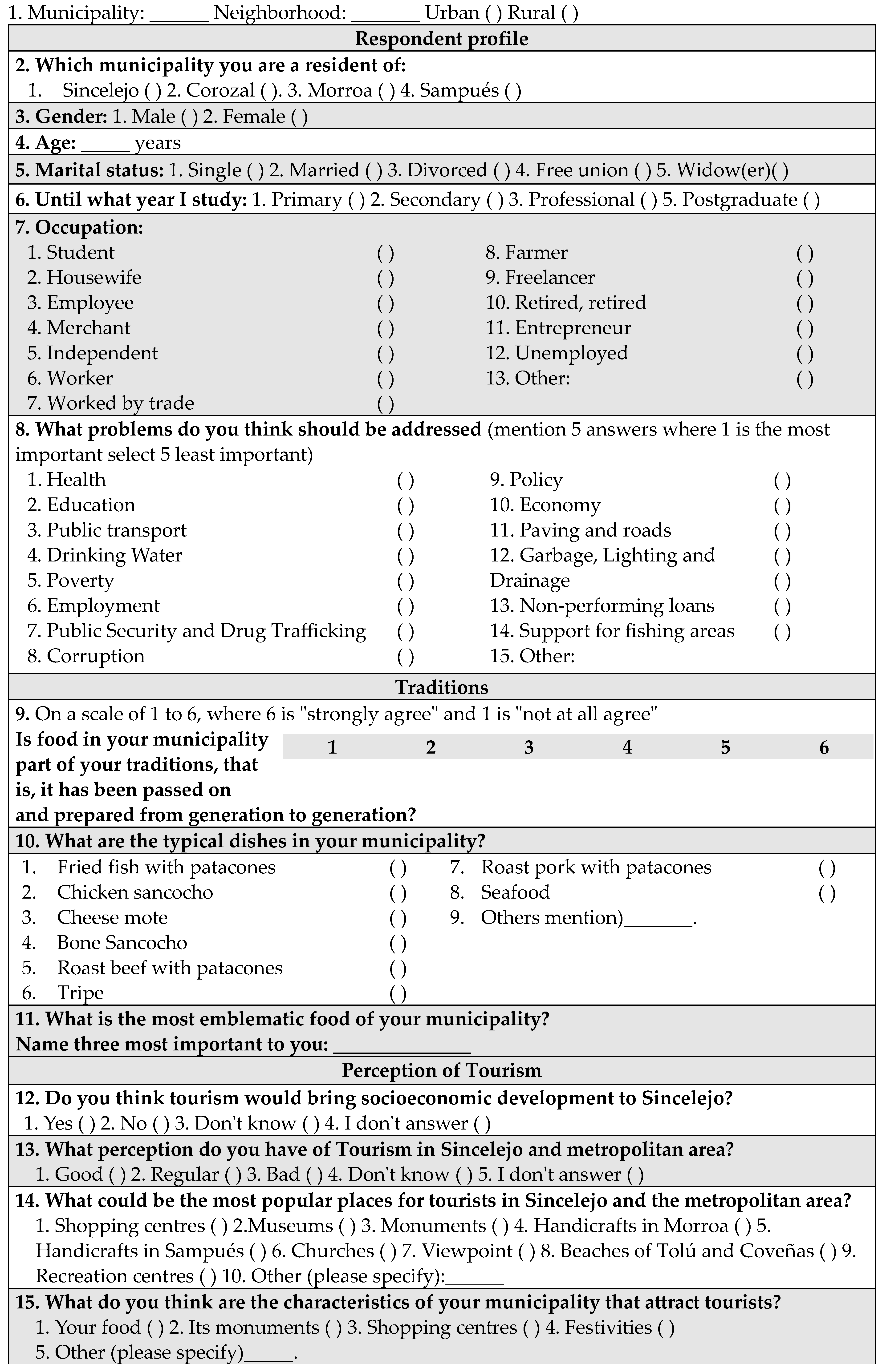
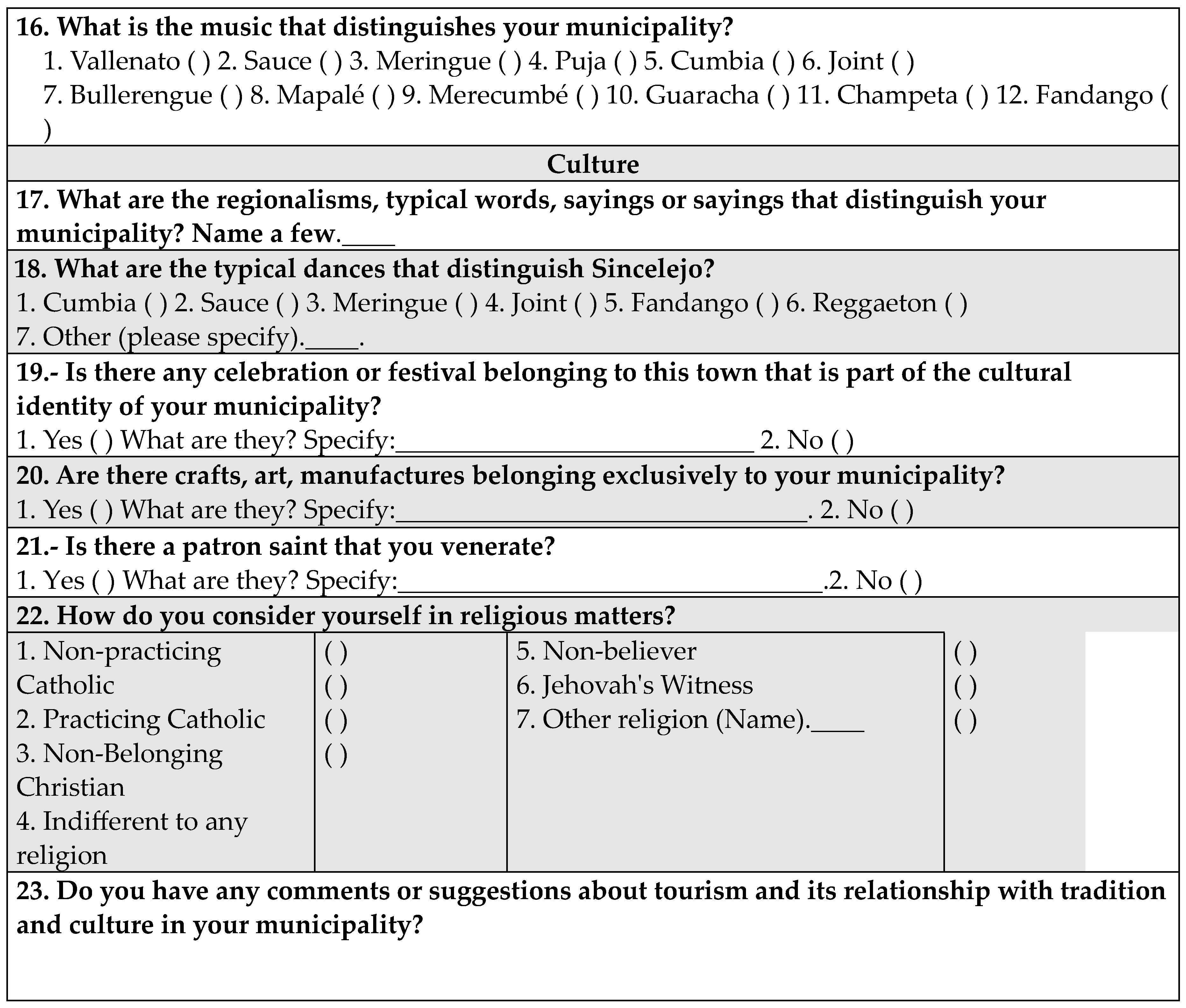
In this context, an instrument consisting of 23 closed-ended items distributed in 4 sections was developed. The first section collects sociodemographic data on the inhabitants of Sincelejo, Corozal, Morroa, and Sampués, including their origin, gender, age, marital status, educational level, occupation, and the most relevant problems in the locality. The second section addresses the culinary traditions that have survived through generations. The third section evaluates the perceptions that residents, tourists, and businessmen have of the tourist destination in question. Finally, the fourth section gathers cultural aspects related to local traditions, such as dances, festivities, art, and religion.
2.2. Data collection
For the sample, a probability sampling design was used that considered a sampling frame of 71.6% of the resident population, 9.4% of visitors and tourists, and 19.0% of businessmen in the aforementioned localities. In addition, the sampling frame considered a confidence level of 95% and a margin of error of 6.5%, which ensured that all people had the same opportunity to be randomly selected. For data collection, 211 written questionnaires (Appendix A) were applied directly to the residents, visitors, and businessmen from the cities in November and December 2022, varying in the days of application.
The distribution of the sample of respondents who provided answers is shown in Table 1.
2.3. Data organization
Data were processed in three distinct stages. In the first stage, the data were tabulated based on the questions asked. Then, the relative frequency (expressed in percentages) of the responses was calculated using both Microsoft Excel 2023 and SPSS version 19 software. Finally, in the third stage, relevant questions were selected for the construction of the multicriteria model corresponding to the following phase, which is developed below.
2.4. Multicriteria method
One of the support methods used for decision making in scenarios involving multiple variables or selection criteria requires the use of techniques that represent a fundamental tool for research because this helps to implement multidimensional analysis methods, as is the problem to be addressed [47].
The procedure for building multicriteria models is shown in Figure 1, where the full arrows indicate the sequence to follow in the model building process, and the dashed arrows indicate the possibilities of returning to a previous step, as allowed in the process of successive refinement [48] in multicriteria problem solving.
For this work, a procedure with three main phases is proposed, which consists of several steps:
- In the first preliminary phase, the main elements of the multicriteria problem are addressed and the Problem Structuring Methods (PSMs) are applied [49];
- In the second phase, preference modeling is carried out, and the preference structure is built based on what the decision-maker desires;
- In the third phase, the choice and implementation stages are carried out for the final resolution of the problem.
Figure 1.
Design of multi-criteria decision support models for tourism destinations. Adapted from [50].
Figure 1.
Design of multi-criteria decision support models for tourism destinations. Adapted from [50].
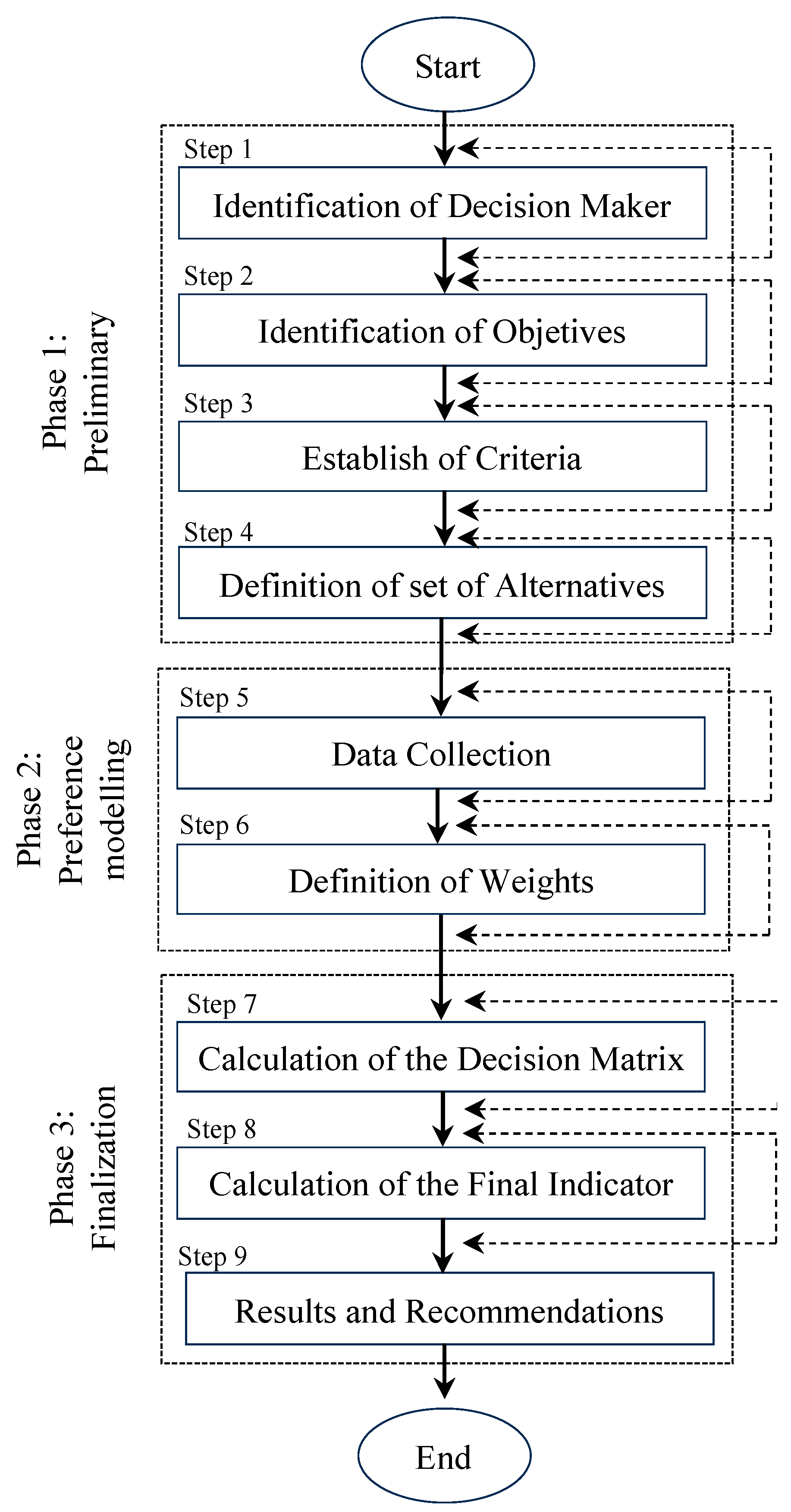
For the study being addressed, the Weighted Additive Sum (SAW) approach is used, which was proposed by [51], and the development is proposed using the procedure to solve problems and build multicriteria models which was developed by [50], as proposed to design the decision model in this work (Figure 1).
- Identification of criteria.
- Choice of alternatives.A={a , a12 ,...,aj ,...,am }, where |A|=m
- Data collection using the questionnaire based on the percentage of highest responses.
- Determination of weights through the comparison matrix [52].wj coefficient of relative importance of criterion gj for j=1, 2, ...n.
- Calculation of the decision matrix.
- Calculation of the final indicator.where xij is the score of the i-th alternative with respect to the j-th criterion; wj is the weighted criterion [51].
The methodology was designed to consider the criteria of the municipalities of the Department of Sucre, including Sincelejo, Corozal, Morroa, and Sampués, where the aim is to know which of these has a greater perception of the tourism potential of its cultural identity, as well as to construct a composite indicator that allows for this appreciation to be evaluated. Finally, Excel 2023 was used to calculate the results of this multi-criteria model.
3. Results and model development
3.1. Identification of criteria
The results obtained from the survey of 211 resident population, visitors and tourists and businessmen of the localities of the municipalities of Sincelejo, Corozal, Morroa, and Sampués in the Department of Sucre are based on some of the reasons that were taken into consideration for the study that the respondents had knowledge of the tourist activities of the locality to answer questions about food, traditions, music, handicrafts, typical dances, religion, festivals, perception of the destination, among others. These are grouped into 11 criteria, which are shown in Table 2 and Figure 2.
3.2. Choice of alternatives
One of the characteristics of multi-criteria analysis is the fact that alternatives are compared based on a series of criteria. As stated by [53], the alternatives must be mutually exclusive, consistent in time and space, and be comparable for any different characteristic, as expressed by the evaluation criteria.
Therefore, alternatives were considered to construct a matrix, where |A| is the decision label (Table 2). In this case, each option corresponds to one of the municipalities contemplated for the study, with A= {a1 , a2 ,...,aj,...,am} being the finite set of alternatives, |A|=m [54].

Table 3.
Municipality alternatives and their label.
| Alternative | Name |
|---|---|
| A1 | Corozal |
| A2 | Morroa |
| A3 | Sampués |
| A4 | Sincelejo |
Source: own elaboration.
The authors of [47] recommend that the analysis process takes the form of the selection of a subset of alternatives in different categories or of global ordering. Therefore, in this case, municipalities were named, considering that at the time of the survey they were distributed in the sample proportion for this research.
3.3. Data collection
For the collection of information, a questionnaire was used as an instrument, which also included control questions such as sex, age, occupation, marital status, and those that were contemplated for the design of this analysis model.
3.4. Determination of weights
The weights of the criteria, unlike other methods, can be considered "importance coefficients" or "relative importance values" [47]; therefore, in this process, the decision maker was assisted to define the weights of the 11 criteria according to Simo's procedure [52], where wj is the coefficient of relative importance attached to the criterion gj for j=1, 2, ...n [54].
In this sense, the data were collected from the opinion of the expert in tourism in the Department of Sucre with the instrument provided and assisted via Zoom conference. The weights obtained from the consensus of the decision maker are shown in Table 4
3.5. Performance matrix.
The proposed model was used to measure through a composite indicator the tourism potential of four municipalities in the Department of Sucre, so a list of attributes to evaluate it is here presented. In total, there are 11 criteria to consider, and these are represented by four main alternatives. Thus, the criteria to evaluate the perception of the tourism potential of the destinations considered in the study are shown in Table 5, where the values of each alternative (municipality) are presented with respect to each criterion, which is called the performance matrix.
3.6. Calculations and final arrangements.
Calculation
3.7. Final Ordering
Considering that xij is the score of the i-th alternative with respect to the j-th criterion, wj is the weighted criterion [51]; the result of the alternatives (Table 7) was generated in a descending way.
The composite indicator obtained suggests the final classification in a descending order, where municipalities A3 and A2 stand out as those with the highest and best perception of the population of the tourist potential of the cultural identity in their demarcations, while municipalities A4 and A1 have a lower valuation.
Finally, it should be noted that this application to study the tourism potential of the cultural identity of the four municipalities of the Department of Sucre is the first of its kind, considering that in this study the selection of criteria for its measurement using the SAW method provides effective information for decision making, allowing a comprehensive evaluation of this research to take place.
4. Discussion
This study established the criteria for evaluating the cultural identity of Sincelejo and its surrounding municipalities, Morroa, Corozal, and Sampués. The objective was to identify the region's potential for tourism development through the evaluation of its cultural identity. According to the results obtained, Morroa and Sampués have a greater potential for tourism due to their strong cultural identity, which is manifested in aspects such as language, social institutions, popular culture, family relationships, art, and literature, as described by [55].
This study is relevant because it allows for the identification of the cultural potential of a region for its tourism development, which is important for the promotion of sustainable tourism and the conservation of the cultural heritage of the area. In addition, the identification of the cultural attributes perceived by the region's inhabitants can be used to design tourism promotion strategies that highlight the area's cultural identity and generate greater interest among tourists [29].
Based on the results of the composite indicator versus the alternatives, what follows in this section is an analysis of our results compared with those detected from the literature review.
Municipality A3: This municipality obtained the highest score in the performance matrix (0.854), and is positioned in first place in the ranking. Its strengths are found in the local population's positive perception of its cultural identity, the preservation of tangible and intangible heritage, and the promotion and dissemination of its culture. This suggests that the local community values and actively participates in cultural tourism, which enhances its attractiveness for tourists interested in authentic and enriching experiences. This result is consistent with previous studies that highlight the importance of community participation in sustainable tourism development and the preservation of cultural identity [45] [22].
Municipality A2: Occupying second place in the ranking with a score of 0.822, this municipality also shows an outstanding performance in terms of several criteria. The positive perception of the local population, the potential of the cultural heritage, the gastronomic and culinary offers, as well as the conservation of the natural environment are some of its strengths. This indicates adequate attention to both cultural aspects and the environment, which could attract tourists interested in an integral and authentic experience in the destination. This finding is consistent with previous studies that emphasize the importance of gastronomy and hospitality in cultural tourism and the key role of the natural environment in the visitor experience [31] [30].
Municipality A4: In third place in the ranking with a score of 0.711, this municipality shows a moderate performance in terms of most of the criteria. Although it presents positive aspects such as valuing cultural identity and the preservation of tangible and intangible heritage, it also has opportunities for improvement in aspects such as gastronomic offerings and community participation in tourism. A focus on strengthening local gastronomy and the active participation of the community could contribute to improving its attractiveness for tourists interested in learning about and experiencing authentic local culture. This recommendation aligns with previous studies that highlight the relevance of community participation in tourism decision making and the promotion of gastronomy as an important cultural resource [32,46].
Municipality A1: With a score of 0.673, this municipality occupies fourth place in the ranking. Although it shows a positive perception of the local population towards its cultural identity, it presents challenges in the promotion and dissemination of its culture and in the valuation and recognition of its identity at the regional or national level. Greater promotion and recognition could help increase its visibility as a cultural tourism destination. This result highlights the importance of effective promotion and external recognition to attract more tourists interested in the cultural identity of the place, which aligns with previous studies that emphasize the relevance of promotion and recognition of local culture [29,43].
Finally, the municipalities evaluated could take advantage of the relevance of their culture and popular music, as noted by [33], to attract tourists interested in authentic experiences. Collaboration within and the strengthening of regional identities, as highlighted by [32], are key to tourism development within the municipalities. In addition, the importance of a sustainable perspective is highlighted, considering environmental, social, and cultural aspects in tourism promotion [27]. Together, these approaches can enhance their tourism attractions in a responsible and respectful manner with the local culture.
5. Conclusions
Generally, we have determined that the method of providing a survey to the 211 inhabitants of the municipalities of Sincelejo, Corozal, Morroa, and Sampués belonging to the Department of Sucre was a way of identifying the attributes of the cultural identity of the locality by answering questions about the food, traditions, music, handicrafts, typical dances, religion, festivals, and perceptions of the destination, etc. These factors were considered in order to compare alternatives according to the established criteria, and each of them corresponds to one of the municipalities selected for the study.
5.1. Contributions
In this paper, a model is introduced to evaluate the tourism prospects of cultural identity by means of a performance matrix that integrates that information. In order to obtain final indicators, the SAW method is used, which ranks the municipalities in terms of cultural identity tourism potentialities in descending order. According to the resulting composite indicator, Morroa and Sampués stand out for having the most favorable perceptions of these potentialities, while Sincelejo and Corozal obtain lower values.
The use of the SAW method to calculate the final indicators and establish the final ranking has proven innovative in this context, as this methodology is widely used in multi-criteria decisions and can yield accurate and valuable results. By understanding the population's current perception of tourism potentialities linked to the cultural identity in each municipality, decision makers can optimize the planning of investments and promotional efforts, thereby seeking to enrich local perspectives and increase the influx of visitors.
5.2. Theoretical and Practical Implications
This study provides both theoretical and practical implications in the evaluation of tourism potentials based on cultural identity. From a theoretical perspective, it introduces an innovative method by applying a performance matrix and the SAW method to analyze tourism prospects based on cultural identity in selected municipalities. This approach successfully adapts multi-criteria decision-making techniques to evaluate cultural attributes in tourism contexts. From a practical perspective, the results provide valuable guidance for tourism management and decision making in tourism destinations. The indicators obtained allow local authorities and planners to understand and enhance the cultural strengths of each destination, promoting authentic and sustainable experiences that enrich the offer of tourism and foster respect for cultural identity.
5.3. Limitations of the research and future suggestions
While applying the instrument, some limitations were detected that affected the development of the research. One of them was the difficulty of identifying the tourists who visited the tourist destinations under study. Another problem was contacting the respondents who complained about a lack of time or did not answer the questionnaire, and these issues also resulted in a smaller number of questionnaires than expected. Finally, the distribution of the instrument in the four locations under study was also a limitation, as this resulted in a longer time frame than had been established for its application.
5.4. Proposals for future research
Future research should focus on further developing the SAW operator by incorporating new criteria to evaluate tourism destinations in a sustainable way, to make changes in weightings, and to make use of new aggregation functions, such as the induced weighted average [56] and the evaluation of the competitiveness of tourism destinations [57]. Studies should also be conducted on how tourism based on cultural identity can have a positive economic and social impact on the local community, assessing how it can generate employment, boost the local economy, and preserve cultural heritage.
5.5. Concluding remarks.
The analysis carried out in this study made it possible to determine the weightings corresponding to the 11 criteria of the tourism municipality selection model. This was achieved through the collection of information from a questionnaire and the use of the Simo procedure, which allowed the decision maker to evaluate the tourism municipalities by weighting the selected criteria.
Finally, this proposed model for measuring the potential of cultural identity in tourism development can be replicated in other regions or countries, which is why the present research was structured as it was. It can also be adapted to other regions by considering aspects related to the social cycle where it is to be implemented, so long as the structure of the criteria set out in Figure 2 is taken into account.
6. Patents
Author Contributions
The authorship of the manuscript is declared, describing the contribution of each of the authors, as follows: "Conceptualization, Martha Cecilia Méndez Prada and Yolanda Patricia Cardona Arce; methodology, Dr. Martin León Santiesteban.; software, Dr. Martin León Santiesteban; validation, Instruments validated by the SECTUR of Mexico formal analysis, Dr. Martin León Santiesteban; research, Martha Cecilia Méndez Prada, Yolanda Patricia Cardona Arce, Nelly Guerrero Mosquera; resources Martha Cecilia Méndez Prada, Yolanda Patricia Cardona Arce, Nelly Guerrero Mosquera; data curation Dr. Martín León Santiesteban; writing—preparation of the original draft, Martha Cecilia Méndez Prada and Yolanda Patricia Cardona Arce; writing—revision and editing, Martha Cecilia Méndez Prada, Dr. Martín León Santiesteban and Yolanda Patricia Cardona Arce; visualization; supervision; project management, Nelly Guerrero Mosquera; acquisition of funds Nelly Guerrero Mosquera. All authors have read and accepted the published version of the manuscript".
Funding
This research received no external funding.
Institutional Review Board Statement
The study was conducted in accordance with the Declaration of Helsinki and was approved by the Institutional Review Board (or Ethics Committee) of the Caribbean University Corporation - CECAR (The protocol was carried out based on resolution 8430 of 1993 of the Ministry of Health, Chapter I, Article 5, it is established that "in any research in which the human being is the subject of study, The criterion of respect for their dignity and the protection of their rights and well-being must prevail" (p. 2). Likewise, Article 6. states that research carried out on human subjects should be carried out based on criteria of scientific and ethical principles that justify it; Likewise, it must meet the following criteria: a. It shall comply with the scientific and ethical principles that justify it. The research was considered "safe" because information collection instruments were applied through documentary research techniques and methods, applying interviews and surveys, questionnaires, and others in which sensitive aspects of their conduct were not identified or addressed, as established in Article 11 of the same resolution.)" for studies with human subjects.
Informed Consent Statement
Informed consent was obtained from all subjects involved in the study. These were not human studies but with the participation of humans.
Data Availability Statement
It has all the information of research data in Word and Excel documents, derived from software analysis and databases processed result of the application of surveys and interviews.
Acknowledgments
We extend our thanks to the Mayor's Office of the Municipality of Sincelejo for their collaboration in the collection of information.
Conflicts of Interest
The authors do not declare any conflict of interest.
Appendix A
Citizen Survey
This instrument is aimed at the population of Sincelejo, Corozal, Morroa and Sampués and seeks to know their opinion regarding the variable of tourism: cultural identity: (traditions, gatronomy, religion, festivities, art, music, dance)
References
- Sinclair, T. Tourism and economic development: A survey. The Journa of Development Studies. 1998. 34(5), 1-51. [CrossRef]
- Bernier, E. (1994). Turismo y desarrollo regional. Papers of tourism. 1994. 14(15), 95 - 102.
- Mayor's Office of Sincelejo. Municipal Development Plan 2016- 2019. 2016. Sincelejo.
- Cardona Arce, Y, Mercado Covo, T and Martínez-García, H. La asociatividad desde una visión pluricultural para el desarrollo de los emprendimientos creativos en la ciudad de Sincelejo – Sucre. 2020. Corporación Universitaria del Caribe – CECAR. [CrossRef]
- Webster, J., and Cooper, N. J. Roman imperialism: post-colonial perspectives. 2016. University of Leicester.
- Graves-Brown, P., Jones, S., and Gamble, C. S. Cultural identity and archaeology: the construction of European communities. 2013. Routledge.
- Dench, E. Romulus' asylum: Roman identities from the age of Alexander to the age of Hadrian. 2005. New York: Oxford University Press on Demand.
- Shennan, S. Introduction: archaeological approaches to cultural identity. In Archaeological approaches to cultural identity. 2003 (pp. 29-60). Routledge. [CrossRef]
- Bentley, G. C. Ethnicity and practice. Comparative studies in society and history, 1987. 29(1), pp. 24-55. [CrossRef]
- Friedman, J. Cultural Identity and Global Process. 1994. London: Sage Publications. [CrossRef]
- Tonkin, E., McDonald, M., and Chapman, M. History and ethnicity. 2016. Routledge.
- Laurence, R., and Berry, J. (2001). Cultural identity in the Roman Empire. 2001. London and New York: Psychology Press.
- Debreczeni, E. Sustainable tourism management and cultural heritage. Portal iberoamericano de gestión cultural, 2003. 1-10.
- Issundari, S., Yani, Y. M., Sumadinata, R. W. S., and Heryadi, R. D. From Local to Global: Positioning Identity of Yogyakarta, Indonesia through Cultural Paradiplomacy. Academic Journal of Interdisciplinary Studies, 2021. 10(3), 167-177. [CrossRef]
- McIntosh, A., Hinch, T., and Ingram, T. (2002). Cultural identity and tourism. International Journal of Arts Management, 2002. 39-49.
- Karkabi, N., and Mendel, Y. (2023). Sonic masquerading in Israeli popular music: self-Imitation, accent, and mockery. Cultural Studies. 2023. 37:3, 461-484. [CrossRef]
- Díaz Camacho, P. El alma colombiana. Idiosincrasia e identidades culturales en Colombia. Hallazgos, 2012. 9 (18), 119-141. [CrossRef]
- Navarro Hoyos, S. N. Cultural manifestations and identity in the Colombian Caribbean: a case study of carnival and handicrafts. 2014. Doctoral dissertation, Universitat de Barcelona).
- Molano, O. L. Cultural identity, an evolving concept. Revista opera, 2007. (7), 69-84.
- Ortega, J. C. An approach to the concept of cultural identity from experiences: heritage and education. Tabanque. Pedagogical Journal, 2018. (31), 244-262.
- Urošević, N. Cultural identity and cultural tourism: Between the local and the global (a case study of Pula, Croatia). Singidunum journal of applied sciences, 2012. 9(1), 67-76. [CrossRef]
- Jullien, F. La identidad cultural no existe. 2017. Taurus.
- Appadurai, A. Disjuncture and difference in the global cultural economy. Theory, culture and society, 1990. 7(2-3), 295-310. [CrossRef]
- Hall, S. Introduction: ¿Who needs ‘identity’? In S. Gay, Hall, and P. du, Questions of cultural identity. 1996. pp. 1-17. Sage Publications.
- Wang, Y. (2019). Local identity in a global city: Hong Kong localist movement on social media. Critical Studies in Media Communication, 2019. 36(5), 419-433. [CrossRef]
- Mousavi, S. S., Doratli, N., Mousavi, S. N., and Moradiahari, F. (2016, December). Defining cultural tourism. In International Conference on Civil, Architecture and Sustainable Development, 2016. Vol. 1, No. 2, 70-75.
- Godfrey, K. B. Attitudes towards ‘sustainable tourism’in the UK: a view from local government. Tourism management, 1998. 19(3), 213-224. [CrossRef]
- Peña, I. F., and Peña, I. F. Theoretical approach to cultural identity. Ciencias Holguín. 2012. 18(4), 1-13.
- Vallejo, M. Cultural identity, tourism, and recreation. 2003. Doctoral dissertation, Universidad Nacional de Mar del Plata).
- Sobrado, D. A. Cultural identity and gastronomic tourism: the commodification of heritage. International journal of scientific management and tourism, 2018. 4(2), 51-71.
- Kivela, J., and Crotts, J. Understanding travelers' gastronomic experiences through etymology and narrative. Journal of hospitality and tourism research, 2009. 33 (2), 161-192. [CrossRef]
- Conto, F., Vrontis, D., Fiore, M., and Thrassou, A. Strengthening regional identities and culture through cross-border wine industry collaboration. British Food Review. 2014. 116 (11), 1788-1807. [CrossRef]
- Bennett, A. Cultures of popular music. 2001. UK: McGraw-Hill Education.
- Cohen, S. Rock culture in Liverpool: Popular music in the making. 1991. Oxford University Press.
- Radano, R. M., Bohlman, P. V., and Baker, H. A. Music and the racial imagination. 2000. University of Chicago Press.
- Turino, T. Music as social life: The politics of participation. 2008. University of Chicago Press.
- Saldanha, A. Music, space, identity: Geographies of youth culture in Bangalore. Cultural Studies. 2002. 16(3), 337-350. [CrossRef]
- Hall, S. Introduction: Who needs 'identity'? In S. Gay, Hall, and P. du, Questions of cultural identity, 1996. 1-17). Sage Publications.
- Said, E. W. Orientalism. 1979. New York: Vintage Books.
- Heriqbaldi, U., Esquivias, MA and Agusti, KS, "The role of cultural distance in driving international tourism arrivals in ASEAN: a gravity model", Consumer Behavior in Tourism and Hospitality, 2023. vol. 18 no. 1, pp. 97-109. [CrossRef]
- Ahn, MJ and McKercher, B., "The effect of cultural distance on tourism: a study of international visitors to Hong Kong", Asia Pacific Journal of Tourism Research, 2015. vol. 20 No. 1, pp. 94-113. [CrossRef]
- Cohen, E. (1988). Authenticity and commoditization in tourism. Annals of Tourism Research, 15(3), 371-386. [CrossRef]
- Tian, D., Wang, Q., Law, R., and Zhang, M. Influence of cultural identity on tourists' authenticity perception, tourist satisfaction, and traveler loyalty. Sustainability, 2020. 12(16), 6344. [CrossRef]
- Bhugra, D., Bhui, K., Mallett, R., Desai, M., Singh, J., and Leff, J. Cultural identity and its measurement: A questionnaire for Asians. International Review of Psychiatry, 1999. 11(2-3), 244-249. [CrossRef]
- Greca, I. M., and Moreira, M. A. (Florianópolis). Mental models, conceptual models, and modeling. Caderno catarinense de ensino de física. 1998, 15 (2), 107-120. [CrossRef]
- Ylatoma, C. C. Model of integrated and participatory municipal tourism management, for the strengthening of the cultural tourism offer. Journal of Research and Culture, 2018. 7(3), 77-85.
- León Santiesteban, M., and Larrañaga Núñez, A. M. Knowledge integration in restaurants using multicriteria analysis for decision making. Inquietud Empresarial, 2019. 19(2), 25-38.
- Ackoff, R.L. and M.W. Sasieni: Fundamentals of operations research, Wiley, New York, 1968.
- Rosenhead, J. and Mingers, J. Problem structuring methods in action. European Journal of Operational Research, 2004. 152, 530-554. [CrossRef]
- De Almeida AT, Cavalcante CAV, Alencar MH, Ferreira RJP, De Almeida-Filho AT, Garcez TV. Multicriteria and multiobjective models for risk, reliability and maintenance decision analysis (Vol. 1). Springer International Publishing, 2015. New York.
- Alireza, A., Majid, M., and Rosnah, Y. Simple Additive Weighting approach to Personnel Selection Problem. International Journal of Innovation, Management and Technology, 2010. Vol. 1, No. 5. [CrossRef]
- Figueira, J., and Roy, B. Determining the weights of criteria in the ELECTRE type methods with a revised Simos' procedure. European journal of operational research, 2002. 139(2), 317-326. [CrossRef]
- Roy, B. The Outranking Approach and the Foundations of ELECTRE Methods, in: Bana e Costa CA (Ed.) Reading in Multiple Criteria Decision Aid. 1990. Springer-Verlag, Berlin.
- León Santiesteban, M., and Leyva López, J. C. A multicriteria decision aid for evaluating the competitiveness of tourist destinations in the Northwest of Mexico. Turismo y Sociedad, 2017. (21), 51-67. [CrossRef]
- Peña, I. F., and Peña, I. F. Theoretical approach to cultural identity. Ciencias Holguín, 2012. 18(4), 1-13.
- Blanco-Mesa, F., León-Castro, E., and Merigó, J. M. Bonferroni means with induced ordered weighted average operators. International Journal of Intelligent Systems, 2019. 34(1), 3-23. [CrossRef]
- Huesca-Gastélum, M. and León-Santiesteban, M. Ranking the competitiveness of tourist destinations: An analysis using the OWA operator and the SAW method. Inquietud Empresarial, 2021. 21(2), 15-34. [CrossRef]
Figure 2.
Hierarchical structure of the criteria considered in the case study. Source: own elaboration.
Figure 2.
Hierarchical structure of the criteria considered in the case study. Source: own elaboration.

Table 1.
Sample distribution.
| Sector | Percentage |
|---|---|
| Rural | 19.9 |
| Urban | 80.1 |
| Genre | |
| Female | 50.2 |
| Male | 48.8 |
| Other | 0.5 |
| I prefer not to say | 0.5 |
| Age | |
| 17–25 | 20.4% |
| 26–35 | 36.5% |
| 36–45 | 26.5% |
| 46–55 | 11.4% |
| 56 or more | 5.2% |
Source: own elaboration.
Table 2.
Identification of criteria.
| Label | Criteria |
|---|---|
| C1 | The most emblematic typical food |
| C2 | Tourism as a factor of economic development |
| C3 | Perception of Tourism in the municipality |
| C4 | Celebrations or festivities belonging to the locality as part of the cultural identity. |
| C5 | Handicrafts, art, and manufactured goods belonging to the municipality |
| C6 | Patron saint to be venerated |
| C7 | Predominant religion |
| C8 | Places most visited by tourists |
| C9 | Characteristics of the municipality that attract tourists |
| C10 | Music that distinguishes the municipality |
| C11 | Typical dances that distinguish the municipality |
Source: own elaboration.
Table 4.
Determination of weights using Simo's procedure.
| Subset | Number of cards | Position | Weights not standardized | Normalized weights | Rounding | Total |
|---|---|---|---|---|---|---|
| C1 and C2 | 2 | 3 | 1.5 | 2.27 | 2 | 4.6 |
| C4 and C3 | 2 | 7 | 3.5 | 5.30 | 5 | 10.6 |
| C5 and C6 | 2 | 11 | 5.5 | 8.33 | 8 | 16.6 |
| C7 | 1 | 7 | 7 | 10.61 | 11 | 10.6 |
| C8 | 1 | 8 | 8 | 12.12 | 12 | 12.1 |
| C9 | 1 | 9 | 9 | 13.64 | 14 | 13.6 |
| C10 | 1 | 10 | 10 | 15.15 | 15 | 15.2 |
| C11 | 1 | 11 | 11 | 16.67 | 17 | 16.7 |
| Sum | 11 | 66 | 100 |
Source: own elaboration.
Table 5.
Performance matrix of the alternatives.
| Criteria/Alternative | A1 | A2 | A3 | A4 |
|---|---|---|---|---|
| C1 | 0.68 | 0.63 | 0.53 | 0.69 |
| C2 | 0.91 | 0.88 | 0.94 | 0.89 |
| C3 | 0.32 | 0.25 | 0.71 | 0.21 |
| C4 | 0.91 | 0.94 | 1.00 | 0.91 |
| C5 | 0.23 | 0.88 | 0.94 | 0.50 |
| C6 | 0.55 | 0.88 | 0.88 | 0.66 |
| C7 | 0.82 | 0.94 | 0.82 | 0.86 |
| C8 | 0.67 | 0.79 | 0.73 | 0.70 |
| C9 | 0.80 | 0.77 | 0.73 | 0.56 |
| C10 | 0.91 | 0.86 | 0.89 | 0.96 |
| C11 | 0.98 | 0.94 | 1.00 | 0.86 |
Source: own elaboration.
Table 6.
Performance matrix of the alternatives.
| Criteria/Alternative | A1 | A2 | A3 | A4 |
|---|---|---|---|---|
| C1 | 0.015 | 0.014 | 0.012 | 0.016 |
| C2 | 0.048 | 0.046 | 0.050 | 0.047 |
| C3 | 0.027 | 0.021 | 0.059 | 0.018 |
| C4 | 0.096 | 0.099 | 0.106 | 0.097 |
| C5 | 0.028 | 0.106 | 0.114 | 0.061 |
| C6 | 0.074 | 0.119 | 0.120 | 0.090 |
| C7 | 0.124 | 0.142 | 0.125 | 0.130 |
| C8 | 0.112 | 0.132 | 0.121 | 0.117 |
| C9 | 0.018 | 0.018 | 0.016 | 0.013 |
| C10 | 0.048 | 0.045 | 0.047 | 0.051 |
| C11 | 0.081 | 0.079 | 0.083 | 0.072 |
Source: Own elaboration.
Table 7.
Ranking of alternatives.
| Position | Code | Result |
|---|---|---|
| 1 | A3 | 0.854 |
| 2 | A2 | 0.822 |
| 3 | A4 | 0.711 |
| 4 | A1 | 0.673 |
Source: own elaboration.
Disclaimer/Publisher’s Note: The statements, opinions and data contained in all publications are solely those of the individual author(s) and contributor(s) and not of MDPI and/or the editor(s). MDPI and/or the editor(s) disclaim responsibility for any injury to people or property resulting from any ideas, methods, instructions, or products referred to in the content. |
© 2023 by the authors. Licensee MDPI, Basel, Switzerland. This article is an open access article distributed under the terms and conditions of the Creative Commons Attribution (CC BY) license (http://creativecommons.org/licenses/by/4.0/).
Copyright: This open access article is published under a Creative Commons CC BY 4.0 license, which permit the free download, distribution, and reuse, provided that the author and preprint are cited in any reuse.


