

Submitted:
25 August 2023
Posted:
28 August 2023
You are already at the latest version
Abstract
The city administration of China planned numerous metro projects and more metros can hardly avoid undercrossing a bridge. While metro shield construction when undercrossing a bridge (MSCUB) is frequently located in complicated natural and social context, which made the construction process more susceptible to safety accidents. Therefore, it is crucial to look into safety risk of MSCUB. The paper identified the safety risk factors during SSCUR by using literature review and experts’ evaluation, proposed a novel safety risk assessment model by integrating CFA and FER, and then selected a project case to test the validity of the suggested model. Research results show that (a) a safety risk factors list of MSCUB was identified, including 4 first-level safety risks and 37 second-level safety risk factors; (b) the proposed safety risk assessment model can be used to measure the risk values of the overall worksite safety risk, the first-level safety risks and the safety risk factors of MSCUB; (c) environment-type safety risk and personnel-type safety risk have higher risk values when shield construction undercrossing a bridge; (d) when compared to worker-type safety risk, manager-type safety risk is the higher risk value. The research can enrich the theoretic knowledge of MSCUB safety risk assessment and provide references to safety managers for conducting scientific and effective safety management on the construction site when subway undercrossing a river.
Keywords:
Shield construction safety risks assessment
; subway undercrossing a bridge
; safety risk factors list
; safety assessment model
; confirmatory factor analysis
; fuzzy evidence reasoning.
1. Introduction
China, the second-largest economy in the world, is quickly becoming an urbanized and industrialized nation [1]. To provide jobs and raise living standards for its citizens, the government has gradually passed laws and increased investment on the infrastructure construction [2,3,4]. City planners are frequently required to plan a metro system since it has excellent traffic efficiency, safety, stability, and energy savings [5,6]. Although metros are generally constructed underneath major city streets to minimize the risk of ground loads and minimize risk [7,8], while cities are extremely intricate systems of human settlements, frequently containing roads, trains, and rivers, thus it is difficult for metro construction to avoid undercrossing a bridge [8,9]. Metro shield construction when undercrossing a bridge (MSCUB) is an extremely risky construction context. The shield construction process will disturb the surrounding soil, on the one hand, it will lead to the settlement of neighboring bridge piles and the bearing additional stresses, which may cause damage to the bridge or aggravate the already existing damage, affecting the normal use of the bridge or leading to collapse [10,11]; on the other hand, it will cause a sudden change in the stress of the traversing soil layer, and instability in the excavation palisade surface, which is very likely to cause collapses or gushing water events [12,13]. Consequently, there is a pressing necessity to investigate safety risks during MSCUB.
Numerous research has been carried out on the metro shield construction safety, with the primary goals of identifying the associated safety risks and meanwhile assessing them. Previous literature has investigated the safety risk based on different views. Such as, Pan et al. [14] examined shield construction safety risks according to the classic paradigm of “personnel-equipment-material-technique-environment”, identifying personnel-type, equipment-type, environment-type, and management-type risks; Liu et al. [15] employed a questionnaire survey to identify shield construction safety risks, the safety risk list covers tunnel excavation, segment assembly, special procedures and conditions, grouting, lead excavation and slag removal. As for safety risk assessment, previous scholars often used analytic hierarchy process [16], cloud model [16], fault tree analysis [17], Bayesian network [18,19], back propagation (BP) neural network [20,21,22] and etc. For instance, Wu and Zou [22] integrated entropy weight method and cloud model to evaluate the static safety risk of underwater shield tunneling; A Bayesian network approach was utilized by Chung et al.[23] to evaluate safety risks during tunnel shield construction. To date, although MSCUB is an extremely risky, few researchers have delved into the safety risk under this construction scenario.
To fill the research gaps, the paper looks into safety risks evaluation of MSCUB. The main purposes of this study are to: (1) provide a systematic and feasible safety risk factors list for MSCUB based on literature analysis and experts group evaluation; (2) propose a quantitative method to evaluate the safety risk (factors) of MSCUR; (3) select a case to validate the proposed quantitative approach.
2. Literature Review
With the development of shield machine manufacturing technology, more and more metro tunnels currently are opting for shield construction, as this tunneling technique is characterized by greater safety, less environmental impact and a higher level of automation [6,24]. Metro tunnels are generally designed to be built under the city, so the construction of metro tunnels is often confronted with various complex environmental contexts (e.g., crossing complex overburden layers, adjacent to rivers, existing pipelines and tunnels). Existing literature has examined the safety risks of shield construction in some complicated situations, covering tunneling under the complex overburden [6,25,26], tunneling under an existing building [27,28,29], tunneling under an existing tunnel [30,31], and tunneling under existing pipelines [32]. These studies’ topics are mostly concentrated on two areas, i.e., safety risk factors identification and safety risks evaluation.
2.1. Safety Risk Factors Identification of Metro Shield Construction
Safety risk factors identification is a prerequisite for safety risks assessment. Based on various viewpoints, previous research looked into the safety risk factors of metro shield construction [29,32]. Some researchers adopted the “equipment-environment-management” identification paradigm because they thought that the external environment, shield equipment, and onsite management were the most important safety concerns [25,26,30,33]. For instance, Hu et al.[25] investigation into the metro shield construction safety risks under soft overburden layer identified geological complex condition, underground water condition, minimum overburden layer thickness, minimum radius of curvature, construction speed, distance from the surrounding environment, and onsite construction management as safety risk factors. A summary of the associated safety risk factors, including geological and hydrological conditions, shield construction parameters, tunnel conditions, bridge conditions, and organization and management risks, was provided by Zhai et al. [33] in their analysis of the metro shield construction safety risk when being adjacent to an existing bridge. Others have stated that the metro shield construction is a complicated system and that it is important to consider the “personnel-equipment-environment” system while solving this complex system issues. For instance, Liu et al. [6] and Chen et al. [5]investigated metro shield construction safety risk when underpassing intricate overburden strata and identify the safety risk factors using the “personnel-equipment-environment” architecture. The “personnel-equipment-environment-management” approach is more methodical. Wu et al. [34] and Pan et al. [14] identified the safety risk factors based on the aforementioned framework. Additionally, a more methodic paradigm called the “personnel-equipment-material-technique-environment” framework exists. Based on this paradigm, Li et al.[35] and Fan and Wang [36] examined the metro shield construction safety risk and gathered the safety risk factors.
2.2. Safety Risks Evaluation of Metro Shield Construction
The risk assessment calculation method is illustrated by the safety risks assessment model. The weight-determining method and the measurement of safety risks are the two most important considerations when constructing the assessment model because there are numerous safety risks in the index framework. According to past study, the analytic hierarchy process (AHP) was chosen as the weight-determining method. For instance, Li et al.’s [35] investigation of the safety risks in slurry balancing shield construction employed AHP to compute the weights of safety risks. In order to reduce the subjective element in determining the weights, more objective procedures were gradually implemented. Zhai et al. [33] chose a combinatorial weighting method by integrating G1 and CRITIC in their investigation on shield construction safety risk when being adjacent to an existing bridge. Fan and Wang [36] applied ISM-DEMATEL and Shapley value method to determine weights of safety risks in order to consider the relationships between different safety risks.
Many quantitative methods can be found in earlier literature for measuring safety risks. The evaluation of shield construction safety concerns frequently uses the fuzzy comprehensive evaluation approach [35,37]. For instance, Ren et al. [37] used a fuzzy comprehensive evaluation method to evaluate the whole construction safety concerns while a building was nearby. Another extensively used strategy is the matter-element approach [27,36]. By linking the risk and its risk criteria, this method has advantages in determining the risk rating [4]. Currently, to lessen the influence of the uncertainty, Bayesian networks [30,38] and cloud model [26,34] have also been used to measure safety risks. Wu et al. [30] combined fuzzy Bayesian and evidence theory to assess the metro shield construction safety risks when passing through existing tunnels. Wu et al. [34] selected a cloud model to evaluate the shield construction safety risks. Furthermore, Chen et al. [26] applied extension cloud theory and optimal cloud entropy to assess the shield construction safety risk when being close to existing structures. Additionally, by simulating the probability sampling process and the dynamic interactions between various safety risks, Monte Carlo [33] and Systematic dynamic (SD) [14] were also applied into the shield construction safety risks evaluation.
3. Safety Risk Factors Identification of MSCUB
3.1. The Framework for Safety Risk Factors Identification
The paradigms outlined in the prior literature can offer thinking frameworks to detect the safety risk factors during MSCUB, despite the fact that few studies have examined the shield construction safety risk assessment in this construction scenario. As previously highlighted, the framework of “personnel-machine-material-technique-environment” [34,36] is widely used and more methodic paradigm in the area of shield construction safety risks. However, we believe that non-standard materials should not be utilized in construction after several inspection rounds, and the damage of materials in the construction process is often caused by the irregular construction arrangement, which should be included in the personnel-type, equipment-type, and technique-type safety risk factors. Thus, we took no account of the material-type safety risks and adopted the “personnel-equipment-technique-environment” framework to identify the safety risk factors. Figure 1 displayed the safety risk factors identification framework for MSCUB.
3.2. The Identifying Process of the Safety Risk Factors
The paper employed a two-step approach to identify the safety risks during MSCUB based on the aforementioned framework. First, we conducted a review of the literature to identify the relevant safety risk factors. Second, we put together a panel of experts to evaluate and improve the list of safety risk factors.
Step 1. Safety risk factors identification based on literature review.
We selected CNKI and Scopus as retrieval databases and our search criteria were (“safety risks” AND “shield construction”) OR (“shield construction” AND “bridge”) OR (“safety risks” AND “metro construction”) OR (“metro construction” AND “bridge”) OR (“safety risks” AND “subway construction”) OR (“subway construction” AND “bridge”). 84 english papers and 75 chinese papers are found in the initial search. Following a thorough analysis of these papers, 54 papers—31 in English and 23 in Chinese—were kept. The retained papers were mined for the initiating safety risk factors.
Step 2. Safety risk factors evaluation and improvement based on experts’ group
20 safety management specialists were invited to evaluate and improve the safety risks discovered during the preliminary procedure. The 20 experts, who included 2 professor-level specialists, 5 senior engineers, and 13 site engineers, all had at least five years of experience in shield construction. Following the aforementioned two steps, we determined the potential safety risks that could arise during MSCUB. The safety risk factors list was displayed in Table 1.
4. Evaluation Model for Safety Risk of MSCUB
We established a model for evaluating the safety risk of MSCUB. Confirmatory factor analysis (CFA) [39,40] and fuzzy evidence reasoning (FER) [41,42] were both included into the evaluation model. The aforementioned weights of safety risk factors were determined using the CFA method, and risk value of safety risk factors and the overall worksite safety risk was measured using the FER method.
4.1. Weights Calculation Based on Confirmatory Factor Analysis
CFA is a widely used data analysis method, and this method belongs to the factor analysis methods. CFA seeks to validate the viability of pre-identified common factor structure (i.e., dimension structure) as opposed to exploratory factor analysis, which is used to identify the common factors structure from the messy data [43,44].
To gather information for additional CFA, a questionnaire survey was chosen [45]. Appendix A shows the questionnaire adopted in this paper. The questionnaire survey was carried out by using Wenjuanxing platform [46]. The online questionnaires were distributed to onsite managers who had collaborated with the researchers. After the validity test, 197 responses from a total of 232 questionnaires were kept.
The data collected in the retained responses were initially loaded into SPSS 23 to test the reliability [47,48]. Cronbach’s alpha was 0.942[49], indicating the collected data were highly reliable and internally consistent.
The data adhered to the normal distributions, as demonstrated by the substantial p value (p 0.001) obtained by Bartlett’s test of sphericity [50]. The KMO value of 0.921 demonstrated adequate sample adequacy for factor analysis as well as the significant correlations between the items [39,51].
Following that, a CFA was carried out on the AMOS 23 using the collected data [52,53]. The concept model was displayed in Figure 2. The standard path coefficients can be obtained after the CFA which were displayed in Table 2,. The relationship strength between various variables is indicated by the standard path coefficients [54,55,56,57]. As a result, we determined the weights for the safety risk factors based on the standard path coefficients, which are displayed in Table 3.
4.2. Safety Risk Factors Measure Using FER
Step 1 Represent a single safety risk factor using triangular fuzzy numbers
The safety risk value of a safety risk factor can be expressed as , that is, the production of the occurrence probability of a safety risk factor P and the consequence severity of a safety risk factor. Quantitative evaluation of the risk value of a safety risk factor is frequently challenging due to the impact of the uncertainty. Applying qualitative descriptions to express risk level of a safety risk factor is a useful and efficient strategy. The occurrence probability of a safety risk factor can be qualitatively expressed in a verbal scale as “extremely low”, “low”, “relatively high”, “high” and “extremely high”. The consequence severity of a safety risk factor can also be described using “no impact,” “minor,” “large,” “dangerous,” and “catastrophic.” In this paper, the verbal evaluation levels of and can be transformed into triangular fuzzy numbers, and the corresponding relationship is displayed in Table 4.
Assuming that two triangular fuzzy numbers , are used to express the occurrence probability and the consequence severity, subsequently, formula (1) can be utilized to express the corresponding safety risk value of the safety event [58,59].
Step 2 Establish the fuzzy belief structure for the predefined risk levels of safety risk factors
Assuming that there exist N evaluation levels for each safety risk factor and the corresponding membership functions are known, thus we can establish the fuzzy belief structure for risk evaluation levels of a safety risk factor, which is expressed by formula (2).
In the formula (2), denotes the fuzzy evaluation levels; N denotes the numbers of the risk evaluation levels; denotes the belief level of a safety risk factor at fuzzy evaluation levels, besides, and .
This study assumed that a safety risk factor has five different evaluation levels, and its membership functions follow the fuzzy triangular numbers (see in Table 5), subsequently, the fuzzy belief structure of the risk evaluation levels of a safety risk factor can be expressed using formula (3) and the membership functions of the five risk evaluation levels were displayed in Figure 3.
Step 3. Compute the belief structure of each safety risk factor
Through this step, we can compute the belief structure of each safety risk factor () based on its triangular fuzzy values (). The computing criteria is as followed.
(1) Create the membership curve based on .
(2) Locate the points where the membership curve of and the five level membership curves in Figure 3 cross.
(3) Compute the ordinates of the intersection points express the belief values of the corresponding fuzzy evaluation level. If there are no intersection points, the belief value of this fuzzy evaluation level is zero. If there are two intersection points, the larger ordinate was selected as the belief value of this fuzzy evaluation level.
(4) Next, standardize the five belief values after sequentially determining the belief values of a safety risk factor. As a result, the belief structure of a safety risk factor can be gained, which is expressed by formula (4).
Step 4. Compute the upper-level safety risks and overall work site safety risk based on ER
Assuming that there exists a risk evaluation problem RE with L risk indexes (i = 1, 2, …, L), the weights of these indexes are , and every risk index follows the fuzzy belief model , We can calculate the mass number of each risk index, as presented in formula (5)-formula (8) [60].
In above formulas, denotes the basic fuzzy belief value of risk index at the fuzzy risk level of FHn, denotes the uncertain risks due to lack of information, which includes and .
Let denotes the belief degree to nth evaluation level of an upper-level risk index which the first lower-level indexes support; and denotes the retained probability after all the first lower-level risk indexes being assigned to all the evaluation levels, thus the recursive processes of and were expressed in formula (9) – formula (12) [60,61].
Next, the fuzzy belief values of an upper-level risk index can be computed by using formula (13).
Step 5. Determine the risk levels of a safety risk factor or overall worksite safety risk
Based on aforementioned processes, we can calculate the fuzzy belief values of all the first-level safety risk factors and the overall worksite safety risk. Subsequently, we can find out the maximum belief value of, and the risk level of the safety risk factor or overall worksite safety risk is the level where the maximum belief value is located.
5. Case Validation
5.1. Project Overview
The section tunnel between Zhengzhou Sports Center station and Longzihu Central Station of Zhengzhou Rail Transit Line 1 Phase II Project is constructed by shield method, with an outer diameter of 6m. The interval tunnel mileage section K006+129.000-K006209.000 underpasses the Zhengzhou–Kaifeng intercity railway Zhengzhou Grand Bridge, with bridge pier numbers 121 and 122. The left and right lines of the tunnel pass through the 121~122 piers respectively, 83 °~86 ° to the Zhengzhou–Kaifeng intercity railway Zhengzhou Grand Bridge. The inner diameter of the shield tunnel is 5400mm, the outer diameter is 6000 mm, the thickness of the pipe segment is 300mm, the width of the pipe segment is 1500mm, and the double-sided wedge is 45mm. The pipe segments are divided into 6 pieces, with 12 bending bolts connecting between blocks and 16 longitudinal bending bolts connecting between rings, and staggered assembly. Reinforced concrete pipe segments within a range of 20m below and on both sides of the railway line are reinforced. The positional relationship between the intersection of the interval tunnel and the bridge is shown in Figure 1 and Figure 2. Relevant parameters of Zhengzhou–Kaifeng intercity railway Zhengzhou Grand Bridge are shown in Table 1 and Table 2.
5.2. Identifying and Evaluating the Safety Risk Factors Based on Experts’ Group
The metro section between Xizhou Station and South Huanghe Road Station includes a very dangerous tunnel portion that undercrosses the Qili River. The project management division invited a 15-person expert group before the Qili River underpass. The specialists were tasked with identifying the safety risk factors associated with undercrossing the Qili River and then assessing the likelihood of occurrence and the severity of the resulting consequences.
After conducting an onsite investigation, the experts examined the project documents and questioned the project managers about a few project-related difficulties. Then individual safety risk factors checklists were given to each expert (see Appendix B). All of the pre-identified safety risk factors in Table 1 are covered by the safety risk factors checklist. The experts noted the safety risk factors they deemed important, together with the associated likelihood of occurrence and severity of the consequences. On-site supervisors gathered all of the checklists and computed the average value of the likelihood that each risk would occur and the gravity of its consequences. Table 6 lists the safety risk factors that the experts’ group identified, and Table 7 lists the calculated results.
5.3. Calculating the Risk Values of the Safety Risk Factors Based on CFA and ER
The triangular fuzzy numbers of the safety risk factors can be determined using the aforementioned transformation rule (see Table 4), and the results are shown in Table 8. We computed the belief structure of the safety risk factors in accordance with the transformation rules in step 3, and the transformative results are displayed in Table 9. Besides, the risk levels of safety risk factors also were determined (see Table 9).
Formulas (5) and (13) can then be used to calculate the belief structure of the safety risk factors categories and the overall worksite safety risk. Table 10 displayed the calculated results and the risk level of these safety risk factor categories and the overall worksite safety risk.
As can be seen in the Table 10, the risk levels of 16 safety risk factors are at the medium level, and others are at the low level. As for worker-type safety risk factors, poor safety awareness is more risky than weak safety ability. Of the manager-type safety risk factors, insufficient safety communication is the most risky one. For equipment-type safety risk factors, malfunction of thrust cylinder equipment and malfunction of grouting equipment are at the medium level, and the retained ones fall on the low level. Improper bridge pier reinforcement technic scheme and improper grouting and reinforcement technical scheme in the technique-type safety risk factors have higher risk values. In terms of natural environment-type safety risk factors, soft clay layer and high-pressure underground water are more risky factors. For the bridge condition, relatively close position of bridge piles and tunnel, friction bridge pile and large bridge pile diameter are with higher risk values. Besides, incomplete safety institution and unclear safety rights and responsibility are risky than the inadequate safety training & education.
As is displayed in Table 11, the overall worksite safety risk is at the medium level, which indicates that the project management team has an average degree of management competency on the safety risks of MSCUB. Almost all the safety risk factor categories are graded as medium-level risk, except for equipment-type safety risk factor categories is at the low level. Of the first-level safety risk factor category, environment-type safety risk factors as a whole has the risk values, the personnel-type safety risk factor, and the method-type safety risk factor follow closely behind. As for the personnel-type safety risk, manager-type safety risk is higher than the worker-type safety risk, which indicates management personnel should be given more attention. For the environment-type safety risk, bridge condition has the maximum risk value, which indicates manager should develop special plan for bridge safety management in advance to prevent related safety accidents. Besides, management-type safety risk ranks the second, thus, more safety experiences should be collected and more safety training should be carried out to develop more perfect safety management system for safety risk management of MSCUB.
6. Discussion and Management Implication
The paper identified a list of MSCUB safety risk factors, which consists of 37 safety risk factors and 4 first-level safety risks. Personnel-type, equipment-type, technique-type, and environment-type safety risks are the ones that have been identified as first-level safety risk. In the available literature, safety risks are classified using the same taxonomy. To illustrate, Lu et al. [62] and Zhou et al. [63] separated safety risks into hydrogeological safety risks, equipment safety risks, construction technology safety risks, and personnel safety risks by adhering to this type classification. As was previously mentioned, the taxonomy does not include material-type safety risks because, in practice, non-standard materials cannot be brought onto construction sites due to the strict three level review system, and damage to materials at work sites is frequently brought on by inadvertent working procedures, during which personnel-type, equipment-type, and technique-type safety risks can cover the related risks. Additionally, as management-type safety risks are essentially climate-type notions or variables, we put them in the category of environment-type safety risks [64]. This approach was used by Liu et al.[6] and Chen et al. [65] to determine the safety concerns during tunnel shield construction. Based on a literature review and experts’ evaluation, the safety risk factors were determined. Our list of safety risk factors is more comprehensive than the lists from earlier studies. For instance, Wu et al. [13] investigated the safety risk when metro construction adjacent bridge and identified tunnel characteristics, soil conditions, bridge condition, and the level of construction method and management as first-level safety risks, ignoring the personnel-type and equipment-type safety risk.
This study integrated fuzzy evidence reasoning (FER) and confirmatory factor analysis (CFA) to provide a novel method for assessing the safety risk of MSCUB. The existing literature has introduced CFA or SEM-kind approaches that can calculate the association degree between some lower-level variables and an upper-level latent variable as well as provide a mechanism for calculating weights [56,66]. These approaches have the benefit of making variable weights more objective through statistically large-scale analysis of survey data. The safety risk analysis frequently employs FER as a method of analysis [67,68]. This method can combine many pieces of information to draw a comprehensive evidential inference and partially alleviate the semantic vagueness and uncertainty brought on by expert evaluation [67,69]. As a result, when compared to previous evaluation models for assessing shield construction safety risk, such as AHP and FCE, the new proposed assessment model can produce results that are more accurate and scientific, which can serve as a more solid foundation for the prevention and management of safety risks
The proposed CFA-FER model was applied to a case, i.e., Zhengzhou Rail Transit Line 1 Phase II Project undercrossing Qili River, to test its feasibility. The computation procedures and findings demonstrate that the suggested approach can assess the safety risks associated with MSCBA. The case study demonstrates that environment-type safety risks have the maximum risk values, and of which, bridge conditions are riskier safety risk factors. The results were in line with earlier research. For instance, it was highlighted by Zheng et al. [70], Liu et al. [8], and [12] that bridge piles are the management core when subway construction undercrossing a bridge. Additionally, manager-type safety risks are more dangerous than worker-type risks. The results of earlier studies can also be used to explain this discovery. Safety managers play a key role in safety management as the central component of the traditional two-agent management approach [71,72]. The managers’ neglect and the ineffectiveness of the safety management system were the main causes of the workers’ low safety awareness and frequent risky behaviors [64,73,74].
Some management policies for improved on-site safety management can be developed based on the analysis given above. The primary safety risk factors when shield construction undercrosses a bridge are the bridge conditions. There are other actions that can be taken in advance to lessen the detrimental impact. To reinforce the bridge piles and assure its stability prior to undercrossing, project managers can (a) conduct further in-depth geological and hydrological surveys; (b) grout in advance; and (c) manage the excavation speed and continually track the bridge’s change in spatial location. Second, it was determined that management-type safety risk and manager-type safety risk were the generally greater safety risks. Senior and front-line managers can take the following actions: (a) consider engineering reality and China’s indigenous management context when formulating management regulations; (b) establish a strict reward and punishment system; (c) clearly define managers’ responsibilities and obligations; and (d) strengthen the supervision of the construction process.
7.Results
The paper used literature review and expert interview to identify the safety risk factors of metro shield construction undercrossing a bridge, proposed a new safety risk assessment model by integrating CFA and FER, and utilized a case to demonstrate the feasibility of the suggested method. The findings of the study are as follows:
(1) A practice-feasible safety risk factors list of MSCUB is established and it consists 4 first-level safety risks and 37 second-level safety risk factors. The first-level safety risks include personnel-type, equipment-type, technique-type, and management-type safety risks.
(2) An integrating safety risks assessment model was proposed to quantitatively assess safety risks of MSCUB, and the model was validated feasible in evaluating the risk values of the safety risk factors, first-level safety risks, and the overall worksite safety risk.
(3) A case study showed that the overall worksite safety risk is at the medium level, environment-type safety risk and personnel-type safety risk have higher risk values when shield construction undercrossing a bridge. Additionally, manager-type safety risk is higher than worker-type safety risk.
(4) The paper only examined the static safety risk assessment during MSCUB. Follow-up researchers can further analyze the links between the safety risk factors and examine how these risk factors interacting to generate a safety accident.
Author Contributions
Conceptualization and formal analysis, K.H.; investigation and original draft preparation, J.Z.; project administration,H.W.; methodology, review and editing, Y.H.; resources,Z.D.; validation, H.L.&J.Z.
Funding
This research was funded by the National Natural Science Foundation of China (grand number U1810203, 52178388), the Zhengzhou Metro Group Co. Ltd. (grand number H22-541); the Fundamental Research Funds for the Univer-sities of Henan Province (grand number NSFRF230426), and the Doctoral fund of Henan Polytechnic University (grand number 760707/038).
Data Availability Statement
The data is available by querying the authors.
Acknowledgments
The research would like to thank Henan Polytechnic University for providing research facilities.
Conflicts of Interest
The authors declare no conflict of interest.
Appendix A
The Questionnaire for Data-Collecting
| Safety risks | No important | Slightly important | Important | Relatively important | Extremelyimportant |
| W1: Physical and psychological unhealthy | |||||
| W2: Poor safety awareness | |||||
| W3: Weak safety ability | |||||
| M1: Lower safety management awareness | |||||
| M2: Weaker safety management competency | |||||
| M3: Lower safety management intentions | |||||
| M4: Insufficient safety communication | |||||
| M5: Inadequate safety inspection | |||||
| EQ1: Malfunction of cutter head equipment | |||||
| EQ2: Malfunction of thrust cylinder equipment | |||||
| EQ3: Malfunction of screw conveyor | |||||
| EQ4: Malfunction of segment erector | |||||
| EQ5: Malfunction of grouting equipment | |||||
| EQ6: Malfunction of electrical equipment | |||||
| TE1: Improper bridge pier reinforcement technic scheme | |||||
| TE2: Inadequate geological and hydrological investigation scheme | |||||
| TE3: Improper construction monitoring technical scheme | |||||
| TE4: Improper excavation technical scheme | |||||
| TE5: Improper grouting and reinforcement technical scheme | |||||
| TE6: Sealed water-proof technical scheme | |||||
| TE7: Improper emergence plan | |||||
| NE1: Soft clay layer | |||||
| NE2: Silt soil layer | |||||
| NE3: Complex soil layer | |||||
| NE4: High-pressure underground water | |||||
| NE5: Subterranean boulders | |||||
| NE6: Subterranean voids | |||||
| BC1: Relatively close position of bridge piles and tunnel | |||||
| BC2:Friction bridge pile | |||||
| BC3:Large bridge pile diameter | |||||
| BC4:Poor bridge pile integrity | |||||
| BC5:Poor bridge safety condition | |||||
| ME1: Poor safety climate | |||||
| ME2: Incomplete safety institution | |||||
| ME3: Incomplete safety organization | |||||
| ME4: Unclear safety rights and responsibility | |||||
| ME5: Inadequate safety training & education |
Appendix B
The safety risk factors checklist for experts’ evaluation
| Safety risk factors | Occurrence probability grade | Consequences severity grade |
| W1: Physical and psychological unhealthy | ||
| W2: Poor safety awareness | ||
| W3: Weak safety ability | ||
| M1: Lower safety management awareness | ||
| M2: Weaker safety management competency | ||
| M3: Lower safety management intentions | ||
| M4: Insufficient safety communication | ||
| M5: Inadequate safety inspection | ||
| EQ1: Malfunction of cutter head equipment | ||
| EQ2: Malfunction of thrust cylinder equipment | ||
| EQ3: Malfunction of screw conveyor | ||
| EQ4: Malfunction of segment erector | ||
| EQ5: Malfunction of grouting equipment | ||
| EQ6: Malfunction of electrical equipment | ||
| TE1: Improper bridge pier reinforcement technic scheme | ||
| TE2: Inadequate geological and hydrological investigation scheme | ||
| TE3: Improper construction monitoring technical scheme | ||
| TE4: Improper excavation technical scheme | ||
| TE5: Improper grouting and reinforcement technical scheme | ||
| TE6: Sealed water-proof technical scheme | ||
| TE7: Improper emergence plan | ||
| NE1: Soft clay layer | ||
| NE2: Silt soil layer | ||
| NE3: Complex soil layer | ||
| NE4: High-pressure underground water | ||
| NE5: Subterranean boulders | ||
| NE6: Subterranean voids | ||
| BC1: Relatively close position of bridge piles and tunnel | ||
| BC2:Friction bridge pile | ||
| BC3:Large bridge pile diameter | ||
| BC4:Poor bridge pile integrity | ||
| BC5:Poor bridge safety condition | ||
| ME1: Poor safety climate | ||
| ME2: Incomplete safety institution | ||
| ME3: Incomplete safety organization | ||
| ME4: Unclear safety rights and responsibility | ||
| ME5: Inadequate safety training & education |
References
- Cheng, J.; Yang, X.; Wang, H.; Li, H.; Lin, X.; Guo, Y. Evaluation of the Emergency Capability of Subway Shield Construction Based on Cloud Model. Sustainability (Switzerland) 2022, 14, 13309. [Google Scholar] [CrossRef]
- Zhang, C.; Qiao, M.; Li, H.; Chen, H.; Yang, Z. A review on blockchain applications in the construction area. Journal of Railway Science and Engineering 2023, 20, 1105–1115. [Google Scholar]
- Hu, X.; Zhang, X.; Dong, L.; Li, H.; He, Z.; Chen, H. Carbon Emission Factors Identification and Measurement Model Construction for Railway Construction Projects. International Journal of Environmental Research and Public Health 2022, 19, 11379. [Google Scholar] [CrossRef]
- Chen, H.; Li, H.; Wang, Y.; Cheng, B. A comprehensive assessment approach for water-soil environmental risk during railway construction in ecological fragile region based on AHP and MEA. Sustainability (Switzerland) 2020, 12, 7910. [Google Scholar] [CrossRef]
- Chen, H.; Li, H.; Hu, X. Safety Influential Factors and Accident Causation Model of Subway Shield Construction. Journal of Railway Engineering Society 2020, 37, 87–92. [Google Scholar]
- Liu, T.; Chen, H.; Li, H. Research on safety impact factors and safety accident causation mechanism of subway shield construction in mix-ground. Journal of Railway Science and Engineering 2020, 17, 266–272. [Google Scholar]
- Zhou, Z.; Su, J. Study on active protection technology for an existing bridge adjacent to a subway project. Urban Rapid Rail Transit 2012, 25, 68–71. [Google Scholar]
- Liu, C.; Wang, B.; Song, F.; Xu, J.; Han, X. Influence of shield tunneling on a Large-Ang gle skewed railway box culvert. Chinese Journal of Underground Space and Engineering 2022, 18, 318–325. [Google Scholar]
- Xia, Q. Research on the safety influence of subway shield method crossing existing high-speed railway frame bridge. Journal of Railway Engineering Society 2021, 38, 82–86. [Google Scholar]
- Li, Z.; Wang, T.; Xiang, Y.; Zhang, M. A study on risk grade classification method and disposal measures for adjacent bridge piles in Beijing metro engineering. Rock and Soil Mechanics 2008, 2008, 1837–1842. [Google Scholar]
- Tao, Y.; Shuailei, L.; Hao, Z.; Xingru, L. Study on the restraint control of an isolation pile on an existing high-speed railway during the close passing of a shield machine. Frontiers in Earth Science 2023, 11, 1142864. [Google Scholar] [CrossRef]
- Geng, D.; Tan, C.; Wang, N.; Jiang, Y. In Influence of Shield Tunnel and Train Load on Existing Bridge Piles. Advances in Transdisciplinary Engineering 2020, 48–63. [Google Scholar]
- Wu, X.; Li, T.; Lin, J.; Ma, J.; Zhang, L.; Liu, W. Safety risk assessment of metro shield tunnel-induced adjacent bridge damage based on rough set and bayesian network. Journal of Civil Engineering and Management 2016, 33, 9–15, 29. [Google Scholar]
- Pan, H.; Gou, J.; Wan, Z.; Ren, C.; Chen, M.; Gou, T.; Luo, Z. Research on Coupling Degree Model of Safety Risk System for Tunnel Construction in Subway Shield Zone. Mathematical Problems in Engineering 2019, 2019, 5783938. [Google Scholar] [CrossRef]
- Liu, W.; Zhao, T.; Zhou, W.; Tang, J. Safety risk factors of metro tunnel construction in China: An integrated study with EFA and SEM. Safety Science 2018, 105, 98–113. [Google Scholar] [CrossRef]
- Wang, X.; Li, S.; Xu, Z.; Li, X.; Lin, P.; Lin, C. An interval risk assessment method and management of water inflow and inrush in course of karst tunnel excavation. Tunn. Undergr. Space Technol. 2019, 92, 103033. [Google Scholar] [CrossRef]
- Hyun, K.C.; Min, S.; Choi, H.; Park, J.; Lee, I.M. Risk analysis using fault-tree analysis (FTA) and analytic hierarchy process (AHP) applicable to shield TBM tunnels. Tunn. Undergr. Space Technol. 2015, 49, 121–129. [Google Scholar] [CrossRef]
- Wu, X.; Feng, Z.; Liu, Y.; Qin, Y.; Yang, T.; Duan, J. Enhanced safety prediction of vault settlement in urban tunnels using the pair-copula and Bayesian network. Applied Soft Computing 2023, 132, 109711. [Google Scholar] [CrossRef]
- Liu, W.; Liu, W.; Zhai, S. Predictive Analysis of Settlement Risk in Tunnel Construction: A Bow-Tie-Bayesian Network Approach. Advances in Civil Engineering 2019, 2019, 2045125. [Google Scholar] [CrossRef]
- Li, Z.; Wang, Y.; Olgun, C.G.; Yang, S.; Jiao, Q.; Wang, M. Risk assessment of water inrush caused by karst cave in tunnels based on reliability and GA-BP neural network. Geomatics. Natural Hazards and Risk 2020, 11, 1212–1232. [Google Scholar] [CrossRef]
- Huang, L.; Yang, J.; Zhang, C.; Jiang, C.; Su, B. Prediction and analysis of shield tunneling parameters in underwater karst stratum based on BP neural network. China Civil Engineering Journal 2020, 53, 75–80, 98. [Google Scholar]
- Wu, Z.; Zou, S. A static risk assessment model for underwater shield tunnel construction. Sādhanā 2020, 45, 1–13. [Google Scholar] [CrossRef]
- Chung, H.; Lee, I.-M.; Jung, J.-H.; Park, J. Bayesian networks-based shield TBM risk management system: methodology development and application. KSCE Journal of Civil Engineering 2019, 23, 452–465. [Google Scholar] [CrossRef]
- Li, H.; Chen, H.; Cheng, B.; Hu, X.; Cai, X. Study on formation model of subway construction safety climate based on fuzzy ISM-DEMATEL. Journal of Railway Science and Engineering 2021, 18, 2200–2208. [Google Scholar]
- Hu, C.; Lu, Z.; Mei, Y.; Zhang, W.; Zhang, Y. On the risk evaluation of the metro shield construction in the soft soil condition background with the extension method. Journal of Safety and Environment 2017, 17, 21–26. [Google Scholar]
- Chen, H.; Yang, S.; Feng, Z.; Liu, Y.; Qin, Y. Safety evaluation of buildings adjacent to shield construction in karst areas: An improved extension cloud approach. Engineering Applications of Artificial Intelligence 2023, 124, 106386. [Google Scholar] [CrossRef]
- Hu, C.; Zhang, W.; Lu, Z.; Mei, Y. On the risk evaluation and control method of the shield tunneling under the hazardous buildings and rivers based on the catastrophe-forecasting theory. Journal of Safety and Environment 2017, 17, 1221–1227. [Google Scholar]
- Wang, X. Safety risk assessment of subway tunnel shield construction undercrossing an existing building. Building Structure 2023, 53, 156. [Google Scholar]
- Qian, S.; Dong, J.; Li, L. Analysis on the safety influence of shield tunnel construction on its above metrostation. China Safety Science Journal 2009, 19, 172–176. [Google Scholar]
- Wu, X.; Liu, Q.; Chen, H.; Zeng, T.; Wang, J.; Tao, W. Preassessment of safety risk of shield tunneling underneath existing tunnel based on fuzzy Bayesian networks and evidence theory. Tunnel Construction 2021, 41, 713–720. [Google Scholar]
- Lü, X.; Zeng, S.; Zhao, Y.; Huang, M.; Ma, S.; Zhang, Z. Physical model tests and discrete element simulation of shield tunnel face stability in anisotropic granular media. Acta Geotechnica 2020, 15, 3017–3026. [Google Scholar] [CrossRef]
- Liu, C.; Su, Y. Pipeline deformation laws and safety risk assessments caused by shield construction. Journal of Railway Science and Engineering 2020, 17, 2882–2891. [Google Scholar]
- Zhai, Q.; Gu, H.; Jie, F. Safety evaluation of adjacent bridge in shield tunnel construction based on SPA method. Journal of Safety Science and Technology 2021, 17, 129–135. [Google Scholar]
- Wu, H.; Wang, J.; Wang, M. In Shield construction safety risk assessment of metro tunnels based on cloud model, Proceedings – 2020 International Conference on Urban Engineering and Management Science. ICUEMS 2020, 2020, 584–587. [Google Scholar]
- Li, K.; Xiahou, X.; Huang, H.; Tang, L.; Huang, J.; Li, Q.; Feng, P. AHP-FSE-Based Risk Assessment and Mitigation for Slurry Balancing Shield Tunnel Construction. Journal of Environmental and Public Health 2022, 2022, 1666950. [Google Scholar] [CrossRef]
- Fan, Y.; Wang, R. Application of matter-element extension method in safety risk assessment of subway shield construction. Journal of Safety and Environment 2023, 23, 1779–1790. [Google Scholar]
- Ren, J.; Yang, F.; Zhu, Y. The Risk Assessment of Shield Construction under the Condition of Adjacent Buildings in Xi’an Metro. Journal of Railway Engineering Society 2016, 33, 88–93. [Google Scholar]
- Zhang, L.; Liu, S.; Li, K.; Xu, J.; Wang, S.; Li, Q.; Mei, Y.; Li, C.; Yang, B. Prediction of shield construction risks in subway tunnelling based on fault tree and Bayesian network. Modern Tunneling Technology 2021, 58, 21–29, 55. [Google Scholar]
- Li, H.; Chen, H.; Zeng, X.; Hu, X.; Cheng, B.; Tang, X. Determining the factor structure of construction safety climate in building engineering: A case study in Changsha. Journal of Railway Science and Engineering 2021, 18, 1935–1942. [Google Scholar]
- Xu, Y.; Li, L.; Chen, H.; Cai, X.; Li, H. Research on the influence of supervisor-worker guanxi on construction workers’ safety behavior. Journal of Railway Science and Engineering 2022, 1–13. [Google Scholar]
- Wei, D.; Zhang, Y. Fuzzy witness reasoning-based approach to the risk assessment of the deep foundation pit construction. Journal of Safety and Environment 2021, 21, 512–520. [Google Scholar]
- He, R.; Zhang, L.; Tiong, R.L.K. Flood risk assessment and mitigation for metro stations: An evidential-reasoning-based optimality approach considering uncertainty of subjective parameters. Reliability Engineering and System Safety 2023, 238, 109453. [Google Scholar] [CrossRef]
- He, X. Multivariate Statistic Analysis, 2nd ed.; China Remin University Press: Beijing, China, 2008; pp. 192–206. [Google Scholar]
- Johnson, R.; Wichern, D. Applied multivariate statistical analysis, 5th ed.; Prentice Hall Inc.: New Jersey, USA, 2002; pp. 477–516. [Google Scholar]
- Brown, T.A. Confirmatory factor analysis for applied research, 2nd ed.; The Guilford Press: New York, USA, 2015; pp. 35–75. [Google Scholar]
- Wenjuanxing. Wenjuanxing website. Available online: https://www.wjx.cn/ (accessed on 30 July 2023).
- Zhang, W. Advanced Courses on SPSS Statistical Analysis; Higher Education Press: Beijing, China, 2004; pp. 218–227. [Google Scholar]
- Pallant, J. SPSS survival manual: a step by step guide to data analysis using IBM spss, 6th ed.; Open University Press: England, US, 2016; pp. 202–224. [Google Scholar]
- Xia, N.; Ding, S.; Yuan, J. The impact of a challenging work environment: Do job stressors benefit citizenship behavior of project managers? International Journal of Project Management 2022, 40, 205–217. [Google Scholar] [CrossRef]
- Xie, Q.; Xia, N.; Yang, G. Do Family Affairs Matter? Work-Family Conflict and Safety Behavior of Construction Workers. Journal of Management in Engineering 2022, 38, 04021074. [Google Scholar] [CrossRef]
- Xia, N.; Tang, Y.; Li, D.; Pan, A. Safety Behavior among Construction Workers: Influences of Personality and Leadership. Journal of Construction Engineering and Management 2021, 147, 04021019. [Google Scholar] [CrossRef]
- Qiu, H.; Lin, B. Principle and Application of Structural Equation Model; China Light Industry Press: Beijing, China, 2009; pp. 69–89. [Google Scholar]
- Wu, M. Structural Equation Model – Operation and Application of AMOS; Chongqing University Press: Chongqing, China, 2009; pp. 37–59. [Google Scholar]
- Qin, Y.; Zhang, J.; Jia, X.; Hui, Y.; Cui, C. Safety evaluation for the overtaking behavior on the two-lane highway based on the structural equation model. Journal of Safety and Environment 2017, 17, 1359–1364. [Google Scholar]
- Sun, K.; Meng, Y.; Yan, X.; Zhou, X. PLS-SEM-based analysis on contruction safety of water conservancy project. Water Resources and Hydropower Engineering 2019, 50, 115–119. [Google Scholar]
- Duan, Y.; Zhou, S.; Guo, Y.; Wang, X. Safety risk and strategy of prefabricated building construction based on SEM. Journal of Civil Engineering and Management 2020, 37, 70–75+121. [Google Scholar]
- He, Y.; Fan, Z. Research on double-weight risk assessment method of coal mine safety management. Journal of Xi’an University of Science and Technology 2022, 42, 600–606. [Google Scholar]
- Jiang, J.; Li, X.; Xing, L.; Chen, Y. System risk analysis and evaluation approach based on fuzzy evidential reasoning. Systems Engineering – Theory & Practice 2013, 33, 529–537. [Google Scholar]
- Gao, J.; Zhang, H.; Men, G.; Wang, Q. A fuzzy evidence reasoning method for aviation safety risk evaluation. Electronics Optics & Control 2022, 29, 81–85+113. [Google Scholar]
- Zhang, Z.; Wang, B.; Wang, X.; He, Y.; Wang, H.; Zhao, S. Safety-Risk Assessment for TBM Construction of Hydraulic Tunnel Based on Fuzzy Evidence Reasoning. Processes 2022, 10, 2597. [Google Scholar] [CrossRef]
- Yang, J.; Wang, Y.; Xu, D.; Chin, K.S. The evidential reasoning approach for MADA under both probabilistic and fuzzy uncertainties. European Journal of Operational Research 2006, 171, 309–343. [Google Scholar] [CrossRef]
- Lu, H.; Qi, J.; Li, J.; Xie, Y.; Xu, G.; Wang, H. Multi-agent based safety computational experiment system for shield tunneling projects. Engineering, Construction and Architectural Management 2020, 27, 1963–1991. [Google Scholar] [CrossRef]
- Zhou, H.; Zhao, Y.; Shen, Q.; Yang, L.; Cai, H. Risk assessment and management via multi-source information fusion for undersea tunnel construction. Autom Constr 2020, 111, 103050. [Google Scholar] [CrossRef]
- Yiu, N.S.N.; Chan, D.W.M.; Shan, M.; Sze, N.N. Implementation of safety management system in managing construction projects: Benefits and obstacles. Safety Science 2019, 117, 23–32. [Google Scholar] [CrossRef]
- Chen, H.; Li, H.; Hu, X. Safety Influential Factors and Accident Causation Model of Subway Shield Construction. Journal of Railway Engineering Society 2020, 37, 87–92. [Google Scholar]
- Wang, Q.; Xiong, Z.; Zhu, K.; Guo, P. Construction Safety Risks of Metro Tunnels Constructed by the Mining Method in Wuhan City, China: A Structural Equation Model-Fuzzy Cognitive Map Hybrid Method. Buildings 2023, 13, 1335. [Google Scholar] [CrossRef]
- Zhang, L.; Wu, X.; Zhu, H.; AbouRizk, S.M. Perceiving safety risk of buildings adjacent to tunneling excavation: An information fusion approach. Autom Constr 2017, 73, 88–101. [Google Scholar] [CrossRef]
- Cai, Q.; Hu, Q.; Ma, G. Improved Hybrid Reasoning Approach to Safety Risk Perception under Uncertainty for Mountain Tunnel Construction. Journal of Construction Engineering and Management 2021, 147, 04021105. [Google Scholar] [CrossRef]
- Zhang, L.; Ding, L.; Wu, X.; Skibniewski, M.J. An improved Dempster–Shafer approach to construction safety risk perception. Knowledge-Based Systems 2017, 132, 30–46. [Google Scholar] [CrossRef]
- Zheng, X.; Qi, J.; Chen, W.; Yang, K.; Chen, Q.; Xue, R. Analysis on influence of shield tunnel excavation in Nantong water-rich sand stratum on adjacent pile foundations. Science and Technology of Work Safety in China 2022, 18, 146–151. [Google Scholar]
- Xia, N.; Xie, Q.; Hu, X.; Wang, X.; Meng, H. A dual perspective on risk perception and its effect on safety behavior: A moderated mediation model of safety motivation, and supervisor’s and coworkers’ safety climate. Accid. Anal. Prev. 2020, 134, 105350. [Google Scholar] [CrossRef] [PubMed]
- Xia, N.; Xie, Q.; Griffin, M.A.; Ye, G.; Yuan, J. Antecedents of safety behavior in construction: A literature review and an integrated conceptual framework. Accid. Anal. Prev. 2020, 148, 105834. [Google Scholar] [CrossRef]
- Chen, H.; Gong, W.; Li, H.; Shi, S. Co-workers’ guanxi and construction workers’ safety behavior: The mediating role of group identification. Frontiers in Public Health 2022, 10, 964514. [Google Scholar] [CrossRef]
- Chen, H.; Li, H.; Goh, Y.M. A review of construction safety climate: Definitions, factors, relationship with safety behavior and research agenda. Safety Science 2021, 142, 105391. [Google Scholar] [CrossRef]
Figure 1.
Safety risk factors identification framework of MSCUB.
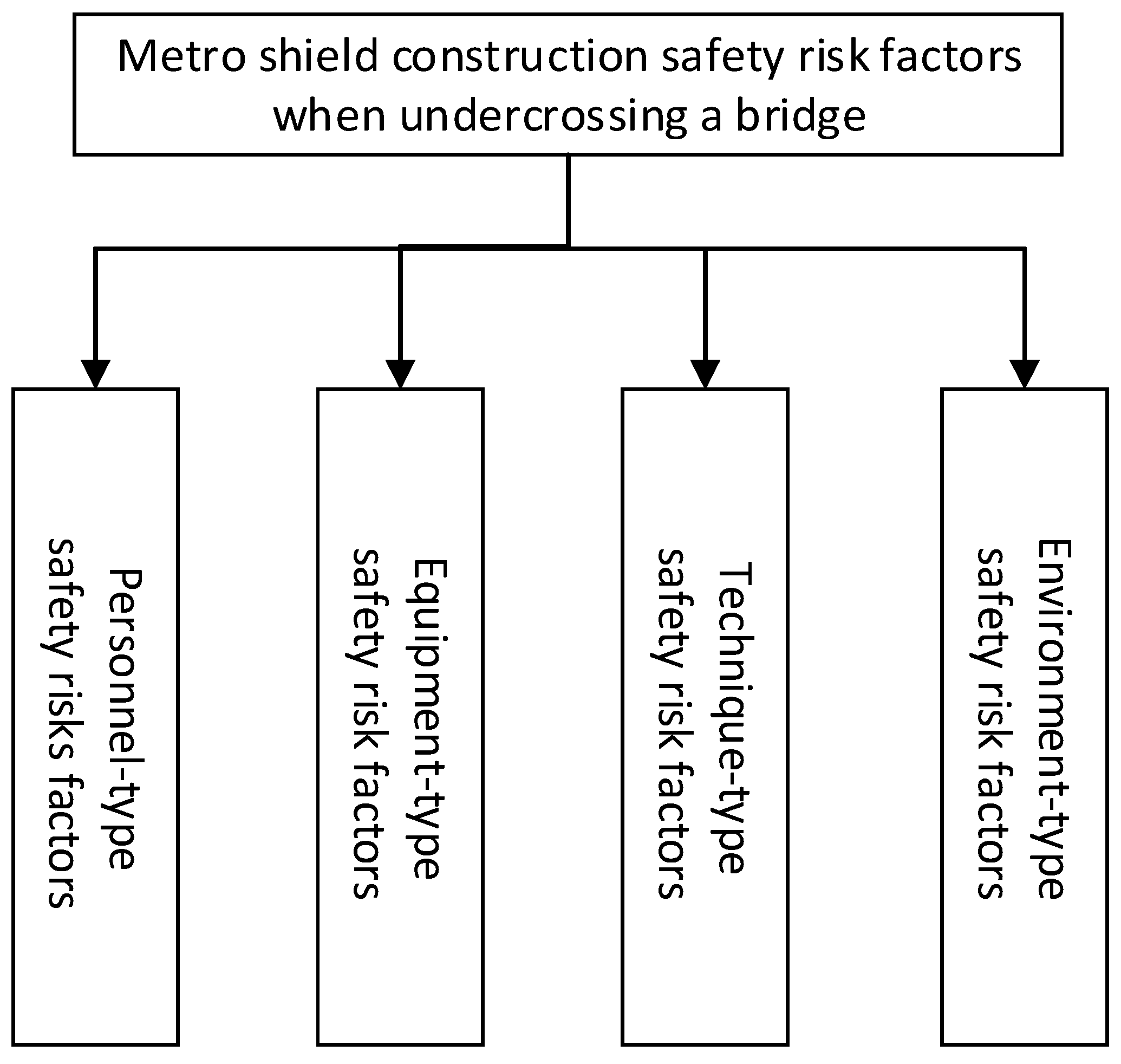
Figure 2.
Concept model for CFA.
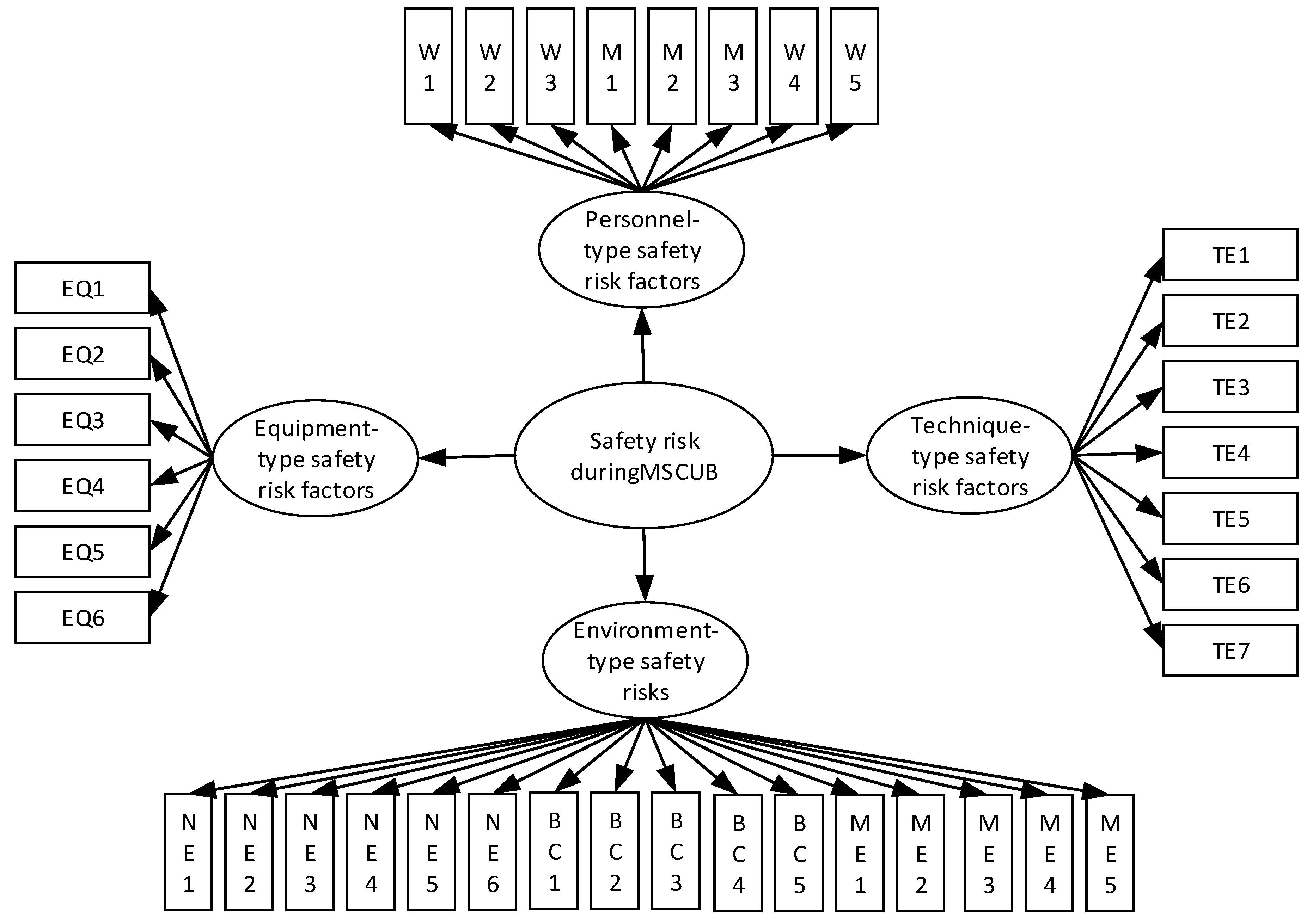
Figure 3.
The membership functions of the five risk evaluation levels.
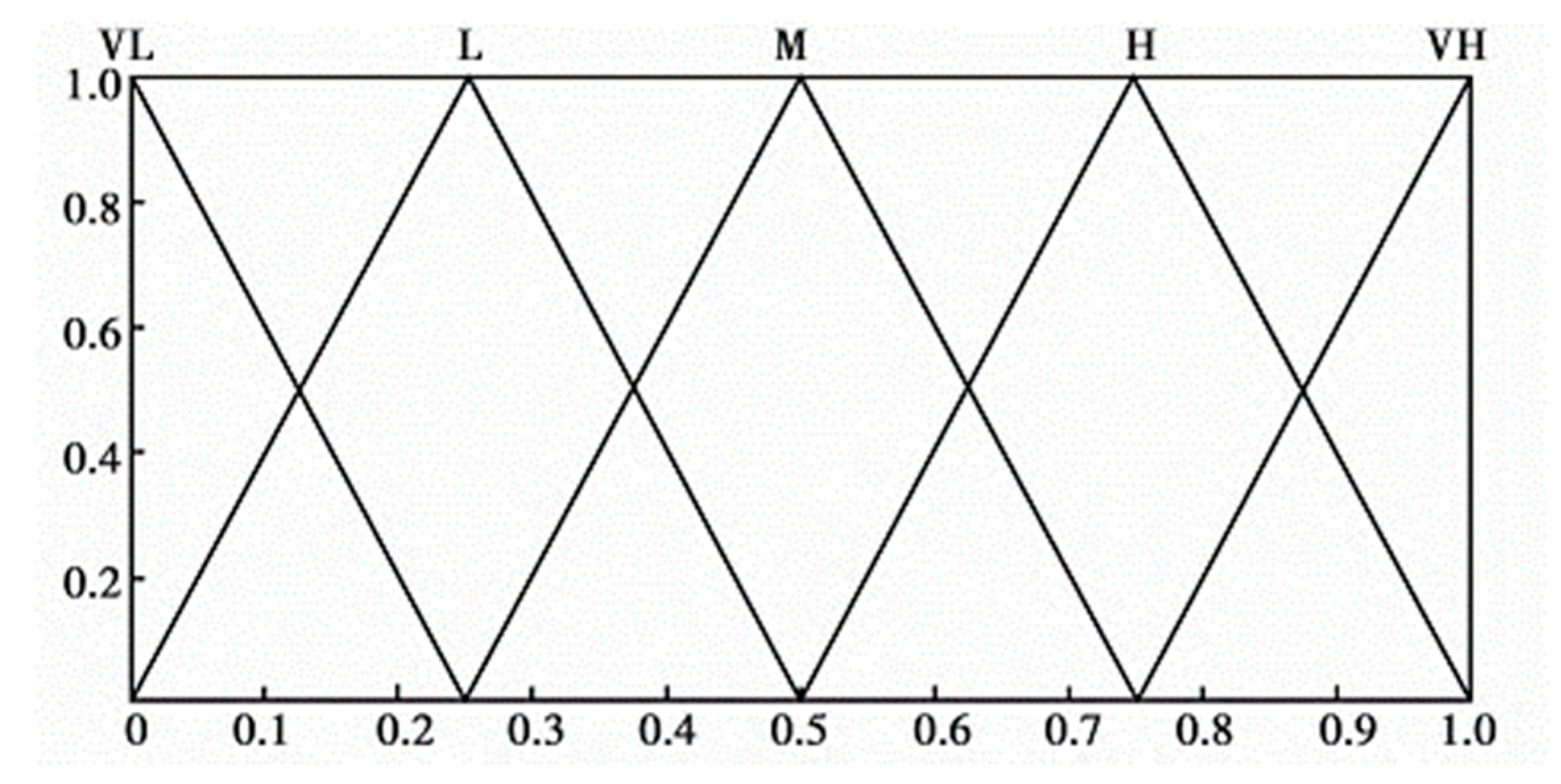

Table 1.
Safety risk factors list of MSCUB.
| Safety risk factors category | Safety risk factors | |
|---|---|---|
| Personnel-type | Worker-type | W1: Physical and psychological unhealthy; W2: Poor safety awareness; W3: Weak safety ability. |
| Manager-type | M1: Lower safety management awareness; M2: Weaker safety management competency; M3: Lower safety management intentions; M4: Insufficient safety communication; M5: Inadequate safety inspection. | |
| Equipment-type | EQ1: Malfunction of cutter head equipment; EQ2: Malfunction of thrust cylinder equipment; EQ3: Malfunction of screw conveyor; EQ4: Malfunction of segment erector; EQ5: Malfunction of grouting equipment: EQ6: Malfunction of electrical equipment. | |
| Technique-type | TE1: Improper bridge pier reinforcement technic scheme; TE2: Inadequate geological and hydrological investigation scheme; TE3: Improper construction monitoring technical scheme; TE4: Improper excavation technical scheme; TE5: Improper grouting and reinforcement technical scheme; TE6: Sealed water-proof technical scheme; TE7: Improper emergence plan. | |
| Environment-type | Natural environment-type | NE1: Soft clay layer; NE2: Silt soil layer; NE3: Complex soil layer; NE4: High-pressure underground water; NE5: Subterranean boulders; NE6: Subterranean voids. |
| Bridge condition | BC1: Relatively close position of bridge piles and tunnel; BC2:Friction bridge pile type; BC3:Large bridge pile diameter; BC4:Poor bridge pile integrity; BC5:Poor bridge safety condition; | |
| Management environment-type | ME1: Poor safety climate; ME2: Incomplete safety institution; ME3: Incomplete safety organization; ME4: Unclear safety rights and responsibility; ME5: Inadequate safety training & education. | |
Table 2.
Standard path coefficients of the CFA.
| Relationship path | SPC | Relationship path | SPC | Relationship path | SPC |
|---|---|---|---|---|---|
| PTSRF→W1 | 0.406 | TTSRF→TE1 | 0.699 | ETSRF→BC2 | 0.674 |
| PTSRF→W2 | 0.711 | TTSRF→TE2 | 0.531 | ETSRF→BC3 | 0.642 |
| PTSRF→W3 | 0.592 | TTSRF→TE3 | 0.627 | ETSRF→BC4 | 0.732 |
| PTSRF→M1 | 0.570 | TTSRF→TE4 | 0.779 | ETSRF→BC5 | 0.755 |
| PTSRF→M2 | 0.605 | TTSRF→TE5 | 0.756 | ETSRF→ME1 | 0.732 |
| PTSRF→M3 | 0.739 | TTSRF→TE6 | 0.587 | ETSRF→ME1 | 0.835 |
| PTSRF→M4 | 0.706 | TTSRF→TE7 | 0.473 | ETSRF→ME1 | 0.732 |
| PTSRF→M5 | 0.727 | ETSRF→NE1 | 0.747 | ETSRF→ME1 | 0.813 |
| ETSRT→EQ1 | 0.625 | ETSRF→NE2 | 0.741 | ETSRF→ME1 | 0.625 |
| ETSRT→EQ2 | 0.682 | ETSRF→NE3 | 0.673 | SRMSCUB→PTSRF | 0.785 |
| ETSRT→EQ3 | 0.409 | ETSRF→NE4 | 0.723 | SRMSCUB→ETSRF | 0.564 |
| ETSRT→EQ4 | 0.622 | ETSRF→NE5 | 0.547 | SRMSCUB→TTSRF | 0.648 |
| ETSRT→EQ5 | 0.768 | ETSRF→NE6 | 0.543 | SRMSCUB→ETSRF | 0.946 |
| ETSRT→EQ6 | 0.594 | ETSRF→BC1 | 0.769 | - | - |
Notes: PTSRF denotes personnel-type safety risk factors; ETSRF denotes equipment-type safety risk factors; TTSRF denotes technique-type safety risk factors; ETSRF denotes environment-type safety risk factors; and SRMSCUB denotes safety risk of MSCUB.
Table 3.
Weights of different safety risk factors.
| Safety risks factors | Weights | Safety risks factors | Weights | Safety risks factors | Weights |
|---|---|---|---|---|---|
| W1 | 0.238 | TE1 | 0.157 | BC2 | 0.189 |
| W2 | 0.416 | TE2 | 0.119 | BC3 | 0.180 |
| W3 | 0.346 | TE3 | 0.141 | BC4 | 0.205 |
| M1 | 0.170 | TE4 | 0.175 | BC5 | 0.211 |
| M2 | 0.181 | TE5 | 0.170 | ME1 | 0.196 |
| M3 | 0.221 | TE6 | 0.132 | ME2 | 0.223 |
| M4 | 0.211 | TE7 | 0.106 | ME3 | 0.196 |
| M5 | 0.217 | NE1 | 0.188 | ME4 | 0.218 |
| EQ1 | 0.169 | NE2 | 0.186 | ME5 | 0.167 |
| EQ2 | 0.184 | NE3 | 0.169 | PTSRF | 0.267 |
| EQ3 | 0.111 | NE4 | 0.182 | ETSRF | 0.192 |
| EQ4 | 0.168 | NE5 | 0.138 | TTSRF | 0.220 |
| EQ5 | 0.208 | NE6 | 0.137 | ETSRF | 0.321 |
| EQ6 | 0.161 | BC1 | 0.215 | - | - |
Table 4.
Relationship between verbal evaluation level and the triangular fuzzy number.
| Level | Occurrence probability | Consequence severity | The triangular fuzzy number |
|---|---|---|---|
| 1 | Extremely low | No impact | (0.00, 0.00, 0.25) |
| 2 | low | Minor impact | (0.00, 0.25, 0.50) |
| 3 | Relatively high | Large impact | (0.25, 0.50, 0.75) |
| 4 | High | Dangerous | (0.50, 0.75, 1.00) |
| 5 | Extremely high | Catastrophic | (0.75, 1.00, 1.00) |
Table 5.
Definition of safety risk evaluation level and risk parameter description.
| Num. | Level of a safety risk | Definition | The membership functions |
|---|---|---|---|
| 1 | Extremely low (EL) | The safety risk is acceptable | (0.00, 0.00, 0.25) |
| 2 | Low (L) | The safety risk is acceptable, and if the safety risk cost is acceptable, measures should be taken to reduce the risk. | (0.00, 0.25, 0.50) |
| 3 | Medium (M) | If technology is feasible, measures must be taken to reduce the risk. | (0.25, 0.50, 0.75) |
| 4 | High (H) | Measures must be taken to reduce the risk. | (0.50, 0.75, 1.00) |
| 5 | Extremely high (EH) | Measures must be taken to reduce and control the risk. | (0.75, 1.00, 1.00) |
Table 6.
The safety risk factors list identified by experts.
| Safety risk factors category | Safety risk factors | |
|---|---|---|
| Personnel-type | Worker-type | W2: Poor safety awareness; W3: Weak safety ability. |
| Manager-type | M2: Weaker safety management competency; M4: Insufficient safety communication; M5: Inadequate safety inspection. | |
| Equipment-type | EQ2: Malfunction of thrust cylinder equipment; EQ3: Malfunction of screw conveyor; EQ5: Malfunction of grouting equipment: EQ6: Malfunction of electrical equipment. | |
| Technique-type | TE1: Improper bridge pier reinforcement technic scheme; TE3: Improper construction monitoring technical scheme; TE4: Improper excavation technical scheme; TE5: Improper grouting and reinforcement technical scheme; TE6: Sealed water-proof technical scheme | |
| Environment-type | Natural environment-type | NE1: Soft clay layer; NE4: High-pressure underground water; NE5: Subterranean boulders; |
| Bridge condition | BC1: Relatively close position of bridge piles and tunnel; BC2:Friction bridge pile; BC3:Large bridge pile diameter; BC5:Poor bridge safety condition; | |
| Management environment-type | ME2: Incomplete safety institution; ME4: Unclear safety rights and responsibility; ME5: Inadequate safety training & education. | |
Table 7.
The levels of occurrence probability and consequence severity of safety risk factors based on the experts.
Table 7.
The levels of occurrence probability and consequence severity of safety risk factors based on the experts.
| Safety risk factors | Occurrence probability level | Consequences severity level |
|---|---|---|
| W2: Poor safety awareness | 3(Relatively high) | 4(Dangerous) |
| W3: Weak safety ability | 3(Relatively high) | 3(Large impact) |
| M2: Weaker safety management competency | 4(High) | 3(Large impact) |
| M4: Insufficient safety communication | 3(Relatively high) | 5(Catastrophic) |
| M5: Inadequate safety inspection | 3(Relatively high) | 4(Dangerous) |
| EQ2: Malfunction of thrust cylinder equipment | 3(Relatively high) | 4(Dangerous) |
| EQ3: Malfunction of screw conveyor | 2(Low) | 4(Dangerous) |
| EQ5: Malfunction of grouting equipment | 3(Relatively high) | 4(Dangerous) |
| EQ6: Malfunction of electrical equipment | 3(Relatively high) | 3(Large impact) |
| TE1: Improper bridge pier reinforcement technic scheme | 3(Relatively high) | 5(Catastrophic) |
| TE3: Improper construction monitoring technical scheme | 3(Relatively high) | 3(Large impact) |
| TE4: Improper excavation technical scheme | 3(Relatively high) | 3(Large impact) |
| TE5: Improper grouting and reinforcement technical scheme | 3(Relatively high) | 4(Dangerous) |
| TE6: Sealed water-proof technical scheme | 3(Relatively high) | 5(Catastrophic) |
| NE1: Soft clay layer | 3(Relatively high) | 4(Dangerous) |
| NE4: High-pressure underground water | 4(High) | 4(Dangerous) |
| NE5: Subterranean boulders | 3(Relatively high) | 3(Large impact) |
| BC1: Relatively close position of bridge piles and tunnel; | 3(Relatively high) | 4(Dangerous) |
| BC2:Friction bridge pile;; | 4(High) | 4(Dangerous) |
| BC3:Large bridge pile diameter; | 3(Relatively high) | 4(Dangerous) |
| BC5:Poor bridge safety condition | 3(Relatively high) | 3(Large impact) |
| ME2: Incomplete safety institution; | 3(Relatively high) | 5(Catastrophic) |
| ME4: Unclear safety rights and responsibility; | 3(Relatively high) | 4(Dangerous) |
| ME5: Inadequate safety training & education | 3(Relatively high) | 3(Large impact) |
Table 9.
The triangular fuzzy values of the safety risks.
| Safety risk factors | Fuzzy occurrence probability | Fuzzy consequences severity level | Fuzzy values of safety risks |
|---|---|---|---|
| W2: Poor safety awareness | (0.25, 0.50, 0.75) | (0.50, 0.75, 1.00) | (0.125, 0.375, 0.750) |
| W3: Weak safety ability | (0.25, 0.50, 0.75) | (0.25, 0.50, 0.75) | (0.063, 0.250, 0.563) |
| M2: Weaker safety management competency | (0.50, 0.75, 1.00) | (0.25, 0.50, 0.75) | (0.125, 0.375, 0.750) |
| M4: Insufficient safety communication | (0.25, 0.50, 0.75) | (0.75, 1.00, 1.00) | (0.188, 0.500, 0.750) |
| M5: Inadequate safety inspection | (0.25, 0.50, 0.75) | (0.50, 0.75, 1.00) | (0.125, 0.375, 0.750) |
| EQ2: Malfunction of thrust cylinder equipment | (0.25, 0.50, 0.75) | (0.50, 0.75, 1.00) | (0.125, 0.375, 0.750) |
| EQ3: Malfunction of screw conveyor | (0.00, 0.25, 0.50) | (0.50, 0.75, 1.00) | (0.00, 0.188, 0.500) |
| EQ5: Malfunction of grouting equipment | (0.25, 0.50, 0.75) | (0.50, 0.75, 1.00) | (0.125, 0.375, 0.750) |
| EQ6: Malfunction of electrical equipment | (0.25, 0.50, 0.75) | (0.25, 0.50, 0.75) | (0.063, 0.250, 0.563) |
| TE1: Improper bridge pier reinforcement technic scheme | (0.25, 0.50, 0.75) | (0.75, 1.00, 1.00) | (0.188, 0.500, 0.750) |
| TE3: Improper construction monitoring technical scheme | (0.25, 0.50, 0.75) | (0.25, 0.50, 0.75) | (0.063, 0.250, 0.563) |
| TE4: Improper excavation technical scheme | (0.25, 0.50, 0.75) | (0.25, 0.50, 0.75) | (0.063, 0.250, 0.563) |
| TE5: Improper grouting and reinforcement technical scheme | (0.25, 0.50, 0.75) | (0.50, 0.75, 1.00) | (0.125, 0.375, 0.750) |
| TE6: Sealed water-proof technical scheme | (0.25, 0.50, 0.75) | (0.75, 1.00, 1.00) | (0.188, 0.500, 0.750) |
| NE1: Soft clay layer | (0.25, 0.50, 0.75) | (0.50, 0.75, 1.00) | (0.125, 0.375, 0.750) |
| NE4: High-pressure underground water | (0.50, 0.75, 1.00) | (0.50, 0.75, 1.00) | (0.250, 0.563, 1.000) |
| NE5: Subterranean boulders | (0.25, 0.50, 0.75) | (0.25, 0.50, 0.75) | (0.063, 0.250, 0.563) |
| BC1: Relatively close position of bridge piles and tunnel; | (0.25, 0.50, 0.75) | (0.50, 0.75, 1.00) | (0.125, 0.375, 0.750) |
| BC2:Friction bridge pile;; | (0.50, 0.75, 1.00) | (0.50, 0.75, 1.00) | (0.250, 0.563, 1.000) |
| BC3:Large bridge pile diameter; | (0.25, 0.50, 0.75) | (0.50, 0.75, 1.00) | (0.125, 0.375, 0.750) |
| BC5:Poor bridge safety condition | (0.25, 0.50, 0.75) | (0.25, 0.50, 0.75) | (0.063, 0.250, 0.563) |
| ME2: Incomplete safety institution; | (0.25, 0.50, 0.75) | (0.75, 1.00, 1.00) | (0.188, 0.500, 0.750) |
| ME4: Unclear safety rights and responsibility; | (0.25, 0.50, 0.75) | (0.50, 0.75, 1.00) | (0.125, 0.375, 0.750) |
| ME5: Inadequate safety training & education | (0.25, 0.50, 0.75) | (0.25, 0.50, 0.75) | (0.063, 0.250, 0.563) |
Table 10.
The belief structure and risk level of the safety risk factors.
| Safety risk factors | Belief structure | Risk level | ||||
| EL | L | M | H | EH | ||
| W2: Poor safety awareness | 0.114 | 0.341 | 0.363 | 0.183 | 0.000 | M |
| W3: Weak safety ability | 0.205 | 0.477 | 0.265 | 0.053 | 0.000 | L |
| M2: Weaker safety management competency | 0.114 | 0.341 | 0.363 | 0.183 | 0.000 | M |
| M4: Insufficient safety communication | 0.051 | 0.257 | 0.461 | 0.231 | 0.000 | M |
| M5: Inadequate safety inspection | 0.114 | 0.341 | 0.363 | 0.183 | 0.000 | M |
| EQ2: Malfunction of thrust cylinder equipment | 0.114 | 0.341 | 0.363 | 0.183 | 0.000 | M |
| EQ3: Malfunction of screw conveyor | 0.300 | 0.467 | 0.233 | 0.000 | 0.000 | L |
| EQ5: Malfunction of grouting equipment | 0.114 | 0.341 | 0.363 | 0.183 | 0.000 | M |
| EQ6: Malfunction of electrical equipment | 0.205 | 0.477 | 0.265 | 0.053 | 0.000 | L |
| TE1: Improper bridge pier reinforcement technic scheme | 0.051 | 0.257 | 0.461 | 0.231 | 0.000 | M |
| TE3: Improper construction monitoring technical scheme | 0.205 | 0.477 | 0.265 | 0.053 | 0.000 | L |
| TE4: Improper excavation technical scheme | 0.205 | 0.477 | 0.265 | 0.053 | 0.000 | L |
| TE5: Improper grouting and reinforcement technical scheme | 0.114 | 0.341 | 0.363 | 0.183 | 0.000 | M |
| TE6: Sealed water-proof technical scheme | 0.051 | 0.257 | 0.461 | 0.231 | 0.000 | M |
| NE1: Soft clay layer | 0.114 | 0.341 | 0.363 | 0.183 | 0.000 | M |
| NE4: High-pressure underground water | 0.000 | 0.184 | 0.366 | 0.300 | 0.15 | M |
| NE5: Subterranean boulders | 0.205 | 0.477 | 0.265 | 0.053 | 0.000 | L |
| BC1: Relatively close position of bridge piles and tunnel | 0.114 | 0.341 | 0.363 | 0.183 | 0.000 | M |
| BC2:Friction bridge pile | 0.000 | 0.184 | 0.366 | 0.300 | 0.150 | M |
| BC3:Large bridge pile diameter | 0.114 | 0.341 | 0.363 | 0.183 | 0.000 | M |
| BC5:Poor bridge safety condition | 0.205 | 0.477 | 0.265 | 0.053 | 0.000 | L |
| ME2: Incomplete safety institution | 0.051 | 0.257 | 0.461 | 0.231 | 0.000 | M |
| ME4: Unclear safety rights and responsibility | 0.114 | 0.341 | 0.363 | 0.183 | 0.000 | M |
| ME5: Inadequate safety training & education | 0.205 | 0.477 | 0.265 | 0.053 | 0.000 | L |
Table 10.
The belief structure and risk level of the first-level safety risks and the overall worksite safety risk.
Table 10.
The belief structure and risk level of the first-level safety risks and the overall worksite safety risk.
| Safety risk factors categories/overall worksite safety risk | Belief structure | Risk level | ||||
|---|---|---|---|---|---|---|
| EL | L | M | H | EH | ||
| Worker-type safety risk factor | 0.080 | 0.560 | 0.330 | 0.030 | 0.000 | L |
| Manager-type safety risk factor | 0.007 | 0.300 | 0.615 | 0.078 | 0.000 | M |
| Personnel-type safety risk factor | 0.001 | 0.451 | 0.541 | 0.007 | 0.000 | M |
| Equipment-type safety risk factor | 0.023 | 0.740 | 0.233 | 0.004 | 0.000 | L |
| Technique-type safety risk factor | 0.001 | 0.480 | 0.516 | 0.003 | 0.000 | M |
| Natural environment-type safety risk factor | 0.012 | 0.464 | 0.500 | 0.024 | 0.000 | M |
| Bridge condition | 0.000 | 0.433 | 0.543 | 0.024 | 0.000 | M |
| Management environment-type safety risk factor | 0.000 | 0.440 | 0.532 | 0.028 | 0.000 | M |
| Environment-type safety risk factor | 0.000 | 0.394 | 0.604 | 0.002 | 0.000 | M |
| Overall worksite safety risk | 0.000 | 0.475 | 0.524 | 0.001 | 0.000 | M |
Disclaimer/Publisher’s Note: The statements, opinions and data contained in all publications are solely those of the individual author(s) and contributor(s) and not of MDPI and/or the editor(s). MDPI and/or the editor(s) disclaim responsibility for any injury to people or property resulting from any ideas, methods, instructions or products referred to in the content. |
© 2023 by the authors. Licensee MDPI, Basel, Switzerland. This article is an open access article distributed under the terms and conditions of the Creative Commons Attribution (CC BY) license (https://creativecommons.org/licenses/by/4.0/).
Copyright: This open access article is published under a Creative Commons CC BY 4.0 license, which permit the free download, distribution, and reuse, provided that the author and preprint are cited in any reuse.


