

Submitted:
23 August 2023
Posted:
24 August 2023
You are already at the latest version
Abstract
Although tourism seasonality significantly influences the livelihood activities of rural tourism households, limited research has explored how they adapt their livelihood strategies to achieve optimal outcomes. Employing an exploratory sequential mixed-methods design that combines thematic analysis and fuzzy-set Qualitative Comparative Analysis (fsQCA), we investigated the relationship between the livelihood strategies and outcomes of rural tourism households under the influence of tourism seasonality at the Guilin Karst World Heritage Site. The results indicate that livelihood strategies adopted by rural tourism households include "Tourism Persistence,” "Seasonal Employment,” and “Seasonal Farming” during the off-season, and “Extending Working Hours,” “Increasing Staffing Input,” and “Increasing Capital Input” during the peak season. Furthermore, these strategies form flexible combinations to realize livelihood outcomes, with “Extending Working Hours” being a necessary condition. The findings also revealed that the four configurations of seasonal livelihood strategies in the two patterns significantly contributed to high livelihood outcomes. One is named “Peak-Season Driven Pattern,” where “Extending Working Hours” and “Increasing Staffing Input” are the core conditions; the other is named “Peak-Off Blend-Driven Pattern,” where “Extending Working Hours,” “Increasing Capital Input,” and the absence of “Tourism Persistence” are the core conditions. These findings provide theoretical and practical insights for sustainable livelihood research.
Keywords:
Rural tourism
; tourism seasonality
; World Heritage Site
; sustainable livelihood
; thematic analysis
; fsQCA
1. Introduction
Local governments often integrate heritage conservation with tourism development to alleviate poverty and promote sustainable development within rural communities located at heritage sites [1,2]. Such efforts have reshaped the livelihood activities of rural households, creating new opportunities and uncertainties [3,4,5]. Since the development of tourism in rural areas has been emphasized as the embedding of tourism in rural communities [6], related studies have mainly discussed the transformation of traditional livelihoods into tourism livelihoods [7,8,9,10]. However, rather than a process from A to B, transforming rural households’ livelihood strategies is a continual positive adjustment to changing environments and circumstances, ultimately leading to livelihood diversification [11]. As a determinant of livelihood diversification, seasonality significantly impacts the livelihood strategies chosen by rural households [12]. Depending on their specific endowment of resources, rural households adopt different combinations of livelihood strategies to reduce the adverse effects of seasonality on their annual income [13]. In rural communities deeply integrated with tourism, the tourism livelihood strategy has become a vital livelihood strategy employed by many rural households[14]. Consequently, seasonal fluctuations in tourism activities result in the discontinuity of livelihood strategies for rural households involved in the tourism industry (hereinafter referred to as rural tourism households) [15], prompting them to seek complementary and alternative livelihood strategies [16]. This transformation in livelihood strategies brings about a rhythmic combination of traditional and tourism livelihoods over time, subsequently affecting livelihood outcomes [17]. Although sustainable tourism livelihoods in the research field of heritage sites have been widely discussed, there remains a shortage of empirical research investigating the transformation of livelihood strategies in the context of tourism seasonality as well as combinations of livelihood strategies that can improve the livelihood outcomes of rural tourism households.
Therefore, we aimed to elucidate the relationship between the seasonal livelihood strategies of rural tourism households and livelihood outcomes, given that the diversification of short-term adjustments when facing tourism seasonality can complicate the interactions between livelihood strategies and livelihood outcomes. Thematic analysis was used to identify the seasonal livelihood strategies of rural tourism households, followed by fuzzy-set Qualitative Comparative Analysis (fsQCA) to explore the relationship between seasonal livelihood strategies and livelihood outcomes. The Guilin Karst World Heritage Site was selected as the study area because of its continuous and in-depth tourism development, resulting in the diverse integration of tourism and traditional livelihoods. This setting provided an ideal context for investigating the impact of tourism seasonality on rural tourism households’ sustainable livelihoods. This study aims to provide a different perspective on sustainable livelihood research and deliver insights into how rural tourism households can optimize their livelihood strategies amid tourism seasonality.
This study contributes to the existing literature in two ways. First, it sheds light on the impact of tourism seasonality on household livelihood. Using mixed methods, this study systematically examines the seasonal responses of rural tourism households at the Guilin Karst World Heritage Site, identifying their seasonal livelihood strategies and the impact of these strategies on livelihood outcomes. Second, it introduces a configurational perspective to the empirical study of sustainable livelihoods by employing fsQCA. We adopted a configurational perspective to explore the impact of seasonal livelihood strategy combinations of rural tourism households on livelihood outcomes at World Heritage Sites. The remainder of this paper is organized as follows: Section 1.1 provides a literature review on sustainable livelihoods and tourism seasonality. Section 2 details the research methodology, data sources, and profile of the study area. Section 3 presents the empirical study results, including the thematic analysis and fsQCA results. Section 4 presents the discussion of this study. Finally, Section 5 concludes the study.
2. Literature review
2.1. Sustainable livelihood
Chambers and Conway (1991) proposed a sustainable livelihood approach for addressing rural poverty in which livelihoods are sustainable when they can adapt to and recover from external risks while enhancing capabilities without compromising natural environmental resources and development opportunities for future generations [18]. To develop a systematic paradigm for sustainable livelihood research, the Department for International Development (DFID) developed a widely recognized framework for sustainable livelihood analysis. This framework places people at the center of the study, considers the fundamental changes in the scale and structure of livelihood capital of subjects under the influence of vulnerability contexts, and selects appropriate livelihood strategies to respond to transforming structures and processes to achieve the goal of livelihood outcomes [11].
In peripheral areas, tourism is perceived not only as a development tool but also as a sustainable livelihood approach that can improve the livelihood of rural households and their adaptive capacity in a vulnerable context [14]. Existing studies on sustainable livelihoods in tourism often use the DFID sustainable livelihood framework for analysis, which examines the interrelationships among livelihood capital, livelihood strategies, and livelihood outcomes, including the evaluation of assets, strategy transformations, and differences in outcomes attributed to different strategies [19,20,21,22]. Among these, livelihood strategies, at the core of rural household responses to external changes, have garnered significant attention [9,23,24]. Livelihood strategies encompass the choices and combinations of activities adopted by rural households to achieve their livelihood objectives, such as production and investment [11]. In the context of tourism as an external force, rural households' livelihood strategies can be broadly categorized into tourism and non-tourism types [10]. Scholars argue that tourism strategies can enhance sustainability and therefore encourage rural households to actively choose these strategies for improved livelihood outcomes [3,25]. Some even claim that earning income through tourism livelihood strategies is more advantageous than other types of livelihood activities and that specialized tourism livelihood is a sustainable “developmental pattern” [26]. However, tourism livelihoods are subject to seasonal variations and unexpected events, which may lead to potential volatility and uncertainty in relying solely on tourism [27]. Therefore, diversifying livelihoods by combining both tourism and traditional strategies over different periods and locations is an effective measure to mitigate livelihood risks [6,28].
Livelihood diversification refers to the process through which rural households build a varied range of activities and social support systems to enhance their standard of living and resilience to livelihood risks [29]. Most scholars categorize rural households' livelihood diversification according to the proportion of income obtained from farming, labor, and tourism activities in their overall household incomes [30,31]. They then used descriptive statistical analysis to compare the differences in livelihood outcomes attributable to each strategy [9,32]. These studies affirm the positive impact of tourism livelihood diversification on rural household sustainability. Nonetheless, livelihood diversification extends beyond mere income diversification; it also entails broadening the range of available options and opportunities, highlighting the significance of flexibility [25,27,33,34]. This aspect becomes particularly critical during seasonal shifts as individual livelihood diversification manifests in the short-term, flexible, and ongoing selection of various livelihood strategies [33].
2.2. Tourism seasonality
While tourism development at World Heritage Sites has led to improvements in livelihood capital and the diversification of livelihood strategies for rural households in surrounding areas, the inherent uncertainties of the tourism industry, particularly tourism seasonality, also present challenges to the livelihoods of households [35,36]. Tourism seasonality refers to the temporary imbalance between demand and supply over time, primarily characterized by fluctuations in critical factors such as the number of tourists, employment, and prices [37]. Seasonality in tourism is influenced by natural and institutional factors [38,39]. Natural seasonality results from cyclical variations in natural phenomena such as temperature and precipitation [38,40], which are particularly pronounced in remote and peripheral areas [41]. Institutional seasonality arises from fluctuations in social norms and customs, such as holidays, which significantly impact tourism seasonality [42,43]. Some scholars argue that tourism seasonality has potential benefits, including providing tourism practitioners with the opportunity to repair equipment [44], as well as facilitating ecological restoration [37,45] and capitalizing on seasonally inexpensive labor [46]. However, seasonality is often considered a negative factor in tourism development, as it places considerable pressure on the sustainability of the tourism industry [47]. For instance, seasonal fluctuations can result in unstable employment relationships, leading to seasonal employment and hidden unemployment among tourism practitioners [48]. Furthermore, tourism practitioners must take advantage of the brief peak season to secure sufficient capital to ensure year-round business income. This discontinuity in income generation may compel practitioners to seek alternative income sources [48].
To mitigate the adverse effects of seasonal uncertainty, most studies recommend demand regulation strategies for tourism firms or destinations [6]. These strategies can be broadly categorized into product and market diversification [49]. Product diversification entails offering a wide range of tourism products, particularly during the off-season, to stimulate sluggish demand [50]. Market diversification involves reducing the risk of reliance on a single market by expanding and targeting new markets [47]. Nevertheless, tourism practitioners in remote and peripheral areas, especially those from rural households with limited resources and expertise [51], often face challenges in effectively responding to seasonal shocks through the mentioned strategies. Consequently, rural tourism households at heritage sites can only adjust their lifestyles and livelihoods when confronted with seasonality [6]. Su et al. (2019) examined the livelihood strategies of various rural households during low- and high-tourism seasons, emphasizing the need for increased attention to seasonality in sustainable livelihood studies [36]. However, current research on livelihoods affected by tourism seasonality has been limited to examining formal coordination between tourism livelihoods and traditional livelihoods, and lacking empirical studies on the potential combination of livelihood strategies under the influence of seasonality and the evaluation of their livelihood outcomes.
3. Materials and Methods
Research on tourism seasonality within the field of sustainable tourism livelihoods is limited; hence, we employed an exploratory sequential research design that involves initially investigating exploratory issues using qualitative methods and subsequently applying the results of the qualitative research to the quantitative research phase [52]. Specifically, the first phase involved a thematic analysis to explore the seasonal livelihood strategies of rural tourism households in the Guilin Karst World Heritage Site. The second phase developed a structured questionnaire based on the results of the thematic analysis and then used fsQCA to examine the relationship between seasonal livelihood strategies and livelihood outcomes of rural tourism households (Figure 1).
3.1. Qualitative phase
In 2021, semi-structured interviews were conducted to gain a deeper understanding of the seasonal livelihood strategies of rural tourism households and how these strategies should be combined. The interview questions were designed based on previous studies on tourism seasonality and sustainable livelihoods. The primary focus of the interviews was on the impact of tourism seasonality on livelihood strategies, with related questions addressing the characteristics of tourism seasonality at heritage sites and the reasons for the seasonal livelihood strategies chosen by rural tourism households. Each interview lasted between 10 and 30 min and was conducted in 40 rural tourism households (coded as I-1-I-40) at the Guilin Karst World Heritage Site. These rural tourism households comprise four types of tourism practitioners: shopholders, stall holders, tourism employees, and catering and accommodation runners.
The audio content of interviews with rural tourism households was recorded and transcribed. Thematic analysis, a method for identifying, analyzing, and interpreting themes within qualitative data [53], was then employed to extract the livelihood adjustments made by these households. Thematic analysis is a flexible method unconstrained by specific theories or frameworks, allowing researchers to identify and interpret key features of the data using inductive and deductive logic guided by the research question [54]. The inductive logic of thematic analysis is data-driven, suggesting that it does not require any predetermined theory or framework for the data to fit into [53], making it well-suited for exploratory research questions. In this study, thematic analysis under inductive logic helped interpret the seasonal livelihood strategies chosen by rural tourism households at the Guilin Karst World Heritage Site, given the scarcity of research focusing on the impact of tourism seasonality on micro-subjects within the field of sustainable livelihoods.
As suggested by Braun and Clarke, thematic analysis involves five distinct steps [53]. The first step involves familiarizing oneself with the data and noting ideas in preparation for coding. In the second step, the data is coded to create the initial codes, utilizing as much data as possible. The third step involves analyzing the codes generated in the previous phase and grouping them into subthemes based on their similarities. The fourth step involves iteratively reviewing and refining the subthemes to create overarching themes. Finally, in the fifth step, the essence of each theme is defined while clarifying which aspects of the data were captured by each theme.
3.2. Quantitative phase
3.2.1. Questionnaire design
To collect comprehensive data on livelihood adjustments, a questionnaire was developed based on thematic analysis and a literature review of sustainable livelihoods. The outcomes of the thematic analysis guided the formulation of closed-ended questions along with their respective answers. Additionally, insights from the sustainable livelihoods research were utilized to develop evaluation indicators for assessing the livelihood capital of rural households and their corresponding livelihood outcomes. The questionnaire comprised three parts: the first involved evaluating livelihood capital and assessing livelihood outcomes. Livelihood capital consisted of five components: natural, physical, human, social, and financial capital (Appendix A). The annual income of rural tourism households was used to assess the livelihood outcomes. In the second part, a series of closed-ended questions explored the primary reasons for the participation of rural tourism households in the tourism industry and their main modes of involvement. The third section investigated the seasonal livelihood strategies and combinations employed by rural tourism households.
In 2021, a questionnaire survey was conducted in villages situated at the Guilin Karst World Heritage Site, primarily targeting local households. Researchers provided guidance and assistance for individuals who were older or less educated and unable to independently complete the questionnaire. A total of 669 valid questionnaires were collected. From this dataset, a sample of 388 households involved in the tourism industry was selected for further analysis to address specific research objectives.
3.2.2. FsQCA
We employed fsQCA to explore the impact of seasonal livelihood strategies on the livelihood outcomes of rural tourism households at the Guilin Karst World Heritage Site. The fsQCA examines complex causality from a configurational perspective using set theory and Boolean algebra to identify necessity and sufficiency [55]. FsQCA, which provides a more precise explanation of complex causality, allows membership from 0 (fully absent) to 1 (fully present). Therefore, the fsQCA was used to investigate how the seasonal livelihood strategies of rural tourism households, as causal conditions, affected their livelihood outcomes through interdependent effects.
In this study, the relevant analysis was conducted using the fsQCA software, following the steps outlined below.
(1) Selection of relevant cases. To focus on the direct impact of tourism seasonality on tourism livelihoods, this study selected 388 rural tourism households as case studies.
(2) Identification of the causal conditions and outcomes. Based on the results of the thematic analysis, multiple seasonal livelihood strategies of rural tourism households were used as causal conditions. Annual household income was selected as the livelihood outcome.
(3) Calibration of causal conditions and outcomes. Calibration is the process of assigning a set membership to each case [56]. The indirect calibration method was employed in the present study using quartiles as anchors for the outcome, with the 75th percentile as the full membership point, the 50th percentile as the crossover point, and the 25th as the full non-membership point [57,58]. A dichotomous approach was used to calibrate causal conditions, with 0 indicating full absence and 1 indicating full presence. Additionally, to avoid theoretical difficulties at the cross point (0.5), we subtracted a small constant of 0.001 [59].
(4) Necessity analysis of causal conditions. The purpose of this analysis was to discuss the extent to which the set of outcomes constitutes a subset of the set of causal conditions [60]. Following Schneider et al.'s suggestion, a single causal condition with a consistency score no less than 0.9 is identified as “almost always necessary” for the occurrence of the outcome [61].
(5) Generation of a truth table. Based on the fuzzy-set membership matrix obtained from the calibration, all combinations of causal conditions that could lead to the outcome were found using the fsQCA software. In this step, three thresholds need to be set: case frequency, which is used to simplify the combinations, and row consistency and PRI consistency, which are used to evaluate whether the causal conditions are a subset of the outcomes. Referring to the recommendations of Rihoux et al., in this study, the case frequency threshold was set to 2, the raw consistency threshold was set to 0.8, and the PRI consistency threshold was set to 0.7 [57,62].
(6) Analysis of the truth table. This step focused on analyzing the sufficiency of combinations of causal conditions for the outcomes [62]. The truth table produces three types of solutions with different complexities: complex, intermediate, and parsimonious solutions. Intermediate solutions with moderate complexity were the primary choice for reporting the results [63].
(7) Robustness analysis. The most commonly used robustness tests for fsQCA involve changing the calibration anchor points and analysis threshold [64]. If there is no substantial change in the configurations and their consistency and coverage after changing the relevant parameters, the results of the fsQCA are robust. In this study, the methods of changing the calibration anchors of the outcome and increasing the raw consistency threshold were used for the robustness analysis.
3.2.3. Study area
The Guilin Karst World Heritage Site, situated in the northeastern part of the Guangxi Zhuang Autonomous Region of China (Figure 2 and Figure 3), largely overlaps with the Lijiang Scenic Spot, which is by far the world's largest and most picturesque karst landscape excursion area and the core display of the karst heritage site (http://www.guilinkarst.com/about.jsp).
As rural villages located in heritage sites experience an increasing influx of tourism, more rural households are participating in the tourism industry to supplement their traditional livelihoods. The focal point of the study area is the karst landscape, and local climatic conditions significantly shape its tourism development. The peak tourism period spans from May to October, coinciding with the summer vacation when the water level and temperature of the river are optimal, making it an opportune time for visiting Lijiang by boat or bamboo raft. Conversely, the remaining months constitute the off-peak tourism season. The impact of pronounced seasonality on the livelihood activities of rural tourism households has compelled them to adopt strategies to manage these fluctuations. Consequently, the Guilin Karst World Heritage Site serves as an appropriate context for investigating the correlation between seasonal livelihood strategies of rural tourism households and their livelihood outcomes.
4. Results
4.1. Seasonal livelihood strategies of rural tourism households
The researchers thematically analyzed the transcribed data from 40 semi-structured interviews. After familiarizing themselves with the data, they developed two themes, off-season, and peak-season livelihood strategies, and identified the connotations of each. The thematic analysis process is illustrated in Figure 4, where the initial 17 codes are at the bottom layer, six subthemes are formed by combining codes of the same nature in the middle layer, and finally, the subthemes are further categorized to form two core themes in the top layer. Through this process, insights into the seasonal livelihood adjustments of rural tourism households at the Guilin Karst World Heritage Site were acquired.
4.1.1. Off-season livelihood strategies
An off-season livelihood strategy refers to the choices made by rural tourism households when normal tourism operations are hindered by a lack of demand during the off-season. The subthemes include “Tourism Persistence,” “Seasonal Farming,” and “Seasonal Employment.”
4.1.1.1. Tourism Persistence
“Tourism Persistence” is a single seasonal livelihood strategy chosen by most rural tourism households, particularly those with commercial buildings and tourism employees. Commercial building investments often involve long-term contracts and substantial monetary investments. Thus, closing during the off-season results in significant financial losses. As one respondent mentioned, "You still have to keep the store open in the off-season, because you've invested all the money" (I-2). As employees of tourist attractions, if the attractions are still in operation during the off-season, the relevant workers need to persist in their work even with a few tourists, although the working hours may change. For example, one respondent stated: "In the peak season, we start to work at 6 o'clock and finish at 18 o'clock; during the off-season, we finish at 17:30" (I-36). In contrast, stallholders have greater flexibility and usually choose to close during the off-season: "…basically, November and December have very low demand, and there are not many people, so we do not set up the stall. Those two months are always rainy and very cold, so we quit" (I-6).
4.1.1.2. Seasonal Farming
Off-season farming activities involve rural tourism households, which utilize agricultural resources to their fullest extent. Land resources are the core agricultural assets of households and provide the basis for engaging in agricultural production activities: "…nearly all the households in the surrounding villages have land and usually grow crops. For example, fruit accounts for a significant portion" (I-1). On the one hand, by planting cash crops, households can obtain a certain economic income: "…I still have some acres of orchards at home; working here is certainly not enough" (I-19). In contrast, farming activities related to subsistence crops provide households with the materials necessary for survival. For example, one respondent stated: "…(off-season) you know, we are going to collect grain, so we do not need to buy rice. Setting up a stall here is just to earn a little money." (I-6).
4.1.1.3. Seasonal Employment
"Seasonal Employment" is an effective way to make full use of idle labor during the off-season, especially for households with little or no land: "…We have sold our fields; the field near the dock used to be ours, and we have sold it to the tourism company" (I-12). The low tourism demand in the off-season significantly reduces the economic returns of households while also releasing some of the family labor within the tourism industry: "If there is little business with few people, and if there aren't that many people needed, we have to find something else to do. We will go to find some temporary work" (I-7). "If it is too long without a turn to row the raft, maybe we cannot earn enough money, so we try to go outside for a job" (I-3).
4.1.2. Peak season livelihood strategies
Peak season livelihood strategies refer to the resource allocation choices made by rural tourism households within the tourism industry when there is a surge in tourism demand. The subthemes included “Extending Working Hours,” “Increasing Staffing Input,” and “Increasing Capital Input.”
4.1.2.1. Extending Working Hours
In the face of surging tourism demand, “Extending Working Hours” is the least costly and most straightforward seasonal livelihood strategy chosen by rural tourism households. In particular, the “Extending Working Hours” sub-theme is most evident for rural tourism households whose employers mandate working hours. The interviewee (I-3) said, “…we need to row the raft without a break all day when there is a huge crowd of people….” As for other types of rural tourism households, their working hours are entirely under their control according to the flow of tourists, but they also generally express a willingness to extend their working hours flexibly: "In the peak season, from 8 am to 10 pm, we are at a time of busy. But the busiest time is not now (afternoon), is lunchtime and dinnertime” (I-7).
4.1.2.2. Increasing Staffing Input
“Increasing Staffing Input” is a pivotal strategy for rural tourism households to expand their production capacity and take full advantage of tourism demand during the peak season, as the tourism industry is labor-intensive. Staffing inputs of rural tourism households can be broadly divided into “self-family labor input” and “hired labor input.” Those rural tourism households with relatively small production scales can meet their labor needs by utilizing their families’ workforce, said (I-1),"...... my son will come home to help me manage this restaurant during the summer vacation, so the family labor is enough for the peak season." Slightly larger catering and accommodation households need to hire labor to adequately serve the continuous flow of tourists: “...usually, during the summer, we need about five or six people to have enough staff" (I-31).
4.1.2.3. Increasing Capital Input
The input of the means of production can make full use of human resources to enhance production capacity and promote output maximization during the peak season. As the production scale of some rural tourism households is small, capital investment is mainly for the purchase of consumable equipment and raw materials required for catering and accommodation. “In peak season, there are a lot of people, so we surely need to prepare more equipment and raw materials, such as bedding and kitchen supplies” (I-35). For rural tourism households that usually set up stalls in scenic spots, capital input is mainly directed toward expanding the variety of goods sold. As one of the interviewees said, "During the peak season, I diversified my goods a bit. Now, in the off-season, there is less variety” (I-8).
4.2. The relationship between seasonal livelihood strategies and livelihood outcome
4.2.1. Individual necessary conditions
Before conducting the sufficiency analysis, a necessity analysis of the causal conditions was performed (Table 1). Of all the seasonal livelihood strategies, including presence and absence, only “Extending Working Hours” had a consistency score above the threshold of 0.9. This means that configurations leading to the presence of high livelihood outcomes must include the seasonal livelihood strategy of “Extending Working Hours.” In addition, the presence or absence of other seasonal livelihood strategies was not necessary for achieving high livelihood outcomes.
4.2.2. Analysis of sufficiency
According to the results of interviews and questionnaires, rural tourism households at the Guilin Karst World Heritage Site did not limit themselves to a single seasonal livelihood strategy. Instead, they employ diverse combinations of strategies that result in different livelihood outcomes. Since “Extending Working Hours” during the peak season is a necessary condition for high livelihood outcomes, this condition should be set as “present” for the intermediate solution. Other causal conditions, whether present or absent, may also lead to favorable livelihood outcomes. Table 2 shows that the six seasonal livelihood strategies yielded the four configurations that achieved the highest livelihood outcomes. In the parameters presented in the results, the coverage of a configuration refers to the percentage of cases that can be explained. Consistency reflects the degree of membership in a given configuration. The overall consistency of the solution was 0.915, which is above the threshold of 0.8. In this study, the core and peripheral conditions of each configuration were distinguished by comparing the causal conditions between the intermediate and parsimonious solutions [65]. Specifically, the conditions appearing in both solutions are the core conditions, which significantly impact the outcome. In contrast, the conditions that only appear in the intermediate solution are peripheral conditions, which have less impact on the outcome.
The four configurations can be categorized into two patterns by comparing the core conditions and interpretation logic of the configurations. Pattern 1 is named “Peak Season Driven Pattern,” which includes S1a, S1b, and S1c. Pattern 2 is named “Peak-off Blend-Driven Pattern,” which contains only S2.
Pattern 1 reveals that high livelihood outcomes can be achieved by combining seasonal livelihood strategies with ‘Increasing Staffing Input’ and ‘Extending Working Hours’ as core conditions, along with various peripheral conditions. In S1a, the peripheral conditions include “Tourism Persistence” and “~Seasonal Farming.” In S1b, peripheral conditions include “Seasonal Employment,” “~Seasonal Farming,” and “~Increasing Capital Input.” Finally, in S1c, the peripheral conditions include "Seasonal Employment," "Seasonal Farming," and “~Increasing Capital Input.”
The case information for these configurations shows that rural tourism households in pattern S1 make significant cumulative investments in tourism and experience a relatively low marginal effect of capital investment during the peak season. Consequently, capital investment during the peak season is unlikely to rapidly improve tourism reception capacity. Moreover, as most rural tourism households in pattern S1 are focused on accommodation and catering, family labor alone cannot meet the surge in tourism demand during the peak season. Therefore, hiring staff to expand tourism reception capacity is vital for the full use of peak season demand. S1a is intended for rural tourism households that depend heavily on tourism for their livelihood. Additionally, rural tourism households have high levels of education, which enables them to effectively leverage their skills to mitigate the negative impact of the low season on tourism operations. The rural tourism households in S1b are less involved in tourism than those in S1a. The proportion of their annual income derived from working outside has increased significantly, which gives them a chance to achieve high livelihood outcomes regardless of whether they persist in tourism operations during the off-season. In S1c, the dependence of households on tourism is further reduced, and household income sources are more diversified compared to the previous two configurations, which allows households in S1c to achieve high livelihood outcomes.
The case information for these configurations shows that rural tourism households in pattern S1 make significant cumulative investments in tourism and experience a relatively low marginal effect of capital investment during the peak season. Consequently, capital investment during the peak season is unlikely to rapidly improve tourism reception capacity. Moreover, as most rural tourism households in pattern S1 are focused on accommodation and catering, family labor alone cannot meet the surge in tourism demand during the peak season. Therefore, hiring staff to expand tourism reception capacity is vital for the full use of peak season demand. S1a is intended for rural tourism households that depend heavily on tourism for their livelihood. Additionally, rural tourism households have high levels of education, which enables them to effectively leverage their skills to mitigate the negative impact of the low season on tourism operations. The rural tourism households in S1b are less involved in tourism than those in S1a. The proportion of their annual income derived from working outside has increased significantly, which gives them a chance to achieve high livelihood outcomes regardless of whether they persist in tourism operations during the off-season. In S1c, the dependence of households on tourism is further reduced, and household income sources are more diversified compared to the previous two configurations, which allows households in S1c to achieve high livelihood outcomes.
Peak-Off Blend-Driven Pattern demonstrates that high livelihood outcomes can be achieved by combining seasonal livelihood strategies with the core conditions of “Extending Working Hours,” “Increasing Capital Input,” and “~Tourism Persistence” along with the peripheral conditions of “Seasonal Employment,” “Seasonal Farming,” and “~Increasing Staffing Input.”
Based on the analysis of the case study, rural tourism households in S2 exhibit a lower level of dependency on the tourism industry. Consequently, these households allocate minimal investment in tourism operations and experience a relatively high marginal effect of capital investment during the peak season. Furthermore, these households possess a relatively high human capital index, reducing the need to hire additional staff. Relying predominantly on farming and labor as their primary income sources in the low season, rural tourism households in S2 possess the flexibility to forego the "Tourism Persistence" strategy if confronted with a substantial decline in tourism demand during the off-season. This capacity enables them to attain favorable livelihood outcomes while making relatively modest resource investments.
4.2.3. Robustness analysis
To enhance the reliability of this study, the raw consistency threshold was raised to 0.85. The resulting new configurations aligned well with the existing configurations, leading to a slight decrease in overall consistency from 0.915 to 0.912. However, this value remained above the 0.85 consistency threshold. Second, a robustness check was performed by adjusting the calibration of the outcome. Full membership, crossover, and full non-membership were set to the 80th, 50th, and 20th percentiles, respectively, resulting in configurations consistent with the existing ones. Although the overall consistency decreased from 0.915 to 0.88, it remained above the consistency threshold of 0.8. The robustness analysis results suggest that the fsQCA findings of this study are robust.
5. Discussion
5.1. Discussion of Empirical Results
In response to the seasonality inherent in tourism, households within the Guilin Karst World Heritage Site implement various seasonal livelihood strategies. These strategies encompass "Tourism Persistence," "Seasonal Employment," and "Seasonal Farming" during the off-season, and "Extending Working Hours," "Increasing Staffing Input," and "Increasing Capital Input" during the peak season. Distinctions between these strategies during the off-season and peak season primarily depend on their underlying factors. During the off-season, strategies are influenced by the industries in which rural tourism households are engaged. In contrast, in the peak season, they are shaped by the allocation of resources by households to the tourism sector. Both qualitative and quantitative data analyses illuminate the deep-rooted integration of tourism within the rural communities of the Guilin Karst World Heritage Site, owing to its prolonged history of tourism development. Consequently, tourism has become a pivotal income source for rural households, particularly those directly involved in the tourism sector. During the peak season, the surge in tourism demand presents substantial revenue-generating potential, compelling rural tourism households to actively participate in tourism-related activities and allocate resources judiciously to optimize annual incomes[66,67,68]. Thus, disparities in peak-season livelihood strategies primarily manifest through resource allocation. In contrast, during the off-season, characterized by low tourism demand and a supply exceeding demand, rural tourism households often encounter impediments to their tourism-related activities. This prompts them to seek alternate livelihood strategies[36,69,70]. Consequently, differences in off-season livelihood strategies correspond to the industries pursued by rural tourism households.
Seasonal livelihood strategies during the peak season serve as the core driving force for the high livelihood outcomes of rural tourism households. The results reveal that the core conditions are primarily concentrated in the seasonal livelihood strategy of peak season, where “Extending Working Hours” is the necessary condition to achieve high livelihood outcomes, and “Increasing Staffing Input” is the most frequent core condition (except necessary conditions). The fluctuation in tourism demand during the low and high seasons necessitates that rural tourism households take advantage of the surge in tourist flow and high unit prices during busy months/weeks to obtain sufficient income [71,72,73]. Tourism, being labor-intensive, heavily depends on a substantial workforce to cater to tourists [74], especially during peak seasons when demand is high [75]. Similar to research on seasonal staffing needs, most rural tourism households retain only a basic labor force and increase the input of temporary labor during the peak season. In contrast, few maintain a stable labor force and adjust working hours to cope with seasonality [76].
Though not the optimal choice, configuration S1a was more frequently adopted among rural tourism households among the four configurations for achieving favorable livelihood outcomes. Configurational information indicates that S1a had the highest raw coverage, implying that relying on year-round tourism livelihoods was the prevalent approach among the examined rural tourism households. However, this configuration exhibited the lowest consistency, suggesting its limited explanatory sufficiency in relation to favorable livelihood outcomes [62]. Previous research on sustainable tourism livelihoods suggests that integrating tourism with traditional livelihoods is imperative to leverage existing resources effectively [77,78]. Thus, solely depending on "Tourism Persistence" during the off-season may not be optimal or sustainable, considering livelihood diversification and benefit maximization. However, the findings from interviews and questionnaires indicate that rural tourism households that exclusively engage in the tourism industry throughout the year may not make decisions based on maximizing family income, which is consistent with prior research [79,80,81]. Rural tourism households commonly identify family attachment as the primary reason for not participating in seasonal work during the off-season despite the potential for maximizing economic benefits.
Among rural tourism households, limited livelihood diversification is a prevalent choice. Among the four configurations that yield favorable livelihood outcomes, three configurations (S1a/S1b/S1c) demonstrate that coupling tourism livelihoods with specific traditional livelihoods can result in favorable livelihood outcomes under the influence of tourism seasonality. Only S2, characterized by nearly the lowest raw consistency, reveals that integrating tourism livelihoods with two traditional livelihoods can yield favorable livelihood outcomes. This aligns with existing research on livelihood diversification, suggesting that while diversification can mitigate livelihood vulnerability to some extent through diversified income streams, excessive diversification disperses already limited livelihood resources, leading to reduced production efficiency and sustainability[82].
5.2. Implications
The findings suggest potential theoretical implications for sustainability. Firstly, the investigation into how livelihood adjustments unfold within rural tourism households, influenced by tourism seasonality, contributes to the enrichment of adaptation theory. By discerning and illuminating specific strategies employed during both high and low seasons, the study offers a nuanced understanding of the decision-making dynamics within households. This perspective sheds light on the intricate ways in which households adapt to the challenges posed by tourism seasonality, advancing adaptation theory. Additionally, the examination of livelihood adjustments during tourism seasonality highlights the delicate equilibrium that rural households attempt to maintain between tourism-related activities and their traditional livelihoods, enhancing the understanding of livelihood diversification theory. Moreover, the research delves into the micro-level intricacies of resource allocation within rural tourism communities. By uncovering the complex decisions rural households make to optimize their livelihood outcomes, the study contributes to the theoretical perspective that explains how these communities allocate resources in response to seasonal variations.
Beyond its theoretical implications, the findings of the study hold practical value by offering recommendations to both rural tourism households and local governments. For rural tourism households, the study suggests a prudent approach to seasonal livelihood strategies, emphasizing alignment with available resources. Caution is advised against excessive diversification, which could lead to inefficiencies and hinder the pursuit of livelihood objectives. The study underscores the importance of meticulous resource assessment, aiming to closely align seasonal livelihood strategies with available resources and aspirations. Furthermore, the study proposes that local governments consider deepening their understanding of the negative impacts of tourism seasonality on livelihoods. This understanding could serve as a foundation for targeted support and solutions. For example, governments could explore avenues for facilitating infrastructure development, providing training programs, and extending financial aid to assist rural tourism households in diversifying their income sources beyond tourism. Such support may empower rural communities to navigate seasonality challenges adeptly, potentially enhancing their overall resilience.
5.3. Limitations
Despite the valuable insights provided in this study, certain limitations warrant consideration in future research endeavors. Initially, the scope of this study was confined by the availability of data, concentrating solely on the static associations between seasonal livelihood strategies and corresponding livelihood outcomes. However, tourism destinations continually evolve; therefore, future studies could adopt a dynamic perspective, enabling a comparative analysis of pertinent research questions across varying stages of tourism development. Moreover, the exclusive reliance on the annual income of rural tourism households as a measure of their livelihood outcomes is a limitation. While this metric pertains to economic sustainability, the intricate web of social relationships suggests that economic sustainability may not be the sole pursuit of rural tourism households. Consequently, future research could formulate a diversified set of livelihood outcome indicators to comprehensively assess the impact of seasonal livelihood strategies on livelihood outcomes.
6. Conclusion
By employing a sustainable livelihood framework, our study enhances the understanding of how seasonal fluctuations in tourism shape rural livelihood outcomes. We exploratively examined the seasonal composition of livelihood strategies and employ the fsQCA method to scrutinize their impact. Within the World Heritage Site context, the trajectories to improved livelihoods are intricately linked to the choice of seasonal strategies. These findings underscore the importance of adjusting strategies to accommodate inherent seasonality in rural tourism. Our analysis sheds light on effective approaches for sustaining rural tourism and fortifying local livelihoods. Moreover, this study highlights the utility of fsQCA for unraveling the intricate interplay between seasonal strategies and their livelihood implications, contributing to methodological advancements in this domain.
Author Contributions
Conceptualization, Z.S. and K.X.; Investigation, W.H.W., T.K. and Y.H.Z.; Data curation, K.X., W.H.W. and Y.H.Z.; Writing—original draft, K.X.; Writing—review & editing, Z.S. and D.D.L. All authors have read and agreed to the published version of the manuscript.
Funding
This work was supported by the National Natural Science Foundation of China (Grant numbers 72262002, 71764003) and Key Research Base of Humanities and Social Sciences in Guangxi Universities.
Institutional Review Board Statement
Not applicable
Informed Consent Statement
Not applicable
Data Availability Statement
Data can be supplied by the corresponding author upon plausible demand.
Acknowledgments
The authors would like to acknowledge the interviewees and questionnaire respondents who gave their time to share their insights with us.
Conflicts of Interest
The authors declare no conflict of interest.
Appendix A Household livelihood capital index
| Indicators | Sub-indicators | Interpretation and Assignment |
| Natural capital | Cultivated land resources | Cultivated land area assignment(0mu =0;0mu<area<5mu =0.5;5mu≤area<10mu =0.75;10mu≤area =1)× Cultivated land quality assignment(very good=1,relatively good=0.75,general=0.5) |
| Orchard land resources | Orchard land area assignment(0mu =0;0mu<area<5mu =0.5;5mu≤area<10mu =0.75;10mu≤area =1)× Orchard land quality assignment(very good=1,relatively good=0.75,general=0.5) | |
| Woodland resources | Woodland area assignment(0mu =0;0mu<area<5mu =0.5;5mu≤area<10mu =0.75;10mu≤area =1)× Woodland quality assignment(very good=1,relatively good=0.75,general=0.5) | |
| Physical capital | Housing resources | Distance from the main road: Less than 25m=1,25-50m=0.75,50-75m=0.5, More than 75m=0.25 |
| Area:More than 150 m2 =1,100-150 m2 =0.75,50-100 m2 =0.5,Less than 50 m2 =0.25 | ||
| Structure:Civil house =0.25,Brick and wood house=0.5,Brick and concrete house=0.75,Concrete house=1 | ||
| Age:Within 5 years=1,5-10 years=0.75,10-20 years=0.5,More than 20 years=0.25 | ||
| Floor:One=0.25,Two=0.5,Three=0.75,Four and above=1 | ||
| Durable goods | Truck=1,Car=0.8,Agricultural machinery =0.6,Motorcycle/Electric motorcycle =0.4,Other appliances =0.2 | |
| Human capital | Population size | Number of household size |
| Educational attainment | Each member's educational background:Below primary school=0,Primary school=0.25,Junior high school=0.5,High school=0.75,College and above=1 | |
| Labor force | Full labor force=1,Half labor force=0.5,Non labor force=0 | |
| Social capital | Social Connections | Whether there are village(town and above) cadres among relatives and friends:Yes=1,No=0 |
| Community relations | Frequency of participation in community activities:Frequently=1,Sometimes=0.5,Seldom=0 | |
| Frequency of contact with neighbors:Frequently=1,Sometimes=0.5,Seldom=0 | ||
| Access to relief | Relatives and friends=1,Relatives or friends=0.5,None=0 | |
| Government training opportunities | Whether received free skills training from the government: Yes=1,No=0 | |
| Financial capital | Government subsidies | Whether accepted subsidies from the government: Yes=1, No=0 |
| Difficulty of loaning | Easy=1,General =0.5,Difficult=0 | |
| Income sources | Four and above=1,Three=0.75, Two=0.5, One=0.25,Zero=0 |
References
- Mowforth, M.; Munt, I. , Tourism and sustainability: Development, globalisation and new tourism in the third world. 2015: routledge.
- Li, M.; Wu, B.; Cai, L. Tourism development of World Heritage Sites in China: A geographic perspective. Tour. Manag. 2008, 29, 308–319. [Google Scholar] [CrossRef]
- Su, M.M.; Wall, G.; Wang, S. Yujiale fishing tourism and island development in Changshan Archipelago, Changdao, China. Isl. Stud. J. 2017, 12, 127–142. [Google Scholar] [CrossRef]
- Qin, R.J.; Leung, H.H. Becoming a Traditional Village: Heritage Protection and Livelihood Transformation of a Chinese Village. Sustainability 2021, 13, 2331. [Google Scholar] [CrossRef]
- Mbaiwa, J.E. Changes on traditional livelihood activities and lifestyles caused by tourism development in the Okavango Delta, Botswana. Tour. Manag. 2011, 32, 1050–1060. [Google Scholar] [CrossRef]
- Rongna, A.; Sun, J. Integration and sustainability of tourism and traditional livelihood: A rhythmanalysis. J. Sustain. Tour. 2020, 28, 455–474. [Google Scholar] [CrossRef]
- Ashley, C. , The impacts of tourism on rural livelihoods: Namibia's experience. 2000.
- Huang, L.; Yang, L.; Tuyến, N.T.; Colmekcioglu, N.; Liu, J. Factors influencing the livelihood strategy choices of rural households in tourist destinations. J. Sustain. Tour. 2021, 30, 875–896. [Google Scholar] [CrossRef]
- Peng, W.; Zheng, H.; Robinson, B.E.; Li, C.; Wang, F. Household Livelihood Strategy Choices, Impact Factors, and Environmental Consequences in Miyun Reservoir Watershed, China. Sustainability 2017, 9, 175. [Google Scholar] [CrossRef]
- Tao, T.C.; Wall, G. Tourism as a sustainable livelihood strategy. Tour. Manag. 2009, 30, 90–98. [Google Scholar] [CrossRef]
- DfID, U. , Sustainable livelihoods guidance sheets. London: DFID, 1999, 445.
- Ellis, F. The Determinants of Rural Livelihood Diversification in Developing Countries. J. Agric. Econ. 2008, 51, 289–302. [Google Scholar] [CrossRef]
- Devereux, S.; Sabates-Wheeler, R.; Longhurst, R. Seasonality, rural livelihoods and development. 2013: Routledge.
- Shen, F.; et al. Connecting the Sustainable Livelihoods Approach and Tourism: A Review of the Literature. Journal of Hospitality & Tourism Management 2008. [Google Scholar]
- Ellis, F. Household strategies and rural livelihood diversification. J. Dev. Stud. 1998, 35, 1–38. [Google Scholar] [CrossRef]
- Lasso, A.; Dahles, H. Are tourism livelihoods sustainable? Tourism development and economic transformation on Komodo Island, Indonesia. Asia Pac. J. Tour. Res. 2018, 23, 473–485. [Google Scholar] [CrossRef]
- Rongna, A.; Sun, J. Tourism livelihood transition and rhythmic sustainability: The case of the Reindeer Evenki in China. Ann. Tour. Res. 2022, 94, 103381. [Google Scholar] [CrossRef]
- Chambers, R.; Conway, G.R. Sustainable rural livelihoods: Practical concepts for the 21st century. International Water Management Institute, 1991.
- Burbano, D.V.; Meredith, T.C. Effects of tourism growth in a UNESCO World Heritage Site: resource-based livelihood diversification in the Galapagos Islands, Ecuador. J. Sustain. Tour. 2020, 29, 1270–1289. [Google Scholar] [CrossRef]
- Qian, C.; Sasaki, N.; Jourdain, D.; Kim, S.M.; Shivakoti, P. Local livelihood under different governances of tourism development in China – A case study of Huangshan mountain area. Tour. Manag. 2017, 61, 221–233. [Google Scholar] [CrossRef]
- Ma, X.; Wang, R.; Dai, M.; Ou, Y. The influence of culture on the sustainable livelihoods of households in rural tourism destinations. J. Sustain. Tour. 2020, 29, 1235–1252. [Google Scholar] [CrossRef]
- Tao, T.C.-H. , Tourism as a livelihood strategy in indigenous communities: Case studies from Taiwan. 2006.
- Su, M.M.; Wall, G.; Wang, Y. Integrating tea and tourism: a sustainable livelihoods approach. J. Sustain. Tour. 2019, 27, 1591–1608. [Google Scholar] [CrossRef]
- Iorio, M.; Corsale, A. Rural tourism and livelihood strategies in Romania. J. Rural. Stud. 2010, 26, 152–162. [Google Scholar] [CrossRef]
- Jamal, K.; Banafsheh, N. The Effects of Rural Tourism on Sustainable Livelihoods (Case Study: Lavij Rural, Iran). Modern Applied ence, 2016, 10, 10–22. [Google Scholar]
- Xi, J.; Zhang, N. An analysis of the sustainable livelihood of tourism households: a case study in Gougezhuang village, Yesanpo tourism area. Tourism tribune, 2016, 31, 65–75. [Google Scholar]
- Mbaiwa, J.E.; Stronza, A.L. The effects of tourism development on rural livelihoods in the Okavango Delta, Botswana. J. Sustain. Tour. 2010, 18, 635–656. [Google Scholar] [CrossRef]
- Rongna, A.; Sun, J. Tourism livelihood transition and rhythmic sustainability: The case of the Reindeer Evenki in China. Ann. Tour. Res. 2022, 94, 103381. [Google Scholar] [CrossRef]
- Ellis, F. , Household strategies and rural livelihhod diversification. pdf. 1998.
- Ellis, F.; Mdoe, N. Livelihoods and Rural Poverty Reduction in Tanzania. World Dev. 2003, 31, 1367–1384. [Google Scholar] [CrossRef]
- Alemu, Z.G. Livelihood Strategies in Rural South Africa: Implications for Poverty Reduction. in International Association of Agricultural Economists. 2012.
- Huang, T.; Xi, J.-C.; Ge, Q.-S. Livelihood differentiation between two villages in Yesanpo Tourism District in China. J. Mt. Sci. 2017, 14, 2359–2372. [Google Scholar] [CrossRef]
- Turner, S. Trading Old Textiles: the Selective Diversification of Highland Livelihoods in Northern Vietnam. Hum. Organ. 2007, 66, 389–404. [Google Scholar] [CrossRef]
- Su, M.M.; Wall, G.; Wang, Y.; Jin, M. Livelihood sustainability in a rural tourism destination - Hetu Town, Anhui Province, China. Tour. Manag. 2018, 71, 272–281. [Google Scholar] [CrossRef]
- Su, Z.; Wen, R.; Zeng, Y.; Ye, K.; Khotphat, T. The Influence of Seasonality on the Sustainability of Livelihoods of Households in Rural Tourism Destinations. Sustainability 2022, 14, 10572. [Google Scholar] [CrossRef]
- Su, Z.; Aaron, J.R.; Guan, Y.; Wang, H. Sustainable Livelihood Capital and Strategy in Rural Tourism Households: A Seasonality Perspective. Sustainability 2019, 11, 4833. [Google Scholar] [CrossRef]
- Butler, R. ; Seasonality in Tourism Issues Problems Teoksessa: Tourism The State of Art toim, A. Seaton, 332--339. 1994, Chichester, UK: Wiley & Son.
- Baron, R.R.V. , Seasonality in tourism: A guide to the analysis of seasonality and trends for policy making. 1975: Economist Intelligence Unit.
- Rudihartmann, Tourism, seasonality and social change. Leisure studies, 1986, 5, 25–33. [CrossRef]
- Williams, A.M.; Shaw, G. Tourism and economic development: Western European experiences. *: 1991, 1991. [Google Scholar]
- Fernández, J.A.S.; Martín, J.A.R.; Rey, M.d.S.O. Analysis of Tourism Seasonality as a Factor Limiting the Sustainable Development of Rural Areas. J. Hosp. Tour. Res. 2020, 44, 45–75. [Google Scholar] [CrossRef]
- Rosselló, J.; Sansó, A. Yearly, monthly and weekly seasonality of tourism demand: A decomposition analysis. Tour. Manag. 2017, 60, 379–389. [Google Scholar] [CrossRef]
- Hinch, T.; Hickey, G. Tourism attractions and seasonality: Spatial relationships in Alberta. Proceedings of the travel and tourism research association, Canadian Chapter, 1997, 69-76.
- Grant, M.; Human, B.; Le Pelley, B. Seasonality in British Tourist Authority & English Tourist Bord. Insights-Tourism Intelligence Papers. 9, 5.
- Higham, J.; Hinch, T. Tourism, sport and seasons: the challenges and potential of overcoming seasonality in the sport and tourism sectors. Tour. Manag. 2002, 23, 175–185. [Google Scholar] [CrossRef]
- Mourdoukoutas, P. Seasonal Employment, Seasonal Unemployment and Unemployment Compensation: The Case of the Tourist Industry of the Greek Islands. Am. J. Econ. Sociol. 1988, 47, 315–329. [Google Scholar] [CrossRef]
- Lee, C.; et al. , Seasonality in the Tourism Industry: Impacts and Strategies. 2008.
- Baum, T.; Lundtorp, S. Seasonality in Tourism: An Introduction. In Seasonality in Tourism; Elsevier BV, 2001; pp. 1–4.
- Duro, J.A.; Turrion-Prats, J. Tourism seasonality worldwide. Tourism Management Perspectives, 2019, 31, 38–53. [Google Scholar] [CrossRef]
- Brännäs, K.; Nordström, J. Tourist Accommodation Effects of Festivals. Tour. Econ. 2006, 12, 291–302. [Google Scholar] [CrossRef]
- Tolkach, D. ; B King, Strengthening Community-Based Tourism in a new resource-based island nation: Why and how? Tourism Management, 2015, 48, 386–398. [Google Scholar] [CrossRef]
- Cresswell, J.W.; Clark, V.L.P. Designing and conducting mixed methods research. 2011.
- Braun, V. ; V Clarke, Using thematic analysis in psychology. Qualitative research in psychology, 2006, 3, 77–101. [Google Scholar] [CrossRef]
- Braun, V.; Clarke, V. Reflecting on reflexive thematic analysis. Qual. Res. Sport Exerc. Health 2019, 11, 589–597. [Google Scholar] [CrossRef]
- Ragin, C.C. , The comparative method: Moving beyond qualitative and quantitative strategies. 2014: Univ of California Press.
- Ragin, C.C. , Redesigning social inquiry: Fuzzy sets and beyond. 2009: University of Chicago Press.
- Fiss, P.C. Building Better Causal Theories: A Fuzzy Set Approach to Typologies in Organization Research. Acad. Manag. J. 2011, 54, 393–420. [Google Scholar] [CrossRef]
- Coduras, A.; Clemente, J.A.; Ruiz, J. A novel application of fuzzy-set qualitative comparative analysis to GEM data. J. Bus. Res. 2016, 69, 1265–1270. [Google Scholar] [CrossRef]
- Du, Y.; Liu, Q.; Chen, K.; Xiao, R.; Li, S. Ecosystem of doing business, total factor productivity and multiple patterns of high-quality development of Chinese cities: A configurational research based on complex system view. Journal of Management World, 2022, 38, 127–145. [Google Scholar]
- Zhang, M.; Du, Y. ; Qualitative comparative analysis (QCA) in management organization research: position tactics directions Chin, J. Manag, 2019, 16, 1312–1323. [Google Scholar]
- Schneider, C.Q.; Wagemann, C. Set-theoretic methods for the social sciences: A guide to qualitative comparative analysis. 2012: Cambridge University Press.
- Rihoux, B.; Ragin, C. Configurational Comparative Methods: Qualitative Comparative Analysis (QCA) and Related Techniques. 2008. [Google Scholar] [CrossRef]
- Schneider, C.Q.; Wagemann, C. Doing justice to logical remainders in QCA: Moving beyond the standard analysis. Political Research Quarterly 2013, 211–220. [Google Scholar]
- Kirchherr, J.; Charles, K.J.; Walton, M.J. Multi-causal pathways of public opposition to dam projects in Asia: A fuzzy set qualitative comparative analysis (fsQCA). Glob. Environ. Chang. 2016, 41, 33–45. [Google Scholar] [CrossRef]
- Pappas, I.O.; Woodside, A.G. Fuzzy-set Qualitative Comparative Analysis (fsQCA): Guidelines for research practice in Information Systems and marketing. Int. J. Inf. Manag. 2021, 58, 102310. [Google Scholar] [CrossRef]
- Rogerson, C.M. Regional tourism in South Africa: A case of `mass tourism of the South'. GeoJournal 2004, 60, 229–237. [Google Scholar] [CrossRef]
- Scheyvens, R. and Russell, M., Tourism and poverty reduction in the South Pacific. 2009.
- C. , A.K.; Parajuli, R.B.T. Tourism and its impact on livelihood in Manaslu conservation area, Nepal. Environ. Dev. Sustain. 2014, 16, 1053–1063. [Google Scholar] [CrossRef]
- Guha, I.; Ghosh, S. Does tourism contribute to local livelihoods? A case study of tourism, poverty and conservation in the Indian Sundarbans. 2007: SANDEE.
- Kokkranikal, J.; Morrison, A. Community Networks and Sustainable Livelihoods in Tourism: The Role of Entrepreneurial Innovation. Tour. Plan. Dev. 2011, 8, 137–156. [Google Scholar] [CrossRef]
- Murphy, P. Tourism: a community approach. Methuen: New York and London. Tourism Review, 1985; 6, 9–10. [Google Scholar] [CrossRef]
- Getz, D.; Nilsson, P.A. Responses of family businesses to extreme seasonality in demand: the case of Bornholm, Denmark. Tour. Manag. 2004, 25, 17–30. [Google Scholar] [CrossRef]
- Shields, J.; Shelleman, J. Small business seasonality: Characteristics and management. Small Business Institute Journal, 2013, 9, 37–50. [Google Scholar]
- Muller, C. Hospitality technology: a review and reflection. Worldw. Hosp. Tour. Themes 2010, 2, 9–19. [Google Scholar] [CrossRef]
- Sangaran, G.; Jeetesh, K. The effects of job satisfaction towards employee turnover in the hotel industry: A case study of hotels in Kuala Lumpur City Center. J Tourism Hospit, 2015, 4, 2167–0269. [Google Scholar]
- Hung, R. Novel ways to deal with seasonal manpower needs. Work. Study 1998, 47, 87–89. [Google Scholar] [CrossRef]
- Bires, Z.; Raj, S. Tourism as a pathway to livelihood diversification: Evidence from biosphere reserves, Ethiopia. Tour. Manag. 2020, 81, 104159. [Google Scholar] [CrossRef]
- Mbaiwa, J.E.; Sakuze, L.K. Cultural tourism and livelihood diversification: The case of Gcwihaba Caves and XaiXai village in the Okavango Delta, Botswana. J. Tour. Cult. Chang. 2009, 7, 61–75. [Google Scholar] [CrossRef]
- Ateljevic, I.; Doorne, S. 'Staying Within the Fence': Lifestyle Entrepreneurship in Tourism. J. Sustain. Tour. 2000, 8, 378–392. [Google Scholar] [CrossRef]
- Li, Y.; Gong, P.; Ke, J. Development opportunities, forest use transition, and farmers' income differentiation: The impacts of Giant panda reserves in China. Ecol. Econ. 2020, 180, 106869. [Google Scholar] [CrossRef]
- Liu, S.; Cheung, L.T.O. Sense of place and tourism business development. Tour. Geogr. 2016, 18, 174–193. [Google Scholar] [CrossRef]
- Su, F.; Chang, J.; Shang, H. Coupling Coordination Analysis of Livelihood Efficiency and Land Use for Households in Poverty-Alleviated Mountainous Areas. Land 2021, 10, 1115. [Google Scholar] [CrossRef]
Figure 1.
Overview of the research framework.
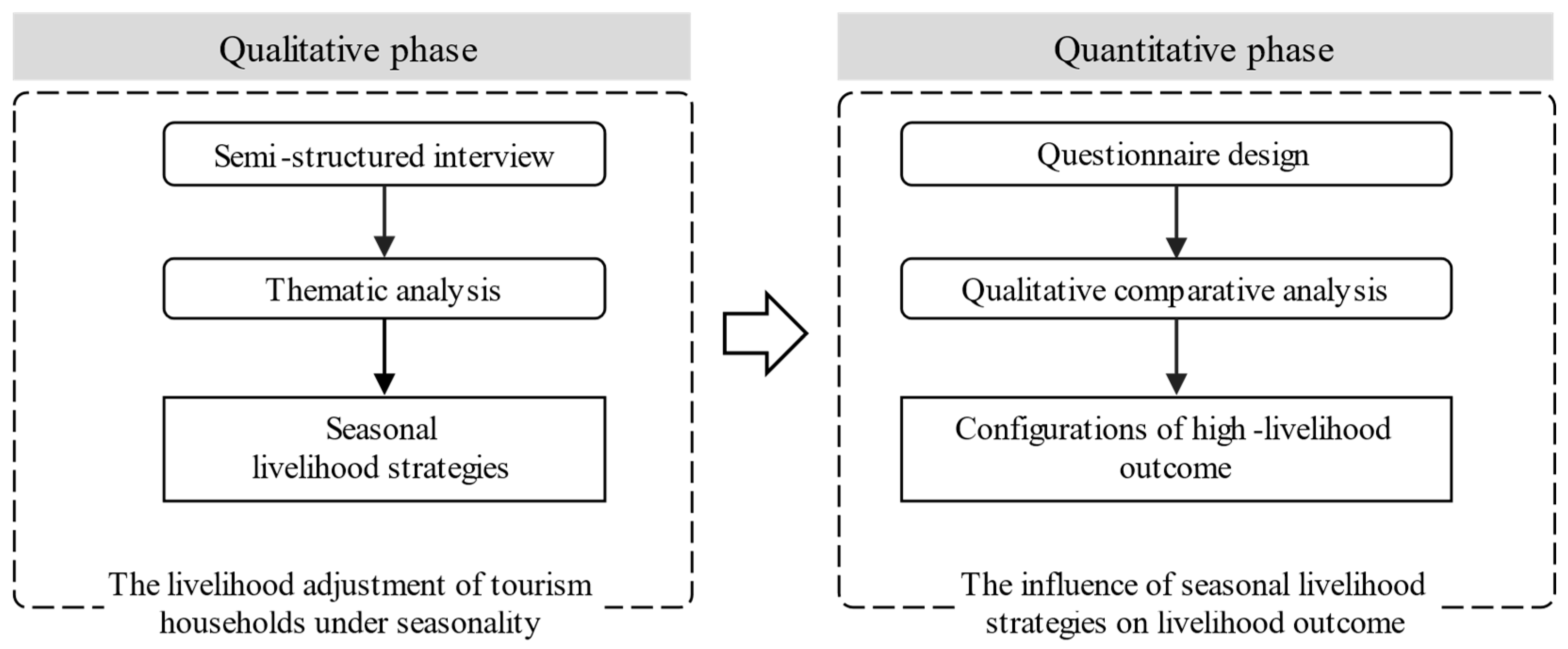
Figure 2.
Location map of the Guilin Karst World Heritage Site.
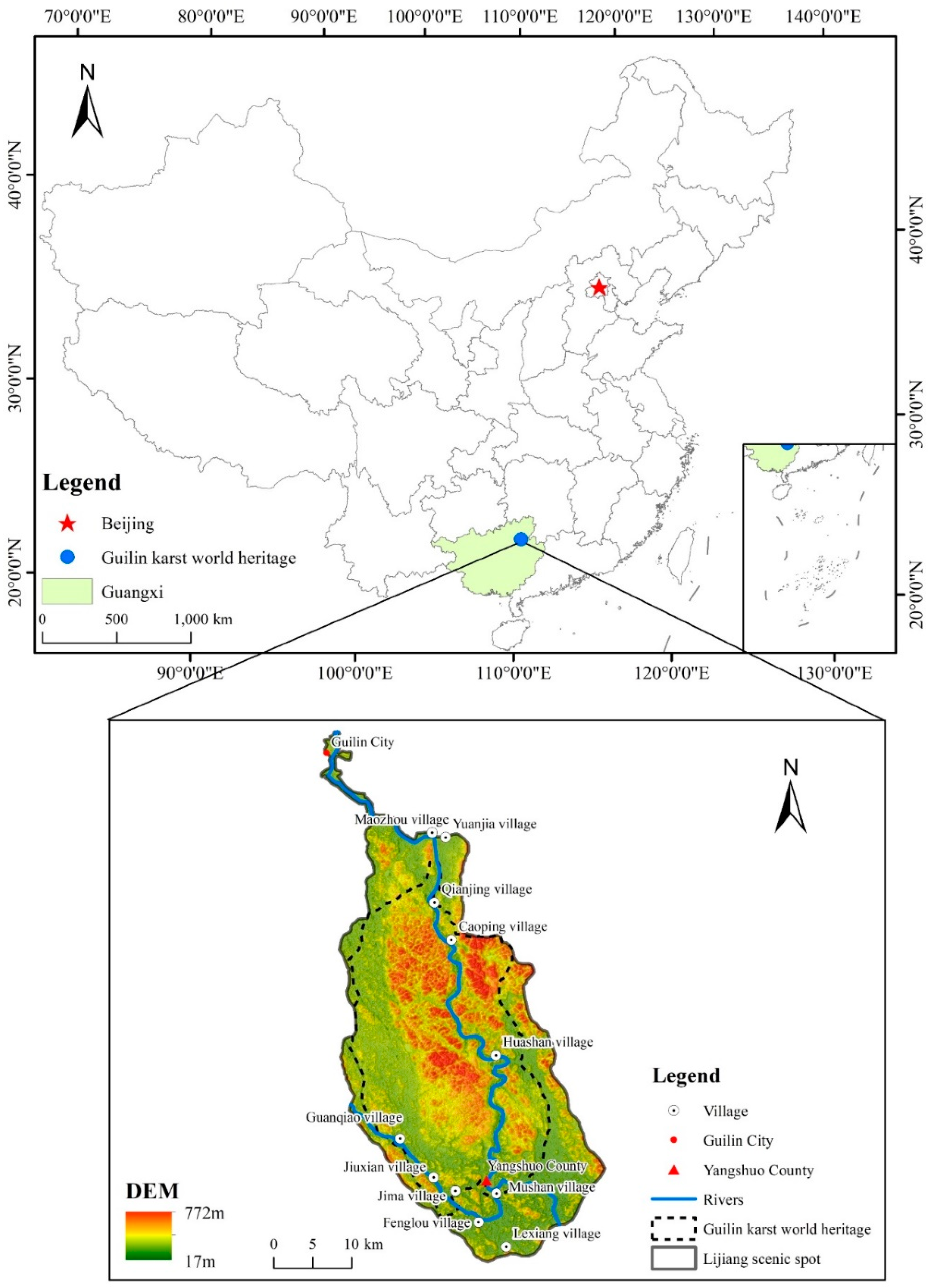
Figure 3.
(Photographs by authors): (a) Bamboo rafts on the Lijiang River; (b) Juice stall on the bamboo raft pier.
Figure 3.
(Photographs by authors): (a) Bamboo rafts on the Lijiang River; (b) Juice stall on the bamboo raft pier.
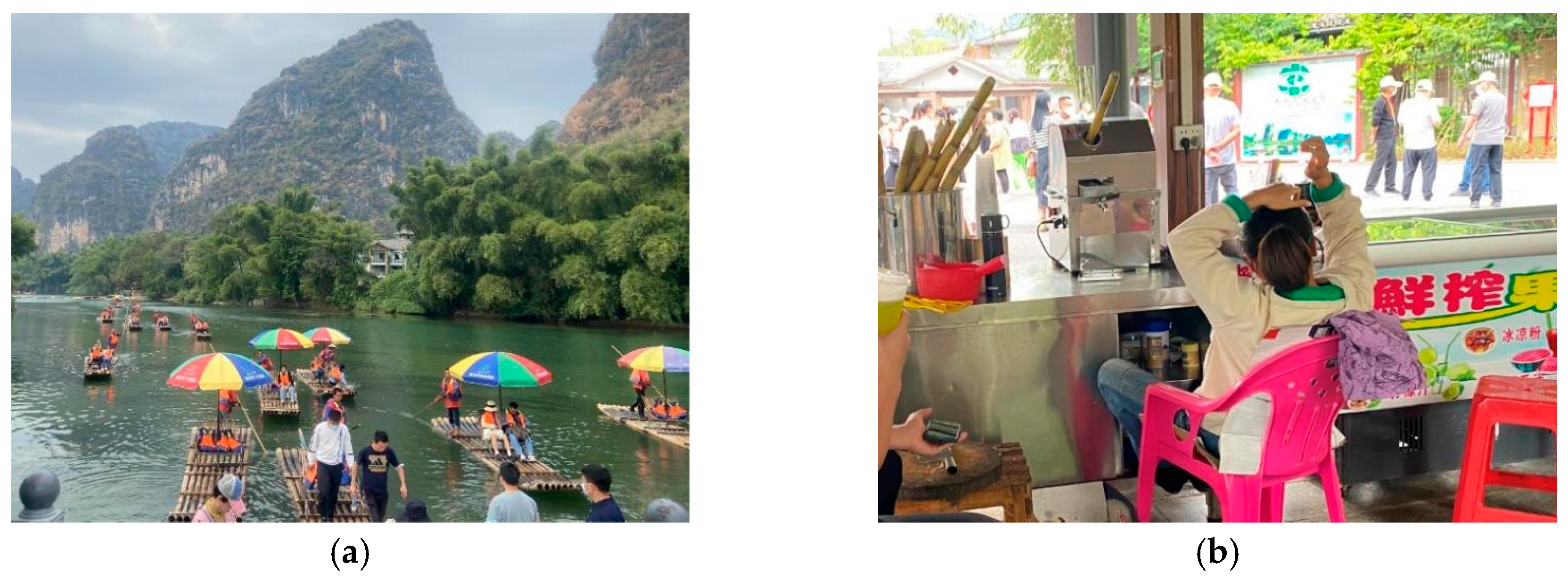
Figure 4.
Process of thematic analysis.
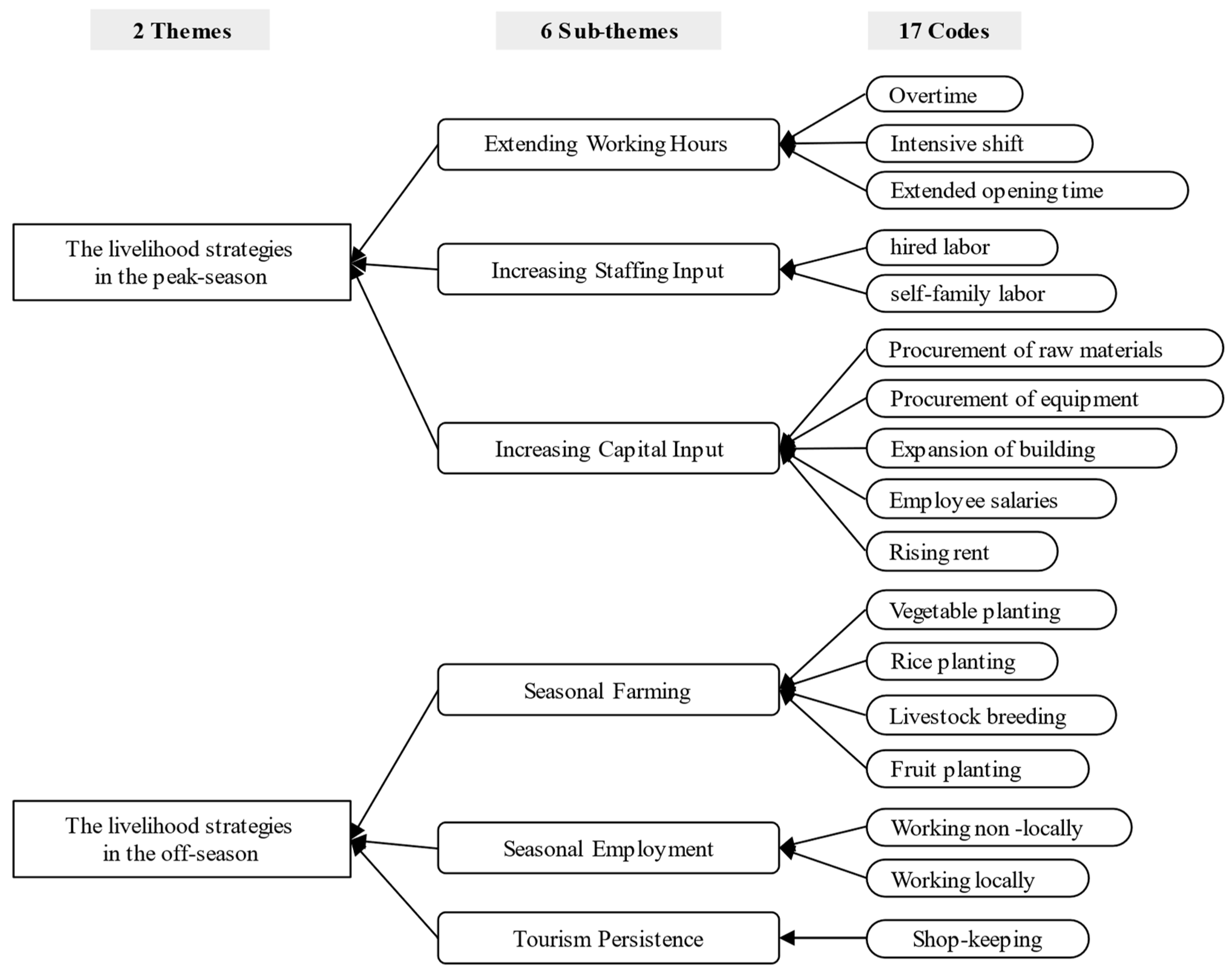

Table 1.
Necessity analysis of a single condition.
| Causal conditions | High livelihood outcome |
|---|---|
| Consistency | |
| Tourism Persistence | 0.885 |
| ~ Tourism Persistence | 0.115 |
| Seasonal Employment | 0.352 |
| ~ Seasonal Employment | 0.648 |
| Seasonal Farming | 0.306 |
| ~ Seasonal Farming | 0.694 |
| Extending Working Hours | 0.987 |
| ~ Extending Working Hours | 0.013 |
| Increasing Staffing Input | 0.812 |
| ~ Increasing Staffing Input | 0.188 |
| Increasing Capital Input | 0.112 |
| ~ Increasing Capital Input | 0.887 |
Note: “~” indicate the absence of a condition.
Table 2.
Configurations to achieve high livelihood outcomes.
| Causal conditions | Configurations | |||
|---|---|---|---|---|
| S1a | S1b | S1c | S2 | |
| Tourism Persistence | ● | ● | ⓧ | |
| Seasonal Employment | ● | ● | ● | |
| Seasonal Farming | ⊗ | ⊗ | ● | |
| Extending Working Hours | ⬤ | ⬤ | ⬤ | ⬤ |
| Increasing Staffing Input | ⬤ | ⬤ | ⬤ | ⊗ |
| Increasing Capital Input | ⊗ | ⊗ | ⬤ | |
| Consistency | 0.895 | 0.945 | 0.953 | 0.915 |
| Row Coverage | 0.116 | 0.029 | 0.035 | 0.010 |
| Unique consistency | 0.097 | 0.010 | 0.016 | 0.010 |
| Overall consistency | 0.913 | |||
| Overall coverage | 0.152 | |||
Note: “⬤” indicate the presence of the core condition, “ⓧ” indicates the absence of the core condition. “●” indicate the presence of the peripheral condition, “⊗” indicates the absence of the peripheral condition. Blank indicates that no matter whether the condition is present, it will not affect the results.
Disclaimer/Publisher’s Note: The statements, opinions and data contained in all publications are solely those of the individual author(s) and contributor(s) and not of MDPI and/or the editor(s). MDPI and/or the editor(s) disclaim responsibility for any injury to people or property resulting from any ideas, methods, instructions or products referred to in the content. |
© 2023 by the authors. Licensee MDPI, Basel, Switzerland. This article is an open access article distributed under the terms and conditions of the Creative Commons Attribution (CC BY) license (https://creativecommons.org/licenses/by/4.0/).
Copyright: This open access article is published under a Creative Commons CC BY 4.0 license, which permit the free download, distribution, and reuse, provided that the author and preprint are cited in any reuse.


