

Submitted:
21 August 2023
Posted:
22 August 2023
You are already at the latest version
Abstract
Activities in the digital economy driven by information technology have rapidly increased in scope and speed in the aftermath of COVID-19. Meanwhile, social isolation accelerated by quarantine measures has increased concerns about individuals’ mental health. However, little is known about the specific consequences of online interactions, especially when applied in online fan community-based relationships where loyal community members are prevalent. Therefore, we examined whether a sense of virtual community (SOVC) can link fans’ online activities with their mental well-being and behavioral loyalty to the platform. For this purpose, we focus on BTS fandom “Adorable Representative MC for Youth” (ARMY) behaviors and attitudes on the fan community platform Weverse. With 202 valid data samples acquired from global ARMY, this study conducted a partial least squares–structural equation modeling analysis. The empirical findings reveal that SOVC in Weverse is significantly influenced by the intensity of online interactions with other fans and parasocial relationships with celebrities. SOVC is found to be the direct predictor of fans’ behavioral loyalty and mental well-being. When considering fans’ perceptions of other social media platforms, dissatisfaction with previous online fan communities enhances the intensity of online interactions with other fans in Weverse.
Keywords:
Fan community platform
; Mental well-being
; Sense of virtual community
; Fan interaction
; Parasocial relationship
; Weverse
1. Introduction
With the outbreak of COVID-19, governments in many countries have adopted various types of physical distancing measures that restrict the outdoor activities of citizens. The pandemic has accelerated non-face-to-face digital transformation in all fields, including shopping, education, work, and leisure [1,2]. However, individuals’ subjective feelings about social isolation during COVID-19 have been found to have a close relationship with adverse psychological reactions like loneliness, anxiety, depression, helplessness, and decreased self-esteem [1,3].
Accordingly, many government officials and scholars have encouraged people to use online spaces to cope with mental health problems. For instance, the United Nations provided guidelines to protect individuals’ mental health and promote a sense of belonging by participating in discussions within online communities [4]. Previous literature has argued that social interactions in emerging media services can significantly enhance people’s sense of belonging and connection, especially under conditions of restricted face-to-face contact [5,6].
However, there have been contradictory findings on the influence of online interaction. Some scholars have explained that the risk of interacting with misinformation in a virtual space [7] or the passive use of social networking services (SNSs) [8] could negatively affect an individual’s well-being. There is also a lack of empirical research applicable to the current pandemic situation, and that sheds light on the results of online interactions in specific contexts. For example, prior studies have discovered the influence of the use of emails and phones [6], SNSs [8], or massive multiplayer online role-playing (MMORPG) games [9] on individuals’ well-being or belongingness during COVID-19. Nevertheless, few studies have investigated the influence of diverse online interactions within celebrity fan communities on the mental well-being of fans.
Online fan communities in the South Korean entertainment industry have experienced several noticeable changes over the last two years. The fandom business model has primarily moved to grow platforms and provide content. Specifically, beyond solely presenting offline experiences, like concerts or TV music programs, to the fans of celebrities, entertainment companies have carefully devised ways to promote K-pop fans’ engagement in a virtual world.
Subsequently, whereas previous online fan activities were sporadic on various social media platforms, the new version of the fan community platform combined all of the online fan activity functions. For instance, it allows interactive communications between K-pop fans and celebrities, fast access to the management agencies’ official information, and easy purchase of celebrity-related products. The emergence of such a space allows fans who have been dissatisfied with previous social media platforms to move to new types of fandom platforms with diverse value offerings. In fact, given the effort of management agencies and platform operatives to promote discussions on the fandom platform, most fan–celebrity and fan–fan interactions have begun to frequently take place on representative fan community platforms, such as Weverse, LYSN, and Universe [10]. As extant fan studies have proved the association between belongingness to online fan communities and fans’ positive mental states [11,12], we will explore the influence of emerging fandom platforms on fans’ mental well-being.
Along these lines, the first objective of this study is to specifically explore whether different types of online interactions in virtual fan communities could have brought about positive or negative psychological outcomes for the members of that community during the COVID-19 pandemic. In addition, by adding the context of behavioral loyalty that measures the willingness to recommend and repurchase the service or product, the study will provide meaningful implications for platform managers and identify whether the platform can affect the development of related fan industries. Furthermore, in linking fans’ interactions with psychological and industrial results, the sense of virtual community (SOVC) will be considered a key bridge between the variables. Extant scholars have confirmed the significant relationship between the intensity of online communications and the state of belonging [13,14], as well as the feelings of emotional connection to a group and personal well-being [12,15] and intent to advocate [16,17]. Finally, we will examine how dissatisfaction with the previous online fan community space may lead to the intensity of fans’ actions in the new fan community platform.
2. Literature Review
2.1. Fan Community Platform
The A fan community platform has the characteristics of both online and fan communities. Previous studies have described online communities in various ways: Bagozzi and Dholakia [18] define them as virtual social spaces where members share their everyday purpose and create content, while Balasubramanian and Mahajan [19] highlight their spatial and temporal constraints. Online communities are often formulated based on regional societies, demographic characteristics, and various offline relationships but are also formed around shared interests, tastes, and preferences [20,21]. Online communities can be constructed based on individuals’ transactional relationships, interests, or fantasies [20]. For instance, people with a common preference for music and singers may assemble in an online fan community as a taste-based online community.
An online fan community is a transcultural community where people from various countries, ethnicities, and cultural backgrounds share their tastes [22]. The development of such communities is driven by information technologies (IT) through various forms of content, such as text, photos, GIFs, and videos, shared and transmitted to millions of fans, creating an environment that maximizes online interaction [23]. Social media platforms, such as Twitter, have allowed fans to engage in personal communication more quickly and deeply [24]. Among all, K-pop singers’ powerful and global fandom actively employ every media channel to interact with other fans. A study of K-pop fandom communities reveals the role of social media platforms as strategic outposts for K-pop fans to promote their favorite artist’s songs or important messages with creative content [25]. Table 1 provides an example and explanation of the social media usage of some K-pop celebrity fans.
With more advances in IT, the fan community platform emerged in South Korea through leading management companies or game providers, with its’ fandom range expanded from local to international. Weverse, Bubble, and Universe appear to be the largest and most active platforms for fan activities, which have distinct and noteworthy attributes. For instance, since all these celebrity communities are officially operated by management agencies, official album-launching or concert ticket-selling information is easily shared with broader coverage. Also, the barrier to joining the fan community platform is comparatively lower than earlier fan cafes because a membership fee is not required. The fandom platform membership usually functions as a subscription for receiving premium celebrity-related content or merchandise. Lastly, these apps and websites allow easier and more complimentary access to the conversation between global fans and artists than the existing portal sites-based fan communities or SNSs [26]. In summary, a fan community platform is both an online community and a transcendent fan community established based on their interests and preferences for celebrities. It is a convergence of platforms, content, commerce, and new media technologies on which global fans focus. More descriptions and comparisons of each brand-new fan community platform are shown in Table 2.
2.1.1. Intensity of Online Interaction with Other Fans
Fans’ online interactions can be understood as the behavior surrounding their mutual influence, sharing, supporting, and creating value within the online community [27]. With the advent of a new fan community platform like Weverse, fans’ interactions have become even more accessible, with a deeper process of exchanging influence. In particular, fan communication channels with a friendly and pleasant atmosphere have allowed them to freely express their opinions and emotions, activating more frequent interactions between community members [26]. For example, their frequency in uploading posts and leaving likes and comments on fellow fans’ posts can imply fandoms’ substantial involvement in the fan community platform. The content of the posts, which ranges from informative to daily life sharing and playful parodies, jokes, or memes, is likely to show the diversity and quality of fans’ communication [28]. Moreover, community members’ enthusiastic engagement is another noteworthy sign of the intensity of online interactions. One fandom platform, Weverse, provides an automatic translation function, supported in ten languages, helping global timely communication among global fans. In addition, BTS fans’ official lightstick, the “Adorable Representative MC for Youth” (ARMY) Bomb, could have been connected to Weverse when watching online concert videos, extending fans’ experience to other steps. Accordingly, the current study approaches online interaction as the intensity of engagement with the digital fandom community, considering the frequency and the quality of interaction with other fans.
2.1.2. The Parasocial Relationship with Celebrities
The concept of parasocial interaction speaks to the spectator’s, audience’s, or user’s feelings about interacting with a performer on the screen [14,29,30,31]. Within the context of the fan community platform, it refers to the process of interaction between fans and celebrities, often considered an essential part of the fan groups’ enjoyment [25]. Meanwhile, a parasocial relationship is formed by repeated parasocial interaction, meaning that fans’ feelings of intimacy are enhanced through repeated exposure to celebrities, eventually forming a non-existent intimate relationship [29].
Fans can interact directly or indirectly with celebrities on digital fan community platforms, leading to stronger parasocial relationships. These platforms support various communication functions that can connect fans and celebrities and build a robust relationship between the two. Specifically, fans can indirectly communicate with celebrities by leaving comments or likes on the posts or messages that celebrities leave on the platform. Fans can also send direct messages to a specific member in a group by adding hashtags like #to_BTSRapmoster below the post or through a one-on-one artist and fan conversation service in separate fan chat windows. The development of information and communication technology (ICT) even allowed real-time video-call fan engagement within the platform.
Various types of parasocial relationships have been studied by previous researchers [32,33], such as companionship, identification, friendship, understanding, and problem-solving [34]. In light of fans’ persistent desire to build relationships with celebrities on the fan community platform, this study specifically delves into the concepts of understanding and friendship, the most traditional types of parasocial relationships [29]. Fans may quickly learn about the artists through various communication features implemented in the service, subsequently enhancing their understanding of celebrities. Also, repeated celebrity interactions may lead to a sense of friendship, a mutual relationship based on intimacy and fondness [35]. Repeated, direct, and private exposure to celebrities may allow fans to feel a high level of favorability and psychological attachment toward these celebrities [34], thus deeming their relationship as friendships on the fan community platform [36].
2.2. Dissatisfaction with Previous Social Media and Fan Activities on the Fan Community Platform
Dissatisfaction refers to subsequent negative perceptions that arise from consumers’ failure to meet previous expectations about a product or service [37]. If they are dissatisfied with the product, they are more likely to react negatively than other consumers who are not dissatisfied [38]. Previous studies have shown that user dissatisfaction can affect avoidance behavior, indicating that users may stop using particular products or services and switch to others [39]. For instance, dissatisfaction with conversational functions in social media platforms lets users visit other platforms [40].
Dissatisfaction may result from poor performance or expensive cost, emotional harm, or inconvenience in any aspect of the consumer’s experience of using the service [38]. Some studies of dissatisfaction with existing platforms have revealed that the user’s switching intention is influenced by the emotional aspect of the platform rather than the utilitarian factor of the functional elements [41]. Meanwhile, dissatisfaction with the quality of information, systems, and the service provided by existing mobile payment platforms accelerates the conversion tendency [39]. As such, various emotional and functional factors of the platform can stimulate users’ dissatisfaction, evidently provoking switching or avoidance behavior.
From the fan community’s perspective, fans may also be dissatisfied with an inconvenient and unstable system or the poor service of the existing online channels. Specifically, the quality and quantity of conversational functions provided in online spaces, including fan community websites and social media services like Twitter or Instagram, can be dissatisfactory to fans.
This dissatisfaction with a previous media experience may be an influential push factor to move to another platform and build new relationships with fans and celebrities [41].
In this study’s context, we predict greater dissatisfaction among fans with social media platforms, such as Twitter, Instagram, and YouTube, is significantly related to intense online interactions with other fans on the new fan community platform. In addition, dissatisfaction with existing media will lead fans to consolidate their friendship and understanding of celebrities on the new platform. Therefore, this study posits the following hypotheses:
H1.
Dissatisfaction with a previous social media experience positively relates to the intensity of online interactions with other fans on the fan community platform.
H2.
Dissatisfaction with a previous social media experience positively relates to the parasocial relationship with celebrities on the fan community platform.
2.3. Sense of Virtual Community (SOVC) and Fan Activities on the Fan Community Platform
The concept of SOVC stems from McMillan and Chavis’ [42] conceptual model, suggested as a sense of community (SOC). SOC is a core and unique facet of community psychology, regarded as the result of communication, cooperation, and deliberation among people with similar commitments and goals in the community [13]. Notably, SOVC explains community members’ feelings of membership, identification, belonging, attachment, and support in online communities [43,44]. Hence, SOVC is considered a significant constituent when building a community [45], without which the online community would be merely a virtual settlement [46].
SOVC is not a single concept but a mixed one with multiple characteristics. A basic subdimension of SOVC includes: membership (the feelings of belonging), influence (the belief that members can trust and influence each other), shared emotional connections (the feelings that members receive support and form emotional bonds with each other), fulfillment of needs (the rewards that members can get from their community membership) [14,43,44].
The dynamic interaction among online community users plays a significant role in building a member’s emotional attachment to the online community and solidifying the community itself [20,45]. The more frequently individuals socially interact, the stronger the ties they form [42,47]. In particular, a sense of community is considered the result of an interaction in which people with similar interests and goals gather [13]. Yang and Shim [14] concentrate on the relationship between the quality and depth of interactive communication in fan communities and SOVC, discovering that active online interaction on Weibo positively influences forming a cohesive fan community. Thus, if a fan’s intensity of interaction grows, a feeling of bonding or emotional attachment to the affiliated virtual community and its members may also increase [9,11,48].
H3.
The intensity of online interaction within the fan community platform positively affects the sense of virtual community (SOVC).
In addition, as fans are given more options to interact with celebrities, they would feel more emotionally connected to the celebrity and are rewarded as a fan community member [49]. A study [50] discovered that internet technologies encouraged a cyclists’ fans to experience various dimensions of interactions and build passionate feelings for both the celebrity and the fan community. Another study [51] found that parasocial relationships formed by watching a Netflix show and repeatedly commenting on influencers’ videos facilitated feelings of unity and belonging among individuals during social isolation in the current pandemic era. Based on previous studies, this study assumes that a parasocial relationship with celebrities on fan community platforms will establish SOVC.
H4.
Parasocial relationships on the fan community platform positively affects a sense of virtual community (SOVC).
2.4. SOVC and Behavioral Loyalty
Loyalty is a tendency to prefer and continue using and purchasing a brand [52]. In an attitudinal context, it is described as an emotional attachment, preference, or support for the brand’s employees or products [53,54]. It is also closely related to the tendency to spread positive word-of-mouth (WoM) [55] and the commitment to repurchase the product without switching behavior [56] from a behavioral perspective. As such, loyalty encloses both attitudinal and behavioral aspects [57]. However, in the online fan community context, it is challenging to distinguish fans’ preferences for their celebrities (e.g., BTS) from their preferences for the fan community platform (e.g., Weverse) since they tend to appear simultaneously. On the contrary, behavioral loyalty towards celebrities and fan community platforms can be distinguished. Therefore, the present study will focus on behavioral loyalty, the frequency of fan purchases, and recommendations about the fan community platform.
Some research demonstrates that SOVC reflecting user stickiness in most online communities is associated with higher community loyalty [16,17,58]. For example, belongingness of membership in the virtual community led to higher loyalty [16], and SOVC had moderating and mediating effects between the breadth of user interaction and loyalty in an online travel community [17]. Likewise, Kim and Zhang [46] discovered a significant relationship between SOVC and users’ loyalty toward the virtual world.
On fan community platforms, the more a user feels emotionally connected to the fan community, the more likely they will consume products on the fandom platform, join the patronage, and praise other people. Therefore, we suggest that a fan’s SOVC would positively and significantly impact the fan community’s behavioral loyalty.
H5.
SOVC has a positive effect on the fan community platform’s behavioral loyalty.
2.5. SOVC and Mental Well-Being
Well-being, a key theme in community psychology [59], is defined as “a positive state of affairs, brought about by the simultaneous and balanced satisfaction of diverse objective and subjective needs of individuals, relationships, organizations, and communities” [60](p.2). From the viewpoint of positive psychology, well-being contributes significantly to maintaining an optimal state among individuals and organizations, including hedonic and eudaimonic perspectives [61].
First, subjective well-being stemming from the hedonic view of well-being highlights that individuals pursue pleasure and avoid pain, thus determined by emotions related to happiness, satisfaction, and interest in life [62,63,64]. In contrast, eudaimonic well-being, which originated from the tradition of Aristotle’s spirit, believes that realizing one’s potential is the most vital component of well-being. Based on this idea, the concept of psychological well-being, a state of personally maintaining an optimal function, consists of six positive functional elements— self-acceptance, the purpose of life, autonomy, positive relationships with others, control over the environment, and personal growth—was proposed [61]. Additionally, Keyes [65] proposed the concept of social well-being, noting that maintaining socially optimal functions and resuming social relationships are paramount to individuals’ well-being. Social well-being is a subjective evaluation of the functions of an individual’s society, consisting of elements such as social cohesion, acceptance, self-realization, contribution, and integration [65,66].
Keyes considers well-being in terms of mental health, defining it as a state of pursuing happiness without a mental disorder, not simply a mental problem [63]. From such a standpoint, Keyes created the concept of mental well-being by combining all three well-being concepts and theories [63,67]. Consequently, mental well-being theory has become one of the most widely used and validated frameworks in psychology.
Several empirical studies have confirmed the positive effect of SOC on different types of well-being [15,68,69,70]. According to Davidson and Cotter [70], SOC is significantly associated with subjective well-being in random samples in South Carolina and Alabama, extending its scale to the city context. Furthermore, Obst and Stafurik [15] demonstrate that the feeling of SOC in an online disability community positively relates to participants’ psychological well-being, particularly personal relations and growth indicators. This finding is because the feeling of belonging with a community of similar others may encourage self-analysis and personal development. Albanesi et al. [68] discovered that SOC is a primary predictor of social well-being in Italian adolescents, illustrating that when teenagers belong to a group, they may experience various identities and social roles, increasing connectivity with the community and the level of pro-social behavior. Further, Coulombe and Krzesni’s study [69] proves the positive and significant impact of SOC on three emotional, psychological, and social well-being scales, revealing the strongest correlation with the social well-being dimension. Likewise, previous literature has documented a meaningful relationship between SOC and subjective, psychological, and social well-being.
In addition, the impact of online interaction in the formulation of SOVC and its positive impact on human well-being has been demonstrated in several studies [71,72]. For instance, a positive relationship between a sense of belonging on online platforms and personal well-being was presented [71]. It was proved that SOVC’s influence has become more significant for those isolated or excluded from society.
As such, it can be viewed that the feelings of social connection in a virtual space will likely affect overall human well-being. This study expects that SOVC in the online fan community platform will likely foster individuals’ mental well-being, encompassing emotional, psychological, and social well-being. Given the situation surrounding COVID-19, which is closely related to the mental illness crisis, the mental well-being variable that primarily considers the absence of mental disorders in individuals seems appropriate for this study. Thus, we suppose that SOVC on the fan community platform is positively and significantly related to the mental well-being of fans.
H6.
SOVC has a positive effect on mental well-being.
The overall research model is described in Figure 1.
3. Materials and Methods
3.1. Sample and Data Collection
This study selected a fan community platform, Weverse, as the subject of analysis. Weverse is a global fan community platform developed by Korea’s local platform Weverse company, a subsidiary of HYBE Entertainment. There are several specific reasons why Weverse was considered appropriate for analysis in this study. First, we attempt to identify various aspects of interactions on the fan community platform of artists leading the music industry. However, other fan community platforms often only support communication functions with artists and support fan interaction services in different apps. In addition, they even provide TV programs’ and sports stars’ fan communities, making it difficult to generalize the results that will appear in an artist’s context. On the other hand, Weverse provides fan–fan and fan–artist communication functions based on information technologies, and the fan community is provided only for music artists. Furthermore, Weverse strengthened its functions within the platform by acquiring a live streaming service, V Live, in 2022 [49]. Likewise, Weverse is considered a suitable platform for tracking the attitudes and behaviors of fans of emerging platform services.
The targeted participants are the members of the ARMY, an official fan community for the South Korean musician group, BTS. This is a seven-member group that has quickly gained popularity overseas since its debut in 2013. BTS’s fandom group, ARMY, is also a global, large, and diverse community. ARMY’s dedication and support have made BTS successful and popular worldwide [25]. Additionally, ARMY has the biggest number of fan subscribers in Weverse. As a subsidiary company of HYBE Entertainment, Weverse has grown with BTS since its’ first launch. Accordingly, BTS Weverse now serves as an official fan club, having replaced the position of the portal sites-based official online fan community. ARMY is considered appropriate as a sample for this study for the above reasons.
Since the study was conducted on global ARMYs, we used various social media platforms, including Twitter, Instagram, Facebook, university websites, and Weverse, to recruit the survey participants. In addition, an online survey was conducted at Korea University, Pukyong National University, Gachon University, and Kyungpook National University. Invitations to participate were sent out by email or by uploading SNS posts containing a link to the questionnaire. The target sample was over-18 ARMY fans currently using Weverse. We asked the survey recipients to forward or share the invitation or post with as many ARMY mates as possible using the snowball sampling method. The snowball sampling procedure cannot claim its’ generalizability due to the lack of representative samples within the research group [73]. However, it is considered ideal when conducting research at a low cost, in a wide geographic area, or in a group thus far not studied [74]. Also, several other studies implemented the snowball sampling method to collect global fan data, including BTS fans [75], metalhead fans [74], and soap opera fans [24]. In seeking to minimize social desirability bias, we asked participants to answer all of the survey questions anonymously [76].
Overall, among 346 responses received from April 7 to May 22, 2022, 202 completed surveys were accumulated from a web-based survey using Qualtrics online software. It was revealed that 112 respondents were left in the middle of the survey, and a screener question filtered 32. Most survey participants were female (86.1%) and under 30 (86.6%). ARMY from 35 countries, including Korea, participated in the survey. Specifically, the countries involved include the US, India, Canada, Brazil, the Philippines, Germany, and Bulgaria. ARMY members mainly joined a 22-dollar subscription plan (48%), and about a third did not join the club (36.6%). Most fans seem to visit Weverse 3–5 times a week (68.3%). Additionally, it turns out that Weverse is the most used social media platform among Army fans for interacting and communicating with BTS. In particular, Weverse has been confirmed to be the space where fan-celebrity interactions occur. The overall participant demographics are reflected in Table 3.
3.2. Measurements
All constructs were measured with multiple items developed and tested in the existing literature. The measurement items were borrowed and adapted to fit the Weverse context. Except for the mental well-being scale, the items were anchored on a 5-point Likert scale, ranging from “1” (strongly disagree) to “5” (strongly agree).
The measurement items for dissatisfaction with previous social media platforms were adapted from Kuo [39]. The questionnaires about the intensity of online interactions with other fans were borrowed from previous literature [11,12,34] and modified to the Weverse context. We used scales for the parasocial relationship with celebrities from Rubin and Perse [33] and Kim et al. [12], which define the relationship as a friendship, and Chung and Cho [34], who considered it as understanding. SOVC constructs were derived from McMillan and Chavis [42], Kim et al. [12], and Blanchard [43], which measured subdimensions of SOVC independently. In this study, we integrated the dimensions into one SOVC scale, including membership, shared emotional connection, and fulfillment of needs, that seems to fit in the Weverse context. The items for behavioral loyalty were referred from the study of Kim and Kim [12]. For mental well-being, the measurement scales created by Keyes [63,67] were considered, known as Mental Health Continuum Short Form: MHC-SF. The mental well-being scale originally consisted of 14 questions measuring emotional well-being (three questions), psychological well-being (six questions), and social well-being (five questions), and it followed the 6-point Likert scale ranging from “0” (no) to “5” (daily) for each question. For the Korean version of the survey, this study used the Korean version of MHC-SF (K-MHC-SF) created and validated by Lim et al. [77]. By borrowing Keyes’ [63] and Lim et al.’s [77] scale, we constructed a simpler version of the survey, comprising nine questions.
3.3. Data Analysis
We used the software application SmartPLS 3.3.9 to test the effectiveness of our research model. The present study adopted partial least squares (PLS) as a soft modeling approach to structural equation modeling (SEM) that can verify the suitability of measurement constructs and their causal relationships expressed through hypotheses [78]. PLS–SEM is a promising method for exploratory studies that are willing to analyze causes and predictions between variables or test and develop an early stage of a theory [79]. Moreover, prior studies deployed PLS–SEM when encountering a condition with small sample size, somewhat skewed data distribution, and complex structural models [79,80]. Similarly, as one of the exploratory studies, we applied the PLS–SEM approach to examine small and non-normal data sets, and developed a new structural model created to explain fandom behavior and attitudes in a newly-made global fandom app.
4. Results
4.1. Measurement Model
We used a reflective measurement model in this study, given that the indicators are highly correlated and interchangeable. For this purpose, we thoroughly investigated the reliability and validity of the measurement constructs [79,81]. The current study first checked indicator reliability to ascertain that the loading of an indicator’s values is greater than the acceptable level of 0.7 [79]. All indicator loadings were larger than 0.7. Internal consistency reliability of the items was assessed with Cronbach’s alphas and composite reliabilities (CR) [80]. Table 4 shows that all constructs were higher than the minimum value of 0.7 for Cronbach alphas (0.718–0.927) and composite reliabilities (0.840–0.951). We evaluated convergent validity using the average variance extracted (AVE) at an acceptable threshold of 0.5 or higher [82]. As indicated in Table 4, all values confirmed convergent validity, with AVE values ranging between 0.532–0.697. Discriminant validity was evaluated by checking whether the square root of AVE in each construct is larger than other correlation values among the constructs [78]. Indicator’s loadings were also considered, where they should be higher than all of the other constructs’ cross-loading values.
4.2. Structural Model
The results suggested that dissatisfaction with previous media has a considerable positive relationship with the intensity of online interaction with other fans (β=0.530, p < .001) but no significant impact on the parasocial relationship. Thus, while H1 was supported, H2 was not.
We then examined the factors that would impact a fan’s SOVC in the new fandom platform: intensity of online interaction with other fans and parasocial relationship with celebrities. The research results indicated that the intensity of online interaction with other fans (β =0.540, p < .001) and parasocial relationship with celebrities (β =0.391, p < .001) have a positive and robust effect on SOVC. The data were consistent with H3 and H4.
This study hypothesized that SOVC in the fan community platform would positively influence platform behavioral loyalty and mental well-being. The results showed that SOVC has a positive and considerable relationship with both behavioral loyalty (β =0.520, p < .001) and mental well-being (β =0.227, p < .001). Thus, the data were consistent with H5 and H6. Table 5 summarizes the relevant results, including hypotheses, coefficients, and t-values.
5. Discussion
The PLS analysis provided several significant insights. First, it has been proven that media experiences, including interactive online communication with fans and celebrities, significantly contributed to the intensified SOVC. The results illustrate the paramount role of Weverse with innovative embedded technologies in expanding fans’ interaction experiences and integrating the global digital fandom. It aligns with previous research that when individuals intimately engage in community activities, they are more likely to build a sense of belonging and an emotional attachment to an offline or online community [11,45]. Also, as stated in recent studies [12,50], we discovered that the passion for the fan community is triggered by a stronger parasocial relationship with celebrities.
Secondly, our results showed that the fans’ enhanced perception of SOVC led to high behavioral loyalty toward Weverse and personal mental well-being. The findings suggest that SOVC, formed and reinforced by the active engagement of fan community members, can be a strong indicator of continuing to use and promote purchases in Weverse. Also, fans who felt more belongingness, emotional connection, or fulfillment to the fan community platform were more mentally healthy, even amidst the pandemic situation. In this sense, users who voluntarily choose to belong to the fan community and engage in community activities with people who have the same taste are not only more loyal but also more emotionally satisfied. This insight confirms the importance of the SOVC measure to the members of an interest-based online community.
Moreover, while dissatisfaction with previous social media had a significant positive effect on the intensity of online interaction with other fans, it did not significantly affect the parasocial relationship with celebrities. The result clarifies that users who were dissatisfied with the quality and quantity of functions to communicate with other fans on social media platforms, like Twitter or Instagram, show a stronger inclination to interact with other fans on Weverse. This finding aligns with prior studies that users’ dissatisfaction with previous mobile platforms affects their attempts to form relationships in new media [41]. Thus, Weverse may have been a better service to meet the interaction needs between fans that other media platforms cannot meet. However, there was no significant relationship between fans’ dissatisfaction with existing media and the perceived parasocial relationship on Weverse. It is true that users may become interested in new media platforms if they are not satisfied with existing ones. Nonetheless, the result implies that much of their dissatisfaction with the old platforms is not related to how deeply they feel about the parasocial relationship with celebrities on the new service. Since fans understand, support, and love celebrities, the level of awareness of parasocial relationships may be similar regardless of the platform.
The current study provides several theoretical and practical implications. From a theoretical perspective, this study takes the first step in extending the existing literature on the online fan community to the fan community platform context, a new mobile app and web platform paradigm specializing in providing artist-to-fan communications. Specifically, this study employs the concept of online interaction, parasocial relationships, SOVC, behavioral loyalty, and mental well-being to illustrate the phenomenon in a virtual fan community and incorporate them into one research model. In this regard, it improves our academic understanding of fandom by defining and dealing with the characteristics of the fandom platform precisely, focusing on the service features.
In addition, our findings have implications for community psychology research, as we addressed the theorized dimensions of SOVC supported by McMillan and Chavis [42]. Our results offered empirical evidence that SOVC is positively and significantly related to media usage patterns of specific subjects in multicultural contexts. Particularly, the present study confirms the power of online fan communities’ SOVC in enabling the quality of life of individuals, communities, and societies [83]. For instance, SOVC may act as a buffer against the negative consequences of social isolation on fans’ mental well-being. Consequently, applying SOVC in other contexts of relational communities seems crucial to broadening the understanding of SOVC and its positive effects. This study was an attempt to expand the literature on SOVC with empirical evidence, answering Stewart and Townley’s [83] research call.
Furthermore, this study expands the dependent variables to the marketing variable, behavioral loyalty, and the psychology and health-related variable, mental well-being, in the domain of media research. Behavioral loyalty is considered a central measure of marketing and business research because it relates to repurchase and WoM intentions. This study has discovered SOVC as a focal variable that can lead to fans’ behavioral loyalty on the fan community platform, showing that the SOVC of community members is a key to developing the entertainment industry and enhancing the media consumption experience. In addition, we empirically analyzed the mental well-being scale by linking it with the SOVC concept.
Although well-being from the mental health approach can be a vital consequence of the users’ media use, it has rarely been investigated in fan studies or media industry studies. Some research using the construct of well-being has only focused on specific dimensions, including emotional well-being, such as pleasure and satisfaction, psychological well-being, such as self-fulfillment, or social well-being. It was usually the health science disciplines that used the mental well-being scale. Taking the health crisis on an individual’s ill-being during the current pandemic, mental well-being, which focuses on the pursuit of happiness in a state without a mental problem, could become the most appropriate facet to understanding people’s behaviors and attitudes toward emerging media services.
From a managerial perspective, this study proposes practical implications for fan community platform operators and entertainment agencies. First, the abundance of study results argues the necessity for more sophisticated and diverse communicative functions within the fandom platform. For example, our results show that although fans utilize Weverse the most to communicate both with other fans and celebrities, Twitter stands as a compelling social media platform for fan–fan interaction (Table 3). Moreover, the results indicate that users dissatisfied with the previous social media platform tend to seek better fan–fan interactions on the new platform. In addition, virtual conversations with other fans and deep attachment to celebrities are closely related to the strengthened SOVC, which is the paramount predictor of fostering a platform’s loyal fans.
Based on these empirical outcomes, we suggest that fan community platform operators should design even more friendly services for fan–fan and fan–celebrity communication.
Specifically, Weverse may add a filter function that may allow the fans to choose the topic they want to see, share opinions with others, and feel an emotional bond. The filters for each group member or specific situations, such as concerts or fan signings, may also be helpful. The parasocial relationship between fans and celebrities is expected to intensify with real-time live streaming functions that celebrities can lead. Further, fans’ attachment to celebrities can be provided in a more direct and lively way via future ICT technologies, like Metaverse. As such, the updated results of this study provide platform providers with meaningful insights. These suggestions can be applied to any business player willing to acquire loyal service users.
Moreover, entertainment management agencies that use the fan community platform can benefit from fans’ loyalty toward the fandom platform. Fans may buy more celebrity-related products with a seamless consumer experience within the fandom platform that directly links to the global merchandise shop. It may foster the sales of products or services and further promote the growth of entertainment companies. Thus, strategic cooperation between fandom platform providers and management agencies seems required.
Even though the current study suggests some meaningful implications, it also entails several limitations that leave room for further studies. First, the external validity of our research samples should be carefully reviewed, notwithstanding their sufficient size (N=202). We attempted to accumulate global fan data, but the survey could only encompass fans who can read and understand English or Korean. Moreover, it should be noted that ARMY is a unique fandom with outstanding loyalty and pride to its artist, BTS, and the fandom itself [84]. Hence, their attitudes and behaviors toward this topic may not be the best representative responses for all of the fandom population. Therefore, future studies are likely to be conducted to discover whether similar patterns are found in other parts of the world, which can translate the same survey questionnaires into other languages. Moreover, additional studies on other celebrities’ fandom, such as K-pop girl group fandom, as well as contexts featuring diverse and larger samples and settings, seem necessary to confirm the generalizability of this study.
Next, we focused on the case of Weverse without discussing similar fandom services, such as LYSN & Bubble or Universe. The lack of general applicability of the findings may limit the value of our final results. Accordingly, as other fan community platforms differ in details and core values, future studies could disclose fans’ perceptions, attitudes, and behaviors on these media services. Finally, while the current study discovered significant influencers that could explain fans’ loyalty toward the media platform and their mental well-being, other possible factors can also affect these variables. Thus, future research may be conducted beyond interaction-related factors. It may include variables of more diverse dimensions, such as trust or the quality of content and information.
6. Conclusions
As a fan community platform created for artists and fans, Weverse presents a new paradigm of social media platforms in a global market and is attracting worldwide attention regarding their usefulness and effectiveness. In particular, the growth of Weverse has been possible with the support of K-pop artists and fans as well as entertainment agencies that hoped to make a profit within the platform. Notably, as the role and scale of offline communities have been shrunk due to COVID-19, the influence of taste-based online communities like Weverse has been vastly enhanced, making the phenomenon worth examining. To this end, this study focused on the case of Weverse and the BTS fandom, ARMY, which show the most remarkable presence within the medium. We investigated whether the fans’ activities in Weverse fostered their sense of virtual community, mental well-being, and behavioral loyalty toward Weverse. Dissatisfaction with other social media was explored to discover the relationship between their switching intentions and subsequent behavior patterns on Weverse. By identifying how fans’ relationships with innovative media services can affect individuals and the entertainment business, this study provides meaningful contributions to academia and related industries.
Author Contributions
Conceptualization, S.W. and S.K.; methodology, S.W.; validation, M.K. and S.K.; formal analysis, S.W.; data curation, S.W.; writing—original draft preparation, S.W.; writing—review and editing, M.K. and S.K.; visualization, S.W. and M.K.; supervision, S.K.; Funding Acquisition, S.K. All authors have read and agreed to the published version of the manuscript.
Funding
This work was supported by the Ministry of Education of the Republic of Korea and the National Research Foundation of Korea (NRF-2019S1A3A2099973) and by the MSIT (Ministry of Science and ICT), Korea, under the ITRC(Information Technology Research Center) support program (IITP-2023-2020-0-01749) supervised by the IITP (Institute of Information & Communications Technology Planning & Evaluation).
Institutional Review Board Statement
The survey conducted was determined exempt by the Institutional Review Board of Korea University.
Informed Consent Statement
Informed consent was obtained from all subjects involved in the study.
Data Availability Statement
The data are available from the corresponding author upon reasonable request.
Conflicts of Interest
The authors declare no conflict of interest.
References
- Al-Omoush, K.S.; Orero-Blat, M.; Ribeiro-Soriano, D. The role of sense of community in harnessing the wisdom of crowds and creating collaborative knowledge during the COVID-19 pandemic. J. Bus. Res. 2021, 132, 765–774. [CrossRef]
- Gauxachs, A.S.; Aiguabella, J.M.A; Bosch, M.D. Coronavirus-driven digitalization of in-person communities: Analysis of the catholic church online response in Spain during the pandemic. Religions, 2021, 12, 311. [CrossRef]
- Pancani, L.; Marinucci, M.; Aureli, N.; Riva, P. Forced social isolation and mental health: A study on 1,006 Italians under COVID-19 lockdown. Front. Psychol. 2021, 12, 663799. [CrossRef]
- United Nations. COVID-19 and the need for action on mental health. 2021. Available online: https://unsdg.un.org/resources/policy-brief-covid-19-and-need-action-mental-health (accessed on 28 March 2023).
- Gabbiadini, A.; Baldissarri, C.; Durante, F.; Valtorta, R.R.; De Rosa, M.; Gallucci, M. Together apart: the mitigating role of digital communication technologies on negative affect during the COVID-19 outbreak in Italy. Front. Psychol. 2020, 11, 554678. [CrossRef]
- Marinucci, M.; Pancani, L.; Aureli, N.; Riva, P. Online social connections as surrogates of face-to-face interactions: A longitudinal study under Covid-19 isolation. Comput. Hum. Behav. 2022, 128, 107102. [CrossRef]
- Eysenbach, G.; Powell, J.; Englesakis, M.; Rizo, C.; Stern, A. Health related virtual communities and electronic support groups: systematic review of the effects of online peer to peer interactions. Bmj 2004, 328, 1166. [CrossRef]
- Masciantonio, A.; Bourguignon, D.; Bouchat, P.; Balty, M.; Rimé, B. Don’t put all social network sites in one basket: Facebook, Instagram, Twitter, TikTok, and their relations with well-being during the COVID-19 pandemic. PloS one 2021, 16, e0248384. [CrossRef]
- Hsu, C.P.; Chang, C.W. Does the social platform established by MMORPGs build social and psychological capital? Comput. Hum. Behav. 2022, 129, 107139. [CrossRef]
- Kanozia, R.; Ganghariya, G. More than K-pop fans: BTS fandom and activism amid COVID-19 outbreak. Media Asia 2021, 48, 338–345. [CrossRef]
- Kim, M.S.; Kim, H. M. The effect of online fan community attributes on the loyalty and cooperation of fan community members: The moderating role of connect hours. Comput. Hum. Behav. 2017, 68, 232–243. [CrossRef]
- Kim, J.; Kim, H.M.; & Kim, M. The impact of a sense of virtual community on online community: Does online privacy concern matter? Internet Res. 2021, 31, 519–539. [CrossRef]
- Hsu, C.L.; Liao, Y.C. Exploring the linkages between perceived information accessibility and microblog stickiness: The moderating role of a sense of community. Inf. Manag. 2014, 51, 833–844. [CrossRef]
- Yang, A.; Shim, K. Antecedents of microblogging users’ purchase intention toward celebrities’ merchandise: Perspectives of virtual community and fan economy. J. Psychol. Res. 2021, 2, 11–26. [CrossRef]
- Obst, P.; Stafurik, J. Online we are all able bodied: Online psychological sense of community and social support found through membership of disability-specific websites promotes well-being for people living with a physical disability. J. Community. Appl. Soc. Psychol. 2010, 20, 525–531. [CrossRef]
- Chiang, I.P.; Lin, C.C.; Wang, K.S. Sense of virtual community: Antecedents and consequences. J. Electron. Bus. 2010, 13, 1–25. [CrossRef]
- Wu, H.; Xiao, T.; Wu, X. More is better? The influencing of user involvement on user loyalty in online travel community. Asia Pac. J. Tour. Res. 2017, 22, 357–369.
- Bagozzi, R.P.; Dholakia, U.M. Intentional social action in virtual communities. J. Interact. Mark. 2002, 16, 2–21. [CrossRef]
- Balasubramanian, S.; Mahajan, V. The economic leverage of the virtual community. Int. J. Electron. Commer. 2001, 5, 103–138. [CrossRef]
- Hagel, I.I.I.; Armstrong, A.G. Net gain. McKinsey Q. 1997, 1, 140–153.
- Obst, P.; Zinkiewicz, L.; Smith, S.G. Sense of community in science fiction fandom, Part 1: Understanding sense of community in an international community of interest. J. Community Psychol. 2002, 30, 87–103. [CrossRef]
- Annett, S. Anime fan communities: Transcultural flows and frictions. Palgrave Macmillan: New York, United States, 2014.
- Bennett, L. ‘If we stick together, we can do anything’: Lady Gaga fandom, philanthropy and activism through social media. Celebr. Stud. 2014, 5, 138–152. [CrossRef]
- Scardaville, M.C. Accidental activists: Fan activism in the soap opera community. Am. Behav. Sci. 2005, 48, 881–901.
- McLaren, C.; Jin, D.Y. “You can’t help but love them”: BTS, transcultural fandom, and affective identities. Korea J. 2020, 60, 100–127. [CrossRef]
- Zhao, Y.D., Choi, M.G. Research on the influence of interaction, identification and recommendation of entertainment communication platform. J. Korea Entmt. Ind. Assoc. 2021, 15, 23–33. [CrossRef]
- Heinonen, K.; Jaakkola, E.; Neganova, I. Drivers, types and value outcomes of customer-to-customer interaction: An integrative review and research agenda. J. Serv. Theory Pract. 2018, 28, 710–732, 10.1108/JSTP-01-2017-0010.
- Ringland, K.E.; Wolf, C.T. “You're my best friend.” finding community online in BTS’s fandom, ARMY. XRDS 2022, 28, 66–69.
- Horton, D.; Wohl, R.R. Mass communication and para-social interaction: Observations on intimacy at a distance. Psychiatry 1956, 19, 215–229. [CrossRef]
- Hartmann, T.; Goldhoorn, C. Horton and Wohl revisited: Exploring viewers’ experience of parasocial interaction. J. Commun. 2011, 61, 1104–1121. [CrossRef]
- Labrecque, L.I. Fostering consumer–brand relationships in social media environments: The role of parasocial interaction. J. Interact. Mark. 2014, 28, 134–148. [CrossRef]
- Cohen, J. Defining identification: A theoretical look at the identification of audiences with media characters. Mass Commun. Soc. 2001, 4, 245–264. [CrossRef]
- Rubin, A.M.; Perse, E.M. Audience activity and soap opera involvement a uses and effects investigation. Hum. Commun. Res. 1987, 14, 246–268. [CrossRef]
- Chung, S.; Cho, H. Fostering parasocial relationships with celebrities on social media: Implications for celebrity endorsement. Psychol. Mark. 2017, 34, 481–495. [CrossRef]
- Tukachinsky, R.H. Para-romantic love and para-friendships: Development and assessment of a multiple-parasocial relationships scale. Am. J. Media Psychol. 2011, 3, 73–94.
- Stern, B.B.; Russell, C.A.; Russell, D.W. Hidden persuasions in soap operas: Damaged heroines and negative consumer effects. Int. J. Advert. 2007, 26, 9–36.
- Zeithaml, V.A.; Parasuraman, A.; Berry, L.L. Delivering quality service: Balancing customer perceptions and expectations. The Free Press: New York, United States, 1990.
- Bolfing, C.P. How do customers express dissatisfaction and what can service marketers do about it?. J. Serv. Mark. 1989, 3, 5–23. [CrossRef]
- Kuo, R.Z. Why do people switch mobile payment service platforms? An empirical study in Taiwan. Technol. Soc. 2020, 62, 101312. [CrossRef]
- Sheldon, K.M.; Abad, N.; Hinsch, C. A two-process view of Facebook use and relatedness need-satisfaction: Disconnection drives use, and connection rewards it. Psychol. Pop. Media Cult. 2011, 1, 2–15. [CrossRef]
- Xu, Y.C.; Yang, Y.; Cheng, Z.; Lim, J. Retaining and attracting users in social networking services: An empirical investigation of cyber migration. J. Strateg. Inf. Syst. 2014, 23, 239–253. [CrossRef]
- McMillan, D.W.; Chavis, D.M. Sense of community: A definition and theory. J. Community Psychol. 1986, 14, 6–23. [CrossRef]
- Blanchard, A.L. Developing a sense of virtual community measure. Cyberpsychol. Behav. 2007, 10, 827–830. [CrossRef]
- Blanchard, A.L.; Markus, M.L. The experienced “sense” of a virtual community: Characteristics and processes. Data Base Adv. Inf. Syst. 2004, 35, 64–79. [CrossRef]
- Jang, H.; Olfman, L.; Ko, I.; Koh, J.; Kim, K. The influence of on-line brand community characteristics on community commitment and brand loyalty. Int. J. Electron. Commer. 2008, 12, 57–80. [CrossRef]
- Kim, D.J.; Zhang, D. The effects of sense of presence, sense of belonging, and cognitive absorption on satisfaction and user loyalty toward an immersive 3D virtual world. Lect. Notes Bus. Inf. Process. 2011, 52, 30–43. [CrossRef]
- Riedl, C.; Köbler, F.; Goswami, S.; Krcmar, H. Tweeting to feel connected: A model for social connectedness in online social networks. Int. J. Hum.-Comput. Int. 2013, 29, 670–687.
- McMillan, D. W. Sense of community. J. Community Psychol. 1996, 24, 315–325. [CrossRef]
- Kim, S.; Hwang, S.; Kim, J. Factors influencing K-pop artists’ success on V live online video platform. Telecommun. Policy 2021, 45, 102090. [CrossRef]
- Kassing, J.W.; Sanderson, J. Fan–athlete interaction and Twitter tweeting through the Giro: A case study. Int. J. Sport Commun, 2010, 3, 113–128. [CrossRef]
- Jarzyna, C.L. Parasocial interaction, the COVID-19 quarantine, and digital age media. Hu. Arenas, 2021, 4, 413–429. [CrossRef]
- Jacoby, J. Brand loyalty: A conceptual definition. In Proceedings of the Annual Convention of the American Psychological Association, 1971.
- Bettencourt, L.A. Customer voluntary performance: Customers as partners in service delivery. J. Retail. 1997, 73, 383–406. [CrossRef]
- Jones, T.O.; Sasser, W.E. Why satisfied customers defect. Harv. Bus. Rev. 1995, 73, 88–99.
- Ko, E.; Megehee, C.M. Fashion marketing of luxury brands: Recent research issues and contributions. J. Bus. Res. 2012, 65, 1395–1398. [CrossRef]
- Oliver, R.L. Whence consumer loyalty? J. Mark. 1999, 63, 33–44. [CrossRef]
- Jacoby, J.; Chestnut, R.W.; Fisher, W.A. A behavioral process approach to information acquisition in nondurable purchasing. J. Mark. Res. 1978, 15, 532–544. [CrossRef]
- Bateman, P.J.; Gray, P.H.; Butler, B.S. Research note—the impact of community commitment on participation in online communities. Inform. Syst. Res. 2011, 22, 841–854. [CrossRef]
- Kloos, B.; Hill, J.; Wandersman, T.E.; Elias, A.; Dalton, J. (2012). Introducing community psychology. In Community Psychology: Linking individuals and communities. Wadsworth: CA, United States, 2012; pp. 2-69.
- Prilleltensky, I. Wellness as Fairness. Am. J. Community Psychol. 2012, 49, 1–21. [CrossRef]
- Ryff, C.D. Happiness is everything, or is it? Explorations on the meaning of psychological well-being. J. Pers. Soc. Psychol. 1989, 57, 1069–1081.
- Diener, E. Subjective well-being: The science of happiness and a proposal for a national index. Am. Psychol. 2000, 55, 34–43. [CrossRef]
- Keyes, C.L.M. The mental health continuum: From languishing to flourishing in life. J. Health Soc. Behav. 2002, 43, 207–222. [CrossRef]
- Ryan, R.M.; Deci, E.L. On happiness and human potentials: A review of research on hedonic and eudaimonic well-being. Annu. Rev. Psychol. 2001, 52, 141–166. [CrossRef]
- Keyes, C.L.M. Social Well-Being. Soc. Psychol. Q. 1998, 61, 121–140. [CrossRef]
- Cicognani, E.; Pirini, C.; Keyes, C.; Joshanloo, M.; Rostami, R.; Nosratabadi, M. Social participation, sense of community and social well being: A Study on American, Italian and Iranian university students. Soc. Indic. Res. 2008, 89, 97–112. [CrossRef]
- Keyes, C.L.M. (2003). Complete mental health: An agenda for the 21st century. In Flourishing: Positive psychology and the life well-lived.; Keyes C.L.M, Haidt, J., Eds.; American Psychological Association: Washington, United States, 2003, pp. 293–312.
- Albanesi, C., Cicognani, E.; Zani, B. Sense of community, civic engagement and social well-being in Italian adolescents. J. Community Appl. Soc. Psychol. 2007, 17, 387–406. [CrossRef]
- Coulombe, S.; Krzesni, D.A. Associations between sense of community and wellbeing: A comprehensive variable and person-centered exploration. J. Community Psychol. 2019, 47, 1246–1268. [CrossRef]
- Davidson, W.B.; Cotter, P.R. The relationship between sense of community and subjective well-being: A first look. J. Community Psychol. 1991, 19, 246–253. [CrossRef]
- Kushlev, K.; Leitao, M.R. The effects of smartphones on well-being: Theoretical integration and research agenda. Curr. Opin. Psychol., 2020, 36, 77–82. [CrossRef]
- Waytz, A.; Gray, K. Does online technology make us more or less sociable? A preliminary review and call for research. Perspect. Psychol. Sci. 2018, 13, 473–491. [CrossRef]
- Hair, J.F.; Money, A.H.; Samouel, P.; Page, M. Research methods for business. Educ. Train. 2007, 49, 336–337. [CrossRef]
- Howe, T.R.; Aberson, C.L.; Friedman, H.S.; Murphy, S.E.; Alcazar, E.; Vazquez, E.J.; Becker, R. Three decades later: the life experiences and mid-life functioning of 1980s heavy metal groupies, musicians, and fans. Self Identity 2015, 14, 602–626. [CrossRef]
- Park, S.Y.; Santero, N.K.; Kaneshiro, B.; Lee, J.H. Armed in ARMY: A case study of how BTS fans successfully collaborated to# MatchAMillion for Black Lives Matter. In Proceedings of the 2021 CHI Conference on Human Factors in Computing Systems, 2021.
- MacKerron, G.J.; Egerton, C.; Gaskell, C.; Parpia, A.; Mourato, S. Willingness to pay for carbon offset certification and co-benefits among (high-) flying young adults in the UK. Energy policy 2009, 37, 1372–1381. [CrossRef]
- Lim, Y.J.; Ko, Y.K.; Shin, H.C.; Cho, Y.R. (2012). Psychometric Evaluation of the Mental Health Continuum-Short Form (MHC-SF) in South Koreans. Korean J. Psychol. 2012, 31, 369–386.
- Fornell, C.; Larcker, D.F. Evaluating Structural Equation Models with unobservable variables and measurement error. J. Mark. Res. 1981, 18, 39–50.
- Hair, J.F.; Ringle, C.M.; Sarstedt, M. PLS-SEM: Indeed a silver bullet. J. Mark. Theory Pract. 2011, 19, 139–152.
- Wong, K.K.K. Partial least squares structural equation modeling (PLS-SEM) techniques using SmartPLS. Mark. Bull. 2013, 24, 1–32.
- Haenlein, M.; Kaplan, A.M. (2004). A beginner’s guide to partial least squares analysis. Understanding Stat. 2004, 3, 283–297. [CrossRef]
- Bagozzi, R.P.; Yi, Y. On the evaluation of structural equation models. J. Acad. Mark. Sci. 1988, 16, 74–94.
- Stewart, K.; Townley, G. How far have we come? An integrative review of the current literature on sense of community and well-being. Am. J. Community Psychol. 2020, 66, 166–189. [CrossRef]
- Lee, J.H.; Nguyen, A.T. How music fans shape commercial music services: A case study of BTS and ARMY. In Proceedings of the International Society for Music Information Retrieval (ISMIR), 2020.
Figure 1.
Research model.
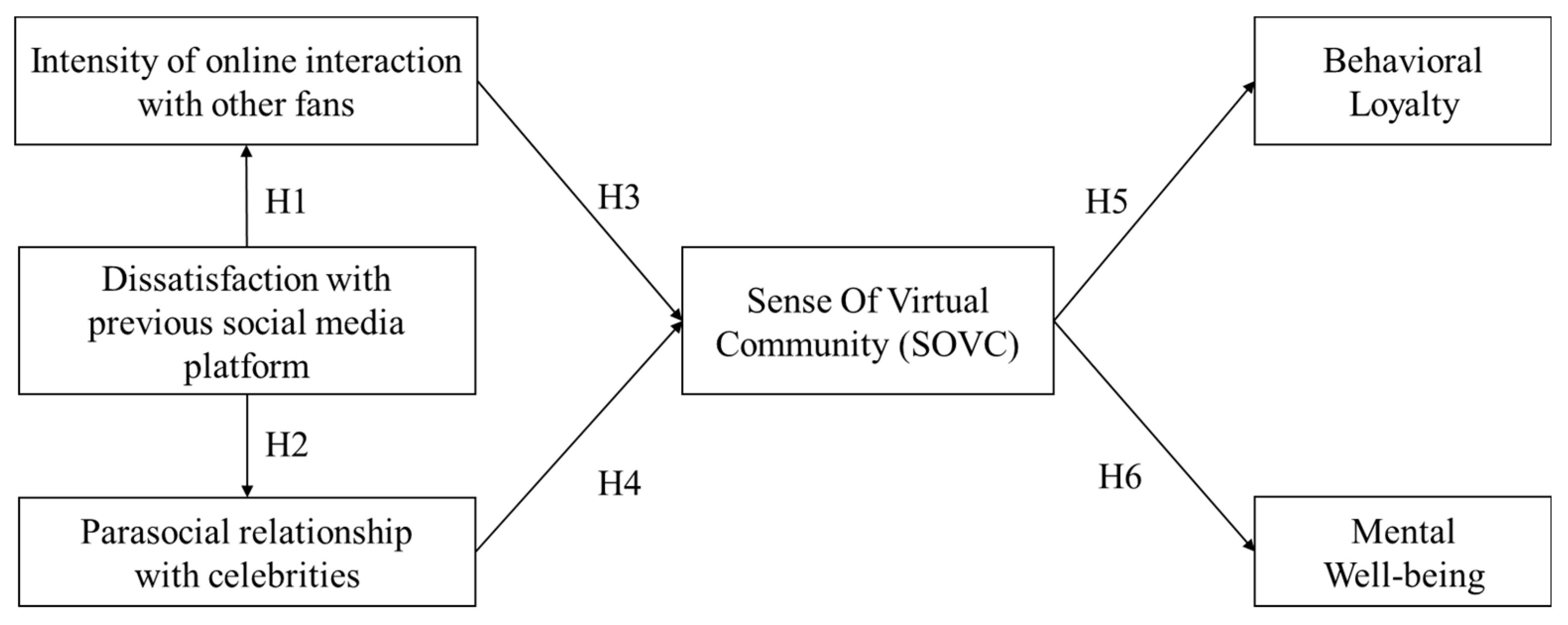

Table 1.
Example of K-pop celebrity’s fandom.
| Fandom | Army | Blinks | NCTzen |
|---|---|---|---|
| Genre | K-pop | K-pop | K-pop |
| Artist | BTS | Black Pink | NCT |
| Year Established | 2013 | 2016 | 2017 |
| Management Agency | HYBE | YG | SM |
| Social Media | Twitter, YouTube, Instagram, Weverse | Twitter, YouTube, Instagram, Weverse | Twitter, YouTube, Instagram, LYSN |
| Official fan community | Weverse | Weverse | LYSN/Bubble |
| Merchandise shop | Weverse shop | Weverse shop | SM Town & Store |
| Members | 14.6 million (Wever) | 2.8 million (Wever) | Unknown |
Table 2.
The example of fan community platforms.
| Fandom | Army | Blinks | NCTzen |
|---|---|---|---|
| Company | HYBE | Dear U (SM) | NC Soft |
| Company Type | Entertainment company | Entertainment company | Video game developer |
| MAU1 | 6.8 million | Differ by each app | 4.4 million |
| Number of Artists | 43 | 249 | 32 |
| Features | Official e-commerce (Weverse shop), Acquisition of V Live2) | Direct celebrity to fan message | Original content (Universe Original), Digital currency (Clap) |
| Communication with artists | Artists’ posts, Comments on artists’ posts | ||
| _ Free users | Story function | Change artist profile | Change artist profile, Separate posts by member |
| _ Subscribed users | Exclusive member content, merchandise, early-bird tickets | Video fan sign Artists’ handwritten letter |
Artists’ private message (one-to-many), AI voice message |
| Communication with other fans | Fans’ posts | ||
| Subscribe to other fans’ accounts | Open chat | Subscribe to other fans’ accounts |
1 MAU: Monthly Active Users.
Table 3.
Participant demographics.
| Measures | Frequency | Percent | |
|---|---|---|---|
| Gender | Male | 28 | 13.9 |
| Female | 174 | 86.1 | |
| Age | 18–24 | 120 | 59.4 |
| 25–30 | 55 | 27.2 | |
| 31–40 | 13 | 6.4 | |
| Over 40 | 14 | 6.9 | |
| Nationality | Korean | 80 | 39.6 |
| Not Korean | 122 | 60.4 | |
| Frequency of Weverse visit |
Everyday | 67 | 33.2 |
| 3–5 times a week | 71 | 35.1 | |
| 1–2 times a week | 58 | 28.7 | |
| I do not visit even once a month | 6 | 3 | |
| Membership Subscription | ARMY Membership (22.00 USD) | 97 | 48 |
| ARMY Membership (160.00 USD) | 31 | 15.3 | |
| No subscription | 74 | 36.6 | |
| Social media used the most for interaction with ARMY | 68 | 33.66 | |
| YouTube | 18 | 8.91 | |
| Weverse | 77 | 38.12 | |
| 33 | 16.34 | ||
| V Live | 6 | 2.97 | |
| Social media used the most for interaction with BTS | 15 | 7.43 | |
| YouTube | 16 | 7.92 | |
| Weverse | 108 | 53.47 | |
| 37 | 18.32 | ||
| V Live | 26 | 12.87 | |
| Total | 202 | 100.0 |
Table 4.
Reliability and validity results.1
| Construct | AVE | CR | Cronbach’s alpha |
|---|---|---|---|
| DIS | .694 | .932 | .912 |
| OI | .697 | .941 | .927 |
| PR | .576 | .871 | .820 |
| SOVC | .532 | .872 | .825 |
| LOY | .636 | .840 | .718 |
| MW | .556 | .918 | .902 |
1 AVE = average variance extracted; CR = composite reliability; DIS = dissatisfaction with previous social media platform; OI = intensity of online interaction with other fans; PR = parasocial relationship with celebrities; SOVC = sense of virtual community; LOY = loyalty on Weverse; MW = mental well-being.
Table 5.
Results of hypothesis testing.1
| Hypothesis | Path | β | t | Result |
|---|---|---|---|---|
| H1 | DIS → OI | .530*** | 10.544 | Supported |
| H2 | DIS → PR | -.065 | .893 | Rejected |
| H3 | OI → SOVC | .540*** | 8.003 | Supported |
| H4 | PR → SOVC | .391*** | 6.326 | Supported |
| H5 | SOVC → LOY | .520*** | 9.737 | Supported |
| H6 | SOVC → MW | .227*** | 4.271 | Supported |
1 Abbreviations are same as in Table 4. ***p<.001.
Disclaimer/Publisher’s Note: The statements, opinions and data contained in all publications are solely those of the individual author(s) and contributor(s) and not of MDPI and/or the editor(s). MDPI and/or the editor(s) disclaim responsibility for any injury to people or property resulting from any ideas, methods, instructions or products referred to in the content. |
© 2023 by the authors. Licensee MDPI, Basel, Switzerland. This article is an open access article distributed under the terms and conditions of the Creative Commons Attribution (CC BY) license (http://creativecommons.org/licenses/by/4.0/).
Copyright: This open access article is published under a Creative Commons CC BY 4.0 license, which permit the free download, distribution, and reuse, provided that the author and preprint are cited in any reuse.


